The Thanksgiving tablescape set around the food
Most Thanksgiving tablescapes are styled for a table with no food on it. Then the turkey arrives, the centerpiece goes on the floor and the gravy has nowhere to land. This one starts from the plate: how much table the meal needs, how tall the flowers can be before they hide a face, how to run the sideboard, and how to keep it all hot until everyone sits.
The photos on this page are AI-generated illustrations.
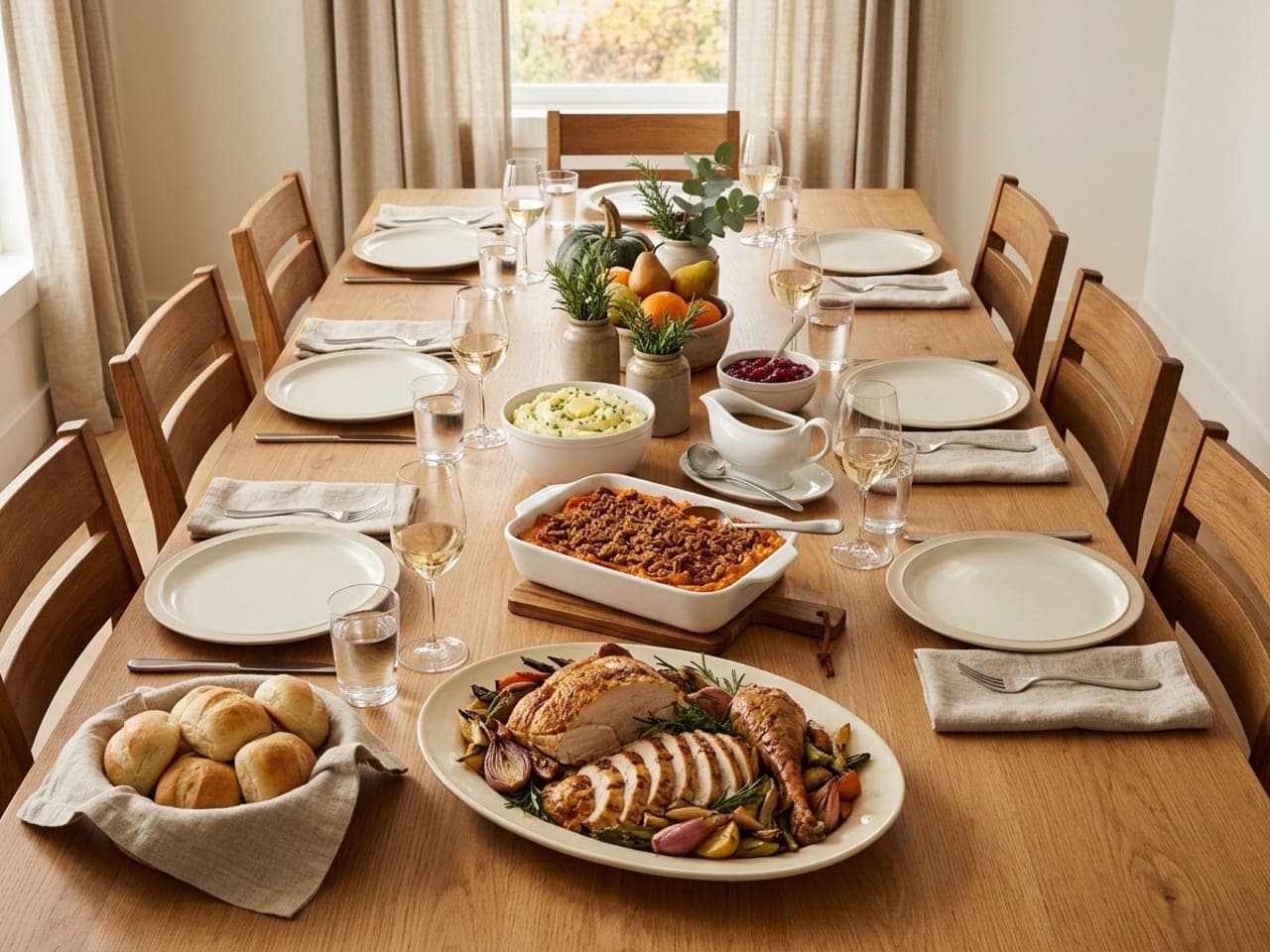
A good Thanksgiving tablescape is designed around the meal it has to hold. Give each guest 24 inches (61 cm) of table edge, keep a strip of about 14 to 16 inches (36 to 41 cm) clear down the middle for the platters, and keep the centerpiece under 12 inches (30 cm) so everyone can see across it. Then decorate what is left: quiet linen, pale plates and produce you will cook on Friday, because the food already brings the orange.
Below, the numbers behind each choice: a palette built around the food, the centerpiece height rule with our own eye-height arithmetic, runner and tablecloth sizes, and the Thanksgiving table setting in formal and casual versions. After that come candle and gourd safety, serving from the table or the sideboard, the kids’ table and a small-space version.
Then the food: make-ahead cards for the site’s harvest recipes and a Thanksgiving-day timeline that shows how to set a Thanksgiving table and cook the meal on one clock, from the turkey going into the fridge on Saturday to the leftovers on Monday, with US and UK food-safety rules kept separate.
Plan the Thanksgiving table around the food
Before the linen and the candles, work out how much table the meal needs. These are the numbers that decide everything below.
- 24 inches (61 cm) per guestThat is the furniture trade’s standard length of table edge per diner; 28 to 30 inches (71 to 76 cm) is comfortable, and under about 21 inches (53 cm) elbows touch. A 72 inch (183 cm) table seats 6, or 8 with someone at each end; a 96 inch (244 cm) table seats 8, or 10.
- 36 inches (91 cm) behind the chairsThat is the clearance from the table edge to a wall or sideboard that lets someone walk behind seated guests; 48 inches (122 cm) is comfortable. If the sideboard is closer than that, people cannot reach it once everyone sits, so plan to serve before they sit.
- Keep a strip down the middleLeave about 14 to 16 inches (36 to 41 cm) down the center of the table for platters, and build the centerpiece so it can be split and moved aside when they arrive.
- Choose the service firstOur rule of thumb: up to 8 guests at a wide table, serve family style with platters passed at the table; 9 to 20, serve from a sideboard and keep only bread, gravy and condiments on the table; above about 20, run a buffet from both sides of its own table. The service decides how big the centerpiece can be.
- Condiments by the headcountThe Emily Post Institute suggests salt and pepper for every two or three guests and two butter dishes for every four, so nobody waits for them to come round.
- Dry-run it the day beforeSet out the empty serving dishes, trivets and spoons exactly where the food will go, then decorate around them. It is the one step that tells you whether the table works.
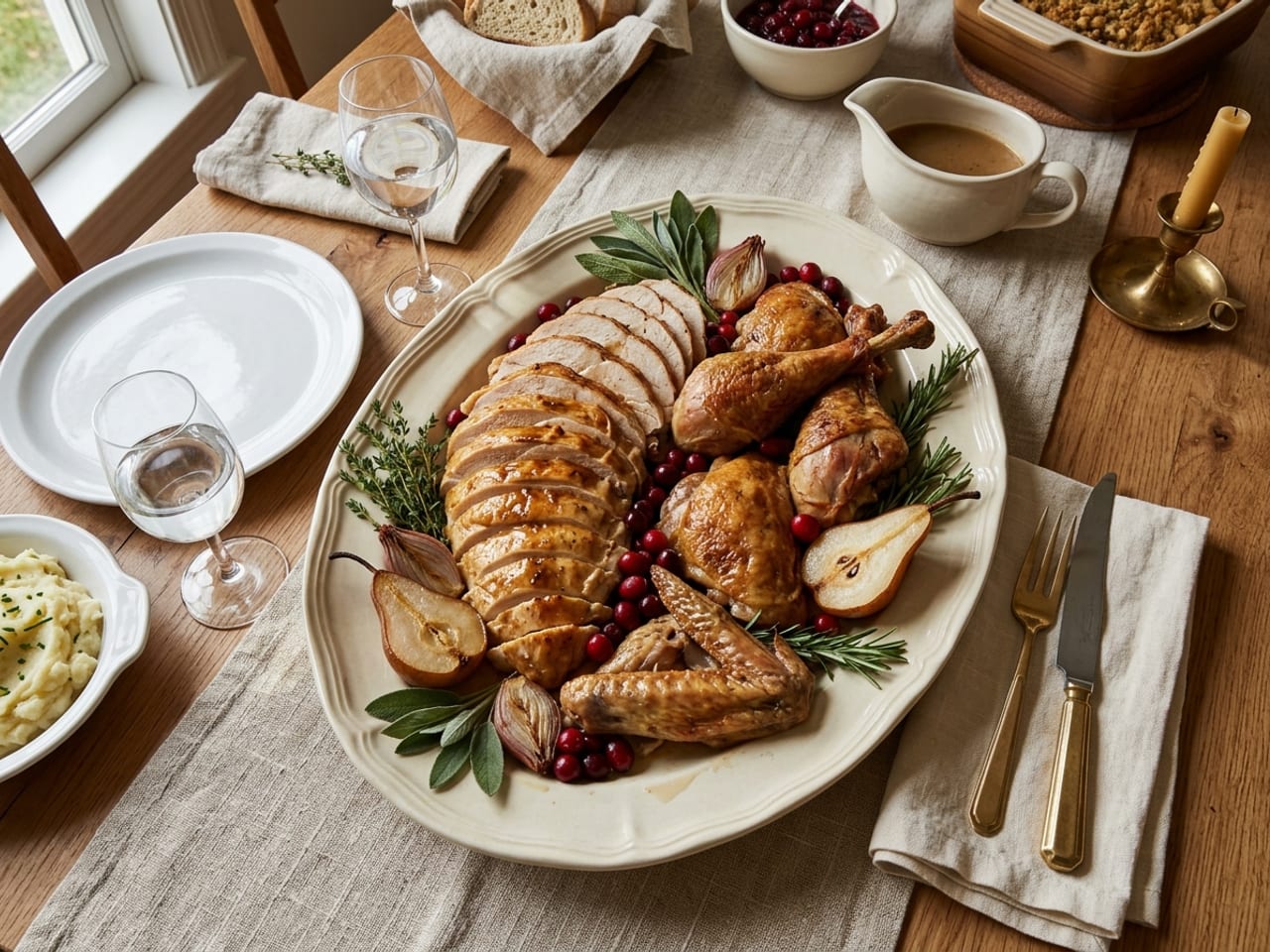
- The turkey is the centerpiece, brieflyCarving in the kitchen and bringing a composed platter is easier and looks better than carving at the table: breast sliced and fanned, legs whole, a few herbs. For that half hour, the centerpiece steps aside. Our plating guide has the same idea dish by dish, and how to carve a turkey has the cuts in order.
Thanksgiving table colors: let the food bring the orange
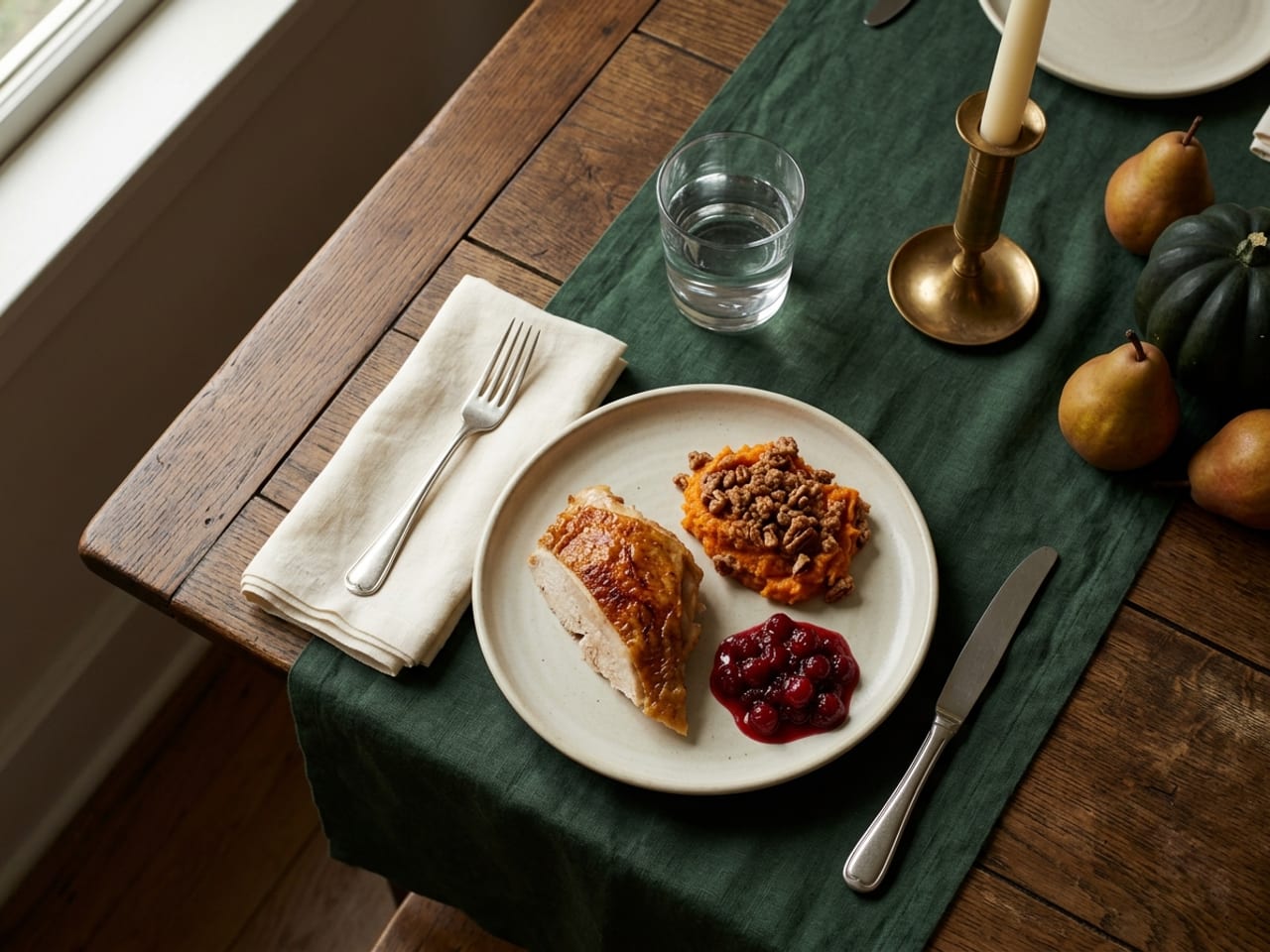
The meal is already orange, brown, gold and cranberry red. Set it on something quieter and it reads warmer; set it on more orange and it disappears. Keep to three or four colors plus neutrals, and keep the dinner plates pale: our color guide has the evidence, and the plate color pairing tool matches a plate to a dish. Four palettes that work:
| Palette | Cloth and runner | Plates | Accents | Why it works |
|---|---|---|---|---|
| Cream, bone and brass | Cream or oatmeal linen | White or bone | Brass candlesticks, clear glass | The safest frame: the food supplies every warm color. |
| Forest green or charcoal | A dark runner on a bare wood table | Pale cream stoneware | Brass, ivory candles | Dark around, pale under: orange looks hotter against green. |
| Terracotta, clay and oatmeal | Oatmeal linen, clay napkins | Pale, never terracotta | Wood, dried grasses (with flameless candles) | Warm on warm, so the plate has to stay light. |
| White linen and clear glass | White cloth | White | Glass vessels, green branches, herbs | Clean and easy to borrow; the green comes from herbs. |
How tall should a Thanksgiving centerpiece be?
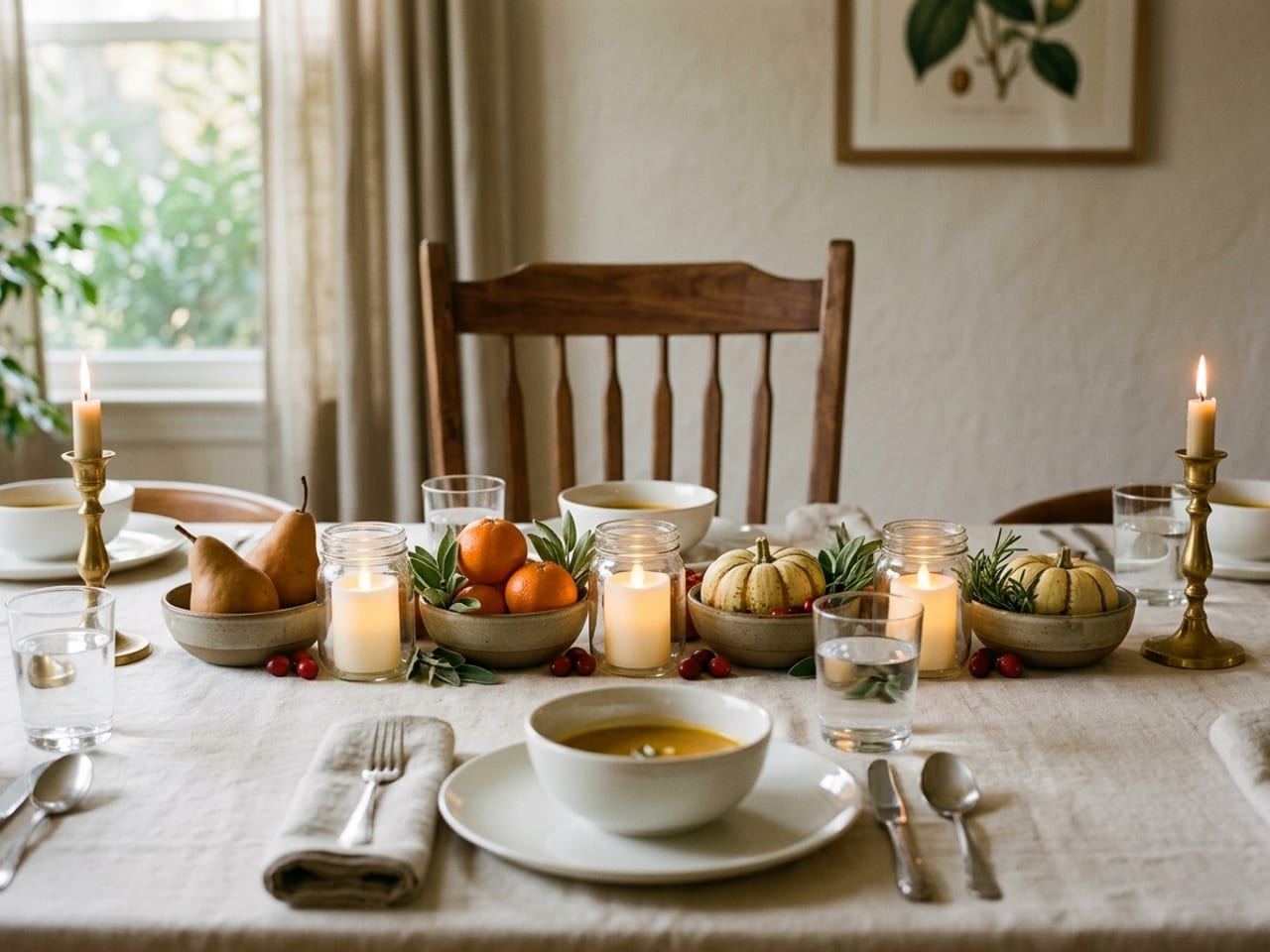
Under 12 inches (30 cm), or on a slim stem that opens out above 24 inches (61 cm). That is the usual rule among florists and event planners (Adorno Design sets the tall option at 30 inches (76 cm) instead), and our own arithmetic from seated eye heights, below, shows why it works.
- Our arithmetic: why the two numbers workThis is our own reasoning, not the florists’: they give the rule without it. In US Army body-measurement data (ANSUR II), seated eye height above the seat runs from about 27.5 inches (70 cm) for a 5th-percentile woman to 33.9 inches (86 cm) for a 95th-percentile man, and a dining tabletop sits about 10 to 12 inches (25 to 30 cm) above the seat. Our arithmetic from those two: seated adults’ eyes sit about 15½ to 24 inches (39 to 61 cm) above the tabletop. Anything under 12 inches (30 cm) stays below the lowest eyes; anything that has to be tall must clear 24 inches (61 cm) before it gets bushy. The band in between is where faces go.
- The elbow testEvent designer Bronson van Wyck’s at-home check, in Elle Decor: put your elbow on the table and bend at the wrist; the tallest flower should not pass your hand.
- Lower at the kids’ endChildren’s eyes sit lower, so we keep anything near them under about 8 inches (20 cm). That one is our own rule of thumb, not a published number.
- Long, low and liftableThree or five small vessels down the spine of the table rather than one big arrangement: each lifts with one hand and moves aside when the platters arrive.
- Decorate with Friday’s ingredientsPears, clementines, pomegranates, nuts in the shell, bunches of sage and rosemary, and pie pumpkins or winter squash bought as food. They cost what they would anyway and go into the leftovers week. Wash them before cooking, and read the gourd rule first. Leave the nuts out of the centerpiece if a guest has a nut allergy, and keep them off the kids’ end.
Runner, tablecloth and napkins, measured
A runner does for the table what a rim does for a plate: it frames the middle and leaves the edge quiet (the types of plates guide explains rim against coupe). Sizes from Living Spaces’ tablecloth chart where it gives one, and our own rule of thumb where it does not:
| Piece | Size | Note |
|---|---|---|
| Runner width | About a third of the table’s width (Living Spaces), so 12 to 14 inches (30 to 36 cm) on an ordinary dining table | Narrow enough to sit inside the platter strip, so platters land on it, not half on it |
| Runner length | Table length plus 12 to 24 inches (30 to 61 cm): our rule of thumb | A 72 inch (183 cm) table takes a 90 inch (229 cm) runner, 9 inches (23 cm) over each end; Living Spaces leaves the overhang to taste, shorter for casual, longer for formal |
| Tablecloth drop, everyday | About 9 inches (23 cm); 6 to 10 inches (15 to 25 cm) for a casual meal | Living Spaces’ recommendation; the longer the drop, the more formal the table |
| Tablecloth drop, formal | To the floor: the table’s height, usually 28 to 30 inches (71 to 76 cm) | The formal look (Living Spaces); we keep it for a buffet or dessert table nobody sits at, since a long cloth gets in seated guests’ way |
| Silencer | Felt, or an ironed fleece blanket | Goes under the cloth; protects the table and deadens the clatter (Emily Post) |
| Napkins | Cloth, patterned if you can | Patterns hide gravy; cloth napkins change a table more per dollar than anything else |
How to set a Thanksgiving table: formal and casual
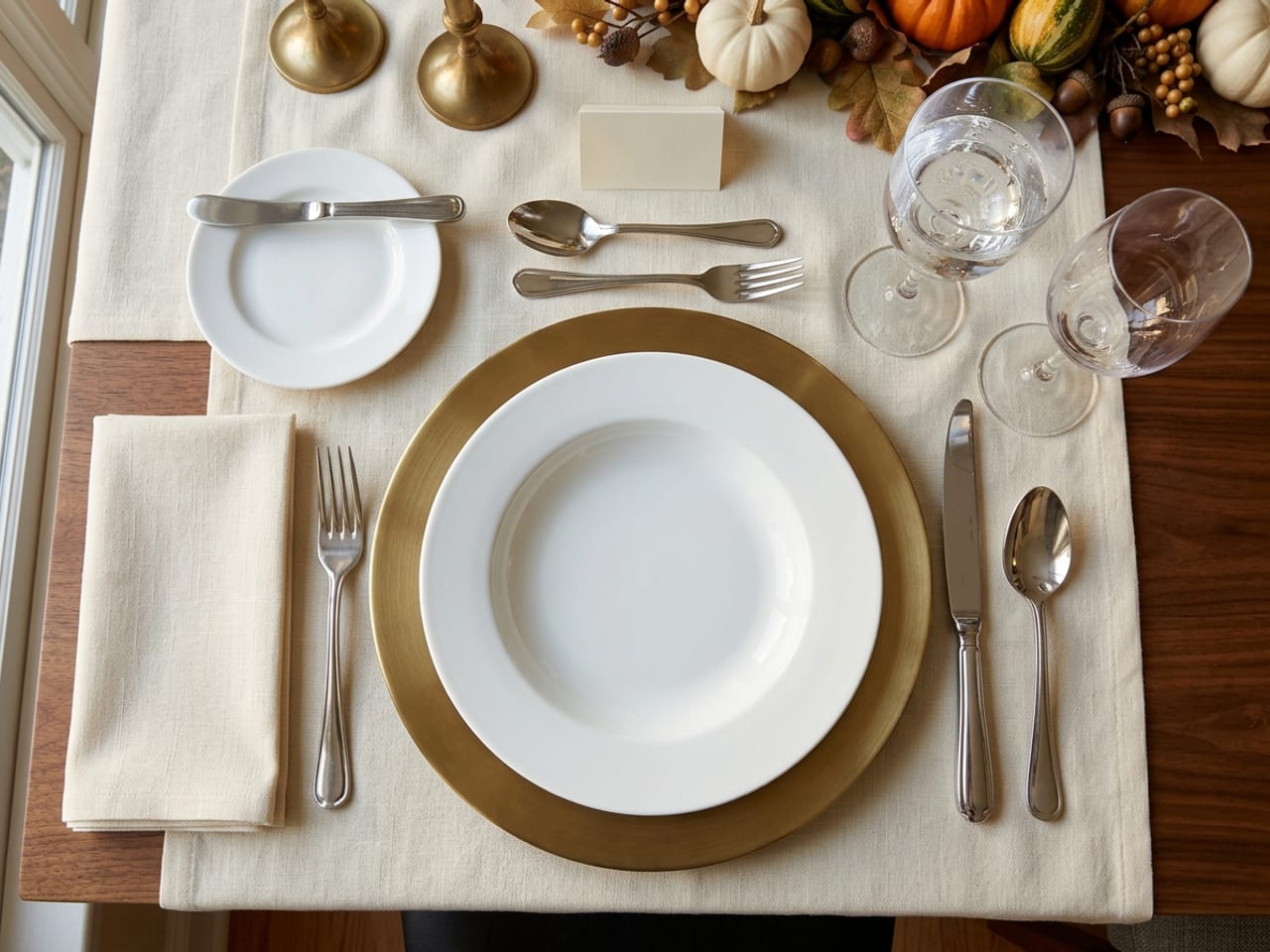
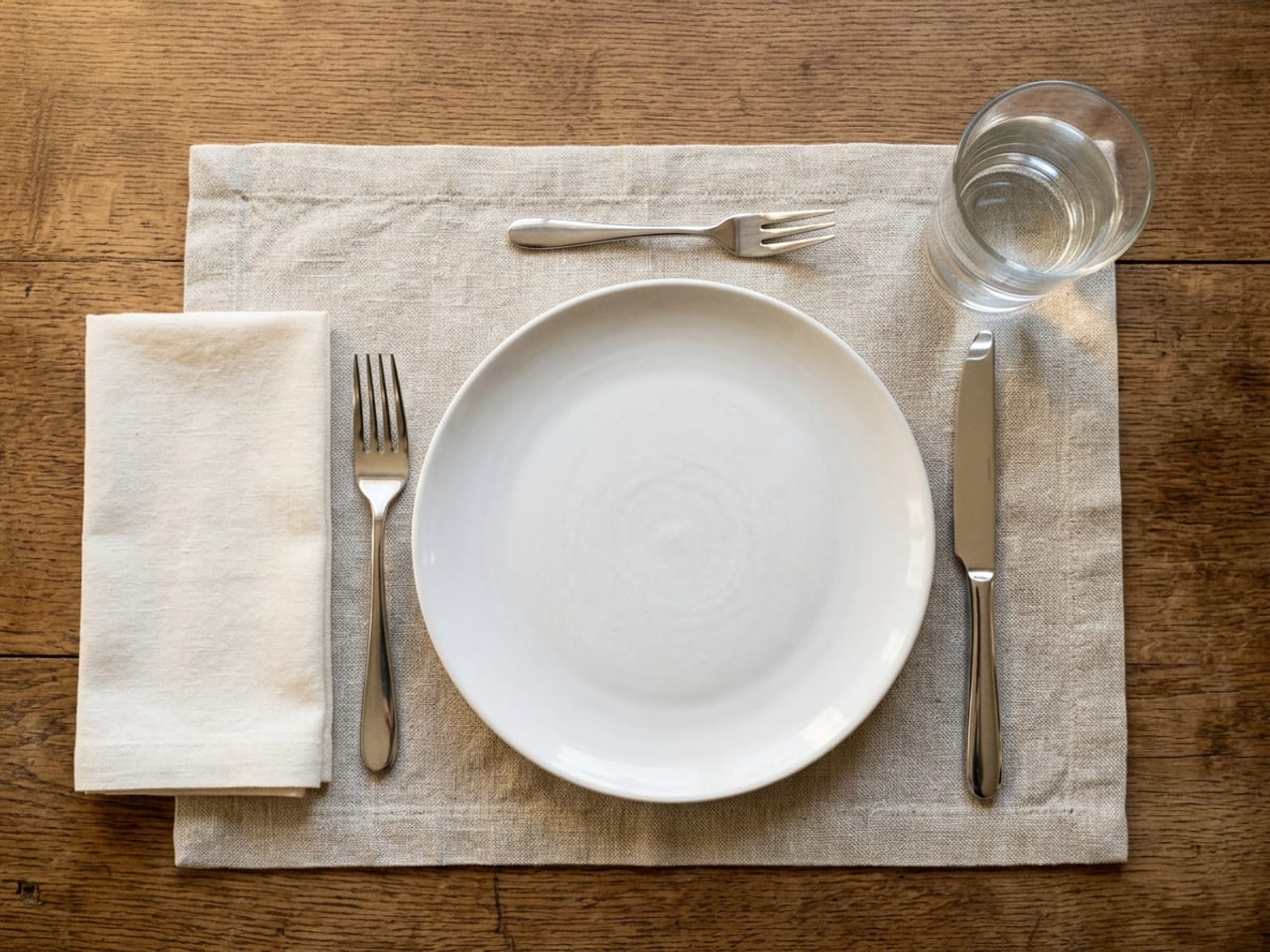
A Thanksgiving table setting follows the Emily Post Institute’s rules: set only what the meal needs, forks left, knives right with the blade toward the plate, cutlery used from the outside in. The formal version assumes three courses (soup, the main, pie) and follows the Institute’s order for the charger; our types of plates guide also covers the catering order. The casual one is our own simple setting for the main and pie. The reason behind each rule is in our guide to how to set a table.
| Where | Formal: soup, main, pie | Casual (ours): main and pie |
|---|---|---|
| Center | A charger, usually 13 inches (33 cm), with the soup plate on it; both leave together after the soup and the warm dinner plate takes their place | The dinner plate, on a placemat if you like |
| Left | The napkin, beside the forks rather than under them, unless space is tight; then the dinner fork (a salad fork too if there is a salad course, closest to the plate if the salad comes after the main) | Napkin, then one dinner fork |
| Right | Dinner knife, blade in; the soup spoon to its right | Dinner knife, blade in |
| Upper left | Bread plate with the butter knife across it, roughly in line with the glasses | None: rolls go on the dinner plate |
| Above the plate | Dessert spoon on top, handle pointing right; dessert fork below it, handle pointing left | A dessert fork, handle pointing left, or bring it with the pie |
| Upper right | Water glass above the knife tip, or a little to its right; wine slightly to its right and a little lower | Water glass; add a wine glass to its right if you are serving wine |
| Name card | Centered above the dessert cutlery (our styling) | Optional |
Do you need charger plates for Thanksgiving?
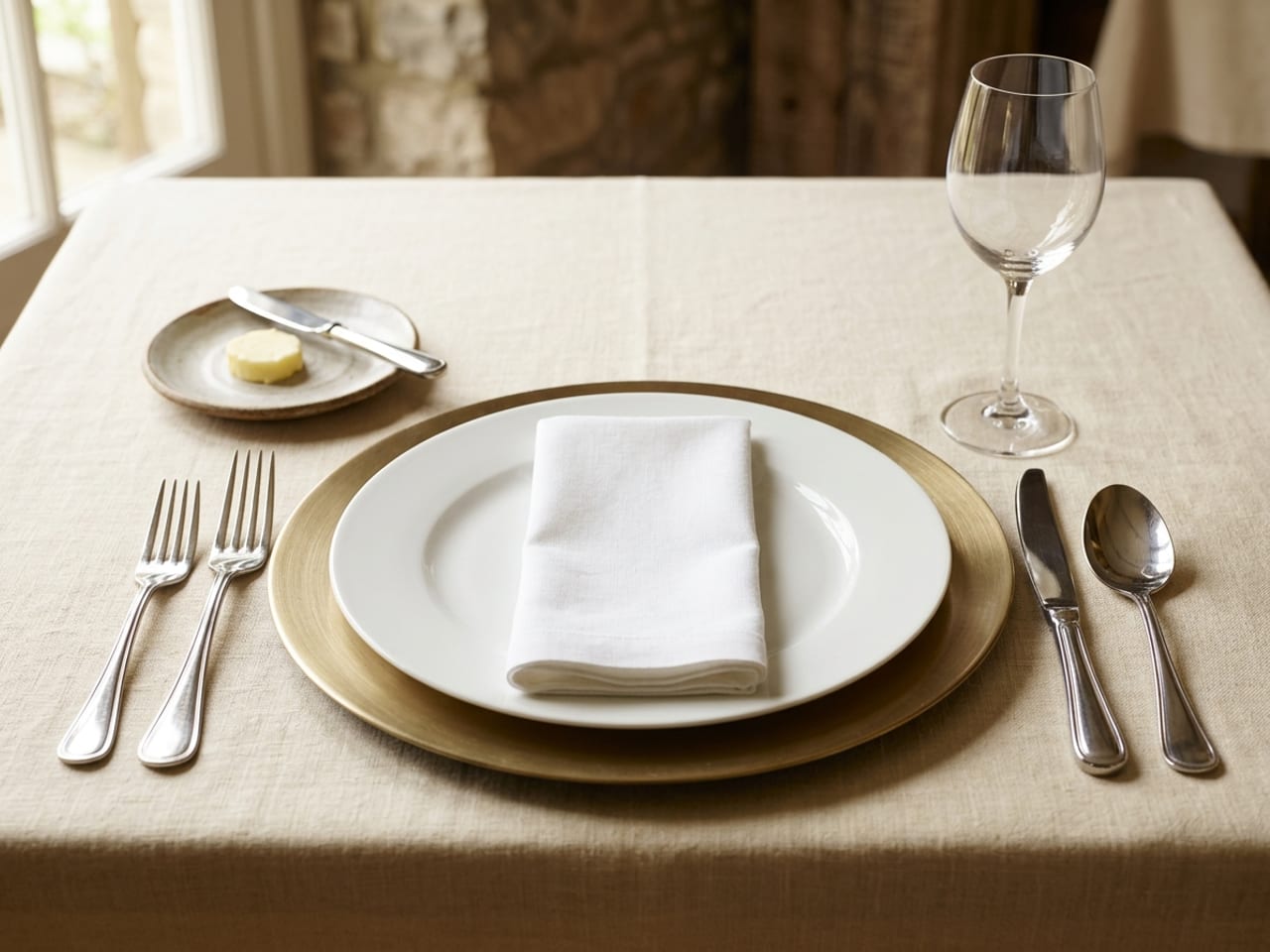
No. A charger is an optional underplate that holds the center of the setting until the main course and is removed before it is served (Emily Post); catering crews often clear it after the main instead, with the dinner plate on top, and both orders are in use. Never eat off a decorative one: many metal, glass, acrylic, rattan and painted chargers are not food-safe (types of plates).
Use them when the main course is plated in the kitchen or served from a sideboard, where the table has room to spare. At a family-style table they take width the platters need, so either clear them with the first course or leave them in the cupboard. At the kids’ table, a cheap plastic charger or a placemat earns its place by catching spills.
Name cards and who sits where
Worth it from about 8 guests, when seating stops sorting itself out. Write them on something from the table rather than something bought for it.
- Leaf, fruit or tagA large magnolia leaf written on with a metallic pen, a card tucked into a clementine or a mini pumpkin, a paper tag tied to an apple stem at the kids’ end.
- Seat the carver by the exitWhoever carves or refills sits nearest the kitchen or the sideboard, so they are not climbing past chairs all evening.
- Put the gravy mid-tableGravy and bread travel most. Put them, and the guest you trust to keep them moving, in the middle of each long side.
- Think about allergies when seatingSeat a guest with a nut allergy away from the pie end, and next to where the dish they can eat starts its pass.
Thanksgiving candles and gourds: two safety rules
Both are about the tablescape itself, and both are easy to get wrong because they look harmless.
- A foot (30 cm) of clearanceThe NFPA’s rule is to keep candles at least 1 foot (30 cm) from anything that can burn, and it notes that over half of candle fires start when things that can burn are too close. Dried wheat, leaves, corn husks, grasses and paper runners all burn.
- Flameless among anything driedUse LED candles inside dried arrangements. Keep real flames in glass hurricanes, or on tapers in heavy, wide-based holders that will not tip, where candlestick and taper together top 24 inches (61 cm) so the flame sits above the sightline, and set them where nobody reaches across (hair and sleeves are the risk).
- Nowhere near a passed platterA sleeve reaching across a flame is the realistic accident at a family-style table. Keep candles off the line platters travel along, in sturdy holders, never leave children alone with a lit one, and blow them all out when you leave the room (NFPA).
- Unscented, and lit lateScent competes with the food. Light the candles about 15 minutes before everyone sits.
- Ornamental gourds are not foodDecorative gourds carry cucurbitacins, bitter compounds that cause vomiting, diarrhea and stomach pain, and cooking does not destroy them (US Poison Control; France’s food-safety agency, Anses). If you plan to eat the centerpiece on Friday, buy pie pumpkins and squash as food, from the produce section, check the label says they are for eating (Anses warns that ornamental ones sometimes turn up there), and keep them apart from decorative gourds. Any squash that tastes bitter: spit it out and throw it away.
- Thanksgiving is the peak day for kitchen firesThe NFPA counted an estimated 1,139 home cooking fires on Thanksgiving Day 2024, 321 percent of the daily average. Stay in the kitchen while anything is on the stovetop, keep a lid nearby to smother a pan fire, and keep the table candles few: one less open flame on a busy day.
Serve it: family style, buffet and the sideboard
The service style you picked at the start decides this section. The one rule that holds for all three: hot food stays hot, at 140°F (60°C) or above (USDA; the UK Food Standards Agency’s line is 145°F (63°C)), or it goes back in the fridge within 2 hours.
- Family style: pass to the rightPlatters go round counterclockwise, to the right, which is the Emily Post Institute’s convention; what matters most is that every dish goes the same way. Trivets go where the dry run put them, and the gravy boat sits on a saucer.
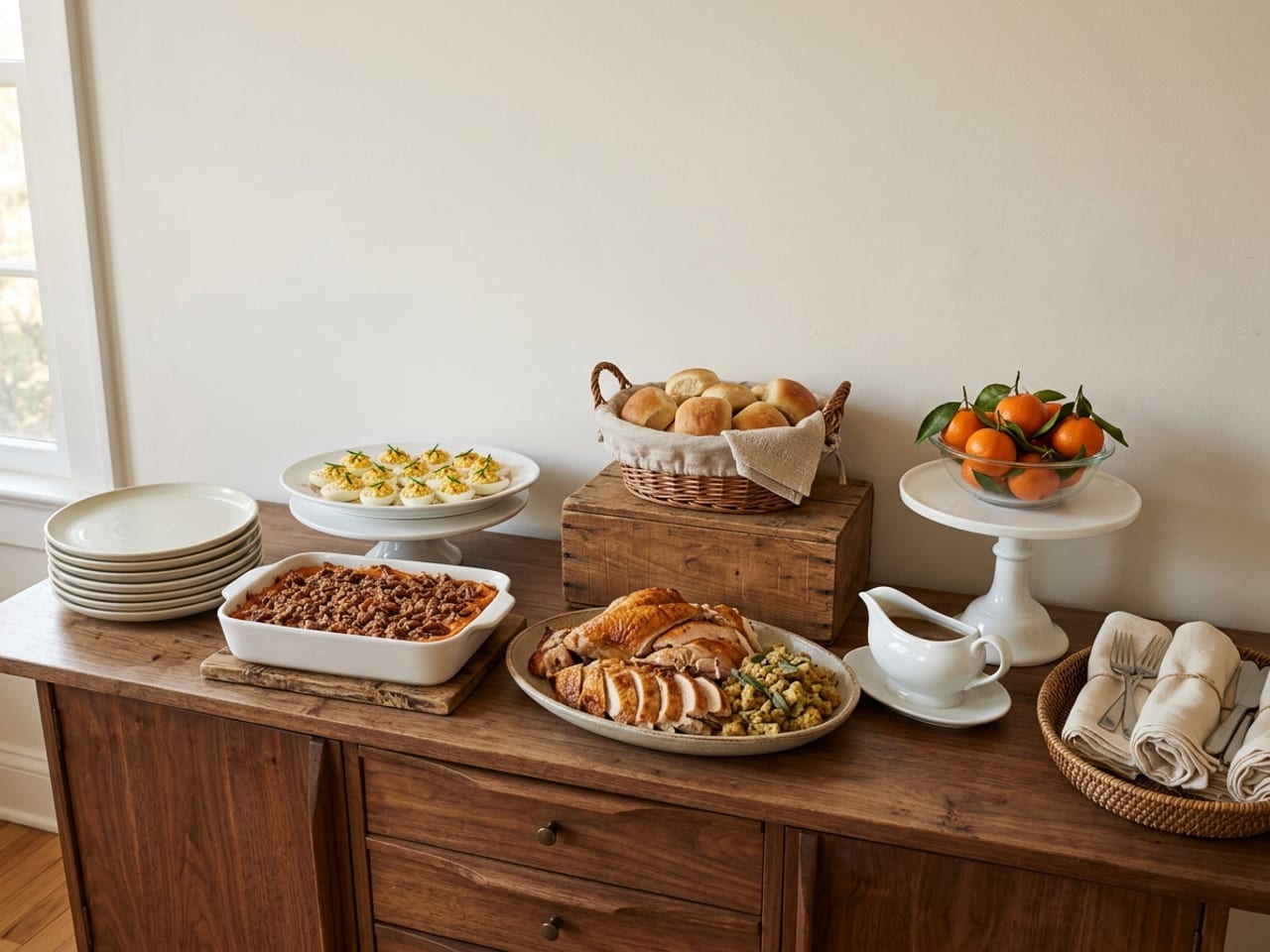
- Buffet orderPlates first; then cold things (deviled eggs, cranberry sauce, salad); then the casserole and other hot sides; then the carved turkey with the gravy right beside it, not at the end of the line; then rolls and butter; cutlery rolled in napkins last, so nobody juggles a fork down the line. Drinks go on a separate table away from the food. Pies wait for their own table after dinner.
- Sideboard heights: the opposite of the tableHeight is fine on a sideboard because nobody talks across it. Tallest at the back against the wall, stepping down to the front: the table surface, a middle tier of 6 to 9 inches (15 to 23 cm) and a top tier of 12 to 18 inches (30 to 46 cm), from a riser seller’s guide. Upturned bowls or a wooden crate under a cloth, cake stands and books under the runner all work.
- Hot, heavy and liquid stay lowOur safety rule for the sideboard: the turkey platter, the casseroles, the gravy and anything in a slow cooker or chafing dish sit low and at the front. Height goes to light, cold, stable things: rolls in a basket, the deviled eggs on a low stand, a bowl of clementines. Nobody reaches over a hot dish to get a tall one. Run every cord to the back of the sideboard, not over the front edge, and with children about, prefer electric warmers to a flame.
- Check the warmersChafing dishes, slow cookers and warming trays must hold 140°F (60°C) or above (USDA); the FDA warns that some only reach 110 to 120°F (43 to 49°C), so check with a thermometer. Keep back-ups in a 200 to 250°F (93 to 121°C) oven and swap in a fresh dish rather than topping up one that has been out. A slow cooker holds food that goes in hot; don’t reheat cold food in one. With canned chafing fuel, set the can in its holder before lighting it with a long lighter, never move a lit chafing dish or light one can from another, put it out with the snuffer or lid, and let a can cool before swapping it. Keep napkins, paper and decorations well clear (fire-marshal guidance from the University of Maryland and UC Berkeley), and any flame out of children’s reach.
- The cooler trick, honestlyA cooler preheated with hot water, the hottest dishes at the bottom and towels in the gaps keeps sides warm for the drive or the wait. It is a way to slow the cooling, not a holding temperature, so the 2-hour clock still runs.
- Plated serviceWarm the plates, plate in the kitchen, and bring each one out composed. The Plating 101 guide covers the six moves that make a plate look finished.
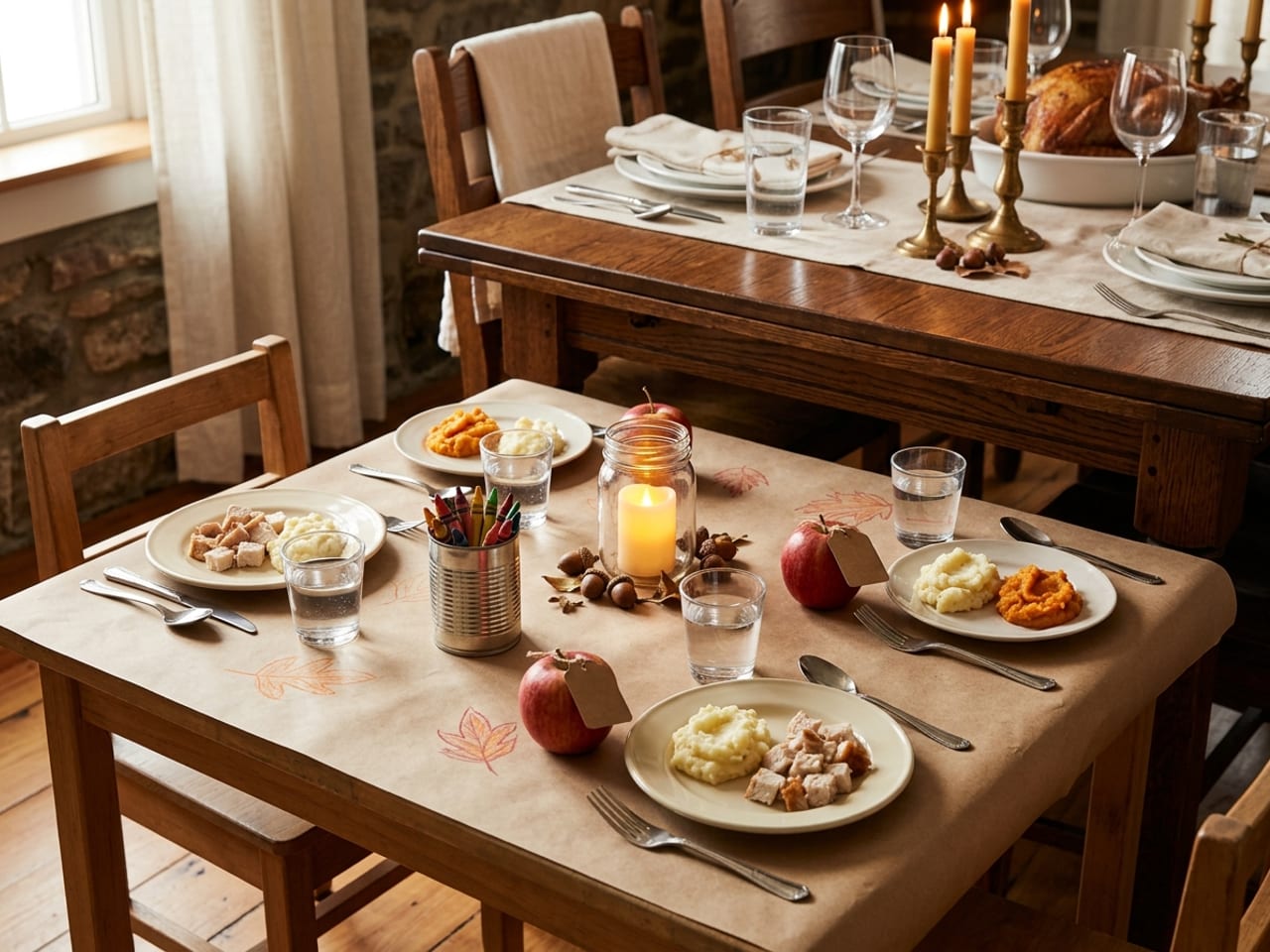
A Thanksgiving kids’ table that works
Opinions on the kids’ table split. If you have one, make it part of the room, not a banishment.
- Butt it against the adult tableSet it at the end of the main table, so the children are in view and the table reads as one long run (Taste of Home’s suggestion).
- Paper, crayons, unbreakablesKraft or drawing paper as the cloth with crayons in a jar, a mug or a tin with a smooth rim, salad plates as dinner plates, unbreakable cups, and a placemat or plastic charger to catch spills.
- Flameless onlyNFPA’s rule is never to leave children alone with a lit candle, and an LED candle in a jar gives the same glow. Choose one whose battery door is screwed shut, and keep the remote and any spare coin batteries out of reach: the CPSC warns that a swallowed coin battery can cause serious injuries, internal chemical burns and death.
- Cut for under-4sThe AAP and CDC choking lists include whole grapes, nuts (whole or chopped), popcorn, hard candy, raw apple and chunks of meat or cheese; UK guidance keeps whole nuts from children under 5. On a Thanksgiving table that means turkey in pieces no bigger than ½ inch (1 cm), grapes quartered lengthwise, no nuts for the little ones (serve them the casserole without streusel and skip the pecan pie), and the nut bowl at the adults’ end.
- Label the allergensThe pecan pie and a streusel topping contain tree nuts. The US has 9 major allergens; the UK has 14: it adds celery, mustard, molluscs, sulphites and lupin, and widens wheat to all cereals containing gluten. A small card by each dish settles it.
- A take-home place cardAn apple with a paper tag, or a clementine with a name on it: the place card is also a snack for the way home (slice the apple for under-4s).
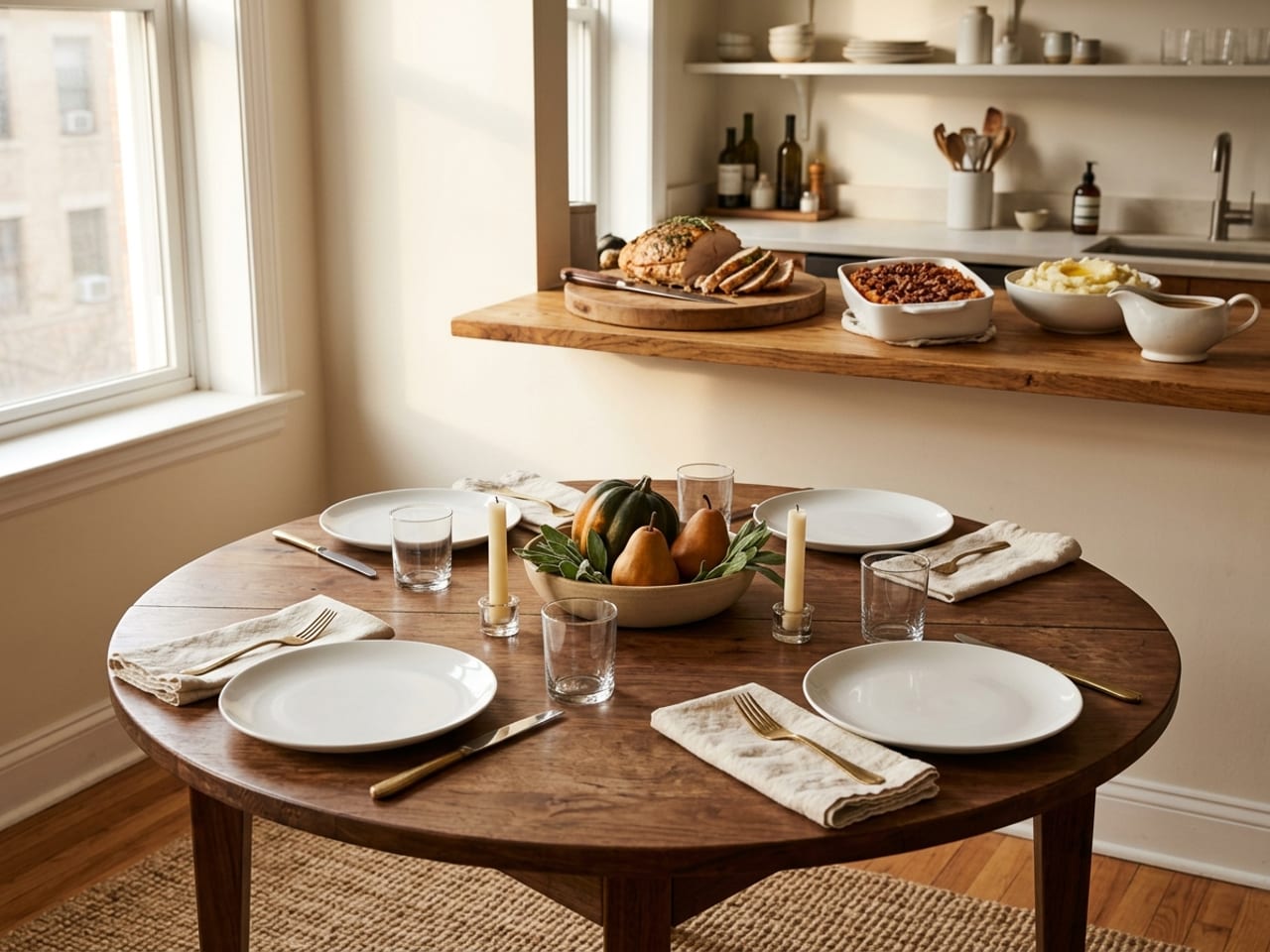
A Thanksgiving table for a small apartment
The same rules, applied harder: seat by the numbers, take the food off the table, and shrink the bird.
- Round seats moreA 48 inch (122 cm) round table seats 4 to 5, a 60 inch (152 cm) round seats 6, and everyone can see everyone. A bench fits more people per inch than chairs: about 20 to 22 inches (51 to 56 cm) each.
- The counter is the buffetServe from the kitchen counter or plate in the kitchen. The table keeps water, bread, gravy and one low centerpiece.
- Skip the extrasNo chargers and no bread plates. One repeated element, the same napkin at every seat, ties mismatched plates together.
- A smaller birdOur turkey breast serves 4; the turkey calculator sizes a breast from 4 to 8 lb (1.8 to 3.6 kg). Bake casseroles and pies in half-size dishes.
Recipes from the site’s harvest menu, each with its own make-ahead window. Every card lists its allergens, and the timeline puts them all on one calendar.
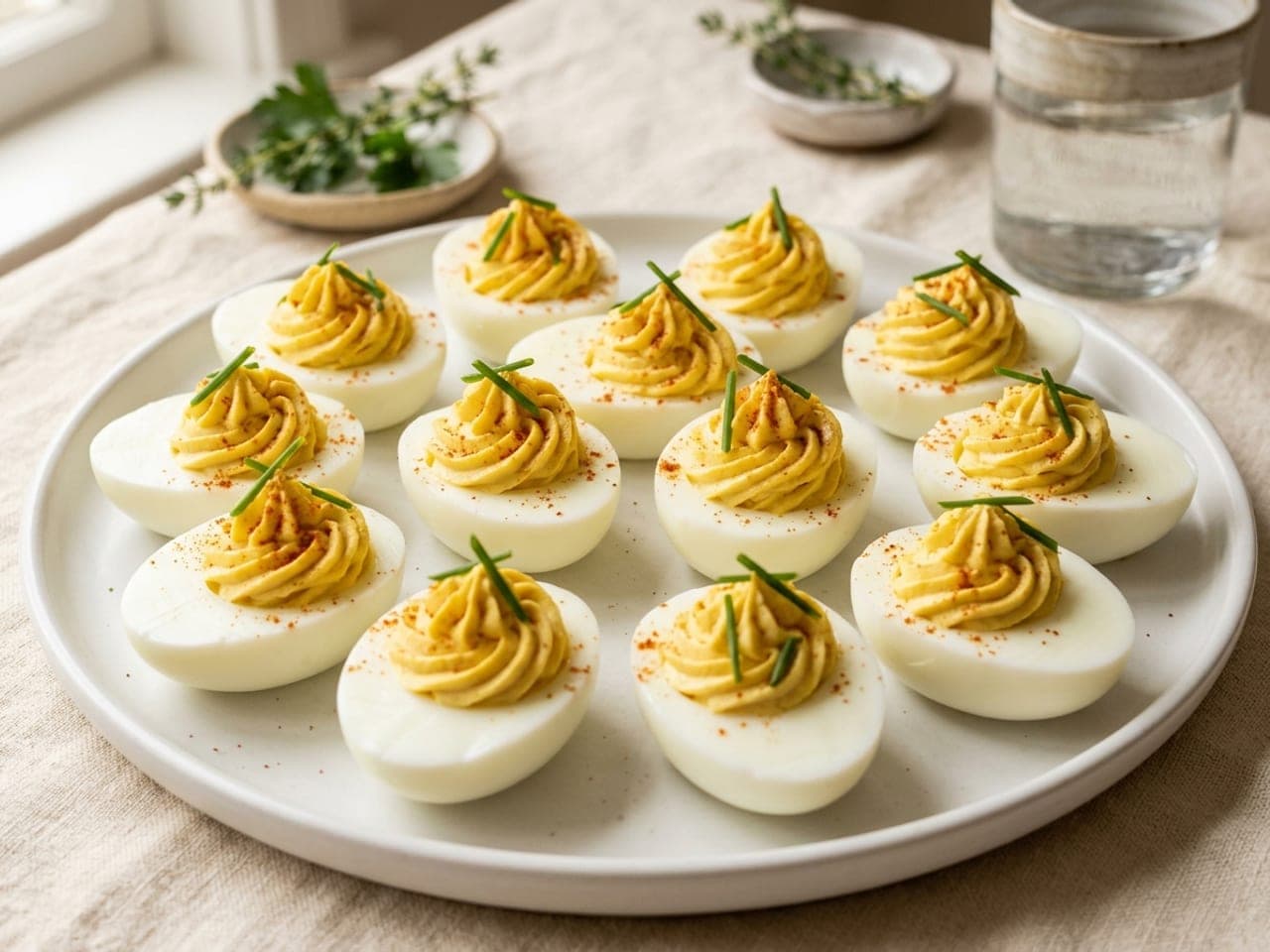
Deviled eggs
The one appetizer that comes out with the guests and holds the room until the turkey is carved. Make ahead: under US guidance, cook the eggs up to a week ahead and keep them in their shells; up to 2 days ahead (a quality limit), peel and halve them and make the filling, kept in a sealed piping bag; pipe and garnish within a few hours of serving. Out for 2 hours at most, 1 hour above 90°F (32°C). Leftovers: in the US, 3 to 4 days, and never past a week from the day the eggs were boiled; UK guidance gives a hard-boiled egg 2 days in all, counted from boiling, so in the UK boil them no more than two days before dinner and plan on no leftovers. Do not freeze them. Allergens: egg; mustard and usually sulphites (both on the UK list). Gluten-free only with a gluten-free mustard: UK English mustard such as Colman’s contains wheat flour.
The twist: Serve them on a low cake stand on the middle tier of the sideboard. They are cold and light, so they can take the height, and nobody has to reach over a hot dish to get one.
Full recipe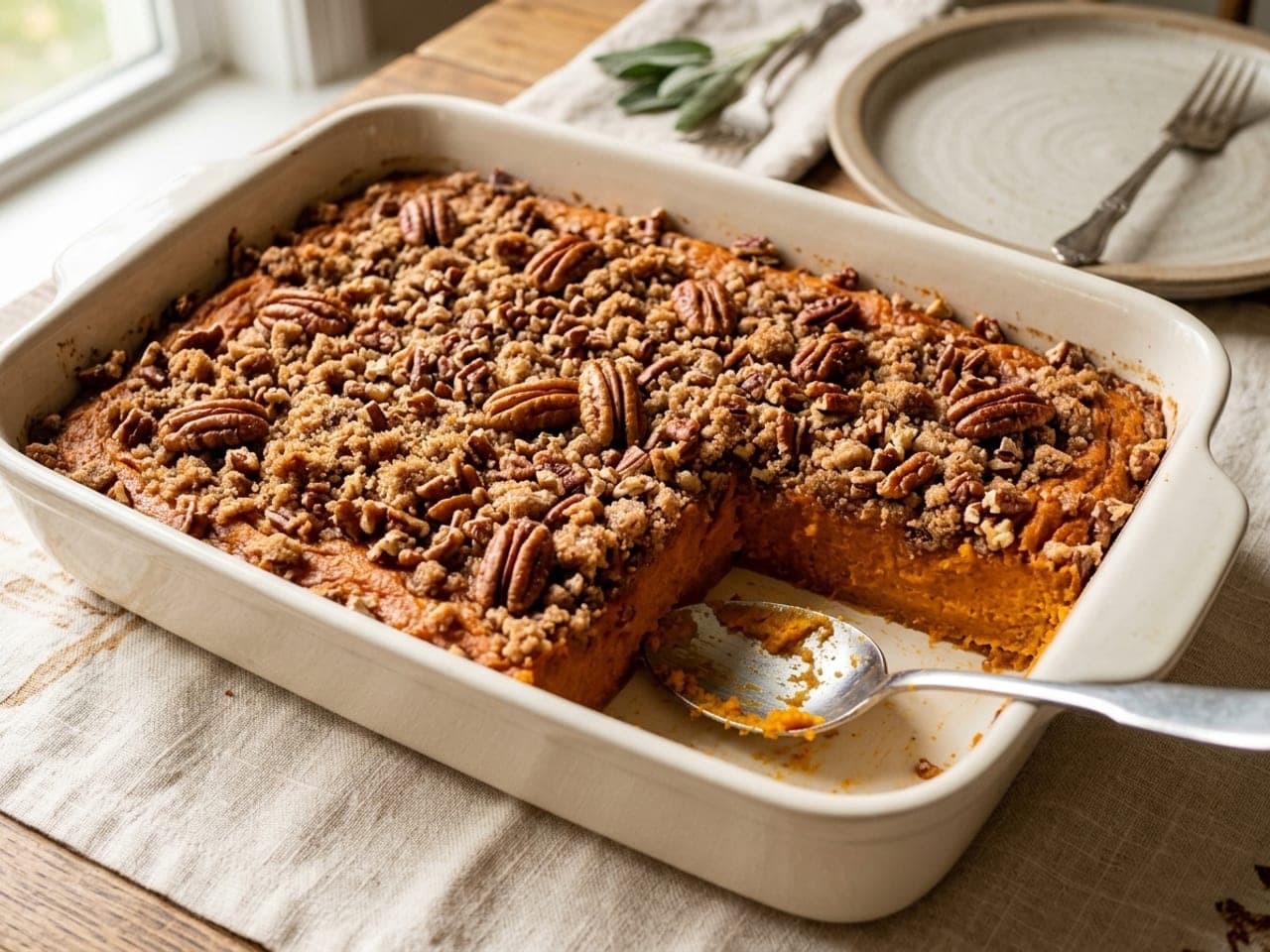
Sweet potato casserole
The orange on the table, supplied by the food. Make ahead: the streusel up to a week ahead, in the fridge; roast and mash the potatoes with the butter only up to 2 days ahead; beat in the eggs, milk and seasoning on the day (or finish the whole filling up to 1 day ahead, covered and cold). The topping goes on only as the dish goes in: 350°F (175°C) until the center reads 165°F (74°C), allowing 15 to 20 minutes more from cold. Leftovers count from the day you roasted the potatoes, not the day you bake: 3 to 4 days in the US; 48 hours in the UK, reheated only once, so a mash roasted on Tuesday leaves no UK leftovers after Thursday’s dinner. Allergens: egg and milk; the streusel adds pecans (tree nuts) and wheat, and standard marshmallows contain gelatin, so the marshmallow version is not vegetarian.
The twist: Bake it in the dish it will be served from and give it the trivet you placed during the dry run. Wipe the rim before it goes in the oven: a clean edge is the plating.
Full recipe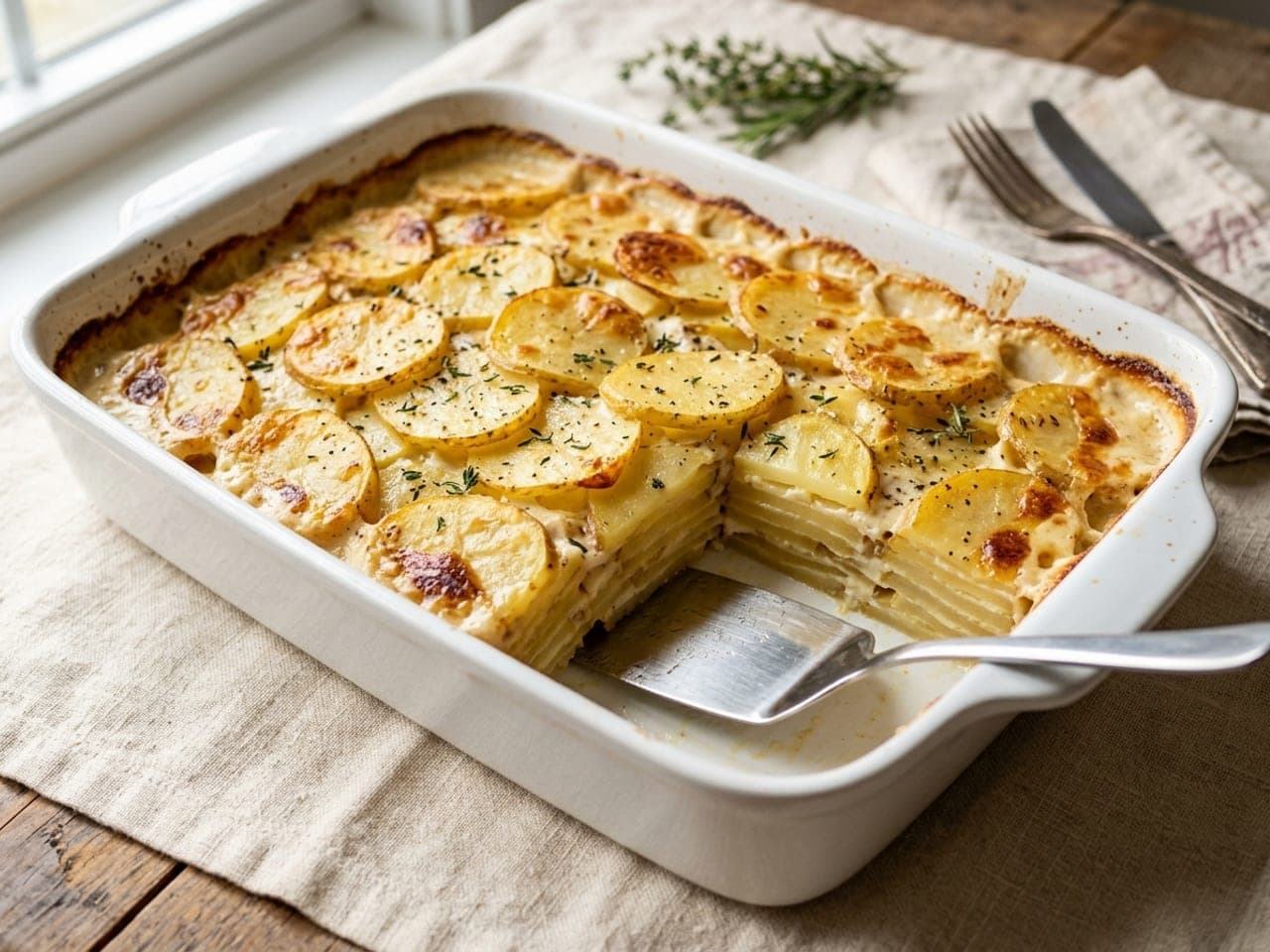
Scalloped potatoes
The make-ahead side that shares the turkey’s oven. Make ahead, three ways: assemble it with the par-cooked slices up to 24 hours ahead and bake it straight from the fridge at 400°F (200°C), 45 minutes covered and about 30 uncovered; or bake it fully, refrigerate it within 2 hours and reheat it covered with a splash of milk at 325°F (163°C) until the center reads 165°F (74°C), 45 to 60 minutes for a full dish; or freeze it baked, at some cost to texture. Leftovers count from the day it was first baked: 3 to 4 days in the US; 48 hours in the UK, reheated only once. Allergen: milk.
The twist: Cut it into squares after its 20-minute stand and serve from the dish on a trivet; the shingled top row is what people see.
Full recipe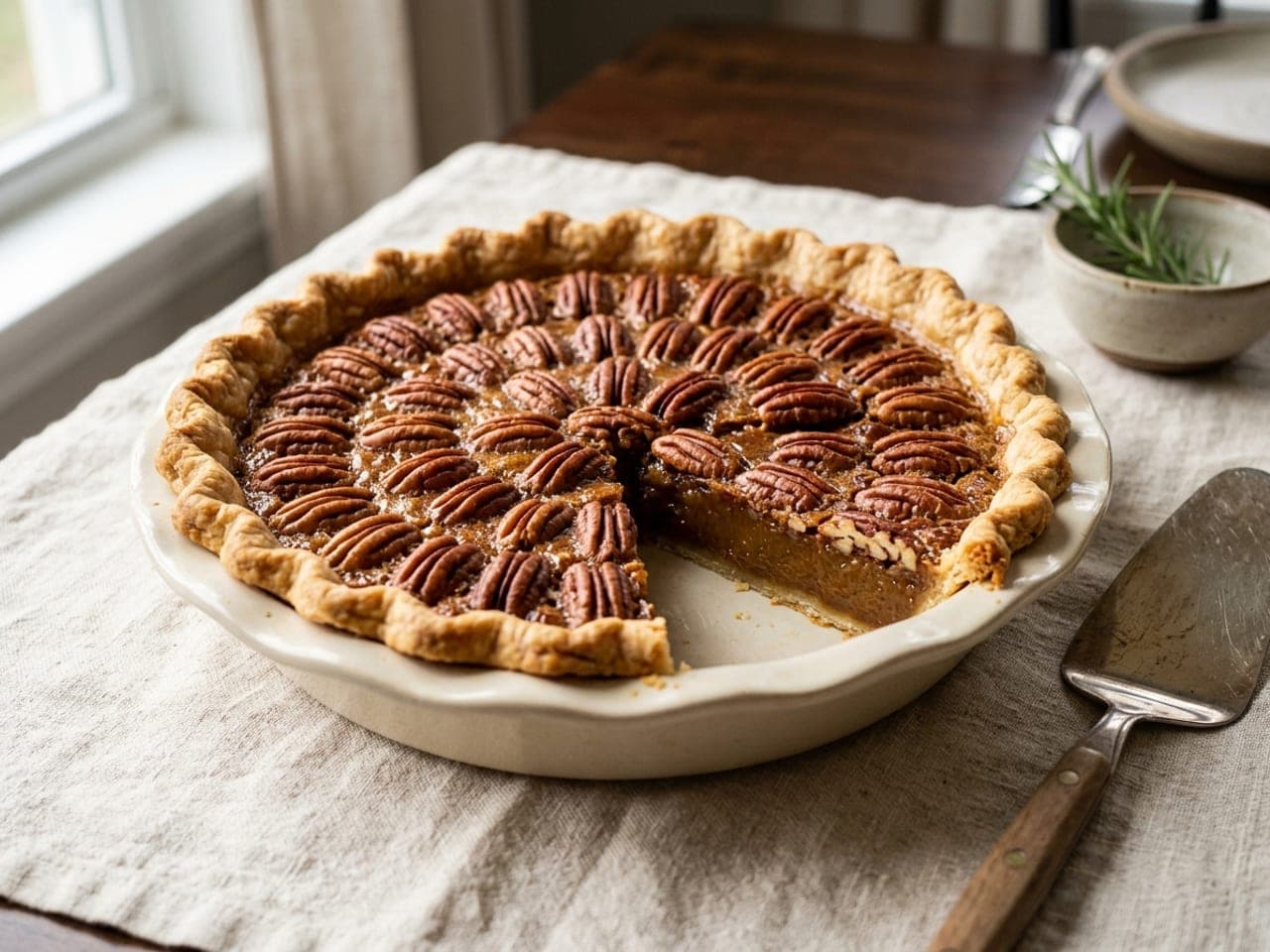
Pecan pie
The dessert you finish before Thanksgiving starts. Make ahead: bake it the day before, cool it 2 hours on a rack, refrigerate it uncovered until cold (3 hours or overnight), then cover it loosely. It is an egg custard pie, so it goes in the fridge within 2 hours of baking. Counted from the day you bake it, FoodSafety.gov gives it 3 to 4 days in the fridge and 1 to 2 months in the freezer; UK guidance is to eat leftovers within 48 hours or freeze them. Allergens: tree nuts (pecans), egg, milk, wheat; many pecans are packed alongside peanuts, so check the bag if anyone has a peanut allergy. If you add the recipe’s optional bourbon, its advice is to leave it out when children or pregnant guests will eat the pie.
The twist: Bring it to the cleared table on a cake stand as the savory dishes go back to the fridge, with a small card that says it contains pecans.
Full recipe
Other recipes on the site that fit a Thanksgiving table, or use the dinner party menu planner to deal a menu and a game plan.
- A first coursePumpkin soup for the formal setting’s soup plate and spoon.
- The mashMashed potatoes, which hold well in a slow cooker on warm at 140°F (60°C) or above, as long as they go in hot.
- A green and orange sideBraised carrots with peas, for color the palette does not have to supply.
- A smaller birdTurkey breast, for four.
- Not a turkey familyRoast goose for six, stuffed with apple, or a roast duck.
- A vegetarian sauceMushroom sauce, a Czech cream sauce that stands in for gravy.
- A second dessertApple strudel, which serves eight; it contains walnuts, so label it like the pie.
- Before dinnerA small Thanksgiving charcuterie board while the turkey rests, sized with the party food calculator.
Thanksgiving-day timeline: the table and the food on one clock
For dinner on Thursday 26 November 2026, guests at 3:00 pm (15:00) and sitting down at 4:00 pm (16:00). The example is 12 guests with leftovers, which the turkey calculator sizes at one 18 lb (8.2 kg) bird; run it for your own bird, and set its dinner time about 40 minutes before you sit, so the turkey is out, rested and carved by then while the casserole finishes in the same oven.
Food safety, kept apart by country. US (USDA, FDA): perishable food off the table after 2 hours, 1 hour above 90°F (32°C); hot food held at 140°F (60°C) or above can stay out. UK (Food Standards Agency): cool cooked food and get it into the fridge within 2 hours; hot food held for serving stays at 145°F (63°C) or above (the FSA’s danger zone runs from 8 to 63°C); eat leftovers within 48 hours of cooking and reheat them once. We plan on the US 2-hour clock, and count each dish’s leftovers from the day it was first cooked, as its recipe does.
- Sat 21 Nov, 9:00 am (09:00)
- Count chairs and place settings, and measure the table: 24 inches (61 cm) of edge per guest.
- Frozen 18 lb (8.2 kg) turkey into the fridge, still wrapped, on a tray, at 40°F (4°C) or below. USDA FSIS allows 4 to 5 days at this size; a thawed bird keeps 1 to 2 days, so early is safe and late is the failure.
- Sun 22 Nov
- Wash and iron the cloth, runner and napkins. Check candles, holders, trivets, and one serving utensil per dish (two per dish for a two-sided buffet).
- Buy flameless candles for anything that will sit among dried wheat, leaves or husks, with a screwed-shut battery door if children will be near them.
- Tue 24 Nov
- Buy branches, flowers and the produce for the centerpiece: pears, clementines, small squash bought as food, sage and rosemary, and nuts in the shell unless a guest has a nut allergy.
- Roast and mash the sweet potatoes with the butter only; make the streusel. Both into the fridge.
- In the evening, cook the eggs. That keeps them inside the US week and inside the UK’s 2 days at dinner time.
- Wed 25 Nov, the day before
- Silencer, cloth and runner on. Do a dry run with the empty serving dishes, trivets and serving spoons exactly where the food will go, then set plates, cutlery, glasses and name cards around them.
- Set the non-perishable base of the centerpiece: vessels, candles in their holders, the produce.
- Bake the pecan pie: 2 hours on a rack, then into the fridge uncovered until cold, then loosely covered.
- Peel and halve the eggs for the deviled eggs; filling into a sealed piping bag, whites in a covered box.
- Bake the scalloped potatoes all the way, cool them and refrigerate within 2 hours: tomorrow’s reheat is their one reheat.
- Thu 26 Nov, 10:25 am (10:25)
- Preheat to 325°F (163°C). Giblets out of both cavities, bird on a rack in a shallow roasting pan.
- Don’t rinse the bird (FSIS). Pat it dry with paper towels, bin them, and wash your hands with soap for 20 seconds. Keep the raw turkey, its board and its knife away from the eggs, the mash and anything served cold.
- 10:45 am (10:45)
- Turkey in: FSIS gives about 3¾ to 4½ hours for an unstuffed 18 lb (8.2 kg) bird at 325°F (163°C) (it sits on the line between two rows of its table).
- Fresh flowers and greenery into the centerpiece now, on the day.
- 1:00 pm (13:00)
- Beat the eggs, milk and seasoning into the cold sweet potato mash, spread it in its dish and refrigerate it, streusel still separate.
- Sideboard: risers, serving pieces, allergen cards. Anything held hot gets a thermometer check: 140°F (60°C) or above. Mash in a slow cooker on warm goes in already hot; don’t try to reheat cold mash in one, and run the cord to the back of the sideboard, not over the front edge.
- 2:00 pm (14:00)
- Pipe and garnish the deviled eggs, cover them and keep them in the fridge.
- The scalloped potatoes go in beside the turkey at 325°F (163°C), covered, with a splash of milk: 45 to 60 minutes to 165°F (74°C) in the center, uncovered for the last 5. They come out with the bird and share its 2-hour clock.
- 2:30 pm (14:30)
- Start checking the turkey: 165°F (74°C) in the innermost thigh, the innermost wing and the thickest part of the breast, whatever a pop-up timer says.
- UK (FSA): cut into the thickest part, between the leg and the breast. It should be steaming hot with no pink meat, and the juices should run clear; by thermometer, 158°F (70°C) held for 2 minutes.
- 2:40 pm (14:40)
- Oven up to 350°F (175°C), whether or not the turkey is out yet: FSIS only asks for no lower than 325°F (163°C), so the bird just finishes a little sooner (keep checking it). Streusel onto the casserole and in as soon as the oven reads 350°F (175°C), on the rack above or beside the bird: from the fridge it needs 15 to 20 minutes longer than the recipe’s 30 to 40, until 165°F (74°C) in the center.
- Small oven: if the 9 by 13 inch (23 by 33 cm) dish won’t fit beside the bird, bake the casserole during the turkey’s rest instead, in as soon as the bird comes out, and seat guests a few minutes later, once it has had its own rest. The 2-hour clock still starts when the turkey leaves the oven, so the 4:40 clear-down stays put.
- 3:00 pm (15:00), guests
- Guests arrive. The deviled eggs come out of the fridge now and their 2-hour clock starts.
- Turkey out once all three spots read 165°F (74°C), which may be a little after 3:00; never pull it on the clock. Tent it with foil. The 2-hour clock for the savory table starts when it comes out.
- Make the gravy from the drippings while the bird rests, and pour it into a thermos you have warmed with boiling water (handle the kettle with care).
- 3:30 pm (15:30)
- Start checking the casserole: out once the center reads 165°F (74°C), then 10 to 15 minutes’ rest, so it reaches the table by 4:00.
- 3:40 pm (15:40)
- Light the candles, about 15 minutes before you sit. Warm the plates if they are oven-safe.
- Carve the turkey (it has rested well past its 20 minutes) onto a warm platter; see the turkey platter.
- 4:00 pm (16:00), dinner
- Everyone sits, with the turkey, the casserole and the gravy on the table. If you used chargers, they leave with the first course. Pass everything to the right.
- 4:40 pm (16:40)
- Start clearing now so everything is in the fridge by 5:00, the 2-hour mark: the deviled eggs first (or keep them on a tray of crushed ice), then the turkey off the bone into small shallow containers, then the sides. Anything held at 140°F (60°C) or above in a warmer can stay out.
- 5:00 pm (17:00)
- Everything perishable is in the fridge; the pie comes out onto the cleared table.
- 7:00 pm (19:00)
- The pie goes back in the fridge: 2 hours out, once.
- Blow out every candle before the table empties (NFPA).
- Fri 27 to Mon 30 Nov, leftovers
- US (USDA FSIS, 3 to 4 days from when each dish was first cooked; its Thanksgiving guide puts Thursday’s food at “until the Monday after”): Thursday’s turkey, gravy and mash by Mon 30 Nov; the deviled eggs by Mon 30 Nov too, inside a week of boiling; the pecan pie, baked Wednesday, by Sun 29 Nov; the scalloped potatoes, baked Wednesday, by Sun 29 Nov; the sweet potato casserole, its mash roasted Tuesday, by Sat 28 Nov. Reheat to 165°F (74°C), gravy to a rolling boil.
- UK (Food Standards Agency, 48 hours from cooking, or freeze): Thursday’s turkey, gravy and mash by Sat 28 Nov; the pie by Fri 27 Nov; the scalloped potatoes, baked Wednesday, by Fri 27 Nov; no UK leftovers of the deviled eggs or the sweet potato casserole, because their eggs and mash were cooked on Tuesday: finish them at dinner or bin them. Reheat only once, until steaming hot all the way through.
See one Thanksgiving dish re-plated first
Photograph a side you are testing for the table and Plate Artists shows it re-plated on a plate from its library, with the negative space back. Your first re-plate is free with an account.
Start free · 1 enhancement →Free account · 1 free enhancement · No credit card
Thanksgiving table questions, answered
What is a Thanksgiving tablescape?
A tablescape is the whole table styled as one picture: cloth or runner, centerpiece, candles and place settings chosen together. A Thanksgiving tablescape also has to leave room for the meal, which is why we plan it from the food outwards: about 24 inches (61 cm) of edge per guest and a clear strip down the middle for the platters (see planning around the food).
How do you set a Thanksgiving table?
Decide how the food will be served, then lay the silencer and cloth or runner, place the centerpiece and candles, and set each place: plate in the center (on a charger if you use one), napkin and forks on the left, knife with its blade toward the plate and any spoon on the right, bread plate at the upper left, glasses at the upper right, dessert cutlery above the plate. Set only what the meal needs. The place settings table has formal and casual versions.
What is the proper Thanksgiving table setting for a casual dinner?
Our simple main-and-pie setting: a dinner plate, the napkin then one fork on the left, the knife on the right with its blade toward the plate, a water glass above the knife, and a dessert fork above the plate or brought out with the pie. No charger and no bread plate needed: rolls go on the dinner plate. Both settings, side by side.
How tall should a Thanksgiving centerpiece be?
Under 12 inches (30 cm), or on a slim stem that opens out above 24 inches (61 cm). That is the florists’ usual rule (some designers say 30 inches (76 cm) for the tall option). Our own arithmetic from US Army body-measurement data (ANSUR II) and standard table and seat heights puts seated adults’ eyes about 15½ to 24 inches (39 to 61 cm) above the tabletop, which is why that middle band blocks faces. At home, use Bronson van Wyck’s elbow test: elbow on the table, bend at the wrist, and keep the tallest stem below your hand.
How far in advance can I set my Thanksgiving table?
The linens can go on the day before, and the rest of the table a day or two early; do a dry run with the empty serving dishes when you do. Leave fresh flowers and greenery for the day itself, and light candles about 15 minutes before everyone sits.
Where does the napkin go?
In a formal setting, beside the forks rather than under them, unless space is tight; with a napkin ring it can sit in the center of the setting, on the plate or charger (Emily Post).
Do you need charger plates for Thanksgiving?
No. A charger is an optional underplate that is removed before the main course is served (Emily Post), and on a family-style table it takes up width the platters need. Never eat off a decorative one: many are not food-safe. More on chargers.
Where do the wine and water glasses go?
At the upper right: the water glass above the knife tip, or a little to its right. The water glass goes down first and stays all meal; a wine glass sits slightly to its right and often a little lower (Emily Post).
Which way do you pass food at Thanksgiving?
To the right, counterclockwise, by the Emily Post Institute’s convention. The point is that every dish travels the same way, so nobody ends up holding two at once; when a neighbor a seat or two to your left asks for something, pass it straight to them.
How many people can sit at my table?
Allow 24 inches (61 cm) of table edge per person, or 28 to 30 inches (71 to 76 cm) to be comfortable. A 72 inch (183 cm) table seats 6, or 8 with the ends; a 60 inch (152 cm) round seats 6. Leave 36 inches (91 cm) between the table edge and the wall so people can pass behind the chairs.
Should the turkey go on the table?
Only if there is room: keep a strip of about 14 to 16 inches (36 to 41 cm) clear down the middle. Carving in the kitchen and bringing out a composed platter is easier and looks better; see the carved platter.
What colors are best for a Thanksgiving table?
Quiet ones. The food already brings the orange, brown and red, so cream, bone, forest green, charcoal or plain white let it read. Keep to three or four colors plus neutrals, and keep the dinner plates pale. Four palettes are in the palette table.
Is it safe to put candles on the Thanksgiving table?
Yes, in sturdy holders that will not tip, at least 1 foot (30 cm) from anything that can burn, never left with children alone, and all blown out before you leave the room (NFPA). Use flameless candles among dried leaves, wheat, husks or paper, and keep flames off the path the platters take.
Can you eat the gourds from your centerpiece?
Not ornamental gourds: they contain cucurbitacins, which cause vomiting and diarrhea and are not destroyed by cooking (US Poison Control; Anses). Pie pumpkins and squash bought as food are fine to cook on Friday; if any squash tastes bitter, spit it out and throw it away.
How long can Thanksgiving food sit out?
US (USDA): 2 hours at room temperature, or 1 hour above 90°F (32°C), then into the fridge or the bin; count from when the turkey leaves the oven. Hot food held at 140°F (60°C) or above can stay out. UK (Food Standards Agency): cool cooked food and get it into the fridge within 2 hours.
How do you keep Thanksgiving food warm?
Hold it at 140°F (60°C) or above in chafing dishes, slow cookers or warming trays (USDA), checked with a thermometer because some warmers only reach 110 to 120°F (43 to 49°C) (FDA). Keep back-ups in a 200 to 250°F (93 to 121°C) oven, pour gravy into a preheated thermos, and warm the plates. A preheated cooler slows cooling but does not stop the 2-hour clock. In the UK, hot food held for serving stays at 145°F (63°C) or above (FSA). With canned chafing fuel, light it in its holder with a long lighter, never move a lit dish, and snuff it with its lid; see serving from the table or the sideboard.
How long are Thanksgiving leftovers good for?
Count from when each dish was first cooked, not from Thursday. US (USDA FSIS): 3 to 4 days in the fridge, which its Thanksgiving guide puts as “until the Monday after” for food cooked on the day; a pie baked on Wednesday keeps to Sunday and a casserole whose mash was roasted on Tuesday to Saturday. Freeze for longer, and reheat to 165°F (74°C), gravy to a rolling boil. UK (Food Standards Agency): eat them within 48 hours of cooking or freeze them, and reheat only once, until steaming hot all the way through; dishes made two days ahead leave no UK leftovers. The timeline gives a date for each dish.
Should you have a kids’ table?
That is a family call. If you do, set it against the end of the adult table so the children are in view, cover it in drawing paper, use unbreakables and flameless light, and for children under 4 cut meat small, quarter grapes lengthwise and leave out nuts, whole or chopped. More on the kids’ table.
The research behind this guide
Sources cited by name in the text:
- Emily Post Institute, Etiquette Today: Thanksgiving Table Setting Guides (26 Nov 2025): linens, silencer, napkin, cutlery, bread plate, charger, glasses, salt and pepper, butter dishes
- Emily Post Institute, Passing food at the table (counterclockwise, to the right)
- Elle Decor, 60 Thanksgiving tablescape ideas (Bronson van Wyck: centerpieces never taller than 12 inches; the elbow test)
- The Spruce, How to set the perfect Thanksgiving table (plan food placement first, dry run with serving dishes, centerpiece 12 inches or less)
- Adorno Design, Thanksgiving tablescape: design for the food first (24 inches a setting, 14 to 16 inch center strip, nothing between 12 and 30 inches tall, candles lit 15 minutes before, place cards above about 8 guests)
- Better Homes & Gardens, How to set a table for Thanksgiving dinner (set several days before; chargers or placemats at the kids’ table)
- Better Homes & Gardens, 27 easy Thanksgiving table decorations (magnolia-leaf and clementine place cards)
- AP News, Tips for setting a great Thanksgiving table (2023): a day or two early, three or four colors plus neutrals, patterned napkins
- QC Event School, Dos and don’ts of event decor centerpieces (tall 24 inches and over, short 12 inches and under)
- Fiore Designs, Tall wedding centerpieces (under 12 or above 24 inches)
- NC State Ergonomics Center, Anthropometry summary tables (ANSUR II 2012: seated eye height)
- Crow Works, Table and seating size guide (seat-to-tabletop height)
- Oak & Loom, How many people can your dining table seat (24 inches per person; what tables seat; bench spacing)
- Bassett Furniture, Complete guide to table sizes
- Lamon Luther, Table size and space guidelines (36 inches of clearance behind chairs)
- Living Spaces, Tablecloth size chart (runner about a third of the table’s width; 9 inch drop, 6 to 10 inches casual, floor length formal)
- Plinths NY, How to set up a buffet display (riser tiers; a riser seller)
- The Kitchn, 5 tips for setting up an excellent buffet table (cutlery at the end of the line)
- NFPA, Candle safety tips (at least 1 foot from anything that can burn)
- NFPA, Thanksgiving fire safety (1,139 home cooking fires on Thanksgiving Day 2024, 321 percent of the daily average)
- US Fire Administration, Candle fire safety
- Poison Control (National Capital Poison Center), Toxic squash syndrome: if it’s bitter, it’s not dinner
- Anses, Beware of inedible gourds (2019)
- USDA, Keep food safety in mind this Thanksgiving (2024): 165°F in three places, hot food at 140°F or above
- USDA FSIS, Your safe Thanksgiving guide (thawing, roasting, leftovers until the Monday after)
- USDA FSIS, Danger zone (40°F to 140°F)
- USDA FSIS, Leftovers and food safety (reheat to 165°F; sauces and gravy to a rolling boil)
- FDA, Serving up safe buffets (warmers that only reach 110°F to 120°F; back-ups at 200°F to 250°F; replace platters rather than topping up)
- Delish, How to keep Thanksgiving sides warm (the cooler hot box, still inside the danger zone)
- Food Standards Agency, Cooking your food (fridge within 2 hours; leftovers within 48 hours; reheat once; danger zone 8 to 63°C; 70°C for 2 minutes)
- Food Standards Agency, Christmas food hygiene (cool and refrigerate within 1 to 2 hours; turkey steaming hot, no pink meat, juices run clear)
- Taste of Home, Thanksgiving kids’ table: yea or nay? (2024)
- American Academy of Pediatrics (HealthyChildren.org), Choking prevention for babies and children
- CDC, Choking hazards
- FDA, Food allergies (the nine major food allergens)
- Food Standards Agency, Allergen guidance for food businesses (the 14 allergens)
- Colman’s, English Mustard (ingredients: wheat flour; contains cereals containing gluten)
- Department for Education, Help for early years providers: food safety (grapes cut lengthways into quarters; no whole nuts under five)
- US Consumer Product Safety Commission, warning on LED flameless candle sets with accessible coin batteries (5 Mar 2026)
- University of Maryland, Baltimore, Fire Marshal: guidelines for the use and storage of chafing fuel
- UC Berkeley EHS, Sterno and chafing fuel guidelines (long-reach lighter; combustibles 3 feet away)
Keep going
How to set a table
Basic, informal and formal place settings from above, the glass order, US and UK differences and the reason behind every rule.
Turkey calculator
How big a bird for your guest count, when to start the thaw, and when it goes in the oven, from USDA’s own tables.
Dinner party menu planner
Deals a starter, main and dessert from the site’s recipes, with a game plan counted back from dinner.
Halloween appetizers
The first entertaining hub: 22 appetizers made spooky by plating, with a kids’ table and a party timeline.