Crème Brûlée French Toast (Overnight Casserole)
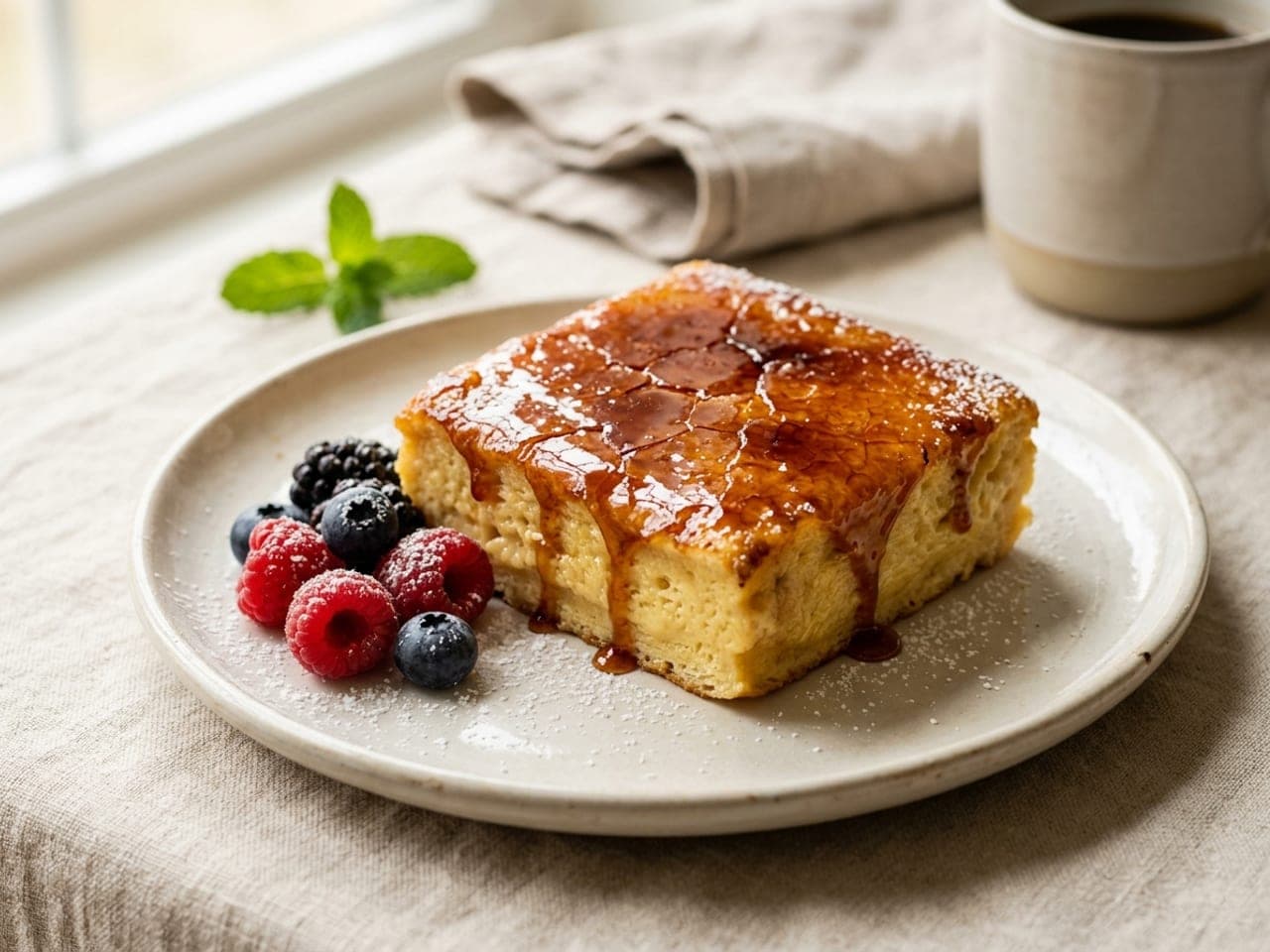
The famous overnight caramel-bottom french toast from a Maine inn: brown-sugar caramel bakes underneath custard-soaked challah, and every square is flipped caramel-side-up to serve. Assemble tonight, bake tomorrow.
Ingredients
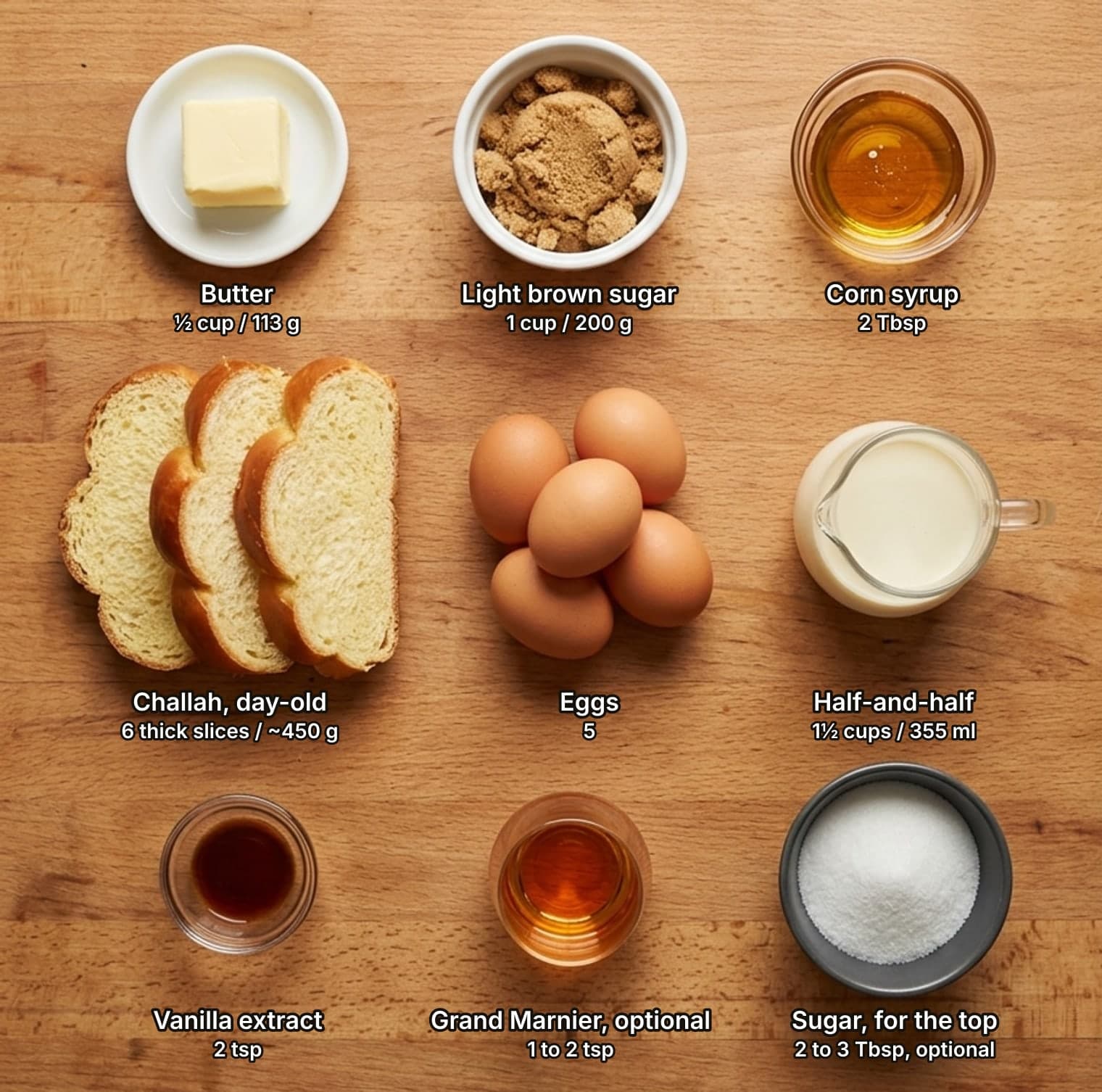
- unsalted butter½ cup / 113 g
- light brown sugar, packed1 cup / 200 g
- corn syrup (or golden syrup)2 Tbsp
- challah or sturdy French loaf, day-old6 thick slices / ~450 g
- eggs (large)5
- half-and-half (or half milk, half cream)1½ cups / 355 ml
- vanilla extract2 tsp
- fine sea salt¼ tsp
- Grand Marnier (optional)1–2 tsp
- granulated sugar, for the optional torched top2–3 Tbsp
The story: a Maine inn’s upside-down brûlée
This is one of the rare internet-famous casseroles with a documented origin story. It was the signature breakfast at the Inn at Sunrise Point in Camden, Maine — whose innkeepers credited it to Barbara Furdyna of La Maison, a French country inn in Spring Lake, New Jersey — and after a guest wrote to Gourmet magazine asking for it, Gourmet published the recipe in July 1998. Nearly every version that ranks today is a descendant of that printing.
The genius of it is the inversion: the brûlée layer bakes underneath. Butter, brown sugar and a spoonful of corn syrup melt into a caramel that sits at the bottom of the dish, the custard-soaked bread bakes on top of it, and at serving each square gets flipped so the amber caramel lands face-up, still glossy from the oven.
It is also the easiest page of this cluster: no water bath, no thermometer, no torch required — the work happens in the fridge overnight, and breakfast takes forty minutes of hands-off baking.
How to make Crème brûlée french toast
- Make the caramel layer. Melt ½ cup (113 g) butter with 1 cup (200 g) packed brown sugar and 2 Tbsp corn syrup in a saucepan over medium heat, bring to a bare simmer and whisk until completely smooth — the corn syrup is there to keep the caramel from turning grainy. Pour into a 9×13-inch (23×33 cm) baking dish and tilt to coat the bottom evenly.
- Prep the bread. Cut a day-old challah (or sturdy French loaf) into six 1–1¼ inch (2.5–3 cm) slices. If the bread is fresh, dry the slices on a rack in a low 300°F (150°C) oven for 15–20 minutes first — slightly stale bread drinks the custard without collapsing into mush.
- Arrange a single snug layer. Fit the slices over the caramel in one tight layer, squeezing them in and plugging any gaps with smaller pieces. One layer only: stacked bread is the number-one cause of a soggy middle.
- Mix and pour the custard. Whisk 5 eggs with 1½ cups (355 ml) half-and-half, 2 tsp vanilla, ¼ tsp salt and, if you like, 1–2 tsp Grand Marnier — it is in the original inn recipe. No sugar goes in the custard; the caramel layer carries all the sweetness. Pour evenly over the bread and press the slices down so they start drinking.
- Soak overnight. Cover and refrigerate 8–24 hours (6 hours in a pinch). The long cold soak is the whole trick — it is what turns toast into custard.
- Bake. Let the dish sit at room temperature for 30 minutes while the oven heats to 350°F (177°C). Bake uncovered 35–40 minutes, until the bread is puffed with pale-golden edges and the caramel bubbles at the rim. Rest 5 minutes before cutting.
- Serve caramel-side up. Cut into squares and flip each one onto the plate so the glossy caramel faces up, then spoon extra caramel from the pan over the top. Berries and softly whipped cream are the classic company.
- Optional: add the crackle. The baked caramel is soft and glossy, not glassy. If you want the true crème brûlée crack, sprinkle a teaspoon of granulated sugar over each flipped square and torch it just before serving — or run the squares 1–3 minutes under a preheated broiler (the overhead grill), watching the whole time.
Safety & hygiene Important
- Raw egg handling. Wash hands, whisk and bowl after mixing the custard, and keep the assembled dish covered in the fridge — never on the counter — during the overnight soak. Bake until the center is puffed and set, with no liquid custard when you nudge the pan — 160°F (71°C) in the center on a thermometer if you want certainty.
- Hot caramel. Simmering caramel runs well past boiling-water temperature and sticks to skin — pour it into the dish slowly and away from yourself. Straight from the oven the caramel layer is scalding: rest the dish 5 minutes and warn anyone serving themselves.
- The 24-hour window. The soak is safe because it happens cold: assemble no more than 24 hours ahead, keep it covered and refrigerated the whole time, and limit the pre-bake counter rest to the 30 minutes the recipe calls for.
- Torch, if you use one. For the optional crackle, use a low flame, keep it moving, work away from anything flammable and refill butane outdoors. Or skip it entirely — the caramel layer is already the brûlée.
- Storage. Leftovers keep covered in the fridge for 3–4 days; reheat at 325°F (163°C) for 7–15 minutes, until steaming hot — 165°F (74°C). Baked squares also freeze well for up to 2 months, wrapped — thaw overnight in the fridge, never on the counter. Torched tops go soft in the fridge; re-sprinkle and re-torch.
3 ways to plate it
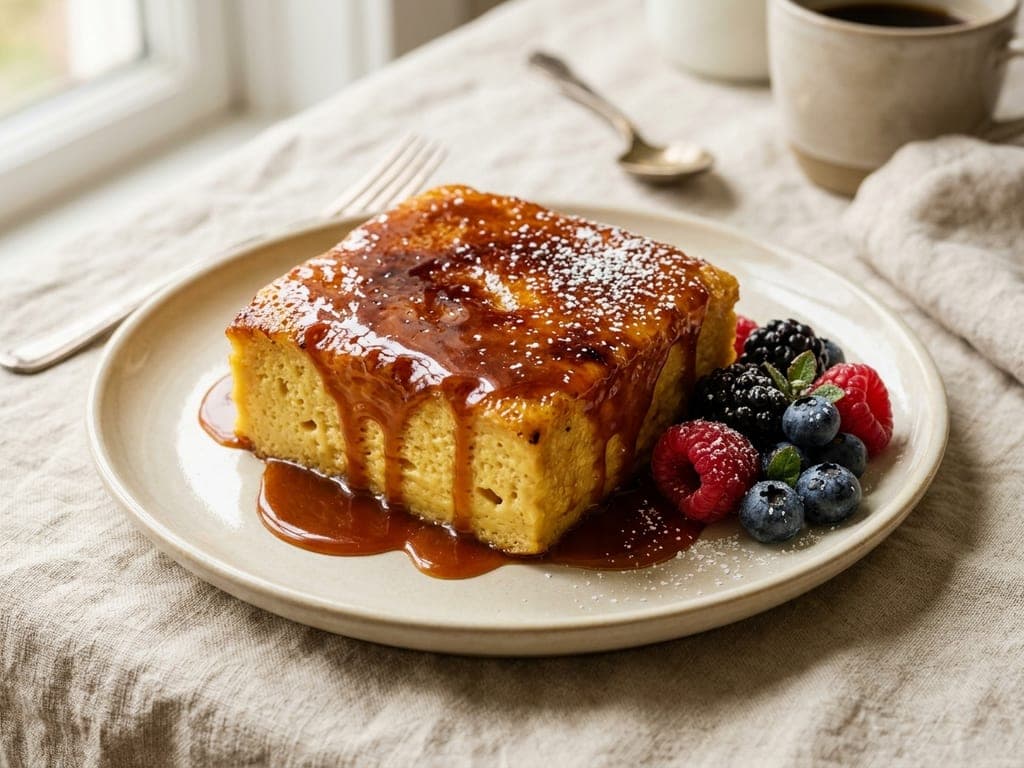
- Warm the plates — caramel stays glossy and pourable on a warm plate and seizes on a cold one.
- Flip each square in one confident motion with a wide spatula, caramel landing face-up.
- Spoon extra caramel from the corners of the pan over the top so it runs down the sides.
- Add a small huddle of berries beside the square — not on it — and a light dusting of powdered sugar.
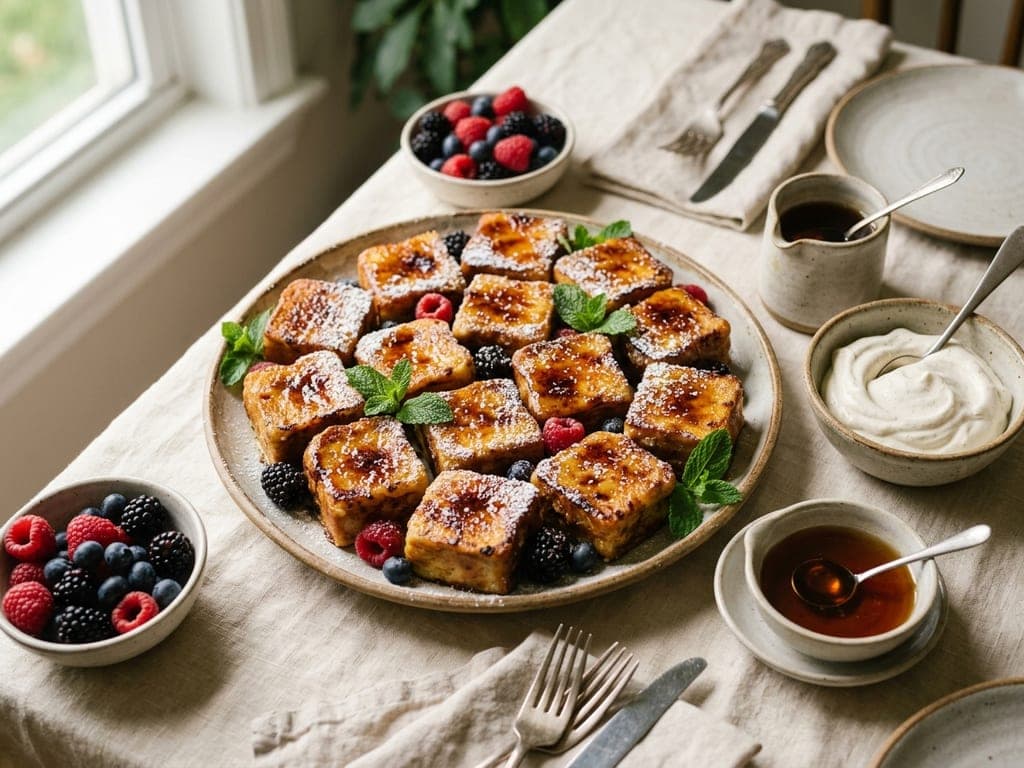
- Cut the casserole into squares in the kitchen and flip them caramel-up in loose rows on a large platter or board.
- Surround it with small bowls: berries, softly whipped cream, warm maple syrup.
- Dust powdered sugar over the whole platter at the table, not before — the show matters.
- Tuck a few berries and mint sprigs into the gaps between squares so the platter reads abundant.
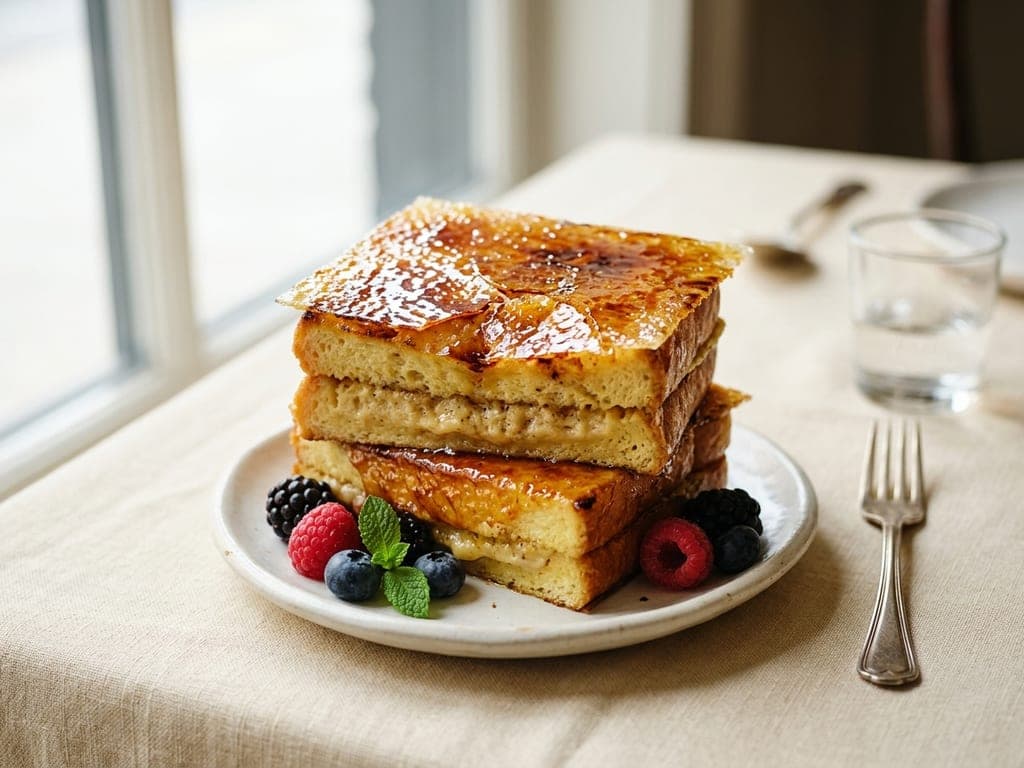
- Halve a square and stack the two pieces slightly offset, caramel sides up.
- Sprinkle a teaspoon of granulated sugar over just the top piece.
- Torch in slow circles to a glassy amber sheet and let it harden for a minute.
- Finish with two or three berries at the base and one small mint tip — height does the rest.
Where the crackle comes from (and our honest hybrid)
Two styles rank for this dish, and they get their brûlée in different ways. The original casserole’s caramel is baked, so it comes out soft, chewy-glossy — closer to sticky toffee than to the glassy sheet on a ramekin of crème brûlée. The slice-style versions skip the caramel bottom and instead caramelize sugar directly on the bread — in the pan, under the broiler, or with a torch — which gives the true crack but loses the pan sauce.
No ranking recipe does both — so treat this as our house suggestion, borrowed from the torched versions: bake the classic caramel-bottom casserole, flip each square caramel-up, then sprinkle a teaspoon of sugar over it and torch to glass. You get the inn’s pan caramel and the crackle. It is optional, it takes thirty seconds, and everything else on this page is faithful to the canon.
Whichever way you finish it, the three rules that matter are the same: a single layer of bread, genuinely stale slices, and no sugar in the custard — the caramel layer is already carrying the sweetness for the whole dish.
Questions, answered
Can I skip the overnight soak?
Not for the casserole — the long cold soak is what makes it custard instead of toast. Ranking recipes put the floor at 4–6 hours — this recipe says six — with 8-plus as the standard. If you need french toast tonight, use the quick route instead: dip thick slices 10–15 seconds a side, bake hot on a sugared sheet pan, and finish under the broiler.
What is the best bread for crème brûlée french toast?
Challah is the plurality pick among the ranking recipes, with sturdy French or country loaf and brioche close behind. What matters more than the variety is the condition: thick slices — about an inch — and day-old dryness. Avoid thin pre-sliced sandwich bread; it collapses in the soak.
Why did mine come out soggy?
Almost always one of four things: fresh soft bread (dry the slices in a low oven first), stacked slices (a single snug layer only), too much dairy for the eggs (this ratio — 5 eggs to 1½ cups — is on the custardy-but-set side), or pulling it at the first hint of browning. Bake until it is puffed with pale-golden edges and the caramel is bubbling.
Can I make it ahead or freeze it?
It is a make-ahead dish by design — assemble up to 24 hours before baking. Baked leftovers freeze surprisingly well: freeze squares flat, bag them, keep up to 2 months, thaw overnight in the fridge and reheat at 325°F (163°C) for 7–15 minutes.
Casserole or slices — which is the real one?
The casserole is the original: the Inn at Sunrise Point recipe that Gourmet published in 1998 is an overnight caramel-bottom bake. The slice versions are later re-creations that move the caramel from under the bread to on top of it, via pan, broiler or torch. Both are legitimate; they just crackle differently.
Is this just caramel french toast?
Functionally, the casserole is an upside-down caramel french toast — the “brûlée” is the baked brown-sugar layer, not a torched crust. The name stuck because of the flavor and the flip. If you want it to earn the name literally, the optional sprinkle-and-torch finish adds the glassy top.
Do I really need the corn syrup?
Its only job is insurance against grainy, crystallized caramel — a tablespoon or two keeps the sugar smooth. You can omit it, and several ranking versions swap in real maple syrup successfully (skip imitation pancake syrup; it makes the layer gummy).
How do I reheat it without ruining it?
Oven, not microwave, if you care about the edges: 325°F (163°C) for 7–15 minutes brings back the puff and re-loosens the caramel. If you torched the tops, that crust will have gone soft in the fridge — re-sprinkle a little sugar and re-torch after reheating.
Snap your finished plate and let the AI plate it again — more beautifully.