Crème Brûlée Recipe (No Torch Needed)
Silky vanilla custard under a crackling caramel crust, finished under the broiler or with poured caramel, so no blowtorch needed. About 1 ¼ hours of work, then at least 5 hours to cool and chill.
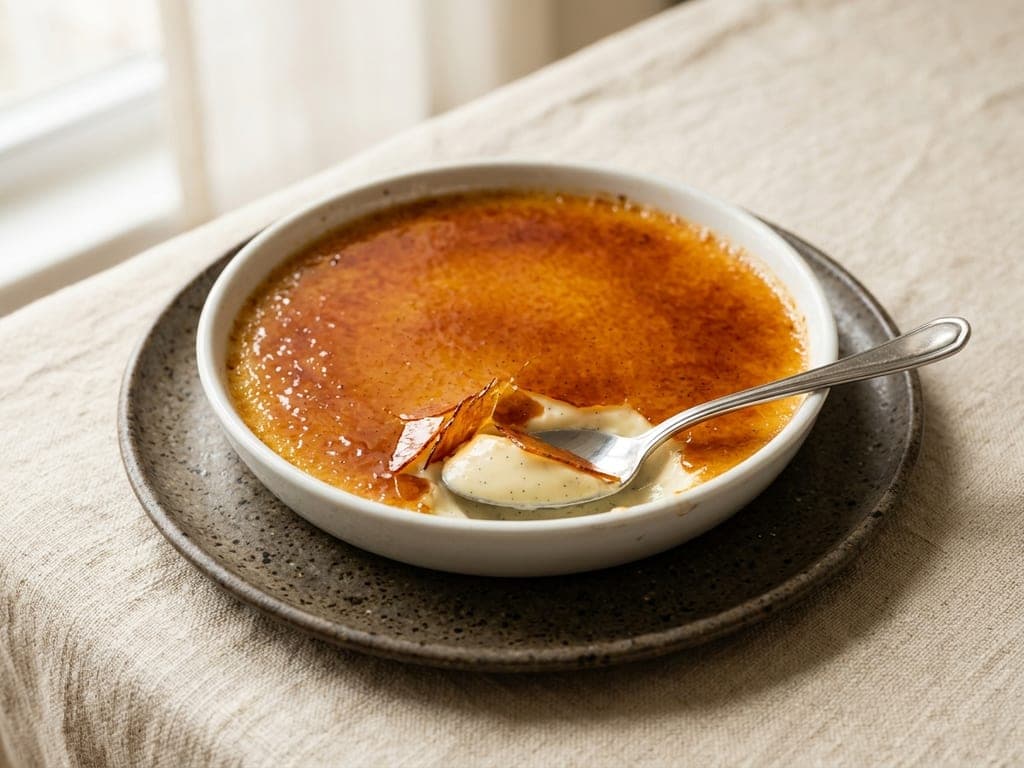
Ingredients
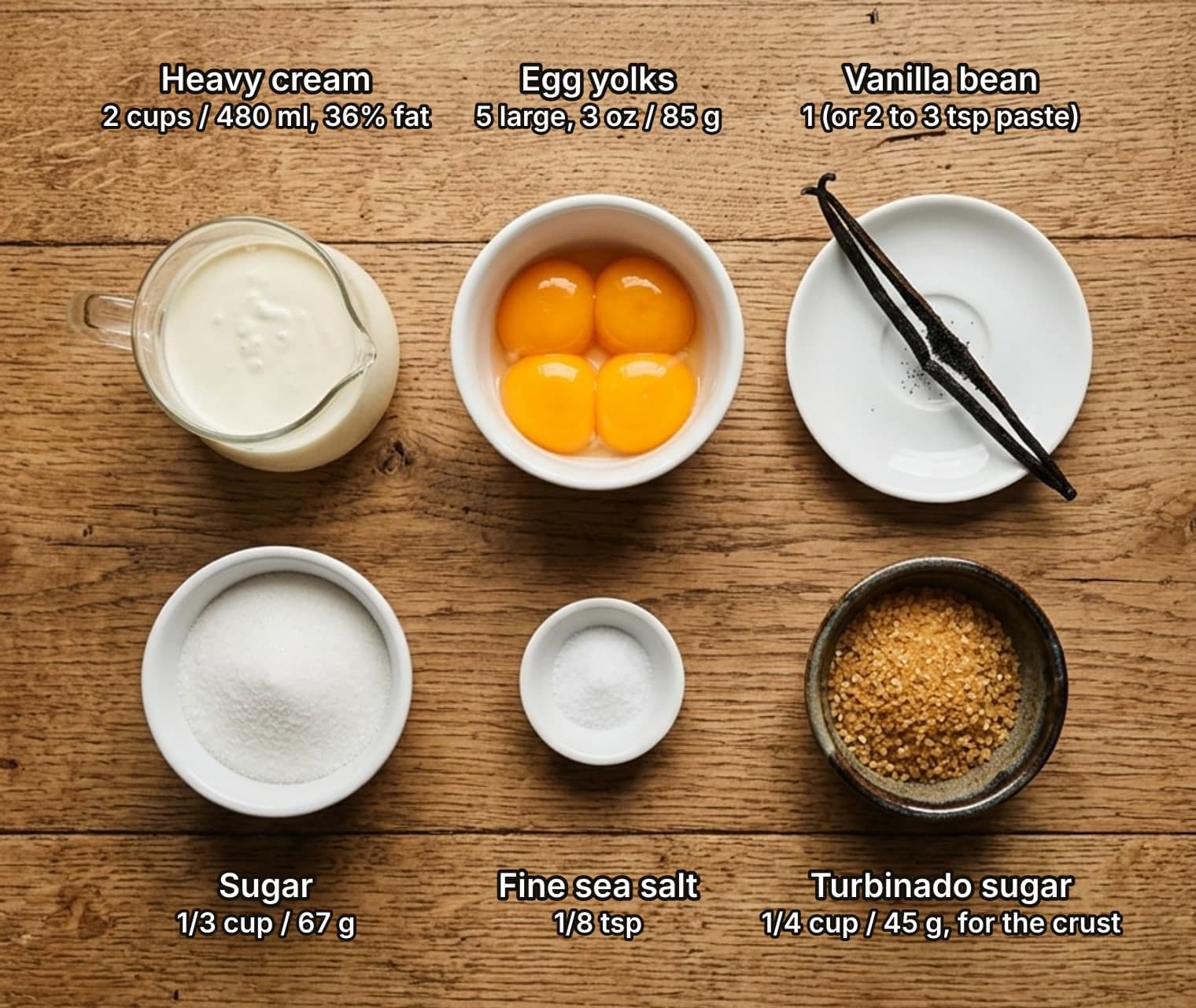
- heavy cream, 36% fat or more (UK: whipping cream; see the FAQ for double cream)2 cups (480 ml)
- egg yolks, from large eggs (UK and EU medium), about 3 oz (85 g) total5
- granulated sugar⅓ cup (67 g)
- vanilla bean, split (or 2 to 3 tsp vanilla bean paste or pure vanilla extract; both contain alcohol)1
- fine sea salt⅛ tsp
- turbinado (demerara in the UK, cassonade in France) or granulated sugar, for the crust; ⅔ cup (130 g) for the caramel pour¼ cup (45 g)
- water and light corn syrup (golden syrup or liquid glucose in the UK), caramel-pour method only¼ cup (60 ml) + 1 tsp
Before you start: the short version
Crème brûlée is a baked custard of cream, egg yolks, sugar and vanilla, chilled, then finished with a thin sheet of caramelized sugar. You do not need a blowtorch: the broiler (the overhead grill) or a poured caramel gives the same crackable top. Step 9 covers the broiler, and the no-torch section after the plating ideas has every method.
The short version: steep 2 cups (480 ml) of cream with vanilla, whisk it into 5 yolks and ⅓ cup (67 g) of sugar, strain, and bake in six shallow ramekins in a water bath at 325°F (163°C) until the centers read 170 to 175°F (77 to 79°C). Chill, then sugar and caramelize just before serving.
Time: about 1 ¼ hours to steep, mix and bake, then about 1 hour to cool and at least 4 hours to chill, so make the custards the day before if you can. They keep 3 to 4 days before you caramelize them.
You need: six shallow 4-oz (120 ml) ramekins or crème brûlée dishes (porcelain or stoneware if you will use the broiler), a roasting pan, a kettle, a fine-mesh sieve and an instant-read thermometer. A torch is optional.
How to make Crème brûlée
- Steep the cream. Pour 2 cups (480 ml) heavy cream into a saucepan. Split the vanilla bean lengthwise, scrape the seeds into the cream, drop in the pod and add the salt. Bring to a bare simmer over medium-low heat, take it off the heat, cover and let it steep for 30 minutes, the time Alain Ducasse and Tom Kerridge both give. (Using paste or extract instead? Skip the steep; it goes in at step 4.) While it steeps, heat the oven to 325°F (163°C, or 145°C fan) with a rack in the middle, and put a full kettle on toward the end. Bring the cream back to steaming just before step 3.
- Whisk yolks and sugar. Only once the cream has steeped (sugar left sitting on yolks clumps them), whisk the 5 egg yolks with the ⅓ cup (67 g) sugar for about 30 seconds, until smooth. Guy Savoy beats his until pale, and Le Cirque’s recipe beats them to a ribbon; that works too, as long as you strain and skim in step 4, because every bubble you whisk in ends up on the surface.
- Temper the yolks. Pour about a quarter of the hot cream into the yolks in a slow, thin stream, whisking constantly so the yolks warm without scrambling. Then whisk in the rest of the cream.
- Strain and skim. Pour the custard through a fine-mesh sieve into a jug with a spout. It catches the vanilla pod and any bits of cooked egg, and it is the ten-second step that guarantees a silky result. Stir in the vanilla paste or extract now if you are using it, then skim the foam off the top with a spoon. (Planning the Vanilla minimal plating? Rinse the pod and leave it to dry.)
- Fill the dishes and set up the water bath. Line a roasting pan with a folded kitchen towel and set six shallow 4-oz (120 ml) ramekins on it. The batch makes about 2 ½ cups (600 ml), a scant ½ cup (100 ml) per ramekin, or enough for four 6-oz (180 ml) dishes. Divide the custard between them and pop any surface bubbles with the corner of a paper towel, or with a one-second pass of the torch, as Heston Blumenthal does. Set the pan on the middle rack, then pour just-boiled (not furiously boiling) water into a corner of the pan, away from the ramekins, until it comes about two-thirds of the way up the sides, level with the custard.
- Bake gently in the water bath. Bake at 325°F (163°C, or 145°C fan). Standard 4-oz (120 ml) ramekins about 1 inch (2.5 cm) deep usually take 30 to 35 minutes, so start checking at 25. Wide, shallow dishes about ¾ inch (2 cm) deep can be done in about 20, and deeper 6-oz (180 ml) ramekins take 30 to 40. They are done when an instant-read thermometer in the center reads 170 to 175°F (77 to 79°C), with the tip clear of the dish wall, which runs hotter; check two or three, including one from the middle of the pan. By then the edges are set and a circle about 1 inch (2.5 cm) across in the middle jiggles like set gelatin, with no liquid slosh. They will look slightly underdone; they finish setting as they cool.
- Cool and chill. Lift the ramekins out of the water bath with a flat spatula or silicone-tipped tongs and cool them on a rack for about an hour, then refrigerate uncovered for at least 4 hours, or better, overnight (Heston Blumenthal gives his at least 6). Get them into the fridge within 2 hours of baking. Once fully cold, cover them; they keep 3 to 4 days. Top them only when you serve.
- Bring them up and blot. If you are torching, let the custards stand at room temperature for 20 minutes so they are cool rather than fridge cold. For the broiler or the caramel pour, skip the wait and keep them as cold as possible. Just before caramelizing, blot any beads of condensation off each surface with a paper towel.
- Sugar and caramelize. Sprinkle about 1 teaspoon of sugar over each custard, tilt and tap so a thin, even layer covers the whole surface, tip out the excess and wipe the rim with a clean cloth. Use turbinado for the torch and granulated for the broiler. Torch: hold the flame tip about 2 inches (5 cm) above the sugar and work in slow circles from the edge toward the center until it melts into a deep amber sheet with no white crystals left; for a thicker, glassier crust, add a second teaspoon and torch again, the way Michel Roux Jr and Heston Blumenthal build theirs. No torch: set the sugared custards in a roasting pan of ice water, 3 to 4 inches (8 to 10 cm) below a broiler (the overhead grill) preheated on high for 10 minutes, and broil for 1 to 4 minutes, turning the pan and watching every second (porcelain or stoneware only, never glass). Or use the caramel pour described in the no-torch section below the plating ideas. Let the caramel harden for 2 minutes and serve within about 30 minutes, before the crust starts to soften.
Safety & hygiene Important
- Raw egg handling. Wash hands, bowls and whisks in hot, soapy water after they touch raw egg. If you are not baking the strained custard right away, cover and refrigerate it and bake it within 24 hours, USDA’s limit for dishes made with raw eggs. The 5 spare whites keep 2 to 4 days in the fridge or up to 12 months frozen. Judge doneness with an instant-read thermometer in the center of two or three ramekins, including one from the middle of the pan: at 170 to 175°F (77 to 79°C) the custard is past the 160°F (71°C) USDA sets for egg dishes. The wobble tells you about texture, not safety, so use the thermometer every time you cook for someone pregnant, older, very young or with a weakened immune system. In a wider, shallower dish the bake time changes; go by the thermometer.
- Boiling water bath. Pour the hot water in only after the roasting pan is sitting on the oven rack, so you never carry a sloshing pan of boiling water. Lift finished ramekins out with a flat spatula or silicone-tipped tongs, not bare fingers.
- Open flame and hot sugar. Torch on a metal baking sheet, never on a napkin, towel or wooden board, and point the flame away from your face, hair and sleeves. Refill the torch only when it is off and cool, outdoors or somewhere well ventilated and away from the stove, and store it out of children’s reach. Liquid caramel is around 340°F (170°C) and sticks to skin: pour away from yourself and keep children away from the stove. If caramel or boiling water touches skin, hold the burn under cool running water for 20 minutes, as the NHS advises; do not peel off caramel that has stuck, and do not put butter, oil or cream on it. Get medical help for a large or deep burn, or one on the face (911 in the US, 999 or A&E in the UK).
- Broiler-safe dishes only. Under a broiler (the overhead grill), sugar goes from amber to burnt in seconds, so stay at the oven and watch with the light on. Broil only in porcelain or stoneware ramekins sold as broiler-safe, never in glass: Pyrex, for one, says its glass bakeware must not go under a broiler and warns against sudden temperature changes, so do not move any dish straight from the freezer to a hot broiler unless its maker allows it. If the sugar catches fire, turn the broiler off and keep the door closed. The ramekins come out very hot: lift them with oven mitts and serve each on a small plate.
- Allergens, alcohol and diet. Contains egg (the yolks) and milk (the cream), two of the nine major food allergens under US law and two of the 14 allergens that UK and EU law makes food businesses declare. There is no wheat, gluten, nut or sesame in the recipe as written. Vanilla bean paste and vanilla extract are made with alcohol (US rules set extract at no less than 35% alcohol by volume), and cooking does not remove all of it: USDA measured 35% of the alcohol left after 30 minutes of baking. The amount per serving is small, but if you avoid alcohol entirely, use the whole vanilla bean, which has none. The dish is lacto-ovo vegetarian (no gelatin, no rennet) but not vegan. In the US some white cane sugar is filtered through bone char; beet sugar never is, so check the label if that matters to you.
- Storage and leftovers. Refrigerate the baked custards within 2 hours of taking them out of the oven. Covered, they keep 3 to 4 days, counted from the day you bake them, not the day you caramelize them. A finished crème brûlée should not sit out for more than 2 hours, or 1 hour above 90°F (32°C), so caramelize only what you will serve. Leftovers that are already caramelized are still safe within the same 3 to 4 days; the crust just melts into a thin syrup. For freezing, see the FAQ.
3 ways to plate it
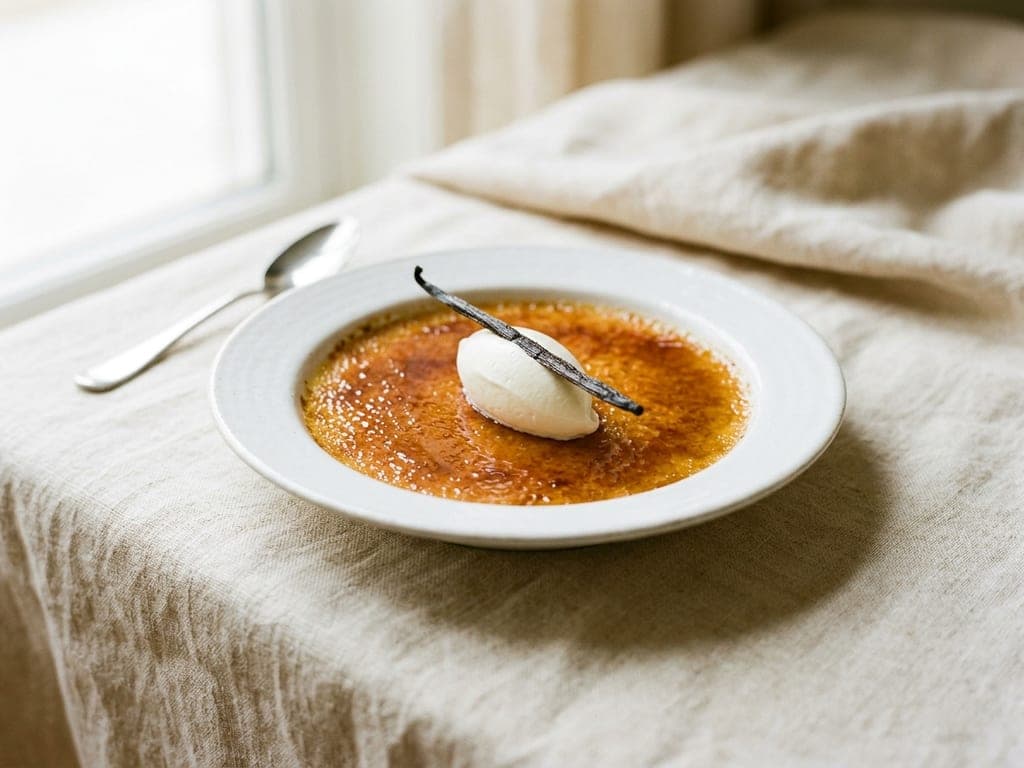
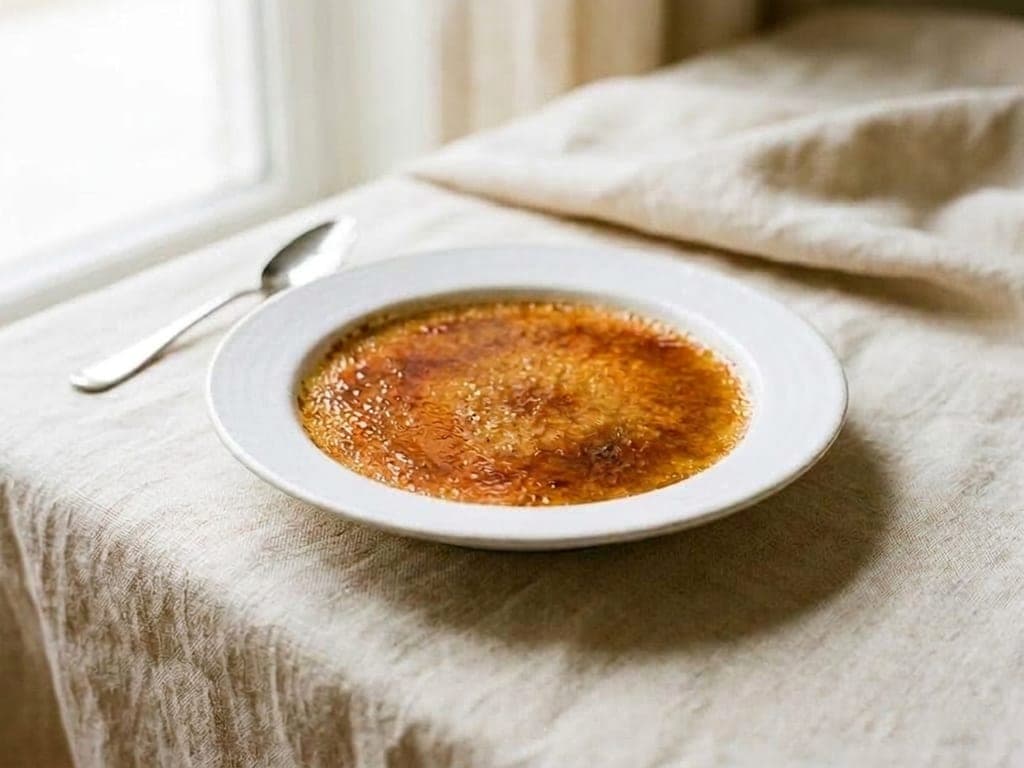 1. Bake this one in a wide, shallow, oven-safe white dish that holds about 6 oz (180 ml); the batch fills four. A shallow custard cooks faster, so start checking at 20 minutes and pull it at 170 to 175°F (77 to 79°C). Leave the rim spotless: the empty ring around the custard is the design.
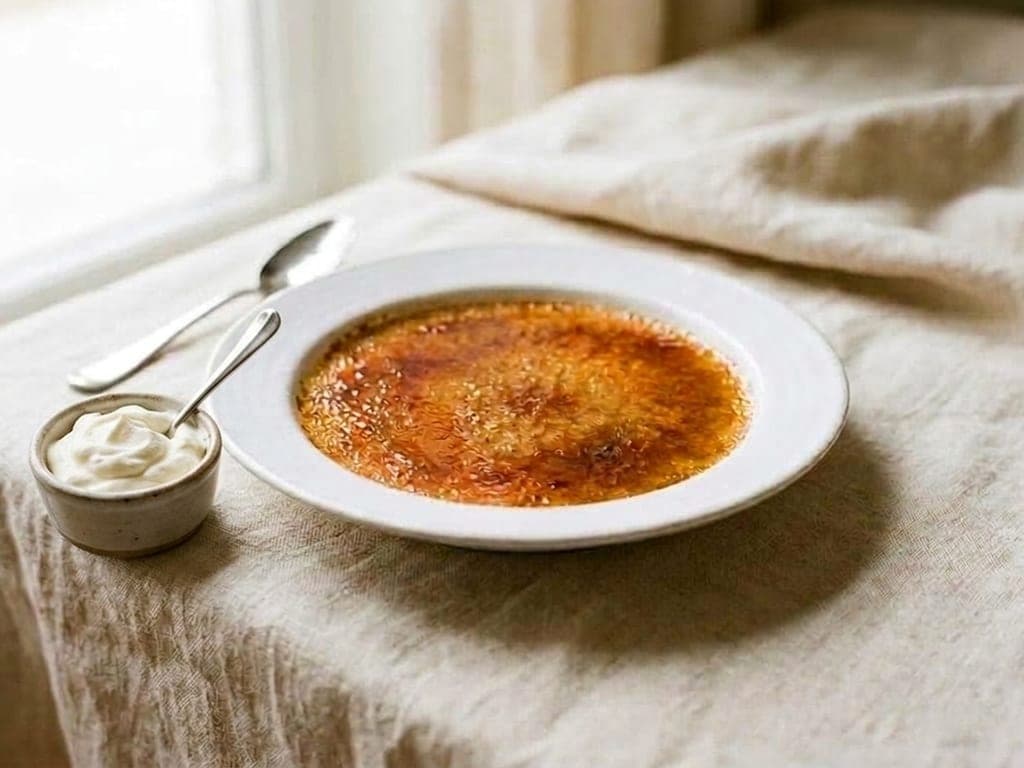 2. Whip a little cream to soft peaks, no sugar: the crust carries the sweetness.
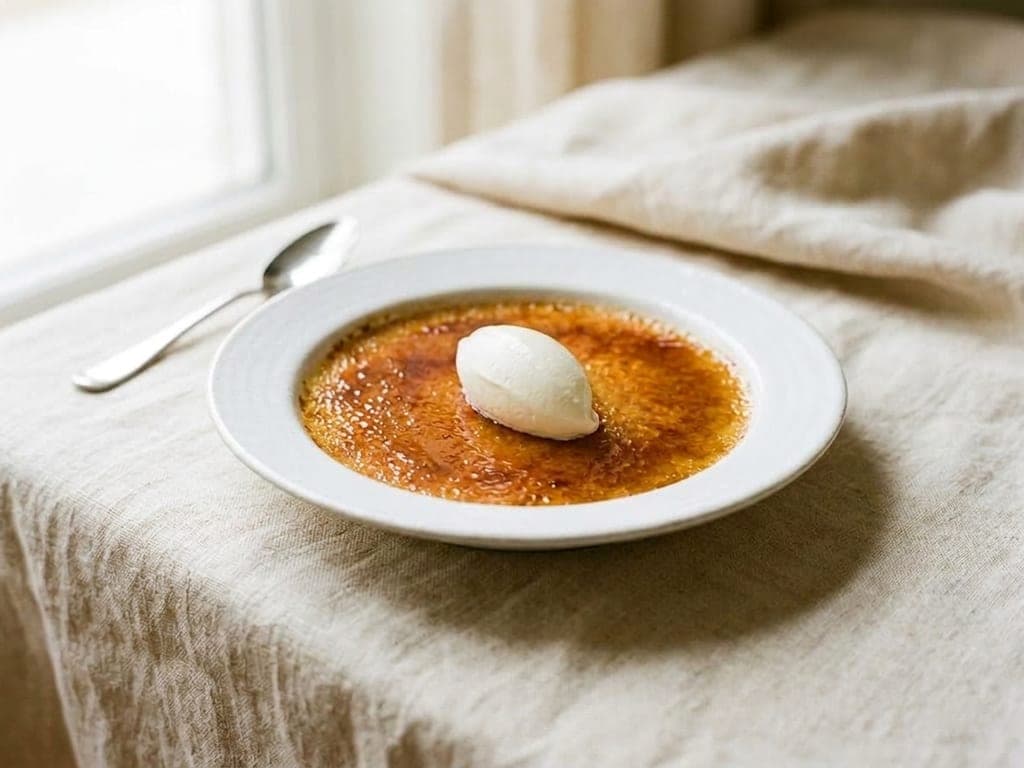 3. Form the quenelle: dip a dessert spoon in hot water and shake it dry, because a drop of water melts caramel, then drag it through the cream in one smooth rolling motion. Set it just off-center on the crust at the very last moment, right before the plate leaves.
- 4. Lay a length of split vanilla pod across the quenelle at an angle: the one you strained out of the cream, rinsed and dried overnight. Then stop: anything more breaks it. (Used paste or extract? Skip the pod.)
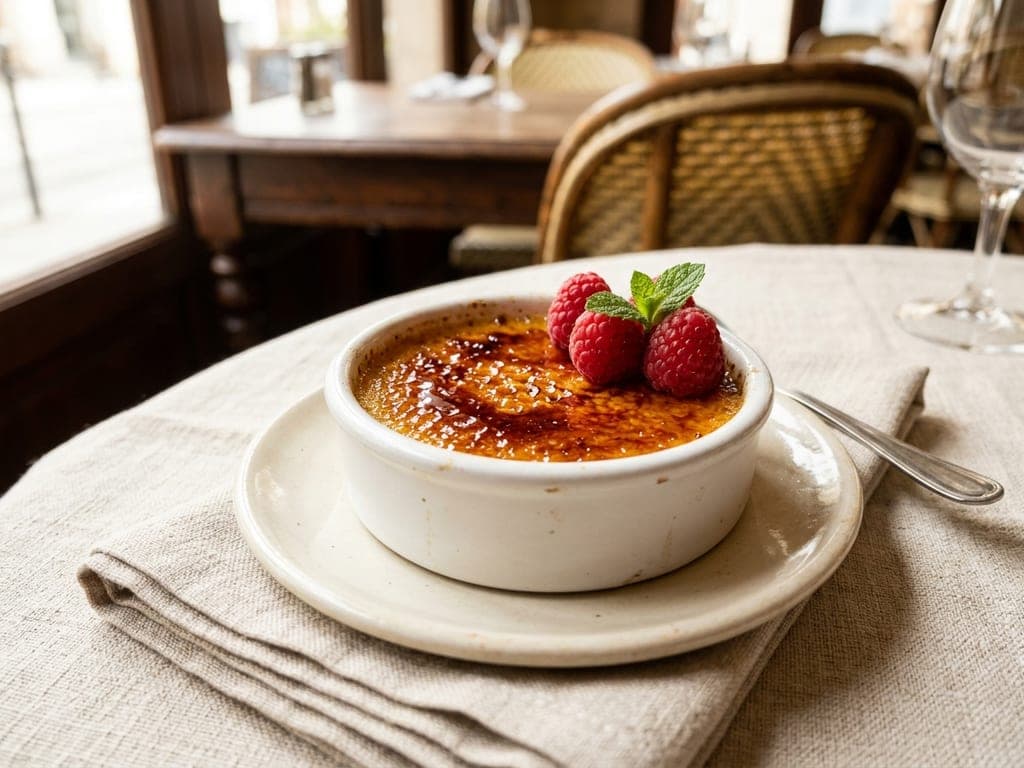
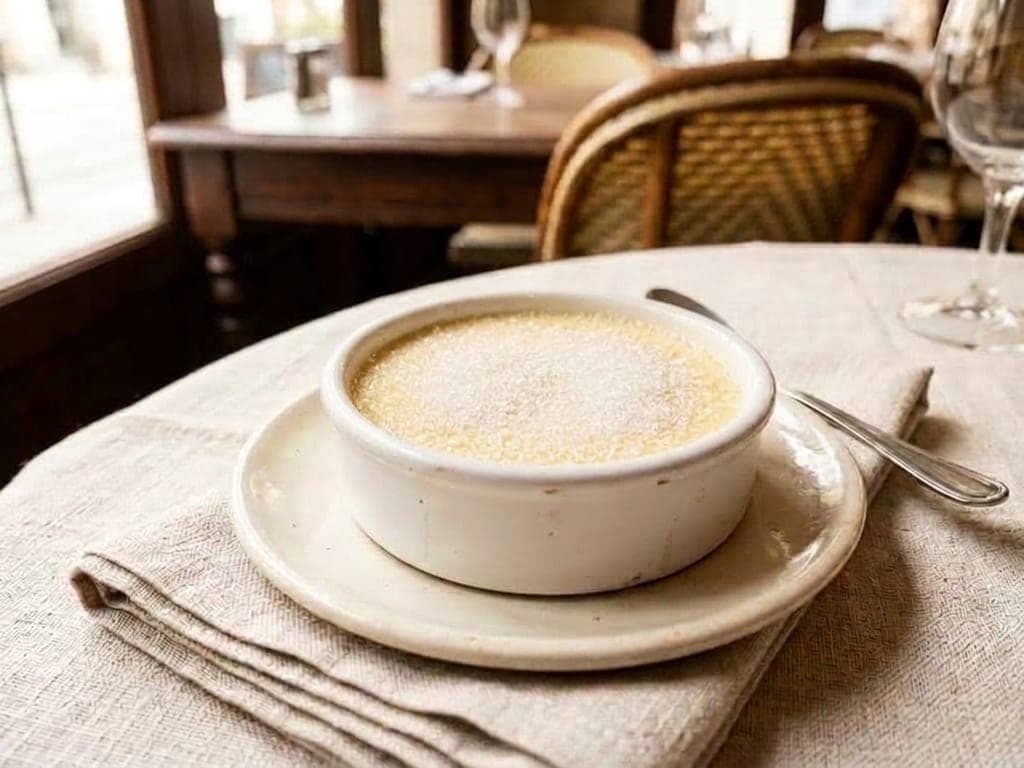 1. Fold a linen napkin flat, set a small plate on it and center the ramekin on the plate. The napkin keeps the plate from sliding on the way to the table.
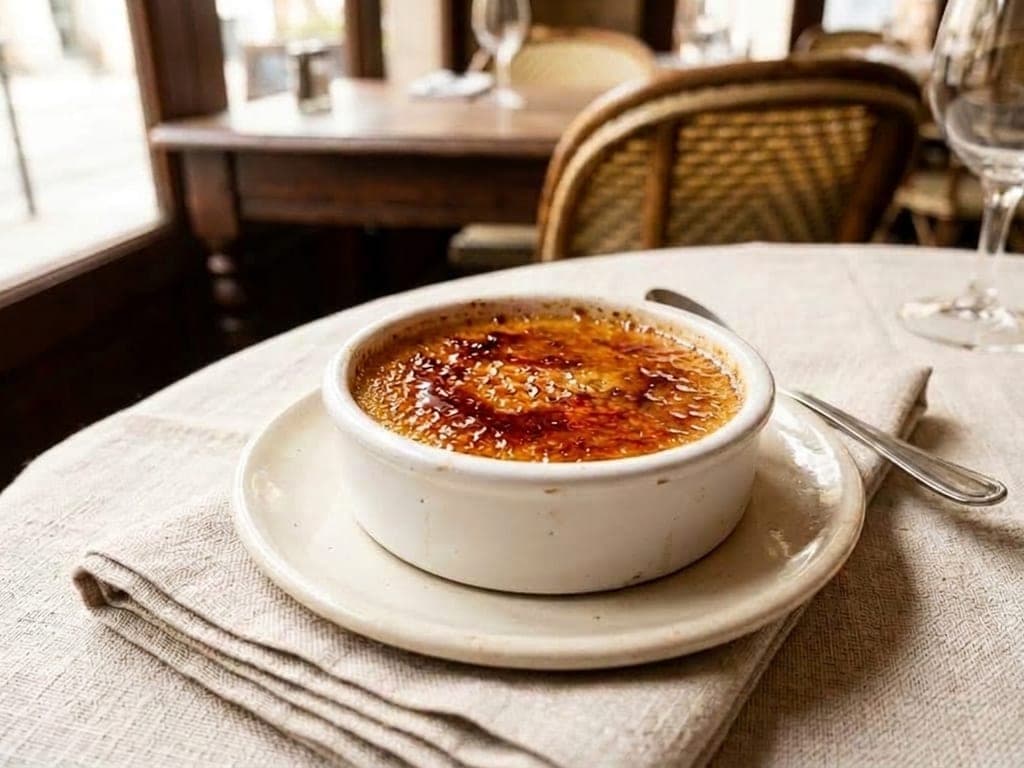 2. Brûlée before you garnish, and never on the linen: caramelize the ramekin on a metal baking sheet, then set it on the plate. The flame would wilt and scorch the berries.
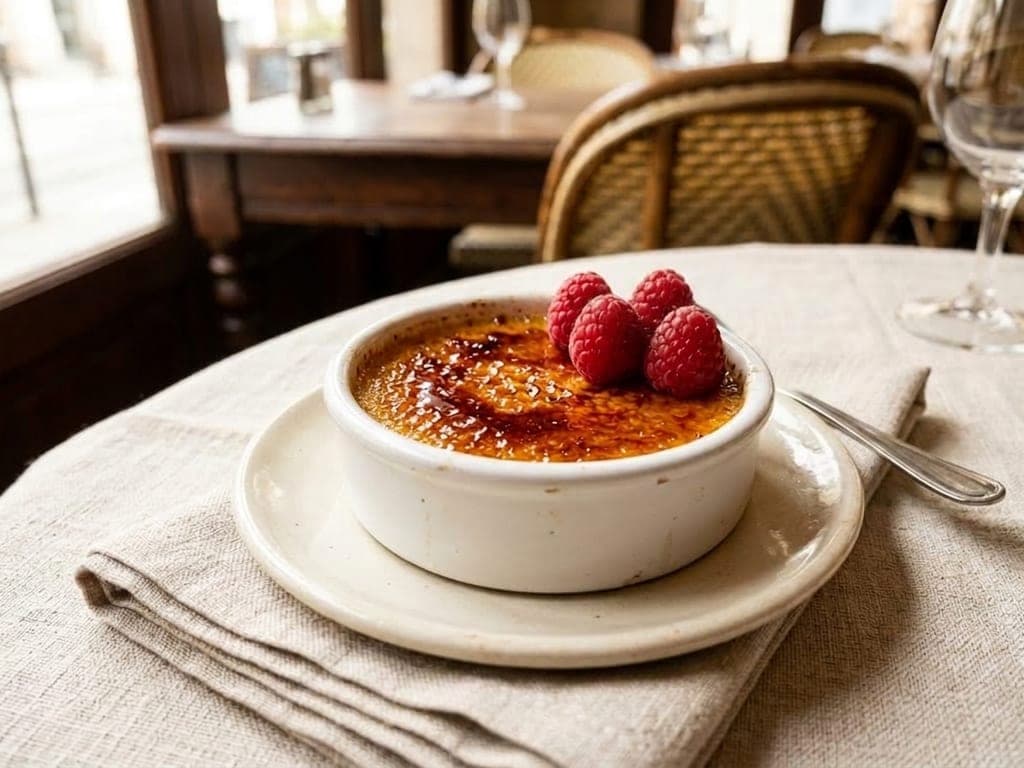 3. Right before serving, huddle a few fresh raspberries (not thawed frozen ones), rinsed and patted dry, at two o’clock on the crust, hollow side down. An imperfect cluster looks more natural than a neat row, and adding them last keeps their juice from dissolving the caramel.
- 4. Tuck a small mint sprig into the top of the cluster, leaves pointing outward, and wipe the plate rim before it goes to the table.
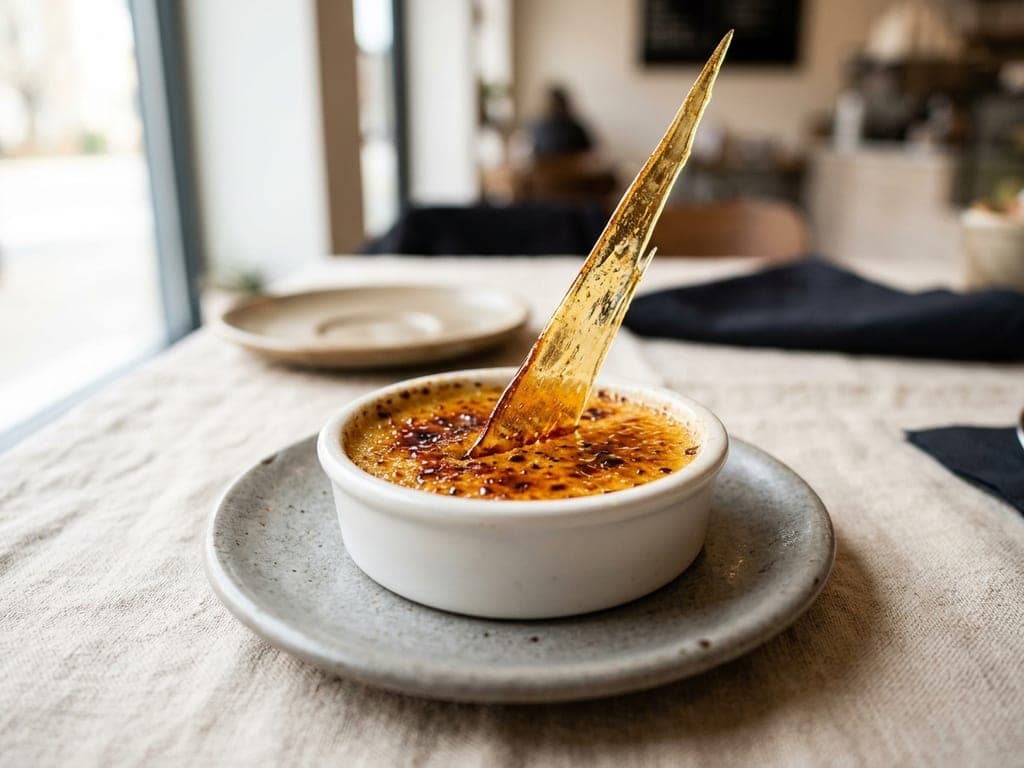
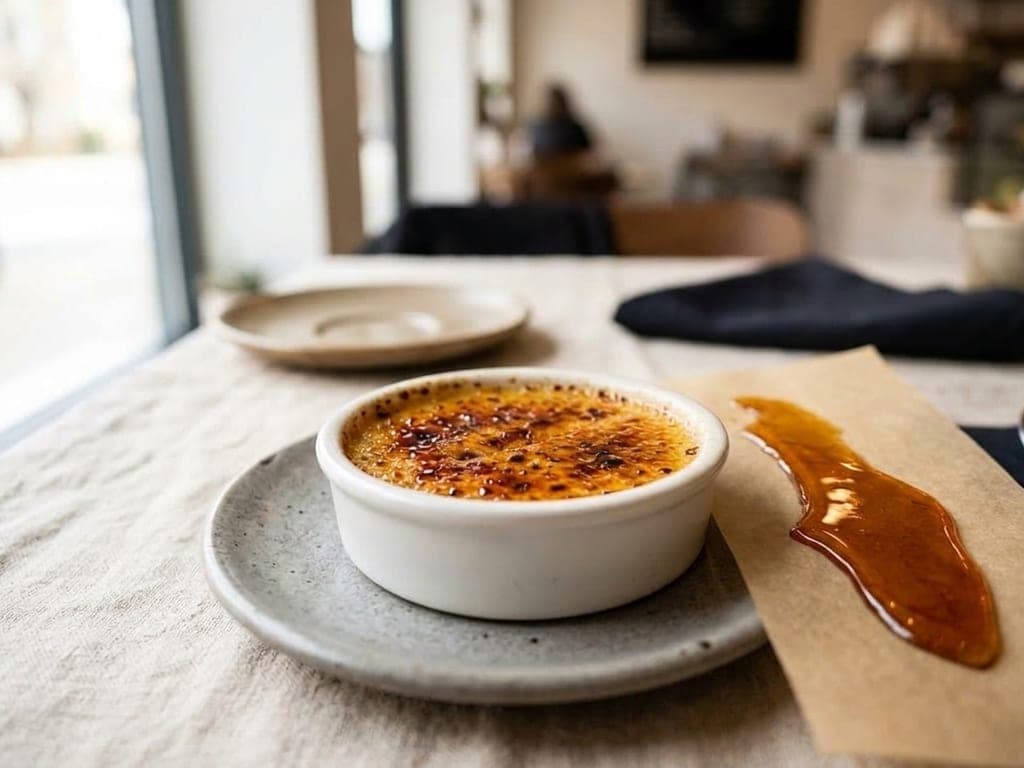 1. Whatever you used for the crust, make the shard in a small pan: cook 2 tablespoons of sugar with 1 tablespoon of water until it turns amber, or save a spoonful from the caramel pour. Pour it onto baking parchment set on a baking sheet, and tilt the sheet, not the loose paper, so it runs into a thin tongue.
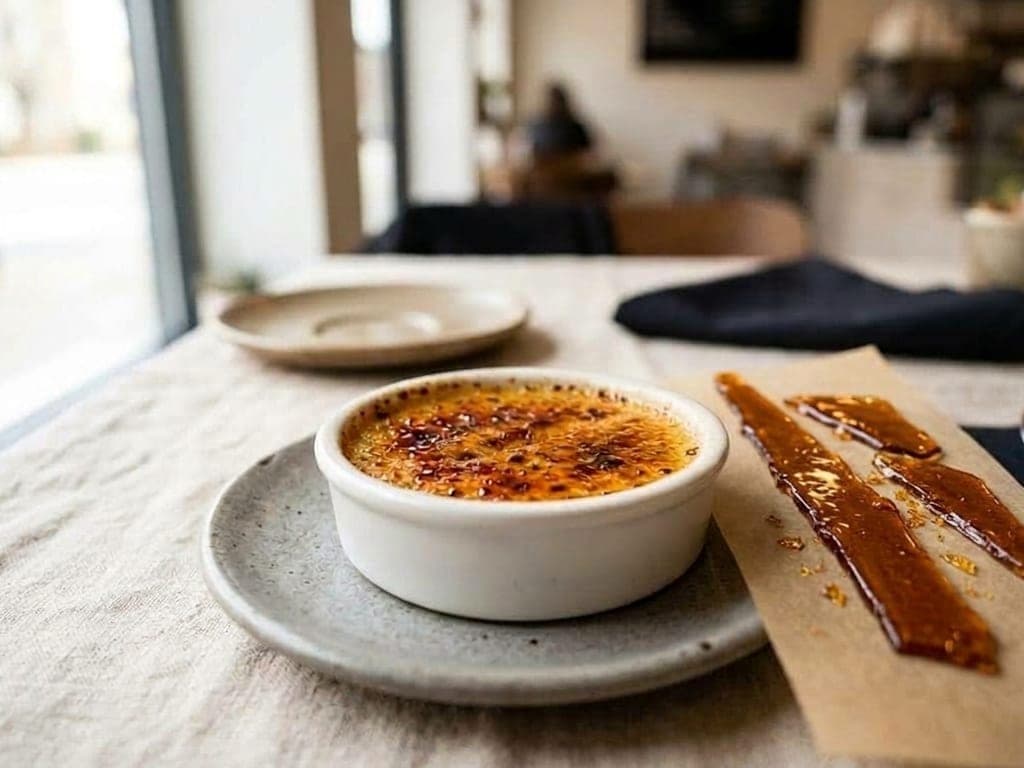 2. Let it set hard, about 5 minutes, then snap it into a few long, narrow shards and pick the tallest. Jagged edges look better than clean ones.
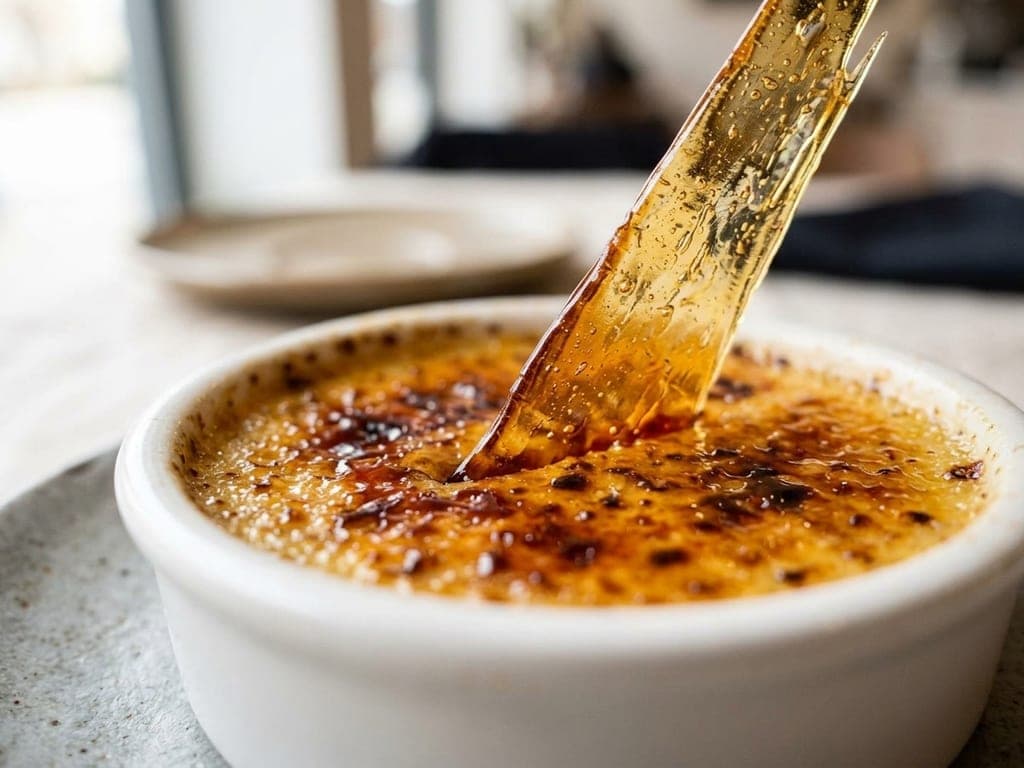 3. Just before serving, push the shard’s base firmly through the crust and lean it at a slight angle like a sail; a gentle twist as you press gets it through the caramel cleanly.
- 4. Serve immediately: the shard starts softening in the open air within the hour, same as the crust.
How to make crème brûlée without a torch (4 ways)
No torch? Use the broiler (the overhead grill), or pour on a thin layer of caramel. The crust is just caramelized sugar, so the heat source is negotiable: every method here gives the same glassy, crackable top.
The broiler. Move a rack so the sugar will sit 3 to 4 inches (8 to 10 cm) below the element and preheat the broiler on high for a full 10 minutes. Use porcelain or stoneware ramekins sold as broiler-safe, never glass. Take the custards straight from the fridge, blot them dry and cover each with a thin, even layer of granulated sugar. Stand them in a roasting pan and pour ice water around them to halfway up the sides, so only the sugar gets hot. Broil for 1 to 4 minutes, turning the pan once and watching every second, and pull them the moment the sugar is amber. For a thicker crust, do what Michel Roux Jr does and build it in thin coats: sugar and broil, then sugar and broil again. If the custard feels warm, chill it for 10 minutes before serving.
You may have read the freeze-first trick, 20 to 30 minutes in the freezer before broiling. The ice bath does the same job without the thermal shock. Only freeze first if your ramekins’ maker says they can go from the freezer to a hot oven; Le Creuset, for one, tells stoneware owners not to put a frozen dish in a preheated oven.
The caramel pour needs no broiler at all. Make one batch for all six: put ⅔ cup (130 g) sugar, ¼ cup (60 ml) water and 1 tsp light corn syrup or golden syrup in a small pan, stir just until the sugar is wet, then leave it alone over medium heat until it turns deep amber, about 340°F (170°C). Turn the heat to its lowest setting. Working one ramekin at a time, spoon about 2 teaspoons of caramel onto the cold custard and tilt the ramekin at once so it runs to the edges, then set the pan back on the low heat before the next one. Keep the layer about as thin as a coin: the caramel seizes on the cold surface in seconds, hardens fully in about 5 minutes and cracks cleanly, and the custard never feels any heat. Pour more and you get a hard-candy lid instead of a crust. A poured crust carries a little more sugar than a torched one, about 40 more calories per custard.
Caramel discs keep every bit of heat away from the custard. Cook the same amber caramel, spoon it into thin rounds a little smaller than your ramekins on a silicone mat or parchment, let them harden for about 5 minutes, and lay one on each custard just before serving.
The oldest way needs no gas at all: a hot iron. Massialot’s 1691 recipe browns the sugar with a fire shovel heated red-hot, and a salamander, a cast-iron disc on a long handle heated on a gas flame or burner and held just above the sugar, still does the job. For one custard, a large metal spoon heated in a gas flame and pressed onto the sugar for a few seconds works the same way. Hold either with an oven mitt, rest it on a heatproof surface and keep it well away from children.
Why this recipe works
Five yolks to 2 cups (480 ml) of cream sits squarely inside the range the most-tested recipes use. America’s Test Kitchen goes to 6 yolks per 2 cups, Mark Bittman’s New York Times recipe uses exactly 5, and the restaurant batch Gordon Ramsay published in The Caterer works out to just under 5. Guy Savoy’s, from his two-star Paris kitchen, is within a yolk of it. Sugar at ⅓ cup (67 g) matches America’s Test Kitchen and sits within a few grams of Savoy’s and Ramsay’s, so the custard reads as vanilla cream rather than pudding and the crust brings the rest of the sweetness.
Yolks alone set silkier than whole eggs, and a custard this rich is the forgiving kind: the cream’s fat and the sugar get between the egg proteins, so they bond slowly and set into a tender gel instead of tightening into curds.
Wide, shallow dishes matter more than any ingredient choice, and chefs say so in print. Michel Roux Jr picks large shallow ramekins “for a higher proportion of crunchy brûlée to rich cream,” Heston Blumenthal pours his custard ¾ inch (2 cm) deep, and Guy Savoy bakes in shallow porcelain egg dishes. Le Cirque’s former executive chef Raphael François warns that in a ramekin or deeper dish “the top will be overcooked and the bottom’s not going to be cooked.” Aim for ¾ to 1 inch (2 to 2.5 cm) of custard, in a dish about 4 ½ to 5 inches (11 to 13 cm) across: it bakes evenly and puts crust in every spoonful. Standard deeper ramekins work too; they just take longer, so trust the thermometer.
Pull it by temperature, not by looks. A finished crème brûlée looks underdone in the oven: set edges and a center that jiggles like set gelatin. An instant-read thermometer reading 170 to 175°F (77 to 79°C) in the middle is the one objective cue, and the custard firms the rest of the way as it cools.
If it goes wrong
Grainy or curdled: the custard went past the target, usually from too long a bake or a missing water bath. Next time, start checking 5 minutes early and pull it at 170 to 175°F (77 to 79°C).
Liquid in the center after chilling: it came out too early. The center should read at least 170°F (77°C) before it leaves the oven.
Bubbles or foam on top: the yolks were whisked hard and the surface was not skimmed. Skim the jug and pop the bubbles before baking.
Wet or weeping crust: condensation, or sugar left sitting too long. Blot the tops dry and caramelize right after sugaring.
Black spots from the broiler: the custards sat too close to the element or the pan was not turned. Move the rack down a notch and turn the pan every 30 seconds.
How Michelin-starred kitchens make it
Crème brûlée is one of the few desserts that starred kitchens still serve close to the classic, and several chefs have published exactly how they make it. For comparison, this recipe uses 5 yolks and ⅓ cup (67 g) of sugar per 2 cups (480 ml) of cream, baked at 325°F (163°C) in a water bath. Stars are as listed in the 2026 MICHELIN Guide.
Tom Kerridge, The Hand & Flowers, Marlow (two stars). Vanilla crème brûlée has been on the menu at his pub since it opened, and it never goes in the oven. He steeps the vanilla in the cream for 30 minutes, brings it back to the boil, pours it onto whisked eggs and sugar, then stirs the mix in the pan until it thickens and reaches 190°F (88°C). Strained and cooled, it sets in the fridge in about 3 hours. To finish, he wipes the edge of each dish, torches from the edges toward the center and takes the caramel to a dark brown, so its slight bitterness balances the rich custard. It rests about 5 minutes and goes out with no garnish.
Guy Savoy, Paris (two stars). His recipe bakes 9 yolks, about 3 cups (750 g) of 35% cream, close to the richness of US heavy cream, and ½ cup (100 g) of sugar at 194°F (90°C) for 50 minutes, in small pots or shallow porcelain egg dishes, with no water bath listed. The finish is a light layer of cassonade, France’s raw cane sugar, under the torch. Scaled to 2 cups of cream, that is within a yolk of our ratio and within a few grams of our sugar.
Alain Ducasse, Le Louis XV, Monaco (three stars). His bistro-style recipe is lighter: equal parts milk and light cream, about 2 cups (500 ml) of each, with four vanilla beans steeped off the heat for 30 minutes, 9 yolks, a 212°F (100°C) oven and a cassonade crust.
Heston Blumenthal, The Fat Duck, Bray (three stars). In his golden syrup crème brûlée he pours the custard ¾ inch (2 cm) deep into brûlée dishes, pops the last surface bubbles with a quick pass of the torch and bakes it at 284°F (140°C) in a water bath under foil. He chills it at least 6 hours, preferably overnight, keeps sprinkling sugar as he torches, and serves it at once, because the sugar starts drawing moisture from the custard and goes soft.
Michel Roux Jr, Le Gavroche, London (two stars until it closed in January 2024). He asks for large shallow ramekins “for a higher proportion of crunchy brûlée to rich cream,” bakes at 284°F (140°C) in a water bath, and builds the crust in several thin coats with a torch or a very hot grill. Demerara, he notes, gives the crunchiest top but does not stay that way for long. He serves it with warm almond puff-pastry twists.
Gordon Ramsay, Restaurant Gordon Ramsay, London (three stars). The restaurant version he published in The Caterer in 2006 uses 12 yolks to about 4 cups (1 liter) of double cream and a scant cup (200 ml) of milk, baked at 230°F (110°C) in a water bath for 47 minutes, then turned out of its mold, caramelized and served with fresh Granny Smith apple juice.
Le Cirque, New York (never starred). The restaurant that made the modern crème brûlée famous never held a Michelin star, but its recipe is worth knowing. As its former executive chef Raphael François gave it to the MICHELIN Guide: 20 yolks, 8 cups (1.9 liters) of heavy cream and 2 cups (400 g) of sugar, about 4 oz (120 g) per wide, shallow dish, baked at 204°F (96°C) in a convection oven for 66 minutes with no water bath, then finished with muscovado sugar. “At lower temperature,” he says, “it doesn’t overcook.” Per 2 cups of cream, that is exactly our 5 yolks, with half again as much sugar.
What they share: a gentle oven or none at all, shallow dishes, and a crust made at the last minute, most often from a brown or raw cane sugar. Where they differ: all cream (Savoy, Le Cirque), British double cream let down with milk (Ramsay, Blumenthal, Roux Jr), which lands close to US heavy cream anyway, or a genuinely lighter half-milk custard (Ducasse). Oven settings run from 194°F (90°C) to 284°F (140°C). Ours is hotter because the water bath does the protecting, and it gets dessert into the fridge in about 35 minutes.
A note on names, because menus and recipe sites blur them. Guy Savoy held three stars from 2002 until 2023 and holds two today. Paul Bocuse’s restaurant near Lyon held three from 1965 until 2020 and also holds two. Le Gavroche closed in January 2024. Le Cirque in New York never held a star: Michelin’s first New York guide was the 2006 edition. Dieter Schorner, Le Cirque’s pastry chef in the 1980s, and Pierre Hermé, who says he first tasted the dessert there, are pastry chefs, not starred restaurants.
Three centuries without a blowtorch
The oldest printed recipe called crème brûlée is in François Massialot’s Le Cuisinier roïal et bourgeois (Paris, 1691). Massialot, who cooked for the Duke of Orléans, blended egg yolks with a pinch of flour and milk, flavored it with cinnamon and citrus peel and cooked it in the serving dish. Then he sugared the top and passed “la pèle du feu, bien rouge,” the fire shovel heated red-hot, over it until it took on “une belle couleur d’or,” a fine golden color. His menu for a grand May dinner lists “deux petites Crèmes brûlées,” and he notes that a similar meal was served at the Marquis de Seignelay’s château at Sceaux to the Dauphin and the court on May 14, 1690.
English cookbooks printed the dish as “burnt cream” from 1702, in a translation of Massialot, and English cooks kept the hot iron. Elizabeth Moxon’s English Housewifry (1764 edition) says to “heat a fire-shovel red-hot, and hold it over the top till the sugar be brown,” and later recipes switch to a salamander, a heavy iron disc heated in the fire. Trinity College, Cambridge, which has served its burnt cream since the later 19th century, keeps a branding iron in the shape of the college crest for the crust. In Catalonia, crema catalana is traditionally burnt with a red-hot iron paddle. The broiler and the kitchen torch are the newcomers.
Escoffier’s Guide to Modern Cookery (1907) has no recipe for it at all. The comeback started in New York, at Le Cirque. Sirio Maccioni, its owner, said he wanted the dessert after eating crema catalana in Spain during the 1982 World Cup, and credited his wife Egidiana and chef Alain Sailhac with developing it. Dieter Schorner, Le Cirque’s pastry chef at the time, told Saveur that he baked it in a shallow fluted dish under a thinner crust, and that Paul Bocuse, whose restaurant near Lyon then held three Michelin stars, “declared it the best dessert he had eaten that year.” Pastry chef Pierre Hermé has said he first tasted crème brûlée at Le Cirque, not in France.
Questions, answered
How do you make crème brûlée without a torch?
Use the broiler (the overhead grill). Preheat it on high for 10 minutes with a rack so the sugar sits 3 to 4 inches (8 to 10 cm) below the element. Blot the cold custards dry, cover each with a thin, even layer of granulated sugar, stand them in a roasting pan of ice water and broil for 1 to 4 minutes, turning the pan and watching the whole time. Use porcelain or stoneware ramekins sold as broiler-safe, never glass. No broiler either? Cook sugar and a little water to a deep amber caramel and spoon a thin layer over each cold custard; it sets hard in about 5 minutes.
What temperature do you bake crème brûlée at?
Bake at 325°F (163°C) in a water bath, and pull the custards when the center reads 170 to 175°F (77 to 79°C) on an instant-read thermometer. They will still wobble in the middle; that is correct, and they set as they cool. That reading is also above the USDA’s 160°F (71°C) guideline for egg dishes.
Can you make crème brûlée without ramekins?
Yes. Any oven-safe dish that fits in the water bath works, as long as the custard sits about ¾ to 1 inch (2 to 2.5 cm) deep: oven-safe teacups, small gratin dishes, or one shallow baking dish to share. The shallower and wider the dish, the faster it bakes, so start checking early and pull it when the center reads 170 to 175°F (77 to 79°C). If you plan to use the broiler, choose porcelain or stoneware, never glass.
Can you make crème brûlée without an oven?
Yes. Tom Kerridge’s crème brûlée at The Hand & Flowers, his two-Michelin-star pub in Marlow, never goes in the oven: he pours boiling vanilla cream onto whisked eggs and sugar, stirs the mix in the pan over medium-low heat until it thickens and reaches 190°F (88°C), strains it, lets it cool and sets it in the fridge for about 3 hours before torching. His recipe uses whole eggs and British double cream (about 3 cups / 750 ml of cream to 4 eggs), so follow his proportions if you cook it that way. A sous-vide water bath at 176°F (80°C) works too. Whatever the method, the center must reach at least 160°F (71°C), the USDA temperature for egg dishes.
Can you make crème brûlée without a water bath?
Only if you bake it thin and very low. Raphael François, Le Cirque’s former executive chef, told the MICHELIN Guide he bakes a thin layer in wide, shallow dishes at 204°F (96°C) in a convection oven and skips the bath. At this recipe’s 325°F (163°C), keep it: water cannot rise above 212°F (100°C), so the bath stops the edges overcooking before the center sets.
How long does crème brûlée last in the fridge?
Covered, the baked custards keep 3 to 4 days in the fridge, counted from the day you bake them, which makes this a good make-ahead dessert. Caramelize them only when you serve: the crust starts drawing moisture from the custard and softening within about 30 minutes. Leftovers that are already caramelized are still safe within the same 3 to 4 days if they went back in the fridge within 2 hours; the crust just melts into a thin syrup.
Can you freeze crème brûlée?
You can, and it is safe, but it costs some silkiness: USDA’s storage chart lists custard pies as a food not to freeze, and ice crystals can leave a thawed custard slightly grainy and weeping. If you try it, freeze the custards un-topped, wrapped in two layers of plastic wrap (cling film) plus one of foil, use them within a month, thaw them overnight in the fridge, never on the counter, and blot the surface dry before you sugar and caramelize. Never freeze them already topped; the caramel turns sticky. For the best texture, bake up to 3 days ahead and refrigerate instead.
Is crème brûlée served hot or cold?
Cool underneath, warm on top. The custard is chilled for hours and the sugar is caramelized moments before serving, so the crust is still faintly warm and brittle over cool, silky cream. If you torch, let the custards sit out for 20 minutes first so the cream is cool rather than fridge cold. Kitchens differ here: Le Cirque’s recipe, as its former executive chef Raphael François teaches it, brings the custards to room temperature before torching, while Heston Blumenthal says to serve at once, because the sugar starts drawing moisture from the custard and softens.
Can I use double cream or 30% cream?
Yes. US heavy cream is at least 36% fat, and UK whipping cream (at least 35%) is the closest match. UK double cream is at least 48% fat, so on its own it sets denser and richer; let it down with milk, as British chefs do. 1 ⅔ cups (400 ml) double cream plus ⅓ cup (80 ml) whole milk comes out at about 40% fat, the same 5-to-1 split as the restaurant crème brûlée Gordon Ramsay published in The Caterer, and Heston Blumenthal and Michel Roux Jr use similar blends. Lighter 30% cream works too; the custard comes out a little softer.
Can I use vanilla extract instead of a vanilla bean?
Yes: 2 to 3 tsp pure vanilla extract or vanilla bean paste replaces the one bean. Skip the steep and stir it into the strained custard. A bean or paste gives the visible seeds; extract gives none.
What can I do with the leftover egg whites?
This recipe leaves 5 whites. Keep them covered in the fridge for 2 to 4 days, or freeze them for up to 12 months, then use them for meringues, macarons or an egg-white omelet.
Can you eat crème brûlée when pregnant?
Homemade crème brûlée counts as a cooked egg dish once the center of the custard reaches 160°F (71°C), the temperature US food-safety agencies give pregnant women for egg dishes. This recipe takes it to 170 to 175°F (77 to 79°C), so check with an instant-read thermometer rather than trusting the wobble. In the UK, the NHS says hen eggs with the red British Lion stamp, or from the Laid in Britain scheme, are fine even partly cooked, and other hen eggs should only be eaten well cooked. Vanilla paste and extract carry a little alcohol, so use the whole bean if you are avoiding it completely. When eating out, it is fine to ask how the custard is cooked.
Is crème brûlée gluten-free?
Yes. Modern crème brûlée is only cream, egg yolks, sugar and vanilla, all naturally gluten-free (this recipe included). Older recipes and its closest cousin are different: Massialot’s 1691 original and some 18th-century English burnt creams stir in flour, and crema catalana is often thickened with wheat flour or cornstarch. Boxed mixes and restaurant versions can add starch or pick up cross-contamination, so if you are cooking for someone with celiac disease, check the recipe, the kitchen and the labels.
What does crème brûlée taste like?
A rich vanilla custard, softer and silkier than flan and closer to a thick cream than a set pudding, under a thin, bittersweet sheet of toasted caramel. The eating experience is the crack: the glassy sugar gives way to cool cream underneath.
What is the difference between crème brûlée and flan?
Flan and crème caramel bake the custard on top of soft caramel and are turned out of the mold, so the caramel pours over them as a sauce; they are usually milk-based and firmer. Crème brûlée stays in its dish, is made with cream and yolks, and its caramel is a hard, crackable sheet made at the last minute.
What is the difference between crème brûlée and crema catalana?
They share the burnt-sugar crust but not the custard. Crema catalana, also called crema cremada or crema de Sant Josep, is made with milk rather than cream, flavored with cinnamon and lemon zest rather than vanilla, thickened with starch and stirred on the stove instead of baked in a water bath. It is traditionally burnt with a red-hot iron paddle and eaten on Saint Joseph’s Day, March 19. Crème brûlée is an all-cream custard baked gently in the oven.
What does “crème brûlée” mean?
French for “burnt cream.” The burnt part is only the sugar on top, caramelized into a thin amber sheet just before serving. English cookbooks used the literal translation, burnt cream, from the early 1700s, and Trinity College, Cambridge still calls its version Trinity burnt cream.
Who invented crème brûlée?
Nobody knows who first burned sugar onto a custard, but the oldest printed recipe under the name is French. François Massialot, cook to the Duke of Orléans, published “Crême brûlée” in Le Cuisinier roïal et bourgeois in 1691: egg yolks, a pinch of flour and milk, cooked in the serving dish, then sugared and browned with a fire shovel heated red-hot. Catalonia’s crema catalana is its closest cousin, but the name first appears in print in 1745 and its burnt-sugar top in 1770. The earlier “Spanish” recipe sometimes cited, a latte alla spagnuola from 1662, comes from an Italian cookbook and browns the custard before the sugar goes on. England printed the dish as burnt cream from 1702, in a translation of Massialot, and Trinity College, Cambridge has served its own version since the later 19th century, though the college says the story that it invented crème brûlée “almost certainly has no basis in fact.”
Who made crème brûlée famous?
A New York restaurant that never held a Michelin star. After the 1982 World Cup in Spain, Sirio Maccioni, owner of Le Cirque, wanted a dessert like the crema catalana he had eaten there. Accounts of who made it differ: Maccioni credited his wife Egidiana and chef Alain Sailhac, while pastry chef Dieter Schorner told Saveur he baked it in a shallow fluted dish under a thinner crust. Schorner also recalled Paul Bocuse, whose restaurant near Lyon then held three Michelin stars, calling it the best dessert he had eaten that year. Pastry chef Pierre Hermé has said he first tasted crème brûlée at Le Cirque, not in France.
Snap your finished plate and let the AI plate it again — more beautifully.