Sushi Bake Recipe (The Baked California Roll Casserole)
A deconstructed California roll served hot: seasoned sushi rice pressed into a baking dish, a creamy surimi-and-Kewpie layer broiled until golden, furikake between and on top. Everyone scoops their own square onto a crisp sheet of nori and folds it like a tiny taco. Born at Hawaii potlucks, made famous from a Manila kitchen in 2020.
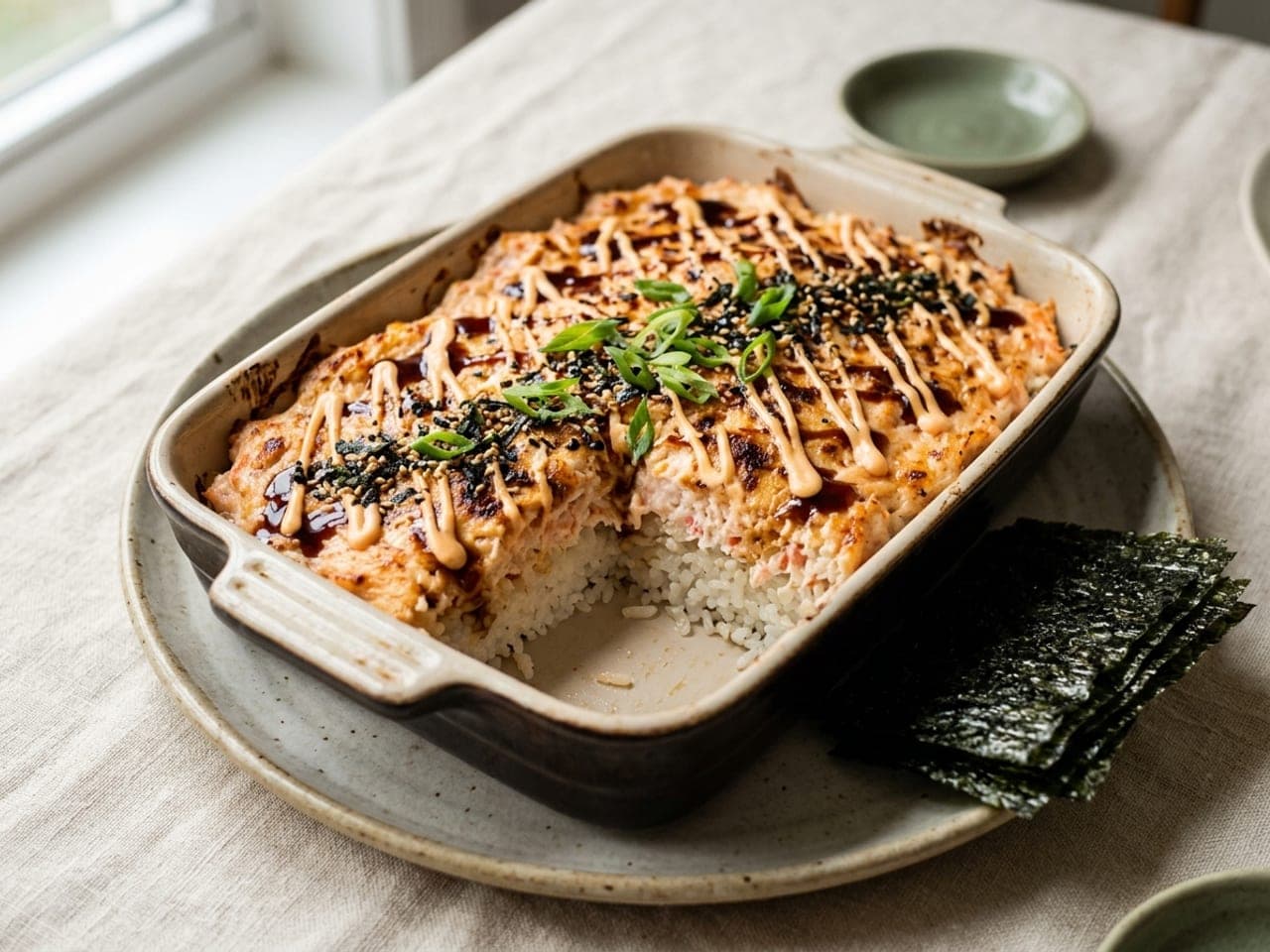
Ingredients
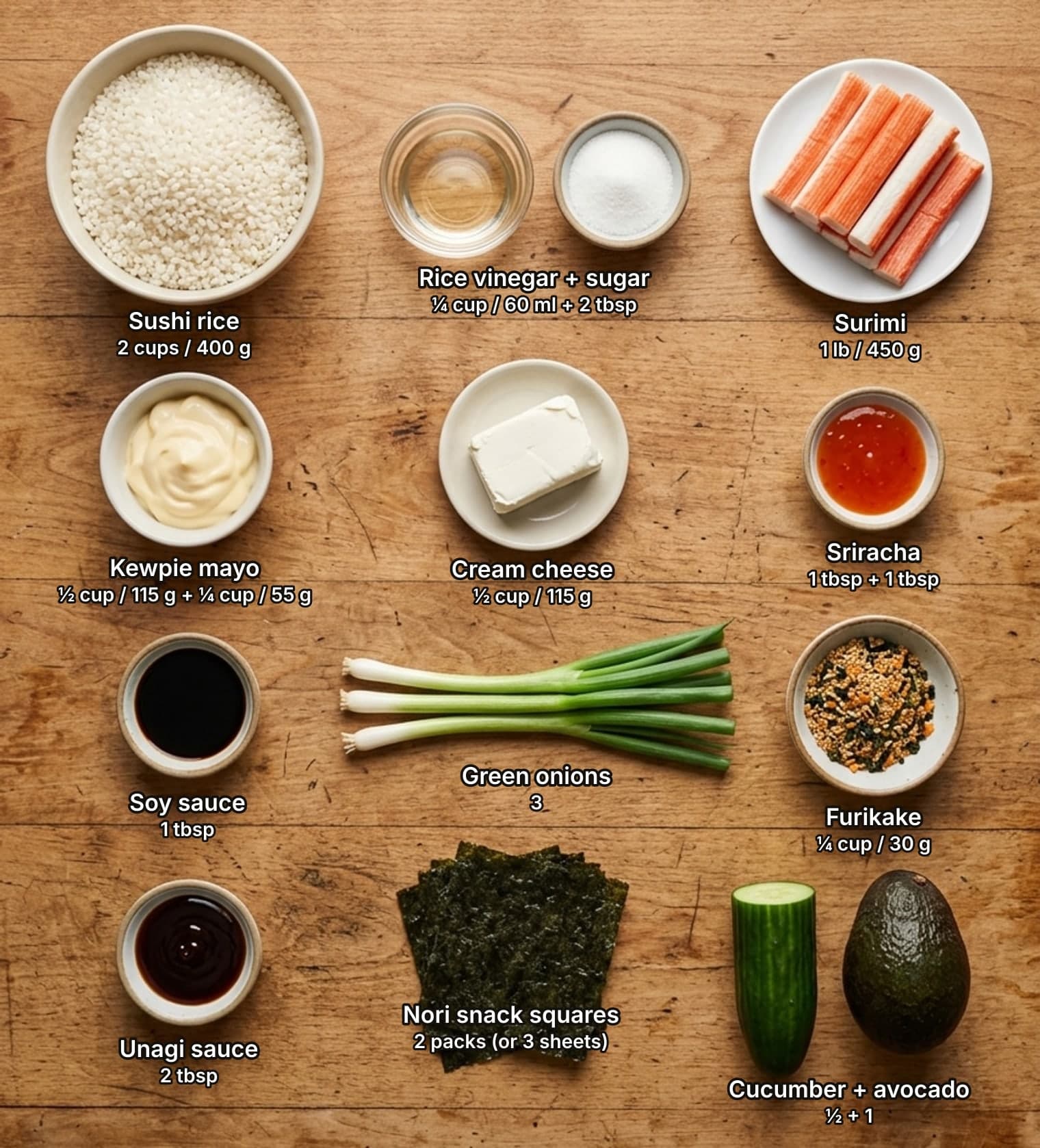
- sushi rice (short-grain), uncooked2 cups / 400 g
- water, for the rice2 cups / 475 ml (+ 2 tbsp on the stovetop)
- rice vinegar¼ cup / 60 ml
- sugar2 tbsp
- fine salt1 tsp
- surimi (seafood sticks / imitation crab)1 lb / 450 g
- Kewpie mayonnaise (or mayo + a splash of rice vinegar + a pinch of sugar)½ cup / 115 g, plus ¼ cup / 55 g for the drizzle
- full-fat cream cheese, softened½ cup / 115 g
- sriracha1 tbsp, plus 1 tbsp for the drizzle
- soy sauce1 tbsp
- green onions (spring onions), thinly sliced3
- furikake (Japanese rice seasoning — or toasted sesame + crumbled nori + salt)¼ cup / 30 g, half under, half on top
- unagi (eel) sauce, to finish2 tbsp
- roasted nori snack squares, to serve2 packs (or 3 full sheets, each cut in 6)
- cucumber, in batons, to serve½
- avocado, sliced, to serve1
Who actually invented sushi bake
The internet’s standard line — “invented in 2015 by Mimi Qiu Reyes” — is half the story, and the wrong half first. Baked sushi casseroles were a Hawaii potluck fixture long before 2015: locals call the genre pan sushi, at least one Japanese-American church cookbook was printing sushi bake recipes by 2009, and chef Sheldon Simeon’s Cook Real Hawaiʻi includes a pan sushi dynamite in the same lineage. Like the fruits of Hawaii’s plate-lunch culture generally, it grew out of Japanese immigrant cooking meeting the American casserole dish.
The 2020 phenomenon, though, genuinely belongs to Mimi Qiu Reyes — a Filipino celebrity nail artist who says she first made a tray for a family gathering in California in 2015 — then, when lockdown closed her Manila salon, started selling “The Original Baked California Roll” in April 2020 from a five-square-meter kitchen with ₱10,000 of capital. She sent trays to her celebrity nail clients; within weeks it was the dish of the Philippine quarantine, by June it had jumped to Instagram kitchens, by August to restaurants, and from there to the world’s For You pages. Hawaii built the dish; Manila made it famous — that’s why you’ll find it filed under Filipino food here.
The name that explains it best is the one Reyes chose: a baked California roll. Same rice, same surimi-and-mayo heart, same nori — just reassembled as a casserole and served hot. If you can make our California roll below, you already know this dish; if rolling intimidates you, this is the roll with the hard part deleted.
How to make Sushi bake
- Cook the rice. Rinse 2 cups (400 g) of sushi rice in a sieve, swishing under cold water until it runs nearly clear, then drain well. Cook with 2 cups (475 ml) of water — the same 1:1 ratio as our sushi rice page below, plus 2 extra tbsp if you use a pot instead of a rice cooker: bring to a boil, drop to the lowest heat for 12–13 minutes, then rest off the heat, lid on, for 10 minutes. You want it slightly firmer than table rice; it has an oven visit ahead.
- Season it warm. Stir ¼ cup (60 ml) of rice vinegar with 2 tbsp of sugar and 1 tsp of fine salt until dissolved (10 seconds in the microwave helps). Turn the hot rice out into a wide bowl, drizzle the vinegar mixture over, and fold it through with a cutting motion — don’t stir hard, or you’ll mash the grains. This awasezu runs a little leaner than the ⅓-cup (80 ml) tier on our sushi rice page below, on purpose: the Kewpie-and-cream-cheese topping brings richness the rice shouldn’t compete with.
- Mix the creamy layer. Pull 1 lb (450 g) of surimi (sold as seafood sticks or crab sticks in Europe) into fine shreds with your fingers — pat it dry first if it looks wet. Fold it with ½ cup (115 g) of Kewpie mayonnaise (Japanese mayo — or regular mayo whisked with a splash of rice vinegar and a pinch of sugar), ½ cup (115 g) of softened cream cheese, 1 tbsp of sriracha, 1 tbsp of soy sauce and two of the sliced green onions (spring onions) until evenly creamy.
- Build the layers. Heat the oven to 425°F (220°C). Press the seasoned rice into a 9×13 in (23×33 cm) baking dish in an even layer about ¾ inch (2 cm) deep — firm enough to slice later, not packed hard. Scatter half the furikake (the Japanese rice seasoning — a substitute is in the sections below) over the rice, then spread the surimi mixture to the edges like frosting a cake.
- Bake hot and fast. Bake for 10–15 minutes, until the top colors at the peaks and the edges bubble. Everything in the dish is already fully cooked, so you are only heating it through and browning the surface — that’s also why a slower 350°F (175°C) oven for 20–25 minutes works just as well if it suits your timing. The full logic is in the sections below.
- The broiler minute. For the taquería-gold top, switch to the broiler (the overhead grill) on high for 1–2 minutes — and do not walk away. The mayo layer goes from pale to golden-toasted to burnt in under a minute. Golden peaks with a few deep-brown tips is the target.
- Rest, then dress. Rest the dish 5–10 minutes — the creamy layer settles and slices cleaner. Then finish like a counter pro: zigzag lines of spicy mayo (¼ cup / 55 g Kewpie + 1 tbsp sriracha), a crosshatch of unagi sauce, the remaining furikake, and the last of the green onions.
- Serve it like tacos. Bring the dish to the table with a stack of crisp nori squares, cucumber batons and sliced avocado. Everyone scoops a spoonful of warm bake onto a nori square, adds a piece of cucumber or avocado, folds, and eats it in two bites while the seaweed still snaps. That snap is the whole point — nori goes on at the last second, never baked in the dish.
- Store and reheat. Leftovers keep 3 days in the fridge, airtight, with the nori stored separately. Reheat portions in the microwave under a damp paper towel until steaming, or covered in a 350°F (175°C) oven — once only. You can also assemble the whole dish up to 24 hours ahead, refrigerate it unbaked, and bake it straight from the fridge with a few extra minutes. Freezing turns the mayo layer grainy; don’t.
Safety & hygiene Important
- The surimi is already cooked. Surimi is fully cooked and pasteurized at the factory, so the bake only needs heating through — there is no raw-fish step in this dish, which is exactly why it’s the beginner-safest thing on a sushi table. Keep it refrigerated and use an opened pack within about 5 days.
- Adding real salmon? Hit 145°F (63°C). If you upgrade the topping with fresh salmon, bake the fillet first until it reaches 145°F (63°C) at the thickest point — the FDA’s safe minimum for fish — or until it flakes and looks opaque all the way through, then fold it in. Don’t rely on the casserole bake to cook raw fish hidden under a creamy layer.
- Cooked rice has a clock. Cooked rice can carry Bacillus cereus spores whose toxins survive reheating, so the risk is in the holding, not the oven. Don’t leave the baked dish at room temperature for more than 2 hours (1 hour on a hot day); refrigerate leftovers promptly in shallow portions and reheat until steaming hot, once.
- The broiler is the burn risk. Both kinds: the mayo top blackens in under a minute once it starts coloring, and the dish comes out searing hot. Stay at the oven for the broil, and give the ceramic a trivet and a warning at the table.
3 ways to plate it
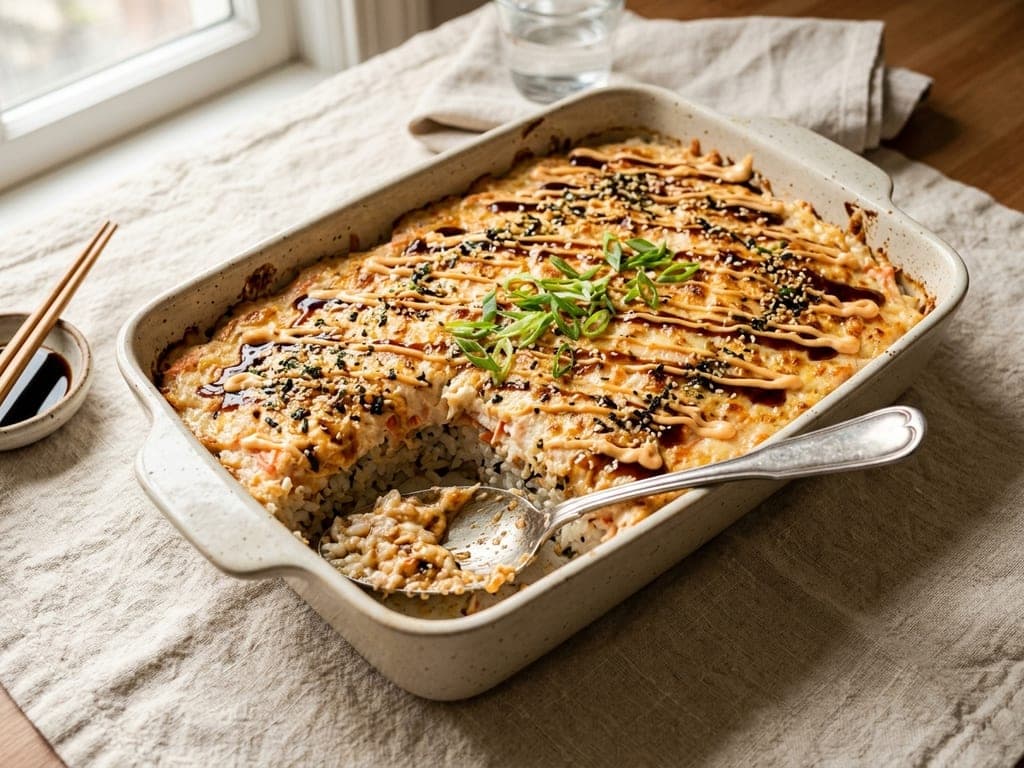
- Broil until the peaks are golden-toasted with a few deep-brown tips — color is the plate’s main garnish.
- Drizzle the spicy mayo in tight, parallel zigzags from a squeeze bottle or a snipped freezer bag, then cross it with unagi sauce at an angle.
- Finish with furikake and green onion while the sauces are still glossy so they hold in place.
- Scoop one corner portion out before the dish reaches the table and leave the spoon in the gap — the rice-layer cross-section it exposes is the appetite cue.
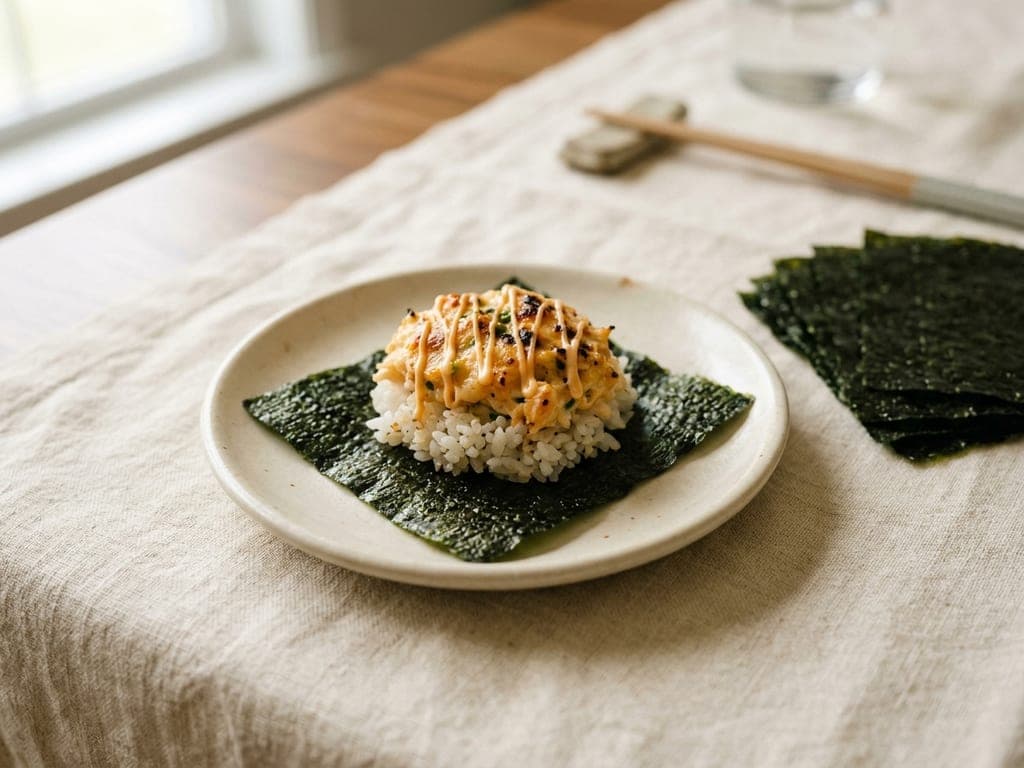
- Lay one nori square flat on a small plate, shiny side down, and place a compact spoonful of bake at its center — rice below, golden topping above.
- Keep the scoop smaller than feels natural; the square has to fold around it in one move.
- Add one thin drizzle of spicy mayo across the top of the scoop only, not the seaweed.
- Set the stack of remaining nori squares beside the plate — the promise of the next bite is part of the presentation.
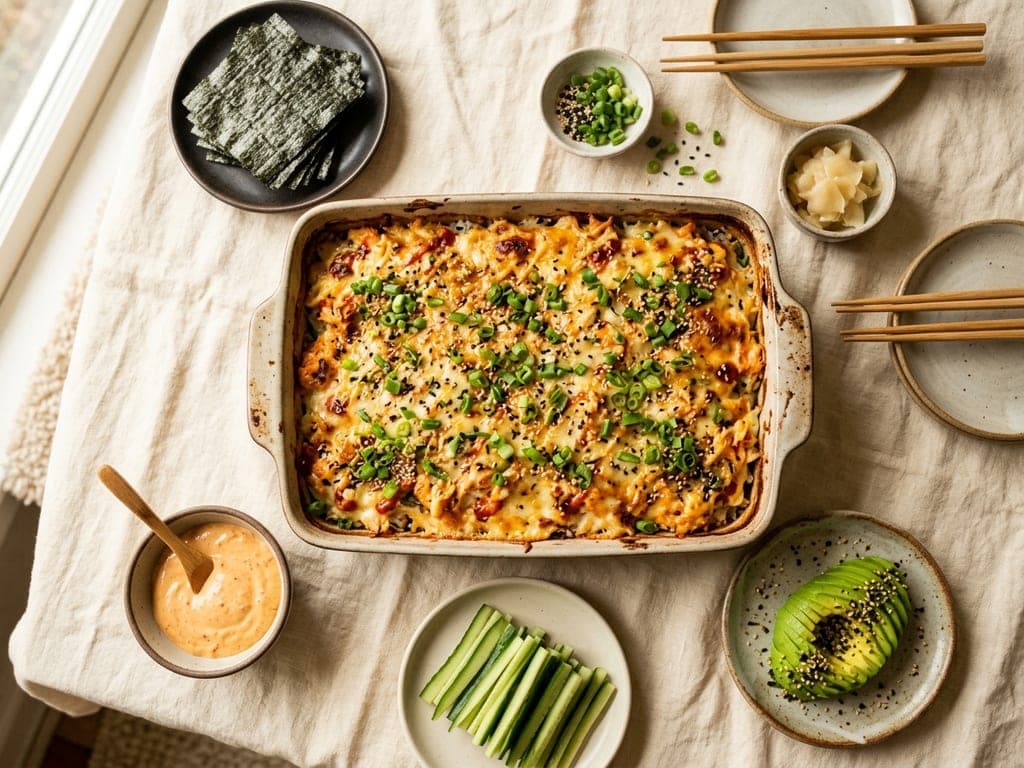
- Set the baking dish at the center of the table — it’s the hero; give the linen a trivet’s protection if it’s straight from the oven.
- Ring it with small plates and bowls: crisp nori squares, cucumber batons, fanned avocado slices, pickled ginger, extra spicy mayo with a spoon.
- Scatter a little furikake over the avocado too, so the sides visibly belong to the dish.
- Lay chopsticks and small plates at the rim of the ring — guests assemble over their own plate, not over the pan.
Two ovens, one truth
Half the ranking recipes bake at 425–450°F (220–230°C) for 10–15 minutes; the other half at 350°F (175°C) for 20–25. Both camps are right, because nothing in the dish is raw: the rice is cooked, the surimi is factory-cooked, the mayo and cream cheese just need to warm and brown. You are not baking a casserole through — you are heating it and coloring the top. Hot-and-fast keeps the rice moister; low-and-slow is more forgiving and heats deeper. Pick by your schedule, and let the broiler do the final coloring either way.
That’s also the answer to the golden-top question: color comes almost entirely from the last 1–2 broiler minutes, not the bake. A bake with no broil comes out pale and still tastes right; a broil left 60 seconds too long tastes like regret. Golden-brown peaks, not blackened patches.
Why sushi bakes turn watery
The dish’s one real failure mode, and no top-ranking page addresses it. The usual culprits, in order: surimi that went into the mix wet (it’s often lightly frozen or glazed — pat it dry and shred it before mixing), cucumber mixed into the topping instead of served alongside, under-drained canned fish in tuna or salmon versions, and drizzling the sauces on before the oven instead of after. The creamy layer should be a thick spread, not a batter.
If it still weeps a little at the edges, rest it the full 10 minutes — the layer reabsorbs most of it as it settles — and serve with a slotted spatula. And keep the fresh, wet things (cucumber, avocado) on the platter, not in the pan.
Finding the parts in Europe
Surimi is the easy one: it’s in every European supermarket chiller, sold as seafood sticks, ocean sticks or crab sticks (UK packs dropped the word “crab” years ago — there was never any crab meat in them). Kewpie is made in Europe now and sits in the world-food aisle of bigger stores; if you can’t find it, whisk regular mayonnaise with a splash of rice vinegar and a pinch of sugar and you’re 90% there.
Furikake (the Japanese rice seasoning) is an Asian-grocer or online buy — or make the working substitute: per tablespoon, mix a tablespoon of toasted sesame seeds with a teaspoon of crumbled nori and a pinch each of salt and sugar. For the serving nori, Korean-style roasted seaweed snack packs are actually ideal — pre-cut, crisp, already seasoned, and stocked by most large European supermarkets. Buy two packs; the first disappears during plating.
Questions, answered
What is sushi bake?
A casserole version of a California roll: a pressed layer of seasoned sushi rice topped with creamy surimi, Kewpie mayonnaise and cream cheese, baked and broiled until golden, finished with furikake and sauces, and eaten scooped onto crisp squares of nori. It’s served warm, feeds a crowd from one dish, and involves zero rolling.
Can I make sushi bake ahead?
Yes — assemble it fully (minus drizzles and the top furikake), cover and refrigerate up to 24 hours, then bake straight from the fridge with a few extra minutes. Baked leftovers keep 3 days airtight in the fridge; store nori separately so it stays crisp, and skip the freezer — the mayo layer splits.
Can I use canned tuna or salmon instead of surimi?
Yes — drained canned salmon or tuna are long-standing Hawaii variations, and cooked fresh salmon flaked into the mix is the popular upgrade. Whatever you use, drain it hard and pat it dry; excess liquid is the number-one cause of a watery bake.
Why is my sushi bake watery?
Wet surimi (pat it dry before shredding), cucumber mixed into the topping instead of served beside, under-drained canned fish, or sauces drizzled before baking instead of after. Rest the baked dish 10 minutes too — the creamy layer reabsorbs moisture as it settles.
Do you eat sushi bake hot or cold?
Warm, about 10 minutes out of the oven, scooped onto crisp nori. But cold sushi bake from the fridge has a quiet fan club — the flavors read closer to a chilled California roll. Both are legitimate; only fridge-cold nori is not, so always add the seaweed fresh.
What do you serve with sushi bake?
Crisp nori squares (Korean seaweed snack packs work perfectly), cucumber batons, sliced avocado, pickled ginger and extra spicy mayo. Some tables add edamame or a simple miso soup, but the dish is rich — crunchy, cool sides are the right counterweight.
Is sushi bake healthy?
It’s an occasion casserole: about 490 calories per serving as built here, most of it from the rice and the Kewpie-and-cream-cheese layer. Lighten it by cutting the mayo by a third, swapping half the surimi for cooked salmon, and leaning on the cucumber-and-nori serving style, which slows the pace of eating all by itself.
How many people does a 9×13 in (23×33 cm) sushi bake serve?
Six to eight as a main course, and up to 24 as potluck squares — this is a dish with two honest serving counts depending on the table. For a family dinner, halve the recipe into an 8×8 in (20×20 cm) dish and keep the timings the same.
Who invented sushi bake?
Two-part answer: baked sushi casseroles (“pan sushi”) existed at Hawaii potlucks well before the trend — a church cookbook was printing them by 2009 — and Filipino nail artist Mimi Qiu Reyes turned the idea into “The Original Baked California Roll” from her Manila kitchen in April 2020, igniting the craze that carried it worldwide. Hawaii built it; Manila made it famous.
Do you bake the nori with the casserole?
No — nori baked under or over the topping turns to wet paper. The seaweed’s job is textural: it goes on at the table, one crisp square per scoop, so every bite has the snap of a fresh roll. Keep the packs sealed until the dish comes out of the oven.
Snap your finished plate and let the AI plate it again — more beautifully.