Teriyaki Sauce Recipe (4 Ingredients, No Cornstarch)
Real teriyaki sauce is four ingredients and one pan: soy, sake, mirin and sugar, simmered until reduction — not cornstarch — gives it body and shine. Fifteen minutes makes a jar that keeps for weeks and glazes everything from chicken thighs to salmon to grilled tofu. The thick American version is here too, honestly labeled, plus the answer to the alcohol question no recipe page gives straight.
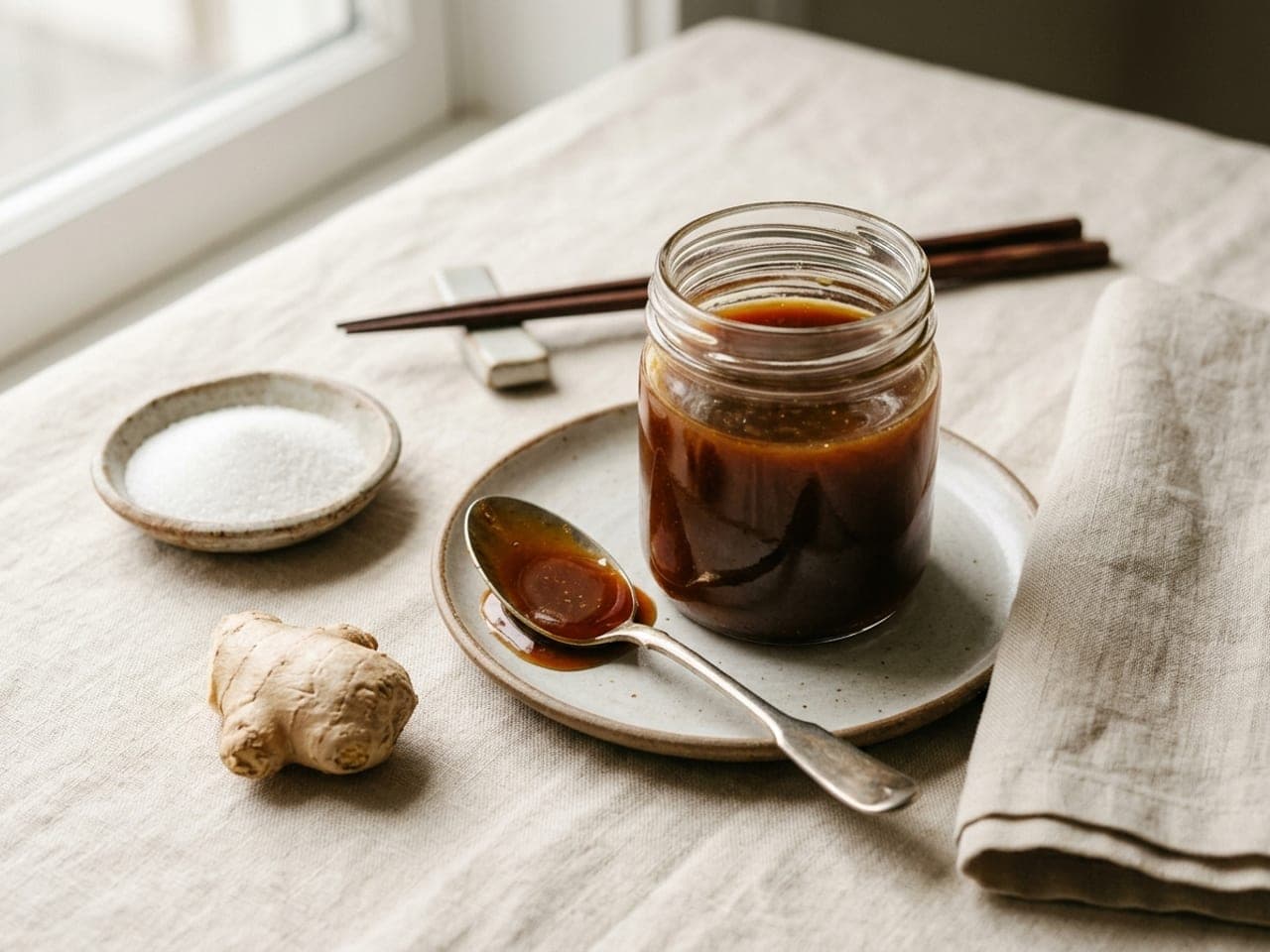
Ingredients
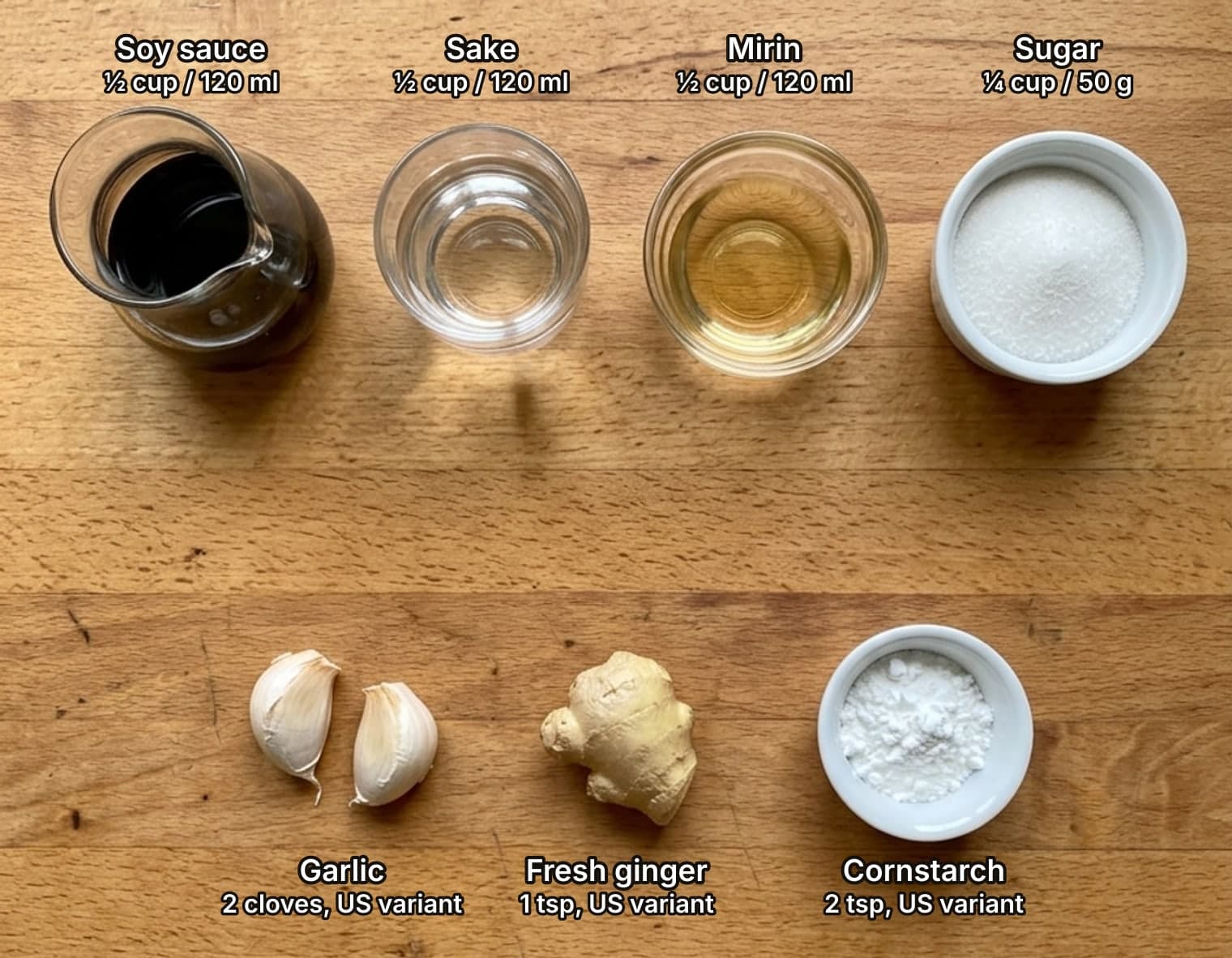
- soy sauce (Japanese all-purpose / koikuchi)½ cup / 120 ml
- sake (or dry sherry — see sections)½ cup / 120 ml
- mirin (supermarket mirin-style works)½ cup / 120 ml
- sugar¼ cup / 50 g
- garlic, crushed (American variant only)2 cloves
- fresh ginger, grated (American variant only)1 tsp
- cornstarch, in 1 tbsp cold water (American variant only)2 tsp
Three ratios, three teriyakis
There is no single teriyaki sauce; there’s a spectrum, and knowing which point you’re standing on beats any one recipe. At the purist end, the classical formula recorded by Shizuo Tsuji pairs soy and sake in equal volume with a much smaller measure of mirin and a single part sugar — barely sweet, barely reduced, meant to form its gloss on the food over the fire. The Japanese home standard, and this page’s hero, is 2:2:2:1 with sugar promoted to a supporting role: sweeter, more forgiving, still transparent and starch-free. And the American family — what the top of every search page teaches — is soy plus brown sugar plus garlic and ginger, thickened with cornstarch, often stretched with water: a sauce built to pour rather than to reduce.
The spectrum isn’t a ranking. Tsuji’s lean version is what you want brushed on grilled fish; the 2:2:2:1 jar is the everyday workhorse; the American build is genuinely better for coating a wok of vegetables. What matters is that they’re different tools — and that the first two need no starch at all.
How to make Teriyaki sauce
- Four ingredients, one pan. Pour ½ cup (120 ml) each of soy sauce, sake and mirin into a small saucepan with ¼ cup (50 g) of sugar. That’s the whole build — the classic Japanese home ratio is 2:2:2:1, and there’s no garlic, ginger or starch in it. Warm over medium heat, whisking until the sugar dissolves completely before the sauce comes to a bubble.
- Simmer, don’t rush. Drop the heat to medium-low and let it simmer gently, uncovered, for 10–15 minutes. You’re not cooking anything — you’re evaporating water so the soy and mirin concentrate into a glaze. No stirring needed beyond an occasional pass; walking away entirely is the only real mistake.
- Read the bubbles. The doneness cue is on the surface: when fine, small bubbles rise and start covering the sauce — and a dipped spoon comes out wearing an even amber coat — it’s done. By volume you’ve lost roughly a third. It will look thinner than bottled teriyaki; that is correct and deliberate.
- Pull it thinner than you want it. Take the pan off the heat while the sauce still seems a shade too loose — it thickens noticeably as it cools, and a sauce that coats the spoon perfectly at a boil sets toward syrup in the jar. Over-reduce it and you’re on the road to caramel, then candy, then bitterness; there is no coming back from that last one.
- Jar it. Pour into a clean jar rinsed with boiling water, cool uncovered, then lid and refrigerate. The pure four-ingredient sauce keeps 2–3 weeks. If you’ve stirred in fresh garlic or ginger (see the American variant below), think one week instead — fresh aromatics are what shorten the clock.
- Use it like tare. This sauce finishes food; it doesn’t stew it. Add it to a hot pan in the last 2–3 minutes with chicken or salmon and let it reduce onto the food, brush it over grilled tofu or eel, spoon it warm over rice bowls, or thin a tablespoon into a stir-fry at the end. A tablespoon or two per serving is the working dose — this jar glazes eight to twelve plates.
- The thick American version, honestly. Want the glossy, clingy bottled-style sauce? Add 2 crushed garlic cloves, 1 tsp of grated ginger and — after the simmer — a slurry of 2 tsp cornstarch in 1 tbsp of cold water; bubble one more minute. It’s a different sauce with its own virtues (it coats a stir-fry like nothing else) and its own history, told below. Just don’t let anyone sell it to you as the original.
Safety & hygiene Important
- The alcohol doesn’t just cook off. Honest numbers: after 15 minutes of simmering, roughly 40% of the alcohol from the sake and mirin remains in the pan. A spoonful of finished glaze carries very little — but if you’re cooking for children, pregnancy or halal observance, don’t rely on evaporation. Build the alcohol-free version instead: replace the sake with water and the mirin with water plus an extra 3 tbsp of sugar.
- Reducing sugar runs hot. A simmering teriyaki pan is hotter than boiling water and gets hotter as it reduces — and if it crosses into caramel territory it can scorch skin badly. Keep the handle turned in, stir toward yourself, and never add water to a pan of overheated sugar syrup; it spits. Let a burnt batch cool completely before cleaning.
- Clean jar, honest clock. Rinse the storage jar with just-boiled water and let it air-dry before filling — wild yeasts love a sugary sauce. Label the lid with the date: 2–3 weeks for the pure sauce, 1 week once fresh aromatics are in it, 4 days for any batch a used spoon has been double-dipping into. It also freezes for 3 months, though the sugar keeps it slightly soft.
- One sauce, two jobs, one rule. If you brush this on raw meat during cooking, that brush and bowl have joined the raw team — they don’t touch the finished plate. Keep a reserved portion for serving, or give brush and bowl a proper wash between duties. (The full raw-marinade safety rules live on our teriyaki marinade page.)
3 ways to plate it
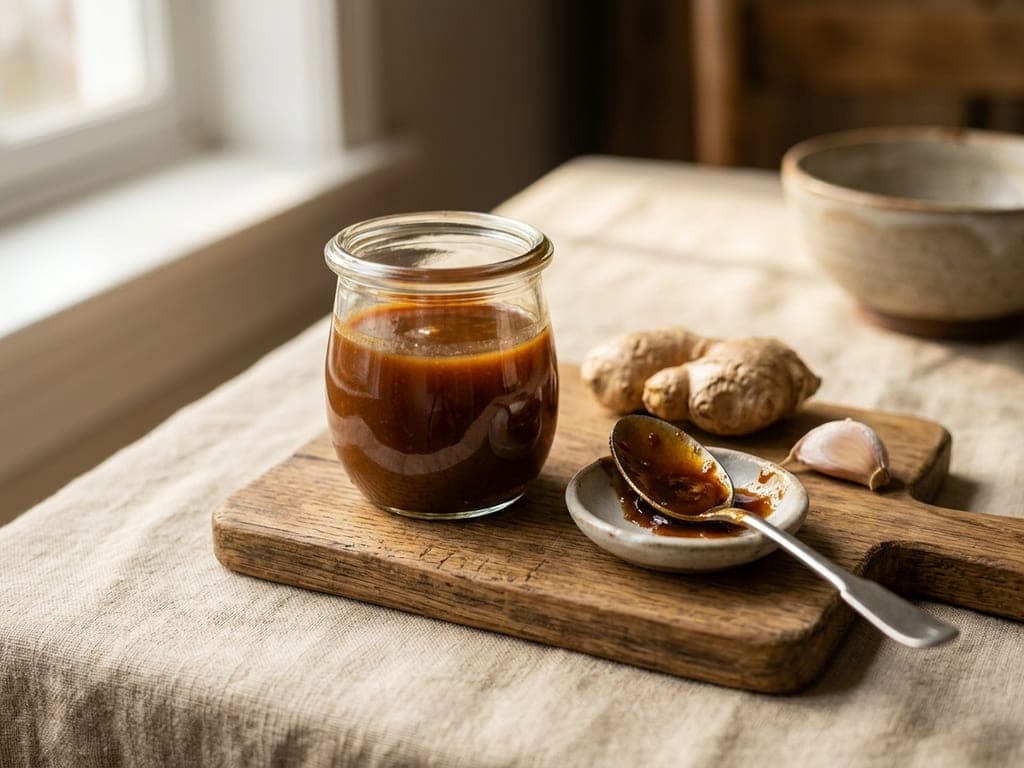
- Choose a plain glass jar over anything branded or clasped — the amber color and the light do the design work.
- Fill to a finger below the rim so the surface shows; the sauce’s translucence is the proof of the no-starch method.
- Rest a just-dipped spoon on a small plate beside the jar, coat unbroken — the nappe is the credential.
- Stage the aromatics (ginger knob, a garlic clove) beside it: in the authentic version they stayed out of the pan, and here they read as styling, not ingredients.
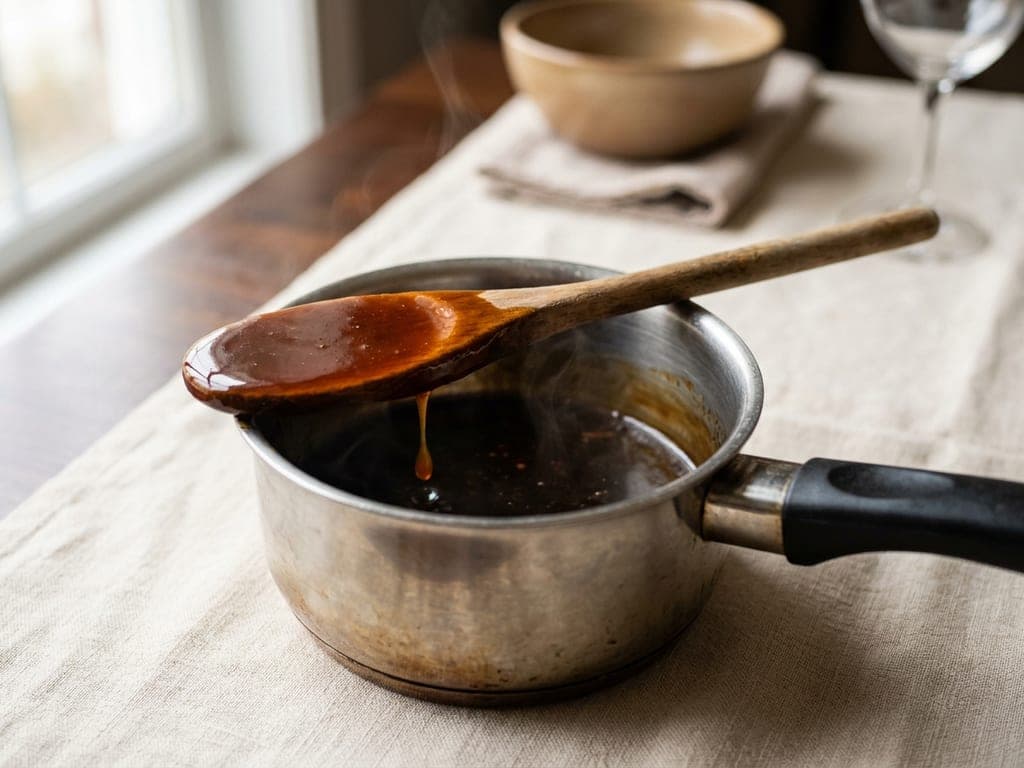
- Catch this moment at the 10-minute mark, when the bubbles have gone fine and the coat holds.
- Rest the spoon across the pan’s rim rather than holding it — a still spoon shows the coat; a moving one shows a blur.
- Let one drip form and hang; the drip’s slowness is the visible viscosity test.
- Keep the pan honest — a small saucepan with real use on it sells the 15-minute truth better than polished copper.
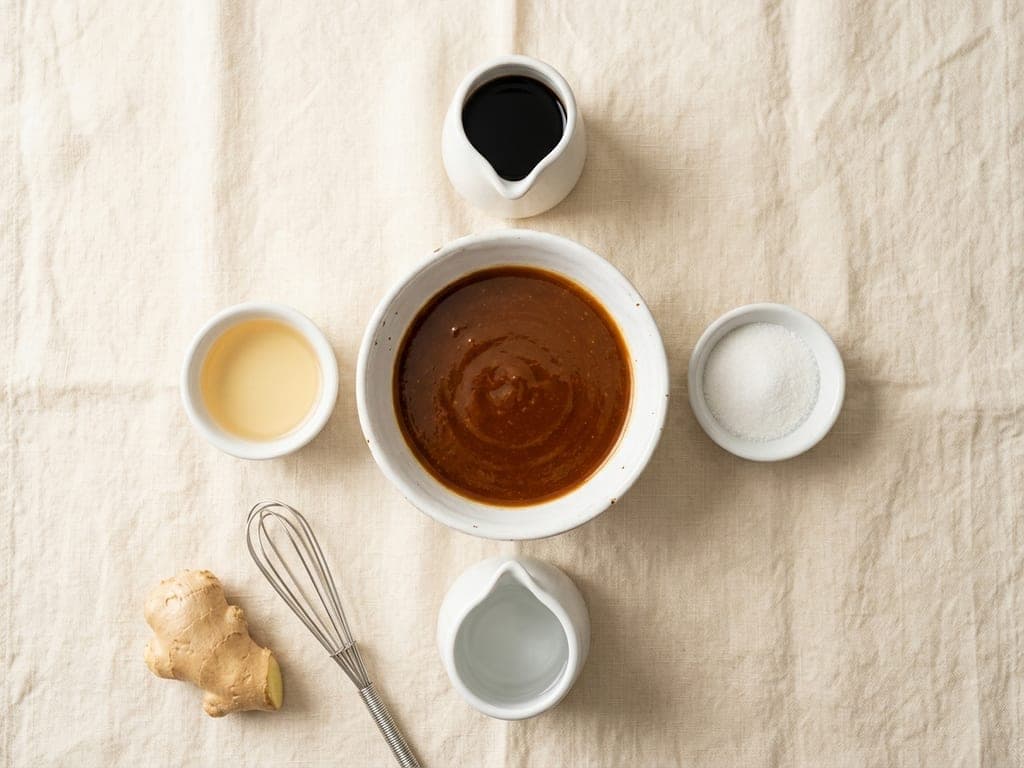
- Use small unmarked pitchers and dishes for the four ingredients — labels would argue with the point that this needs no bottles.
- Set them at loose compass points around the central bowl, close enough to read as one family.
- Let the sauce sit thick and matte in its bowl; against the pale linen the color contrast carries the frame.
- Add one process object — the whisk, the ginger that stays optional — and stop before it becomes a flat-lay collage.
Why no cornstarch — and when yes
Cornstarch exists in teriyaki for one reason: water. Dilute a sauce enough and nothing is left to reduce, so a slurry has to fake the body that evaporation would have built. The traditional route runs the logic backwards — start with nothing but flavorful liquids, remove water over heat, and the sauce thickens itself while the sugars edge toward caramel and pick up the shine the dish is named for (teri: luster). Reduction also concentrates flavor; starch dilutes it. The practical rules that follow: pull the pan while the sauce is a touch loose (it thickens as it cools), and know that sugar starts caramelizing around 320°F (160°C) and turns bitter near 375°F (190°C) — an over-reduced pan crosses that line fast.
And the honest exception: when a sauce must cling cold — dipping, drizzling over a finished bowl, coating a stir-fry — starch does that job better than reduction ever will. Even Kikkoman followed its original pourable sauce with a thicker, starch-stabilized basting version once America made its preference known. Make the slurry variant when the job calls for it; just make it knowing which teriyaki you’re making.
A sauce with a passport
The technique is Edo-period Japanese — a soy-mirin glaze grilled onto fish, documented by the early 1800s and belonging to the wider family of tare, the master sauces some Japanese eel houses have kept alive, topped up rather than replaced, for generations. The sweet, garlicky teriyaki the West knows grew up in Hawaii, where Japanese plantation workers rebuilt the glaze from what was local: sugar, soy, ginger — and pineapple. By mid-century, mainland newspapers were writing home about it.
Then comes the bottle, and a correction worth printing: the story that Kikkoman invented bottled teriyaki in America isn’t quite right. By the company’s own recently published history, the 1961 Teriyaki Barbecue Marinade was developed in Japan — blended to American tastes on the advice of Kikkoman’s US employees — and exported to become America’s first bottled teriyaki, growing 30–50% a year off the shelf. The sauce was designed for one market by another, which is the most teriyaki fact of all. From there: Seattle, 1976, and the teriyaki-shop boom — but that story lives on our teriyaki chicken page.
Bottles and substitutes in Europe
Mirin first, because the label lies a little: most European supermarket “mirin” (Yutaka, Blue Dragon, own-brand) is mirin-style seasoning — sweetened, nearly alcohol-free, and perfectly fine for this sauce. True hon-mirin (Clearspring’s is the common find, otherwise Asian grocers) is brewed and carries real alcohol and depth; it’s the upgrade, not the requirement. Sake: supermarkets rarely stock it — an Asian grocer’s cheap drinking sake or ryorishu cooking sake works (note ryorishu contains added salt; ease up on the soy), and dry sherry is the best mainstream stand-in. Soy: Japanese all-purpose koikuchi — the standard Kikkoman bottle, brewed in the Netherlands for Europe — not Chinese dark soy, which is a molasses-thick different creature that turns the sauce tarry.
Two builds for two pantries. Fully-supermarket: Kikkoman soy + mirin-style bottle + dry sherry + sugar. Alcohol-free (and also the zero-special-shopping version): soy + water in the sake’s place + water plus 3 extra tbsp of sugar in the mirin’s place — the flavor loses a little roundness and gains total availability. Gluten-free readers swap the soy for tamari; the rest of the pan is naturally clear.
Questions, answered
What are the ingredients in teriyaki sauce?
Authentic teriyaki sauce is exactly four: soy sauce, sake, mirin and sugar, simmered until reduced. No cornstarch, no garlic, no ginger, no sesame — those belong to the American-style variant, which is a legitimate but different sauce.
What are the two ingredients in teriyaki sauce?
If you strip teriyaki to its irreducible pair, it’s soy sauce and mirin — salt and sweet-gloss. Sake rounds it and sugar tunes it, which is why the working recipe is four ingredients; but the soy-mirin axis is what makes a glaze read as teriyaki.
How do I thicken teriyaki sauce without cornstarch?
Reduce it: simmer gently 10–15 minutes until fine bubbles cover the surface and the sauce coats a spoon, then stop — it thickens further as it cools. Evaporation plus caramelizing sugar is the traditional thickener and the source of the shine. If it’s still thin cold, simmer a few minutes more; never start with extra water you’ll have to fight later.
Is teriyaki sauce gluten-free?
Not by default — standard Japanese soy sauce (koikuchi) is brewed with wheat. Swap in tamari or a certified gluten-free soy sauce and the rest of the pan (sake, mirin, sugar) is naturally gluten-free; just glance at mirin-style labels, which occasionally add wheat-derived glucose.
How long does homemade teriyaki sauce keep?
The pure four-ingredient reduction keeps 2–3 weeks refrigerated in a clean jar — soy, sugar and reduction are all preservative forces. Add fresh garlic or ginger and the clock shortens to about a week. It also freezes for 3 months, staying slightly soft thanks to the sugar.
Can I make teriyaki sauce without alcohol?
Yes — and you should if it matters, because simmering doesn’t remove alcohol the way kitchen folklore says: roughly 40% survives a 15-minute simmer. Replace the sake with water and the mirin with water plus 3 extra tbsp of sugar per ½ cup (120 ml). The sauce loses a little aromatic roundness and keeps its entire job.
What is the difference between teriyaki sauce and teriyaki marinade?
Sauce is cooked, reduced and finishes the dish; marinade is raw, thinner, and does its work before the heat — mostly via salt, since flavor barely penetrates the surface. The starch test is a good shortcut: if it’s thickened, it’s a sauce and shouldn’t touch raw meat as a soak. Our teriyaki marinade page runs the full soak-side playbook, timing table included.
What do you use teriyaki sauce on?
As a finishing glaze in the pan for chicken thighs and salmon (the last 2–3 minutes, over heat), brushed over grilled tofu, eel or skewers, spooned warm over rice bowls, or stirred through a finished stir-fry. The rule underneath: teriyaki meets food late — the sauce’s sugar burns long before proteins cook through.
Why is my teriyaki sauce too salty, too thin, or burnt?
Too salty: no mirin or sake to balance the soy, or a reduction pushed too far — the 2:2:2:1 frame protects you. Too thin: under-reduced, but remember it thickens as it cools before you keep simmering. Burnt: sugar caramelizes from about 320°F (160°C) and goes bitter near 375°F (190°C) — over-reduction or glazing over ferocious heat gets you there; a bitter batch can’t be rescued.
Can I just buy bottled teriyaki sauce?
Of course — the bottle has been doing honest work since 1961, when Kikkoman shipped America’s first. Homemade wins on three counts: thirty seconds of effort ahead of a 15-minute unattended simmer, complete control of sweetness, and no thickeners unless you choose them. Keep a bottle for emergencies and a jar for pride.
Snap your finished plate and let the AI plate it again — more beautifully.