Ceviche Recipe (The Peruvian Way — Minutes, Not Hours)
The Peruvian original marinates for two minutes, not two hours — fresh white fish, lime, red onion, ají and salt, eaten the moment the edges turn pearly. The long cure is the export version. This page teaches the real method, the leche de tigre it produces, and the one safety rule nobody on page one states plainly: lime juice cooks nothing, so the fish must be properly frozen first unless your fishmonger did it for you.
Ingredients
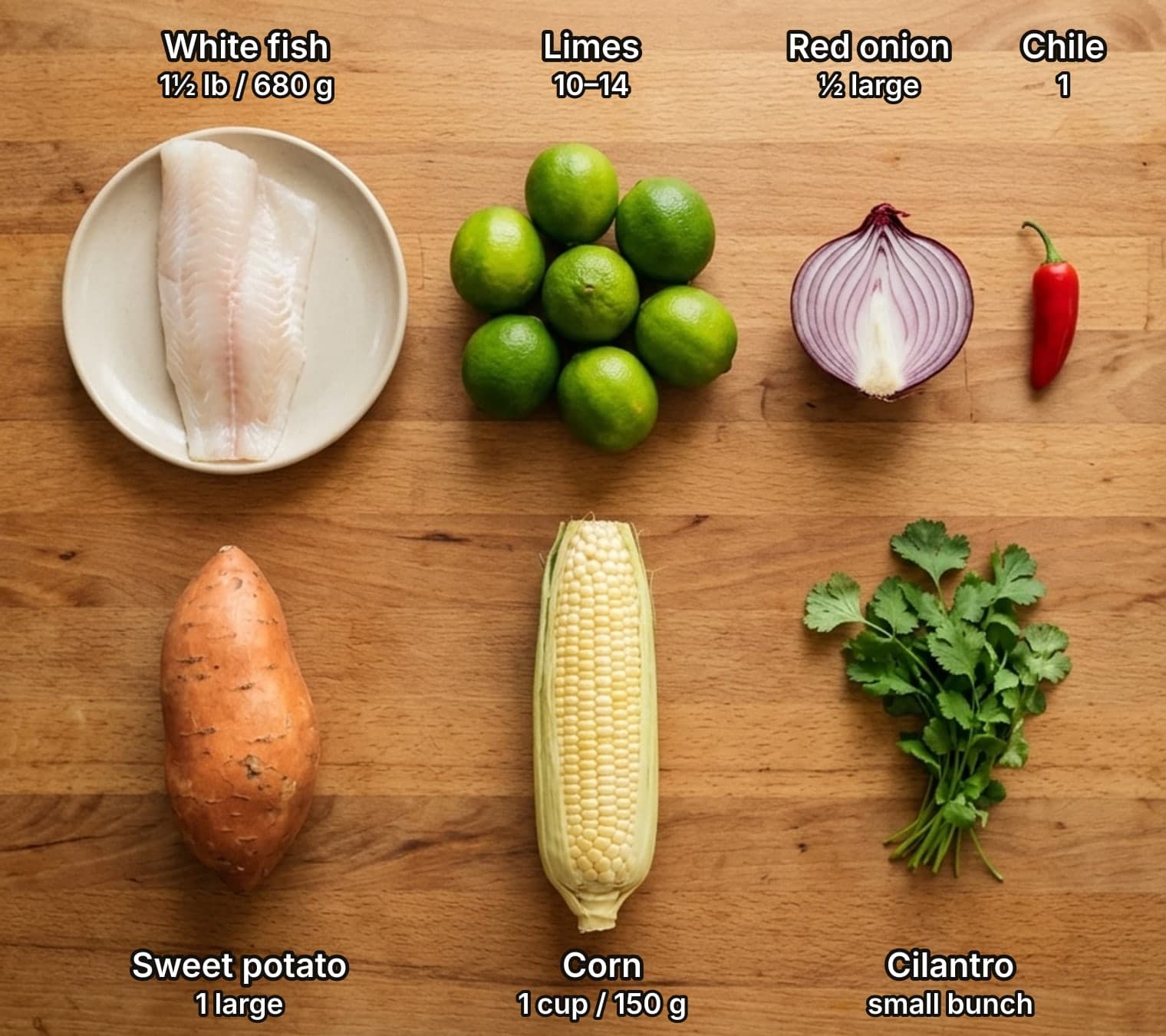
- very fresh firm white fish (sea bass, bream, corvina), frozen-for-raw, skinned and boned1½ lb / 680 g
- limes10–14 (¾ cup / 180 ml juice)
- red onion, in paper-thin feathers½ large
- ají limo or fresh red chile, finely chopped, seeds out1
- garlic, minced1 clove
- cilantro (fresh coriander) — stems in the marinade, leaves on topsmall bunch
- fine salt1 tsp, plus more to taste
- ice cubes, for the marinade and the onion batha handful
- sweet potato, peeled, in thick rounds1 large
- corn kernels (fresh or frozen)1 cup / 150 g
- cancha (toasted corn nuts; salted corn nuts stand in)½ cup / 60 g
- lettuce leaves, to line the plates4
Two minutes, not two hours
The single biggest difference between ceviche in Lima and ceviche on the American internet is time. The recipes ranking for this keyword marinate for 15 minutes, 30 minutes, an hour, sometimes longer, and they describe the result as the goal: fish opaque all the way through, firm, fully “cooked” by the acid. In Peru that texture reads as overdone. The modern cevichería standard — the one Gastón Acurio carried around the world — marinates for about two minutes: long enough for the outside of each cube to turn pearly, short enough that the centre stays glossy, cool and essentially raw. You are seasoning fish with lime, not preserving it.
The long cure is not wrong so much as it is a different, older dish. Before refrigeration, hours in acid and salt were part of how the coast kept fish edible, and the long-cured style travelled north and settled into Mexican and Central American kitchens, where it evolved its own excellent traditions — chunky, tomato-strewn, spooned onto tostadas (our shrimp ceviche page is that branch of the family). The Peruvian style assumes what a modern kitchen has: cold, fresh fish and a fridge. Taste the two-minute version once, with good fish, and the argument settles itself.
One practical consequence: because the marinade barely penetrates, the Peruvian style is unforgiving of stale fish and big sloppy cubes. Sharp knife, ¾-inch (2 cm) dice, cold everything, and a fishmonger you trust — the recipe is short because the shopping is the recipe.
How to make Ceviche
- Buy the fish like it matters, because it is the dish. You need 1½ lb (680 g) of very fresh, firm, white-fleshed fish — corvina is the Peruvian classic; sea bass, bream (dorade), halibut or flounder all behave the same way. Tell your fishmonger it is for ceviche: you want fish that has been commercially frozen (the parasite rule below — most fish sold in Europe for raw eating already has been), skinned and boned. It should smell of the sea and nothing else.
- Cook the sides first — they are not optional garnish. Boil a large sweet potato, peeled and cut in thick rounds, for 12–15 minutes until just tender, and simmer the kernels of one ear of corn (or 1 cup / 150 g frozen) for a few minutes. Set both aside to cool. In Peru the camote and choclo are as much a part of the plate as the fish — sweet and starchy against sharp and cold — and a handful of cancha (toasted corn nuts; salted corn nuts from a snack aisle are a fair stand-in) adds the crunch.
- Cut the fish into honest cubes. With your sharpest knife, cut the fish into ¾-inch (2 cm) cubes — big enough to taste the fish, small enough for the lime to reach the centre quickly. Work on a cold board, keep the fish refrigerated until the last minute, and chill the serving plates too. Ceviche is a cold dish or it is a mistake.
- Salt the fish, then wait five minutes. Toss the cubes with 1 tsp of fine salt and let them sit in the fridge for 5 minutes. The salt starts firming the surface and seasons the fish from the outside in — a small step that separates a cevichería plate from a home one. Meanwhile, slice ½ a red onion into the thinnest feathers you can manage and hold them in iced water to tame the bite.
- Juice the limes gently. You need about ¾ cup (180 ml) of lime juice — 10 to 14 limes. Roll them, halve them, and squeeze with your fingers or a light touch on the press, stopping before the last drops: crushing the peel presses bitter oils out of the pith and into your marinade. This is why some homemade ceviche tastes faintly of detergent and nobody can say why.
- Build the marinade in the bowl, not around the fish. In a chilled bowl, stir the lime juice with 1 minced garlic clove, 1 finely chopped ají limo or red chile (seeds out unless you know your audience), a few cilantro (fresh coriander) stems chopped fine, and a couple of ice cubes. Thirty seconds later, fish the ice out. Peruvian cooks call the cold sharp result the beginning of leche de tigre — the full version has its own page below.
- Marinate for two minutes — yes, two. Add the salted fish to the marinade, turn it gently so every face is wet, and count two minutes, three if your cubes ran large. The outside turns opaque and pearly while the centre stays translucent and tender — that contrast is the entire point. The 30-minute cure of the export version gives you fish that is chalky all the way through; if you prefer that texture it is your dinner, but taste the short cure once before you decide.
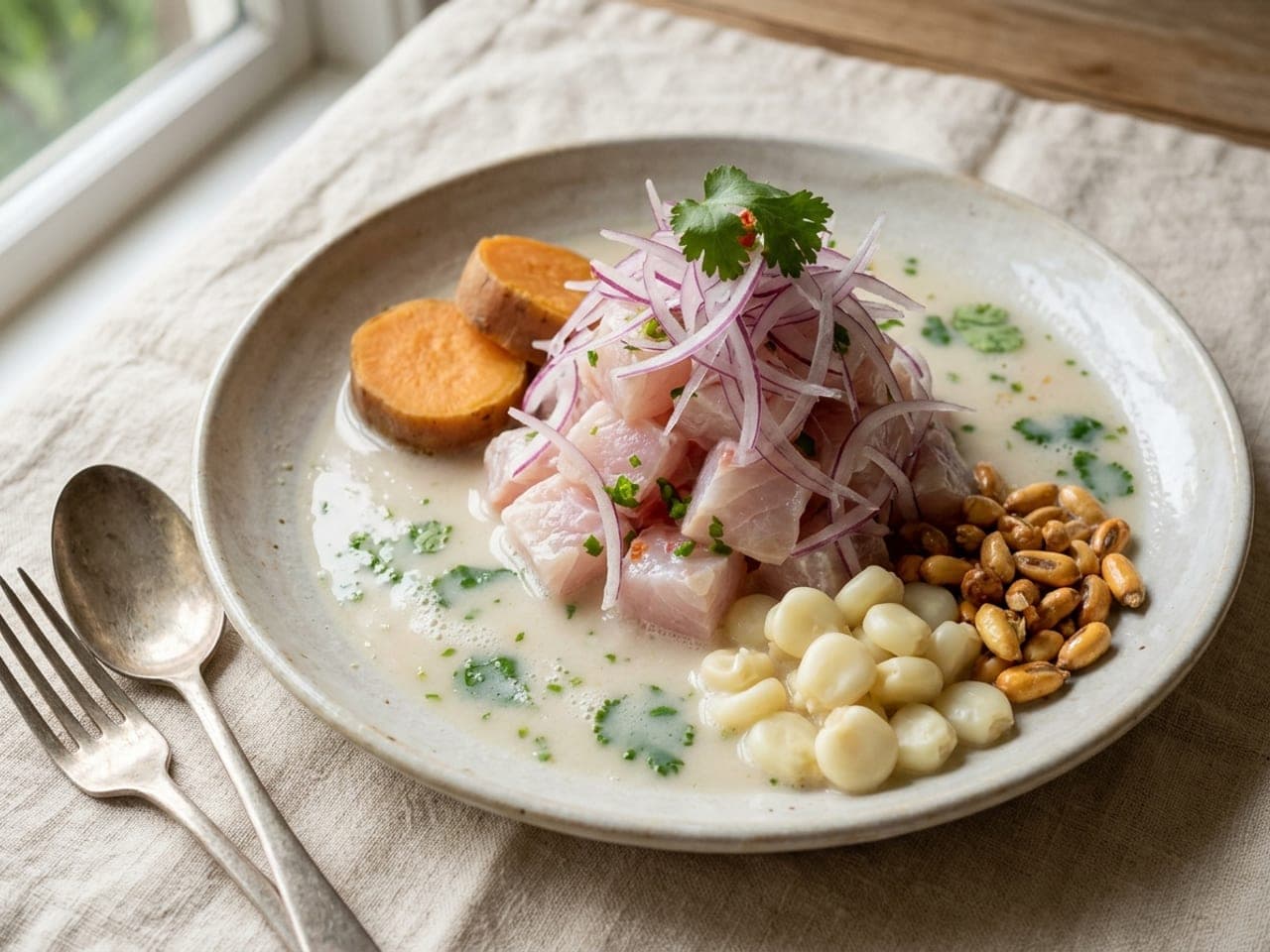
- Plate cold, pour the milk, serve now. Lift the fish onto the chilled plates with the drained onion feathers folded through, spoon the now-milky marinade — the leche de tigre — generously over and around, and set the sweet potato rounds, corn and a scatter of cancha alongside with a leaf or two of lettuce. Cilantro leaves on top. Ceviche does not wait: it is made after the table is sat, and eaten in the next ten minutes.
- Drink what remains. When the fish is gone, what is left in the bowl is the best part. In Peru it goes straight into a small glass — the levanta muertos, the raiser of the dead. If that pool of cloudy, fiery, fish-sweetened lime juice interests you as more than a leftover, the leche de tigre page below makes it deliberately, from scratch.
Safety & hygiene Important
- Lime juice cooks nothing — the freezer does the safety work. The acid denatures surface proteins so the fish looks and tastes “cooked”, but it kills neither parasites nor bacteria — not in two minutes, not in two hours. The protection against parasites like Anisakis is freezing: the FDA rule for fish eaten raw is -4°F (-20°C) for 7 days in a normal freezer, or -31°F (-35°C) for 15 hours in a blast freezer. Most fish sold for sushi or ceviche has already had this done — ask. “Sushi-grade” on a label is marketing, not a regulation; the question to ask is whether it was frozen to the parasite-destruction schedule.
- Freezing does not kill bacteria, so freshness still matters. The freezer handles parasites; it does nothing to Vibrio, Salmonella or Listeria. Those are managed the unglamorous way: impeccably fresh fish, an unbroken cold chain, clean hands and boards, and eating the dish the hour it is made. Keep the fish below 40°F (4°C) at every step, chill the bowl and the plates, and never let ceviche sit out at a summer party.
- Who should skip raw fish entirely. Pregnant women, young children, the elderly and anyone immunocompromised are advised to avoid raw and acid-cured fish altogether — the same list as for sushi and oysters. For that table, our Mexican shrimp ceviche page uses briefly poached shrimp and loses remarkably little; it is the honest workaround rather than a compromise.
- Leftovers are not a thing. Ceviche is a now dish. After a few hours in its juice the fish is over-cured, chalky and increasingly risky, and by the next day it is neither safe nor worth eating. Make what will be eaten, eat it cold and fresh, and discard what is left — the one exception is the strained leche de tigre itself, which keeps a day refrigerated for tomorrow's shot glass.
3 ways to plate it
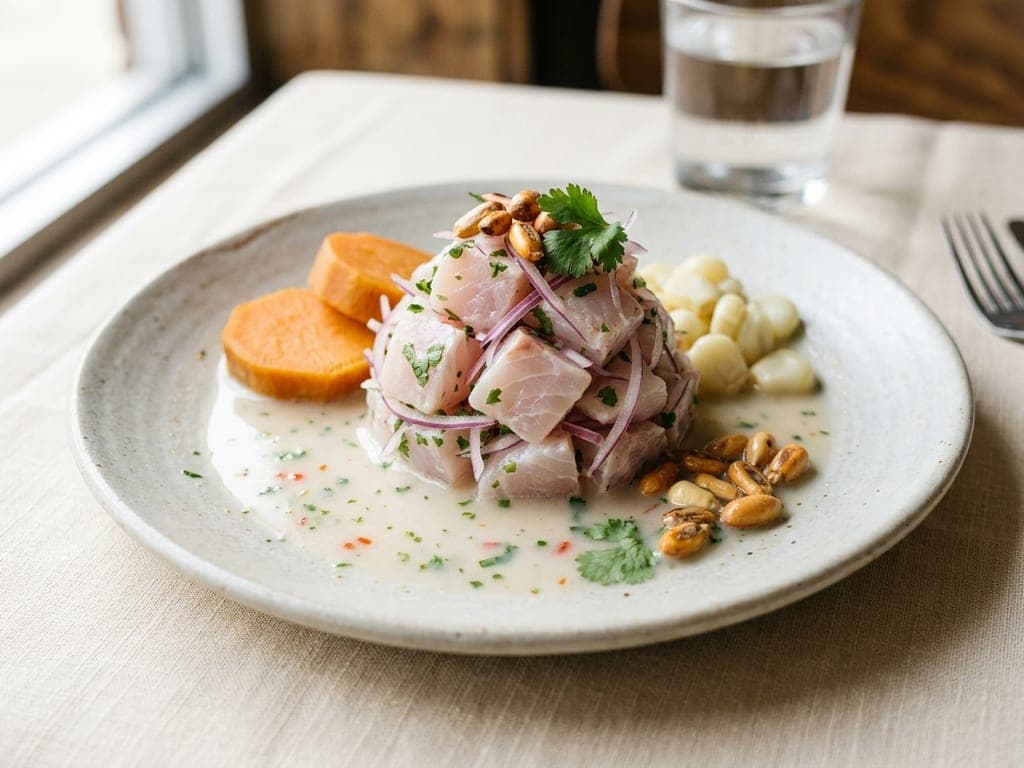
- Chill the plate properly — a cold plate keeps the marinade viscous and the fish glossy, and it is the single most restaurant-signalling move in the dish.
- Build the fish and drained onion into one deliberate mound rather than a scatter; height reads as generosity, spread reads as thin.
- Spoon the leche de tigre around the mound, not over it, so the fish keeps its pearl and the pool shows off its milkiness.
- Place sweet potato and corn at one edge — they are sides, not confetti — and finish with cancha and cilantro leaves only at the moment of serving.
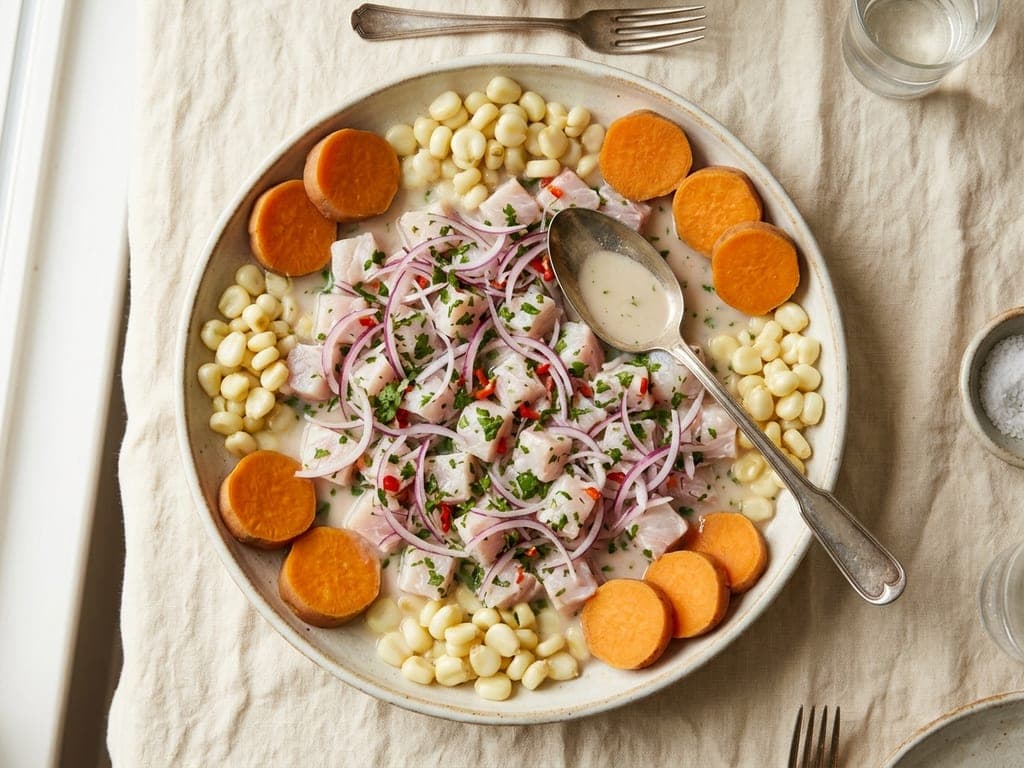
- Use your widest, shallowest platter — depth drowns the fish, width shows it off and keeps every piece in reach of the marinade.
- Ring the sweet potato rounds and corn around the rim first, alternating, so the platter has a built frame before the fish arrives.
- Lay the fish in one even layer in the centre and pour the leche de tigre over the whole surface — family-style is the one plating where the fish wears the sauce.
- Finish with the onion feathers strewn over everything and serve with a big spoon standing in the platter; ceremony ends where appetite starts.
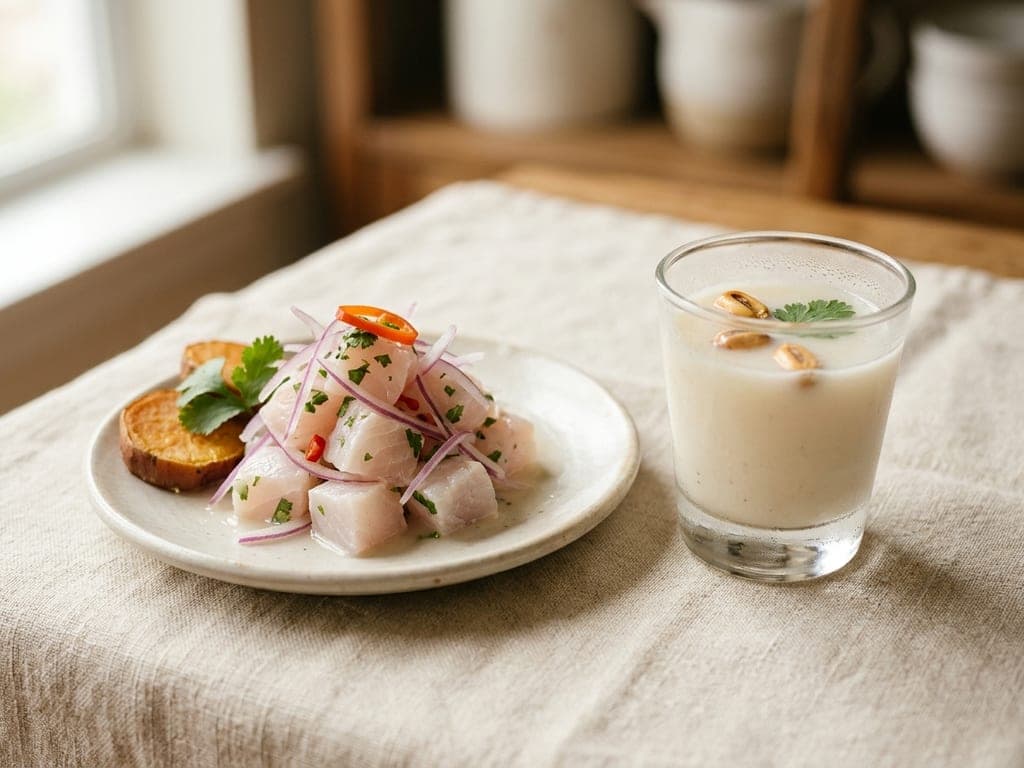
- Strain a few spoonfuls of the marinade into a small chilled glass before plating the fish — once the fish is served the pool disappears fast.
- Plate the ceviche in a modest mound with its sides, leaving clear space for the glass on the plate or just beside it.
- Drop two or three cancha kernels and a cilantro leaf onto the shot at the last moment so the surface has something to look at.
- Serve the glass cold and insist it is drunk, not sipped politely — the levanta muertos is a finisher, and it makes the meal a story.
A very old dish with a brand-new certificate
On December 6, 2023, UNESCO inscribed the practices and meanings around Peruvian ceviche on its Representative List of the Intangible Cultural Heritage of Humanity — bureaucratic language for something Peruvians have said all along, that ceviche is not a recipe but a national institution with its own day (June 28), its own restaurants, and its own hour: cevicherías traditionally serve it at lunch, when the morning's catch is hours old, and many still close by late afternoon.
The history under the certificate is long and partly guesswork. Coastal cultures of what is now northern Peru — the Moche are the name usually given — were curing fresh fish some two thousand years ago, most often with the fermented juice of tumbo, a local banana passionfruit, since limes did not exist in the Americas. Citrus arrived with the Spanish in the sixteenth century, along with onions and garlic, and the dish as we know it assembled itself from that collision. Even the name is contested: one camp derives cebiche from Quechua siwichi, “fresh fish”; another traces it through Spanish escabeche to Mozarabic and Andalusian Arabic assukkabáǧ, vinegar-cooked meat. Both stories are told confidently; neither is settled — which is itself a fair summary of how the dish came to be.
The five elements, and what each one is doing
Classic Peruvian cebiche is five things: fish, lime, onion, ají, salt. Everything else on the plate is a side. The fish should be white, firm and mild — corvina at a Lima counter; sea bass, bream, halibut or flounder elsewhere — because the dish is about texture and freshness, not fishiness. The lime is doing the visible work: its acid denatures the surface proteins, turning them opaque and firm exactly as heat would, which is why everyone says “cooked” in quotation marks. Squeeze gently; bitter pith oils are the classic home-kitchen off-flavour.
The onion is always red, always feather-thin, and ideally shocked in iced water so it crunches without shouting. The ají — ají limo on the coast, habanero's fruity cousin — brings heat that floats on the surface of the marinade rather than soaking in, so every bite gets a flash of it. And the salt goes on the fish first, minutes before the lime, firming and seasoning it from the surface inward. The sides are the sixth element in all but name: sweet potato and corn for starch and sweetness against all that acid, cancha for crunch, a lettuce leaf as the traditional plate liner. A cevichería plate is a complete argument — sharp, sweet, soft, crunchy, cold — and skipping the sides amputates half of it.
Shopping for ceviche in Europe
The fish counter first. Corvina rarely appears in northern Europe, but farmed sea bass (branzino, loup de mer) and gilthead bream (dorade royale) are everywhere, inexpensive, and behave beautifully in lime; halibut and flounder are excellent too. The crucial question is not the species but the freezing: EU regulation already requires fish served raw in restaurants to have been frozen to parasite-killing schedules, and most supermarket “sushi” or “sashimi” fish has had the treatment. Buying at a counter, ask directly — “has this been frozen, is it suitable for eating raw?” — and if the answer is a shrug, buy a vacuum-packed frozen loin instead and thaw it overnight in the fridge. Frozen-at-sea fish is often fresher in the ways that matter than the “fresh” fillet that spent five days in a display.
The rest of the list is easier. Limes are limes — Persian limes work, key limes are closer to Peru's limón sutil and slightly sharper if you find them. Ají limo will not be in the shop, but a fresh red chile stands in, and jars of ají amarillo paste — worth owning for the leche de tigre page — are stocked by Latin grocers and online. Sweet potato and corn are everywhere; cancha comes from the same Latin grocers, or salted corn nuts from the snack aisle do the job with less romance. Cilantro is the leaf sold as fresh coriander. That is the whole list — the dish is five ingredients and a shopping standard.
Questions, answered
How long should ceviche marinate?
Peruvian style: about two minutes — the outside of each cube turns pearly while the centre stays tender and glossy. The 15–30-minute cure common in US recipes gives fully opaque, firmer fish (and Mexican styles go longer still, by design). It is a texture choice, not a safety mechanism: the acid never sterilises the fish however long you wait, so marinate to the texture you want and let the freezing rule handle safety.
Does the lime juice cook the fish?
It transforms it, but no — not in the sense that matters. Acid denatures proteins, so the flesh turns opaque and firm exactly as it does in a pan, but nothing is heated and nothing is sterilised: parasites and bacteria survive the marinade entirely. Treat ceviche as what it is — a raw-fish dish — and buy fish accordingly.
What fish is best for ceviche?
Firm, white, mild and impeccably fresh: corvina is the Peruvian benchmark; sea bass, gilthead bream, halibut and flounder are the reliable European stand-ins. Avoid oily fish (mackerel, sardines overwhelm the lime), delicate flakers (cod falls apart) and anything you would not happily smell twice. Fresh tuna and salmon work but make a different, richer dish.
Is ceviche safe to eat?
Made properly, yes — with two rules doing the work the lime cannot. One: the fish must have been frozen to the parasite-destruction schedule (FDA: -4°F / -20°C for 7 days, or -31°F / -35°C for 15 hours) — most fish sold for raw eating already has been, but ask. Two: bacteria are controlled by freshness, cold and cleanliness, not by any treatment — so cold chain, chilled plates, eaten within the hour. Pregnant and immunocompromised eaters should choose the cooked-shrimp version instead.
What does “sushi-grade” fish actually mean?
Legally, nothing — it is a marketing term with no regulated definition in the US or EU. The meaningful question is whether the fish was frozen to a parasite-killing schedule and handled for raw consumption. A fishmonger who answers that question directly is worth more than any label.
What is leche de tigre?
“Tiger's milk” — the cloudy, pale, intensely flavoured marinade left after ceviche, part lime, part chile, part everything the fish gave up. In Peru it is drunk from a small glass as a hangover cure (levanta muertos — “raiser of the dead”) and made deliberately as a base and a shot. It has its own page here, made from scratch rather than scraped from the bowl.
What do you serve with ceviche?
The Peruvian plate answers this precisely: boiled sweet potato rounds, corn kernels, cancha (toasted crunchy corn), a lettuce leaf, and the marinade itself spooned generously over. Sweet and starchy against sharp and cold is the architecture. A cold lager or a pisco sour is the drink; rice is not traditional but nobody was ever arrested for it.
Can I make ceviche ahead of time?
You can prep everything ahead — fish cubed and refrigerated, onion sliced into iced water, limes juiced, sides cooked, plates chilling — but the marinade meets the fish only after the table is seated. Two minutes later you are plating. Ceviche assembled an hour early is a different and worse dish, and leftovers are not safe territory; the only keeper is strained leche de tigre, one day, for the shot glass.
Peruvian vs Mexican ceviche — what is the difference?
Peruvian: fish-first, a two-minute cure, red onion and ají, the milky marinade as a feature, sweet potato and corn alongside. Mexican: a longer cure, chunkier build — tomato, cucumber, avocado, often shrimp — served with tostadas and bottled hot sauce. Sibling dishes, not competitors; our shrimp ceviche page is the Mexican branch done properly.
How many calories are in ceviche?
About 380 per serving as plated here — and most of that is the sweet potato and corn, not the fish, which is as lean as protein gets. Skip the sides and a serving of the fish itself runs nearer 150, though the plate stops being Peruvian at that point. There is no oil anywhere in the dish unless you add it.
Snap your finished plate and let the AI plate it again — more beautifully.