Aguachile Recipe (Sinaloa Shrimp in Chile-Lime Water)
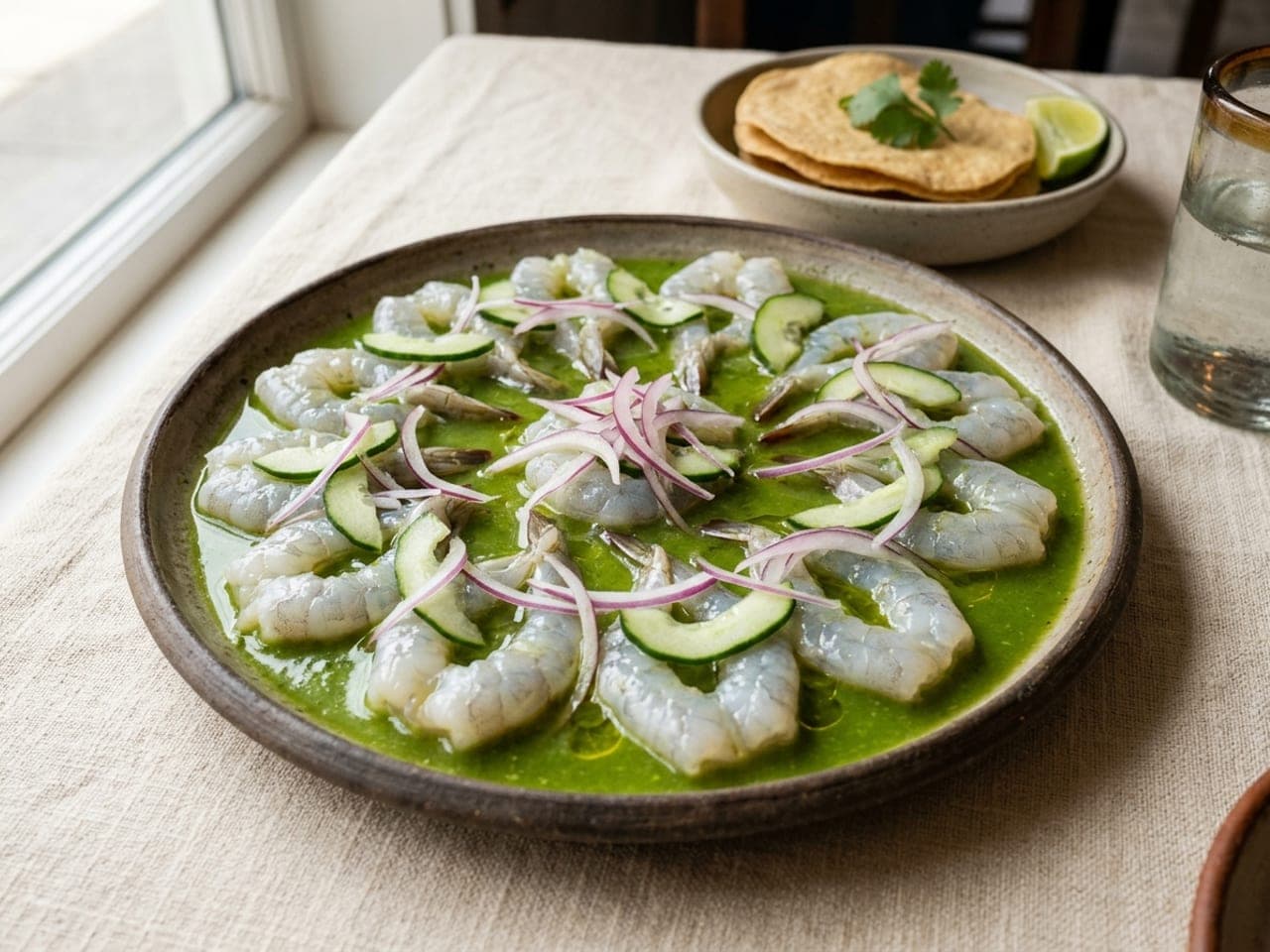
Ceviche's ferocious Sinaloa cousin: raw butterflied shrimp under a blended chile-lime water, cucumber and red onion on top, eaten the minute the sauce hits — no cure, no wait, no mercy. Born inland as literally water, crushed chiltepín and salt, it moved to the coast and picked up shrimp on the way. Five ingredients, ten minutes, and the freshest shrimp you can buy, because there is nowhere to hide.
Ingredients
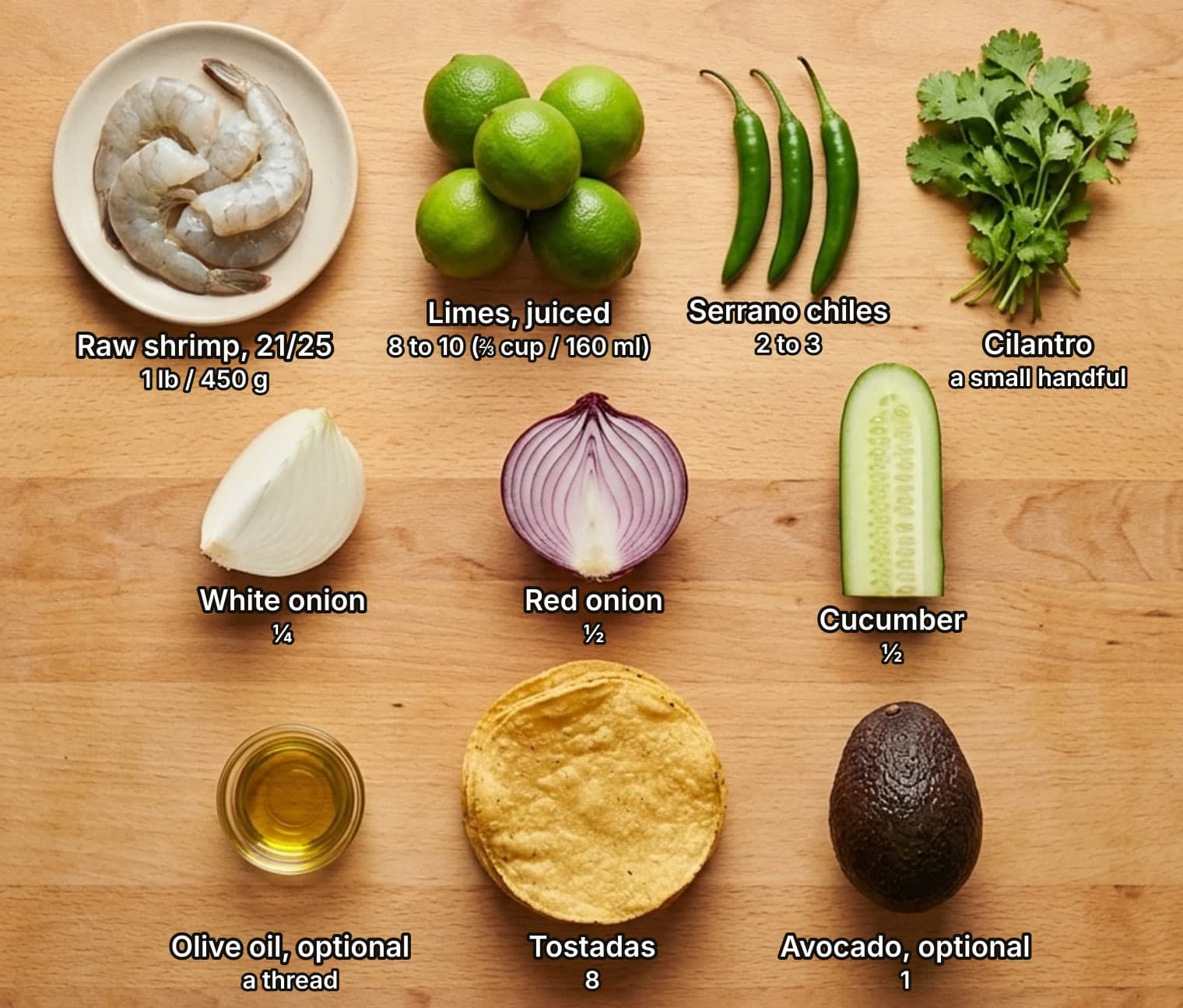
- large raw shrimp (21/25), frozen and thawed, peeled, butterflied1 lb / 450 g
- limes8–10 (⅔ cup / 160 ml juice)
- serrano chiles (plus a pinch of crushed dried chiltepín, if you have it)2–3
- cilantro (fresh coriander), leaves and stemsa small handful
- white onion¼
- red onion, in thin feathers, iced½
- cucumber, in thin half-moons½
- fine salt1 tsp, divided
- cold water2 tbsp
- good olive oil, to finish (optional, modern)a thread
- tostadas (crisp fried corn tortillas), to serve8
- avocado, sliced (optional, common)1
Water, chile, salt: the inland origin nobody tells
Aguachile means “chile water”, and the name is the history. The dish was not born on a beach: it comes from the ranchos of inland Sinaloa, in Mexico's northwest, where the original aguachile was exactly what the word says — water with wild chiltepín chiles crushed into it and salt, a fierce thin broth that made dried beef (machaca) and whatever else was to hand edible in the heat. The chiltepín itself is the point of pride: a wild, bead-sized pepper that grows on the hillsides, sharp and smoky and vastly hotter than its size suggests — 50,000 to 100,000 Scoville units against a jalapeño's 2,500 to 8,000.
The shrimp came later, when the idea travelled the short distance to the coast and met Sinaloa's shrimping fleet. The chile water stayed; the beef swapped for raw shrimp split open flat; lime moved from garnish to engine; cucumber and red onion signed on as the cooling counterweight. What never changed is the tempo — aguachile kept the immediacy of a ranch dish made and eaten standing up. Modern Culiacán and Mazatlán marisquerías have made it a genre (green with serrano and cilantro, black with soy and Maggi, mango versions, scallop versions), but the definition holds: raw seafood, violent chile-lime water, eaten the minute they meet.
How to make Aguachile
- Start with frozen shrimp, deliberately. You need 1 lb (450 g) of raw shrimp — large ones, 21/25 count, because they will be butterflied and displayed, not diced. Buy them frozen and thaw overnight in the fridge: commercial freezing is the parasite control for a dish that never sees heat or a long cure, and shrimp frozen at sea hours after the catch are in better shape than “fresh” ones that travelled for days. Peel them completely, tails off.
- Butterfly them flat. Run a small sharp knife along the back of each shrimp, cut deep enough to open it like a book but not through, lift out the vein, and press the shrimp gently flat. You want maximum surface: aguachile has no marinating time, so the lime and chile do all their work on contact. Lay the butterflied shrimp in a single layer on a chilled platter — the dish is assembled where it is served — cover and refrigerate.
- Salt them ten minutes before the sauce. Sprinkle the shrimp evenly with ½ tsp of fine salt and return them to the fridge for 10 minutes. The salt starts firming the surface and seasons the flesh the way the blended sauce alone cannot in the minute it gets. This small head start is the difference between shrimp that taste dressed and shrimp that taste like they swam through the sauce.
- Blend the chile water. In a blender: ⅔ cup (160 ml) fresh lime juice (8–10 limes), 2–3 serrano chiles roughly chopped (the traditional heat is chiltepín — the tiny wild pepper of the Sinaloa hills; a pinch of crushed chiltepines plus 2 serranos gets you close, and serranos alone are honest), a small handful of cilantro (fresh coriander) leaves and stems, ¼ of a white onion, ½ tsp salt, and a splash — 2 tbsp — of cold water. Blitz 30 seconds to a thin, vivid green liquid. Taste it: it should be genuinely fierce, because it is about to be diluted by a pound of sweet shrimp.
- Slice the vegetables thin and cold. Shave ½ a red onion into feathers and hold them in iced water. Slice ½ a cucumber into thin half-moons (peel on, seeds out if watery). These two are the entire vegetable cast — aguachile has no tomato, no avocado by default (avocado is a common and defensible addition; tomato is a different dish), and the crunch of cold cucumber against soft raw shrimp is half the experience.
- Pour, dress, and go to the table — in that order, now. Take the platter from the fridge, pour the green chile water evenly over the shrimp until they are lapped but not drowned, scatter the drained onion and the cucumber over, and carry it to the table immediately. From pour to first bite should be minutes: the shrimp at the moment of serving are still essentially raw, barely blushed opaque at the edges by the lime — that silken texture is the entire dish, and it is gone in a quarter of an hour.
- Finish at the table. A thread of good olive oil over the top is a modern cevichería touch that rounds the heat; a few extra crushed chiltepines or a grind of black pepper for the brave. Tostadas and cold beer alongside — the shrimp goes onto the tostada, a spoon of the chile water follows it, and the leftover water in the platter is drunk with exactly the same ceremony as leche de tigre, which is to say none.
- Do not make it ahead — there is no ahead. Everything can wait in the fridge separately: butterflied salted shrimp, blended sauce, sliced vegetables, chilled platter. Assembled aguachile cannot wait at all — fifteen minutes after the pour the shrimp are visibly curing toward ceviche, and an hour after it they are a different (lesser, rubberier) dish. Pour when the table is sat. This is the one recipe on this site where the clock is the main ingredient.
Safety & hygiene Important
- This dish is genuinely raw — source accordingly. Unlike ceviche's cure or a poach, aguachile gives the lime no meaningful time to even firm the shrimp: you are eating raw seafood, full stop. That is safe the same way sushi is safe — commercially frozen shrimp (parasite control), an unbroken cold chain, spotless hands and boards, and immediate consumption — and unsafe any other way. Never make aguachile with shrimp of unknown history, and never with precooked shrimp either, which defeats the dish entirely.
- Vibrio does not negotiate with lime. Raw warm-water shrimp can carry Vibrio bacteria, and the minute of acid contact in aguachile does nothing measurable about it. Freezing controls parasites, not bacteria — so freshness and cold are the whole bacterial defence. Keep the shrimp below 40°F (4°C) until the pour, serve the platter cold, and if anyone at the table is pregnant, elderly, or immunocompromised, this is the page to skip in favour of the poached shrimp ceviche.
- Chile burns are real kitchen injuries. Chiltepines and serranos both punch far above their size, and a blender aerosolises them — open the jug away from your face, don't lean over it, and wash hands, knife and board with soap before touching anything else, especially eyes or contact lenses. If you crushed dried chiltepines by hand, treat your fingertips as loaded for the next hour.
- Fifteen minutes on the table, then it is over. There are no aguachile leftovers by design: the dish degrades in real time as the acid cures the shrimp past their moment, and raw seafood that has sat dressed at room temperature is not safe to keep regardless. Make what the table will eat at one sitting. If plans change, undressed components keep separately in the fridge until tomorrow — assembled aguachile does not keep sixty minutes.
3 ways to plate it
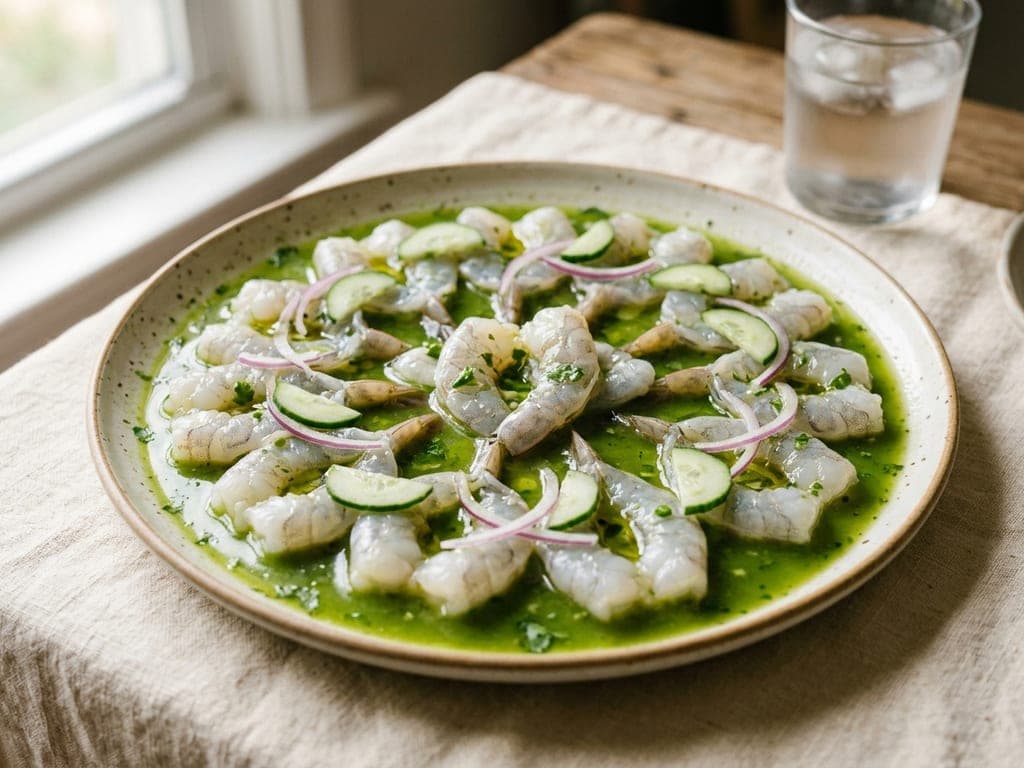
- Arrange the butterflied shrimp cut-side up in an overlapping ring before the sauce — flat, opened shrimp are the dish's signature shape and they vanish if placed after the pour.
- Pour the chile water at the centre and let it flood outward until the shrimp are lapped, not submerged; the green pool is the second subject of the photo.
- Strew the cucumber and drained onion loosely over the top — this dish is dressed, never arranged, and neat rows kill it.
- Add the olive-oil thread and any chiltepín last, and serve while the shrimp still look translucent — fifteen minutes from pour, the photo is gone too.
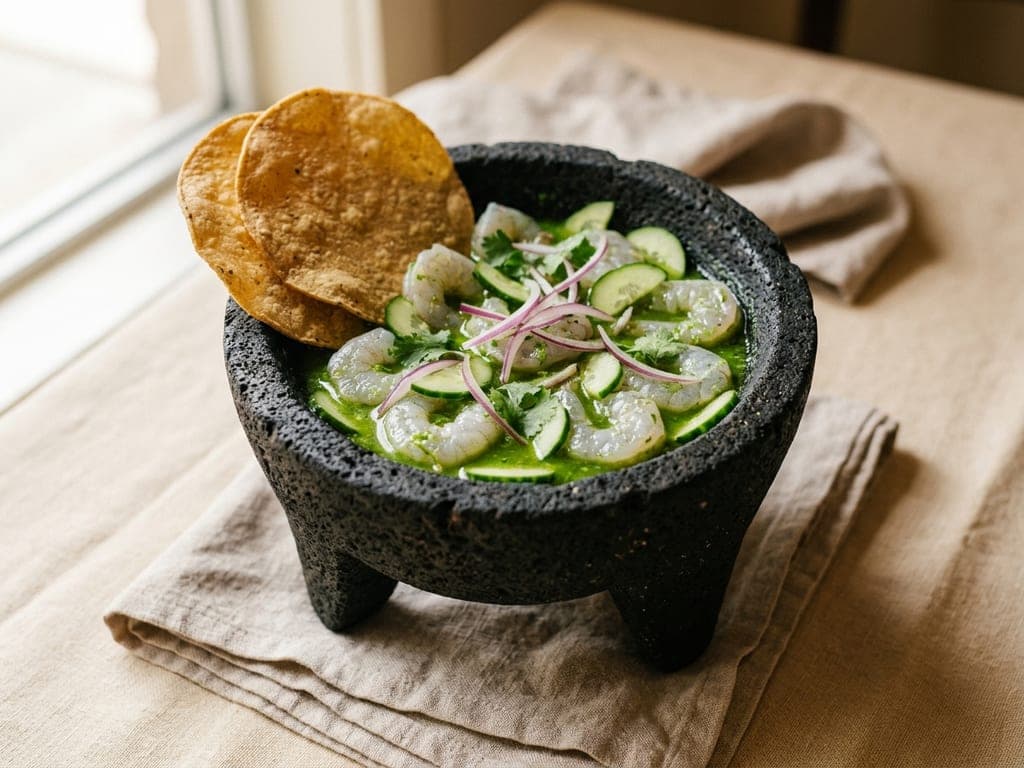
- Chill the molcajete itself — stone holds cold as well as it holds heat, and a cold vessel buys the raw shrimp precious minutes.
- Build in the bowl: shrimp first, sauce poured over at the table if you want the moment witnessed, vegetables scattered after.
- Lean two tostadas against the rim rather than serving them apart; the stone-and-tortilla still life is the shot.
- Put the molcajete on a folded cloth at the table — basalt scratches wood, and the cloth frames the black stone against the table.
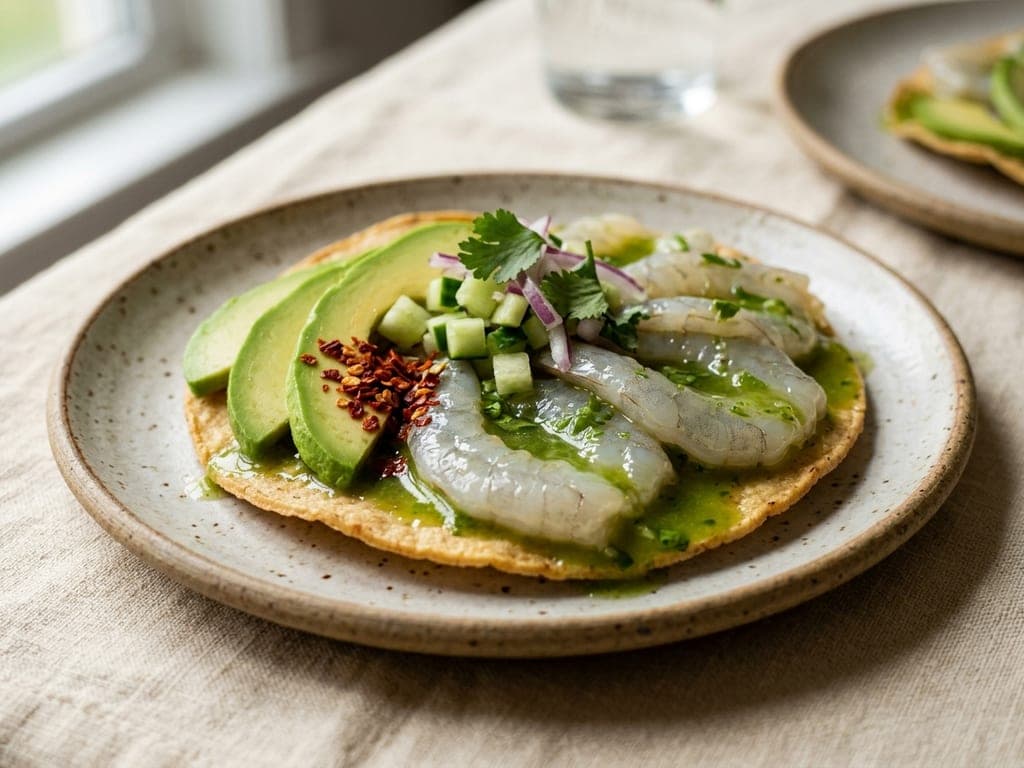
- Lay three shrimp cut-side up so they overlap across the tostada's full width — generosity reads instantly on a small canvas.
- Spoon the chile water over the shrimp only at the very last second; the shell has a two-minute crispness budget.
- Fan a few avocado slices along one edge and pile the cucumber and onion at the centre for height.
- Finish with a pinch of crushed chiltepín where it can be seen against the avocado, and serve with the platter following behind — this plate is the invitation.
Aguachile is not ceviche, and the difference is the clock
The two dishes share a coastline, a citrus bag and half their ingredients, so the confusion is understandable — but they are opposites in the one dimension that defines them. Ceviche is a cure: acid is given time (two minutes in Lima, half an hour in Mazatlán) to transform the seafood before it is eaten, and the transformation is the dish. Aguachile is a dressing: the sauce is poured over raw shrimp and the plate is on the table before the acid has done anything but introduce itself. Ceviche you make ahead by minutes; aguachile you make ahead by zero.
Everything else follows from that. Ceviche can afford chunky vegetables, resting juices, even tomato and Clamato in its Mexican forms, because the protein is stabilised; aguachile stays minimal — cucumber, onion, the water itself — because nothing about it is stable. Ceviche's leftover marinade becomes leche de tigre; aguachile's is drunk from the platter or lost, because by the time it would be “leftover” the dish is already past. And texturally they end in different places: cured shrimp are firm and springy, aguachile shrimp are silken and barely set, closer to sashimi with a temper than to anything cooked. If you want the firm version of raw shrimp in lime, that is just ceviche — our shrimp ceviche page poaches instead, for reasons it explains. This page is for the other thing.
The heat is structural, so calibrate it honestly
There is no mild aguachile, only aguachile scaled to its audience. The chile is not seasoning here — the dish is named after it, and a timid version collapses into watery shrimp with cucumber. The traditional engine is chiltepín, which most kitchens outside northwest Mexico will not find fresh; dried chiltepines travel well though, keep for a year in a jar, and a generous pinch crushed into the blender alongside two serranos lands remarkably close to the Culiacán baseline. Serranos alone — three for brave tables, two for mixed company — make an honest green aguachile with no apologies needed. Jalapeños alone make a gentle one; call it a starting point.
Two calibration tricks from marisquería practice. First, taste the blended water before it goes anywhere near the shrimp: it should make you blink — a pound of sweet raw shrimp and a plate of cucumber are about to dilute it, and water that tastes “pleasant” in the jug tastes absent on the plate. Second, put heat on the table instead of only in the blender: a small dish of crushed chiltepín or a halved serrano lets the bravest eaters escalate without holding the whole platter hostage. And serve cold beer, not water — capsaicin is fat- and alcohol-soluble, and everyone at a real aguachile table knows it.
Shopping the dish in Europe
The shrimp rule is absolute: raw, frozen, thawed by you. Look for warm-water shrimp sold raw and frozen — usually labelled gambas, king prawns or tiger prawns — at 21/25 count or larger, since small shrimp disappear under the sauce and cannot be butterflied. The freezing is a feature, not a concession: it is the parasite control for a no-heat dish. What you cannot use is the pre-cooked pink prawn that dominates northern European chillers — aguachile with cooked shrimp is a salad with a misleading name.
Chiltepines: dried, from Mexican grocers online — worth the small order for authenticity, but not a blocker; serranos are in most large supermarkets now and jalapeños everywhere. Limes, cucumber, red onion, cilantro (the herb sold as fresh coriander) complete the list. Tostadas come from the same Latin shelf as for the shrimp ceviche page, or bake corn tortillas crisp at home. The olive-oil thread at the end is a modern touch, not tradition — use a good one or none. Total shopping beyond the shrimp: perhaps eight euros, most of it limes. The dish spends its budget on freshness, not on ingredients.
Questions, answered
What is aguachile?
A Sinaloan dish of raw butterflied shrimp under a blended “chile water” of lime, serrano or chiltepín, cilantro and onion, topped with cucumber and red onion and eaten immediately — no marinating, no cooking. It began inland as literally water, crushed chiltepín and salt on the Sinaloa ranchos, and picked up shrimp when it reached the coast.
Is aguachile raw shrimp?
Yes, genuinely — the lime touches the shrimp for minutes, not long enough to cure them, so the texture stays silken and sashimi-like. That is the entire point of the dish, and why sourcing matters more here than anywhere else on this site: commercially frozen raw shrimp, cold chain intact, eaten the sitting it is made.
What is the difference between aguachile and ceviche?
The clock. Ceviche gives acid time to cure the seafood — the transformation is the dish. Aguachile pours the sauce over raw shrimp and hits the table before the acid has done more than introduce itself — the rawness is the dish. Ceviche keeps minutes to hours; aguachile is over fifteen minutes after the pour.
Is aguachile safe to eat?
Made with commercially frozen raw shrimp (the parasite control), a tight cold chain and immediate eating, it carries the same order of risk as sushi. The lime kills nothing — not parasites, not Vibrio — so the safety is entirely in the sourcing and the cold. Pregnant, elderly or immunocompromised eaters should have the poached shrimp ceviche instead; that is what it is for.
What chile do you use for aguachile?
Tradition says chiltepín — the wild, bead-sized Sinaloa pepper at 50,000–100,000 Scoville. Outside Mexico, dried chiltepines (online, they keep a year) crushed in with two serranos get close; serranos alone make an honest version; jalapeños a gentle one. Whatever you use, the blended water should taste fiercer than seems polite — a pound of sweet shrimp is about to dilute it.
Can I make aguachile ahead of time?
You can prep everything ahead — butterflied salted shrimp, blended chile water, sliced vegetables, all separately refrigerated — but assembly is the point of no return. Pour when the table is seated: fifteen minutes later the acid has visibly cured the shrimp toward ceviche, and an hour later it is a lesser dish and an unsafe one.
Can I make aguachile with cooked shrimp?
You can make something nice, but it will not be aguachile — the silken raw texture is the dish's entire identity, and cooked shrimp under chile water is a dressed shrimp salad. If cooked shrimp is the requirement (safety, preference, availability), our Mexican shrimp ceviche is the page you want; it is built for exactly that.
What is black aguachile?
The Sinaloa marisquería variant where the green chile water is darkened with soy sauce and Maggi-style seasoning sauce, sometimes with a little Worcestershire — deeper, saltier, umami-heavy where the green is bright and herbal. Make it from this recipe by adding 2 tbsp soy and 1 tbsp Maggi to the blender and dropping the added salt. Same shrimp, same rules, same clock.
What do you serve with aguachile?
Tostadas, cold lager, and nothing that needs a fork: shrimp onto the tostada, a spoon of chile water over it, repeat. Avocado slices are a common and defensible addition on the platter; saltines stand in for tostadas at the beach. The leftover chile water gets drunk from the platter by whoever earned it.
How spicy is aguachile supposed to be?
Genuinely spicy — the dish is named after the chile, and the water must overshoot because the shrimp and cucumber dilute it on the plate. Calibrate to your table (two serranos mixed company, three brave, chiltepín on top for Sinaloa standards), but if the blended water doesn't make you blink on its own, the finished platter will taste of cucumber and regret.
Snap your finished plate and let the AI plate it again — more beautifully.