Hot chocolate charcuterie board set up as a drinks station that stays hot
The ranking pages are candy lists. This one is a drinks station, plated: pot and mugs as anchors, toppings in the order a mug is built, and the numbers written down, from cocoa per guest to how long it stays hot.
The photos on this page are AI-generated illustrations.
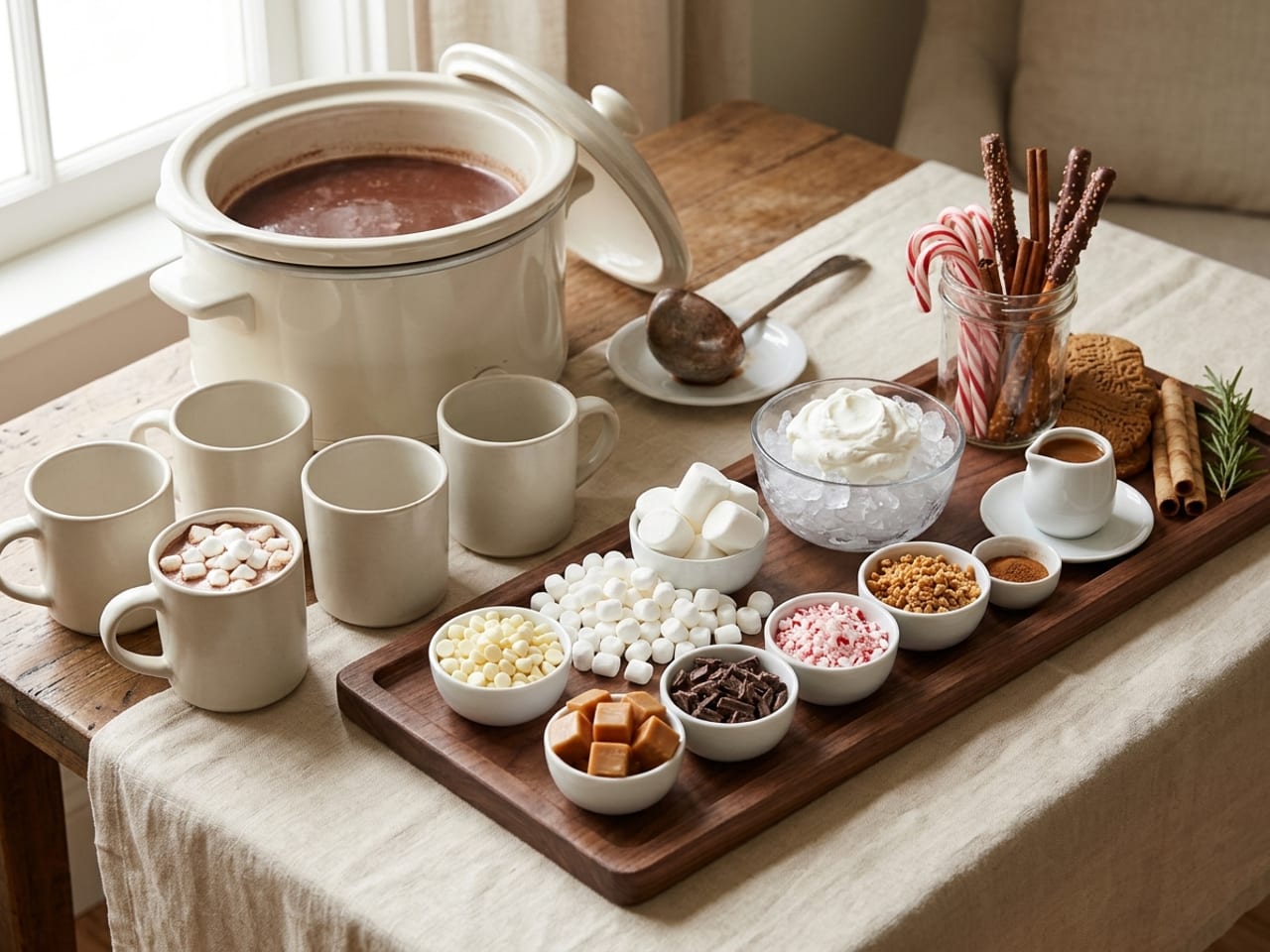
A hot chocolate charcuterie board is a toppings board beside a pot of cocoa: chocolate to melt in, marshmallows and whipped cream to crown the mug, crushed candy cane to crunch, candy canes and wafer rolls to stir and dunk. Plan about 10 fl oz (300 ml) of cocoa a guest over a two to three hour party, 16 fl oz (475 ml) if it is the only drink, and 15 g of marshmallows each. Make it on the stove, then hold it in a slow cooker (crockpot) on WARM, not LOW, stirred every 20 to 30 minutes, for up to 4 hours.
The thirteen pages that rank for this board list candy; none says how much cocoa a guest drinks, and only one names a slow-cooker setting, with no time limit. Here the board is plated as a drinks mise en place: pot and mugs are the anchors, bowls run in build order. General board rules and food safety live on the charcuterie board flagship.
The scoop: a marshmallow was going into each cup of hot chocolate in print by March 1908, nine years before the 1917 booklet usually credited with the idea.
What do you put on a hot chocolate charcuterie board?
Six jobs, in the order a guest builds a mug.
The base
The cocoa, hot in a slow cooker or insulated carafe beside the board on a trivet, never on the board or bare wood, plus a jug of cold milk for cooling children’s mugs (for the mugs, never the hot pot).
Melt-ins
White chocolate chips, soft caramels, chopped dark chocolate, peppermint bark: things that vanish when stirred.
The crown
Mini and regular marshmallows, and whipped cream in a bowl set in ice, after the melt-ins so it sits on top.
Crunch
Crushed candy cane, toffee bits, sprinkles, crushed gingerbread.
Dippers and stirrers
Candy canes and cinnamon sticks to stir, rolled wafers and pretzel rods to dunk, standing in a jar: the board’s height.
The drink at party scale: cocoa, chocolate or mix
Cocoa powder is the party default: cheap, steady on WARM, easy to scale. Chopped chocolate adds cocoa butter, for a richer, thicker cup. A mix is the shortcut (USDA’s envelope is 28 g for 6 fl oz (180 ml) of water), but the big ones (Nestlé, Ghirardelli, Swiss Miss) list milk, so “just add water” is not dairy-free.
Natural or Dutch-process? Taste decides. Dutching treats cocoa with alkali, lifting its pH from 5.3 to 5.8 to 6.5 and up, past 7.6 for the darkest, and darkening it 1; Alice Medrich, for King Arthur, tastes a deeper “base” chocolate with fewer fruity notes. It also strips flavanols, from 34.6 mg per gram to 3.9 at the heavy end 1, in a study from Hershey’s own nutrition centre. Natural cocoa has three times the caffeine: 230 mg per 100 g against 78 (USDA).
Why cocoa clumps: starch on a clump’s outside swells into “a waterproof seal” around a dry core, and cocoa is about 12 percent fat, Kenji López-Alt explains at Serious Eats. The fix is a paste: an equal volume of liquid to powder, smooth, before the rest; for stubborn lumps, his immersion blender. For dairy-free, Genevieve Yam at Serious Eats picks oat milk; malted milk powder is milk, and wheat and barley.
Party hot chocolate for a 4-quart (3.8 L) slow cooker
Makes about 2¾ quarts (2.6 L): eleven 8 fl oz (240 ml) mugs or fourteen 6 fl oz (180 ml) children’s mugs, under the ¾ line Crock-Pot’s manual sets. You need 10 cups (2.4 L) whole milk, ⅔ cup (57 g) natural or Dutch-process cocoa, 1 cup (200 g) sugar, ¾ cup (180 ml) water, ½ tsp fine salt and 2 tsp vanilla: a fifth less sugar than Hershey’s 2 tbsp to each cup (240 ml) of milk, because the board adds its own.
- Make the pasteWhisk the cocoa, sugar and salt in a large pot, whisk in the water, and boil 2 minutes, stirring: Hershey’s syrup step.
- Add the milkWhisk in the milk a quarter at a time and heat, stirring, to 160°F (71°C), steaming, small bubbles at the edge. Do not boil.
- Hold itStir in the vanilla, taste, and ladle into a cooker preheated on WARM, lid on.
- The chocolate upgradeCut the cocoa to ⅓ cup (28 g) and the sugar to ¾ cup (150 g); whisk 6 oz (170 g) of chopped 60 to 70% dark chocolate into the hot milk. A 65% bar is up to 35% sugar, so it brings up to 60 g of its own. Use bars, not chips.
How much hot chocolate per person?
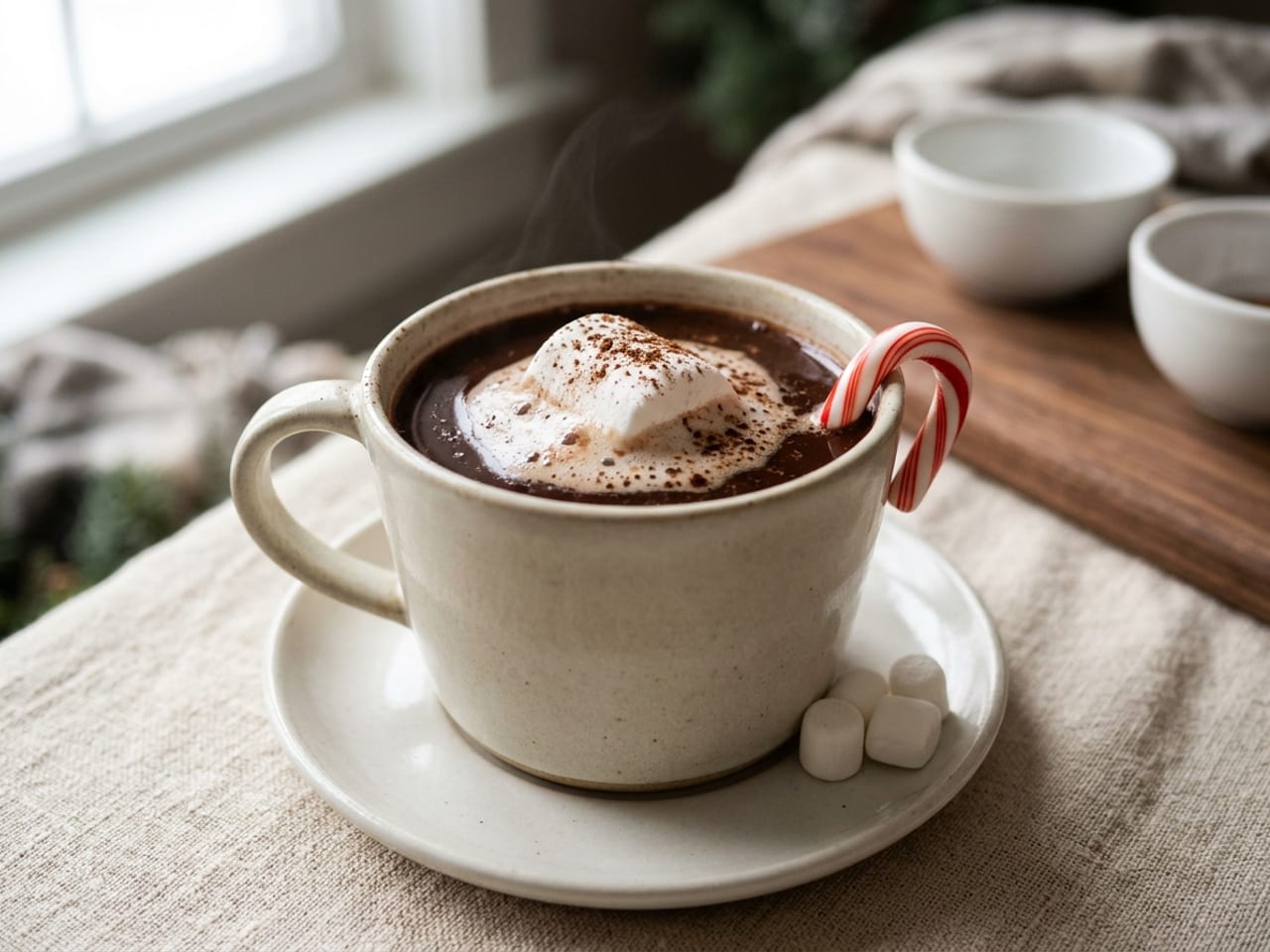
About 10 fl oz (300 ml) a guest over a two to three hour party when cocoa is one drink among several, 16 fl oz (475 ml) when it is the only one. The first is what caterers sell: Ben & Jerry’s self-serve bar on ezCater is 96 fl oz (2.8 L) that “Serves 10”, 9.6 fl oz (285 ml) a head, and Ellen’s Kitchen’s minimum of 6 gallons (22.7 L) for 100 works out at 7.7 fl oz (230 ml). The second is our estimate, from Ellen’s party-coffee rule of a pint (475 ml) a person for three hours.
Use 10 to 12 fl oz (300 to 355 ml) mugs filled to about 8 fl oz (240 ml), so the crown fits; a guest’s share is a mug and a top-up, so plan toppings for one and a half. Children get 6 fl oz (180 ml) mugs, about one and a half each: count them as adults for cocoa, double for marshmallows.
Per mug, by USDA FoodData Central weights: 10 to 15 minis (ten weigh 7 g) or two regular marshmallows (14 g), a 2 tbsp dollop of whipped cream (a cup (240 ml) of heavy cream whips to 16 of them), one candy cane. Sugar and Charm’s card for 15 guests counts 25 minis and 20 large marshmallows, about 10 g a guest, but no cocoa at all. One batch serves about nine guests, five or six when cocoa is the only drink; for the food, the party food calculator.
Hot chocolate board amounts for 6, 12 and 24 guests
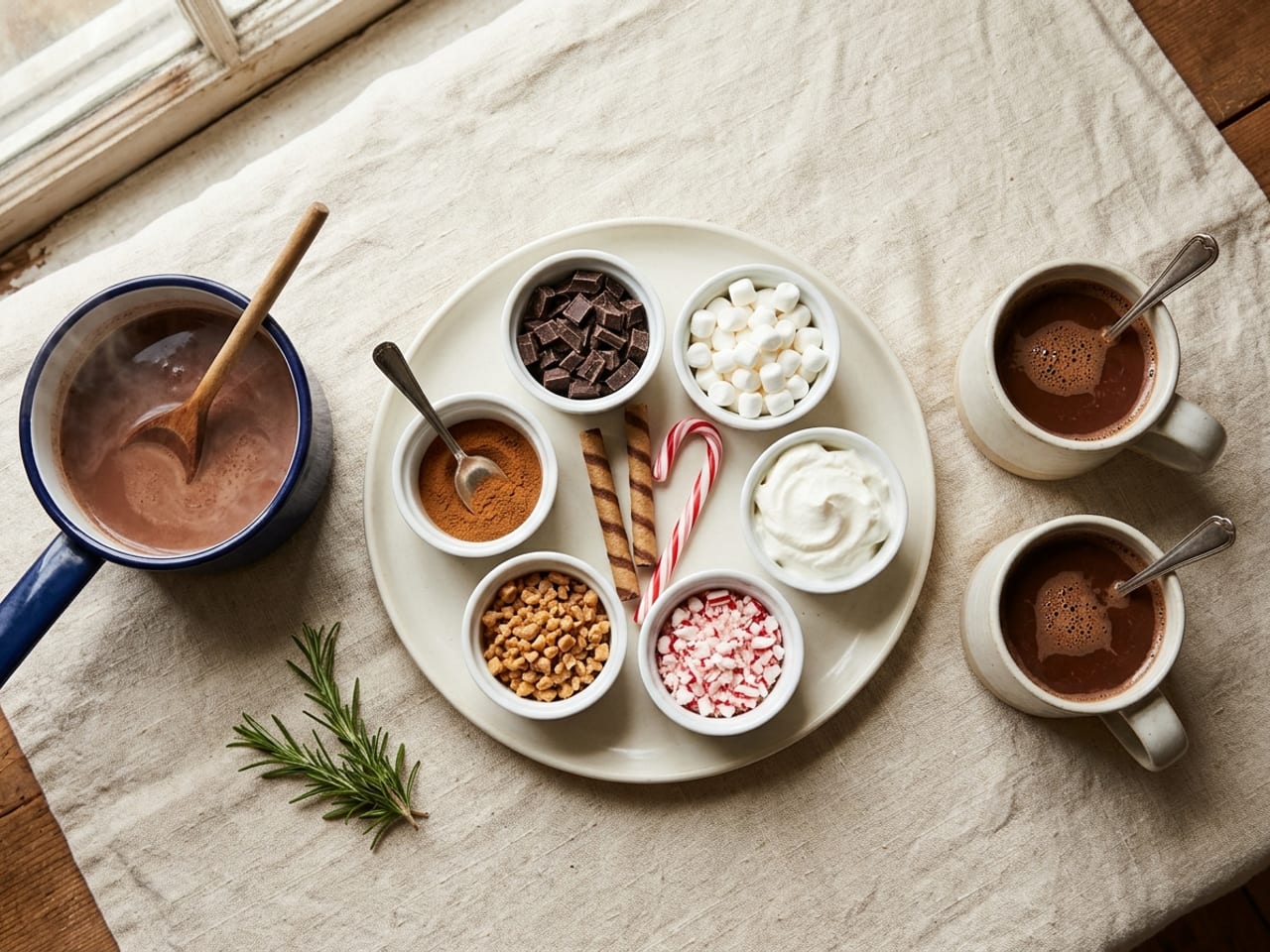
Per guest: 10 fl oz (300 ml) of cocoa, 16 fl oz (475 ml) if it is the only drink; 15 g of marshmallows, 3 tbsp of whipped cream (cream doubles when whipped), a candy cane a mug, two dunkers and about ½ oz (15 g) of melt-ins (our estimate). Mugs: one and a quarter a guest. A batch is the recipe above, 2¾ quarts (2.6 L), and one 4-quart (3.8 L) cooker holds one batch, enough for about nine guests; for twelve, use a 6-quart (5.7 L) cooker, which holds 4½ quarts (4.3 L) under its ¾ line, or make a second pan on the stove for top-ups.
| Guests | Cocoa, one drink of several | Cocoa, the only drink | Mugs | Marshmallows | Heavy cream to whip | Candy canes, dunkers |
|---|---|---|---|---|---|---|
| 6 | 60 fl oz (1.8 L): ¾ batch | 3 quarts (2.8 L): 1¼ batches | 8 | 3.2 oz (90 g) | a generous ½ cup (135 ml) | 8 canes, 12 dunkers |
| 12 | 3¾ quarts (3.5 L): 1½ batches | 6 quarts (5.7 L): 2¼ batches | 15 | 6.3 oz (180 g): one 10 oz (283 g) bag | 1⅛ cups (265 ml) | 15 canes, 24 dunkers |
| 24 | 7½ quarts (7.1 L): 3 batches | 12 quarts (11.4 L): 4½ batches | 30 | 12.7 oz (360 g) | 2¼ cups (530 ml) | 30 canes, 48 dunkers |
How do you keep hot chocolate warm for a party?
Make it on the stove, hold it on WARM: the slow cooker is a holding cabinet here. Crock-Pot’s manual says WARM “is ONLY for keeping already cooked food at the perfect serving temperature”, and that milk and cream “break down during extended cooking”. LOW is the wrong setting: Hamilton Beach’s manual says food on Low or High ends at about 200°F (93°C), where milk skins and scorches. WARM runs about 165 to 175°F (74 to 79°C), going by a Crock-Pot support answer we could only read second-hand, and some cookers run cooler; put a thermometer in yours.
How long can you keep hot chocolate warm in a slow cooker? Up to 4 hours on WARM: Crock-Pot does not recommend longer, and by then a milk drink has thickened and darkened anyway. For safety there is no clock while it holds at or above 140°F (60°C), USDA FSIS’s hot-holding line (the FDA Food Code allows 135°F (57°C) in restaurants). Stir every 20 to 30 minutes and keep the lid on between ladles; a skin whisks back in, a scorched bottom does not. Henry Stubbe was complaining in 1662 that hot milk, “standing so,” will “cast up a scum”. Unplugged, or poured into a jug below 140°F (60°C), the cocoa joins the two-hour clock.
No socket, or a small party: an insulated carafe. Zojirushi rates its 74 fl oz (2.2 L) air pot, nine mugs, at 169°F (76°C) after 10 hours for water poured in at 203°F (95°C); cocoa starts near 160°F (71°C), but a full, preheated pot should stay above 140°F (60°C) through a three-hour party (our estimate; it cools faster as it empties, so check it with a thermometer). Rinse it as soon as the party ends: milk left in a vacuum pot sours and smells. Top up from a pan on the stove: WARM is not for reheating (Hamilton Beach).
The cold dairy is on the clock: whipped cream, the cold-milk jug and cut fruit get the flagship’s two-hour rule, one hour above 90°F (32°C) (USDA FSIS). Nest the cream in ice, refill from the fridge, discard what has sat two hours; an empty bowl holds its place until guests arrive (The Speckled Palate’s trick). Leftovers: shallow containers into the fridge, then reheated on the stove to 165°F (74°C) before any hold, since FSIS does not recommend reheating in a slow cooker.
The party clock, for a 7:00 pm start
Two clocks run at once: the 4-hour WARM limit on the cocoa, and the 2-hour limit on the cold dairy (USDA FSIS); putting a bowl back in the fridge does not reset it (Nebraska Extension: “2 hours, TOTAL time”).
| When | Task | Why |
|---|---|---|
| Day before | Crush the candy canes, chop the chocolate, fill the dry bowls and cover them | Dry toppings keep at room temperature overnight; uncovered marshmallows dry out |
| 5:45 pm | Paste, then milk to 160°F (71°C) on the stove (a batch and a half: start at 5:35 pm; made a day ahead: reheat on the stove to 165°F (74°C)); cooker preheating on WARM | Milk breaks down in long slow cooking (Crock-Pot manual) |
| 6:15 pm | Cocoa into the cooker, lid on; set the dry board with an empty placeholder bowl for the cream | The 4-hour WARM window opens; it closes at 10:15 pm |
| 6:50 pm | Whip the cream; its bowl on ice to the board; cold-milk jug out | The 2-hour clock starts for the dairy; it ends at 8:50 pm |
| Every 20 to 30 minutes | Stir, scrape, lid back on; check it reads 140°F (60°C) or above | Skin and scorching; the hot-holding line (USDA FSIS) |
| 8:50 pm | Swap the cream and milk jug for fresh from the fridge | Two hours out, total |
| 10:00 pm | Last mugs; cooker off; leftovers into shallow containers and the fridge | Reheat on the stove, not in the cooker (USDA FSIS) |
How hot should hot chocolate be for kids?
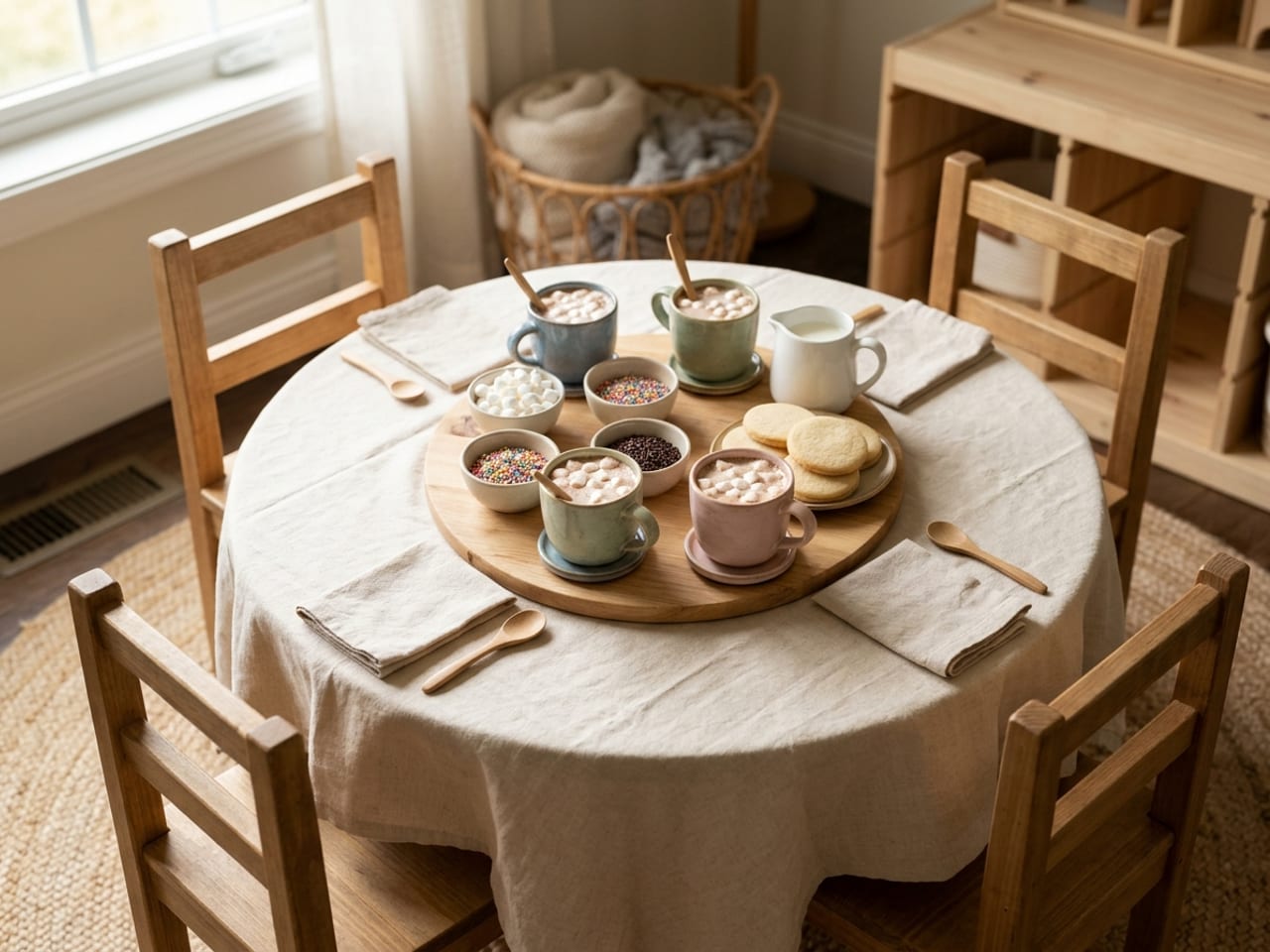
Cooler than the pot: we found no study or health body that sets a safe drinking temperature for children. Hot drinks are commonly served at 160 to 185°F (71 to 85°C); Brown and Diller modelled about 136°F (58°C) as the best serving temperature for coffee, balancing scald risk against taste 2. In ceramic mugs, tea and coffee with milk start at 167 to 171°F (75 to 77°C), and the burns surgeons who measured them warn of a full-thickness burn even after 10 minutes’ cooling or a splash of cold milk 3; cocoa ladled from a pot on WARM starts in the same range.
The danger is the mug more than the sip: scalds peak between 6 and 24 months, typically a child pulling a mug down with an adult close by 4, and a spilled drink can disfigure for up to 11 minutes 5. Pour children’s mugs yourself, half full, with a splash of cold milk, let them stand, and hand them over to children seated at their own table; for under-fours, stir the marshmallow in until it melts. Toddlers get no mug on any table they can reach. The cooker goes at the back, on a trivet, cord short and never over the edge; if you need an extension cord, one rated for the cooker, run where nobody walks or can pull it. The crock and lid stay hot to the touch. If a scald happens: cool running water for 20 minutes, at once, with wet clothing taken off unless it sticks; no ice or butter; and any scald on a small child gets a doctor (NHS).
For under-fours, the AAP lists marshmallows, hard and sticky candy and nuts among choking foods: melt the marshmallow into the mug, keep candy canes, caramels and toffee for older children, and seat them while they eat.
How to arrange a hot chocolate board, in build order
The board is a drinks mise en place: everything a mug needs, in the order it goes in. Three stages, photographed.
- Anchors off the boardCooker or carafe at the left and to the back, on a trivet, ladle on a saucer, mugs in front; the board starts to its right. Taste of Home’s rule applies: the hot drink sits where nobody has to reach across the board to get started. Mugs on the board take the room of three bowls.
- Bowls in build orderMelt-ins nearest the mugs, then crown, crunch and finish, dippers at the far end: Laura Fuentes arranges “in the order they are used”. A tray with a raised rim keeps sprinkles home.
- The crown and its placeholderMinis loose in a mound beside the bowl of regulars; an empty bowl holds the whipped cream’s place.
- Crunch and finishA spoon in every bowl; sauces in small jugs on a saucer, so drips land on china.
- Height at the far endCandy canes, cinnamon sticks and pretzel rods upright in a jar, wafers and gingerbread beside it: tall things last, so nobody reaches over them.
- Gaps, then wipeLeave 1 to 2 inches (2.5 to 5 cm) between groups for hands and spoons, one sprig of rosemary at a corner, wipe the rim, and swap the cream in as the doorbell goes.
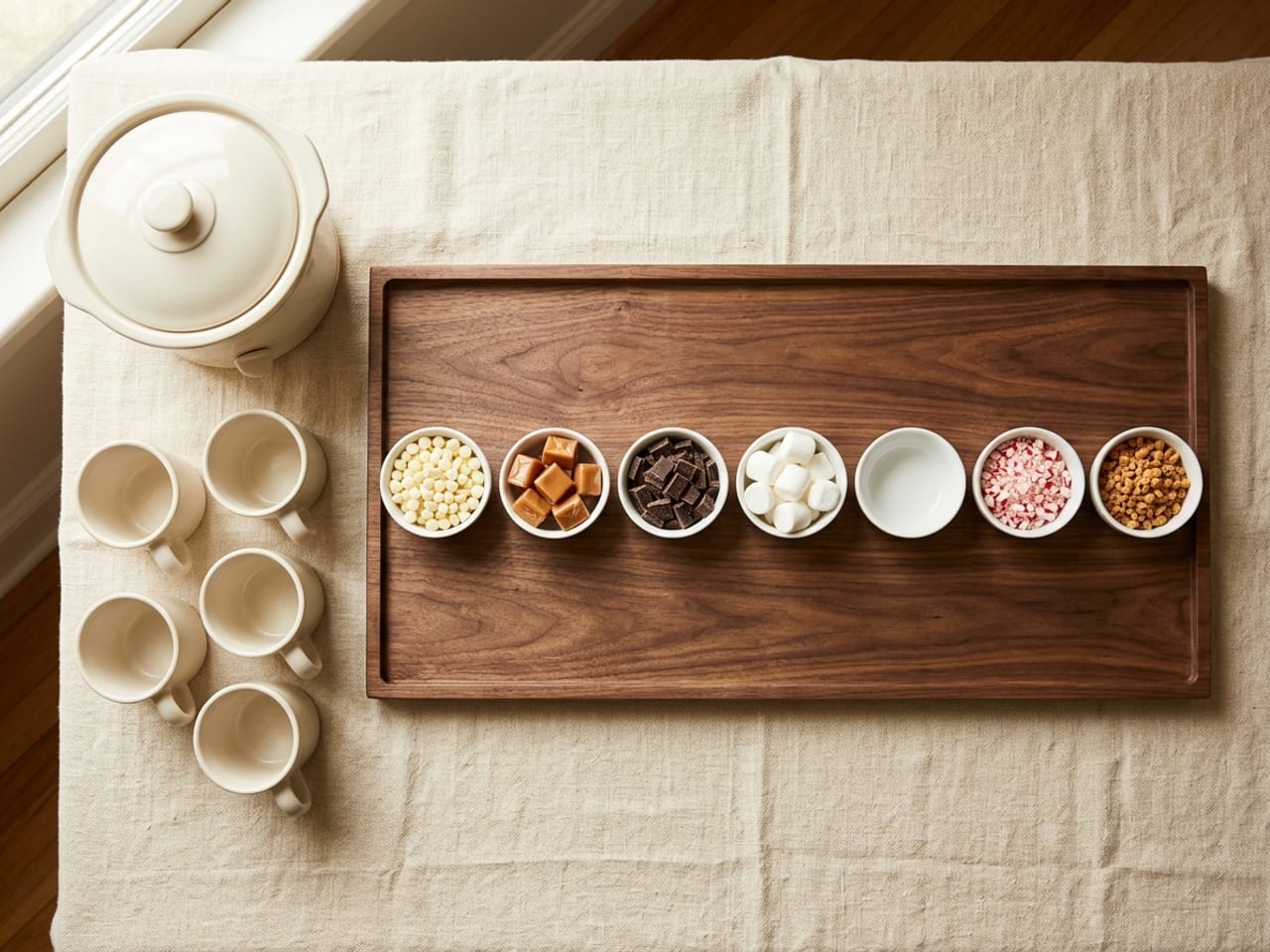
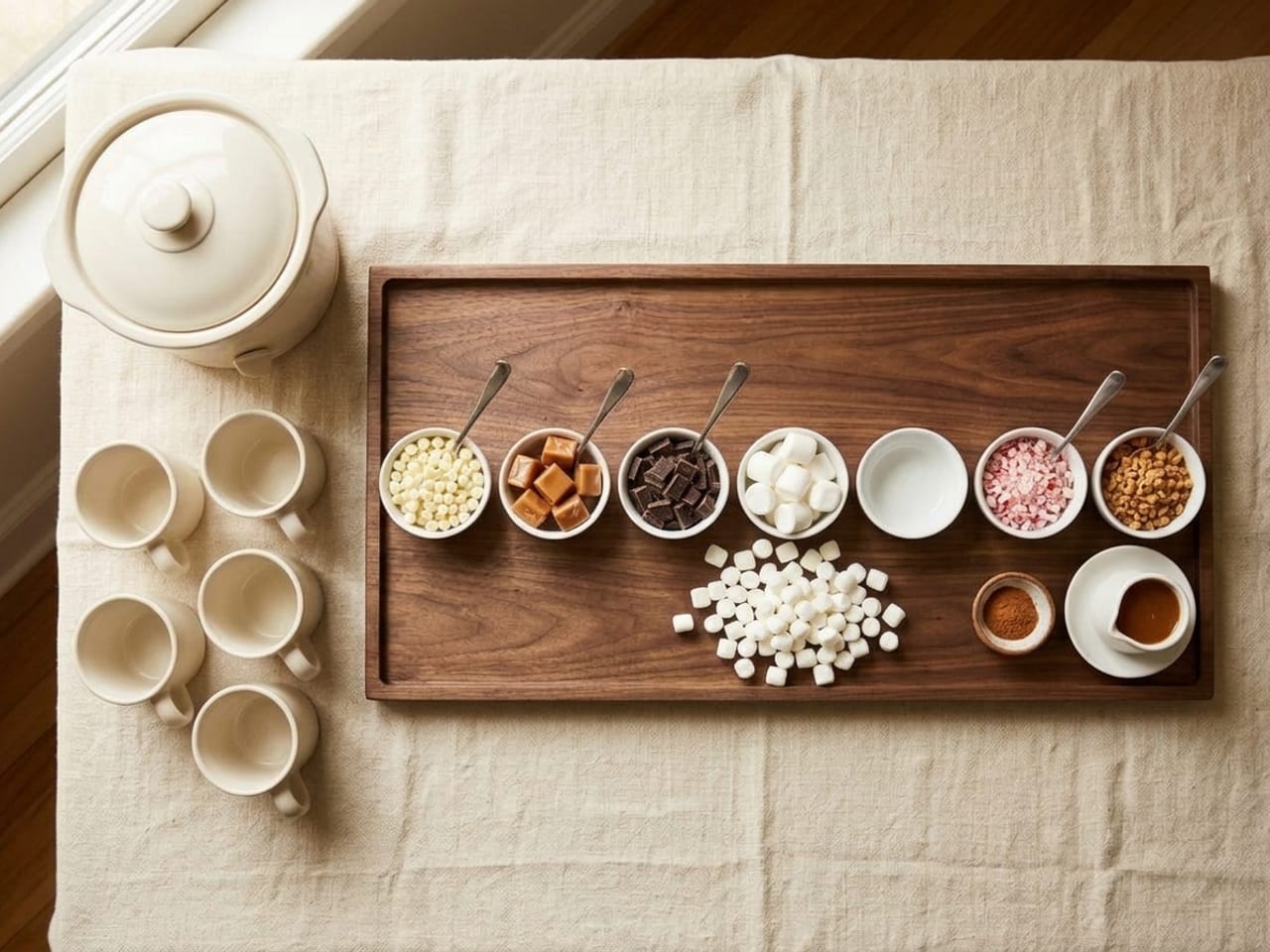
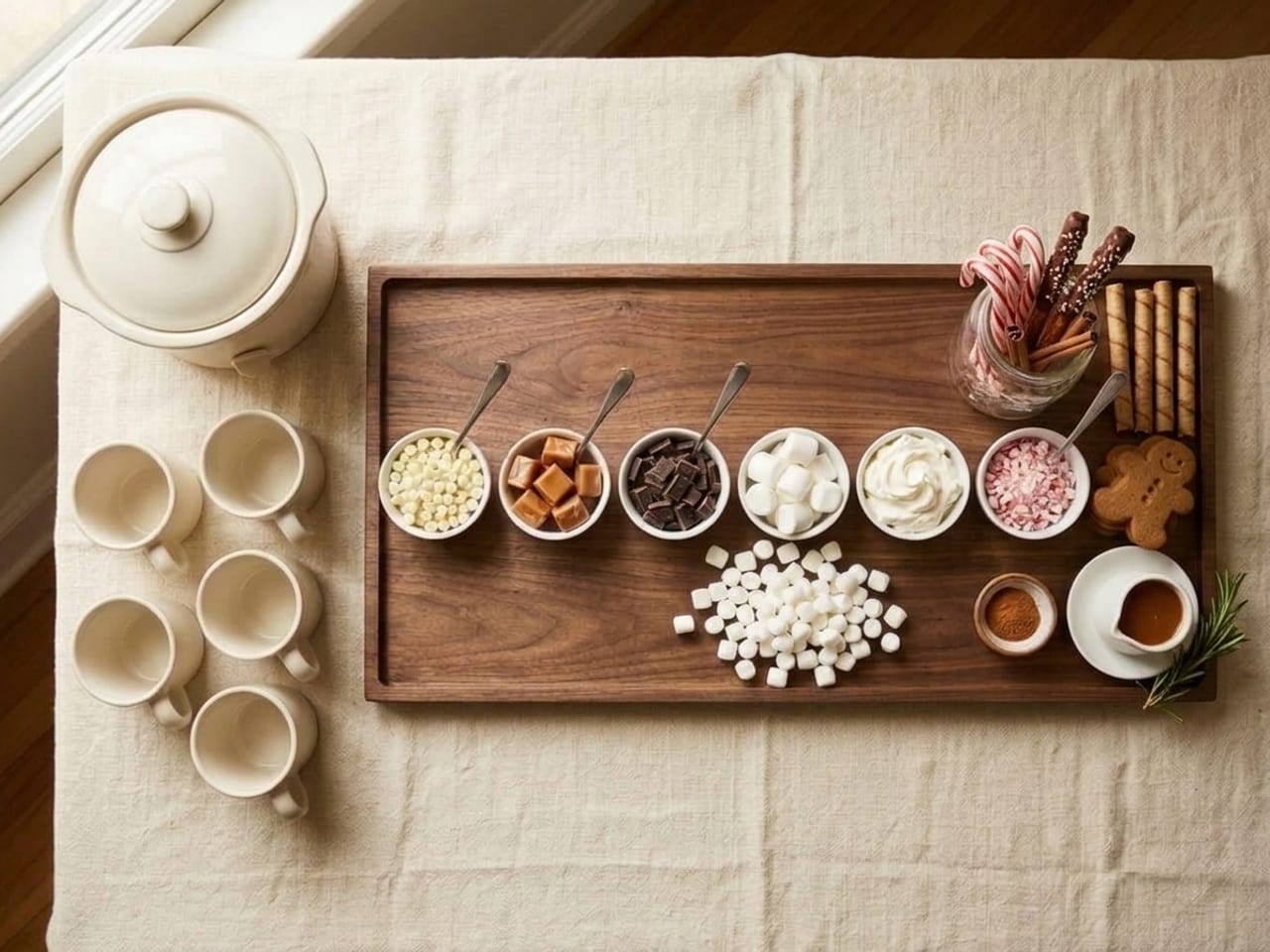
The winter palette, and where the height goes
Colour from the food: cocoa and chocolate for the ground, marshmallow and cream for white, candy cane for red, toffee and caramel for gold, one sprig of rosemary or mint for green. Two top pages disagree: Dinner then Dessert keeps “each of the same ingredients together”, Love from the Oven forbids “chocolate next to chocolate”. Both hold at different scales: group by job, alternate colour between groups, so dark chocolate meets the white crown and the crown meets the red crunch (colour on the plate).
Height: one tall thing at each end, the cooker at the left and the jar of stirrers at the right, so the eye runs the board as a guest walks it. Everything between stays low; the gaps are where spoons rest (plating 101).
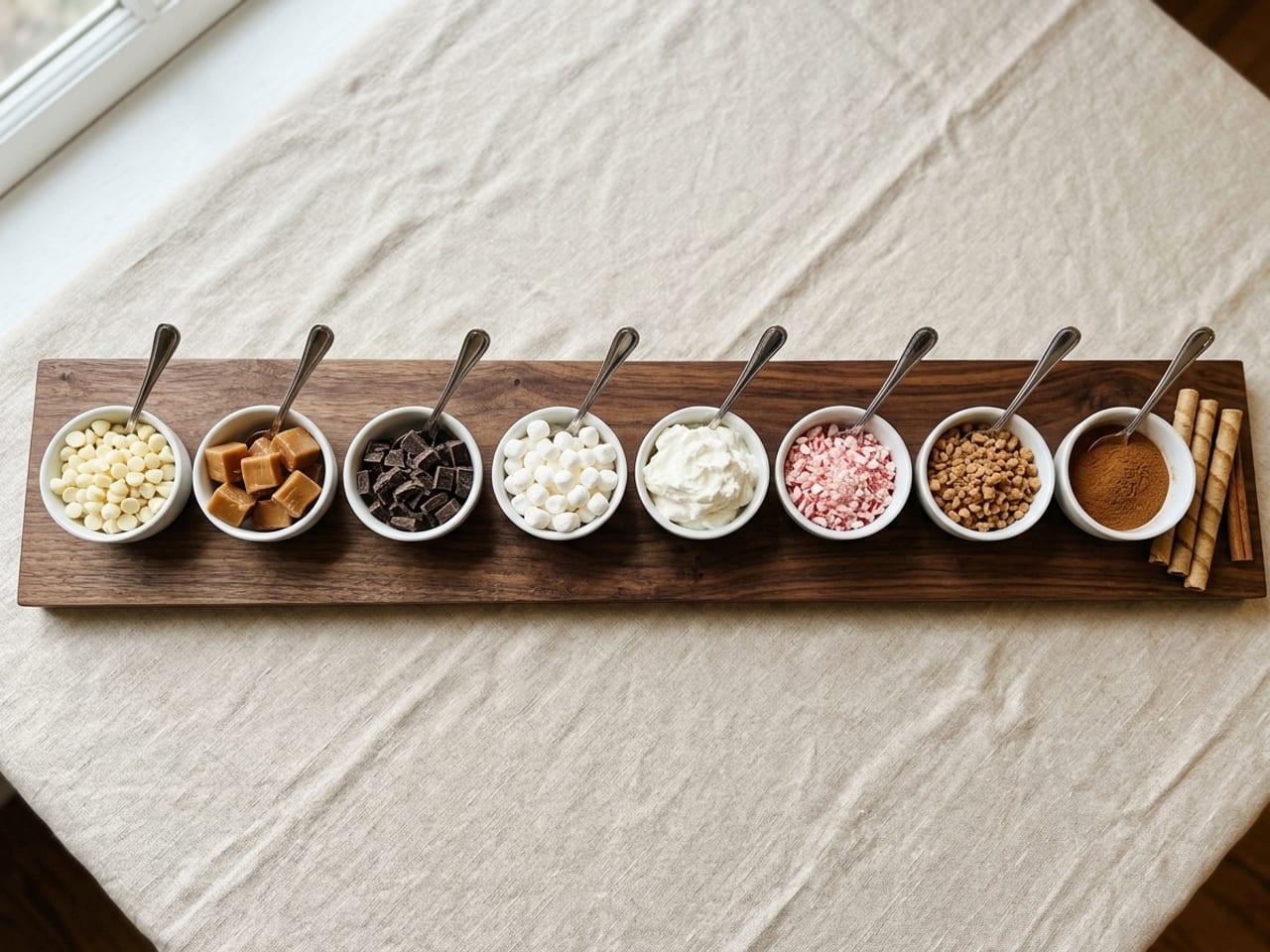
Hot cocoa bombs on the board
A cocoa bomb is a chocolate shell around cocoa mix and mini marshmallows; hot milk poured over melts it open. So a bomb board needs a carafe of plain hot milk beside the bombs, not cocoa (Taste of Home’s layout). Pour 6 to 8 fl oz (180 to 240 ml) of steaming milk slowly over the top: cocoa butter melts just below body temperature. The milk follows the cocoa’s rules: hot in a preheated carafe or on WARM at 140°F (60°C) or above, or two hours out; children’s bombs get their milk poured by an adult.
Compound chocolate (candy melts) needs no tempering; real chocolate does, dark worked at 88 to 91°F (31 to 33°C) per Hungry Happenings, or the shells won’t set or release. Keep them far from the cooker. The craze appears to have started with Eric Torres-Garcia’s TikTok of 2 December 2019 (he says his was the first bomb); it peaked a year later.
Marshmallows: which kind, and why they melt
Minis (0.7 g each, USDA) melt fastest into a foam cap; regulars (7.2 g) float and slump; dehydrated mallow bits stay crunchy. The gelatin gel softens at about 95°F (35°C) and the sugar dissolves: “the marshmallow doesn’t really melt, it dissolves”, says McGill’s Joe Schwarcz, and never completely.
Gelatin is an animal product, which matters to vegetarian, vegan, halal and kosher guests. Dandies set with carrageenan and soy protein; Trader Joe’s seasonal ones have none, Reader’s Digest reports, but read this year’s bag, and for halal or kosher look for the mark. A kitchen torch is an adult’s job: stop at golden.
The grown-up station: pours, standard drinks, a separate table
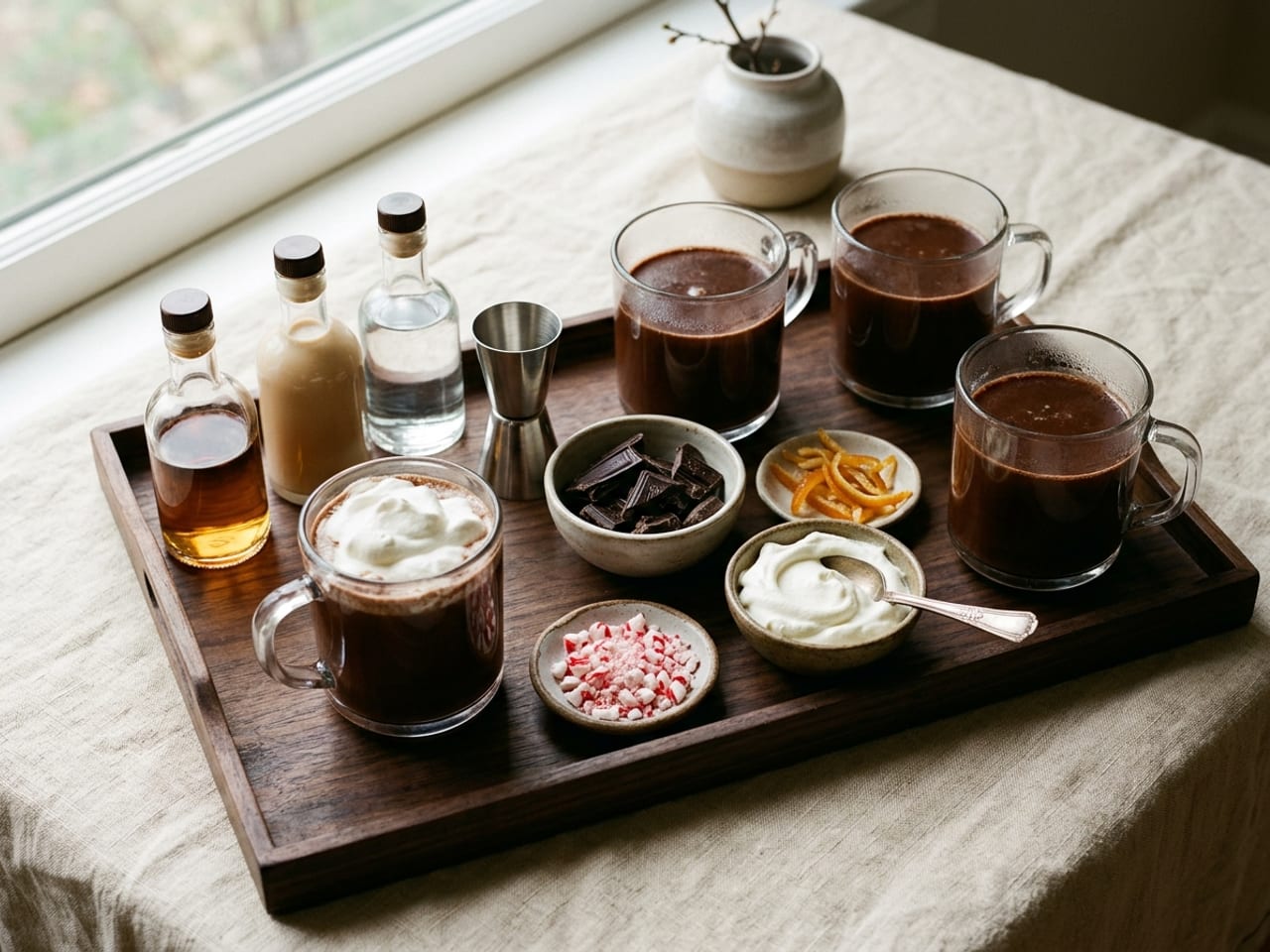
Spike the mug, never the pot. Children can’t tell, and the alcohol stays: USDA’s retention table keeps 85% of alcohol stirred into boiling liquid and taken off the heat 7, and even an hour’s simmer, stirred, still leaves a quarter; a lidded pot on WARM, below a simmer, loses less. The bottles get their own tray across the room, with a jigger and glass mugs, so a spiked drink looks different.
NIAAA’s US standard drink is 14 g of alcohol: 1.5 fl oz (45 ml) of a 40% spirit. So 1 fl oz (30 ml) of bourbon or rum at 40% is two thirds of a drink, 1.5 fl oz (45 ml) of Baileys at 17% is 0.43, and peppermint schnapps, 15 to 50% by brand, is 0.25 to 0.83 per fl oz (30 ml): read the bottle.
Allergens, diets and the dairy-free board
Label every bowl, a spoon in each, risky ones where they can’t spill into the rest.
- MilkIn the drink, the cream and the big mixes, even made with water; malted milk powder, caramels, toffee bits, peppermint bark, white chocolate and Irish cream too.
- Nuts and peanutsNutella and many rolled wafers are hazelnut, Heath-style toffee bits contain almonds and biscotti often do, peanut butter cups are peanut: read every bag, put the nut bowls at the far end with their own spoon (or buy an almond-free toffee for the middle of the board), and read the chocolate’s “may contain”.
- GlutenCookies, pretzels, wafers, graham crackers (digestive-style biscuits), churros, gingerbread, malted milk powder (wheat and barley). As dippers they sit last, so crumbs fall away from the melt-ins; a coeliac guest needs a separate plate.
- Gelatin, egg, soyGelatin in most marshmallows, egg in meringues, soy lecithin in most chocolate, soy protein in vegan marshmallows such as Dandies.
- The dairy-free boardOat-milk cocoa made first, in a clean pot, with its own labelled carafe (oat milk labelled gluten-free if a coeliac guest is coming); dark chocolate with no milk and no “may contain milk” line, since FDA has found milk in dark bars labelled dairy-free; gelatin-free marshmallows (Dandies are soy); coconut whipped cream, named on its label, since coconut no longer appears in US “Contains” lines; candy canes.
- SulfitesSweetened shredded coconut is usually preserved with them, and so is sulfured molasses: buy unsweetened coconut and unsulfured molasses, or label the bowl.
Sugar and caffeine per mug, honestly
A plain mug of our recipe has about 18 g of added sugar (200 g across eleven mugs): 72% of the American Heart Association’s daily limit for a child, 25 g 6, before toppings, and the AHA advises none at all under age 2; loaded, about 30 g. Hershey’s recipe page puts 12 g on its 6 fl oz (180 ml) serving, but its ½ cup (100 g) of sugar over six servings is 16.7 g; we use the arithmetic. A loaded mug at a party is a treat; the smaller mug is the lever.
Caffeine is minor: about 12 mg a mug with natural cocoa, 4 mg with Dutch, 5 mg from a packet, against 95 mg in 8 fl oz (240 ml) of brewed coffee; the same cocoa brings 105 to 140 mg of theobromine, caffeine’s chemical cousin (USDA). Health Canada’s ceiling for children, 2.5 mg per kg a day, is 50 mg for a 44 lb (20 kg) six-year-old.
Lead: Consumer Reports, in tests published in October 2023, checked 48 chocolate products, three samples each, against California’s daily lead level of 0.5 µg; 16 were over CR’s line for lead or cadmium. Per 1 tbsp, about one of our mugs’ worth, Hershey’s natural cocoa was 125% of that level and Droste 324%; CR named Swiss Miss among the lowest mixes. The level is California’s daily Prop 65 warning threshold, set with a wide margin, not a cap on what food may contain, and one party won’t change anyone’s exposure much. CR’s caution is for regular eating by young children and pregnant people, who it says should keep dark chocolate occasional: for a children’s party, vary brands or use a mix that tested low.
One mug, added up
USDA FoodData Central values per 100 g, scaled to the serving; our recipe is 10 cups (2.4 L) of milk, ⅔ cup (57 g) of cocoa and 1 cup (200 g) of sugar over eleven mugs.
| Per mug | kcal | Added sugar | Caffeine |
|---|---|---|---|
| Our recipe, 8 fl oz (240 ml), natural cocoa | about 218 | 18 g | 12 mg |
| Our recipe, Dutch-process cocoa | about 217 | 18 g | 4 mg |
| A child’s 6 fl oz (180 ml) mug of our recipe | about 163 | 14 g | 9 mg |
| Hershey’s ratio, 1 cup (240 ml) whole milk | about 258 | 25 g | 12 mg |
| Packet mix, 28 g in 6 fl oz (180 ml) water | about 111 | about 18 g | 5 mg |
| Add 10 mini marshmallows (7 g) | 22 | 4 g | 0 |
| Add 2 regular marshmallows (14 g) | 46 | 8 g | 0 |
| Add 2 tbsp whipped heavy cream, unsweetened | 51 | 0 | 0 |
| Add 1 mini candy cane (6 g) | 24 | 4 g | 0 |
| Loaded: our mug, 2 marshmallows, cream, candy cane | about 338 | about 30 g | 12 mg |
| Brewed coffee, 8 fl oz (240 ml), for scale | about 2 | 0 | 95 mg |
The history a mug can carry
Marshmallows were going into hot chocolate by 1908. That March, Harper’s Bazar told readers to make rich chocolate, “pour into cups, and add last a marshmallow to each cup.” Dame Curtsey’s etiquette book (1909) gave children’s parties “Cocoa in winter, with whipped cream or a marshmallow in each cup”. The 1917 Angelus Marshmallows booklet often said to have pioneered it came nine years later; “pioneered” is the Smithsonian writer’s word; the passage she quotes from her source does not say it.
Hot chocolate versus hot cocoa is an old American kitchen distinction, not a dictionary one: Fannie Farmer’s 1896 Boston Cooking-School Cook Book makes its Breakfast and Reception Cocoa from powder and its “Chocolate” from melted Baker’s chocolate, served “with whipped cream”; Merriam-Webster treats them as one drink. Milk came early: Henry Stubbe wrote in 1662 that the English “either use milk alone, or half milk, and half conduit-water”, a quarter-century before Hans Sloane, who usually gets the credit.
A correction: Bernal Díaz saw “about fifty large pitchers” of frothy cacao brought in at Motecuhzoma’s meal, not fifty cups drunk. And Swiss Miss began as a use for surplus Korean War coffee creamer, sold in envelopes mostly to airlines and restaurants as “Brown Swiss”.
The board: the earliest dated one we found is No. 2 Pencil’s, 10 December 2018, already with a slow cooker of cocoa beside it, and its maker hedged the name: “Technically charcuterie boards are made with cured meats.” By December 2020 Fox News was calling it “the latest fad”.
Hot chocolate board ideas: fourteen boards
The rest of the spread is on the Christmas desserts and Christmas appetizers hubs.
- ClassicNatural-cocoa recipe, minis and regulars, whipped cream, chocolate chips, crushed candy cane, rolled wafers, cinnamon sticks.
- Peppermint candy canePeppermint bark and crushed cane to melt in, peppermint marshmallows, a jar of whole canes, fresh mint.
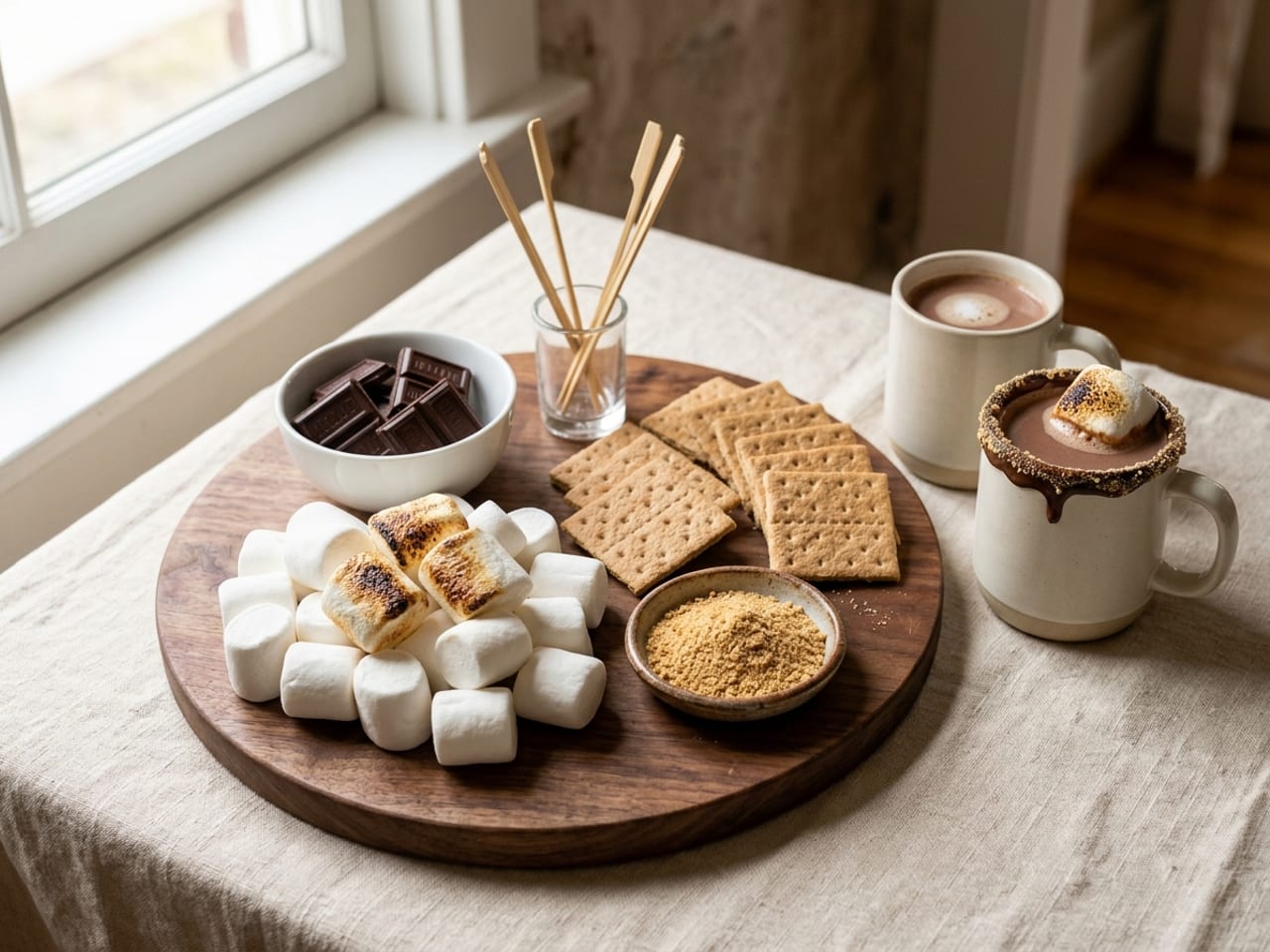
- S’moresDark chocolate squares, marshmallows toasted by an adult, graham crackers to dunk, mugs rimmed in chocolate and crumbs (Taste of Home’s trick).
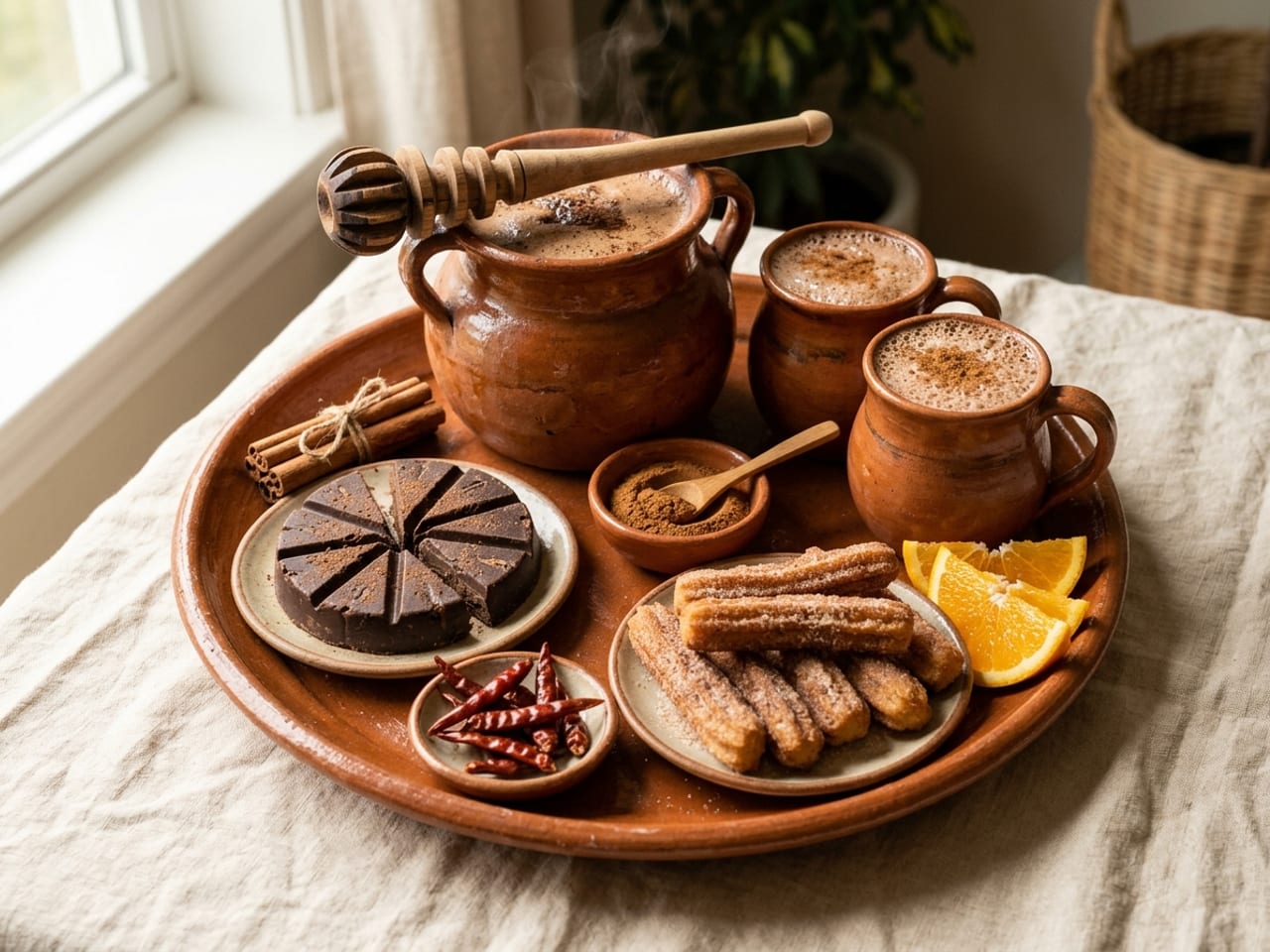
- Mexican hot chocolateAn Ibarra (1925) or Abuelita (1939) tablet, cinnamon sticks, chile in a pinch bowl rather than the pot, a molinillo, churros; a clay pot or jarro only if it is labelled lead-free (sin plomo). The cinnamon, like the tablet’s sugar and the churros, arrived with the Spanish; none of the three is Aztec.
- White hot chocolateWhite chocolate melted into milk, white marshmallows, coconut, freeze-dried raspberries for the only colour.
- GingerbreadMolasses and ground ginger in the base, gingerbread to dunk, nutmeg, whipped cream.
- Salted caramelCaramels to melt, caramel sauce, flaky salt in a pinch bowl, toffee, pretzel rods.
- Mocha barA labelled carafe of coffee, 95 mg of caffeine a cup (240 ml), chocolate espresso beans, biscotti, at the grown-ups’ end.
- Kids’ sleepover6 fl oz (180 ml) mugs poured and cooled in the kitchen, minis, sprinkles, sugar cookies, children seated at their own table.
- Grown-upGlass mugs, bourbon, Irish cream, schnapps, a jigger, 70% chocolate, orange peel, on its own tray.
- Dairy-freeOat-milk cocoa, dark chocolate with no milk on the label, gelatin-free marshmallows, coconut whipped cream.
- Valentine’sWhite hot chocolate turned pink with raspberry, heart marshmallows, strawberries (two-hour clock).
- Board for twoTwo mugs, a small pan on the stove, six tiny bowls on a 10 in (25 cm) plate.
- Budget, about $23 for twelveOur recipe, a 10 oz (283 g) bag of minis, aerosol cream, candy canes, pretzel rods, chocolate chips (prices below, mostly estimated).
Is it cheaper to make a hot chocolate board or buy a kit?
Make it: about $34 for twelve, $2.79 a head, against $6.70 to $8.00 a head for a caterer’s bar, or $65 to $70 for a boxed kit for three or four. Milk and sugar are BLS US averages for September 2026, cocoa and marshmallows Walmart list prices as read in November 2026 (we could not re-check the store’s page, so treat them as estimates too), the rest our estimates; check before you shop.
| Item | Quantity | Price | Status |
|---|---|---|---|
| Whole milk | 15 cups (3.5 L) | $3.85 | BLS, $4.106 a gallon (3.8 L) |
| Natural cocoa | 1 cup (86 g) of an 8 oz (226 g) can | $2.27 | Estimate: Walmart, $5.97 a can (Nov 2026) |
| Sugar | 1½ cups (300 g) | $0.67 | BLS, $1.019 a lb (454 g) |
| Vanilla and salt | $1.00 | Estimate | |
| Mini marshmallows | 10 oz (283 g) bag | $1.73 | Estimate: Walmart, $1.73 (Nov 2026) |
| Heavy cream | 1 pint (475 ml) | $3.50 | Estimate |
| Candy canes | 15 | $3.00 | Estimate |
| Chocolate chips and a dark bar | 6 oz (170 g) | $3.50 | Estimate |
| Rolled wafers and pretzel rods | 24 | $6.00 | Estimate |
| Crushed peppermint, sprinkles, cinnamon sticks | $5.00 | Estimate | |
| Caramel sauce | 1 jar | $3.00 | Estimate |
| DIY total, 12 guests | drink $7.79, about $0.47 an 8 fl oz (240 ml) mug | $33.52 | $2.79 a head |
| Ben & Jerry’s self-serve hot chocolate bar (ezCater, Milwaukee) | drink, toppings, dispenser | $80 for 10; $335 for 50 | $8.00 to $6.70 a head |
| Luxe Bites Hot Cocoa Charcuterie Box | toppings box, “Serves 3+” | $65.00 | up to $21.67 a head |
| Felicity Jane Hot Cocoa Charcuterie Kit | 4 mugs, 1 can of cocoa, bowl, spoon, sweets, no board | $70.00 ($150 with board; sold out when checked) | $17.50 a head, mugs kept |
| Dunkin’ Box O’ Joe Hot Chocolate | 96 fl oz (2.8 L), drink only | $19 to $30 or more, by store | Estimate: about $1.60 to $2.50 an 8 fl oz (240 ml) cup |
Five things to avoid on a hot chocolate board
The flagship’s five general ones are on the charcuterie board guide. These five are the drink’s.
- LOW for the whole partyIt ends near 200°F (93°C): skin and a scorched bottom. Stove first, then WARM, 4 hours at most.
- A spiked potChildren can’t tell, and the alcohol stays. Pour per mug, at a separate station.
- Whipped cream out all eveningTwo hours, then fresh from the fridge.
- The pot at the front edgeToddler scalds are mostly a mug pulled down 4. Back of the table, on a trivet, cord short and never over the edge.
- Quantities by the bag½ cup (120 ml) of cocoa a serving (Dinner then Dessert’s recipe, worked out), or a toppings card with no drink on it (Sugar and Charm’s), is gone in the first round.
Your board, re-arranged
Photograph the hot chocolate board you built, upload it, and Plate Artists returns it re-arranged: pot and mugs anchored, bowls in build order, colour alternating, gaps left for hands. Same marshmallows, better station.
Start free · 1 enhancement →Free account · 1 free enhancement · No credit card
Hot chocolate board questions, answered
What do you put on a hot chocolate charcuterie board?
A pot of cocoa beside it, then toppings in build order: chocolate to melt in, marshmallows and whipped cream, crushed candy cane, cinnamon and sauces, and candy canes or wafers to stir and dunk; 15 g of marshmallows a guest.
How do you keep hot chocolate warm for a party?
Make it on the stove to 160°F (71°C), then hold it in a preheated slow cooker on WARM, lid on, stirred every 20 to 30 minutes. LOW ends near 200°F (93°C) and scorches milk. For a small group, a preheated insulated carafe.
How much hot chocolate per person?
About 10 fl oz (300 ml) over a two to three hour party with other drinks, 16 fl oz (475 ml) when cocoa is the only one: for twelve guests, 3¾ quarts (3.5 L) or 6 quarts (5.7 L).
How long can you keep hot chocolate warm in a slow cooker?
Up to 4 hours on WARM, the most Crock-Pot recommends; by then it has also thickened and darkened. At or above 140°F (60°C) USDA FSIS sets no time limit; unplugged or below it, two hours.
What is the difference between hot chocolate and hot cocoa?
In old American cookbooks, cocoa is made from powder and hot chocolate from melted chocolate, as Fannie Farmer separated them in 1896. Dictionaries treat them as one drink, and British hot chocolate usually means powder.
How far ahead can you set up a hot chocolate board?
Dry bowls the night before, covered; the cocoa can be made a day ahead, cooled in shallow containers and reheated on the stove to 165°F (74°C) (USDA FSIS); whipped cream and cold milk go out as guests arrive.
Can whipped cream sit out on a hot chocolate board?
Two hours out of the fridge, one above 90°F (32°C), then discard it (USDA FSIS). Ice under the bowl is FSIS’s way of keeping cold food cold, but it only counts if the cream stays at 40°F (4°C) or below, which a small bowl rarely does for long; count the two hours anyway.
How do you make a dairy-free hot chocolate board?
Oat-milk cocoa in its own labelled pot, dark chocolate with no milk and no “may contain milk” line (FDA has found milk in dark bars labelled dairy-free), gelatin-free marshmallows (Dandies are soy), coconut whipped cream; the big cocoa mixes contain milk.
How hot should hot chocolate be for kids?
Cooler than the pot: no study or health body we found sets a safe number, and tea or coffee with milk starts near 167°F (75°C) in a mug 3. Pour children’s mugs yourself, half full, with a splash of cold milk, let them stand, and seat children at their own table; for under-fours, melt the marshmallow in (AAP choking list).
Is it cheaper to make a hot chocolate board or buy one?
Make it: about $34 for twelve, $2.79 a head, against $6.70 to $8.00 a head for a caterer’s self-serve bar.
Can you put alcohol in the slow cooker of hot chocolate?
Better not: children can’t tell, and alcohol does not cook off: 85% stays when it is stirred into boiling liquid and taken off the heat (USDA). Add it per mug at a separate station: 1 fl oz (30 ml) of a 40% spirit is two thirds of a standard drink.
The research behind this guide
Peer-reviewed studies, retrieved via PubMed and Crossref. Every numbered figure quoted above comes from one of these papers.
- Miller, K. B., Hurst, W. J., Payne, M. J., Stuart, D. A., Apgar, J., Sweigart, D. S., & Ou, B. (2008). Impact of alkalization on the antioxidant and flavanol content of commercial cocoa powders. Journal of Agricultural and Food Chemistry, 56(18), 8527-8533. doi:10.1021/jf801670p
- Brown, F., & Diller, K. R. (2008). Calculating the optimum temperature for serving hot beverages. Burns, 34(5), 648-654. doi:10.1016/j.burns.2007.09.012
- Jamnadas-Khoda, B., See, M. S., Cubison, C. T., & Dheansa, B. S. (2010). How would you like your tea, vicar? Burns, 36(3), 356-359. doi:10.1016/j.burns.2009.04.024
- Burgess, J. D., Kimble, R. M., Watt, K. A., & Cameron, C. M. (2017). Hot tea and tiny tots don’t mix: a cross-sectional survey on hot beverage scalds. Burns, 43(8), 1809-1816. doi:10.1016/j.burns.2017.05.008
- Ramanathan, C., Ekpenyong, L., & Stevenson, J. H. (1994). Scald burns in children caused by hot drinks: the importance of the type of cup. Burns, 20(2), 111-114. doi:10.1016/s0305-4179(06)80005-7
- Vos, M. B., Kaar, J. L., Welsh, J. A., et al. (2017). Added sugars and cardiovascular disease risk in children: a scientific statement from the American Heart Association. Circulation, 135(19), e1017-e1034. doi:10.1161/CIR.0000000000000439
- Augustin, J., et al. (1992). Alcohol retention in food preparation. Journal of the American Dietetic Association, 92(4), 486-487. doi:10.1016/s0002-8223(21)00661-1
Agency guidance, dictionaries and archives cited by name in the text:
- USDA FSIS, Slow cookers and food safety (hot holding at least 140°F (60°C); reheating in a slow cooker not recommended)
- USDA FSIS, Danger Zone (40 to 140°F (4 to 60°C); 2 hours, 1 hour above 90°F (32°C))
- FDA Food Code 2022 (hot holding at 135°F (57°C) or above)
- Crock-Pot Classic manual, pp. 3 and 4 (WARM only for cooked food, not more than 4 hours; milk breaks down; fill no more than ¾)
- Crock-Pot brand answer on Amazon Q&A (WARM about 165 to 175°F (74 to 79°C), approximate)
- Hamilton Beach 840071200 manual, pp. 3 and 4 (Low or High end at about 200°F (93°C); Keep Warm not for reheating)
- Zojirushi Air Pot AAPE heat retention ratings
- Hershey’s Perfectly Chocolate Hot Cocoa recipe
- Serious Eats, Kenji López-Alt, Ask the Food Lab: why cocoa clumps
- Serious Eats, Genevieve Yam, Easy hot chocolate (oat milk as the swap)
- Serious Eats, Stella Parks, Homemade hot cocoa mix (bars, not chips)
- King Arthur Baking, Alice Medrich, Types of cocoa explained
- USDA FoodData Central: cocoa, unsweetened (caffeine 230 mg/100 g)
- USDA FoodData Central: cocoa, Dutched (caffeine 78 mg/100 g)
- USDA FoodData Central: whole milk
- USDA FoodData Central: marshmallows (1 regular 7.2 g; 10 minis 7 g)
- USDA FoodData Central: heavy cream (whips to double its volume)
- USDA FoodData Central: hard candy
- USDA FoodData Central: cocoa mix powder (28 g envelope)
- USDA FoodData Central: brewed coffee
- American Heart Association, Added sugars
- Health Canada, Caffeine in foods (children: 2.5 mg per kg a day)
- Consumer Reports, A third of chocolate products are high in heavy metals (25 October 2023)
- Consumer Reports, Best hot chocolate (Swiss Miss among the lowest in lead and cadmium)
- NIAAA, What is a standard drink?
- NY OASAS, Alcohol and cooking (USDA retention table: 85% stirred into boiling liquid and removed from heat; 25% after an hour’s simmer)
- McGill Office for Science and Society, Joe Schwarcz, Marshmallows and hot chocolate
- Reader’s Digest, Trader Joe’s marshmallows (no gelatin, seasonal)
- Hungry Happenings, How to make hot chocolate bombs (tempering temperatures)
- ezCater, Ben & Jerry’s Milwaukee self-serve hot chocolate bar (serves 10; prices)
- Ellen’s Kitchen, Big Pots beverage quantities for 100
- BLS Average Price Data, whole milk per gallon (APU0000709112)
- BLS Average Price Data, white sugar per lb (APU0000715211)
- Walmart, Hershey’s natural cocoa and Jet-Puffed mini marshmallow listings (read November 2026)
- Luxe Bites, Hot Cocoa Charcuterie Box
- Felicity Jane, Hot Cocoa Charcuterie Kit
- Harper’s Bazar, March 1908 (“add last a marshmallow to each cup”)
- Ellye Howell Glover, Dame Curtsey’s Book of Etiquette (1909)
- Good Housekeeping, December 1909
- New York Times, 6 March 1910
- Smithsonian, Kat Eschner, Marshmallow-topped hot chocolate (21 December 2017)
- Fannie Farmer, The Boston Cooking-School Cook Book (1896 first edition)
- Merriam-Webster, hot cocoa
- Henry Stubbe, The Indian Nectar (1662)
- Bernal Díaz del Castillo, Memoirs, Lockhart translation (1844)
- Sam Roberts, New York Times obituary of Charles Sanna, man behind Swiss Miss, via the Boston Globe (4 April 2019)
- Boston Globe, Devra First, the year of TikTok food (29 December 2020)
- No. 2 Pencil, Hot Chocolate Dessert Charcuterie Board (10 December 2018; Wayback capture 23 July 2019)
- Fox News, Hot chocolate charcuterie boards (13 December 2020)
- Mexicolore, Aztec and Maya chocolate (Coe and Coe on temperature)
- Chocolate Ibarra, About us (founded 1925)
- Nestlé Abuelita, About us (brand born 1939)
- Harvard ReVista, Laura Caso, A culture of cacao and chocolate (2020; cinnamon among colonial additions)
- University of Nebraska Extension (cut food out of the fridge: “2 hours, TOTAL time”)
- NHS, Burns and scalds (cool running water for 20 minutes; no ice, creams or butter)
- AAP HealthyChildren, Choking prevention (marshmallows, hard and sticky candy, nuts until age 4)
- FDA, Milk in some dark chocolate labelled dairy-free
- Zojirushi FAQ, vacuum-insulated mugs and bottles (dairy drinks not recommended)
- Baker’s Sweetened Angel Flake coconut (sodium metabisulfite)
- Nestlé Professional, Carnation Original Malted Milk (contains wheat, milk)
- Alameda County Healthy Homes, Lead in ceramic ware (glazed terracotta; “sin plomo”)
Keep going
How to make a charcuterie board: the flagship
Quantities per person with the arithmetic, the four-stage build, the 3-3-3 rule audited and the full two-hour clock. The rules this station leans on.
Christmas desserts
Twenty-four desserts for the table the cocoa sits beside, sorted by when you make them, with sit-out times.
Chocolate garnishes
Curls, shards and piping: the finish bowl, made rather than bought.