Chocolate garnishes: temper it, then make shards, curls, lace and leaves
Chocolate decorations for desserts from the textbooks and the chocolate makers' own pages, side by side where they disagree: which chocolate, how to temper it and at what temperatures, then each garnish step by step, where it goes on the plate, and what to do when it turns out dull, soft or grey.
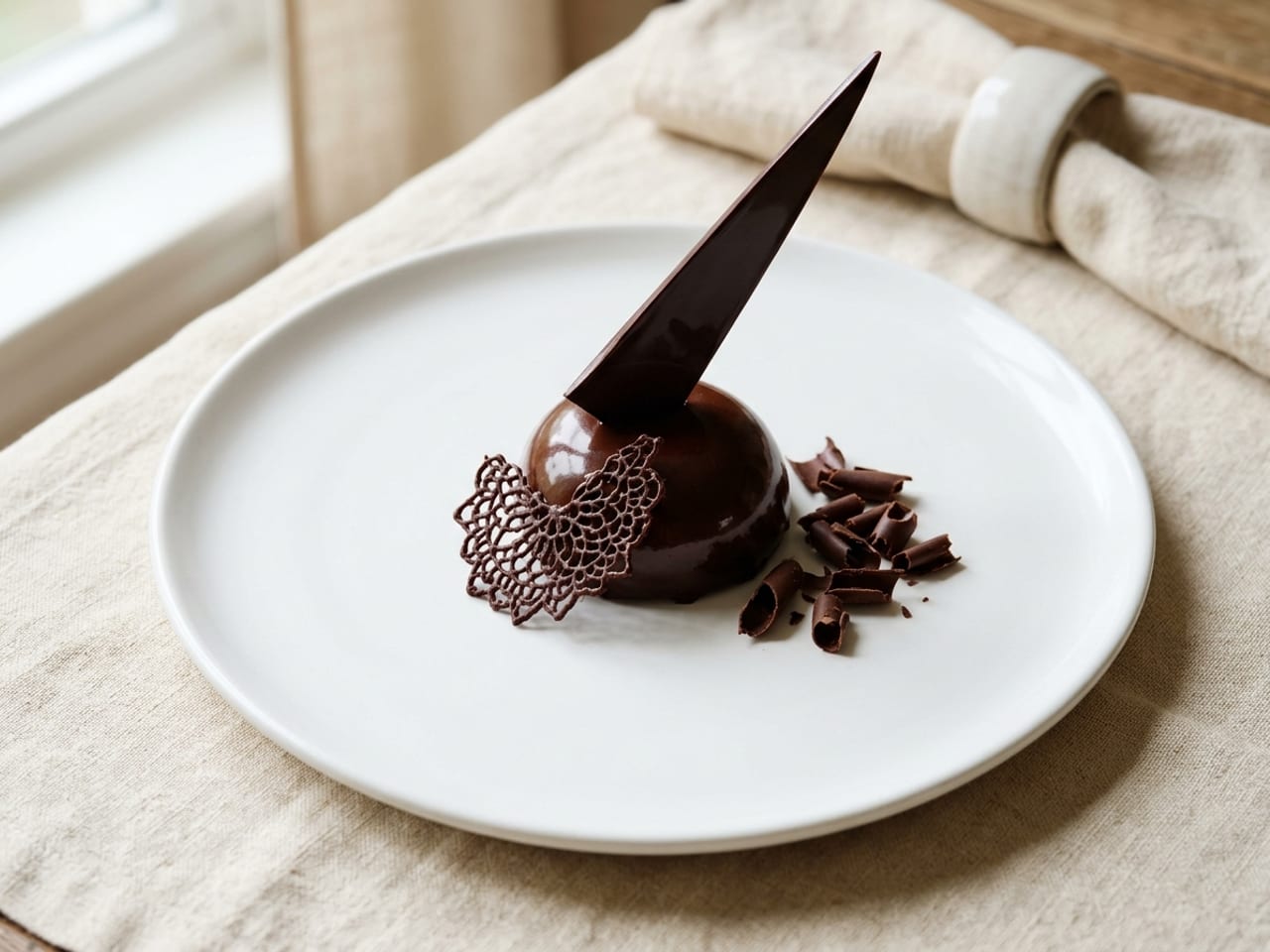
The photos on this page are AI-generated illustrations.
How do you make chocolate garnishes?
Chocolate garnishes are thin pieces of set chocolate: shards, curls, cigarettes, piped lace, cut shapes, leaves, transfer-sheet prints and collars. Temper the chocolate first so it sets glossy and snaps, or use compound coating, which needs no tempering; then spread, scrape, pipe or brush it, let it set, and add it to the dessert last.1, 2, 4, 5 Every step and number below is credited to the textbook or maker that prints it; where they disagree, each is shown.
| Chocolate garnishes at a glance | What the sources say |
|---|---|
| Which chocolate | Couverture (in EU, UK and Codex law at least 31% cocoa butter) and temper it, or compound coating with no tempering; no maker we read says whether chocolate chips temper (the law and the labels) |
| Tempering temperatures | Dark is worked at 30 to 33°C (86 to 91°F, ours) in every dark curve in our table, milk and white a little lower (Zotter's own product list goes as low as 29.5°C, 85°F ours, for its 60% couverture); the melt and cool figures differ by maker (37 curves from 17 sources) |
| Seed ratio | From 5% (Callebaut) through about 25% of the melted weight (the CIA) and Felchlin's 350 to 450 g per 1 kg melted (about 26 to 31% of the total, ours) to a third (Valrhona, Ghirardelli, Zotter) and up to a half (Garrett) (every ratio) |
| Is it tempered? | A dab sets evenly, glossy and streak-free within about 3 to 5 minutes at room temperature (Callebaut's knife tip: 3 minutes at 18 to 20°C, 64 to 68°F ours; Guittard's scraper begins to set within 2) (the tests) |
| How thin | About 1 mm (1/32 in, ours) to 2 mm (1/16 in) in the four sources that print a number (by garnish) |
| How long it keeps | No textbook we read gives a day count for shards, curls, lace or leaves (one shop's blog says 2 to 4 weeks for shards); keep finished pieces cool, dry and dark, and out of the fridge in Friberg's book, though Callebaut allows a sealed, low-humidity one (storage) |
| Grey bloom | Fat or sugar coming to the surface; Canada's food agency says bloom "is harmless and safe to eat"46 (fixes) |
On this page: Which chocolate · Why temper · Temperatures · Seeding method · Tabling, microwave, Mycryo · Testing · Eight garnishes · Tools · On the plate · Fixes · Storage · Safety · History · Terms · FAQ
How this page was made. Every temperature, method and time comes from the source named beside it, with its product, edition and page: the chocolate makers' own pages and PDFs (Callebaut, Valrhona, Cacao Barry, Felchlin, Guittard, Ghirardelli, Michel Cluizel, Zotter), the pastry textbooks (Gisslen, Friberg, the CIA, Figoni, Labensky, Bilheux), the law in five legal standards, food agencies and a few studies. Most textbooks were read as the machine-read text of uploaded copies or as search fragments of lending-only scans; each source's entry says how. Plate Artists melted, tempered and made nothing for this page: the methods are quoted, not kitchen-tested. A twin unit in brackets is the source's own where it prints one and ours where it says "ours"; sums, suggestions and readings marked ours are our own. Sources are at the bottom.
Which chocolate: couverture, compound coating or chips
Three kinds of chocolate end up in a garnish. Couverture is real chocolate with plenty of cocoa butter, the kind you temper; compound (coating) chocolate swaps the cocoa butter for other fats and sets without tempering; chips are sold for baking. What each may be called is set by law, and the law differs by country.
| Where | "Chocolate" | "Couverture" | White chocolate | Fats other than cocoa butter |
|---|---|---|---|---|
| United States41 21 CFR 163 | Semisweet and bittersweet are one standard: at least 35% chocolate liquor; sweet chocolate at least 15%; milk chocolate at least 10% liquor and 12% milk solids | No such category: the word is not in the regulation | At least 20% cacao fat, 3.5% milkfat and 14% milk solids, at most 55% sweetener, no colouring | Only under their own names, such as "sweet chocolate and vegetable fat coating" |
| European Union42 Directive 2000/36/EC | At least 35% total dry cocoa solids, including 18% cocoa butter and 14% dry non-fat cocoa solids | At least 35% total dry cocoa solids, "including not less than 31 % cocoa butter" and 2.5% non-fat cocoa solids; milk chocolate couverture at least 31% total fat | At least 20% cocoa butter and 14% dry milk solids, 3.5% of it milk fat | Up to 5% of six named fats (palm oil, shea, illipe, sal, kokum gurgi, mango kernel), labelled "contains vegetable fats in addition to cocoa butter" |
| England43 SI 2003/1659 | The same reserved descriptions as the EU directive (we read the couverture items) | The same rule: at least 35% total dry cocoa solids, 31% cocoa butter and 2.5% non-fat cocoa solids; milk couverture 31% total fat | - | - |
| International (Codex)44 CODEX STAN 87-1981, Rev. 1-2003 | At least 35% total cocoa solids | At least 35% total cocoa solids, 31% of them cocoa butter and 2.5% fat-free; milk couverture at least 25% cocoa solids, 14% milk solids and 31% total fat | At least 20% cocoa butter and 14% milk solids | Other vegetable fats at most 5% of the finished product |
| Australia and New Zealand45 FSANZ Standard 2.10.4 | Made from at least 200 g/kg (20%) cocoa bean derivatives; "Food that is sold as 'chocolate' must be chocolate" | No such category | - | At most 50 g/kg (5%) of edible oils other than cocoa butter or dairy fats |
Couverture: 31% cocoa butter by law, 32% in one textbook
Gisslen's textbook gives the same minimum as the EU, UK and Codex rules: "Couverture must contain at least 31% cocoa butter", and "Genuine couverture contains cocoa butter and no other fat." 1, 42, 43, 44 The CIA's glossary prints "at least 32 percent".5 US law has no couverture category, and Figoni notes that "European law defines couvertures; Canadian and U.S. laws do not."6, 41 In the US, semisweet and bittersweet are one standard: "Both have a minimum chocolate liquor content of 35%" (Gisslen, matching 21 CFR 163.123).1, 41 A maker's label says it plainly where it applies: Valrhona's Guanaja sheet reads "Dark chocolate couverture (70% cocoa minimum,pure cocoa butter)".26
Compound chocolate: the no-temper shortcut
Compound or coating chocolate sets firm without tempering because its fat is not (or not only) cocoa butter. The sources agree on that and split on how much cocoa butter is left:
- Gisslen, 7th ed.: "part of the cocoa butter replaced by other fats", "easier to handle and don't require tempering", but without "the flavor and eating qualities of good chocolate"; sold as cookie coating, cake coating, baking chocolate, coating chocolate or compound chocolate1
- Friberg, 4th ed.: "there is no cocoa butter in coating chocolate (it has been replaced with other fats)", so it needs no tempering; "Products made entirely of coating chocolate may not be labeled chocolate"4
- CIA, 3rd ed.: "containing no cocoa butter", made with vegetable fats, "requires no tempering"; also called summer coating or compound chocolate5
- Figoni, 3rd ed.: Vegetable fats such as palm kernel or coconut; some coatings use fats that give "a melting mouthfeel and glossy shine without the need to temper"6
- Open textbook (BCcampus): Typically 35 to 40% fat, "usually hydrogenated palm kernel oil"; not for moulds; melts at about 35 to 37°C (95 to 99°F), best for coating at about 40°C (104°F)12
- Ghirardelli coating wafers: "compound wafers", "no tempering required"; melt to 38 to 43°C (100 to 109°F), never above 48°C (118°F)33
US law has its own names for these, such as "sweet chocolate and vegetable fat coating".41 For a garnish the trade-off is taste against ease: Friberg prefers coating chocolate for piped pieces that will be moved "because I can be certain the coating chocolate will set up firm", and Gisslen says such chocolates lack "the flavor and eating qualities of good chocolate".1, 4 Our suggestion: temper real chocolate, or use compound coating, for anything that must snap and shine; untempered chocolate is fine for curls and shavings that will be eaten soon, as Gisslen allows (which garnishes need it).
Can you temper chocolate chips?
No maker we read says whether chips temper, and none says they cannot. What the sources do say: Ghirardelli's semi-sweet chips list "Cane sugar, unsweetened chocolate, cocoa butter, whole milk powder, soy lecithin, vanilla extract", real chocolate with no vegetable fat, and the page says nothing about tempering.34 King Arthur's tempering guide (a flour brand's baking school) says "chocolate chips will also work here".69 Its 2014 blog says the soy lecithin in chips is there "to raise its melting temperature"; we found no maker or textbook that says so, and Friberg says lecithin is used "to establish the appropriate viscosity".4, 70 Candy melts are a different product: the same blog pictures them beside chips and couverture, "(Only the latter two are real chocolate.)", and Ghirardelli sells its own as "compound wafers".33, 70
White chocolate has no non-fat cocoa solids: its cocoa part is cocoa butter alone, with milk and sugar, and Friberg calls it very heat-sensitive: overheating makes it "thicken and develop a gritty texture".4, 41 Its legal minimums are in the table above.
How to temper chocolate, and why it matters for a garnish
Tempering means melting chocolate, cooling it while it is stirred, and rewarming it a little, so it sets glossy, firm and snappy. Gisslen's reason in one line: couverture "will not handle properly when simply melted. It will take too long to set, and when it does set, it will not have the desired shine or the proper texture." 1 The open textbook calls it "sometimes called pre-crystallization"; badly tempered chocolate "may not ever set up hard at room temperature; it may become hard, but look dull and blotchy; the internal texture may be spongy rather than crisp".11 Callebaut puts it the other way round: chocolate "simply melted (between 40 and 45 °C) and then left to cool down to a suitable working temperature" will not be glossy.14 You do not need it when chocolate is only a flavour: for chocolate mousses or bavarian creams, Callebaut says "it suffices to simply melt it without tempering."14
Why it works: six crystal forms (the science, labelled)
Cocoa butter can set in several crystal forms. X-ray work in 1966 named six, I to VI, "in order of increasing melting point", and found that "The normal state of cocoa butter in chocolate is apparently V".61 A 2025 review gives each form a melting range, Form V at about 30.0 to 34.5°C (86 to 94°F, ours), and says Form VI, the most stable, is "typically undesirable in chocolate due to its association with fat bloom and brittle texture".62 Tempering follows from that: melt out every crystal, cool so crystals form (in dark chocolate "typically" at 27 to 29°C, 81 to 84°F ours, a mix of Forms IV and V), then rewarm to about 31 to 32°C (88 to 90°F, ours) to melt the unstable Form IV and keep Form V; tempered chocolate, still fluid, carries only about 2 to 5% Form V crystals as seeds.62 Gisslen says the same in kitchen terms: rewarming "raises the temperature above the melting point of form IV crystals", so "the chocolate contains only stable crystals".1
Single melting points differ by source, which is one reason the curves below differ. Gisslen prints one number per form (V at 34°C, VI at 36°C, with his own °F: 94°F and 97°F); a 2019 review gives Form V as 33.8°C and, a sentence later, as melting at 29 to 31.5°C; the 2025 review warns that the ranges "tend to overlap, necessitating source-specific characterization".1, 62, 63 Textbooks also name the forms differently: Figoni uses alpha (II), beta prime (IV) and beta (V); the CIA names four types and calls only beta stable.5, 6
Tempering chocolate temperatures: the eight makers we read, side by side
Gisslen's advice is to ask the maker: "The manufacturer or the supplier should be able to indicate the exact temperatures that are best for each of its products."1 So the makers' own curves come first, per product as printed, then the textbooks, then a study and one magazine piece that adds the lowest white figure: 37 rows from 17 sources (8 makers). The first 9 are Callebaut, Valrhona and Gisslen in dark, milk and white; the other 28 open under "Show all". Each figure is in the unit the source prints, with its twin.
| Source | Chocolate | 1 Melt | 2 Cool (crystallise) | 3 Work |
|---|---|---|---|---|
| Callebaut13 811, curve table (2024) | Dark | 40 to 50°C (113 to 122°F as printed; its curve graphic says 45 to 50°C) | 27°C (80.6°F) | 31 to 32°C (87.8 to 89.6°F); never above 34.5°C (94.1°F) |
| Callebaut13 823, curve table (2024) | Milk | 45°C (113°F) | 27°C (80.6°F) | 29 to 30°C (84.2 to 86°F); never above 32.5°C (90.5°F) |
| Callebaut13 W2, curve table (2024) | White | 45°C (113°F) | 27°C (80.6°F) | 28 to 29°C (82.4 to 84.2°F); never above 31.5°C (88.7°F) |
| Valrhona24 Guanaja 70%, Manjari 64%, Caraïbe 66%, Equatoriale 55%; US product pages | Dark | 113 to 131°F (45 to 55°C, ours) | 82 to 84°F (28 to 29°C, ours) | 87 to 89°F (30.5 to 31.5°C, ours) |
| Valrhona24 Jivara 40%, Equatoriale Milk 35%; US product pages | Milk | 104 to 122°F (40 to 50°C, ours) | 80 to 82°F (26.5 to 28°C, ours) | 84 to 86°F (29 to 30°C, ours) |
| Valrhona24 Ivoire 35% (white), Dulcey 35% (blond); US product pages | White and blond | 113 to 131°F (45 to 55°C, ours) | 78 to 82°F (25.5 to 28°C, ours) | 82 to 86°F (28 to 30°C, ours) |
| Gisslen, Professional Baking1, 2 7th ed. 2017, p. 628 (the 6th ed. 2012 prints the same) | Dark | 115 to 120°F (46 to 49°C) | 80 to 84°F (27 to 29°C) | 88 to 90°F (31 to 32°C) |
| Gisslen, Professional Baking1, 2 7th ed. 2017, p. 628 | Milk | 110 to 115°F (43 to 46°C) | 78 to 82°F (26 to 28°C) | 86 to 88°F (30 to 31°C) |
| Gisslen, Professional Baking1, 2 7th ed. 2017, p. 628 | White | 110 to 115°F (43 to 46°C) | 78 to 82°F (26 to 28°C) | 84 to 86°F (29 to 30°C) |
Show all 37 curves (28 more)
| Source | Chocolate | 1 Melt | 2 Cool (crystallise) | 3 Work |
|---|---|---|---|---|
| Valrhona, L'École Gourmet25 seed-a-third recipe sheet, 2020 | Dark | 50 to 55°C (122 to 131°F, ours) | none: the last third goes in unmelted | 31 to 32°C (88 to 90°F, ours) |
| Valrhona, L'École Gourmet25 seed-a-third recipe sheet, 2020 | Milk | 45 to 50°C (113 to 122°F, ours) | none: the last third goes in unmelted | 29 to 30°C (84 to 86°F, ours) |
| Cacao Barry23 Pistoles page | Dark | 45°C (113°F, ours) | none: 15 to 20% Pistoles go in | about 32°C (90°F, ours) |
| Cacao Barry23 Pistoles page | Milk and white | 45°C (113°F, ours) | none: 15 to 20% Pistoles go in | about 30°C (86°F, ours) |
| Felchlin28 all couvertures, PDF dated February 2026 | Dark | 48 to 50°C (118 to 122°F) | 26 to 28°C when tabling (78 to 82°F) | 31 to 33°C (87.8 to 91.4°F) |
| Felchlin28 all couvertures, PDF dated February 2026 | Milk | 48 to 50°C (118 to 122°F) | 26 to 28°C when tabling (78 to 82°F) | 30 to 32°C (86.0 to 89.6°F) |
| Felchlin28 all couvertures, PDF dated February 2026 | White | 48 to 50°C (118 to 122°F) | 26 to 28°C when tabling (78 to 82°F) | 29 to 31°C (84.2 to 87.8°F) |
| Guittard29 couverture; Chocolate Studio pages | Dark | 120 to 122°F (49 to 50°C) | 82°F when tabling (27°C) | 88 to 90°F (31 to 32°C) |
| Guittard29 couverture; Chocolate Studio pages | Milk and white | 115 to 117°F (46 to 47°C) | 80°F when tabling (26°C) | 86 to 88°F (30 to 31°C) |
| Ghirardelli31 consumer page; it says to avoid heating above 130°F (54.5°C, ours) | One curve for every type | 110 to 115°F (43.5 to 46°C, ours) | 80 to 82°F (26.5 to 28°C, ours) | 87 to 91°F (30.5 to 33°C, ours) |
| Michel Cluizel35 US blog, 17 October 2023 | Dark | 55 to 58°C (131 to 136°F) | 28 to 29°C (82 to 84°F) | 31 to 32°C (88 to 90°F) |
| Michel Cluizel35 US blog, 17 October 2023 | Milk | 45 to 50°C (113 to 122°F) | 27 to 28°C (81 to 82°F) | 29 to 30°C (84 to 86°F) |
| Michel Cluizel35 US blog, 17 October 2023 | White | 45 to 50°C (113 to 122°F) | 26 to 27°C (79 to 81°F) | 28 to 29°C (82 to 84°F) |
| Zotter36 couverture page | Milk | 45 to 48°C (113 to 118°F, ours) | 27 to 28°C (81 to 82°F, ours) | 29 to 30°C (84 to 86°F, ours) |
| Zotter36 couverture page: an average of 31 to 32°C; its product list gives 29.5°C (60%) to 31°C (100%) | Dark | - | - | 31 to 32°C (88 to 90°F, ours) |
| Zotter36 couverture page: about 28 to 29°C on average; its product list gives 28.5°C for its white couverture | White | - | - | about 28 to 29°C (82 to 84°F, ours) |
| Gisslen, Professional Baking3 4th ed. 2005, p. 580 | Dark | 122 to 131°F (50 to 55°C) | 80 to 84°F (27 to 29°C) | 86 to 89°F (30 to 32°C) |
| Gisslen, Professional Baking3 4th ed. 2005, p. 580 | Milk and white | 113 to 122°F (45 to 50°C) | 78 to 82°F (26 to 28°C) | 84 to 86°F (29 to 30°C) |
| Friberg, The Professional Pastry Chef4 4th ed. 2002, p. 468 | Dark | 115 to 120°F (46 to 49°C) | 80 to 82°F (26 to 28°C) | 87 to 90°F (30 to 32°C) |
| Friberg, The Professional Pastry Chef4 4th ed. 2002, p. 468 | Milk and white | 110 to 115°F (43 to 46°C) | 78 to 80°F (25 to 26°C) | 85 to 87°F (29 to 30°C) |
| CIA, Baking and Pastry5 3rd ed., pp. 904 to 905 | Dark | 110 to 120°F (43 to 49°C) | about 80°F (27°C) | 86 to 90°F (30 to 32°C) |
| CIA, Baking and Pastry5 3rd ed., pp. 904 to 905 (milk and white printed alike) | Milk and white | 105 to 110°F (41 to 43°C) | about 80°F (27°C) | 84 to 87°F (29 to 31°C) |
| Figoni, How Baking Works6 3rd ed. 2011, pp. 412 to 413 | Any (milk tempers lower) | 115 to 120°F (46 to 49°C) | 78 to 81°F (26 to 27°C) | 86 to 90°F (30 to 32°C) |
| Garrett, Professional Cake Decorating7 2nd ed. 2012, p. ~335 | Any | 115 to 120°F (46 to 49°C) | none: the rest goes in unmelted | 90°F (32°C) |
| Greweling, Chocolates and Confections at Home8 2010 (fragments) | Dark | no higher than 120°F (49°C, ours) | 85°F (29.5°C, ours) | below 90°F (32°C, ours) |
| Greweling, Chocolates and Confections at Home8 2010 (fragments) | Milk and white | no higher than 110°F (43.5°C, ours) | 83°F (28.5°C, ours) | below 87°F (30.5°C, ours) |
| Stobbs et al., Crystal Growth & Design62 2025, industrial tempering (study) | Dark | past 50°C, often 60°C (122°F, 140°F, ours) | 27 to 29°C (81 to 84°F, ours) | about 31 to 32°C (88 to 90°F, ours) |
| Tasting Table72 27 April 2023 (magazine) | Dark, milk, white | - | 81°F (27°C, ours) | 88 to 90, 86 to 88 and 80 to 82°F (31 to 32, 30 to 31 and 26.5 to 28°C, ours) |
What the table says (ours)
- Dark chocolate is worked at about 31 to 32°C (88 to 90°F) in 12 of the 17 dark curves, and between 30 and 33°C (86 and 91°F, ours) in all of them. Milk and white are worked lower, and the white figures spread widest: from 80 to 82°F (26.5 to 28°C, ours) in a magazine piece to 86 to 88°F (30 to 31°C) at Guittard.1, 13, 24, 29, 72
- The melt is where makers differ most: 40 to 50°C (104 to 122°F, ours) for Callebaut's 811 dark (its curve graphic prints 45 to 50°C), 48 to 50°C for Felchlin, up to 131°F (55°C, ours) for Valrhona and 55 to 58°C (131 to 136°F) for Michel Cluizel's dark; industrial dark chocolate is taken "past 50 °C, often to 60 °C". Gisslen's own textbook moved: 122 to 131°F (50 to 55°C) in the 4th edition, 115 to 120°F (46 to 49°C) in the 6th and 7th.1, 3, 13, 24, 28, 35, 62
- The cool step is about 27°C (81°F, ours) in most curves, and missing in the seed methods (Valrhona's École, Cacao Barry, Garrett), where the unmelted chocolate does the cooling; a Callebaut chef says that with seeding "you do not need to drop to 27°C". 7, 13, 14, 23, 25
- Why the numbers differ: "Each brand of chocolate has its own ideal tempering pattern" (Figoni), and the CIA prints ranges because "Each chocolate manufacturer, in fact, has specific recommended working temperatures for the couvertures it produces." Guittard calls its own figures "a guide". Figoni adds that the curves "do not tell you how long the chocolate is best held at each temperature."5, 6, 29 Our advice: use the curve printed for the chocolate in your hand; if it has none, the textbook rows are the fallback.
The seeding method, step by step
Seeding is the method that needs no marble: stir already-tempered chocolate into melted chocolate and its stable crystals set the pattern. The steps are Callebaut's, end to end, from its Chocolate Academy pages, because its pages print the whole method with a seed ratio, temperatures and a test; the other makers' and textbooks' ratios are in the table after it. Quoted, not kitchen-tested by us.
- 1
Weigh the seed: 5% of the chocolate, at room temperature
The seed is chocolate that is already tempered: Callebaut's Callets are small drops whose cocoa butter "already has the right crystalline structure", and its rule of thumb is to add "5% Callets™ at ambient temperature (i.e. between 15 and 20°C)" (59 to 68°F, ours).14 For 500 g of melted chocolate that is 25 g (ours). Other makers and textbooks use far more seed: see every printed ratio.
- 2
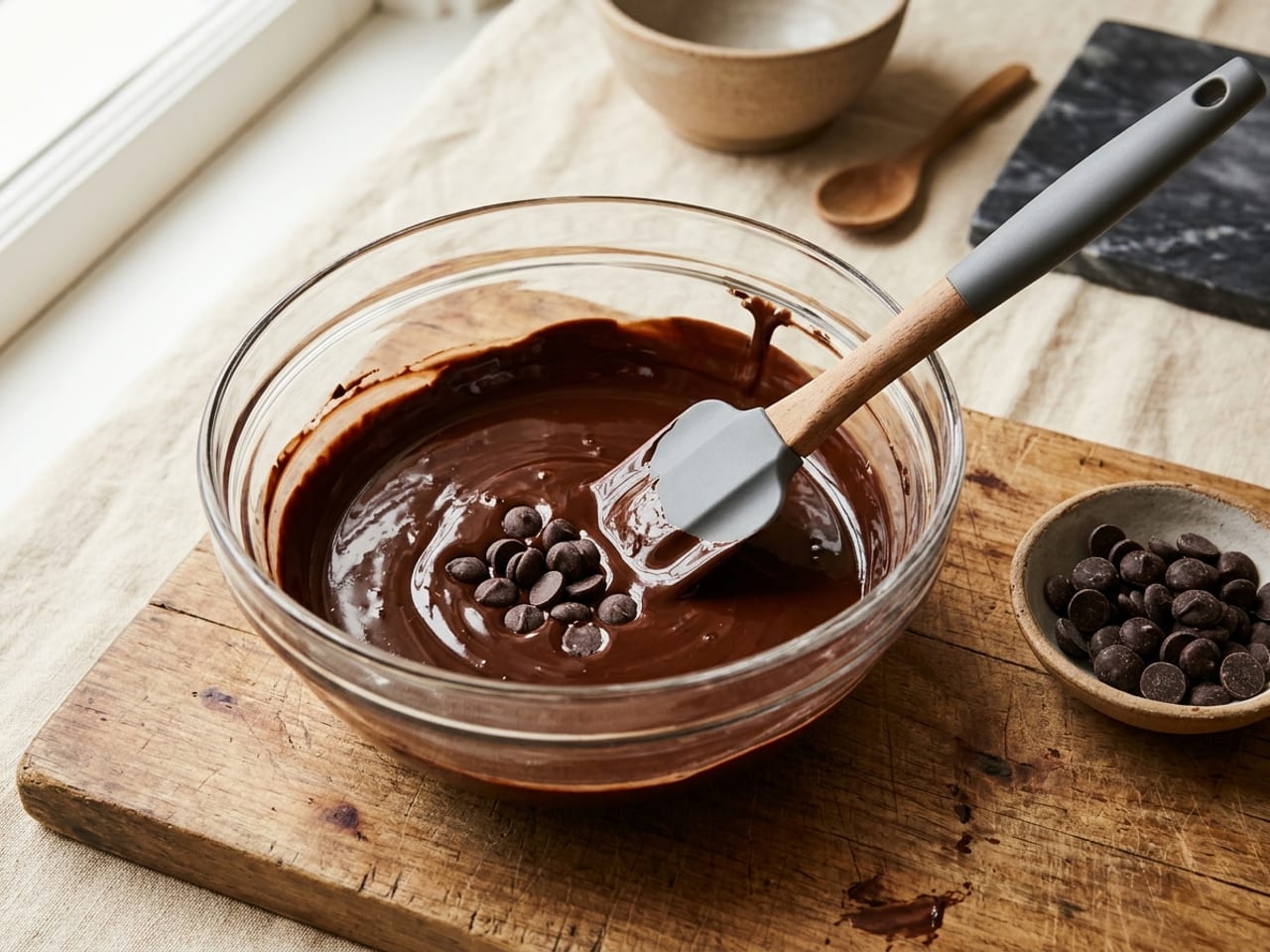
Melt the rest to 45°C (113°F, ours)
Callebaut melts the chocolate at 45°C, and between 40 and 45°C in its general guide; a Callebaut chef adds that dark chocolate needs "at least 40°C to ensure that all of the cocoa butter is completely melted".13, 14 Keep every drop of water and steam away: moisture makes chocolate "seize", "thick and grainy" (the CIA).5
 3
Add the seed and stir
Callebaut lowers its melter's thermostat to about 31°C for dark or 29°C for milk and white (88°F and 84°F, ours) and "immediately" adds the seed, then "Stir the chocolate well". Its rule of thumb ties the amount to the heat: "When your melted chocolate is at a temperature of about 40°C, the rule of thumb is to add 5% Callets™" (104°F, ours). "Do the Callets™ melt too quickly? That means your chocolate is still too hot. Add more Callets™ to lower its temperature and continue stirring." A Callebaut chef confirms you need not cool to 27°C first.14
- 4
Stop at the working temperature: about 31°C (88°F, ours) for dark
"You'll obtain a slightly thickened chocolate, which is ready and workable", at about 31°C for dark and 29°C (84°F, ours) for milk and white.14 "Do not allow the chocolate's temperature to rise above the final temperature indicated on the curve": 34.5°C (94.1°F) for Callebaut's 811 dark, 32.5°C (90.5°F) for its 823 milk, 31.5°C (88.7°F) for its W2 white (its "Max Working Temp", from its curve table).13 Other makers' working figures are in the table.
 5
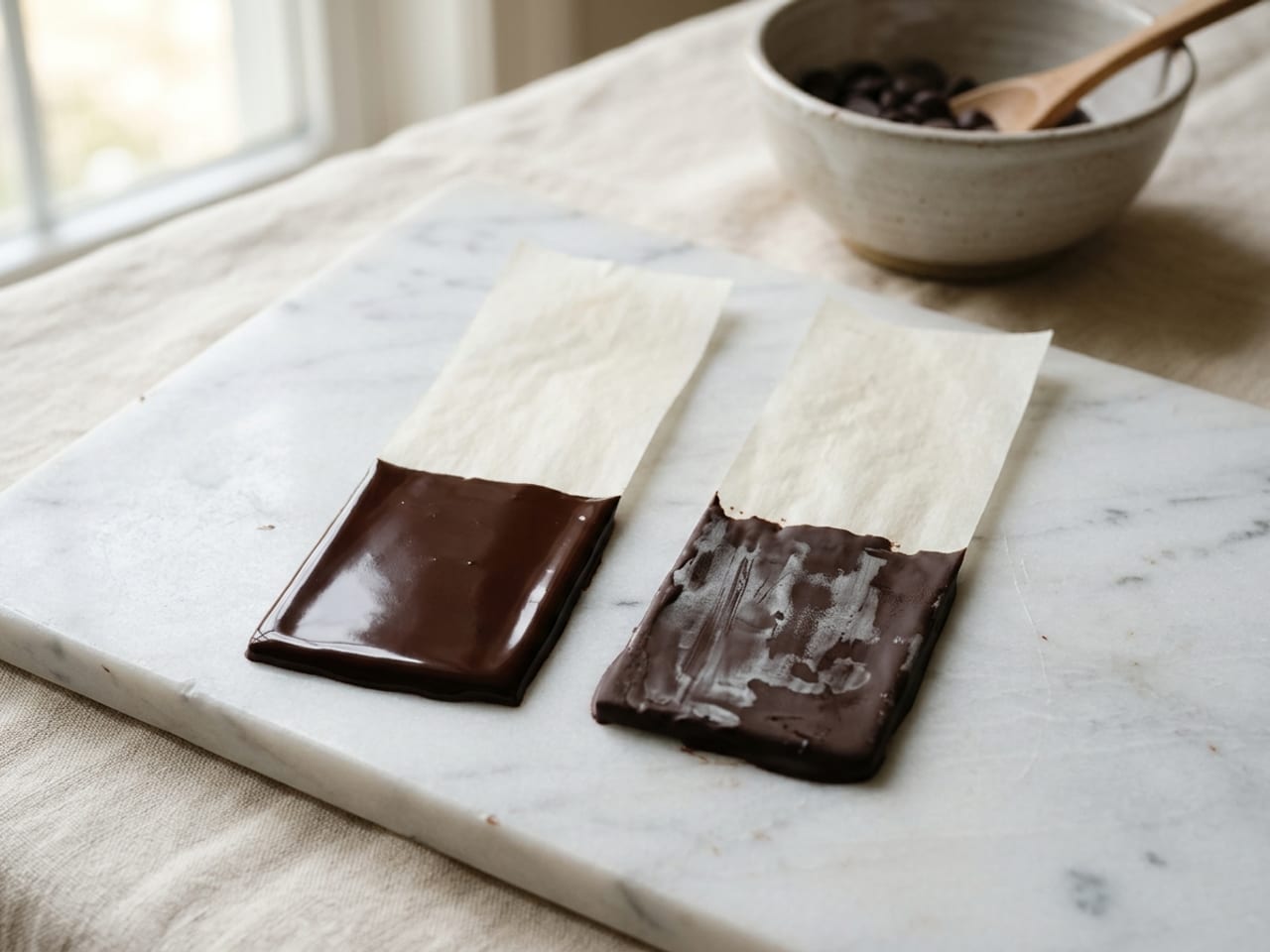
Test a sample before you make anything
"Always test your chocolate before beginning your project by taking a small sample": dip the tip of a knife; properly crystallised chocolate "will harden evenly within 3 minutes at an ambient temperature of 18 to 20°C" (64 to 68°F, ours). If it does not, it is not yet tempered.13, 15 More tests, and what an untempered smear looks like, are under testing.
How much seed? From 5% to a third or more
No two sources agree, and two brands of the same group (Callebaut and Cacao Barry, both Barry Callebaut) print 5% and 15 to 20%. Every ratio we read, as printed:
| Source | Seed, as printed | When it goes in |
|---|---|---|
| Callebaut (Callets)14 | 5% | At about 40°C (104°F, ours), or with the thermostat at about 31°C dark / 29°C milk and white (88 / 84°F, ours); seed at 15 to 20°C (59 to 68°F, ours) |
| Friberg, 4th ed. p. 4694 | "5 to 10 percent of the total weight of the melted chocolate": 2 to 4 oz (55 to 115 g) per 40 oz (1 kg 135 g) | At 95°F (34°C); then hold at working temperature at least 2 minutes, stirring |
| Cacao Barry (Pistoles)23 | 15% to 20% | At about 40°C (104°F, ours), or the thermostat at about 32°C dark / 30°C milk and white (90 / 86°F, ours) |
| CIA, 3rd ed. p. 9045 | "approximately 25 percent of the weight of the melted chocolate" | At 110°F/43°C |
| King Arthur blog, 2014 (a flour brand)70 | About 25% by weight | After a first melt to 122°F/50°C (dark) or 105°F/40°C (milk, white) |
| Felchlin, February 202628 | 350 g (dark) or 450 g (milk, white) of tempered rondos per 1 kg melted: about 26% and 31% of the total (ours) | Rondos at 20 to 23°C (68.0 to 73.4°F) |
| Valrhona, École Gourmet 202025 | A third: melt two-thirds, add the last third unmelted | After melting to 50 to 55°C dark or 45 to 50°C milk (122 to 131°F and 113 to 122°F, ours) |
| Zotter36 | A third, cut small and chilled 15 minutes in the fridge | After melting two-thirds to 50 to 55°C (122 to 131°F, ours) |
| Ghirardelli31 | A third | After cooling the melted two-thirds to 95 to 100°F (35 to 38°C, ours) |
| Garrett, 2nd ed.7 | A third to a half of the total (her fractions, as we read the OCR) | After melting the rest to 115 to 120°F (46 to 49°C) |
| Gisslen, 7th ed. p. 6291 | No ratio: shavings added a few at a time, "Do not add the shavings too fast" | Until the chocolate cools to the tempering point |
| Guittard29 | No ratio: "Add the seeds in 3 to 4 additions" | After melting dark to 120 to 122°F (49 to 50°C), milk and white to 115 to 117°F (46 to 47°C) |
The seed must itself be tempered: Friberg says "it is important that the seeding chocolate was originally tempered before it set up", and holds the mix at working temperature "for at least 2 minutes", stirring.4 Figoni warns the other way: with "too many seed crystals" the chocolate is "overtempered or overseeded", thick and hard to coat with.6
Keeping it in temper while you work
Melt more than you need: "it is easier to keep larger amounts of chocolate in temper" (the CIA), and King Arthur's blog starts with "at least a pound" (450 g, ours).5, 70 When it thickens, warm it a little: the CIA holds the bowl over a burner "for 2 to 3 seconds" while stirring; Friberg and Valrhona's école use a hair dryer, Friberg also a heat gun, or adds warm tempered chocolate all at once, since "adding chocolate slowly will actually destabilize the temper." 4, 5, 25 If it is too thick at the right temperature, Gisslen thins it "with a little melted cocoa butter. Do not thin it by heating it." Overshoot the working temperature and "the chocolate is no longer tempered": start again.1
Tabling, the microwave and cocoa butter powder
Gisslen calls tabling "perhaps, the most popular" of the pastry-shop methods; Friberg names tabling and seeding as "the more commonly used methods". All of them are melting, cooling and rewarming in some form.1, 4
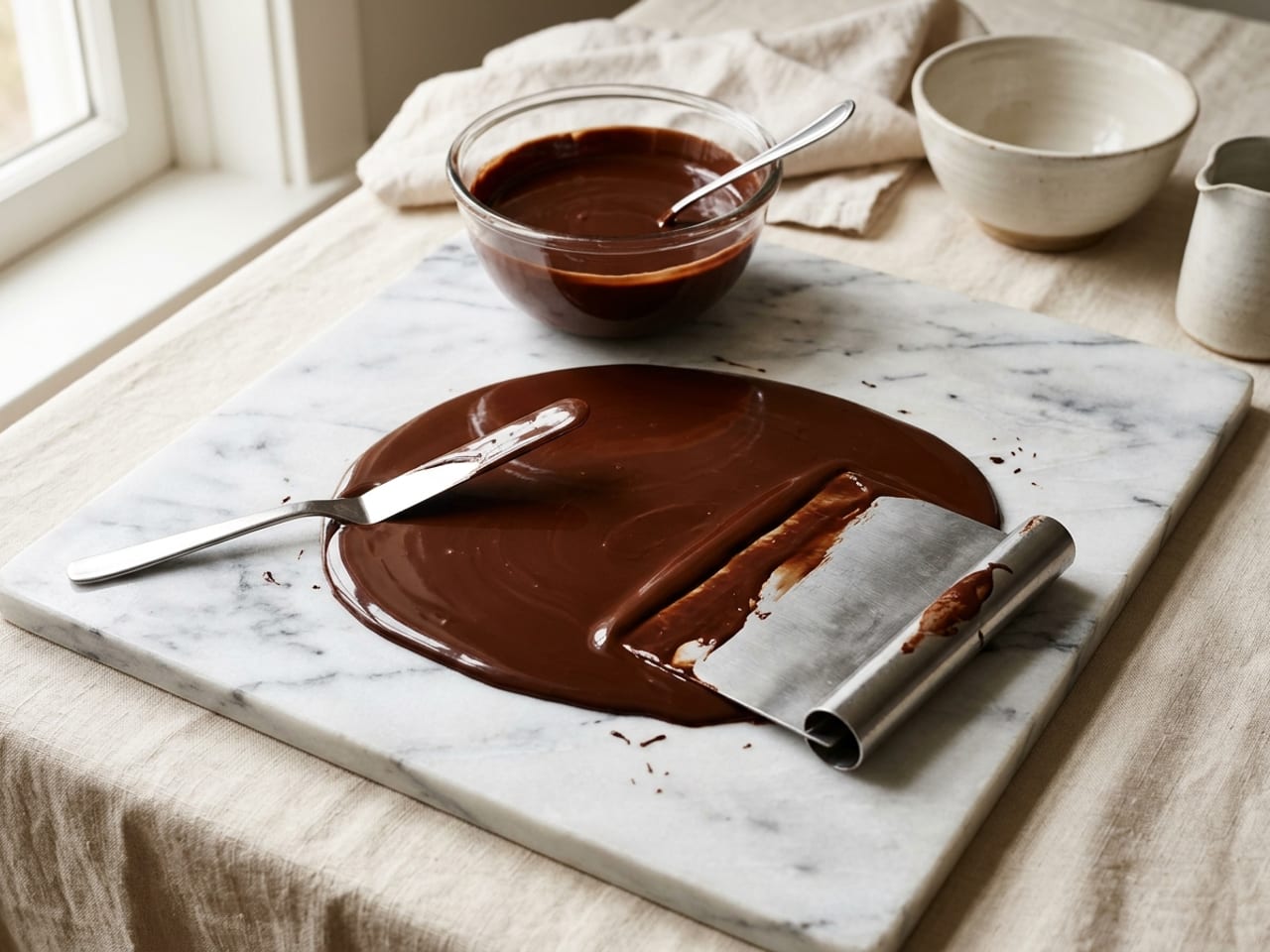
Tabling on marble
Melt, pour part of the chocolate onto marble, keep it moving with a palette knife and scraper until it thickens, then stir it back into the rest. How much goes on the marble is the split: about two-thirds (Gisslen, Callebaut), about one-third (the CIA; Friberg, "or up to two-thirds, if you are more experienced") or 75% (Guittard). Callebaut stops when it thickens, "usually when its temperature is 4 to 5 degrees lower than its working temperature"; Guittard at 82°F (27°C) for dark, 80°F (26°C) for milk and white. Marble is used "because it has a high thermal mass" (the CIA).1, 4, 5, 15, 29
In the microwave
Bought chocolate is already tempered, so the trick is to melt it without losing that: Friberg melts pellets until about two-thirds are melted and stirs until the rest melt, never letting any part pass 90°F (32°C) for dark or 85 to 87°F (29 to 30°C) for milk and white. Callebaut uses 800 to 1,000 W, takes the bowl out "every 15 to 20 seconds" to stir, stops while "Some small pieces of Callets™ should still be visible" and stirs them out; a Callebaut chef keeps it "under 500 grams". To melt (not temper) in the microwave, the CIA uses medium power in 30-second bursts and Ghirardelli 50% power, stirring each time.4, 5, 17, 31
Cocoa butter powder (Mycryo)
Powdered cocoa butter in the stable form, at 1% of the chocolate's weight in all three sources that print a dose (10 g per 1 kg): Callebaut adds it at 34°C for dark or 33°C for milk, white and coloured (93°F and 91°F, ours), Cacao Barry at 34 to 35°C or 33 to 34°C, Gisslen at 95°F (35°C), then "Wait 10 minutes". Callebaut works it at 31°C or 29°C (88°F or 84°F, ours) for longer sessions, and warns you "will not be able to re-temper the same batch of chocolate indefinitely via this method". Sold as Mycryo by Callebaut and Cacao Barry; Gisslen calls such products "beta 6 crystals". 1, 16, 23
Ice water, a block, a machine, sous vide
Friberg cools the bowl over ice water to about 80°F (26°C) and rewarms it, the quickest way, but "chocolate manufacturers do not recommend it" (water gets in). The block method stirs one solid piece into the melted chocolate and lifts out what is left: "simple and effective, but slightly more time-consuming" (the CIA); Friberg says it will not give "the same long-lasting temper". Callebaut's tempering machine runs its seed method: melt at 45°C, lower to about 31°C (dark) or 29°C (milk, white) and add 5% Callets at 18 to 20°C (113°F, 88°F, 84°F and 64 to 68°F, ours). Anova, a sous-vide maker, publishes a bagged method (115°F/46.1°C, 81°F/27.2°C, then 90°F/32.2°C) as a recipe, not a maker's curve.4, 5, 18, 71
How to test tempered chocolate, with or without a thermometer
Every method ends the same way: dip something in the chocolate and watch it set. Each source's test, as printed:
| Source | The test | Tempered if | Room |
|---|---|---|---|
| Callebaut15 | Dip the tip of a knife | "harden evenly within 3 minutes" | 18 to 20°C (64 to 68°F, ours) |
| CIA, 3rd ed. p. 9055 | Dip a small spatula and set it aside | "within 3 to 5 minutes", "streak-free with a satiny shine" | Room temperature |
| Guittard29 | Dip the tip of a scraper | "begin to set within 2 minutes" with "a uniform sheen"; milk and white a little longer | Not given |
| Friberg, 4th ed. p. 4694 | Dip the corner of a piece of baking paper, fold it | Not sticky within 5 minutes, curls when scraped; in the fridge, a clean snap after 1 or 2 minutes | 64 to 68°F (18 to 20°C) |
| King Arthur guide (a flour brand)69 | A metal tool or spoon | "set within 3 to 5 minutes" | Normal room temperature |
| King Arthur blog, 201470 | A knife, spoon or spatula | 3 to 5 minutes | 65 to 70°F (18.5 to 21°C, ours) |
If it fails: "Chocolate not in full temper may be streaky, speckled, and dull, and will set more slowly; if this occurs the chocolate needs to be seeded further until full temper is achieved" (the CIA).5 Too thick and setting fast is the opposite fault, over-crystallised chocolate, which Callebaut says gives "too thick of a shell, air pockets and dull spots".19
How to temper chocolate without a thermometer
No maker or textbook we read prints a method without a thermometer. What they give instead are cues you can see: the set tests above; Callebaut's seed that melts "too quickly" when the chocolate is still too hot, and its result, "a slightly thickened chocolate"; and, in the microwave, stopping while small pieces are still visible.14, 17 The old "lip test", a dab under the lip or on the inner wrist that should feel "slightly warm", is reported by a magazine, which quotes chocolatier Christopher Curtin that it "isn't really practiced in professional kitchens anymore". 72 Our advice: a cheap probe thermometer and the set test together; the test is the one every source uses.
Tempered vs untempered chocolate
Untempered chocolate sets slowly, without "the desired shine or the proper texture" (Gisslen); Figoni adds "unattractive gray-white streaks called fat bloom" over time, and Callebaut says on untempered chocolate "fat bloom will appear within hours". Friberg's untempered piping chocolate "may start to bloom within a few hours".1, 4, 6, 20 That is why the textbooks temper anything that must look glossy on the plate, and why Gisslen still allows plain melted chocolate for curls, shavings and soft strips (the split, garnish by garnish).2 Trade training agrees on the default: Australia's national qualification for producing desserts lists "tempered chocolate" among the garnishes each candidate must use at least once.60
Eight chocolate garnishes, step by step
Chocolate garnish ideas, eight of them, each with the steps as its textbook or maker prints them, whether it needs tempered chocolate (the sources often disagree), how thin to spread it and how long it keeps. The summary table comes after the eighth. Gisslen's note on all of them: chocolate decorations "go well with many kinds of dessert, not only chocolate desserts."2
1. Chocolate shards · broken sheets, marbled shards
- Tempered? Tempered in Gisslen and in Lakeland's cake shards; Friberg breaks shards from a transfer-sheet slab and accepts coating chocolate for it.
- How thin: "a thin layer" (Gisslen); the open textbook warns "Too thick a chocolate garnish can overpower the dessert, so it must be delicate"; Lakeland spreads its cake-side shards "thickly". No source gives shards a number.
- How long it keeps: No textbook gives a time. One Texas chocolate shop's blog says airtight, cool and dry "for up to 2 to 4 weeks", which is that shop's advice, not a test.
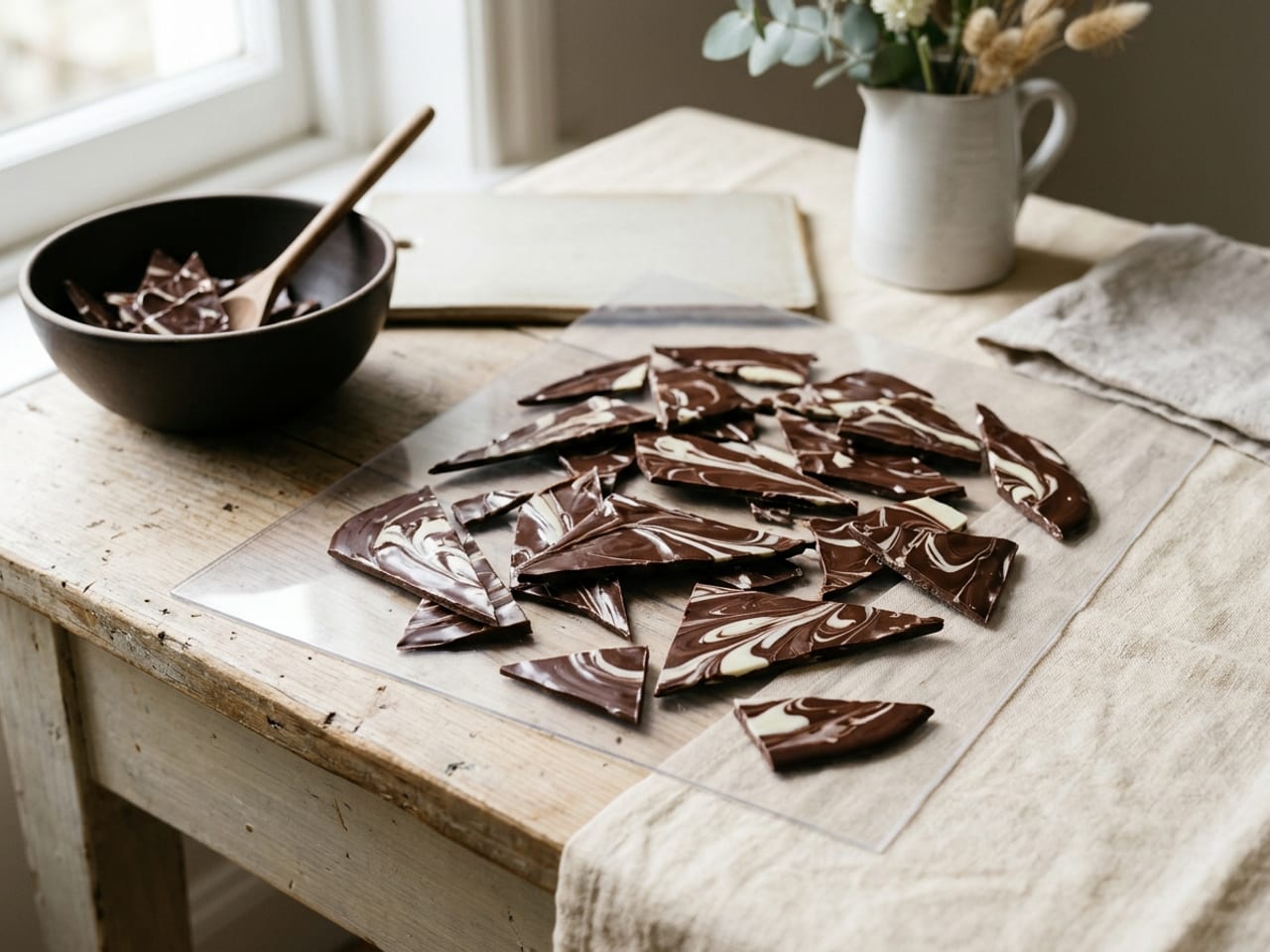
- Spread tempered chocolate in a thin layer on a sheet of acetate, which Gisslen polishes first "with cheesecloth or cotton wool", or on a guitar sheet: Valrhona's Sarah Tibbetts finds guitar sheets "slightly more flexible than acetate and are much better for chocolate decor".2, 37
- To marble it, "add a little tempered white couverture to tempered dark couverture and mix just until the white shows streaks" (Gisslen).2
- For a flat sheet, lay a second sheet on top and push the chocolate thin between them with a rolling pin: "you get shine on both sides" and none of the "retraction" of tempered chocolate, so the decor stays "very, very flat" (Tibbetts).37
- Let it set hard, peel the sheet and break it: Friberg uses "randomly broken pieces or shards" as a garnish.4
- For tall shards on a cake, Lakeland spreads tempered chocolate "thickly over sheets of baking parchment" and presses the shards "down into the cake sponge to keep them in place".74
2. Chocolate curls and shavings · caraque, copeaux
- Tempered? Not necessary for Gisslen: "Melted chocolate can be used for these decorations. Tempered chocolate may also be used but is not necessary." Friberg uses "tempered or melted coating chocolate"; the CIA shaves "a large block of tempered chocolate"; America's Test Kitchen peels a bought block.
- How thin: A strip about 2 mm (1/16 in) thick, "or as thin as possible without being able to see the surface through the chocolate" (Friberg); for peeler curls, a block "at least 1 inch thick" (2.5 cm, ours) (America's Test Kitchen).
- How long it keeps: "Store the shavings or curls covered in a cool, dry place to use as needed. Do not store in the refrigerator" (Friberg); no day count. Callebaut's boxed factory shavings carry an 18-month shelf life, sealed.
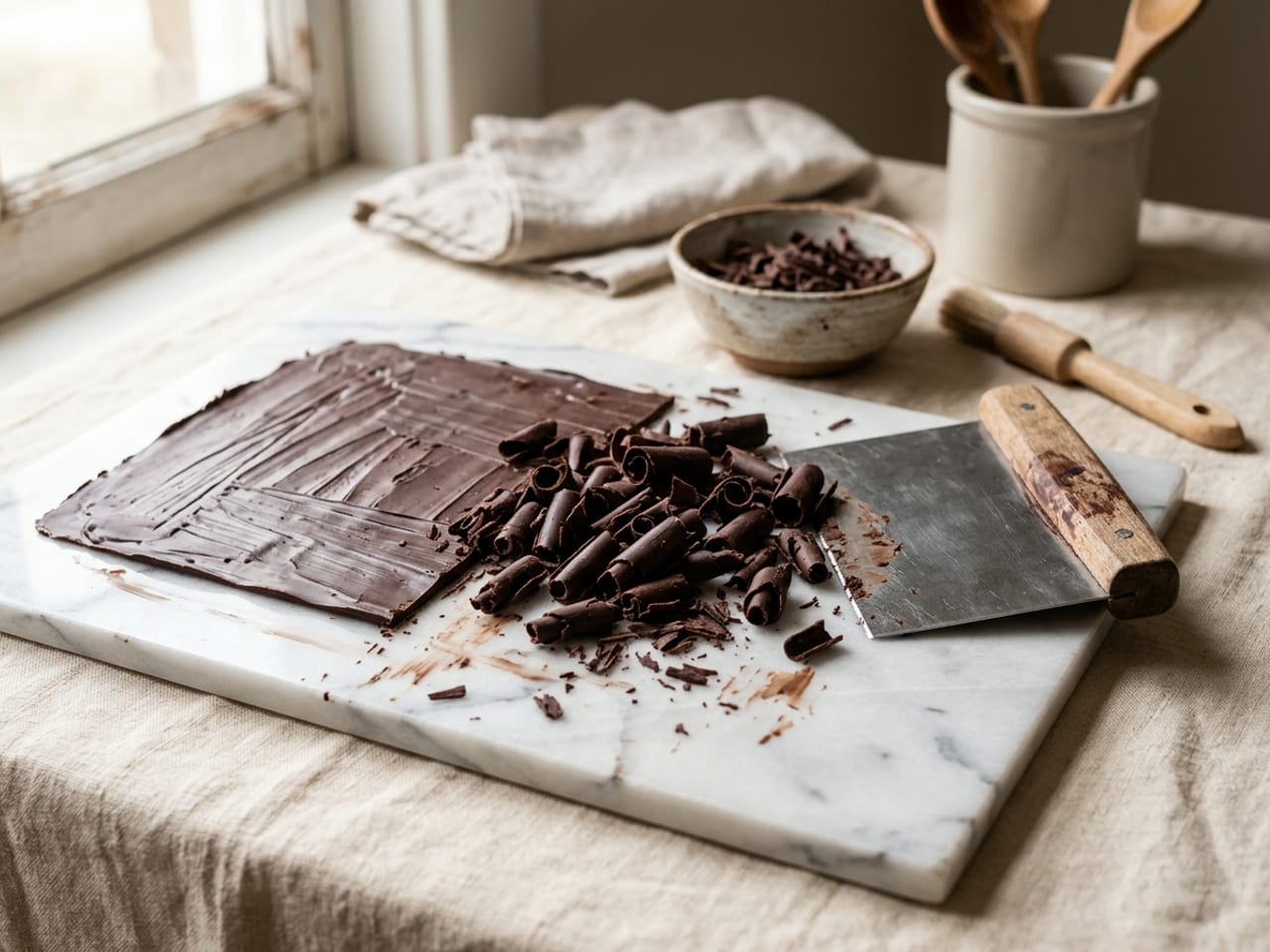
- Work in a cool room: "the ideal room temperature for chocolate work is approximately 68°F (20°C)" (Friberg).4
- Spread a strip of chocolate about 1/16 in (2 mm) thick on marble or a smooth hardwood board, a little wider than the curl you want, and trim both long edges once it has set (Friberg).4
- "Hold a long knife or palette knife at a 45-degree angle to the surface and push the knife away from you to cut off and curl about 1 inch (2.5 cm) of the strip" (Friberg). Gisslen pushes a metal scraper for cigarettes and, for curls and shavings, scores the strip with a knife point and scrapes them up with the knife.2, 4
- Read the chocolate: "If it is too soft, it will just smear and stick to the knife instead of curling"; set too hard, it "will break": soften it with a hair dryer, or warm it with your palm (Friberg, Gisslen).2, 4
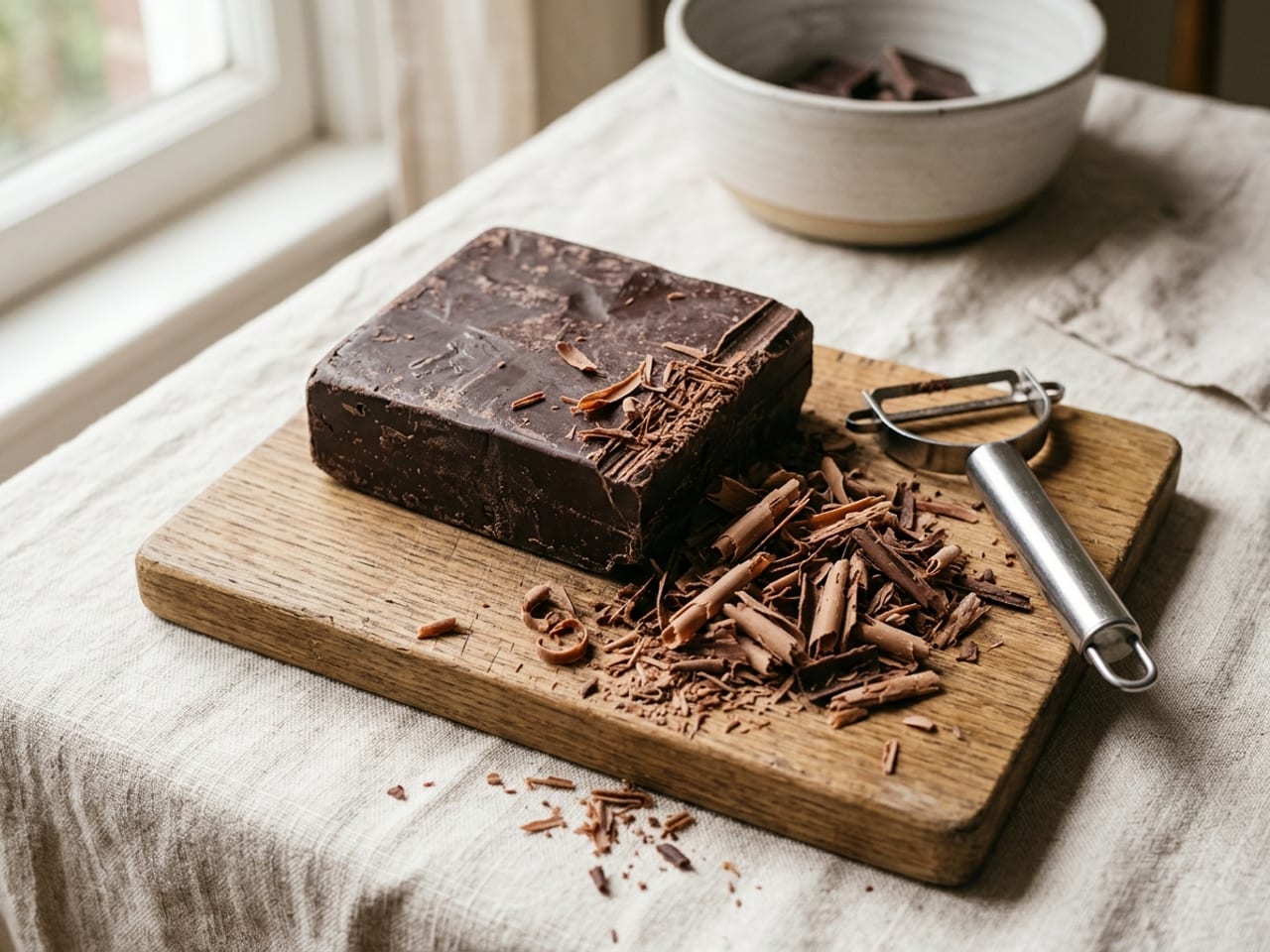
- For shavings, scrape a small knife held at 90 degrees across a block (Friberg; milk or gianduja chocolate makes it "much easier"), or run a vegetable peeler along a softened block, America's Test Kitchen's method (step by step on our garnish guide).4, 67
- Move them with a spoon, "to avoid contact with the heat of your hands" (Friberg), or an offset spatula: "Do not pick up the shavings with your hands or they will melt" (the CIA).4, 5
3. Chocolate cigarettes · not the rolled wafer biscuit of the same name
- Tempered? Tempered for the CIA, Labensky ("tempered couverture") and Bilheux, who reheats and retempers chocolate that sets too firm; "not necessary" for Gisslen; tempered or coating chocolate for Friberg.
- How thin: "a thin, even layer" (the CIA), "a thin layer" (Labensky); Friberg's tight "cigarette-type" curls come from his 2 mm (1/16 in) strip.
- How long it keeps: "can be stored for several months in airtight containers free from humidity and heat" (Bilheux, read as a fragment of the scan): the only keeping time for a chocolate garnish in any book we read.
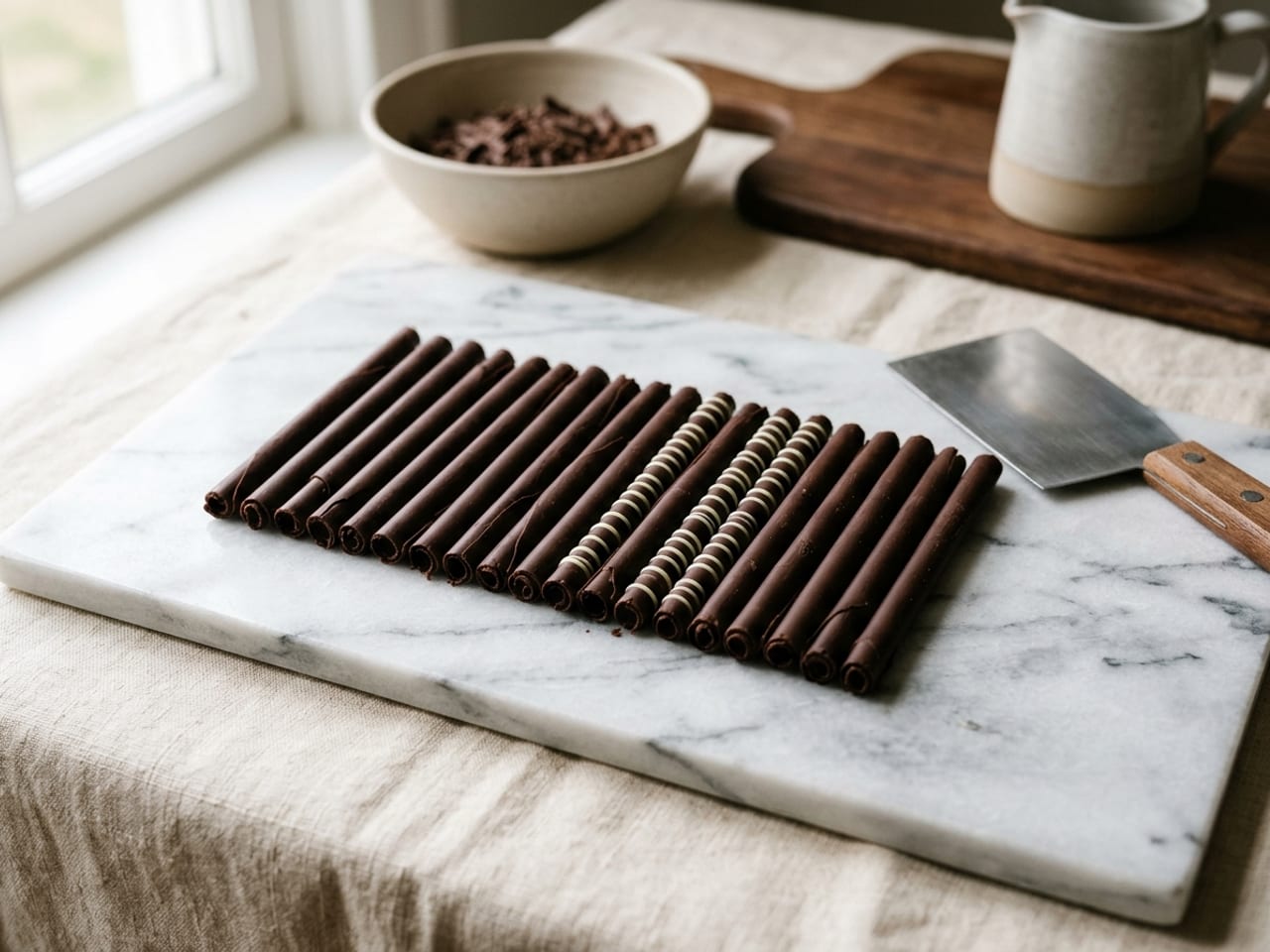
- "Drizzle a thin line of tempered chocolate onto a marble surface, parallel to the edge of the marble", and spread it thin (the CIA).5
- When it has set somewhat, trim it to width with a Plexiglas strip and a bench scraper (the CIA) or "the back of a chef's knife" (Bilheux).5, 10
- When "the chocolate loses some of its gloss", hold a metal scraper "at a 45-degree angle" and push "approximately 1 inch (2.5 centimeters) to produce uniform curls" (Labensky).9
- The CIA scrapes "with a quick, abrupt motion; it should feel as though you are trying to scrape off a thin layer of marble." Not set enough, "the cigarettes will not curl properly"; set too much, they "will crack and break"; slightly too cool, warm it with your palm.5
- Striped cigarettes: comb white chocolate down to the marble, cover it thinly with dark, and scrape when it is "no longer tacky but still pliable". The CIA also rolls finished cigarettes in cocoa "to resemble cinnamon sticks".5
4. Piped chocolate lace and filigree · piped lacework, writing, filigree
- Tempered? Tempered for the CIA, so the pieces "become rigid once set" and "can be made ahead", and for Gisslen and Claire Ptak. Friberg prefers coating chocolate for pieces that will be moved, and says untempered piping chocolate piped straight onto a plate "may start to bloom within a few hours".
- How thin: A fine line. Plain tempered chocolate is "adequate for small, fine decorations" but "too thin for most other piped decorations", so Gisslen thickens it with "a very little warm simple syrup".
- How long it keeps: "made up far in advance and stored in a dark cool place (but not in the refrigerator)" (Friberg); Ptak's lace is stable enough to wrap in cellophane as a gift. No day count.
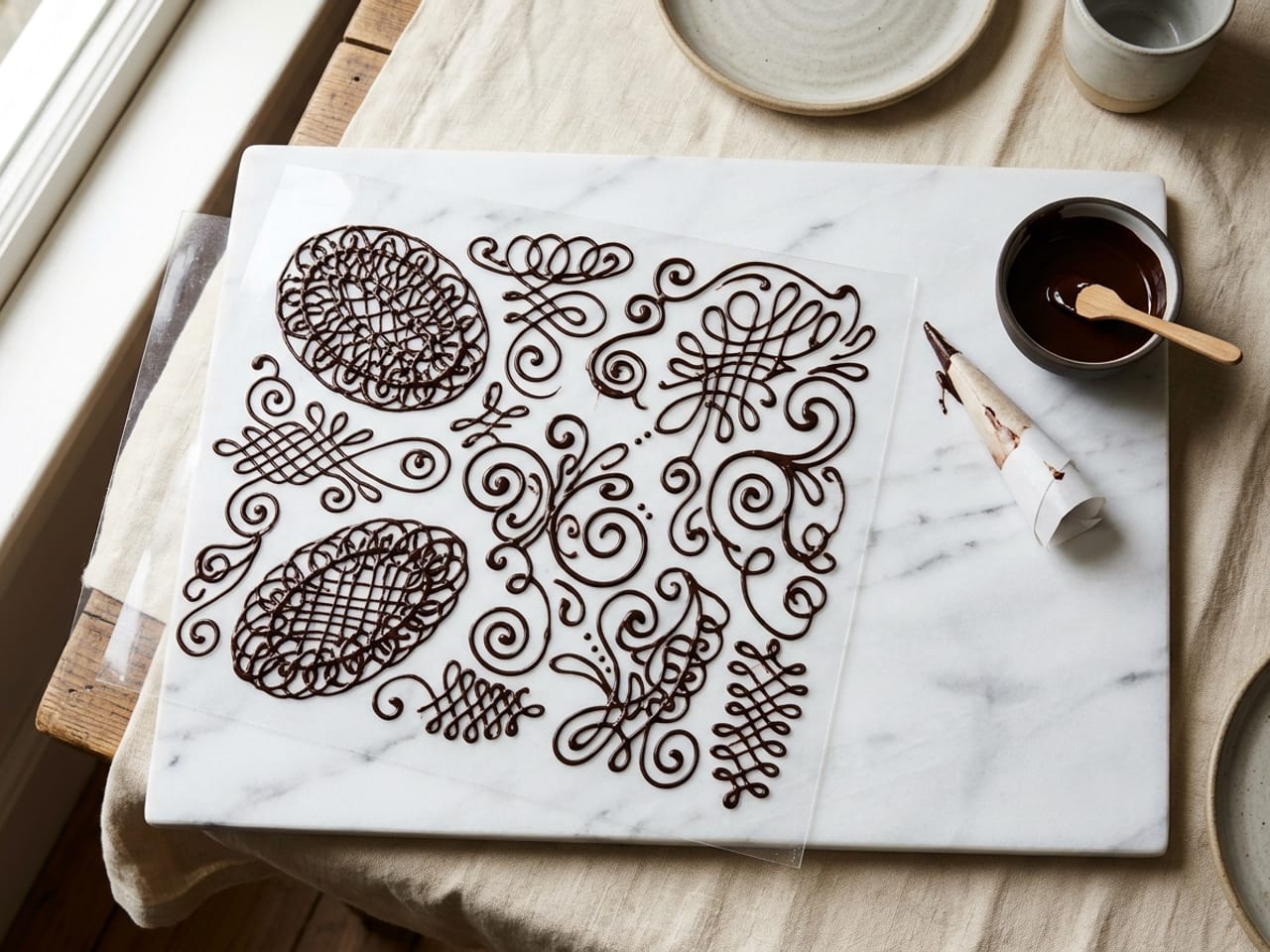
- Make piping chocolate: "add a very little warm simple syrup to the tempered chocolate. This will thicken the chocolate immediately" (Gisslen). Friberg uses 1/4 to 1/2 tsp of simple syrup or orange liqueur for 12 oz (340 g) of coating chocolate.2, 4
- Make a small paper cone, "fill it no more than halfway with piping chocolate" and "cut a tiny hole"; small, because "the chocolate can easily harden in the cone if the environment is cool" (the CIA).5
- Put a pattern under the sheet: Friberg traces his design on paper under baking paper; Ptak lays paper doilies under baking parchment, "checking you can see the pattern through the parchment".4, 75
- Pipe "in one unbroken line as much as possible" (Friberg). The CIA touches the tip to the surface, lifts so the string falls where it should, pauses at the top for a loop, and touches down again to end.4, 5
- Let it set, then lift each piece by pushing up from underneath, or slide a thin knife under very fragile ones (Friberg). For a curve, set the sheet in a curved mould or tray while it hardens (Gisslen, Valrhona's Tibbetts); no source we read curves lace over a rolling pin.2, 4, 37
5. Cut shapes: triangles, squares and discs · cutouts, plaques
- Tempered? Tempered for Gisslen, the CIA and Valrhona's chefs; "coating or tempered chocolate" for Friberg.
- How thin: "very thin", 1/16 in (2 mm) (Friberg); 0.15 cm (1/16 in) for the CIA's white layer; 1 mm (Labensky; Valrhona's discs, rolled between two sheets); the CIA's rule is "spread thin, but the exact thinness will depend on the intended use".
- How long it keeps: Friberg makes cutouts "in advance" and keeps them on their paper in "a dark, cool place. Do not store them in the refrigerator." The CIA leaves them on the acetate "until time for service so that the surface does not become marred". No day count.
- "For a very shiny finished surface, spread the chocolate onto a sheet of acetate rather than parchment paper" (the CIA).5
- Wait for the cutting point, a state rather than a time: until it "clouds over and becomes firm but not hard" (Gisslen), until it is "fudgy", soft enough to draw a knife point through "without cracking but set enough so that the cut does not refill" (the CIA), or until it "feels like leather" (Labensky).2, 5, 9
- Cut with a small sharp knife, or a cutter "slightly warmed" (Gisslen); the CIA cuts its triangles against a ruler; Friberg dips cutters in hot water and dries them, and gets "four or five pieces before reheating the cutter". Valrhona's Tibbetts scores with a multi-wheel cutter, or presses with "the back of the paring knife", because the edge cuts through the sheet.2, 4, 5, 37
- Keep it flat while it sets: the CIA stacks the sheets between pans or boards and lets striped triangles set "a minimum of 3 hours"; chocolate between two sheets stays flat on its own (Tibbetts).5, 37
- "Do not attempt to remove the cutouts at this point": peel them only when hard and the sheet comes away easily (Gisslen).2 For quick discs, Tibbetts dips a very small glass (a verrine) in tempered chocolate and stamps it on a guitar sheet.37
6. Chocolate leaves · real-leaf, moulded or knife-swiped
- Tempered? Tempered couverture (Labensky; Gisslen's leaf mould); "tempered chocolate or melted coating chocolate" (Friberg).
- How thin: "a thin layer" (Friberg); modeling-chocolate leaves 0.3 cm (1/8 in) (the CIA).
- How long it keeps: No source we read gives one.
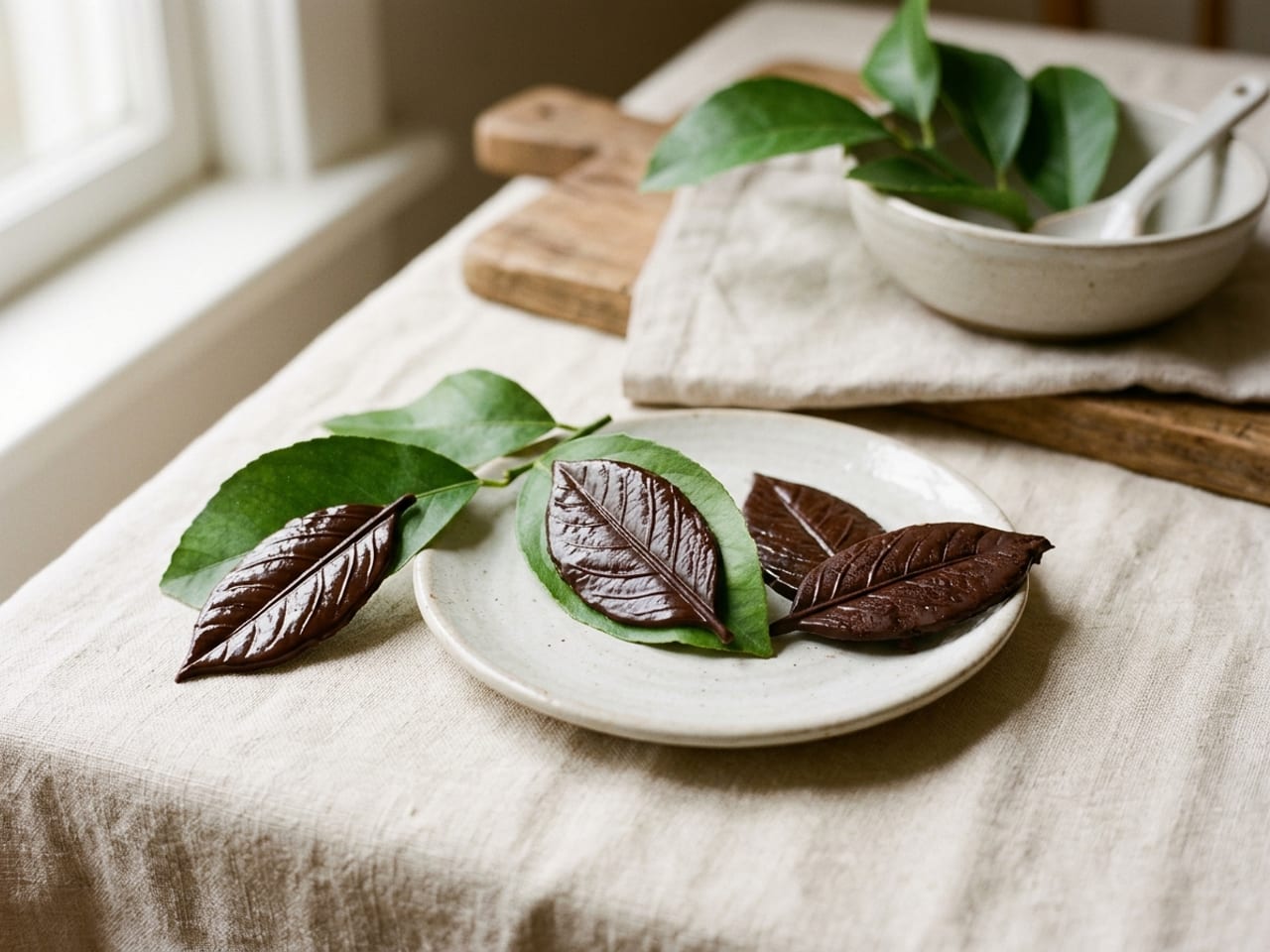
- Choose the leaf (the safety split is just below): Labensky uses "a clean, dry" lemon leaf; Friberg "typically a rose leaf", adding "citrus trees are safe, and small citrus leaves produce a good result"; Gisslen brushes a leaf mould, and "real leaves could also be used".2, 4, 9
- Brush a thin layer of chocolate on the underside, the veined back (Labensky, Friberg); keep it off the edges so the leaf peels cleanly (ours).4, 9
- Let it set, then peel the leaf away from the chocolate; Friberg gets "three or four times" out of one leaf "before the chocolate begins to stick".4
- With no real leaf: cut leaf shapes from half-set chocolate with a knife tip and score the veins (Friberg); swipe a paring knife dipped in tempered chocolate across a sheet (Tibbetts); or roll modeling chocolate 0.3 cm (1/8 in) thick, cut and vein it (the CIA, whose tool list includes silicone leaf moulds).4, 5, 37
Which leaves are safe? The sources split. The textbooks use real leaves: Friberg says "make sure any leaves you use are non-toxic", Labensky uses lemon leaves, Gisslen allows real ones.2, 4, 9 The University of Georgia's extension service advises against it: a food-safety specialist worries about toxins that "could migrate into the melted chocolate", says "pesticides used on ornamental plants are not necessarily the same ones approved for use on food crops", some of them systemic, and about "insects or insect eggs"; she suggests fondant leaves.58 The poison lists we read flag English ivy, holly, English laurel, Carolina laurel cherry, mountain laurel and oleander; UC lists camellia and gardenia as safe and the National Capital Poison Center rose as non-poisonous, but a plant that is not poisonous is not therefore fit to cast food on (ours).59 Our advice: use unsprayed leaves from an edible plant you know, washed and dried, or a silicone leaf mould; never ivy, holly, laurels or oleander. Which plants are edible is our edible flowers guide's job.
7. Transfer sheets · printed acetate, cocoa-butter transfers
- Tempered? Tempered for Valrhona (its own sheet) and the CIA; "melted chocolate or coating chocolate" for Friberg.
- How thin: Thin; no source gives a number for the chocolate (Valrhona's sheet itself is 150 microns).
- How long it keeps: No day count for the finished pieces. Unused sheets: "in a dry, odour-free environment at a temperature of 15-20°C" (59 to 68°F, ours) (Valrhona).
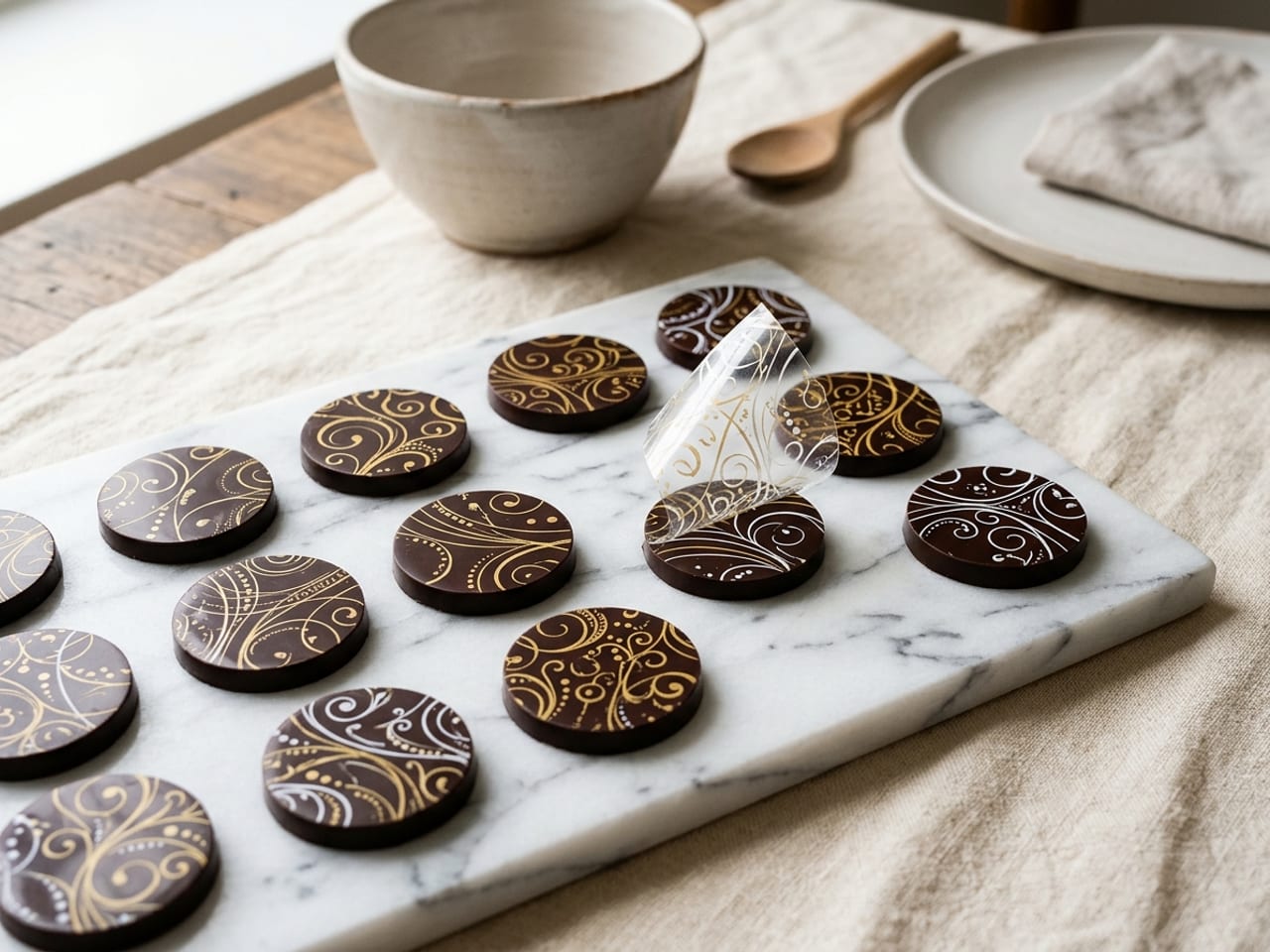
- Know what it is: "acetate sheets with designs imprinted on them in plain or colored cocoa butter" (the CIA); Friberg adds "or vegetable fat colored with food dye"; Labensky calls the designs "edible printed designs".4, 5, 9
- Lay it with "the raised or textured side" facing up, the side with the design (Gisslen), and "spread an even layer of tempered chocolate on the sheet" (Valrhona).2, 39
- Cut it to shape before it sets hard (Gisslen cuts curled triangles "When the chocolate is set but not hard") or leave it whole to break into shards (Friberg).2, 4
- Let it set, and here the sources split: Valrhona says "Leave to stand in the cold (4 to 6°C) for at least 20 minutes before peeling off the print" (39 to 43°F, ours); Labensky, "For the best sheen, wait at least 4 hours"; Friberg weights it and says "Chill for a few minutes", then inverts it and peels.4, 9, 39
- On a dipped chocolate, the CIA lays the sheet on "immediately" after dipping and removes it "After the coating is completely set".5
Read the print's ingredients. Valrhona's transfer print lists "cocoa butter, colouring E100, sugar, whole milk powder, colouring E120", so a dark chocolate piece made on it is not dairy-free, and E120 (carmine) comes from insects (ours, from the ingredient line).39 Colours in prints by country are under safety.
8. Collars, bands, fans and ruffles · chocolate bands, teardrops
- Tempered? Bands tempered (the CIA, Gisslen); for soft strips and fans "Melted, untempered chocolate may be used, resulting in softer chocolate" (Gisslen), and the CIA's ruffles use "melted but not tempered" chocolate; Labensky's fans start from tempered couverture.
- How thin: Thin for a band (the CIA); "more thickly so the ring will be sturdier" for a free-standing ring (Gisslen); for fans, "Do not make the chocolate too thin or the fan will break" (the CIA).
- How long it keeps: Bands stay in their acetate until service (the CIA); "Store the ruffles in a cool, dry place" (the CIA). No day count.
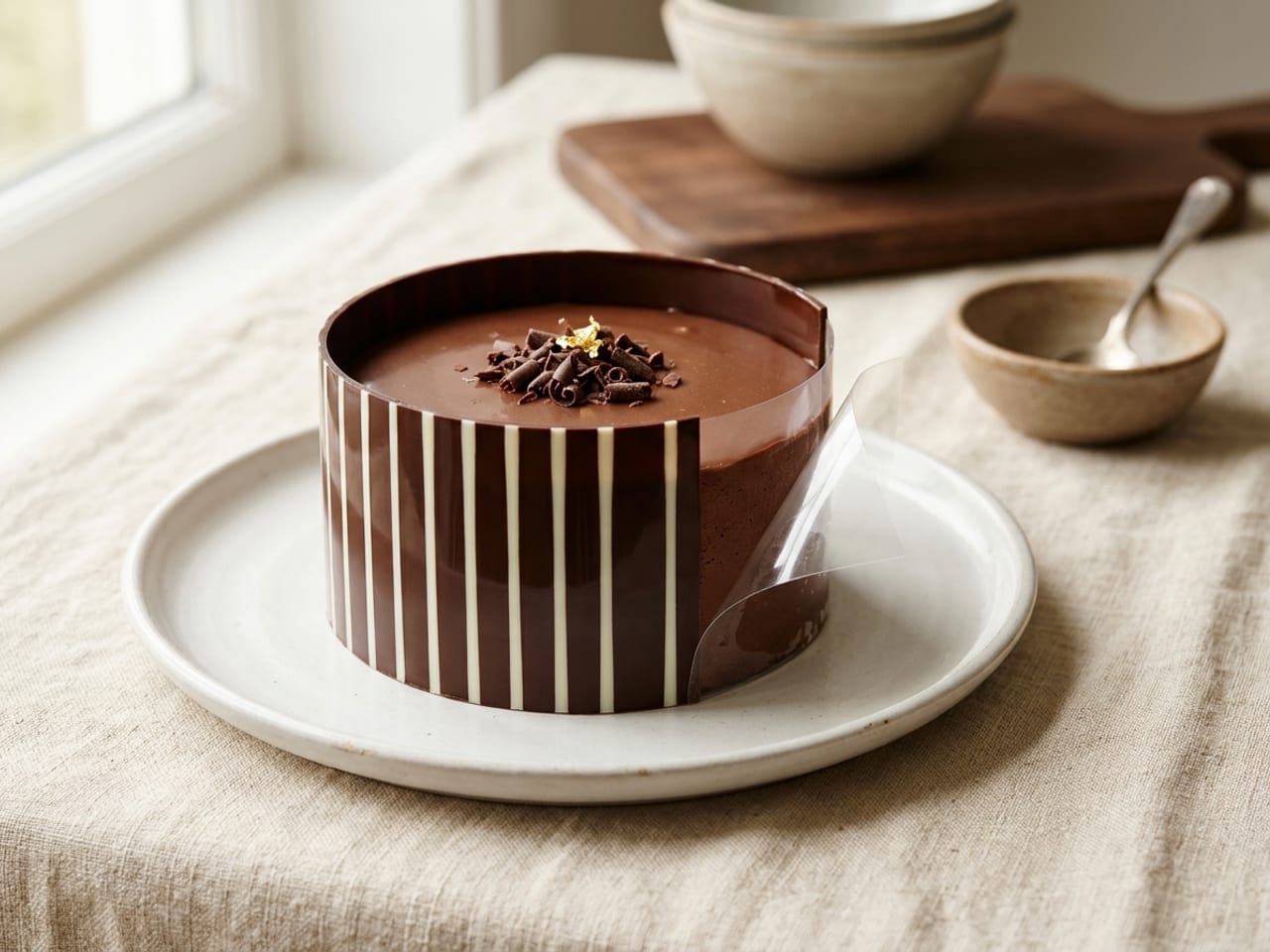
- Cut an acetate strip to the height of the band and spread tempered chocolate thin, over the long edges (the CIA).5
- "Allow the chocolate to set slightly so that the acetate can be picked up without the chocolate running. The chocolate should still be fluid enough to adhere" (the CIA).5
- "Place the band carefully, starting with one end; once it touches the surface, it cannot be moved without damaging the chocolate"; overlap the end and trim (the CIA).5
- "To preserve its shiny finish, leave the acetate on the chocolate until time for service" (the CIA); Gisslen peels it "just before serving". For a pattern, comb the chocolate on the strip first (Labensky) or use a wood-grain tool and then white chocolate (Gisslen).1, 2, 5, 9
- Fans: Gisslen heats "a clean half-sheet pan at 325°F (160°C) for 4 minutes", spreads melted chocolate thin on its back, refrigerates it until set, lets it warm to room temperature, then pushes a scraper with a thumb on one corner so the strip gathers. The CIA freezes its ruffle sheet until "set but still malleable". Teardrops are strips bent while half set, clipped, and on the plate filled with mousse (Gisslen).2, 5
Other chocolate decorations
- Cocoa dust through a stencil: Gisslen masks the top with "paper cutouts or paper doilies", sifts cocoa, icing sugar or shaved chocolate over, then lifts the paper.2
- Cocoa nibs: Roasted, shelled cocoa bean pieces that give "an intense roasted chocolate flavor and a pleasant crunchy texture" (Friberg).4
- Chocolate tuiles: A baked cocoa batter, not tempered chocolate: spread through a stencil, baked and shaped while warm (Friberg; the open textbook bakes its tuiles at 170°C, 350°F, for 10 to 15 minutes); a Great British Chefs recipe breaks a cacao tuile into shards. The tuile batters by weight, cocoa included, are in our tuile guide.4, 11, 76
- Modeling chocolate and sprayed chocolate: Gisslen makes modeling chocolate from melted chocolate and "half its weight of glucose (corn syrup)", and sprays chocolate thinned two parts couverture to one part cocoa butter for a velvet finish.2
Gold leaf, lustre dust and coloured cocoa butter are under safety, country by country.
The eight garnishes at a glance
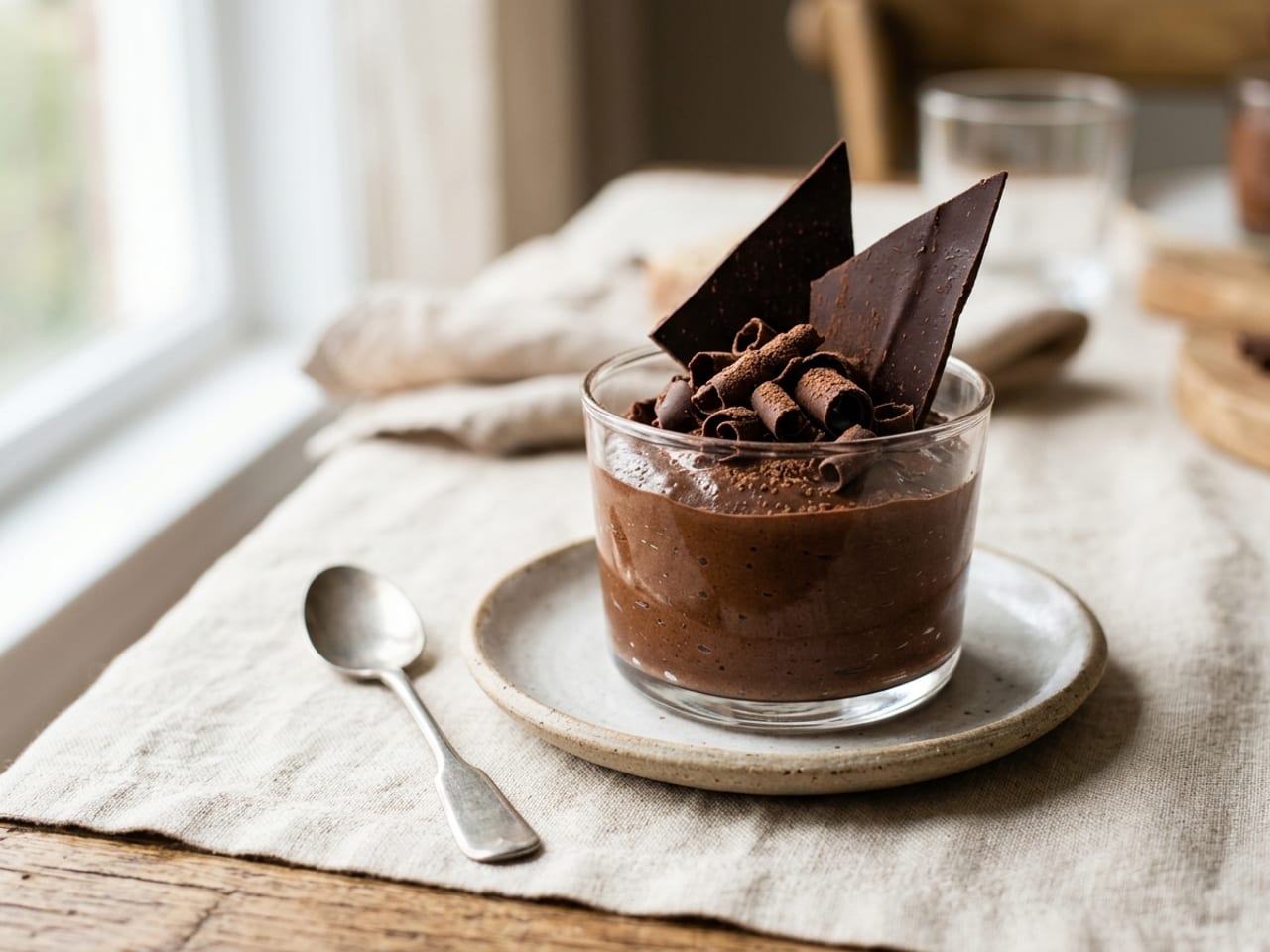
Tempered or not as the sources say it, thickness only where a source prints a number, and keeping time only where one is printed. Our reading: temper, or use compound coating, for anything that must snap and shine or be made ahead; untempered chocolate is fine for curls and shavings eaten soon, as Gisslen allows.2, 4
| Garnish | Needs tempered chocolate? | How thin | Keeps |
|---|---|---|---|
| Chocolate shards | Tempered, or compound (Friberg) | Thin; no number (thick for cake-side shards) | No textbook figure; one shop says 2 to 4 weeks |
| Chocolate curls and shavings | Not necessary (Gisslen); tempered (CIA) or compound (Friberg) | 2 mm (1/16 in) layer; a 1 in (2.5 cm) block for peeler curls | No day count; covered, cool, dry (Friberg) |
| Chocolate cigarettes | Tempered (CIA, Labensky, Bilheux); not necessary (Gisslen) | Thin; 2 mm (1/16 in) in Friberg | "several months", airtight (Bilheux) |
| Piped chocolate lace and filigree | Tempered (CIA, Gisslen), or compound for pieces that move (Friberg) | A fine line; thickened with a drop of syrup (Gisslen) | Far in advance, dark and cool (Friberg); no day count |
| Cut shapes: triangles, squares and discs | Tempered, or compound (Friberg) | 1 to 2 mm (1/32 to 1/16 in, the 1/32 ours) | On the paper or acetate, cool and dark; no day count |
| Chocolate leaves | Tempered, or compound (Friberg) | A thin layer; 0.3 cm (1/8 in) for modeling chocolate | No source gives one |
| Transfer sheets | Tempered (Valrhona, CIA), or compound (Friberg) | Thin; no number | No day count (unused sheets: dry, 15 to 20°C, 59 to 68°F ours) |
| Collars, bands, fans and ruffles | Bands tempered; fans and ruffles may be untempered (Gisslen, CIA) | Thin; thicker for a free-standing ring | Acetate on until service; no day count |
The tools for chocolate decorations
The tools the textbooks name for each garnish. Most kitchens have the spatula, scraper and paper; the rest is cheap. The wider plating kit is in our plating tools guide.
- Acetate sheets and strips: "shiny, flexible nonstick sheets used for chocolate work" (the CIA): they give the gloss and line bands and collars. "Acetate is not and cannot be used for baking" (Friberg). No regulator page we read covers acetate for food; buy sheets sold for chocolate work and ask the seller for a food-contact declaration (ours).4, 5
- Guitar sheets: Thin sheets "slightly more flexible than acetate", held to the bench with a dab of neutral oil (Valrhona's Tibbetts). In the CIA's book a "guitar" is a different tool, a wire cutter for confections.5, 37
- Offset or palette spatula: To spread chocolate thin on acetate, paper or marble, and to move finished pieces without your hands.2, 4, 5
- Bench scraper, putty knife or triangle: For tabling and for scraping curls, cigarettes and fans; Friberg and Bilheux also name the triangular scraper.4, 5, 9, 10
- Marble slab: Chosen "because it has a high thermal mass" (the CIA); in a cold room Friberg will use a smooth hardwood board instead, never a worn or cut one.4, 5
- Paper piping cone: Cut the paper with one stroke of a long knife, because "A clean cut, not possible when tearing the paper or cutting it with scissors, enables piped icings or glazes to fall in a clean, straight line" (the CIA).2, 5
- Combs and a wood-grain tool: Square-toothed or icing combs for stripes; Gisslen's wood-grain tool for a grain pattern.2, 5, 9
- Cutters and moulds: Round and shaped cutters (warmed), a multi-wheel pastry cutter for squares, silicone leaf moulds and a leaf veiner.2, 4, 5, 37
- Thermometer: A Callebaut chef recommends "grabbing a digital thermometer" even with a thermostat; Ghirardelli says "Use a candy thermometer to avoid heating chocolate above 130°F." (54.5°C, ours)14, 31
- Hair dryer or heat gun, and gloves: To warm chocolate that sets too fast (Friberg); disposable gloves keep fingerprints off the gloss (Gisslen).1, 4
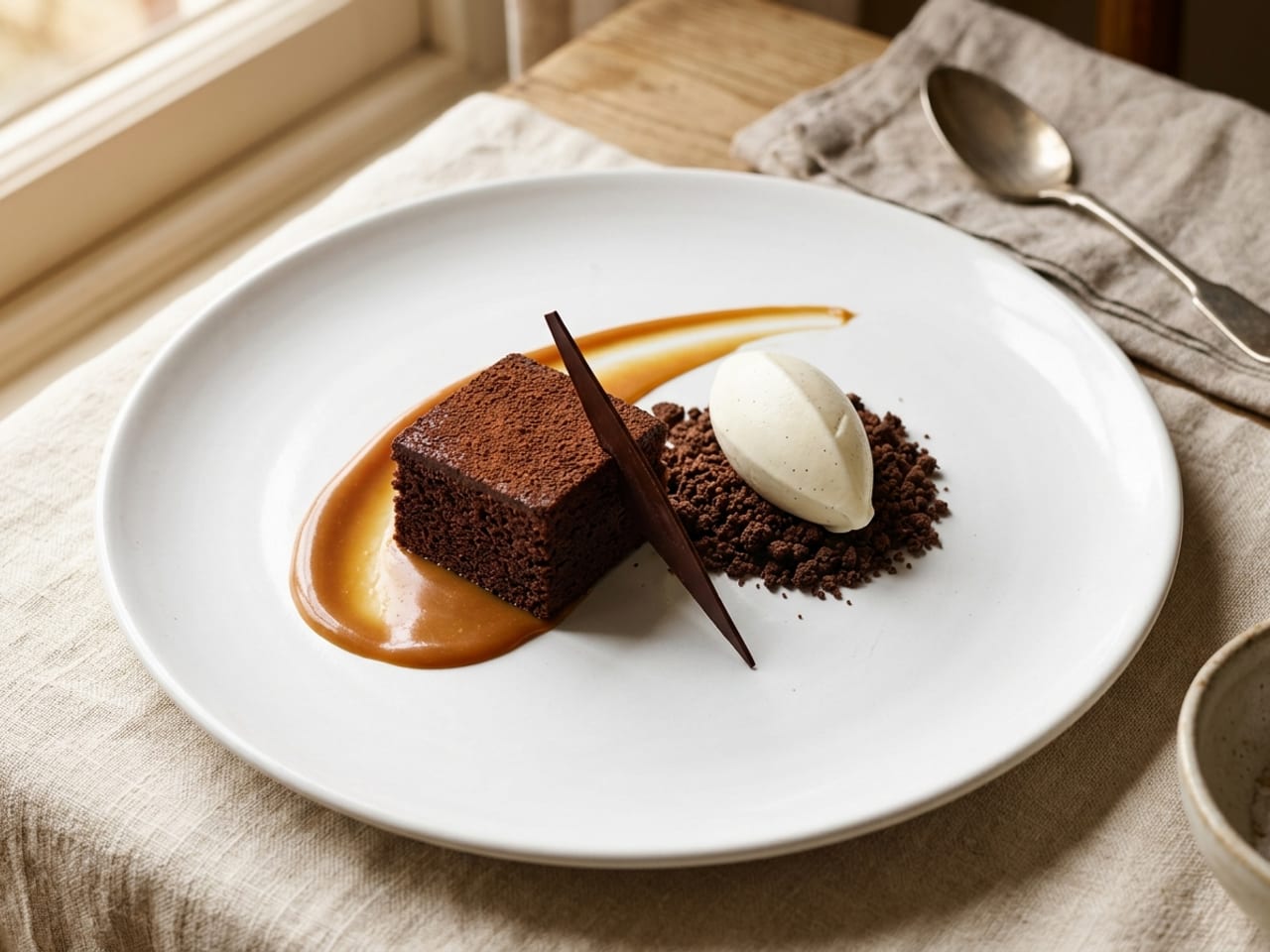
Where a chocolate garnish goes on the plate, and when
The pastry textbooks agree on four things, and give no size or height for any of them.
- Restraint. "Every component should have a purpose. Don't add elements merely to make the plate fuller. Limit the items added primarily for decoration" (Gisslen); the CIA would "never add components just to have another contrasting element"; the open textbook: "Too much of anything is never a good idea."1, 5, 11
- Delicate, not heavy. "Too thick a chocolate garnish can overpower the dessert, so it must be delicate" (the open textbook). Gisslen adds: "Don't make the dessert into a presentation that is difficult or awkward to eat."1, 11
- One point of height, often at an angle. The open textbook puts "Height on right side" and says "An upward curve of a tuile or chocolate garnish" helps direct the eye; the CIA lays a chocolate cigarette "at a 45-degree" angle across a piped border on top of an almond cake; Friberg sets cutouts "at an angle on top" of a cake.4, 5, 11 That is the shard of our dessert plating guide: one point of height, off-centre.
- Anchor it. The CIA has you "Lean a white chocolate triangle garnish on" each quenelle of cremeux; Gisslen sets a chocolate teardrop on the plate and pipes it full of mousse; the open textbook lists a "Chocolate garnish" among the bases that keep a scoop of ice cream off the plate, because on a base "it will slow down the rate of melting".1, 5, 11 Shaping the quenelle itself is in our quenelle guide.
When to add it: last. "For most desserts, all the components are prepared well in advance. The plated dessert itself, however, is assembled at the last minute"; for a chocolate band in acetate, Gisslen says "Peel the acetate off the chocolate just before serving".1 Handle it with a spoon, a spatula or gloves, not bare fingers.1, 4
What no source we read says: how big a garnish should be against the dessert, how tall a shard should stand, or how long a chocolate garnish lasts on a warm plate, beside a hot sauce or on ice cream. Our suggestions, not from a source: keep a shard or fan in scale with the portion, so it reads as a garnish and not a second dessert; put chocolate on cold or room-temperature components, away from a hot sauce or a warm fondant; and plate it in the last seconds. The plating studies we found did not test chocolate: one preferred upward-pointing elements on a savoury dish, another found the same strawberry mousse tasted sweeter on a white plate than a black one.65, 66 For the wider rules, see plating components and Michelin star plating.
Dull, streaky, soft, seized or bloomed: the fixes
Twelve faults, each with its cause and cure as the textbooks and makers print them. Cracks are missing: no source we read covers cracking in a garnish.
| Problem | Cause | Fix |
|---|---|---|
| Dull, streaky or grey1, 4, 11, 19 | Too many unstable crystals: not tempered, or tempered badly; a dull surface "showing streaks of cocoa butter" (Gisslen). Rewarming "just a few degrees above the recommended temperature" does it too (Friberg). | Temper again and test a sample before you start; never let it pass the top of the maker's curve. |
| Soft, will not set, or sets slowly1, 4, 11, 19, 30 | Badly tempered chocolate "may not ever set up hard at room temperature" (the open textbook); under-crystallised (Callebaut); a room that is too warm (Gisslen works at 65 to 77°F, 18 to 25°C; Friberg at about 68°F, 20°C). | Guittard remelts slow-setting chocolate "to a temperature of 125°-130°F" (51.5 to 54.5°C, ours) and tempers it again. |
| Seized: thick and grainy1, 6, 9 | Water or steam: "A single drop of water will ruin its texture" (Gisslen); the sugar absorbs water and turns sticky (Figoni). | Not usable for a garnish; seized chocolate "can be used in ganaches, fillings, and other products" (Figoni). Keep water and steam away from the start. |
| Thick, lumpy and dull from overheating4, 6 | Too much heat; milk chocolate "tends to get lumpy if overheated" and white "can become grainy and useless very quickly" (Friberg). | "throw out the chocolate and begin again" (Figoni). |
| Too thick while you work1, 4, 19 | Over-crystallised: "thick and viscous" (Callebaut), or simply cooled. | Warm it gently with a hair dryer or heat gun, or add warm tempered chocolate all at once (Friberg); at the right temperature, thin it with melted cocoa butter, never by heating (Gisslen). |
| Fat bloom: a grey-white film6, 9, 20, 46 | A white film "which disappears at the touch": chocolate not tempered, or stored too warm (Callebaut); stored "above 70°F (21°C)" (Labensky). | Mild fat bloom "disappears when chocolate is tempered before use, as long as it is not severe" (Figoni); store it cool and steady. It is safe to eat (Canada's food agency). |
| Sugar bloom: white, rough and gritty6, 9, 20 | "a white and rough, grainy texture" (Callebaut): moisture, from condensation, damp storage or a cold piece unwrapped in a warm room. | Prevent it: "Sugar bloom remains even after chocolate is tempered" (Figoni). Keep it dry and let cold packs warm up before you open them. |
| Spotted or sticky after the fridge4, 6, 21 | Condensation as the cold chocolate warms: "water droplets easily condense onto its surface" (Figoni). | Keep finished pieces out of the fridge (Friberg); if something must be chilled, keep it sealed until it is back at room temperature (Figoni, Callebaut). |
| Curls smear, or break into specks2, 4 | Too soft, it smears; too hard, it breaks; for shavings, too warm cakes on the tool and too cold gives "small unattractive specks" (Friberg). | Wait, or lay a chilled sheet pan on it; if too hard, a hair dryer or the palm of your hand (Friberg, Gisslen). |
| Fingerprints and melted edges1, 4 | Warm hands on set chocolate. | Disposable gloves, "touching them as little as possible" (Gisslen); a spoon or spatula, not fingers (Friberg). |
| Flat pieces curl or warp5, 37 | The "retraction" of tempered chocolate as it sets (Tibbetts). | Set it between two sheets (Tibbetts), or weighted between pans or boards (the CIA). |
| Chocolate sets in the piping cone4, 5 | A cool room (the CIA). | Use small cones (the CIA). Friberg keeps the tip warm between pinched fingers, warms a set tip against a warm pot, and chills a fully set bag so the chocolate drops out to be melted again. |
Chocolate bloom: fat or sugar, and is it safe?
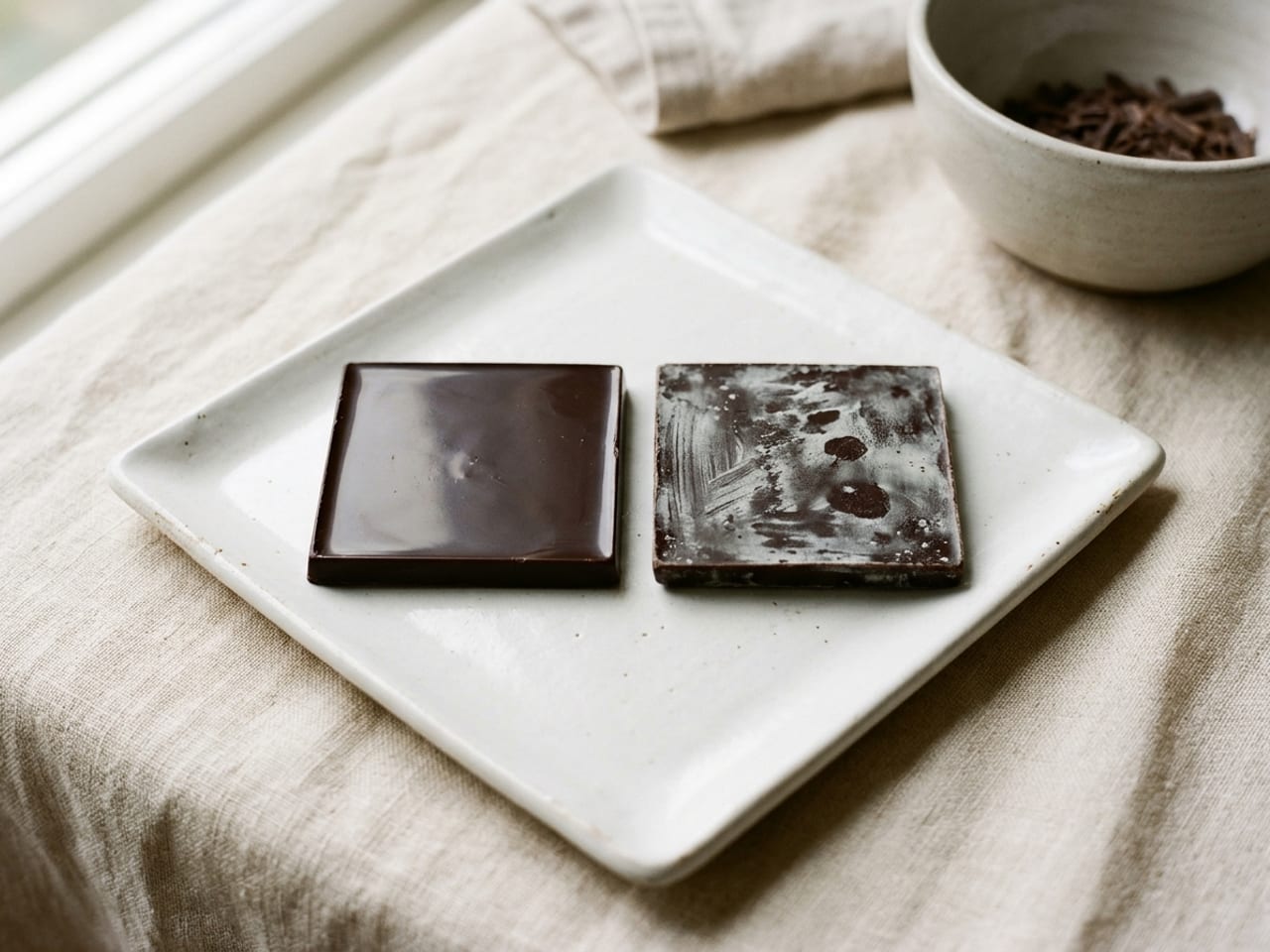
Tell them apart by touch. Callebaut's troubleshooting table: "The chocolate is covered in a white film, which disappears at the touch" is fat bloom (not tempered, or stored too warm); "a white and rough, grainy texture" is sugar bloom (moisture). Figoni adds the second test: mild fat bloom goes when the chocolate is re-tempered, "Sugar bloom remains even after chocolate is tempered." 6, 20 How fat bloom forms is still debated in the research.62, 64
Safe to eat. The Canadian Food Inspection Agency: "Although it may affect the taste of chocolate, it is harmless and safe to eat", and bloomed chocolate "can still be eaten or used for baking."46 The CIA calls both kinds "safe to eat", and Ghirardelli "a visual and textural defect only."5, 32 We found no US agency statement on bloom. On a garnish it is a looks problem: make a new piece, and re-temper a bloomed bar before using it (ours).
How to store chocolate garnishes, and how far ahead to make them
Cool, dry and steady, and most add dark: the sources we read agree on that much. The numbers do not agree, so here they all are, as printed (15 rows).
| Source | Temperature | Humidity | The fridge |
|---|---|---|---|
| Callebaut, shelf-life article21 Pure chocolate | "between 12 and 18°C (54-64°F)" | At most 70% | "Generally not recommended for confections" |
| Callebaut, fat-bloom tutorial20 Finished chocolate products | "a constant temperature between 18°C and 20°C" (64 to 68°F, ours) | - | - |
| Callebaut, sugar-bloom tutorial20 Finished products | Constant | Low | Yes, packed well, in a fridge with low humidity; let it warm for a few hours before unpacking |
| Callebaut, curve graphics13 811 (dark); W2 (white) | 12 to 20°C (53.6 to 68°F); W2 12 to 18°C (read from the graphic by us) | Away from humidity | - |
| Valrhona FAQ27 Solid chocolate; bonbons | "16-20°C (61-68°F)" | A dry place | Bonbons may be kept at 4°C (39°F) in the sealed box, then brought to room temperature over about 3 hours |
| Valrhona, Guanaja sheet26 Unopened couverture | 16 to 18°C / 60 to 64°F | A dry place | - |
| Figoni, 3rd ed.6 Cocoa and chocolate | "a cool, consistent 55°-65°F" (13 to 18°C) | Below 50% | Only very tightly wrapped while it warms |
| Guittard29 Chocolate | 60 to 70°F (15.5 to 21°C, ours) | Below 50% | - |
| Ghirardelli32 Chocolate | 60 to 75°F (15.5 to 24°C, ours) | Dry | In hot climates, "although this isn't ideal" |
| Greweling, 20108 Chocolate | "about 65°F" (18°C, ours) | - | "Do not refrigerate or freeze it" |
| CIA, 3rd ed.5 Chocolate | Cool, ventilated, away from sunlight | Dry | "Ordinarily it should not be refrigerated"; in hot, humid kitchens the fridge or freezer "may be preferable" |
| Open textbook (BCcampus)12 Chocolate | 18 to 20°C (64 to 68°F) | 60% | Not the ideal place (odours, humidity) |
| Labensky, 2nd ed.9 Chocolate | Fat bloom forms "above 70°F (21°C)" | - | Refrigerated chocolate gets sugar bloom |
| Friberg, 4th ed.4 Curls, shavings, cutouts, piped pieces | "a dark, cool place" | Dry | "Do not store them in the refrigerator"; a few minutes just before use is fine for shavings |
| Callebaut decorations (retailer's spec)40 Factory chocolate decorations | "12 - 20 °C" (54 to 68°F, ours) | At most 70% | - |
- Temperature splits: 12 to 18°C (54 to 64°F) in one Callebaut article and 18 to 20°C (64 to 68°F, ours) in another, 16 to 20°C (61 to 68°F) at Valrhona, 13 to 18°C (55 to 65°F) in Figoni, up to 75°F (24°C, ours) at Ghirardelli.6, 20, 21, 27, 32 Humidity: below 50% (Figoni, Guittard) against at most 70% (Callebaut).6, 21, 29
- The fridge, to set: makers chill briefly to set work: Valrhona's school puts moulds in the fridge for 5 minutes, Callebaut's curves cool moulded work at 8 to 12°C (46.4 to 53.6°F), Valrhona's transfer sheet sets "in the cold (4 to 6°C)" (39 to 43°F, ours), and Friberg's paper test snaps after 1 or 2 minutes in the fridge. Figoni disagrees: "tempered chocolate should not be placed in the cooler or freezer to speed the process."4, 6, 13, 25, 39
- The fridge, to store finished pieces: no for Friberg ("Do not store them in the refrigerator"), Greweling and the CIA in ordinary kitchens; a sealed, low-humidity fridge is fine for Callebaut's finished products and Valrhona's boxed bonbons, and the CIA allows it in hot, humid kitchens.4, 5, 8, 20, 27 Our mignardises guide keeps finished chocolates out of the fridge for the same reason: condensation.
How far ahead?
The textbooks make chocolate decorations ahead and say so: Gisslen pipes them "during slack hours and stored until needed", Friberg calls cutouts "good to have on hand", the CIA's piped pieces "can be made ahead and stored for later use".1, 4, 5 None of them gives a day count for shards, curls, lace, leaves or cut shapes. The one figure in a book is Bilheux's for chocolate cigarettes: "several months in airtight containers free from humidity and heat", read as a fragment of the scan.10 A Texas chocolate shop's blog keeps shards airtight "for up to 2 to 4 weeks", and briefly in the fridge, wrapped, for "up to 2 days" in a warm kitchen.73 Factory decorations are another matter: Callebaut prints 18 months, sealed.22, 40 Our plan: make tempered pieces a few days ahead, keep them on their paper or acetate in a sealed box somewhere cool and dark, and plate them last.
The chocolate you buy: Greweling gives dark chocolate a "shelf life of twelve months" and milk or white six; Figoni gives milk and white "six months to one year"; Friberg says unopened dark keeps "for up to one year". Valrhona guarantees its chocolate to the date on the pack when stored as it says.4, 6, 8, 27
Allergens, gold leaf, glitter and colours, country by country
Milk, soy and nuts
Dark chocolate is not automatically dairy-free. The US FDA: "Milk is a permitted ingredient in dark chocolate", and milk can get in "because most dark chocolate is produced on equipment that is also used to produce milk chocolate"; in its survey of dark chocolate products labelled dairy-free, "four of the 52 products sampled", all bars, had potentially hazardous levels of milk. It reads "may contain milk" warnings as a sign milk may be present.49 In the UK, 14 allergens must be declared, and a business serving a dessert must give allergen information for every item that contains one.56 Soy lecithin is common in chocolate (Ghirardelli's chips list it) and soybeans are on both the US and UK lists (ours, from the labels and lists); a transfer print can carry milk powder (above).34, 39, 56
Gold and silver leaf, by country
- United States: in the FDA's colour additive database, gold is "Delisted, formerly exempt from certification" (1976) and silver is listed for "Fingernail polish only"; in what we read, no FDA page says how gold leaf sold for food is allowed, so we do not call it "FDA approved". 48 America's Test Kitchen (suppliers quoted) says gold leaf "is not regulated or evaluated by the FDA", and warns that imitation leaf, "made with more stable metals like copper or bronze", is "not food grade": look for packs that state the carat, and the suppliers ATK spoke to say never below 22K (22-karat).68
- European Union: gold (E 175) and silver (E 174) are allowed only for "external coating of confectionery", "decoration of chocolates" and "liqueurs", as printed in the 2011 text we read (later amendments not re-read).51 On silver, the EU food-safety authority's panel in 2025 "could not conclude on the safety of the food additive silver E 174".52
- United Kingdom: silver and gold are on the Food Standards Agency's list of approved colours.55
Friberg calls 22-karat gold leaf "completely edible"; he also points readers to art-supply stores, advice we do not repeat given the imitation-leaf warning above.4, 68
Glitter, lustre dust and coloured cocoa butter
- United States: the FDA advises bakers to avoid glitters and dusts "unless the products are specifically manufactured to be edible"; edible ones must list their ingredients, and a label that says only "non-toxic" or "for decorative purposes only" with no ingredient list "should not be used directly on foods".47
- United Kingdom: the Food Standards Agency's guidance (as hosted by a local council) adds a middle group: glitter labelled for food contact may decorate food but is not to be eaten; only products clearly labelled edible go on food to be eaten.57
- White and pearl colours (titanium dioxide, E 171): banned in EU foods (Regulation 2022/63, after a transition to 7 August 2022) and in Northern Ireland; still authorised in Great Britain (our reading of the FSA page) and in the US, up to 1% of the food (21 CFR 73.575). Pearl dusts and white prints sold in one country may not be legal in another.53, 54, 55
- Red No. 3 (erythrosine): the FDA has revoked it for food from 15 January 2027.50
Real leaves are the other safety question: see which leaves, and our edible flowers guide for plants.
Chocolate garnishes in print: the earliest we found
Short, and only what we could date: these are the earliest uses we found in dated scans, not firsts. We did not trace the French terms (tempérage, mise au point): the French library search was blocked to us, and the Internet Archive returned nothing for "tempérage du chocolat" up to 1965.
| Year | What we found |
|---|---|
| 1907 | "copeaux, or shavings" are almond biscuits served with ices in a London trade book: in what we found, the word for shavings named a biscuit (1907) before it named chocolate (1950).80 |
| 1909 | Pittsburgh's hand-dippers: "The chocolate curls, hearts, and bands on top of creams are marks of hand-dipped work", decorations on candy tops rather than plated desserts.77 |
| 1922 | "We both melt and temper the chocolate for the enrober in one mixer": the earliest English "temper the chocolate" we found, in a candy-trade magazine.78 |
| 1923 | A Nebraska newspaper's party menu floats a few chocolate "rose leaves" on a punch; it does not say how they were made.79 |
| 1950 | Small chocolate shavings on the cream of an ice-cream coupe, "Petits copeaux de chocolat sur la créme" (as the scan reads): the earliest French chocolate copeaux on a dessert we found.81 |
| 1956 | "CHOCOLATE CARAQUE For this good block chocolate or couverture should be used": the Constance Spry Cookery Book, the earliest caraque we found (the fragment gives no definition; scraped curls is our gloss).83 |
| 1958 | A French confectioner's book has a section "LES FLEURS ET LES FEUILLES EN CHOCOLAT" (chocolate flowers and leaves), and still a copeaux batter beside "copeaux en chocolat".82 |
| 1966 | X-ray work names six crystal forms of cocoa butter, the numbering still used.61 |
| 1988 | A US patent application (granted 1990) screen-prints coloured cocoa butter on a sheet, ages it, casts chocolate over it and peels the sheet: the transfer-sheet principle. It is not proof of the first commercial sheet, whose origin we did not find.84 |
Photograph your plate, see it re-plated
A chocolate shard on the plate and not sure where it goes? Photograph the dessert and Plate Artists re-plates that dessert, with the food kept as it is and the changes named so you can repeat them. Start with a re-plate.
Your food, plated like a chef's
Snap it, upload it, and get the composed version back, with the steps to recreate it at home.
Start free · 1 enhancement →Free account · 1 free enhancement · No credit card
Chocolate garnish terms, defined
Only the words the site does not already define: ganache is on our mignardises guide, the tuile on plating components, and the quenelle guide's "tempering" is ice cream's, a different sense.
Tempering (chocolate) · pre-crystallisation
Melting, cooling and rewarming chocolate so its cocoa butter sets in the stable crystal form: glossy, firm and snappy.
Where it comes from. Gisslen's three stages; the open textbook: "sometimes called pre-crystallization".1, 11
Couverture
Chocolate with extra cocoa butter for coating and decorations: at least 31% cocoa butter in EU, UK and Codex law; not a US legal category.
Where it comes from. Directive 2000/36/EC, Annex I; Gisslen; Figoni.1, 6, 42
Compound chocolate · coating chocolate, confectionery coating, summer coating
A chocolate-flavoured coating whose fat is partly or wholly not cocoa butter, so it sets without tempering.
Where it comes from. Gisslen, Friberg, the CIA and the open textbook name it.1, 4, 5, 12
Seeding · seed method
Tempering by stirring already-tempered chocolate into melted chocolate so its stable crystals set the pattern.
Where it comes from. Gisslen's "Seeding or Injection"; Callebaut's Callets method.1, 14
Tabling · tablage, tabliering
Tempering by working part of the melted chocolate on marble until it thickens, then stirring it back into the rest.
Where it comes from. Gisslen's "tablage", Friberg's "tabliering".1, 4
Cocoa butter powder · Mycryo, beta crystals
Powdered cocoa butter in the stable form, added at 1% of the chocolate's weight to temper it.
Where it comes from. Callebaut and Cacao Barry sell it as Mycryo; Gisslen calls such products "beta 6 crystals".1, 16, 23
Form V · beta V crystals
The crystal form of cocoa butter that tempering aims for; it melts at about 30 to 34.5°C (86 to 94°F, ours).
Where it comes from. Wille and Lutton, 1966; Stobbs and others, 2025.61, 62
Fat bloom
A grey-white film of cocoa butter on the surface that melts at a touch; from poor tempering or warm, changing storage.
Where it comes from. Callebaut's troubleshooting; the CIA's glossary.5, 20
Sugar bloom
A dry, gritty white crust of sugar left when moisture on the surface dries; it survives tempering.
Where it comes from. Callebaut; Figoni; the CIA's glossary.5, 6, 20
Seizing
Chocolate turning thick and grainy when a little water or steam gets in.
Where it comes from. The CIA: "thick and grainy"; Figoni explains the sugar.5, 6
Acetate
Clear, flexible plastic sheet or strip that chocolate is spread on for a glossy face and for bands.
Where it comes from. Gisslen, Friberg and the CIA's tool lists.2, 4, 5
Guitar sheet
A thin, flexible plastic sheet used like acetate for chocolate decor; not the CIA's guitar, a wire cutter.
Where it comes from. Valrhona's Sarah Tibbetts; the CIA's tools chapter for the cutter.5, 37
Transfer sheet
Acetate printed with coloured cocoa butter (or, per Friberg, vegetable fat) that leaves its design on chocolate set against it.
Where it comes from. The CIA, Friberg, Labensky; a 1988 patent describes the principle.4, 5, 9, 84
Chocolate cigarette
A tight roll of chocolate scraped from a thin layer on marble; also the name of a rolled wafer biscuit.
Where it comes from. The CIA, Labensky; Bilheux: "Chocolate cigarettes are a classic" (the fragment ends there).5, 9, 10
Caraque
A British name for chocolate scraped into curls, in print in 1956 (our gloss; the fragment gives no definition).
Where it comes from. The Constance Spry Cookery Book, 1956.83
Chocolate garnishes and tempering, answered
What is tempering chocolate, and does a garnish need it?
Tempering is melting chocolate, cooling it while it is stirred and rewarming it a little, so its cocoa butter sets in the stable crystal form: glossy, firm and snappy. Gisslen says couverture simply melted takes too long to set and lacks shine and texture. Anything that must snap and shine, or be made ahead (shards, cut shapes, piped lace, leaves, bands), is tempered in most of the textbooks we read, or made with compound coating (Friberg); Gisslen allows plain melted chocolate for curls, shavings and soft strips, and compound coating needs no tempering at all.
What are the tempering temperatures for dark, milk and white chocolate?
They depend on the chocolate, so use the curve printed for yours. As examples, Callebaut's 811 dark: melt to 40 to 50°C (its curve graphic says 45 to 50°C, 113 to 122°F), cool to 27°C (80.6°F), work at 31 to 32°C (87.8 to 89.6°F); its 823 milk works at 29 to 30°C and its W2 white at 28 to 29°C. Gisslen's textbook gives dark 115 to 120°F (46 to 49°C), 80 to 84°F (27 to 29°C), 88 to 90°F (31 to 32°C). Across the 17 dark curves in our table, dark is worked between 30 and 33°C (86 and 91°F, ours).
How much seed chocolate do you add when tempering?
Sources print everything from 5% (Callebaut, with its Callets) and 5 to 10 percent of the melted weight (Friberg) to 15 to 20% (Cacao Barry), about 25% (the CIA), 350 to 450 g per 1 kg melted (Felchlin: about 26 to 31% of the total, ours), a third (Valrhona's school, Ghirardelli, Zotter) and a third to a half (Garrett). There is no single correct ratio; what matters is that the seed is itself tempered and that the chocolate passes a set test.
How do you temper chocolate in the microwave?
Bought chocolate is already tempered, so melt it without losing that. Callebaut heats drops of chocolate at 800 to 1,000 W, takes them out every 15 to 20 seconds to stir, stops while small pieces are still visible and stirs those out; a Callebaut chef keeps it under 500 g. Friberg melts until about two-thirds of the pellets are melted and never lets any part pass 90°F (32°C) for dark or 85 to 87°F (29 to 30°C) for milk and white. Then test it.
How do you temper chocolate without a thermometer?
No maker or textbook we read prints a method without one. The cues they give: in the seed method, seed that melts too quickly means the chocolate is still too hot, and the result is slightly thickened; in the microwave, stop while pieces are still visible; and always the set test, a dab that hardens evenly and glossy within about 3 to 5 minutes at room temperature (Callebaut's knife tip: 3 minutes at 18 to 20°C, 64 to 68°F; Guittard's scraper begins to set within 2). The old lip test is reported by a magazine, whose quoted chocolatier says it is no longer practised in professional kitchens.
Can you temper chocolate chips?
No maker we read says either way. Ghirardelli's semi-sweet chips are real chocolate (sugar, unsweetened chocolate, cocoa butter, milk powder, soy lecithin, vanilla) and its page says nothing about tempering; King Arthur's tempering guide says chocolate chips will also work. The claim that the lecithin in chips raises their melting point appears in one blog; no maker or textbook we read says so. Candy melts are a coating, not real chocolate (the same blog).
What is the difference between couverture and compound chocolate?
Couverture is real chocolate with extra cocoa butter: EU, UK and Codex law require at least 31% cocoa butter (the CIA's glossary says 32%); US law has no couverture category. Compound (coating) chocolate replaces part or all of the cocoa butter with other fats such as palm kernel oil, so it sets without tempering, but Gisslen says it lacks the flavour and eating quality of good chocolate.
How do you make chocolate shards?
Spread tempered chocolate thin on acetate or a guitar sheet (marble it with a little tempered white if you like), lay a second sheet on top and roll it thin so it sets flat and glossy on both sides, let it set hard, peel it and break it into pieces. For tall shards pressed into a cake, spread it thicker.
How do you make chocolate curls?
Friberg spreads a strip about 1/16 in (2 mm) thick on marble, lets it set, then pushes a long knife held at 45 degrees away from him to curl about 1 in (2.5 cm) at a time, in a room of about 68°F (20°C). Too soft and it smears; too hard and it breaks, so warm it a little. For quick curls, run a vegetable peeler along a softened block at least 1 in (2.5 cm) thick (America's Test Kitchen). Lift them with a spoon, not your fingers.
How do you make chocolate leaves, and which leaves are safe?
Brush a thin layer of tempered chocolate on the underside of a clean, dry leaf, let it set and peel the leaf away (Labensky uses lemon leaves, Friberg rose or citrus). The University of Georgia's extension service advises against real leaves (plant toxins, pesticides on ornamental plants, insects) and suggests fondant leaves. Our advice: unsprayed leaves from an edible plant you know, or a silicone leaf mould; never ivy, holly, laurels or oleander, which are on poison lists.
How do you use chocolate transfer sheets?
Lay the sheet with the textured, printed side up, spread tempered chocolate over it, cut shapes before it sets hard if you want them, and let it set before peeling the sheet off. How long is where sources split: Valrhona says at least 20 minutes in the cold (4 to 6°C; 39 to 43°F, ours), Labensky at least 4 hours for the best sheen, Friberg a few minutes chilled under a weight. The print is cocoa butter with colours; check its ingredients for milk.
How far ahead can you make chocolate garnishes?
The textbooks make them ahead (Gisslen in slack hours, Friberg far in advance, the CIA ahead and stored) but give no day count, except Bilheux, whose chocolate cigarettes keep several months in airtight containers away from humidity and heat. One chocolate shop's blog says shards keep 2 to 4 weeks airtight. Keep finished pieces cool, dry and dark, on their paper or acetate, and add them to the dessert at the last minute.
Why did my chocolate turn grey or white, and is it safe to eat?
That is bloom. Fat bloom is a grey-white film that melts at a touch, from poor tempering or warm storage; sugar bloom is a dry, gritty white crust from moisture. Canada's food inspection agency says bloom is harmless and safe to eat, and the CIA agrees. Mild fat bloom disappears when the chocolate is tempered again; sugar bloom does not.
Should you put chocolate decorations in the fridge?
Mostly not to store them: Friberg says never, Greweling not to refrigerate or freeze chocolate, and the CIA ordinarily not, because condensation spots it and causes sugar bloom; Callebaut allows well-packed finished products in a low-humidity fridge, Valrhona its boxed bonbons at 4°C (39°F), and the CIA the fridge in hot, humid kitchens. Chilling briefly to set is another matter: Valrhona's school chills moulds 5 minutes, Callebaut's curves cool moulded work at 8 to 12°C (46.4 to 53.6°F), and Friberg's test uses the fridge, while Figoni says tempered chocolate should not go in the cooler to speed setting. If something must be chilled, keep it sealed until it is back at room temperature.
What are good chocolate garnish ideas for a plated dessert?
A tall shard leaning on a quenelle or mousse for height, a few curls or shavings, a piece of piped lace, a cut triangle or disc, a transfer-printed square, a chocolate leaf, or a band around a small cake. Gisslen notes chocolate decorations suit many desserts, not only chocolate ones; the textbooks agree on restraint: few pieces, each with a purpose, added last (one or two is our suggestion, not theirs).
The textbooks, makers, agencies and studies behind this guide
How each source was read (in full, as a PDF, in an archived copy, as the machine-read text of an uploaded copy, or as search fragments of a lending-only scan) is in its entry and under how this page was made. Blogs, magazines, makers' pages and retailers are labelled. Conversions, sums and suggestions marked ours are our own.
- Gisslen, W. (2017). Professional Baking, 7th edition. John Wiley & Sons, ch. 23 "Chocolate": the cocoa butter crystal sidebar (p. 627), "Critical Temperatures for Tempering Chocolate" and tempering (pp. 625 to 629), couverture and coating chocolate (pp. 626 to 627; ch. 4 p. 86), handling and piped decorations (pp. 631 to 637); ch. 22 "Dessert Presentation" (pp. 600 to 607); the Nougatine Parisienne band (p. 367); read on 25 October 2026 as the machine-read text (OCR) of a copy uploaded to the Internet Archive (first read on 19 October 2026 for our mignardises guide); cited as the book, without a link to that copy.
- Gisslen, W. (2012). Professional Baking, 6th edition. John Wiley & Sons, ch. 24 "Chocolate": the same tempering table as the 7th edition (p. 636) and "Chocolate Decorations" (pp. 639 to 645); the Feuille d'Automne cake (p. ~466); toxic plants (pp. 31 to 32); dessert presentation (pp. 608 to 610); stencils (p. ~438); read on 25 October 2026 as the machine-read text (OCR) of a copy uploaded to the Internet Archive (first read on 19 October 2026 for our mignardises guide); cited as the book, without a link to that copy.
- Gisslen, W. (2005). Professional Baking, 4th edition. John Wiley & Sons, ch. 22 "Chocolate", the tempering table and bloom (pp. 579 to 580); read on 25 October 2026 as the machine-read text (OCR) of a copy uploaded to the Internet Archive (first read on 19 October 2026 for our mignardises guide); cited as the book, without a link to that copy.
- Friberg, B., with Kemp Friberg, A. (2002). The Professional Pastry Chef: Fundamentals of Baking and Pastry, 4th edition. John Wiley & Sons, ch. 10 "Basic Chocolate Work": curls, cutouts, piped figurines, leaves, shavings, piping chocolate and spraying (pp. 458 to 468), tempering, the paper test and the microwave (pp. 466 to 471), chocolate tuiles (pp. 481 to 482); Appendix A on coating chocolate, lecithin and white chocolate (pp. 869 to 873); the glossary (acetate, gold leaf, gold powder, transfer sheets, rotary slicer); read on 25 October 2026 as the machine-read text (OCR) of a copy uploaded to the Internet Archive (first read on 19 October 2026 for our mignardises guide); cited as the book, without a link to that copy.
- The Culinary Institute of America (2016). Baking and Pastry: Mastering the Art and Craft, 3rd edition. John Wiley & Sons, ch. 3 ingredients (couverture, coating, bloom, storage, p. ~73 to 74), ch. 21 "Chocolates and Confections", tempering, the seed, tabling and the spatula test (pp. 904 to 907), ch. 22 "Décor", piped work, cutouts, cigarettes, bands, shavings and ruffles (pp. 976 to 990), ch. 20 plated desserts (pp. 860 to 862), tools and the glossary; read on 25 October 2026 as the machine-read text (OCR) of a copy uploaded to the Internet Archive (first read on 19 October 2026 for our mignardises guide); cited as the book, without a link to that copy (first read on 18 October 2026 for our coulis guide).
- Figoni, P. (2011). How Baking Works: Exploring the Fundamentals of Baking Science, 3rd edition. John Wiley & Sons, ch. 15 "Cocoa and Chocolate Products": compound coatings and the law (pp. 410 to 411), seizing and overheating (p. 411), tempering and the crystal forms (pp. 412 to 413), storage and bloom (pp. 416 to 417); read on 25 October 2026 as the machine-read text (OCR) of a copy uploaded to the Internet Archive (first read on 19 October 2026 for our mignardises guide); cited as the book, without a link to that copy.
- Garrett, T. (2012). Professional Cake Decorating, 2nd edition. John Wiley & Sons, the quick tempering note in a ganache recipe (p. ~335; the OCR prints her fractions as "V2 to 2A"); read on 25 October 2026 as the machine-read text (OCR) of a copy uploaded to the Internet Archive (first read on 19 October 2026 for our mignardises guide); cited as the book, without a link to that copy.
- Greweling, P. P. (The Culinary Institute of America) (2010). Chocolates and Confections at Home. John Wiley & Sons, tempering temperatures (no page in the fragments), storing chocolate and truffles; read on 19 October 2026 for our mignardises guide as Internet Archive search-inside fragments of a lending-only copy, quoted briefly and never completed (on 25 October 2026 the search returned no hits for this book). archive.org
- Labensky, S. R., Martel, P. A., & Van Damme, E. (2009). On Baking: A Textbook of Baking and Pastry Fundamentals, 2nd edition. Pearson Prentice Hall, ch. 20 "Chocolate and Decorative Work": bloom (p. 706), leaves (p. 708), cigarettes (p. ~710), fans (pp. 711 to 712), transfer sheets; ch. 19 plating; read on 25 October 2026 only as Internet Archive search-inside fragments of a lending-only copy (machine-read text, short fragments); quoted briefly and never completed. archive.org
- Bilheux, R., & Escoffier, A. (ed. P. Michalet) (1998). Petits Fours, Chocolate, Frozen Desserts, and Sugar Work (Professional French Pastry Series, vol. 3). John Wiley & Sons, ch. 2 "Chocolate": chocolate cigarettes, two-toned cigarettes and shavings, and their storage (no page numbers in the fragments); read on 25 October 2026 only as Internet Archive search-inside fragments of a lending-only copy (machine-read text, short fragments); quoted briefly and never completed. Alain Escoffier is not Auguste Escoffier. archive.org
- BC Cook Articulation Committee (2015). Modern Pastry and Plated Dessert Techniques (BCcampus open textbook, CC BY 4.0). BCcampus Open Education, chapters "Garnishes", "Crystallization", "Design Principles for Plating Food" and "Plan Dessert Plating", and the appendix of dessert-garnish recipes; read in full on 25 October 2026. opentextbc.ca
- BC Cook Articulation Committee (2015). Understanding Ingredients for the Canadian Baker (BCcampus open textbook, CC BY 4.0). BCcampus Open Education, chapters "Compound Chocolate" and "Storing Chocolate"; read in full on 25 October 2026. opentextbc.ca
- Callebaut (Barry Callebaut) (2024). Guide to Different Tempering Methods: crystallization curves for 811, 823, W2, Ruby and Gold. callebaut.com (chocolate maker), the page prints each curve as an image (uploaded June 2024) and as a text table (melt to, cool to, warm to, max working temp), read in full on 25 October 2026, with its text on melting at 40 to 45°C and testing a sample; for 811 the text prints the melt as 40-50°C/113-122°F, the image 45-50°C; the storage figures are on the images only (our transcription, the images saved). callebaut.com
- Callebaut Chocolate Academy (2026). Tempering chocolate with Callets (tutorial, with staff replies of 16 March and 28 May 2026). callebaut.com (chocolate maker), read in full on 25 October 2026: melt at 45°C, lower to about 31°C (dark) or 29°C (milk and white), add 5% Callets at 15 to 20°C. callebaut.com
- Callebaut Chocolate Academy (2026). How to temper chocolate on a marble worktop? callebaut.com (chocolate maker), read in full on 25 October 2026: two-thirds on the marble, and the knife-tip test, "within 3 minutes at an ambient temperature of 18 to 20°C". callebaut.com
- Callebaut Chocolate Academy (2026). Tempering chocolate with cocoa butter (Mycryo). callebaut.com (chocolate maker), read in full on 25 October 2026: 1% Mycryo, 10 g per 1 kg, at 34°C (dark) or 33°C (milk, white, coloured). callebaut.com
- Callebaut (2026). Tempering chocolate in a microwave (video page, with a staff reply of 3 June 2026). callebaut.com (chocolate maker), read in full on 25 October 2026: 800 to 1,000 W, out every 15 to 20 seconds, stop with small pieces still visible; staff: keep it under 500 g. callebaut.com
- Callebaut Chocolate Academy (2026). Using the chocolate tempering machine (tutorial). callebaut.com (chocolate maker), read in full on 25 October 2026: thermostat up to 45°C, then to about 31°C (dark) or 29°C (milk and white), and 5% Callets at 18 to 20°C. callebaut.com
- Callebaut Chocolate Academy (2026). How to remedy overcrystallised chocolate; How to remedy undercrystallised chocolate; Molded product is dull or discolored. callebaut.com (chocolate maker), video pages read in full on 25 October 2026 (the text names the faults; the remedy itself is in the videos, which were not watched). callebaut.com
- Callebaut Chocolate Academy (2026). Troubleshooting: Chocolate Bloom; Fat bloom, a natural phenomenon; Sugar bloom, a common issue; How to prevent fat bloom. callebaut.com (chocolate maker), read in full on 25 October 2026: the white film that "disappears at the touch" against the "white and rough, grainy" surface, and storing finished products "at a constant temperature between 18°C and 20°C". callebaut.com
- Callebaut (2026). Confectionery Shelf Life: Good Storage Practices; Storing: How to store chocolate products. callebaut.com (chocolate maker), read in full on 25 October 2026: pure chocolate "between 12 and 18°C (54-64°F)", relative humidity at most 70%, refrigeration "Generally not recommended for confections". callebaut.com
- Callebaut (2026). Callebaut Selection: Marbled Curled Shavings, CHX-SV-92206-A99 (product page). callebaut.com (chocolate maker), read in full on 25 October 2026: shelf life "18 months" for the sealed factory product. callebaut.com
- Cacao Barry (Barry Callebaut) (2026). Tempering with Pistoles; Tempering with Mycryo. cacao-barry.com (chocolate maker), read in full on 25 October 2026: 15% to 20% Pistoles; Mycryo at 1% (Mycryo page: https://www.cacao-barry.com/en-US/chocolate-recipe/technique/tempering/mycryo). cacao-barry.com
- Valrhona Collection (2026). Product pages: Guanaja 70%, Manjari 64%, Caraïbe 66%, Equatoriale 55%, Jivara 40%, Equatoriale Milk 35%, Ivoire 35%, Dulcey 35%. valrhona-collection.us (Valrhona's US shop), read in full on 25 October 2026; each page prints a tempering curve in °F only (the °C on our page are ours). valrhona-collection.us
- Barret, P. (L'École Gourmet Valrhona) (2020). Easter Moulded Products (recipe sheet). Valrhona, a PDF read in full on 25 October 2026: melt two-thirds, add the last third unmelted, 31 to 32°C dark, 29 to 30°C milk; moulds 5 minutes in the fridge. valrhona.com (PDF)
- Valrhona (2024). Specification sheet FT 4653, Guanaja (updated 5 January 2024). Valrhona, a PDF read in full on 25 October 2026: "Dark chocolate couverture (70% cocoa minimum,pure cocoa butter)", stored at 16 to 18°C. valrhona.com (PDF)
- Valrhona (2026). FAQ: How should Valrhona chocolate be stored? How should Valrhona Chocolate Bonbons be stored? valrhona.com (chocolate maker), read in full on 25 October 2026: "16-20°C (61-68°F) in a dry place away from light"; bonbons at 4°C (39°F) in the sealed box. valrhona.com
- Max Felchlin AG (2026). Guidelines for the Tempering of Couvertures (PDF dated February 2026 in its file name). felchlin.com (chocolate maker), a PDF read in full on 25 October 2026: melt all couvertures at 48 to 50°C; 350 g (dark) or 450 g (milk, white) of tempered rondos per 1 kg melted. felchlin.com (PDF)
- Guittard Chocolate Co. (2026). Chocolate Studio: Tempering (Seeding Method); Tempering (Tabling Method); Chocolate Melting. guittard.com (chocolate maker), read in full on 25 October 2026; Guittard calls its temperatures "a guide". guittard.com
- Guittard Chocolate Co. (2026). Problem Solving: Mould Set Times (blog). guittard.com (chocolate maker), read in full on 25 October 2026: remelt slow-setting chocolate "to a temperature of 125°-130°F" and temper again. guittard.com
- Ghirardelli Chocolate Company (2026). Tempering Chocolate Tips & Melting Chocolate Techniques. ghirardelli.com (chocolate maker, consumer page), read in full on 25 October 2026: one curve for every type; "avoid heating chocolate above 130°F". ghirardelli.com
- Ghirardelli Chocolate Company (2026). Product FAQs (glossary: fat bloom, sugar bloom; storage). ghirardelli.com (chocolate maker), read in full on 25 October 2026. ghirardelli.com
- Ghirardelli Professional (2026). Ghirardelli Premium Coating Wafers (product page). ghirardelli.com (chocolate maker), read in full on 25 October 2026: "compound wafers", "no tempering required", melt to 38 to 43°C (100 to 109°F). ghirardelli.com
- Ghirardelli Chocolate Company (2026). Semi-Sweet Chocolate Premium Baking Chips (product page and ingredient list). ghirardelli.com (chocolate maker), read in full on 25 October 2026; the page says nothing about tempering. ghirardelli.com
- Chocolat Michel Cluizel (US site) (2023). The art of tempering chocolate: dark, milk, white (blog, 17 October 2023). cluizel.us (chocolate maker's blog), read in full on 25 October 2026. cluizel.us
- Zotter Schokolade (2026). How do I temper couverture? zotter.at (Austrian chocolate maker), read in full on 25 October 2026. zotter.at
- Tibbetts, S. (L'École Valrhona pastry chef), posted by N. Esnault (2019). L'Ecole Valrhona Pastry Chef Sarah Tibbetts' Decoration Tips (video transcript). dr.ca blog (Daniel et Fils, a Canadian Valrhona distributor), 22 November 2019, read in full on 25 October 2026; a maker's chef, quoted from a transcript on a distributor's blog. dr.ca
- Bau, F., & École du Grand Chocolat Valrhona (2017). Encyclopedia of Chocolate: Essential Recipes and Techniques, recipe "Disks". Flammarion (listing on ckbk), read on 25 October 2026 in ckbk's public preview, which cuts the method off; it prints "½ in. (1 mm)", and we print the 1 mm. ckbk.com
- Valrhona (product text as published by Meilleur du Chef, a retailer) (2026). Chocolate Transfer Sheet, pack of 5 sheets. meilleurduchef.com (retailer), read in full on 25 October 2026: cocoa-butter colour prints; spread tempered chocolate, "Leave to stand in the cold (4 to 6°C) for at least 20 minutes"; ingredients of the print include whole milk powder and E120. meilleurduchef.com
- Callebaut (product specification as printed by CFW, a UK trade retailer) (2026). Callebaut Milk Chocolate Blossoms 1kg. cfw.co.uk (retailer), read in full on 25 October 2026: decorations stored at "12 - 20 °C", relative humidity at most 70%, "18 Months"; the maker's own page returned a bot check. cfw.co.uk
- US Food and Drug Administration (2026). 21 CFR Part 163, Cacao Products (§§ 163.111 to 163.155). Electronic Code of Federal Regulations, the current text, read in full on 25 October 2026; "couverture" does not appear in it. ecfr.gov
- European Parliament and Council (2000). Directive 2000/36/EC relating to cocoa and chocolate products, Article 2 and Annexes I and II. legislation.gov.uk (the EU text as at 31 December 2020), read in full on 25 October 2026; EUR-Lex refused this machine. legislation.gov.uk
- UK Government (2003). The Cocoa and Chocolate Products (England) Regulations 2003, SI 2003/1659, Schedule 1. legislation.gov.uk, the schedule as made, read in full on 25 October 2026 (later amendments not checked). legislation.gov.uk
- Codex Alimentarius Commission (2003). Standard for Chocolate and Chocolate Products, CODEX STAN 87-1981, Rev. 1-2003. FAO / WHO, a PDF read in full on 25 October 2026 (FAO's list shows later revision years; this is the 2003 text). fao.org (PDF)
- Food Standards Australia New Zealand (2026). Australia New Zealand Food Standards Code, Standard 2.10.4 (compilation in force 9 June 2026). legislation.gov.au, read in full on 25 October 2026. legislation.gov.au
- Canadian Food Inspection Agency (2020). White coating on chocolate (chocolate bloom) (date modified 27 July 2020). inspection.canada.ca (Canada's food inspection agency), read in full on 25 October 2026. inspection.canada.ca
- US Food and Drug Administration (2018). FDA Advises Home and Commercial Bakers to Avoid Use of Non-Edible Food Decorative Products (content current as of 4 January 2018). fda.gov, read on 25 October 2026 in an Internet Archive (Wayback) capture of 12 January 2026, because fda.gov refused this machine. fda.gov
- US Food and Drug Administration (2026). Regulatory Status of Color Additives: Gold; Silver. fda.gov (database records), read in full on 25 October 2026: gold "Delisted, formerly exempt from certification" (41 FR 41855, 23 September 1976); silver "Fingernail polish only". fda.gov
- US Food and Drug Administration (2020). Allergic to Milk? Some Dark Chocolate Labeled as Dairy-Free May Still Contain Milk (Consumer Update, content current as of 1 October 2020). fda.gov, read on 25 October 2026 in an Internet Archive (Wayback) capture, because fda.gov refused this machine. fda.gov
- US Food and Drug Administration (2025). Color Additive Petition From Center for Science in the Public Interest, et al.; Request To Revoke Color Additive Listing for Use of FD&C Red No. 3 in Food and Ingested Drugs (Federal Register document 2025-00830, 16 January 2025). Federal Register 90 FR 4628, the Federal Register record read on 25 October 2026: effective 15 January 2027 for foods; the eCFR text of 21 CFR 74.303 as of 1 October 2026 still lists it. federalregister.gov
- European Commission (2011). Commission Regulation (EU) No 1129/2011 amending Annex II to Regulation (EC) No 1333/2008 (OJ L 295, 12 November 2011). EUR-Lex, the E 174 (silver) and E 175 (gold) entries as printed in the 2011 text we read on 25 October 2026 (through a reader service); the Annex has been amended since and the current consolidated text was not re-read. eur-lex.europa.eu
- EFSA Panel on Food Additives and Flavourings (FAF) (2025). Follow-up of the re-evaluation of silver (E 174) as a food additive. EFSA Journal, 23(4), e9316; the abstract read in PubMed on 25 October 2026. doi.org
- European Commission (2022). Commission Regulation (EU) 2022/63 of 14 January 2022 (titanium dioxide, E 171) (OJ L 11, 18 January 2022). EUR-Lex, read in full on 25 October 2026 through a reader service. eur-lex.europa.eu
- US Food and Drug Administration (2026). 21 CFR 73.575 Titanium dioxide. Electronic Code of Federal Regulations (text as of 1 October 2026), read in full on 25 October 2026: "for coloring foods generally", at most 1 percent by weight. ecfr.gov
- Food Standards Agency (2026). Approved additives and E numbers (guidance, published 25 June 2026). gov.uk (UK food-safety agency), read in full on 25 October 2026: titanium dioxide "not permitted for use in Northern Ireland"; silver and gold on the approved colours list. gov.uk
- Food Standards Agency (2026). Allergen guidance for food businesses. gov.uk (UK food-safety agency), read in full on 19 October 2026 for our mignardises guide (the saved copy re-read on 25 October 2026). gov.uk
- Food Standards Agency (Safer Food, Better Business, as hosted by Runnymede Borough Council) (2026). Extra care foods (glitters and dusts). runnymede.gov.uk (a UK local council), an undated PDF, read in full on 25 October 2026. runnymede.gov.uk (PDF)
- Dowdy, S. (with Harrison, J. A., UGA Extension) (2013). UGA experts say don't use real leaves to mold chocolate ones (10 December 2013). CAES Field Report, University of Georgia (extension service), read in full on 25 October 2026. caes.uga.edu
- UC Agriculture and Natural Resources; National Capital Poison Center (2026). Safe and Poisonous Garden Plants (UC ANR); Poisonous and non-poisonous plants: An illustrated list (poison.org). University of California extension; US poison centre, read on 17 October 2026 for our edible flowers guide (the UC lists in Internet Archive captures), the saved copies re-read on 25 October 2026. poison.org
- SkillsIQ (Australian Government, training.gov.au) (2023). Assessment Requirements for SITHPAT016 Produce desserts, Release 1 (generated 2 March 2023). training.gov.au, a PDF read in full on 25 October 2026: "tempered chocolate" among the garnishes each candidate uses at least once. training.gov.au (PDF)
- Wille, R. L., & Lutton, E. S. (1966). Polymorphism of cocoa butter. Journal of the American Oil Chemists' Society, 43(8), 491 to 496; the abstract read through Crossref on 25 October 2026. doi.org
- Stobbs, J. A., Ghazani, S. M., Donnelly, M.-E., & Marangoni, A. G. (2025). Chocolate Tempering: A Perspective. Crystal Growth & Design, read in full (Europe PMC, PMC12063059, CC BY-NC) on 25 October 2026; Table 1 gives the melting range of each form. doi.org
- Barišić, V., Kopjar, M., Jozinović, A., Flanjak, I., Ačkar, Đ., Miličević, B., Šubarić, D., Jokić, S., & Babić, J. (2019). The Chemistry behind Chocolate Production. Molecules, 24(17), 3163; read in full (Europe PMC, PMC6749277) on 25 October 2026. doi.org
- Lonchampt, P., & Hartel, R. W. (2004). Fat bloom in chocolate and compound coatings. European Journal of Lipid Science and Technology, 106(4), 241 to 274; the abstract read through Crossref on 25 October 2026. doi.org
- Michel, C., Woods, A. T., Neuhäuser, M., Landgraf, A., & Spence, C. (2015). Rotating plates: Online study demonstrates the importance of orientation in the plating of food. Food Quality and Preference, 44, 194 to 202; the abstract read on 25 October 2026 (a savoury dish was tested, not a dessert). doi.org
- Piqueras-Fiszman, B., Alcaide, J., Roura, E., & Spence, C. (2012). Is it the plate or is it the food? Assessing the influence of the color (black or white) and shape of the plate on the perception of the food placed on it. Food Quality and Preference, 24(1), 205 to 208; the abstract read on 25 October 2026 (a strawberry mousse was tested). doi.org
- America's Test Kitchen (2026). Chocolate curls (how-to). americastestkitchen.com (test kitchen), undated how-to, read in full on 25 October 2026. americastestkitchen.com
- Rahravan, E. (2023). Edible Gold Leaf: What It Is, How to Apply It, and More (26 October 2023). America's Test Kitchen (suppliers quoted), read in full on 25 October 2026. americastestkitchen.com
- King Arthur Baking Company (2026). How to Temper Chocolate. kingarthurbaking.com (a flour brand's baking school, not a chocolate maker), an undated guide, read in full on 25 October 2026. kingarthurbaking.com
- Reid, S. (2014). A basic guide to tempering chocolate (31 January 2014). King Arthur Baking blog, read in full on 25 October 2026. kingarthurbaking.com
- Anova Culinary (2026). Sous Vide Tempered Chocolate (recipe page). recipes.anovaculinary.com (an appliance maker's recipe site), read in full on 25 October 2026. anovaculinary.com
- Tasting Table (2023). The Lip Test Master Chocolatiers Always Use For Tempering (27 April 2023). tastingtable.com (magazine; chocolatier Christopher Curtin quoted via Food & Wine), read in full on 25 October 2026. tastingtable.com
- Hill Country Chocolate (2024). How to Make Chocolate Shards (30 October 2024). hillcountrychocolate.com (a Texas chocolate shop's blog), read in full on 25 October 2026; what this shop advises, with no testing cited. hillcountrychocolate.com
- Lakeland (2026). Chocolate Shard Cake (blog recipe). lakeland.co.uk (a UK kitchenware retailer), an undated recipe, read in full on 25 October 2026. lakeland.co.uk
- Ptak, C. (2022). Home-made Sweets & Candies, recipe "Chocolate Lace with White Pearl Dust". listing on ckbk, read on 25 October 2026 in ckbk's public preview, which cuts the method off after step 2. ckbk.com
- Chelley, A. (Pots & Co) (2023). Cacao tuile. Great British Chefs (a brand-sponsored chef's recipe), read in full on 25 October 2026. greatbritishchefs.com
- Butler, E. B. (1909). Women and the Trades, Pittsburgh, 1907-1908 (The Pittsburgh Survey). New York: Charities Publication Committee, the hand-dippers of chocolate creams; read on 25 October 2026 in the machine-read text of the Cornell University Library scan. archive.org
- The Candy Manufacturer (1922). The Candy Manufacturer, vol. 2 no. 2 (February 1922). Manufacturing Confection Publishing Co. (trade magazine), read on 25 October 2026 as Internet Archive full-text search fragments. archive.org
- Lincoln Evening State Journal and Daily News (1923). 29 October 1923, p. 15 (a party menu). Lincoln, Nebraska (newspaper), read on 25 October 2026 as Internet Archive full-text search fragments of a noisy scan. archive.org
- Kirkland, J. (1907). The Modern Baker, Confectioner and Caterer, vol. 3. London: Gresham, pp. 425 to 426, "copeaux, or shavings", biscuits served with ices; read in the machine-read text of the University of Toronto scan (first read on 19 October 2026 for our mignardises guide). archive.org
- Ali-Bab, Pellaprat and others (the Internet Archive lists "Various") (1950). L'Art culinaire français. Paris: Flammarion, "Petits copeaux de chocolat sur la créme" in an ice-cream coupe; read on 25 October 2026 as Internet Archive full-text search fragments. archive.org
- Franchiolo, P. J. (1958). L'Art chez le pâtissier confiseur-glacier. Paris, a copeaux batter beside "copeaux en chocolat", and "LES FLEURS ET LES FEUILLES EN CHOCOLAT"; read on 25 October 2026 as Internet Archive full-text search fragments. archive.org
- Spry, C., & Hume, R. (1956). The Constance Spry Cookery Book. London: J. M. Dent and Sons, "CHOCOLATE CARAQUE"; read on 25 October 2026 as Internet Archive full-text search fragments. archive.org
- Nendl, J., & Nendl, E. (1990). Process for producing fine patternation in chocolate surfaces, US Patent 4,946,696 (priority 14 November 1988, granted 7 August 1990). Google Patents, read in full on 25 October 2026. patents.google.com
Keep going
Dessert plating
Five roles on one plate: the hero, the sauce, the crunch, the quenelle and the point of height.
Plating components
Coulis, tuiles, crumb, crémeux, meringue shards, powders, gels and foams: how to make them.
Food garnish ideas
Twelve kinds of garnish and how to make each one, from herbs to chocolate curls.
Mignardises and petits fours
The small sweets after dessert: truffles, tempered shells, a tray made days ahead.
Plating tools
Twenty plating tools, from offset spatulas to squeeze bottles, and what each one does.
Edible flowers
Which flowers and plants are safe on a dessert, and which to keep off the plate.