24 Christmas appetizers sorted by how far ahead you can make them
Most Christmas appetizer lists promise make-ahead, but few say how far ahead each dish keeps. These are sorted by when the work happens, and every card says how long it keeps, how it behaves on the table and what is in it.
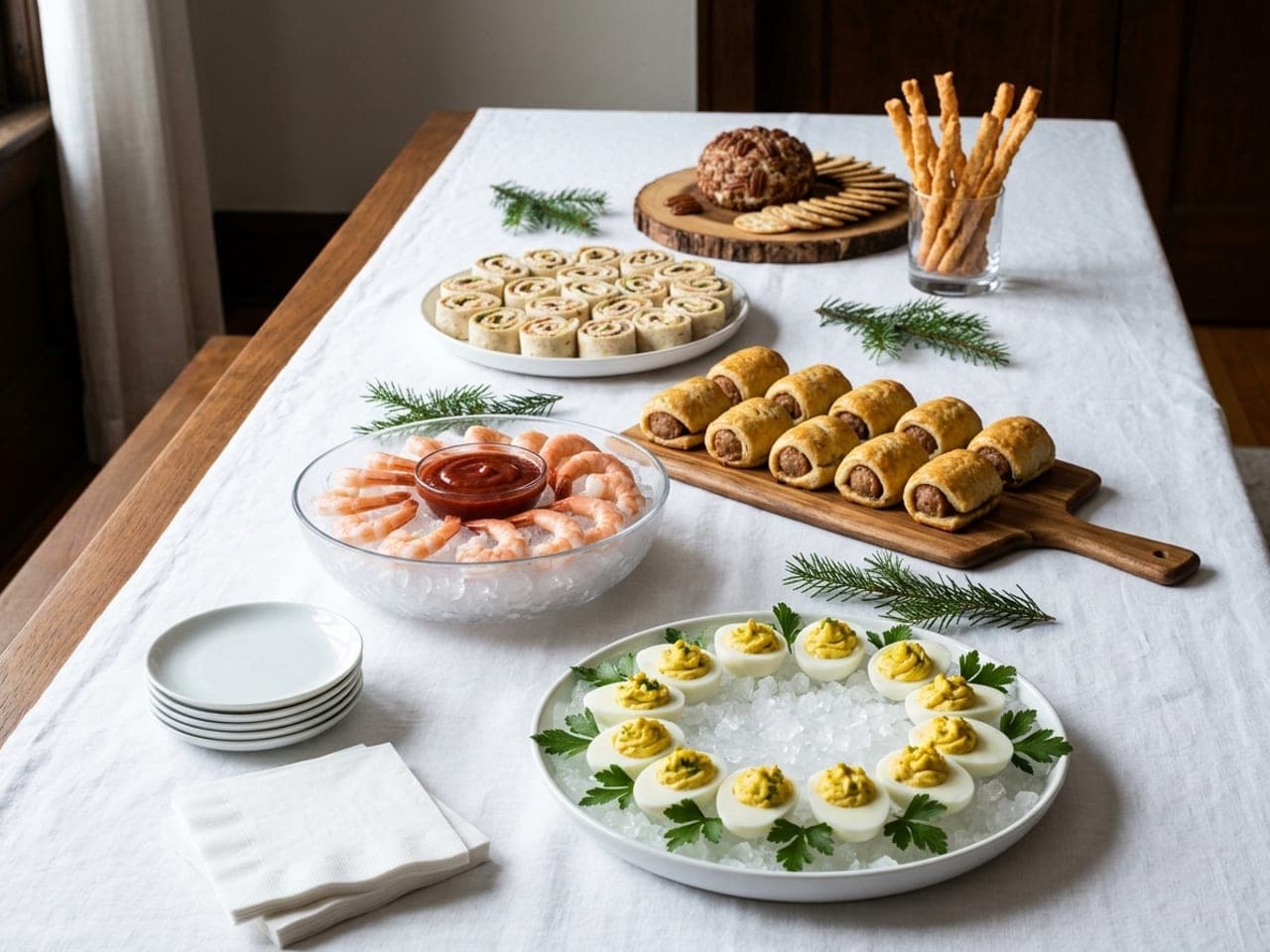
The photos on this page are AI-generated illustrations.
A Christmas appetizer party goes well when almost nothing is cooked after the doorbell. The 24 appetizers below are sorted by when the work happens: in the freezer, weeks ahead (seven), in the fridge, days ahead (nine), the morning of the party (five) and the last 30 minutes (three), then six from other countries and traditions. Every card gives the same lines: whose make-ahead window it is, the finish on the day, how it behaves on the table, one plating move and the allergens (the US nine, with the UK’s extra ones marked (UK)).
How to use it. Choose four kinds before dinner, six or more when the appetizers are the meal (how many), then work down the timeline. The chips under each card give the active time, when to make it and its holding class: 2-hour item, Keep hot or Holds all evening, explained in how long appetizers can sit out. Ten cards link a full recipe of ours with a Christmas twist; ten carry a short recipe that follows one named published recipe, credited and linked, and not kitchen-tested by us; the rest point to a guide or tool. Our own suggestions and arithmetic are labeled as ours.
The rules it follows. Temperatures are USDA’s minimums: 160°F (71°C) for ground meat and sausage, 165°F (74°C) for poultry and for anything reheated. American and British advice differ on time out, leftovers and food for pregnant and higher-risk guests, so both are given and never merged.
Freezer: made weeks ahead
Pastry that bakes from frozen, meatballs that reheat in their sauce and fried things that finish in minutes: the work is done on a quiet weekend in early December. The windows are the named cooks’ and our recipes’, and they are quality windows: frozen food stays safe indefinitely but loses moisture and flavor (USDA FSIS).
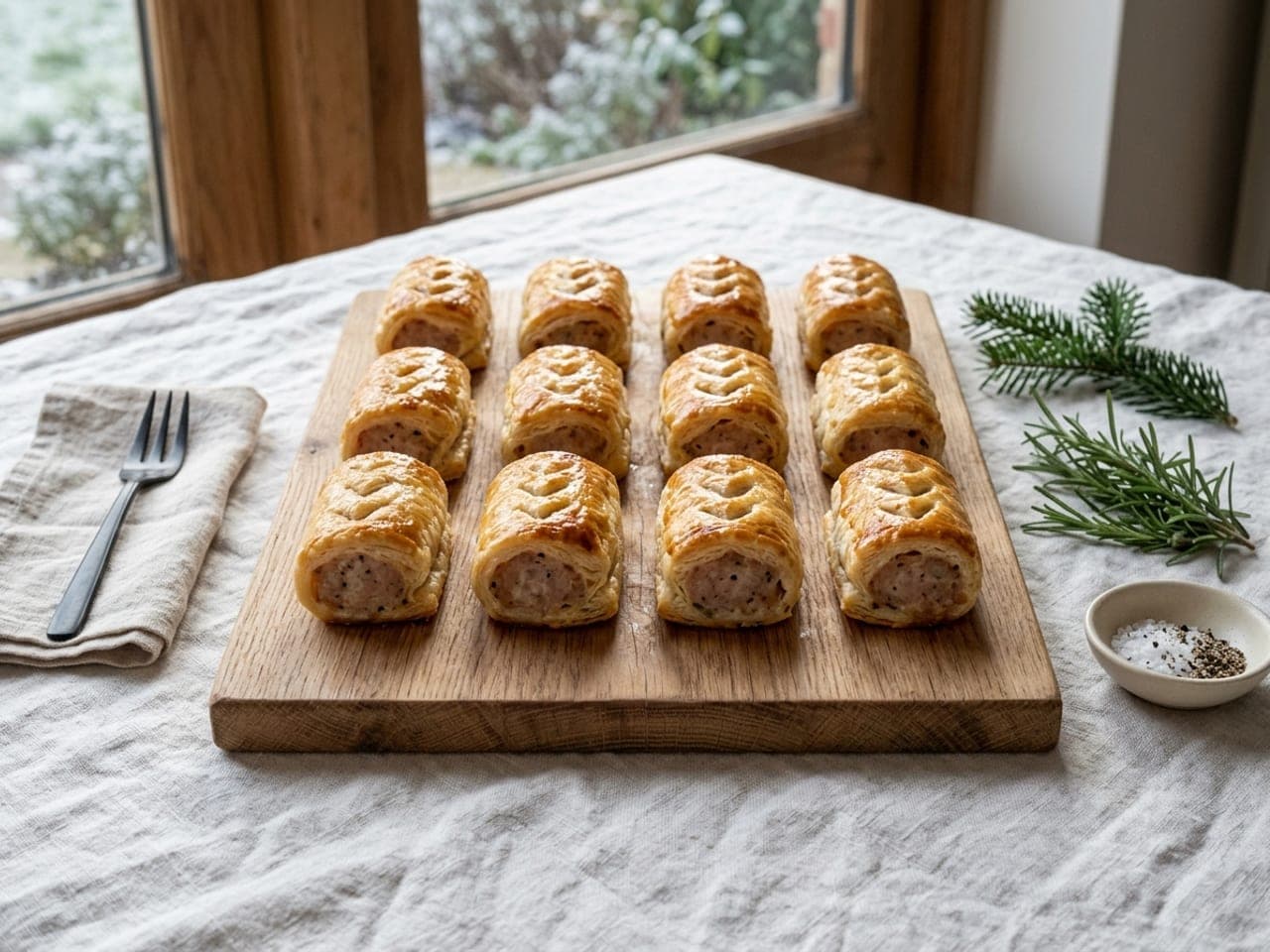
1Sausage rolls
Delia Smith’s mother’s recipe, from Delia’s Happy Christmas, and it freezes raw or baked. Make ahead: open-freeze them unglazed; Neven Maguire keeps raw ones a month, Jus-Rol 3 months. On the day: glaze and bake from frozen at 425°F (220°C, Delia’s figure) with 10 minutes added, or freeze them baked, thaw them overnight in the fridge and reheat them until 165°F (74°C) in the middle (USDA); Delia thaws baked ones for an hour at room temperature, which we do not. On the table: 2-hour item (Jus-Rol’s limit too). Plate it: two straight rows on a board. Allergens: wheat, milk, egg; sulphites (UK) in some sausagemeat.
Quick recipe · 12. After Delia Smith’s Etty’s Sausage Rolls (Delia Online); not kitchen-tested by us
Ingredients
- Delia’s quick flaky pastry: 2½ oz (75 g) butter, about 4 oz (110 g) all-purpose (plain) flour, a pinch of salt, cold water
- 8 oz (225 g) pork sausagemeat, ½ onion and 2 rounded tbsp sage, finely chopped, salt and pepper
- 1 egg, beaten, to glaze
Method
- Make the pastry as her site describes and chill it 30 minutes. Roll the seasoned meat into two 12 inch (30 cm) logs and wrap each in a 12 by 4 inch (30 by 10 cm) strip of pastry, sealed with egg, seam down.
- Cut each into six, snip the tops, glaze and bake high at 425°F (220°C, her figure) for 20 to 25 minutes. To freeze, open-freeze them unglazed and bake from frozen with 10 minutes more. Full recipe: Delia Online.
Sausagemeat is done at 160°F (71°C) in the middle (USDA): check one from frozen with a thermometer.
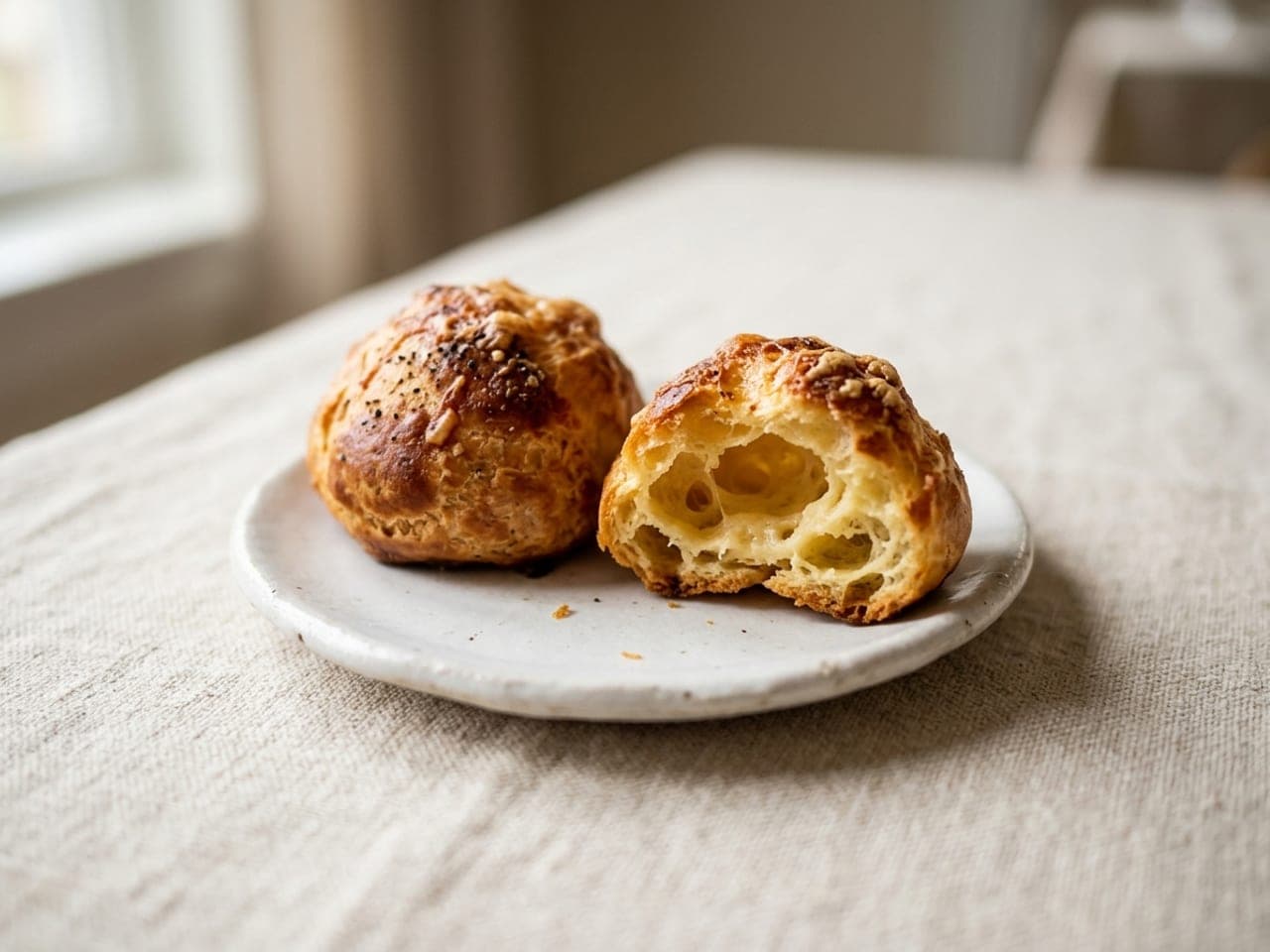
2Cheddar gougères
Cheese choux puffs, the French drinks bite, and they bake straight from the freezer. Make ahead: freeze them piped and raw: a week for Epicurious, 2 months for The Kitchn. On the day: glaze and bake from frozen, 425°F (218°C) then 350°F (177°C), about 3 minutes longer. On the table: holds all evening: Epicurious keeps baked ones airtight at room temperature for 2 days. Plate it: a linen-lined bowl, one broken open on top. Allergens: wheat, egg, milk, mustard (UK). Vegetarian only with a cheese made without animal rennet; Parmesan never is (the Vegetarian Society).
Quick recipe · About 60. After Laurie Ellen Pellicano’s Cheddar and Herb Gougères (Epicurious); not kitchen-tested by us
Ingredients
- ¾ cup (170 g) butter, ¾ cup (180 ml) each of whole milk and water, 1 tsp kosher salt (coarse)
- 1½ cups (188 g) all-purpose (plain) flour and 6 large eggs, one yolk kept back to glaze
- 8 oz (225 g) sharp cheddar, grated; 3 scallions (spring onions), 2 tbsp dill and 1 tbsp whole grain mustard
Method
- Boil the butter, milk, water and salt, add the flour at once and stir over the heat about 3 minutes, until the dough films the pan. Beat in 5 eggs and the spare white for 8 to 10 minutes, to glossy soft peaks, fold in the scallions, dill, mustard and half the cheese, and pipe 1 inch (2.5 cm) rounds.
- Glaze, top with the rest of the cheese and bake 10 minutes at 425°F (218°C), then 15 at 350°F (177°C) and 5 to 7 more. To freeze, freeze the piped rounds and bake from frozen with about 3 minutes added. Full recipe: Epicurious.
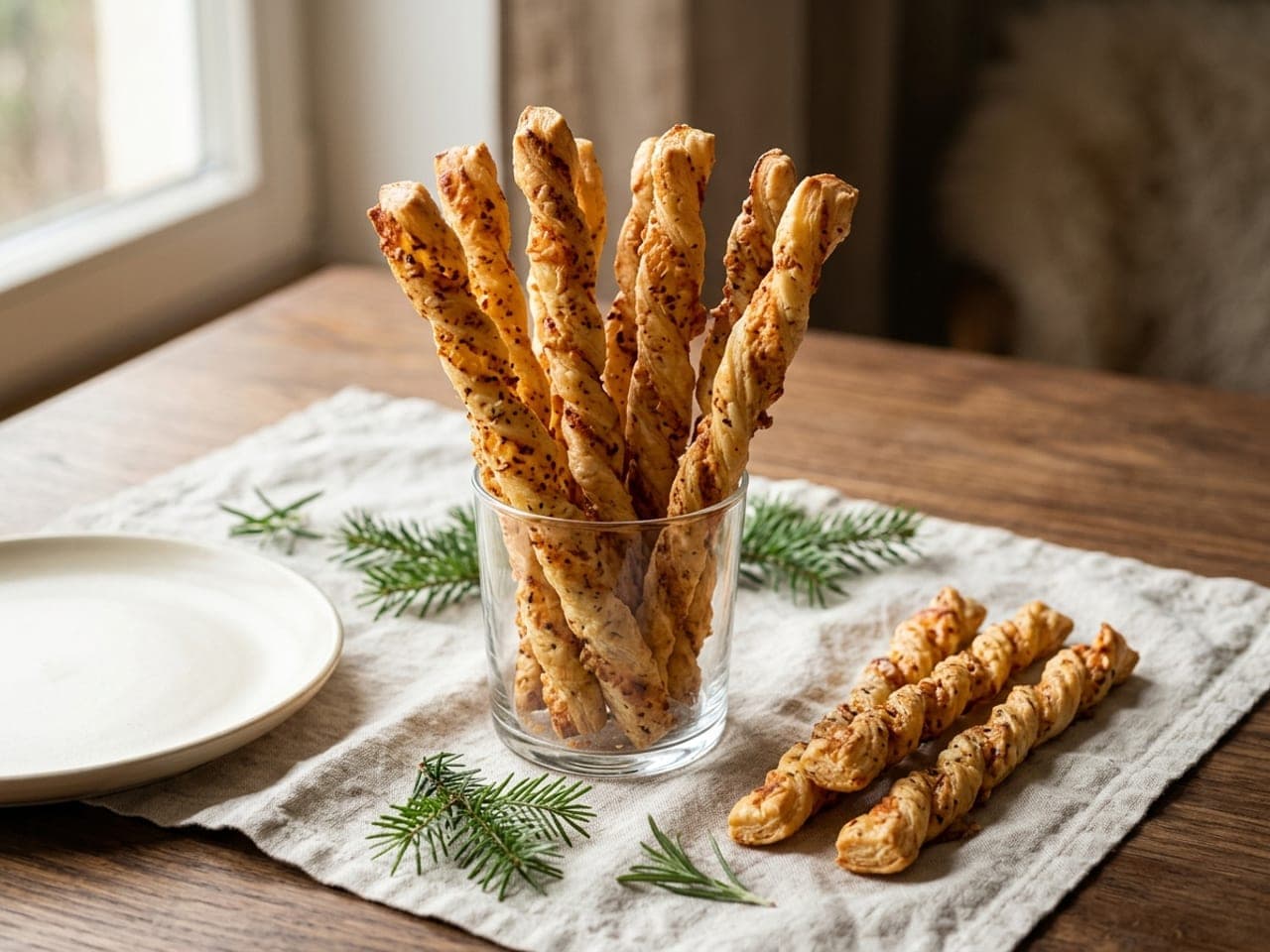
3Cheese twists
Store-bought puff pastry, cheese and paprika, twisted into straws. Make ahead: Bon Appétit freezes the unbaked twists, wrapped on the sheet, up to a month. On the day: bake from frozen at 400°F (204°C), 12 to 18 minutes plus a few. On the table: holds all evening by a food blog’s measure (Seasons and Suppers keeps baked puff pastry bites a day, airtight); Pepperidge Farm, the pastry maker, says puff pastry should be eaten within a few hours of baking. Plate it: upright in a tumbler. Allergens: wheat, milk, egg. Vegetarian only with a cheese made without animal rennet; Parmesan never is (the Vegetarian Society).
Quick recipe · About 14 long twists. After Claire Saffitz’s Crispy Cheese Twists (Bon Appétit); not kitchen-tested by us
Ingredients
- 6 oz (170 g) hard cheese, grated: Gruyère, Parmesan, Manchego or extra sharp cheddar
- One 14 to 17 oz (400 to 480 g) package puff pastry, thawed overnight in the fridge
- 1 egg yolk, 1 tsp sweet paprika, ¼ tsp cayenne, salt and plenty of black pepper
Method
- Heat the oven to 400°F (204°C). Brush half the pastry with the yolk mixed with 1 tsp water, cover with half the cheese and spices, lay the other half on top, brush and repeat.
- Roll just under ¼ inch (6 mm) thick, cut ½ inch (1 cm) strips, twist them and bake 12 to 18 minutes. To freeze, wrap the unbaked twists on the sheet, up to a month, and bake from frozen. Full recipe: Bon Appétit.
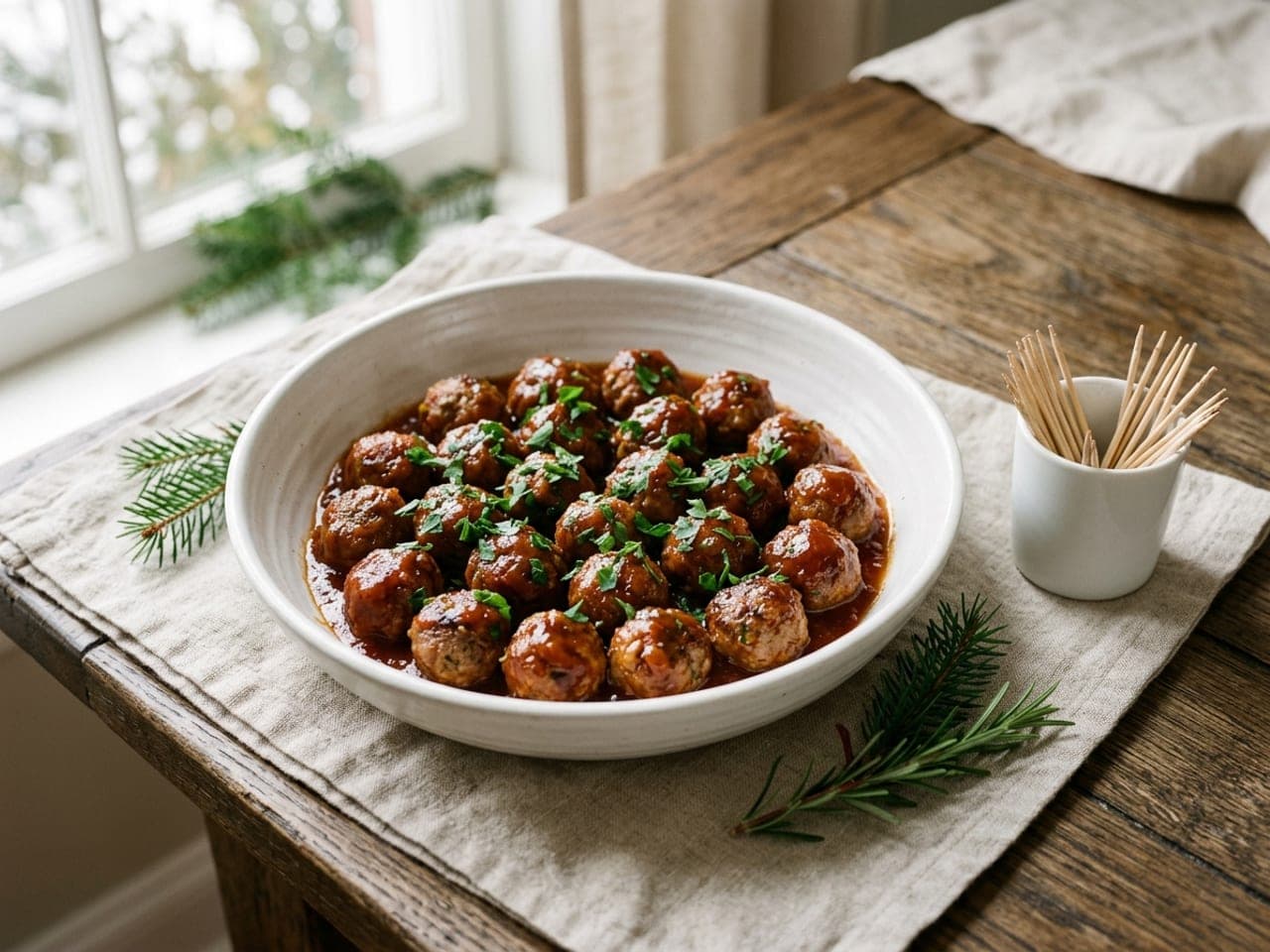
4Sweet and sour cocktail meatballs
America’s Test Kitchen’s party batch: about 80 meatballs, for 20. Make ahead: bake the meatballs, make the sauce, and freeze both separately up to a month. On the day: simmer the sauce on the stove and cook the frozen meatballs in it 10 to 15 minutes, to 165°F (74°C). On the table: keep hot, at 140°F (60°C) or above, or the 2-hour rule: a preheated slow cooker holds them once hot, but should not reheat them (USDA FSIS). Plate it: a shallow bowl, picks beside it. Allergens: wheat, milk, egg, fish (Worcestershire), mustard (UK); British Worcestershire adds barley (UK).
Quick recipe · About 80, for 20. After America’s Test Kitchen’s Make-Ahead Sweet and Sour Cocktail Meatballs; not kitchen-tested by us
Ingredients
- Meatballs: 4 slices white sandwich bread, ½ cup (120 ml) milk, 2 egg yolks, ½ lb (227 g) ground pork, 2½ lb (1.1 kg) 85 percent lean ground beef, ½ cup (120 ml) parsley, 2 garlic cloves, salt and pepper
- Sauce: 1 onion, one 28 oz (794 g) can tomato sauce, 2½ cups (600 ml) apricot preserves (jam), ¼ cup (55 g) dark brown sugar, 3 tbsp Worcestershire sauce, 2 tbsp Dijon mustard, ¼ tsp pepper flakes
- 1 tbsp vegetable oil
Method
- Mash the bread, milk and yolks, mix in the rest of the meatball ingredients, roll about 80 balls of 1¼ inches (3 cm) and bake on two sheets at 450°F (232°C) for 12 to 15 minutes. Cool, chill and freeze up to a month.
- Soften the onion in the oil, add the rest of the sauce, simmer 15 minutes, cool and freeze it separately. To serve, bring the sauce to a simmer and cook the frozen meatballs in it 10 to 15 minutes. Full recipe: America’s Test Kitchen.
160°F (71°C) when first baked, 165°F (74°C) when reheated (USDA). FSIS says not to reheat cold meatballs in a slow cooker, which another ATK recipe does.
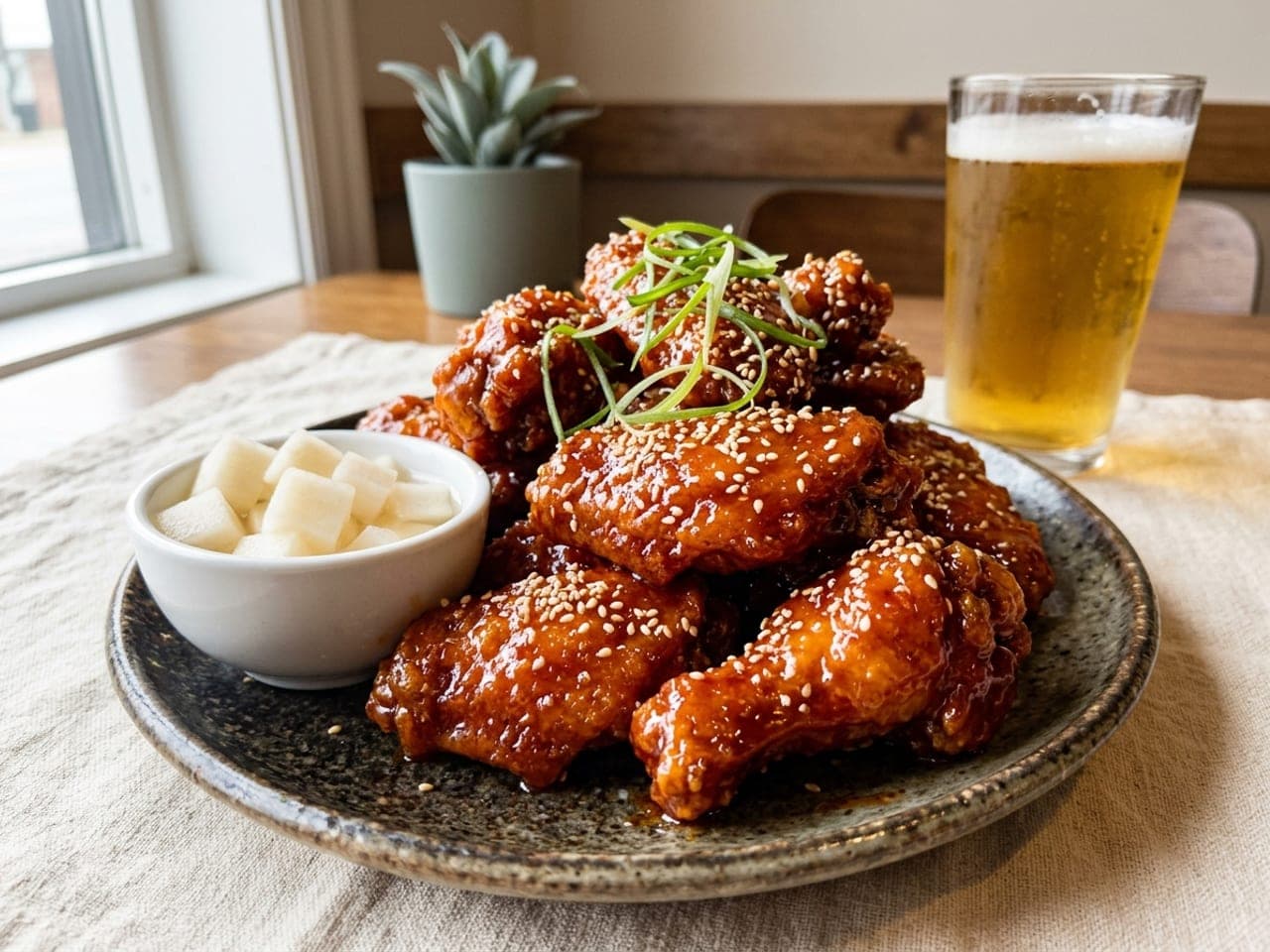
5Korean fried chicken wings
Party wings whose crust stays crackly under the glaze. Make ahead: our recipe stops after the first fry: a few hours in the fridge, or up to a month frozen. On the day: second-fry from frozen with 2 to 3 extra minutes, to 165°F (74°C) at the bone, then sauce them. On the table: keep hot, at 140°F (60°C) or above, or the 2-hour rule. Plate it: one deep pile, a bowl for bones and a stack of napkins. Allergens: wheat, soy, sesame; peanut if fried in peanut oil; sulphites (UK) in the rice wine or sherry.
The twist: The gochujang glaze is already Christmas red: sauce half the batch with it and the other half with the soy-garlic glaze, and shower both with thin threads of green onion (spring onion) so the platter reads red and green.
Full recipe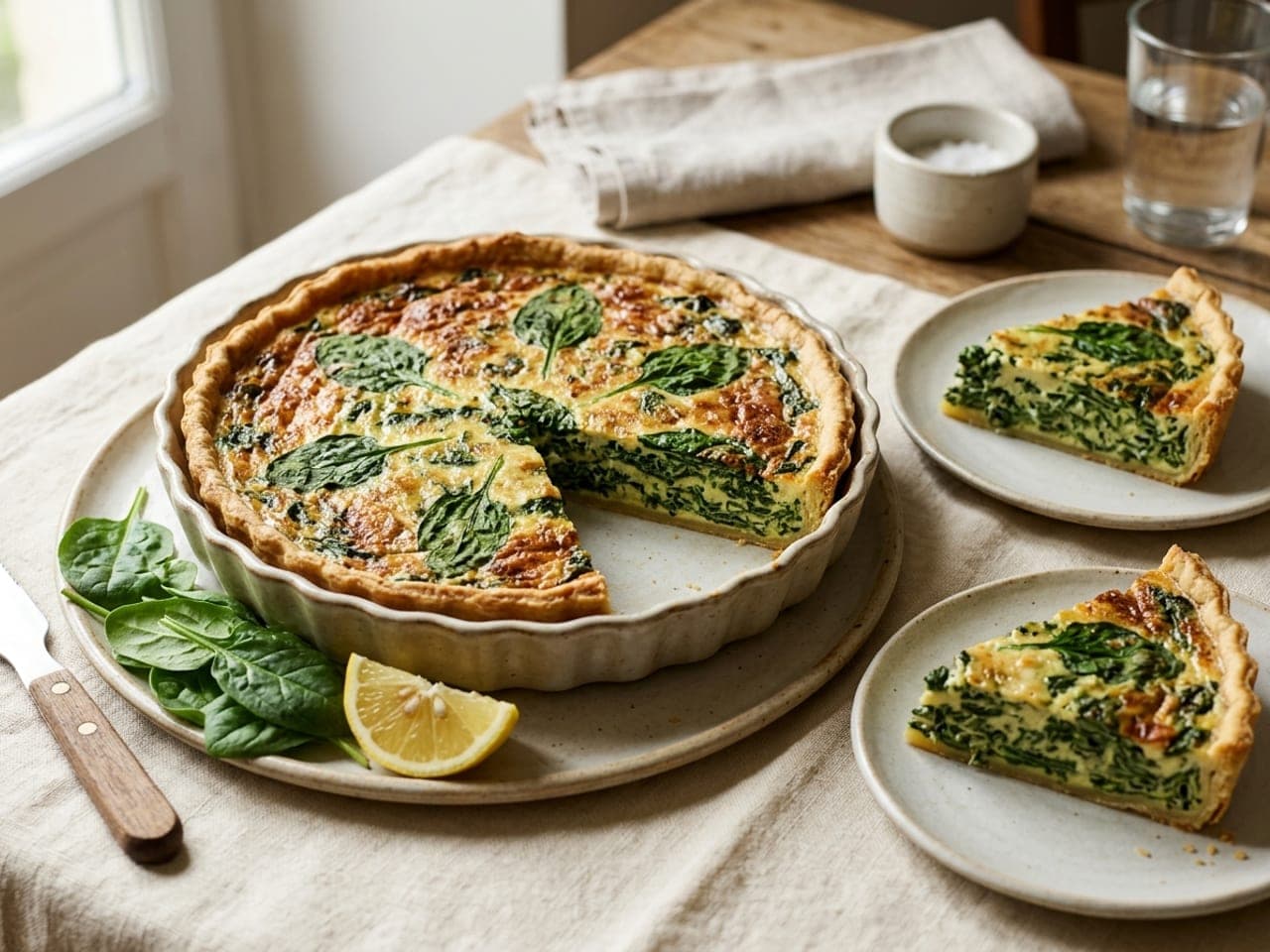
6Spinach quiche in party wedges
Our recipe says this quiche is best barely warm or at room temperature, which suits a party. Make ahead: bake it and refrigerate it covered up to 3 to 4 days, or freeze it baked for 2 months and thaw it overnight in the fridge. On the day: serve it at room temperature, as our recipe allows and our timeline does, or rewarm it at 325°F (163°C) for 12 to 15 minutes, to 165°F (74°C). On the table: 2-hour item. Plate it: slim wedges fanned on a round board. Allergens: wheat, milk, egg. Vegetarian only with a cheese made without animal rennet: check the Gruyère’s label.
The twist: Cut the 9 inch (23 cm) quiche into 16 slim wedges instead of 8 and scatter a few pomegranate seeds over each just before serving, red on green.
Full recipe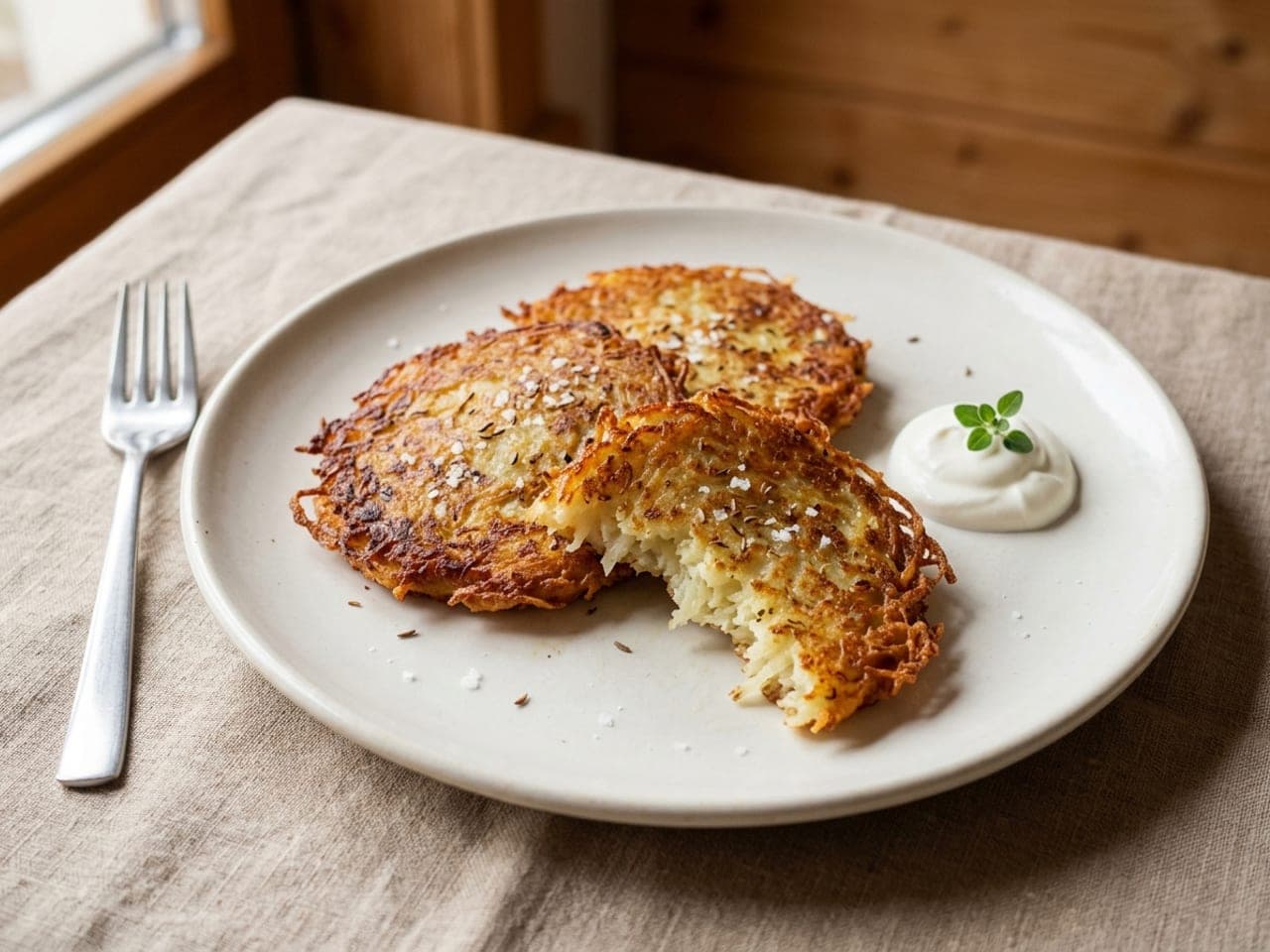
7Bramboráčky, little Czech potato pancakes
Garlic and marjoram potato pancakes, the Czech pub classic, fried small enough to eat in two bites. Make ahead: our recipe freezes fried pancakes in a single layer, then packs them with parchment between, best within about 2 months. On the day: reheat once, on a rack at 400°F (204°C) for 10 to 15 minutes plus a few from frozen, until steaming hot (165°F / 74°C). On the table: keep hot, at 140°F (60°C) or above, or the 2-hour rule. Plate it: overlap them in a ring with sour cream in the middle. Allergens: wheat, egg, milk. Fried in lard they are not vegetarian.
The twist: Fry heaped tablespoons of batter instead of full pancakes, about 2 inches (5 cm) across, and top each with a dab of sour cream and a few snipped chives just before they go out.
Full recipe
Fridge: 1 to 3 days ahead, or a week for the pickles
Pickles, cured fish, dips and anything a night in the fridge does not hurt. Where a cook’s window and an agency’s storage limit differ, the card gives both.
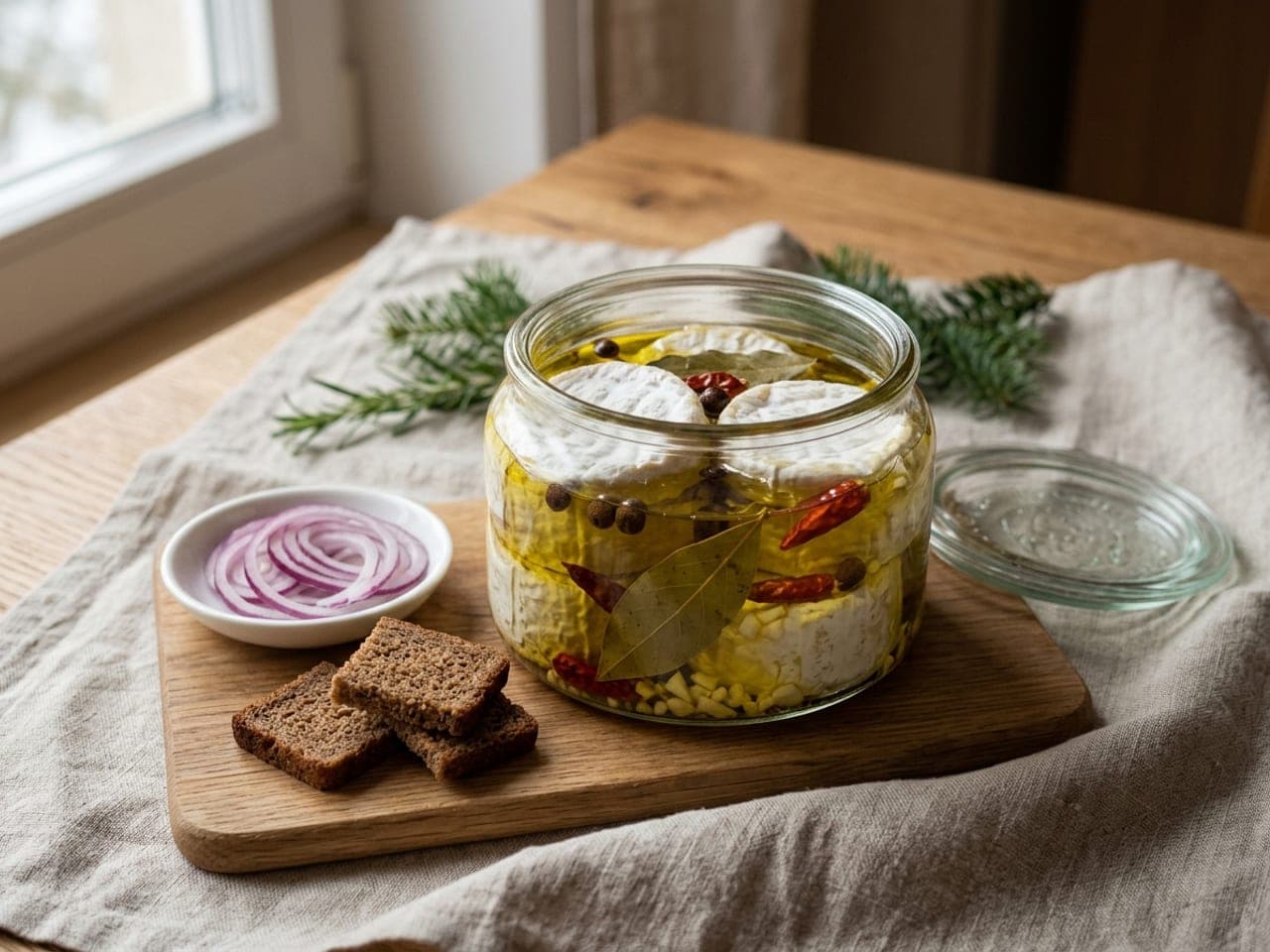
8Marinated Hermelín
Czech Camembert-style cheese marinated in oil with garlic, dried chillies and allspice. Make ahead: our recipe marinates it at least 3 to 4 days and eats it by day 10. Its garlic is acidified first and the onion stays out of the jar: plain garlic in oil gets only 4 days in the fridge (National Center for Home Food Preservation). On the day: take out only what you will serve. On the table: 2-hour item. Plate it: wedges on dark bread, raw onion on top. Allergens: milk. For pregnant guests the NHS says camembert-style cheese must be cooked; the CDC flags soft cheese made from raw milk (higher-risk guests). Vegetarian only with a Hermelín made without animal rennet: check the label.
The twist: Cut each cheese into 8 small wedges, spear each on a cocktail pick with a ring of the fresh onion, and set them on a board next to small squares of dark rye bread. (The gluten-free tag is for the cheese alone, not the bread.)
Full recipe
9Utopenci, Czech pickled sausages
Sausages pickled in vinegar with onion, allspice and chilli, sharp enough to cut through rich party food. Make ahead: at least 3 days in the fridge; our recipe says 5 to 7 days tastes deeper. On the day: nothing to cook. On the table: 2-hour item: a small bowl, swapped for a fresh one from the fridge, never topped up. Plate it: coins on picks with pickled onion. Allergens: check the sausages for wheat and milk; sulphites (UK) in vinegar. Eaten cold, so not for pregnant or higher-risk guests: the FDA lists hot dogs and deli meats unless reheated until steaming hot.
The twist: Slice the pickled sausages into thick coins and thread each on a cocktail pick with a ring of pickled onion and a sliver of the chilli: a red and white bite that needs no plate.
Full recipe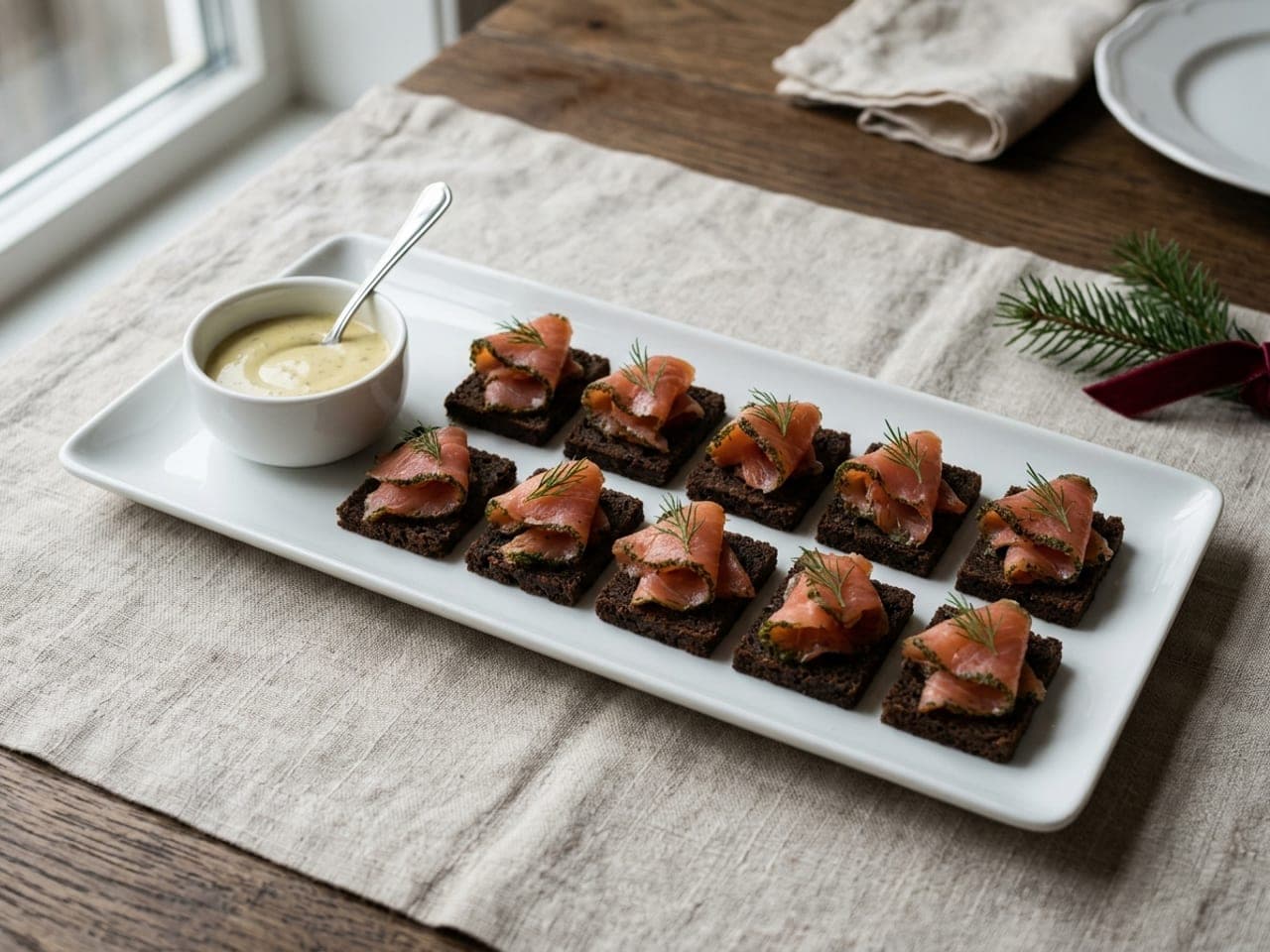
10Gravlax on pumpernickel
Salmon cured under salt, sugar and dill, the cured fish of the Swedish Christmas table. Make ahead: Serious Eats cures it 2 days (1 or 2 more for a firmer cure) and keeps it about 5 days after curing; NYT Cooking and The Washington Post print 5 days to a week. On the day: slice thin on the bias. On the table: 2-hour item. Plate it: one fold per square of bread. Allergens: fish, mustard (UK); wheat, and rye (UK), in most pumpernickel. Not for pregnant or immunocompromised guests (UK agencies; older guests should be aware); in the US, raw fish is on the FDA’s at-risk list.
Quick recipe · 10 to 15 as an hors d’oeuvre. After Daniel Gritzer’s Gravlax With Caraway, Coriander, and Mustard-Dill Sauce (Serious Eats), shortened; not kitchen-tested by us
Ingredients
- One 2 lb (900 g) skin-on sushi-grade salmon fillet, pin bones out: tell the fishmonger you will eat it raw
- Cure: 40 g (about 4 tbsp) kosher salt (coarse), 15 g (about 1 tbsp) sugar, 1 tsp each of caraway and coriander seeds, toasted and ground, ½ tsp white pepper, 2 large bunches dill
- Sauce: 3 tbsp white vinegar, 5 tbsp (75 ml) Dijon mustard, 1 tbsp sugar, 2 tbsp dill, ¼ cup (60 ml) canola oil; pumpernickel to serve
Method
- Rub the salmon all over with the cure and sandwich it, skin side down, between the two bunches of dill in a dish. Cover, weight and refrigerate 1 day; turn it and give it 1 or 2 days more.
- Blend the sauce, adding the oil last. Scrape off the dill, slice thin on the bias and serve on pumpernickel. Full recipe: Serious Eats.
Raw fish: the US Food Code makes restaurants freeze it first, at -4°F (-20°C) or below for 7 days, unless it is farmed salmon raised on pellet feed. A home freezer at 0°F (-18°C) is warmer than that (our comparison).
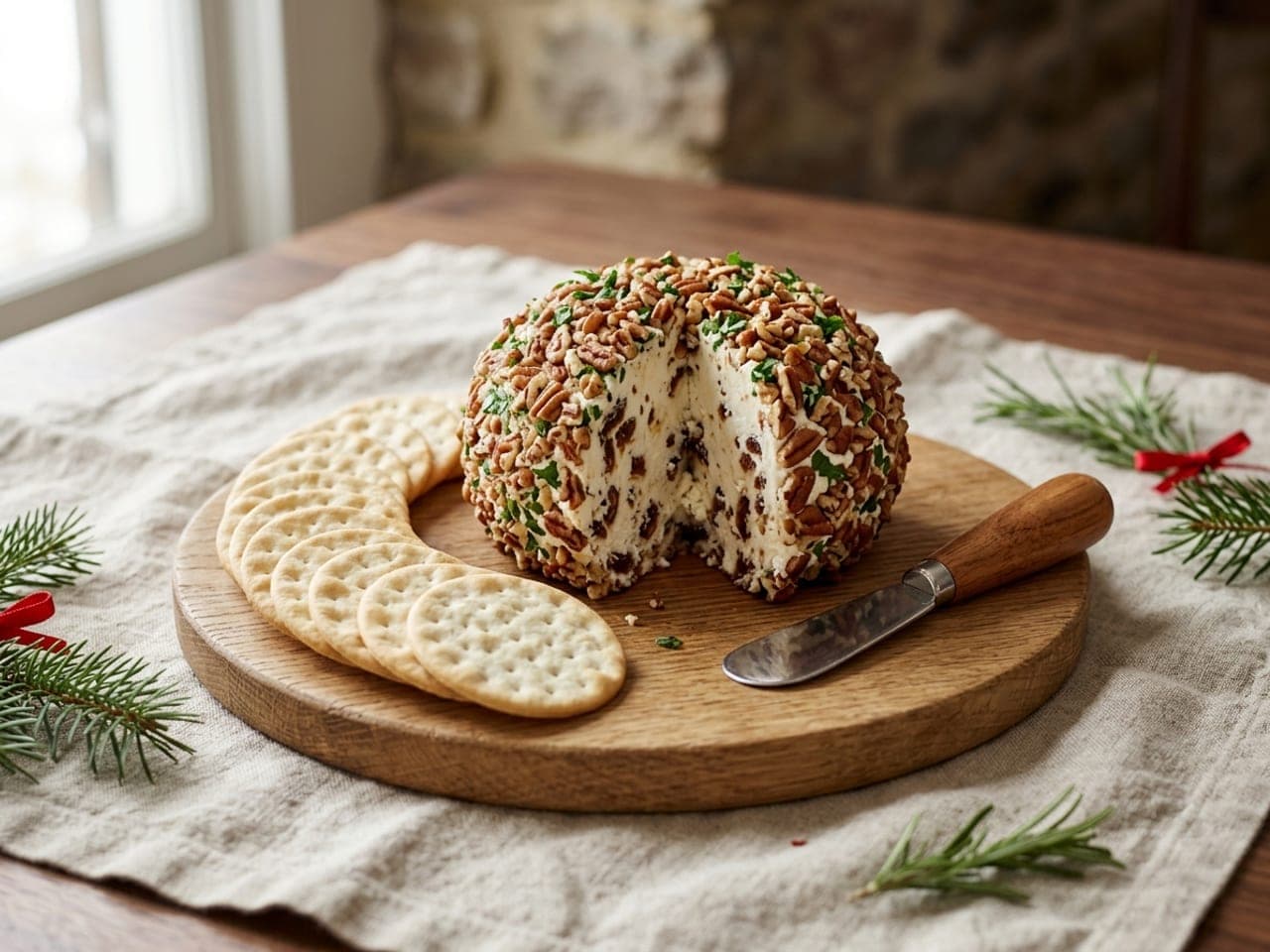
11Goat cheese ball with dates and pecans
The retro party cheese ball, made with goat cheese, cream cheese, dates and scallions. Make ahead: Jennifer Segal makes it 3 days ahead, or freezes it a month, thaws it overnight in the fridge and adds the nuts after; Midwest Living freezes its own 3 months. On the day: roll it in pecans and parsley and let it soften 30 minutes. On the table: 2-hour item, and the softening counts. Plate it: crackers fanned to one side. Allergens: milk, tree nuts; wheat and sesame in most crackers. Vegetarian with a goat cheese made without animal rennet.
Quick recipe · 1 large or 2 small balls. After Jennifer Segal’s Cheese Ball (Once Upon a Chef), from Vivian Howard’s Deep Run Roots; not kitchen-tested by us
Ingredients
- 4 oz (113 g) goat cheese, 3 oz (85 g) cream cheese and 5 tbsp butter, all soft
- ⅓ cup (60 g) chopped pitted dates, 3 tbsp chopped scallions (spring onions), ½ tsp hot sauce, ¼ tsp salt
- ⅓ cup (40 g) chopped salted pecans and 1 tbsp chopped parsley
Method
- Beat the cheeses, butter, hot sauce and salt, mix in the dates and scallions, chill 15 minutes, then twist into a ball in plastic wrap (cling film) and chill at least an hour.
- Roll it in the pecans and parsley and let it soften 30 minutes before serving. Full recipe: Once Upon a Chef.
For a guest who cannot eat nuts, roll a second small ball in parsley alone and give it its own board and knife.
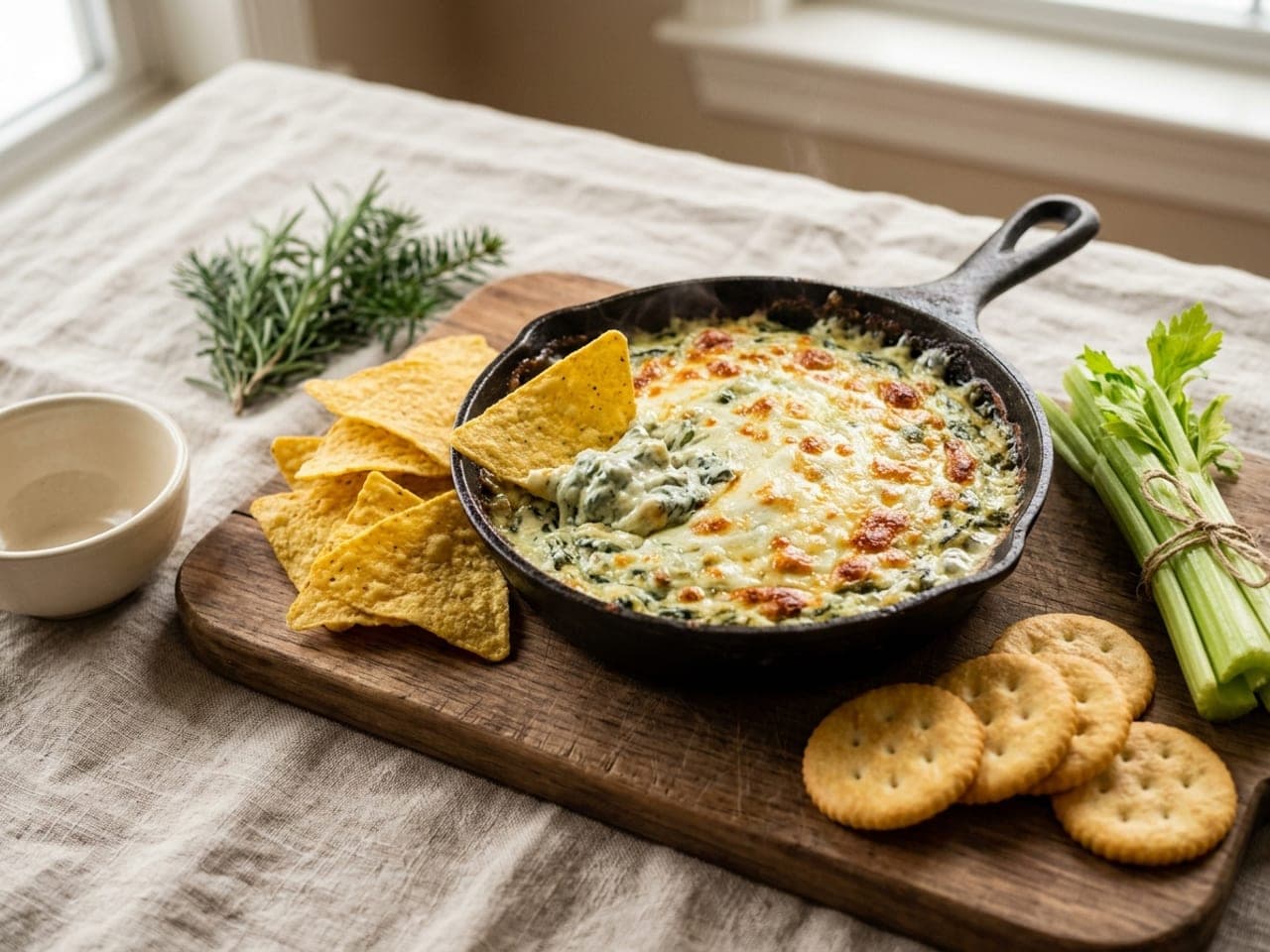
12Hot spinach and artichoke dip
Four dairy products, spinach and artichoke, baked until bubbling. Make ahead: The Kitchn assembles it in its dish under foil up to a day ahead; America’s Test Kitchen keeps its own unbaked 2 days. On the day: bake uncovered at 375°F (191°C) for about 30 minutes. On the table: keep hot, at 140°F (60°C) or above, or the 2-hour rule: bake two smaller dishes together and keep the second in the oven at 225°F (107°C), the FDA’s hot back-up range, until the first is empty. Plate it: chips and crudités around the dish. Allergens: milk, egg; wheat in most dippers. With Parmesan it is not vegetarian (the Vegetarian Society).
Quick recipe · About 4 cups (950 ml), for 12. After Christine Gallary’s Spinach Artichoke Dip (The Kitchn); not kitchen-tested by us
Ingredients
- 10 oz (283 g) frozen chopped spinach, thawed and squeezed dry; one 14 oz (400 g) can artichoke hearts, chopped
- 8 oz (227 g) cream cheese, 1 cup (240 ml) sour cream, ½ cup (120 ml) mayonnaise, 1 oz (28 g) Parmesan, 1 cup (113 g) shredded mozzarella
- 3 scallions (spring onions), 2 garlic cloves, salt, pepper and the zest of a lemon
Method
- In a 10 inch (25 cm) cast iron skillet, stir everything except half the mozzarella and the zest over medium heat for 8 to 10 minutes, until melted and steaming; stir in the zest and top with the rest of the mozzarella.
- Broil (grill) 3 to 5 minutes to serve now, or cover with foil, refrigerate up to a day and bake uncovered at 375°F (191°C) for about 30 minutes. Full recipe: The Kitchn.
From the fridge, bake it to 165°F (74°C) in the middle (USDA’s reheating figure).
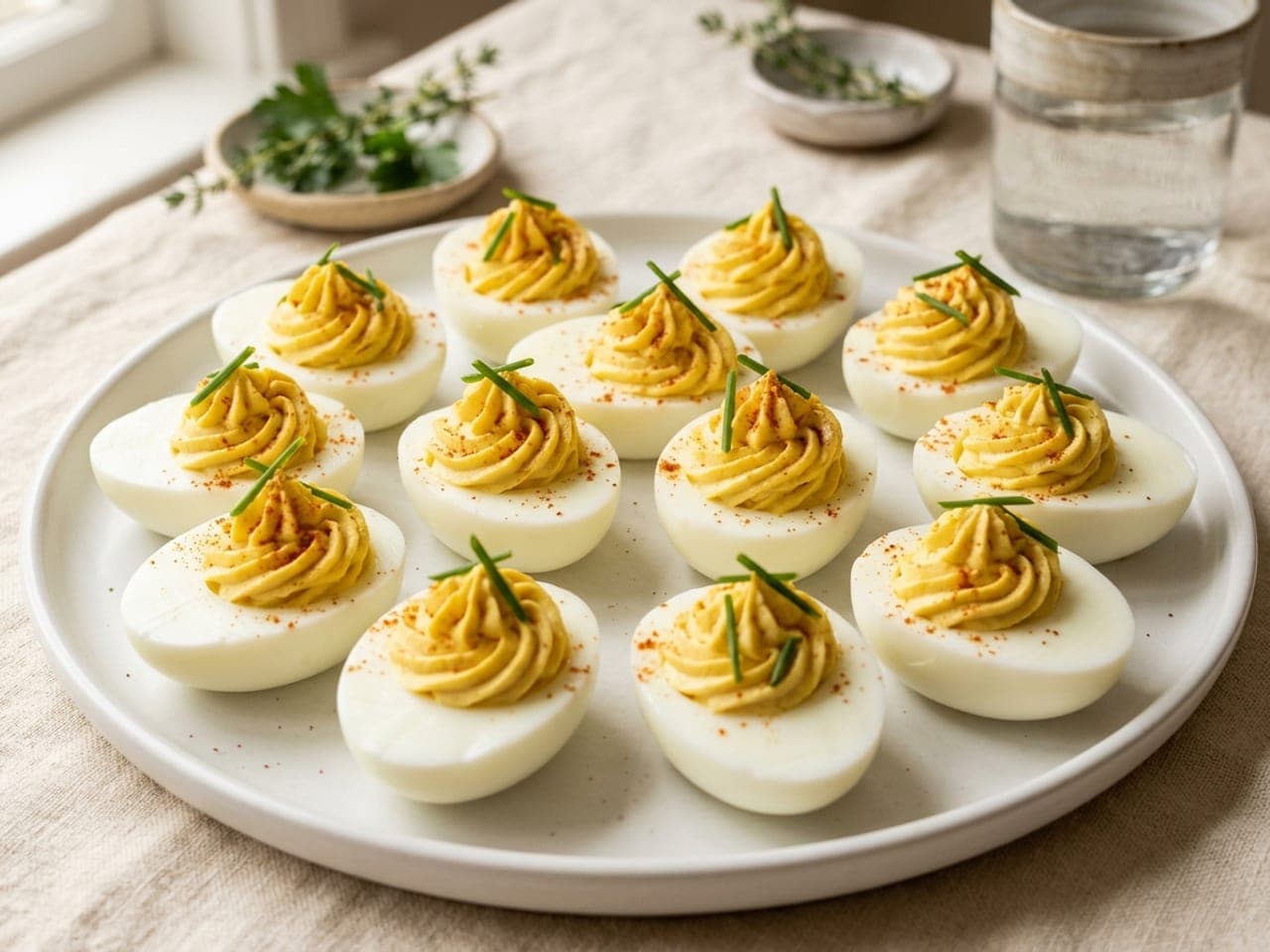
13Deviled egg wreath
The American party egg, and not a canapé. Make ahead: our recipe’s US plan cooks the eggs up to a week ahead in their shells, stores whites and filling apart up to 2 days, and pipes within a few hours of serving; UK guidance squeezes it all into 2 days. On the day: pipe, then garnish at the last minute. On the table: 2-hour item, or on ice past 2 hours (FDA). Plate it: a ring on a round platter over crushed ice, as in the twist. Allergens: egg, mustard (UK); sulphites (UK) in some Dijon and vinegar; fish if you add Worcestershire, which also makes them not vegetarian.
The twist: Make two batches and lay the 24 halves in a ring on a round platter over crushed ice with flat-leaf parsley tucked between them, and finish each with a fleck of paprika and a chive tip just before they go out: a wreath, made from the recipe’s own garnish.
Full recipe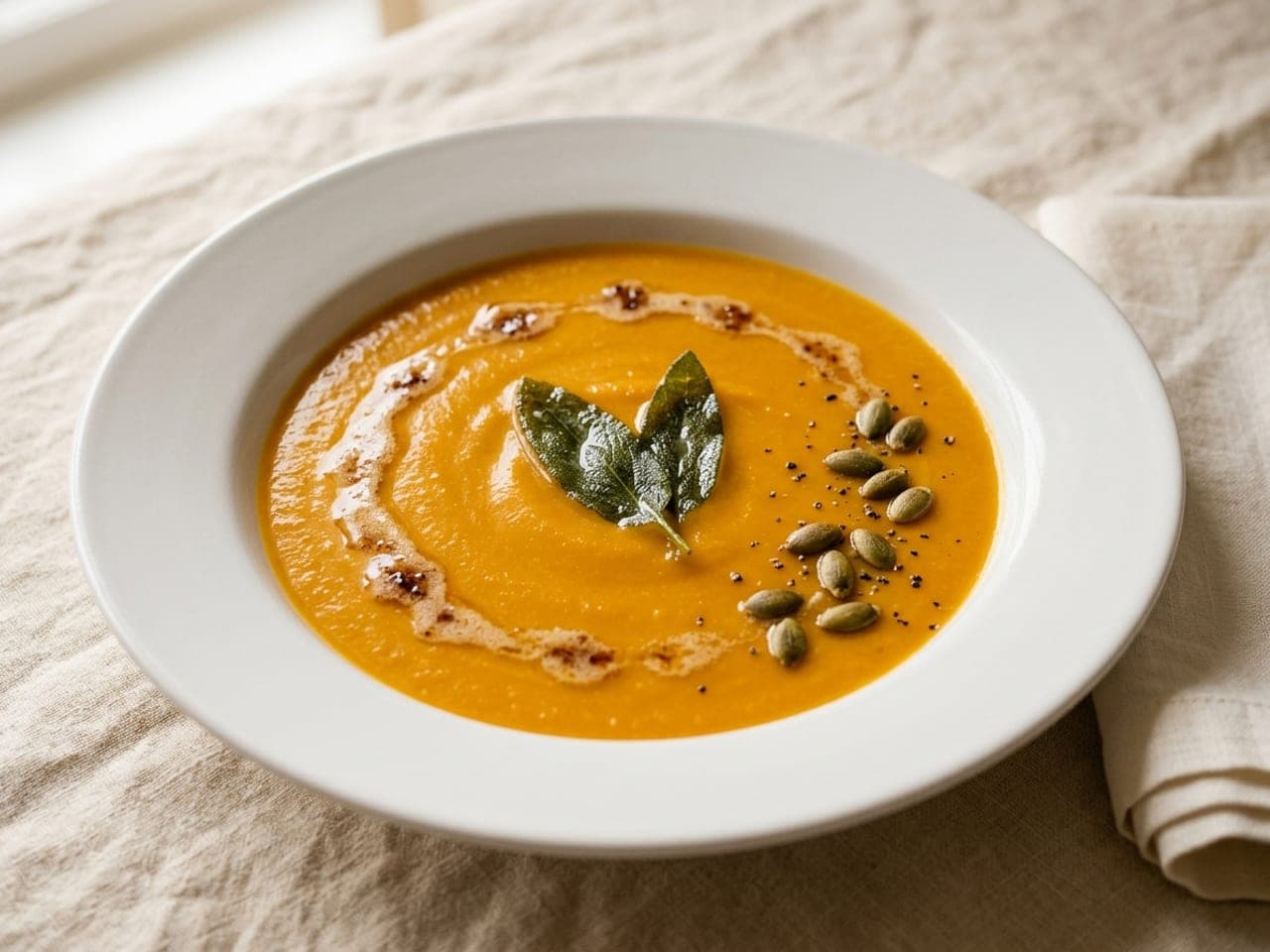
14Butternut squash soup in cups
A hot starter guests can drink standing up. Make ahead: our recipe makes it 2 to 3 days ahead in the US, inside the 3 to 4 day fridge window (no more than 2 days ahead in the UK), or freezes it plain for 2 to 3 months, thawed in the fridge and used within 3 to 4 days (US) or 24 hours (UK). On the day: reheat only what you will serve, to 165°F (74°C). On the table: keep hot, at 140°F (60°C) or above, or the 2-hour rule: keep the pot on the lowest heat that holds it at 140°F (60°C) or above and fill a warmed jug from it for each round. Plate it: a dot of crème fraîche per cup. Allergens: milk; celery (UK) in some stock, sulphites (UK) in the vinegar.
The twist: Pour ¼ cup (60 ml) into each small cup: by our division the batch the recipe pours as ten 3/4 cup (180 ml) servings fills about 30 of them. Top each with a dot of crème fraîche and a fried sage leaf (fry more than the recipe’s 12).
Full recipe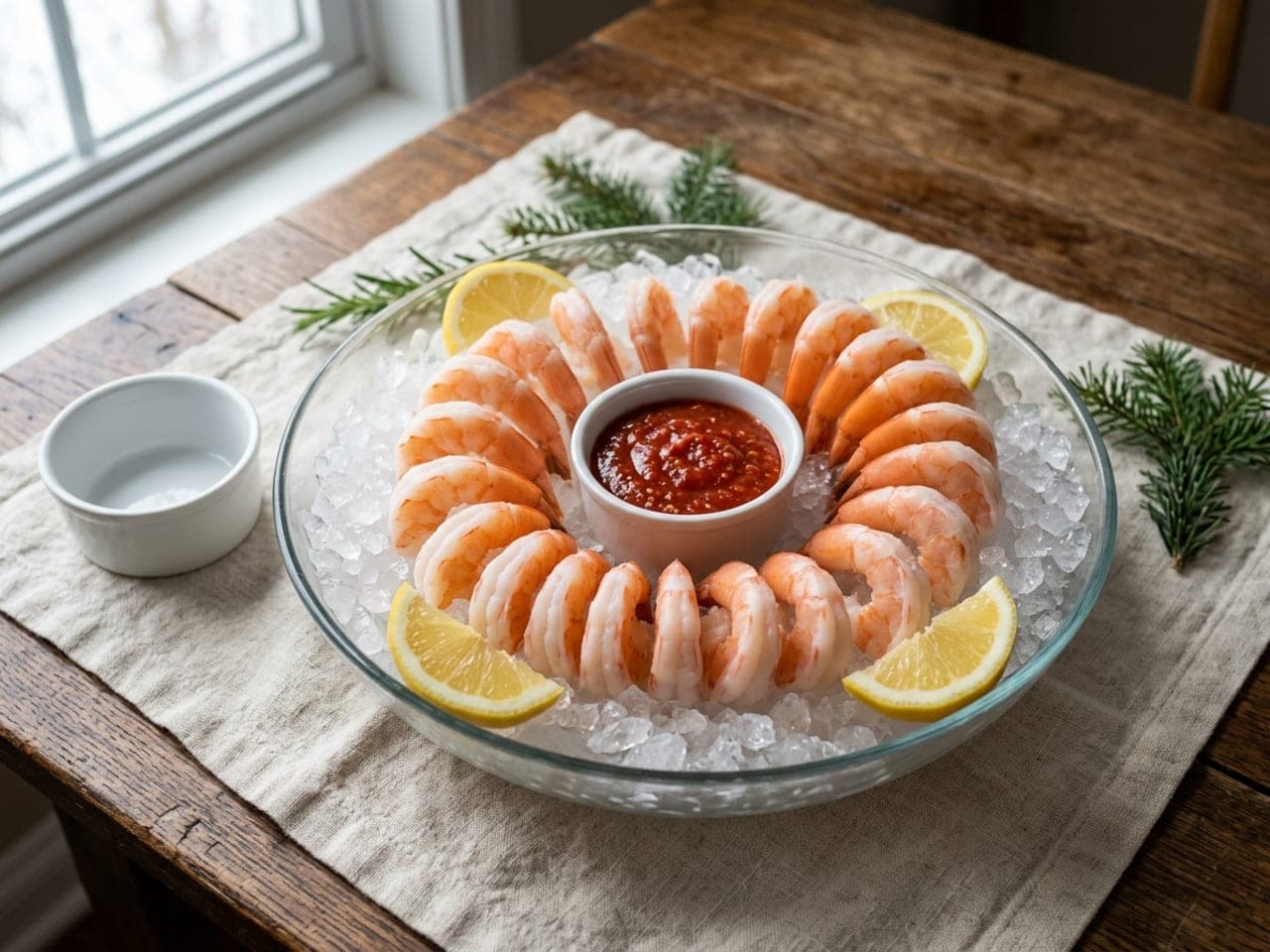
15Shrimp cocktail on ice
Big poached shrimp on cracked ice with a horseradish cocktail sauce. Make ahead: Bon Appétit poaches and peels the shrimp a day ahead and makes the sauce a day ahead; Alison Roman makes her sauce 2 weeks ahead. Cooked shrimp keep 3 to 4 days in the fridge (USDA FoodKeeper). On the day: nothing to cook. On the table: 2-hour item; FDA allows cold seafood longer only on ice. Plate it: a ring of shrimp around the sauce on cracked ice, a dish for tails beside it. Allergens: crustacean shellfish; check the chili sauce, horseradish and frozen shrimp labels for sulphites (UK), egg and milk.
Quick recipe · 4 servings. After Molly Baz’s BA’s Best Shrimp Cocktail (Bon Appétit); not kitchen-tested by us
Ingredients
- 1 lb (450 g) shell-on jumbo or large shrimp (prawns), deveined
- To poach: 6 cups (1.4 l) water, 4 tbsp Diamond Crystal kosher salt (coarse), ¼ cup (50 g) sugar, 2 lemons, 8 cups (1.9 l) ice
- Sauce: 1 cup (240 ml) chili sauce, 2 tbsp each of lemon juice and prepared horseradish, ¾ tsp lemon zest, 2 tsp black pepper, ¾ tsp hot sauce
Method
- Boil the water with the salt, sugar and squeezed lemons, take it off the heat and poach the shrimp 3½ minutes, until opaque all the way through (cut one), then tip in the ice and leave them 10 minutes. Drain, peel, pat dry and chill: up to a day ahead.
- Mix and chill the sauce, also up to a day. Serve the shrimp on cracked ice with lemon wedges and the sauce. Full recipe: Bon Appétit.
Keep the ice up to the level of the shrimp. For pregnant guests the NHS says cold, ready-to-eat prawns must be cooked until steaming hot.
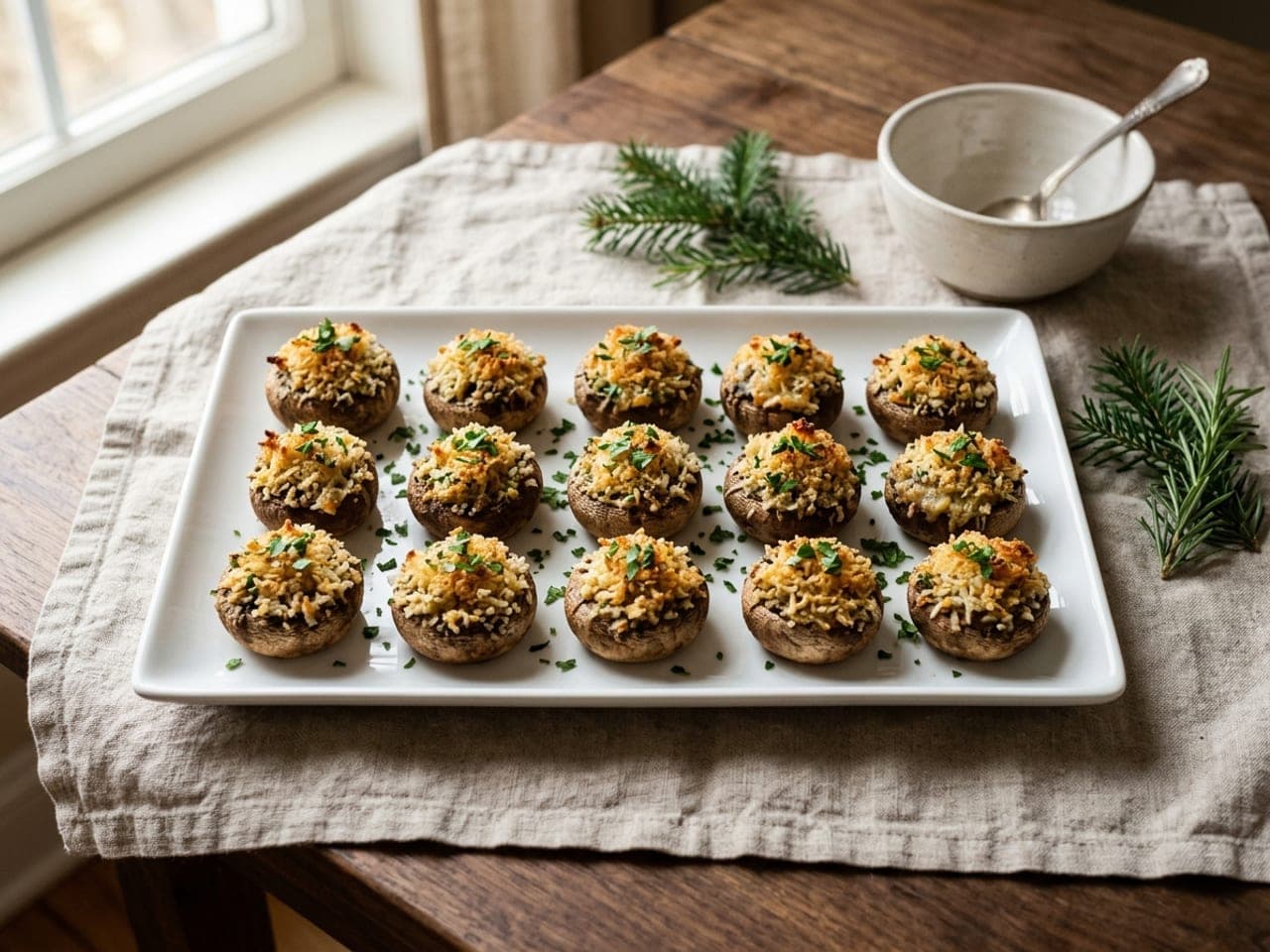
16Cheese and herb stuffed mushrooms
Cremini caps under a crisp panko, parsley and two-cheese stuffing. Make ahead: The Kitchn stuffs them up to a day ahead, in an airtight container in the fridge. On the day: bake at 400°F (204°C) for 16 to 18 minutes, plus 2 to 3 from the fridge, until golden. On the table: keep hot, at 140°F (60°C) or above, or the 2-hour rule. Plate it: rows on a warm platter, parsley over. Allergens: milk, wheat. With Parmesan they are not vegetarian; swap in a vegetarian hard cheese.
Quick recipe · 24, for 12. After Patty Catalano’s Stuffed Mushrooms (The Kitchn); not kitchen-tested by us
Ingredients
- 24 cremini mushrooms, 1½ to 2 inches (4 to 5 cm) wide, stems chopped and gills scraped out
- 3 tbsp olive oil, 1 small shallot, 2 garlic cloves, salt and pepper
- ¼ cup (15 g) panko, 2 tbsp parsley, 2½ oz (70 g) shredded mozzarella, 1 oz (28 g) Parmesan
Method
- Toss the caps with 2 tbsp of the oil, salt and pepper. Cook the stems and shallot in the rest of the oil 3 to 4 minutes, add the garlic, then the panko, parsley and cheeses, and fill the caps.
- Bake at 400°F (204°C) for 16 to 18 minutes, or refrigerate the filled caps up to a day and add 2 to 3 minutes. Full recipe: The Kitchn.
The morning of the party
Things that go soggy or dry overnight but forgive a few hours: rolled, sliced or arranged in the morning and kept in the fridge until they go out.
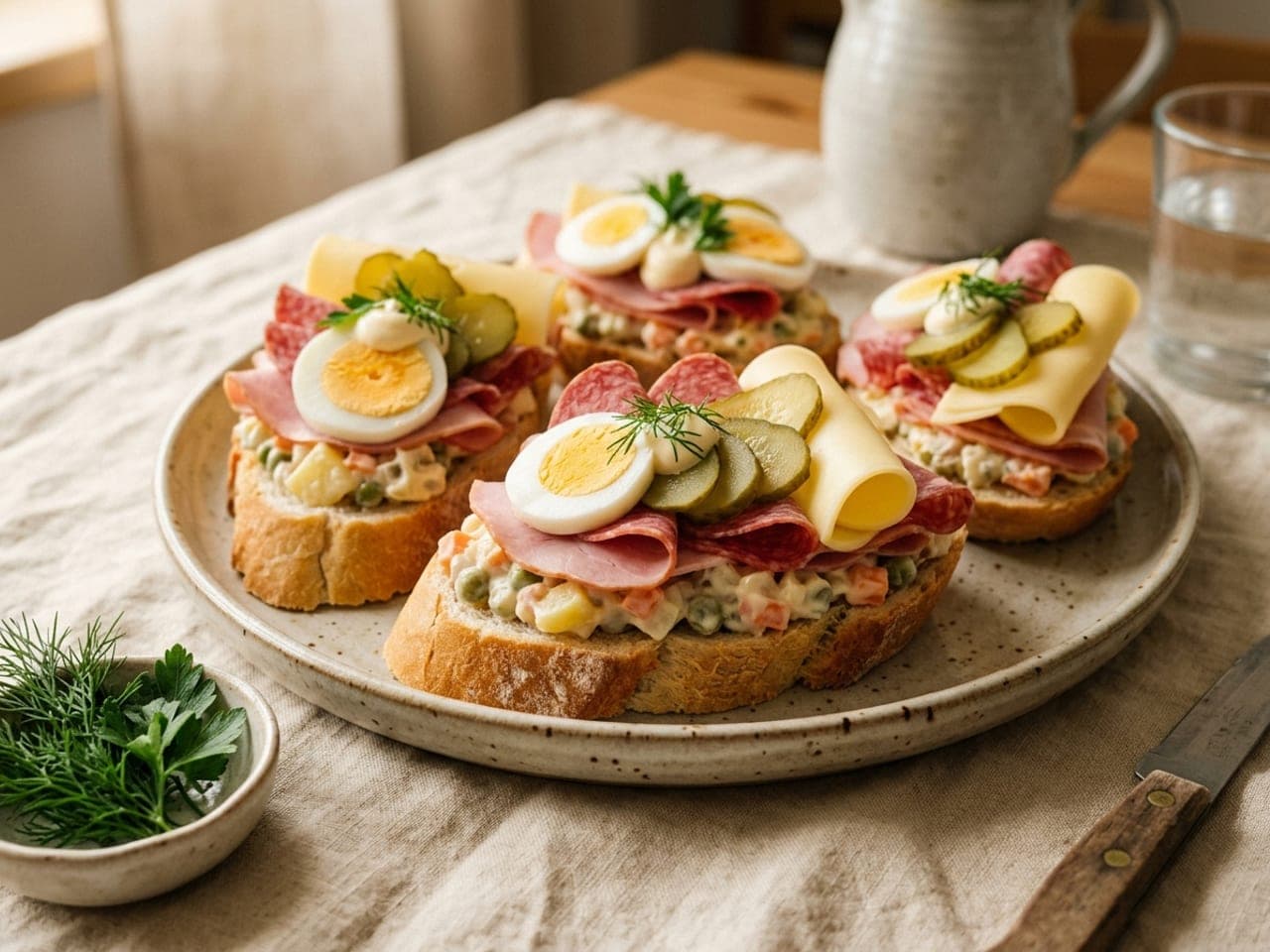
17Chlebíčky, Czech open sandwiches
Two or three bites of bread under potato salad, ham, egg and cheese, their invention usually credited to Prague’s Paukert delicatessen, which Jan Paukert’s parents opened in 1916 (Radio Prague). Make ahead: the potato salad the day before; slice and boil everything else in the morning. On the day: our recipe serves them straight away, or refrigerates them uncovered for no more than an hour so the bread stays crisp. On the table: 2-hour item. Plate it: tight rows on a long tray, each topping facing the same way. Allergens: wheat, egg, milk; mustard (UK) and sulphites (UK) in some mayonnaise and pickles.
The twist: Make one tray the original way Radio Prague describes from the Paukert café: potato salad, Prague ham, a slice of hard-boiled egg, Emmental, Hungarian salami and a slice of tomato. The Paukert original uses homemade mayonnaise; for pregnant or older guests, use a jar (FoodSafety.gov lists homemade mayonnaise as high risk; in the UK, British Lion eggs are passed as safe raw). The ham and salami are eaten cold, so for pregnant guests make a tray with egg and cheese only: the CDC lists unheated deli meats and dry sausages as riskier, and the NHS says cook salami until steaming hot.
Full recipe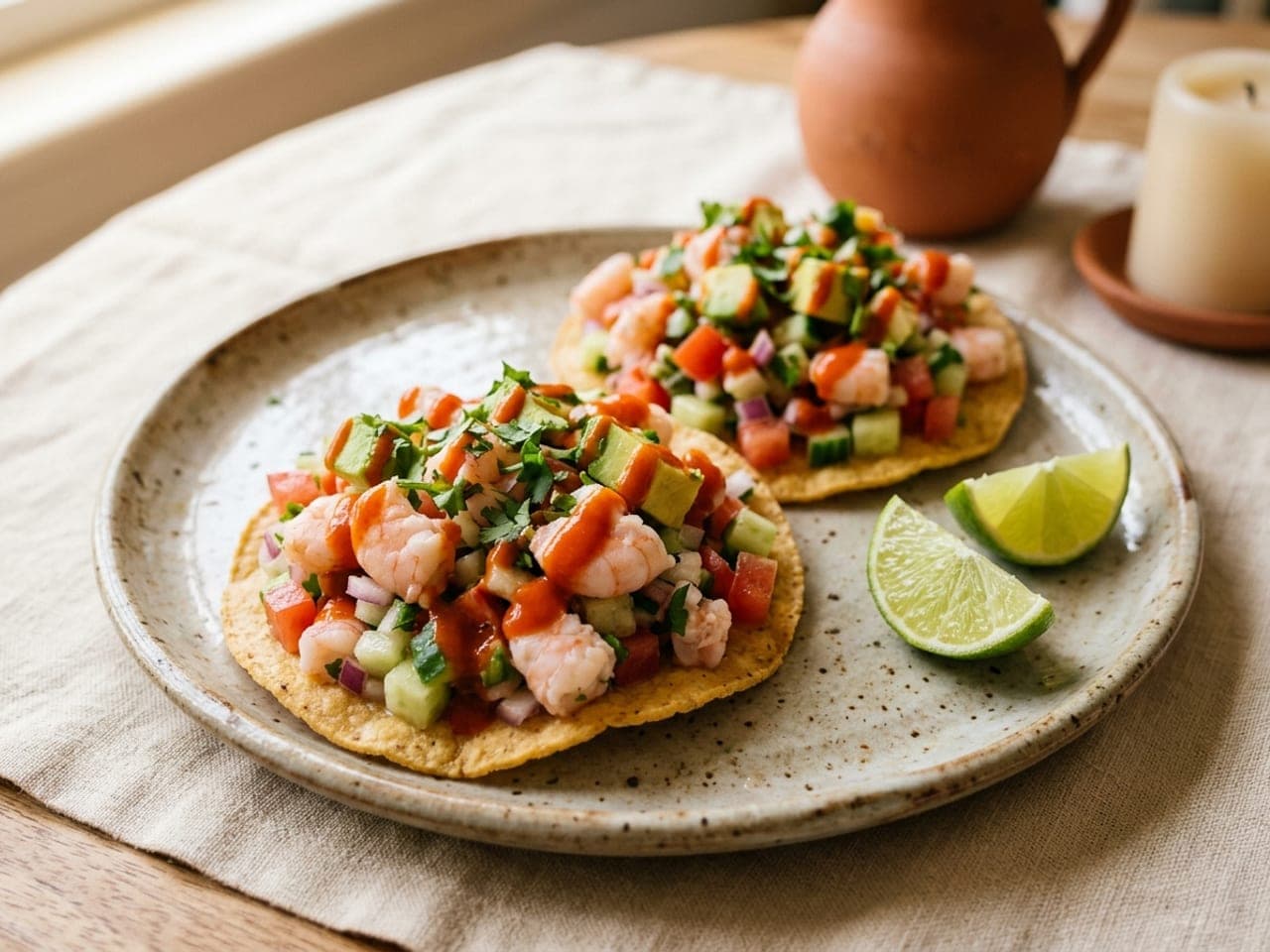
18Shrimp ceviche in small glasses
Poached shrimp in lime with tomato, cucumber, chile and cilantro (fresh coriander). Make ahead: our recipe poaches and marinates the shrimp up to half a day ahead, refrigerated in their lime; fold in the vegetables within an hour of serving and the avocado last. On the day: spoon into glasses as guests arrive. On the table: 2-hour item: the recipe serves it from a bowl nested in ice and puts leftovers straight back in the fridge. Plate it: small glasses on a tray of ice. Allergens: crustacean shellfish; check the tostadas and hot sauce labels. For pregnant guests the NHS says cold, ready-to-eat prawns must be cooked until steaming hot; the FDA’s at-risk list names only partially cooked shrimp.
The twist: Spoon it into twelve small glasses instead of onto whole tostadas, and break the tostadas into bite-size shards to stand in each glass at the last moment, so they stay crisp. Red tomato, green chile and cilantro do the Christmas colors.
Full recipe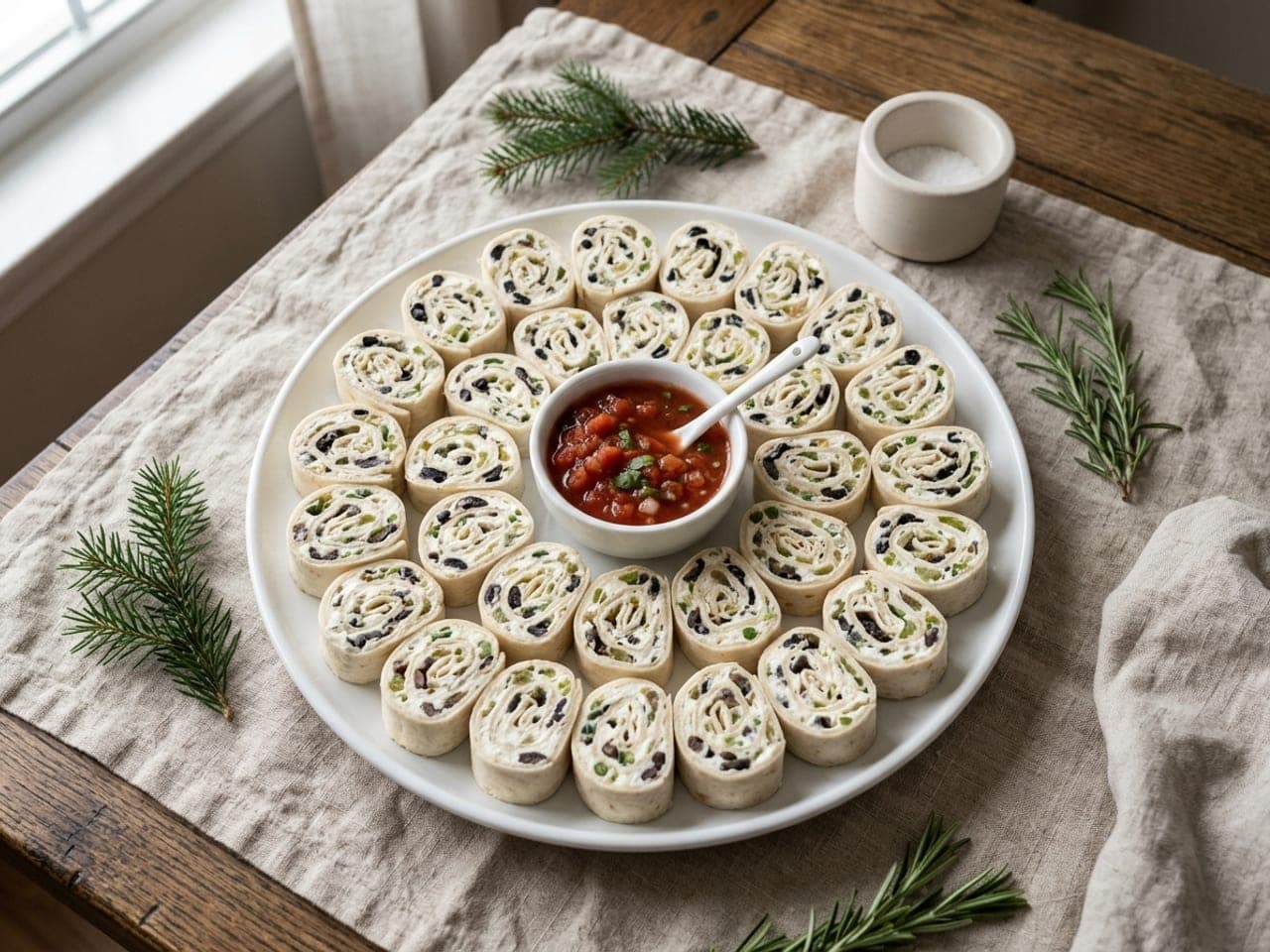
19Cream cheese and olive pinwheels
Flour tortillas rolled around cream cheese, cheddar, olives and green chiles, then sliced into spirals. Make ahead: roll and wrap them in the morning: the Taste of Home Test Kitchen chills pinwheels at least 4 hours and makes them no more than 24 hours ahead, before the tortillas go soggy. On the day: slice just before serving; The Spruce Eats warns that sliced pinwheels dry out. On the table: 2-hour item. Plate it: cut side up in a spiral on a round platter, salsa in the middle. Allergens: wheat, milk. Vegetarian only with a cheddar made without animal rennet.
Quick recipe · 5 rolls, sliced ½ to ¾ inch (1 to 2 cm) thick. After Pat Waymire’s Pinwheels (Taste of Home); not kitchen-tested by us
Ingredients
- 8 oz (227 g) cream cheese, 1 cup (113 g) shredded cheddar and 1 cup (240 ml) sour cream
- A 4¼ oz (120 g) can chopped ripe olives and a 4 oz (113 g) can green chiles, both drained; ½ cup (120 ml) chopped green onions (spring onions); garlic powder and seasoned salt
- 5 flour tortillas, 10 inch (25 cm)
Method
- Beat the cheeses and sour cream, stir in the rest, spread over the tortillas, roll them tightly, wrap in plastic wrap (cling film) and chill at least 4 hours, at most 24.
- Slice with a serrated knife just before serving. Full recipe: Taste of Home.
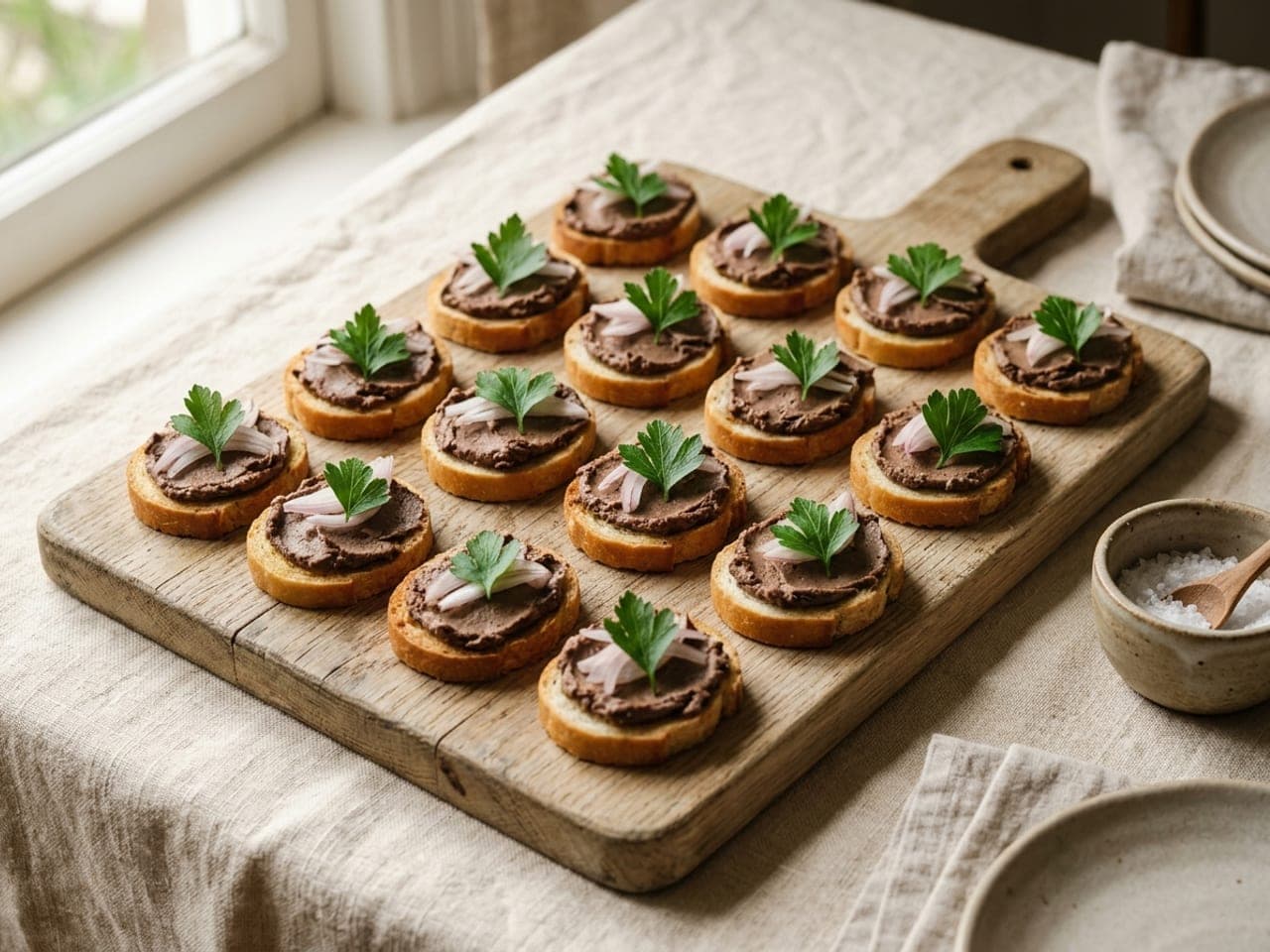
20Chicken liver pâté crostini
Thin toasts under a smooth pâté and a few shallot rings. Make ahead: toasts keep 2 to 3 days airtight in four cookbooks, and delicious. magazine freezes bases a month (each one is in our canapés guide). USDA FoodKeeper gives deli pâté 1 to 2 days. On the day: top as late as you can: nobody has timed how long a topped toast stays crisp. On the table: 2-hour item. Plate it: rows on a board, shallot rings all one way. Allergens: wheat; check the pâté for milk and sulphites (UK). Homemade, cook the livers to 165°F (74°C), no pink left (USDA’s poultry minimum). Pregnant guests: the NHS says avoid liver pâté (vitamin A); in the US, refrigerated pâté is high risk and canned or shelf-stable pâté lower risk (FoodSafety.gov).
Every crostini window we found, by cookbook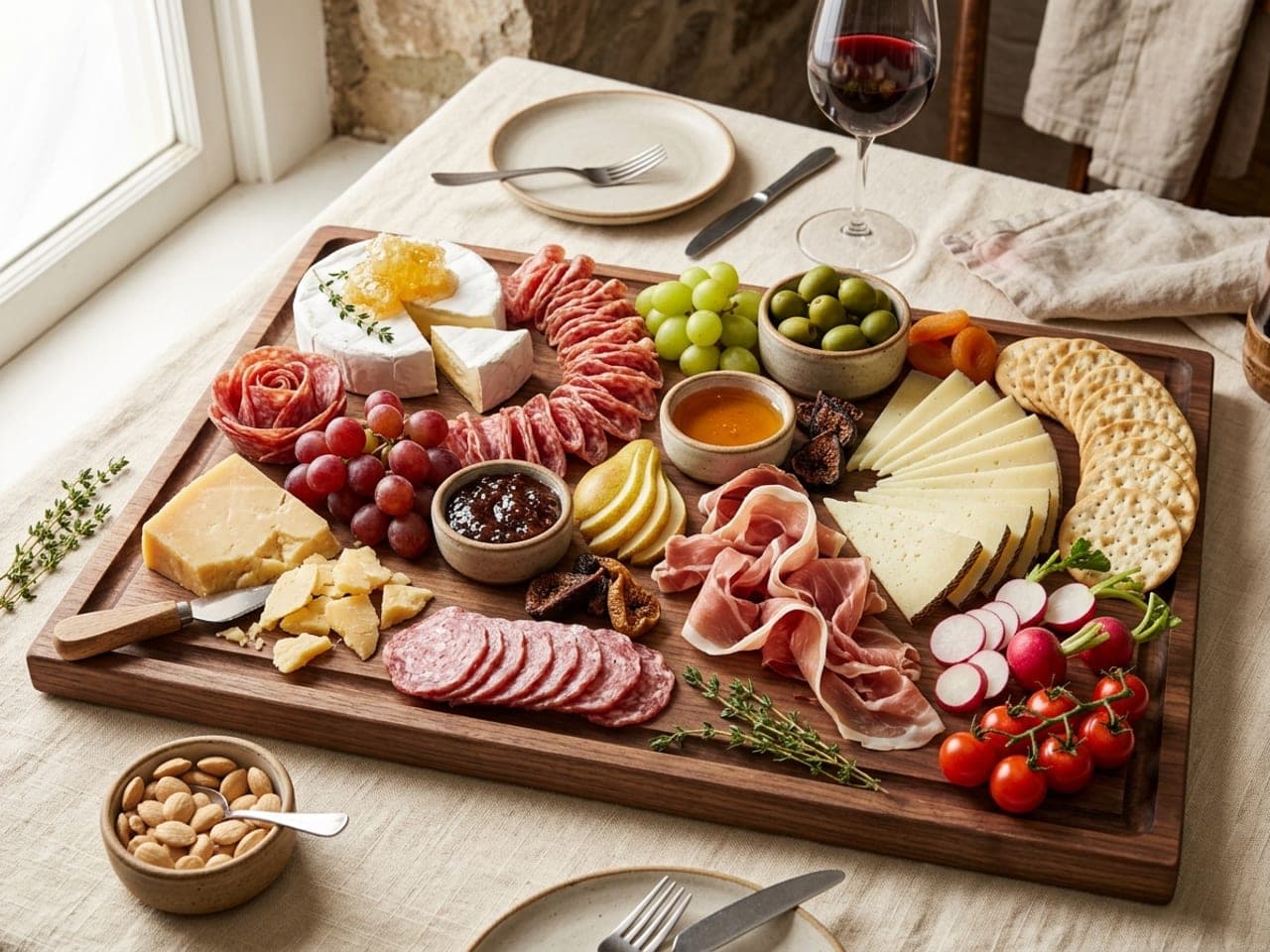
21A cheese and charcuterie board
Mostly shopping, partly plating. Make ahead: arrange it in the morning on a board that fits your fridge (Penn State Extension’s advice), cover and chill. On the day: the Academy of Cheese, a trade education body, takes cheese out at least an hour ahead. On the table: 2-hour item: under US rules that hour counts. Plate it: cheeses first, meat as lines between them (the board guide). Allergens: milk; wheat and sesame in crackers; sulphites (UK) in dried fruit and some cured meats. Pregnant and higher-risk guests: the NHS says cook brie and camembert, pasteurised or not, and cook cured meats until steaming hot; the CDC lists raw-milk soft cheese and unheated deli meats and dry sausages as riskier. Hard cheeses are fine in both. See the table.
Size the board for your guest count
The last 30 minutes
The frying, topping and final bake that cannot be done ahead. Their make-ahead is the prep; in the oven order the pigs in blankets and fried cheese are the second wave, cooked as the first guests arrive, and the blini are warmed and topped just before the doorbell.
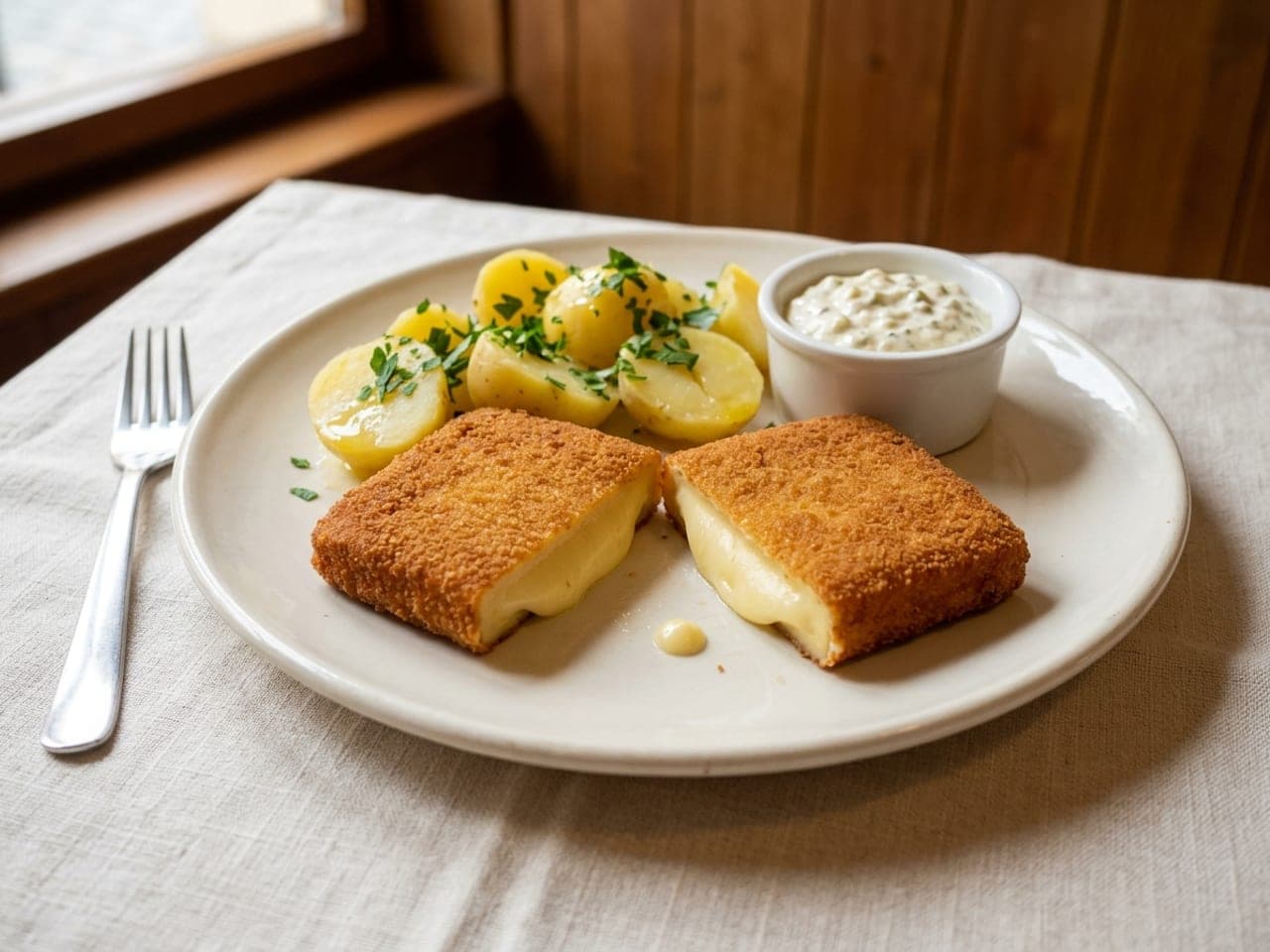
22Smažený sýr, Czech fried cheese, in triangles
Breaded, pan-fried cheese with tartar sauce, cut into party bites after frying. Make ahead: our recipe breads the slabs up to a few hours ahead and keeps them uncovered on a rack in the fridge; raw breaded slabs freeze for about 3 months, but it thaws them 20 to 30 minutes in the fridge before frying, and prefers fresh. It says plainly: don’t fry ahead. On the day: rest them 10 to 15 minutes out of the fridge while the fat heats to 350°F (177°C), then fry. On the table: keep hot, at 140°F (60°C) or above, or the 2-hour rule. Plate it: triangles on a warm board around the sauce. Allergens: milk, wheat, egg, mustard (UK); sulphites (UK) in pickles; fish if the tartar sauce gets Worcestershire; some breadcrumbs add milk or sesame.
The twist: Fry the slabs exactly as the recipe says, then cut each into four triangles on a warm board, stand a pick in each and put the tatarka in a small bowl in the middle. The vegetarian tag assumes a cheese made with microbial rennet, as the recipe suggests, oil rather than lard, and no Worcestershire (or a vegetarian brand) in the tartar sauce.
Full recipe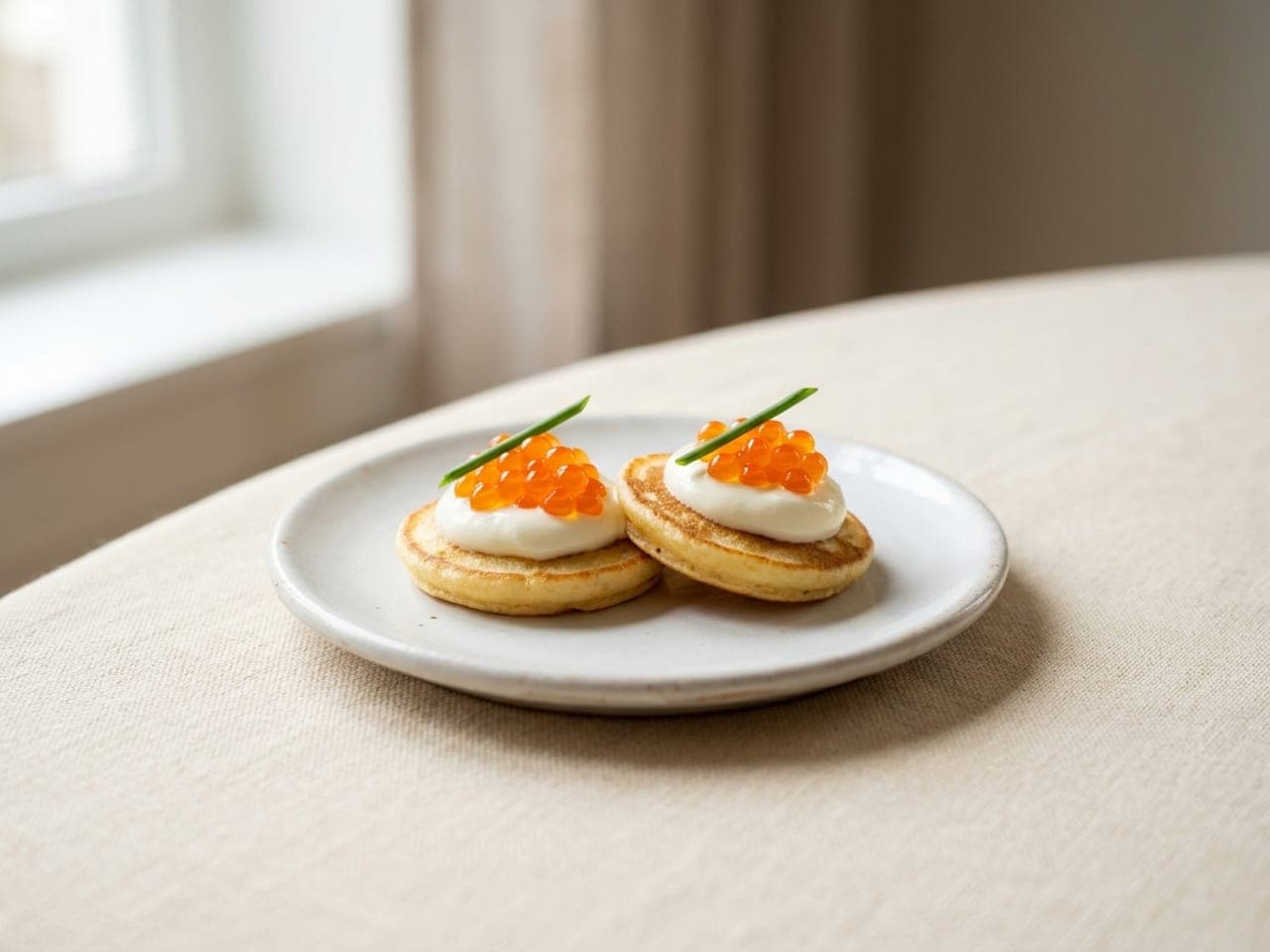
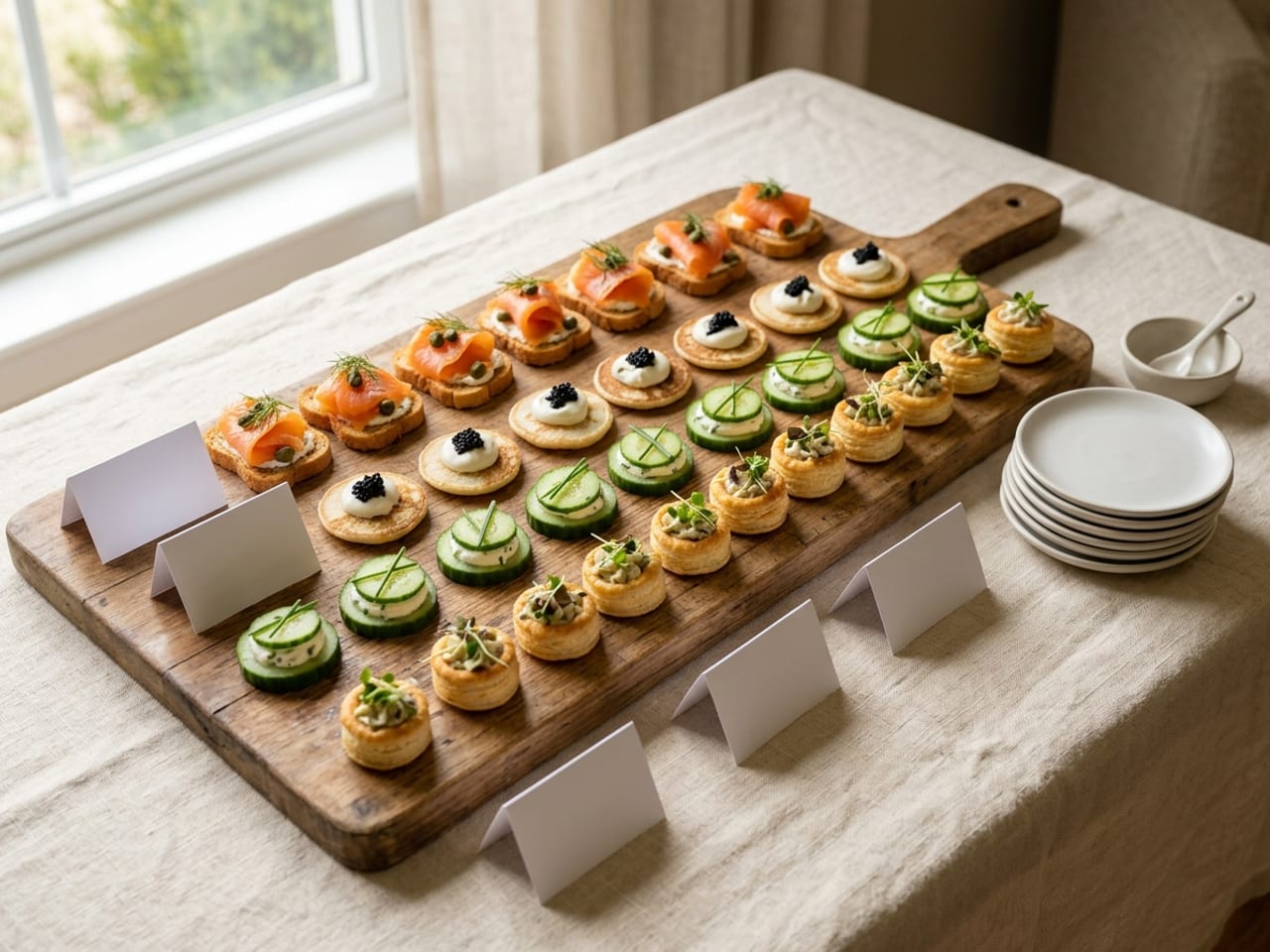
23Blini with crème fraîche and roe or smoked salmon
Coin-sized pancakes, topped at the last minute. Make ahead: cookbooks print anything from the same day to 3 days airtight (our canapés guide lists them). Sri Owen freezes them for a couple of weeks; Madeleine Kamman says frozen blini lose most of their flavor. On the day: warm them 4 minutes at 400°F (204°C), Delia’s reheat, cool, then top. On the table: 2-hour item. Plate it: two rows, roe last. Allergens: wheat, egg, milk, fish. Smoked salmon: not for pregnant guests in UK or US advice unless cooked, nor for immunocompromised guests in UK advice.
Blini, with Delia’s reheat, in the amuse-bouche guide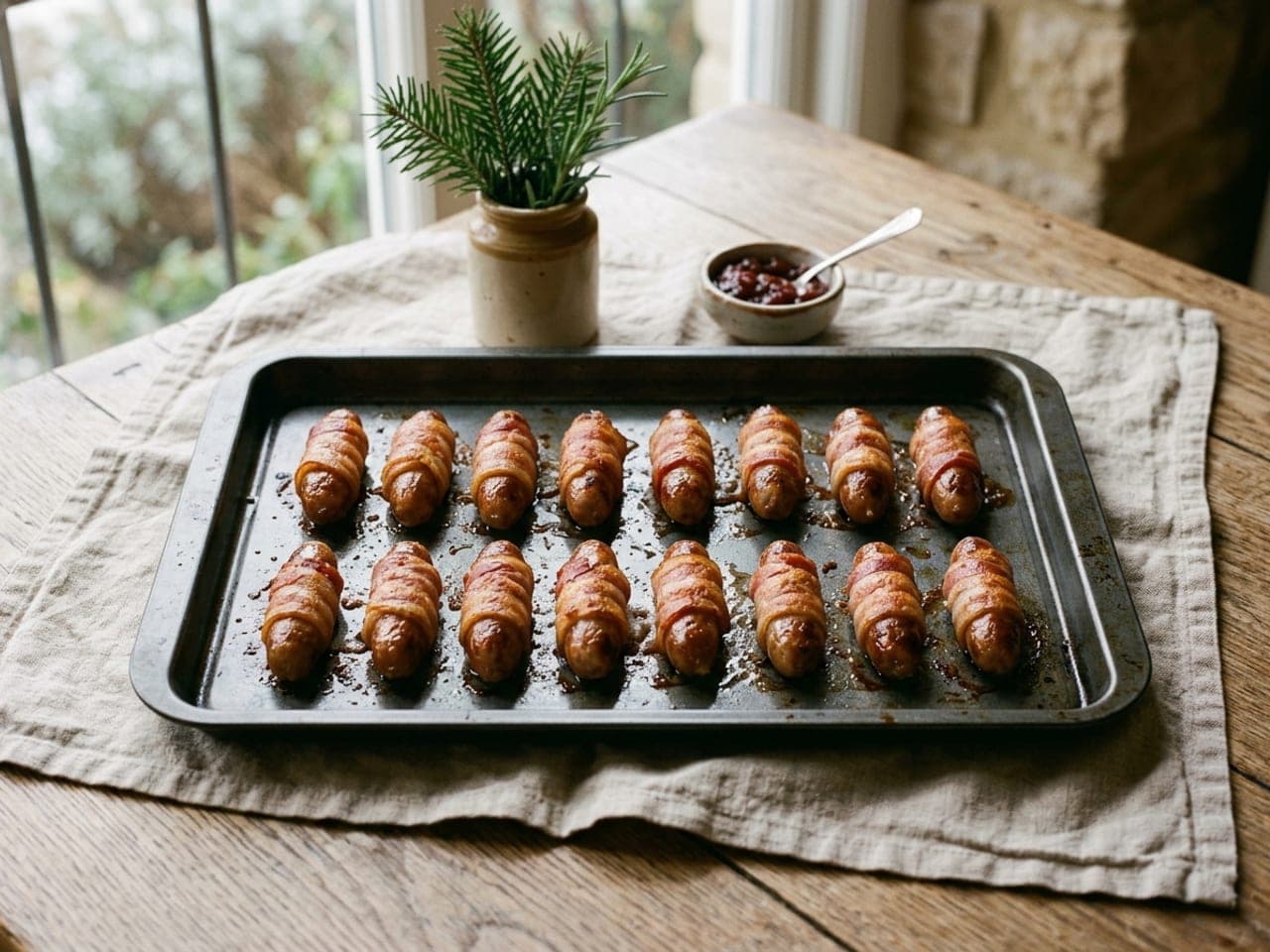
24Pigs in blankets, the British kind
Chipolatas wrapped in streaky bacon; in the US the name means a sausage in soft pastry (see the FAQ). Make ahead: BBC Good Food wraps them a day or two ahead, or freezes them two weeks (a month in its make-ahead calendar). On the day: roast at 375°F (191°C) for 30 to 35 minutes; from frozen, BBC Good Food gives 20 to 30 minutes in a hot oven, so go by the thermometer either way: 160°F (71°C) in the middle of a sausage (USDA). On the table: keep hot, at 140°F (60°C) or above, or the 2-hour rule. Plate it: a heap in a warm dish. Allergens: check the sausages and bacon for wheat, milk, soy, mustard (UK), celery (UK) and sulphites (UK).
The short recipe, on our Christmas dinner hub
Christmas appetizers from other countries and traditions
What other countries put out around Christmas dinner, as named sources describe it; each card links the closest dish here or on a sibling page, and its chips are that dish’s. National Geographic adds Poland’s meatless Christmas Eve, Wigilia, with herring served with onions, linseed oil, vinegar and rye bread.
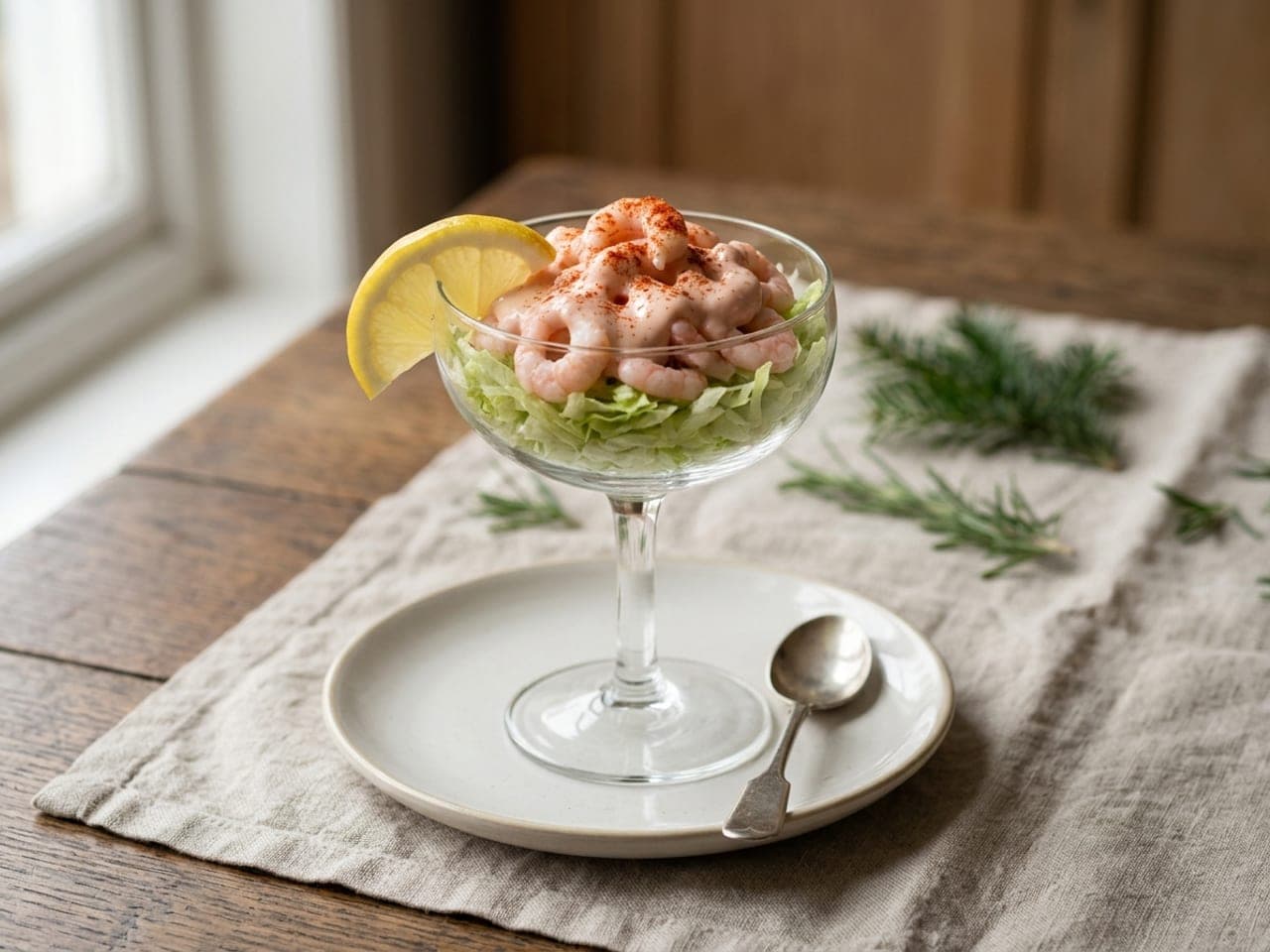
Britain: prawn cocktail on Christmas Day
A poll of 1,000 Britons for British Turkey, an industry body, reported by lovefood, found 31% starting Christmas Day with prawn cocktail and about a quarter with smoked salmon; the poll’s year is not shown. The Guardian says the dish is believed to have started in the US and was reportedly mentioned on Coronation Street by 1962; Felicity Cloake writes that it does not seem to have been Fanny Cradock who brought it to Britain, as is often claimed. Allergens: crustaceans; egg and mustard (UK) in Marie Rose sauce, and fish, with barley (UK), if it has Worcestershire.
Poach the shrimp a day ahead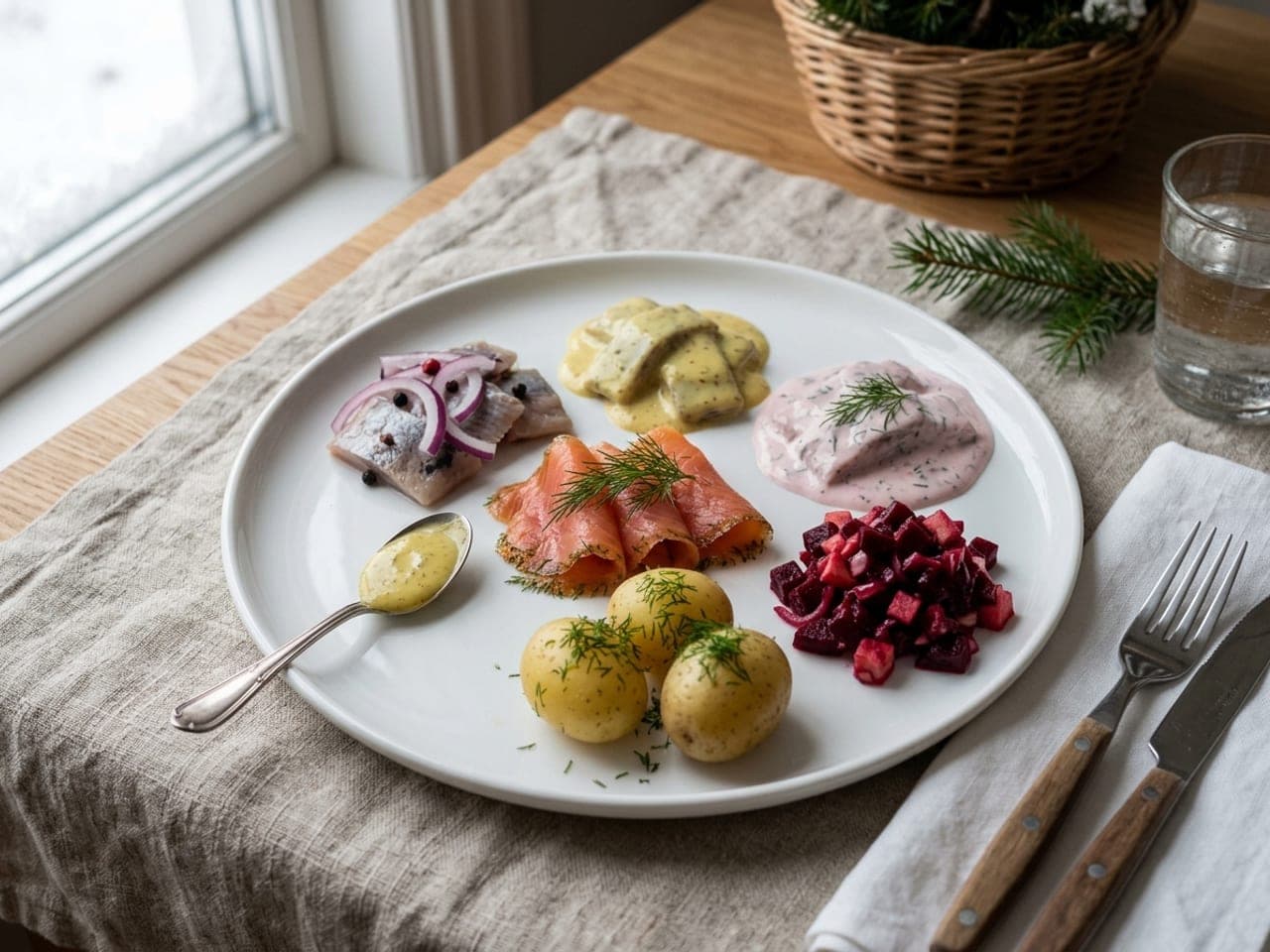
Sweden: the julbord, eaten in rounds
Visit Sweden lists the julbord’s essentials: meatballs, gravlax, short ribs, prinskorv sausages, potatoes, beetroot salad and several pickled herrings; Jansson’s temptation, a potato and fish gratin, joined in the 1940s. Scan, a Swedish meat company, credits restaurateur Tore Wretman with the order of rounds: herring, other fish, cold meats, small hot dishes, then sweets. Allergens: fish; milk, egg and mustard (UK) in the sauces.
Cure the gravlax 2 days ahead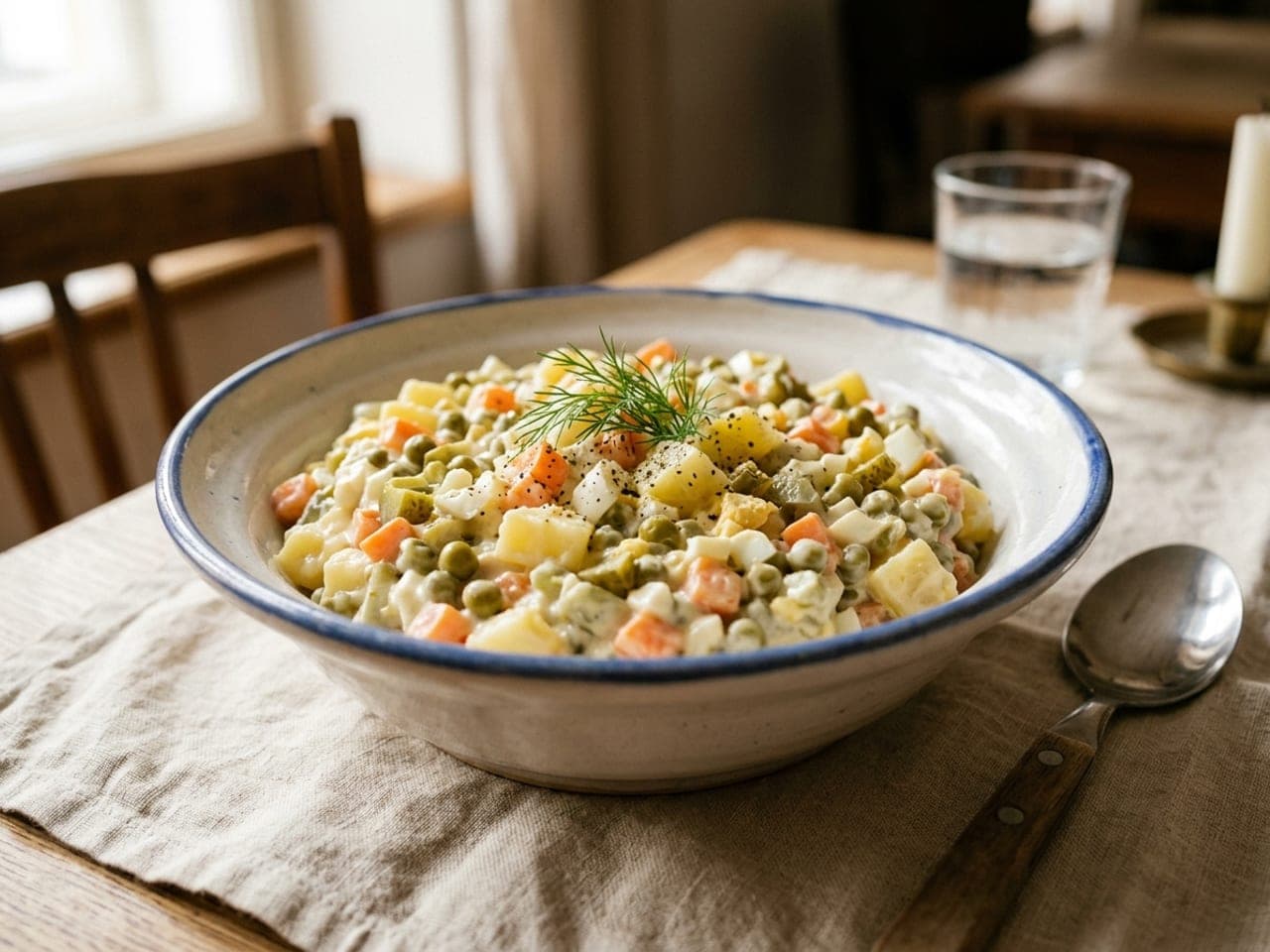
Czech Republic: the cold platter
Our deviled egg recipe puts stuffed eggs on the Czech Christmas and New Year’s Eve cold platter, the obložená mísa, beside chlebíčky. Christmas Eve dinner opens with fish soup made from carp heads, then fried carp with potato salad (CzechTourism); Radio Prague dates breaded carp as a nationwide staple to after the Second World War. Chlebíčky at a Christmas party are our pick, not a Christmas Eve custom. Allergens: egg; mustard (UK) and sulphites (UK) possible.
The twist: It is the bottom layer of the original Paukert chlebíček, as Radio Prague describes it: make one batch the day before, spread half on the chlebíčky and serve the rest in a bowl on the cold platter beside the deviled eggs.
Full recipe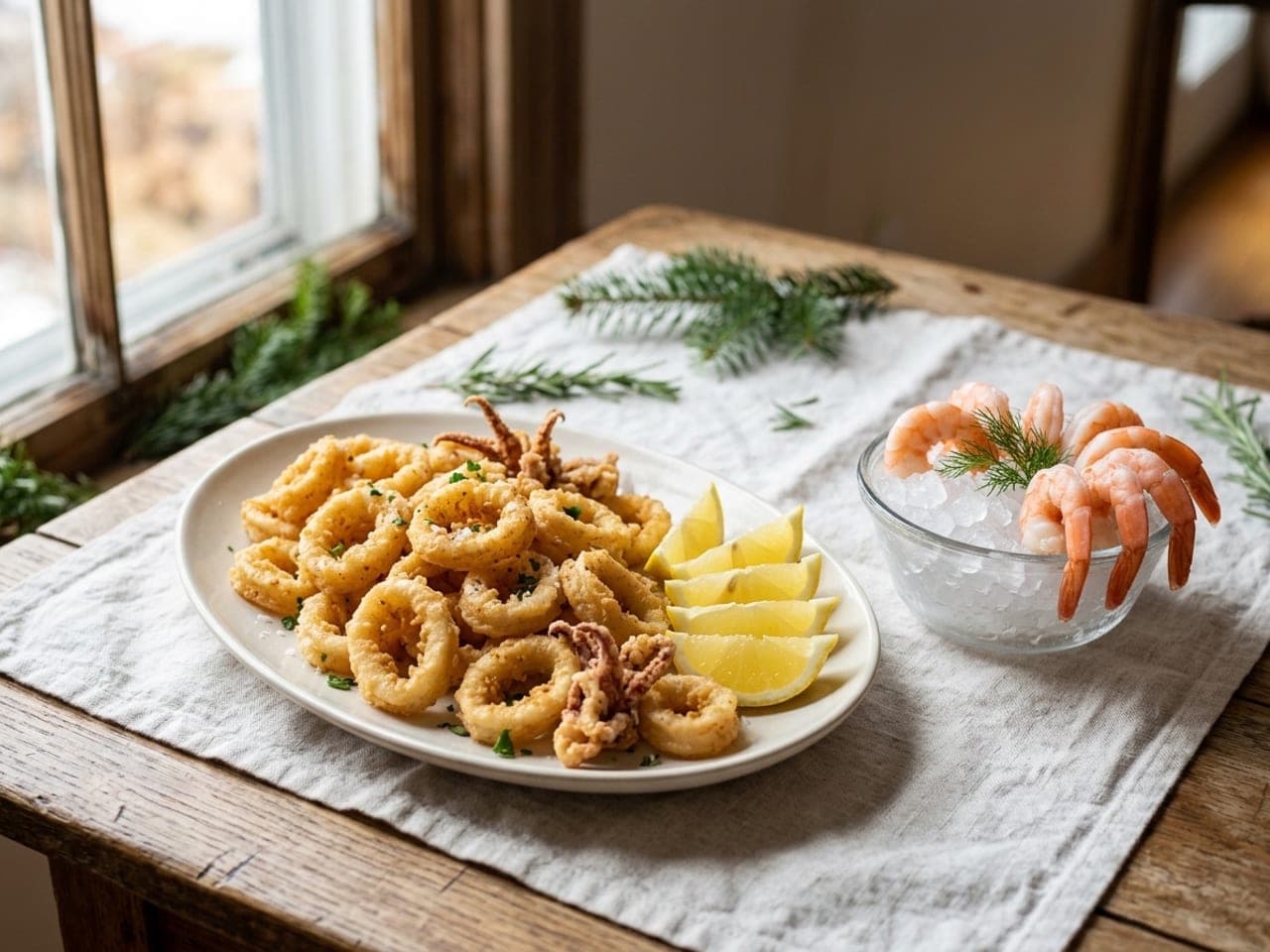
Italian-American Christmas Eve: the Seven Fishes
Britannica says the name Feast of the Seven Fishes is believed to be Italian American and first in print in the 1980s; in Italy the meal is la cena della Vigilia. Serious Eats’ Daniel Gritzer calls salt cod a mainstay, and The Kitchn names shrimp cocktail and fried calamari as typical starters. Allergens: fish, crustaceans, molluscs (UK; squid is not a US major allergen), wheat in the batter.
Where the Seven Fishes name comes from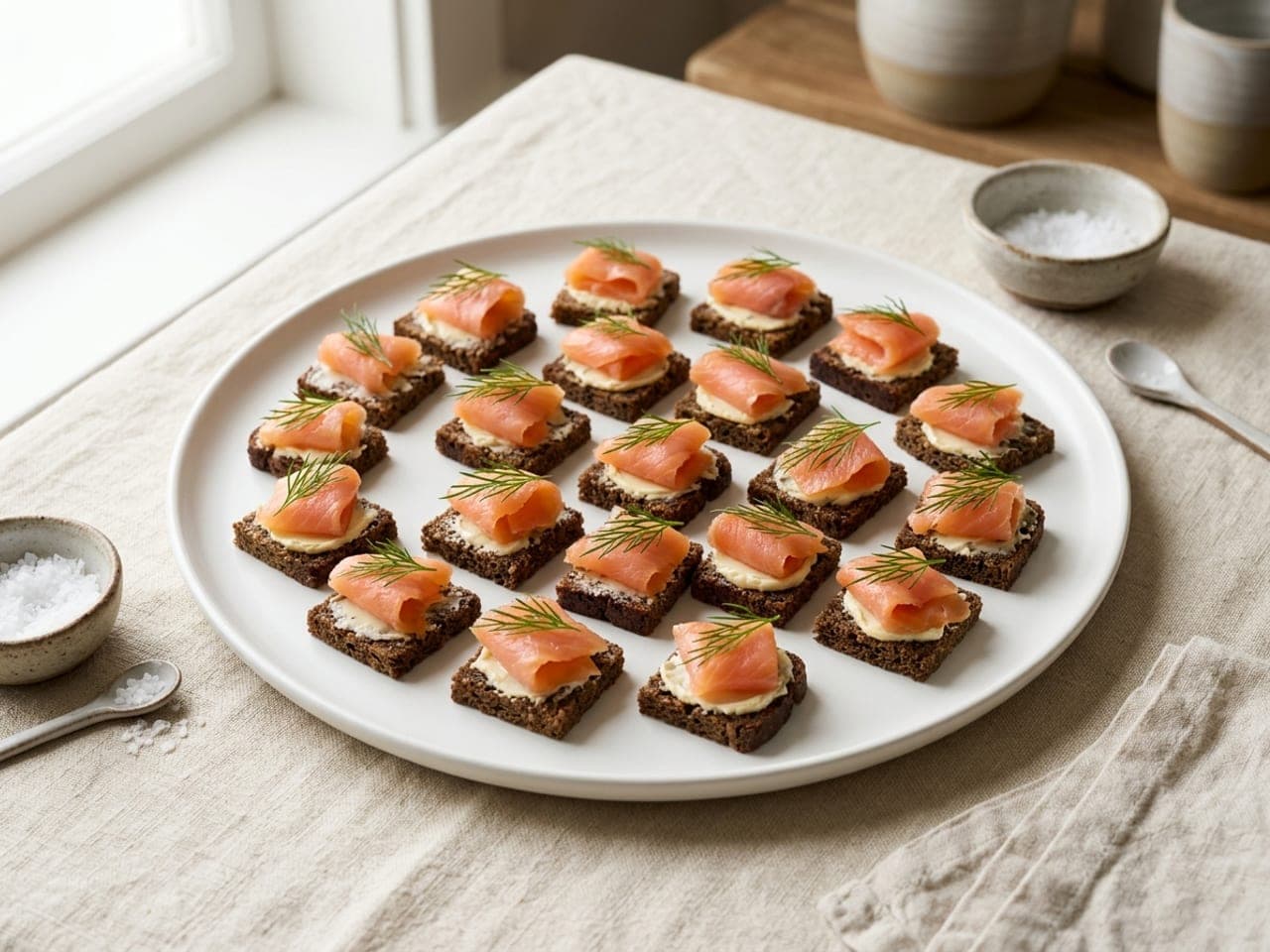
France: foie gras, smoked salmon and oysters
In Nielsen figures reported by BFM TV in 2019, foie gras was the top-selling festive food in French supermarkets in December, and smoked fish the second best-selling starter. In a Harris Interactive survey for Cetelem, the French linked the year-end meals with foie gras, oysters, champagne and seafood. For raw oysters, the CDC says lemon juice, hot sauce and alcohol do not kill Vibrio. Foie gras is a liver product: see pâté in the table. Allergens: fish; molluscs (UK); milk in the butter; wheat, and rye (UK), in the bread.
Smoked salmon on blini, topped late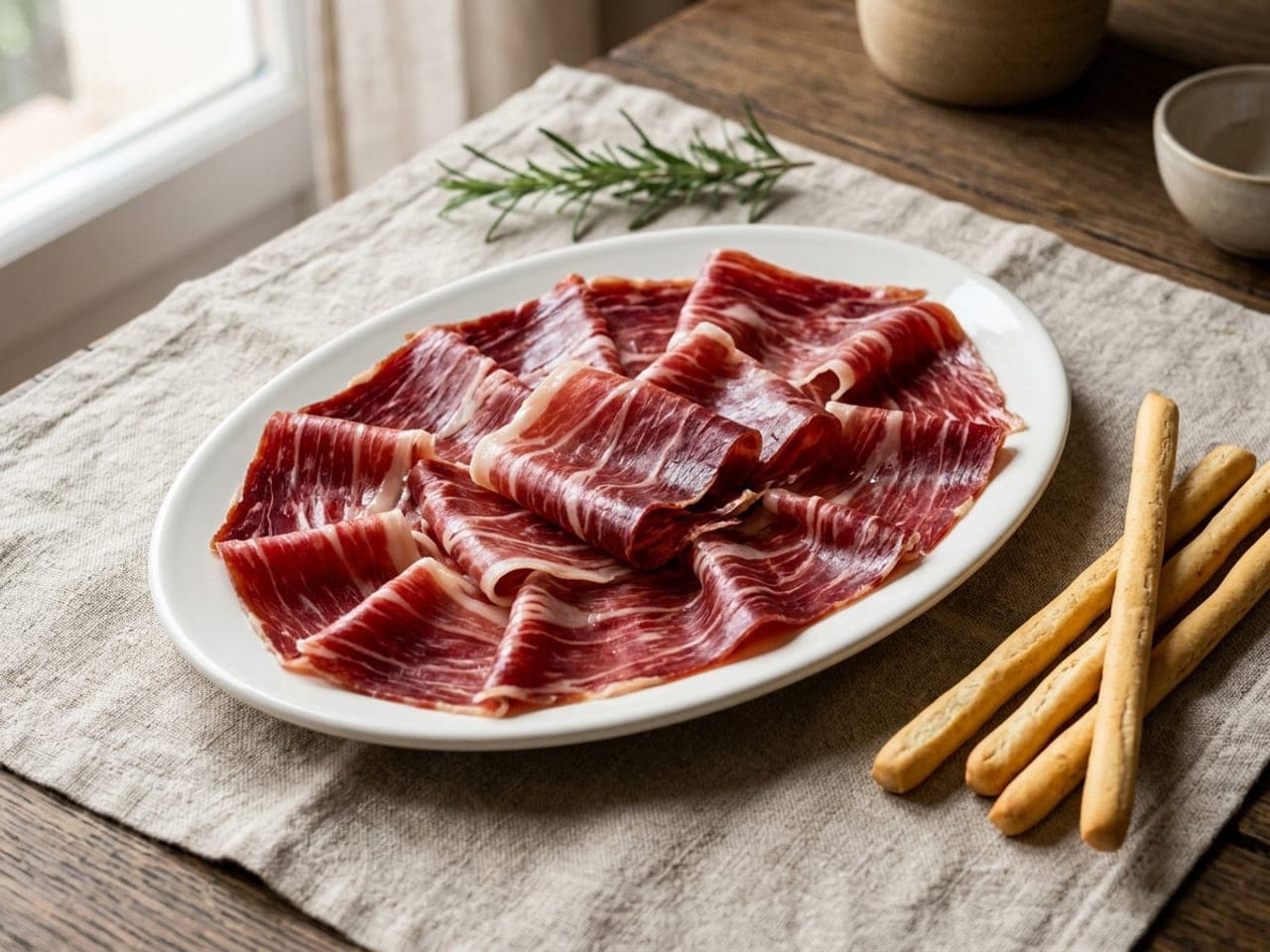
Spain: jamón at Christmas
EFEAgro, the Spanish news agency, calls serrano and ibérico ham the most-demanded pork product at Christmas, a season worth up to 70% of turnover for some producers: company figures, not national statistics. Cut dry-cured ham keeps 2 to 3 months in the fridge (FoodSafety.gov), and the NHS says pregnant guests should have cured meats cooked until steaming hot. The FDA’s at-risk list says the same of deli-style meats unless reheated until steaming hot. Allergens: check the label; breadsticks add wheat.
How to fold cured meat on a board
How many appetizers per guest
It depends on whether dinner follows, and the published figures disagree, so each one here has its owner.
| The party | Per guest | Whose figure |
|---|---|---|
| Appetizers, then dinner | 6 to 8 pieces, at least 4 kinds | Cooking For Crowds For Dummies, as our calculator uses it |
| A one-hour reception before dinner | 3 to 5 pieces | Labensky and Hause, On Cooking, a culinary textbook |
| Before dinner | 4 to 5 pieces, 3 to 4 kinds | Taste of Home |
| Appetizers instead of dinner | 12 to 15 pieces, at least 6 kinds | Dummies; Nicolet College’s catering textbook |
| A light reception | 8 to 12 pieces | Nicolet College |
| Each hour of a drinks party | 4 to 6 pieces | WebstaurantStore; a UK caterer, Savery Grazing, plans 3 to 4 at Christmas drinks |
| A Christmas drinks party | 8 to 10; 5 if guests go on to dinner | Good Housekeeping (UK), Complete Christmas, 1997 |
| A Christmas party, about four hours (our reading of a jumbled scan) | 12, put out as needed | Tesco Magazine, Christmas 2019 |
| Cheese on a board, before a meal | 1 to 2 oz (28 to 57 g); 2 oz (57 g); 2 to 3 oz (57 to 85 g) | Penn State Extension; Wisconsin Cheese; America’s Test Kitchen |
| Shrimp, among several appetizers | 2 to 3 medium or larger | The Spruce Eats |
| Dips | 1 oz (28 g) counts as 1 piece; about ⅓ cup (80 ml); ½ cup (120 ml) | Dummies; Allrecipes; America’s Test Kitchen |
A worked example (our arithmetic). Twelve guests before dinner at Dummies’ 6 to 8 pieces is 72 to 96 pieces in at least four kinds: two batches of sausage rolls (24), two of deviled eggs (24 halves), pinwheels and a dip at 1 oz (28 g) a piece. Nicolet College plans 5 to 10% extra guests.
Every count we found is in our canapés guide, how many canapés per person: of the 93 figures we collected from 56 sources, the ones for a reception before dinner run from 2 to 10 a guest, most often 3 to 5 or 6 to 8, and when the canapés are the meal 12 to 15 is the most common figure. The party food calculator does the sums for any guest count.
How long can appetizers sit out?
For almost every card the honest answer is the same 2 hours, so each card carries a label instead of a number.
- The three labels on every card2-hour item: perishable food, out of the fridge or oven for 2 hours at most, 1 hour above 90°F (32°C) (USDA FSIS). Keep hot: held at 140°F (60°C) or above, or else on the same 2-hour clock. Holds all evening: dry baked things a named source stores at room temperature, here only the gougères and cheese twists. The cheese and egg in them are baked in and dry; nothing with a moist topping or filling of cheese, meat, fish, egg or dairy earns it.
- United States: 2 hoursUSDA FSIS: never leave food out of refrigeration over 2 hours, or 1 hour above 90°F (32°C); between 40°F (4°C) and 140°F (60°C) bacteria can double in as little as 20 minutes. Health Canada gives the same 2 hours for holiday platters.
- United Kingdom: up to 4 hours for chilled foodThe Food Standards Agency tells home cooks to keep chilled food out of the fridge for the shortest time possible during preparation, a maximum of four hours; Food Standards Scotland’s Christmas page gives a buffet’s chilled food no longer than four hours. Food businesses have their own rules: cold display at 46°F (8°C) or below or four hours once, hot food at 145°F (63°C) or above or two hours once. These are different rules, not conversions of the US ones; this page plans on the shorter US clock, which keeps you inside both.
- Keep hot food at 140°F (60°C)Chafing dishes, warming trays and slow cookers hold food at 140°F (60°C) or above; they do not reheat it. Reheat food cooked ahead to 165°F (74°C) on the stove, in the oven or microwave first (USDA FSIS). The FDA warns that some warmers reach only 110 to 120°F (43 to 49°C): check the label.
- Cold food on ice that reaches the foodFSIS: hold cold food at 40°F (4°C) or below by nesting dishes in bowls of ice. A county health department’s business sheet adds: ice at or above the level of the food, water in the gaps, never a pan just set on top. The FDA lets cold seafood and egg dishes stay out longer than 2 hours only on ice.
- Swap platters, never top them upThe FDA’s advice for hosts: make several small platters ahead, keep cold back-ups in the fridge and hot ones in a 200 to 250°F (93 to 121°C) oven, and replace a nearly empty dish with a fresh one, because guests’ hands contaminate food already out.
- What does not hold all eveningCheese: the Academy of Cheese, a trade body, says 4 to 8 hours, but no US agency page we read gives cheese more than 2. Olives or feta with fresh garlic or herbs in oil: refrigerate and use within 4 days (National Center for Home Food Preservation). Mayonnaise is not the villain (University of Nebraska Extension: commercial mayonnaise’s acid helps), but a mayonnaise dip still follows the 2-hour rule.
- Leftovers, by countryUS (USDA FSIS): in the fridge within 2 hours, eaten within 3 to 4 days, reheated to 165°F (74°C). UK: within 48 hours (Food Standards Agency), reheated only once and steaming hot (Food Standards Scotland). Both clocks run from when the food was first cooked, not from the party: soup made 2 days ahead has a day or two left in the US and none in the UK. Food that sat out past its clock is not a leftover.
Pregnant and higher-risk guests: US and UK advice side by side
For pregnant guests, older adults, young children and anyone with a weakened immune system. The CDC says pregnant women are 10 times more likely to get a Listeria infection.
| On the platter | US advice | UK advice |
|---|---|---|
| Shrimp or prawn cocktail | The FDA’s at-risk list names partially cooked shrimp | The NHS says cold, ready-to-eat prawns must be cooked until steaming hot in pregnancy |
| Cold brie or camembert on a board | The CDC lists raw-milk soft cheese as riskier | The NHS says brie and camembert, pasteurised or not, must be thoroughly cooked |
| Baked brie | The CDC counts pasteurized soft cheese heated to 165°F (74°C) as a safer choice | Fine once cooked until steaming hot (NHS) |
| Gravlax and other cured salmon | Raw fish is on the FDA’s list for people at higher risk | The FSA and Food Standards Scotland: pregnant and immunocompromised people avoid cured fish, gravlax by name; older people should be aware |
| Smoked salmon on blini | FDA: in pregnancy, refrigerated smoked seafood only in a cooked dish | Avoid, or cook until steaming hot; just warming it through is not enough (Food Standards Scotland) |
| Pâté | Refrigerated, unpasteurized pâté is on the FDA’s list; canned or shelf-stable pâté is lower risk (FoodSafety.gov) | The NHS says keep meat pâté chilled and avoid liver pâté in pregnancy (vitamin A) |
| Cold cured meats | The CDC tells pregnant women to skip unheated deli meats and dry sausages | The NHS says cook salami, chorizo and prosciutto until steaming hot in pregnancy |
| Homemade mayonnaise and eggnog | High risk (FoodSafety.gov); the FDA heats an eggnog base to 160°F (71°C) | The NHS passes raw British Lion or Laid in Britain eggs, mayonnaise included, in pregnancy |
| Raw oysters | The CDC: lemon juice, hot sauce and alcohol do not kill Vibrio; cooking does | The NHS says avoid raw shellfish in pregnancy |
Safe under one country’s advice is not automatically safe under the other’s. For a seated meal, see the Christmas dinner hub.
Arranging the platters
How a party platter looks good in the second hour as well as the first.
- Small platters, refilled in roundsThe Chopping Block, a Chicago cooking school, fills small platters to the brim and garnishes the table rather than the platter: the look side of the FDA’s swap rule.
- Rows, or lines on a slantThe Culinary Institute of America sets finger food in straight rows; Labensky’s textbook lays a tray in parallel diagonal lines; Gisslen curves the lines for movement. None gives spacing or a count per tray: our canapés guide’s tray layouts draw both.
- Odd numbers are one caterer’s rule“Odd numbers look best on a tray” is Rocket Food’s, a London caterer quoted by Country Life; no textbook we read gives it.
- Height, but not muchLabensky keeps the tray simple and says height adds interest: one platter on a cake stand is enough. Our buffet guide covers risers for a whole table.
- Hot and cold on separate traysGisslen says to avoid presenting hot and cold items on the same tray: keep-hot cards on warm platters near the kitchen, 2-hour cold cards on ice or on swappable platters.
- A garnish you can eat“Garnishes should be edible” is a rule many cooking texts repeat, with exceptions. A chive tip or a pomegranate seed passes; fir sprigs stay on the cloth. More in our garnish guide; the Christmas table hub lists festive plants to keep away from food.
- Picks, napkins and a cardCocktail Parties For Dummies allows 2 to 3 napkins a guest for 3 hours; put a dish for used picks and tails beside anything served on one. UK home hosts have no legal duty to label allergens, but the Food Standards Agency encourages it: a small card by each platter and one spoon per dish is our suggestion.
The make-ahead timeline, counted back from the doorbell
Relative times, so it works for any date: move every step together. Christmas Day 2026 is a Friday and Christmas Eve a Thursday.
Which standard? Each step uses its card’s source. Where the US and UK differ (the eggs, the soup, leftovers), both are given; the 2-hour clock on the table is the US one, which keeps you inside the UK’s four hours too.
- 4 weeks before
- Freeze and date: sausage rolls raw, cheese twists unbaked, meatballs and sauce, the once-fried wings, each a month. The baked quiche and bramboráčky keep about 2 months. Gougères only if you follow The Kitchn (2 months unbaked); the Epicurious recipe in our card freezes them a week, so pipe and freeze those 1 week before.
- 2 weeks before
- Pigs in blankets into the freezer (BBC Good Food’s freezer guide).
- 1 week before
- Pipe and freeze the Epicurious gougères. Start the utopenci and the dated Hermelín jar (eaten by day 10). US only: boil the eggs for the deviled eggs and keep them in their shells.
- 3 days before
- Start the gravlax. Make the cheese ball, uncoated. Clear the fridge: Food Standards Scotland warns that a full fridge warms up and suggests moving drinks out.
- 2 days before
- Make the soup (US: 2 to 3 days ahead; UK: no more than 2). Halve the eggs and store whites and filling apart (UK: cook them today). Toast the crostini.
- The day before
- Poach the shrimp and make the sauce. Stuff the mushrooms. Assemble the dip in two smaller dishes. Make the potato salad. Thaw the quiche in the fridge; everything else cooks from frozen.
- Morning
- Bake the gougères from frozen (425°F (218°C), then 350°F (177°C)), cool them and keep them airtight at room temperature: they hold all evening.
- Roll the pinwheels, marinate the ceviche, arrange the cheese board and chill it. Plan two platters of every cold item: one for the doorbell, one waiting in the fridge (the FDA’s small-platter advice); hot back-ups wait for the oven to drop to 225°F (107°C) after the second wave. Except the chlebíčky: assemble their second tray about an hour after the doorbell.
- 2 hours before
- Bread fresh fried cheese and leave it uncovered on a rack in the fridge. Coat the cheese ball and put it back in the fridge until 30 minutes before the doorbell. Set out platters, picks, napkins and a card for each dish.
- 1 hour before
- The oven order (ours): one oven, hottest first, so it only ever cools down. Have it at 425°F (218°C) by now (start heating it 15 minutes earlier) and put the sausage rolls in from frozen, glazed: Delia’s 20 to 25 minutes plus 10, until 160°F (71°C) in the middle.
- Cheese board out (at least an hour, the Academy of Cheese says; under US rules that hour counts, so its twin replaces it an hour after the doorbell). Assemble the chlebíčky: no more than an hour in the fridge, uncovered.
- 30 minutes before
- Sausage rolls out. Oven down to 400°F (204°C): mushrooms from the fridge (18 to 21 minutes) and twists from frozen (about 20) on two racks; warm the blini 4 minutes beside them, cool and top them. Frozen meatballs into their simmering sauce for 10 to 15 minutes, to 165°F (74°C) in the middle of one, then into a slow cooker preheated on low, which holds them at 140°F (60°C) or above. Soup to 165°F (74°C), then on the lowest heat that holds 140°F (60°C). Quiche and the coated cheese ball out of the fridge: their 2-hour clocks start now. Pipe the eggs, slice the pinwheels.
- The doorbell
- First wave out: sausage rolls, mushrooms, twists, gougères, quiche, meatballs, soup and the cold platters. The oven stays at 400°F (204°C) for the bramboráčky, 10 to 15 minutes plus a few from frozen, to 165°F (74°C). Guests trickle in over 30 to 60 minutes (Savery Grazing, a caterer) and eat more in the first hour, then level off (Backus and Shock, a catering text).
- 15 minutes after the doorbell
- Bramboráčky out. Oven down to 375°F (191°C) for the second wave: both dishes of dip (about 30 minutes from the fridge, to 165°F (74°C) in the middle) and the pigs in blankets from frozen, by the thermometer: 160°F (71°C) in the middle of a sausage. Meanwhile fry: wings first, second fry from frozen at 375°F (191°C), 2 to 3 minutes longer than the recipe, to 165°F (74°C) at the bone; then let the oil fall to 350°F (177°C) for the fried cheese. Once the last tray is out, turn the oven to 225°F (107°C) for hot back-ups (the FDA’s 200 to 250°F (93 to 121°C)), the second dip among them.
- 2 hours after each platter goes out
- Swap, never top up: cold platters go and their twins come out (FSIS, FDA). Anything perishable that sat between 40°F (4°C) and 140°F (60°C) for 2 hours goes, or for 1 hour above 90°F (32°C) in the room; the gougères and cheese twists are the exceptions.
- After the party
- Safe leftovers into the fridge within 2 hours. Count from the day each dish was first cooked, not from today: US, 3 to 4 days (USDA FSIS); UK, 48 hours (Food Standards Agency), reheated once (Food Standards Scotland).
See your platter re-plated first
Photograph a trial run of an appetizer and Plate Artists shows it re-plated on a plate from its library, with the moves to get there. Your first re-plate is free with an account.
Start free · 1 enhancement →Free account · 1 free enhancement · No credit card
Christmas appetizer questions, answered
What is the most popular Christmas appetizer?
No single answer has a source behind it. In Britain, a poll for the industry body British Turkey, reported by lovefood, found prawn cocktail the most-eaten Christmas Day starter, at 31%. In France, Nielsen’s supermarket figures put foie gras first in December. We found no national figure for the US. See Britain and France.
What are some good make-ahead Christmas appetizers?
The freezer section: sausage rolls, gougères and cheese twists bake from frozen, and meatballs reheat in their sauce. From the fridge, utopenci and Hermelín want most of a week, gravlax two days and a cheese ball keeps three.
What appetizer is a crowd-pleaser for a large group?
Ones that scale without more hands: America’s Test Kitchen’s cocktail meatballs make about 80, for 20, from the freezer, and one dish of hot dip serves 12. Cooking For Crowds For Dummies says to include dips and spreads for a crowd, so you are not making hundreds of single bites.
What is a good finger food for a Christmas party?
Anything eaten in one or two bites without a knife: deviled eggs, chlebíčky, pinwheels, pâté crostini, blini and sausage rolls. Our canapés guide says which count as canapés.
How many appetizers per person for a Christmas party?
Before dinner, 6 to 8 pieces a guest in at least four kinds; when the appetizers are the whole party, 12 to 15 in at least six (Cooking For Crowds For Dummies, the figures our party food calculator uses). A culinary textbook gives 3 to 5 for a one-hour reception before dinner. The table has each figure’s owner.
How long can appetizers sit out at a party?
In the US, 2 hours out of the fridge or oven, 1 hour above 90°F (32°C) (USDA FSIS). In the UK, Food Standards Scotland’s Christmas page says a buffet’s chilled food should be out of the fridge for the shortest time possible, no longer than four hours. Hot food held at 140°F (60°C) or above can stay. Each card carries its holding class.
What is the 4-hour rule for food?
For food businesses in England, Wales and Northern Ireland, the Food Standards Agency lets cold buffet food be displayed out of chilled storage for up to four hours, once. Australia and New Zealand have a 2-hour/4-hour rule for businesses too. UK home advice is as short a time as possible, four hours at most, for chilled food; the US home rule is 2 hours.
How do you keep appetizers warm at a party?
Reheat to 165°F (74°C) on the stove or in the oven, then hold at 140°F (60°C) or above in a preheated slow cooker, chafing dish or warming tray (USDA FSIS); the FDA says some warmers only reach 110 to 120°F (43 to 49°C). Or bake in two rounds, as the timeline does.
What appetizers can sit out at room temperature?
Fewer than most lists suggest. Here only the dry baked gougères and cheese twists hold all evening on a named source’s say-so. Cheese on a board, dips, eggs, fish and meat follow the 2-hour rule in the US, mayonnaise dips included.
Are pigs in blankets the same in the US and the UK?
No. In Britain they are small sausages wrapped in bacon, typically served with Christmas dinner (Oxford Learner’s Dictionaries); in the US, pigs in a blanket are a sausage, usually a hot dog, in soft pastry (Cambridge Dictionary), closer to a British sausage roll.
What is a traditional Christmas appetizer in other countries?
Prawn cocktail in Britain, herring and gravlax first on the Swedish julbord, the Czech cold platter, foie gras and smoked salmon in France, jamón in Spain and herring on Poland’s meatless Christmas Eve: see other countries.
Is smoked salmon or gravlax safe at a Christmas party?
For most guests, kept cold and out no more than 2 hours. UK agencies tell pregnant and immunocompromised guests to avoid cold-smoked and cured fish, gravlax by name, unless cooked until steaming hot; US agencies list refrigerated smoked seafood and raw fish for people at higher risk. See the table.
The research behind this guide
Agencies, publications and recipes named in the text:
- USDA FSIS, Danger Zone (40°F to 140°F): 2 hours, 1 hour above 90°F; bacteria double in as little as 20 minutes
- USDA FSIS, askFSIS: At what temperature should I hold hot foods? (140°F; cold cooked food not reheated in a slow cooker)
- USDA FSIS, askFSIS: How do I keep foods safe at a buffet? (bowls of ice; small trays replaced within two hours)
- USDA FSIS, Leftovers and food safety (3 to 4 days; reheat to 165°F; a platter of deli meats is cold perishable food)
- USDA FSIS, Slow cookers and food safety (reheat to 165°F first, then hold at 140°F or more)
- USDA FSIS, FoodKeeper data (cooked shrimp 3 to 4 days; deli pâté 1 to 2 days; cheese storage)
- FoodSafety.gov, Cold food storage chart (cut dry-cured ham 2 to 3 months; hard-cooked eggs 1 week)
- FoodSafety.gov, People at risk (high risk: cold-smoked fish, homemade mayonnaise and eggnog, refrigerated pâté)
- FDA, Serving up safe buffets (small platters swapped, never topped up; back-ups at 200 to 250°F; warmers; eggnog at 160°F)
- FDA, Selecting and serving fresh and frozen seafood safely (cold seafood on ice past 2 hours; smoked seafood in pregnancy)
- FDA, What you need to know about egg safety (cold egg dishes on ice past 2 hours)
- FDA, People at risk of foodborne illness (raw fish, partially cooked shrimp, refrigerated pâté)
- FDA, Food Code 2026, § 3-402.11 parasite destruction (freezing; the farmed salmon exemption)
- FDA, Food allergies (the nine major food allergens; sesame since 1 January 2023)
- CDC, Safer food choices for pregnant women (10 times more likely to get Listeria; raw-milk soft cheese; deli meats)
- CDC, Vibrio and oysters (hot sauce, lemon juice and alcohol do not kill Vibrio)
- Health Canada, Holiday food safety (platters, seafood, eggnog; two hours)
- Food Standards Agency, How to chill, freeze and defrost food safely (chilled food out of the fridge a maximum of four hours; leftovers within 48 hours)
- Food Standards Scotland, Christmas food safety (buffet: no longer than four hours; leftovers within 2 days; a full fridge warms up)
- Food Standards Agency, Safer Food Better Business: chilled storage and display (8°C; the 4 hour rule, once)
- Food Standards Agency, Safer Food Better Business: hot holding (63°C; two hours out, once)
- Food Standards Agency, Allergen guidance for food businesses (the 14 allergens)
- Food Standards Agency, Providing food at community and charity events (no legal duty for unregistered hosts; encouraged)
- Food Standards Scotland and FSA, updated advice on ready-to-eat cold-smoked and cured fish (27 July 2023)
- NHS, Foods to avoid in pregnancy (prawns, smoked and cured fish, brie and camembert, pâté, cured meats, British Lion eggs)
- Food Standards Australia New Zealand, 2-hour / 4-hour rule (business guidance)
- National Center for Home Food Preservation, Freezing garlic-in-oil (refrigerate, no more than 4 days)
- University of Nebraska-Lincoln Extension, Mayonnaise mix-ins (commercial mayonnaise is not the culprit)
- Snohomish County Health Department, Cold holding with ice (business sheet: ice at or above the level of the food)
- The Vegetarian Society, Which cheeses are suitable for vegetarians (Parmesan and calf rennet)
- Penn State Extension, Creating a healthy charcuterie board (1 or 2 ounces of cheese a person; a board that fits the fridge; ask about allergies)
- America’s Test Kitchen, How to perfectly portion your charcuterie board (2 to 3 ounces of cheese and meat; ½ cup of dip)
- Wisconsin Cheese, Cheese boards (2 ounces each of cheese and meat as an appetizer)
- Academy of Cheese, How to bring cheese to room temperature (an hour out; 4 to 8 hours, a trade body’s figure)
- The Spruce Eats, Shrimp counts per pound and serving sizes (2 to 3 a person with several appetizers)
- Dummies, Cooking for Crowds For Dummies cheat sheet (6 to 8 or 12 to 15 pieces; kinds; 1 ounce of dip as one piece)
- Allrecipes, Cooking for a crowd (3 ounces of dip, about ⅓ cup, a person)
- Savery Grazing, How to host Christmas drinks and nibbles (guests trickle in over 30 to 60 minutes; 3 to 4 canapés an hour)
- Plate Artists, How many canapés per person: Labensky, the CIA, Gisslen, Nicolet College, WebstaurantStore, Taste of Home, Good Housekeeping, Tesco Magazine, Treuille, Martha Stewart and the other cookbook windows, with their references
- The Chopping Block, Platter presentation and table display (small platters; garnish the table)
- Country Life, How to make and serve perfect canapés (Rocket Food: odd numbers on a tray)
- Delia Online, Etty’s Sausage Rolls (from Delia’s Happy Christmas)
- Delia Online, Ask Lindsey: Getting ahead with the mince pies and sausage rolls (freezing raw or baked)
- Jus-Rol, Christmas sausage rolls (freeze before baking; 3 days in the fridge; two hours out)
- Christmas FM, Christmas with Neven: Amelda’s festive sausage rolls (frozen uncooked up to one month)
- Epicurious, Cheddar and herb gougères (Laurie Ellen Pellicano)
- The Kitchn, How to freeze French cheese puffs (unbaked gougères up to 2 months)
- Bon Appétit, Crispy cheese twists (Claire Saffitz)
- Pepperidge Farm, Puff pastry tips and techniques (eat within a few hours of baking)
- Seasons and Suppers, Quick and easy puff pastry appetizers (baked bites a day airtight)
- America’s Test Kitchen, Make-ahead sweet and sour cocktail meatballs
- America’s Test Kitchen, Swedish cocktail meatballs (reheats chilled meatballs in the slow cooker)
- Serious Eats, Gravlax with caraway, coriander and mustard-dill sauce (Daniel Gritzer)
- NYT Cooking, Gravlax (lasts five days once sliced)
- The Washington Post, Gravlax (adapted from Andreas Viestad; up to 1 week)
- Once Upon a Chef, Cheese ball (Jennifer Segal, after Vivian Howard)
- Midwest Living, Make-ahead cheese ball with olives and almonds (frozen up to 3 months)
- The Kitchn, Spinach artichoke dip (Christine Gallary)
- America’s Test Kitchen, Spinach-artichoke dip (unbaked up to 2 days)
- Bon Appétit, BA’s best shrimp cocktail (Molly Baz)
- Alison Roman, Shrimp cocktail (sauce 2 weeks ahead; a dish for tails)
- The Kitchn, Stuffed mushrooms (Patty Catalano)
- Taste of Home, Pinwheels (Pat Waymire; Lauren Habermehl; test kitchen windows)
- The Spruce Eats, Tortilla pinwheels with cream cheese filling (slice just before serving)
- BBC Good Food, Classic pigs in blankets (Miriam Nice)
- BBC Good Food, Triple pigs in blankets (prepared a day or two ahead)
- BBC Good Food, What can you freeze at Christmas? (pigs in blankets two weeks; never refreeze)
- BBC Good Food, 13 classic Christmas recipes you can make ahead (pigs in blankets up to one month before)
- Cambridge Dictionary, pig in a blanket (UK and US senses)
- Oxford Learner’s Dictionaries, pigs in blankets (typically served with Christmas dinner)
- lovefood, Britain’s favourite Christmas lunch (a British Turkey poll: prawn cocktail 31%)
- The Guardian, Prawn cocktail is back in fashion, says Mary Berry (20 February 2018)
- Felicity Cloake, How to make the perfect prawn cocktail (The Guardian, syndicated by NDTV Food)
- Visit Sweden, Swedish Christmas food (the julbord’s essentials; Jansson’s temptation in the 1940s)
- Scan, Så ska julbordet ätas (Tore Wretman’s order of rounds; in Swedish)
- CzechTourism, Get a taste of Czech Christmas (fish soup first; potato salad in cookbooks from 1924)
- Radio Prague International, Peas, lentils and mushrooms: old Bohemian Christmas meals (breaded carp nationwide after the Second World War)
- Radio Prague International, Humble chlebíček with grand tradition (2018; the original Paukert topping)
- Radio Prague International, Legendary Prague deli chef Jan Paukert dies at 91 (2010; his parents started the deli in 1916)
- Encyclopaedia Britannica, Feast of the Seven Fishes (Rebecca M. Kulik)
- Serious Eats, Feast of the Seven Fishes menu (Yasmine Maggio; salt cod a mainstay)
- The Kitchn, Feast of the Seven Fishes menu (shrimp cocktail and fried calamari to start)
- BFM TV, Foie gras ou saumon fumé: quelles stars du réveillon achète-t-on le plus (Nielsen figures; in French)
- Harris Interactive for Cetelem, Les repas des fêtes (November 2019; in French)
- EFEAgro, ham at Christmas (up to 70% of turnover for some producers; in Spanish)
- National Geographic, How to celebrate Christmas, Polish style (Ren Behan, 2024)
Keep going
12 Christmas dinner ideas
Whole menus planned around one oven, with amounts per guest and a dated timeline for 2026.
Canapés, and how many per guest
Every count we found per guest, which bases stay crisp in print, and tray layouts.
Party food calculator
How many pieces and kinds for your guest count, before dinner or as the meal.
How to set a Christmas table
Place settings, the sideboard buffet and which festive plants to keep away from food.