Cocktail garnishes: how to garnish 20 classic drinks
The official garnish for twenty classics, from the Negroni to the Espresso Martini, and how to cut and use each one: twists, wheels, wedges, flags, rims, flamed peel, mint and dried citrus. Plus the glossary, the history, the safety rules and what the research says about aroma.
The photos on this page are AI-generated illustrations.
A cocktail garnish is whatever goes on or in a drink after it is mixed to add aroma, flavour or looks: a citrus twist, a wheel or wedge, a salt or sugar rim, an olive, a cherry, a herb sprig, three coffee beans. The word comes from the Old French garnir, to furnish or equip,1 and it is plating for a glass: the same rule applies as on a plate, that every element should earn its place.
Most classic drinks have an agreed garnish, and the International Bartenders Association (IBA) writes it into the official specification of each of its cocktails.3 This guide gives that spec for twenty drinks next to what bars actually do, then shows how to cut and use every garnish, with the history from the first bar books, the food-safety points for peel, flowers and dry ice, and what the science does and doesn't say. Everything here works the same on an alcohol-free drink. Sources are at the bottom.
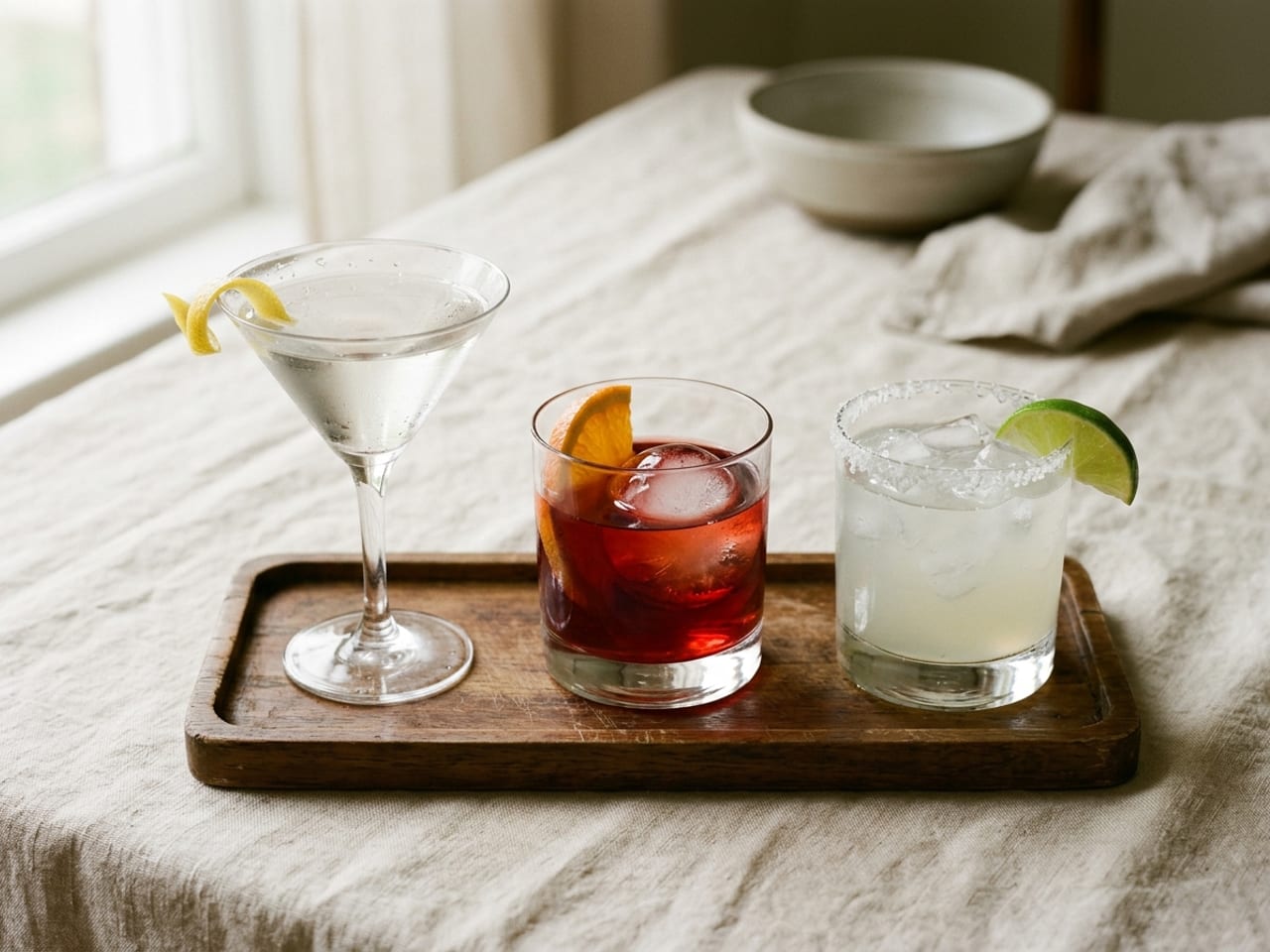
What a garnish is for
- Aroma: the part you smell before you sipA twist sprays citrus oil over the drink, a mint sprig sits right under the nose, a grating of nutmeg lands on the foam. Difford's Guide puts it simply: expressing the oils "adds a citrus aroma and changes the perceived flavour."19
- Flavour: the part you eat, squeeze or sip throughA salt rim, an olive, a cherry, a wedge you squeeze in yourself. These change what is in the glass, sip by sip, and the drinker controls how much.
- Looks: the part that tells you what it isThree coffee beans say Espresso Martini across a room, a celery stalk says Bloody Mary. The Oxford Companion to Spirits and Cocktails splits garnishes into "functional and visual", and the best ones are both.2
The garnish for 20 classic cocktails
The official column is the IBA specification, word for word where it is short;3 the second column is what you will usually be served. Tap a drink for the photo and how to do it.
| Drink | Official garnish (IBA) | What bars often do |
|---|---|---|
| Negroni | Half orange slice | Orange peel, expressed |
| Old Fashioned | Orange slice or zest, and a cocktail cherry | Orange peel only |
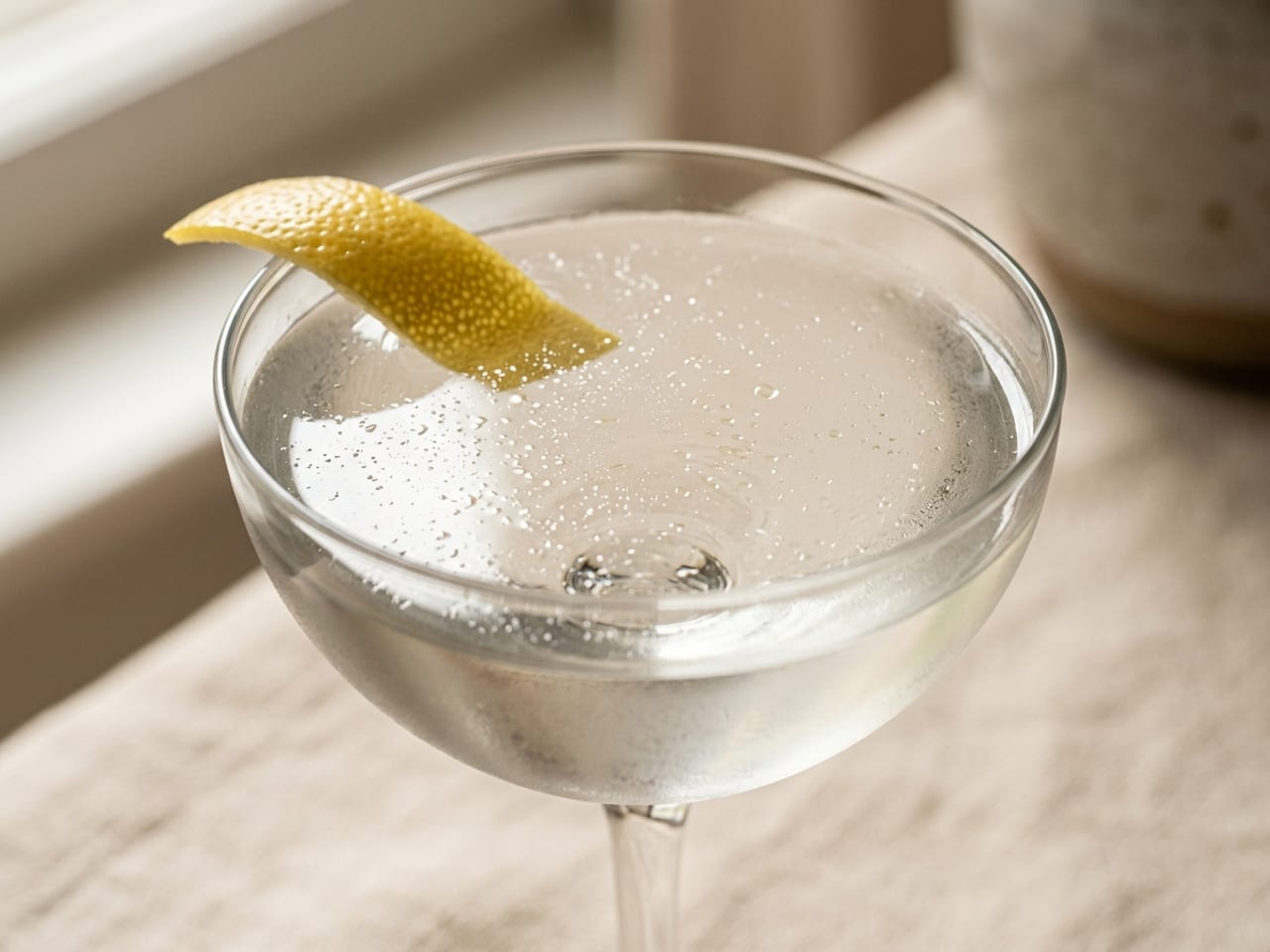
| Dry Martini | Lemon oil squeezed from a peel; green olive if requested | Lemon twist, or one or three olives |
| Gimlet | Not on the IBA list | Lime wheel |
| Margarita | Half salt rim (optional); no lime | Salt rim and a lime wedge or wheel |
| Cosmopolitan | Lemon twist | Flamed orange peel |
| Mojito | Mint sprigs and a slice of lime | Same |
| Whiskey Sour | Half orange slice and a maraschino cherry | Lemon or orange and a cherry on a pick (a flag), or bitters on the foam |
| Paper Plane | None | None |
| Espresso Martini | 3 coffee beans | Same |
| Bloody Mary | Celery, lemon wedge (optional) | Celery, lemon or lime, olives, pickles |
| Gin and Tonic | Not on the IBA list | Lime wedge or wheel; cucumber for cucumber-led gins |
| Manhattan | Cocktail cherry | Brandied cherry or a lemon twist |
| Aperol Spritz | Slice of orange | Same |
| Daiquiri | None | Lime wheel |
| Moscow Mule | Lime slice | Lime wedge, sometimes mint |
| French 75 | None | Long lemon twist |
| Sazerac | Lemon zest | Lemon peel, expressed over the glass |
| Pisco Sour | Dashes of Amargo bitters on the foam | Same |
| Mai Tai | Pineapple spear, mint leaves and lime peel | Spent lime shell and a mint sprig (Trader Vic's original) |
Three surprises in that table. The Daiquiri, the French 75 and the Paper Plane officially have no garnish at all. The IBA Margarita has no lime, only an optional half salt rim. And the Mai Tai's pineapple spear is a later addition: Trader Vic put "half the lime shell" in each drink "for colour" and "stuck in a branch of fresh mint."14
How to garnish 12 classic cocktails
The twelve most-asked-about garnishes, each with the official spec, the story where there is one, and how to do it at home.
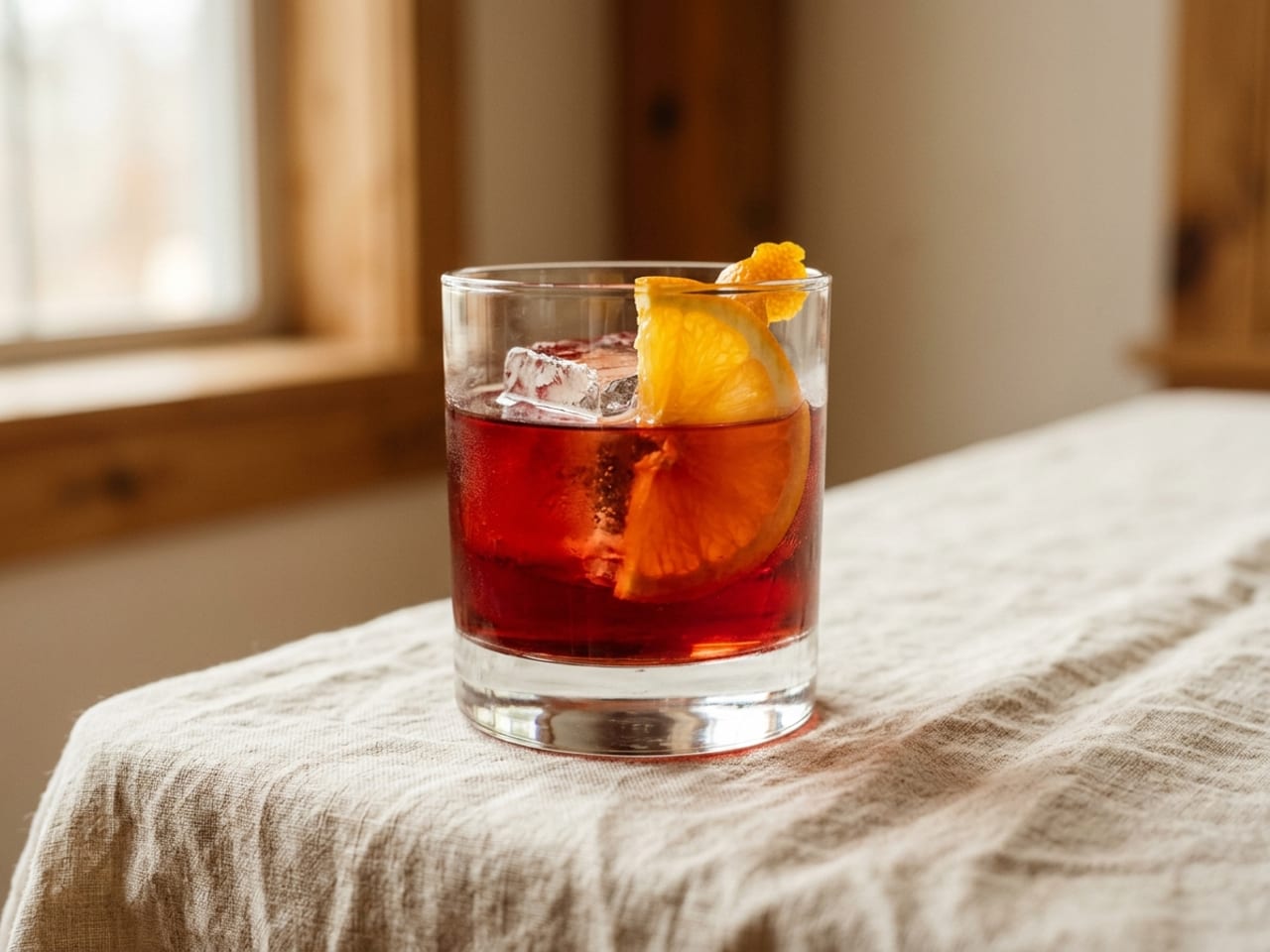
Negroni garnish
IBA: half orange slice · rocks glass · orange
The IBA specification says "Garnish with half orange slice."3 Many bars use an expressed orange peel instead,18 which gives the same orange note without the slice going soft in the glass.
Do it: a half-wheel about ¼ inch (6 mm) thick, tucked between the ice and the glass so it stays upright; or a swath of orange peel squeezed over the top, then dropped in.
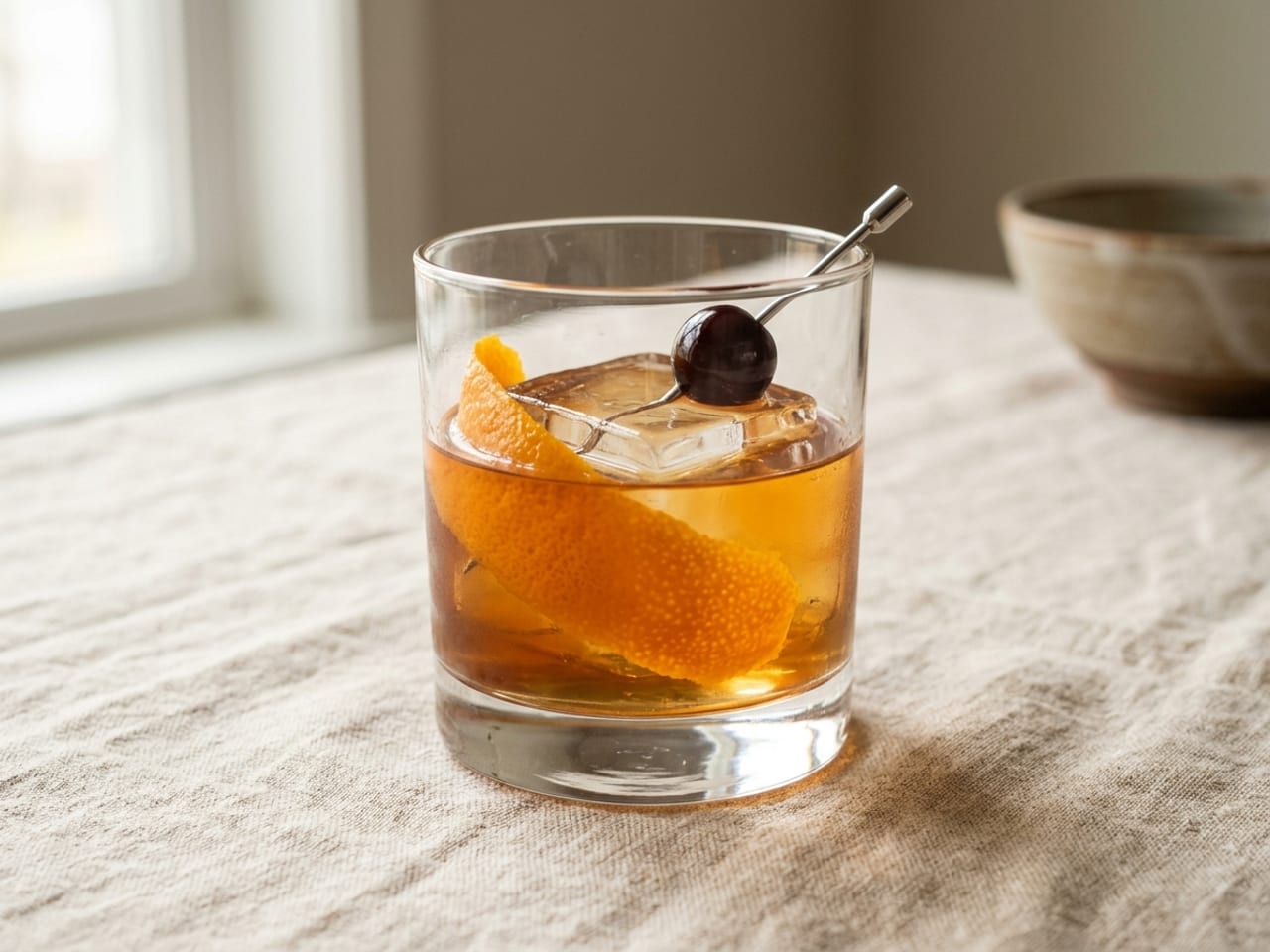
Old Fashioned garnish
IBA: orange slice or zest and a cherry · rocks glass
The IBA lists "orange slice or zest, and a cocktail cherry";3 most craft bars today serve it with an orange peel alone.18 The old books sit with the purists: Kappeler's 1895 Old-Fashioned cocktails take "a small piece of lemon peel" and no fruit,6 and the Savoy's 1930 version is decorated "with twist of lemon peel and slice of orange", nothing muddled.7
Do it: a wide swath of orange, expressed over the glass, then laid against the big cube. Add a dark cherry on a pick if you like it the IBA way. Skip the muddled "fruit salad".
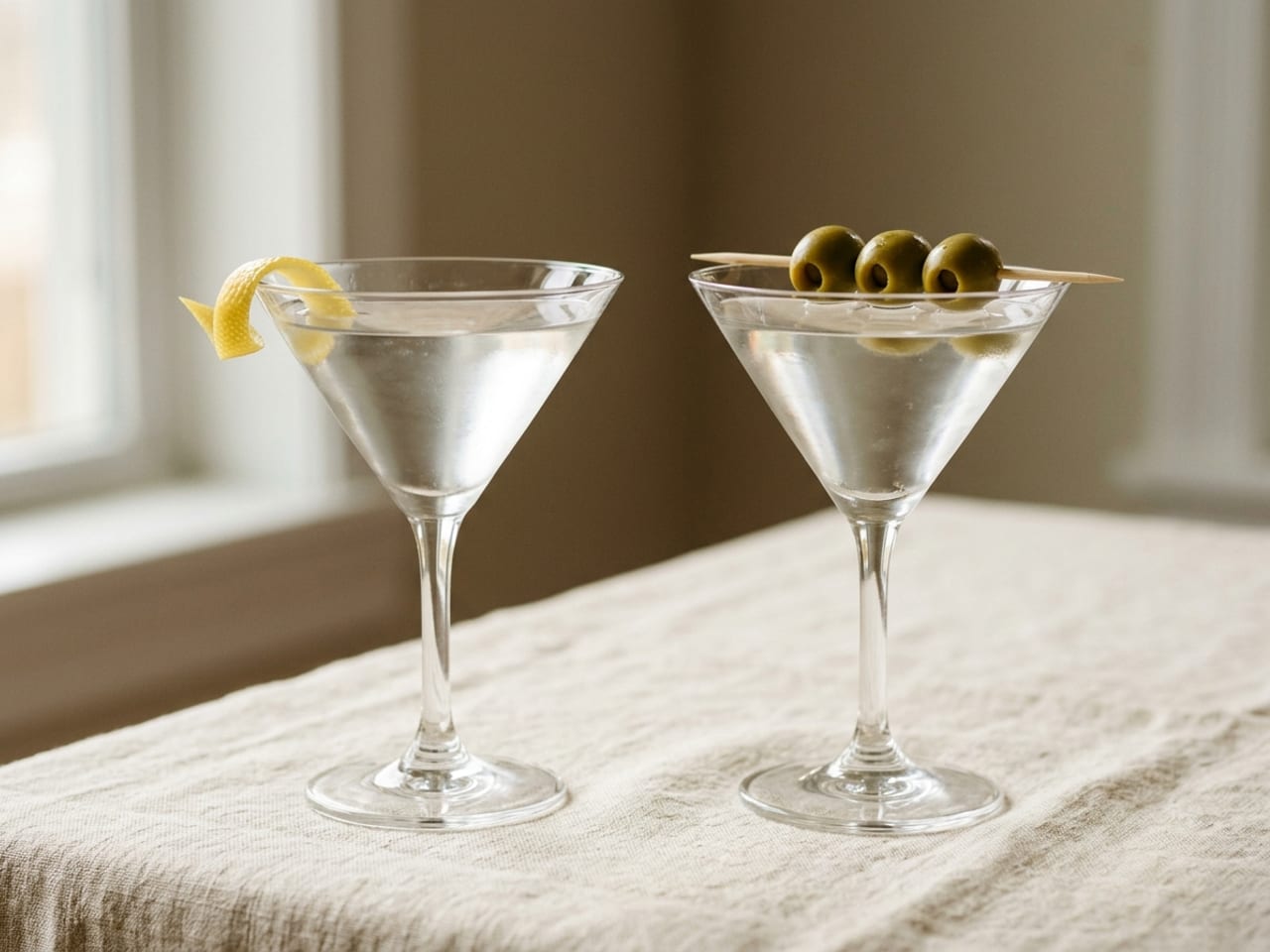
Martini garnish
IBA: lemon oil, or olive on request · stemmed cocktail glass
The IBA default is the twist: "Squeeze oil from lemon peel onto the drink, or garnish with a green olives if requested."3 That is the older garnish, too. Kappeler's 1895 Martini is made with "a piece lemon-peel" and says "Add a maraschino cherry, if desired by customer". 6 The olive arrived in the mid-1890s, when taste turned from sweet drinks to dry ones: "The cherry should go with the sweet drink and the olive with the dry."2 A cocktail onion instead of an olive makes it a Gibson.
Do it: for a twist, express a strip of lemon peel over the surface and drop it in or rest it on the rim. For olives, rinse them first so no oil or brine clouds the drink, and use one or three on a pick. The "never two" rule is a superstition nobody has traced to a source.17
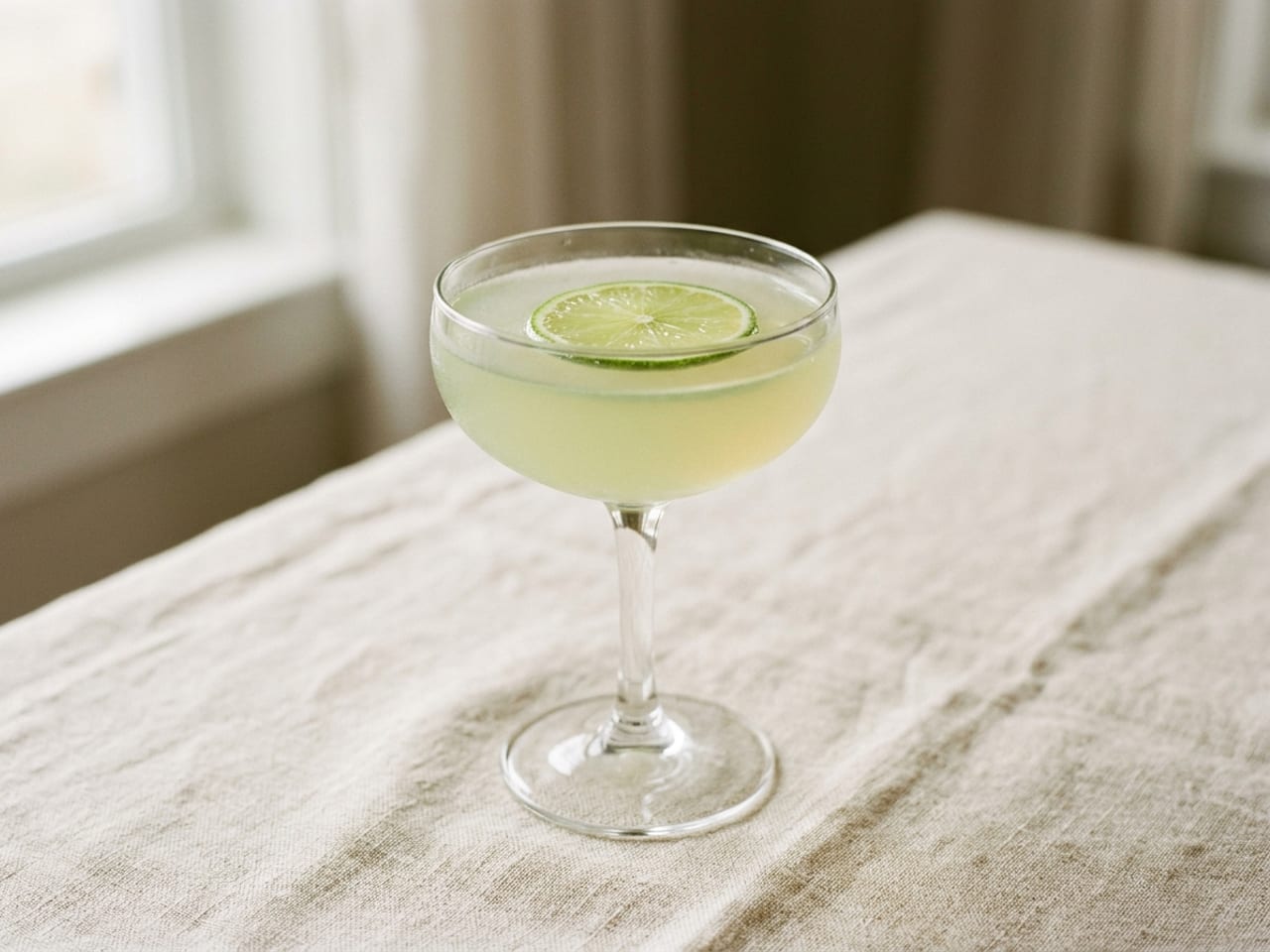
Gimlet garnish
Not an IBA cocktail · coupe · lime
The Gimlet isn't on the IBA list, so there is no official garnish, and the Savoy's 1930 recipe (gin and Rose's Lime Juice Cordial, half and half) has none.7 Today's standard is a lime wheel.18
Do it: a thin wheel, ⅛ inch (3 mm), floated on the surface of a drink served up, or slit to the centre and seated on the rim.20
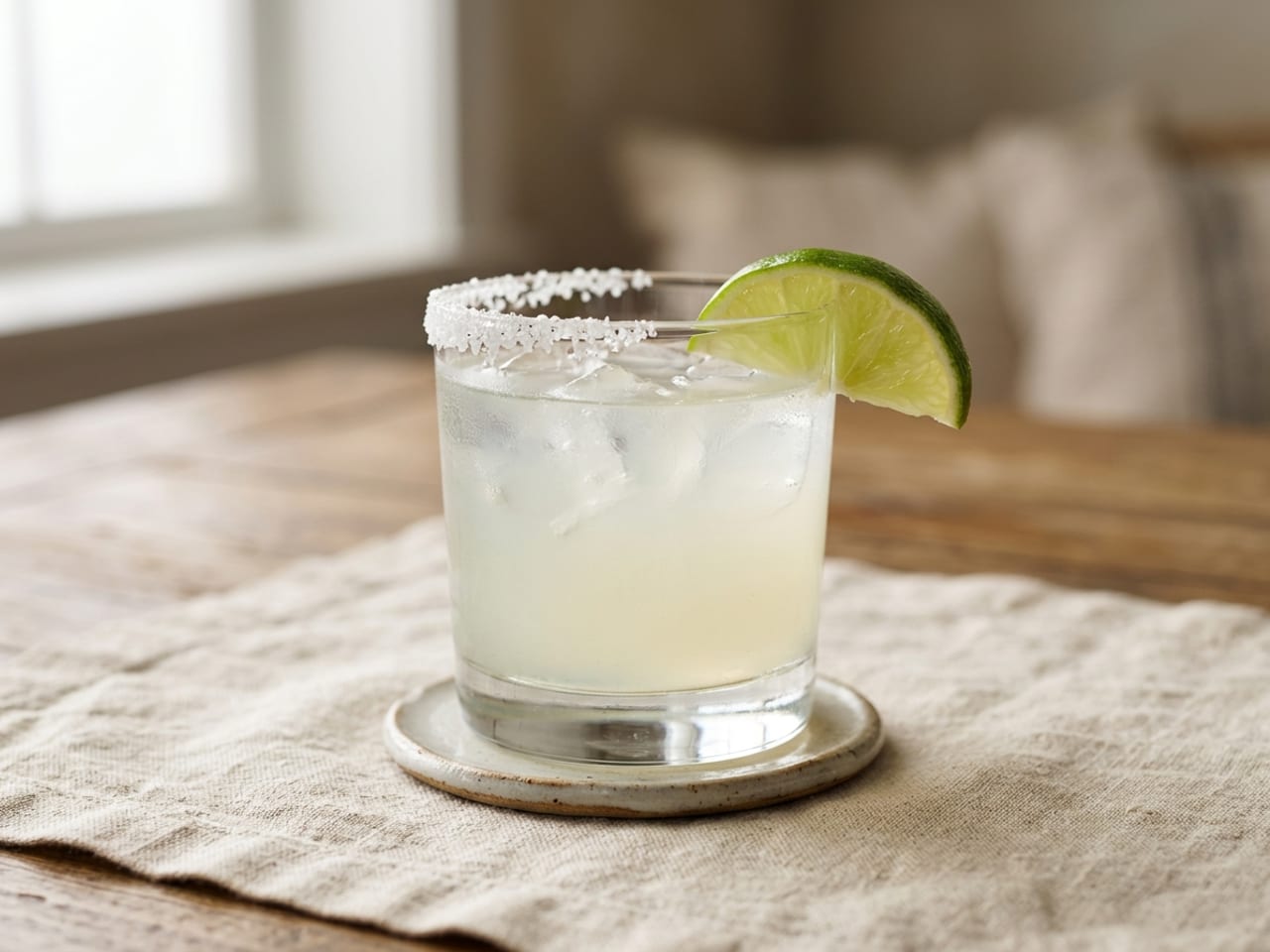
Margarita garnish
IBA: half salt rim (optional) · rocks glass or coupe
The IBA garnish is only "Half salt rim (Optional).", with no lime at all.3 Common practice adds a lime wedge or wheel.18 The salt is older than the name: Charlie Connolly's 1939 Tequila Sour was served in a glass "rimmed with rind of lime and coated with salt", and the first Margarita in print, in 1953, came in "a glass whose rim has been dipped in salt".13
Do it: salt half the rim, outside only, with coarse salt (the method is below). The guest chooses, sip by sip, whether they get salt.
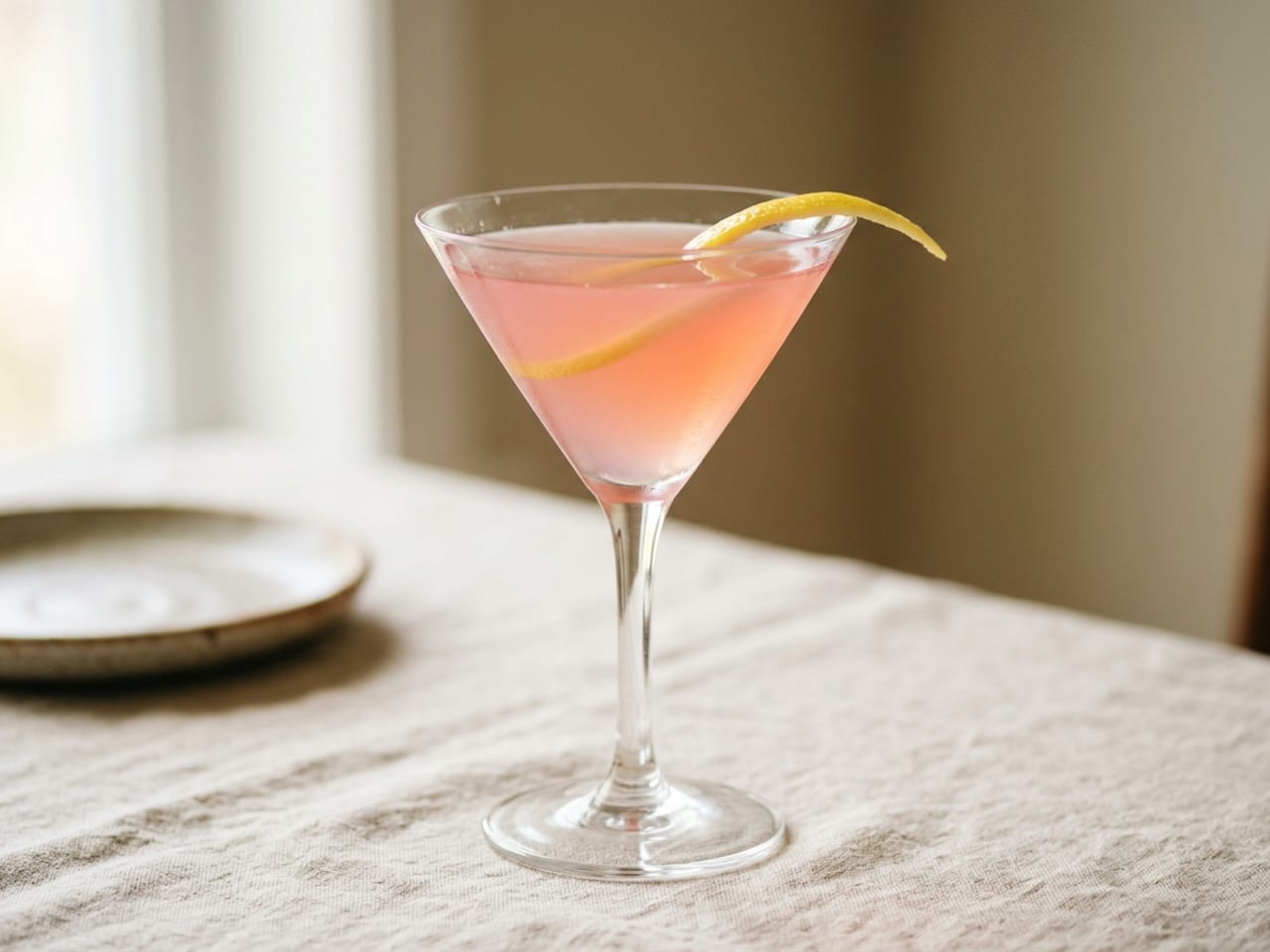
Cosmopolitan garnish
IBA: lemon twist · cocktail glass
Toby Cecchini's 1988 original at New York's Odeon was "garnished with a lemon twist", and the IBA keeps it.3 The flamed orange peel came in 1996, when Dale DeGroff put the drink on the Rainbow Room menu.11
Do it: a long, thin lemon twist, expressed and laid across the surface; or flame an orange coin over it for the 1990s version (how).
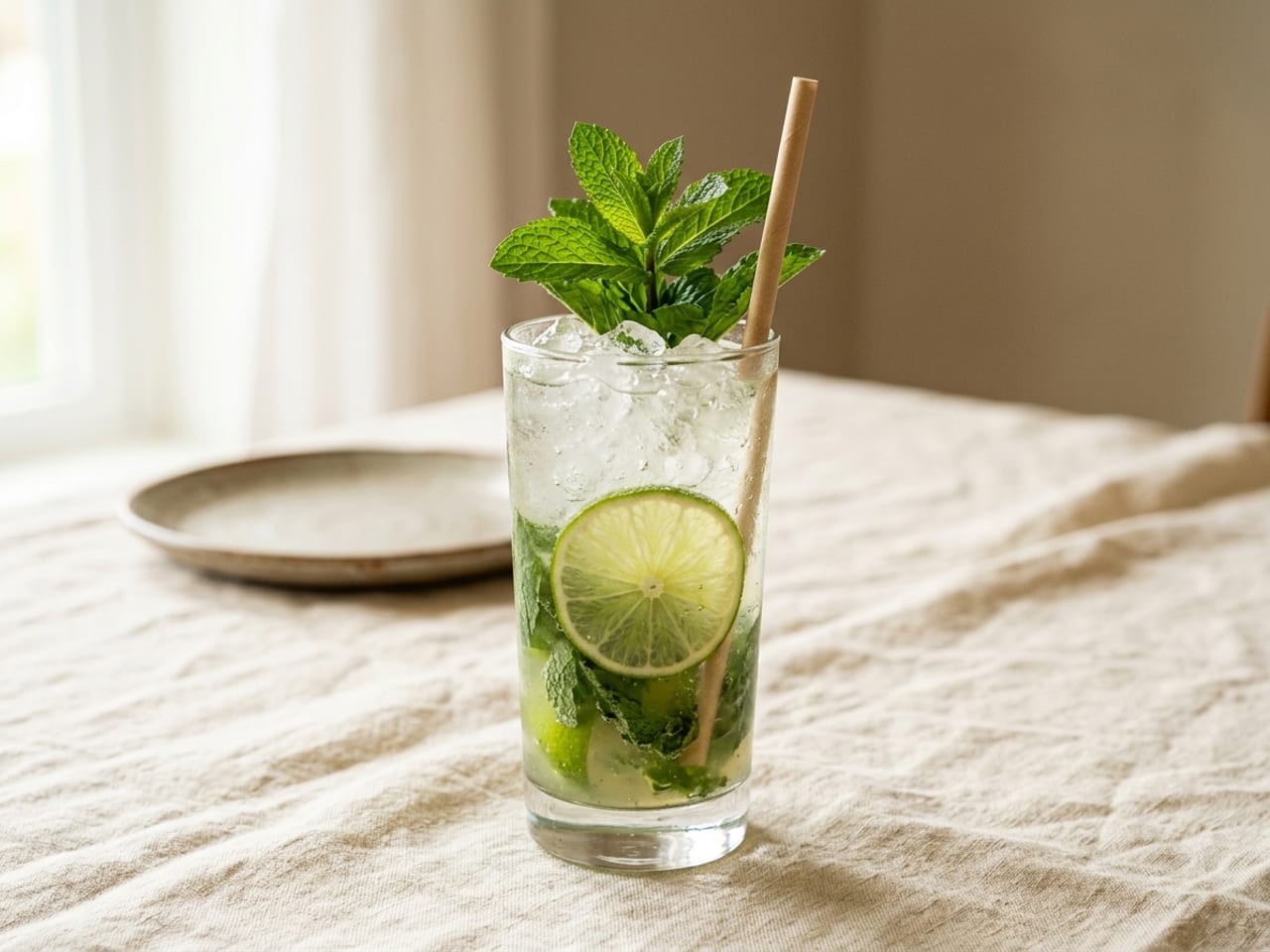
Mojito garnish
IBA: mint sprigs and a lime slice · highball
The IBA garnish is "sprigs of mint and slice of lime."3 The sprig is there for the nose: in a test by America's Test Kitchen, slapped mint smelled markedly stronger, but the gain was lost once the herbs were mixed into a dish.23 So wake up the sprig that sits on top, and leave the mint in the drink alone.
Do it: pick a full, bright sprig, clap it once between your palms and stand it in the ice right next to the straw, so every sip goes past it.
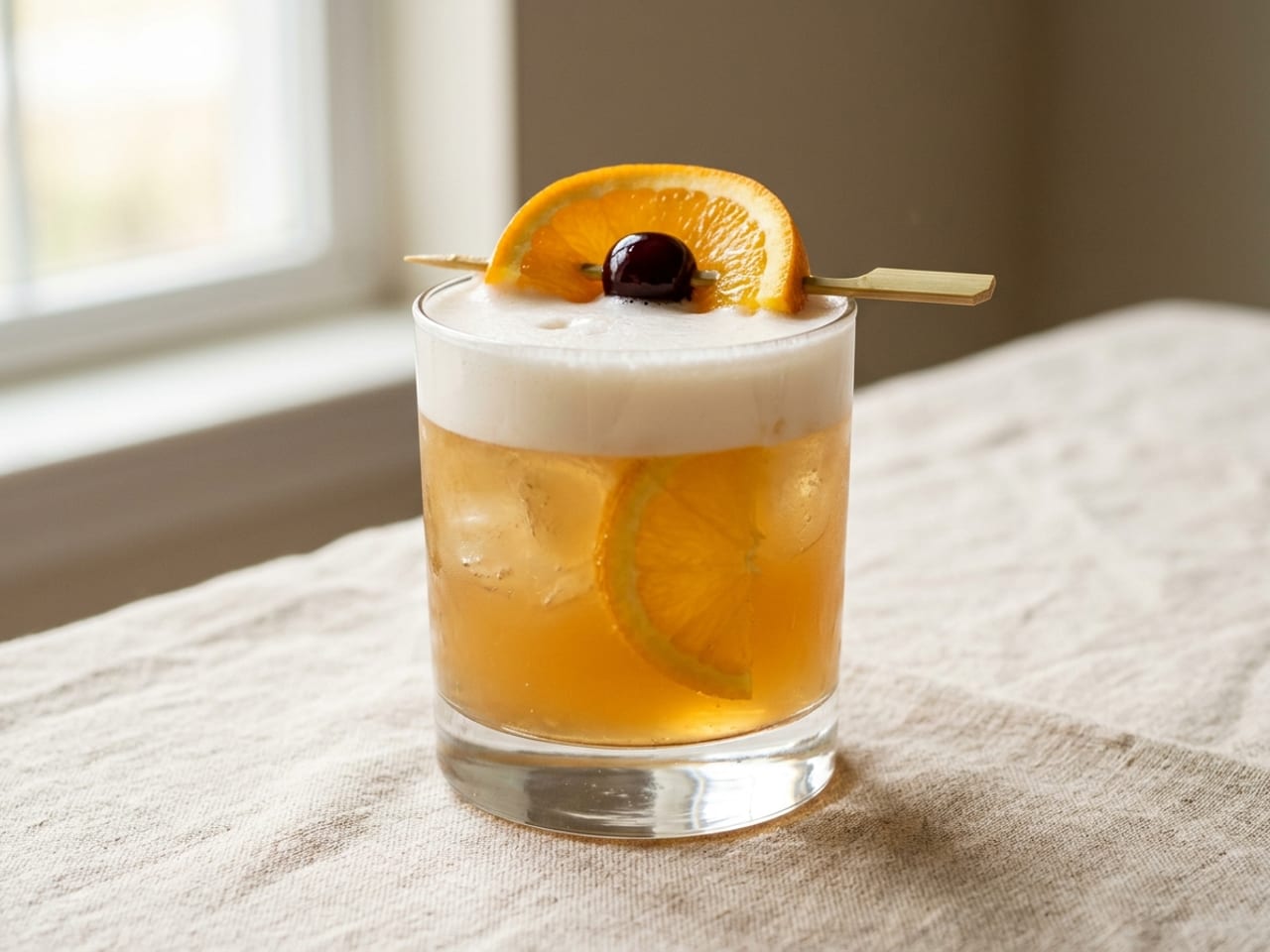
Whiskey Sour garnish
IBA: half orange slice and a cherry · rocks glass
The IBA garnish is "half orange slice and maraschino cherry, optionally use orange zest."3 Fruit and a cherry pinned together on a pick is a flag (Difford's calls it a "sail"). With egg white, some bars dot the foam with a few drops of aromatic bitters instead, the way the Pisco Sour is garnished.
Do it: half an orange wheel folded around a cherry, both speared on one pick, rested across the rim.
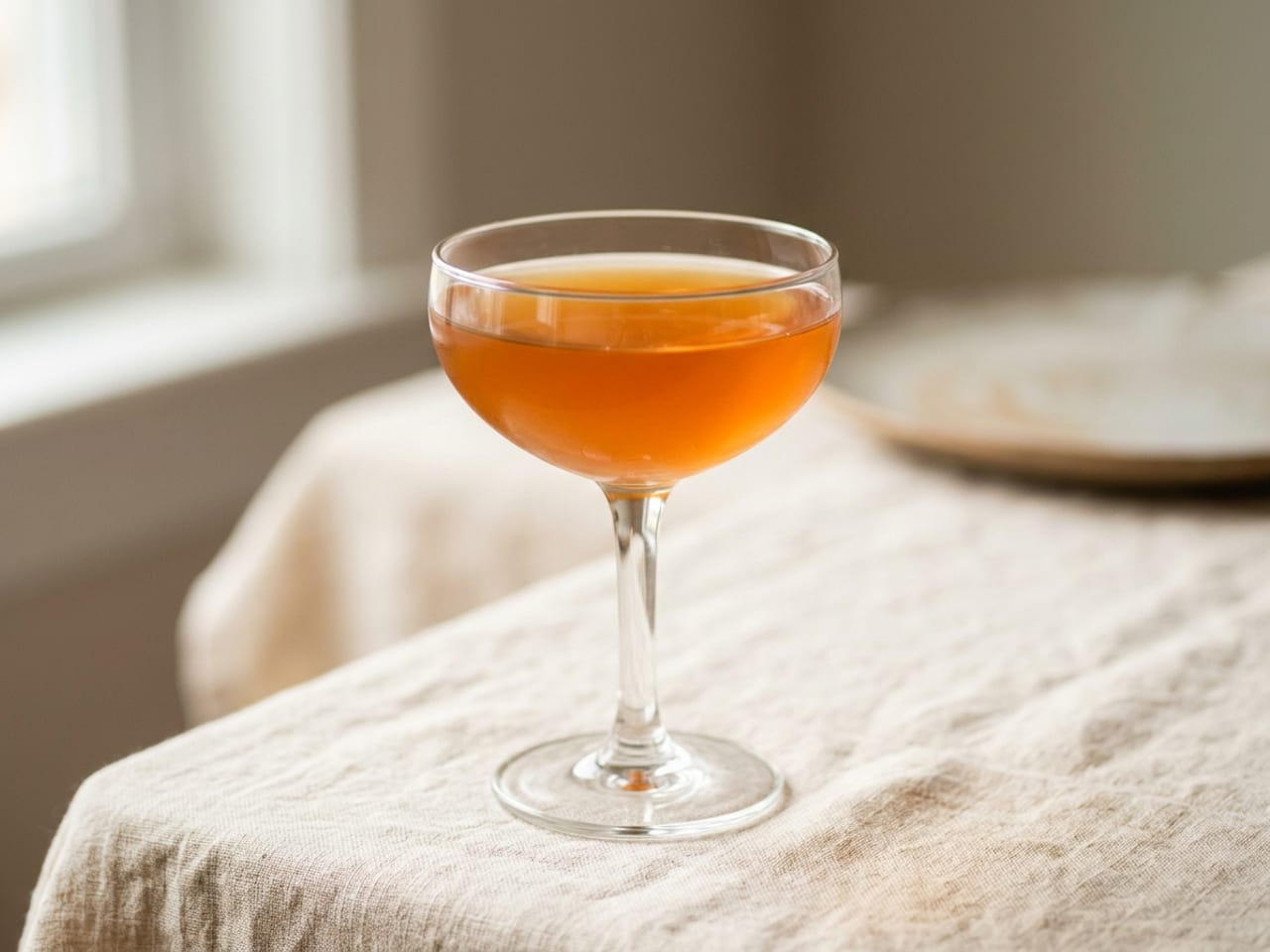
Paper Plane garnish
IBA: none · coupe
None. The IBA garnish line reads "N/A",3 and so do the Daiquiri and the French 75. A drink with no garnish is not unfinished: it means everything it needs is already in the glass.
Do it: a well-chilled coupe, a clean rim, nothing else.
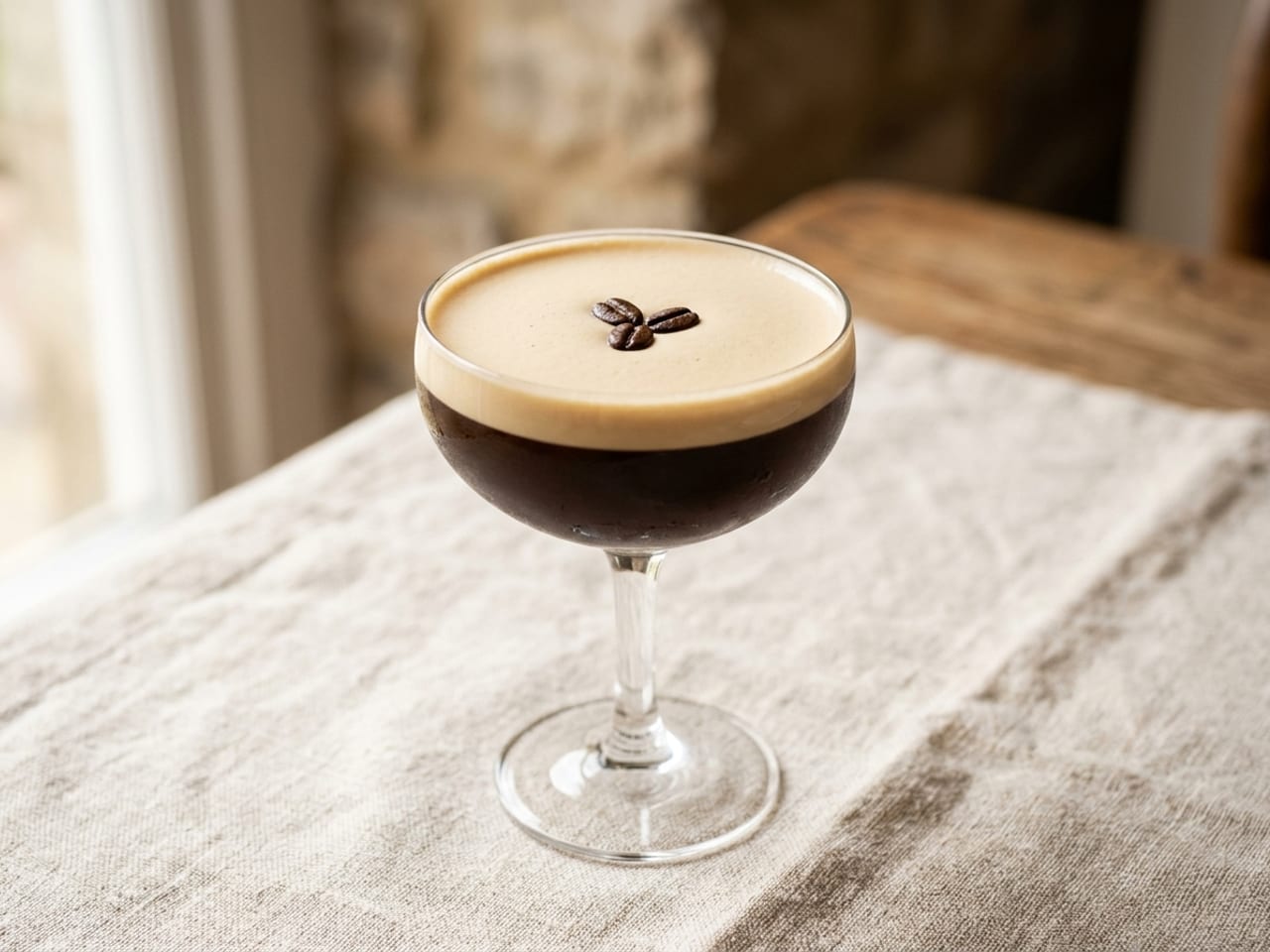
Espresso Martini garnish
IBA: 3 coffee beans · coupe or cocktail glass
"3 coffee beans", says the IBA.3 The custom comes from sambuca served "con la mosca", "with the fly", where the three beans stand for health, wealth and happiness.15 Molinari's version of the story has a single bean dropped into a glass as a joke, "THERE'S A FLY!"16
Do it: shake hard for a thick crema, wait a few seconds for it to settle, then set three beans in the centre in a small petal shape. They float on the foam, so place them; don't drop them.
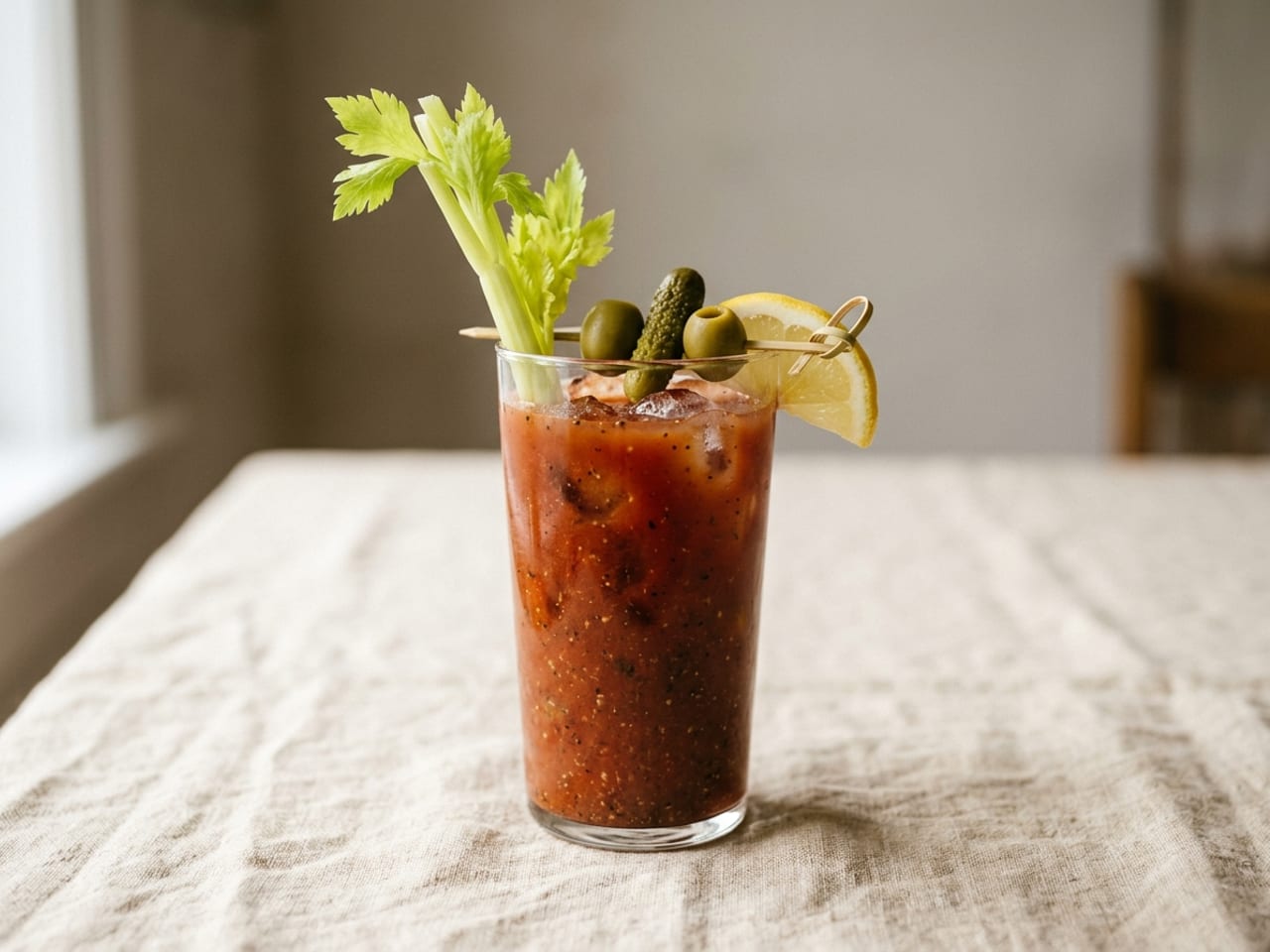
Bloody Mary garnish
IBA: celery and a lemon wedge (optional) · highball
"Celery, lemon wedge (Optional)", per the IBA.3 The story that a Chicago guest grabbed a celery stalk from a relish tray to stir her drink first appears, unattributed, in a 1974 wire feature; celery stirrers in tomato juice are in print from 1951 and in a Bloody Mary by 1968.12
Do it: one crisp inner stalk with its leaves, a lemon wedge on the rim. Olives, pickles and a pepper on a pick are fair game; a whole cheeseburger is a meal.
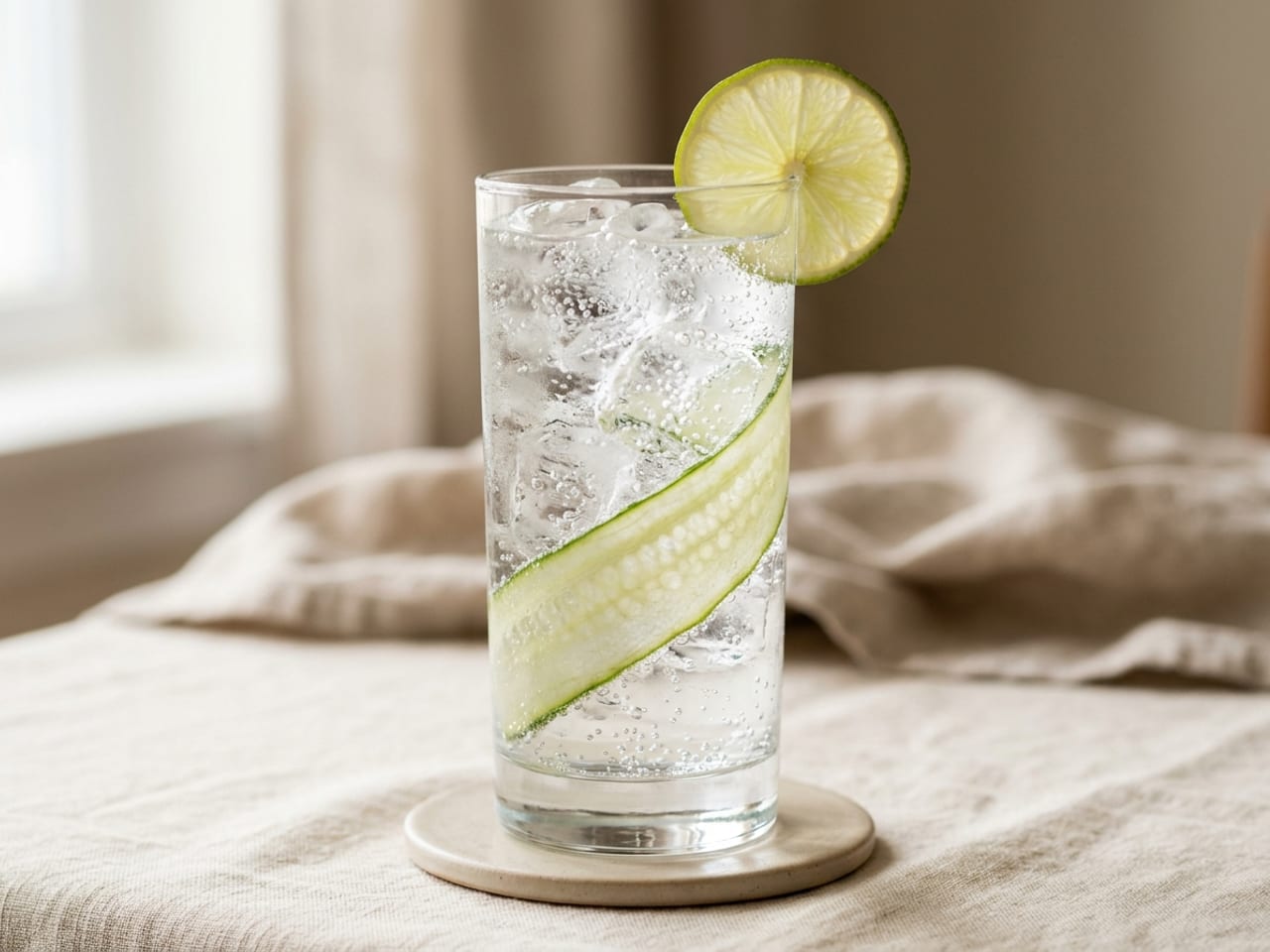
Gin and Tonic garnish
Not an IBA cocktail · highball or copa
No official spec. A lime wedge or wheel is the default; a gin led by cucumber or herbs wants that instead, and a cucumber ribbon lining the glass works as well in an alcohol-free highball as in a gin one.56
Do it: shave a long ribbon from a cucumber with a Y-peeler, press it against the inside of the empty glass, then fill with ice to hold it in place. Add the lime wheel last.
Every garnish, named
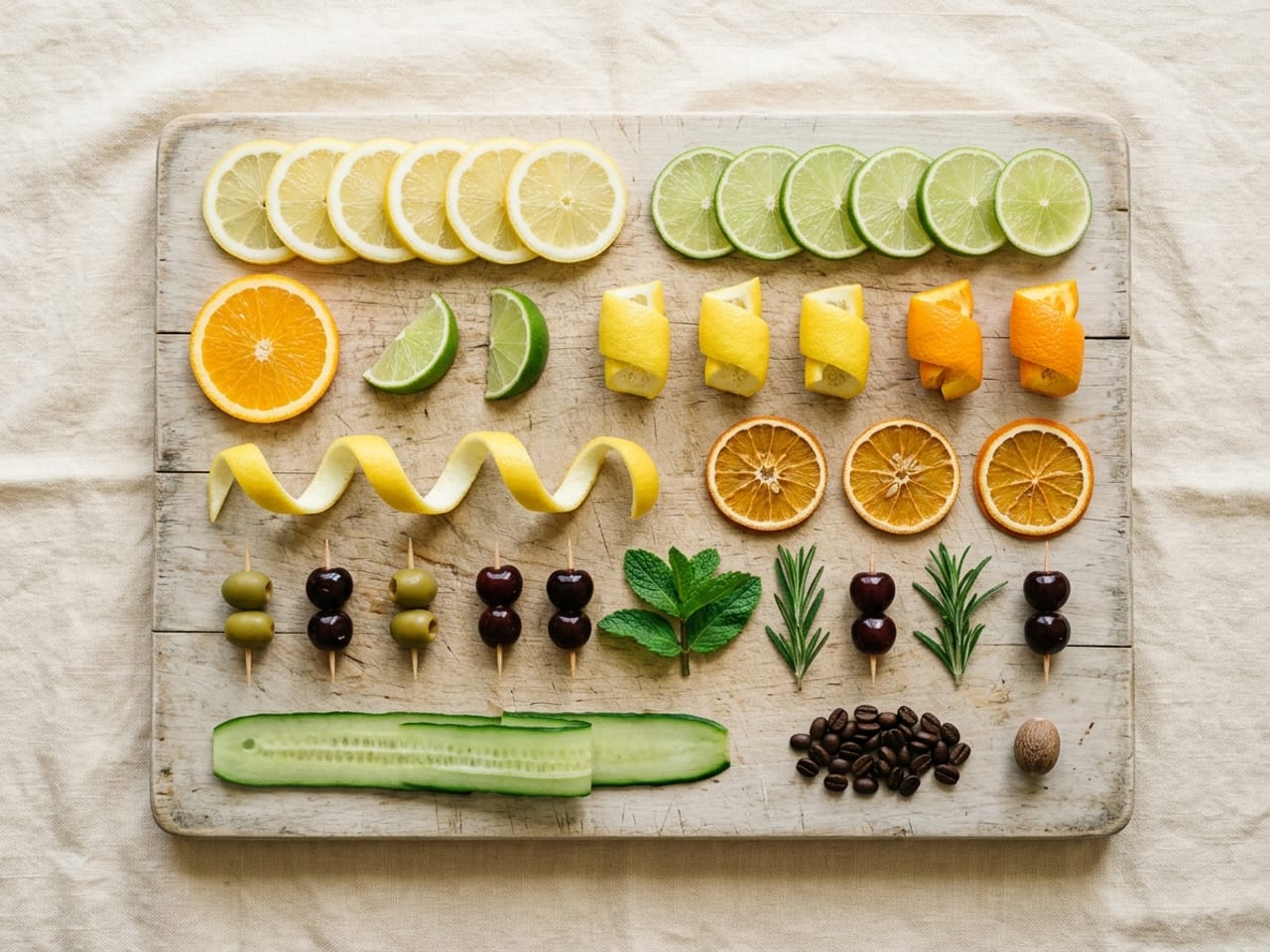
Garnish
The finishing touch on a drink: something added for aroma, flavour or looks, from the Old French garnir, to furnish or equip.
Zest
The coloured outer skin of a citrus fruit, where the aromatic oil glands are.
Pith (albedo)
The white, spongy, bitter layer under the zest; a good twist carries very little of it.
Peel
A piece of citrus skin cut for a drink: zest with a little pith behind it; bar menus use peel, twist and zest almost interchangeably.
Twist
A strip of citrus zest, named for the twist it gets to spray its oils over a drink before it is dropped in, rested on the rim or thrown away.
Swath
A wide piece of zest, about ½ inch (12 mm) or more across, cut with a Y-peeler; the most common twist today.
Coin
A small round of zest, about the size of a coin, used for flaming or for a neat disc on the surface.
Expressed oil
The fine spray of citrus oil that comes out of the zest when it is squeezed or twisted over a drink.
Flamed twist · flamed orange peel
A coin of orange zest squeezed through a lit match so its oil flares over the drink; popularised by Dale DeGroff from 1987.
Horse's neck
The whole peel of a lemon cut in one long spiral and hung inside a tall glass, named after the drink it decorated.
String twist · channel-knife twist
A thin strand of zest, 3 to 5 mm wide, cut with a channel knife; it can be wound into a spring or tied in a knot.
Wheel
A round slice cut across the fruit, ⅛ to ¼ inch (3 to 6 mm) thick, floated on the drink or slit and seated on the rim.
Half-wheel · slice
A wheel cut in half; it tucks between the ice and the glass, as in the IBA Negroni.
Wedge
A lengthwise piece of the fruit, for squeezing into the drink by the person drinking it.
Flag · sail
A slice of orange or lemon and a cherry pinned together on one pick, the classic sour garnish.
Rim · salt rim, sugar rim, half-rim
A band of salt, sugar or spice stuck to the outside edge of the glass with citrus juice; a half-rim covers half the circle so the drinker can choose.
Crusta
A drink served in a sugar-rimmed glass lined with a whole spiral of lemon peel; the Brandy Crusta of the 1850s is the ancestor of the sugar rim.
Spank · clap, slap
One clap of a herb sprig between the palms to release its aroma before it goes on the drink.
Dehydrated wheel
A thin citrus wheel dried in a low oven or a dehydrator until crisp; it keeps for months and floats without going soggy.
Cocktail cherry · maraschino, Luxardo
A preserved cherry for drinks: originally marasca cherries in maraschino liqueur, now usually either dark candied marasca cherries or bright red dyed, sweetened ones.
Olive and onion
The savoury Martini garnishes: green olives on a pick, or small white cocktail onions, which make the drink a Gibson.
Aromatic garnish
A garnish meant for the nose rather than the mouth, such as bitters dashed on a Pisco Sour's foam, a mint sprig or grated nutmeg.
Float
A liquid laid on top of a drink over the back of a spoon, such as the red wine on a New York Sour.
Where cocktail garnishes came from
The first bar book barely says "garnish". Jerry Thomas's How to Mix Drinks (1862) uses the word once. What it says, again and again, is "ornament with berries in season": a cobbler had to be "acceptable to the eye, as well as to the palate". His Mint Julep sets the mint sprigs in the ice "in the shape of a bouquet", and his Brandy Crusta gets a sugared rim and a whole lemon peel pared "the same as you would an apple" to line the glass: "Then smile."4 Thomas squeezes lemon peel over his cocktails or throws a piece on top.
The twist gets its name. By 1882 Harry Johnson was telling bartenders to "twist a piece of lemon peel on top" and to handle fruit "with a handsome fork".5 The Oxford Companion finds "twisting" the peel in the 1870s and the strip itself called "a twist" by 1889.2
Cherry for sweet, olive for dry. The cherry reached American bars in the late 1880s, and George Kappeler's 1895 Modern American Drinks offers one in the Martini "if desired by customer".6 The olive came in the mid-1890s as taste turned dry, and by the 1930s it "belonged almost solely to the Martini".2 In 1912 the US Department of Agriculture ruled that "Maraschino Cherries" meant only "marasca cherries preserved in maraschino";8 the alcohol-free red cherry most bars use came out of Oregon, where Ernest Wiegand worked out a calcium-salt brine between 1925 and 1931.9
Some classics had none. The Savoy Cocktail Book (1930) prints its Dry Martini, Gimlet and "Frenchy 75" with no garnish at all, and its Old Fashioned with a twist of lemon and a slice of orange, nothing muddled.7
The modern showpieces are recent. Dale DeGroff saw waiters flaming orange peel over espresso in New York in 1970, learned to use it in drinks from Pepe Ruiz at Chasen's in West Hollywood, and made it a house signature at the Rainbow Room from 1987.10 The celery in the Bloody Mary has a better story than it has a source,12 and the Espresso Martini borrowed its beans from a Roman sambuca ritual.16
Six garnish techniques, step by step
Cut and express a citrus twist
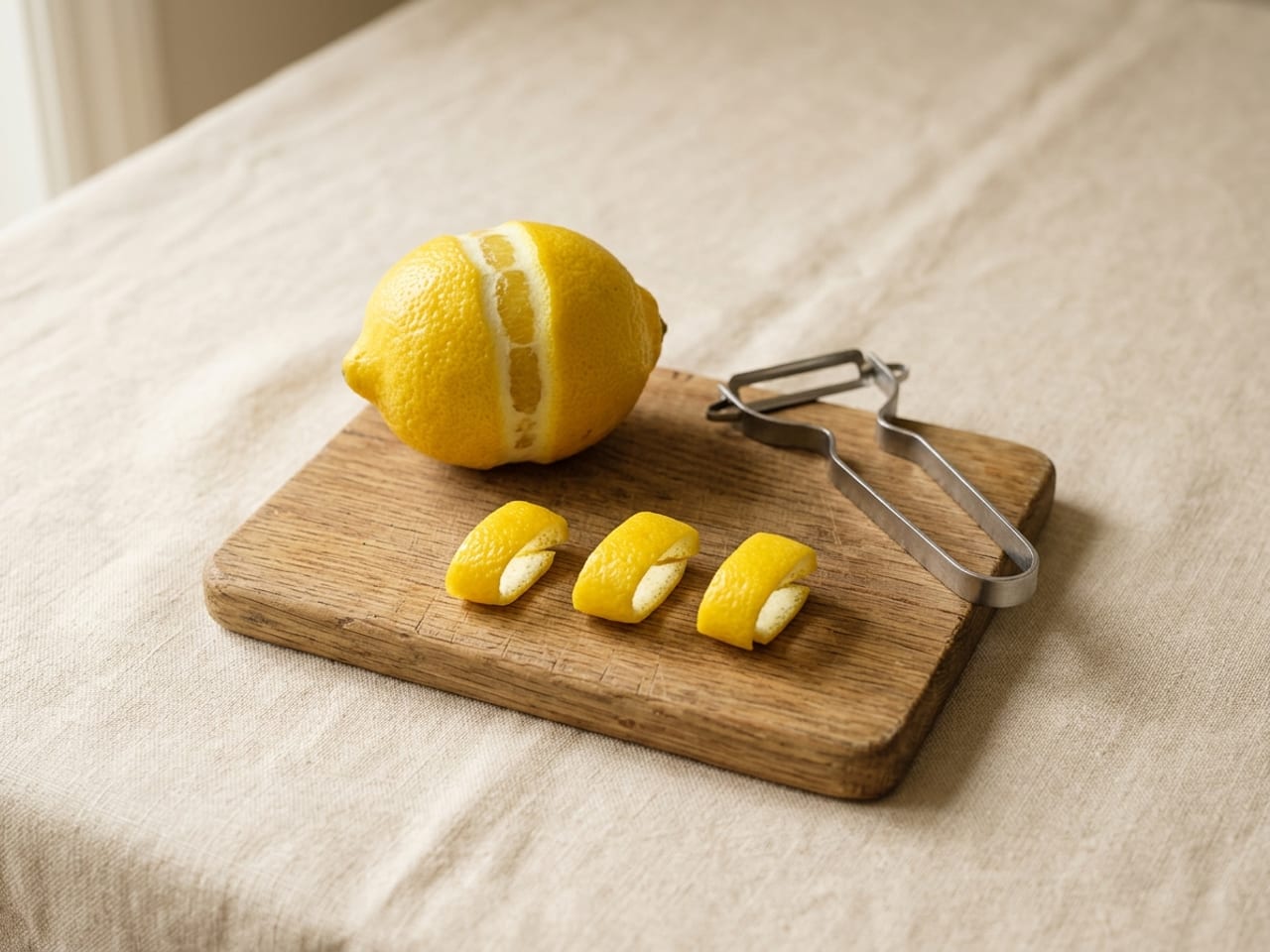
- Pick a firm, fresh, unwaxed fruit and scrub it under running water (why).
- With a Y-peeler, take a strip about ½ inch (12 mm) wide from top to bottom, with "just a little of the white pith on the back".19 Press lightly: pith makes the drink bitter.2
- Trim the ragged ends square with a paring knife if you like it neat.
- Hold it coloured side down over the glass and twist the ends in opposite directions, or pinch it in half, so the oil mists across the surface.19
- Then drop it in, rest it on the rim through a small slit, or throw it away: all three are correct.19 Some bartenders wipe the rim with it first; others say that just makes the rim taste bitter.
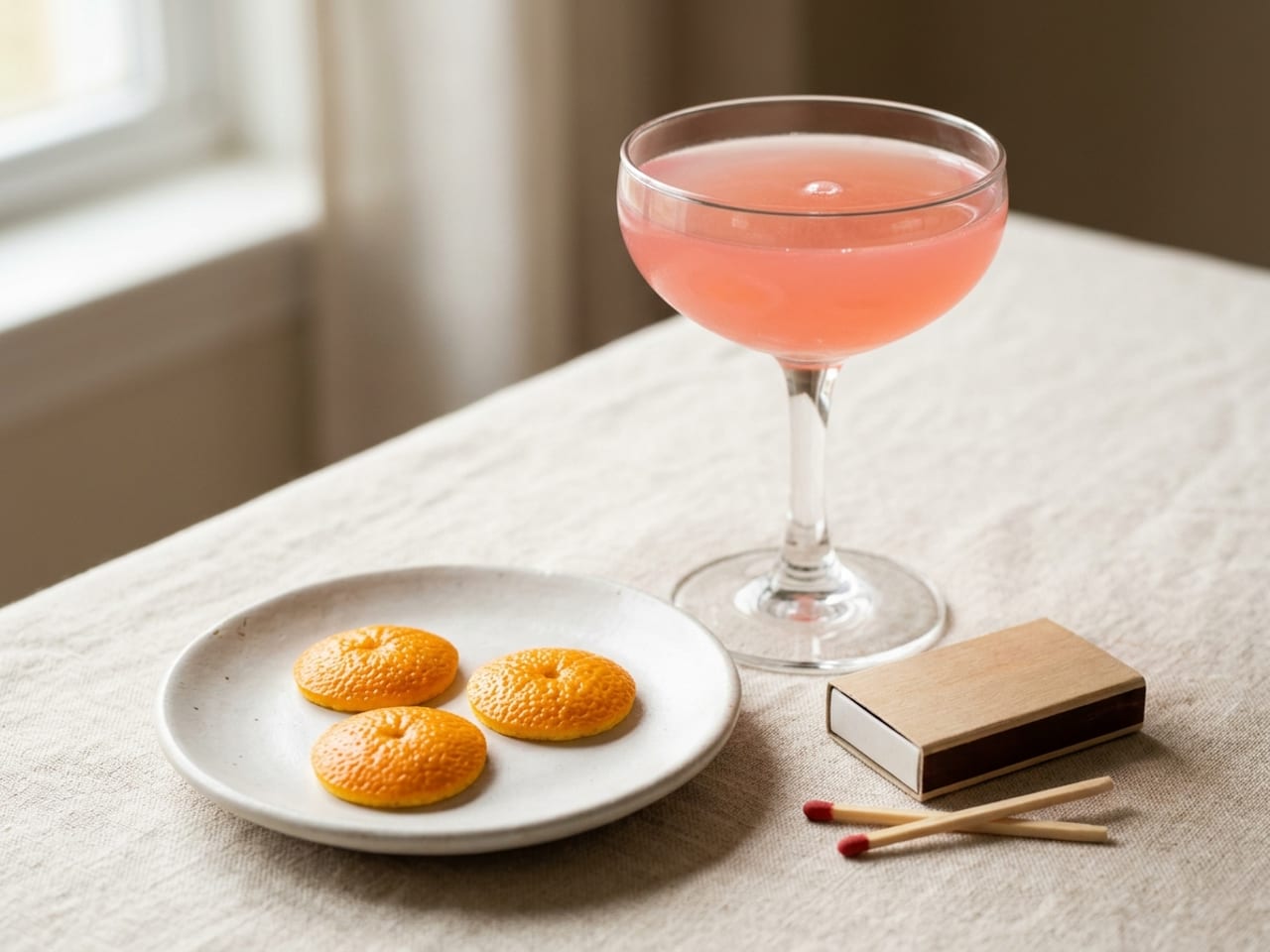
Flame an orange peel
Dale DeGroff's own method:2
- Cut a coin "the size of a quarter" from a fresh, thick-skinned orange, zest only, no pith. Don't warm it first.
- Light a wooden match and let the sulphur burn off.
- Hold the coin skin side down about 5 inches (13 cm) above the drink, with the flame between the peel and the glass, about 4 inches (10 cm) above the glass.
- "Snap the twist sharply": the oil sprays through the flame and flares. Hold it high, or you get "a smoky film" on the drink.
It is theatre more than flavour: it "slightly mellows out the bright citrus notes" and adds a faint smokiness.27 If nothing flares, the orange is too old and dry.
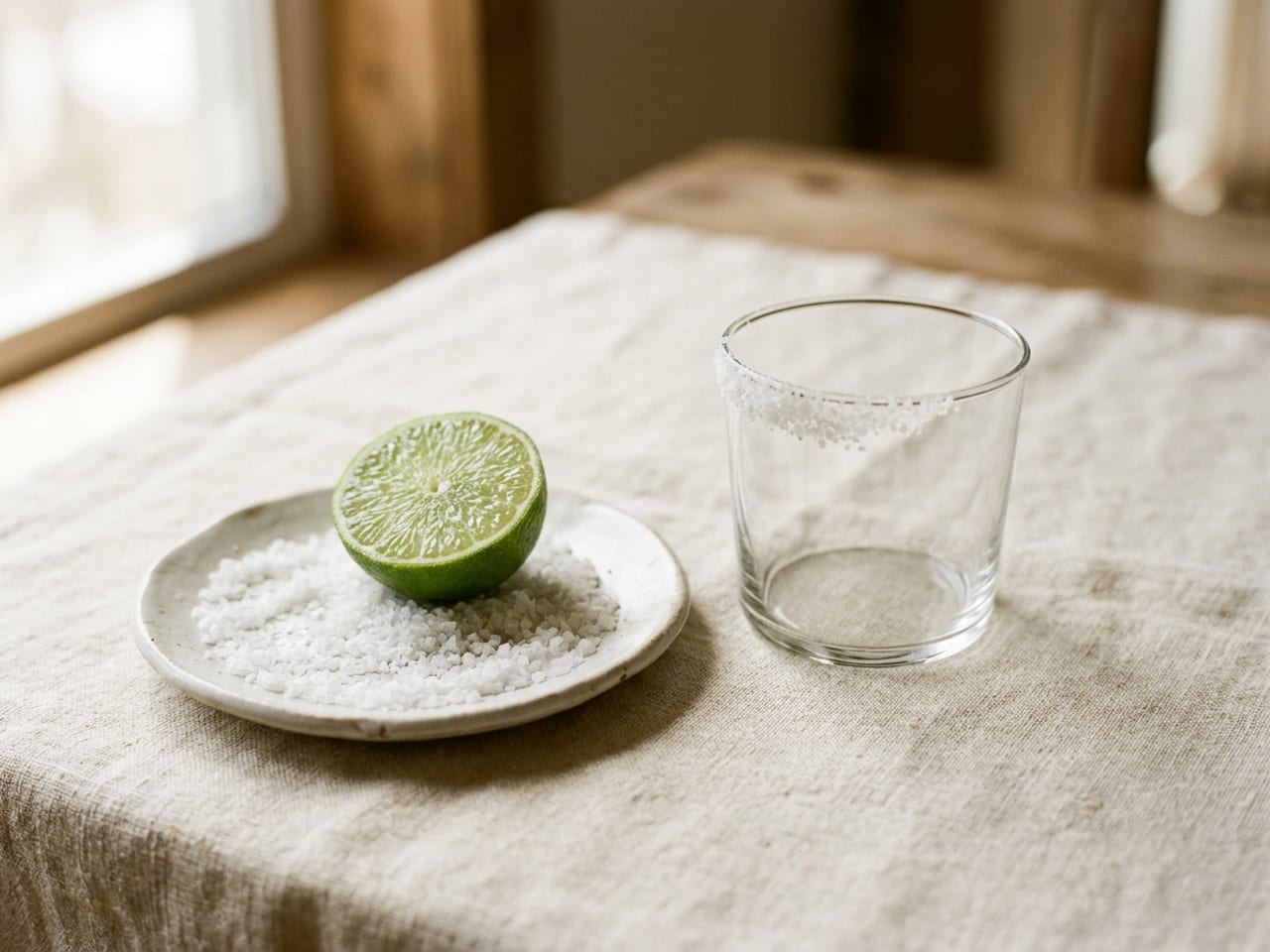
Salt or sugar the rim
- Spread coarse salt (or sugar) on a small plate.
- Run a cut lime around half of the outside of the rim, not the inside.22
- Press the wet outside edge into the salt, rolling the glass on its side, rather than dunking it straight down.22
- Tap off the loose grains before you pour. Salt inside the rim falls into the drink and makes every sip salty.
A half-rim is the IBA Margarita spec3 and lets each guest choose salty or not. For a crusta, apply the sugar hours ahead so it dries hard.
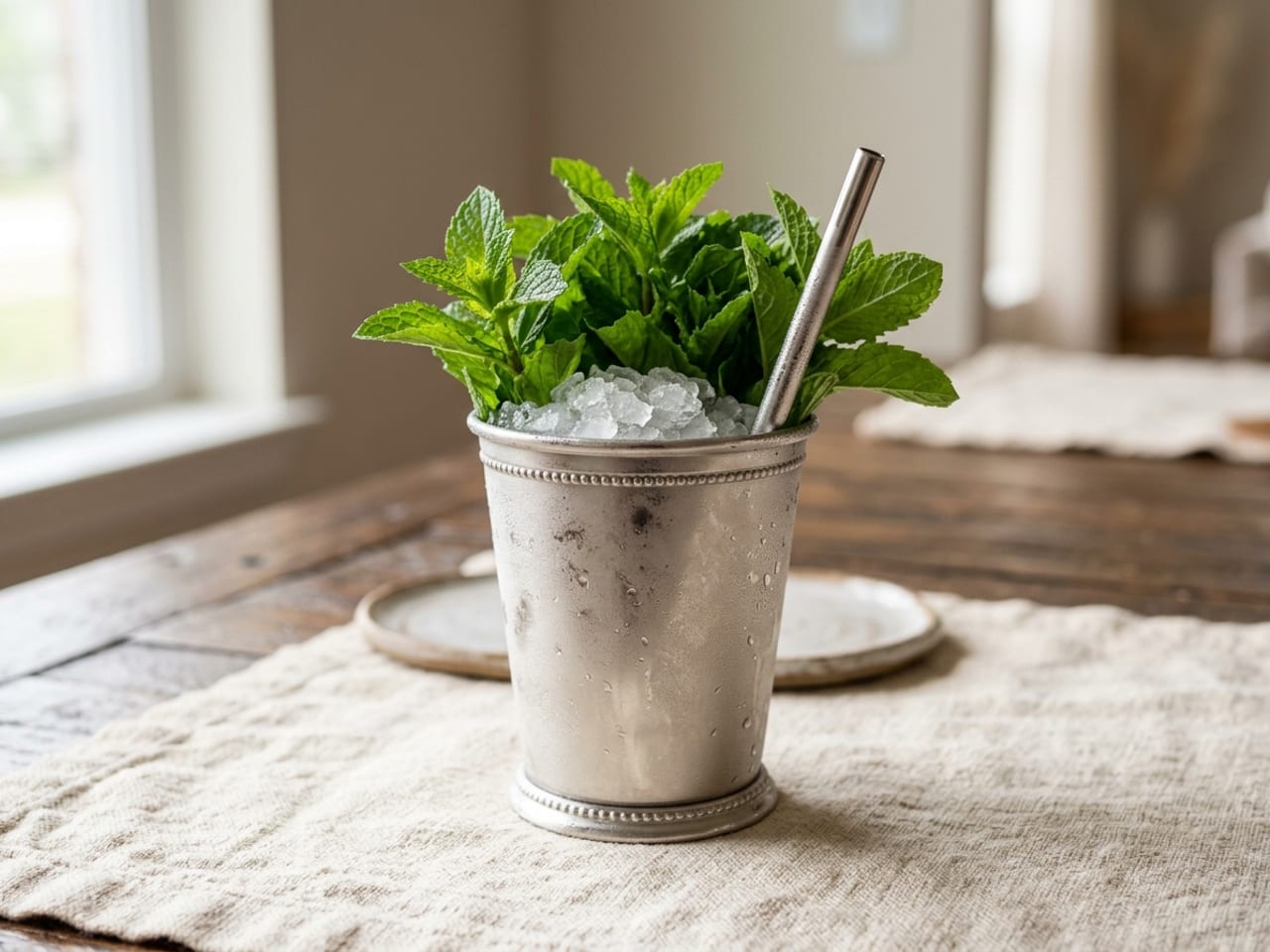
Wake up a herb sprig
Mint keeps its oil in tiny glands on the leaf surface, each a pocket under a thin skin, and the mature gland is "fragile".52 A single clap between the palms (the bartender's "spank") is enough to open them.2 Crushing it tears the leaf and bruises it dark.
Stand the sprig where the nose will be, next to the straw, and keep it out of the drink so it stays bright. The same goes for basil, thyme and rosemary.
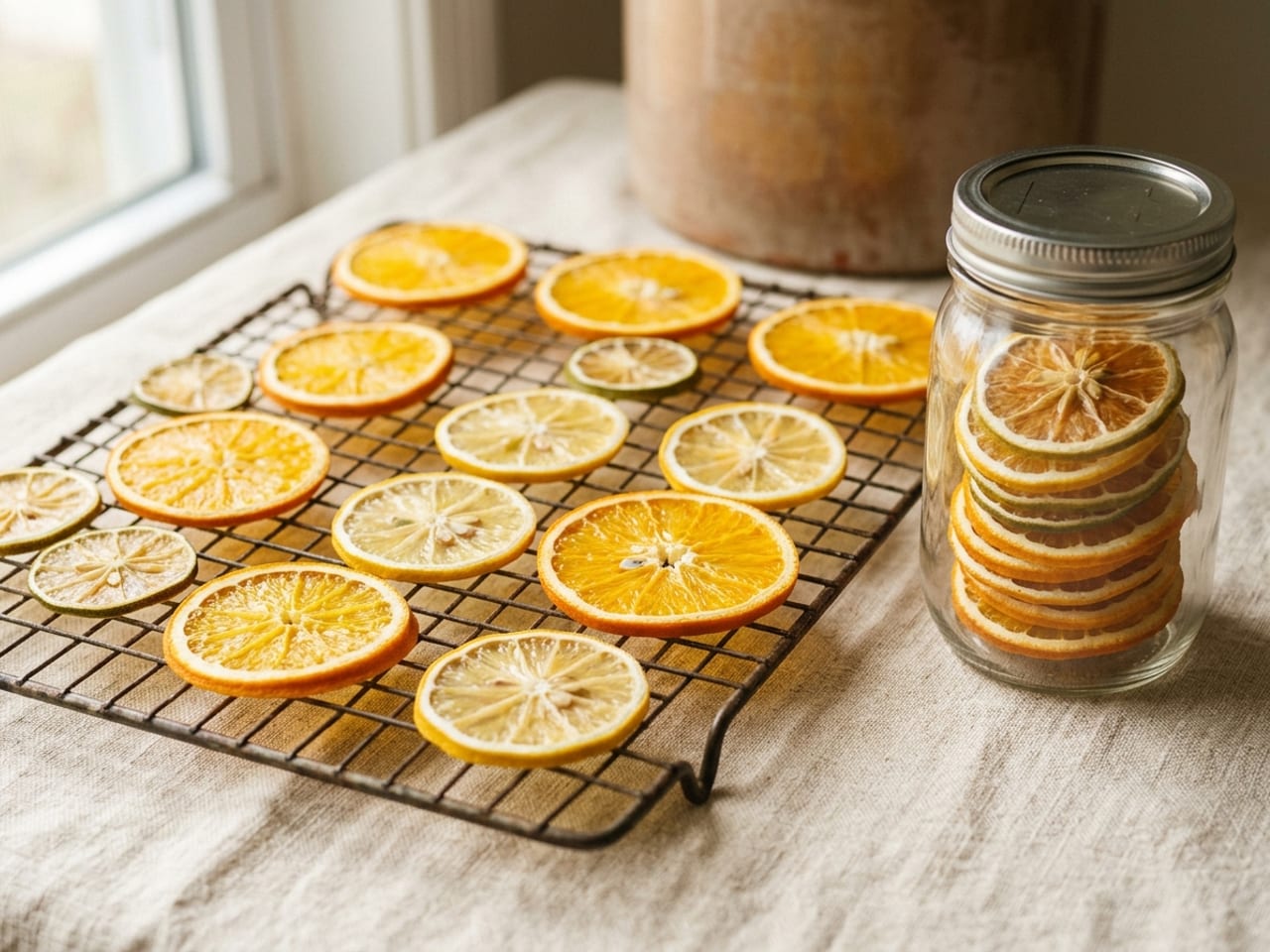
Dry citrus wheels
- Slice oranges, lemons or limes ⅛ inch (3 mm) thick.24
- Dehydrator: 8 to 10 hours at 125 °F (52 °C). Oven: as low as it goes, 170 to 200 °F (77 to 93 °C), on a rack, for about 3 to 5 hours, turning every so often,24 until they are dry and no longer tacky.
- Let them cool completely before you seal them in a jar: warm fruit sweats, and the moisture can grow mould.25
Dried fruit keeps about a year at 60 °F (16 °C) and six months at 80 °F (27 °C).25 Float one on a spritz, a hot toddy or a punch bowl.
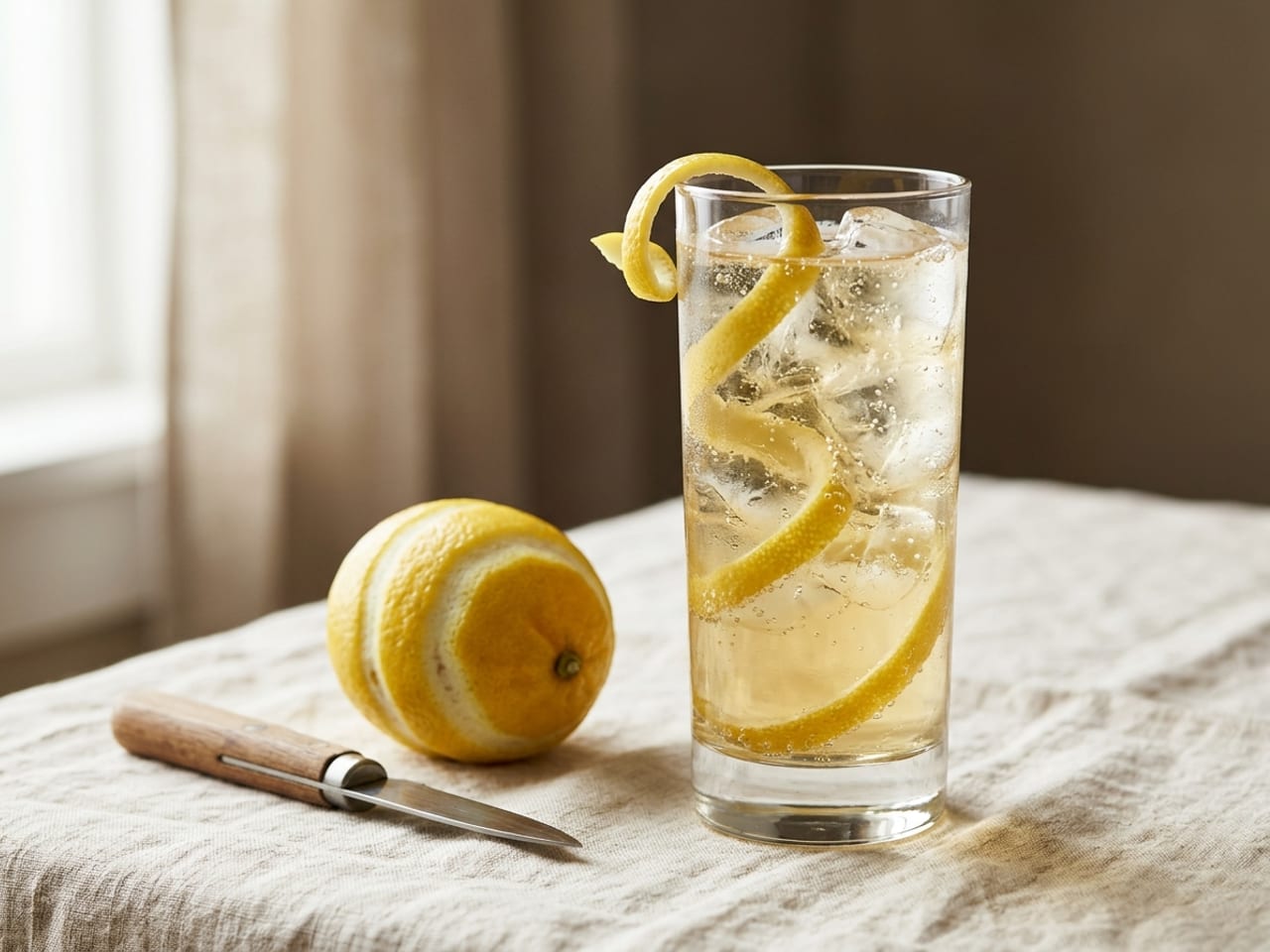
Cut a long spiral (horse's neck)
With a channel knife, start at the top of the fruit and cut round and round down to the bottom, leaving about a centimetre (⅜ inch) between turns.21 Hold one end at the top of a tall glass, let the coil drop in and push it against the side.
The name comes from the Horse's Neck, which in 1895 was simply ginger ale in a glass with "the peel from a lemon in one long piece": no whiskey at all.6
Wheels and wedges. Cut wheels across the fruit ⅛ to ¼ inch (3 to 6 mm) thick, and make a slit from the edge to the centre so the wheel sits on the rim. For wedges, cut off the ends, halve the fruit lengthwise and cut each half into three or four; a slit halfway through seats the wedge on the glass.20 A wedge is for squeezing, so serve it where the drinker can reach it.
Same Margarita, two salt rims: drag to compare
The most common garnish mistake is doing too much of it, too early. Both frames are the same drink in the same glass.
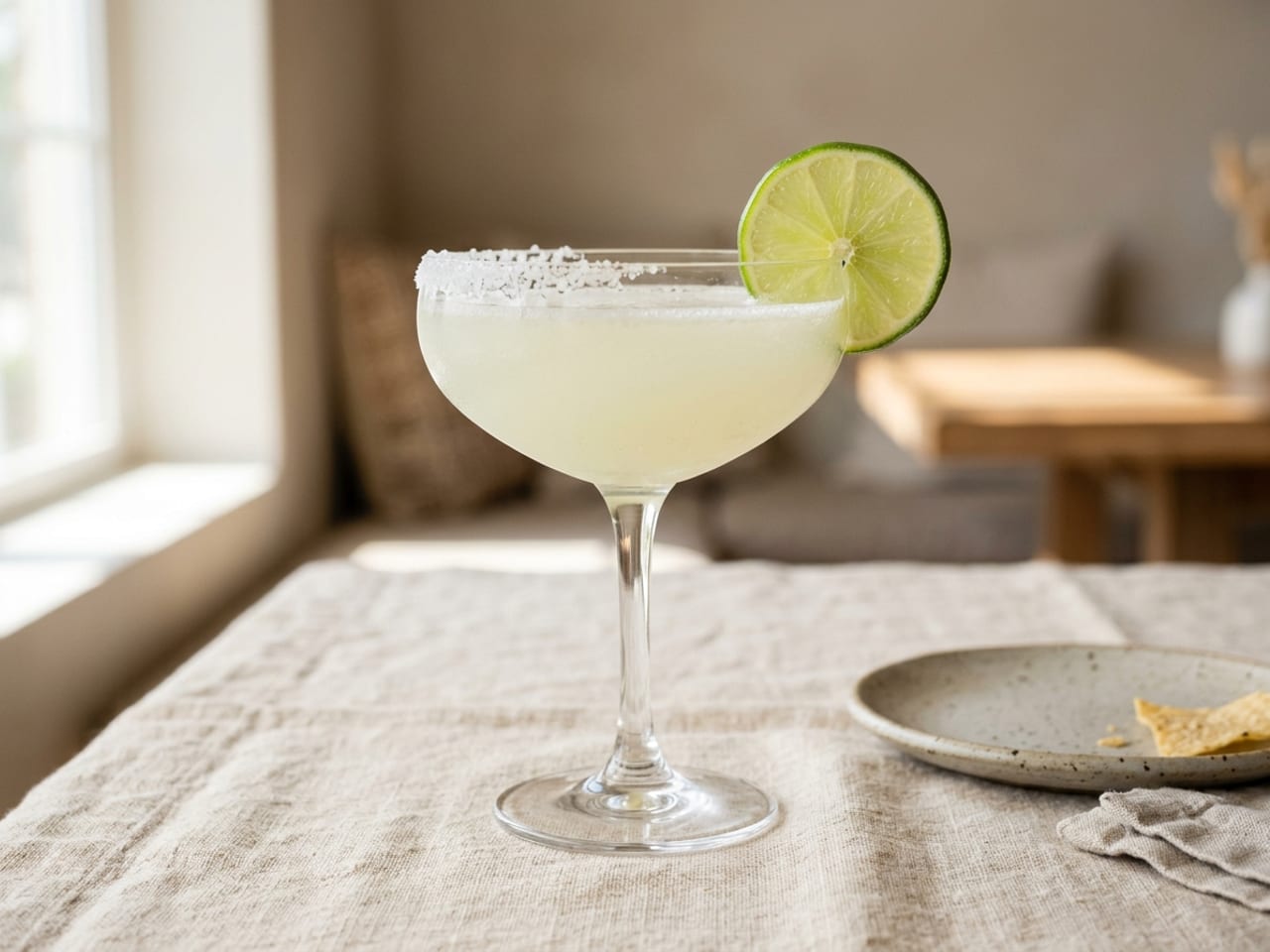
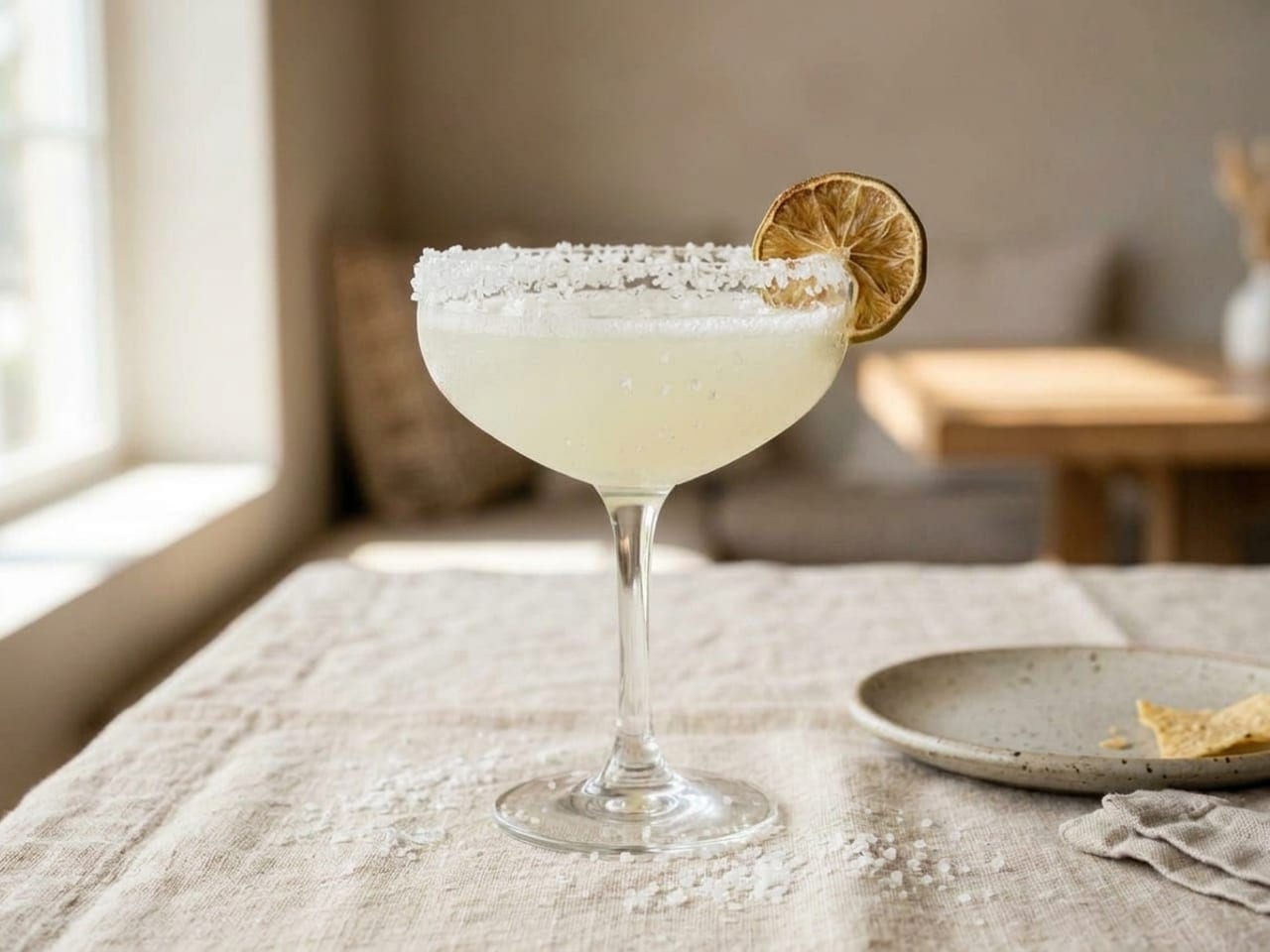 OverdoneNeat
Garnish tools you actually need
- Y-peelerThe one tool that matters. A horizontal peeler gives "more precise control than a vertical peeler" for citrus strips and cucumber ribbons.26
- Small paring knifeAbout 3½ inches (9 cm), for wheels, wedges, trimming twists and cutting the slit that seats a wheel on the rim.26
- Channel knifeCuts the thin string twist and the horse's neck spiral.2
- MicroplaneFor nutmeg on a flip or eggnog, chocolate, cinnamon and fine zest.26
- Cocktail picks and tweezersPicks carry olives, onions, cherries and flags; long tweezers fish cherries out of the jar and place delicate garnishes without fingerprints.26
- A small plate for rimsWide enough to roll the glass on its side in salt or sugar.
Garnishes for a party: what to prep when
Cut citrus goes downhill fast: twists last little more than a day even stored with damp paper towel in a sealed box,19 and cut produce belongs in the fridge. Prep in this order and the only job left at each drink is the one that has to be fresh.
| When | What |
|---|---|
| Weeks ahead | Dehydrated citrus wheels, dried, cooled and sealed in a jar. |
| The day before | Scrub and dry all the citrus. Nothing else: cut citrus does not keep. |
| An hour before | Cut wheels and wedges into a covered container in the fridge; rim the glasses and let them dry; herb sprigs standing in a glass of cold water; olives rinsed and on picks. |
| Just before the first guest | Cut twists, laid on damp paper towel in a sealed box: they fade fast, and even stored this way last little more than a day. |
| At each drink | Express the twist over the glass, clap the mint, set the beans. The aroma is the part that doesn't wait. |
Garnish safety
A garnish is food that sits on the drink, often unwashed peel, and sometimes on fire. The rules below come from regulators, extension services and peer-reviewed studies.
- Clean hands and fresh-cut fruitIn a study of 76 lemon slices served on drinks in 21 restaurants, 69.7% grew microbes, 25 species in all, including E. coli.28 The authors did not measure whether anyone got ill, so treat it as a hygiene point: wash your hands, handle garnishes with tongs or picks, and cut them fresh.
- Buy unwaxed citrus for anything with peelUS rules allow wax coatings on citrus "for protection of the fruit",29 and post-harvest fungicides go on with them. Washing removed no more than 30% of the fungicide imazalil from treated lemons,30 and a 2026 study found peel fungicides leaching into every one of 25 drinks and soups tested, though far below legal limits.31 For twists, flamed peels and zest, buy unwaxed fruit (organic citrus can be waxed too),33 then scrub it under plain running water with a brush: no soap or produce wash.32
- Only food-grade flowersColorado State University Extension: never use flowers from florists, garden centres or nurseries, which may carry chemicals not safe to eat, and "if in doubt, do not eat it". Safe choices include violas and pansies, nasturtium, borage, calendula, hibiscus, lavender and rose; foxglove, lily of the valley, oleander, sweet pea and daffodil are poisonous.34 So is hydrangea.35
- No dry ice or liquid nitrogen in the glassThe FDA warns that both can cause severe damage to skin and internal organs if swallowed or touched.36 A teaspoon of liquid nitrogen expands to about 3.5 litres of gas, "enough to cause rupture along the gastrointestinal tract"; if you want the fog, use a holder that keeps the pellet out of the drink.37
- Put the fire out before it is servedNever hand over a drink or a sprig still alight, never blow out a burning drink (smother it), and never pour spirit onto something already burning: the flame can run up the stream.38
- Lime juice and sunLime juice on skin in sunlight can cause a blistering rash, sometimes called "margarita photodermatitis".39 Wash your hands after cutting limes for an outdoor bar.
- A grating of nutmeg is fineNutmeg becomes toxic at 15 to 20 g, two to three tablespoons,40 hundreds of times more than a dusting on an eggnog.
What science says about garnishes
No study has tested a cocktail garnish directly. What follows is what research on citrus oil, mint, smell, salt and colour suggests, including the parts that contradict bar lore.
- The twist sprays mostly limoneneCitrus peel oil comes from the coloured rind and is 60 to 95% limonene: 90 to 97% in sweet orange, as little as 48% in lemon, whose sharper smell owes more to citral (geranial and neral). Those aldehydes "drop dramatically" in air and light,41 one reason to cut and express a twist at the last moment.
- Squeezing bursts the oil glandsThe oil sits in glands just under the skin, and pressure ruptures the skin above them: in oranges, mechanical injury alone released oil onto the rind.42 That is the whole mechanism of expressing a peel.
- It is smelled before it is tastedWe smell two ways: sniffing the world outside (orthonasal) and from inside the mouth as we swallow (retronasal),43 and the brain handles the two routes differently.44 A garnish at the rim works on the first route. The popular claim that 80% of taste is smell has no real source, though smell does most of the work in flavour.45
- But a sniff first may not change the tasteIn one small lab study, an aroma breathed in after a sip made a sweet drink taste sweeter; the same aroma sniffed before the sip did not.46 So a twist shapes the first impression and the expectation; that it makes the drink itself taste brighter is untested.
- Salt tames bitternessSodium suppresses bitterness more than it suppresses sweetness, which lets the pleasant tastes through,47 and it worked on quinine, the bitter in tonic, among others.48 Nobody has tested a salt rim, but that is the likely reason it suits bitter and sour drinks like a grapefruit Paloma.
- Colour sets expectations, inconsistentlyPeople identified flavours less accurately in drinks coloured the "wrong" way,49 but colour studies are mixed overall,50 and glassware has only been shown to shift what people expect to pay, from photos.51 A garnish that matches the drink helps; nobody has shown it raises the price.
- Cold drinks smell less, so the rim does moreChilling a drink puts fewer aroma molecules into the air above it.54 On an ice-cold Martini, the oil sprayed on the surface is a larger share of what reaches the nose. (Our inference: the size of the effect has not been measured.)
- Why the flame catchesLimonene is flammable, with a flash point of 119 °F (48 °C),55 so a fine mist of it flares in a match flame. The claim that flaming "caramelises" the oil has no study behind it.
- Spearmint is carvone, peppermint is mentholThe mint in a Mojito or julep is usually spearmint, whose oil is 30 to 85% carvone; peppermint's main compound is menthol, the cooling one.53
Six garnish mistakes
- Too much pithA thick twist with a white back makes the drink bitter. Peel lightly.
- Salt inside the rimIt dissolves into the drink. Outside only, and only half.
- Cutting twists hours aheadThey dry out and lose the oil that was the whole point. Cut to order.
- Muddling the garnish mintClap the sprig on top once; leave it whole and bright.
- A garnish that fights the drinkMatch it to what is in the glass: orange with Campari and bourbon, lemon with gin and cognac, lime with rum and tequila.
- A salad on a stickEvery garnish should be there for the nose, the mouth or to say what the drink is. If it does none of the three, leave it off.
Now plate the food
A garnish is plating for a glass. For the plate beside it, photograph what you cooked and Plate Artists re-plates your own dish the way a chef would, with the moves named so you can do it again for real.
Your dish, plated like a chef's
Snap it, upload it, and get the composed version back, with the steps to recreate it on a real plate.
Start free · 1 enhancement →Free account · 1 free enhancement · No credit card
Cocktail garnishes, answered
What is a cocktail garnish?
A garnish is whatever goes on or in a drink after it is mixed to add aroma, flavour or looks: a citrus twist, a wheel or wedge, a salt or sugar rim, an olive, a cherry, a herb sprig, coffee beans or grated nutmeg. The Oxford Companion to Spirits and Cocktails divides garnishes into functional and visual ones; the best do both.
What is the garnish for a Negroni?
The IBA specification is half an orange slice. Many bars use an expressed orange peel instead, which gives the same orange aroma without a soggy slice.
What is the garnish for an Old Fashioned?
The IBA lists an orange slice or orange zest and a cocktail cherry. Most craft bars use an expressed orange peel alone. The oldest recipes, from 1895, used a small piece of lemon peel and no fruit at all.
What is the garnish for a Martini?
A lemon twist: the IBA says to squeeze the oil from a lemon peel onto the drink, or to garnish with green olives if the guest asks. A cocktail onion instead turns it into a Gibson.
Why do Martinis come with one or three olives, never two?
It is a superstition. Cocktail writer Robert Simonson tried to trace it and could not find its origin; the evidence suggests it is fairly recent.
Why are there three coffee beans on an Espresso Martini?
The custom comes from sambuca served con la mosca, 'with the fly', in Italy, where the three beans are said to stand for health, wealth and happiness. The IBA specification is simply '3 coffee beans'.
How do you make a lemon twist?
Scrub an unwaxed lemon, then take a strip about 1/2 inch (12 mm) wide with a Y-peeler, pressing lightly so it carries very little white pith. Hold it coloured side down over the drink and twist or pinch it to spray the oil, then drop it in, rest it on the rim or discard it.
How do you flame an orange peel?
Cut a quarter-sized coin of orange zest with no pith, light a wooden match and let the sulphur burn off, hold the peel skin side down about 5 inches (13 cm) above the drink with the flame between, and snap the peel sharply so the oil sprays through the flame. Don't warm the peel first (Dale DeGroff's method).
How do you salt the rim of a glass?
Wet half of the outside rim with a cut lime, then roll that outside edge in coarse salt on a small plate. Keep salt off the inside of the rim so it does not fall into the drink, and tap off the loose grains.
What is the difference between a twist, a peel and a zest?
Zest is the coloured outer skin of the fruit. A peel is a piece cut for a drink, zest with a little white pith behind it. A twist is a strip of that peel twisted over the drink to spray its oil; in practice bars use the three words almost interchangeably.
How do you dehydrate citrus for cocktails?
Slice the fruit 1/8 inch (3 mm) thick and dry it in a dehydrator at 125 °F (52 °C) for 8 to 10 hours, or on a rack in the oven at its lowest setting, 170 to 200 °F (77 to 93 °C), for about 3 to 5 hours, turning occasionally. Let the wheels cool completely before sealing them in a jar; they keep about 6 to 12 months.
Which edible flowers can I use in cocktails?
Food-grade violas and pansies, nasturtium, borage, calendula, hibiscus, lavender and rose are on university extension lists of edible flowers. Never use florist or garden-centre flowers, and never foxglove, lily of the valley, oleander, sweet pea, daffodil or hydrangea, which are poisonous.
Do mocktails need a garnish?
Yes, and for the same reasons: an alcohol-free drink has no spirit aroma, so a twist, a herb sprig or a cucumber ribbon does even more of the work.
The books, specs and research behind this guide
The IBA's official specifications; four bar books from 1862 to 1930 and a 1912 USDA ruling read in Internet Archive scans; the Oxford Companion to Spirits and Cocktails; bartender references from Difford's Guide, PUNCH and Imbibe; US and Canadian regulators and two university extension services; and eighteen peer-reviewed papers, seventeen verified through Crossref and one through PubMed. No study has tested a garnish itself; the science section says what each does and does not show.
- Harper, D. (2026). Garnish (v.), garnish (n.). Online Etymology Dictionary, from Old French garnir, 'provide, furnish; fortify'; the culinary sense predominant after about 1700. etymonline.com
- Wondrich, D. & Rothbaum, N. (eds.) (2021). The Oxford Companion to Spirits and Cocktails. Oxford University Press, entries 'garnish', 'twist', 'zest, citrus', 'olive', 'maraschino cherries', 'onion', 'flag', 'sugar rim', 'spank' and Dale DeGroff's 'flaming a twist'. oxfordreference.com
- International Bartenders Association (2026). IBA official cocktails. iba-world.com, the 'Garnish' line of each drink's specification, read 27 September 2026. iba-world.com
- Thomas, J. (1862). How to Mix Drinks, or The Bon-Vivant's Companion. Dick & Fitzgerald, New York, Sherry Cobbler (No. 98), Mint Julep (No. 88), Brandy Cocktail (Nos. 107 and 108), Brandy Crusta (No. 116); read in the Internet Archive scan. archive.org
- Johnson, H. (1882). New and Improved Bartender's Manual. New York, rule 26 on dressing drinks with fruit; Champagne and Jersey Cocktails; read in the Internet Archive scan. archive.org
- Kappeler, G. J. (1895). Modern American Drinks. The Merriam Company, New York, Martini Cocktail and Manhattan (p. 38), Old-Fashioned Holland Gin and Whiskey Cocktails, Horse's Neck (p. 68); read in the Internet Archive scan. archive.org
- Craddock, H. (1930). The Savoy Cocktail Book. Constable, London, Dry Martini, Gimlet, Old Fashioned, Frenchy 75, Sazerac; read in the Internet Archive scan. archive.org
- US Department of Agriculture (1912). Food Inspection Decision 141: Maraschino cherries. Food Inspection Decisions 1 to 150, issued 28 February 1912; read in the Internet Archive scan. archive.org
- Verzemnieks, I. (2022). Maraschino cherries. The Oregon Encyclopedia, Oregon Historical Society, Ernest Wiegand's calcium-salt brine, 1925 to 1931. oregonencyclopedia.org
- Culliton, A. (2023). What happened to the flamed orange twist garnish? PUNCH, 12 April 2023; Pepe Ruiz at Chasen's and Dale DeGroff at the Rainbow Room. punchdrink.com
- PUNCH (2017). Mastering the Cosmopolitan with Toby Cecchini. PUNCH, the 1988 Odeon original and DeGroff's 1996 Rainbow Room version. punchdrink.com
- Popik, B. (2008). Bloody Mary (cocktail) and celery stalk. The Big Apple, newspaper citations from 1951, 1968 and 1974. barrypopik.com
- Difford, S. (2026). Margarita cocktail: origins and history. Difford's Guide, Charlie Connolly's 1939 Tequila Sour and the 1953 Press Democrat Margarita. diffordsguide.com
- Difford, S. (2026). Mai Tai (Trader Vic's formula). Difford's Guide, quoting Trader Vic on the lime shell and mint. diffordsguide.com
- Difford, S. (2026). Espresso Martini. Difford's Guide, the three coffee beans and sambuca con la mosca. diffordsguide.com
- Molinari (2026). Sambuca with coffee beans. molinari.it, the Roman 'con la mosca' story. molinari.it
- Simonson, R. (2024). Are two olives bad luck? Robert Simonson (newsletter), 1 April 2024. robertsimonson.substack.com
- PUNCH (2026). Recipes: Negroni, Old Fashioned, Gimlet, Margarita, Mojito. PUNCH, the garnish line of each recipe. punchdrink.com
- Difford, S. (2026). How to express a citrus zest twist over a cocktail. Difford's Guide, width, pith, expressing, what to do with the spent zest, shelf life of cut zests. diffordsguide.com
- Microplane (2020). Wedges, wheels and slices: cocktail garnishes. Microplane blog, thicknesses and the slit that seats a wheel or wedge on the rim. microplane.com
- PUNCH (2015). The extras: how to make a lemon spiral (Horse's Neck). PUNCH, 29 September 2015. punchdrink.com
- PUNCH (2026). Salted rim. PUNCH, outside of the glass only, half the rim. punchdrink.com
- America's Test Kitchen (2026). Does slapping herbs affect their flavor in cocktails or garnishes? America's Test Kitchen, slapped versus untouched basil and mint. americastestkitchen.com
- Campari Academy (2026). How to make dehydrated citrus garnish. Campari Academy, slice thickness, dehydrator and oven temperatures and times. campariacademy.com
- National Center for Home Food Preservation (2020). Packaging and storing dried foods. University of Georgia, storage life of dried fruit at 60 °F and 80 °F; cooling before packing. nchfp.uga.edu
- Bass, P. (2026). Gear: garnish tools. Imbibe, Y-peeler, paring knife, channel knife, Microplane, tweezers. imbibemagazine.com
- PUNCH (2015). The extras: how and when to garnish a cocktail with a flamed orange peel. PUNCH, 4 September 2015; Joaquín Simó on what flaming does to the aroma. punchdrink.com
- Loving, A. L. & Perz, J. (2007). Microbial flora on restaurant beverage lemon slices. Journal of Environmental Health, 70(5), 18–22 (PubMed 18189035; the journal did not assign DOIs). PubMed 18189035
- US Code of Federal Regulations (2026). 21 CFR 172.210: Coatings on fresh citrus fruit. Title 21, Food and Drugs, the permitted waxes and resins, 'in the minimum amount required'. law.cornell.edu
- Vass, A., Korpics, E. & Dernovics, M. (2015). Follow-up of the fate of imazalil from post-harvest lemon surface treatment to a baking experiment. Food Additives & Contaminants: Part A, 32(11), 1875–1884. doi:10.1080/19440049.2015.1086824
- Lányi, K. et al. (2026). Leaching of postharvest pesticides from lemon fruits into liquid foods. Food Chemistry, 525, 150490. doi:10.1016/j.foodchem.2026.150490
- US Food and Drug Administration (2026). 7 tips for cleaning fruits, vegetables. FDA Consumer Updates, plain running water and a brush, no soap or produce wash. fda.gov
- CocktailSafe (2026). Citrus. cocktailsafe.org, organic and conventional citrus can both be waxed. cocktailsafe.org
- Newman, S. E. & Stoven O'Connor, A. (2025). Edible flowers, fact sheet 7.237. Colorado State University Extension, reviewed August 2025; edible and poisonous flower tables. extension.colostate.edu
- North Carolina State University Extension (2026). Hydrangea macrophylla. NC State Extension Gardener Plant Toolbox, poisonous parts: bark, flowers, leaves. plants.ces.ncsu.edu
- US Food and Drug Administration (2018). Liquid nitrogen and dry ice in food. FDA Food Code Reference System, 31 October 2018, citing the 30 August 2018 consumer advisory. fda.gov
- BC Centre for Disease Control (2017). Safety of novel use of liquid nitrogen and dry ice in the food and beverage industry. Environmental Health Services, 12 April 2017. bccdc.ca
- CocktailSafe (2026). Flamed drinks. cocktailsafe.org, never serve a drink still alight; snuff flames by covering them. cocktailsafe.org
- Aleksiev, T. (2025). Mojito-induced phytophotodermatitis: a case of lime-triggered skin reaction. Case Reports in Dermatology, 17(1), 397–401. doi:10.1159/000547675
- Bowman, N. (2020). Nutmeg: a potentially uninvited holiday guest. Tennessee Poison Center, Vanderbilt University Medical Center, 23 November 2020. vumc.org
- González-Mas, M. C., Rambla, J. L., López-Gresa, M. P., Blázquez, M. A. & Granell, A. (2019). Volatile compounds in citrus essential oils: a comprehensive review. Frontiers in Plant Science, 10, 12. doi:10.3389/fpls.2019.00012
- Knight, T. G., Klieber, A. & Sedgley, M. (2002). Structural basis of the rind disorder oleocellosis in Washington navel orange. Annals of Botany, 90(6), 765–773. doi:10.1093/aob/mcf258
- Rozin, P. (1982). 'Taste–smell confusions' and the duality of the olfactory sense. Perception & Psychophysics, 31(4), 397–401. doi:10.3758/BF03202667
- Small, D. M., Gerber, J. C., Mak, Y. E. & Hummel, T. (2005). Differential neural responses evoked by orthonasal versus retronasal odorant perception in humans. Neuron, 47(4), 593–605. doi:10.1016/j.neuron.2005.07.022
- Spence, C. (2015). Just how much of what we taste derives from the sense of smell? Flavour, 4, 30. doi:10.1186/s13411-015-0040-2
- Kakutani, Y. et al. (2017). Taste of breath: the temporal order of taste and smell synchronized with breathing as a determinant for taste and olfactory integration. Scientific Reports, 7, 8922. doi:10.1038/s41598-017-07285-7
- Breslin, P. A. S. & Beauchamp, G. K. (1997). Salt enhances flavour by suppressing bitterness. Nature, 387, 563. doi:10.1038/42388
- Breslin, P. A. S. & Beauchamp, G. K. (1995). Suppression of bitterness by sodium: variation among bitter taste stimuli. Chemical Senses, 20(6), 609–623. doi:10.1093/chemse/20.6.609
- Zampini, M., Sanabria, D., Phillips, N. & Spence, C. (2007). The multisensory perception of flavor: assessing the influence of color cues on flavor discrimination responses. Food Quality and Preference, 18(7), 975–984. doi:10.1016/j.foodqual.2007.04.001
- Spence, C. (2019). On the relationship(s) between color and taste/flavor. Experimental Psychology, 66(2), 99–111. doi:10.1027/1618-3169/a000439
- Wan, X., Zhou, X., Woods, A. T. & Spence, C. (2015). Influence of the glassware on the perception of alcoholic drinks. Food Quality and Preference, 44, 101–110. doi:10.1016/j.foodqual.2015.03.018
- Turner, G. W., Gershenzon, J. & Croteau, R. B. (2000). Development of peltate glandular trichomes of peppermint. Plant Physiology, 124(2), 665–680. doi:10.1104/pp.124.2.665
- Krajewska, A., Azeez, G., Ebadollahi, A., Kalemba, D. & Synowiec, A. (2026). Carvone-rich essential oils and their agrobiological interactions: a review. Molecules, 31(4), 579. doi:10.3390/molecules31040579
- Simons, C. T. (2019). Left out in the cold: serving wines chilled. Temperature, 6(1), 1–3. doi:10.1080/23328940.2018.1563443
- NOAA Office of Response and Restoration (2026). D-Limonene. CAMEO Chemicals, flash point 119 °F (NTP, 1992). cameochemicals.noaa.gov
- Imbibe (2026). The Driver #3 (alcohol-free highball). Imbibe, garnished with a cucumber wheel or ribbon. imbibemagazine.com
Keep going
What is an amuse-bouche?
The one free bite before dinner, and twelve you can make ahead to serve with the first drink.
Plating techniques and styles
The glossary for the plate: swoosh, quenelle, stacking, free-form and the rest, with a photo of each.
Knife cuts chart, drawn to scale
Julienne to brunoise at true size, printable 1:1, for everything you cut that isn't a twist.
Party food calculator
How much food to make for the guests holding those drinks.
Food garnishes
The same idea on a plate: twelve types of garnish, how to make each, and which flowers are safe to eat.
How to cut fruit
Mango, pineapple, citrus suprêmes and nine more fruits, cut for a plate or a platter, step by step.