Plating techniques and styles — the illustrated glossary
Culinary-school vocabulary in plain English, shown plate by plate: the eight named plating styles, the sauce and shaping techniques, the parts of a plate and the tools — plus the studies on which arrangements diners actually prefer.
The photos on this page are AI-generated illustrations.
Plating is the arranging of cooked food on the plate for service — the last minute of cooking and the first thing a diner judges. The word covers both the layout (a plating style) and the hand moves that build it (plating techniques), and the vocabulary that grew up around it is where most home cooks get lost: culinary school teaches "classic", "free-form" and "landscape", chef interviews talk about "the Nordic look" and "hide-and-seek", and every term gets used as if everybody already knows it.
This page is the missing dictionary. Every entry is defined in a sentence, shown on a plate, and — where a study has tested it — checked against the research. Because the styles are not equal: diners have measurable preferences for balanced compositions,2 for horizontal arrangements over stacked ones,3 and for a plate whose lines rise to the right.5 The sources are at the bottom.
The parts of a plate
Every plating instruction refers to a part of the plate. Five terms cover all of it.
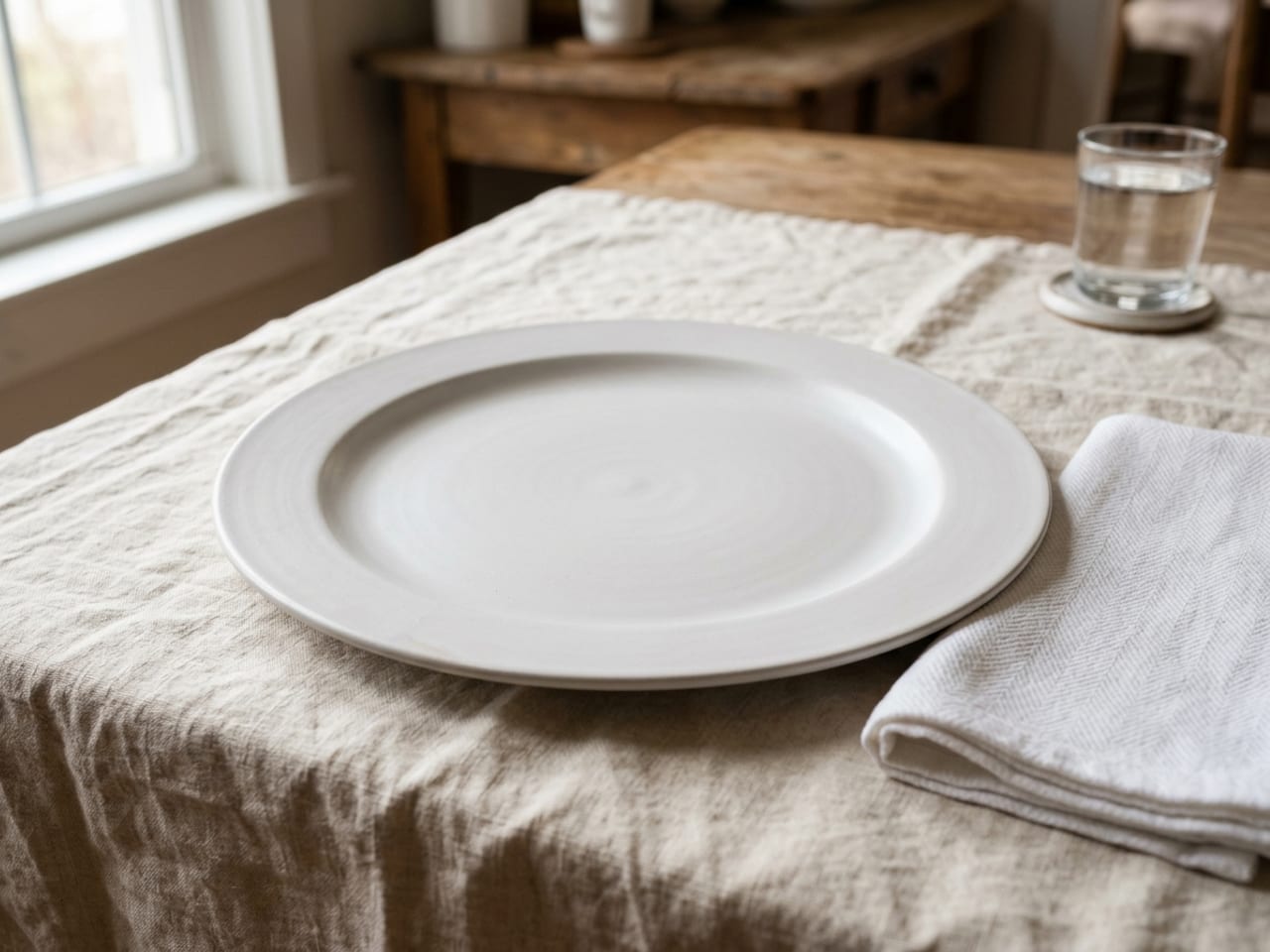
- The wellThe flat central surface where the food goes — the plating surface in kitchen talk; porcelain makers also call it the mirror.
- The rim (or lip)The raised outer band that frames the well. Kept clean and never plated on in formal service. A coupe plate has no distinct rim — the surface runs to the edge.
- The shoulderThe slope between rim and well. Sauce pools stop here, and a wide gentle shoulder is what makes an oversized plate look framed rather than empty.
- The footThe ring underneath that the plate stands on. Not a plating term, but it is why a warmed plate stays warm: the well is lifted off the table.
- 12 o'clockThe orientation vocabulary. The plate is read as a clock face from the diner's seat: 12 is the far edge, 6 the near edge, 3 and 9 the sides. Every 'protein at 6' instruction depends on it.
Eight plating styles, defined and shown
Culinary school teaches the first three; the modern kitchen added the rest. The first four cards are the same salmon dinner — identical food, four layouts — so the styles can be compared directly.
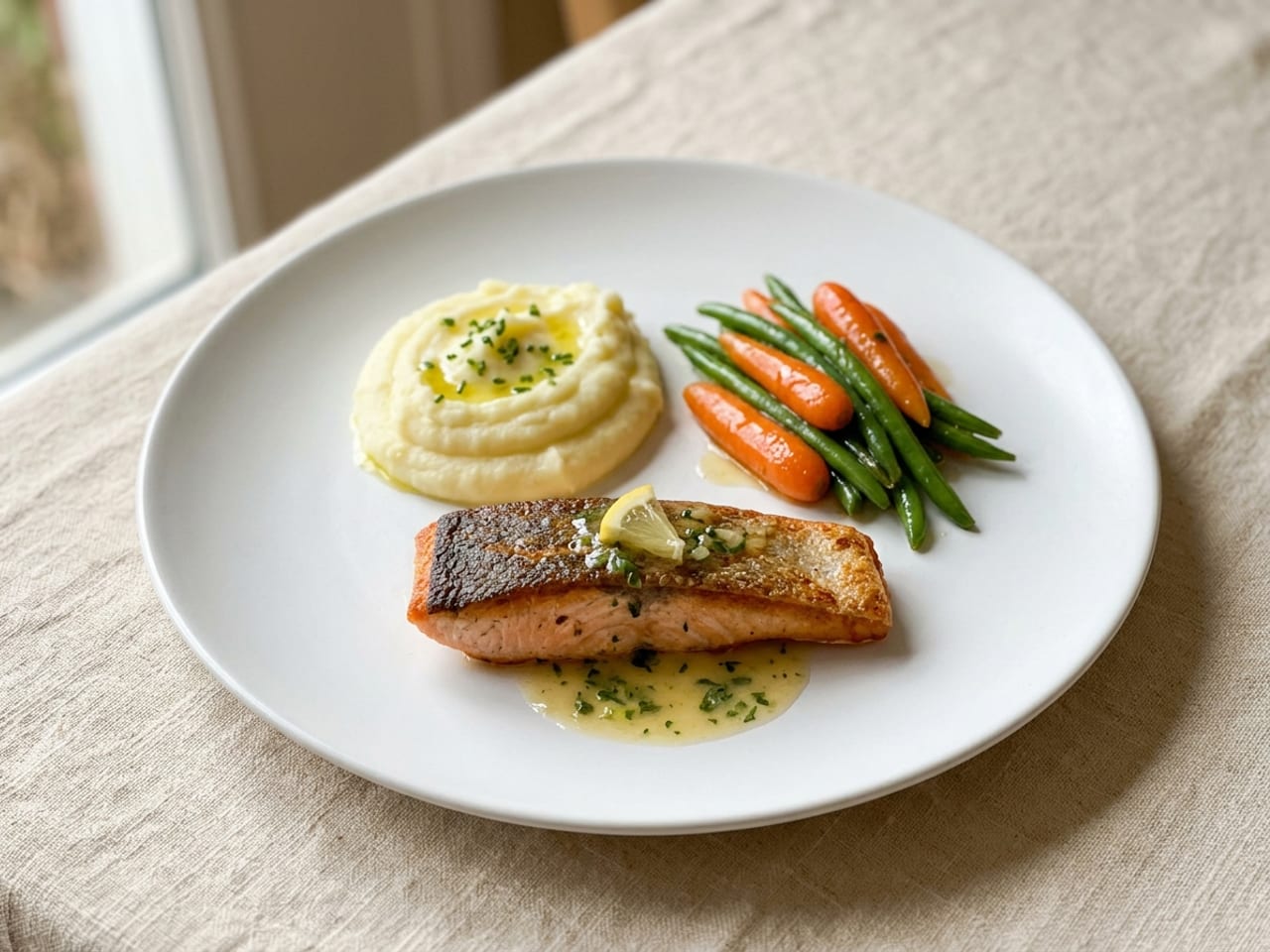
Classic plating
Also: traditional or clock-method plating.
Protein, starch and vegetable each take a fixed position on the plate, read like a clock face from the diner's seat: protein at 6 o'clock, starch at 10, vegetables at 2. Older service manuals give the same layout as bands (protein 3 to 9, starch 9 to 12, vegetables 12 to 3). Symmetrical, tidy, nothing overlapping much, sauce under or beside the protein. Tell: you could draw a line between the three components. It is also the layout closest to what diners rate highest in testing — centred,9 balanced, three to four components.8
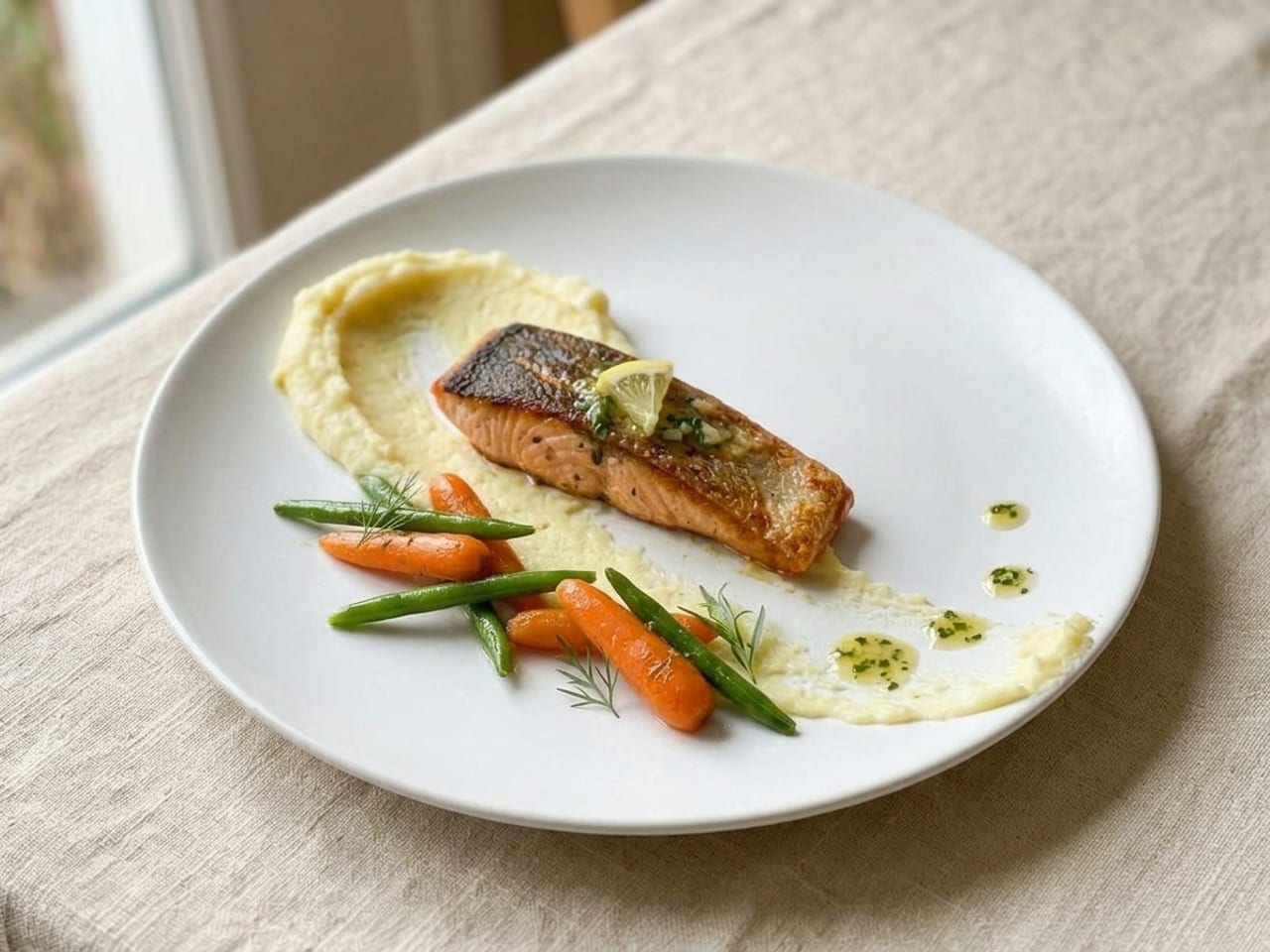
Free-form plating
Also: abstract or artistic plating.
Components are placed asymmetrically across the plate with no fixed positions — a swoosh, scattered elements, deliberate gaps — composed like an abstract painting around one focal point. It looks improvised and never is: every element is set for balance, flow and colour. Tell: no component sits where the clock would put it. The research caveat is real — when the same ingredients were crowded onto one side of the plate, diners preferred the balanced version every time,2 so keep the asymmetry inside a balanced whole.
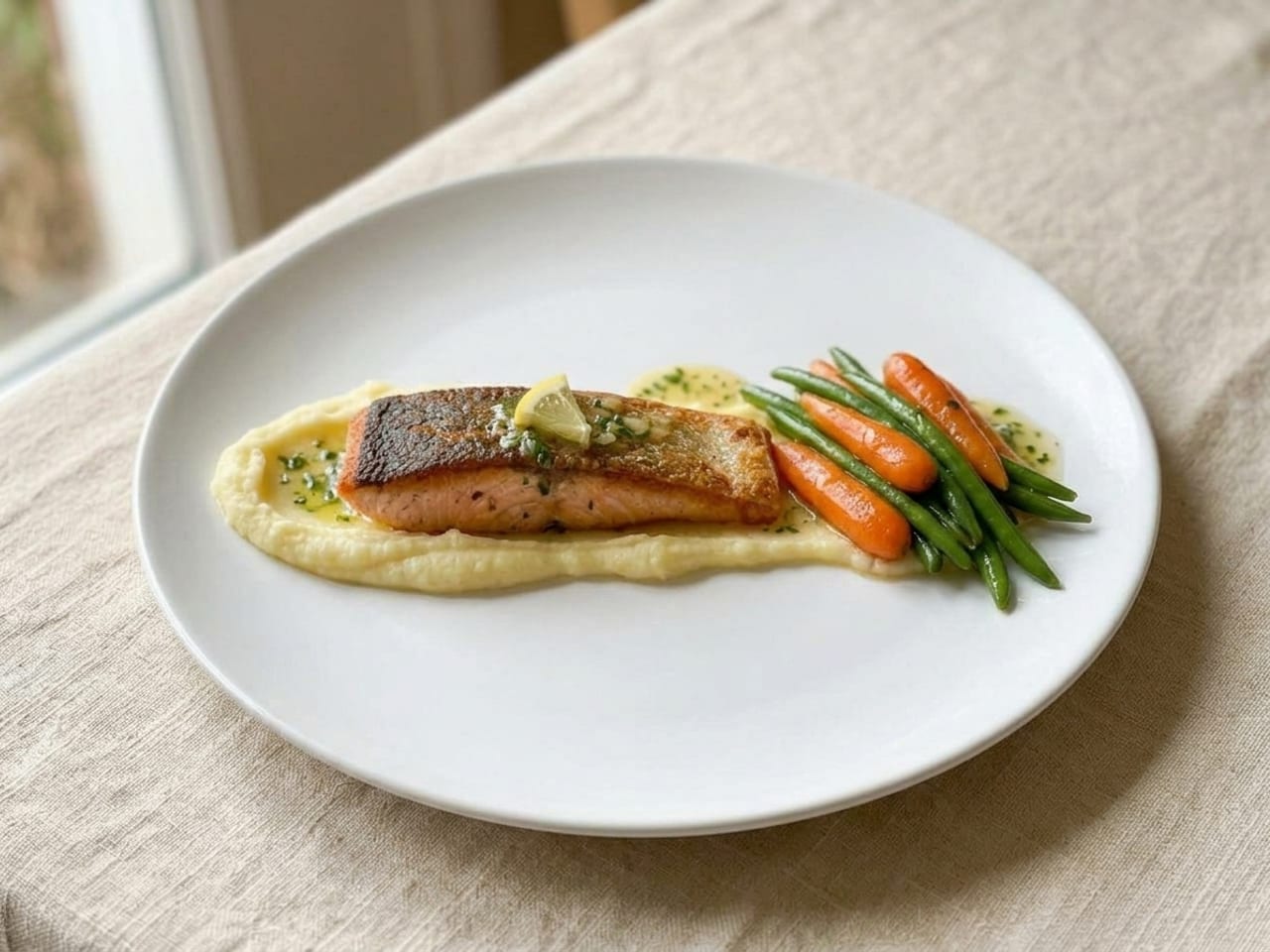
Landscape plating
Food arranged low and long in a horizontal band across the plate, like a strip of garden or a landscape painting: a line of purée, elements set along it at intervals, height kept minimal. The name is borrowed from landscape gardening — the composition reads left to right, not top to bottom, and almost nothing stands up. Tell: wide empty plate above and below one horizontal line of food. It has the best evidence of any style: the same food arrayed horizontally was rated a larger portion, liked more and worth more than when it was stacked.3
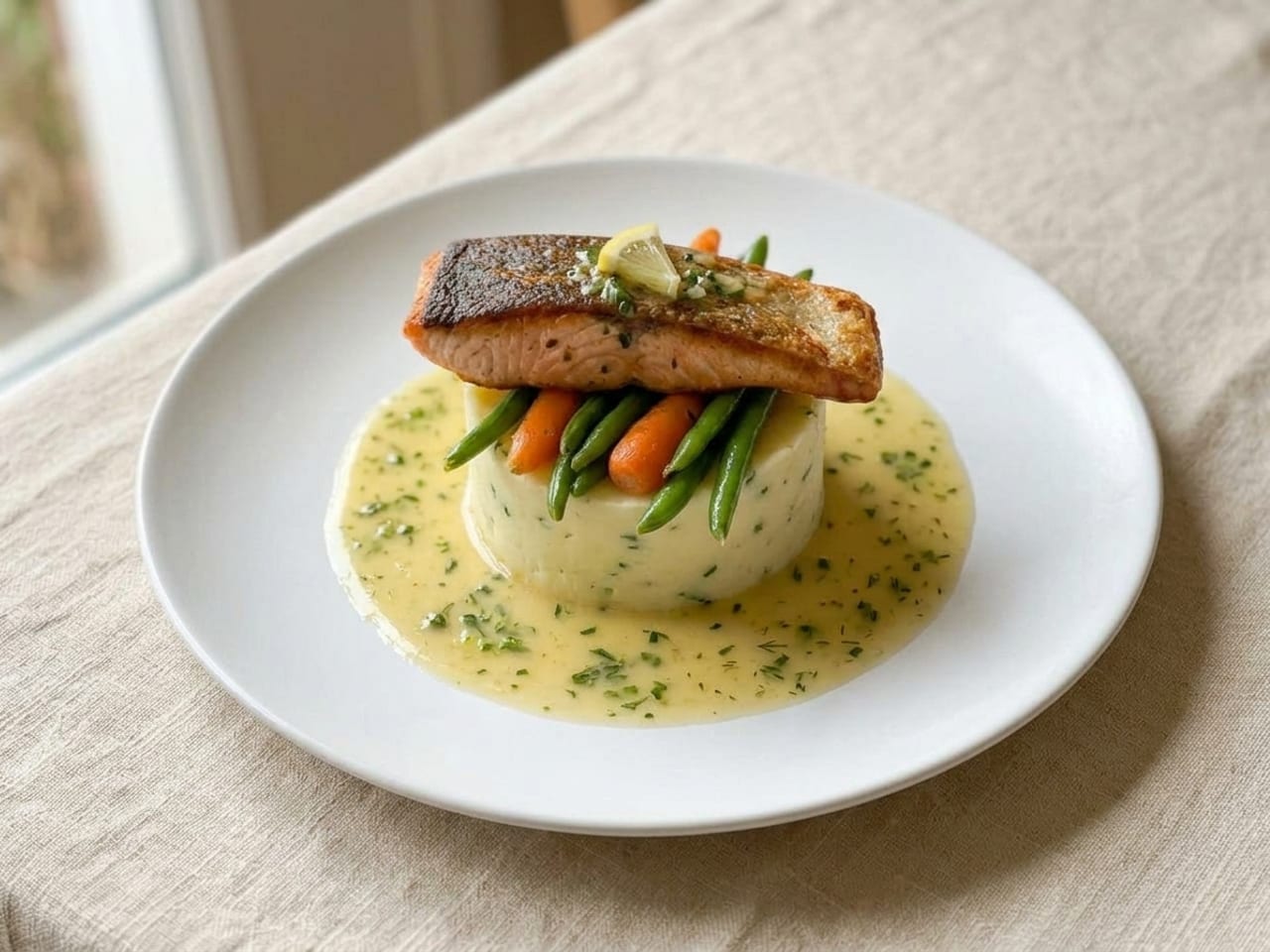
Stacked plating
Also: vertical plating, the tower.
Components built upward — starch as the base, protein on top, vegetables leaning or perched — often set inside a ring mould so the tower holds. The 1990s signature, now used for one modest peak rather than a skyscraper. Tell: the fork has to demolish something to eat it. Two costs: stacked food is harder to eat and travels badly, and the identical dish reads as a smaller portion standing up than laid flat.3 Build height where the dish earns it, not by default.
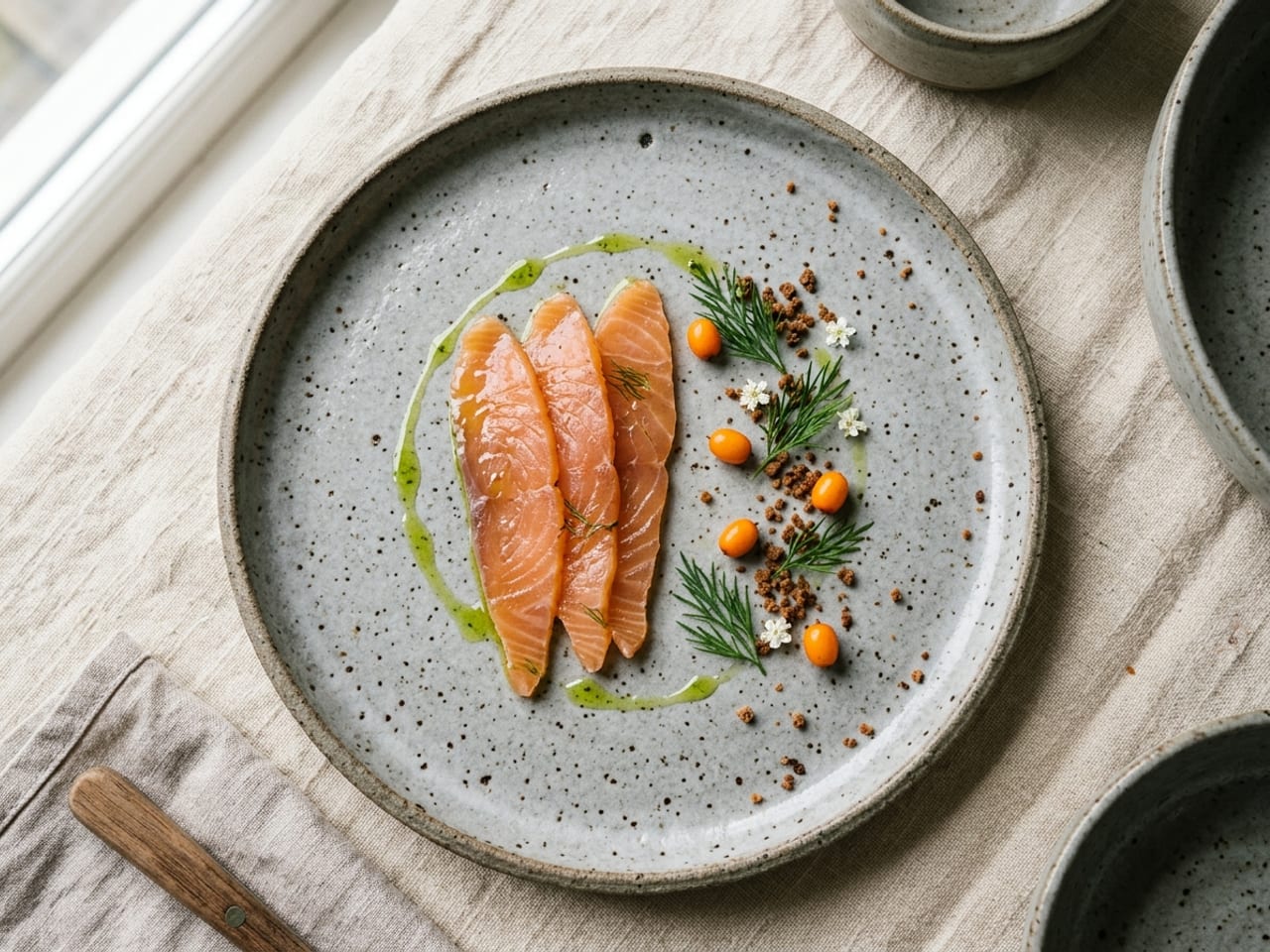
Nordic plating
Also: minimalist or New Nordic plating.
Very few elements, a lot of empty plate, and natural or foraged-looking ingredients — herbs, flowers, seeds, crumbs — set on stone, wood or rough ceramic with placement that looks found rather than built. Muted colours with one accent, no towers, no sauce painting. Tell: it looks like it landed there. The catch is exposure: with three elements on a plate every placement shows, so Nordic plates are usually the most carefully placed food in the room.
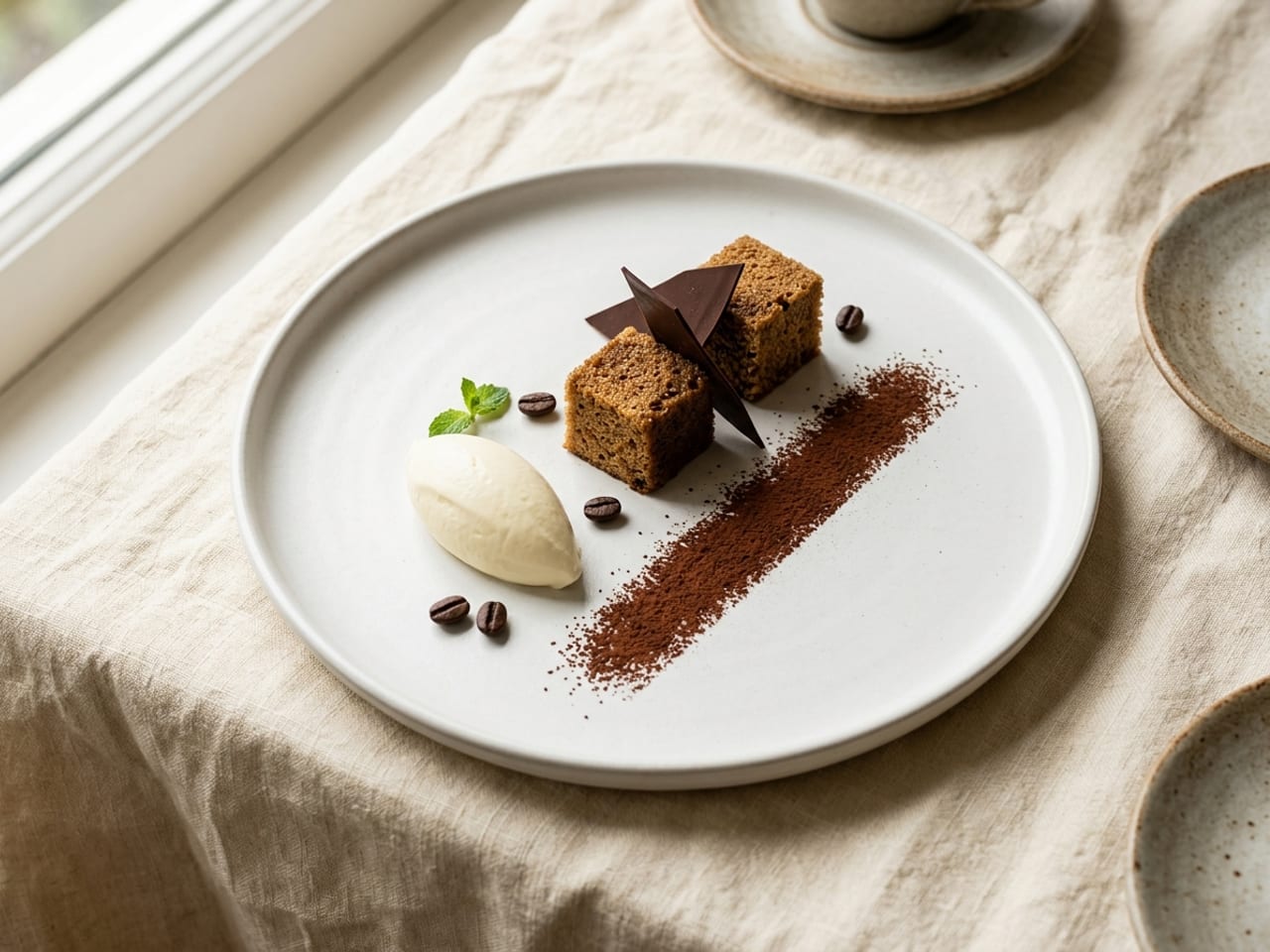
Deconstructed plating
A familiar dish taken apart and served as its separate components — tiramisu as a mascarpone quenelle, coffee-soaked sponge, cocoa and chocolate shards — so the diner assembles each bite. Tell: you can name the original dish from the parts. The rule that comes with it: every component now gets judged alone, so each one has to be excellent alone. Deconstruction that hides a mediocre element under a clever layout is the version diners rightly mock.
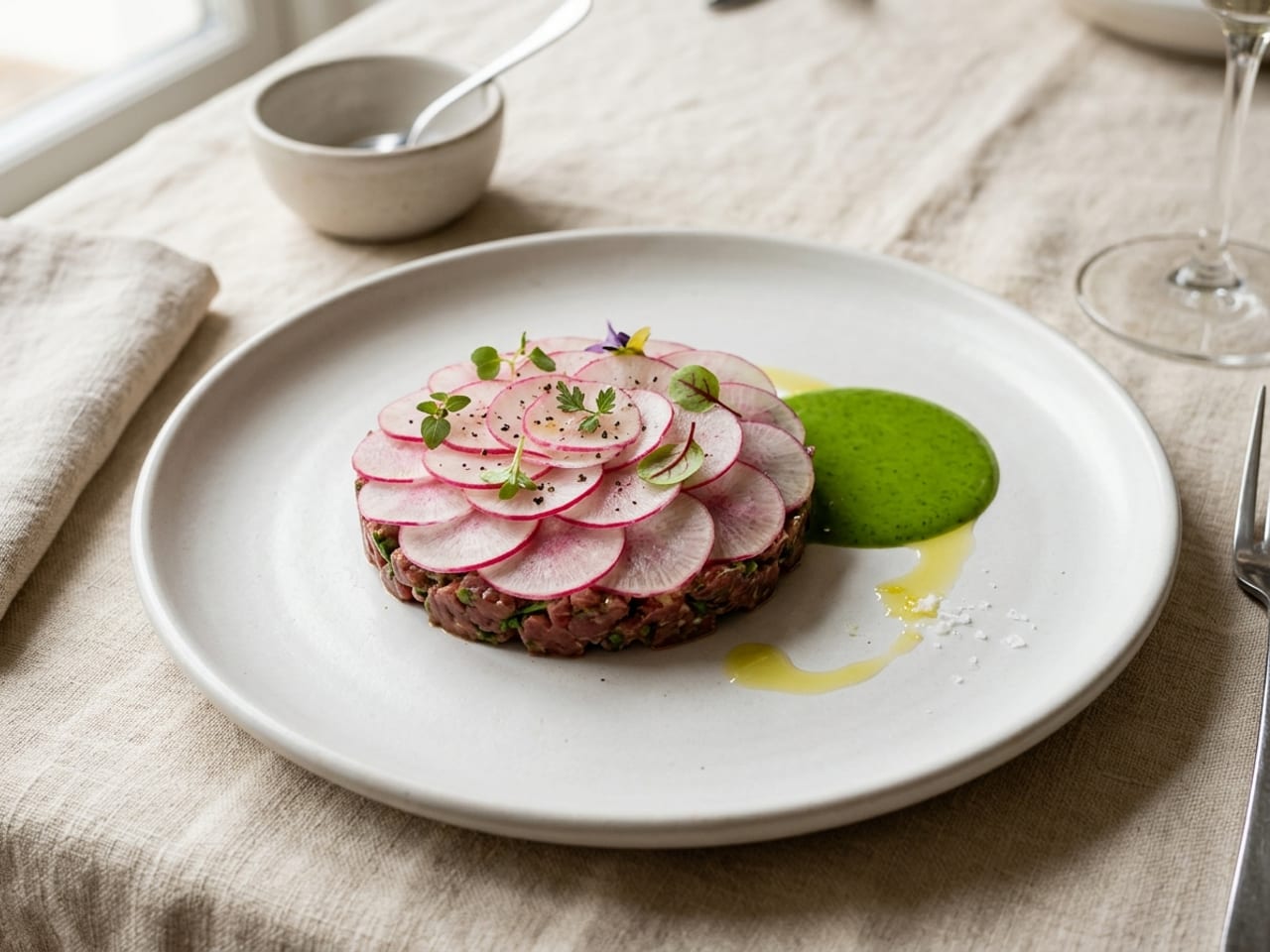
Hide-and-seek plating
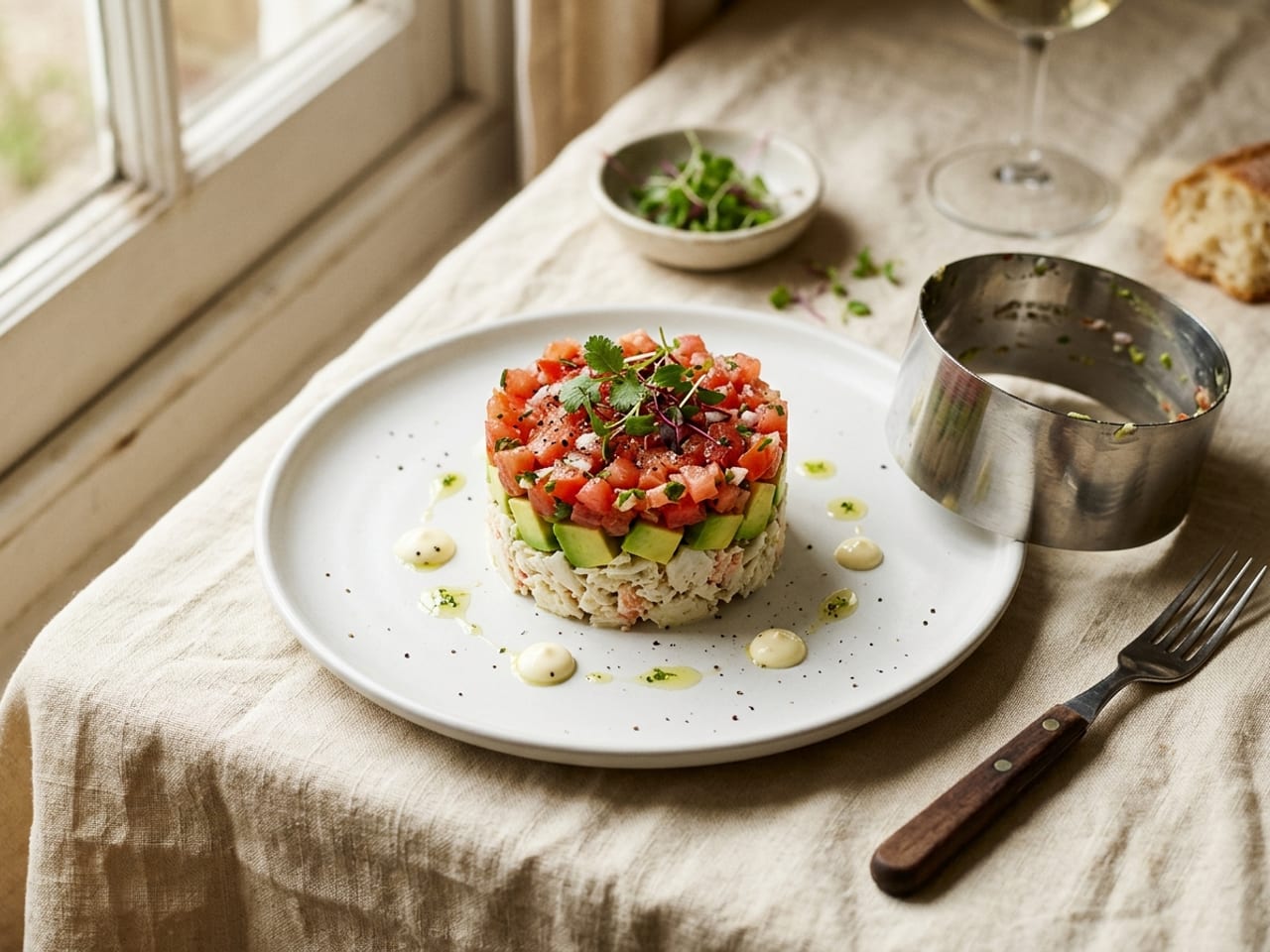
One element concealed under another and revealed by the fork: tartare under a lattice of radish slices, crab under a puffed cracker, a sauce under a foam or a cover of leaves. Tell: the plate looks simpler than the dish. It trades a little of the first glance for surprise at the first bite — so it only works when the hidden element is the best thing on the plate, and when the cover is edible and good in the same forkful.
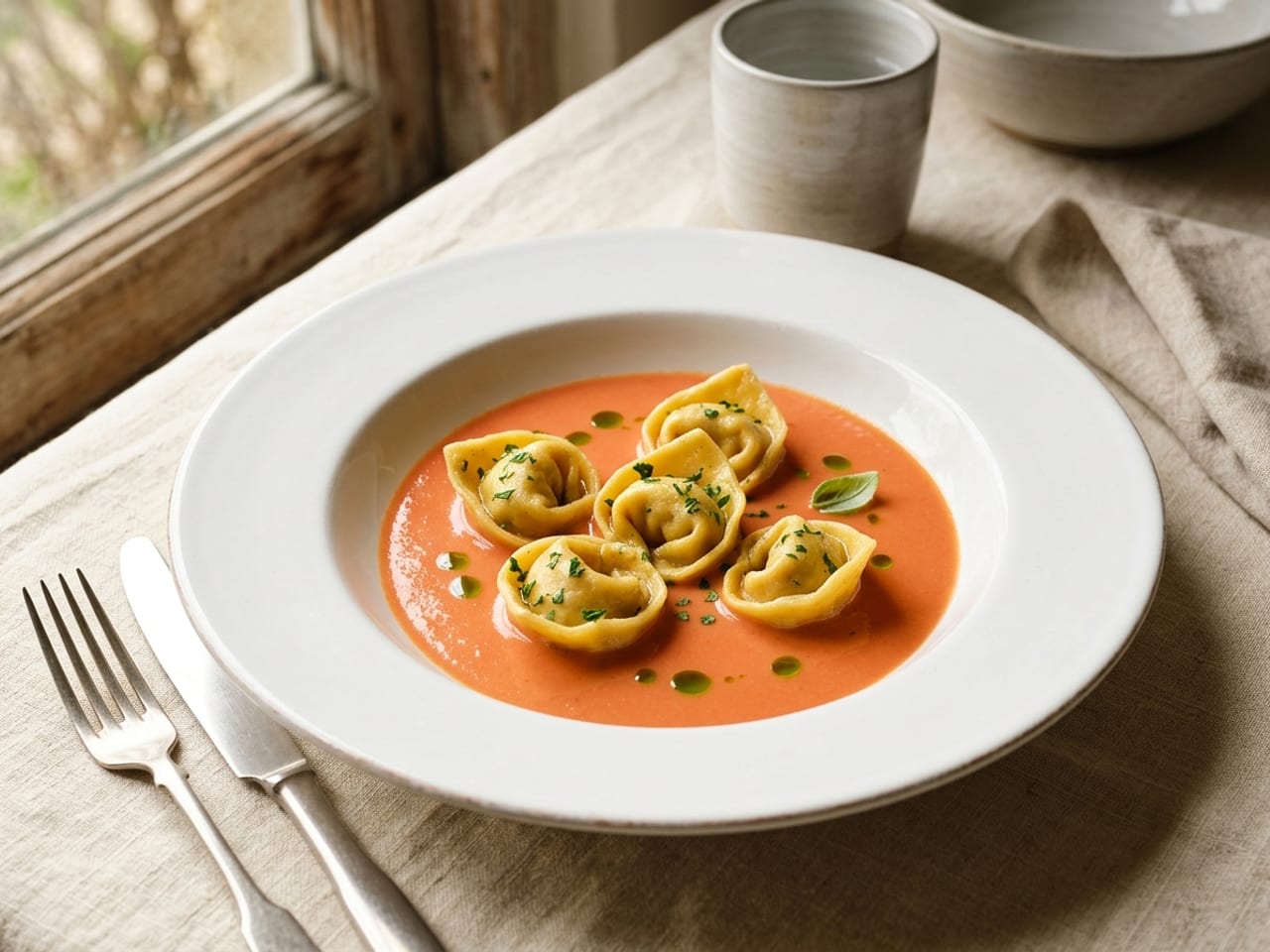
Bathing plating
Also: pool or broth plating.
Food sitting in a shallow pool of broth, sauce or dashi — tortellini in shellfish bisque, a fish fillet in beurre blanc, dumplings in consommé — usually in a wide-rimmed bowl so the liquid reads as a still surface. Tell: the sauce is the plate. Keep the liquid shallow (the food should sit in it, not sink), the rim spotless, and float one accent — herb oil, a leaf — on the surface. Pour the broth at the table and the style becomes the show.
One dinner, drag between the styles
The same salmon, purée, carrots and beans, re-plated from one layout to the next. Drag the divider to compare.
ClassicFree-formLandscapeStackedAlso in the vocabulary. Family style — the dish arrives on a platter or board for the table to share, so plating happens at platter scale (see the boards guide). Organic-materials plating — slate, wood, stone or a leaf standing in for china, the surface as part of the composition. Geometric plating — precise lines, cubes, dots and right angles, the sauce work drawn with a ruler's discipline. Circular plating — elements arranged in a ring around an empty centre; worth knowing because the same ingredients laid in a line beat the circle in testing.5 Bento plating — each component in its own compartment or vessel, the Japanese lunchbox as a style.
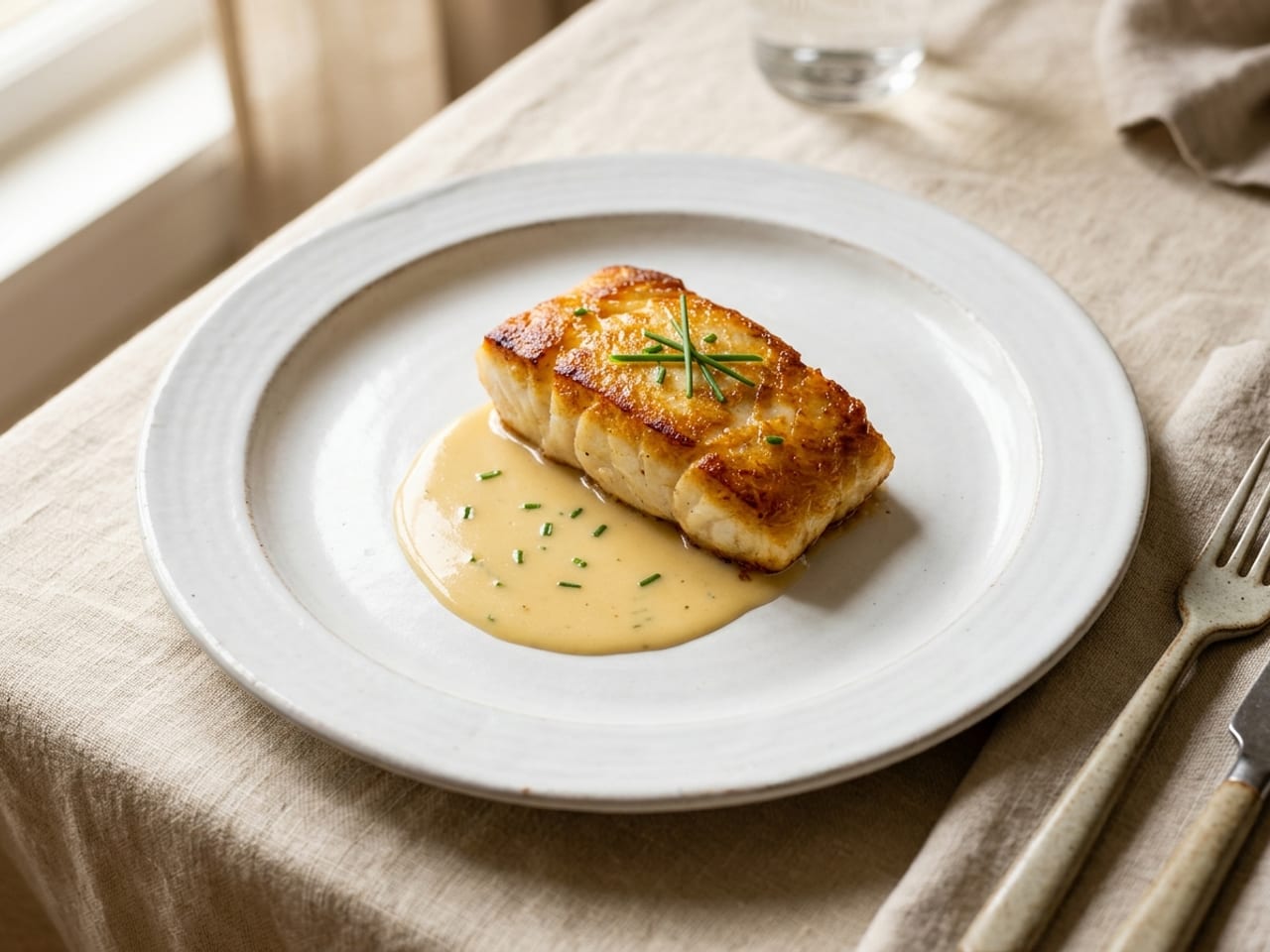
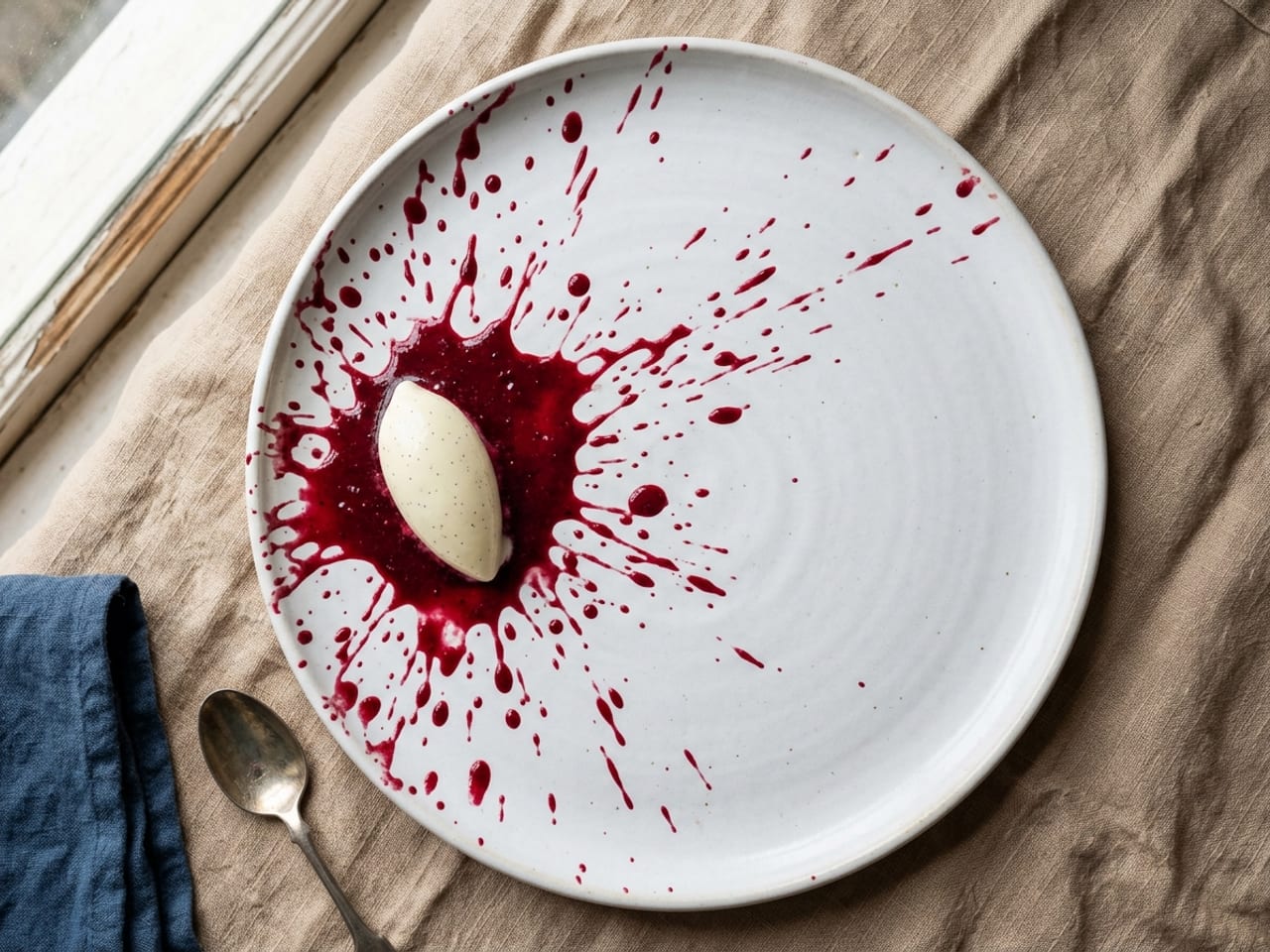
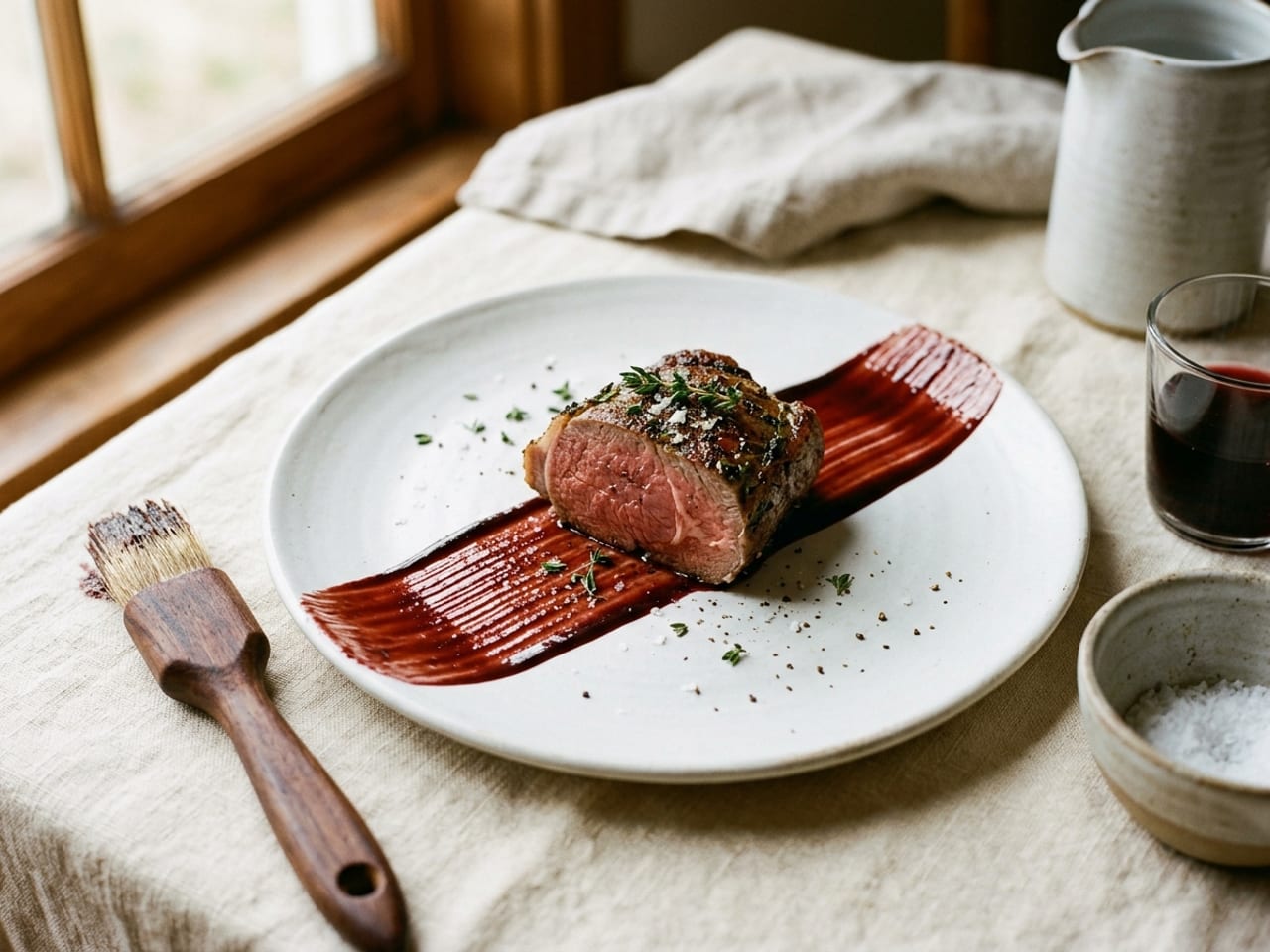
Sauce plating techniques
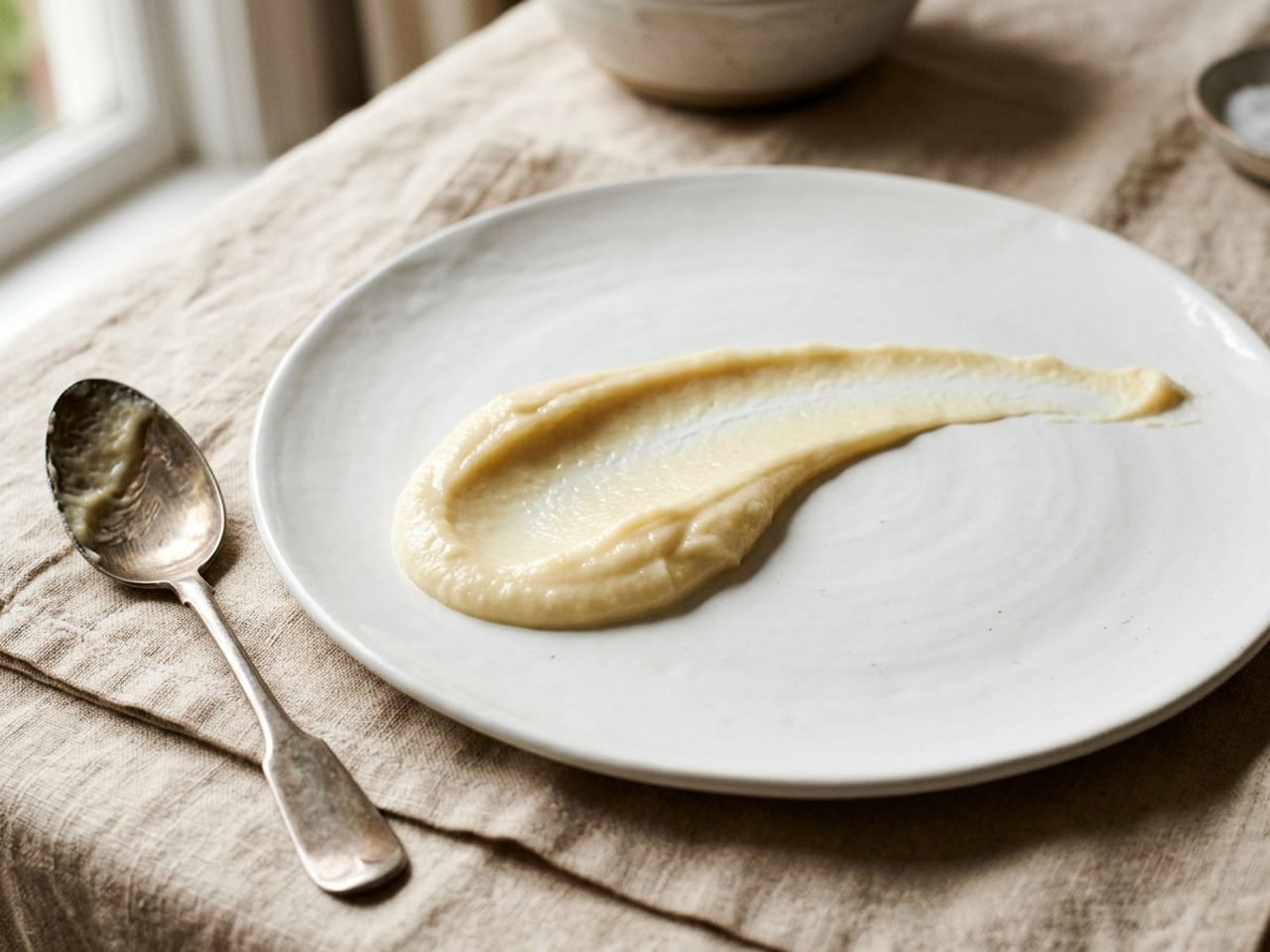
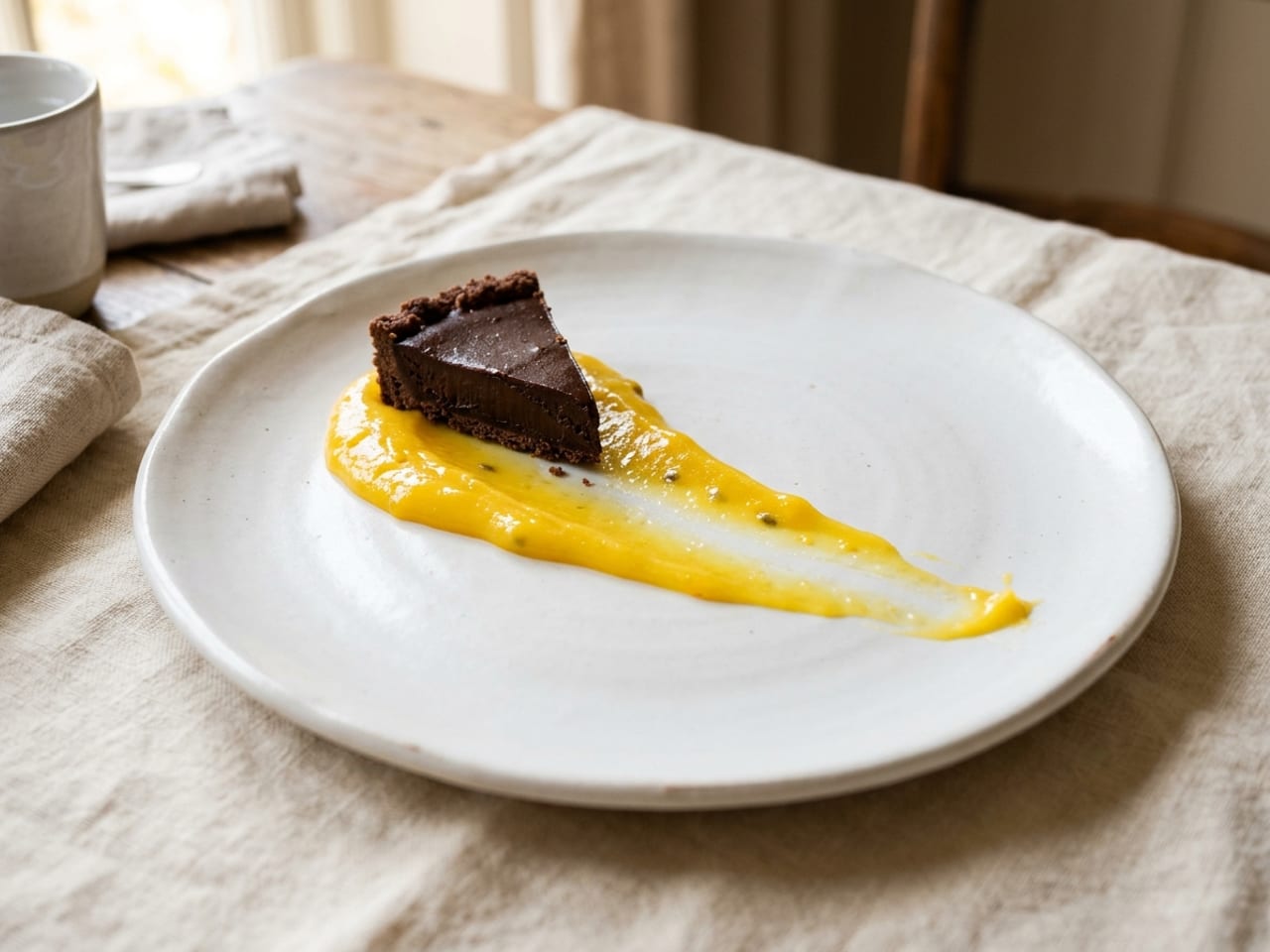
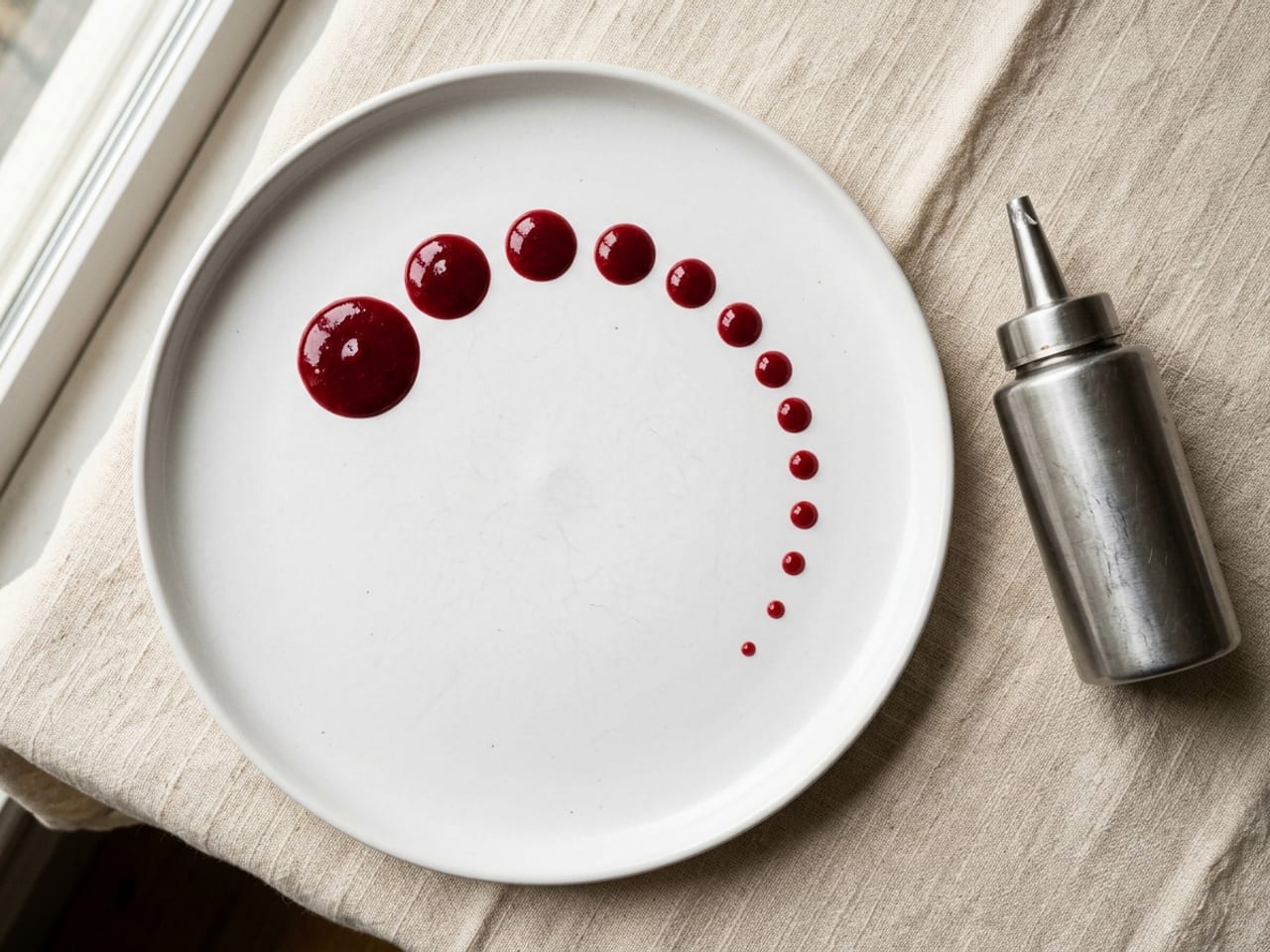
Six ways to put sauce on a plate, from the pool to the painted stroke. Each is a tool, not a decoration: pick the one the dish needs and use it once. Every move, its other names and the thickness it needs are in sauce plating techniques.
Shaping and placement techniques
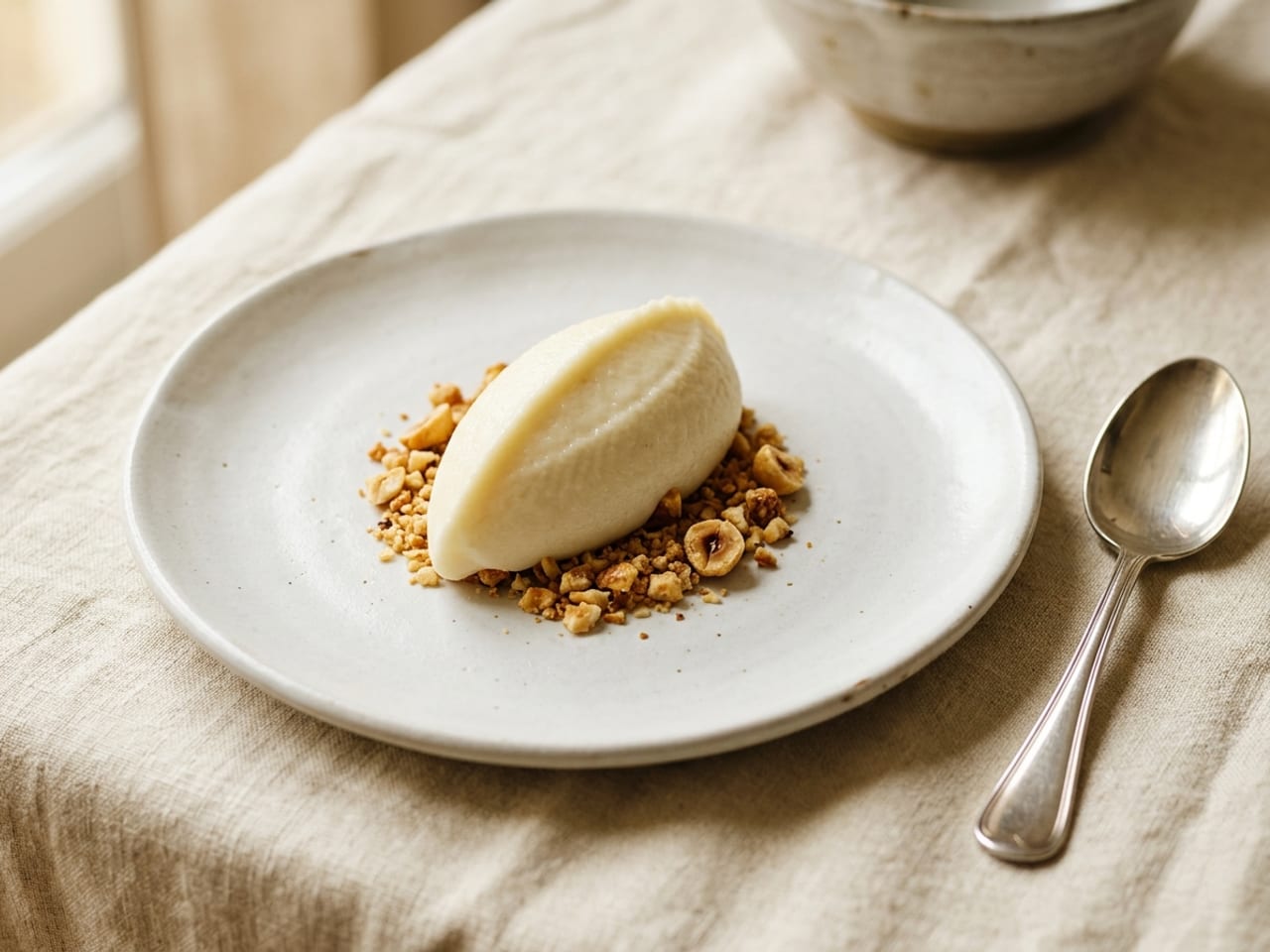
The moves that give food a shape before it meets the sauce: scoops, cylinders, fans, beds and nests. The first has a guide of its own: the quenelle, step by step.
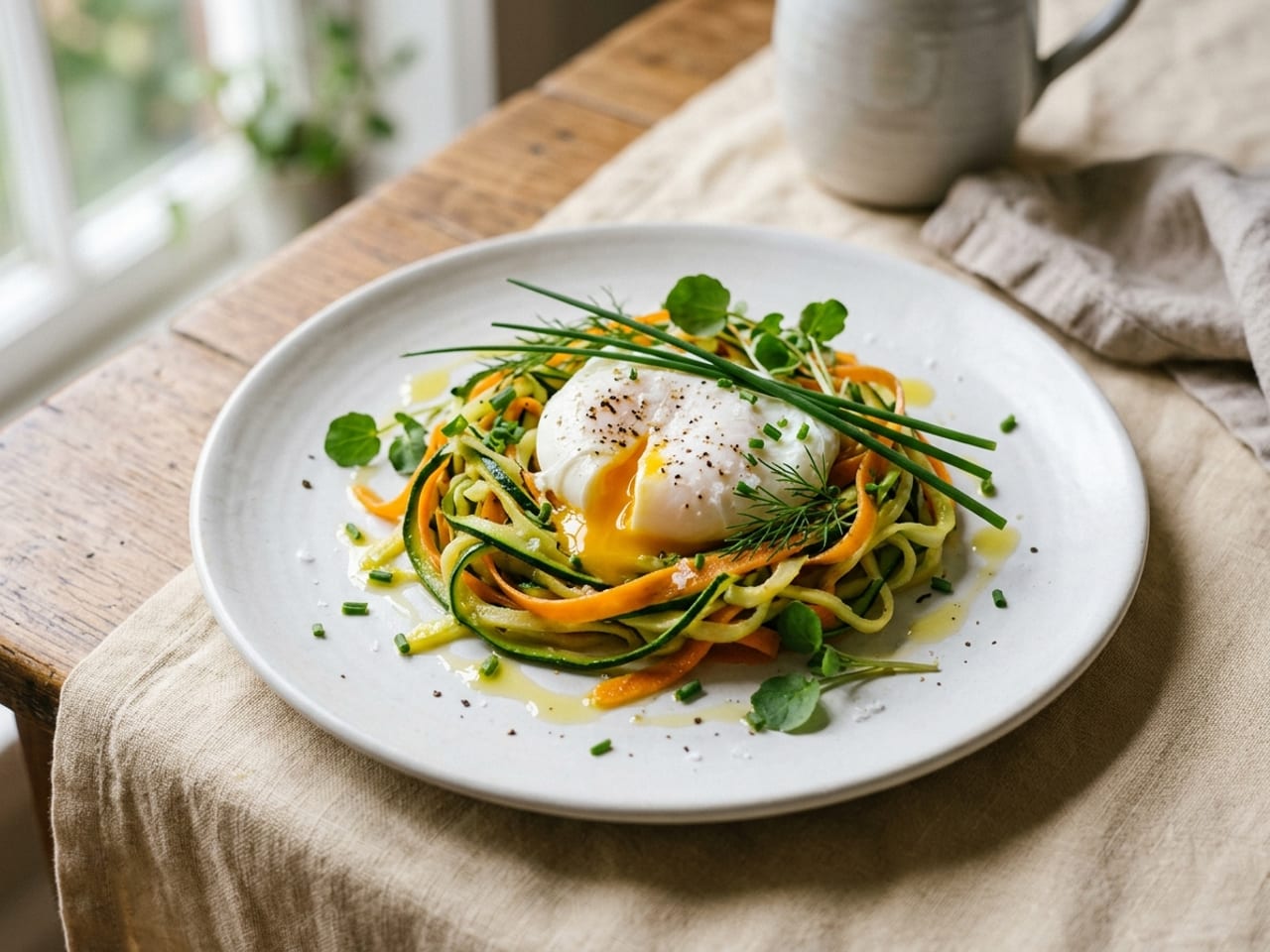
The composition vocabulary
The words chefs use to describe why a plate works — with the studies that tested them.
- Focal pointThe one element the eye lands on first — usually the protein. Everything else supports it; a plate with two heroes has none.
- Negative spaceThe empty plate around the food. Keep food to roughly the middle two-thirds and let the rim stay clean — the rim is the frame.
- HeightOne vertical moment per plate — a leaning element, a standing garnish. Horizontal arrangements still test better than stacks.3
- BalanceVisual weight spread across the plate, even in an asymmetric composition. Tested with identical ingredients: balanced beat lopsided in every composition.2
- Rule of thirdsPlacing the focal point on a third-line rather than dead centre — borrowed from photography. Note that in a real dining room, centred mains still won on liking and price.9
- The odd-number rule"Plate three or five, never four." Tested head-on with scallops: no reliable preference.10 Plate the count the dish needs.
- ContrastColour, texture and temperature differences inside one plate — crisp against soft, hot against cold, green against brown. Consistently, diners preferred three colours on a plate.
- GarnishAn edible element that echoes a flavour in the dish — placed, not sprinkled. The full rules are in Plating 101.
- The rim wipeDamp cloth around the rim before the plate leaves. Neat presentation measurably raises liking for the taste of the same food.6
Plating tools, and what each is for
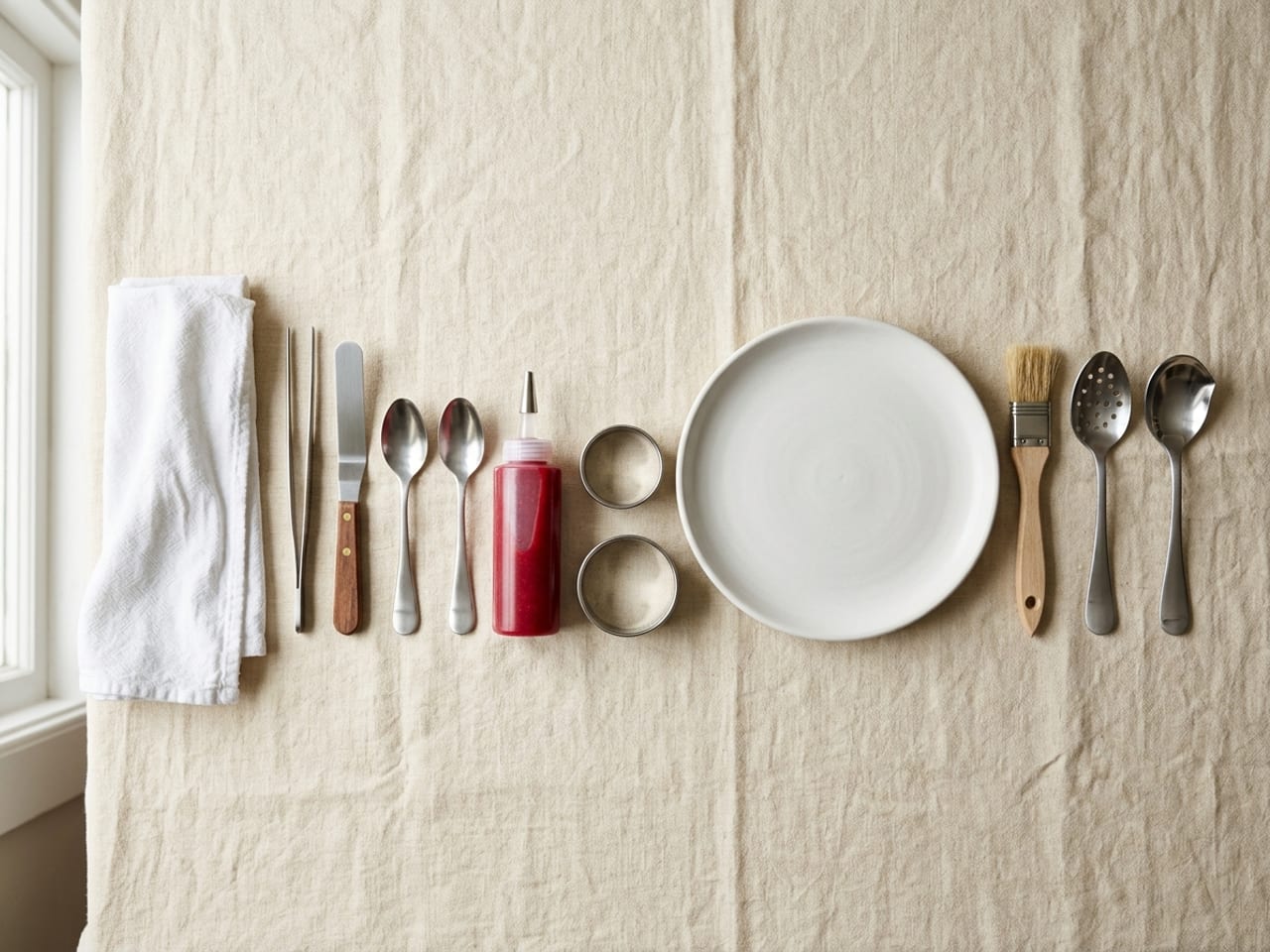
- Plating tweezers (precision tongs)Long fine-tipped tongs for placing micro herbs, flowers and single leaves exactly once. An offset tip sits a little lower than the grip, which keeps the hand off the plate.
- Plating spoonsA large sauce spoon (the Kunz spoon is the best known; it has a tapered tip and no spout) for swooshes and pools, a saucier spoon with a pouring spout for a measured drizzle, and a pair of matched smaller spoons for the two-spoon quenelle.
- Squeeze bottlesThe sauce painter's tool for dots, lines and spirals. The nozzle sets the line, and chefs cut the tip to the size they want.
- Ring mouldsStainless rings in two or three diameters for timbales and stacks. Pack, press lightly, lift straight up.
- Offset spatulaLifts and slides delicate elements — a fish fillet, a slice of tart — into place without breaking them.
- Pastry brush and plating wedgeThe brush paints strokes and glazes; the wedge (a wooden skewer works) is dragged through dots to turn them into teardrops.
- Cake turntableSpins the plate under a squeeze bottle for spirals.
- The rim clothThe rim wipe, on every plate. Whether the cloth should be damp or dry is disputed (the plating tools guide sets out who says what); what matters is that it is clean and kept for plates. If you buy nothing else on this list, fold a clean cloth before you start plating.
Each tool has its own card in the plating tools guide: what it is called in American and British kitchens, the mark it makes, what to use from the drawer instead and what tested reviews looked for.
Which styles diners actually prefer
A decade of experiments — many of them run by Charles Spence's Crossmodal Research Laboratory at Oxford with a chef in residence — has tested the plating "rules" on real diners. The review verdict: a number of the aesthetic rules worked out for painting, such as balance, harmony and the oblique effect, influence judgments of plating in much the same way — but by no means all of them.11 The ones that held:
- Balanced beats lopsided. In citizen-science experiments at London's Science Museum, identical ingredients arranged in balanced compositions were preferred over unbalanced ones across every composition tested — a direct challenge to the modernist habit of crowding everything onto one side of the plate.2 An earlier study found colour raised the attractiveness of a balanced presentation but did nothing for an unbalanced one.7
- Horizontal beats vertical; centred beats offset. The same dish arrayed horizontally rather than stacked was rated a larger portion, liked more and worth more — online and in a real dining room — and a centrally plated dessert was rated a larger portion than the offset version of exactly the same dish.3 In a naturalistic restaurant test, diners also preferred, and paid more for, the main element centred.9
- Orientation is part of the composition. Rotating a commercially successful dish changed how much people liked it and would pay: an upward-facing arrangement beat the same plate turned toward the viewer or to the side.4
- Lines that rise to the right. Given the same ingredients in a line or a circle, participants favoured the line — and when asked to turn the plate to its most appealing position, they tilted it so the dominant element ran as an oblique line ascending to the right.5
- Neat beats messy. Food in a neat arrangement was liked more than the identical food presented messily; people expected to like it more, would pay more, and assumed it came from a better restaurant where more care was taken.6
- Three colours, three to four components — everywhere. Adults in the United States, Italy and Japan agreed on the number of colours (three), the number of components (three to four) and how full a plate should be; they diverged on where the main should sit, how organised the layout should be and whether it should look casual.8 Classic and free-form are, partly, a cultural preference.
- Artistic plating changes the taste. A salad arranged after a Kandinsky painting was liked more, rated tastier and earned a higher willingness to pay than the same ingredients plated plainly.1
- The odd-number rule did not survive. Three versus four scallops, tested head-on: no reliable preference.10
Which style to use tonight
- Weeknight dinner, three componentsClassic, on a plate one size up, sauce in a pool, rim wiped. It is the fastest layout and the one diners rate highest.
- A sauce-led dishPool or bathing. Let the sauce be the surface and set the food in it — dumplings, braises, anything with a broth.
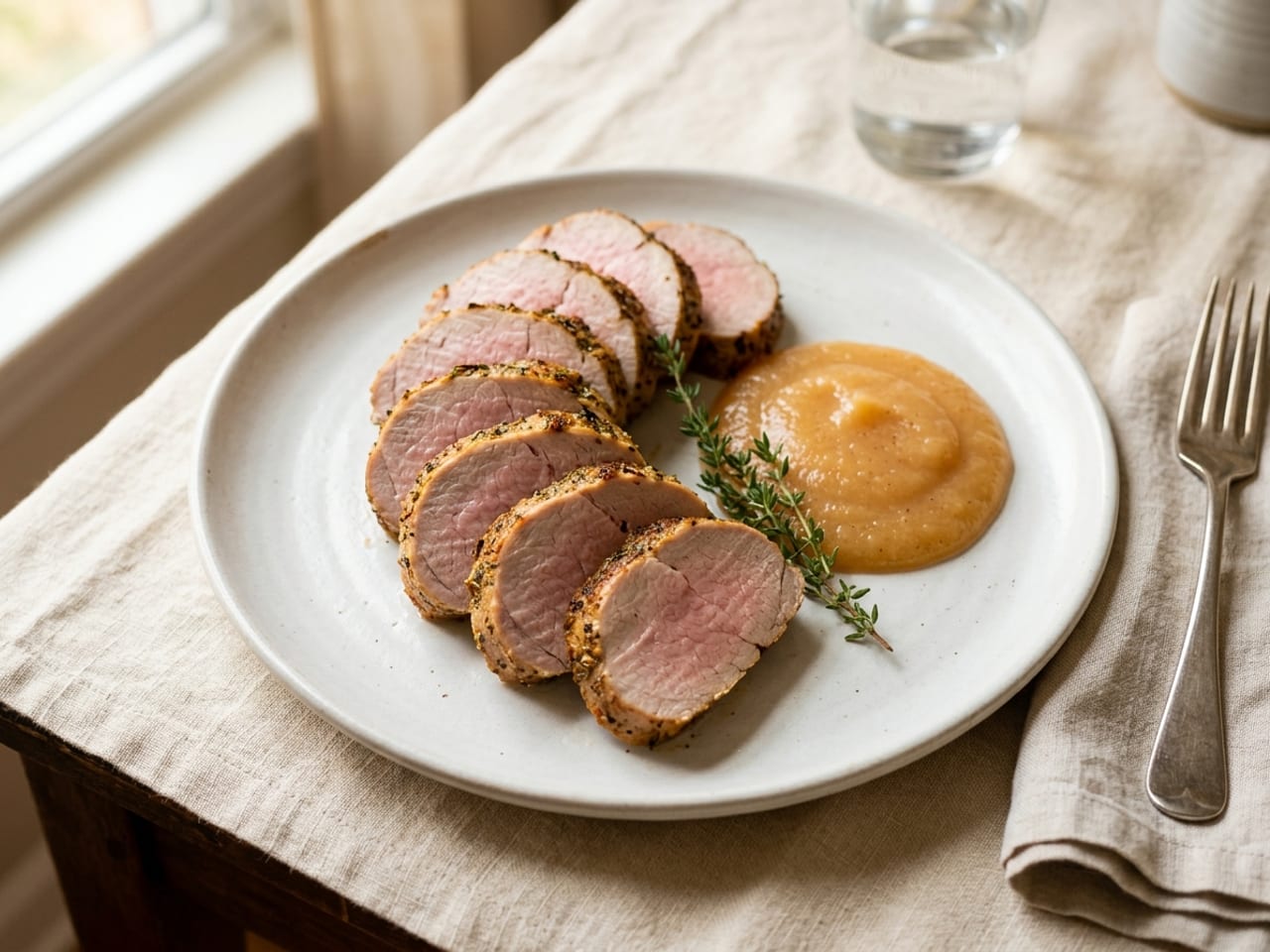
- Anything with a good cross-sectionFan it and lay it out landscape-style: a low horizontal line reads as generous and shows every slice.
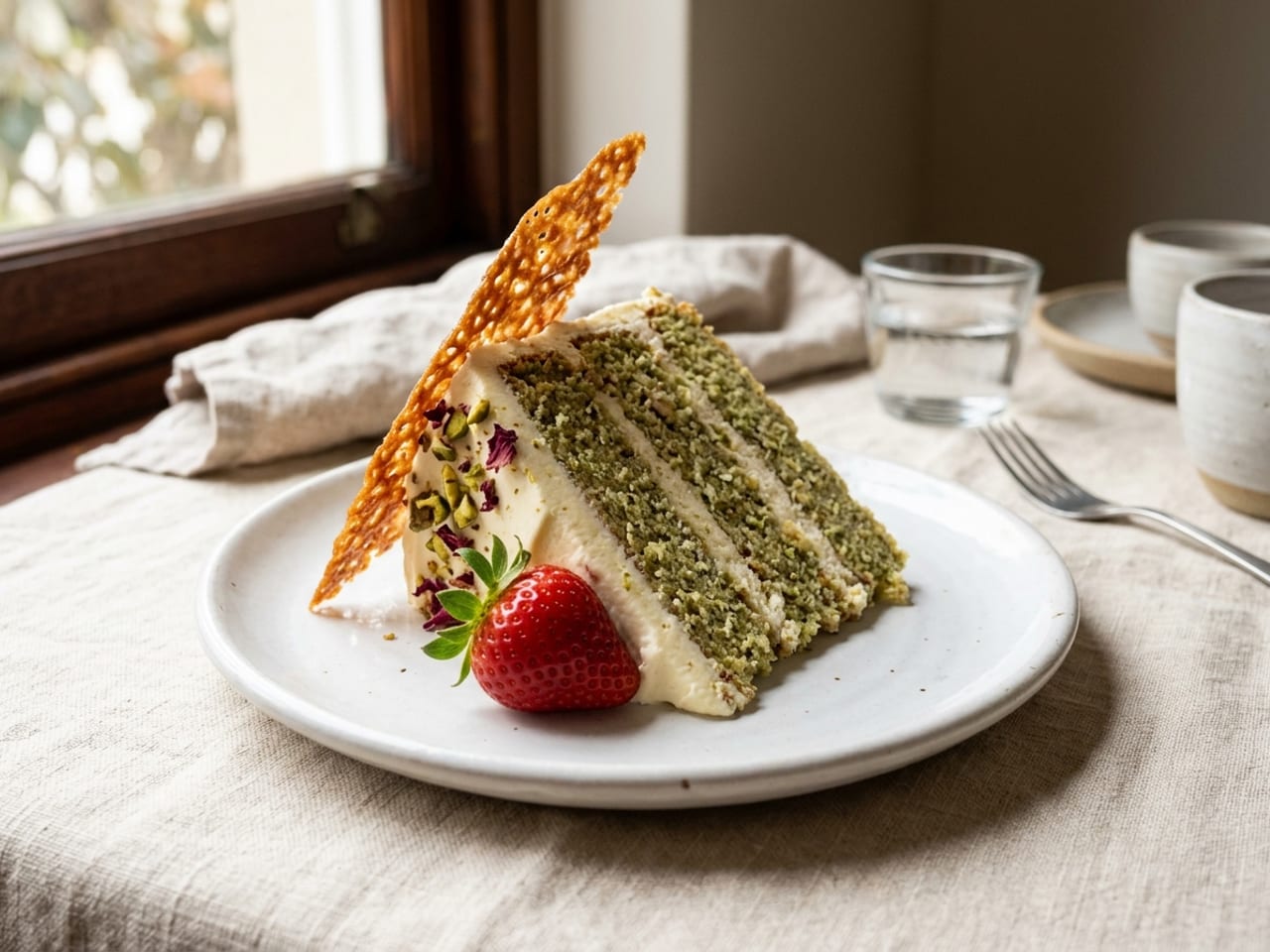
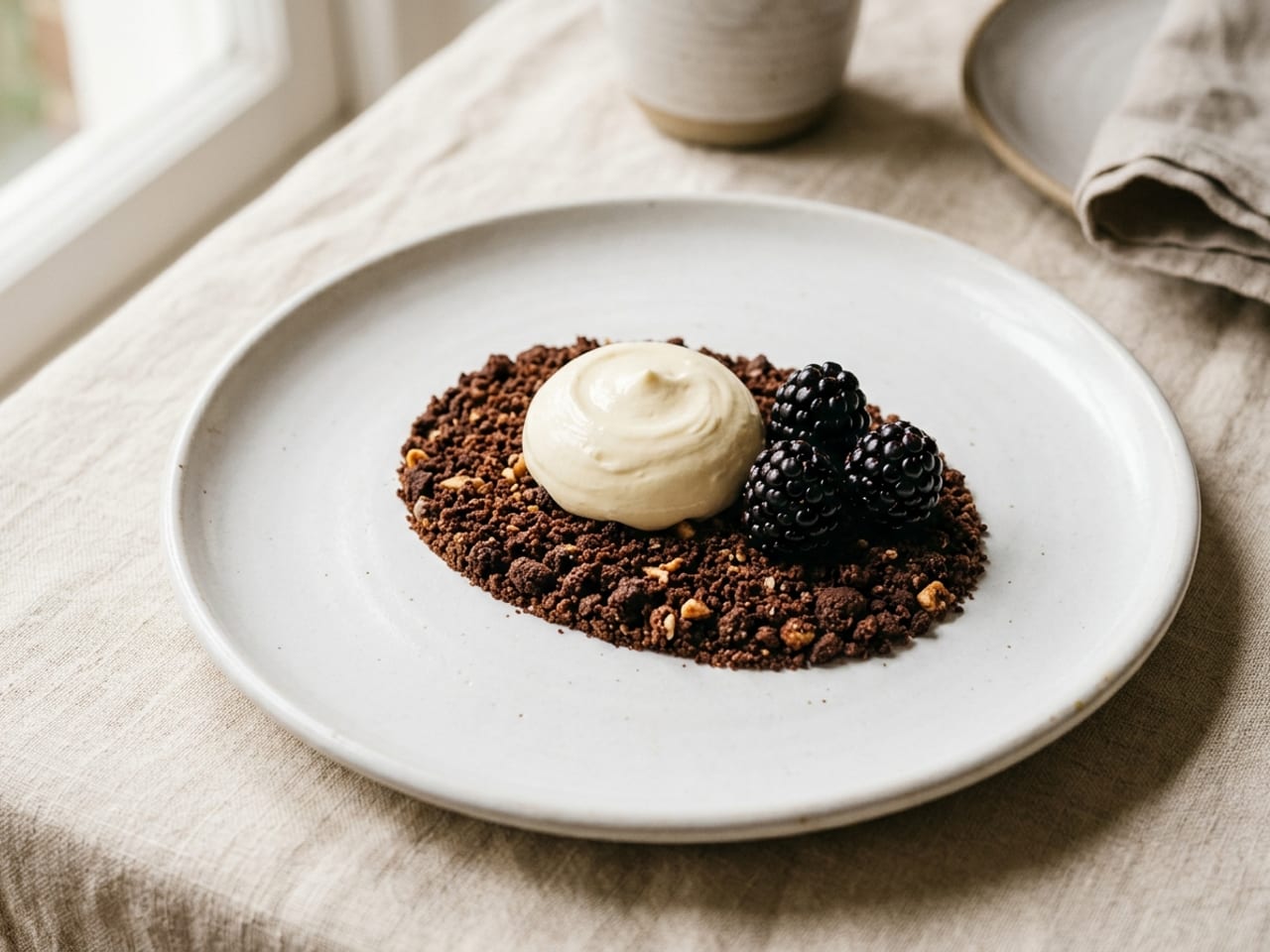
- DessertSmear plus quenelle (free-form), or deconstructed when every component is excellent on its own.
- A table that sharesFamily style — plate at platter scale and let the table do the rest. The boards guide covers it.
- In doubtClassic, centred, balanced, three to four components. Every study in this guide points the same way.
See your own dinner in each style
The vocabulary sticks fastest when it is applied to food you actually cooked. Upload a photo of tonight's plate and Plate Artists re-plates your own dish — choosing the style and the techniques the dish calls for, naming each move, and giving you the steps to do it on a real plate next time.
Your dish, in a chef's layout
Snap it, upload it, and get the composed version back — with the style and techniques named, and the moves to recreate it.
Start free · 1 enhancement →Free account · 1 free enhancement · No credit card
Plating terms, answered
What is plating in cooking?
Plating is arranging cooked food on the plate for service — choosing the plate, placing each component, adding the sauce and garnish, and wiping the rim. The word covers both the overall layout (a plating style such as classic, free-form or landscape) and the individual hand moves that build it (plating techniques such as the swoosh, the quenelle or fanning). It is the last minute of cooking and the first thing a diner judges: identical food that is arranged neatly or artistically is rated tastier and worth more in controlled tests.
What are the different plating styles?
Culinary schools teach three: classic (protein, starch and vegetable in fixed clock positions), free-form (asymmetric, painterly placement around a focal point) and landscape (a low horizontal band across the plate). Modern kitchens added stacked or vertical plating, Nordic minimalist plating, deconstructed plating, hide-and-seek plating and bathing (broth or pool) plating, plus family style, organic-materials, geometric and bento or compartment plating. Each is defined and shown above.
What is classic plating?
Classic plating is the traditional clock-method layout: from the diner's seat, the protein sits at 6 o'clock (the front of the plate), the starch at 10 and the vegetables at 2, with the sauce under or beside the protein. Older service manuals describe the same layout as bands — protein from 3 to 9, starch from 9 to 12, vegetables from 12 to 3. It is symmetrical and tidy, and it is the style closest to what diners preferred in testing: centred, balanced, three to four components.
What is free form plating?
Free-form plating places the components asymmetrically across the plate with no fixed positions — typically a purée swoosh or smear, the protein set off-centre on it, vegetables and garnish scattered at deliberate angles with gaps between them — composed like an abstract painting around one focal point. It looks spontaneous but every placement is decided for balance and flow. The research caveat: when the same ingredients were crowded onto one side of the plate, diners preferred the balanced version, so the asymmetry has to stay inside a balanced whole.
What is landscape plating?
Landscape plating arranges the food low and long in one horizontal band across the plate, like a landscape painting or a strip of garden: a line of purée or sauce with the protein, vegetables and garnish set along it at intervals, and almost no height. It reads left to right, with empty plate above and below the band. In a controlled study the same dish laid out horizontally was rated a larger portion, liked more and worth more than when it was stacked vertically.
What is the top of the plate where food is placed called?
The flat central surface of a plate where the food is placed is the well (porcelain makers also call it the mirror, and chefs simply say the plating surface); it is framed by the raised rim, which stays clean. If the question means orientation rather than a part of the plate, the top of the plate as it faces the diner is the 12 o'clock position of the clock method, with 6 o'clock nearest the diner. In food-safety courses the same phrase has a third answer: any surface that touches food, including the plate's well, is a food-contact surface.
What is the difference between plating techniques and plating styles?
A style is the overall layout of the plate — classic, free-form, landscape, stacked and so on. A technique is one hand move used inside a style — a swoosh, a sauce pool, a quenelle, a ring mould, a fan of slices, a splatter. The same technique appears in several styles (a swoosh can anchor a free-form plate or a landscape band), and one style can be built from many techniques.
What tools do chefs use for plating?
Plating tweezers (long precision tongs, also sold as plating tongs) for placing garnish, a large sauce spoon for swooshes and pools, a saucier spoon with a spout for a measured drizzle, a pair of matched spoons for quenelles, squeeze bottles for dots and lines, stainless ring moulds for timbales and stacks, an offset spatula for moving delicate elements, a pastry brush for painted strokes, a wooden skewer or plating wedge for dragging through dots, and a clean cloth for the rim wipe. A cake turntable is the useful extra. Our plating tools guide gives each one its names and uses, with the kitchen-drawer substitutes that named sources give.
Which plating style should a beginner start with?
Classic. Put the protein at 6 o'clock, the starch at 10 and the vegetables at 2 on a plate one size larger than you think you need, keep the food in the middle two-thirds, spoon the sauce into a pool and wipe the rim. It takes ninety seconds, it looks intentional, and it is the layout diners rated highest in the research. Move to landscape or free-form once the classic plate is automatic.
The research behind this guide
Peer-reviewed studies (plus one Oxford Handbook review chapter), verified via PubMed and Crossref. Every finding quoted above comes from one of these papers.
- Michel, C., Velasco, C., Gatti, E., & Spence, C. (2014). A taste of Kandinsky: assessing the influence of the artistic visual presentation of food on the dining experience. Flavour, 3, 7. doi:10.1186/2044-7248-3-7
- Velasco, C., Michel, C., Woods, A. T., & Spence, C. (2016). On the importance of balance to aesthetic plating. International Journal of Gastronomy and Food Science, 5–6, 10–16. doi:10.1016/j.ijgfs.2016.08.001
- Rowley, J., & Spence, C. (2018). Does the visual composition of a dish influence the perception of portion size and hedonic preference? Appetite, 128, 79–86. doi:10.1016/j.appet.2018.06.005
- Michel, C., Woods, A. T., Neuhäuser, M., Landgraf, A., & Spence, C. (2015). Rotating plates: Online study demonstrates the importance of orientation in the plating of food. Food Quality and Preference, 44, 194–202. doi:10.1016/j.foodqual.2015.04.015
- Youssef, J., Juravle, G., Youssef, L., Woods, A., & Spence, C. (2015). Aesthetic plating: a preference for oblique lines ascending to the right. Flavour, 4, 27. doi:10.1186/s13411-015-0037-x
- Zellner, D. A., Siemers, E., Teran, V., Conroy, R., Lankford, M., Agrafiotis, A., Ambrose, L., & Locher, P. (2011). Neatness counts. How plating affects liking for the taste of food. Appetite, 57(3), 642–648. doi:10.1016/j.appet.2011.08.004
- Zellner, D. A., Lankford, M., Ambrose, L., & Locher, P. (2010). Art on the plate: Effect of balance and color on attractiveness of, willingness to try and liking for food. Food Quality and Preference, 21(5), 575–578. doi:10.1016/j.foodqual.2010.02.007
- Zampollo, F., Wansink, B., Kniffin, K. M., Shimizu, M., & Omori, A. (2012). Looks good enough to eat: How food plating preferences differ across cultures and continents. Cross-Cultural Research, 46(1), 31–49. doi:10.1177/1069397111418428
- Michel, C., Velasco, C., Fraemohs, P., & Spence, C. (2015). Studying the impact of plating on ratings of the food served in a naturalistic dining context. Appetite, 90, 45–50. doi:10.1016/j.appet.2015.02.030
- Woods, A. T., Michel, C., & Spence, C. (2016). Odd versus even: a scientific study of the ‘rules’ of plating. PeerJ, 4, e1526. doi:10.7717/peerj.1526
- Spence, C. (2021). On the empirical aesthetics of plating. The Oxford Handbook of Empirical Aesthetics, Oxford University Press, online edition. doi:10.1093/oxfordhb/9780198824350.013.31
Keep going
Food plating tools: 20 names and uses
What makes each mark: tweezers, the sauce spoon, squeeze bottle, ring mould and sixteen more, with the kitchen-drawer substitutes that named sources give.
Plating components, defined
What the techniques are applied to: sixteen components from coulis and tuile to fluid gels, foams and herb oil, defined and made.
Plating 101 — the composition guide
The vocabulary applied, step by step: the clock method, height, negative space, sauce work and garnish rules on one dinner.
Michelin-star plating — the fine-dining anatomy
The purée-sear-crunch structure, the five signature moves and the sixty-second home pass.
How to plate food — dish by dish
The techniques applied to ten everyday dishes, each shown as the same home dinner before and after re-plating.
Dessert plating — the pastry chef's system
Quenelle, smear, soil and stack — the same techniques at the sweet end of the menu.
The five French mother sauces
Béchamel, velouté, espagnole, tomate and hollandaise — how each is made and thickened, its daughters, and where it goes on the plate.
Types of plates — the dinnerware glossary
Every plate, bowl and platter defined and sized: charger to saucer, rimmed to coupe, porcelain to slate, and which one to plate on.