What is an amuse-bouche? Meaning, history and 12 ideas
The one free bite before dinner: what the word means and how to say it, where it came from, how it differs from an hors d'oeuvre, a canapé and an appetizer, and how to make one at home, with twelve ideas, the vessels, the food-safety rules and what the research says about a first taste.
The photos on this page are AI-generated illustrations.
An amuse-bouche (pronounced ah-mooz-BOOSH) is a single bite or two of food that the kitchen sends to every diner before the first course. Nobody orders it, the chef chooses it, everyone at the table gets the same one, and it is usually free: Merriam-Webster defines it as "a small complimentary appetizer offered at some restaurants".1 The French means, literally, "it amuses the mouth". The plural in English is amuse-bouches; in French it is masculine, un amuse-bouche, and the plural can be written with or without the final s.
It has an older, rougher twin. Amuse-gueule uses gueule, the mouth of an animal, and French dictionaries still label it familiar; Larousse notes that restaurants, "especially the most prestigious", announce amuse-bouche rather than amuse-gueule on their menus.3 A New York Times writer put the difference as "approximately the same as that between 'toilet paper' and 'toilet tissue'."4
This guide covers the word, its history (older than the textbooks say), the neighbours it gets confused with, how a cook builds one, the vessels, twelve ideas you can make at home and when to make each part, the food-safety rules for the raw ones, and what the science actually says about a first bite. Sources are at the bottom.
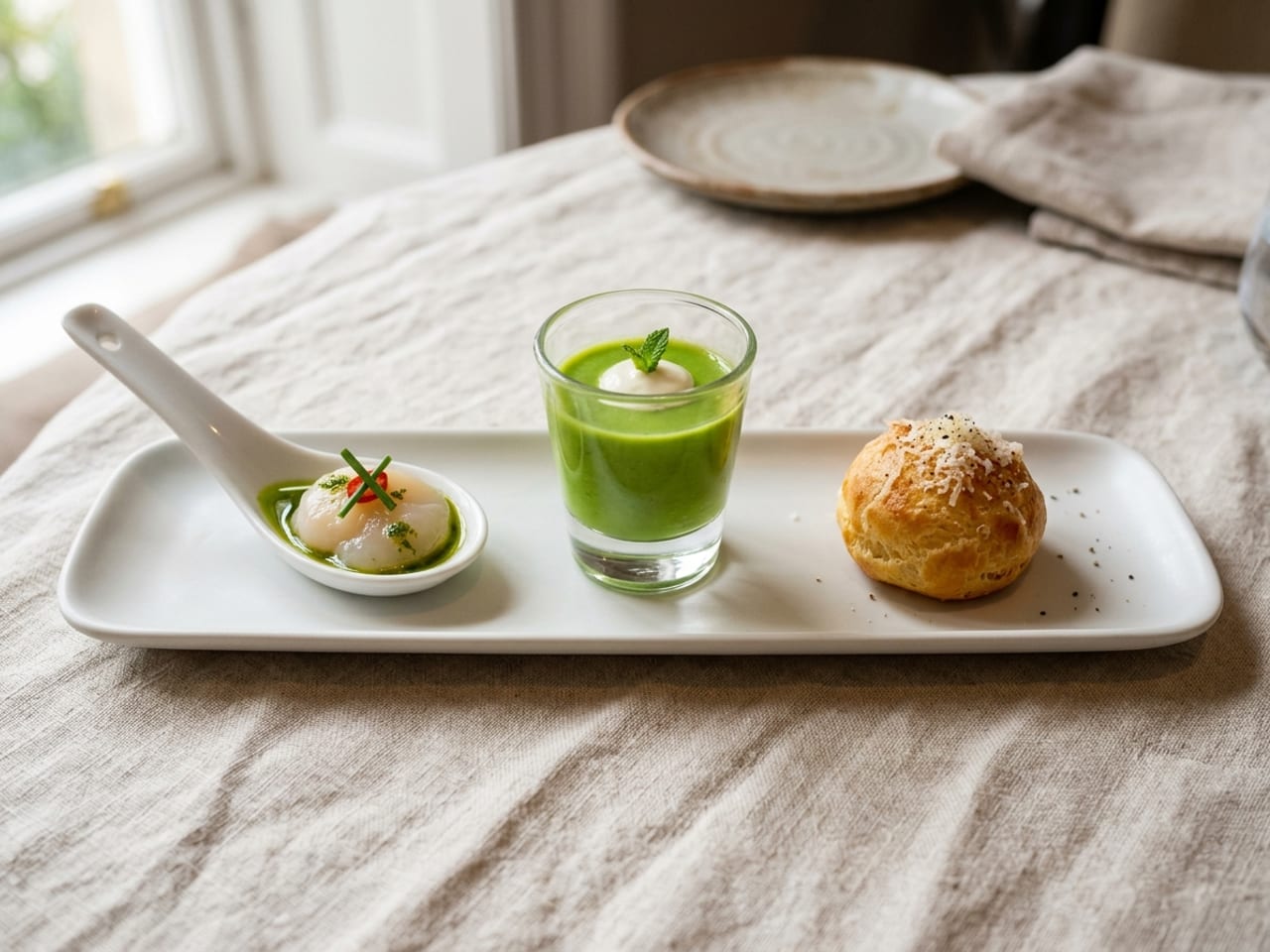
Five things that make it an amuse-bouche
- Nobody orders itThe kitchen decides what it is and sends the same bite to every guest at the table. The MICHELIN Guide calls it the kitchen's "gastronomic sketch pad", a place to try ideas "without feeling obliged to include the items in the fixed menu". 5
- One or two bites"Very small, usually only one-to-two bites and, accordingly, free," in the words of chef Connie Chung, formerly of Eleven Madison Park.6 If it needs a knife and fork, it is a starter.
- It comes before the first courseAfter you sit down and before anything you ordered arrives, often while the order is being taken. Some kitchens send several in a row; the MICHELIN Guide counts anything "from just one dish to as many as six or seven".5
- It previews the cook"It should be super flavorful and indicative of the meal to come," says Chung.6 At a casual restaurant it is often made from the trim of other dishes; at home it is a preview of the dinner in one bite.
How it differs from everything else served first
The quick test: who chose it, did you pay for it, and how many bites is it?
| Course | Who chooses | On the bill? | Size | When |
|---|---|---|---|---|
| Amuse-bouche | The kitchen | No (usually) | 1 to 2 bites, one per guest | Seated, before the first course |
| Hors d'oeuvre | The host or the menu | At a restaurant, yes | A few bites, several kinds | With drinks, or as a first course |
| Canapé | The host or caterer | Part of the event | 1 bite on a bread, pastry or cracker base | Standing, with drinks |
| Appetizer / starter | You | Yes | A small plate | The first ordered course |
| Pre-dessert | The kitchen | No (usually) | 2 to 3 bites | Between the main and dessert |
| Mignardises | The kitchen | No (usually) | 1 bite each, a small tray | With coffee, at the end |
Amuse-bouche · amuse, amuse-bouches (plural)
A single bite or two, chosen by the kitchen and sent to every diner before the first course, not ordered and usually free.
Amuse-gueule
The older, everyday French word for a small savoury nibble, the kind served with an aperitif; gueule is an animal's mouth, so it sounds casual, and grand restaurants say amuse-bouche instead.
Mise en bouche
A French and Swiss menu synonym for the amuse-bouche: the bites offered with the aperitif before the meal.
Hors d'oeuvre
A small savoury dish at the start of a meal or served at a party; in France a proper first course (hors d'oeuvres variés), in English usually finger food passed with drinks, several kinds and in quantity.
Canapé
A one-bite base of bread, toast, pastry or cracker with a topping, served with drinks at a reception; defined by its edible base, where an amuse can come in a spoon, a cup or a shell.
Appetizer (starter)
The first course you order and pay for: a small plate, eaten with a knife and fork, the first line of the menu.
Entrée
In France and at formal British dinners, the course before the main (a starter); in the United States, the main course itself.
Pre-dessert (avant-dessert)
The amuse-bouche of the sweet side: two or three bites sent between the last savoury course and the dessert, a bridge from one to the other; it need not be sweet.
Mignardises (petits fours)
The tray of one-bite sweets sent with coffee at the end of the meal, the bookend to the amuse-bouche; in French a petit four can also be savoury.
Sakizuke
The opening bite of a Japanese kaiseki meal, often something pickled; the MICHELIN Guide compares it to the amuse-bouche, but it is a fixed course of a set sequence rather than an off-menu extra.
Tapas and pintxos
Small Spanish portions eaten with a drink in a bar, a pintxo often held together with a cocktail stick; ordered, shared, and enough of them make a whole meal.
Snacks
What many tasting-menu restaurants now call their run of opening bites; sometimes free like an amuse-bouche, and at some restaurants a paid section of the menu.
Two notes on the neighbours. The kaiseki comparison comes from the MICHELIN Guide, which calls sakizuke "the first bite of the meal, similar to the French amuse bouche".19 And entrée is the one that trips people up across the Atlantic: Cambridge gives it as the main dish in American English and as a small dish before the main in British formal dining,20 which is the French sense too. The small course that interrupts a meal instead of opening it, the sorbet or granita between courses, has its own guide: the palate cleanser.
Where the amuse-bouche came from
The idea is nineteenth-century. In Jules Verne's Twenty Thousand Leagues Under the Sea (1870), the harpooner Ned Land dismisses a catch of pigeons as mere "hors-d'œuvre et amusettes de la bouche", starters and mouth-amusers.7
The words are older than the dictionaries. The French dictionary of record, the Trésor de la langue française, dates amuse-gueule to a 1946 novel,13 and the Académie française only admitted it in its ninth edition, with no entry for amuse-bouche at all.12 The digitised French press tells a different story. In 1904 a Saint-Denis newspaper, sending up a council meeting as a dinner, calls the small items on the agenda "les hors-d'œuvre" and "les « amuse-gueule »" before the "plat de résistance" arrives: a joke that only works if readers already knew the word.8 And on 15 March 1922 the Hôtel Ruhl in Nice opened a dinner with "Amuse-Bouche Nantais", printed on the menu that La Revue culinaire reproduced that May.9 By 1924 a French fashion magazine's menu column was already applauding "la suppression de ces « amuse-bouche »", which wore out a good appetite without satisfying it,10 and in 1928 the gastronome Ali-Bab explained that hors d'oeuvres had begun as nibbles left on the table between courses: "c'étaient des amuse-gueule".11
In those early uses, though, an amuse-bouche was simply a small opening dish. English borrowed the word late: the Oxford English Dictionary's earliest evidence is from 1959, in the writing of Lord Kinross.2
The free chef's gift is a 1970s idea. The New York Times traced the modern amuse, the unordered bite with the kitchen's compliments, to "the advent of nouvelle cuisine in the early 1970's", when portions shrank and an extra bite made the point. Jacques Pépin, who cooked at New York's Le Pavillon in its prime, said flatly: "We never served an amuse-bouche at Le Pavillon." In New York it caught on at the Quilted Giraffe, which sent out a layered smoked salmon and foie gras "cake" from the mid-1970s through the 80s.4 Chef Jean Joho remembered amuses going "unfashionable during the late '80s" and then coming back.5
The most famous one is an ice-cream cone. In 2000, every meal at Thomas Keller's French Laundry began with a "cornet" of salmon tartare with sweet red onion crème fraîche, which looks like a scoop of sorbet; Keller conceived it at a Baskin-Robbins, and "people always smile when they get it."16 His published recipe tells home cooks to stand the cones in a bowl of rock salt or peppercorns.15
Today it is often a run of "snacks". "The amuse bouche is dead. Long live the 'snack'," the Sydney Morning Herald's Good Food Guide declared in 2019, as tasting menus moved from one free bite to seven or eight.17 It also moved home. "Once the exclusive domain of multi-starred chefs, the amuse-bouche has trickled down to the dining room of a home near you," the New York Times wrote in 2006: espresso cups of soup, oversize spoons, shot glasses.14
How to make an amuse-bouche
- Start from the dinner, not from the amuseTake one ingredient or idea from the meal and show it in a different form: the pea from the main course as a chilled shot, the Gruyère from the gratin in a gougère. It should hint at dinner without repeating it.
- One star, then a contrast"You can go high salinity, salty, creamy, acidic, but often, you're messing with a mix of all of the above," says chef Feisal Lagos, whose example is a potato chip with crème fraîche and caviar: "really all you want is one bite."6 One main ingredient, one thing that cuts it (acid, salt, a little heat), one texture that is different.
- Season it a notch up, not twoA single bite has to say everything at once, so it can carry a little more salt and acid than a main course. But in the lab the most appetising level of a seasoning was the middle one: doubling the oregano in a pasta sauce killed the rise in hunger that the right amount produced.22
- Cold means cold, hot means hotA one-bite portion reaches room temperature in minutes. Chill the glasses and spoons for the cold ones (the pea-shot recipe below freezes its glasses first)47 and warm the cups for the hot ones. A lukewarm amuse tastes of nothing.
- Size it by the spoonfulThere is no official weight. Useful yardsticks from real recipes: Keller fills each salmon cornet with about 1½ teaspoons of tartare,15 a chilled soup shot is about ¼ cup (60 ml),47 and a published beef-tartare canapé recipe (250 g of beef for twenty) works out at about 12 g each. If it can't go in the mouth in one move, it's too big.
- Say what it isWhen a bite looks like something it isn't, name it. In one experiment the same frozen smoked-salmon dish was strongly disliked when people were told it was "ice cream" and acceptable when it was called a frozen savoury mousse; the wrong label even made it taste saltier.30 At home, one sentence as you set it down does the job.
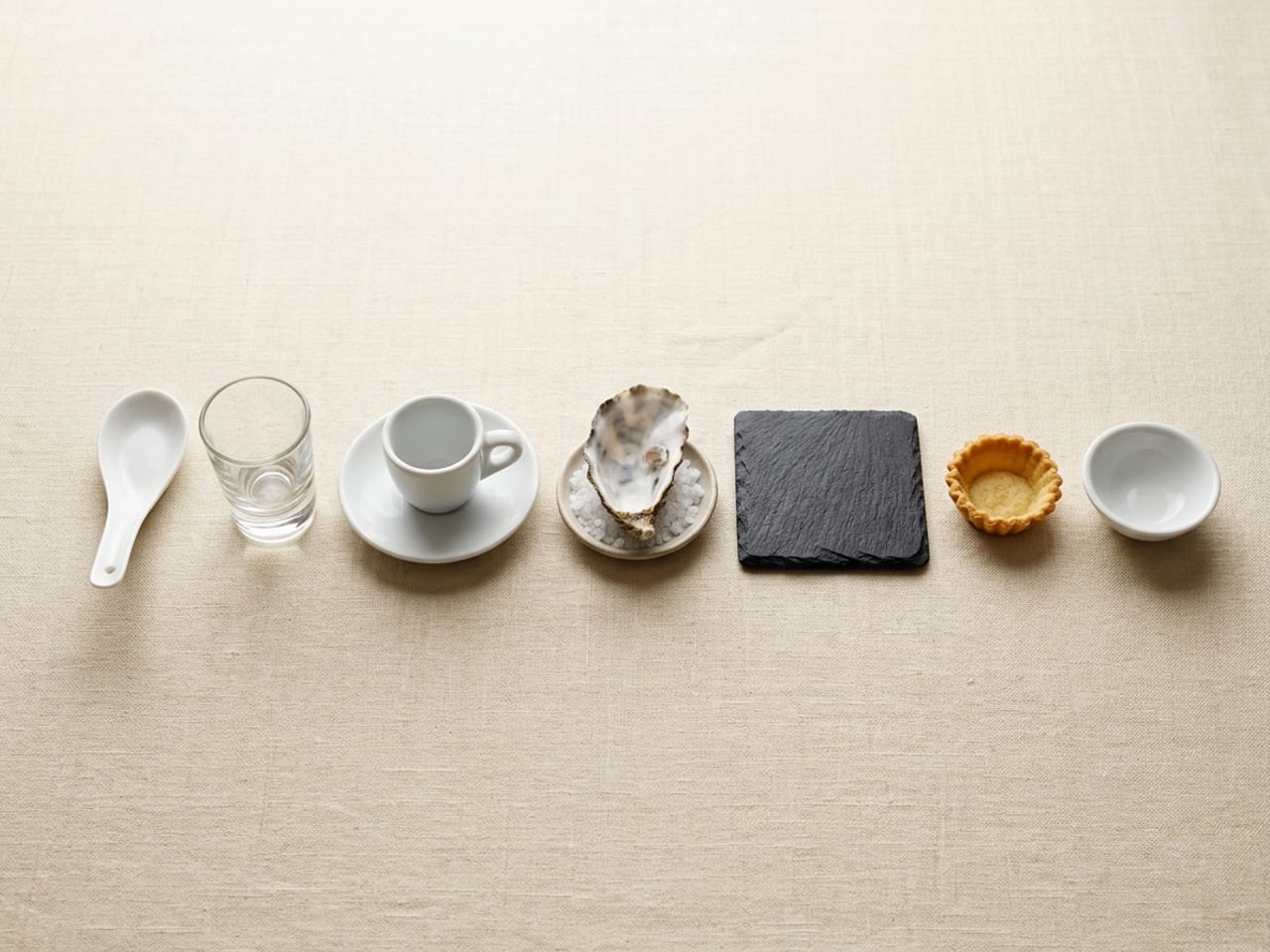
What to serve an amuse-bouche in
- The tasting spoonThe Chinese soup spoon is the classic, and restaurant-supply tasting spoons are sold at roughly 0.2 oz to 1 oz (about 6 to 30 ml). Those are maximum capacities: fill well below the rim. Set the spoon on a small plate with the handle towards the guest.
- The shot glass or verrineFor chilled soups, tomato water, layered creams. There is no standard size; the common US shot glass holds 1½ oz (44 ml). Glass shows off layers and clear liquids, and it can be frozen first to keep the soup icy.
- The espresso cupThe home cook's best amuse vessel: it holds heat, everyone owns them, and a hot soup in a demitasse cup is the traditional format. In 2006 the New York Times described home hosts setting one at each place "for the amuse-bouche".14
- The shell, on salt or iceAn oyster or scallop shell is its own plate. Sit it on a bed of coarse salt or crushed ice so it can't rock. Keller's recipe has home cooks stand his cornets upright in a bowl of rock salt or peppercorns.15
- The edible baseA crisp, a blini, a tartlet case or a slice of cucumber: the vessel is eaten with the bite, so there is nothing to clear. This is where an amuse overlaps with a canapé.
- The small plate or slateFor anything that stands on its own, like a gougère or a devilled egg. Keep the plate small so a single bite doesn't look lost, and dark slate for pale food, white for dark.
12 amuse-bouche ideas for a dinner party
Seven vegetarian, five from the sea or the butcher; cold and hot; every one of them made mostly ahead. The make-ahead windows come from the cited recipes.
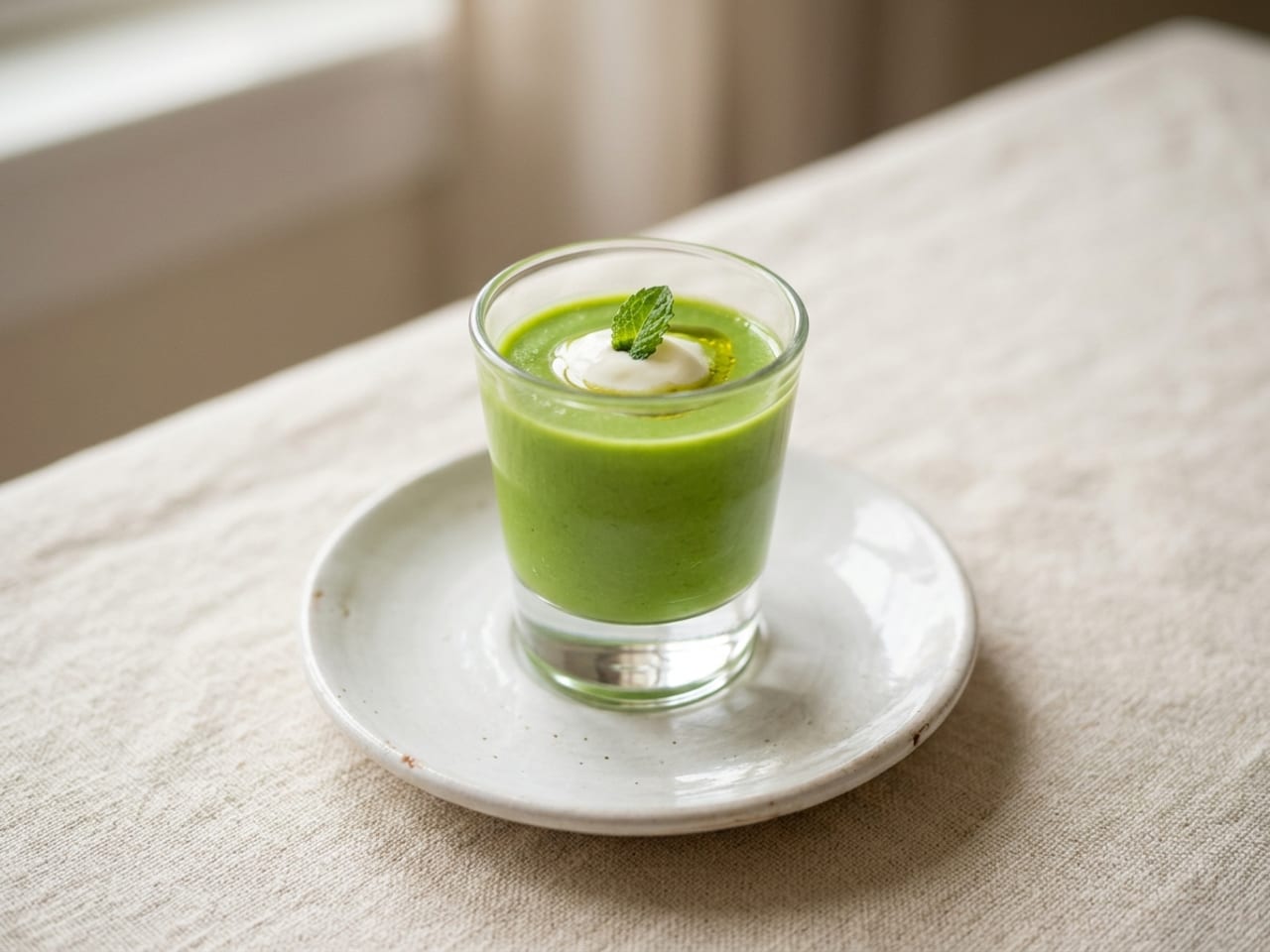
1. Chilled pea and mint shot
Cold · vegetarian · make the day before
Frozen peas cooked in vegetable stock with spring onion, blended with mint, pushed through a sieve and finished with crème fraîche. About ¼ cup (60 ml) per frozen shot glass or espresso cup, a dot of crème fraîche, one mint leaf. The soup keeps a day in the fridge.47
Plate it: the dot goes dead centre and small, so the green stays the colour of the bite.
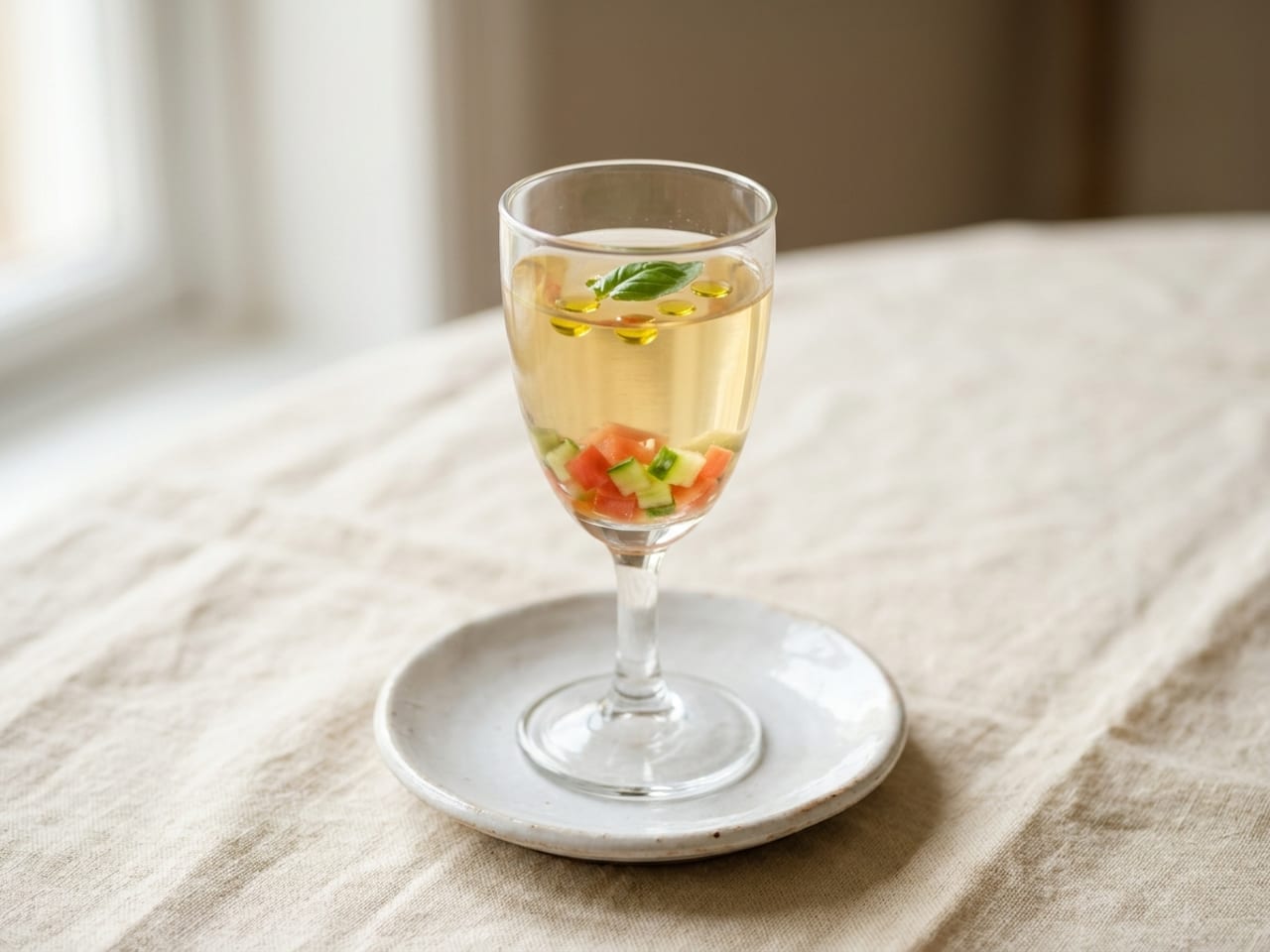
2. Clear tomato water
Cold · vegan · drip overnight
Pulse ripe tomatoes with a little shallot and basil stalk, tip into a sieve lined with damp muslin over a bowl and leave it in the fridge overnight to drip. Don't press, or it clouds. A kilo of tomatoes gives about 400 ml, enough for four small glasses. Season with salt and a drop of sherry vinegar.45
Plate it: a sherry or shot glass, a few tiny cubes of tomato and cucumber, one small basil leaf, three drops of olive oil. It looks like water and tastes of August.
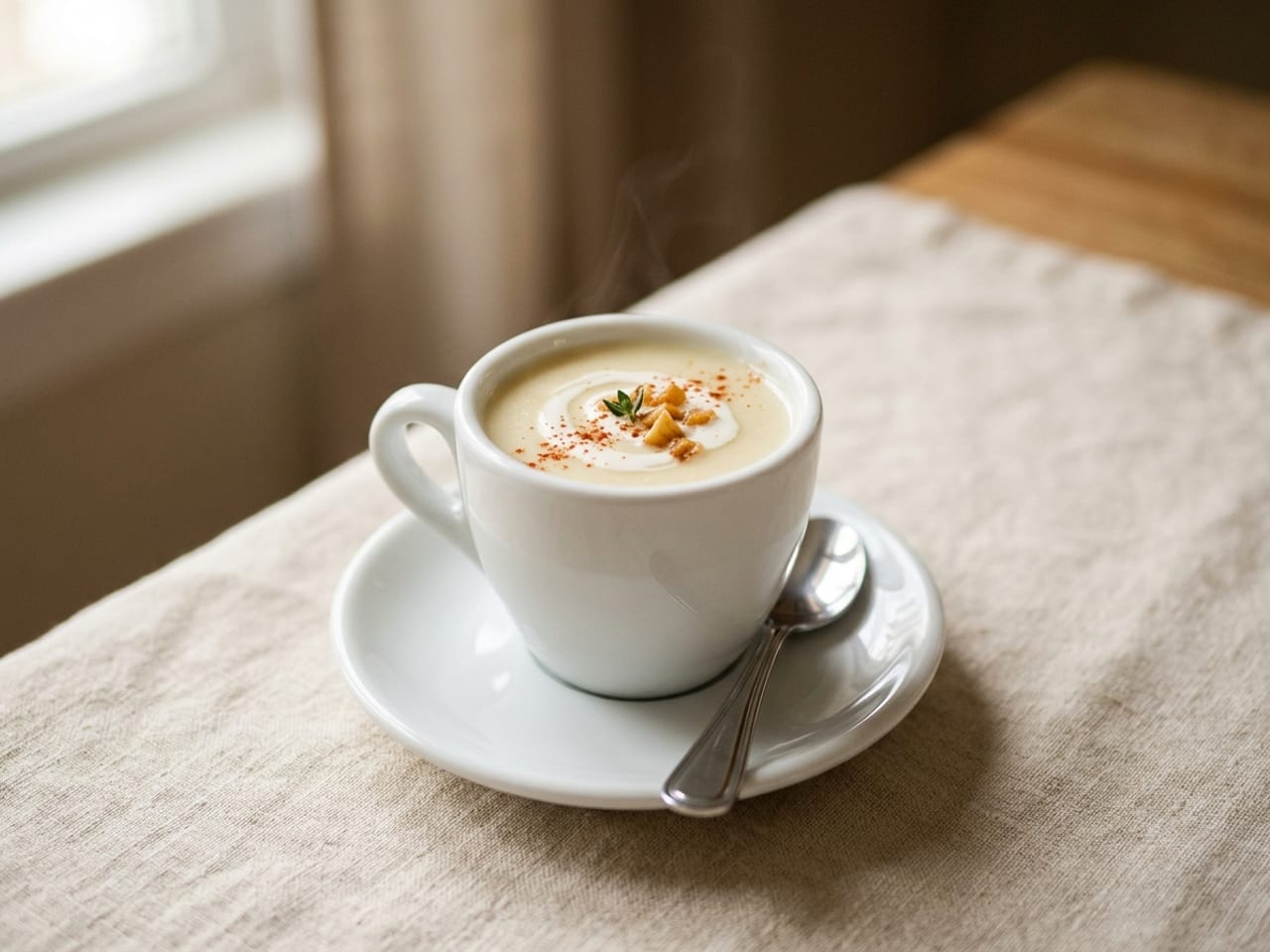
3. Hot parsnip soup in an espresso cup
Hot · vegetarian · reheat to serve
The winter version: a smooth parsnip soup (onion, a little carrot, a pinch of curry powder) served in espresso cups "before a glass of wine", as cookbook author Judith Finlayson does on cold nights; her batch makes about 16.44 Make it the day before and reheat until steaming.33
Plate it: warm the cups, a thin swirl of cream, a dust of paprika, a few fried parsnip crumbs for crunch. Or pour a spoonful of our pumpkin soup.
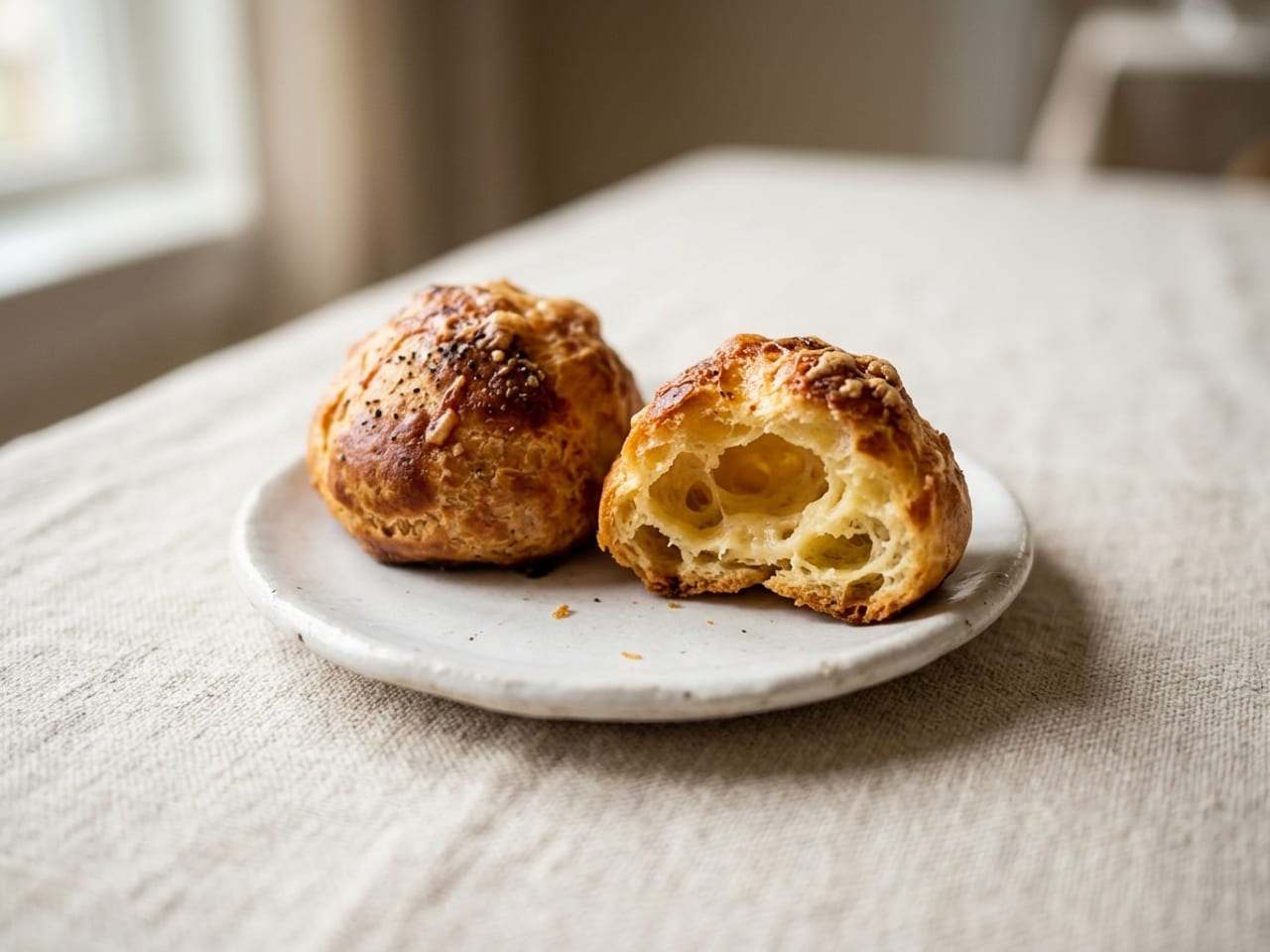
4. Gougères
Warm · vegetarian · freeze unbaked
Choux pastry with grated Gruyère or Comté, the traditional welcome bite of Burgundy's wine cellars. Scoop the dough onto a tray, freeze, bag, and bake straight from the freezer with a few extra minutes.41
Plate it: two on a small plate, still warm, one broken open if you want the custardy inside to show. Strict vegetarians: check the cheese for animal rennet.
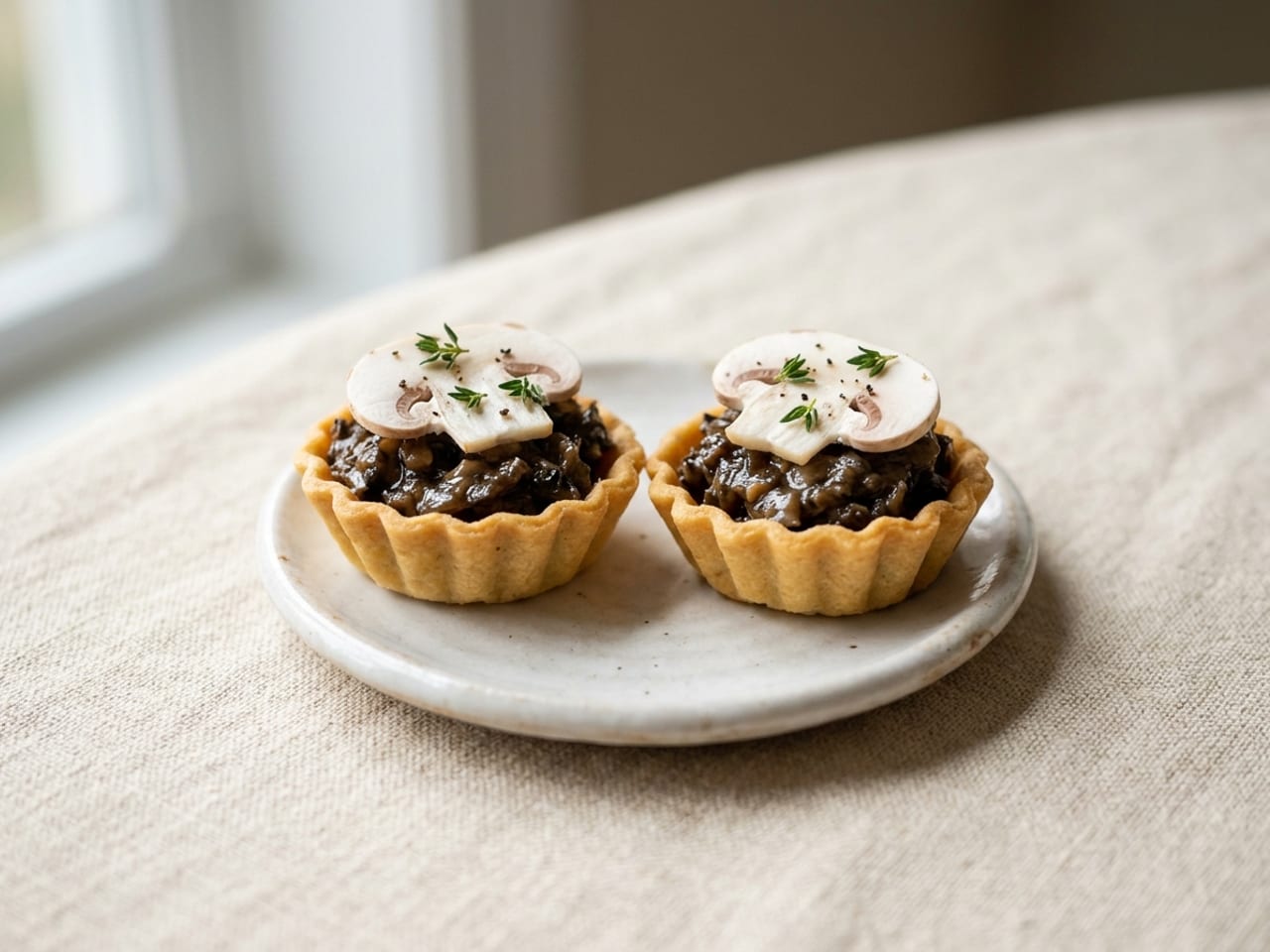
5. Mushroom duxelles tartlet
Hot · vegetarian · cases the day before
Finely chopped mushrooms and shallot cooked slowly in butter until every drop of liquid is gone (duxelles), finished with thyme and a spoon of crème fraîche, spooned into small baked pastry cases and warmed through.
Plate it: a paper-thin slice of raw mushroom on top for freshness against the dark filling, three thyme leaves, nothing else.
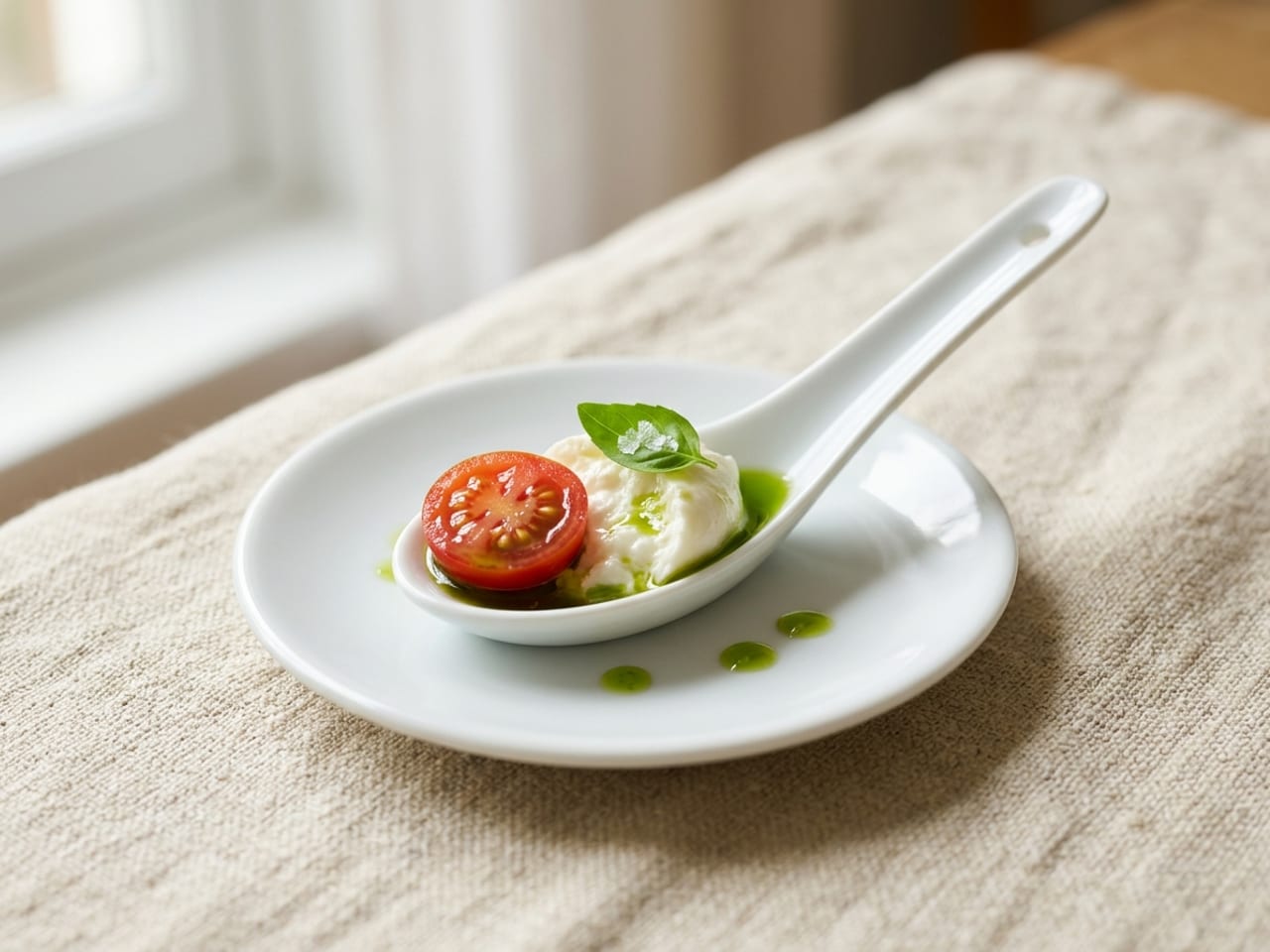
6. Burrata and tomato spoon
Cold · vegetarian · assemble to order
A small torn piece of burrata, half a sweet cherry tomato, a few drops of basil oil, one leaf, a flake of salt. It is the caprese salad in one mouthful, and it takes ten minutes for eight people.
Plate it: build it on the spoon at the last moment; burrata weeps if it waits. As with the gougères, check the cheese if your guests avoid animal rennet.
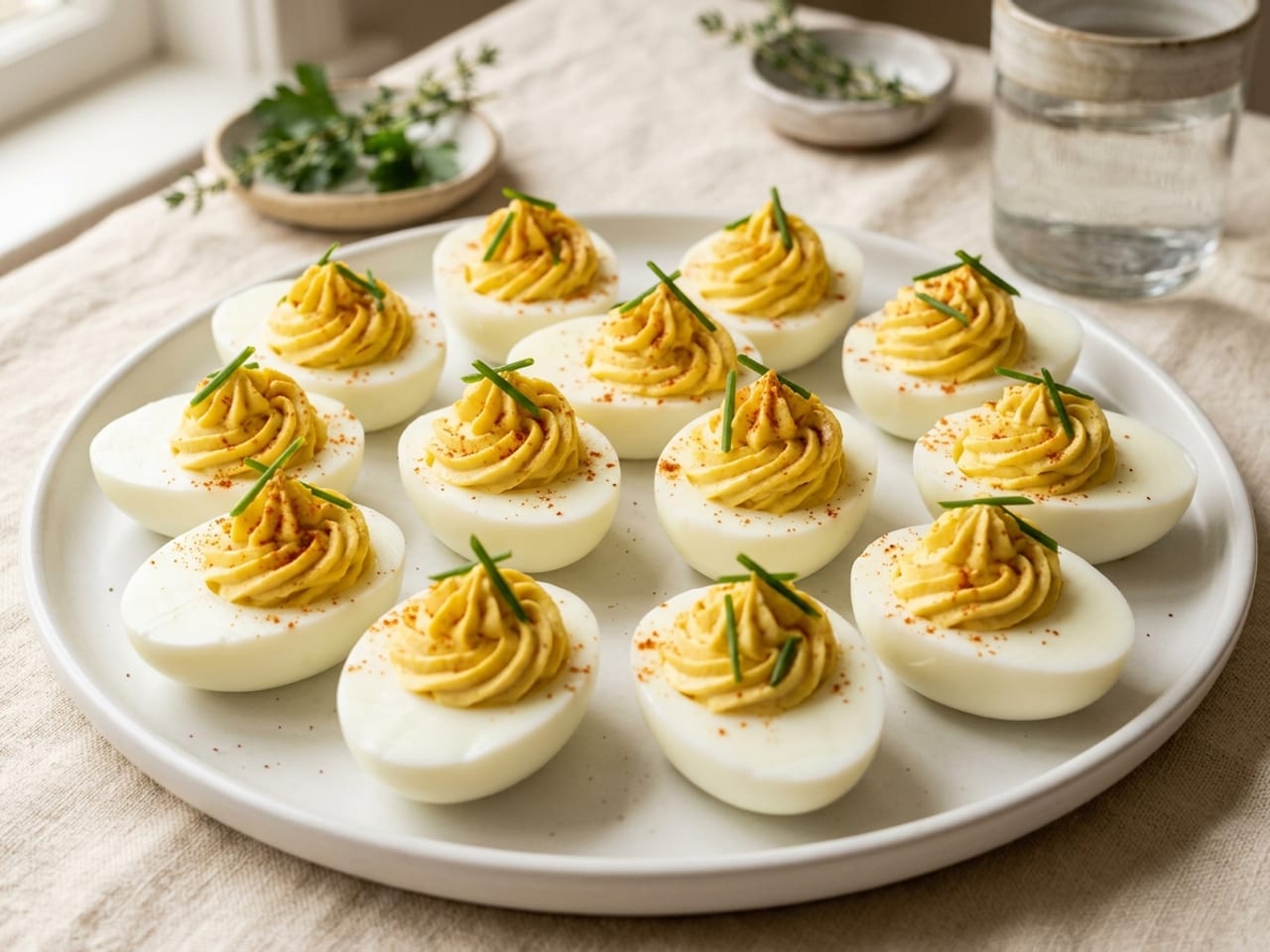
7. One devilled egg
Cold · vegetarian · make the morning of
The retro party snack is back as a restaurant amuse: Rita's in London opens its meals with devilled eggs.48 One half per guest (or a quail egg) turns it from party platter into a single composed bite.
Cook it: our devilled eggs recipe; pipe the filling high, one chive baton and a pinch of paprika.
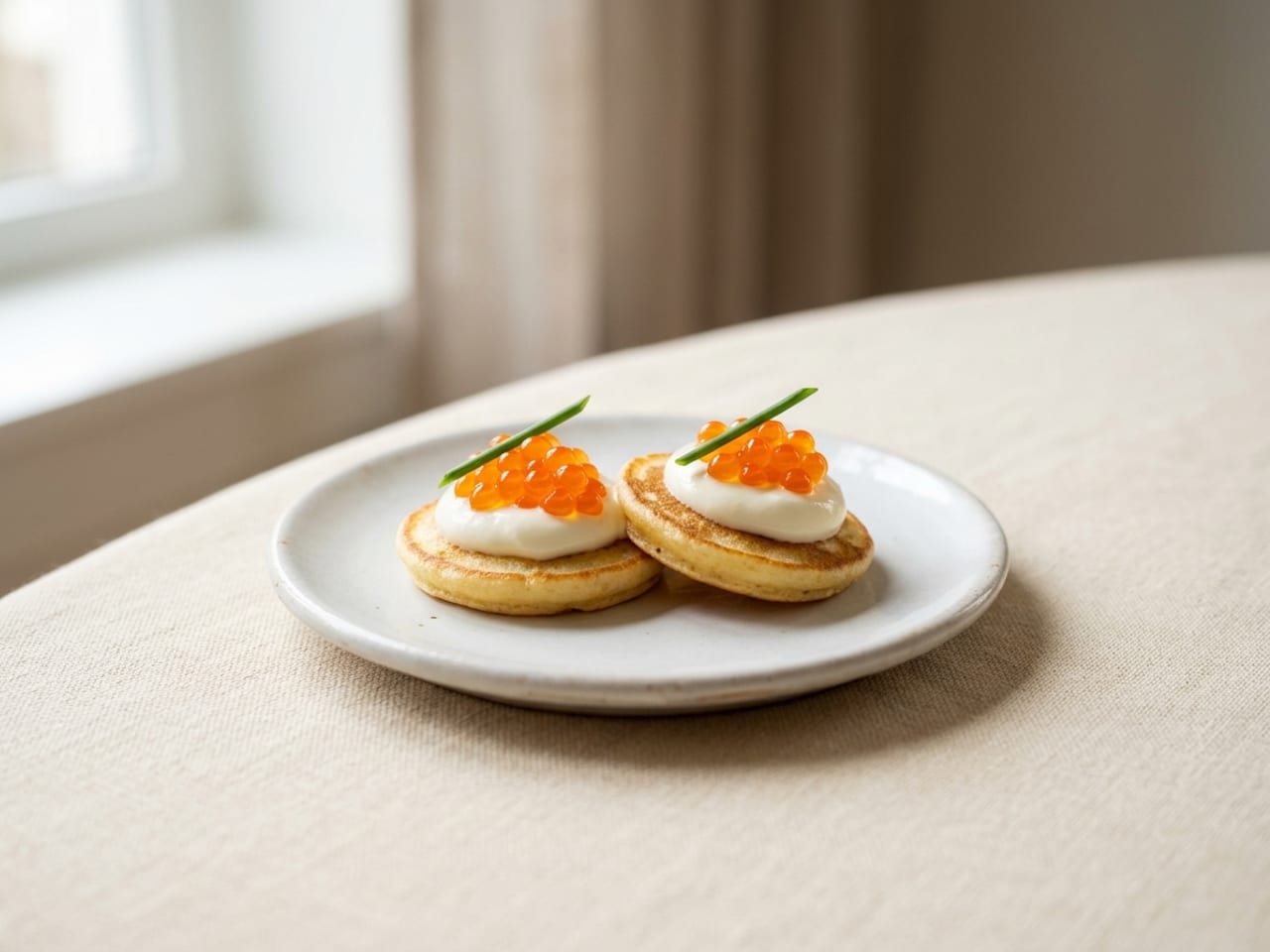
8. Blini with crème fraîche and trout roe
Warm · fish · freeze the blini
Coin-sized buckwheat blini, a spoon of crème fraîche, a little heap of trout or salmon roe, a chive tip. The blini keep three days in the fridge or months in the freezer; reheat them spread on a tray, uncovered, for 4 minutes at 400 °F (200 °C) and let them cool before topping.46
Plate it: two per plate, roe last, on the top of the cream, never touching the plate.
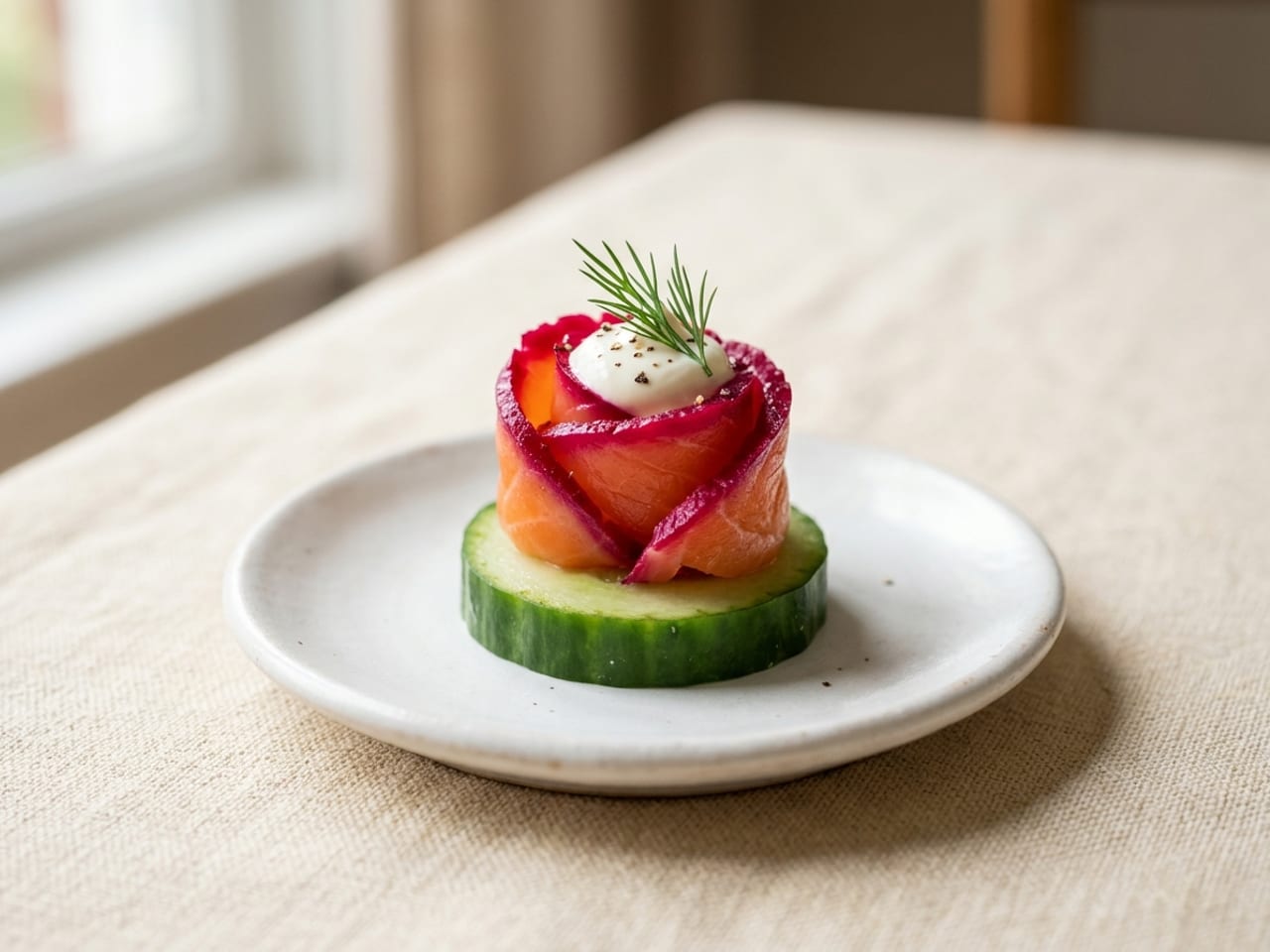
9. Beet-cured salmon on cucumber
Cold · fish · cure 12 hours ahead
Salmon cured under salt, sugar and grated beetroot for 12 hours, turned halfway, so the edge goes magenta.42 Slice it thin, fold a small rosette onto a thick round of cucumber, a dot of crème fraîche, a sprig of dill. Farmed salmon is the safe choice for a raw cure (see the safety section).
Plate it: the cut edge of the salmon faces the guest; that stripe of colour is the whole point.
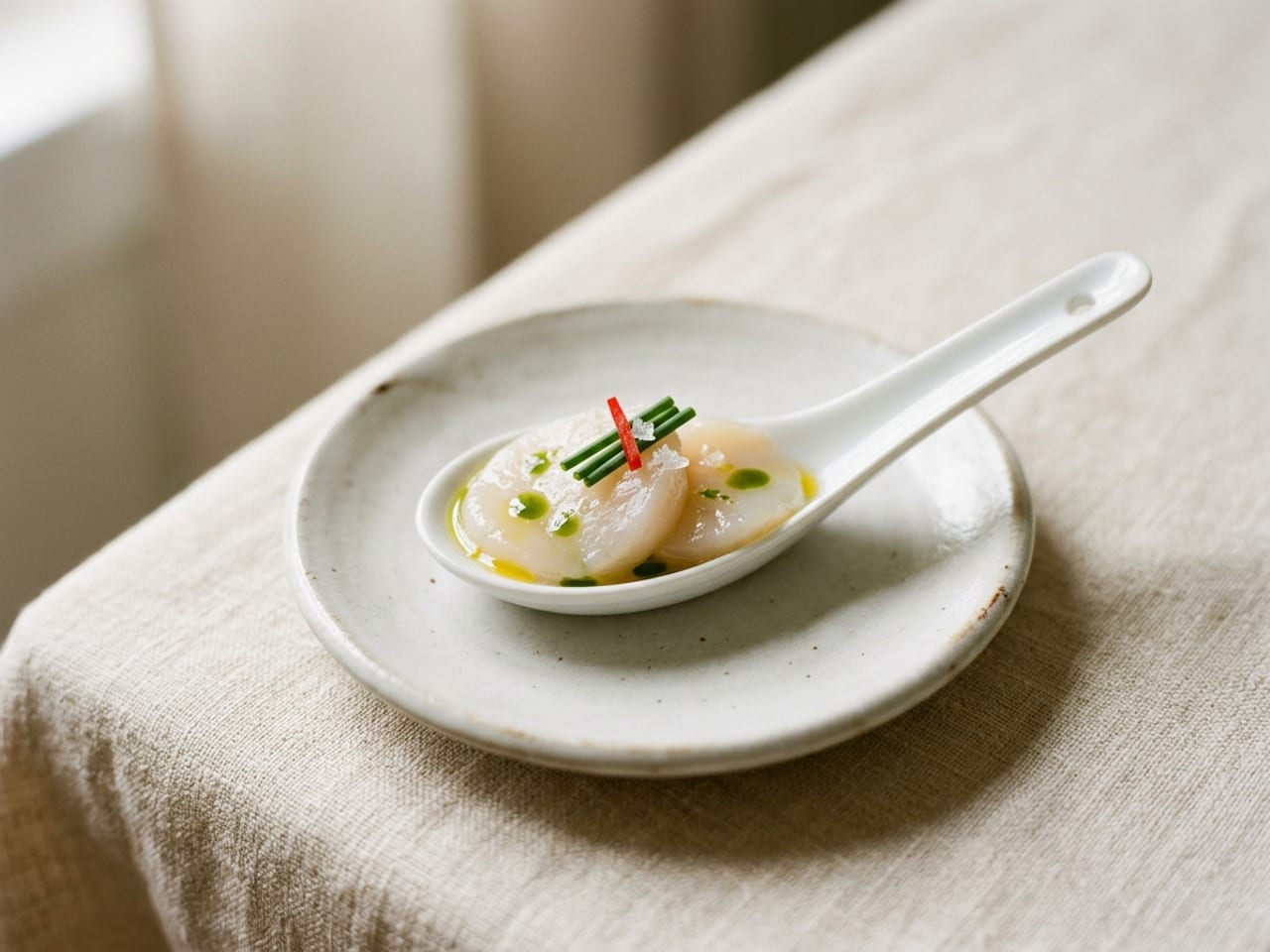
10. Scallop crudo on a spoon
Cold · shellfish · slice to order
Very fresh, dry-packed scallops sliced ¼ inch (6 mm) thick, dressed at the last second with good olive oil, a squeeze of lemon or lime, flaky salt and a sliver of chilli. Serve at once, before the acid turns the edges opaque.
Cook it: the same idea, marinated longer, is our ceviche; a spoonful of it makes an amuse too.
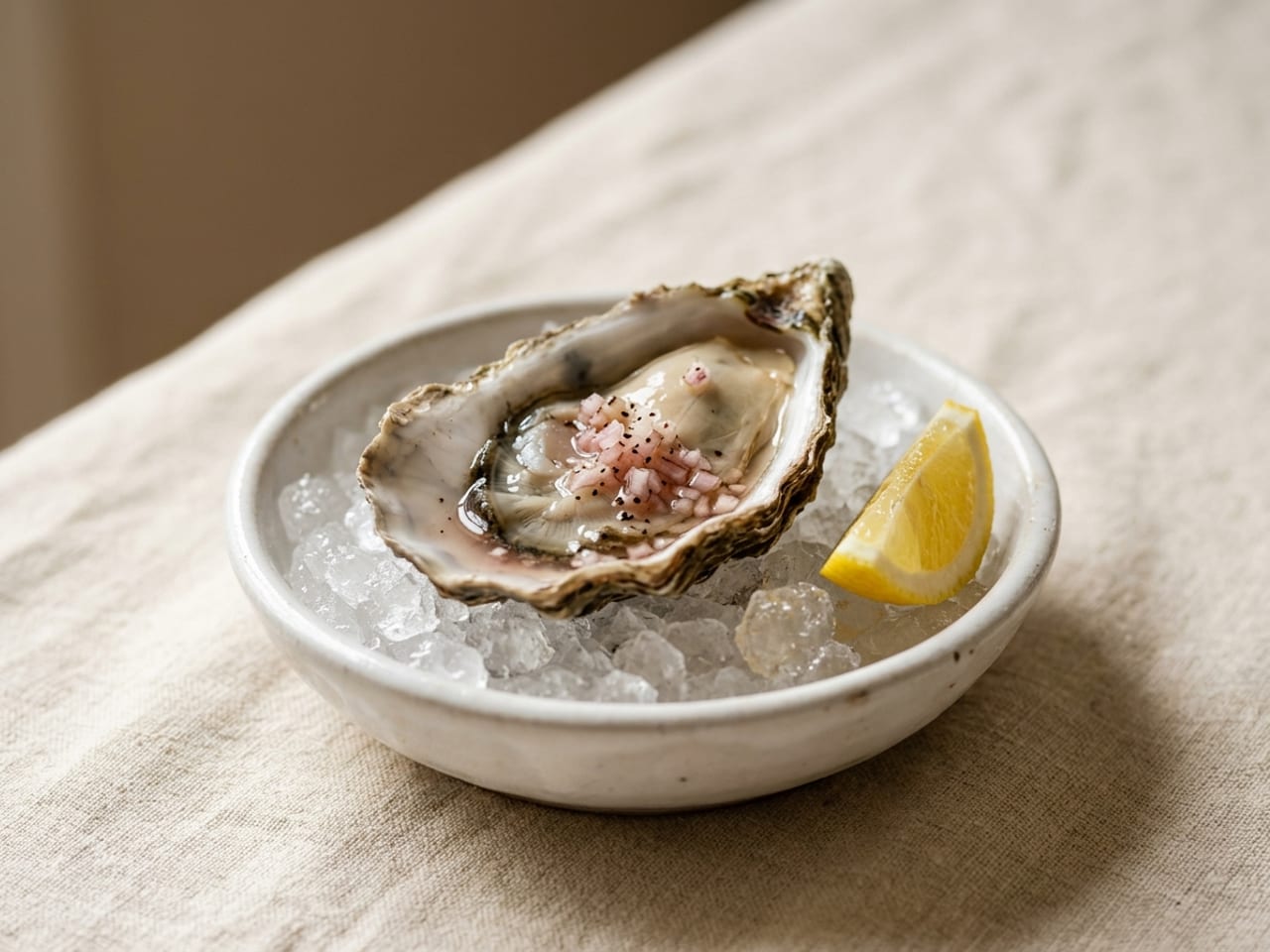
11. Oyster with mignonette granité
Cold · raw shellfish · granité up to 2 days ahead
Red wine vinegar, water, grated shallot and a pinch of sugar, frozen and scraped with a fork into ice, black pepper stirred in; it keeps for up to two days in the freezer.43 A teaspoon on each freshly opened oyster, set on crushed ice.
Read the safety section first: this is the riskiest bite on the list, especially in winter. The cooked alternative, oysters baked at 450 °F (230 °C) for 10 minutes, is in the CDC's own advice.36
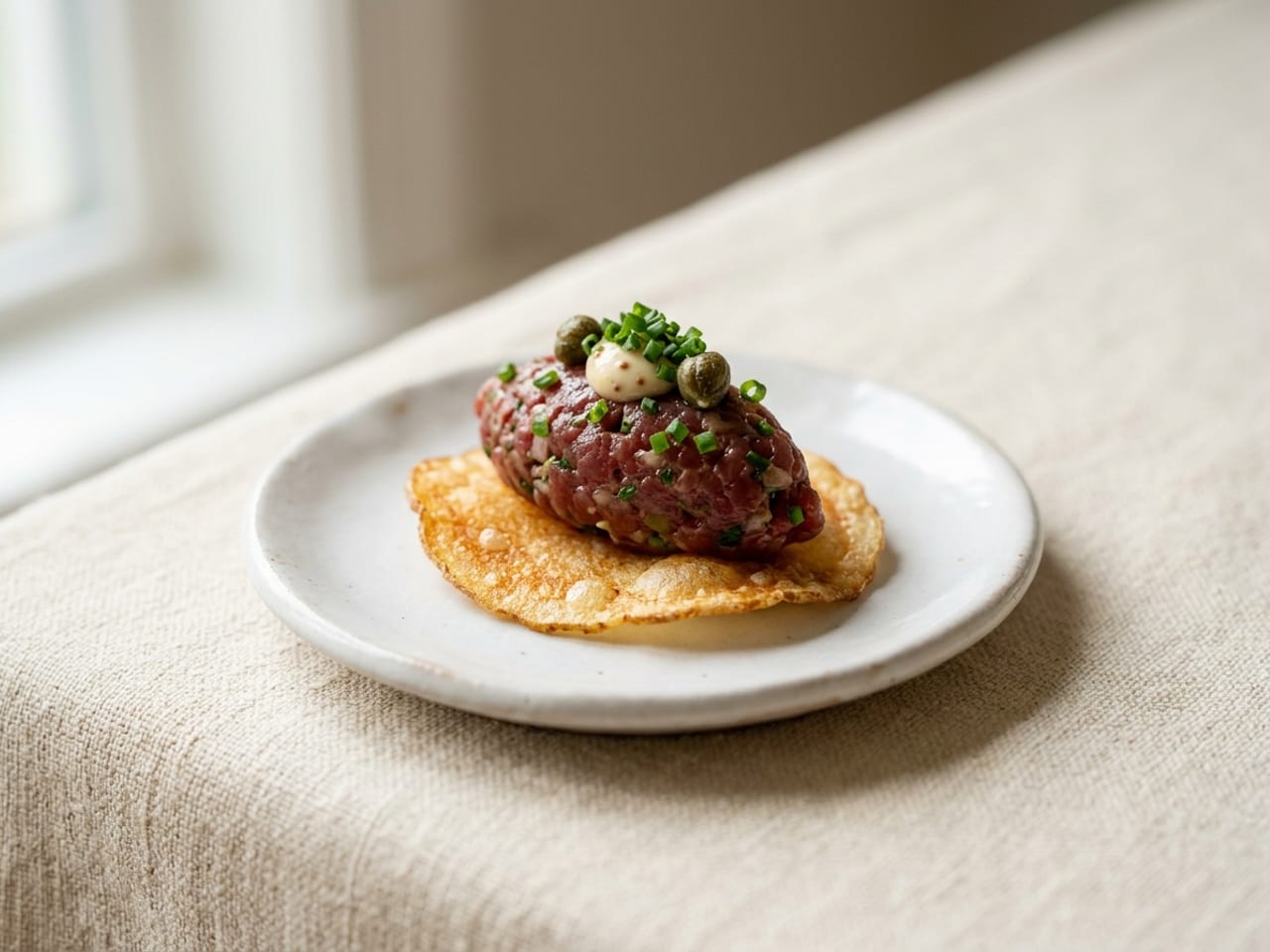
12. Beef tartare on a potato crisp
Cold · raw meat · chop to order
A whole piece of very fresh beef, trimmed and chopped by hand just before serving, dressed with Dijon, a little olive oil, shallot and capers, and spooned onto a thick potato crisp. About 12 g of beef per bite. Never use bought mince for a raw dish.39
Plate it: a small neat quenelle, a dot of mustard mayonnaise, a few capers, chives. Set it on the crisp only as it goes out, or the crisp goes soft.
Same spoon, same tartare: drag to compare
The most common home amuse-bouche mistake is generosity. Both frames hold the same salmon tartare; only one of them is a single bite.
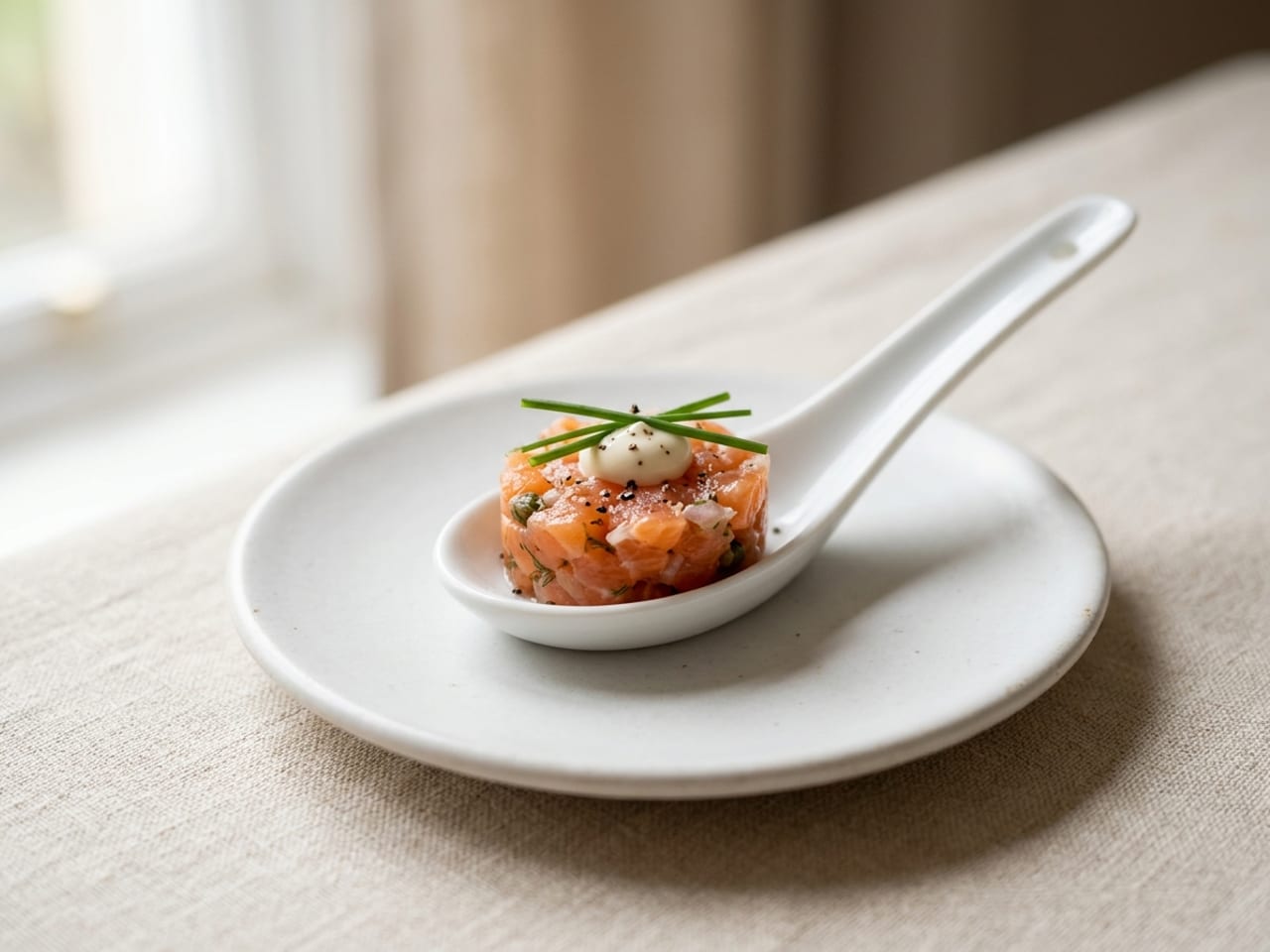
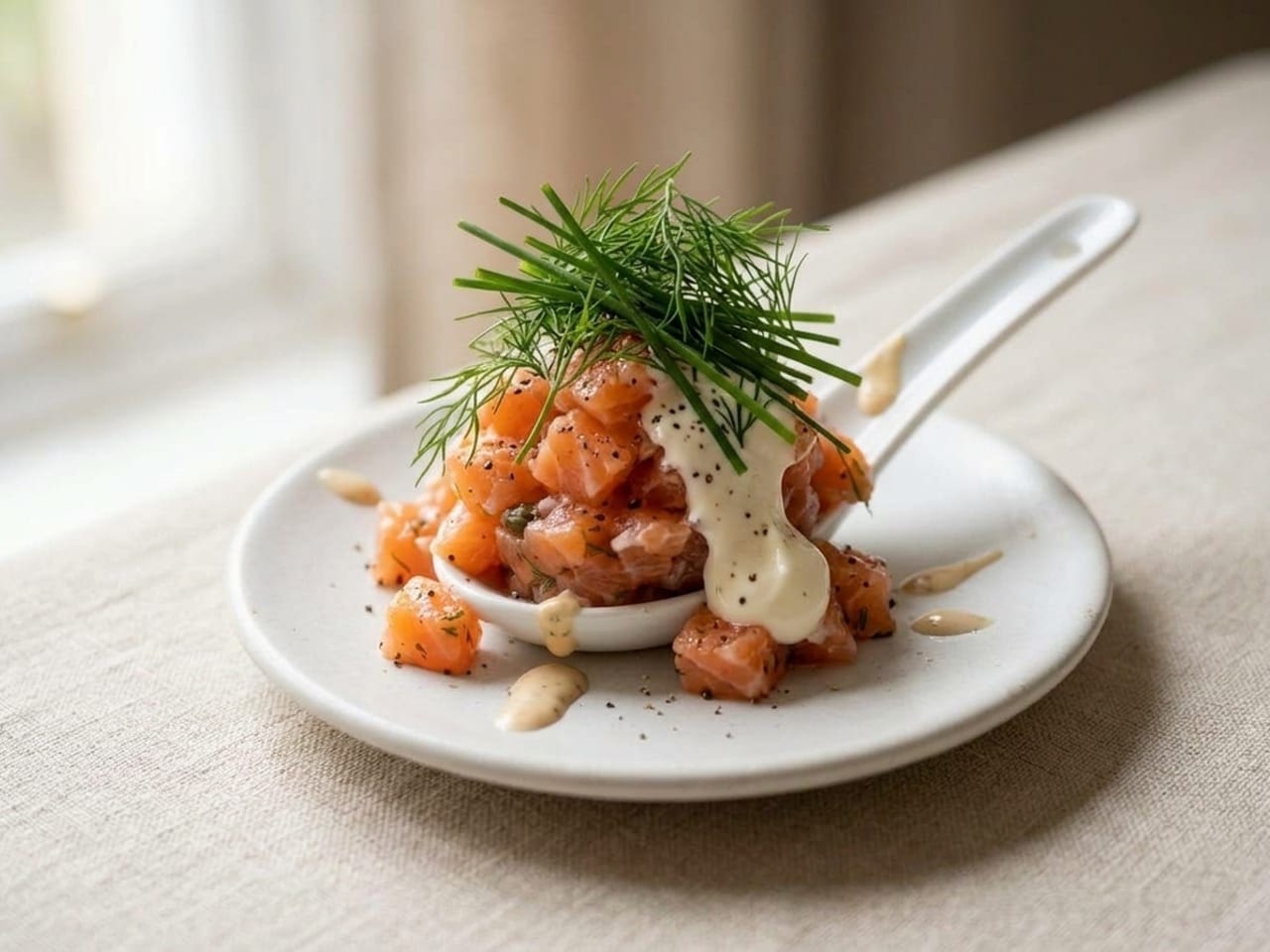 OverloadedOne bite
Six amuse-bouche mistakes
- Too bigThree bites is a starter. If it needs cutting, it is not an amuse.
- Too many things on itFive garnishes on a spoon read as a pile. One star, one contrast, one crunch, one finish.
- A spoon that rocksSet spoons on a small plate or a line of salt so they sit flat, handle out; a spoon that tips onto the tablecloth ends the amuse before it starts.
- LukewarmFrozen glasses for the cold ones, warm cups for the hot ones, out the moment they are filled.
- A rehearsal of the main courseBeef tartare before a steak dinner says the same thing twice. Preview the meal, don't repeat it.
- Serving it to a crowdAn amuse is one bite for guests sitting down to a meal. For a standing party with drinks, you want canapés and more of them: work out how many with the party food calculator.
How to serve an amuse-bouche at home
One per guest, all identical, served as everyone sits down or with the last of the aperitif. Carry them out together, say in one sentence what they are, and clear them before the first course. The work is all in the timing: almost every part of the twelve ideas above can be made one or two days ahead, leaving only the last thirty seconds for the moment people sit.
| When | What |
|---|---|
| Two days ahead | Mignonette granité into the freezer; gougère dough scooped and frozen; blini made and frozen. |
| The day before | Chilled soups made and refrigerated; tomato water set to drip overnight; salmon into its cure; tartlet cases baked. |
| The morning of | Devilled eggs filled and chilled; duxelles cooked; herb oil and garnishes prepped into small containers. |
| An hour before | Shot glasses and spoons into the freezer; espresso cups onto the warm stove top; gougères and blini ready to bake or reheat. |
| As everyone sits | Heat, fill, garnish, carry. Raw fish, scallop and beef are sliced or chopped now, not earlier. |
Food safety for one-bite starters
Many classic amuses are raw, and they are served to guests whose health you may not know. The rules below come from the US and UK food-safety agencies.
- Two hours out, then it goesPerishable food should not sit out of the fridge for more than two hours, or one hour above 90 °F (32 °C). Keep cold things at 40 °F (4 °C) or below, on ice if they wait; reheat hot ones to 165 °F (74 °C) or until steaming.33 A tray of amuses left on the counter through a long aperitif is the classic mistake.
- Raw fish: buy it frozen for raw use, or pick an exempt oneThe US Food Code requires fish served raw to be frozen at -4 °F (-20 °C) for 7 days, or at -31 °F (-35 °C) until solid and then held there for 15 hours, to kill parasites.34 A home freezer at 0 °F (-18 °C) is not cold enough, so buy fish sold for raw use. The same rule exempts farmed salmon raised on parasite-free feed, scallops sold as the adductor muscle only, the common tuna species and rinsed roe.34 The UK rule is -20 °C for 24 hours, and exempts farmed Atlantic salmon.35
- Oysters: know who you are feedingThe CDC's advice is blunt: "Do not eat raw or undercooked oysters or other seafood. Cook them before eating." 36 Vibrio peaks in summer, but the UK's Food Standards Agency finds norovirus in oysters is higher in winter,37 which is exactly when they turn up on Christmas and New Year menus. Skip raw oysters for anyone pregnant, elderly, very young or with a weakened immune system, and offer the baked version.
- Raw beef: whole piece, cut at the last momentThe USDA's position is that raw meat is never safe to eat, and it names steak tartare.38 The UK explains the mechanism: whole cuts carry bacteria on the surface, but mincing spreads them all the way through, so minced meat must be cooked through.39 If you serve tartare, trim the outside of a whole piece and chop it yourself, minutes before serving, and leave it off the plate of at-risk guests.
- Ask about allergies before you planEveryone gets the same bite, so one shellfish allergy changes the menu. Restaurants plan an alternative bite for exactly this; at home, ask when you invite, or pick one of the seven vegetarian ideas above.
What science says about the first bite
No study has ever tested an amuse-bouche. What follows is what research on small bites, starters, meal memory and cutlery suggests, including the parts that contradict the usual story.
- A good first taste can raise appetite, for a momentIn a classic study, hunger ratings rose during the first mouthfuls of a pasta sauce seasoned just right, and simply fell when it was under- or over-seasoned (the "appetizer effect").22 An umami broth likewise made people hungrier when they first tasted it, then left them eating less at the next meal.23
- Which is why it has to stay tinyReal starters fill people up: a bowl of vegetable soup before lunch cut the total eaten by 20%.24 The research supports a bite that wakes the palate, not a course that takes the edge off dinner.
- Small bites give more taste per gramAt the same pace of eating, people who took 5 g bites ate markedly less custard than those taking 15 g bites before they felt full, because small bites spend longer in the mouth.25 One bite is a lot of flavour for very little food.
- Contrast matters more than numberVariety makes people eat more, but only when the foods really differ: three yogurts that differed in taste, texture and colour raised intake, three that differed only in fruit flavour did not.21 An amuse that looks, feels and tastes different from the course after it earns its place.
- The first bite does not decide the mealThe popular claim fails the evidence. When people choose a favourite from a short run of what they think are different wines (all the same wine, in fact), the first one wins,27 but in real seven-whisky tastings it was the last,28 and a study of how people remember whole meals found no first-course effect at all.26 An amuse can't rescue a weak dinner. A bad one can still start it badly.
- A surprise gift is feltNo study has tested a complimentary amuse-bouche. The nearest evidence is a chocolate given with the bill, which raised tips from 15.1% to 17.8%; the effect grew when the gift looked personal and unexpected.29 That is the whole idea of "with the chef's compliments".
- The spoon is part of the tasteYogurt tasted less sweet from a black spoon than from a white one, and cheese tasted saltiest off a knife.31 But the evidence is mixed (in one real dining room, moving the starter off-centre changed nothing measurable),32 so choose the vessel for contrast with the food, not by rule.
Plate your own first bite
The hardest part of an amuse-bouche is the plating: one bite, one vessel, nothing extra. Photograph your first attempt and Plate Artists re-plates your own dish the way a chef would, with the moves named so you can do it again for real.
Your dish, plated like a chef's
Snap it, upload it, and get the composed version back, with the steps to recreate it on a real plate.
Start free · 1 enhancement →Free account · 1 free enhancement · No credit card
Amuse-bouche, answered
What is an amuse-bouche?
An amuse-bouche is a single bite or two of food that the kitchen sends to every diner before the first course. Nobody orders it, the chef chooses it, everyone at the table gets the same one, and it is usually free: Merriam-Webster defines it as 'a small complimentary appetizer offered at some restaurants'. It is meant to wake up the palate and give a preview of the cooking to come.
How do you pronounce amuse-bouche?
In English, ah-mooz-BOOSH (the Oxford English Dictionary gives /əˌmjuːzˈbuːʃ/ or /əˌmuːzˈbuːʃ/; Merriam-Webster also lists ah-mooz-BOOSH). In French it is /a.myz.buʃ/, with the French u in amuse and the stress evenly spread.
What does amuse-bouche mean literally?
'Amuses the mouth' or 'mouth amuser'. Amuse is a form of the French verb amuser (to amuse, to entertain) and bouche is mouth. The older French word amuse-gueule uses gueule, an animal's mouth, which is why it sounds casual and why grand restaurants prefer amuse-bouche.
What is the plural of amuse-bouche?
In English, amuse-bouches (Merriam-Webster also accepts amuses-bouches). In French, both amuse-bouches and the invariable amuse-bouche are correct. The word is masculine in French: un amuse-bouche.
What is the difference between an amuse-bouche and an hors d'oeuvre?
An hors d'oeuvre is a small savoury dish at the start of a meal or at a party, often several kinds, passed with drinks or ordered; an amuse-bouche is one bite chosen by the kitchen and served to each seated diner, unordered and usually free. Canapés are a type of hors d'oeuvre built on an edible base of bread, pastry or cracker.
Is an amuse-bouche the same as an appetizer?
No. An appetizer, or starter, is the first course you order and pay for, a small plate eaten with a knife and fork. The amuse-bouche comes before it, is not ordered and is one or two bites. In France the starter is called the entrée; in the United States entrée means the main course.
Is an amuse-bouche free?
Usually, yes: it is sent 'with the chef's compliments'. In a fixed-price tasting menu its cost is part of the menu price, and a few restaurants have sold whole menus of amuses. Many restaurants now serve a run of opening 'snacks' in its place, and at some of them the snacks are a paid part of the menu.
When is the amuse-bouche served?
After guests sit down and before the first ordered course, often while orders are being taken or with the aperitif. At home, serve it as everyone sits down, or with the last of the drinks before you move to the table.
How big should an amuse-bouche be?
One or two bites, eaten in one move. There is no official weight; useful yardsticks are about 1½ teaspoons of tartare in Thomas Keller's salmon cornets, about 1/4 cup (60 ml) of soup in a shot glass, and roughly 12 g of beef for a tartare bite.
What is a good amuse-bouche for a dinner party?
Something you can make ahead and finish in seconds: a chilled pea and mint shot or a hot parsnip soup in espresso cups (made the day before), gougères baked from frozen, clear tomato water dripped overnight, blini with crème fraîche and roe, beet-cured salmon on cucumber, or a single devilled egg. Pick one that previews the dinner without repeating the main course.
What is the difference between an amuse-bouche and a pre-dessert?
They are the two free bookends of a tasting menu's savoury and sweet halves. The amuse-bouche opens the meal before the first course; the pre-dessert (avant-dessert) is two or three bites sent between the last savoury course and the dessert. The mignardises, or petits fours, come with coffee at the very end.
Is an amuse-bouche the same as a palate cleanser?
Not quite. A palate cleanser, such as a small sorbet or granita, is served between courses as a pause meant to refresh the palate; an amuse-bouche opens the meal. A granita can do either job, which is why the two get confused.
The texts and research behind this guide
Dictionaries in three languages; French newspapers, menus and cookbooks from 1870 to 1928 read in the Bibliothèque nationale de France's Gallica scans; restaurant reporting from 1998 to 2023; twelve peer-reviewed studies verified through Crossref; the US and UK food-safety agencies; and the recipes behind every make-ahead window. No study has tested an amuse-bouche itself; the science section says what each study does and does not show.
- Merriam-Webster (2026). Amuse-bouche (entry). Merriam-Webster.com Dictionary, definition, pronunciations, plurals and first known use in English (1959). merriam-webster.com
- Oxford English Dictionary (2026). Amuse-bouche, n. Oxford University Press, earliest English evidence 1959, in the writing of Lord Kinross; IPA. oed.com
- Larousse (2026). Bouche; amuse-bouche; amuse-gueule (entries). Dictionnaire de français Larousse, the usage note that restaurants, especially the grandest, announce amuse-bouche rather than amuse-gueule. larousse.fr
- Grimes, W. (1998). First, a little something from the chef . . . very, very little. The New York Times, 22 July 1998, Dining section; read in the Internet Archive copy. nytimes.com
- Saini, A. (2017). Kitchen language: what is amuse bouche? MICHELIN Guide, 18 September 2017. guide.michelin.com
- Dumais, E. (2023). Enough with girl dinner, let's bring back the amuse-bouche. VICE, 27 November 2023; interviews with chefs Connie Chung and Feisal Lagos. vice.com
- Verne, J. (1870). Vingt mille lieues sous les mers, part 1, chapter XXI: Quelques jours à terre. Hetzel, Paris, Project Gutenberg edition. gutenberg.org
- Journal de Saint-Denis (1904). Report of a municipal council meeting, 17 November 1904. Journal de Saint-Denis, digitised by the Bibliothèque nationale de France. gallica.bnf.fr
- La Revue culinaire (1922). Dîner à l'hôtel Ruhl (15 mars 1922). La Revue culinaire, 1 May 1922; digitised by the Bibliothèque nationale de France. gallica.bnf.fr
- Les Modes de la femme de France (1924). Menu column, 10 February 1924. Les Modes de la femme de France, digitised by the Bibliothèque nationale de France. gallica.bnf.fr
- Ali-Bab (Babinski, H.) (1928). Gastronomie pratique: études culinaires, 5th edition. Flammarion, Paris, digitised by the Bibliothèque nationale de France. gallica.bnf.fr
- Académie française (2026). Amuse-gueule (entry), Dictionnaire de l'Académie française, 9th edition. Académie française, first admitted in the 9th edition; no amuse-bouche headword. dictionnaire-academie.fr
- ATILF / CNRS (1994). Amuse-gueule (entry), Trésor de la langue française informatisé. CNRTL, dates the word to 1946; read in the Internet Archive copy of 16 May 2024. cnrtl.fr (archived)
- Clark, M. (2006). Tiny come-ons, plain and fancy. The New York Times, 30 August 2006, Dining section; read in the Internet Archive copy. nytimes.com
- Keller, T. (1999). Salmon tartare with sweet red onion crème fraîche (cornets). From The French Laundry Cookbook, excerpted as Thomas Keller's salmon cornets. Vanity Fair, 8 July 2014. vanityfair.com
- Wolcott, J. (2000). French dining par excellence in California's Napa Valley. The Christian Science Monitor, 1 November 2000. csmonitor.com
- Boys, C. (2019). Top hats for Sydney's tiny snacks. The Sydney Morning Herald, Good Food, 28 September 2019. smh.com.au
- Migoya, F. (2012). The Elements of Dessert: Pre-desserts. The Culinary Institute of America / Wiley, read on ckbk. ckbk.com
- MICHELIN Guide (2024). Kaiseki vs. omakase: what's the difference? MICHELIN Guide, sakizuke, the kaiseki first bite, compared to the amuse-bouche. guide.michelin.com
- Cambridge Dictionary (2026). Entrée; canapé; hors d'oeuvre (entries). Cambridge University Press, the US and UK senses of entrée. dictionary.cambridge.org
- Rolls, B. J., Rowe, E. A., Rolls, E. T., Kingston, B., Megson, A., & Gunary, R. (1981). Variety in a meal enhances food intake in man. Physiology & Behavior, 26(2), 215–221. doi:10.1016/0031-9384(81)90014-7
- Yeomans, M. R. (1996). Palatability and the micro-structure of feeding in humans: the appetizer effect. Appetite, 27(2), 119–133. doi:10.1006/appe.1996.0040
- Masic, U., & Yeomans, M. R. (2014). Umami flavor enhances appetite but also increases satiety. The American Journal of Clinical Nutrition, 100(2), 532–538. doi:10.3945/ajcn.113.080929
- Flood, J. E., & Rolls, B. J. (2007). Soup preloads in a variety of forms reduce meal energy intake. Appetite, 49(3), 626–634. doi:10.1016/j.appet.2007.04.002
- Zijlstra, N., de Wijk, R. A., Mars, M., Stafleu, A., & de Graaf, C. (2009). Effect of bite size and oral processing time of a semisolid food on satiation. The American Journal of Clinical Nutrition, 90(2), 269–275. doi:10.3945/ajcn.2009.27694
- Rode, E., Rozin, P., & Durlach, P. (2007). Experienced and remembered pleasure for meals: duration neglect but minimal peak, end (recency) or primacy effects. Appetite, 49(1), 18–29. doi:10.1016/j.appet.2006.09.006
- Mantonakis, A., Rodero, P., Lesschaeve, I., & Hastie, R. (2009). Order in choice: effects of serial position on preferences. Psychological Science, 20(11), 1309–1312. doi:10.1111/j.1467-9280.2009.02453.x
- Quigley-McBride, A., Franco, G., McLaren, D. B., Mantonakis, A., & Garry, M. (2018). In the real world, people prefer their last whisky when tasting options in a long sequence. PLOS ONE, 13(8), e0202732. doi:10.1371/journal.pone.0202732
- Strohmetz, D. B., Rind, B., Fisher, R., & Lynn, M. (2002). Sweetening the till: the use of candy to increase restaurant tipping. Journal of Applied Social Psychology, 32(2), 300–309. doi:10.1111/j.1559-1816.2002.tb00216.x
- Yeomans, M. R., Chambers, L., Blumenthal, H., & Blake, A. (2008). The role of expectancy in sensory and hedonic evaluation: the case of smoked salmon ice-cream. Food Quality and Preference, 19(6), 565–573. doi:10.1016/j.foodqual.2008.02.009
- Harrar, V., & Spence, C. (2013). The taste of cutlery: how the taste of food is affected by the weight, size, shape, and colour of the cutlery used to eat it. Flavour, 2, 21. doi:10.1186/2044-7248-2-21
- Michel, C., Velasco, C., & Spence, C. (2015). Cutlery matters: heavy cutlery enhances diners' enjoyment of the food served in a realistic dining environment. Flavour, 4, 26. doi:10.1186/s13411-015-0036-y
- USDA Food Safety and Inspection Service (2026). Danger zone (40 °F to 140 °F). fsis.usda.gov, the two-hour and one-hour rules, cold and hot holding. fsis.usda.gov
- U.S. Food and Drug Administration (2022). Food Code 3-402.11: parasite destruction (as adopted verbatim in 16 Del. Admin. Code § 3-402.11). Legal Information Institute, Cornell Law School, freezing times and temperatures for raw fish, and the exemptions. law.cornell.edu
- Food Standards Agency (2026). Freezing fish and fishery products and treatment for parasites. food.gov.uk, the UK rule and the farmed-salmon exemption. food.gov.uk
- Centers for Disease Control and Prevention (2026). Preventing vibriosis. cdc.gov, raw oysters, and cooking times for shucked oysters. cdc.gov
- Food Standards Agency (2024). Risk assessment to support guidance for norovirus outbreaks in oysters. food.gov.uk, norovirus in oysters is higher in winter than in summer. food.gov.uk
- U.S. Department of Agriculture (2026). Tips for eating cannibal sandwiches this holiday season. usda.gov, raw ground beef, steak tartare and safe cooked alternatives. usda.gov
- Food Standards Agency (2026). Cooking your food. gov.uk, whole cuts carry bacteria on the surface; minced meat must be cooked through. gov.uk
- U.S. Food and Drug Administration (2026). What you need to know about egg safety. fda.gov, pasteurised eggs for dishes served raw or undercooked. fda.gov
- Greenspan, D. (2026). Cheese gougères. Saveur, freeze the scooped dough and bake from frozen. saveur.com
- Hulstone, S. (2026). Soy and beetroot marinated salmon. Great British Chefs, a 12-hour cure, turned at 6 hours. greatbritishchefs.com
- America's Test Kitchen (2026). How to make icy mignonette. americastestkitchen.com, freeze the granité 1 hour to 2 days. americastestkitchen.com
- Finlayson, J. (2016). Parsnip soup shooters. judithfinlayson.com, hot soup in espresso cups before the wine, about 16 per batch. judithfinlayson.com
- Crumbs on the Table (2026). Essence of tomato. crumbsonthetable.co.uk, tomato water dripped overnight through muslin; 1 kg of tomatoes gives about 400 ml. crumbsonthetable.co.uk
- Delia Online (2026). Getting ahead with blinis. deliaonline.com, make ahead, freeze and reheat for canapés. deliaonline.com
- Elle Decor (2026). Chilled green pea soup shooters. elledecor.com, about 1/4 cup per frozen shot glass; make up to a day ahead. elledecor.com
- Famurewa, J. (2022). The return of the amuse-bouche (and a recipe to make one at home). MR PORTER, The Journal, 31 August 2022; Rita's, London, opens every meal with devilled eggs. mrporter.com
- Food Standards Agency (2026). Home food fact checker. gov.uk, British Lion and Laid in Britain eggs eaten raw or lightly cooked. gov.uk
Keep going
Prix fixe, à la carte and tasting menus
What every menu term means, the real math on the bill, and how to cook, pace and plate a tasting menu at home.
Palate cleansers: when to serve one and 14 ideas
The sorbet between courses: what it is called, where it goes in the meal, what the tests found and how to serve it.
The five French mother sauces
Béchamel, velouté, espagnole, tomate and hollandaise: how each is made and where a chef puts sauce on the plate.
Michelin-star plating: the fine-dining anatomy
The purée-sear-crunch structure, the five signature moves and the sixty-second home pass.
How Michelin stars work
What one, two and three stars mean, the five criteria inspectors judge, and why decor and service don't count.
Types of plates: the dinnerware glossary
Charger to saucer, rimmed to coupe, porcelain to slate, and which plate to serve each course on.
Dinner party menu planner
Deal a starter, main and dessert that go together, with a cooking timeline for the day. Add your amuse-bouche on top.