How to cut fruit: mango, pineapple and ten more, step by step
The cleanest way to cut twelve fruits, from the mango hedgehog and the spiral-cut pineapple to citrus suprêmes and star fruit, with how much of each you actually get, how long it keeps, how each cut looks on a plate or a platter, and the safety rules that matter.
The photos on this page are AI-generated illustrations.
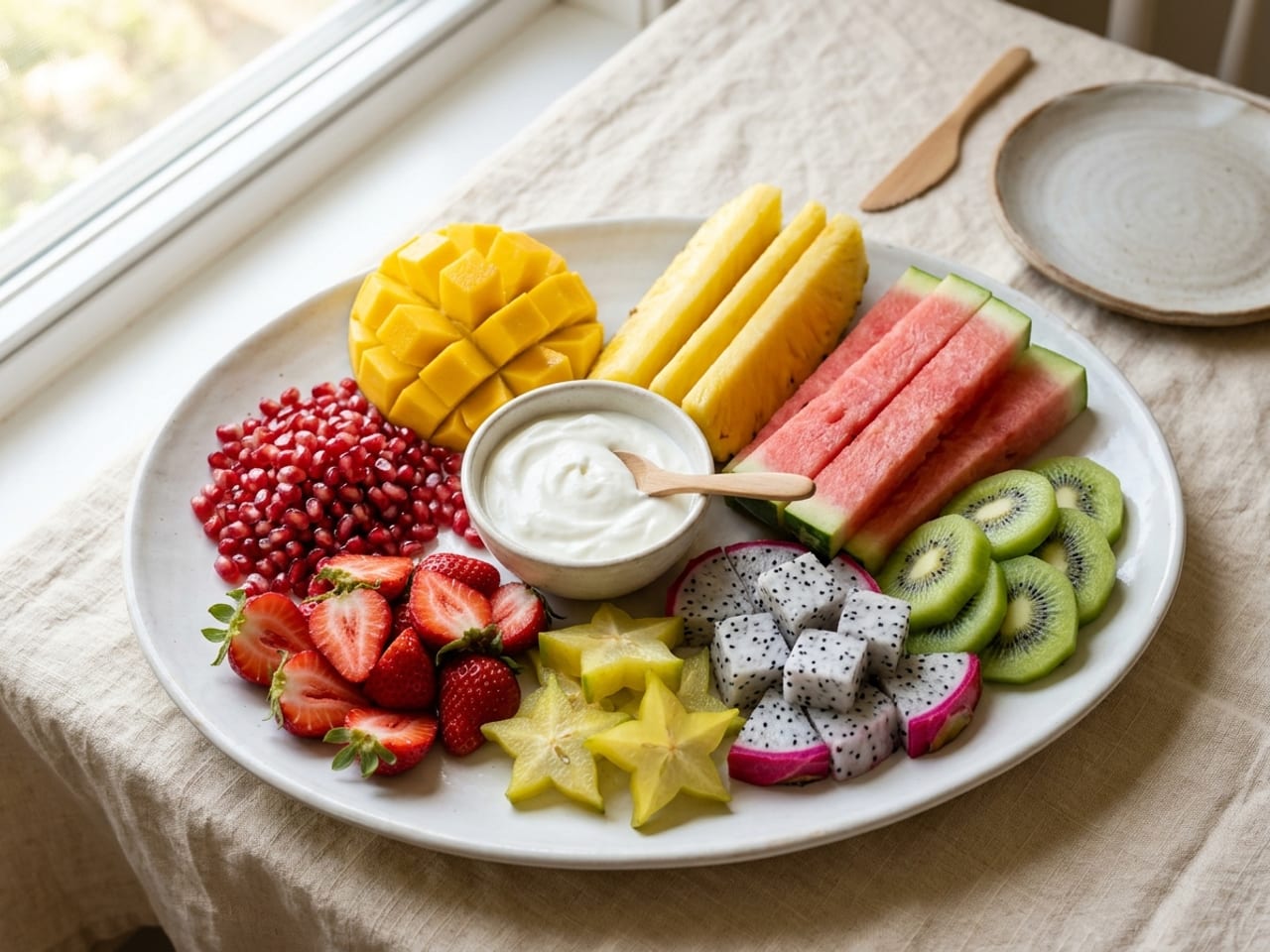
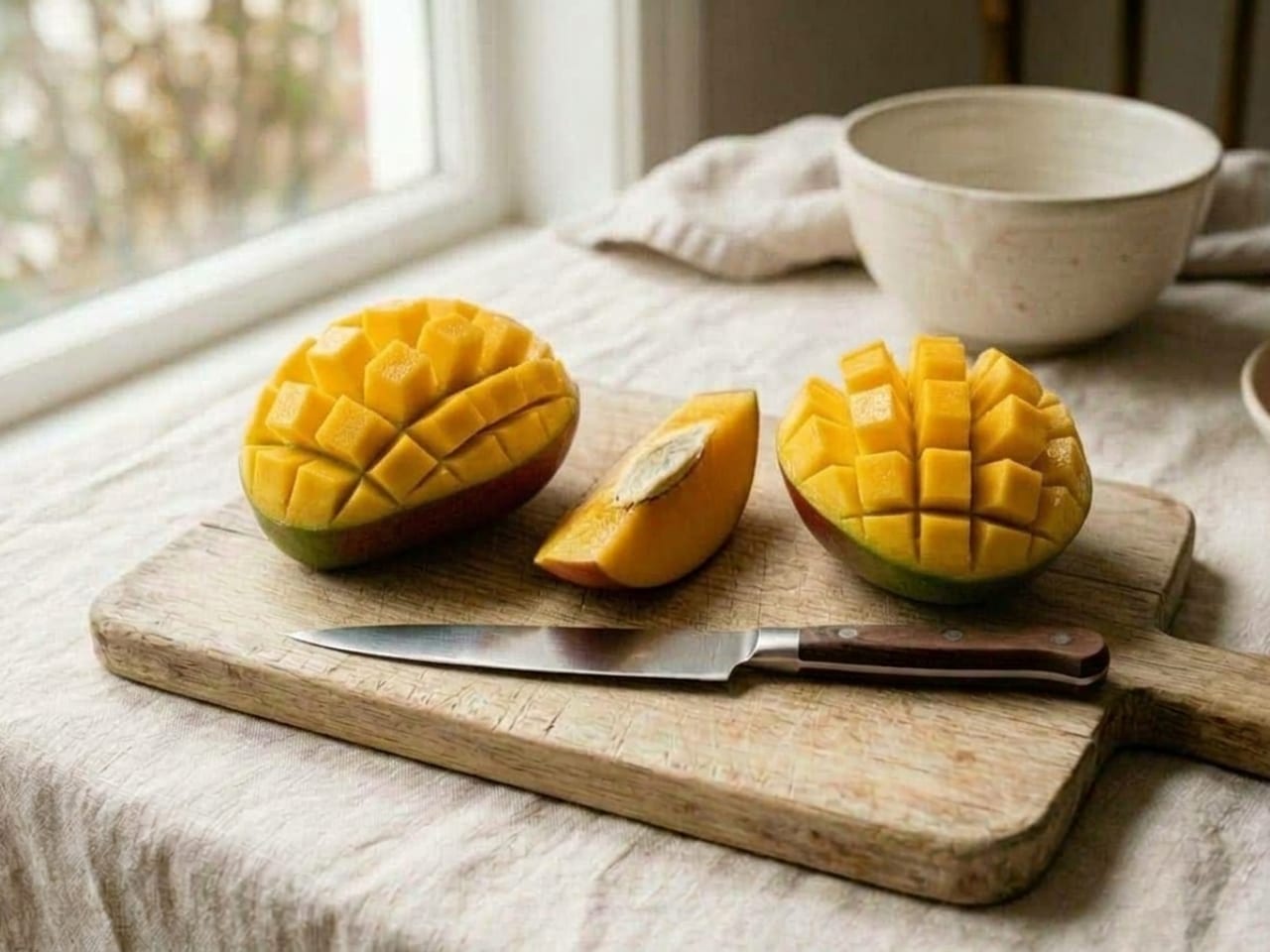
To cut a mango, stand it on its stem end and slice straight down about ¼ inch (6 mm) either side of the center to take off the two cheeks, clearing the long flat seed. Score each cheek in a crosshatch down to the skin, not through it, and push the skin up so the cubes fan out: the hedgehog.1 Most fruit follows the same logic: wash it, give it a flat side so it can't roll, take off what you don't eat (rind, seed, core, membrane), then cut the rest into one even shape.
This guide does that for twelve fruits: mango and pineapple frame by frame, then watermelon, kiwi, dragon fruit, star fruit, avocado, pomegranate, cantaloupe, citrus, papaya and strawberries, each with a quick answer, numbered steps, how the cut reads on a plate, and the USDA's figure for how much of the fruit you actually get. Then the fruit platter, a glossary of the cuts, the safety points (avocado hand, mango rash, washing melons, the two-hour rule) and the science of browning. Sources are at the bottom.
Five rules for cutting any fruit
- Wash it, even if you won't eat the skinRinse fruit under running water before you peel or cut it, so the knife doesn't drag dirt and bacteria from the skin into the flesh. Scrub firm rinds (melons, pineapple) with a clean produce brush; skip soap and produce washes.26, 27 Dry it, so it doesn't slip.
- Lock the board downA damp towel or a non-slip mat under the cutting board stops it sliding.39 Round fruit rolls, so cut a thin slice off one side (or halve it) and work flat side down.
- Pinch the knife, claw the fruitGrip the knife with thumb and forefinger on the blade just in front of the handle, the other fingers round the handle. Hold the fruit with your fingertips curled under like a claw, so the side of the blade rides against your knuckles, never your fingertips.39
Twelve fruits at a glance
"Usable" is the USDA Food Buying Guide's ready-to-serve weight from a pound of whole fruit;5, 6 "keeps" is refrigerated, cut, from USDA FoodKeeper.9 Tap a fruit for its steps.
| Fruit | Best cuts | Usable | Cut, keeps |
|---|---|---|---|
| Mango | Hedgehog, cubes, slices | 69% | 4 days |
| Pineapple | Spears, chunks, rings | 54% (cubes) | 3 to 4 days |
| Watermelon | Sticks, cubes, triangles | 61% | 2 to 4 days |
| Kiwi | Rounds, halves to scoop | 87% (peeled) | 4 days |
| Dragon fruit | Cubes, scooped halves | 71% | 4 days |
| Star fruit | Stars (cross slices) | 97% | 4 days |
| Avocado | Slices, fans, cubes | 67% | Same day |
| Pomegranate | Arils (seeds) | 1½ cups a lb | Up to 5 days |
| Melon | Wedges, cubes, balls | 46 to 56% | 2 to 4 days |
| Citrus | Suprêmes, wheels | 40 to 58% | 4 days |
| Papaya | Slices, cubes, boats | 67% | 4 days |
| Strawberries | Halves, fans | 88% | 2 to 3 days |
How to cut a mango (the hedgehog)
One mango, four frames, from whole to hedgehog.
 1
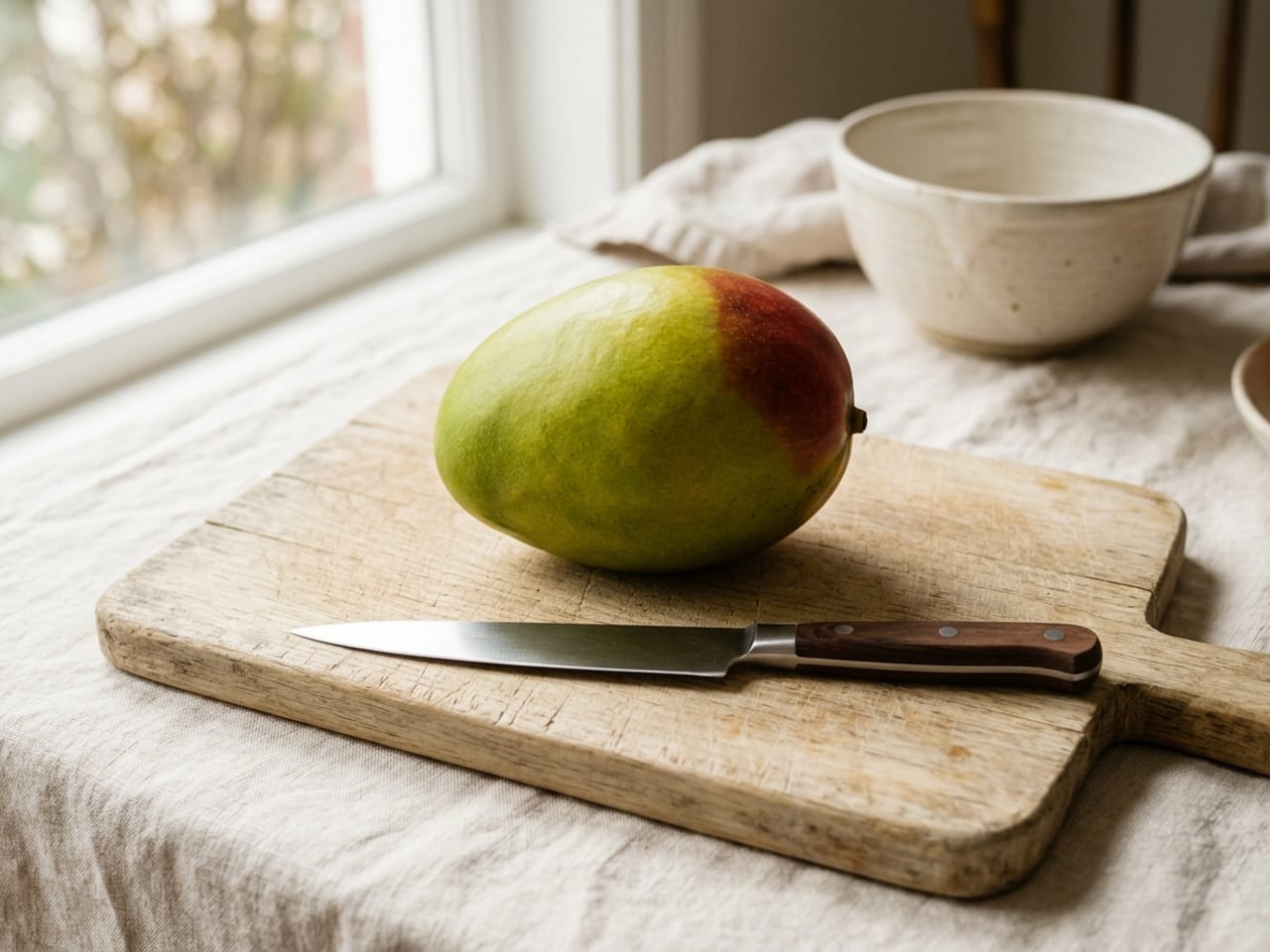
1Stand it up and find the seed
The seed is long and flat and runs the length of the fruit, so the two wide sides (the cheeks) are almost all flesh.1 Stand the mango on its stem end, narrow side toward you.
 2
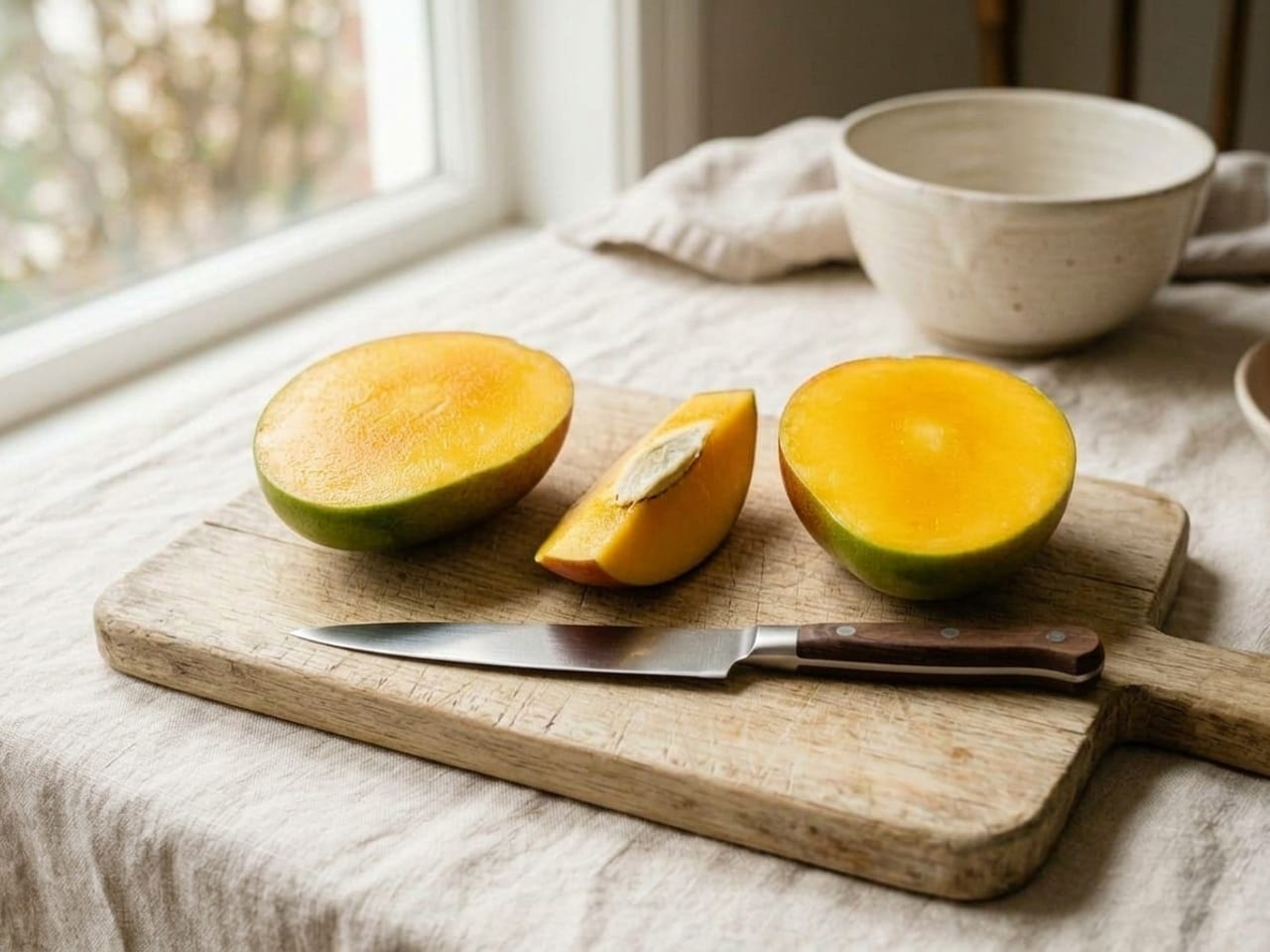
2Cut off the two cheeks
Slice straight down about ¼ inch (6 mm) from the center, just clearing the seed; turn and repeat on the other side. That leaves two cheeks and a center slice with the seed.1
 3
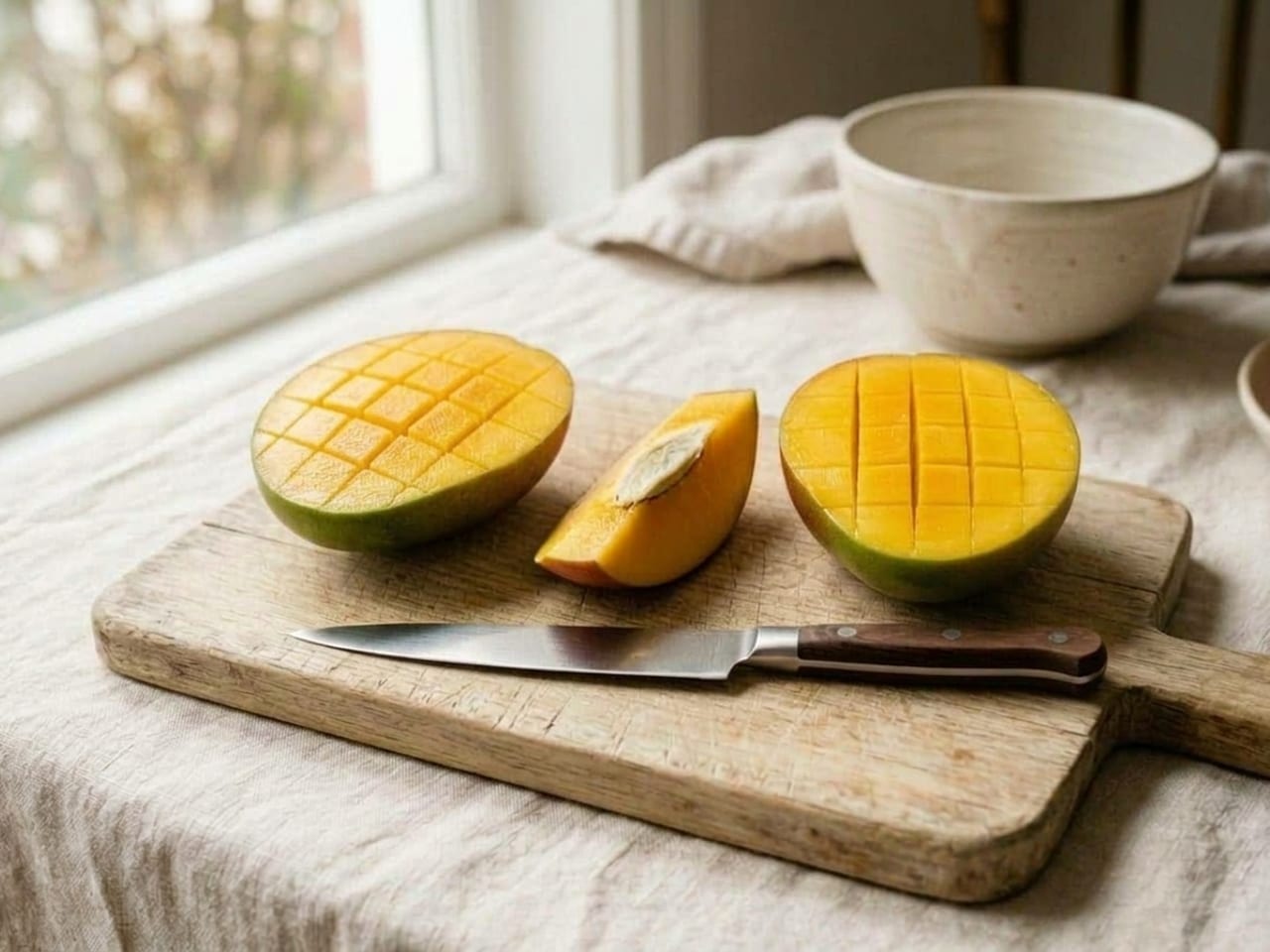
3Score a grid
Hold a cheek skin side down and score the flesh in a crosshatch, down to the skin but not through it.1 Lines about ½ inch (12 mm) apart give neat bite-size cubes.
 4
4Push it inside out
Push the center of the skin up from underneath so the cubes fan outward: the hedgehog.1 Serve it like that, or slice the cubes off the skin into a bowl, then trim the flesh from around the seed.
Other mango cuts. For slices, score the cheek in lengthwise strips instead of a grid and scoop them out with a large spoon.1 For a platter, peel first: cut a sliver off the stem end to steady it, take the skin off with a knife or peeler, then cut the cheeks away from the flat sides of the seed and slice or dice them.3
Choosing and keeping. Squeeze, don't look: a ripe mango gives slightly, and the red blush says nothing about ripeness.2 Ripen it on the counter (mangoes don't ripen below 50 °F / 10 °C), then refrigerate ripe fruit for up to 5 days;4 cut mango keeps about 4.9
Yield. A pound (450 g) of whole mango gives about 0.69 lb (310 g) of fruit.5 Variety matters: in the Mango Board's test of 50 fruits each, Kent and Honey (Ataulfo) gave about 71%, Haden 56%.3 If mango skin gives you a rash, read this first. Cubes go straight into mango sticky rice or a fruit salsa.
How to cut a pineapple (and get the eyes out)
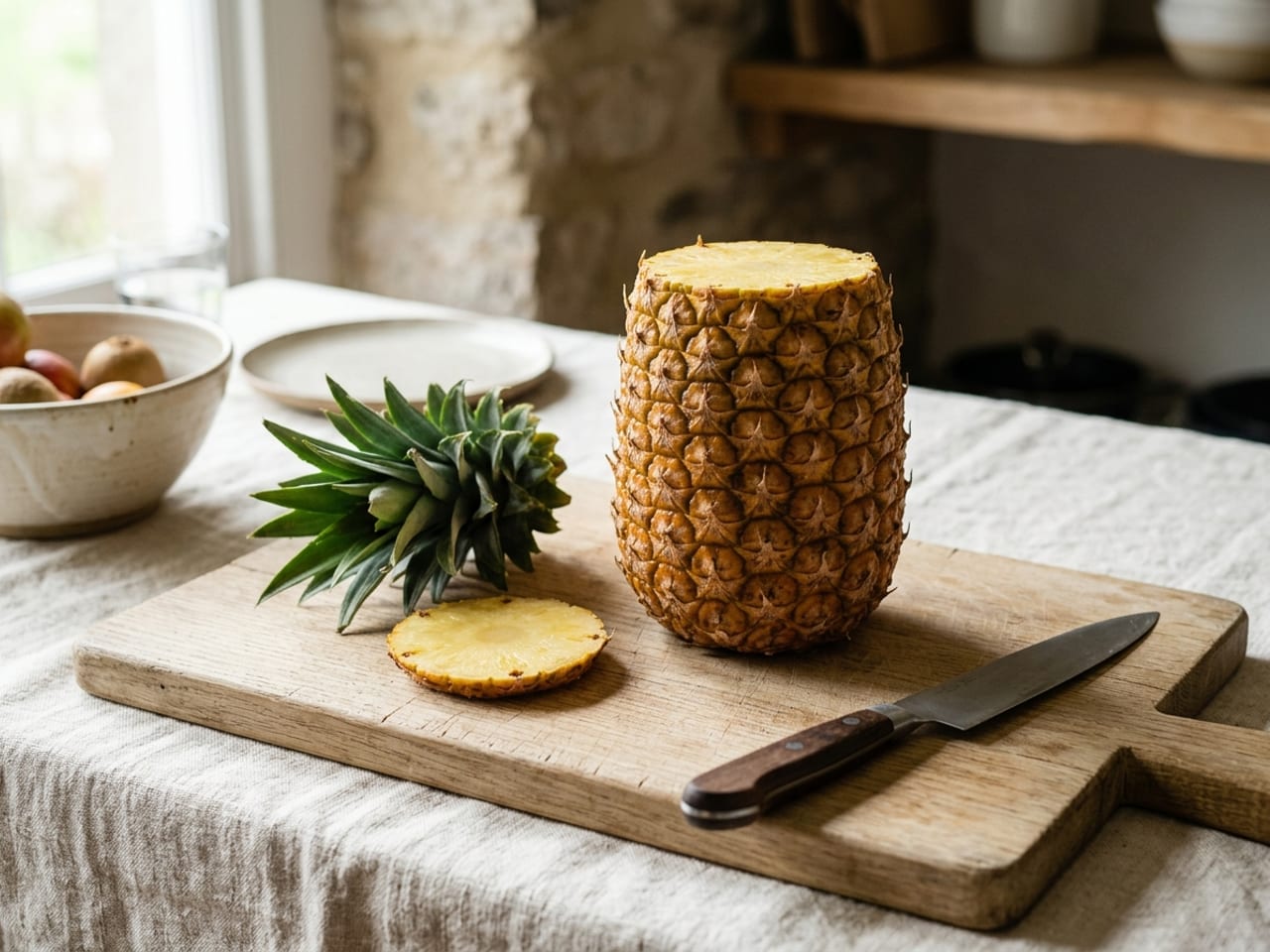
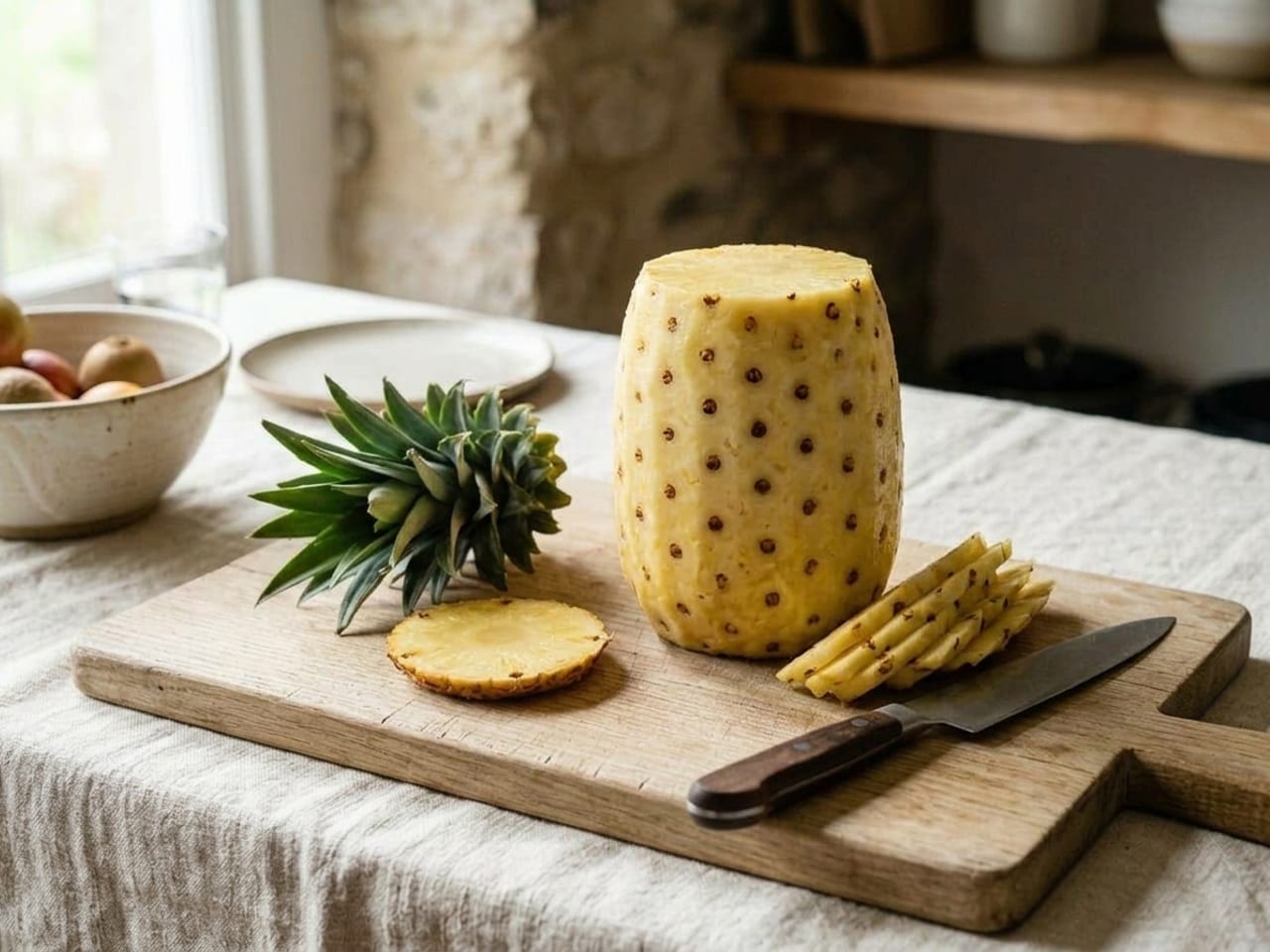
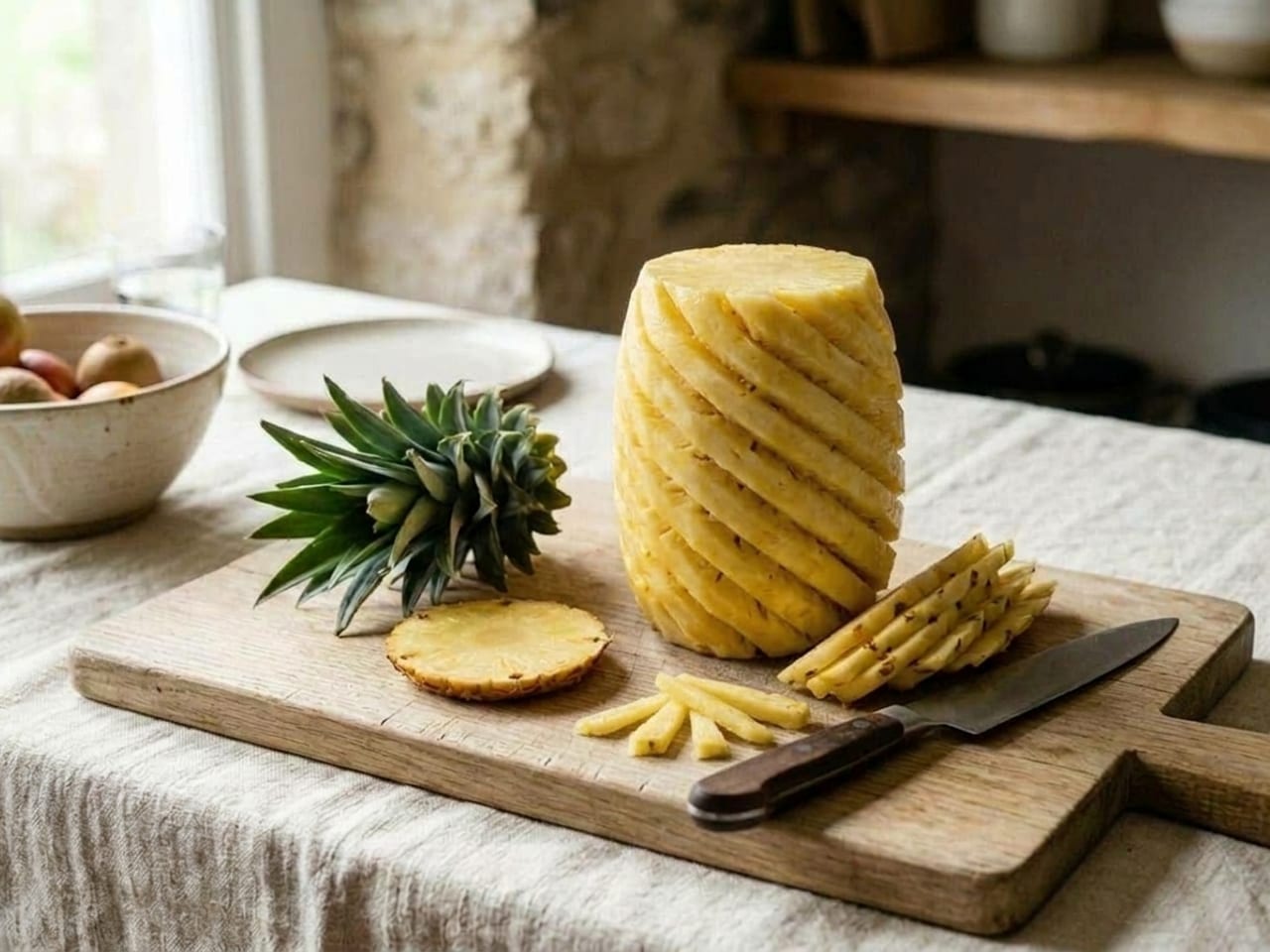
The spiral cut: thin peel, then the eyes out in diagonal grooves. Same pineapple in all four frames.
 2
2Pare off the rind, thin
Cut the skin away in strips from top to bottom, as thin as you can.12 Thin paring leaves the brown eyes behind, sitting in diagonal rows that spiral around the fruit.
 3
3Cut out the eyes in a spiral
Lay it on its side and cut shallow V-shaped grooves along each diagonal row of eyes, just deep enough to lift them out.12 You lose far less fruit than by paring deep, and the grooves look deliberate.
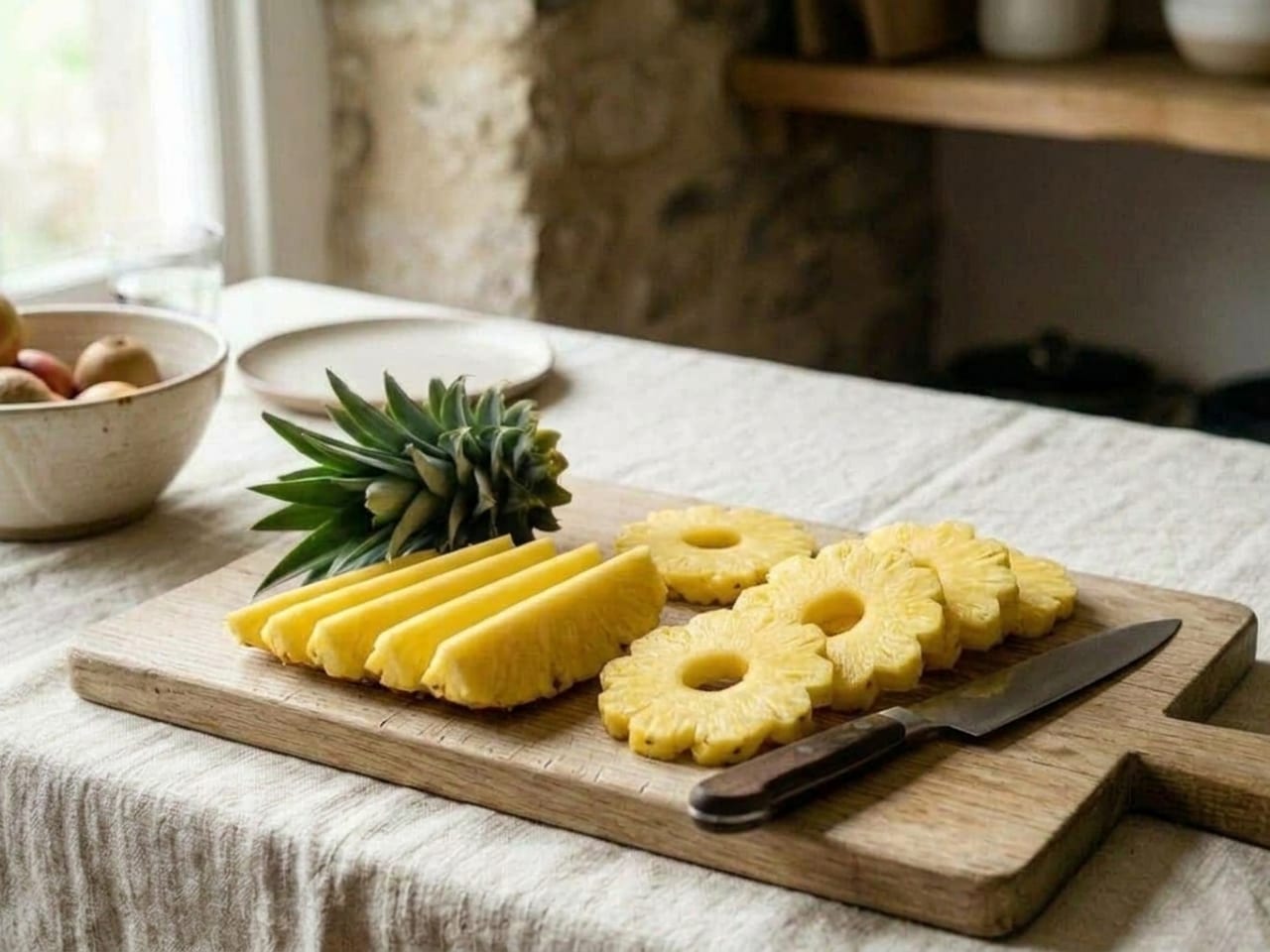 4
4Core it into spears or rings
Quarter it lengthwise and cut the woody core off each quarter, then cut spears or chunks.11 For rings, slice across and cut out the core with a small round cutter; the grooves give each ring a scalloped edge.
Why the spiral. Paring deep enough to take the eyes off with the skin wastes a lot of fruit, and digging each one out leaves gouges; the grooves follow the rows the eyes grow in, save the flesh and leave a pattern worth putting on the table.12 On a whole pineapple, the crown, core and parings are about half the weight: USDA puts it at 16% crown, 8% core and 26% parings,8 and the Food Buying Guide gets 0.54 lb (245 g) of cubes from a pound, or 0.57 lb of ½ × 3 inch (13 × 76 mm) sticks.5
Choosing and keeping. A pineapple does not ripen after it is picked,10 so leaving it on the counter won't sweeten it. Choose one heavy for its size, fragrant, with crisp green leaves, and eat it within about three days of cutting for the best flavor.11 Fresh pineapple stops gelatin setting (why).
How to cut ten more fruits
Each card: the quick answer, the steps, how to choose it, and how the cut looks on a plate.
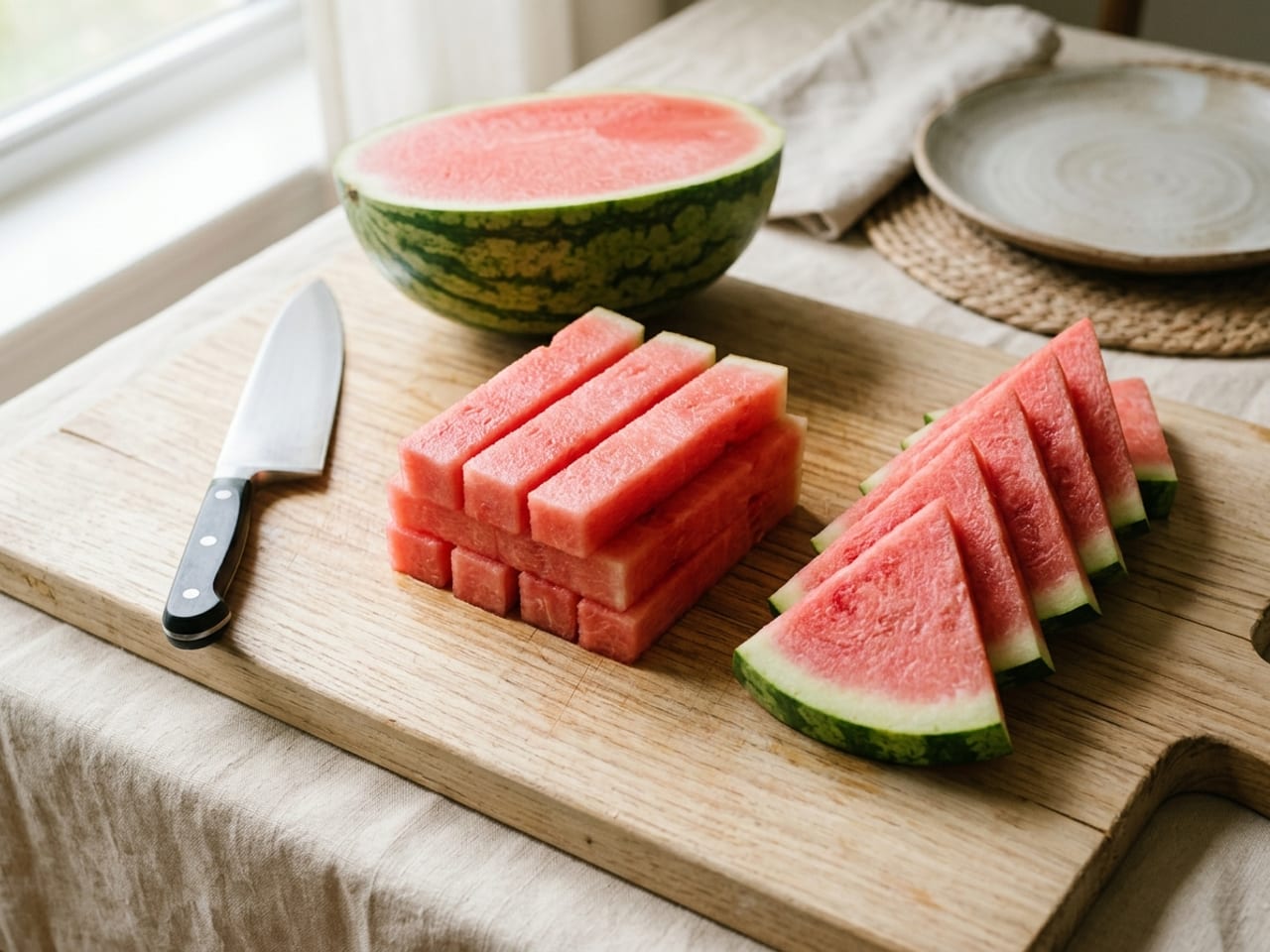
How to cut a watermelon
Usable 61% · sticks, cubes, triangles · cut keeps 2 to 4 days
Quick answer: wash it, cut off both ends, stand it on one, and slice the rind away where the white meets the red, following the curve. Then cut the peeled melon into slabs and the slabs into sticks or cubes.14
- Wash the rind and dry it. Cut off both ends so it stands.
- With the knife angled along the curve, cut the rind off in strips from top to bottom.14
- Cut the melon across into disks as thick as you want the cubes, lay them flat, and cut strips both ways.14 For sticks, cut the slabs into batons about 1 inch (2.5 cm) square.
- For triangles with a rind handle, skip the peeling: halve, quarter lengthwise, and slice each quarter across.
Choosing: look for a creamy yellow ground spot and a melon heavy for its size.13 Thumping doesn't work reliably; an Arkansas extension horticulturist says he can't hear the difference.15
On the plate: sticks stack like logs and give a platter straight lines; triangles with a sliver of green rind read as watermelon from across the room. It softens fast once cut (unwrapped slices lost 47% of their firmness in 4 days),51 so cut it last. Yield: 61% of the weight you buy (USDA);5 the Watermelon Board's rind-off method gets 60 to 70%.14
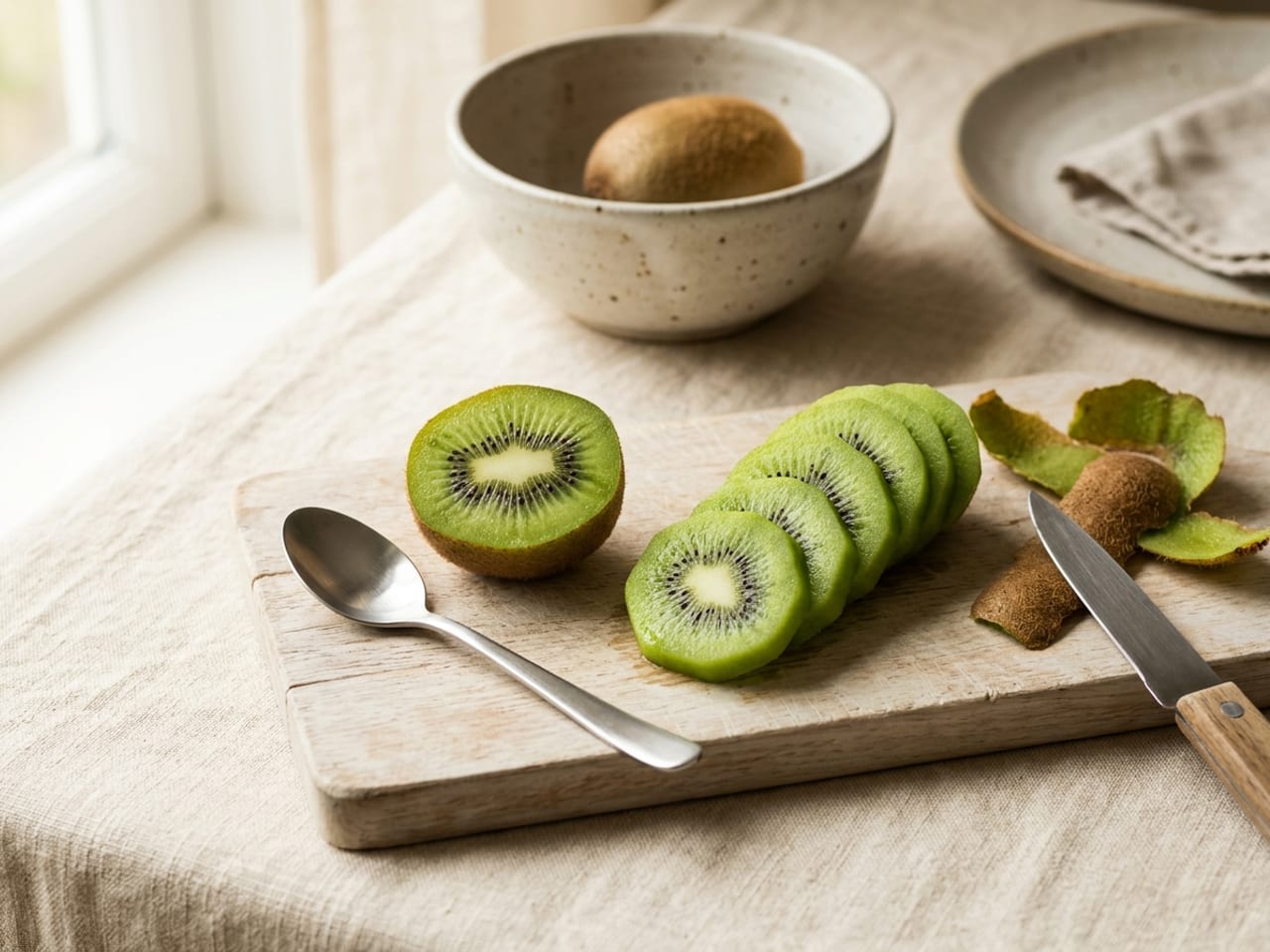
How to cut a kiwi
Usable 87% peeled · rounds, halves · cut keeps 4 days
Quick answer: halve it across and scoop each half with a teaspoon, or peel it and slice it into rounds.16
- To scoop: cut it in half across the middle and spoon the flesh out of the skin.16
- To peel: cut the stem patch off both ends, then pare the skin off in lengthwise strips with a paring knife or a serrated peeler.16 Or slide a spoon between skin and flesh and turn the fruit around it.11
- Lay it on its side and slice into rounds about ¼ inch (6 mm) thick.
Choosing: a ripe kiwi gives a little when you press it. Gold (SunGold) kiwis are hairless, and the skin is edible.16
On the plate: cross slices show the ring of black seeds around a pale center, the most graphic cut on a platter; a scooped half-shell makes its own little cup. Kiwi's enzyme, actinidin, breaks down gelatin and milk proteins,55, 57 so add it to cream, yogurt or panna cotta at the last minute. Yield: 87% peeled.5
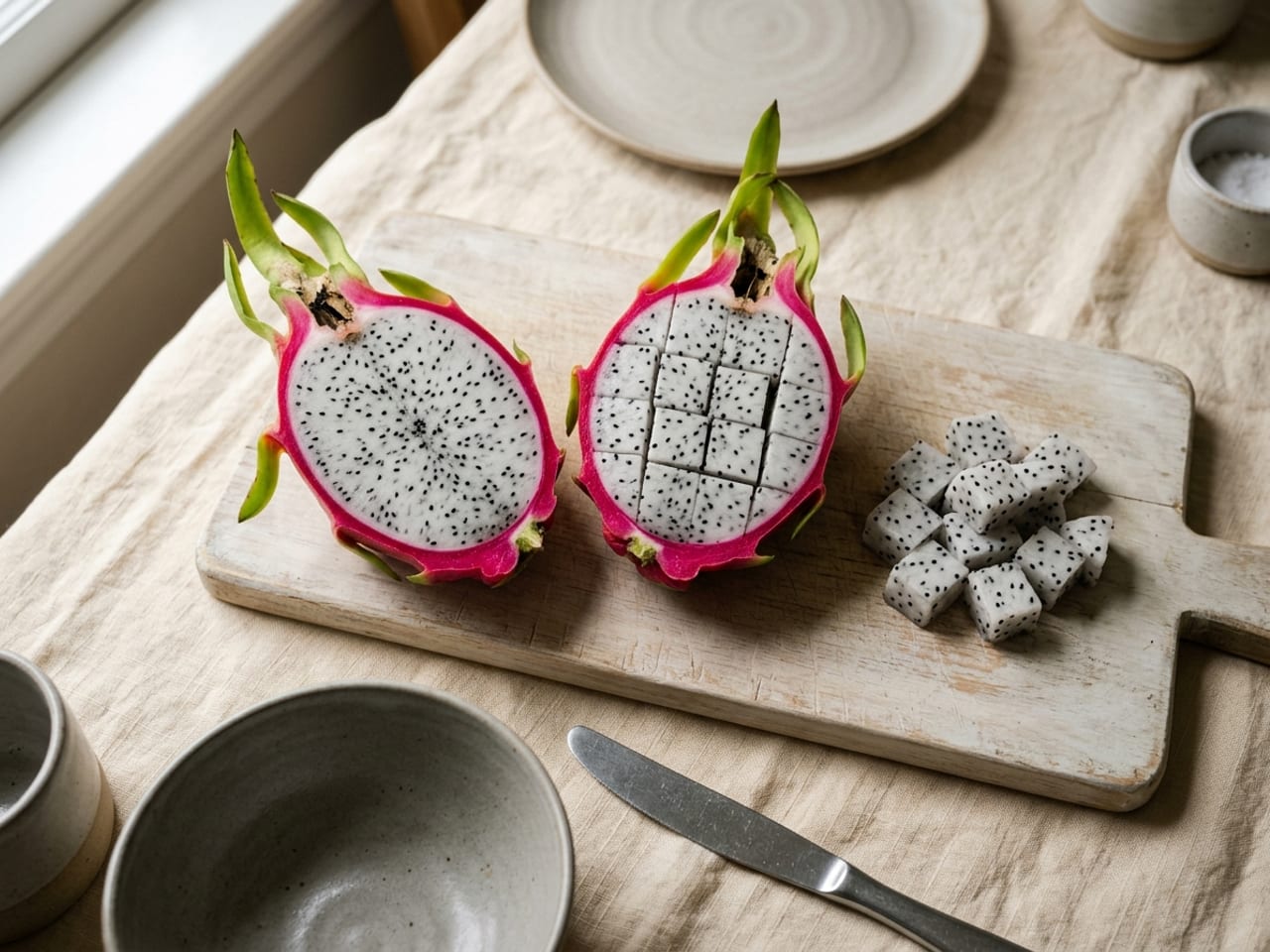
How to cut a dragon fruit
Usable 71% · cubes, scooped halves · cut keeps 4 days
Quick answer: halve it lengthwise, then scoop the flesh out with a spoon, or score it into cubes inside the skin and scoop those out.
- Cut it in half from end to end through the skin.
- Run a spoon between the flesh and the skin: on a ripe fruit the flesh comes away in one piece. Or peel the skin back like a banana.
- Cut the flesh into slices or ¾ inch (2 cm) cubes.
Choosing: dragon fruit is picked ripe and does not ripen further. UC Davis lists firm flesh and firm, fleshy, green bracts (the scales) as top quality,10 so the common "buy it soft" advice is doubtful.
On the plate: white or magenta flesh speckled with black seeds gives a pale fruit platter its contrast; the empty magenta shell makes a bowl for the cubes. The flavor is mild, so a squeeze of lime helps. Yield: 71%, about one fruit a pound.5
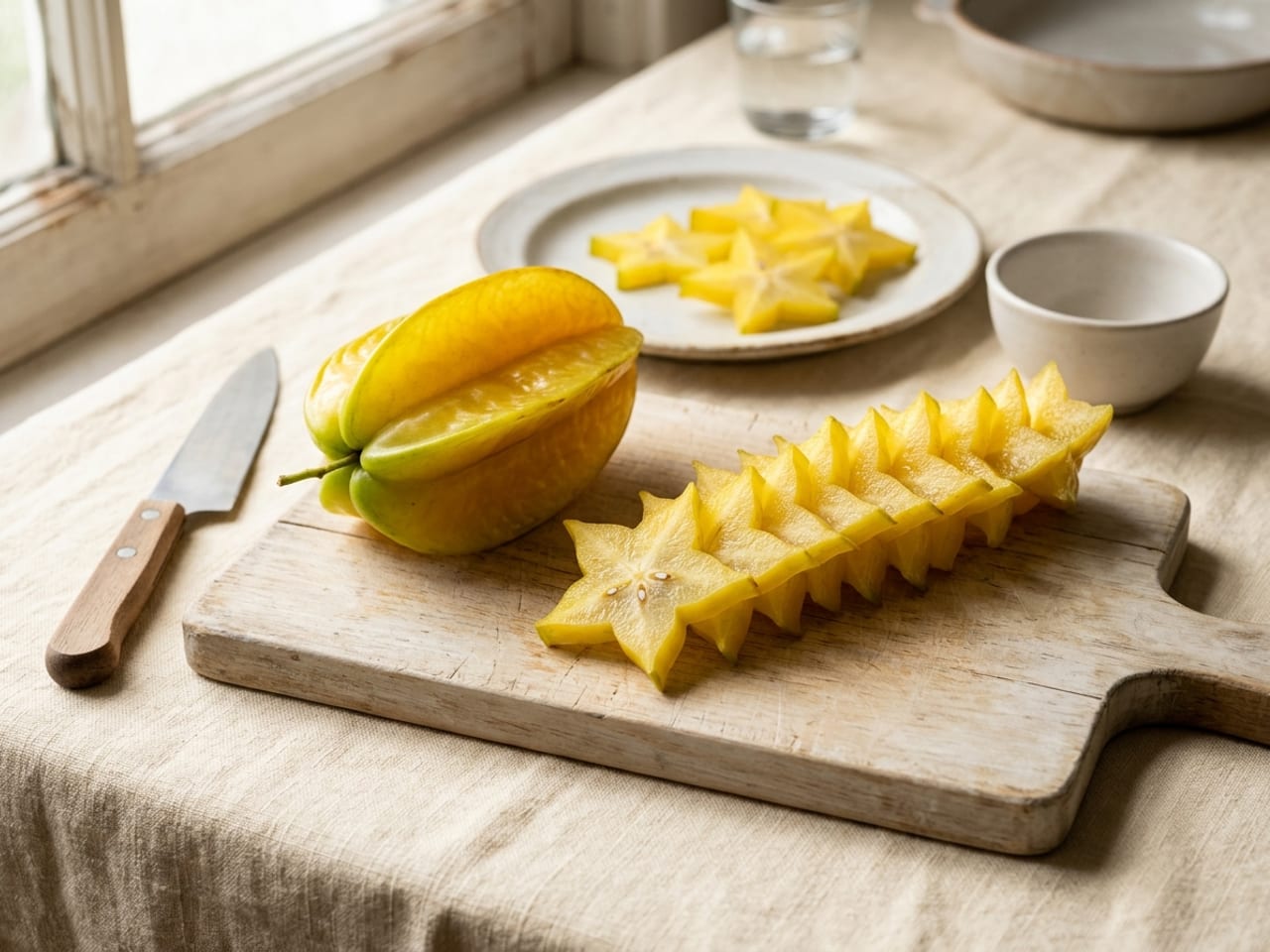
How to cut star fruit
Usable 97% · star slices · cut keeps 4 days
Quick answer: wash it, trim the thin edge of each of the five ribs if it is brown, and slice straight across into stars.19 Everything is edible, skin included.18
- Rinse and dry the fruit.
- Shave off any brown along the rib edges and cut off both ends.19
- Slice across about ¼ inch (6 mm) thick; flick out any seeds with the knife tip.
Choosing: ripe when most of the green has gone golden yellow; brown edges on the ribs are normal.18 It does not get sweeter after picking.17
On the plate: no other fruit cuts into a ready-made shape. Illinois Extension suggests a border of carambola slices around a fruit tray.18 Yield: 97%, about 46 slices a pound.5 Warning: if you have kidney disease, don't eat it (why).
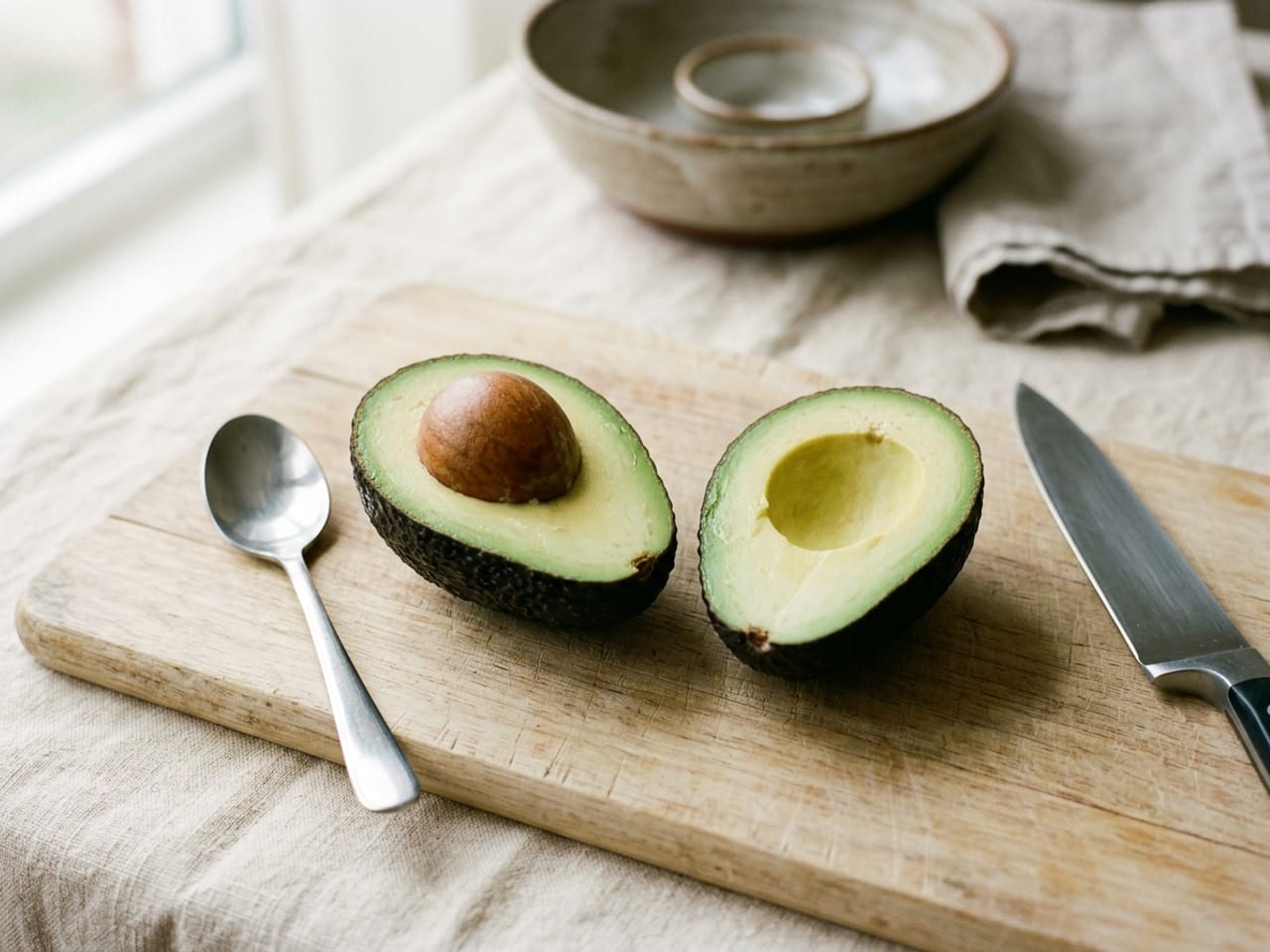
How to cut an avocado (safely)
Usable 67% · slices, fans, cubes · browns, so cut last
Quick answer: keep it on the board. Cut lengthwise around the seed, twist the halves apart, and lift the seed out with a spoon, never by stabbing or whacking it with the knife while the fruit is in your hand.21
- With the avocado on the board, cut in until the knife hits the seed and turn the fruit to cut all the way around.20
- Twist the halves apart. Lift the seed out with a spoon, or cut the fruit into quarters and pull the seed out with your fingertips.20, 21
- Peel by sliding your thumb under the skin.20 To slice, put the pieces face down on the board, not in your palm.21
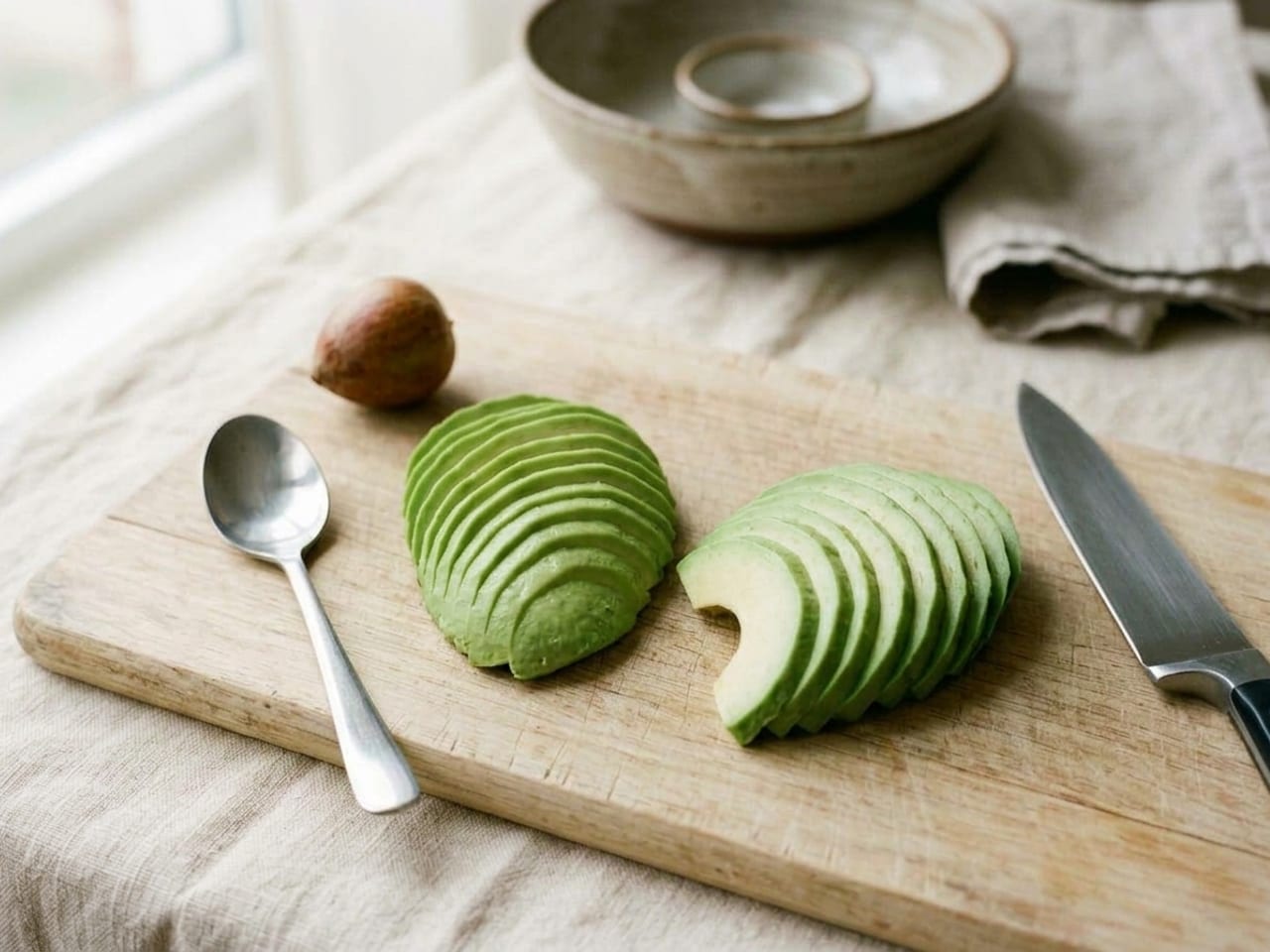
- Fan: slice a half thinly across, then press gently so the slices slide apart.
Choosing: ripe fruit is firm but yields to gentle pressure; dark skin means ripe only in Hass.20
On the plate: a fan on toast, on a poke bowl or next to shrimp ceviche, thin slices on a California roll. It browns: brush cut faces with lemon or lime juice and press plastic wrap (cling film) onto the surface.20 Yield: 67%.6
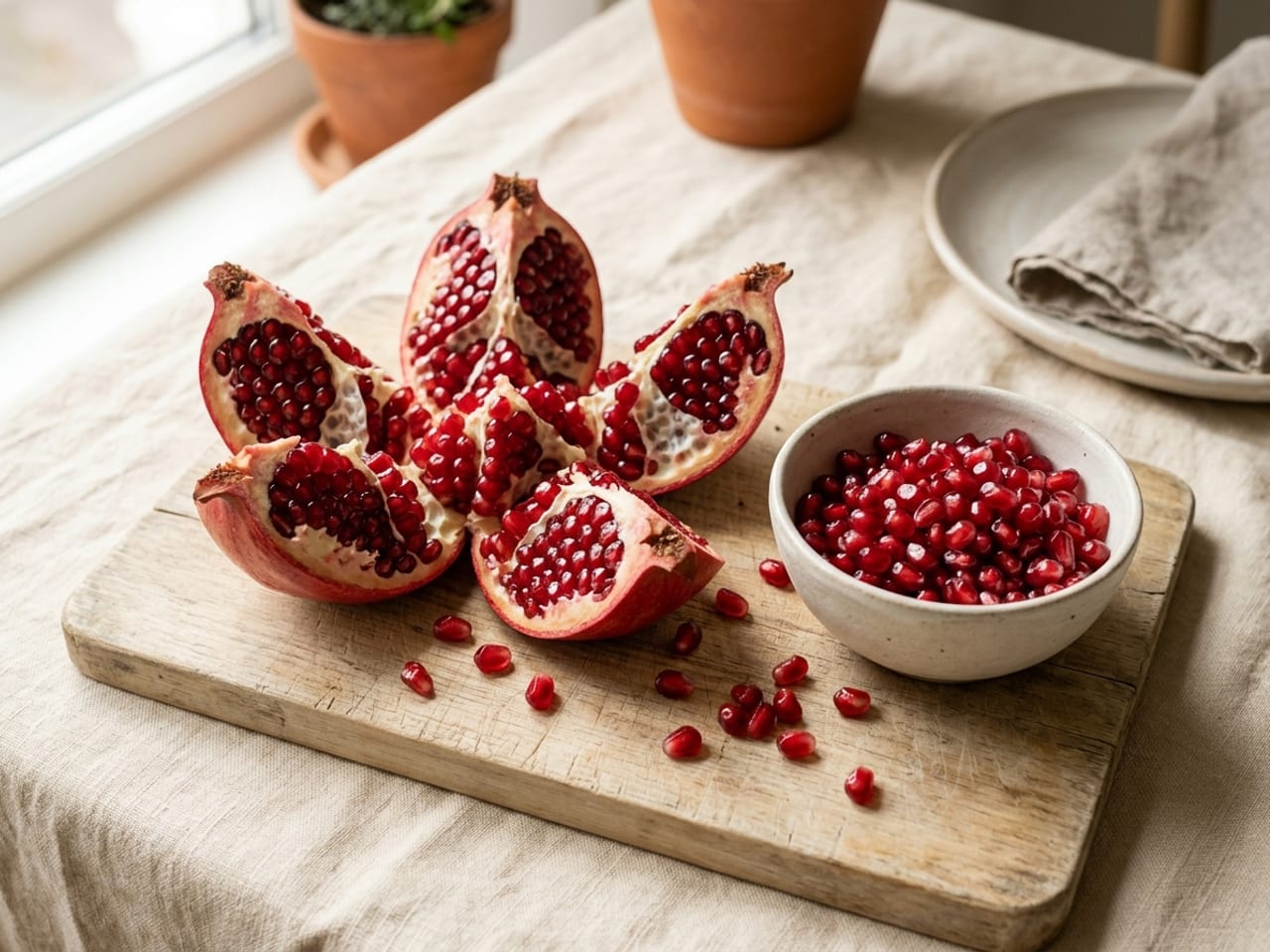
How to cut a pomegranate
About 1½ cups seeds a pound · arils keep 5 days
Quick answer: slice off the crown, score the skin along the ridges between its sections, and pull it apart over a bowl of water. The seeds (arils) sink and the white membrane floats.22, 23
- Cut about ½ inch (13 mm) off the crown end.22
- Score down through the skin along the four to six ridges between the sections, without cutting into the seeds.22
- Pull the fruit apart over a bowl of water and push the arils loose with your thumbs.22
- Skim off the floating membrane and drain the seeds.22
Choosing: heavy for its size; the rind doesn't have to be perfectly red.22
On the plate: scatter arils last, as the finishing jewel on yogurt, salads, a platter's gaps. Their juice stains boards, cloth and paler fruit, so keep them in a bowl until serving. Fresh seeds keep up to 5 days in the fridge.23 Yield: about 1½ cups (360 ml) of seeds a pound (450 g).5
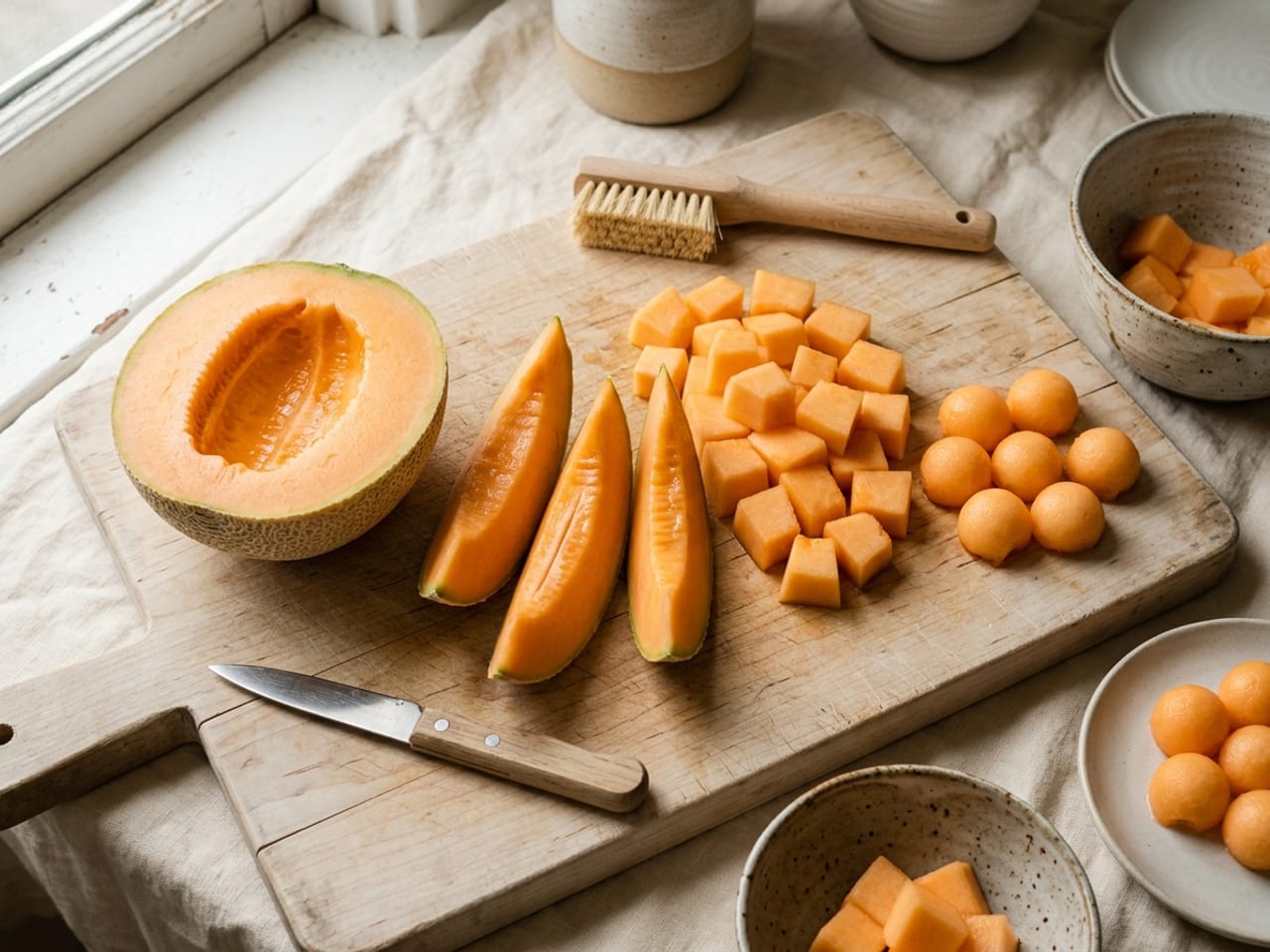
How to cut a cantaloupe (and honeydew)
Usable 46 to 56% · wedges, cubes, balls · cut keeps 2 to 4 days
Quick answer: scrub the rind under running water with a clean brush first, then cut off both ends, stand it up, cut the rind off in curved strips, halve it and scoop out the seeds.26, 11
- Scrub the netted rind with a produce brush under running water, no soap, and dry it.26 (Why it matters.)
- Cut off both ends, stand it on one, and cut the rind away following the curve.11
- Halve it and scoop out the seeds with a spoon.11
- Cut wedges, then cubes; or skip the peeling and scoop balls from the halves with a melon baller.
Choosing: a cantaloupe softens after picking but doesn't get sweeter,10 so buy it fragrant and heavy.
On the plate: melon balls are the classic compact cut for cups and skewers; long rindless wedges fan well on a platter. Of the fruits here, cut melon is the one the FDA Food Code names as needing temperature control,34 so keep it cold and use it within 2 to 4 days.9 Yield: 47 to 56% for cantaloupe, 46% for honeydew.5
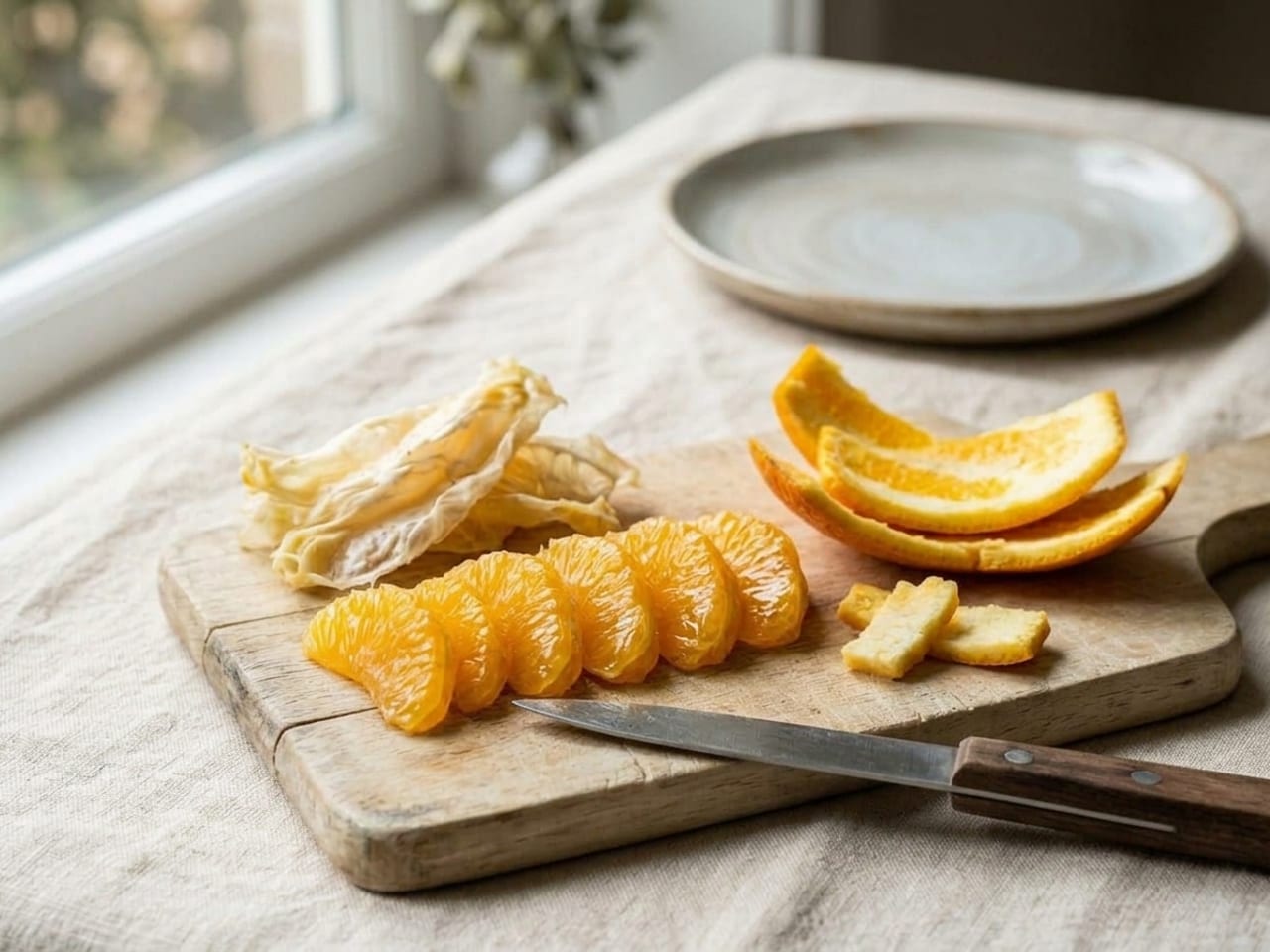
How to supreme an orange or grapefruit
Usable 40 to 58% · suprêmes, wheels · cut keeps 4 days
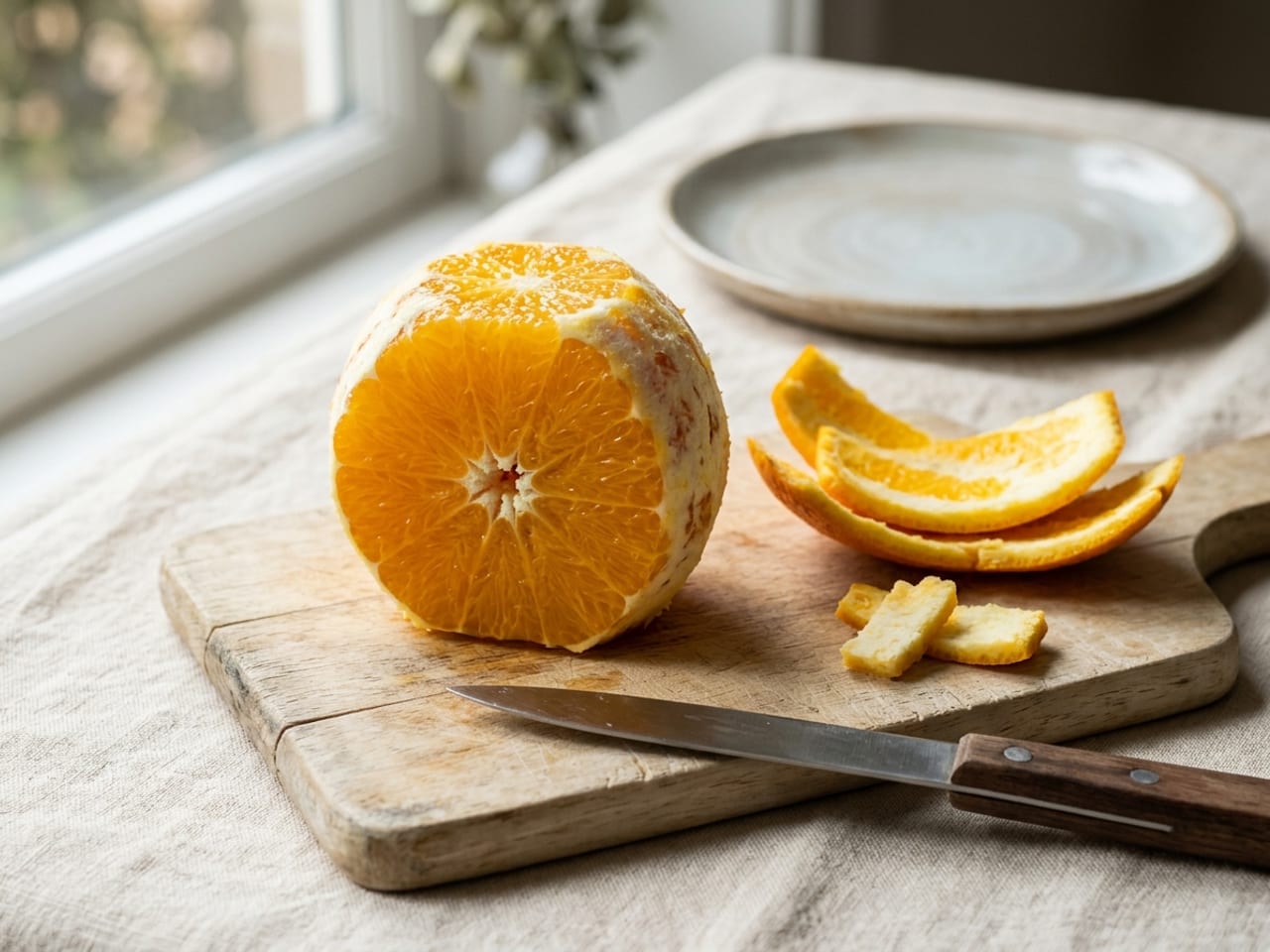
Quick answer: cut off the peel and all the white pith, then slice in beside each membrane to the center and lift out the segment. A suprême is flesh only, with none of the membrane, which is fibrous and bitter.24
- Cut a thin slice off the top and bottom so the fruit stands.24
- With a paring knife, slice off the rind and white pith from top to bottom, following the curve.24
- Slide the blade between a membrane and a segment and cut to the center.24
- Turn the blade outward and cut along the membrane on the other side until the segment falls out; repeat all round.24
On the plate: suprêmes are the citrus cut for plated desserts and salads: glossy, even, no chewy skin. Drain them on paper before plating, and squeeze the leftover membrane for juice. Yield: about half the fruit (USDA: 40% for oranges of all sizes, 58% for large grapefruit; 50 to 52% in the older handbook).5, 7
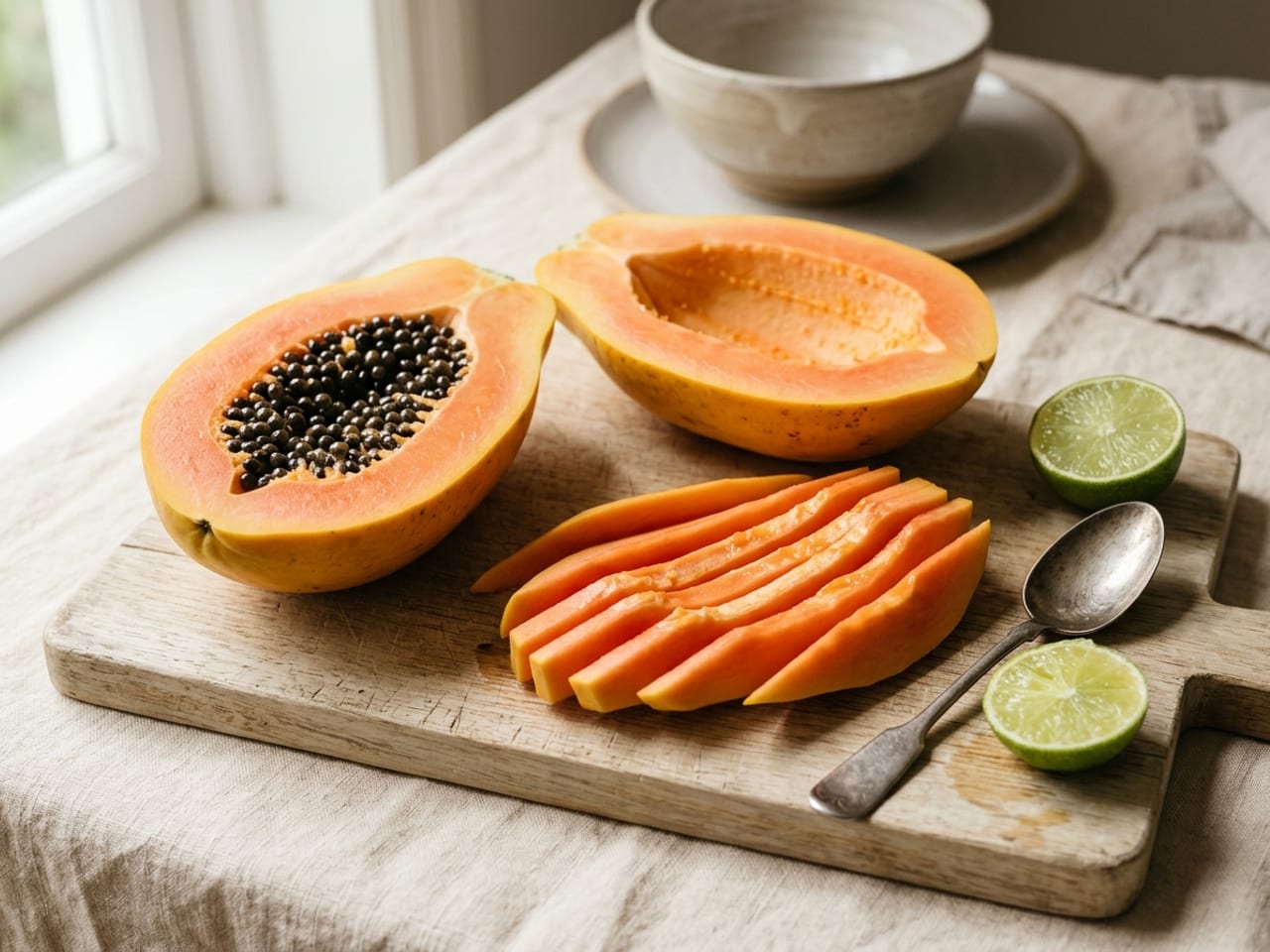
How to cut a papaya
Usable 67% · slices, cubes, boats · cut keeps 4 days
Quick answer: halve it lengthwise, scoop out the black seeds with a spoon, cut the flesh away from the skin, and slice it.11
- Cut it in half from end to end.
- Scoop out the seeds with a spoon.11
- With a small sharp knife, cut the flesh away from the skin on each half, then slice or cube it.11
Choosing: buy it with yellow streaks and let it turn fully yellow at room temperature; it softens but does not get sweeter after picking.10, 11
On the plate: a seeded half is a ready-made boat: squeeze lime over it and serve it with a spoon, or fill it with other cut fruit. Like pineapple and kiwi, it digests gelatin.55 Yield: 67%.5
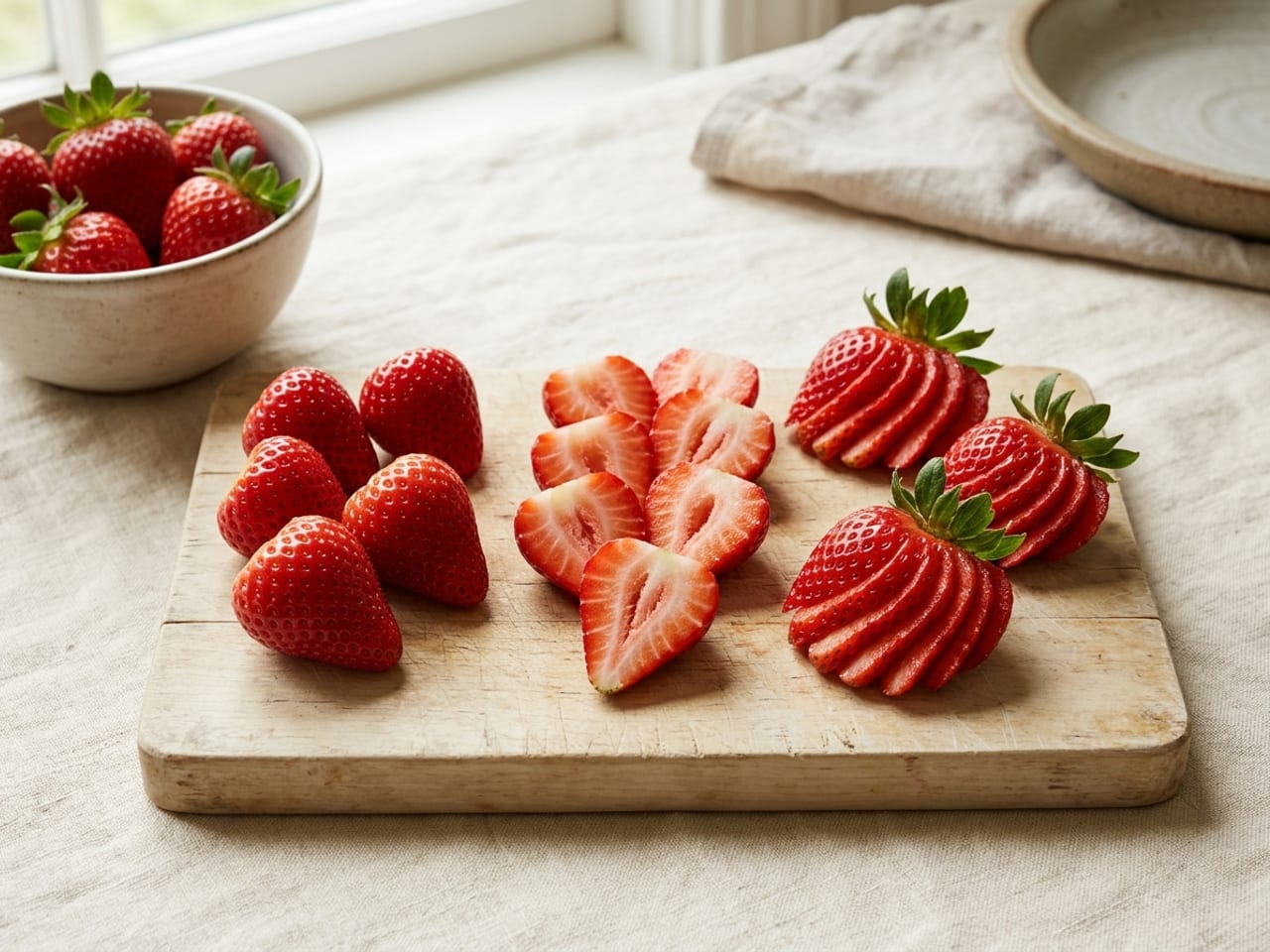
How to cut strawberries
Usable 88% · halves, fans · keep 2 to 3 days
Quick answer: rinse them with the green caps on, pat them dry, then hull them with a twist or the tip of a knife and halve them from tip to top.25
- Rinse just before serving, caps on, and blot dry.25
- Twist the cap off, or cut out the hull with the tip of a paring knife.25
- Halve or quarter lengthwise, through the tip.
- For a fan, keep the cap on, slice thinly from the tip almost to the cap, and press the slices apart.
Choosing: strawberries don't ripen after picking, so white shoulders stay white.25
On the plate: halves cut through the tip show the pale heart; a fan is the classic single-berry garnish for a plated dessert. Store them unwashed and use them within 2 to 3 days.9 Yield: 88%.5
How cut fruit looks on a plate
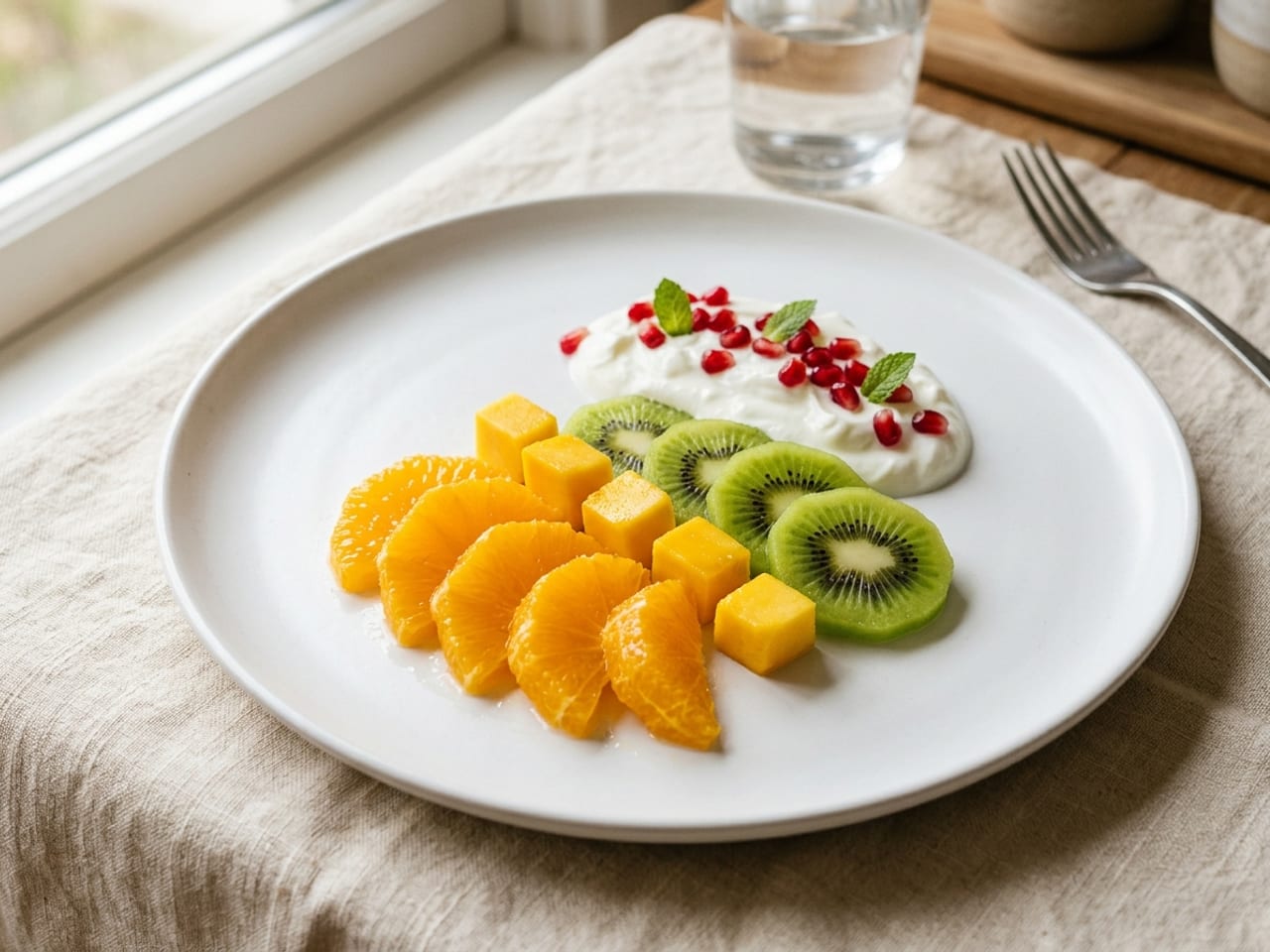
Choose the cut for the plate, not the fruit. A plated dessert wants small, clean, even pieces: suprêmes, a few mango cubes, kiwi rounds, a brunoise for a salsa. Pick one or two shapes and repeat them rather than mixing five, and leave empty plate between them; the dessert plating guide has the rest of that system.
Let the cut show the inside. Kiwi and star fruit are best cut across, where the seed ring and the star are; strawberries halved through the tip show their pale heart; dragon fruit shows its seeds on any face. A cut that shows the cross-section is doing the garnish's work for free.
Use color on purpose. Orange mango next to green kiwi, magenta dragon fruit skin beside white flesh, red arils last on anything pale. The color guide explains why contrast reads as fresh, and plating techniques names the moves: fanned, stacked, scattered.
Some cuts are their own vessel. A hedgehog cheek, a scooped papaya half, a dragon fruit shell or a kiwi half-shell all hold their fruit on the plate, no bowl needed. For savory plates, an avocado fan does the same job on aguachile.
How to cut fruit for a platter
How much. Caterers plan 3 quarts (2.8 L) of fruit salad for 25 people, about half a cup (120 ml) a guest,64 when fruit is one dish among several; plan more for a brunch where it is a main event. Divide by the usable yield to know what to buy: 3 lb (1.4 kg) of pineapple cubes takes about 5½ lb (2.5 kg) of whole pineapple.5 The party food calculator does the rest of the menu.
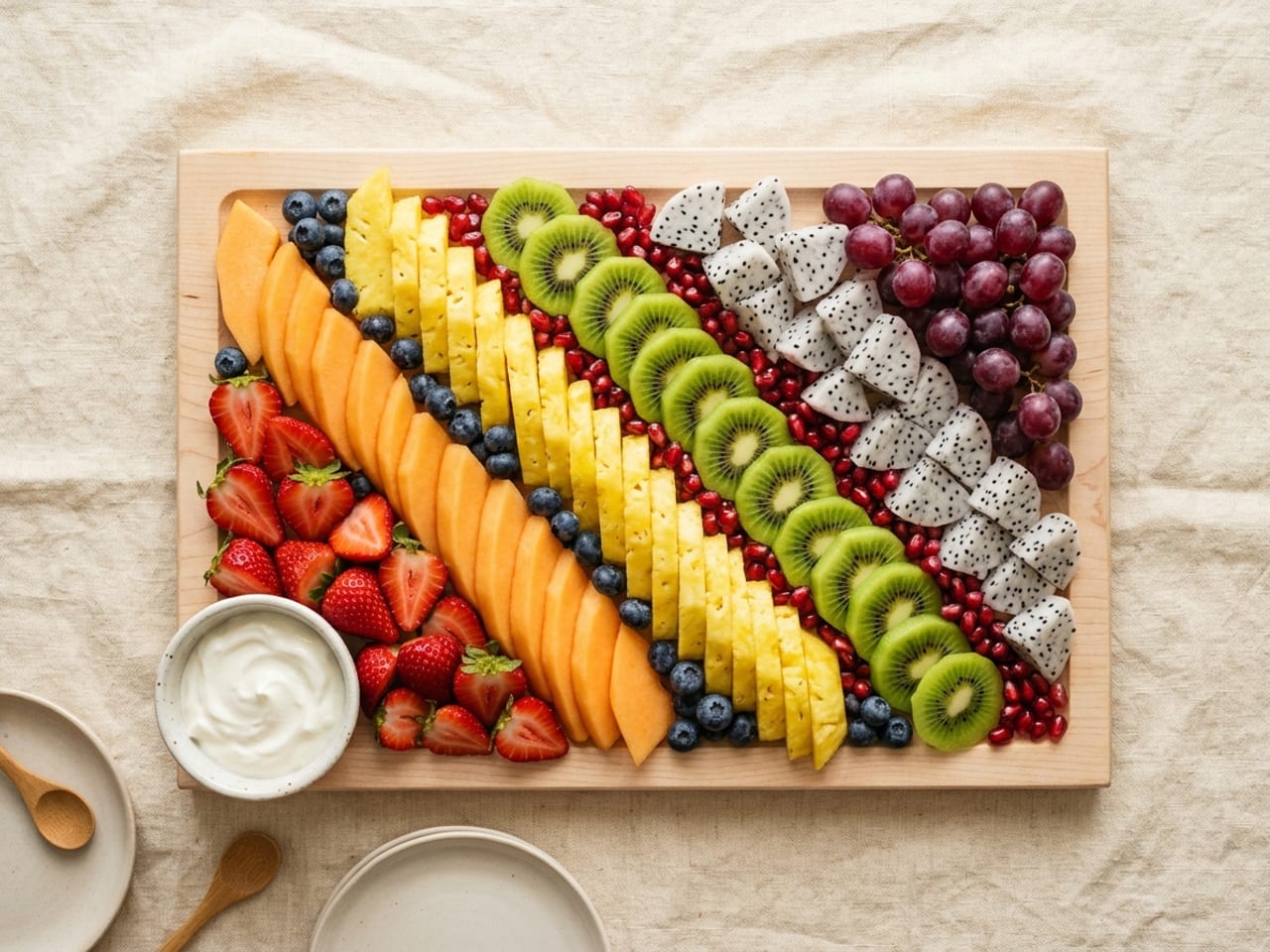
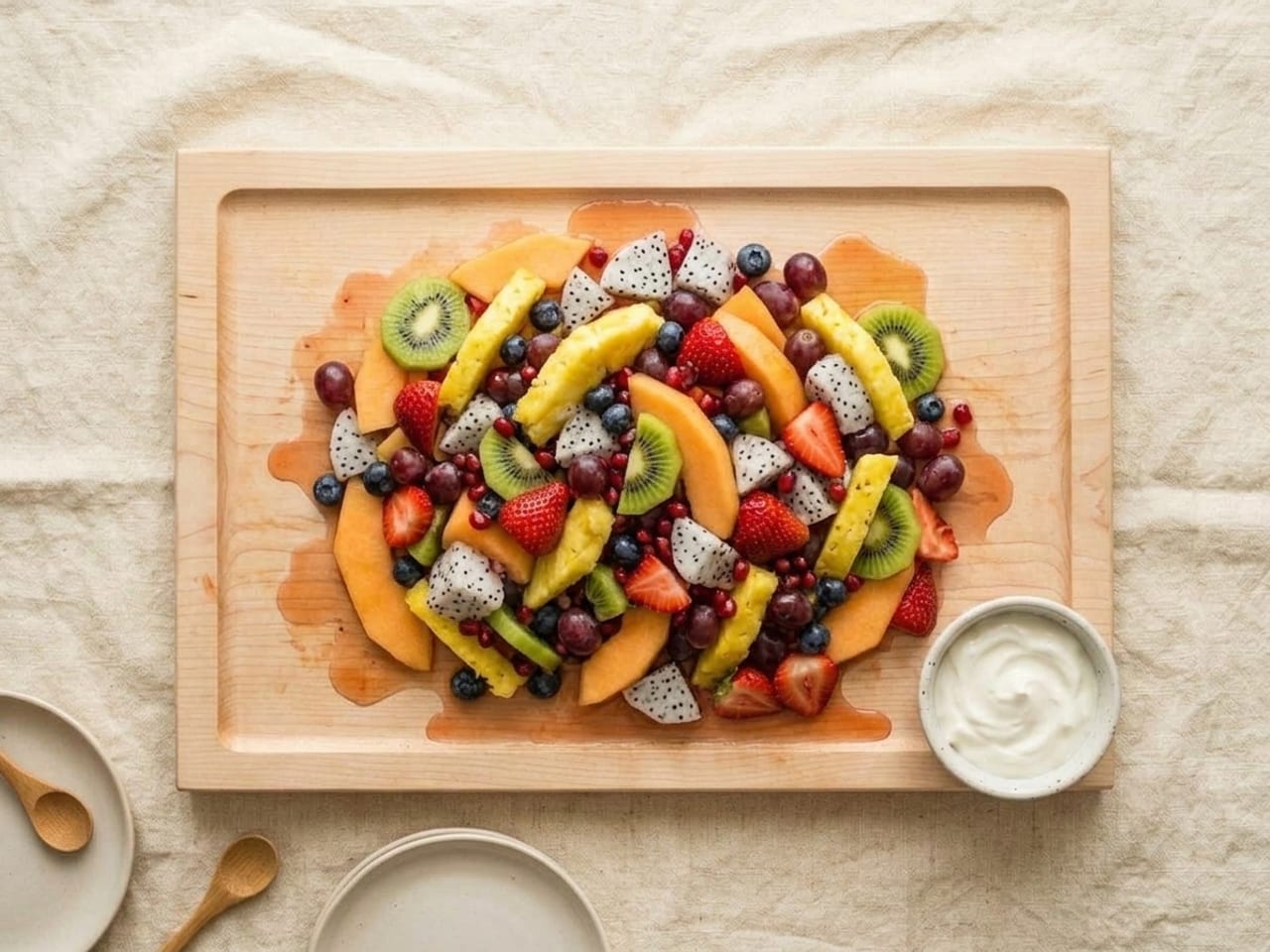
In what order. Cut the sturdy fruit first (pineapple, melon, citrus), the delicate and browning fruit last (strawberries, kiwi, and avocado or apple if you use them). Cut every fruit into one shape a guest can pick up with fingers or a pick: sticks, spears, wedges, stars, halves.
How to lay it out. The same method as a charcuterie board: an anchor first (a dip bowl, off-center), then each fruit in its own band or block, dark next to light, and the small stuff (berries, arils, grapes) into the gaps last. Keep wet cuts like watermelon and suprêmes from bleeding into pale ones. Illinois Extension's trick: a border of star fruit slices.18
How long it can sit. Two hours at room temperature, one above 90 °F (32 °C).33 Nest the platter in a tray of ice, and replace it with a fresh one from the fridge rather than topping it up.35
Same board, same fruit, two ways: drag to compare.
 PiledArranged
Fruit cuts, named
The words recipes use for cut fruit. The vegetable cuts they borrow from are on the knife cuts chart, drawn to scale.
Cheek
One of the two broad pieces sliced off either side of a mango's flat central seed.
Hedgehog cut · porcupine
A mango cheek scored in a crosshatch down to, but not through, the skin, then pushed inside out so the cubes stand up.
Suprême · supreme, segment
A citrus segment cut free of peel, pith and membrane, so it is flesh only.
Pith
The white, bitter layer between a citrus fruit's colored skin and its flesh, cut away for suprêmes.
Wedge
A triangular piece cut lengthwise from a round fruit such as a melon, lemon or apple.
Wheel · round
A slice cut straight across a round fruit, showing its whole cross-section: citrus, kiwi or star fruit.
Spear
A long, narrow lengthwise piece, usually of cored pineapple.
Stick · baton
A squared-off length of fruit, like a watermelon stick; the fruit version of the batonnet.
Cube · dice
A small even square piece; for fruit usually ½ to ¾ inch (12 to 20 mm).
Brunoise
A very fine dice, about ⅛ inch (3 mm), used for fruit salsas and garnishes.
Macédoine
A mixture of small, even pieces of fruit (or vegetables); a macédoine de fruits is a fruit salad of them.
Melon ball · parisienne
A small sphere of fruit scooped with a round melon baller, named after the parisienne potato balls cut with the same tool.
Fan
A fruit sliced thinly almost to one end (a strawberry) or across (an avocado half), then pressed so the slices spread out.
Arils
The juicy, seed-containing sacs inside a pomegranate: the part you eat.
Hull
To remove a strawberry's green cap and stem; also the name of the cap itself.
Chiffonade
Leaves rolled tight and sliced across into fine ribbons, like mint over a fruit salad.
A short history of fruit cuts
The hedgehog is younger than you might think. The earliest printed "mango hedgehogs" we could find are in a 1985 rice cookbook59 and, with instructions ("slice off the 2 fleshy cheeks"), in a 1986 book of garnishes.60 A 1993 cookbook calls it "this Australian technique"61 but gives no evidence, and we couldn't confirm where it began. The technique may well be older than the name.
Suprême started as chicken. In Escoffier's Guide culinaire (1907) a suprême is a breast fillet of poultry: "the terms filet and suprême are synonyms".62 The citrus suprême is a later borrowing.
Melon balls were potatoes first. Escoffier's pommes noisette are scooped "à la cuiller ronde", with a round spoon, the size of a hazelnut, and pommes à la parisienne are the same, a little smaller.62 The same round scoop is now sold as a melon baller. His macédoine de fruits rafraîchis, fruit in season, peeled, sliced and soaked in a kirsch or maraschino syrup, is the fruit salad in its formal clothes.62
And the pineapple on the platter? The story that it was a colonial symbol of hospitality has no 17th- or 18th-century evidence behind it, according to Colonial Williamsburg's historians; the earliest telling traced so far is 1930s Hawaiian pineapple publicity.63
Tools for cutting fruit
- Chef's knife, 8 inch (20 cm)For melons, pineapple and everything big. Sharp matters more than brand.
- Paring knifeFor suprêmes, kiwi skin, strawberry hulls and trimming star fruit ribs.
- A big board and a damp towelA board large enough for a watermelon, held still by a damp towel or a non-slip mat underneath.39
- Spoons and a melon ballerA tablespoon lifts avocado seeds and scoops kiwi and dragon fruit; a baller makes melon balls.
- A produce brushKept for fruit only, for scrubbing melon and pineapple rinds before the knife goes in.26
Fruit cutting safety
The injuries and illnesses that cut fruit really causes, from peer-reviewed studies and US regulators, and what to do about each.
- Avocado hand is common, and avoidableAbout 50,000 people went to US emergency rooms with avocado knife injuries between 1998 and 2017, 27,059 of them in the last five years; 80% were women, and the injuries were mostly to the left, usually non-dominant, hand.36 A second team counted about 49,000 from 2000 to 2017.37 In a UK series of 35 patients, 85% of injuries happened while removing the stone and every one needed surgery, often for cut tendons or nerves.38 The fix is simple: fruit on the board, never in your palm, and a spoon or your fingers for the seed, not the knife.21
- Mango skin can cause a rash like poison ivyMango belongs to the same plant family as poison ivy, and its peel carries resorcinol compounds that are chemical cousins of urushiol; people already sensitized to poison ivy or oak can react to it on first contact.41, 43 The peel holds roughly ten times more of these compounds than the flesh.42 The rash is rare,44 but if poison ivy gets you, have someone else peel your mangoes, or wear gloves, and serve cubes off the skin rather than hedgehogs to bite from.
- Scrub melons before the knife goes inIn 2011, whole cantaloupes from one Colorado farm caused a listeria outbreak: 147 people ill in 28 states, 33 deaths.28, 29 In 2023, cantaloupes from Mexico sickened 407 people with salmonella.30 A knife carries bacteria from the rind into the flesh,31 and the netted rind holds on to them, so the FDA says to scrub melons with a clean brush under running water (no soap or bleach) before cutting; washing reduces the bacteria but doesn't eliminate them.26 Scooping the flesh from the halves rather than cutting through the rind on a board lowered the transfer a little in a lab test.32
- Two hours out, then the fridge or the binCut fruit goes back in the fridge (40 °F / 4 °C or below) within 2 hours, or 1 hour above 90 °F (32 °C).33 The FDA Food Code names cut melons among the foods that need temperature control once cut.34 On a buffet, nest the platter in a tray of ice and swap in a fresh platter rather than topping up the old one.35
- Star fruit and kidney disease don't mixStar fruit contains oxalate and a neurotoxin, caramboxin. A review of 136 poisoning cases found 69% had kidney disease already;45 in another series, 36% of patients with chronic kidney disease and 27% of those on dialysis died, and no one with normal kidneys did.46 If you have kidney disease, don't eat star fruit or drink its juice.17
What happens when you cut fruit
- Why cut fruit turns brownCutting breaks cells open, and an enzyme, polyphenol oxidase (PPO), meets the fruit's phenolic compounds and oxygen and turns them into quinones, which link up into brown pigments.49 Apples, pears, peaches, bananas, mango and avocado all carry PPO,49 and avocado's is one of the hardest to switch off.50 Citrus, pineapple and melon hold their color after cutting; what limits them is flavor, texture and microbes.51
- What actually slows itAcid (PPO stops working below about pH 3), cold and keeping air off.49 Ascorbic acid (vitamin C) turns the quinones back until it is used up;51 a dip of 1 teaspoon of ascorbic acid powder (or six crushed 500 mg tablets) in a gallon (3.8 L) of cold water beats lemon juice.52 The avocado seed in the guacamole only protects the spot it covers; plastic wrap pressed onto the surface does the same job everywhere.53
- Why cut fruit weeps and softensA cut fruit is a wounded one: it breathes faster, makes ethylene, loses water and lets its sugars out for microbes. Unwrapped watermelon slices lost 47% of their firmness in 4 days at 41 °F (5 °C).51 That is why the cut matters: a sharp knife crushes fewer cells.
- Pineapple, kiwi and papaya dissolve gelatinAll three contain protein-digesting enzymes (bromelain, actinidin, papain). Gelatin is a protein, so fresh pieces stop a jelly or panna cotta setting; canned fruit is fine because the heat destroys the enzymes.54, 55 Kiwi extract also digests yogurt and cheese proteins,57 though most gold kiwis carry little or no actinidin, and it stops working at about 140 °F (60 °C).58
- Why pineapple tinglesBromelain gets the blame, but McGill's Office for Science and Society says there is "no single, clear explanation": the fruit also holds needle-like crystals of calcium oxalate that may help the enzyme along.56
Five fruit myths
- "A red mango is a ripe mango"No: the red blush is sun or variety. Squeeze gently; a ripe mango gives slightly.2
- "Whack the knife into the avocado seed"That is how avocado hand happens. Use a spoon, or quarter it.21
Now plate it
Cutting is half of it; the other half is where it goes on the plate. Photograph a dessert or a dinner you made and Plate Artists re-plates your own dish the way a chef would, with the moves named so you can do it again for real.
Your dish, plated like a chef's
Snap it, upload it, and get the composed version back, with the steps to recreate it on a real plate.
Start free · 1 enhancement →Free account · 1 free enhancement · No credit card
How to cut fruit, answered
How do you cut a mango?
Stand the mango on its stem end and slice straight down about 1/4 inch (6 mm) from the center on each side, just clearing the long flat seed. That gives two cheeks. Score each cheek's flesh in a crosshatch down to the skin but not through it, then push the skin up from underneath so the cubes fan out (the hedgehog cut). Slice the cubes off, or serve them on the skin, and trim the flesh left around the seed.
How do you cut a pineapple?
Scrub it, cut off the crown and base, and stand it upright. Pare the rind off in thin strips from top to bottom, then remove the brown eyes by cutting shallow V-shaped grooves along their diagonal spiral. Quarter it lengthwise, cut the woody core off each quarter, and cut spears or chunks; or slice it into rings and cut out the core with a small round cutter.
How do you cut a watermelon into sticks or cubes?
Wash it, cut off both ends and stand it on one. Cut the rind off in strips where the white meets the red, following the curve. Cut the peeled melon into slabs, then the slabs into sticks about 1 inch (2.5 cm) square, or into strips both ways for cubes.
How do you cut a kiwi?
Either halve it across the middle and scoop each half out with a teaspoon, or cut off both ends, pare the skin off in lengthwise strips and slice it into rounds. Gold kiwis have hairless skin that you can eat.
How do you cut a dragon fruit?
Halve it lengthwise through the skin, then run a spoon between the flesh and the skin to lift it out in one piece, or peel the skin back. Slice or cube the flesh. The empty shell makes a serving bowl.
How do you cut star fruit?
Rinse it, shave off any brown along the edges of the five ribs, cut off the ends and slice straight across about 1/4 inch (6 mm) thick. Each slice is a star. The skin is edible. People with kidney disease should not eat star fruit.
What is the safest way to cut an avocado?
Keep it on the cutting board the whole time. Cut lengthwise around the seed, twist the halves apart, and lift the seed out with a spoon, or cut the avocado into quarters and pull the seed out with your fingers. Never stab or whack the seed with a knife while holding the fruit in your hand: that is how most avocado hand injuries happen.
What is the easiest way to get the seeds out of a pomegranate?
Cut off the crown, score the skin along the ridges between the sections, and pull the fruit apart over a bowl of water. Push the seeds out with your thumbs: they sink, the white membrane floats, and the juice stays in the bowl instead of on your shirt.
Should you wash a cantaloupe before cutting it?
Yes. Scrub the rind with a clean produce brush under running water and dry it before cutting, because the knife carries bacteria from the netted rind into the flesh. Don't use soap or bleach. Cantaloupes have caused listeria and salmonella outbreaks, and washing reduces the risk without removing it, so keep cut melon cold too.
How do you cut fruit for a fruit platter?
Wash and cut the sturdy fruit first (pineapple, melon, citrus), the delicate or browning fruit last (strawberries, kiwi, avocado, apples). Cut each fruit into one shape that can be picked up with fingers or a pick: sticks, spears, wedges, stars, halves. Arrange them in bands or blocks of one fruit each, dark next to light, with a dip bowl as an off-center anchor, and fill the gaps with berries or pomegranate seeds.
How much fruit do I need per person for a fruit tray?
About half a cup (120 ml) of cut fruit a guest when fruit is one dish among several; caterers plan about 3 quarts of fruit salad for 25 people. To know how much whole fruit to buy, divide by the usable yield: a pineapple gives a little over half its weight as cubes, a watermelon about 60%.
How long does cut fruit last in the fridge?
USDA FoodKeeper gives about 4 days for cut fruit and 2 to 4 days for cut melon, stored at 40 °F (4 °C) or below. Strawberries last 2 to 3 days and pomegranate seeds up to 5. Cut avocado browns within hours, so cut it last.
How do you keep cut fruit from turning brown?
Browning is an enzyme reaction with air, so use acid, cold and a cover. A 10-minute dip in 1 teaspoon of ascorbic acid (vitamin C powder) per gallon of cold water works better than lemon juice. Brush cut avocado with lemon or lime juice and press plastic wrap onto the surface. Fruits like citrus, pineapple and melon hardly brown at all.
The boards, handbooks and research behind this guide
The fruit industry's own cutting guides (the mango, watermelon, avocado, pomegranate and strawberry boards and growers); USDA yield and storage tables; university extension services; the FDA, CDC, USDA and OSHA; four cookbooks read in Internet Archive scans; and nineteen peer-reviewed papers, each verified through Crossref. The steps with no marker (dragon fruit, strawberry fans, watermelon triangles) are standard kitchen practice with no published source.
- National Mango Board (2026). How to cut a mango. mango.org, slice down each side about ¼ inch from the center, the cheeks, the crosshatch and the push. mango.org
- National Mango Board (2026). How to choose a mango. mango.org, squeeze gently; skin colour and red blush are not ripeness signs. mango.org
- National Mango Board (2026). Mango yield and cutting. mango.org foodservice, the peel-first method and a 50-fruit yield test by variety. mango.org
- National Mango Board (2015). Know your mangos. mango.org, ripe mangos keep up to 5 days refrigerated; mangos do not ripen below 50 °F. mango.org (PDF)
- USDA Food and Nutrition Service (2026). Food Buying Guide for Child Nutrition Programs, Section 3: Fruits (yield table). foodbuyingguide.fns.usda.gov, pounds ready to serve from 1 lb as purchased, per fruit and cut; read 27 September 2026. fns.usda.gov (PDF)
- USDA Food and Nutrition Service (2026). Food Buying Guide for Child Nutrition Programs, Section 2: Vegetables (yield table). foodbuyingguide.fns.usda.gov, avocado is listed with the vegetables. fns.usda.gov (PDF)
- Matthews, R. H. & Garrison, Y. J. (1975). Food Yields Summarized by Different Stages of Preparation. Agriculture Handbook No. 102. USDA Agricultural Research Service, yield after preparation with ranges: mango, pineapple, watermelon, citrus sections without membrane. ars.usda.gov (PDF)
- USDA Agricultural Research Service (2016). National Nutrient Database for Standard Reference, Release 28: food descriptions and refuse. USDA ARS, refuse per food, e.g. pineapple: 8% core, 16% crown, 26% parings. ars.usda.gov
- USDA Food Safety and Inspection Service (2018). FoodKeeper data (version 128). fsis.usda.gov, storage times for cut fruit (4 days), cut melon (2 to 4 days) and whole fruit; read in the Internet Archive capture of 2 July 2025. fsis.usda.gov (archived)
- UC Davis Postharvest Research and Extension Center (2026). Produce facts: pineapple, watermelon, dragon fruit, cantaloupe, papaya, strawberry. postharvest.ucdavis.edu, which fruits ripen or sweeten after harvest; read in Internet Archive captures. postharvest.ucdavis.edu (archived)
- University of Minnesota Extension (2026). Real Life, Good Food: pineapple, kiwi, cantaloupe, honeydew, papaya. reallifegoodfood.umn.edu, choosing, cutting and storing each fruit; read in Internet Archive captures. umn.edu (archived)
- America's Test Kitchen (2026). How to spiral cut a pineapple. America's Test Kitchen, shallow diagonal V-shaped grooves following the eyes' spiral. americastestkitchen.com
- National Watermelon Promotion Board (2026). How to choose a watermelon. watermelon.org, look, lift, turn: the creamy yellow ground spot. watermelon.org
- National Watermelon Promotion Board (2015). Cutting and yield. watermelon.org foodservice, the rind-off method and flesh yields of 59.8 to 70.5% by melon size (Oregon State Food Innovation Center). watermelon.org
- University of Arkansas Division of Agriculture (2019). Can thumping help you pick the perfect watermelon? Horticulture experts weigh in. uaex.uada.edu, 3 July 2019. uaex.uada.edu
- Zespri (2026). Cut, slice or peel: the many ways to eat and enjoy kiwifruit. zespri.com, halve and scoop, peel and slice; SunGold skin is hairless and edible. zespri.com
- Crane, J. H. (2026). Carambola growing in the Florida home landscape (HS12/MG269). UF/IFAS Extension, EDIS, picking for sweetness; the warning for people with kidney disease. edis.ifas.ufl.edu
- Smith, J. (2020). Bring home the starfruit. University of Illinois Extension, 17 September 2020: ripeness, the whole fruit is edible, a border for a fruit tray. extension.illinois.edu
- University of Hawaiʻi CTAHR (2026). Pacific Food Guide: star fruit. manoa.hawaii.edu, trim the corners if desired and slice as stars. manoa.hawaii.edu
- California Avocado Commission (2026). How to choose and use a ripe avocado. californiaavocado.com, the squeeze test, the quartering method, lemon juice and plastic wrap on cut surfaces. californiaavocado.com
- California Avocado Commission (2026). 5 tips on how to safely cut an avocado. californiaavocado.com, keep it on the board; never whack or stab the seed while holding the fruit. californiaavocado.com
- POM Wonderful (2026). How to open a pomegranate; Fresh pomegranates. pomwonderful.com, score the sections, open over a bowl of water; choosing by weight, not colour. pomwonderful.com
- Jorgensen, T. & Brennand, C. (2026). How to preserve pomegranates. Utah State University Extension, separating the seeds under water; fresh seeds keep up to 5 days refrigerated. extension.usu.edu
- America's Test Kitchen (2026). Slicing citrus. America's Test Kitchen, trim, segment, slice: cutting sections free of the fibrous, bitter membranes. americastestkitchen.com
- California Strawberry Commission (2026). How to select and store strawberries; Strawberry facts. californiastrawberries.com, rinse with the caps on, then hull; berries do not ripen after picking. californiastrawberries.com
- US Food and Drug Administration (2024). Selecting and serving produce safely. fda.gov, scrub melons with a clean produce brush; no soap or produce wash; washing reduces but does not eliminate bacteria. fda.gov
- US Food and Drug Administration (2021). 7 tips for cleaning fruits, vegetables. FDA Consumer Updates, rinse before you peel so the knife does not carry dirt and bacteria into the fruit. fda.gov
- Centers for Disease Control and Prevention (2012). Multistate outbreak of listeriosis linked to whole cantaloupes from Jensen Farms, Colorado (final update). cdc.gov, 147 cases in 28 states, 33 deaths. archive.cdc.gov
- McCollum, J. T. et al. (2013). Multistate outbreak of listeriosis associated with cantaloupe. New England Journal of Medicine, 369(10), 944–953. doi:10.1056/NEJMoa1215837
- Centers for Disease Control and Prevention (2024). Salmonella outbreak linked to cantaloupes, November 2023. cdc.gov, 407 cases, 158 hospitalized, 6 deaths in 44 states; read in the Internet Archive capture. cdc.gov
- Ukuku, D. O. & Sapers, G. M. (2001). Effect of sanitizer treatments on Salmonella Stanley attached to the surface of cantaloupe and cell transfer to fresh-cut tissues during cutting practices. Journal of Food Protection, 64(9), 1286–1291. doi:10.4315/0362-028x-64.9.1286
- Shearer, A. E., LeStrange, K., Castañeda Saldaña, R. & Kniel, K. E. (2016). Transfer of pathogens from cantaloupe rind to preparation surfaces and edible tissue as a function of cutting method. Journal of Food Protection, 79(5), 764–770. doi:10.4315/0362-028X.JFP-15-420
- USDA Food Safety and Inspection Service (2026). "Danger Zone" (40 °F to 140 °F). fsis.usda.gov, never more than 2 hours out of the fridge, 1 hour above 90 °F. fsis.usda.gov
- US Food and Drug Administration (2022). Food Code 2022. fda.gov, §1-201.10: cut melons are a time/temperature control for safety (TCS) food. fda.gov (PDF)
- US Department of Agriculture (2026). Don't let bacteria crash your party. usda.gov, nest buffet dishes in bowls of ice; replace platters instead of topping them up. usda.gov
- Farley, K. X. et al. (2020). Avocado-related knife injuries: describing an epidemic of hand injury. American Journal of Emergency Medicine, 38(5), 864–868. doi:10.1016/j.ajem.2019.06.051
- Rossheim, M. E., Ninh, E. Q., Livingston, M. D. & Thombs, D. L. (2020). 49,000 avocado cutting injuries. American Journal of Health Behavior, 44(1), 13–17. doi:10.5993/AJHB.44.1.2
- Sajid, S., Gill, J., Chojnowski, A. & Singh, R. (2020). The avocado hand: the UK experience of the management of avocado hand injuries. Journal of Hand Surgery (Asian-Pacific Volume), 25(4), 402–406. doi:10.1142/S2424835520500423
- Libretti, G. (2025). Master basic knife skills. Michigan State University Extension, the pinch grip, the claw grip, a damp towel under the board. canr.msu.edu
- Occupational Safety and Health Administration (2026). Young worker safety in restaurants: food preparation. osha.gov, dull knives tend to slip; let a falling knife fall. osha.gov
- Yoo, M. J. & Carius, B. M. (2019). Mango dermatitis after urushiol sensitization. Clinical Practice and Cases in Emergency Medicine, 3(4), 361–363. doi:10.5811/cpcem.2019.6.43196
- Knödler, M., Reisenhauer, K., Schieber, A. & Carle, R. (2009). Quantitative determination of allergenic 5-alk(en)ylresorcinols in mango (Mangifera indica L.) peel, pulp, and fruit products by high-performance liquid chromatography. Journal of Agricultural and Food Chemistry, 57(9), 3639–3644. doi:10.1021/jf803934p
- Hershko, K., Weinberg, I. & Ingber, A. (2005). Exploring the mango – poison ivy connection: the riddle of discriminative plant dermatitis. Contact Dermatitis, 52(1), 3–5. doi:10.1111/j.0105-1873.2005.00454.x
- Berghea, E. C., Craiu, M., Ali, S., Corcea, S. L. & Bumbacea, R. S. (2021). Contact allergy induced by mango (Mangifera indica): a relevant topic? Medicina, 57(11), 1240. doi:10.3390/medicina57111240
- Yasawardene, P., Jayarajah, U., De Zoysa, I. & Seneviratne, S. L. (2021). Nephrotoxicity and neurotoxicity following star fruit (Averrhoa carambola) ingestion: a narrative review. Transactions of the Royal Society of Tropical Medicine and Hygiene, 115(9), 947–955. doi:10.1093/trstmh/trab026
- Chua, C. B. et al. (2017). Association of renal function and symptoms with mortality in star fruit (Averrhoa carambola) intoxication. Clinical Toxicology, 55(7), 624–628. doi:10.1080/15563650.2017.1314490
- Pastorello, E. A. et al. (1998). Identification of actinidin as the major allergen of kiwi fruit. Journal of Allergy and Clinical Immunology, 101(4), 531–537. doi:10.1016/S0091-6749(98)70360-4
- Wagner, S. & Breiteneder, H. (2002). The latex-fruit syndrome. Biochemical Society Transactions, 30(6), 935–940. doi:10.1042/bst0300935
- Moon, K. M., Kwon, E. B., Lee, B. & Kim, C. Y. (2020). Recent trends in controlling the enzymatic browning of fruit and vegetable products. Molecules, 25(12), 2754. doi:10.3390/molecules25122754
- Toledo, L. & Aguirre, C. (2016). Enzymatic browning in avocado (Persea americana) revisited: history, advances, and future perspectives. Critical Reviews in Food Science and Nutrition, 57(18), 3860–3872. doi:10.1080/10408398.2016.1175416
- Beaulieu, J. C. & Gorny, J. R. (2016). Fresh-cut fruits. In Gross, K. C., Wang, C. Y. & Saltveit, M. (eds.), The Commercial Storage of Fruits, Vegetables, and Florist and Nursery Stocks (Agriculture Handbook 66). USDA Agricultural Research Service, pp. 603–620: browning, softening, and pear slices cut with a freshly sharpened knife. ars.usda.gov (PDF)
- Zepp, M. (2026). Preserving color and preventing browning of foods. Penn State Extension, ascorbic acid dip; citric acid and lemon juice are less effective. extension.psu.edu
- Schwarcz, J. (2017). Can placing an avocado seed in guacamole prevent discolouration? McGill Office for Science and Society, 20 March 2017. mcgill.ca
- Pavan, R., Jain, S., Shraddha & Kumar, A. (2012). Properties and therapeutic application of bromelain: a review. Biotechnology Research International, 2012, 976203. doi:10.1155/2012/976203
- Schwarcz, J. (2017). Why can't I use fresh pineapple to make Jell-O? McGill Office for Science and Society, pineapple, kiwi and papaya enzymes break down gelatin; canning destroys them. mcgill.ca
- Cohn, H. (2023). Why does pineapple make your mouth tickle? McGill Office for Science and Society, 26 May 2023. mcgill.ca
- Kaur, L. & Boland, M. (2013). Influence of kiwifruit on protein digestion. Advances in Food and Nutrition Research, 68, 149–167. doi:10.1016/B978-0-12-394294-4.00008-0
- Kaur, L. et al. (2022). Actinidin in green and SunGold kiwifruit improves digestion of alternative proteins: an in vitro investigation. Foods, 11(18), 2739. doi:10.3390/foods11182739
- Street, M. (1985). Ritzy Rice. Chartwell Books, Secaucus, NJ, 'top with the mango hedgehogs'; read in Internet Archive full-text search. archive.org
- Budgen, J. (1986). The Book of Garnishes. HPBooks, Tucson, 'Mango hedgehogs', p. 90; read in Internet Archive full-text search. archive.org
- Harris, M. R. (1993). Tropical Fruit Cookbook. University of Hawaii Press, Honolulu, 'This Australian technique…'; read in Internet Archive full-text search. archive.org
- Escoffier, A. (1907). Le Guide culinaire, 2nd edition. Paris, filets or suprêmes of poultry (p. 705), pommes noisette and parisienne, macédoine de fruits rafraîchis; read in the Internet Archive scan. archive.org
- Miley, M. (2014). Revisited myth #12: the pineapple has long been a symbol of hospitality. History Myths Debunked, 17 April 2014, quoting Colonial Williamsburg historian Michael Olmert. historymyths.wordpress.com
- Simmons, D. & Simmons, C. (2022). Cooking for Crowds For Dummies cheat sheet. Wiley, dummies.com, per-person amounts for a crowd, including 3 quarts of fruit salad for 25. dummies.com
Keep going
Knife cuts chart, drawn to scale
Julienne, brunoise, macédoine and the rest at true size, printable 1:1.
Knife skills: julienne, brunoise, chiffonade
The pinch grip and the claw in full, then the vegetable cuts step by step.
How to make a charcuterie board
The same anchor-lines-gaps method at board scale, with quantities per guest.
Dessert plating
Where suprêmes, fans and a few mango cubes go on a plated dessert.
Cocktail garnishes
Wheels, wedges and twists: the fruit cuts for a glass.