Oyakodon Recipe (Chicken & Egg Rice Bowl — the Two-Pour Custard Method)
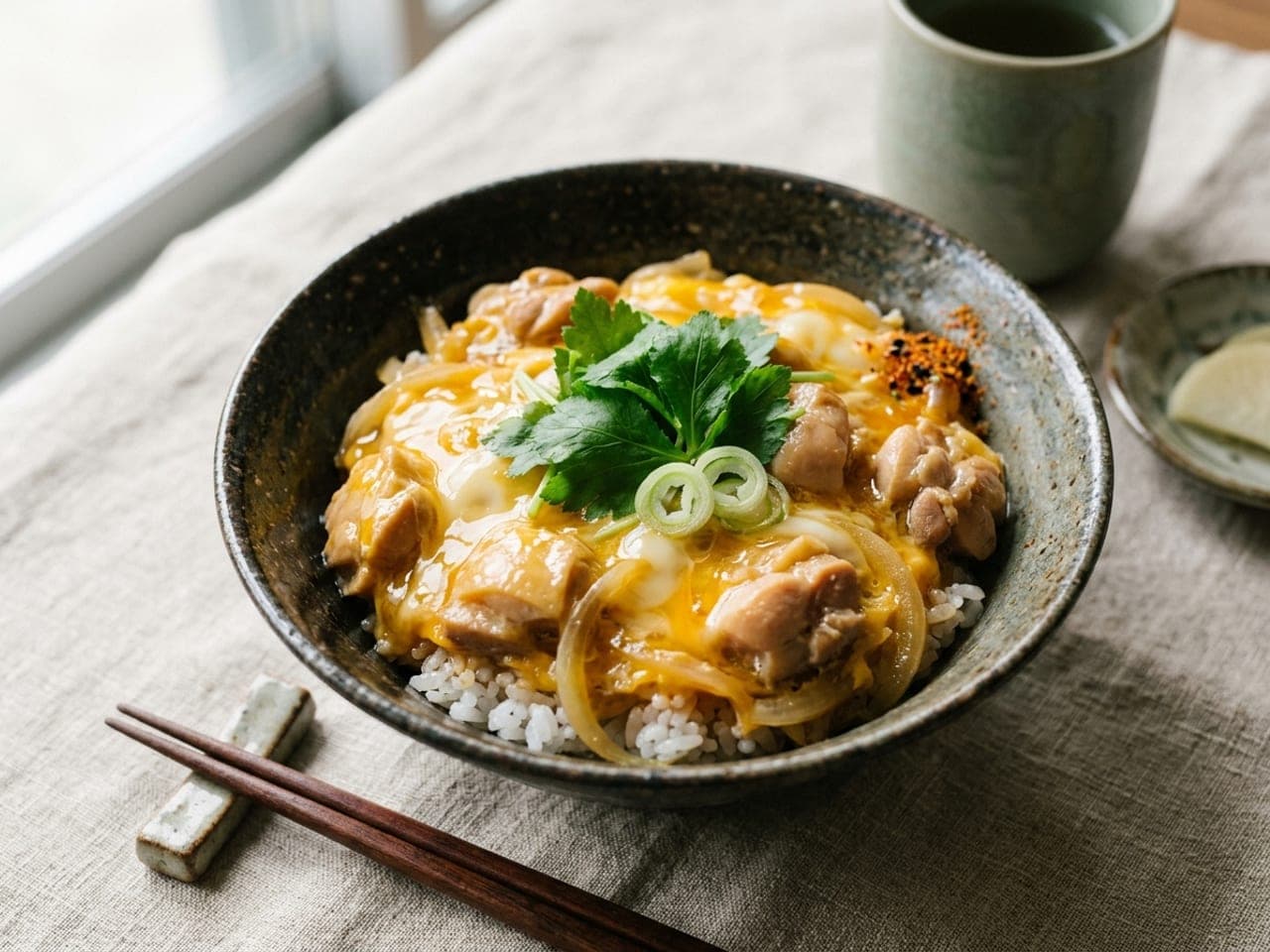
The parent-and-child bowl: chicken and egg simmered together in sweet dashi-soy broth and slid, barely set and glossy, over hot rice. Oyakodon is Japan's fifteen-minute dinner and its entire craft lives in one move — the egg goes in twice, and the pan comes off the heat while the second pour still shines. Get that right and a Tuesday bowl eats like a small ceremony.
Ingredients
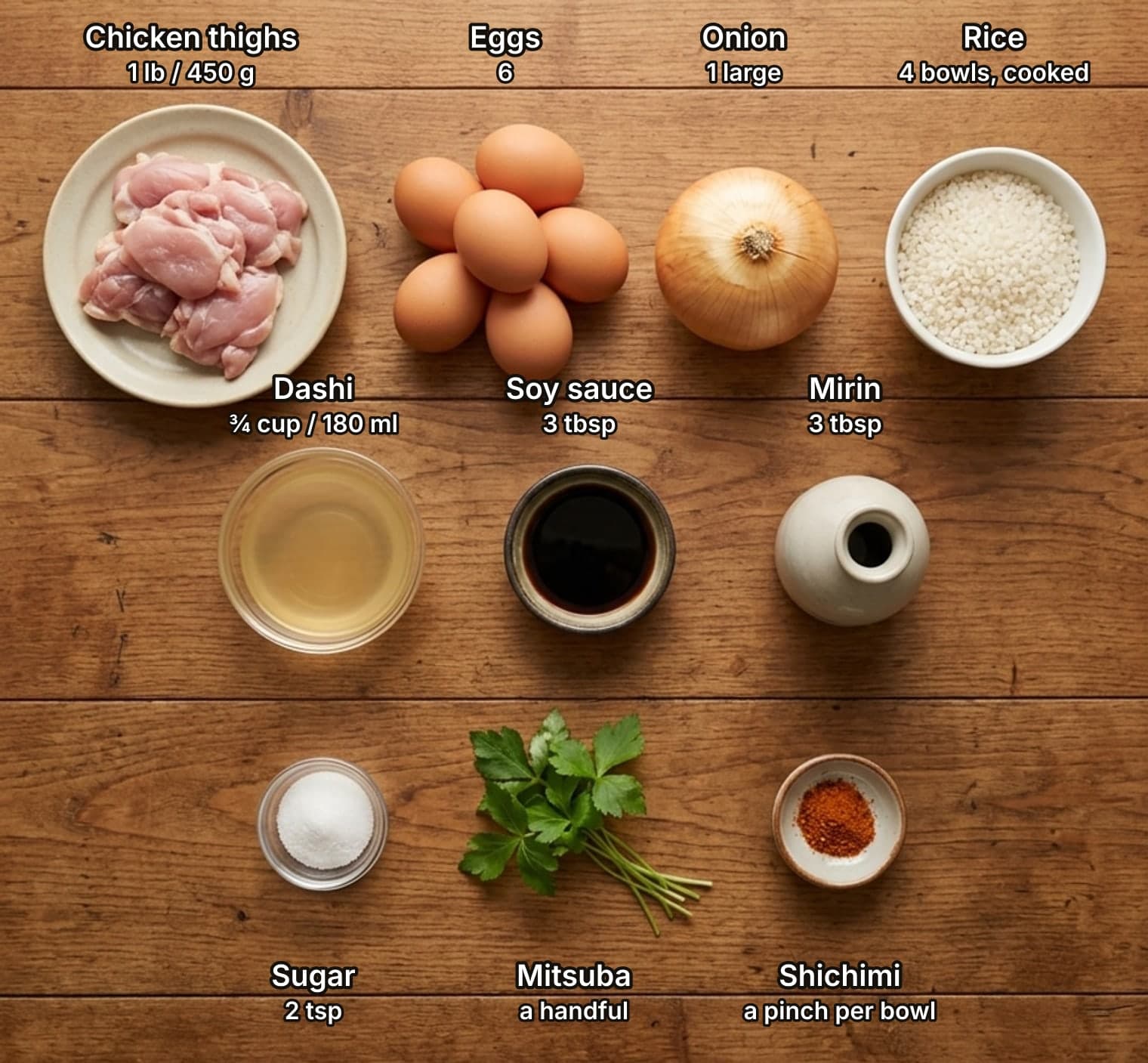
- boneless chicken thighs, bite-size pieces1 lb / 450 g
- onion, in thin half-moons1 large
- eggs, lazily beaten6
- dashi (or water + ¾ tsp hondashi granules)¾ cup / 180 ml
- soy sauce (warishita)3 tbsp
- mirin (warishita)3 tbsp
- sugar (warishita)2 tsp
- cooked short-grain rice, hot, to serve4 bowls
- mitsuba (or scallions), to topa small handful
- shichimi tōgarashi, at the rima pinch per bowl
The name, the bowl, and the family it heads
Oyakodon — 親子丼 — translates as "parent-and-child bowl": the chicken is the parent, the egg is the child, and Japanese cuisine names this without flinching, which tells you something true and useful about its relationship with ingredients. The dish is credited to Tamahide, a Tokyo chicken restaurant operating since 1760, whose proprietress formalised the chicken-and-egg simmer over rice in 1891; the restaurant still serves it, and the queue still forms. It is weeknight infrastructure in Japan — the dish a student learns first and a parent cooks forever.
The -don suffix is donburi — the deep rice bowl and the whole genre named after it, in which something saucy is simmered and laid over rice so the broth seasons the grains from above. Learn oyakodon and you hold the master key: gyudon swaps in beef and more onion, tanindon ("stranger bowl" — the same joke, darker) uses beef or pork with the egg, and katsudon lays yesterday's breaded cutlet into the same warishita and egg — the single best thing that can happen to a leftover katsu, and the reason our chicken katsu page and this one point at each other.
What oyakodon is not: fried rice, teriyaki over rice, or a scramble. No wok, no glaze, no stirring — the identity of the dish is a simmered custard raft, and everything in the method exists to protect it.
How to make Oyakodon
- Mix the warishita — the bowl's whole seasoning. Stir together ¾ cup (180 ml) dashi, 3 tbsp soy sauce, 3 tbsp mirin and 2 tsp sugar. This sweet-savoury simmering base — warishita — is the entire flavour architecture of the bowl, and the ratio (roughly 4 parts dashi to 1 each of soy and mirin, sugar to taste) is worth committing to memory because it also cooks katsudon, gyudon and half the donburi family. Dashi from scratch if the morning allows; water plus ¾ tsp hondashi granules is what most of Japan actually does on a weeknight, and this page has no lectures about it.
- Simmer the onion soft first. Slice 1 large onion into thin half-moons and simmer it in the warishita in a medium skillet or saucepan — 8–10 inches (20–26 cm), with a lid — over medium heat for 3–4 minutes until translucent and sweet. The onion goes first because it needs the head start: it should be fully tender before the chicken arrives, since once the egg goes in there is no more simmering time to fix a crunchy allium. This is also when the broth starts tasting like the finished dish — steal a spoonful.
- Poach the chicken through — before any egg. Add 1 lb (450 g) of boneless chicken thighs cut into bite-size pieces, spread in one layer, and simmer gently 5–7 minutes, turning once, until cooked through — 165°F (74°C) on a probe, and this is the moment to verify, because the egg stage ahead is deliberately brief and can rescue nothing. Skim any scum. The broth will have reduced slightly and taken on the chicken; that concentration is the plan, not a problem.
- Beat the eggs lazily — streaks are structure. Crack 6 eggs into a bowl and beat them with chopsticks or a fork exactly six or seven strokes — until the whites and yolks are broken and swirled but visibly NOT uniform. This is the counterintuitive heart of oyakodon: a lazily mixed egg sets into layers — firm ribbons of white, custardy pools of yolk — where a thoroughly beaten egg can only become one flat omelette. Fight the whisking instinct; the streaks you can see in the bowl are the texture you will eat in the bowl.
- First pour: two-thirds, around the edges, lid on. With the broth at a lively simmer, pour about two-thirds of the egg in a spiral over the chicken and onion, starting at the edges and finishing in the middle, without stirring — ever, at any point; stirring is how oyakodon becomes egg-drop soup. Lid on, 60–90 seconds, until the first pour is mostly set but still trembling. The simmering broth cooks the egg from below while the lid steams it from above; your job is only to not interfere.
- Second pour: the shine that finishes off the heat. Pour the remaining third of the egg over the set first layer, kill the heat, lid back on, and count 30–45 seconds: the second pour should reach barely-set — glossy, trembling, custard-wet on top — cooked by residual heat alone. This two-stage timing is the whole dish: layer one is structure, layer two is sauce. (Runny-style is traditional and the safety note covers who should take it fully set instead — for the set version, just give it another 60–90 seconds of lid.)
- Slide — do not spoon — onto the rice. Fill bowls with hot short-grain rice, then slide the chicken-egg raft out of the pan over each serving in one motion, so it lands as an unbroken layer with the broth soaking down into the rice below. If you cooked one big pan for four (see the FAQ — Japan does this per-portion in a tiny dedicated pan), quarter the raft gently with the spatula first and slide each quarter. Spooning it out in lumps breaks the custard you just protected for two steps; the slide is the plating.
- Mitsuba, shichimi, and eat it now. Top with mitsuba leaves (or scallion rings — the FAQ covers the swap), a pinch of shichimi at the rim for whoever wants warmth, and serve immediately: oyakodon has a three-minute prime while the egg sits exactly between set and sauce and the rice drinks the broth. This is not a dish that waits, holds, or reheats into anything worth defending — the fifteen-minute cook time is matched by a fifteen-minute eating window, and both are part of its charm.
Safety & hygiene Important
- The runny-egg question, answered honestly. Traditional oyakodon finishes the second pour barely set — glossy and custard-wet — which means lightly cooked egg. In Japan, eggs are produced and graded for raw eating; in the US and most of Europe they are not held to that standard, so the honest guidance is: use pasteurized eggs if you want the full trembling finish, or give the second pour the extra 60–90 seconds to fully set — the bowl remains excellent. Pregnant, very young, elderly or immunocompromised eaters take it fully set without debate (UK readers: British Lion-stamped eggs are officially cleared for runny even in pregnancy — a clearance that does NOT extend to the severely immunocompromised). One bowl, two valid endings; pick by who is eating.
- The chicken clock ran BEFORE the egg went in. The egg stages are 90 seconds and 45 seconds of mostly lid — they cook egg, not chicken. Doneness lives entirely in the poaching step: 165°F (74°C) on a probe in the thickest piece before the first pour, because afterwards there is no honest way to fix underdone chicken without destroying the custard on top of it. Bite-size pieces in simmering broth get there in 5–7 minutes reliably, but reliably is not the same as verified — the probe takes four seconds and the glossy finish is not worth a gamble underneath.
- This bowl has no second act. Oyakodon is eaten on completion — the barely-set egg is exactly the texture food safety asks you not to hold warm, park on the counter, or box for tomorrow. Assembled leftovers are a genuine don't: the egg sits in the danger zone the moment the bowl stops steaming, so cook the portion you will eat now. If life interrupts, the components separate honestly — broth-simmered chicken and onion refrigerate fine for 2 days (cool within two hours, reheat to a full simmer) and fresh eggs finish a new bowl in two minutes. The rice follows the household rice rule: cooled fast, fridged within the hour, one day, reheated steaming.
- Small pan, live broth, tilted slide. The finishing slide tips a pan of hot broth and soft egg toward a bowl and your hand — do it low, close, and over the counter rather than in the air, with the bowl braced. A small pan is genuinely safer here as well as more traditional: less mass, shorter tilt, one portion of momentum. Simmering warishita spits less than a thick sauce but the sugar in it holds heat — the mirin-soy scent will tempt small helpers toward the stove exactly when the pan is at its most tippable, so this is a good dish to plate at the hob, away from the table edge.
3 ways to plate it
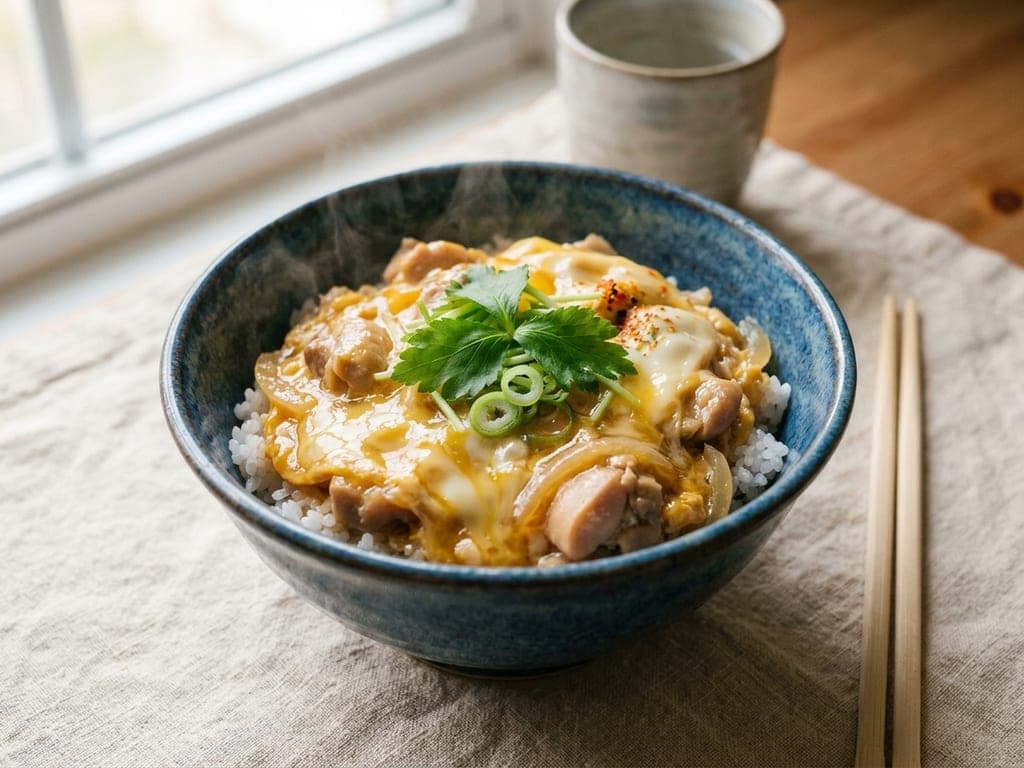
- Slide, don't spoon: tilt the pan low over the bowl and let the raft land as one layer — the unbroken surface with its set-and-glossy patches IS the presentation.
- Let a little broth follow the raft down the bowl's side so the visible rice at the rim turns glossy — the shine at the boundary is what reads as appetising from above.
- Place the mitsuba (or scallion) in one deliberate cluster at the centre, not scattered — a single green island on the gold, same one-accent logic as fukujinzuke on curry.
- Shichimi in a pinch at the RIM, not over the egg — it keeps the custard photogenic and lets each eater decide their own heat.
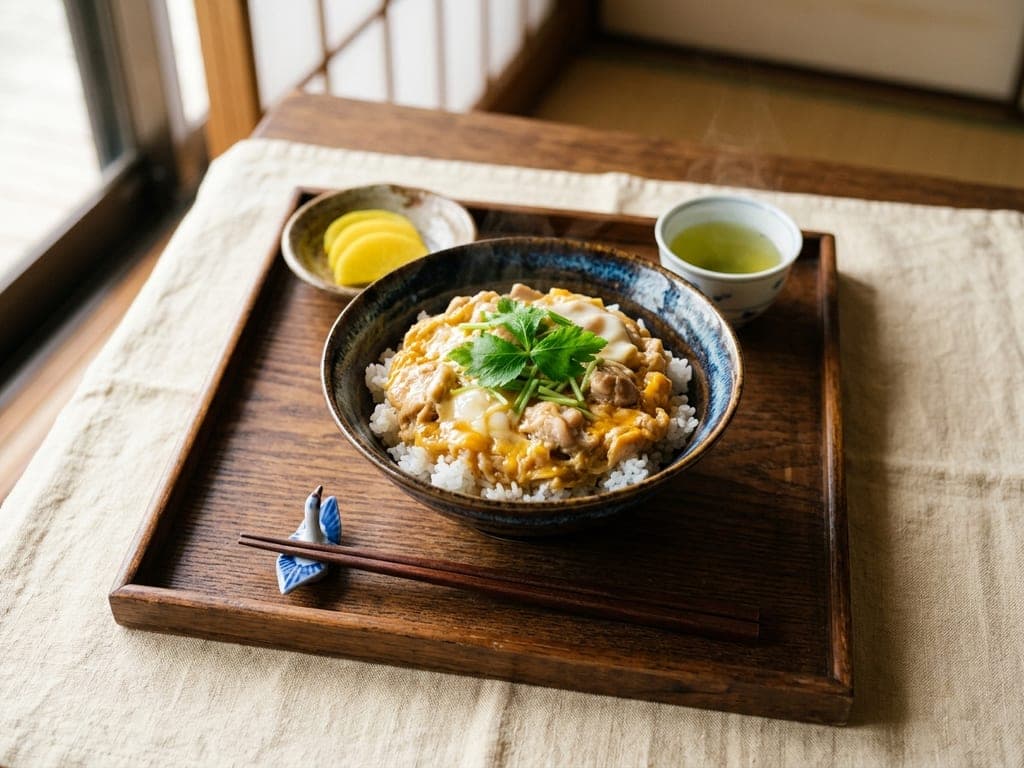
- Centre the donburi and keep everything else small: a two-slice dish of yellow takuan pickles, a small cup of tea — the tray reads as a composition because nothing on it competes.
- Chopsticks go horizontal at the tray's front edge on a rest, tips left — the traditional placement, and the detail that makes the whole tray look intentional.
- Odd numbers and asymmetry: bowl centre-left, pickles upper-right, tea lower-right — the empty wood is part of the design, exactly as on a plate.
- If you own one beautiful tray, this is its dish; if you own none, a large wooden cutting board does the same framing job and nobody checks the paperwork.
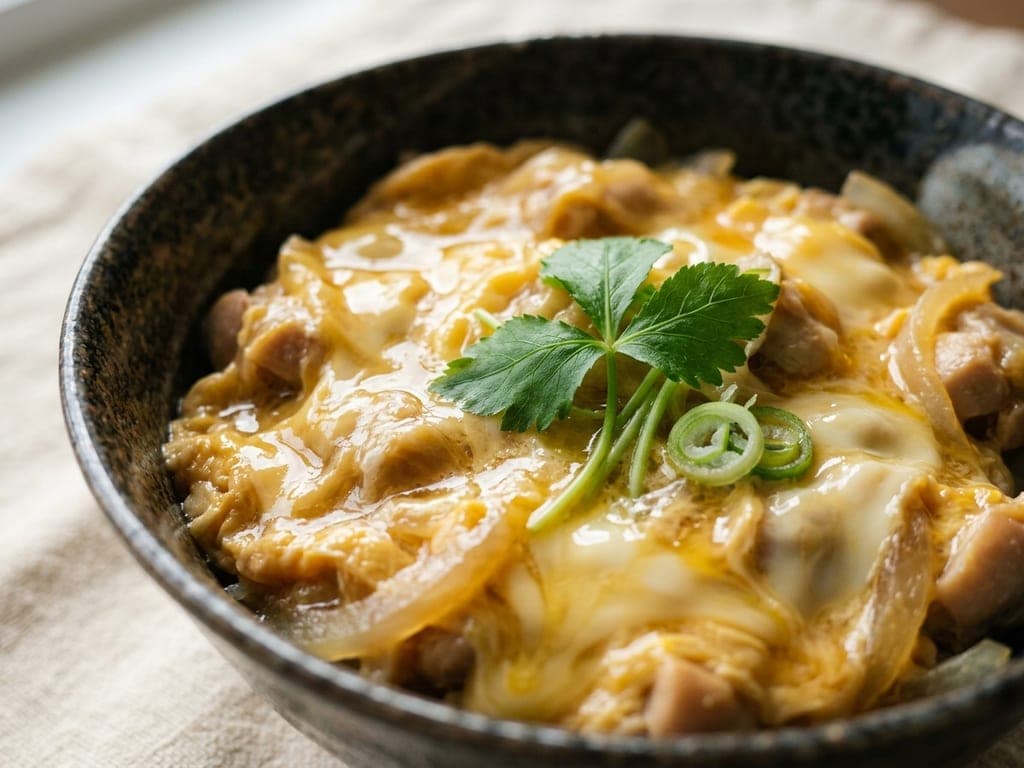
- Choose a wide, shallow bowl and under-fill the rice so the egg layer sits near the rim — proximity to the edge is what lets the surface texture dominate the view.
- Kill the heat a beat earlier than usual for this version: the close-up rewards maximum gloss, and the extra tremble that would vanish in a deep bowl is the subject here.
- One perfect mitsuba sprig, placed with fingers, slightly off-centre — a macro composition wants a single point of focus, not a garnish handful.
- Serve within the minute: the surface dulls as it sets, and this plating's entire argument is catching the custard at its shortest-lived, best-looking moment.
The egg technique is the entire dish
Every decision routes through one goal: egg that lands as layered custard, not omelette and not soup. The lazy beat leaves whites and yolks in visible streaks that set at different rates into ribbons and pools. The two pours split the egg's job in half — the first pour, with lid, builds a set foundation; the second pour rides on top and is finished by residual heat alone, so it stops exactly at glossy. And the no-stirring rule is absolute, because any stir after the first pour tears the structure into flakes and hands you soup with commitments.
Heat discipline makes the timing honest: a lively simmer (not a boil, which toughens the bottom layer before the top sets; not a murmur, which lets egg seep and disperse), a lid that actually fits, and the confidence to kill the heat while the pan still looks slightly underdone — carryover finishes the last ten percent in the walk from hob to bowl. If your first attempt comes out fully set, it was still dinner; note which stage ran long and shorten it next Tuesday. The dish is fifteen minutes precisely so you can practice it weekly.
The professional tool, for the curious: an oyako nabe — a shallow 6-inch (15 cm) one-portion pan with a vertical handle, built so the raft slides out in one clean sheet. Charming, cheap at Japanese kitchen shops, entirely optional: a small nonstick skillet reproduces it, and the four-serving skillet compromise in the FAQ is this page's honest default.
Warishita, and the dashi honesty clause
Warishita — the sweetened dashi-soy simmering base — is a ratio, not a recipe: about 4 parts dashi, 1 part soy sauce, 1 part mirin, sugar to conscience. Once memorised it cooks half the donburi family plus sukiyaki's cousin flavours, and adjusting it is legitimate regional politics (Kanto runs sweeter and darker, Kansai lighter; households litigate the sugar). The broth should taste slightly too assertive on a spoon — it is about to season plain rice and mild egg, and it carries the whole bowl.
The dashi clause, consistent with this catalog's other confessions (curry roux blocks, batter hondashi): granulated dashi — hondashi — dissolved in water is what the overwhelming majority of Japanese home kitchens use for a Tuesday oyakodon, and it produces a genuinely correct bowl. From-scratch dashi (kombu steeped warm, katsuobushi off the heat, ten minutes total) is a real upgrade you will taste in a dish this spare — make it when the bowl is the point rather than the vehicle. Both are Japanese home cooking; neither needs defending.
Mirin matters more than it looks: it brings sweetness with acidity and gloss, and the common substitution (extra sugar plus a splash of sake, 1 tbsp sugar + 2 tbsp sake per 3 tbsp mirin) is workable but flatter. If buying one new bottle for this page, buy hon-mirin; it keeps forever and upgrades every soy-sweet sauce in the catalog, teriyaki included.
Shopping, swaps, and the leftover-katsu move
The list is a corner-shop errand: chicken thighs (breast survives here better than in most dishes thanks to the poach, but thigh's fat feeds the broth), one onion, eggs worth caring about — this is an egg showcase; buy the good box, pasteurized if you want the traditional finish — short-grain rice, soy, mirin, dashi in whichever honesty tier the evening allows. Mitsuba, the trefoil herb traditionally laid on top, is an Asian-grocer item with no perfect substitute: scallion rings are the standard swap, flat-leaf parsley the emergency one (a different herb entirely, but the grassy-fresh job gets done). Shichimi on the rim finishes it.
The one deliberate cross-sell, because it is genuinely the best version of this technique: katsudon. Take yesterday's chicken katsu — refrigerated, even slightly softened; the simmer forgives everything — slice it, lay it into the simmering warishita with the onion, and run the same two-pour egg over it. The crust drinks the sweet broth at its edges while staying crisp at its peaks, and the result outranks both parent dishes. Fry katsu on Sunday, eat katsudon on Monday: this is the intended life cycle, and both pages endorse it.
Allergy fine print for the bowl as written: egg (structurally), soy and wheat in the soy sauce (tamari for gluten-free — everything else already is), fish in the dashi (kombu-only dashi makes it fish-free honestly), sesame in the shichimi at the rim, and mirin is alcohol-derived — the simmer drives off most but not all of it, worth knowing for strict households.
Questions, answered
Is the runny egg in oyakodon safe?
It depends on your eggs, and honesty beats tradition here. Japan grades eggs for raw consumption; the US and most of the EU do not, so for the traditional barely-set finish use pasteurized eggs — or simply cook the second pour the extra 60–90 seconds to fully set, which costs the bowl gloss but nothing structural. UK British Lion eggs are officially cleared for runny, pregnancy included — but that clearance does not extend to the severely immunocompromised. Pregnant eaters elsewhere, the very young, elderly or immunocompromised take it fully set, full stop. The recipe works identically either way; only the final minute changes.
Can I make katsudon from leftover katsu?
You are supposed to — katsudon is the official afterlife of the cutlet and arguably outranks fresh katsu. The method is this page with one substitution: skip the chicken poach, simmer the onion in the warishita, lay in yesterday's katsu sliced into strips (straight from the fridge; the simmer revives it), 60 seconds to warm and drink broth at the edges, then the same two-pour egg over the top. Our chicken katsu page handles the cutlet; this page handles its best Monday.
Chicken thigh or breast for oyakodon?
Thigh is the default — its fat rounds out the broth and it stays tender through the poach — but oyakodon is the rare Japanese chicken dish where breast genuinely works: the gentle simmer in seasoned dashi is exactly the treatment lean meat wants. Cut breast slightly larger, pull it at 165°F (74°C) without overshooting, and expect a cleaner, lighter bowl. Either way the probe, not the clock, ends the poaching step.
What if I don't have dashi?
Hondashi granules in water (¾ tsp per ¾ cup / 180 ml) are the standard Japanese weeknight answer and entirely legitimate — this page's ratio assumes either. No hondashi anywhere: low-sodium chicken stock cut half-and-half with water works as a different-but-decent broth (full-strength stock bullies the egg), and a kombu-only steep makes the fish-free version. What does not work is plain water — warishita without umami is just sweet soy, and the bowl tastes hollow in a way more soy cannot fix.
What can I use instead of mirin?
Per 3 tbsp mirin: 2 tbsp sake plus 1 tbsp sugar is the standard swap; dry sherry plus sugar runs a close second; rice vinegar is NOT it (acidity without sweetness inverts the job). If you are buying one bottle, real hon-mirin keeps indefinitely and upgrades teriyaki, katsudon and every soy-sweet glaze on this site — it is the highest-leverage bottle in the Japanese pantry after soy sauce itself.
Why did my egg turn into scrambled soup?
One of three interferences: you stirred (the cardinal sin — after the first pour, the spatula's work is done), the broth was at a rolling boil (violent bubbles tear the setting egg apart — lively simmer only), or the eggs were beaten smooth (uniform egg can only set as one thin sheet, which then shreds). The fix costs nothing: lazy six-stroke beat, simmer not boil, pour in a spiral, lid on, hands off. Oyakodon is less a recipe than a self-control exercise with dinner attached.
What is mitsuba and what can replace it?
Japanese wild parsley (trefoil) — a tender three-leafed herb with a flavour between parsley, celery leaf and chervil, laid fresh on the finished bowl. Asian grocers stock it; nothing replicates it exactly. Scallion rings are the universal Japanese substitute, celery leaves get surprisingly close in spirit, flat-leaf parsley is the Western emergency. The bowl needs SOME fresh green against the sweet broth — which one is negotiable, none is not.
Can I cook oyakodon for four in one pan?
Yes, with managed expectations: Japan cooks it per-portion in a small pan precisely because a one-serving raft slides out intact. The four-serving skillet version — this recipe as written — simmers everything in a 10-inch (26 cm) pan and quarters the raft before sliding; you trade the pristine single sheet for one pan and one timeline, and the trade is worth it on a weeknight. For the full ritual, cook two half-batches back to back in a small skillet: the second one takes six minutes because the warishita is already hot.
What other donburi can I make with this method?
The warishita-plus-egg template is the donburi master key: katsudon (leftover breaded cutlet — see above), gyudon (thin-sliced beef and extra onion, usually no egg or an optional raw-style yolk), tanindon (beef or pork with the egg — "stranger bowl," because the animals aren't related; Japanese food humour is like this), tamagodon (egg alone, the broke-student classic that slaps far above its cost). Same base, same two-pour finish where egg is involved, same bowl of rice underneath doing the quiet work.
What rice should be under oyakodon?
Hot, plain, short-grain — the sticky Japanese type sold as sushi rice, cooked without seasoning (our sushi rice page covers the method; skip the vinegar). The grains need cling so the soaking broth makes them glossy rather than soupy, and the bowl should be filled just before the slide so the rice is steaming when the broth arrives. Long-grain sheds the broth to the bowl's bottom — edible, but the last third becomes a spoon-race through sweet soup.
Snap your finished plate and let the AI plate it again — more beautifully.