Yakitori Recipe (Japanese Grilled Chicken Skewers — the Tare Is the Secret)
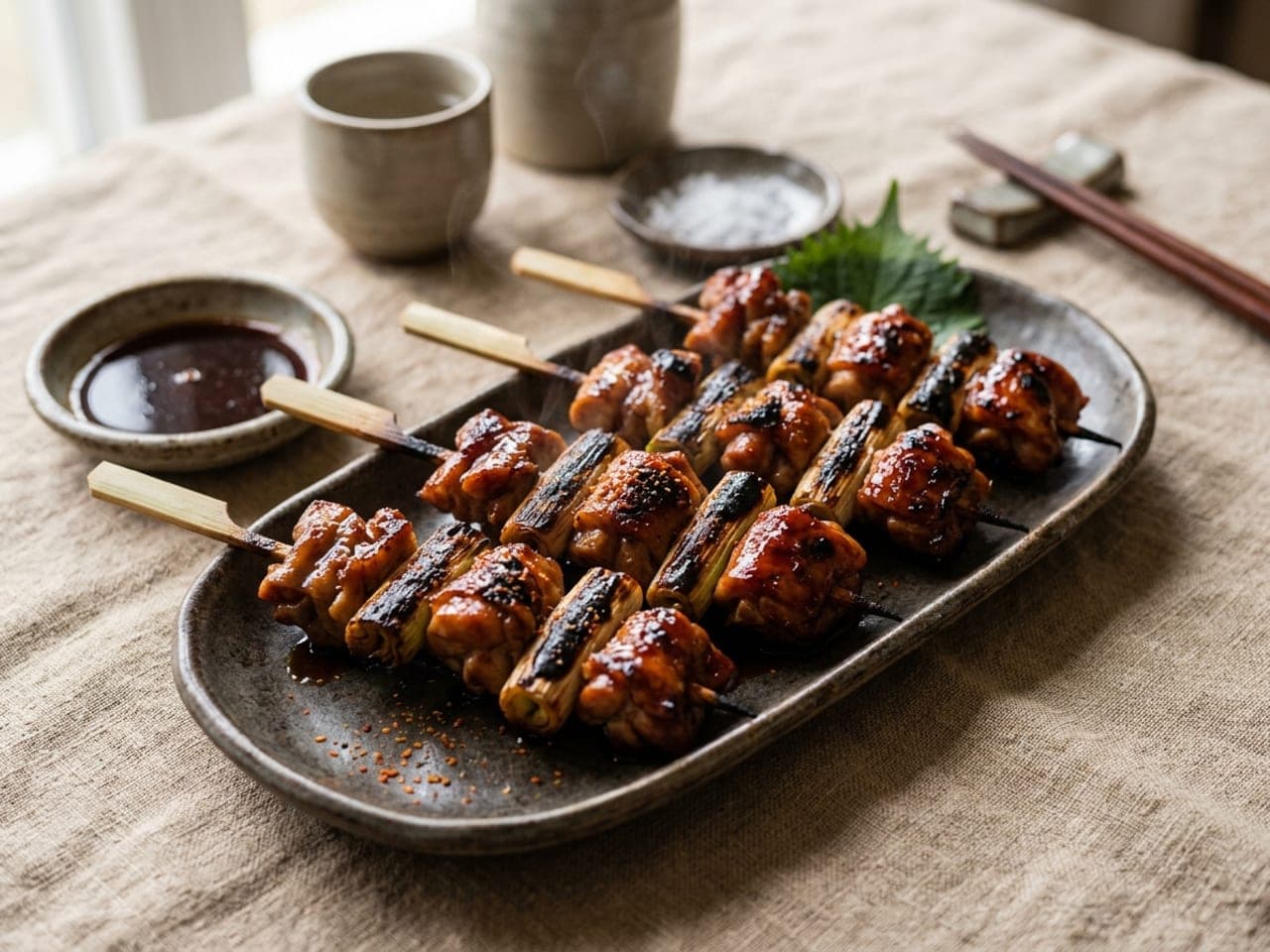
Japan's izakaya skewer: chicken thigh and scallion grilled in repeating pairs, painted in thin late coats of a soy-mirin glaze that caramelizes to a lacquered mahogany shine. The tare is the whole secret — four pantry bottles reduced once, kept for a month and improving — and the dish needs charcoal far less than it needs patience with the glaze.
Ingredients
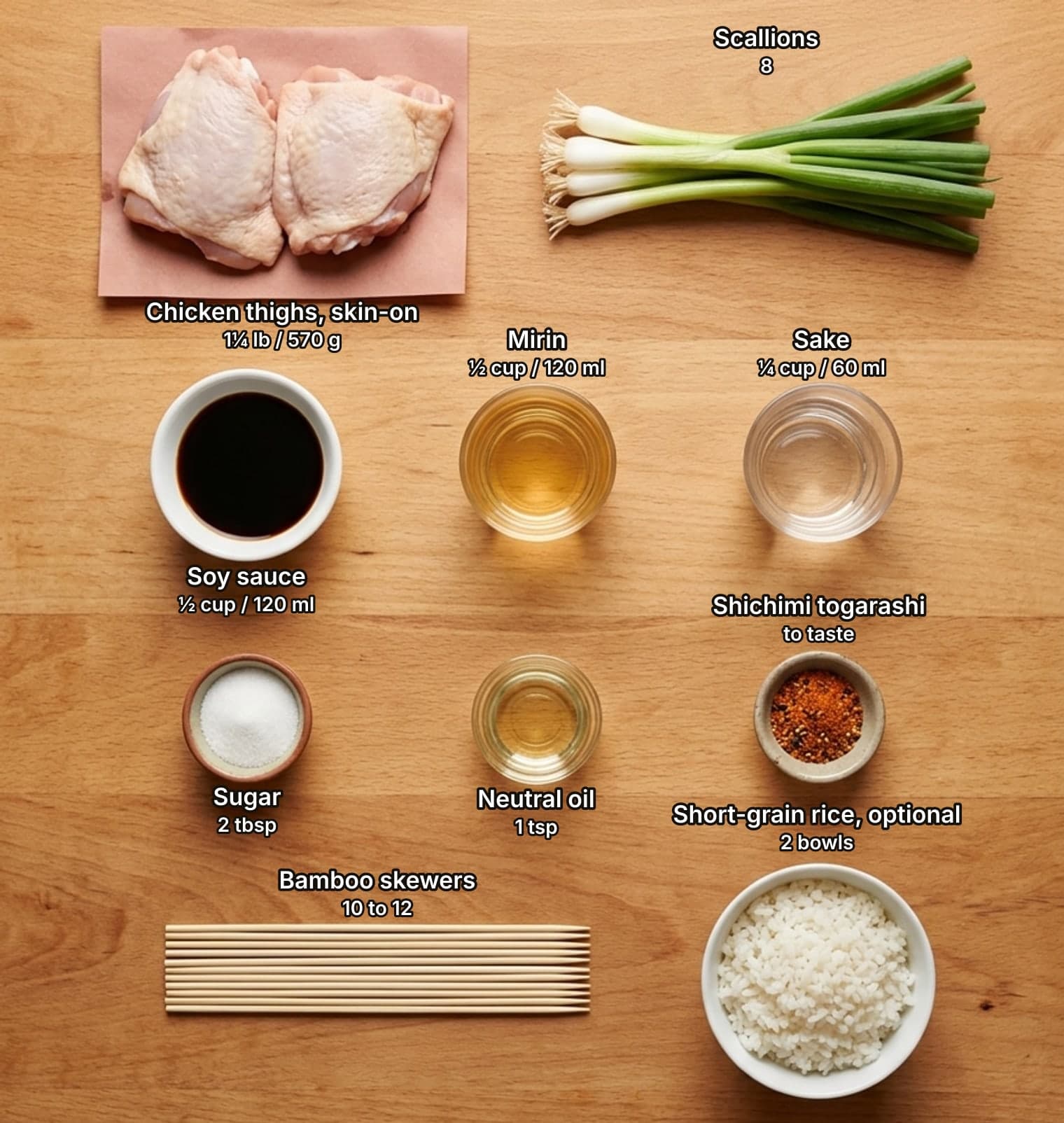
- boneless chicken thighs, skin-on if possible, in 1¼-inch (3 cm) pieces1¼ lb / 570 g
- scallions (spring onions), whites and light greens in 1-inch (2.5 cm) batons, dark tops saved for the tare8
- soy sauce (Japanese dark / koikuchi)½ cup / 120 ml
- mirin (hon mirin if you can find it)½ cup / 120 ml
- sake (drinking-grade, not salted cooking sake)¼ cup / 60 ml
- sugar2 tbsp
- coarse salt½ tsp
- neutral oil, for the rack1 tsp
- shichimi togarashi or sansho pepper, to serveto taste
- bamboo skewers, soaked 30 minutes10–12
- steamed short-grain rice, to serve (optional)2 bowls
What yakitori is (and the culture it comes from)
Yakitori — 焼き鳥, literally 'grilled bird' — is Japan's great after-work food: small skewers of chicken grilled over charcoal, seasoned one of exactly two ways, eaten standing at a smoky stall or crowded into an izakaya with something cold. The form is older than its fame — Edo-period vendors grilled skewered birds, and for much of Japan's history chicken was a luxury — but yakitori as everyone knows it is a postwar story: when cheap broiler chicken arrived in the 1950s and 60s, yatai stalls put affordable chicken over charcoal for the commuting salaryman, and the red-lantern smoke of a yakitori alley became one of the defining smells of a Japanese evening.
The culture runs on specificity. A serious yakitori-ya butchers whole birds into dozens of named skewers — each cut its own order, its own texture, its own doneness — and a chef spends years learning to grill each one correctly. Nobody expects that of a home kitchen, and this page doesn't pretend to: it teaches negima, the thigh-and-scallion skewer that is the single most-ordered stick in Japan and the one every home cook should own, plus the sauce that carries the whole genre. Master one skewer properly and the rest of the menu is variations.
One naming honesty before the shopping list: strictly, 'yakitori' is chicken, and the wider world of skewered things — pork belly, beef, vegetables — files under kushiyaki, 'grilled skewers'. In practice even Tokyo uses the words loosely, and your tare will happily glaze all of it. The point of the distinction here is simpler: this is a chicken technique page, and chicken thigh is where the technique lives.
How to make Yakitori
- Soak the skewers and pick your heat. Put 10–12 bamboo skewers in a tray of water and forget them for 30 minutes — dry bamboo under a broiler is kindling, and even soaked bamboo wants the foil shield coming in step 5. Decide the heat while they soak: the broiler (the overhead grill) is this recipe's default and genuinely the closest home translation of a yakitori grill; a heavy cast-iron grill pan is the stovetop route; a real charcoal kettle is the weekend upgrade — all three run the same timings, and the honest physics of each is in the charcoal section below. Whatever you choose, the skewers cook in one layer with room between them — a wire rack on a full sheet pan takes the whole dozen under most broilers; it's the grill pan that forces two batches.
- Reduce the tare — ten minutes now, months of payoff. In a small saucepan, combine ½ cup (120 ml) soy sauce, ½ cup (120 ml) mirin, ¼ cup (60 ml) sake and 2 tbsp sugar, and drop in the dark-green scallion tops you'll trim in the next step. Bring it to a lively simmer and let it reduce by about a third, 10–12 minutes, until it just coats the back of a spoon — it thickens noticeably as it cools, so pull it at lightly-syrupy rather than waiting for true syrup. Fish out the scallion tops and — the step this page insists on — split the tare into two jars before any chicken appears: a basting jar for the brush and a table jar that will never meet raw meat. Real yakitori-ya keep a mother tare going for years, topped up and never emptied; yours can live the same way if the basting jar gets a one-minute boil after each session (the safety notes explain why).
- Cut the chicken and the negi like a yakitori-ya. Cut 1¼ lb (570 g) of boneless chicken thighs — skin on if you can get it; see the skewer-canon section for the honest word on Western supermarket thighs — into pieces about 1¼ inches (3 cm) square, aiming for same-size rather than pretty. Cut the white and light-green parts of 8 scallions (spring onions) into batons about 1 inch (2.5 cm) long; the dark tops are already in the tare pot. Uniformity matters more here than anywhere on this site: a skewer is a queue, it cannot be stirred, and the fattest piece sets the timing for everyone behind it.
- Skewer the negima — snug, flat, repeating. Thread each soaked skewer with the classic negima rhythm: chicken, scallion, chicken, scallion, chicken — three pieces of thigh, two batons of negi, pushed together snugly so the pieces shield each other from drying, with the skin folded to face one direction where you have it. Keep the food in the top two-thirds of the skewer and leave the bottom third bare as a handle. Flatten each loaded skewer gently with your palm on the board — a flat profile is what lets both sides actually touch the heat — and pat everything dry with paper towels: surface water is the enemy of browning, and there is no glaze yet to hide behind.
- Set up the broiler and salt the skewers. Set an oven rack so the skewers will sit 3–4 inches (8–10 cm) below the broiler element and preheat the broiler (the overhead grill) on its highest setting for a full 5 minutes — a tepid broiler steams, a furious one grills. Arrange the skewers on an oiled wire rack over a foil-lined sheet pan, and lay a strip of folded foil under the bare bamboo handles so they stay out of the fight. Just before they go in, season the skewers lightly with ½ tsp of coarse salt — yes, even for the tare version: the salt seasons the chicken itself, the tare only ever seasons its surface.
- First pass: render and brown, completely naked. Broil the skewers plain — no tare anywhere near them yet — for 5–6 minutes on the first side, until the edges brown and the skin (where there is skin) starts to blister and render, then flip with tongs and give the second side 4–5 minutes. This naked stage is most of the actual cooking, and rushing it is the classic homemade-yakitori mistake: tare applied to raw chicken has to sit through the whole cook, and its sugar burns long before the meat is done. Cook almost through, glaze last — that is the yakitori-ya method in one sentence; the light pre-salt is this page's insurance policy for supermarket chicken.
- The glaze coats — three thin, never one thick. Now work in coats, like lacquer: brush both sides of every skewer with tare from the basting jar (or dip the whole skewer into it, the yatai move — the chicken is nearly cooked now, and the jar gets boiled afterwards regardless), return them to the broiler for 60–90 seconds until the glaze bubbles and catches at the edges, and repeat two or three times, flipping between passes so both faces take their turn under the element. Each coat is thin, dries almost matte, and the next one deepens it toward glossy mahogany with small charred freckles — that layered shine is the look no single heavy pour can produce. This is the stage that needs your eyes: reduced soy and sugar swing from caramelized to burnt in the time it takes to check a phone.
- Rest, check, sprinkle — and finish at the table. Rest the skewers 2 minutes on a clean plate, then check the fattest piece of the fattest skewer: opaque throughout, juices clear, and if an instant-read thermometer lives in your drawer, 165°F (74°C) settles it — glazed mahogany surfaces make eyeballing less reliable, not more. Finish with a pinch of shichimi togarashi or sansho pepper and a thread of tare from the table jar — the one no brush ever touched. Serve as skewers with cold drinks and something pickled, or slide the meat off over hot rice, drizzle, and call it a yakitori don; both plates are in the plating guide below. The basting jar gets its one-minute boil before it goes back in the fridge for next time.
Safety & hygiene Important
- Raw chicken rules, skewer edition. Everything the raw chicken touched — board, knife, hands, and every bamboo skewer you loaded — is on poultry rules until the heat finishes its work: hot soapy water for the tools, a real 20-second soap wash for the hands before they touch the tare jars, the salt, the oven door or the shichimi shaker. No rinsing the chicken, ever — it removes nothing and redecorates the sink in bacteria. Doneness is not a color: glazed meat browns on the outside long before the inside is safe, so check the fattest piece for opaque-throughout and clear juices, and remember USDA's one reliable test is a thermometer reading 165°F (74°C) in the thickest piece. Skewered pieces are small and get there fast — the check costs ten seconds and settles it.
- The tare double-dip problem, solved by arithmetic. Yakitori's signature move — dipping and brushing skewers into the same pot, coat after coat — is a cross-contamination machine if the pot is also headed for the table. The fix is the split in step 2: a basting jar the brush lives in, and a table jar no raw-adjacent thing ever visits. The basting jar has met a brush that touched not-yet-done chicken, so its contents end every session with a one-minute rolling boil in a small pan before returning to the fridge — that boil is what lets it live on as a keeper, the home version of the yakitori-ya mother tare, which survives decades on the same logic: constant heat cycles and skewers that only dip when nearly cooked. The brush itself gets hot soapy water or the dishwasher — the boil sterilizes the sauce, not the bristles. Boiled after every session and kept sealed and cold, a month is realistic; but a jar that basting trips have visibly thinned is diluted leftovers on the standard clock — use it within 3–4 days or re-reduce it — and if a jar ever smells sour or shows mold, it is not a mother, it is compost.
- Broilers, charcoal and a sugar glaze all bite. This recipe parks sugared soy inches under a maximum-heat element, and that demands deep-fry posture: never walk away — the glaze coats are 60–90 second visits for a reason — sleeves pushed up, and the foil-lined sheet in place to catch drips before they smoke. Bamboo is fuel: soak the skewers, shield the bare handles with foil, and if one ignites anyway, tongs to the sink, not a panic across the kitchen; a flare-up on the pan or sheet gets smothered — lid, baking sheet, or simply the oven door closed — never water. Charcoal is strictly an outdoor tool — never indoors, in a garage, vehicle, camper or tent, and no amount of opened windows makes an indoor charcoal fire safe, because burning charcoal makes carbon monoxide, which is invisible, odorless and entirely uninterested in how careful you feel; outdoors, keep it away from open windows and doors so the fumes don't drift in — and coals get extinguished fully, not left to smolder. The burn rule, same as every high-heat page on this site: cool a burn under cool running water for a full 20 minutes — no ice, no butter — rings off, and medical eyes on anything blistered, larger than the person's palm, on the face, hands or a joint, looking white or charred (deep burns can be painless), or on a child.
- Leftovers, the clock, and the alcohol question. Cooked skewers follow the standard clock: into the fridge within 2 hours of cooking (1 hour if the kitchen is above 90°F/32°C), eaten within 3 to 4 days per USDA's cooked-poultry rule, reheated once until properly steaming — 165°F (74°C) if you check — and a skillet or hot oven brings the glaze back better than a microwave, which turns it to syrup. Slide leftover meat off the bamboo before storing; the skewers themselves are single-use and go in the bin, not the dishwasher. On the alcohol: the tare simmers and then cooks again on the skewers, which drives off much of the mirin and sake's alcohol but — despite kitchen folklore — not all of it; a small but real fraction survives any realistic reduction. For a strictly alcohol-free version, build the tare from an alcohol-free mirin-style seasoning and swap the sake for water plus an extra pinch of sugar — the FAQ has the details.
3 ways to plate it
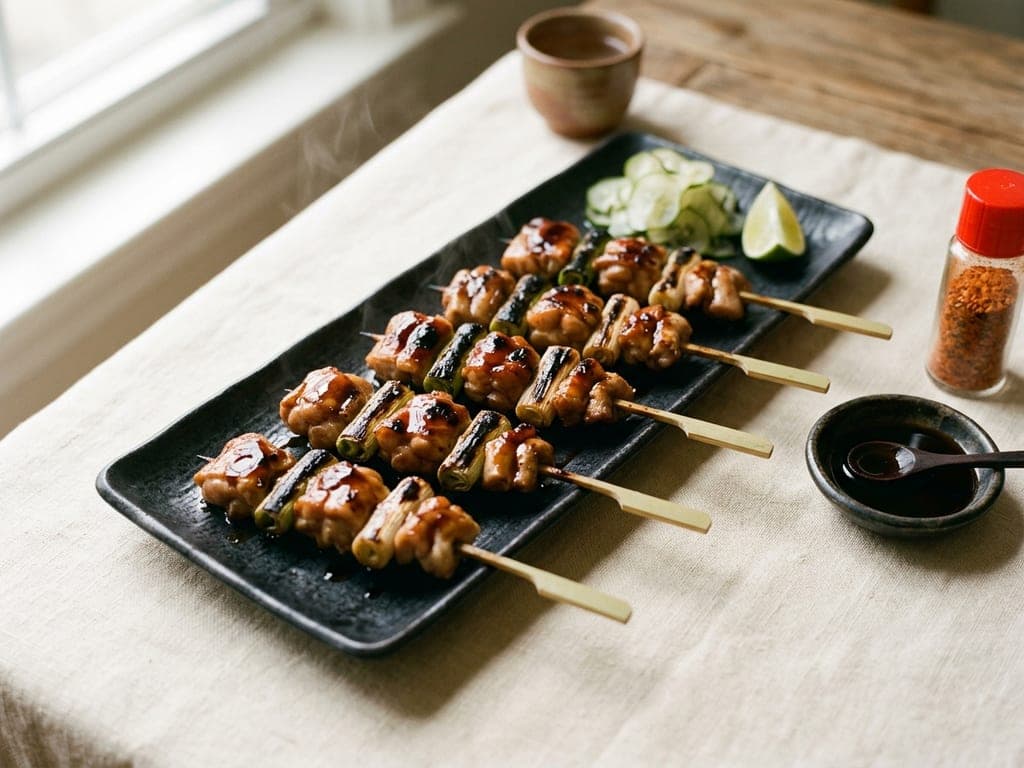
- Lay the skewers parallel with all the handles facing the diner — the stall convention that reads instantly as yakitori and makes them effortless to pick up one-handed.
- Choose a long, narrow plate (a rectangular one if you own it): skewers on a round dinner plate drift into a campfire pile, and the lineup is the look.
- Drizzle a thread of tare from the table jar down the line just before serving, and put the shichimi togarashi shaker ON the table, not on the food — heat is a personal setting here.
- Add one pile of something sharp at the plate's end — quick-pickled cucumber or a wedge of lemon for the salt-grilled skewers — and resist any further garnish; the glaze is the decoration.
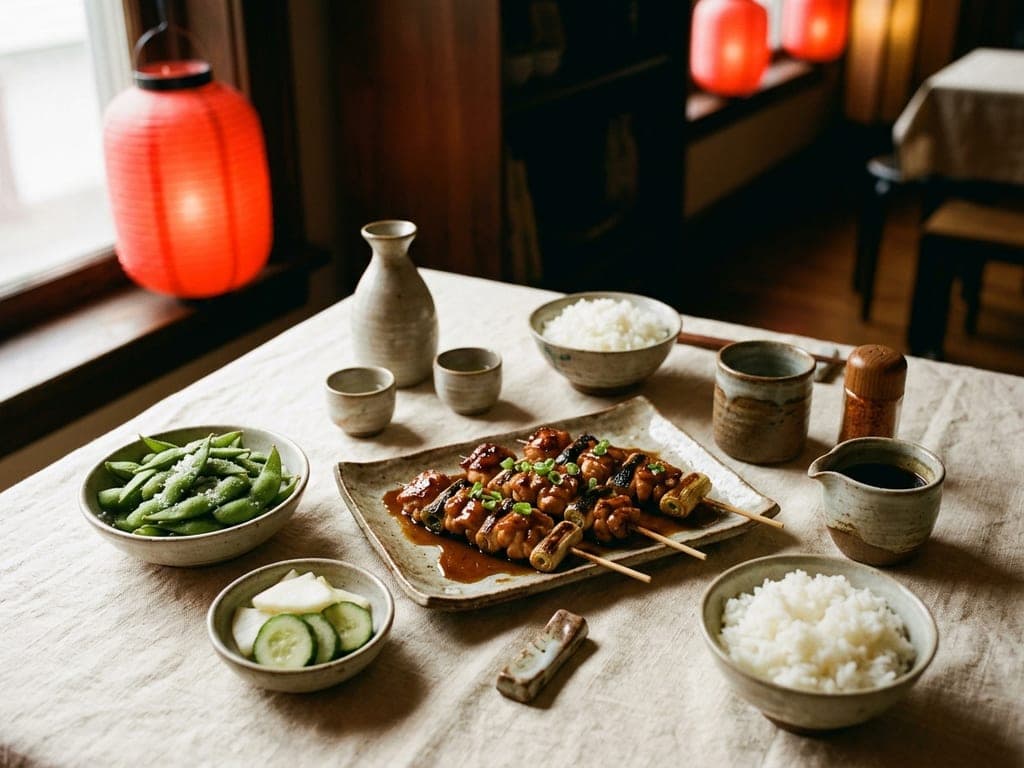
- Keep the yakitori plate central and let the sides orbit in genuinely small bowls — edamame in one, cucumber pickles in another, rice in its own bowl per person; mismatched ceramics look more izakaya than a matched set ever will.
- Put the two jars on the table as objects: the table tare in a tiny pitcher or dish with a spoon, the shichimi in its shaker — the diner finishing their own skewer is half the fun of the format.
- Pour drinks into small cups — sake in a ceramic flask and cups if that's the mood, cold tea or lager in small glasses if not; the miniature scale is what makes the table feel like an occasion.
- Light it warm and low: yakitori's palette is mahogany, char and green — under cool bright light it reads brown, under warm light it reads like the red-lantern stall it comes from.
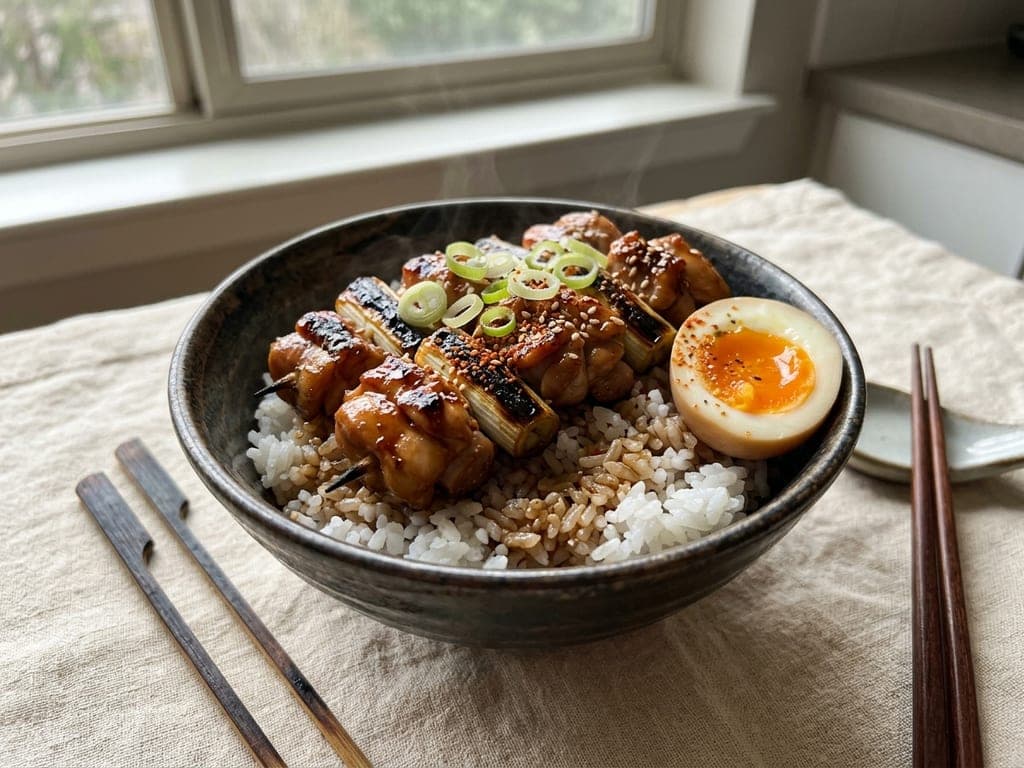
- Mound hot short-grain rice in a deep bowl and slide the chicken and scallion pieces off their skewers straight onto it, keeping the glazed sides facing up.
- Drizzle a spoonful of table tare over meat AND rice — the point of a don is the seasoned rice under the toppings, so let some soak past the chicken.
- Finish with thin-sliced raw scallion greens and a pinch of shichimi; if there's a soft-boiled egg in the fridge, halve it onto the bowl and nobody will call it a shortcut.
- Serve with a spoon as well as chopsticks — tare-soaked rice at the bottom of the bowl is the best three bites of the dish, and the spoon admits it.
Tare, the mother sauce (and the shio school)
Every yakitori order starts with one question — tare or shio, glaze or salt — and the honest answer is that both are correct and they are for different things. Shio, plain good salt, is the connoisseur's order for cuts with something to say: crisp skin, rich thigh from a good bird — and, when the bird is good enough, the organ skewers, though plenty of chefs will hand you liver glazed in tare and be right. Tare — soy sauce, mirin, sake and sugar reduced to a light syrup — is the crowd's order and the beginner's friend: it flatters supermarket chicken, it caramelizes into that lacquered izakaya shine, and it is the reason yakitori smells the way it does. This page grills the chicken nearly through before the tare appears — the timing that IS the yakitori-ya method — and adds a light pre-salt as home insurance for supermarket chicken, where a yakitori-ya would trust the bird.
The tare itself is the best pantry investment in Japanese cooking. Four bottles, ten minutes of simmering, and you own roughly a cup of sauce that keeps for a month refrigerated and improves the second time you use it, because tradition is on your side: yakitori-ya famously maintain a single mother tare for years, even decades, topping it up rather than replacing it, each night's drippings deepening it. The home translation of that romance is the two-jar discipline from step 2 plus a one-minute boil after each session — the safety notes carry the reasoning — and a tare jar in the fridge quietly becomes the house glaze for salmon, tofu, tsukune and next month's yakitori.
Bottle fine print, because the labels genuinely matter: mirin means hon mirin ('true mirin', around 14% alcohol, real depth) where you can find it — the supermarket 'mirin-style seasoning' next to it is sweetener plus little or no alcohol, and it works here, just sweeter and shallower, so shave the sugar. Sake means something you could drink a glass of — an inexpensive junmai is perfect — not 'cooking sake' (ryōrishu), which carries added salt that a reduction concentrates; if salted cooking sake is all you have, use it and hold back about a tablespoon of the soy sauce. And the soy sauce is ordinary Japanese dark soy (koikuchi) — nothing fancy, since reduction concentrates whatever you pour.
Binchotan honesty: the heat translations
The mythical yakitori heat source is binchotan — white charcoal, kilned so hard it rings like metal — and its virtues are real: it burns steady and long with almost no flame, smoke or smell, throwing intense infrared heat that crisps chicken skin without perfuming it. Note what is NOT on that list: binchotan does not add smoke flavor — it is prized for being clean, not smoky. The flavor people call 'the charcoal taste' is mostly the tare and chicken fat vaporizing where drips hit the coals, plus honest char. That distinction is liberating for a home cook, because conditions — intense radiant heat, close range, fat escaping — can be rebuilt without importing Japanese charcoal.
Translation one, and this page's default: the broiler (the overhead grill). It is the appliance in your kitchen that most resembles a yakitori grill — fierce radiant heat at close range with the food open to the air, drips falling away onto the sheet below instead of pooling. Its weaknesses are a cooler bottom side (hence flipping) and a house that smells of dinner (hence the hood). Translation two: a heavy cast-iron grill pan, preheated past the point of caution, skewers pressed to the ridges — better sear, worse render, and the glaze coats want slightly gentler heat so the pan's stored ferocity doesn't torch them. Translation three, the real thing: a charcoal kettle with coals banked to one side, skewers grilling over the hot zone with the bare handles cantilevered over the cool zone — which is a home-scale imitation of the narrow trench grills yakitori-ya use precisely so that handles stay cool and no grate marks interrupt the skin.
Whatever the heat, the constants travel: cook the skewers almost through on salt alone, keep them moving between hot and less-hot zones instead of negotiating with flare-ups, and treat the tare as a finish, not a marinade. The dish rewards attention over equipment — a watched broiler beats an ignored kettle every single time.
The skewer canon and the fine print
Negima — the chicken-and-scallion alternation this page teaches — carries a good story in its name: the 'negi' is the scallion, but the 'ma' is usually traced to maguro, tuna, because the original Edo-era negima was a tuna-and-leek dish; when chicken grew cheap and tuna belly grew precious, the bird inherited the skewer and the name stayed. Beyond negima, the canon runs long and precise: momo (plain thigh), tsukune (chicken meatballs, glazed with the same tare and the single best use of your leftover jar), kawa (skin, grilled until it shatters), tebasaki (wings), sunagimo (gizzard), rebā (liver) — each a separate order at a real yakitori-ya, each a different answer to how much chicken you like your chicken.
The shopping honesty: proper negima wants boneless, SKIN-ON thigh, and Western supermarkets mostly sell thigh skinless. Three honest paths: ask the butcher counter (they usually have skin-on thighs whole and will bone them), buy skin-on and bone them yourself with five minutes and a small knife, or simply cook skinless — negima with skinless thigh is still excellent, it just trades the blistered-skin dimension for convenience. What not to do is default to breast: thigh's fat is the self-basting that lets a small piece survive fierce heat, and the breast version needs the babying the FAQ describes.
Fine print for the plate as served: soy sauce carries wheat and soy, so the standard tare is neither gluten-free nor soy-free — the GF conversion is tamari plus a checked-label mirin, details in the FAQ. The tare's mirin and sake leave trace alcohol on the finished skewer (see the safety notes for the alcohol-free build). Vegetarian is not a footnote here but a genuinely good dinner: thick scallion segments, shiitake caps, king oyster rounds and firm tofu all take the same salt-first-tare-last treatment — just build their tare bottle-only, with no chicken drippings in its history, and grill the tofu on a well-oiled rack because it sticks with enthusiasm.
Questions, answered
What does yakitori mean?
'Grilled bird' — yaki (grilled) plus tori (bird/chicken). Strictly it means chicken skewers, and the broader family of grilled skewers — pork, beef, vegetables — is kushiyaki ('skewer-grilled'), though everyday usage blurs the line even in Japan. On a menu, individual skewers are named by cut: negima (thigh and scallion — this page's recipe), momo (thigh), tsukune (meatball), kawa (skin), and onward into the parts of the bird most Western supermarkets never sell.
What is the difference between yakitori and teriyaki?
Same sauce family, different technique and different citizenship. Yakitori is a specific dish — small chicken skewers grilled over fierce heat, finished with thin coats of tare. Teriyaki is a glazing method — teri means luster — that in its Westernized form became a thicker, sweeter sauce poured over pan-cooked chicken. The bottles overlap almost completely (soy, mirin, sake, sugar), so your tare jar is one simmer away from a teriyaki glaze; our teriyaki chicken page is this recipe's stovetop cousin, and the honest weeknight shortcut when skewering feels like a project.
What is negima, and why scallions?
Negima is the alternating chicken-thigh-and-scallion skewer — the most ordered stick in Japan. The scallion isn't garnish: it steams and chars between the meat, sweetening as the chicken's fat bastes it, and each bite alternates rich and sharp. The name carries history — the 'ma' is generally traced to maguro (tuna), because Edo-era negima was a tuna-and-leek dish; chicken inherited the skewer when tuna became sushi royalty. In Japan the allium is usually naganegi, the thick Japanese long onion; fat scallions (spring onions) are the standard and correct substitute abroad, and a leek's tender core works in a pinch.
Can I make yakitori with chicken breast?
Yes, with eyes open: breast has none of the fat that lets thigh shrug off fierce heat, so it wants insurance. Cut it slightly larger (1½ in / 4 cm), pack the pieces tightly so they shield each other, pull the naked stage a minute early and lean harder on the glaze coats for moisture. Better yet, split the difference: one batch of thigh negima, one of breast, same tare — and see which plate empties first. (It will be the thigh.)
How do I make yakitori without a grill?
The broiler (the overhead grill) IS this recipe's default — maximum heat, skewers 3–4 inches (8–10 cm) below the element, wire rack over a foil-lined sheet, and the timings in the steps. Second choice: a cast-iron grill pan preheated hard, skewers pressed to the ridges, glaze coats at slightly lower heat. No broiler, no grill pan? Skip the bamboo entirely and cook the same chicken and scallion pieces in a hot cast-iron skillet, then glaze in the pan — it stops being yakitori and becomes an excellent soy-glazed chicken with the same flavors. The skewer is tradition; the salt-cook-glaze sequence is the dish.
What is tare, and do restaurants really keep it for decades?
Tare is the yakitori glaze: soy sauce, mirin, sake and sugar simmered down to a light syrup. And yes — the mother-tare tradition is real: celebrated yakitori-ya maintain one continuously replenished pot for years or decades, each night's service deepening it with chicken drippings, never emptied, only topped up. It stays safe on constant heat cycles, heavy salt and sugar, and skewers that only dip when nearly cooked. The home version of that tradition is this page's two-jar discipline: a table jar that never meets the brush, and a basting jar that gets a one-minute boil after each session and lives in the fridge, getting quietly better each round.
How do I keep bamboo skewers from burning?
Three layers of defense: soak them 30 minutes (slows ignition, doesn't prevent it), load the food onto the top two-thirds so the bare handle sits away from the hottest zone, and lay folded foil under the exposed handles — under the broiler this is the difference between handles and fuses. On a charcoal grill, the classic move is the yakitori-ya's own: coals banked in a strip, handles cantilevered over the coal-free edge. Flat bamboo paddle skewers beat round ones twice over — food doesn't spin when you flip, and the wider blade chars slower. Metal skewers never burn but get dangerously hot and their slick round bodies let food spin; if you use them, choose flat ones and grab them with tongs, never fingers.
Is yakitori gluten-free?
Not as standard — the wheat hides in the soy sauce, as usual. The conversion is short: tamari (checked for the GF label — a few tamaris still carry wheat) in place of soy sauce, and a look at the mirin label: hon mirin is naturally gluten-free, but some mirin-style seasonings and some sakes add ingredients worth reading for. Salt-grilled (shio) yakitori with no tare is naturally gluten-free and is exactly what a good izakaya would serve a celiac guest — sprinkle, grill, lemon, done.
Is the alcohol in mirin and sake a problem for kids?
The tare simmers ten minutes and then cooks again in coats on a broiling skewer, which removes much of the alcohol — but kitchen folklore oversells the burn-off, and measured studies consistently find that some fraction survives any realistic home cooking. The residue in a tablespoon of finished glaze is small, and most families are comfortable with it. For zero-alcohol certainty: build the tare with alcohol-free mirin-style seasoning, replace the sake with water plus a pinch more sugar, and simmer as written — the glaze loses a little aromatic depth and keeps all of its shine and salt-sweet balance.
What do you serve with yakitori?
At an izakaya, yakitori IS the meal, arriving in waves alongside small cold things: edamame, cucumber pickles, cabbage wedges, cold tofu. At home the graceful version is skewers plus hot rice, quick-pickled cucumbers and miso soup — or the one-bowl cheat this page's plating guide calls the yakitori don: slide the meat off over rice, drizzle from the table jar, shichimi over the top. For the rest of a Japanese-week table, this page's siblings are karaage (the fried side of the chicken shelf) and oyakodon (where the soy-mirin family meets egg and rice).
Snap your finished plate and let the AI plate it again — more beautifully.