Chicken Satay Recipe (Thai-Style Skewers, Real Peanut Sauce)
Southeast Asia's great skewer: strips of chicken stained gold with turmeric and coconut, charred fast over fierce heat, served with a peanut sauce that owes nothing to the peanut-butter-and-soy shortcut. The marinade and the sauce are both ten-minute jobs — the skill is in the skewering, the heat, and knowing which country's satay you're actually making.
Ingredients
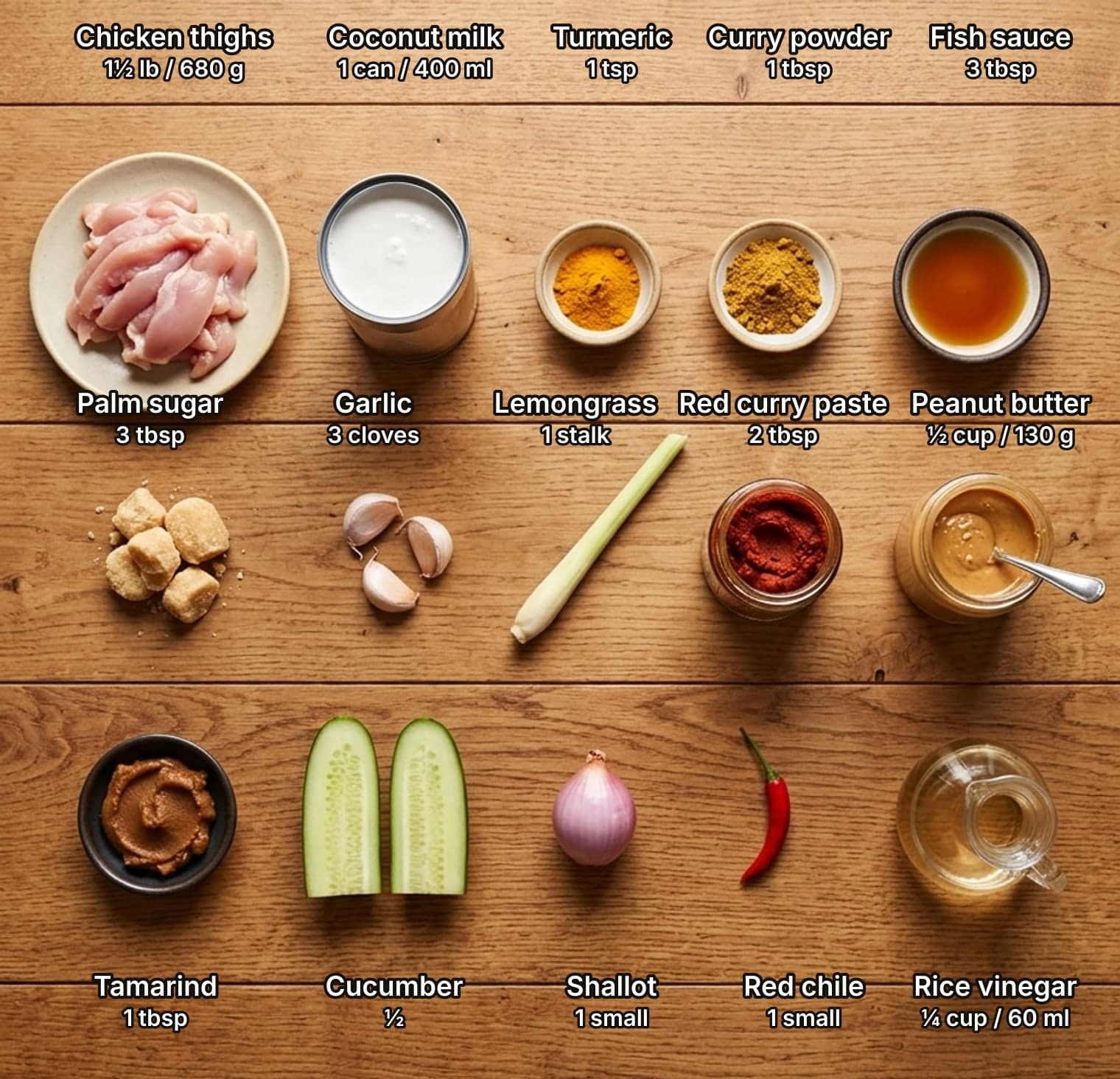
- boneless, skinless chicken thighs, cut into strips about 1 inch (2.5 cm) wide1 1/2 lb (680 g)
- coconut milk, full-fat — 1/2 cup for the marinade, the rest of the can for the sauce1 can, 13.5 oz (400 ml)
- ground turmeric1 tsp
- mild curry powder1 tbsp
- ground coriander1 tsp
- fish sauce — 2 tbsp for the marinade, 1 tbsp for the sauce3 tbsp
- palm sugar or brown sugar — 2 tbsp for the marinade, 1 tbsp for the sauce3 tbsp
- garlic, finely grated3 cloves
- lemongrass, tender core only, minced and bruised1 stalk
- Thai red curry paste2 tbsp
- natural peanut butter (the just-peanuts kind), or 3/4 cup (110 g) roasted peanuts ground fine1/2 cup (130 g)
- tamarind paste (or the juice of 1 lime)1 tbsp
- cucumber, quartered lengthwise and sliced1/2
- shallot, halved and thinly sliced1 small
- fresh red chile, thinly sliced1 small
- rice vinegar — for the ajad relish, with 2 tbsp sugar and a pinch of salt1/4 cup (60 ml)
- bamboo skewers, soaked 30 minutes12–16
- steamed jasmine rice and cilantro (fresh coriander), to serve
Whose satay is this? (An honest family tree)
Satay is Indonesian — that's the honest first sentence. Sate began as Javanese street food, likely in the nineteenth century (the favored theory traces the skewer idea to kebabs arriving with traders from South Asia and the Middle East, adapted to local meats and seasonings), and Indonesia still treats it as a national dish with hundreds of regional variants: sate ayam with its sweet kecap manis glaze and rough-ground bumbu kacang, sate padang with its curried rice-flour sauce, sate lilit — minced, spiced meat wound onto lemongrass stalks — in Bali. From Java it traveled the peninsula — Malaysia and Singapore both claim beloved versions, and satay drifted north into Thailand's south and onward to Bangkok's street grills.
The satay most Western diners know, though — golden turmeric-and-coconut chicken with a smooth, gently spicy peanut sauce — is essentially the Thai version — satay gai, chicken satay, as Thai menus have it — polished for export in the same decades Thai restaurants conquered the West. That's the lane this page teaches, chosen with eyes open: it's the version the searcher of 'chicken satay recipe' is almost always looking for, it's genuinely excellent, and its components (red curry paste, coconut milk, fish sauce) are the easiest of the family to shop for in a Western supermarket. Consider sate ayam the graduation course: kecap manis, a rougher hand-pounded peanut sauce, and a squeeze of lime over charcoal smoke. And one honest limit up front: a home broiler reproduces the flavor architecture, not the street charcoal — you get the char and the caramel, not the smoke, and the dish is still worth making.
One naming clarification for menus and cookbooks: 'satay' and 'sate' are the same word (Indonesian/Malay sate, anglicized with the y), and the dish is defined by the skewer and the fire, not by the peanut sauce — plenty of Indonesian satays come with soy-based or curried sauces instead. The peanut sauce's global fame is really the fame of one branch of a very large family.
How to make Chicken Satay
- Soak the skewers, stain the marinade. Put 12–16 bamboo skewers in water to soak — 30 minutes, same rule as every skewer on this site — and build the marinade in a bowl big enough for the chicken: 1/2 cup (120 ml) of the coconut milk, the turmeric, curry powder, ground coriander, 2 tbsp fish sauce, 2 tbsp sugar, the garlic and the lemongrass, whisked until the sugar dissolves — it should coat like thick paint, not slide off like soup; if your coconut milk runs thin, hold some back. Fair warning that the recipe's cheerful golden color writes in permanent ink: turmeric stains plastic permanently and boards, towels and fingernails temporarily, so mix in glass or ceramic and don't wear the good apron.
- Cut the chicken into ribbons, not cubes. Slice the thighs into strips about 1 inch (2.5 cm) wide and 1/4 inch (6 mm) thick, cutting with the length of the thigh so each strip is long enough to weave onto a skewer. Strips are the satay difference: cubes cook into bouncy knuckles, while a thin ribbon threaded flat presents maximum surface to the heat and eats tender in two bites. Toss the strips through the marinade until every face is gold, cover, and refrigerate at least 1 hour — even 20–30 minutes registers in a real pinch — with 4 hours to overnight the sweet spot, when the turmeric and spices have moved past a surface stain.
- Make the ajad — the relish that makes the plate work. Stir 1/4 cup (60 ml) rice vinegar with 2 tbsp sugar, a pinch of salt and 2 tbsp warm water until dissolved, then add the cucumber, shallot and half the sliced chile. That's ajad (also spelled ajat or achat), the Thai satay stand's standard-issue relish, and it isn't garnish: peanut sauce plus coconut-marinated chicken is richness stacked on richness, and this sharp, cold, barely-pickled crunch is what resets your palate between skewers. The brine can be made any time — it keeps indefinitely — but dress the vegetables no more than 30 minutes before serving: ajad is an instant pickle, best while the cucumber still snaps, and it softens rather than improves with sitting. Day-two leftovers are safe, just past their best.
- Build the peanut sauce — curry paste first, jar second. In a small saucepan over medium heat, fry the 2 tbsp red curry paste in a spoonful of thick coconut cream from the top of the can until it smells loud and the oil stains orange, 1–2 minutes — this blooming step is the whole difference between sauce and sweetened peanut butter. Whisk in the rest of the can's coconut milk, then the peanut butter, 1 tbsp sugar, 1 tbsp fish sauce and the tamarind, and simmer gently 3–4 minutes until it thickens to a pourable coat. Thin with water a spoonful at a time if it tightens — it will tighten more as it cools — and taste for the four-way balance: rich, sweet, sour, salty, each answering the others.
- Thread the skewers flat — the weave is the technique. Thread each marinated strip onto a skewer with a loose running-stitch weave — over, under, over — so the meat lies flat like a ribbon down the skewer's top two-thirds, with nothing balled up and no fat tail flapping loose. Flat is the entire secret to satay's char: a woven strip touches the heat along its whole length, while a bunched one steams in its own thickness. Leave the bottom third of each skewer bare as a handle, and lay the finished skewers on a tray in one layer. (Metal skewers skip the soak but conduct heat into the middle of a thin strip — with bamboo the strip cooks outside-in like it should.)
- Broil hot and close — or grill-pan in batches. The broiler (the overhead grill) is the home translation of the satay stand's charcoal trough: rack 3–4 inches (8–10 cm) below a fully preheated element, skewers in one layer on an oiled rack over a foil-lined sheet, bare handles shielded with a strip of foil. Give them 4–5 minutes on the first side, until the edges char and the turmeric-gold deepens to bronze, then flip and finish 3–4 minutes more. The grill-pan route: ripping hot, lightly oiled, skewers in batches with space between them, 3 minutes a side. Either way, don't crowd — char is the flavor here, and crowding trades it for steam.
- Check one, rest none. Probe the thickest strip of the fattest skewer with an instant-read thermometer slid sideways along its length — 165°F (74°C) settles it; on strips too thin even for a sideways probe, opaque throughout with clear juices is the working proxy. Satay has no resting period worth honoring; it goes to the table hot off the heat, when the char is still crackling and the coconut fat still glistens. If you're cooking in waves for a party, serve in waves too — a satay skewer's best minutes are its first five.
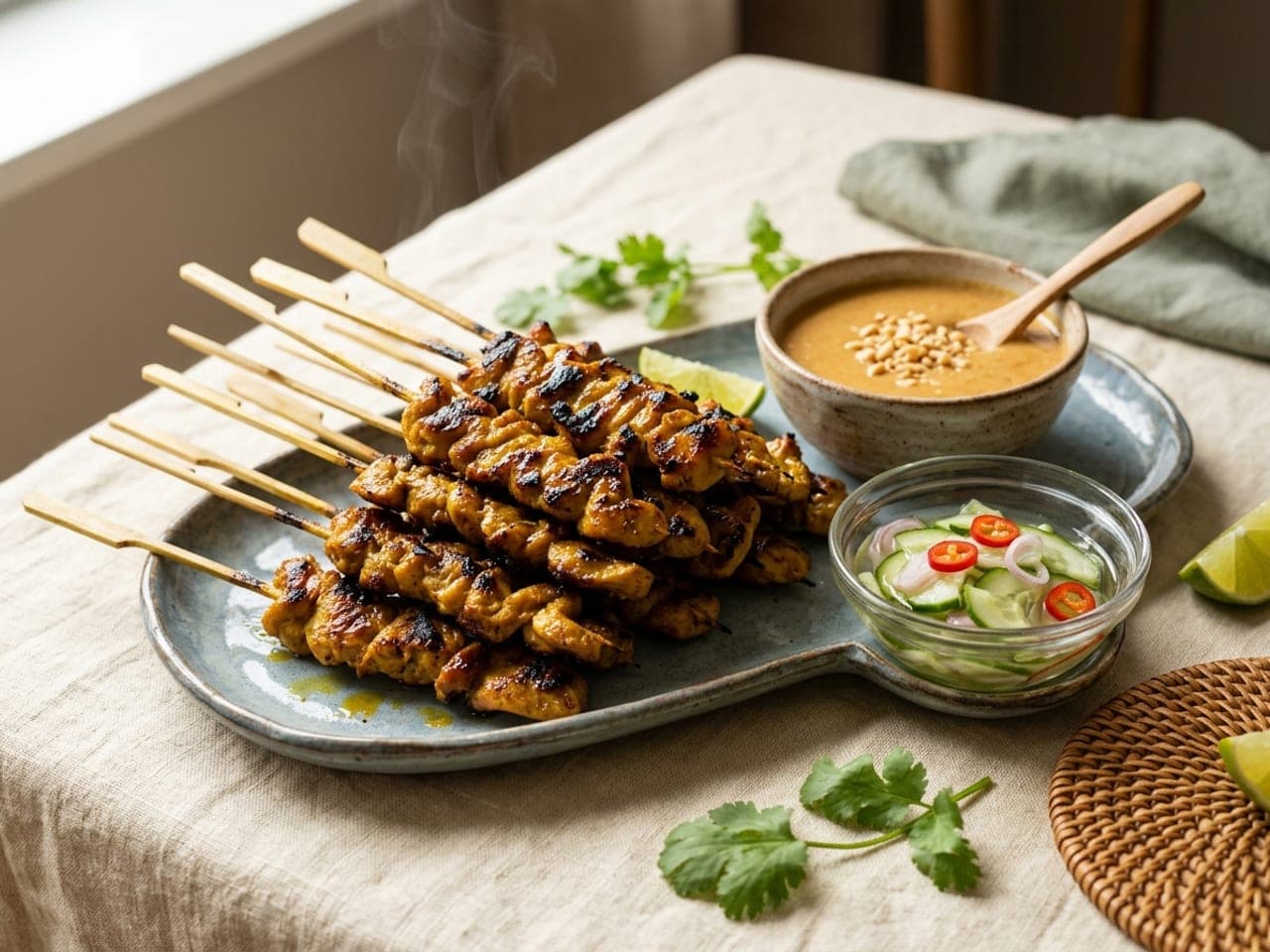
- Serve it the satay-stand way. Pile the skewers on a platter, pour the peanut sauce into a bowl deep enough for real dipping, and put the ajad beside it in its brine. Dinner version: over jasmine rice with the sauce spooned across and cilantro on top. Party version: the platter, the two bowls, and a spoon for portioning sauce onto plates — better than communal double-dipping for germs as much as for allergens — satay was street food before it was appetizer, and it knows how to work a crowd. One hosting honesty: peanut sauce is the point of the dish, so say the word 'peanut' out loud when you serve it — the safety notes carry the allergy reality.
Safety & hygiene Important
- Raw chicken rules, skewer edition. Everything the raw chicken and its marinade touched — bowl, board, knife, hands, and every skewer you loaded — is on poultry rules until hot soapy water says otherwise, and the tray that carried raw skewers to the broiler never receives the cooked ones. The ajad's cucumber, shallot and chile are eaten raw — they get a clean board and a clean knife, never the ones that just portioned chicken. The spent marinade is trash (or a hard one-minute boil if you must baste — better: reserve a clean few spoonfuls before the chicken goes in). Doneness is a number, not a color: turmeric paints everything gold and char paints it dark, both long before the inside is done, so check the thickest strip for 165°F (74°C), USDA's line for all poultry — opaque throughout with clear juices as the visual proxy on strips too thin to probe.
- Peanut allergy is a headline, not a footnote. Peanut is one of the most severe common food allergens, and this dish buries half a cup of it in a sauce that doesn't announce itself once it's poured. When serving anyone beyond your own household: name the sauce out loud, keep a clean batch of skewers unsauced and undipped (satay is genuinely good with just ajad and lime), and don't rely on 'a little won't matter' — for a true allergy it does. Cross-contact counts too: one dipped skewer returned to the shared platter makes the platter peanut. Cook the allergy-safe skewers FIRST, on clean equipment, before the peanut butter jar even opens, and read every label — 'may contain' advisories on curry pastes and nut butters are voluntary, and imported jars may not follow local labeling rules. Cashew sauce is a real substitute for a peanut-free table only if cashews themselves aren't a problem — tree nuts and peanuts are separate allergies, and severe eaters may need both gone. And peanut isn't the plate's only major allergen: the fish sauce is anchovy — fish — in both marinade and sauce, and many curry pastes carry crustacean shellfish (shrimp paste); check both jars for an allergic table.
- Broiler, bamboo, and the clock. Fierce heat plus sugared marinade means the standard vigilance: soaked skewers with foil-shielded handles, a foil-lined sheet to catch coconut-fat drips, and no walking away — sweet marinades cross from caramel to carbon in a phone-check. Leftovers follow the standard clock: fridge within 2 hours (1 hour above 90°F/32°C), eaten within 3–4 days, chicken reheated hard to 165°F (74°C); the peanut sauce keeps 3–4 days refrigerated in a covered container (never the can) and loosens back with a splash of water in a warm pan, reheated until steaming throughout — 165°F (74°C), and the ajad is best the first day, acceptable the second, compost the third. The burn rule as always: cool running water for a full 20 minutes, no ice, no butter, rings off — and medical eyes on anything blistered, large, or on a child.
3 ways to plate it
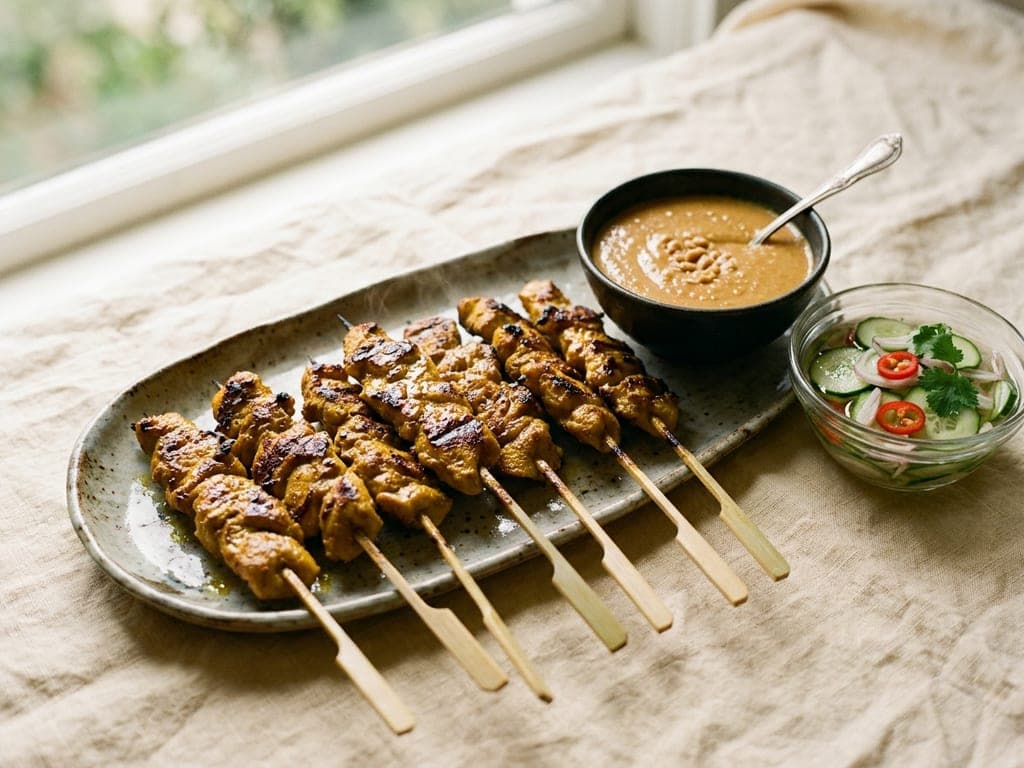
- Lay the skewers parallel on a long platter with all the handles facing the diner — effortless to pick up one-handed, and it reads as satay from across the room.
- Give the peanut sauce a bowl with depth and a spoon; shallow saucers cause the double-dip problem the safety notes warn about.
- Serve the ajad in its brine in a small glass bowl — the clear liquid against the cucumber is the freshness cue.
- Scatter a few cilantro sprigs and lime wedges at the platter's end and stop there; the gold-and-char skewers are the decoration.
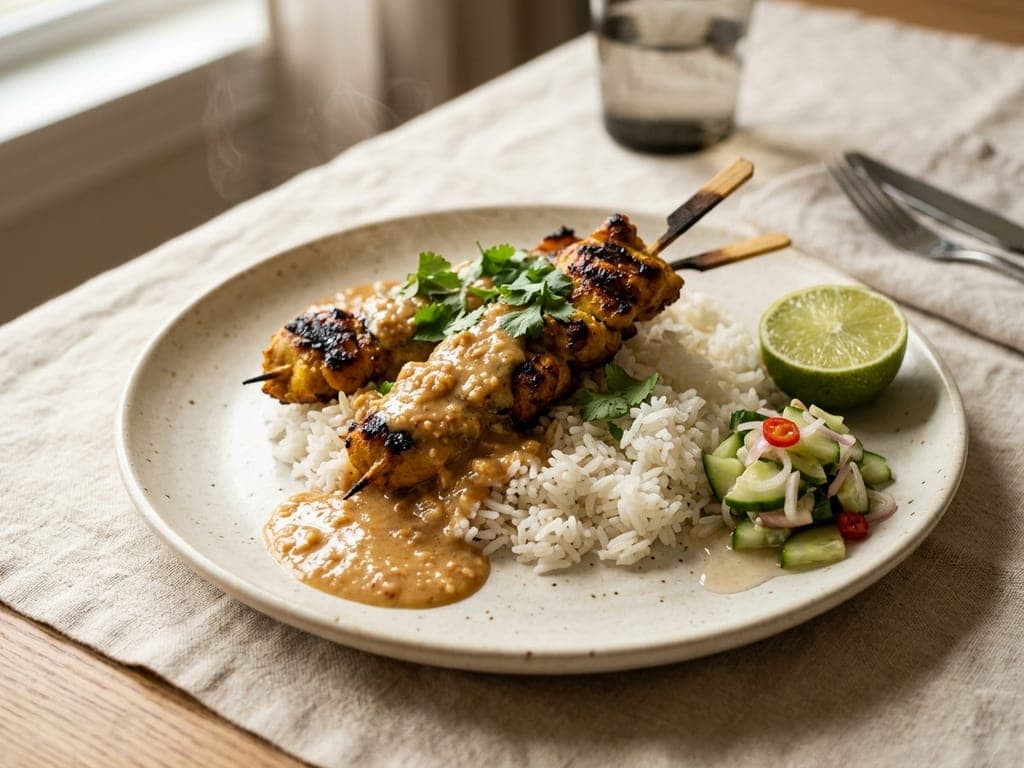
- Mound the rice slightly off-center and rest the skewers across it at an angle — the height keeps the chicken out of its own steam.
- Spoon the peanut sauce generously over the chicken AND let some pool onto the rice — sauce-soaked jasmine rice is half the point of the format.
- Pile the ajad on the plate's edge where its brine can't flood the sauce, and add half a lime for the final squeeze.
- Finish with cilantro leaves and, if the table likes heat, the reserved sliced chile from the relish.
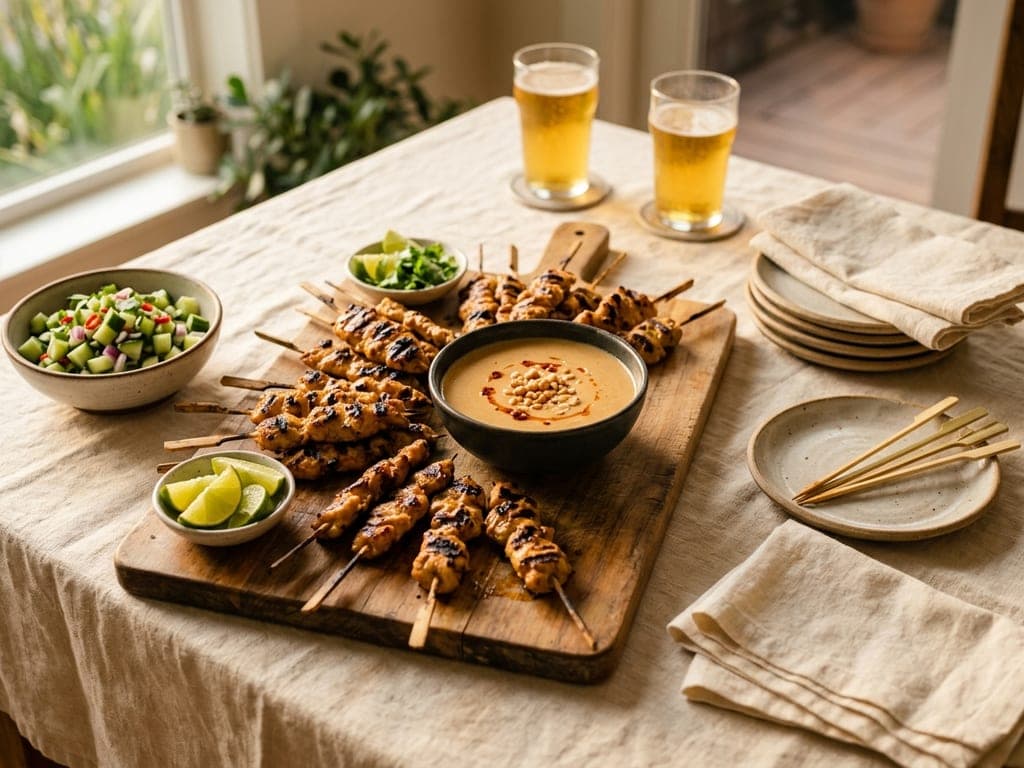
- Fan the skewers on a big wooden board around the central sauce bowl — abundance reads better loose than arranged.
- Stack small plates and napkins at the board's edge; satay drips, and guests who have a plate hover less over the shared bowl.
- Put out a discard glass for spent skewers — it saves the board from becoming a pick-up-sticks game.
- Cook and serve in waves rather than all at once: a satay skewer's best minutes are its first five, and a party gives you the excuse to keep grilling.
The two decisions: the weave and the sauce
The weave first. Satay meat is cut into thin ribbons and threaded flat with a running stitch — over, under, over — so the strip lies along the skewer like a flag along a pole. This isn't decoration: a flat woven strip presents its whole surface to the heat, chars along its length, and cooks through in the same few minutes the char takes. Cubes — the Western kebab instinct — do the opposite: thick centers that need time the outside doesn't have. If your strips tear or come out stubby, don't force elegance; two shorter strips threaded snugly behave exactly like one long one. The 30-minute skewer soak and the bare-handle foil shield are the same physics as every broiler skewer on this site: bamboo is fuel, and handles are fuses.
The sauce is where most Western recipes quietly give up, whisking peanut butter into soy sauce and calling it satay sauce. The real Thai version is a curry: red curry paste bloomed in coconut cream until the oil splits out fragrant and orange, then coconut milk, ground roasted peanuts (natural peanut butter is the honest shortcut — it IS ground roasted peanuts), palm sugar for roundness, fish sauce for depth, tamarind for the sour that keeps the richness from cloying. Blooming the paste is the non-negotiable step: raw curry paste tastes tinny and hot, bloomed paste tastes like a restaurant. The Indonesian bumbu kacang runs rougher and sweeter — fried peanuts pounded coarse, kecap manis, no curry paste — and is its own excellent project.
Balance is the sauce's finish line, and it's personal: the four-way of rich (coconut, peanut), sweet (palm sugar), sour (tamarind or lime) and salty (fish sauce) should sit level on the tongue, no single corner shouting. Taste at the end and fix the corner that's loud — more tamarind if it's cloying, a pinch more sugar if the tamarind bites, water if everything is shouting at once. And mind the pot: peanut sauce scorches easily and thickens dramatically as it cools, so gentle heat, regular stirring, and a looser-than-you-want consistency at the stove.
Shopping: the paste, the peanuts, the pantry
Red curry paste does heavy lifting here, and the supermarket jar is legitimate: Thai Kitchen and the like run mild and slightly sweet — fine for this sauce — while Thai-grocery pastes run hotter and saltier — Mae Ploy is the intense, shrimp-paste-forward one, and Maesri's canned paste typically skips shrimp paste entirely, making it the safer pick where shellfish is a concern (check the label either way; many Thai curry pastes contain shrimp paste). Start with 2 tbsp of a supermarket paste or 1 heaping tbsp of a Thai-grocery one and adjust after tasting. Curry powder in the marinade is the satay stand's own habit, not fusion — a mild Malaysian- or Thai-style blend if you have one, any mild curry powder if you don't.
The peanut question: natural peanut butter — the kind whose ingredient list is peanuts and maybe salt — is ground roasted peanuts by another name, and it makes the sauce in five fewer minutes. Grinding 3/4 cup (110 g) of roasted peanuts yourself in a food processor buys you a rougher, more Indonesian texture and slightly deeper flavor. What to avoid is the sweetened, hydrogenated sandwich spreads: their sugar and stabilizers fight the sauce's balance and its texture. Palm sugar is the traditional sweetener and worth buying if you cook Southeast Asian food monthly; light brown sugar is the honest everyday twin.
Coconut milk means full-fat, in a can, shaken — the carton drinking kind is water with ambitions and will thin both marinade and sauce into soup. The thick cream at the top of an unshaken can is worth harvesting deliberately for blooming the curry paste. Tamarind means the seedless jarred paste or concentrate, not the sour-candy pulp blocks; it varies wildly in strength between brands (some are concentrate, some are watered pulp), so add, taste, adjust — or use lime juice, squeezed at the end, which is what plenty of Thai home cooks do anyway. And chicken thighs over breast for the standard reason on this site: thigh fat forgives fierce heat; breast strips work but demand the thermometer and no distractions.
Questions, answered
Is satay Thai or Indonesian?
Indonesian by origin — sate is Javanese street food with hundreds of regional variants, and Indonesia treats it as a national dish; Malaysia and Singapore have their own deep satay traditions. The golden coconut-turmeric chicken with smooth peanut sauce that Western menus call 'chicken satay' is mostly the Thai restaurant expression of the family. This page teaches that Thai-style lane and says so plainly — with sate ayam (kecap manis glaze, rough bumbu kacang) recommended as the next project.
Can I make the peanut sauce without curry paste?
You can make A peanut sauce — peanut butter, soy, lime, a little sugar and chile — and it's fine for dipping spring rolls. But blooming red curry paste in coconut cream is what makes actual satay sauce: fragrant, gently hot, restaurant-deep. The paste keeps for months in the fridge and shows up in the site's Thai recipes repeatedly, so the jar earns its shelf space. If curry paste is truly unavailable, add grated garlic, ginger, a spoon of curry powder and a pinch of chile to the shortcut version and simmer it in coconut milk — closer, still not quite.
How long should the chicken marinate?
One hour minimum for the flavor to register, 4 hours for the sweet spot, overnight without harm — coconut milk and fish sauce season rather than cure, and thin strips drink fast. Longer than 24 hours and the texture starts drifting soft. The marinade doubles as a make-ahead lever: strips can go into the marinade in the morning, or be frozen raw in it for a month, thawed overnight in the fridge and cooked within a day or two.
Can I cook satay in the oven, air fryer or on a grill?
Broiler is this page's default and genuinely close to the street version. A charcoal or gas grill is better still — high direct heat, skewers over the flame with handles over the cool zone, same times. Air fryer works for the chicken (400°F/200°C, 8–10 minutes, flipping once) though you lose some char and all the theater. A regular bake can't char thin strips before drying them — if the oven is all you have, use the broiler function; that's what it's for.
What is the cucumber relish, and can I skip it?
Ajad — cucumber, shallot and chile in a quick sweet vinegar — is the Thai satay stand's standard partner, and it's doing structural work: the plate is rich-on-rich (coconut chicken, peanut sauce) and ajad is the sharp, cold reset between bites. Skippable? Technically. But it's a five-minute job that uses three things you already have, and the plate is measurably better with it. A squeeze of lime over the skewers is the emergency substitute.
How do I make it for someone with a peanut allergy?
Keep a batch of skewers completely away from the sauce — cooked on a clean tray, served on a separate plate with ajad and lime, no shared platters and no dipped-and-returned skewers, since cross-contact is enough for severe allergies. The chicken itself is peanut-free as written. Cashew or almond butter make a similar sauce ONLY if tree nuts are safe for that eater — peanut and tree-nut allergies are separate — and for a fully nut-free table, a sweet chili or soy-lime dip serves the same role honestly.
Can I use chicken breast, or make it with beef or tofu?
Breast works in the same strips — it takes the marinade beautifully; it just demands the thermometer, because its done-to-dry window is short under a broiler. Beef satay is classic across the region: flank or sirloin in the same strips and marinade, 2–3 minutes a side. Tofu satay is legitimate too — pressed firm tofu in flat slabs, same marinade with soy swapped for the fish sauce, and the peanut sauce made with soy as well makes the whole plate vegetarian.
Why did my satay come out pale, bland or bitter?
Almost always distance, crowding or a cold start: the rack too far from the broiler element (3–4 inches / 8–10 cm is the zone), too many skewers steaming each other (one loose layer, cook in waves), or a broiler given 30 seconds of preheat instead of 5 minutes. The marinade's sugar and coconut fat are engineered to char — given real heat, close range and room, the bronze edges arrive on schedule. Yellow but bland is the other failure: under-marinated (give it its hours) or a too-thin marinade that slid off instead of clinging. And bitter usually means a heavy hand with turmeric — it's a 1-teaspoon spice, not a color slider.
Snap your finished plate and let the AI plate it again — more beautifully.