Pad See Ew Recipe (Thai Stir-Fried Noodles — the Char Is the Whole Dish)
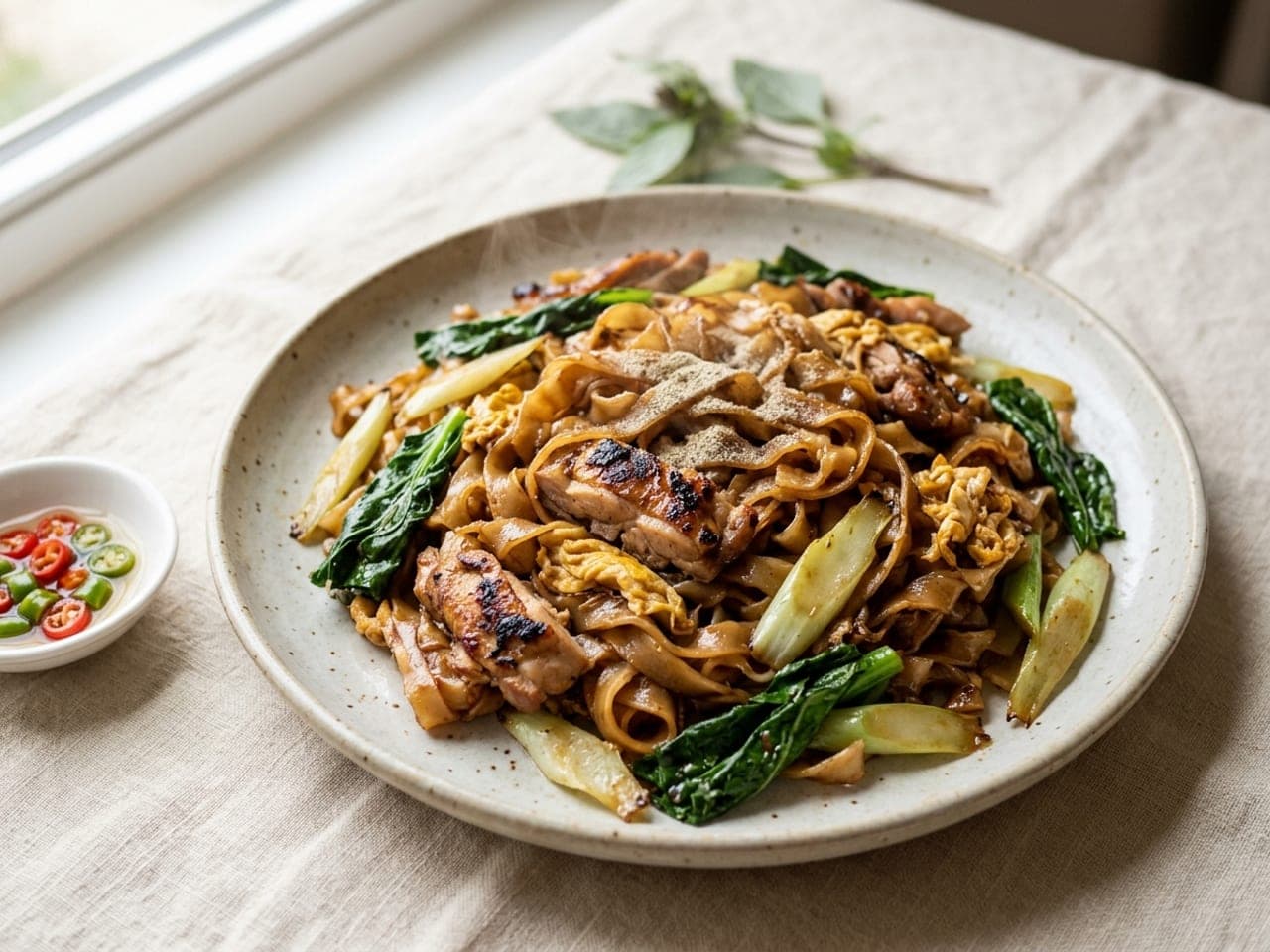
Thailand's soy-charred noodle: wide rice noodles seared in sweet dark soy until the edges blister and smoke, folded with chicken, egg and Chinese broccoli. There is no chili in the pan and no trick in the sauce — the whole dish is two decisions, sweet dark soy and the nerve to leave the noodles alone in a very hot pan until they char.
Ingredients
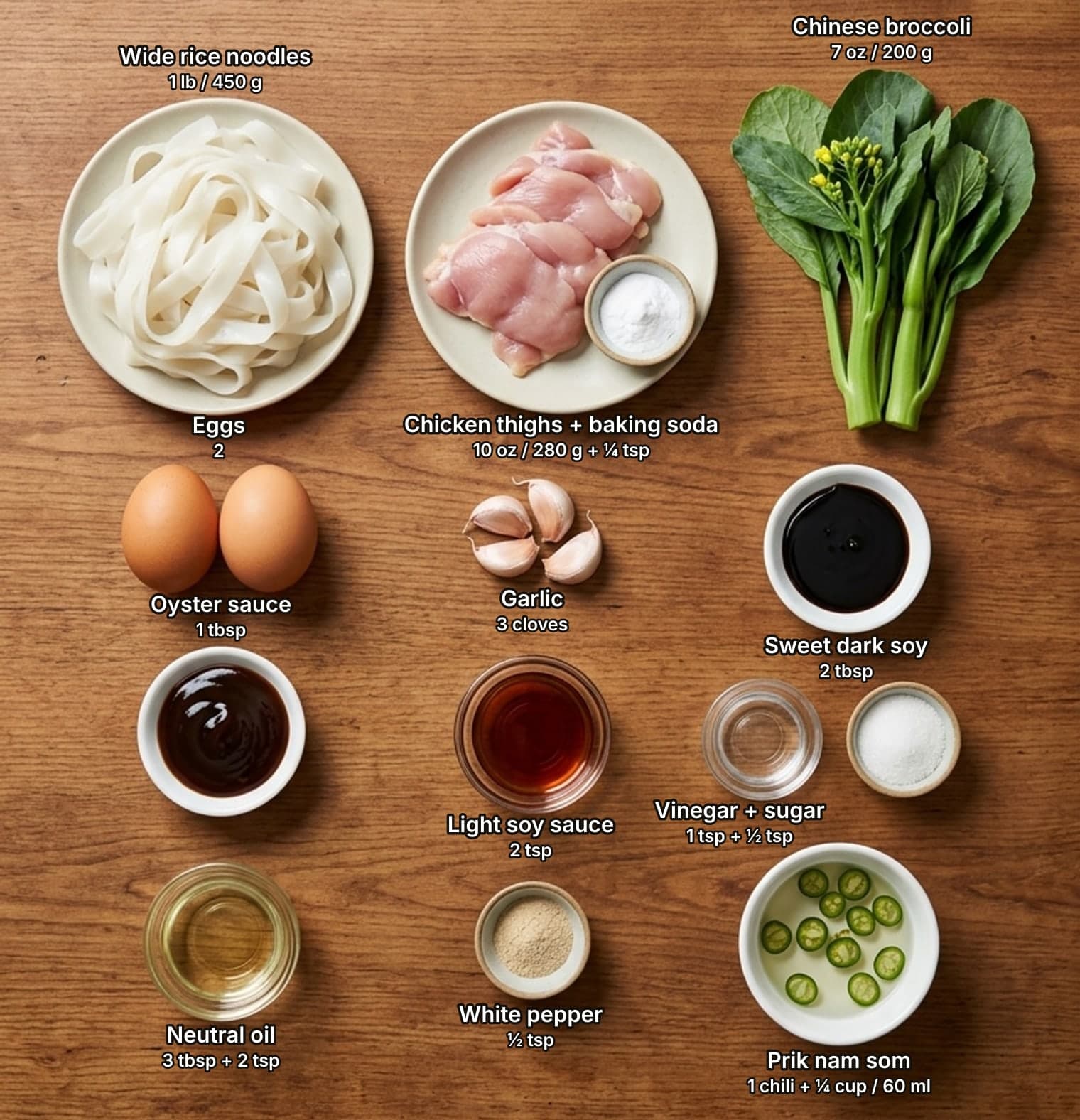
- fresh wide rice noodles (sen yai) — or 7 oz / 200 g dried XL rice sticks1 lb / 450 g
- boneless chicken thighs, sliced thin against the grain10 oz / 280 g
- baking soda (optional velveting)¼ tsp
- Chinese broccoli (gai lan) — or broccolini7 oz / 200 g
- eggs, beaten2
- garlic, roughly chopped3 cloves
- sweet dark soy sauce (see ew wan — or kecap manis)2 tbsp
- oyster sauce1 tbsp
- light soy sauce2 tsp
- white vinegar (sauce)1 tsp
- sugar½ tsp
- neutral high-smoke-point oil3 tbsp + 2 tsp
- ground white pepper, to finish½ tsp
- prik nam som: serrano or jalapeño, thin-sliced, in white vinegar1 chili + ¼ cup / 60 ml
What pad see ew is (and where it came from)
Pad see ew — ผัดซีอิ๊ว, literally 'fried in soy sauce', the 'see ew' borrowed from the Teochew Chinese word for soy — is Thailand's great lunch noodle: wide rice ribbons, a dark sweet soy glaze, egg, a green vegetable, a modest amount of meat, and char. It belongs to the family of rice-noodle dishes that Chinese immigrants, largely Teochew, folded into Thai street cooking over the last century and a half — the same kuaitiao noodle culture that produced boat noodles and rat na — and it remains fundamentally a street and food-court dish: cooked to order, one plate per wok-pass, eaten fast, seasoned at the table.
Its temperament is the interesting part. Thai food's export reputation is fire and lime, and pad see ew has neither — no chili in the pan, no citrus anywhere, just sweet-salty-smoky comfort. It is the dish Thai kids order, the safe harbor of every Thai menu in the West, and the reason the phrase 'Thai comfort food' exists. The heat arrives only at the table, self-administered, via the vinegar-chili dish this page refuses to let you skip.
One useful mental model: pad see ew and drunken noodles (pad kee mao, its page is this one's sibling) are the same noodle in two moods — same sen yai, same wok, overlapping sauce shelf. Pad see ew is the calm one: sweet, mild, charred, a lunch dish. Drunken noodles are the loud one: chilies, holy basil, green peppercorns, a late-night dish. Learn one and you are two-thirds of the way to the other, which is exactly why this site built them as a pair.
How to make Pad see ew
- Ready the noodles — fresh if you can get them. For fresh wide rice noodles (sen yai): if they are room-temperature and floppy, just separate the strands gently and you are done. If they came refrigerated — and in the West they almost always do — they will be welded into a solid brick; turn them out into a microwave-safe bowl, microwave in 30-second bursts until warm and pliable, then separate the strands with your fingers, keeping them in wide ribbons and shrugging off the tears (a torn noodle chars exactly as well as a whole one). For dried wide rice noodles, soak 7 oz (200 g) in hand-hot water — kettle-warmed and cooled a little, not straight from the hot tap, which is for dishes rather than dinner — for 30–40 minutes until fully limp but still firm-chewy, then drain hard — they finish cooking in the pan, and boiled-soft noodles turn to mush the moment the sauce hits.
- Slice the chicken thin, and consider the 15-minute upgrade. Slice 10 oz (280 g) of boneless chicken thigh against the grain into thin, broad pieces about ¼ inch (6 mm) thick — wide and thin sears faster than chunky, and this dish gives the protein about ninety seconds of attention. The optional upgrade with an outsized payoff: toss the slices with ¼ tsp baking soda and let them sit 15 minutes, then rinse them off under a low, gentle stream with the meat held low in the sink — this is the one sanctioned raw-chicken rinse on this site, and the sink pays for it afterwards; see the safety notes — and pat thoroughly dry. This is velveting, the Thai-Chinese restaurant standard — the soda nudges the surface pH so the meat stays silky at wok heat. Skip it on a weeknight; do it once and you will stop skipping it.
- Cut the gai lan like two different vegetables. Take 7 oz (200 g) of Chinese broccoli (gai lan) and treat stems and leaves as separate ingredients, because they are: slice the stems on a hard diagonal about ⅛ inch (3–4 mm) thin — the bias cut is what lets them cook crisp-tender in a minute — and cut the leaves into wide 2-inch (5 cm) ribbons. Keep the two piles apart; the stems go into the pan a full minute before the leaves. No gai lan? Broccolini split lengthwise is the closest stand-in there is — see the vegetable section for why that is almost literally true.
- Mix the sauce — it is shorter than you think. Stir together 2 tbsp sweet dark soy sauce (see ew wan), 1 tbsp oyster sauce, 2 tsp light soy sauce, 1 tsp white vinegar and ½ tsp sugar. That is the whole sauce — no stock, no cornstarch, no sesame oil, and adding any of them moves the dish somewhere else. If you could not find sweet dark soy, the honest substitute is 4 tsp regular dark soy sauce plus 2 tsp more sugar, or an equal swap of Indonesian kecap manis. Set the sauce by the stove with everything else: once the pan is hot, this recipe moves faster than shopping.
- Split everything in half — this cooks one plate at a time. Divide the noodles, chicken, gai lan, garlic, sauce and 2 beaten eggs into two portions. This is the rule the restaurant versions obey and the home versions ignore: a home burner holds enough violence for one plate of noodles, and doubling the load drops the pan temperature from searing to stewing — the difference between pad see ew and soy-sauce noodle soup. Cooking it twice costs four extra minutes. Cooking it once, doubled, costs the entire dish. Second batches also go faster: the pan is already furious.
- Sear the chicken and garlic in a smoking-hot pan. Heat a wok or — genuinely just as good on a flat Western burner — a large cast-iron skillet over maximum heat until a drop of water skitters and vanishes instantly, then add 1½ tbsp of high-smoke-point oil. Add half the chicken in one layer and leave it 45–60 seconds before touching it, until the underside browns hard; toss in half the chopped garlic and stir-fry 30 seconds more until the chicken is just cooked through and the garlic is golden, not brown. The hood is on and a window is open, correct? This dish smokes on purpose.
- Egg, then noodles, then the sauce — then leave it alone. Push the chicken up the side, add a teaspoon more oil, and pour in half the beaten egg; let it bubble 15 seconds, scramble it roughly, then add half the gai lan stems for 30 seconds, followed by half the noodles and half the sauce, tossing until every ribbon is stained brown. Now the step that makes the dish: spread the noodles into one layer, press them gently against the metal, and do not move them for 45–60 seconds — past the point that feels safe — until the undersides blister and catch dark, charred spots. Toss once and press again. That smoky edge is wok hei's home translation, and stirring is its enemy.
- Leaves in, heat off, white pepper on — and the vinegar on the table. Add half the gai lan leaves, toss for 20 seconds until they just collapse and go glossy, and kill the heat — the leaves finish on the way to the plate. Slide the noodles out, dust generously with ground white pepper, and repeat the last three steps for plate two. Serve with prik nam som — the little dish of sliced chilies drowned in white vinegar; it takes thirty seconds and the recipe is in the sauce-shelf section below — plus fish sauce, sugar and chili flakes if you want the full Thai noodle-counter table. The vinegar is not optional garnish; it is the extra acid this sweet, charred, salty plate is still quietly missing until the first spoonful lands.
Safety & hygiene Important
- Maximum heat is a commitment — respect the pan. This recipe runs a nearly dry pan hotter than most home cooking ever goes, and that demands the same posture as deep-frying: never walk away — not for a phone call, not for the doorbell — long sleeves pushed up not dangling, the pan's handle turned in, and a metal lid or baking sheet within reach BEFORE the burner goes on. Brief wisps of oil smoke are part of this dish; oil that smokes heavily and continuously is past its limit and headed for its flash point — off the heat, let it cool a notch. If oil ever ignites: heat off, lid slid on from the side at arm's length (dropped from above it splashes burning oil), and the lid stays on until everything is stone cold — never water, which turns a pan fire into a fireball, and never pick the pan up to carry it anywhere, which is how most cooking-fire burns actually happen. Not out at once? Everyone leaves, door closed, fire service called. Run the hood, open a window, and accept that the smoke alarm is a safety device, not a food critic — disabling it is never the fix; ventilation is. The burn rule, same as every high-heat page on this site: cool a burn under cool running water for a full 20 minutes — no ice, no butter — rings off, and medical eyes on anything blistered, larger than the person's palm, on the face, hands or a joint, looking white or charred (deep burns can be painless), or on a child.
- Thin slices of chicken still play by raw-poultry rules. The cutting board, the knife, the marinating bowl and your hands have all handled raw chicken — hot soapy water for the tools, a real 20-second soap wash for the hands before they touch the noodle bag, the sauce bowl or the pan handle. Thin slices at wok heat cook in about ninety seconds, but fast is not automatic: check the thickest piece — opaque all the way through, no translucent core, juices clear — while remembering that color is a proxy, not proof: USDA's one reliable test is a thermometer reading 165°F (74°C), so if an instant-read lives in your drawer, spear the thickest piece and settle it. Truly seared thin slices blow past the number almost immediately; when any piece leaves doubt anyway, 30 seconds more costs nothing. The velveting rinse water is raw-chicken water: it goes down the drain, and the sink plus its surrounding counter then get hot soapy water followed by a sanitizer — USDA's sink study found bacteria still camped in 1 in 7 sinks even after a cleaning attempt — and no raw-chicken rinsing happens otherwise; on plain chicken it removes nothing and redecorates the sink in bacteria.
- Rice noodles are on the fried-rice clock. Cooked rice and rice noodles are the classic home of Bacillus cereus — the 'fried rice syndrome' bug whose toxin laughs at reheating, which is why time at room temperature is the one mistake that cannot be cooked away later. The rules: leftovers into the fridge within 2 hours of cooking (1 hour if the kitchen is above 90°F/32°C), eaten the next day (the NHS rule for cooked rice is 24 hours, and rice noodles ride the same clock), reheated once until properly steaming hot, and never left out for the afternoon 'to cool down' — a shallow container in the fridge cools faster and safer than the counter ever will. The same clock applies to fresh sen yai from the Asian market: use the package the day it is opened or refrigerate it immediately. A package forgotten out on the counter gets binned on time alone, and the sniff test only works one way — a sour smell condemns the noodles, but a clean one does not acquit them; the fried-rice bug has no scent.
- The chili-vinegar dish bites both ways. Prik nam som is just chilies and vinegar, but the chilies are the real thing: wash hands with soap after slicing them, because capsaicin is an oil — water alone smears it around — and it will find eyes, noses and contact lenses hours later with total accuracy. Slice chilies last on the board or give them their own corner, keep the little dish away from small children (it looks exactly like a fun sauce), and spoon it on with the vinegar, not the seeds, if you want the acid without the arson. A milk sip or yogurt spoonful calms a chili-burned mouth; water is famously useless — capsaicin does not dissolve in it.
3 ways to plate it
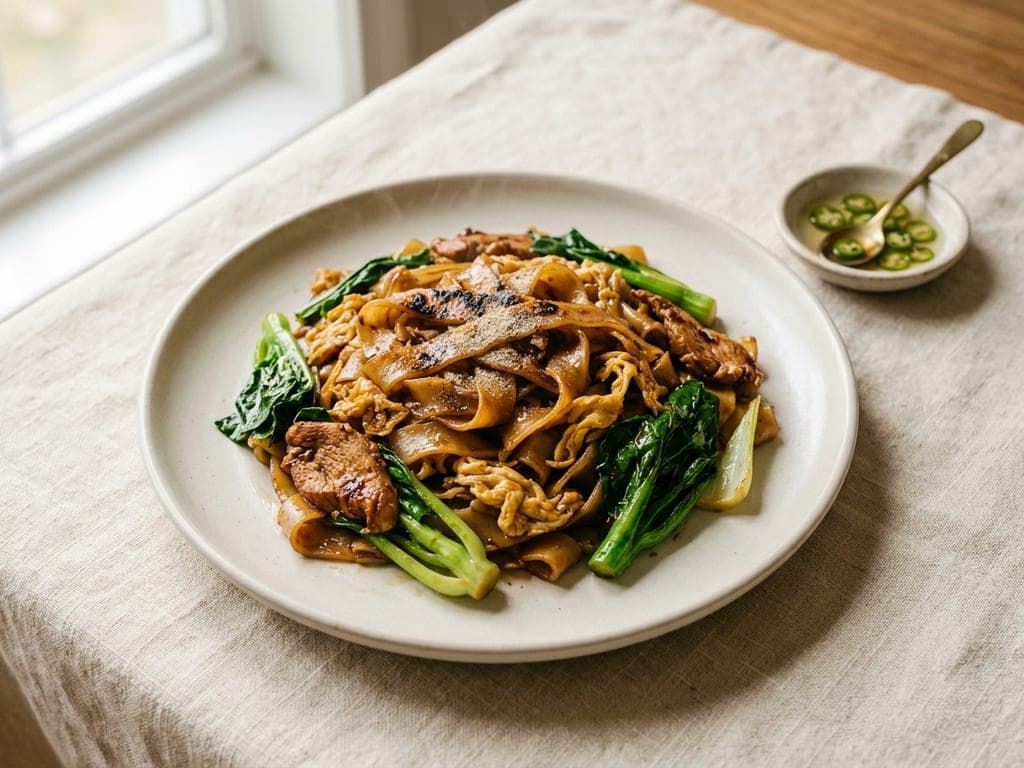
- Slide, don't arrange: tip the pan so the noodles land in one loose fold and leave them — the best char spots should end up on top, and tonging them into tidiness wipes the sear off the surface.
- Dust white pepper from a height over the whole plate rather than a pinch in one spot; it should register as atmosphere, not punctuation.
- Set the prik nam som in a tiny separate dish at two o'clock with a small spoon — it is table jewelry and seasoning at once, and it never goes over the top in the kitchen.
- Serve on a plain, pale plate; the dish is brown and proud of it, and patterned crockery fights the char freckles that are the whole visual argument.
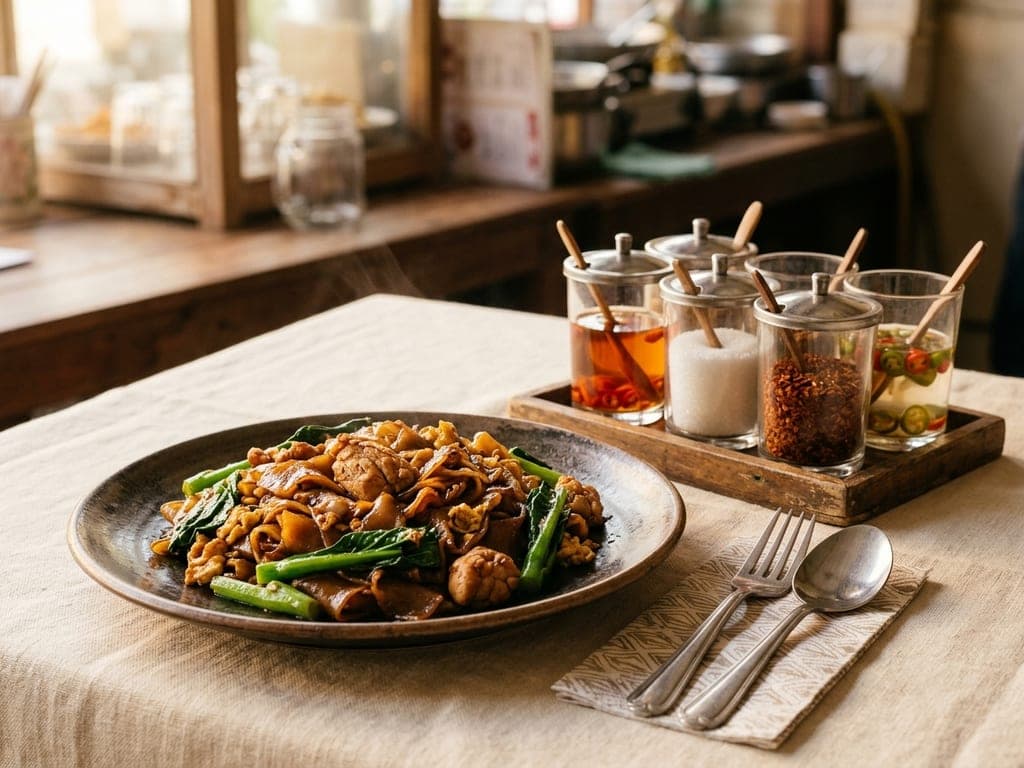
- Cluster four small bowls or jars on a little tray — fish sauce, white sugar, dried chili flakes, prik nam som — each with its own tiny spoon; mismatched bowls look more street-authentic than a matched set.
- Keep the caddy central and shared while each plate stays individual: the Thai grammar is one wok-pass per person, seasoning in common.
- Add a small stack of paper napkins and fork-and-spoon per setting, Thai-style — chopsticks really belong to noodle soups, though nobody blinks if you offer them; just never a fork alone against wide slippery ribbons.
- Light matters more than props: this table wants the warm, low, end-of-day kind — pad see ew photographed under cool bright light looks like brown noodles, and under warm light like dinner.
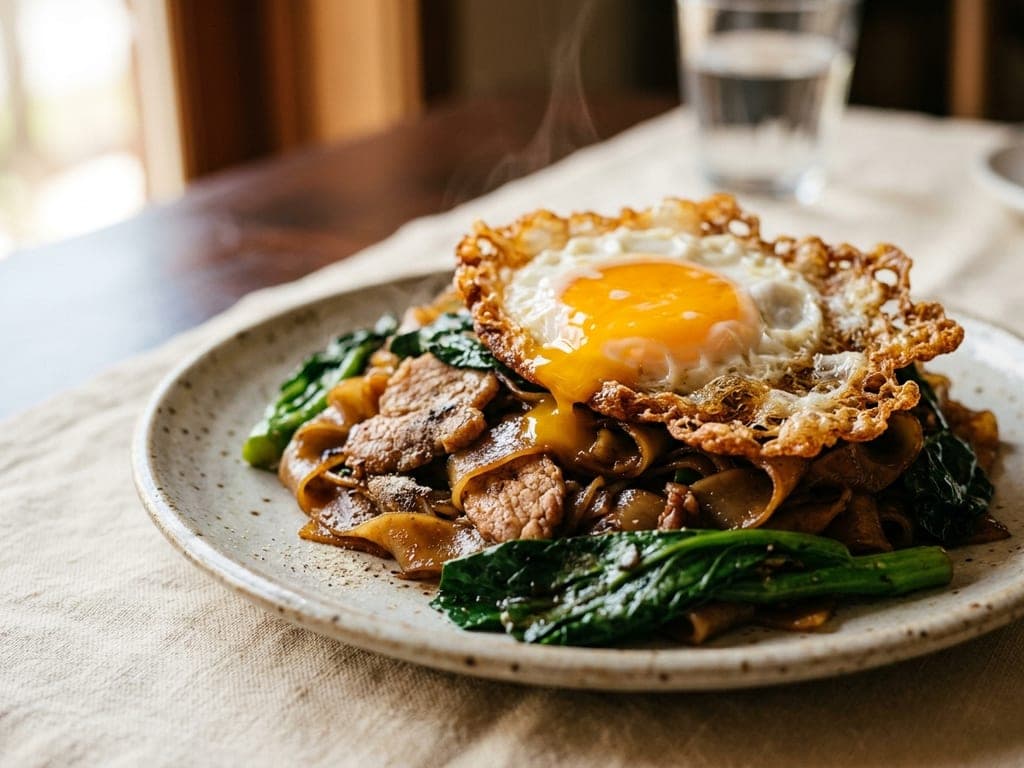
- Fry the egg in the still-hot pan after the noodles come out: 2 tbsp of oil, high heat, and baste the top with spooned oil so the white blisters lacy and brown at the edge while the yolk stays liquid.
- Land the egg half-on, half-off the noodle pile — fully centred reads like a diner breakfast; offset reads like the street stall that invented it.
- Break format and put one thing green nearby: a few of the darkest gai lan leaves pulled to the visible edge of the pile keep the plate from going monochrome around the egg.
- Serve immediately and instruct the table to break the yolk first — it is the second sauce, and pad see ew under running yolk is the version people photograph. (Small children and anyone advised off runny eggs get theirs fried hard; the lacy edge is the part that matters.)
Sen yai: the noodle is half the dish
The correct noodle is sen yai — 'big strand' — fresh wide rice noodles sold as slippery folded sheets or pre-cut ribbons in any Asian grocery with a refrigerator, sometimes still faintly warm from the noodle factory if the store is lucky enough to have one nearby. Fresh rice noodles are one of those ingredients where the gap between fresh and dried is a genre change: fresh ones are tender-chewy with frilled edges that catch sauce and char; dried ones rehydrate into something firmer and narrower that makes a respectable weeknight pad see ew and a noticeably different one.
The practical fresh-noodle briefing nobody prints on the package: rice noodles harden dramatically in the fridge — the starch retrogrades, same physics as day-old bread — so refrigerated sheets arrive as a solid brick. This is not staleness and it is fixable in one move: microwave in short bursts until warm and floppy, then separate gently. Some will tear. Let them. A plate of slightly ragged, properly charred noodles beats a plate of pristine steamed ones every single time, and the street stalls are not running an inspection either.
Buying dried: look for the widest rice stick sold, usually labelled XL or 10 mm — the Chantaboon/Jantaboon style from Thailand's noodle town of Chanthaburi. Soak in hot tap water until limp but still chewy rather than boiling them soft; they finish cooking in the sauce, and the difference between soaked-then-seared and boiled-then-sauced is the difference between noodles and porridge.
Char without a wok burner (the honest physics)
A Thai street wok runs over a jet burner that produces more heat than a home stove's every ring combined, and 'wok hei' — the breath of the wok, that faint smoky char-taste — is what happens when sauce and noodle surfaces flash-caramelize against metal that hot. A home burner cannot reproduce the burner, so this page reproduces the conditions instead. Condition one: mass. A heavy cast-iron skillet, fully preheated, stores enough thermal energy to sear the first load of noodles before the pan cools — on a flat electric or induction hob it genuinely beats a round-bottomed wok, which only shines over a strong gas flame.
Condition two: patience disguised as laziness. Charring happens where noodle touches metal and stays there; every stir resets the clock to zero. The recipe says press the noodles flat and leave them for 45–60 seconds, and it means it — past the first tug of worry, until you can smell the sweet soy toasting. The sugars in see ew wan are not just seasoning; they are fuel. They caramelize and scorch in spots, and those bittersweet charred freckles are the flavor the takeout version has and the timid home version lacks.
Condition three: throughput. One plate per pan-load, everything prepped and within arm's reach, sauce pre-mixed, no measuring once the oil goes in. The recipe's entire hands-on cook time is about four minutes per plate; the moment you stop to find the white pepper, the gai lan overcooks and the noodles steam. Mise en place is usually presented as cheffy virtue — here it is a structural requirement.
The sauce shelf, the vinegar, and the fine print
Sweet dark soy sauce — see ew wan — is the signature ingredient and the one worth a special trip: a molasses-thick, barely-salty caramel soy that supplies the dish's color, sweetness and charring fuel in one pour. Thai brands (Healthy Boy's green label, Dragonfly) are the target; Indonesian kecap manis is a genuinely excellent substitute rather than a compromise, being close cousins. The bootstrap version — regular dark soy plus extra sugar — works and is printed in the recipe, but the bottle is cheap, keeps for a year, and also makes the drunken noodles next door, half the point of buying it. Alongside it: oyster sauce for savory depth and a little light soy for salt. Nothing else.
Now the table. In Thailand a plate of noodles arrives unfinished on purpose, and the diner completes it from the khrueang prung — the four-jar caddy of fish sauce, sugar, dried chili flakes and prik nam som, chilies steeped in plain white vinegar. For pad see ew, prik nam som is not one option among four; it is the point of the caddy. The dish as cooked is sweet, salty and smoky, with only a quiet teaspoon of vinegar hiding in the sauce — a spoonful of sharp chili-vinegar over the top is what snaps it into full balance, and Thai eaters apply it as automatically as Westerners salt fries. Make it in thirty seconds: one serrano or jalapeño, sliced thin, drowned in ¼ cup (60 ml) of white vinegar. It keeps for weeks in the fridge and improves takeout, too.
Fine print for the plate as served: wheat and soy in the soy sauces (and in most oyster sauce), molluscan shellfish in the oyster sauce, egg in the pan — the scrambled egg and the optional fried-egg crown; the rice noodles themselves are egg-free — and fish in the fish-sauce jar if you set the full table caddy. Gluten-free is achievable with care — the rice noodles already are, so it comes down to swapping in tamari, a GF-certified oyster sauce, and building the sweet soy from tamari plus palm sugar, since kecap manis and most see ew wan carry wheat. Vegetarian: mushroom stir-fry sauce for the oyster sauce, firm tofu for the chicken, and press the tofu hard — a wet cube at wok heat spits like rain on a bonfire.
Questions, answered
What does pad see ew mean?
'Fried in soy sauce' — 'pad' is Thai for stir-fried, and 'see ew' is the Thai rendering of the Teochew Chinese word for soy sauce, a loanword that arrived with the Chinese immigrants who built Thailand's noodle culture. The name is the recipe: wide rice noodles fried in (sweet dark) soy sauce. Everything else on the plate — chicken, egg, Chinese broccoli — is supporting cast.
What is the difference between pad see ew and pad thai?
Different noodle, different sauce, different personality. Pad thai is thin rice noodles in a sweet-sour tamarind and fish sauce dressing, busy with peanuts, dried shrimp, lime and bean sprouts. Pad see ew is wide rice noodles in a dark sweet soy glaze — no tamarind, no peanuts, no lime — with char standing in for all that complexity. Pad thai is sweet-and-sour and crunchy; pad see ew is sweet-and-smoky and tender. In Thailand pad thai is the postcard the tourists order; pad see ew is the everyday lunch counter.
What is the difference between pad see ew and drunken noodles?
Same wide rice noodles, same wok, opposite mood. Pad see ew is mild, sweet and charred — no chili in the pan, comfort first. Drunken noodles (pad kee mao) are hot and herbal: bird's eye chilies, garlic, holy basil, green peppercorns, less sweetness, more violence. The sauces overlap enough that one shopping trip stocks both. Our drunken noodles page is this recipe's deliberate sibling — cook them in the same week and you will have opinions.
What noodles do I need for pad see ew?
Fresh wide rice noodles — sen yai — from an Asian grocery's refrigerator case, sold as folded sheets or cut ribbons; warm them until pliable and separate before cooking. The dried fallback is the widest rice stick you can find (XL / 10 mm), soaked in hot water until limp but still chewy, never boiled soft. In a genuine emergency, fresh lasagna sheets cut into ribbons are a known hack — wrong chew, right width — but at that point consider making the drunken noodles another day and shopping properly.
How do I get the smoky char like the restaurant version?
Three moves, all free. One: a heavy pan preheated to genuinely smoking — cast iron beats a thin wok on a home stove. Two: cook one portion at a time; a doubled batch drops the pan into steaming range and no char is possible. Three: stop stirring — spread the sauced noodles flat, press them down, and leave them 45–60 seconds until the undersides catch dark blistered spots, then toss once and press again. The sweet soy's sugar is the charring fuel; the leaving-alone is the technique. Restaurants have a jet engine; you have patience.
Why do my rice noodles clump together or fall apart?
Clumping means cold: refrigerated fresh noodles retrograde into a brick and must be rewarmed (microwave, short bursts) until floppy before they will separate — forcing them cold tears them into confetti. Falling apart means overhandled or overwet: soaked dried noodles boiled instead of soaked, or fresh noodles tossed continuously in the pan. Rice noodles are sturdiest when hot and lightly handled — get them in, sauce them, press them flat, and resist the stir-fry instinct to keep everything moving. And a few tears are cosmetic; the char covers for them.
Is pad see ew gluten-free?
Not as usually made, but convertibly. The rice noodles are naturally gluten-free; the wheat hides in the bottles — light soy, sweet dark soy (and kecap manis), and most oyster sauces all contain it. The conversion: tamari for the light soy, a certified GF oyster sauce (they exist), and sweet soy built from tamari simmered briefly with palm or brown sugar. Check the fresh-noodle package too — a few brands dust the sheets with wheat starch.
What is sweet dark soy sauce, and what can I substitute?
See ew wan is a Thai soy sauce reduced with sugar or molasses until it pours like syrup — barely salty, deeply sweet, and the source of pad see ew's color and charred-caramel flavor. Closest substitute: Indonesian kecap manis, essentially the same idea and freely swappable. Pantry bootstrap: 2 parts regular dark soy sauce to 1 part sugar, which covers the color and sweetness and merely lacks a little of the molasses depth. Plain light soy plus sugar is the distant third choice — the color and body will read pale.
Can I make pad see ew with beef, pork, shrimp or tofu?
All four are street-legal — 'pad see ew gai' (chicken) just happens to be the default order. Beef: flank or skirt, thin against the grain, and the baking-soda velvet earns its keep most here. Pork: shoulder or loin, same thin cut. Shrimp: add them raw with the garlic and pull the pan's timing forward — they are done in a minute. Tofu: firm or pressed extra-firm, seared first in the oil until the faces brown, then set aside and returned with the sauce so it stops shedding water into your char.
What can I use instead of Chinese broccoli?
Broccolini, and this is the rare substitution that is nearly the original: broccolini is a deliberate commercial hybrid of broccoli and gai lan, so you are swapping in the vegetable's own child. Split the stalks lengthwise and treat stems and florets on the same stagger as the recipe's stems and leaves. Beyond that: regular broccoli with the stems peeled and sliced thin on the bias, or a sturdy green like choy sum. Spinach and other soft leaves collapse too fast — by the time the noodles char, they have left.
Snap your finished plate and let the AI plate it again — more beautifully.