Korean Corn Dog Recipe (Chewy Yeast Batter, Real Cheese Pull, Sugar on Top)
The Korean street-cart original that conquered the internet: sausage or molten mozzarella on a stick, wrapped in a chewy yeasted batter — bread, not pancake, and no corn anywhere — armoured in panko, deep-fried gold, rolled in sugar, striped with ketchup and mustard. This page teaches the real yeast batter the shops use, the physics of the cheese pull, and the frying discipline that keeps it fun.
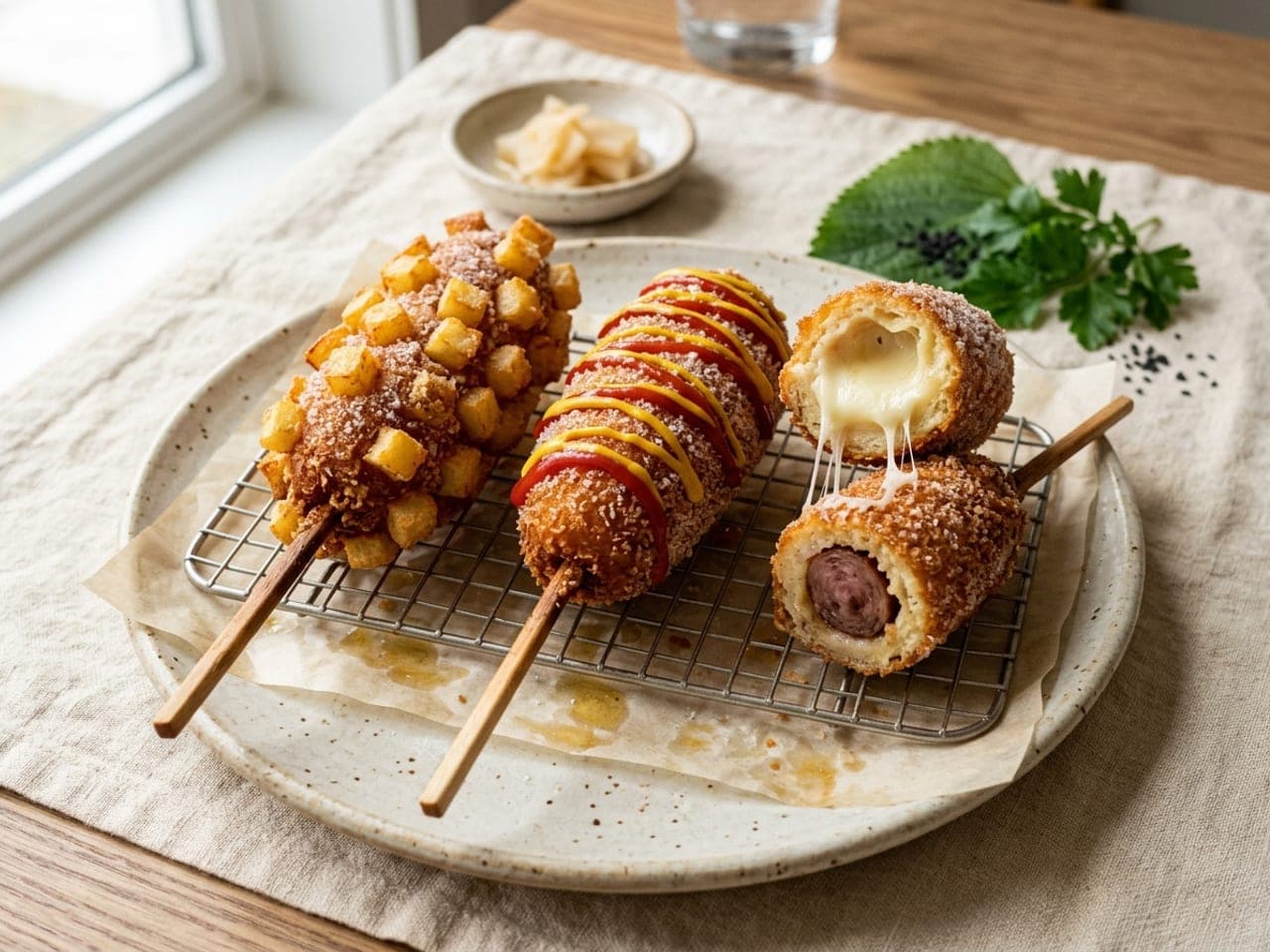
Ingredients
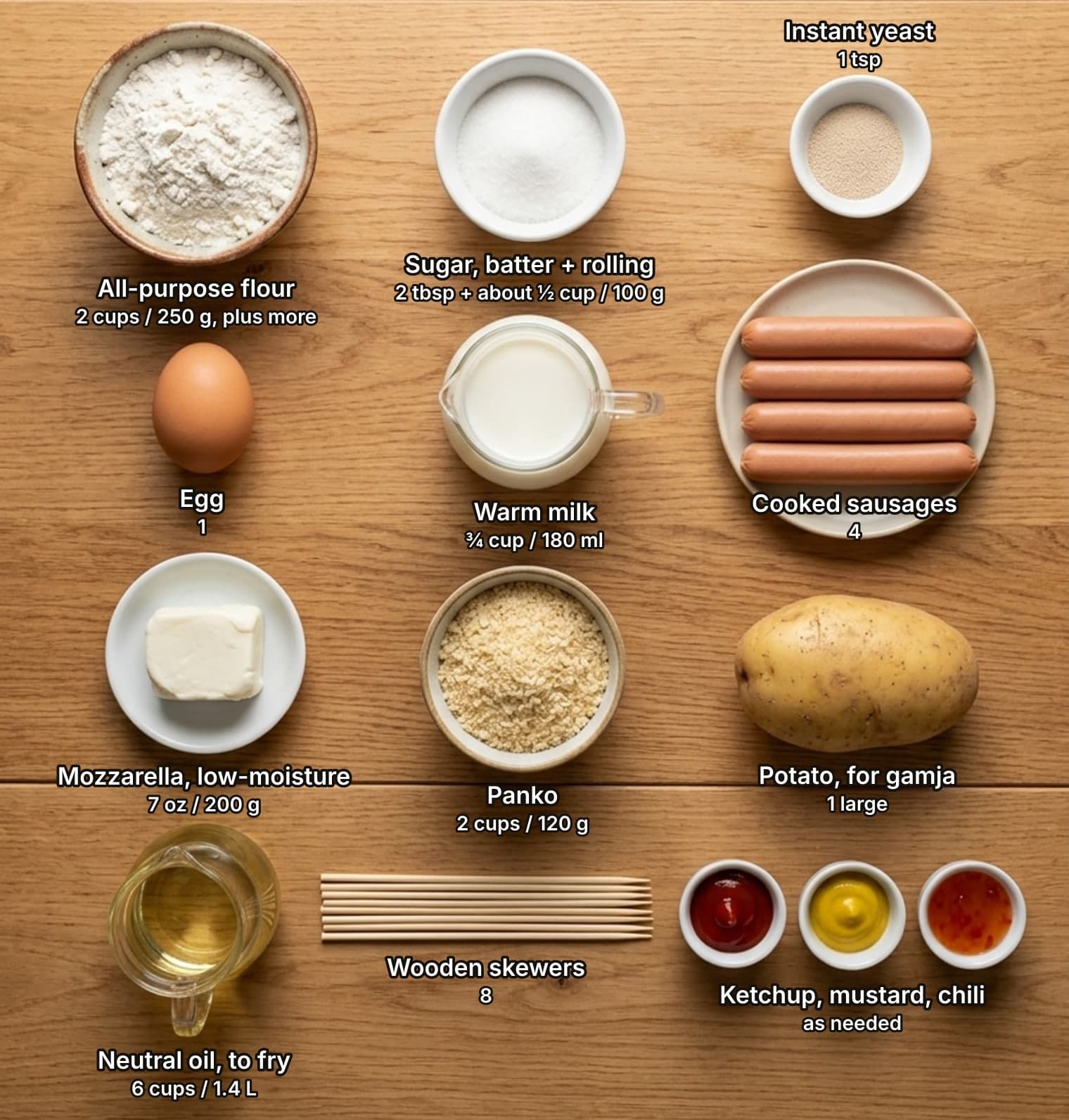
- all-purpose flour2 cups / 250 g, plus more for dusting
- sugar (batter), plus about ½ cup / 100 g for rolling2 tbsp
- instant yeast1 tsp
- fine salt1 tsp
- egg1
- warm milk¾ cup / 180 ml
- slim fully-cooked sausages (frankfurters or thin kielbasa)4
- low-moisture mozzarella block or string cheese, in sausage-size logs7 oz / 200 g
- panko breadcrumbs2 cups / 120 g
- potato, in ½-inch (1 cm) cubes, par-boiled 3 min and dried (gamja version)1 large
- neutral oil, for deep-frying6 cups / 1.4 L
- sturdy wooden skewers or chopsticks8
- ketchup, yellow (American-style) mustard and sweet chili sauce, to stripeas needed
No corn in the corn dog
Start with the honesty the name refuses: there is no corn in a Korean corn dog. The American original — the state-fair corndog — is a sausage in cornmeal pancake batter, fried and done. The Korean hot dog (hatdogeu, 핫도그 — “corn dog” was bolted on later for Western menus) took the format and rebuilt every layer: the batter became a chewy yeasted wheat dough, the coating became panko or cubed potatoes, the filling learned to be cheese as often as sausage, and — the move that scandalises first-timers and converts them by the second bite — the whole thing gets rolled in sugar on its way to the ketchup. Sweet-salty is not a stunt here; it is the thesis.
The format is decades-old Korean street food, but the version the world knows arrived in the late 2010s, when Busan-born chains — Myungrang Hot Dog the famous one — turned the cheese-pull into a franchise and social video did the rest. A stretched rope of molten mozzarella is the most legible food image ever filmed; it needs no language, no context and no menu. By 2020 the K-dog had shops from Bangkok to Berlin to a mall near you, priced like street food and queued like sneakers.
It remains, underneath the internet, a genuinely good idea: bread, sausage, cheese and potato are not a trend, they are a food group with a stick through it. The home version costs a fraction of the shop one, upgrades every component, and — because the batter is the only real technique — rewards exactly the hour of patience this page asks for.
How to make Korean corn dog
- Make the batter — it is a dough, and it needs an hour. Whisk 2 cups (250 g) of flour with 2 tbsp sugar, 1 tsp instant yeast and 1 tsp salt, then beat in 1 egg and about ¾ cup (180 ml) of warm milk until you have a very thick, sticky, stretchy batter — wetter than bread dough, stiffer than pancake batter, and it should fight the spoon. Cover and let it rise somewhere warm for 60–90 minutes until puffy and webbed with bubbles. The yeast is not negotiable: it is the entire difference between the street version’s chewy pull and a pancake on a stick.
- Build the skewers cold. Pat everything bone-dry, then thread sturdy wooden skewers or chopsticks: whole hot dogs for classics; a half hot dog followed by a half-length block of low-moisture mozzarella for the half-and-half; all cheese for the full pull. Cut the cheese into logs roughly the hot dog’s size — string cheese is famously perfect here, two sticks pressed together per skewer — and then FREEZE the built cheese skewers for 20–30 minutes. Warm cheese melts before the crust sets; frozen cheese arrives at molten exactly when the batter finishes frying.
- Set the station: dust, dough, armour. Three stops in a row: a plate of flour, the risen batter, and a deep tray of panko (about 2 cups / 120 g) — plus, for the gamja version, a second tray of ½-inch (1 cm) potato cubes, par-boiled 3 minutes and thoroughly dried. Roll each skewer in flour first and shake it off; the dusting is what convinces the batter to grip sausage and cheese instead of sliding off in the oil.
- Wrap the dough — the spiral trick. The batter is too thick to dip, which is the point. Working with wet hands, scoop a palmful, flatten it, lay the skewer on it and pinch the dough around, then roll and stretch it between your palms into an even sleeve, sealing the cheese end completely — every burst corn dog was a bad seal first. Shop trick if the wrap fights you: spread the batter on a wet flat tray, lay the skewer at one edge and ROLL it up the tray, spiralling the sheet on. Even coverage, sixty seconds a stick.
- Armour it. Roll the wrapped skewer immediately in panko, pressing crumbs in with your palms until nothing wet shows. For gamja dogs, press the dried potato cubes over the surface first — really press; commit each cube — and fill the gaps with panko. Set finished skewers on parchment while you wrap the rest; they can wait ten minutes, not thirty, before the batter starts thinking about rising again.
- Fry at 340–350°F (170–175°C), two at a time. Heat 2 inches (5 cm) of neutral oil in a deep, heavy pot to 340–350°F (170–175°C) — a thermometer is the honest tool; the fallback test is a panko pinch that sizzles instantly but does not brown in the first breath. Lower in two skewers, no more, and fry 5–6 minutes, turning every minute, until deep even gold. Crowding drops the oil’s temperature, and cool oil is how you get grease-soaked shells and cheese that escapes before the crust can hold it. Let the oil recover between rounds.
- Drain, then sugar while it is still too hot to hold. Lift onto a rack — never paper, which steams the base soggy — wait ten seconds, then roll or shower each dog in granulated sugar while the surface fat is still liquid enough to hold it. The sugar-on-fried move is the signature and the order is the trick: sugar first, sauces second, never the reverse. If a corner of cheese peeks out anywhere, it stayed inside — that is a successful dog, not a failed one.
- Stripe and serve standing up. Zigzag ketchup and yellow (American-style) mustard down each dog — the two-tone stripe is as canonical as the stick — with sweet chili or honey-mustard for the dissenters. Serve within ten minutes: the pull is at its cinematic best in the first five, the crust at its crispest in the first fifteen, and a Korean corn dog eaten warm out of hand, standing in the kitchen, is the correct cultural experience. Reheating notes live in the FAQ, but the real answer is to fry only what the room will eat.
Safety & hygiene Important
- Deep-frying is a procedure, not a vibe. Use a deep, heavy pot filled no more than a third with oil — the batter displaces more than you think — set it on a back burner with the handle turned in, and keep a lid within reach: burner OFF, lid ON, pot unmoved until stone cold is how an oil fire ends (water is how it becomes a ceiling fire — never, ever water). Clip on a thermometer and hold 340–350°F (170–175°C); below 320°F (160°C) the shells drink oil, above 375°F (190°C) the outside browns while the dough inside stays raw. No phone in the frying hand, no children at the pot, and everything that enters the oil goes in dry.
- The cheese is a pressure vessel — treat the seal as safety. A blown corn dog does not just leak; it can spit molten cheese and hot oil at face height. Prevention is the recipe: cheese frozen 20–30 minutes so it melts late, batter sealed completely at the cheese end, correct oil temperature so the crust sets fast, and skewers lowered in gently — never dropped. If one does start leaking, let it finish frying and lift it out normally; chasing a leaking dog around hot oil is how frying accidents audition.
- Hot sugar, hot cheese, small mouths. The first bite of a fresh corn dog holds cheese at boiling temperature inside an insulating crust — and unlike hot water, molten cheese sticks where it lands; the same physics as a jam doughnut. Give them two or three minutes off the oil before serving, warn the table the way the street carts never do, and for small children: take the dog off the stick and cut it LENGTHWISE into strips, never into coins — rounds are exactly the shape that plugs a small airway, and hot dogs top the childhood-choking statistics for that reason. The sharpened skewer plus a running child is the other hazard this page insists you take seriously.
- Oil afterlife. Cool the oil completely in the pot, then strain it through a fine sieve into a jar: batter crumbs left in used oil are what turn it acrid on the second outing. Fried-once oil is good for two or three more sessions if it still smells neutral; retire it when it darkens or smokes early — and retired oil goes into a sealed container and the bin (or your municipality’s collection), never down a drain, where it and the drain will both remember you badly.
3 ways to plate it
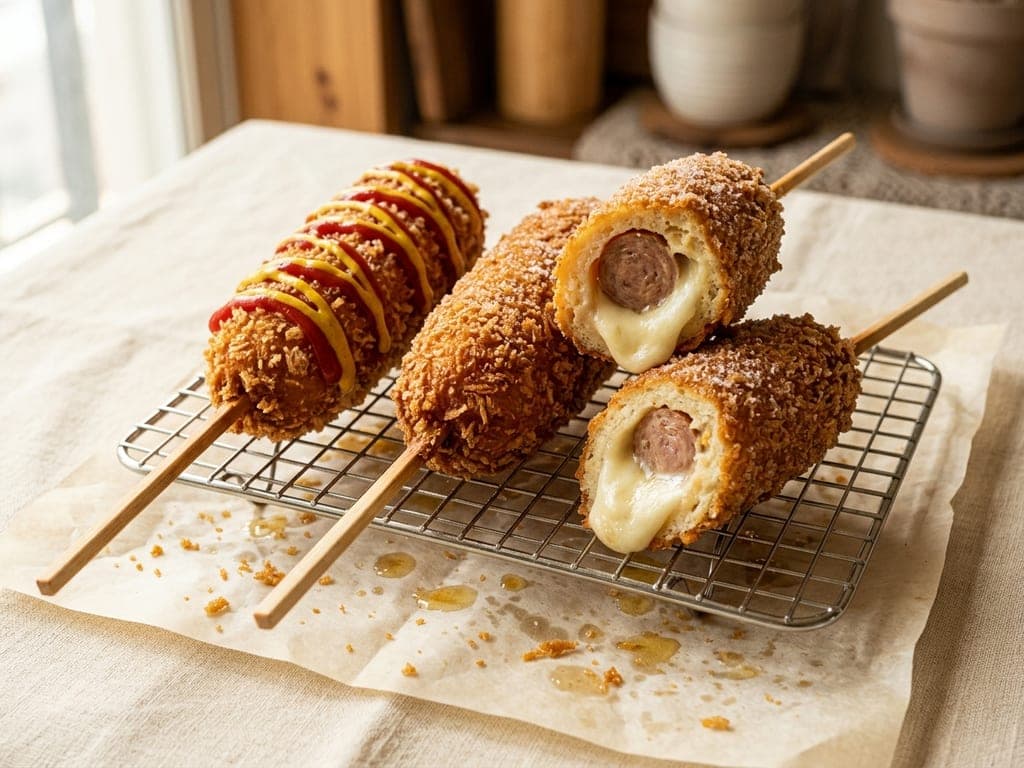
- Prop the dogs at leaning angles on a rack or against a small crate rather than flat on a plate — verticality is the whole grammar of stick food.
- Lay each sauce stripe in one unbroken zigzag pass per bottle — confidence reads from a metre away, and touch-ups read from further.
- Cut one dog in half on a hard diagonal and prop the halves cut-face out — the cross-section (or the beginning of a pull) is the menu photograph doing its own advertising.
- Leave the parchment’s honest grease spots and a scatter of stray panko in frame — street food plated sterile reads as frozen-aisle; the mess is provenance.
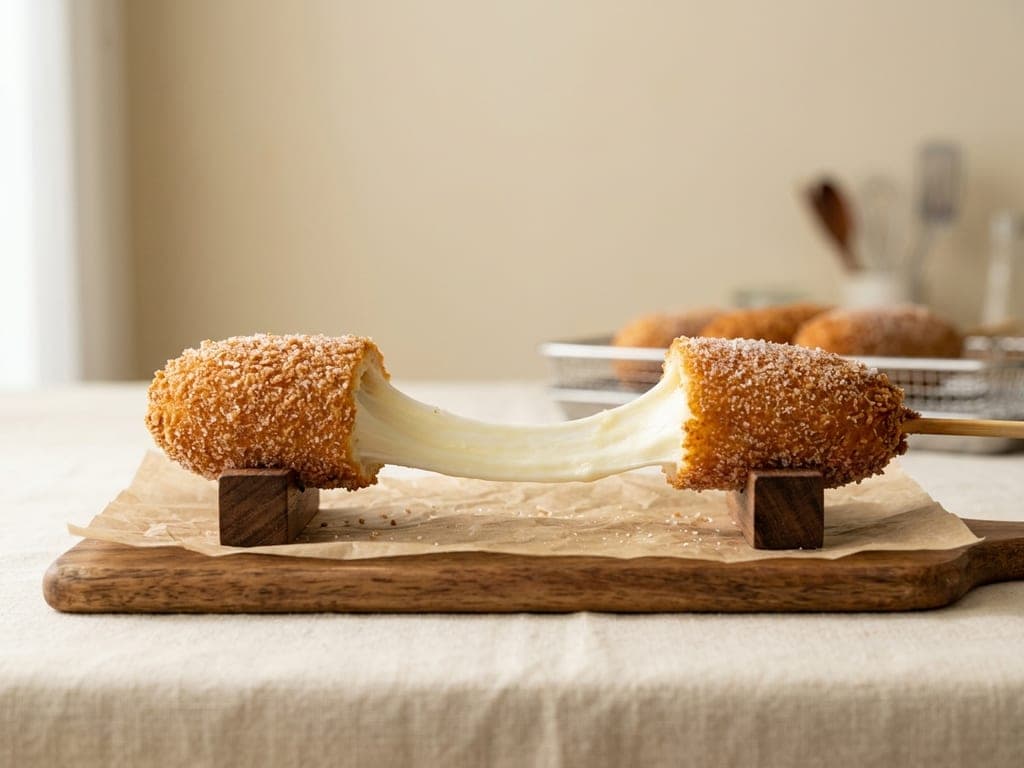
- Work in the first three minutes off the oil — the pull’s elasticity peaks early, and a rested dog tears instead of stretching.
- Cut with kitchen scissors, not a knife: snip the crust ring and pull the halves apart slowly and LEVEL — an even horizontal stretch ropes; a fast diagonal yank snaps.
- Pin each half down against something with weight (the rack, a small bowl’s edge) so the stretch holds for the photograph without a second pair of hands.
- Serve the demonstration dog to whoever filmed it — molten-cheese theatre has a strict best-before of about ninety seconds, and someone must eat the evidence.
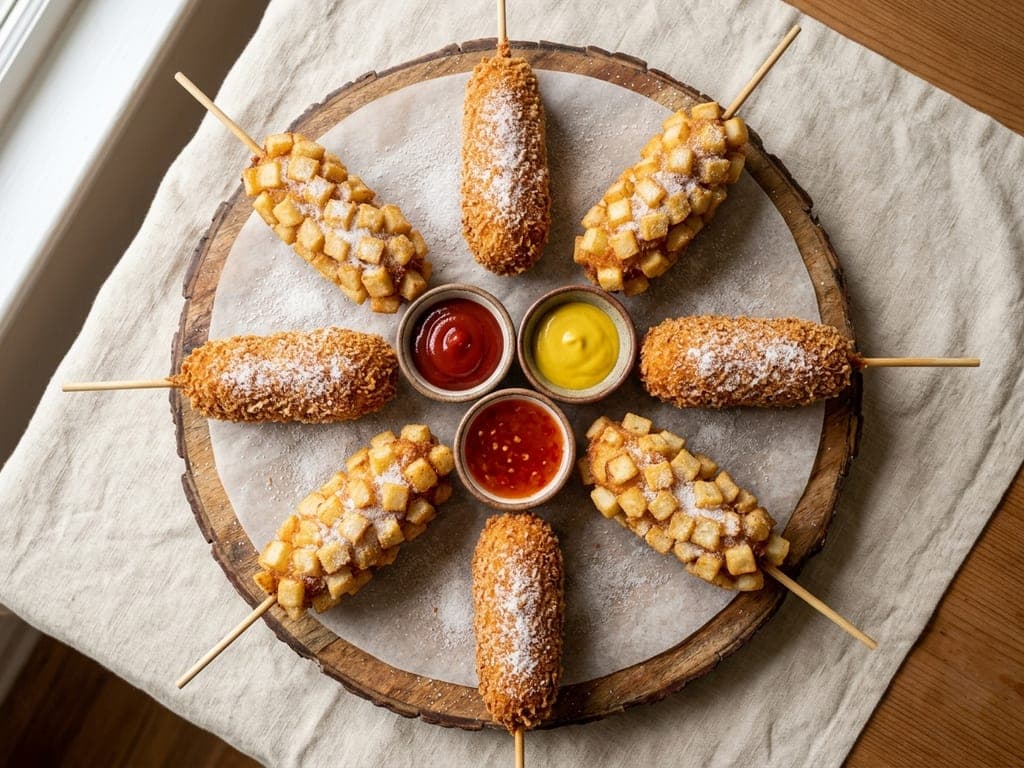
- Radiate the dogs sticks-outward with every handle clearing the board’s edge — reachability is the design; nobody should touch food to take food.
- Alternate the coatings around the circle — plain panko, potato, plain — so the board reads as a pattern and the choice explains itself without a menu.
- Put the sauces in deep small bowls at the hub for dipping rather than pre-striping — a party dog gets dunked, and pre-sauced sticks turn a shared board into roulette.
- Dust the finished wheel with sugar from a height at the table, like a crêpe stand — the falling-snow moment is thirty seconds of theatre that costs one tablespoon.
The batter is bread, not pancake
Everything that separates a Korean corn dog from an American one is decided in the mixing bowl. A quick baking-powder batter — which is what most of this keyword’s front page quietly teaches — sets into a tender, cakey shell: pleasant, gone in an hour, and wrong. The street batter is a yeasted dough on the wet end of bread: flour, sugar, yeast, egg, warm milk, beaten until stretchy and then given its hour to rise. Yeast means gluten development and gas, and those mean CHEW — the elastic, slightly bready pull that makes the shop version eat like a fresh doughnut that took a savoury job. One rise, one difference, the whole dish.
The dough’s stickiness is a feature with a learning curve. It is too thick to dip like pancake batter and too wet to roll like bread, which is why the method is palms, kept wet, shaping a sleeve around the skewer — or the shop trick of spreading the batter flat on a wet tray and rolling the skewer up it, spiralling the sheet on like a poster. Your first one will be ugly. Your third will be a shop dog. The panko forgives everything cosmetic anyway; what it cannot forgive is a thin patch over the cheese, so seal first and beautify later.
Variations the shops actually use: a spoonful of rice flour in the mix (2–3 tbsp of the 250 g here) shifts the chew toward the bouncier, QQ end and crisps the shell a shade harder — worth trying on your second batch. And if the evening truly cannot spare the rise, a baking-powder batter will feed people — just know you made the other dish, and make it on purpose rather than by omission.
Fillings, and the physics of the pull
The cheese-pull is not a cheese choice, it is a moisture choice. LOW-MOISTURE mozzarella — the firm block or, most conveniently, string cheese, which is low-moisture mozzarella pre-cut to exactly the right geometry — melts into the long elastic ropes the format is famous for. Fresh mozzarella, the wet ball in whey, is a steam bomb in a sealed crust: it boils, bursts the seam, and leaves you a hollow dog and a greasy pot. It is the single most common failure on this recipe and it happens in the shopping aisle, not the kitchen. Cheddar splits oily; gouda pulls decently; halloumi squeaks and never pulls at all. Buy the boring block.
The freezer is the other half of the physics. Cheese straight from the fridge reaches full melt before the yeast shell has set, and pressure finds the seam; cheese frozen for twenty-odd minutes arrives at molten in the final minute of the fry, exactly when the crust can contain it. Sausage-half-cheese-half is the canonical build partly because it eats well and partly because the sausage end anchors the cheese end’s engineering.
The sausage itself: any good fully-cooked frankfurter works, and Europe is frankly the home advantage — a proper smoked wiener or a slim kielbasa outclasses the shop product. Skinny sausages beat fat ones (ratio of crust to filling is the eating experience), and pat everything dry before flouring: batter grips matte surfaces and abandons wet ones.
The toppings order, and the gamja upgrade
Street-cart choreography is strict and correct: sugar first, while the surface fat is still hot enough to hold it, sauces second, in stripes, at the end. Reverse it and the sugar will not stick and the sauces steam-slide off. The sugar is granulated, showered or rolled, and the right amount is more than feels respectable — the sweet-against-salt is the identity of the thing, and under-sugaring out of embarrassment produces a corn dog with an identity crisis. Beyond ketchup and yellow mustard, the shops run sweet chili, honey-mustard, and — for the full Seoul — a dusting of parmesan or a squeeze of condensed milk on the cheese-only dogs. Start canonical; earn your deviations.
The gamja (potato) dog is the format’s best upgrade and it is a coating, not a new recipe: ½-inch (1 cm) potato cubes, par-boiled three minutes so they finish cooking in the fry, dried fanatically, pressed into the wrapped batter before the panko fills the gaps. They fry into a jacket of tiny roast potatoes around a sausage, which is as good as that sentence sounds. (The shop shortcut of diced frozen fries, thawed and blotted, works and no one will audit you.) The other famous armour — crushed instant ramen — crisps loudly, scorches quickly, and needs the oil at the low end of the range and your full attention.
However you coat it, the fry rules stay identical: 340–350°F (170–175°C), two skewers at a time, turned every minute, rack never paper. Crowding the pot is the only way to fail this recipe after the shopping aisle — cold oil returns every sin at once: pale, greasy, leaking. The pot will tell you when it has recovered; believe the thermometer over your impatience.
Questions, answered
Why is there no cornmeal in a Korean corn dog?
Because it was never a corndog — the Korean street original (hatdogeu) is a yeasted wheat-dough batter, chewy like a savoury doughnut, and “corn dog” was adopted later as export vocabulary. The American fair version is cornmeal pancake batter: tender, cakey, corn-sweet. Different batters, different chew, different dish — this page makes the Korean one, honestly cornless.
What cheese gives the real cheese pull?
Low-moisture mozzarella, full stop — the firm block, or string cheese, which is the same cheese pre-shaped to the exactly correct log (two sticks pressed together per skewer). Fresh mozzarella in whey is the classic failure: too wet, boils into steam, bursts the crust. Freeze the built cheese skewers 20–30 minutes so the melt peaks as the shell finishes — that timing IS the pull.
Can I make the batter without yeast?
You can make A batter without yeast — flour, baking powder, sugar, egg, milk — and it fries into a pleasant, cakey shell in five minutes of prep. What it cannot make is the chewy, bready pull that defines the street version; that texture is gluten and fermentation, and only the hour’s rise sells it. This page’s position: make the yeast batter the first time so you know what the dish is, keep the quick version for emergencies.
Can I air-fry or bake these?
Not into the same dish — the wet yeast batter needs the oil’s immersion to set into its shell; in an air fryer it slumps and welds to the basket. Where the air fryer genuinely shines is REheating: 350°F (175°C) for 5–6 minutes returns a fridge-cold corn dog to about ninety percent of its glory, far better than a microwave’s soggy hundred percent of sadness.
What sausages should I use?
Fully-cooked, smoked, and on the slim side: a good frankfurter, a thin wiener, or a skinny kielbasa — in Europe the butcher’s case is a straight upgrade on the shop version. Slim matters because the crust-to-filling ratio is the eating experience; a fat bratwurst turns the dog into a mortar round. Pat dry, always: batter does not negotiate with wet surfaces.
Why did my cheese explode out?
One of three engineering failures, usually all announced in the pot: the cheese went in fridge-warm (freeze the built skewer 20–30 minutes), the batter seal at the cheese end had a gap (pinch it closed like a dumpling, then check), or the oil ran cold from crowding, giving the melt a head start on the crust (two skewers at a time, thermometer honest). Fresh mozzarella is the fourth failure and it happened at the supermarket.
Do I really roll a hot dog in sugar?
You really do, and it is the entire personality of the dish — the granulated sweetness against the salty sausage and mustard is Korea’s standard-issue sweet-salty street move (the same instinct that butters and sugars Korean garlic bread). Roll it on while the crust is hot so it sticks, and apply more than your instincts suggest. Skeptics convert at bite two, reliably enough to schedule.
Can I make them ahead or reheat them?
The batter can rise slowly in the fridge overnight (better flavour, actually), skewers can be built and frozen, and the finished dogs reheat respectably: 350°F (175°C) oven or air fryer for 5–8 minutes to re-crisp — never a microwave, which un-fries them. But the cheese-pull is a fresh-off-the-oil phenomenon with a fifteen-minute window; for guests, fry in rounds while they eat rather than plating twenty at once. Street food keeps street hours.
What is a gamja dog?
The potato one — gamja is Korean for potato: the battered skewer gets a jacket of small par-boiled potato cubes pressed on before frying, so it comes out wearing a coat of tiny roast potatoes. Same batter, same fry, one extra tray at the station — and for many people, one bite in, the only version that matters. Diced-up frozen fries, thawed and dried, are the accepted shortcut.
How many calories in one?
About 380 for a classic half-and-half as built here, before sauces — it is a fried, sugared street snack and it declines to apologise. The gamja version runs a bit higher, the all-sausage a bit lower, and the honest portion answer is the street’s own: one dog is a snack, two is lunch, and nobody eats three standing up.
Snap your finished plate and let the AI plate it again — more beautifully.