Banh Mi Recipe (Lemongrass Pork, Real Đồ Chua, the Bread Truth)
Saigon's baguette sandwich: charred lemongrass pork, bright pickled daikon and carrot, cool cucumber and cilantro, all inside bread with a shattering crust and a cloud-light crumb. The two make-or-break decisions happen before any meat hits heat — choosing bread that's light enough, and giving the đồ chua pickle its head start — and this page treats both as seriously as the pork. Count on about an hour of hands-off time (freezer, marinade, pickle) around the 40 active minutes.
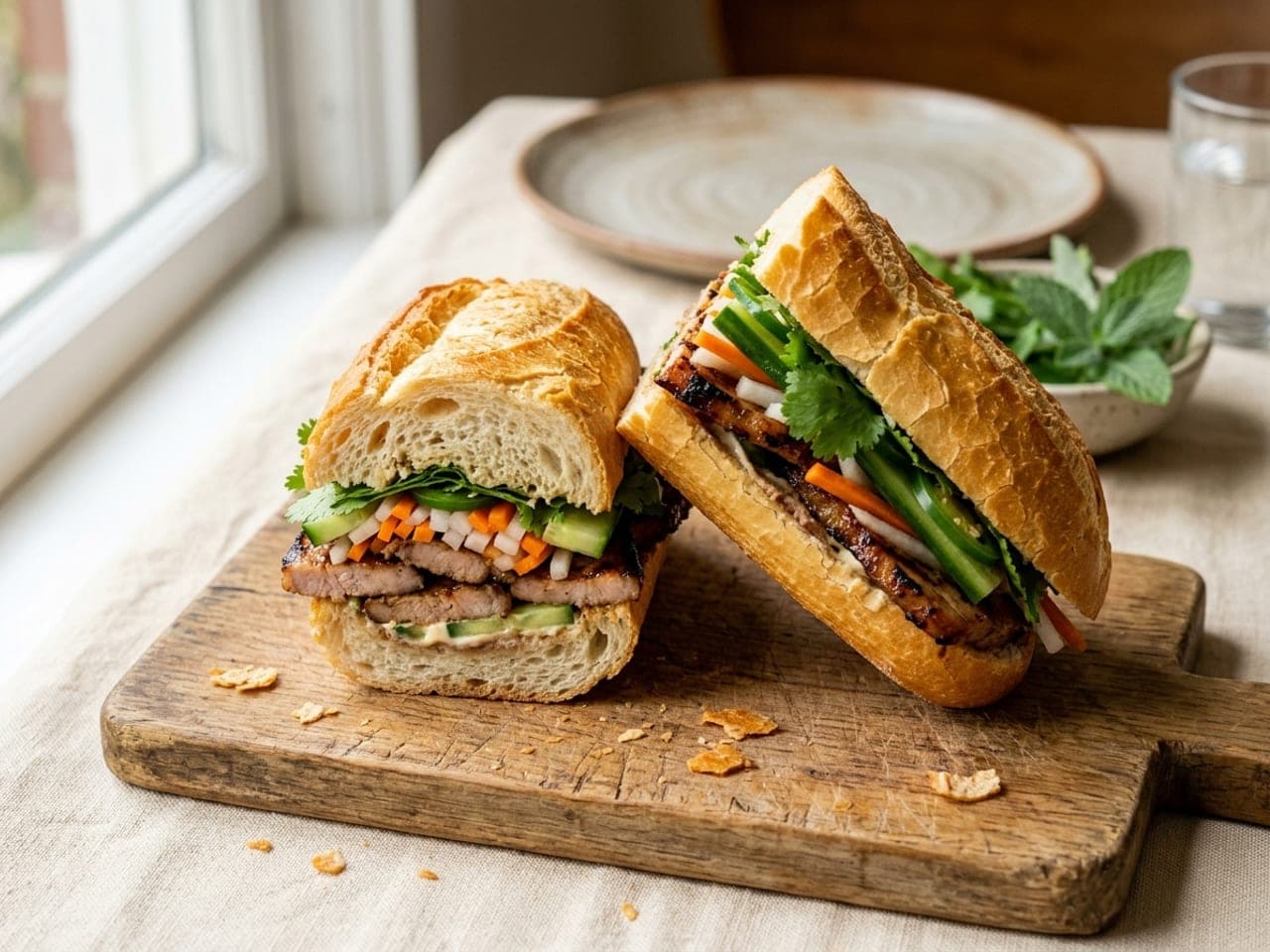
Ingredients
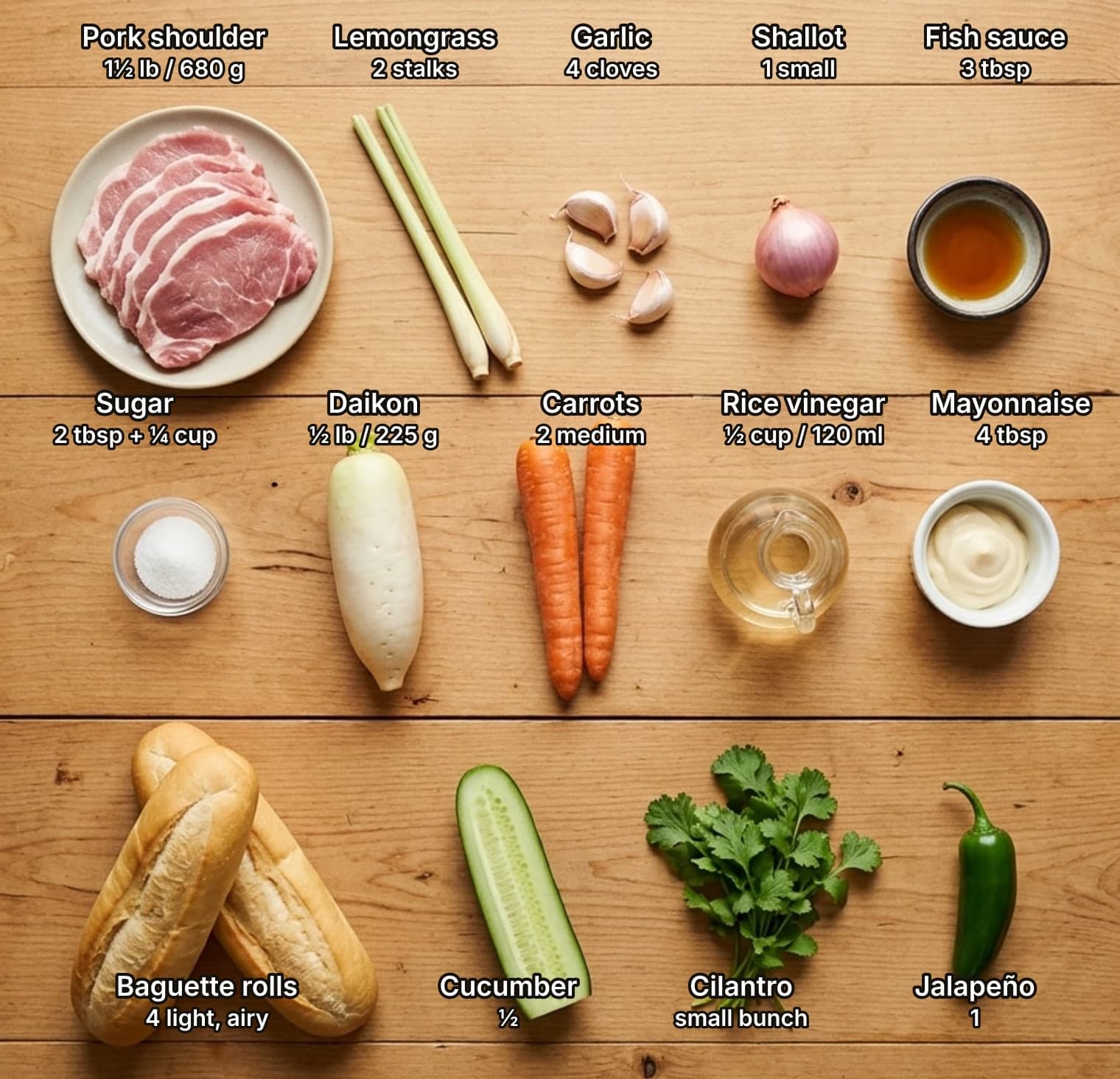
- pork shoulder, sliced thin against the grain — see the partial-freeze trick in the steps1 1/2 lb (680 g)
- lemongrass, tender inner cores only, finely minced2 stalks
- garlic, finely minced4 cloves
- shallot, finely minced1 small
- fish sauce3 tbsp
- granulated sugar — 2 tbsp for the marinade, 1/4 cup (50 g) for the pickle brine2 tbsp + 1/4 cup
- neutral oil (for the marinade and the pan)2 tbsp
- freshly ground black pepper1/2 tsp
- daikon (sold as mooli in the UK), cut into matchsticks1/2 lb (225 g)
- carrots, cut into matchsticks2 medium
- rice vinegar (or distilled white vinegar)1/2 cup (120 ml)
- fine salt (for the pickle)1 tsp
- light, airy baguette-style rolls, about 8 inches (20 cm) each — see the bread section before shopping4
- mayonnaise4 tbsp
- cucumber, in long thin spears1/2
- cilantro (fresh coriander), in whole sprigs1 small bunch
- jalapeño or another medium-hot green chile, thinly sliced1
- Maggi seasoning or soy sauce, a few drops per sandwich (optional but traditional); chicken-liver pâté, optional — see the pâté honesty
Bread, empire, and the sandwich Saigon made its own
Bánh mì literally means 'wheat bread' — bánh the broad Vietnamese category of breads, cakes and pastries, mì 'wheat' (a popular folk etymology ties it to French pain de mie, but the term appears in Vietnamese dictionaries decades before the colony) — specifically the loaf the French brought to Vietnam in the colonial nineteenth century, when the baguette arrived as the occupier's loaf. What happened next is the part worth telling: Vietnam didn't just adopt the baguette, it re-engineered it — lighter, airier, with a crust like thin ice instead of French chew — and then, in the Saigon of the 1950s, street vendors did the decisive thing and stuffed a full meal inside. The shop most often credited is Hòa Mã, a Saigon deli opened in 1958 by bakers from the north, which began stuffing the roll as a complete to-go meal — and the format spread through the city's streets, then — after 1975, carried by the Vietnamese diaspora — to bakery counters from Paris to Houston to Melbourne.
The sandwich's genius is engineering under constraints: it's a complete flavor argument — rich (mayo, pâté, fatty pork), sharp (pickle), hot (chile), cool (cucumber), herbal (cilantro) — in a package one hand can hold and a street vendor can build in under a minute. Every component is prepared ahead; only assembly happens to order. That's also the honest home-cooking lesson this page borrows: banh mi is not a 40-minute sprint, it's 30 minutes of relaxed prep whenever you have them, and 90 seconds of assembly whenever you're hungry.
What fills the bread varies by region, cart and decade — cold cuts and pâté in the classic thịt nguội style, grilled lemongrass pork like this page, chicken, meatballs, fried egg for breakfast, tofu — and none of them is the single authentic one. This page picks thịt nướng, the grilled pork version, because it's the one most beloved outside Vietnam and the one a home broiler genuinely does well.
How to make Banh Mi
- Đồ chua first — the pickle needs the head start. Cut the daikon (mooli) and carrots into matchsticks about 1/8 inch (3 mm) thick — a julienne peeler makes this a two-minute job — and toss them in a bowl with the 1 tsp salt and 1 tbsp of the pickle's sugar. Massage with your hands for a minute until the sticks bend without snapping and weep some liquid, then rinse briefly and squeeze dry. Pack them into a jar and pour over the brine: 1/2 cup (120 ml) rice vinegar, 1/2 cup (120 ml) warm water and the rest of the 1/4 cup sugar, stirred until dissolved. Top up with equal parts vinegar and water if the sticks aren't fully submerged. Thirty minutes on the counter makes them edible; a few hours in the fridge makes them right. This is the sandwich's acid engine, and it cannot be rushed at assembly time — which is exactly why it goes first.
- Slice the pork thin — the freezer trick works here too. Firm the pork shoulder in the freezer for 30–45 minutes, then slice it against the grain about 1/4 inch (6 mm) thick — thin enough to char quickly and stack obediently in bread, thick enough to stay juicy. Shoulder is the cut on purpose: its marbling forgives fierce heat the way lean loin never will. If your butcher sells thin-cut pork shoulder or 'BBQ-cut' pork, take it and skip the freezer.
- Build the lemongrass marinade — inner cores only. Trim the lemongrass stalks of their woody tops and outer layers until you reach the pale, tender core — the bottom 4 inches (10 cm), roughly — mince it fine, then bruise the mince to a rough paste with the flat of your knife (or a few pulses in a small processor) — smashed lemongrass releases its oils into the marinade; merely chopped lemongrass just decorates it. Tough outer layers never soften, they lodge between teeth. Stir it in a bowl with the garlic, shallot, 3 tbsp fish sauce, 2 tbsp sugar, 1 tbsp of the oil and the black pepper until the sugar dissolves. The marinade should smell loud: fish sauce and sugar are doing the caramel-savory work that makes thịt nướng taste grilled even out of a city kitchen.
- Marinate 30 minutes — or overnight if dinner allows. Massage the marinade through the pork slices so every surface is coated, then cover and refrigerate at least 30 minutes and up to overnight — 24 hours is the outer edge — because thin slices drink fast, and fish sauce plus time deepens rather than ruins here. If you plan to cook under the broiler, thread the slices loosely onto skewers or lay them on an oiled rack now, so the transfer to fierce heat is one motion later.
- Char the pork hard and fast. The broiler (the overhead grill) is this kitchen's stand-in for a Saigon charcoal brazier: maximum heat, pork in a single layer on a rack over a foil-lined sheet, 3–4 minutes per side until the edges char and the sugars catch in dark patches. The cast-iron route works just as well: a 12-inch (30 cm) skillet with the remaining oil over high heat, pork in a single layer in two batches, 2–3 minutes per side, resisting the urge to stir — char needs contact, and a crowded, shuffled pan steams. Either way the smell is the checkpoint: caramel first, smoke second, and pull it while the edges are dark but the centers still glisten.
- Revive the bread — three minutes that decide the sandwich. While the pork rests, put the rolls straight on the rack of a 350°F (175°C) oven for 3–4 minutes, until the crust crackles when squeezed and the inside is warm. This step is non-negotiable even for fresh bread, and it's resurrection for day-old: the light, airy rolls this sandwich needs go leathery at room temperature and reset completely with heat. Then split each roll like a book — cut along the side but keep a hinge — so the sandwich holds together in one hand instead of shedding its filling from an open top.
- Layer in order — fat, meat, pickle, fresh. Spread 1 tbsp mayonnaise across both inner faces of each roll (and a thin layer of pâté on the bottom face, if you're using it — the honesty section has the ruling). Then build upward: warm pork first, directly on the fat layer; a generous tangle of đồ chua squeezed of its brine — squeezed hard, wet pickle is how bread dies; then cucumber spears along one side, whole cilantro sprigs, and jalapeño slices scattered to taste — cut everything to the roll's length beforehand; the fresh trio should lie along the sandwich, not poke out of it. Finish with a few drops of Maggi seasoning or soy sauce shaken over the pork. The order isn't ceremony: fat waterproofs the crumb, warm meat sits below so its juices soak downward into mayo instead of upward into pickle, and the fresh things stay cool on top.
- Serve immediately — this sandwich has a crust clock. A banh mi is at its absolute best in the first ten minutes, while the crust still shatters against the soft interior — that contrast IS the sandwich, and it doesn't wait politely. Press gently, cut in half on the diagonal if sharing, and eat over the wrapper the way Saigon does. If you're feeding a crowd in waves, hold the components instead of built sandwiches: pork rewarmed in a hot pan, rolls re-crisped in the oven, pickle and fresh trio straight from the fridge — assembly takes ninety seconds and the clock starts fresh every time.
Safety & hygiene Important
- Raw pork and its marinade. The bowl, the board, the knife and the hands that met raw pork are on raw-meat rules until hot soapy water says otherwise, and the marinade the pork sat in has exactly two futures: the trash, or a hard one-minute boil if you want to brush a little over the cooking meat — never a cold drizzle over the finished sandwich. USDA's line for whole-muscle pork is 145°F (63°C) with a 3-minute rest — that's the standard; on slices too thin to probe, opaque-throughout with charred edges and no translucent centers is the working proxy that guarantees you're well past it. The plate or rack that carried raw pork to the heat never receives the cooked pork — and if you want a basting sauce without the boil, spoon off a clean few tablespoons of marinade before the raw pork ever goes in. What actually needs your attention is the crowding: a heaped pan steams at a temperature where nothing chars and everything stews.
- Đồ chua is a fridge pickle, not a canned one. This quick pickle is a refrigerator citizen: it goes into a clean jar, it lives in the fridge, and it keeps about 3 weeks — it is NOT shelf-stable and was never processed to be, so no pantry storage, no reused lids from real canning projects, no gifting it as if it were preserved. Fish the pickle out with a clean fork, and never return squeezed or handled pickle to the jar. One smell honesty so you don't throw out good food: daikon develops a sulfurous, cabbage-y funk after a few days in the jar. That smell is normal and fades seconds after the pickle hits air. The line between funky-normal and actually-off: sliminess, fizzing brine, or mold means the jar is done; a whiff of sulfur on opening does not.
- Assembled sandwiches don't keep — components do. A built banh mi follows the 2-hour rule (1 hour above 90°F/32°C) like any perishable food, and warm meat plus pâté in bread is not a lunchbox that improves with time — if it must travel, pack the components cold and separate and build on arrival. (Commercial mayonnaise, for the record, is acidified and not the villain of this story — the pork and pâté drive the clock; homemade raw-egg mayo, if you go there, tightens every rule.) The parts store honestly: cooked pork keeps 3–4 days refrigerated and rewarms best in a hot skillet, properly hot — 165°F (74°C) is the reheat line; an opened tub of pâté gets the same 3–4 days, and deli-case pâté is a Listeria-risk food that pregnant and immunocompromised eaters should skip; the pickle keeps its 3 weeks; the rolls live at room temperature and re-crisp in the oven, never the microwave, which turns that thin crust to chewing gum. Cilantro and cucumber are day-of citizens — wash them when you use them, not before.
3 ways to plate it
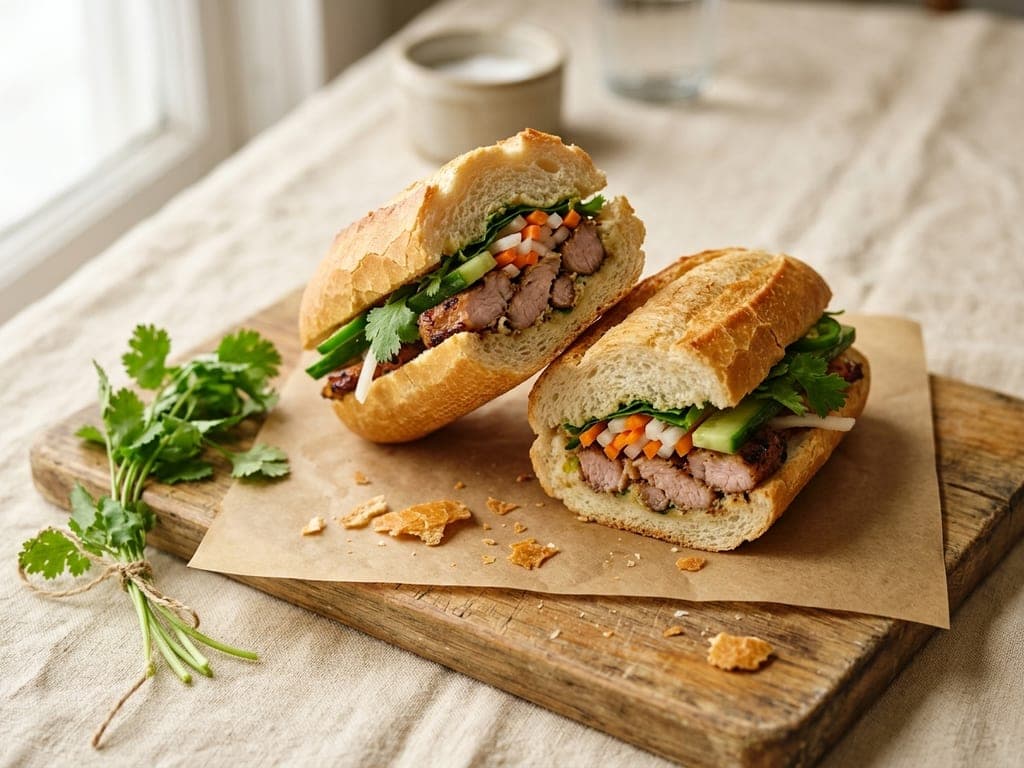
- Cut the sandwich on a hard diagonal with a serrated knife — one confident stroke, not a saw; the cross-section showing every layer is the whole presentation.
- Serve it on plain paper or a small board, halves leaning against each other so the filling faces the eater.
- Let a few crust shards stay where they fall — a banh mi that doesn't shed crust wasn't crisp enough.
- Put extra cilantro and chile slices within reach rather than overstuffing the sandwich; the eater balances their own bites.
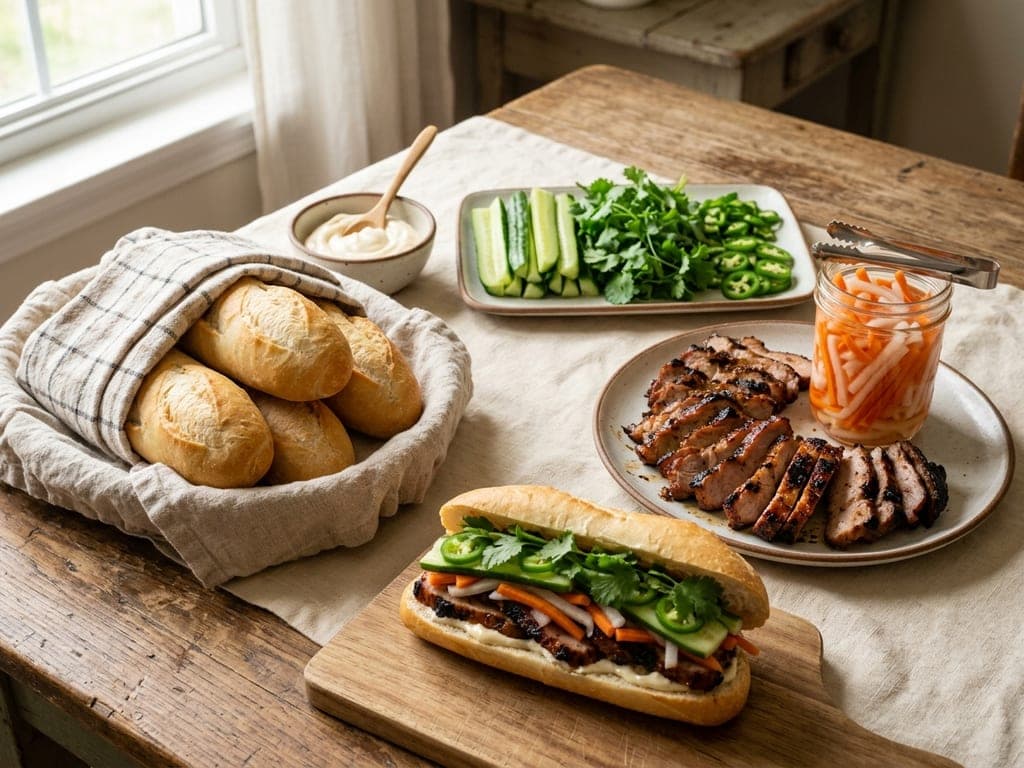
- Give the pork its own warm platter and the đồ chua its jar with tongs — the jar going to the table IS the make-ahead flex.
- Stack revived rolls in a cloth-lined basket so they stay warm and audible; revive them in waves if the meal runs long.
- Arrange cucumber, cilantro and chile in rows on one plate — mise en place as table decoration.
- Build one demonstration sandwich open-faced and leave it in front: fat, meat, squeezed pickle, fresh — the order teaches itself.
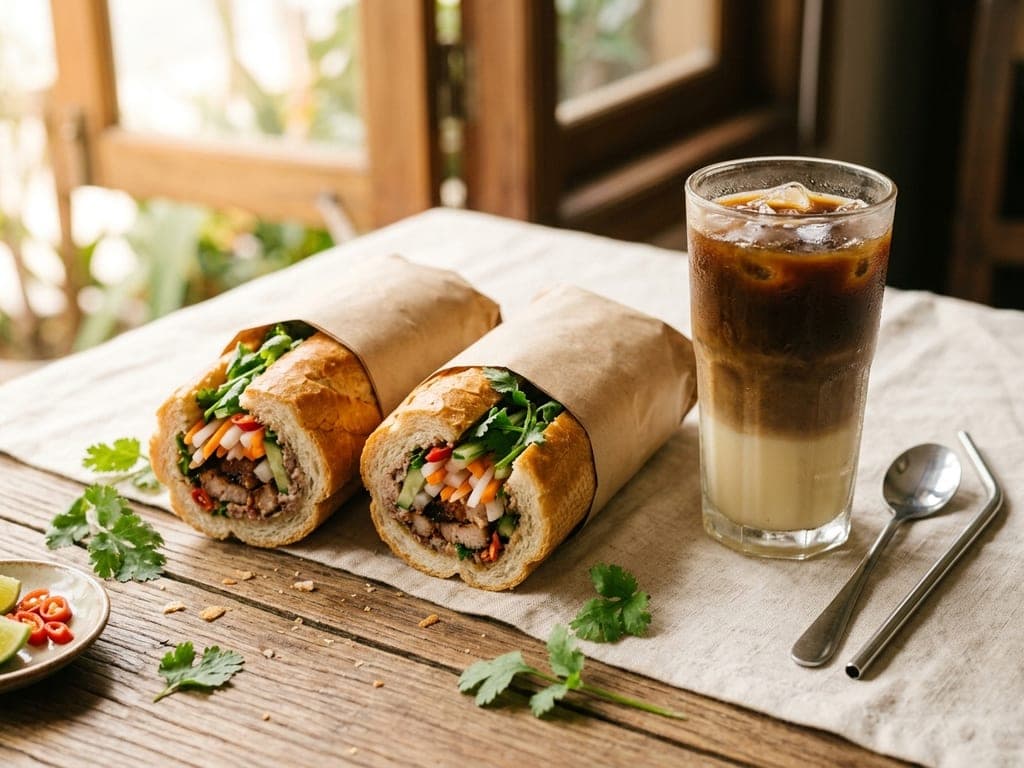
- Wrap each sandwich snugly in plain paper with the ends open — the paper holds the architecture together and the open ends let steam out, protecting the crust.
- Wrap while the bread is warm but the fillings are freshly built; a paper-wrapped banh mi holds its dignity for about an hour, unrefrigerated food-safety clock permitting.
- Pair with cà phê sữa đá — strong coffee over condensed milk and ice — or any cold, bitter drink that argues with the richness.
- For a real picnic, carry components instead: rolls whole, pork in a container, pickle in its jar, and build on site in ninety seconds.
The two decisions: the bread and the pickle
The bread decision comes first because it can sink the sandwich before you cook anything. A Vietnamese bánh mì roll is a different animal from a French baguette: the crust is paper-thin and shatters at a touch, and the crumb inside is light to the point of cottony — a structure often attributed to rice flour in the dough, though the deeper truth is a lean, essentially all-wheat dough baked hot with steam. What this means at a Western bakery is counterintuitive: skip the good baguette. An artisan loaf's thick, chewy crust and dense crumb will shred the roof of your mouth and squeeze the filling out the sides. You want the LIGHT bread: a Vietnamese or Chinese bakery roll if your city has one, a supermarket 'French roll' or demi-baguette (the inexpensive soft kind, genuinely better here than the fancy kind), or a Mexican bolillo or telera, which are close cousins already built for wet fillings. If your roll runs dense, hollow it slightly — pull a little crumb out of the top half — and it gets out of the filling's way. The oven-revival step then gives whichever roll you found its crackle back.
The pickle is the sandwich's second structural decision, because đồ chua isn't a garnish — it's the acid that makes the rich layers eatable at speed. The salt-massage matters: it collapses the vegetable's rigidity so the sticks pack tight and drink brine fast, which is what lets a 30-minute pickle taste properly developed. Make it in daylight hours whenever you like — it improves for the first day or two and holds about 3 weeks in the fridge — No daikon at your market? All-carrot đồ chua — same weight, same salt-massage, same brine — is the legitimate fallback: sweeter, still sharp, still crunchy. Either way, squeeze it almost dry before it goes in the bread; the flavor lives in the vegetable, and the brine's only contribution inside a sandwich is sog.
Everything else is assembly discipline. The layer order in the steps exists to manage moisture: fat below, warm meat in the middle, squeezed pickle above it, fresh things on top. The sandwich fails from water, not from flavor — wet pickle, unsqueezed, or a room-temperature roll are the two ways a good banh mi turns into a soft, sad one.
Shopping honestly: lemongrass, fish sauce, pâté and Maggi
First, the pork label decoder: pork shoulder is sold as Boston butt in American cases (same upper-shoulder muscle) and picnic shoulder works when it's what's on sale; tidy-looking loin and tenderloin do not — no marbling, no mercy at high heat. Lemongrass is the marinade's identity, and the shopping truth is that only the bottom third of each stalk is food — the pale, tender core you reach after stripping the woody outer layers. Two stalks sounds like a lot of vegetable for two tablespoons of usable mince; that ratio is normal. Tubes and frozen minced lemongrass are honest substitutes at about 1 tbsp per stalk; dried lemongrass is not worth the jar. Fish sauce means a straight Vietnamese or Thai bottle (nước mắm; Red Boat and Squid brand pass the label test — anchovy and salt near the top, not much else — while Three Crabs is a beloved exception that carries additives; avoid anything labeled 'sweet fish sauce', a different product) — it smells far stronger in the bottle than it tastes after caramelizing, and there is no substitute that does its job; soy alone makes teriyaki-adjacent pork, pleasant and wrong.
The pâté honesty: a classic Saigon-style banh mi carries a thin swipe of pâté — traditionally pork-liver (pâté gan heo) in Vietnam — and it adds a deep, faintly bitter richness that fans consider the soul of the thing. It is also genuinely optional in the grilled-pork version, and most home cooks skip it. If you're curious: any smooth chicken-liver pâté from the supermarket deli case is the honest home stand-in, spread thin as butter, on the bottom face only. Skip liverwurst-style spreads with visible spice — wrong accent. The mayonnaise, by contrast, is not optional; in Vietnam it's often closer to a rich egg butter, and a good full-fat mayo is the faithful stand-in — Kewpie, the egg-yolk-rich Japanese one, is closer still if your shop carries it.
Maggi seasoning — the dark, savory drops shaken over the meat — is the sandwich's quiet French colonial fingerprint, beloved across Vietnam. In Europe it's the familiar bottle sold everywhere (a wheat-based seasoning sauce, not soy sauce, though the flavor family is close); in the US it hides in the 'international' aisle. A few drops, no more; regular soy sauce is the accepted substitute. And the chile: in Vietnam it's usually thin-sliced bird's eye; jalapeño is the overseas bánh mì-shop default, any medium-hot fresh green chile is right, and the shop move of leaving the slices long — so they can be evicted mid-sandwich by the heat-averse — is worth stealing.
Questions, answered
What does 'banh mi' actually mean?
Literally, 'wheat bread' — bánh mì is the Vietnamese term for the baguette-style loaf the French introduced during the colonial era. Outside Vietnam the phrase has come to mean the sandwich; inside Vietnam you'd specify, e.g. bánh mì thịt nướng (grilled-pork bread) for this page's version. Knowing this decodes menus instantly: whatever follows 'bánh mì' is the filling.
What bread should I use if I can't find Vietnamese rolls?
Ranked honestly: a roll from any Vietnamese or Chinese bakery; a Mexican bolillo (a genuinely close cousin); a supermarket 'French roll' or soft demi-baguette — the cheap, light kind, which beats the artisan kind here; and only then a true baguette, chosen as thin and light as possible. Whatever you find, the 3–4 minute oven revival is what makes it right: warm, crackling crust over a soft interior. Avoid dense, chewy, thick-crusted artisan loaves and anything sourdough — wrong texture, wrong flavor.
How far ahead can I make the components?
Đồ chua: up to 3 weeks ahead — it's genuinely better on day two. Marinated raw pork: up to overnight in the fridge, or freeze it flat in the marinade for a month (thaw overnight in the fridge, still sealed — never on the counter). Cooked pork: 3–4 days refrigerated, rewarmed hard in a skillet. Rolls: buy day-of, or revive older ones in the oven. Assembly: never ahead — 90 seconds before eating, always.
My đồ chua jar smells like sulfur — is it spoiled?
Almost certainly not. Daikon develops a sulfurous, cabbage-y smell after a few days in brine; it's a known trait of the vegetable, and it dissipates moments after the pickle meets air — the taste is unaffected. Actual spoilage announces itself differently: slimy texture, fizzing or cloudy-active brine, or visible mold. Those mean the jar is done; a sulfur whiff on opening means it's daikon.
Is pâté required, and what is Maggi?
Pâté is classic — a thin swipe of smooth pâté — traditionally pork-liver in Vietnam; chicken-liver is the everyday home stand-in — is the traditional richness in Saigon-style banh mi — but in the grilled-pork version it's genuinely optional, and the sandwich stands proudly without it. Maggi is a dark, savory European seasoning sauce (a French-era import beloved in Vietnam) shaken in drops over the meat; a few drops of soy sauce substitute honestly. Both are 'more traditional', neither is homework.
Can I make it with chicken, tofu or egg?
Yes — the marinade is the constant. Chicken thighs take it as-is — bánh mì gà nướng, its own classic (cook through to 165°F/74°C); firm tofu in 1/2-inch (1.3 cm) slabs takes it beautifully for a broiler or hot pan — press the tofu first, swap the fish sauce for soy or vegan fish sauce if vegetarian is the point, and know that 30 minutes of marinating is all tofu absorbs anyway; and bánh mì ốp la — fried eggs (trứng ốp la) with Maggi in the same bread with the same pickle — is Vietnam's own breakfast version, not a compromise. The đồ chua, mayo and fresh trio stay identical in all of them.
Why did my sandwich go soft and chewy?
Water or a cold roll. If the crust was never crisp: the roll skipped its 3–4 minute oven revival, or it was a dense artisan loaf that can't crackle. If it crisped and then collapsed: the đồ chua went in wet — squeeze it almost dry — or the sandwich sat built for longer than its ten best minutes. Warm bread, squeezed pickle, immediate eating: those three rules are the whole game.
How do I cook the pork without a broiler or grill?
A cast-iron or carbon-steel skillet over high heat is fully legitimate: a little oil, pork in a single layer, two batches, 2–3 minutes per side without shuffling, until the edges char and the sugars catch. The marinade's fish sauce and sugar are engineered to caramelize on contact heat, which is why the pan version tastes closer to the street version than logic suggests. What doesn't work is a nonstick pan over medium heat — no char, grey pork, sad sandwich.
Snap your finished plate and let the AI plate it again — more beautifully.