General Tso Sauce Recipe (From Scratch — No Hoisin, 15 Minutes)
The takeout sauce from its actual parts: soy, rice vinegar, sugar, garlic, ginger and whole dried chiles, reduced to a glossy mahogany lacquer that clings to anything crisp. No hoisin, no bottle — a jar of the base waits in the fridge for the next dinner, and the dials for sweet, sour and heat stay in your hands. Vegan as written, and ready for chicken, tofu, wings or a wok of vegetables.
Ingredients
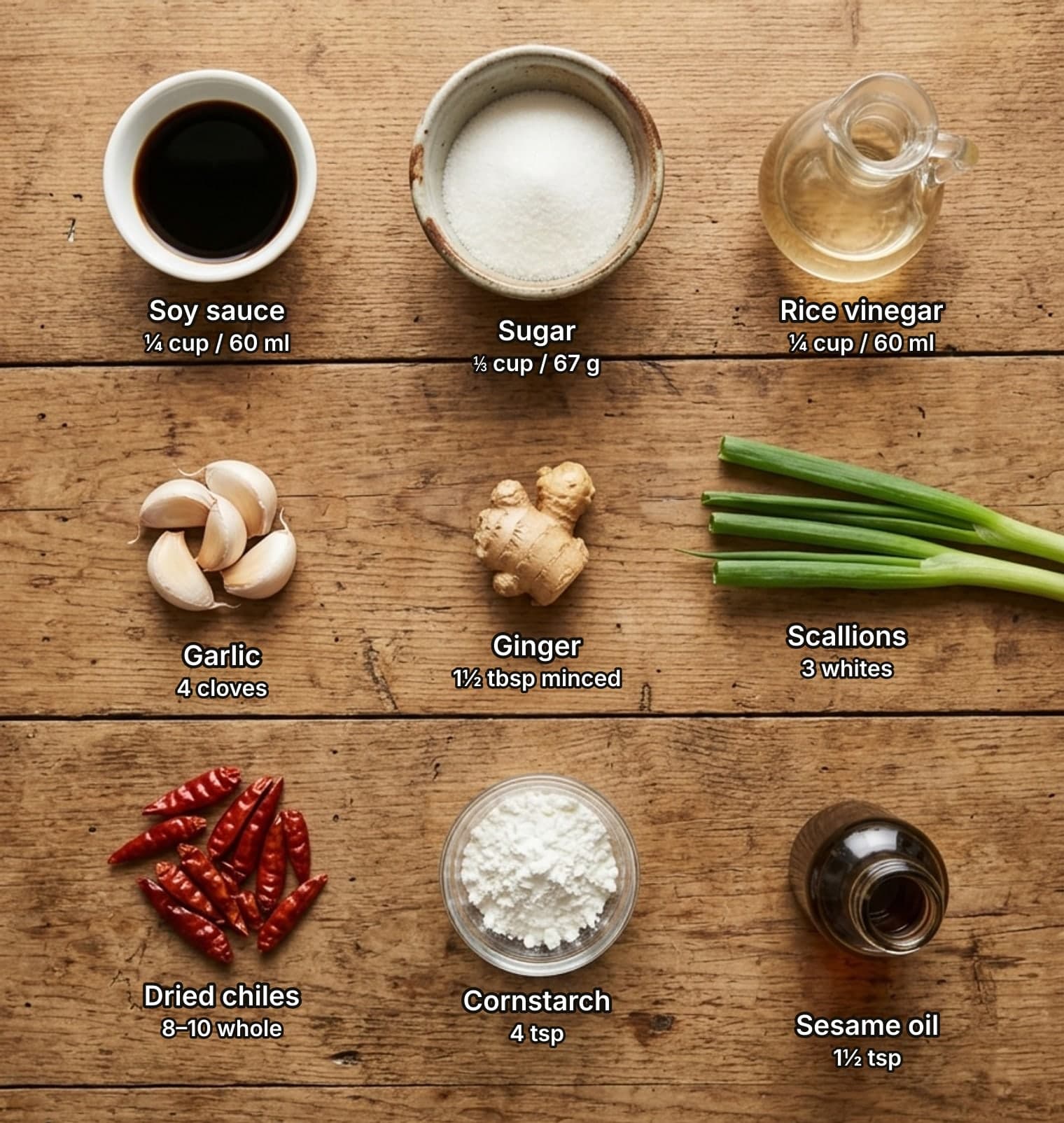
- water — or chicken or vegetable stock for more depth (see the celery note in the allergen block)3/4 cup (180 ml)
- soy sauce1/4 cup (60 ml)
- dark soy sauce — optional, for the takeout mahogany1 tsp
- rice vinegar (unseasoned)1/4 cup (60 ml)
- sugar — yes, really; see the honesty note1/3 cup (67 g)
- Shaoxing wine (or a dry sherry — see shopping; skippable)1 1/2 tbsp
- toasted sesame oil1 1/2 tsp
- garlic, minced4 cloves
- fresh ginger, minced1 1/2 tbsp
- green onions (spring onions), white parts, in 1-inch (2.5 cm) lengths — save the greens for whatever you sauce3
- whole dried red chiles (Chinese facing-heaven chiles, or chiles de árbol)8–10, left whole
- cornstarch (cornflour in the UK) — for the slurry, stirred into 2 tbsp cold water4 tsp
- neutral oil (canola or sunflower) — for blooming the aromatics1 tbsp
What General Tso sauce is (and what's actually in the takeout bottle)
General Tso sauce is the glossy, deep-mahogany heart of American Chinese takeout's most famous dish: sweet first, then tangy, then quietly hot, thick enough to lacquer a crust without soaking it. Structurally it's five decisions — a soy backbone, real sugar, rice vinegar pushing back, garlic-ginger-scallion bloomed in oil, and whole dried chiles seasoning everything while committing to nothing — thickened with cornstarch to the consistency the takeout carton taught America to expect. It's the sauce this site builds inside its General Tso's chicken; this page gives it its own address, because a sauce this useful shouldn't be trapped under one protein.
The history is short and split in two, and the sauce is the split. The dish's inventor, the exiled Hunanese chef Peng Chang-kuei, sauced his original Taipei version — early 1950s, by his own late-life account — with soy, vinegar, garlic and chiles and almost no sugar at all: salty, hot and sour, a banquet dish in a hurry. The sweetness arrived in 1970s New York, where Shun Lee's T.T. Wang served a candied, crispier take by 1972 and Peng himself, arriving a year later, admitted to the writer Fuchsia Dunlop that he'd sweetened his own recipe for American palates. The sauce in your pot is the New York one — the version that conquered the country — with the Peng conversion waiting in the FAQ for the night you want to taste the argument.
As for the bottles and the shortcuts: most top-ranking homemade recipes build this sauce on hoisin — a fine pantry move that borrows hoisin's sugar, soy and spice in one squeeze, at the cost of hoisin's flavor arriving whether you wanted it or not — and the retail shelf will sell you a pre-made bottle (House of Tsang's General Tso sauce, a Hormel brand, is a widely stocked one). Neither is wrong; both are somebody else's decisions in a jar. Ketchup, for the record, is the other common shortcut and a more honorable one than it sounds — it's been in takeout sweet-and-sour and General Tso pots for decades, and in Korean fried-chicken shops' yangnyeom too — but this page's position is simple: the from-parts sauce takes fifteen minutes, costs less than the bottle, and every dial stays yours.
How to make General Tso Sauce
- Bloom the chiles first — they season the oil, not the eater. Warm the neutral oil in a small saucepan or wok over medium heat, add the whole dried chiles and toast them 30–45 seconds, until glossy, darkened a shade and unmistakably fragrant — not blackened, which turns the whole batch acrid. Add the garlic, ginger and scallion whites and stir another 30–45 seconds, until the garlic smells sweet but hasn't colored. This first minute is where the sauce stops tasting like sweetened soy water and starts tasting like a takeout kitchen: fat carries aromatics the way water can't, and the chiles stay whole because their job here is perfume and a warm hum, not a dare.
- Everything liquid, in one pour. Add the water, soy sauce, dark soy, rice vinegar, sugar and Shaoxing, and stir until the sugar dissolves. Taste it now, before any thickening, and notice that it's thin, loud and slightly too much of everything — that's correct. A sauce destined for reduction should start overstated the way stock for a pan sauce does, because water is about to leave and everything else is about to get more concentrated. If you're using stock instead of water, the finished sauce lands a shade rounder and more savory; with plain water it stays brighter and the vinegar speaks up — both are right, and the water version keeps the jar vegan.
- Reduce first — flavor before texture, always. Bring the pot to a hard simmer and let it work, uncovered, for 3–4 minutes, until the raw edge of the vinegar rounds off and the sauce smells concentrated rather than sharp. This is the step the quick versions skip, and it's why they taste like their ingredients list instead of like a sauce. Reduction is doing two jobs the slurry can't: it's evaporating water, which concentrates everything, and it's giving the sugar, soy and aromatics a few minutes of heat to merge into one flavor. A sauce thickened before it's reduced is glue with ambitions — the house line, and it was written for exactly this pot.
- Slurry in stages, up to the lacquer line. Stir the cornstarch slurry once more (starch settles fast), then add it in two or three additions, simmering 15–20 seconds between each, until the sauce is thick enough to coat a spoon and hold a line drawn through it with a finger. Stop there — the lacquer line — even if the pot looks looser than a takeout carton. Cornstarch keeps thickening as it cools and again the moment it meets hot fried food, and a sauce pushed past the line turns to gel in the jar. If you're jarring rather than using it tonight, stop after the reduction entirely and skip the slurry: the base keeps better thin, and thickens in the pan when you use it.
- Taste and steer — this is why you made it. Off the heat, stir in the sesame oil, then taste against what the jar can't offer: dials. Too sharp — another spoon of sugar dissolves in the residual heat. Too sweet — a teaspoon more vinegar bites back. Too polite — snap two of the chiles in half and let them steep five minutes, seeds and all, or add a pinch of red pepper flakes. Too flat — a pinch of salt or MSG (the takeout kitchen's quiet answer, safe by the FDA's account and unashamed here). Every bottled and hoisin-based version has these decisions welded shut at the factory; the entire point of fifteen minutes at the stove is that yours aren't.
- Use it tonight — on anything with a crust. Used now, the sauce wants ten seconds and no more: heat off, something crisp into the pan — fried chicken, crisped tofu, roasted wings, seared cauliflower, a wok of stir-fried vegetables — and a short, decisive toss until everything is lacquered and the pan is nearly clean. A thin, clinging coat is the whole game; sauce should sit on a crust like paint, not pool under it like weather. This batch sauces 1 1/2 to 1 3/4 lb (680–800 g) of fried anything — one family dinner for four, the tofu page's two blocks included — and the fried-chicken and crispy-tofu versions of that dinner both live on this site, one page in either direction.
- Or jar the base, and own a better bottle. For the fridge, cool the unslurried base briefly off the heat, jar it, and get it in within 2 hours — warm is fine; USDA says so: it holds 3–4 days refrigerated like any cooked leftover, and it freezes for two months in a zip bag laid flat (leave the chiles in for a sauce that deepens by Thursday, or fish them out to hold the heat where it is). When you cook from the jar, bring the base to a full rolling boil in the pan — USDA's rule for reheating any sauce — then slurry to the lacquer line fresh: one minute, and it tastes made-today because the texture was. What you have now is a bottle of General Tso sauce with a legible ingredients list and your name on the dials. Do not, whatever the internet says, water-bath can it — the safety notes explain why that one's non-negotiable.
Safety & hygiene Important
- Storage rules — and why this sauce must never be home-canned. In the refrigerator, this sauce keeps 3–4 days in a sealed jar, slurried or not — USDA's window for cooked leftovers, and salt and sugar don't buy extensions. Jar the base thin because it thickens better at the pan, not because it lasts longer; cooking past Thursday belongs to the freezer, where the base holds two months — flat in a zip bag or in ice-cube trays for single-dinner portions — and thaws overnight in the fridge (cornstarch-thickened sauce separates when frozen; base doesn't, which settles the argument). What this sauce must never do is get water-bath canned for the pantry: it must be treated as a low-acid mixture — garlic, ginger and soy outweigh the little vinegar here, and nobody has lab-tested its pH — and low-acid foods in a sealed room-temperature jar are exactly the environment where Clostridium botulinum grows and produces botulism toxin. Water-bath temperatures don't kill its spores; only pressure-canning of lab-tested recipes does, and no tested recipe exists for this sauce. USDA's National Center for Home Food Preservation and university extension services say the same thing: sauces like this live in the fridge or the freezer, full stop. The 2-hour room-temperature rule (1 hour above 90°F/32°C) applies to the cooling jar like anything else — and warm-into-the-fridge is explicitly fine.
- Allergens and the label checks. This sauce carries soy (the soy sauces) and wheat (standard brewed soy sauce is made with wheat — the Kikkoman-style brew is roughly equal parts wheat and soybeans — and Shaoxing wine ferments on a wheat-based starter), plus sesame (the finishing oil), each a major allergen in the US and EU; a dry sherry standing in for the Shaoxing adds sulphites, an EU-labelled allergen in its own right. If you take the stock option, EU readers should know store-bought chicken and vegetable stocks very often contain celery, and sometimes mustard or gluten — all EU-labelled — so check the carton, or stay with water. The gluten-free path runs on labels: a certified gluten-free tamari for both soy sauces, and a dry sherry or pure-rice sake in place of the Shaoxing. Vegan as written with the water base; the chicken-stock option obviously isn't, and strict vegans who track sugar processing can reach for organic or beet sugar. Nothing here needs an egg, and nothing here touches raw meat — this is the rare page in the family where the thermometer gets the night off.
- Small pot, real heat. A thick sauce burns worse than boiling water not because it's meaningfully hotter but because it clings — as it thickens it spatters in fat, slow bubbles, and it doesn't run off skin the way water does, which stretches the contact time. Use a pot with sides, stir with a long spoon, and keep the simmer at assertive rather than volcanic, especially in the slurry stage when the bubbles get fat and can spit. Blooming chiles in oil produces a sharp, peppery vapor if the heat runs high; run the fan, keep the toast to under a minute, and if a chile blackens, start the oil over rather than cooking a burnt one into the batch — acrid is forever. The pan the sauce meets later is often a fry setup: the usual oil rules apply there and live on the chicken and tofu pages. And taste hot sauce from a spoon that's had two seconds of air, not straight off the simmer — molten sugar holds heat the way soup doesn't.
3 ways to plate it
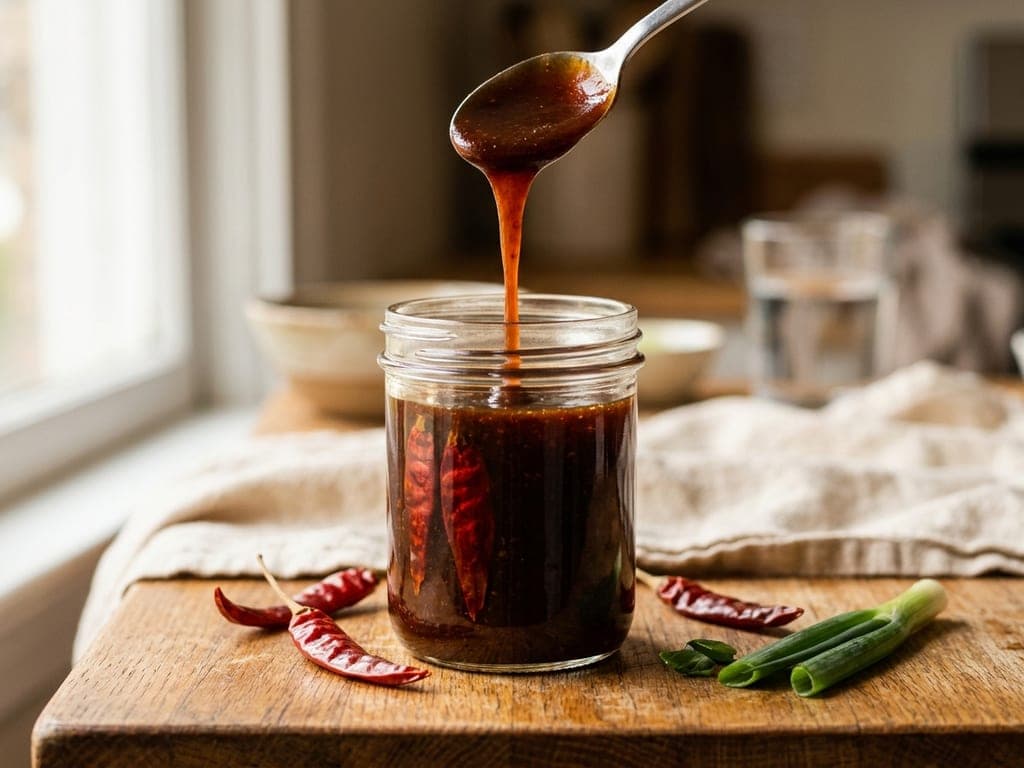
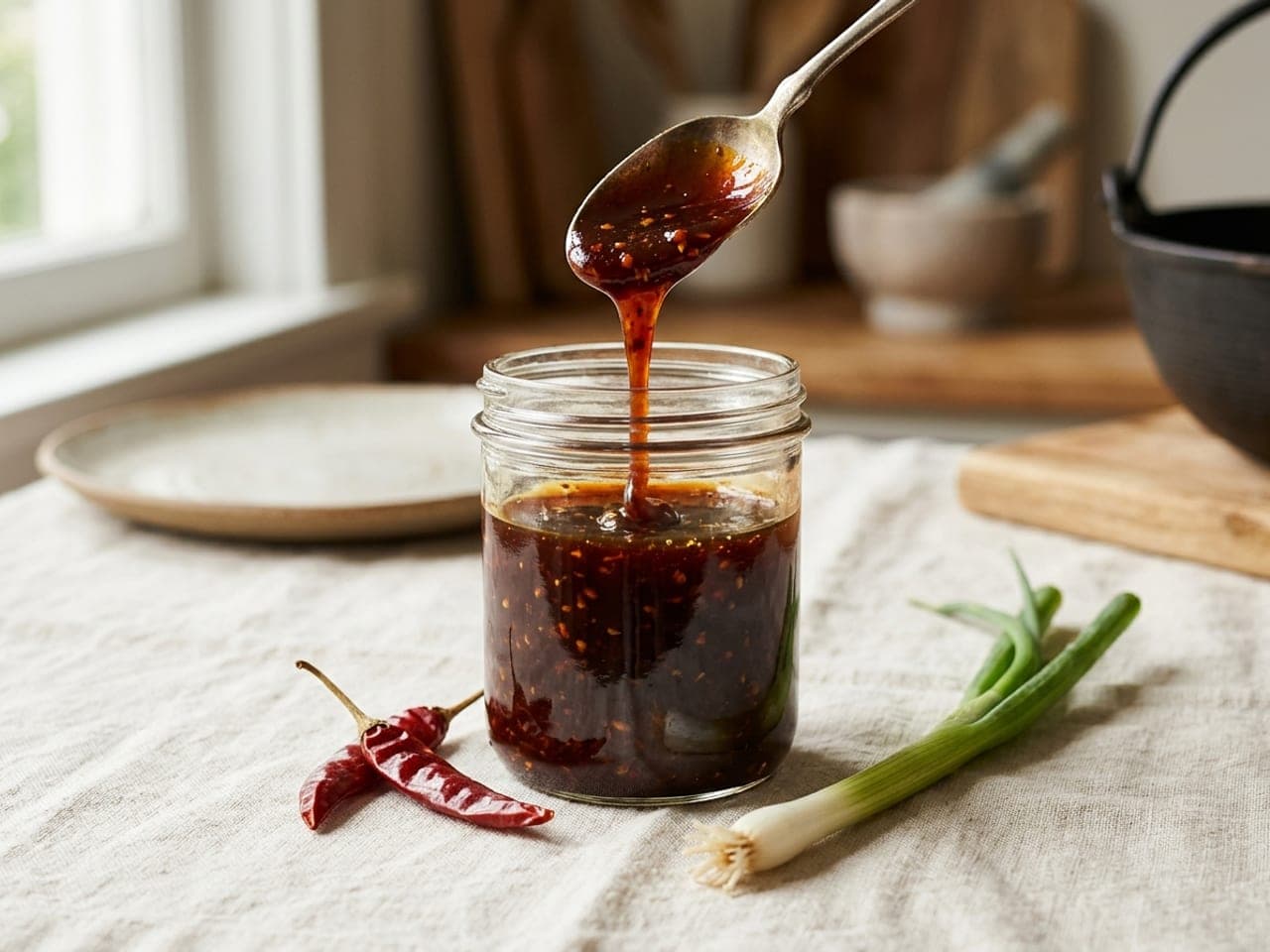
- Jar the cooled base in a straight-sided glass jar filled to a finger below the rim — the mahogany reads darkest and glossiest against clear glass.
- Lift a spoonful eight inches (20 cm) and let it ribbon back slowly; that falling line is the money shot and the doneness test in one.
- Leave two or three whole chiles visible against the glass — they label the heat without a word.
- Stand a scallion and a couple of spare chiles beside the jar so the ingredients tell the story the label doesn't need to.
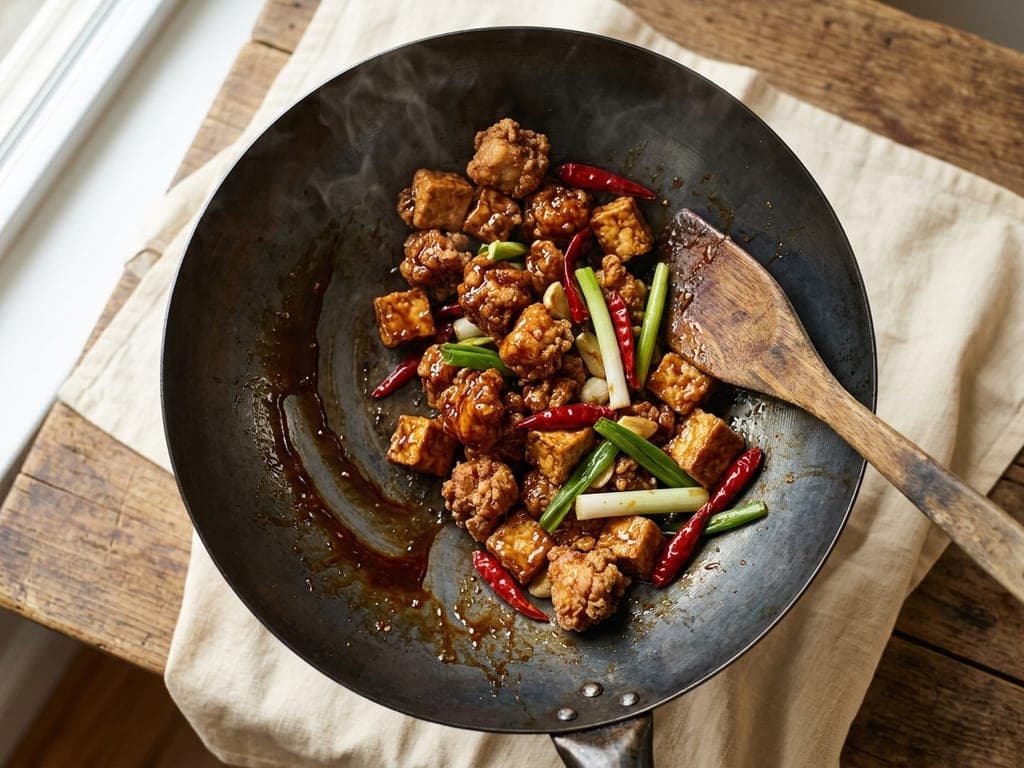
- Work in a dark wok or skillet so the mahogany gloss reads against the metal.
- Pour the sauce down the pan's side, not over the food — it sizzles up and coats from below, and the pour streak looks intentional because it is.
- Toss only until each piece is lacquered and the pan bottom is nearly dry; a puddle in the photo is a puddle on the plate.
- Finish with scallion greens thrown from a small height so they land scattered, not clumped.
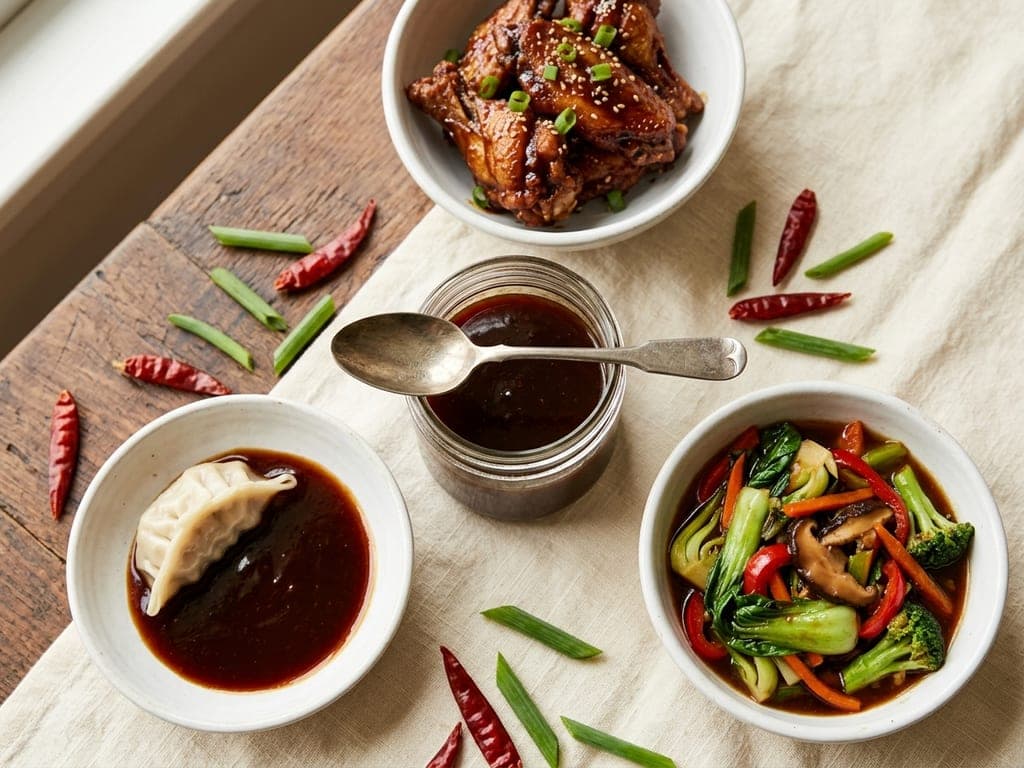
- Set the jar center-frame with its lid off and the spoon resting across the mouth.
- Ring it with three small white bowls: one of lacquered wings or tofu cubes, one of saucy stir-fried vegetables, one of thinned sauce with a dumpling poised over it.
- Keep each bowl's portion small and glossy — this is a map, not a buffet.
- Scatter a few whole dried chiles and scallion lengths in the bare space between bowls to tie the frame together.
The engineering: reduce, then thicken — never the reverse
Every thin, disappointing homemade General Tso sauce fails the same way: it was thickened before it was reduced. Cornstarch is a texture tool with no flavor opinion — it makes a sauce thicker, not better — so a pot that goes from raw ingredients straight to slurry ends up tasting like sweetened soy water wearing a gel coat. The order matters because the two steps do different jobs: three or four minutes of hard simmer evaporates water, concentrates everything that stays, rounds the vinegar's raw edge and lets sugar, soy and aromatics merge into one flavor; only then does the slurry translate that finished flavor into the clinging texture the crust needs. Flavor first, texture second, always.
The finish line has a name in this kitchen: the lacquer line, the moment the sauce coats a spoon and holds a line drawn through it. It arrives sooner than the takeout carton suggests, because cornstarch keeps working after you stop — it tightens as it cools and tightens again on contact with hot fried food — so a sauce that looks right in the pot lands gluey on the plate. Adding the slurry in two or three stages with a pause between them is how you sneak up on the line instead of blowing past it; there is no rescuing an over-slurried sauce except loosening it with water and re-tasting, which works but costs you concentration you paid the simmer for.
The last piece of engineering is restraint at the moment of use: heat off, crisp food in, ten seconds of decisive tossing, done. A crust survives sauce by meeting a thin coat late, not a deep bath early — sauce should sit on fried food like paint, and the pan should finish nearly clean. This is also why the jar strategy works: the unslurried base holds its flavor for a week and thickens to order in one minute at the pan, so Tuesday's tofu and Saturday's wings each get sauce that behaves like it was made for them. It was.
Shopping honestly: two soys, a wine, and the sugar question
Two soy sauces, two jobs. The quarter cup of everyday soy — an all-purpose brewed bottle like Kikkoman, or Pearl River Bridge's light soy from a Chinese grocery — is the salt-and-savor backbone. The single teaspoon of dark soy sauce is a different product doing one job: color. Thicker, less salty, faintly molasses-edged, it's what turns the sauce takeout-mahogany instead of pale amber; skip it and the flavor barely moves while the photograph changes entirely. Don't substitute more regular soy for it — that just adds salt. Shaoxing wine, the amber rice wine sold in Asian markets and many larger supermarkets as salted cooking grade, adds a nutty background depth; dry sherry is the honest substitute, skipping it entirely is survivable, and the allergen block covers what each choice means for a gluten-free or sulphite-sensitive table.
The sugar deserves the same straight sentence it gets on the chicken page: a third of a cup is what makes this General Tso sauce rather than a Hunan-style chile sauce, and recipes that whisper the number are apologizing for the dish instead of cooking it. It's balanced by a full quarter cup of unseasoned rice vinegar — check that word on the label, because seasoned rice vinegar smuggles in its own sugar and salt and quietly doubles your seasoning. Plain white sugar is correct; brown sugar muddies the gloss and honey shifts the flavor floral. If the finished sauce still tastes flatter than your benchmark carton, the missing piece is almost never sugar — it's the dark soy you skipped, or a pinch of MSG, which most takeout kitchens use and the FDA regards as safe.
The chiles are the flag on the pot: Chinese facing-heaven chiles (chao tian jiao) from an Asian grocery, or the chiles de árbol in most supermarket spice aisles — both right, both used whole. Whole chiles perfume the oil and hum politely; broken chiles and their seeds commit. Toast them only until glossy and fragrant, never black. Cornstarch (cornflour in the UK) runs the slurry — four teaspoons stirred into cold water, never straight into the hot pot, where it seizes into pearls. And the toasted sesame oil is the dark bottle from the Asian aisle, added off the heat as a finisher; its smoke point is low and its aroma is the first thing heat destroys, which is why it goes in last here and everywhere else on this site.
Questions, answered
What is General Tso sauce made of?
The from-parts version: soy sauce, water or stock, rice vinegar, sugar, garlic, ginger, scallion whites and whole dried red chiles, finished with toasted sesame oil, colored with a teaspoon of dark soy sauce, and thickened with a cornstarch slurry. That's the whole list. Restaurant and bottled versions reach the same profile by other roads — hoisin sauce, ketchup or plum sauce for sweet-savory body, sometimes oyster sauce — which is why ingredient lists vary so much between recipes while the flavor barely does. Sweet, tangy, garlicky, a controlled hum of chile heat, and glossy enough to lacquer a crust: if it does that, it's General Tso sauce.
What does tso sauce taste like?
Sweet first — this is the candy-edged school of American Chinese sauces — then a clear rice-vinegar tang that keeps the sugar honest, over a salty-savory soy floor with garlic and ginger in the middle distance and a low, warming chile heat that hums rather than burns (the whole dried chiles perfume the sauce; they only commit if you break them). Texture is half the identity: thick, glossy and clinging, closer to a glaze than a gravy. Against its takeout siblings: less candied and more heat than sesame sauce, no citrus and a shade hotter than orange sauce, and far sweeter than anything actually served in Hunan.
What can I use as a substitute for General Tso sauce?
Closest first: a sweet-and-sour or orange stir-fry sauce plus a minced clove of garlic and a pinch of red pepper flakes lands within shouting distance. Hoisin thinned with rice vinegar and a little water, sweetened to taste, is the classic pantry impression — most shortcut recipes are exactly this. Teriyaki reads sweeter and darker with no heat (add chile flakes and a splash of vinegar to steer it). In the other direction, if what you're missing is the bottle itself, the honest answer is that this page's sauce takes fifteen minutes from ingredients most kitchens already hold — the substitute for General Tso sauce is General Tso sauce.
Which bottled General Tso sauce is the best?
The two you're most likely to meet in a US supermarket are House of Tsang's General Tso sauce (a Hormel brand) and Iron Chef's General Tso's Sauce & Glaze, and both are serviceable weeknight bottles: correct color, correct thickness, sweeter and flatter than fresh-made, as bottled sauces are. Asian grocery stores carry regional brands that vary too much shop-to-shop for a national recommendation to mean anything. The honest framing: every bottle is a set of decisions — how sweet, how hot, how much garlic — welded shut at a factory, and this page exists because the from-parts version takes fifteen minutes, keeps a week in the fridge as a base, and leaves every one of those decisions yours. Buy a bottle for the pantry's sake; make the jar for dinner's.
How long does homemade General Tso sauce keep — and can I can it?
Fridge: 3–4 days in a sealed jar, slurried or not — USDA's cooked-leftover window (jar the unslurried base anyway; it thickens fresher at the pan, and reheat it to a full rolling boil before slurrying, per USDA's rule for sauces). Freezer: two months for the base, flat in a zip bag or as ice cubes for single dinners; slurried sauce separates when frozen, so freeze thin and thicken after. Canning: no — firmly. This must be treated as a low-acid sauce (soy, garlic and ginger outweigh its vinegar, and no lab has tested its pH), and low-acid foods sealed in a room-temperature jar are the textbook environment for botulism; water-bath canning cannot make it safe, and no lab-tested pressure-canning recipe exists for it. USDA's National Center for Home Food Preservation and university extension services agree: fridge or freezer, never the pantry.
How do I thicken General Tso sauce — or rescue one that turned to glue?
Thicken with a cornstarch slurry — cornstarch stirred into cold water first, never sprinkled into the hot pot, where it seizes into pearls — added in two or three stages at a simmer, pausing between additions, until the sauce coats a spoon and holds a line drawn through it. Stop there: cornstarch tightens further as it cools and again when it meets hot food. If you overshot and the sauce gelled, whisk in hot water a tablespoon at a time until it loosens, then re-taste — dilution costs a little concentration, so it may want a pinch more sugar or a drop of soy. And if it thinned out after sitting sauced on food, that's the crust's moisture at work; next time, toss later and lighter.
What do I use General Tso sauce on?
Anything with a crust, first: the fried chicken it's named for, crispy tofu, roasted or air-fried wings, popcorn shrimp, seared cauliflower or Brussels sprouts. As a stir-fry sauce it needs no crust at all — add it to a hot wok of chicken, shrimp or vegetables for the last minute, straight from the jar, and it thickens on contact. It glazes salmon and meatballs under a broiler (the overhead grill), wakes up plain rice or noodle bowls, and works cold-ish as a dipping sauce for dumplings and spring rolls if you thin it with a teaspoon of hot water. One batch sauces about 1 1/2 to 1 3/4 lb (680–800 g) of anything — the crispy-chicken and crispy-tofu dinners it was built for both live one page away.
General Tso vs orange sauce vs sesame sauce — what's the difference?
Three siblings from the same fryer, told apart by their sauce. General Tso: vinegar-and-chile backbone, sweet but with an edge, no citrus, whole dried chiles in the pan. Orange sauce: citrus-forward and sweeter, anchored in orange peel and juice — an echo of chenpi ji, the Sichuanese dried-tangerine-peel chicken — and essentially mild; it's a 1987 Panda Express creation. Sesame sauce: the sweetest and mildest of the three, candy-glossed and finished under a blanket of sesame seeds. Same architecture, three temperaments — and from this jar, you're one snapped chile from hotter, one squeeze of orange from sunnier, and one seed-shower from sweeter.
Can I make it less sweet — what did the original taste like?
Yes, and there's history on your side. Peng Chang-kuei's original Taipei sauce was salty, hot and sour with almost no sugar — the sweetness is a 1970s New York addition, one Peng himself adopted for American diners, even though, shown today's American versions on camera late in life, he dismissed them as 'crazy nonsense'. The conversion from this page's recipe: drop the sugar to 1 teaspoon, raise the rice vinegar to 1/3 cup (80 ml), skip the dark soy, and let the chiles run to twelve. What comes out is sharper, hotter and unmistakably the same dish's older relative — closer to what a Hunanese banquet chef would recognize. For merely less sweet rather than historical, the floor is about 3 tbsp of sugar before the sauce stops reading as General Tso and starts reading as a chile-soy glaze; between 3 tbsp and 1/3 cup, it's your dial.
Is General Tso sauce vegan and gluten-free?
Vegan: yes as written — the base is water, and nothing else in the pot comes from an animal (choose the chicken-stock option and that changes; strict vegans who track sugar refining can use organic or beet sugar, since some US cane sugar is processed with bone char). Gluten-free: not as written, but cleanly convertible — standard soy sauce is brewed with wheat and Shaoxing wine ferments on a wheat starter, so swap a certified gluten-free tamari for both soys (dark soy included; the color lightens a shade) and a dry sherry or pure-rice sake for the Shaoxing. The cornstarch, vinegar, sugar and aromatics are naturally gluten-free; as always, certification lives on the label, not the category.
Snap your finished plate and let the AI plate it again — more beautifully.