General Tso's Tofu Recipe (Crispy Without Egg — Skillet, Oven or Air Fryer)
The vegan answer to takeout's most famous chicken: extra-firm tofu pressed hard, torn into craggy chunks, crisped in a skillet and lacquered in the same glossy sweet-hot-sour General Tso sauce — no egg, no batter, no apology. Whole dried chiles perfume the pan, broccoli and rice do their canonical work, and the tofu turns out to be the most Chinese thing on the plate.
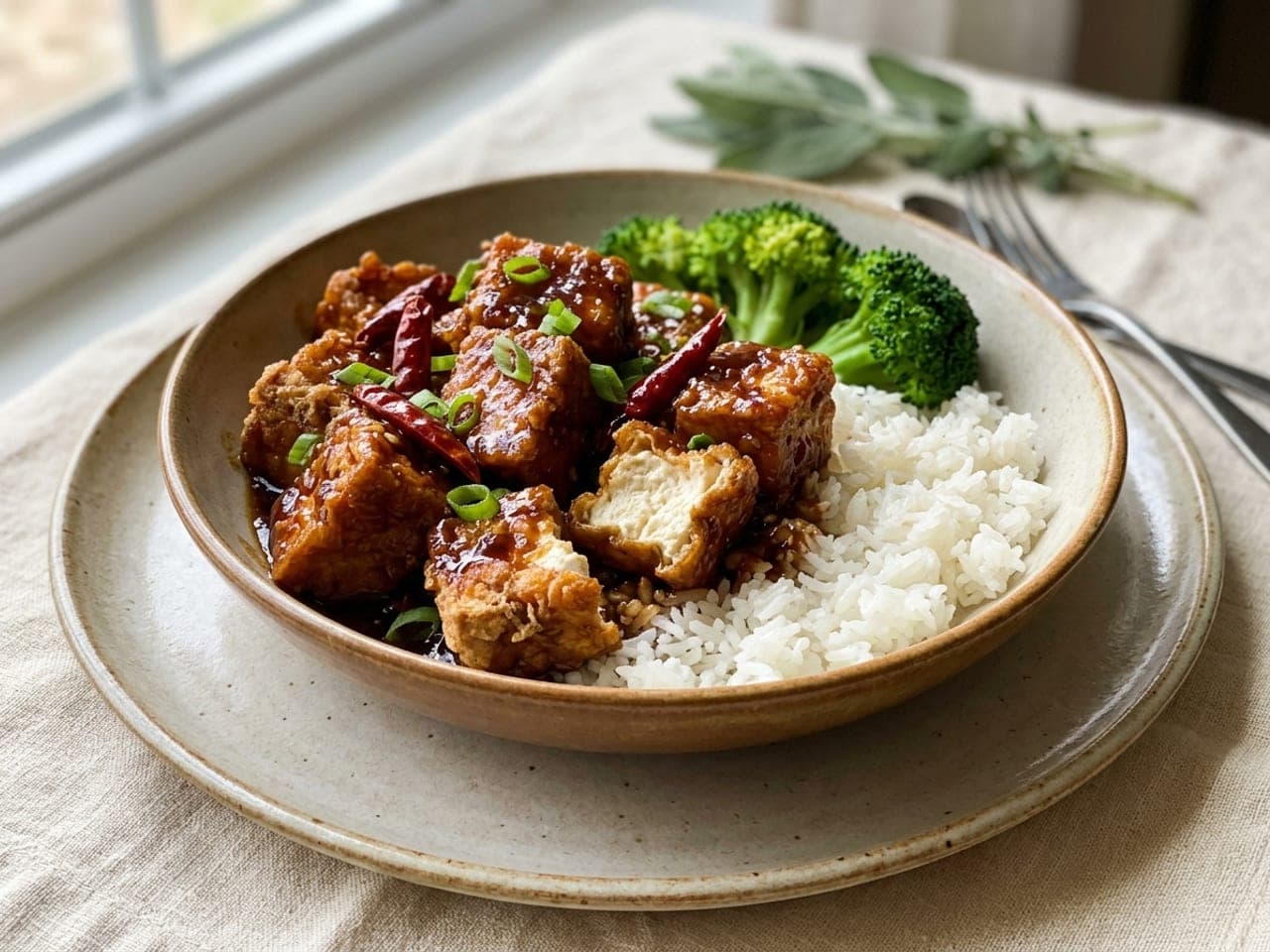
Ingredients
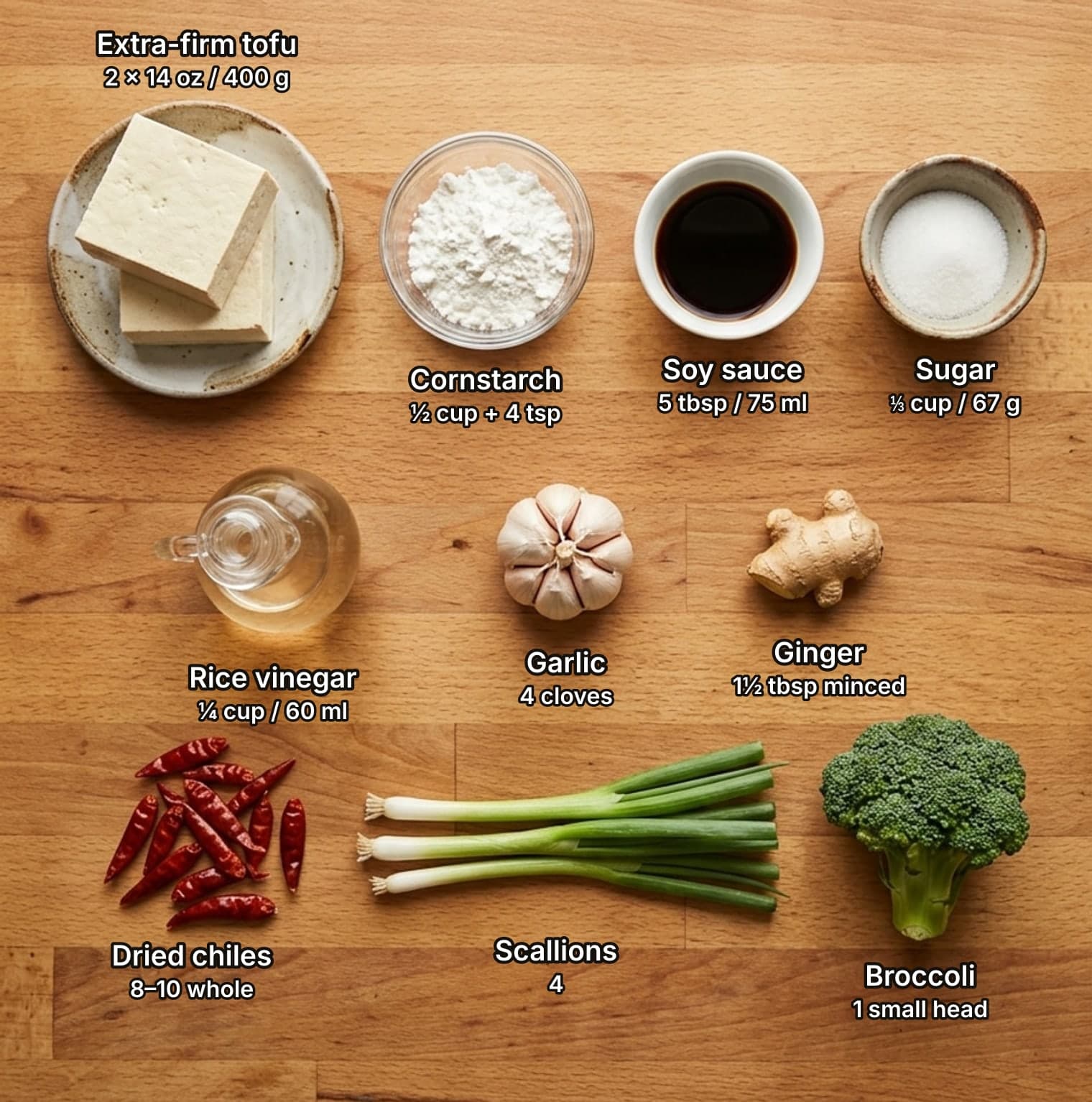
- extra-firm tofu — two blocks; or super-firm/high-protein tofu to skip the pressing (see shopping)2 × 14 oz (400 g) blocks
- soy sauce — 1 tbsp for seasoning the tofu, the rest for the sauce1 tbsp, plus 1/4 cup (60 ml)
- cornstarch (cornflour in the UK) — for the coat, plus the sauce slurry1/2 cup (65 g), plus 4 tsp
- neutral oil (canola or sunflower) — for the skillet3 tbsp
- water3/4 cup (180 ml)
- rice vinegar (unseasoned)1/4 cup (60 ml)
- sugar — see the honesty note on the sauce page; organic or beet sugar if you keep strict-vegan rules1/3 cup (67 g)
- dark soy sauce — optional, for the takeout mahogany1 tsp
- Shaoxing wine (or a dry sherry) — optional1 1/2 tbsp
- toasted sesame oil1 1/2 tsp
- garlic, minced4 cloves
- fresh ginger, minced1 1/2 tbsp
- green onions (spring onions) — whites in 1-inch (2.5 cm) lengths for the sauce, greens sliced to finish4
- whole dried red chiles (Chinese facing-heaven chiles, or chiles de árbol)8–10, left whole
- toasted sesame seeds — optional, a light hand1 tsp
- steamed rice and steamed broccoli, to serve4 cups (about 630 g) cooked rice; 1 small head of broccoli
What General Tso's tofu is (and how a Qing general went vegan)
General Tso's tofu is crisp-coated tofu in the glossy, sweet-tangy-hot mahogany sauce of American Chinese takeout's most famous chicken dish — same sauce, same whole dried chiles, same broccoli-and-rice plate, with pressed and torn extra-firm tofu doing the crunching. Nobody owns the tofu chapter: American takeout kitchens were listing General Tso's bean curd — 左宗豆腐, a restaurant-native coinage with its own Chinese name — by the 2000s, New York's Buddhist-vegetarian mock-meat houses were dressing soy 'chicken' in the sauce even earlier, and the vegan food blogs and plant-forward cookbooks of the 2010s canonized the crisp-skillet home version most of us cook now. Restaurant and home kitchens got there in parallel; what's certain is that the dish is American, and young — a fourth generation bolted onto a lineage that was already three stories tall.
Those three stories, briefly, because they're the best in takeout: the name honors Zuo Zongtang (1812–1885), a celebrated Qing-dynasty statesman-general from Hunan who died some seven decades before the dish existed and never ate anything like it. The dish itself was invented in Taipei in the early 1950s by Peng Chang-kuei, an exiled Hunanese banquet chef, as a salty-hot-sour improvisation for a visiting American admiral — by Peng's own account, told late in life. And the sweetness is 1970s New York, where Shun Lee's T.T. Wang and then Peng himself candied the dish for American dining rooms. The full origin story, dates argued honestly, lives on this site's General Tso's chicken page; the tofu chapter is simply the one written in English, by vegetarians, within living memory.
The irony the dish carries lightly: the tofu is the most Chinese thing on the plate. Bean curd has as much as two thousand years of Chinese history — legend credits its invention to a Han-dynasty prince, the first sure written record is tenth-century, and it anchors a vast Buddhist vegetarian cooking tradition that was meatless a millennium before the word vegan existed — while the sauce it wears here is younger than the jet engine. A plate of General Tso's tofu is an ancient Chinese ingredient dressed in a mid-century Taiwanese-American costume named for a nineteenth-century general, and it is, on top of all that, a genuinely excellent Tuesday dinner.
How to make General Tso's Tofu
- Press like you mean it — water in is crust out. Drain the blocks, stand them between doubled paper towels or a clean dish towel on a plate, and put weight on top — a second plate with a cast-iron pan or a couple of cookbooks — for 30 minutes. Tofu is a sponge holding the water your crust has to evaporate later; every gram pressed out now is a minute of sizzling saved and a step crispier finish. Two honest shortcuts: super-firm vacuum-packed tofu (sometimes sold as high-protein) arrives pre-pressed and skips this step entirely, and a block frozen solid then thawed presses in five minutes and fries up with the open, chewy texture some restaurant kitchens chase on purpose.
- Tear, don't cube. Tear the pressed blocks by hand into rough 1.5-inch (4 cm) chunks — irregular, cragged, no two alike — and toss them gently with the tablespoon of soy sauce. Torn edges are the eggless answer to the chicken page's craggy dredge: a knife leaves six flat faces that fry into six flat surfaces, while a tear leaves ridges and shreds that fry into points and shards, and those are what stay audible under sauce. The soy is doing quiet double duty — seasoning the only ingredient in this dish that arrives bland, and leaving the surface tacky enough that the cornstarch actually commits to it.
- The cornstarch coat — thin, total, slightly shaggy. Scatter the half cup of cornstarch over the chunks in two additions, tossing between them with hands or a big spoon until every face wears a thin, matte, slightly shaggy coat and the bowl holds almost no loose powder. Damp-but-not-wet is the mechanism: on well-pressed, soy-slicked tofu the starch hydrates into a paste-like film that fries to glass, while on unpressed tofu it turns gluey and slides off in the pan — which is why the pressing step is doctrine, not preference. No egg is needed here and none is missed; that trick belongs to the chicken. Let the coated chunks sit five minutes while the oil heats, so the coat sets.
- Skillet route: hot pan, single layer, patience. Heat the 3 tbsp of oil in a large nonstick or well-seasoned skillet over medium-high until it shimmers. Lay the tofu in a single uncrowded layer — two batches if needed, because crowding steams what should sear — and then do the hard part: nothing, for 2–3 minutes per side, turning only when a face releases easily and shows deep gold, 8–10 minutes total. Tofu punishes fidgeting; a piece moved early leaves its crust on the pan. Onto a wire rack or plate when done. The forks: air fryer at 400°F (200°C) for about 15 minutes, shaken twice, oil-sprayed — drier-edged but genuinely crisp; oven at 425°F (220°C) on parchment for 25–30 minutes, flipped once — the least crisp and the most hands-off. The sauce carries all three.
- Bloom the chiles — scenery, not snacks. Wipe the skillet (or take a fresh saucepan), warm a teaspoon of the remaining oil over medium heat, and toast the whole dried chiles 30–45 seconds until glossy, darkened a shade and fragrant — never blackened, which turns the batch acrid. Add the garlic, ginger and scallion whites and stir another 30–45 seconds, until the garlic smells sweet but hasn't colored. The chiles stay whole because their job is to season the oil and decorate the plate, not to ambush a fork; anyone at the table chasing real heat can snap one open over their own bowl and accept the consequences personally.
- The sauce: reduce first, slurry second. Add the water, soy sauce, dark soy, rice vinegar, sugar and Shaoxing, stir until the sugar dissolves, and let it simmer hard for 3–4 minutes, until the vinegar's raw edge rounds off and it smells concentrated. Then stir the 4 tsp of cornstarch into 2 tbsp of cold water and add the slurry in two or three stages, simmering briefly between each, until the sauce coats a spoon and holds a line drawn through it — the lacquer line. Stop there; it tightens as it cools and again when it meets the tofu. Off the heat, stir in the sesame oil. This is the site's General Tso sauce built inline — it has its own page, jar strategy included, one link away.
- The ten-second toss. Heat off, tofu into the pan, and toss for ten to fifteen seconds — no more — until every cragged chunk is lacquered and glossy and the pan bottom is nearly clean. A thin clinging coat is the entire game: sauce sits on the crust like paint or it soaks in like weather, and the difference is decided in these ten seconds, not in the recipe. Scatter the scallion greens and the optional pinch of sesame seeds and fold once. If sauce chases the tofu around the pan in a puddle, you slurried past the lacquer line — the tofu will still be very good, and next time you'll stop one addition sooner.
- Serve it over the rice it was born for. Straight to the table, over steamed rice, with the broccoli — which steams in exactly the minutes the second batch of tofu takes — tucked alongside to catch its share of sauce, and the whole chiles riding on top as scenery with a warning attached. Like everything crisp-then-sauced, this is a now food: the crust's best fifteen minutes start immediately. It's also, quietly, the highest-protein plant dinner on this site's Chinese shelf, and the FAQ has the honest numbers for the is-it-healthier conversation — bring them to the table along with more napkins than seems reasonable.
Safety & hygiene Important
- Tofu is a fresh product — treat it like one. Tofu lives in the refrigerator, before and after cooking. An unopened pack keeps to its date; once opened, an unused portion keeps 3–4 days submerged in fresh water in a covered container, with the water changed daily — and if a block smells sour or the packing water has gone cloudy and slimy, it's done, no appeal. Cooked, the standard leftover clock applies: out of the danger zone within 2 hours (1 hour above 90°F/32°C), shallow container, fridge, 3–4 days. Reheat leftovers to 165°F (74°C) — USDA's endpoint for all leftovers, tofu included, not just poultry: a 400°F (200°C) oven or air fryer gets sauced tofu there in 6–8 minutes and brings the crust most of the way back, while the microwave hits the number with a steamed crust. Freezing cooked sauced tofu is legal but changes the texture twice over; if you're cooking ahead on purpose, freeze the crisped unsauced tofu instead and re-crisp from frozen.
- Shallow oil, real spatter. Three tablespoons of oil is not a deep fry, but it spits — and damp tofu is the spitting-est thing in the plant kingdom, which is the safety half of why the pressing step is non-negotiable. Lay pieces into the pan away from you, keep a lid or spatter screen within reach, and keep the fry zone clear of kids, pets and dangling sleeves. If oil ever flares in the pan: heat off, lid on, never water — water flash-boils under burning oil and throws it upward. Turn pieces with tongs or a thin spatula rather than a toss while there's hot oil in the pan; save the cinematic toss for the sauce stage, when the oil is gone and the heat is off. Let the pan cool fully before it goes anywhere near the sink.
- Allergens and diet integrity. Soy is this dish's headline allergen twice over — the tofu itself and the soy sauces — joined by wheat (standard brewed soy sauce is made with wheat, and Shaoxing wine ferments on a wheat-based starter), sesame (the finishing oil and optional seeds), and sulphites if a dry sherry stands in for the Shaoxing — all EU-labelled, soy/wheat/sesame also US majors. The gluten-free path runs on labels: certified gluten-free tamari for both soy sauces, a dry sherry or pure-rice sake for the Shaoxing, and the cornstarch coat is already flourless. Vegan integrity, honestly handled: everything here is plant-derived as written, and the one asterisk lives on the sugar bag — some US cane sugar is filtered through bone char, which certified-organic and beet sugars sidestep; whether that matters is a personal line, and the recipe works identically either side of it. Nothing here touches meat, so the family's usual cross-contamination drill gets a night off — the cutting board's biggest risk is the chiles meeting your eyes via your fingers. Wash hands with soap after handling them — capsaicin is oil-soluble, so water alone just moves it around — and keep fingers away from eyes and contact lenses until you have.
3 ways to plate it
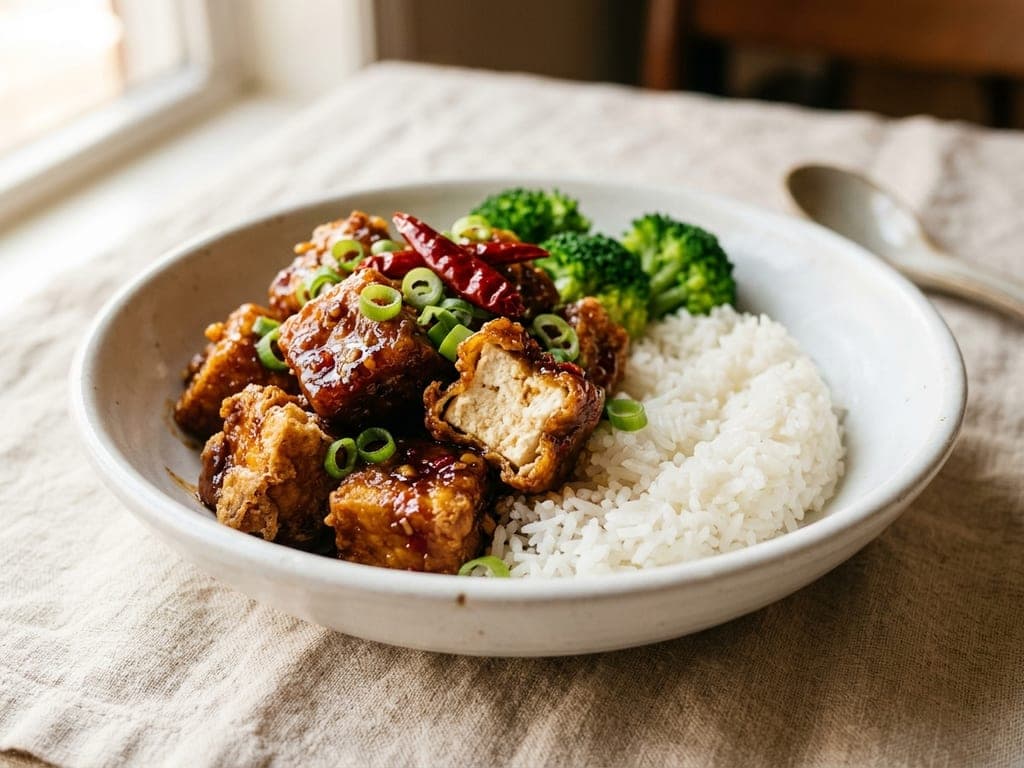
- Mound the rice slightly off-center in a wide shallow bowl and press a low slope into it with the back of the spoon.
- Pile the tofu over half the rice, leaving a crescent of white showing — the mahogany gloss needs the contrast to read.
- Tuck three or four broccoli florets into the seam, heads up, where they'll catch stray sauce.
- Finish with scallion greens, a restrained pinch of sesame seeds, and two whole chiles placed where they can be admired and avoided.
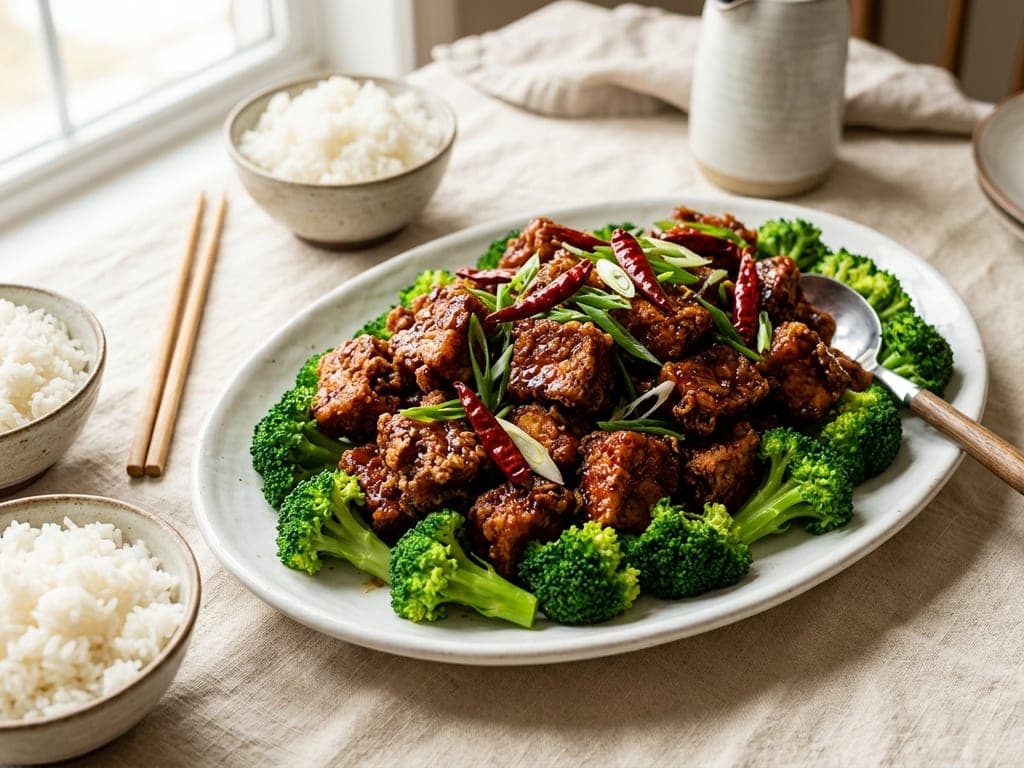
- Warm the platter under hot tap water and dry it — lacquer stays glossy on warm ceramic and sets dull on cold.
- Pile the tofu high in the center; height keeps the crust crisp against itself and reads as abundance.
- Ring the base with broccoli florets facing outward and let the whole chiles sit where the toss dropped them.
- Give every diner a bowl of rice and a serving spoon; the tofu goes over rice at the last second, never before.
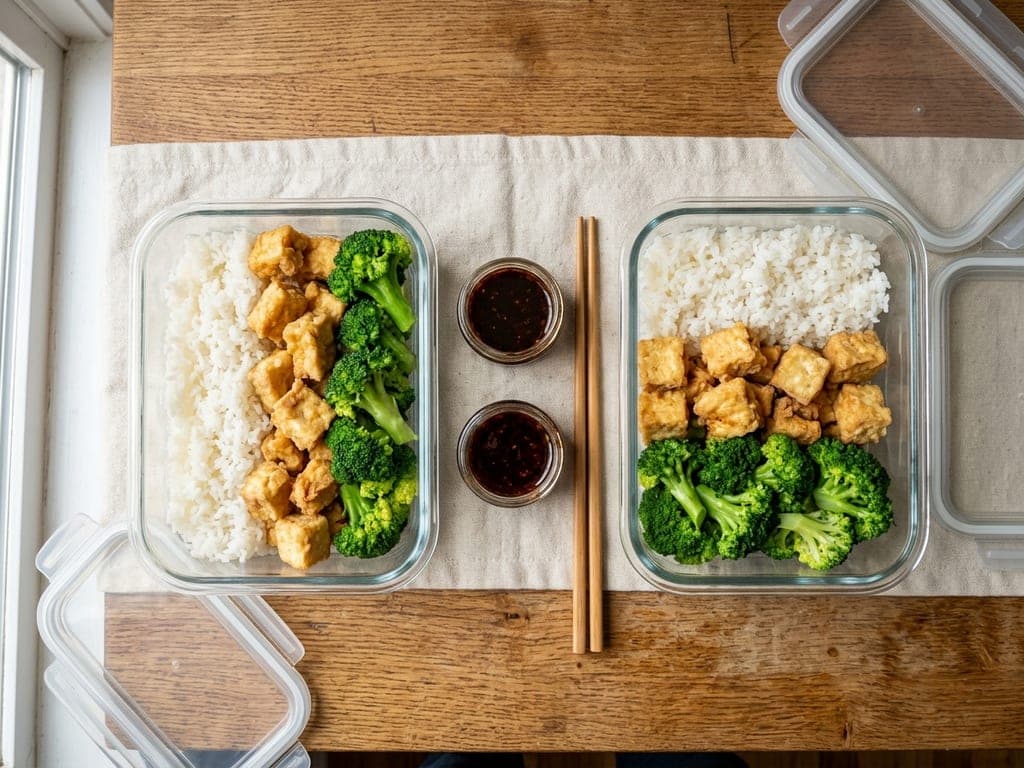
- Pack cooled rice along one side of each glass box, crisped unsauced tofu in the middle lane, and broccoli in the third.
- Fill two small lidded containers with sauce — one per box, riding in the corner — so the lacquer happens after reheating.
- Lid the boxes loosely — a corner left vented — and refrigerate within the hour; USDA says warm food can go straight in, and venting, not counter time, is what keeps steam off the crust. Snap the lids fully shut once cold.
- Shoot from directly overhead with the two boxes parallel and a pair of chopsticks between them — order is the aesthetic.
Crisp without egg: pressing physics and the torn edge
The chicken page gets crispness from a velveting marinade and a craggy egg-moistened dredge; tofu gets there by subtraction. A block of extra-firm tofu is a sponge carrying water your crust must evaporate before it can even begin to brown — so thirty minutes under weight isn't fussiness, it's moving that evaporation off the stove and onto the counter. Pressed tofu takes a cornstarch coat that hydrates into a film and fries to glass; unpressed tofu turns the same coat gluey, sheds it in the pan, and spatters violently in the oil for good measure. Every crisp-tofu trick on the internet is downstream of this one fact. The two legitimate cheats — super-firm vacuum-packed tofu, which arrives pre-pressed, and freeze-thaw, where ice crystals tear the curd's pores open so water pours out in minutes — are cheats of schedule, not of physics.
The second mechanism is the torn edge. A knife gives six flat faces; a tear gives ridges, shreds and points — a fractal surface that fries into free-standing crisp the way the chicken page's marinade-droplet crags do, no egg required. Cornstarch over damp, soy-slicked chunks builds a thin total coat rather than a batter; five minutes of rest sets it; and then the skillet asks only for the discipline tofu always asks: single layer, real heat, and no touching until a face releases on its own and shows deep gold. Tofu never punishes patience. It always punishes fidgeting.
The three cooking routes rank honestly. The skillet is best — direct metal contact and a thin film of oil make the hardest, most even crust, for about three tablespoons of oil across four servings. The air fryer is a close and legitimate second: drier at the edges, a shade less shattery, remarkably good for a spoonful of sprayed oil. The oven is the hands-off floor — parchment, high heat, a flip at halfway — and lands at pleasantly firm rather than crisp. All three finish the same way, because the finish is where the dish is decided: sauce reduced then slurried to the lacquer line, heat off, ten seconds of tossing, and a thin coat that sits on the crust like paint. The sauce holds up its half of the bargain on any route; the skillet just gives it the loudest partner.
Shopping honestly: the tofu aisle, decoded
The tofu aisle runs on a firmness scale, and only one end of it belongs in this pan. Silken and soft tofu are custards — magnificent in soups and desserts, doomed here, where they'd shed their coat and their dignity in the same minute. Medium and firm hold shape but carry too much water for a dry crust without heroic pressing. Extra-firm is this recipe's word: dense enough to tear and toss, wet enough to still need its thirty minutes under weight. Above it sits super-firm — vacuum-packed rather than water-packed, sometimes labelled high-protein — which arrives pre-pressed and turns this into a twenty-minute dinner; if your store carries it, it's the move. Water-packed blocks keep their date unopened; opened leftovers keep 3–4 days under fresh water, changed daily.
Pressing gear is optional in the way most gear is. A dedicated tofu press is tidy and worth it for a weekly habit; a plate, paper towels and a cast-iron pan do the identical physics for free. The freeze-thaw route deserves its own sentence: freezing a block solid grows ice crystals that tear the curd's structure open, so it thaws into something between a sponge and a cutlet — presses in five minutes, drinks marinades, and fries up with the open, chewy bite some restaurant versions have on purpose. It's a different, slightly meatier texture than fresh-pressed; plenty of cooks prefer it, and the only cost is remembering yesterday.
The sauce pantry is the family's usual and is argued in full on the sauce page: everyday soy plus a teaspoon of dark soy for the mahogany, unseasoned rice vinegar (the seasoned bottle smuggles sugar and salt), real sugar in an honest third-cup — organic or beet sugar if strict-vegan rules apply to your bag — Shaoxing wine or dry sherry or neither, toasted sesame oil strictly as a finisher, and whole dried chiles: facing-heaven from an Asian grocery or árbol from most spice aisles. Cornstarch (cornflour in the UK) does both the coat and the slurry, one bag. The broccoli is not garnish — its florets hold sauce like cups, and it steams in exactly the minutes the second batch of tofu takes to crisp.
Questions, answered
What is General Tso's tofu?
Crisp-coated tofu tossed in General Tso sauce — the glossy, sweet-tangy, quietly hot mahogany sauce of the famous Chinese-American chicken dish — typically served over steamed rice with broccoli. This version presses extra-firm tofu, tears it into craggy chunks, crisps it in a cornstarch coat (skillet, air fryer or oven), and lacquers it in a from-scratch sauce of soy, rice vinegar, sugar, garlic, ginger and whole dried chiles. It's the vegan rendition of General Tso's chicken — born not in China or Taiwan but in America, in takeout and Buddhist-vegetarian kitchens and, in its crisp-skillet home form, the plant-based recipe world — and it eats like takeout with the volume turned just slightly toward honest.
Is General Tso's tofu healthier than chicken?
By the numbers on this site's two versions: the tofu lands around 430 calories per serving before rice against the chicken's roughly 600, with meaningfully less saturated fat, zero cholesterol, and a little more fiber — while the sodium stays substantial on both plates, because the sauce, not the protein, carries it: roughly 1,200–1,400 mg per serving here against the chicken page's ~1,700. Restaurant versions of both run far higher. So: moderately healthier, honestly framed — the tofu's real advantages are the swap from fried dark-meat chicken to a leaner protein and a shallower fry, not any virtue of the sauce, which remains a sweet glaze having a wonderful time. If sodium is your number, the fix on either page is the same: low-sodium soy and a lighter hand at the toss.
What does General Tso's tofu taste like?
The sauce leads, exactly as it does on the chicken: sweet first, then a rice-vinegar tang, a salty soy floor, garlic and ginger in the middle, and a low chile warmth from whole dried chiles that perfume without punishing. The tofu underneath is milder-mannered than chicken — clean, faintly nutty, a quiet canvas — which the recipe answers with a soy toss before coating and a crust that supplies the drama: crisp shards outside, tender and custardy inside where a torn edge shattered and the middle stayed plush. If your reference point is takeout General Tso's chicken, this reads as the same dish with a softer center and a slightly cleaner finish.
What is the difference between General Tso's tofu and kung pao tofu?
Different sauces, different ancestries, different textures. General Tso's is the Chinese-American school: a thick, sweet-leaning, glossy lacquer over a crisp coated protein, heat as a background hum. Kung pao is a genuine Sichuan dish adapted westward: a thinner, darker, savory-forward sauce with less sugar, more vinegar-and-soy edge, Sichuan peppercorns (in truer versions) bringing their electric tingle, peanuts for crunch, and — in the Americanized version — diced vegetables in the stir-fry; the protein goes in unbattered, in a thin marinade rather than a crisp coat. Rough compass: General Tso's is candy-glossed and crunchy, kung pao is savory, nutty and numbing-adjacent. This site's sauce page has the dials to steer between them; the peanuts you'll have to supply yourself.
How do I get tofu crispy without egg — and keep it crispy under sauce?
Four habits do all of it. Press hard: thirty minutes under real weight (or buy super-firm and skip it) — water is the enemy and everything else is downstream. Tear, don't cube: ragged edges fry into shards; flat knife-faces fry into tiles. Coat thin on damp: cornstarch over soy-slicked chunks hydrates into a film that fries to glass — no egg needed; that's the chicken page's trick, not tofu's. Then leave it alone in a hot single layer until each face releases and shows deep gold. Keeping it crisp under sauce is the family doctrine: reduce the sauce to a clinging lacquer, kill the heat, toss ten seconds, serve now. Sauce applied thin and late sits on the crust; sauce applied deep and early is soup.
Which tofu should I buy — and can I skip pressing?
Extra-firm water-packed is the recipe's default; super-firm vacuum-packed (sometimes labelled high-protein) is the upgrade that skips pressing entirely and turns this into a twenty-minute dinner. Silken and soft are for soup and dessert — never this pan — and medium/firm need more pressing than they're worth here. You can skip pressing extra-firm tofu only by paying for it elsewhere: a gluey, patchy coat and a spitting skillet. The freeze-thaw route splits the difference — freeze the block solid, thaw it, and five minutes of squeezing does what thirty minutes of weight does, with a chewier, more open crumb that plenty of people prefer. Whatever you buy, opened leftovers keep 3–4 days in the fridge under fresh water, changed daily.
Can I make it in an air fryer or the oven?
Yes, and honestly ranked: air fryer second, oven third, sauce identical throughout. Air fryer: coated chunks in a single layer, oil-sprayed, 400°F (200°C) for about 15 minutes, shaken at 5 and 10 — drier-edged than the skillet, genuinely crisp, excellent for a spoonful of oil. Oven: parchment-lined sheet, 425°F (220°C), 25–30 minutes with a flip at halfway — pleasantly firm rather than crisp, and the most hands-off route on a busy night. Both finish exactly the same way: sauce reduced and slurried to the lacquer line, heat off, ten-second toss. The one universal rule is the single layer — crowded tofu steams itself soft on every route, in every appliance, every time.
Is it vegan and gluten-free?
Vegan: yes as written — tofu, plants and pantry throughout; the single asterisk for strict observance is the sugar bag, since some US cane sugar is filtered through bone char, and certified-organic or beet sugar sidesteps the question entirely. Gluten-free: convertible with labels — standard soy sauce is brewed with wheat and Shaoxing wine ferments on a wheat starter, so use a certified gluten-free tamari for both soys and a dry sherry or pure-rice sake (or nothing) for the Shaoxing; the cornstarch coat is already flourless. Soy itself is unavoidable here — it's the tofu and the sauce both — so for a soy-allergic table this is the wrong page, not a substitution project.
Can I make it ahead, and what about leftovers?
Stage it like the rest of the family. Ahead: press and even coat the tofu hours early (fridge, uncovered), crisp it just before dinner; or crisp it fully, refrigerate unsauced, and re-crisp 6–8 minutes in a 400°F (200°C) oven or air fryer, to 165°F (74°C) inside, before a fresh ten-second toss — the unslurried sauce base keeps 3–4 days in the fridge like any cooked leftover (the jar strategy lives on the sauce page). Leftovers of the finished dish keep 3–4 days refrigerated and come back best in the oven or air fryer, to 165°F (74°C), never the microwave-only route, which steams the crust to memory; expect about eighty percent of the original crunch. Meal-preppers: pack rice, tofu and broccoli in the boxes and the sauce in its own small container — brought to a bubbling boil in the pan or microwave at lunch (USDA's rule for reheating any sauce), so sauce meets crust at noon, not on Sunday.
What should I serve with General Tso's tofu?
Steamed rice and steamed broccoli are canonical for the same reasons as ever: neutral, sauce-catching, and free — the broccoli steams in the minutes the second batch crisps. Beyond the plate, this dish sits at the crossing of two of this site's shelves. On the General Tso shelf: the chicken it answers, and the sauce page with the jar strategy that makes this a fifteen-minute dinner the second time. On the crisp-and-lacquered shelf: Korean fried chicken runs the same paint-not-pool philosophy in fermented-chile red. Cook the chicken and the tofu in the same week, split a jar of sauce between them, and the only argument left at the table is which one the general would have preferred — he's in no position to object either way.
Snap your finished plate and let the AI plate it again — more beautifully.