Bryndzové Halušky: Sheep Cheese Potato Dumplings + Feta Swap
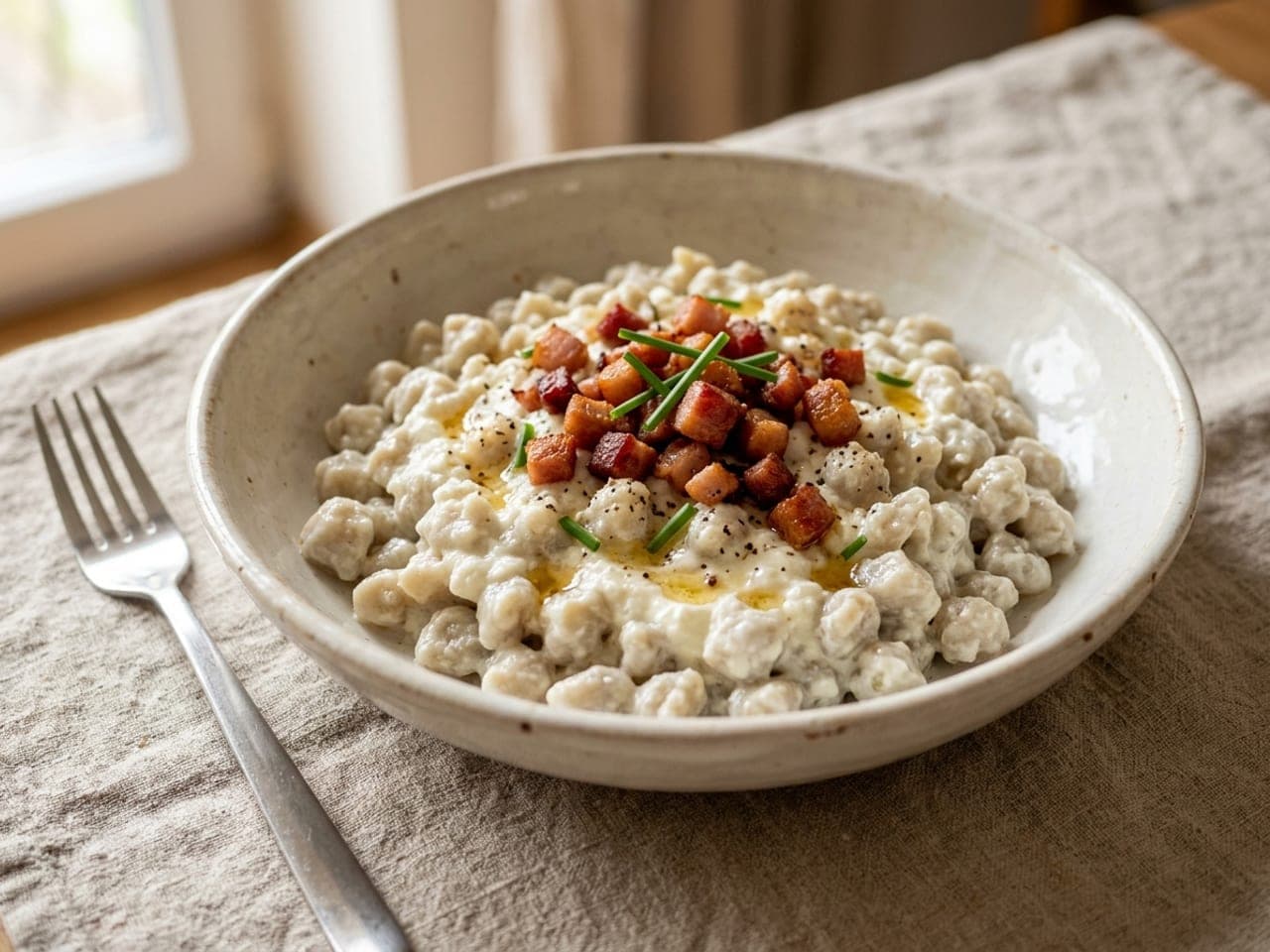
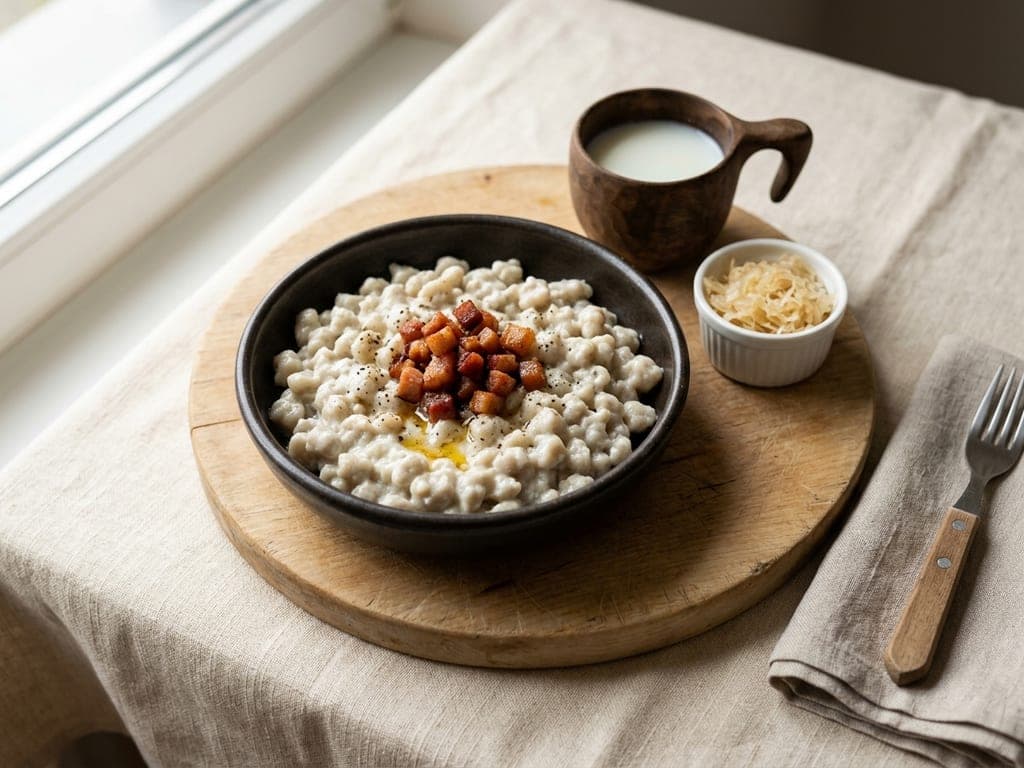
Bryndzové halušky, the dish Slovaks call their national one: small, chewy dumplings of raw grated potato and flour, folded off the heat into bryndza, the tangy, spreadable sheep cheese, and finished with crisp bacon škvarky and their fat. This version is built for cooks outside Slovakia: a weighed bryndza substitute (sheep’s-milk feta plus fresh goat cheese) that lands within about 2 g of the real cheese’s fat, protein and salt per 100 g, a work order that races the grey-dough clock, and one test dumpling in place of a guessed flour ratio. It also settles the naming mix-up: this is the Slovak potato-dumpling dish, not Pittsburgh’s cabbage-and-noodle “haluski”. Contains wheat, milk, pork and (optionally) egg.
Ingredients
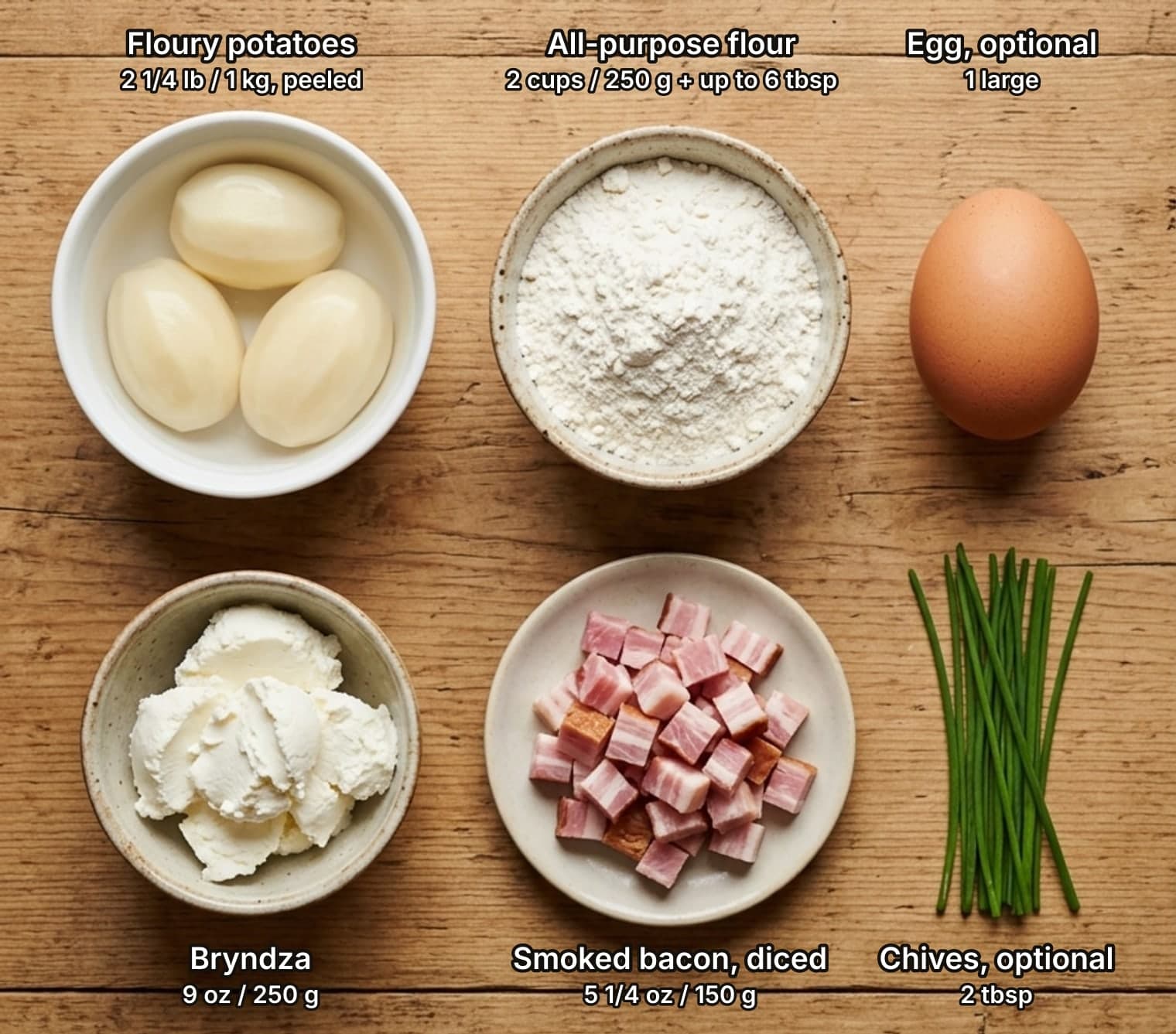
- floury potatoes (russet, Maris Piper or King Edward), peeled and weighed after peeling; keep them whole under cold water until you grate2 1/4 lb (1 kg) peeled weight
- all-purpose (plain) flour, spooned and leveled or weighed; Slovak polohrubá (semi-coarse) or hrubá (coarse) flour if you can find it. Contains wheat (gluten)2 cups (250 g), plus up to 6 tbsp (50 g) more if the test dumpling asks for it
- large egg, optional: firmer dumplings and a more forgiving batter. Contains egg; leave it out for egg-free halušky1
- fine sea salt or table salt for the batter (kept low on purpose: the bryndza and bacon bring the salt)3/4 tsp (about 4.5 g)
- bryndza (Slovak spreadable sheep’s-milk cheese), out of the fridge when you put the water on in step 1 (inside the USDA’s 2-hour limit for perishables, or 1 hour if your kitchen is above 90°F / 32°C); if you are pregnant, choose a tub made from pasteurized milk with no pregnancy warning on the label (see safety notes). Substitute: 5 1/4 oz (150 g) sheep’s-milk feta plus 3 1/2 oz (100 g) fresh, rindless goat cheese (both made from pasteurized milk if you are pregnant), mashed smooth. Contains milk9 oz (250 g)
- smoked slab bacon or thick-cut smoked bacon (smoked streaky), cut into 1/4- to 3/8-inch (6 to 10 mm) dice. Pork-free: skip it and use 3 tbsp (42 g) hot butter, the alternative Terézia Vansová printed (let it foam and turn nutty if you like): 1 tbsp goes into the cheese in step 3 and the rest over the plates. If you avoid celery, check the label: US “uncured” bacon is cured with celery powder5 1/4 oz (150 g)
- water, to start the bacon (keeps the rendering gentle)1/4 cup (60 ml)
- water, for boiling the dumplings5 quarts (4.7 L)
- fine salt for the cooking water, about 0.5% (with Diamond Crystal kosher salt, use twice the volume)1 1/4 tbsp (about 23 g)
- hot cooking water, scooped from the pot before the last batch comes out, to loosen the cheese (you’ll use 2 to 4 tbsp)1/2 cup (120 ml)
- black pepper, freshly groundto taste
- fresh chives, cut into 1-inch (2.5 cm) batons, optional2 tbsp
- sauerkraut, drained and warmed, optional, for the salaš plating (check jarred sauerkraut for sulphites if you avoid them)1/2 cup (about 70 g)
- to drink, optional: cold buttermilk, or žinčica (sheep’s whey) if you can find it (if you are pregnant, choose a pasteurized one; supermarket buttermilk is)1 glass per person
Halušky, haluski or strapačky: which dish did you mean?
Search for “haluski” in the US and most of what comes back is a different dish: egg noodles fried with cabbage and butter, a church-bazaar and Lenten fish-fry staple in Pittsburgh and Pennsylvania’s coal towns. In Slovakia, halušky (one is a haluška) are small dumplings of grated raw potato and flour, and bryndzové halušky are those dumplings tossed with bryndza sheep cheese and topped with bacon. Toss the same dumplings with sauerkraut and bacon and most Slovaks will call them strapačky (in some regions and in the dictionary, strapačky is simply another word for potato halušky). This page is the Slovak dish. If you came for noodles and cabbage, that is a different recipe, and a good one, but not this one.
The noodle version has more than one parent. The Slovak Academy’s dialect dictionary records that in the Hont region, around Pukanec, “haluške” could mean noodles eaten as a dish of their own, mixed with fried cabbage, plum butter or a topping. Yet the 1952 Anniversary Slovak-American Cook Book, published by the First Catholic Slovak Ladies Union in Cleveland, still makes “Repne Halušky” from grated potato, egg and flour dropped from a spoon, served “with cottage cheese or cabbage”. In that book bryndza has already become dry cottage cheese, the Repne Halušky are still potato, and a recipe from Munhall, Pennsylvania, in the Pittsburgh steel valley, already calls ham with torn noodles “Šunka a halušky”. The earliest dated newspaper description of the dish as “a mixture of noodles and cabbage” we could read is a 1997 Wilkes-Barre Times Leader report of a Lenten sale, and it is surely not the first.
Is it Polish? Maria Staszkiewicz of the Pittsburgh Polish Cultural Council told Eater in 2023: “Some Polish Americans would be surprised, but haluski is not really a Polish dish,” adding that it was adopted by many Central and Eastern European immigrants in the US, “but it does not come from Poland.” One last twist: Hungarians call bryndzové halušky sztrapacska, borrowed from the Slovak strapačky, so the same word usually means the cheese version on a Budapest menu and the sauerkraut version in Bratislava.
How to make Bryndzové halušky (Slovak potato dumplings with sheep cheese)
- Set up before a potato meets the grater. Pour 5 quarts (4.7 L) of water into an 8-quart (7.5 L) pot about 9 1/2 to 10 inches (24 to 26 cm) across, so a halušky board can bridge it, add 1 1/4 tbsp (about 23 g) fine salt, cover and bring it to a boil over high heat. Take the bryndza out of the fridge so it loses its chill. Peel the potatoes, cutting out any green patches and eyes generously (skip green or sprouting potatoes altogether), weigh them (you want 2 1/4 lb / 1 kg) and keep them whole in a bowl of cold water: it’s the grated pulp, not a whole peeled potato, that discolors fast. Set out the halušky board or colander, a spatula or bench scraper, a spider or slotted spoon, a large serving bowl and four wide bowls. Why the fuss: grated raw potato turns rosy within about 5 minutes and greyish-pink by 30, and a boiled dumpling has no brown crust to hide it. Everything that can happen before grating should, so the first batch is in the pot about 15 minutes after the first potato meets the grater (sooner with a food processor) and the last within about half an hour.
- Render the škvarky. Put the diced bacon in a cold, wide frying pan with 1/4 cup (60 ml) water and set it over medium heat. The water keeps the start gentle, and by the time it has boiled off much of the fat has rendered (America’s Test Kitchen’s method). Expect a burst of popping as the last of the water cooks off. Keep cooking, stirring now and then and turning the heat down if the fat starts to smoke, until the cubes are a deep reddish gold, crisp outside and still a little chewy, about 10 to 15 minutes in all. Lift them onto a clean plate with a slotted spoon and pour the fat into a small heatproof cup; you want about 3 tbsp (45 ml). Lean or British-style streaky bacon renders less, so top it up with lard or butter. Of that, 1 tbsp goes into the cheese, 1 tsp onto each plate, and the last couple of teaspoons are yours to keep for frying leftovers (cover it and keep it in the fridge). Small cubes rather than thin strips matter: they stay chewy-crisp on soft dumplings, where thin rashers shatter. And watch the color. Milan Holák, race director of the halušky World Championship, named one fault above the rest to the SITA news agency in 2011: “hlavne by nemali byť prihorené škvarky”, above all, no burnt cracklings.
- Loosen the bryndza in a warm bowl. Ladle a little boiling water from the pot into the serving bowl, swirl, tip it out and dry the bowl. Add the bryndza and 1 tbsp of the warm bacon fat and mash with a fork into a thick, smooth, spoonable cream with no dry lumps. Mixing the cheese with bacon fat before the dumplings go in is how Slovakia’s official tourism recipe does it; the fat carries smoke into every bite. Leave the bowl beside the stove, never on it. Bryndza is acidic (pH about 4.6 to 4.85), and cheese that acidic softens but never truly melts: on a burner or in a microwave it tightens, weeps whey and ends up as grainy curds in oil. A warm bowl and room-temperature cheese let the hot dumplings do all the heating.
- Grate last, and mix the batter as you go. Grate half the potatoes on the finest rasp side of a box grater (the small, sharp-edged holes that make a wet pulp, not shreds) straight into a large bowl, and stir in half the flour, 1 cup (125 g), so that pulp isn’t sitting bare while you grate the rest. Grate the rest, then add the remaining 1 cup (125 g) flour, the egg if using and 3/4 tsp salt. A food processor with the metal blade, pulsed to a rough purée, is faster and works too. Don’t squeeze or rinse the pulp: the cloudy liquid carries loose potato starch, and that starch is the binder. If a clear layer of water pools on top of very wet pulp, tip it off but keep the white sediment underneath. Beat with a wooden spoon for a minute into a thick, sticky, sluggish batter, thicker than pancake batter and looser than a scone dough: a spoonful holds a rough mound for a moment, then slowly slumps. If it is too stiff to push through the holes, loosen it with a teaspoon of water at a time. It will look beige-grey and wrong. That’s normal.
- Boil one test dumpling. Drop a small spoonful of batter into the boiling water. When it floats, give it 1 to 2 minutes more, lift it out and cut it open. It should hold its shape and be soft and chewy right through, with no pasty raw-flour center. If it frays or falls apart, beat in 1 to 2 tbsp more flour and test again, up to 6 tbsp (50 g) in all. If it’s dense and heavy, stop: the batter has enough flour. This is the only reliable spec, because potatoes differ in water from bag to bag, which is why published recipes range from about 200 g to over 700 g of flour per kilo of potato. Taste the test dumpling for salt, never the raw batter: it should taste of potato and only lightly seasoned, because the bryndza and bacon bring the rest.
- Press the halušky in four batches. Adjust the heat so the water holds a steady boil but not a violent one, which can tear the dumplings apart. Set the halušky board or colander over the pot so it doesn’t touch the water; if it does, batter cooks in the holes and clogs them. Spread about a quarter of the batter on it and push it through with a wet spatula or scraper in short strokes, so short, irregular dumplings drop into the water. Stir once, gently, so none stick to the bottom. When they float, count 1 to 2 minutes more, then bite one: it should be chewy right through. Pulled at the float, they taste of raw flour; left several minutes longer, they turn gummy. At altitude, where water boils below 212°F (100°C), trust the bite over the clock. Let the water return to a boil before each batch. Tipping in the whole batter at once would knock the pot far off the boil and leave pale, sodden dumplings. Dip the scraper in the hot water between passes so the batter slides.
- From the pot straight onto the cheese. Lift each batch out with a spider or slotted spoon, give it one shake and tip it straight onto the bryndza; fold with a spatula to coat, then cover the bowl with a plate while the next batch cooks. Don’t rinse the dumplings. Rinsing cools them below the point where they soften the cheese and washes off the starch film that makes the coating cling; Slovakia’s official tourism recipe and today’s Slovak cooks are firm on this, even if some older recipes rinsed. Before the last batch comes out, scoop about 1/2 cup (120 ml) of the cooking water into a cup. When everything is in the bowl, fold in 2 to 4 tbsp of it, a spoonful at a time, until the cheese coats every dumpling in a loose, glossy cream, a little like risotto. With a milder substitute blend, warm milk is the gentler loosener. By a rough heat-balance estimate the cheese warms to about 130°F (55°C) with the first batch and ends around 140 to 160°F (60 to 70°C) once the last batch is in: hot enough to soften and coat, and it never sees a burner. That is an estimate, not a measurement, and it is not the CDC’s 165°F (74°C) “heated through”, so the toss is not a Listeria kill step and does not make raw-milk bryndza safe in pregnancy (see safety notes).
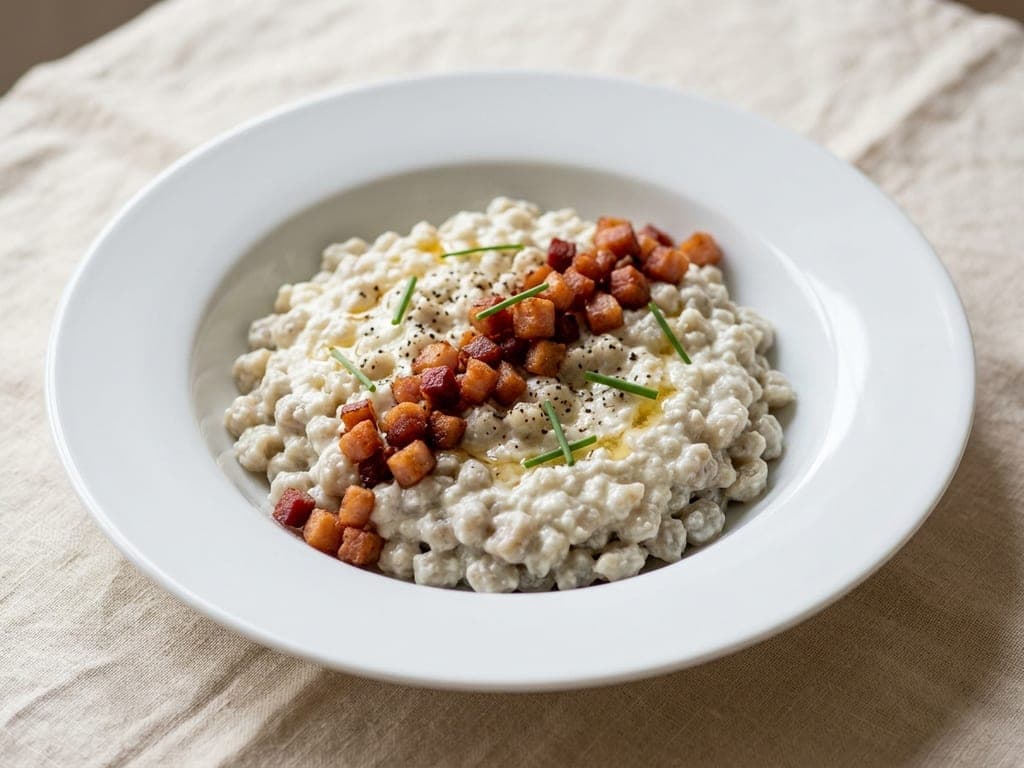
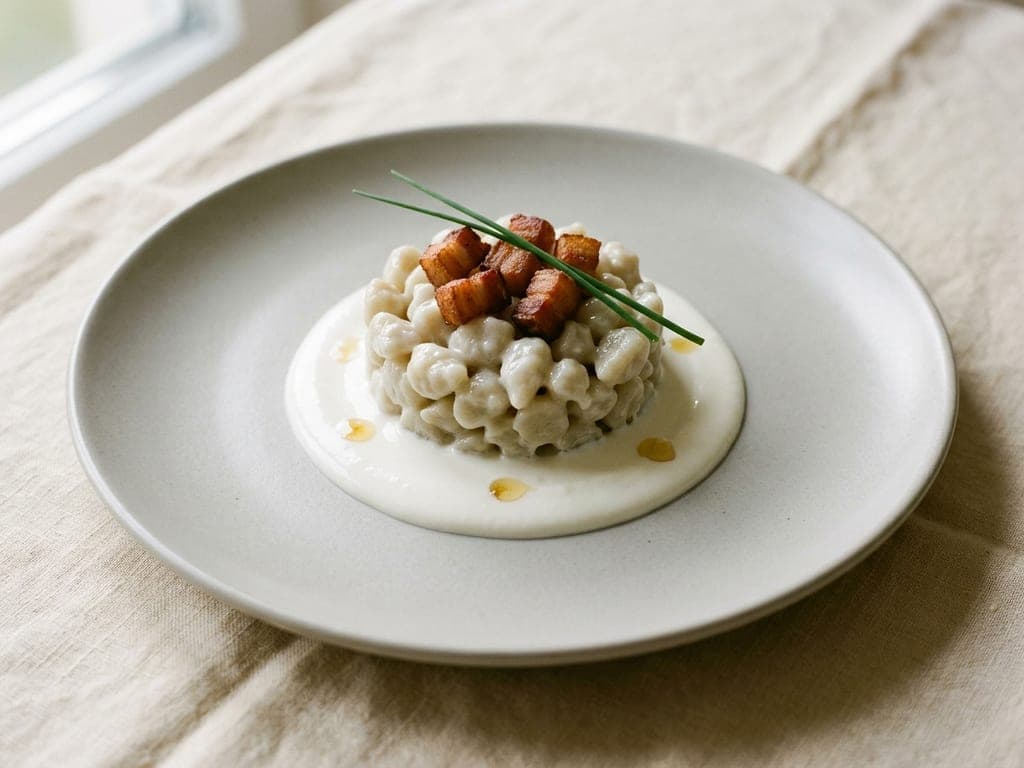
- Plate within five minutes. Divide the halušky among four warmed bowls, scatter the škvarky over the top and spoon about 1 tsp of the warm bacon fat over each plate: enough to gloss, not to pool. Finish with black pepper and, if you like, the chives. Serve at once. The dressed dish has a working life of minutes: the dumplings keep drinking up the cheese, the starch firms as it cools and the bacon fat sets. That is also why it can’t be reheated back to creamy (see the make-ahead section for what can be done ahead). Pour a glass of cold buttermilk alongside or, if you ever find it, žinčica, the sheep’s whey drink of the salaš, often served with it.
Safety & hygiene Important
- Pregnancy and raw-milk bryndza. The bryndza in this dish is never cooked: the hot dumplings warm it to roughly 140 to 160°F (60 to 70°C), unevenly, which is not a kill step. Traditional Slovak bryndza is often made with raw sheep’s milk. In a Slovak challenge test, Listeria monocytogenes did not grow in bryndza stored at about 43°F (6°C), but it survived at detectable levels for the 7 days tested (Cabanová and colleagues, Czech Journal of Food Sciences, 2011). The NHS says that in pregnancy, foods made from unpasteurised milk must be thoroughly cooked, and it counts any cheese cooked until steaming hot as safe; the US CDC lists any cheese made from raw milk as one to avoid unless it is heated to 165°F (74°C) or steaming hot. So if you are pregnant, 65 or older or immune-compromised, go by the whole label, not just the word “pasteurized”: use a bryndza that is made from pasteurized milk and carries no pregnancy warning, or, simplest, the pasteurized feta and goat cheese blend. One Slovak producer, Agrofarma, makes its mixed Slovenská bryndza from pasteurized milk and still labels it “not suitable for pregnant women”, while its pasteurized 100% sheep’s bryndza is labeled “safe for pregnant women”, and another of its tubs is made with raw-milk sheep’s cheese. Thermised bryndza, common in UK shops, has had a milder heat treatment than pasteurization, so in pregnancy treat it as unpasteurized, even when an English shop listing calls it “pasteurised” (termizovaná on the tub means thermised). Pasteurization lowers the risk but doesn’t end it: the CDC notes soft cheese can be contaminated after the milk is pasteurized, so keep the tub cold and within its date. The NHS lists pasteurized feta and goats’ cheese without a white rind among the soft cheeses that are fine in pregnancy.
- Raw batter and raw bacon. The FDA’s advice is plain: flour is a raw food, and you should never eat or taste raw flour, dough or batter. This batter also holds a raw egg if you use one. It’s a kitchen rule as well as a safety one, because raw batter tastes nothing like the cooked dumpling; judge salt and texture on the boiled test dumpling in step 5. Treat the bacon as raw pork until it is rendered: dice it on its own board with its own knife, keep it away from the cheese bowl and the chives, and wash your hands with soap for 20 seconds after handling it. Wash that board and knife, and the batter bowl, in hot, soapy water before they touch anything that won’t be cooked.
- Hot fat, boiling water and steam. Rendering bacon spits. Starting it in a cold pan with 1/4 cup (60 ml) water keeps the first minutes gentle, but expect some popping as the last of the water boils off: use a wide, deep-sided pan, keep your face and forearms back and a lid or splatter screen within reach, and never add water to fat that is already hot. Let the fat settle for a minute in its heatproof cup before you spoon it over the plates: it should be warm and liquid, not smoking. Steam coming up through the halušky board or colander scalds fast: rest the board on the pot rim rather than holding it, wear an oven mitt on the hand that steadies it, keep your face out of the column of steam, and dip the scraper with an arm’s-length reach, not a hand over the pot. Keep children back from the stove while the pot of water and the pan are both going. Deep-gold, crisp škvarky are cooked far past the USDA’s 145°F (63°C) minimum for pork.
- Cooling, storing and reheating. US (USDA FSIS): refrigerate cooked leftovers within 2 hours, or 1 hour if the room is above 90°F (32°C); eat within 3 to 4 days or freeze, where they keep best for 3 to 4 months; reheat to 165°F (74°C). UK (Food Standards Agency): cool and put leftovers in the fridge within two hours, eat them within 48 hours or freeze them, reheat until steaming hot throughout and only ever reheat once. For this dish, store the plain cooked dumplings rather than the dressed plate (see make-ahead), and keep the bryndza itself in the fridge within the use-by date on the tub, and use an opened tub within a few days.
3 ways to plate it
Bryndza by the numbers, and why it never melts
Bryndza (from Romanian brânză, “cheese”) is not a block cheese like feta. It is a soft, spreadable, slightly grainy white cheese made by milling matured sheep’s lump cheese (hrudkový syr) with salt, often with some cow’s lump cheese blended in. Its Slovak form is protected in the EU as “Slovenská bryndza”, a protected geographical indication (PGI, not a PDO), by Commission Regulation (EC) No 676/2008 of 16 July 2008. The Slovak specification sets the rules: sheep’s lump cheese must be more than 50% of the cheese by weight on a dry-matter basis (not “50% ewe’s milk”, as it’s often misquoted), dry matter at least 44%, fat in dry matter at least 38%, salt no more than 3.0%. Real labels come in under that ceiling: 2.4 g salt per 100 g on a Slovak mixed bryndza, 1.9 g on a thermised export tub sold in UK shops. Blending is not a modern shortcut, either: a 1662 record from Hrádok already lists sheep bryndza and cow bryndza side by side.
It starts as a rennet cheese and is then fermented hard. Under the EU application, the sheep’s milk is renneted, the lump cheese ferments for two to three days and then matures until its pH falls to 4.2 to 4.8, about seven to eight days in all, before it is crushed, milled between rollers and salted. The EU text describes the taste as a “pleasantly sour sheep’s cheese taste that is slightly spicy and salty”.
That acidity is the reason for this recipe’s one hard rule. Casein, the main milk protein, is least soluble near pH 4.6; as a cheese approaches it, the proteins stop repelling each other and bind tighter, so cheeses this acidic soften but barely melt (Cogan, Kelly and Sheehan, Journal of Dairy Science, 2026). Finished bryndza measures pH 4.61 to 4.85 (Cabanová and colleagues, 2011). In practice, heated in a pan it never becomes a smooth sauce: the protein network tightens, squeezes out whey and fat, and leaves grainy curds in an oily film.
So the only heat comes from the dumplings. They arrive in four batches, so the cheese warms in steps: by a rough heat-balance estimate, with room-temperature cheese in a warmed bowl, it reaches about 130°F (55°C) after the first batch and ends around 140 to 160°F (60 to 70°C) once the last is in. That is enough to soften it into a coating, and because the bowl is off the stove, the cheese only stays that warm briefly. It is also an estimate, not a measurement, and it is not the CDC’s 165°F (74°C) “heated through”, so the toss is not a Listeria kill step (see safety notes). Loosen it with the dumplings’ own starchy cooking water, which Slovak recipes, the official tourism one included, use in place of cream, and a spoonful of the bacon fat.
Buying bryndza in the US and UK, and a substitute that matches it
Under US federal rules (21 CFR 1240.61 and the cheese standards in 21 CFR 133), cheese made from unpasteurized milk can be shipped between states or imported only if it has been cured for at least 60 days at no less than 35°F (1.7°C). Bryndza matures for about a week, so traditional raw-milk bryndza can’t legally be imported. Look in Slovak, Czech, Polish and Eastern European delis for bryndza made from pasteurized milk, and read the ingredients: the real thing is milled sheep’s cheese with salt or brine (so water on the label is fine), sometimes with cow’s cheese, and nothing else. In the UK, Slovak and Polish shops sell thermised bryndza. Thermisation is a mild heat treatment, gentler than pasteurization, that knocks back the live cultures (Slovak public radio STVR says it leaves none) and lets the cheese travel. It is not a substitute for pasteurization; see the safety notes if you are pregnant. One 100 g (3 1/2 oz) tub lists sheep’s cheese, cow’s milk cheese and water, with 1.9 g salt per 100 g. UK shop listings sometimes translate termizovaná as “pasteurised”: check the Slovak name on the tub, because termizovaná means thermised, which is not pasteurized. In Slovakia you can also buy ovčia bryndza, 100% sheep, made in the milking season (one producer’s runs April to September), and Slovaks prize the spring cheese: “najlepšie bryndzové halušky sú z májovej bryndze”, runs a line on the Slovak food site Bonvivani, the best bryndzové halušky are made with May bryndza. In 2023 the farm journal Poľnoinfo reported that only one producer, the Kluknava dairy, was using the protected name “Slovenská bryndza”.
The closest swaps are Poland’s Bryndza Podhalańska (a PDO since 2007), Hungarian juhtúró and Romanian brânză de burduf, a kneaded sheep’s cheese. Podhalańska is traditionally made from raw milk and ripened for days, not months, so the pregnancy advice in the safety notes applies to it too, and you won’t find it legally on US shelves. Be wary of cheese labeled “brynza” in Russian or Ukrainian shops: that name usually means a brined, feta-like block, often cow’s milk. It works like feta in the blend below, not as bryndza.
Otherwise, weigh a blend. With USDA FoodData Central values per 100 g (feta 21.5 g fat, 14.2 g protein, 1,140 mg sodium; soft fresh goat cheese 21.1 g fat, 18.5 g protein, 459 mg sodium), 150 g (5 1/4 oz) sheep’s-milk feta plus 100 g (3 1/2 oz) fresh, rindless goat cheese (both pasteurized if you are pregnant) works out per 100 g to: fat (150 × 21.5 + 100 × 21.1) ÷ 250 = 21.3 g; protein (150 × 14.2 + 100 × 18.5) ÷ 250 = 15.9 g; sodium (150 × 1,140 + 100 × 459) ÷ 250 = 868 mg, about 2.2 g salt. A Slovak bryndza label reads 22.8 g fat, 15.8 g protein and 2.4 g salt. Real PDO sheep’s feta labels run 21 to 25 g fat, 17 g protein and about 2.5 g salt per 100 g, and the blend stays within about 2 g of the bryndza either way. The feta brings the sheep flavor and the salt, the goat cheese the soft body and lactic tang. Buy feta made mostly from sheep’s milk (PDO feta is sheep’s milk with up to 30% goat’s); cow’s-milk “feta-style” cheese lacks the sheep note. If you don’t like goat, 200 g (7 oz) sheep’s feta and 50 g (1/4 cup) sour cream is milder and looser (21.1 g fat, 11.8 g protein and 2.3 g salt per 100 g). Mash either blend smooth and taste the finished dish before adding salt anywhere.
The grey-dough clock: why the order of work is the recipe
Grated raw potato starts to discolor almost at once. Grating breaks the cells and lets an enzyme, polyphenol oxidase, meet the potato’s phenolic compounds and the air, and the pigments it makes read pink, then grey. In a side-by-side test published by Serious Eats in December 2025, untreated potato shreds were rosy by 5 minutes and “distinctly grayish-pink by 30.” A browned crust helps hide it in latkes, though in the same test the untreated batch still fried up noticeably greyer. A boiled dumpling has no crust at all, so every minute the pulp stands shows on the plate.
The usual fixes don’t transfer. Soaking or rinsing would wash out the loose starch that holds these dumplings together, and salting the pulp and letting it stand to draw out juice sits right in the window where the color turns (in the same test, a salted-water soak slowed the change, but what color came through read grey rather than pink). The fix is order: water at a boil, bacon rendered, cheese in its bowl, and only then do the potatoes meet the grater, with the flour stirred in as you go, so the first batch hits the water about 15 minutes after grating starts (sooner with a food processor).
A faint grey is normal and harmless; Serious Eats found even its most oxidized samples didn’t taste off once cooked. There is a second grey, too, that shows up after cooking as boiled potato sits in the air (potato scientists call it after-cooking darkening), one more reason halušky go from pot to cheese to plate without a pause.
Flour, egg, salt and the tool: where the recipes disagree
Published recipes disagree by more than three times on flour. Slovakia’s official tourism recipe uses 500 g of flour for 700 g of potatoes, about 715 g per kilo; Slovak recipe sites run from 250 to 500 g per kilo; one English guide squeezes out half the potato liquid and uses 200 to 240 g. One Slovak home cook’s rule: flour up to a third of the potato’s weight, no more. The difference is water. New or waxy potatoes carry more of it, and more water needs more flour, but every extra spoonful makes the dumplings denser and less potato-tasting. So this recipe starts at 250 g per kilo of peeled potato, the low end of the Slovak range, and lets one test dumpling decide whether it needs up to 50 g more, so it ends at 250 to 300 g per kilo. Floury potatoes (russet, Maris Piper, King Edward) give the most starch for the least water.
Keep the potato liquid. The white sediment that settles out of it is potato starch, and it only gelatinizes in the pot, from about 142 to 151°F (61 to 66°C), gluing the flour network together. That is why halušky can hold with little or no egg, and why they come out slippery-chewy rather than fluffy like gnocchi.
Egg is a live argument in Slovakia. The official tourism recipe and many Slovak cooks leave it out; Terézia Vansová’s printed recipe and the 1952 Slovak-American cookbook both use one. Egg white sets from about 144°F (62°C), right where the starch does, so an egg adds a second binding network: firmer, bouncier dumplings and a batter that forgives a little extra water. It’s optional here, as insurance for a first batch.
Keep the batter salt low: 3/4 tsp (about 4.5 g) for a kilo of potato. Bryndza is already about 2 to 2.4% salt and the bacon is cured; Food Network’s version puts 1 tablespoon of kosher salt into the batter for a pound (454 g) of potato before adding the cheese, and that much salt in the batter, on top of the cheese and bacon, is how the dish ends up tasting only of salt. The cooking water gets about 0.5% salt, half the 1% that Serious Eats found ideal for pasta water.
You don’t need a special tool, but hole size sets the shape. Slovak halušky boards (sito na halušky, a flat perforated plate that bridges the pot, sold with a scraper) have holes of a generous 1/4 to 3/8 inch (7 to 10 mm). A Spätzle press with 1/8-inch (3 mm) holes makes thin threads, too fine for halušky. A colander or round-holed grill basket with 3/16- to 5/16-inch (5 to 8 mm) holes works; hold it above the water, not in it, or the batter cooks in the holes and clogs them. The traditional way needs no tool at all: spread batter on a small wet wooden board and flick slivers into the pot with a wet knife.
Older than its potato fields: where bryndzové halušky come from
The words are older than potato fields in Slovakia. The Slovak Academy’s historical dictionary prints “bryncze” from Mošovce in 1563, halušky with milk for lunch (“na obed halussiek z mliekom”) at Ilava in 1663, and tvaroh for halušky at Žilina in 1681. Those were flour dumplings. The potato was known in Slovakia from the 17th century as a garden plant and became a field crop only from the late 18th and first half of the 19th century. After that, grated potato went into the dough, and in the mountains potato halušky became a meal of their own, often eaten in the morning by shepherds, woodcutters, miners and carters (ÚĽUV folk-culture encyclopedia: Peter Slavkovský on the potato, Rastislava Stoličná on halušky).
Bryndza came with the Wallachian colonization, the settlement of the Slovak mountains by pastoral people from the 14th century, whose settlers paid their lords partly in cheese and bryndza. The EU’s 2007 application calls bryndza “the first Slovak invention” and credits Ján Vagač, who founded the first Slovak bryndza plant at Detva in 1787. He built the first manufactory; he did not invent a cheese already on record more than two centuries earlier. The creamy bryndza that makes today’s sauce is younger still: in the late 19th century, hard bryndza that had to be cut with a knife gave way to soft, spreadable trecia bryndza, after the bryndza maker T. Wallo added a special brine.
The “national dish” label is older than any printed recipe we could find. In 1859 the Czech writer Božena Němcová, describing the woodcutters of the Brezno area, listed at their weddings and feasts “halušky s brynzou, národní to slovanské jídlo”: halušky with bryndza, “a national Slavic dish.” Slavic, not Slovak, and feast food, not everyday food. Then the surprise: Ján Babilon’s Prvá kuchárska kniha v slovenskej reči (Pest, 1870), the first Slovak-language cookbook, has no bryndzové halušky at all. Its halušky are soup dumplings, dumplings for goulash and chicken paprika, and several sweet kinds, and bryndza appears only twice, sprinkled on žganci. In 1870, strapačka was even a kind of kale.
The earliest printed potato-and-bryndza recipe we could read is Terézia Vansová’s, in the 1925 printing of her Nová kuchárska kniha (the first edition’s preface is dated 1914), and she calls it “zemiakové strapačky”: grate the potatoes, add egg, a little milk and flour, throw small halušky into boiling salted water, mix them with bryndza and dress them with bacon or hot butter. “Čerstvé sa nesú na stôl,” she ends: bring them to the table fresh. A century on, that is still the rule.
Not every expert puts halušky first. In a 2019 TASR feature, ethnologist Katarína Nádaská named porridge (kaša), a food she traces to the early Slavs, as one of the most traditional Slovak dishes. The dish has its own sport all the same: a cooking and eating contest started by the pub-keeper in the village of Turecká grew into a “World Championship”, which moved to Terchová in 2011; the Terchová festival also times contestants drinking a litre (about a quart) of žinčica. At the 20th “World Championship”, held in 2014 at a Banská Bystrica pool, the contest record for eating 1 kg (2.2 lb) of halušky was set at 45 seconds.
Make ahead, freeze, and what to do with leftovers
Don’t make the finished dish ahead. As it sits, the dumplings soak up the loosened cheese, their starch firms as it cools (retrogradation, which runs fastest at fridge temperatures), and bryndza, being so acidic, weeps whey and fat when reheated instead of turning creamy again. Make the parts ahead instead.
Cook the plain dumplings, drain them, toss them with about 1 tsp of fat per 9 oz (250 g) so they don’t clump (fat also slows the firming), spread them in a thin layer to cool fast and refrigerate within 2 hours. The USDA window is 3 to 4 days in the fridge, or 3 to 4 months in the freezer for best quality; the UK Food Standards Agency says eat leftovers within 48 hours or freeze them, so plan on two days if you want one rule. Render the škvarky ahead too; they re-crisp in a dry pan. To serve, drop the dumplings into boiling salted water a quarter at a time, about 1 to 1 1/2 minutes from the fridge or 1 1/2 to 2 1/2 minutes from frozen, until they are steaming hot right through (165°F / 74°C is the US reheat target), then lift them straight onto fresh, room-temperature bryndza and loosen with the hot water, exactly as in step 7. Never freeze the raw batter, which greys and thins, and never freeze the dressed dish.
Leftover dressed halušky can be eaten cold within those windows, or fried in a hot pan with a little bacon fat until the edges catch and they’re steaming hot through, which suits their tightened texture. If you are pregnant, 65 or older or immune-compromised, reheat leftovers until steaming hot rather than eating them cold. If the dumplings were made ahead and already reheated once, the UK FSA’s reheat-once rule means eating those leftovers cold (unless you’re in a higher-risk group, in which case don’t keep them). They won’t be creamy again, and microwaving them, the restaurant shortcut Slovak purists complain about, is what makes them gluey.
Questions, answered
What is bryndza cheese?
Bryndza is a soft, spreadable, slightly grainy white cheese made by milling matured sheep’s lump cheese with salt, often blended with some cow’s lump cheese. The Slovak version is an EU protected geographical indication, “Slovenská bryndza” (Regulation (EC) No 676/2008), which requires more than 50% sheep’s lump cheese on a dry-matter basis and caps salt at 3.0%. It tastes sour, sheepy and salty, and because it is so acidic (pH about 4.6 to 4.85) it softens with heat but never melts. Poland’s Bryndza Podhalańska, Hungarian juhtúró and Romanian brânză de burduf are close relatives; “brynza” in Russian or Ukrainian shops is usually a feta-like brined cheese.
What can I substitute for bryndza?
Weigh a blend of 150 g (5 1/4 oz) sheep’s-milk feta and 100 g (3 1/2 oz) fresh, rindless goat cheese (both pasteurized if you are pregnant), mashed smooth. It works out to about 21.3 g fat, 15.9 g protein and 2.2 g salt per 100 g, against 22.8 g, 15.8 g and 2.4 g on a Slovak bryndza label. For a milder, goat-free version, use 200 g (7 oz) sheep’s feta and 50 g (1/4 cup) sour cream. Loosen either with 2 to 4 tbsp of hot cooking water, and taste before salting anything. If you have no sheep cheese at all, make the sauerkraut version most Slovaks call strapačky: the same dumplings tossed with sauerkraut and bacon.
What is the national dish of Slovakia?
Bryndzové halušky. Slovakia’s tourist board calls it the most typical Slovak national food, and even the EU’s 2007 Official Journal text on the cheese describes it as the “national Slovak dish made from dumplings and bryndza”. The label is old: in 1859 Božena Němcová called halušky with bryndza “a national Slavic dish”, though one Slovak ethnologist, Katarína Nádaská, names porridge (kaša) among the most traditional Slovak foods. The dish has its own championships, held in Turecká and in Terchová.
What is the difference between halušky and spaetzle?
Spätzle are an egg pasta: the EU protected Schwäbische Spätzle as a product made from flour and fresh eggs (at least 8 eggs per kilo of flour in the fresh version) with no potato. Slovak halušky are a potato dumpling: mostly finely grated raw potato plus flour and salt, with egg optional, so they come out denser, chewier and slightly grey, and taste of potato. Gnocchi use cooked, riced potato worked into a soft dough and shaped by hand, which makes them fluffier and paler. The same perforated board can make Spätzle and halušky, but a halušky board has bigger holes.
Is haluski Polish or Slovak?
The potato-dumpling dish is Slovak above all (it is also cooked in the neighbouring Carpathian parts of Poland, Ukraine and Moravia); the word belongs to a whole family (Czech haluška, Polish gałuszka, Ukrainian halushka, and Hungarian galuska, borrowed from Polish dialect). American “haluski”, egg noodles fried with cabbage and butter, is a Pennsylvania and Pittsburgh dish that grew out of Central and Eastern European immigrant cooking. The Pittsburgh Polish Cultural Council’s Maria Staszkiewicz told Eater in 2023 that “haluski is not really a Polish dish” and “does not come from Poland”; Poland’s own noodles-and-cabbage dish is łazanki z kapustą. The Slovak dish with cabbage is the one most Slovaks call strapačky: potato dumplings with sauerkraut and bacon.
Do I need a halušky maker?
No. A colander or a round-holed grill basket with 3/16- to 5/16-inch (5 to 8 mm) holes works: hold it above the water, not in it, and push the batter through with a wet spatula. The traditional method uses no tool: spread batter on a small wet wooden board and flick slivers into the pot with a wet knife. A Slovak halušky board (holes a generous 1/4 to 3/8 inch, 7 to 10 mm) is simply the fastest. Avoid a Spätzle press with 1/8-inch (3 mm) holes, which makes threads rather than dumplings.
Why are my halušky gray, gummy or falling apart?
Grey: grated potato oxidizes within minutes, so render the bacon and boil the water first, grate last and get the first batch into the pot within about 15 minutes; a faint grey is normal and harmless. Green is not: cut green patches and eyes out of the raw potatoes before grating, and skip green or sprouting ones. Gummy: they were boiled too long after floating (1 to 2 minutes is enough), rinsed and then reheated, or had too much flour. Falling apart: the batter is too loose or the water is boiling too violently; beat in 1 to 2 tbsp flour, turn the heat down to a steady boil and boil one test dumpling before the rest.
Can you freeze halušky?
Yes, but freeze only the plain cooked dumplings, never the raw batter and never the finished dish. Drain them, toss with a little fat, cool fast in a thin layer, then freeze; USDA gives 3 to 4 months for best quality. To serve, drop them straight from frozen into boiling salted water, a quarter at a time, for 1 1/2 to 2 1/2 minutes, until steaming hot right through, then toss them with fresh, room-temperature bryndza off the heat. Dressed halušky don’t come back creamy, because the acidic cheese weeps whey and fat when it’s reheated.
What is strapačky?
Most Slovaks use strapačky for the same potato halušky tossed with sauerkraut and bacon instead of bryndza, though in some regions and in the Slovak Academy’s dictionary it is simply another word for potato halušky; the name is related to strapatý, “shaggy” or “tousled”. The meaning has moved around: in Babilon’s 1870 cookbook a strapačka was a kind of kale, Terézia Vansová’s printed recipe calls the bryndza version “zemiakové strapačky”, and in Hungary “sztrapacska” still usually means the cheese version. In most of Slovakia today, ask for strapačky and you’ll get sauerkraut, though “bryndzové strapačky” is also correct Slovak.
What do you drink with bryndzové halušky?
In Slovakia it is often served with žinčica, the whey drink of the salaš (the mountain sheep farm), or with buttermilk or cultured sour milk. Shepherds drank žinčica every day: the whey left in the kettle after cheesemaking, heated over the fire and drunk from wooden cups. Outside Slovakia, cold buttermilk does the same job: its sourness cuts the fat and resets the palate between forkfuls of salty cheese. If you are pregnant, pick a pasteurized žinčica or buttermilk (supermarket buttermilk is). If you want alcohol, a cold lager or a dry, high-acid white such as Grüner Veltliner (wine contains sulphites) works; avoid anything sweet or oaky, which fights the cheese.
How many calories are in bryndzové halušky?
About 792 kcal per serving of four as written. From USDA FoodData Central and a Slovak bryndza label: 1 kg peeled russet potato 830 kcal, 300 g flour (the full amount) 1,092, one egg 72, 250 g bryndza 675, the škvarky from 150 g raw bacon 218 (about 46.5 g of crisp bits at USDA’s 31% cooking yield) and the bacon fat used, 1 tbsp in the cheese plus 1 tsp per plate (about 31 g at 9 kcal per gram), 279. That is 3,166 kcal in all, about 792 per serving, with about 29 g protein, 29 g fat (about 16 g saturated) and 102 g carbohydrate. Spoon over all the rendered fat (about 39 g) and it is about 810 kcal; skip the fat entirely and it is about 722. Sodium is about 1,350 mg per serving: 5,378 mg in all, from bryndza 2,400 mg, bacon 1,127 mg (counted at its raw weight), batter salt 1,744 mg and the rest 107 mg, before any salt the dumplings pick up from the cooking water. That is more than half the 2,300 mg Daily Value, or about 3.4 g salt, more than half the NHS’s 6 g daily maximum for adults, which is why the batter salt stays low. UK smoked streaky is saltier (2.3 to 3.2 g salt per 100 g on supermarket labels), which can lift it to about 1,500 mg, and the optional sauerkraut adds about 120 mg per plate.
Snap your finished plate and let the AI plate it again — more beautifully.