Koprovka: Czech Dill Sauce (Koprová Omáčka) with Eggs and Potatoes
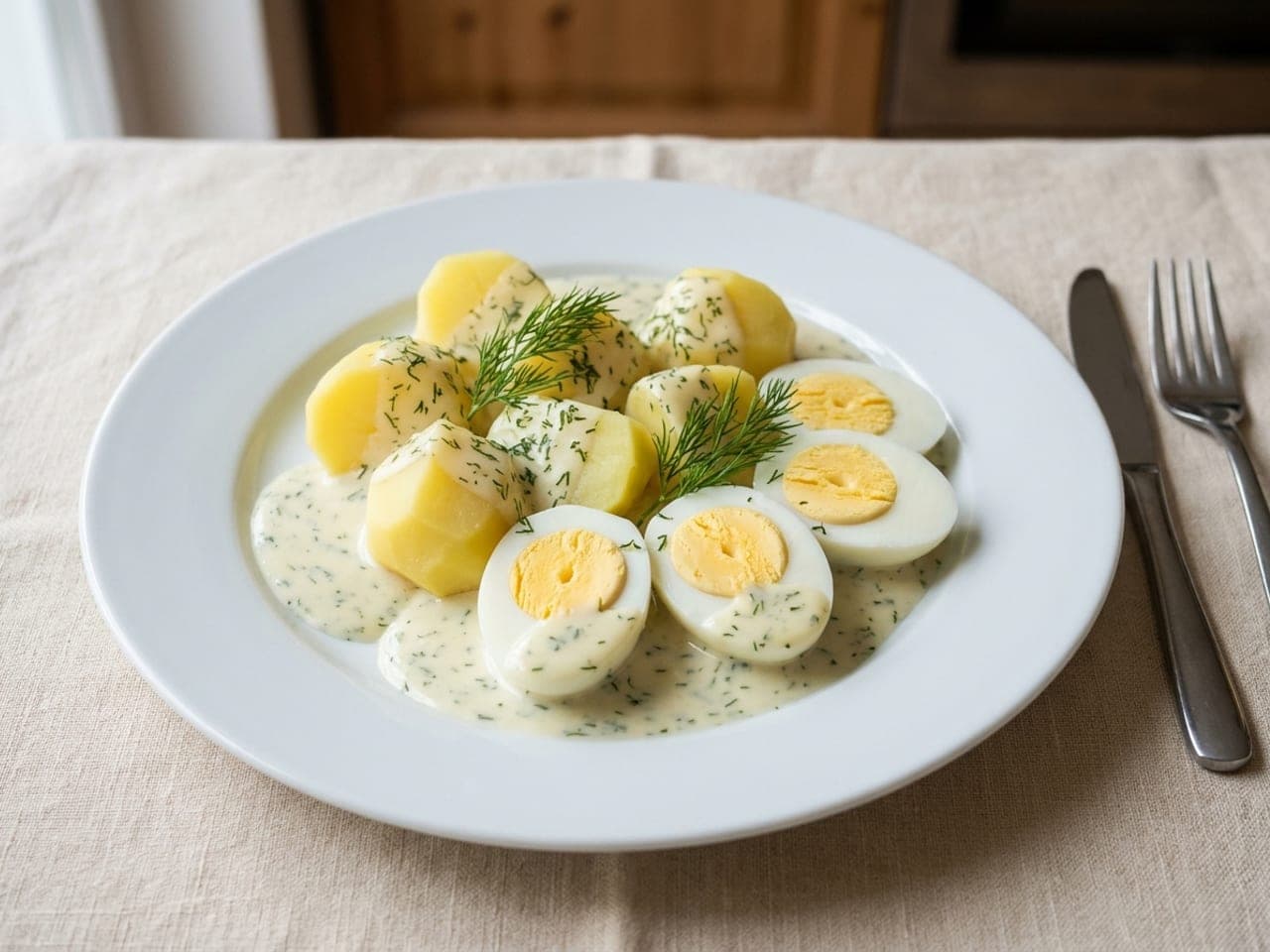
Koprová omáčka, koprovka in everyday Czech, is a silky dill sauce: broth thickened with a pale butter roux, enriched with cream, then finished off the heat with vinegar, a little sugar and a big handful of fresh dill, so it tastes creamy, bright and gently sweet-sour. This is the meatless plate Czech school canteens serve, poured over halved hard-boiled eggs and boiled potatoes, with the classic boiled beef and bread dumpling version in full below. It also gives what other dill sauce recipes skip: how much vinegar to use when yours is 5% rather than the 8% Czech recipes assume, the one order of steps that keeps the sauce from curdling and the dill from turning grey, and what the oldest Czech recipe we could find, from 1826, really put in it. Vegetarian with vegetable broth. Contains milk, wheat and egg.
Ingredients
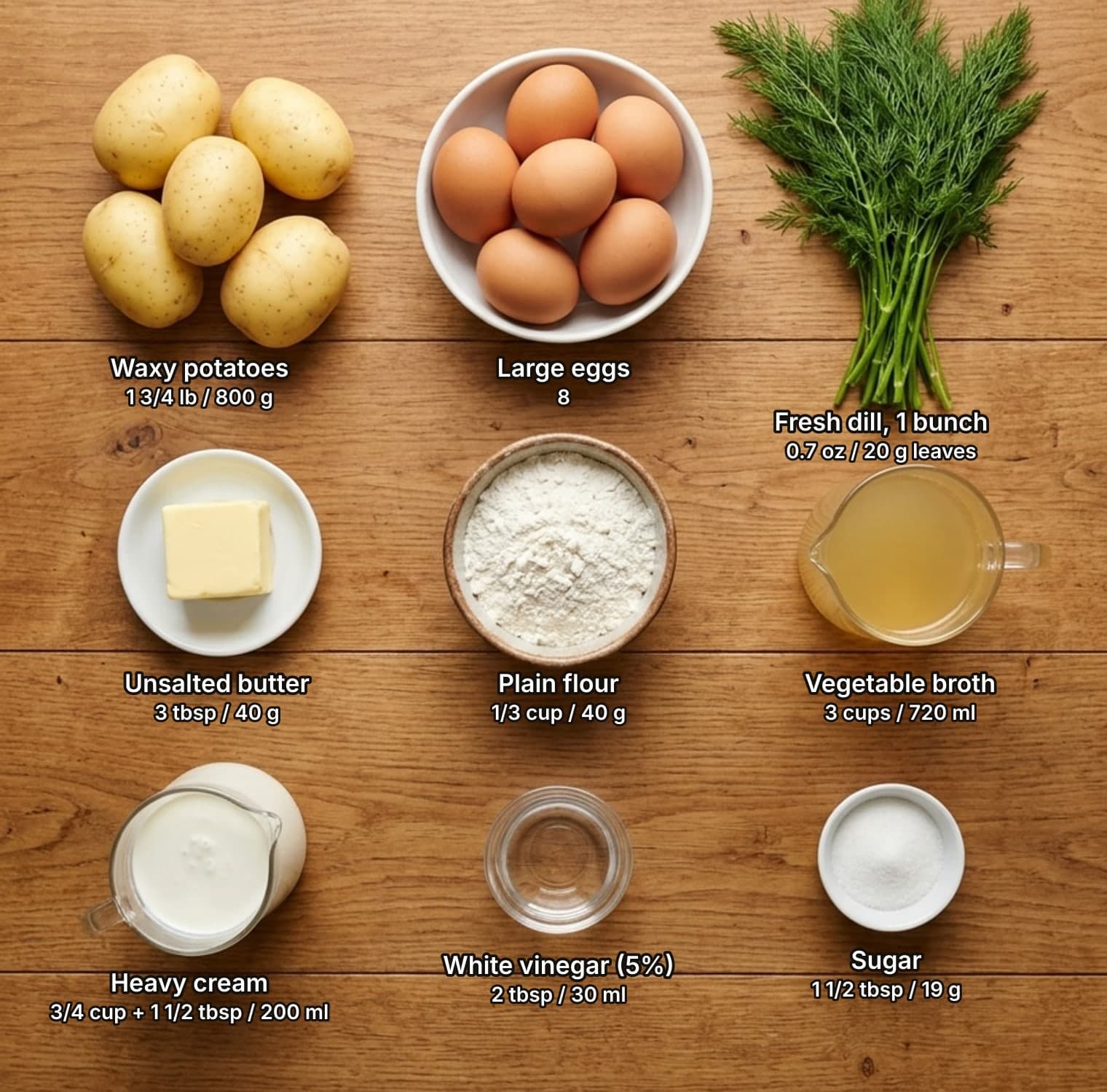
- waxy or all-purpose potatoes (Czech cooking type A or AB; Yukon Gold or red potatoes in the US, Charlotte or another salad potato in the UK; floury russets crumble into the sauce), peeled and cut into even chunks about 1 1/2 inches (4 cm) across1 3/4 lb (800 g)
- salt, for the potato water2 tsp
- large eggs, cold from the fridge (2 per person; contains egg)8
- ice cubes and cold water, for the egg ice bath2 cups (480 ml) ice plus 2 cups (480 ml) water
- fresh dill (1 large bunch): leaves picked and finely chopped; stems kept and tied into a bundle with kitchen string (frozen chopped dill works; dried is a poor swap, see FAQ)0.7 oz (20 g) picked leaves
- unsalted butter (contains milk)3 tbsp (40 g)
- plain (all-purpose) flour (contains wheat; white rice flour for a gluten-free sauce)1/3 cup (40 g)
- vegetable broth, warm (keeps the dish vegetarian; beef broth is the older classic, but then it is not vegetarian; choose a low-sodium broth, cube or concentrate and check the label for celery)3 cups (720 ml)
- heavy or whipping cream, at least 30% fat (UK double or whipping cream; Czech smetana ke šlehání 31 to 33%; not single cream or 12% cooking cream, which can curdle; contains milk)3/4 cup plus 1 1/2 tbsp (200 ml)
- white distilled vinegar, 5% acidity (if you have Czech kvasný ocet at 8%, use 1 1/4 tbsp instead; lemon juice also works, to taste)2 tbsp (30 ml), plus more to taste
- granulated sugar (1 tbsp is a start; up to 3 tbsp / 38 g for a sweeter sauce)1 1/2 tbsp (19 g)
- fine salt, for the sauce1/2 tsp, then to taste
- ground white pepper (optional)a pinch
What koprovka is, and how it differs from kulajda
Koprová omáčka (say KOH-proh-vah OH-mahch-kah; Czech stresses the first syllable) means simply “dill sauce”, and almost everyone calls it koprovka (KOH-prof-kah). It is a smooth, pale sauce: broth thickened with a light butter roux, enriched with cream, sharpened with vinegar, rounded with a little sugar and full of chopped fresh dill. It tastes creamy, fresh and gently sweet-sour. Czechs eat it as a main course, ladled generously over one of two partners: sliced boiled beef with bread dumplings (houskové knedlíky), the Sunday classic, or hard-boiled eggs with boiled potatoes, the meatless version many Czechs remember from the school canteen. Both are real, current Czech dinners: the chef recipe of Rohlik, the big Czech online grocer, offers the beef and dumpling plate and, as its meat-free option, boiled potatoes with hard-boiled egg, and the same grocer sells dill sauce with eggs and potatoes as a ready meal.
If you know our kulajda, koprovka will look familiar: both are Czech, creamy, soured with vinegar and loaded with dill, and both meet egg and potato. The difference is what they are. Kulajda is a soup, with potatoes and mushrooms cooked in it and a poached egg floating on top, eaten from a bowl with a spoon. Koprovka is a sauce, thickened with a roux to coat a spoon, poured over potatoes and eggs (or beef and dumplings) that are cooked separately, and eaten with a knife and fork. It is also sweeter: a properly balanced koprovka has a clear sweet-sour note that kulajda does not.
This page builds the meatless plate step by step and gives the beef and dumpling version in full. Along the way it covers what the ranking recipes leave out: the vinegar arithmetic for 5% and 8% bottles, the order of steps that keeps the sauce smooth and the dill green, fresh versus frozen versus dried dill with the lab numbers, how to make it ahead and freeze it, and what Czech cookbooks have actually put in it since 1826.
How to make Creamy dill sauce (Koprová omáčka)
- Pick the dill and start the potatoes. Strip the feathery dill leaves from the thick stems, chop the leaves finely and keep them covered on the board; they go in only at the very end. Tie the stems into a bundle with kitchen string: they will flavour the sauce while it simmers and come out before you serve, which gives you a deep dill taste without chewy, greying bits. Put the 1 3/4 lb (800 g) peeled potato chunks in a pot; even 1 1/2 inch (4 cm) pieces finish together, where ragged sizes leave raw centres next to mush, cover with cold water by about an inch (2.5 cm), add the 2 tsp salt and set over high heat. Starting potatoes in cold water lets the heat reach the middle before the outside breaks up, so they stay neat under the sauce. At the same time put about an inch (2.5 cm) of water into a lidded pot that holds a steamer basket and bring it to a boil for the eggs, and warm the 3 cups (720 ml) broth in a small pan. Warm broth whisks into a roux more smoothly than cold.
- Cook a pale roux. Melt the 3 tbsp (40 g) butter over medium heat in a heavy 3 quart (2.8 l) saucepan. When it stops foaming, add the 1/3 cup (40 g) flour and stir constantly with a flat whisk or wooden spoon for 1 to 2 minutes, until the paste loosens, smells of biscuits and turns the colour of pale straw. Stop there: this is the light roux Czech cooks call světlá jíška, not a brown one. Cooking the flour in fat removes the raw taste and coats each grain so it does not clump when liquid arrives, but every shade darker costs thickening power; a well-browned flour thickens only about a third as much as raw flour. A pale roux also keeps the sauce cream-coloured, which is what makes the green dill stand out on the plate.
- Whisk in the broth and simmer for 20 minutes. Take the pan off the heat and whisk in about 1/2 cup (120 ml) of the warm broth, standing back as it hisses and steams. It will seize into a thick paste; keep whisking until it is completely smooth, then add the rest of the broth in three more additions, whisking each one smooth before the next. Adding liquid little by little is what prevents lumps. Drop in the dill-stem bundle, return the pan to the heat and bring to a boil, then turn it down to a bare simmer, set the lid ajar and cook for 20 minutes, scraping the bottom and corners every few minutes because roux sauces catch. The flour thickens almost at once, but the long simmer is what cooks out the floury taste and gives the gloss. By the end the sauce should coat the back of a spoon and hold a clean line when you draw a finger through it. Too thick? Whisk in a splash of broth or water.
- Boil the potatoes until just tender. Once the potato water boils, lower the heat so it bubbles gently; a hard boil knocks the potatoes against each other and roughs up their edges. Medium pieces take about 15 to 20 minutes. Test the largest piece: a thin knife should slide into the centre with no resistance. Drain, return the potatoes to the hot pot and set it over low heat for a minute, shaking once, so the surface steams dry and the sauce will cling instead of sliding off a wet potato. Keep the lid on until you serve. Waxy and all-purpose potatoes (Czech type A or AB) are the right choice here because they keep their shape when hot sauce is poured over them; floury type C potatoes and russets start to collapse and thicken the sauce into paste.
- Steam the eggs for 13 minutes. As soon as the steamer water boils (usually while you are making the roux), lower the 8 cold eggs into the steamer basket, cover and keep the heat at medium for 13 minutes. Steam sets the outer white at once, so it shrinks away from the shell membrane and peels cleanly, and because the eggs do not cool down a pan of water the way a batch dropped into boiling water does, the timing stays reliable; America’s Test Kitchen gave steaming and boiling its top grade among the methods it tested. Meanwhile mix the 2 cups (480 ml) ice with 2 cups (480 ml) water in a lidded container. Move the eggs straight into the ice bath for 15 minutes, as America’s Test Kitchen tested it: stopping the cooking prevents the grey-green ring around the yolk, which is harmless iron sulfide from overcooking but looks tired on a plate. To peel fast, pour off half the water, put the lid on and shake the container hard about 40 times, then slip the shells off. Halve the eggs lengthwise just before serving.
- Add the cream and season. Fish out the dill-stem bundle, pressing it against the side of the pan to save the sauce it holds. Warm the 3/4 cup plus 1 1/2 tbsp (200 ml) cream in the empty broth pan first, so cold dairy does not hit the hot sauce, then pour it in, stir and bring the sauce back to a gentle simmer for 2 minutes, just to heat it through. Season with the 1/2 tsp salt and a pinch of white pepper; how much more salt you need depends on your broth, so taste. Cream of at least 30% fat matters for what comes next: in rich cream the fat globules are numerous enough to bind most of the milk protein, so the sauce can take vinegar without splitting, while milk and single cream have too little fat to protect it. For a perfectly smooth sauce, the way Czech restaurant cooks do it, pass it through a fine sieve now, before any dill goes in.
- Off the heat: vinegar and sugar, to taste. Take the pan off the heat. Stir constantly as you pour in 1 tbsp of the vinegar, so no corner of the pan turns sour on its own, then stir in 1 tbsp of the sugar. Taste from a spoon you have let cool for a few seconds: a scalding sauce always tastes milder than it will on the plate. Then add the rest in small, roughly equal steps until the sauce tastes bright and rounded: tang first, then a soft finish, like a good Czech cucumber salad. It should never taste sweet; the sugar is there because sweetness dulls sourness far more than sourness dulls sweetness, so a spoonful of sugar takes the harsh edge off the vinegar. You can always add more of either, but you cannot take them out. The vinegar goes in last and off the heat for two reasons. Acid pushes milk protein towards the point where it clumps, and heat speeds that up, so hot plus sour is how cream sauces curdle. And acid added before the starch has fully swollen stops it thickening, which is why it waits until after the 20 minute simmer.
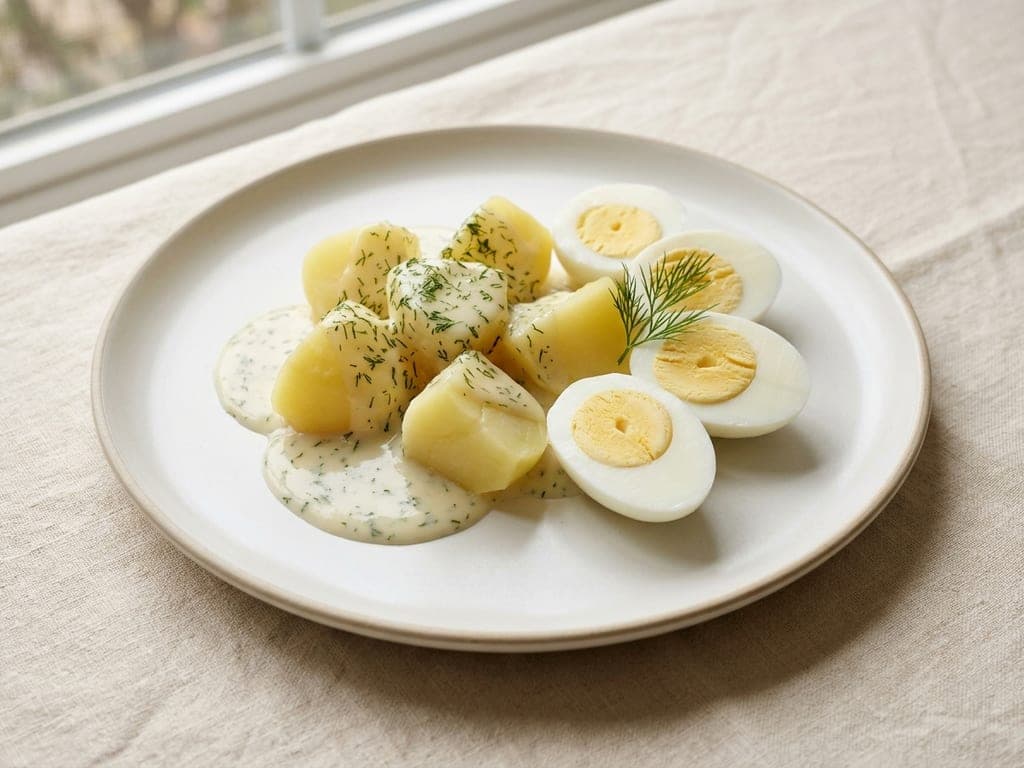
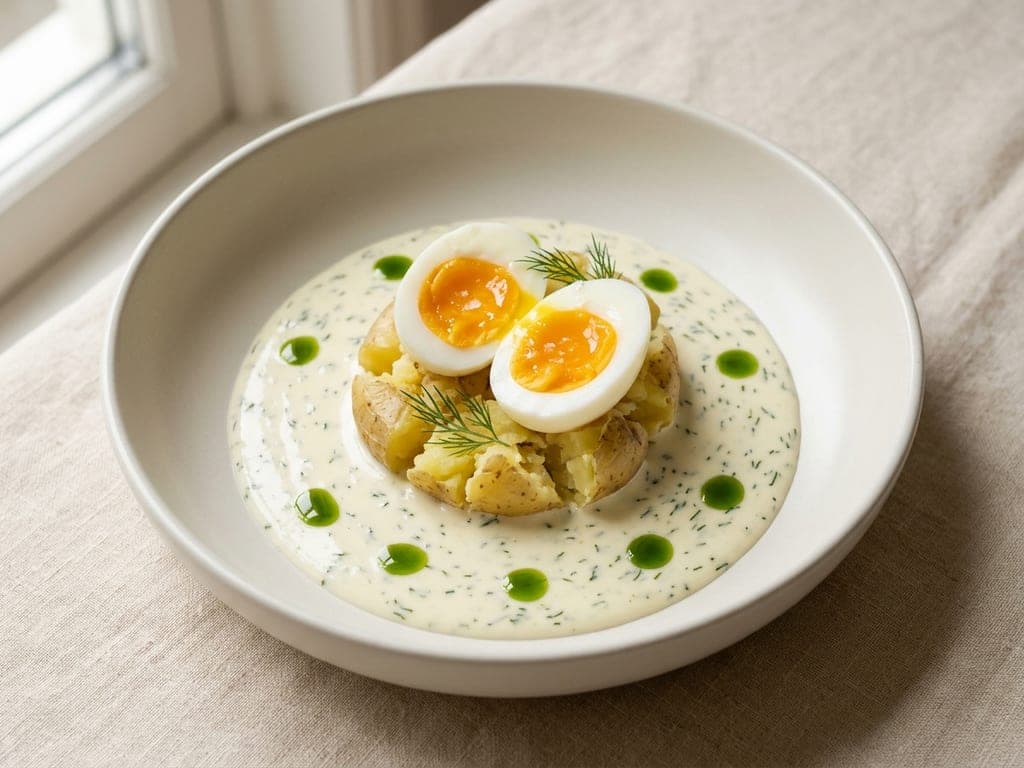
- Dill last, then serve straight away. Stir the chopped dill leaves into the sauce off the heat and let it stand for 2 minutes, so the dill softens and perfumes the sauce. Czech cookbooks have said to add the dill only when the sauce goes to the table since at least 1869, and the chemistry agrees: heat and acid together turn the bright green chlorophyll in dill into olive-grey pheophytin, and in a hot, sour sauce that takes minutes, not hours. So serve right away. Put the potatoes on warm plates, lay four egg halves beside them, cut side up, and ladle the sauce over the potatoes and half of each egg, leaving the yolks peeking out. If you are making the sauce ahead, stop after the cream; then bring it back to the boil with a splash of water, stirring, and add the vinegar, sugar and a fresh handful of dill off the heat just before eating.
Safety & hygiene Important
- Leftovers: US and UK windows. Cool the sauce, eggs and potatoes quickly in shallow containers and store them separately. USDA advice is to refrigerate within 2 hours of cooking (1 hour if the room is above 90°F / 32°C), keep the fridge at 40°F (4°C) or below and eat leftovers within 3 to 4 days. The UK Food Standards Agency says to chill cooked food (fridge at 0 to 5°C / 32 to 41°F) within one to two hours, eat leftovers within 48 hours and reheat only once. USDA’s rule for leftovers is 165°F (74°C), and for sauces, soups and gravies it says to bring them back to a rolling boil. Add a splash of water, since the roux sauce sets thick in the fridge, and stir all the time as it comes up to the boil. Heavy cream copes with this better than milk would; if the sauce turns grainy anyway, a stick blender brings it back. In the UK, the FSA test is simply steaming hot all the way through, and reheat it only once. Add fresh dill after reheating.
- Hard-boiled eggs and soft yolks. FoodSafety.gov gives hard-cooked eggs 1 week in the fridge and says not to freeze them (the whites turn rubbery). Once the eggs are sliced into the sauce, treat the whole plate as leftovers: 3 to 4 days in the US, 48 hours in the UK. Do not leave cooked eggs out for more than 2 hours, or 1 hour above 90°F (32°C). A soft, jammy yolk, as in the modern plating, is not fully cooked. US food-safety advice (FoodSafety.gov) is to cook eggs until both yolk and white are firm, and to use pasteurized eggs for dishes with raw or lightly cooked eggs; this matters most for pregnant people, children under 5, adults over 65 and anyone with a weakened immune system. In the UK the FSA has said since 2017 that British Lion hen eggs are safe for those groups to eat runny, except for people who are severely immunocompromised and on a medically supervised diet. Eggs without the Lion mark, imported eggs and duck or quail eggs should still be cooked through for vulnerable groups. The UK government’s egg guidance for caterers, updated in August 2026 during a salmonella outbreak linked to imported eggs, repeats the rule: lightly cooked eggs for vulnerable people should be British Lion or Laid in Britain.
- Freezing and reheating. Sauces thickened with wheat flour do not freeze well: some of the starch breaks down, so they thin out and weep water on thawing, and dairy sauces can separate. You can still freeze the base (roux, broth and cream, before the vinegar and dill) for 2 to 3 months, the window FoodSafety.gov gives for soups and stews. Thaw it in the fridge, bring it to a simmer while whisking, or blend it, which reverses most of the separation, then add the vinegar, sugar and fresh dill. Do not freeze the hard-boiled eggs (the whites turn rubbery); boiled potatoes are safe to freeze but turn watery and mealy, so cook them fresh. If you want a sauce built for the freezer, make the roux with glutinous (sweet) rice flour, such as Mochiko: in freeze-thaw tests, sauces thickened with waxy rice starch barely wept, while ordinary high-amylose rice flour and corn or potato starch did much worse.
- Boiled beef and a big pot of broth. For the beef variant, USDA’s minimum for whole cuts of beef is 145°F (63°C) with a 3 minute rest; a chuck simmered for 2 1/2 to 3 hours is far beyond that, so the real test is tenderness. The risk is the cooling: a deep pot of broth stays warm for hours. Divide it into shallow containers, or set the pot in a sink of iced water and stir, and get it into the fridge within 2 hours; the professional standard (the FDA Food Code) is to get it from 135°F (57°C) down to 70°F (21°C) within 2 hours, and to 41°F (5°C) or below within 6 hours in total. Keep raw beef apart from everything else: use a separate board and knife, and wash them in hot soapy water before they touch anything else. Wash your hands with soap for at least 20 seconds after handling the meat. Do not rinse the raw beef; splashing spreads bacteria. Keep raw juices away from the dill, eggs and potatoes. Keep sliced beef hot, at 140°F (60°C) or above, in a little broth until serving, or chill it.
- Allergens and dietary notes. This sauce contains milk (butter, cream) and wheat (the roux), and the plate contains egg. Bread dumplings add wheat, milk and egg. Many stock cubes and broths contain celery, one of the 14 allergens UK and EU labels must declare, so check yours. The dish is vegetarian only when made with vegetable broth; the classic version on beef broth, with or without the meat, is not. For gluten-free, make the roux with white rice flour and use a gluten-free broth. The beef version’s homemade broth contains celery (celeriac). Bread dumplings contain wheat, so the gluten-free swap works only for the egg and potato plate.
3 ways to plate it
The order that keeps it smooth and green
Almost every complaint about koprovka, grainy, grey, floury or harsh, comes from doing the right things in the wrong order. The order that works is: pale roux, then broth, a 20 minute simmer, then cream, then off the heat the vinegar and sugar, and the dill leaves last of all.
Vinegar goes in late for two separate reasons. The first is curdling. Milk protein (casein) stays dispersed because its particles carry the same electric charge and repel each other; acid neutralises that charge, and as the sauce nears a pH of about 4.6 the proteins clump, faster the hotter the sauce is. Fat protects: in cream with 25% or more fat, the surface of the fat globules soaks up most of the casein, so heavy or whipping cream (30% and up in the US, 31 to 33% in Czech whipping cream) can take the vinegar, while milk and 12% cooking cream often cannot. The roux helps too, because swollen starch keeps any curds microscopic. The second reason is thickening: acid stops starch from swelling properly, so a sauce soured before it has simmered never thickens fully. Adding vinegar after the simmer and off the heat solves both.
Dill goes in after the vinegar because chlorophyll is fragile in exactly those conditions. Above about 140°F (60°C) the plant cells open and expose the chlorophyll to acid, which swaps out its magnesium and turns it olive-grey. In a hot, sour sauce that happens within minutes, which is why the leaves go in at the very end and the sauce goes straight to the table, while the tough stems, which you are going to discard anyway, do their work during the simmer.
Thickness is the other dividing line. Czechs who grew up with canteen koprovka remember it either as thin and watery or as a thick, floury porridge, and both are roux problems. This recipe uses 40 g butter and 40 g flour for 920 ml of broth and cream, about 43 g of flour per litre: a little thicker than the Czech how-to site Skrblík’s 40 g each per litre of broth plus 200 ml cream, or Rohlik’s 40 g flour (with 60 g butter) per litre plus 250 ml cream, both about 32 to 33 g per litre, because this sauce has to cling to potatoes and eggs. The result coats a spoon and pools softly on the plate, which is the texture to aim for; thin it with a splash of broth if you like it looser.
Vinegar strength and the sugar dial
The Czech dill sauce recipes we read online quietly assume Czech vinegar. Standard Czech kvasný lihový ocet (fermented spirit vinegar) is sold at 8% acetic acid, often tinted light brown; US white distilled vinegar is sold at 5% (the FDA minimum for vinegar is 4%), and UK malt and spirit vinegars are usually 5% (wine vinegars about 6%; check the label). Follow a Czech recipe’s spoonfuls with a 5% bottle and the sauce comes out flat.
The arithmetic: 1 tbsp (14.8 ml) of 8% vinegar holds 1.18 g of acetic acid. To get the same 1.18 g from 5% vinegar you need 23.7 ml, about 1.6 tbsp. So multiply a Czech vinegar amount by 1.6 for a 5% bottle, or multiply a 5% amount by 0.625 for Czech ocet. This recipe’s 2 tbsp (30 ml) of 5% vinegar is 1.5 g of acid, the same as 1 1/4 tbsp of 8% ocet. Rohlik’s chef recipe, by contrast, calls for 3 tbsp of ocet per litre of broth, which would be close to 5 tbsp of US vinegar. Lemon juice works too, and has a long Czech pedigree: Ludmila Barthová’s První česká vegetářská kuchařka (The First Czech Vegetarian Cookbook) of 1908 finished its dill sauce with lemon. Add it to taste, as its sourness is not the same per spoonful.
Sugar is a dial, not a fixed amount. The oldest Czech recipe we found, from 1826, had none. Today’s versions range widely: about 38 g for roughly 890 ml of liquid at Cook Like Czechs, the most visible English-language Czech recipe, up to 70 g per litre of broth plus 250 ml cream at Rohlik, about 52 g scaled to this recipe. This page starts at 1 1/2 tbsp (19 g) for 920 ml, because a sweet-sour sauce should taste bright rather than sweet, and you can always add more up to about 3 tbsp (38 g) for a sweeter sauce. Add sugar and vinegar together in small steps and taste between them.
Fresh, frozen or dried dill
Use fresh dill if you possibly can, and use a lot: 20 g of picked leaves for four people. A 1985 Finnish study of dill herb by Huopalahti, Kesälahti and Linko measured what drying does. Air-dried dill kept only 9 to 15% of the aroma compounds of fresh dill, and its key note, the compound researchers call dill ether, dropped to traces. Freeze-drying did better, keeping 25 to 58%. Worse, more than half of what remained in dried dill were new compounds formed during drying, which is why dried dill tastes of hay rather than just tasting weaker.
Frozen dill is the best stand-in. Chop it, freeze it flat in an airtight bag and use it within about two months: a companion study by Huopalahti, cited in that paper, saw aroma losses in frozen dill after roughly two months at -4°F (-20°C), depending on the packaging. Add it straight from the freezer at the end, like fresh. If dried dill is all you have, the usual swap is 1 tsp dried for 1 tbsp fresh, but expect a flatter sauce. Do not use dill seed: its main aroma, carvone, tastes of caraway, not of the fresh herb.
Do not throw the stems away. They are too tough to eat, but simmered in the sauce and fished out, as Rohlik’s chef recommends, they add a deep, sweet dill flavour that the leaves alone do not give. Czech cooks have been told to pick off the stalks for a long time: the 1863 Malá kuchařka attributed to Magdalena Dobromila Rettigová says “stopky z něj vyber” (pick out the stalks).
The classic version: boiled beef and bread dumplings
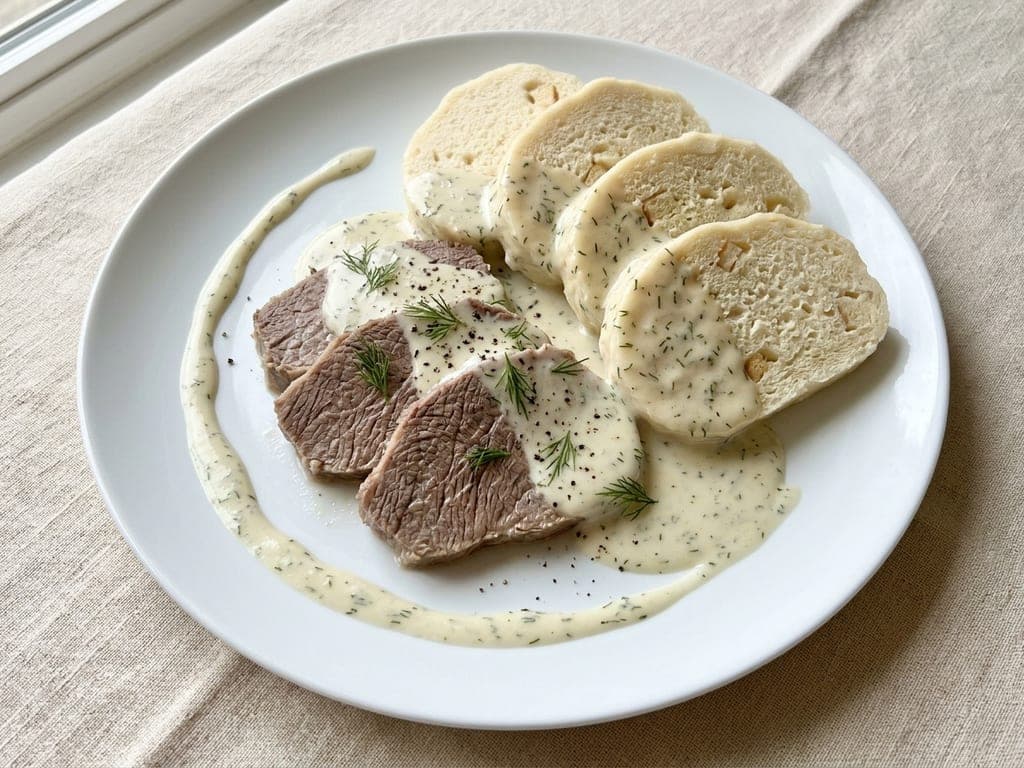
The older and grander koprovka is a sauce for boiled beef, and the beef gives you the broth. For four, put about 2 1/4 lb (1 kg) of boneless beef chuck in one piece (Czech hovězí plec, shoulder; US chuck roast or shoulder clod; UK braising chuck in one piece; brisket also works) in a large pot with 2 carrots, a quarter of a celeriac, 1 parsley root (or a parsnip), 1 onion halved and 3 garlic cloves. Cover with cold water by about an inch (2.5 cm) and bring it slowly to a boil, skimming off the grey foam as it rises. Once the foam stops, add 3 bay leaves, 5 allspice berries, 10 black peppercorns and 1 tsp salt, and keep it at a gentle simmer, uncovered, for about 2 1/2 to 3 hours, topping up with hot water if the meat surfaces, until a fork slides in and the meat pulls apart with little resistance. This is the method of Rohlik’s chef recipe; see our beef broth recipe for more on the stock itself.
Lift out the beef, strain the broth and skim off the fat. Make the sauce exactly as above with 3 cups (720 ml) of this beef broth in place of the vegetable broth; taste before salting, since homemade broth varies. Freeze the remaining broth for soup. Slice the beef across the grain about 1/4 inch (6 mm) thick and keep the slices in a little hot broth so they stay moist. The beef can be cooked a day ahead, which makes the sauce a 35 minute job on the day; chill the beef in some of its broth in a shallow container (cool the rest of the broth in shallow containers or in a sink of iced water first, see the safety note), then lift the set fat off the top.
To serve, lay two or three slices of beef on each warm plate, add four slices of bread dumpling, and ladle the sauce over the beef and half of each dumpling slice. Steam the dumplings or our boiled potatoes while the sauce simmers. Per serving, the sauce on beef broth is about 313 kcal and 120 g of cooked chuck adds about 356 kcal (USDA: 297 kcal per 100 g braised chuck), so roughly 670 kcal before the dumplings. This version is not vegetarian.
Two hundred years of koprovka in Czech print
The oldest Czech dill sauce recipe we could find is in Magdalena Dobromila Rettigová’s Domácí kuchařka of 1826, page 18, in a chapter called “Omáčky k hovězímu masu”, sauces for boiled beef. It is nothing like the milky canteen sauce: beef broth and wine vinegar brought to the boil with finely chopped dill, then thickened with a mixture of fresh butter, flour, thick sour cream and one or two egg yolks, simmered a little more “a tak jest hotová” (and so it is done). No milk, no roux and no sugar. So the oldest koprovka we can read was a sour, creamy sauce for beef, and the sweet-sour taste Czechs know today came later.
The modern shape assembles over the next eighty years. A pale roux appears in the 1863 Malá kuchařka; the 1869 Pražská kuchařka says to add the dill only “když chceš omáčku nésti na stůl”, when you are about to take the sauce to the table. Potatoes arrive early and in bulk: the public kitchen of Olomouc printed its weekly menu in the paper Našinec, and on Tuesday in October 1876 it was barley soup, boiled beef, “koprová omáčka s brambory” (dill sauce with potatoes) and rice pudding. Dill sauce with beef and potatoes was mass-catering food seventy years before the socialist school canteen. Hanna Dumková gave a recipe for “Koprová omáčka se zemáky” around 1880.
The earliest sugar we found is in a Czech-American book, Emanuel Persein-Beránek’s Nová domácí kuchařka pro česko-americké hospodyně, published in Chicago around 1896, which adds “octa a cukru dle potřeby” (vinegar and sugar as needed), and then in Prague in 1905, in a Kuchařská kniha from the publisher F. Šimáček that also gives a broth-free version made from sour cream alone. Ludmila Barthová’s První česká vegetářská kuchařka (The First Czech Vegetarian Cookbook, 1908) made it on vegetable cooking water and soured it with lemon juice. In 1909 Anuše Kejřová’s thrifty cookbook, Úsporná kuchařka, gave a dill sauce made with milk and told cooks to take it off the stove and wait a few minutes before stirring in the vinegar and dill; for her broth version she says to add the vinegar last and stir well “aby se omáčka nesrazila”, so the sauce does not curdle. That is the no-curdle rule in print more than a century ago. Her menus serve dill sauce with dumplings and no meat on a Tuesday.
And the egg? In print, the earliest egg recipe we could read is a frugal supper: in 1922 Kejřová suggested frying eggs to go with dill sauce left over from lunch, and “vejce v koprové omáčce” (eggs in dill sauce) turns up from 1929. The hard-boiled egg and potato plate that defines koprovka for many Czechs today is the meatless serving of modern canteens; we found no dated source for when it became standard. The word koprovka itself is colloquial and twentieth-century. The earliest use we found is in the diary the sixteen-year-old Jiří Wolker, later a celebrated poet, kept at a 1916 scout camp (printed in 1928): “Vařil jsem hovězí maso, koprovou omáčku a knedlíky” (I cooked beef, dill sauce and dumplings), because, he writes, little Jiříček had asked for “Koprovku”. It turns up in the 1920s press too, and the 1960 dictionary of standard Czech lists it as everyday speech for dill sauce, with the example “hovězí s koprovkou” (beef with koprovka), credited to the writer Eduard Bass.
Koprovka is distinctly Czech in its sweet-sour finish, but dill sauce is not a Czech monopoly, whatever you may read. Sweden’s dillkött, veal, mutton or lamb boiled with dill, is in Cajsa Warg’s cookbook of 1755, and by 1822 a Swedish cookbook says to eat it with dill sauce, four years before Rettigová. Poland’s jajka w sosie koperkowym, hard-boiled eggs in dill sauce with new potatoes, is the closest twin of the Czech meatless plate, though usually without the vinegar and sugar. Germany’s Dillsoße is most often served with fish.
The most hated, and most ordered, school lunch
Koprovka has a reputation. In 2011 the weekly Týden headlined it “the sauce that divides the nation”, and quoted Viktor Mráz, a restaurateur who serves beef with koprovka and dumplings: “Já sám koprovku nejím... Spousta stálých hostů sem jezdí právě kvůli koprovce” (I don’t eat koprovka myself... plenty of regulars come here precisely for the koprovka). In a 2012 Reflex reader poll of the worst school lunches it came third, after žemlovka (bread and apple bake) and milk soup.
Yet children keep ordering it. When Primirest, a large Czech school caterer, analysed what pupils chose in 236 canteens between September 2022 and February 2023, koprová omáčka was the second most popular meatless dish, after spaghetti napolitana. Grown-ups who hated it tend to blame the same things: sauce that was either watery or a floury paste, and pickled dill in vinegar brine instead of fresh. Both are fixable, and this recipe is built around fixing them: a measured roux, fresh dill added at the end, and vinegar tasted in, not tipped in.
Questions, answered
What is koprovka (koprová omáčka)?
Koprovka is the everyday Czech name for koprová omáčka, a creamy Czech dill sauce. It is broth thickened with a pale butter roux, finished with cream, a little vinegar and sugar for a gentle sweet-sour taste, and plenty of fresh chopped dill. It is eaten as a main course, poured over boiled beef with bread dumplings, or over hard-boiled eggs and boiled potatoes. Say it KOH-prof-kah; the full name is KOH-proh-vah OH-mahch-kah.
What do you eat Czech dill sauce with?
The two standard partners are sliced boiled beef with bread dumplings (houskové knedlíky), and hard-boiled eggs with boiled potatoes, the meatless version served in school canteens and sold as a ready meal by the Czech grocer Rohlik. Allow 2 eggs and about 7 oz (200 g) potatoes per person, or 2 to 3 slices of beef and 4 dumpling slices. Fried eggs over leftover sauce are an old Czech supper too, recommended by Anuše Kejřová in 1922.
Is koprovka vegetarian?
Only if you make it with vegetable broth, as this recipe does. The traditional sauce is made with beef broth, often from the beef it is served with, so even a koprovka served with eggs is not vegetarian if the broth is beef. Broth-free versions are old: a 1905 Prague cookbook made one from sour cream alone, and Ludmila Barthová’s První česká vegetářská kuchařka (The First Czech Vegetarian Cookbook, 1908) made it on vegetable cooking water with lemon juice.
Why did my dill sauce curdle?
Acid met hot, low-fat dairy. Vinegar pushes milk protein towards the point (about pH 4.6) where it clumps, and heat speeds that up. Prevent it by using cream with at least 30% fat, adding it after the roux and broth have simmered, and stirring in the vinegar off the heat. Milk-based and 12% cooking-cream versions are the ones that split. To rescue a grainy sauce, blend it off the heat with a stick blender and a splash of cream, keeping the head fully under the surface so hot sauce does not spatter.
Why did the dill turn grey?
It was cooked in the sour sauce. Heat and acid together turn the green chlorophyll in dill into olive-grey pheophytin within minutes. Simmer only the stems in the sauce (then remove them), and stir the chopped leaves in off the heat, after the vinegar, just before serving. For reheated leftovers, add a fresh handful of dill.
How much vinegar and sugar go in koprovka?
For 4 servings this recipe uses 2 tbsp (30 ml) of 5% white vinegar and 1 1/2 tbsp (19 g) sugar, then more of either to taste. Czech recipes assume 8% vinegar: multiply a Czech vinegar amount by 1.6 if your bottle is 5%, or use 1 1/4 tbsp of Czech 8% ocet in this recipe. 1 tbsp of 8% vinegar holds 1.18 g acetic acid, the same as 23.7 ml (1.6 tbsp) of 5%. Published recipes range from no sugar (1826) to about 52 g for this much liquid (Rohlik’s chef recipe uses 70 g per litre of broth); this recipe starts at 19 g and suggests stopping at about 3 tbsp (38 g).
Can I use dried or frozen dill?
Frozen chopped dill works well if used within about two months. Dried dill is a poor substitute: a 1985 study found air-dried dill kept only 9 to 15% of fresh dill’s aroma compounds, and its signature note almost vanished. If you must, use about 1 tsp dried per 1 tbsp fresh and expect a flatter sauce. Never use dill seed, which tastes of caraway.
Roux (jíška) or flour slurry (zátřepka), and how thick should it be?
A pale roux of equal weights butter and flour, cooked 1 to 2 minutes, gives the smoothest sauce and a light toasted flavour; a slurry of flour whisked into cold cream or milk is the quick route and works if simmered for 15 to 20 minutes, but lumps more easily. This recipe uses 40 g butter and 40 g flour for 920 ml broth and cream. The finished sauce should coat the back of a spoon and hold a line drawn through it: thinner than a gravy that sets, thicker than a soup.
Can you make koprovka ahead or freeze it?
Yes. Make the sauce up to the cream, chill it within 2 hours and keep it 3 to 4 days (US) or 48 hours (UK). It thickens in the fridge, so reheat it with a splash of water, stirring, until it bubbles all over (USDA: a rolling boil for sauces; UK: steaming hot, and only once), then take it off the heat and add the vinegar, sugar and fresh dill. The base freezes for 2 to 3 months but may weep; whisk or blend it as it reheats. Do not freeze the hard-boiled eggs (the whites turn rubbery), and cook the potatoes fresh, since frozen boiled potatoes turn watery. Hard-boiled eggs keep 1 week in the fridge.
How many calories are in koprovka with eggs and potatoes?
About 637 kcal per serving, from USDA values for the whole recipe divided by 4: butter 40 g (287), flour 40 g (146), vegetable broth 720 ml (36), heavy cream 200 ml (683), sugar 19 g (74), vinegar 30 ml (5), dill 20 g (9), 8 large eggs (620) and 800 g boiled potatoes (688), total 2,547 kcal. The sauce alone is about 310 kcal per serving; 2 eggs add 155 and 200 g potatoes 172. Per serving that is about 37 g fat (20 g saturated), 19 g protein, 57 g carbohydrate and about 260 mg sodium with low-sodium broth (about 685 mg with regular boxed vegetable broth), before added salt; the 1/2 tsp salt adds about 290 mg.
What is the difference between koprovka and kulajda?
Kulajda is a soup: potatoes and mushrooms cooked in a creamy, dill-scented, vinegar-soured broth with a poached egg on top, eaten with a spoon. Koprovka is a thicker roux sauce with a sweet-sour finish, poured over separately cooked potatoes and hard-boiled eggs, or beef and dumplings, and eaten with a knife and fork.
Snap your finished plate and let the AI plate it again — more beautifully.