How to carve a ham: spiral, bone-in and boneless, step by step
Five lines for any ham, then the steps for 8 kinds.
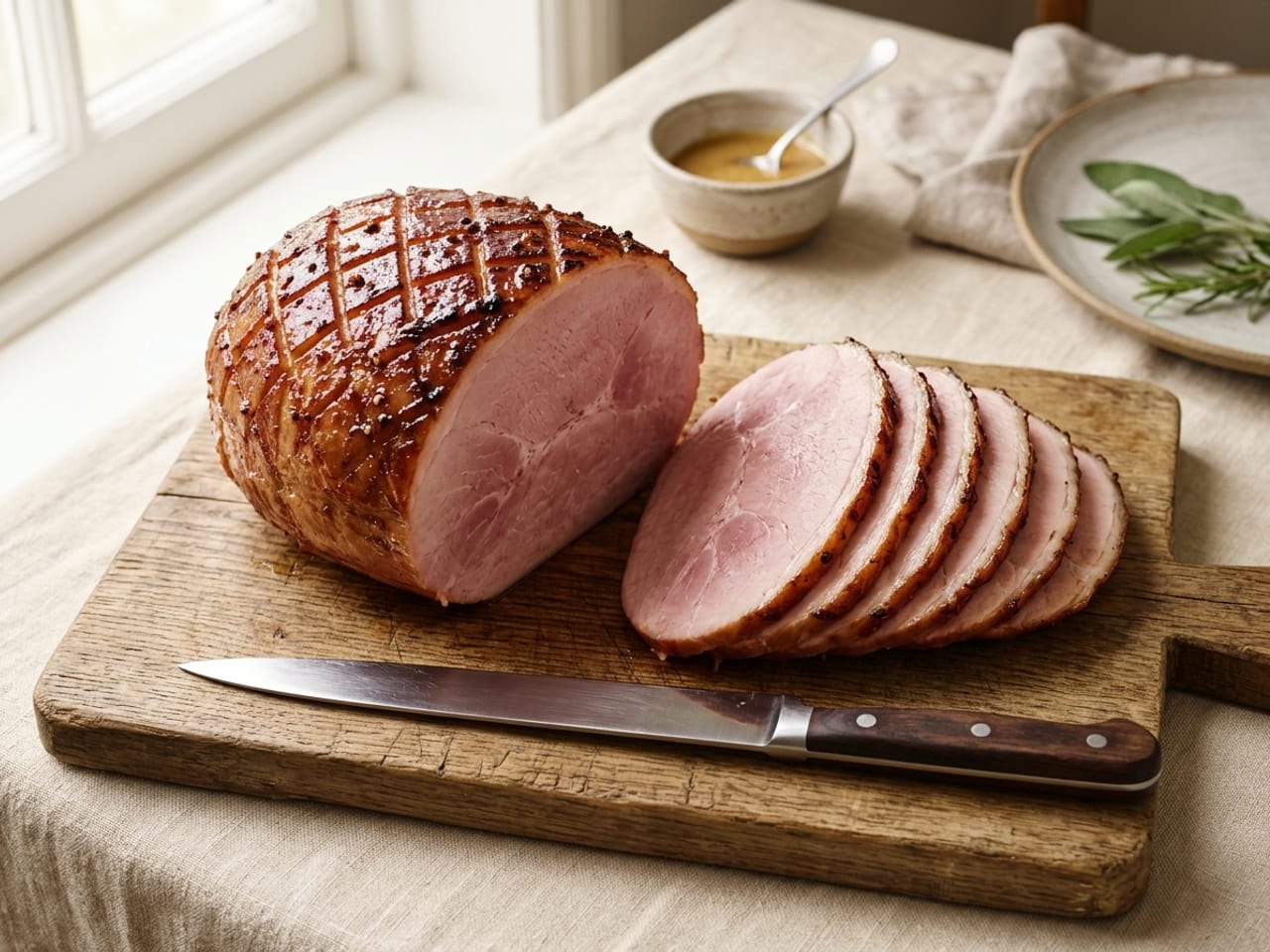
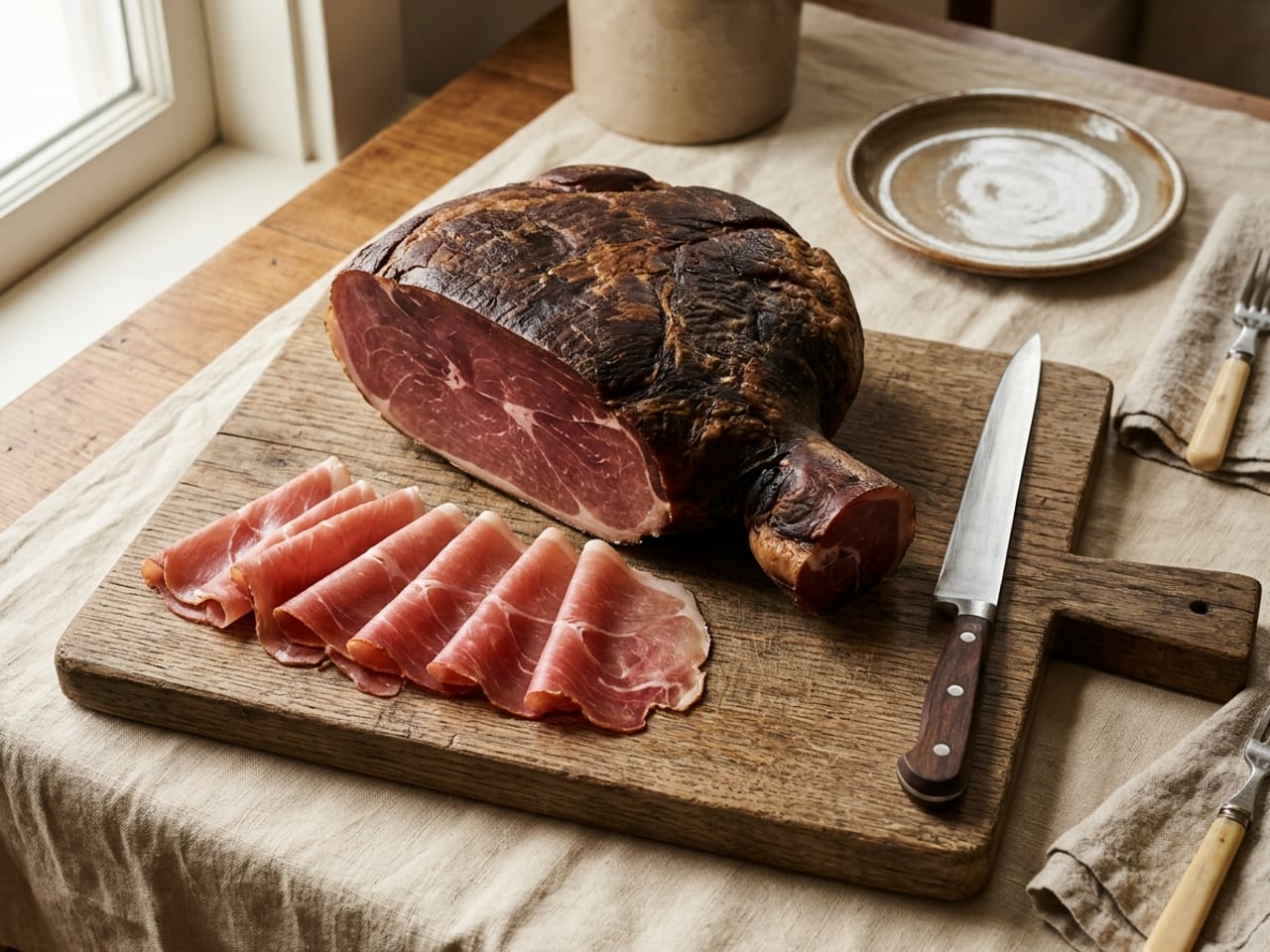
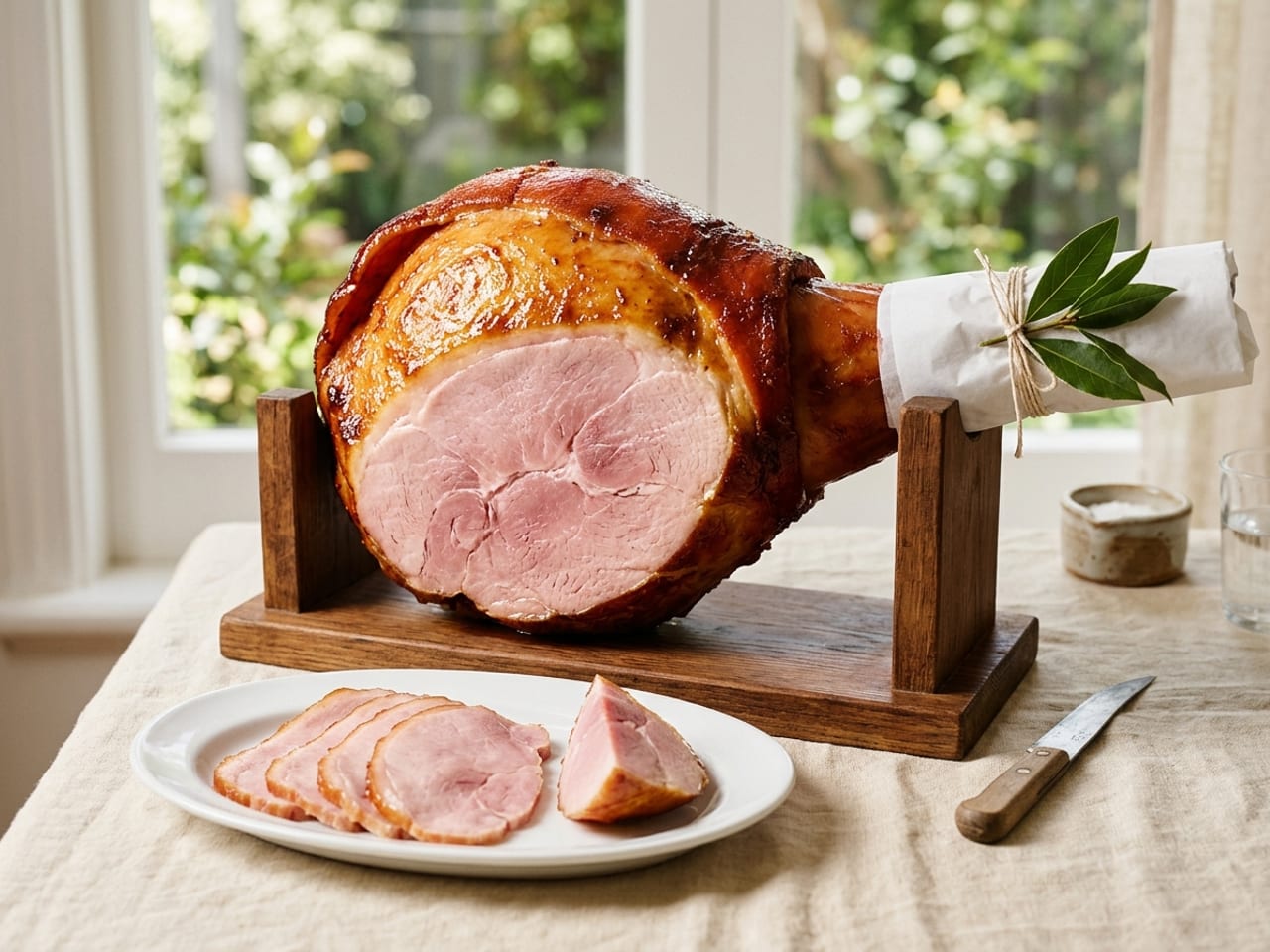
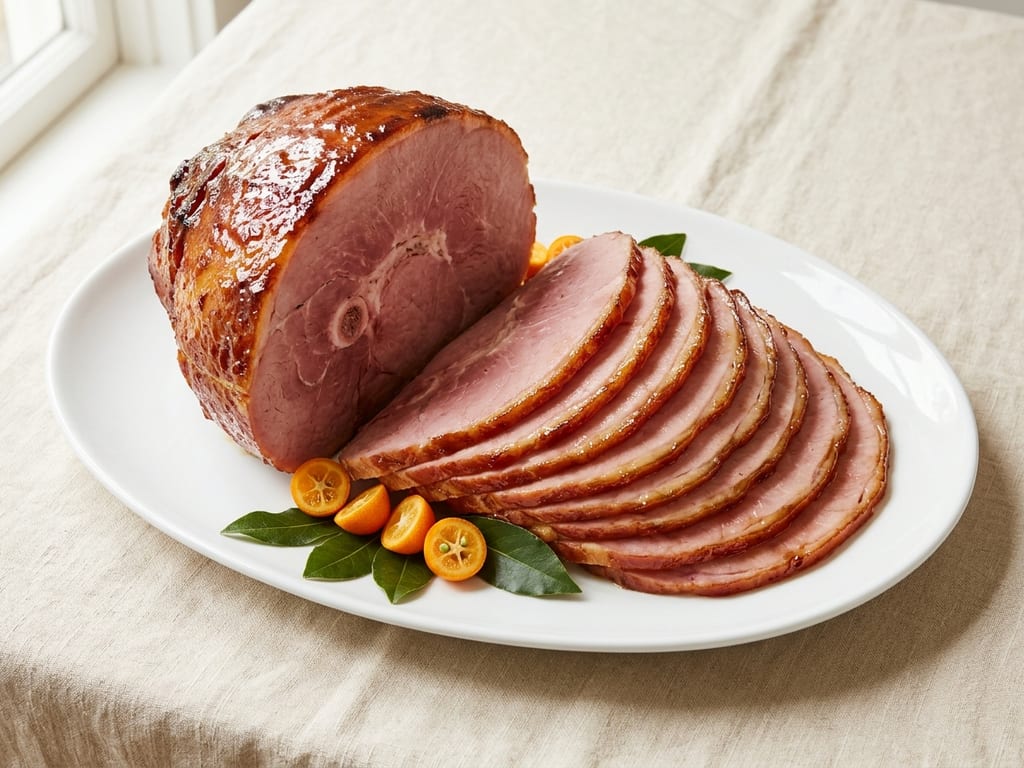
The photos on this page are AI-generated illustrations.
The short answer
How to carve any ham, in five lines
Rest a hot ham first. About 15 minutes, loosely tented with foil.3 A fresh or cook-before-eating ham that has just reached 145°F (63°C) needs at least 3 minutes, for safety.49, 51
Give it a steady base. Cut side down, or slice a sliver off the underside so it cannot rock.1, 11, 37
Free the meat from the bone. On a spiral ham, cut around the bone.1 On an unsliced ham, slice down to the bone, then run the knife flat along it to release the slices.8, 38
Slice across, thin. Slices run at right angles to the bone, 1/8 to 1/4 in (3 to 6 mm) thick on the pages that give a figure.18, 37, 38, 40
Carve only what the table will eat now. The rest stays whole, covered and at 140°F (60°C) or above, and anything at room temperature goes in the fridge within 2 hours of leaving the oven.6, 11, 51
Which ham do you have?
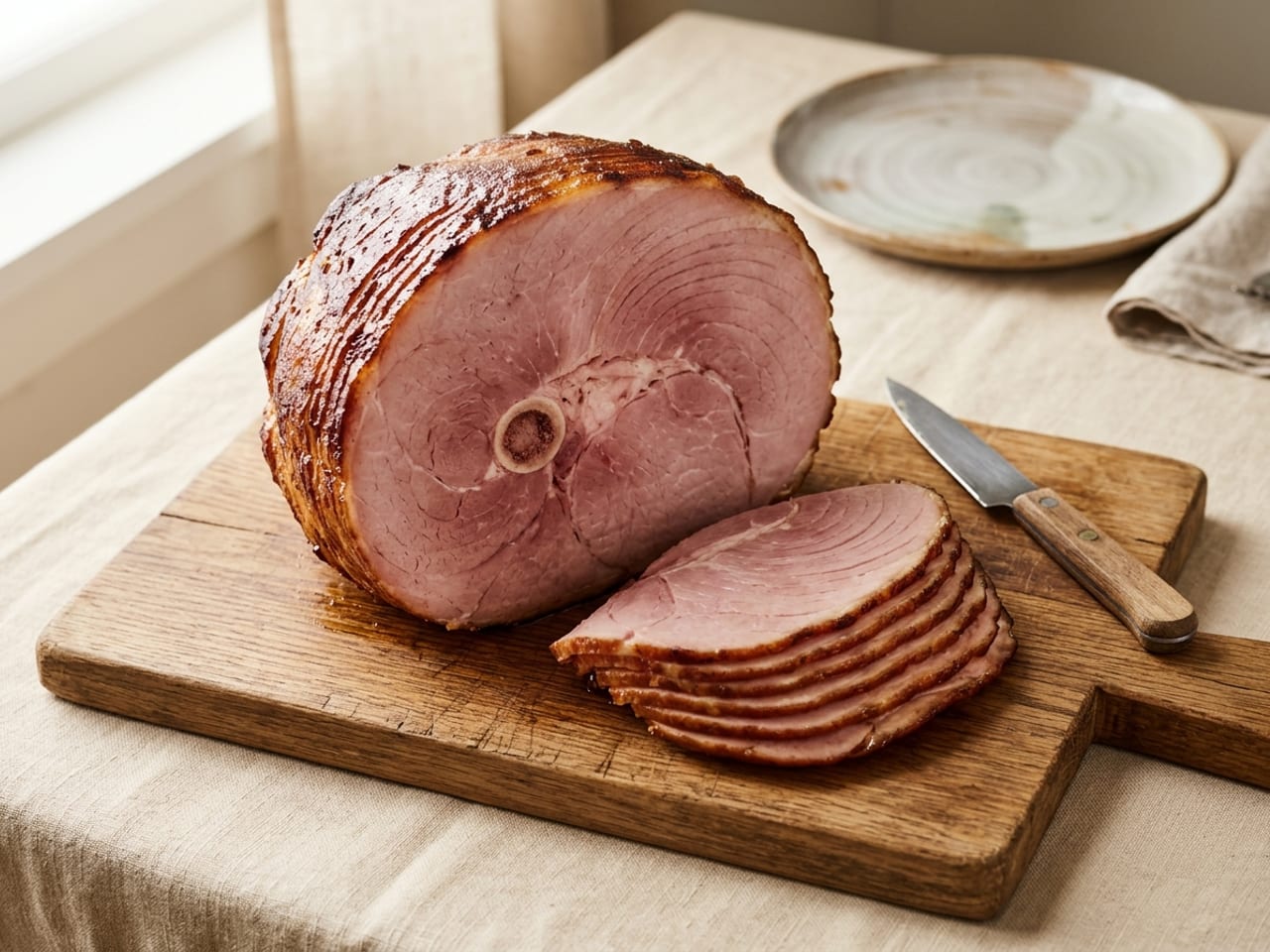
Spiral-sliced ham: Already sliced in a spiral, still on the bone: you only free the slices.
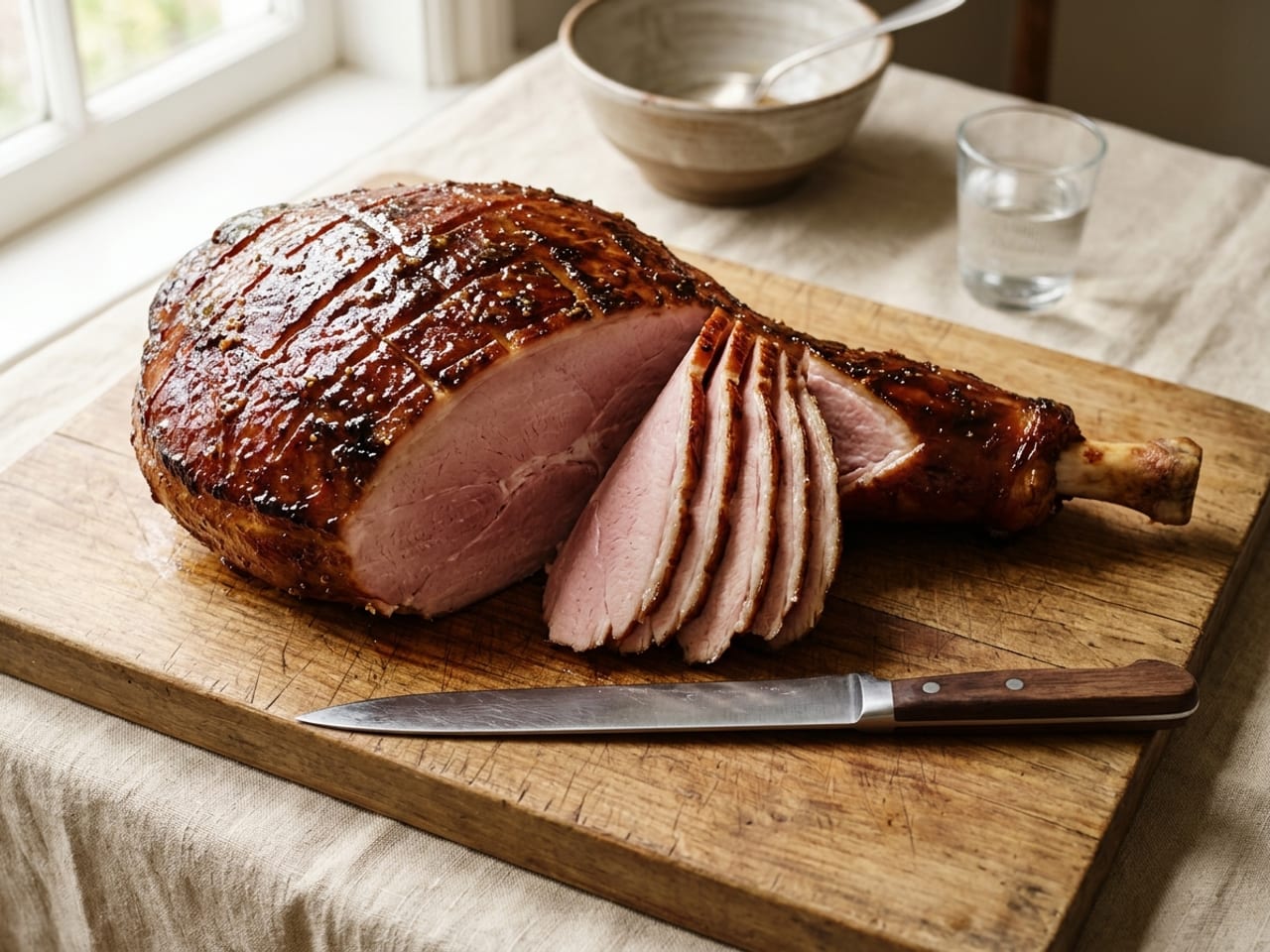
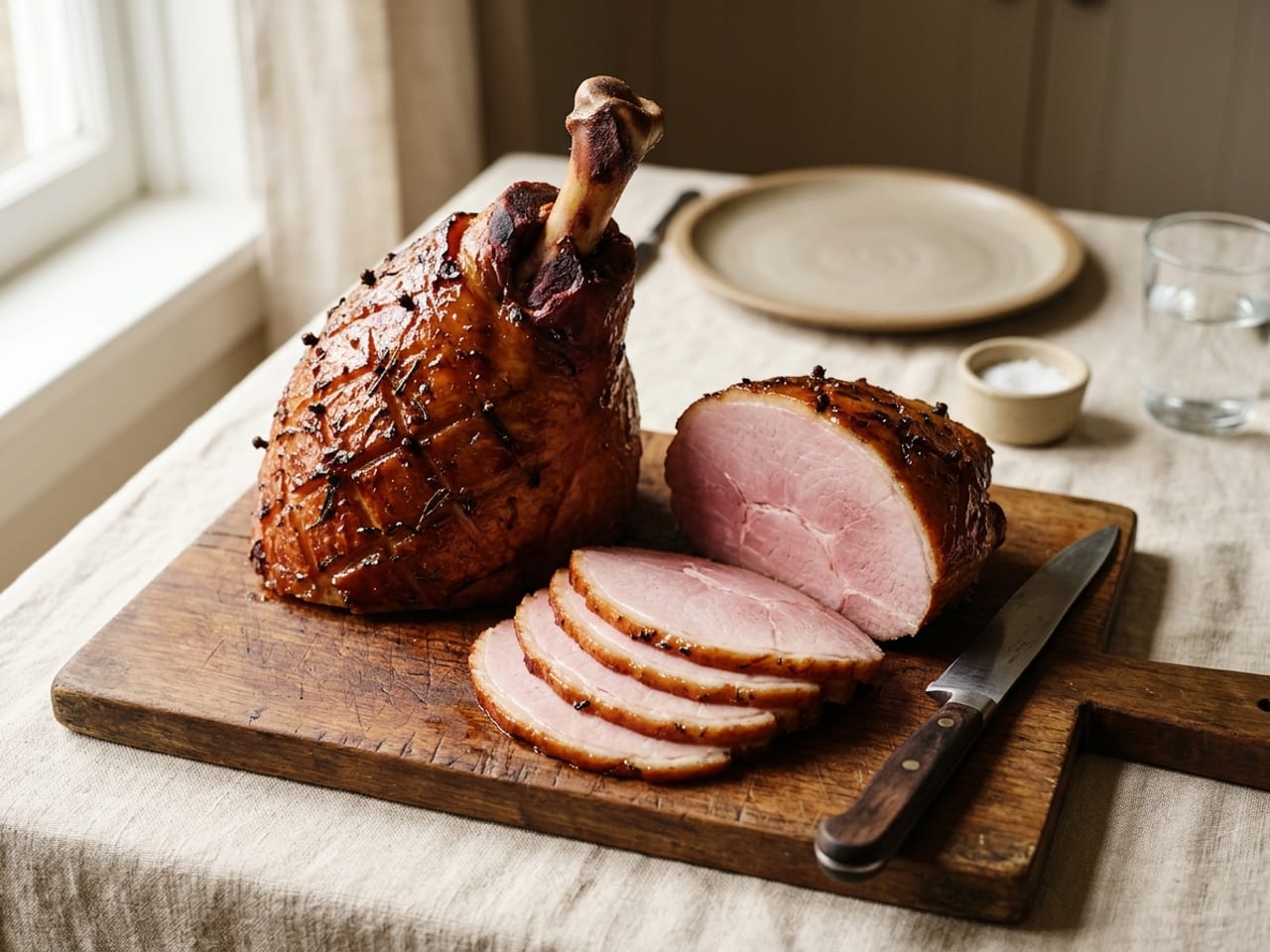
Whole bone-in ham: The whole leg, unsliced: a narrow shank end and a thick butt end.
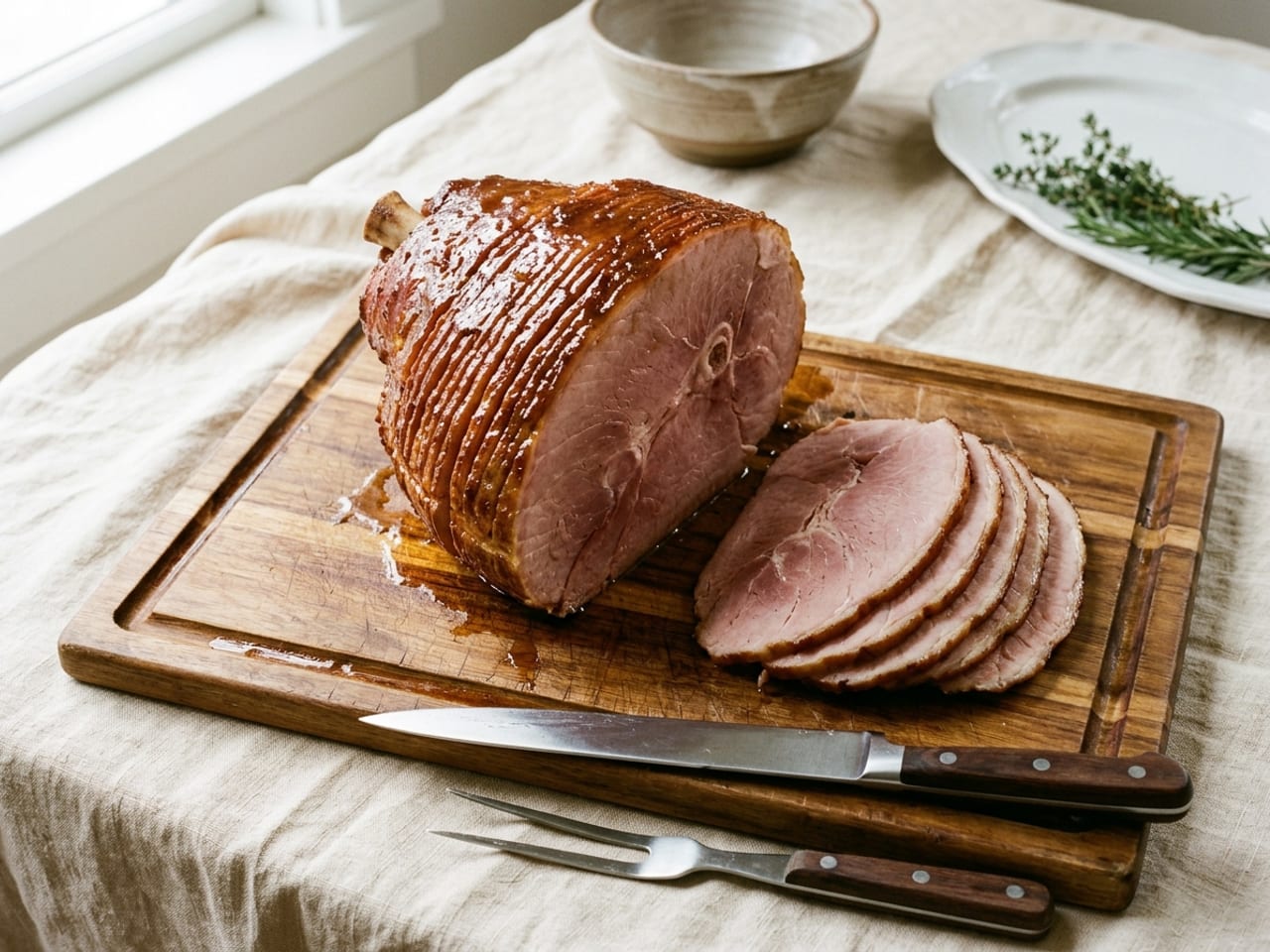
A spiral ham on its side, with the first slices freed from the bone. An AI render, not a photograph.
Step by step
How to carve each kind of ham
Each card says how to tell the ham, then the steps in plain words with whose they are; the sources' own words and where others do it differently are one tap away. The steps are quoted from the pages named, not from our kitchen.
1. Spiral-sliced ham
Also searched as: spiral ham, spiral-cut half ham, bone-in spiral ham
Sliced round and round in one long cut, the slices still held on by the bone. America's Test Kitchen: “Despite the name, spiral-sliced hams are not fully sliced.”1
Lay it on its side and cut around the bone with a small knife.(America's Test Kitchen)1
With a long knife, cut flat above the bone to lift off that whole section.(America's Test Kitchen)1
Stand it cut side down and slice down along the bone for the rest.(America's Test Kitchen)1
Which end first. Buy the shank end if you can: America's Test Kitchen prefers it “because they contain less gristle and fat and are easier to carve than butt-end hams”. Smithfield, for its own spiral ham, starts at the other end: “Start by cutting slices off the large (butt) end of the ham.”1, 33
How thick. Set at the factory. CooksInfo: “You can get them thickly or thinly sliced.” The 1949 slicer patent changes the thickness by swapping the nut and screw shaft for a set of a different pitch “to provide meat slices of selected thickness”, and gives no number.31, 61
The bones, and the sources' own words
The bones. The machine turns the ham on its leg bone and cuts it “so as to slice the joint spirally about said bone but not to cut through” it (the 1952 patent), which is why the slices stay on. A shank half holds the shank bone and the rest of the femur; a butt half holds the aitch bone and part of the femur.62, 63The drawing.
America's Test Kitchen: "With the ham on its side, cut around the bone with a paring knife to free the attached slices."1
America's Test Kitchen: "Switch to a carving knife and slice horizontally above the bone to remove the entire section."1
America's Test Kitchen: "Turn the ham to cut side down and slice down along the bone to remove the remaining meat."1
America's Test Kitchen: "Carefully cut between the slices to separate them."1
Done differently. The pages split three and three. Smithfield (“make cuts along the natural seams of the ham's surface parallel to the bone”), Betty Crocker (bone end up: “cut through the seams”) and RecipeTips (“locate the natural muscle lines in the ham”) start along the seams, the natural lines between the muscles. Hempler's and The Takeout cut round the bone first (Hempler's, then “along the seams, which are the natural breaks in the muscle”; The Takeout: “slice around the bone on the front of the ham, freeing the meat from the bone”). Niman Ranch: “Bone in spiral hams have three large sections naturally divided by a thin layer of fat.” For a boneless spiral ham The Takeout says “There isn't a bone to slice around” and has you slice “along the natural muscle breaks or seams”.23, 33, 36, 37, 39, 40
2. Whole bone-in ham
Also searched as: ham on the bone, whole ham leg, how to carve a ham on the bone
The whole hind leg: a narrow shank (hock) end, a thick butt end, and one bone through it. Saveur: “the bone, which runs the length of a ham from the narrow shank end all the way to the thick butt end”.18
Cut one or two slices off the thinner side so the ham sits flat, then turn it onto that flat side.(Saveur, Tasting Table, Hempler's and Jones Dairy Farm all start this way; RecipeTips trims 2 or 3 slices)18, 21, 37, 38, 40
Near the shank end, cut straight down to the bone, then cut in at an angle a little further along to lift out a wedge.(Saveur (4 in, 10 cm, from the shank end, the second cut at 45 degrees about 2 in, 5 cm, away))18
Slice down to the bone from the wedge, working toward the thick end.(Saveur (1/8 in is 3 mm))18
About a third of the way along, slice from each side in toward the bone.(Saveur)18
Free the slices with one flat cut along the bone.(Jones Dairy Farm)38
Turn it over and slice the underside along the bone.(The Australian Women's Weekly)6
Which end first. The pages do not agree (the count is in the table below). Saveur, RecipeTips and the two Women's Weekly magazines start near the shank; Tasting Table says “Start at the wide end and work toward the narrow end, leaving the slices attached to the bone.”6, 8, 18, 21, 40 Of the 12 whole-leg pages we read that say where to start, 5 start near the shank (the count).
How thick. Saveur: 1/8 in (3 mm). RecipeTips: “cut 1/4 inch slices (or desired thickness)” (6 mm). NZ Woman's Weekly: “Carve slices as thinly as you can; keep the cutting line straight as you carve the ham.”9, 18, 40
The bones, and the sources' own words
The bones. Three, by a butcher's count: “A ham is only made up of three bones: the shank at one end, the femur in the middle, and the angled bone in the butt called the aitch bone.” The femur runs “from the aitchbone on one side to the shank bone on the other” (Mashed). See the drawing below.24, 32The drawing.
Saveur (4 in, 10 cm, from the shank end, the second cut at 45 degrees about 2 in, 5 cm, away): "Working about 4" from shank end, make a vertical cut down to the bone."18
Saveur (1/8 in is 3 mm): "begin making even, 1⁄8"-thick slices, cutting to the bone and working your way toward the thick end."18
Saveur: "Now begin carving at a new angle, slicing from the side of the ham closest to you inward toward the center of ham and down to the bone to create thin half slices."18
Jones Dairy Farm: "To loosen the slices, cut horizontally along the leg bone, removing each slice with a fork."38
The Australian Women's Weekly: "To carve the underside of the ham flip it over, and cut long, flat slices parallel to the ham bone."6
Done differently. The other way is to take the meat off the bone in big pieces and slice those flat. Frick's Quality Meats: “Cut through the ham alongside the aitch bone until reaching the femur (center bone). Make a similar cut on the opposite end of the ham just before the shank. Then carve out the meat between the two slices by cutting along the femur.” Then: “Place the freshly removed large chunk of ham on its flat side.” Mashed puts it as a rule: “extract the large chunks of boneless meat first.” Cuisine at Home: “You'll notice three distinct muscle sections surrounding the bone. The idea is to carve away each section from the bone and then slice them into more manageable sized pieces.”24, 25, 32
3. Half ham: shank end or butt end
Also searched as: ham shank, shank portion, butt portion, rump portion, half leg
The leg cut across the middle. The shank half has the tapered end (America's Test Kitchen: “look for the half ham with the tapered, pointed end”); the butt or rump half is rounder and holds part of the hip bone. Canada's meat cuts manual separates the two “by a straight cut passing at right angle to the middle of the shaft of the leg bone (femur)”.2, 58
Shank half: steady it with a fork and cut along the top of the bone to free the thick piece.(Frick's Quality Meats)32
Lay that piece flat and slice it straight across.(Frick's Quality Meats)32
Butt half: set it cut side down, cut the big boneless section off along the bone, and slice it.(Frick's Quality Meats)32
Take what is left on the bone in flat slices toward the bone.(Frick's Quality Meats)32
Or, for a butt half standing on its flat end, cut level slices.(RecipeTips)40
Which end first. The shank half is the easier one to carve, say America's Test Kitchen (“the bone configuration makes it easier to carve”) and Mashed (“The shank is fattier and easier to carve, while the lean sirloin, as noted above, is more complicated and dispenses smaller boneless pieces”). They disagree on the fat: America's Test Kitchen says the shank end has less.1, 2, 24
How thick. RecipeTips: 1/4 in (6 mm) “or desired thickness”. The other half-ham pages give no figure.40
The bones, and the sources' own words
The bones. A patent describes the usual cut: “the butt half includes an aitch bone and part of the femur bone. the shank half includes a shank bone and the remainder of the femur bone.” A meat-science video tells them apart by the bone on show: on a rump piece “The shank is not there but the pelvic bone is”.59, 63The drawing.
Frick's Quality Meats: "Begin with the thicker piece of meat on the top, use a fork to steady the ham and cut along the top of the bone to loosen the boneless meat."32
Frick's Quality Meats: "Place the meat carved-side down on the cutting board and cut across the grain of the meat in perpendicular slices. Transfer slices to a serving platter."32
Frick's Quality Meats: "Slice boneless section across the grain and transfer to a serving platter."32
Frick's Quality Meats: "insert fork into meat next to bone and make horizontal slices towards the bone"32
RecipeTips: "cut 1/4 inch slices (or desired thickness) parallel to the flat end of the ham by making horizontal cuts."40
Done differently. Cook's Ham heats its half hams cut side down and says: “Remove ham from oven and let stand, covered, 10 to 15 minutes before serving.”35
4. Boneless ham
Also searched as: boned ham joint, boneless ham roast, how to slice ham with no bone
No bone to work round. lovefood.com on a bone-in ham: “the bone makes it tricky to carve neatly so, if you want perfect slices, opt for a boned joint.”44
Lay it on its side and cut a few long slices off the thin side to make a flat base.(Jones Dairy Farm; Hempler's takes a slice or two off the bottom)37, 38
Which end first. Either end: no page we read names one.
How thick. “Desired thickness” on both makers' pages; neither gives a figure.37, 38
The bones, and the sources' own words
The bones. None. We found no carving page that covers taking off the netting, so we give no step for it. The drawing.
Jones Dairy Farm: "Turn the ham onto the flat, cut surface and slice ham to desired thickness."38
Hempler's: "Cut vertically across the ham into slices of desired thickness."37
5. Fresh ham (roast leg of pork)
Also searched as: fresh leg of pork, uncured ham, roast pork leg, ham roast
Raw pork leg, not cured, roasted like a pork roast, often with the skin on. A meat-science video at the University of Nebraska draws the line: “the ham is if it has been smoked or cured and the leg is if it's fresh.”59
Safety: It is raw pork: 145°F (63°C) in the thickest part, then a rest. Ohio State University Extension, relaying USDA: “For safety and quality, allow meat to rest for at least three minutes before carving or consuming.”49, 51
Tent it with foil and let it stand.(America's Test Kitchen)4
Shank end: carve lengthwise along the bone, then slice the boneless pieces flat.(America's Test Kitchen (1/2 in is 1.3 cm))4
Sirloin (butt) end: carve it into three pieces around the bones, then slice them.(America's Test Kitchen)4
Which end first. America's Test Kitchen carves the two ends differently, as the steps show; it names no end to start.4
How thick. America's Test Kitchen: 1/2 in (1.3 cm), thicker than any cured-ham page we read.4
The bones, and the sources' own words
The bones. The same leg bones as any ham (the drawing below); America's Test Kitchen cuts the sirloin end “around the bones”.4The drawing.
America's Test Kitchen: "Tent ham loosely with foil and let stand until center of ham registers 155 to 160 degrees, 30 to 40 minutes."4
America's Test Kitchen (1/2 in is 1.3 cm): "FOR THE SHANK END: Transfer the ham to a cutting board and carve it lengthwise alongside the bone, following the two dotted lines in the illustration above. Lay the large boneless pieces that you have just carved flat on the cutting board and slice into 1/2-inch pieces."4
America's Test Kitchen: "FOR THE SIRLOIN END: Transfer the ham to a cutting board and carve into three pieces around the bones along the dotted lines in the illustration above."4
Done differently. Beeton in 1861, on a roast leg of pork: “The knife should be carried sharply down to the bone, clean through the crackling, in the direction of the line 1 to 2.”65
6. Country ham
Also searched as: dry-cured country ham, how to slice ham thin
Dry-cured with salt, hard and salty, sold whole and often uncooked (our description). Allan Benton, a Tennessee country-ham maker: “Typically, when you're doing a country ham, you need something sweet to neutralize the ham's saltiness, and pineapple does this really well.”29
Safety: Mold on the outside is normal. N.C. State Extension: “Scrub mold off the surface. It is normal for these shelf-stable products to have surface mold.” Our ham calculator has the soak, the simmer and the temperature.57
Saveur cuts 4 to 6 in (10 to 15 cm) off the raw hock before it soaks and simmers the ham; skip this if yours is already cooked.(Saveur)19
Let it cool before you slice.(Saveur; RecipeTips agrees)19, 40
Start at the butt end, slicing parallel to the aitch bone.(countryhams.com, a seller (a fragment of its page))41
Slice as thin as you can, or have a butcher slice it.(Saveur (“thinly”); countryhams.com suggests a butcher)19, 41
Which end first. The butt end, on the one seller's page that names an end.41
How thick. Thin, and no page we read gives a number. RecipeTips: “A country ham will carve easier if it is at room temperature or cooler.” Our ham calculator says paper-thin: that is our wording, not a measurement.40
The bones, and the sources' own words
The bones. The aitch bone at the butt end is the guide for the first slices (countryhams.com).41The drawing.
Saveur; RecipeTips agrees: "Slice ham thinly when cool; serve on Hot Crusty Buttermilk Biscuits, if you like."19, 40
countryhams.com, a seller (a fragment of its page): "the butt-end of the country ham and make sure you slice parallel to the aitch bone."41
7. Christmas leg ham (Australia and New Zealand)
Also searched as: leg ham on the bone, Christmas ham, ham leg with the rind on
A whole cooked leg sold with its rind on, often served cold. The Australian Women's Weekly: “Not everyone serves a hot Christmas ham, especially in Australia where cold cut ham is practically a Christmas dinner staple.” Australian Pork: “Leg ham is covered with thick, rubbery skin called the rind. You need to remove the rind before carving or glazing.”6, 13
Safety: A cold ham taken out to lose its chill is on the 2-hour clock from the moment it leaves the fridge: The Women's Weekly's “allow the ham to come to room temperature for about an hour before carving” leaves an hour for the table. Above 90°F (32°C) the limit is 1 hour in all, so skip the wait.6
Peel off the rind and keep it.(NZ Pork (and NZ Woman's Weekly keeps the rind for storage))9, 12
Steady it: on a ham stand if you have one, a sliver off the bottom if it rocks, a fork pushed deep.(Hellers; NZ Woman's Weekly)8, 11
Cut a small wedge out at the shank end.(The Australian Women's Weekly; NZ Woman's Weekly cuts it 5 cm (2 in) along at 45 degrees)6, 8
Slice thin, the full width, down to the bone.(The Australian Women's Weekly)6
Free the slices along the bone.(NZ Woman's Weekly)8
Knife too short? Slice from each side to the middle, side by side.(The Australian Women's Weekly)6
Which end first. The two Women's Weekly magazines start at the shank. Australian Pork goes the other way (“carve it at the opposite end of the shank”), and Hellers and NZ Pork slice toward the hock: Hellers' “Run knife lengthways along to remove slices, slicing towards the hock.” Our picture shows the thick-end start.6, 8, 11, 12, 13
How thick. Thin, with no figure: “lovely thin slices” (The Women's Weekly).6
The bones, and the sources' own words
The bones. Hellers: “You can remove the bone by making a few shortcuts at the joint.” NZ Pork takes it out once you are “about a third of the way up”.11, 12The drawing.
NZ Pork (and NZ Woman's Weekly keeps the rind for storage): "run a small sharp knife under the rind around the bottom (opposite to the knuckle end/hock of leg) and each side of the ham to about halfway up."9, 12
Hellers; NZ Woman's Weekly: "If it is wobbly then slice a small piece of ham off underneath to stabilise it."8, 11
The Australian Women's Weekly; NZ Woman's Weekly cuts it 5 cm (2 in) along at 45 degrees: "make a vertical cut toward the bone at the shank (narrow) end of the ham. Next, make a cut at an angle to the first to remove a small wedge of ham."6, 8
The Australian Women's Weekly: "Continue to carve toward the ham bone, taking long sweeps with the knife to create lovely thin slices the full width of the ham. The pieces will increase in size as you carve your way up the bone."6
NZ Woman's Weekly: "Once the slices in one section are cut, work the blade of the knife horizontally under the cut slices, along the bone, to release the meat. You may have to wiggle the knife back and forward."8
The Australian Women's Weekly: "If your knife isn't long enough, you can start to make slices from the sides of the ham to the middle, alternating sides as you move along the bone."6
Done differently. NZ Pork slices “like you would a loaf of bread, cutting on a slight angle down to the bone (rather than across)”; Better Homes and Gardens Australia: “Once bone is visible, run the knife around the tip of the bone, then continue slicing.”10, 12
8. Gammon joint (UK)
Also searched as: ham joint, boiled or baked gammon, how to carve a ham joint
Morrisons, a UK supermarket, says gammon is cured and sold raw and becomes ham once it is cooked. Of a joint on the bone: “Mind you, carving it takes a bit more effort!”45
Thinly sourced: we found no UK page with real carving steps for a gammon joint (BBC Good Food's page was gone and Delicious refused us), so these are one-line tips from a UK butcher and the consumer body Which?.
Rest it 10 to 15 minutes (Which? says so for gammon cooked in an air fryer).(Which?)46
For neat slices, let it cool a little.(DukesHill, a UK butcher)42
On the bone, carve along the bone to remove the slices. (For a boned joint, slice it as the boneless card says: ours, not DukesHill's.)(DukesHill)42
Which end first. No UK page we read names an end.
How thick. No figure on any UK page we read.
The bones, and the sources' own words
The bones. For perfect slices, lovefood.com says to buy it boned: “the bone makes it tricky to carve neatly”.44The drawing.
Which?: "Leave to rest for 10-15 minutes before slicing."46
DukesHill, a UK butcher: "Allow the cooked ham to rest and cool slightly before serving to make slicing neater and with precision."42
DukesHill: "If the ham has the bone in, carefully carve along the bone to remove the slices."42
Done differently. lovefood.com rests a baked ham longer: “Once it's baked, allow to rest for half an hour, even if you're serving it hot.”44
Inside the ham
The three bones in a ham, and where a half is cut
Ours and schematic: no page we read prints a drawing we could reproduce, and we read no anatomy text, so the sizes are not measured. The bones are a butcher's three: "the shank at one end, the femur in the middle, and the angled bone in the butt called the aitch bone".24, 32, 58
Canada's meat cuts manual names the same bones more exactly: the femur (the leg bone), the "aitch bone (ischium)", the pin bone (ilium), the kneecap and the shank bones (tibia and fibula).58 Michael Ruhlman calls the aitch bone the hip bone, "part of the pelvis that remains on the ham cut", and finds it "at the base of the ham".48 The spiral slicer's 1952 patent prefers the aitch bone out: "It is not essential butV it is preferable to remove the aitch bone." (the OCR's typo kept).62
A shoulder is not a ham. USDA: "Simply, ham is a leg of pork. If it's made from the shoulder, it's called a picnic."50 Tasting Table on picnic ham: "you could even say it isn't ham at all."22 None of the carving pages we read covers a picnic.
Tools
The knife, the fork, the board and a ham stand
A long, sharp knife. Of the pages that name a knife, seven want a carving, slicing or large sharp knife, and four of those say it should be long; America's Test Kitchen: "A long knife is ideal for slicing the meat horizontally above the bone and through the spiral-cut slices, towards the back of the ham. We prefer the Granton edge (scalloped divots) for cutting even slices."1, 6, 13, 21, 25, 37, 40 How long: "at least as long as your ham is wide" (Tasting Table), or "at least as long as the length of your cuts" (Hempler's).21, 37 Betty Crocker is the one that says your everyday 8 to 10 in (20 to 25 cm) chef's knife will do.36 A paring knife frees a spiral ham's slices round the bone.1 Our turkey guide and knife skills cover the knife itself.
An electric knife is "a little overkill (and hard to clean)", says Tasting Table, which does not rule it out.21 America's Test Kitchen's electric-knife test did not include ham.5 More in the turkey guide.
A fork to steady it. NZ Woman's Weekly: "Insert the fork as far down into the meat as you can, so you have a stable handle to hold while carving."8 Fork, tongs or a towel, for any roast: the turkey guide.
A big board with a groove. America's Test Kitchen: "A carving board is a necessary upgrade from a cutting board since it boasts a trench that traps liquid from a juicy roast." Tasting Table: "The cutting board should be at least as big as the ham, so you'll have plenty of room to carve without your slices falling off onto the table."1, 21
A ham stand holds a leg ham steady: Hellers says to "use a ham stand if you have one".11 The Spanish stand for jamón is a different tool, below.
Thin slices without a slicer. The longest sharp knife you have, a straight cutting line (NZ Woman's Weekly), and a cool ham: "A country ham will carve easier if it is at room temperature or cooler" (RecipeTips), and a UK butcher lets a cooked ham "rest and cool slightly before serving to make slicing neater".9, 40, 42 Or have the butcher slice it.41 No page we read measures how thin.
Fingers. A hand surgeon: "Make sure your knife is sharp. This will help keep the food or knife from slipping." and "Always slice away from your hand and keep your fingers clear of the blade."60
How much
How much ham per person: by weight, not slices
USDA's guide, as our ham calculator quotes it: 1/3 to 1/2 lb (150 to 225 g) of bone-in ham a serving, and 1/4 to 1/3 lb (115 to 150 g) boneless.49 Our ham calculator plans the top of each for dinner, 1/2 lb (225 g) bone-in and 1/3 lb (150 g) boneless, and 3/4 lb (340 g) and 1/2 lb (225 g) when you want leftovers (HoneyBaked's own serving counts); a fresh ham 3/4 lb (340 g), or 1 lb (455 g) with leftovers. Twelve at dinner: 6 lb (2.7 kg) of bone-in ham.
Slices: no source we read gives a number of slices per ham or per guest, because slices vary with the ham and the knife, so we give none. The other camps, by weight:
Label servings and a carving station's 3 oz are a taste beside other food; a dinner plan uses the bigger figures. Our glazed ham recipe plans 16 servings from an 8 to 10 lb (3.6 to 4.5 kg) ham: 1/2 lb (225 g) a head at 8 lb, which is USDA's top figure, and 5/8 lb (285 g) at 10 lb, which is above it and leaves some over.
The platter
Three ways to lay out carved ham
The sources put slices straight onto the platter as they are carved: Hellers, "as you slice and cut away the ham from the hock area place it directly onto a serving platter", and Food & Wine, "lay the slices out on a platter or on individual plates. If you cooked your ham with a glaze, spoon some of the sauce on top of the slices."11, 26 None we read describes fanning or shingling, so the three layouts below are ours, the same three as our glazed ham recipe. A trade magazine backs the idea of one big piece as the centre of a buffet platter: "one common focal point is a grosse pièce (literally "big piece"). The guest can instantly identify the food on the platter."28
1. Carved and set back against the bone
The showpiece, for a table that sees the ham whole.
Ours, from our glazed ham recipe: carve the first round in the kitchen, set the bone with the uncarved part at one end of a long oval platter, cut face toward the open platter, and lay the slices back against it in a loose fan, each overlapping the last by about two thirds, glaze edge up and all facing one way. A few halved kumquats and bay leaves at the base; nothing on the glazed top.
From our glazed ham recipe; an AI render, not a photograph.
2. Shingled on a board
For a buffet or a crowd.
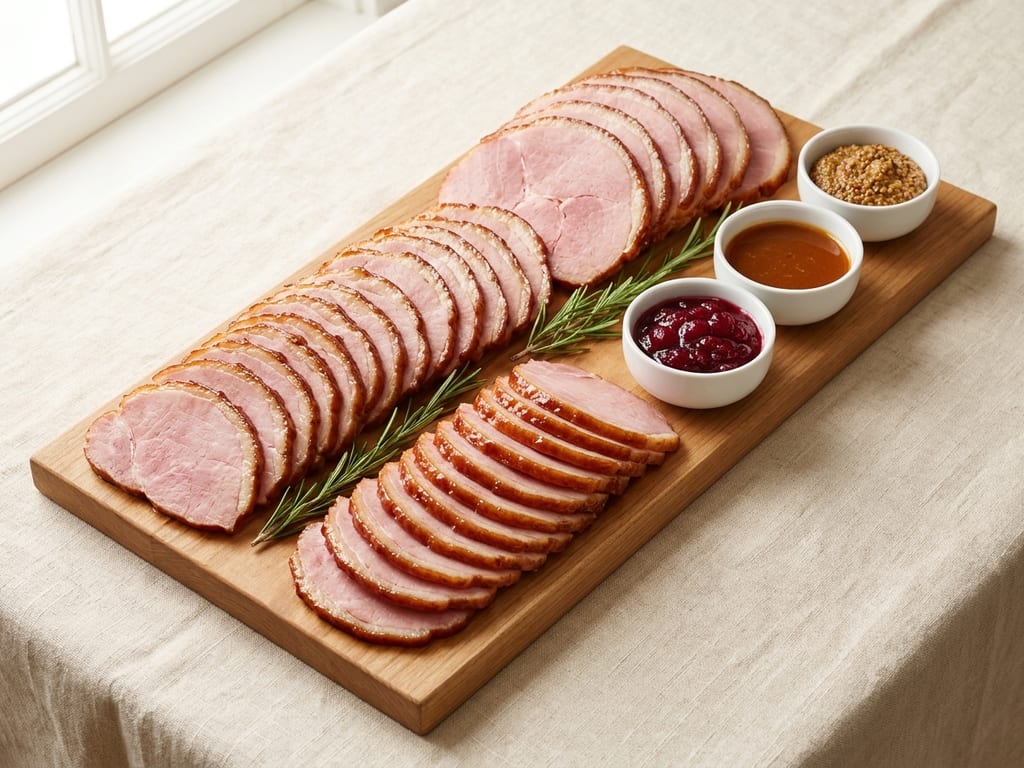
Ours, from our glazed ham recipe: a long wooden board, the slices in straight overlapping rows like roof tiles, glaze edge up, the biggest slices at the back and each muscle section kept together so a row matches. Three small bowls at one end (whole-grain mustard, the warm sauce, cranberry sauce) and a few rosemary sprigs between the rows. Put out a third at a time; the rest stays covered in a low oven.
From our glazed ham recipe; an AI render, not a photograph.
3. One plate
For a seated dinner.
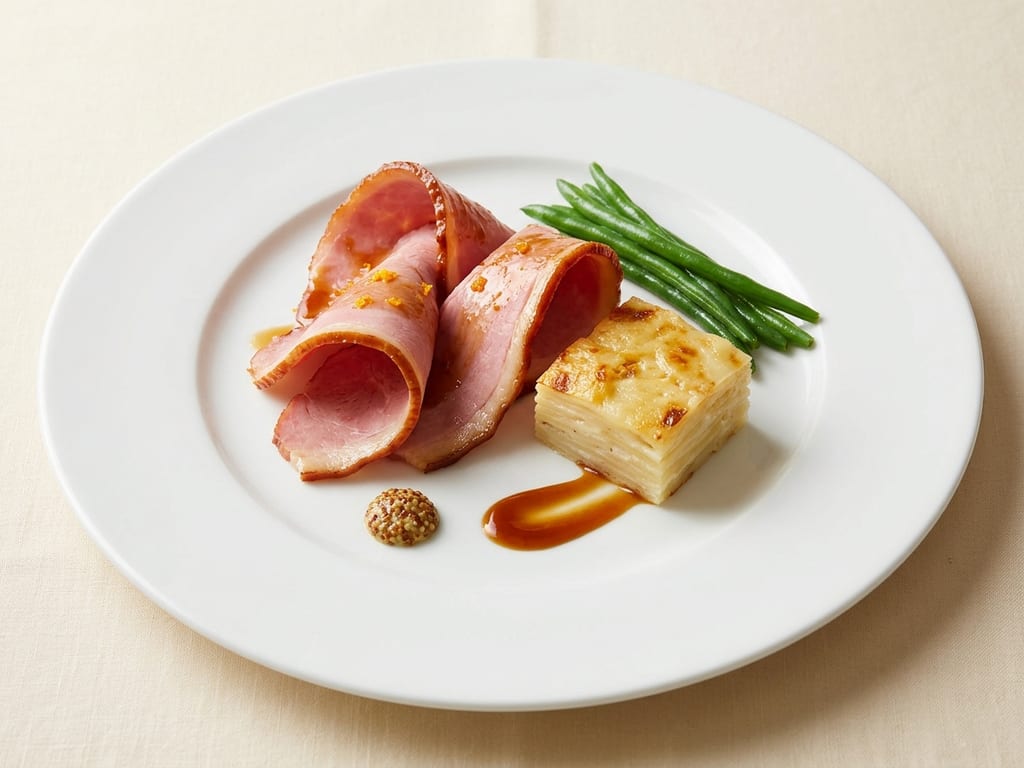
Ours, from our glazed ham recipe: two or three thin slices folded into loose ribbons, slightly off centre on a warm wide-rimmed plate, glaze edges up; a short swoosh of sauce beside them, not over; a square of scalloped potatoes and a few green beans; a little orange zest and one dot of whole-grain mustard.
From our glazed ham recipe; an AI render, not a photograph.
Garnish. Fruit and herbs today: Niman Ranch, "Garnish with fresh cranberries, pomegranate seeds, slices of citrus or fresh herbs"; Betty Crocker, "sprigs of parsley, apple or orange slices. Or, gild the lily with an old-school garnish of canned pineapple and maraschino cherries".36, 39 Australian Pork wraps the hock: "wrap the hock end in a strip of folded baking paper and tie it with string or ribbon. Tuck in a few sprigs of fresh herbs, such as bay leaves or rosemary".13 That is the old paper frill: Beeton in 1861 sent a hot ham to table "with a paper ruffle round the knuckle".65 The trade magazine's test for a garnish: "most effective and attractive when they offer some information about the food instead of simply adding a spot of color".28
Kitchen or table. Our glazed ham recipe carves in either place. Emily Post found in 1922 that "in forty-nine houses out of fifty, in New York at least, the carving is done by the cook in the kitchen", and a Saveur writer on carving in front of guests: "I would display my roast, then whisk it off to the kitchen, where I could wield my knife in private."20, 67
The platter. No source we read gives a size. An old cooking-school book: "Allow the carver plenty of room and put the roast on a platter ample in size, so placed that it need not be moved by the carver".68
Warm and safe
Keeping carved ham warm, and the buffet
Carve as you go. The Australian Women's Weekly: "It's best to carve only as much ham as you need at any one time because the meat will dry out."6 Our glazed ham recipe carves the first round and keeps the rest whole, covered, in a low oven, the meat at 140°F (60°C) or above, as the second round. Niman Ranch carves the lot ahead instead; that works too if it is eaten inside the 2 hours.39
Or serve it cold. A fully cooked ham sealed at the plant is safe cold, and USDA says spiral hams are best that way, because heating dries the slices (our ham calculator takes it out about 30 minutes ahead).49, 50 On a buffet line, the ham goes with the hot food: our buffet guide.
The rules, all shown
2 hours. Nothing perishable stays out more than 2 hours (Ohio State Extension, relaying USDA), or 1 hour above 90°F (32°C), the USDA line our ham calculator quotes. We count from the end of cooking, or from the fridge for a ham served cold, as our ham calculator does.49, 51
140°F (60°C) to hold it hot. Hot food held for serving stays at 140°F or warmer (USDA, as Ohio State Extension relays it).49, 51 In the UK, food businesses keep it at 63°C (145°F): "Hot food must be kept at or above 63°C if you're not serving it straight away."56
Which temperature. Ohio State Extension, relaying USDA: "Reheat cooked hams packaged in USDA-inspected plants to 140 degrees F and all others to 165 degrees F." Leftover ham goes to 165°F (74°C); a fresh or cook-before-eating ham to 145°F (63°C) with a rest of at least 3 minutes.49, 51
Guests who are pregnant, 65 or older, or have a weakened immune system. CDC lists "Deli meat, cold cuts, hot dogs, and fermented or dry sausages reheated to 165°F or until steaming hot" as the safer choice for them.54 CDC does not name carved ham; treating cold sliced ham like deli meat is our reading, as on our glazed ham recipe, so warm their slices to 165°F (74°C).
After dinner
Leftover ham and the bone
Off the bone within 2 hours. Cut the meat off the bone, into shallow containers, in the fridge. Ohio State Extension, relaying USDA: "divide portions into shallow containers or packages and refrigerate it to eat cold or reheat later to 165 degrees F." (165°F is 74°C.) University of Nebraska Extension: "Food in each pan or storage container needs to be 3 inches deep or less." (3 inches is 7.5 cm)51, 52
Where
How long
Who says
US: spiral ham and leftovers from a ham you cooked
3 to 5 days in the fridge; 1 to 2 months in the freezer, "Frozen hams remain safe indefinitely." Reheat to 165°F (74°C).
The Australian weeks are for an Australian cooked leg ham kept whole on the bone; a US spiral ham is sliced to the bone, and USDA gives it 3 to 5 days. NZ Woman's Weekly covers the cut face with the rind: "Reserve the rind to cover the cut surface of the ham to keep it moist during storage."9
The bone. USDA has no separate row for it, so treat it as leftover ham: 3 to 5 days in the fridge, 1 to 2 months frozen for quality.49 The Women's Weekly freezes it "for up to three months".6 USDA's 1 to 2 months is about quality; frozen ham stays safe indefinitely.49 Then soup: Tasting Table says to "save the hambone and freeze it for later use in stock, soup, or beans".21
On a stand
Spanish jamón on a stand: the basics
A dry-cured Spanish ham carved on a stand (a jamonero) is its own craft; these are the basics from Spanish sources, not a full method. We read no Italian source on prosciutto on the bone.
The stand. A professional cutter: "Por en torno a 100 euros tenemos un buen jamonero, cuya principal característica debe ser la estabilidad." (about 100 euros buys a good stand, and above all it must be stable).73
The knives. "Ham knife: Long, flexible, and with a thin blade for precise cuts.", plus a small, firm boning knife for round the bone.69, 72
Which side up. Museo del Jamón: "If the ham will be consumed quickly, place the hoof facing up and start with the maza (the juiciest part). If consumption will be gradual, place the hoof facing down and begin with the babilla, which is more cured."69 The other sources split (the table).
The slices. EROSKI Consumer: "Hay que procurar que las lonchas sean lo más finas y horizontales posible." (the slices should be as thin and as level as possible).70
Keeping it."Un jamón de buena calidad puede aguantar abierto durante mes y medio" (a good ham can last a month and a half once opened, EROSKI), on the stand at room temperature, often under a cloth (Wikipedia, weak). That is for dry-cured ham only, never a cooked ham.70, 74
Reference
Where the sources disagree
The counts are ours, of the pages we read on 17 November 2026; each page is named, so you can check them.
Question
One camp
The other
Our note
Where to start a whole leg
Near the shank: 5 pages (The Australian Women's Weekly Food Test Kitchen, NZ Woman's Weekly Food, NZ Woman's Weekly Food, Weaver, B. and RecipeTips.com).6, 8, 9, 18, 40
From the other end, slicing toward the hock: 3 (Australian Pork Limited, Heller, T. and NZ Pork). At the wide end: 1 (Finch, J.). Big boneless pieces off the bone first: 3 (Price Chopper with Frick's Quality Meats, Cuisine at Home and Mashed).11, 12, 13, 21, 24, 25, 32
No page tests one way against another. Our whole-leg card leads with the shank-end wedge because more of the pages we read (5 of 12) start there than any other way; the others are in its fold.
Spiral ham: round the bone first, or the seams?
Round the bone first: 3 (Cook's Illustrated Editors, Hempler's Foods and Davis, J.).1, 23, 37
Along the seams first: 3 (Smithfield Foods, Betty Crocker and RecipeTips.com).33, 36, 40
Both free the same sections from the bone. We print America's Test Kitchen's four steps, the same ones our glazed ham recipe quotes.
Which end is fattier
America's Test Kitchen: the shank end has "less gristle and fat".1
Mashed: "The shank is fattier and easier to carve".24
Both say the shank end is easier to carve.
Which knife
A carving, slicing or large sharp knife: 7 of the pages that name one (four say long).1, 6, 13, 21, 25, 37, 40
Betty Crocker: "A chef's knife, 8-10 inches. The one you use every day will serve you just fine".36
Six of the eight say sharp; America's Test Kitchen and Betty Crocker do not. The long-knife pages give the same reason: no sawing back and forth (Tasting Table).
How long to rest it
10 to 20 minutes, or at least 15: Cook's Ham, Which?, America's Test Kitchen, the Women's Weekly, The Takeout, a butcher.3, 6, 15, 23, 35, 46
20 minutes to half an hour or more: Smithfield (20 to 30), Australian Pork (at least 30), lovefood.com (half an hour).13, 33, 44
Only the 3 minutes after a fresh or cook-before-eating ham reaches 145°F is a safety rule; the rest are cooks' choices (every time, source by source).
Carve it all ahead, or as you go?
Only what you need: the Women's Weekly, Hellers, Food & Wine and our glazed ham recipe.6, 11, 26
Niman Ranch: "Carving your spiral sliced ham ahead of serving makes for less mess and a more enjoyable experience at the table".39
Either way, carved ham is on the same 2-hour clock.
How long leftover ham keeps
USDA: 3 to 5 days in the fridge for spiral ham and leftovers from a ham you cooked. Ohio State Extension, relaying USDA, gives a day less: "ham after home cooking, three to four days".49, 51
Australia: "up to two weeks" under a vinegar cloth (Australian Pork), "several weeks" (Food Safety Information Council), up to three weeks (Hellers).11, 13, 14
The Australian figures are for an Australian cooked leg ham on the bone. A US spiral ham follows USDA. Our leftovers section keeps the countries apart.
Damp cloth or dry?
A cloth soaked in water and vinegar: Australian Pork, the Women's Weekly, the Food Safety Information Council.7, 13, 14
Hellers: "it is better to keep the ham dry", loosely covered with baking paper or foil.11
Both are Australian or New Zealand advice for a leg ham; neither is USDA's.
When the 2 hours start
Our rule: from the end of cooking (or from the fridge for a ham served cold), as our ham calculator and turkey guide count it.
University of Nebraska Extension: "within 2 hours of cooking or being served"; Illinois Extension: "within two hours of serving".52, 53
Counting from the oven is the shorter clock, so it is the one we print.
When spiral slicing began
Hoenselaar's first patent application: filed 7 September 1944, granted 10 May 1949.61
USDA's ham page: "invented in 1957"; the company's story: a machine in 1924.30, 49
We go by the patent record. 1957 is the year the company says its first shop opened.
Jamón: which side first
The maza (the rounder, juicier side), hoof up: EROSKI Consumer and a professional cutter in Directo al Paladar.70, 72
The babilla (the more cured side) for more than four people (Que.es) or a ham eaten slowly (Museo del Jamón).69, 71
Museo del Jamón ties it to how fast the ham will be eaten.
Carving through a hole in the top
Trusler (1788) and Eliza Acton: a small hole widened in circles keeps a ham moist (Acton: for eating cold).64, 66
Beeton (1861): "we think this a plan not to be recommended."65
History only: no modern page we read carves this way.
Resting, source by source
Roughly shortest first. Only the first row is a safety rule, and only for a ham cooked to 145°F. Whether a rest helps a reheated cooked ham, we found no test (the claim). The rest counts toward the 2 hours.
Who
How long
In their words
USDA, via Ohio State University Extension (fresh and cook-before-eating ham at 145°F)51
At least 3 minutes
"For safety and quality, allow meat to rest for at least three minutes before carving or consuming."
"Tent ham loosely with foil and let stand until center of ham registers 155 to 160 degrees, 30 to 40 minutes."
Often repeated
Ham carving claims, with a verdict each
Always carve ham against the grain. Mixed
Retailers say it: Frick's (“cutting meat across the grain for maximum tenderness”), Online Meats NZ (“Cutting across the grain gives you neat, tender slices.”) and DukesHill's gammon page. DukesHill's own carving guide gives the grain rule under beef, not ham, and the older books (Trusler 1788, Beeton 1861) give none. We found no test on ham.17, 32, 42, 43, 65
Rest a heated ham so the juices redistribute. No source found
Makers and magazines say it (Hempler's, The Takeout, DukesHill's “keeps the juices within the meat”), and none of them shows a test. We found no test on a reheated ham. Our turkey guide covers the tests that exist on other meats.23, 37, 43
Heating a spiral ham dries it out. Supported, narrowly
USDA's advice says so, with no figures: “Spiral-cut hams, which are fully cooked, are best served cold because heating sliced hams can dry out the meat and cause the glaze to melt.” Its fix is to cover the ham with heavy foil.49, 50
Ham keeps longer on the bone. Mixed
Australian Pork: “Ham will keep longer on the bone, so only slice what you need.” The Women's Weekly says meat on the bone “will stay juicy for longer than carved slices”. USDA gives no separate, longer time for ham on the bone.7, 13, 49
Thin slices are more tender. No source found
Beeton wanted slices “thin and even” in 1861 and Saveur cuts 1/8 in, but no page we read ties thinness to tenderness or tests it.18, 65
The spiral-sliced ham was invented in 1957 (or 1924). Not supported
Harry J. Hoenselaar's patent application for the slicer was filed on 7 September 1944 and granted on 10 May 1949. 1957 is the year his own shop opened, in the company's story; 1924 is the company's date for the machine, which we found in no patent.30, 61
Where it came from
A short history of carving ham
1944 to 1952. Harry J. Hoenselaar of Detroit filed for a machine that mounts the ham on its own leg bone, “turning the ham about its leg bone as an axis, and slicing it as it turns” (filed 1944, granted 1949), then patented the sliced ham itself in 1952: the cut runs spirally round the bone “but not to cut through” it, so the ham keeps its shape.61, 62
1788. Trusler's Honours of the Table cuts a ham across, or by a small hole in the middle widened “in a circular direction”, a method meant “to preſerve the gravy and keep it moiſt”.64
1861. Mrs Beeton starts at the knuckle (shank) end with thin slices if the carver wants to be economical, goes down to the prime part for the choicest slices, rejects the hole (“we think this a plan not to be recommended”) and sends a hot ham to table “with a paper ruffle round the knuckle”.65
1922. Emily Post, on roasts in general: “in forty-nine houses out of fifty, in New York at least, the carving is done by the cook in the kitchen”, the pieces then “transferred to an intensely hot platter”.67
1925. Ham with pineapple: TASTE traces it to a 1925 Hawaiian Pineapple Packers booklet, citing a book (we did not see the booklet).29
FAQ
Carving ham, answered
How do you carve a ham on the bone?
Rest it, give it a flat base by cutting a slice or two off the thin side, cut a small wedge out near the shank end, then slice down to the bone toward the thick end and free the slices with one flat cut along the bone (Saveur, Jones Dairy Farm). The other way, from a butcher: cut the big boneless pieces off along the femur first and slice them flat. Of the 12 whole-leg pages we read that say where to start, 5 start near the shank.
How do you carve a spiral ham?
America's Test Kitchen, in four steps: with the ham on its side, cut around the bone with a paring knife; switch to a carving knife and slice horizontally above the bone to take off that whole section; turn the ham cut side down and slice down along the bone for the rest; then cut between the slices to separate them. A spiral ham is not fully sliced: the slices are still attached at the bone.
How do you carve a ham shank?
A shank half (the pointed end) is the easier half to carve, say America's Test Kitchen and Mashed. Frick's Quality Meats steadies it with a fork, cuts along the top of the bone to free the thick boneless piece, lays it flat and slices it across, then turns the ham to take off the other sections.
Can you carve a ham shank by hand?
We found no carving page that covers carving a ham shank or hock by hand, without a knife, so we give no method for it. The knife steps for a shank half are on the half-ham card.
How do you slice ham thin without a slicer?
Use the longest sharp knife you have (Tasting Table: at least as long as the ham is wide), keep the cutting line straight (NZ Woman's Weekly) and slice it cool: RecipeTips says a country ham carves easier at room temperature or cooler, and a UK butcher lets a cooked ham cool slightly for neater slices. Or ask the butcher to slice it. No page we read gives a thickness for paper-thin.
How do you carve a boneless ham?
Lay it on its side, cut a few long slices off the thin side to make a flat base, turn it onto that flat face, and slice straight down across it to the thickness you want (Jones Dairy Farm, Hempler's).
How do you carve a ham joint?
For a UK gammon or ham joint the sources are one-liners: rest it 10 to 15 minutes (Which?, for gammon cooked in an air fryer), let it cool a little for neater slices, and on the bone carve along the bone to remove the slices (DukesHill, a UK butcher). A boned joint we would slice as the boneless card says (ours, not DukesHill's). We found no UK page with full carving steps.
How do you carve a ham shoulder?
A shoulder cut is called a picnic, not a ham (USDA: "If it's made from the shoulder, it's called a picnic"); Tasting Table goes further and says you could even say it isn't ham at all. None of the carving pages we read covers a picnic, so we give no steps for it.
How much ham per person?
By weight, not slices: USDA's guide is 1/3 to 1/2 lb (150 to 225 g) of bone-in ham a serving and 1/4 to 1/3 lb (115 to 150 g) boneless. Our ham calculator plans 1/2 lb (225 g) bone-in for dinner and 3/4 lb (340 g) with leftovers. No source we read gives a number of slices per guest.
Which end of a ham do you start carving?
The sources split. For a whole leg, 5 of the pages we read start near the shank (narrow) end, 3 slice from the other end toward the hock, 1 starts at the wide end and 3 take big boneless pieces off the bone first. For a spiral ham, America's Test Kitchen buys the shank end because it is easier to carve, while Smithfield starts slicing at the butt end.
How long should a ham rest before carving?
America's Test Kitchen rests a heated ham 15 minutes, loosely tented; published times run from a few minutes to half an hour or more. The one safety rest is USDA's for a fresh or cook-before-eating ham: at least 3 minutes after it reaches 145°F (63°C).
How do you keep carved ham warm?
Carve only what the table will eat in the first round and keep the rest whole, covered, in a low oven with the meat at 140°F (60°C) or above. Anything that has sat at room temperature goes in the fridge within 2 hours of leaving the oven (1 hour above 90°F, 32°C). A fully cooked ham sealed at the plant can also be served cold.
How long does carved ham last in the fridge?
In the US, 3 to 5 days for spiral ham and leftovers from a ham you cooked, and 1 to 2 months in the freezer (USDA); reheat leftovers to 165°F (74°C). In the UK, the Food Standards Agency says eat leftovers within 48 hours or freeze them. Australian advice of weeks under a vinegar cloth is for an Australian cooked leg ham on the bone.
How do you carve a Spanish ham (jamón)?
On a stand (a jamonero), with a long, thin, flexible slicing knife and a small boning knife, cutting slices as thin and level as you can. The Spanish sources disagree on which side goes up first: the rounder maza, hoof up, for a ham eaten quickly, or the babilla for a ham eaten slowly or by a crowd.
Method
How this page was made
We carved, cooked and tested nothing for this page. On 17 November 2026 we read the carving pages of a test kitchen, magazines in the US, Australia, New Zealand and the UK, makers, butchers and retailers (each labelled where it is used), US, UK, Canadian and Australian food safety pages, three patents, Spanish pages on jamón and old books from 1788 to 1922 read as scans. Every step is quoted from, or attributed to, the page named beside it. Ours: every plain-language lead on the step cards, the counts, the grouping into 8 kinds, the bones drawing, the three platter layouts (from our glazed ham recipe) and the translations from Spanish.
We could not read Cutco's carving page, Smithfield's bone-in carving page and WebstaurantStore (they refused us), Delicious magazine, BBC Good Food's ham carving page and Hempler's blog post (gone), ckbk (login) or USDA's ham page on the day (refused); its words here are the ones our ham calculator and glazed ham recipe already quote. Three Australian and New Zealand magazine pages come from a publisher whose footer says some of its content may be partly AI-generated; we treat them as magazine pages only. The figures are AI renders, not photographs.
Sources
The pages, patents and books behind this page
How each source was read is in its entry. Makers, retailers and weak sources (a recipe site of unknown authorship, Wikipedia) are labelled as such wherever the page uses them.
Cook's Illustrated Editors (America's Test Kitchen) (2023). How to Carve a Ham. America's Test Kitchen (Cook's Illustrated article 270), published 10 April 2023, read on 17 November 2026 (the public part of the page); the four spiral-ham steps, the shank-end preference and the tools. The article gives no resting time. americastestkitchen.com
America's Test Kitchen (2010). How to Prepare Spiral-Sliced Ham. America's Test Kitchen (recipe 1498), published 22 December 2010, read in full on 17 November 2026: servings per pound and why it buys the shank portion. americastestkitchen.com
Cook's Country (America's Test Kitchen) (2026). Maple-Glazed Ham. America's Test Kitchen (Cook's Country recipe 5902), undated recipe page, read in full on 17 November 2026: the 15-minute rest, loosely tented. americastestkitchen.com
America's Test Kitchen (Cook's Illustrated) (2026). Roast Fresh Ham. America's Test Kitchen (recipe 284), read on 17 November 2026 (the public part of the page): the carving lines for the shank end and the sirloin end, and the stand to 155 to 160°F. americastestkitchen.com
Phares, E. and Bromberg, M. (Cook's Illustrated) (2025). The Best Electric Knives. Cook's Illustrated (America's Test Kitchen), published 11 June 2025, read on 17 November 2026 (the public part of the page). A test of electric knives on roasts and bread; ham is not among the foods tested. cooksillustrated.com
The Australian Women's Weekly Food Test Kitchen (Are Media) (2022). How to carve a leg of ham. womensweeklyfood.com.au, page dated 6 December 2022, read in full on 17 November 2026. The publisher's footer says its brands "may have generated content partially using generative AI, which our editors review", so we treat it as a magazine page only. womensweeklyfood.com.au
Women's Weekly Food (Are Media) (2026). How long does ham last in the fridge? womensweeklyfood.com.au, undated page; read in full on 17 November 2026. The publisher's footer says its brands "may have generated content partially using generative AI, which our editors review", so we treat it as a magazine page only. womensweeklyfood.com.au
NZ Woman's Weekly Food (Are Media) (2026). How to carve a Christmas ham. nzwomansweeklyfood.co.nz, undated page; read in full on 17 November 2026. The publisher's footer says its brands "may have generated content partially using generative AI, which our editors review", so we treat it as a magazine page only. nzwomansweeklyfood.co.nz
NZ Woman's Weekly Food (Are Media) (2015). How to carve a ham. nzwomansweeklyfood.co.nz, page dated 26 November 2015, read in full on 17 November 2026. The publisher's footer says its brands "may have generated content partially using generative AI, which our editors review", so we treat it as a magazine page only. nzwomansweeklyfood.co.nz
Barry, L. (Better Homes and Gardens Australia, Are Media) (2026). How to correctly carve a Christmas ham. bhg.com.au, undated page; read in full on 17 November 2026. The publisher's footer says its brands "may have generated content partially using generative AI, which our editors review", so we treat it as a magazine page only. bhg.com.au
Heller, T. (Hellers, a New Zealand ham maker) (2026). How to Carve a Ham on the Bone. hellers.co.nz (a maker), undated page, read in full on 17 November 2026. hellers.co.nz
NZ Pork, via FreshChoice (a New Zealand supermarket) (2026). How to Carve a Ham. freshchoice.co.nz (a retailer quoting the pork industry body), undated page, read in full on 17 November 2026. freshchoice.co.nz
Australian Pork Limited (the industry body) (2025). Ham Tips and Tricks. pork.com.au (copyright 2025), read in full on 17 November 2026. pork.com.au
Food Safety Information Council (Australia) (2026). Ham: how long will leg ham last? foodsafety.asn.au (a national non-profit), undated page, read in full on 17 November 2026. foodsafety.asn.au
Peter G. Bouchier (an Australian butcher) (2026). Christmas ham tips and tricks. petergbouchier.com.au (a retailer), undated page, read in full on 17 November 2026. petergbouchier.com.au
CHOICE (the Australian consumers' association) (2026). Christmas ham buying guide. choice.com.au, read in full on 17 November 2026; the page shows 2026 content and no exact date. choice.com.au
Online Meats NZ (a butcher) (2026). Your Step-by-Step Guide to Carving the Perfect Christmas Ham. onlinemeats.co.nz (a retailer), undated page, read in full on 17 November 2026. onlinemeats.co.nz
Weaver, B. (Saveur) (2026). Ham Carving: Six steps make it easy to handle a bone-in ham. saveur.com, undated page, read in full on 17 November 2026. saveur.com
Saveur (2026). Country Ham. saveur.com (recipe), undated page, read in full on 17 November 2026. saveur.com
Saveur (2007). Sharp Reads. saveur.com, published 14 November 2007, read in full on 17 November 2026. Its Trusler line is Saveur's quotation; we read Trusler's own ham entry separately (see Trusler, 1788). saveur.com
Finch, J. (Tasting Table, Static Media) (2024). The Absolute Best Way To Carve A Bone-In Ham. tastingtable.com, 8 September 2024, read in full on 17 November 2026. tastingtable.com
Tasting Table (Static Media) (2026). What Exactly Is Picnic Ham And How Did It Get Its Name? tastingtable.com, undated page, read in full on 17 November 2026. tastingtable.com
Davis, J. (The Takeout, Static Media) (2024). How To Cut A Spiral Ham Like A Pro. thetakeout.com, 16 November 2024, read in full on 17 November 2026. thetakeout.com
Mashed (Static Media) (2026). How You Should Be Slicing Your Whole Ham. mashed.com, undated page, read in full on 17 November 2026. mashed.com
Cuisine at Home (2026). How To Carve a Bone-In Ham. cuisineathome.com (video page), undated page; we read the text description of the video, not the video. cuisineathome.com
Saladino, E. (Food & Wine) (2024). How to Cook and Carve a Spiral-Cut Ham. Food & Wine, 20 November 2024, read in its syndicated copy on aol.com, read in full on 17 November 2026 in the syndicated copy; the foodandwine.com original returned an empty page to us. aol.com
Selasky, S. (Detroit Free Press) (2024). Easter ham: 6 answers to commonly asked questions. Detroit Free Press, syndicated on Yahoo, updated 28 March 2024, read in full on 17 November 2026 in the syndicated copy. yahoo.com
Restaurant Business Staff (2009). Buffets 101 Part II: the presentation. Restaurant Business (a trade magazine), 1 November 2009, read in full on 17 November 2026. restaurantbusinessonline.com
Wilbur, K. (TASTE) (2017). Ham and Pineapple: A Long and Happy Marriage. tastecooking.com, 7 December 2017, read in full on 17 November 2026. Its 1925 pineapple booklet is cited from a book; we did not see the booklet. tastecooking.com
Patrick, M. (Restaurant Informer) (2007). 50-year-old Company Revolutionized Ham, Introduces New Concept. Restaurant Informer (a Georgia trade paper), March/April 2007, read in full on 17 November 2026. The company's own story, as told to the paper. restaurantinformer.com
CooksInfo (2026). Spiral-Sliced Hams. cooksinfo.com (a reference site: weak), undated page, read in full on 17 November 2026. cooksinfo.com
Price Chopper with Frick's Quality Meats (a butcher) (2026). Ham Carving Tips. pricechopper.com blog (a retailer), undated page, read in full on 17 November 2026. pricechopper.com
Smithfield Foods (a maker) (2026). The Art of the Spiral: Prep, Cook and Serve like a Pro. smithfield.sfdbrands.com, undated page, read in full on 17 November 2026. Smithfield's separate bone-in carving page refused us (403) and is not used. smithfield.sfdbrands.com
Smithfield Foods (a maker) (2026). Smithfield Spirals Preglazed Brown Sugar Spiral Sliced Ham. smithfield.sfdbrands.com (product page), undated product page, read on 17 November 2026: the label's serving size, 3 oz. smithfield.sfdbrands.com
Cook's Ham (a Smithfield Foods brand) (2026). Bone-in Portioned or Half Hams. cooksham.sfdbrands.com (a maker's cooking guide), read in full on 17 November 2026. cooksham.sfdbrands.com
Betty Crocker (General Mills) (2026). How to Carve a Ham. bettycrocker.com (a brand site), undated page, read in full on 17 November 2026. bettycrocker.com
Hempler's Foods (a maker) (2026). How to Carve a Ham: Boneless, Bone-in, and Spiral Sliced. hemplers.com, undated page, read in full on 17 November 2026. hemplers.com
Jones, P. (Jones Dairy Farm, a maker) (2025). How to Cook & Carve the Perfect Holiday Ham. jonesdairyfarm.com, 9 April 2025, read in full on 17 November 2026. jonesdairyfarm.com
Niman Ranch (a meat producer) (2023). Carving a Spiral Ham. nimanranch.com blog, 19 December 2023, read in full on 17 November 2026. nimanranch.com
RecipeTips.com (author not named) (2026). Carving Ham. recipetips.com (a recipe site: weak), undated page, read in full on 17 November 2026. recipetips.com
countryhams.com (a country ham seller) (2026). The Proper Way To Slice A Country Ham. countryhams.com (a retailer: weak), undated page, read on 17 November 2026; its layout breaks the text into fragments, so we quote a fragment only and complete no sentence. countryhams.com
DukesHill (a UK butcher) (2026). How To Cook Gammon. dukeshill.co.uk (a retailer), undated page, read in full on 17 November 2026. dukeshill.co.uk
DukesHill (a UK butcher) (2026). How to Carve Meat Properly. dukeshill.co.uk (a retailer), undated page, read in full on 17 November 2026; its grain rule sits under beef, and its ham section says nothing about grain. dukeshill.co.uk
lovefood.com (2026). How to make the perfect ham. lovefood.com (a gallery site), undated page, read in full on 17 November 2026. lovefood.com
Morrisons (a UK supermarket) (2026). How to Cook Gammon. morrisons.com (a retailer), undated page, read in full on 17 November 2026. morrisons.com
Which? (the UK consumer body) (2025). How to cook a gammon joint. which.co.uk, dated 15 December 2025 on the page, read in full on 17 November 2026. which.co.uk
Thanksgiving Point (a Utah event venue) (2025). Reception Menu 2025. thanksgivingpoint.org (a caterer's menu, PDF), read in full on 17 November 2026. PDF
Ruhlman, M. (a chef and author, with butcher Rob Levitt) (2026). Ham, Butcher Larder-style. ruhlman.com (blog), undated page, read in full on 17 November 2026. ruhlman.com
USDA Food Safety and Inspection Service (FSIS) (2025). Hams and Food Safety. fsis.usda.gov, page last updated 15 January 2025, the site refuses scripts, so it was read via the Internet Archive on 30 September 2026 for our ham calculator; on 17 November 2026 it refused us again, and this page uses only the words our ham calculator and our glazed ham recipe already quote from it. The copy saved for this page is the Internet Archive's of 31 December 2023 (the storage chart, "invented in 1957" and the 145°F rest are in it). The 2-hour, 90°F and 140°F-for-serving lines are the ones our ham calculator and glazed ham recipe quote from FSIS; we could not show them on this page's copy. fsis.usda.gov
Van, D. (USDA Meat and Poultry Hotline) (2011). Spring Traditions: Serving Ham Safely. Food Safety News, 17 April 2011 (republished from FoodSafety.gov), read in full on 17 November 2026. A 2011 text: its 160°F for fresh ham is the older figure (today 145°F with a 3-minute rest). foodsafetynews.com
Sidle, L. (Ohio State University Extension, Wayne County) (2026). How To Handle Holiday Ham. wayne.osu.edu, undated page, read in full on 17 November 2026; it relays USDA's wording. wayne.osu.edu
Patton, Larvick and Albrecht (University of Nebraska-Lincoln Extension) (2008). Leftover Food Safety. food.unl.edu, read in full on 17 November 2026. food.unl.edu
University of Illinois Extension (2026). Leftovers. extension.illinois.edu, undated page, read in full on 17 November 2026. extension.illinois.edu
Centers for Disease Control and Prevention (2025). Preventing Listeria Infection. cdc.gov, page dated 31 January 2025, read in full on 17 November 2026. cdc.gov
GOV.UK (Food Standards Agency guidance for food businesses) (2026). Food hygiene for businesses: cooking. GOV.UK, undated page, read in full on 17 November 2026; a rule for businesses, not home cooks. gov.uk
Syracuse, C. (N.C. Cooperative Extension, Brunswick County) (2024). Moldy Foods: Use or Pitch. brunswick.ces.ncsu.edu, 11 September 2024 (updated 22 October 2024), read in full on 17 November 2026. ncsu.edu
Canadian Food Inspection Agency (2026). Pork: Meat cuts manual. inspection.canada.ca, undated page, read in full on 17 November 2026: item 6.6 (leg shank half and butt half) and the bone names. inspection.canada.ca
Schimmels, C. and Burson, D. (University of Nebraska-Lincoln) (2024). Retail Meat ID Pork Primal Cuts: Ham/Leg and Shoulder. UNL MediaHub, added 5 September 2024, the video's transcript, read in full on 17 November 2026. mediahub.unl.edu
Midwest Orthopaedics at Rush (a hand surgeon's advice) (2025). Holiday Kitchen Safety Tips from Hand Surgeon. rushortho.com, posted 2 December 2025, read in full on 17 November 2026. rushortho.com
Hoenselaar, H. J. (1949). Apparatus for slicing ham on the bone. US patent 2,470,078. US Patent Office, filed 7 September 1944, patented 10 May 1949, read on 17 November 2026 as the OCR text on Google Patents; quotes keep the OCR's spelling. patents.google.com
Hoenselaar, H. J. (1952). Sliced meat joint such as ham and method of slicing same. US patent 2,599,328. US Patent Office, patented 3 June 1952 (a division of the 1944 application), read on 17 November 2026 as the OCR text on Google Patents; quotes keep the OCR's spelling. patents.google.com
US patent 8,545,923 B2 (2013). Method of cutting ham and product thereof. US Patent Office (its background section), read on 17 November 2026 on Google Patents: the background's description of a conventional butt half and shank half. patents.google.com
Trusler, J. (1788). The Honours of the Table. London; Internet Archive scan (eighteenth-century collection), OCR, read on 17 November 2026 as the OCR text, searched for the ham entries; the long s is kept as printed. The year is the archive record's; the OCR carries no date. archive.org
Beeton, I. (1861). The Book of Household Management. S. O. Beeton, London; Project Gutenberg text #10136 via the Internet Archive, and the Wellcome copy's OCR, read on 17 November 2026 as the full text, searched: para. 843 "Ham" (carving), 844 "Leg of Pork", recipes 810 and 811. archive.org
Acton, E. (2026). Modern Cookery in All Its Branches: How To Carve Pork and Ham. a transcription on chestofbooks.com (the edition is not shown), read on 17 November 2026 as a transcription; the page does not say which edition it transcribes, so the year here is the year we read it. chestofbooks.com
Post, E. (1922). Etiquette in Society, in Business, in Politics and at Home. Funk & Wagnalls, New York; Internet Archive scan (1923 printing), OCR, read on 17 November 2026 as the OCR text: "Carving on the Table", pp. 279 to 280. archive.org
Robinson, E. R. (2026). Lessons in Cooking Through Preparation of Meals: Carving At Table. a transcription on chestofbooks.com (the edition year is not shown), read on 17 November 2026 as a transcription; the book's year is not shown, so the year here is the year we read it. chestofbooks.com
Museo del Jamón (a Spanish retail chain) (2026). How to cut ham properly. museodeljamon.com (a retailer), undated page, read in full on 17 November 2026. museodeljamon.com
EROSKI Consumer (a Spanish consumer magazine) (2011). Cómo cortar el jamón. consumer.es, 14 November 2011, read in full in Spanish on 17 November 2026; quotes are kept in Spanish and the translations are ours. consumer.es
Que.es (a Spanish news site) (2020). Cómo cortar un jamón ibérico, pasos y recomendaciones. que.es, 17 November 2020, read in full in Spanish on 17 November 2026; quotes are kept in Spanish and the translations are ours. que.es
Ayuso Rejas, M. (Directo al Paladar), with cutter Alba Esteban (Los Finos) (2021). Cómo se empieza a cortar un jamón. directoalpaladar.com, 7 December 2021; read in full in Spanish on 17 November 2026; quotes are kept in Spanish and the translations are ours. directoalpaladar.com
Ayuso Rejas, M. (Directo al Paladar), with cutter Zulima Esteban (Los Finos) (2025). Cómo cortar el jamón en casa como un profesional. directoalpaladar.com, 19 November 2025; read in full in Spanish on 17 November 2026; quotes are kept in Spanish and the translations are ours. directoalpaladar.com
Wikipedia (2026). Jamonera. en.wikipedia.org (revision 1374910294), read on 17 November 2026. An encyclopedia anyone can edit, and this article flags that it cites no sources: weak, so it is never the only source for a fact here. wikipedia.org
Plated your ham? Photograph it and Plate Artists re-plates that dish, with the food kept as it is and the changes named. Start with a re-plate.
Your food, plated like a chef's
Snap it, upload it, and get the composed version back, with the steps to recreate it at home.