Knife skills: how to julienne, brunoise, chiffonade and dice
How to hold a chef's knife, the claw grip, the five cutting motions and which knife to use, then the four cuts that matter most, step by step, with sizes that match our knife cuts chart, fixes for uneven cuts, and the safety and science behind them.
The photos on this page are AI-generated illustrations.
Knife skills are one system: square the vegetable off, slice it into planks, cut the planks into sticks and cut the sticks across into cubes. A julienne is a stick ⅛ in (3 mm) square; a brunoise is a ⅛ in (3 mm) cube. Leaves are stacked, rolled and sliced into ribbons: a chiffonade. Pinch the knife by the blade and hold the food in a claw.
This guide covers the setup and grip, the five ways to move the knife and which knife to use, then julienne, brunoise, chiffonade, dicing an onion, mincing garlic and a few shaped cuts, each step by step. After that: why even cuts matter, a troubleshooting table, plating, safety, a practice drill, the history of the words, the science and ten myths. The knife cuts chart draws all 24 standard cuts to scale; this page is the how. Sources are at the bottom.
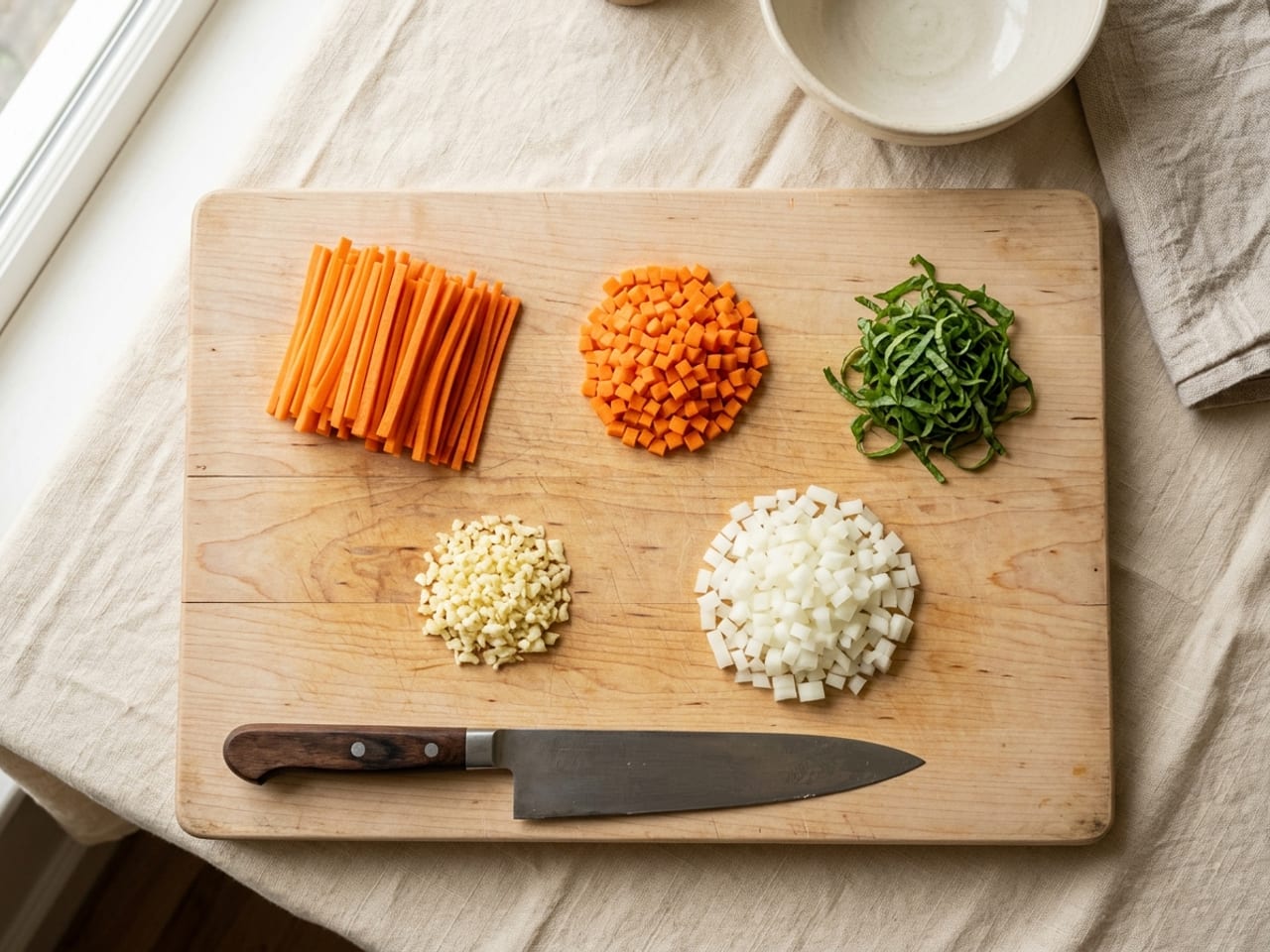
The four cuts at a glance
Sizes are the US culinary textbooks', exactly as the knife cuts chart prints them; tap "to scale" to see each one at true size.
| Cut | Size | Made from | Used for | Chart |
|---|---|---|---|---|
| Julienne | ⅛ × ⅛ × 1 to 2 in (3 × 3 × 25 to 50 mm) | Planks of a squared-off vegetable | Garnish for clear soups, salads, meat and fish, stir-fries and slaws, and matchstick potatoes. | to scale |
| Brunoise | ⅛ × ⅛ × ⅛ in (3 × 3 × 3 mm) | Julienne, cut across | Garnish for consommé, sauces and stuffings, and a fine mirepoix for quick sauces. | to scale |
| Chiffonade | fine ribbons, no set width | A stack of leaves, rolled tight | Garnish for soups, salads and pasta. Escoffier's chiffonade of sorrel or lettuce went into soups. | to scale |
| Small dice | ¼ × ¼ × ¼ in (6 × 6 × 6 mm) | Batonnet, cut across | Soups, salsas, sautés and stuffings. | to scale |
How to hold a knife: setup, pinch grip and the claw
Gisslen gives the guiding hand three jobs: hold the food so it can't slip, guide the knife ("the knife blade slides against the fingers"), and protect itself, with the fingertips curled under.2 Here is how to set that up.
- Set the height a little below your elbowNo culinary text we found sets a board height. General ergonomics advice puts light standing work about 2 to 4 in (5 to 10 cm) below elbow height,11 which is a sensible target for vegetable prep: a thick board on a low counter, a thin one on a high counter.
- Pinch the knife"Pinch the blade where it meets the handle with your thumb and forefinger" and wrap the other three fingers round the handle.4, 6 It feels awkward at first; Gisslen promises practice "will make it seem natural."2 Keep the wrist firm: a loose wrist or pressing straight down "could result in less accurate cuts."1
- Claw the foodCurve the fingers of your other hand into a claw on top of the food, thumb tucked behind them, so your knuckles guide the side of the blade and your fingertips stay out of the way; after each cut the claw moves back by the same step.4 The claw is not a knife grip: it is the hand holding the food.
The handle grip has its place. Holding the handle alone feels secure, but it "doesn't offer the control over the tip that is needed to make precision cuts," so America's Test Kitchen keeps it for honing and mincing herbs.4 The claw is old advice, too: Julia Child taught it in 1961, with the fingernails pointed back and "the knuckles of your left hand act as a guide for the next slice."12
The five cutting motions
Precise cuts are sliced, not pressed: the stroke should travel forward or back, never straight down.1 The physics agrees: the more the blade slides as it presses, the less force the cut takes.69
- Rock chop: the chef's knife defaultThe tip stays on the board as a pivot. "As heel of knife goes down, knife slices forward; then, blade slides back as heel is lifted up."4 America's Test Kitchen prefers a gently curved edge for a natural motion; exaggerated curves put the testers' wrists at slightly more awkward angles.13 Use it for most vegetables, garlic and herbs.
- Pull cut: soft and delicate thingsStart with the heel on the food and draw the blade back toward you, finishing at the tip.8 Gisslen's version slices down and forward, then pulls the heel back for the next slice with the tip still on the board.2 One Japanese knife shop recommends it for chives, scallions and other herbs that bruise under downward pressure.8
- Tap chop: straight up and downThe whole blade lifts and drops with no rocking, the traditional Japanese way to chop.9 Wüsthof's santoku advice is a close cousin: "keep the tip of your knife on the cutting board as you use a straight, up-and-down chopping motion."10 "Tap chop" is a kitchen nickname; no textbook we read defines it.
- Rocking mince: for herbs and garlicHold the tip against the board, rock the knife rapidly, and move it sideways so the cuts pass through the whole pile; after several cuts, gather the pile and start again.2 The CIA has the fingertips of the guiding hand hold the tip down while you chop.1 Mincing herbs is one of the two jobs, with honing, where the handle grip is fine.4
Which knife to use, and keeping it sharp
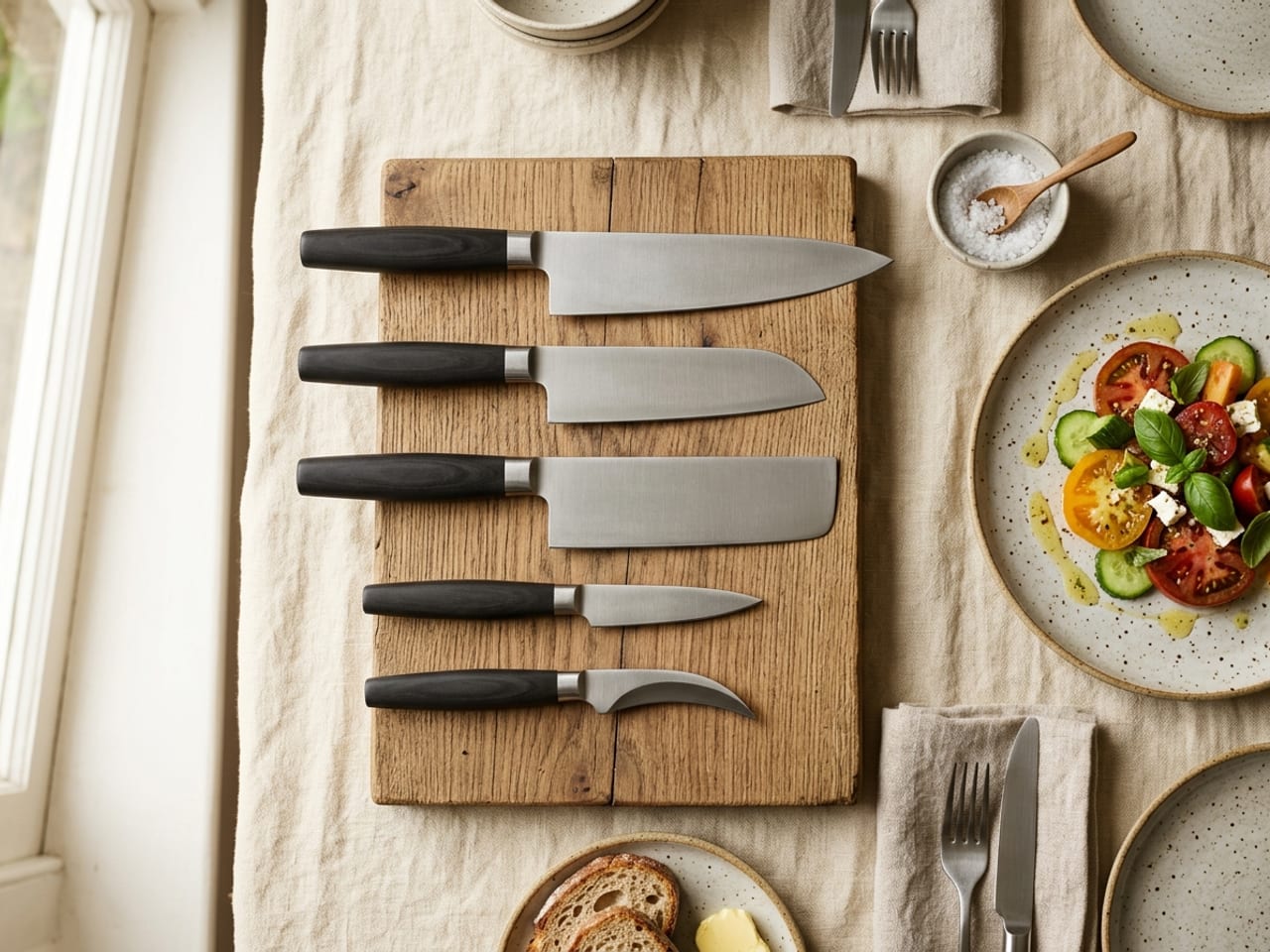
- SantokuShorter than a chef's knife, with a flatter edge;7 it suits push cuts and straight up-and-down chopping more than rocking.10 Japanese dictionaries explain the name as handling three things, meat, fish and vegetables;17 it was developed for postwar Japanese home cooks.16 Julienne and dice are push cuts, so it handles them well.
- Paring knifeA blade 2 to 4 in (5 to 10 cm) long, for paring and trimming.1 Use it for peeling in the hand, coring and small jobs the chef's knife is too big for.
Honing is not sharpening. An edge is "thousands of small cutting teeth" that bend out of line with use; honing on a steel realigns them, and when that stops working the edge has to be "reground to bring on a new edge." Hone regularly, sharpen occasionally.15 America's Test Kitchen calls the name "sharpening steel" a misnomer: honing trues the edge, sharpening removes metal.4 On a steel, the CIA says to listen for "a light ringing sound; a heavy grinding sound indicates that too much pressure is being applied."1
Edge angles have moved. The CIA still teaches 20 degrees on the stone and the steel, and Gisslen on the stone.1, 2 Makers now quote narrower angles, per side: Wüsthof 14 to 14.5° (10° on its santokus and nakiris), Zwilling about 15° (9 to 12° on its santokus and its Miyabi and Kramer knives), MAC 15°, Global 10 to 15°, Shun 16° and Victorinox 15 to 20°.14 America's Test Kitchen measured most chef's knives it tested at 13 to 16°.13 So the old "15 Japanese, 20 German" rule is out of date: check your maker's figure and say per side, because Victorinox quotes the total.14
Is it sharp? Zwilling's test: a sharp blade glides through a sheet of paper "without serious pressure or scratching."15 Julia Child's: it is sharp "if just the weight of it, drawn across a tomato, slits the skin."12
How to julienne (a carrot)
A julienne is ⅛ × ⅛ × 1 to 2 in (3 × 3 × 25 to 50 mm). Same carrot in all three frames.
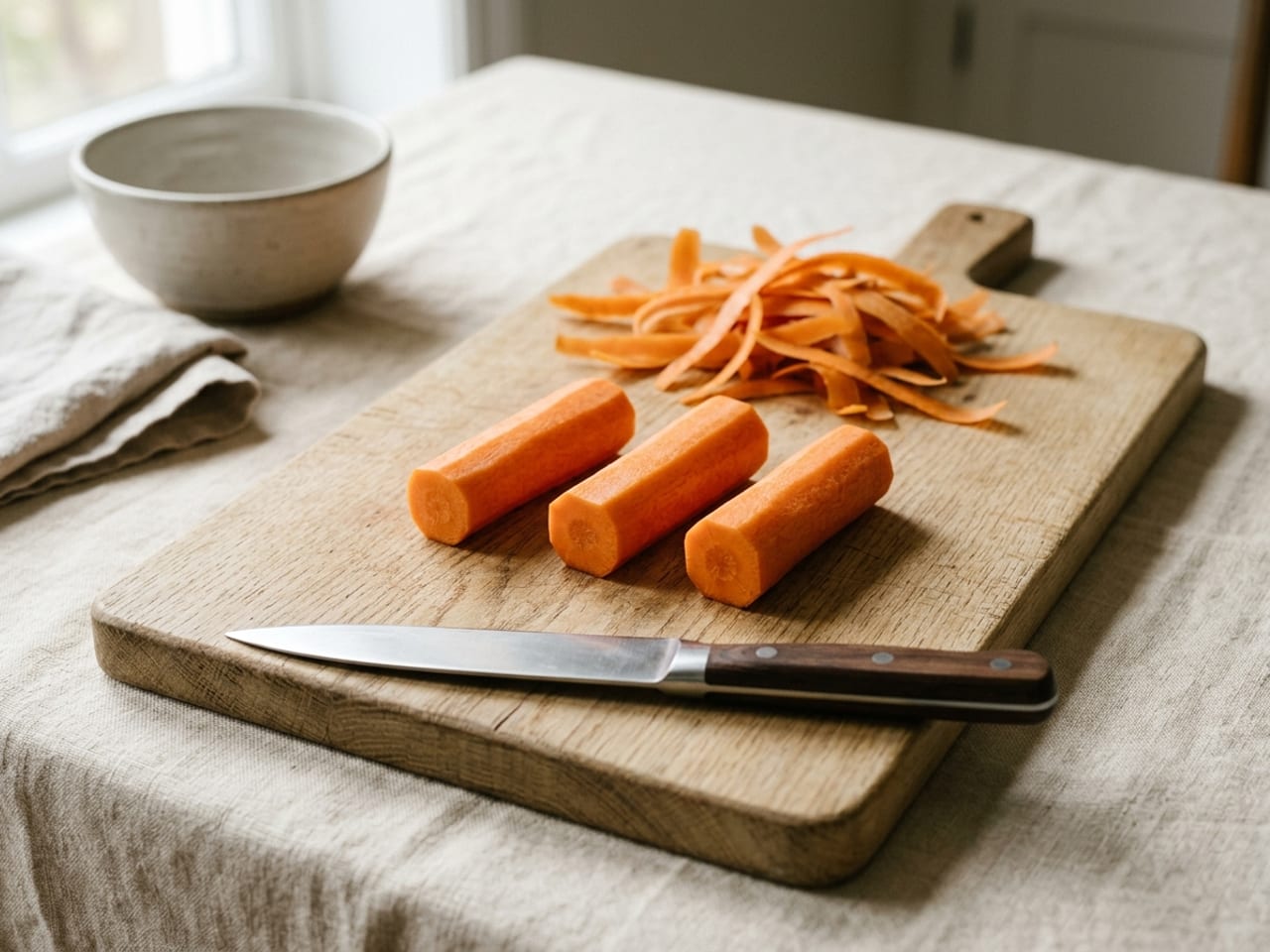 1
1Cut to length and square off
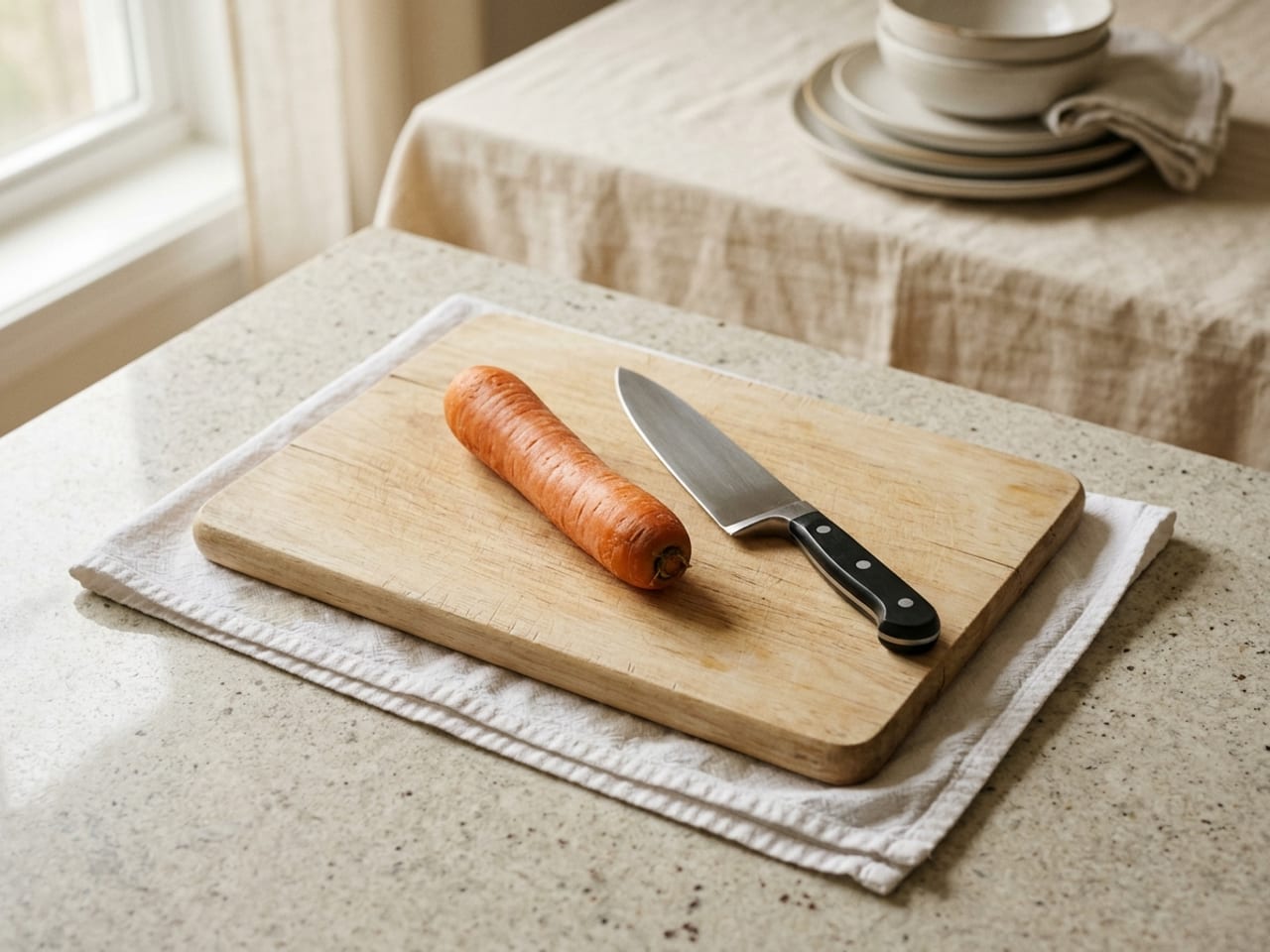
Peel the carrot and cut it into lengths of 1 to 2 in (25 to 50 mm), so each piece can be squared to its own width. Slice a thin piece off one side of each length and lay it on that flat side so it can't roll, then trim the other sides to make a rectangular block.1 The flat faces give you straight sides to measure from.
 2
2Slice into planks
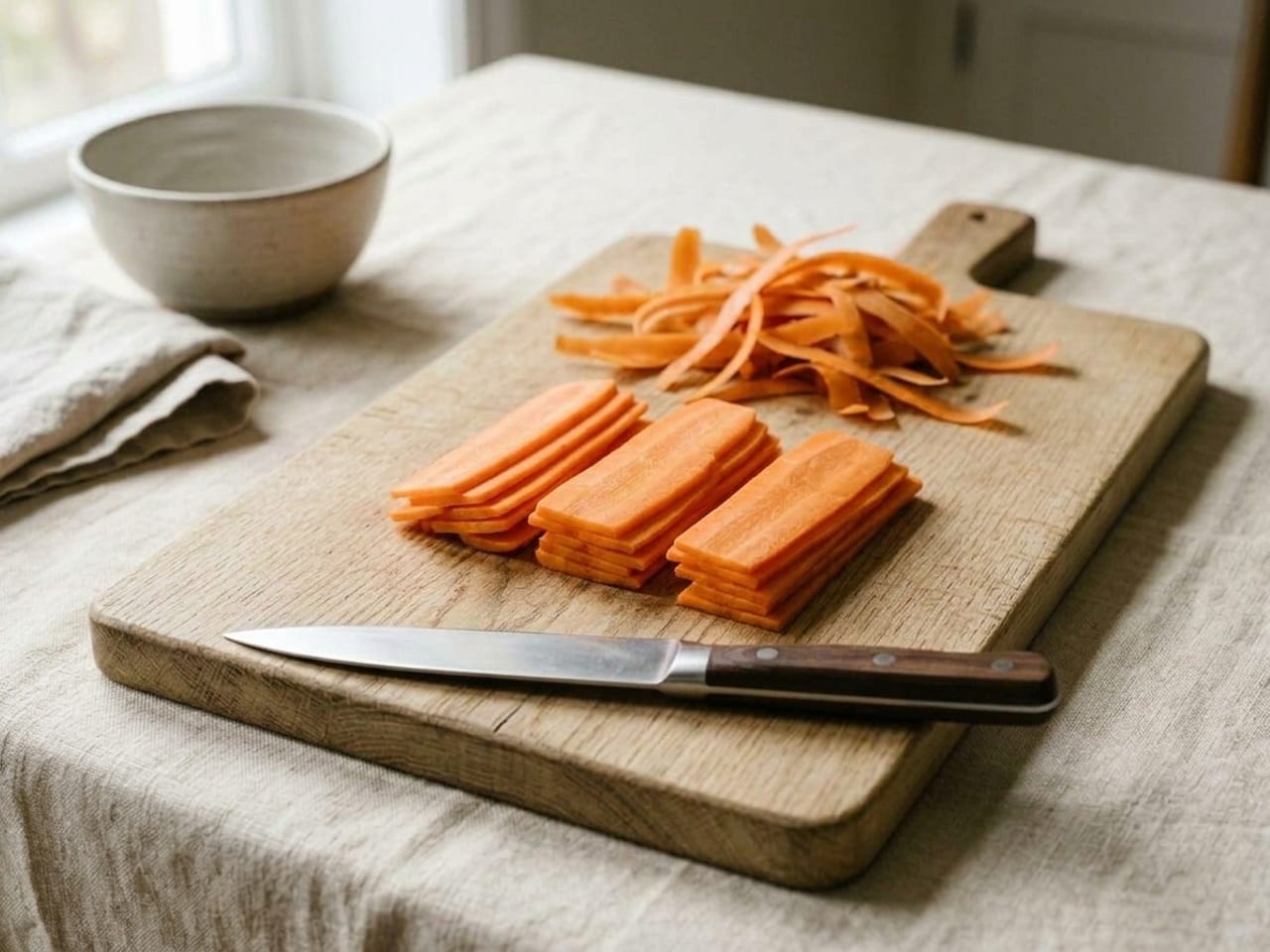
Lay each block on a flat side and slice it lengthwise into planks ⅛ in (3 mm) thick. The plank thickness sets the final stick, so keep every plank the same.
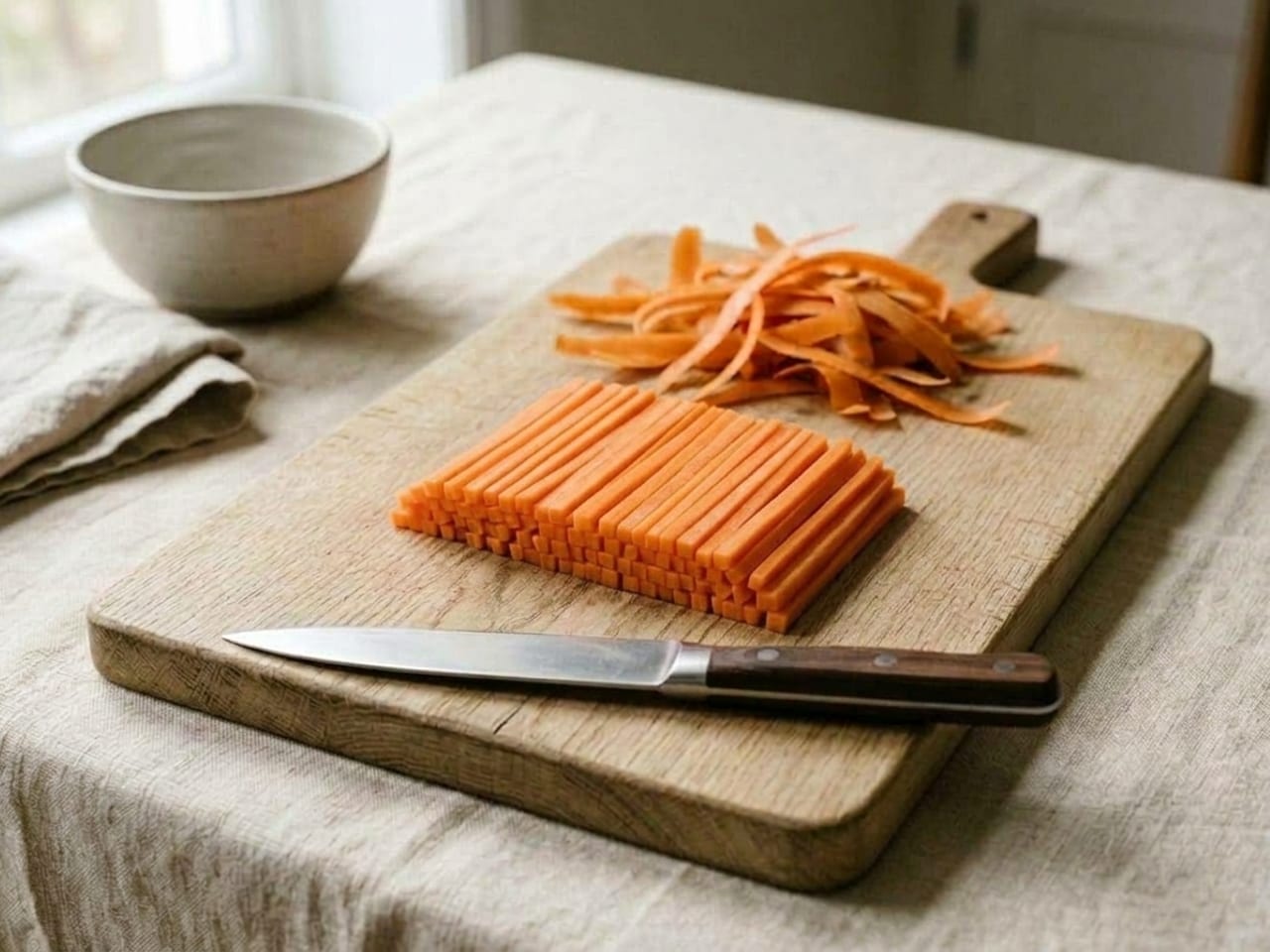
If it goes wrong. Tapered, wedge-shaped sticks mean the planks weren't even: square off properly and slice rather than press.1 A carrot that rolls needs a flat side. The full list is in the troubleshooting table.
The low-waste way. Squaring off a round carrot costs a lot of it (how much). For a salad or a stir-fry where perfect squares don't matter, slice the carrot thinly on a long bias, shingle the ovals in an overlapping row and cut them into strips.24 The strips are uneven at the ends but nothing goes to stock.
Fine julienne and batonnet. The same three steps at other thicknesses give a fine julienne, 1/16 × 1/16 × 1 to 2 in (1.5 × 1.5 × 25 to 50 mm), where a mandoline, used with a cut-resistant glove, helps, and the thicker batonnet, ¼ × ¼ × 2 to 2½ in (6 × 6 × 50 to 60 mm), the stick behind a small dice.
Bell pepper, leek, onion. For a pepper, cut the walls into flat panels and slice off the pale inner membrane so each panel is an even thickness,1, 3 then cut strips. For a leek, halve or quarter it lengthwise, rinse the grit out from between the layers, then cut.1 What recipes call julienned onion is really thin slices cut from root to tip.
How to brunoise
A brunoise is ⅛ × ⅛ × ⅛ in (3 × 3 × 3 mm): a julienne cut across.
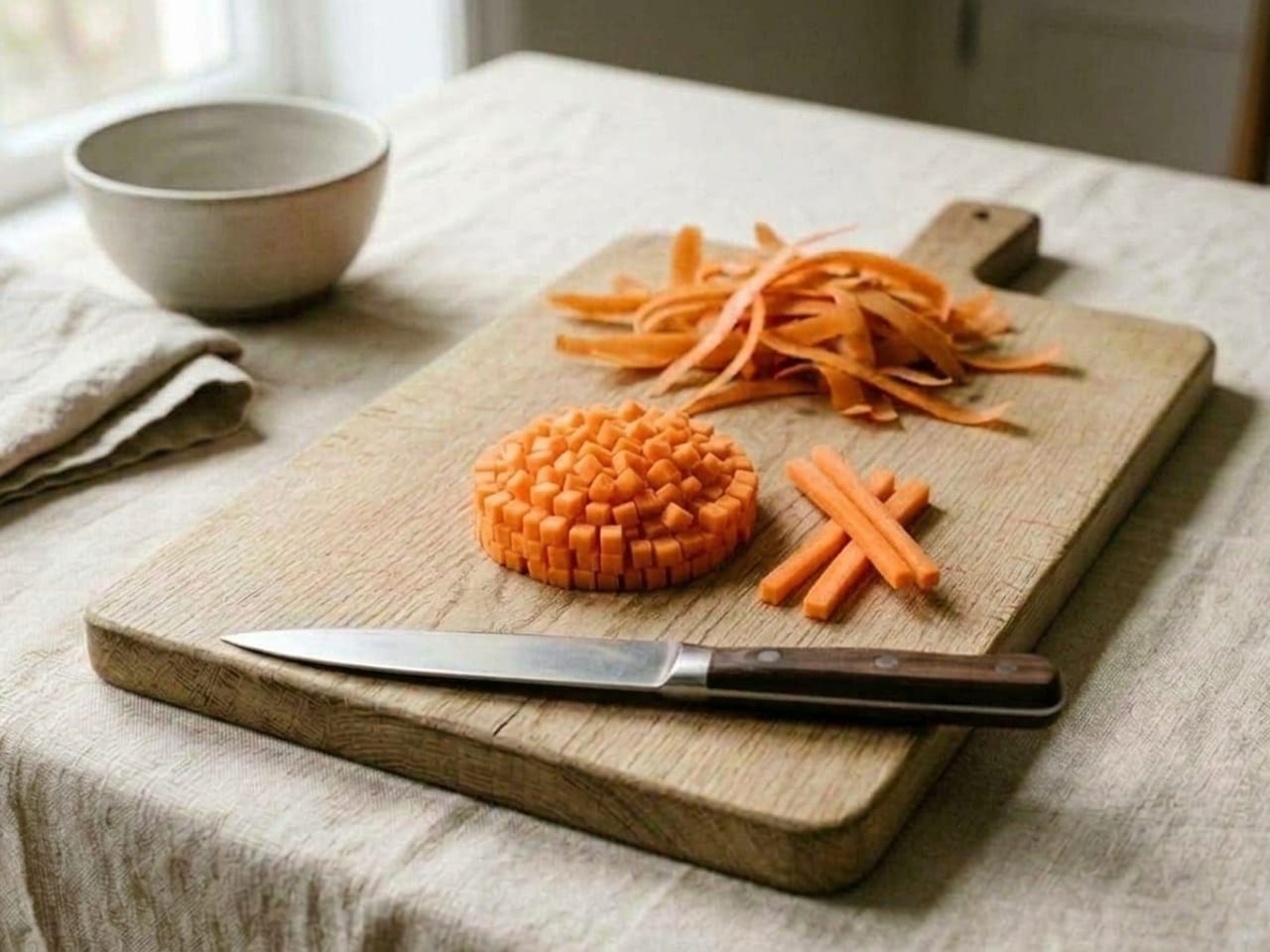
- Start from an even julienne. A brunoise is only as square as the sticks it comes from, so start with a julienne whose strips are all ⅛ in (3 mm) square.
- Line up the sticks. Gather a small bundle and line up the ends against your claw.
- Cut across at the same width. Cut straight across the bundle every ⅛ in (3 mm), the same width as the sticks, so every piece is a cube.1
Rectangles, not cubes? Then the cuts across were wider or narrower than the sticks. Crushed and wet? The knife was dull or pressing down: hone it and let the blade travel. A fine brunoise, 1/16 × 1/16 × 1/16 in (1.5 × 1.5 × 1.5 mm), comes from a fine julienne the same way.
Shallot and onion brunoise. No textbook we read gives a separate method: use the onion method with the cuts about ⅛ in (3 mm) apart, which sits inside America's Test Kitchen's spacing for minced onion, ⅛ to ¼ in (3 to 6 mm).26 Shallots lose little to trimming: The Book of Yields puts the usable part at about 91%.3
Where it goes. Garnish for consommé, sauces and stuffings, and a fine mirepoix for quick sauces. Escoffier cut the vegetables for his mirepoix into a finer or coarser brunoise depending on the dish.95
How to chiffonade basil
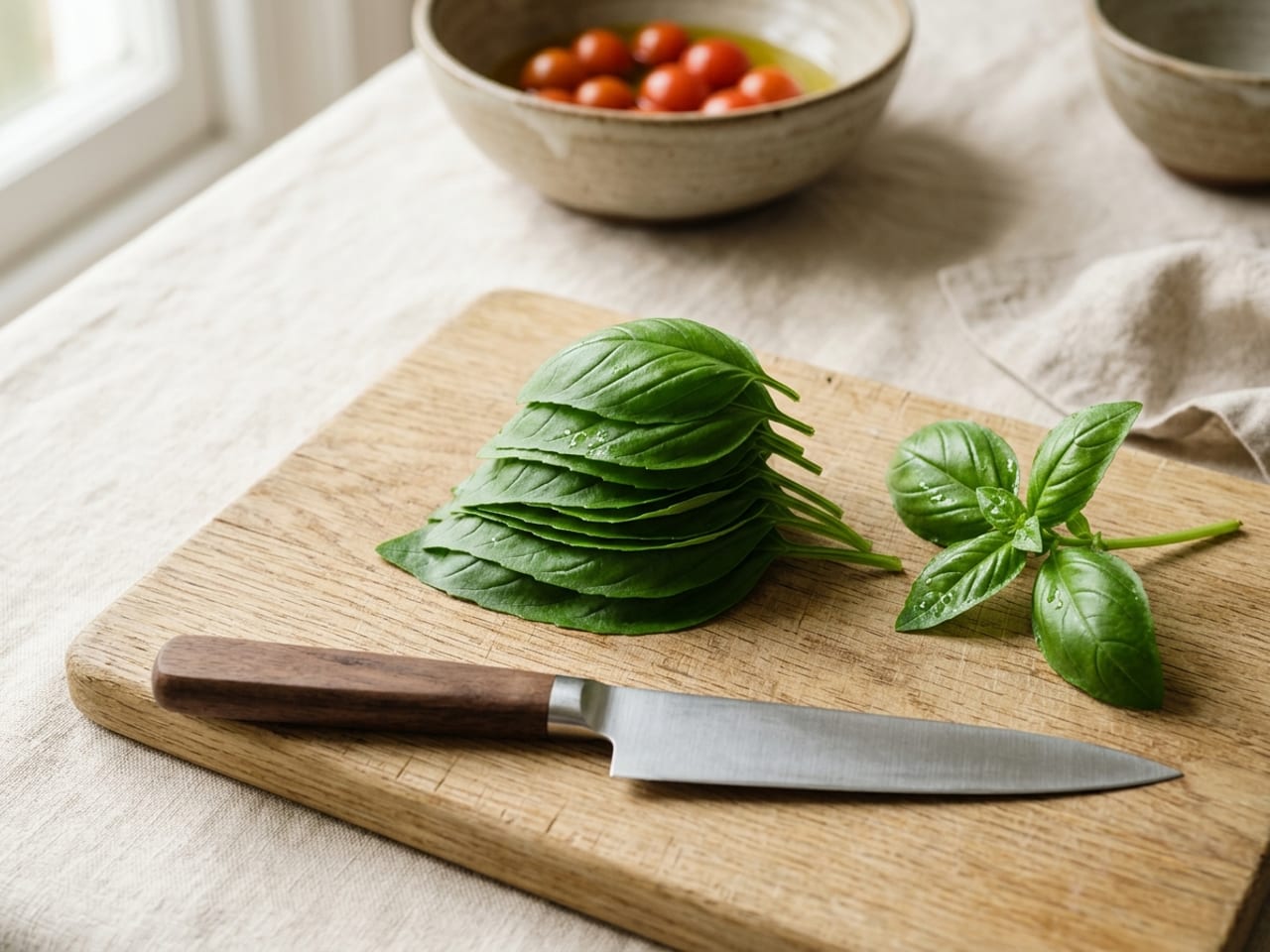
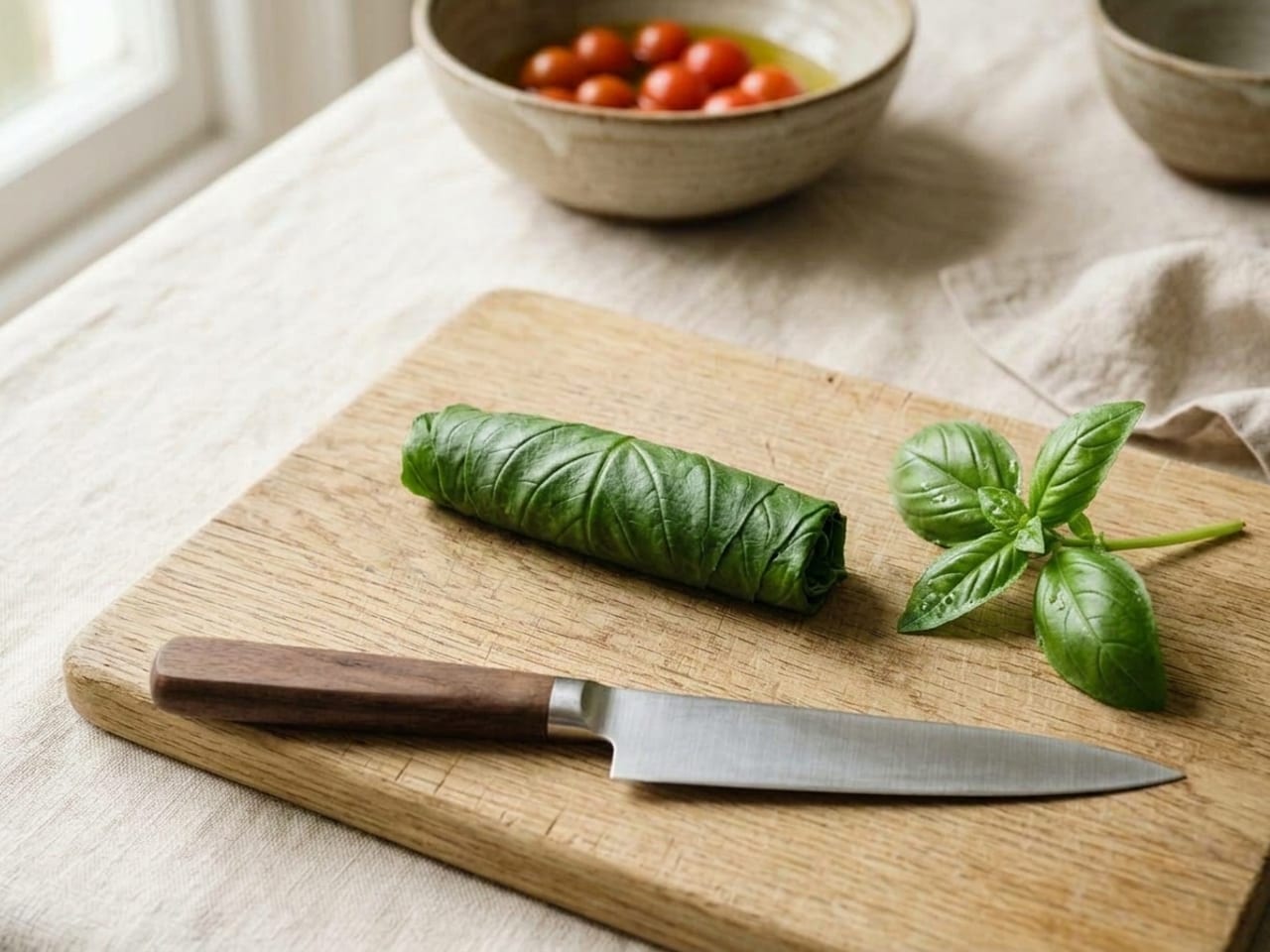
A chiffonade is leaves rolled and sliced into ribbons; the chart lists its size as fine ribbons, no set width. Same basil in all three frames.
 1
1Stack the leaves
Pick clean, dry basil leaves and pull off any heavy stems or ribs.2 Stack eight or ten, the largest at the bottom, all facing the same way.
 2
2Roll them tight
Roll the stack lengthwise into a tight cylinder, like a cigar.2
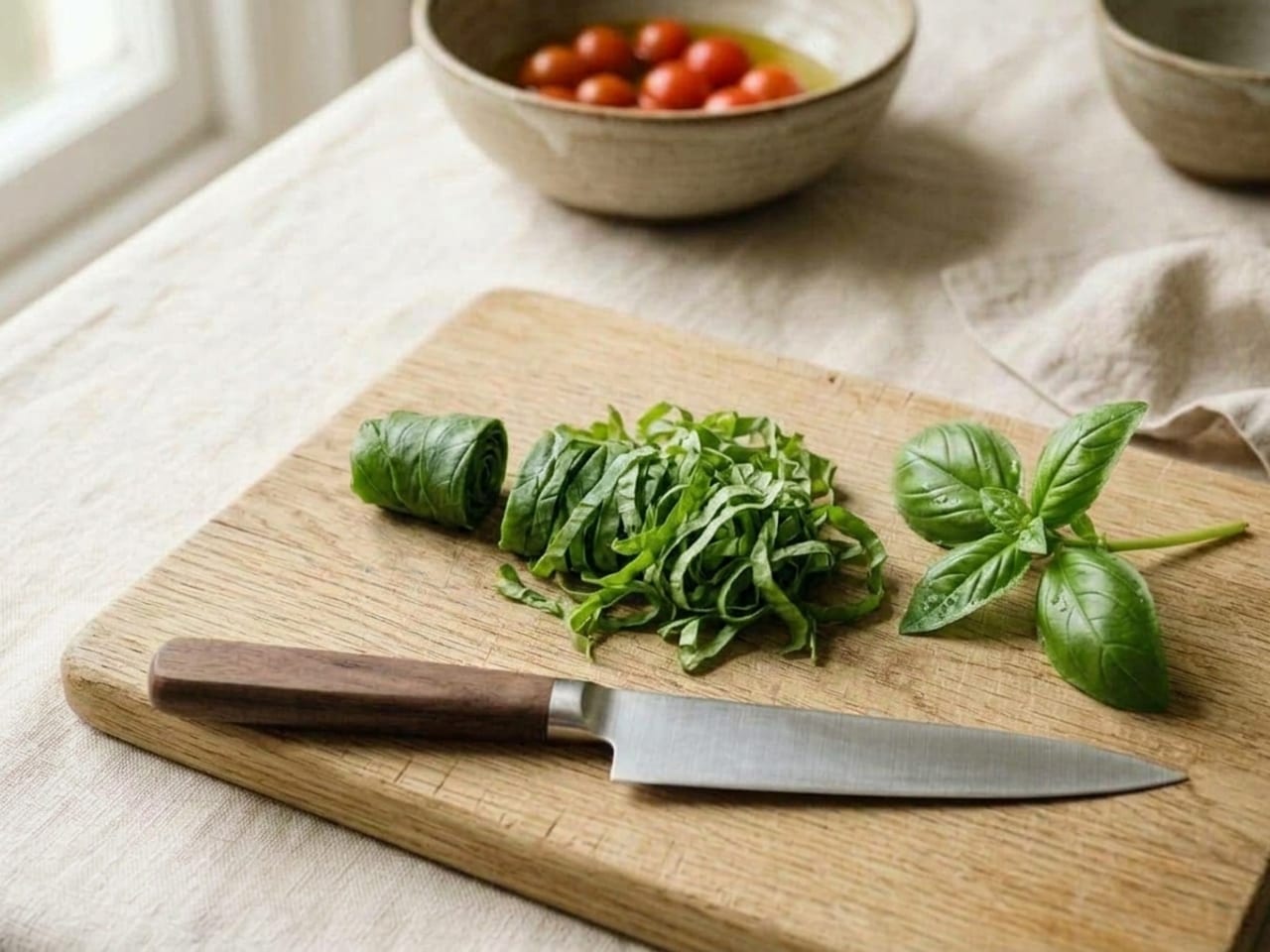 3
3Slice across into ribbons
Slice across the roll into thin shreds,2 drawing the knife rather than chopping down, then fluff the ribbons apart with your fingertips. No textbook sets a width.
Cut it last. "Freshly chopped basil can quickly turn dull black," says America's Test Kitchen; oil on the whole leaves "barely slowed" it, and oil on the cut basil slowed it but left it oily, so chop basil just before serving.31 The CIA's general rule is the same: cut anything that loses colour or flavour as close to service as possible.1
Why it turns black, honestly. The cause that is actually documented is cold. Sweet basil kept about 12 days at 15 °C (59 °F), but 3 days at 5 °C (41 °F) and 1 day at 0 °C (32 °F),32 and chilling injury (browning and black spots) starts below about 12 °C (54 °F).33 A home fridge runs near 4 °C (39 °F), so keep basil in a glass of water on the counter, like cut flowers. We found no study of cut-edge darkening from chiffonade, or of tearing versus cutting. Sharp blades measurably reduced browning in cut apples and translucency and discolouration in cut melon,67, 68 so a sharp knife and a slicing stroke are sensible, but no one has tested basil.
Which leaves. Large, tender leaves that stack and roll: basil, mint, sage and sorrel, and lettuce, spinach, kale or cabbage. Gisslen's own example is sorrel.2 Parsley, cilantro, thyme and rosemary don't roll; gather them into a tight bunch and cut through it, then rock-mince.1 A lettuce or cabbage chiffonade counts as a cut leafy green, so it goes in the fridge (why).
How to dice and mince
A dice is a stick cut across. Batonnet gives small dice, ¼ × ¼ × ¼ in (6 × 6 × 6 mm); thicker sticks give medium dice, ½ × ½ × ½ in (12 × 12 × 12 mm), and large dice, ¾ × ¾ × ¾ in (20 × 20 × 20 mm).
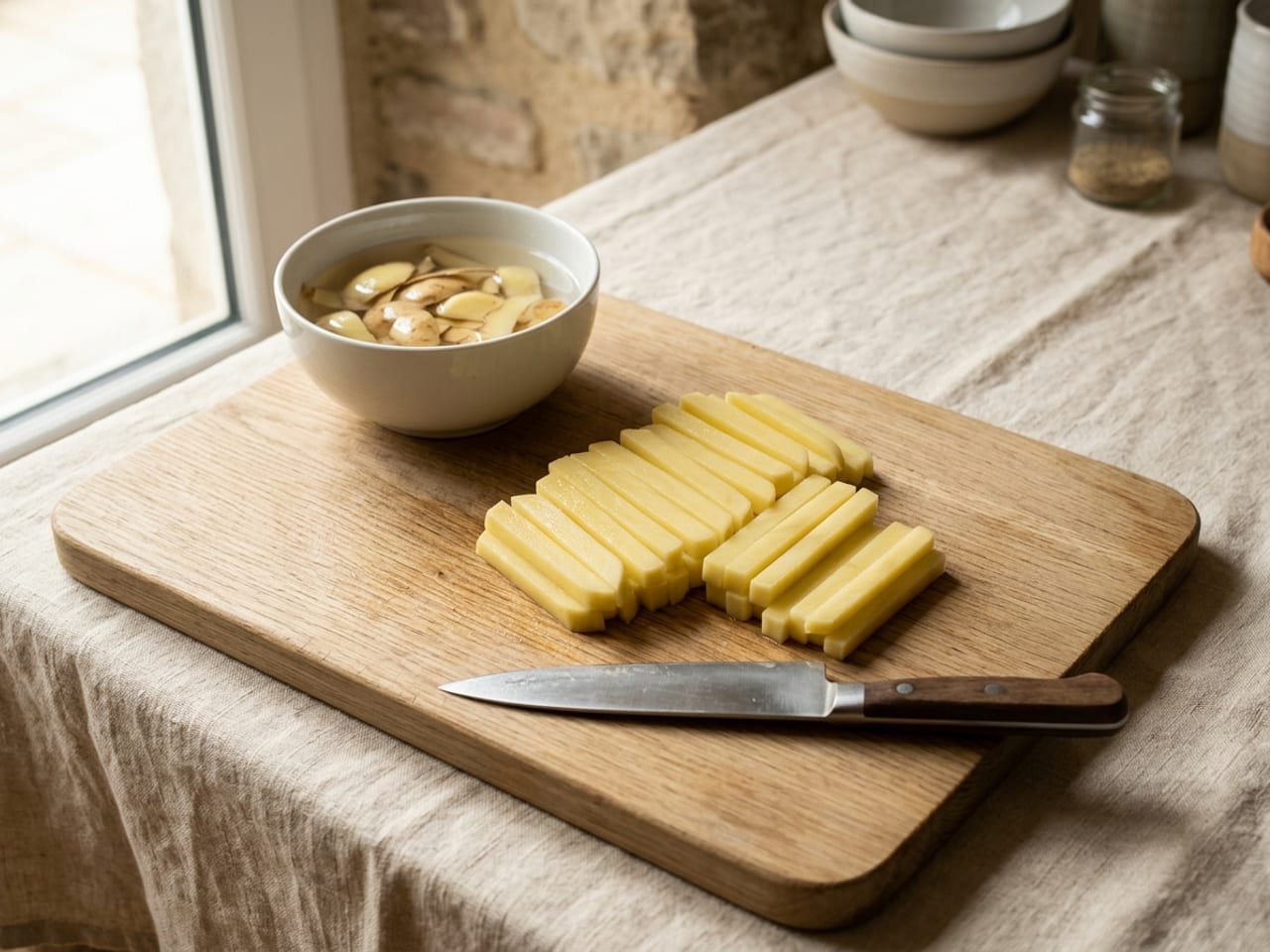
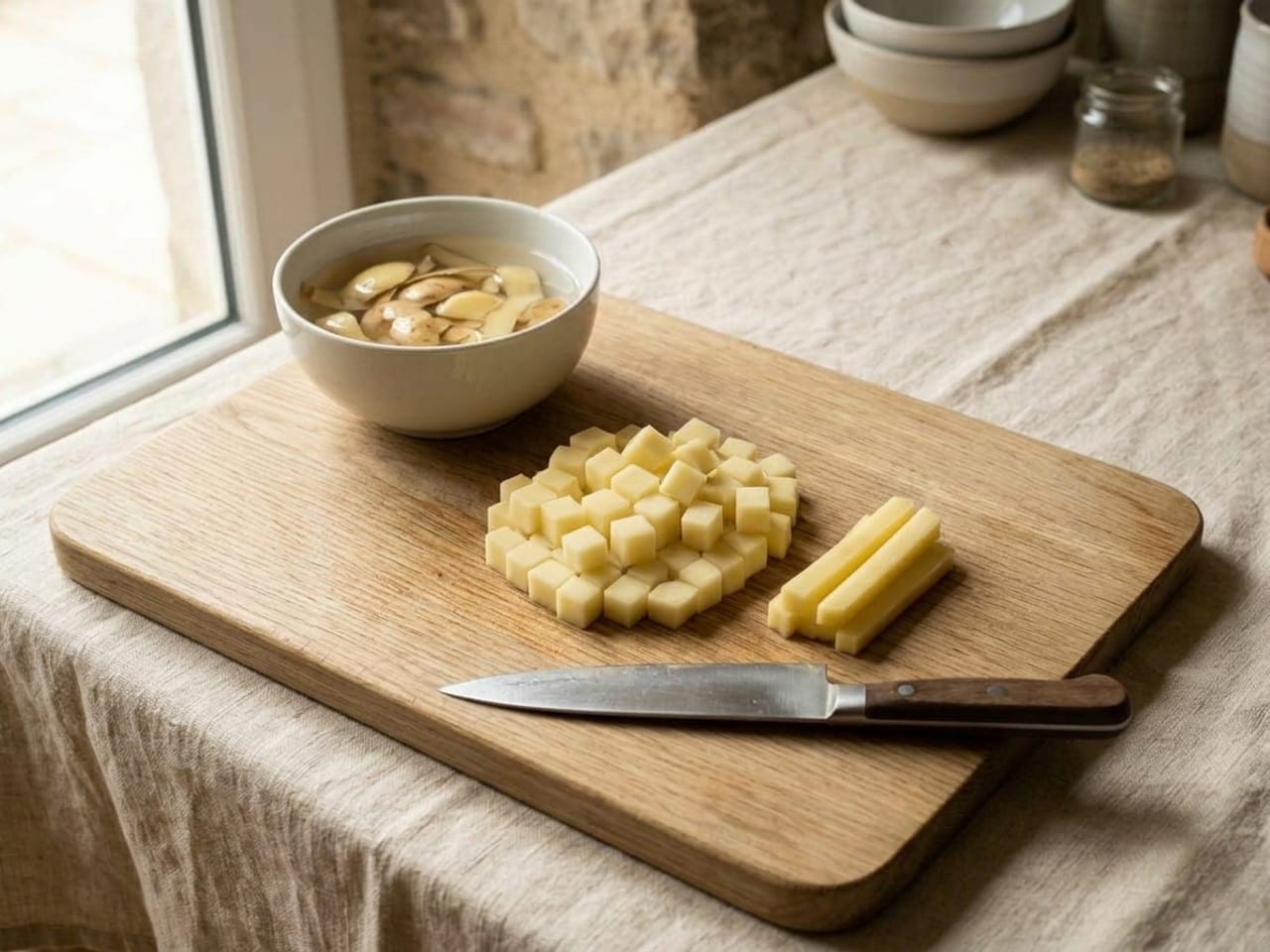
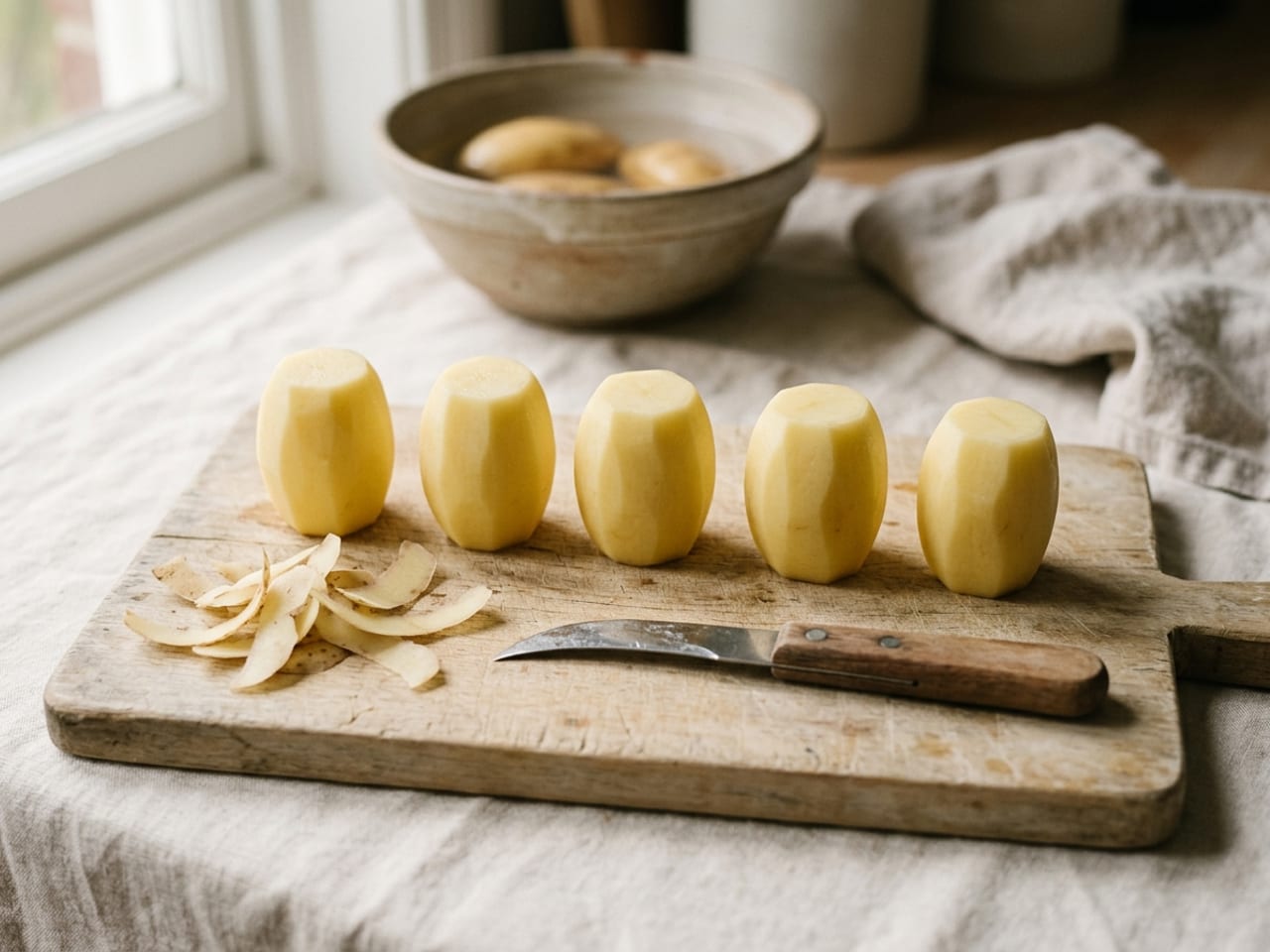
Potato small dice. Square off the peeled potato by cutting a slice from all sides and keep the trimmings for mash or soup; then "pile the bâtonnets together and cut across in slices 1/4 inch (6 mm) apart."2
How to dice an onion
An onion is layers, not a solid block, which is why it needs its own method.2 Same onion half in all three frames.
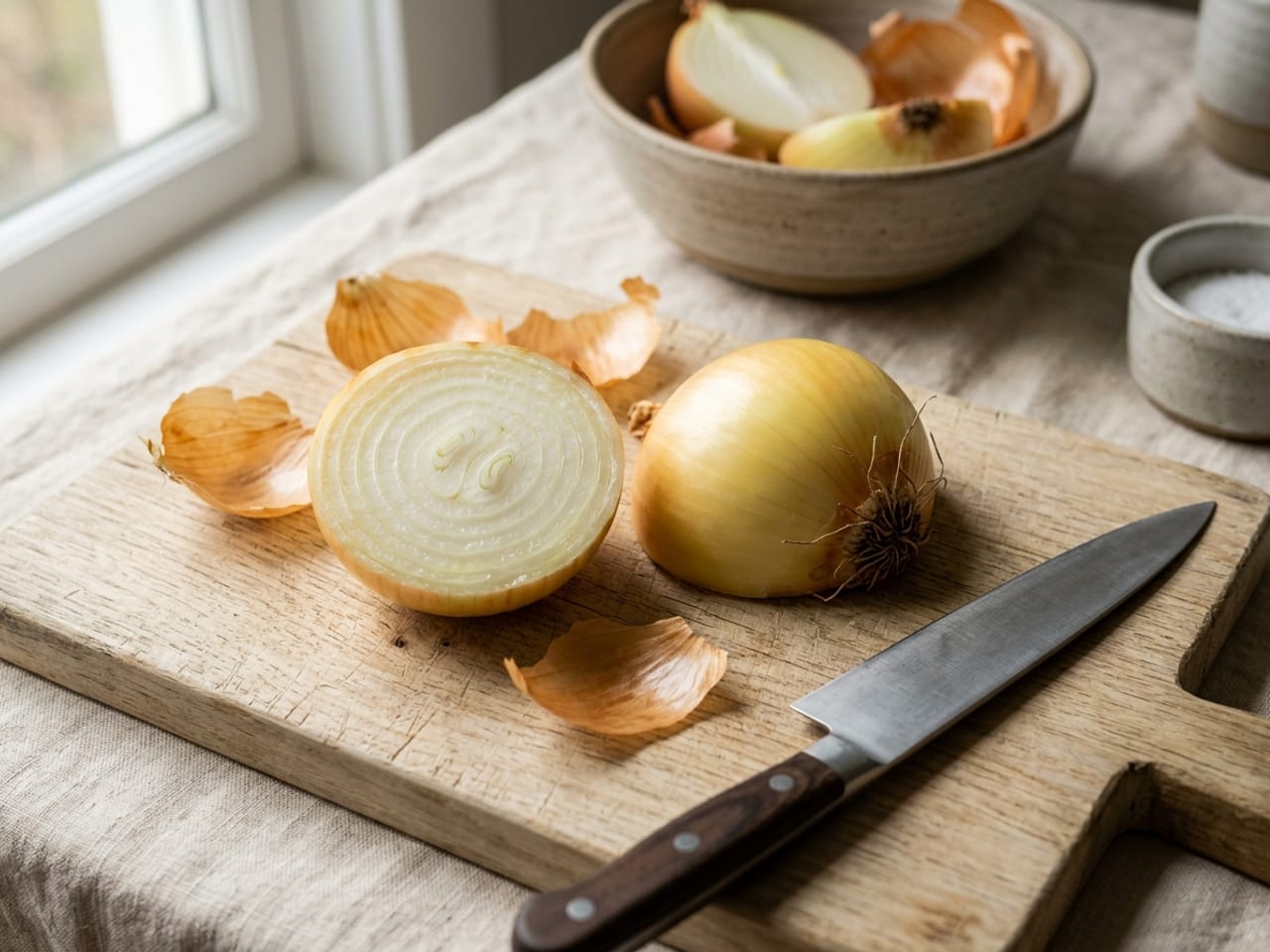 1
1Halve through the root, peel
Cut the onion in half lengthwise through the root end, peel it and lay one half cut side down.2 Leave the root on: it holds the layers together.
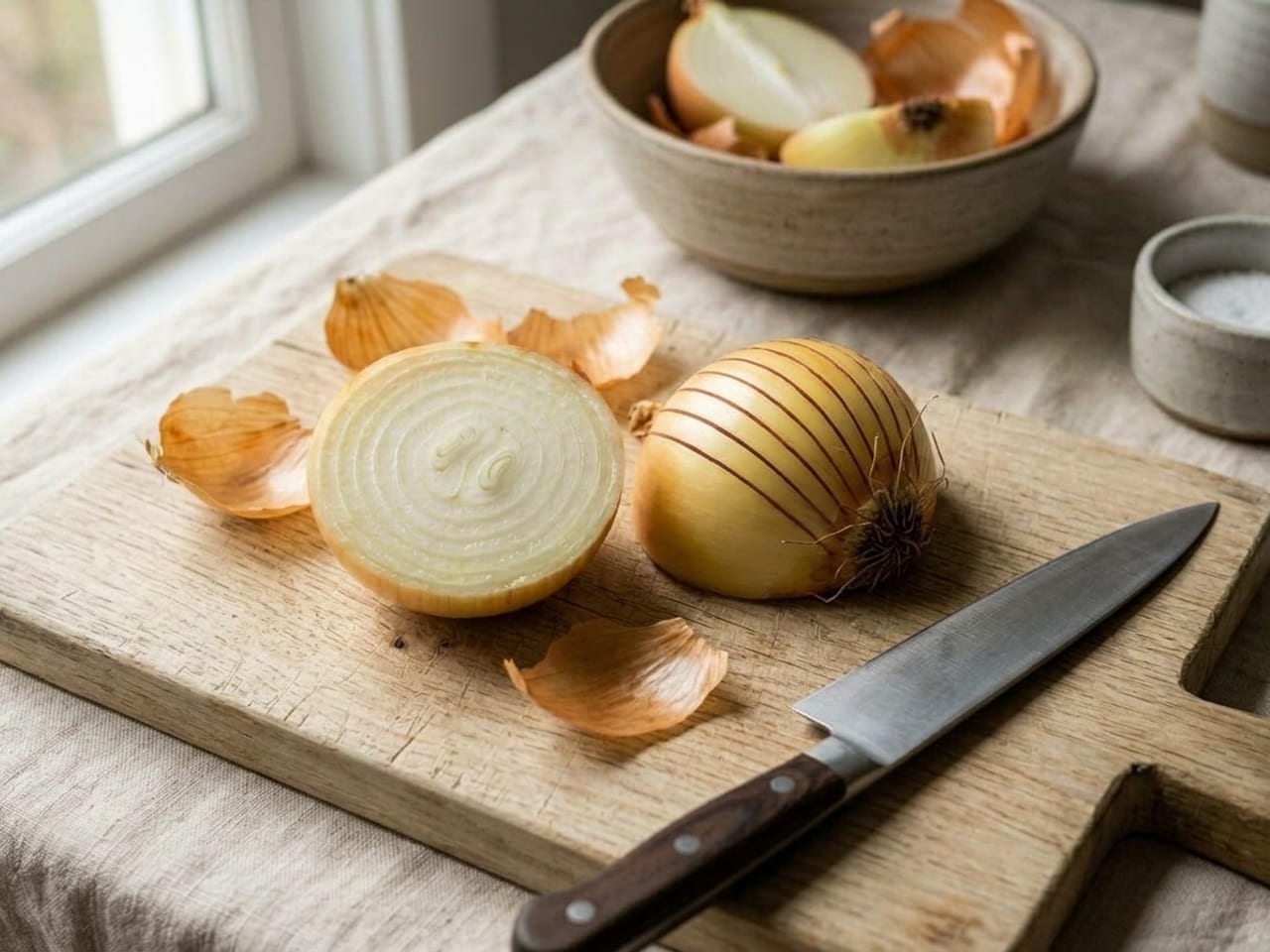 2
2Cut toward the root, not through it
With the root away from you, make lengthwise cuts from the stem end almost to the root. The closer the cuts, the smaller the dice.2 Aim them radially, down toward a point below the board, or cut straight down and add a horizontal cut or two (which to choose). If you make a horizontal cut, hold the onion with your palm flat on top and your fingers lifted clear, keep the blade level, and cut toward the root, not through it.2
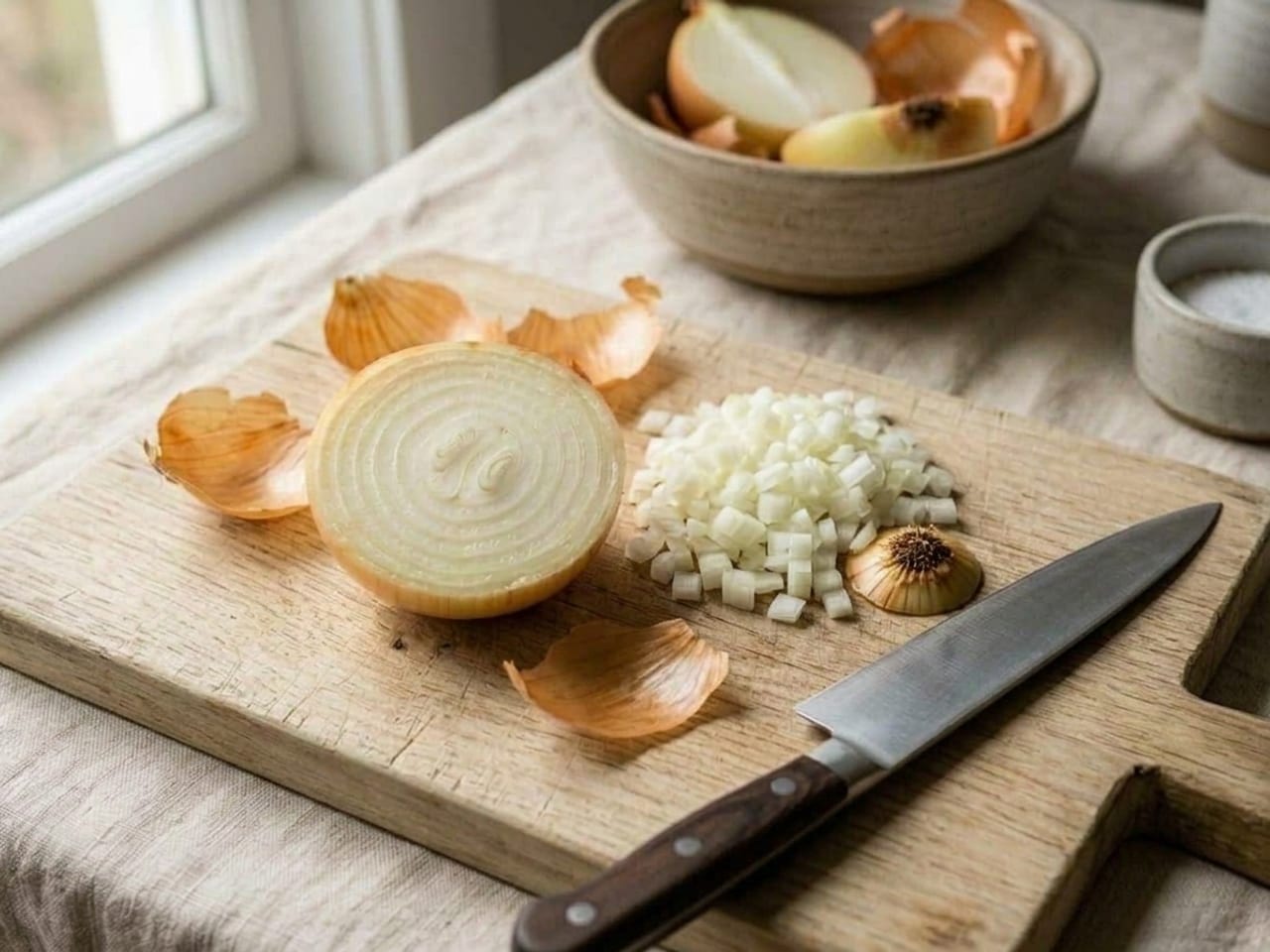 3
3Slice across into dice
Slice across the cuts and the onion falls into dice. Stop near the root; the root end can go to a stock.2
How far apart. For diced onion, leave ¼ to ½ in (6 to 13 mm) between cuts; for minced, ⅛ to ¼ in (3 to 6 mm).26
The horizontal cut debate. The textbook method adds "a few horizontal cuts toward but not through" the root after the vertical ones,2 as Julia Child did.12 Those cuts send the blade toward the hand holding the onion, so America's Test Kitchen now teaches two methods without them;27, 28 one of its editors cut himself making exactly that cut.28 Kenji López-Alt's position is more precise than the internet version: aim the first cuts radially at a point on the centre line about 60% of the onion's radius below the board, which gave pieces with a standard deviation of about 30% against 50% for vertical cuts; he says a horizontal cut matters with vertical cuts and is "not quite as important" with his radial ones.29
Does it matter? The Pudding's model gives different numbers but agrees that aiming below the board beats vertical cuts: a 34.5% spread in piece size against 37.3% for straight-down cuts, and in the model a horizontal cut "almost never helps with consistency." Aiming every cut at the centre was worst, at 57.7%.30 López-Alt, quoted by The Pudding, says uniformity "matters far more for winning internet debates and solving interesting math problems than it does for cooking."30 Pick the method that feels safe; keep the root on.
How to mince garlic (and make a paste)
Same cloves in all three frames: crushed, minced, mashed.
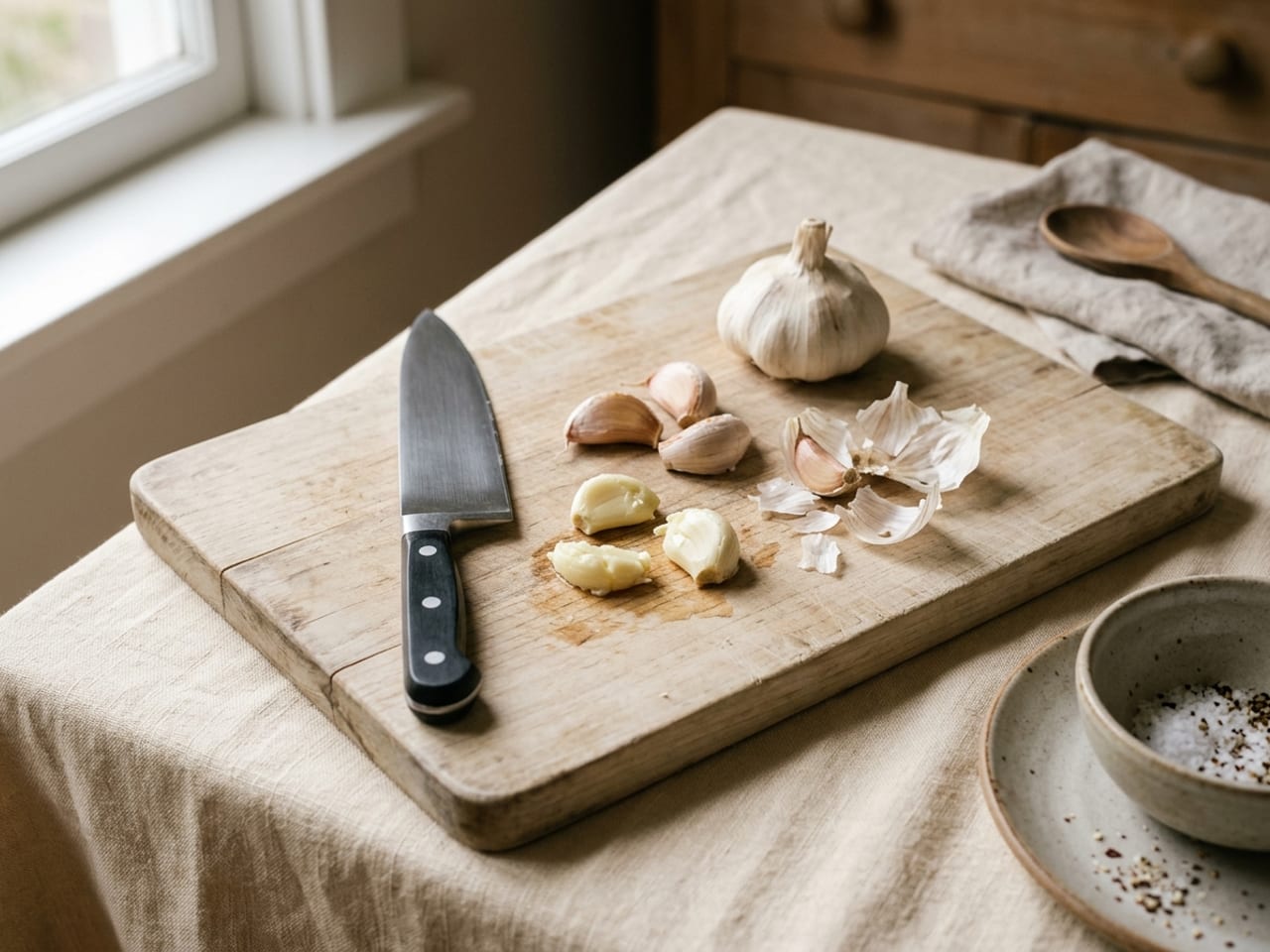
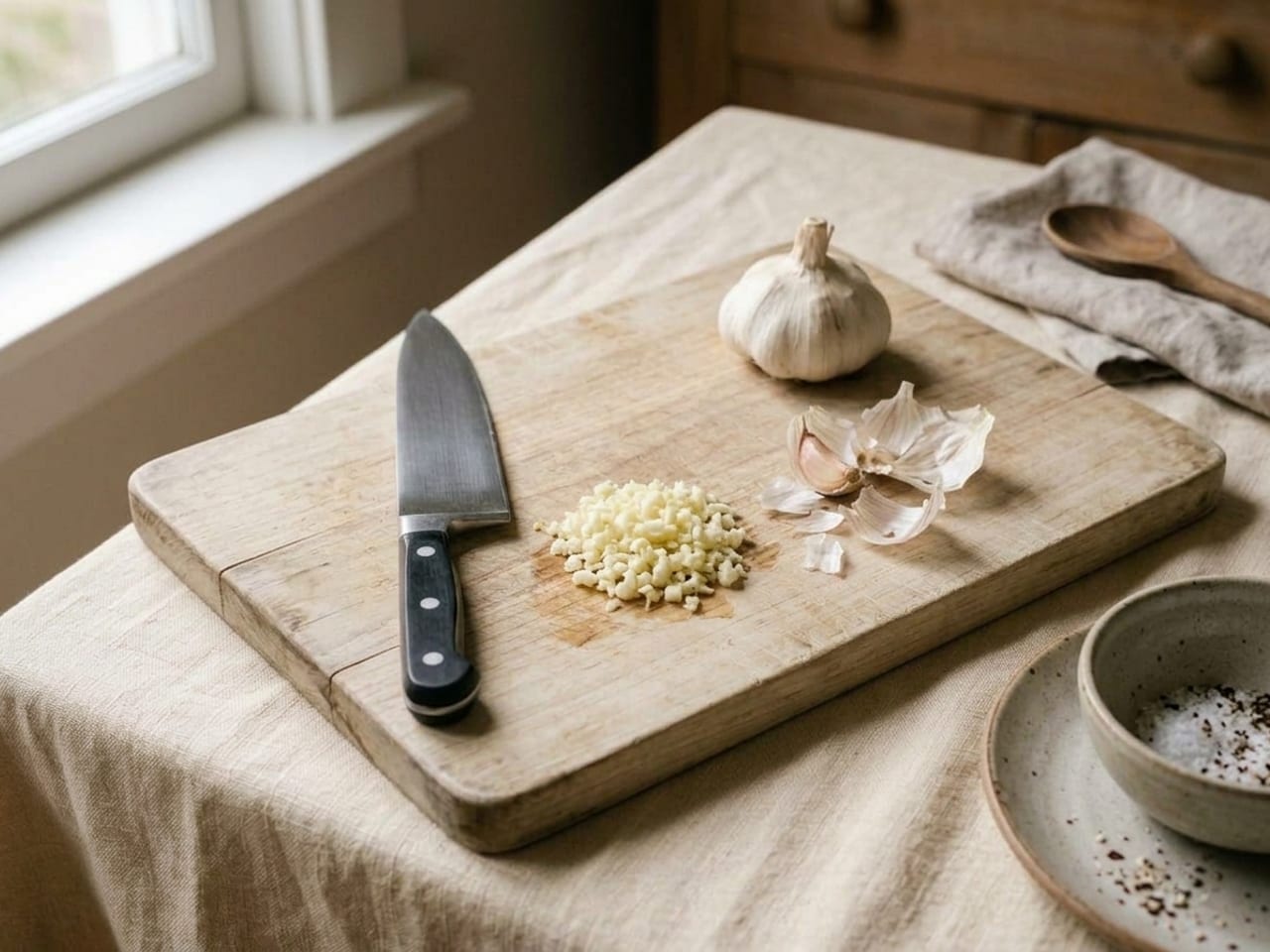 2
2Mince
Slice, then mince "using a rocking motion as for herbs,"1 gathering the pile and going again until the pieces are small and even.
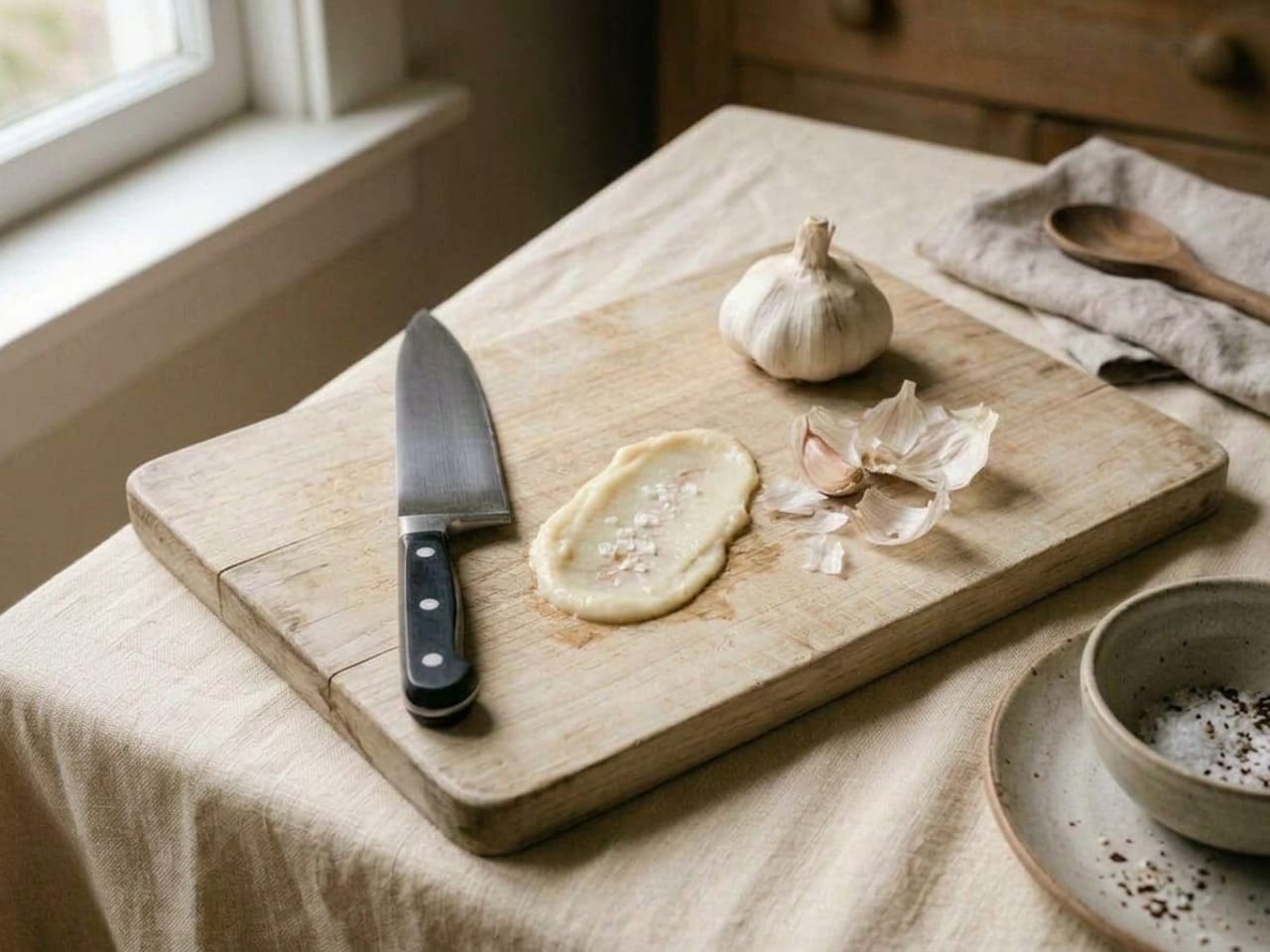 3
3Paste, with salt
Sprinkle with salt, hold the knife nearly flat and mash the garlic against the board with the edge, again and again. The salt acts as an abrasive and stops the garlic sticking to the blade.1
Paste without a knife. A mortar and pestle does the same job: crush and grind salted garlic into a paste.1 Garlic mixed into oil is a food the FDA Food Code says needs temperature control,46 so a garlic paste loosened with oil goes in the fridge, not on the counter, and is used within 4 days or frozen.49 The popular 10-minute rest after crushing has a thin basis (why).
Mincing herbs. Rinse and dry the herbs, strip the leaves, gather them into a tight ball under your guiding hand and slice through it, then rock-mince with the tip held down. "This need not be a perfectly neat cut, but all the pieces should be roughly the same size."1 A sharp knife cuts cleanly instead of crushing.
Shaped cuts: paysanne, rondelle, bias, oblique and tourné
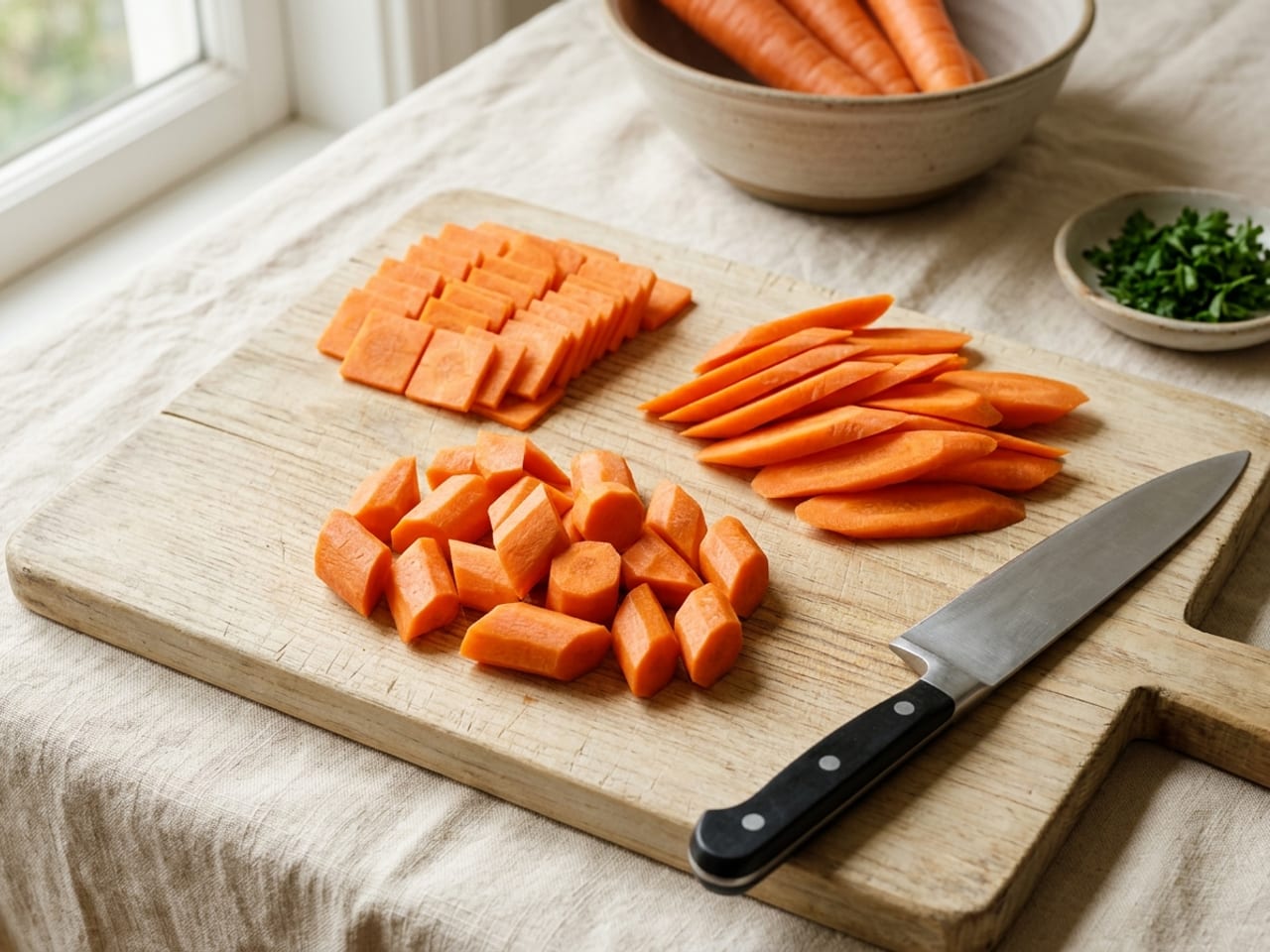
Paysanne, ½ × ½ × ⅛ in (12 × 12 × 3 mm): cut sticks, then "cut them crosswise into thin slices."2 The shape has always varied: lozenges for Carême in 1833,92 triangles in Escoffier's English edition.96 Even the CIA disagrees with itself, its method building paysanne from a thicker stick than its own chart.1
Rondelle, ⅛ to ½ in thick (3 to 10 mm thick): round slices straight across a carrot or similar.2 Halve it lengthwise first for half-moons.1
Bias: rounds cut at an angle; "the wider the angle, the more" elongated the oval.1
Oblique (roll cut): cut on a diagonal, roll the vegetable a quarter turn, cut again on the same diagonal. It exposes more surface and shortens cooking time, which is why stir-fries use it. On a tapering carrot, angle the cut closer to straight across as the carrot gets thicker, or the pieces won't match.1
Tourné, 2 in long, ¾ in across, 7 faces (50 mm long, 20 mm across, 7 faces) in Gisslen: carve each face in a curve, turning the piece "one-seventh of a full turn, to be exact," though "customers rarely count them."2 The seven-sided rule is a modern school specification: Escoffier turned vegetables into garlic-clove and olive shapes and counted no faces.95 Keep the trim for soup or purée.1
Julienne vs brunoise vs chiffonade vs batonnet
The cuts people mix up, with the chart's sizes and uses. Every dice is cut from the stick of the same thickness.
| Cut | Shape | Size | Cut from | Best for |
|---|---|---|---|---|
| Julienne | Thin square stick | ⅛ × ⅛ × 1 to 2 in (3 × 3 × 25 to 50 mm) | Planks | Garnish for clear soups, salads, meat and fish, stir-fries and slaws, and matchstick potatoes. |
| Brunoise | Tiny cube | ⅛ × ⅛ × ⅛ in (3 × 3 × 3 mm) | Julienne | Garnish for consommé, sauces and stuffings, and a fine mirepoix for quick sauces. |
| Chiffonade | Fine flat ribbon | fine ribbons, no set width | Rolled leaves | Garnish for soups, salads and pasta. Escoffier's chiffonade of sorrel or lettuce went into soups. |
| Batonnet | Thick square stick | ¼ × ¼ × 2 to 2½ in (6 × 6 × 50 to 60 mm) | Planks | Crudités, glazed or roasted vegetables, jardinière garnishes in US kitchens, and small dice. |
| Small dice | Cube | ¼ × ¼ × ¼ in (6 × 6 × 6 mm) | Batonnet | Soups, salsas, sautés and stuffings. |
| Mince | Very fine bits | very fine, no set size | Anything, chopped | Garlic, shallots, ginger and herbs. |
Brunoise vs dice vs mince. A dice is a measured cube (small, medium or large); a brunoise is the tiniest named dice; mince has no set size and is judged by eye. Julienne vs shredded: a julienne is cut to a square section, a shred is whatever a grater or peeler leaves.
Peeler, mandoline, grater: julienne without a knife
| Tool | What you get | Beats the knife for | Safety |
|---|---|---|---|
| Julienne peeler | Thin, flat-faced strands | A carrot or zucchini for a salad, fast | Stop before the last inch (2.5 cm); keep fingers off the teeth |
| Mandoline | Perfectly even slices and julienne | Fine julienne and large batches | A cut-resistant glove every time, plus the guard if it grips the food well |
| Box grater | Shreds, not sticks | Slaws, fritters, anything cooked down | Stop before your knuckles reach the holes |
| Chef's knife | Any cut, any size | Brunoise, dice, chiffonade, small amounts | Pinch grip, claw, a still board |
Using a mandoline safely. America's Test Kitchen's rules: wear a cut-resistant glove on the hand holding the food; use the hand guard "if it's any good"; if food sticks, don't push harder; work on a flat, dry surface; and remember "a sharp blade is the safest blade."19 In 2018 about 19,000 Sharper Image and Frigidaire mandolines were recalled because the small blades in their julienne attachment could separate from the plastic.20 We found no safety source for julienne peelers: the advice in the table is ordinary kitchen practice. Shredded vegetables also keep less well than sticks: finer lettuce shreds stored for less time,65 and more cut surface means a stronger wound response.64
What the glove ratings mean. In the US, ANSI/ISEA 105 rates cut resistance A1 to A9 by the grams of load a blade needs to cut through, from 200 g at A1 to 6,000 g or more at A9.21 In Europe, EN 388 marks cut resistance with a letter from A (at least 2 N) to F (at least 30 N) from the ISO 13997 test, usually beside an older 1 to 5 Coupe score.22, 23 Puncture is rated separately:23 a cut-resistant glove resists a slicing blade, not the stab of a knife tip. No food-safety body names a level for home use, so we don't either. In a study of 1,166 injured workers across industries, the risk of cuts and punctures was 60 to 70% lower while they wore gloves; the study was of workplaces, not kitchens, and its summary does not say what kind of gloves they were.36
Why uniform cuts matter
They cook evenly and look deliberate. Gisslen gives two reasons for uniform cuts: even cooking and appearance.2 The CIA is blunter: uneven pieces "give an impression of carelessness that can spoil the dish's look," and "foods of different sizes and shapes won't cook evenly."1 The rule is old. A 1740 cookbook cut its beans "to the size of the peas,"94 and Escoffier cut soup vegetables as regularly as possible "pour l'unité de cuisson," for even cooking.95
Cooking time grows faster than size. Heat soaks in by conduction, so the time to heat a piece through climbs faster than its thickness: in Baldwin's model a 10 mm slab takes about 19 minutes to come to temperature, 20 mm about 50 minutes and 40 mm about 2½ hours. Each doubling costs roughly 2.6 to 3 times the time, heading toward 4 for thicker pieces, and a cube heats faster than a slab of the same thickness because heat comes in from more sides.54 The model is for meat in a water bath, but the physics is general: a pan of mixed dice cannot finish together. No study has cooked mixed and uniform dice side by side; this is physics, not a trial.
Smaller pieces lose more vitamin C in water. In blanched potato, longer pieces (more volume per cut surface) kept significantly more vitamin C.55 That applies to water-soluble vitamins; carotenoids in carrot don't leach the same way.
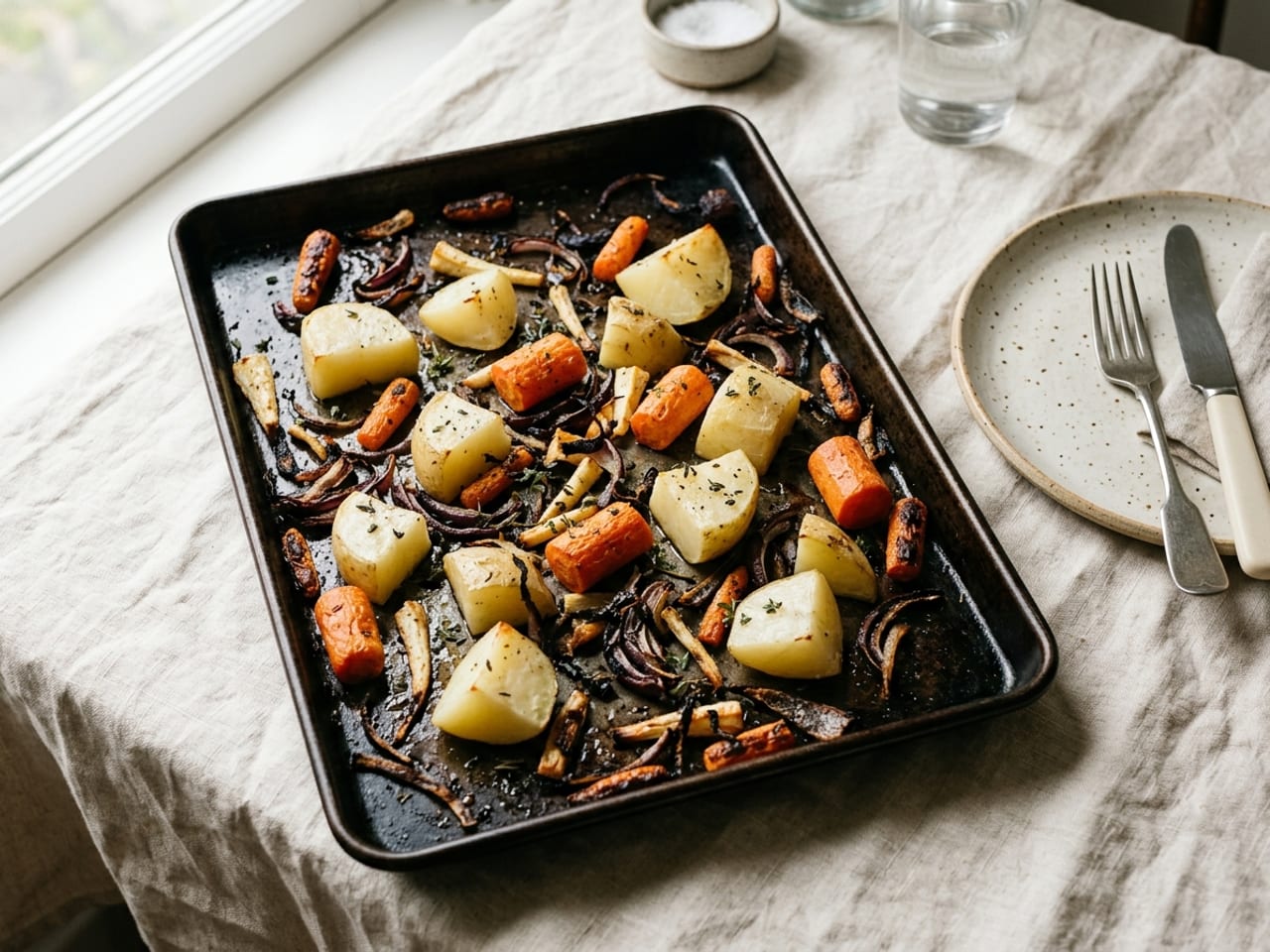
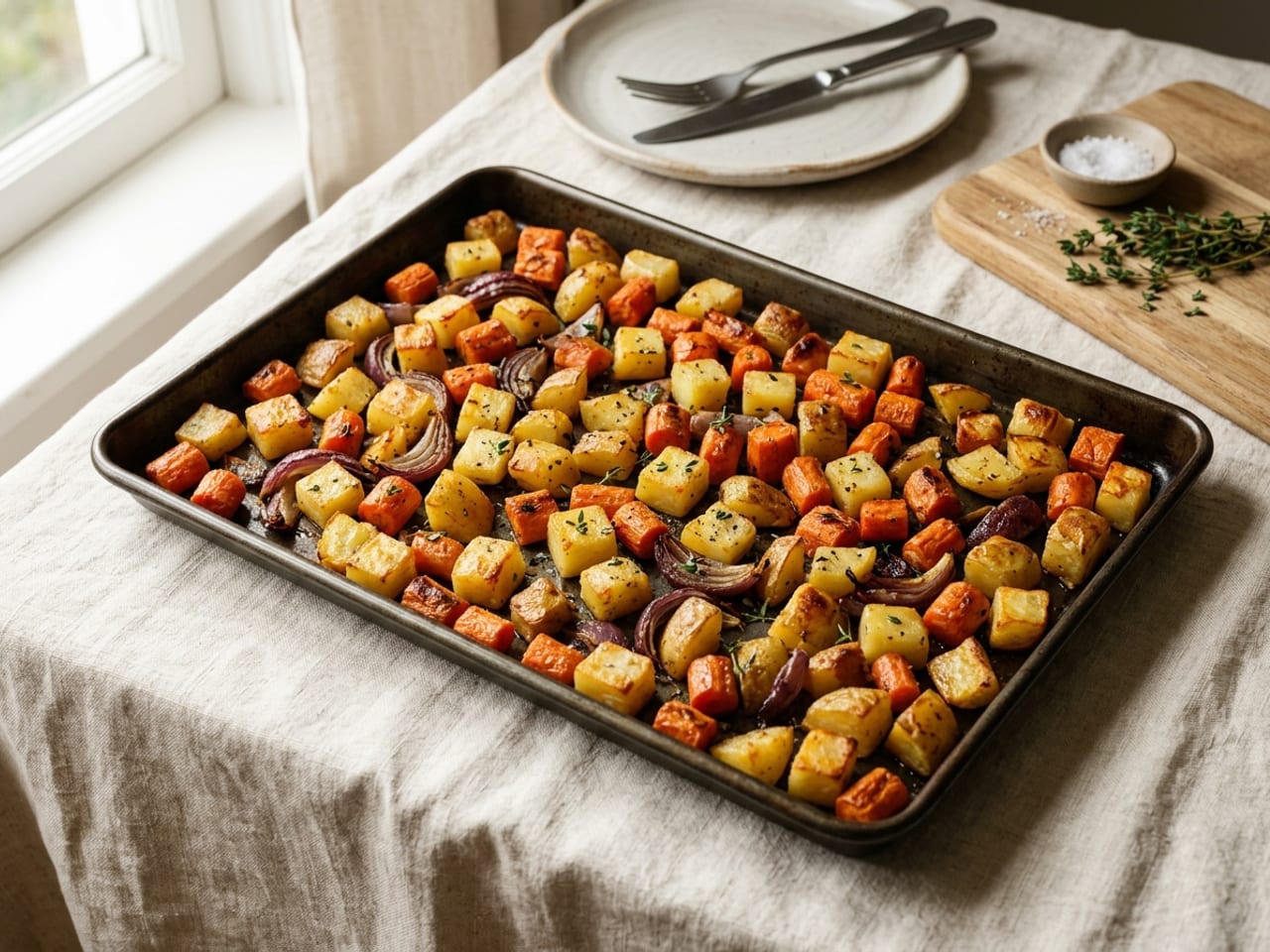
What neat cuts cost. The USDA gets 0.70 lb of raw carrot sticks (4 by ½ in, 10 by 1.3 cm) from a pound of carrots but 0.83 lb of chopped carrot, so the sticks cost about 13 more points of weight. The same guide gives 0.88 for onions, 0.80 for bell peppers, and 0.83 for celery whether it is cut into sticks or chopped.25 The Book of Yields, by contrast, gives carrots one trim yield, 81.3%, for chopped, diced or sliced.3 The USDA does not say where the stick loss goes, and its sticks are not squared off. Squaring off can cost far more: cutting a perfectly round carrot down to the largest square that fits inside it throws away about 36% of the cross-section (1 minus 2/π). Real carrots taper, and you rarely square that hard, but the lesson holds: square off only what the dish needs to look square.
Use the trimmings. Vegetable trimmings go into "purées, soups, stews, stocks, fillings for omelets and crêpes,"2 potato squarings into mash or soup,2 the onion's root end into a mirepoix,2 tourné trim into soup or purée,1 and dark leek greens into a bouquet garni.1
Troubleshooting: why your cuts come out wrong
| Problem | Likely cause | Fix |
|---|---|---|
| Julienne sticks taper into wedges | The planks weren't the same thickness, or the knife pressed straight down. | Square off first, keep every plank the same, and slice forward.1 |
| Brunoise comes out as little rectangles | The cuts across were wider or narrower than the sticks. | Cut across at exactly the stick width: ⅛ in (3 mm) for brunoise. |
| Brunoise or dice look crushed and wet | A dull edge, or pressing instead of slicing. | Hone or sharpen, and let the blade travel as it cuts: slicing takes less force than pressing.69 |
| The carrot rolls away from the knife | No flat base. | Slice a thin piece off one side and cut with that side down.1 |
| The onion falls apart before you dice it | The root end was cut off, or a cut went through it. | Halve through the root and stop every lengthwise cut short of it.2 |
| Onion dice are big at the edges, tiny in the middle | Straight-down cuts on a round, layered onion. | Aim the cuts toward a point below the board. A horizontal cut is optional: López-Alt says it helps with straight-down cuts, but The Pudding's model found it almost never does.29, 30 |
| Basil chiffonade turns black | Cut too early, or the basil was kept in the fridge. | Cut it just before serving, and store basil above about 12 °C (54 °F), not in the fridge.31, 33 |
| Chiffonade comes out in clumps | A loose roll, damp leaves, or chopping down instead of slicing. | Dry the leaves, roll them tight, draw the knife through, then fluff the ribbons apart. |
| Garlic sticks to the knife | Wet, sticky garlic and a clean blade. | A pinch of salt on the pile stops it sticking and speeds the paste.1 |
| Roll-cut carrot pieces vary wildly in size | The carrot tapers but the angle stayed the same. | Angle the knife closer to straight across as the carrot gets thicker, so the pieces stay the same size.1 |
| Fine julienne tears or bends | An edge that is no longer straight. | Hone first, or use a mandoline, wearing a cut-resistant glove on the hand that holds the food.19 |
| Your hand and forearm tire quickly | A dull knife makes you grip harder. | Sharpen it: in studies of professional meat cutters, sharper blades needed less grip force and less muscle effort.73, 74 |
Knife cuts on the plate
On a plate, the cut is the garnish. Even pieces read as care; one ragged cube in a clear soup reads as the opposite.
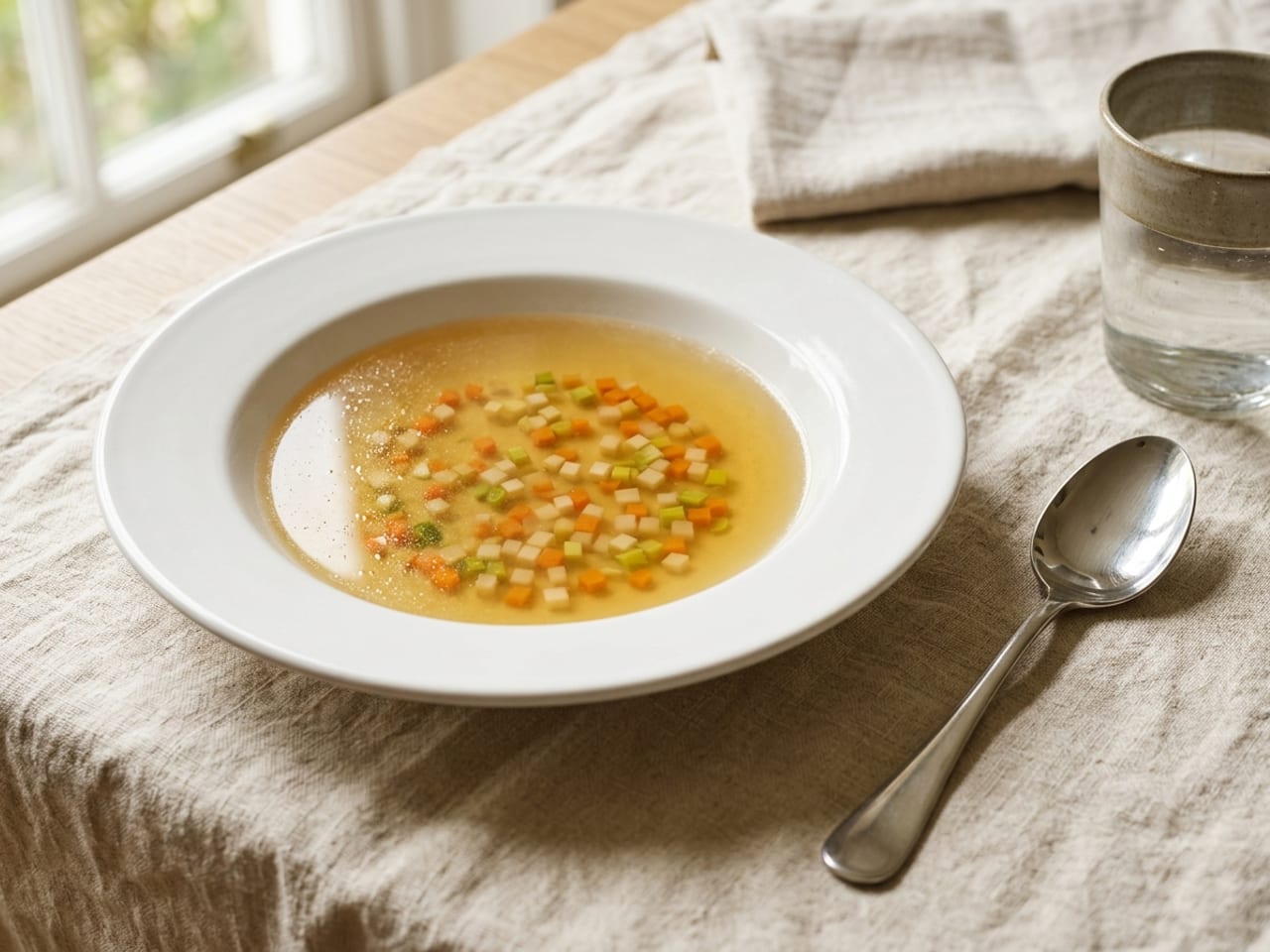
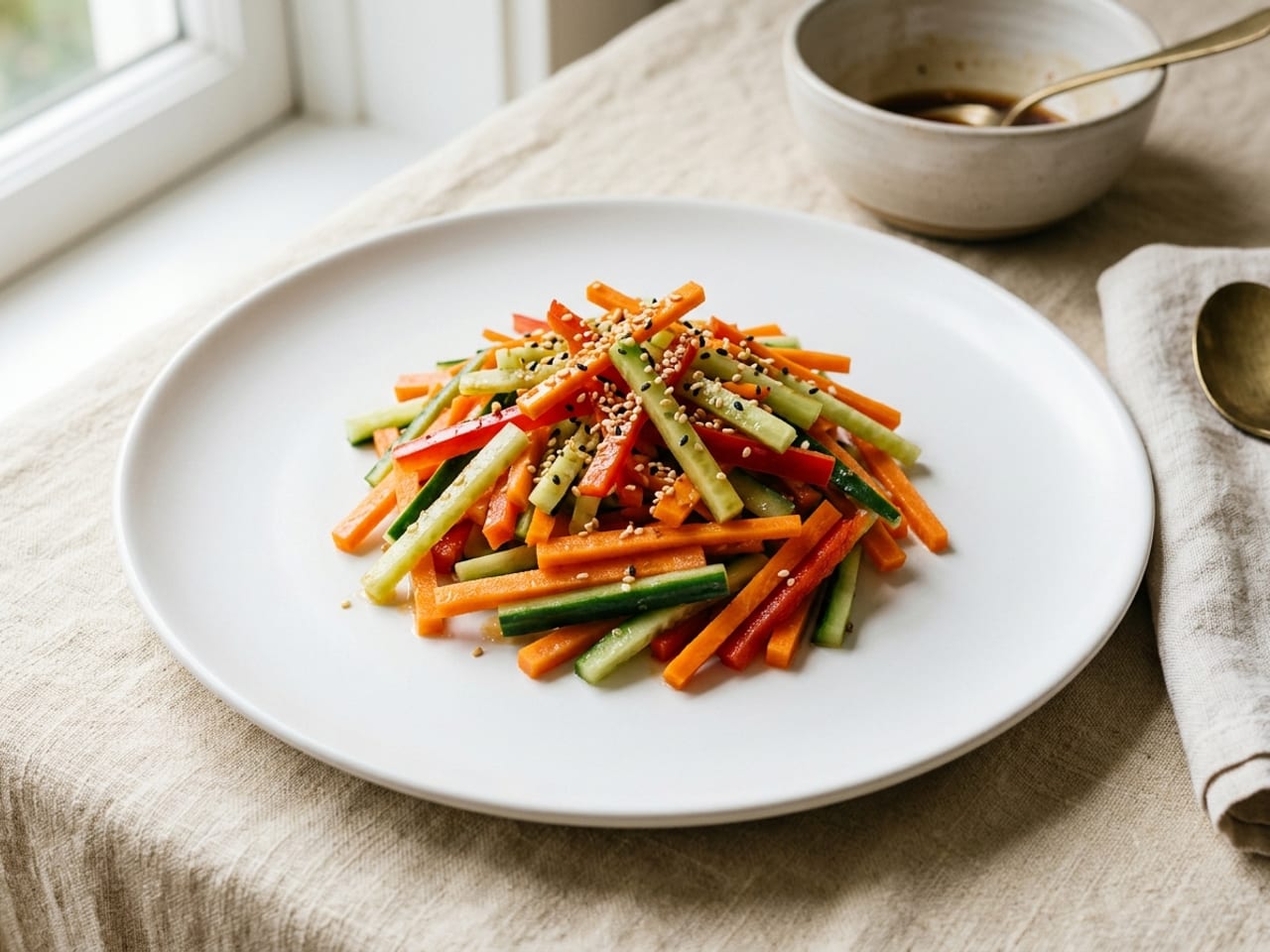
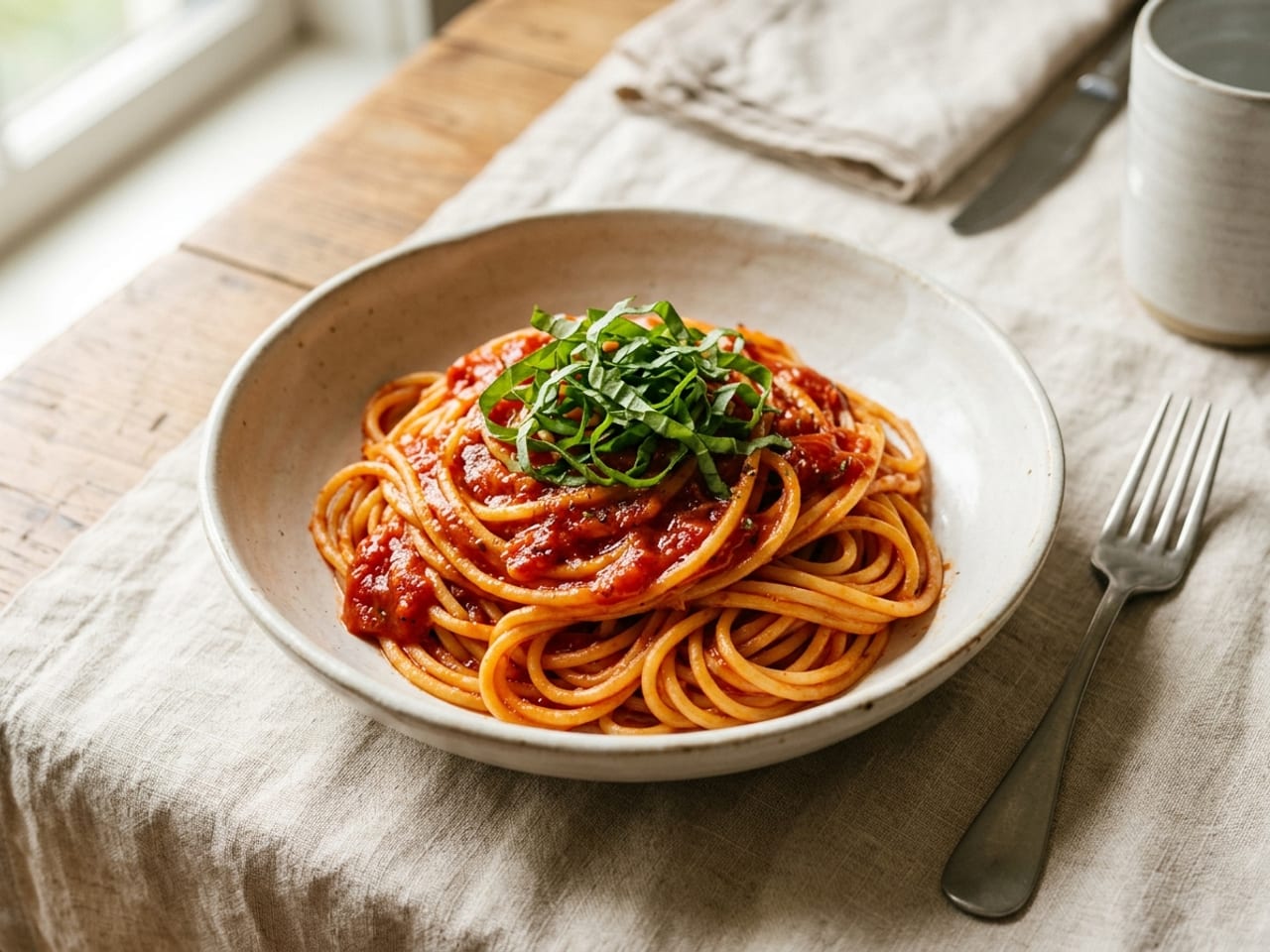
Brunoise in a clear soup is an old idea. Ude's 1813 bill of fare already lists "La Brunoise au consommé clair."89 Keep the cubes to one or two colours and a spoonful per bowl.
Choose the cut for the plate. Julienne gives line and height, brunoise gives a fine scatter or a bed, chiffonade gives a soft, loose finish, and a paysanne or dice gives body to a vegetable garnish. For how each fits a composed plate, see plating components, how to plate food and Michelin-star plating.
Slicing a cooked steak is a different job. Which way the grain runs in each cut, and where the knife goes, is in how to plate steak. Carving a roast bird at its joints is another, and has its own guide: how to carve a turkey.
Knife safety
What the injury data says, first aid, how to pass and wash a knife, boards, and how long cut vegetables keep.
- Fingers take most of the damageUS emergency departments treated about 434,000 knife injuries a year from 1990 to 2008, roughly 1,190 a day. Fingers and thumbs were 66% of them and 94% were cuts; where the knife was recorded, kitchen knives were 36%. Only 1% of patients were admitted.34 That is what the claw is for.
- Rushing, distraction and a change of method raise the riskIn 1,166 workers with acute hand injuries, the risk jumped when a tool or workpiece was not behaving as expected (11 times higher) or when using a different method from usual (10.5 times), and being rushed or distracted raised it too.35 Among 991 kitchen workers in Japan, those under the most job stress had more cuts and burns, an association rather than proof of cause.37 Learn a new cut slowly, and when interrupted, put the knife down.38
- A sharp knife is safer: the consensus and the mechanismTextbooks and OSHA agree: a sharp knife needs less pressure and is less likely to slip, while dull knives "tend to slip."2, 38 Studies of meat cutters back the mechanism, since dull blades need more grip force and muscle effort,73, 74 but no study has counted injuries by sharpness.
- First aid for a kitchen cutPress on it with a clean folded cloth and raise it above your heart; if blood soaks through, add another cloth on top.39 Once it stops, rinse it under running tap water, pat it dry and cover it with a clean dressing or plaster.39 Get emergency help if the bleeding won't stop after about 10 minutes of pressure,40 if blood spurts, if you lose feeling or movement, or for a bad cut on the palm.39 A cut deeper than about ¼ in (6 mm), or one that gapes, may need stitches.40, 42 Most cuts that need closing are closed within 6 to 8 hours, though a clean cut, such as one from a kitchen knife, can often still be treated up to about 24 hours later,42, 43 so get it seen the same day. Check your tetanus shot: a booster is due if your last one was 10 or more years ago for a clean, minor cut, or 5 or more years ago for a dirty or major wound.41
- Pass it down, carry it low, let it fallTo pass a knife, lay it down with the handle toward the other person. Carry it point down at your side, edge facing behind you, and say you're passing with something sharp. Never leave it hanging over the edge of the board or hidden under a towel.1 If a knife falls, step back and let it fall.2, 38
- Wash knives by hand, never in a sink full of waterDon't drop knives into a sink or leave them under water where they can't be seen; wash them with the edge away from you and store them in a rack.2 The CIA says not to use a dishwasher,1 and makers agree, because the detergent and heat can damage the blade.44
- Boards: separate, washed and replaced when scarredKeep one board for produce and bread and another for raw meat, poultry and seafood.45 Cutting lettuce on a board and knife just used for raw chicken moved Salmonella onto it; a water rinse cut the transfer but didn't stop it, while soap and hot water brought it close to nothing.81 Wash boards in hot, soapy water after each use; to sanitize, flood the clean board with 1 tablespoon of unscented bleach per gallon (3.8 L) of water, let it stand several minutes, then rinse,45 and replace a board once its grooves can't be cleaned.45, 46 Colour-coded boards (red for raw meat, green for produce) are a good habit,47 not a Food Code requirement.
- Cut produce goes in the fridgeThe FDA Food Code treats cut leafy greens (lettuce, spinach, cabbage, kale), cut tomatoes, cut melon and garlic-in-oil mixtures as foods that need temperature control, held at 41 °F (5 °C) or below.46 So a lettuce or cabbage chiffonade is a cut leafy green; a basil chiffonade is not in that definition (herbs are excluded), but cut it just before serving rather than holding it; it is whole basil that should stay out of the fridge (why). At home, get cut vegetables into the fridge within 2 hours, 1 hour above 90 °F (32 °C).48 Use cut onion within about a week.50, 51
A knife skills practice drill
"The goal is consistency and speed. Without practice, it is impossible to achieve either."1 Julia Child reckoned on "several weeks of off-and-on practice,"12 and Tom Colicchio learned from Jacques Pépin's books by buying celery at 39 cents a head just to practise his mirepoix.104 The Culinary Institute of America's blog lists five basic knife skills: keep the knife sharp, hone it, set up your work area, choose the right knife and know your cuts.108
The drill. This is adapted from the FCCLA student knife-skills event, which gives contestants 15 minutes to make "six (6) uniform and appropriate pieces" of each of three cuts, with no rulers, and scores the top band as "correct cut, identical in size and shape."105
- Set up: board on a damp towel, a sharp knife, two carrots, one potato, half an onion, a few basil leaves.
- Cut six even pieces each of julienne, brunoise and small dice, plus a chiffonade of the basil and the onion diced. The first few times, ignore the clock; the contest's 15 minutes is a target for later.
- Check your six against the knife cuts chart at actual size (calibrate it with a bank card, or print it at 100%).
- When all six of each match the chart, try it against the 15 minutes. Speed comes from repetition, never from rushing. Cook everything you cut.
How the competitions test it. The SkillsUSA national high-school contest gives knife skills 50 of 1,000 points, with tasks such as small dice from half an onion, four minced garlic cloves and 2 oz (57 g) of carrot julienne at ⅛ × ⅛ × 2 in, handed in during a 5-minute window.106 The American Culinary Federation's Certified Culinarian practical asks for 2 oz (57 g) of julienne carrot, 4 oz (113 g) of batonnet carrot, 4 tablespoons of fine chopped parsley and a pound (450 g) of mirepoix, each scored on weighing and on uniformity.107 Note that it names the cuts by weight and prints no sizes.
A short history of julienne, brunoise and chiffonade
Julienne was a soup long before it was a cut. It first appears in Massialot's Cuisinier roïal et bourgeois of 1691 (not the 1722 edition often cited) as "Potages à la Julienne," and in Massialot's recipe, still in print around 1730, the vegetables went in whole, quartered or tied in bundles, not in strips.85, 86 The earliest strips we found are from the 1750s: Menon cuts the soup's roots and greens "en petit filets" in 1755 and, in the same book, cuts roots "comme pour une Julienne," the earliest use of the word as a shape we found.87 In English, William Verral's 1759 julienne soup has carrot about an inch long, sliced very thin, then cut into strips,88 and in 1813 L. E. Ude uses it as a reference shape: parsley roots "cut in the like manner as for the julienne," and elsewhere slices "as for a julienne, about one line thick and one inch long."89 Carême in 1833 gives the modern method: cut to length, slice into ribbons, then into strips about 2.3 mm square.92
No Jean Julien has ever been found. The French historical dictionary says the word probably comes from the first name Julien or Julienne and that how it came to mean the soup "remains obscure";98 Etymonline says it was "presumably the name of an otherwise unknown cook."99 A chef called Jean Julien appears in no period source we read, only in modern web copy.
Brunoise: Brunoy, probably. "Un potage à la Brunoy" (Brunoy is a town south-east of Paris) is in print in 1808.90 Ude's "La Brunoise" of 1813 fries the diced roots "without having lost their original colour,"89 while Beauvilliers in 1814 browns them and, when the soup has rice in it, wants the dice no bigger than the cooked rice,91 and Carême colours his light blond.92 So browning was one practice, not the definition, and the "from brun, brown" story is unproven. Ude's use also predates the Oxford English Dictionary's earliest English evidence, 1828.100
Chiffonade comes from the word for a rag. It is built on French chiffon, a rag, through the verb chiffonner, to crumple, with the cookery ending -ade.98 Modern French spells it chiffonnade, English chiffonade. Like julienne it first turns up in soups: a "potage de chiffonnade" is listed in 1767, 65 years before the French dictionary's 1832 date.93, 98 Escoffier in 1907 didn't roll the leaves; he squeezed them "tightly between the fingers of the left hand and the table" and cut fine strips.96
The first mirepoix recipes had no carrot, onion or celery. "Des cailles, à la Mirepoix" is on the same 1808 menu page as the Brunoy soup,90 and Ude's 1813 mirepoix is ham, bacon, butter, bay, parsley and lemon juice.89 Escoffier's 1907 mirepoix is carrot, onion and celery cut into a brunoise, with ham or lean bacon.95 The earliest attribution we found, Grimod's in 1808, credits quails à la Mirepoix to the Maréchale de Mirepoix, the duke's wife, not to the duke's cook;90 we found no 18th-century print of the word.
Dice and mince are the old English words. The Forme of Cury, written by Richard II's cooks around 1390, tells you to "dyce hem" and to cook onions "grete mynced."97 Both verbs go back to the late 14th century.99 Mise en place, everything prepared before you cook, is dated in English to 1876 by Merriam-Webster,101 and Escoffier's 1907 English glossary defines it as "those elementary preparations which are constantly resorted to."96
Teaching it with pictures. Julia Child's 1961 Mastering the Art of French Cooking already teaches the knuckle-guided claw.12 Jacques Pépin's La Technique (1976)102 printed more than 1,500 step photographs,103 and its companion La Méthode "focused heavily on knife skills, from how to hold your knife to julienning vegetables."104
The science of cutting, honestly
What peer-reviewed studies show, including where they found nothing. Several come from factories and meat plants rather than home kitchens, and we say so.
- Why onions make you cryCutting breaks cells, so the enzyme alliinase meets its substrate and makes a sulfenic acid; a second enzyme, lachrymatory factor synthase, turns that into the tear gas, syn-propanethial-S-oxide. Until 2002 that last step was thought to happen on its own.56 Silencing the enzyme's gene sharply cut the tear factor and shifted the onion's flavour chemistry,57 and a low-alliinase line made without genetic modification (the seeds were irradiated) produced about 7.5 times less and was rated tearless.58 The tear factor and its breakdown products dominate what a cut onion gives off in the first 10 minutes.59
- What helps with onion tears, and what's untestedHigh-speed filming showed that blunter or faster blades throw significantly more droplets, with more energy, out of a cut onion, so a sharp knife and a slower stroke plausibly help; the study counted droplets, not tears.60 Chilling the onion, candles, bread in your mouth and cutting under water have no peer-reviewed tests, and the "70% less tear gas" figures online trace to no paper we could find.
- The 10-minute garlic rule rests on one rat studyAllicin forms within seconds of crushing: about 20 seconds at body temperature.61 The advice to let crushed garlic stand 10 minutes before heating comes from a rat study of anticancer markers that tested only that one standing time.62 A later study found that after 6 minutes of heating, crushed garlic kept some antiplatelet activity that uncrushed cloves had lost; after more than 10 minutes, both had lost it.63 Both measured health markers, not flavour. Nothing shows 10 minutes is needed.
- A sharp blade keeps cut produce fresher (with nulls)Cutting sets off a wound response that grows with the cut surface per gram: carrot shreds breathe harder than slices or sticks.64 Carrot slices cut with a blunt blade had the most damage and microbial growth, a razor the least.66 Shredded lettuce kept longest cut by a sharp blade with a slicing motion,65 melon pieces cut sharp were still marketable at 6 days when blunt-cut pieces were not,67 and apple slices lasted 14 days from the sharpest blade against 5 from the dullest.68 The nulls: sharpness did not change the melon's sugar, aroma or firmness, or the apples' nutrients.67, 68 In the lettuce study, temperature mattered most of all.65
- What sharp means, and why slicing beats pressingSharpness comes down to the radius of the very tip of the edge, and how much blunting matters depends on the food.70 The more the blade slides along the cut compared with how fast it presses down, the less force the cut takes, which is the physics behind "let the knife glide."69
- Edge angles: the evidence is mixedOn nine vegetables in a lab testing machine, a 15° edge took less force than 25°, though at cutting speeds hundreds to thousands of times slower than real knife work.71 In two meat-plant tasks, three edge angles made no significant difference to grip force, while a finer polish after sharpening did, in one of the two.72
- Wood or plastic boards: the studies disagreeBacteria soaked into clean wood and generally couldn't be recovered, while heavily knife-scarred plastic was hard to clean by hand;75, 76 yet another lab found plastic cleaner after standard commercial food-service washing and sanitising,77 others found E. coli still about 75% viable inside wood,78 Salmonella surviving longest in scored wood,79 and, recently, the shortest survival on wood.80 What most of them agree on: knife scars in either material hold bacteria and make a board harder to clean,76, 79 and soap and hot water remove nearly all of them from a board in good condition.76, 81
- Does the shape change the taste? Mostly noChildren aged 9 to 12 liked sticks and slices equally (stars best);82 for 3 to 5 year olds, repeated tasting mattered and no shape won.83 In one study, rounded chocolate pieces tasted sweeter than angular ones,84 but no study we found shows a julienne tasting different from a dice.
Ten knife skills myths
- "Julienne is named after a chef called Jean Julien"No early source we found names any cook. The French historical dictionary derives it probably from the first name Julien or Julienne and calls the change of meaning "obscure";98 Etymonline says "presumably the name of an otherwise unknown cook."99 See where the words come from.
- "Let crushed garlic rest exactly 10 minutes"The one study behind it tested only 10 minutes, in rats, for anticancer markers, not flavour.62
- "There's an ACF standard size chart"We couldn't find one. The American Culinary Federation's certification exam names cuts by weight ("Julienne carrot, 2 ounces") and points to textbooks,107 and though some student contests refer to ACF guidelines,105 we found no published ACF size table. The US sizes come from the CIA, Gisslen and On Cooking, which is what the knife cuts chart uses.
Knife skills glossary
Grips, motions and tools. The names and sizes of the cuts themselves are on the knife cuts chart.
Pinch grip · blade grip
Holding a chef's knife with the thumb and the side of the curled index finger pinching the blade just in front of the handle, the other three fingers wrapped round the handle, so you steer the blade itself.
Handle grip
Holding the knife by the handle alone, every finger behind the bolster; it feels secure but gives little control of the tip, so it is kept for honing and rock-mincing.
Guiding hand
The hand that is not holding the knife: it holds the food still, feeds it to the blade and sets the thickness of each slice.
Claw grip · bear claw
The shape of the guiding hand: fingertips curled back, thumb tucked behind them, and the flat of the blade riding against the front knuckles so the fingertips stay behind the edge.
Rock chop · rocking cut
A cut in which the tip stays on the board as a pivot while the heel rises and falls, slicing forward on the way down; the usual motion for a curved chef's knife.
Push cut
Driving the blade down and forward through the food in one stroke until the edge meets the board; the natural cut for flat-edged knives such as the nakiri.
Pull cut · draw cut
Starting with the heel on the food and drawing the blade back toward you, finishing at the tip; used for soft foods and herbs that would bruise under downward pressure.
Tap chop
Lifting the whole blade and bringing it straight down with no rocking, the traditional Japanese vegetable motion; an informal name with no textbook entry.
Rocking mince
Mincing herbs or garlic by holding the knife tip against the board and rocking the heel rapidly across a pile, gathering the pile and repeating until it is fine.
Squaring off
Trimming the rounded sides off a vegetable so it sits flat and can be cut into even planks, sticks and cubes; the trimmings go to stock, soup or purée.
Planking
Slicing a squared-off vegetable lengthwise into flat slabs of equal thickness; the plank thickness sets the size of the sticks and cubes cut from it.
Tip · point
The front end of the blade, used for fine work such as scoring, trimming and the first cuts into an onion.
Heel
The rear, widest part of the cutting edge next to the handle, which gives the most leverage for hard foods.
Spine
The blunt top edge of the blade, which gives it rigidity; use it, not the edge, to scrape food across the board.
Bolster
The thick collar of steel where the blade meets the handle on most forged knives; it adds balance and guards the fingers.
Edge and bevel
The edge is the sharpened line of the blade and the bevel the ground face that forms it; most makers quote the bevel angle per side (Victorinox quotes the total), so a 15-degree knife is 30 degrees in total.
Honing
Drawing the edge along a steel rod at the knife's angle to straighten an edge that has rolled out of line; a smooth steel realigns the edge but cannot restore a worn one.
Sharpening
Grinding away steel, usually on a whetstone, to form a new edge when honing no longer works: coarse grit first to set the edge, finer grits to refine it.
Mise en place
French for 'put in place': every ingredient washed, cut and measured, and the tools laid out, before the cooking starts.
Mandoline
A flat slicing frame with a fixed, adjustable blade that food is slid across for thin, even slices or julienne; used with a cut-resistant glove on the hand holding the food, and the hand guard if it grips well.
Bird's beak knife · tourné or peeling knife
A short paring knife whose blade curves down like a beak, made for peeling round produce and carving tourné shapes.
Santoku
A Japanese all-purpose knife, shorter than a chef's knife, with a flatter edge and a rounded, dropped tip; suited to push cuts and up-and-down chopping more than rocking.
Nakiri
A Japanese vegetable knife with a thin, tall rectangular blade, a straight edge and a square end, used with push cuts and straight chops, not rocking.
Cut-resistant glove
A knit or mesh glove for the guiding hand, rated A1 to A9 under ANSI/ISEA 105 or A to F under EN 388 for how much blade force it withstands; it resists slicing, not stabbing.
Now plate it
Neat cuts are half of a good-looking plate; the other half is where they go. Photograph a dish you cooked and Plate Artists re-plates your own dish the way a chef would, with the moves named so you can do it again for real.
Your dish, plated like a chef's
Snap it, upload it, and get the composed version back, with the steps to recreate it on a real plate.
Start free · 1 enhancement →Free account · 1 free enhancement · No credit card
Knife skills, answered
What is the difference between julienne and brunoise?
A julienne is a stick and a brunoise is the cube you cut from it. A julienne is ⅛ × ⅛ × 1 to 2 in (3 × 3 × 25 to 50 mm); line the sticks up and cut straight across them at the same width and you get brunoise, ⅛ × ⅛ × ⅛ in (3 × 3 × 3 mm). A fine julienne gives a fine brunoise, 1/16 × 1/16 × 1/16 in (1.5 × 1.5 × 1.5 mm).
What is the difference between chiffonade and julienne?
Julienne is for firm vegetables cut into square sticks of a set size, ⅛ × ⅛ × 1 to 2 in (3 × 3 × 25 to 50 mm). Chiffonade is for leaves: stack them, roll them tight and slice across the roll into fine ribbons, with no set width. Both are long and thin, but a julienne is a square stick and a chiffonade ribbon is flat.
What size is a julienne cut?
A julienne is ⅛ × ⅛ × 1 to 2 in (3 × 3 × 25 to 50 mm) in the US culinary textbooks. On Cooking gives a fixed 2 in length. Names drift: the SkillsUSA chart calls this size allumette and keeps julienne for the 1/16 in stick, and some cooking sites put allumette at ¼ in. In France, Larousse gastronomique cuts julienne 1 to 2 mm thick and 3 to 5 cm long. A fine julienne is 1/16 × 1/16 × 1 to 2 in (1.5 × 1.5 × 25 to 50 mm).
What size is a brunoise cut?
A brunoise is ⅛ × ⅛ × ⅛ in (3 × 3 × 3 mm), cut from a julienne. Escoffier's Guide culinaire of 1907 also cuts it 3 mm. Later French and British books go finer: 1 to 2 mm in Larousse gastronomique, 2 mm in Practical Cookery. A fine brunoise is 1/16 × 1/16 × 1/16 in (1.5 × 1.5 × 1.5 mm).
What is the smallest knife cut?
The fine brunoise, 1/16 × 1/16 × 1/16 in (1.5 × 1.5 × 1.5 mm), is the smallest cut with a set size. It is cut from a fine julienne. Minced food can be finer, but mince has no set size: it just means chopped very small.
What are the 5 basic knife skills?
There is no official list. The Culinary Institute of America's own blog names five: keep your knife sharp, hone it, set up your work area, choose the right knife and know your cuts. For a home cook, the five habits that fix most problems are the pinch grip on the knife, the claw on the food, a flat side on anything round, slicing instead of pressing, and cutting everything in a dish to one size.
What is the claw grip in cooking?
The claw is how you hold the food, not the knife. Curl your fingertips back, tuck your thumb behind them and rest the food under them; the flat of the blade rides against your front knuckles, which guide it, so the fingertips stay out of the blade's path. After each slice, move the claw back by the same step.
How should you hold a chef's knife?
With a pinch grip: pinch the blade just in front of the handle between your thumb and the side of your curled index finger, and wrap your other three fingers round the handle. It gives far more control than holding the handle alone. Keep the wrist firm and slice forward or back rather than pressing straight down.
What is the best knife for julienne and brunoise?
A sharp 8-inch (20 cm) chef's knife does both. A santoku or a nakiri works just as well, because julienne and brunoise are push cuts that suit a flatter edge. What matters more than the shape is a sharp, recently honed edge. For fine julienne, a mandoline is easier; wear a cut-resistant glove on the hand that holds the food.
How do you julienne without a mandoline?
With a knife: cut the vegetable into lengths of 1 to 2 in (25 to 50 mm), square off each length, slice it into planks ⅛ in (3 mm) thick, stack two or three planks and cut them into strips of the same width. A julienne peeler is faster for carrots and zucchini but gives thinner, flat-faced strands, and a box grater gives shreds rather than sticks.
How do you keep basil from turning black after chiffonade?
Cut it just before serving: cut basil darkens quickly, and oiling the whole leaves first barely slows it. Keep whole basil out of the fridge, since cold is the documented cause of blackening: it keeps about 12 days at 15 °C (59 °F) but 1 day at 0 °C (32 °F). Use a sharp knife and slice rather than chop down.
Which herbs can you chiffonade?
Large, tender, flat leaves that stack and roll: basil, mint, sage and sorrel, plus leafy greens such as lettuce, spinach, kale and cabbage. Small-leaved herbs like parsley, cilantro, thyme and rosemary don't stack or roll, so gather them into a tight bunch and chop or mince them instead.
What does brunoise mean?
Brunoise (pronounced broon-WAHZ) is the ⅛ × ⅛ × ⅛ in (3 × 3 × 3 mm) dice cut from a julienne. The name probably comes from Brunoy, a town south-east of Paris: 'potage à la Brunoy' is in print in 1808, before 'potage à la brunoise'. The popular 'browned' explanation is weak: the earliest recipe we found, from 1813, keeps the dice uncoloured, although later cooks browned them. No source explains the naming, so treat both as unproven.
What is the difference between batonnet and julienne?
Thickness. A batonnet is ¼ × ¼ × 2 to 2½ in (6 × 6 × 50 to 60 mm); a julienne is ⅛ × ⅛ × 1 to 2 in (3 × 3 × 25 to 50 mm). Both are cut the same way, from planks, and each is the stick behind a dice: batonnet gives small dice and julienne gives brunoise.
How do you dice an onion?
Cut the onion in half through the root, peel it and lay one half flat side down. With the root away from you, make lengthwise cuts from the stem end almost to the root without cutting through it, aiming them down toward a point below the board (or cutting straight down and adding a horizontal cut or two, with your palm flat on top of the onion and your fingers lifted clear of the blade). Then slice across the cuts and the onion falls into dice. Space the cuts 1/4 to 1/2 inch (6 to 13 mm) apart for diced onion, 1/8 to 1/4 inch (3 to 6 mm) for minced.
The textbooks, scans and research behind this guide
Two culinary textbooks and a yield handbook read in Google Books snippets; test kitchens, knife makers and standards bodies; the FDA, USDA, CDC, OSHA and health services; old cookbooks read in Gallica, Internet Archive and Project Gutenberg scans; dictionaries (some dates read through search snippets where the sites blocked us); and 37 peer-reviewed papers, each verified through Crossref. Every size comes from the knife cuts chart, which lists its own sources. Steps with no marker (the julienne peeler, stacking the largest leaf at the bottom, the practice drill's details) are standard kitchen practice.
- The Culinary Institute of America (2011). The Professional Chef, 9th edition. Wiley, Hoboken, knife safety p. 44, knife types p. 47, sharpening and honing pp. 48-51, grips and slicing p. 618, herbs p. 620, cuts pp. 623-627, garlic pp. 633-634, leeks p. 635, practice p. 645; read in Google Books search-inside snippets. books.google.com
- Gisslen, W. (2011). Professional Cooking, 7th edition. Wiley, Hoboken, knife safety p. 36, trimmings p. 121, sharpening p. 141, grips, slicing, dicing and tourné pp. 142-148; read in Google Books search-inside snippets. books.google.com
- Lynch, F. T. (2007). The Book of Yields, 7th edition. Wiley, Hoboken, trim yields: carrots 81.3% for any cut, onions and shallots 90.6%, garlic 88.1%, pepper membrane sliced off for brunoise; read in Google Books snippets. books.google.com
- Bomze, L. / America's Test Kitchen (2018). A guide to using your chef's knife. America's Test Kitchen, the pinch grip, the handle grip, the claw, the rocking motion, honing versus sharpening. americastestkitchen.com
- Libretti, G. (2025). Master basic knife skills. Michigan State University Extension, the pinch grip, the claw, a damp towel or non-slip mat under the board. canr.msu.edu
- Shun Cutlery (2026). Know your knife: anatomy and the perfect chef's grip. shun.kaiusa.com, the parts of a knife, the pinch grip and the claw. shun.kaiusa.com
- Shun Cutlery (2026). Santoku vs chef knife: different kitchen knife shapes. shun.kaiusa.com, the nakiri is not rocked but push-cut; the santoku is shorter than a chef's knife. shun.kaiusa.com
- Musashi Hamono (2026). Push cut vs. pull cut with a Japanese knife. musashihamono.com, the pull cut starts at the heel and draws the blade toward you, for delicate vegetables and herbs. musashihamono.com
- ZWILLING (2026). Japanese knives: some nuggets of information. zwilling.com, Japanese knife culture: chop by lifting the knife and bringing it down; Western: rock. zwilling.com
- WÜSTHOF (2026). What is a santoku knife? wusthof.com, a straight up-and-down chop with the tip kept on the board; a 10-degree edge per side on its santoku against 14.5 on its chef's knife. wusthof.com
- Canadian Centre for Occupational Health and Safety (2022). Working in a standing position: basic information. ccohs.ca, work heights for precision, light and heavy work relative to elbow height. ccohs.ca
- Beck, S., Bertholle, L. & Child, J. (1961). Mastering the Art of French Cooking. Knopf, New York, knives p. 6, chopping, slicing, dicing and mincing pp. 26-30; read in the Internet Archive scan. archive.org
- Levine, K. S. & Bromberg, M. / America's Test Kitchen (2026). The best chef's knives. America's Test Kitchen, 7 July 2026: 8-inch blades as the most versatile length, gently curved edges, measured edge angles of 13 to 16 degrees. americastestkitchen.com
- Tormek (2020). Knife sharpening angles: manufacturer's recommendations. tormek.com (PDF), per-side angles from Wüsthof, Zwilling, Victorinox, Global, MAC and Shun. tormek.com (PDF)
- ZWILLING (2026). Knife sharpening: use and care. zwilling.com, honing realigns the edge's teeth, sharpening regrinds it; the paper test. zwilling.com
- America's Test Kitchen (2017). The best santoku knives. America's Test Kitchen, 25 September 2017: developed for postwar Japanese home cooks; the early-2000s US boom. americastestkitchen.com
- Kotobank (2026). 三徳包丁 (santoku bōchō); 菜切包丁 (nakiri bōchō). kotobank.jp (Digital Daijisen, Nihon Kokugo Daijiten, Kōdansha), the santoku named for meat, fish and vegetables; the nakiri as a thin, wide, square-ended vegetable knife, first cited 1894. kotobank.jp
- WÜSTHOF (2026). Classic 2¾" peeling knife. wusthof.com, also known as a turning or tourné knife, with a short bird's beak-shaped blade. wusthof.com
- Bromberg, M. / America's Test Kitchen (2021). How to use a mandoline. America's Test Kitchen, 18 February 2021: glove, guard, don't push harder, a flat dry surface. americastestkitchen.com
- US Consumer Product Safety Commission (2018). Sharper Image and Frigidaire mandoline slicers recalled due to laceration hazard. cpsc.gov, 1 May 2018: julienne blades that could separate from the plastic assembly. cpsc.gov
- MCR Safety (2024). ANSI/ISEA Standard 105-2024. mcrsafety.com, cut levels A1 to A9 in grams of cutting load. mcrsafety.com
- uvex safety (2016). Change to the standard regulating cut protection safety gloves: EN 388:2003 compared to EN 388:2016 and ISO 13997. uvex-safety.com, 20 June 2016: letter levels A (2 N or more) to F (30 N or more). uvex-safety.com
- Ergodyne (2021). ANSI 105 & EN 388: what you need to know. ergodyne.com, 22 November 2021: how the cut test works; puncture is rated separately from cut. ergodyne.com
- Smitten Kitchen (2016). How to julienne. smittenkitchen.com, August 2016: slice on the bias, shingle the slices, cut them into strips. smittenkitchen.com
- USDA Food and Nutrition Service (2025). Food Buying Guide for Child Nutrition Programs, Section 2: Vegetables (yield table). foodbuyingguide.fns.usda.gov, carrots 0.70 lb of 4 by ½ in sticks or 0.83 lb chopped per pound as purchased; onions 0.88; celery 0.83; bell peppers 0.80. fns.usda.gov (PDF)
- America's Test Kitchen (2016). How to cut an onion. Cook's Illustrated, 12 April 2016: choke up on the heel; the bear claw; cut spacing for diced and minced onion. americastestkitchen.com
- America's Test Kitchen (2026). A different way to chop onions. Cook's Illustrated, vertical cuts, quarter, turn and cut again: no horizontal cuts. americastestkitchen.com
- Pang, K. / America's Test Kitchen (2021). The easiest, best way to cut an onion: learn the leapfrog technique. America's Test Kitchen, 16 July 2021. americastestkitchen.com
- López-Alt, J. K. (2021). Dicing an onion: radial cuts aimed 60% below the board. Instagram, 5 November 2021. instagram.com
- Aquino, A., Samora, R. & Diehm, J. (2025). Dicing an onion, the mathematically optimal way. The Pudding, August 2025: modelled spread of piece sizes for four cutting plans. pudding.cool
- America's Test Kitchen (2026). Chopping and using fresh basil. Cook's Country, cut basil turns dark quickly; oil barely slows it on whole leaves; chop just before serving. americastestkitchen.com
- Lange, D. D. & Cameron, A. C. (1994). Postharvest shelf life of sweet basil (Ocimum basilicum). HortScience, 29(2), 102-103. doi:10.21273/hortsci.29.2.102
- Brindisi, L. J. & Simon, J. E. (2023). Preharvest and postharvest techniques that optimize the shelf life of fresh basil (Ocimum basilicum L.): a review. Frontiers in Plant Science, 14, 1237577. doi:10.3389/fpls.2023.1237577
- Smith, G. A. (2013). Knife-related injuries treated in United States emergency departments, 1990-2008. Journal of Emergency Medicine, 45(3), 315-323. doi:10.1016/j.jemermed.2012.11.092
- Sorock, G. S., Lombardi, D. A., Hauser, R., Eisen, E. A., Herrick, R. F. & Mittleman, M. A. (2004). A case-crossover study of transient risk factors for occupational acute hand injury. Occupational and Environmental Medicine, 61(4), 305-311. doi:10.1136/oem.2002.004028
- Sorock, G. S. et al. (2004). Glove use and the relative risk of acute hand injury: a case-crossover study. Journal of Occupational and Environmental Hygiene, 1(3), 182-190. doi:10.1080/15459620490424500
- Haruyama, Y. et al. (2014). Burn and cut injuries related to job stress among kitchen workers in Japan. Industrial Health, 52(2), 113-120. doi:10.2486/indhealth.2013-0143
- Occupational Safety and Health Administration (2026). Young worker safety in restaurants: food preparation. osha.gov, dull knives tend to slip; let a falling knife fall; put the knife down when interrupted. osha.gov
- NHS (2026). Cuts and grazes. nhs.uk, reviewed 2 April 2026: pressure with a clean cloth, raise it, when to go to A&E. nhs.uk
- MedlinePlus (2025). Cuts and puncture wounds. US National Library of Medicine, reviewed 14 October 2025: call for help if bleeding continues after 10 minutes of pressure; stitches for wounds deeper than a quarter inch. medlineplus.gov
- Centers for Disease Control and Prevention (2026). Clinical guidance for wound management to prevent tetanus. cdc.gov, 8 September 2026: a booster for clean, minor wounds if the last dose was 10 or more years ago, for dirty or major wounds if 5 or more; read in the Internet Archive capture. cdc.gov
- Kaiser Permanente (2026). Cuts: when stitches are needed. kaiserpermanente.org, current as of 27 February 2026: most cuts closed within 6 to 8 hours, a cut from a clean kitchen knife up to 12 to 24 hours after. kaiserpermanente.org
- Grover, P. / Cleveland Clinic (2025). How do you know if you need stitches? health.clevelandclinic.org, 1 December 2025: a window of about 24 hours. clevelandclinic.org
- ZWILLING (2026). Product guide: knives. zwilling.com, wash knives by hand; dishwasher detergent and heat can damage the blades. zwilling.com
- USDA Food Safety and Inspection Service (2024). Cutting boards. fsis.usda.gov, updated 27 August 2024: wood or nonporous boards, separate boards, bleach sanitizing, discard worn boards; read in the Internet Archive capture. fsis.usda.gov
- US Food and Drug Administration (2022). Food Code 2022. fda.gov, §1-201.10 (time/temperature control for safety food, cut leafy greens), §3-501.16, §3-501.17, §4-501.12, §4-602.11. fda.gov
- University of Minnesota Extension (2026). Food safety. extension.umn.edu, color-coded boards: red for raw meat, white for cooked meat, green for produce; read in the Internet Archive capture. extension.umn.edu
- Centers for Disease Control and Prevention (2019). Outbreak of Salmonella infections linked to pre-cut melons. cdc.gov, April 2019: refrigerate cut fruit and vegetables within 2 hours, 1 hour above 90 °F. archive.cdc.gov
- National Center for Home Food Preservation (2026). Freezing garlic in oil. nchfp.uga.edu, garlic-in-oil kept in the refrigerator at 40 °F or lower for no more than 4 days, or frozen; at room temperature it risks botulism. nchfp.uga.edu
- National Onion Association (2026). Common onion myths; FAQs. onions-usa.org, the leftover-onion myth; cut onions keep up to 7 days in a sealed container in the fridge (its FAQ page says 7 to 10 days at 40 °F or below). onions-usa.org
- Full Fact (2020). Cut onions are safe to eat for about a week if kept in the fridge. fullfact.org, 28 February 2020. fullfact.org
- Centers for Disease Control and Prevention (2020). Salmonella Newport infections linked to onions (final update). cdc.gov, 1,127 ill in 48 states, 167 hospitalized. archive.cdc.gov
- Centers for Disease Control and Prevention (2024). E. coli outbreak linked to onions served at McDonald's. cdc.gov, 104 cases in 14 states, 34 hospitalized, 1 death. cdc.gov
- Baldwin, D. E. (2012). Sous vide cooking: a review. International Journal of Gastronomy and Food Science, 1(1), 15-30. doi:10.1016/j.ijgfs.2011.11.002
- Hough, G., Alzamora, S. M. & Chirife, J. (1988). Effect of piece shape and size on leaching of vitamin C during water blanching of potato. Journal of Food Engineering, 8(4), 303-310. doi:10.1016/0260-8774(88)90019-2
- Imai, S. et al. (2002). An onion enzyme that makes the eyes water. Nature, 419(6908), 685. doi:10.1038/419685a
- Eady, C. C. et al. (2008). Silencing onion lachrymatory factor synthase causes a significant change in the sulfur secondary metabolite profile. Plant Physiology, 147(4), 2096-2106. doi:10.1104/pp.108.123273
- Kato, M. et al. (2016). Production and characterization of tearless and non-pungent onion. Scientific Reports, 6, 23779. doi:10.1038/srep23779
- Løkke, M. M., Edelenbos, M., Larsen, E. & Feilberg, A. (2012). Investigation of volatiles emitted from freshly cut onions (Allium cepa L.) by real time proton-transfer reaction-mass spectrometry (PTR-MS). Sensors, 12(12), 16060-16076. doi:10.3390/s121216060
- Wu, Z., Hooshanginejad, A., Wang, W., Hui, C. Y. & Jung, S. (2025). Droplet outbursts from onion cutting. Proceedings of the National Academy of Sciences, 122(42), e2512779122. doi:10.1073/pnas.2512779122
- Lawson, L. D. & Hughes, B. G. (1992). Characterization of the formation of allicin and other thiosulfinates from garlic. Planta Medica, 58(4), 345-350. doi:10.1055/s-2006-961482
- Song, K. & Milner, J. A. (2001). The influence of heating on the anticancer properties of garlic. Journal of Nutrition, 131(3), 1054S-1057S. doi:10.1093/jn/131.3.1054S
- Cavagnaro, P. F., Camargo, A., Galmarini, C. R. & Simon, P. W. (2007). Effect of cooking on garlic (Allium sativum L.) antiplatelet activity and thiosulfinates content. Journal of Agricultural and Food Chemistry, 55(4), 1280-1288. doi:10.1021/jf062587s
- Surjadinata, B. B. & Cisneros-Zevallos, L. (2003). Modeling wound-induced respiration of fresh-cut carrots (Daucus carota L.). Journal of Food Science, 68(9), 2735-2740. doi:10.1111/j.1365-2621.2003.tb05797.x
- Bolin, H. R., Stafford, A. E., King, A. D. & Huxsoll, C. C. (1977). Factors affecting the storage stability of shredded lettuce. Journal of Food Science, 42(5), 1319-1321. doi:10.1111/j.1365-2621.1977.tb14487.x
- Barry-Ryan, C. & O'Beirne, D. (1998). Quality and shelf-life of fresh cut carrot slices as affected by slicing method. Journal of Food Science, 63(5), 851-856. doi:10.1111/j.1365-2621.1998.tb17913.x
- Portela, S. I. & Cantwell, M. I. (2001). Cutting blade sharpness affects appearance and other quality attributes of fresh-cut cantaloupe melon. Journal of Food Science, 66(9), 1265-1270. doi:10.1111/j.1365-2621.2001.tb15199.x
- Incardona, A., Fatchurrahman, D., Amodio, M. L., Peruzzi, A. & Colelli, G. (2024). Effect of cutting blade sharpness on physical and nutritional quality of fresh-cut 'Golden Delicious' apples. Horticulturae, 10(9), 955. doi:10.3390/horticulturae10090955
- Atkins, A. G., Xu, X. & Jeronimidis, G. (2004). Cutting, by 'pressing and slicing', of thin floppy slices of materials illustrated by experiments on cheddar cheese and salami. Journal of Materials Science, 39(8), 2761-2766. doi:10.1023/B:JMSC.0000021451.17182.86
- Schuldt, S., Arnold, G., Kowalewski, J., Schneider, Y. & Rohm, H. (2016). Analysis of the sharpness of blades for food cutting. Journal of Food Engineering, 188, 13-20. doi:10.1016/j.jfoodeng.2016.04.022
- Singh, V., Das, M. & Das, S. K. (2016). Effects of knife edge angle and speed on peak force and specific energy when cutting vegetables of diverse texture. International Journal of Food Studies, 5(1), 22-38. doi:10.7455/ijfs/5.1.2016.a3
- McGorry, R. W., Dowd, P. C. & Dempsey, P. G. (2005). The effect of blade finish and blade edge angle on forces used in meat cutting operations. Applied Ergonomics, 36(1), 71-77. doi:10.1016/j.apergo.2004.08.002
- McGorry, R. W., Dowd, P. C. & Dempsey, P. G. (2003). Cutting moments and grip forces in meat cutting operations and the effect of knife sharpness. Applied Ergonomics, 34(4), 375-382. doi:10.1016/S0003-6870(03)00041-3
- Claudon, L. & Marsot, J. (2006). Effect of knife sharpness on upper limb biomechanical stresses: a laboratory study. International Journal of Industrial Ergonomics, 36(3), 239-246. doi:10.1016/j.ergon.2005.11.007
- Ak, N. O., Cliver, D. O. & Kaspar, C. W. (1994). Cutting boards of plastic and wood contaminated experimentally with bacteria. Journal of Food Protection, 57(1), 16-22. doi:10.4315/0362-028X-57.1.16
- Ak, N. O., Cliver, D. O. & Kaspar, C. W. (1994). Decontamination of plastic and wooden cutting boards for kitchen use. Journal of Food Protection, 57(1), 23-30. doi:10.4315/0362-028X-57.1.23
- Welker, C., Faiola, N., Davis, S., Maffatore, I. & Batt, C. A. (1997). Bacterial retention and cleanability of plastic and wood cutting boards with commercial food service maintenance practices. Journal of Food Protection, 60(4), 407-413. doi:10.4315/0362-028X-60.4.407
- Abrishami, S. H., Tall, B. D., Bruursema, T. J., Epstein, P. S. & Shah, D. B. (1994). Bacterial adherence and viability on cutting board surfaces. Journal of Food Safety, 14(2), 153-172. doi:10.1111/j.1745-4565.1994.tb00591.x
- Gough, N. L. & Dodd, C. E. R. (1998). The survival and disinfection of Salmonella typhimurium on chopping board surfaces of wood and plastic. Food Control, 9(6), 363-368. doi:10.1016/S0956-7135(98)00127-3
- Kimiran, A., Salla, E., Arslan Aydoğdu, E. Ö., Uludağ, A. A. & Battal, G. (2026). Survival of Salmonella spp. on cutting boards and cross-contamination to food. Journal of Food Safety, 46(1), e70048. doi:10.1111/jfs.70048
- Ravishankar, S., Zhu, L. & Jaroni, D. (2010). Assessing the cross contamination and transfer rates of Salmonella enterica from chicken to lettuce under different food-handling scenarios. Food Microbiology, 27(6), 791-794. doi:10.1016/j.fm.2010.04.011
- Olsen, A., Ritz, C., Kramer, L. & Møller, P. (2012). Serving styles of raw snack vegetables. What do children want? Appetite, 59(2), 556-562. doi:10.1016/j.appet.2012.07.002
- Karagiannaki, K. et al. (2021). Optimising repeated exposure: determining optimal stimulus shape for introducing a novel vegetable among children. Foods, 10(5), 909. doi:10.3390/foods10050909
- Ogata, K., Gakumi, R., Hashimoto, A., Ushiku, Y. & Yoshida, S. (2023). The influence of Bouba- and Kiki-like shape on perceived taste of chocolate pieces. Frontiers in Psychology, 14, 1170674. doi:10.3389/fpsyg.2023.1170674
- Massialot, F. (1691). Le Cuisinier roïal et bourgeois. Paris, 'Potages à la Julienne', p. 283; read in the Gallica scan. gallica.bnf.fr
- Massialot, F. (1722-1730). Le Nouveau cuisinier royal et bourgeois, tome 3. Paris, potage à la julienne, p. 298: lettuces 'coupées par quartiers', sorrel and chervil 'en paquet', a bundle of carrots and parsnips; read in the Gallica scan. gallica.bnf.fr
- Menon (1755). Les Soupers de la Cour, tome 1. Paris, julienne roots and greens 'en petit filets', p. 100; roots 'coupées comme pour une Julienne', p. 356; read in the Gallica scan. gallica.bnf.fr
- Verral, W. (1759). A Complete System of Cookery. Lewes, 'Potage, or Soup a-la Julienne', p. 11; read in the Internet Archive scan. archive.org
- Ude, L. E. (1813). The French Cook. London, julienne pp. 56-57 and p. 341, 'La Brunoise' p. 58, mirepoix recipes; read in the Internet Archive scan. archive.org
- Grimod de La Reynière, A. B. L. (1808). Manuel des amphitryons. Paris, cailles à la Mirepoix 'imaginées par la Maréchale de ce nom', p. 165; 'Un potage à la Brunoy' and 'Des cailles, à la Mirepoix', p. 182; read in the Gallica scan. gallica.bnf.fr
- Beauvilliers, A. (1814). L'Art du cuisinier, tome 1. Paris, 'Potage à la Brunoise', pp. 20-21; read in the Gallica scan. gallica.bnf.fr
- Carême, A. (1833). L'Art de la cuisine française au XIXe siècle, tome 1. Paris, potage à la brunoise p. 85, julienne p. 86, potage à la paysanne pp. 86-87; read in the Gallica scan. gallica.bnf.fr
- Anonymous (1767). Dictionnaire portatif de cuisine, d'office, et de distillation. Paris, 'potage de chiffonnade' in the list of soups; read in Gallica. gallica.bnf.fr
- Anonymous (1740). Le Cuisinier gascon. Amsterdam, 'Macedoine à la Paysanne', p. 139: beans cut 'de la grosseur des pois'; read in the Gallica scan. gallica.bnf.fr
- Escoffier, A. (1907). Le Guide culinaire, 2nd edition. Paris, potage julienne ('pour l'unité de cuisson'), mirepoix p. 101, tourné shapes; read in the Internet Archive scan. archive.org
- Escoffier, A. (1907). A Guide to Modern Cookery. Heinemann, London, glossary p. xiv (julienne, paysanne, mise-en-place), chiffonade No. 215, p. 89; read in the Internet Archive scan. archive.org
- Pegge, S. (ed.) (1780). The Forme of Cury (c. 1390). London; Project Gutenberg ebook 8102, 'dyce hem', 'grete mynced'. gutenberg.org
- ATILF / CNRTL (2026). Trésor de la langue française informatisé: julienne, chiffonnade, mirepoix. cnrtl.fr, etymologies and first dates. cnrtl.fr
- Harper, D. (2026). Etymonline: julienne; chiffonade; dice; mince. etymonline.com, 'an otherwise unknown cook'. etymonline.com
- Oxford English Dictionary (2026). Brunoise, n. oed.com, earliest English evidence 1828; entry summary read via a search snippet. oed.com
- Merriam-Webster (2025). Mise en place. merriam-webster.com, first known use 1876; read in the Internet Archive capture of 18 December 2025. merriam-webster.com
- Pépin, J. (1976). La Technique: the fundamental techniques of cooking, an illustrated guide. Quadrangle/The New York Times Book Co., New York, Internet Archive record. archive.org
- Graham, R. (2026). One of the most important cookbooks of the 20th century celebrates 50 years. Smithsonian Magazine, 10 August 2026: more than 1,500 step photographs printed. smithsonianmag.com
- Colicchio, T. (2023). A chef's journey. Food & Environment Reporting Network, 16 November 2023: learning knife skills from Pépin's La Méthode on 39-cent celery. thefern.org
- Missouri FCCLA (2025). Culinary Knife Skills (state event rules). missourifccla.org (PDF), six uniform pieces of each of three cuts in 15 minutes, no rulers. missourifccla.org (PDF)
- SkillsUSA (2024). Culinary Arts, High School (national competition rules). skillsusa.org (PDF), knife skills tasks and scoring. skillsusa.org (PDF)
- American Culinary Federation (2021). Certified Culinarian (CC) candidate handbook. acfchefs.org (PDF), updated 1 September 2021: the practical exam's cuts, named by weight, and its scoring. acfchefs.org (PDF)
- The Culinary Institute of America (2026). 5 knife skills every chef must have. ciachef.edu, sharpen, hone, set up the work area, choose the right knife, know your cuts. ciachef.edu
Keep going
Knife cuts chart, drawn to scale
All 24 standard cuts at true size, in inches and millimetres, printable 1:1.
How to cut fruit
The same grip and claw on mango, pineapple, citrus suprêmes and nine more fruits.
Food garnishes
Where a chiffonade, a julienne or a brunoise ends up: twelve garnish types.
Plating components
Coulis, tuile, quenelle and the other building blocks of a composed plate.