How to set up a buffet table: the order of the line, the layout, and keeping food hot
Plates first, cutlery last, drinks and dessert on tables of their own: that is what most of the sources we read teach, and they disagree about nearly everything in between. This page gives the majority order with the count behind each step, names who differs, draws the layouts, and covers the parts the short lists skip: how many lines, chafing dishes, and each country's own rule for holding food hot and cold.
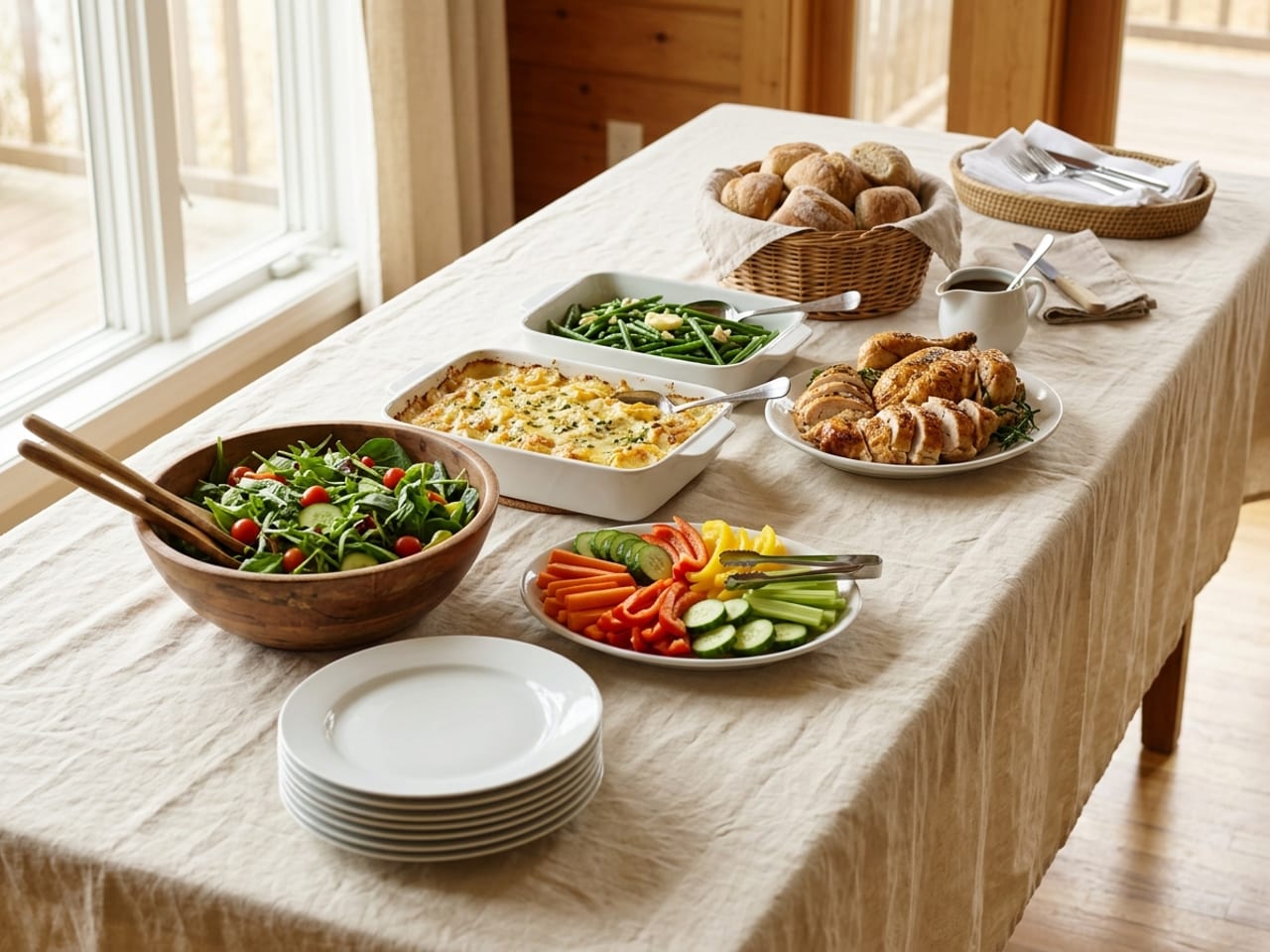
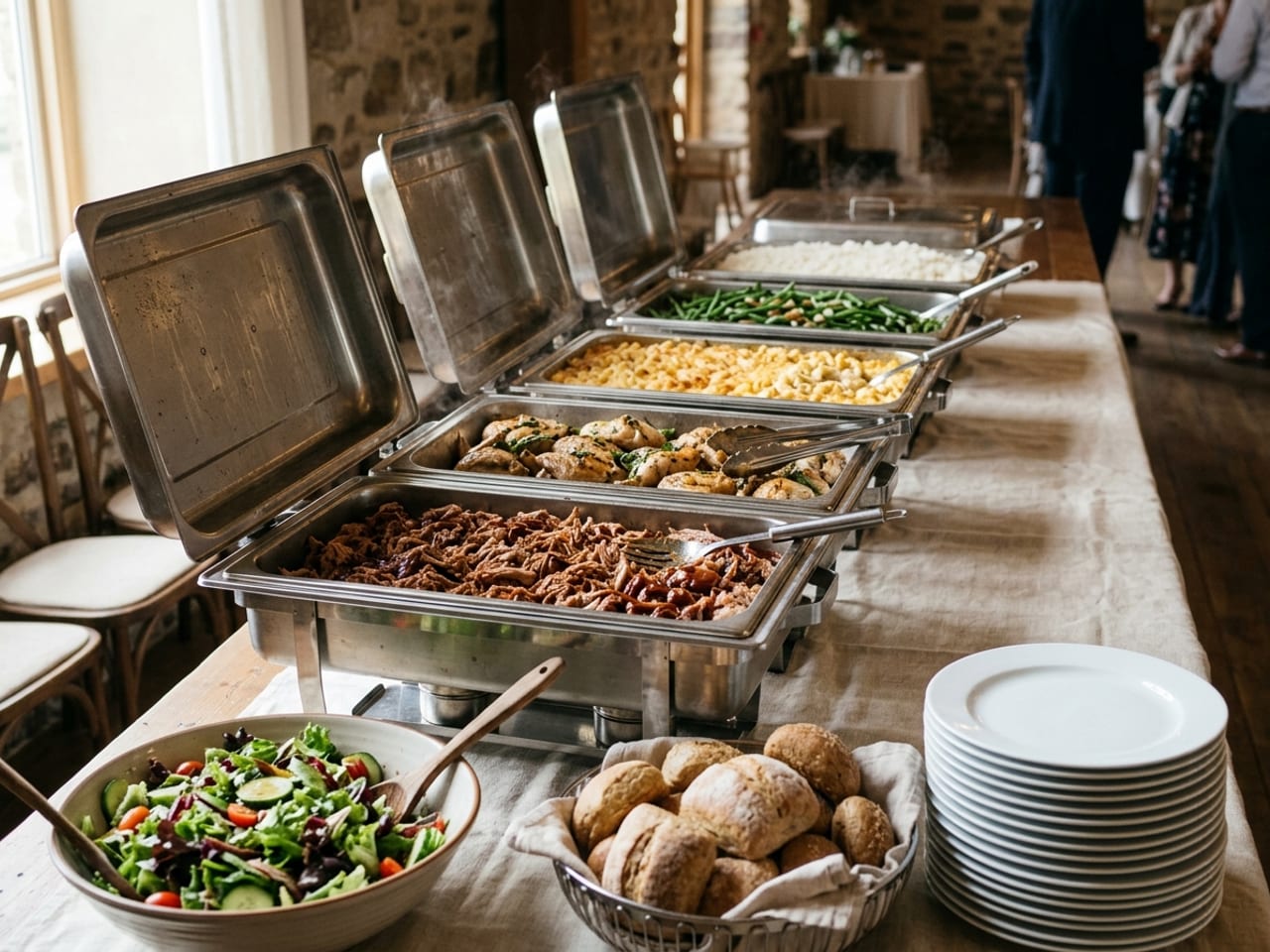
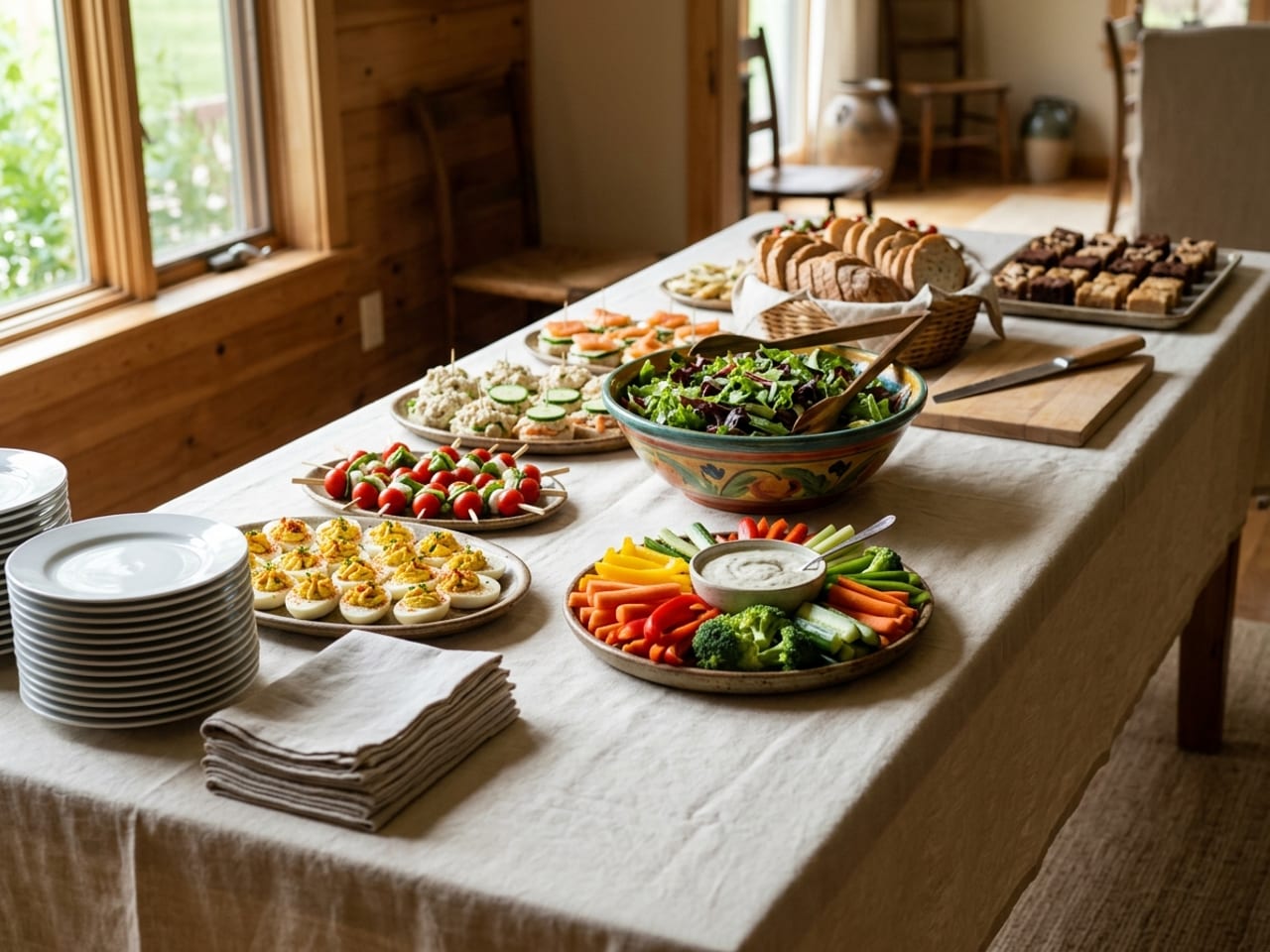
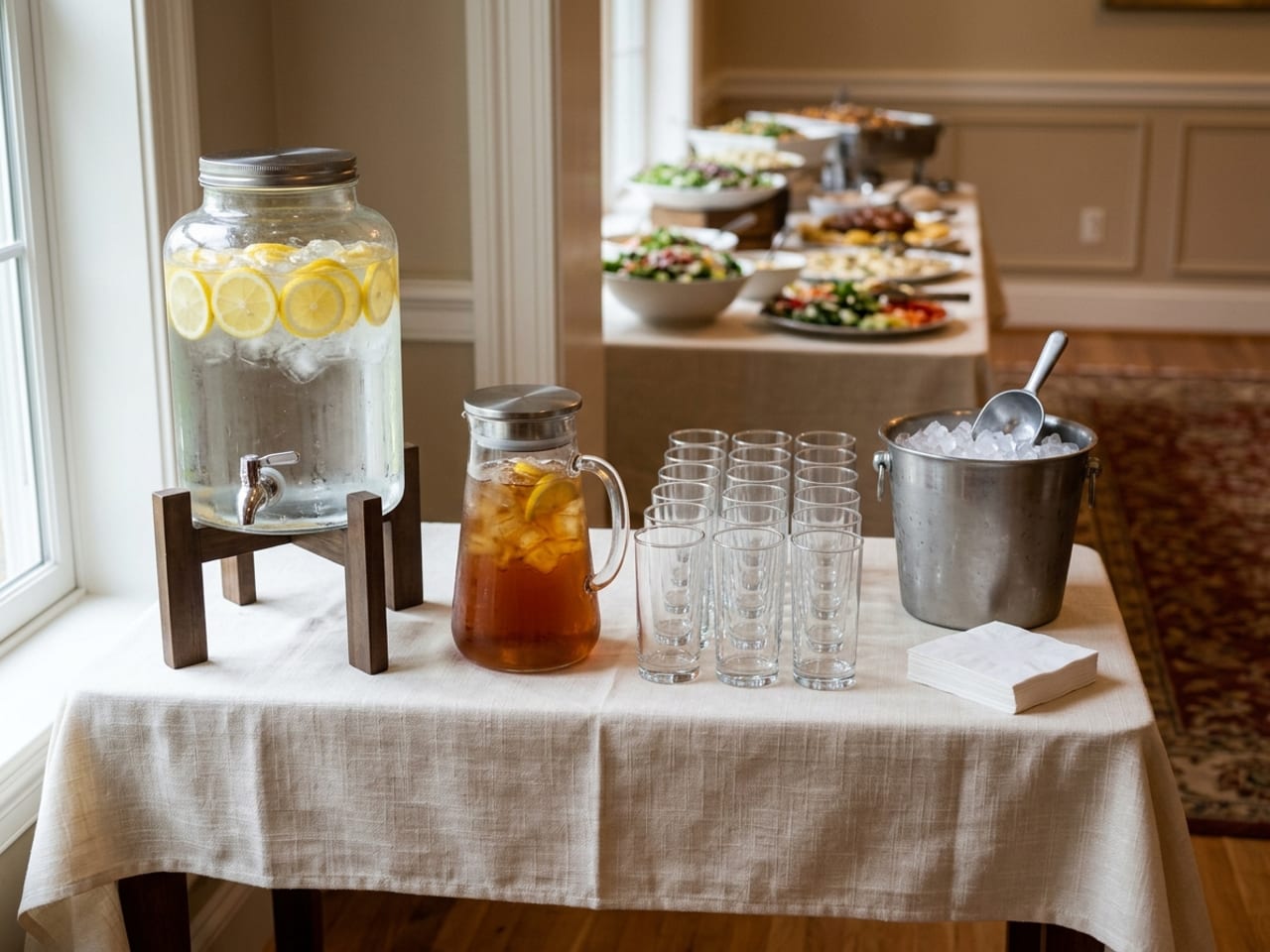
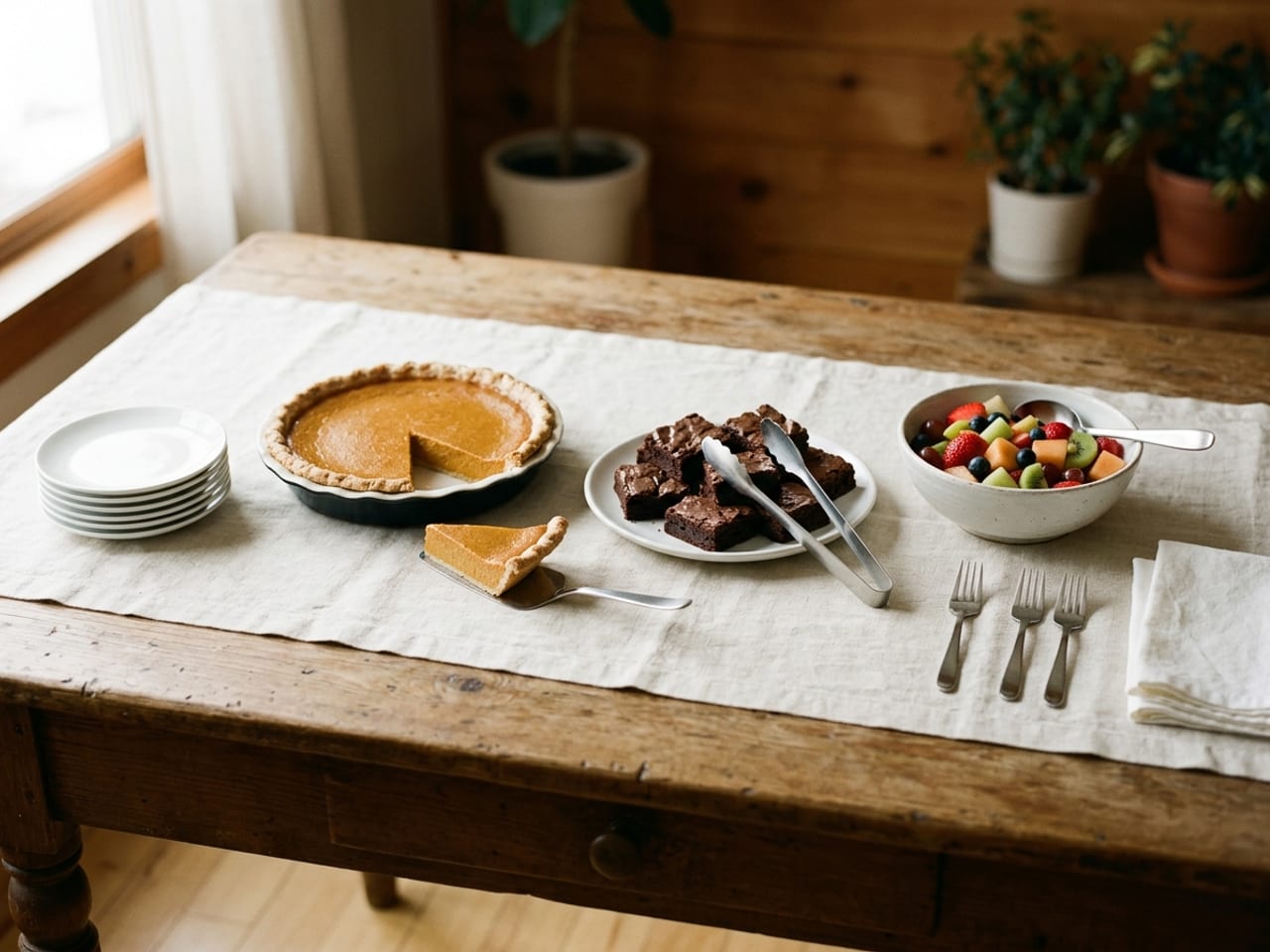
The photos on this page are AI-generated illustrations.
How to set up a buffet table, in six steps
Plates at the start. Then the food: cold dishes and salad, hot sides, and the main dish with its sauce beside it. Then bread, and cutlery and napkins last, or already on the dining tables. Drinks and dessert go on separate tables. This is the majority order among the sources we read on 12 October 2026, not a rule; the counts are our own tallies.
- Plates start the line. A stack of plates, and nothing else to carry, marks where guests begin. Nearly every source we read starts the line with the plates.1, 3, 14, 40 The exceptions: Arte Italica, a seller, starts with cutlery, napkins and bread; Michigan State's 1967 bulletin and a 1965 Idaho bulletin stack the plates between or beside the main dishes; Real Simple and Coton Colors each describe a dining table already set, from which guests bring their own plate.6, 7, 25, 27, 44
- Cold food and salad next. Six sources state cold before hot in words; one lesson plan prints the reverse, entrées and hot vegetables before the salads, without a reason; thirteen put the salad early.4, 11, 14, 17, 27, 49, 65
- Hot side dishes. Kept together, and nearest the kitchen so they can be swapped: Restaurant Business groups hot with hot and cold with cold, and Diane Gottsman puts the hot end by the kitchen.3, 9, 11
- The main dish, with its sauce beside it. Fifteen sources put the meat or main last of the savory food, eleven put it first and two in the middle. Gravy and sauces split three ways: see the table.
- Bread, then cutlery and napkins, last. Cutlery at the end of the line in 29 sources, so nobody carries it while serving, or already on the dining tables in eight; six put it at the start. Bread splits: eight put it early, seven after the main.
- Drinks and dessert on tables of their own. Away from the food, so that a refill never cuts through the line. A minority put drinks at the end of the food table, some of them only when there is no second table.1, 2, 4, 6, 53
Where named sources differ. Club chef Chuck Kerber puts the cutlery with the plates, the turkey first and the gravy at the end, after the sides.43 Noelle Carter also starts with the cutlery, and puts the rolls and salads first and the costly dishes last.40 Party City sends the gravy to the dining table.20 Michigan State University Extension printed the main dish first in 1967 and the meat late in 2017.5, 6 Every position, with names, is in the table below.
On this page: Where sources disagree · Layout diagrams · Kitchen counter · Room plan · How many lines · Table length · Space and table sizes · Heights and risers · Serving utensils · Labels and allergens · Plates · Chafing dishes · Fuel · Warm without chafing dishes · Keeping food cold · Hot and cold: the rules · Buffet or family style · Thanksgiving · Christmas, brunch, weddings · Etiquette · Mistakes · Popular claims · History · The words · FAQ
How much food, how many pans and chafing dishes?
The catering calculator works out portions for up to 500 guests, the pans they fill, and the chafing dishes, fuel cans and serving lines a buffet takes.
Cooking it yourself for a houseful?
The party food calculator gives appetizers, mains, sides and drinks per person for a party at home.
How this page was made. Every rule, number, date and quotation here comes from the published source named beside it: university extension bulletins, etiquette writers, cooking sites and magazines, chefs and caterers quoted in them, catering textbooks, the makers and sellers of buffet equipment, food-safety agencies, dictionaries and old household books. Plate Artists hosted, cooked, timed and measured nothing for it. Counts such as "29 put cutlery at the end" are our own tallies of the sources we read, not surveys, and a source that offers two options is counted under both. Sites that could not be opened directly were read in Internet Archive captures. Chuck Kerber's tips reach us in the words of the Pittsburgh Post-Gazette's reporter, Dana Cizmas, so a quotation credited to Kerber here is the reporter's wording of his advice. The catering textbooks and a few etiquette and travel books were read only as search fragments of scanned copies, without the surrounding page; each of those is marked in the sources list and wherever it is used. Sellers, makers, rental firms and staffing vendors are labeled, and the page carries no affiliate links. Rules from different countries are kept apart and never converted into each other. Anything marked "ours" is our own reading, count, conversion, arithmetic or suggestion. Sources are at the bottom.
The order of food on a buffet table: where the sources disagree
Nine questions, each with the positions we found and who holds them. The numbers are our count of the sources we read, a source can sit in two cells, and a majority here is a majority of that reading and nothing more.
| The question | The larger camp | The other camp | Also in print |
|---|---|---|---|
| Cutlery and napkins | At the end (29): The Kitchn, Lizzie Post of the Emily Post Institute, Restaurant Business, Williams-Sonoma (a seller), Michigan State University Extension in 2017, the same extension service in 1967, a 1965 University of Idaho 4-H bulletin, Ellen's Kitchen, etiquette trainer Diane Gottsman, Lea Schneider, Cooking Channel, The Old Farmer's Almanac, Fiesta (a maker), Displays2go (a seller), Alto-Shaam (a maker), Party City (a seller), Southern Discourse, StoneGable, Colorado Party Rentals (a rental firm), Thoughtfully Simple, Diana Elizabeth, Living on a Dime, Meal Planning Magic, caterer Brian Strayer, for napkins, as Chowhound reports him, a University of Rhode Island leaflet (a scan too garbled to quote), Coton Colors (a seller), Southern Lady, an Illinois lesson plan and Kim Seybert (a seller, as one of two options).1, 2, 3, 4, 5, 6, 7, 8, 9, 11, 14, 15, 16, 17, 18, 19, 20, 22, 23, 24, 26, 27, 29, 31, 32, 33, 42, 53, 65 The Kitchn allows no exception: "All cutlery and anything else that has to be juggled goes at the end (or, even better, on the tables where people will sit down and eat). No exceptions." | At the start (6): club chef Chuck Kerber, Noelle Carter, Emily Post's Etiquette of 1992 (read as a search fragment), Arte Italica (a seller), Real Simple's summary box and Peanut Blossom.25, 36, 40, 43, 44, 46 Kerber, as the Pittsburgh Post-Gazette's reporter Dana Cizmas words his tips: "Set the plates and linen-wrapped silverware at the beginning of the buffet table before placing the food." Carter does it "so people get a sense of where they need to start." Arte Italica starts with "cutlery, napkins, bread, and bread plates" and names no dinner plates there. Real Simple's body text names only plates at the start. | On the dining tables (8): The Kitchn, Lizzie Post, Elizabeth Post in 1975, Michigan State University Extension in 1967, Southern Discourse, Coton Colors (a seller), Diana Elizabeth and Ellen's Kitchen's forum article.1, 2, 6, 10, 17, 18, 27, 45 A few steps in (1): Kim Seybert (a seller), as an option: "a few steps into the buffet or near the end".31 Ellen's Kitchen allows a crock of forks by the plates when a buffet "is informal, and requires few utensils".9 |
| The meat or main dish | Last of the savory food (15): The Kitchn (by cost: the scarcest or most expensive food last), Noelle Carter, Ellen's Kitchen's second order, Ellen's Kitchen's planning article, the caterer Southern Standard Hospitality (via Chowhound), private chef Steve Ingber (via Chowhound), Michigan State University Extension in 2017, Diane Gottsman, Lea Schneider (by implication: hot food last), Displays2go (a seller; by implication: warm dishes last), Diana Elizabeth, The Shelving Store (a seller), a workbook outline to Gisslen's textbook (a search fragment; by implication: hot food last), Coton Colors (a seller) and Arte Italica (a seller).1, 5, 9, 10, 11, 14, 17, 21, 22, 25, 27, 40, 41, 42, 49 The reason given is cost. The Kitchn: "Put most plentiful or cheapest types of food at the beginning; push the scarcest or most expensive to the end." Ellen's Kitchen: "Most caterers put the most costly entree last in line if there are several entrees, since plates are full and people take less." | First, after the plates (11): Chuck Kerber, Michigan State University Extension in 1967, Ellen's Kitchen's "common" order, Southern Discourse, StoneGable, Party City (a seller), Living on a Dime (its "proper way"), Real Simple's summary box, Emily Post's Etiquette of 1992 (a search fragment), a 1965 University of Idaho 4-H bulletin (a broken scan) and an Illinois lesson plan.6, 7, 10, 18, 19, 20, 32, 43, 44, 46, 65 Party City's reason: "you arrange your sides around your main course, so start with the main". Living on a Dime prints both: meats first as what it calls "the proper way", and "if the meat budget is tight, put the side dishes first". | In the middle, after the starters (2): Williams-Sonoma (a seller) and Kim Seybert (a seller; mains and sides together, after the starters).4, 31 Michigan State's two bulletins sit on opposite sides, fifty years apart, and the 2017 one opens with "There are no set rules as to how to set up a buffet table". 5, 6 With a server on the meat, Ellen's Kitchen lets it lead the line.9 |
| Cold before hot | Cold first, stated in words (6): Williams-Sonoma (a seller), Diane Gottsman, Lea Schneider, Coton Colors (a seller), Diana Elizabeth and a workbook outline to Gisslen's textbook (a search fragment).4, 11, 14, 17, 27, 49 Schneider: "Traditionally, cold foods are offered first. Hot foods are offered last. This way, the hot food will still be hot when the guest sits down to eat." Displays2go's printed list and Alto-Shaam's list of food groups also run cold to hot without saying why; we do not count them.22, 26 | Hot first (1): an Illinois lesson plan, which prints "The entrée (or entrées) should be next" after the plates, then "Hot vegetables should be next, followed by salads and bread." It gives no reason.65 A search summary of one hospitality course page that we could not open is reported to say the same; we did not read it and do not count it. | Sources that put the main dish first (the row above) put a hot dish ahead of the salads without stating a temperature rule. Restaurant Business gives no sequence, only grouping: "Keep hot foods near one another; likewise, group chilled foods in their own area."3 |
| Gravy, sauces and dressings | With the food they go on (6): Restaurant Business, Coton Colors (a seller), Arte Italica (a seller), Peanut Blossom, Southern Discourse (gravies with the starch) and a 1965 University of Idaho 4-H bulletin.3, 7, 18, 25, 27, 36 Restaurant Business: "Place sauces and condiments directly with the foods they accompany so that guests understand how to use them." | At the end of the line (6): Chuck Kerber, Cooking Channel, Chowhound's panel, StoneGable (after the sides), Southern Discourse (as one of three places) and Diana Elizabeth (butter and condiments, after the bread).15, 17, 18, 19, 42, 43 Kerber, as reported: "Place the gravy and cranberry sauce at the end so that you can top the meat and stuffing and whatever else you want with them at one time without holding up the line." His rolls and butter come after them, "as the last items". | On the dining table (5): Party City (a seller), Real Simple, Southern Discourse, Chuck Kerber (as an option) and Diane Gottsman.11, 18, 20, 43, 44 Southern Discourse names all three in one sentence: "You can keep condiments close to what they should be paired with, at the end of the line or on the tables where your guests will eat!" |
| Bread and butter | First, or before the main (8): Displays2go (a seller), Fiesta (a maker), Noelle Carter, Ellen's Kitchen's planning article, Arte Italica (a seller), Real Simple (rolls to mark the start), The Shelving Store (a seller) and Southern Standard Hospitality (via Chowhound).9, 21, 22, 25, 29, 40, 41, 44 Carter starts "with the rolls and the salads at the beginning" so that plates fill with the cheaper food. | Last, or after the meat (7): Michigan State University Extension in 2017, Chuck Kerber, StoneGable, Ellen's Kitchen's two forum orders, Diana Elizabeth, Peanut Blossom and an Illinois lesson plan.5, 10, 17, 19, 36, 43, 65 Kerber, as reported: rolls and butter "have a better chance of not being wasted if they are placed as the last items". | On the dining tables (3): Diane Gottsman, Chuck Kerber (as an option) and Ellen's Kitchen (as an option).9, 11, 43 Where a dish is assembled in the line, Ellen's Kitchen follows the assembly: "Bread goes at the beginning of a sandwich line, not at the end."10 |
| Salad | Early, before the hot food (13): Michigan State University Extension in 2017, Ellen's Kitchen's economical orders, Noelle Carter, Diane Gottsman, Displays2go (a seller), Alto-Shaam (a maker; a list of food groups), Fiesta (a maker), Arte Italica (a seller), Diana Elizabeth, Kim Seybert (a seller), Coton Colors (a seller), Steve Ingber (via Chowhound) and The Shelving Store (a seller).5, 9, 10, 11, 17, 21, 22, 25, 26, 27, 29, 31, 40, 42 | After the main, among the sides (4): Chuck Kerber, Ellen's Kitchen's "common" order, Living on a Dime and an Illinois lesson plan.10, 32, 43, 65 | On the dining table (2): Real Simple and Ellen's Kitchen's forum article (for a seated buffet).10, 44 Real Simple suggests "setting cold dishes, like salad, on the table to pass around family-style, while the rest of the food is buffet-style". Chowhound suggests dressing in small containers so guests "can just grab them and go".42 |
| Dessert | On its own table, or on the buffet once it is reset: at least twelve of the sources we read, among them Michigan State in 1967 ("The dessert course should not appear on the buffet table with the main course."), Williams-Sonoma, Ellen's Kitchen, Diane Gottsman and Southern Lady, which says a separate table "allows guests to decide about dessert after they have finished their meals." 4, 6, 9, 11, 53 | On the main table (2 as their only plan): Kerber and Fiesta. Kerber's tip, headed "Segregate desserts", puts the dessert plates, forks and napkins "on one end of the table", which we read as one end of the same table. Living on a Dime lists desserts in the line before the napkins; Michigan State in 2017 and Displays2go put them there only when there is no second table.5, 22, 29, 32, 43 | A dessert table is a small buffet of its own. Ellen's Kitchen: "small dishes at the beginning and napkins plus any needed silverware at the end of the table." 9 |
| Drinks | A separate table: at least fourteen of the sources we read, among them The Kitchn, Williams-Sonoma, Lizzie Post, Diane Gottsman and Ellen's Kitchen ("Beverages slow the line."). 1, 2, 4, 9, 11 Williams-Sonoma wants it "as far from the main buffet as possible to keep traffic flowing." | At the end of the food line (10, two of them only as a fallback): Michigan State University Extension in 1967, Thoughtfully Simple, Brian Strayer (via Chowhound), Living on a Dime, a 1965 University of Idaho 4-H bulletin (or passed on trays later), a University of Rhode Island leaflet (a garbled scan), Ellen's Kitchen's two forum orders (a separate table "ideally for large groups"), an Illinois lesson plan, Michigan State University Extension in 2017 (only when there is no second table) and Diana Elizabeth (only if they fit).5, 6, 7, 8, 10, 17, 23, 32, 42, 65 | Never first. Living on a Dime: "Some people put the drinks first. This is a no-no because then everyone has to juggle a plate and a glass while trying to serve himself."32 Ellen's Kitchen asks for one drinks table "for each 50-100 people".9 |
| One side of the table, or two | Two sides, the table pulled out (7): Michigan State University Extension in 2017, Chowhound, Williams-Sonoma (a seller), Diane Gottsman, StoneGable, Party City (a seller; room to pass on both sides) and Cooking Clarified.4, 5, 11, 19, 20, 30, 42 Michigan State: "The fastest and easiest way to set up a buffet table is to have your guests go down both sides of the table." Chowhound: "Don't set your buffet up against a wall." Party City's words are about room: "ideally one where guests can pass on both sides of the buffet table". | One side (1): Chuck Kerber, as reported: "You want a continuous flow, in and out in the same direction, and a one-sided display will cater to that."43 | By guest count: Ellen's Kitchen sets the lowest threshold we read: "If you are going to have more than twenty people, set up the serving tables so that people can serve themselves from both sides of the table."9 An Illinois lesson plan puts a second line at 50, and a hotel catering textbook, read as a search fragment, says "For any group over 50 people, you should use double-sided buffet tables whenever possible."65, 66 (The lines tables.) Lizzie Post ties it to "the size of your party" without a number.2 |
Which order our own pages use
Our Thanksgiving tablescape and Christmas table setting pages print one order: plates; cold things; the hot sides; the carved meat with the gravy right beside it; rolls and butter; cutlery rolled in napkins last; drinks on a separate table; dessert on its own table afterwards. That is our choice, not a rule. It sides with the larger camp on cutlery, cold before hot, the main dish late, and drinks and dessert apart; it picks one of three camps for the sauce and one of two for the bread. Our turkey carving guide prints Chuck Kerber's order, which runs the other way on the cutlery, the main dish and the gravy, and says so. The Kitchn, which we cite for cutlery at the end, allows no exception there; our table setting guide's "either works" is our reading, not The Kitchn's.1
The two ideas behind every order
Free hands. Lizzie Post: utensils and napkins at the end "so that your guests aren't juggling their plates, utensils and napkins while trying to serve themselves."2 Plate space. Noelle Carter: "people will fill their plates with the cheaper items first."40 A caterer quoted by Chowhound says the same of brisket: by the end of the line guests "have less room for a double portion".41 The Kitchn treats the order as adjustable while the party runs: "I usually keep an eye on the food and within the first hour switch it up."1 One published study bears on this, and it is small: the line-order study.
Buffet table layouts: one side, two sides, the counter and the room
Four drawings, all ours and schematic. Two of the sources print plans of their own, Michigan State's 1967 bulletin (two figures with arrows) and the 1992 Emily Post's Etiquette (seen by us only as figure captions in search fragments); ours are not copies of either.6, 46 Each caption names whose rule the drawing shows. The numbers follow the short answer above.
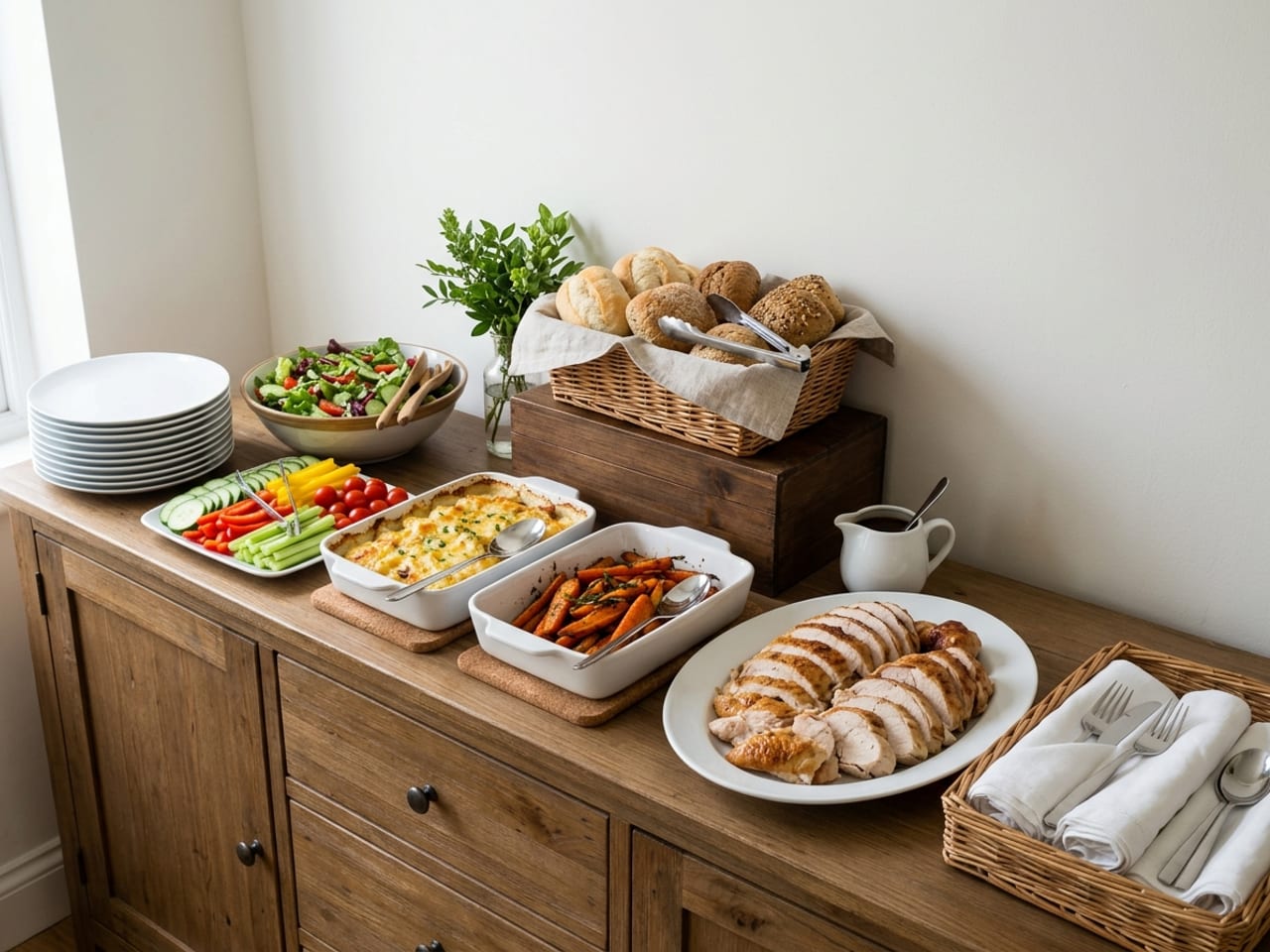
Against a wall. It is the layout chef Chuck Kerber prefers, for "a continuous flow, in and out in the same direction" (the reporter's wording).43 Leave room at both ends: The Kitchn wants "a lot of extra space at both beginning and end".1 If a helper will restock from behind, Michigan State's 1967 bulletin leaves "enough space between the table and the wall" for that.6 Using the dining table itself? The Almanac: "be sure to move the chairs away from the table".16 Our own pages suggest a sideboard for 9 to 20 guests; that band is ours.
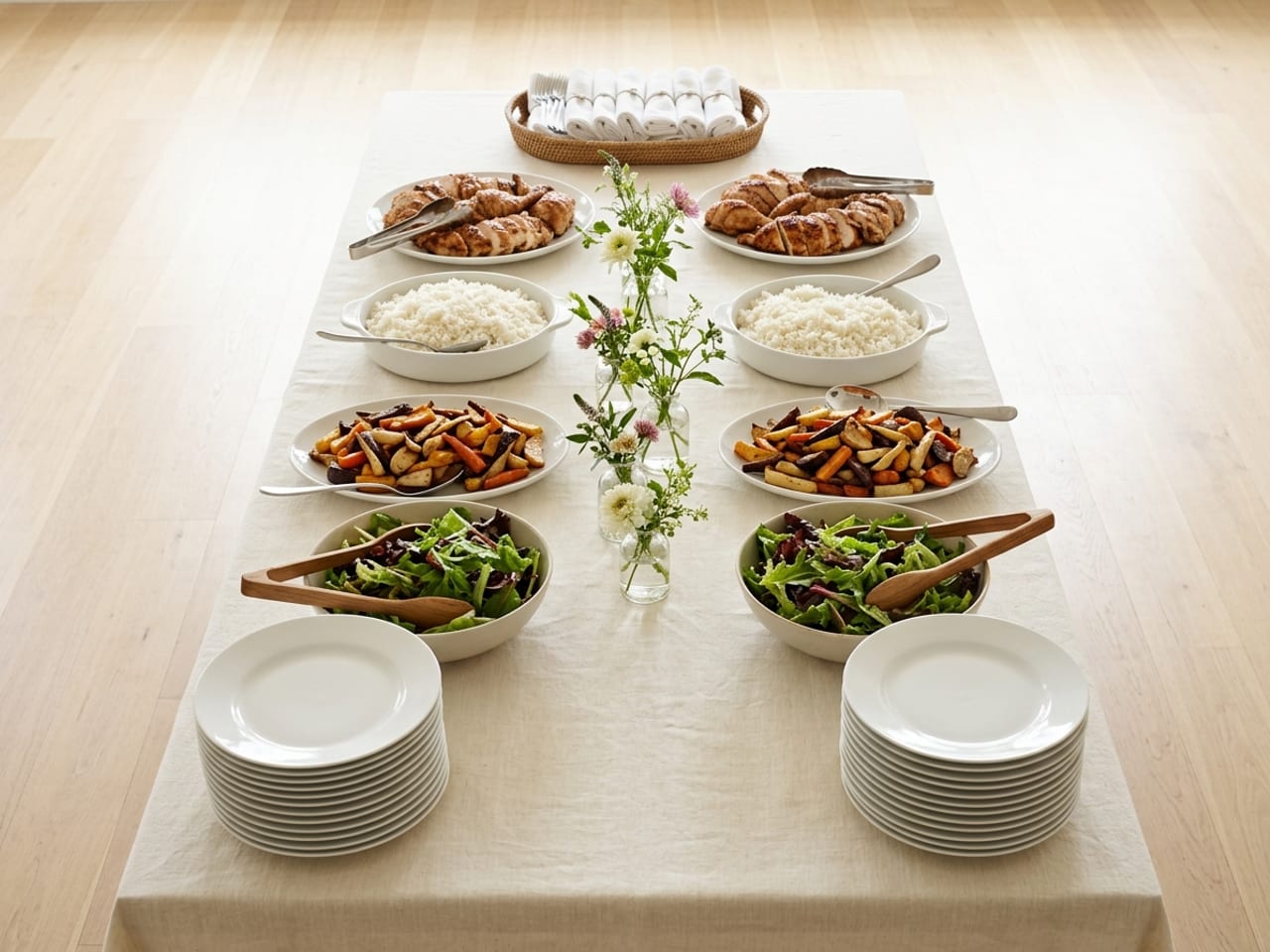
Two sides. Ellen's Kitchen sets the switch at "more than twenty people", and says a table served down both sides with the same menu "can count as 2 lines."9 Each shared dish then needs two serving tools. Michigan State: "Put two spoons or serving utensils in each dish so that people from both sides can get the food at the same time".5 Diana Elizabeth describes the large version: "two of each item that would mirror each other. The end of the table would have the utensils and napkins."17 Kim Seybert, a seller, mirrors "the setup with plates at each end", and Michigan State's 1967 bulletin let service "begin at the ends and proceed to the center"; a rental firm warns that lines from both ends leave "everyone bunched up in the middle".6, 24, 31 The drawing starts both lines at one end. A chafing dish on a two-sided table needs a lid that opens for both: lids.
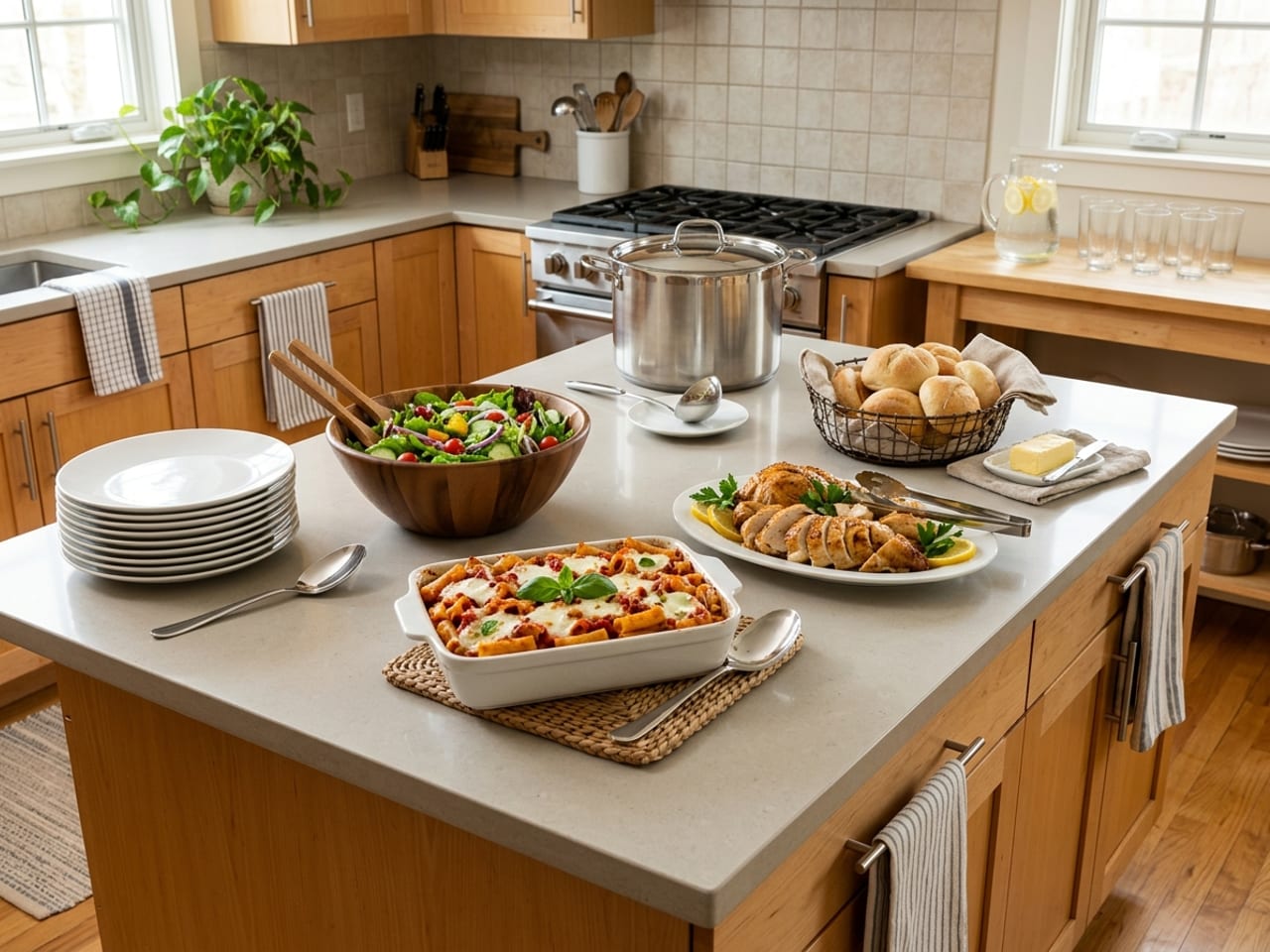
The kitchen counter. Coton Colors, a tableware seller, calls island serving "perfect for a casual family gathering", best where the floor plan is open.28 Chowhound quotes Vanessa Gordon keeping "the hot dishes in the kitchen" where she can watch them, and the cold dishes in the living or dining room.42 In a small home, Real Simple suggests "a bar cart or side table for drinks and ice", or a folding tray table as the bar.44 Our tablescape page's small-space line, "The counter is the buffet", is the same idea.
The room. Three things pull guests apart so that no queue blocks another. Drinks: Lizzie Post wants them "on a separate table so guests can put their plates down and go back for their drinks".2 Chowhound reports Steve Ingber's "beverage triangle": "water at the front of the room, cocktails and soda opposite that, and coffee and tea near the desserts". 42 The door: Lea Schneider plans the flow "so that guests enter one and depart by another", and a fragment of an Emily Post's Etiquette that the Internet Archive catalogs as the 1975 Funk & Wagnalls edition starts the line where served guests "do not have to double back against the people coming in". 14, 47 The kitchen: Diane Gottsman puts the hot food at "the end of your table closest to the kitchen".11 For a big party, Cooking Clarified sets platters "in other parts of the house", and Chowhound says that meat sliced in front of guests is best at "an entirely separate station".30, 42 We found no published distance between the buffet and the nearest dining table, and no source that recommends a U-shaped table at home; an L shape gets two passing mentions.31, 44
How many buffet lines for 50, 100, 200 or 300 guests
Two rules are in print, and they differ by a factor of two: one line for every 50 guests and one for every 100. Shock and Stefanelli's hotel catering textbook prints both and ties the choice to how fast the group must be fed, and two sister handbooks repeat its wording (all three were read only as search fragments). In that book "One line is one side of a buffet table", so a table served down both sides counts as two lines.9, 66, 72, 73
The faster camp: one line for every 50 guests
| The rule | Who prints it | Kind of source |
|---|---|---|
| One line for every 50 guests | Hayley Seed of Taste Catering: "I recommend one line per 50 guests. So if you have 100 guests, you will have two buffets."59 | a caterer, answering a wedding site in 2013 |
| One line for every 50, a double-sided buffet for 75 to 100 | Professional Event Coordination (2012): "Allow one buffet line per 50 guests" and "Double-sided buffets may accommodate 75-100 guests each".74 | a textbook, read only as search fragments |
| One line for every 50 feeds the group in about 15 minutes | Backus and Shock (2017): a caterer who "sets one food buffet line for every 50 people" can "feed the entire group in about 15 minutes"; the Club Manager's Guide (1998) and Lora Arduser's handbook (2006) print the same figure, and Shock and Stefanelli's textbook (2011) says "it might be a good idea to set one line for every 50 guests" when time matters. Three of these four share an author or a passage, so they are one text family, not four witnesses.66, 69, 72, 73 | trade handbooks, read only as search fragments |
| Two lines above 50 people | An Illinois lesson plan: "Two buffet lines are recommended for groups that exceed 50 people."65 | a school lesson plan |
| A double line for every 50; both sides of the table above 20 | Ellen's Kitchen: "each fifty people require their own double serving line; 200 people, means 4 separate 2-sided serving lines." The same page also says "with 200 people, you need 4 serving lines", so it is not consistent about whether a line is a side or a table.9 In a forum reply its owner gives "one service line for each 50-75 diners".60 | a site for volunteer cooks |
The lighter camp: one line for every 100 guests
| The rule | Who prints it | Kind of source |
|---|---|---|
| One line for every 100 guests, and a line is one side of a table | Shock and Stefanelli (2011): "Most meal buffets are usually set with one line for every 100 guests." The same fragment adds "One line is one side of a buffet table".66 | a textbook, read only as search fragments |
| One line for every 100 guests | Anthony Strianese: "One buffet line is needed to serve every 100 guests." Lora Arduser: "You can usually estimate 100 guests per buffet line." The Club Manager's Guide says most meal buffets are set that way.69, 70, 72 | textbooks and handbooks, read only as search fragments |
| One line for every 100, 120 the break point | George Fenich: "Provide one buffet line per 100 guests, with 120 being the break point."71 | a textbook, read only as search fragments |
| One line at least for every hundred people | Meg Keene's wedding planner: "one buffet line minimum per one hundred people".75 | a consumer book, read only as search fragments |
| 100 to 125 guests the most for one line | Paul Fairbrook's Catering on Campus gives 100 to 125 as the maximum number of guests for a line (our paraphrase of a broken fragment).68 | a trade handbook, read only as search fragments |
| One double-sided buffet for every 150 guests, as a minimum | Monona Catering: "Monona Catering recommends a minimum of one double-sided buffet per 150 guests."64 | a convention center's caterer |
Our catering calculator uses one line for every 50 guests, Taste Catering's rule, because it is the rule of a named caterer that we could read in full, where the textbook forms came to us as fragments, and because it is the faster of the two. It then reads a two-sided table as two lines, which gives one two-sided table for 100 guests: the lightest reading of that rule, as the calculator page says. Ellen's Kitchen is stricter, a double line for every fifty, and says of one table: "One 8 foot buffet table services only 20 to 30 people." 9 Asked about a wedding of 220 to 240, its owner answered that with one table "it will be over an hour and a half before everyone is served", and with four lines "about 40 minutes".62 For 100: "you need 2 serving lines or a double sided line to serve everyone in under an hour."61 For 300: "you need 4 serving lines at least; 6 would be better."63
How fast a line moves
The printed speeds run from one guest a minute to seven. None of the fragments we read cites a count of real guests, and we found no measured study of a self-service buffet line. Older food service books print rates for cafeteria lines, where staff serve, of 2 to 15 people a minute; we saw those only as search fragments, they are a different kind of line, and we do not cite them.
| Who | The speed in print | How far to trust it |
|---|---|---|
| Ellen's Kitchen, a forum reply | About one guest a minute: "each person can easily take a minute in the line".60 | The site owner's rule of thumb; no count is cited. |
| Edward Sanders, Catering Solutions (2000) | Three to four a minute: a single-line buffet "can comfortably accommodate fifty to seventy-five guests within 15 to 20 minutes, with an average of three to four guests per minute going through the line".67 | A textbook read only as search fragments. It adds that the variety of foods sets the speed. |
| Shock and Stefanelli, On-Premise Catering (2011) | About four a minute once the line is moving: "The first guest will take about five minutes to go through the line. After that, there will be about four guests passing through the line every minute."66 | A textbook read only as search fragments; the same passage is in fragments of the 1998 Club Manager's Guide and of the 2017 Backus and Shock handbook. |
| Paul Fairbrook, Catering on Campus (2004) | Five to seven a minute: "the average speed per buffet serving line is between five and seven guests per minute".68 | A trade handbook read only as search fragments. |
| Erik Bernhardsson, a computer simulation (2019) | "It turns out that this method has a critical maximum capacity of something between 0.3 and 0.7 people per second." He adds "If my simulations are correct (a big if)", and finds that "Moving the food so that it's accessible from both sides increases throughput a ton."76 | A simulation, not a count of real guests; 0.3 to 0.7 a second is 18 to 42 a minute (our arithmetic). |
What speeds a line, in the sources' words: fewer choices ("the fewer actual choices to be made by the individual diner in the line, the faster the line will move"),10 a short menu ("no more than five items"),59 popular dishes put out twice,42 food cut and portioned in the kitchen,9 and drinks somewhere else.9
Lines by guest count, both rules
Our arithmetic on the two rules: the first two columns divide by the calculator's 50, the last by the textbooks' 100. Below about 20 guests one side of one table is enough by Ellen's Kitchen's threshold.
| Guests | Lines at one for every 50 | As two-sided tables | Lines at one for every 100 |
|---|---|---|---|
| 20 | 1 | 1 | 1 |
| 30 | 1 | 1 | 1 |
| 50 | 1 | 1 | 1 |
| 75 | 2 | 1 | 1 |
| 100 | 2 | 1 | 1 |
| 150 | 3 | 2 | 2 |
| 200 | 4 | 2 | 2 |
| 300 | 6 | 3 | 3 |
How long a buffet table: by the dish
Ellen's Kitchen: "You must allow approximately 2 running feet of buffet table for each food container. For example, every 3 chafers require one 8 foot table." 9 (Two feet is about 60 cm.) A hotel catering textbook, read as a search fragment, prints the same rule "plus an additional 2 feet for the plates".66 The calculator uses the first form, 2 feet a dish with nothing added, so add the plates, and the cutlery if it sits at the end, yourself. The table below is our arithmetic on those two figures.
| Dishes on the line | At 2 ft a dish | With 2 ft for the plates | 8 ft (2.4 m) tables, with the plates | 6 ft (1.8 m) tables, with the plates |
|---|---|---|---|---|
| 4 | 8 ft (2.4 m) | 10 ft (3.0 m) | 2 | 2 |
| 6 | 12 ft (3.7 m) | 14 ft (4.3 m) | 2 | 3 |
| 8 | 16 ft (4.9 m) | 18 ft (5.5 m) | 3 | 3 |
| 10 | 20 ft (6.1 m) | 22 ft (6.7 m) | 3 | 4 |
| 12 | 24 ft (7.3 m) | 26 ft (7.9 m) | 4 | 5 |
Three other rules size the table by guests, not dishes, and disagree by a factor of about three. For 100 guests (our arithmetic): the Illinois lesson plan's "for every 65 guests, 10 feet of buffet table space" gives about 15.4 feet (4.7 m);65 Steve Ingber's "1 linear foot of buffet per three or four guests" gives 25 to 33 feet (7.6 to 10.1 m);42 a furniture seller's 1 linear foot for every 8 to 10 guests gives 10 to 12.5 feet (3.0 to 3.8 m), though its own example says three to four eight-foot tables, which does not match its ratio.77 Size by the dish, then check that the room takes it.
Space, clearance, buffet table sizes and cloths
Aisles. Ellen's Kitchen works from an 8 by 3 foot table (2.4 by 0.9 m): "it requires about 60 square feet for aisle space if the table is against the wall, and about 100 square feet for aisle space if the table is accessible from all sides."9 (About 5.6 and 9.3 m².) It calls 3 feet (0.9 m) the "standard 3-foot aisle", a phrase that also appears in the hotel catering textbook's fragments.9, 66 Steve Ingber allows "between 18 inches and 2 feet between the lines on either side of the table" (46 to 61 cm).42 A floor-plan software vendor's unsigned blog prints 48 to 60 inches (122 to 152 cm) in front of a buffet and 36 to 42 inches (91 to 107 cm) behind it for service; it cites nothing and is a weak source.83
Guests who use a wheelchair. Two rules written for businesses give useful sizes. The US accessibility standard for food service lines in covered facilities, which does not govern a home, asks for a clear width of at least 36 inches (915 mm) and tray slides 28 to 34 inches (710 to 865 mm) above the floor.80, 81 The Vienna Tourist Board's guide for hospitality businesses asks for circulation space of "at least 90 cm, ideally 120 cm", and food "within easy reach (max. 85 cm height)", adding: "Where this is not possible, offer active service at the buffet."82 At home that last sentence is the one to keep: offer to fill a plate (ours).
Standing room. For a reception where guests stand, Ellen's Kitchen allows "about 6 to 10 square feet of floor space per guest IN ADDITION TO THE SERVING SPACE and any dance area."9 (About 0.6 to 0.9 m².)
Buffet table sizes, in feet, inches and centimeters
These are folding banquet tables as linen and rental sellers list them; we read no table maker's own dimensions. A height or width is given with the name of whoever prints it, because they do not agree.
| What | The figure | Whose figure |
|---|---|---|
| Common lengths | 4, 6 and 8 feet (1.2, 1.8 and 2.4 m) | Premier Table Linens, a linen seller78 |
| Width | 30 inches (76 cm); the catering textbook and Ellen's Kitchen assume 3 feet (91 cm) | Premier Table Linens; A Classic Party Rental; Ellen's Kitchen9, 78, 79 |
| Height of a folding banquet table | 29 inches (74 cm), or 30 inches (76 cm) | Premier Table Linens prints 29; A Classic Party Rental and the riser seller Plinths print 3050, 78, 79 |
| The "standard" buffet table height, as one rental firm prints it | 36 inches (91 cm) | Party Rental Ltd., a rental firm, which disagrees with the row above51 |
| A 6 foot table seats | 3 on each side and 1 on each end, 6 to 8 people | A Classic Party Rental79 |
| Cloth to the floor, 6 foot table | 90 by 132 inches (229 by 335 cm) | Premier Table Linens; A Classic Party Rental78, 79 |
| Cloth to the floor, 8 foot table | 90 by 156 inches (229 by 396 cm) | Premier Table Linens78 |
| Half-drop cloth | 60 by 120 inches (152 by 305 cm), a 15 inch (38 cm) drop on an 8 foot table | Premier Table Linens78 |
Cloths. A cloth to the floor has a use: "you can hide backup items underneath the table".16 Keep any cloth clear of a burner: open flame on a clothed table. The one counter figure in the sources we read is that rental firm's remark that a 36 inch (91 cm) buffet table "aligns well with standard counter height";51 we read no cabinet maker's or planning body's figure for a kitchen counter or for the depth of a sideboard, so none is printed here.
How to set up a buffet with risers and different heights
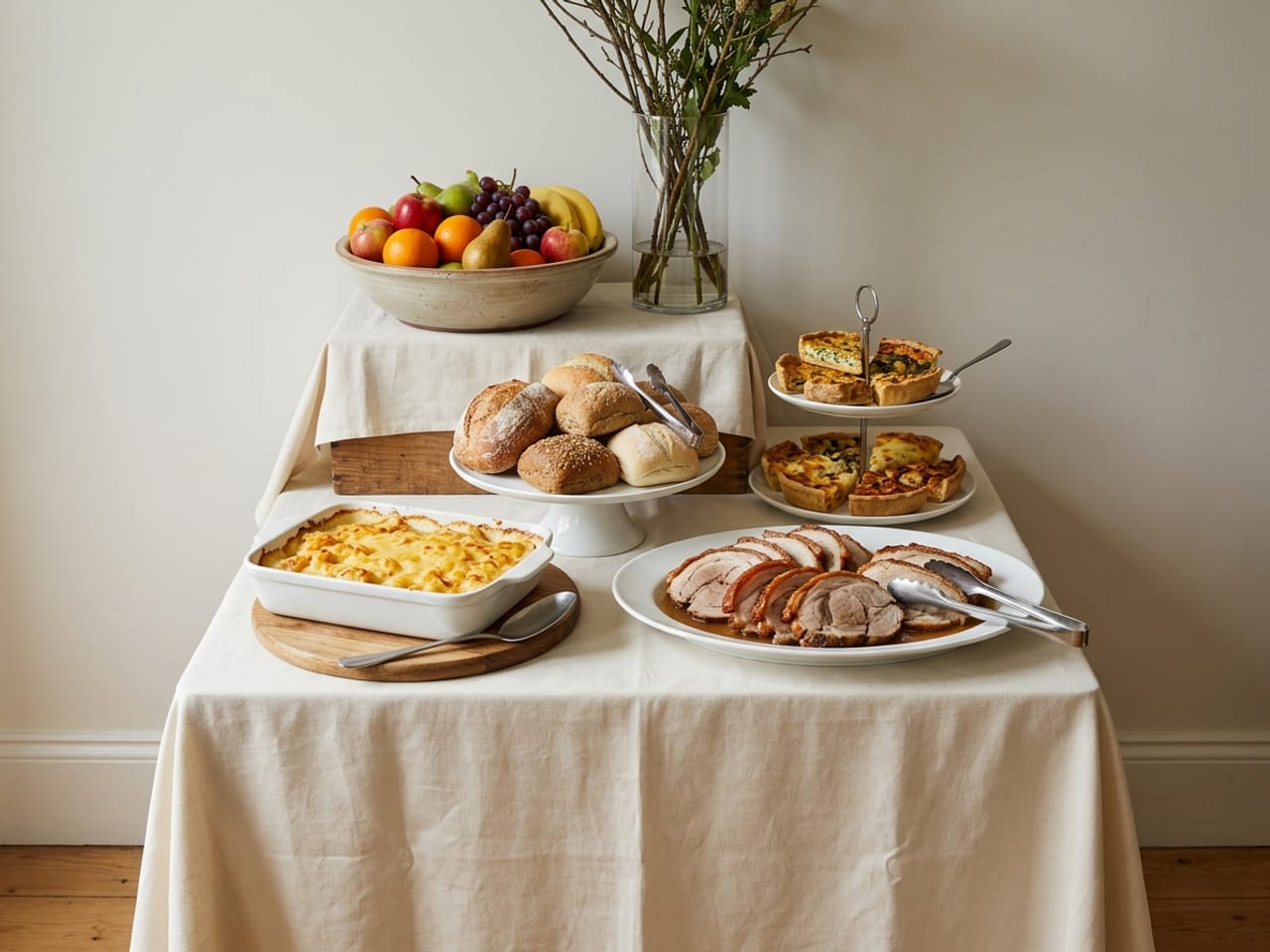
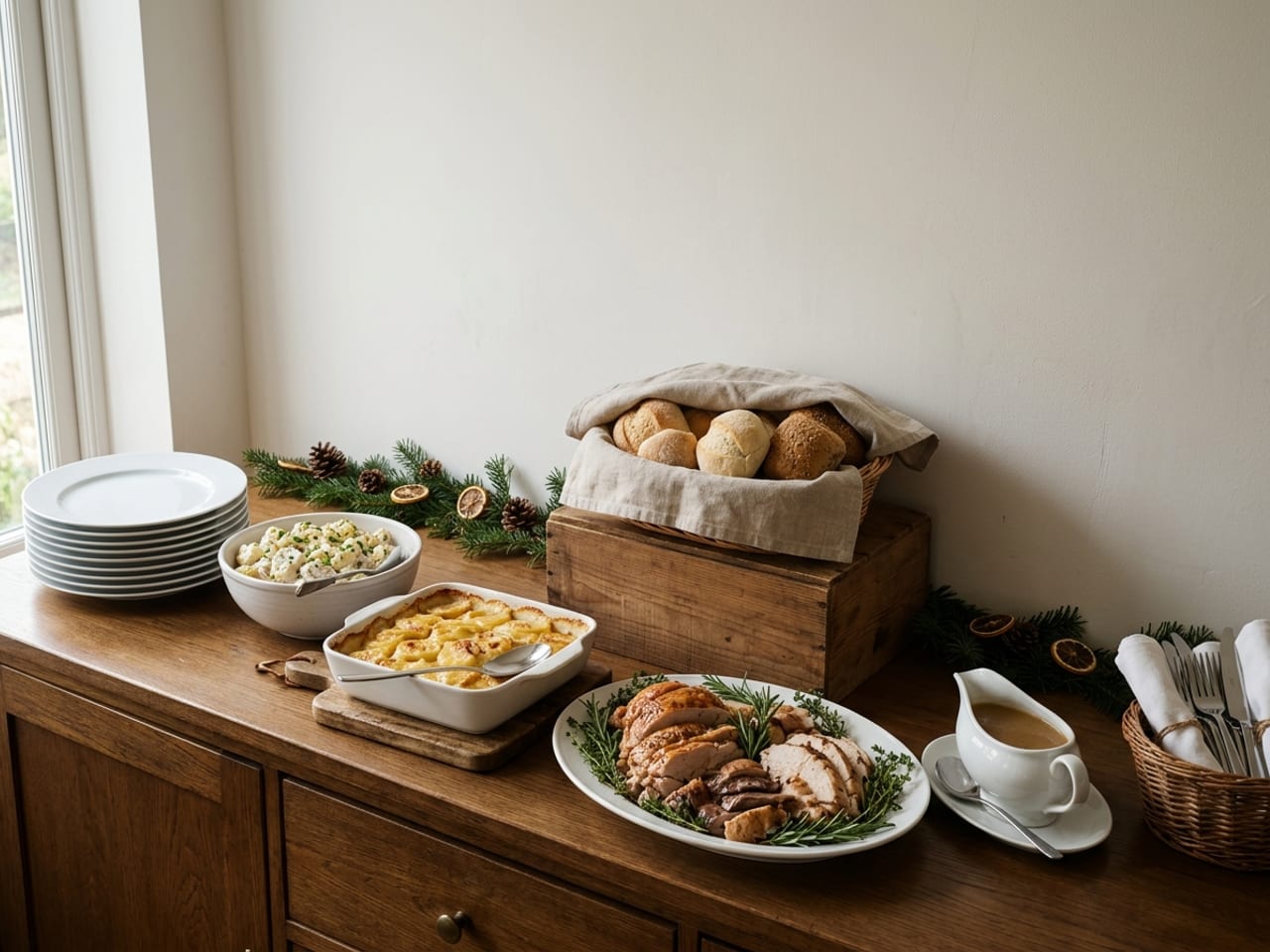
Back to front. Restaurant Business: "Place larger items in the rear and lower items in front." And: "Keep foods that might drip or spill closest to the guests."3 Cooking Channel gives the reason: height at the back "makes it easier for your guests to access the dishes at the back of the buffet".15 On a two-sided table the height goes down the middle.9
How high. The only figures we found are a riser seller's, written for caterers: "Three height tiers minimum. Floor (the table surface itself), mid (6 to 9 inches), and top (12 to 18 inches)." (15 to 23 cm; 30 to 46 cm.) It adds "One peak per 4 to 5 feet of table." (1.2 to 1.5 m.)50 Its example is a 12-foot table, so using the same tiers on a home sideboard, as our tablescape page does, is our extrapolation.
What goes up, what stays down. Arte Italica, a tableware seller: "Because they are heavy, it is best to leave your main courses flat on the table."25 Chowhound: "Use risers and funky stands to display small appetizers and light (physically and figuratively) bites".42 The riser seller puts a number on the weight: "A full chafing dish with water and a tray of pasta is around 18 pounds." (About 8 kg.)50 Our pages' short form, "Hot, heavy and liquid stay low", is ours; the same riser seller lifts a hot platter in its own example.
Risers from the house. The Almanac: "You could wrap a few boxes in wrapping paper. Or, simply stack books or upside-down baskets and cover them with a tablecloth."16 Ellen's Kitchen puts "books, wooden boxes, milk crates, and so on under the table cloth".9 HGTV: "Even a mixing bowl can be turned upside down to act as a pedestal for a serving plate in a pinch."35 Tiers also add room: "The serving dishes on the surface tuck under the edges of ones placed above them."34
Decoration. Keep it small. Kerber, as reported: "select small ones and try to keep them to a minimum".43 Williams-Sonoma: "Flowers with a mild fragrance are a good choice."4 Candles belong well away from sleeves and napkins (ours).
Serving utensils, labels, allergen cards and plates
One tool a dish, two on a two-sided table. Metropolitan Market, a grocer: "consider putting out two utensils for each dish, one facing each direction".34 A rental firm plans "one to two utensils per item" and "at least one spare utensil per station", matched to the food: "tongs for rolls, ladles for gravies, and slotted spoons for vegetables".108 Steve Ingber, via Chowhound: tongs for solid foods and spoons for "saucy items."42 Michigan State's 1967 bulletin counted differently, a spoon and a fork for each food: "Two serving pieces are usually needed for each food served."6 We found no published sizes for serving spoons or tongs.
Somewhere to put the spoon down. Ellen's Kitchen: "Set out small saucers on both sides of the table in front of each serving dish for the serving spoons, so the table cloth stays clean."9 The Almanac leaves gaps for the guest's own plate: "Leave a little space here and there for people to put down their plates while serving themselves."16
Labels and allergen cards
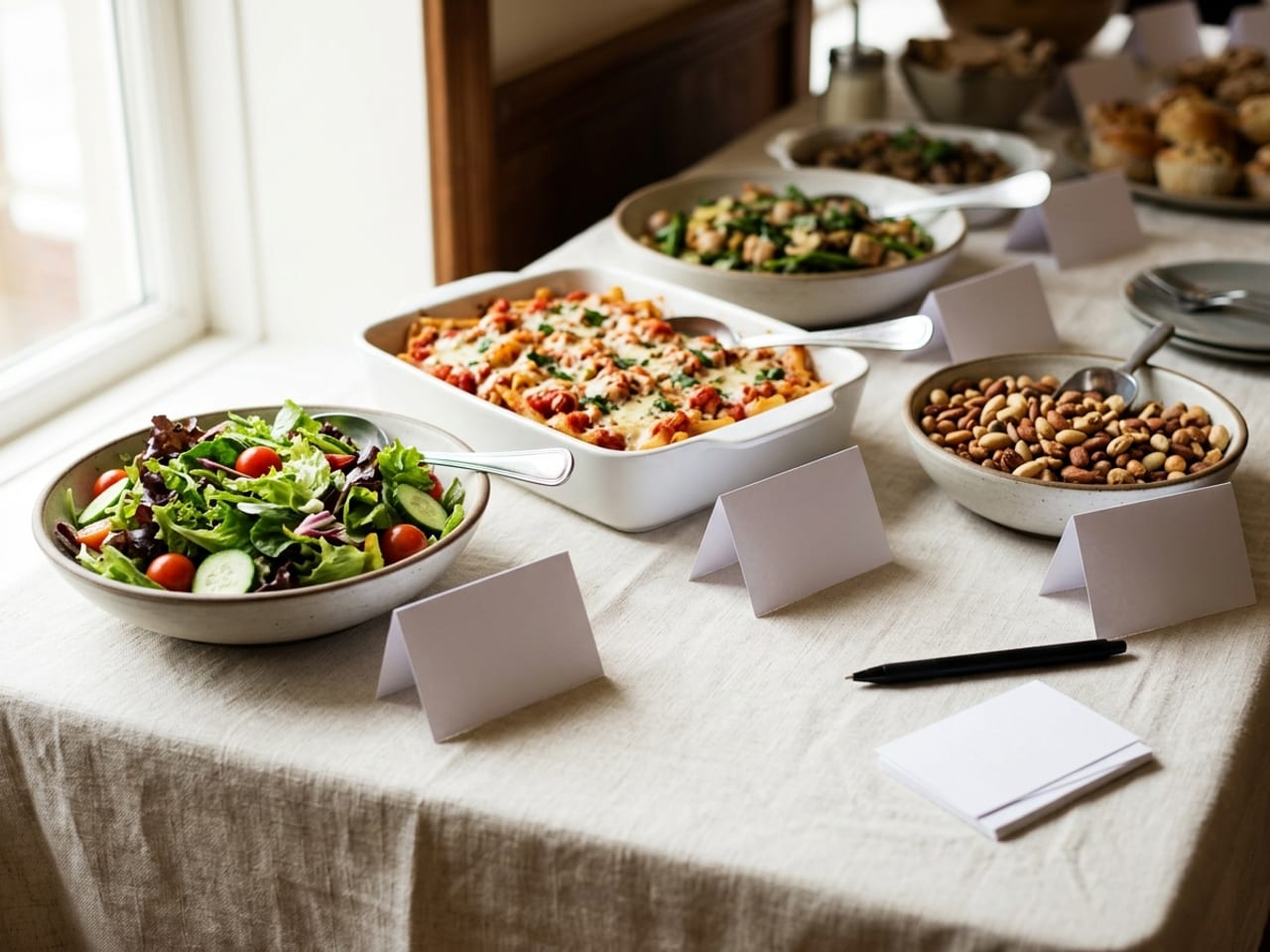
A card in front of each dish answers the question every guest asks. Real Simple: "you will undoubtedly be asked several times what's in the lasagna". 44 Ellen's Kitchen adds a menu at the start of the line, "so people know what is offered and can decide what they want". 9 For a potluck, put out blank cards for the dishes guests bring.34, 44 What to write about allergens, and what the United States and the United Kingdom each ask of whom, is under allergens.
Plates: how many, and what size
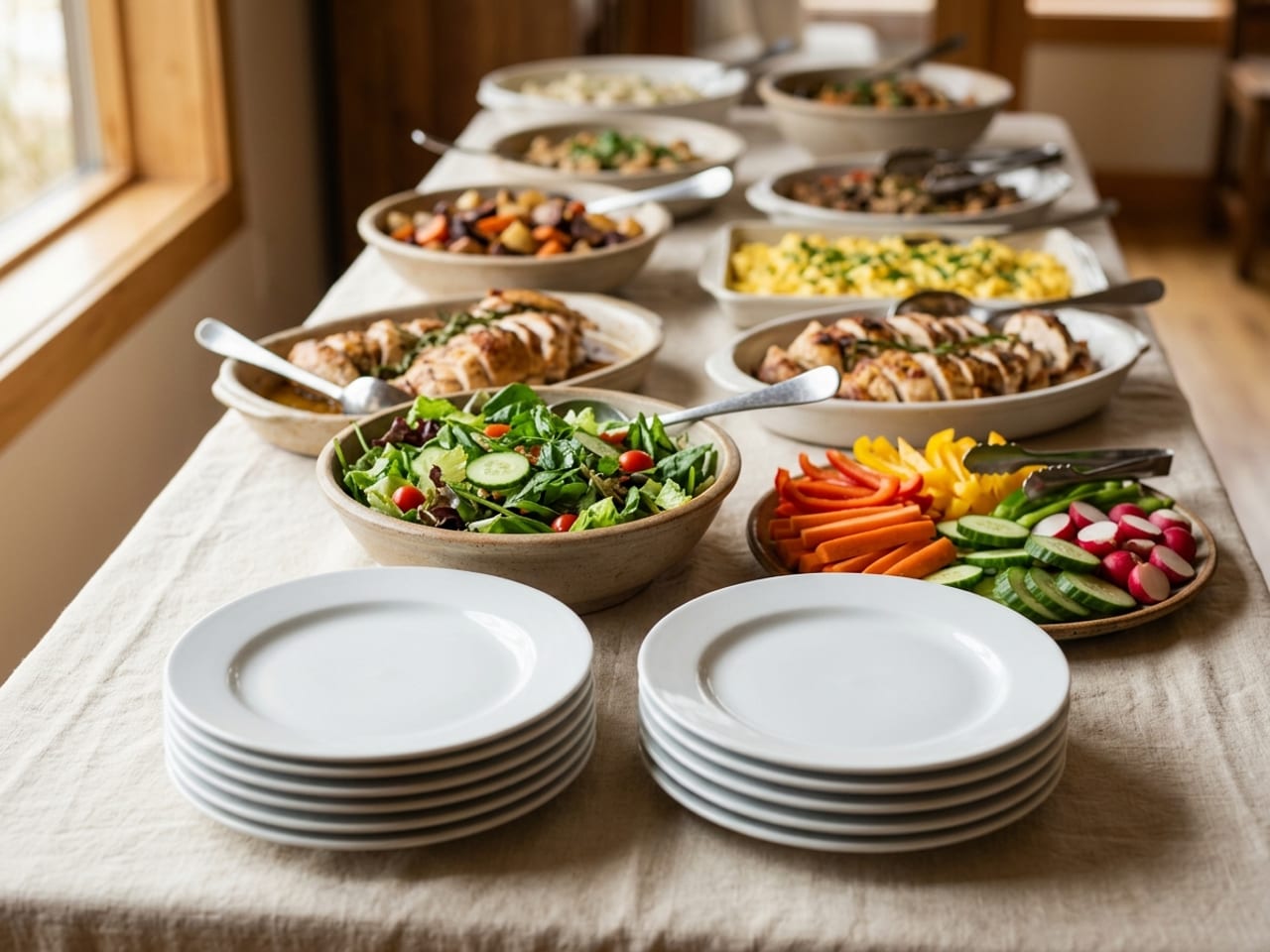
How many. Rental firms, which have plates to rent, print these: Party Rental Ltd., "1.25 plates per guest will suffice for smaller buffets" and 2 to 2.5 for larger ones;106 Curated Events, "1 to 1.25 dinner plates per guest for casual buffets and 1.5 to 2 plates per guest when serving larger portions or expecting seconds", with a 10 to 20% buffer, and 0.8 to 1.0 forks and knives a guest.108 Gottsman, an etiquette trainer: "as many plates and bowls as you have invitees plus a few extra."11 For napkins, the one figure we found is a seller's: Caspari, which sells paper napkins, says of buffet napkins "plan on 2 per person", and its table heads read 3 cocktail napkins and 1.5 dinner napkins a guest.105
What size. The advice points both ways. Smaller: Ellen's Kitchen says "smaller (9 inch) plates rather than 10 or 12 inch plates are easier to handle, and people take less food. For a standing event, 6 inch plates are best." (23 cm; 25 or 30 cm; 15 cm.)9 Steve Ingber recommends 9 or 10 inch plates (23 or 25 cm).42 Larger: Michigan State in 1967, "Use your largest dinner plates and napkins for a buffet meal."6 Both: Cooking Channel, "Offer two different plate sizes."15 Buffet plates and their sizes are in our types of plates guide.
Do smaller plates make people take less? What the studies show
Noelle Carter puts the belief plainly: "If you give them an 8-inch plate, they're going to fill that up. But if you give them a 12-inch plate, they'll fill that up, too."40 The controlled evidence is mixed, and part of what is usually quoted for it was retracted. The table says which papers stand, which was corrected and which were retracted, as PubMed and the journals showed them on 12 October 2026; a caterer may still be right about their own guests.
| The paper | What it reports | Status |
|---|---|---|
| Rolls, Roe, Halverson and Meengs, 2007 (independent) | Three experiments with plates of 17, 22 and 26 cm, the third at a buffet of five foods: "Results showed that plate size had no significant effect on energy intake." With the smallest plate, participants "made significantly more trips to the buffet".110 | No notice found |
| Robinson and others, 2014 (independent meta-analysis) | "Evidence to date does not show that dishware size has a consistent effect on food intake, so recommendations surrounding the use of smaller plates/dishware to improve public health may be premature."111 | No notice found |
| Hollands and others, 2015 (Cochrane review) | "This review found that people consistently consume more food and drink when offered larger-sized portions, packages or tableware than when offered smaller-sized versions." It pools portion, package and tableware studies together.112 | No retraction or correction in PubMed; re-issued in 2018 with a note on retracted studies it includes, which we did not read |
| Kosīte and others, 2019 (independent, pre-registered) | 134 adults serving themselves lunch on a large or a small plate: "There was no clear evidence of a difference in consumption between the two groups". The authors say earlier meta-analyses "may have considerably overestimated the effects of plate size on consumption."113 | No notice found |
| Yip and others, 2013; Libotte, Siegrist and Bucher, 2014 (independent, at buffets) | Twenty women at a buffet lunch with 19.5 and 26.5 cm plates: "There was no detectable difference in EI between the two plate sizes" (EI is energy intake).114 Eighty-three people at a buffet of replica foods: "the plate size had no significant effect on the total energy of the meal", though those with the large plate "served themselves significantly more vegetables".115 | No notice found (abstracts read) |
| Kallbekken and Sælen, 2013 (independent) | Hotel restaurants: smaller plates and a sign "reduce the amount of food waste in hotel restaurants by around 20%". It measured waste, not what guests ate.123 | No notice found (abstract read) |
| Wansink and van Ittersum, 2013 | The source of the figures most often repeated: "Chinese buffet diners with large plates served 52% more, ate 45% more, and wasted 135% more food than those with smaller plates".116 Other papers from the same laboratory were retracted (the rows below). | No notice in its PubMed record |
| Wansink and Hanks, 2013 (the line-order study) | 124 conference attendees, one breakfast, two seven-item lines in opposite order, one trip each: "Over 75% of diners selected the first food they saw, and the first three foods a person encountered in the buffet comprised 66% of all the foods they took."121 We found no direct replication by other authors in what we read. | No notice found on the journal page, in Crossref or in PubMed |
| Wansink and Payne, 2008, "Eating behavior and obesity at Chinese buffets" | An observation of buffet patrons. PubMed links a corrigendum published in 2017.120 | CORRECTED |
| Wansink and Cheney, 2005, "Super Bowls: serving bowl size and food consumption" | The bowl-size paper. PubMed records its retraction in JAMA's issue of 23 October 2018. It is one of six papers by the same first author that the JAMA journals retracted together; their notice, as Retraction Watch prints it, quotes Cornell University: "We regret that, because we do not have access to the original data, we cannot assure you that the results of the studies are valid."117, 122 | RETRACTED |
| Wansink, Tal and Shimizu, 2012, "First foods most" | About which foods people take first after fasting; sometimes cited for buffet order. PubMed records its retraction in the issue of 1 November 2018.118 | RETRACTED |
| Siğirci and Wansink, 2015, on prices at all-you-can-eat buffets | Retracted; the note is dated 2017.119 | RETRACTED |
Our reading: choose the plate size for handling, a plate a guest can hold in one hand while serving with the other, and do not count on it to control how much is eaten. A plate small enough to need a second trip also needs a second clean plate.
How to set up and use a chafing dish, step by step
A chafing dish is a food pan sitting in a pan of hot water over a small burner: "They typically consist of a frame, a water pan, a food pan, and a cover."85 The steps below are WebstaurantStore's order (a seller), with the fuel maker's safety rules and a rental firm's instruction sheet beside them. We lit nothing.
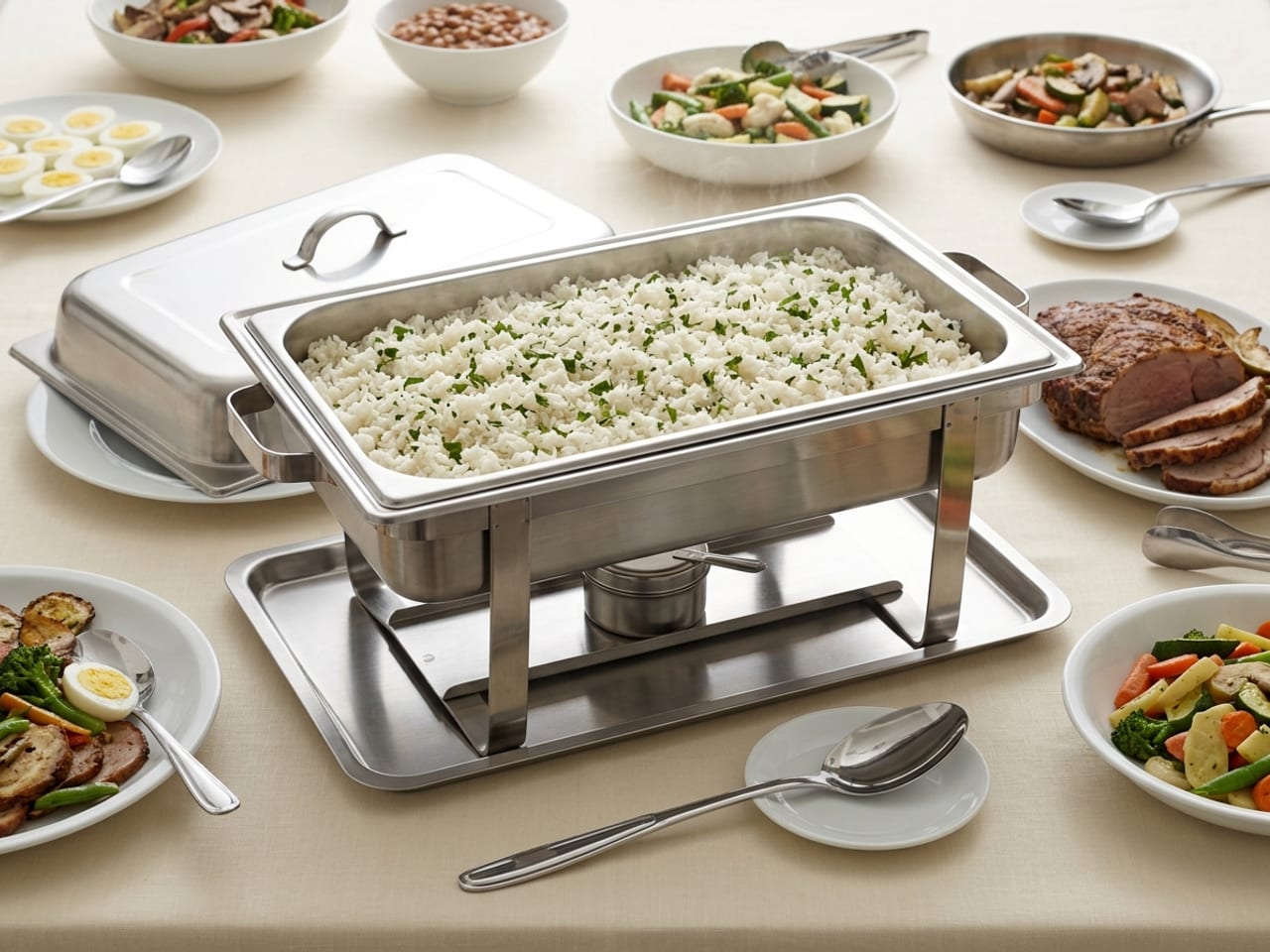
- 1. Set the frame where it will stayOn a stable surface, away from the table's edge: "Avoid placing it near the edge of a table where it may be more prone to accidents."85 And away from children and pets. The same page: "it's crucial to keep children and animals away from the chafer dish area. The hot surfaces and open flames can cause serious burns if not handled properly."85 Keep the space around the burner clear. The maker of the fuel: "Keep chafing fuels away from curtains and other flammable table decorations; just as you would with table candles."92 A chafing dish is never carried with the fuel lit, so choose the spot first.93
- 2. Water pan in, then hot water: about 1 inch (2.5 cm)Three printings agree on an inch. The fuel maker's set-up sheet fills the water pan with "hot tap water" to about 1 inch (2.5 cm) deep.93 WebstaurantStore, a seller: "Add 1 inch of hot water."85 A rental firm's instruction sheet: "Chafing dish water pans should be filled 1 in deep with hot water."88 A second seller, GoFoodservice, prints about 2 inches (5 cm).87 If the pan has a fill mark, use the maker's mark (our suggestion). The water is not optional. The rental sheet: "DO NOT USE WITHOUT WATER." Start with hot water, not cold: the fuel maker says to "start with the correct amount of very hot water". 92
- 3. Fuel under the pan first, then light itSterno's safety poster: "ALWAYS use a blunt object, such as a spoon, to pry off the lid", and "ALWAYS use a long handled match or butane lighter to light cans", with the can already in its holder under the dish. "NEVER use a lit can to light another can".93 The rental sheet adds the order: "Never light the burner unit before putting liquid into the water pan."88 The maker's caution about gel: "when lit the can gets very hot; if spilled, the gel will remain lit". It says wick cans stay cool to the touch and are not flammable if spilled.92
- 5. Add food that is already hotA chafing dish holds heat; it does not make it. WebstaurantStore: "chafing dishes are only used to keep food warm, and they cannot be used for cooking food."84 The fuel maker says the same of its cans, and gives its own number for the food going in, "a minimum internal temperature of 160°F" (71°C).92 That is Sterno's figure, not an agency's: USDA's is food reheated to 165°F (74°C) on the stove, in the oven or in a microwave and then held at 140°F (60°C) or above.130
- 6. Keep the lid on between guestsWebstaurantStore on lid types: a roll top suits self-service "because customers do not need to hold the lid or even remove it", but "roll tops that don't flip down 180 degrees are only ideal for one-sided service."84 So a two-sided table wants lift-off lids or fully retracting ones (our reading). We found no published rule for where a lift-off lid goes while a guest serves; leave a clear space beside each dish for it (ours). Lizzie Post suggests a small sign: "Please use tongs/spoon".2
- 7. During the party: water, steam, temperature, fresh pansThe rental sheet: "Check water pan when in use to insure sufficient water is contained at all times."88 GoFoodservice says every hour.87 The fuel maker's set-up sheet adds three things: "Use chafing dishes in well-ventilated areas. Replenish water as needed. Be cautious of hot steam."93 Steam comes out when the lid or the food pan is lifted, so lift the far edge first and keep faces and forearms back; top the water pan up with hot water, not cold (both ours). USDA: "Check the temperature frequently to be sure food stays at or above 140 °F."130 When a pan runs low, lift it out and put in a full, hot one: swap, do not top up.
- 8. Put the flame out with a cap, and let the can coolSterno: "ALWAYS use a can cap, snuffer paddle, regulator or saucer to extinguish flame", "NEVER blow out flame to extinguish", "NEVER carry lit cans" and "ALWAYS wait until can is cool before touching".93 WebstaurantStore adds oven mitts for the lid and the frame, which stay hot.85
Sizes
WebstaurantStore: "Full size chafers hold between 8 to 9 quarts of food and are typically rectangular." (7.6 to 8.5 L.) Half-size ones hold 4 to 5 quarts (3.8 to 4.7 L), and a round soup chafer, which it calls a marmite chafer, keeps "soups, stews, sauces, and gravies warm".84 One full-size frame takes a full pan, two half pans or three third pans.87 How many guests a pan serves, and how many pans a menu needs, is worked out by the catering calculator; a rental firm's rule is one vessel for each dish, plus back-ups.108
Chafing dish fuel: types and burn times
Burn times are each maker's own claims, and most of Sterno's product pages word them as "up to". The maker of most of these cans prints its ethanol gel two ways.
| Fuel | Burn time as printed | Notes |
|---|---|---|
| Ethanol gel (Sterno Ethanol Gel) | 2¼ hours on the maker's product page for its retail 12-pack; its 2026 poster lists Ethanol Gel (item 20612, a different item number) at 2 hours, and its FAQ calls gel "a good choice when an event lasts up to two hours." 91, 92, 93, 94 | A strong, hot flame. The maker's caution: "when lit the can gets very hot; if spilled, the gel will remain lit".92 WebstaurantStore describes ethanol gel as pink.84 |
| Methanol gel (Sterno Handy Fuel) | Up to 2 hours.91, 95 | The maker's own page: "Unlawful to sell and use in the State of Pennsylvania."95 WebstaurantStore describes methanol gel as blue.84 |
| Wick cans (Sterno Stem Wick, Handy Wick, Safe Heat) | 2, 4, 5 and 6 hours, by the can.91 | A glycol liquid burned through a wick (ethylene glycol and diethylene glycol on the safety data sheet).96 The maker: "Wick fuels are considered a safer option as they are not flammable if spilled and the can stays cool to the touch when lit."92 |
| Adjustable wick (Hollowick Easy Heat) | The largest can: 6, 3 or 8 hours, by the heat setting.97 | A second maker; three wick settings. |
| Electric heater (Vollrath) | As long as it is plugged in; 45 minutes to preheat.90 | The maker's manual: "Do not operate without water in the water pan.", "Do not use an extension cord with this equipment.", and two heaters for a full-size chafer.90 WebstaurantStore calls electric chafers "more reliable than chafing fuel in the event of windy or inclement weather."84 |
Not a chafing dish fuel: Sterno SpeedHeat. The maker offers its flameless SpeedHeat for "venues with open flame restrictions."92 It is not a can for a chafing dish. The maker's poster, which spells it Speed Heat, calls it "a food-warming system that includes a specially-designed base, tray and packets that MUST be used together", and says that using its refills "with any other equipment, such as in a chafing dish water pan, regardless of the type, material or design, is a misuse of the product that may cause personal injury." The same poster prints "Keeps food hot up to 1 hour" and "ALWAYS use Speed Heat in a well-ventilated area". 93 Ask a hall whether it allows open flame before you buy cans (ours).
How many fuel cans
Two ways to count. A seller's rule, which the catering calculator uses at its short end: "Estimate 1 fuel can per 2-3 hours per chafer. Have 20% extra fuel on hand."87 By that rule three chafing dishes over four hours take 8 cans with one can under each, or 16 with two (the calculator's arithmetic: a can every 2 hours, times 1.2 for the spare, rounded up). The maker's advice is different: "Choose a chafing fuel with a burn time long enough to last the duration of the event. This will prevent the need to change the chafing fuel during service."92 A 6-hour wick can under each holder does that for a four-hour meal, and halves the count. How many holders: a rental firm's sheet lists two holders with its oblong chafer and one with its round one, and the fuel maker says "Always follow manufacturer's instructions for maximum number of fuel cans & placement."88, 93 Unused cans: the maker suggests using them "within 2 years from the date of purchase."92
What a chafing dish cannot do
It cannot cook, and it is not for reheating: both claims, checked. It does not keep food cold. It is not safe to move while lit.93 And it does not excuse the thermometer: why. Indoors, the fuel maker describes its ethanol gel as certified for indoor and outdoor emissions, and its set-up sheet still says to "Use chafing dishes in well-ventilated areas";93 a hall may still ban open flame, and an electric or induction chafing dish needs an outlet.84, 94
How to keep food warm on a buffet without chafing dishes
The US agencies name three home devices, "chafing dishes, slow cookers, and warming trays", and one fallback.124, 131 All of them hold food that is already hot. The temperatures here are US home figures.
- A slow cooker, for anything wetUSDA lists slow cookers with chafing dishes and warming trays for holding food at 140°F (60°C) or above, and adds the condition: reheat first, "Then the hot food can be placed in a preheated slow cooker to keep it hot for serving".124, 129 A maker's manual limits its warm setting: "We do not recommend using the WARM setting for more than 4 hours."100 We found no temperature printed for a warm setting in that manual or in the USDA pages we read, so check the food with a thermometer.
- A warming tray or electric buffet serverFDA's warning applies here most: "some warmers only hold food at 110 °F to 120 °F, so check the product label to make sure your warmer has the capability to hold foods at 140 °F or warmer."131 (43 to 49°C; 60°C.) One maker's manual for its buffet server says to "preheat for 10 minutes before use." and that it is not designed to heat cold food.101
- No equipment: small platters, swappedUSDA's fallback when nothing keeps the food hot: "use small serving platters and replace them within two hours or less (1 hour at above 90 °F)."124 (90°F is 32°C.) FDA says the same thing as a plan: "Prepare a number of small platters and dishes ahead of time, and replace the serving dishes with the fresh ones throughout the party."131
- The stove itself, or an induction burnerAt a kitchen-island buffet a pot can stay on the stove: "Just have your soup bowl and plates on the counter next to the stove so guests can easily transfer the food to their dish."28 Chowhound quotes Brandon Dorsky that "induction burners work great for soups, pastas, and other potted items that should be maintained at a minimum level of heat."42
- An insulated carrier, for getting thereUSDA on carrying hot food: "Hot food should be kept hot, at or above 140 °F. Wrap well and place in an insulated container."130 (60°C.) Health Canada: "Transport hot food in insulated containers with hot packs or wrapped in foil and heavy towels."151 Kansas State's extension service gives a home method for soup, chili and stew: "Fill the container with boiling water, let it stand for a few minutes, empty and put in the hot food."103 Cambro, a maker, preheats its own carriers with a pan of 190°F (88°C) water for about 30 minutes and claims at least 4 hours for them.102 Those figures are for that maker's boxes. No agency page we read gives a holding time for any insulated container, and we found no agency or maker text that names a picnic cooler for hot food, so we give no time for one. Check the food with a thermometer when it arrives: if it is below 140°F (60°C), the two-hour clock has been running since it left the heat (ours).
How to keep food cold on a buffet, indoors and outside
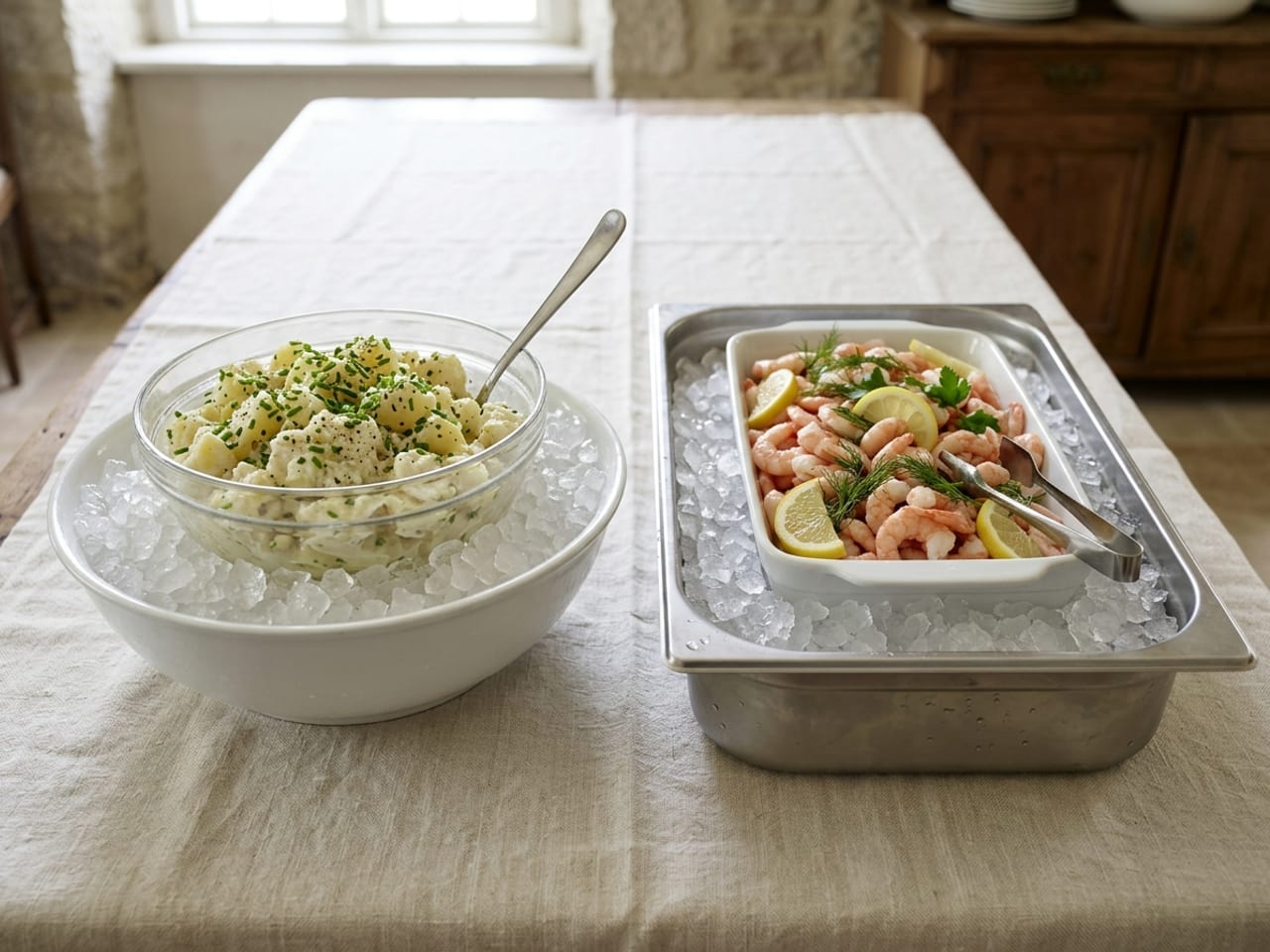
- Nest the dish in a bowl of iceUSDA: "Keep foods cold by nesting dishes in bowls of ice."124 For a serving line, its booklet for volunteers puts the food in a shallow container and says: "Place this container inside a deep pan filled partially with ice to keep food cold." And: "Drain off water as ice melts and replace ice frequently."130 No source we read gives a depth in inches. One county health department's sheet, written for food businesses in Washington State, gives a level: "Surround the food with ice, keeping the ice at or above the level of the food." Among its don'ts: "Set food pans on top of the ice."104
- Outside, the clock is shorterFDA, on food served outdoors: "Once you've served it, it should not sit out for longer than 2 hours, or 1 hour if the outdoor temperature is above 90 °F." Past that, it says to discard it.134 (32°C.) Keep the cold table in the shade, on ice, and bring food out in small amounts (our suggestions). We found no agency wording on fly covers or food nets.
- Seafood, eggs and cut fruitFDA: "Serve cold seafood on ice if it is going to stay out longer than 2 hours."133 And: "Keep cold egg dishes on ice if they are going to stay out longer than 2 hours."132 A copy of the CDC's buffet page lists cut fruit among the perishable foods its two-hour rule covers.136 Our fruit guide has the platter.
Keeping buffet food hot and cold: each country's own rule
One row for each agency and each audience. A home host, a volunteer and a business are told different things, and so are different countries. The rows are not conversions of each other: do not take a number from one row into another. Where a row is in Fahrenheit the Celsius beside it is ours, for reading only.
| Whose rule | Who it is for | Hot food | Cold food | The clock |
|---|---|---|---|---|
| United States: USDA (FSIS) | Home hosts | "Hot foods should be held at 140 °F or warmer."124 (60°C.) | "Cold foods should be held at 40 °F or colder."124 (4°C.) | "Keep track of how long foods have been sitting on the buffet table and discard any food that has been there for more than two hours."124 One hour above 90°F (32°C). |
| United States: FDA | Home hosts | "Hot foods should be kept at an internal temperature of 140 °F or warmer."131 | "Cold foods should be kept at 40 °F or colder."131 | "Remember the 2-Hour Rule: Discard any perishables left out at room temperature for more than 2 hours, unless you're keeping it hot or cold." And: "If the buffet is held in a place where the temperature is above 90 °F, the safe holding time is reduced to 1 hour."131 |
| United States: USDA booklet | Volunteers cooking for groups | "at or above 140 °F", with no reheating in the holding equipment.130 | "Hold cold foods at or below 40 °F."130 | Perishable food "left at room temperature longer than 2 hours; 1 hour in temperatures above 90 °F" is discarded.130 |
| United States: FDA Food Code 2026 | Restaurants and caterers, where a jurisdiction has adopted it. Not a home host. | "At 57°C (135°F) or above"137 | "At 5°C (41°F) or less."137 | Time may replace temperature only with written procedures "prepared in advance", food that starts at 41°F or below or 135°F or above, a marked discard time, and service or discard "within four hours"; a six-hour option covers cold food that stays at or below 70°F.137 |
| United Kingdom: Food Standards Agency | Home cooks and community events (England, Northern Ireland and Wales) | No figure for a host's hot buffet food on this agency's home pages that we read. | A fridge "between 0 and 5°C"; the agency's Danger Zone is "between 8 - 63°C".143 | "Food that needs to be chilled, such as sandwich fillings served as part of a buffet, should be left out of the fridge for no more than four hours." "In extremely hot weather, use food that's been out of the fridge within 2 hours." 142 |
| United Kingdom: Food Standards Scotland | Home hosts, and volunteers at community and charity events (Scotland) | For community and charity events: "All foods which are to be held hot prior to serving must be kept above 63°C."150 No hot-holding figure on its home Christmas page. | "Your fridge should be between 0-5°C".149 | At home: "if you're having a buffet, keep chilled foods out of the fridge for the shortest time possible (no longer than four hours)."149 At community events, chilled buffet food "should be left out of the fridge for the shortest time possible and for no more than four hours."150 |
| United Kingdom: Food Standards Agency | Food businesses (Safer Food Better Business for caterers) | "Hot food must be kept at 63°C or above, except for certain exceptions."147 | "8°C or below", a legal requirement in England, Wales and Northern Ireland and recommended in Scotland (our reading of the sheet's table cells).148 | Hot: "you can take food out of hot holding to display it for up to two hours, but you can only do this once."147 Cold: "You can display food out of chilled storage for up to four hours, but you can only do this once."148 |
| Canada: Health Canada | Home hosts | The danger zone is "between 4°C (40°F) and 60°C (140°F)"; hot food is kept above it with "warming trays, chafing dishes or crock pots". In its paragraph on travelling with food the same page says to "keep hot foods hot (at or above 60°C / 140°F)".151 | "Keep cold foods cold by putting serving trays on crushed ice."151 | "If food remains at room temperature for more than two hours, throw it away."151 |
| Australia and New Zealand: FSANZ | Food businesses | 60°C, the top of the range the rule counts.152 | 5°C, the bottom of it.152 | Time between 5°C and 60°C, added up: under 2 hours, "The food can be used, sold or put back in the fridge to use later"; 2 to 4 hours, used but not put back; over 4 hours, thrown away. "Please note the 2-hour/4-hour rule is a guide for refrigerated food".152 |
Reading the US rows. USDA and FDA give home hosts the same temperatures and word the clock differently: USDA's answer says to discard food that has sat on the buffet table more than two hours, and FDA's adds "unless you're keeping it hot or cold." USDA's own answer says it is not the rule for restaurants: "For food service buffets, consult the FDA Food Code or your local health department regulations."124 The Food Code is "a model" that FDA publishes for state and local authorities to adopt; 2026 is its current full edition.138 Its 135°F and its four hours are a licensed kitchen's, with paperwork, and are not a home host's to borrow. It also has a restaurant buffet "monitored by food employees trained in safe operating procedures" and its food on display protected by guards "or other effective means."137 We read the CDC's buffet page only as a copy; it gives the same 140°F and 40°F.136
Reading the UK rows. The Food Standards Agency's four hours for chilled buffet food comes from its guidance for community and charity events in England, Northern Ireland and Wales; Food Standards Scotland prints the same four hours on its home Christmas page. The 63°C, the two hours for hot food on display and the "only once" come from the Food Standards Agency's method sheet for caterers, a business rule; Food Standards Scotland asks 63°C of volunteers at community events. Neither agency's home pages that we read give a private host a hot-holding figure, and we do not turn the business rule into home advice. We found no buffet advice on the NHS site and no consumer rule at European Union level in what we read.
- United States: the two-hour clock, in both agencies' wordsUSDA: "Foods should not sit at room temperature for more than two hours."124 Its Danger Zone page: "Never leave food out of refrigeration over 2 hours."127 FDA words it with an exception: discard perishables left out more than 2 hours "unless you're keeping it hot or cold."131 Read together (our reading): the clock runs on food that is NOT being held at 140°F (60°C) or above or at 40°F (4°C) or below. Above 90°F (32°C) it is one hour. USDA's leftovers page starts the two hours when food comes off the heat or out of "an appliance keeping it warm".128
- Reheat food cooked ahead to 165°F (74°C) first, then holdUSDA: "Foods that have been cooked ahead and cooled should be reheated to at least 165 °F." (74°C.) Then: "Once food is thoroughly heated on stovetop, oven or in microwave oven, keep food hot by using a heat source."130 Its leftovers page: "Reheat sauces, soups and gravies by bringing them to a rolling boil."128 Never in the chafing dish, the slow cooker or the warming tray: why. Gravy for a holiday line is in our turkey gravy recipe.
- Swap, do not top upFDA: "Don't add new food to an already filled serving dish." "Instead, replace nearly empty serving dishes with freshly filled ones." Its reason: "bacteria from people's hands can contaminate the food."131 USDA: "When a dish is empty or nearly empty, replace with a fresh container of food, removing the previous container."130 Health Canada: "use a clean platter or serving dish each time you re-stock the buffet."151 The UK sheet for caterers: do not "mix new food with the food that is already on display."147
- A serving tool for every dishHealth Canada is the one agency we read that asks for it outright: "Provide serving spoons and tongs for every dish served. Even finger foods like cut vegetables, candies, chips, nachos and nuts should have serving tools to prevent contamination between guests."151 If one falls into the food, Lizzie Post says "it's best to remove it and get a fresh one for your guests to use".2
- Guests at higher riskFoodSafety.gov names four groups in the United States: children under five, older adults, people with weakened immune systems and pregnant women.139 The UK's agency: "young children, pregnant women, people with an underlying health condition (such as cancer, diabetes, liver and kidney disease) and older people." 144 Health Canada: "young children, the elderly, pregnant women and people with weakened immune systems."151 For them, keep raw or lightly cooked egg off the table; FDA lists where it hides: "homemade Caesar salad dressing, ice cream, custards, rice pudding, chocolate mousse, eggnog, and some sauces".131 The UK agency's line for community events: "don't use raw eggs in anything that won't be thoroughly cooked, such as icing or mousse".142 Serving them first, from untouched dishes, is our suggestion.
- Allergens: a card for each dishThe United States recognizes nine major food allergens; sesame became "the 9th major food allergen" under a 2021 law.135 Chowhound quotes Brandon Dorsky on naming them on labels: "peanuts, tree nuts, eggs, dairy, wheat, soybean, fish, shellfish, and sesame", and on keeping such dishes "in one area".42 We found no FDA page written for a private host. In the UK the law covers 14 allergens and binds registered food businesses; of everyone else the agency says "We encourage you to provide allergen information where possible".142, 146 A separate spoon for every dish matters most here, and a card cannot promise that a dish is free of anything (ours).
- United Kingdom, at home and at community eventsThe Food Standards Agency's buffet figure is for chilled food: out of the fridge "for no more than four hours", and "If you put the food back in the fridge, don't let it stand around at room temperature when you serve it again."142 The page is written for community and charity events in England, Northern Ireland and Wales. Food Standards Scotland prints the same limit for a buffet at home, "no longer than four hours".149 For cooked rice, a buffet staple, the Food Standards Agency's home advice is: "Rice may be eaten cold if it is cooled down quickly. Put the rice in the fridge and consume within 24 hours." 145 The 63°C and two-hour figures in the table belong to that agency's sheet for food businesses, not to its home pages; Food Standards Scotland asks 63°C of volunteers at community events, and neither gives a private host a hot-holding figure on the home pages we read.150
- Leftovers: each country's own figureUnited States, USDA: "Leftovers can be kept in the refrigerator for 3 to 4 days or frozen for 3 to 4 months."128 FDA, for food sent home with guests: refrigerate "as soon as guests arrive home and/or within 2 hours!"131 United Kingdom: "Eat leftovers within 48 hours or freeze them if you think this won't be possible."143 These are different rules, not conversions. Food that sat on the buffet past the clock is not a leftover; it is thrown away.
- Why the holidays are the risky seasonCDC, on the bacterium most tied to food cooked in bulk and kept warm: "Most outbreaks happen in November and December. Many of them have been linked to popular holiday foods, such as turkey and roast beef."140
- Open flame on a clothed tableThe fuel maker's poster keeps "decor, loose clothing, napkins or tablecloths" away from the flame.93 One university's rule for its own campus events keeps combustibles such as plates, napkins and cups "a minimum of three feet from Sterno" (0.9 m) and wants the chafing dish on a non-combustible surface, for which a mat or a ceramic or metal tray "extending at least eight inches" (20 cm) beyond the can in each direction may be used; another wants staff in the room whenever the fuel is lit.98, 99 Those are two campuses' rules, not a national code: we read no fire-code text. Keep children and pets away from a lit chafing dish: WebstaurantStore, a seller, calls it "crucial" because "The hot surfaces and open flames can cause serious burns if not handled properly." 85 An electric heater is not for a table within children's reach either: its maker says "Do not operate equipment in public areas and/or around children."90
- Old books are history, not adviceEmily Post wrote in 1922 that "all cold dishes and salads can stand in the pantry or on a buffet table all evening."48 No agency rule on this page allows that. The old bulletins and etiquette books are quoted here for where things go, never for how long food may sit.
Buffet, family style or plated, and the kinds of buffet
What each is and when it fits. Two of the definitions rest on course notes that we label as weak; no dictionary or etiquette authority we read defines every one of these.
| Style | What it is | When it fits |
|---|---|---|
| Buffet | Merriam-Webster: "a meal set out on a buffet or table for ready access and informal service". Oxford's learner's dictionary adds where it is eaten: guests "serve themselves from a table and then stand or sit somewhere else to eat". 153, 155 | More guests than seats at one table, or a guest count that may change: Emily Post in 1922 called it practical "when an elastic number of guests are expected".48 Nicolet College's catering textbook: "Fewer servers are needed compared to plated service."109 |
| Seated buffet | Guests serve themselves, then sit at tables that are fully set. Elizabeth Post, 1975: "The places are set exactly as for any seated dinner, and since the guests need not carry silver, napkins, or glasses with them, a great deal of space is saved on the buffet table."45 | Any buffet where everyone has a chair at a table. It is the reason cutlery can leave the line. |
| Semi-buffet | Elizabeth Post's name for sideboard service: "arrange the food on the sideboard or a side table and set the dining-room table as for a sit-down dinner." Either the host fills each plate at the sideboard, or "the guests may serve themselves as at a regular buffet and carry their plates to the table".45 | In her words, "a small group of friends or a family party".45 |
| Stations | Several small buffets around the room in place of one line. Chowhound quotes Laide Olambiwonnu: "appetizers on one table, mains on another, desserts somewhere else entirely. This spreads people out instead of creating one giant bottleneck".42 No dictionary we read defines the word in this sense. | A wedding or hall where a queue would form. Darcy Hill of Garces Events suggests stations with a served first course.37 Each station needs its own plates.3 |
| Family style | Platters on the dining table, passed. A hospitality course text words it: "Food and the accompaniments are traditionally served in large dishes and people help themselves" (a weak source: open course notes from the National Open University of Nigeria).173 | A table that can hold the platters. On our Thanksgiving page the working rule is up to 8 guests family style, 9 to 20 from a sideboard and a two-sided buffet above about 20; those bands are ours, and no source we read gives a guest count for choosing a style. |
| Plated | The same course text: "The prepared food is dished onto individual plates in the kitchen" and carried to the guests (the same weak source).173 | A small dinner you can plate in the kitchen, or a caterer with staff. Whether a buffet takes more food than a plated meal is disputed: the calculator page sets the positions side by side. |
| Finger buffet (UK) | Cambridge, which marks it UK: "a meal, often on a special occasion, in which the food is eaten with the fingers, often by guests who are standing".157 | A standing party with no cutlery at all: small plates and napkins only. |
| Fork buffet (UK) | Food eaten with a fork alone, standing or perched. That reading is ours: we found no dictionary entry, only uses in British catering books seen as search fragments.158 It matches Emily Post's 1922 rule for a standing meal: everything "must be selected with a view to its being easily eaten with a fork while the plate is held in the other hand!"48 | More guests than chairs. Michigan State in 1967: "Do not provide knives, unless guests are seated at tables where they can be used without too much trouble."6 |
| Sit-down buffet (restaurant) | One unsigned course chapter uses the phrase for restaurants where "the tables are arranged with crockery and cutlery where guests can sit and eat, and then replenish their plates." It is a weak source and is quoted only as an example of textbook wording.174 | The restaurant form of the seated buffet above. |
A mixed service is in print too. Real Simple passes the cold dishes at the table and serves the rest as a buffet,44 and Kerber, as reported, sends bread, butter, gravy and cranberry sauce to the dining table "so that the diners could help themselves to seconds."43 If guests will sit at set tables, the table setting guide has the place settings, and courses of a meal has the order for a dinner served in courses.
How to set up a Thanksgiving buffet
Four published orders and ours. They disagree on where the turkey goes and on where the gravy goes, and each gives a reason.
| Whose order | The line | Gravy | In their words |
|---|---|---|---|
| Chuck Kerber, club chef (Pittsburgh Post-Gazette, 2017) | Plates and wrapped silverware, the turkey, the sides (salads among them), gravy and cranberry sauce, rolls and butter | At the end, or on the dining table | As the Post-Gazette's reporter words his tip: "The first food item after silverware and plates should be the turkey."43 |
| StoneGable (a blog) | Plates, the turkey, the sides, gravy and condiments, rolls, napkins and flatware | After the sides | "The best way to lay out a Thanksgiving buffet is from left to right since guests naturally move that way."19 |
| Party City (a seller) | Plates, the mains, the sides, napkins and cutlery | On the dining table, with the cranberry sauce | "Salt and pepper, cranberry sauce, gravy, and any condiments are all items for the dining table."20 |
| The Shelving Store (a seller) | Salads, breads, sides, the turkey last | Not stated | "Generally, it's best to line the food from most plentiful (salads, breads, sides) to the richer main courses at the end, like the actual turkey." 21 |
| Ours (the Thanksgiving tablescape and the Christmas table setting pages) | Plates, cold things, the hot sides, the carved turkey, rolls and butter, cutlery rolled in napkins | Beside the turkey | Our choice, not a rule. It follows the majority on cold before hot and on the main dish late, and Restaurant Business on sauces "directly with the foods they accompany".3 Putting the cranberry sauce among the cold things is ours alone: no source we read lists it early. |
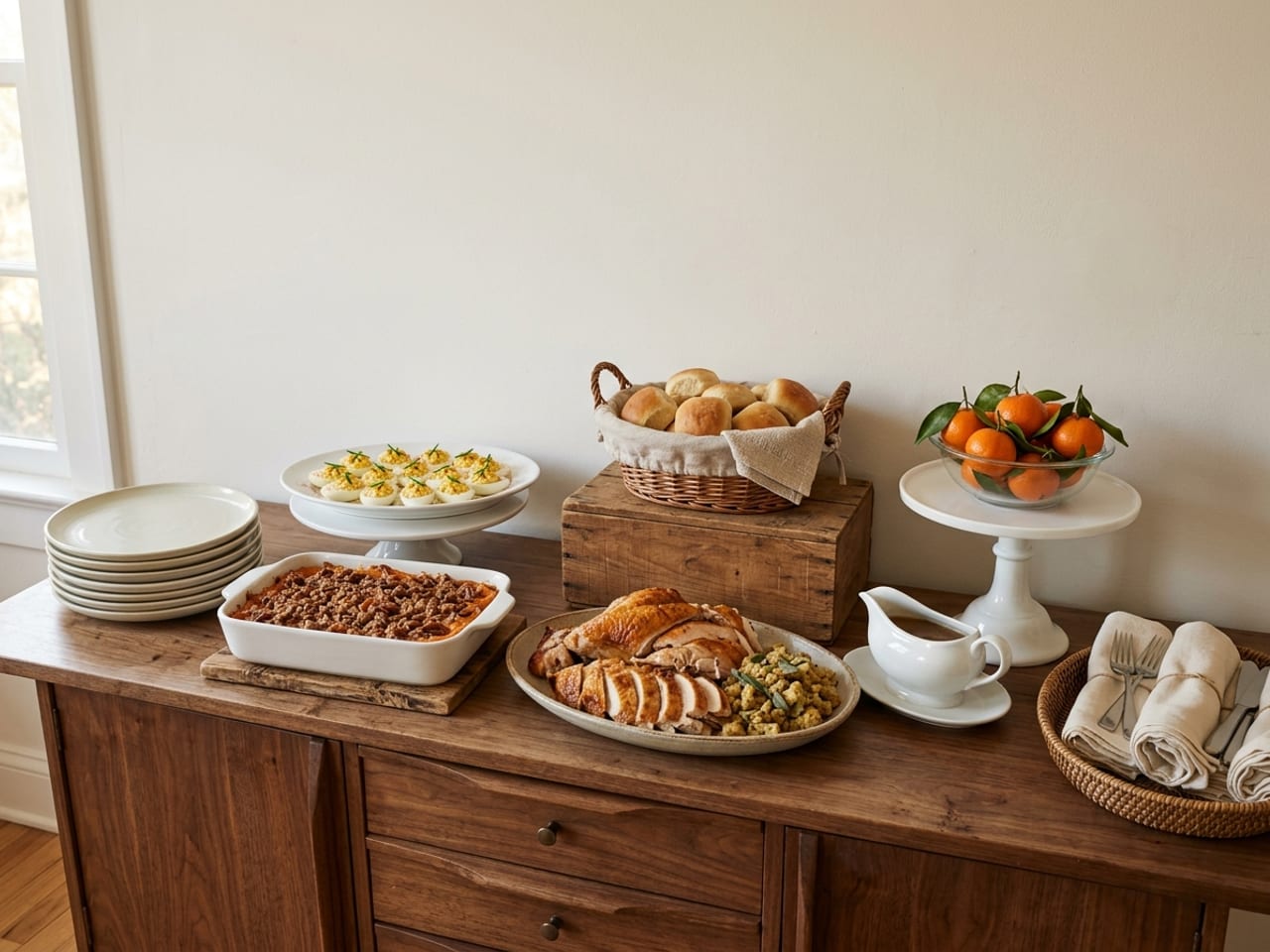
The turkey. The sources that say how the turkey reaches the table carve it in the kitchen. Kerber, as reported: the turkey "should already be carved before being placed on the table".43 Michigan State, 1967: "Meats appearing on the buffet table should be carved in the kitchen and arranged on a platter with a suitable garnish."6 Ellen's Kitchen keeps "white meat and dark in different chafing dishes or at least on opposite ends of the platter". 10 The cuts, the platter and how to keep carved turkey warm are in how to carve a turkey.
The gravy. Beside the turkey in our order; at the end in Kerber's, after the sides and before the rolls, "so that you can top the meat and stuffing and whatever else you want with them at one time without holding up the line" (the reporter's wording); on the dining table in Party City's.20, 43 Wherever it goes it must stay hot: a small slow cooker or a round chafing dish holds it, and our turkey gravy recipe has the reheating. The Thanksgiving sides page says how each side holds.
Dessert. Kerber's tip is headed "Segregate desserts" and gives an order: "Stack the dessert plates, forks and napkins on one end of the table. Then set up traditional desserts such as pumpkin, pecan and apple pies." 43 That it means one end of the same table is our reading. Ours go on a separate table after dinner. The day's timing is in the Thanksgiving timeline planner, and the opener in the Thanksgiving charcuterie board.
Christmas, brunch, appetizers, a wedding and a potluck
- ChristmasWe found no published Christmas order that differs from the general one. Cooking Channel's Christmas page gives a direction and two positions: guests move "from the left side of the table toward the right (like reading a book)", with the gravy "all the way to the right" and the flatware at the far right.15 The Old Farmer's Almanac models its table on the Swedish Christmas table: "Reserve the most prominent spot for the smoked fish and/or pork and the vegetables."16 Our Christmas table setting page has the sideboard version and Christmas dinner ideas has a buffet menu for 12 to 20.
- Breakfast or brunchPeanut Blossom's brunch line is one of the six that start with the cutlery: plates or bowls, utensils, napkins, then the mains, sides and a bread basket, with drinks and dessert as separate stations, and "all sauces, syrups, or dressings needed for the dish right next to the container of the main dish."36 A catering textbook, read as a fragment, says that at breakfast "you may be able to get by with one buffet line for more than 100 guests".66 FDA on egg dishes: "Serve small platters of reheated egg dishes at a time", and "Replenish as needed, or at least every 2 hours."132 A guest's tip from caterer David Jubé, quoted by The Daily Meal: "Walk the line once with empty hands, decide what you want, then come back and serve yourself".39
- Appetizers or a cocktail partyThere is no line to order. The Kitchn: "For small plate or appetizer setups, I like to put stacks of plates at both the beginning and end of the table, so people can wander up from any direction."1 The Almanac does the same on any buffet table, "so that people are less likely to huddle on one end".16 A rental firm plans "three (3) to five (5) plates per person" for cocktail stations.107 Serve food that needs no knife.6, 53 Counts of pieces per guest are in the party food calculator; boards are in our charcuterie board guide and the Halloween appetizers page.
- A wedding or a hallCount lines first: one for every 50 guests or one for every 100. Then decide how guests are released. Debrett's describes the usual way: "At formal 'wedding-style' buffets, guests get called up table-by-table".54 A Philadelphia caterer prefers stations and no announcement: she "advises against calling table numbers or making a big announcement that the stations are open, which can cause crowds to form around the food."37 Tasting Table's advice is to "structure the buffet line in a way that guests can get everything at once and don't have to return multiple times".38 For a mirrored two-sided table, see the drawing. Ask the hall about open flame before choosing fuel, and a caterer follows the food code its state or county has adopted, not the home rules (the table). Quantities, pans, chafing dishes, fuel cans and staff for up to 500 guests are in the catering calculator.
- A potluckEllen's Kitchen: "Potlucks are usually self serve and are set up in the same order as buffets."10 Put out blank cards: "If you have guests bringing dishes, leave some open labels for them to fill out."44 And spare spoons: "Guests often forget to bring serving utensils when they contribute a dish".19 The safety clock starts when each dish left its own kitchen, not when it reached your table (our reading of USDA's two hours out of refrigeration). A CDC report of a 2015 church potluck in Ohio, where home-canned potatoes in a potato salad caused botulism, calls it "the largest botulism outbreak in the United States in nearly 40 years".141
Buffet etiquette, for the host and for guests
For the host
- Who goes first is the host's callLizzie Post lets the host invite guests "in whatever order you deem appropriate for your party".2 Southern Lady, asked whether ladies always go first: "No. In fact, I like to serve by couples or tables."52 The Reuters etiquette column: "Gender and status privileges do not apply in the buffet line."55 We found no rule that a guest of honor goes first at a self-service line in the etiquette sources we read. For children the published advice is about who goes with them, not when: caterer David Jubé, quoted by The Daily Meal, says "With children under about eight, plate the first round yourself, then walk the line beside them next time".39
- Say how it worksLizzie Post's script: "Please take a plate and begin. There are tongs and spoons for each item, and you'll find utensils and napkins at the end of the buffet, and drinks over on the other table."2 For a larger party, release a few at a time. Michigan State, 1967: "Invite a few guests at a time to go to the buffet table to be served".6
For guests
- A clean plate for secondsThe strict view, Lizzie Post: "it's not proper to bring a used plate back to the buffet".2 Diane Gottsman: "After finishing your first serving, use a clean plate if you want to go back for seconds. Dessert also requires a separate plate."12 The relaxed view, the Reuters column: "In a private home, use common sense to determine whether you should retain your plate or ask for a new one."55 In US restaurants, where the model Food Code is adopted, it is a rule and not manners: the Code says self-service customers "may not be allowed to use soiled tableware" for a return trip.137
- One direction, one plate, no eating in lineGottsman: "Don't swim upstream or go against the current of buffet traffic." 13 And: "Put your glass down at the table or seating area and carry only one plate through the buffet line at a time."12 Protocol Professionals: food goes on the plate, not in the mouth, while you are in the line (our paraphrase).56 A Georgia newspaper's etiquette columnist answers a reader that skipping ahead in the line is generally not acceptable (our paraphrase).58
- Seconds are welcome, after everyone has been throughMichigan State, 1967: "Second servings are always in order."6 Gottsman: "Avoid jumping back in the buffet line for seconds until everyone has had the opportunity to go through the line once."13 Debrett's is cooler: "multiple visits to the buffet table may look greedy". 54
- Look at the tables before you look for a forkThe Reuters column: "Before piling food on your plate, look at the dining tables. If utensils are already there, you don't need to look for them at the buffet table." 55 And help the person behind you, Debrett's says, "either by handing them a plate, knife and fork or napkin, or by serving them where practical." 54
Buffet table mistakes, and the fixes named sources give
Each mistake is one a named source lists; the fix is that source's or another named source's, and where it is ours it says so. None was tested by us.
- Guests juggle forks down the lineThe Kitchn calls end placement "the cardinal rule". Fix: move the cutlery to the end, rolled in napkins, or onto the dining tables.1 Our napkin folding guide has the cutlery roll.
- Two lines started from opposite endsThe same rental firm: "the final result will be everyone bunched up in the middle, reaching over each other and creating a mess."24 Fix: both lines start at the plates and move the same way. (Michigan State's 1967 bulletin allowed ends to center; the two disagree.)6
- Nowhere to put a used plateThe Almanac: "Nothing makes a party table look more tired than plates filled with food scraps intermingled with the serving dishes."16 Fix: Ellen's Kitchen: "Set up a place where your guests can put their plates when they're finished eating", and The Kitchn: "don't forget the trash cans!"1, 9
- Food that needs two hands or assemblingSouthern Lady: "I like to avoid foods that my guests must handle, such as baked potatoes that call for added toppings."53 Fix: portion it in the kitchen. Ellen's Kitchen: "Always cut any food that needs it into individual servings in the kitchen".9 For a turkey, our carving guide has the cuts and the platter.
- Bread or salad wilting beside a hot dishArte Italica, a seller: "Be careful not to place something delicate like French bread or salad greens close to anything that might ruin them with steam."25 Fix: hot with hot, cold with cold.3, 9 Dressing goes beside the salad, not on it: see how to plate salad.
- A tall stack of plates, or stemmed glasses on the buffetGottsman: "Don't stack them too high as guests might knock them over." 11 Michigan State, 1967: "Avoid using footed sherbets and goblets since they upset easily."6 Fix: two short stacks (ours), and low glasses: a 1965 Idaho bulletin, in a scan too broken to quote, also prefers low glasses and cups.7
- Fresh food tipped onto what is left in the dishFDA: "Don't add new food to an already filled serving dish." 131 Fix: swap the dish.
- Finding out at the party that a dish has no spoon or no spaceFix: a dry run. Williams-Sonoma: "Arrange empty platters and bowls on the table ahead of time so you can determine their placement. Then attach post-its indicating which foods will be served in each platter and bowl."4 Gottsman does it "at least one day before your event".11
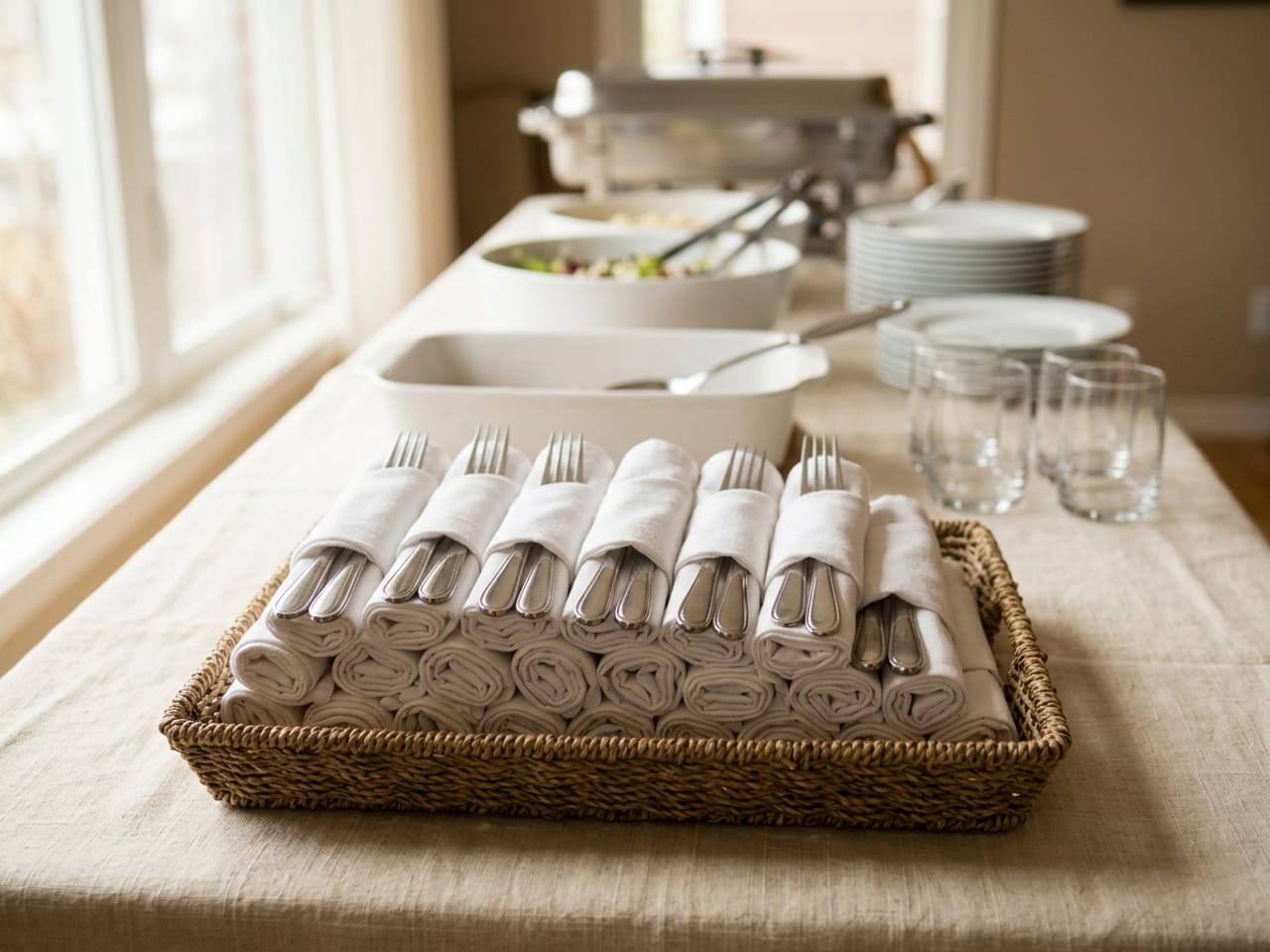
Ten popular claims about buffets, each with a verdict
"Supported" never means proven for your party. "Supported, narrowly" means the source or study covers less than the claim says; "Mixed", that sources point both ways; "Not supported", that the claim was checked against the sources it rests on, or against agency rules, and did not hold; "No source found", that we found no source for it at all.
| The claim | Verdict | What we found |
|---|---|---|
| "Cutlery always goes last" (or "always goes first") | Not supported | Neither holds as "always". Of the sources we read, 29 put cutlery at the end, six at the start and eight name the dining tables as the best or an equal place. The names are in the table. The end of the line is the clear majority, and the reason is always the same: free hands. |
| "Hot food goes first so that guests get it while it is hot" | Mixed | The order is in print; the reason is not. One source we read, an Illinois lesson plan, prints the entrées and the hot vegetables before the salads, and gives no reason.65 The sources that give a reason all give it for the opposite order: six state cold before hot in words, for the very reason the claim gives. Diane Gottsman's "setup ensures your guests will be able to sit down to food that is still hot versus a plate that has gone cold as you proceed through the line."11 One course page that a search summary describes as putting hot dishes first could not be opened. |
| "A chafing dish keeps food safe by itself" | Not supported | It holds food that went in hot, over water that was put in hot, and only while someone checks it. USDA: "Check the temperature frequently to be sure food stays at or above 140 °F."130 (60°C.) FDA warns that "some warmers only hold food at 110 °F to 120 °F".131 And the maker of the fuel says its cans "are not designed or intended to cook food."92 |
| "You can reheat food in the chafing dish or the slow cooker" | Not supported | Every agency page we read that addresses it says no. USDA: "Reheating leftovers in slow cookers, steam tables or chafing dishes is not recommended because foods may stay in the 'Danger Zone,' between 40 °F and 140 °F, too long."130 The UK agency's sheet for caterers says hot holding equipment is for hot holding only and is not for cooking or reheating (our reading of its table cells).147 |
| "Food held hot is fine all day" | Mixed | On safety, the US home pages we read set no time limit for food that is truly kept at 140°F (60°C) or above: FDA's two-hour rule applies "unless you're keeping it hot or cold", and USDA's hot-holding answer names none.125, 131 USDA's page on bought turkey dinners adds: "It's not a good idea to keep food hot longer than 2 hours."126 That is one page's advice about a bought dinner, not an agency limit. USDA's booklet for volunteers says "Hot holding for extended periods may reduce the quality of the food."130 A slow-cooker maker limits its warm setting to 4 hours, and a can of gel fuel burns about two.92, 100 And USDA's buffet answer, read on its own, says to discard any food "that has been there for more than two hours."124 So: only with a thermometer, and swap the pans anyway. |
| "Bigger plates make people take more" | Mixed | A Cochrane review that pools portions, packages and tableware finds people consume more from larger ones.112 A meta-analysis of dishware alone finds no consistent effect, and four independent experiments, three of them at buffets, found no difference in what people ate.110, 111, 113, 114, 115 The large effects usually quoted come from a laboratory whose bowl-size paper was retracted.116, 117 The table of studies. |
| "Putting the healthy food first changes what people take" | Supported, narrowly | By one small study: 124 people at one conference breakfast, one trip each, with groups kept together.121 It carries no correction or retraction that we could find, but its first author's other buffet papers do, and we found no direct replication by anyone else in what we read.118, 119, 120 Caterers say something close without a study: cheap and filling first, costly last.1, 9, 40, 41 |
| "A buffet always needs more food than a plated dinner" | Mixed | The published portion guides split, and Nicolet College's catering textbook prints the same protein figure for both. The positions are set out on our catering calculator page. |
| "The smörgåsbord came to America at the 1939 New York World's Fair" | Not supported | The Swedish Pavilion did have a restaurant.179 But the word was in English by 1873 on Merriam-Webster's dating, a restaurant historian puts a smörgåsbord at the Chicago fair of 1893 and smörgåsbord restaurants in American cities "in the 1910s", and the encyclopedia article that prints the 1939 claim tags it as needing a citation.159, 177, 180 The fair may have made it famous; nothing we read measures that, and we read no source from 1939. |
| "The buffet was invented in Las Vegas" | Not supported | Not the buffet: Mrs Beeton laid one for a standing supper in 1861 and Emily Post wrote of the "buffet lunch" in 1922.48, 175 Not the phrase or the fixed price either: "all you can eat" is quoted from 1895 and Merriam-Webster dates the adjective to 1940.163, 186 What Las Vegas has is a story about the casino buffet. Its earliest version that we read is Herb McDonald's own recollection, printed in his 2002 obituary: a midnight "chuckwagon" buffet at the El Rancho Vegas in 1946, at $1.25.181 The subheading of an Associated Press story reads "At least three Vegas legends claimed inventing the all-you-can-eat buffet."182 The university's exhibit calls the Chuck Wagon Buffet a "widely-copied feature" and a forerunner, not the first.183 A restaurant historian dates the idea's fame earlier, "it wasn't until the Depression of the 1930s that the all-you-can-eat idea became a newsworthy phenomenon", and the casinos' influence to the 1950s.178 A later book prints the price as a dollar,184 and the name "Buckaroo Buffet" is earliest seen by us in a volume cataloged 2011;185 both were read only as search fragments, and we read no source from the 1940s. |
A short history of the buffet
Dated sightings, each only as far as its source goes. Where two dictionaries give two dates, both are printed. "Earliest seen" means the earliest we saw, never the first.
| When | What the source says |
|---|---|
| About 1150 to 1690 | In French, bufet is first a stool (about 1150), then a table or counter (1268). In 1690 Furetière's dictionary describes a buffet as a long table for the silver, the glasses and the bottles that serve the dinner table (our translation of the passage as the Trésor de la langue française quotes it).171 |
| 1707 or 1718 | The furniture word in English. Merriam-Webster dates it 1707; the Oxford English Dictionary's public summary gives "OED's earliest evidence for buffet is from 1718", and Etymonline also says 1718. Merriam-Webster and Etymonline both call the French word it was borrowed from "of uncertain origin".153, 165, 170 |
| 1832 | The French word is recorded for the table where food and drink are set out at a gathering (the Trésor's date; our translation).171 |
| 1848 | The earliest quotation the Swedish Academy's dictionary shows for smörgåsbord. Its first definition is food taken before the meal proper; a later sense is the table eaten as the whole meal (our translation). A Nordiska museet page says aquavit was served before the meal in the 1600s, got a table of its own in the 1700s, and that the small dishes grew and moved to the dining table in the 1800s (our summary of the Swedish).172, 176 |
| 1861 | Mrs Beeton uses the word for the table or room of refreshments at a ball: "A SEPARATE ROOM OR CONVENIENT BUFFET should be appropriated for refreshments". Her standing supper is already fork and finger food, "Dishes for these suppers should be selected which may be eaten standing without any trouble", and she keeps back-ups: "A few dishes of fowls, lobster salads, &c. &c., should be kept in reserve to replenish those that are most likely to be eaten first."175 |
| 1873 or 1893 | "Smorgasbord" in English: Merriam-Webster gives a first known use of 1873, Etymonline 1893. The two differ by twenty years and we print both.159, 168 Restaurant historian Jan Whitaker reports "a Swedish restaurant with a smörgåsbord at the 1893 Columbian Exposition in Chicago", and smörgåsbord restaurants in American cities from the 1910s.177 |
| 1890s | The chafing dish has a vogue in America as a table COOKER. Christine Terhune Herrick wrote in 1894 that it "has leaped into sudden popularity."187 Fannie Farmer described its two pans in 1898, "The upper pan, familiarly called the blazer," and the lower "hot-water pan or bath", the part a buffet chafing dish keeps today, and the holding use: "to keep the viand hot, without further cooking, that a second serve may be as satisfactory as the first."188 The word itself is far older: "Chafing-dish is from late 15c.", from an Old French verb meaning to warm.166 |
| 1895 and 1898 | Two words arrive. The Phrase Finder quotes an Oklahoma newspaper of September 1895, "all you can eat for fifteen cents." (its author's find; we did not see the newspaper).186 Merriam-Webster dates "buffet" as an adjective, as in a buffet supper, to 1898.153 |
| 1922 | Emily Post describes the stand-up luncheon: "This is nothing more nor less than a buffet lunch." "The food is all put on the dining table and every one helps himself." She gives no order for a line; plates, napkins, spoons and forks sit in piles at intervals along the table.48 So Etymonline's "by 1951" for the meal sense is later than uses we read ourselves.165 |
| 1939 | The Swedish Pavilion at the New York World's Fair has a restaurant; a 1948 New York restaurant guide says the Three Crowns in Manhattan was run by the men "who operated the restaurant in the Swedish Pavilion at the World's Fair."179 That much is supported. That the fair introduced the smörgåsbord to America is not: the claim, checked. |
| 1940 and 1946 | Merriam-Webster dates the adjective "all-you-can-eat" to 1940.163 In 1946, by his own later account, Herb McDonald of the El Rancho Vegas set out cold cuts and cheese on the bar at night, and the midnight "chuckwagon" buffet that followed "cost $1.25." That is from his 2002 obituary, which gives the story as what he "recalled".181 The claim, checked. |
| 1975 | Elizabeth Post names the seated buffet and the semi-buffet in The New Emily Post's Etiquette.45 |
See your own plate, re-plated
A buffet is where guests plate for themselves. For the dishes you plate yourself, photograph one and Plate Artists re-plates that dish the way a restaurant would, with the food kept as it is and the steps named so you can repeat them. Start with a re-plate.
Your dish, plated like a chef's
Snap it, upload it, and get the composed version back, with the steps to recreate it at home.
Start free · 1 enhancement →Free account · 1 free enhancement · No credit card
Buffet words, defined
Definitions and first-use years are each dictionary's own. A word that no dictionary we read defines in this sense says so, and its definition is then a seller's, an etiquette book's or our reading.
Buffet
A meal at which the food is set out on a table and guests serve themselves, then stand or sit elsewhere to eat.
Where it comes from. Merriam-Webster: "a meal set out on a buffet or table for ready access and informal service". Cambridge: "a meal where people serve themselves different types of food". Collins still defines it as "a meal of cold food that is displayed on a long table at a party or public occasion". Americans stress the second syllable (Cambridge gives /bəˈfeɪ/, buh-FAY in our respelling) and the British the first (/ˈbʊf.eɪ/).153, 154, 156
Buffet (the furniture) · sideboard
A piece of dining room furniture with a flat top for serving food from and storage below; also called a sideboard.
Where it comes from. The older sense, and the reason a search for "buffet table" mixes furniture with meals. Oxford's learner's dictionary: "a piece of furniture in a dining room for putting food on before it is served, with drawers in it for storing knives, forks, etc." Etymonline dates "sideboard" to about 1300 as a table placed near the side of a room, and to the 1670s as dining room furniture; Merriam-Webster gives about 1663.155, 164, 167
Chafing dish · chafer
A covered pan of food set over a pan of hot water in a frame, with a small burner or heater underneath, used to keep cooked food hot on a buffet.
Where it comes from. Merriam-Webster: "a utensil for cooking or keeping food warm at the table". Cambridge: "a metal dish used for serving food that has a small flame under it to keep the food warm". Etymonline derives chafe from Old French chaufer, to heat or warm, and dates chafing-dish to the late 15th century. WebstaurantStore, a seller, lists the parts: "a frame, a water pan, a food pan, and a cover."85, 161, 162, 166
Water pan
The deeper, lower pan of a chafing dish, which holds about an inch of hot water under the food pan.
Where it comes from. No dictionary we read has an entry. WebstaurantStore describes the job: the heat is "used to heat a pan of water to create steam. This steam then heats the pan above that's filled with food." Fannie Farmer called the same part "the hot-water pan or bath" in 1898.84, 188
Food pan · steam table pan, hotel pan
The rectangular metal pan that holds the food in a chafing dish or steam table, made in a full size and in fractions of it.
Where it comes from. A trade term with no dictionary entry among those we read. WebstaurantStore gives the full size as about 20 3/4 by 12 3/4 inches (53 by 32 cm) and the half size as half of that; Vollrath, a maker, prints 8.3 quarts (7.9 L) to the brim for its full-size pan 2½ inches (6.5 cm) deep. How much to put in one is on the catering calculator page.86, 89
Chafing fuel
A small can of gel or wick fuel that burns under a chafing dish to keep its water hot.
Where it comes from. No dictionary entry among those we read. WebstaurantStore describes two families: "Gel fuel comes in either ethanol (pink) or methanol (blue) gel." and wick fuel, of which it says "glycol cannot combust without a wick." Sterno, a maker, prints burn times from 45 minutes to 6 hours across its range.84, 92
Riser
A box, stand or pedestal that lifts a dish above the table so that the food behind can be seen and reached.
Where it comes from. No dictionary we read defines it in this sense. A seller of risers writes of "Three height tiers minimum." Home sources name the stand-ins: "stack books or upside-down baskets and cover them with a tablecloth" (The Old Farmer's Almanac).16, 50
Seated buffet
A buffet at which guests serve themselves and then sit at tables already set with cutlery, napkins and glasses.
Where it comes from. Elizabeth Post's term in The New Emily Post's Etiquette (1975): guests "may be seated at small tables", and "The places are set exactly as for any seated dinner". No dictionary we read has an entry.45
Semi-buffet · sideboard service
A small dinner where the food is set on a sideboard and the dining table is fully set; the host fills the plates there or guests serve themselves.
Where it comes from. Elizabeth Post, 1975: "arrange the food on the sideboard or a side table and set the dining-room table as for a sit-down dinner." The publisher's excerpt spells it both semi-buffet and semibuffet. No dictionary we read has an entry.45
Finger buffet
A British term for a buffet of food eaten with the fingers, usually standing.
Where it comes from. Cambridge, marked UK: "a meal, often on a special occasion, in which the food is eaten with the fingers, often by guests who are standing". Oxford glosses it inside its buffet entry as "food that you can eat with your hands, not with a knife and fork".155, 157
Fork buffet
A British term for a buffet of food that can be eaten with a fork alone, standing or with the plate on a knee (our reading; no dictionary we read defines it).
Where it comes from. We found no dictionary entry. The words appear in British catering books seen only as search fragments. The reading here is ours, and it matches Emily Post's 1922 rule that food for a standing meal be "easily eaten with a fork while the plate is held in the other hand".48, 158
Stations
Several small serving tables around a room, each with its own plates, used in place of one buffet line.
Where it comes from. No dictionary we read defines the catering sense. Restaurant Business uses it for separate serving points: plates go "at each independent station where they are easy to reach". Kim Seybert, a seller, sketches three: a cold table near the entry, hot food near the kitchen, dessert near the seating.3, 31
Smörgåsbord · smorgasbord
A Swedish buffet of many hot and cold dishes; in Swedish, first the table of small dishes taken before a meal.
Where it comes from. Merriam-Webster: "a luncheon or supper buffet offering a variety of foods and dishes (such as hors d'oeuvres, hot and cold meats, smoked and pickled fish, cheeses, salads, and relishes)", first known use 1873; Etymonline says 1893 and renders the Swedish as "butter-goose table". The Swedish Academy's dictionary first defines it as food taken before the meal proper (our translation).159, 168, 172
Potluck
A shared meal to which each guest brings a dish, usually served as a buffet.
Where it comes from. Merriam-Webster: "a communal meal to which people bring food to share"; its older sense, whatever happens to be available, has a first known use of 1592. Etymonline: 1590s, "meal accepted from another and made without preparation", from the luck of the pot.160, 169
Danger zone
The range of temperatures in which bacteria grow quickly in food, as each country's food agency defines it.
Where it comes from. Each agency draws it differently, and the figures are not conversions of each other. USDA: "between 40 °F and 140 °F". Health Canada: "between 4°C (40°F) and 60°C (140°F)". The UK's Food Standards Agency: "between 8 - 63°C". Food Standards Australia New Zealand counts time "between 5°C and 60°C".130, 143, 151, 152
Hot holding
Keeping cooked food at or above the safe serving temperature its country's rules set, in equipment made for that and not for reheating.
Where it comes from. The trade's and the agencies' word for keeping cooked food hot until it is served. The UK agency's sheet for caterers: "Hot food must be kept at 63°C or above, except for certain exceptions." USDA for US homes and volunteers: "at or above 140 °F". The US model Food Code for restaurants: "At 57°C (135°F) or above". Three audiences, three numbers.130, 137, 147
Setting up a buffet, answered
How do you set up a buffet table?
Plates at the start, food in the middle, cutlery and napkins at the end, drinks and dessert on tables of their own. In the order most of the sources we read use: plates; cold dishes and salad; hot sides; the main dish with its sauce beside it; bread; then cutlery rolled in napkins. Put the hot end nearest the kitchen, give every dish its own serving tool, keep hot food at 140°F (60°C) or above and cold food at 40°F (4°C) or below (the US agencies' home figures), and swap dishes for fresh ones instead of topping them up.
What is the correct order of food on a buffet table? What food goes first?
There is no single correct order: Michigan State University Extension opens its own list with "There are no set rules as to how to set up a buffet table". Of the sources we read, six state cold food before hot in words and one lesson plan prints the reverse, thirteen put the salad early, and fifteen put the meat or main dish last of the savory food against eleven that put it first. The reason given for mains last is cost: guests take less of what comes late. The reason given for mains first is that people build a plate around the main.
Where do the plates, cutlery and napkins go on a buffet?
Plates start the line in nearly every source we read; the exceptions are dining tables already set with plates, one seller that starts with cutlery and bread, and two bulletins of the 1960s that put the plates beside the main dish. Cutlery and napkins go at the end in 29 of the sources we read, so that guests are not carrying them while they serve, and eight sources name the dining tables as the best or an equal place when everyone has a seat. Six put the cutlery at the start, among them the club chef Chuck Kerber. Rolling a set of cutlery in each napkin makes it one thing to pick up.
Should a buffet table go against the wall or in the middle of the room?
Against a wall works for a small party and one line. For a crowd, seven of the sources we read prefer a table pulled out so guests can serve from both sides, which makes two lines; Ellen's Kitchen sets the change at more than twenty people. One chef, Chuck Kerber, prefers one side for a continuous flow. On a two-sided table, split each dish between two matching platters, put two serving tools with anything shared, and start both lines at the same end.
How many buffet lines do I need for 100 or 200 guests?
It depends which published rule you follow. One line for every 50 guests is caterer Hayley Seed's rule, and trade handbooks (read by us only as search fragments) say it feeds a group in about 15 minutes: that is 2 lines for 100 guests and 4 for 200, or 1 and 2 two-sided tables, since a table served down both sides counts as two lines. One line for every 100 guests is the usual minimum in several catering textbooks, also read as fragments: 1 line for 100 and 2 for 200, and a slower meal. Our catering calculator uses the first rule. The arithmetic is ours.
How long should a buffet table be, and what size are buffet tables?
Ellen's Kitchen allows about 2 running feet (60 cm) of table for each food container, and a catering textbook that prints the same rule adds 2 feet (61 cm) for the plates. For eight dishes that is 16 feet (4.9 m), or 18 feet (5.5 m) with the plates, which is 3 eight-foot tables (our arithmetic). Rental and linen sellers list folding banquet tables at 4, 6 and 8 feet long (1.2, 1.8 and 2.4 m) and 30 inches (76 cm) wide, and print the height as 29 or 30 inches (74 or 76 cm).
How do you set up a buffet on a kitchen counter or island?
Start the plates at one corner and run the line clockwise from there, which is how the blogger Diana Elizabeth sets an island. Hot pots can stay on the stove with bowls and plates beside it, as the tableware seller Coton Colors suggests, and drinks and dessert go on another counter, near the sink or the refrigerator, as Meal Planning Magic does. Put the cutlery at the end of the island or on the dining table. Keep pan handles turned in and the line away from the burners (our suggestion).
How do you set up a buffet with chafing dishes?
Set each frame on a stable surface away from the table edge, clear of napkins, cloth and decoration, and where children and pets cannot reach it. Put the water pan in, add about an inch (2.5 cm) of hot water, place the fuel can in its holder under the pan and then light it with a long match or lighter. Let the water heat for 10 to 20 minutes, add food that is already hot, and cover it. Check the water and the food's temperature during the party, mind the hot steam when you lift the lid or a pan (the fuel maker's set-up sheet says to use chafing dishes in well-ventilated areas and to be cautious of hot steam), and put the flame out with the can's cap or a snuffer, never by blowing. A chafing dish holds hot food hot; it does not cook or reheat.
How much water do you put in a chafing dish?
About 1 inch (2.5 cm) of hot water in the water pan. The fuel maker Sterno's set-up sheet, WebstaurantStore's instructions and a rental firm's instruction sheet all print an inch; a second seller, GoFoodservice, prints about 2 inches (5 cm). If the pan has a fill line, use it. Never run a chafing dish dry, and check the level during the party, because the water boils away.
How do you light chafing dish fuel, and how long does a can last?
Pry the lid off with a blunt tool such as a spoon, set the can in its holder under the dish, then light it with a long match or a butane lighter; never light one can from another, never carry a lit can, and put it out with the cap, a snuffer or a saucer. Those are the maker Sterno's instructions. Its gel cans burn about 2 hours and its wick cans 2, 4, 5 or 6 hours. Our catering calculator counts a can for each chafing dish every 2 hours plus 20% spare, the short end of a seller's rule; a wick can rated for longer than the meal avoids changing cans during it, which is what Sterno recommends. If gel is spilled it stays lit, the maker warns, so keep children and pets away from a lit can.
How do you keep food warm on a buffet without chafing dishes?
Use a slow cooker for anything wet, a warming tray for flat dishes, and the oven for the back-ups: FDA keeps hot back-up dishes in an oven set at 200 to 250°F (93 to 121°C). Reheat food that was cooked ahead to 165°F (74°C) first, because none of these is for reheating, and check it with a thermometer: FDA warns that some warmers only hold food at 110 to 120°F (43 to 49°C), below the 140°F (60°C) it asks for. With no equipment at all, USDA's answer is small serving platters replaced within two hours.
How do you keep food cold on a buffet, especially outside?
Nest each dish in a larger bowl or pan of ice, drain the water as the ice melts and add more, or put out small trays from the refrigerator and swap them. USDA's figure for cold food is 40°F (4°C) or colder. Outdoors the US clock for food sitting out is 2 hours, or 1 hour when it is above 90°F (32°C). Keep the cold table in the shade and bring food out a little at a time (our suggestions).
How long can food sit out on a buffet?
By US home advice, two hours for food that is not being kept hot or cold, and one hour above 90°F (32°C): USDA says to discard food that has been on the buffet table for more than two hours, and FDA words the same rule with the exception "unless you're keeping it hot or cold", meaning at 140°F (60°C) or above or 40°F (4°C) or below. Other countries have their own rules, which are not conversions of the American ones: the UK's Food Standards Agency gives chilled buffet food four hours out of the fridge at community events, Food Standards Scotland prints the same four hours for a buffet at home, and Health Canada says two hours at room temperature.
How do you set up a buffet with risers and different heights?
Place the risers before the food. Put tall things at the back of a table against a wall, or down the center of a two-sided table, and keep low dishes in front. Lift light, dry food such as rolls, appetizers and small desserts; keep heavy, hot and liquid dishes flat on the table, which is our rule (a tableware seller says heavy mains are best left flat). A riser seller's guide for caterers gives tiers of 6 to 9 inches (15 to 23 cm) and 12 to 18 inches (30 to 46 cm). Boxes, stacked books or an upturned bowl under a cloth all work.
How do you set up a Thanksgiving buffet? Buffet or family style?
Our order is plates; cold things; stuffing, potatoes and the other hot sides; the carved turkey with the gravy beside it; rolls and butter; cutlery rolled in napkins; with drinks and pies on separate tables. That is our choice, and published orders differ: the club chef Chuck Kerber puts the turkey first and the gravy and cranberry sauce at the end, after the sides, and Party City puts the gravy on the dining table. As a rule of thumb of ours, pass platters family style for up to 8 at a wide table, serve from a sideboard for 9 to 20, and run a two-sided buffet above about 20.
Buffet, family style or plated: which should I choose?
A buffet suits more guests than one table seats, or a number that may change; it needs room for a line and equipment to hold food hot and cold. Family style, with platters passed at the table, suits a table wide enough to hold them. Plated suits a small dinner you can plate in the kitchen, or a caterer with servers. A seated buffet is the middle way: guests serve themselves, then sit at tables already set with cutlery and glasses. We found no published guest count at which one becomes better than another.
Is it rude to reuse your plate for seconds at a buffet? Who goes first?
Etiquette writers split by setting. Lizzie Post of the Emily Post Institute says it is not proper to bring a used plate back to the buffet, and advises hosts to put out more plates than guests; the Reuters etiquette column says that in a private home you should use common sense. In US restaurants a clean plate is a rule wherever the FDA's model Food Code has been adopted. On who goes first: the hosts serve themselves last, and the host chooses the order for everyone else, by table or a few at a time. We found no rule that a guest of honor goes first at a self-service line.
How many dishes should a buffet have?
We found no rule of so many dishes for so many guests. The published limits are for speed: caterer Hayley Seed says to "keep the menu simple (no more than five items)", and Ellen's Kitchen puts at most 12 items on a 24-foot (7.3 m) double line. An Illinois lesson plan describes a typical buffet as two or three entrées, one or two vegetables, two or three salads, relishes, hot bread, dessert and a beverage. How much of each dish to make is a job for the catering calculator or the party food calculator.
The pages, bulletins, books, manuals, studies and agencies behind this guide
How the archived pages, the syndicated copies and the scanned books were read is under how this page was made and in each entry. A page that could only be read in an Internet Archive capture links to the capture and gives its date. A book read only as search fragments says so. Agency pages are named with their country and their audience. Sellers, makers, rental firms and vendors are labeled. Retracted papers are listed so that a reader can recognize them, and are marked. Readings, counts, conversions and arithmetic marked as ours are our own.
- Durand, F. (2014). 5 Tips for Setting Up a Great Buffet. The Kitchn, published 19 June 2014; the live page could not be opened, so it was read in the Internet Archive capture of 24 November 2025; plates alone at the start, cutlery at the end or on the tables, drinks on their own table, cheapest food first. thekitchn.com (archived)
- Post, L. (co-president, Emily Post Institute) (2026). Modern Manners: Buffet Rules Everyone Should Know. AARP, published 31 July 2026; utensils and napkins at the end or at place settings, drinks on a separate table, a sign for the tongs, more plates than guests. aarp.org
- Restaurant Business staff (2009). Buffets 101 Part II: the presentation. Restaurant Business (a trade magazine), dated 1 November 2009; the article prints no credit for its text, and the same sentences turn up in Internet Archive search fragments of the Culinary Institute of America's Garde Manger: The Art and Craft of the Cold Kitchen (Wiley), which we did not read in full. restaurantbusinessonline.com
- Williams-Sonoma (2016). Tips for Hosting a Buffet. Williams-Sonoma (a seller of kitchen and tableware), the page says it is adapted from Williams-Sonoma, Entertaining, edited by Chuck Williams (Oxmoor House, 2004); the live page could not be opened, so it was read in the Internet Archive capture of 16 December 2016, the year given here. williams-sonoma.com (archived)
- Nichols, J. (2017). Tips for summertime buffet tables. Michigan State University Extension, dated 13 June 2017; read in the Internet Archive capture of 16 November 2025; its order of the line, both sides of the table, two utensils in each dish. canr.msu.edu (archived)
- Dean, A. (1967). Entertaining: Buffets, Teas, Parties. Extension Bulletin 343. Michigan State University Cooperative Extension Service, reprinted January 1967; an archive copy that the university marks as not for current recommendations; read as the text of the scanned PDF; cited for how a buffet was laid in 1967, never for food safety. archive.lib.msu.edu
- Wilson, E. (1965). Have Fun with Foods. 4-H Foods Project, unit 5. Bulletin No. 446. University of Idaho Extension Service, July 1965; a scan whose machine-read text is badly broken; only the clause quoted is clean. objects.lib.uidaho.edu
- University of Rhode Island Cooperative Extension (2026). Setting Your Table. University of Rhode Island, an undated scanned leaflet read on 12 October 2026; its machine-read text is too garbled to quote, so it is described and not quoted. web.uri.edu
- Ellen's Kitchen (2026). Planning and Setting Up Buffet Lines and Tables. Ellen's Kitchen (a site for volunteer cooks feeding large groups), undated, read on 12 October 2026; the author signs as Ellen and the page cites no sources; several of its figures match fragments of Shock and Stefanelli's textbook, and which came first was not established. ellenskitchen.com
- Ellen's Kitchen (2026). Forum message 45469: a draft article on the order of a buffet line. Ellen's Kitchen forum, undated on the text read, read on 12 October 2026; a reply by the site's owner that prints two orders for the line. ellenskitchen.com
- Gottsman, D. (2014). Eight Steps to Setting Up a Festive Holiday Buffet. dianegottsman.com (an etiquette trainer's site), dated 10 November 2014; cold first and hot last, the hot end nearest the kitchen, cutlery wrapped in a basket at the end. dianegottsman.com
- Gottsman, D. (2023). Buffet Etiquette: 10 Mannerly Tips. dianegottsman.com (an etiquette trainer's site), dated 9 July 2023; a clean plate for seconds, one plate at a time. dianegottsman.com
- Gottsman, D. (2012). Buffet Etiquette Tips. dianegottsman.com (an etiquette trainer's site), dated 17 February 2012; do not go against the line, wait for seconds. dianegottsman.com
- Schneider, L. (2026). Planning and Organizing Buffets. What's Cooking America, undated, read on 12 October 2026. whatscookingamerica.net
- Cooking Channel (2016). How to Set Up a Buffet Table for Christmas Dinner. Cooking Channel, no byline or date in the text read; the page sits in a package named Holiday Party Planner 2016, the year given here; read in the Internet Archive capture of 14 September 2024. cookingchanneltv.com (archived)
- Doerfer, J. (2025). 11 Expert Tips for Setting Up a Stress-Free Holiday Buffet Table. The Old Farmer's Almanac, dated 20 November 2025; one of its sentences repeats The Kitchn's wording almost word for word. almanac.com
- Steffen, D. E. (2024). How to: Properly Set a Buffet Table. Diana Elizabeth Blog (carries affiliate links), dated 1 October 2024; it credits a Williams-Sonoma page that we could not read. dianaelizabethblog.com
- Southern Discourse (2023). How to Set An Inviting Buffet Table. Southern Discourse (a blog), updated 2 August 2023; the author signs as Stacey. southerndiscourse.com
- StoneGable (2025). 10 Tips For Setting A Beautiful Thanksgiving Buffet. StoneGable (a blog that carries affiliate links), dated 28 October 2025. stonegableblog.com
- Party City (2026). Tips for Creating Your Thanksgiving Buffet. Party City (a seller of party goods), undated, read on 12 October 2026. partycity.com
- The Shelving Store (2019). Thanksgiving Buffet Organization Ideas. The Shelving Store (a seller), dated 15 November 2019; read in the Internet Archive capture of 13 December 2019. theshelvingstore.com (archived)
- Displays2go (2015). How to Set Up a Buffet. Displays2go (a seller of display goods), posted 18 September 2015; read in the Internet Archive capture of 13 October 2019. displays2go.com (archived)
- Thoughtfully Simple (2026). Buffet Table Set Up in 4 Easy Steps. Thoughtfully Simple (a blog that sells a planner and carries affiliate links), the page carries several dates; read on 12 October 2026. thoughtfullysimple.com
- Colorado Party Rentals (2019). Three Things That Will Make Your Buffet Great. Colorado Party Rentals (a rental firm), dated 15 June 2019. cpartyrentals.com
- Arte Italica (2026). Feast Your Eyes: Tips for Beautiful and Functional Buffet Tables. Arte Italica (a seller of tableware), undated, read on 12 October 2026. arteitalica.com
- Alto-Shaam (2026). How to Display Food on a Buffet. Alto-Shaam (a maker of foodservice equipment), undated, read on 12 October 2026. alto-shaam.com
- Coton Colors (2023). 7 Simple Steps to Setting a Stylish Buffet. Coton Colors (a seller of tableware), dated 13 February 2023. coton-colors.com
- Coton Colors (2026). Your Home's 7 Different Serving Spaces & How to Use Them. Coton Colors (a seller of tableware), date not seen, read on 12 October 2026; the kitchen island and serving from the stove. coton-colors.com
- Fiesta Tableware (2016). The Fiesta Guide to Setting a Thanksgiving Buffet Table. Fiesta (a maker of tableware), dated 10 November 2016. fiestafactorydirect.com
- Cooking Clarified (2010). Tips for Setting Up a Buffet. Cooking Clarified, the address is dated November 2010. cookingclarified.com
- Leeds, C. (2025). How to Set Up a Buffet Table: A Complete Guide for Any Occasion. Kim Seybert (a seller of table linens), dated 3 July 2025; read in the Internet Archive capture of 18 October 2025. kimseybert.com (archived)
- Living on a Dime (2010). 10 Easy Christmas Party Food Ideas And Easy Recipes. Living on a Dime (a site that sells cookbooks), the page's own date is 9 December 2025, but its reader comments begin in December 2010, the year given here. livingonadime.com
- Thompson, B. (2021). 5 Great Buffet Setup Ideas. Meal Planning Magic (a blog that carries affiliate links), published 2 December 2021, first published December 2016. mealplanningmagic.com
- Metropolitan Market (2026). Table Settings 101. Metropolitan Market (a Seattle grocer), undated, read on 12 October 2026. metropolitan-market.com
- HGTV (2026). 10 Tips for Setting Up an Easy + Elegant Thanksgiving Buffet. HGTV, undated; read in the Internet Archive capture of 14 January 2026. hgtv.com (archived)
- Peanut Blossom (2024). How to Host a Brunch. Peanut Blossom (a blog that carries affiliate links), the page is dated 26 April 2022 and 22 January 2024; the author signs as Tiffany. peanutblossom.com
- Leshner, A. (2015). Ask the Expert: How Can I Avoid Having My Guests Wait in Buffet Lines? Philadelphia Magazine, 24 December 2015 by its address; quotes Darcy Hill of Garces Events. phillymag.com
- Andersen, J. (2025). When To Consider A Buffet-Style Dinner For Your Wedding. Tasting Table, dated 18 March 2025. tastingtable.com
- The Daily Meal (2026). 8 Etiquette Rules To Follow At A Breakfast Buffet. The Daily Meal, dated 14 September 2026; quotes etiquette writer Nick Leighton and caterer David Jubé. thedailymeal.com
- Kasper, L. R., interviewing Carter, N. (2012). Want leftover shrimp? Hide those expensive buffet items at the end. The Splendid Table (Minnesota Public Radio), 6 December 2012; Noelle Carter then ran the Los Angeles Times Test Kitchen; her own newspaper column on the subject could not be opened. splendidtable.org
- Trivedi, D. (2025). The Smart Buffet Tip To Keep Guests From Wasting Expensive Food. Chowhound, dated 16 October 2025; quotes the catering company Southern Standard Hospitality. chowhound.com
- Klimek, S. (2025). How To Properly Set Up A Buffet For Smooth Serving. Chowhound, dated 18 October 2025; quotes private chef Steve Ingber, Brian Strayer of Rubio's Coastal Grill, Vanessa Gordon, Laide Olambiwonnu, Brandon Dorsky and others; a sentence in the article's own voice is credited to Chowhound. chowhound.com
- Cizmas, D. (Pittsburgh Post-Gazette, Tribune News Service) (2017). Going buffet-style for Thanksgiving? Here are the rules. West Hawaii Today (a syndicated copy of a Pittsburgh Post-Gazette article), 7 November 2017; numbered tips that the writer credits to Chuck Kerber, executive chef of the Allegheny HYP Club, printed in the reporter's wording and without quotation marks; the Post-Gazette's own page could not be opened. westhawaiitoday.com
- Kravitz Hoeffner, M. (2026). How to Set Up a Crowd-Pleasing Easter Buffet That Flows Effortlessly. Real Simple, published 21 March 2026; read in the Internet Archive capture of 23 March 2026; its key-takeaways box and its body text place the cutlery differently, and the page says so where it matters. realsimple.com (archived)
- Emily Post Institute, excerpting Post, E. L. (1975). Etiquette Throwback 1975: The NEW Emily Post's Etiquette, Seated Buffet & Semi-buffet. Emily Post Institute (Substack; the institute sells its books), the publisher's own excerpt of chapter 30 of Elizabeth L. Post's 1975 edition; the post's date was not captured, and the year given is the book's. emilypost.substack.com
- Post, E. L. (1992). Emily Post's Etiquette. HarperCollins, read ONLY as Internet Archive full-text search fragments of a scanned copy: the surrounding page was not read and no page number was seen; the cutlery passage also appears in fragments of the 1999 edition; this scan's two buffet table plans were seen only as their captions. archive.org
- Post, E. L. (1975). Emily Post's Etiquette. Funk & Wagnalls, read ONLY as Internet Archive full-text search fragments of a scanned copy: the surrounding page was not read and no page number was seen; the Internet Archive's catalog record dates this scan 1975, which would make it Elizabeth L. Post's edition, the book excerpted in the entry above; the "double back" sentence was seen only here. archive.org
- Post, E. (1922). Etiquette in Society, in Business, in Politics and at Home. Funk & Wagnalls, read in full as Project Gutenberg eBook 14314; cited for how a buffet was described in 1922, never for food safety. gutenberg.org
- Gisslen, W. (1999). Professional Cooking, Student Workbook. Wiley, read ONLY as Internet Archive full-text search fragments of a scanned copy: the surrounding page was not read and no page number was seen; the hit is a workbook outline line about hot foods in chafing dishes ("best placed at the end of the buffet, after cold platters"), so it is counted only as a workbook outline, never as the textbook's own page; true-or-false test items in the instructor's manual (scans of 1995 to 2002) are not counted at all. archive.org
- Plinths New York (2026). How to Set Up a Buffet Display That Holds Up From the First Plate to the Last. Plinths New York (a seller of display risers), dated 22 May 2026, last updated June 2026; written for caterers and event planners. plinthsny.com
- Ryan, M. (2025). What Is the Standard Buffet Table Height? Party Rental Ltd. (a rental firm), last published 11 July 2025; a help-center page. partyrentalltd.com
- Hoffman DePiano, P. (2015). Etiquette Q&A: Buffet-Style Entertaining. Southern Lady Magazine, dated 19 October 2015; who goes first. southernladymagazine.com
- Southern Lady Magazine (2015). Etiquette Q&A: Buffet Fundamentals. Southern Lady Magazine, dated 30 October 2015; the same series by Phyllis Hoffman DePiano; fork food, the dessert table. southernladymagazine.com
- Debrett's (2016). Buffets (Etiquette: Entertaining at Home). Debrett's (a British publisher that sells books and courses), undated; the page is no longer at its address and was read in the Internet Archive capture of 27 May 2016, the year given here. debretts.com (archived)
- Reuters (Modern Etiquette column) (2015). Modern Etiquette: Demystifying the buffet. Khaleej Times (a syndicated copy), published 30 March 2015; the copy carries the Reuters credit and no columnist's name. khaleejtimes.com
- Protocol Professionals, Inc. (2026). Buffet Buffoons (tip sheet). Protocol Professionals (sells etiquette training), undated, read on 12 October 2026. protocolprofessionals.com
- Leighton, N., and Bonnema, L. (2019). Extra Helpings: Greeting with a Kiss, Going Rogue at a Dinner Party, Getting Catfished, and More. Were You Raised by Wolves? (a podcast), 9 December 2019; read as the published transcript, not listened to. wereyouraisedbywolves.com
- Coleman, M. (2025). Ask Margar-etiquette about Buffet Guidelines. The Citizen (Fayette County, Georgia), dated 31 January 2025. thecitizen.com
- Recor, M., interviewing Seed, H. (Taste Catering & Event Planning) (2013). Ask the Expert: Taste Catering & Event Planning. Style Me Pretty (the answers are a caterer's), dated 8 August 2013; one line per 50 guests, no more than five items. stylemepretty.com
- Ellen's Kitchen (2013). Forum thread: Wedding menu (message 41871). Ellen's Kitchen forum, 13 May 2013; a reply by the site's owner: a minute a person, one line for each 50 to 75 diners. ellenskitchen.com
- Ellen's Kitchen (2026). Forum message 57350. Ellen's Kitchen forum, date not recorded, read on 12 October 2026; 100 guests, two lines or one double-sided line. ellenskitchen.com
- Ellen's Kitchen (2014). Forum thread: Wedding Reception (message 48898). Ellen's Kitchen forum, 6 to 10 August 2014; 220 to 240 guests on one table and on four lines. ellenskitchen.com
- Ellen's Kitchen (2026). Forum message 40933. Ellen's Kitchen forum, date not recorded, read on 12 October 2026; 300 guests. ellenskitchen.com
- Monona Catering (2016). Monona Catering Menu Planning. Monona Terrace, Madison, Wisconsin (a venue's caterer), undated PDF; the year is the one in its file path. mononaterrace.com
- CAERT, Inc. (2011). Service Styles and Table Settings. Lesson L700043. Illinois State Board of Education (a career and technical education lesson plan), undated; the year is that of its newest reference. isbe.net
- Shock, P. J., and Stefanelli, J. M. (2011). On-Premise Catering: Hotels, Convention Centers, Arenas, Clubs, and More. Wiley, read ONLY as Internet Archive full-text search fragments of a scanned copy: the surrounding page was not read and no page number was seen; cited for both line rules, "One line is one side of a buffet table", the speed of a line and the 2 running feet a dish; two sister handbooks repeat its buffet passage. archive.org
- Sanders, E. E. (2000). Catering Solutions: For the Culinary Student, Foodservice Operator, and Caterer. Prentice Hall, read ONLY as Internet Archive full-text search fragments of a scanned copy: the surrounding page was not read and no page number was seen. archive.org
- Fairbrook, P. (2004). Catering on Campus: A Guide to Catering in Colleges and Universities. Colman Publishers (a trade handbook), read ONLY as Internet Archive full-text search fragments of a scanned copy: the surrounding page was not read and no page number was seen. archive.org
- Arduser, L. (2006). The Professional Caterer's Handbook. Atlantic Publishing Group, Ocala, Florida (a trade handbook), read ONLY as Internet Archive full-text search fragments of a scanned copy: the surrounding page was not read and no page number was seen. archive.org
- Strianese, A. (1990). Dining Room and Banquet Management. Delmar Publishers, Albany, New York (a textbook), read ONLY as Internet Archive full-text search fragments of a scanned copy: the surrounding page was not read and no page number was seen; the sentence also appears in fragments of the 2003 and 2008 editions. archive.org
- Fenich, G. G. (2005). Meetings, Expositions, Events, and Conventions: An Introduction to the Industry. Pearson/Prentice Hall (a textbook), read ONLY as Internet Archive full-text search fragments of a scanned copy: the surrounding page was not read and no page number was seen; the sentence also appears in fragments of editions to 2016. archive.org
- Author not printed in the catalog record (1998). Club Manager's Guide to Private Parties and Club Functions. Wiley (a trade handbook), read ONLY as Internet Archive full-text search fragments of a scanned copy: the surrounding page was not read and no page number was seen; its buffet passage is the one in Shock and Stefanelli's textbook and in Backus and Shock's handbook. archive.org
- Backus, L., and Shock, P. J. (2017). Catering and Convention Service Survival Guide in Hotels and Casinos. Business Expert Press (a trade handbook), read ONLY as Internet Archive full-text search fragments of a scanned copy: the surrounding page was not read and no page number was seen; its buffet passage is the one in Shock and Stefanelli's textbook. archive.org
- Author not printed in the catalog record (2012). Professional Event Coordination. a textbook (ISBN 9781118173367); the catalog record names no publisher or author, read ONLY as Internet Archive full-text search fragments of a scanned copy: the surrounding page was not read and no page number was seen. archive.org
- Keene, M. (2015). A Practical Wedding Planner. Da Capo Lifelong Books (a consumer book), read ONLY as Internet Archive full-text search fragments of a scanned copy: the surrounding page was not read and no page number was seen. archive.org
- Bernhardsson, E. (2019). Buffet lines are terrible, but let's try to improve them using computer simulations. erikbern.com (a software engineer's blog), 16 October 2019; a computer simulation, not a measurement of guests, and its author calls his own result uncertain. erikbern.com
- OfficeFurniture2go (2026). What table quantity do I need for an event of 100 people? OfficeFurniture2go (a furniture seller), undated, read on 12 October 2026; its ratio and its own worked example do not match. officefurniture2go.com
- Premier Table Linens (2026). Table Linen Sizing Guide. Premier Table Linens (a linen seller), undated, read on 12 October 2026. premiertablelinens.com
- A Classic Party Rental (2026). Banquet Table 6' x 30" (product page). A Classic Party Rental (a rental firm), undated, read on 12 October 2026. aclassicpartyrental.com
- U.S. Access Board (2010). 2010 ADA Standards for Accessible Design, chapter 9, section 904.5: Food Service Lines. U.S. Access Board, a rule for covered facilities in the United States, not for a home. access-board.gov
- U.S. Department of Justice (1991). Figure 53. Food Service Lines (description of a figure from the 1991 ADA standards). archive.ada.gov, an archived figure description; a rule for covered facilities, not for a home. archive.ada.gov
- Vienna Tourist Board (2026). Buffet & Self-Service (Vienna for all). Vienna Tourist Board (an accessibility guide for hospitality businesses), undated, read on 12 October 2026; Austrian guidance for businesses, quoted in its own metric units. b2b.wien.info
- Homestyler (2025). Elegant banquet hall planning tips. Homestyler (a floor-plan software vendor's blog), 26 November 2025; unsigned and cites no source, so it is a weak source and is labeled so where used. homestyler.com
- WebstaurantStore (2026). Types of Chafing Dishes. WebstaurantStore (a seller of restaurant equipment), last updated 13 March 2026; the live page could not be opened, so it was read in the Internet Archive capture of 12 June 2026. webstaurantstore.com (archived)
- WebstaurantStore (2023). How to Use a Chafing Dish. WebstaurantStore (a seller of restaurant equipment), last updated 14 August 2023; read in the Internet Archive capture of 17 April 2026. webstaurantstore.com (archived)
- WebstaurantStore (2026). Food Pan Buying Guide. WebstaurantStore (a seller of restaurant equipment), date not recorded; read in the Internet Archive capture of 16 June 2026. webstaurantstore.com (archived)
- GoFoodservice (2026). Chafing Dish Guide. GoFoodservice (a seller of restaurant equipment), last updated 16 August 2026; read in the Internet Archive capture of 4 September 2026; the page contradicts itself on indoor use and on the water line, so it is cited only for its fuel count, its sizes, its preheating and water-check intervals and, beside two other printings, its water depth. gofoodservice.com (archived)
- A Classic Party Rental (2017). Instructions: Chafers. A Classic Party Rental (a rental firm), undated instruction sheet; the year is the one in its file path. aclassicpartyrental.com
- Vollrath (2026). Super Pan V full-size 2½ inch stainless steel steam table pan, item 30022. Vollrath (a maker), undated product page, read on 12 October 2026. vollrathfoodservice.com
- Vollrath (2014). Operator's Manual: Universal Electric Chafer Heater (46060, 46110, 46115). Vollrath (a maker), item 2350047-1, revision of June 2014; read in an Internet Archive capture of a seller's copy of the PDF. vollrath manual (archived)
- Sterno (2026). Chafing Fuel (product range). Sterno (a maker of chafing fuel), read on 12 October 2026; burn times are the maker's own claims, most of them printed as up to. sterno.com
- Sterno Products (2026). Chafing Fuel Frequently Asked Questions. Sterno (a maker of chafing fuel), revision A, undated, read on 12 October 2026. sterno.com (PDF)
- Sterno (2026). Chafing Fuel Ideal Usage and Chafing Fuel Safety Tips (bilingual safety posters). Sterno (a maker of chafing fuel), 2026 in the file name; read as the text of the PDF, whose machine-read text breaks a few words; cited for its safety rules, its chafing dish set-up panel (an inch of hot tap water, ventilation, steam), its burn-time chart and its Speed Heat panel. sterno.com (PDF)
- Sterno (2026). 2.25 Hour Sterno Ethanol Gel (product page). Sterno (a maker of chafing fuel), read on 12 October 2026; a retail 12-pack, item 20440. sterno.com
- Sterno (2026). 2 Hour Sterno Handy Fuel (product page). Sterno (a maker of chafing fuel), read on 12 October 2026; a methanol gel. sterno.com
- Sterno (2025). Safety Data Sheet: Glycol Wick Fuel (Safe Heat, Handy Wick, Stem Wick). Sterno (a maker of chafing fuel), September 2025. sterno.com (PDF)
- Hollowick (2020). Easy Heat chafing fuel (flyer). Hollowick (a maker of chafing fuel); the flyer is hosted by the seller KaTom, copyright 2020 (flyer L2069), read on 12 October 2026. katom.com (PDF)
- University of Pennsylvania, Division of Public Safety (2013). Guideline 2. Sternos. University of Pennsylvania, Fire and Emergency Services, undated; it cites the 2013 Philadelphia Fire Code, the year given here; one campus's rule, not a national code. publicsafety.upenn.edu
- Boston University Environmental Health and Safety (2015). Policy 2.2.1: Managing Chaffing Fuels (Sterno). Boston University, revision dated 28 April 2015; the title's spelling is the policy's; one campus's rule. bu.edu
- Crock-Pot (2026). Crock-Pot CSC022X instruction manual, page 5. Crock-Pot (a maker); read on ManualsLib, a third-party manual host, read on 12 October 2026; the maker's own site could not be opened; the manual prints no temperature for its WARM setting. manualslib.mx
- VonHaus (2026). Instruction manual 2000317 (buffet server and warming tray). VonHaus (a maker; a UK-market product), undated, read on 12 October 2026; the lines read print no temperature. vonhaus.com
- Cambro (2014). How To Maximize the Performance of Your Transporters. Cambro (a maker of insulated food carriers), 29 July 2014; written about the maker's own carriers, not about a picnic cooler. blog.cambro.com
- Nwadike, L. (2015). Keep Food Safety in Mind When Tailgating. MF3205. Kansas State University Agricultural Experiment Station and Cooperative Extension Service (United States; home advice), April 2015; an extension fact sheet; cited for preheating an insulated container with boiling water. bookstore.ksre.ksu.edu (PDF)
- Snohomish County Health Department, Food Safety Program (2024). Cold Holding with Ice: Instructions. Snohomish County Health Department, Washington (United States; a sheet for food businesses, not for a home host), marked English 7.11.24; a one-page sheet of dos and don'ts; its cold-holding temperature is a business figure and is not printed on this page. snohd.org (PDF)
- Caspari (2017). A Guide to: Napkins Per Guest. Caspari (a seller of paper napkins and party goods), dated 31 August 2017, read on 13 October 2026; a seller's figures for its own goods. casparionline.com
- Silverman, R. (2025). If I am having a buffet dinner how many plates should I order? Party Rental Ltd. (a rental firm), last published 17 July 2025. partyrentalltd.com
- Silverman, R. (2025). How many cocktail plates (small plates) should I order if I am creating "stations" for my buffet? Party Rental Ltd. (a rental firm), last published 18 July 2025; a help-center page. partyrentalltd.com
- McConaghy, M. K. (2025). How to Estimate Tableware for Holiday Buffets & Plated Celebrations. Curated Events (a rental firm), dated 19 November 2025. curatedevents.com
- Mendham, V. (2025). Catering (open textbook): Menu Planning for Buffets. Nicolet College (Pressbooks), copyright 2025. nicoletcollege.pressbooks.pub
- Rolls, B. J., Roe, L. S., Halverson, K. H., and Meengs, J. S. (2007). Using a smaller plate did not reduce energy intake at meals. Appetite, read as its PubMed record (abstract) on 12 October 2026; three experiments, the third with a buffet of five foods. pubmed.ncbi.nlm.nih.gov · PMID 17540474
- Robinson, E., Nolan, S., Tudur-Smith, C., and others (2014). Will smaller plates lead to smaller waists? A systematic review and meta-analysis of the effect that experimental manipulation of dishware size has on energy consumption. Obesity Reviews, read as its PubMed record (abstract) on 12 October 2026. pubmed.ncbi.nlm.nih.gov · PMID 25040672
- Hollands, G. J., and others (2015). Portion, package or tableware size for changing selection and consumption of food, alcohol and tobacco. Cochrane Database of Systematic Reviews, read as its PubMed record (abstract) on 12 October 2026; the review pools portion, package and tableware studies; PubMed showed no retraction or correction, and Crossref shows the review re-issued in 2018; its full text and its later note on the retracted papers were not read. pubmed.ncbi.nlm.nih.gov · PMID 26368271
- Kosīte, D., and others (2019). Plate size and food consumption: a pre-registered experimental study in a general population sample. International Journal of Behavioral Nutrition and Physical Activity, read as its PubMed record (abstract) on 12 October 2026; 134 adults. pubmed.ncbi.nlm.nih.gov · PMID 31462252
- Yip, W., Wiessing, K. R., Budgett, S., and Poppitt, S. D. (2013). Using a smaller dining plate does not suppress food intake from a buffet lunch meal in overweight, unrestrained women. Appetite 69:102-107, read as its PubMed record (abstract) on 12 October 2026; 20 women. pubmed.ncbi.nlm.nih.gov · PMID 23727256
- Libotte, E., Siegrist, M., and Bucher, T. (2014). The influence of plate size on meal composition. Literature review and experiment. Appetite 82:91-96, read as its PubMed record (abstract) on 12 October 2026; 83 participants, a buffet of 55 replica foods. pubmed.ncbi.nlm.nih.gov · PMID 25049139
- Wansink, B., and van Ittersum, K. (2013). Portion size me: plate-size induced consumption norms and win-win solutions for reducing food intake and waste. Journal of Experimental Psychology: Applied 19(4):320-332, read as its PubMed record (abstract) on 12 October 2026, which carried no retraction or erratum flag that day; that is a reading of a database, not a judgment of the paper. pubmed.ncbi.nlm.nih.gov · PMID 24341317
- Wansink, B., and Cheney, M. M. (2005). Super Bowls: serving bowl size and food consumption. RETRACTED. JAMA 293(14):1727-1728, PubMed marks it a retracted publication: retraction in JAMA, 23 October 2018, 320(16):1648; read as the PubMed record on 12 October 2026. pubmed.ncbi.nlm.nih.gov · PMID 15827310
- Wansink, B., Tal, A., and Shimizu, M. (2012). First foods most: after 18-hour fast, people drawn to starches first and vegetables last. RETRACTED. Archives of Internal Medicine, PubMed marks it a retracted publication: retraction in JAMA Internal Medicine, 1 November 2018, 178(11):1450; read as the PubMed record on 12 October 2026. pubmed.ncbi.nlm.nih.gov · PMID 22732752
- Siğirci, Ö., and Wansink, B. (2017). Retraction Note: Low prices and high regret: how pricing influences regret at all-you-can-eat buffets. BMC Nutrition 3:76, the retraction note for the 2015 paper, read as its PubMed record on 12 October 2026. pubmed.ncbi.nlm.nih.gov · PMID 32154804
- Wansink, B., and Payne, C. R. (2008). Eating behavior and obesity at Chinese buffets. CORRECTED. Obesity 16(8):1957-1960, PubMed links a corrigendum in Obesity, July 2017, 25(7):1292; corrected, not retracted, as PubMed showed it on 12 October 2026. pubmed.ncbi.nlm.nih.gov · PMID 18670421
- Wansink, B., and Hanks, A. S. (2013). Slim by Design: Serving Healthy Foods First in Buffet Lines Improves Overall Meal Selection. PLOS ONE 8(10): e77055, read on the journal's page on 12 October 2026; no correction, expression of concern or retraction was found that day on the article page, in its Crossref record or in its PubMed record; other papers by its first author have been retracted. doi:10.1371/journal.pone.0077055 · PMID 24194859
- Retraction Watch (2018). JAMA journals retract six papers by food marketing researcher Brian Wansink. Retraction Watch, 19 September 2018; it lists the six papers and quotes the journals' notice. retractionwatch.com
- Kallbekken, S., and Sælen, H. (2013). 'Nudging' hotel guests to reduce food waste as a win-win environmental measure. Economics Letters 119(3):325-327, read as its abstract on RePEc on 12 October 2026; the title prints a dash, given here as a hyphen; hotel restaurants; it measures food waste, not how much guests ate. ideas.repec.org
- USDA Food Safety and Inspection Service (2024). How do I keep foods safe at a buffet? AskUSDA (United States), last updated 10 July 2024; read in a browser on 12 October 2026; home advice, and the answer itself sends food businesses to the Food Code. ask.fsis.usda.gov
- USDA Food Safety and Inspection Service (2024). At what temperature should I hold hot foods? AskUSDA (United States), last updated 17 December 2024; it names no time limit for food held hot. ask.fsis.usda.gov
- USDA Food Safety and Inspection Service (2024). Turkey Basics: Handling Cooked Dinners. fsis.usda.gov (United States), last updated 25 September 2024; a page about a bought, hot, cooked turkey dinner; its advice that keeping food hot longer than 2 hours is "not a good idea" is one page's advice, not an agency limit; the same source and wording as on our turkey carving guide. fsis.usda.gov
- USDA Food Safety and Inspection Service (2017). Danger Zone (40 °F - 140 °F). USDA FSIS (United States), last updated 28 June 2017; read in the Internet Archive capture of 31 May 2025. fsis.usda.gov (archived)
- USDA Food Safety and Inspection Service (2020). Leftovers and Food Safety. USDA FSIS (United States), last updated 31 July 2020; read in the Internet Archive capture of 2 March 2026. fsis.usda.gov (archived)
- USDA Food Safety and Inspection Service (2026). Slow Cookers and Food Safety. USDA FSIS (United States), read in the Internet Archive capture of 8 October 2026, the year given here. fsis.usda.gov (archived)
- USDA Food Safety and Inspection Service (2011). Cooking for Groups: A Volunteer's Guide to Food Safety. USDA FSIS (United States; a booklet for volunteers, not for food businesses), March 2001, slightly revised September 2011; read as the PDF in an Internet Archive capture. fsis.usda.gov (archived PDF)
- U.S. Food and Drug Administration (2024). Serving Up Safe Buffets. FDA (United States), content current as of 5 March 2024; the live page could not be opened, so it was read in the Internet Archive capture of 29 September 2026. fda.gov (archived)
- U.S. Food and Drug Administration (2024). What You Need to Know About Egg Safety. FDA (United States), content current as of 5 March 2024; read in the Internet Archive capture of 9 October 2026. fda.gov (archived)
- U.S. Food and Drug Administration (2024). Selecting and Serving Fresh and Frozen Seafood Safely. FDA (United States), content current as of 5 March 2024; read in the Internet Archive capture of 30 September 2026. fda.gov (archived)
- U.S. Food and Drug Administration (2024). Handling Food Safely While Eating Outdoors. FDA (United States), content current as of 5 March 2024; read in the Internet Archive capture of 1 October 2026. fda.gov (archived)
- U.S. Food and Drug Administration (2026). Food Allergies. FDA (United States), content current as of 11 March 2026; read in the Internet Archive capture of 5 October 2026; a page about labeled products, with no advice for a private host. fda.gov (archived)
- Centers for Disease Control and Prevention (2023). Food Safety for Buffets and Parties. CDC (United States), read as a PDF print of the page hosted by a third party, last reviewed 15 May 2023; the page was not found on cdc.gov on 12 October 2026, so this is a copy on a municipal site and is treated as a copy. bpd.org (a copy)
- U.S. Food and Drug Administration (2026). Food Code 2026. FDA (United States; a MODEL code that binds food establishments only where a jurisdiction has adopted it, never a home host), read as the text of the full PDF in an Internet Archive capture of 29 September 2026; the Code prints its defined terms in small capitals, given here in lower case. fda.gov (PDF)
- U.S. Food and Drug Administration (2026). FDA Food Code (landing page). FDA (United States), read in the Internet Archive capture of 9 October 2026; it names 2026 as the most recent full edition and calls the Code a model. fda.gov (archived)
- FoodSafety.gov (2025). People at Risk. FoodSafety.gov (United States), date last reviewed 14 August 2025; read in the Internet Archive capture of 19 September 2026. foodsafety.gov (archived)
- Centers for Disease Control and Prevention (2026). About C. perfringens food poisoning. CDC (United States), dated 28 September 2026; read in a browser on 12 October 2026. cdc.gov
- McCarty, C. L., and others (2015). Large Outbreak of Botulism Associated with a Church Potluck Meal, Ohio, 2015. Morbidity and Mortality Weekly Report 64(29):802-803 (CDC), 31 July 2015. cdc.gov
- Food Standards Agency (2026). Providing food at community and charity events. GOV.UK (applies to England, Northern Ireland and Wales), updated 4 September 2026; guidance for volunteers and community events, not written for a private dinner at home. gov.uk
- Food Standards Agency (2017). How to chill, freeze and defrost food safely. GOV.UK (United Kingdom; home advice), published 18 December 2017. gov.uk
- Food Standards Agency (2018). Christmas food hygiene. GOV.UK (United Kingdom; home advice), published 11 January 2018. gov.uk
- Food Standards Agency (2026). Home food fact checker. GOV.UK (United Kingdom; home advice), updated 21 August 2026. gov.uk
- Food Standards Agency (2026). Allergen guidance for food businesses. GOV.UK (United Kingdom; a rule for food businesses), updated 17 July 2026. gov.uk
- Food Standards Agency (2026). Safer Food Better Business for caterers: safe method, Hot holding. GOV.UK (United Kingdom; a method sheet for food businesses), undated PDF, fetched on 12 October 2026; its text sits in table cells, so two of its sentences are given as our reading of the cells. gov.uk (PDF)
- Food Standards Agency (2026). Safer Food Better Business for caterers: safe method, Chilled storage and displaying chilled food. GOV.UK (United Kingdom; a method sheet for food businesses), undated PDF, fetched on 12 October 2026. gov.uk (PDF)
- Food Standards Scotland (2026). Christmas food safety. Food Standards Scotland (Scotland; consumer advice for the home), undated, read on 12 October 2026; four hours for chilled buffet food at home, a fridge at 0 to 5°C. foodstandards.gov.scot
- Food Standards Scotland (2026). Community and charity events. Food Standards Scotland (Scotland; advice for volunteers at community and charity events, not for a private dinner at home), undated, read on 12 October 2026; four hours for chilled buffet food, hot food held above 63°C. foodstandards.gov.scot
- Health Canada (2017). Holiday food safety. Government of Canada (home advice), date modified 8 December 2017; read in a browser on 12 October 2026. canada.ca
- Food Standards Australia New Zealand (2025). 2-hour / 4-hour rule. FSANZ (Australia and New Zealand; written for food businesses), page last updated 30 September 2025. foodstandards.gov.au
- Merriam-Webster (2026). Buffet (entry). Merriam-Webster.com Dictionary, read in the Internet Archive capture of 8 September 2026. merriam-webster.com (archived)
- Cambridge University Press (2026). Buffet (entry). Cambridge Dictionary, read on 12 October 2026. dictionary.cambridge.org
- Oxford University Press (2026). Buffet (entry). Oxford Advanced Learner's Dictionary, read on 12 October 2026. oxfordlearnersdictionaries.com
- Collins (2026). Buffet (entry). Collins English Dictionary, read in the Internet Archive capture of 28 August 2026. collinsdictionary.com (archived)
- Cambridge University Press (2026). Finger buffet (entry). Cambridge Dictionary, read on 12 October 2026; the entry is marked UK. dictionary.cambridge.org
- Ridgway, J. (1992). Running Your Own Catering Company. Kogan Page, London (a British trade book), read ONLY as Internet Archive full-text search fragments of a scanned copy: the surrounding page was not read and no page number was seen; cited only as a use of the words fork buffet. archive.org
- Merriam-Webster (2026). Smorgasbord (entry). Merriam-Webster.com Dictionary, read in the Internet Archive capture of 16 January 2026. merriam-webster.com (archived)
- Merriam-Webster (2026). Potluck (entry). Merriam-Webster.com Dictionary, read in the Internet Archive capture of 28 May 2026. merriam-webster.com (archived)
- Merriam-Webster (2026). Chafing dish (entry). Merriam-Webster.com Dictionary, read in the Internet Archive capture of 28 September 2026. merriam-webster.com (archived)
- Cambridge University Press (2026). Chafing dish (entry). Cambridge Dictionary, read on 12 October 2026. dictionary.cambridge.org
- Merriam-Webster (2026). All-you-can-eat (entry). Merriam-Webster.com Dictionary, read in the Internet Archive capture of 15 March 2026. merriam-webster.com (archived)
- Merriam-Webster (2026). Sideboard (entry). Merriam-Webster.com Dictionary, read in the Internet Archive capture of 7 September 2026. merriam-webster.com (archived)
- Harper, D. (2026). Buffet (entry). Online Etymology Dictionary, read in the Internet Archive capture of 10 July 2026; its date for the meal sense is later than uses we read ourselves. etymonline.com (archived)
- Harper, D. (2026). Chafe (entry, which covers chafing-dish). Online Etymology Dictionary, read in the Internet Archive capture of 3 June 2026. etymonline.com (archived)
- Harper, D. (2026). Sideboard (entry). Online Etymology Dictionary, read in the Internet Archive capture of 9 March 2026. etymonline.com (archived)
- Harper, D. (2026). Smorgasbord (entry). Online Etymology Dictionary, read in the Internet Archive capture of 24 July 2026. etymonline.com (archived)
- Harper, D. (2026). Potluck (entry). Online Etymology Dictionary, read in the Internet Archive capture of 7 July 2026. etymonline.com (archived)
- Oxford University Press (2026). Buffet, n.3 (public summary of the entry). Oxford English Dictionary, read on 12 October 2026; first published 1888 and not fully revised; the full entry, with the first date of the meal sense, is behind a paywall and was not read. oed.com
- Centre National de Ressources Textuelles et Lexicales (2026). Buffet (étymologie). Trésor de la langue française informatisé, read on 12 October 2026; translations are ours. cnrtl.fr
- Svenska Akademien (1980). Smörgås, with the compound smörgåsbord. Svenska Akademiens ordbok, the volume was published in 1980; translations are ours. saob.se
- National Open University of Nigeria (2026). HCM 303, module 2 (open course material on food and beverage service). National Open University of Nigeria (an open educational resource; a weak source), undated, read on 12 October 2026; used only as an example of how a hospitality course words the service styles. oer.nou.edu.ng
- Author not printed (2022). Chapter Five: Types of Service. a course chapter hosted by CSJM University, India (unsigned and undated; a weak source), the year is the one in its file path; used only as an example of textbook wording. csjmu.ac.in
- Beeton, I. (1861). The Book of Household Management. S. O. Beeton, read in full as Project Gutenberg eBook 10136. gutenberg.org
- Nordiska museet (2005). Från brännvinsbord till smörgåsbord. Nordiska museet, Stockholm (a museum web page), read in the Internet Archive capture of 10 April 2005; the museum's own site search returned nothing for the word on 12 October 2026; the summary of it here is our translation. nordiskamuseet.se (archived)
- Whitaker, J. (2023). The smörgåsbord saga. Restaurant-ing through history (a restaurant historian's site), 22 January 2023; a secondary source. restaurant-ingthroughhistory.com
- Whitaker, J. (2016). All you can eat. Restaurant-ing through history (a restaurant historian's site), 15 May 2016; a secondary source. restaurant-ingthroughhistory.com
- Dana, R. W. (1948). Where to Eat in New York: the Three Crowns entry. read as a transcription on tipsontables.com, a 1948 restaurant guide as transcribed by a third party; the book itself was not seen. tipsontables.com
- Wikipedia (2026). Buffet. en.wikipedia.org (a tertiary source), read on 12 October 2026; cited only to show where the 1939 claim is printed and that the article itself tags it as needing a citation. wikipedia.org
- Las Vegas Sun (2002). Strip visionary McDonald dies. Las Vegas Sun, 9 July 2002; read in the Internet Archive capture of 1 September 2026; an obituary whose account of the buffet rests on Herb McDonald's own recollection. lasvegassun.com (archived)
- Hill, J., and Weissenstein, M. (Associated Press) (2026). After helping the US win the Cold War, the all-you-can-eat buffet is fading. Thanks, COVID. The Nevada Independent (an Associated Press story), read on 12 October 2026; the date of the story was not captured; the sentence quoted is the story's subheading. thenevadaindependent.com
- UNLV Center for Gaming Research (2019). El Rancho Vegas (online exhibit): Dining. University of Nevada, Las Vegas, read in the Internet Archive capture of 7 April 2019, the year given here. gaming.unlv.edu (archived)
- Gragg, L. D. (2013). Bright Light City: Las Vegas in Popular Culture. University Press of Kansas, read ONLY as Internet Archive full-text search fragments of a scanned copy: the surrounding page was not read and no page number was seen; cited only as a later book that prints the El Rancho buffet's price as a dollar, never as proof of the price; fragments of two guidebooks of 1992 and 2000 print the same dollar. archive.org
- Editor not checked (papers of a 2007 conference, by the catalog record) (2011). Chinese Food and Foodways in Southeast Asia and Beyond. NUS Press, Singapore, read ONLY as Internet Archive full-text search fragments of a scanned copy: the surrounding page was not read and no page number was seen; cited only for the earliest date at which we SAW the name Buckaroo Buffet, never as proof of the name. archive.org
- The Phrase Finder (2026). All you can eat. phrases.org.uk, read on 12 October 2026; it quotes an 1895 Oklahoma newspaper that we did not see ourselves. phrases.org.uk
- Herrick, C. T. (1894). The Chafing-Dish Supper. Charles Scribner's Sons, read as the machine-read text of an Internet Archive scan. archive.org
- Farmer, F. M. (1898). Chafing Dish Possibilities. a period cookbook; the publisher was not checked, read as the machine-read text of an Internet Archive scan; a period book, never a source for how long food may be held. archive.org
Keep going
Catering calculator
Food per person for up to 500 guests, the pans it fills, and the chafing dishes and fuel cans a buffet takes.
Party food calculator
The home version: appetizers, mains, sides and drinks for a party you cook yourself.
How to set a table
The place settings for the tables your guests carry their plates to.
How to fold napkins
Eighteen folds, among them the pocket and the roll that hold a set of cutlery.
The Thanksgiving tablescape
Family style, sideboard or buffet, with the heights and the dry run.
How to carve a turkey
The cuts in order, the platter, and keeping carved turkey warm for the line.
21 Thanksgiving side dishes
Sorted by where they cook, with how each one holds and reheats.
Courses of a meal in order
For the dinner you would sooner serve course by course.