How to carve a turkey: the cuts in order, the platter, and keeping it hot
Legs first, then each breast half off the bone in one piece and sliced across the grain: that is what most of the carving pages we read teach, and this page shows the bird after every cut. It also says where those sources disagree, and finishes the job the carving pages stop short of: the platter, keeping carved turkey warm and moist, carving ahead, and one plate.
The photos on this page are AI-generated illustrations.
How to carve a turkey, in 8 steps
Rest the bird and take out the stuffing. Take off both legs at the hip. Split each drumstick from its thigh at the knee. Bone and slice the thighs, or leave them whole. Take off the wings. Cut each breast half off the bone in one piece, lay it skin side up and slice it crosswise. Move it all to a warm platter and serve at once.
- Rest the bird, then clear it for carving. Let the roasted bird stand before you cut (USDA says 20 minutes; published times run from 15 minutes to an hour and a half, and the rest counts toward the agencies' two hours), take out the stuffing and cut off the twine.
- Take off both legs at the hip. Cut through the skin between leg and breast, pull the leg out until the hip joint shows, cut through the joint, and keep the oyster with the leg.
- Split the drumstick from the thigh. Find the knee by bending the leg, and cut through the joint, not the bone.
- Bone the thigh and slice it, or leave it whole. Turn the thigh skin side down, cut along both sides of the bone, lift it out, then slice the meat crosswise; or serve the thighs whole.
- Take off the wings. Bend each wing to find the shoulder joint and cut through it; split it into drumette and flat if you like.
- Take each breast half off the bone, whole. Cut down one side of the breastbone, follow the rib cage with long strokes and lift the half off in one piece; repeat on the other side.
- Slice the breast across the grain. Lay the half skin side up and slice it crosswise, the short way, a quarter to half an inch (6 mm to 1.3 cm) thick, keeping skin on every slice.
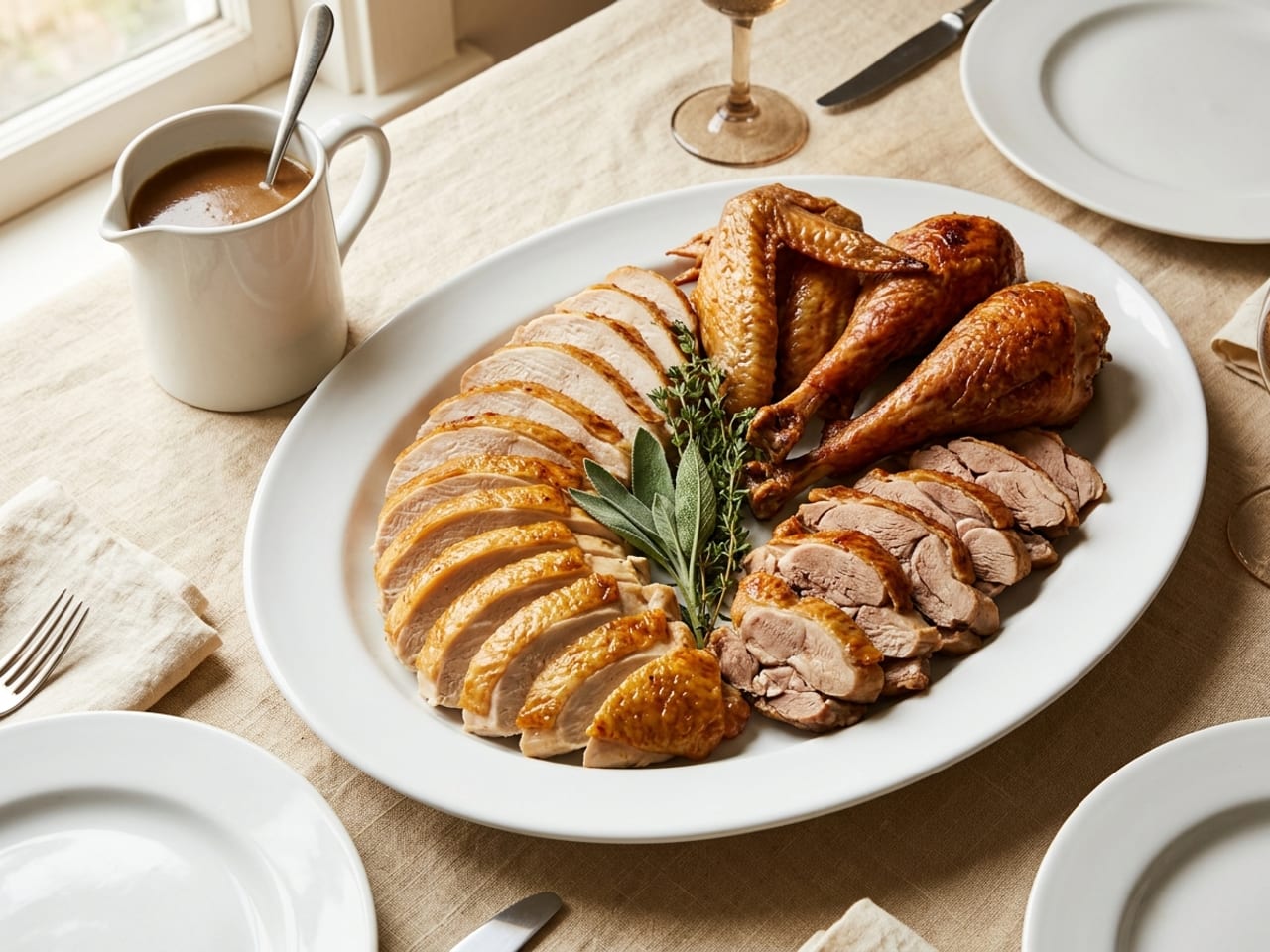
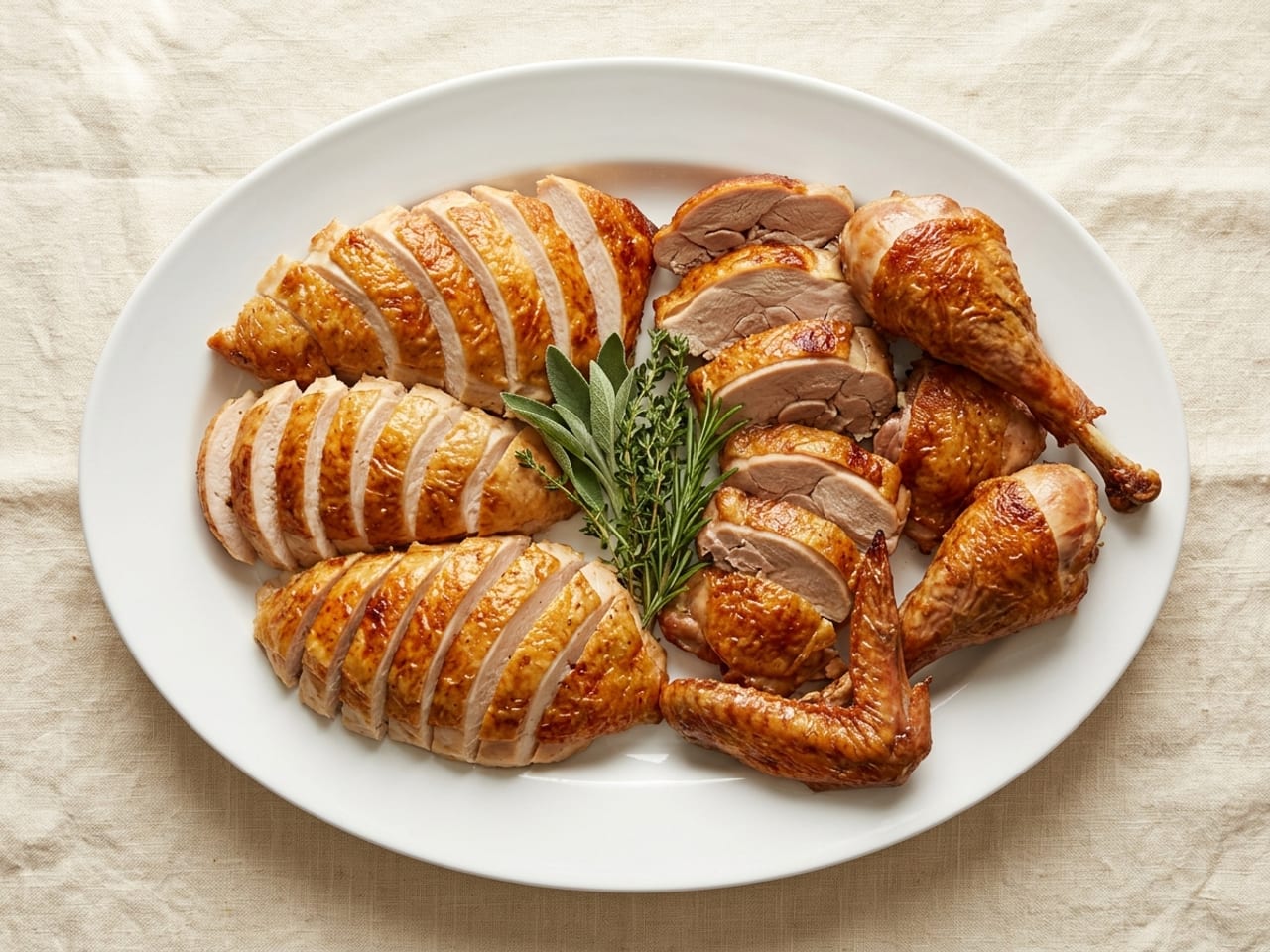
- Move it to a warm platter and serve at once. Slide the sliced breast onto a warmed platter in its stack and fan it, put the dark meat beside it, and serve straight away.
On this page: How long to rest · Knife, board, fork or tongs · The cuts, with pictures · Diagram · Slicing on the bird · Where sources disagree · Turkey breast · Turkey crown · Spatchcocked · Electric knife · The platter · Keeping it warm and moist · Carving ahead · Reheating · Kitchen or table · Who carves · One plate · How much meat · Mistakes · History · Popular claims · Food safety · The words · FAQ
How this page was made. Every instruction, number, date and quotation here comes from the published source named beside it: test kitchens and cooking magazines, butchers and turkey farmers quoted in them, a turkey brand and the turkey industry's federation, UK supermarkets, old household books, dictionaries, patents and food-safety agencies. Plate Artists roasted, carved, timed, weighed and tasted nothing for it, and watched none of the videos that some of these pages embed. Counts such as "twenty-three pages start with the legs" are our own tallies of the pages we read, not surveys. A butcher or farmer quoted by a magazine is credited by name, and a reporter's sentence to the publication. Sites that refuse automated readers were read in Internet Archive captures, seven articles as syndicated copies (on Yahoo, AOL or another newspaper's site), old books and one magazine issue as the text of scans or of an uploaded copy, and one textbook and one cookbook only through searches of a scan's text; each reference says which. Makers, retailers, brands and trade bodies are labeled, and the page carries no affiliate links. Where sources disagree we set them side by side. Anything marked "ours" is our own reading, count, conversion or suggestion. Sources are at the bottom.
How long to rest a turkey before carving
Nineteen named positions from the pages we read, roughly shortest first. They run from 15 minutes to an hour and a half, and one publisher prints two different times on different pages. None of them is the rule, and the longest do not fit inside the US agencies' two hours from the oven to the refrigerator once carving and the meal are added: the clock.
| Who | How long | Covered? | In their words |
|---|---|---|---|
| USDA FSIS (United States) | 20 minutes | No tent is mentioned for the rest (our reading of the page). | "For quality, let the turkey stand for 20 minutes before carving to allow juices to set. The turkey will carve more easily."117 Its stuffing page: "Let the cooked turkey stand 20 minutes before removing the stuffing and carving."118 Neither says "at least", and neither gives a maximum. |
| CDC (United States) | 20 minutes | Not mentioned. | "Remember to let the turkey stand 20 minutes before removing all stuffing and carving the meat. This will let the stuffing cook a little longer and make the turkey easier to carve."119 |
| Butterball (a turkey brand) | About 20 minutes | Not mentioned. | "First, allow your cooked turkey to sit for about 20 minutes before starting to carve."6 |
| University of Illinois Extension | 20 minutes | Not mentioned. | "Allow the turkey to rest 20 minutes after cooking. This lets juices saturate the bird evenly again for better slicing."34 The page shows no test of that. |
| British Turkey (a UK promotion site) | At least 20 minutes | Covered: "loosely with foil or a clean tea towel". | "Transfer to a platter, cover loosely with foil or a clean tea towel and leave to rest for at least 20 minutes before carving."131 |
| Food Network Kitchen | 15 to 30 minutes | Not mentioned. | The page rests the bird "15 to 30 minutes, depending on its size".7 |
| Serious Eats | At least 20 to 30 minutes; 20 for a spatchcocked bird | Tented only for a long wait. | "For a 12 to 15 pound turkey roasted at high temperatures, a rest of at least 20 to 30 minutes before carving is recommended."20 (12 to 15 lb is 5.4 to 6.8 kg, our conversion.) Its butterflied bird: "Allow to rest at room temperature for 20 minutes before carving."53 |
| Allrecipes | At least 20 to 30 minutes | Covered: "with a piece of foil tucked over the top". | The page rests the bird "for at least 20 to 30 minutes (depending on its size) with a piece of foil tucked over the top."13 |
| The New York Times (Julia Moskin, 2007) | At least 20 minutes; 40 is better | Not mentioned. | "It is important to start with a turkey that has rested for at least 20 minutes; 40 is even better, so that the meat has firmed enough to cut cleanly."8 The sentence is the reporter's, in her article on butcher Ray Venezia. |
| ThermoWorks (a thermometer seller) | 30 minutes | Not mentioned. | "We recommend a 30-minute rest before carving."130 |
| Ellie Logan, a butcher quoted by America's Test Kitchen | At least 30 minutes; an hour for a bigger bird | Not mentioned. | "Let it rest for at least 30 minutes (an hour for a bigger bird) or else all those delicious juices come right out."1 These are the butcher's words; the article brings them in to confirm the test kitchen's own advice, and only she says an hour. |
| America's Test Kitchen | 30 minutes on some pages, about 45 on others | No tent on its turkey pages; "tent it loosely" on a page about meat in general. | October 2025: "About 45 minutes or so gives it time to reabsorb the juices", and "Don't tent the turkey with foil to keep it warm while it's resting; it's unnecessary and will make the skin soggy."84 November 2022: "We recommend resting your Thanksgiving turkey for at least 45 minutes. Don't cover it with foil, either."41 In 2018 it called 30 minutes "the standard".83 Cook's Country, November 2022: "A large bird like a turkey needs at least a 30-minute rest to allow the meat time to reabsorb the juices."121 An undated how-to page about meat in general: "when cooking a huge turkey (18 pounds or more), the bird should rest for 30 minutes before it is carved. To keep meat warm while it rests, tent it loosely with foil."120 (18 lb is 8.2 kg, our conversion.) |
| Bon Appétit | 30 minutes to an hour | Not mentioned. | "let the whole turkey rest for at least 30 minutes and up to an hour after roasting."3 |
| National Turkey Federation (an industry body) | Half an hour to an hour | No tent. | The rest is "at least a 1/2 hour and up to 1 hour", and "Don't tent the turkey with foil, which can make the skin soggy. Letting the turkey sit uncovered preserves the crispness of the skin."10 |
| Epicurious | 30 to 90 minutes | Not mentioned. | "let the turkey rest for at least 30 minutes (and up to 90 minutes) before carving. This prevents its juices from running all over your counter, helps stave off dry meat".4 Ninety minutes of rest leaves half an hour of the US agencies' two hours for the carving and the meal: the clock. |
| Delia Online (United Kingdom) | About 45 minutes | Covered with foil. | The page says to cover the turkey with foil and leave it to stand for about 45 minutes, and that "it will be fine at kitchen temperature."35 |
| Thermapen UK (a thermometer seller) | At least 45 minutes; up to about an hour and a half tented | Tented, in its own test. | "We would also recommend leaving your turkey to rest for at least 45 minutes, as the results show that the turkey doesn't decrease in temperature for around 30 minutes." And: "If tenting your bird with foil and resting in a relatively warm room, the meat can be left for around an hour and a half before carving." 129 That is the seller's advice from its own test. By the US agencies' count it leaves half an hour for the carving and the meal: the clock. |
| Divertimenti (a UK retailer) | At least 20 to 30 minutes; up to an hour wrapped | Wrapped in foil for the longer rest. | The retailer's guide gives 20 to 30 minutes as the least, and up to an hour if the bird is wrapped in foil.28 |
| Jamie Oliver (United Kingdom) | At least an hour and a half | Wrapped loosely in foil, under tea towels. | "Cover the foil with two or three tea towels. Let the turkey rest for at least an hour and a half."15 That cannot be squared with the US agencies' two hours from the oven to the refrigerator, so this page does not follow it: the clock. |
What the tests measured, and on what
The usual reason given for the rest is juice. These are the juice-loss tests we could read. Only the first was run on turkey, on six breasts, in 2004.
| Who | The meat | What they found |
|---|---|---|
| Cook's Illustrated, November and December 2004 | Six skin-on turkey breasts | "We sliced three straight from the oven and waited 30 minutes to slice the others. On average, we found that the rested turkeys weighed 2 to 3 percent more than the unrested turkeys". The magazine took from it "a 30-minute rest for most birds and up to 40 minutes for very large birds."122 Three breasts against three, with no figure for each and no word on when they were weighed; breasts, not whole birds. We read it as the text of a copy of the issue, not in the printed magazine. |
| Dan Souza, America's Test Kitchen, 2022 | Boneless pork loin roasts | "We roasted five boneless pork loins until their internal temperatures reached 140 degrees." (60°C, our conversion.) "The roasts that we sliced immediately after cooking shed an average of 10 tablespoons of liquid. In contrast, the roasts that we allowed to rest for 10 minutes before carving shed an average of just 4 tablespoons of liquid." Its explanation is thickening, not reabsorption: resting "lets the juices cool, so that the dissolved gelatin, and any fat they contain, firms up a little, making the juice more viscous, so more of it stays within the muscle."123 |
| J. Kenji López-Alt, Serious Eats, 2009 | Steaks | "The steak loses around 13 percent of its weight just during cooking. Cut it open immediately, and you lose an additional nine percent. But allow it to rest, and you can minimize this weight loss down to around an additional two percent." Serious Eats now heads the page with a note that it has "since revisited the science".124 |
| Daniel Gritzer, Serious Eats, 2025 | Pork chops (a tasting, four tasters) | "Across 30 tasting rounds, my tasters identified the rested meat as juicier 16 times, an almost perfect 50/50 split." His conclusion: "Contrary to common belief, resting meat isn't really about retaining juices, but that doesn't mean it's pointless. Instead, it's best understood as a temperature-control method for managing carryover cooking."125 |
| Greg Blonder, genuineideas.com | Two thick ribeye steaks; 1 kg pork loins | One ribeye sliced at once, one rested 30 minutes: "Within experimental variations (and consistent in two repeated tests), a dead-heat." His general statement: "But in general, when the juices are freed, they remain at large."127 |
| Prieto and colleagues, Meat Science, 2025 | Beef roasts | A peer-reviewed study, read as its abstract only: "Total moisture losses (resting plus slicing) were similar among unrested and 8 and 13-min rested roasts."128 Beef, not poultry. |
One small test on turkey breasts, then pork loins, pork chops, steaks and beef roasts. We found no juice-loss test on a whole turkey, and the tests on other meats point both ways. So this page does not say, in its own voice, that the juices settle, redistribute or are reabsorbed. The tests and the argument about them are set out in full in our steak plating guide.
What is not disputed. A rested bird is easier to carve. FSIS says so ("The turkey will carve more easily"),117 and so does the writer who argues hardest against resting, Meathead Goldwyn: "the only remaining reason for resting is to make a large roast easier to carve." He quotes Harold McGee's On Food and Cooking, a book we did not open, for the mechanism: "As the temperature drops, the meat structure becomes firmer and more resistant to deformation and its water holding capacity increases."126 And the inside keeps cooking: ThermoWorks, a thermometer seller, calls that "The real reason" for the rest, "To allow the carryover cooking to play out",130 and CDC says the stand lets the stuffing cook a little longer.119 The price, in Meathead's words, is the skin: "Rest it for 15 minutes or so, especially under foil, and it turns to rubber." 126
How much the temperature climbs. One source prints its readings, and it is a thermometer seller's. Thermapen UK "cooked three whole turkeys (each weighing 4-4.5kg)" (8.8 to 9.9 lb, small birds by US standards) and rested them "on a chopping board tented with foil". "Turkey 2 increased by 6 °C. After 13 minutes, it reached a peak temperature of 80 °C"; "Turkey 3 increased by 8 °C. After 24 minutes, it reached a peak temperature of 75 °C."; "Turkey 1 did not increase in temperature."129 (That bird was cooked by the packet's time and came out at 97 °C, 207°F, so it had nowhere to climb; the other two were taken out at 74 and 67 °C, 165 and 153°F. 6 and 8°C are 11 and 14°F; 75 and 80°C are 167 and 176°F; conversions ours.) FSIS asks for 165°F (74°C) before the bird leaves the oven: food safety. The write-up does not say where in the bird the logged probe sat. America's Test Kitchen does not lean on the climb at all: "for food safety reasons we usually don't recommend removing it from the heat until it's done."132
How long a resting bird stays hot. Two measured sources, and they are not the same test. America's Test Kitchen, 2018, two untented birds in a 78 degree (26°C) kitchen: "After a full hour out of the oven, both birds were still plenty hot. The smaller turkey's breast was 142 degrees and its thighs were 150 degrees. Meanwhile, the breast in the larger bird was 155 degrees and its thighs were 148 degrees." The birds were 14 and 18 lb (6.4 and 8.2 kg); those readings are 61, 66, 68 and 64°C. "It took nearly 1½ hours for the smaller bird's temperature to drop below 130 degrees" (54°C).83 Thermapen UK's three small tented birds, in a room at about 68°F (20 °C), read 151, 151 and 147°F (66, 66 and 64 °C, the figures it prints) after an hour and a half, and the seller advises "carving it before it reaches 60 °C".129 The two differ in bird size, foil, room and pull temperature, so neither shows what the foil does (our reading). By the first set of numbers, an untented 14 lb (6.4 kg) bird's breast is at about the 140°F (60°C) hot-holding line an hour out of the oven (our reading), which fits the 30 to 45 minutes, uncovered, of this site's roast turkey recipe.
The knife, the board, and fork against tongs against a towel
The best knife to carve a turkey is a sharp one you know. Eight of the pages we read say a chef's knife is enough, seven ask for a carving or slicing knife and five use a boning knife for some or all of the cutting (the names). Food Network Kitchen: "all you need is a sharp knife".7 Serious Eats: "Forget about carving knives or electric knives. All you need for a turkey is your favorite razor-sharp chef's knife."20 The butcher in The New York Times' 2007 article worked small, in the reporter's words: "Since most of the cutting is done with the first few inches of the blade, a small, sharp knife that you know how to wield is a wise choice. For our demonstration he used an eight-inch boning knife with a plastic handle that cost, by his estimate, $10. He used a larger knife only for slicing." 8 (Eight inches is 20 cm.) Butcher Jake Dickson, in Saveur: "It can be cheap," so long as it is sharp.19
America's Test Kitchen's knife review separates the carving knife ("about 8 to 10 inches", 20 to 25 cm, with a pointed tip) from the slicing knife (10 to 12 inches, 25 to 30 cm, with a rounded one), says that carving knives "don't offer significant advantages" over the chef's or boning knife it would use to break down a turkey, and keeps the long slicer for boneless breast, where the hollows along the blade helped: "Slices of brisket and turkey stayed in place instead of sticking to the knife as we worked".40 The 8 to 10 inch (20 to 25 cm) carving or chef's knife of our roast turkey recipe is the National Turkey Federation's size too: "at least 8-inches long, preferably 10 inches".10 Serrated blades are rejected by three of the pages we read and preferred by one blog (who). Sharpen before the day: turkey farmer Tom Copas says "We always sharpen our knife."24 Our knife skills guide covers the grip, and honing against sharpening. No knife model is named here: review winners change, and we have tested none.
The board. Big, heavy and grooved. Bon Appétit wants "a large cutting board with some weight to it (preferably with grooves to catch any drippings)."3 If you have no grooved board, America's Test Kitchen makes one: "Place the cutting board inside a rimmed baking sheet (also called a half sheet pan). The sheet pan's raised edges will contain the juice runoff as you carve and keep your counters clean." For grip it puts "a damp paper towel or small piece of non-slip drawer liner between the board and the sheet pan (and the sheet pan and the counter, while you're at it)."41 Martha Stewart's list adds a second baking sheet as a landing zone for the parts, and a bowl for scraps bound for gravy or stock.5 Epicurious says to save what the groove collects: "be sure to save those drippings for your gravy recipe".4 Those board juices are covered in our au jus guide. The board must not be one that held the raw bird: food safety.
Fork, hand or tongs. A three-way split, counted from the pages we read: eleven steady the bird or the meat with a carving fork and two more make it optional; twelve use a hand, bare or with a towel, paper towels or gloves; two use tongs, one of them only on the breast once it is off the bird (the names). The Kitchn lists tongs in its kit and never says what they are for. Serious Eats holds the turkey "using a clean kitchen towel".2 Alton Brown, as quoted by Tasting Table from a television clip we did not watch: "Get rid of granddad's carving set and get yourself an honest-to-goodness carving knife and a pair of spring-loaded tongs".17 Saveur finds a carving fork "often more trouble than it's worth" and has its butcher layer latex, cotton and latex gloves.19 The University of Illinois Extension: "Secure the turkey at the breastbone with a carving fork or better yet, use a folded napkin."34 Tongs, which our roast turkey recipe uses, are the smallest camp. Whether a fork costs the meat any juice is a claim with a verdict.
Set-up. The Kitchn: "Before you make your first slice, gather your cutting board, chef's and/or carving knife, serving platter, tongs, and paper towels." And: "Work on one side of the turkey at a time." "With this set-up, you should only need to turn the turkey once."9 Epicurious keeps the platter within reach, "to easily transfer the carved turkey to it and maximize your work area."4
How to carve a turkey step by step, with pictures
One card per step, each showing the bird after the cut. The words are the sources', named in front of them; none of it was carved or timed by us. The pictures are illustrations.
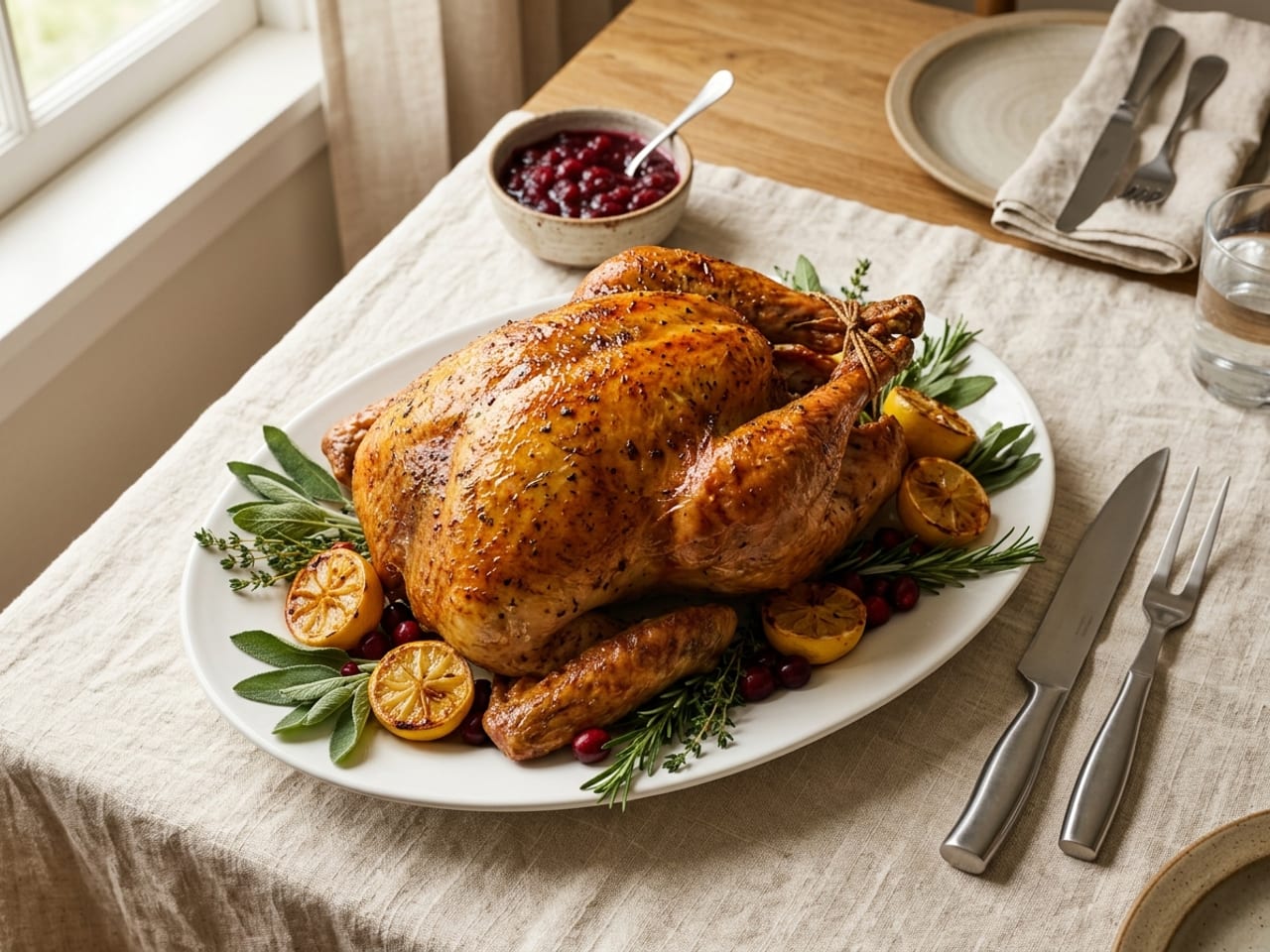
1. Rest the bird, then clear it for carving
Most of the carving pages we read start with a rest, and they do not agree on its length: the table is below. USDA's Food Safety and Inspection Service (FSIS) words it as a quality step: "For quality, let the turkey stand for 20 minutes before carving to allow juices to set. The turkey will carve more easily." Its next line is "Remove all stuffing from the turkey cavities."117 Before the bird leaves the pan, the National Turkey Federation tips it so the juices inside run "back into the roasting pan, where they will become part of the gravy or the au jus".10 Then the string: "If you have any twine on your bird, start by cutting that off using kitchen shears."1 A rested bird is also easier to hold: the rest "allows the surface of the bird to cool off enough so that you can handle it without burning your hands".1
Where sources differ. Our roast turkey recipe rests a 12 to 14 lb (5.4 to 6.4 kg) bird 30 to 45 minutes, uncovered, and our Thanksgiving timeline stretches the rest from 20 minutes to at most 45, or 60 for a bird of 16 lb (7.3 kg) or more. Both sit inside the published range.
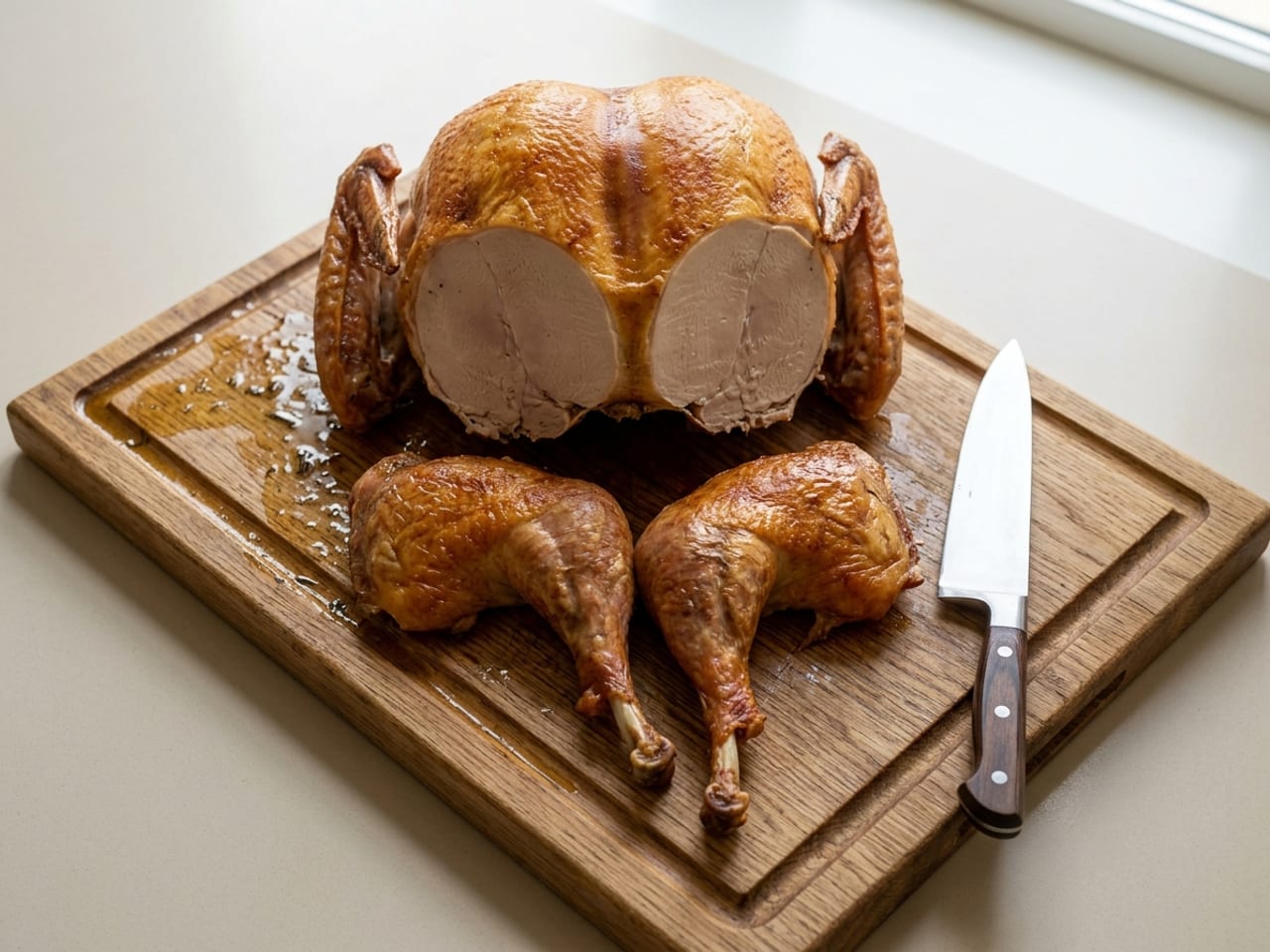
2. Take off both legs at the hip
America's Test Kitchen: "Slice through the skin between the leg and the breast to expose the hip joint. Pull the leg quarters away from the breast. Then carefully cut through the now-exposed joint."1 Epicurious tells you what you will feel: pull the leg away, "rotating it downward as you go. The joint will pop open", and, in a caption further down, "If you encounter resistance, you're probably hitting a bone."4 The Spruce Eats puts it more strongly: "you're not cutting through the joint, you're just popping it out and using your knife to cut through the skin and connective tissue."11 Butcher Jake Dickson, in Saveur, names the usual mistake: "you want your knife to fall on the outside of the hip bone."19 Keep the oyster. America's Test Kitchen: "Turn the bird slightly to get off the oyster (a little lump of dark meat on the back of the bird above the thighs)."1 The leg is hot: The Kitchn pulls it back "With your hands (and either paper towels or a clean kitchen towel)".9
Where sources differ. Twenty-three of the pages we read start with the legs; one takes the breast first and three start with a wing. Who, by name.
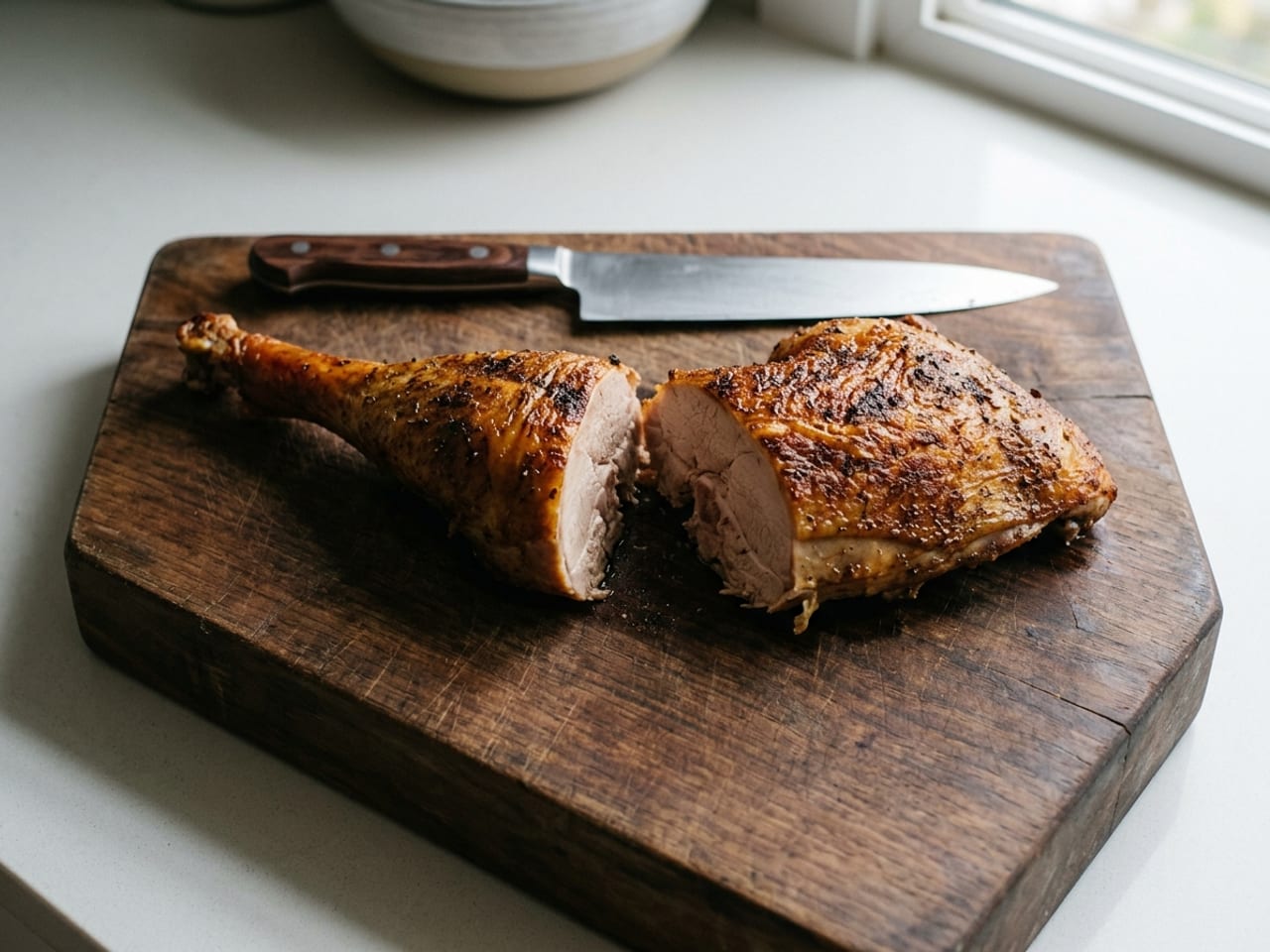
3. Split the drumstick from the thigh
Serious Eats: "Locate the joint between the drumstick and the thigh by moving them back and forth and feeling with your fingertip. Slice through this joint."2 The Washington Post adds that the joint "is often easier to find skin-side down."14 Martha Stewart's page gives a test at the hip that, on our reading, holds for any joint: "it should feel easy to cut through".5 The drumstick, whole or sliced. Sixteen of the pages we read leave it whole (Serious Eats, Epicurious, Martha Stewart, Food Network Kitchen, the National Turkey Federation, The Spruce Eats, Real Simple, The Kitchn, Saveur (Jake Dickson), The Washington Post, Allrecipes, Bon Appétit, Made In (a maker), Shun (a maker), Waitrose and Ellen's Kitchen).2, 3, 4, 5, 7, 9, 10, 11, 12, 13, 14, 16, 19, 22, 32, 33 Saveur reports butcher Jake Dickson's reason: wings and drumsticks "don't yield enough meat to serve to multiple people", and whoever gets one "will get more meat by eating straight from the bone."19
Where sources differ. TODAY slices "down the drumstick to remove the meat" and discards "the long and thin tendons that resemble toothpicks";18 the University of Illinois Extension prints both on one page: "Leave the drumstick whole." and "For the drumstick: Cut slices parallel to the bone, turn and repeat."34 America's Test Kitchen, BBC Good Food and Tesco leave it to the carver.1, 21, 23
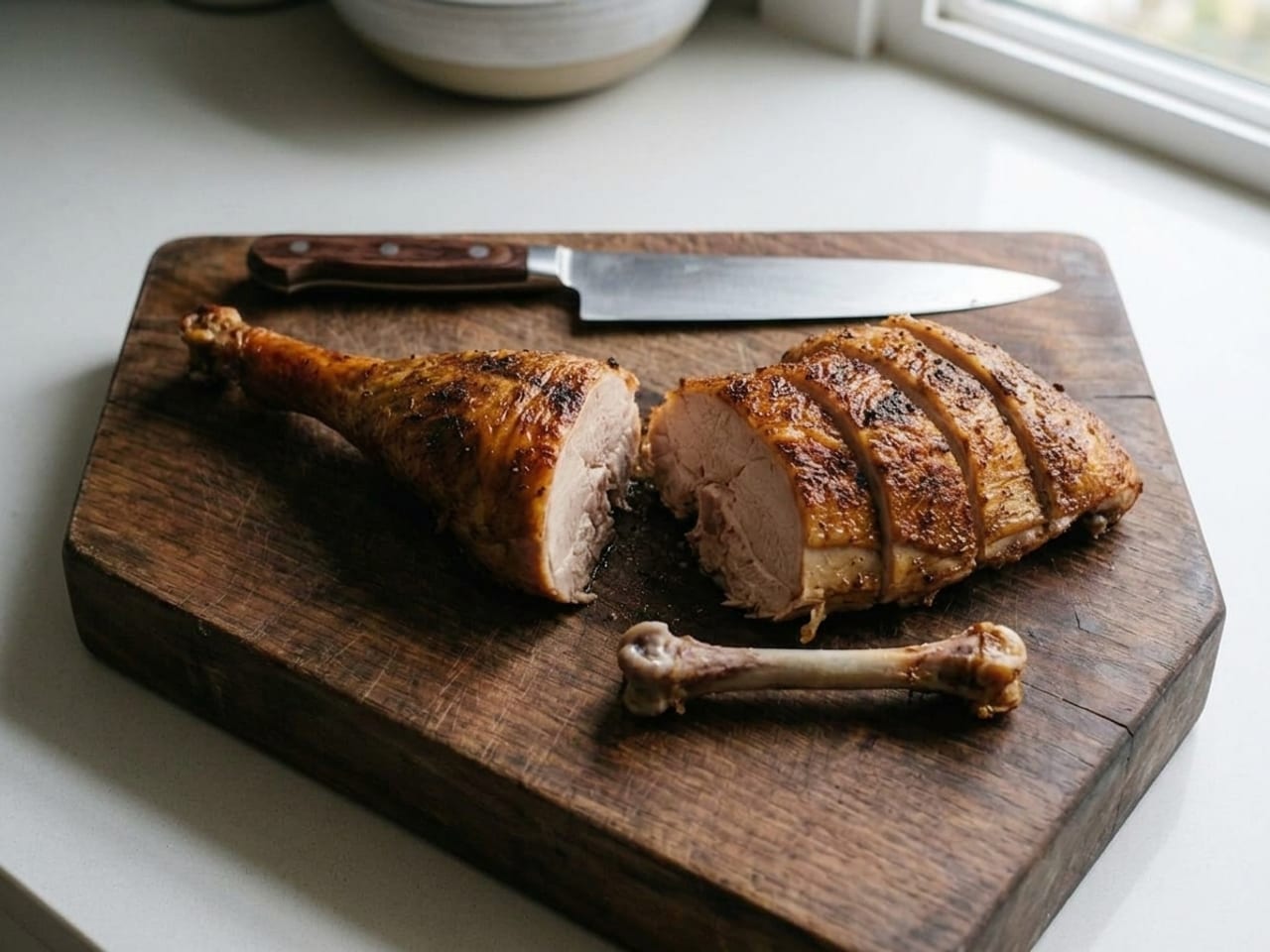
4. Bone the thigh and slice it, or leave it whole
Bon Appétit: "Position the thighs skin side down on the cutting board and slice along each side of the thigh bone until the meat easily pulls away."3 The Spruce Eats cuts "along one side of the thigh bone, then roll the bone the other way and cut along the other side."11 The Washington Post then flips "the meat skin-side up" to slice it.14 How thick. Epicurious: at least a quarter inch (6 mm), because "thinner slices tend to dry out quickly";4 the National Turkey Federation: "about 1/3-inch thick" (8 mm);10 Serious Eats and The Spruce Eats: half an inch (1.3 cm).2, 11 The metric figures are our conversions.
Where sources differ. Sliced or whole, and when. Fourteen of the pages we read bone and slice the thigh.2, 3, 4, 5, 7, 8, 9, 10, 11, 12, 13, 14, 18, 32 Whole thighs are an option in four of the pages we read: America's Test Kitchen ("or serve them whole for the dark meat lovers of your crew"), BBC Good Food, Tesco and Waitrose ("The thighs can be carved or served whole like the drumsticks"). 1, 21, 22, 23 The sourced argument for slicing is Ray Venezia's, in The New York Times: you'll "find that people eat a lot more of the dark meat when it's carved this way".8 Our reading: slice for a platter that many people serve themselves from, and leave thighs whole when a few guests want a piece on the bone.
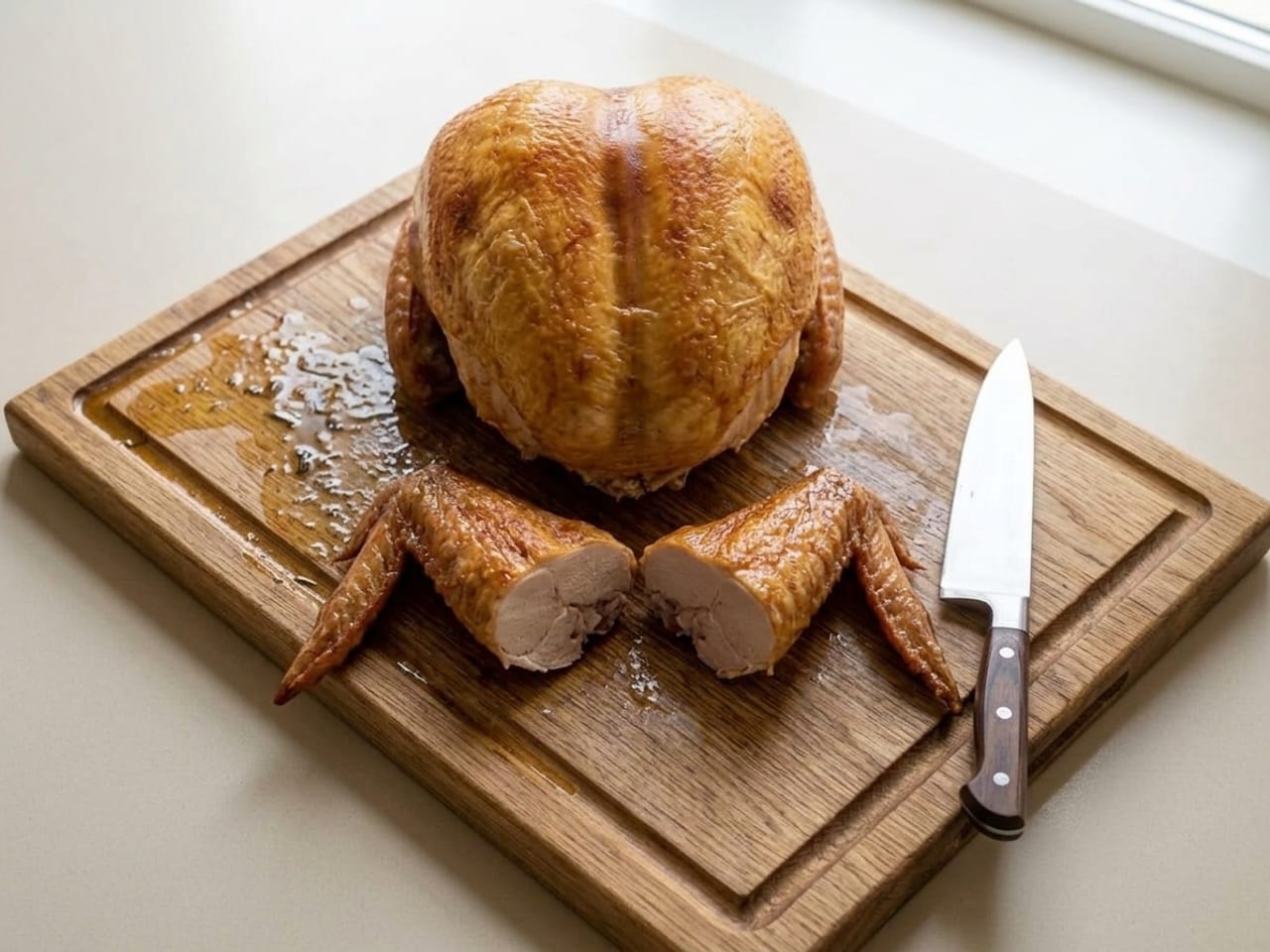
5. Take off the wings
Serious Eats: "Locate the wing joint by articulating it, then slice through with a sharp chef's knife. Repeat with the other wing, then separate the drumettes from the flats, and transfer all four wing pieces to the platter."2 A wing has three sections, in The Spruce Eats' words the "pointy wing tip", the "flat" or "wingette", and the "drumette", "so called because it looks like a miniature drumstick."11 Bon Appétit pulls or cuts off the tip, because "there's not a lot of meat there", and keeps the tips for stock.3 Saveur's butcher leaves the knife out of it: "I usually just rip the wings off".19
Where sources differ. When. After the legs and before the breast in twelve of the pages we read.1, 2, 7, 10, 12, 16, 19, 22, 24, 26, 29, 32 Epicurious and The Washington Post take only the outer wing here and leave the drumette on, which, Epicurious says, "will help steady the bird as you continue carving".4, 14 Bon Appétit, Allrecipes, The Kitchn, TODAY and our own roast turkey recipe take the wings after the breast, Bon Appétit because the wing works "like a natural handle", and The Spruce Eats takes them last of all, "because they've been helping to stabilize the carcass on the cutting board." 3, 9, 11, 13, 18
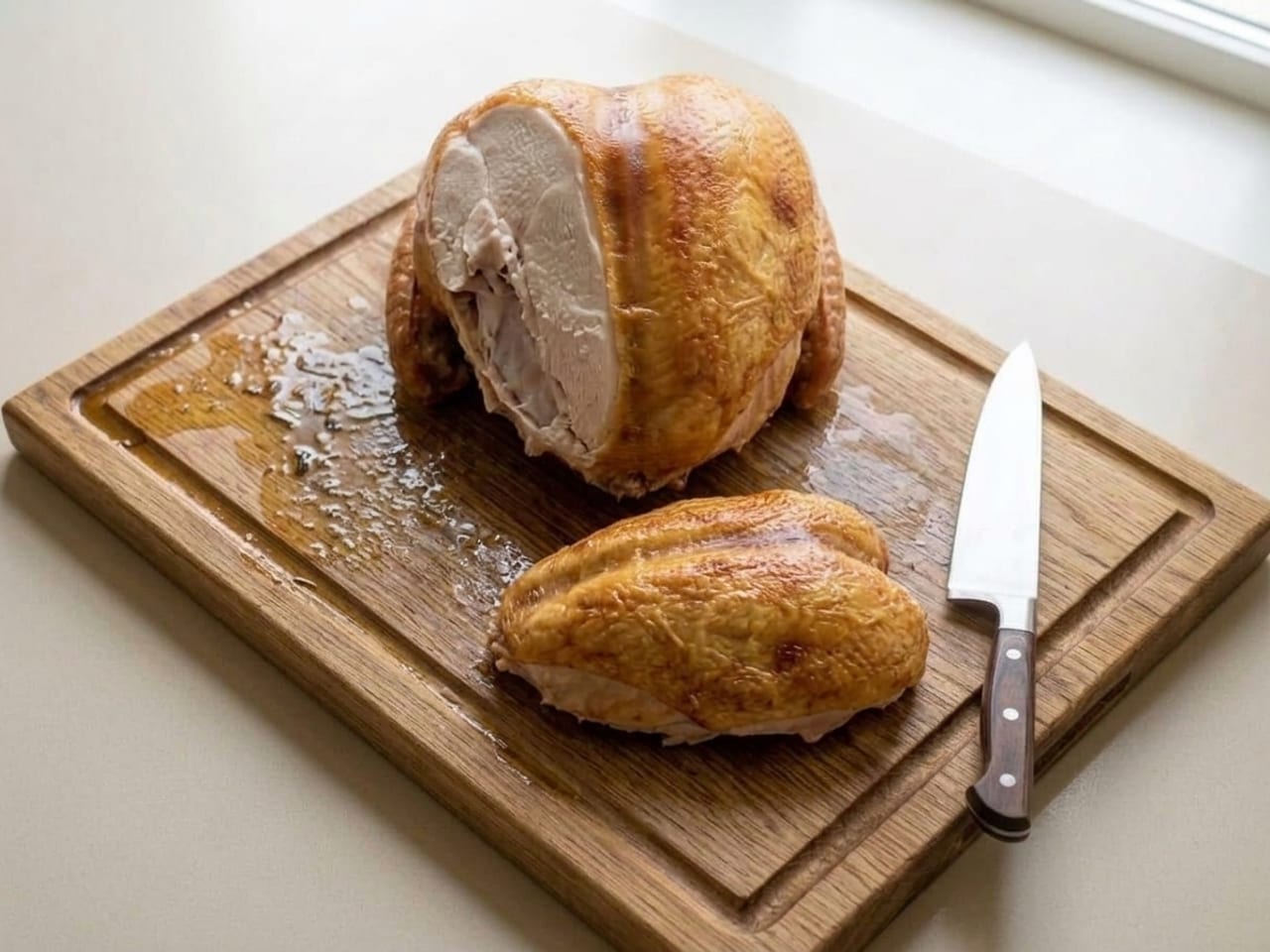
6. Take each breast half off the bone, whole
America's Test Kitchen: "Carve each split breast off in one piece by running your knife along the curvature of the breastbone. Follow your knife along the breast plate, and continue cutting using long motions (not sawing motions) until each breast is off."1 Epicurious: "Cut along one side of the breastbone with the point of your knife, curving along the rib cage as you go. Gently pull the breast toward you, making shallow cuts until you can remove the meat from the carcass."4 Martha Stewart's page uses the ribs as a depth stop: when the knife "hits something hard", that is the rib cage, "which will tell you not to cut deeper than that point."5 Butcher Jocelyn Guest, quoted by Bon Appétit, on committing to the cut: "You want to be pretty confident with your cuts because if you hesitate, the skin will get all weird and then it won't be on the breast".3 If the wishbone is still in, it is in the way here: when sources take it out.
Where sources differ. The National Turkey Federation, BBC Good Food, Waitrose, Ellen's Kitchen and Divertimenti first make a deep horizontal cut along the bottom of the breast; Divertimenti makes it "to act as a guide."10, 21, 22, 28, 33 Twenty-one of the pages we read teach only this off-the-bone method, three only the older way of slicing on the bird, and seven print both: the on-the-bird method.
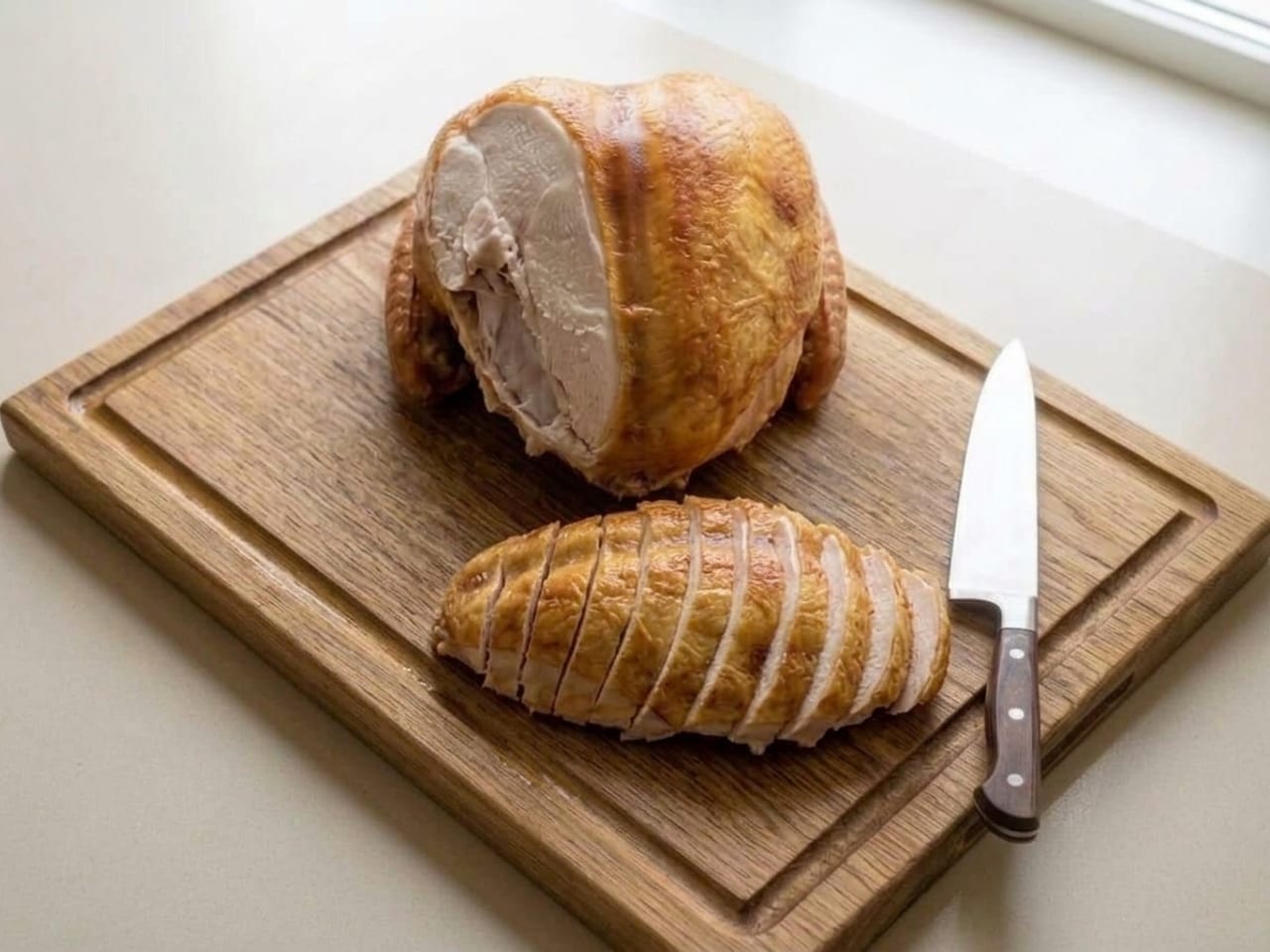
7. Slice the breast across the grain
Food Network Kitchen: "Place the breasts skin-side up on the cutting board and cut across the breast meat into 1/2-inch-thick slices for serving. For the neatest slices, try to use long cutting strokes instead of short sawing ones."7 Real Simple gives the cue for direction: "position the meat so you'll cut it at its shorter length. Slice against the grain, taking care to keep the skin attached to each slice of turkey."12 Bon Appétit says why: "Cutting this way ensures you're slicing against the grain of the turkey meat (i.e., the direction in which the muscle fibers are aligned) and results in a more tender bite." 3 America's Test Kitchen slices "thinly" and "crosswise, holding the skin in place so that each piece gets a little bit of skin on it."1 The National Turkey Federation keeps the slices "stacked neatly together on the cutting board" and slides a knife or spatula under the whole sliced breast to move it.10
Where sources differ. How thick. From a quarter inch (6 mm) at Epicurious and The Kitchn to an inch (2.5 cm) at Bon Appétit (our conversions): who prints what.3, 4, 9 More on the grain.
8. Move it to a warm platter and serve at once
America's Test Kitchen: "warm up the platter in a low 200-degree oven before serving to make sure the turkey stays nice and warm on the table. Use a knife or bench scraper to move those breast slices to the platter and shingle them. Arrange the thighs, drumsticks, and wings in a symmetrical pattern on the other side of the platter so people can easily go in for light or dark meat."1 (200°F is 93°C, our conversion; check that the platter is ovenproof first.) Then go: "Carving cools the meat significantly, so as soon as the turkey is carved and sliced, it's ready to serve."7 The clock that matters is the agencies': "Within 2 hours of cooking food or after it is removed from an appliance keeping it warm, leftovers must be refrigerated."77
Where sources differ. Layouts differ by source: the platter, layout by layout. If dinner is not ready, how to keep carved turkey warm and moist.
The order is looser than it looks. Many pages take every big piece off the carcass first and portion afterwards: The Kitchn's rule is "Remove sections of the turkey before slicing", working "on one side of the turkey at a time", and America's Test Kitchen, Food Network Kitchen and the National Turkey Federation all split the legs only after the breasts are off.1, 7, 9, 10 Serious Eats and our roast turkey recipe finish each leg before moving on, and the recipe takes the wings last.2 Both get you to the same platter. Smoked and deep-fried birds carve the same way, according to the two pages we read that mention them.9, 13
The wishbone: four schools
The wishbone sits across the neck end of the breast, where the knife wants to go. When it comes out depends on whom you read.
| When | Who, in their words |
|---|---|
| Out of the raw bird, before roasting | Serious Eats ("With the wishbone removed, it's going to be a lot easier to carve your turkey later."), Waitrose ("Before cooking, remove the wishbone to make carving easier."), Julia Child's The Way to Cook as far as a garbled scan can be read, and Tesco by implication ("If you took out the wishbone before cooking"). Made In, a knife maker, makes it step one, "while the turkey is still raw".2, 22, 23, 31, 32 |
| Out of the cooked bird, before the breast comes off | Martha Stewart, The Washington Post ("If the wishbone was not removed before roasting, do so now to make removing the breasts easier.") and The Spruce Eats, which argues against doing it raw: "for wish-making (as well as food safety) purposes, you want it to be cooked, not raw." Real Simple says only where it is and that it comes out with the fingers ("You can find the wishbone at the front end of the breast. Use your fingers to pull it out."), without saying when.5, 11, 12, 14 |
| Mid-carve, when the knife reaches it | BBC Good Food: "If you remove the wishbone when you get to it, you'll keep carving neat slices."21 Divertimenti cuts "through the wishbone as you remove the first breast."28 Ellen's Kitchen cuts it loose once the breast is off.33 |
| Left in | Epicurious hands it out at the end: "Hand off the wishbone to two lucky dreamers and tell everyone to dig in."4 Turkey producer Paul Kelly, as lovefood reports him, calls taking it out "a lot of effort for very little gain".37 America's Test Kitchen, Food Network Kitchen, the National Turkey Federation, Butterball and Saveur do not mention it; Bon Appétit and The Kitchn name it only as a landmark for the knife.1, 3, 6, 7, 9, 10, 19 |
Slicing the breast on the bird
The older method leaves the breast on the carcass and slices down it. It is not wrong: it is what Butterball teaches, what Waitrose calls "The classic way", and how Mrs Beeton in 1861 and Fannie Farmer in 1896 carved.6, 22, 175, 178 Butterball: "Make a long horizontal cut above the wing joint through the body frame." "Beginning halfway up the breast, slice straight down with an even stroke." "When the knife reaches the cut above the wing joint, the slice should fall free on its own." "Continue to slice breast meat by starting the cut at a higher point each time."6 An old Williams-Sonoma tip, read in a 2012 capture, adds the fork: "Insert the fork close to the breastbone to steady the bird. Make a preliminary cut through the breast meat just above the leg and shoulder joints. Then, starting near the breastbone, carve the meat vertically into thin slices, cutting parallel to the rib cage, ending each slice at the preliminary cut."29 Jamie Oliver's table method cuts "0.5cm-thick slices from the breast", "using the whole length of the knife".15 One culinary textbook's carving figure works the same way: "Make a horizontal cut just above the wing, cutting all the way through to the bones of the body cavity. This cut helps the breast slices separate evenly." Then "With long, smooth strokes, cut the breast into thin slices."30
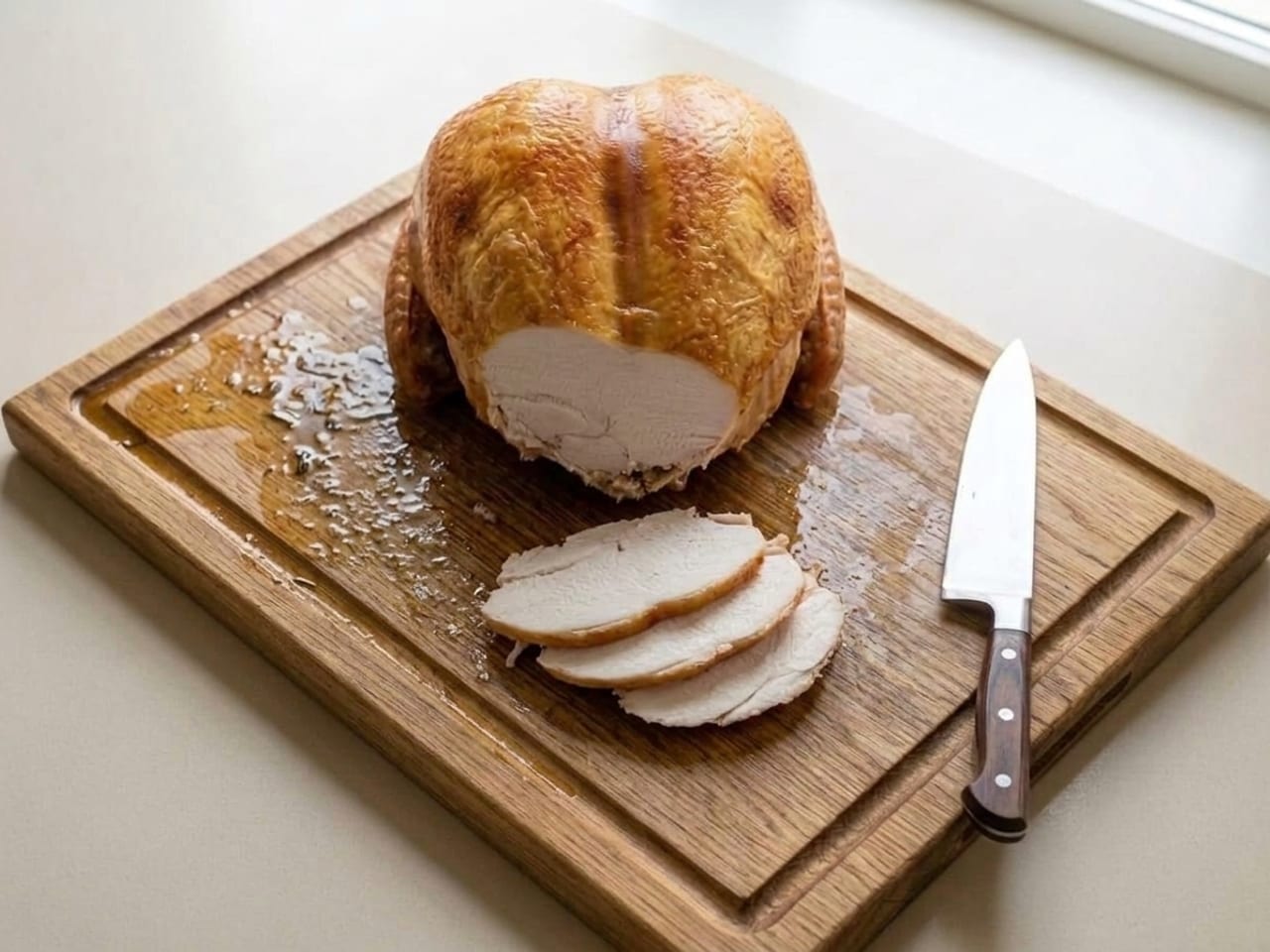
Which, and when. BBC Good Food assigns them: on the bird at the table, off it in the kitchen (its words). The case for taking the breast off is made by people who cut meat for a living. Ellie Logan: "For me, this is way easier than carving slices directly from the bird."1 And it suits a first-timer: the Times calls the butcher's method "ideal for less-experienced carvers", and Jamie Oliver says of a boneless breast on the board that "even the most novice of cooks can carve like a chef!" 8, 15 We found no test that compares the two.
Across the grain: what the sources say, and what they do not
The reason to take the breast off is the grain, and it has named sources. Roger Bassett, a Philadelphia turkey seller, in The New York Times: "Cutting a turkey the traditional way, where you leave the meat on the bird and cut down, you can't cut across the grain", and "The pieces you end up with are all stringy because the fibers are long instead of short."8 Saveur, of Jake Dickson: the traditional method "involves slicing the bird's breast along the grain", and he recommends "taking the entire breast off the bone and then slicing it against the grain."19 Tom Copas gives a second reason: "Cut across the breast or across the grain as this means the meat holds together better. Going with the grain means it can flake apart".24
Which way the grain runs is in print, from cooks and not from an anatomy text. Shirley Corriher's CookWise (1997), read as a search fragment: "The grain of the turkey breast runs from front to back."38 Milk Street says that cuts on the bird "that run parallel to the breast bone" mean "You'll be slicing with the grain, leaving the muscle fibers in long, chewy strings."36 Ellen's Kitchen, a quantity-cooking site, calls a breast carved lengthwise carved "with the muscle".33 That fits what five carving pages imply: slices cut down the breast on the bird run with the grain (Bassett, Dickson), and a removed half cut "crosswise" or "at its shorter length" is cut against it (Bon Appétit, The Washington Post, Real Simple).3, 8, 12, 14, 19 So the practical cue is Real Simple's: turn the half so you cut across its shorter length. Two pages we read use the words the other way round: TODAY's contributor calls crosswise slices "going with the grain", and the University of Illinois Extension calls a horizontal cut on the bird "across the grain".18, 34 The benefit has been measured on beef and not on turkey: the numbers. Our steak guide has the grain cut by cut.
Legs or breast first, on or off the bird, fork or tongs: who says what
Counts are ours, of the carving pages we read on 10 October 2026; they are tallies, not a survey, and a page that prints two methods is counted under "both". Makers and retailers are marked.
| The question | One side | The other | Also |
|---|---|---|---|
| What comes off first | The legs (23): America's Test Kitchen, Serious Eats, Bon Appétit, Epicurious, Martha Stewart, Food Network Kitchen, The Kitchn, the National Turkey Federation, The Spruce Eats, Real Simple, Allrecipes, The Washington Post, Saveur (butcher Jake Dickson), BBC Good Food, Waitrose, Tesco, turkey farmer Tom Copas, Julia Child (a garbled scan), Williams-Sonoma (a 2012 capture), Shun (a knife maker), Made In (a maker), Divertimenti (a retailer) and the University of Illinois Extension.1, 2, 3, 4, 5, 7, 9, 10, 11, 12, 13, 14, 16, 19, 21, 22, 23, 24, 28, 29, 31, 32, 34 | The breast (1): TODAY (its contributor Elizabeth Heiskell), which removes both breast halves and then the legs.18 The Irish News, reporting turkey farmer Tom Copas, notes that "Lots of people start with the breast".24 | A wing (3): Jamie Oliver, turkey producer Paul Kelly (the outer wing, in his numbered steps) and Robert Welch with the Ashburton School of Cookery (a maker).15, 25, 27 Paul Kelly's own summary line reads "The secret is to remove the legs and wings first." Ellen's Kitchen takes the drumsticks alone first, then the thighs.33 No order is claimed here for Ray Venezia (his numbered steps were a photo graphic we could not read) or for Butterball (its page does not number the steps).6, 8 |
| The breast: off whole, or sliced on the bird | Off whole, sliced on the board (21): America's Test Kitchen, Serious Eats, Bon Appétit, Epicurious, Martha Stewart, Food Network Kitchen, The New York Times (butcher Ray Venezia), The Kitchn, the National Turkey Federation, The Spruce Eats, Real Simple, Allrecipes, The Washington Post, TODAY, Saveur (Jake Dickson), Paul Kelly, John Williams of The Ritz London, Shun (a maker), Made In (a maker), Divertimenti (a retailer) and the University of Illinois Extension.1, 2, 3, 4, 5, 7, 8, 9, 10, 11, 12, 13, 14, 16, 18, 19, 25, 26, 28, 32, 34 | Sliced on the bird (3): Butterball, Williams-Sonoma (a 2012 capture) and Robert Welch with the Ashburton School of Cookery (a maker).6, 27, 29 | Both offered (7): BBC Good Food, Waitrose, Tesco, Jamie Oliver, Tom Copas, Julia Child (a garbled scan) and Ellen's Kitchen.15, 21, 22, 23, 24, 31, 33 BBC Good Food says which is for when; Waitrose calls on-the-bird "The classic way". One culinary textbook's figure also prints both: thin slices cut on the bird down to "a horizontal cut just above the wing", then, as "An alternative method", "an entire half-breast in one piece".30 |
| What holds the bird: fork, hand or tongs | A carving fork (11, plus 2 that make it optional): Butterball, the National Turkey Federation, Allrecipes, Jamie Oliver (his table method), Williams-Sonoma (a 2012 capture), Waitrose (for a crown), Ellen's Kitchen, the University of Illinois Extension ("or better yet" a folded napkin), Shun (a maker, on the removed breast), Divertimenti (a retailer) and turkey producer Paul Kelly, as lovefood reports him; optional for Epicurious and Made In (a maker).4, 6, 10, 13, 15, 16, 28, 29, 32, 33, 34, 37, 47 | A hand, bare or covered (12): Serious Eats (a clean kitchen towel), Ray Venezia (one hand), Jake Dickson (three layers of gloves), The Washington Post (clean hands, or gloves), Food Network Kitchen (bare hands), Bon Appétit (hands), Martha Stewart (hands), The Spruce Eats (the other hand), Real Simple (a paper towel), TODAY (a dish cloth), The Kitchn (paper towels or a clean kitchen towel) and Made In (a clean kitchen towel).2, 3, 5, 7, 8, 9, 11, 12, 14, 18, 19, 32 | Tongs (2): Alton Brown, as reported by Tasting Table and Real Simple (to steady the removed breast).12, 17 The Kitchn lists tongs in its kit and never says what they are for.9 Against the fork, by name (2): Ray Venezia and Saveur's writer, of Jake Dickson's method.8, 19 No holding tool is named by America's Test Kitchen, BBC Good Food, Tesco and Robert Welch. |
| The knife | A chef's knife is enough (8): America's Test Kitchen (its carving article), Serious Eats (its Food Lab guide), Food Network Kitchen, The Spruce Eats, The Kitchn, Martha Stewart ("is fine"), the National Turkey Federation (carving or chef's) and Allrecipes (carving, chef's or electric).1, 5, 7, 9, 10, 11, 13, 20 | A carving or slicing knife (7): Epicurious, Tom Copas, Waitrose (for a crown), Alton Brown, as quoted by Tasting Table, Shun (a maker), Made In (a maker) and Divertimenti (a retailer).4, 16, 17, 24, 28, 32, 47 | A boning knife for some or all of the cutting (5): Ray Venezia (and a larger knife only to slice), Bon Appétit (optional; a chef's knife to slice), Jake Dickson (or a chef's knife), Serious Eats (its carving guide, for the breast) and Real Simple (for the breast).2, 3, 8, 12, 19 America's Test Kitchen's review of slicing knives says it would break the bird down with a chef's or boning knife, and keeps the long slicer for boneless breast (our summary of it).40 |
| Knife length, where a number is printed | Epicurious: a 6 to 9 inch (15 to 23 cm) slicing or carving knife.4 The National Turkey Federation: "at least 8-inches long, preferably 10 inches" (20 and 25 cm).10 Tom Copas: about 9 inches (23 cm, his figure).24 | America's Test Kitchen's definitions: carving knives "about 8 to 10 inches" (20 to 25 cm), slicing knives "10 to 12 inches" (25 to 30 cm).40 Electric blades: "slightly less than 7 inches" (18 cm).39 | Ray Venezia used an 8 inch (20 cm) boning knife and, in the reporter's words, "counsels against using a large or unfamiliar knife".8 The retailer Divertimenti sells a carving knife of about 8 inches (20 cm) for the job.28 Conversions are ours. |
| Serrated and electric knives | Electric allowed (6): The Kitchn, The Spruce Eats, Allrecipes, TODAY ("in a pinch"), The Wooden Skillet (a blog) and It Is a Keeper (a blog).9, 11, 13, 18, 42, 50 America's Test Kitchen's test calls a good one "a very effective alternative".39 Hamilton Beach, a maker, prints carving steps for one.44 | Electric rejected (2): the National Turkey Federation and Serious Eats.10, 20 | Serrated rejected: the National Turkey Federation, Butterball by implication ("straightedge") and chef Evan LeRoy, in Made In's words ("non-serrated").6, 10, 32 Serrated preferred: one blog, It Is a Keeper.42 |
| A foil tent while it rests | No tent: America's Test Kitchen on its turkey pages, the National Turkey Federation, turkey producer Paul Kelly as lovefood reports him, and Meathead Goldwyn of AmazingRibs.com ("Foil is a lousy insulator."). 10, 37, 41, 83, 84, 112, 126 | Tent or cover: Allrecipes, British Turkey, Delia Online, Jamie Oliver, Thermapen UK in its own test, Bon Appétit in 2009 ("Cover the turkey loosely with foil, and set it in a warm spot.") and one America's Test Kitchen how-to page about meat in general.13, 15, 35, 70, 120, 129, 131 | Serious Eats tents only for a long wait and names the cost: "The real danger is the skin getting soggy and the surfaces getting cold."89, 90 Its long wait, "tent with foil in a warm spot in the kitchen for up to a couple hours", is that site's practice, and it uses up the whole of the US agencies' two hours before anyone eats: the clock. We found no test of the same bird with and without foil. |
| How thick to slice the breast | Thin: a quarter inch (6 mm) for Epicurious and The Kitchn; about a fifth of an inch (0.5 cm, his figure) on the bird for Jamie Oliver; "thin" or "thinly" for America's Test Kitchen, The Ritz's John Williams, Williams-Sonoma (2012) and Robert Welch.1, 4, 9, 15, 26, 27, 29 | Thick: half an inch (1.3 cm) for Martha Stewart, Food Network Kitchen and The Spruce Eats; half an inch to an inch (1.3 to 2.5 cm) for Bon Appétit; "like a loaf of bread in thick slices" for Tom Copas.3, 5, 7, 11, 24 | Any thickness: The Washington Post and the National Turkey Federation ("as thin or thick as you like them").10, 14 Our reading: every page that slices on the bird prints thin slices (Jamie Oliver, Williams-Sonoma, Robert Welch, Waitrose for a crown); pages that slice on the board print anything from thin to an inch. |
| Carve the whole bird, or only what the meal needs | All of it, in the kitchen: the method of most pages above, and what our roast turkey recipe does. FSIS wants a cooked turkey cut into smaller pieces before it is refrigerated in any case.77 | Only what you need: Tom Copas. "Always keep on the bone and never carve the whole bird unless you're eating it all in one go." His reason is moisture: "It keeps its moisture when kept on the bones".24 Fannie Farmer said much the same in 1896: "For a small family carve but one side of a turkey".178 | This page carves the whole bird, because the two-hour clock runs either way and the leftovers have to come off the bone to chill quickly (our reading of FSIS and CDC).77, 119 |
A turkey breast, a boneless roast, a crown, a spatchcocked turkey, and the electric knife
These are thinly sourced, and each card says how thinly. Where we found one blog and no test kitchen, that is what it says.
A bone-in turkey breast
how to carve a turkey breast
The breast step of the whole bird, with nothing else in the way. The Wooden Skillet, a home-cook blog: "Now hold the turkey breast upright so that breasts and breastbone are on top. Locate the breastbone down the top of the bird and place your chef's knife just to the side of that breastbone." Then "Cut from one end of the turkey breast to the other, staying as close to that breastbone as possible to make sure that you are getting the most amount of meat. Remove the breast and place on a platter." 50 A second blog, It Is a Keeper, repeats those steps almost word for word a year later and adds that you should slice against the grain.42 From there it is step 7: skin side up, crosswise. A bone-in breast gives more meat for its weight than a whole bird: USDA's buying guide lists 0.64 lb of cooked turkey with skin per pound of turkey breast bought, against 0.48 to 0.53 for a whole bird.104 Our turkey breast recipe is the roast.
How well sourced. Two home-cook blogs, the second of which repeats the first's wording, and one grill maker's recipe (Pit Boss: "cut down the center on both sides of the breastbone, and continue to follow the bone in short strokes until the breast falls away from the breastbone").59 We read no test-kitchen page written for carving a bone-in turkey breast; one from Better Homes & Gardens exists that we could not open.
A boneless breast roast or roll
how to carve a boneless turkey breast roast
No joints and no bone, so this is slicing, not carving. Serious Eats, of a boned and tied breast: "With no bones and an even shape, carving this turkey is as simple as slicing a tenderloin."52 The netting on a bought roast stays on in the oven. Butterball's own instructions for its boneless frozen roast: "Leave inner string netting on (this holds the roast together during roasting)." Before cooking, "Lift string netting and shift position on roast to make removal easier after cooking." Afterwards, "For ease of net removal and carving, wrap in foil and let stand for 10 minutes. Slice the roast, heat the gravy per packet directions, and serve."51 This is the one job for which America's Test Kitchen recommends a long slicing knife: "for slicing bigger boneless cuts and roasts such as roast turkey breasts, flank steak, or a brisket, a dedicated slicing knife is ideal."40 Two sources add the direction and a thickness. America's Test Kitchen, of a breast it bones and ties itself: "Slice turkey ½ inch thick, removing twine as you slice." (1.3 cm, our conversion).57 Ellen's Kitchen, a quantity-cooking site, slices rolls "crosswise to desired thickness", and of a breast roast says: "For a traditional look, carve the fully cooked breast or half-breast roast lengthwise with the muscle. For more uniform, tender slices, slice cross-wise in a cutlet style." It also times the netting: "Let netted pieces stand 10 minutes after cooking for easy removal of netting."33 How to get it off is on a foodservice page for Jennie-O's netted breast: "Cut underside of netting down the length of product. Remove netting and slice or serve as desired." 58 Boned and rolled legs carve the same way, "straight down through the meat."27
How well sourced. Two brands' product instructions (one of them for a foodservice roast), one test-kitchen recipe for a home-tied breast, one quantity-cooking site and two passing lines. None is a test.
A turkey crown (United Kingdom)
how to carve a turkey crown
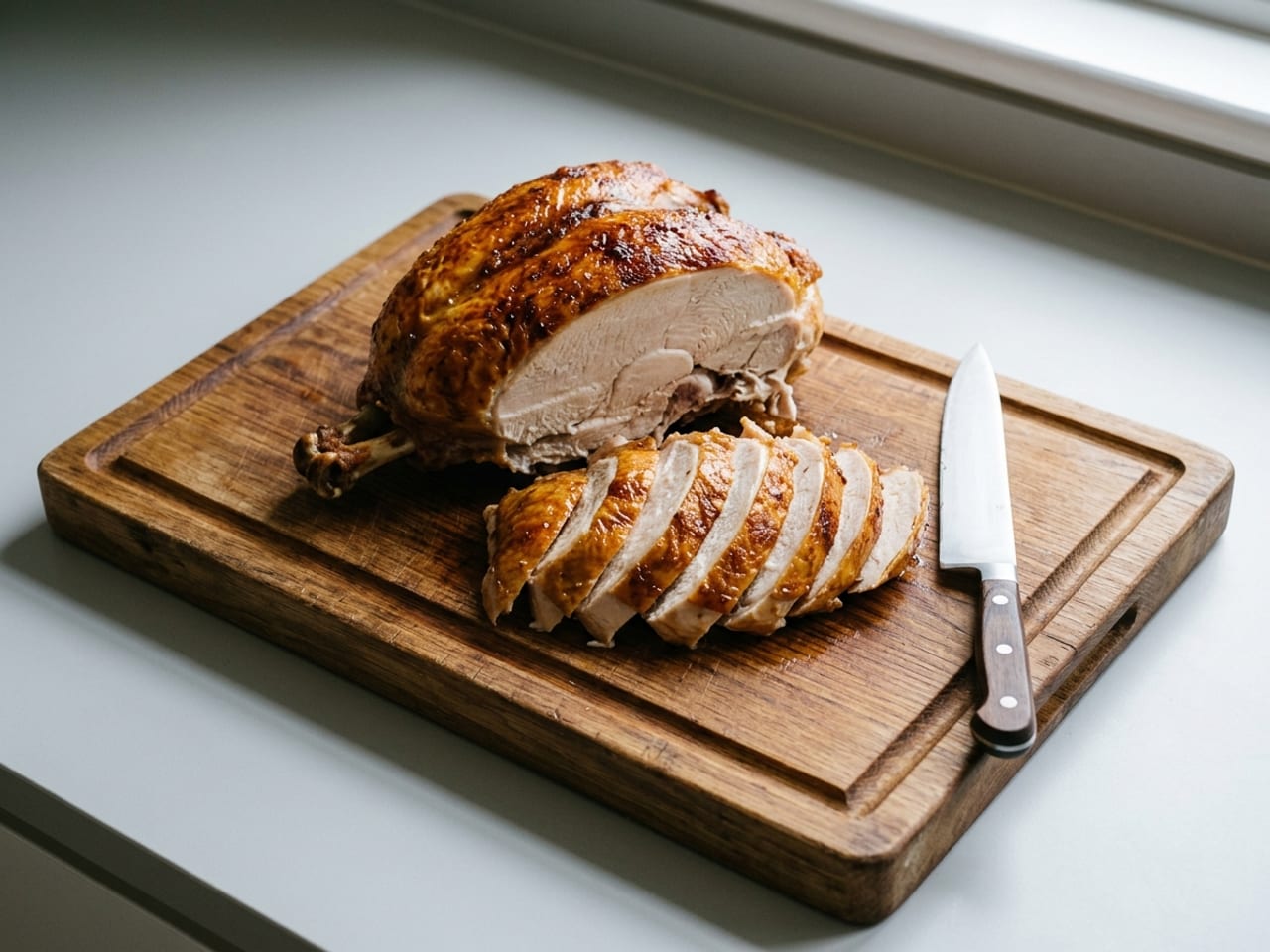
"A turkey crown is the breast of the turkey attached to the bone, with the wings and legs removed."47 It is a British word. The Cambridge Dictionary labels the sense UK and defines crown as "part of a turkey or other large bird eaten as food that includes the breast (= chest parts) but not the legs", with "turkey crown" as its example; Collins has no entry for "turkey crown" and the American Heritage Dictionary's entry for crown has no such sense.158, 163, 164 It carves two ways, like the whole bird. Waitrose prints both: "Using a fork to keep it steady, cut thin slices of breast meat with a downward motion using a sharp carving knife. Or remove the turkey breasts whole by slicing down close to the breastbone on each side. Then slice each breast crossways, against the grain, into thick slices."47 BBC Good Food says its two breast methods are ones "that you can apply to a turkey crown as well".21 Jamie Oliver's crown recipe lifts each breast off whole and slices it on a board; Robert Welch, with the Ashburton School of Cookery, carves on the bone, "working from the top of the crown, remove thin slices of meat with a steady slicing action." 27, 48 A crown may still have its wishbone: delicious. magazine, boning a raw one, notes "it might have been removed already".49
How well sourced. Five UK pages, among them a supermarket and a knife maker; the fifth is about boning a raw crown. The doneness temperatures on UK crown pages are their own and are not repeated here; for UK leftovers rules, which differ from the US ones, see food safety.
A spatchcocked (butterflied) turkey
how to carve a spatchcock turkey
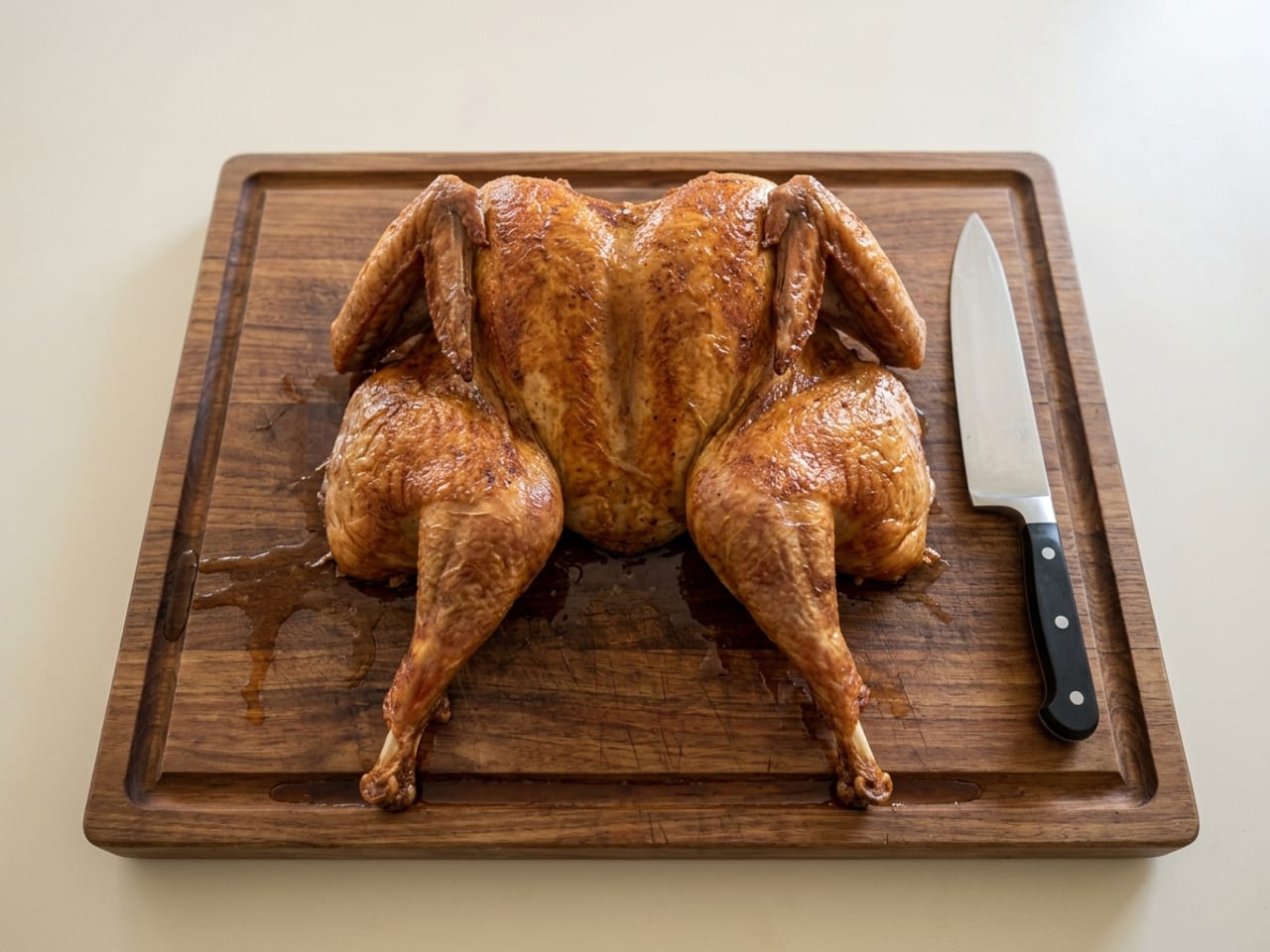
Serious Eats, whose detail is in a video we did not watch: "The process for carving a spatchcocked turkey is remarkably similar, with a few small tweaks to accommodate its butterflied profile."2 Its recipe adds that the wishbone can come out when the backbone does, "to make carving even easier", rests the bird 20 minutes and advises carving it in the kitchen.53 America's Test Kitchen prints the steps: "Carving a roasted butterflied bird follows virtually the same steps as carving a whole turkey, but the flattened shape makes it easier to execute." Its five are the leg quarters, the wings, then "Run tip of knife first along breastbone and then along rib cage, gently pulling meat away from ribs and using ribs as guide as you cut", then one step a whole bird does not have, "Work thumb between hip bone and thigh and pull hip bone away from thigh meat", and last the drumsticks from the thighs.55 Allrecipes lists "spatchcocked" among the birds its own steps cover.13 A home-cook blog gives the same order. Brazilian Kitchen Abroad: "where there's a joint, is where we cut", and "if you feel resistance, or hit a bone, wiggle and bend, and try again." For the breast: "Slice down the breast bone, gently following the hard line of the bone that separates the two breasts. Next, use a gently pulling motion to remove the breast from the bird in a whole piece, if possible." The writer slices it "on the thicker side in half an inch slices or so" (1.3 cm, our conversion).54 So the order of this page holds: legs, wings, each breast half off whole, slices across, with the hip bone to pull off each thigh. The picture shows the bird before the first cut.
How well sourced. One test-kitchen article with five steps, a grill maker's three (Traeger, which takes the wings last), one sentence from Serious Eats and one blog.2, 54, 55, 56
With an electric knife
how to carve a turkey with an electric knife
One published test exists, and one maker's step-by-step. America's Test Kitchen (review of 11 June 2025) carved a whole roast turkey with each model. What the tool is: "two identical serrated blades, riveted together", which "move in opposite directions" and cut "with minimal downward pressure"; they are "especially good for cutting skin-on poultry without ripping or pulling the skin." Its verdict: "While most of the professional cooks we surveyed still prefer using a boning knife or chef's knife to carve a roast, we think an electric knife can be a very effective alternative". Its cautions: the blades are "quite short", the knives are "quite loud", and a safety lock "proves especially useful if you plan to carve roasts during big family gatherings."39 Six of the pages we read allow one and two reject it: who. One blog places it: "the electric knife is best when using it on boneless meat", with a chef's knife to "remove meat off the bone."42 The American Society for Surgery of the Hand recommends one on safety grounds: "Use an electric knife if possible."154 In that test the electric knives also took the meat off the bone ("cleaving closely to the bone when we need them to") and cut slices a quarter and an eighth of an inch thick (6 and 3 mm, our conversion).39 The steps in print are a maker's. Hamilton Beach uses its knife for the whole bird, in the order of this page: "Remove the leg quarters first. Use the electric knife to cut the skin between the leg and the breast, exposing the ball joint. Start with gentle cuts so you can see where you are going." Then the wings, each breast off along the rib cage, and the slicing: "You should avoid sawing the meat; it's not necessary with an electric knife."44 Its later page puts it as "one smooth motion. Do not move the electric knife back and forth as you would with a traditional carving knife."45 If the joints worry you, take the bird apart with an ordinary knife and keep the electric knife for step 7, the boneless breast on the board (that part is our suggestion).
How well sourced. One test, one maker's steps and an allow-or-reject split. The fallback in the last sentence is ours.
How to arrange carved turkey on a platter
The layouts that named sources describe, each in its own words. The pattern words are "fan" and "shingle". No page we read says "rows", none tells you to lay slices "skin side up" on the platter (that phrase belongs to the slicing), and none lays white meat over dark.
| The layout | Who | Their words |
|---|---|---|
| Breast shingled on one side; thighs, drumsticks and wings on the other | America's Test Kitchen | "Use a knife or bench scraper to move those breast slices to the platter and shingle them. Arrange the thighs, drumsticks, and wings in a symmetrical pattern on the other side of the platter so people can easily go in for light or dark meat."1 |
| Dark and light in distinct areas, slices fanned | Southern Living, as reprinted by Yahoo | "When placing the carved meat onto a serving platter, do it in a decorative way, keeping dark and light meat in distinct areas for easy grabbing. Fan the slices of the meat for a visually appealing presentation".60 |
| Dark meat in the middle, breast slices fanned on either side | Southern Living's editors (2016), as reprinted by Yahoo | Legs and thighs: "Arrange them in the middle of the platter." Breast: "fan out the slices on either side of the dark meat."73 |
| Breast and thigh slices fanned, drumsticks and wings around | Epicurious | "Fan out the breast and thigh meat and arrange the drumsticks and wings around."4 |
| Breast shingled, drumstick whole, thigh slices nestled in, herbs between the sections | Martha Stewart | "Transfer to the platter and slightly shingle the meat; repeat with the other breast." "Slice the thigh meat into pieces and nestle it onto the platter." "Use sprigs of fresh herbs such as sage, thyme, and rosemary to decorate the platter, placing them in between the different sections of the meat."5 |
| Breast on the platter first, dark meat built around it | The Spruce Eats | "Note that the breasts are going to take up a lot of space on your platter, so you'll want to platter them first and then arrange the drumsticks and dark meat around them."11 |
| The sliced breast moved in its stack, then fanned | National Turkey Federation (a trade body) | "Try to keep the slices stacked neatly together on the cutting board for the best presentation." Then slide a knife or a spatula "under the sliced breast, and transfer it to the serving platter, fanning out the slices."10 |
| Slices fanned, drumsticks and wings alongside | Real Simple | "You can fan out the slices of breast meat and thigh meat, and place the drumsticks and wings on the platter as well."12 |
| Breast fanned around the edge, bone-in pieces layered in | Shun (a knife maker) | "Fan the sliced breast meat around the edges of your platter for an elegant presentation. Layer in the drumsticks, thighs, and wings as well for a full spread."16 |
| Slices mounded, a few pieces left whole | The New York Times, describing Ray Venezia's platter | "a platter mounded with thick, clean slices of breast and thigh and a few whole pieces for those who like the bony bits."8 |
| Carved breast with WHOLE thighs and drumsticks, gravy passed | America's Test Kitchen (a turkey cooked as parts) | "Finally, we carve the breasts and arrange them on a platter with the thighs and drumsticks, passing the gravy separately."62 |
| White and dark together, a little gravy poured over | Jamie Oliver (United Kingdom) | "Transfer the dark and white meat to a platter, then pour over a little gravy so it doesn't dry out."15 |
| Carved meat arranged ON a layer of gravy in an ovenproof platter, then reheated | Ina Garten | "Carve the turkey and arrange it artfully on top of the gravy. Place the platter uncovered into the oven for 15 to 30 minutes, until the turkey is very hot. Serve hot with extra gravy on the side."63 |
| For an overcooked bird: slices on a shallow bed of thinned gravy, more ladled over | Epicurious (its turkey guide) | "Layer the sliced turkey on a shallow bed of that gravy and pour a few ladlefuls of gravy over the top."65 |
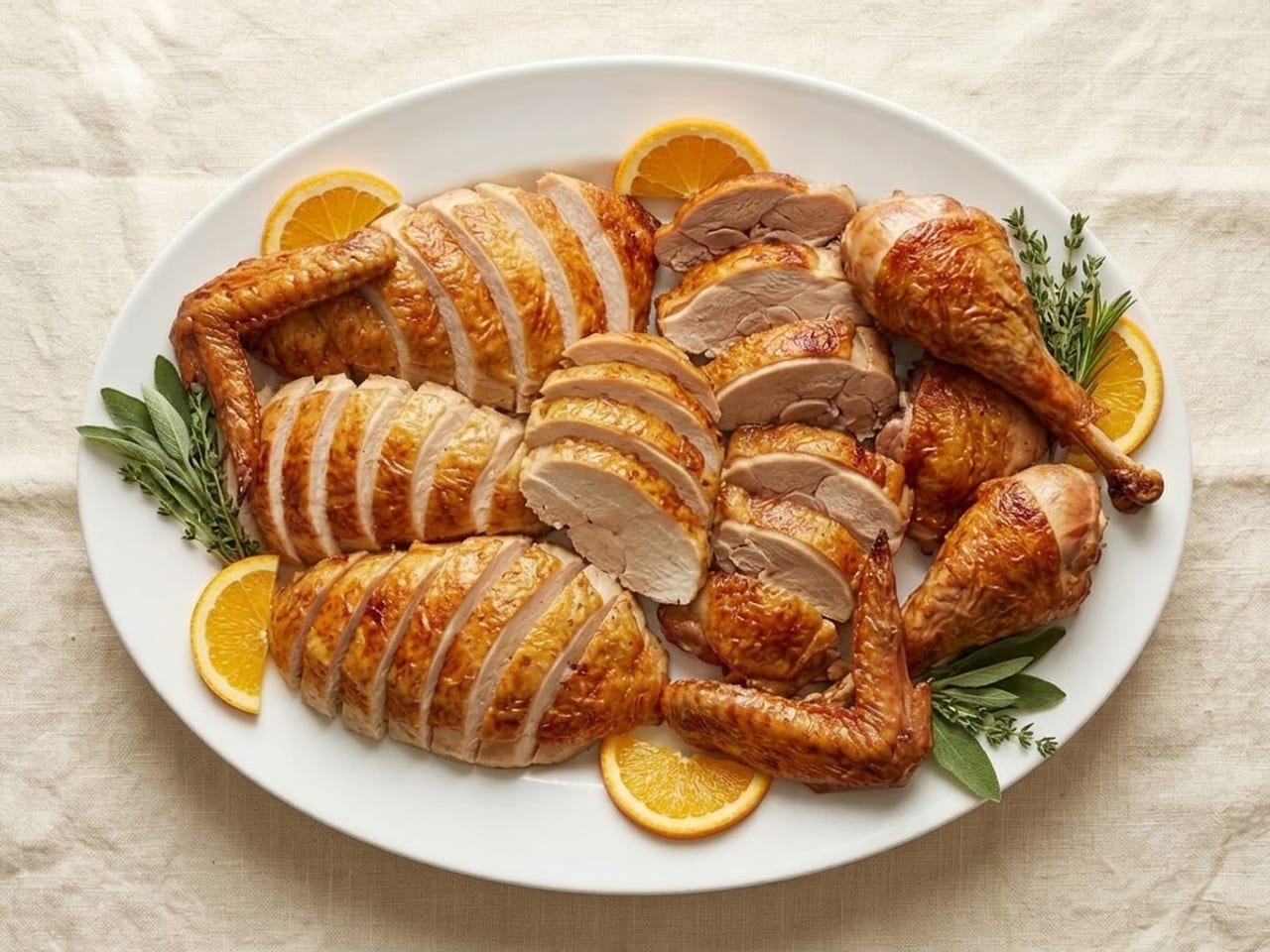
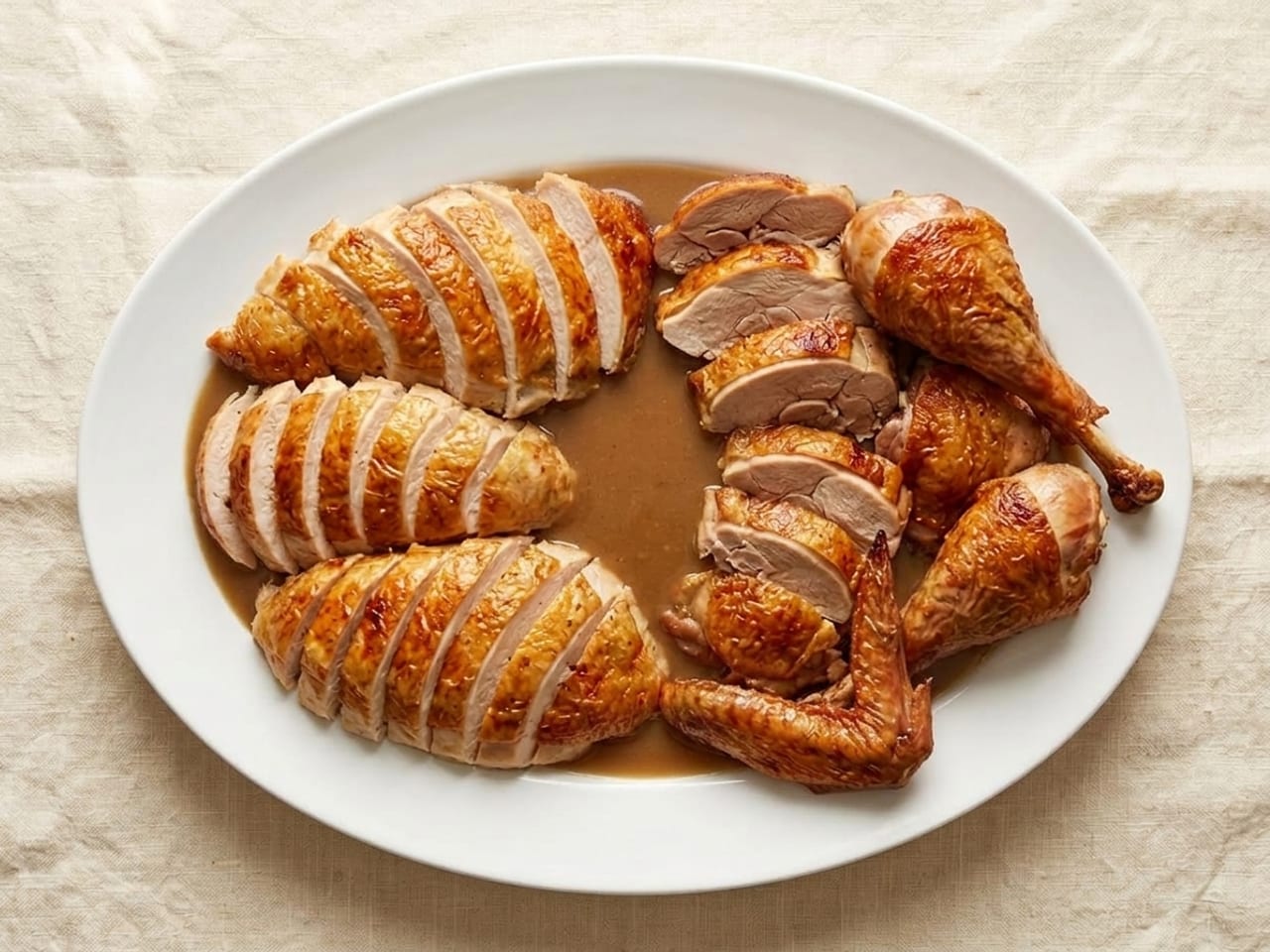
Two layouts of our own. The family platter in our roast turkey recipe lays the breast in two overlapping rows down the middle, with the thigh slices along one side and the drumsticks and wings at the ends. That arrangement is ours: it keeps white and dark apart, as the sources above do, but its rows and its ends come from no named page. Our Thanksgiving tablescape shows the legs whole, which among the pages we read is the rarer choice.
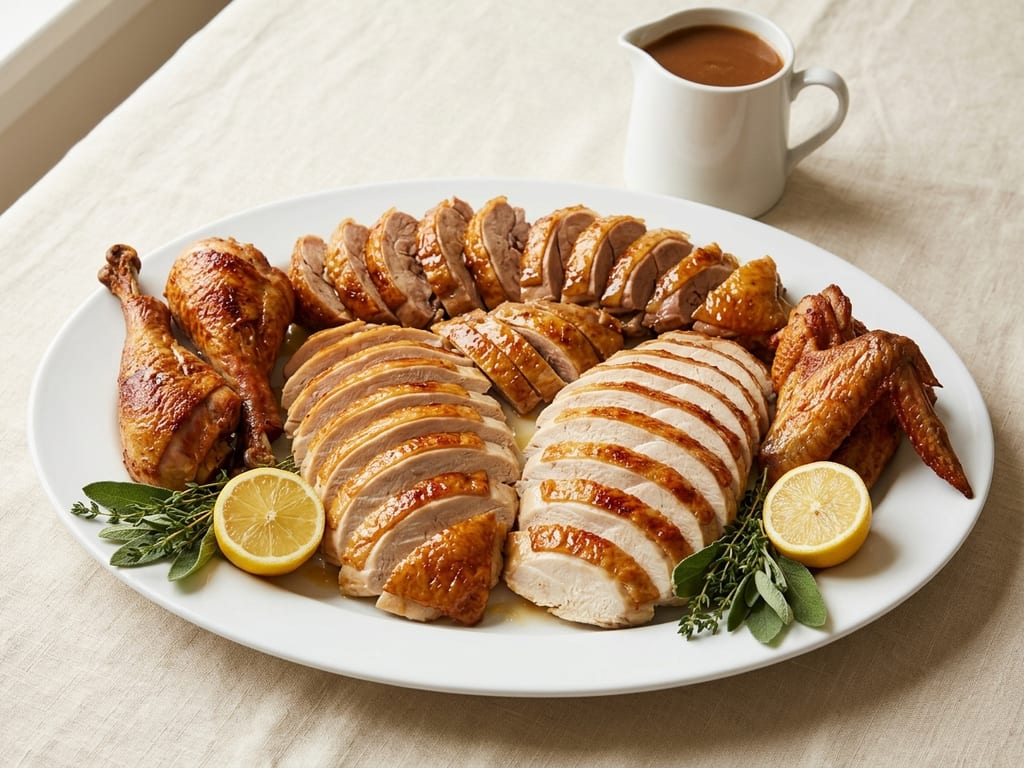
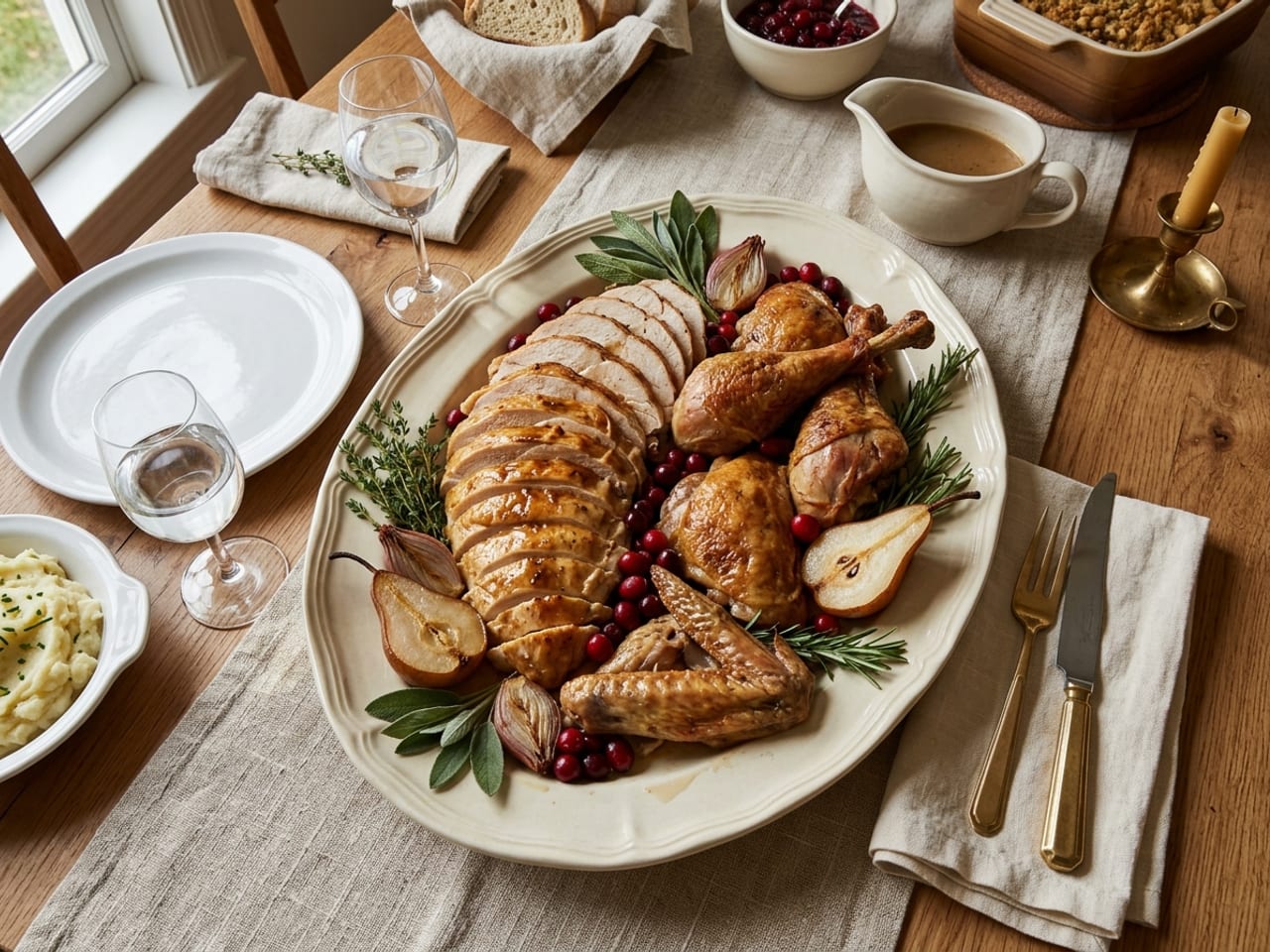
White meat and dark meat. Why the sources keep them apart is in the table above (so guests can reach either). How much of each there will be is less certain than it sounds. The University of Illinois Extension says a 15 lb (6.8 kg) turkey "usually has about 70 percent white meat and 30 percent dark meat", and America's Test Kitchen that the common commercial breed "contains up to 70 percent white meat"; neither says how it was measured.111, 112 And the sources do not agree on what the wings are: white meat for Taste of Home, dark for the National Turkey Federation.106, 109
What size platter. Two sizes turned up in the pages we read, and only one comes with a bird. Ina Garten carves a "12- to 14-pound" (5.4 to 6.4 kg) turkey, to serve 8, onto "a large (12 × 16-inch), ovenproof serving platter".63 Williams Sonoma's reprint gives the same platter as "30 x 40-cm".64 Southern Living's editors, in a 2016 piece read as Yahoo's reprint, ask for a platter "which is at least 16 inches and can accommodate the bird and garnishes" (41 cm), and name no bird weight.73 We found no platter size tied to a bird weight or a guest count other than Ina Garten's, so this page prints no size table. What else we found: a blog's weight test ("large enough and can support the weight of a turkey without being too heavy for someone to carry");68 an argument for two small platters, one at each end of the table, which "gives your dinner guests better, quicker access";69 and two smaller birds in place of one, above about 15 lb (6.8 kg) for the National Turkey Federation and Bon Appétit, and for more than ten guests for chef Jonathan Waxman in Epicurious.105, 107, 108 On the table, our tablescape guide keeps a strip of 14 to 16 inches (36 to 41 cm) clear for platters. Platter shapes are in our types of plates guide.
Turkey platter garnish ideas, from the sources. Herbs first: "any extra herbs you have around (rosemary and sage are particularly festive), or skip this step and let your bird ride solo."3 The National Turkey Federation: "thyme, sage, rosemary or whatever you used to season your bird. You can also add some wedges of citrus, such as lemons, oranges, clementines or limes."10 Small whole fruit: "small pears or a few bunches of grapes" (Food Network Kitchen), "kumquats and fresh sage" (Allrecipes), "fresh cranberries, figs, or sliced oranges" (Southern Living), "whatever tiny pears and apples you can score at the market" (Epicurious, around a cut-up bird).7, 13, 60, 71 Bon Appétit's 2009 list is the longest: "Pomegranates, oranges, pears, grapes, and bunches of fresh herbs will make a platter of turkey look like a masterpiece."70 Garnish that cooked with the bird is the tidiest idea: one Epicurious writer serves "the roasted oranges and shallots alongside for a festive presentation."72 Martha Stewart puts the herbs "in between the different sections of the meat", where they also mark white from dark.5 The one warning we found is about a whole bird carved on its tray: with "whole pomegranates, walnuts, and other bulky items" around it, "you'll have one hell of a time carving the bird."67 We found no named source on whether raw garnish should touch hot carved meat; what the sources ask is that it be washed and edible: food safety. More in our food garnishes guide.
How to keep carved turkey warm and moist
Sliced meat cools fast, so the first answer is not to carve early. After that, these are the methods in named sources, with the agency line beside them: hot food is held at 140°F (60°C) or above, and food that is not held that hot is in the refrigerator within 2 hours of leaving the oven (1 hour above 90°F, 32°C).
- Serve it at onceThree pages say the same thing in nearly the same words. Food Network Kitchen: "Carving cools the meat significantly, so as soon as the turkey is carved and sliced, it's ready to serve."7 The Kitchn: "carving is going to cool your turkey significantly, so you'll want to serve it right away or cover it with aluminum foil and stash in a warm oven until serving."9 Real Simple: once it is carved, "you should serve it as quickly as possible".12
- Better still, keep it whole and carve lateThe Pioneer Woman, as reprinted by Yahoo: "If you can, though, hold off on carving your turkey until as close to serving time as possible."85 EatingWell, as reprinted by AOL: "If your bird is ready within 2 hours before serving, wait to carve it. Keeping it whole will prevent the meat from drying out."87 The two tests we read are of whole birds, not slices: in America's Test Kitchen's, two untented birds were "still plenty hot" after "a full hour out of the oven".83, 129 The numbers. One Serious Eats writer waits longer: she roasts her turkey "several hours earlier than I need it" and says a big bird stays warm "up to two or three hours".91 That is her practice, not advice here, and like EatingWell's two hours before serving it is longer than the US agencies allow off the heat: FSIS and CDC count two hours (one above 90°F, 32°C) from the end of cooking to the refrigerator, with the meal inside them.77, 117, 146 A whole bird that must wait longer than its rest is held hot, at 140°F (60°C) or above, not left out: how.
- Warm the platterThe only temperature we found is America's Test Kitchen's "low 200-degree oven" (93°C, our conversion).1 Emily Post, in 1922, describes the cook's platter for a roast as "intensely hot".66 Serious Eats says "warm platter" and Allrecipes "warmed platter" without saying how.2, 13 The Kitchn asks for a platter that is "heat- or oven-safe", and Ina Garten adds "make sure it's ovenproof!" 9, 63 A platter out of the oven can burn: carry it with dry cloths and tell the table (ours).
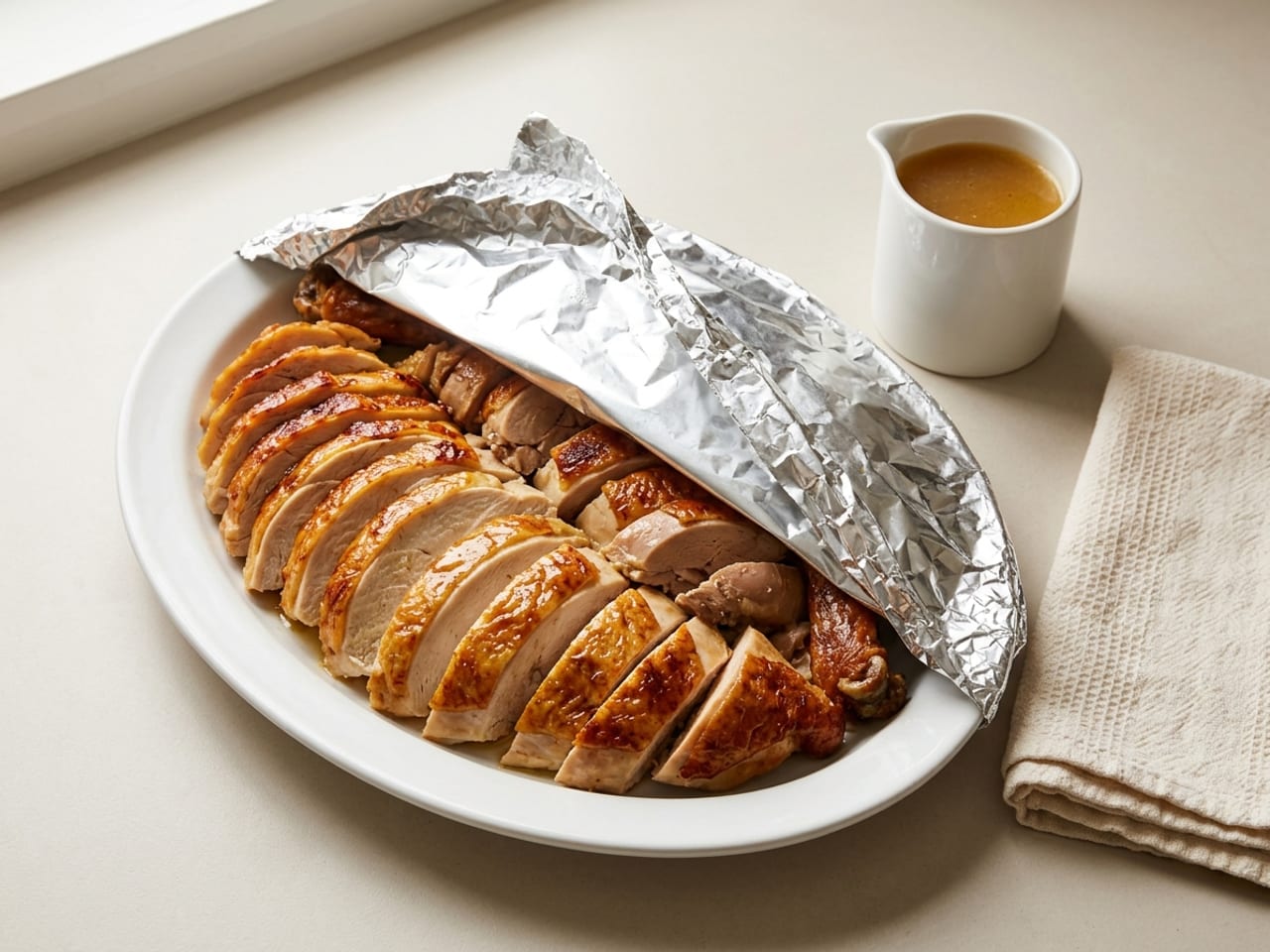
- Foil, loosely, and a towel over itReal Simple: "you can place the carved meat on a tray, and cover it with foil. (You can even add a towel or two to help insulate it and keep the heat in.)"12 Southern Living, as reprinted: "cover the platter loosely with aluminum foil, leaving a gap for steam to escape to prevent the skin from becoming soggy."60 The Pioneer Woman names the cost: cover it "to trap the heat and moisture; just keep in mind that the skin will start to soften."85
- A low oven, coveredSouthern Living, for longer waits, keeps carved turkey warm at 200°F (93°C), "wrapping it tightly to keep it from drying out."60 The Kitchn puts an oven-safe platter "in the oven at a low temperature", with no number.9 The agency line is a floor. FSIS, on a bought hot turkey dinner to be eaten within two hours: "Set oven temperature high enough to keep the turkey at 140 degrees F or above. Use a food thermometer to check." "Covering with foil will help keep the food moist." For a longer wait the same page prefers the refrigerator: "It's not a good idea to keep food hot longer than 2 hours."79 (140°F is 60°C.) That is one page's advice about a bought dinner; FSIS's general answer on hot holding names no time limit.137 A news report of a Culinary Institute of America video, which we did not watch, has its chef say not to be "afraid to pop the carved turkey back in the oven for a minute or so".95
- Hot broth or gravy over the slices, a littleThe Pioneer Woman: "you can douse the carved meat with a little warm chicken broth or turkey stock to make it taste like it was freshly carved."85 Better Homes & Gardens puts it on the white meat and warns about the amount: "After carving, drizzle some hot chicken broth over breast slices to moisten them before serving. Don't use too much broth or the slices may get soggy."61 Epicurious: "But don't overdo it. You don't want your turkey to drown in broth."86 Bobby Flay, in TODAY's words, tops the sliced turkey with hot broth, which "helps reheat the meat";18 Paul Kelly pours "hot cooking juices over the sliced meat";25 Jamie Oliver uses gravy;15 Epicurious whisks "a little butter into warm stock".65 No source we read limits the liquid to the dark meat. What softens skin, in the sources, is a cover and steam (above), not the broth.
- Carve early onto gravy, then reheat the whole platterIna Garten's method, in Williams Sonoma's words: "she could carve the turkey in advance, arrange it on an ovenproof platter over a layer of gravy and then reheat it all together. Not only was the turkey moist and delicious, but it stayed hot longer!"64 Her recipe pours "a ¼-inch layer of the gravy" (6 mm in Williams Sonoma's reprint) into the platter and puts it back in the oven uncovered "for 15 to 30 minutes, until the turkey is very hot."63, 64 As printed, the platter goes back into the oven straight after carving; the recipe has no chilling step. It prints no internal temperature; the agencies' reheating number is 165°F (74°C).
- A warming tray, a chafing dish or a slow cooker (to hold, not to reheat)FSIS keeps hot food "at or above 140 °F" (60°C), in "chafing dishes, preheated steam tables, warming trays, and/or slow cookers."78 An Epicurious shopping column sets "your platter of carved turkey right on top" of an electric warming tray.93 Southern Living allows "a large slow cooker set to the warm setting".60 FDA adds a check: "some warmers only hold food at 110 °F to 120 °F, so check the product label to make sure your warmer has the capability to hold foods at 140 °F or warmer."102 (43 to 49°C.) That is holding. Reheating in one is another matter: "Reheating leftovers in a slow cooker is not recommended."80
- A cooler is for a whole bird, not for slicesThe "faux Cambro" of AmazingRibs.com's Meathead is a cooler warmed with hot water for a whole, foil-wrapped bird. His claim, not a published test: he has "kept meats in a faux Cambro for three hours and they were well above 150°F." (66°C.) The cost: "the skin on your turkey and the bark on your brisket will soften." 92 Nothing in it is about carved meat, and a cooler has no thermostat: the agencies' line for holding is 140°F (60°C) or above, so check with a thermometer (the check is ours).137
- Warm the dinner platesSerious Eats, in a 2014 reader Q&A, asked why carved turkey is always cold by the time it reaches the plate: "Preheating plates in the oven will also help keep food piping hot as you eat it."88 How to warm a plate, and what not to put in an oven, is in our steak plating guide.
- What nobody we read has testedWe found no published test of how fast carved roast turkey cools on a platter, or of any home way of holding it: broth, foil, a towel, a warm platter, a low oven, a slow cooker or a cooler. The two tests we read are of whole birds.83, 129 The nearest thing we found is from foodservice: a 1987 study for the US Army held slices of cooked turkey roll hot at about 66°C (151°F) for up to two hours and scored them less juicy as the holding went on (read as the rough text of a scan, so not quoted).103 Bon Appétit offers the other way out (inside the two hours): "No one will care if the food isn't piping hot".94
Carving a turkey ahead of time
If the turkey is cooked the day before, carve it before you chill it. Every source we read that says how says so, FSIS included: "Reheating a Whole Turkey is NOT Recommended. If you plan to reheat a turkey, cut the meat into smaller pieces. Slice breast meat. Legs and wings may be left whole. Refrigerate in shallow containers."79 EatingWell, as reprinted: "it's best to carve it and keep it in the refrigerator." Its pieces are "about ¾-inch thick" (1.9 cm), laid "close together while overlapping" in a tray and covered tightly.87 Real Simple, for a few hours' head start: "carve and place it on a baking pan covered in foil in the fridge." 12 Better Homes & Gardens, for a bird that is done two hours early: "keep it warm, covered, in a 200°F oven until serving time. Or you can carve it, chill it, and reheat it in a roasting pan, covered, in a 350°F oven, adding some chicken broth to keep it moist."61 (93 and 177°C.) A bird kept warm that long has to stay at 140°F (60°C) or above, on a thermometer: the agencies' line.
Slices or big pieces? The sources split. Slices: EatingWell and Better Homes & Gardens' test kitchen specialist Sarah Brekke ("You will not have success trying to reheat large pieces of turkey like whole thighs or breasts,"); FSIS slices the breast and leaves legs and wings whole.79, 87, 96 Big pieces: Serious Eats ("sliced turkey is difficult to reheat without overcooking") and Bon Appétit's Claire Saffitz, who moves whole legs and breasts, and The Pioneer Woman's current page.20, 85, 97 Two make-ahead methods avoid reheating a whole roast bird: America's Test Kitchen's make-ahead turkey is cooked as parts, the legs braised "up to a few days before the feast", and an Epicurious writer warns that a turkey roasted the day before and simply reheated risks "a dry bird with flabby skin."62, 72 Bon Appétit's buying guide does suggest roasting a second bird "a day or two early" and reheating it, without saying how.108 Two FSIS rules bound any plan: "Never brown or partially cook turkey to refrigerate and finish cooking later."81 and "Cooked turkey may be eaten cold or reheated."117
Reheating carved turkey: whose number is whose
The reheat-to temperatures in print run from 110°F to 167°F (43 to 75°C). The first row is the safety number, from the US agencies, and it is this page's advice for everyone, above all when anyone at the table is a small child, pregnant, elderly or has a weakened immune system (ours; the UK, Canadian and Australian pages under food safety name those groups). The rows marked as what a publication's cooks do are quality choices that sit below it, and are printed here as theirs, not as advice. A row that prints no number is no reason to stop short of 165°F (74°C).
| Who | The oven | Reheat to | How, in their words |
|---|---|---|---|
| USDA FSIS and CDC (United States): the safety number | Stove, microwave, or an oven "no lower than 325 °F" (163°C) | 165°F (74°C) | FSIS: "Reheat turkey to an internal temperature of 165 °F. Use a food thermometer to check the internal temperature." In the oven: "Set the oven temperature no lower than 325 °F."117 "Cover leftovers to reheat. This retains moisture and ensures that food will heat all the way through."77 CDC: "Reheat all leftovers to at least 165°F before serving or eating."119 |
| Real Simple | 300 to 325°F (149 to 163°C) | 165°F (74°C) | Carved hours ahead and chilled; then "put a little broth or water into the pan, cover it with foil, and heat it at 300 to 325 degrees, until the turkey meat reaches a safe temperature of 165 degrees."12 |
| Better Homes & Gardens, as reprinted by Yahoo | 350°F (177°C) | 165°F (74°C) | "Top with a little broth or gravy, cover with foil or the Dutch oven lid, then bake at 350°F until the turkey reaches 165°F. (This usually takes about 30 minutes.)"96 |
| Taste of Home | 300°F (149°C) | 165°F (74°C) for large pieces | Foil, "a few spoonfuls of gravy or chicken stock" and a pat of butter; for large pieces, "use an instant-read thermometer to make sure each piece reaches 165°F."99 |
| olive magazine (United Kingdom) | 356°F (180C, or 160C fan, as printed) | 167°F ("at least 75C") | Thin slices of breast and the leg meat off the bone, in about a fifth of an inch (5 mm, the page's figure) of stock, dotted with butter, covered tightly with foil for 30 minutes.98 |
| Serious Eats: what its cooks do, below the agencies' number | 300°F (149°C) | 150 to 165°F (66 to 74°C) | The site says it prefers a core of 150 to 155°F (66 to 68°C) for turkey that is still juicy. Its reasoning, in its words: "It will be safe to eat as long as the turkey is at least 150°F at its coldest part for at least four minutes, while 165°F is the temperature at which bacteria is killed instantly."100 That is the site's claim, not FSIS's. |
| America's Test Kitchen: what its cooks do, below the agencies' number | 275°F (135°C) | 130°F (54°C) | "Heat until the meat registers 130 degrees. This temperature is warm enough for serving but not so hot that it drives off more moisture."101 Its make-ahead recipe reheats legs braised days earlier to 110 degrees (43°C).62 Both are far below 165°F. |
| The Pioneer Woman, as reprinted by Yahoo | 300°F (149°C) | No number: "until hot" | "Cover the pan tightly with foil", with a little broth or stock in it, and reheat "until hot, about 20 to 30 minutes at 300 degrees."85 The publisher's current page, updated in November 2023, also carves a day-ahead bird "into large pieces" and reheats them at 325 degrees (163°C). |
| Bon Appétit (Claire Saffitz) | 300°F (149°C) | No number: "until warmed through" | Whole legs and breasts in the roasting pan with the carving juices and a little stock, wrapped in foil. "The skin won't be crispy, but it's not a huge loss,"97 |
| EatingWell, as reprinted by AOL | 350°F (177°C) | No number: "desired warmth" | "Reheat to desired warmth, around 15 minutes." The same method first lets the chilled, carved bird "come to room temperature (it should take about an hour)", an hour on the counter that is EatingWell's own: the US agencies' pages do not ask for it, and they count time at room temperature against the two hours.87 |
Three things most of the sources share. Add liquid: Brekke calls reheating turkey without it "the biggest mistake a person can make."96 (America's Test Kitchen and Serious Eats add none in the oven and rely on a tight foil wrap.100, 101) Cover it;77 Ina Garten's platter, uncovered on its gravy, is the exception.63 Most of the ovens in the table are cooler than the 325°F (163°C) FSIS asks for.117 And expect soft skin: Serious Eats says moist reheating "inevitably leads to soft, flabby turkey skin", and its fix is to "sear the skin side in a lightly oiled skillet over medium-high heat until it snaps back to life."100 Do not reheat in a slow cooker.80 For reheating the gravy, see our turkey gravy recipe. In the United Kingdom the advice is to reheat once, until steaming hot: food safety.
Carve in the kitchen or at the table?
The kitchen is the modern consensus, and it is a hundred years old. The reasons the sources give are mess, space, an audience, speed and hotter food.
| Who | Where | In their words |
|---|---|---|
| Jocelyn Guest, a butcher quoted by Bon Appétit | Kitchen | "Just remember to cut it up in the kitchen first, and then bring it out to the table,"3 |
| The Spruce Eats | Kitchen | "The process involves a certain amount of grappling with the bird that is best confined to the kitchen. Besides, you don't need the added pressure of a captive audience."11 |
| National Turkey Federation (a trade body) | Kitchen | "my advice is to take care of this in the kitchen while others get the rest of the dishes to the table or the buffet."10 |
| Allrecipes | Kitchen | Carve "in the privacy of your kitchen", to cut down on what the page calls "helpful" comments from onlookers.13 |
| Ray Venezia and Roger Bassett, in The New York Times | Kitchen, or a sideboard | Venezia: "Give me a flat cutting board any time." The reporter adds that "a roomy sideboard with a cutting board on top would be fine". Bassett "said he preferred to present the turkey in its whole, golden-brown, burnished state, then retreat to the kitchen to carve it."8 |
| Emily Post, 1922 | Kitchen | "This method has two advantages over table carving; quicker service, and hotter food."66 |
| BBC Good Food (United Kingdom) | Either, by method | Slicing on the bird: "Do this at the table for large slices." Taking the breast off whole: "Do this in the kitchen for good portion control".21 |
| Jamie Oliver (United Kingdom) | Either, and he prefers the kitchen | "Carving the bird before you take it to the table gives really good results every single time." At the table, slices go to the platter "or directly onto someone's plate."15 |
| University of Illinois Extension | Either | "Whether you carve the turkey at the table or in the kitchen, sharpen the knife and get to it."34 |
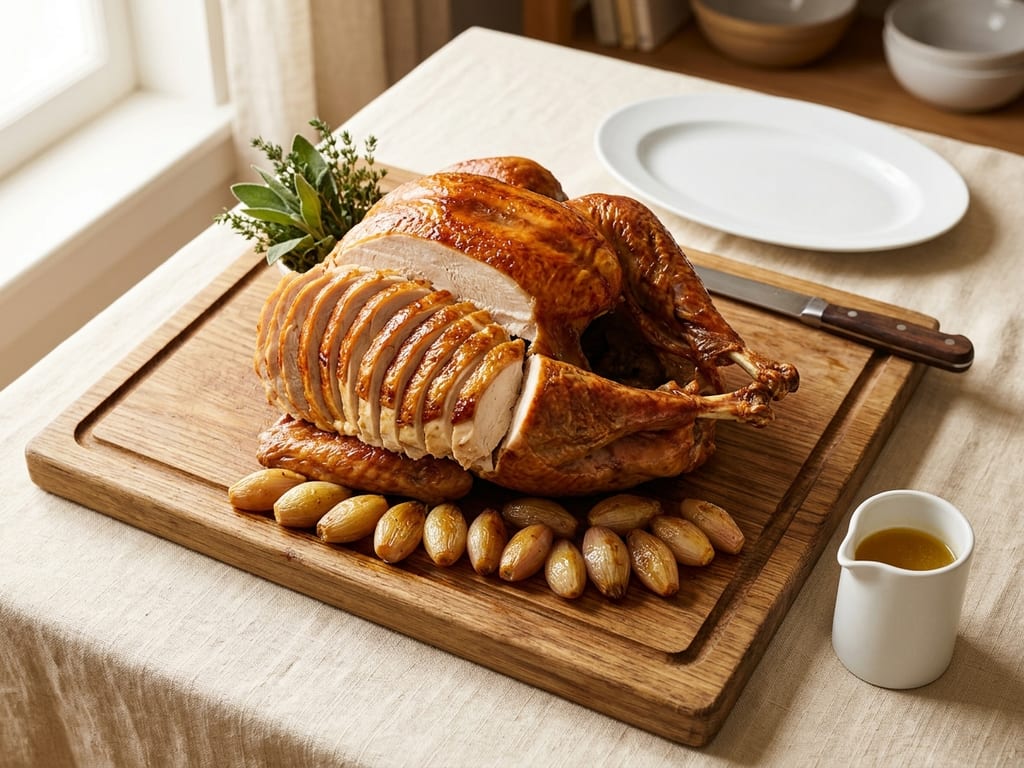
Passing and the buffet. At a seated table the Emily Post Institute passes platters to the right: "Food is passed around the table in a counterclockwise direction, or to the right."114 An Epicurious writer says of every Thanksgiving he has been to that it was "a buffet-style serving situation with a find-a-seat-where-you-can mentality."115 For a buffet, FSIS's small platters, replaced within two hours, are the food-safety answer.138 One newspaper prints an order for the line, on the advice of a club chef, Chuck Kerber: "The first food item after silverware and plates should be the turkey." "Sides are second." And: "Place the gravy and cranberry sauce at the end so that you can top the meat and stuffing and whatever else you want with them at one time without holding up the line."75 The order on our Thanksgiving tablescape is our own and differs: sides before the turkey, and the gravy right beside it.
Who carves the turkey, and who traditionally did
The answer changes with the century. The man at the table carving the Thanksgiving turkey is in American books of 1864 and 1865; we did not find its first appearance in print, so those are floors, not a date for the custom.
| When and where | Who carved, by the source |
|---|---|
| 1508 / 1513, England | A servant with a title. Wynkyn de Worde's carving book is written "for the seruyce of a prynce or ony other estate", and its carver works "afore your lorde or your lady".169 First printed in 1508; the words are the 1513 edition, read in an 1867 reprint. In France the office was the écuyer tranchant, defined by the Trésor de la langue française as the one who cut the meats (our translation).162 |
| 1788, England | The hostess, and her husband. John Trusler: where there are several dishes, the mistress of the house carves the one in front of her and asks her husband, or whoever sits at the bottom of the table, to carve the joint or bird in front of him.171 That is our reading of a scan's text, which prints the long s as an f, so it is not in quotation marks. |
| 1840, United States | Women carve too. Eliza Leslie: "We have seen very small women carve admirably sitting down; and very tall men who knew not how to cut a piece of beef-steak without rising on their feet to do it."172 Read as the text of a scan. |
| 1852, United States | Sarah Josepha Hale tells women to learn it: "Ladies ought especially to make carving a study", and seats the lady of the house at the head of the table with two gentlemen "who should assist her to carve."173 Read as the text of a scan of the fifth edition, dated 1852 on its title page and in its preface. A Connecticut newspaper, reporting Old Sturbridge Village's historian in 1998 on "American etiquette of the 1830s", puts it this way: "women were expected to carve the turkey so that the feast would go smoothly", and "Our current custom of assigning this task to the head of the household came later". 180 |
| 1861, England | The father, at Christmas. Isabella Beeton: "we can hardly imagine an object of greater envy than is presented by a respected portly pater-familias carving, at the season devoted to good cheer and genial charity, his own fat turkey, and carving it well."175 That is British and about Christmas. In the United States a husband carves the turkey at an ordinary dinner in a magazine story of January 1852: "I said, as I began to carve the turkey, at dinner".174 |
| 1864 and 1865, United States | The man at the table, at Thanksgiving. In Horatio Alger's novel Frank's Campaign the father is away at the war, and at the Thanksgiving dinner the mother asks the gentleman boarder: "Do you think you can carve the turkey, Mr. Morton?"176 Barry Gray's My Married Life at Hillside has a new husband who is proud to sit at the top of his own table and carve, and who admits: "on Thanksgiving Day, when a young physician and his wife took dinner with me, I managed to deposit the turkey I was carving upon the floor".177 Both read as the text of scans. They are the earliest we found, not necessarily the first. |
| 1869, United States | A New England Thanksgiving in a novel names no carver. Harriet Beecher Stowe's Oldtown Folks has only "much carving" and laughing and talking.179 Read as the text of a scan of a 1911 printing. |
| 1922, United States | The cook, in the kitchen. Emily Post: "A certain type of man always likes to carve, and such a one does. But in forty-nine houses out of fifty, in New York at least, the carving is done by the cook in the kitchen". A host who does carve "must have the end place".66 |
| 1943, United States | Norman Rockwell's Freedom from Want, a story illustration for The Saturday Evening Post of 6 March 1943, shows the moment before carving.181 Our description, from the museum's reproduction: an older woman in an apron sets a whole, uncarved turkey down at the head of the table; an older man in a suit stands behind her; a carving knife and fork lie on the cloth. Nobody is carving. |
| Today | America's Test Kitchen and the knife sellers it interviewed call the carving set a relic, "filling a role that's more ceremonial than functional"; Josh Donald of Bernal Cutlery ties its decline to "the dramatic decrease in the importance of the Sunday dinner ritual".40 The Emily Post Institute remembers "a roast-something that her grandfather carved perfectly at the table" and leaves the service open: "family style, buffet style, or a combination of both".113 |
One plate of turkey
We found no modern named source that describes how to plate one serving of roast turkey: how many slices, white and dark together or apart, gravy under or over. What is in print is around the edges. Warm the plates: "Preheating plates in the oven will also help keep food piping hot as you eat it."88 At a table carving, slices can go "directly onto someone's plate." 15 Gravy goes under and over on two platters (Ina Garten's, and Epicurious' fix for a dry bird) and is passed separately by America's Test Kitchen.62, 63, 65 The one rule we found for a single plate is old and is about fowl in general: the White House Cook Book of 1887 puts gravy "on a vacant side of the plate, not pour it over their meat, fish or fowl, that they may use only as much as they like."76
So the plate below is ours, from the roast turkey recipe: a small pool of gravy off center, three slices of breast shingled across it with the skin up and out of the sauce, a piece of boneless thigh beside them so each guest gets both meats, and one side. How to pool a sauce and how to build a plate have their own guides.
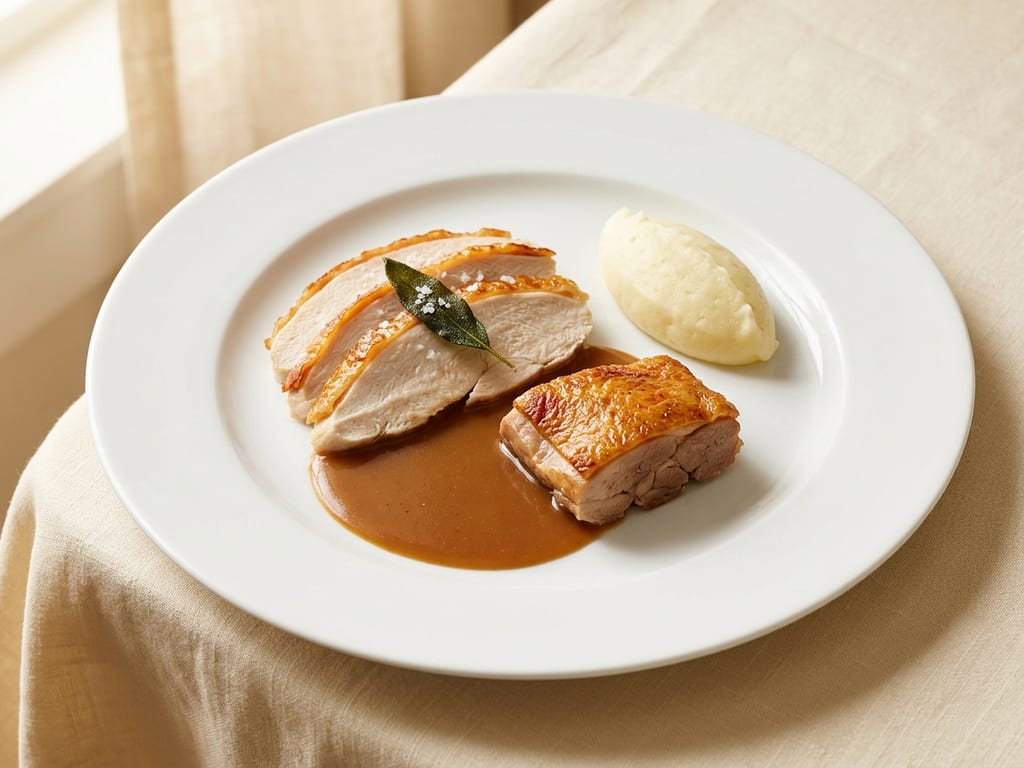
How much meat a turkey gives
About half the weight you buy. USDA's Food Buying Guide, written for school kitchens, gives the cooked yield of a whole turkey per pound as purchased. Bought with neck and giblets, as most birds are sold (our reading): "1 lb AP = 0.48 lb cooked" turkey with skin, 0.42 lb without skin. Bought without them: 0.53 lb with skin, 0.47 lb without.104 By our arithmetic a 13 lb (5.9 kg) bird therefore carves to about 6.2 to 6.9 lb (2.8 to 3.1 kg) of meat and skin, or about 5.5 to 6.1 lb (2.5 to 2.8 kg) of meat alone, and one pound bought gives each guest about 7.7 oz (218 g) on the plate, a pound and a half about 11.5 oz (326 g). The magazines round it the same way. Serious Eats: "Plan on about one pound of turkey per person, which translates to around half a pound of edible meat."20 (About 450 g and 225 g.) A bone-in breast does better, at 0.64 lb cooked with skin per pound.104
How much to buy, raw, per person: a pound in the National Turkey Federation's and the University of Illinois Extension's advice (about 450 g), and a pound and a quarter to a pound and a half with leftovers in mind (570 to 680 g).105, 108, 109, 110 Our turkey calculator does the sum. We found no count of slices per breast in any page we read.
Turkey carving mistakes, and the fix each source gives
Each mistake is one a named source lists, with that source's fix beside it. None was tested by us.
- Chasing neat slices on a round carcass that movesThe Kitchn: "Don't attempt to carve perfect slices directly from the roasted bird. Remove the breast, drumstick and thigh sections in large pieces, then cut into slices for serving."9 Ray Venezia's picture of it: "Trying to carve from the carcass is like trying to cut it off a beach ball: it's all curved surfaces and it moves around under the knife".8
- The knife jams at the hipSaveur, reporting butcher Jake Dickson: if the knife falls on the inside of the hip bone, "the knife gets stuck, so he recommends feeling for that bone and making sure you cut down the outside".19
- Ragged slices from sawingLong strokes. America's Test Kitchen: "long motions (not sawing motions)"; Food Network Kitchen: "long cutting strokes instead of short sawing ones"; Ellen's Kitchen: "Use long, sweeping strokes for smooth slices; sawing shreds the meat, especially on a large or overcooked bird."1, 7, 33
- A dull knife, or a big one you do not knowTom Copas: "A blunt knife is dangerous, doesn't do a good job and makes a real mess!"24 The American Society for Surgery of the Hand: "A dull knife will require the use of force to cut your turkey, which is dangerous and could cause slips."154 And Ray Venezia "counsels against using a large or unfamiliar knife, like a wedding set carving knife."8 Honing and sharpening are different jobs: our knife skills guide has both.
- Flipping the bird over to reach the undersideAmerica's Test Kitchen tilts it instead: "don't fully flip the bird over; you don't want to sog out the skin by having it sit against a cutting board steaming."1 Jamie Oliver does turn the carcass over for the dark meat underneath, but only after the breasts and legs are off.15
- Slices cut too thinEpicurious gives the only reason for a minimum that we read: thigh slices at least a quarter inch (6 mm) thick, because "thinner slices tend to dry out quickly".4 We found no source that warns against slices that are too thick.
- Carving the moment it leaves the ovenA retailer's list puts it first: "Carving too early- your turkey will lose its juices and become dry".28 Whether a rest saves juice is disputed, and tested on turkey only once, on six breasts. What is not disputed is in FSIS's line, "The turkey will carve more easily", and in the reporter's phrase about a rested bird, that the meat "has firmed enough to cut cleanly."8, 117
- A board that slides, and juice on the counterThe Kitchn: "Stabilize the cutting board by placing a mildly damp towel or a non-slip mat underneath."9 America's Test Kitchen sets the board inside a rimmed baking sheet (above).41 Food Network Kitchen stops midway "to wipe down your cutting board to eliminate extra juice."7
- Cold by the time it is eatenCarve as late as you can, onto a warm platter, and warm the plates: the holding methods. Serious Eats, in a 2014 reader Q&A, answers with a thermometer: "Rest the turkey just until it's dropped down to about 5°F below its final cook temperature."88 (5°F is about 3°C.) That suits its lower cooking temperatures; whatever you do, the bird must have reached 165°F (74°C).
- The breast came out dryMoisten it on the platter. Epicurious: "Ladle warm broth over the platter of sliced turkey", but "don't overdo it." Chef Nate Waugaman, as that article describes him, "mixes equal parts gravy and stock, seasons it, and then pours enough of this thinned-out gravy over the dry turkey slices to rise half way up the meat. He then covers the pan with foil and pops it in a 200°F oven to warm it through." 86 (200°F is 93°C.) That is a chef's fix for meat just carved, not a way to reheat leftovers, which go to 165°F (74°C). Our turkey gravy is the gravy.
- It came off in piecesBetter Homes & Gardens, as reprinted: "Choose a smaller platter", put the larger scraps underneath and "Top with your best looking slices or cuts."61 Allrecipes: "If it doesn't look perfect, don't stress. It will soon be smothered in gravy".13 And Ray Venezia: "Piping hot gravy will take care of everything".8
A short history of carving the turkey
Dated sightings from the books themselves. Each row says how the text was read; the oldest books were read as the machine-read text of scans, which is why some passages are described and not quoted.
| When | What the source says |
|---|---|
| 1508 and 1513 | Wynkyn de Worde prints The Boke of Keruynge. Its "Termes of a Keruer" give every animal its own verb: "Breke that dere", "rere that goose", "lyft that swanne", "sauce that capon", "dysmembre that heron", "wynge that partryche". There is no turkey in the list. It also has a rule for the free hand, never more on the food than "two fyngers and a thombe".169 What we read is the second edition, 1513, as reprinted in 1867; a note in that reprint describes the first edition of 1508. |
| 1747, 1767 and 1784 | Hannah Glasse's The Art of Cookery. In two scans of the 1747 first edition we found no carving section. Later editions (we read 1767 and 1784) add one that opens with a paragraph on how to cut up a turkey, and it is display carving: the leg is raised and the joint opened, but the leg is not taken off (our reading of a scan's text, so not in quotation marks).170 |
| 1788 | John Trusler's The Honours of the Table, London, written "FOR THE USE OF YOUNG PEOPLE". On our reading of the scan's text, a turkey is cut up like a pheasant, and it is customary to carve no more than the breast, taking off a wing only if more is wanted.171 So in 1788 the legs stayed on at table. |
| 1840 | Eliza Leslie's The House Book, Philadelphia, takes the wing, leg and breast off one side, then says to "turn the turkey over, and cut them off from the other." On the knife: "The carving knife should be very sharp, and not heavy; and it should be held firmly in the hand". On posture: "it is extremely ungraceful to carve standing".172 Read as the text of a scan. |
| 1852 | Sarah Josepha Hale's The Ladies' New Book of Cookery starts with the breast: "Cut long slices from each side of the breast down to the ribs". The drumsticks "are only served in cases of necessity, as being rather tough".173 Read as the text of a scan of the fifth edition (1852). |
| 1861 | Isabella Beeton's Book of Household Management: "The only art consists, as in the carving of a goose, in getting from the breast as many fine slices as possible". The legs are "very seldom cut off and eaten at table: they are usually removed to the kitchen", to come back devilled.175 Her carving lines refer to an engraving that we did not see. |
| 1896 | Fannie Farmer's Boston Cooking-School Cook Book is the earliest text we read that takes both legs and both wings off before any breast is cut: "Introduce carving fork across breast-bone, hold firmly in left hand, and with carving knife in right hand cut through skin between leg and body, close to body. With knife pull back leg and disjoint from body. Then cut off wing." Then: "Carve breast meat in thin crosswise slices."178 The breast is still sliced on the bird. |
| 1922 | Emily Post reports that carving has left the table in New York houses (above) and expects the skill to go with it: "Unless a change takes place in the present fashion, none except cooks will know anything about carving, which was once considered an art necessary to every gentleman."66 |
| 1939 to 1965 | The electric knife is patented more than once. Clem E. Kosterman of Racine, Wisconsin, applies on 4 June 1938 and is granted US 2,180,244, "POWER OPERATED KNIFE", on 14 November 1939: "a knife handle having an electric motor mounted therein".182 General Electric's "ELECTRIC SLICING KNIFE", US 3,203,096, is filed on 29 July 1963 and granted on 31 August 1965.183 Who is credited with inventing it is a claim with a verdict. Both patents were read as machine-read text. |
| 2007 | The New York Times prints "Butcher's Method Takes Carving Off the Table": breasts and thighs "removed whole, then boned and sliced on a cutting board." A poultry scientist it quotes sees what is lost: "If you want the Norman Rockwell moment, this is not the method for you".8 We read the article, not its videos. |
Eighteen popular claims about carving a turkey, each with a verdict
"Supported" never means proven for your bird. "Supported, narrowly" means the source or test covers less than the claim says; "Mixed", that sources point both ways; "Not supported", that the claim was tested, or checked against the source it names or against agency rules, and did not hold; "No source found", that we found no source or study for it at all.
| The claim | Verdict | What we found |
|---|---|---|
| "Resting lets the juices redistribute" | Mixed | For it: America's Test Kitchen says 45 minutes "gives it time to reabsorb the juices", and the University of Illinois Extension that the rest "lets juices saturate the bird evenly again"; neither page shows a test of that.34, 84, 121 Against it: Serious Eats in 2025 ("resting meat isn't really about retaining juices"), Greg Blonder ("when the juices are freed, they remain at large") and ThermoWorks, which says the reabsorb reasoning "has little science or data to back it up." 125, 127, 130 America's Test Kitchen's own data page explains its result by thicker juices, not reabsorbed ones.123 The one juice-loss test on turkey that we read is Cook's Illustrated's of 2004, six breasts, the rested ones 2 to 3 percent heavier; none was run on a whole bird: the tests. |
| "A carving fork makes the meat leak its juice" | Mixed | One butcher says so and a test kitchen measured the opposite on steak; nobody we read tested a carving fork in a cooked turkey. The butcher is Ray Venezia: "Why pierce the meat more than you have to and let the juices run out?"8 The evidence we read runs the other way, and it is about steak during cooking. America's Test Kitchen cooked two sets of five steaks, turning one set with tongs and the other "by jabbing the steaks with a sharp fork": "Both sets of steaks lost exactly the same amount of moisture during cooking", an average of 19.6 percent of their weight.46 Serious Eats says the same of a thermometer or a fork: its tip "isn't sharp enough to slice through the muscle fibrils, the sheath-like containers that hold moisture".134 Butterball, Fannie Farmer and the National Turkey Federation all carve with one, and Epicurious allows it.4, 6, 10, 178 Tongs, a towel or gloves are still reasonable for grip, and for the skin. |
| "The turkey is traditionally carved at the table" | Supported, narrowly | True of the old books, not of the last hundred years. Every carving text on this page from 1788 to 1896 carves at the table.171, 172, 173, 175, 178 By 1922 Emily Post wrote that "in forty-nine houses out of fifty, in New York at least, the carving is done by the cook in the kitchen",66 and Beeton had already described dinners where "the dishes are cut up on a sideboard" and sent the turkey's legs back to the kitchen.175 Today most pages we read say kitchen, and BBC Good Food and Jamie Oliver print a table method beside a kitchen one.15, 21 |
| "Legs first is the classic method" | Supported, narrowly | Classic in American print since the 1890s, not in the older British books. Fannie Farmer, 1896, takes the leg and then the wing off first, and Eliza Leslie, 1840, the wing, leg and breast from one side.172, 178 In other books the breast came first or alone: Trusler in 1788, Hale in 1852 and Beeton in 1861.171, 173, 175 Today twenty-three of the pages we read start with the legs: the tally. |
| "Slicing the breast on the bird is wrong" | Mixed | Both ways are in print from named sources and we found no test comparing them. On the bird: Butterball, Fannie Farmer ("Carve breast meat in thin crosswise slices."), Beeton, and BBC Good Food's first method.6, 21, 175, 178 Off whole: BBC Good Food's second method, Bon Appétit, the University of Illinois Extension ("Remove the entire section of breast meat to a cutting board.") and most others.3, 21, 34 Milk Street says outright that slicing on the bird "is the wrong way to do it."36 The argument for off whole is the grain: who makes it. |
| "You must slice turkey against the grain" | Supported, narrowly | Measured on beef; asserted, not measured, for turkey. America's Test Kitchen: "Flank steak slices carved against the grain required 383 grams of force" to bite into, "while slices carved with the grain required a whopping 1,729 grams of force". For tender strip loin the gap was smaller: "329 grams of force; with the grain, 590 grams of force."133 For turkey the claim is Bon Appétit's sentence that slicing crosswise "results in a more tender bite." 3 We found no texture test on turkey breast. |
| "You need a proper carving knife" | Mixed | Eight of the pages we read say a chef's knife is enough and seven ask for a carving or slicing knife, three of them sellers of knives. America's Test Kitchen's review of slicing knives says that carving knives "don't offer significant advantages" over a chef's or boning knife; it did not test them.40 The names. |
| "An electric knife shreds the meat" | Mixed | It depends on the knife, in the one test we read. America's Test Kitchen: "The best electric knives cut neat, clean slices of turkey breast (left); the worst produced ragged, sloppy-looking slices (right)."39 The National Turkey Federation's writer holds the opinion ("I think tends to shred the meat"); 10 a Gear Patrol writer who dislikes the tool objects to its noise and to its being "unforgiving", not to shredding.43 |
| "Chefs always take the wishbone out first" | Mixed | Some do, at three different moments; others leave it in, and several of the pages we read never mention taking it out: the four schools. |
| "A tented turkey stays hot for an hour and a half" | Supported, narrowly | One vendor test, small birds, a warm room. Thermapen UK's three tented birds of 8.8 to 9.9 lb (4 to 4.5 kg) read 147 to 151°F (64 to 66°C) after an hour and a half.129 America's Test Kitchen's untented 14 lb (6.4 kg) bird had a breast at 142°F (61°C) after one hour.83 Nobody we read measured one bird with and without foil, or any bird at two hours; two hours is the whole of the US agencies' clock from oven to refrigerator, so a two-hour rest leaves no time to serve.77 |
| "White meat dries out the moment it is sliced" | No source found | We found no measurement and no source for an instant effect. Narrower lines are in print: Epicurious on thigh slices ("thinner slices tend to dry out quickly"), Tom Copas on meat kept on the bone ("It keeps its moisture") and the University of Illinois Extension on a held whole bird ("Keep the turkey covered so it does not dry out.") and EatingWell on carving late ("Keeping it whole will prevent the meat from drying out.").4, 24, 82, 87 What three pages do say of carved turkey is that it cools fast.7, 9, 12 |
| "Pink turkey is undercooked" | Mixed | It depends on the country's advice. FSIS: "Only by using a food thermometer can one accurately determine that poultry has reached a safe minimum internal temperature of 165 F throughout the product. Turkey can remain pink even after cooking to a safe minimum internal temperature of 165 F."142 America's Test Kitchen agrees.84 The UK's Food Standards Agency tells cooks without a probe to check "that none of the meat is pink and that any juices run clear".148 More. |
| "USDA requires a 20-minute rest for safety" | Not supported | FSIS's sentence begins "For quality".117 The only safety reason in print for those 20 minutes is CDC's, for a stuffed bird: it "will let the stuffing cook a little longer".119 FSIS's rest of at least three minutes belongs to its 145°F (63°C) rule for beef, pork, lamb and veal; poultry has none.136 |
| "The two hours start when the turkey reaches the table" | Not supported | FSIS counts from the end of cooking: "Within 2 hours of cooking food or after it is removed from an appliance keeping it warm".77 Epicurious puts it plainly: "Officially, two hours. And that includes the time that it's resting."65 The only way to keep it out longer is to hold the food at 140°F (60°C) or above,137 and FSIS's page on bought turkey dinners adds that keeping food hot longer than 2 hours is "not a good idea".79 |
| "The oyster is the best bite on the bird" | Supported, narrowly | As an opinion with a long record; nobody can measure best. Fannie Farmer, 1896: "dainty tidbits".178 Butcher Ellie Logan, quoted by America's Test Kitchen: "Save that oyster for yourself. That's the chef's treat; it's fatty and crispy."1 Butcher Erika Nakamura, quoted by Bon Appétit: "that's the best part".3 The French name says the fool leaves it behind (our translation).162 |
| "The tail is called the pope's nose, or the parson's nose" | Supported | Both names are in dictionaries, with dates: the entry.158, 161, 168 Two writers offer a reason, a likeness to a nose and an anti-Catholic gibe answered by a Protestant one; neither is a dictionary's etymology.166, 167 |
| "Rockwell's Thanksgiving painting shows the father carving" | Not supported | In the museum's reproduction of Freedom from Want the bird is whole and is being set down, and the carving knife and fork lie on the table (our description).181 The painting shows the moment before. |
| "The electric carving knife was invented by Jerome Murray" | Mixed | The credit is in print, on Wikipedia ("usually attributed to Jerome L. Murray", with "other claimants") and in Gear Patrol.43, 184 We found no electric-knife patent in his name, and another inventor's patent was granted in 1939.182 |
Food safety at the carving board: the United States first, then where others differ
The rules below are each agency's own, and the countries are kept apart on purpose: the United States and the United Kingdom tell cooks different things about pink meat, cooling and how long leftovers keep. The knife comes last.
- United States: done is 165°F (74°C), on a thermometer, before it leaves the ovenFSIS: "A whole turkey is safe when cooked to a minimum internal temperature of 165 °F, as measured with a food thermometer. Check the internal temperature in the innermost part of the thigh and wing and the thickest part of the breast."117 CDC gives the same three places, "avoiding bone".119 FSIS's chart prints the number as 73.9 degrees C; 74°C is our rounding.135 Poultry has no safety rest in FSIS's rule,136 and its chart asks for the number "before removing food from the heat source." A recipe that takes the breast out a little early, as ours does, is therefore outside FSIS's wording: it has to confirm with the thermometer that the breast reaches 165°F (74°C) during the rest, and if it does not, the bird goes back in. For a stuffed bird, or when cooking for small children, pregnant women, older people or anyone with a weakened immune system, leave it in the oven until it reads 165°F (ours). How much it climbs is not a figure to count on: in the one test with printed readings, a thermometer seller's, two small birds taken out at 165 and 153°F (74 and 67°C) rose 11 and 14°F (6 and 8°C, the figures it prints).129
- United States: the stuffing comes out before the knife goes inFSIS: "Let the cooked turkey stand 20 minutes before removing the stuffing and carving." And: "Do not remove the stuffing from the turkey before it reaches 165 °F because the undercooked stuffing could contaminate the cooked meat."118 (165°F is 74°C.) CDC: the wait "allows the stuffing to cook a little longer."119 The UK's Food Standards Agency avoids the question: "Cook the stuffing in a separate roasting tin, not inside the turkey." 148
- United States: two hours, counted from the ovenFSIS: "Discard any turkey, stuffing, and gravy left out at room temperature longer than 2 hours; 1 hour in temperatures above 90 °F."117 (90°F is 32°C.) The count starts when cooking ends: "Within 2 hours of cooking food or after it is removed from an appliance keeping it warm, leftovers must be refrigerated."77 "Refrigerate the cooked turkey and stuffing within 2 hours after cooking."118 CDC says the same: "Refrigerate within 2 hours after cooking the food or removing it from an appliance that's keeping it at a safe temperature."145 So the rest, the carving and the meal share one two-hour budget unless the food is held hot (our reading). The reason, in FSIS's words: "Bacteria grow most rapidly in the range of temperatures between 40 °F and 140 °F, doubling in number in as little as 20 minutes."78 (4 and 60°C.)
- United States: held hot means 140°F (60°C) or above"Once the food is cooked or reheated, it should be held hot, at or above 140 °F(60 °C)."137 A platter left on the table is in the same position as a buffet (our reading): "Keep track of how long foods have been sitting on the buffet table and discard any food that has been there for more than two hours." FSIS's tactic for that: "use small serving platters and replace them within two hours or less (1 hour at above 90 °F)."138 (90°F is 32°C.) For a whole bird that is done early, the University of Illinois Extension holds it in the oven "at a reduced temperature of 200°F" (93°C) and adds: "make sure that the temperature of the turkey does not drop below 140°F during holding time."82 America's Test Kitchen's 130°F (54°C) is a yardstick for eating warm, not this safety line.83 FSIS's page on bought turkey dinners adds: "It's not a good idea to keep food hot longer than 2 hours."79 Its general answer on hot holding names no time limit.
- United States: the bug that goes with holiday roastsCDC: "CDC estimates that C. perfringens causes nearly 900,000 foodborne illnesses in the United States each year." "Most outbreaks happen in November and December. Many of them have been linked to popular holiday foods, such as turkey and roast beef." What sets it off: "foods cooked in large batches and held at unsafe temperatures (between 40°F and 140°F)", which is 4 to 60°C. The illness, in that page's words: "C. perfringens food poisoning can cause diarrhea and stomach cramps." 144
- United States: leftovers off the bone, shallow, 3 to 4 daysFSIS: "Cut turkey into smaller pieces and refrigerate. Slice breast meat; legs and wings may be left whole."77 "Refrigerate or freeze in covered shallow containers for quicker cooling." "Use refrigerated turkey, stuffing, and gravy within 3 to 4 days."117, 139 CDC: "You do not need to wait until food is cool to store it in the refrigerator or freezer."119 "Package warm or hot food into several clean, shallow containers and then refrigerate."146 In the freezer the limit is quality, not safety, and FSIS prints more than one figure: "If freezing leftovers, use within 2 to 6 months for best quality" on its turkey page, 3 to 4 months on its leftovers page.77, 117, 147 Reheat to 165°F (74°C), in an oven "no lower than 325 °F" (163°C), and gravy "to a rolling boil."77, 117 FSIS allows reheating more than once: "After each reheating, leftovers will be safe in the fridge for an additional three to four days." "Be sure to return any unused portion to the refrigerator within two hours to remain safe."140 Reheating does not rescue a bird left out too long: "some foodborne bacteria produce poisons or toxins that are not destroyed by high cooking temperatures".141
- United States: pink turkey can be safe; the thermometer decidesFSIS: "The color of cooked poultry is not always a sure sign of its safety. Only by using a food thermometer can one accurately determine that poultry has reached a safe minimum internal temperature of 165 F throughout the product. Turkey can remain pink even after cooking to a safe minimum internal temperature of 165 F. The meat of smoked turkey is always pink." (165°F is 74°C.) One of its reasons: "Often meat of younger birds shows the most pink because their thinner skins permit oven gases to reach the flesh."142 America's Test Kitchen: "Just because a slice of turkey has a pinkish tint doesn't necessarily mean it's underdone."84 The UK and Australian advice is different, below.
- United States: not on the board that held the raw birdCDC: "Never place cooked food or fresh produce on a plate, cutting board, or other surface that held raw turkey." And: "Wash your hands with soap and water for at least 20 seconds before and after handling turkey."119 FSIS on boards in general: wash them "with hot, soapy water after each use"; it has no sentence about a carving board for the cooked bird.143 For garnish, the lines we found ask for it to be clean and edible: a blog says to have "washed the produce well before you use it on the platter", Southern Living's editors ask for "pretty, edible trimmings" and Williams Sonoma for "food-safe leaves".68, 73, 74 No agency page we read mentions garnish.
- United Kingdom: no pink, cool first, 48 hours, reheat onceThe Food Standards Agency's pages (England, Northern Ireland and Wales) differ from the US ones on four points. The agency's Christmas page asks for "Extra care" when "preparing, cooking and storing food" for "young children, pregnant women, people with an underlying health condition (such as cancer, diabetes, liver and kidney disease) and older people."148 Pink: without a probe, "cut into the thickest part of the meat and check that none of the meat is pink and that any juices run clear." With one, the meat must reach a time and temperature pair such as "70°C for 2 minutes" or "75°C for 30 seconds" (158 and 167°F).148 Cooling: "Don't place hot or warm food in your fridge. Instead, cool cooked food at room temperature and place in the fridge within one to two hours." Keeping: "Eat leftovers within 48 hours or freeze them if you think this won't be possible."150 Reheating: "When reheating leftovers, you should only ever reheat once."149 "Make sure that it is steaming hot all the way through before eating."151 Frozen cooked turkey "will be safe to eat for a long time, but you may see a deterioration in quality after 3-6 months."148 We found nothing about resting a turkey in the agency's pages that we read.
- Canada and Australia, brieflyHealth Canada sets a higher number for a whole bird: "82°C (180°F) for whole birds and 74°C (165°F) for pieces". Leftovers: "refrigerate or freeze all poultry leftovers within 2 hours", "use chilled leftovers as soon as possible, within 2 to 4 days", and "don't reheat the same leftovers more than once". It lists as "at higher risk of serious illness" "children 5 and under", "adults 60 and over", "pregnant women" and "people with weakened immune systems". 152 Australia's Food Safety Information Council: "use a meat thermometer to make sure it is cooked to 75°C in the thickest part of the meat" (167°F), "No pink should be visible.", and leftovers used "within two to three days." The same page: "Young children, the elderly, those with compromised immune systems and pregnant women can be severely affected by food poisoning." 153
- The knife: what hand surgeons ask forThe American Society for Surgery of the Hand: "Never cut toward yourself. Your free hand should be placed opposite the side you are carving toward." "Keep everything dry. This includes your knife handles, the cutting board and the cutting area. This will help you avoid slips."154 "Don't place your hand underneath the blade to catch the slice of meat." "Do not let children assist with the carving, cutting or chopping."155 The American Academy of Orthopaedic Surgeons adds: "Ensure the carving board is secure and won't slip." and "Take your time and minimize distractions."156 If you are cut, the hand surgeons send you to the emergency room when "Continuous pressure does not stop the bleeding after 15 minutes".154 We found no national estimate of turkey-carving injuries: the hand society prints none, and the orthopedic surgeons' "hundreds of thousands of knife-related injuries" a year is every kind of knife injury.154, 156 The one count we found is a news site's. Vox went through the Consumer Product Safety Commission's 2015 sample of emergency room visits, "at about 100 hospitals", and found 47 that involved a turkey, 10 of them on Thanksgiving Day; "nearly half involved a knife."157 That counts records in a sample, not the country.
- The electric knife: a lock, and a light handThe hand surgeons recommend it ("If possible, use an electric knife for the carving.") and print no caution about it.155 The cautions come from reviewers. America's Test Kitchen liked models with "a small toggle designed to lock the start button and prevent accidental starting."39 A Gear Patrol writer calls the tool "unforgiving. If you push down on the wrong area of the bird, you've cut through three-quarters of it before you've corrected course."43
- The carcass is a leftover tooNo FSIS page we read mentions the carcass, so the general rule covers it (our reading): into the pot or the cold within the same two hours.77 Food Network Kitchen: "If you plan to use it to make turkey broth, you can put it right into a large pot."7 The Spruce Eats: "If you don't have time to make stock in the next day or two, place the bones and carcass in a zip-top bag and freeze."11 America's Test Kitchen's stock "employs nothing but the carcass, water, and a lazy simmer."116
See your own plate, re-plated
Once the bird is carved, the plate is the last thing between the cooking and the table. Photograph a dish you cooked and Plate Artists re-plates that dish the way a restaurant would, with the food kept as it is and the steps named so you can repeat them. Start with a re-plate.
Your dish, plated like a chef's
Snap it, upload it, and get the composed version back, with the steps to recreate it at home.
Start free · 1 enhancement →Free account · 1 free enhancement · No credit card
Turkey carving words, defined
Etymologies and first-use years are each dictionary's own. A word that no dictionary we read defines in this sense says so, and its definition is then a carving page's or our reading.
Carve
To cut cooked meat or poultry apart at the joints, slice it and serve it.
Where it comes from. The American Heritage Dictionary's food sense is "To disjoint, slice, and serve meat or poultry"; Merriam-Webster's is "to cut up and serve meat", with a first known use "before the 12th century". Both derive it from Old English ceorfan. Etymonline makes it "the English cognate of Greek graphein", to write, originally to scratch; it dates the meat sense to the early 13th century and the compound carving-knife to the early 15th. The Oxford English Dictionary's public summary counts 25 meanings, ten of them obsolete; its full entry was not read.158, 159, 160, 161
Oyster · sot-l'y-laisse (French)
One of two small rounds of dark meat on the back of a bird, above the thighs, in a hollow of the pelvic bone.
Where it comes from. American Heritage: "An edible bit of muscle found in the hollow of the pelvic bone of a fowl." Merriam-Webster: "a small mass of muscle contained in a concavity of the pelvic bone on each side of the back of a fowl", so a bird has two. America's Test Kitchen places it as "a little lump of dark meat on the back of the bird above the thighs". Fannie Farmer named it in 1896: "two small, oyster-shaped pieces of dark meat, which are dainty tidbits". The French name, in the Trésor de la langue française, comes from a phrase meaning the fool leaves it there (our translation).1, 158, 159, 162, 178
Keel bone · breastbone
The breastbone of a bird, the ridge of bone that runs down the middle between the two breast halves.
Where it comes from. American Heritage, under keel: "A structure, such as the breastbone of a bird, that resembles a ship's keel in function or shape." The Spruce Eats says it is also called a keel bone "because it's shaped like the keel of a boat." Of the carving pages we read, Bon Appétit, Epicurious, The Washington Post and The Spruce Eats say keel bone; most say breastbone. Jamie Oliver's pages say backbone where the breastbone is meant.3, 4, 11, 14, 15, 158
Wishbone
The forked bone at the neck end of the breast, in front of the breastbone, which stands in the knife's way when a breast half is taken off.
Where it comes from. American Heritage: "The forked bone anterior to the breastbone of most birds, formed by the fusion of the clavicles." Merriam-Webster explains the name "from the superstition that when two persons pull it apart the one getting the longer fragment will have a wish granted". Real Simple places it "at the front end of the breast".12, 158, 159
Drumstick
The lower part of a bird's leg, below the knee joint.
Where it comes from. American Heritage: "The lower part of the leg of a fowl, especially when cooked." Merriam-Webster: "the segment of a fowl's leg between the thigh and tarsus".158, 159
Drumette, flat and tip · the flat is also called the wingette
The three sections of a wing: the drumette nearest the body, the flat in the middle and the pointed tip.
Where it comes from. The three sections of a wing, in The Spruce Eats' words the tip, the "flat" or "wingette", and the "drumette", "so called because it looks like a miniature drumstick." American Heritage defines drumette for chicken only ("The small fleshy part of a chicken wing, often fried and served as an appetizer."); the carving pages apply it to turkey.11, 158
Hip joint and knee
The two joints of a turkey leg: the hip, where the thigh meets the body, and the knee, where the drumstick meets the thigh.
Where it comes from. No single name is used. For the joint between thigh and body the carving pages say "hip joint" (America's Test Kitchen, Epicurious, Allrecipes) or "the socket joint where the thigh meets the hip" (Serious Eats). For the joint between thigh and drumstick they say "knee joint" (Waitrose) or "the ball joint at the knee" (Jamie Oliver).1, 2, 4, 13, 15, 22
Against the grain · across the grain
Slicing across the direction of the muscle fibers, which shortens them; on a turkey breast half that has been taken off the bone, it means slicing crosswise, the short way.
Where it comes from. The Spruce Eats defines the grain as "the long strands of muscle fibers that run this way and that throughout the meat. Slicing against (or across) these strands shortens the muscle fibers, making them more tender and easy to chew." Real Simple: "in the opposite direction of how the muscle fibers run". A culinary textbook gives it as the general rule for tenderness. Which way the grain runs is stated by cooks, not by an anatomy text we read: Shirley Corriher's CookWise (a search fragment) says "The grain of the turkey breast runs from front to back", and Milk Street that cuts "parallel to the breast bone" slice "with the grain".11, 12, 30, 36, 38
Turkey crown
The whole breast of a turkey on the bone, sold with the legs and wings removed.
Where it comes from. A British word. Cambridge Dictionary, under crown, marked UK: "part of a turkey or other large bird eaten as food that includes the breast (= chest parts) but not the legs". Waitrose: "A turkey crown is the breast of the turkey attached to the bone, with the wings and legs removed." Collins has no entry for "turkey crown", and American Heritage's entry for crown has no such sense.47, 158, 163, 164
Spatchcocked turkey · butterflied turkey
A turkey with its backbone removed and the bird opened out flat before roasting.
Where it comes from. American Heritage defines the verb as "To prepare (a dressed fowl) for roasting or grilling by splitting open." Serious Eats uses both words for one bird: its recipe is titled "Spatchcocked (Butterflied) Roast Turkey", and its carving guide speaks of the bird's "butterflied profile".2, 53, 158
Pope's nose · parson's nose
The fleshy tail end of a cooked bird.
Where it comes from. American Heritage: "The tail of a cooked fowl. Also called parson's nose." Francis Grose's dictionary of slang has "POPE'S NOSE. The rump of a turkey." in its 1811 edition, and the Oxford English Dictionary's public summaries date its earliest evidence for pope's nose to 1788, in Grose, and for parson's nose to 1836. A British turkey recipe still ties string around the "parsons nose". Two writers explain the name, neither of them a dictionary: Word Histories says it is "so called from the resemblance of this fatty extremity to the human nose", and a Globe and Mail language column of 2004 that pope's nose "appears to have been coined in Britain as a result of anti-Catholic feeling" and parson's nose "as a response". One carving page says what to do with it: a lovefood.com gallery of turkey producer Paul Kelly's advice has the cook pull the parson's nose off the carcass with the back skin and crisp the skin in the oven.37, 131, 158, 161, 166, 167, 168
Tenderloin (of a turkey breast)
In poultry, the inner breast muscle that lies along the breastbone under each breast half and comes away with it; USDA's labeling definition, not a dictionary's.
Where it comes from. The general dictionaries we read define tenderloin as a muscle of the loin (American Heritage: "The tenderest part of a loin of beef, pork, or similar cut of meat."); Cambridge adds chickens but still says "from the lower back". The poultry sense is defined by USDA for labels: "A "(Kind) Tenderloin" is the inner pectoral muscle which lies alongside the sternum (breast bone) of the kind indicated." A textbook caption about cutting up a chicken puts the word in quotation marks, a quantity-cooking site tells carvers to "remove the whole breast and tenderloin from the carcass before slicing", and a brand sells it by that name.6, 30, 33, 158, 159, 164, 165
Shingle and fan
To lay slices on a platter so that each one overlaps the one before it.
Where it comes from. The two pattern words in the carving pages. America's Test Kitchen, Martha Stewart and The Spruce Eats say shingle; Epicurious, Real Simple, Southern Living, the National Turkey Federation and Shun say fan. None defines either word, so the definition here is our reading. The word "rows" is in none of the pages we read.1, 4, 5, 10, 11, 12, 16, 60
Carving knife and slicing knife
Two long knives for cooked meat: the carving knife shorter, narrower and pointed, the slicing knife longer with a rounded tip.
Where it comes from. America's Test Kitchen's knife review separates them by blade: "Carving knives have shorter, narrower blades measuring about 8 to 10 inches; they also have pointy tips. Slicing knives are longer (10 to 12 inches) and often a bit taller from edge to spine; they have blunt, rounded tips." That is 20 to 25 cm and 25 to 30 cm (our conversions). Etymonline dates the compound carving-knife to the early 15th century.40, 160
Carryover cooking
The rise in a roast's internal temperature after it leaves the oven, as heat moves from the outside in.
Where it comes from. ThermoWorks, a thermometer seller, says large cuts such as turkeys "can easily experience as much as 15°F (8°C) increase in internal temperature while the exterior cools", and shows no data for it on that page. America's Test Kitchen notes that "carryover cooking can occur in poultry" but that for food safety it does not usually take poultry off the heat early.130, 132
Service à la russe
Service in which the food is carved away from the table and handed round, course by course.
Where it comes from. Isabella Beeton, 1861: "In a dinner à la Russe, the dishes are cut up on a sideboard, and handed round to the guests, and each dish may be considered a course." Emily Post, 1922, of the same service: "The meat is carved in the kitchen or pantry".66, 175
Carving a turkey, answered
How do you carve a turkey step by step?
In 8 steps. Rest the bird, take out the stuffing and cut off the twine. Take off both legs at the hip joint. Split each drumstick from its thigh at the knee. Cut the thigh meat off the bone and slice it, or leave the thighs whole. Take off the wings. Cut down one side of the breastbone and along the rib cage to take each breast half off whole. Lay each half skin side up and slice it crosswise, across the grain. Move everything to a warm platter and serve at once. That is the method most of the carving pages we read teach; Butterball and a few others slice the breast on the bird instead.
How long should a turkey rest before carving?
Named sources say anything from 15 minutes to an hour and a half. USDA FSIS says 20 minutes, "For quality", so the bird carves more easily; CDC says 20 minutes so the stuffing cooks a little longer. America's Test Kitchen prints 30 minutes on some pages and about 45 on others; Bon Appétit says 30 minutes to an hour; Epicurious 30 to 90 minutes. The one juice-loss test on turkey that we read (Cook's Illustrated, 2004, six turkey breasts, read as the text of a copy of the issue) found the rested ones 2 to 3 percent heavier; later tests on pork and steak point both ways. What nobody disputes is that a rested bird is easier to carve and that, in a stuffed bird, the stuffing cooks a little longer. Keep the rest, the carving and the meal inside two hours of the bird leaving the oven (one hour above 90°F, 32°C): that is FSIS's and CDC's clock, and the longest published rests do not fit inside it.
When should you carve the turkey?
After the rest and as close to serving as you can. The Pioneer Woman says to hold off carving "until as close to serving time as possible", and Food Network Kitchen that "Carving cools the meat significantly". The two tests we read are of whole birds: in America's Test Kitchen's, two untented birds were "still plenty hot" an hour out of the oven. We found no test of slices cut from a roast turkey.
What is the best knife to carve a turkey?
A sharp one you know. Of the pages we read, eight say a chef's knife is enough, seven ask for a carving or slicing knife (three of those are knife sellers) and five use a boning knife for some or all of the cutting, one of them with a larger knife kept for slicing. Printed lengths run from 6 to 10 inches (15 to 25 cm). America's Test Kitchen's review of slicing knives says a carving knife offers no significant advantage over a chef's or boning knife (it did not test one), and keeps a long slicing knife, 10 to 12 inches (25 to 30 cm), for boneless breast.
Do you carve a turkey with a fork, tongs or a towel?
All three are in print. Of the pages we read, eleven steady the bird or the meat with a carving fork (two more make it optional), twelve use a hand, bare or with a clean towel, paper towels or gloves, and two use tongs. One butcher is on record against the fork because it pierces the meat, and one magazine writer calls it more trouble than it is worth, but we found no test showing that a fork drains a cooked turkey. Use what gives you a firm grip on a hot, slippery bird.
Do you carve turkey breast on or off the bone?
Off the bone is the common modern advice: twenty-one of the pages we read teach only that, three teach only slicing on the bird and seven print both. Taking each breast half off whole lets you slice it crosswise on a flat board, across the grain. Slicing on the bird, after one horizontal cut low on the breast, gives the long thin slices of a table carving. BBC Good Food puts it this way: on the bird "at the table for large slices", off the bird "in the kitchen for good portion control".
How do you slice turkey breast against the grain?
Take the breast half off the bone, lay it skin side up and cut it crosswise, across its shorter length. Real Simple's cue is to "position the meat so you'll cut it at its shorter length". Shirley Corriher's CookWise says the grain of a turkey breast "runs from front to back", and Milk Street that cuts parallel to the breastbone slice with the grain, so crosswise is across it. The benefit has been measured on beef, not on turkey.
How thick should you slice turkey?
Published thicknesses for breast run from a quarter inch (6 mm) at Epicurious and The Kitchn to half an inch (1.3 cm) at Martha Stewart and Food Network Kitchen and up to an inch (2.5 cm) at Bon Appétit. For thigh, Epicurious says at least a quarter inch because "thinner slices tend to dry out quickly". We found no named source that gives a thickness for sandwich slices.
How do you carve a bone-in turkey breast?
Stand it breastbone up, cut down one side of the breastbone from end to end, staying close to the bone, and lift that half off; repeat on the other side. Then lay each half skin side up and slice it crosswise. Those steps come from two home-cook blogs and a grill maker's recipe; it is the breast step of a whole bird.
How do you carve a turkey crown?
A crown is the whole breast on the bone with the legs and wings removed, a British term (the Cambridge Dictionary marks the sense UK). Waitrose gives both ways: hold it steady with a fork and cut thin slices downward on the bone, or slice down close to the breastbone on each side to take each breast off whole, then slice it "crossways, against the grain, into thick slices". UK food safety advice differs from US advice on pink meat, cooling and how long leftovers keep.
How do you carve a spatchcock turkey?
In the same order as a whole bird: legs off at the hip, wings off, each breast half off whole along the breastbone, then slices across. America's Test Kitchen says it "follows virtually the same steps as carving a whole turkey, but the flattened shape makes it easier", and adds one step: pull the hip bone off each thigh. Serious Eats calls it "remarkably similar, with a few small tweaks", in a video we did not watch.
Can you carve a turkey with an electric knife?
Yes. America's Test Kitchen carved a whole roast turkey with each model it reviewed in June 2025 and called a good electric knife "a very effective alternative", especially good at cutting skin-on poultry without tearing the skin, though short and loud. Six of the pages we read allow one and two reject it. Hamilton Beach, a maker, prints the steps: the same cuts in the same order, each in one smooth motion and without sawing.
How do you arrange carved turkey on a platter?
The layout with a reason behind it is America's Test Kitchen's: shingle the breast slices on one side of a warmed platter and arrange the thighs, drumsticks and wings on the other, "so people can easily go in for light or dark meat". Epicurious fans the breast and thigh slices and puts the drumsticks and wings around them. Herbs such as sage, thyme and rosemary are the garnish most often named. Two of the sources we read print a platter size: Ina Garten's 12 by 16 inch (about 30 by 40 cm) platter for a 12 to 14 lb (5.4 to 6.4 kg) bird, and Southern Living's "at least 16 inches" (41 cm), with no bird weight.
How do you keep carved turkey warm and moist?
Carve as late as you can, onto a warmed ovenproof platter (America's Test Kitchen warms it in a 200°F, 93°C, oven). If it has to wait, cover it loosely with foil, with a towel on top, or hold it covered in a low oven; USDA FSIS says hot food must stay at 140°F (60°C) or above, and its page on bought turkey dinners adds that keeping food hot longer than 2 hours is "not a good idea". Food that is not held that hot goes into the refrigerator within 2 hours of leaving the oven (1 hour above 90°F, 32°C). Several sources pour a little hot broth or gravy over the slices; Better Homes & Gardens warns that too much makes them soggy. We found no published test of any of these methods on a carved roast turkey.
Can you carve a turkey ahead of time?
Yes, and if it is cooked a day ahead it should be carved before it is chilled: USDA FSIS says reheating a whole turkey is not recommended, and to slice the breast meat and refrigerate it in shallow containers within 2 hours of cooking. Real Simple and Better Homes & Gardens carve, chill, then reheat the meat covered, with a little broth, to 165°F (74°C). Ina Garten carves onto a layer of gravy in an ovenproof platter and puts the whole platter back in the oven until the turkey is very hot.
How do you reheat carved turkey without drying it out?
Reheat it to 165°F (74°C) inside, covered, with a little liquid: that is USDA FSIS's and CDC's safety number, and FSIS asks for an oven no lower than 325°F (163°C). Better Homes & Gardens heats carved turkey under foil with a little broth at 350°F (177°C) for about 30 minutes; Real Simple prints 300 to 325°F (149 to 163°C), the low end of which is below FSIS's oven line. America's Test Kitchen (130°F, 54°C) and Serious Eats (150 to 165°F, 66 to 74°C) stop lower for the sake of texture; those are their cooks' choices, they are below the agencies' number, and they are not this page's advice. 165°F is the number to hold to, above all when cooking for small children, pregnant women, older people or anyone with a weakened immune system. FSIS says not to reheat leftovers in a slow cooker.
Who traditionally carves the turkey?
It has changed with the century. At a great table around 1500 carving was a servant's office. In English and American books of 1788, 1840 and 1852 the mistress of the house carves as much as the master. The father carving his own turkey is in Mrs Beeton in 1861, about an English Christmas, and an American husband carves the turkey at dinner in a magazine story of 1852. The man at the table carving the Thanksgiving turkey is in American books of 1864 and 1865; we did not find its first appearance in print. By 1922 Emily Post wrote that in forty-nine New York houses out of fifty the cook carved in the kitchen.
What does it mean to carve a turkey?
To cut the cooked bird apart at its joints, slice the meat and serve it. The American Heritage Dictionary's food sense of carve is "To disjoint, slice, and serve meat or poultry". The word is Old English (ceorfan, to cut) and a cousin of the Greek word for writing, which first meant to scratch.
The pages, books, dictionaries, patents and agencies behind this guide
How the archived pages, the syndicated copies, the scanned books and the second-hand quotations were read is under how this page was made and in each entry. A page that could only be read in an Internet Archive capture links to the capture and gives its date. Agency pages are named with their country. Makers, retailers, brands and trade bodies are labeled. Readings, counts, conversions and arithmetic marked as ours are our own.
- Bolling, M. (America's Test Kitchen) (2022). How to Carve a Turkey Like a Pro. America's Test Kitchen, published 17 November 2022; the order of cuts, the oyster, the warmed platter; butcher Ellie Logan of Walden Local Meat is quoted directly on the rest, the oyster and taking the breast off whole. americastestkitchen.com
- López-Alt, J. K. (2023). The Serious Eats Guide to Carving Turkey. Serious Eats, "Updated April 30, 2023"; the live site refuses scripts, so it was read in the Internet Archive capture of 5 March 2025; wishbone out of the raw bird, the towel, the thigh, the wings, the warm platter; its spatchcock carving is a video we did not watch. seriouseats.com (archived)
- Harans, J. (2022). How to Carve a Turkey With Ease. Bon Appétit, 11 October 2022; butchers Erika Nakamura and Jocelyn Guest are quoted directly on the oyster, on confident cuts and on carving in the kitchen; the rest, the keel bone, the grain and the slice thickness are the writer's sentences. bonappetit.com
- Vaughan, K., and Fox, M. (2022). How to Carve a Turkey Like a Champ. Epicurious, page data: published 9 June 2017, modified 17 October 2022; the knife, the board, the optional fork, the wing left on to steady the bird, slice thickness, the platter and the rest of 30 to 90 minutes. epicurious.com
- Morris, R. (2024). How to Carve a Turkey Like a Pro - With Photos and Video Walkthrough. marthastewart.com, "Published on November 12, 2024"; the page prints a dash where this entry has a hyphen; the live site refuses scripts, so it was read in the Internet Archive capture of 1 May 2025; the tool list, the wishbone, the rib cage, the platter and the herbs. marthastewart.com (archived)
- Butterball (2026). How to Carve a Turkey. butterball.com (a turkey brand), page data: published 20 September 2022, modified 16 March 2026; the live site refuses scripts, so it was read in the Internet Archive capture of 19 May 2026; the breast sliced on the carcass after a horizontal cut, the knife and fork, the rest of about 20 minutes; the page does not number its steps. butterball.com (archived)
- Food Network Kitchen (2025). How To Carve a Turkey in a Few Easy Steps. Food Network, "Updated on October 28, 2025"; the live site refuses scripts, so it was read in the Internet Archive capture of 6 December 2025; the kit, the paper towels, the half-inch slices, the garnish and that carving cools the meat; this is Food Network Kitchen's page, not a chef's. foodnetwork.com (archived)
- Moskin, J. (2007). Butcher's Method Takes Carving Off the Table. The New York Times, 21 November 2007; read in the Internet Archive capture of 31 October 2024; butcher Ray Venezia, turkey seller Roger Bassett and poultry scientist Michael Darre are quoted directly; the article's numbered steps were a photo graphic and are not in the text we read, and its two videos were not watched. nytimes.com (archived)
- Splawn, M. (2025). How to Carve a Turkey: The Easiest Method (Step-by-Step Guide). The Kitchn, published 9 November 2017, "updated Oct 16, 2025"; second credit Cory Fernandez; the live site refuses scripts, so it was read in the Internet Archive capture of 10 February 2026; one side at a time, the kit, the oven-safe platter. thekitchn.com (archived)
- Workman, K. (National Turkey Federation) (2022). How to Carve a Turkey. eatturkey.org (the National Turkey Federation, an industry body), page data modified 20 October 2022; the guide is credited to Katie Workman; the knife, the fork, no serrated or electric knife, no foil tent, slice thickness, fanning the slices, the garnish. eatturkey.org
- Alfaro, D. (2019). How to Carve a Turkey. The Spruce Eats, "Updated on 09/16/19"; the live site refuses scripts, so it was read in the Internet Archive capture of 4 March 2025; wings last, the wishbone after cooking, the grain defined, the wing sections, the keel bone, the platter. thespruceeats.com (archived)
- Gold, B. (2024). How to Carve a Turkey Like a Pro. Real Simple, "Updated on November 14, 2024"; by Betty Gold, reviewed by Kristy Del Coro and fact-checked by Haley Mades; read in the Internet Archive capture of 17 December 2024; a paper towel on the leg, tongs on the removed breast, two knives, the wishbone, the grain, holding and carving ahead. realsimple.com (archived)
- Fincher, M., and Allrecipes Editors (2023). How to Easily Carve a Turkey. Allrecipes, "Updated on October 18, 2023"; the live site refuses scripts, so it was read in the Internet Archive capture of 19 February 2026; the tool list with an electric knife, the fork, the warmed platter, the garnish. allrecipes.com (archived)
- Hutcherson, A. (2021). How to carve a turkey. The Washington Post, an interactive dated 12 November 2021; read as text in the Internet Archive capture of 1 December 2022, its videos not watched; the outer wing first, the wishbone, the keel bone, hands or gloves. washingtonpost.com (archived)
- Jamie Oliver (jamieoliver.com) (2017). How to carve a turkey. jamieoliver.com (United Kingdom), 24 November 2017; two methods, one in the kitchen and one at the table with a fork and 0.5 cm slices; gravy over the platter; a rest of at least an hour and a half under foil and tea towels; the page says "backbone" where the breastbone is meant. jamieoliver.com
- Shun Cutlery (2025). How to Carve a Turkey with Confidence and Precision. shun.kaiusa.com (a knife maker's blog), the text prints no date; page data dated 4 October 2025; every step names one of the maker's own knives; the fork on the removed breast, slicing against the grain, the breast fanned around the edge of the platter. shun.kaiusa.com
- Staropoli, A. (2022). Alton Brown's Tool Tip For Carving Turkey. Tasting Table, 12 October 2022; reports Alton Brown's use of the tongs in the writer's words and quotes him from a "Good Eats" clip that we did not watch; we found no written carving method by Brown himself. tastingtable.com
- Bulow, A., and Vaughan, K. (2023). How to carve a Thanksgiving turkey. TODAY.com, "Updated Oct. 3, 2023"; steps credited to chef Bobby Flay and TODAY contributor Elizabeth Heiskell: every carving quotation on this page is Heiskell's, and Flay is reported only on hot stock; breast halves first; Heiskell's sentence on the grain reverses the usual label. today.com
- Tomky, N. (2021). The Easiest Way to Carve a Turkey. Saveur, "Updated on November 17, 2021"; the page's title tag reads "How to Carve a Turkey for Thanksgiving Dinner"; the method of Manhattan butcher Jake Dickson of Dickson's Farmstand Meats, quoted directly; the writer's own line on the fork, three layers of gloves, the hip bone, wings and drumsticks whole. saveur.com
- López-Alt, J. K. (2025). The Food Lab's Definitive Guide to Buying, Prepping, Cooking, and Carving Your Holiday Turkey. Serious Eats, "Updated November 21, 2025"; read in the Internet Archive capture of 3 March 2026; the chef's knife verdict, a rest of at least 20 to 30 minutes for a 12 to 15 pound bird, a pound a person, big chunks for leftovers. seriouseats.com (archived)
- BBC Good Food (2025). How to carve a turkey. bbcgoodfood.com (United Kingdom), page data dated 18 November 2025; the text around a video that we did not watch; two breast methods, one for the table and one for the kitchen, both said to suit a turkey crown; the wishbone taken out mid-carve. bbcgoodfood.com
- Waitrose (2024). How to carve a turkey. waitrose.com (a United Kingdom supermarket), a step-by-step page with no date; read in the Internet Archive capture of 19 June 2024; the wishbone out before cooking, "The classic way" on the carcass and the alternative off it, thighs carved or whole. waitrose.com (archived)
- Tesco (2026). How to carve a turkey - Carving guide. tesco.com (a United Kingdom supermarket), the page title, which prints a hyphen; no date found; the breast carved diagonally on the bird, or off whole if the wishbone came out before cooking; read 10 October 2026. tesco.com
- Taylor, L. (PA) (2023). How to carve your turkey like a pro this Christmas. The Irish News, 14 December 2023; turkey farmer Tom Copas is quoted directly on legs and wings first, a 23 cm carving knife, both breast methods, the grain and carving only what you need. irishnews.com
- Kelly, P. (2016). How to carve a turkey. lovefood.com (United Kingdom), "Updated on 23 December 2016"; the numbered steps of Paul Kelly, a turkey producer (KellyBronze): the outer wing, the legs, each breast off whole, hot cooking juices over the platter. lovefood.com
- Sainsbury's Magazine (2017). How to carve a Christmas turkey. sainsburysmagazine.co.uk (United Kingdom), page data dated 22 June 2017; four tips by John Williams, head chef at The Ritz London, around a video that we did not watch; read in the Internet Archive capture of 11 September 2025. sainsburysmagazine.co.uk (archived)
- Robert Welch, with the Ashburton School of Cookery (2021). How to Carve a Turkey. robertwelch.com (a United Kingdom knife and cutlery maker), the text prints no date; page data dated 16 December 2021; wings first, legs roasted apart from the crown, the breast carved on the crown in thin slices, boned and rolled legs. robertwelch.com
- Divertimenti (2025). How to Carve a Turkey: A Guide with Wusthof. divertimenti.co.uk (a United Kingdom cookware retailer selling the maker's knives), 12 December 2025; not the knife maker's own site, whose carving page we did not find; a 20 cm carving knife and a fork, a tea towel under the board, a four-item mistake list. divertimenti.co.uk
- Williams-Sonoma (2012). Carving the Turkey. williams-sonoma.com (a retailer's recipe tip), read only in the Internet Archive capture of 7 April 2012, an old capture: the live page refuses scripts and may have changed since; the fork, the preliminary cut, the breast carved on the bird in thin slices, the leg sliced along the bone. williams-sonoma.com (archived)
- Gisslen, W. (2011). Professional Cooking. a culinary textbook, the Internet Archive's catalog year for the scan; a lending-only scan read through phrase searches of its text, with no page images, which between them return every caption of "Figure 13.3 Carving roast turkey" (the leg pulled out with a fork, drumstick and thigh in thin slices, a horizontal cut above the wing, thin slices on the bird and, as an alternative, the half-breast off in one piece and cut across the grain), a chicken-cutting caption that says "breastbone or keel bone" and "tenderloin", and a line on slicing against the grain. archive.org
- Child, J. (2012). The Way to Cook. the book's poultry pages, as a scan hosted by NPR, the year is the one in the scan's address, not the book's; read ONLY in the scan's garbled text layer, so nothing is quoted from it and a human should check the printed page. npr.org (PDF)
- Robey, R. (Made In) (2024). How to Carve the Perfect Thanksgiving Turkey. madeincookware.com (a cookware and knife maker's blog), 25 November 2024; a maker's page selling its carving set; the steps are credited to Made In's Rhoda Boone and four tips to chef Evan LeRoy of LeRoy and Lewis Barbecue, in the writer's words; the wishbone out raw, the wings before the breast, half-inch thigh slices, a non-serrated knife. madeincookware.com
- Ellen's Kitchen (2026). How To Carve a Roasted Turkey. ellenskitchen.com (a quantity-cooking site), undated; the page's title tag reads "How to carve a roast turkey at the table and in the kitchen"; drumsticks first, long sweeping strokes, a breast carved lengthwise "with the muscle" or crosswise "cutlet style", netted pieces rested 10 minutes, "breast and tenderloin"; read 10 October 2026. ellenskitchen.com
- University of Illinois Extension (2026). Turkey for the Holidays: Carving. extension.illinois.edu (United States), no date recorded; a rest of 20 minutes, carving at the table or in the kitchen, a carving fork "or better yet" a folded napkin, the drumstick whole or sliced; read 10 October 2026. extension.illinois.edu
- Delia Online (2026). Turkey and other meat. deliaonline.com (United Kingdom), a questions page with no date recorded; a carving sequence that the page credits to Paul Kelly of Kelly Turkeys, and a rest of about 45 minutes under foil; read 10 October 2026. deliaonline.com
- Lower, C. (2024). How to Carve a Thanksgiving Turkey. Christopher Kimball's Milk Street, November 2024; tips credited to Matt Card of Milk Street; slicing on the bird runs with the grain, each breast lobe off whole and sliced perpendicular to the grain; the quoted sentence prints dashes where this page breaks the quotation. 177milkstreet.com
- Meager, D. (2018). Secrets of a perfect carved turkey. lovefood.com (United Kingdom), 5 December 2018; a gallery that relays Paul Kelly of the turkey producer KellyBronze in indirect speech, with no quotation marks: a carving fork to lever the breast off, the wishbone not worth removing, a rest of at least 30 minutes uncovered, the parson's nose pulled off with the back skin for crackling. lovefood.com
- Corriher, S. O. (1997). CookWise: The Hows and Whys of Successful Cooking. William Morrow, New York, read ONLY as a full-text search fragment of a lending-only Internet Archive scan, with no page image: "The grain of the turkey breast runs from front to back."; the fragment breaks off in the next sentence, which is not quoted. archive.org
- Phares, E., and Bromberg, M. (America's Test Kitchen) (2025). The Best Electric Knives. America's Test Kitchen (an equipment review), published 11 June 2025; each model carved a whole roast turkey; how the knife works, what it is good at, the short blades, the noise and the safety lock; winners change when the review is re-run. americastestkitchen.com
- Crowley, H., and Bromberg, M. (America's Test Kitchen) (2025). The Best Slicing Knives. America's Test Kitchen (an equipment review), published 9 July 2025; carving knife against slicing knife by length and tip; what each is for; knife seller Josh Donald of Bernal Cutlery quoted on the decline of the carving knife. americastestkitchen.com
- The Editors of America's Test Kitchen (2022). Carve Your Thanksgiving Turkey (and More) Without Getting Juices All Over Your Counter. America's Test Kitchen, 1 November 2022; a cutting board inside a rimmed baking sheet, a damp paper towel or drawer liner under both, a rest of at least 45 minutes without foil. americastestkitchen.com
- Hitchcock, C. (2023). How to Carve a Turkey Breast (and the Rest of the Bird). It Is a Keeper (a home-cook blog), published 31 October 2023; a blog, not a test, whose bone-in breast steps repeat The Wooden Skillet's almost word for word; the electric knife on boneless meat, a turkey breast taken off the bone and sliced against the grain; the only page we read that prefers a serrated knife. itisakeeper.com
- Price, W. (2024). The One Knife You Should Never Use to Carve a Turkey. Gear Patrol, published 19 November 2024; one writer's objections to the electric knife and one home noise reading; it reports a Cook's Illustrated test that we did not open, and credits the knife's invention to Jerome Murray. gearpatrol.com
- Knight, K. (Hamilton Beach) (2014). How to Carve a Turkey with an Electric Knife. blog.hamiltonbeach.com (a maker of electric knives), posted 20 November 2014; a maker's page: legs, wings, each breast off whole and the slicing, all with the electric knife; a carving fork; no sawing. blog.hamiltonbeach.com
- Knight, K. (Hamilton Beach) (2022). How to carve a turkey. blog.hamiltonbeach.com (a maker of electric knives), posted 13 October 2022; nine steps for a slicing knife or an electric knife, the electric knife in one smooth motion. blog.hamiltonbeach.com
- America's Test Kitchen (2026). Does Poking Meat During Cooking Cause Moisture Loss? America's Test Kitchen (a how-to page), no date recorded; ten steaks, five turned with tongs and five jabbed with a fork, the same 19.6 percent weight loss; steak during cooking, not a cooked turkey; read 10 October 2026. americastestkitchen.com
- Waitrose (2026). Turkey Crown guide. waitrose.com (a United Kingdom supermarket), no date recorded; what a crown is and the two ways to carve it; its doneness temperatures are the supermarket's and are not used on this page; read 10 October 2026. waitrose.com
- Jamie Oliver (jamieoliver.com) (2026). Easy turkey crown & stuffed legs. jamieoliver.com (United Kingdom), a recipe page with no date recorded; the crown's breasts lifted off whole and sliced on a board, the tied legs sliced at an angle; the text says "backbone" where the breastbone is meant; read 10 October 2026. jamieoliver.com
- delicious. magazine (2023). How to bone a turkey crown. deliciousmagazine.co.uk (United Kingdom), published 21 November 2017, modified 9 November 2023; boning a RAW crown, cited only for where the wishbone and the breastbone sit. deliciousmagazine.co.uk
- Jensen, E. (2025). How to Carve a Turkey Breast. The Wooden Skillet (a home-cook blog), published 11 November 2022, updated 15 September 2025; read in the Internet Archive capture of 13 March 2026; a bone-in breast stood breastbone up, each half cut off and sliced. thewoodenskillet.com (archived)
- Butterball (2026). Boneless Frozen Turkey Breast Roast. butterball.com (a turkey brand's product page), undated; read in the Internet Archive capture of 11 June 2026; the brand's own instructions for the string netting, the foil and the 10 minute stand; it gives no slice thickness or direction. butterball.com (archived)
- Serious Eats (2025). Roast Turkey in Parts Recipe. Serious Eats (a recipe), "Updated March 19, 2025"; read in the Internet Archive capture of 27 June 2025; a boned, tied breast roast that carves like a tenderloin. seriouseats.com (archived)
- López-Alt, J. K. (2025). Spatchcocked (Butterflied) Roast Turkey With Gravy Recipe. Serious Eats (a recipe), updated 26 September 2025; read in the Internet Archive capture of 20 April 2026; the wishbone, a rest of 20 minutes, carving in the kitchen; its 150°F line is the writer's claim, not an agency's. seriouseats.com (archived)
- Shaw, A. (2021). How to Carve a Spatchcock Turkey. Brazilian Kitchen Abroad (a home-cook blog), published 15 December 2021; a home-cook blog's written steps for carving a spatchcocked turkey. braziliankitchenabroad.com
- Turner, E. (America's Test Kitchen) (2023). How to Spatchcock and Carve Your Turkey. America's Test Kitchen, published 2 October 2023; five numbered steps for carving a butterflied turkey, with the hip bone pulled off the thigh by hand. americastestkitchen.com
- Traeger Grills (2026). Best Spatchcock Turkey. traeger.com (a grill maker's page), the page's title tag; undated; cited only for its section "How to Carve a Spatchcocked Turkey": the legs, each breast off in one large piece, the wings last; read 10 October 2026. traeger.com
- Bolling, M. (America's Test Kitchen) (2018). Boneless Turkey Breast with Gravy. America's Test Kitchen (a recipe), page data dated 26 June 2018; a bone-in breast boned, tied and roasted; a 15 minute rest, half-inch slices, the twine removed as you slice. americastestkitchen.com
- Jennie-O (Hormel Foods) (2026). JENNIE-O GRAND CHAMPION Turkey Breast Raw Netted Skin On UnSeasoned. hormelfoodservice.com (a turkey brand's foodservice product page), undated; product 119360, sold to kitchens, not the retail roast; the netting left on to roast, a rest of 10 to 20 minutes, the netting cut along the underside and removed; read 10 October 2026. hormelfoodservice.com
- Pit Boss Kitchen (2024). Bone-In Turkey Breast. pitboss-grills.com (a grill maker's recipe), page data dated 10 March 2024; cited only for its two carving sentences; its cooking temperatures are the maker's and are not used on this page. pitboss-grills.com
- Rosenhouse, K. (2024). How To Carve A Turkey: A Step-By-Step Guide. Southern Living, as reprinted by Yahoo, read as the syndicated copy on Yahoo dated 25 November 2024; the publisher's own page refuses scripts and was not opened; light and dark meat in distinct areas, the garnish, three ways to hold carved turkey. yahoo.com (reprint)
- Peterson, A. K., and Martens, S. (2024). Thanksgiving Turkey Emergency? We're Solving the Most Common Cooking Problems. Better Homes & Gardens, as reprinted by Yahoo, read as the syndicated copy on Yahoo dated 2 November 2024; the publisher's own page was not opened; the rescue platter, hot broth over breast slices, a bird done two hours early. yahoo.com (reprint)
- Dunn, S. (America's Test Kitchen) (2018). Low-Stress Turkey for a Crowd. America's Test Kitchen / Cook's Illustrated, published 3 October 2018; a turkey cooked as parts, legs braised days ahead and reheated to 110 degrees, plated with whole thighs and drumsticks. americastestkitchen.com
- Garten, I. (2021). Make-Ahead Roast Turkey and Make-Ahead Turkey Gravy with Onions & Sage. barefootcontessa.com (a recipe from her book Make It Ahead), no date on the page; page data published 15 November 2021, and the book is 2014; a 12 to 14 pound turkey, serves 8, carved onto a 12 by 16 inch ovenproof platter over a quarter inch of gravy and put back in the oven straight after carving; as printed the recipe has no chilling step, and 325 degrees is its roasting temperature; read 10 October 2026. barefootcontessa.com
- Williams Sonoma (2026). Make-Ahead Roast Turkey. williams-sonoma.com (a retailer's reprint of Ina Garten's recipe, with its own headnote), undated; read in the Internet Archive capture of 15 April 2026; the headnote on carving at the last minute and the buffet, and the platter size in centimetres. williams-sonoma.com (archived)
- Sevier, J. (2019). Thanksgiving Turkey and Gravy: Everything You Need to Know. Epicurious, author and year from the page's data; sliced turkey on a bed of thinned gravy, butter in warm stock, the two-hour count that includes the rest, bones as almost half the weight. epicurious.com
- Post, E. (1922). Etiquette in Society, in Business, in Politics and at Home. Funk & Wagnalls (New York and London), read in full as Project Gutenberg eBook #14314, whose imprint lines give a first edition of July 1922 and a second of September 1922; the section "Carving on the Table", the seating of a host who carves, and Russian service; a search of the text found no passage on carving a turkey as such. gutenberg.org
- Jacobs, K. L. (2014). Tips for Decorating a Turkey Platter. A Garden for the House (a personal blog), 26 November 2013, "Last updated on November 23rd, 2014"; a platter for a WHOLE bird carved on its tray; edible leaves and fruit, and the warning about bulky garnish. agardenforthehouse.com
- Johnson, L. (Design Mom) (2023). 9 Secrets To Garnishing a Turkey Platter. designmom.com (a blog), page data published 15 November 2023; a republished post, whose reader comments are dated November 2013; a whole bird on its platter; the weight test, greens, fruit and the line about washing produce. designmom.com
- Hoffman, M. (2019). Serving Platters: Our Advice? Go Small for Easier Entertaining. Epicurious, author and year from the page's data; an argument for a small plate of every dish at each end of the table; about dinner parties in general, not turkey. epicurious.com
- Fleischaker, E. (2009). The 7 Most Common Turkey Emergencies (and How to Fix Them). Bon Appétit, 12 November 2009; the garnish list, and a waiting bird covered loosely with foil. bonappetit.com
- Santopietro, J. (2015). How to Roast a Thanksgiving Turkey in Just One Hour. Epicurious, author and year from the page's data; a cut-up bird on a platter with herb sprigs and small pears and apples. epicurious.com
- Szewczyk, J. (2023). The Ultimate Thanksgiving Flex Is the Turkey You Cooked on Monday. Epicurious, 6 November 2023; turkey parts cooked in parchment days ahead; why a whole roast bird reheated the next day disappoints. epicurious.com
- Southern Living Editors (2016). Plate Your Turkey Like a Pro. Southern Living, as reprinted by Yahoo, read as the syndicated copy on Yahoo dated 16 November 2016; the publisher's own page refuses scripts and was not opened; a platter of at least 16 inches, the dark meat in the middle with the breast slices fanned on either side, edible garnish. yahoo.com (reprint)
- Williams Sonoma (2026). Carving the Turkey. williams-sonoma.com (a retailer's tip page), undated; the live site is closed to this server, so it was read in the Internet Archive capture of 17 March 2026; dark meat on one side of the platter and sliced breast on the other, garnished with herbs, food-safe leaves or fruit. williams-sonoma.com (archived)
- Cizmas, D. (Pittsburgh Post-Gazette, TNS) (2017). Going buffet-style for Thanksgiving? Here are the rules. West Hawaii Today (a syndicated copy of a Pittsburgh Post-Gazette article), 7 November 2017; read as the syndicated copy on West Hawaii Today and, with the same text, in an Internet Archive capture of the Atlanta Journal-Constitution's copy; the Post-Gazette's own page was not opened; numbered rules that the writer credits to Chuck Kerber, executive chef at the Allegheny HYP Club: plates and silverware, the carved turkey, the sides, then gravy, cranberry sauce, rolls and butter. westhawaiitoday.com (reprint)
- Gillette, F. L., and Ziemann, H. (1887). The White House Cook Book. read as Project Gutenberg eBook #13923, which titles it "The Whitehouse Cookbook (1887)", the printed book's edition line was not checked; its rule for helping gravy onto a plate, which is about meat, fish or fowl in general and not about turkey. gutenberg.org
- USDA Food Safety and Inspection Service (2020). Leftovers and Food Safety. fsis.usda.gov (United States), last updated 31 July 2020; hot food at 140°F or warmer, the two hours counted from cooking or from a warming appliance, cutting turkey up, shallow containers, 165°F for reheating, 3 to 4 days and 3 to 4 months. fsis.usda.gov
- USDA Food Safety and Inspection Service (2023). "Danger Zone" (40°F - 140°F). fsis.usda.gov (United States), last updated 28 June 2023; the two-hour rule, the one-hour rule above 90°F, bacteria doubling in as little as 20 minutes, hot food at or above 140°F. fsis.usda.gov
- USDA Food Safety and Inspection Service (2024). Turkey Basics: Handling Cooked Dinners. fsis.usda.gov (United States), last updated 25 September 2024; a bought, hot, cooked turkey dinner held in the oven at 140°F or above, foil for moisture; its advice that keeping food hot longer than 2 hours is "not a good idea"; reheating a whole turkey is not recommended. fsis.usda.gov
- USDA Food Safety and Inspection Service (2013). Slow Cookers and Food Safety. fsis.usda.gov (United States), last updated 8 August 2013; reheating leftovers in a slow cooker is not recommended, but food reheated to 165°F may be held in a preheated one at 140°F or above. fsis.usda.gov
- USDA Food Safety and Inspection Service (2024). Turkey from Farm to Table. fsis.usda.gov (United States), last updated 2 July 2024; never partially cook a turkey to finish later. fsis.usda.gov
- University of Illinois Extension (2026). Turkey for the Holidays: Holding time. extension.illinois.edu (United States), no date recorded; a whole bird done early held in a 200°F oven, never below 140°F, kept covered; read 10 October 2026. extension.illinois.edu
- Lam, L. (America's Test Kitchen) (2018). How Long Will Turkey Stay Warm After Cooking? America's Test Kitchen, published 3 October 2018; two whole, untented birds of 14 and 18 pounds in a 78 degree kitchen, read at 30 minutes, one hour and until they fell below 130 degrees; nothing in it is about carved meat. americastestkitchen.com
- America's Test Kitchen (2025). How to Read Your Turkey's Temperature and Rest It Properly. America's Test Kitchen, published 9 October 2025; a rest of about 45 minutes, no foil tent, the pull temperatures, and that a pinkish slice is not necessarily underdone. americastestkitchen.com
- O'Brien, K. T. (2021). Here's How to Reheat Turkey So It's Still Absolutely Tasty. The Pioneer Woman, as reprinted by Yahoo, read as the syndicated copy on Yahoo dated 16 September 2021; the publisher's own page, read on 10 October 2026, has since been rewritten ("Updated: Nov 16, 2023", now titled "How to Reheat Turkey to Keep it Juicy and Tender"): it keeps 300 degrees and 20 to 30 minutes and adds a day-ahead method in large pieces at 325 degrees; foil softens the skin, warm broth over carved meat, carve as late as you can. yahoo.com (reprint)
- Santopietro, J. (2015). How to Fix Dry, Overcooked Thanksgiving Turkey. Epicurious, author and year from the page's data; warm broth over the platter; chefs Andrew Carmellini and Nate Waugaman quoted or described on butter in gravy and on slices in thinned gravy under foil at 200°F. epicurious.com
- Yoon, J. (2024). How to Keep a Turkey Warm. EatingWell, as reprinted by AOL, read as the syndicated copy on AOL, which carries the publisher's revision of 7 November 2024 under the date 31 August 2022; the publisher's own page refuses scripts and was read in Internet Archive captures; a whole bird under foil and a towel, do not carve early, and a day-ahead method that brings carved turkey to room temperature for about an hour before reheating and gives no internal temperature. aol.com (reprint)
- López-Alt, J. K. (2014). You Asked, We Answered: Thanksgiving Edition, Part 1. Serious Eats, a reader Q&A published 19 November 2014, "Updated August 10, 2018"; read in the Internet Archive capture of 15 November 2024; carving when the bird has dropped about 5°F, and preheating plates. seriouseats.com (archived)
- Serious Eats (2025). Thanksgiving FAQ: cooking questions answered, part 2 (Ask the Food Lab). Serious Eats, our short title; read in the Internet Archive capture of 2 September 2025, whose year is given here; a whole bird tented for up to a couple of hours and returned to a 500°F oven before carving. seriouseats.com (archived)
- Serious Eats (2025). The Food Lab Answers All Your Thanksgiving Questions. Serious Eats, read in the Internet Archive capture of 6 July 2025, whose year is given here; a tented bird staying warm inside for at least a couple of hours, and larger birds having plumper breasts. seriouseats.com (archived)
- Colins, L. (2025). When to Start Cooking Every Thanksgiving Dish, According to a Pro Chef. Serious Eats, "Published November 06, 2025"; read in the Internet Archive capture of 7 November 2025; the writer roasts her bird hours early and says a big one stays warm "up to two or three hours", her own practice and longer than the US agencies allow off the heat; a slow cooker for side dishes. seriouseats.com (archived)
- Goldwyn, M. ("Meathead") (2026). A Faux Cambro Can Save Your Butt, Turkey, And Save Face. AmazingRibs.com, read in the Internet Archive capture of 12 July 2026, whose year is given here; a cooler warmed with hot water for a WHOLE foil-wrapped bird; his own claim of three hours above 150°F, not a published test; the skin softens. amazingribs.com (archived)
- Chou, A. (2023). I Can't Do Thanksgiving Without an Electric Warming Tray. Epicurious (a shopping column), author and year from the page's data; a platter of carved turkey set on an electric warming tray. epicurious.com
- Uskokovic, S. (2025). I Avoided Cooking Thanksgiving Turkey for a Decade. This Year I Caved. Bon Appétit, author and year from the page's data; that the food need not be piping hot and that an uncarved bird stays warm for a long time. bonappetit.com
- Fox News (2017). Expert tips for carving the turkey before your Thanksgiving feast. foxnews.com, published 22 November 2017; a news page describing a Culinary Institute of America video that we did not watch, so its advice is the reporter's account of it. foxnews.com
- Walsh, K. (2024). How to Reheat Turkey in Ovens, Stovetops, or Microwaves. Better Homes & Gardens, as reprinted by Yahoo, read as the syndicated copy on Yahoo, which carries the publisher's revision of 30 October 2024 under the date 2 October 2023, when the article first ran as "How to Reheat Turkey: The 3 Best Ways, Plus 1 to Avoid"; the publisher's own page refuses scripts and was read in Internet Archive captures; Test Kitchen culinary specialist Sarah Brekke is quoted directly on large pieces, added liquid and the slow cooker. yahoo.com (reprint)
- Whitney, A. (2017). 11 Thanksgiving Tips and Tricks from the BA Test Kitchen. Bon Appétit, author and year from the page's data; Claire Saffitz is quoted on carrying a cooked turkey to another house as whole legs and breasts and reheating it at 300 degrees. bonappetit.com
- Bush, A. (2023). Perfect roast turkey. olive magazine, olivemagazine.com (United Kingdom), a recipe page; page data: published 6 December 2018, modified 2 November 2023; its reheating section: thin slices under about 5 mm of stock, covered, to at least 75C. olivemagazine.com
- Mattison, L. D. (2024). How to Reheat Turkey While Keeping It Juicy. Taste of Home, published 21 November 2022, "Updated on Oct. 06, 2024"; the page's title tag adds "Moist and" before "Juicy"; 300 degrees, foil, gravy or stock and butter, 165°F for large pieces. tasteofhome.com
- Colins, L. (2025). Your Leftover Turkey Deserves Better: Here's How to Revive It for Juicy, Crispy Results. Serious Eats, "Published November 26, 2025"; the page prints a dash where this entry has a colon; read in the Internet Archive capture of 2 December 2025; 300°F, a core of 150 to 165°F, large pieces under foil with no added liquid, slices warmed in gravy, soft skin and how to crisp it. seriouseats.com (archived)
- Dresser, K. (America's Test Kitchen) (2021). Reheat Leftover Turkey Without Drying It Out. America's Test Kitchen, published 12 November 2021; foil and a little oil, no added liquid, a 275 degree oven and 130 degrees, which is below the agencies' 165°F. americastestkitchen.com
- U.S. Food and Drug Administration (2024). Serving Up Safe Buffets. fda.gov (United States), "Content current as of: 03/05/2024"; the live page refuses scripts, so it was read in the Internet Archive capture of 23 September 2026; the 2-Hour Rule "unless you're keeping it hot or cold", and warmers that only hold food at 110 °F to 120 °F. fda.gov (archived)
- Matthews, M. E., Zabik, M. E., and Maxcy, R. B. (1987). Food Quality and Energy Usage in Foodservice Systems: Convective Thermal Processing of Turkey Rolls. Faculty Publications in Food Science and Technology 74, University of Nebraska-Lincoln DigitalCommons (a report for the US Army Natick laboratories), a scanned report read as rough extracted text in the Internet Archive capture of 9 May 2022; slices of cooked turkey roll held hot at about 66°C for 0, 60 or 120 minutes, with juiciness falling as holding went on; turkey roll in foodservice equipment, not a carved bird. digitalcommons.unl.edu (archived PDF)
- USDA Food and Nutrition Service (2026). Food Buying Guide for Child Nutrition Programs, Section 1: Meats/Meat Alternates yield table. foodbuyingguide.fns.usda.gov (United States; written for school kitchens), a PDF read as extracted text on 10 October 2026; the rows for whole turkey, fresh or frozen, and for turkey breasts: cooked pounds per pound as purchased; its serving columns are school-lunch units, not dinner portions. fns.usda.gov (PDF)
- National Turkey Federation (2019). How Much Turkey for My Table? eatturkey.org (an industry body), 5 November 2019; a pound of uncooked turkey a person, more for leftovers, and two smaller birds above 15 pounds. eatturkey.org
- National Turkey Federation (2022). Serve Turkey. eatturkey.org (an industry body), page data: published 26 January 2019, modified 31 March 2022; counts the wings as dark meat. eatturkey.org
- Van Buren, A. (2015). How to Buy the Right Size Turkey for Thanksgiving. Epicurious, author and year from the page's data; chef Jonathan Waxman on two birds instead of one large one for more than ten guests and on the meat in a pound and a half. epicurious.com
- Avalle, A. (2021). How Much Turkey Per Person Is Ideal for Thanksgiving? Bon Appétit, author and year from the page's data; Jessie YuChen and Amiel Stanek quoted; 1 to 1½ pounds a person, a 15 pound ceiling, a second bird roasted a day or two early and reheated, bone-in breast as 40 to 50 percent bone and cartilage. bonappetit.com
- Taste of Home (2025). How Much Turkey Do You Need Per Person? Taste of Home, the page-data headline; published 21 November 2022, "Updated on Oct. 24, 2025"; 1¼ pounds a person, and wings counted as white meat. tasteofhome.com
- University of Illinois Extension (2026). Turkey for the Holidays: Choosing your turkey. extension.illinois.edu (United States), no date recorded; a pound a person, a pound and a half for hearty eaters or leftovers; read 10 October 2026. extension.illinois.edu
- University of Illinois Extension (2023). Turkey for the Holidays: Turkey Facts. web.extension.illinois.edu (the extension's old site), read in the Internet Archive capture of 26 September 2023, whose year is given here; "about 70 percent white meat and 30 percent dark meat" for a 15 pound turkey, with no method. extension.illinois.edu (archived)
- America's Test Kitchen (2026). How to Cook a Turkey. America's Test Kitchen, no date recorded; the Broad-Breasted White "contains up to 70 percent white meat", with no method; read 10 October 2026. americastestkitchen.com
- The Emily Post Institute (2026). Sunday Dinner: An Old Tradition in a New Light. emilypost.com, no date recorded; table carving remembered as the old way; family style, buffet or both; read 10 October 2026. emilypost.com
- The Emily Post Institute (2020). Passing Food at the Table. emilypost.com, page data: published 7 July 2015, modified 16 December 2020; food is passed to the right. emilypost.com
- Sevier, J. (2019). How to Plan and Host Thanksgiving, A Primer. Epicurious, author and year from the page's data; the writer says every Thanksgiving he has been to was a buffet with find-a-seat seating. epicurious.com
- Bomze, L. (America's Test Kitchen) (2022). The Best Turkey Stock Is the Simplest. America's Test Kitchen, published 25 November 2022; stock from the carcass, water and a slow simmer. americastestkitchen.com
- USDA Food Safety and Inspection Service (2023). Let's Talk Turkey: A Consumer Guide to Safely Roasting a Turkey. fsis.usda.gov (United States), last updated 17 November 2023; the page's title prints a dash where this entry has a colon; 165°F and where to measure, the 20 minute stand "For quality", stuffing out, the two hours, shallow containers, 3 to 4 days, reheating to 165°F in an oven no lower than 325 °F; it gives no carving method. fsis.usda.gov
- USDA Food Safety and Inspection Service (2024). Turkey Basics: Stuffing. fsis.usda.gov (United States), last updated 8 August 2024; the 20 minute stand before the stuffing comes out, 165°F for stuffing, and the cooked turkey and stuffing refrigerated within 2 hours after cooking. fsis.usda.gov
- Centers for Disease Control and Prevention (2024). Preparing Your Holiday Turkey Safely. cdc.gov (United States), page dated 29 April 2024; the three places to take the temperature, the 20 minute stand, raw-turkey surfaces, hand washing, cutting a big bird up to chill, 3 to 4 days, 165°F for leftovers. cdc.gov
- America's Test Kitchen (2026). Resting Meat. America's Test Kitchen (a how-to page), no date on the page; four grilled steaks, two rested 10 minutes; 30 minutes for a turkey of 18 pounds or more; "tent it loosely with foil", said of meat in general; calls redistribution "The theory"; read 10 October 2026. americastestkitchen.com
- Ginsberg, M. (America's Test Kitchen) (2022). 6 Things You Need to Know to Cook the Perfect Turkey. America's Test Kitchen (from Cook's Country), 16 November 2022; the page's title tag reads "6 Turkey Tips from the Experts at Cook's Country Magazine"; a turkey "needs at least a 30-minute rest"; this is the page our Thanksgiving timeline cites. americastestkitchen.com
- Hays, R., with Olson, J., and Clingingsmith, G. (2004). The Last Word on Roast Turkey. Cook's Illustrated, number 71 (November and December 2004), pages 9 to 11; six skin-on turkey breasts, three sliced at once and three after 30 minutes, the rested ones 2 to 3 percent heavier; read ONLY as the machine-read text of a reader's copy of the issue, checked against a mailing-list post of 23 November 2005 that quotes the same paragraph; the link is the publisher's page for the article's recipe, which names the issue; the printed magazine was not seen. americastestkitchen.com (the article's recipe)
- Souza, D. (2022). The Importance of Resting Meat After Cooking. America's Test Kitchen, published 23 June 2022; the title is the one our steak guide reads from the page's title tag; its on-page headline reads "Resting Meat is Worth It", then a dash, then "and We've Got the Data to Prove It"; five boneless pork loins roasted to 140 degrees: 10 tablespoons of liquid lost when sliced at once against 4 after a 10 minute rest under foil. americastestkitchen.com
- López-Alt, J. K. (2009). From the Archive: The Food Lab on Resting Meat. Serious Eats, a 2009 column, marked "Updated on July 22, 2025" with a banner pointing to the site's newer tests; read in the Internet Archive capture of 29 September 2026; steaks only. seriouseats.com (archived)
- Gritzer, D. (2025). This Major Rule About Cooking Meat Turns out to Be Wrong. Serious Eats, published 22 July 2025; read in the Internet Archive capture of 1 November 2025; 30 tasting rounds on pork chops with four tasters; reports Chris Young's tests, whose video we did not watch; describes Young as a maker of a thermometer. seriouseats.com (archived)
- Goldwyn, M. ("Meathead") (2026). Resting Meat: Why I Don't Believe The Hype. AmazingRibs.com, "Last Modified On: July 21, 2026"; an argument against resting that reports other people's tests and runs none on turkey; it quotes Harold McGee's On Food and Cooking, a book we did not open. amazingribs.com
- Blonder, G. (2026). Resting meat. genuineideas.com, our short title; no date recorded; two thick ribeyes, one sliced at once and one rested 30 minutes, and 1 kg pork loins; no turkey; read 10 October 2026. genuineideas.com
- Prieto, N., Zawadski, S., Schmidt, B., and Lopez-Campos, O. (2025). Effect of resting time on beef roast moisture retention and palatability. Meat Science 227, 109864, September 2025; read ONLY as the abstract on PubMed; beef roasts, not poultry. doi:10.1016/j.meatsci.2025.109864 · PMID 40412285
- Thermapen UK (2023). A Temperature Guide to Cooking & Resting Turkey. thermapen.co.uk (a United Kingdom thermometer seller), 12 December 2023; a vendor's own test of three whole turkeys of 4 to 4.5 kg, all rested under foil in a room at about 20 °C; one was cooked by the packet's time and came out at 97 °C; the write-up does not say where in the bird the logged probe sat. thermapen.co.uk
- ThermoWorks (2026). How to Cook a Turkey: Temperature Tips for the Perfect Turkey. blog.thermoworks.com (a thermometer seller), no date recorded; a vendor's advice: a 30 minute rest, for carryover and not for the juices; a carryover figure with no data shown; read 10 October 2026. thermoworks.com
- British Turkey (2026). Traditional Roast British Turkey. britishturkey.org.uk (a United Kingdom turkey promotion site), a recipe, no date recorded; a rest of at least 20 minutes under loose foil or a clean tea towel; a second recipe on the same site, "Classic Roast British Turkey with all the Trimmings", rests the bird 20 minutes under foil and ties string around the "parsons nose"; read 10 October 2026. britishturkey.org.uk
- America's Test Kitchen (2026). All About Carryover Cooking. America's Test Kitchen (a how-to page), no date recorded; its note that for food safety it does not usually take poultry off the heat early; read 10 October 2026. americastestkitchen.com
- America's Test Kitchen (2026). Science: How to Slice Steak. America's Test Kitchen (a how-to page), no date recorded; the force needed to bite slices of flank steak and strip loin carved with and against the grain; beef, not turkey; read 10 October 2026. americastestkitchen.com
- Serious Eats (2025). For Juicier Steaks and Crispier Chicken Skin, It's Time to Retire These 6 Meat Myths. Serious Eats, read in the Internet Archive capture of 7 November 2025, whose year is given here; its second myth, on piercing meat with a fork or a thermometer, is about steak during cooking and credits its own writer's testing, which we did not open. seriouseats.com (archived)
- USDA Food Safety and Inspection Service (2025). Safe Minimum Internal Temperature Chart. fsis.usda.gov (United States), last updated 14 April 2025; all poultry and leftovers at 165 degrees F, which the chart gives as 73.9 degrees C, to be reached "before removing food from the heat source". fsis.usda.gov
- USDA Food Safety and Inspection Service (2024). What is a safe internal temperature for cooking meat and poultry? ask.fsis.usda.gov (United States), last updated 4 September 2024; 165°F for all poultry; the three minute rest belongs to the 145°F rule for beef, pork, lamb and veal. ask.fsis.usda.gov
- USDA Food Safety and Inspection Service (2024). At what temperature should I hold hot foods? ask.fsis.usda.gov (United States), last updated 17 December 2024; cooked or reheated food held at or above 140 °F (60 °C). ask.fsis.usda.gov
- USDA Food Safety and Inspection Service (2024). How do I keep foods safe at a buffet? ask.fsis.usda.gov (United States), last updated 10 July 2024; discard food that has been on the buffet for more than two hours; small serving platters replaced within two hours. ask.fsis.usda.gov
- USDA Food Safety and Inspection Service (2025). How long will cooked food stay safe in the refrigerator? ask.fsis.usda.gov (United States), last updated 4 February 2025; cooked leftovers within 3 to 4 days. ask.fsis.usda.gov
- USDA Food Safety and Inspection Service (2025). How many times can I reheat foods? ask.fsis.usda.gov (United States), last updated 23 April 2025; leftovers may be reheated more than once, with quality falling each time, unused portions back in the refrigerator within two hours; frozen leftovers safe indefinitely. ask.fsis.usda.gov
- USDA Food Safety and Inspection Service (2024). If I forget to put food away in the refrigerator, will proper heating or reheating kill its bacteria content? ask.fsis.usda.gov (United States), last updated 9 September 2024; some bacterial toxins are not destroyed by cooking temperatures. ask.fsis.usda.gov
- USDA Food Safety and Inspection Service (2024). Is Pink Turkey Meat Safe? fsis.usda.gov (United States), last updated 13 September 2024; turkey can stay pink at 165 F; oven gases, young birds, smoked and grilled turkey. fsis.usda.gov
- USDA Food Safety and Inspection Service (2024). Cutting Boards. fsis.usda.gov (United States), last updated 27 August 2024; separate boards, washing and sanitizing; it has no sentence about a carving board for the cooked bird. fsis.usda.gov
- Centers for Disease Control and Prevention (2026). About C. perfringens food poisoning. cdc.gov (United States), page dated 28 September 2026; the estimate of illnesses, the November and December outbreaks, the foods and the temperatures, the symptoms. cdc.gov
- Centers for Disease Control and Prevention (2024). Preventing C. perfringens Food Poisoning. cdc.gov (United States), page dated 3 April 2024; cooked food at 40°F or colder or 140°F or hotter; leftovers refrigerated within 2 hours of cooking or of leaving a warming appliance; reheating to 165°F. cdc.gov
- Centers for Disease Control and Prevention (2025). Preventing Food Poisoning. cdc.gov (United States), page dated 24 November 2025; the two hours, one above 90°F; warm food into shallow containers and into the refrigerator. cdc.gov
- FoodSafety.gov (2023). Cold Food Storage Chart. foodsafety.gov (United States), "Date Last Reviewed September 19, 2023"; cooked meat or poultry: 3 to 4 days in the refrigerator, 2 to 6 months in the freezer. foodsafety.gov
- Food Standards Agency (2018). Christmas food hygiene. GOV.UK (England, Northern Ireland and Wales), published 11 January 2018; no pink meat and clear juices, the time and temperature pairs for a probe, stuffing in its own tin, cooling within one to two hours, freezing cooked turkey; extra care for young children, pregnant women, people with an underlying health condition and older people; the page does not use the word rest. gov.uk
- Food Standards Agency (2017). Cooking your food. GOV.UK (England, Northern Ireland and Wales), published 18 December 2017; no pink meat in poultry, reheating leftovers once, the 8 to 63°C danger zone. gov.uk
- Food Standards Agency (2017). How to chill, freeze and defrost food safely. GOV.UK (England, Northern Ireland and Wales), published 18 December 2017; no hot food in the fridge, cooling at room temperature within one to two hours, leftovers within 48 hours, eating leftovers cold. gov.uk
- Food Standards Agency (2026). Home food fact checker. GOV.UK (England, Northern Ireland and Wales), updated 21 August 2026; reheating meat in a microwave once, until steaming hot all the way through. gov.uk
- Health Canada (2019). Poultry safety. canada.ca (Canada), the page-details date at its foot reads 6 February 2019; 82°C (180°F) for a whole bird, leftovers within 2 hours and used within 2 to 4 days, reheated once; the groups at higher risk of serious illness. canada.ca
- Food Safety Information Council (2026). Entertaining family and friends. foodsafety.asn.au (Australia), no date recorded; no pink visible, 75°C in the thickest part, the two-hour and four-hour rule, leftovers within two to three days, and who can be severely affected by food poisoning; read 10 October 2026. foodsafety.asn.au
- American Society for Surgery of the Hand (2018). How to Avoid a Turkey Carving Injury. assh.org (United States), 21 November 2018; never cut toward yourself, keep the knife handles, the board and the cutting area dry, a sharp knife, an electric knife if possible, shears for bones, when to go to the emergency room; it prints no count of injuries. assh.org
- American Society for Surgery of the Hand (2015). 5 Turkey Carving Safety Tips. assh.org (United States), 20 November 2015; no hand under the blade, no children carving, an electric knife and kitchen shears, how serious the cuts can be. assh.org
- American Academy of Orthopaedic Surgeons (2025). Carve the Turkey, Not Your Hand. aaos.org (a press release, United States), 13 November 2025; four tips, and surgeon Leon Benson quoted; its one figure is every knife injury in a year, credited to the Consumer Product Safety Commission's injury surveillance system, with no table or year. aaos.org
- Frostenson, S. (2016). The most dangerous part of cooking a turkey isn't the deep fryer. Vox, 22 November 2016; the writer's own count of records in the Consumer Product Safety Commission's 2015 injury sample: 47 turkey-related emergency room visits, nearly half involving a knife, 10 on Thanksgiving Day; a count of sample records, not a national estimate; its charts are images and were not read. vox.com
- The American Heritage Dictionary of the English Language (2026). Entries for carve, oyster, keel, wishbone, drumstick, drumette, pope's nose, parson's nose, tenderloin, crown and spatchcock. ahdictionary.com (5th edition), each entry read on 10 October 2026; drumette is defined for chicken only, tenderloin as a loin muscle of beef, pork or a similar cut, and crown has no sense for a cut of poultry. ahdictionary.com
- Merriam-Webster (2026). Entries for carve, oyster, keel, wishbone, drumstick, pope's nose, parson's nose and tenderloin. merriam-webster.com, read on 10 October 2026, some entries live and some in Internet Archive captures of 2025 and 2026 because the site refuses scripts; first known use of carve "before the 12th century". merriam-webster.com
- Online Etymology Dictionary (2026). carve (v.). etymonline.com, read in the Internet Archive capture of 18 February 2026; Old English ceorfan, the cognate of Greek graphein; the meat sense, "carving" at the table and "carving-knife", each with its century. etymonline.com (archived)
- Oxford English Dictionary (2026). Public summaries of the entries carve (verb), pope's nose and parson's nose. oed.com, only the free summary pages were read on 10 October 2026; the full entries are behind a subscription; earliest evidence 1788 for pope's nose and 1836 for parson's nose. oed.com
- Trésor de la langue française informatisé (2026). Entries sot-l'y-laisse and écuyer. cnrtl.fr (France), read on 10 October 2026; the English renderings on this page are ours. cnrtl.fr
- Collins English Dictionary (2026). Search for "turkey crown". collinsdictionary.com, the search returned no entry for the two-word term on 10 October 2026. collinsdictionary.com
- Cambridge Dictionary (2026). Entries for crown and tenderloin. dictionary.cambridge.org (Cambridge Advanced Learner's Dictionary & Thesaurus), read on 10 October 2026; crown has a sense marked UK for the breast of a turkey or other large bird without the legs, with "turkey crown" as its example; tenderloin names cows, pigs and chickens. dictionary.cambridge.org
- USDA Food Safety and Inspection Service (2025). Food Standards and Labeling Policy Book. fsis.usda.gov (United States; labeling policy, not cooking advice), "Revised September 8, 2025"; the live PDF refuses scripts, so it was read in the Internet Archive capture of 11 March 2026; the entry "Poultry Tenders and Poultry Tenderloins", which cites Policy Memo 100 of 3 September 1986. fsis.usda.gov (archived)
- Tréguer, P. (2025). 'parson's nose': meaning and origin. Word Histories (wordhistories.net; one writer's etymology site), 20 October 2025; the name from a likeness to the human nose; early quotations for both names. wordhistories.net
- Clements, W. (2004). The war of the noses. The Globe and Mail (a language column), page data dated 16 October 2004; pope's nose as an anti-Catholic coinage and parson's nose as the reply, both hedged "appears to"; it dates Grose's entry to 1796, where the OED's summary gives 1788. theglobeandmail.com
- Grose, F. (1811). Dictionary of the Vulgar Tongue. the 1811 edition, read as Project Gutenberg eBook #5402; the entry "POPE'S NOSE. The rump of a turkey.". gutenberg.org
- de Worde, W. (printer); Furnivall, F. J. (editor) (1513). The Boke of Keruynge. in Early English Meals and Manners, Early English Text Society, first printed in 1508; the words quoted are the second edition of 1513 as reprinted by Furnivall in 1867 and transcribed as Project Gutenberg eBook #24790; the terms of a carver; the word turkey does not occur in the file. gutenberg.org
- Glasse, H. (1767). The Art of Cookery, Made Plain and Easy. London (the 1767 edition), read ONLY as the OCR text of Internet Archive scans, with no page numbers: the carving section headed "To cut up a turkey" is in the 1767 edition and in a 1784 one; in two scans of the 1747 first edition we found no carving section; our clean readings of the OCR are marked as ours. archive.org
- Trusler, J. (1788). The Honours of the Table, or, Rules for Behaviour During Meals; with the Whole Art of Carving. London, read ONLY as the OCR text of an Internet Archive scan of the Leeds University Library copy, with no page numbers; the turkey, and who carves which dish; our clean readings of the OCR are marked as ours. archive.org
- Leslie, E. (1840). The House Book. Philadelphia, the scan carries "ENTERED according to Act of Congress, in the year 1840"; read ONLY as the OCR text of an Internet Archive scan, whose running heads put the carving passage on pages 268 to 271; the turkey carved one side and then the other, carving sitting down, the knife. archive.org
- Hale, S. J. (1852). The Ladies' New Book of Cookery. H. Long & Brother, New York (fifth edition), title page: "FIFTH EDITION", 1852; preface dated Philadelphia, July 1st, 1852 (both seen on the page images); the text was read ONLY as the OCR of an Internet Archive scan; pages 460 to 461, long slices from the breast, the legs only for a large party; and ladies as carvers. archive.org
- Peterson's Magazine (1852). A story in the number for January 1852 (volume 21, number 1). Philadelphia, our description, not a title: a husband who tells the story carves the turkey at dinner; read ONLY as the OCR text of an Internet Archive scan; the story's title and author were not recorded. archive.org
- Beeton, I. (1861). The Book of Household Management. S. O. Beeton, issued in monthly parts from 1859 to 1861 and first bound in 1861; read in full as Project Gutenberg eBook #10136; paragraph 1005 on roast turkey, paragraph 1056 on the carver, and the notes on dinners à la Russe; the engraving the carving lines refer to was not seen. gutenberg.org
- Alger, H., Jr. (1864). Frank's Campaign; or, What Boys Can Do on the Farm for the Camp. Loring, Boston (a novel), title page 1864; read ONLY as the OCR text of an Internet Archive scan; page 148, the Thanksgiving dinner at which the mother asks the gentleman boarder to carve the turkey. archive.org
- Gray, B. (1865). My Married Life at Hillside. Hurd and Houghton, New York, title page 1865; read ONLY as the OCR text of an Internet Archive scan; pages 7 and 8, the husband at the top of his table carving, and the Thanksgiving turkey he dropped; the author's name is a pen name, which we did not check. archive.org
- Farmer, F. M. (1896). The Boston Cooking-School Cook Book. Little, Brown, and Company, Boston, "To Carve Turkey", indexed at page 227; read as the OCR text of a facsimile of the first edition on the Internet Archive, checked against a scan of the 1896 printing where that is legible. archive.org
- Stowe, H. B. (1869). Oldtown Folks. a novel, copyright 1869; read ONLY as the OCR text of an Internet Archive scan of a 1911 printing; a Thanksgiving dinner with "much carving" and no carver named. archive.org
- The Newtown Bee (1998). Why Turkey? Old Sturbridge Serves Up Some Answers. The Newtown Bee (Connecticut), 20 November 1998; a newspaper report citing Jack Larkin, chief historian at Old Sturbridge Village; the museum's own page was not found. newtownbee.com
- Norman Rockwell Museum (2026). Freedom from Want, 1943. nrm.org, the museum's page for the painting, with its caption (oil on canvas, a story illustration for The Saturday Evening Post, 6 March 1943) and its reproduction; the page does not describe the scene, so the description on this page is ours, from looking at that reproduction; read 10 October 2026. nrm.org
- Kosterman, C. E. (1939). Power Operated Knife. United States patent 2,180,244. United States Patent Office, application 4 June 1938, patented 14 November 1939; read as the text of the Google Patents page, which is OCR of the patent; its cited-by table lists a 1957 "Motor driven hand carving knife" (US 2,781,578) that we did not open. patents.google.com
- Beisheim, J. W., and Gerry, O. F. (1965). Electric Slicing Knife. United States patent 3,203,096. United States Patent Office (assigned to General Electric), filed 29 July 1963, patented 31 August 1965; read as the text of the Google Patents page, which is OCR of the patent. patents.google.com
- Wikipedia (2026). Electric knife. en.wikipedia.org (a tertiary source), read on 10 October 2026; cited only for what it says about who is usually credited; the Engineering and Technology History Wiki's page on Jerome L. Murray makes the same credit; its date for Kosterman's filing does not match the patent. wikipedia.org
Keep going
Roast turkey recipe
The roast itself: a timing chart that adds up, the pull temperatures, the rest and three ways to plate it.
Turkey gravy recipe
Made while the bird rests, from the drippings or ahead, with how to hold it hot and reheat it.
Turkey calculator
What size bird to buy, how long to thaw and roast it, and a countdown to carving, on USDA's tables.
Thanksgiving timeline planner
The whole day counted back from dinner, with the turkey's rest used as the sides' oven time.
The Thanksgiving tablescape
A table planned around the platters: how much room the turkey needs and where the gravy lands.
Sauce plating techniques
How to put gravy or jus on one plate: the pool, sauce spooned over, and how thick it should be.
Knife skills
The grip, the claw, honing against sharpening, and the cuts for everything that goes beside the bird.
How to plate food, dish by dish
The six-step method for the plate each guest gets, from the starch to the last garnish.