Brown Sugar Glazed Ham: Glaze by Ham Weight, When to Brush It On, and Plating the Platter
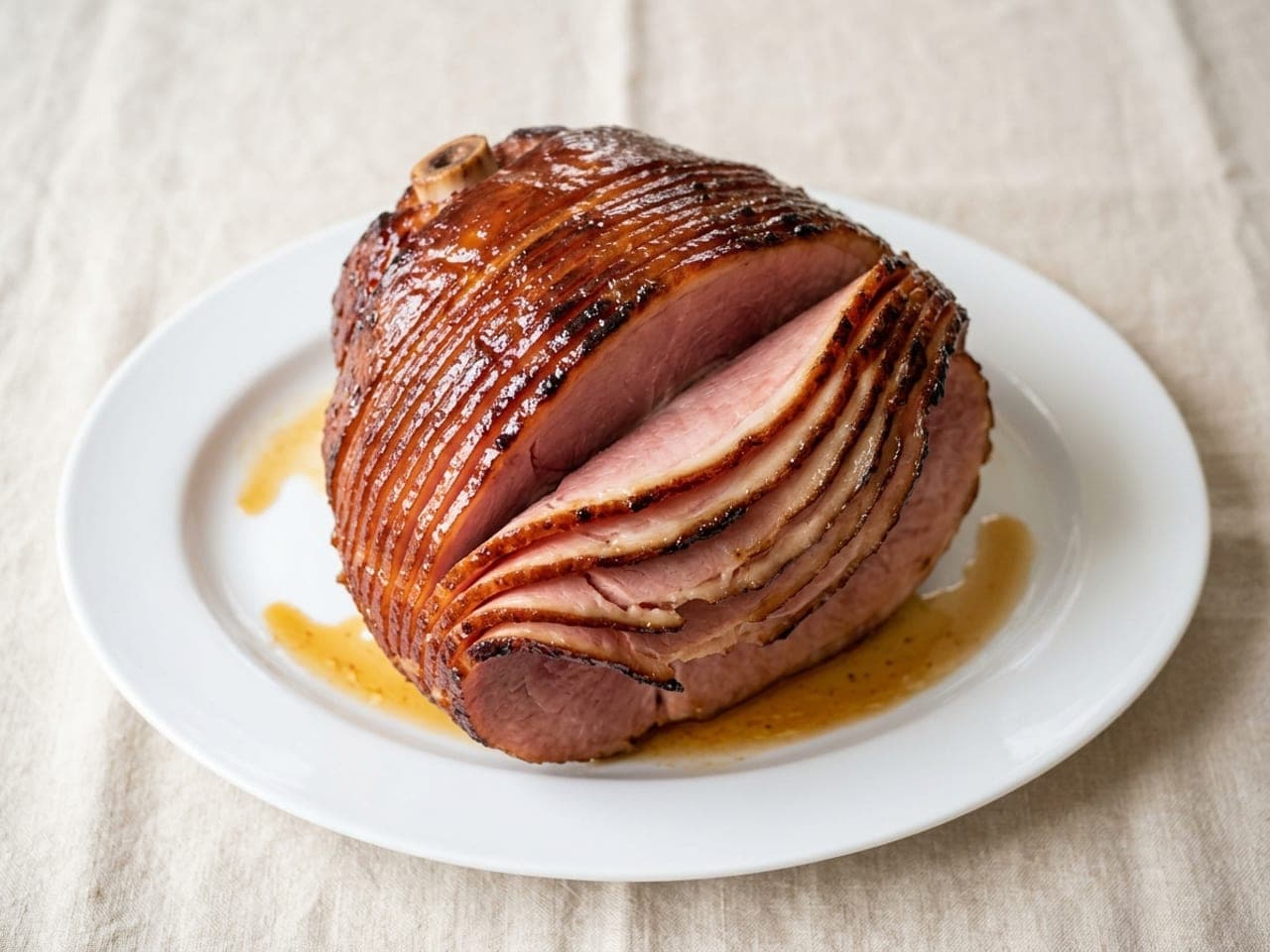
A glazed ham recipe for a fully cooked, bone-in, spiral-cut half ham of 8 to 10 lb (3.6 to 4.5 kg), enough for 16 at dinner. It is heated covered at 325°F (163°C), USDA’s floor, and glazed by the thermometer, not the clock: the glaze goes on at 125 to 130°F (52 to 54°C) in two thin coats at 400°F (204°C) and the ham comes out at 140°F (60°C). The page gives what no ranking recipe does: how much glaze a ham actually holds, by weight (our surface-area estimate: about 2/3 cup (160 ml) at 8 lb (3.6 kg), not the 2 cups (470 ml) a per-pound rule gives), why a brown sugar glaze burns in an oven below sugar’s textbook browning point, the USDA times for every kind of ham, a whole ham with its fat cap and a boneless ham as variations, and three ways to plate the platter. And the history: in 1861 Mrs Beeton’s glaze for a cold ham was reduced meat stock, with no sugar in it.
Ingredients
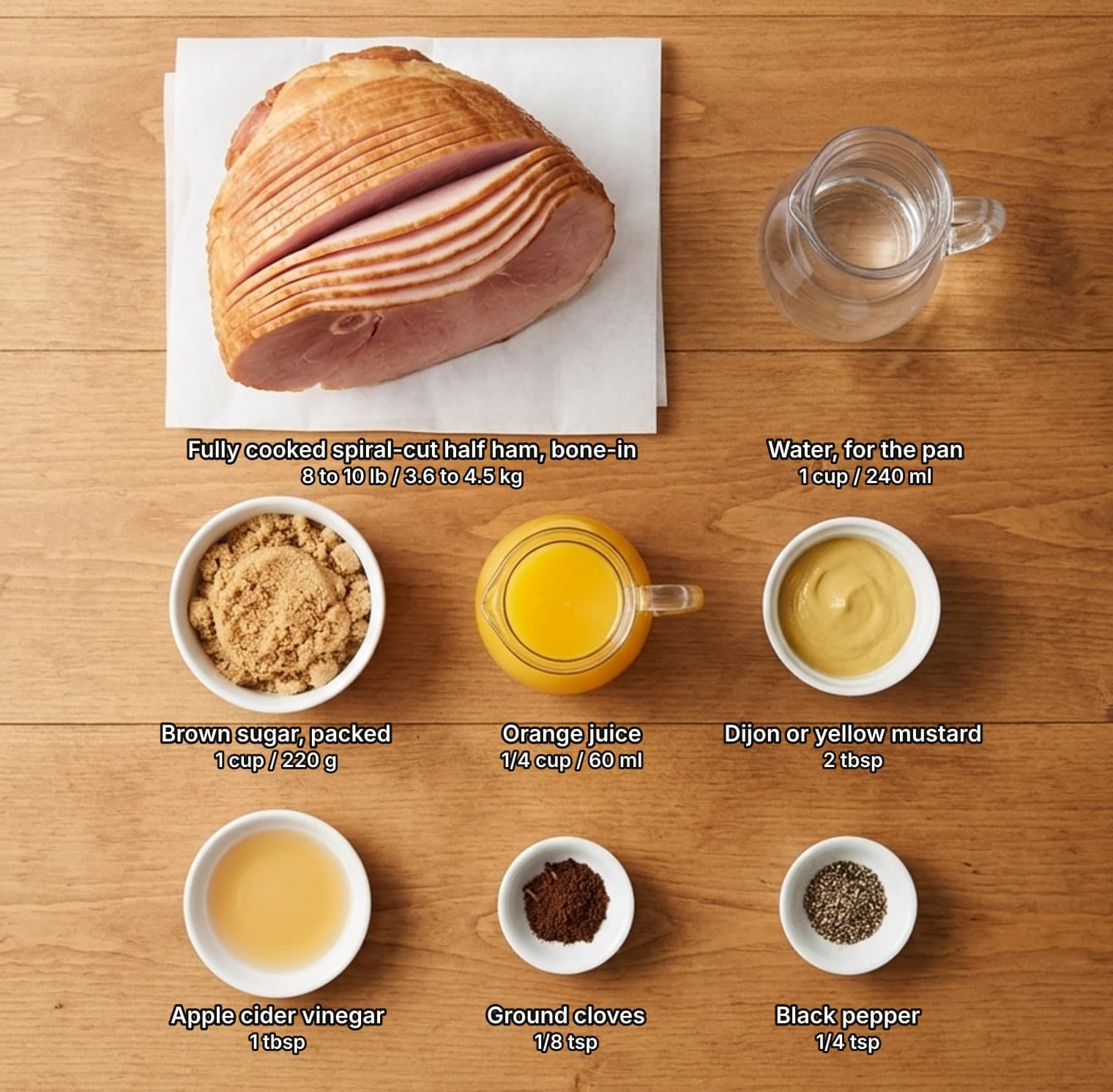
- fully cooked, bone-in, spiral-cut half ham, thawed in the fridge if frozen (2 to 3 days at this size, still wrapped, on a tray, never on the counter). The label must say “fully cooked” and carry the USDA inspection mark, meaning it was sealed at the plant (a ham the store sliced or rewrapped needs 165°F (74°C), see the safety notes). “Ham” or “ham with natural juices” on the label holds less added water than “ham, water added”. Set aside any glaze packet; it can replace the glaze below (see the glaze section). Allergens: plain ham is usually gluten-free, but read the label: “uncured” hams are cured with celery powder (celery is a declared allergen in the UK and EU), and some brands add soy or milk proteins8 to 10 lb (3.6 to 4.5 kg)
- water, for the pan (keeps the drippings from scorching and makes steam under the foil)1 cup (240 ml)
- light or dark brown sugar (UK: soft brown sugar), packed. Dark carries more molasses and colors a little sooner1 cup packed (220 g)
- orange juice, or pineapple juice1/4 cup (60 ml)
- Dijon or yellow mustard (allergen: mustard, a declared allergen in the UK and EU)2 tbsp
- apple cider vinegar1 tbsp
- ground cloves (it is potent: 1/8 tsp is enough)1/8 tsp
- black pepper, freshly ground1/4 tsp
- for the platter, optional: bay leaves or rosemary sprigs, halved oranges or kumquats (and a little orange zest), whole-grain mustard (allergen: mustard), cranberry saucea handful of herbs, 2 to 3 oranges or 8 kumquats, 1/4 cup (60 ml) mustard
How much glaze a ham needs, by weight (our surface-area estimate)
Most recipes give one amount of glaze for any ham, often about 1/2 cup (120 ml) for 8 to 10 lb (3.6 to 4.5 kg), or a per-pound rule. The per-pound rule we found, 1/4 cup (60 ml) of glaze per pound of bone-in ham, gives 2 1/2 cups (590 ml) for a 10 lb (4.5 kg) ham, and that is far more than will stay on it: a glaze is a coat on the outside, and the excess runs into the pan and burns. No test kitchen or brand publishes a rule by weight, so we worked one out, and the table below is our own estimate, not a published standard.
The reasoning: glaze covers surface, and the surface of a ham grows more slowly than its weight. For solids of the same shape, surface area grows with weight to the power 2/3, so a ham twice as heavy needs about 1.6 times the glaze, not twice. We anchored the scale on two real amounts that agree by sugar weight. ATK’s glazed spiral ham makes a glaze “reduced to 1 cup” (240 ml) for a 7 to 10 lb (3.2 to 4.5 kg) half ham, brushes two thirds of it on and turns the last third into sauce: about 2/3 cup (160 ml) on the ham, carrying roughly 155 g (5 1/2 oz) of sugar from its maple syrup and marmalade. The 5 oz (140 g) brown sugar packet sold with one retailer’s 7 to 8 lb (3.2 to 3.6 kg) spiral ham, mixed with its 2 tbsp of water, makes only about 1/2 cup (120 ml) of a thicker glaze, because the water fills the gaps between the crystals, but it puts about the same sugar on the ham, some 140 g (5 oz).
Glaze on the ham, by weight (our estimate, scaled from 2/3 cup (160 ml) at 8 lb (3.6 kg)): 3 lb (1.4 kg) boneless, about 1/3 cup (80 ml). 5 lb (2.3 kg), about 1/2 cup (120 ml). 7 lb (3.2 kg), a scant 2/3 cup (145 ml). 8 lb (3.6 kg), 2/3 cup (160 ml). 10 lb (4.5 kg), a generous 3/4 cup (185 ml). 12 lb (5.4 kg), about 7/8 cup (210 ml). 14 lb (6.4 kg), about 1 cup (230 ml). 16 lb (7.3 kg), about 1 cup plus 1 tbsp (255 ml). The per-pound rule would ask for 3/4 cup (180 ml), 1 1/4 cups (300 ml), 1 3/4 cups (410 ml), 2 cups (470 ml), 2 1/2 cups (590 ml), 3 cups (710 ml), 3 1/2 cups (830 ml) and 4 cups (950 ml) for the same hams.
At 2/3 cup (160 ml) on an 8 lb (3.6 kg) ham the film works out to roughly 1 mm in all, a few tenths of a millimeter per coat, by our arithmetic from the ham’s estimated surface. That is why two or three thin coats work and one thick one slides off. Make a little more than the table says: this recipe makes 1 cup (240 ml) for an 8 to 10 lb (3.6 to 4.5 kg) ham, puts about 3/4 cup (180 ml) on it and keeps 1/4 cup (60 ml) for the sauce. A spiral ham takes a little extra because some glaze runs between the slices; we have no measurement for how much, so we won’t invent one. For a 14 to 16 lb (6.4 to 7.3 kg) whole ham, make about 1 1/2 cups (360 ml), not the 3 1/2 to 4 cups (830 to 950 ml) the per-pound rule asks for.
If your ham came with a packet, it is a fine glaze: the one we read is brown sugar and spices with anticaking agents, and other packets are mostly sugar or corn syrup. Read the packet’s own ingredient list first: some flavored packets contain nuts (pecan praline) or other allergens the ham itself doesn’t. Mix it as directed and stir in 1 tbsp mustard and 1 tbsp cider vinegar for the acid it lacks. Packets made with high fructose corn syrup or dextrose brown faster than brown sugar, so give them the short end of the glaze times.
How to make Brown Sugar Glazed Ham
- Read the label, then heat the oven. Check two words on the ham: “fully cooked” and the USDA inspection mark. Together they mean the ham was cooked and sealed at the plant, so you are only reheating it, to 140°F (60°C). A ham labeled “cook before eating” is a different job (145°F (63°C) and a 3-minute rest, and longer times: see the times section), and in the UK a gammon joint is raw. Size: USDA allows 1/3 to 1/2 lb (150 to 225 g) of bone-in ham a guest, so an 8 lb (3.6 kg) ham feeds 16 at dinner and a 10 lb (4.5 kg) one leaves leftovers; the ham calculator does any number of guests. Put a rack in the lowest position: a half ham stands tall, and on the middle rack its top sits close to the top element, which is where glazes burn. Heat the oven to 325°F (163°C), the lowest oven temperature USDA recommends for ham, because a cooler oven keeps the meat longer between 40 and 140°F (4 and 60°C). Take the ham out of the fridge while the oven heats, about 30 minutes and no longer: it barely warms in that time, so a longer wait only adds time at room temperature for nothing.
- Simmer the glaze for 3 minutes. In a small saucepan, stir together the 1 cup packed (220 g) brown sugar, 1/4 cup (60 ml) orange juice, 2 tbsp mustard, 1 tbsp cider vinegar, 1/8 tsp ground cloves and 1/4 tsp pepper. Bring to a simmer over medium heat, stirring until the sugar has dissolved, then simmer 2 to 3 minutes, until it coats a spoon like warm syrup. You should have about 1 cup (240 ml). Hot sugar syrup burns worse than boiling water, so don’t taste it off the spoon. Why simmer: dissolved sugar spreads in an even film instead of sliding off as wet crystals, and every spoonful of water you boil off here is water the oven doesn’t have to drive off the ham, so the glaze sets faster. Why the acid: mustard, vinegar and juice cut the sweetness against a salty ham, and acid also speeds sugar browning, which is why this glaze stays in the oven for minutes, not an hour. Why no honey: honey is about 41% fructose, which starts to caramelize at about 220°F (105°C) by Harold McGee’s figures, against about 340°F (170°C) for the sucrose that makes up some 95% of brown sugar; a brown sugar glaze gives you a wider window. Pour 1/4 cup (60 ml) into a cup for the sauce now, before a brush touches it. The glaze keeps, covered in the fridge, for up to 4 days.
- Cut side down, water in, foil tight. Unwrap the ham, take out the plastic disc on the bone if there is one, and stand it cut side down in a roasting pan (roasting tin). Cut side down presses the spiral slices together and keeps the big cut face, the part that dries fastest, against the pan instead of open to the oven. Pour the 1 cup (240 ml) water around it, then cover the whole pan tightly with heavy aluminum foil (kitchen foil), crimped hard at the edges. Both Smithfield and Hormel heat their spiral hams this way, with water in the pan and the pan sealed in foil, and USDA’s own spiral ham directions say to cover the entire ham. The foil holds the steam in, so the slices heat without drying; the water keeps the drippings from scorching and becomes the base of your sauce. Do not score a spiral ham: it is already sliced to the bone, and extra cuts only open more surface to dry out.
- Heat to 125 to 130°F (52 to 54°C) by the thermometer. Slide the pan onto the lowest rack. USDA gives 10 to 18 minutes per pound (22 to 40 minutes per kg) at 325°F (163°C) for a fully cooked spiral ham, so 80 to 144 minutes for 8 lb (3.6 kg) and 1 hour 40 minutes to 3 hours for 10 lb (4.5 kg); USDA’s spiral row stops at 9 lb (4.1 kg), so plan a 10 lb (4.5 kg) ham on the long end. Start checking at 10 minutes a pound (22 a kg): hams vary in shape, in water content and in how cold they went in, and the clock can’t see any of that. Push an instant-read thermometer through the foil into the thickest part of the ham, from the side, without touching the bone (bone runs hotter and gives a false high). When the center reads 125 to 130°F (52 to 54°C), it is time to glaze: the last 10 to 15°F (6 to 8°C) of heating happen during the glaze stage, so the glaze and the ham finish together. To know when it must go in, count back from dinner with the long end of the range; the ham calculator does that for you, and for this recipe you add 10 to 15 minutes to its timing for the 400°F (204°C) glaze stage.
- Glaze in two thin coats at 400°F (204°C). Lift the pan out with oven gloves, keeping it level (the liquid in it is close to boiling), keep the foil on, and turn the oven up to 400°F (204°C). When the oven has reached temperature, peel back the foil from the far side, away from your face and hands, because the steam under it scalds (keep the foil for resting) and brush half of the remaining 3/4 cup (180 ml) glaze over the outside of the ham, letting a little run between the slices but not prying them open (opened slices dry, and the glaze runs off them). Return the ham, uncovered, for 5 to 7 minutes, until the glaze bubbles at the edges. Brush on the rest and give it another 5 to 8 minutes, until the glaze is glossy, set and amber and the center reads 140°F (60°C). That is 10 to 15 minutes of glazing in all, which is where ATK, Smithfield and Cook’s all put a spiral ham glaze. Why thin coats: while a coat is wet, evaporation holds its surface near the boiling point of water, 212°F (100°C); once the water is gone the sugar heats toward oven temperature and colors fast. A second thin coat re-wets the surface and buys time; one thick coat slides into the pan, where it burns. If a spot darkens before the center is at 140°F (60°C), lay a small square of foil on it. If the glaze is set but the center isn’t there, tent the whole ham loosely and leave it until it is.
- Rest 15 minutes and make the sauce. Move the ham to a carving board, cut side down, and tent it loosely with the foil. Rest it 15 to 20 minutes: ATK rests its spiral ham 15 minutes tented and found that the center keeps climbing while it rests, and the slices are easier to lift. Tent loosely, not tightly: a sealed foil cover traps steam and turns a set glaze back to syrup. Meanwhile, with oven gloves on, pour the pan liquid, which is close to boiling, into a heatproof measuring cup and spoon off the fat. Taste it: spiral ham juices are salty, and any blackened sugar stuck to the pan stays there, because it tastes bitter. Add up to 1/2 cup (120 ml) of it to the 1/4 cup (60 ml) of glaze you set aside, boil for 1 to 2 minutes until it is lightly syrupy, and pour it into a warm jug; if the ham itself tastes very salty, serve the sauce on the side rather than over it. That is the sauce, and it is how ATK uses the last third of its glaze.
- Carve around the bone, then build the platter. A spiral ham is sliced but not free: the slices are still attached to the bone. ATK’s method, in its own words: “With the ham on its side, cut around the bone with a paring knife to free the attached slices.” Then “Switch to a carving knife and slice horizontally above the bone to remove the entire section.” Then “Turn the ham to cut side down and slice down along the bone to remove the remaining meat.” Finally, “Carefully cut between the slices to separate them.” Carve only what the table will eat in the first round and keep the rest whole, covered, in a low oven, with the meat at 140°F (60°C) or above: whole ham holds its moisture, separated slices lose it. After the meal, and within 2 hours for anything that has sat out at room temperature, cut the remaining meat off the bone, refrigerate it in shallow containers, and wrap the bone, with only scraps left on it, for soup or the freezer. Lay the slices glaze side up (see the three platter builds below) and spoon a little sauce over just before they go to the table, with the jug alongside. The same board and the same patience apply as for a turkey: our turkey carving guide has the knife and board advice.
Safety & hygiene Important
- Which temperature: 140°F (60°C), 165°F (74°C) or 145°F (63°C). USDA FSIS: a cooked ham “packaged in federally inspected plants” can be eaten cold; to reheat it, “set the oven no lower than 325°F and heat to an internal temperature of 140°F” (325°F is 163°C, 140°F is 60°C). That is this recipe’s ham. A cooked ham “repackaged in any other location outside the processing plant”, such as a store-sliced or deli ham, and any “leftover cooked ham” must reach 165°F (74°C). A “cook-before-eating” ham, or a fresh (raw) ham, must reach 145°F (63°C) “with a 3-minute rest time”. Some older guides, and a glossary line on the same USDA page, still say 160°F (71°C) for cook-before-eating ham; the timetable and body text say 145°F (63°C) plus 3 minutes. Brands such as Smithfield and Cook’s stop heating at 120°F (49°C) because their ham is safe cold: that is a quality choice, not the safety number. Check with a thermometer in the thickest part, away from the bone. Pregnant, over 65, or with a weakened immune system? US agencies (CDC, FoodSafety.gov) advise that deli meats and cold cuts be heated to 165°F (74°C) or until steaming hot just before eating, because of Listeria; we treat sliced ham and cold leftover ham the same way. For those guests, warm their slices to 165°F (74°C) in a covered pan or the microwave rather than serving them cold or at 140°F (60°C).
- In the UK, gammon is raw. Most UK “glazed ham” starts as gammon, which AHDB’s LovePork describes as the cut that becomes ham once cooked and which “requires cooking before you can eat it”. The Food Standards Agency’s rule for cooking it through is that “the middle of the food should reach a temperature of 70°C for 2 minutes” (70°C is 158°F), or an equivalent such as 75°C for 30 seconds or 80°C for 6 seconds. LovePork’s roasting time is 30 minutes per 450 g (1 lb) plus 30 minutes at 180°C (350°F), with glazes “added 10-15 mins before the end of cooking”. A cooked ham sold ready to eat in the UK needs no cooking at all; if you serve it hot, the FSA wants it “steaming hot throughout”. UK leftovers: eat within 48 hours or freeze, and reheat only once. In pregnancy, the NHS lists cold pre-cooked meats such as ham among foods to be careful with: keep them chilled and eat them before the use-by date. That is UK advice; the US advice for at-risk guests above is stricter. The UK danger zone is 8 to 63°C (46 to 145°F); the US one is 40 to 140°F (4 to 60°C).
- Two hours on the table. FSIS: throw away perishable food left at room temperature “for more than 2 hours (1 hour if the temperature is over 90° F” (32°C), and hot food held for serving must stay at 140°F (60°C) or warmer. On a buffet, that means putting out part of the ham at a time and keeping the rest covered in a low oven (no lower than 140°F (60°C) at the meat) or in the fridge. To cool it, FSIS says “For whole roasts or hams, slice or cut them into smaller parts”: a whole ham bone cools far too slowly in one piece, so strip the meat off before refrigerating. The UK FSA says to cool leftovers and get them into the fridge within one to two hours, and its danger zone tops out at 63°C (145°F), so UK hot holding means 63°C or above, not 60°C.
- Leftovers, the freezer and the bone. FSIS’s ham storage chart: “Spiral-Cut Hams and Leftovers From Consumer-Cooked Hams | 3 to 5 days | 1 to 2 months” in the fridge and freezer. The freezer time is about quality: “Frozen hams remain safe indefinitely.” Reheat leftovers to 165°F (74°C), or eat them cold (except for pregnant, older or immunocompromised guests, for whom US agencies say 165°F (74°C) or steaming hot). USDA has no separate row for the bone, so treat it as leftover ham: 3 to 5 days in the fridge, 1 to 2 months frozen; soup made from it keeps 3 to 4 days in the fridge and 2 to 3 months frozen (FoodSafety.gov). In the UK, use leftovers within 48 hours (FSA). Australian advice that a leg ham on the bone keeps several weeks in the fridge, below 5°C (41°F), under a cloth soaked in water and vinegar (Food Safety Information Council) is for an Australian cooked leg ham; a US spiral ham is sliced to the bone, and USDA gives it 3 to 5 days.
- Make the glaze ahead, not the glazed ham. Under FSIS rules, a ham you heat, glaze and refrigerate is now a leftover, and has to be reheated to 165°F (74°C) instead of 140°F (60°C), which costs more juice. So make the glaze up to 4 days ahead, keep the ham sealed in its plant packaging, and heat and glaze it on the day. Keep the sauce portion of the glaze apart from the brushing portion, and bring the finished sauce to a boil: it contains pan juices. The ham is ready to eat, so keep raw meat away from it: if a turkey or a raw gammon is on the go the same day, give it its own board, knife and brush, wash your hands with soap for 20 seconds after touching the raw meat and before you touch the ham, and throw out any glaze a brush has carried from raw meat.
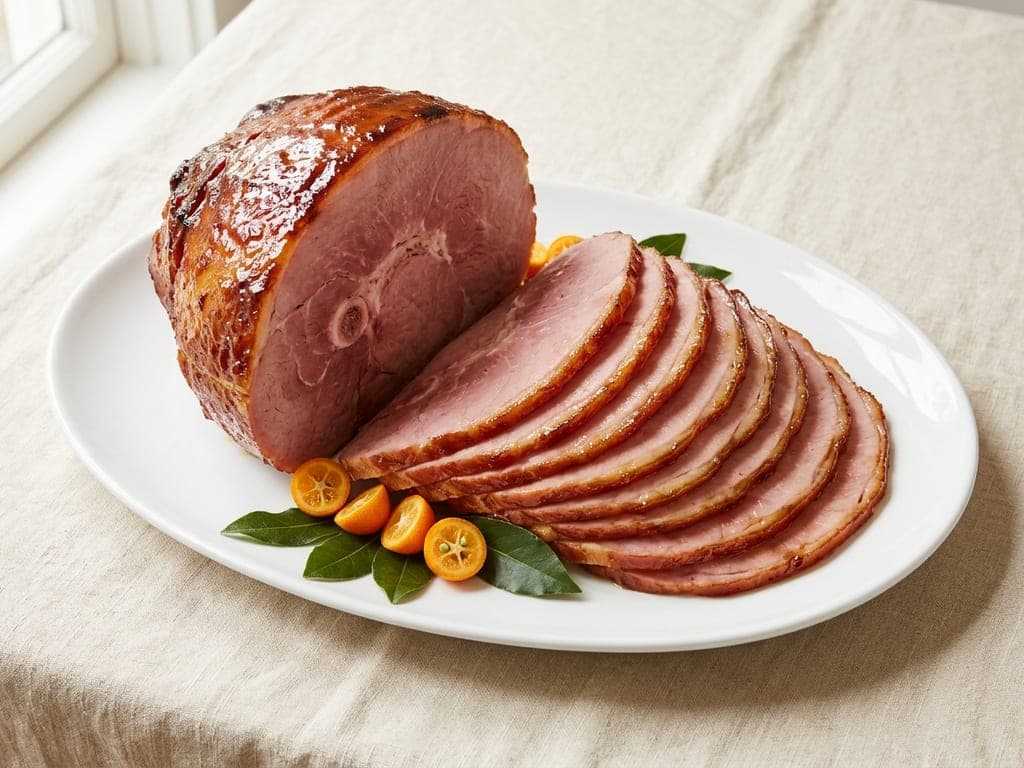
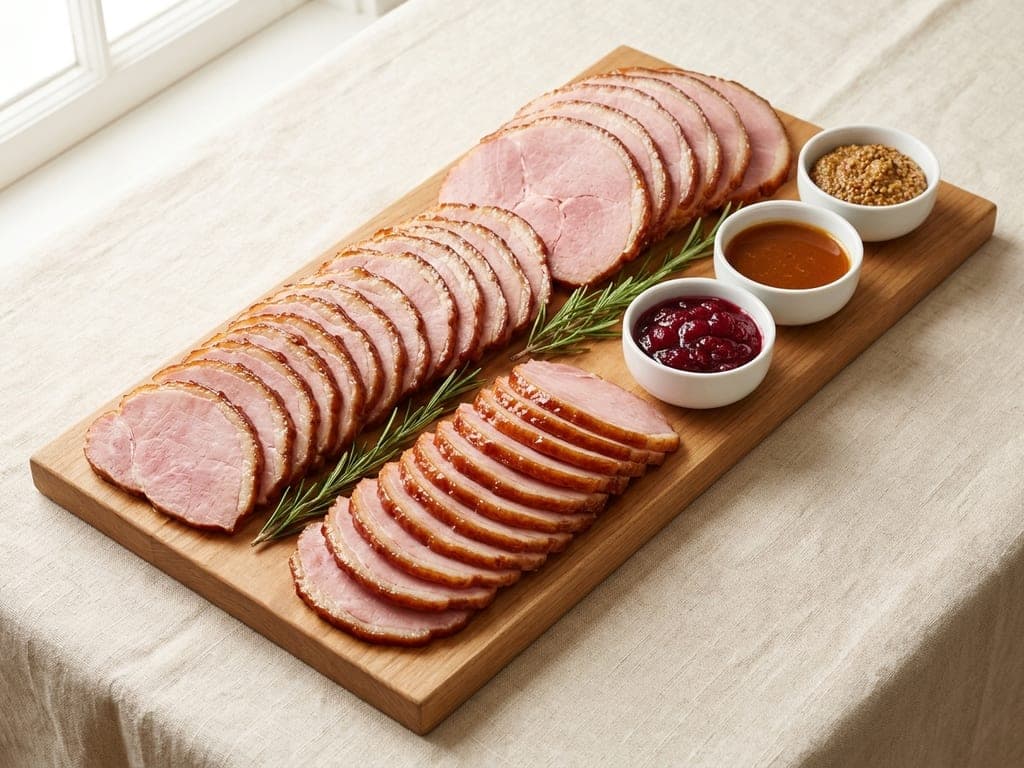
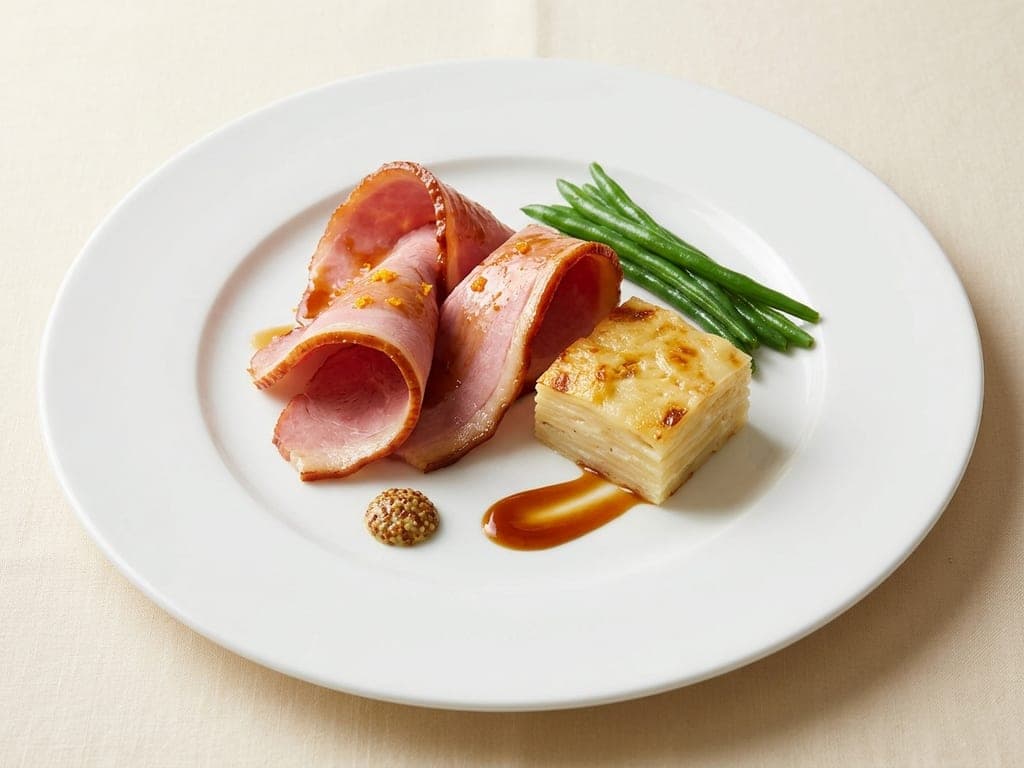
3 ways to plate it
When to glaze, and why a glaze burns below sugar’s browning point
Recipes say “the last 15 to 30 minutes”, but the clock is the wrong signal: a ham that went in colder, or is heavier, needs longer, and its glaze still only wants 10 to 15 minutes. Glaze by the center temperature instead. Brush it on at 125 to 130°F (52 to 54°C) and take the ham out at 140°F (60°C). For a spiral ham that means 10 to 15 minutes in two coats; an unsliced ham with a fat cap takes 20 to 30 minutes in two or three coats (Cook’s glazes its whole hams uncovered for 25 to 30). The brand directions spread across 275 to 425°F (135 to 218°C) for this stage; we use 400°F (204°C), USDA’s own glazing temperature for country ham, on the lowest rack.
By Harold McGee’s figures, sucrose, the sugar in brown sugar, melts at about 320°F (160°C) and caramelizes at about 340°F (170°C), its textbook browning point. A 325°F (163°C) oven sits below that browning point, so why does a glaze brushed on at the start of a two-hour bake turn black? Because sugar has no truly fixed melting point; it decomposes, and slowly. Food scientists at the University of Illinois showed that sugar breaks down well below its listed melting temperature if it is held there long enough: caramelization is a matter of time as well as heat. In effect, over two hours at 325°F (163°C) the sugar has time to do what a few minutes at 400°F (204°C) does, and then keeps going.
Composition decides how fast. USDA’s figures put brown sugar at about 95% sucrose, honey at about 41% fructose, and maple syrup at about 58% sucrose and a third water. Fructose melts and starts to caramelize at about 220°F (105°C), McGee says, so a honey glaze colors fastest, a maple glaze starts wetter and later, and brown sugar sits in between. Acid speeds it all up: caramelization is slowest near neutral and faster in acid, and acid also splits sucrose into glucose and fructose as it heats. That is why a glaze with mustard, vinegar or pineapple juice wants the short end of the time, and why the safe move is a late glaze, in thin coats, with foil ready.
Times and temperatures for every kind of ham (and the common 18 to 20 minute mistake)
USDA’s timetable, all at 325°F (163°C). Fully cooked ham, reheated to 140°F (60°C): spiral cut, whole or half, 7 to 9 lb (3.2 to 4.1 kg), 10 to 18 minutes per pound (22 to 40 per kg); whole bone-in, 10 to 14 lb (4.5 to 6.4 kg), 15 to 18 (33 to 40 per kg); half bone-in, 5 to 7 lb (2.3 to 3.2 kg), 18 to 24 (40 to 53 per kg); vacuum-packed boneless, 6 to 12 lb (2.7 to 5.4 kg), 10 to 15 (22 to 33 per kg). USDA’s holiday chart adds a small boneless ham, 3 to 4 lb (1.4 to 1.8 kg), at 27 to 33 minutes per pound (60 to 73 per kg). Cook-before-eating ham, to 145°F (63°C) and a 3-minute rest: whole bone-in 18 to 20 minutes per pound (40 to 44 per kg), half bone-in 22 to 25 (49 to 55 per kg). Fresh (raw, uncured) whole leg, bone-in: 22 to 26 (49 to 57 per kg). Country ham is soaked 4 to 12 hours in the refrigerator, then covered with water and boiled 20 to 25 minutes per pound (44 to 55 per kg), then glazed and browned at 400°F (204°C) for 15 minutes.
The mistake: several pages that rank for this give 18 to 20 minutes per pound for a fully cooked whole ham. That is USDA’s row for a cook-before-eating ham. On a fully cooked ham it overshoots by as much as 70 minutes at 14 lb (6.4 kg), and a ham heated well past 140°F (60°C) only loses more juice: research on pork shows cooking loss rising with cooking temperature. Use the right row, start checking at the low end, and let the thermometer decide. Our ham calculator puts every one of these rows behind a dinner time and works backward to when the ham goes in, when it gets glazed and when it comes out.
How much to buy: USDA allows 1/3 to 1/2 lb (150 to 225 g) per serving of bone-in ham and 1/4 to 1/3 lb (115 to 150 g) of boneless. With leftovers in mind, plan on about 3/4 lb (340 g) of bone-in ham a guest (our calculator’s figure, from HoneyBaked’s own serving counts). And read the name on the label: under US rules a cooked ham called just “Ham” has the most meat protein, “Ham with natural juices” a little less, “Ham, water added” less again, and a “Ham and water product” the least. More added water means more liquid in the pan and a softer, wetter bite.
Variations: a whole ham with a fat cap, and a boneless ham
Whole or shank-end ham, unsliced, with its fat cap (fully cooked, bone-in). This is the one to score. If it has skin, cut it off and leave about 1/4 inch (6 mm) of fat. Score the fat in 1-inch (2.5 cm) diamonds, about 1/4 inch (6 mm) deep, through the fat but not into the meat. Scoring does not carry glaze into the meat, since sugar can’t travel far into dense cured ham in 20 minutes; it makes more edges of fat that render, crisp and hold glaze in the grooves. Studding a ham with whole cloves is an old American touch (Fannie Farmer, 1896, has the cook “stick with cloves one-half inch apart”, about 1.3 cm, into a sugar-and-crumb coat); a clove at each crossing of scored diamonds is the later, familiar version. Pull them out before slicing. Heat it fat side up, covered, at 325°F (163°C): USDA gives 15 to 18 minutes per pound (33 to 40 per kg) for a whole bone-in ham of 10 to 14 lb (4.5 to 6.4 kg) and 18 to 24 (40 to 53 per kg) for a half of 5 to 7 lb (2.3 to 3.2 kg). Uncover it when the center reads about 125°F (52°C) and glaze it for the last 20 to 30 minutes at 400°F (204°C), in three coats 8 to 10 minutes apart, with foil ready for dark spots, until the center reads 140°F (60°C). A 14 lb (6.4 kg) ham wants about 1 cup (230 ml) of glaze on it; make 1 1/2 cups (360 ml).
Boneless ham (fully cooked, vacuum-packed). It carves into neat ovals and is easy for a crowd, at 1/4 to 1/3 lb (115 to 150 g) a serving. Heat it covered at 325°F (163°C): USDA’s two charts give 10 to 15 minutes per pound (22 to 33 per kg) for a 6 to 12 lb (2.7 to 5.4 kg) vacuum-packed ham and 27 to 33 (60 to 73 per kg) for a small 3 to 4 lb (1.4 to 1.8 kg) one, a wide gap that the thermometer settles. If it has no fat on it, a shallow 1/8 inch (3 mm) crosshatch is only for looks. Glaze it like the spiral ham, 10 to 15 minutes at 400°F (204°C) from 125 to 130°F (52 to 54°C); a 3 lb (1.4 kg) ham needs only about 1/3 cup (80 ml), so halve the glaze recipe. Check boneless labels for “water added” or “and water product”: these give off more liquid.
When “glazed ham” meant stock and breadcrumbs
The word first. Old English hamm meant the back of the knee, and the lexicographer David Wilton traces the pig-meat sense to the mid-1600s; before that, English cooks said gammon or bacon for the cured leg. And in the English and American cookbooks we read, from Hannah Glasse to Mrs Beeton, a “glazed” ham had no sugar on the outside at all.
Hannah Glasse, whose Art of Cookery first appeared in 1747, roasts a ham basted in sweet Canary wine, then says to “drudge it well with Crumb’d Bread and Parsley shred fine; make the Fire brisk, and Brown it well.” Mary Randolph’s The Virginia Housewife (first published 1824; we read a later printing) covers a boiled ham “thickly with bread crumbs, put it in an oven to brown”. Eliza Leslie’s Directions for Cookery (1840 edition) has a recipe called “To Glaze a Cold Ham”: beaten egg yolk, then “pounded cracker, made as fine as flour”, then “thick cream”, browned in the oven. In England, glaze meant meat glaze: stock boiled down until it set glossy. Eliza Acton’s Modern Cookery (first published 1845; we read a later edition) warns that “It is much the fashion at present to glaze hams and tongues, but this should never be attempted by a cook not well acquainted with the manner of doing it”. Isabella Beeton’s Book of Household Management (1861) has a “Glaze for Covering Cold Hams, Tongues, &c.”, made from stock “boiled down and reduced very considerably”. A glazed ham was savory, glossy and served cold. The sugar in these books is inside the ham, in the cure: Acton cures a 14 lb (6.4 kg) ham with “coarse sugar, 3 oz.” (85 g) among the rest.
Sugar on the outside is far older, but it was once the foreign way. A French travel writer, Madame d’Aulnoy, published in 1691 an account of a dinner at Cardinal Portocarrero’s table in Toledo, with a ham from the Portuguese border “spread all over with certain little Comfits” (nonpareils, whose sugar “melted in the Fat”) and larded with lemon peel, “which abated much of its goodness” (historians debate how much of her Spain she saw herself). In the American books we read, sugar on the outside first shows up late in the 19th century. Housekeeping in Old Virginia (1879) stuffs a boiled ham with cloves, allspice, mace and “a little brown sugar”, then has the cook “grate on bread crumbs and white sugar. Put in the oven and brown.” Fannie Farmer’s Boston Cooking-School Cook Book (1896) boils the ham, then says to “sprinkle with sugar and fine cracker crumbs, and stick with cloves one-half inch apart. Bake one hour in a slow oven. Serve cold, thinly sliced.” That is the ancestor of today’s sugar-and-clove ham, still with crumbs, still served cold. We found no dated early source for the brown sugar and mustard pairing, so we won’t give it one. The mustard line runs through Sweden instead: julskinka, Christmas ham, is a word attested in 1689, and the Swedish crumb crust (griljerad skinka, cited from a 1903 cookbook; today usually mustard, egg and breadcrumbs) is, on our reading, the surviving descendant of the old crumb glaze.
Why the method changed: those old hams were hard-salted, so the work was soak, boil for hours, skin, coat and brown. In the 20th century, US hams became mild, brine-pumped and sold cooked (a trade-press history dates USDA’s approval of a sodium nitrite cure to 1925 and calls artery pumping “a common process” by 1937). The job shrank to reheating and glazing, which is why a modern recipe is a thermometer and 15 minutes of sugar. That last link is our reading of the dates, not a quotation.
The spiral slicer, and the Christmas and Easter ham
The supermarket default, a bone-in ham sliced in one continuous spiral around the bone, is a Detroit invention. Harry J. Hoenselaar filed for a patent on an “Apparatus for slicing ham on the bone” in 1944; it was granted in 1949, and a second patent, for the sliced ham and the way it is cut, followed in 1952. He opened the first HoneyBaked store in Detroit in 1957. USDA’s ham page says the slicing method was “invented in 1957”, which matches the store, not the patents. The company’s own history adds a 1936 prototype, which we have not seen documented elsewhere.
Christmas: the ham was not always the holiday joint. Mrs Beeton marks her baked and boiled hams “Seasonable all the year”; her Christmas dinner “would scarcely be a Christmas dinner without its turkey”, and she writes of the boar’s head as something served “in ancient times”. The Boar’s Head Carol was printed in London in 1521. The popular story that the Christmas ham descends from a Norse boar sacrificed to the god Freyr at Yule is a link folklorists have suggested; no documentary line connects the two, so treat it as lore.
Easter: the usual story says hogs were slaughtered in the fall and the hams were cured in time for spring. A University of Kentucky extension guide to country ham puts the traditional slaughter in the cold months, December to early February, and says a ham is ready for the table after 3 to 4 months of curing and salt equalization, which lands around Easter. The timing fits, but no period source we found gives it as the reason for the Easter ham.
Carving and serving the ham: the plating angle
A glazed ham is judged at the table before anyone tastes it, so plate it for the moment it is carved. Keep the glaze side up on every slice, because the lacquered edge is the point. Carve in the kitchen or at the table, but carve only the first round: keep the rest whole and covered in a low oven, so the meat stays juicy and at 140°F (60°C) or above, and bring it out as the second round. Whatever sits at room temperature goes in the fridge within 2 hours of leaving the oven.
Garnish to frame, not to bury: a few whole bay leaves or rosemary sprigs and halved oranges or kumquats around the ham pick up the orange in the glaze, and nothing goes on the cut faces. The sauce goes in a warm jug, with a spoonful over the slices just before serving and the rest on the table. For the full Christmas menu around it, with oven timing for a 9 lb (4.1 kg) ham, see our Christmas dinner ideas; to size the ham for your table, use the ham calculator; and the same carving board, knife and resting logic are in our turkey carving guide.
Questions, answered
How long do you cook a glazed ham per pound?
It depends on the ham. At 325°F (163°C), USDA gives a fully cooked spiral ham 10 to 18 minutes per pound (22 to 40 per kg), a fully cooked whole bone-in ham 15 to 18 (33 to 40 per kg), a fully cooked half 18 to 24 (40 to 53 per kg) and a large vacuum-packed boneless ham 10 to 15 (22 to 33 per kg). Cook-before-eating hams take longer: 18 to 20 minutes per pound (40 to 44 per kg) whole and 22 to 25 (49 to 55 per kg) for a half. For this recipe’s 8 to 10 lb (3.6 to 4.5 kg) spiral ham, that is 80 minutes to 3 hours (USDA’s spiral row stops at 9 lb (4.1 kg), so plan a 10 lb (4.5 kg) ham on the long end); start checking at 10 minutes a pound (22 a kg) and go by the thermometer, 140°F (60°C). The glaze time is part of the total, not added to it. Our ham calculator works it out for any ham and dinner time; for this recipe, add 10 to 15 minutes to its timing for the 400°F (204°C) glaze stage.
When do you put the glaze on a ham?
When the center reads 125 to 130°F (52 to 54°C), not at a fixed time. For a spiral ham that leaves 10 to 15 minutes of glazing at 400°F (204°C) in two thin coats; an unsliced ham with a fat cap gets 20 to 30 minutes in two or three coats. Take it out at 140°F (60°C). For a store-wrapped ham, which has to reach 165°F (74°C), start the glaze at about 150 to 155°F (66 to 68°C) instead (our suggestion), so the sugar still sees only the last 10 to 15 minutes. Glaze any earlier and the sugar has time to burn, even at 325°F (163°C), because sugar browns slowly below its textbook browning point.
Do you cook a ham covered or uncovered?
Covered for the heating, uncovered for the glaze. Set the ham cut side down with 1 cup (240 ml) of water in the pan and seal the pan tightly with foil until it reaches 125 to 130°F (52 to 54°C); the steam stops the slices drying. Then uncover it for the glaze, which needs dry heat to set. The exception is a raw fresh ham with its skin, which roasts uncovered for crackling.
What temperature should a precooked ham be heated to?
140°F (60°C) if it was packaged in a USDA-inspected plant, which includes most spiral hams, in an oven of at least 325°F (163°C). 165°F (74°C) if it was sliced or rewrapped at the store or deli, and for leftovers. A cook-before-eating ham needs 145°F (63°C) and a 3-minute rest. A plant-packaged cooked ham is also safe cold, which is why brands like Smithfield and Cook’s stop at 120°F (49°C) for juiciness; USDA’s number for reheating is 140°F (60°C). For pregnant, older or immunocompromised guests, US agencies (CDC, FoodSafety.gov) say sliced and leftover ham should be heated to 165°F (74°C) or until steaming hot, because of Listeria. In the UK, a cooked ham served hot should be steaming hot throughout, and raw gammon must reach 70°C (158°F) for 2 minutes.
How much glaze do I need for a ham?
Less than most rules say, because glaze covers surface, not weight. Our estimate from surface area, anchored on ATK’s recipe and a retail glaze packet, which agree by sugar weight: about 1/2 cup (120 ml) on a 5 lb (2.3 kg) ham, 2/3 cup (160 ml) on 8 lb (3.6 kg), a generous 3/4 cup (185 ml) on 10 lb (4.5 kg) and about 1 cup (230 ml) on 14 lb (6.4 kg). A rule of 1/4 cup (60 ml) per pound would put 2 1/2 cups (590 ml) on a 10 lb (4.5 kg) ham, most of which ends up burning in the pan. Make a little extra for a spiral ham and for the sauce: this recipe makes 1 cup (240 ml) for 8 to 10 lb (3.6 to 4.5 kg).
Should you score a ham before glazing?
Only an unsliced ham with a fat cap or skin. Take off the skin, leave about 1/4 inch (6 mm) of fat and score 1-inch (2.5 cm) diamonds through the fat, about 1/4 inch (6 mm) deep, without cutting into the meat. The cuts give the fat more edges to render and catch the glaze; they don’t carry glaze into the meat. Never score a spiral ham: it is already sliced to the bone, and more cuts only dry it.
Can you glaze a ham the day before?
Make the glaze ahead (it keeps up to 4 days in the fridge) and heat and glaze the ham on the day. Under USDA rules, a ham you have heated and chilled is a leftover and must be reheated to 165°F (74°C), not 140°F (60°C), which dries it more. If you must work a day ahead, cut the glazed ham off the bone into smaller pieces, refrigerate them in shallow containers within 2 hours, then reheat them covered at 325°F (163°C) to 165°F (74°C) and brush on fresh glaze for the last 10 minutes. Some popular recipes reheat at 300°F (149°C); USDA’s floor is 325°F (163°C).
How do you keep a spiral ham from drying out?
Heat it cut side down so the slices press together, with 1 cup (240 ml) of water in the pan and tight foil over it; glaze it only at the end; and take it out at 140°F (60°C), not later: a hotter ham only loses more juice. USDA itself says spiral hams are best served cold, because heating sliced hams “can dry out the meat and cause the glaze to melt and run off”. At the table, carve only what will be eaten and keep the rest whole, covered, in a low oven.
How long can glazed ham sit out?
Two hours at room temperature, or 1 hour if it is above 90°F (32°C), then into the fridge (USDA). To hold it longer for a buffet, keep it at 140°F (60°C) or warmer. The UK FSA says to get leftovers into the fridge within one to two hours. Slice the meat off the bone to cool it: a whole ham cools too slowly.
How long does leftover ham last, and can you freeze it?
In the US, 3 to 5 days in the fridge and 1 to 2 months in the freezer for spiral ham and leftovers from a ham you cooked (USDA); frozen ham stays safe indefinitely, the time limit is for quality. Freeze the bone too, for soup. Reheat leftovers to 165°F (74°C) or eat them cold (for pregnant, older or immunocompromised guests, US agencies say 165°F (74°C) or steaming hot). In the UK, the FSA says eat leftovers within 48 hours or freeze them, and reheat only once.
How many calories are in a serving of glazed ham?
About 269 kcal for a sixteenth of this recipe: 6 oz (170 g) of carved ham, roughly what a sixteenth of an 8 lb (3.6 kg) ham gives after the bone and the juices lost to the pan, plus a sixteenth of the glaze. The arithmetic, from USDA figures: water-added cured ham, roasted, is 126 kcal per 100 g, so 170 g is 214 kcal, with 30 g protein, 9 g fat and 2,006 mg sodium. The whole glaze is about 885 kcal: 220 g brown sugar at 380 kcal per 100 g (836), 1/4 cup (60 ml) orange juice (28), 2 tbsp mustard (18) and the vinegar (3); a sixteenth is 55 kcal, about 14 g sugar and 25 mg sodium with yellow mustard (about 45 mg with a typical Dijon). 214 + 55 = 269 kcal, and about 2,030 mg sodium, some 88% of a 2,300 mg daily value, before any sauce, whose pan juices add more. Sodium is the number to watch, and it comes from the ham, not the glaze: labels run from about 600 to 1,150 mg per 3 oz (85 g). A smaller 4 oz (113 g) plate comes to about 197 kcal (142 + 55) and 1,360 mg sodium; each ounce (28 g) of ham adds or takes away about 36 kcal and 335 mg sodium.
Snap your finished plate and let the AI plate it again — more beautifully.