How to fold napkins: 18 easy and fancy folds, step by step
Every fold drawn step by step, from the ten-second oblong to the bishop's hat, with the napkin size, starch and place on the table each one needs, how to fold paper napkins, and where the napkin goes when you sit down.
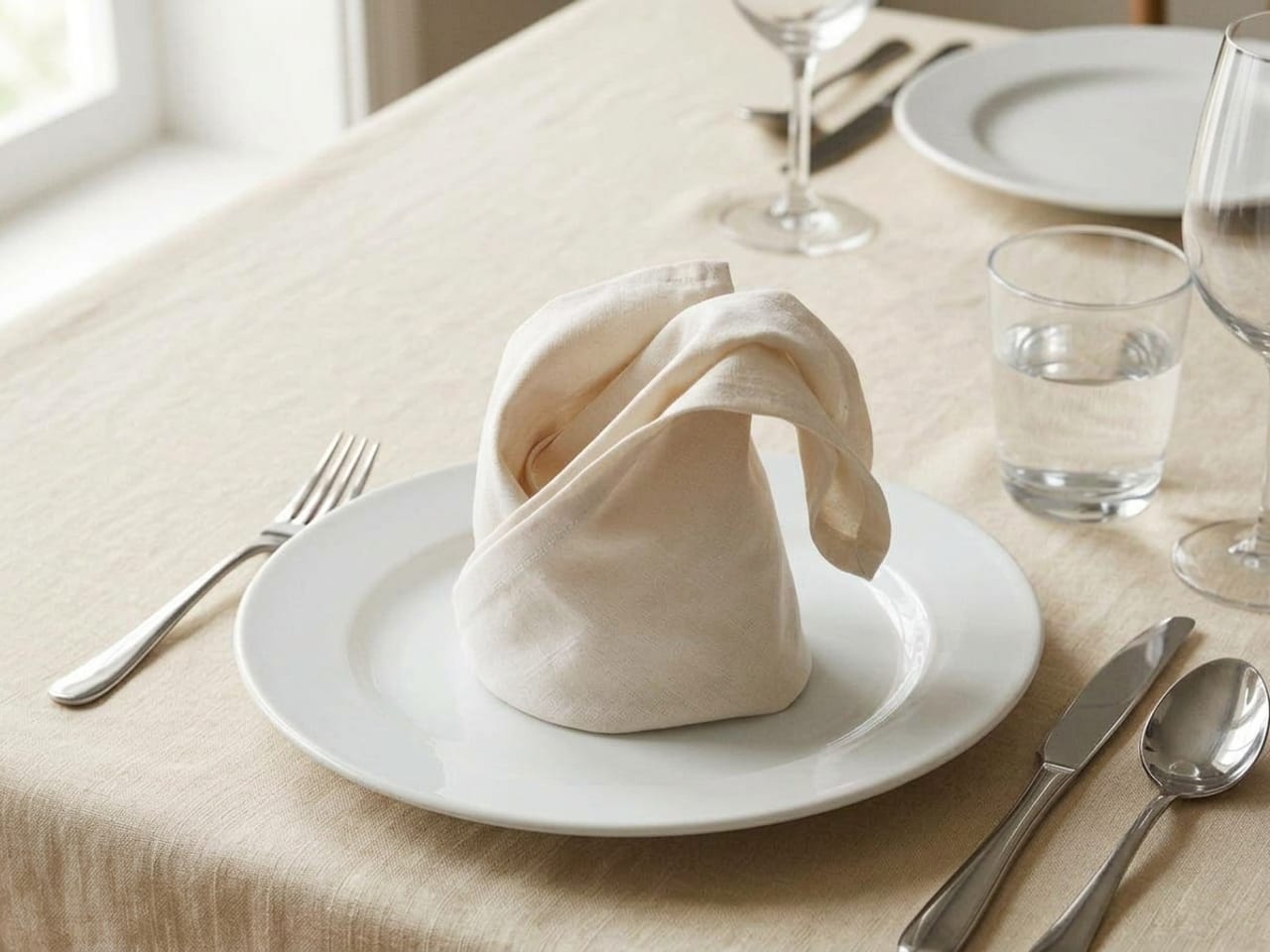
The photos on this page are AI-generated illustrations.
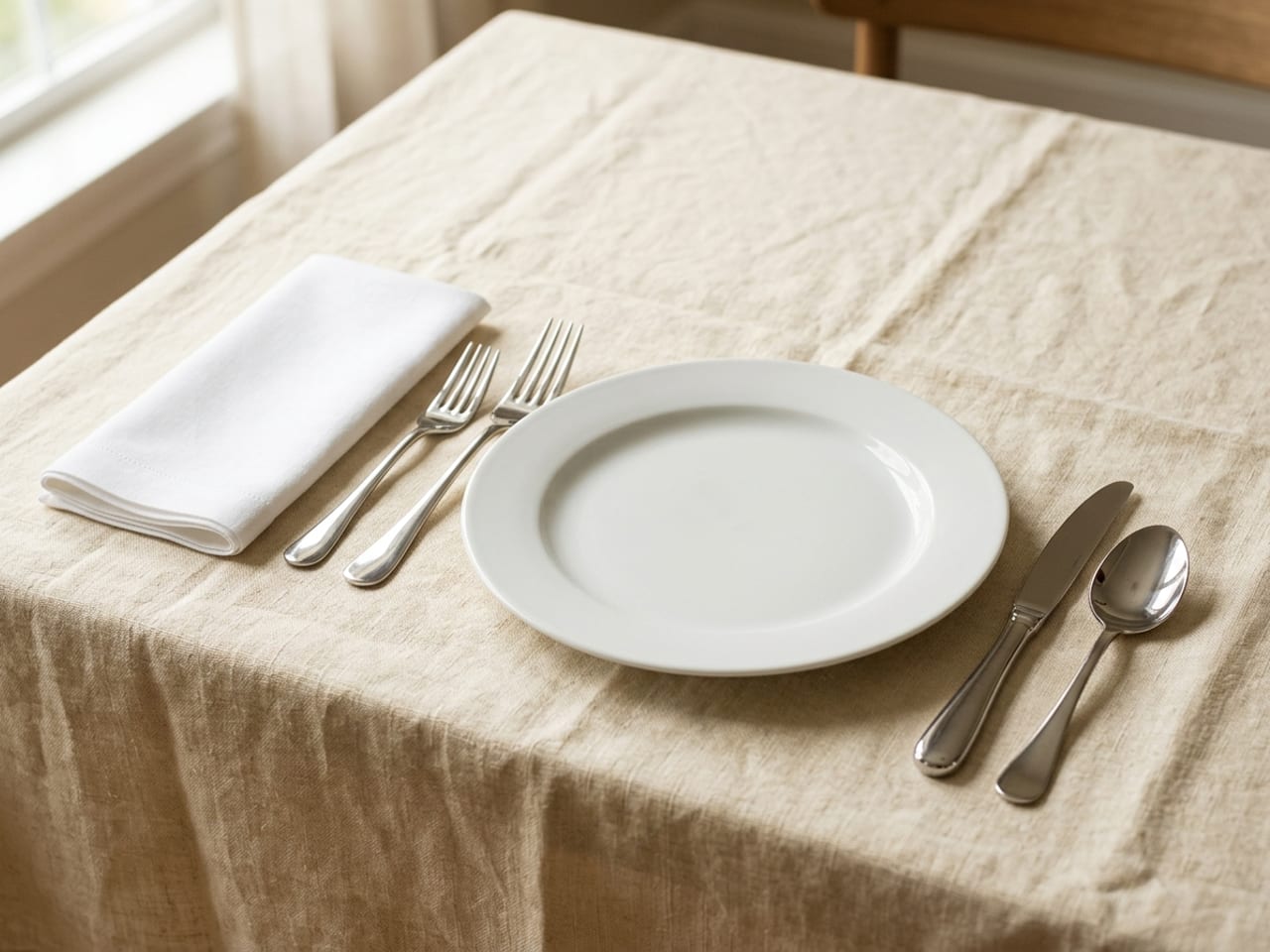
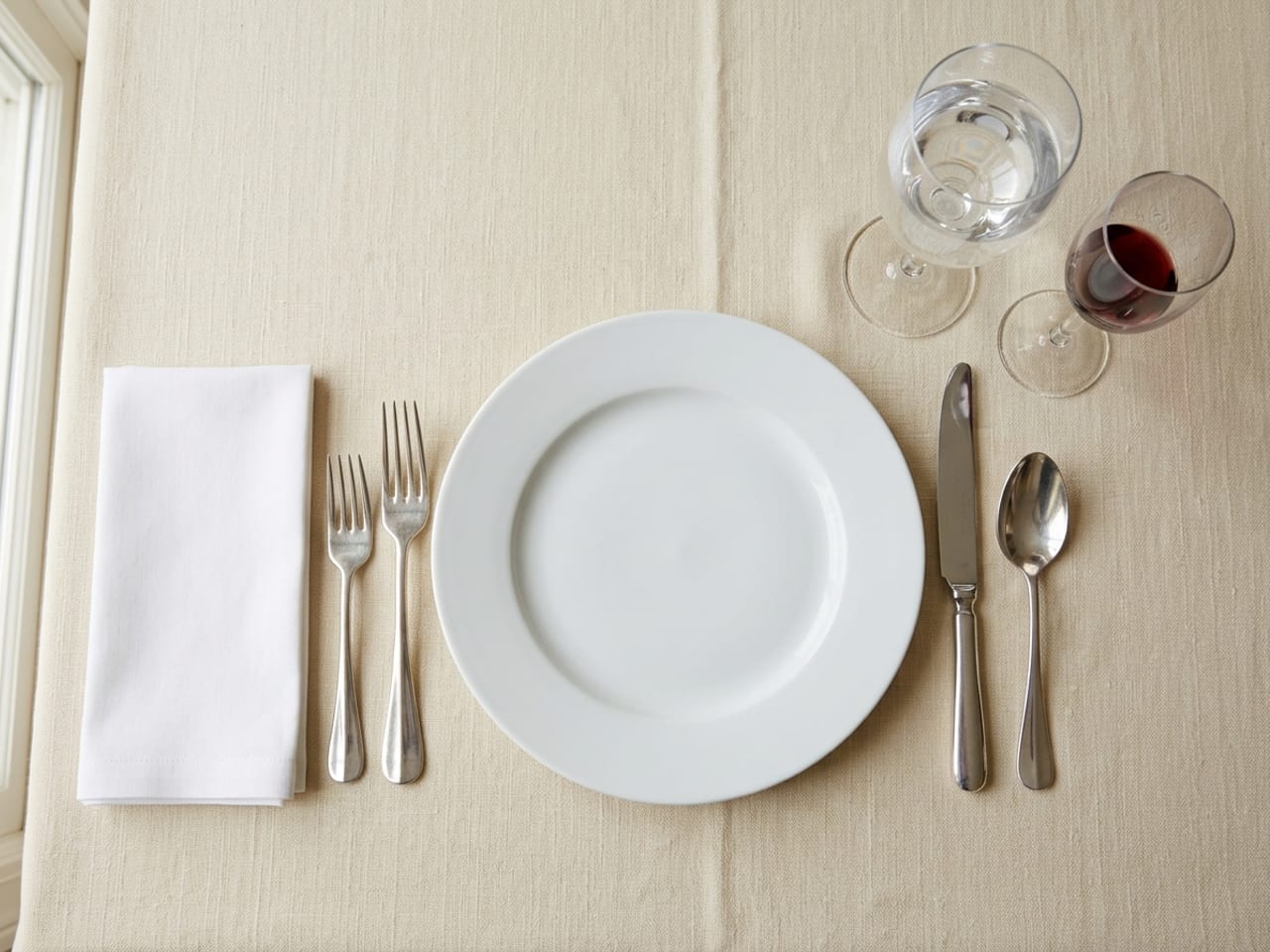
To fold a napkin for a dinner table, lay it face down, fold it in half, in half again and in half once more, and set the oblong to the left of the forks with the long side along them.9, 25 That flat fold is the one etiquette books have preferred since at least 1922.24 For something more, stand a pleated fan or a bishop's hat on the plate (they need a crisp, lightly starched napkin), fold a pocket that holds the cutlery, or pull the napkin through a ring.
Below are eighteen folds in five groups: easy, silverware pockets, napkin rings, fancy, and the Christmas tree and Thanksgiving turkey. Each has a quick answer, numbered steps, a strip of step diagrams and a photo of the finished fold, plus a table of which napkin size, starch and paper each one needs. Then where the napkin goes and what to do with it during the meal, napkin sizes, fabric, starch and stains, paper napkins, the history of folding from a 1629 Italian treatise to Emily Post, and the little research there is. Sources are at the bottom.
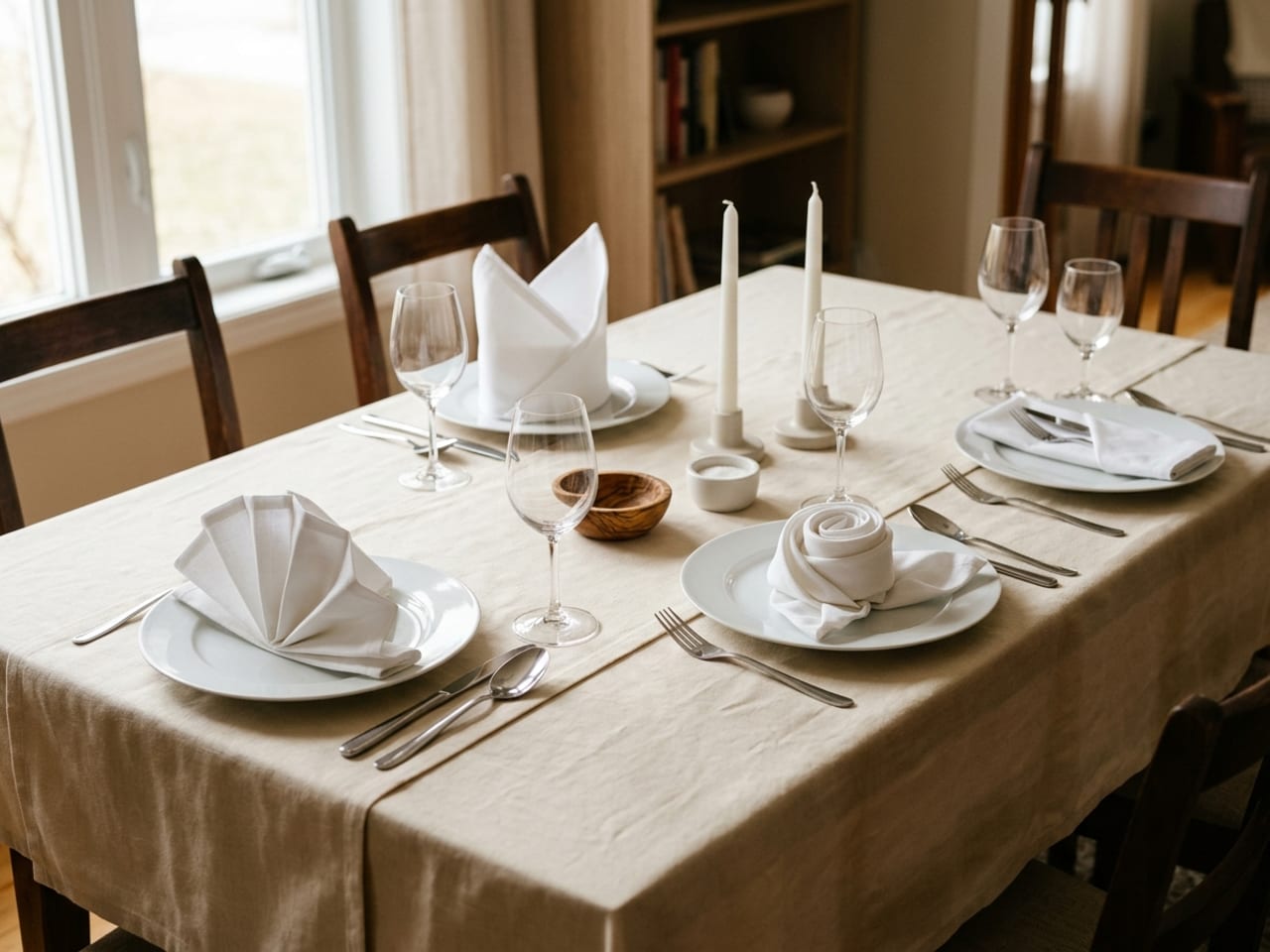
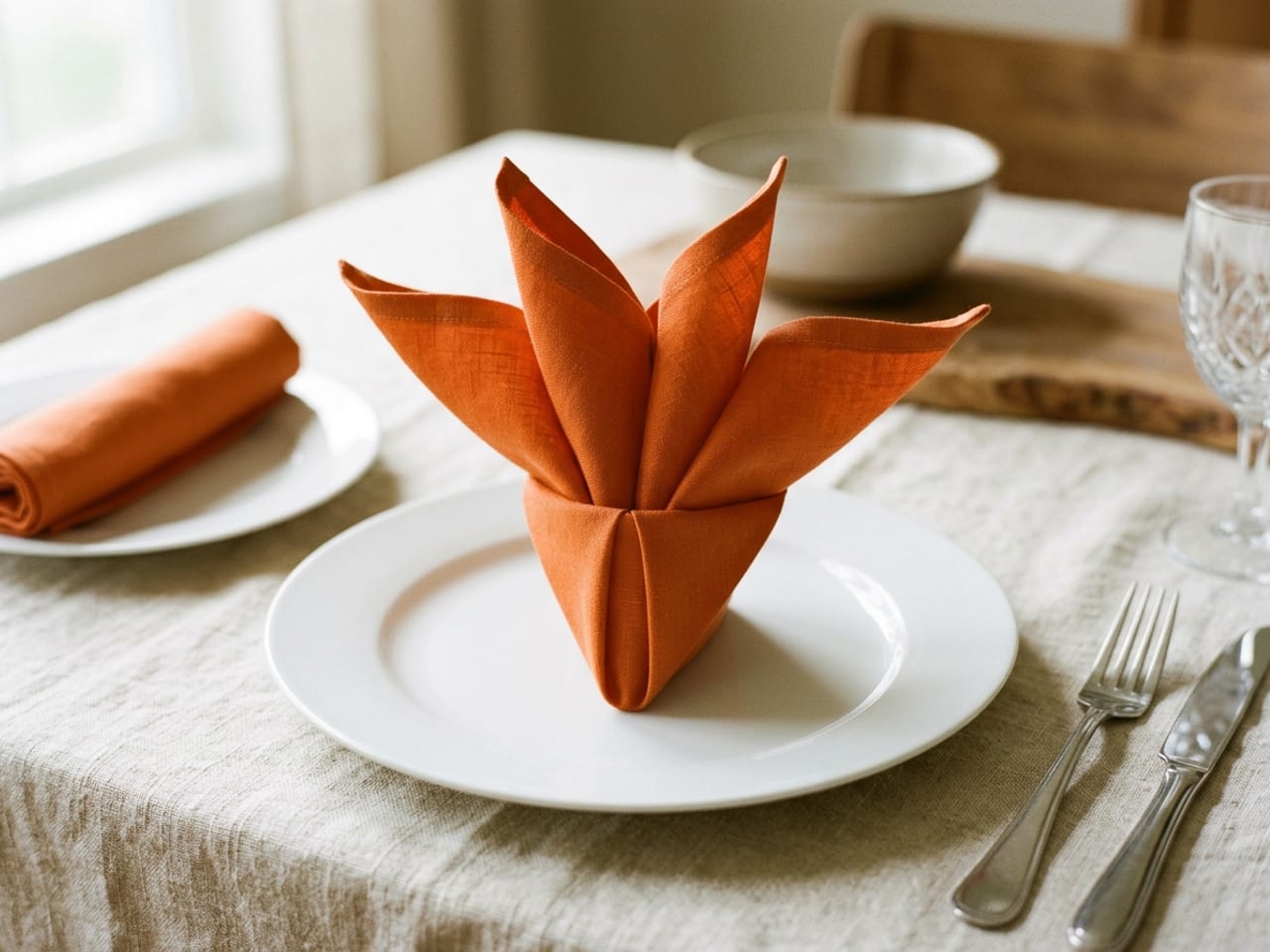
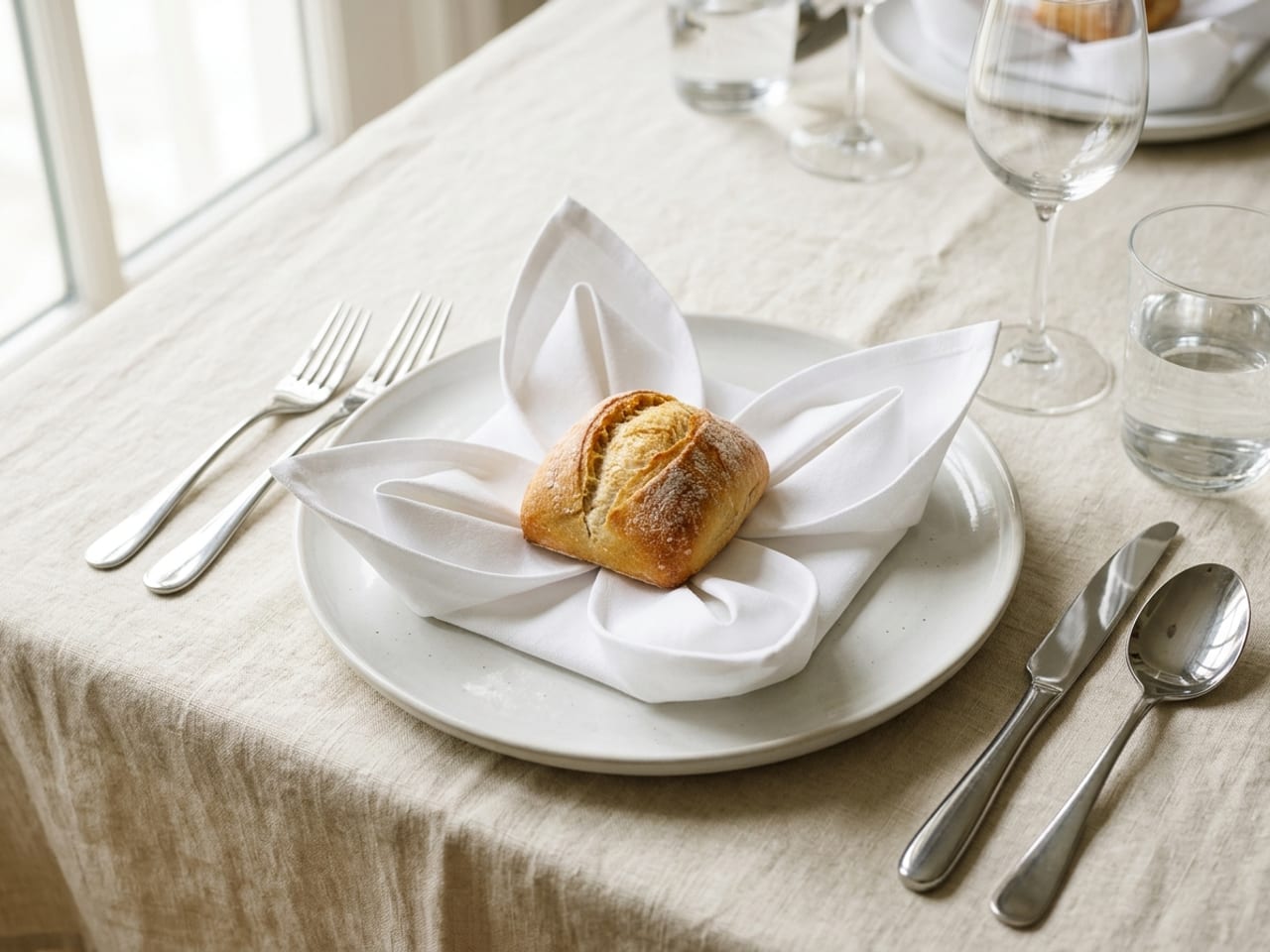
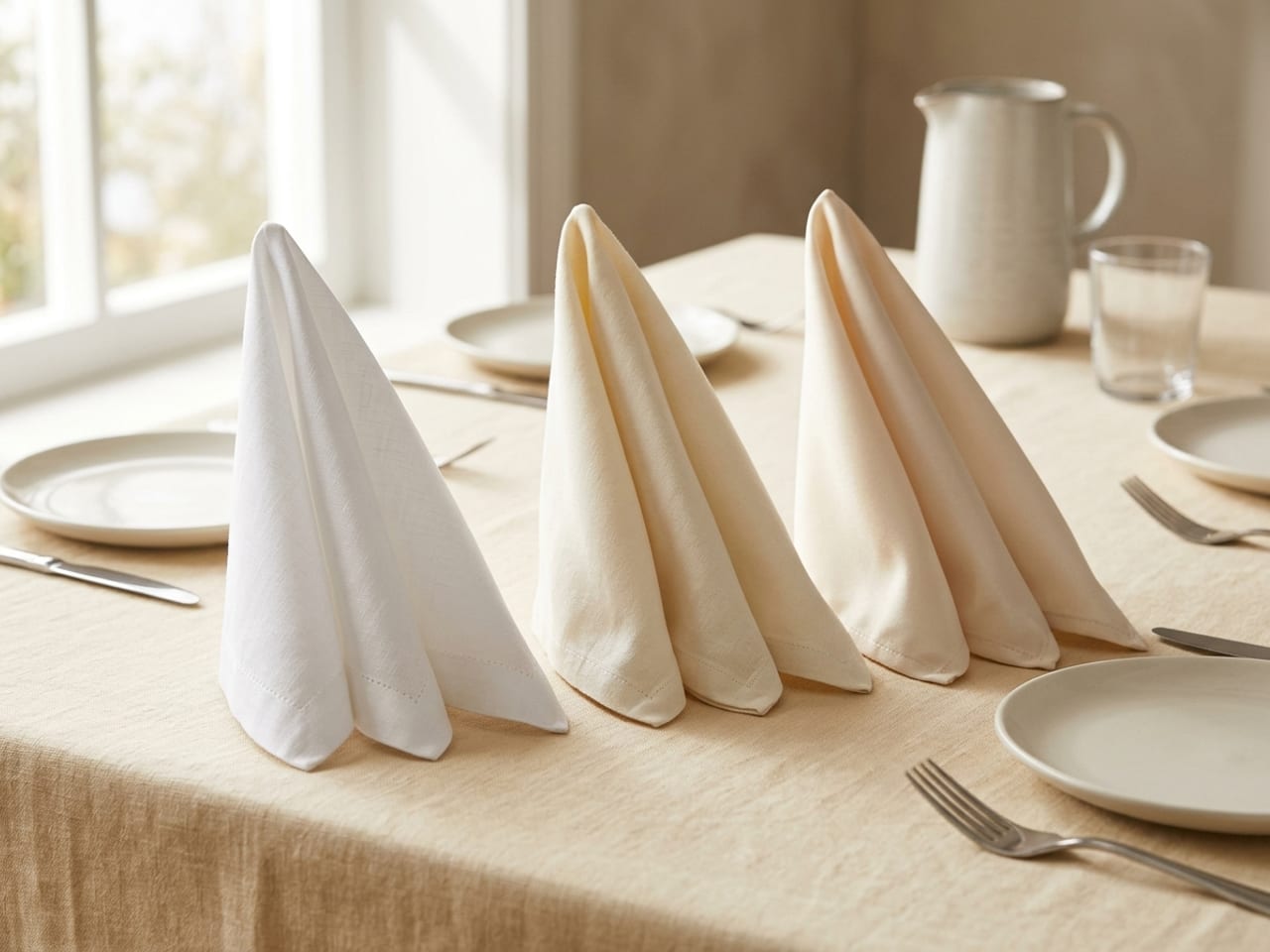
Four folds, one table: a standing fan, a bishop's hat, a rose and a pocket. At a real dinner, pick one and repeat it at every place.
Before you fold
Five rules for folding any napkin
Start square and face downLay the napkin flat with the right side (the printed or hemmed-outside side) against the table, so it ends up on the outside of the fold. Only the pull-through ring fold starts face up. The napkins "must be exactly square," as an 1888 steward's handbook put it.1 Line the edges up at every step; Beeton's editors warned that "the folding must be exact, or the result will be slovenly and unsightly."2
Press as you goA crease you press with your palm holds; one you only pinch springs back. For cotton and linen, iron while slightly damp (the care-label standard says so for the cotton and linen setting),39 and fold while the cloth is still warm. The 1888 method: damp the napkin with starch, smooth it with a hot iron and fold it "whilst crisp and steaming."1
Starch only the folds that standThe pyramid, standing fan, bishop's hat, bird of paradise and a tall lotus need a crisp or lightly starched napkin, or they sag.4, 7 Flat folds, pockets and ring folds don't: for the pocket, "starching is not necessary,"10 and the ring puff needs no ironing at all.4 Beeton's 1880 editors: anything beyond "the most simple forms" needs napkins "slightly starched and smoothly ironed." 2
Match the fold to the napkinMost folds here work with an 18 to 20 inch (45 to 51 cm) cloth napkin; the tall ones look better at 20 inches or more. Victorian dinner napkins were 28 to 30 inches (71 to 76 cm),2 which is why old folds look so grand. Many US paper dinner napkins aren't even square (see paper napkins).15
One fold for the whole table, folded aheadPick one fold and repeat it at every place; mixing folds reads as a demonstration rather than a table. Most folds keep for a day: stand folded pyramids side by side on their long edges,7 keep fans closed in a basket and open them at the table.6 Fold with clean hands on a clean surface, since guests will put these on their laps and to their mouths (our rule, not a regulation).
The quick answer
18 napkin folds at a glance
Which fold needs starch, which works with paper, how big a napkin it needs, where it goes and whether it holds the cutlery.
Each fold has a strip of drawings, one per step, showing the napkin as it looks before that step. The napkin starts face down, so you see its wrong side (darker) until a fold brings the right side up.
Fold here, toward you
Fold here, away from you
Right side · wrong side of the cloth
Turn the napkin over
Folds 1 to 4
Easy napkin folds
The oblong and triangle lie flat beside the forks and take seconds; the pyramid and standing fan stand on the plate and want a crisp napkin.
1. Simple rectangle (the oblong)
Also: classic fold, rectangular fold, basic fold
Easy · 10 seconds · starch: no · left of the forks
Quick answer: fold the napkin in half, in half again, and in half once more, then lay it to the left of the forks with the long side parallel to them.9, 25
Face down, fold the bottom edge up to the top edge.
Fold in half left to right: a square a quarter of the size.
Fold in half again, bottom to top. For a slimmer oblong, fold in thirds instead.
Turn it so the long side runs beside the forks. A 20 inch (51 cm) napkin gives about 10 × 5 in (25 × 13 cm).
Good to know: this is the fold Emily Post called correct in 1922 ("folded square and flat", with "very fancy foldings" "not in good taste")24 and still the one to use at a formal table. Which edge faces the plate depends on the source: US extension and 4-H teaching sheets put the fold on the left, away from the plate, so it opens like a book;69, 70 some other guides turn the fold toward the plate, and the etiquette authorities we read don't say. Whichever you pick, put the folded edge the same way at every place.
1Face down: fold the bottom edge up to the top
2Fold in half, left over right
3Fold in half again, bottom to top
4Turn it so the long side runs beside the forks
2. Triangle
Also: simple triangle, diagonal fold
Easy · 10 seconds · starch: no · left of the forks or on the plate
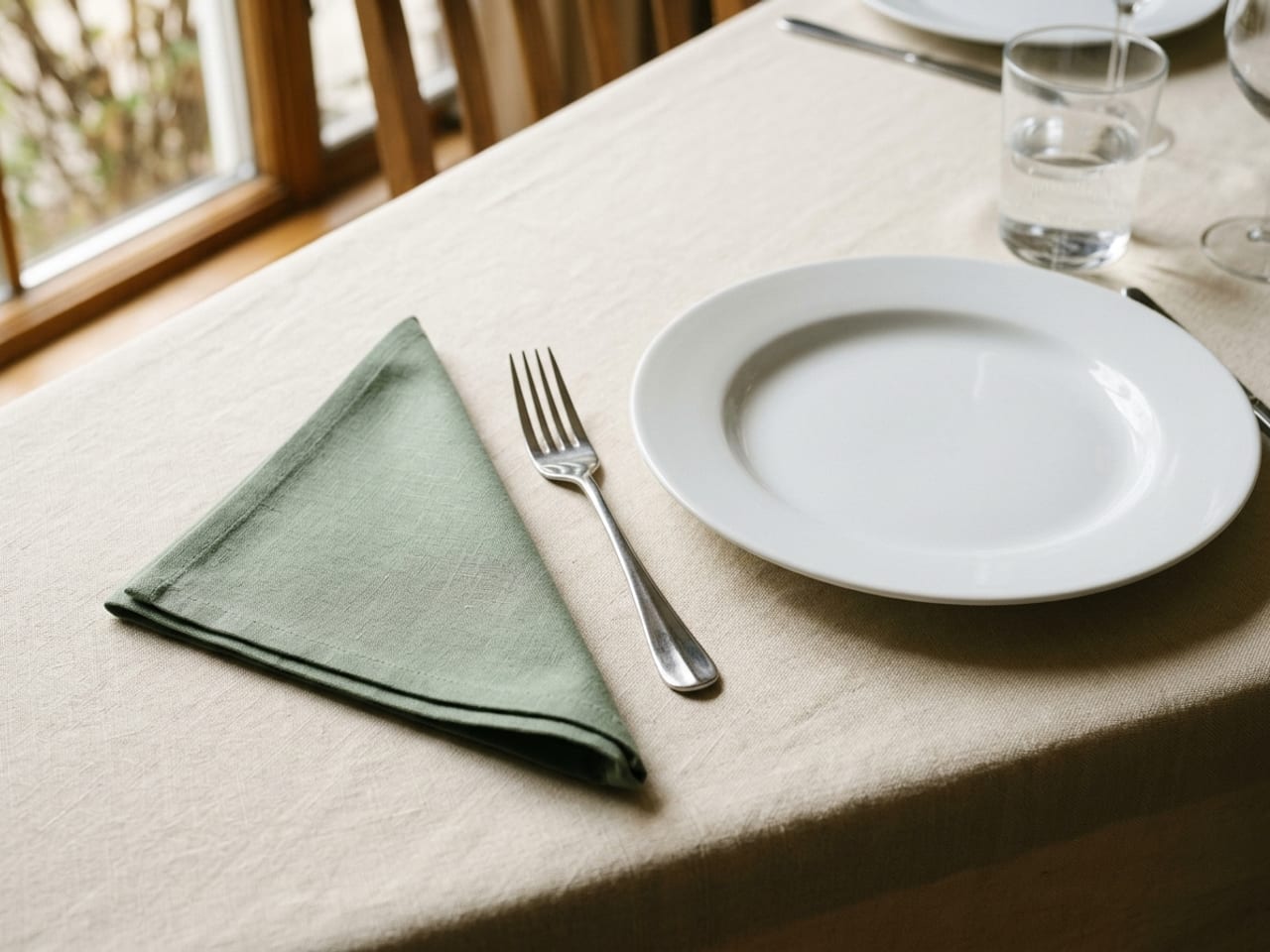
Quick answer: fold the napkin into a quarter square, then fold it corner to corner into a triangle and lay it beside the forks, point out.
Face down, fold in half and in half again.
Turn it so the open corner (the one with all the loose edges) is top right, and fold that corner down onto the opposite corner.
Lay it with the long side along the forks and the point away from the plate, or on the plate with the point up.
Good to know: folding the open napkin once, corner to corner, gives a big single-layer triangle, the size to drape over a plate or a bread basket.9 Some shops call the standing pyramid below a "triangle";7 they are different folds.
1Face down: fold in half, then in half again
2Open corner top right: fold it down to the opposite corner
3Long side beside the forks, point out
3. Pyramid
Also: standing triangle, tent; sold by some shops as the “triangle” fold
Medium · 45 seconds · starch: yes · on the plate
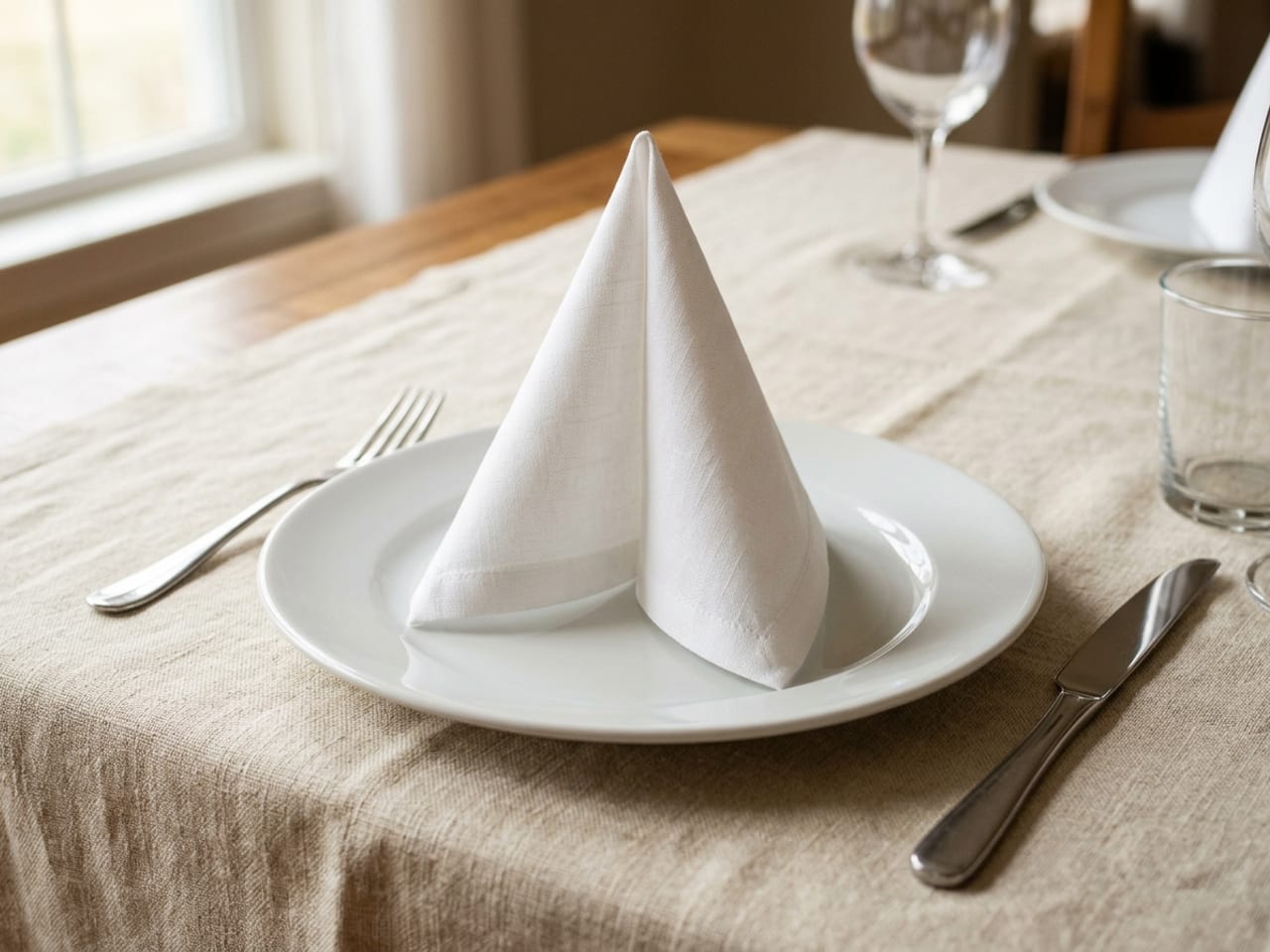
Quick answer: fold the napkin corner to corner, fold both base corners up to the top point to make a diamond, turn it over, fold it in half into a triangle, then bend it at the centre seam and stand it on its long edge.4, 5, 7
Face down as a diamond, fold the bottom point up to the top: a triangle with the fold at the bottom.
Fold the right and left base corners up to the top point. The edges meet down the middle: a diamond.
Turn it over, keeping the loose points at the top.
Fold the top point down to the bottom point.
Turn it over again, pick it up at the centre seam, bend along the seam and stand it on its long edge. It stands about 7 in (18 cm) tall from a 20 inch napkin.
Good to know: a limp napkin won't stand, so iron it with a little starch first.4, 7 You can fold a stack a day ahead, squeeze them flat and store them standing on their long edges.7
1Face down as a diamond: fold the bottom point up to the top
2Fold both corners up to the top point
3A diamond with a seam: turn it over
4Fold the top point down to the bottom point
5Turn over, bend at the seam and stand it on its long edge
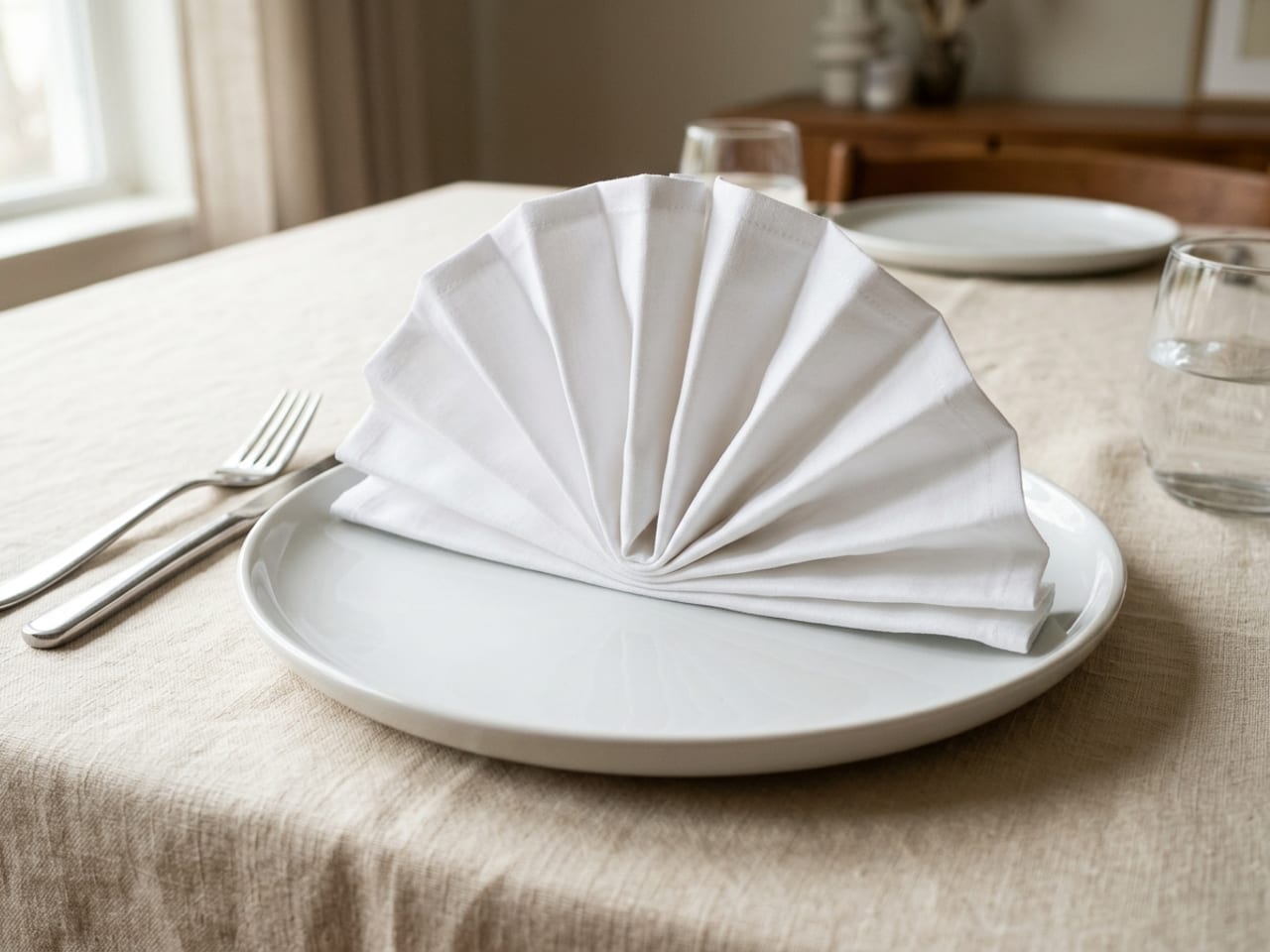
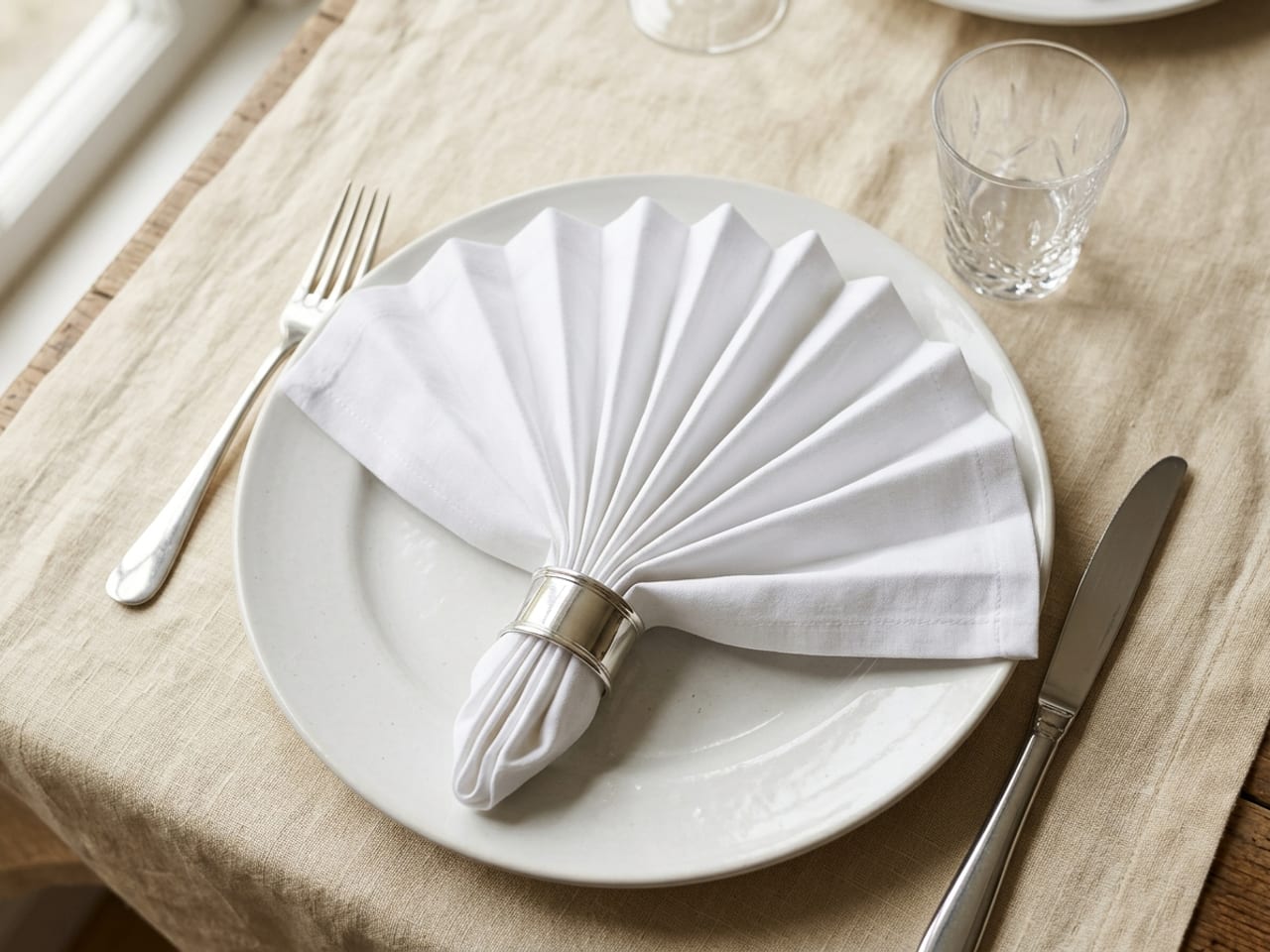
4. How to fold a napkin into a fan
Also: fan, palm, Lady Windermere's fan, peacock fan
Medium · 1 to 1½ minutes · starch: yes · on the plate
Quick answer: fold the napkin in half, pleat it like an accordion from one end in 1 inch (2.5 cm) folds, leaving a 4 inch (10 cm) tail, fold it in half across the pleats, and tuck the tail's corner in as a stand. It stands on the plate and the pleats open into a fan.6, 7
Face down, fold the top edge down to the bottom edge.
Starting at the left end, pleat back and forth in 1 inch (2.5 cm) folds. Stop about 4 to 5 inches (10 to 12 cm) from the right end, with the last fold at the bottom and all the pleats underneath.6, 7
Fold the whole piece in half, bottom up to top, pleats on the outside.
Fold the flat tail's top corner diagonally down toward the pleats and tuck it into them: that triangle is the kickstand.7
Stand it up and let the pleats open into a half circle.
Good to know: the fan is old. "Il ventaglio" is the third fold in the first printed folding treatise, Padua 1629,55 and Beeton's 1880 editors pleated theirs "in inch deep folds, backwards and forwards."2 The 1888 version stood in a glass instead.1 It needs a crisp napkin; a soft one droops.7 See starched and unstarched side by side.
1Face down: fold the top edge down to the bottom
2Pleat from the left in 1 in (2.5 cm) folds; leave a 4 in (10 cm) tail
3Fold in half, bottom up, pleats outside
4Fold the tail's top corner down and tuck it into the pleats
5Stand it up: the pleats open into a fan
Folds 5 to 7
Napkin folds that hold silverware
Pockets and a roll-up: the cutlery travels in the napkin, which is why restaurants and buffets use them.
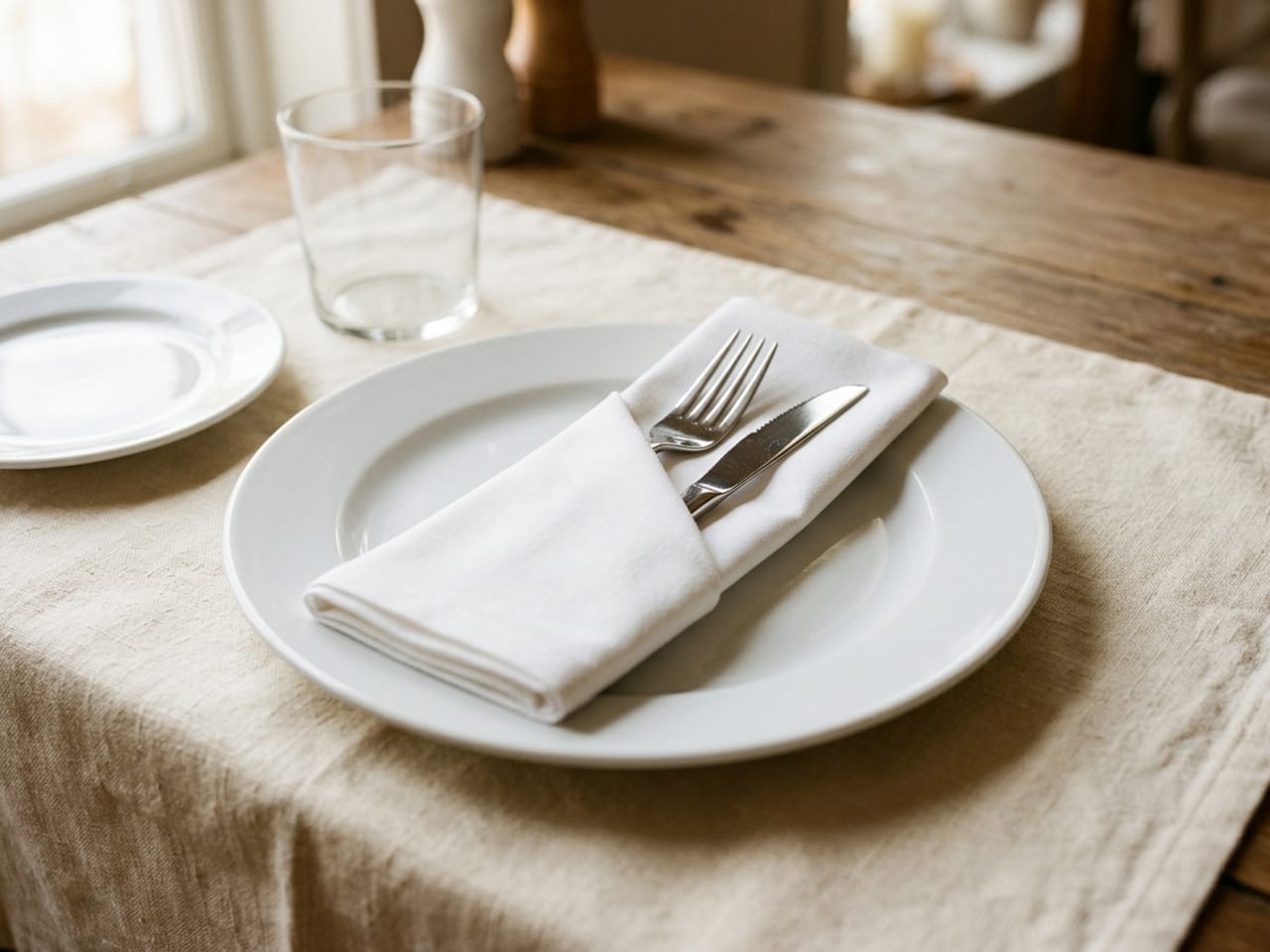
5. How to fold a napkin to hold silverware
Also: silverware pouch, angled pocket, single pocket, sometimes called a tuxedo fold
Easy · 45 seconds · starch: no · holds cutlery · on the plate or left of it
Quick answer: fold the napkin into a quarter square, fold only the top layer corner to corner to make the pocket, turn it over, fold the sides in by thirds, and turn it back. Slide a fork and knife in, handles first.4, 7, 10
Face down, fold in half and in half again.
Turn it so the open corner is top right. Take only the top layer and fold its corner down onto the opposite corner. Its folded edge is the mouth of the pocket.
Turn it over.
Fold the right third and then the left third toward the middle; tuck the edge of the second into the first to lock it.10
Turn it back over. A 20 inch napkin gives a pocket about 3 × 10 in (8 × 25 cm).
Good to know: the best fold for a buffet or a crowded table, because it carries the cutlery. Chopsticks fit too.4 Which way the diagonal runs depends on which corner you start from; either is right.
1Face down: fold in half, then in half again
2Open corner top right: fold the TOP layer down to the opposite corner
3One layer folded: that edge is the pocket. Turn over
Medium · 1½ minutes · starch: no · holds cutlery · on the plate or left of it
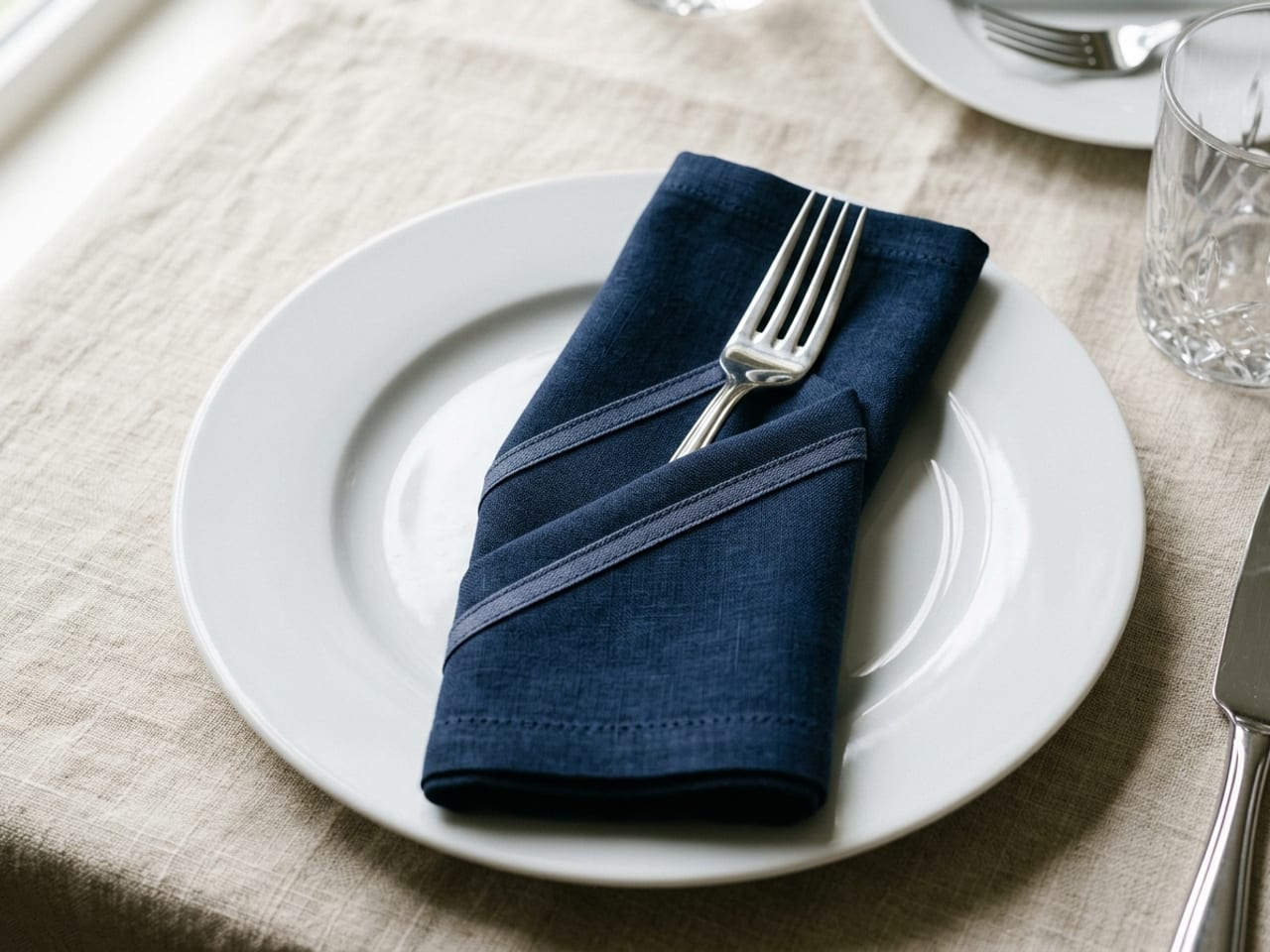
Quick answer: like the simple pocket, but you roll two or three layers down in narrow bands so the finished napkin has parallel diagonal stripes, each one a pocket.4, 6
Face down, fold in half and in half again.
Open corner top right. Roll the top layer's corner down in 1½ inch (4 cm) folds until it reaches the middle diagonal.6
Roll the next layer down the same way, stopping just behind the first band. Do a third layer if you like.4
Turn it over and fold the sides in by thirds.
Turn it back over: two or three stripes. Tuck cutlery in the top band.
Good to know: press each band flat as you go; it looks much better pressed.4 A napkin with a contrasting hem makes the stripes pop.
1Face down: fold in half, then in half again
2Open corner top right: roll the top layer down in 1½ in (4 cm) folds to the middle
3Roll the second layer down to sit just behind the first
4Turn over and fold the sides in by thirds
5Turn back over: two stripes, the cutlery tucked in the top one
Easy · 30 seconds · starch: no · holds cutlery · on the plate, beside it, or in a basket
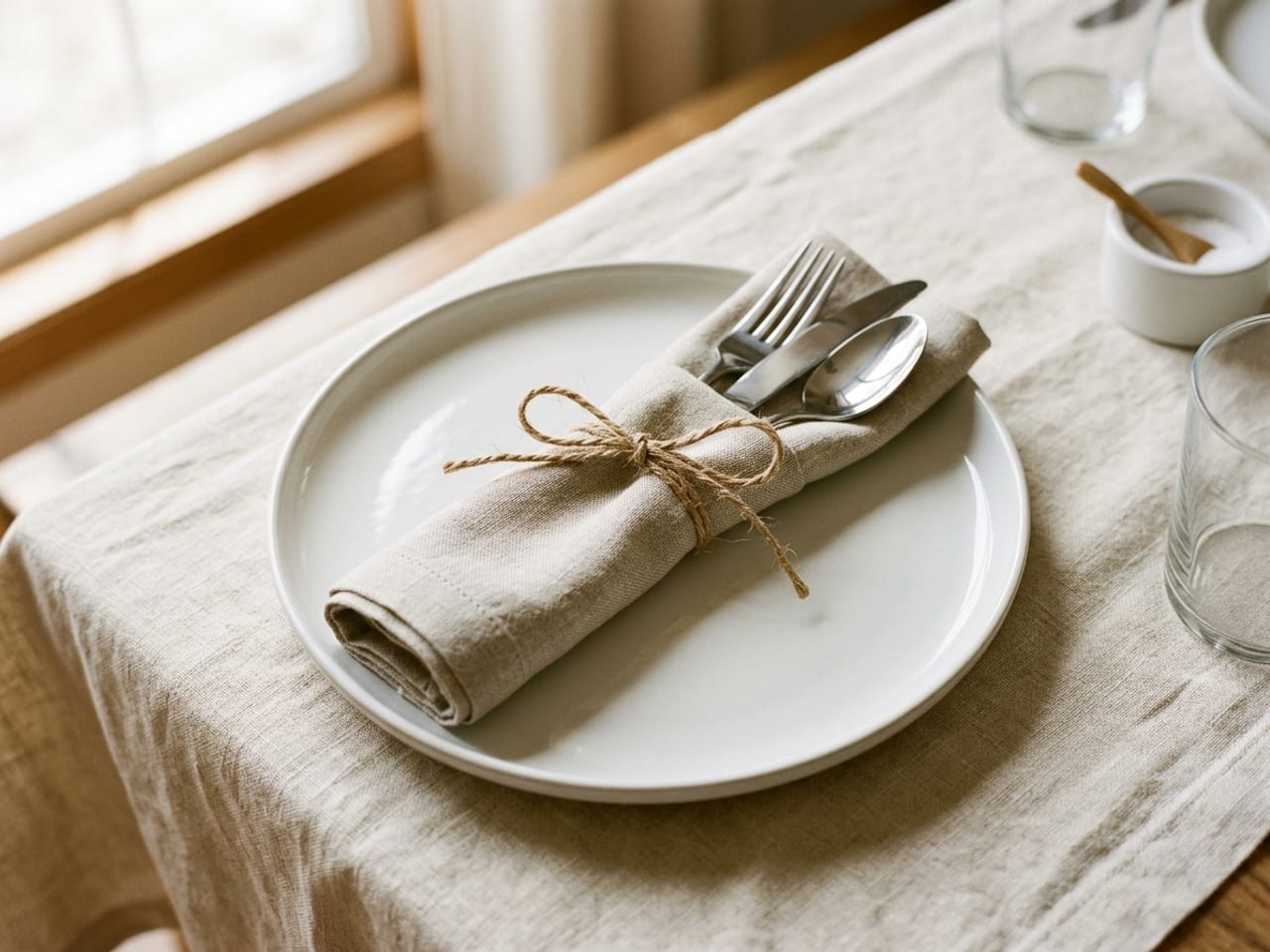
Quick answer: lay the napkin as a diamond, put the fork, knife and spoon up the middle, fold the bottom corner up over the handles, fold one side over, roll it up and tie it halfway down.4, 6
Face down as a diamond. Lay the cutlery up the middle with the handle ends about a third of the way up from the bottom corner.6
Fold the bottom corner up over the handles.
Fold the left corner over the cutlery, then roll to the right, snug.
Tuck the last corner under, or tie it halfway down with twine, ribbon or a paper band.6
Good to know: the turned-up corner closes the bottom so nothing slides out when a guest picks it up from a buffet basket.6 A dinner knife is about 9 inches (23 cm) long, so a small napkin won't cover it.
1Face down as a diamond; cutlery up the middle, handles a third from the bottom
2Fold the bottom corner up over the handles
3Fold the left corner over the cutlery, then roll to the right
4Rolled snug: tie or band it halfway down
Folds 8 to 10
How to fold napkins for napkin rings
Three ways to use a ring, none of which needs an iron. Any ring about 1½ in (4 cm) across works.
8. How to fold a napkin for a napkin ring
Also: napkin ring stuffer, flower fold, simple napkin ring
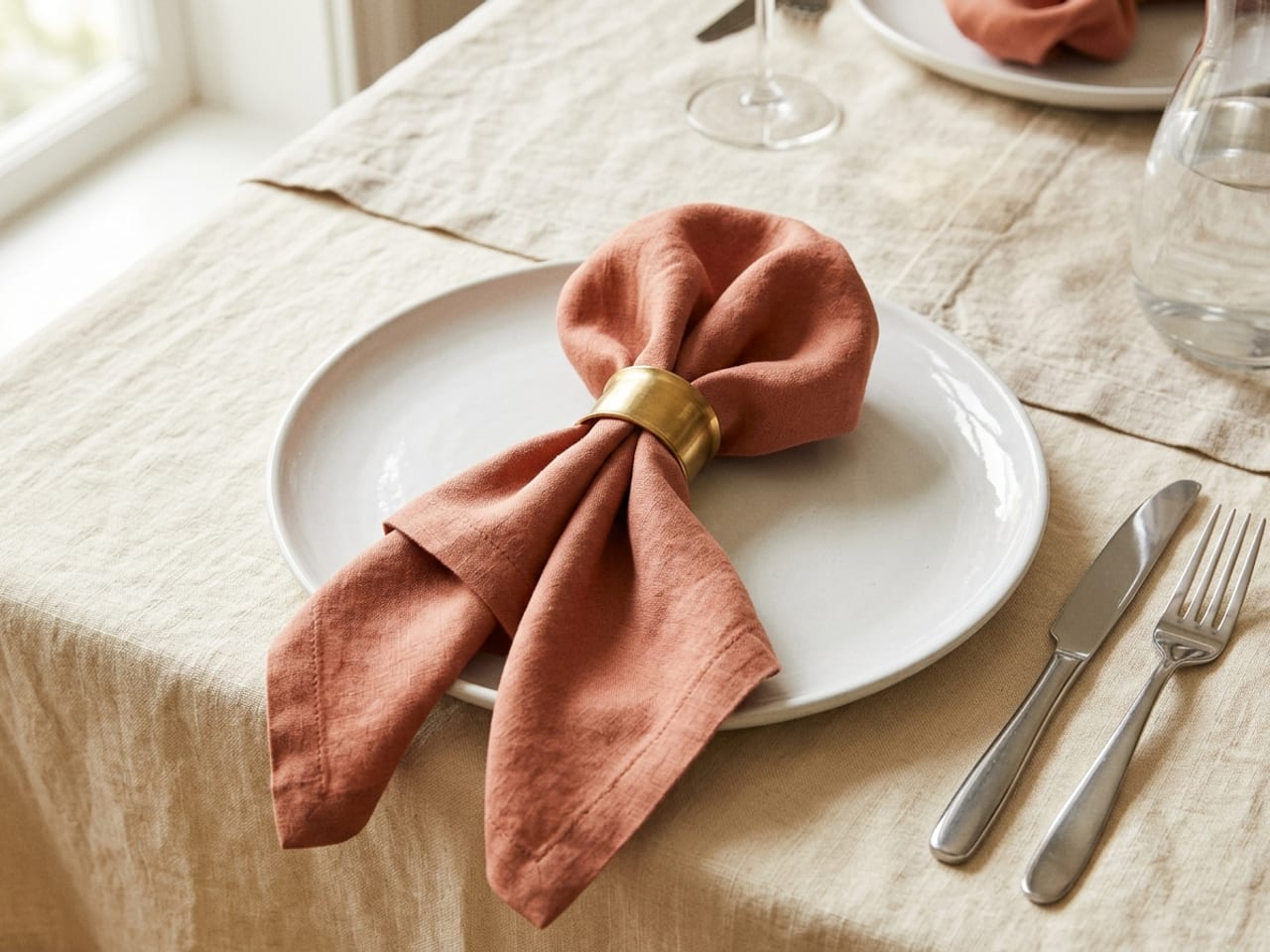
Easy · 10 seconds · starch: no · on the plate or left of the forks
Quick answer: lay the napkin face up, pinch it in the exact centre, lift it and push the centre through the ring. Fluff the top into a puff and spread the corners below.4, 9
Face up this time (the side facing you ends up outside). Pinch the exact centre and lift; the napkin hangs like an upside-down umbrella.4
Push the pinched centre through the ring, 2 to 3 in (5 to 8 cm).
Fluff the puff and spread the tails. Lay it with the tails toward the guest.
Good to know: the fastest fold in this guide, and it needs no ironing at all.4 For petals, fold the napkin in half with the corners slightly offset first, then pull the middle of the folded edge through.6
1Face UP this time: pinch the centre and lift
2Push the centre through the ring
3Fluff the puff and spread the tails
9. Accordion fan through a ring
Also: napkin ring fan
Easy · 1 minute · starch: helps · on the plate or left of the forks
Quick answer: pleat the whole napkin like an accordion in 1 inch (2.5 cm) folds, fold the pleated bar in half, slide a ring over the folded end and spread the top into a fan.4, 21
Face down, fold in half and open it again to leave a centre crease, then pleat from the left edge in 1 inch folds, making sure a fold lands on the crease so both ends match.4, 21
You now have a long pleated bar. Fold it in half.
Slide the ring over the folded end, 1 to 2 in (3 to 5 cm) up.
Spread the free ends into a fan.
Good to know: lay it on the plate with the fan toward the top, or lying beside the forks. Pressing the pleats first keeps the fan tidy.
1Face down: crease the middle, then pleat from the left in 1 in (2.5 cm) folds
2A long pleated bar: fold it in half
3Slide the ring over the folded end
4Spread the top into a fan
10. Rolled napkin with a ring
Also: classic roll, napkin ring roll
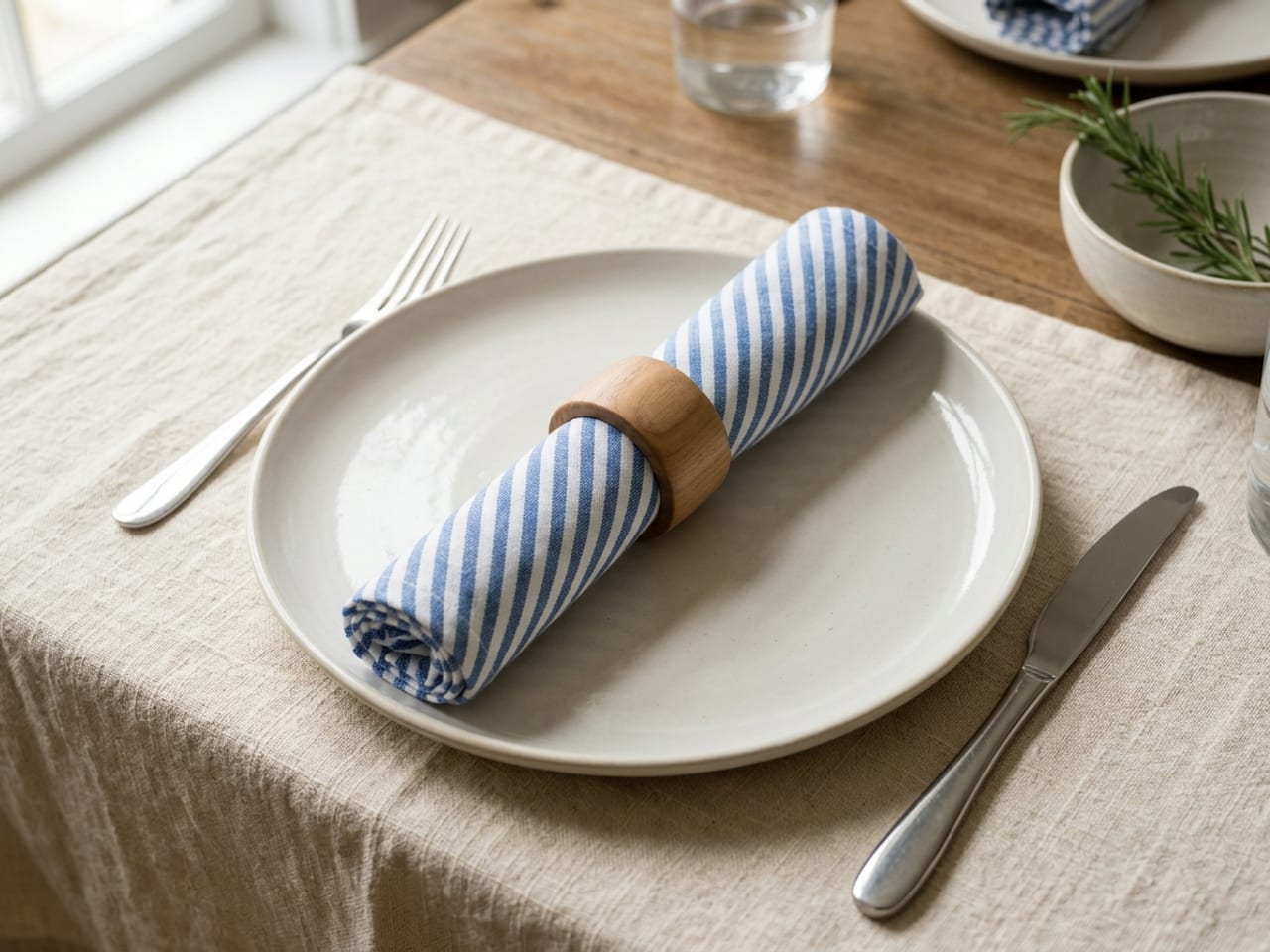
Easy · 20 seconds · starch: no · across the top of the plate or left of the forks
Quick answer: fold the napkin in half and in half again, roll it up from one edge into a tube, and slide a ring to the middle with the seam underneath.9
Face down, fold in half, top to bottom.
Fold in half again.
Roll it up from the bottom edge into a tube about 10 in (25 cm) long.
Slide the ring to the middle, seam underneath.
Good to know: the ring once had a job. Before napkins were washed after every meal, each family member had a ring of their own so they got their own napkin back at the next meal.2, 3 Emily Post wrote in 1922 that rings were "unknown in fashionable houses outside of the nursery";24 the Emily Post Institute now allows them at an informal table.25
1Face down: fold in half, top to bottom
2Fold in half again, right over left
3Roll it up from the bottom edge
4Slide the ring to the middle, seam underneath
Folds 11 to 16
Fancy napkin folds
The restaurant folds. The bishop's hat and bird of paradise need starch; the rose, heart, bow and lotus don't.
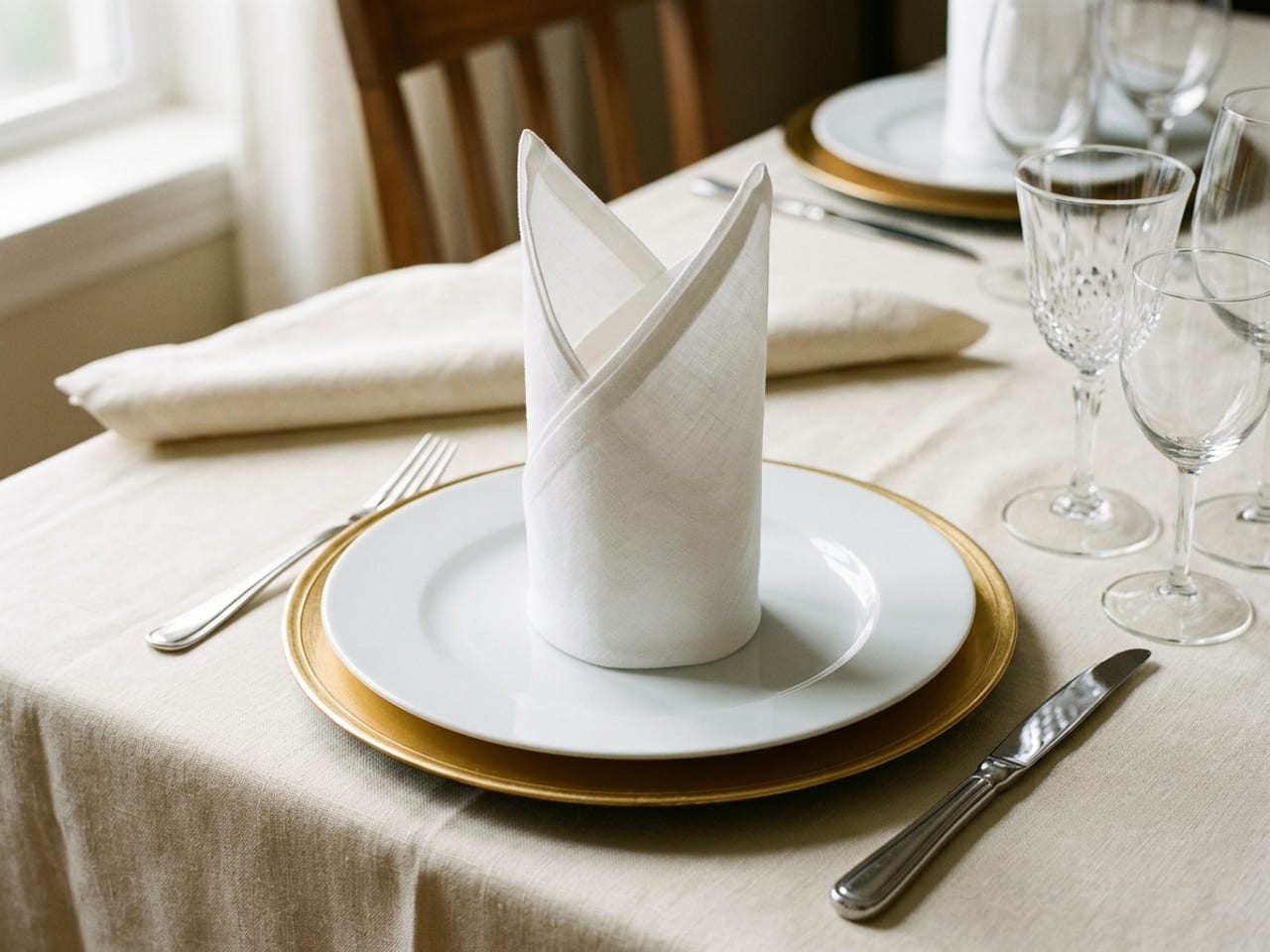
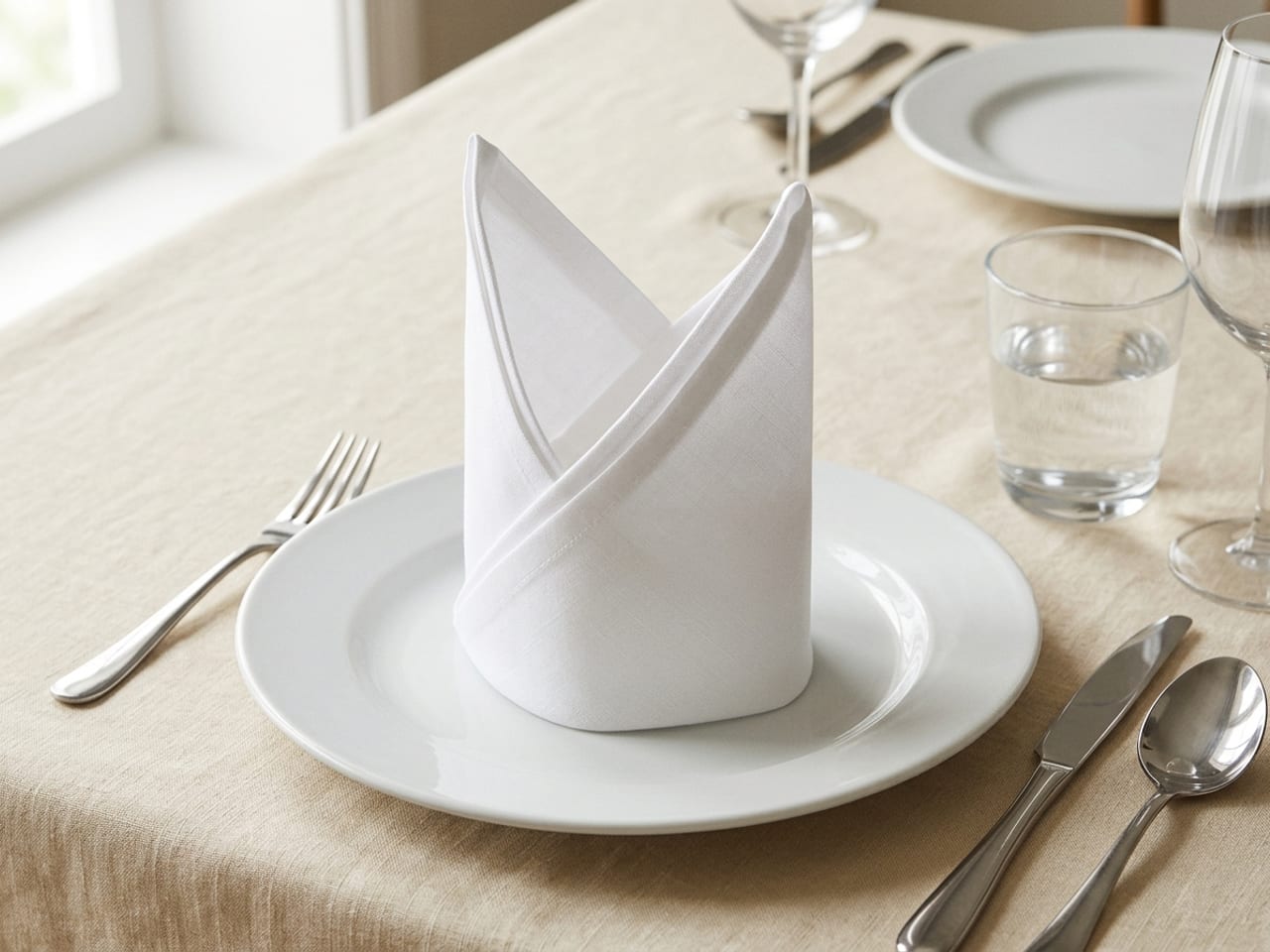
11. How to fold a bishop's hat napkin
Also: bishop's mitre, mitre, miter
Tricky · 2 minutes the first time · starch: yes · on the plate or charger
Quick answer: fold the napkin in half, fold two opposite corners to the middle to make a parallelogram, turn it over, fold it in half lengthwise and pull the hidden flap out, then tuck the two ends into each other and open it into a standing two-peaked hat.4, 5, 8
Face down, fold the top edge down to the bottom edge.
Fold the top-right corner down to the middle of the bottom edge, and the bottom-left corner up to the middle of the top edge: a parallelogram with 45° ends.
Turn it over and turn it so the long edges run left to right.
Fold the bottom long edge up to the top, then reach underneath and pull the trapped triangle out, so two points hang below a band.4, 5
Turn it round so the points face up.
Fold the left end across and tuck it under the right point's flap. Turn it over and do the same with the right end, tucking it into the first.5
Put your hand inside the base, open it into a ring and stand it up: about 7 in (18 cm) tall, one peak at the front and one behind.
Good to know: "la mitra" is the tenth fold on the 1629 list,55 and it was the first plate in Beeton's 1880 edition.2 It is the one fold here that really needs starch.4 Victorian hosts set a dinner roll inside it.1, 3 Some shops sell a different, triangle-based fold under the same name.
1Face down: fold the top edge down to the bottom
2Top-right corner down to the bottom middle; bottom-left corner up to the top middle
3A parallelogram: turn it over, long edges left to right
4Fold the bottom edge up to the top, then pull the flap out from under it
5A band with two points: turn it so they point up
6Fold the left end across and tuck it in; turn over and do the right
7Open the base into a ring and stand it up
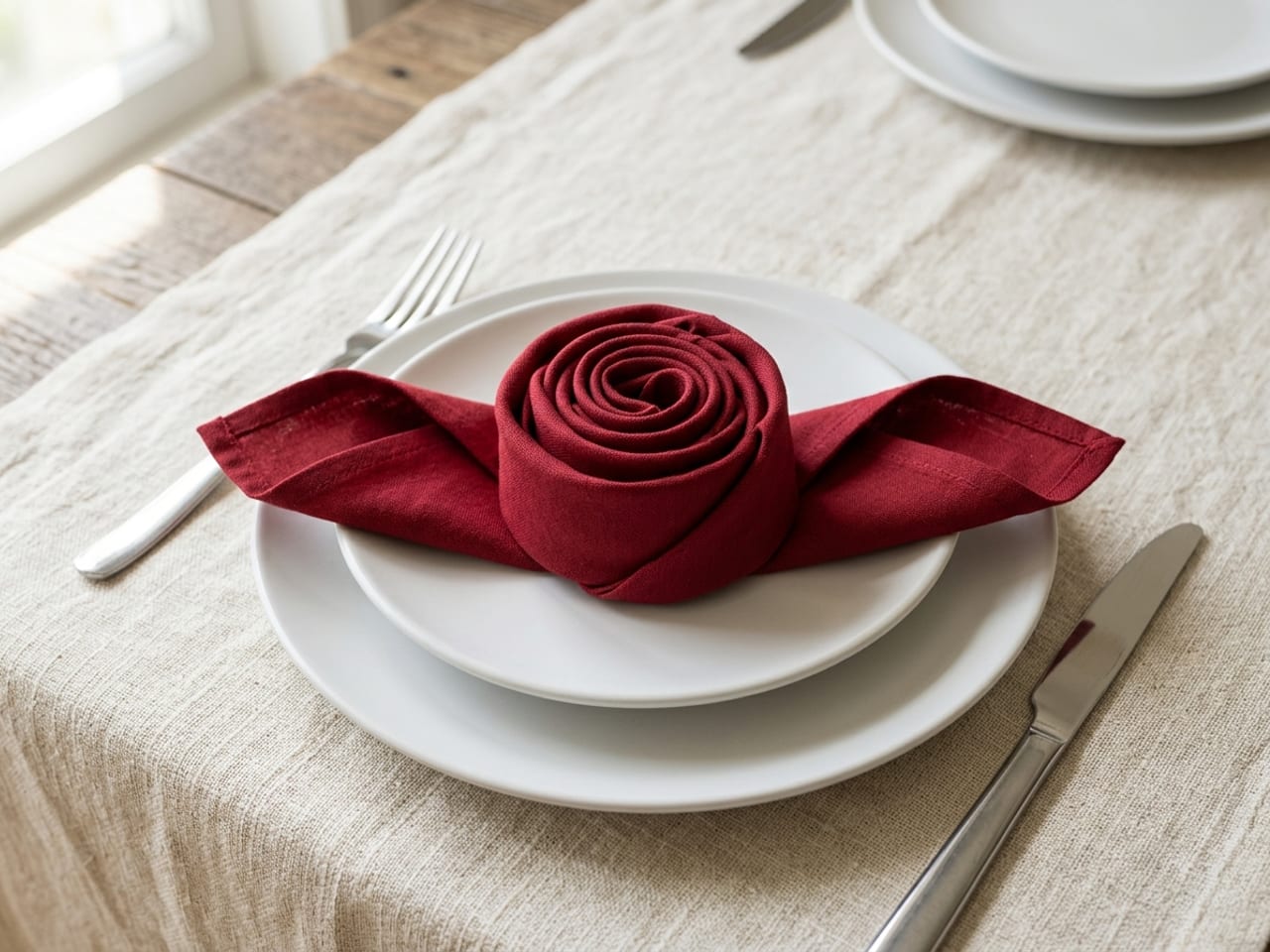
12. How to fold a napkin into a rose
Also: napkin rose, rolled rose
Medium · 1 minute · starch: no · on the plate or a side plate
Quick answer: fold the napkin corner to corner, roll it tightly from the long edge until about 3 inches (7.5 cm) of the point is left, coil the roll around itself like a cinnamon roll, tuck the end in, and turn it over so the two points spread out as leaves.11, 12
Face down as a diamond, fold the bottom point up to the top.
Roll tightly from the long folded edge toward the point. Stop about 3 in (7.5 cm) from the tip.11
You have a long rope with a flat triangle on it. Starting at one end, coil the rope around itself, keeping the triangle outside.
Tuck the last end of the rope into the coil to lock it.
Turn it over and separate the two points of the triangle as leaves.
Good to know: soft cotton coils better than starched linen, and red or pink reads most like a rose.7 Two sites call the corners-to-centre fold a "rose"; that one is the lotus below.4, 5 The rose works with thick 3-ply paper but not thin 2-ply.11, 12
1Face down as a diamond: fold the bottom point up to the top
2Roll tightly from the long edge; stop 3 in (7.5 cm) from the point
3A rope with two points: coil it up from one end
4Coil it tight and tuck the end in
5Turn over and spread the two points as leaves
13. How to fold a bird of paradise napkin
Also: crane, crowned bird
Tricky · 2 minutes · starch: yes · on the plate
Quick answer: fold the napkin into a quarter square, then into a triangle with the loose corners at the top, fold the sides to the centre line, tuck the bottom behind, fold it in half and stand it up, then pull the four loose corners up one by one into a crest.4, 5, 8
Face down, fold in half and in half again.
Turn it into a diamond with the four loose corners at the top and fold the bottom point up: a triangle, loose points at the top.
Fold the right and left edges in to meet on the centre line. Their corners hang below the bottom edge.
Fold those hanging corners behind, along the bottom edge.
Fold the whole thing in half behind, down the middle.
Stand it on its base and hold the base firmly. Pull the four loose points up one at a time, each a little lower than the last.4, 8
Good to know: "a stiff napkin works best for this one," so starch a soft one lightly.4 The crest points are the four corners of the napkin, so a napkin with a contrasting hem gives a striped crest.
1Face down: fold in half, then in half again
2Diamond, loose corners at the top: fold the bottom point up
3Fold the right and left edges to the centre line; the corners hang below
4A kite: fold the bottom point behind
5Fold it in half behind, down the middle
6Stand it up and pull the four points up into a crest
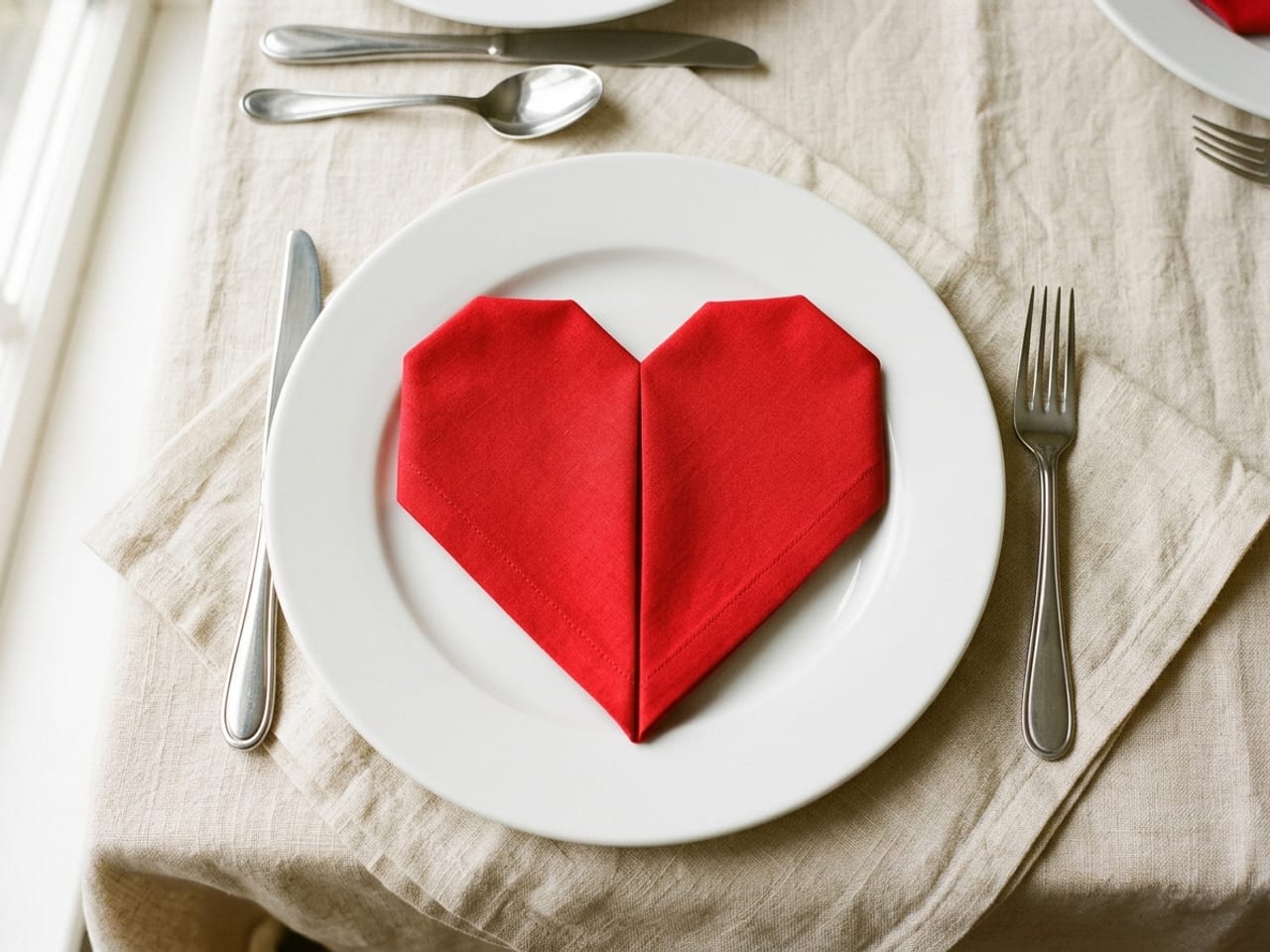
14. How to fold a napkin into a heart
Also: Valentine's heart
Easy · 1 minute · starch: no · on the plate
Quick answer: fold the napkin into a long strip, fold each half up at 45° from the middle of the bottom edge so they stand side by side, turn it over and tuck the top corners behind to round the lobes.13, 14
Face down, fold in half bottom to top, then in half again: a strip four times as long as it is tall.
From the middle of the bottom edge, fold the right half straight up.
Fold the left half up the same way. The two halves stand side by side.
Turn it over, point toward you.
Fold the four top corners behind, about 1½ in (4 cm), to round the lobes.14
Turn it back over and press it.
Good to know: an 18 inch (45 cm) napkin fills a dinner plate.13 Pressing each fold with an iron keeps the heart flat.13 Because it starts with a strip, it works with rectangular paper dinner napkins too.14
1Face down: fold in half bottom to top, then again: a long strip
2Fold the right half up from the middle of the bottom edge
3Fold the left half up the same way
4Turn over, point toward you
5Fold the four top corners behind to round the lobes
6The heart
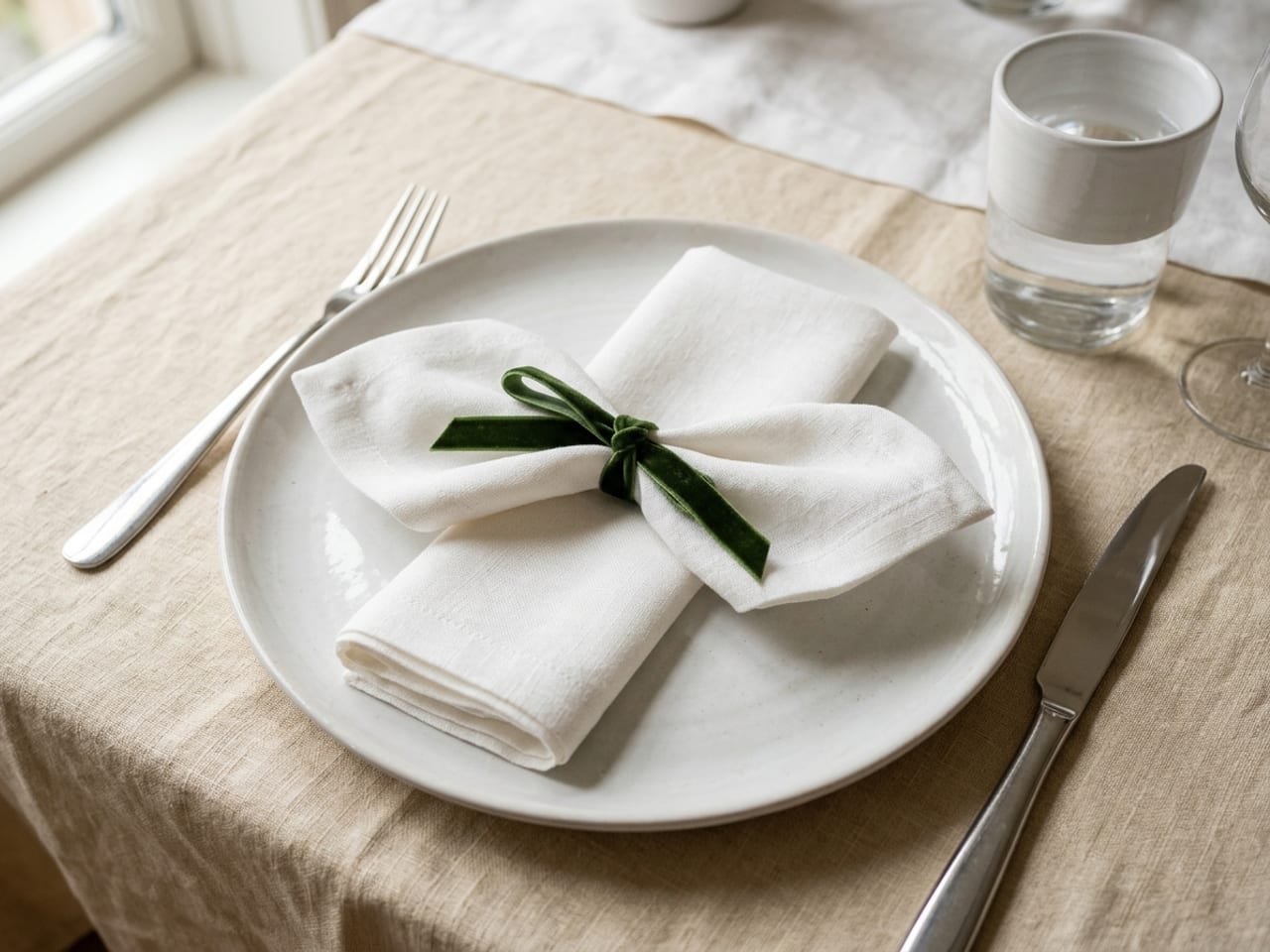
15. How to fold a napkin into a bow
Also: bow tie, butterfly
Easy · 45 seconds · starch: no · on the plate
Quick answer: fold the top and bottom edges to the middle, fold both ends in to meet, turn it over, pinch the middle into a zigzag and tie it with a ribbon or a ring.7, 16, 22
Face down, fold the top and bottom edges to the middle. For a slimmer bow, fold the band in half lengthwise too.7
Fold both short ends in to meet in the middle.
Turn it over.
Pinch the middle into a zigzag with the deepest dip in the centre,16 wrap it with a ribbon or a napkin ring and fluff the wings.
Good to know: a 1½ to 2½ inch (4 to 6 cm) ribbon about 5 to 6 inches (13 to 15 cm) long is enough.16
1Face down: fold the top and bottom edges to the middle
2Fold both ends in to meet in the middle
3Turn over
4Pinch the middle into a zigzag, tie it and fluff the wings
16. How to fold a lotus napkin
Also: water lily, artichoke; called a “rose” by some sites
Medium · 2 minutes · starch: helps · on the plate
Quick answer: fold all four corners to the centre, do it again, turn it over and do it a third time, then hold the centre down and pull the corner flaps up from underneath into petals.4, 5
Face down, fold all four corners to the exact centre.
Fold the four new corners to the centre again.
Turn it over, holding the layers together.
Fold the corners to the centre a third time.
Hold the centre down hard (a small glass helps). Reach under each corner, find the flap and pull it up and out: four petals.5
Reach under the middle of each side and pull out a second set: eight petals.4
Good to know: the centre makes a nest for a bread roll, an egg or a single flower; the 1888 "Victoria Regia" water lily held a rose.1 It can be done with almost any napkin,4 but a bigger one gives fuller petals.
1Face down: fold all four corners to the centre
2Fold the new corners to the centre again
3Turn over, holding the layers together
4Corners to the centre a third time
5Hold the centre down; pull each corner flap up from underneath
6Pull a second set from under the sides: eight petals
What about the swan? The swan is folded like the turkey's body: a quarter square as a diamond, the sides folded to the centre twice into a narrow cone, the point bent up for the neck, then folded in half. It only stands if the napkin is soaked in starch first,23 and on an ordinary home napkin it slumps, so we left it out of the eighteen. The 1888 handbook's swan is a twisted rope you hold "between the teeth" while folding.1
Folds 17 and 18
Holiday napkin folds: Christmas tree and Thanksgiving turkey
Two seasonal folds for the Thanksgiving and Christmas tables. The tree lies flat; the turkey stands. Our Christmas table hub sorts more Christmas folds by what the napkin has to do.
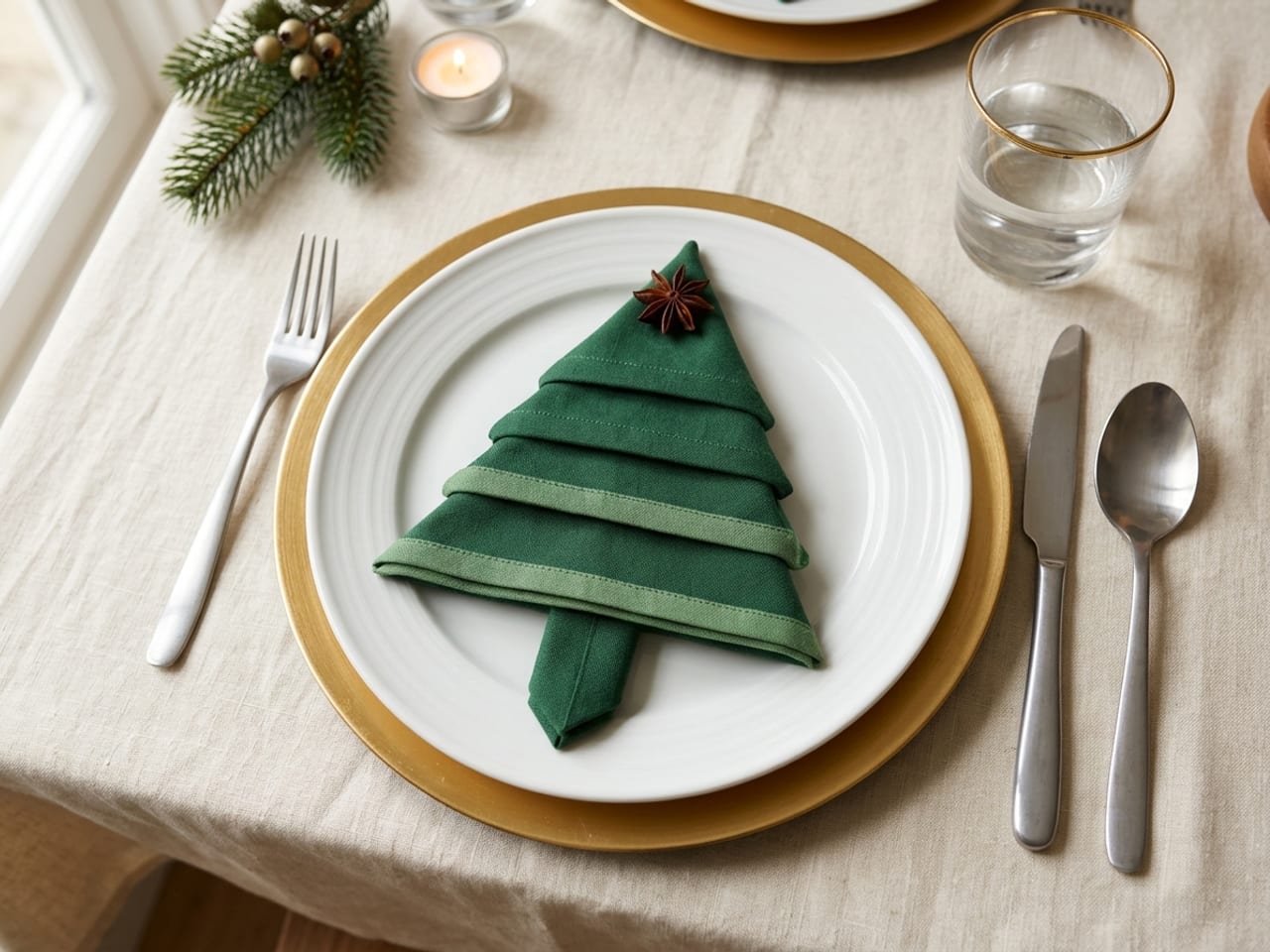
17. How to fold a Christmas tree napkin
Also: tree fold, layered tree
Medium · 2 minutes · starch: no · on the plate or charger
Quick answer: fold the napkin into a quarter square, turn it into a diamond with the loose corners toward you, fold each layer up to just below the one before, turn it over, fold the sides in, turn it back and tuck each layer's tip under the one above to make tiers.17, 18
Face down, fold in half and in half again.
Turn it into a diamond with the four loose corners pointing toward you. Fold the top layer's corner up to about 1 in (2.5 cm) below the top point.18
Fold each of the next layers up the same way, each 1 in lower than the one before. Turn it over, holding the layers.
Fold the right and left corners in so they overlap down the middle.17
Turn it back over. Starting at the top, fold each layer's tip up and tuck it under the layer above, so each tier gets a straight lower edge.17
Good to know: iron the napkin first; this fold "will be much harder and not turn out well with wrinkled napkins."18 A green napkin with a contrasting reverse gives striped tiers. A star anise, a cranberry or a rosemary sprig on top is optional. One shop's version skips the turn-over and side folds and makes a layered diamond, not a tree.7
1Face down: fold in half, then in half again
2Diamond, loose corners toward you: fold the top layer up to just below the top
3Fold each layer up the same way, each 1 in (2.5 cm) lower. Turn over
4Fold the sides in so they overlap down the middle
5Turn back over and tuck each flap's tip under the one above: the tree
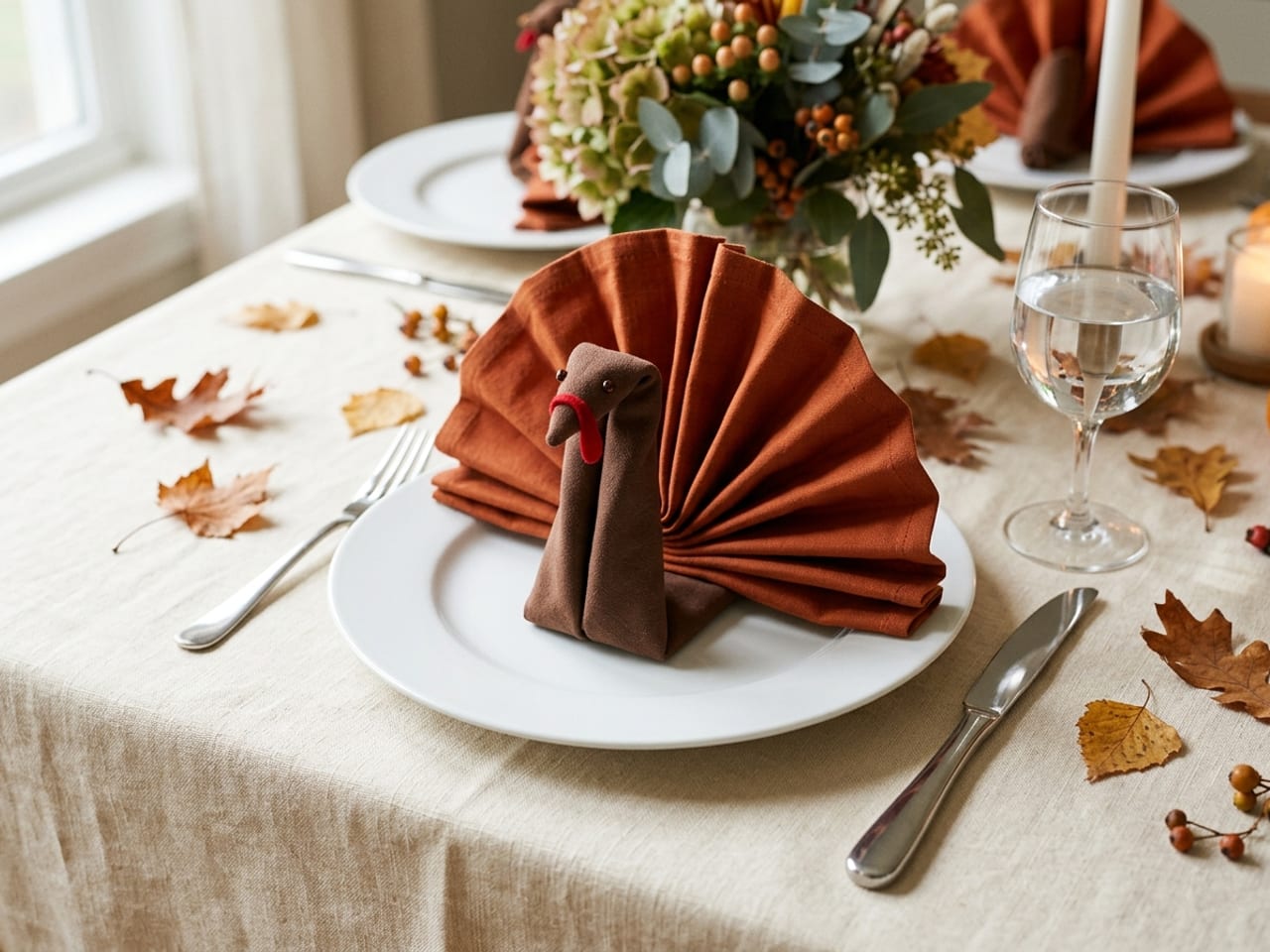
18. How to fold a turkey napkin for Thanksgiving
Also: turkey fan tail
Medium · 3 minutes, two napkins · starch: helps · on the plate
Quick answer: the tail is a standing fan (fold 4) from one napkin; the body is a second napkin folded into a narrow spike like a paper aeroplane, with its point bent up into a neck and head, standing in front of the fan.19
Fold the first napkin (brown, orange or plaid) into a standing fan.
For the body, lay a second napkin face down and fold the two top corners to the centre: a house shape.
Fold the long slanted edges to the centre line, then do it again: a narrow spike.19
Turn it so the point faces you, fold the point up and back for the neck, fold the last 1 to 1½ in (3 to 4 cm) down for the head, and stand the body in front of the fan.
Good to know: there is no single standard turkey fold. The easiest version uses just the fan as the tail and a pinecone for the body;20 a little spray starch helps the tail stand.20 A red felt or paper wattle is optional.
1Tail: fold the first napkin into a standing fan (fold 4)
2Body: second napkin face down, top corners to the centre
3Fold both long edges to the centre, then again: a narrow spike
4Point toward you, fold it up for the neck, tip down for the head; stand it in front of the fan
Why starch matters
Starched or not: the same fold, twice
SoftStarched
Soft cotton, no starch: the tucks hold, but the peaks fold over within minutes.
Lightly starched and ironed damp: the same fold stands straight through dinner.
Etiquette
Where the napkin goes, and what to do with it
Three places: left of the forks for everyday, on the plate or charger for a formal dinner, and in the glass only for a fold made to stand there.The everyday spot: an oblong to the left of the forks, long side parallel to them.
Where it goesLeft of the forks, or on the plate or charger. The Emily Post Institute puts it "on top of the charger (if one is used) or in the space for the plate" at a formal table, or left of the forks, or under them if space is tight;26 at an everyday table, "to the left of the fork, or on the plate."27 Whether the fork sits on top of the napkin is "really up to you and your style."25 In Britain, Debrett's lays it simply folded on the side plate.30
When you sit downUnfold it and put it in your lap as soon as you are seated,28, 29 folded in half with the crease toward you: Post in 1922 had it "folded once in half across the lap."24, 33 At a private dinner, some etiquette writers wait for the host to take theirs first.32
Dab, don't wipe; never the collarDab the corners of your mouth and "avoid grand side-to-side wiping gestures," and "never tuck it into your shirt collar."29
Stepping away: the chair or the table?Here the authorities disagree. The Emily Post Institute says to place it loosely to the left of your plate, "not on the plate or chair you sit in": "'LL' for 'Loosely' to the 'Left'."28 William Hanson and Etiquette Scholar say the chair seat.32, 33 Either is fine; the plate is not.
At the end of the mealLeave it loosely, unfolded, beside your plate on the left.28, 29 Don't refold it: Miss Manners files that, with refolding a used handkerchief, under "Eeeeew." 34
The table setting diagram draws a whole place setting, napkin included, for the menu you are serving, and our guide to how to set a table gives the reason behind every other piece.
No standards body defines napkin sizes; these are etiquette and trade conventions. The practical point for folding: every fold here works with an 18 to 20 inch (46 to 51 cm) napkin, and the bigger the napkin, the grander the tall folds look. The Victorian napkins the old folds were designed for were half as big again.2, 38
Cloth, starch and stains
Which fabric folds best, and how to care for it
Fabric
How it folds
At the table
Iron
Linen
Takes and holds a sharp crease; the best cloth for standing folds
Strong, absorbent and quick-drying, but "prone to wrinkling"45
Hot (3 dots), while damp
Cotton
Holds a pressed fold, softer than linen; starch it for tall folds
Absorbent, durable, wrinkles easily; withstands heat and bleach44
Hot (3 dots), slightly damp
Polyester and blends
Resists wrinkles, and resists creases too; looks flatter in sculptural folds
Quick-drying, wrinkle resistant, holds oily stains44; starch doesn't bond well, so use sizing42
Moderate (2 dots)
Paper
Good for flat folds and pockets; tall folds need thick 3-ply
Single use; dinner napkins often not square
Never
Homemade starchStir ½ cup (60 g) cornstarch into 1 cup (240 ml) cold water, then add boiling water: 2 quarts (1.9 L) for a heavy starch, 3 quarts (2.8 L) for medium, 6 quarts (5.7 L) for light. Dip, let the napkins dry until only slightly damp, then iron. Use it the same day.41 For folds, a light or medium starch is plenty; spray starch works too.
Starch or sizing?Starch (corn, wheat or rice) stiffens cotton and linen. Sizing adds body without much stiffness and is the better choice for polyester, blends and dark napkins,42, 43 because starch "doesn't satisfactorily adhere" to polyester.42 White flakes on a dark napkin are starch.43
Iron at the temperature on the labelUnder ISO 3758:2023 the dots on a care label mean up to 120 °C (1 dot), 160 °C (2 dots, polyester) and 210 °C (3 dots, cotton and linen, iron while damp);39 the older version of the standard said 110, 150 and 200 °C.40 The label, not the fibre, sets the limit.39
Red wineSprinkle the fresh stain with table salt, sponge it with cool water or club soda and blot. Then soak it for 15 minutes in 1 quart (1 L) warm water with ½ teaspoon detergent and 1 tablespoon white vinegar, rinse, and launder.46
Candle waxScrape off what you can, then put the napkin between white paper towels and press with a warm iron from the back, moving the towel as it soaks up the wax. Treat what's left with detergent and launder.46
Butter, oil, gravy and lipstickRub a pre-wash stain remover or heavy-duty liquid detergent into the stain before washing, then wash as hot as the fabric allows.46, 47 Cream and egg are protein: soak those in cold water first, because hot water "cooks the protein."47
Check before the dryer"Heat sets stains." Don't tumble-dry or iron a napkin until the stain is gone.48 White cotton and linen can go in a 95 °C (boil) wash if the label shows it.39
Store them clean, unstarched and loosely foldedWash starch out before long storage: it yellows linen and feeds insects.45, 49 Sharp creases kept for years can crack the fibres, so store good linen flat or with few folds and refold it in new places now and then.45, 49 Everyday napkins in a drawer are fine.
Disposable
How to fold paper napkins
Check the shape first. Beverage napkins are about 9½ inches (24 cm) square, folded to a quarter.35 US paper dinner napkins run 15 to 17 inches (38 to 43 cm), often folded into eighths,35 and many aren't square: Chinet's Classic Dinner Napkin is 14.8 × 17 inches.15 European sizes are squares of 24, 33, 40 and 48 cm.36 Any fold that starts from a square (the pyramid, pockets, bishop's hat, bird of paradise, lotus, rose) needs a square napkin, or trim a rectangle square with scissors.
Choose the fold for the paper. Flat folds, the pocket, the roll-up, the heart, the bow and the accordion ring fan all work with ordinary 2-ply paper; paper pleats hold well. Standing folds need thick 3-ply, and thin 2-ply tears where you tuck.12 Crease paper once, firmly, with a fingernail: it remembers every mistake.
Cloth or paper, for the planet? It depends. The two full life-cycle studies were paid for by opposite sides and lean opposite ways: one, for the laundry industry, found heavier paper napkins worse than a reusable polyester napkin used 100 times, and the lightest paper ones slightly better;50 the other, for a paper-napkin maker, found its light tissue napkin lowest in most impacts and said its own results can't support a general claim either way.37 What tips it: how heavy the paper is, how many times the cloth is used, and how it is washed.
Where folds come from
A short history of napkin folding
The first folding book, 1629. Mattia Giegher, a Bavarian carver serving the German students at the University of Padua,56 published Li tre trattati with a treatise on folding napkins and tablecloths, which he said no one in his profession had written before. Napkins came first because they are "le prime cose," the first things set on the table.55 His list already has the fan ("Il terzo il ventaglio") and the mitre ("Il decimo la mitra"), plus eagles, lions, dragons, a ship, a castle with sentries and artillery, and "una Caccia in sù la tavola fatta di salviette," a hunt on the table made of napkins. It is not a step-by-step manual: Giegher calls it a memory aid for people he had taught in person.55, 56
Folded sculpture. At Baroque banquets these figures, called trionfi, were conversation pieces whose meaning guests were expected to decode.55, 56 The Catalan folder and historian Joan Sallas reconstructs them; a 2010 exhibition of his work in Vienna showed about forty folded linen centrepieces and 150 napkins.58 No originals survive. "A napkin, however artfully folded, lives only a few moments," Sallas told a journalist. "That is the essence of the Baroque."57
The Victorians. Isabella Beeton's famous 1861 book has no folding section; the footman simply lays "a napkin neatly folded, within it a piece of bread or small roll." 67 Her publishers added illustrated folds after her death: the 1880 edition has the Mitre, the Star and the Rose, the Fan and others, on dinner napkins of 28 to 30 inches.2 By 1907 there were seventeen plates, from the Bishop to the Boar's Head, yet the same chapter admits "these fancy designs are not fashionable in the household now."3 An 1888 Chicago steward's handbook explains how the grand folds were made to stand: napkins "damped with (raw) starch, smoothed with a hot iron, and immediately folded whilst crisp and steaming." 1
Emily Post, 1922. "A dinner napkin folded square and flat is laid on each 'place' plate; very fancy foldings are not in good taste." Bread in the napkin: "not nowadays." And rings are "unknown in fashionable houses outside of the nursery."24 Rings had spread in the early 1800s so each family member could reuse their own napkin between weekly washes, and faded as washing got easier.3, 61
Paper napkins are older than you might think. In Tang China, tea was served with paper napkins folded into squares.59 In the West, decorated Japanese paper napkins arrived as a novelty in the 1880s; by 1896 an American column said every picnic party "must be well supplied" with them.60 In 1948 Emily Post ruled that paper was "far better form" than a linen napkin already used at breakfast.68
Napkin or serviette? A napkin is literally a little tablecloth: Old French nape plus -kin, from the late 14th century.62 In 1954 the linguist Alan Ross called serviette versus table-napkin "perhaps the best known of all the linguistic class-indicators of English," serviette being the non-upper-class word.63 Debrett's still says "never 'serviette',"29 but a 2024 study found some Britons now hear serviette as the posher one.64
The research, briefly
Does a cloth napkin make the food taste better?
Nobody has tested a foldWe found no study that compares napkin folds, or folded against plain napkins. Everything about folds on this page is craft tradition. What has been tested is table linen as a whole.
Cloth table linen, in a real restaurant247 diners at a real restaurant ate the same meal with fabric or paper table linen. With fabric, they liked the appetiser more and rated the overall meal quality, the service and the ambiance higher; the main course and dessert scores didn't change. Three quarters said table linen mattered to them.51
A tablecloth mattered more than the lightingIn a lab study of 159 people eating soup, a tablecloth made them eat more, eat longer and rate the soup's taste and quality higher, and it had a bigger effect than dimming the lights.52
What's in your hand counts tooDiners given heavier cutlery liked the same food more, rated it as more artistically plated and would have paid more for it.53 That is cutlery, not napkins, but it points the same way: the feel of the table is part of the meal.
Clean depends on time, temperature and detergentHow well a home wash kills germs depends on temperature, cycle length and detergent together; a detergent with activated oxygen bleach or a longer cycle makes up for a cooler wash.54
Seven napkin myths
“Leonardo da Vinci invented the napkin”No. The story comes from Leonardo's Kitchen Note Books (1987), a joke book built around a manuscript that doesn't exist; the editor of its Spanish edition called it "pura broma," a pure joke.65 The English word napkin is from the late 14th century.62
“A folded napkin means ‘I'm coming back’”The story that the folded cloth in Jesus's tomb (John 20:7) followed a Hebrew master-and-servant custom has no biblical or rabbinic source, and the Greek word means a sweat-cloth, not a table napkin.66
“Mrs Beeton taught the mitre and the fan”Not in 1861. The first edition only lays "a napkin neatly folded, within it a piece of bread or small roll".67 The illustrated folds were added by her publishers after her death in 1865: there by the 1880 edition,2 seventeen plates by 1907.3
“Napkin folding comes from origami”The European tradition has its own printed treatise from 1629, whose author says he taught the art in person;55 the 2010 Vienna exhibition made the same point.58
“Napkin rings are formal”The opposite. Rings let each family member reuse their own napkin between washes,2, 3 and in 1922 Emily Post called them "unknown in fashionable houses outside of the nursery."24
“Every fold needs starch”Only the folds that stand up. The pocket and ring folds need none.4, 10
“Emily Post says put it on your chair”The Emily Post Institute says the opposite: to the left of the plate, "not on the plate or chair."28 The chair rule is other teachers'.32, 33
Words
Napkin folding terms, defined
Valley fold
A fold that brings part of the napkin toward you, on top, so the crease sinks like a valley; drawn here as a dashed line.
Mountain fold · fold behind
A fold that takes part of the napkin away from you, underneath, so the crease rises like a ridge; drawn here as a dash-dot line.
Quarter square · quarter fold
A napkin folded in half and in half again into a square a quarter of its size, with all the loose edges at one corner.
Open corner
The corner of a folded napkin where all the loose points and edges meet, as opposed to the corners made by folds.
Accordion pleat · fan pleat
A row of folds made alternately forward and back, usually about 1 inch (2.5 cm) wide, as in the fan folds.
Right side and wrong side
The right side of a napkin is the side meant to be seen, with the print or the neat side of the hem; the wrong side faces the table.
Starch
A corn, wheat or rice solution ironed into cotton or linen to stiffen it so standing folds hold their shape.
Sizing
A finish that adds body and crispness without much stiffness, suited to polyester, blends and dark napkins.
Damask
A reversible woven fabric with a pattern shown by the weave, traditionally linen, the classic cloth for formal napkins.
Napkin ring
A ring that holds a rolled or pulled-through napkin, first used so each family member could reuse their own napkin between washes.
Charger · service plate, place plate
A large decorative plate set under the dinner plate at a formal table, where a folded napkin often waits before the first course.
Dinner napkin
A cloth napkin about 18 to 20 inches (46 to 51 cm) square for an informal dinner, or 22 to 26 inches for a formal one.
Luncheon napkin
A smaller napkin, about 14 to 16 inches (36 to 41 cm) square, for lunch.
Cocktail napkin · beverage napkin
A small napkin, about 9 inches (23 cm) square, served with drinks and finger food.
Serviette
Another word for a table napkin, from French; in Britain it was long marked as the less upper-class word.
Trionfo · plural trionfi
A folded or sculpted table centrepiece at a Renaissance or Baroque banquet, a word Giegher's 1629 treatise uses for folded napkin figures.
Now the plate
The napkin frames the plate; what's on it matters more. Photograph a dish you made and Plate Artists re-plates your own food the way a chef would, with the moves named so you can do it again for real.
Your dish, plated like a chef's
Snap it, upload it, and get the composed version back, with the steps to recreate it on a real plate.
Free account · 1 free enhancement · No credit card
FAQ
How to fold napkins, answered
What is the easiest way to fold a napkin?
Fold it in half, in half again and in half once more, and lay the oblong to the left of the forks. For a napkin ring, lay it face up, pinch the centre and pull it through the ring. Neither needs an iron.
How do you fold a napkin for a dinner table?
For most dinners, a flat oblong to the left of the forks or on the plate is correct. For a special dinner, a standing fan or a bishop's hat on the plate, using a crisp or lightly starched napkin. Use the same fold at every place.
How do you fold a napkin to hold silverware?
Fold it into a quarter square, fold only the top layer corner to corner to make a pocket, turn it over, fold the sides in by thirds and turn it back. Slide the fork and knife in, handles first. For a buffet, roll the cutlery up in the napkin instead and tie it halfway down.
How do you fold napkins with napkin rings?
The quickest way is the pull-through: lay the napkin face up, pinch the exact centre, lift it and push the centre through the ring, then fluff the top and spread the corners. You can also roll the napkin into a tube and slide the ring to the middle, or pleat it like an accordion, fold it in half and put the ring over the fold so the top fans out.
Where does the napkin go in a table setting?
To the left of the forks, or in the centre of the plate or charger. At a formal dinner the Emily Post Institute puts it on the charger or in the plate's space; at an everyday table, left of the fork or on the plate. In Britain it often goes on the side plate.
Do you need to starch napkins to fold them?
Only for folds that stand up: the pyramid, standing fan, bishop's hat, bird of paradise and a tall lotus. Flat folds, pockets, the rose and napkin-ring folds need no starch. Light homemade starch is about ½ cup cornstarch in 1 cup cold water topped up with 6 quarts of boiling water.
What size napkin is best for folding?
An 18 to 20 inch (46 to 51 cm) square cloth napkin works for every fold in this guide; the tall ones (bishop's hat, bird of paradise, lotus) look better at 20 to 22 inches. Luncheon napkins of 14 to 16 inches are fine for flat folds and pockets.
Can you fold paper napkins into fancy shapes?
Yes, if they are square and thick. Flat folds, pockets, the roll-up, the heart, the bow and the ring fan work with most paper napkins. Standing folds need thick 3-ply squares, and 2-ply tears at the tucks. Many US paper dinner napkins are rectangles (Chinet's is 14.8 × 17 inches), which breaks folds that start from a square.
How do you fold a napkin into a rose?
Fold the napkin corner to corner, roll it tightly from the long edge until about 3 inches of the point is left, coil the roll around itself, tuck the end in, and turn it over so the two points spread out as leaves.
How do you fold a Christmas tree napkin?
Fold the napkin into a quarter square and turn it into a diamond with the loose corners toward you. Fold each layer up to about an inch below the one before, turn it over, fold the sides in to overlap down the middle, turn it back and tuck each layer's tip under the one above to make tiers.
How far ahead can you fold napkins?
A day ahead is fine for most folds. Keep fans closed and open them at the table, stand pyramids side by side on their long edges, and put pockets and oblongs in a flat stack. Starched napkins shouldn't be stored for long, because starch yellows linen and attracts insects.
Where do you put your napkin when you leave the table?
The Emily Post Institute says loosely to the left of your plate, not on the chair; several other etiquette writers say on the chair seat. Everyone agrees: not on the plate. At the end of the meal, leave it loosely to the left of the plate, not refolded.
Is it napkin or serviette?
Both mean the same thing. Napkin, from Old French nape (tablecloth) plus -kin, meaning little, is from the late 14th century. In 1954 the linguist Alan Ross called serviette the non-upper-class word, and Debrett's still says never serviette, but a 2024 study found some Britons now hear serviette as the posher one.
Sources
The handbooks, etiquette books and research behind this guide
Fold methods checked against at least two published tutorials each (hospitality suppliers, food magazines and folding sites, several read in step photographs); four historical manuals read in scans (Giegher 1629, Beeton 1861, 1880 and 1907, Whitehead 1888) and Emily Post's 1922 Etiquette; current etiquette authorities; napkin makers' specifications; care-label standards and university extension services; two industry life-cycle studies; and five peer-reviewed papers, each verified through Crossref. The diagrams are ours, drawn from those steps; unmarked details (finished sizes, which edge faces the plate) are our measurements or choices.
Whitehead, J. (1888). How to Fold Napkins (appendix to The Steward's Handbook). Jessup Whitehead & Co., Chicago, the starch, mitre, fan and swan instructions; read in Project Gutenberg ebook #62208. gutenberg.org/ebooks/62208
Beeton, I. (Ward, Lock & Co., eds.) (1880). The Book of Household Management, new edition. Ward, Lock & Co., London, ¶2988 Table Napkins or “Serviettes” and ¶¶2989–2996, the Mitre, the Star and the Rose and the Fan, pp. 1312–1316. archive.org/details/bookhouseholdma01goog
Beeton, I. (Ward, Lock & Co., eds.) (1907). Mrs Beeton's Book of Household Management, new edition. Ward, Lock & Co., London, chapter LXVI, Serviettes, pp. 1698–1713, seventeen plates. archive.org/details/mrsbeetonshouse00beetuoft
The Napkin Folding Guide (2010s). Fold pages: the Pyramid, Standing Fan, Basic and Fancy Silverware Pouch, Bishop's Hat, Bird of Paradise, Rose and the napkin-ring folds. napkinfoldingguide.com, read through the Internet Archive, step-by-step photographs. napkinfoldingguide.com
California Linen Service (n.d.). Napkin folds: Bishop's Mitre, Pyramid, Bird of Paradise, The Rose. calinen.com (restaurant linen supplier), fold cards. calinen.com/fld-bishopmiter
Taste of Home (n.d.). How to Fold a Napkin 8 Easy Ways. tasteofhome.com, standing fan, diagonal fold, cutlery wraps, flower fold, napkin ring. tasteofhome.com/article/how-to-fold-a-napkin
WebstaurantStore (n.d.). How to Fold Napkins. webstaurantstore.com blog 5018, angled pocket, fan, pyramid, rose, heart, bow tie. webstaurantstore.com/blog/5018
Everyday Laura (2017). 8 easy ways to fold napkins. everydaylaura.com, the classic fold, the classic roll, the simple napkin ring. everydaylaura.com
Savory Experiments (n.d.). Simple Pocket Napkin Fold. savoryexperiments.com, read through the Internet Archive, “Iron to no wrinkles, but starching is not necessary”. savoryexperiments.com/simple-pocket-napkin-fold
Christine's Crafts (n.d.). How to fold a napkin into a rose. christines-crafts.com, stop about 3 inches from the point. christines-crafts.com
All Cotton and Linen (n.d.). Rose Napkin Fold. allcottonandlinen.com, “Avoid thin paper napkins”. allcottonandlinen.com
In My Own Style (n.d.). Valentine's Table: Easy Heart Shaped Napkin Fold. inmyownstyle.com, 18-inch napkins fill a dinner plate. inmyownstyle.com
Between Naps on the Porch (n.d.). Christmas Tree Napkin Fold Tutorial. betweennapsontheporch.net, “stopping about an inch down from the top edge”. betweennapsontheporch.net
DIY Magazine (n.d.). How to fold a turkey napkin. diy-magazine.com, two-napkin turkey, 19 step photographs. diy-magazine.com
Between Naps on the Porch (n.d.). Thanksgiving Turkey Napkin Fold Tutorial. betweennapsontheporch.net, standing-fan tail. betweennapsontheporch.net
Bluum Maison (n.d.). 4 Napkin Folding Ideas Using Napkin Rings. bluummaison.com, 1-inch pleats for the ring fan. bluummaison.com
Hunker (n.d.). How to Fold Swan Dinner Napkins (after D. Kuhn, Napkin Folding for Every Occasion, 2000). hunker.com, heavy starch soak. hunker.com
Post, E. (1922). Etiquette in Society, in Business, in Politics and at Home. Funk & Wagnalls, New York, chapters XIII, XIV, XVI, XXVI and XXXV; read in Project Gutenberg ebook #14314. gutenberg.org/ebooks/14314
The Emily Post Institute (n.d.). Proper Table Setting 101. emilypost.com, napkin placement and the fork-on-napkin question. emilypost.com/advice/table-setting-guides
The Emily Post Institute (n.d.). Basic Table Setting. emilypost.com, “The napkin goes to the left of the fork, or on the plate”. emilypost.com/advice/basic-table-setting
Debrett's (n.d.). The A-Z of the Modern Gentleman. debretts.com, napkin in the lap, dab, never in the collar, unfolded beside the plate at the end. debretts.com
Debrett's (n.d.). The Christmas Table. debretts.com, “Napkins should be simply folded or rolled and placed on the side plates”. debretts.com/the-christmas-table
Etiquette Scholar (n.d.). The Expert's Guide to Napkin Use and Etiquette. etiquettescholar.com, napkin sizes by occasion. etiquettescholar.com, napkins
Etiquette Scholar (n.d.). Table Manners (part 2). etiquettescholar.com, the chair rule and napkin rings. etiquettescholar.com, table manners
Hanson, W. (2011). In Defence of the Napkin. HuffPost UK, 23 July, the crease toward you; the chair when you step away. huffingtonpost.co.uk
Martin, J. (Miss Manners) (2009). Don't refold your napkin after use. Deseret News syndication, 28 July. deseret.com
Tork (Essity) (2026). Conventional napkins: product specifications (Universal Beverage Napkin B1141A, White Dinner Napkin N7141A and others). torkglobal.com, US, unfolded and folded sizes, fold and ply. torkglobal.com
Duni (2026). Napkins catalogue, size filter. global.duni.com, 24, 33, 40 and 48 cm squares. global.duni.com
Jelse, K., Westerdahl, J. (IVL Swedish Environmental Research Institute, for Duni AB) (2011). Life cycle assessment of premium single-use and reusable napkins for restaurant dinners. IVL report, textile napkins washed 40 times; 45 cm reference size. dunigroup.com (PDF)
Daranvat, A. (c. 1850). L'art de plier les serviettes. L. Baudot, Paris, damask napkins “80 centimètres de longueur sur 72 centimètres de largeur”. archive.org/details/gri_33125015555002
GINETEX (2023). Care symbols under ISO 3758:2023. ginetex.net, ironing at 120, 160 and 210 °C; “iron whilst damp” for cotton and linen. ginetex.net/GB/labelling/care-symbols
GINETEX (pre-2023). Table of textile care symbols (EN ISO 3758). ginetex.net, ironing at 110, 150 and 200 °C. ginetex.net (PDF)
Clorox (n.d.). Fabric Starch: How to Make Homemade Starch for Clothes. clorox.com, ½ cup cornstarch in 1 cup cold water, then 2, 3 or 6 quarts boiling water. clorox.com
Spielvogel, A. (2009). What's the Difference Between Starch and Sizing? American Drycleaner, 9 January. americandrycleaner.com
Faultless (n.d.). Frequently asked questions. faultless.com, sizing for synthetics and dark fabrics; starch flakes. faultless.com/faq
University of Arkansas Division of Agriculture, 4-H (n.d.). Textiles project booklet. 4h.uada.edu, fibre characteristics and ironing. 4h.uada.edu (PDF)
Canadian Conservation Institute (2024). Caring for textiles and costumes. canada.ca, linen “prone to wrinkling”; sharp creases can fracture; starch feeds silverfish. canada.ca, CCI
University of Georgia Extension, Textiles (n.d.). Stain removal: alcoholic beverages (wine), candle wax, oil-based foods, gravy, cosmetics. site.extension.uga.edu. site.extension.uga.edu/textiles
University of Kentucky Cooperative Extension (1996). Stain Removal for Washable Fabrics (FCS2-840). uky.edu, “If hot water is used first, it cooks the protein”. uky.edu (PDF)
University of Georgia Extension, Textiles (n.d.). Heirlooms. site.extension.uga.edu, remove starch before storing, store flat, reposition folds. site.extension.uga.edu/textiles/care/heirlooms
Exponent and PE International, for the Textile Rental Services Association (TRSA) (2014). Comparative Life Cycle Assessment of Reusable vs. Disposable Textiles. TRSA, polyester napkins, 100 uses; four paper scenarios. trsa.org (PDF)
Liu, J., Petit, E., Brit, A.-C., Giboreau, A. (2019). The impact of tablecloth on consumers' food perception in real-life eating situation. Food Quality and Preference, 71, 168–171. doi:10.1016/j.foodqual.2018.06.011
Bschaden, A., Dörsam, A. F., Cvetko, K., Kalamala, T., Stroebele-Benschop, N. (2020). The impact of lighting and table linen as ambient factors on meal intake and taste perception. Food Quality and Preference, 79, 103797. doi:10.1016/j.foodqual.2019.103797
Michel, C., Velasco, C., Spence, C. (2015). Cutlery matters: heavy cutlery enhances diners' enjoyment of the food served in a realistic dining environment. Flavour, 4, 26. doi:10.1186/s13411-015-0036-y
Honisch, M., Stamminger, R., Bockmühl, D. P. (2014). Impact of wash cycle time, temperature and detergent formulation on the hygiene effectiveness of domestic laundering. Journal of Applied Microbiology, 117(6), 1787–1797. doi:10.1111/jam.12647
Giegher, M. (1629). Li tre trattati (Trattato delle piegature). Guaresco Guareschi, Padua, University of Basel copy, digitised on e-rara. doi:10.3931/e-rara-16355
Venturini, A. (Thinking 3D, University of St Andrews) (2018). Mattia Giegher, Li tre trattati (1629). thinking3d.ac.uk. thinking3d.ac.uk/Giegher1629
Freitag, W. (n.d.). Vom Serviettenbrechen: Die 33.000 Falten der Schlange (interview with Joan Sallas). wolfgangfreitag.com, first in Die Presse. wolfgangfreitag.com
Origami-Kunst (2010). Gefaltete Schönheit: Meisterwerke der Serviettenfaltkunst (exhibition, Hofmobiliendepot Vienna, 8 Sept 2010 to 23 Jan 2011). origami-kunst.de. origami-kunst.de
Tsien, T.-H. (in Needham, J., ed.) (1985). Science and Civilisation in China, vol. 5 part 1: Paper and Printing. Cambridge University Press, p. 122, paper napkins (chih pha) with tea in the Tang. books.google.com
Atlas Obscura (n.d.). The napkin's long journey to the dining table. atlasobscura.com, John Dickinson's Japanese souvenir napkins, 1887; the 1896 picnic column. atlasobscura.com
Bruce County Museum & Cultural Centre (n.d.). Napkin rings (collection note). brucemuseum.ca. brucemuseum.ca
Ross, A. S. C. (in Mitford, N., ed.) (1956). U and Non-U: An Essay in Sociological Linguistics, in Noblesse Oblige. Hamish Hamilton, London, p. 24; first in Neuphilologische Mitteilungen 55 (1954). books.google.com
Sandow, R., Bailey, G., Braber, N., O'Hara-Brown, J. (2024). How “U” are “U” words? English World-Wide, 45(1), 94–124. doi:10.1075/eww.00085.san
Capel, J. C. (2011). Los cuadernos de cocina de Leonardo, una broma. El País, Gastronotas de Capel, 7 September. elpais.com
Beeton, I. (1861). The Book of Household Management. S. O. Beeton, London, ¶2185 and ¶37; read in Project Gutenberg ebook #10136. gutenberg.org/ebooks/10136
Vox (2019). Paper napkins are wasteful. Why do we still use them? (quoting the Long Beach Independent, 2 Dec 1948). vox.com, 31 October. vox.com
University of Maryland Extension (2021). Meal appeal: setting the table. extension.umd.edu, the napkin to the left of the fork, with the fold on the left. extension.umd.edu (PDF)
Nebraska Extension (2026). Favorite Foods Contest: basic guide. extension.unl.edu, napkins folded into oblongs beside the forks, the fold to the left 'so it opens like a book'. extension.unl.edu (PDF)