Types of plates — every kind, its size and what it is for
Charger to saucer, rimmed to coupe, porcelain to slate: the whole dinnerware vocabulary defined and sized, with the etiquette, the food safety and the research on how the plate itself changes what you taste.
The photos on this page are AI-generated illustrations.
A place setting uses six plates, and they nest by size: the charger (11–14 in / 28–36 cm) that nobody eats from, the dinner plate (about 10.5 in / 27 cm), the luncheon plate (9 in / 23 cm), the salad or dessert plate (7–8.5 in / 18–22 cm), the side or bread-and-butter plate (5–7 in / 13–18 cm) and the saucer (about 6 in / 15 cm). The soup plate joins them as a wide rimmed shallow bowl of 9–10 in.
Everything else is a variation on three questions. What shape is it, rimmed or coupe, round or square, flat or deep? What is it made of, and does that survive your oven and your dishwasher? And what does the plate do to the food once the food is on it? This guide answers all three, then works through the bake-and-serve dishes, the serving pieces and the plates of Japan, India and Korea. Every size is given US-first with the metric twin, because plate naming diverges between markets and the centimetres are the honest part.
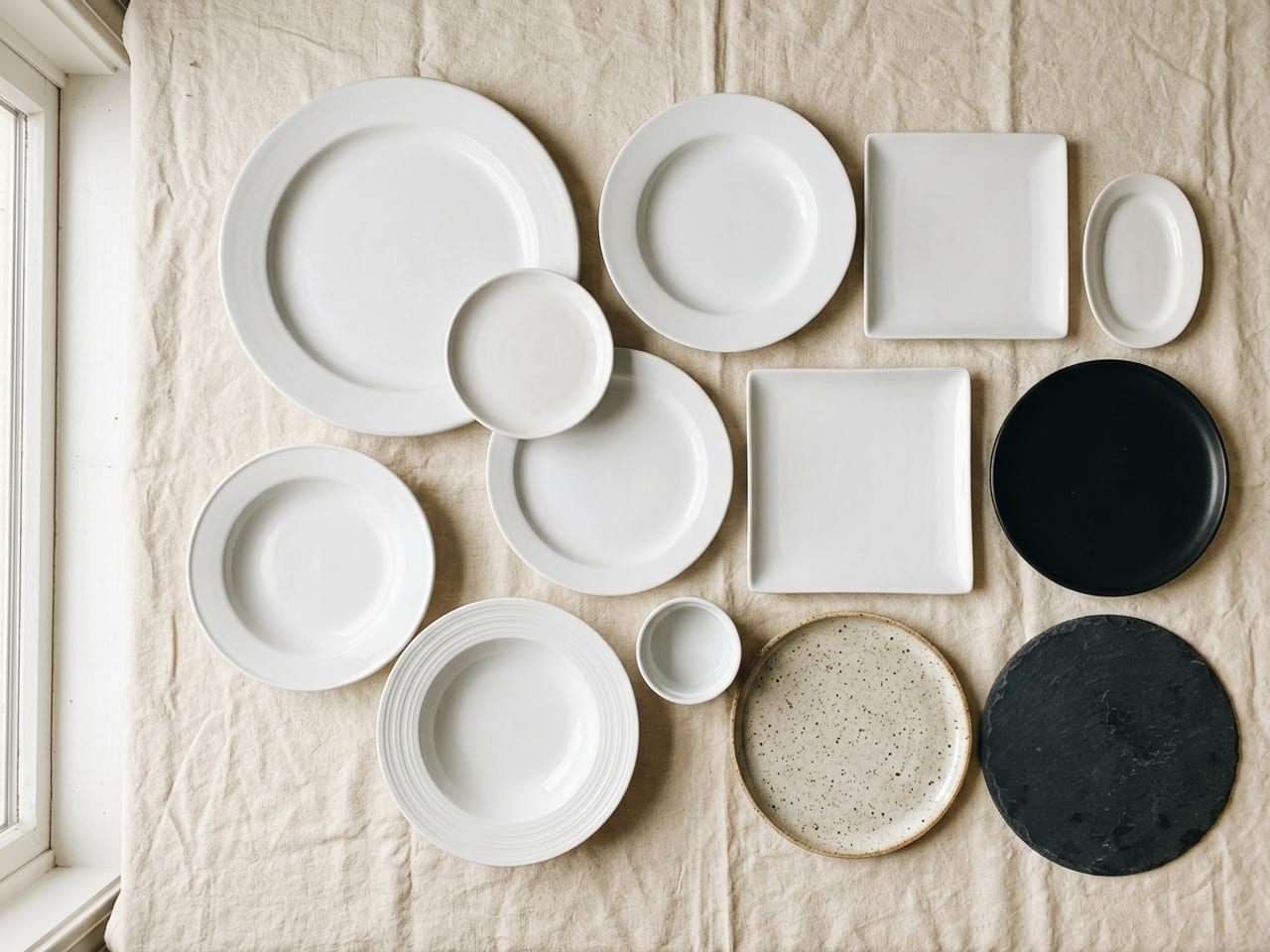
The parts of a plate
Five words cover every plate ever made, and two of them do most of the work: the well is where food goes, the rim is the frame around it.
Well
Also: centre, mirror, bassin.
The flat central floor of a plate, inside the rim: the surface food actually sits on and the number that matters more than the plate's diameter.
Rim
Also: lip, marli.
The flat raised border framing the well. Trade catalogues from Steelite, Churchill, Bauscher and Denby all call it the rim; collectors say lip, and French ceramics say marli.
Cavetto
Also: bouge, the slope.
The sloping wall that joins the rim to the well. Pewterers called it the bouge and hammered it to strengthen the metal; on a soup plate it deepens until rim and well read as one bowl.
Foot ring
Also: foot.
The ring the plate stands on, left unglazed on cheaper ware because it rests on the kiln shelf. Premium hotelware is fired on pins so even the foot can be glazed, which slows glaze wear in a stack.
Base
The underside inside the foot ring, where the backstamp, the pattern name and any oven, microwave or dishwasher rating are printed.
Why the well matters more than the diameter. Two plates with identical outside measurements can look completely different depending on how the maker split that width between rim and well. A restaurant moving from a 10.5 in plate to a 12 in plate frequently keeps the same well and buys nothing but a wider frame, which is exactly the point: the frame is the product. When you buy, measure the well.
Plate sizes, drawn to scale
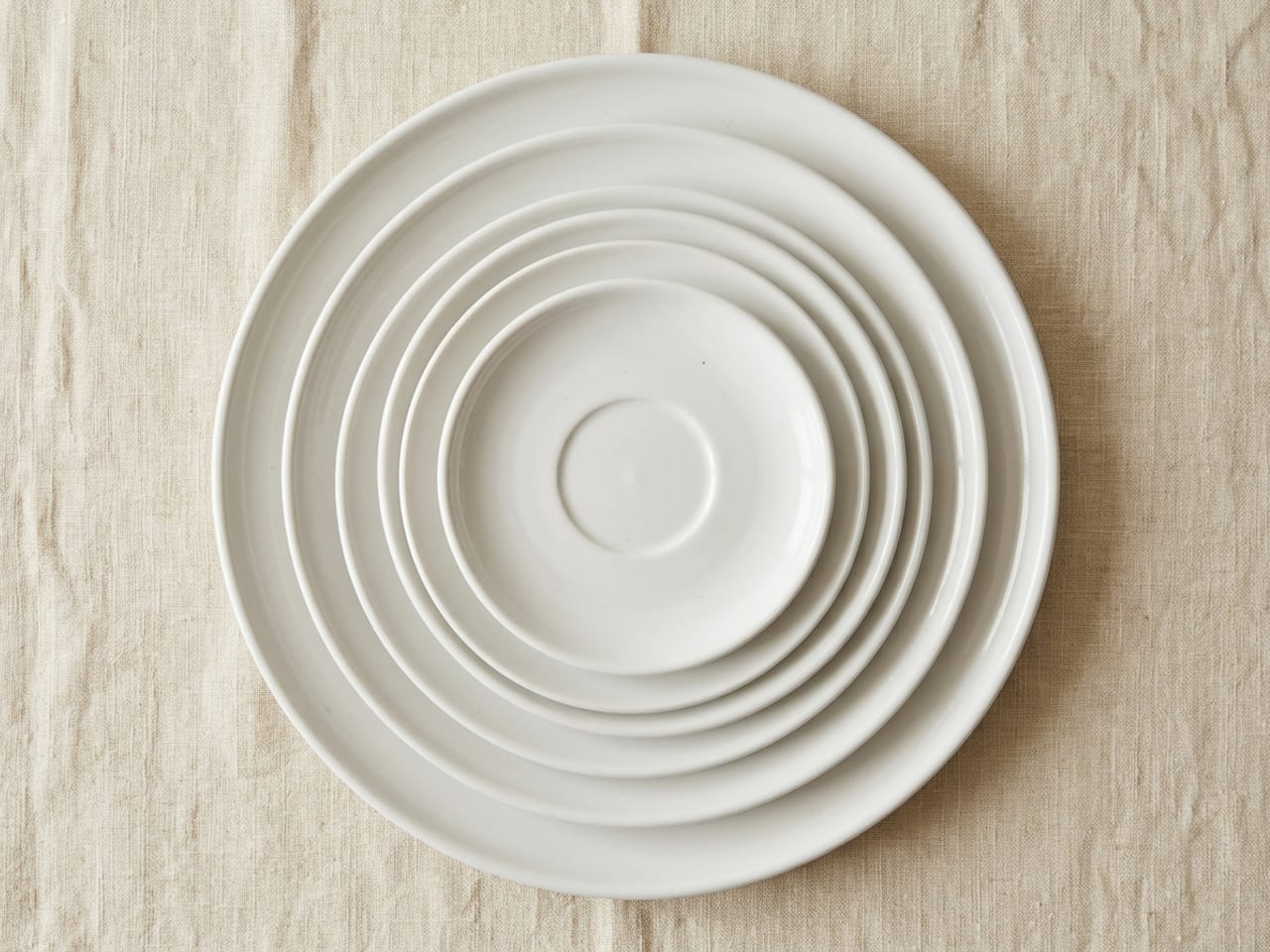
| Plate | Diameter | What it holds |
|---|---|---|
| Charger | 11–14 in / 28–36 cm | Nothing. It holds other plates |
| Dinner | 10–12 in / 25–30 cm | The main course |
| Luncheon | 8.5–9.5 in / 21.5–24 cm | A lighter main, a sandwich, brunch |
| Soup plate | 9–10 in / 23–25 cm | Soup, pasta, anything with a sauce to hold |
| Salad / dessert | 7–8.5 in / 18–22 cm | A starter, a salad course, the sweet |
| Side / bread | 5–7 in / 13–18 cm | Bread, butter, olives, stones and shells |
| Saucer | 4.5–6.5 in / 11–16 cm | A cup, or a very small anything |
| Appetiser | 4–7 in / 10–18 cm | One or two bites, an amuse-bouche |
Names travel badly, so trust the centimetres. An Australian "entrée plate" is a 23 cm starter plate; an American "entrée plate" is an 8.5 in course plate; US commercial ranges skip course names altogether and sell you a "narrow rim plate, 9¼ in". A UK side plate and a US bread-and-butter plate are broadly the same object, except where a British maker also lists a larger bread-and-butter plate, reversing the logic entirely.
The place-setting plates, defined
Each card: the one-sentence definition, the size as it is actually sold, and what the plate is for.
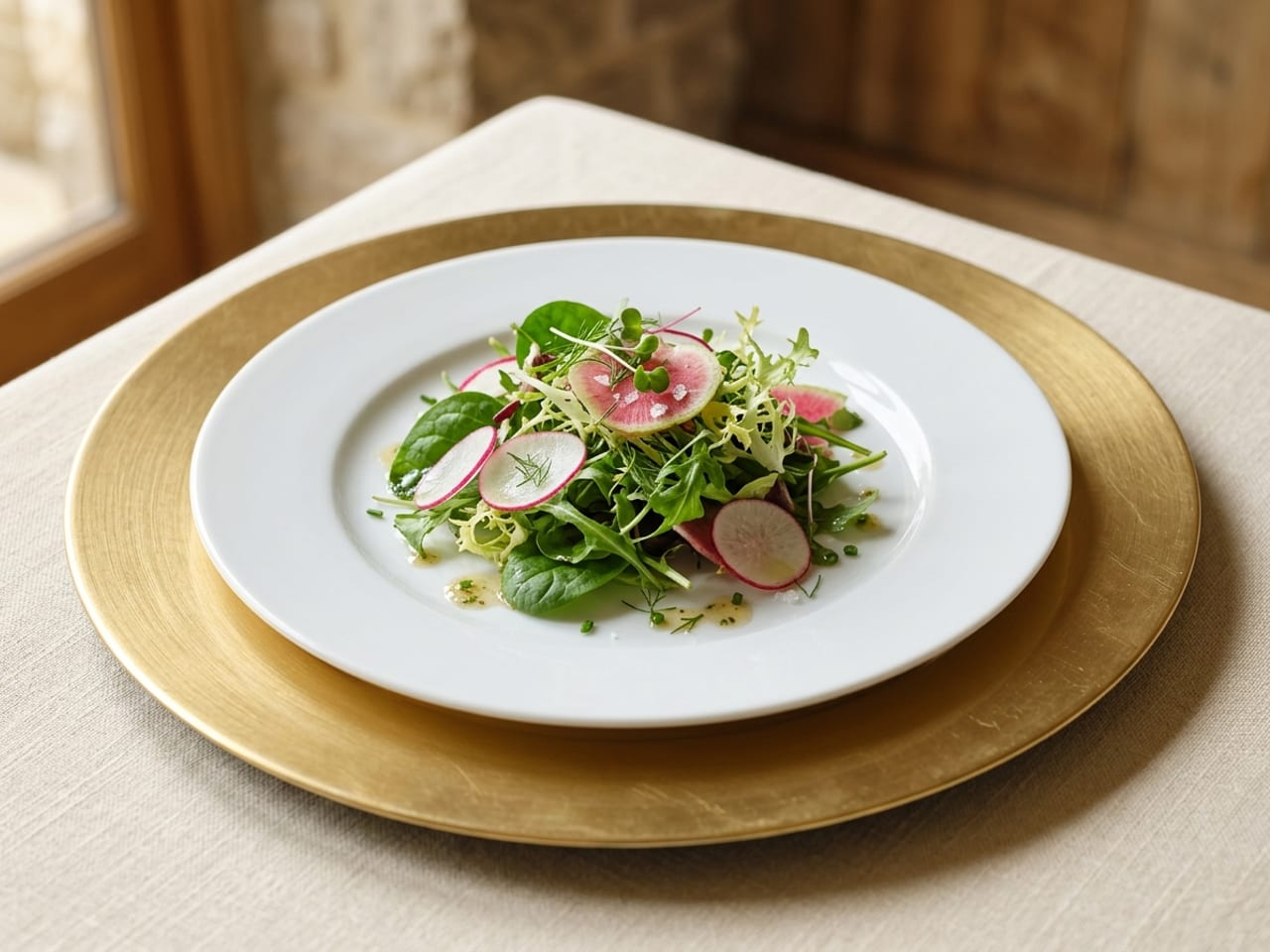
Charger
Also: service plate, show plate, presentation plate, underplate, place plate, cover plate.
The oversized plate laid before guests sit down, used as an underplate for the courses that arrive on their own plates and taken away before the main course.
Size: 11–14 in / 28–36 cm, most often 13 in / 33 cm.
A charger is the one plate on the table you are not supposed to eat from. Emily Post describes it as the underplate for the plate holding the first course, staying put through the courses that precede the entrée and being exchanged for the entrée plate when that arrives.4 Catering practice often differs: banquet crews commonly clear the charger with the dinner plate on top after the main course, which is why you will find both rules stated confidently online.
Do not serve food directly on one. Decorative chargers in beaded metal, glass, acrylic, rattan or painted wood are frequently not made from food-safe materials, and a charger sold as decor is not tested the way a dinner plate is. If it is plain glazed porcelain from a dinnerware line, it is a plate and you can use it as one.
The word is older than the object's current job. It comes through Middle English chargeour from Latin carricare, to load, and originally meant a large platter that carried a whole roast to the table.
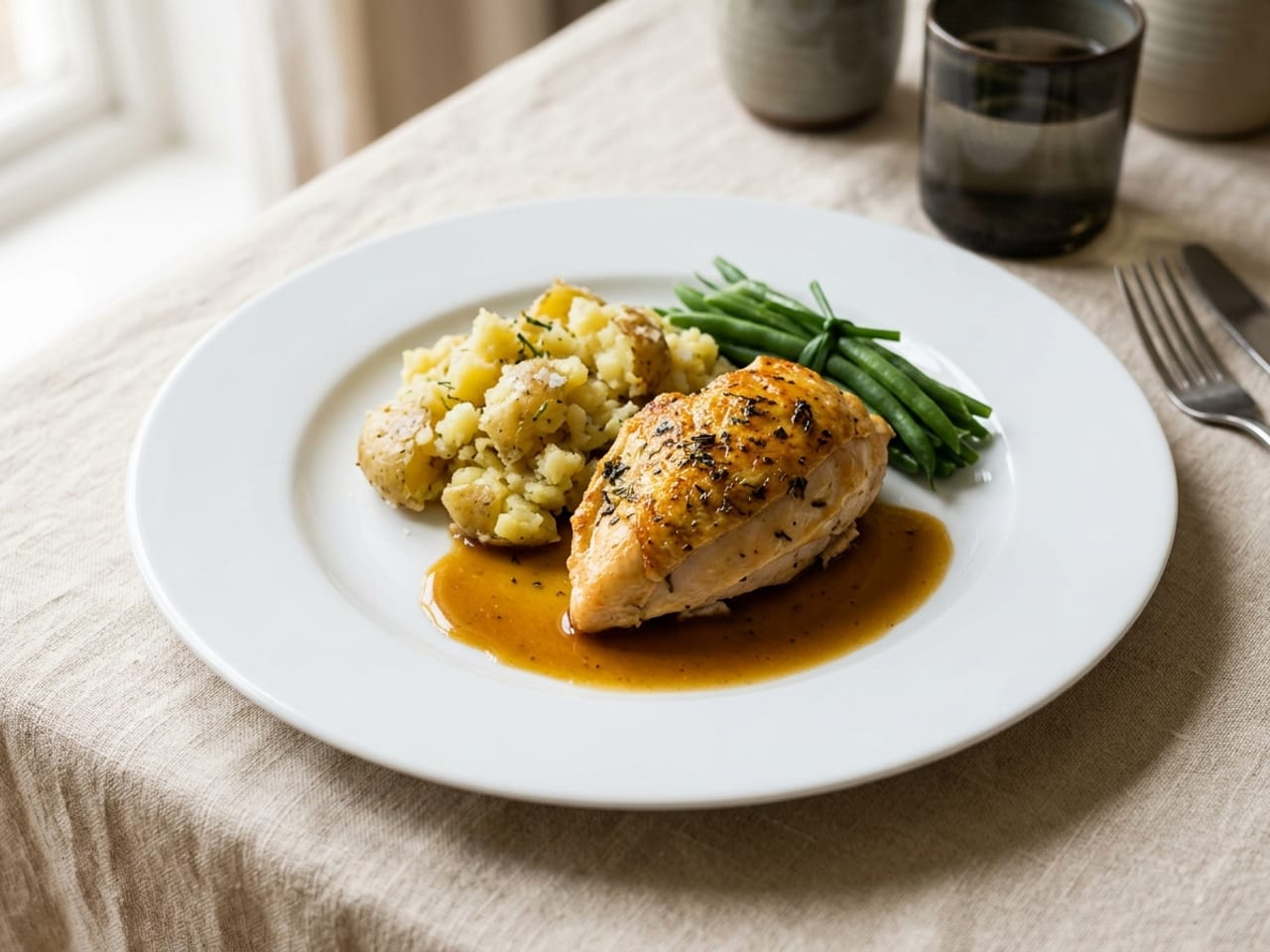
Dinner plate
Also: full plate, meat plate, joint plate.
The main-course plate and the hub of any place setting, standardised for a century at about 10.5 inches or 27 centimetres.
Size: 10–12 in / 25–30 cm; 10.5 in / 27 cm is the usual standard.
Sources disagree at the edges. Etiquette references say 10–11 in; Wedgwood lists 26–28 cm; Portmeirion calls 25 cm standard and goes to 30 cm; the UK catering supplier Nisbets says the trade standard has always been 10.5 in, with restaurants now often choosing 11 or 12 in plates that carry wider rims around the same well, so the eating surface has not actually grown.
Practical ceiling: 11 in is roughly where domestic dishwasher racks and cupboards start to complain, and a 12 in plate needs a table wide enough to keep the flatware on it.
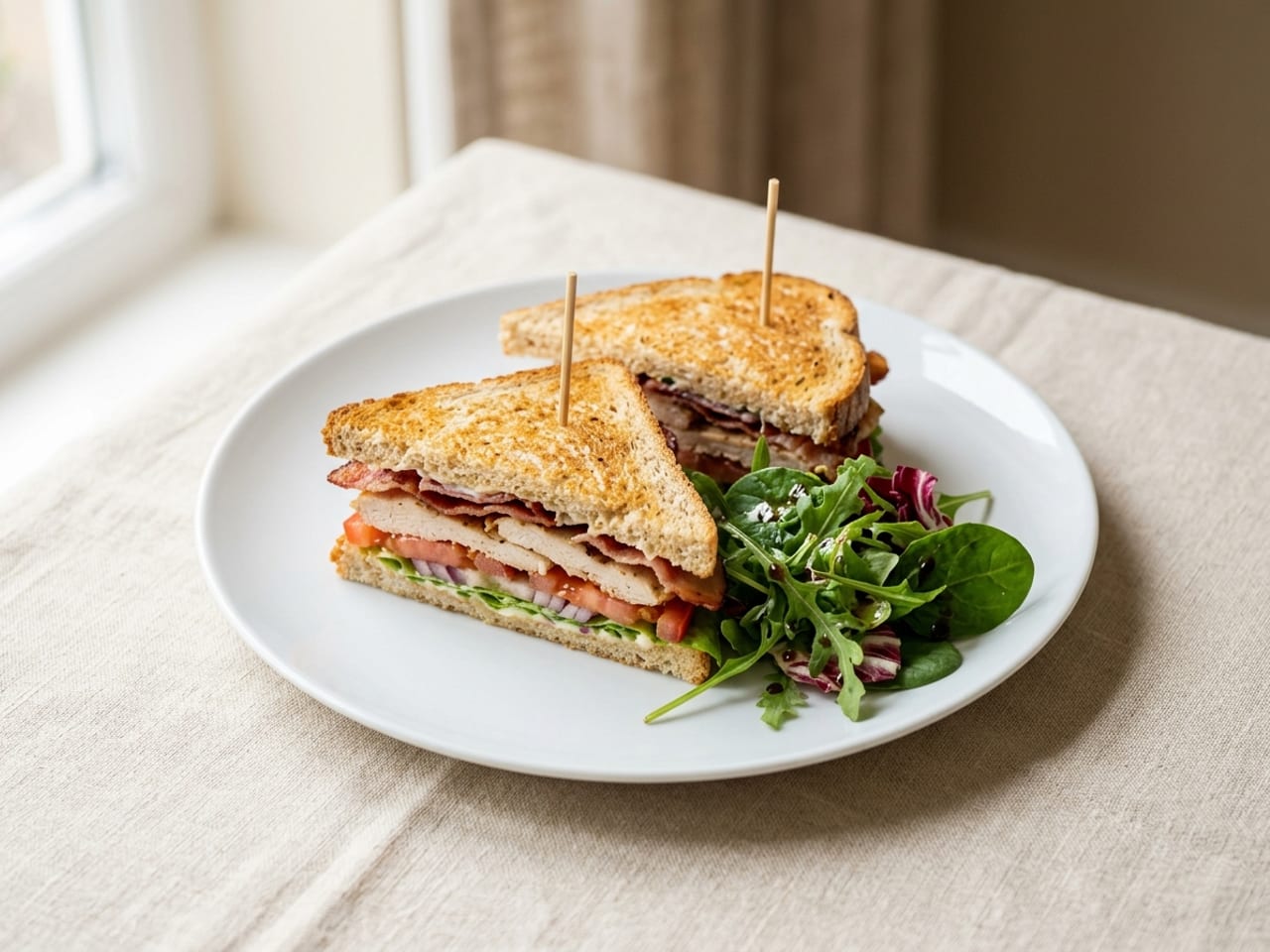
Luncheon plate
The plate between dinner and salad size, for lighter midday meals, sandwiches and brunch; a Victorian ladies'-luncheon survivor that many modern sets have dropped.
Size: 8.5–9.5 in / 21.5–24 cm.
Useful precisely because it is unfashionable: a luncheon plate is a dinner plate for a modern portion. Corelle sells its version at 8.5 in, vintage Fiesta's was 9 in, and formal references put it at 9–9.5 in.
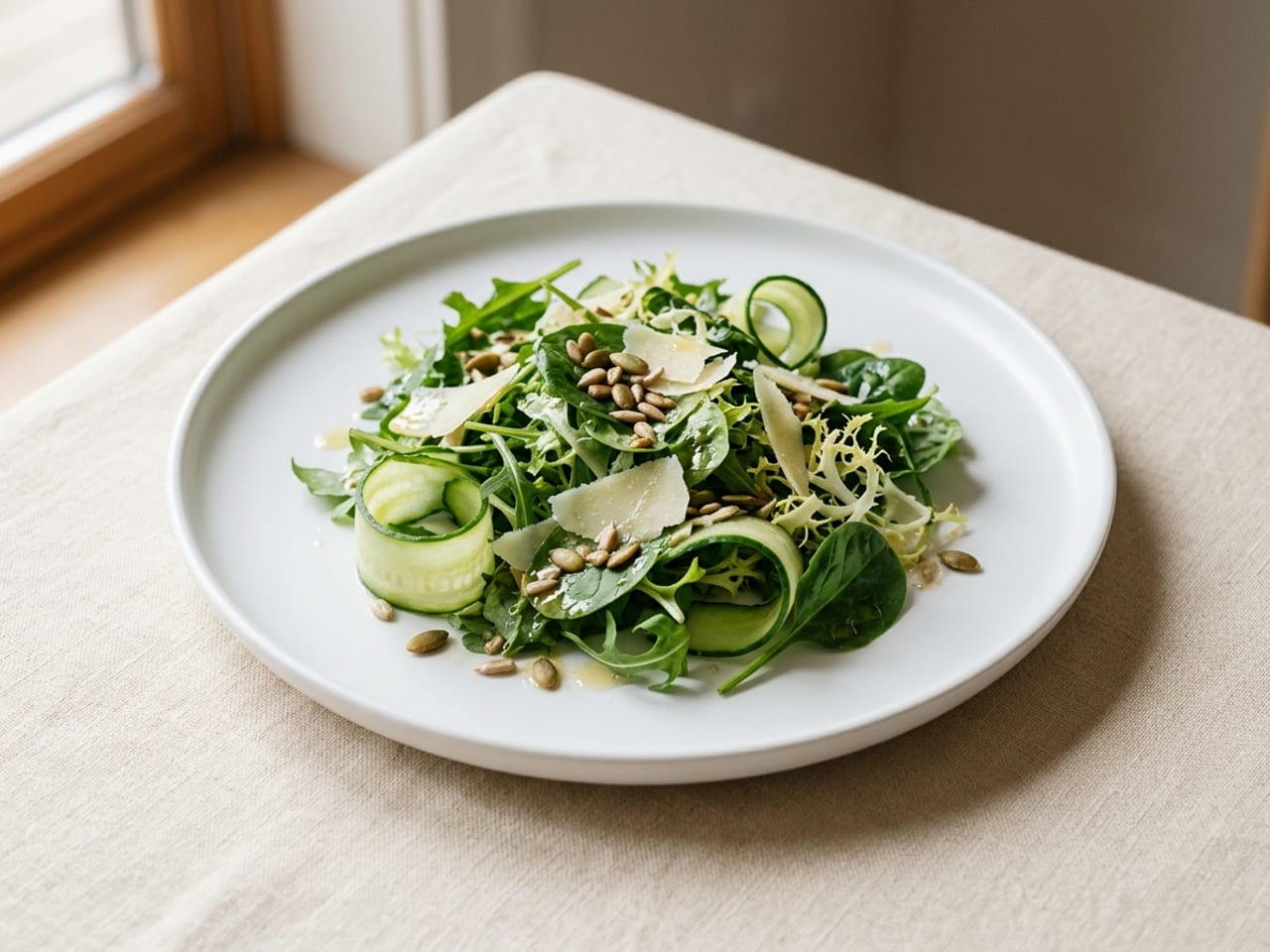
Salad plate
The medium plate for a salad course, a starter or a dessert, usually with a slightly raised rim to keep dressed leaves from sliding off.
Size: 7–8.5 in / 18–22 cm.
In North America salad usually comes before the main; French and Italian custom, and older formal American service, put it after. If the salad is the meal, it goes on a dinner plate. The crescent plate is the same idea bent into a new moon so it tucks against the dinner plate. What goes on it, and how, is in how to plate salad.
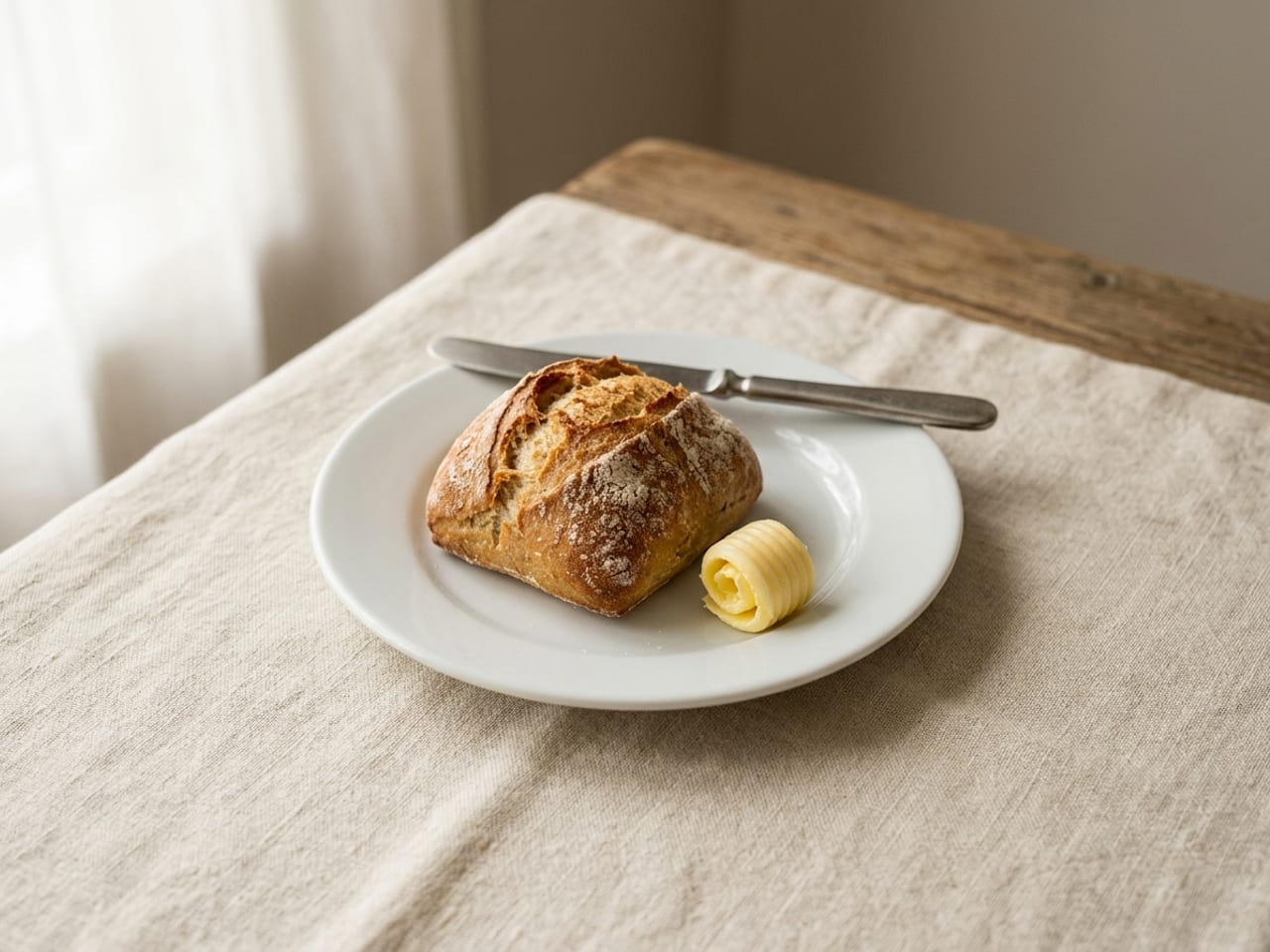
Side plate
Also: bread-and-butter plate, B&B plate, quarter plate, tea plate.
The small plate set above and to the left of the forks for bread and butter, olives or anything you want off the main plate.
Size: 5–7 in / 13–18 cm.
US and UK naming diverge here. In the US the bread-and-butter plate is the small one, 5–7 in. In the UK the side plate is 6–7 in but Wedgwood also lists a separate, larger bread-and-butter plate at 20–29 cm. When buying across markets, trust the centimetres, not the name.
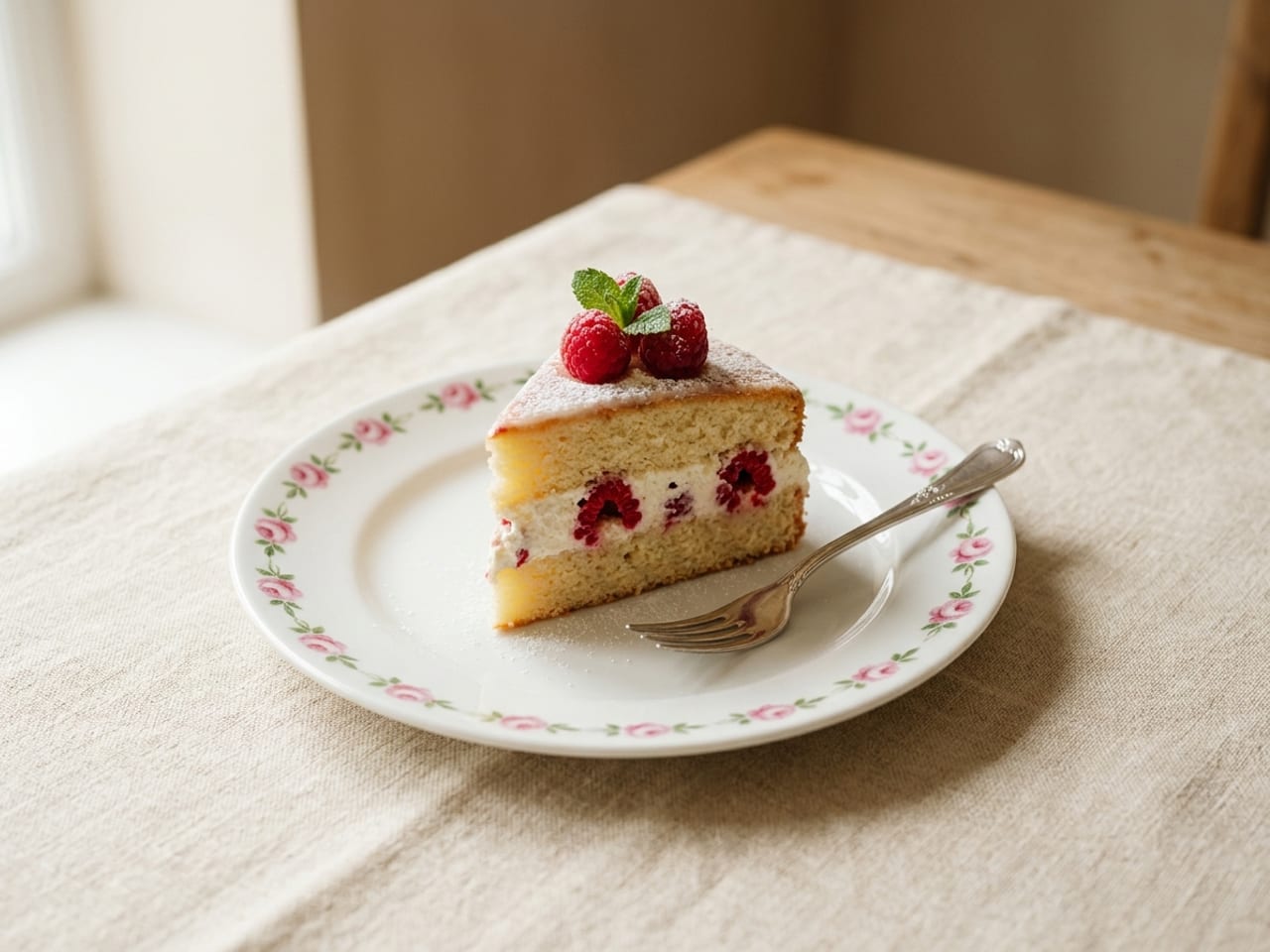
Dessert plate
Also: sweet plate, half plate, cake plate.
The plate for the sweet course, often decorated more heavily than the rest of a set because it is the last thing seen.
Size: 6–8.5 in / 15–22 cm in the US, 8–10 in / 20–25 cm in UK catering.
Because a crème brûlée arrives in its own shallow dish, plenty of restaurants plate rich desserts on the smaller starter size instead. Watch the ambiguity in "cake plate": it means both an individual 8 in plate and a footed pedestal stand for a whole cake.
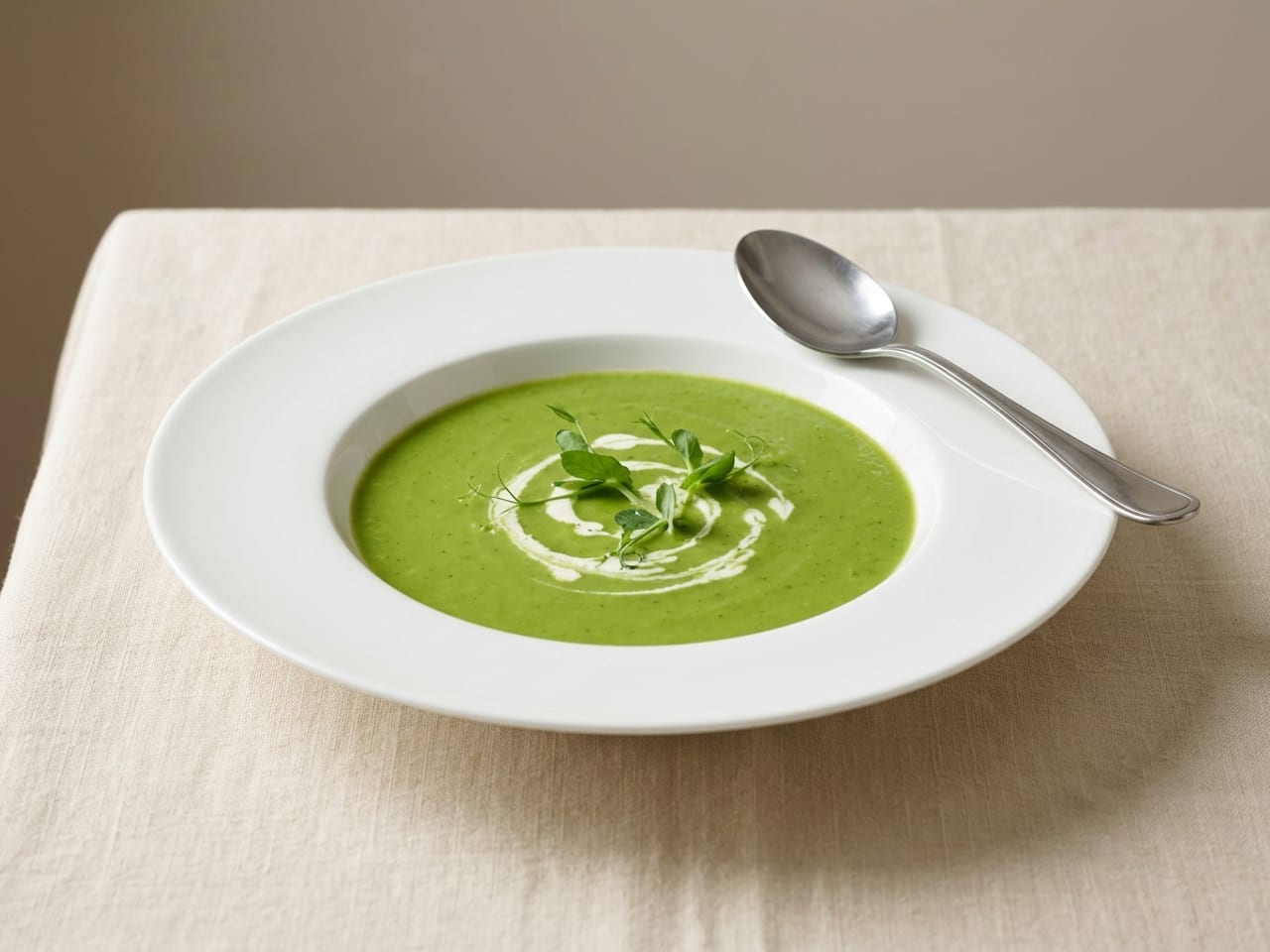
Soup plate
Also: rimmed soup bowl, deep plate, assiette creuse.
A wide shallow bowl with a flat rim: the only soup vessel used in formal service, and the shape a modern pasta plate is built on.
Size: 9–10 in / 23–25 cm across, well 6–7 in, up to 1.5 in deep.
The rim is the whole point. It gives a place for thumbs, a frame for the soup and somewhere for a garnish to sit dry. Lose the rim and the same vessel is simply a soup bowl. UK catering catalogues call it a deep plate; the French assiette creuse carries a legend that Cardinal Mazarin brought it from Italy in 1653.
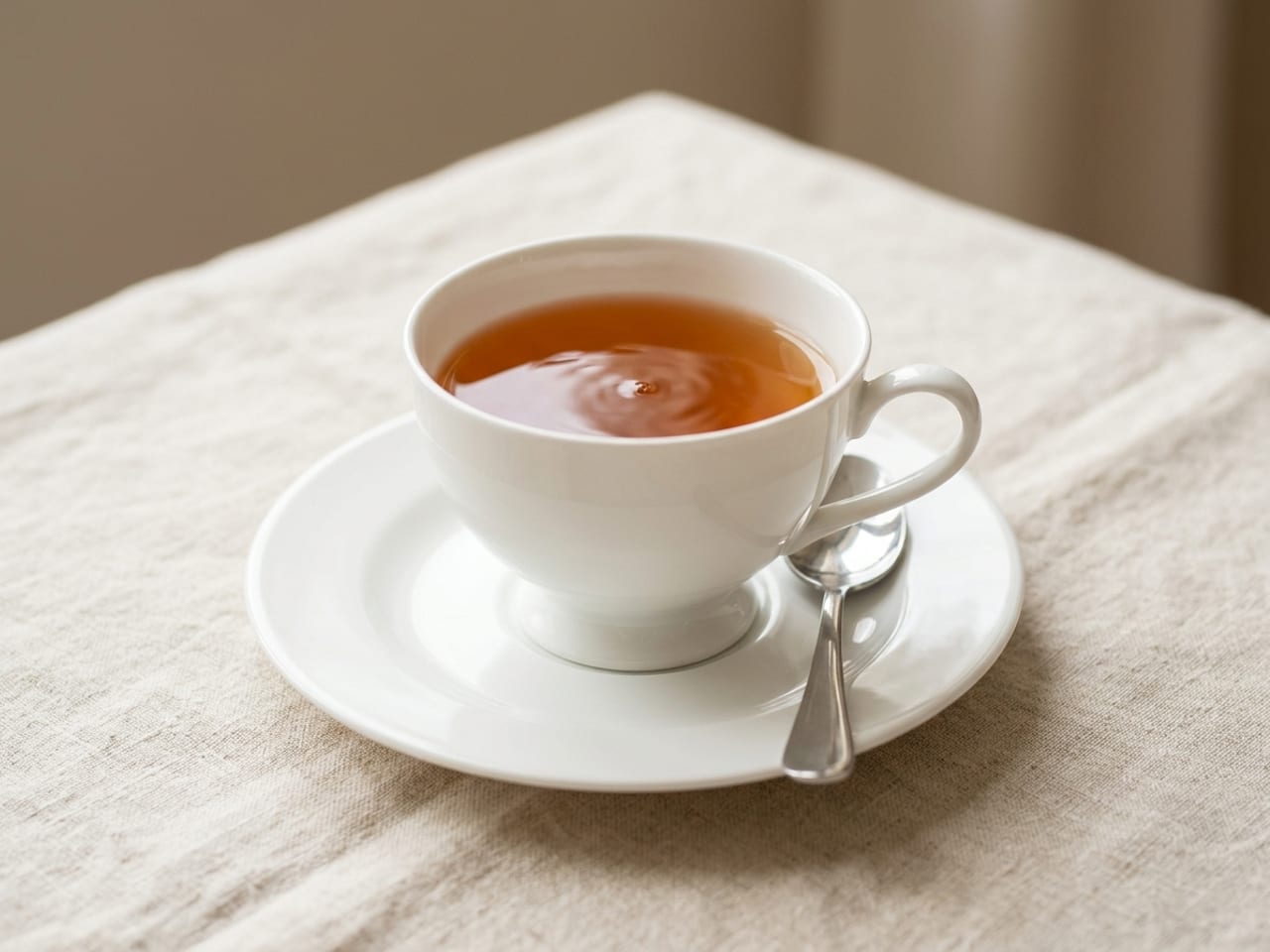
Saucer
The small dished plate whose well is sized to grip the foot of its cup so the cup does not slide when carried.
Size: 4.5–6.5 in / 11–16 cm.
A tea saucer runs about 6 in, a demitasse saucer about 4.5 in. Loose saucers make excellent miniature side plates for olive stones, tea bags and spoon rests.
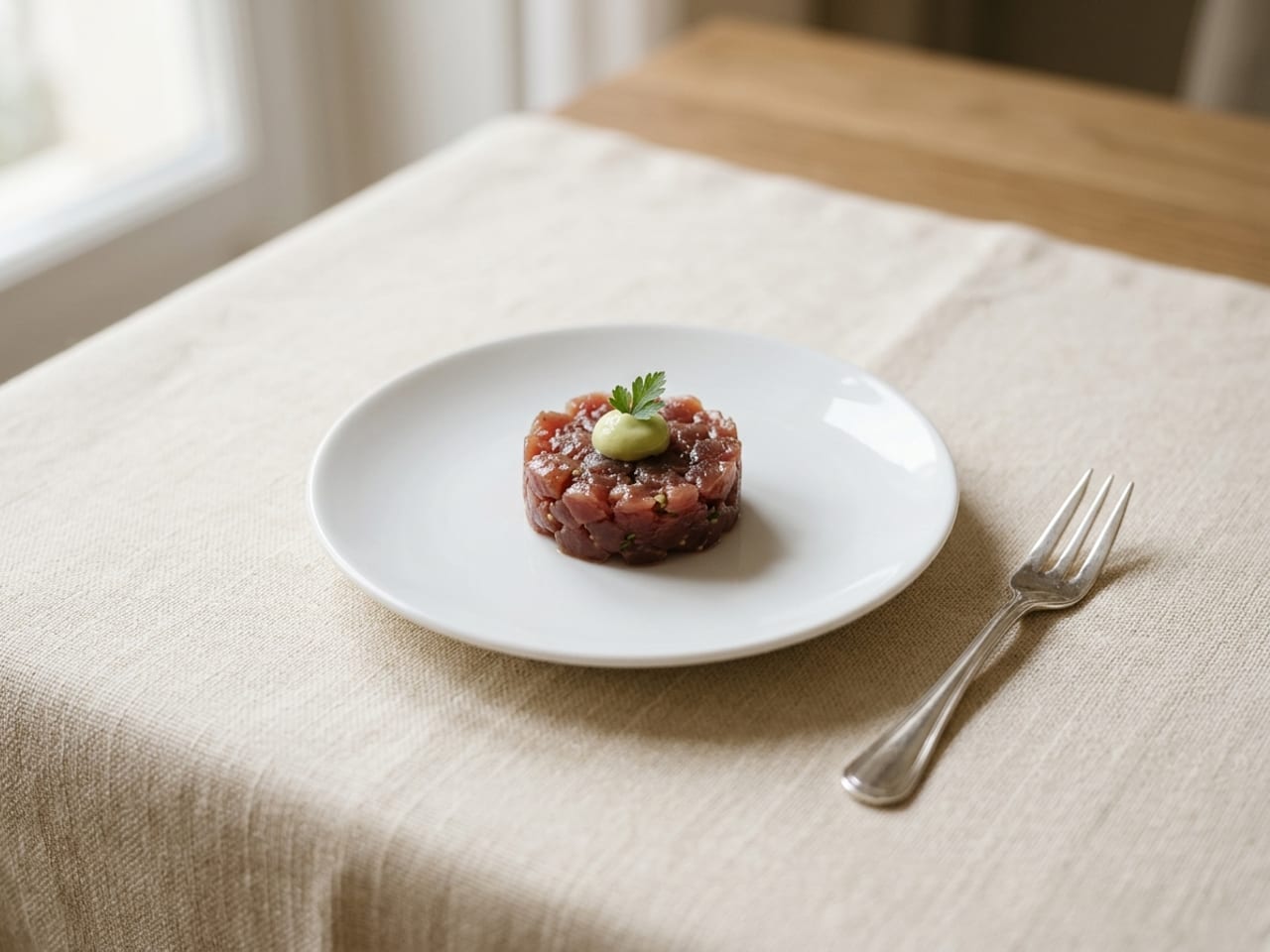
Appetiser plate
Also: tasting plate, small plate, amuse-bouche plate.
The smallest serving plate in commercial ranges, used for one or two bites, an amuse-bouche, or as an auxiliary plate for shells and bones.
Size: 4–7 in / 10–18 cm.
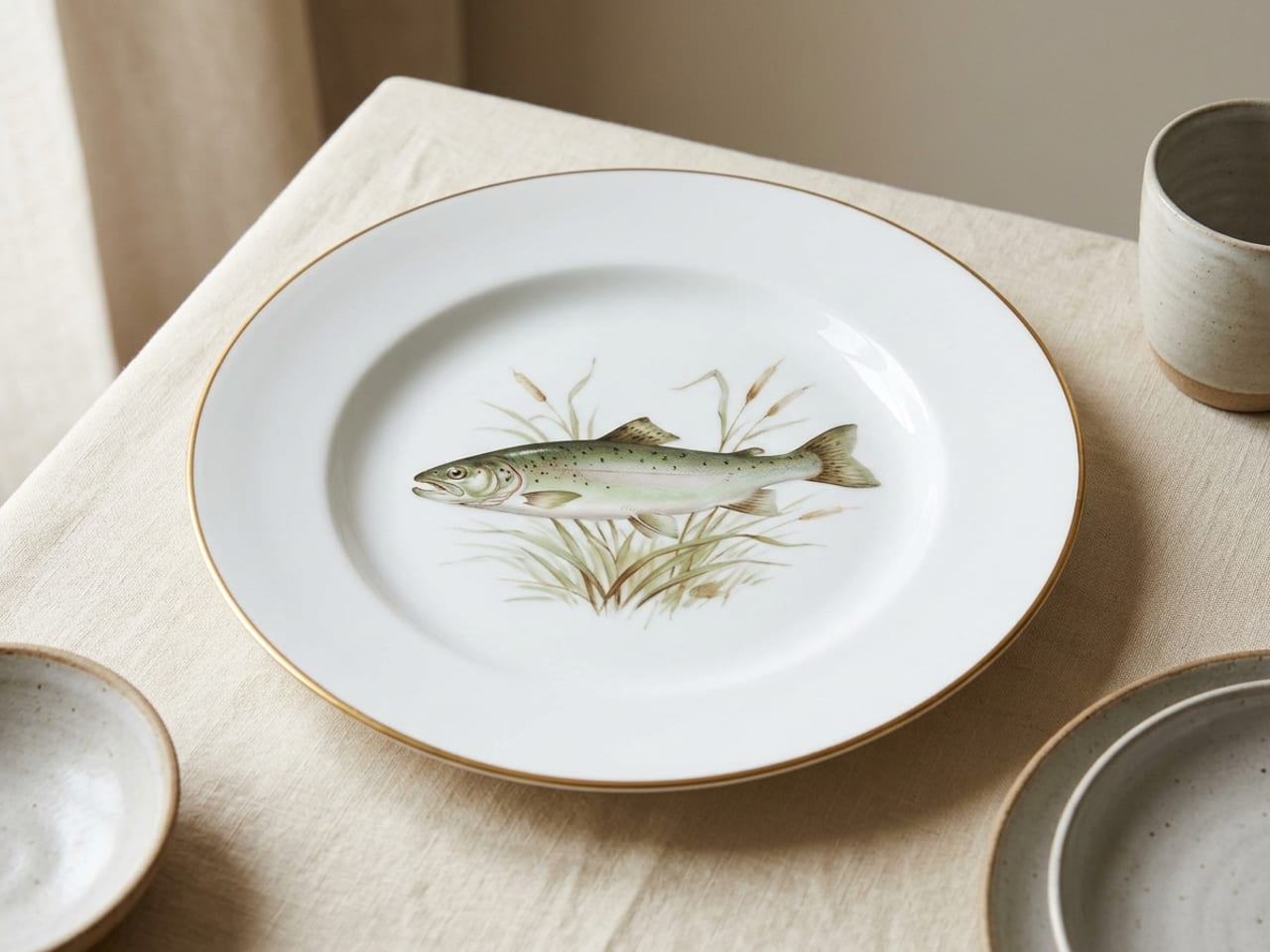
Fish plate
A medium plate, historically sold outside a dinner service and decorated with a painted fish, from the 1880s vogue for matched fish services.
Size: 8–9 in / 20–23 cm.
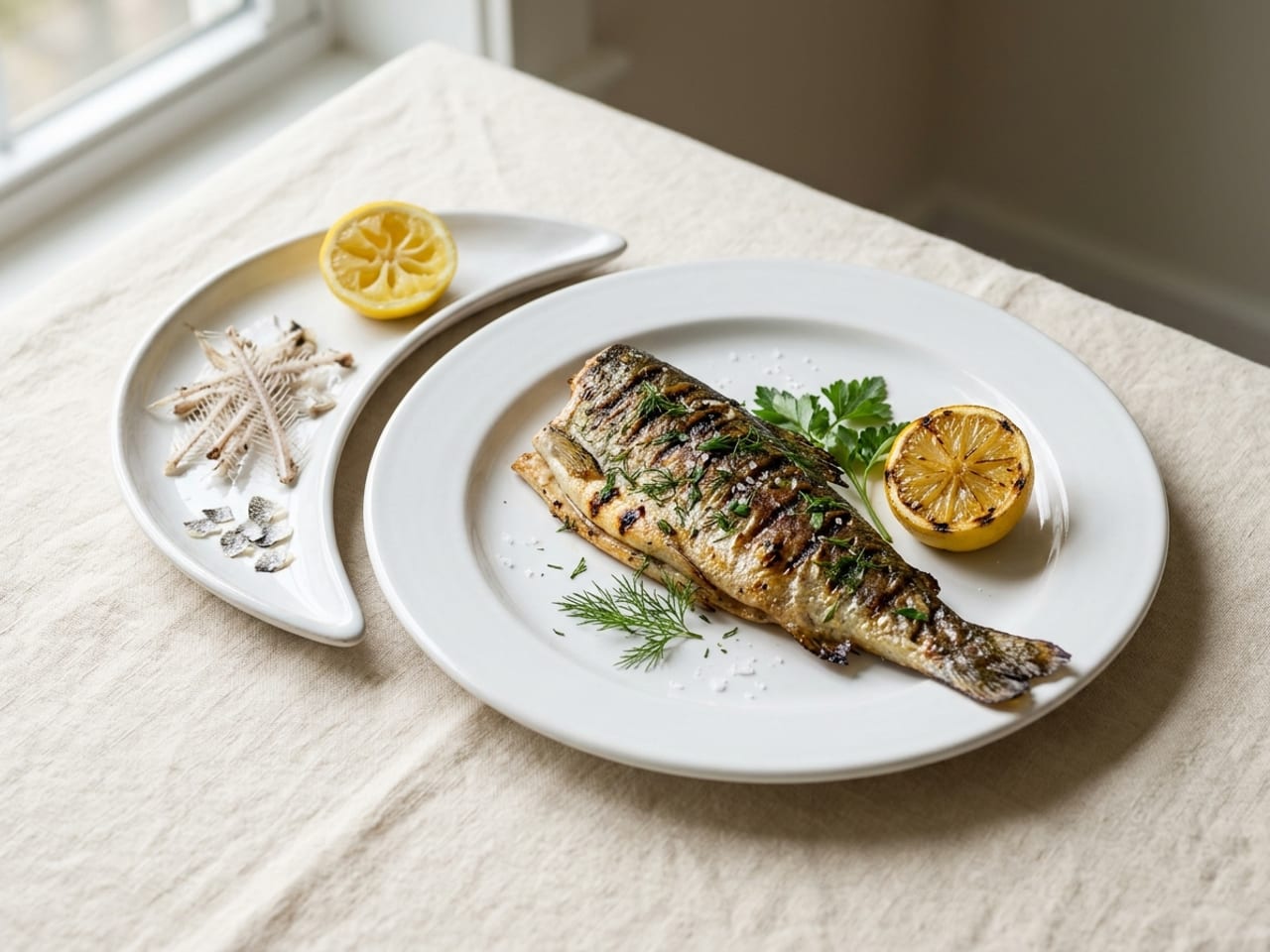
Bone dish
Also: crescent plate.
A crescent-shaped dish that nests against a round plate, made to receive fish and poultry bones in Victorian service and out of fashion by the 1920s.
Size: About 6 in / 15 cm on the long axis.
Where the charger sits, and when it leaves
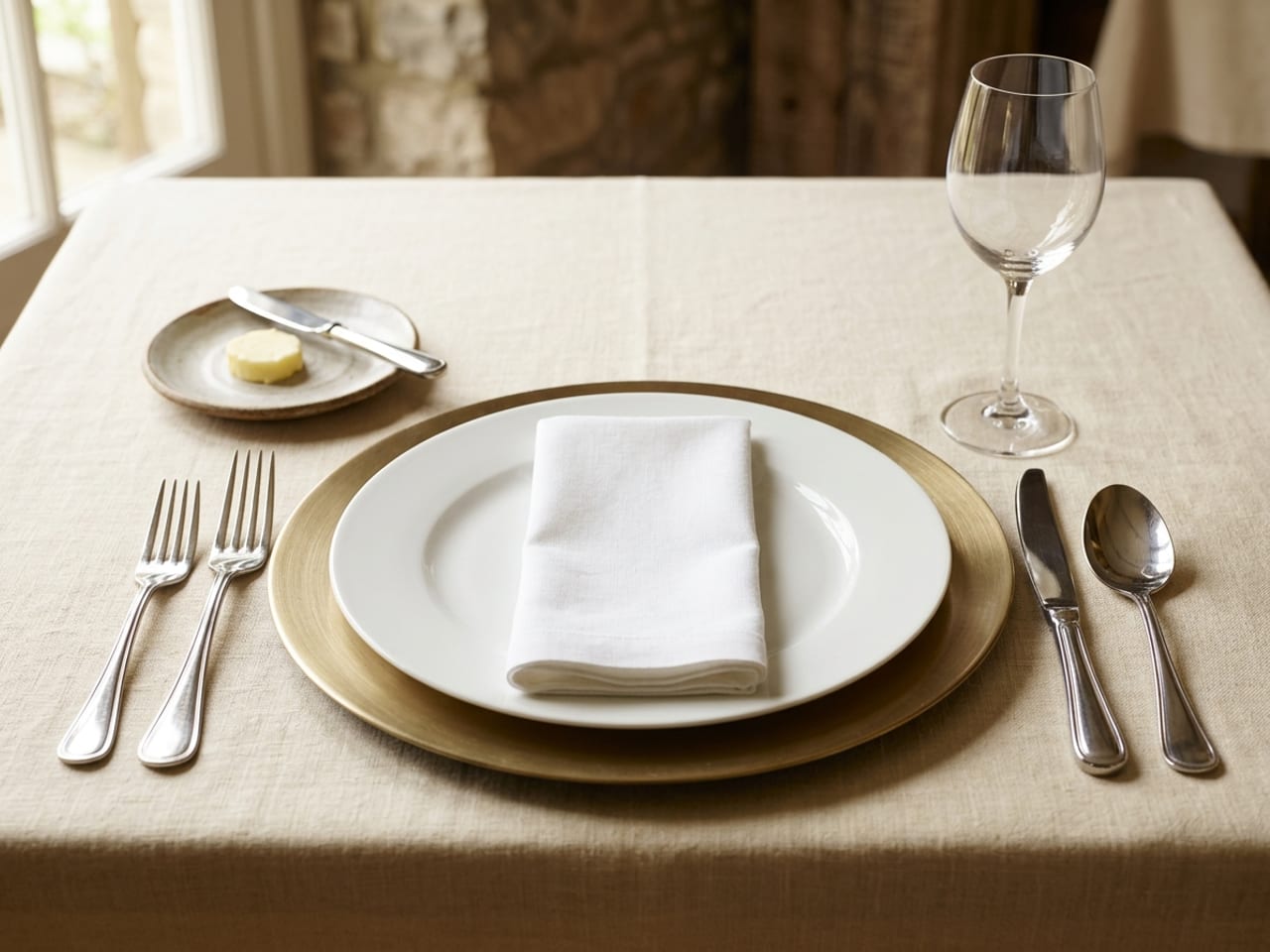
- It is an underplate, not a plateFormal etiquette exchanges the charger for the entrée plate when the main course arrives; catering crews often clear it after the main with the dinner plate on top. Both are in current use, which is why guides contradict each other.4
- Leave at least an inch of rim showingThe charger's job is to frame the plate on top of it. A 13 in charger under a 10.5 in dinner plate gives a 1.25 in ring all the way round, which is the look people are buying.
- Check whether yours is food-safeDecorative chargers in beaded metal, mirrored glass, acrylic, rattan or painted finishes are frequently not made for food contact. Anything carrying a "Not for Food Use" mark on the base is regulated as decor, not tableware.10
- Or use a big plate insteadA 12–13 in dinner plate from a commercial range works as a charger and doubles as a buffet plate, which is exactly how suppliers sell the presentation plate.
Setting a table for a particular menu? The table setting diagram maker draws the basic, informal or formal place setting for the courses you are serving, charger included, with every piece numbered.
Shapes: rimmed, coupe and everything after
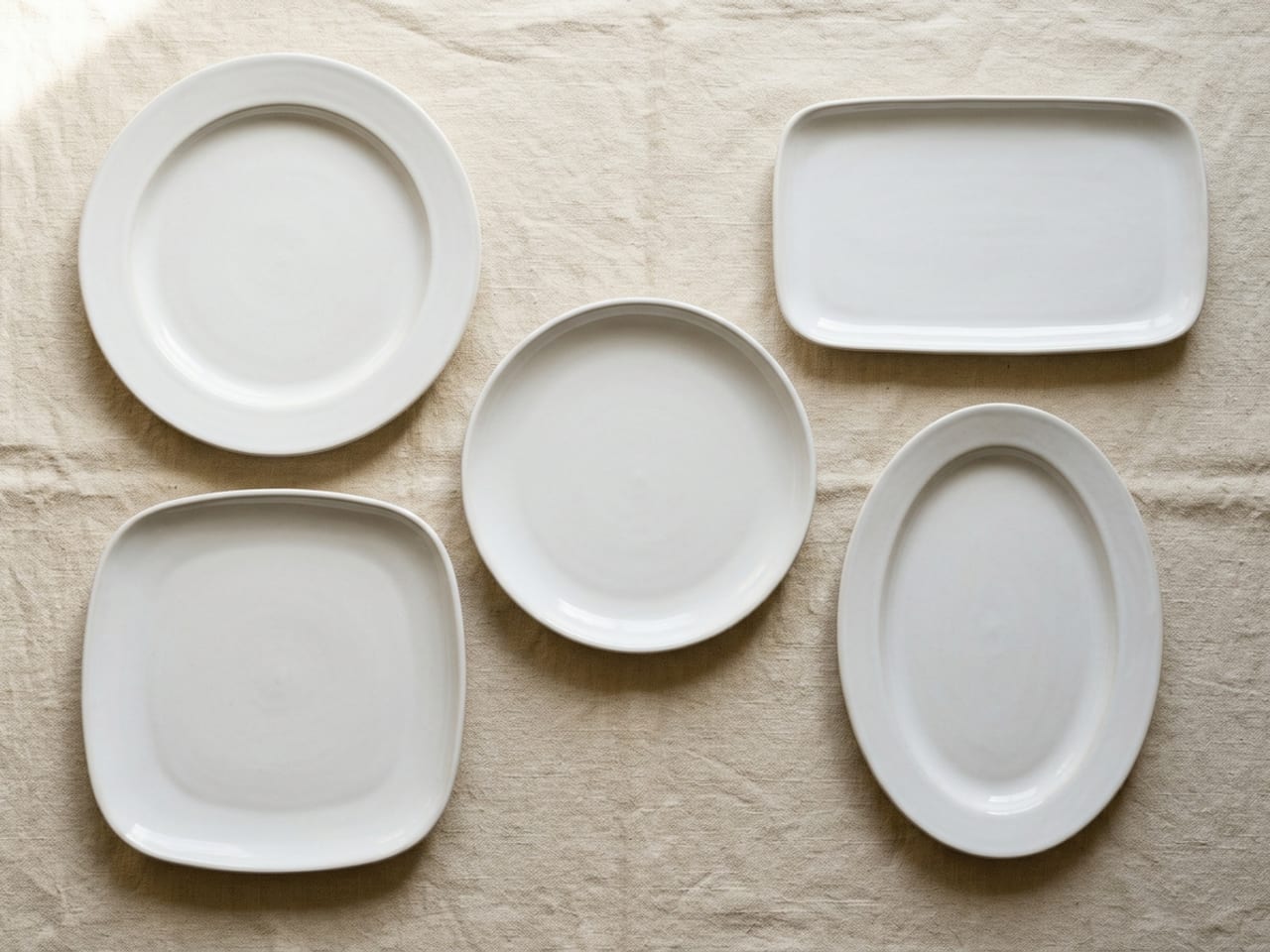
Rimmed plate
Also: wide rim, broad rim.
A plate with a border clearly separated from the well. The traditional European profile, descended from metalwork; it frames the food, catches juices, and gives the server somewhere to hold.
Narrow rim
A discreet border rather than a wide flat one, so more of the same diameter is usable as a plating surface. The commercial middle ground between rim and coupe.
Coupe plate
Also: rimless.
A plate with no distinct rim, its surface flowing evenly from the centre to a gently upturned edge. Reads flatter, quieter and more modern, and makes the whole disc the canvas.
Deep coupe
A rimless plate with a genuinely bowled centre, sold under that name by Steelite and Bauscher: the shape that holds a risotto, a curry or anything with a moat of sauce.
Flat plate
Also: presentation plate.
An almost perfectly flat disc with no well at all. Dramatic for dry, composed food and useless for anything that runs.
Pasta plate
Also: deep plate, assiette creuse.
A wide rimmed plate with a shallow bowled well, typically 28–29 cm, built so a nest of pasta sits proud in the middle with the sauce held around it.
Square plate
A four-sided plate, common in Asian restaurant ranges and 2000s Western fine dining. Sharp corners chip more readily than round rims, so most commercial squares now have softened corners.
Rectangular plate
Also: oblong, naga-zara.
A long plate for sequences: three canapés, a row of sashimi, a tasting flight. It forces a left-to-right reading order that round plates do not.
Oval plate
The elongated round, traditional for fish and for any food longer than it is wide; also the practical shape for platters, since ovals store where big rounds will not.
Triangle plate
A rarer fine-dining and appetiser shape, sold in commercial ranges at 18–31 cm; the point gives a natural focal direction.
Organic plate
Also: free-form.
A round-ish plate with a deliberately uneven, hand-thrown edge. Churchill's official word for the profile; it reads handmade even when it is not.
Rim versus coupe is the decision that matters. Put the same dish on both and the rim version looks composed and restaurant-y, because the empty border reads as deliberate negative space and the food sits in a frame. The coupe version looks calmer and more modern, and it gives you more usable surface at the same diameter, which is why it suits food that spreads.
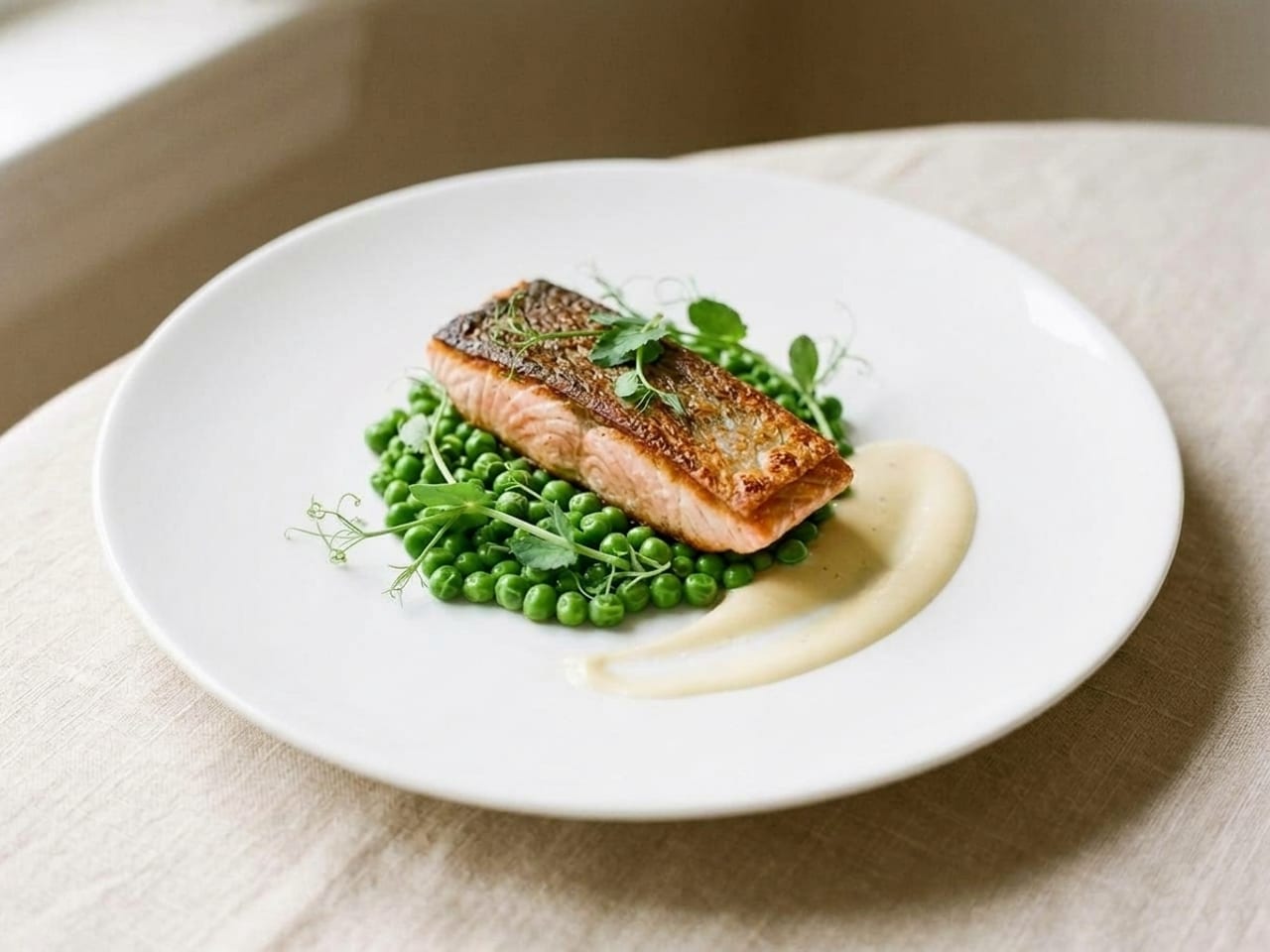
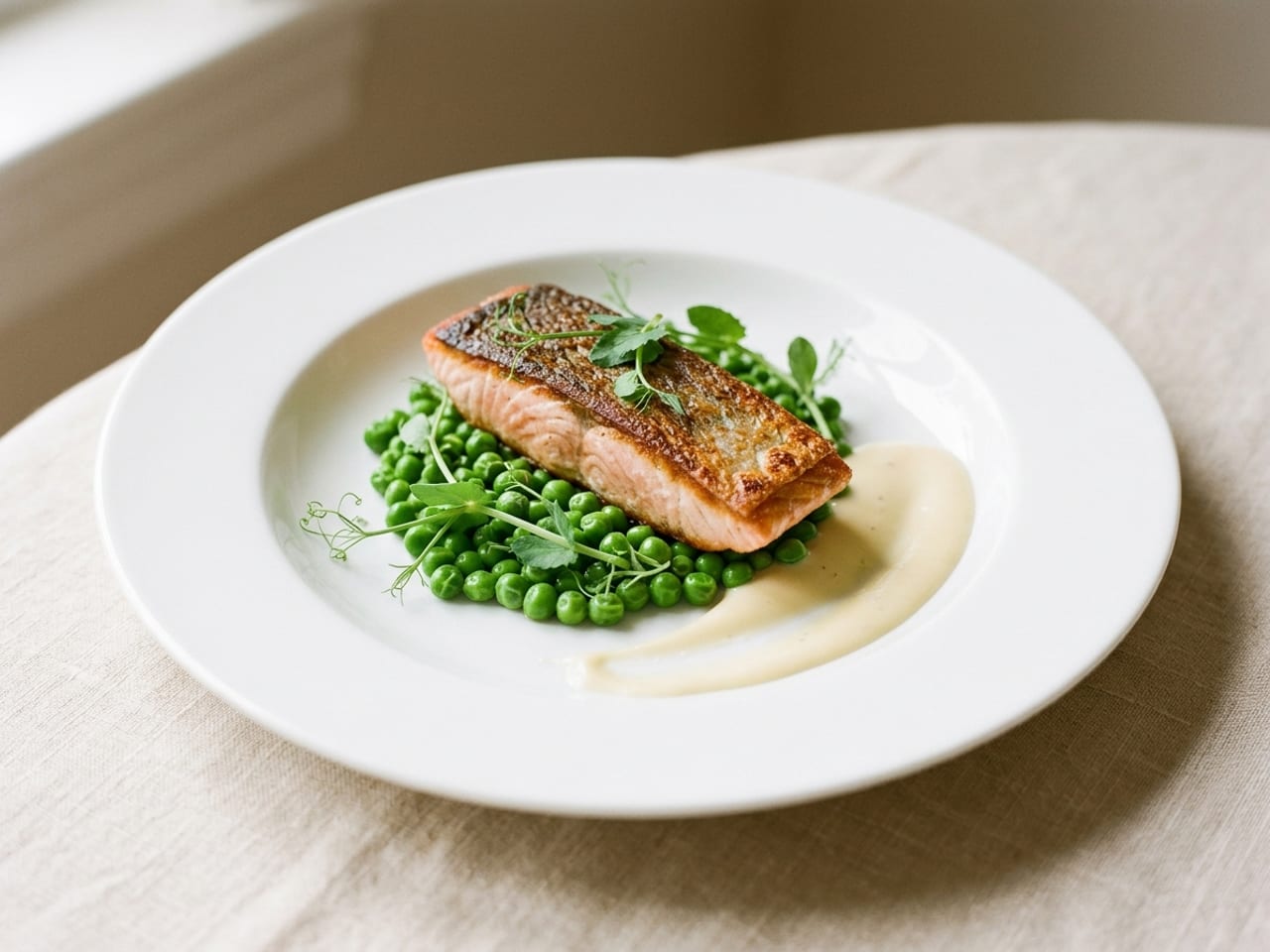 Wide rimCoupe
The bowl end of the family
The line between a plate and a bowl is a slope, not a border. Deepen a plate's well and keep the rim and you have a soup plate. Lose the rim and it is a soup bowl. Widen the bowl and flatten the floor and it is a pasta plate again. The names follow the depth of the well and the presence of a rim, in that order.
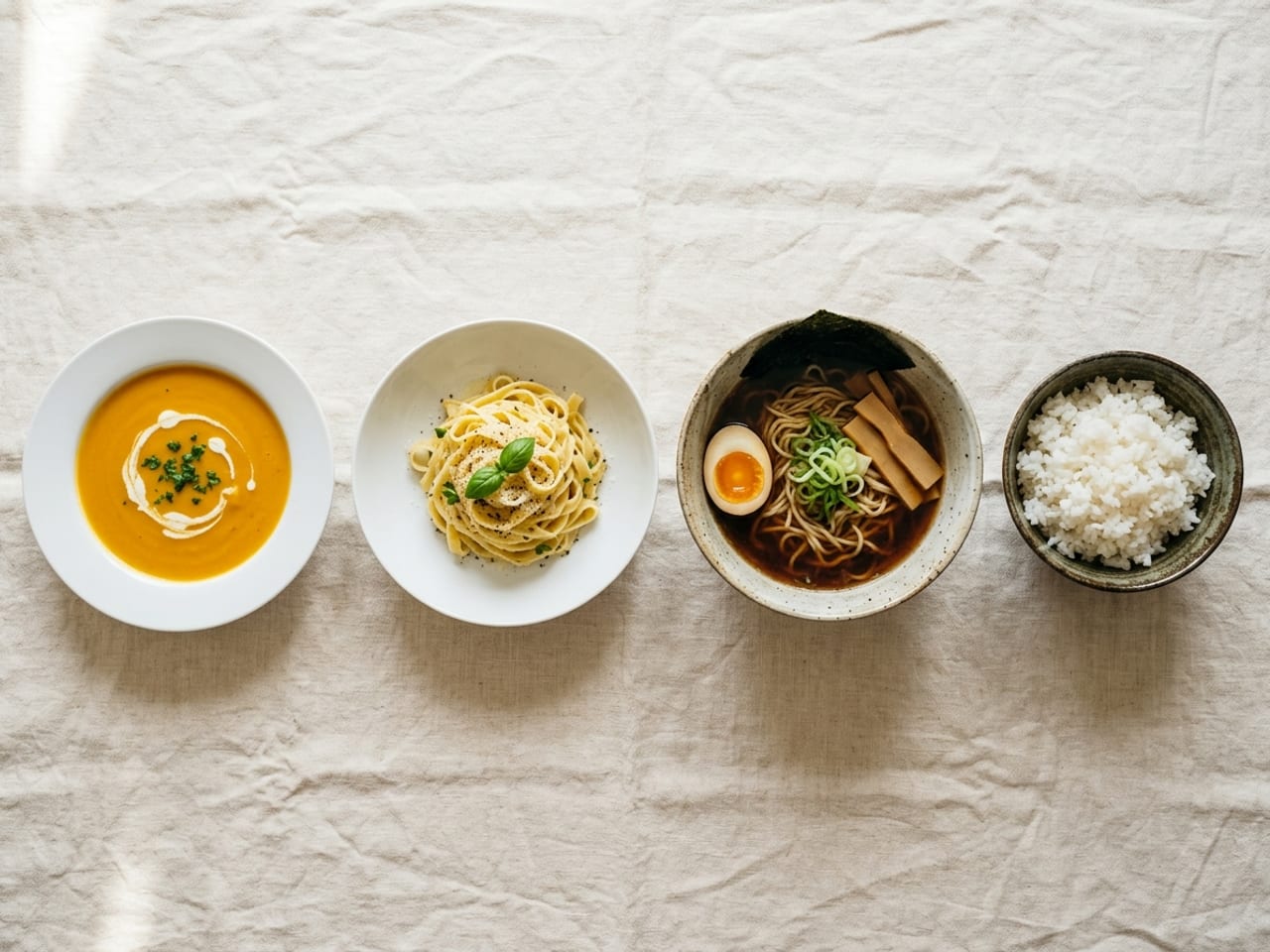
| Vessel | Size | Made for |
|---|---|---|
| Soup plate | 9–10 in / 23–25 cm, to 1.5 in deep | Formal soup service; a rim to hold and to garnish on |
| Coupe soup | 6–9 in / 15–23 cm | The same thing without a rim, informal only |
| Pasta plate | 11–11.5 in / 28–29 cm | A nest of pasta proud in the middle, sauce held around it |
| Cereal bowl | About 7.5 in / 19 cm | Breakfast, and the everyday grain bowl |
| Donburi | 15 cm, about 900 ml | Rice with one topping |
| Ramen bowl | 18 cm, about 1,400 ml | Broth, noodles and toppings each with their own space |
| Rice bowl (chawan) | 12 cm, about 6 cm tall | Roughly 150 g of steamed rice, lifted in the hand |
Materials: nine bodies and what each one costs you
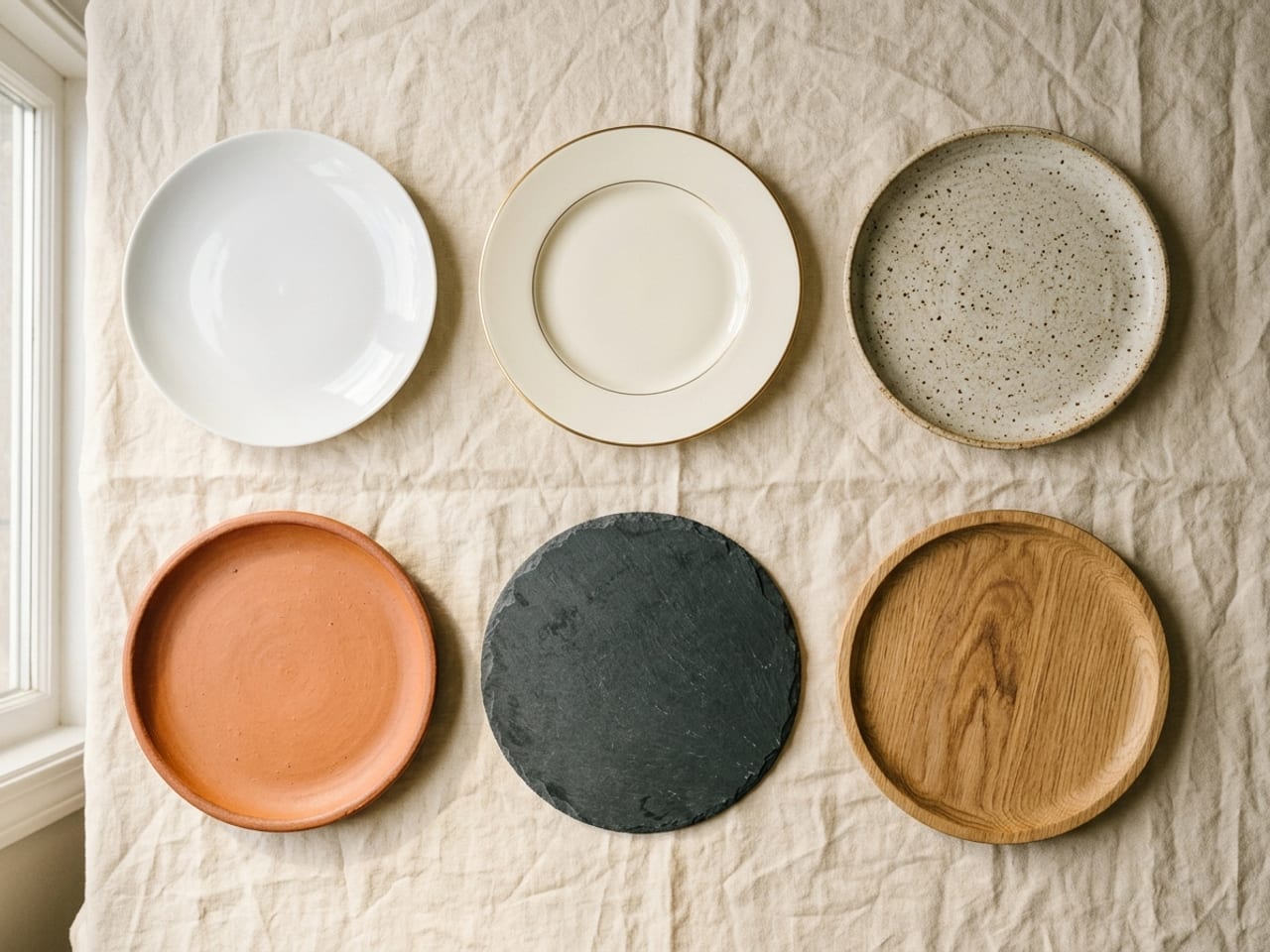
| Material | Fired at | Absorbs | Oven | Weight, 27 cm plate |
|---|---|---|---|---|
| Porcelain | 1,200–1,400 °C | under 0.5% | Usually yes; check the base | 740–980 g |
| Bone china | Biscuit 1,200–1,300 °C, glaze 1,050–1,100 °C | under 0.5% | Pattern-specific; never with metal trim | 600–710 g |
| Vitrified hotelware | About 1,200 °C with added alumina | 0.2–0.4% | Yes, and usually freezer to oven | 780–980 g |
| Stoneware | 1,200–1,300 °C | About 2% | Usually yes, often to 260 °C | 790–850 g |
| Earthenware | About 900–1,060 °C | 10–15% | Cazuelas and tagines yes; decorated ware, check | Heavy for its strength |
| Glass and glass laminate | Tempered by reheating to about 650–700 °C and rapid cooling | Zero | Preheated oven only, low temperatures | About 350 g |
| Melamine | Moulded thermoset resin, not fired | Zero | Never. Never microwave either | Very light |
| Enamelware | Glass fused to steel at 750–850 °C | Zero | Yes, typically to 270 °C. Never microwave | Light for its toughness |
| Slate, wood and bamboo | Quarried or milled, not fired | Porous unless sealed | No | Heavy (slate), light (wood) |
Water absorption is the number that separates the tiers. A body is "vitrified" when it has been fired until it is effectively glass, and the trade threshold sits under 0.5%.23 Everything else in the table follows from it: stain resistance, hygiene, strength, weight and price.
Porcelain
Also: hard-paste porcelain, china.
Kaolin, quartz and feldspar fired until the body turns glassy: vitrified, impervious, translucent and resonant, by the definition in ISO 5644.
The default restaurant canvas, and the reason plain white plates dominate professional kitchens. Fired hot enough that the body itself is effectively glass, so it does not absorb food, odours or bacteria, and a chip exposes more white rather than a dark clay underneath.1 Britannica notes the trade-off: hard porcelain is strong but chips fairly easily, and untreated it carries a blue or grey cast.
On the table: Bright white, slightly cool, faintly translucent.
Bone china
A porcelain containing calcined bone ash, introduced by Josiah Spode II around 1800 and still the strongest, whitest, most translucent tableware body.
Spode I invoiced "English China" in 1796 and called it Stoke China before the name bone china stuck.7 The bone ash gives a warm creamy white rather than porcelain's starker tone, and the minimum content depends on whose rule you read: at least 25% bone ash under ASTM C242, at least 30% by UK industry practice, at least 35% tricalcium orthophosphate in the fired body under ISO 5644.21
Two kitchen tests. Hold it to a light and bone china glows where porcelain without bone ash blocks the light. Tap the rim and it rings; a piece that has lost its ring has usually been thermally shocked.
On the table: Warm ivory, the most translucent, rings like a bell.
Vitrified hotelware
Also: vitrified china, alumina-reinforced porcelain.
Commercial tableware whose body is reinforced with alumina for strength and whiteness, fired to near-zero porosity and sold with an edge-chip warranty.
This is what you eat off in most restaurants and hotels. Churchill puts the contrast plainly: a vitrified plate absorbs 0.4% or less of its weight in water, against up to 15% for a non-vitrified domestic plate. Alumina adds strength and whiteness; rolled edges and fully glazed feet buy the rest of the lifespan, since chips almost always start at the rim or the foot during stacking.
On the table: Very white, heavy, thick rolled edges.
Stoneware
A dense, opaque, high-fired body that is vitrified enough to be functional but never translucent; the home of speckled, reactive and hand-thrown glazes.
Heavier in the hand and warmer in tone than porcelain, which is why restaurants increasingly use white porcelain for mains and stoneware for starters, sharing plates and desserts. Reactive glazes, which vary on purpose, are the visual payoff and the batch-consistency headache. Commercial reactive ranges are still fully vitrified and tested, so the safety questions attach to studio and import pieces rather than to the look itself.
On the table: Opaque, matte or speckled, warm and tactile.
Earthenware
Also: terracotta, faience, delftware, majolica.
Low-fired pottery that never vitrifies, so it stays porous and must be glazed to hold food at all.
The oldest and most forgiving of the bodies. Because it is porous it absorbs thermal shock far better than dense porcelain, which is why traditional cazuelas and tagines are earthenware and why a terracotta dish survives the oven. The same porosity is the weakness: crazed glaze over a porous body will wick liquid, so hand-made low-fired ware should not be left soaking.
On the table: Rustic, warm, often crazed with age.
Glass and glass laminate
Also: tempered glass, Vitrelle, opal glass.
Toughened or laminated glass tableware: Corelle's three-layer Vitrelle, Arcoroc's opal glass and Duralex's tempered glass, all non-porous and unusually light.
Light, cheap, stackable and completely non-porous. The catch is thermal shock: tempered glass is rated for a sudden change of about 130 °C, and Corelle asks for a preheated oven no hotter than 176 °C, never a stovetop, never an empty microwave and never cold liquid into a hot dish. When laminated glass does fail it can break into many small pieces, sometimes a while after the knock that damaged it.
On the table: Bright cool white or clear, very thin, very light.
Melamine
Melamine-formaldehyde resin tableware: effectively unbreakable, the standard for poolside, outdoor and high-volume service, and the one material with a hard temperature rule.
The FDA is explicit that food should not be heated on melamine in a microwave; serve on it, do not cook on it.12 Germany's BfR found melamine resin releases melamine and formaldehyde above about 70 °C and is not stable against hot acidic food, and flagged bamboo-filled melamine in particular, where a third of tested cups exceeded the formaldehyde limit.13 Within its range, FDA migration testing put real-world exposure at hundreds of times below the acceptable level.12
On the table: Matte plastic; convincing at a glance, not in the hand.
Enamelware
Also: vitreous enamel, porcelain enamel.
Powdered glass fused onto heavy-gauge steel: camp-plate durability with a glassy food surface, and a steel core that rules out the microwave.
Chips reveal the steel underneath, which oxidises but stays usable. Worth knowing that migration from enamelled metal rises sharply with heat and that dark enamels can release transition metals, which is why ISO 4531:2022 now sets test conditions specifically for enamelled food-contact ware.
On the table: Glossy, coloured, dark speckled rims.
Slate, wood and bamboo
Natural serving surfaces rather than plates: slate, hardwood and bamboo boards, sealed with food-grade mineral oil and best kept to dry and cold food.
Stone-trade guidance is to keep slate to dry items, because some varieties absorb moisture and can harbour bacteria in micro-fracture planes; unsealed slate also darkens where a soft cheese has sat. For wood, the USDA asks for separate boards for produce and for raw meat, poultry and seafood, and says to discard boards with grooves too deep to clean.15 Bamboo absorbs less moisture than hardwood but dislikes dishwashers.
On the table: Matte black stone, or warm grain.
Is your plate safe to eat off?
For plain, commercially made white dishes the answer is yes, and the California health department says so directly: lead is rarely found in plain white dishes.14 The risk lives in a specific, identifiable set of pieces, and it is worth knowing which.
- The risk listTraditional glazed terracotta, brightly decorated imported or hand-made ware, orange, red and yellow decoration, painted decoration on the food surface or the rim that you can feel with a fingertip, antiques from before lead in tableware was regulated, and any piece whose glaze has gone corroded, dusty or chalky.914
- What the legal limits actually areThe FDA sets action levels measured by leaching into 4% acetic acid: 3.0 µg/mL of lead for flatware, which is anything less than 25 mm deep, and 0.5 for cups and mugs; cadmium is 0.5 for flatware.8 The EU limits plates to 0.8 mg/dm² lead and 0.07 mg/dm² cadmium, and the Commission has said it intends to lower those substantially.11 California's Proposition 65 thresholds are stricter again, which is why so much American tableware carries a warning label.14
- "Not for Food Use" is a legal phraseDecorative ceramicware sold in the US must carry both a stick-on label and a permanent fired statement on the base, in one of three prescribed wordings, or have a hole bored through the food surface. If you see it, believe it.10
- Acid and time are what pull lead outTomato, citrus, vinegar, wine, coffee and tea leach far faster than neutral food, and storing or cooking in a suspect piece is much worse than serving from it. Folk remedies do not help: boiling in vinegar, bleach or a salt-and-garlic cure will not remove lead from a glaze.14
- Crazing is a hygiene problem, not just a lookCraze lines that darken with use are collecting food. Under a crazed glaze on a porous body those cracks reach clay that holds moisture, and glaze chemistries that craze readily tend to be the more leachable ones. Intentional crackle glaze belongs on decorative pots, not dinner plates.
- Metal trim and microwaves do not mixGold, silver and platinum bands arc. The USDA lists china with metallic paint or trim as unsafe in a microwave, and prolonged arcing damages both the plate and the oven.15 Alumina in a hotelware body is a ceramic, not a metal, and is perfectly fine.
Thermal shock, dishwashers and grey marks
- Cold to hot is survivable; hot to cold is notA laboratory study of industrial tableware porcelain found no cracking after thirty water quenches at a 180 °C differential and a crack network at 230 °C, but that is a fired-to-spec body in a rig. The practical rule from manufacturers is simpler: never take a dish from fridge or freezer into a hot oven. Put the cold dish in a cold oven and let them heat together.
- Know your ceiling before you bake in itStoneware ranges commonly go to 260 °C. Laminated glass such as Corelle is capped at 176 °C and only in a preheated oven, never a stovetop or an empty microwave. Fine bone china is pattern-specific. Melamine is never oven or microwave safe, and enamelware is fine in an oven and never in a microwave.
- Grey pencil marks are metal, not scratchesThey are cutlery deposited into microscopic pits in the glaze, because the glaze is harder than the steel. Matte and zircon-opacified glazes suffer most. A ceramic-safe cleanser or a baking-soda paste takes them off; abrasive pads make it worse.
- Dishwashers age plates faster than use doesHeat plus aggressive detergent is what dulls a glaze. Manufacturers test to the marking: Villeroy & Boch passes "dishwasher-safe" patterns at a minimum of 1,000 cycles and "dishwasher-resistant" at 500. Wash bone china on a short low cycle at no more than 65 °C, keep metal away from it, and never use industrial detergent on domestic ware.
- Chips start at rims and feetWhich is why commercial ware has rolled edges and fully glazed feet, and why putting a napkin or felt pad between stacked plates is not fussiness. Stack by size and type.
- Warm the plate, not just the foodHeat moves from the hotter object to the cooler one, so a cold plate is a heat sink under your dinner. Commercial plate warmers hold plates at only 40–50 °C, which is enough; at home, a warm oven for a minute does it, and Wedgwood caps warming its tableware at 65 °C. For crudo, sushi and salads, run the logic backwards and chill the plate for half an hour.
Dishes you cook in and serve from
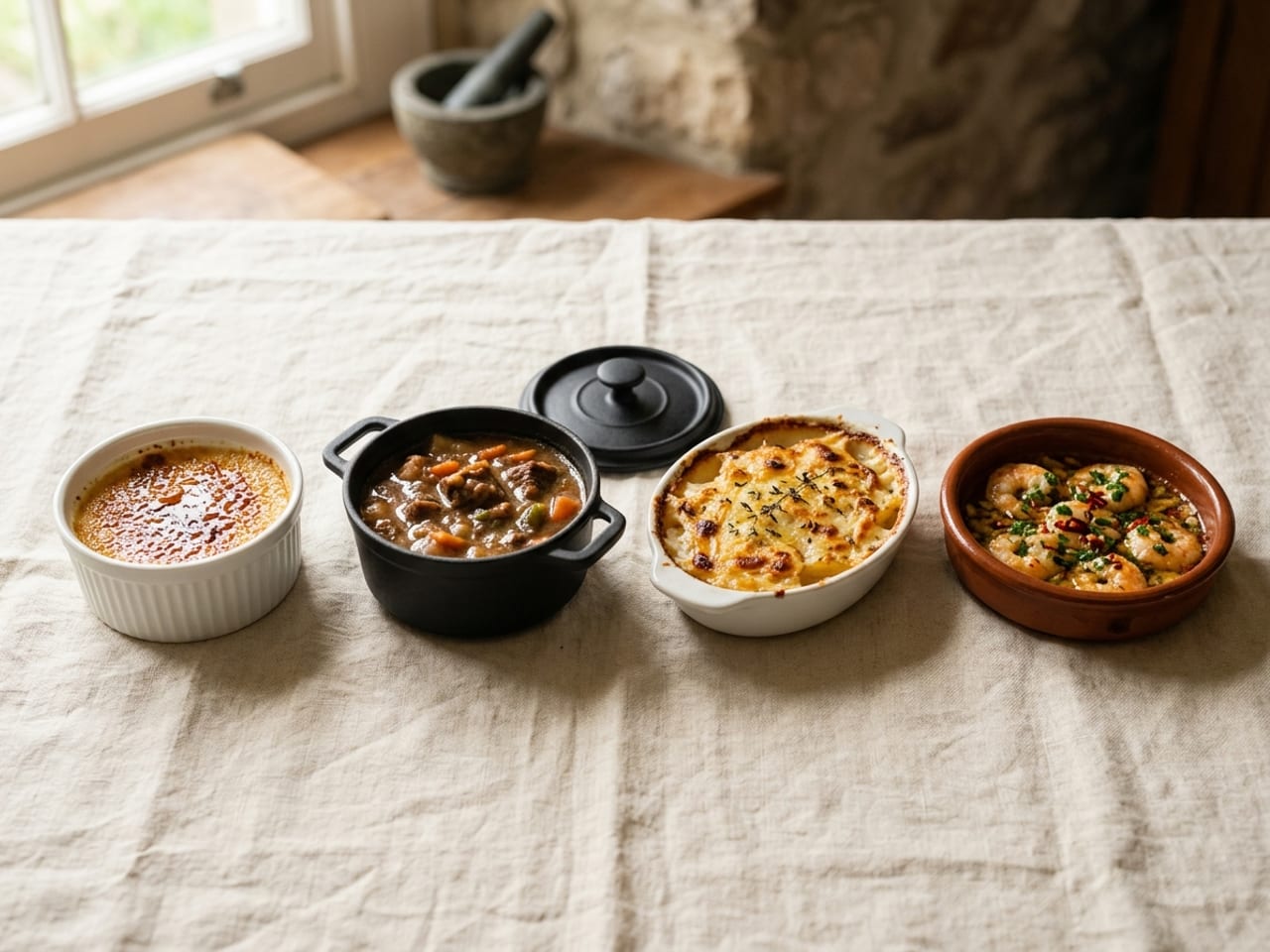
Ramekin
A small straight-sided glazed dish, usually 4 to 8 oz (120–240 ml) and 3 to 3.75 in across, for baking and serving one portion of anything set or custardy.
The word came from French ramequin and originally named a cheese preparation, not the dish. A shallow crème brûlée dish about 4 ½ to 5 in (11 to 13 cm) across and 1 in (2.5 cm) deep is the crème brûlée default, because the wide surface gives the caramel crust its area; a standard 3 in ramekin works but sets a deeper, slower custard. 6 oz is the usual home soufflé size. Cook one.
Cocotte
Also: mini cocotte.
The French name for a heavy lidded braising pot; in individual sizes, a 8–24 oz cast-iron or stoneware pot that goes from oven to table as one person's portion.
Gratin dish
A shallow oval or rectangular baking dish, wide and low so the maximum surface browns under heat. Its shape is a recipe instruction, not a style choice.
Cazuela
A shallow unglazed or glazed earthenware Spanish cooking dish that goes straight to the table, traditional for gambas al ajillo and baked rice.
Tagine
A North African vessel of a flat rimmed earthenware dish and a tall conical lid, which condenses rising steam back onto the food; the word also names the stew.
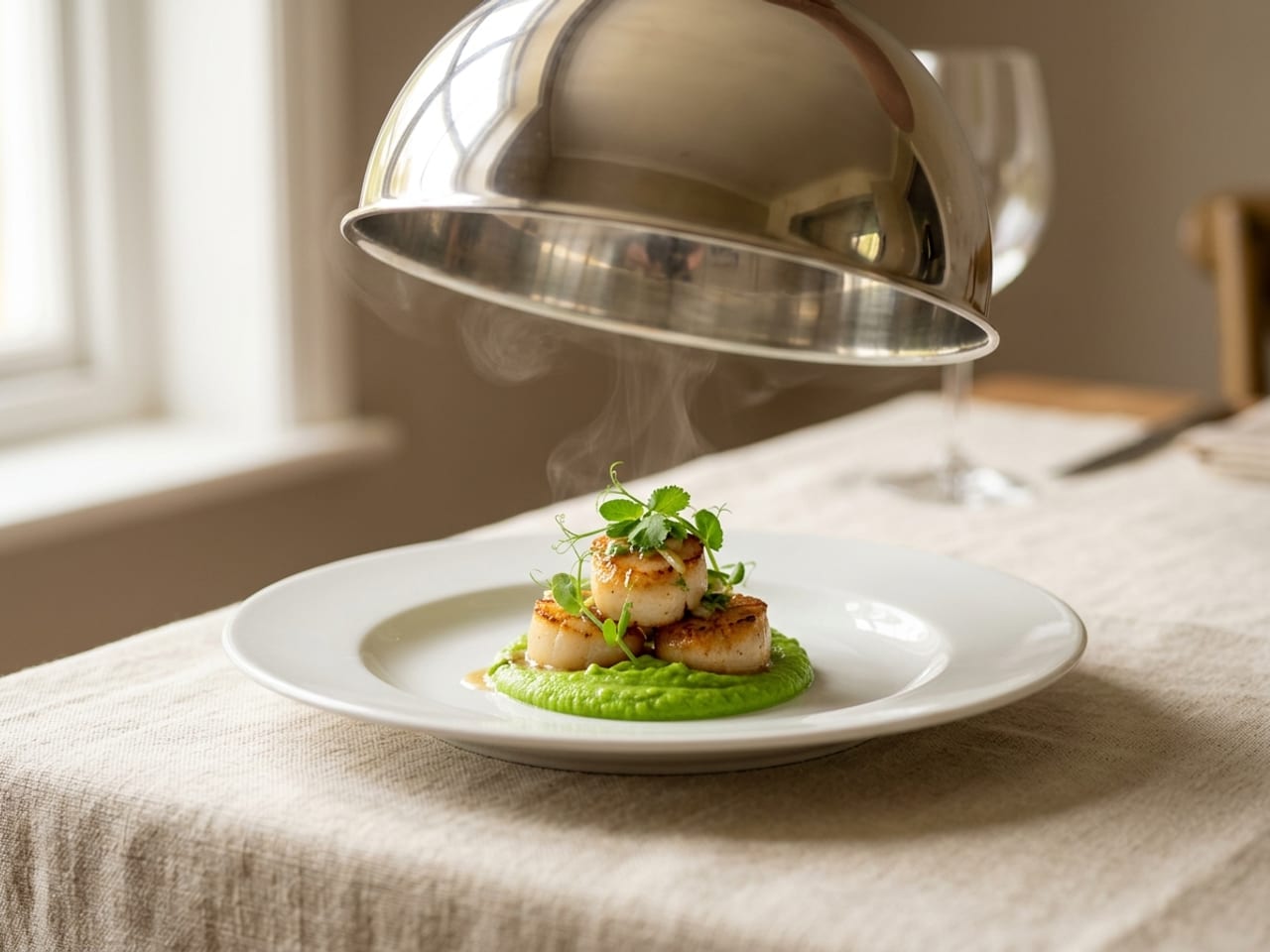
Cloche
The bell-shaped dome cover lifted off a plate at the table, from French cloche, a bell; the same word gives the garden cloche and the 1920s hat.
Practically, a cloche keeps a plate hot between the pass and the table and delivers a small piece of theatre when it lifts. It is also the vehicle for smoke service, where the dome traps aromatic smoke that escapes at the table.
Escargot plate
A round metal or porcelain dish with six or twelve dimpled wells that hold snails upright in their garlic butter; the wells double for baked oysters.
Oyster plate
A plate moulded with individual oyster-shaped wells around a central sauce well, most famously the six-well Victorian majolica versions by Minton.
Deviled-egg plate
A plate with moulded oval wells that hold halved eggs steady, a mid-century American form whose popularity peaked in the 1950s.
Sizzle platter
A thin oval metal platter heated to serving temperature so food arrives audibly cooking, carried in an insulated holder.
Divided plate
Also: compartment plate.
A plate with moulded sections that keep foods apart: Korean banchan dishes, cafeteria trays, children's plates and portion-controlled healthcare ware.
Platters, boards and stands
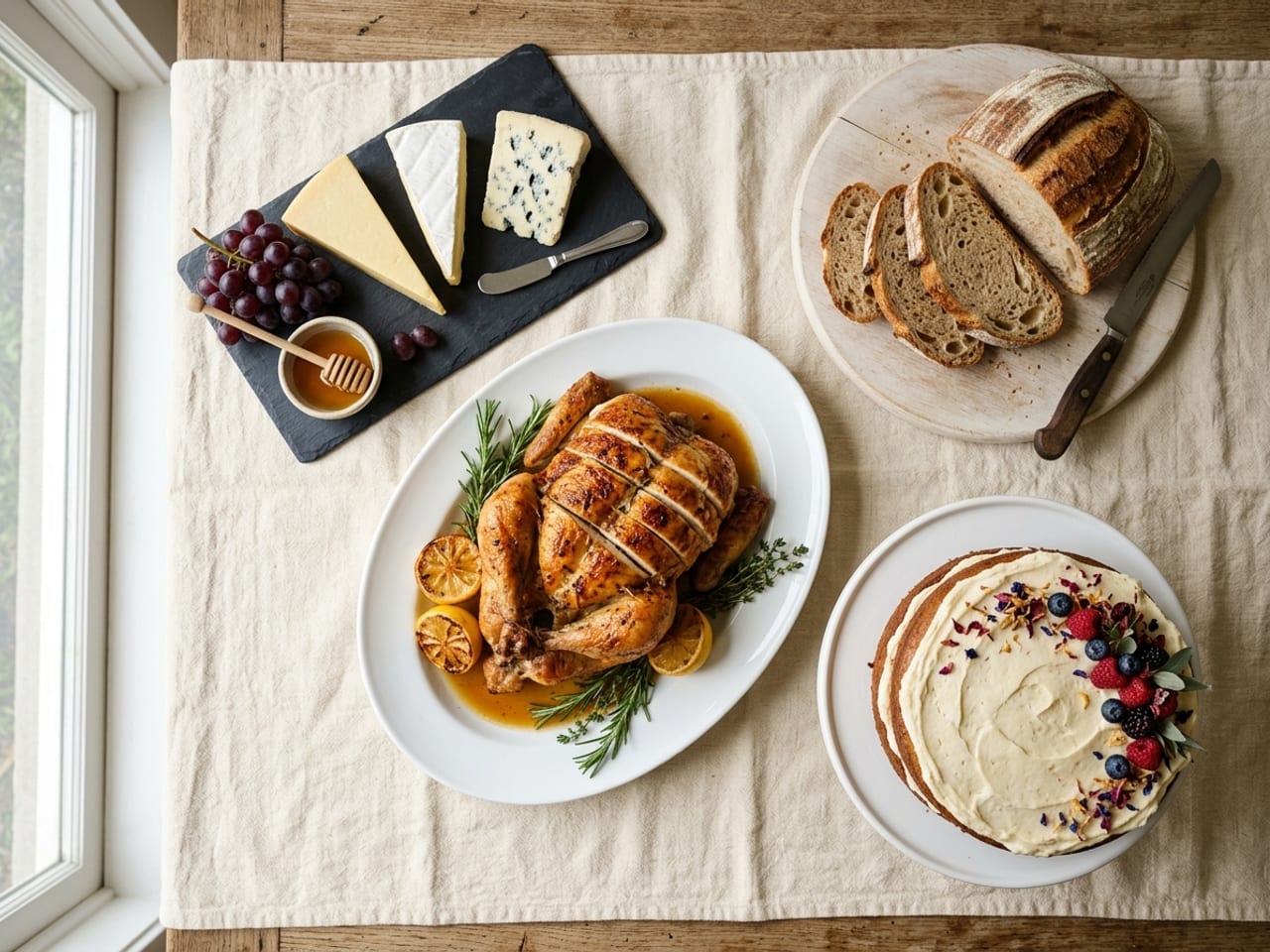
Platter
An oversized dish, usually oval and 13 in (33 cm) or larger, for food distributed to several people at the table rather than eaten from directly.
Chop plate
Also: round platter.
A large round platter, typically 12–13 in, named for the chops it once carried. Confusingly, some suppliers use the same word for a charger.
Cake stand
Also: footed cake plate.
A round plate raised on a pedestal, about 10–10.5 in, which lifts a cake into its own visual space and makes slicing possible from every side.
Tiered stand
Two or three plates stacked on a central post for afternoon tea, commonly 12/10/8 in or 10/8/6 in, with 10–11 in regarded as the ideal bottom tier.
Board
A flat wooden, slate or marble serving surface with no well at all. The direct descendant of the medieval trencher, and the working surface of every charcuterie board.
The board is where plating becomes table-scale. Our charcuterie board guide covers quantities, arrangement and the safety windows.
Tray
A carrying surface with a raised edge, distinguished from a platter by intent: a tray moves food, a platter presents it.
Plates around the world
The European place setting is one solution to one problem: a sequence of courses eaten by one person with a knife and fork. Other traditions solved different problems, and their vocabulary is more precise than ours about size. Japanese tableware names plates by measurement in sun units of about 3 cm, so a plate's name tells you how big it is before you see it.
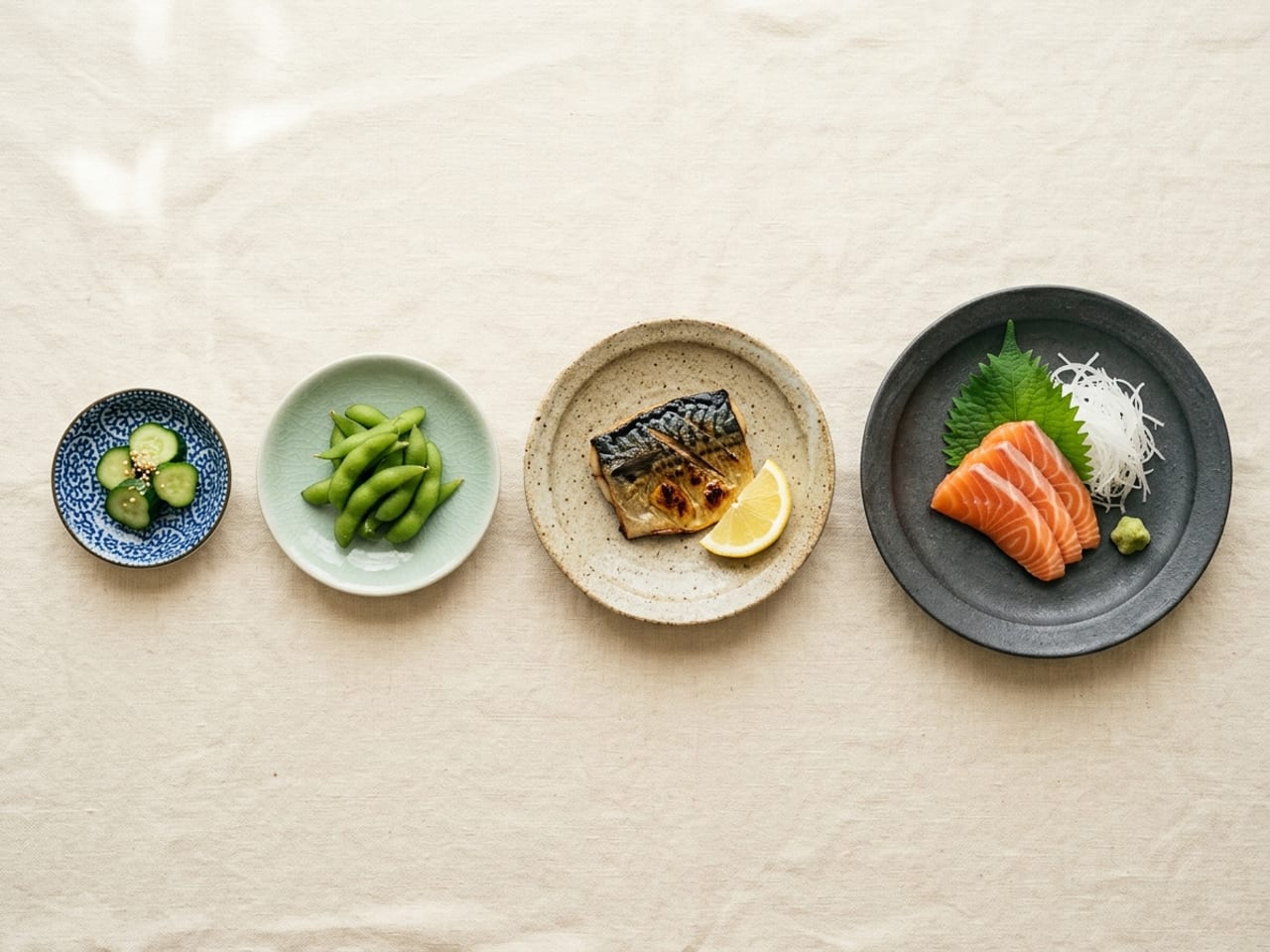
Mamezara
Also: bean plate.
A Japanese plate of roughly 6–10 cm, for a pinch of pickles, a condiment or a single bite; the smallest plate in regular use anywhere.
Kozara
The Japanese small plate, about 12–15 cm, for one person's portion of a side dish.
Chūzara
The Japanese medium plate, about 18–21 cm, the everyday plate for a grilled fish or a main side.
Ōzara
The Japanese large plate, 24–30 cm, used as a Western dinner plate would be or as a sharing platter for sashimi.
Chawan
Also: rice bowl.
The Japanese rice bowl, about 12 cm across and 6 cm tall, sized to hold roughly 150 g of steamed rice and to be lifted in the hand.
Donburi
A deep Japanese bowl about 15 cm across holding around 900 ml, for rice topped with a single dish; the word also names the meal.
Ramen bowl
Also: ramen-bachi.
A wide flared bowl of about 18 cm and 1,400 ml, big enough that noodles, broth and toppings each keep their own territory.
Volume is the whole design brief: a bowl that looks absurdly large empty is the one that lets you lift noodles without flooding the table. Tonkotsu, miso and shoyu all want it.
Geta
Also: sushi geta.
The wooden sushi board raised on two feet, named after the geta sandal it resembles; the height keeps the rice clear of any moisture on the counter.
Bento box
A compartmented Japanese single-serving lunch container, a form dating to the Kamakura period and popularised as a school and office lunch in the Taishō era.
Thali
A round metal platter used across South Asia, holding small bowls of individual dishes around a central mound of rice or bread; also the name of the meal.
Katori
The small metal bowl that sits on a thali to keep each wet dish separate from the rice.
Banchan dishes
The set of small Korean side-dish plates and bowls placed in the middle of the table to be shared through the meal.
Verrine
A small glass in which a starter or dessert is layered and served, so the construction is visible from the side rather than from above.
Amuse-bouche spoon
A flat-based tasting spoon that stands on the table and holds a single bite; the Chinese soup spoon does the same job.
Does the plate change how food tastes?
Yes, measurably, but not in the tidy way the internet claims. Almost every study here is small, single-food and often from one Oxford lab, so treat the percentages as illustrative rather than as constants.31 Here is what survives scrutiny.
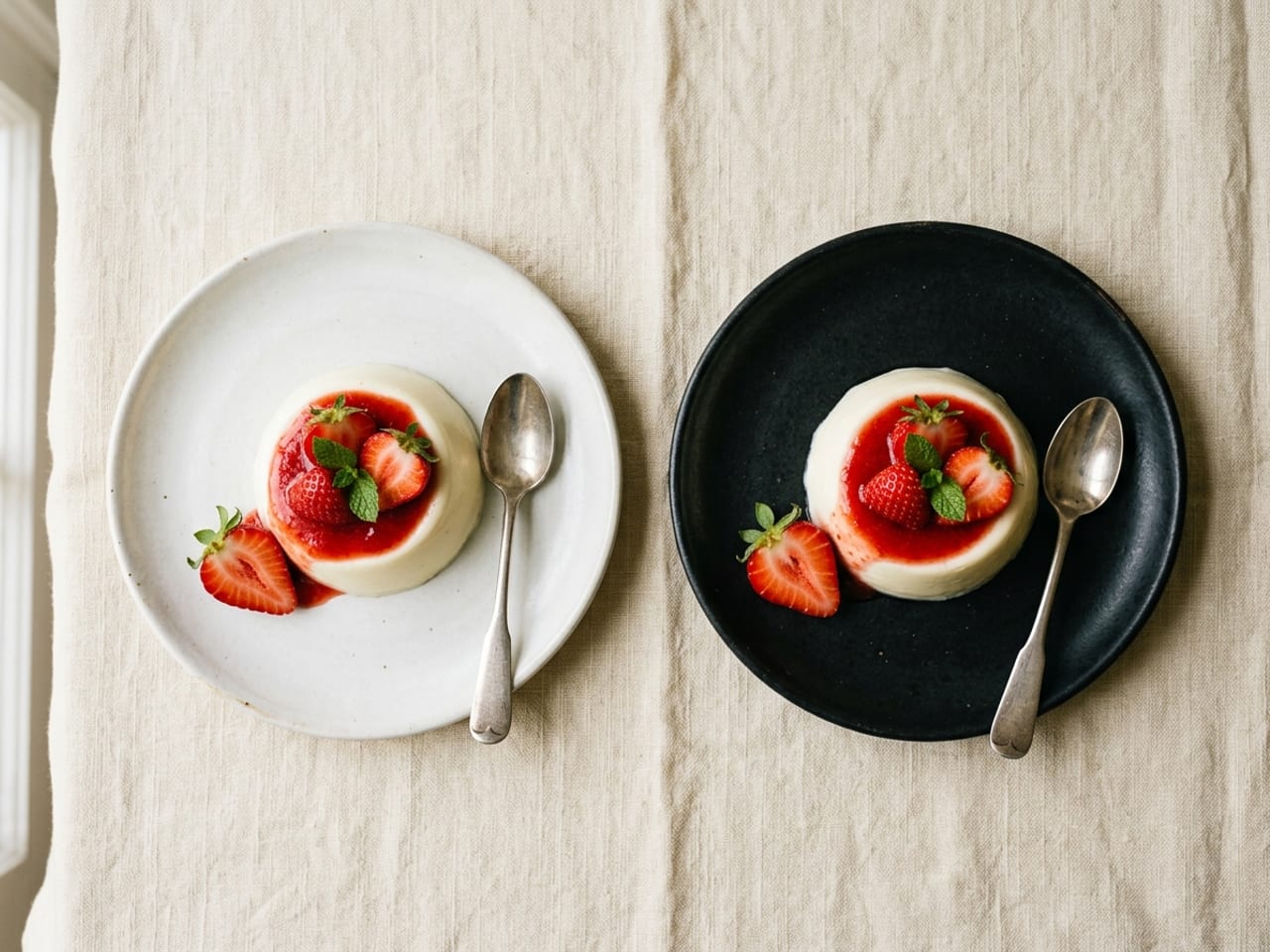
- Plate colour changes ratings, but the direction follows the foodStrawberry mousse on a white plate was rated more intense, sweeter and better liked than on black.16 Yet when 253 paying diners in Lyon ate three different desserts, the pink one looked far more appetising on white while the brown raspberry one was liked more on black.17 There is no universal best colour; there is contrast with the food in front of you.30
- Plate shape on its own does almost nothingThe original test found no effect of round, square or triangular plates on any attribute.16 One later study found a round-and-white synergy for cheesecake, with twelve people per cell and a surface-area confound the authors acknowledge.18 "Round tastes sweeter" is an expectation effect, not an established tasting effect.
- Rim width genuinely changes perceived portion sizeIn a psychophysics study of 338 people, a rim half the plate's radius made the same food look about 5% wider, roughly 10% more in area, than a very thin rim; colouring the rim added a smaller effect again.20 That is the Delboeuf illusion doing your plating for you. It changes perception, not appetite.
- A heavier plate reads as more expensiveIdentical yoghurt in a heavier bowl was rated denser, pricier and better liked,21 and was expected to be more filling before anyone tasted it.22 The effect runs on expectation, and it reverses when the expectation flips, so treat weight as a signal you can send rather than a law of physics.
- Smaller plates do not reliably make you eat lessThree crossover experiments at Penn State found no effect on energy intake.23 The only pre-registered general-population trial found a 19 kcal difference with a confidence interval straddling zero.24 A meta-analysis of dishware experiments pooled to a marginal result whose interval touched zero.25 The Cochrane review does find larger sizes increase consumption, but that estimate is dominated by portion and package size rather than plates.26 Where plate size does bite is self-service: people serve themselves more onto a bigger plate.32
- The red-plate diet trick did not replicateThe original finding that red plates suppress snacking29 was reversed by a larger direct replication in which people ate more from red plates,28 and a randomised crossover trial found red and black plates raised pasta intake against white.27 Do not repeat it as fact.
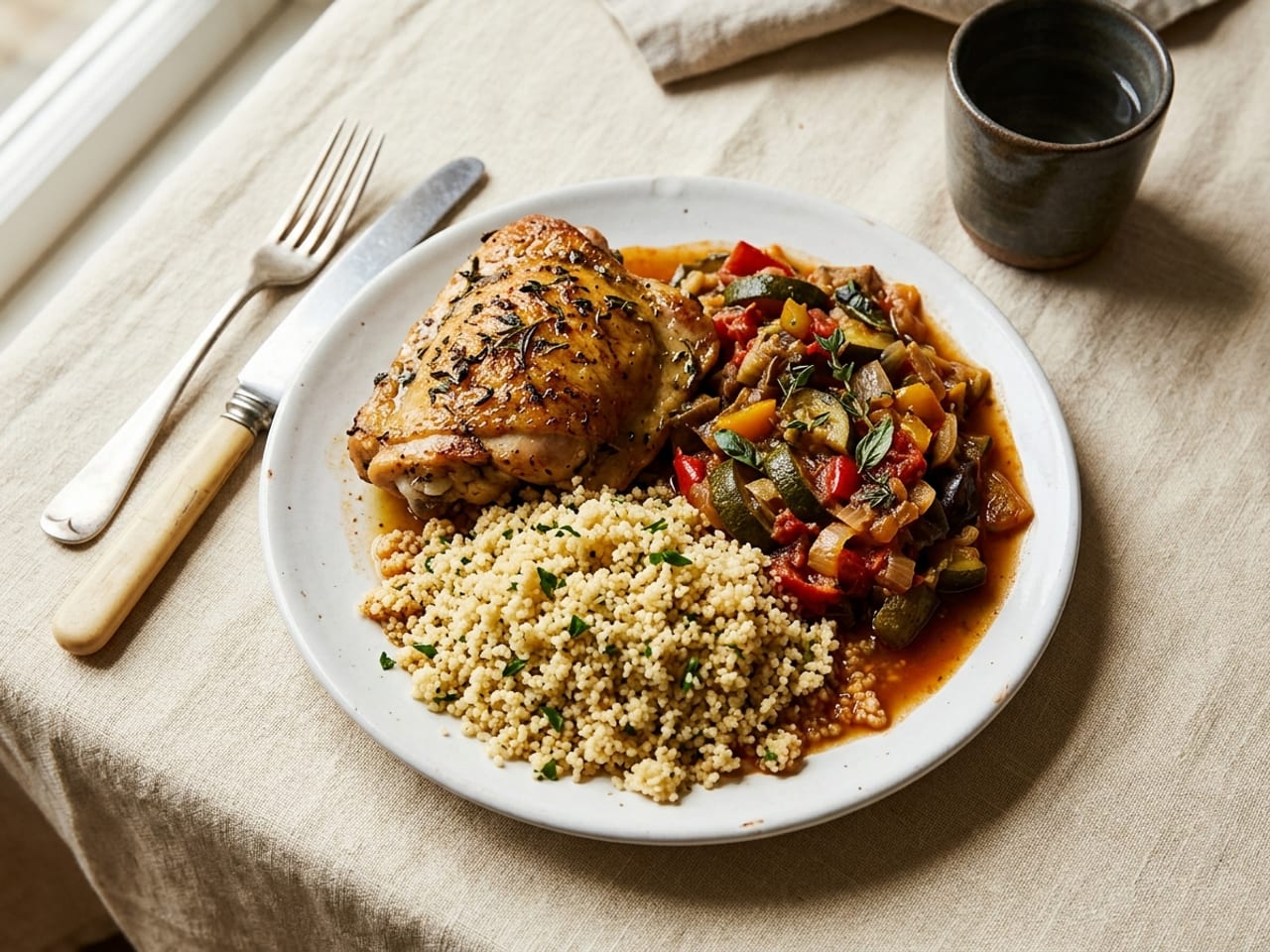
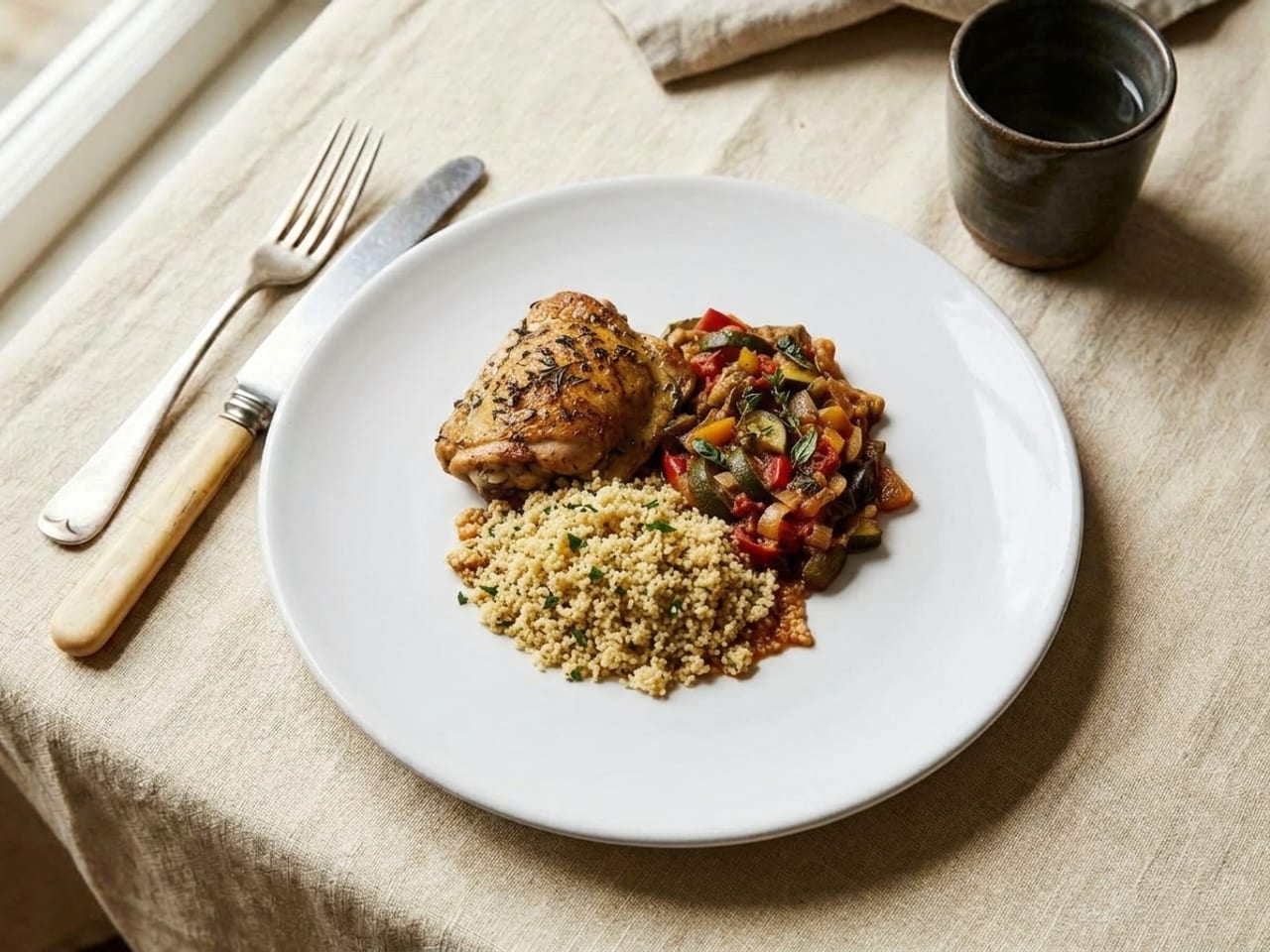
Which plate for which dish
Strip away the vocabulary and the choice comes down to one question: what does this food need from its background? Pale food needs a dark plate to exist at all. Colourful food needs white to stay clean. Rustic food gains from a warm speckled body and loses on bright porcelain. These are the plates in the Plate Artists studio, and the logic behind them is the same logic you should use in your own cupboard.
- Chalk whitePorcelain, matte bisqueColourful food: red sauces, greens, desserts, anything with its own contrast.
- White rimmedPorcelain, wide rimJus and sauces, plated mains, a portion that should look generous.
- Hand-thrown creamSatin glaze, throwing ringsPasta, risotto, roast vegetables. The rings frame a centred portion.
- Basalt blackMatte black, volcanic texturePale food: scallops, risotto, white fish, cauliflower, bright sauces.
- SpeckledOatmeal stonewareRoasts, grain bowls, rustic and brown food that wants warmth.
- Fog grey specklePale grey stoneware, dark speckleCured fish, salmon, beetroot, herbs and flowers. The Nordic look.
- Slate greyTextured stonewareMeat, mushrooms, autumn plates, chocolate.
- Navy glazedReactive glazeSeafood, citrus, anything orange, gold or yellow.
- Celadon poolGlossy celadon, pooled glazePink and red: salmon, tuna, prawns, beetroot, berries. Also dumplings.
- BlushDusty rose stoneware, matteGreen salads, burrata, white fish, pistachio and berry desserts.
- TerracottaGlazed, warmMediterranean food, tapas, eggs, bread, roasted vegetables.
- Shallow bowlWhite porcelainBroths, curries, tartare in dashi, saucy pasta.
- Slate boardNatural slateGyoza, cheese, tapas, sharing plates.
| Dish | Plate | Why |
|---|---|---|
| Risotto, scallops, white fish | Matte black or slate coupe | Pale food disappears on white and glows on dark |
| Tomato pasta, curry, salad | White coupe | The food already has colour; the plate stays out of it |
| Steak, roast, anything with jus | Wide-rimmed white | The rim holds the sauce in and frames the portion |
| Grain bowls, roasted vegetables | Speckled oatmeal stoneware | Warm body for brown food that would look drab on white |
| Seafood, citrus, saffron | Navy or celadon | Blue and green sit opposite orange and gold on the wheel |
| Soup, stew, anything saucy | Shallow bowl or soup plate | Depth to hold liquid, width to keep the garnish visible |
| Cheese, charcuterie, bread | Slate or wooden board | Table-scale food does not want a personal plate |
| Crème brûlée, soufflé, baked custard | Ramekin on a small plate | The underplate catches drips and turns a pot into a course |
The deeper version of this logic is in our colour guide, and the composition side is in Plating 101. If you want to see it applied dish by dish, how to plate food runs ten everyday dinners before and after.
Sets, counts and what actually fits
- What is in a "place setting"A five-piece formal setting is a dinner plate, salad plate, bread-and-butter plate, cup and saucer. A four-piece casual setting is a dinner plate, salad plate, bowl and mug. That is why sets sell as 16 pieces, which is four settings of four, or 20 pieces, four of five.
- How many you needEight to twelve settings covers a household of three to six and most dinner parties. Roughly two dinner plates per person is the working number, rising to one and a half to two plates per guest if you serve multiple courses.
- Measure your dishwasher before you fall in loveLower racks commonly take plates to about 30–32 cm, and oversized plates can block the spray arm. Above 11 in, check before you buy.
- Coupe and rim plates of the same nominal size are not the same sizeSome makers build a coupe about an inch larger than the rim plate with the same well; others make their coupe slightly smaller. Lay out a full setting in the shop, or check the centimetres, before committing to twelve of them.
- Plain white is the versatile answerIt is what most restaurants use, it showcases food, it is cheap to replace one piece at a time, and it coordinates with everything you add later. Buy the character pieces second.
A short history of the plate
Before about 1500, the plate was bread. Diners ate off trenchers, thick slabs of days-old loaf, filled from platters in the middle of the table; a 14th-century Parisian household manual specifies trencher bread half a foot wide, four inches high and baked four days before.5 By the end of the 15th century, particularly in northern Europe, trenchers were more often wood or pewter, and wooden trenchers stayed in use into the 19th century alongside pottery plates.5
Then pewter, in enormous quantities. Between 1650 and 1780 British households across the social spectrum replaced wooden trenchers with pewter plates, and the profile changed with fashion: a steep slope and broad rim from around 1640, multiple-reeded rims around 1660, plain rims dominant after about 1730. Pewterers hammered the slope to strengthen the metal, and their word for it, the bouge, is still the most precise name for that part of a plate.
Ceramics arrived from two directions. Tin-glazed earthenware, known as maiolica in Italy, faience in France and delftware in the Netherlands, gave Europe an opaque white surface that imitated Chinese porcelain. The real thing followed in 1710, when Meissen became the first European factory to make true hard-paste porcelain, after Johann Friedrich Böttger's successful firing in 1708. Chinese export plates had already set the template Europe copied: a plain central field for the food, surrounded by a richly decorated rim.
Two English inventions made plates ordinary. Josiah Wedgwood ran close to 5,000 trials on creamware, supplied a tea set to Queen Charlotte in 1765, renamed the ware Queensware the following year and gave the middle classes a cheap, versatile alternative to porcelain.6 Around 1800 Josiah Spode II perfected bone china, mixing calcined ox bone into the body to produce something whiter, stronger and more translucent than anything before it, and still the standard English formula.7
Have dinner plates grown? The famous claim is that they went from 9.6 in to 11.8 in since 1900, a 23% increase. That figure comes from a single count of American dinner plates listed for sale on eBay on one day in 2010, in a paper from the Cornell Food and Brand Lab whose director was later found by his university to have committed academic misconduct; the paper itself has not been retracted, but the provenance is worth stating.32 Other popular numbers trace to a 2004 trade-magazine note or to a study of plate sizes in paintings of the Last Supper. Against them: vintage Fiesta's dinner plate was already 10 in in 1936, and the UK catering trade says 10.5 in has always been the standard. What has certainly grown is restaurant plate diameter, and much of that growth is rim.
See your own dinner on the right plate
Knowing that pale food wants a dark plate is one thing. Seeing your own risotto moved onto matte black, composed the way a chef would compose it, is another. Upload a photo of tonight's dinner, pick a plate from the library above or let the art director choose, and Plate Artists re-plates your dish and tells you why that plate.
Your dish, on a plate that suits it
Snap it, upload it, choose the plate, and get the composed version back with the moves to recreate it for real.
Start free · 1 enhancement →Free account · 1 free enhancement · No credit card
Plates, answered
What are the different types of plates?
A full place setting uses, from largest to smallest: the charger (11–14 in / 28–36 cm), the dinner plate (about 10.5 in / 27 cm), the luncheon plate (9 in / 23 cm), the salad or dessert plate (7–8.5 in / 18–22 cm), the side or bread-and-butter plate (5–7 in / 13–18 cm) and the saucer (about 6 in / 15 cm). Add the soup plate, a rimmed shallow bowl of 9–10 in, and the specialised forms: fish plate, bone dish, appetiser plate, pasta plate, escargot and oyster plates. Beyond the place setting sit the serving pieces (platters, chop plates, cake stands, boards) and the bake-and-serve dishes (ramekins, cocottes, gratin dishes, cazuelas).
What is a charger plate?
A charger is a large decorative plate, usually 13 inches (33 cm), laid on the table before guests sit down. It works as an underplate: each course arrives on its own plate set on top of it, and it is cleared before the main course or exchanged for the entrée plate. The name comes from Middle English chargeour, from Latin carricare, to load, because it once carried a whole roast to the table.
Do you eat off a charger plate?
No. Food is never placed directly on a service plate in formal etiquette, and many decorative chargers in metal, glass, acrylic or painted finishes are not made from food-safe materials. If your charger is a plain glazed porcelain plate from a dinnerware line, it is simply a large plate and you can use it as one.
What size is a standard dinner plate?
About 10.5 inches or 27 centimetres. Sources vary between 10 and 12 inches, and restaurants often use 11 or 12 inch plates, but those usually carry a wider rim around a well of the same size, so the eating surface has not grown as much as the diameter suggests. Above 11 inches, plates start to be hard to fit in domestic dishwasher racks.
What is the difference between a rimmed plate and a coupe plate?
A rimmed plate has a flat border clearly separated from the well, the traditional European profile that frames the food and catches juices. A coupe plate has no distinct rim: the surface flows from the centre to a gently upturned edge, so the whole disc is the plating surface. Coupe reads more modern and quieter; rim reads more formal and makes the same portion look larger.
What is a ramekin?
A ramekin is a small straight-sided glazed dish, usually 4 to 8 ounces (120–240 ml) and 3 to 3.75 inches across, used to bake and serve an individual portion of crème brûlée, soufflé, custard, flan or a small gratin. The word comes from the French ramequin and originally named a baked cheese preparation rather than the dish it was cooked in.
What size ramekin do I need for crème brûlée?
A shallow crème brûlée dish about 4 ½ to 5 inches (11 to 13 cm) across and 1 inch (2.5 cm) deep is the classic choice, because a wide shallow custard gives the most caramel surface per spoonful and bakes evenly in the water bath. A standard 3-inch (7.6 cm), 4-ounce (120 ml) ramekin works too, but the deeper custard takes longer to set. A 6-ounce ramekin is the standard size for a soufflé, where height matters more than surface.
What is a cloche?
A cloche is the bell-shaped dome cover lifted off a plate at the table. The word is French for bell, from Medieval Latin clocca, and is a doublet of clock and cloak, which is why the garden cloche and the 1920s hat share the name. In service it keeps a plate hot between the kitchen and the table, and it is the standard vehicle for smoke service.
What is the difference between a plate and a platter?
Intent and size. A plate holds one person's food; a platter is an oversized dish, usually oval and 13 inches (33 cm) or larger, from which food is distributed to several people. Pewter collectors still use a size rule: under 7 inches is a saucer, 7 to 11 inches a plate, 11 to 18 inches a dish, and anything larger a charger.
What is the difference between porcelain and bone china?
Bone china is a porcelain with calcined bone ash added, at least 25% by the ASTM definition and at least 30% by UK industry practice. The bone ash makes it warmer and creamier in colour, more translucent, lighter and thinner than hard-paste porcelain, and it rings when tapped. Hard porcelain is fired hotter, is brighter and slightly cooler in tone, costs less, and chips a little more readily.
Is stoneware or porcelain better for plates?
Neither is better; they do different jobs. Porcelain is whiter, thinner, lighter and closer to non-porous, which makes it the neutral canvas most restaurants use for main courses. Stoneware is heavier, opaque, warmer in tone and suits speckled and reactive glazes, which makes it a design statement rather than a frame. A common professional answer is white porcelain for mains and stoneware for starters, sharing plates and desserts.
How do I know if a plate has lead in it?
Plain white commercially made dishes are very unlikely to be a problem; lead is rarely found in them. The risk list is traditional glazed terracotta, brightly decorated imported or hand-made ware, orange, red and yellow decoration, decoration on the rim or the food surface that you can feel, antiques made before lead in tableware was regulated, and any piece with a corroded, dusty or chalky glaze. Swab kits give a useful positive but an unreliable negative, since they cannot see lead below the surface. Anything marked 'Not for Food Use' should never hold food.
Can you put a plate in the oven?
Only if the base says so, and never straight from the fridge or freezer into a hot oven. Ratings vary hugely by material: many stoneware ranges go to 260 °C, laminated glass such as Corelle only to 176 °C and only in a preheated oven, some fine bone china not at all, and melamine never. Warming empty plates is gentler than baking in them, and even then a manufacturer may cap it: Wedgwood says 65 °C is safe for warming its tableware.
Do smaller plates make you eat less?
Probably not, on the evidence. Three crossover experiments at Penn State found no effect on energy intake, and the only pre-registered general-population trial found a difference of 19 kcal with a confidence interval spanning zero. A meta-analysis of dishware experiments pooled to a marginal effect whose interval touched zero. Where plate size does bite is self-service: people serve themselves more onto a larger plate, especially when they do not know they are being watched.
What plate colour is best for food?
White is the safe default and the one most restaurants use, and a pale dessert on a white plate was rated sweeter and more intense than the same dessert on black. But the effect follows the food: in a 253-diner restaurant test, a pink fraisier scored far better on white while a brown raspberry dessert was liked more on black. The practical rule is contrast with the food, not with the tablecloth: pale food glows on dark plates, colourful food sings on white.
How many plates do I need?
Common guidance is eight to twelve place settings for a household of three to six people, or about two dinner plates per person, rising to one and a half to two plates per guest if you host multi-course meals. A five-piece formal setting is a dinner plate, salad plate, bread-and-butter plate, cup and saucer; a four-piece casual setting is a dinner plate, salad plate, bowl and mug. That is why sets are sold as 16 pieces (four settings of four) or 20 pieces (four of five).
The standards and research behind this guide
Seventeen peer-reviewed studies verified through Crossref and PubMed, plus the international standards, food-safety regulations, museum records and etiquette references that define the terms. Sizes come from manufacturers' and restaurant suppliers' own specifications; where they disagree, the range is given rather than a single number.
- International Organization for Standardization (2024). ISO 5644:2024 — Porcelain tableware: specification and test method. ISO, Geneva, defines porcelain, bone china and vitreous china by firing range, water absorption and translucency. iso.org
- ASTM International (2021). ASTM C242-21 — Standard terminology of ceramic whitewares and related products. ASTM International, West Conshohocken, the definitions of bone china, vitreous, semivitreous and nonvitreous bodies. astm.org
- ASTM International (2018). ASTM C373-18 — Standard test methods for determination of water absorption, bulk density, apparent porosity and apparent specific gravity of fired whiteware products. ASTM International, West Conshohocken, the boil method behind every absorption figure quoted here. astm.org
- Emily Post Institute (2026). The formal place setting. emilypost.com, the charger as underplate, and when it leaves the table. emilypost.com
- Victoria and Albert Museum (2026). Trencher (museum no. W.32-1913), with the c. 1393 Ménagier de Paris description of trencher bread. V&A Collections, London, bread trenchers before 1500; wood and pewter after. vam.ac.uk
- Victoria and Albert Museum (2026). Wedgwood: an introduction — creamware, the 5,000 trials and Queensware. V&A, London, 1759 founding; 1765 tea set for Queen Charlotte; 1766 Queensware. vam.ac.uk
- Spode Museum Trust (2026). The first Spode period, 1776–1833: the introduction of bone china. spodemuseumtrust.org, Spode I's 1796 'Stoke China', renamed bone china; perfected by Spode II after 1797. spodemuseumtrust.org
- US Food and Drug Administration (2005). Compliance Policy Guide Sec. 545.450 — Pottery (ceramics); import and domestic: lead contamination. FDA, Silver Spring, action levels of 3.0 µg/mL lead for flatware, 0.5 for cups and mugs. fda.gov
- US Food and Drug Administration (2026). Questions and answers on lead-glazed traditional pottery. FDA, Silver Spring, which pottery is most likely to leach, and what a swab kit can and cannot tell you. fda.gov
- US Food and Drug Administration (1994). 21 CFR 109.16 — Ornamental and decorative ceramicware: labelling requirements. Code of Federal Regulations, the wording and lettering size of the 'Not for Food Use' statement. ecfr.gov
- Council of the European Communities (1984). Directive 84/500/EEC on the approximation of the laws of the Member States relating to ceramic articles intended to come into contact with foodstuffs (consolidated 2005). Official Journal of the European Communities, Category 1 limits for flat articles: 0.8 mg/dm² lead, 0.07 mg/dm² cadmium. eur-lex.europa.eu
- US Food and Drug Administration (2026). Melamine tableware: questions and answers. FDA, Silver Spring, migration measured only into acidic food held at 160 °F; never heat food on melamine in a microwave. fda.gov
- Bundesinstitut für Risikobewertung (BfR) (2011). Release of melamine and formaldehyde from dishes and kitchen utensils. BfR Opinion No. 012/2011, Berlin, melamine resin ware is for food up to about 70 °C, not for cooking or microwaving. bfr.bund.de
- California Department of Public Health (2026). Questions and answers: lead in tableware. CDPH Childhood Lead Poisoning Prevention Branch, the Proposition 65 warning thresholds, the risk list, and the note that lead is rarely found in plain white dishes. cdph.ca.gov
- US Department of Agriculture, Food Safety and Inspection Service (2026). Cooking with microwave ovens, and Cutting boards. USDA FSIS, Washington DC, metallic trim arcs in a microwave; wood and bamboo board handling. fsis.usda.gov
- Piqueras-Fiszman, B., Alcaide, J., Roura, E., & Spence, C. (2012). Is it the plate or is it the food? Assessing the influence of the color (black or white) and shape of the plate on the perception of the food placed on it. Food Quality and Preference, 24(1), 205–208. doi:10.1016/j.foodqual.2011.08.011
- Piqueras-Fiszman, B., Giboreau, A., & Spence, C. (2013). Assessing the influence of the color of the plate on the perception of a complex food in a restaurant setting. Flavour, 2, 24 — 253 paying diners at the Institut Paul Bocuse, Lyon. doi:10.1186/2044-7248-2-24
- Stewart, P. C., & Goss, E. (2013). Plate shape and colour interact to influence taste and quality judgments. Flavour, 2, 27 — n = 48, twelve per cell. doi:10.1186/2044-7248-2-27
- Harrar, V., Piqueras-Fiszman, B., & Spence, C. (2011). There's more to taste in a coloured bowl. Perception, 40(7), 880–882. doi:10.1068/p7040
- McClain, A. D., van den Bos, W., Matheson, D., Desai, M., McClure, S. M., & Robinson, T. N. (2014). Visual illusions and plate design: the effects of plate rim widths and rim coloring on perceived food portion size. International Journal of Obesity, 38(5), 657–662 — n = 338 and n = 251. doi:10.1038/ijo.2013.169
- Piqueras-Fiszman, B., Harrar, V., Alcaide, J., & Spence, C. (2011). Does the weight of the dish influence our perception of food? Food Quality and Preference, 22(8), 753–756. doi:10.1016/j.foodqual.2011.05.009
- Piqueras-Fiszman, B., & Spence, C. (2012). The weight of the container influences expected satiety, perceived density, and subsequent expected fullness. Appetite, 58(2), 559–562 — n = 45. doi:10.1016/j.appet.2011.12.021
- Rolls, B. J., Roe, L. S., Halverson, K. H., & Meengs, J. S. (2007). Using a smaller plate did not reduce energy intake at meals. Appetite, 49(3), 652–660 — three crossover experiments, n = 45, 30 and 44. doi:10.1016/j.appet.2007.04.005
- Kosīte, D., König, L. M., De-loyde, K., Lee, I., Pechey, E., Clarke, N., Maynard, O., Morris, R. W., Munafò, M. R., Marteau, T. M., Fletcher, P. C., & Hollands, G. J. (2019). Plate size and food consumption: a pre-registered experimental study in a general population sample. International Journal of Behavioral Nutrition and Physical Activity, 16, 75 — n = 134, d = 0.07 (95% CI −0.27 to 0.41). doi:10.1186/s12966-019-0826-1
- Robinson, E., Nolan, S., Tudur-Smith, C., Boyland, E. J., Harrold, J. A., Hardman, C. A., & Halford, J. C. G. (2014). Will smaller plates lead to smaller waists? A systematic review and meta-analysis of the effect that experimental manipulation of dishware size has on energy consumption. Obesity Reviews, 15(10), 812–821 — pooled SMD −0.18 (95% CI −0.35 to 0.00). doi:10.1111/obr.12200
- Hollands, G. J., Shemilt, I., Marteau, T. M., Jebb, S. A., Lewis, H. B., Wei, Y., Higgins, J. P. T., & Ogilvie, D. (2015). Portion, package or tableware size for changing selection and consumption of food, alcohol and tobacco. Cochrane Database of Systematic Reviews, 2015(9), CD011045 — 72 randomised trials. doi:10.1002/14651858.CD011045.pub2
- Akyol, A., Ayaz, A., Inan-Eroglu, E., Cetin, C., & Samur, G. (2018). Impact of three different plate colours on short-term satiety and energy intake: a randomized controlled trial. Nutrition Journal, 17, 46 — n = 54; red and black plates raised intake against white. doi:10.1186/s12937-018-0350-1
- Steele, K. M., & Rash, L. L. (2021). Is the suppression effect of the color red on snack food consumption reliable? Experimental Psychology, 68(4), 214–220 — the replication that reversed the effect. doi:10.1027/1618-3169/a000524
- Genschow, O., Reutner, L., & Wänke, M. (2012). The color red reduces snack food and soft drink intake. Appetite, 58(2), 699–702 — the original red-plate claim, now contradicted. doi:10.1016/j.appet.2011.12.023
- Spence, C. (2018). Background colour and its impact on food perception and behaviour. Food Quality and Preference, 68, 156–166. doi:10.1016/j.foodqual.2018.02.012
- Spence, C., Piqueras-Fiszman, B., Michel, C., & Deroy, O. (2014). Plating manifesto (II): the art and science of plating. Flavour, 3, 4. doi:10.1186/2044-7248-3-4
- Van Ittersum, K., & Wansink, B. (2012). Plate size and color suggestibility: the Delboeuf illusion's bias on serving and eating behavior. Journal of Consumer Research, 39(2), 215–228 — not retracted, but a Cornell Food and Brand Lab paper; read alongside sources 20, 24 and 25. doi:10.1086/662615
Keep going
How to set a table
Where every plate, fork and glass goes, basic to formal, and the reason behind each rule.
How to fold napkins
Eighteen folds for the plate and the charger, drawn step by step, and where the napkin goes.
Plate colour pairing tool
Free, and it works both ways: what to serve a dish on, or what a plate you already own actually flatters.
Color on the plate
The food colour wheel, the 60-30-10 rule, and choosing the plate as a painter chooses a frame.
Plating techniques & styles
Eight named styles on one dinner, the sauce and shaping moves, and the parts of a plate in a labelled diagram.
How to plate food, dish by dish
Pasta, steak, salmon and seven more everyday dinners, each shown before and after re-plating.
The five French mother sauces
Béchamel to hollandaise: how each is thickened, its daughters, and where the sauce goes on the plate.
What is an amuse-bouche?
The free first bite: the word, its history, how it differs from canapés and appetizers, and twelve ideas to make at home.
Prix fixe, à la carte and tasting menus
Every menu term explained, and how to run a tasting menu at home, with the plate for each course.