How to set a table: every place setting rule, and the reason behind it
Basic, informal and formal place settings photographed from above, where every fork, knife, spoon and glass goes and why, the glass order the guides argue about, American versus British and French tables, spacing, and how to set the table from your menu.
The photos on this page are AI-generated illustrations.
How to set a table
Put the plate in the middle of each place, about an inch (2.5 cm) from the table edge. Forks go left, knives and spoons right, in the order of use from the outside in, knife blades facing the plate. Bread plate upper left, glasses upper right with water above the knife, napkin left of the forks or on the plate.
And set only what the menu needs: no soup, no soup spoon.1 Step by step below; for a printable table setting diagram drawn for your own menu and guest count, use our free tool.
- Lay the cloth or mats, then the plate. Put the dinner plate (or a charger, for a formal dinner) in the centre of each place, about an inch (2.5 cm) in from the table edge.21, 22 The Emily Post Institute calls the plate the "hub of the wheel": everything else is placed around it.3
- Forks on the left. Lay them in the order of the courses, the first course's fork furthest out. Salad first means the salad fork goes outside the dinner fork.3
- Knife and spoons on the right. The dinner knife goes next to the plate with its blade facing the plate, the spoons to its right, the soup spoon outermost if soup comes first.1, 3
- Bread plate upper left. If there is bread, a small plate goes above the forks with the butter spreader across it, handle to the right.3, 4
- Glasses upper right. The water glass stands above the tip of the knife, or a little to its right, and any wine glasses go to its right in the order you'll pour them.2, 4
- Napkin to the left or on the plate. Both are correct. At an everyday table the fork can sit on top of it.2, 16
- Dessert cutlery, then a last check. The dessert spoon and fork go across the top of the plate, spoon on top with its handle to the right, or come in with dessert.1, 3, 4 Then step back: every place alike, cutlery bottoms level with the plate,14 and nothing laid that the menu doesn't need.
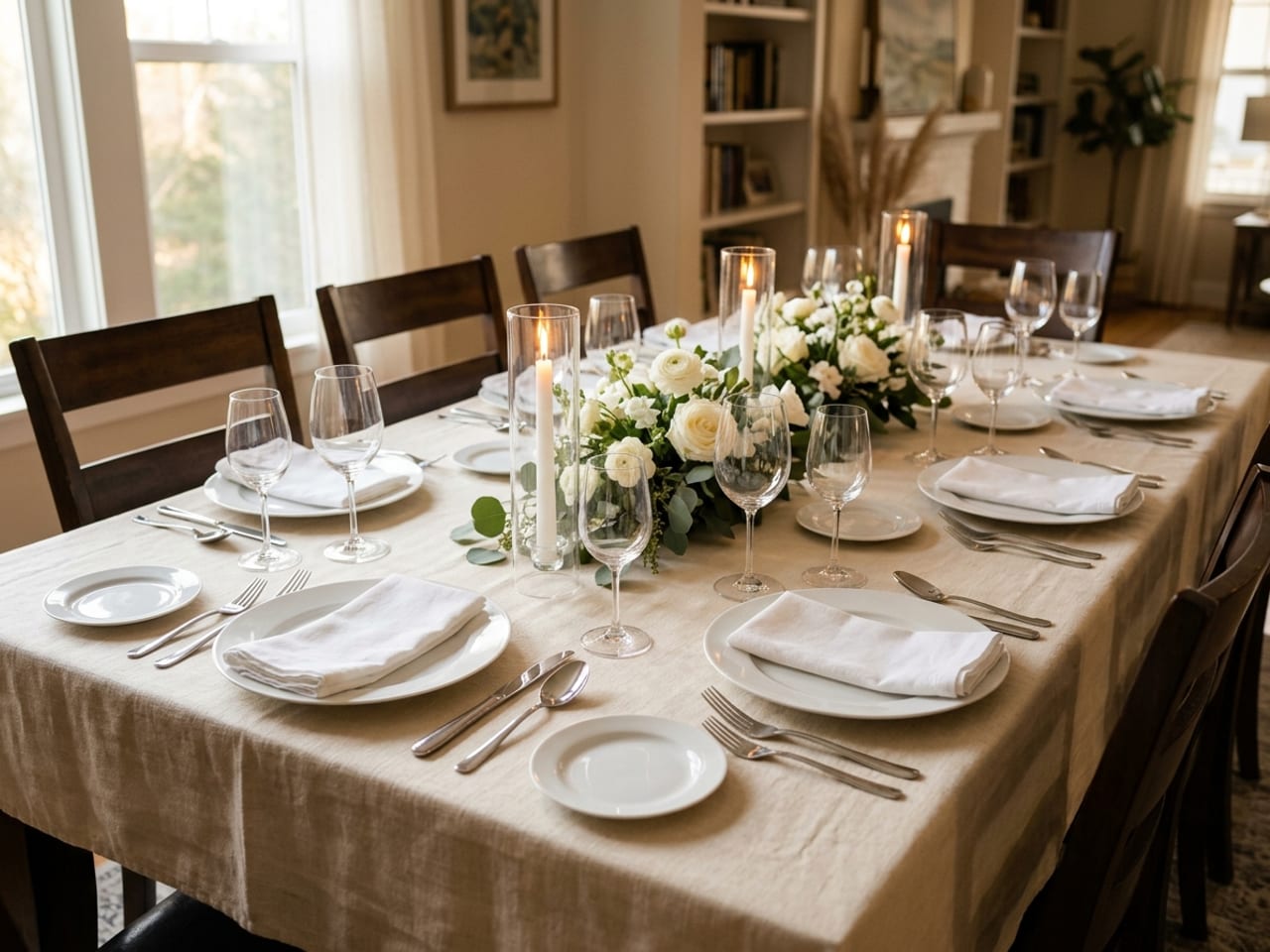
The rest of this guide gives the reason behind each rule, because once you know why the forks are on the left you don't have to memorize where they go. Then the three standard settings, every piece's place, the questions the etiquette books disagree on, and the history, research and safety notes. Sources are at the bottom.
The five rules every table setting follows, and why
- 1. Outside in: the cutlery follows the menuEmily Post, 1927: "The one first necessary goes on the outside, where it is reached first, the implement to be used last is put furthest in toward the plate."28 Her institute calls the setting "a map of the meal".7 Why: it is the footprint of service à la russe, courses handed round one after another instead of every dish set on the table at once (à la française). Mrs Beeton described the new style in 1861: the table "laid out with plate and glass, and ornamented with flowers", the dinner "handed round in succession".29 One course after another meant one set of cutlery after another, laid in order.
- 2. Forks left, knives and spoons rightEvery fork goes to the left except the small oyster fork, the one fork ever set on the right.1 Why: it is a right-hander's layout. The knife cuts in the right hand and the fork holds the food in the left, the explanation the historian of technology Henry Petroski gives.36 The arrangement is already standard in Beeton ("a knife on the right side of each plate, a fork on the left")29 and in French manuals of the 1890s.35
- 3. Knife blades face the plate"Knife blades always face the plate."2 Why: no edge points at your neighbour; as Real Simple puts it, "That helps prevent cuts!"14 The blunt tip has its own history: a gossip writer says Cardinal Richelieu had his steward grind the points off his knives after watching his chancellor pick his teeth with one (no date given),31 and in 1669 Louis XIV ordered innkeepers and everyone else in his newly won Flemish and Low Countries towns to blunt their table knives within three days.32
- 4. Bread on the left, drinks on the rightThe bread plate sits above the forks and the glasses above the knives.3, 4 Why: each sits above the hand that reaches for it. Etiquette coaches teach the "b and d" trick: touch thumb to forefinger on both hands and the left makes a b (bread), the right a d (drinks).2, 38 It is a memory aid, not an old rule: Emily Post's 1922 book allowed bread and butter plates at breakfast, lunch and supper, "but never at dinner."27
- 5. Only what the menu needs, never more than three of anything"Not serving soup? Then, no soup spoon for you."1 At most three of any implement are on the table at once, plus an oyster fork; a course that would need a fourth fork or knife gets its cutlery with the food.4 Why: Post was reacting to tables of around 1900 laid "for a dozen courses" with "at least six" glasses,27 when one silver pattern could offer 72 different pieces.37 Her three-fork limit first appears in the 1927 edition: "Not more than three forks and two knives belong on the table when it is set."28
The basic table setting (everyday)
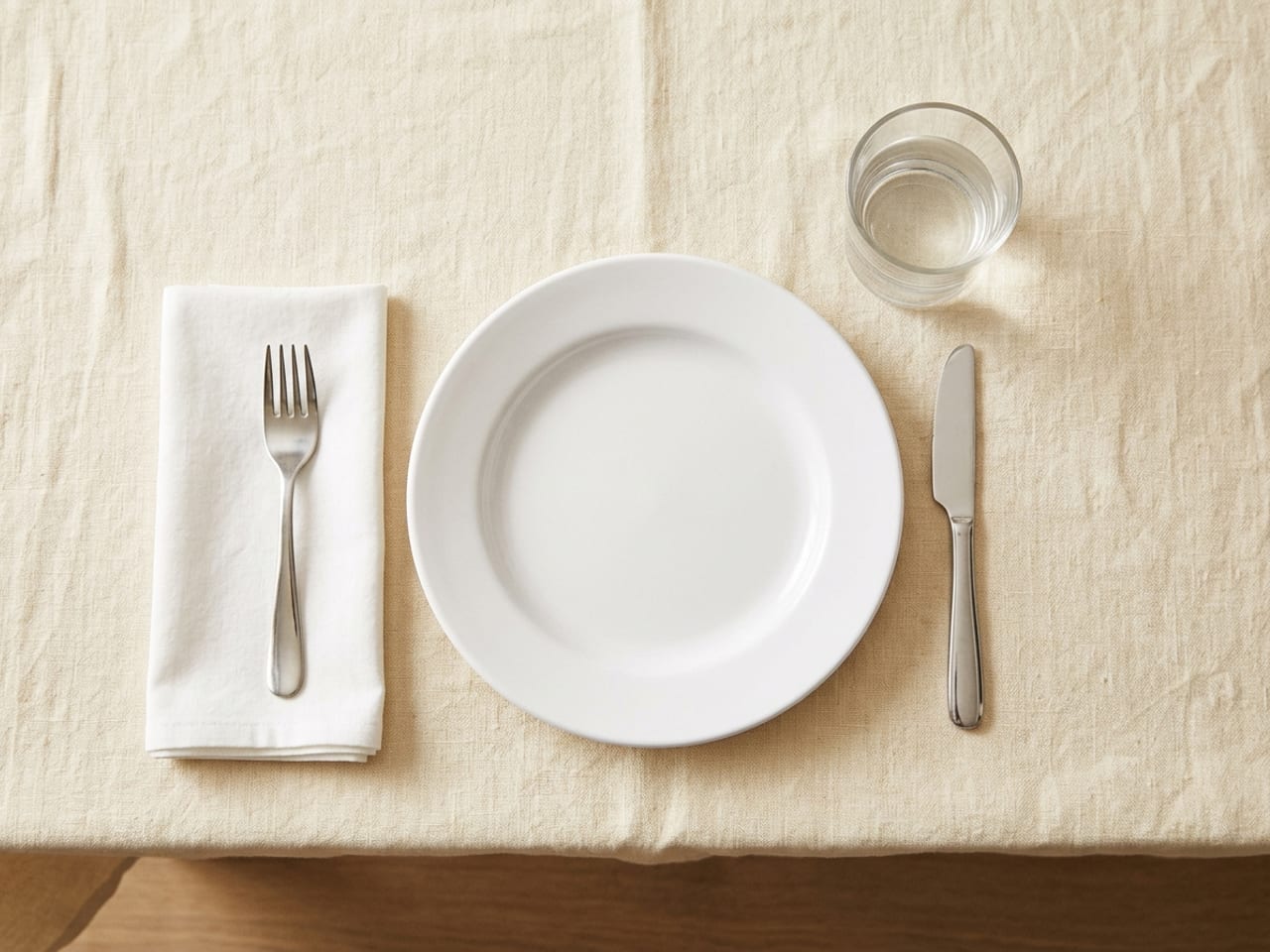
For breakfast, lunch or a one-course weeknight dinner. The Emily Post Institute accepts two layouts: the napkin on the left with the fork on it or beside it, the knife and spoon on the right; or, for a casual meal, fork, knife (blade facing the fork) and spoon all laid on the napkin on the left.1, 2 Some hosts put the napkin outside the fork so nobody has to move cutlery to reach it; Southern Living calls either acceptable.16 The glass goes above the knife or at 45 degrees to its right.2 Paper plates are fine here too.12
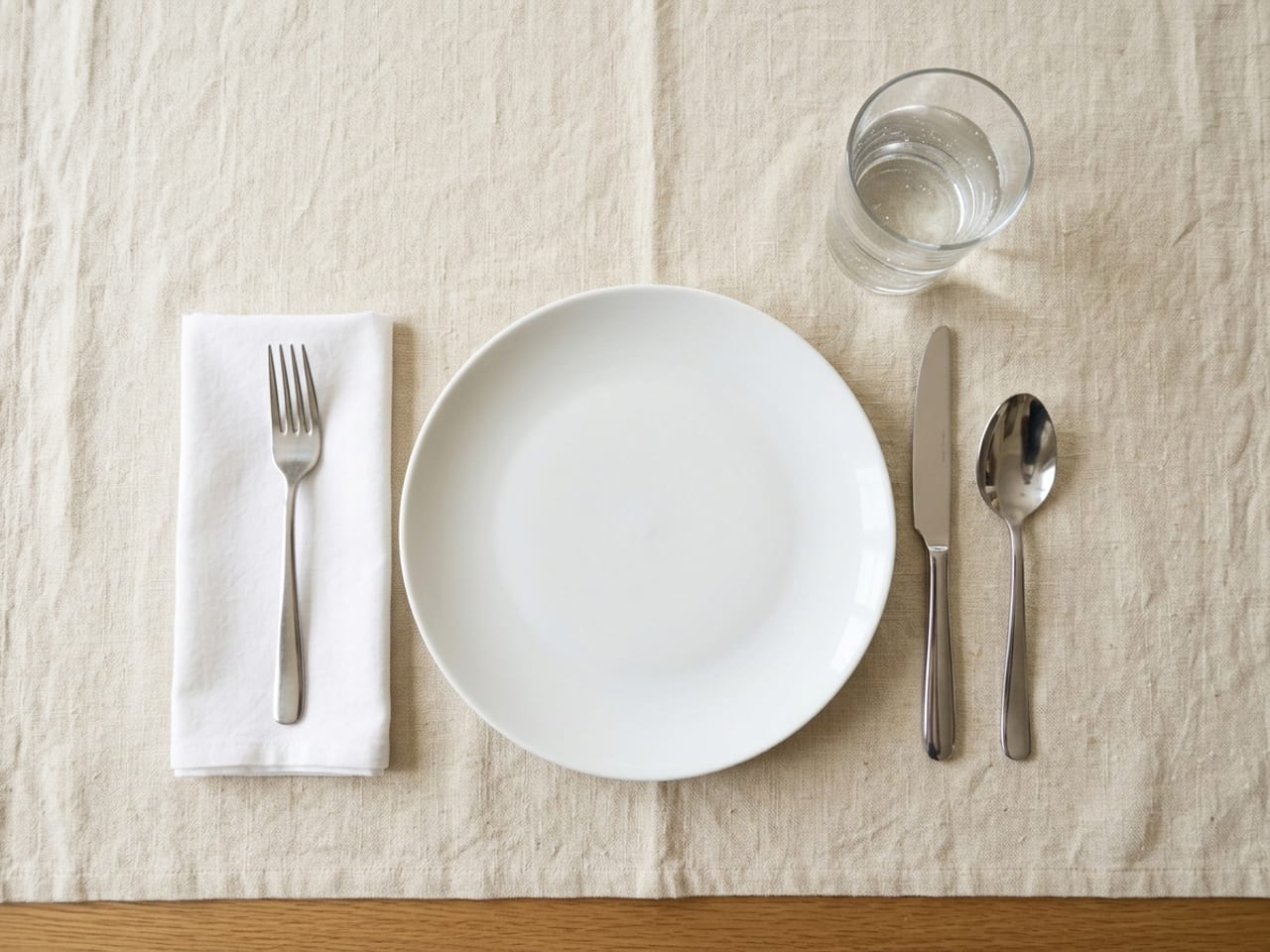
The key: the plate first, then left to right along the cutlery, then left to right across the top:
- Dinner plate, centred, about 1 in (2.5 cm) from the edge
- Napkin, folded, to the left
- Dinner fork, on the napkin
- Dinner knife, blade toward the plate
- Spoon, right of the knife
- Water glass, above the knife tip
Want it drawn? Make a basic place setting diagram and print one for each place.
The informal (dinner party) place setting
The dinner-party setting, for a meal of up to three courses; more than three makes it formal.4 The forks follow the menu: salad first puts the salad fork outside the dinner fork, salad after the main puts it inside.3 A soup spoon sits outermost on the right. The bread plate goes above the forks with the butter knife "diagonally across the edge of the plate, handle on the right side and blade facing down".3 Dessert cutlery lies across the top of the plate, or beside it, fork on the left next to the plate and spoon on the right between the knife and soup spoon.3 One or two wine glasses stand to the right of the water.1 One dinner knife can serve every course.3
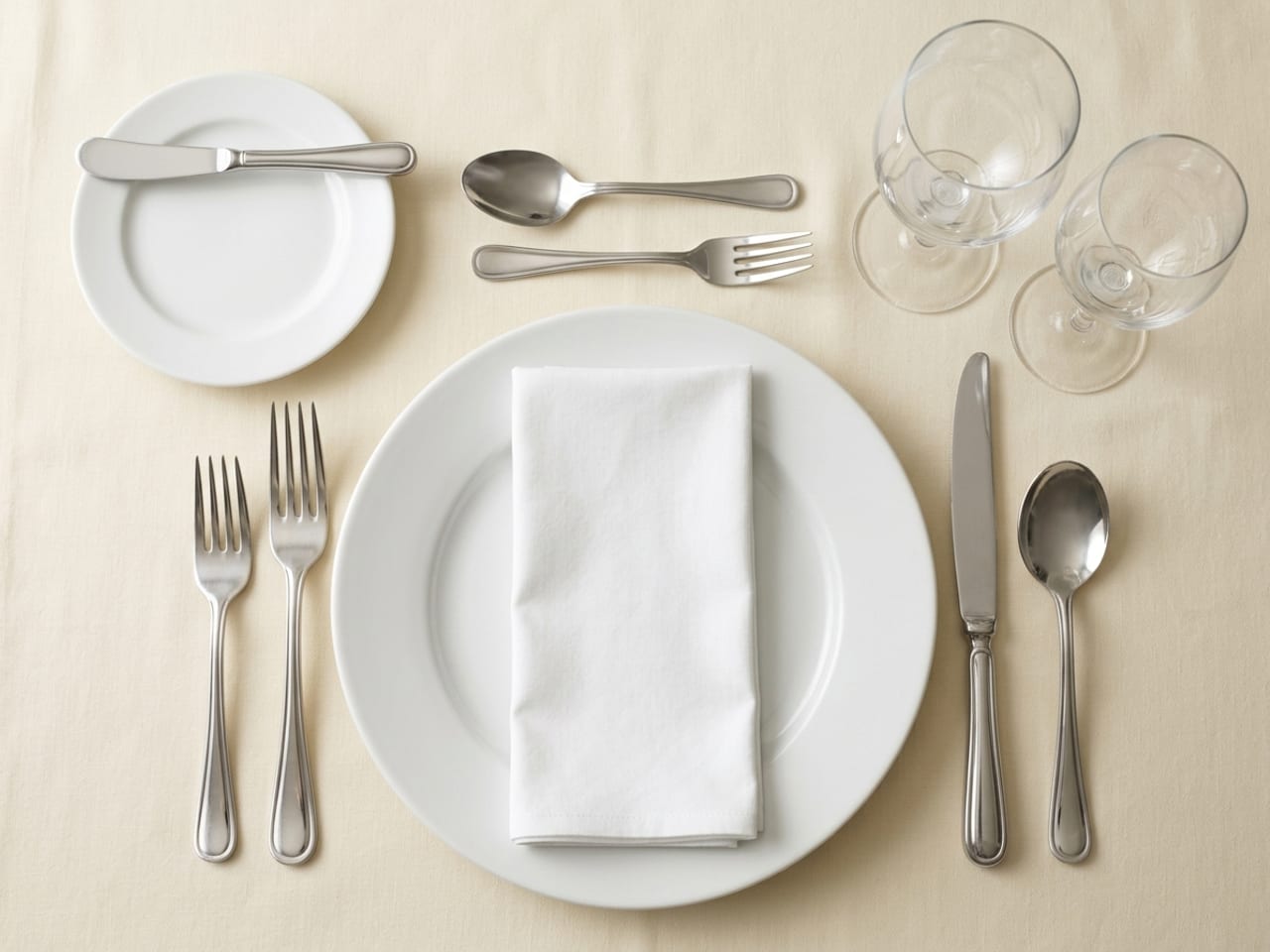
The key: the plate first, then left to right along the cutlery, then left to right across the top:
- Dinner plate, napkin on it
- Salad fork, outside (the salad comes first)
- Dinner fork
- Dinner knife, blade toward the plate
- Soup spoon, outermost on the right
- Bread plate and butter spreader, handle to the right
- Dessert spoon (handle right) above the dessert fork (handle left)
- Water glass, above the knife tip
- Wine glass, to its right
To draw this setting for your own courses, open the table setting diagram on its informal preset.
The formal place setting
A formal setting is for a meal of more than three courses.4 It starts with a charger, or service plate, which holds the first course's plate, stays under the courses before the main, and is swapped for the hot dinner plate when the main arrives.4 In 1922 Emily Post called it the place plate, though hers left with the soup plate and could take a cold first course passed in bulk;27 in France it is the assiette de présentation, set 2 cm from the edge.26 Today it is only an underplate, so food never goes straight on it;4 there is more on where the charger sits, and when it leaves, with sizes, in our plates guide.
The napkin goes on the charger, or beside the forks rather than under them, unless space is tight.4, 13 No more than three of any implement are laid, plus an oyster fork, which goes on the far right;4 one Martha Stewart expert puts it inside the soup spoon instead.13 Up to five glasses stand in the order they'll be used.4 The butter spreader lies on the bread plate, handle right, blade down, and the dessert spoon and fork arrive on the dessert plate.4 A place card goes above the plate, or on the napkin where it is easier to read.27 Everything is symmetrical: the centrepiece in the exact centre, an even number of candlesticks, places evenly spaced, and decorations low enough for guests opposite to see each other.4
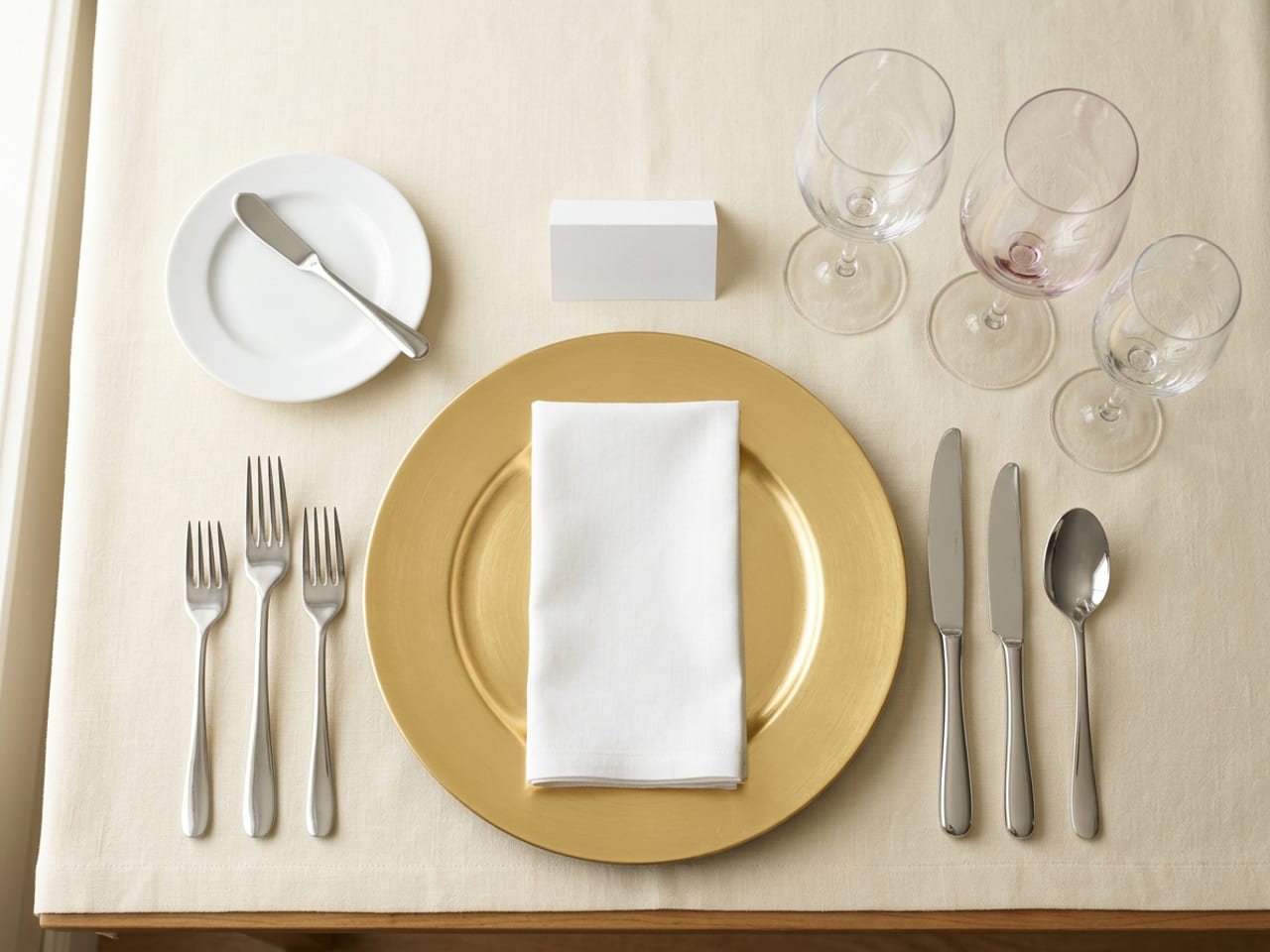
The key: the plate first, then left to right along the cutlery, then left to right across the top:
- Charger, with the napkin on it
- Fish fork, outside (fish is the first fork course)
- Dinner fork
- Salad fork, inside (the salad comes after the main)
- Dinner knife, blade toward the plate
- Fish knife
- Soup spoon, outermost
- Bread plate and butter spreader
- Place card
- Water goblet, above the knife tip
- Red wine glass (the main)
- White wine glass (the fish), poured first, so furthest out
Change the courses, glasses or the charger and see it redrawn in the formal table setting diagram.
Where everything goes
Every piece of a place setting: where it sits, which way it faces, and the mistake people make with it.
| Piece | Where | Which way | The usual mistake |
|---|---|---|---|
| Dinner plate | Centre, about 1 in (2.5 cm) from the edge | Bottom edge level with the cutlery | Pushed far in toward the middle of the table |
| Charger | Centre, under the early courses (formal) | Swapped for the hot dinner plate at the main | Food straight on it; still there at dessert |
| Napkin | Left of the forks, or on the plate | Simply folded | In the wine glass at a dinner table |
| Forks | Left, first course outermost | Tines up (tines down in France) | Salad fork always outside, whatever the menu |
| Oyster fork | Far right, outside the soup spoon | The only fork on the right | Set on the left with the others |
| Knives | Right, dinner knife nearest the plate | Blade toward the plate | Blade facing out |
| Spoons | Right of the knives, soup spoon outermost | Bowl up | A soup spoon with no soup on the menu |
| Bread plate | Upper left, above the forks | Butter spreader across it, handle right | On the right, or taken for a neighbour's |
| Glasses | Upper right, water above the knife tip | Wines to its right in the order poured | Water at the far end of the line |
| Dessert spoon and fork | Above the plate, or brought with dessert | Spoon on top, handle right; fork below, handle left | Handles pointing the wrong way, away from the hand that takes them |
| Cup and saucer | Right of the spoons, a little above | Handle to the right | Set at the start of a dinner when coffee comes at the end |
| Place card | Above the plate, or on the napkin | Small: Post's in 1922 were about 1½ by 2 in (4 by 5 cm) | Big enough to block the view across the table |
Where does the napkin go?
To the left of the forks, or on the plate: both are correct.2, 4 At a formal table it goes on the charger or beside the forks rather than under them, unless space is tight.4, 13 More in the napkin, briefly.
Which side does the fork go on?
The left. Every fork goes left of the plate except the oyster fork, which sits on the far right.1 The salad fork goes outside the dinner fork when salad is served first, and inside it, next to the plate, when salad follows the main.3
Which way does the knife blade face?
In, toward the plate, always.1 The butter spreader follows the same idea on the bread plate: the Emily Post Institute has its blade facing the diner and the handle to the right, because the setting is "mostly designed for right-hand dominant diners".1
Where do the spoons go?
On the right, outside the knives. A soup or fruit spoon for a first course goes furthest out; a teaspoon or dessert spoon set beside the plate goes between the knife and the soup spoon.3
Where does the bread plate go?
Upper left, above the forks, so yours is the one on your left.3, 4 In Britain the side plate is laid at every formal place even if it won't be used,8 and it sits to the left of the place setting;103 British cutlery makers usually put it to the left of the forks rather than above them.101, 102 Emily Post's 1922 book put it "above and to the left of the forks", and only at breakfast, lunch and supper.27
Where do the dessert spoon and fork go?
Across the top of the plate: the spoon on top with its handle to the right, the fork below it with its handle to the left, so each handle points to the hand that picks it up. The Emily Post Institute calls spoon-above-fork the traditional order and admits the reverse is also seen.1, 3 At a formal dinner they come in on the dessert plate instead,4 and a British formal table lays them innermost beside the plate.8
Where does the coffee cup go?
On the right, above and to the right of the knife and spoons, handle to the right.3, 16, 22 At a dinner at home most people serve coffee after the meal and bring the cups and saucers then.3
Where do the steak knife and butter knife go?
The steak knife takes the dinner knife's place, on the right with the blade toward the plate; set it when you serve steak or another big piece of meat.3, 14 The butter spreader never joins the knives on the right: it lies on the bread plate, handle to the right.3, 4
Where does the salad plate or bowl go?
For a first-course salad, on the dinner plate or charger, and cleared with the course. With the main, to the left of the forks, which the Emily Post Institute recommends when the main has gravy or anything runny; otherwise the salad can share the dinner plate.3 Plating the salad itself is in how to plate salad.
Glasses: the order, and why the guides disagree
Search for the order of glasses and you'll find half a dozen arrangements. They are mostly the same order in different shapes. The rule the etiquette authorities share: the water glass stands above the knife tip, or a little to its right, and the wine glasses go to its right in the order you'll pour them, so the first wine is the one nearest the hand.
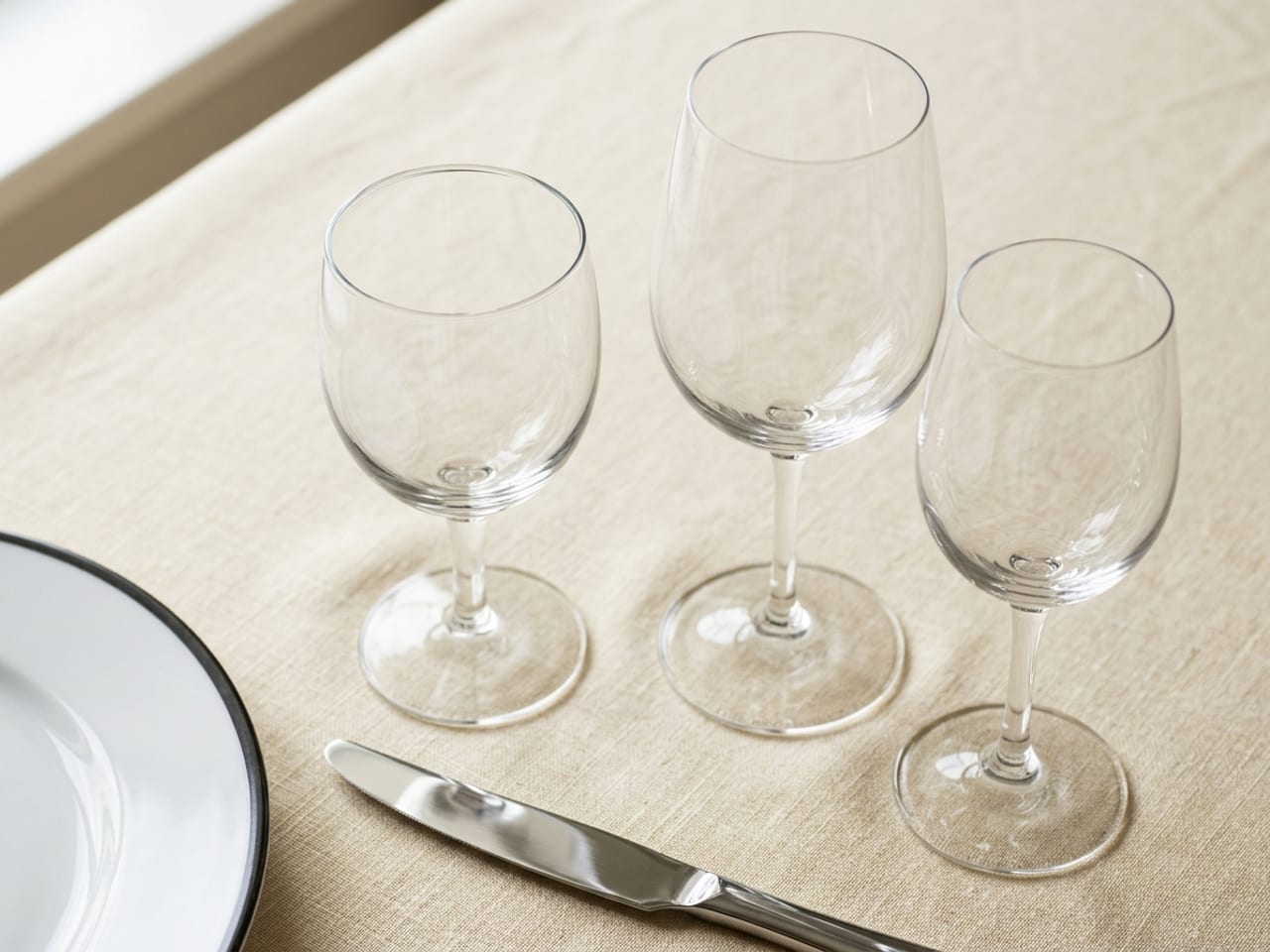
- The rule they shareWater stands above the tip of the dinner knife (Etiquette Scholar and Nebraska Extension both say about an inch, 2.5 cm, above it), or a little to its right at 45 degrees.2, 11, 22 The wines go to its right in the order they'll be poured, up to five at a formal dinner; past three, the smaller glasses stand in front.4
- DiamondFour or five glasses stepped into a diamond, as Etiquette Scholar describes it for a sherry course, with the dessert-wine glass highest.11
- British practiceDebrett's: glasses "grouped or lined up on the right above the knives. A tumbler for water and two wine glasses, with the larger one for red wine, is usually enough," with a smaller third for pudding wine or champagne.8
When the guides disagree
One widely copied version, Wikipedia's, lists the glasses "in the order of use: white wine, red wine, dessert wine, and water tumbler", which puts the water last and furthest out.18 That isn't what Emily Post's 1922 book, the Emily Post Institute today or Etiquette Scholar describe: all put the water above the knife.27, 4, 11 Some retailer and holiday-styling pages go further, setting a wine glass above the knife or the water in front of the wines; we found no etiquette authority that does. Our verdict: water above the knife tip, wines to its right in pour order, and line, triangle or diamond is your choice of shape.
The napkin, briefly
Left of the forks or on the plate: both are correct.2, 4 Under the fork is fine at an everyday table.2, 16 At a formal table, put it on the charger or beside the forks rather than under them, unless space is tight; the Emily Post Institute allows under-the-forks when space is short, and the experts Martha Stewart quotes advise against it, because a guest has to move the cutlery to reach it.4, 13 In Britain it sits on the side plate.8 A napkin in the wine glass is decoration, not a rule; Wikipedia says that in less formal settings it "should be in the wine glass",18 but none of the etiquette authorities we read endorses it. In 1922 Emily Post wanted it "folded square and flat", adding that "very fancy foldings are not in good taste".27
Which way does the fold face? Sources differ. US extension and 4-H teaching sheets put the fold on the left, away from the plate, so the napkin opens like a book;21, 22, 24 some other guides turn the folded edge toward the plate; and the etiquette authorities we checked, the Emily Post Institute and Debrett's, don't say. For a 4-H contest, follow the sheet; at home, choose one and fold every napkin the same way.
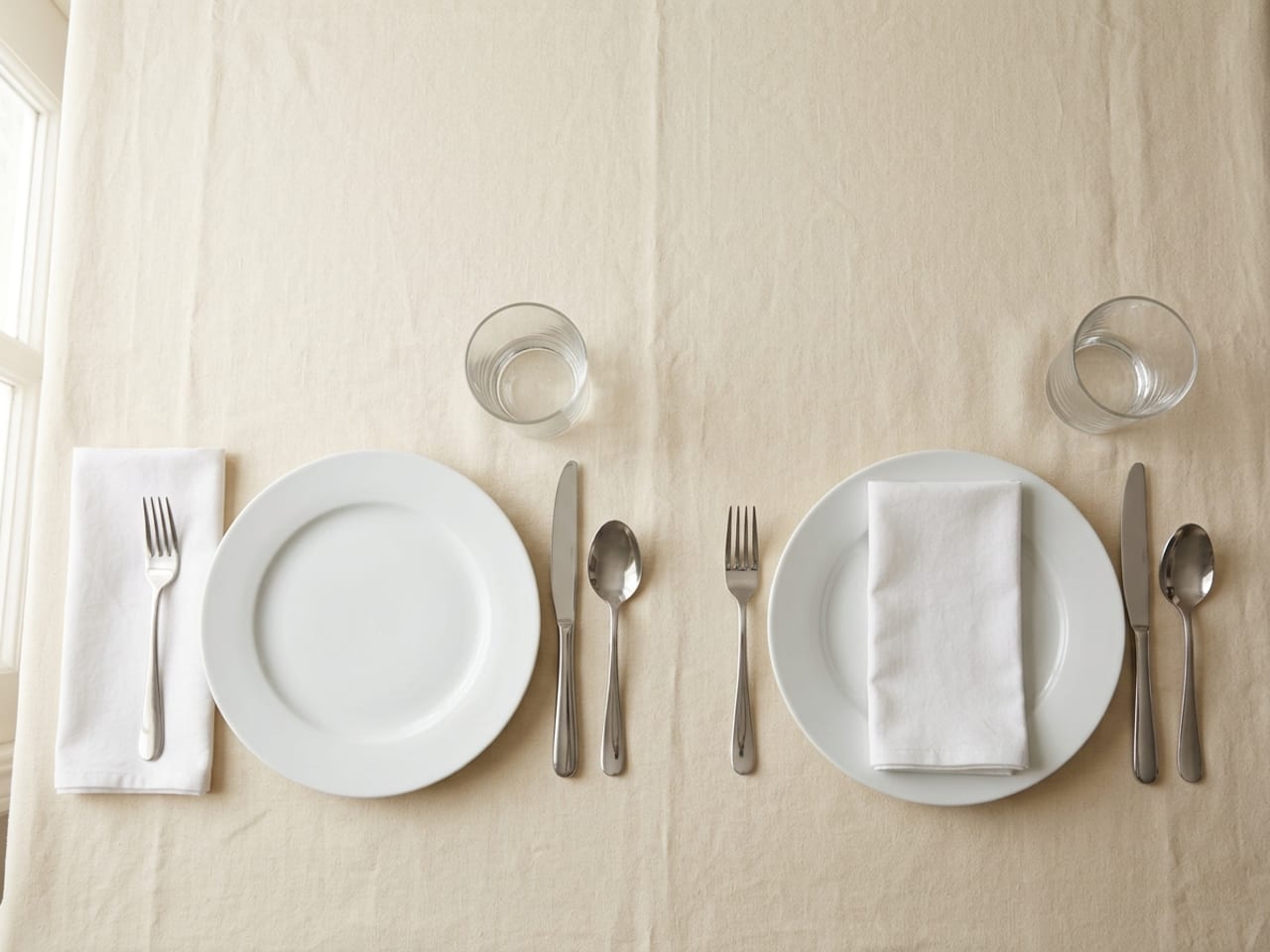
What to do with it once you sit down, and when you get up, is in our guide to where the napkin goes, along with how to fold napkins 18 ways.
American, British and Continental table settings
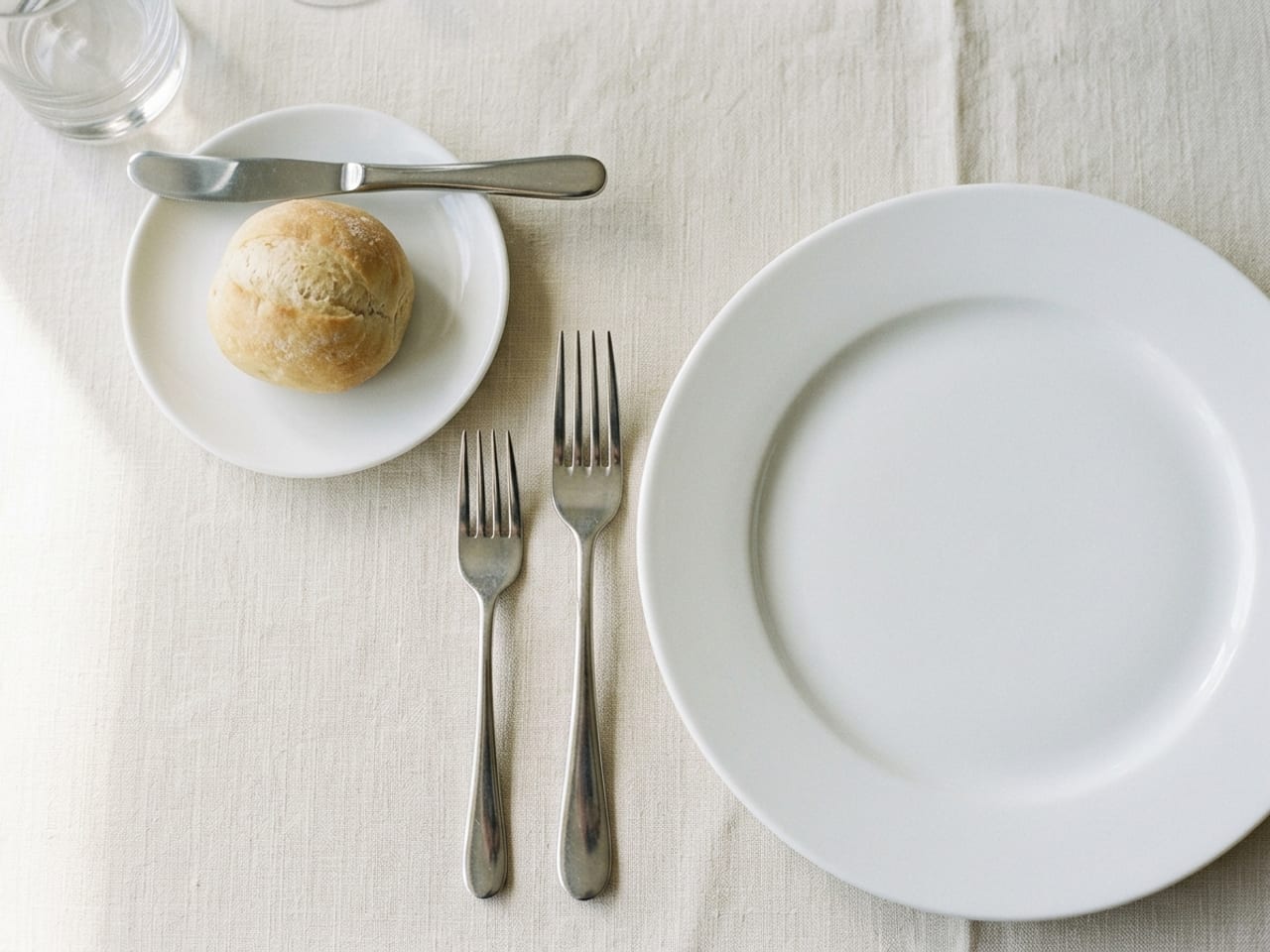
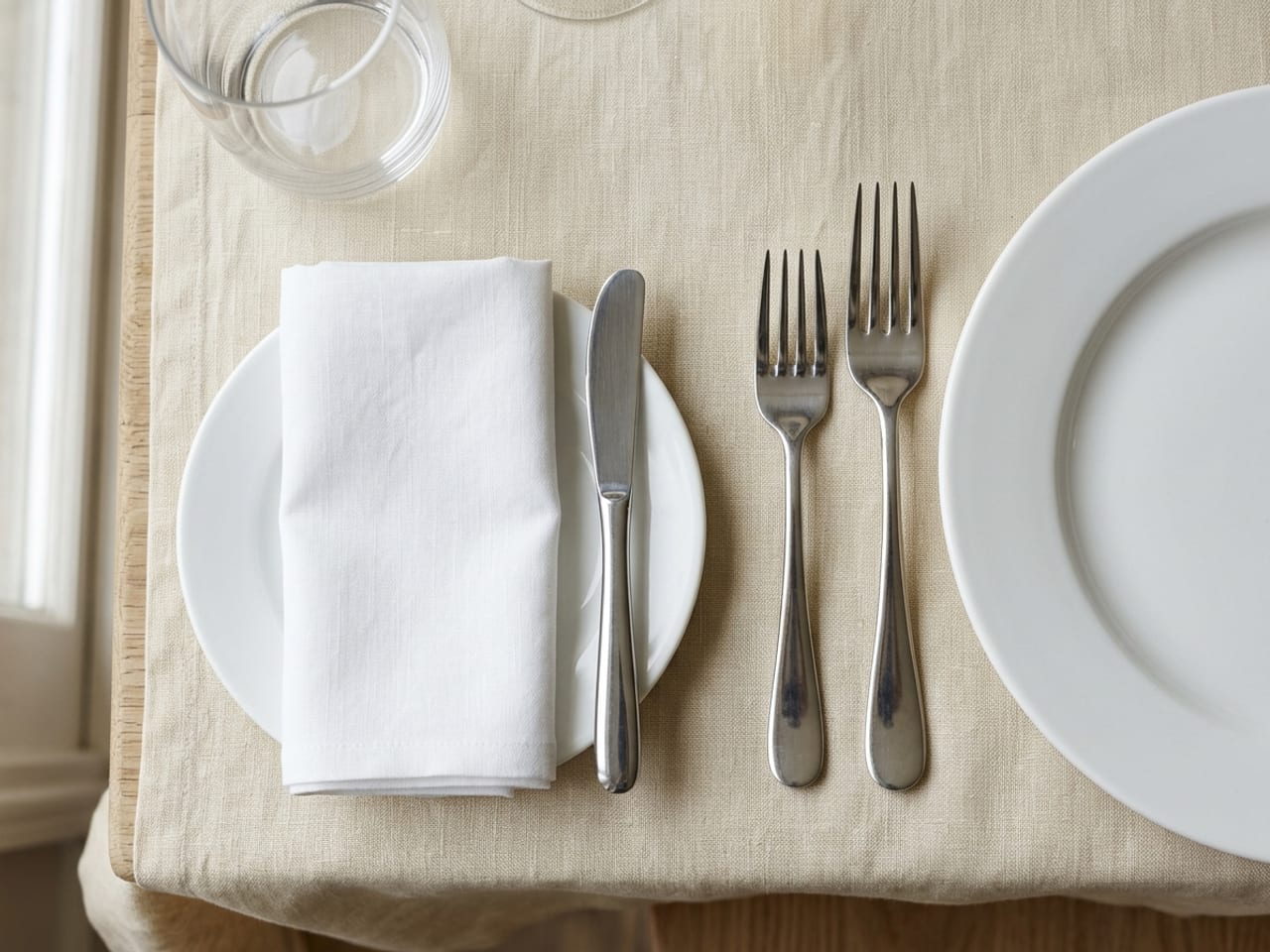
The core rules travel: Debrett's, the British etiquette authority, says "The basic rules do not vary when laying the table ... Knives and spoons go on the right, forks on the left. The idea is always to work from the outside in."8 The differences are in the bread, the dessert cutlery and which way the forks lie.
| Point | United States | Britain | France |
|---|---|---|---|
| What it's called | Setting the table | Laying the table8 | Mettre le couvert49 |
| Bread | Bread plate above the forks3 | Side plate to the left of the forks, laid at every formal place even if unused8, 101, 102, 103 | Traditionally on the cloth to the left; the bread plate is an accepted Anglo-Saxon habit41 |
| Napkin | On the plate or left of the forks2, 4 | Simply folded on the side plate8 | On the plate, to the left, or on the forks41 |
| Forks | Tines up10, 27 | Tines up39, 40 | Tines down10, 39 |
| Dessert cutlery | Above the plate, or brought with dessert at a formal dinner3, 4 | Formal: innermost beside the plate, "not above"; brought in if space is short8 | Across the top of the plate, or brought with dessert, the more elegant choice41 |
| Glasses | Water above the knife, wines to its right4 | Grouped or lined up above the knives; water tumbler and two wines8 | Upper right, largest (water) on the left down to the smallest100 |
| Eating | Cut, then switch the fork to the right hand; Continental style also fine5 | Fork stays in the left hand, tines down9 | Fork stays in the left hand35 |
Why French forks lie tines down. The usual explanation is that families engraved their arms or initials on the back of the handle, so the back faced up to show them.39 It fits, but the Alimentarium, the Swiss food museum, says there is no really satisfactory explanation for the two customs,40 and the "since the Renaissance" dating in popular retellings has no support.
Eating, not setting. Americans traditionally cut, put the knife down and switch the fork to the right hand; Europeans keep the fork in the left. The Emily Post Institute says switching between the two styles is fine, even within a course.5 Post herself called constant switching "a ridiculous practise of the would-be elegant" in 1927,28 while a Philadelphia etiquette book had called it fashionable in 1853.30
Spacing: how much room each guest needs
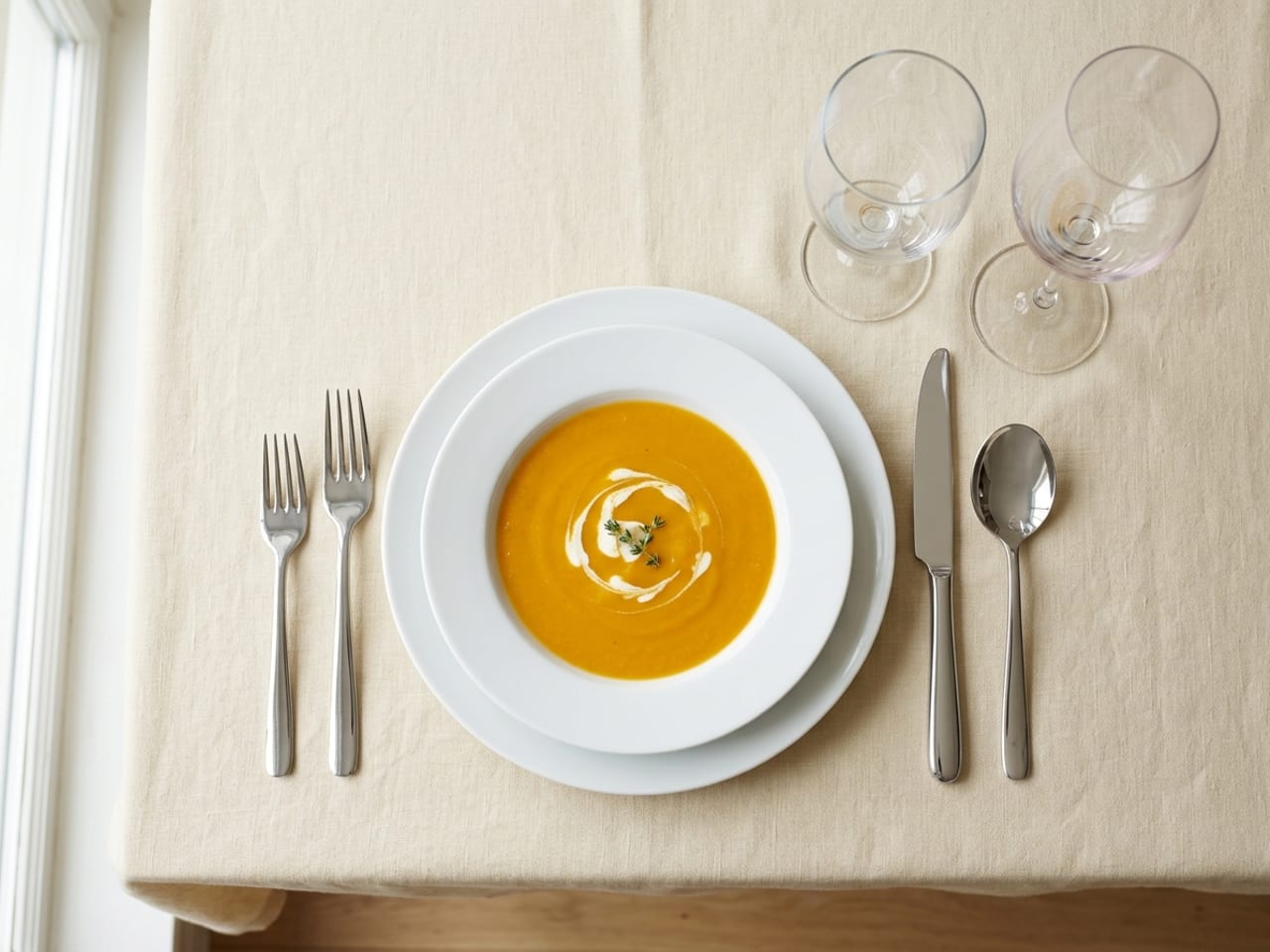
Between places: Emily Post's 1922 ideal was "about two feet from plate center to plate center", 24 in (61 cm).27 Debrett's asks for "ideally no less than 20 inches" (51 cm) between places,8 US 4-H sheets for at least 20 in per person,22, 24 and the University of Maryland Extension calls 24 to 30 in (61 to 76 cm) center to center comfortable.21 French practice is 40 to 60 cm (16 to 24 in) between plates.26 Use 24 in as the working figure, more if you're passing platters.
From the edge: about 1 in (2.5 cm) for the plate and the bottoms of the cutlery, a figure from US extension and 4-H sheets;21, 22, 23 French maîtres d'hôtel use 2 cm.26 The Emily Post Institute sets place mats one to two inches (2.5 to 5 cm) from the edge and asks for the silverware at the same distance from the edge at every place.4 Leave about half an inch (1.3 cm) between pieces of cutlery and line up their bottoms with the plate.14, 23
The cloth: the Emily Post Institute gives an average drop of 12 to 18 in (30 to 46 cm);4 Maryland Extension, 16 to 24 in (41 to 61 cm) for a formal table and 10 to 14 in (25 to 36 cm) for an informal one.21 Linen retailers go shorter for everyday, about 9 in (23 cm), and to the floor for a banquet look; our Thanksgiving hub has those sizes. To check how long a table your guest list needs, the table setting diagram works it out from the guest count.
Southern Living's advice is the whole method: "let the menu be your guide". 15 Each course adds its piece; each link opens the setting drawn for it.
| If you serve | Add | Where |
|---|---|---|
| Soup first | Soup spoon | Right, outside the knife |
| Oysters or a shellfish cocktail | Oyster fork | Far right, outside the soup spoon |
| Salad before the main | Salad fork | Outside the dinner fork |
| Salad after the main | Salad fork | Inside the dinner fork, next to the plate |
| A fish course | Fish fork and fish knife | Fork outside the dinner fork; knife outside the dinner knife |
| Steak or a large roast | Steak knife in place of the dinner knife | Right of the plate, blade in |
| Bread and butter | Bread plate and butter spreader | Above the forks |
| A runny main with salad on the side | Salad plate | Left of the forks |
| Dessert | Dessert spoon and fork | Above the plate, or brought on the dessert plate |
| Coffee or tea | Cup, saucer and teaspoon | Right, or brought with the coffee |
| Each wine | Its own glass | Right of the water glass, in the order poured |
| A course that needs a fourth fork or knife | Its cutlery | Brought in with the food, never laid as a fourth fork or knife |
Sources for the table: the Emily Post Institute's informal and formal pages and its overview,1, 3, 4 and Real Simple for the steak knife.14 No menu yet? The course meal builder deals one from real recipes and has a button that opens the setting for it, and the dinner party menu planner plans a three- or four-course dinner with a cooking timeline.
Manners at a set table
- Resting and finishedSplayed or crossed on the plate means you are still eating. Together and parallel means you've finished: about 4:20 on a clock face in the US, six-thirty with tines up in Britain.9, 13 The exact clock position varies by source; parallel and together is what every source agrees on.
- Pass to the rightDishes travel counterclockwise, all in the same direction, so nobody ends up holding two. If a neighbour a seat or two to your left asks, pass it straight to them.6
- Serving and clearing"Serve from the left, clear from the right" is really the platter convention: offer a platter at the guest's left so they can serve with their right hand.62 Plated food usually goes down from the right, drinks are poured from the right, and plates are cleared from the right once everyone has finished, never stacked or scraped at the table.61
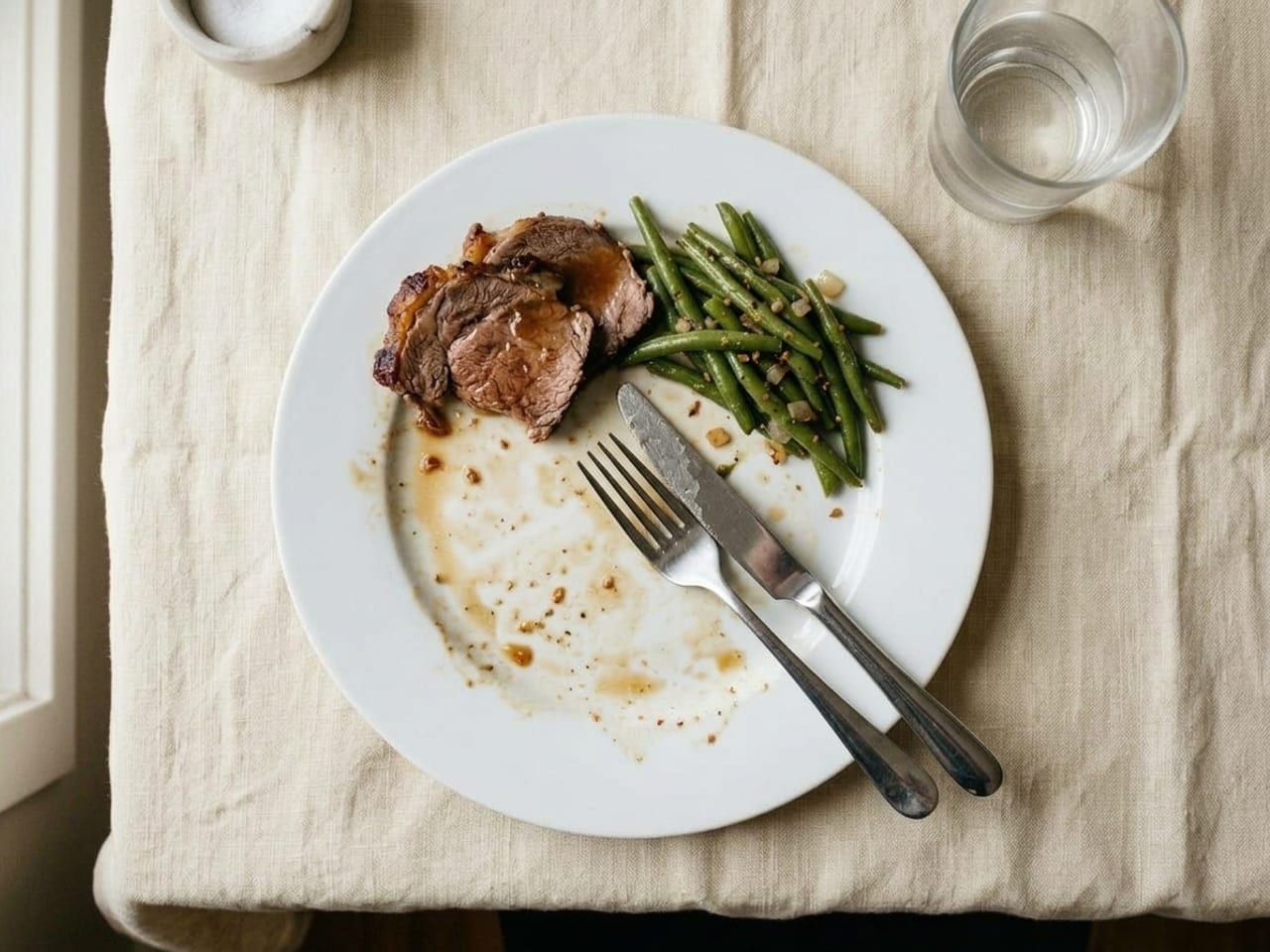
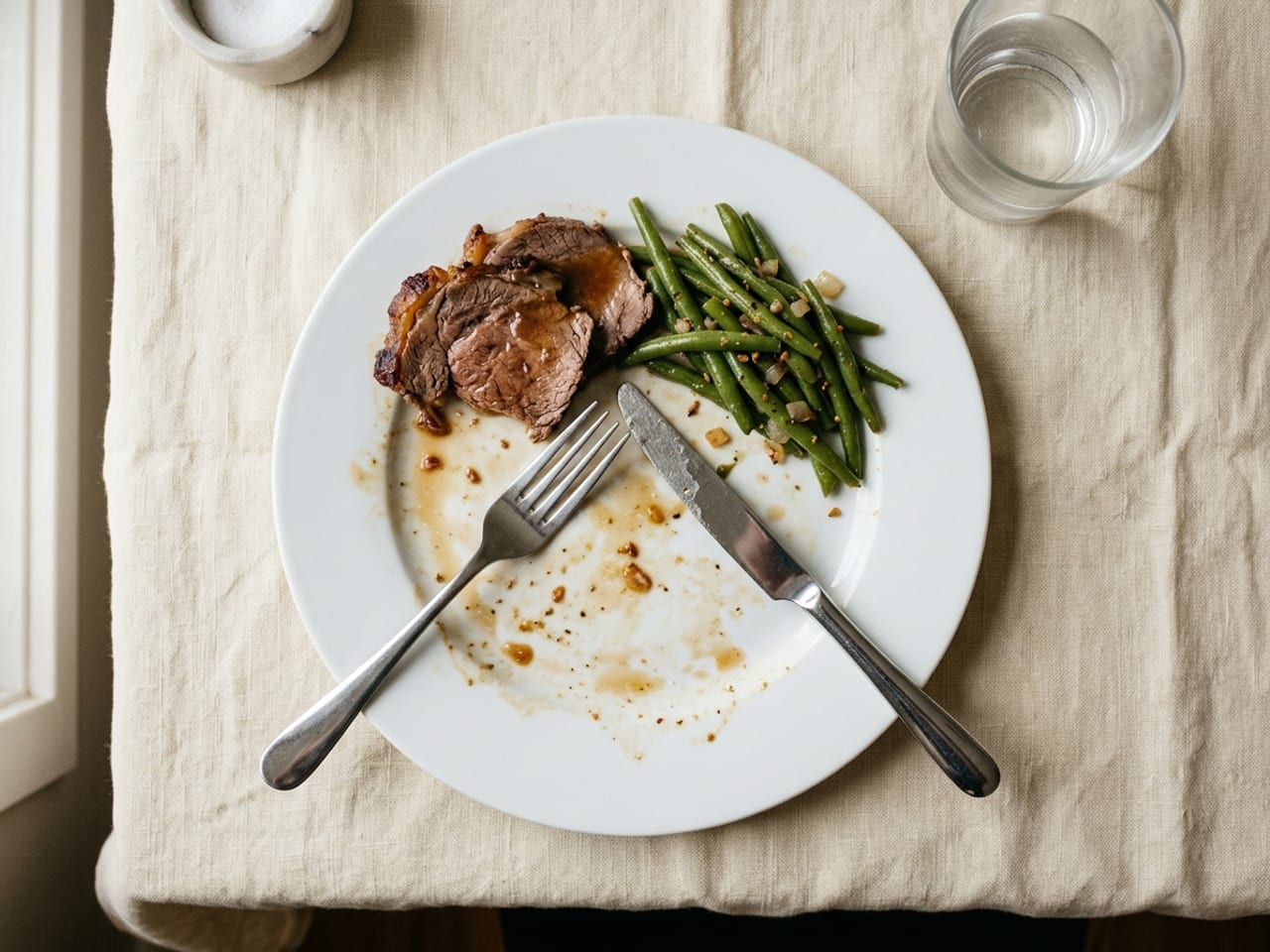 RestingFinished
Setting the table for Thanksgiving, Christmas, a buffet and kids
Thanksgiving
The same rules, sized for a big meal: plan where the serving dishes will go first, keep the middle of the table clear for them, set the centrepiece and candles before the glasses and plates, and keep the centrepiece to about 12 in (30 cm) or lower.17 Our hub shows how to set a Thanksgiving table, formal and casual, with the whole Thanksgiving tablescape around it.
Christmas and other holidays
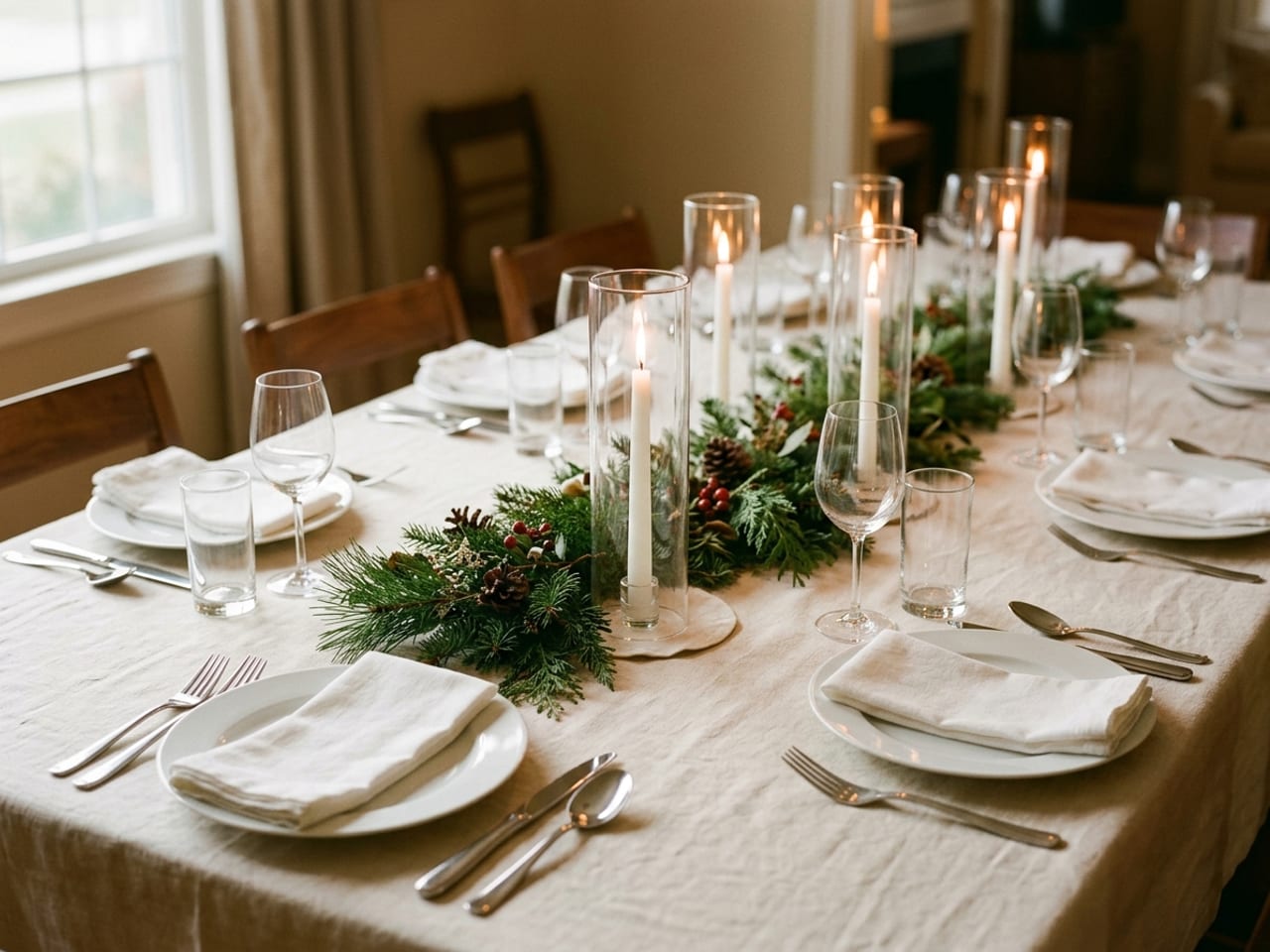
Debrett's Christmas table: flowers "low enough for guests to see over", side plates laid, and candles supplemented by other light so nobody eats in "the flickering half-light"; "the old rule was six candles, in pairs, for eight people".8 December is also the peak month for candle fires, so keep flames in glass and clear of the greenery (see safety).66 Our hub shows how to set a Christmas table, with the American and British place settings, where the crackers go and the napkin folds.
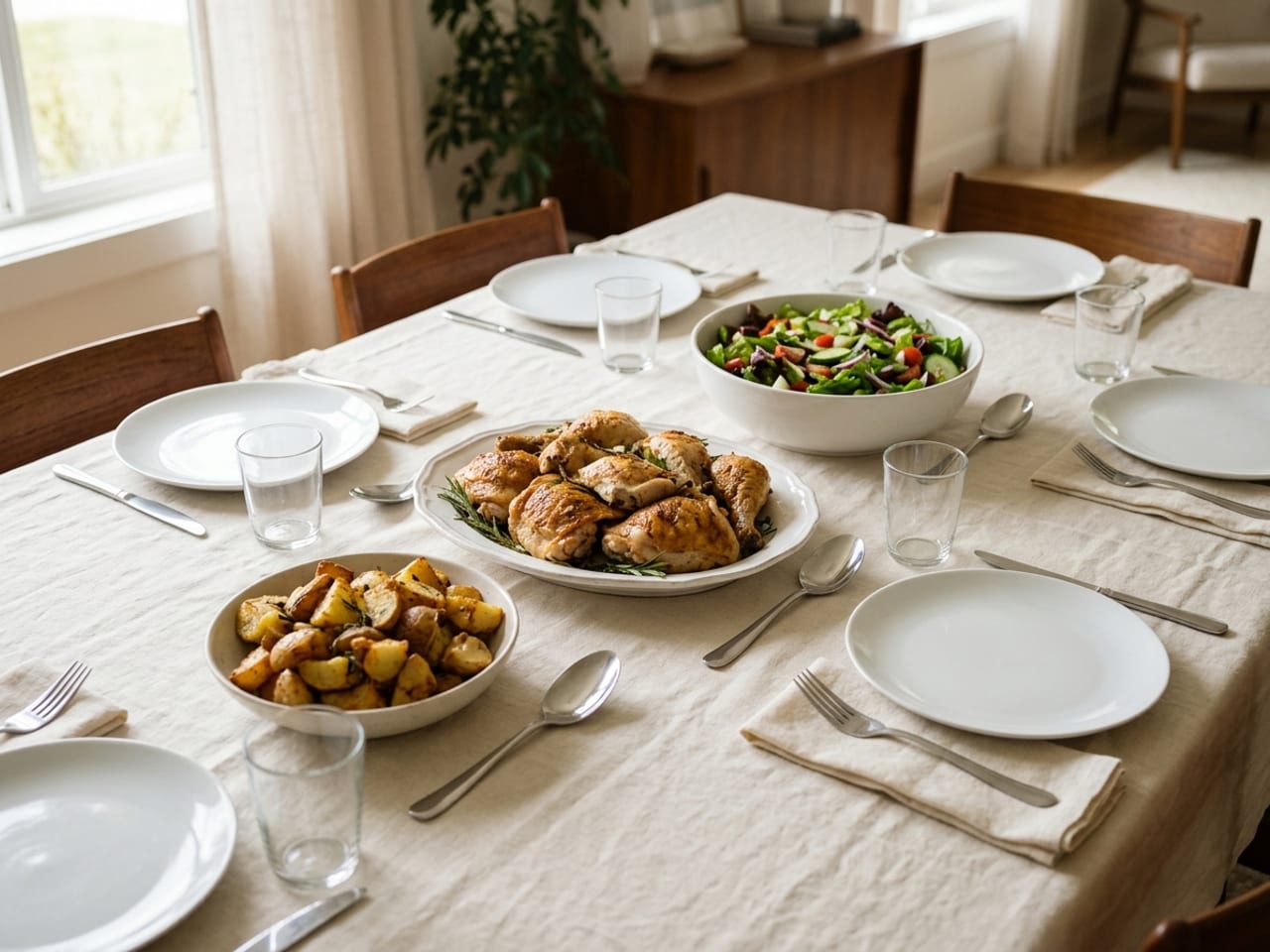
Family-style
Leave room for the platters, or decorations you can move to a sideboard during the meal.8, 17 Lay each serving spoon beside its dish, not in it, until serving starts,22 and pass to the right.6 Use the generous end of the spacing range, up to 30 in (76 cm) center to center, the top of Maryland Extension's comfortable range,21 when platters are going round.
A buffet
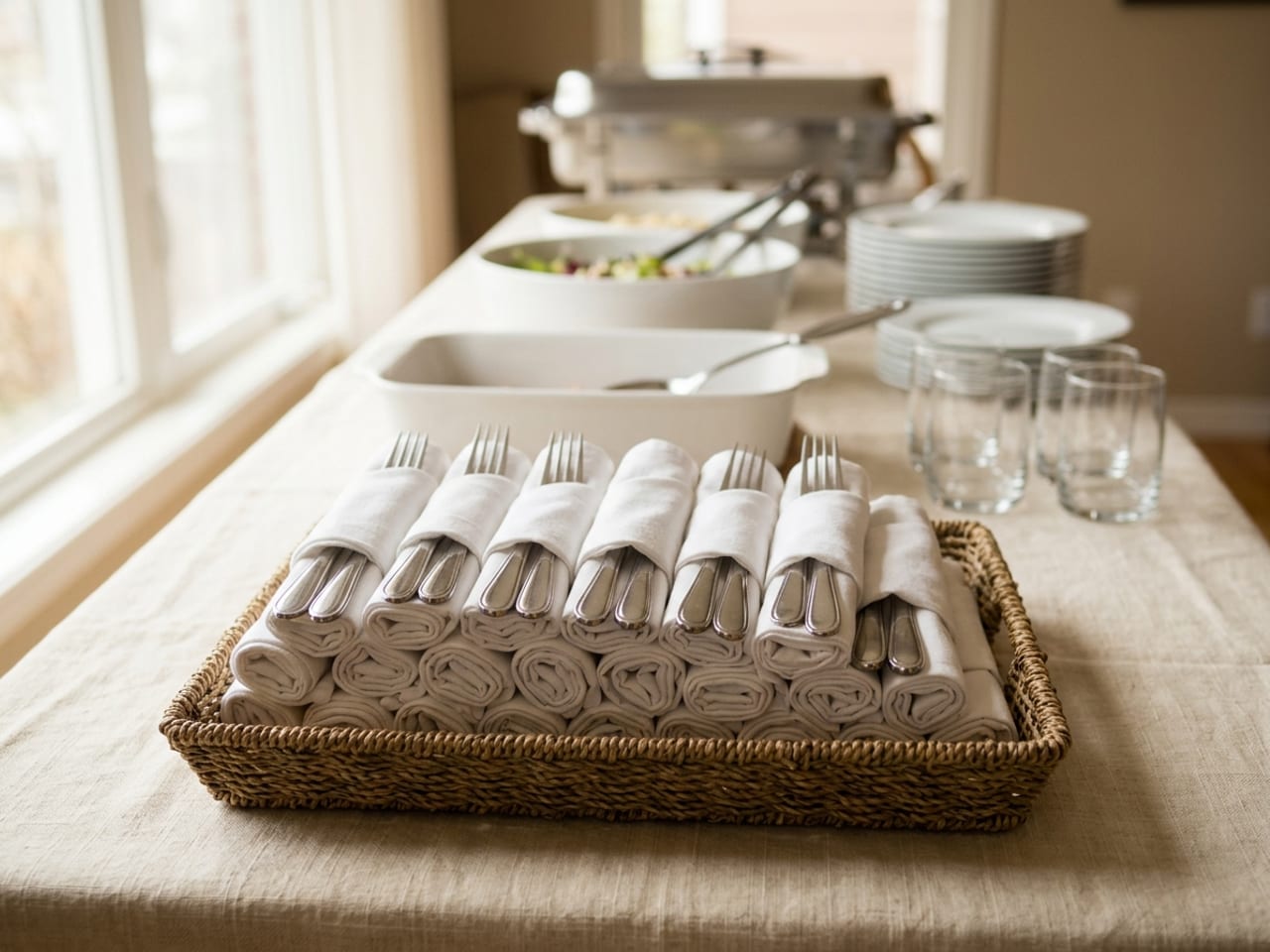
A buffet needs no place settings at the buffet itself: plates at the start of the line, then the food with a serving utensil for each dish, and the cutlery rolled in napkins at the end, so guests aren't juggling it while they serve; or set the dining tables with napkins and cutlery instead.15 Some guides start the line with the cutlery;63 both work, but the end of the line leaves both hands free. Keep food out no more than two hours (one above 90 °F, 32 °C).78 The Thanksgiving hub has the buffet and sideboard flow.
The kids' table
Keep it to one fork, one knife and one cup, unbreakable if you can. Keep candles off the kids' table, or well away from it;68 give children lead-free glass or an unbreakable tumbler, not crystal;71 no copper mugs for cider or lemonade unless they are lined;73 and don't let children handle a dish straight from the microwave.76 The Thanksgiving hub has a whole kids' table section.
Setting a table for a 4-H or county-fair contest
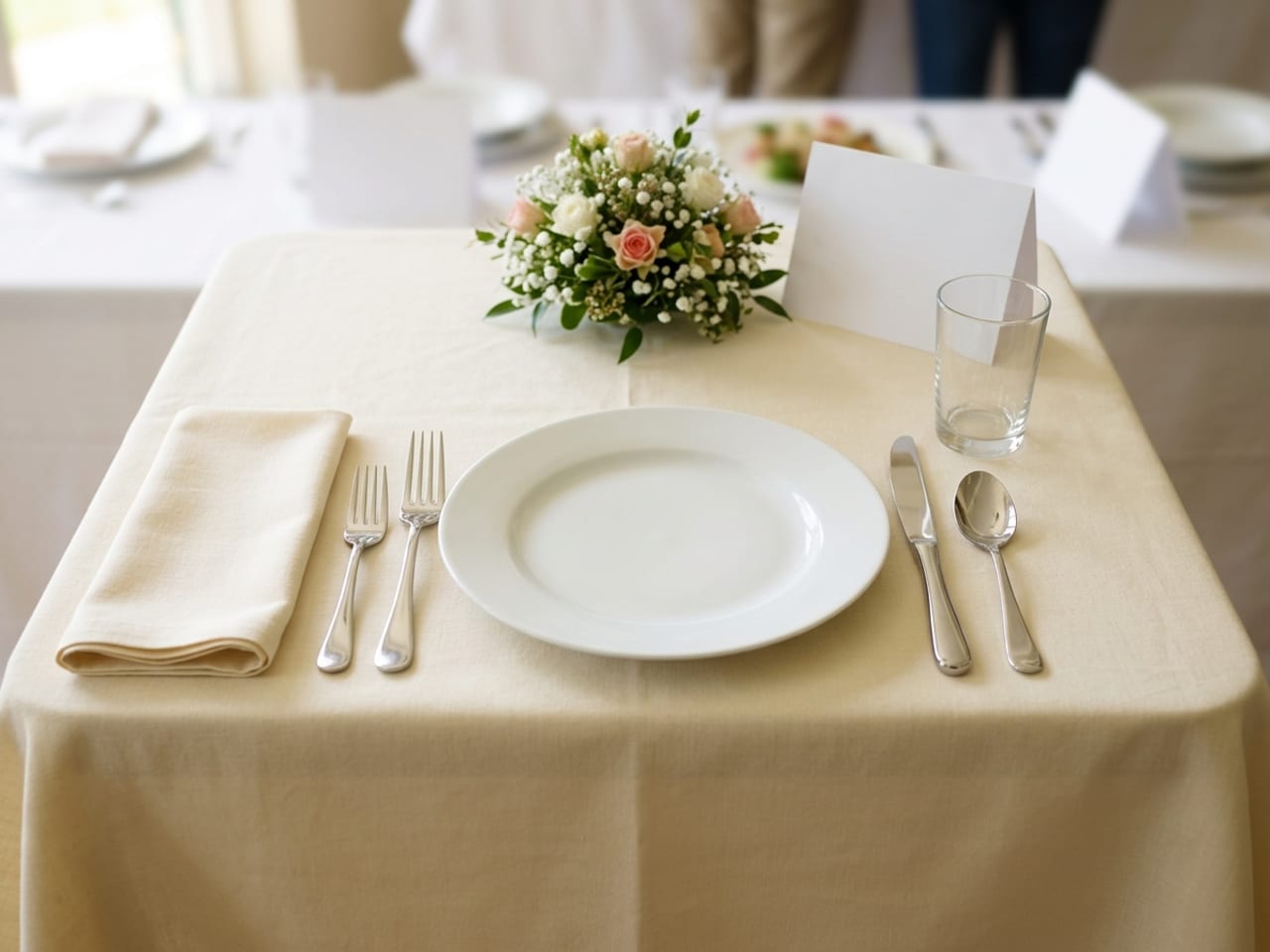
Table setting contests are a real 4-H and county-fair tradition. Rules vary by county, so read yours first. Virginia's, for example, asks for a themed table with a centrepiece and a menu card of at least 4 by 6 in (10 by 15 cm), and gives the judges five minutes per table while you introduce your theme and menu and answer their questions.25 What to check before the judges arrive:
- Every piece in its place for the menu on your card, and nothing the menu doesn't use.
- Plate and cutlery bottoms level, about 1 in (2.5 cm) from the edge.22, 23
- Knife blade toward the plate; water glass above the knife tip.22
- A centrepiece low enough to talk over.8
- Candles unlit, and no alcohol on the menu, so no wine glass: Maryland's and K-State's rules want candles unlit, K-State deducts points for lit ones and disqualifies a menu with alcohol.21, 24
- Napkin folded into an oblong with the fold on the left, so it opens like a book, and no glitter or glue on anything you would eat from.22, 24
- A reason ready for every choice: this guide's five rules are your talk.
The table setting diagram prints a numbered key you can practise from.
A short history of the place setting
The individual place, a plate, napkin, spoon, fork, knife and glass for each guest, is an 18th-century idea;40, 49 in 1611 Thomas Coryat still described Italians cutting their meat from a shared dish.33 The long row of courses that gave us outside-in came with service à la russe in the 19th century.29, 40
| When | What happened |
|---|---|
| c. 1060 | The monk Peter Damian sneers at a Byzantine-born Venetian dogaressa who ate with "a golden instrument that had two prongs" rather than her fingers.34 |
| 1430 | The table fork in an English inventory, the first record of the word in that sense.56 |
| 1611 | Thomas Coryat reports that Italians "doe alwaies at their meales use a little forke"; a friend jokingly calls him furcifer for copying them.33 |
| c. 1635 to 1642 | The undated Richelieu anecdote: knives "épointés", their points ground off, after Chancellor Séguier picks his teeth with one.31 |
| 1669 | Louis XIV bans pointed knives in the Flemish and Low Countries towns ceded to France in 1668, and orders innkeepers and households there to blunt their table knives within three days.32 |
| 18th century | Each guest gets an individual couvert of plate, napkin, spoon, fork, knife and glass.40, 49 |
| 1779 | "Bread and butter plate" in print in English.52 |
| 1853 | Eliza Leslie in Philadelphia: cutting, then moving the fork to the right hand, is "fashionable".30 |
| 1861 | Mrs Beeton lays knife right and fork left, a roll in each napkin, and describes dinners à la Russe served from the sideboard.29 |
| 1890s | Gorham's Mythologique silver pattern offers 72 pieces;37 in France, Baronne Staffe keeps the fork in the left hand and calls putting the knife down and picking it up again "très inélégant".35 |
| 1892 | "Place card" in print, in the Ladies' Home Journal.57 |
| 1922 | Emily Post's Etiquette: four forks at a formal place, no bread plates at dinner, places "about two feet" apart.27 |
| 1927 | Post's revision adds the three-fork limit and calls constant fork-switching "a ridiculous practise of the would-be elegant".28 |
| 1944 | "Place setting" in print by 1944, per Merriam-Webster; the OED's first example is from 1950, in a later Emily Post edition.44, 46 |
| 1947 | "Tablescape" in print, in the Hollywood Citizen-News.47 |
Eleven table-setting myths
- “Richelieu invented the table knife on 13 May 1637”The story comes from Tallemant des Réaux's court gossip, written in the 1650s, and gives no date at all.31 The precise date is a later invention.
- “Louis XIV banned pointed knives in France”His 1669 edict covered the newly ceded Flemish and Low Countries towns, after knife killings in quarrels there.32
- “A Byzantine princess brought the first fork to Europe”Peter Damian's 11th-century sneer is real, but he names no one. Hodgson (1901) ties it to the Byzantine bride of the young doge Giovanni Orseolo, early in the century; later chroniclers pinned it on Theodora, who married Doge Domenico Selvo only after 1071. Either way it describes a rarity, not a first.34
- “Catherine de' Medici brought the fork to France”A long-told legend, like Henri III bringing forks home from Venice; we found no early source behind either.40
- “Emily Post taught Americans to zig-zag”In 1927 she used "zig-zag" to mock switching at nearly every mouthful, "a ridiculous practise of the would-be elegant", while letting a child cut a few pieces, lay down the knife and move the fork to the right hand.28 In 1922 she taught children to carry food to the mouth with the fork in the left hand.27
- “Never more than three forks is Post's original rule”Her 1922 first edition has no limit.27 The 1927 revision adds "Not more than three forks and two knives belong on the table when it is set", right after laying salad, meat and fish forks plus an oyster fork, so the oyster fork was never counted,28 as the Emily Post Institute still says.4
- “Mettre le couvert comes from poison-proof lids”That is one 19th-century lexicographer's theory. The Académie's 1762 definition is simpler: the cloth, napkins, knives and spoons "dont on couvre la table", that you cover the table with.49
- “BMW and b-and-d are old etiquette”Neither appears in Post, Beeton or Leslie; they are modern memory aids.38
Table-setting terms, defined
Table setting vs place setting vs tablescape
A place setting is one person's plate, cutlery, glasses and napkin.44, 45 The table setting is the whole table laid for the meal. A tablescape is the whole decorative arrangement, matching plates and bowls with the linen, flowers and candles.48 "Tablescape" sounds like television slang, but the OED's first example is from a 1947 Hollywood newspaper; the designer David Hicks, whose first book came out in 1966, used it for objects "arranged as landscapes" and claimed to have invented it, and Sandra Lee made it a dinner-party word in the 2000s.47, 43, 42
Place setting
The plates, cutlery, glasses and napkin laid for one diner; the same words name the unit dinnerware and flatware are sold in (a five-piece place setting) and the unit a dishwasher's capacity is counted in. Merriam-Webster: "a set of dishes and flatware constituting a table service for one person".44 Merriam-Webster dates it to 1944; the OED's first example is from 1950, in Emily Post.44, 46
Table setting · also laying the table (UK)
The way a whole table is laid for a meal: every place setting plus the cloth, centrepiece and serving pieces. In print since 1844, per the OED.46
Cover · also couvert
One diner's place at the table and everything laid there, from French couvert; restaurants still count their nightly trade in covers. Post 1922: "a plate must remain at every cover";27 "a restaurant with 100 covers in a night has served 100 guests."50
Tablescape
The decorative arrangement of a whole table, often with matching plates and bowls as well as linen, flowers and candles: the look of the table rather than what each guest needs to eat. Cambridge defines the decorative sense;48 the OED dates the word to 1947.47
Charger · also service plate, place plate, assiette de présentation
A large plate that marks each place and sits under the early courses; food never goes straight on it, and it is swapped for the hot plate at the main course. Merriam-Webster's service plate "indicate[s] a place at table";51 Post 1922 called it the place plate, removed with the soup plate before the fish.27 See the charger in detail.
Bread-and-butter plate · also side plate (UK)
The small plate for bread and butter, set at the upper left above the forks in the US and to the left of the forks in Britain. In print since 1779;52 Cambridge's side plate is "a small plate that you put your bread on when you are eating the main part of a meal";53 Post 1922 sized it at 5½ to 6½ in (14 to 16.5 cm),27 Debrett's at 6 in (15 cm).8
Butter spreader · also butter knife
The small round-bladed knife laid on each bread plate for buttering bread at table, distinct from the master butter knife that serves from the butter dish. Merriam-Webster's definition.54 Eliza Leslie in 1853 meant the shared one: "To take butter or salt with your own knife is an abomination. There is always a butter-knife and a salt-spoon."30 Emily Post in 1927 called "butter knife" "the proper word ... not butter spreader".28
Flatware, silverware, cutlery
The knives, forks and spoons: flatware or silverware in American English (even in steel), cutlery in British English. Cambridge marks the split;55 flatware first meant plates and dishes.56
Oyster fork · also cocktail fork
The small fork for shellfish, the only fork set on the right, outside the spoons. Emily Post Institute.1
Service à la française
The older style of dinner in which many dishes are set on the table at once in symmetrical courses and guests help themselves. The style à la russe replaced.29
Service à la russe
Dinner served course by course from the sideboard, which freed the table for flowers and multiplied the cutlery at each place. Beeton 1861;29 by 1922 Post called it "the only one known in New York".27 Each dish now had its own utensils on the table.40 Tradition credits the Russian ambassador Prince Kurakin, around 1810, without contemporary evidence.41
Place card
A small card with a guest's name, set above the plate to show where they sit. In print since 1892;57 Post 1922: about 1½ in by 2 in (4 by 5 cm), above the plate or on the napkin.27
Family-style
Service in which the food comes to the table in large dishes and everyone helps themselves. Cambridge;58 in print since 1857.59
Buffet
A meal in which guests serve themselves from dishes on a side table; the word first named the sideboard itself. Cambridge;60 Beeton's standing supper placed "on the buffet".29
Resting position
Knife and fork laid apart on the plate, splayed or crossed, to show you are still eating. Sources differ on the exact angle; the signal is that the two lie apart.
What the research says about a set table
We found no study that compares a properly set table with a bare one at home. What follows comes from restaurant and lab studies of linen, cutlery, glasses, plates and company, each with what it doesn't show.
- A tablecloth has some of the best evidence of any table itemIn a French restaurant study of 247 diners, fabric linen instead of paper made the first course, the meal as a whole, the service, the ambience and the overall experience rate higher, though the main course and dessert rated no differently.79 In a German lab study of 159 people eating in groups, adding a tablecloth made them rate the same soup higher, eat more of it and linger longer; in a separate test, dimming the lights alone changed nothing except that the soup seemed saltier.80 Doesn't show: cloth against a bare table (both arms of the French study had linen), or home meals.
- Cutlery should feel right for the meal, not just heavyAt a hotel conference lunch run by Oxford researchers, diners given heavier banquet-style cutlery liked the same main course more and said they'd pay about £2 more for it.81 In the lab, though, yogurt from a lighter plastic spoon seemed denser and pricier than from a weighted one; those authors suggest such effects appear when expectations about the cutlery are broken.82 Doesn't show: that heavier is always better. The lunch groups were whole tables, not individuals, and the heavy cutlery was a different style too.
- Glass shape changes a wine's smell, a little, not reliablyIn a German study of 181 untrained volunteers, the same wine smelled different in differently shaped glasses.83 In a blindfolded test, a Cabernet smelled no better in the "correct" Bordeaux glass; its aroma was rated less intense.84 Pooled Cambridge trials found bigger wine glasses made no difference to sales in bars and about 7% more in restaurants, for one size step only.85 Doesn't show: that a varietal glass improves its own wine.
- If you plate the food, plate size doesn't change how much guests eatA meta-analysis found bigger plates mattered when people served themselves, but with the portion fixed the effect was nil (d = 0.03); it pools older studies, some from a lab with several later-retracted papers, so treat its larger numbers as upper bounds.86 The first preregistered trial, 134 adults serving themselves lunch, found no clear difference either.87
- People eat more with friends than aloneA 2019 review of 42 studies found people eat noticeably more with friends than alone, but not reliably more with strangers or acquaintances.88 Distracted eating (TV, computer games and the like) raised intake in another review, more at the next meal than at that one.91 Doesn't show: that anyone enjoyed the meal more.
- Family meals: linked with good things, not proven to cause themAcross 50 studies, the family-meal habits most linked with healthier children were longer meals (r = .20) and a positive mood (r = .13); parents eating well, better food and the TV switched off were linked too, and every one of these correlations is small.89 When researchers followed the same children over time, family meal frequency had no significant link with school results or behavior.90
- Ritual: a nice idea, not a lawIn small experiments, mostly with students, people who did a little ritual before eating chocolate (breaking the bar in half, then unwrapping and eating each half in turn) enjoyed it more and said they would pay more; in a lemonade test, making the drink in ritual steps yourself beat watching someone else do it.92 We found no independent replication. The paper itself has no correction or retraction, but two other ritual papers that share two of its authors were retracted in 2024 over data problems,93, 94 and a review calls the evidence on food rituals limited.95 If it holds, our guess is that the person setting the table gets more from it than the guests.
- Flowers, candles, cloth napkins, round tables: untestedIn a French care-home study, putting condiments on the table helped people eat; a decorative object on the table made no difference.96 The only flower study we found asked people to rate arrangements on a tablet, with no meal.97 No study we found tests flowers, candlelight, cloth napkins or round against rectangular tables at a real meal.
Safety at the set table
- Hold cutlery by the handle, glasses by the stemThe FDA Food Code has restaurants keep hands off the food- and lip-contact surfaces and present knives, forks and spoons so only the handles are touched,64 and preset tableware wrapped, covered or inverted, unless unused places are cleared when guests sit or cleaned and sanitized before reuse.65 At home: if a table stays set for days or through a buffet, rinse the glasses before dinner.
- Keep flames clear of napkins and greeneryIn NFPA's 2014 to 2018 figures, December was the peak month for US home candle fires, Christmas Day saw nearly three times the daily average, and 60% started when something that can burn was too close.66 Its 2020 to 2024 figures still put the peak in December, and nearly half of home decoration fires (Christmas trees aside) start because the decoration is too near a heat source such as a candle.67 NFPA's advice: candles at least 12 in (30 cm) from anything that can burn, and blown out when you leave the room.68 Use hurricane shades or flameless candles near children and on paper cloths.
- “Not for Food Use” means decorationUnder 21 CFR 109.16, decorative ceramics that look usable for food count as food ware, lead limits included, unless they carry a "Not for Food Use" warning on a sticker and on the base, or have a hole bored through them.69 Antique and hand-me-down china is among the higher-risk tableware; plain white dishes rarely contain lead.72 Use a suspect heirloom under a plate, not under acidic food.
- Lead crystal: serve from it, don't store in itHealth Canada: the risk is lower over a meal, higher when port or juice is stored overnight or for weeks; "limit its use to serving food or drinks, never storing", and give children and pregnant guests lead-free glass.71
- No unlined copper for acidic drinksThe Food Code keeps copper and brass away from food below pH 6, such as vinegar, fruit juice or wine,73 so a copper mug for cider or lemonade should be lined.
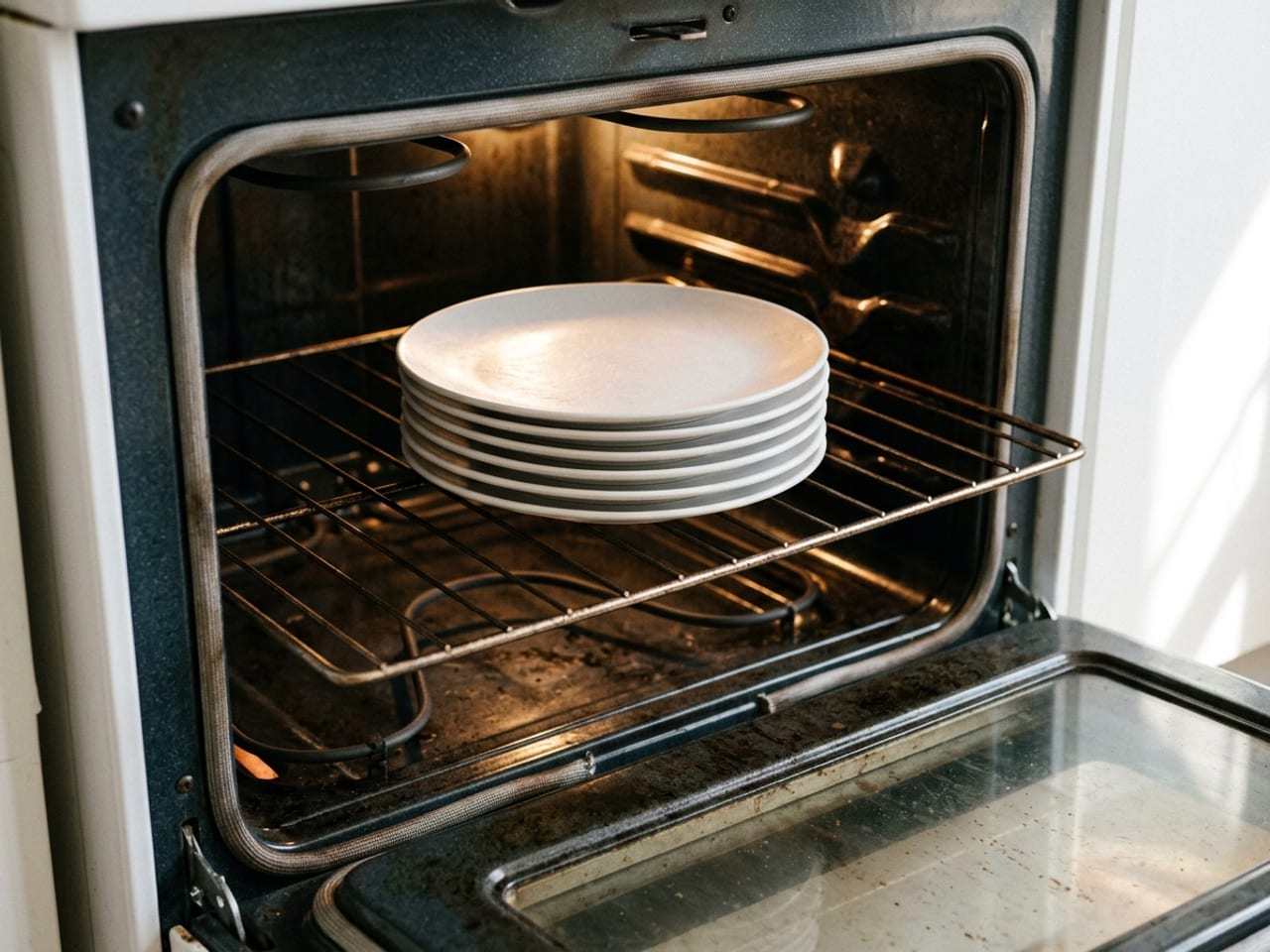
- Warm plates by the backstampAim for warm, not hot: about 120 to 150 °F (50 to 65 °C), warm enough to matter and cool enough to carry. Mikasa: start cool dinnerware in a cool oven, no higher than 225 °F (107 °C) for the first 10 minutes, and its oven and microwave advice covers only pieces without gold or platinum accents.74 Wedgwood: bone china isn't oven-safe unless labelled,75 and its Australian care page caps warming its tableware at 65 °C (149 °F).105 Lenox: nothing in the microwave that isn't marked microwave-safe.76 Makers' limits differ, so read the base.
- The two-hour clock on a buffet or family-style tableUSDA: food out no more than two hours, one hour above 90 °F (32 °C); hot food at 140 °F (60 °C) or above, cold at 40 °F (4 °C) or below; small platters replaced from the kitchen.78
Make the food match the table
Every setting in this guide is built around one thing: the plate in the middle, and what lands on it. A table laid with care and food piled anyhow reads as a mismatch, so finish the job at the stove.
- Pick the plate for the courseDinner, luncheon, salad, soup and dessert plates, with sizes, in types of plates.
- Pick its color for the foodIn a real restaurant a pale strawberry cake looked better on white and a darker dessert was liked more on black.99 The plate color pairing tool does the matching.
- Plate it neatlyIn one study a neat plate was liked more and read as more care from the cook.98 The method, dish by dish, is in how to plate food.
- Plan the menu, then set for itThe course meal builder deals a 3 to 12-course menu and links straight to the setting for it; the dinner party menu planner does a three- or four-course dinner. For a long tasting menu, see prix fixe and tasting menus at home; for the order the courses come in, the courses of a meal.
See your own dinner, plated for the table
You know where every fork goes. Now photograph tonight's main course and Plate Artists re-plates your own dish the way a chef would, on the plate you choose, with the moves named so you can copy them for every guest.
Your dish, plated like a chef's
Snap it, upload it, and get the composed version back, with the steps to recreate it on a real plate.
Start free · 1 enhancement →Free account · 1 free enhancement · No credit card
Table setting, answered
What is the difference between a table setting and a place setting?
A place setting is one person's share: their plate, cutlery, glasses and napkin. A table setting is the whole table: every place setting plus the cloth, centrepiece and serving pieces. 'Place setting' also names the unit dinnerware is sold in, as in a five-piece place setting, and the way dishwasher capacity is counted.
What are the basic rules of table setting?
Set only what the menu needs. Forks go on the left and knives and spoons on the right, used from the outside in. Knife blades face the plate. Bread goes at the upper left and drinks at the upper right. Never lay more than three of any utensil, an oyster fork aside; a course that would need a fourth fork or knife gets its cutlery with the food.
What is the correct order of glasses in a table setting?
The water glass stands above the tip of the dinner knife, or a little to its right, and the wine glasses go to its right in the order they will be poured, the first one furthest out, nearest the hand. Line, triangle and diamond layouts are the same order arranged to save space.
Why are forks placed on the left?
Because the layout is built for right-handed diners: the knife that cuts goes on the right and the fork that holds the food on the left. It was already standard in Mrs Beeton's 1861 book and in French etiquette manuals of the 1890s. The small oyster fork is the one fork set on the right.
Is the knife blade in or out?
In: the cutting edge always faces the plate, which keeps an edge from pointing at your neighbour. The butter spreader lies on the bread plate with its handle to the right. Blunt-tipped table knives have their own history: in 1669 Louis XIV ordered innkeepers and everyone else in his newly won Flemish and Low Countries towns to blunt their table knives.
Does the salad fork go inside or outside the dinner fork?
It depends on when the salad comes. Salad first, as at most American dinners: the salad fork goes outside, furthest from the plate. Salad after the main course, the European order: it goes inside, next to the plate. Either way you use the cutlery from the outside in, so the menu decides.
Where does the coffee cup go?
On the right: the Emily Post Institute puts the cup and saucer above and to the right of the knife and spoons, and US extension sheets turn the handle to the right. At a dinner at home most hosts bring the cups and saucers to the table when the coffee is served, rather than setting them at the start.
What is the difference between an American and a European table setting?
The rules are the same: forks left, knives and spoons right, used from the outside in. American forks lie tines up and French ones tines down, French tables often skip the bread plate and put bread on the cloth, and a British formal table lays the dessert spoon and fork beside the plate rather than above it.
How do you lay a table in the UK?
As in the US, forks go on the left and knives and spoons on the right, worked from the outside in. Debrett's adds that side plates are always laid at a formal table, even if unused, with the napkin simply folded on them, and that pudding spoons and forks go innermost beside the plate, not above it.
Which side of the napkin faces the plate?
Sources differ. US extension and 4-H teaching sheets put the fold on the left, away from the plate, so the napkin opens like a book; some other guides turn the folded edge toward the plate; and the etiquette authorities we checked, the Emily Post Institute and Debrett's, don't say. They do agree on where the napkin goes, to the left of the forks or on the plate. Pick one way and fold every napkin at the table the same.
Where do you put your napkin when you leave the table?
Mid-meal, etiquette sources split: many say leave it on your chair, others loosely folded to the left of your plate. At the end of the meal, lay it loosely to the left of the plate, not crumpled on it. Our napkin-folding guide sets out both views and what to do with the napkin when you sit down.
What is the difference between a table setting and a tablescape?
A table setting is functional: the plates, cutlery and glasses each guest needs, in their places. A tablescape is the whole decorative arrangement, often matching plates and bowls with the linen, flowers and candles, that makes the table look good. The word sounds recent, but the Oxford English Dictionary's first example is from a 1947 Hollywood newspaper.
How do you set a buffet table?
Plates at the start of the line, then the food with a serving spoon for each dish, and the cutlery and napkins at the end, rolled together, so guests have both hands free while they serve. Some guides put the cutlery first; either works. Keep food out no more than two hours, or one hour above 90 °F (32 °C).
How far from the edge of the table should the plate be?
About an inch (2.5 cm), with the bottoms of the cutlery level with the plate. That figure comes from US home-economics and 4-H extension sheets; French practice is about 2 cm. Emily Post's books give no number for the plate; the Emily Post Institute puts place mats one to two inches in and asks for the silverware all at the same distance from the edge.
More answers (the proper way to set a table, how many forks, spacing, formal versus informal) are in the FAQ under the table setting diagram.
The etiquette books, dictionaries and research behind this guide
Etiquette authorities (the Emily Post Institute, Debrett's, Etiquette Scholar) and magazine guides read in October 2026; Emily Post's 1922 and 1927 books, Mrs Beeton, Eliza Leslie, Tallemant, Coryat and a French etiquette manual of the 1890s read in Gutenberg and Internet Archive texts, and Louis XIV's 1669 edict in a Gallica scan; English and French dictionaries; US extension and 4-H sheets; US and Canadian regulators, the NFPA and tableware makers' care pages; and peer-reviewed papers verified through Crossref (PubMed IDs where PubMed has the record). Two retracted papers are listed only to say so. No study we found tests a full place setting against a bare table.
- The Emily Post Institute (2026). Table setting guides. emilypost.com, outside in; forks left, knives and spoons right; only set what you will use; the oyster fork; dessert spoon traditionally above the fork; clearing for dessert; substitutes. emilypost.com
- The Emily Post Institute (2026). Basic table setting. emilypost.com, napkin left of the fork or on the plate; water glass above the knife or at 45 degrees to its right; knife blades always face the plate; the b and d hands. emilypost.com
- The Emily Post Institute (2026). Informal place setting. emilypost.com, the plate as the hub of the wheel; salad fork outside or inside; butter knife and dessert cutlery positions; cup and saucer; the dinner knife for all courses. emilypost.com
- The Emily Post Institute (2026). Formal place setting. emilypost.com, more than three courses; no more than three of any implement; the service plate; napkin positions; up to five glasses; dessert cutlery brought in; place mats one to two inches from the edge; a 12 to 18 inch cloth drop; symmetry. emilypost.com
- The Emily Post Institute (2026). Table manners: Continental style dining. emilypost.com, switching between American and Continental styles, even during the same course, is fine. emilypost.com
- The Emily Post Institute (2026). Passing food at the table. emilypost.com, counterclockwise, to the right, all dishes the same way. emilypost.com
- The Emily Post Institute (2026). Table manners video: using utensils from the outside in. emilypost.com, the place setting as 'a map of the meal the host has planned'. emilypost.com
- Debrett's (2026). The Christmas table. debretts.com, outside in; side plates always laid formally, napkins on them; no less than 20 inches between places; mats an inch from the edge; plate diameters; glasses; pudding cutlery innermost; low flowers; six candles for eight. debretts.com
- Debrett's (2026). The curse of cutlery. debretts.com, finished position: knife and fork together at six-thirty, tines up. debretts.com
- Etiquette Scholar (2026). Table setting. etiquettescholar.com, about 24 inches center to center; large plates an inch from the edge; tines up (American) or down (Continental). etiquettescholar.com
- Etiquette Scholar (2026). Placing stemware. etiquettescholar.com, the water goblet about 1 inch above the tip of the dinner knife; triangle and diamond arrangements. etiquettescholar.com
- Martha Stewart editors (2026). Setting the table 101. marthastewart.com, the stemware triangle; the charger as a decorative plate; mixing sets; water glasses stay all meal; paper plates are fine for casual meals. marthastewart.com
- Martha Stewart editors (2026). How to set a formal dinner table. marthastewart.com, experts advise against the napkin under the forks; the oyster fork's place; finished position at 4:20; a used utensil never touches the cloth again; champagne for a toast on the far right. marthastewart.com
- Real Simple editors (2026). How to set a table. realsimple.com, blade toward the plate ('That helps prevent cuts!'); utensil bottoms level with the plate; about half an inch between pieces; casual, formal and brunch settings. realsimple.com
- Southern Living editors (2022). How to set a table. southernliving.com, let the menu be your guide; buffet utensils at the end of the line, rolled in napkins. southernliving.com
- Southern Living editors (2026). Do you know how to set a table? southernliving.com, fork on the napkin or the napkin outside the fork, 'either is acceptable'; the coffee cup on the right, handle outward. southernliving.com
- The Spruce editors (2024). How to set a table for Thanksgiving dinner. thespruce.com, decorate before the glasses and plates; centrepiece 12 inches or less; keep the middle clear for serving dishes. thespruce.com
- Wikipedia contributors (2026). Table setting. Wikipedia, read 2 October 2026; the glass line ending in the water tumbler, and the napkin in the wine glass. en.wikipedia.org
- Whats For Dinner (Marzetti) (2026). 5 classic table settings. whatsfordinner.com, the formal glass triangle: water above the knife, white to the lower right, red above. whatsfordinner.com
- Martin, J. (Miss Manners) (2024). How do you set the table for left-handers? AL.com, August 2024; seat left-handers at the outside left corner rather than reversing the setting. al.com
- University of Maryland Extension (2021). Meal appeal: setting the table. extension.umd.edu, a place setting or 'cover'; flatware, plate and napkin one inch from the edge; napkin left of the fork with the fold on the left; 24 to 30 inches center to center; cloth drop 16 to 24 inches formal, 10 to 14 informal; candles not lit during the contest. extension.umd.edu (PDF)
- Nebraska Extension (2026). Favorite Foods Contest: basic guide. extension.unl.edu, plate and cutlery about 1 inch from the edge; water glass about 1 inch above the knife tip; napkin fold to the left 'so it opens like a book'; cup handle to the right; at least 20 inches per person; serving spoons beside the bowls. extension.unl.edu (PDF)
- Oregon State University Extension (2018). Table setting guidelines. extension.oregonstate.edu, flatware one inch above the table edge, half an inch between pieces and from the plate. extension.oregonstate.edu (PDF)
- K-State Research and Extension, Pottawatomie County (2026). Table setting guidelines. pottawatomie.k-state.edu, 'Allow at least 20 inches for each person's dishes. This is called a cover.'; napkin fold to the left; points deducted for lit centrepiece candles; alcohol on the menu disqualifies; no glitter or glue on eating surfaces. k-state.edu (PDF)
- Sponaugle, K., Mallory, K., Daniel, K., & Mayo, K. (Virginia Cooperative Extension) (2022). Table setting competition guide (4H-718). pubs.ext.vt.edu, a themed table with table service, a centrepiece and a complete menu on a 4 by 6 in card or larger; a brief introduction, then the judges' questions, five minutes per table; rules vary by county. pubs.ext.vt.edu
- Courtiade, D., interviewed by Offrir International (2019). L'assiette de bienvenue. offrir-international.com, the assiette de présentation 2 cm from the edge, 40 to 60 cm between plates; the maître d'hôtel of the Plaza Athénée. offrir-international.com
- Post, E. (1922). Etiquette in Society, in Business, in Politics and at Home. Funk & Wagnalls, 'Setting the Table', 'Setting the Places', 'The Bread and Butter Plate', 'Place Cards', 'The Dinner Table of Yesterday'; read in the Project Gutenberg text (#14314). gutenberg.org
- Post, E. (1927). Etiquette: The Blue Book of Social Usage, new and enlarged edition. Funk & Wagnalls, pp. 195, 243, 252, 253 and 611; read in the Internet Archive scan of the April 1929 printing. archive.org
- Beeton, I. (1861). The Book of Household Management. S. O. Beeton, ¶2185 to ¶2188 on laying the dinner table and dinners à la Russe; Project Gutenberg text (#10136). gutenberg.org
- Leslie, E. (1853). The Behaviour Book. Willis P. Hazard, Philadelphia, p. 127, cutting and then switching the fork, and the shared butter-knife; Internet Archive scan. archive.org
- Tallemant des Réaux, G. (1834). Les Historiettes, tome 3 (written 1657 to 1659). first printed 1834, 'Le Chancelier Séguier': the cardinal orders 'faire épointer tous les couteaux'; Project Gutenberg text (#39314). gutenberg.org
- Louis XIV (1669). Edit du roy qui défend le port et l'usage des couteaux pointus (June 1669). Archives historiques et littéraires du Nord de la France et du Midi de la Belgique, 3e série, t. 3 (1852), pp. 112–114; applies to the Flemish and Low Countries towns ceded in 1668; innkeepers to blunt table knives within three days; Gallica scan. gallica.bnf.fr
- Coryat, T. (1611). Coryat's Crudities. reprinted James MacLehose and Sons, Glasgow, 1905, vol. 1, pp. 236–237: Italians 'doe alwaies at their meales use a little forke'; the 'furcifer' joke; Internet Archive scan. archive.org
- Hodgson, F. C. (1901). The Early History of Venice. George Allen, London, p. 192, translating Peter Damian's 11th-century account of a Greek-born dogaressa's 'furcinulis aureis atque bidentibus'; Internet Archive scan. archive.org
- Staffe, Baronne (1899). Usages du monde: règles du savoir-vivre dans la société moderne. G. Havard fils, Paris (preface to the new edition dated 1897), the fork on the left, knife and spoon on the right; the menu card as a place card; the fork carried to the mouth in the left hand, and putting the knife down and taking it up again 'très inélégant'; Internet Archive scan. archive.org
- Lybbert, T. J. (2010). The economic roots of the American 'zigzag': knives, forks, and British mercantilism. Economic Inquiry, 48(3), 810–815; cites Petroski on cutting with the right hand and holding the fork in the left. doi:10.1111/j.1465-7295.2009.00217.x
- Williams, E. A. (RISD Museum) (2014). Surprise endings: Gorham silver's Mythologique. risdmuseum.org, 72 pieces offered in the pattern (1894 to 1895); American silver production nearly quadrupled. risdmuseum.org
- The Boston Globe (2013). A few tricks for ensuring a proper place setting. bostonglobe.com, 13 July 2013; the b and d hands and BMW. bostonglobe.com
- Le Figaro (2026). Pourquoi ne faut-il pas, en France, poser les fourchettes les pointes en l'air ? lefigaro.fr, 15 April 2026; arms and initials engraved on the back of the handle. lefigaro.fr
- Alimentarium (2026). La fourchette. alimentarium.org, no really satisfactory explanation for the tines-up and tines-down customs; host-supplied engraved cutlery in the 18th century. alimentarium.org
- Savoir-vivre.fr (2026). L'art de la table. savoir-vivre.fr, 'L'assiette à pain est un usage anglo-saxon, aujourd'hui parfaitement admis'. savoir-vivre.fr
- Slate (2015). History of table setting, from service à la russe to Sandra Lee's tablescapes. slate.com, May 2015; Sandra Lee and the themed dinner table from 2003. slate.com
- The Independent (1998). Obituary: David Hicks. independent.co.uk, his claim, 'indeed, I invented the word' tablescape. independent.co.uk
- Merriam-Webster (2026). Place setting (entry). Merriam-Webster.com Dictionary, 'a set of dishes and flatware constituting a table service for one person'; first known use 1944. merriam-webster.com
- Cambridge Dictionary (2026). Place setting (entry). Cambridge University Press, UK and US definitions. dictionary.cambridge.org
- Oxford English Dictionary (2026). Place setting, n.; table setting, n. Oxford University Press, earliest evidence: place setting 1950, in the writing of E. Post; table setting 1844, in Friend's Family. oed.com
- Oxford English Dictionary (2026). Tablescape, n. Oxford University Press, earliest evidence 1947, in the Hollywood Citizen-News. oed.com
- Cambridge Dictionary (2026). Tablescape (entry). Cambridge University Press, an arrangement of items on a table that produces an attractive, decorative effect. dictionary.cambridge.org
- ATILF / CNRS (1994). Couvert (entry), Trésor de la langue française informatisé. CNRTL, everything laid for one diner; the 1907 citation on each guest's individual couvert in the 18th century; the Académie's 1762 definition. cnrtl.fr
- OpenTable (2023). What is a cover in a restaurant? opentable.co.uk, 'a restaurant with 100 covers in a night has served 100 guests'. opentable.co.uk
- Merriam-Webster (2026). Service plate (entry). Merriam-Webster.com Dictionary, 'used to indicate a place at table and to serve as an under plate during the first courses'. merriam-webster.com
- Oxford English Dictionary (2026). Bread and butter plate, n. Oxford University Press, earliest evidence 1779, in the Gazetteer & New Daily Advertiser. oed.com
- Cambridge Dictionary (2026). Side plate (entry). Cambridge University Press, the small plate for bread during the main part of a meal. dictionary.cambridge.org
- Merriam-Webster (2026). Butter spreader (entry). Merriam-Webster.com Dictionary, 'a small knife with rounded blade used for buttering bread at table'. merriam-webster.com
- Cambridge Dictionary (2026). Flatware; silverware; cutlery (entries). Cambridge University Press, flatware and silverware US, cutlery UK. dictionary.cambridge.org
- Harper, D. (2026). Flatware; fork (entries). Online Etymology Dictionary, flatware first meant plates and dishes (1851), cutlery by 1895; the table fork in an English inventory of 1430. etymonline.com
- Oxford English Dictionary (2026). Place card, n. Oxford University Press, earliest evidence 1892, in the Ladies' Home Journal. oed.com
- Cambridge Dictionary (2026). Family-style (entry). Cambridge University Press, food brought to the table in large dishes so people serve themselves. dictionary.cambridge.org
- Oxford English Dictionary (2026). Family-style, adj. Oxford University Press, earliest evidence 1857, in the Evening Bulletin (San Francisco). oed.com
- Cambridge Dictionary (2026). Buffet (entry). Cambridge University Press, a meal where people serve themselves. dictionary.cambridge.org
- Nicolet College (2026). Chapter 4: American service. Beverage and service open textbook (Pressbooks), plated food and beverages served from the guest's right; clear from the right once everyone has finished; never scrape plates at the table. nicoletcollege.pressbooks.pub
- Nicolet College (2026). Chapter 6: Russian and butler service. Beverage and service open textbook (Pressbooks), platters presented and served from the guest's left. nicoletcollege.pressbooks.pub
- Real Simple editors (2026). How to set up a crowd-pleasing Easter buffet. realsimple.com, a flow that starts with plates and utensils. realsimple.com
- US FDA Food Code, as adopted in Minnesota Rules 4626.0965 (2026). 4-904.11 Kitchenware and tableware: preventing contamination. revisor.mn.gov, knives, forks and spoons presented so only the handles are touched. revisor.mn.gov
- US FDA Food Code, as adopted in Minnesota Rules 4626.0975 (2026). 4-904.13 Preset tableware. revisor.mn.gov, wrapped, covered or inverted, or removed or cleaned when unused. revisor.mn.gov
- Ahrens, M. (National Fire Protection Association) (2020). Home candle fires. NFPA Research, 2014 to 2018 averages: December the peak month; 60% started by something that could burn too close; nearly three times the daily average on Christmas. nfpa.org (PDF)
- National Fire Protection Association (2025). December among leading months of the year for US home fires. nfpa.org news release, December 2025; 47% of decoration fires had decorations too close to a heat source such as a candle; candle fires peak in December and January. nfpa.org
- National Fire Protection Association (reprinted by Marine Corps Installations East) (2026). Candle safety tips. mcieast.marines.mil, keep candles at least 12 inches from anything that can burn; blow them out when you leave the room. mcieast.marines.mil (PDF)
- US Code of Federal Regulations (2026). 21 CFR 109.16: Ornamental and decorative ceramicware. Legal Information Institute, Cornell Law School, decorative ceramicware that looks usable for food counts as food ware unless it carries a 'Not for Food Use' sticker and a permanent statement on the base, or has a hole bored through it. law.cornell.edu
- US FDA Food Code, as adopted in Minnesota Rules 4626.0460 (2026). 4-101.13 Lead, use limitation. revisor.mn.gov, lead limits for ceramic, china and crystal; pewter with more than 0.05% lead not for food contact. revisor.mn.gov
- Health Canada (2026). Lead crystalware and your health. canada.ca, limit it to serving, never storing; lower risk over a meal; lead-free glass for children and pregnant people. canada.ca
- California Department of Public Health (2026). Questions and answers: lead in tableware. cdph.ca.gov, antique and hand-me-down tableware among the higher-risk kinds, with terra cotta, highly decorated and hand-crafted ware; lead is rarely found in plain white dishes. cdph.ca.gov
- US FDA Food Code, as adopted in Minnesota Rules 4626.0465 (2026). 4-101.14 Copper, use limitation. revisor.mn.gov, copper and brass not in contact with food below pH 6, such as vinegar, fruit juice or wine. revisor.mn.gov
- Mikasa (2026). Dinnerware FAQs. mikasa.com, cool dinnerware into a cool oven, no higher than 225 °F for the first 10 minutes; oven and microwave advice only for pieces without precious-metal accents. mikasa.com
- Wedgwood (2026). Care guide. wedgwood.com, bone china not oven-safe unless labelled; microwave-safe unless the piece has metallic decoration. wedgwood.com
- Lenox (2026). Product use and care. lenox.com, no extreme temperature changes; not marked microwave-safe, not in the microwave; children should not handle a piece after microwaving. lenox.com
- HF Coors (2026). Commercial chargers. hfcoors.com, ceramic chargers sold as lead-free, oven-safe and dishwasher-rated. hfcoors.com
- USDA Food Safety and Inspection Service (2026). How do I keep foods safe at a buffet? ask.fsis.usda.gov, two hours at room temperature, one hour above 90 °F; hot at 140 °F or warmer, cold at 40 °F or colder; small platters replaced. ask.fsis.usda.gov
- Liu, J., Petit, E., Brit, A. C., & Giboreau, A. (2019). The impact of tablecloth on consumers' food perception in real-life eating situation. Food Quality and Preference, 71, 168–171. doi:10.1016/j.foodqual.2018.06.011
- Bschaden, A., Dörsam, A. F., Cvetko, K., Kalamala, T., & Stroebele-Benschop, N. (2020). The impact of lighting and table linen as ambient factors on meal intake and taste perception. Food Quality and Preference, 79, 103797. doi:10.1016/j.foodqual.2019.103797
- Michel, C., Velasco, C., & Spence, C. (2015). Cutlery matters: heavy cutlery enhances diners' enjoyment of the food served in a realistic dining environment. Flavour, 4, 26. doi:10.1186/s13411-015-0036-y
- Harrar, V., & Spence, C. (2013). The taste of cutlery: how the taste of food is affected by the weight, size, shape, and colour of the cutlery used to eat it. Flavour, 2, 21. doi:10.1186/2044-7248-2-21
- Hummel, T., Delwiche, J. F., Schmidt, C., & Hüttenbrink, K. B. (2003). Effects of the form of glasses on the perception of wine flavors: a study in untrained subjects. Appetite, 41(2), 197–202. doi:10.1016/S0195-6663(03)00082-5 · PubMed 14550318
- Delwiche, J., & Pelchat, M. L. (2002). Influence of glass shape on wine aroma. Journal of Sensory Studies, 17(1), 19–28. doi:10.1111/j.1745-459X.2002.tb00329.x
- Pilling, M., Clarke, N., Pechey, R., Hollands, G. J., & Marteau, T. M. (2020). The effect of wine glass size on volume of wine sold: a mega-analysis of studies in bars and restaurants. Addiction, 115(9), 1660–1667. doi:10.1111/add.14998 · PubMed 32003493
- Holden, S. S., Zlatevska, N., & Dubelaar, C. (2016). Whether smaller plates reduce consumption depends on who's serving and who's looking: a meta-analysis. Journal of the Association for Consumer Research, 1(1), 134–146. doi:10.1086/684441
- Kosīte, D., König, L. M., De-loyde, K., Lee, I., Pechey, E., Clarke, N., et al. (2019). Plate size and food consumption: a pre-registered experimental study in a general population sample. International Journal of Behavioral Nutrition and Physical Activity, 16, 75. doi:10.1186/s12966-019-0826-1 · PubMed 31462252
- Ruddock, H. K., Brunstrom, J. M., Vartanian, L. R., & Higgs, S. (2019). A systematic review and meta-analysis of the social facilitation of eating. American Journal of Clinical Nutrition, 110(4), 842–861. doi:10.1093/ajcn/nqz155 · PubMed 31435639
- Dallacker, M., Hertwig, R., & Mata, J. (2019). Quality matters: a meta-analysis on components of healthy family meals. Health Psychology, 38(12), 1137–1149. doi:10.1037/hea0000801 · PubMed 31556657
- Miller, D. P., Waldfogel, J., & Han, W. J. (2012). Family meals and child academic and behavioral outcomes. Child Development, 83(6), 2104–2120. doi:10.1111/j.1467-8624.2012.01825.x · PubMed 22880815
- Robinson, E., Aveyard, P., Daley, A., Jolly, K., Lewis, A., Lycett, D., & Higgs, S. (2013). Eating attentively: a systematic review and meta-analysis of the effect of food intake memory and awareness on eating. American Journal of Clinical Nutrition, 97(4), 728–742. doi:10.3945/ajcn.112.045245 · PubMed 23446890
- Vohs, K. D., Wang, Y., Gino, F., & Norton, M. I. (2013). Rituals enhance consumption. Psychological Science, 24(9), 1714–1721. doi:10.1177/0956797613478949 · PubMed 23863754
- Brooks, A. W., Schroeder, J., Risen, J. L., Gino, F., Galinsky, A. D., Norton, M. I., & Schweitzer, M. E. (2016). Don't stop believing: rituals improve performance by decreasing anxiety. Organizational Behavior and Human Decision Processes, 137, 71–85; RETRACTED in November 2024 (notice doi:10.1016/j.obhdp.2024.104377). doi:10.1016/j.obhdp.2016.07.004
- Tian, A. D., Schroeder, J., Häubl, G., Risen, J. L., Norton, M. I., & Gino, F. (2018). Enacting rituals to improve self-control. Journal of Personality and Social Psychology, 114(6), 851–876; RETRACTED in 2024 (notice doi:10.1037/pspa0000374). doi:10.1037/pspa0000113 · PubMed 29771567
- Ratcliffe, E., Baxter, W. L., & Martin, N. (2019). Consumption rituals relating to food and drink: a review and research agenda. Appetite, 134, 86–93. doi:10.1016/j.appet.2018.12.021 · PubMed 30572007
- Divert, C., Laghmaoui, R., Crema, C., Issanchou, S., Van Wymelbeke, V., & Sulmont-Rossé, C. (2015). Improving meal context in nursing homes. Impact of four strategies on food intake and meal pleasure. Appetite, 84, 139–147. doi:10.1016/j.appet.2014.09.027 · PubMed 25445198
- Chen, Y. C., Tsui, P. L., Chen, H. I., Tseng, H. L., & Lee, C. S. (2019). A dining table without food: the floral experience at ethnic fine dining restaurants. British Food Journal, 122(6), 1819–1832. doi:10.1108/BFJ-08-2018-0541
- Zellner, D. A., Siemers, E., Teran, V., et al. (2011). Neatness counts. How plating affects liking for the taste of food. Appetite, 57(3), 642–648. doi:10.1016/j.appet.2011.08.004 · PubMed 21855585
- Piqueras-Fiszman, B., Giboreau, A., & Spence, C. (2013). Assessing the influence of the color of the plate on the perception of a complex food in a restaurant setting. Flavour, 2, 24. doi:10.1186/2044-7248-2-24
- Vessière Cristaux (2026). Disposition des verres. vessiere-cristaux.fr, French glass order: from the largest, the water glass, on the left to the smallest on the right, in a diagonal. vessiere-cristaux.fr
- Viners (2026). How to set a table. viners.co.uk, side plates to the left of the setting, the napkin on the side plate. viners.co.uk
- Robert Welch (2026). How to set the table: place setting guide. robertwelch.com, side plates, butter knives on top, to the left of any forks. robertwelch.com
- Debrett's (2026). Breaking bread. debretts.com, bread rolls are eaten from a side plate to the left of a place setting. debretts.com
- Etiquette Scholar (2026). Place setting. etiquettescholar.com, bread, salad and fruit plates to the left of the setting, or the reverse for a left-handed person. etiquettescholar.com
- Wedgwood (2026). Care instructions. wedgwood.com.au, tableware may be warmed in the oven up to 65 °C, never over a naked flame. wedgwood.com.au
Keep going
Table setting diagram
Every fork, knife and glass placed for the courses you are serving, numbered and printable.
How to fold napkins
Eighteen folds drawn step by step, from the oblong to the bishop's hat.
Types of plates
Charger to side plate with standard sizes, and which plate each course goes on.
Thanksgiving tablescape
Centrepiece heights, formal and casual settings, buffet flow and a timeline.
Prix fixe and tasting menus
Every menu term explained, and how to run a seven-course tasting menu at home.
Course meal builder
A 3 to 12-course menu from real recipes, with a link to the setting for it.