How to set a Christmas table around the food
Count the seats at 24 inches (61 cm) each, decide where the dishes will stand, then set each place from the outside in. Below: seats per table, the American and British place settings, crackers, the centerpiece, candles and napkin folds, each number with its source.
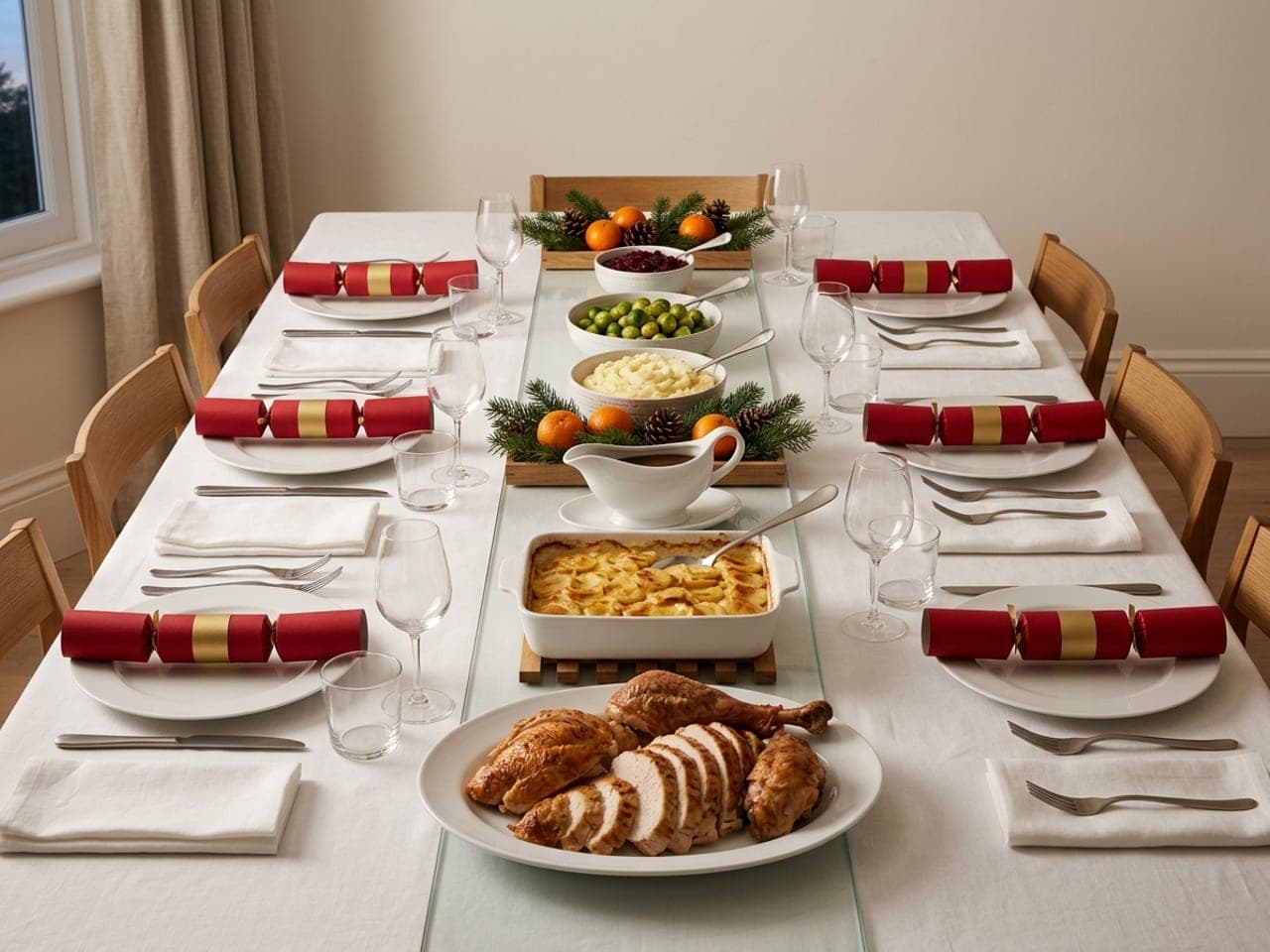
The photos on this page are AI-generated illustrations.
To set a Christmas table, count the seats first: allow 24 inches (61 cm) of table edge per guest, and ideally no less than 20 inches (51 cm), Debrett’s figure for a Christmas table. Decide where the serving dishes will stand before anything decorative goes down. Lay the cloth or runner, then set each place from the outside in: forks on the left, knives and spoons on the right, glasses above the knives, the napkin on the plate or the side plate, and the cracker across the top of the plate, where the one named professional we found puts it. Keep the middle low and easy to lift off, and keep any real flame at least 1 foot (30 cm) from anything that can burn (NFPA), crackers and napkins included: on most tables that means flameless candles, or crackers kept in a basket until they are pulled.
How to read the numbers. Every figure and rule is attributed to the source that states it, statistics carry their years, and our own arithmetic and suggestions are labeled as ours. American measures come first with the metric beside them; British readers: centrepiece, serviette, pudding and laying the table are, here, centerpiece, napkin, dessert and setting the table.
How to set a Christmas table, in order
Eleven steps for the day. Where a step rests on a source, the source is named.
- 1. Count the seats before anything elseAllow 24 inches (61 cm) of table edge per guest, plate center to plate center; Debrett’s asks for “ideally no less than” 20 inches (51 cm). Who gives which figure, and how many your table seats.
- 2. Decide where the food goesOn the table, or on a sideboard: Debrett’s wants the serving platters in the table plan, or decorations that lift off. The choice sizes the centerpiece.
- 3. Lay the cloth or runnerFor the overhang, the Emily Post Institute gives an average drop of 12 to 18 inches (30 to 46 cm), and Oregon State University’s 4-H guidelines 8 to 10 inches (20 to 25 cm).
- 4. Do a dry run with the empty dishesSet out every serving dish, trivet and spoon where the food will stand, then decorate around them: our own step, as on our Thanksgiving hub.
- 5. Build the middle lowLow enough to see across, which is all Debrett’s and the Emily Post Institute ask, and on a tray so it lifts off in one move. The center of the table.
- 6. Plates, mats or chargersThe plate, or a table mat under it, sits about an inch (2.5 cm) from the table edge (Debrett’s for the mat; Oregon State’s 4-H guidelines for the plate). A charger is optional.
- 7. Cutlery from the outside inForks left, knives and spoons right, in order of use, working inward (Debrett’s); no more than three of any implement (Emily Post Institute). The US and UK place settings.
- 8. Glasses above the knivesThe water glass directly above the knives, the wine glasses beside it in the order they are used (Emily Post Institute).
- 9. The napkinOn the plate or charger, or left of the forks (Emily Post Institute); on the side plate (Debrett’s). A shaped fold goes on the plate: Christmas napkin folds.
- 10. The cracker and the place cardGary Williams of the British Butler Institute, showing BBC Good Food magazine how he lays a table, puts the cracker “across the top of the plate”; no etiquette authority gives a rule, and retailers and magazines suggest other spots. With real candles on the table, the crackers wait in a basket. Place cards are in the place setting table.
- 11. Last, on the dayFresh greenery and the water jug go on last. Candles are lit just before guests sit and never left in an empty room (NFPA). The timeline.
Room per guest and seats per table: a Christmas table for 6, 8, 10 or 12
Plan on 24 inches (61 cm) per guest and treat 20 inches (51 cm) as the floor. None of the Christmas table guides we read turns that into seats for a given table. Furniture sellers publish seating charts, and our Thanksgiving hub quotes theirs; this table is our own arithmetic, with the method below. For rectangles the second number counts a guest at each end.
| Table | Seats at 24 inches (61 cm) each | Seats at 20 inches (51 cm) each |
|---|---|---|
| Rectangle, 60 inches (152 cm) long, 5 ft | 4, or 6 | 6, or 8 |
| Rectangle, 72 inches (183 cm), 6 ft | 6, or 8 | 6, or 8 |
| Rectangle, 84 inches (213 cm), 7 ft | 6, or 8 | 8, or 10 |
| Rectangle, 96 inches (244 cm), 8 ft | 8, or 10 | 8, or 10 |
| Rectangle, 108 inches (274 cm), 9 ft | 8, or 10 | 10, or 12 |
| Rectangle, 120 inches (305 cm), 10 ft | 10, or 12 | 12, or 14 |
| Round, 42 inches (107 cm) across | 3; four fit at 23.6 inches (60 cm) each | 4 |
| Round, 48 inches (122 cm) | 4 | 5 |
| Round, 54 inches (137 cm) | 5 | 6 |
| Round, 60 inches (152 cm) | 6 | 7 |
| Round, 72 inches (183 cm) | 7; eight fit at 23.6 inches (60 cm) each | 9 |
24 inches (61 cm): the working figure. Emily Post’s Etiquette (1922) calls “about two feet from plate center to plate center” ideal; Rachel Wagner of Etiquette Trainer repeats it for a holiday dinner (2018), and Oregon State University’s 4-H guidelines (revised 2018) give each place setting a space 24 inches (61 cm) wide and 15 inches (38 cm) deep.
20 inches (51 cm): the minimum. Debrett’s, on the Christmas table: “Leave an even amount of space between places, ideally no less than” 20 inches (51 cm). Debrett’s says “between places” and does not say where it measures from; we read it as place center to place center, like the American figure. American 4-H table-setting sheets give the same floor of at least 20 inches (51 cm) a person, Nebraska Extension’s among them; our table setting guide has them. So 24 inches (61 cm) is the plan and 20 inches (51 cm) the squeeze.
The depth, and the strip down the middle. Our arithmetic from Oregon State’s 15 inches (38 cm) of depth: two facing places take 30 inches (76 cm) of the table’s width, so a table 36 inches (91 cm) wide has about 6 inches (15 cm) left down the middle, and one 42 inches (107 cm) wide has 12 inches (30 cm). No source states those remainders. What that strip can hold.
How we worked out the seats. Rectangles: divide the length by the room per guest and round down for the seats along each long side; add one at each end if the table is wide enough. Rounds: we measure round the circle the plate centers sit on, not the table’s edge. A 10 inch (25 cm) dinner plate (Debrett’s traditional size, “or a little more”) set 1 inch (2.5 cm) in from the edge has its middle 6 inches (15 cm) in, so we take 6 inches (15 cm) off the radius, multiply by 2 and by 3.14, divide by the room per guest and round down.
How it compares. The results match the furniture-trade figures on our Thanksgiving hub: a 72 inch (183 cm) table for 6, or 8 with the ends (its food-first section); a 48 inch (122 cm) round for 4 to 5 and a 60 inch (152 cm) round for 6 (its small-space section).
What to drop first when it is tight. The bread plate: “if you don’t have bread plates, don’t worry about it” (Emily Post Institute). The pudding cutlery: Debrett’s brings it in with the pudding “if short of space”. The placemat’s corners: round mats take up less space than rectangular ones (Good Housekeeping UK). And the napkin can go under the forks “if space is tight” (Emily Post Institute).
Twelve guests, ten seats. Twelve at a 96 inch (244 cm) table is five a side and one at each end: 96 ÷ 5 = 19.2 inches (49 cm) each, just under Debrett’s minimum. It works only if the food is served from a sideboard and the bread plates go. Otherwise borrow a table of the same height and cover the join with one cloth, as BBC Good Food suggests; it can also seat the children.
Long and small tables. On a long table, Architectural Digest quotes the designer Purvi Padia: a centerpiece “doesn’t have to live in the center”; it can “run the length of the table, or appear in sculptural clusters throughout.” On a small one, serve from the kitchen counter or a sideboard, keep only gravy, bread and water in the middle, and let the places carry the season: a folded tree napkin, a cracker each, a sprig of rosemary.
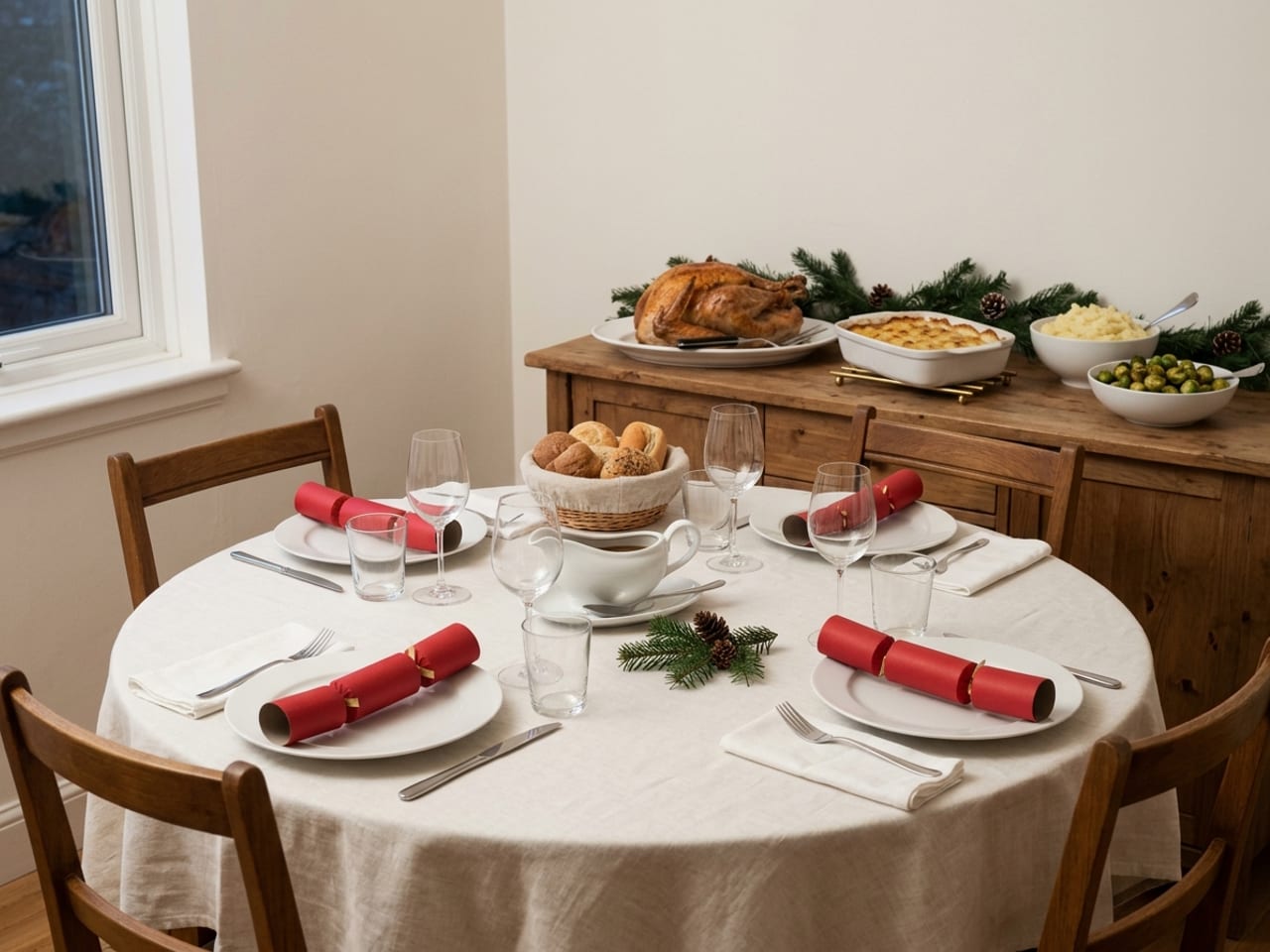
The Christmas place setting, US and UK
For a starter, a main course and dessert (pudding, in Britain), after the Emily Post Institute and Debrett’s; other sources are named. Notes on old china, crystal and warm plates follow the table.
| Where | United States | Britain |
|---|---|---|
| Center | The dinner plate, about an inch (2.5 cm) from the table edge, or a charger that holds the first course and is exchanged for the dinner plate when the main course arrives; a decorative charger never touches food (our plates guide) | A table mat about an inch (2.5 cm) from the edge with the plate on it. Chargers are allowed, though Debrett’s warns that too many plates at each place “can look cluttered in a domestic setting” |
| Left | Forks in order of use from the outside in: starter or salad fork, then dinner fork | Forks, outside in: starter, dinner, and at a formal dinner the pudding fork innermost |
| Right | The dinner knife, blade toward the plate; a soup spoon to its right only if there is soup | Outside in: starter knife, dinner knife, and at a formal dinner the pudding spoon innermost |
| Bread | A bread plate at the upper left of the dinner plate, above the forks (Etiquette Trainer); optional at a holiday table (Emily Post Institute) | A side plate, always laid at a formal table (Debrett’s). Our table setting guide has it to the left of the forks; the butler Gary Williams moves it above the forks to save space |
| Dessert or pudding cutlery | A spoon and fork above the plate (Oregon State 4-H), or brought in on the dessert plate (Emily Post Institute, formal setting) | “Laid innermost and not above the place setting” at formal dinners, or brought in with the pudding if space is short (Debrett’s). Cotswold Trading, a British retailer, lays them above the plate anyway |
| Glasses | Water glass directly above the knives, wine glasses to its right in the order they are poured | Above the knives: a tumbler for water and two wine glasses, the larger for red, “is usually enough” (Debrett’s) |
| Napkin | On the plate or charger, or left of the forks; under the forks only if space is tight | Simply folded or rolled, on the side plate |
| Cracker | No American authority mentions one. HGTV puts it on the plate; Williams Sonoma, a retailer, alongside it | Debrett’s does not mention crackers. Gary Williams, British Butler Institute: “across the top of the plate” |
| Place card | Above the plate on the cloth, or on the napkin (Emily Post, 1922) | In the middle of each place setting (Debrett’s) |
The cracker and the dessert cutlery want the same spot. Dessert cutlery laid above the plate, the American habit, leaves nowhere for a cracker across the top; the British formal rule, pudding cutlery beside the plate, leaves that space free. At an American table, bring the dessert cutlery in with dessert, the Emily Post Institute’s formal practice anyway, or lay the cracker on the plate (our reading).
See it drawn. Our table setting diagram tool draws a place setting for your menu and counts the pieces for your guest list: the American setting for starter, main and dessert. Its nearest British version is an approximation: the tool lays one knife where Debrett’s lays two, puts the napkin on the dinner plate and draws the bread plate in the American position, and it has no cracker to place; lay that across the top. The table setting guide explains every piece.
Heirloom china and crystal. The FDA’s advice on lead in pottery (2010) lists antique, damaged or worn pieces among the types to be careful with. Health Canada (2024) says lead crystal is for serving, never storing, since the risk rises when drinks are kept in it, “like fruit juice stored overnight or port wine stored for weeks”: pour the port into the crystal decanter on the day and back out afterwards. It calls lead-free tableware “especially critical when serving infants, children or pregnant people”, so the crystal glasses stay at the other adults’ places. China with metallic trim stays out of the microwave (USDA FSIS).
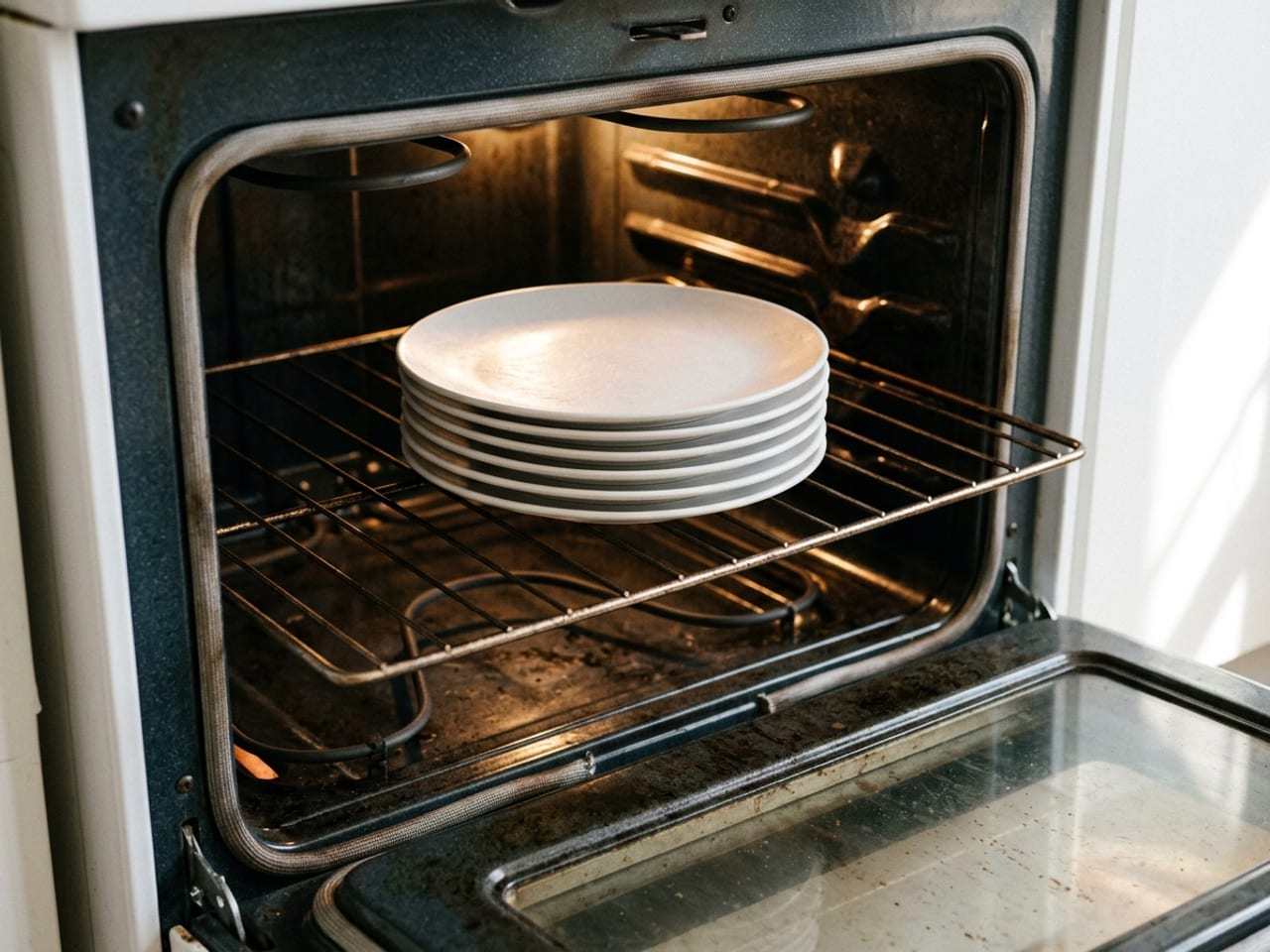
Warming the plates. Go by the maker: Royal Doulton’s care guide allows its stoneware and porcelain to be warmed to 212°F (100°C), and Mikasa says to put cool dinnerware into a cool oven set no higher than 225°F (107°C) for the first 10 minutes, and only pieces without metallic accents. Those are limits for the china, not targets for the plate: warm, not hot, about 120 to 150°F (50 to 65°C) on our table setting guide’s reckoning, so a guest can hold it. Carry hot plates with a cloth, tell the table they are warm, and give children room-temperature plates (the guide’s safety notes).
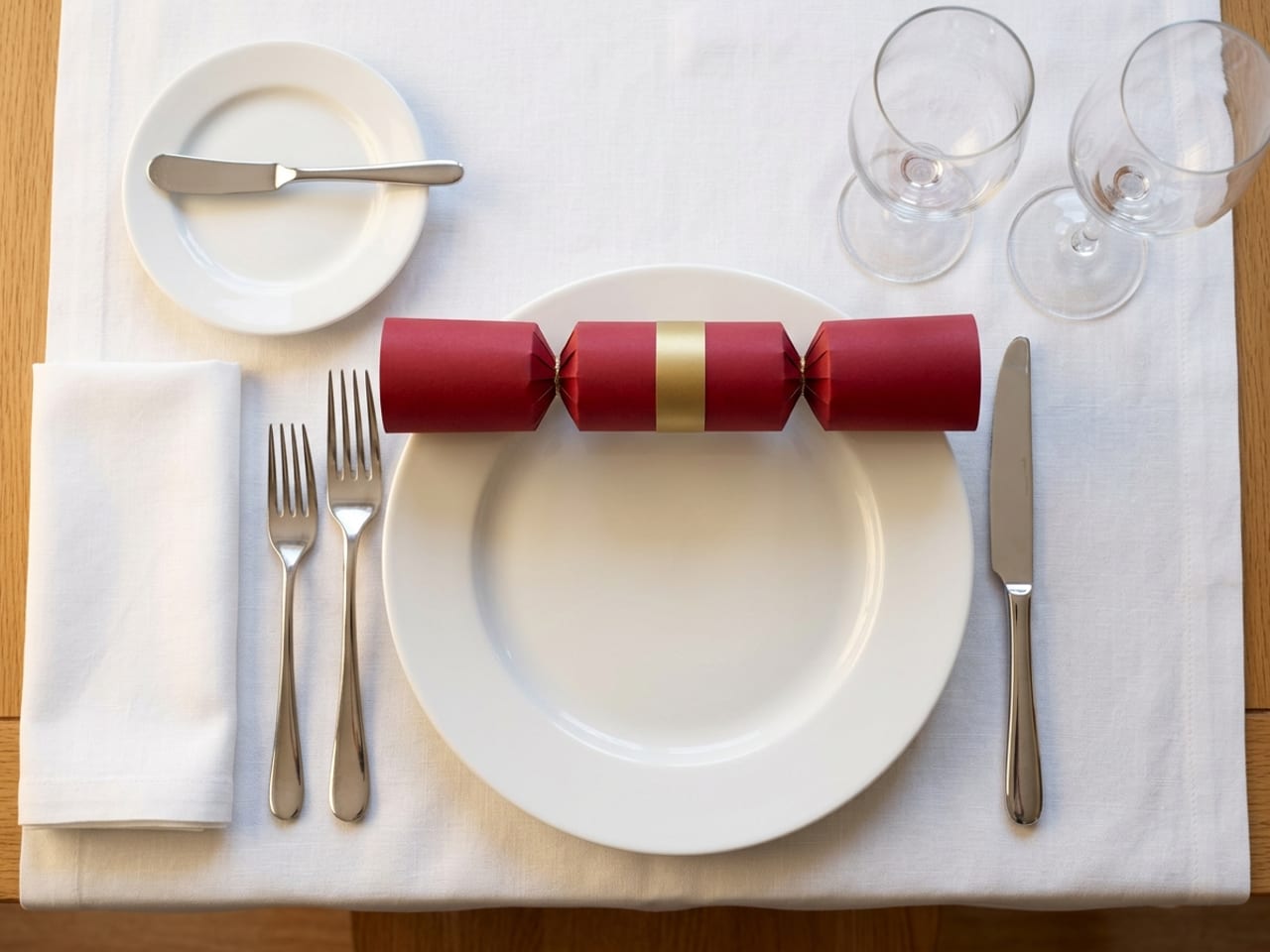
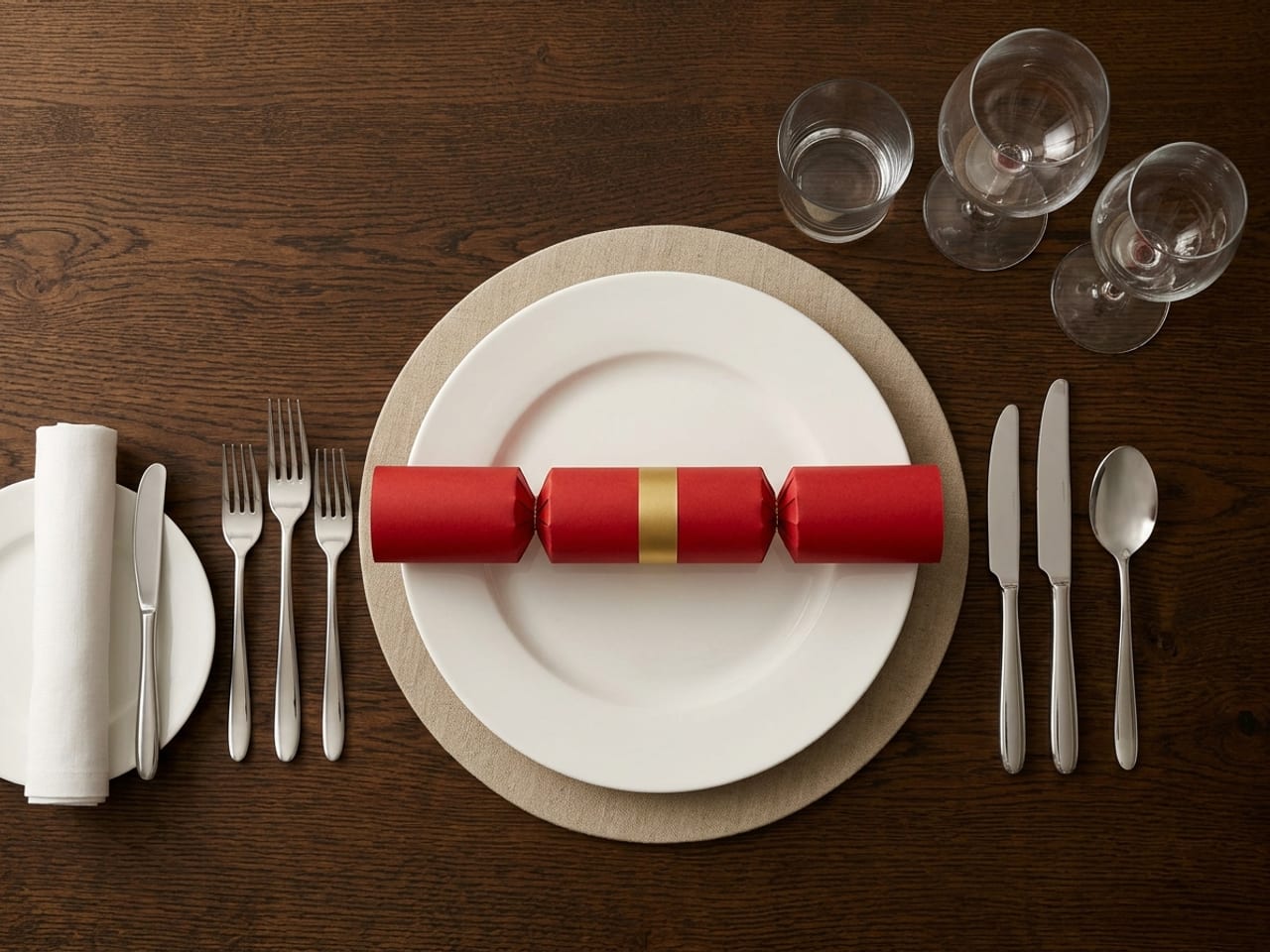
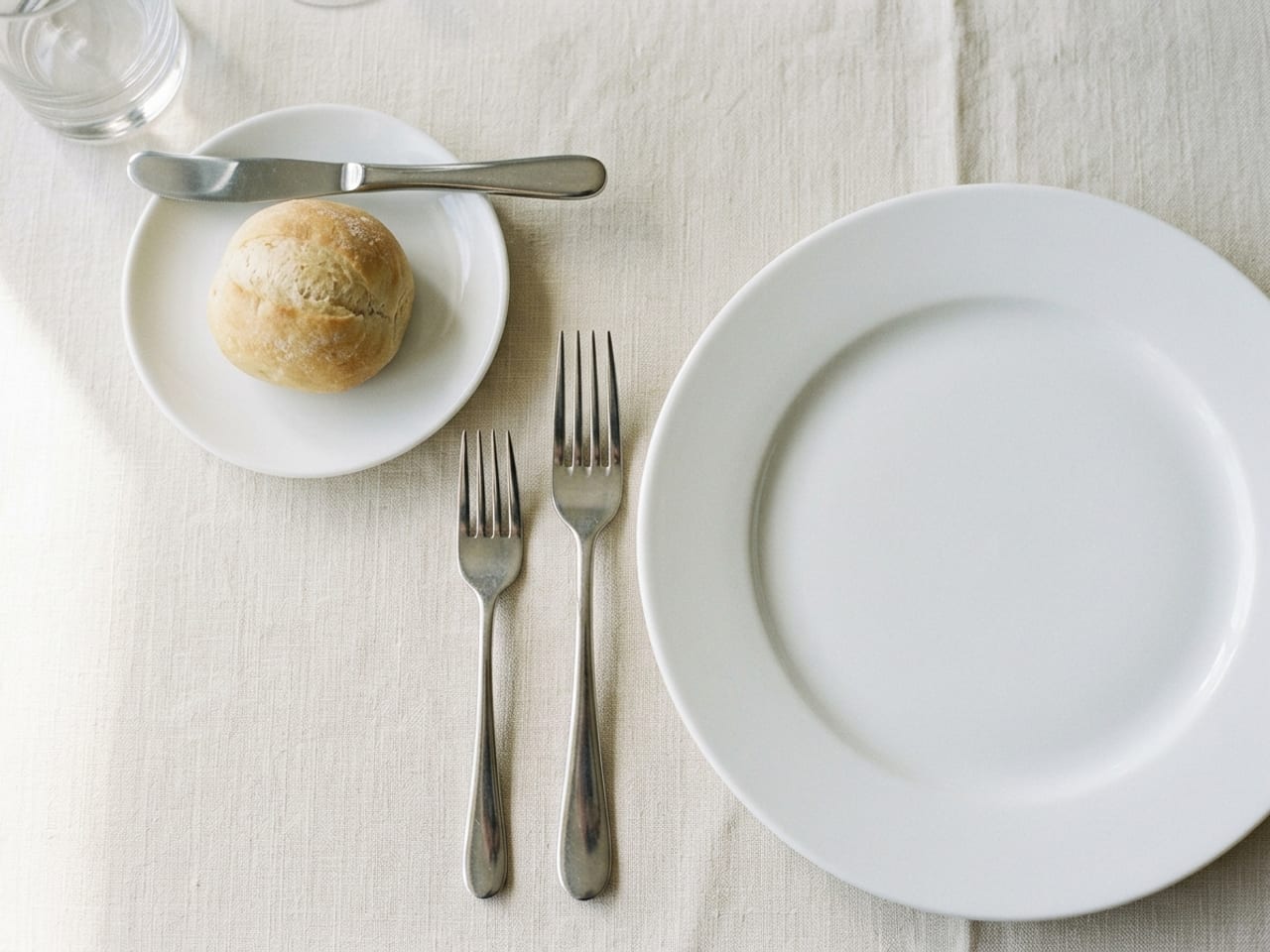
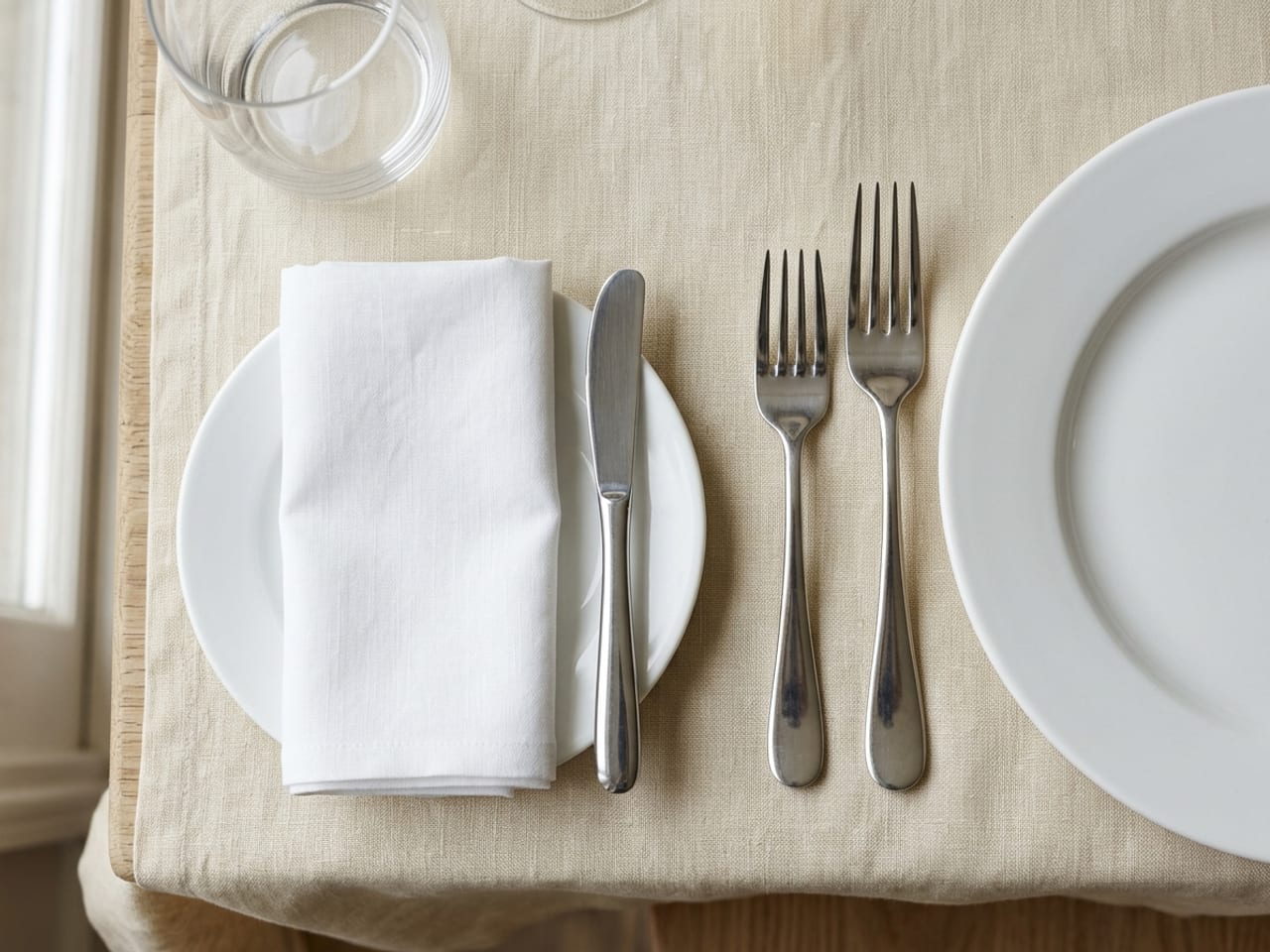
Where do Christmas crackers go on the table?
There is no etiquette rule. One named professional gives a position, across the top of the plate; retailers and magazines give others; Debrett’s page on the Christmas table never mentions crackers. With real candles down the middle, the safest place is a basket. When to pull them is a separate argument.
- First, for American readers: what a cracker isNot the kind you eat: a paper tube pinched at both ends, holding a paper crown, a joke and a small gift, with a strip that snaps when two people pull it apart. The V&A credits it to the London confectioner Tom Smith, in the 1840s.
- Across the top of the plate“A Christmas cracker should be placed across the top of the plate”: Gary Williams, Principal of the British Butler Institute, in BBC Good Food magazine’s “Set your Christmas table” (December 2013), the only named service professional we found who gives a position. The article’s photograph does not show a cracker, so that sentence is all there is: it does not say whether the cracker rests on the plate’s upper rim or just above it.
- What retailers and magazines sayOn top of each plate (HGTV); alongside it (Williams Sonoma, a retailer); to the left of the setting, on or next to the side plate (Homes & Gardens). Cotswold Trading, a British retailer, says it out loud: the placement “doesn’t matter, as long as they don’t interfere with the rest of your table setting”. How many: one per guest plus spares, in case any fail to bang (Partyrama, a UK party retailer).
- Keep them away from the candlesA cracker is paper, and paper is on the NFPA’s list of things that start candle fires when they are too close; the CPSC’s line is to keep candles away from other decorations and wrapping paper. Our arithmetic: a 10 inch (25 cm) plate set 1 inch (2.5 cm) in from the edge puts a cracker laid across its top about 11 inches (28 cm) in. A candle on the center line of a table 42 inches (107 cm) wide is then about 10 inches (25 cm) from it, and on a table 36 inches (91 cm) wide about 7 inches (18 cm): inside the NFPA’s 1 foot (30 cm) both times. Only a table about 46 inches (117 cm) wide clears it. So with real candles on the table, keep the crackers in a basket until they are pulled, or use flameless candles. Once they are pulled, clear the torn paper off the table.
- Who can buy them, and who should not play with what is insideIn UK law a cracker is a pyrotechnic article because of its snap, and the Pyrotechnic Articles (Safety) Regulations 2015 forbid selling one to anyone under 12. That is a rule about selling, not about who may pull one at the table. The contents are another matter: RoSPA says Christmas novelties “don’t adhere to the same safety standards as toys” and that children under 36 months are at greatest risk from small parts; the US Consumer Product Safety Commission keeps toys with small parts away from children younger than three. Clear the cracker gifts off the kids’ table once the hats are on.
The center of the table: centerpiece and room for the food
The Christmas table has to hold a meal as well as a centerpiece (centrepiece, in Britain). Work out the strip you have, keep what stands in it low, and make it liftable.
- How wide a strip you really haveBy our arithmetic, tables 36 to 42 inches (91 to 107 cm) wide leave 6 to 12 inches (15 to 30 cm) between facing places; the 14 to 16 inches (36 to 41 cm) our Thanksgiving hub repeats from a design blog needs a table 44 to 46 inches (112 to 117 cm) wide. No etiquette authority gives a strip width. On a narrower table the strip holds the food or the decoration, not both.
- How tall should a Christmas centerpiece be?The figure everyone repeats, under 12 inches (30 cm), has no authoritative source. Debrett’s says flower arrangements “should be low enough for guests to see over”; the Emily Post Institute, “so diners seated opposite can see each other”; Oregon State’s 4-H guidelines, low enough to see each other easily across the table. None gives a number. The numbers come from florists, event firms, retailers and at least one 4-H blog, and they vary: a low limit of 10 inches (25 cm), 12 inches (30 cm) or 14 inches (36 cm), and a tall option that starts at 18 inches (46 cm), 20 inches (51 cm), 24 inches (61 cm) or, for Adorno Design, 30 inches (76 cm). The usual pair, under 12 inches (30 cm) or above 24 inches (61 cm), is still a fair rule of thumb: by the arithmetic on our Thanksgiving hub, seated adults’ eyes are about 15½ to 24 inches (39 to 61 cm) above the tabletop.
- The test that needs no rulerGood Housekeeping UK: “try sitting down and testing the height of your centerpiece.” The same piece warns that fresh flowers and lit candles “can often be overpowering”: choose unscented candles.
- Put it on a trayMartha Stewart: build the centerpiece on a tray and it “becomes a portable vignette that can be moved off the table when the food is served”; Debrett’s wants decorations that “can be easily removed to a sideboard during the meal”.
- A wreath with candles inside: read this firstDebrett’s suggests a Christmas wreath with candles standing inside it, and the Royal Horticultural Society a coil of ivy round a pillar candle. The US Consumer Product Safety Commission says the opposite: “Never use lighted candles on a tree or near other evergreens.” Both looks work with flameless candles. The candle rules.
- What stays on the table, and what goes to the sideboardBy our count from YouGov’s survey of British Christmas dinners (November 2025: turkey at 57% of tables, roast potatoes and gravy at about eight in ten, carrots at 76%), a typical table carries 8 to 10 serving pieces. Our suggestion: keep what travels most (gravy, sauces, bread) on the table and send the heavy, hot dishes to a sideboard.
- A cold starter uses the strip twiceBBC Good Food’s idea: a cold starter made ahead and put “on a big wooden board in the middle of the table”; it leaves when the platters arrive. Keep the board in the fridge until guests sit: a cold starter counts its own 2 hours from when it comes out (USDA FSIS; the UK figure for chilled buffet food is four hours).
Candles on the Christmas table, safely
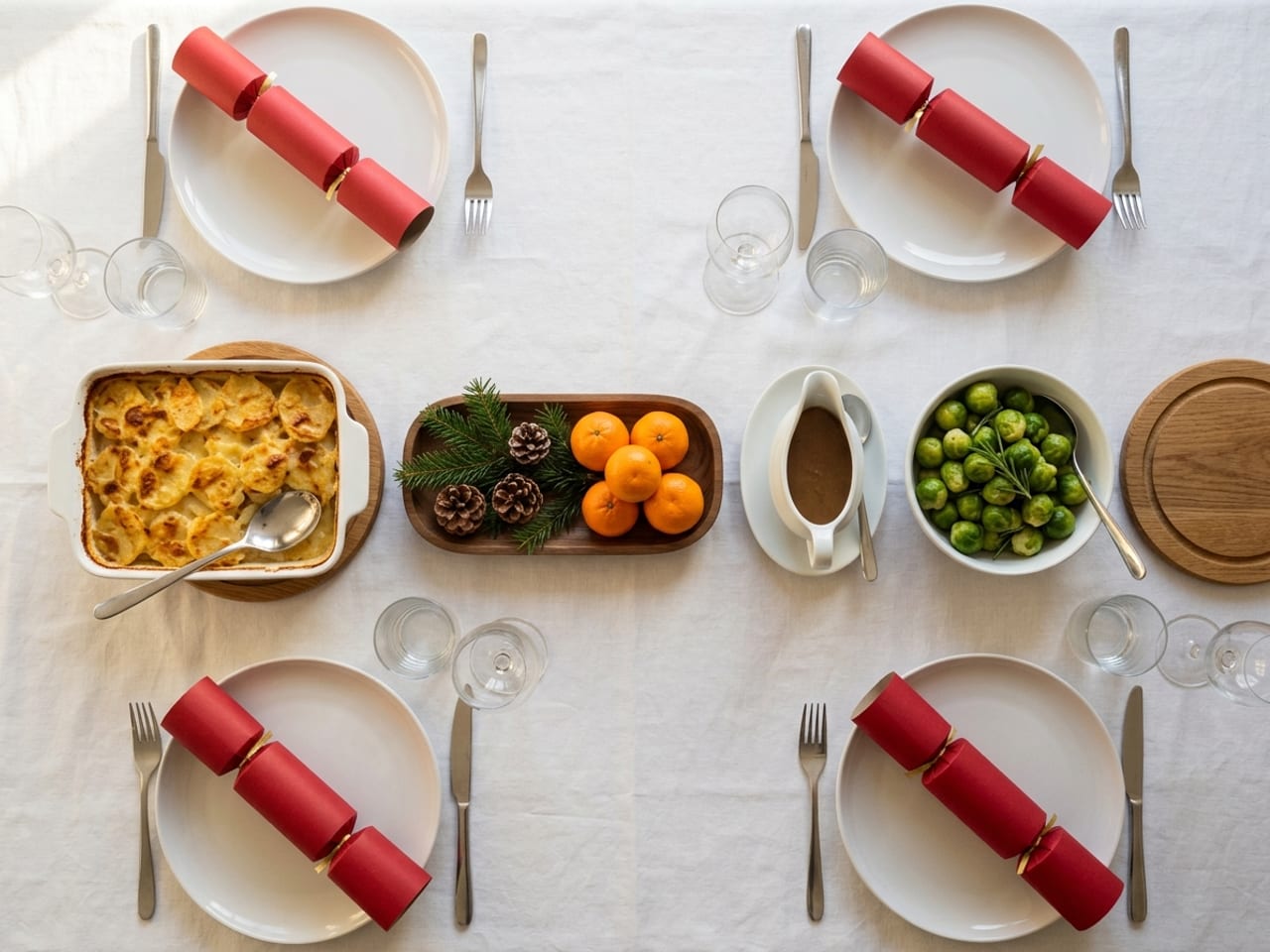
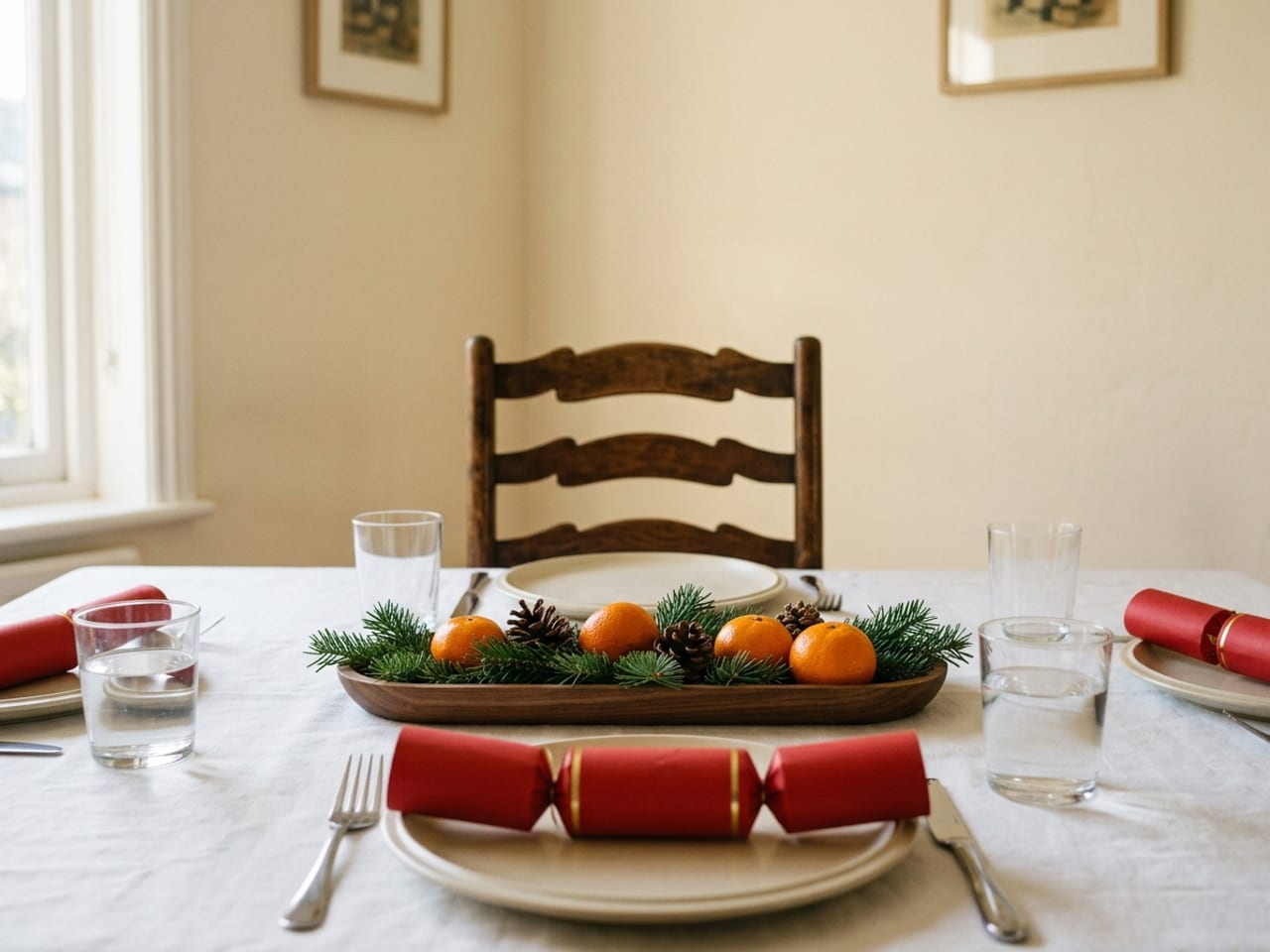
December is the peak month for candle fires in the United States, and decorations are three times as likely to be the first thing to catch as in the rest of the year. The American rule is a distance; British advice gives none.
- The US numbers, with their yearsThe National Fire Protection Association (NFPA) estimates that in 2020 to 2024 US fire departments responded to an average of 5,894 home fires a year started by candles, with 63 deaths and 532 injuries a year, and that over half began when something that could burn was too close. In its 2014 to 2018 report a decoration was the first thing to catch in 12% of December candle fires, against 4% in the other eleven months.
- The US rule: 1 foot (30 cm)NFPA’s tip sheet: “Keep candles at least 1 foot (30 centimeters) away from anything that can burn.” The US Fire Administration and the National Candle Association say 12 inches (30 cm), the same thing. On a table that means the greenery, the crackers, paper napkins and hats, a paper runner and sleeves. By our arithmetic, a cracker across the top of a plate is inside that distance from a candle on the center line of any table narrower than about 46 inches (117 cm): on most tables it is real candles or crackers at the places, not both.
- British advice gives no distanceThe UK government’s Fire Kills leaflet for Christmas says: “Never place candles near your Christmas tree or materials that can catch light easily.” Neither it nor London Fire Brigade gives a measurement, so the 30 cm figure is not British official advice; it is a sound distance borrowed from the US.
- Holders, spacing and wicksThe National Candle Association, the US trade body: trim the wick to ¼ inch (6 mm), keep burning candles at least 3 inches (8 cm) apart and out of drafts, and never use a glass item that was not made for candles as a holder. NFPA: sturdy holders that will not tip, on an uncluttered surface.
- Sleeves, hair and paper hatsNFPA: keep “your hair and any loose clothing away from the flame”. The CPSC names the setting outright: avoid “long, open sleeves” near open flames “such as those of a fireplace, stove, or candlelit table”. A paper hat is paper on a head that leans over the table: with real candles, hats come off or the candles go out (our reading).
- How many candlesDebrett’s quotes “the old rule” of six candles, in pairs, for eight people, and gives no source for it. A 1913 manual, Edith B. Ordway’s The Etiquette of To-Day, as quoted by the blog I Heart Etiquette, says four are enough for eight. The Emily Post Institute asks only for an even number of candlesticks. Count for symmetry, and let lamps or flameless candles do the lighting.
- The LED alternativeLondon Fire Brigade calls flameless LED candles “a much safer alternative”; NFPA says simply, “Use flameless candles in your home.” One check: many run on button batteries, and the Child Accident Prevention Trust lists “Easy-access button batteries” among the dangers to watch for, because “a swallowed battery can kill a child”. Choose ones whose battery door screws shut (our reading of that warning).
- Never unattended, never with a child alone“Blow out all candles when you leave the room or go to bed” and “Never leave a child alone in a room with a burning candle” (NFPA). The UK leaflet adds: check on older relatives and neighbors, who are at greater risk from fire.
- Flaming the puddingWe found no official procedure for flaming a Christmas pudding at the table; one UK fire service, Humberside, says only to be extra careful and “Don’t overdo the brandy!” Our reading of the general rules: take the holly sprig and any paper decoration off first; warm the brandy in a ladle and light it there, never pouring from the bottle onto a flame; keep sleeves, paper hats, napkins and crackers clear; and do not carry it lit past seated children. The flame does not remove the alcohol: USDA’s Table of Nutrient Retention Factors (Release 6, 2007) lists 75% of the alcohol remaining in a flamed alcoholic beverage, and 85% when alcohol is stirred into a hot liquid, so tell guests who avoid alcohol, and parents.
Holly, mistletoe, poinsettia: Christmas plants and the food
Most Christmas greenery is decoration, not food, and some of it should stay out of reach of children and pets.
- Poinsettia: not deadly, still an irritantUS Poison Control: “The poinsettia plant is often considered deadly. That’s wrong. Poinsettia can be irritating but it is not fatal if eaten.” It can still cause mouth irritation, stomach upset and, from the sap, a rash. The ASPCA calls it “generally over-rated in toxicity”; the Royal Horticultural Society rates it an irritant to skin and eyes and harmful if eaten. So: fine in the room, out of reach of small children and pets, and not on the plates.
- Holly: the berriesUS Poison Control: “The berries of the holly plant are poisonous to people and pets”, and children have had symptoms after swallowing as few as two. Its advice is to remove the berries before decorating with fresh holly. A 2012 review in an emergency medicine journal says the leaves are not poisonous.
- Mistletoe: two different plantsAmerican mistletoe (Phoradendron) and European mistletoe (Viscum album) share only a name. For the American one, a study of 1,754 exposures reported from 1985 to 1992 found no deaths and no ill effect in 99.2% of cases (Krenzelok and colleagues, 1997). The European one, the British plant, has a record: “Poisonings and deaths have been reported from ingestion of European mistletoe” (US Poison Control), and the Royal Horticultural Society rates it harmful if eaten, so British readers should not borrow the American numbers. Either way, Poison Control is blunt: “Mistletoe should not be used to decorate food!”
- Yew: keep it off the tableThe one common Christmas evergreen with a serious rating: the Royal Horticultural Society lists yew (Taxus) as “toxic if eaten”; US Poison Control says the poisonous parts include the needles and the seed inside the berry; the ASPCA’s entry for pets includes sudden death from heart failure. Keeping it out of table decorations altogether is our recommendation.
- Ivy, Christmas rose, amaryllisAll three are on the Royal Horticultural Society’s list as harmful if eaten, and the ASPCA lists all three as toxic to dogs and cats. The Society’s rule fits a dinner table exactly: “If it is not a food plant, do not eat it.”
- What can touch the foodNo food agency publishes a list of greenery that is safe on a plate. Our rule: only things that are food in their own right touch food or lie on a plate, such as rosemary, bay, thyme, sage, citrus, cranberries and pomegranate. Bay means culinary bay (Laurus nobilis), not the cherry laurel of garden hedges, which is on the Royal Horticultural Society’s harmful list; and buy the herbs as food, not as florist’s stems (our note). Oregon State’s 4-H guidelines add that decorations should not shed or droop over the food.
- Pets and the greeneryThe PDSA, a UK veterinary charity: poinsettia, mistletoe, holly and ivy “can all cause your pet to become poorly”. The ASPCA adds lilies, which can cause kidney failure in cats.
Christmas napkin folds, sorted by what the napkin has to do
Pick the fold by its job. Folds already in our napkin folding guide link to their step diagrams there; four new ones have written steps below. British readers: a serviette is the same thing.
| The job | Fold | Napkin | Where it sits | Steps |
|---|---|---|---|---|
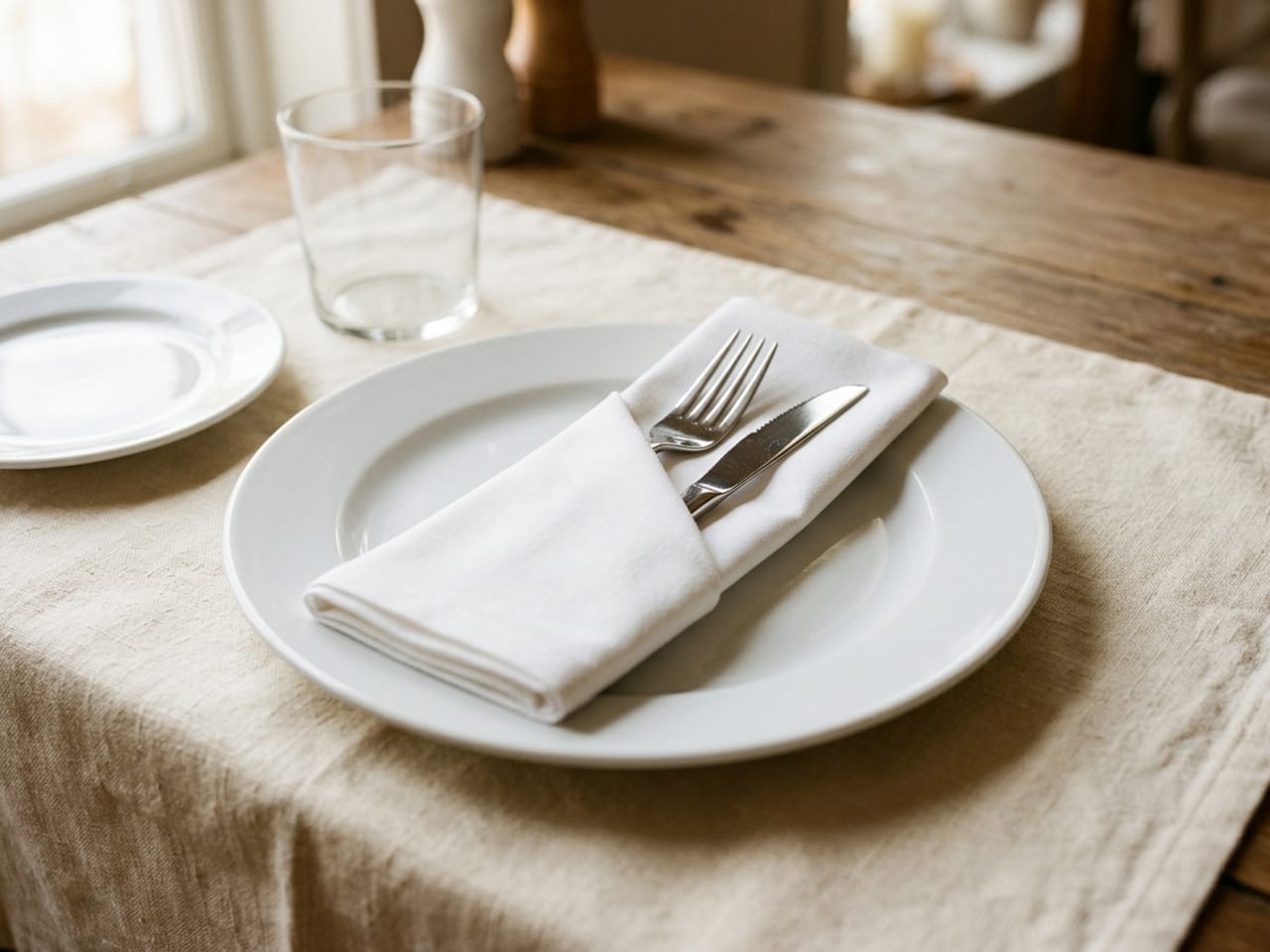
| Holds the cutlery | Simple pocket | 16 inches (41 cm) or larger; paper works | On the plate or left of it | Pocket fold, with a rosemary sprig beside the fork |
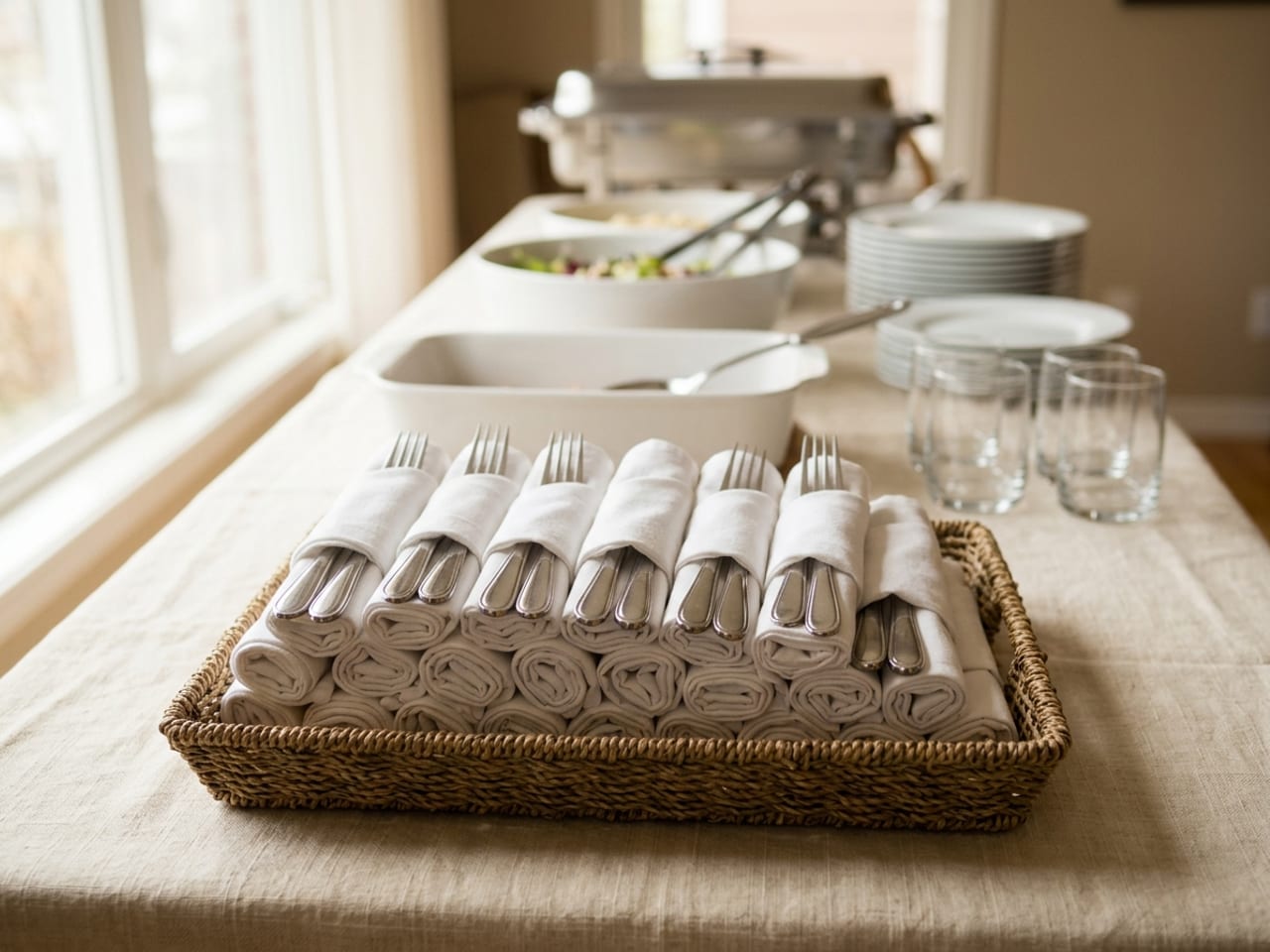
| Holds the cutlery at a buffet | Silverware roll-up | 16 inches (41 cm) or larger | In a basket at the end of the line | Roll-up |
| Lies under the cracker | Plain oblong, or rolled with a ring | Any size for the oblong; 14 to 16 inches (36 to 41 cm) for the roll | The oblong flat on the dinner plate with the cracker across it, or either one on the side plate, as Debrett’s lays it | Oblong or rolled with a ring |
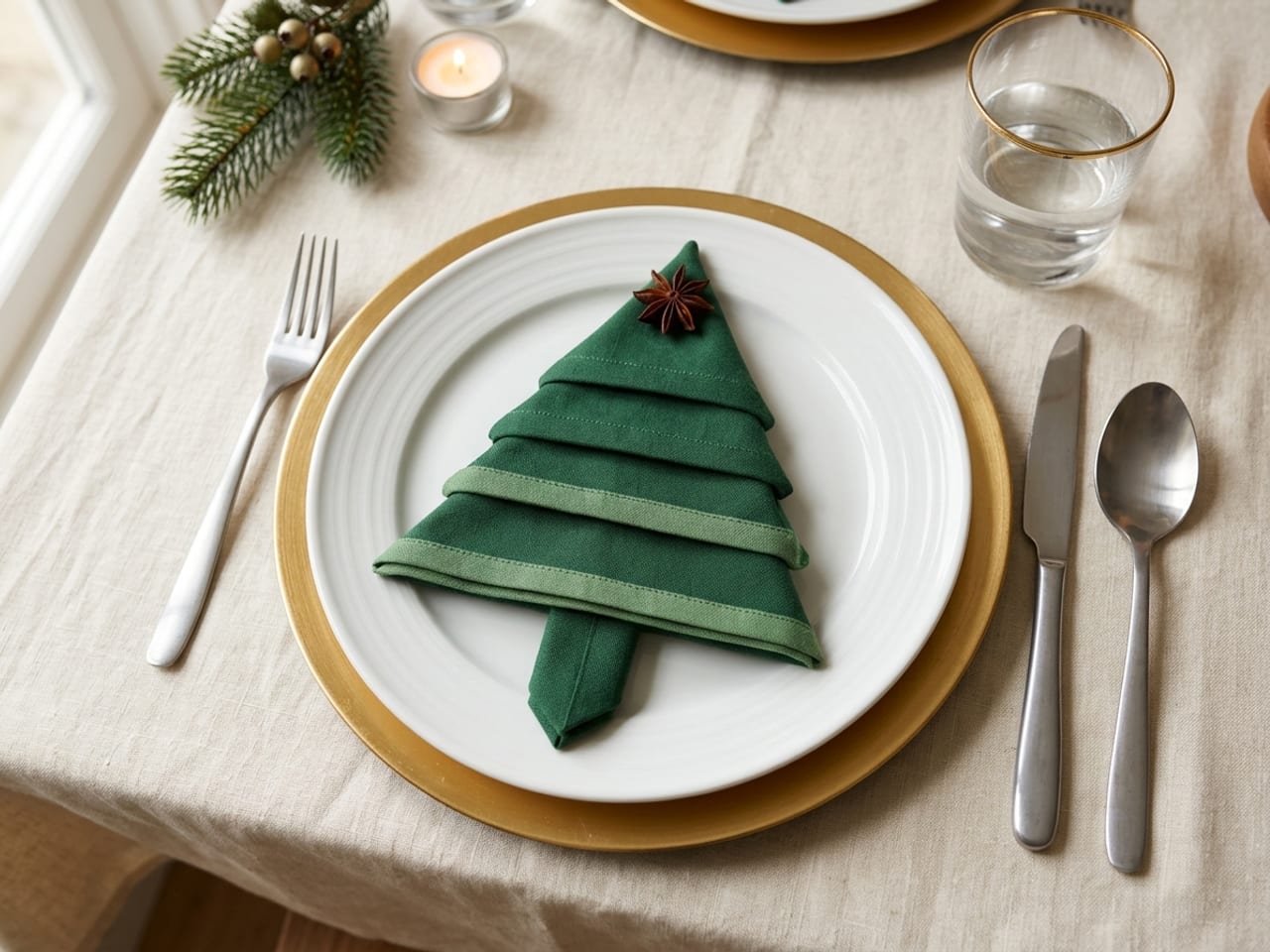
| Looks like Christmas, and can hold a place card | Christmas tree | 16 inches (41 cm) at least, 20 inches (51 cm) is best; square paper works | On the plate or charger | Christmas tree fold; a punched paper star with the guest’s name on top is Martha Stewart’s idea |
| A red flower on the plate | Poinsettia, which is our lotus fold in a red napkin | Our guide asks for 18 inches (46 cm), better 20 to 22 inches (51 to 56 cm); Gala in the Kitchen folded hers from a 17 inch (43 cm) napkin | On the plate. A wrapped chocolate in the middle is our suggestion, at the adults’ places only: nothing small enough to swallow where a small child sits | Lotus fold; HGTV, Gala in the Kitchen and Woman & Home publish the same three rounds of corners to the middle as the poinsettia |
| A gift bow | Bow | 16 inches (41 cm) | On the plate | Bow fold; HGTV styles it in red with a gold ring |
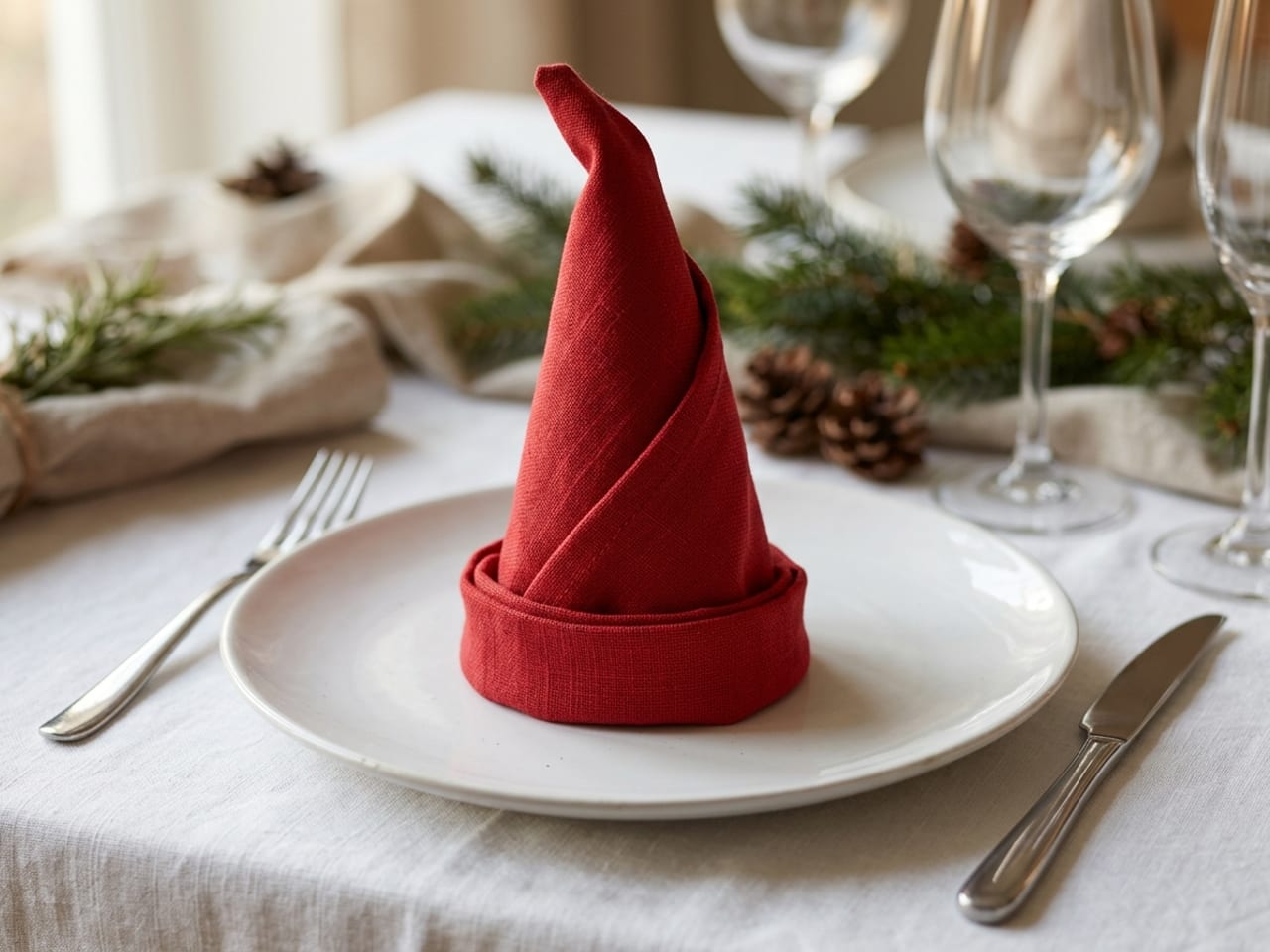
| Stands up, as a hat | Elf hat | No source gives a size | On the plate | Elf hat steps, after HGTV |
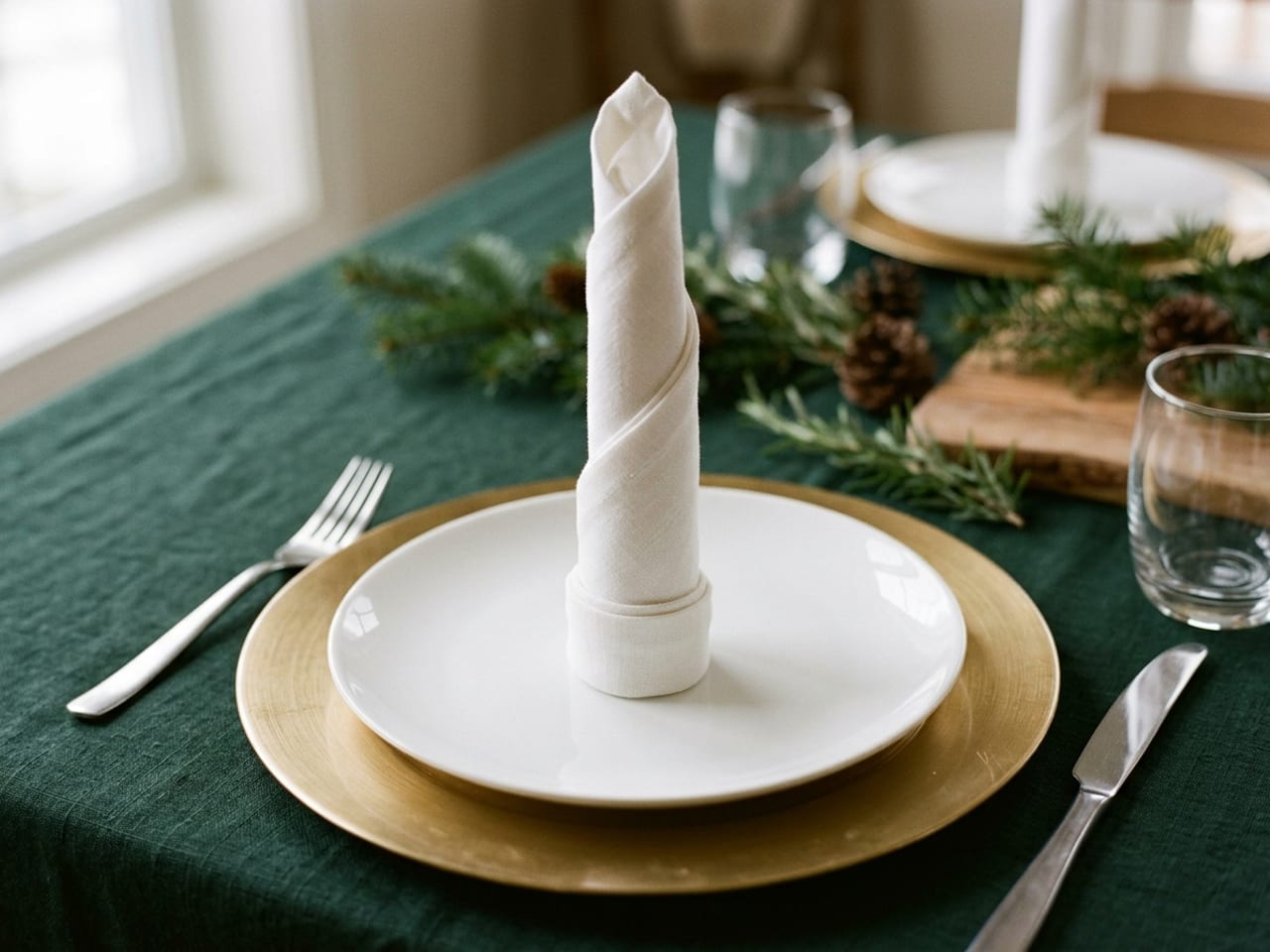
| Stands up, as a candle | Candle | “Almost any napkin” (Napkin Folding Guide) | On the plate | Candle steps, after Napkin Folding Guide |
| Stands up, as a shoe | Elf shoe | Cloth or paper; thinner is easier | On or next to the plate (LUSINI, a hospitality supplier, for the same fold) | Elf shoe steps, after wikiHow |
| Is the cracker | Napkin cracker | A cloth napkin wider than a cardboard tube | Across the plate | Napkin cracker steps, after Sarah K |
Not hand-tested. We have not folded the four new folds ourselves. Each follows one named, published tutorial, retold in our own words and credited in its section; the source list says which copy we read.
One fold per table. Our guide’s rule is to repeat one fold at every place and to starch only folds that stand. The three standing folds below are rolled or locked with a tuck, and none of their tutorials asks for starch. Most folds keep for a day, so they can be done on Christmas Eve.
Iron first; paper works. Between Naps on the Porch, on the tree: the fold “will be much harder and not turn out well with wrinkled napkins”. The tree also works in a square paper napkin (A Piece of Rainbow, delicious. magazine), and A Labour of Life calls the elf hat “a very easy fold with a paper napkin”; our guide’s paper notes list the sizes.
With a cracker and candles on the table too. A fold that stands or has tiers needs the plate to itself, so the cracker moves above or beside the plate; a flat napkin can share the plate with it. Yahire, a UK hire company, puts simple folds on the side plate and elaborate ones on the dinner plate. Standing folds, paper stars and ribbon ties all count as things that can burn: 1 foot (30 cm) from a real candle (NFPA).
How to fold an elf hat napkin
A standing cone with a turned-up brim. These steps follow HGTV’s “10 Festive and Easy Ways to Fold Napkins for the Holidays” (updated 17 November 2025). Retold in our words, and not hand-tested by us. The original, with five photos.
- The napkinHGTV says only “a square napkin”; no tutorial we read gives a size or asks for starch. A Labour of Life, which folds the same hat, suggests pressing a cloth napkin first.
- 1. Wrong side upLay the napkin flat with the side you want hidden facing up.
- 2. Fold it in halfFold it in half so the fold is toward you and the open edges are away from you.
- 3. Pin the middlePut one finger on the middle of the folded edge and hold it there. That point becomes the tip of the hat.
- 4. Roll a coneWith the other hand, take the left end of the folded edge and roll it round that point toward the right, so the napkin winds into a cone.
- 5. Turn up the brimFold the uneven bottom edge back on itself. The cuff holds the cone shut and gives it a flat base.
- 6. Stand it upSet it on the plate, tip up. HGTV finishes it with a red pom-pom on a toothpick pushed into the tip; with small children at the table, leave the toothpick out (our note). A standing napkin, cloth or paper, stays 1 foot (30 cm) from any real flame (NFPA).
How to fold a candle napkin
A tall, slim roll that stands on the plate and tapers to a point: a candle with no flame to worry about. These steps follow Napkin Folding Guide’s “The Candle Napkin Fold”. Retold in our words, and not hand-tested by us. The original.
- The napkinThe source says the fold “does not require any starch” and “can be made with almost any napkin”, and gives no size. By our arithmetic a 20 inch (51 cm) napkin makes a candle about 13 inches (33 cm) tall, and a 16 inch (41 cm) one about 10 inches (25 cm); nothing was tested.
- 1. Face downLay the napkin face down.
- 2. Make a triangleFold it in half diagonally.
- 3. Turn itTurn the triangle so the long folded side is toward you and the open point is away from you.
- 4. Fold a cuffFold the long side up by about an inch (2.5 cm) and press it down firmly. The source warns that a loose cuff gets in the way of the next step.
- 5. Roll itRoll it up from one end of the long side to the other, tightly and squarely. A roll that drifts will not stand.
- 6. Tuck and standTuck the tail end of the roll into the cuff at the bottom, on the side that will face away from the guest, and stand the candle on that end. The source says only “into the base on the backside”, and does not say which way the cuff should face while you roll. It is a napkin, not a candle holder: it stays 1 foot (30 cm) from any real flame (NFPA).
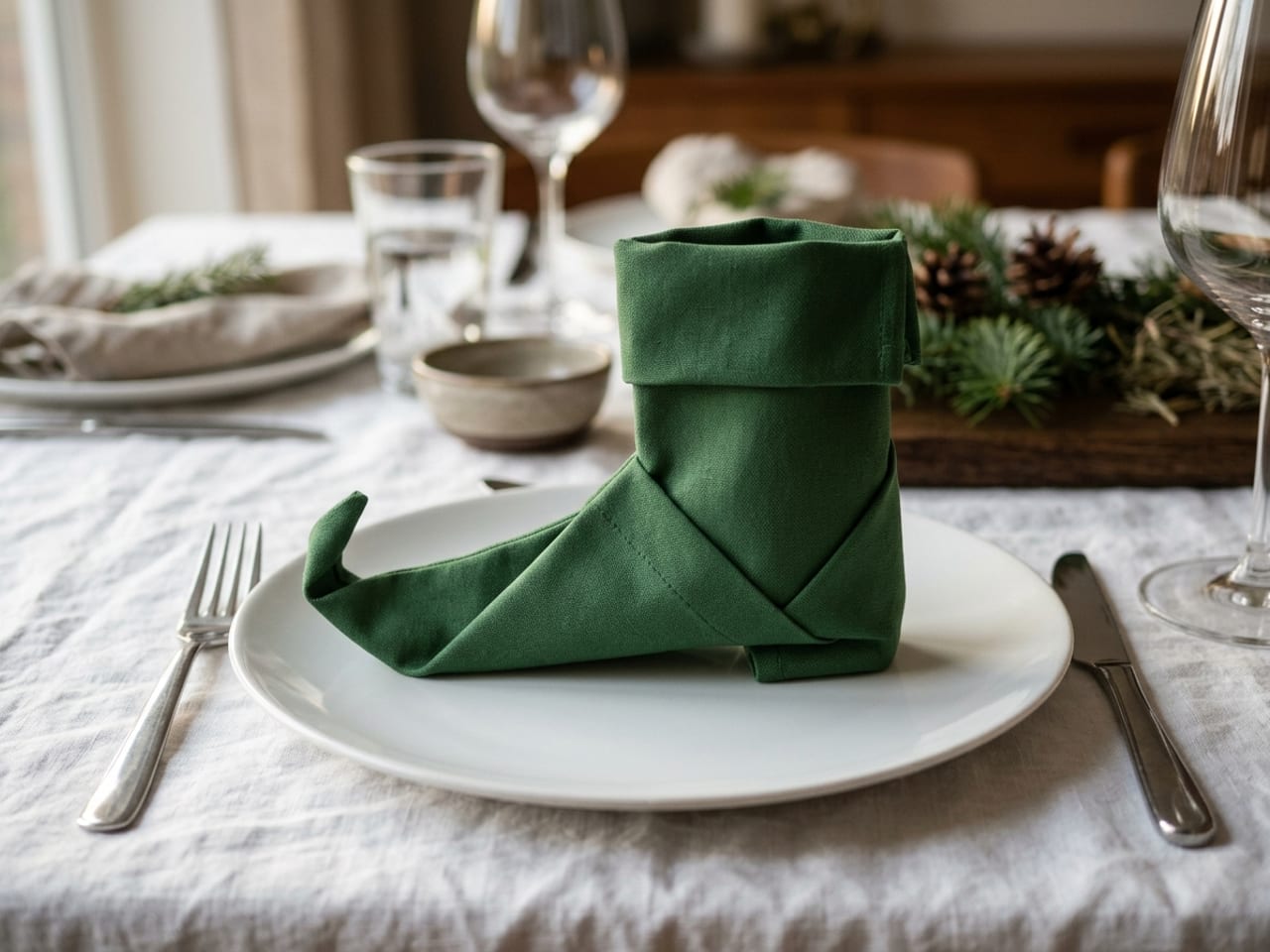
How to fold an elf shoe napkin
Also published as an elf boot or a Santa boot, and the fold where the pictures on the original help most. These steps follow wikiHow’s “How to Fold Napkins for Christmas”, method 4, “Creating Playful Elf Shoes” (co-authored by etiquette coach Tami Claytor; last updated 16 June 2025). Retold in our words, and not hand-tested by us. The original, with a picture for every step.
- The napkinwikiHow suggests green, or colored paper napkins for a children’s party, and gives no size. A Labour of Life, which folds the same shoe: “you want a thinner napkin so folding is easy or keep a hot iron close by”.
- 1. Fold it in halfLay the napkin flat and bring the bottom edge up to the top edge.
- 2. And in half againBring the top edge down to the bottom, lining the edges up. You now have a long, narrow band. With paper, crease it between finger and thumb.
- 3. Make a pointFind the middle of the band and fold both ends down from it so that their inner edges meet in the middle, as for a paper airplane. The band now has a point at the top. With cloth, wikiHow presses it with an iron here.
- 4. Sharpen the pointFold the two outer edges in to the middle once more. The point becomes sharper and narrower.
- 5. Fold it in half lengthwiseBring the left side over onto the right. Lay it down with the fold at the top and the open side toward you: the open side is the sole, the point is the toe.
- 6. Lift the upper tailTurn it so the wide end, the heel, is on your right. That end is two tails, one lying on the other. Lift the whole upper tail (wikiHow calls it the top layer) and fold it upward; in wikiHow’s picture it becomes the upright part of the shoe.
- 7. Wrap and tuckThe lower tail is still flat on the table. Wrap it forward, toward the toe, and push its end into the pocket on the side of the shoe. It has to lie flat in there; a wrinkle shows on the outside. This tuck is what holds the shoe together, and it is the step to check against the picture.
- 8. Stand it and turn down the cuffSet the shoe on its sole. Turn the top of the upright part down on the outside to make the cuff, then pinch the toe and curl it up a little. wikiHow ties a bell or ornament under the cuff; anything small enough to swallow stays off a toddler’s place (our note). Like any standing fold, it stays 1 foot (30 cm) from a real flame (NFPA).
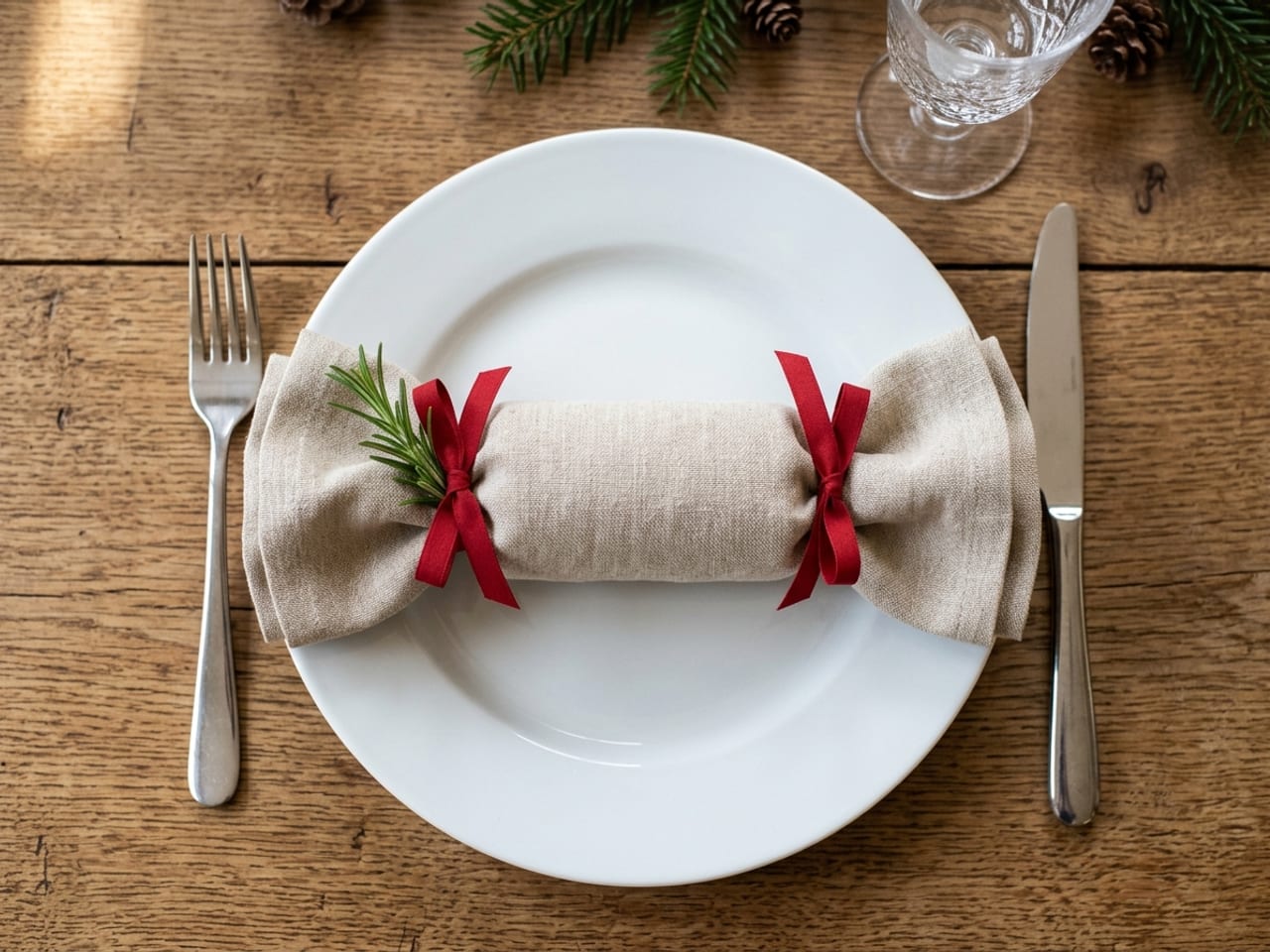
How to wrap a napkin as a Christmas cracker
The napkin and the cracker become one object, which settles where each of them goes. It has no snap, so it is silent. These steps follow Sarah K’s “How to Create Sustainable Christmas Crackers from Napkins” by Claire Locking (9 December 2022). Retold in our words, and not hand-tested by us. The original.
- What you needPer place: a cloth napkin, a cardboard tube from a toilet roll, double-sided tape, ribbon or twine, and something to put inside. The source gives no napkin size; Ideal Home, which makes a three-tube version, says only that the napkin must be larger than the tubes, to leave fabric to tie at each end.
- 1. Fill the tubePut the treat, message or joke inside the cardboard tube. Wrapped sweets keep food off the cardboard (our note).
- 2. Lay it on the napkinPlace the napkin face down and lay the tube along the middle of one edge.
- 3. Tape the far edgeStick a strip of double-sided tape along the edge opposite the tube, on the side facing up. Sarah K says only “one edge”; Ideal Home’s version says to start rolling from the end without the tape, which puts it here. It is the one step that puts adhesive on your linen, so test the tape on a corner first (our note).
- 4. RollRoll the tube slowly away from you so the fabric wraps round it, and press the taped edge down to hold it.
- 5. Tie both endsTie each end with ribbon or twine. The source adds a sprig of herbs, greenery, a cinnamon stick or dried orange to the twine; use rosemary, not holly or mistletoe, on something that sits on a plate (see the plant notes). It is cloth, card, ribbon and dried trimmings: the same 1 foot (30 cm) from any flame as a paper cracker (NFPA), which on most tables means flameless candles.
- What goes inside, with children at the tableThe same rule as for bought crackers: nothing with small parts for children under three (CPSC), no balloons for children under eight (CPSC), and nothing with a button battery. The treat counts too: no hard sweets, nuts or marshmallows for children under four (American Academy of Pediatrics; the NHS says no whole nuts under five).
Christmas table color schemes: red and green, red and gold, green and gold, white
Debrett’s on Christmas color: “red and green is traditional, but you might opt for the metallic glow of silver or gold.” Four schemes, with the food counted as part of the palette.
| Scheme | Start from | Plates | What the food adds | Watch for |
|---|---|---|---|---|
| Red and green | A white cloth with a green runner or greenery, and red napkins | White | Brown and gold from the roast and potatoes; red from cranberry sauce | The greenery supplies the green. Red on the napkin, not under the food |
| Red and gold | A red tablecloth, or a white one with red napkins | White, on gold chargers if you have them | Gold from the roast potatoes and the gravy | Decorative chargers are not for food; gold or platinum rims stay out of the microwave |
| Green and gold | A green tablecloth or a dark green runner on wood | White or cream | Every warm color on the table | Dark around, pale under, as in the green palette on our Thanksgiving hub |
| White and natural | White linen, clear glass, bare wood | White | All of the color | The quietest frame; add fir and rosemary for the green |
Keep the plates pale. The roast, the potatoes and the gravy are brown and gold, and they need contrast under them more than a theme: our color guide has the evidence, and the plate color pairing tool matches a plate to a dish. Ideal Home’s scheme is “one key colour” picked up in the cloth, the napkins and the arrangement. The Emily Post Institute: white linens are still the most formal, “but colored or patterned tablecloths or place mats, and napkins can be just as elegant.”
Where red and green come from. Not from Coca-Cola. The company’s own FAQ says it “did not create the legend of Santa Claus” and dates its Haddon Sundblom Santa to 1931; the Smithsonian’s National Museum of American History says he was dressed in colors “that had already become associated with Santa”.
The kids’ Christmas table
The points with a named source behind them, American and British kept apart where they differ.
- Against the end of the big tableTaste of Home’s suggestion, also on our Thanksgiving hub: butt the children’s table against the end of the adults’, so they are in view. Keep the gravy boat, hot dishes and any flame away from the end where the tables meet: New York State’s Department of Health says to put hot liquids and foods in the middle of the table, not near the edge.
- No real flamesNFPA: “Never leave a child alone in a room with a burning candle.” The UK government’s fire booklet says the same. Flameless candles are the obvious answer; the Child Accident Prevention Trust’s warning is about “Easy-access button batteries”, so choose ones whose battery door screws shut (our reading). If a child may have swallowed one, its advice is: “go straight to A&E or call an ambulance.”
- Placemats, not a long cloth, where there are toddlersNew York State’s Department of Health: “Use non-slip placemats instead of tablecloths when serving hot foods or drinks.” Nemours KidsHealth goes further: avoid tablecloths “or large placemats”. The NHS’s line is about hot drinks, which can still scald 15 minutes after they are made.
- Crackers, with an adultPull them with an adult at the table and, like the adults’ crackers, 1 foot (30 cm) from any real flame. The gifts inside are novelties, not toys (RoSPA): take small ones away from children under three, and check anything that lights up for button batteries (Child Accident Prevention Trust). The law, the small-parts advice and the candle arithmetic.
- Food for small childrenUS: the American Academy of Pediatrics keeps high-risk foods, among them whole grapes, nuts, hard candy, popcorn and marshmallows, from children until age 4 or older, and cuts food for young children into pieces no larger than ½ inch (1.3 cm). Both its list and the CDC’s include sausages, which covers pigs in blankets; the CDC’s adds bones in meat or fish. UK: the NHS says whole nuts should not be given to children under 5, and the Child Accident Prevention Trust’s Christmas tip is to think “long not chunky and narrow not wide for food like pigs in blankets, vegetables and cheese. Anything round needs cutting up.”
- Pudding, brandy butter and childrenFlaming does not remove the alcohol (the USDA figures), and brandy butter is not cooked at all. Offer a plain alternative and say what is in each (our advice).
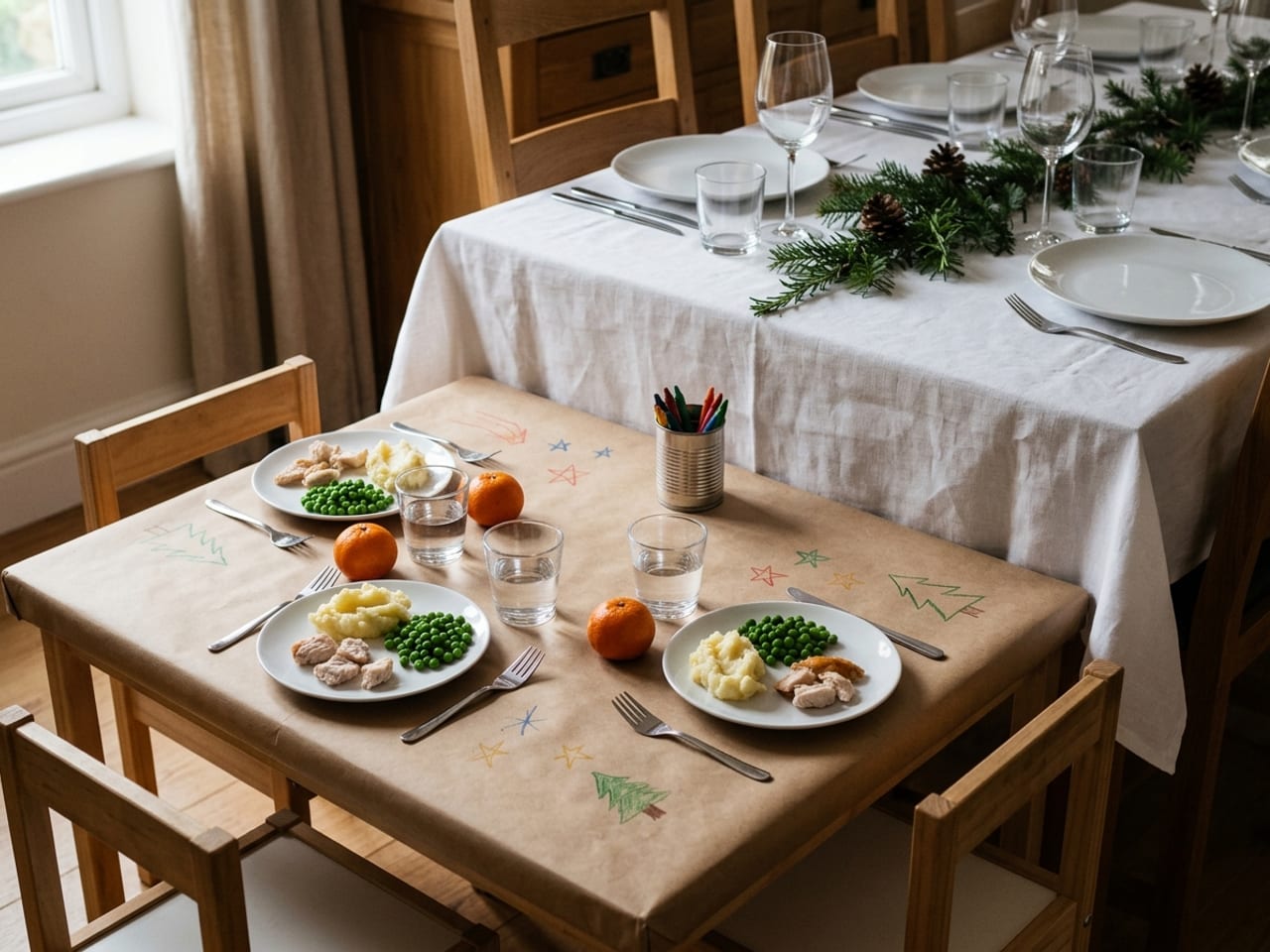
- Paper, crayons, unbreakablesA paper cover to draw on, taped down and trimmed flush with the table edge so there is nothing to pull; crayons in a tin; short unbreakable cups and salad plates as dinner plates: the same kit as on our Thanksgiving hub.
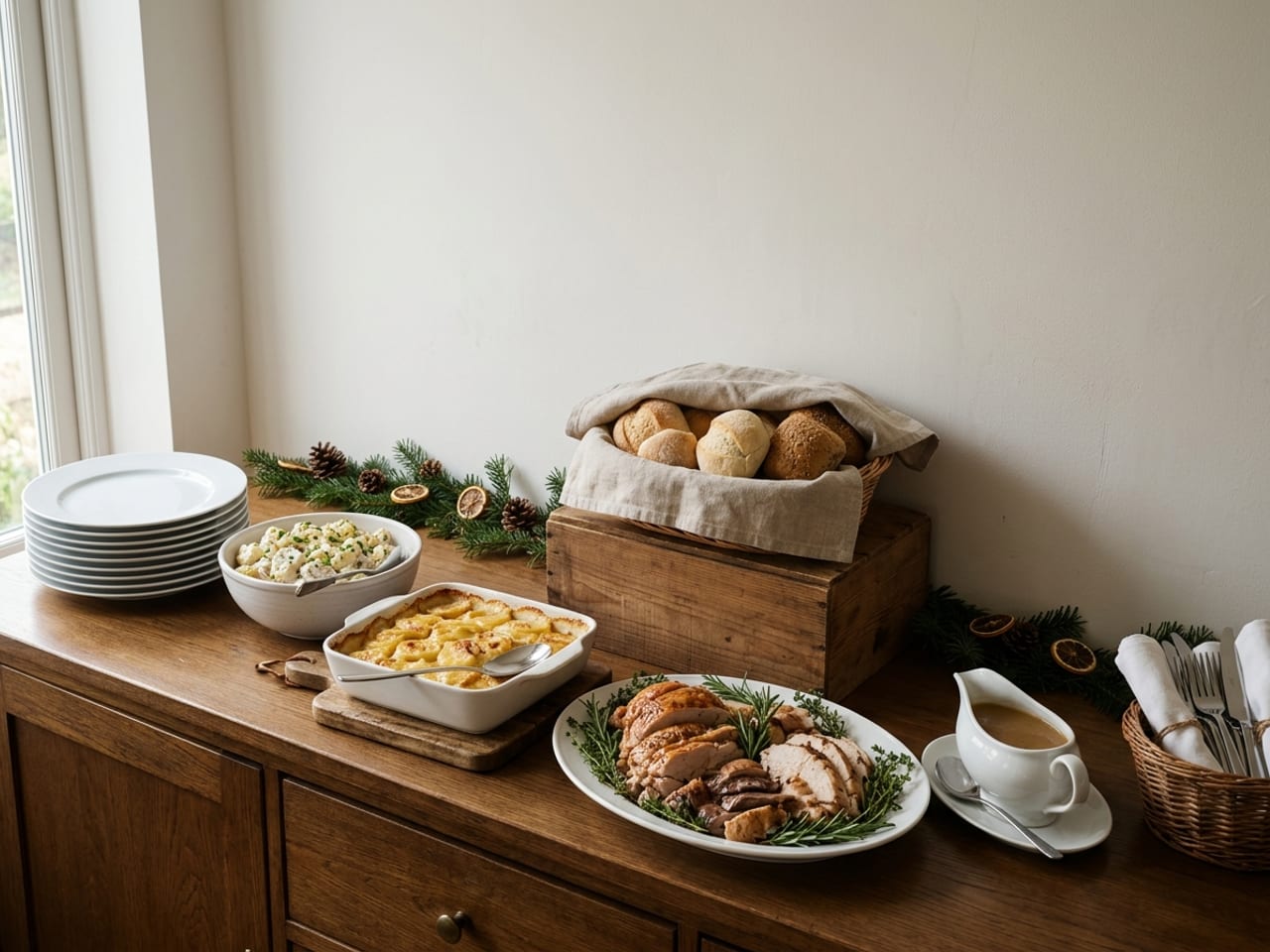
A Christmas buffet or sideboard instead
The answer when the table cannot hold the dishes, and the Post family’s own habit: “We were often served buffet style for our big Christmas Day celebration”, writes the Emily Post Institute.
- The sideboard versionElizabeth Post, in The New Emily Post’s Etiquette (1975): “arrange the food on the sideboard or a side table and set the dining-room table as for a sit-down dinner”. Guests carry only their plates, the table keeps its centerpiece, and the buffet needs less room.
- The order of the linePlates first; then cold dishes; the hot sides; the carved meat with the gravy beside it; then bread. If guests will not sit at a set table, cutlery rolled in napkins goes last. This is the order on our Thanksgiving hub.
- Holding hot food: USUSDA: hot food at 140°F (60°C) or above, cold food at 40°F (4°C) or below, and nothing perishable out of that range for more than 2 hours, or 1 hour above 90°F (32°C). The FDA warns that some warmers only hold 110 to 120°F (43 to 49°C), so check with a thermometer; it keeps back-up dishes in a 200 to 250°F (93 to 121°C) oven and replaces a nearly empty dish with a fresh one, never topping it up.
- Holding food: UKThe Food Standards Agency’s danger zone is 8 to 63°C. Its guidance for community and charity events (not written for home hosts, but the only place it gives a buffet time) allows chilled buffet food out of the fridge “for no more than four hours”. Its rule for caterers is hot food at 63°C or above, or on display for up to two hours, once. For home cooks its Christmas page says to cool cooked food and refrigerate it within one to two hours. The British and American figures are different rules, not conversions of each other.
- AllergiesThe Food Standards Agency’s advice for cooking at home for someone with an allergy: ask in advance what they can and cannot eat, keep allergens separate and keep the packets so you can answer questions; taking the food off their plate is not enough. A small card by each dish with nuts, milk, egg or wheat does it.
Recipes on this site that suit a Christmas dinner, each with what it needs on the table, how it holds and its allergens. The Czech dishes are here because that is where the site began. Roast calculators and more dishes follow the cards.
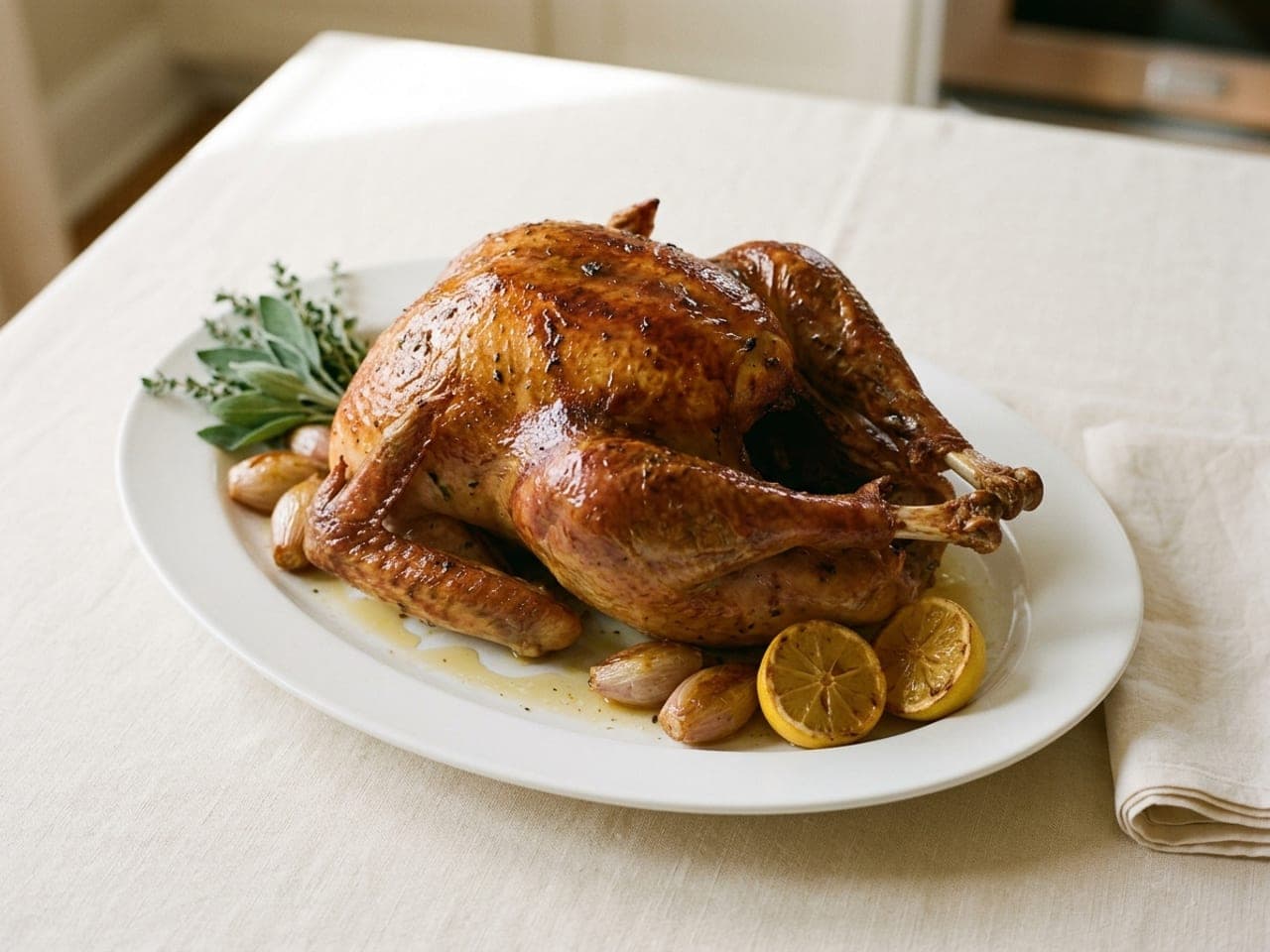
Roast turkey
A 12 to 14 lb (5.4 to 6.4 kg) bird, dry-brined and roasted at 325°F (163°C), enough for 12; the recipe is written for Thanksgiving, and nothing in it changes in December. On the table: carve in the kitchen and bring it out on your largest platter, which needs a place in the center strip. Timing: the timeline has the thaw, the dry brine and the oven. Done is 165°F (74°C) in the innermost part of the thigh and of the wing and in the thickest part of the breast (USDA FSIS), and the recipe counts the 2 hours on the table from when the bird leaves the oven. Allergens: none of the major ones in a plain bird; the herb butter adds milk, and the celery under the rack, a listed allergen in the UK and EU, ends up in the drippings.
The twist: For Christmas, move the recipe’s dates: a bird for Friday 25 December goes from the freezer to the fridge on Sunday 20 December, five days ahead as the recipe has it, so that it has thawed before the dry brine on Wednesday 23 December.
Full recipe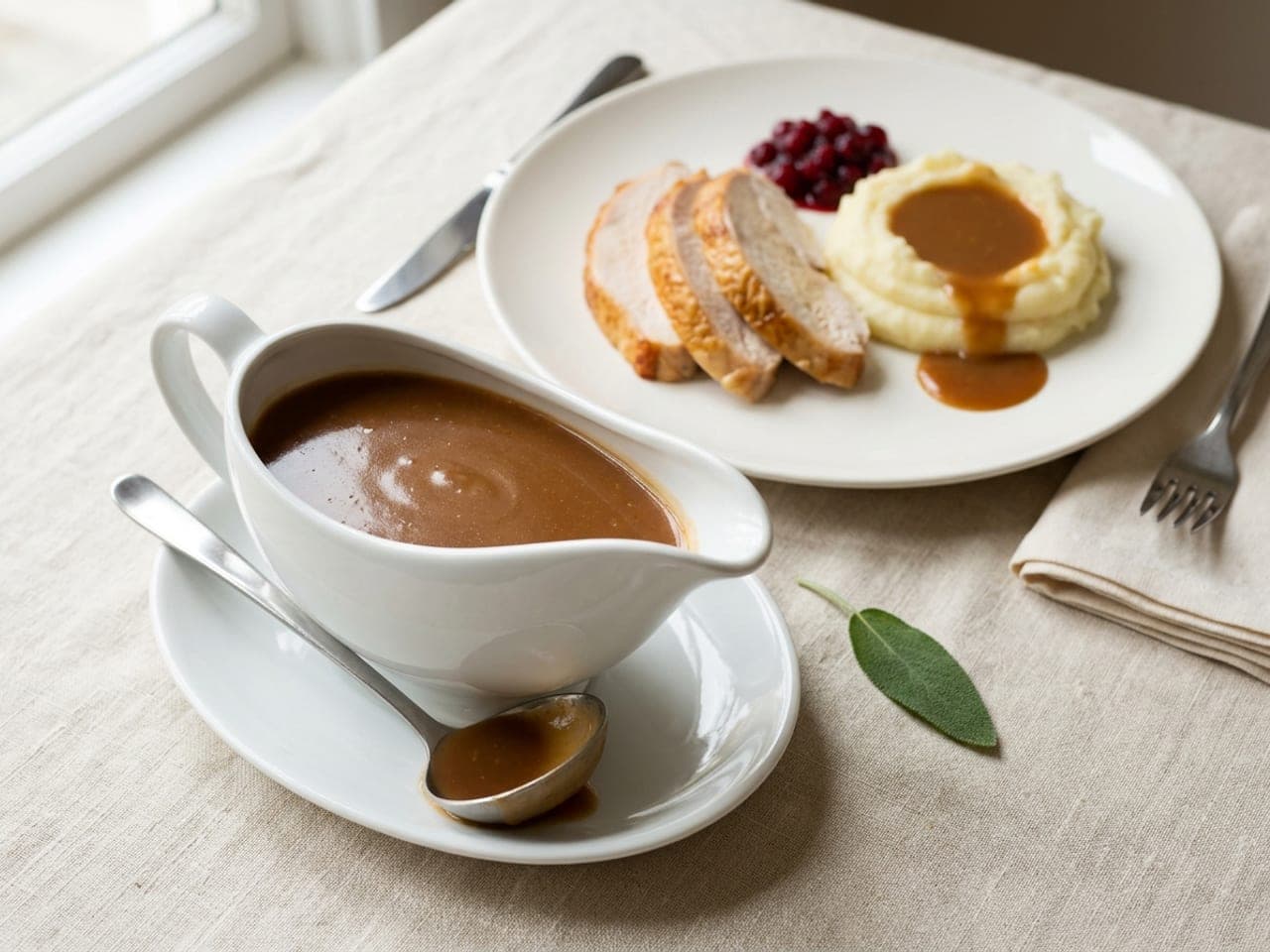
Turkey gravy
The dish that travels round the table most; the recipe makes about 4 cups (1 l), enough for 8. On the table: a warmed gravy boat on a saucer, with its own ladle, where both ends can reach it. It cools fast in a boat: refill the boat from the pan, kept at 140°F (60°C) or above, and bin any gravy that has been out more than 2 hours (the recipe, after USDA FSIS). Make ahead: by the recipe’s wing-stock route the gravy is cooled fast, refrigerated and brought to a rolling boil on the day, and its 3 to 4 days in the fridge (USDA FSIS) count from the day it was made, not from Christmas Day. In the UK the recipe’s advice is to make only the stock ahead and the gravy on the day. Allergens: wheat (the roux); milk if finished with butter; sulphites if made with wine; most bought stock contains celery.
The twist: Give the gravy boat a saucer and a fixed spot before dinner.
Full recipe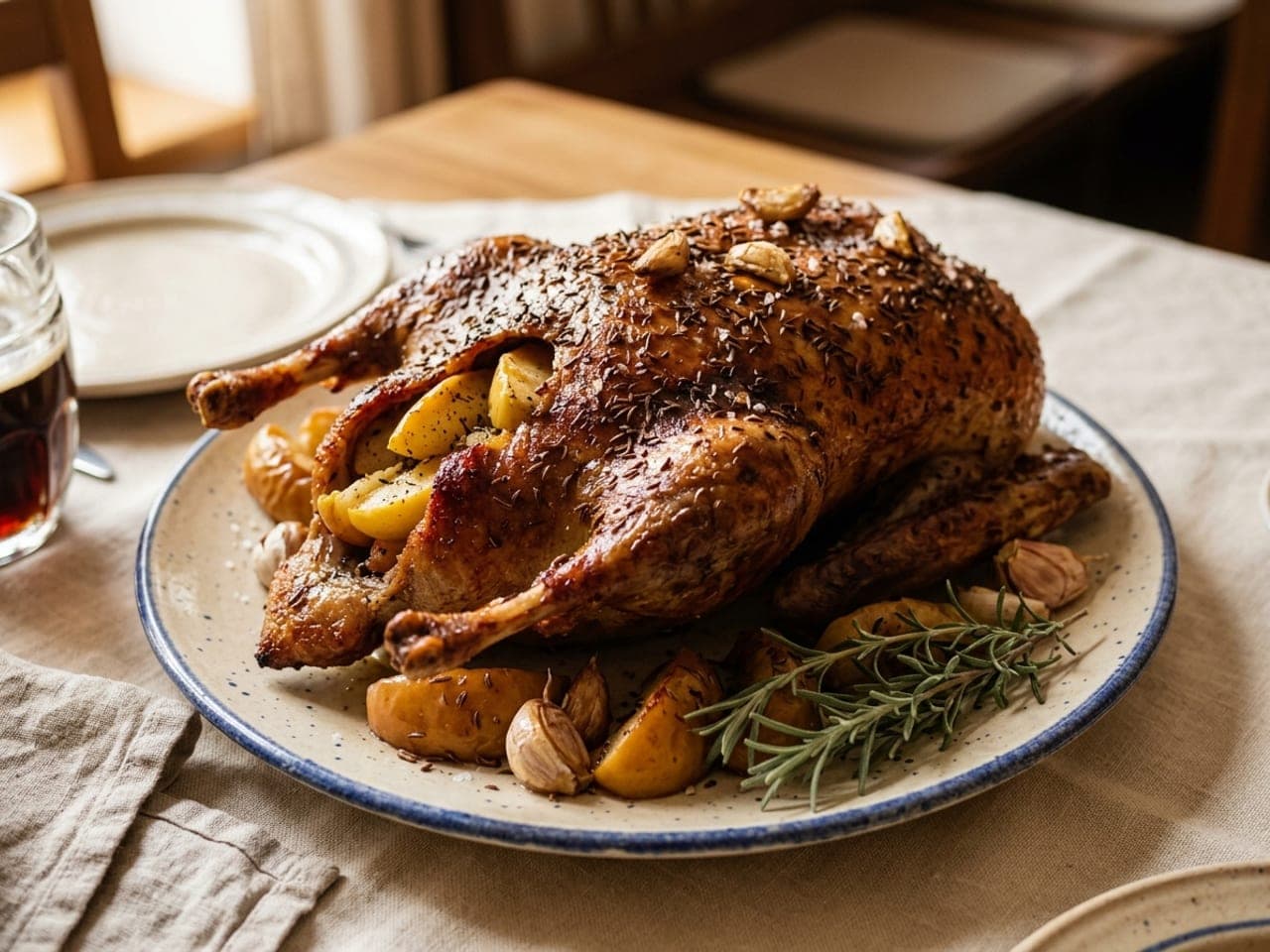
Roast goose
The older Christmas bird, and the Cratchits’ in A Christmas Carol (1843); goose is still the main meat at about 2% of British Christmas dinners (YouGov, December 2020). Ours is Czech-style, one 8.8 lb (4 kg) goose for six (the Fahrenheit figures are our conversions of the recipe’s metric ones). On the table: carve it in the kitchen and bring a platter. Timing: the recipe roasts it until the thigh reads at least 180°F (82°C), rests it under foil for at least 20 to 30 minutes, and reheats carved goose to 167°F (75°C) throughout, once only. The recipe gives no holding time; by the US rule the carved goose is off the table and in the fridge within 2 hours of leaving the oven. Allergens: none of the major ones in the ingredient list (our reading of the list).
The twist: Pour the rendered fat into a heatproof bowl as the recipe says, well away from the table.
Full recipe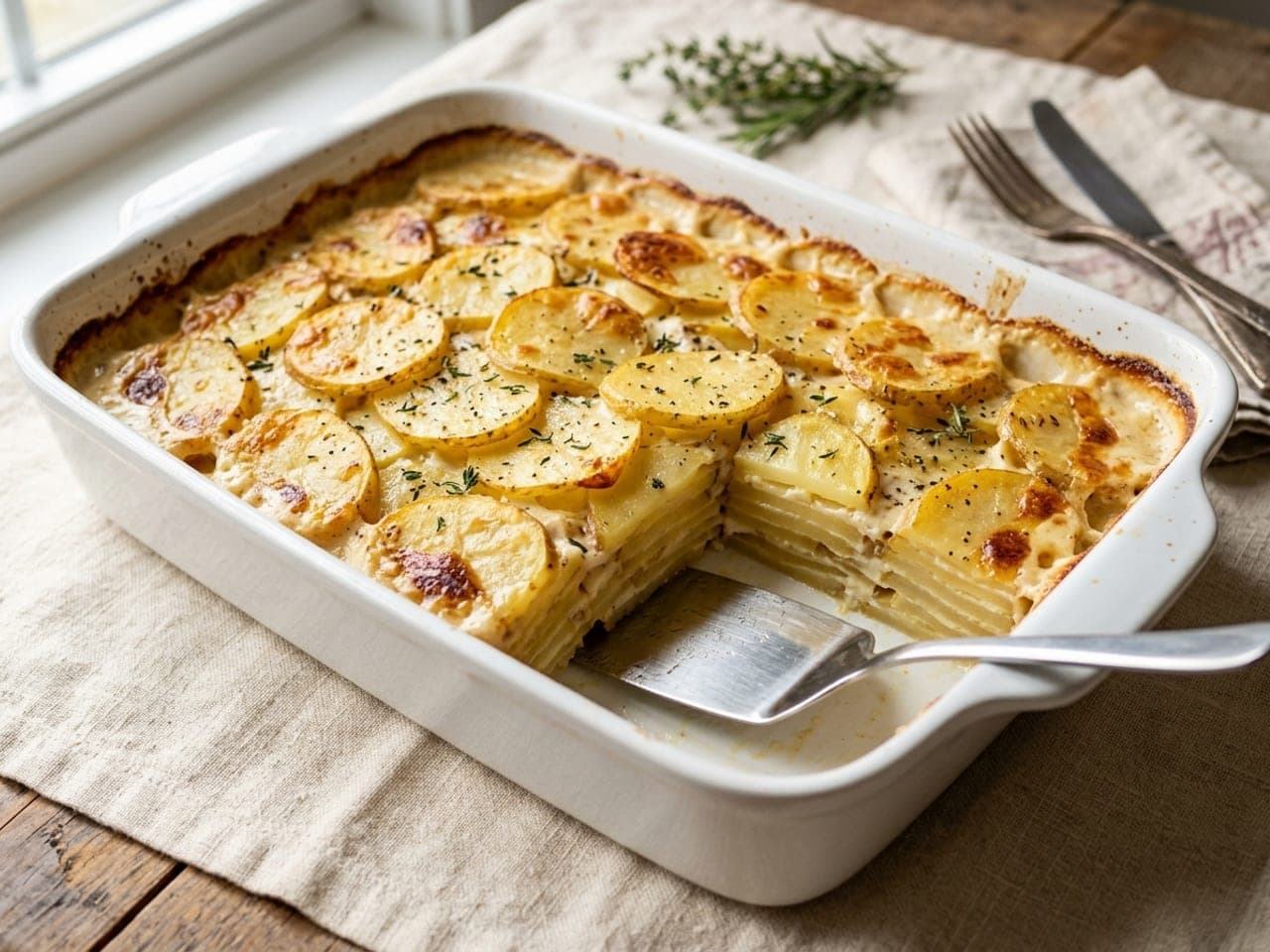
Scalloped potatoes
The make-ahead side. On the table: baked and served in one 9 by 13 inch (23 by 33 cm) dish, so it needs a trivet, a serving spoon and a place in the center strip; it stands 20 minutes before it is cut. On a buffet the recipe keeps it in a 200°F (93°C) oven or on a warming tray, or treats it as a two-hour dish. Make ahead: assemble it up to 24 hours ahead and bake it on the day; or, as in our timeline, bake it fully, refrigerate it within 2 hours and reheat it covered at 325°F (163°C) until the center reads 165°F (74°C), 45 to 60 minutes for a full dish. That is its one reheat, so nothing left over is reheated again (the recipe’s rule). Allergen: milk.
The twist: Set its trivet on the table during the dry run, so the hot dish has a home when it comes out.
Full recipe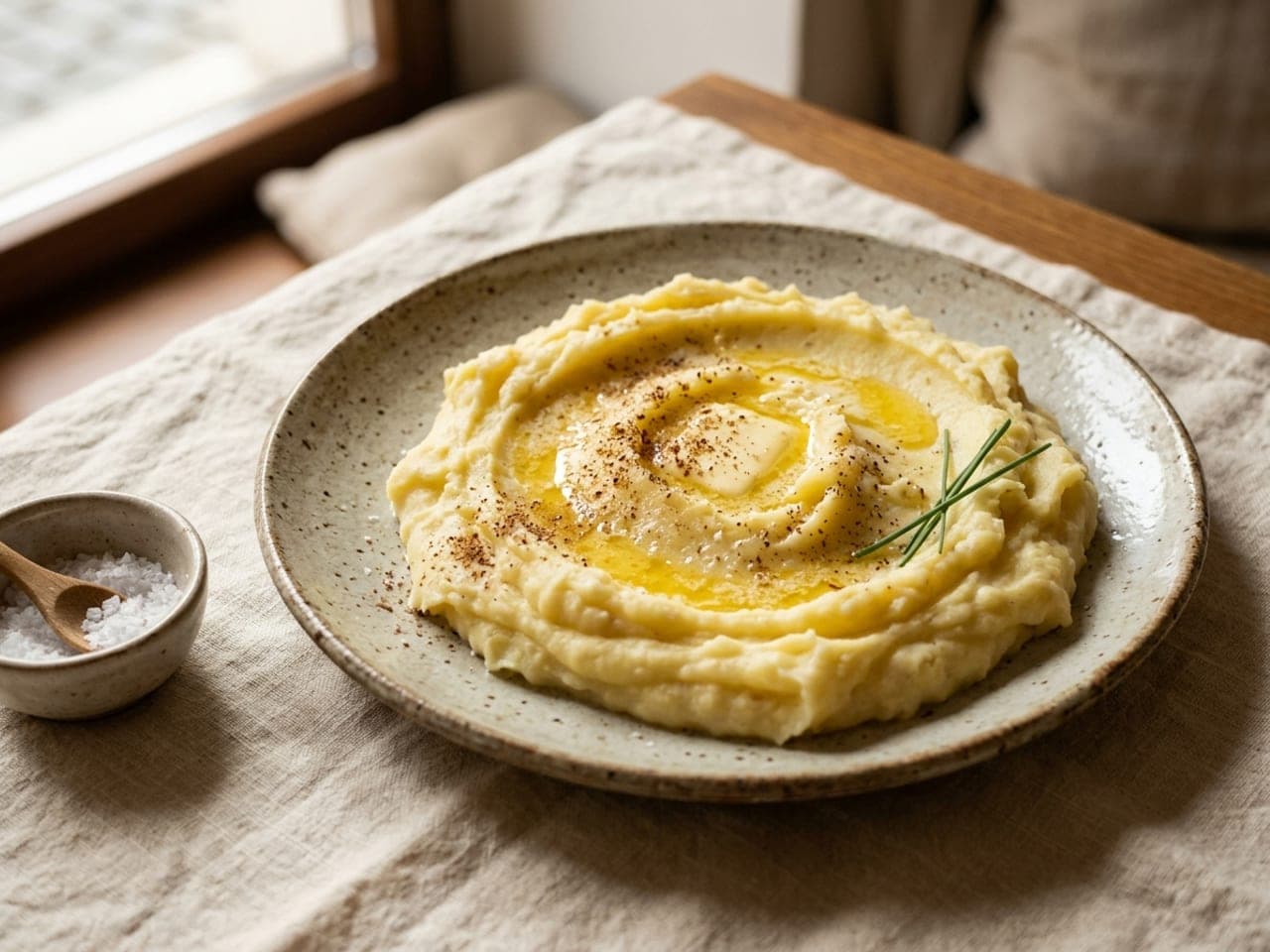
Mashed potatoes
About eight in ten Britons had roast potatoes at Christmas and 35% mashed (YouGov, November 2025). The recipe serves 4, so scale it. On the table: a warmed bowl with a spoon, or a slow cooker on the sideboard. Holding: mash can be held in a preheated slow cooker if it goes in hot and a thermometer shows it staying at 140°F (60°C) or above (USDA FSIS); a warm setting does not guarantee that. In a bowl on the table it is a 2-hour dish. For mash made ahead, the recipe’s rule is to cool it quickly, refrigerate it within two hours, reheat it until piping hot all the way through and never reheat it twice. Allergen: milk (milk and butter).
The twist: Warm the serving bowl with hot water and dry it before the mash goes in.
Full recipe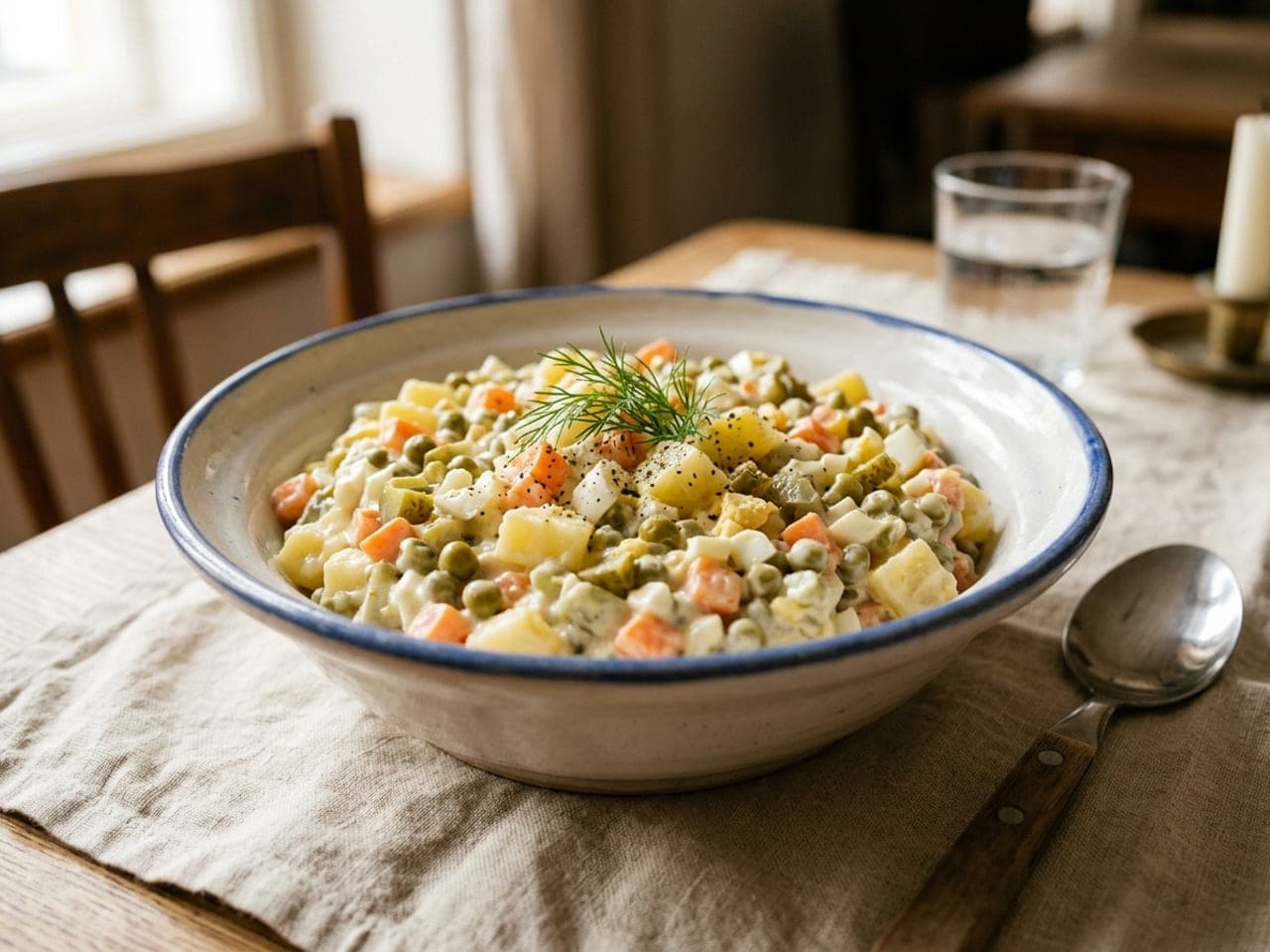
Czech potato salad
The Czech Christmas Eve side: Radio Prague International describes the holiday meal as carp fried in breadcrumbs with potato salad. Ours, with carrot, peas, pickles, egg and mayonnaise, serves 6. On the table: served cold in a bowl, with no trivet and no oven space; it goes on the table the moment guests sit. Make ahead: the recipe chills it at least 4 hours, ideally overnight, and mixes the mayonnaise only into fully cold potatoes. Holding: the recipe’s limits are 2 hours at room temperature and 3 days in the fridge; UK guidance is shorter, 48 hours for leftovers. Allergens: egg; most mayonnaise also contains mustard.
The twist: Fill the bowl, cover it and keep it in the fridge until guests sit: its 2 hours start when it comes out.
Full recipe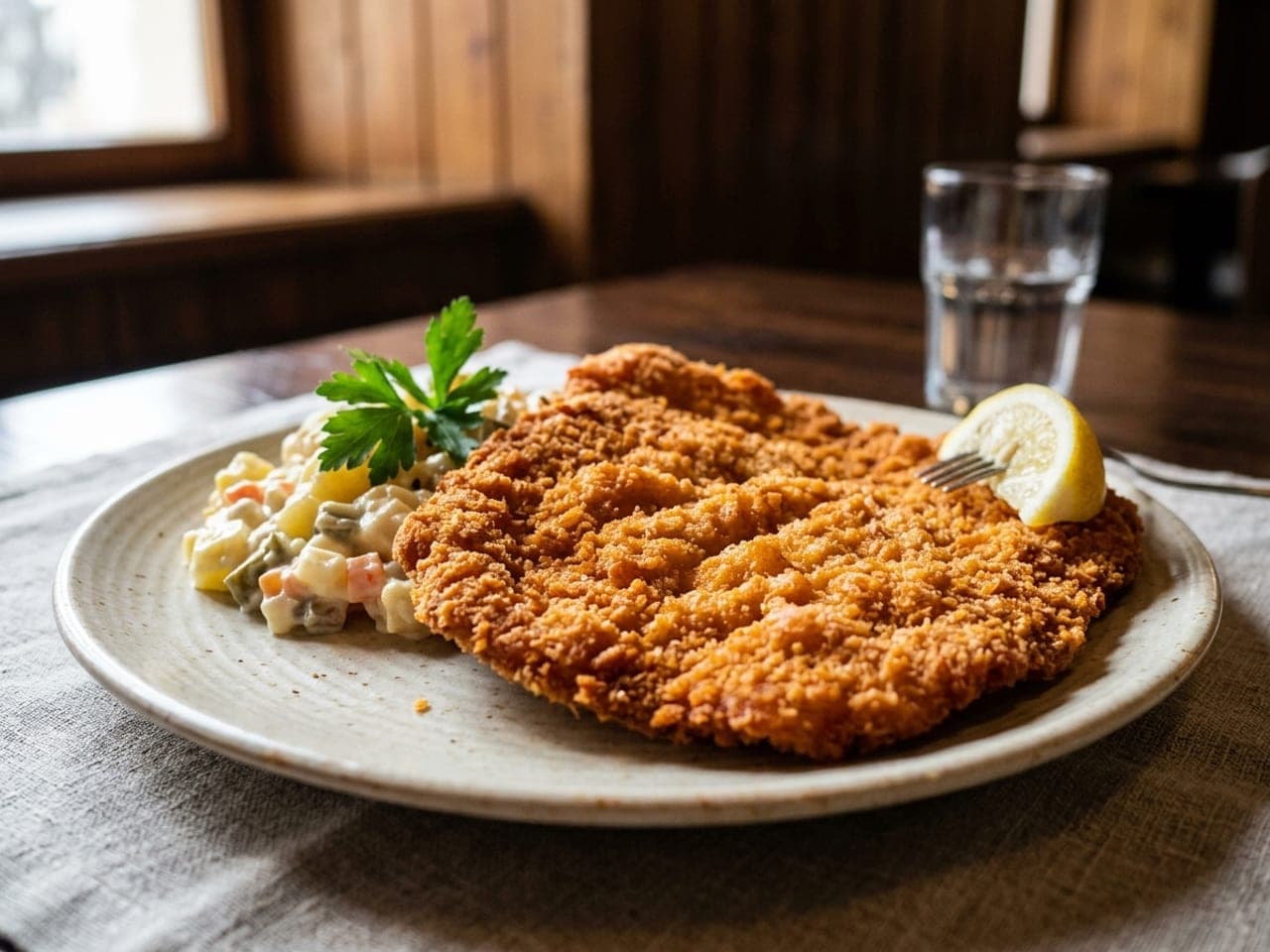
Fried pork schnitzel
The Christmas Eve alternative to carp: “Czechs are not great fish-eaters, so some people prefer Wiener schnitzel”, said Pavla Horáková on Radio Prague International’s Christmas program (December 2018). On the table: it is fried to order, 3 to 4 minutes a side, and served at once with lemon, so the table needs only a warm platter. Holding: the recipe gives no holding or make-ahead note, and cooks the pork to at least 158°F (70°C) (our conversion), checking the thickest piece for pink. Fried schnitzel left on the platter is a 2-hour dish like the rest. Allergens: wheat (flour, breadcrumbs) and egg.
The twist: Bread the cutlets before guests arrive, lay them in one layer on a tray, cover and refrigerate them, and fry them straight from the fridge as everyone sits down. Throw away the leftover beaten egg, flour and crumbs.
Full recipe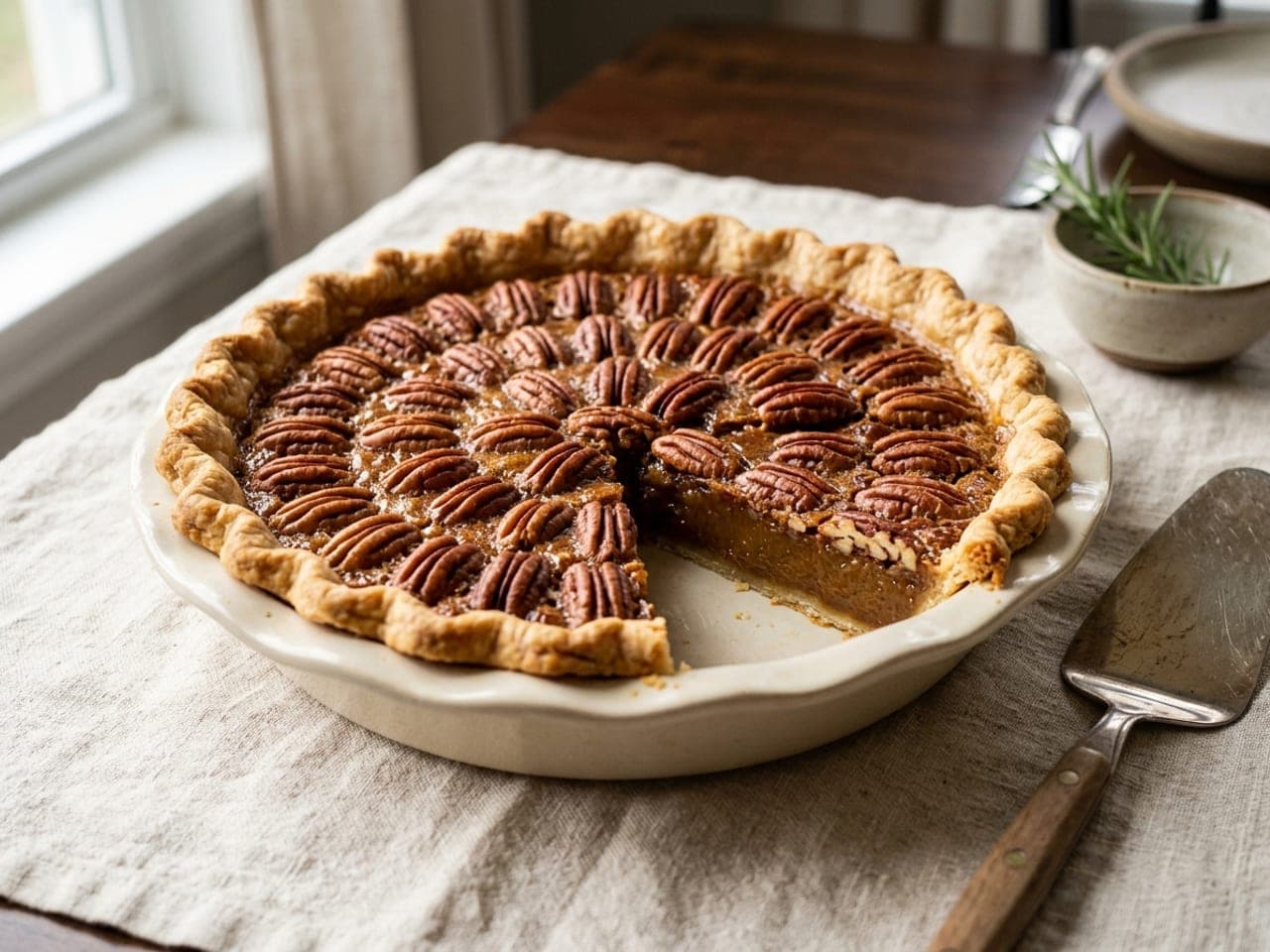
Pecan pie
A dessert that is finished the day before. On the table: on a cake stand, once the savory dishes have gone back to the fridge, with a small card saying it contains pecans; it goes back in the fridge within 2 hours of coming out (the recipe’s rule). Make ahead: bake it the day before, cool it 2 hours on a rack and refrigerate it; it is an egg custard pie, so it goes in the fridge within 2 hours of baking. Allergens: tree nuts (pecans), egg, milk, wheat. For children under 5 the recipe says to pick the whole pecan halves off or serve the chopped-nut part, because whole nuts are a choking risk. Leave out its optional bourbon when children or pregnant guests will eat the pie (the recipe’s advice).
The twist: A cake stand lifts the pie above the coffee cups and takes less table than a flat plate.
Full recipe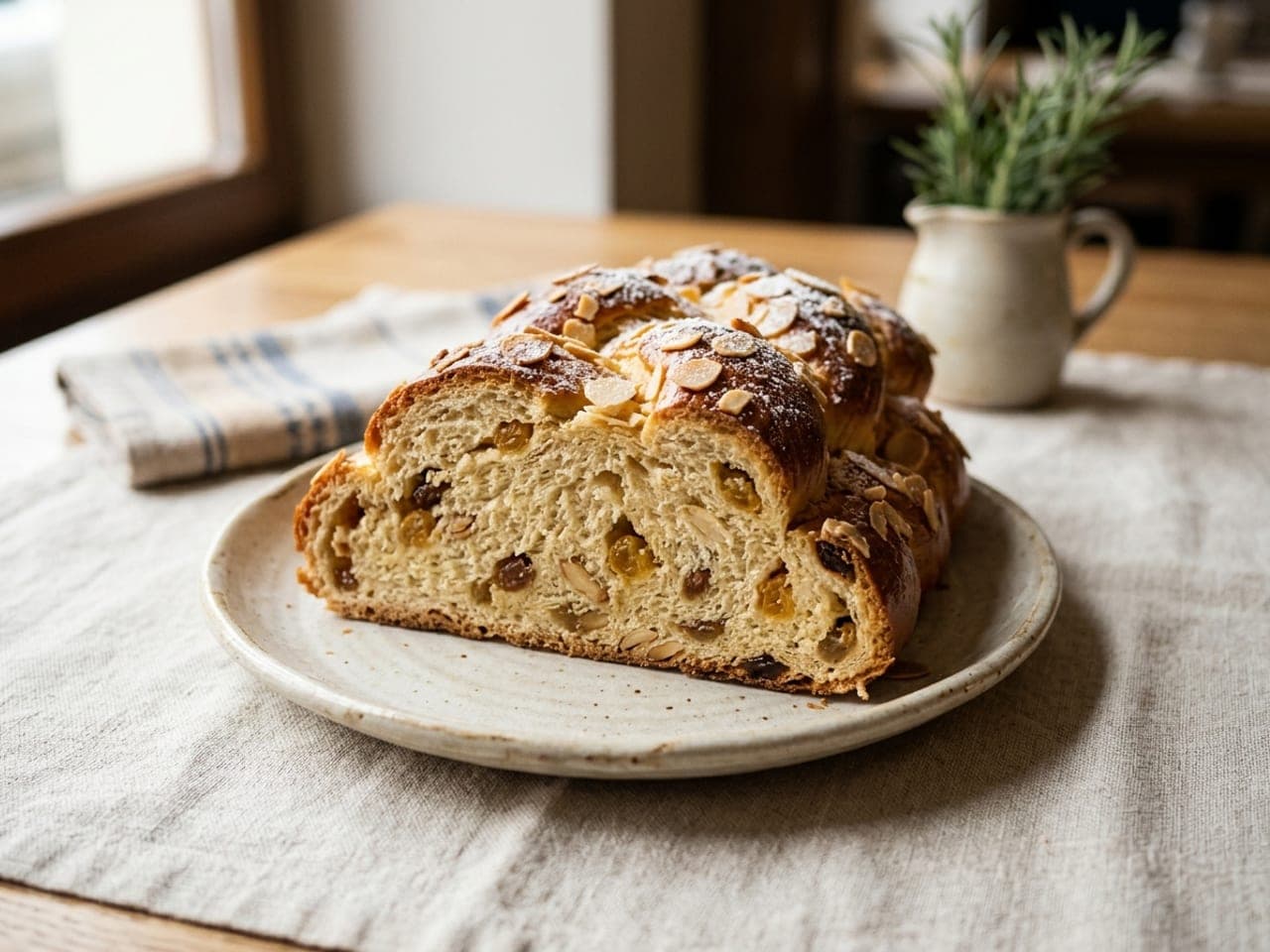
Vánočka
The Czech braided Christmas bread, with raisins and almonds: a loaf for 12, for coffee or Christmas breakfast, not a plated dessert. On the table: the recipe serves it “at the table as a centrepiece, torn or sliced thickly”: a board, a bread knife and butter. Timing: it cools at least 30 minutes before slicing, and the recipe page’s time leaves out the rises. Allergens: wheat, milk, egg and almonds (tree nuts). The almonds are kneaded into the dough and cannot be picked out, so chop them fine or leave them out if children under five will eat it (the NHS says no whole nuts under five; the adjustment is our note). Raisins are on the PDSA’s list of foods that are poisonous to pets.
The twist: Slice only half and leave the braid showing.
Full recipe
In a University of Illinois and Purdue survey in November 2025, of 808 Americans who have a Christmas meal, 47.9% planned to serve turkey, 47.5% pork such as ham and 39.9% beef such as prime rib; they could choose more than one.
- Roast calculatorsThe prime rib calculator counts back from Christmas at about 1 lb (450 g) of bone-in roast a person, and flags doneness below USDA’s 145°F (63°C) with a 3-minute rest. The ham calculator uses USDA’s ⅓ to ½ lb (150 to 225 g) of bone-in ham a serving; ham leftovers keep 3 to 5 days by that page, a different window from the turkey’s. The turkey calculator allows USDA’s 1 lb (450 g) a person and works out the thaw: set it to 25 December, and start a day earlier than it says if you dry-brine.
- Courses and the place settingThe course meal builder lays out three to twelve courses for your number of guests and sends the menu to the table setting diagram. It has no Christmas menu of its own; its small Thanksgiving sample for six, built round a turkey breast, is the closest start.
- A Czech Christmas Eve tableThe Czech feast is on the evening of the 24th: carp fried in breadcrumbs, or schnitzel for those who do not want fish, with potato salad. The table customs, as Radio Prague International and a regional Czech newspaper report them: a fish scale under each plate for money in the coming year; an even number of diners, with an extra plate for an unexpected guest; and nobody leaves the table until everyone has finished, so everything is set within reach first.
- Other mains, and another dessertRoast duck for four, which Radio Prague International’s Christmas program calls a favorite on Czech tables on Christmas Day. Roast beef for five: its medium, 140 to 149°F (60 to 65°C) by our conversion, starts below USDA’s 145°F (63°C) with a 3-minute rest. For dessert, apple strudel, which serves eight and contains walnuts, or the make-ahead desserts on our fancy desserts hub.
A Christmas table timeline, from the linen to the leftovers
For dinner on Friday 25 December 2026 at 3:00 pm (15:00), with a 12 to 14 lb (5.4 to 6.4 kg) turkey. Move the times to suit your own dinner hour and roast.
When to set the table: the sources disagree. Ideal Home says the night before, Delia Smith’s Christmas timetable the morning itself, and Debrett’s only “well before the guests arrive”. The timeline shows both.
Food safety. We plan on the US 2-hour clock and count each dish’s leftovers from the day it was first cooked; the British rules differ and are kept apart (both countries’ holding figures).
- Early December
- Count the guests and check the table against the seats table. Decide whether the food is served on the table or from a sideboard: that decides how big the centerpiece can be.
- Buy what sells out: crackers (one per guest plus spares, by Partyrama’s count), candles or flameless candles, and napkins big enough for the fold you picked.
- Sat 19 Dec
- Wash and iron the linen; Ulster Linen’s advice is to iron it while it is still damp. Fold one napkin as a trial, and count plates, glasses, cutlery and a serving utensil for every dish.
- Sun 20 Dec
- A frozen 12 to 14 lb (5.4 to 6.4 kg) turkey goes into the fridge, still wrapped, on a tray, five days ahead as the roast turkey recipe has it: 3 to 4 days to thaw (USDA FSIS), then a day or two for the dry brine. For a different bird, set the turkey calculator to 25 December; its date is the latest start without a dry brine.
- Wed 23 Dec
- Dry-brine the turkey as soon as it has thawed, with no ice crystals left in the cavity: today, or tomorrow morning at the latest (one to two days ahead, as the recipe says).
- Cut or buy the greenery; the Royal Horticultural Society keeps cut holly, ivy and mistletoe in a bucket of water outdoors until Christmas Eve. First read which plants stay away from the food.
- Thu 24 Dec, Christmas Eve: the night-before plan
- Dress the table tonight, as Ideal Home advises: cloth and runner, a dry run with the empty serving dishes, trivets and spoons (our own step), then the places and the folded napkins. The crackers go on the plates only if the candles are flameless; with real candles they wait in a basket (our arithmetic).
- Candles go into their holders unlit, at least 1 foot (30 cm) from the greenery, the crackers and the napkins (NFPA’s rule covers anything that can burn). If the table is too narrow for that, and most are, use flameless ones.
- Bake the pecan pie and refrigerate it. Bake the scalloped potatoes all the way, cool them and refrigerate them within 2 hours: tomorrow’s reheat is their one reheat. Make the potato salad and chill it overnight.
- Fri 25 Dec, morning: the Christmas-morning plan
- Delia Smith’s timetable sets the table this morning instead, after 8.55 am. If it was laid last night, add the fresh greenery and the water jug now.
- 10:10 am (10:10): oven to 325°F (163°C). 10:30 am (10:30): turkey in. The recipe allows 3 to 3¾ hours for a 12 to 14 lb (5.4 to 6.4 kg) unstuffed bird, so it should be out by about 2:15 pm (14:15); go by the thermometer, not the clock.
- 1:30 pm (13:30)
- The scalloped potatoes go in beside the turkey at 325°F (163°C), covered, with a splash of milk: 45 to 60 minutes, until the center reads 165°F (74°C).
- Set out the sideboard, with a card by any dish with nuts. Anything held hot gets a thermometer check: 140°F (60°C) or above (USDA).
- About 2:15 pm (14:15)
- Turkey out when the innermost thigh reads 170 to 175°F (77 to 79°C) and the thickest part of the breast 157 to 160°F (69 to 71°C) (our roast turkey recipe). USDA’s rule is 165°F (74°C) in the thigh, the wing and the breast: check during the rest that the breast has reached it, and if it has not, the bird goes back in the oven. An unstuffed bird only. Rest it 30 to 45 minutes. The US 2-hour clock for the savory food starts now.
- Make the gravy from the drippings. Warm the plates only as their maker allows, warm and not hot (the place setting notes).
- 2:45 pm (14:45)
- Carve onto the platter. Light any real candles just before everyone sits (Fine Dining Lovers), and only where they stand 1 foot (30 cm) clear of everything that can burn.
- 3:00 pm (15:00), dinner
- Everyone sits. Crackers: pull them now, which is William Hanson’s order, so the hot food is not waiting; Liz Brewer would wait until the main course is finished (who says what). Clear the torn paper off the table, and with real candles lit the paper hats come off or the candles go out (why).
- Platters go round to the right, counterclockwise (the Emily Post Institute’s convention); port, later, goes clockwise from the host without being put down (Debrett’s).
- 4:00 pm (16:00)
- Clear the savory dishes so that everything perishable is in the fridge by 4:15 pm (16:15), 2 hours after the turkey left the oven: turkey off the bone into shallow containers, then the sides and gravy. The scalloped potatoes and the potato salad each count their own 2 hours, from the oven and from the fridge.
- Then the pie or pudding, on a cleared table; in Britain cheese and port end the meal (Debrett’s). The pie goes back in the fridge within 2 hours of coming out. Blow out every candle when you leave the room (NFPA).
- Sat 26 to Tue 29 Dec, leftovers
- US (USDA FSIS, 3 to 4 days from when each dish was first cooked): Friday’s turkey, the mash and the gravy made that day by Tue 29 Dec; the pie and the scalloped potatoes, baked Thursday, by Mon 28 Dec; our potato salad recipe sets its own limit of 3 days, so Sun 27 Dec. Reheat to 165°F (74°C), gravy to a rolling boil. The scalloped potatoes had their one reheat on Friday: eat what is left cold, or bin it.
- UK (Food Standards Agency, 48 hours from cooking, or freeze): Friday’s turkey, gravy and mash by Sun 27 Dec; the pie, the scalloped potatoes and the potato salad, made Thursday, by Sat 26 Dec. Reheat only once, until steaming hot all the way through. The scalloped potatoes had their one reheat on Friday: eat what is left cold, or bin it.
See one Christmas dish re-plated first
Photograph a dish you are testing for the table and Plate Artists shows it re-plated on a plate from its library, with the moves to get there. Your first re-plate is free with an account.
Start free · 1 enhancement →Free account · 1 free enhancement · No credit card
Christmas table questions, answered
How do you set a Christmas table?
Count the seats first, at 24 inches (61 cm) of table edge per guest. Decide where the serving dishes will stand, lay the cloth or runner, and put a low, liftable centerpiece in the middle. Then set each place from the outside in: forks left, knives and spoons right, glasses above the knives, the napkin on the plate or side plate, and the cracker across the top of the plate (one butler’s placement; there is no rule, and with real candles on the table the crackers wait in a basket). The eleven steps.
Where do Christmas crackers go on the table?
There is no etiquette rule: Debrett’s page on the Christmas table does not mention them. Gary Williams of the British Butler Institute lays the cracker “across the top of the plate” (BBC Good Food magazine, December 2013). Retailers and magazines also suggest on the plate, beside it or by the side plate. With real candles down the middle, a cracker at the place is inside the NFPA’s 1 foot (30 cm) on most tables: keep the crackers in a basket until they are pulled, or use flameless candles. The positions, and the arithmetic.
When do you pull Christmas crackers?
The experts disagree. William Hanson says at the start, so the paper hats are on for the meal (reported by The Mirror, 2024). The butler Grant Harrold says not before the starter is over (The Sun, 2018). Liz Brewer says at the end of the main course, before the pudding, or at the end of the meal (Wales Online, 2024). Pick one and tell the table.
Are Christmas crackers dangerous?
We found no official injury statistics for crackers. What is documented: in the UK a cracker is legally a pyrotechnic article and may not be sold to anyone under 12; the gifts inside are novelties, not toys, and can be a choking risk for children under three (RoSPA, CPSC); a cracker is paper, so the NFPA’s 1 foot (30 cm) from any candle applies to it; and the ASPCA warns that “celebratory poppers or noisemakers can scare our furry companions”, so pull them with the dog in another room.
How does a Christmas cracker work?
Inside the tube is a snap: in the V&A’s description, two narrow strips of paper layered together, with silver fulminate on one and an abrasive surface on the other, so that friction sets off a small bang when the cracker is pulled apart. A US Department of Transportation letter from 2020 concerns one cracker containing 0.6 mg of it.
How tall should a Christmas centerpiece be?
Low enough to see over: that is all Debrett’s, the Emily Post Institute and Oregon State’s 4-H guidelines say, and none gives a number. The popular figure of under 12 inches (30 cm) comes from florists and event firms, whose limits range from 10 to 14 inches (25 to 36 cm). It is a fair rule of thumb, but the reliable test is Good Housekeeping UK’s: sit down and look. More on the center of the table.
Can you set a Christmas table the day before?
Yes. Ideal Home recommends dressing the table the night before Christmas, and our napkin guide says most folds keep for a day. Leave fresh greenery, water and anything perishable for the day, and the candles unlit. Delia Smith’s timetable sets the table on Christmas morning instead: the timeline shows both.
How do you set a Christmas table without candles?
Use flameless LED candles, which London Fire Brigade calls “a much safer alternative”, or skip them and let the table carry the season in other ways: a folded tree napkin, a cracker at each place, and a low tray of fir, pine cones and clementines. With children near, choose LED candles whose battery door screws shut.
What can I use instead of Christmas crackers?
A napkin wrapped as a cracker: a cloth napkin rolled round a cardboard tube with a treat inside and tied at both ends with ribbon. It has no snap, so it suits a table with pets or with guests who dislike the bang, and it doubles as the napkin. It still burns, so it keeps the same 1 foot (30 cm) from a real candle. The steps follow Sarah K’s published tutorial.
How do you fold a napkin for Christmas?
Choose by what the napkin has to do. To hold the cutlery, the pocket fold. To look like Christmas with no props, the Christmas tree, which lies flat on the plate. For a red flower, the poinsettia, our lotus fold in a red napkin. To stand up, an elf hat, a candle or an elf shoe. The full table has the sizes and the steps.
How do you set a Christmas table for 8?
At 24 inches (61 cm) each, eight fit at a table 96 inches (244 cm) long with nobody at the ends, or at one 72 inches (183 cm) long with a guest at each end; that is our own arithmetic, and it matches our table setting tool. A 72 inch (183 cm) round table takes eight at 23.6 inches (60 cm) each, a shade under the working figure. Seats for other sizes.
How long should a runner be on a table?
Debrett’s and the Emily Post Institute give no figure. Etiquette Scholar suggests a drop of about 15 inches (38 cm) at each end and a width of 14 to 17 inches (36 to 43 cm). The rule of thumb on our Thanksgiving hub, labeled there as ours, is the table’s length plus 12 to 24 inches (30 to 61 cm); a furniture retailer’s chart there puts the width at about a third of the table’s.
Do you use placemats with a table runner?
You can. The English Home suggests a tablecloth with “a runner or place mats, or both, if desired”. Good Housekeeping UK quotes the stylist Jen Fox of Interior Fox, who lays one long runner down the middle with shorter ones across it in front of the chairs, and the article then adds placemats as well. The Emily Post Institute calls placemats “totally optional”; Debrett’s likes a table mat under each plate.
Are poinsettias poisonous?
Not in the way the legend says. US Poison Control: the idea that poinsettia is deadly is “wrong”; it “can be irritating but it is not fatal if eaten”. A study of 22,793 poinsettia exposures reported to US poison centers from 1985 to 1992 found no deaths, and 92.4% of those exposed developed no toxicity at all (Krenzelok and colleagues, 1996). It can still upset a stomach and irritate skin, so keep it off the plates and out of reach of children and pets. Holly berries, European mistletoe and yew are the ones to take more seriously: plant by plant.
Is it rude to wear the paper hat from a cracker?
At the table, no: the hat is the point, and William Hanson’s reason for pulling crackers at the start is that “you can eat the meal with the paper hat on”. Liz Brewer’s limit is the table’s edge: do not wear the paper crown once you have left the table. One caution of ours: with real candles on the table, the hats come off or the candles go out.
The research behind this guide
Sources named in the text, each under the headline its page displays (a dash in a headline is written here as a comma or a colon), with the copy we read where it was not the live page:
- Debrett’s, The Christmas Table (2022): no less than 20 inches between places; side plates and napkins; pudding cutlery innermost; glasses; low flowers; a wreath with candles; room for serving platters; six candles for eight
- Debrett’s, How to be the Perfect Host: lay the table well before guests arrive; name cards in the middle of each place setting
- Debrett’s, Debrett’s Guide to Entertaining at Home (PDF, 2023): cheese and port end the meal
- Emily Post Institute, The Formal Place Setting (2015): three of any implement; charger; water goblet above the knives; napkin; tablecloth drop of 12 to 18 inches; decorations so diners can see each other
- Emily Post Institute, How to Set The Thanksgiving Day Table: bread plates and placemats optional; dessert utensils above the setting or brought out
- Emily Post Institute, Passing Food at the Table (2015): counterclockwise, to the right
- Emily Post Institute (Substack), Etiquette Throwback 1922: Emily Post, Etiquette, Setting The Places (27 February 2025): place cards above the plate or on the napkin
- Emily Post, Etiquette (1922), chapter XIV, Formal Dinners (Project Gutenberg text #14314): “About two feet from plate center to plate center is ideal”
- Emily Post Institute (Substack), Etiquette Throwback 1975: The NEW Emily Post’s Etiquette, Seated Buffet & Semi-buffet (7 November 2024): sideboard service; the family’s buffet-style Christmas
- BBC Good Food magazine, Set your Christmas table (December 2013), in which Gary Williams of the British Butler Institute shows how (PDF hosted by the Institute; the photograph shows no cracker): cracker across the top of the plate; side plate above the forks
- BBC Good Food, How to style a Christmas table (Cassie Best, 2012): borrowed tables of the same height; a bar on a side table; a cold starter on a board
- Good Housekeeping UK, Tips for hosting Christmas dinner (2016): test the centerpiece sitting down; scent
- Good Housekeeping UK, How to lay the perfect Christmas dining table (2019): round placemats; the stylist Jen Fox on short runners across the table
- Ideal Home, Setting a Christmas table, a step by step guide to styling (Laurie Davidson, 3 December 2021): dress the table the night before; one key colour
- Delia Smith, Christmas: The last 36 hours (2024): set the lunch table on Christmas morning
- The English Home, From crackers to candles: How to style the perfect Christmas table (4 November 2025; read in the Internet Archive copy of 17 May 2026): a runner or place mats, or both
- Rachel Wagner, Etiquette Trainer, Set the Table for a Holiday Dinner (2018): two feet between plate centers; bread plate
- Architectural Digest, How to Set a Table, for Everything From Holiday Parties to Casual Dining (Sarah Lyon, 2025): Purvi Padia on centerpieces
- Oregon State University Extension 4-H, Table Setting Guidelines (revised 2018): a place setting 24 inches wide by 15 inches deep; 8 to 10 inch cloth drop; plate one inch from the edge; centerpieces; dessert cutlery
- Nebraska Extension, Preparing for Favorite Foods Day Contest (a 4-H contest sheet, PDF): at least 20 inches for each person’s dishes
- Homes & Gardens, 22 Wow-Factor Christmas Table Decor Ideas to Make Your 2025 Holiday Feasts the Most Memorable Yet (27 November 2025): crackers to the left of the place setting, on or next to the side plate
- Fine Dining Lovers, How to set a Christmas table (2025): candles lit before guests sit
- Flower Design Guide, How to Build a Holiday Centerpiece That Lasts (2024): under 12 inches or about 24 inches and above
- Signature Home Services, Holiday Table Mastery: Tips for Stunning, Guest-Friendly Setups (2024): under 14 inches
- Byaas, How to Arrange Centerpiece Candle Holders for Dinner Parties (2026): below ten or above twenty inches
- Adorno Design, Thanksgiving Tablescape: Design for the Food First: nothing between 12 and 30 inches tall
- UF/IFAS Extension St. Johns County, A 4-H’ers Tips for Creating an Attractive Holiday Centerpiece (19 November 2021): no taller than 12 inches, or at least 18 inches tall
- Martha Stewart, 15 Holiday Centerpiece Ideas That Bring a Festive Touch to Your Table: a centerpiece on a tray
- I Heart Etiquette, Minutia: Candles on The Table (2020): quoting Edith B. Ordway, The Etiquette of To-Day (1913), four candles for eight covers (the book itself was not opened)
- Royal Horticultural Society, Dreaming of a green Christmas (Lia Leendertz, 2026): keeping cut greenery in water until Christmas Eve; ivy round a pillar candle
- V&A, The Christmas cracker (last updated 17 April 2024): Tom Smith, the 1840s, the snap
- HGTV, Copy These Christmas Table Setting + Decorating Ideas: top each plate with a cracker
- Cotswold Trading, How to dress a Christmas table with example ideas (Rachel White, 2025): the cracker placement doesn’t matter; dessert cutlery above the plate
- Yahire, Christmas Table: 10 Christmas Table Setting Tips and Ideas (2019): simple folds on the side plate, elaborate ones on the dinner plate
- Williams Sonoma, Decorating the Holiday Table (read in an Internet Archive copy): a cracker alongside each plate
- Partyrama, Christmas Table & Cracker Guide: one cracker per guest plus spares
- The Mirror, You’ve been pulling Christmas crackers wrong as etiquette expert shares correct way (Christopher Sharp, 25 December 2024): reporting William Hanson’s Telegraph column, which we did not open
- Wales Online, How to correctly pull Christmas cracker - and ‘ideal’ time to open them today (Christine Younan, 25 December 2024): Liz Brewer
- The Sun, Royal Butler reveals do’s and don’ts of Christmas entertaining including the correct time to pull your crackers and why you should keep your glass in your left hand (Josie Griffiths, 6 December 2018; read in the Internet Archive copy of 7 December 2018): Grant Harrold
- UK legislation, The Pyrotechnic Articles (Safety) Regulations 2015, regulation 31: no sale of a Christmas cracker to anyone under 12
- RoSPA, Christmas decorations and novelties: novelties are not toys; children under 36 months
- US Consumer Product Safety Commission, Holiday Safety (read in the Internet Archive copy of 21 September 2026): small parts and children under three; balloons and children under eight
- US Consumer Product Safety Commission, Holiday Decoration Safety Tips (CPSC-611, PDF): candles, evergreens and wrapping paper; long, open sleeves near a candlelit table
- US Department of Transportation, PHMSA, Interpretation Response 19-0063 (25 March 2020): a Christmas cracker containing 0.6 mg of silver fulminate
- ASPCA, Holiday Safety Tips: poppers, holiday plants and pets
- NFPA, Safety with candles: home candle fires, 2020 to 2024
- NFPA Research, Candle fires (Marty Ahrens), with Home Candle Fires: Supporting Tables (May 2020): 2014 to 2018 averages; December; decorations first ignited
- NFPA, Candle Safety (safety tip sheet, 2025; this is the address NFPA’s candles page links to): at least 1 foot (30 centimeters) from anything that can burn
- US Fire Administration, Candle Fire Safety: at least 12 inches from anything that burns
- National Candle Association, Candle Safety Tips: wick, drafts, 12 inches, 3 inches apart
- National Candle Association, Expert Tips: candles at least 3 inches apart; glass not made for candles
- Home Office (GOV.UK), Wishing you a safe and happy Christmas (accessible) (updated 25 May 2022)
- Home Office (GOV.UK), Fire safety in the home (accessible version) (updated 25 May 2022)
- London Fire Brigade, How to use candles safely: LED candles; holders; no distance given
- Humberside Fire and Rescue Service, Be an angel this Christmas - top tips to stay safe (21 December 2022): lighting the Christmas pudding
- USDA Agricultural Research Service, USDA Table of Nutrient Retention Factors, Release 6 (December 2007): alcohol retention, flamed 75%, stirred into hot liquid 85%
- Child Accident Prevention Trust, 6 simple safety tips to keep children safe this Christmas (2025): easy-access button batteries; pigs in blankets
- Child Accident Prevention Trust, Button battery safety: what to do if a child may have swallowed one
- Poison Control (National Capital Poison Center), Are poinsettias poisonous?
- Krenzelok, Jacobsen and Aronis, Poinsettia exposures have good outcomes...just as we thought, American Journal of Emergency Medicine 14(7), 1996 (abstract read)
- Evens and Stellpflug, Holiday plants with toxic misconceptions, Western Journal of Emergency Medicine 13(6), 2012
- Poison Control, Holly berries: A beautiful decoration but a poisonous snack
- Poison Control, Is mistletoe poisonous?: American and European mistletoe; not for decorating food
- Krenzelok, Jacobsen and Aronis, American mistletoe exposures, American Journal of Emergency Medicine 15(5), 1997 (abstract read)
- Poison Control, Yew and paclitaxel: What do they have in common?
- Royal Horticultural Society, Potentially harmful garden plants: yew, ivy, Christmas rose, amaryllis, mistletoe, poinsettia, cherry laurel
- ASPCA, Toxic and Non-toxic Plants: Poinsettia (the entries for English yew, English ivy, Christmas rose and amaryllis were read on the same site)
- PDSA, How to have a pet-friendly Christmas: festive plants; raisins
- HGTV, 10 Festive and Easy Ways to Fold Napkins for the Holidays (Kamron Sanders, Deanne Revel and Jennie Andrews; updated 17 November 2025; read in the Internet Archive copy of 6 February 2026, because the live page refuses scripted requests): elf hat; poinsettia; Christmas bow
- Napkin Folding Guide, How to fold napkins like a pro: The Candle Napkin Fold (live page read 5 October 2026)
- wikiHow, How to Fold Napkins for Christmas (co-authored by Tami Claytor; last updated 16 June 2025; live page read 5 October 2026, step pictures seen in the Internet Archive copy of 7 January 2026): method 4, Creating Playful Elf Shoes
- A Labour of Life, Christmas Elf Shoes Napkin (2016): a thinner napkin, or a hot iron
- A Labour of Life, Christmas Elf Hat Napkin (2016): easy in paper; press cloth first
- LUSINI, Folding napkins: Boots: the boot can be placed on or next to the plate
- Sarah K, How to Create Sustainable Christmas Crackers from Napkins (Claire Locking, 9 December 2022; live page read 5 October 2026)
- Ideal Home, How to make a Christmas cracker from a napkin - just like Angel Strawbridge’s (Katie Sims, 2022): the three-tube version; start wrapping from the end without the tape
- Martha Stewart, How to Make a Christmas Tree Napkin Fold (With Step-by-Step and Video): paper star toppers as place cards
- Between Naps on the Porch, Christmas Tree Napkin Fold Tutorial (22 December 2013): iron wrinkled napkins first
- A Piece of Rainbow, Christmas Tree Napkin Folding in 2 Minutes (2022): paper or cloth squares
- delicious. magazine, How to fold Christmas tree napkins (Kathleen Silverfield, 2015): paper napkins work as well as fabric
- Gala in the Kitchen, Poinsettia Cloth Napkin Fold Technique For Christmas Table Decor (2024): a 17 by 17 inch napkin; fold halfway a few days ahead
- Woman & Home, Forget boring folded napkins I’m making these DIY Poinsettia flowers for my table this year (Tamara Kelly, 2024)
- Etiquette Scholar, Table Runners: about 14 to 17 inches wide, with a drop of about 15 inches at the ends
- Ulster Linen, Care for Linen (2018): iron damp; spray starch for folded napkins
- The Coca-Cola Company, Did Coca-Cola create Santa Claus?
- Smithsonian National Museum of American History, How Santa brought Coca-Cola in from the cold (Tory Altman, 2014)
- YouGov, The YouGov Big Survey on Christmas: Christmas dinner (Dylan Difford, 28 November 2025): what is on British Christmas tables
- YouGov, What do people have for their Christmas dinner? (Connor Ibbetson, 17 December 2020): goose at about 2% of British Christmas dinners
- farmdoc daily (University of Illinois and Purdue University), Setting the Holiday Tables: How Do Consumers Say Food Prices Will Affect Their 2025 Holiday Meals? (Maria Kalaitzandonakes, Jonathan Coppess and Brenna Ellison, 4 December 2025): the protein sources 808 Americans planned for their Christmas meal, surveyed in November 2025
- Charles Dickens, A Christmas Carol (1843), Stave Three (Project Gutenberg)
- Radio Prague International, The carp’s journey from the fishpond to the Christmas table (Daniela Lazarová, 1 December 2018): carp and potato salad; the fish scale under the plate
- Radio Prague International, Czech Christmas traditions explained, from Ježíšek to the Golden Pig (24 December 2018): schnitzel on the Christmas Eve table; roast duck; an even number of guests; the extra plate
- Slovácký deník, Seriál Slováckých novin: Jak vypadal Štědrý den? (22 December 2010): nobody leaves the table; scales under the plates
- USDA FSIS, “Danger Zone” (40°F - 140°F) (last updated 28 June 2023)
- USDA FSIS, Leftovers and Food Safety: refrigerate within 2 hours; 3 to 4 days
- USDA FSIS, Let’s Talk Turkey: A Consumer Guide to Safely Roasting a Turkey (read in the Internet Archive copy of 23 September 2026): 165°F in the thigh, the wing and the breast
- USDA FSIS, Slow Cookers and Food Safety (read in the Internet Archive copy of 30 September 2026): hot food in a preheated slow cooker, at least 140°F by thermometer
- USDA FSIS, Safe Minimum Internal Temperature Chart (read in the Internet Archive copy of 30 September 2026): beef roasts, 145°F and a rest of at least 3 minutes
- US Food and Drug Administration, Serving Up Safe Buffets: warmers at 110 to 120°F; back-ups at 200 to 250°F; replace, don’t top up
- Food Standards Agency (GOV.UK), Christmas food hygiene (published 11 January 2018): refrigerate within one to two hours
- Food Standards Agency (GOV.UK), How to chill, freeze and defrost food safely (published 18 December 2017): leftovers within 48 hours; the 8 to 63°C danger zone
- Food Standards Agency (GOV.UK), Providing food at community and charity events (updated 4 September 2026): buffet food out of the fridge for no more than four hours
- Food Standards Agency, Safer food, better business for caterers: Hot holding (63°C or above; two hours on display, once)
- Food Standards Agency (GOV.UK), Food allergy and intolerance advice for consumers (updated 7 August 2026): preparing an allergy-safe meal at home
- US Food and Drug Administration, Questions and Answers on Lead-Glazed Traditional Pottery (November 2010)
- Health Canada, Lead Crystalware and Your Health (2024; read in the Internet Archive copy of 10 March 2026): serving, not storing; lead-free tableware for infants, children and pregnant people
- USDA FSIS, Cooking with Microwave Ovens (last updated 27 June 2024; read in the Internet Archive copy of 30 September 2026): china with metallic paint or trim
- Royal Doulton, Care Guide (US site): stoneware and porcelain can be warmed to 100 C / 212 F
- Mikasa, Dinnerware Care & FAQs: a cool plate into a cool oven, no higher than 225°F for the first 10 minutes
- New York State Department of Health, Burn and Scald Prevention for Children (revised December 2025): placemats instead of tablecloths; hot food in the middle of the table
- Nemours KidsHealth, Preventing Burns and Fires (reviewed July 2022): avoid tablecloths or large placemats
- NHS, Baby and toddler safety (reviewed 19 February 2026): hot drinks scald for 15 minutes
- NHS, Foods to avoid giving babies and young children (reviewed 18 February 2026): no whole nuts under 5
- American Academy of Pediatrics (HealthyChildren.org), Choking Prevention for Babies & Children: What Every Parent Needs to Know
- CDC, Choking Hazards (11 March 2026)
- Taste of Home, An Argument for a Kids’ Table at Thanksgiving (2019, updated 2024): the kids’ table against the end of the adults’ (carried over from our Thanksgiving hub’s research)
Keep going
12 Christmas dinner ideas
Twelve complete menus for this table, each with amounts per guest, an oven plan counted back from the serving time and make-ahead dates.
The Thanksgiving tablescape
The same idea a month earlier: a table planned from the plate out, with the eye-height arithmetic behind the centerpiece rule and a buffet layout.
How to set a table
Every piece of a basic, informal and formal place setting, the American, British and Continental differences, and the etiquette at the table.
How to fold napkins
Eighteen folds with drawn step diagrams, among them the Christmas tree, the pocket, the bow and the lotus that doubles as a poinsettia.
Table setting diagram maker
Draws the place setting for your menu, counts plates, cutlery and glasses for your guest list, and prints.