Food plating quiz: 25 questions with answers, and the reason for each
The plating and garnishing questions students paste into search, in their own words, each answered first where a source gives an answer, then the reason from a culinary textbook or school curriculum, a note where the research says something different or has not tested the idea, and a link to the guide that teaches it.
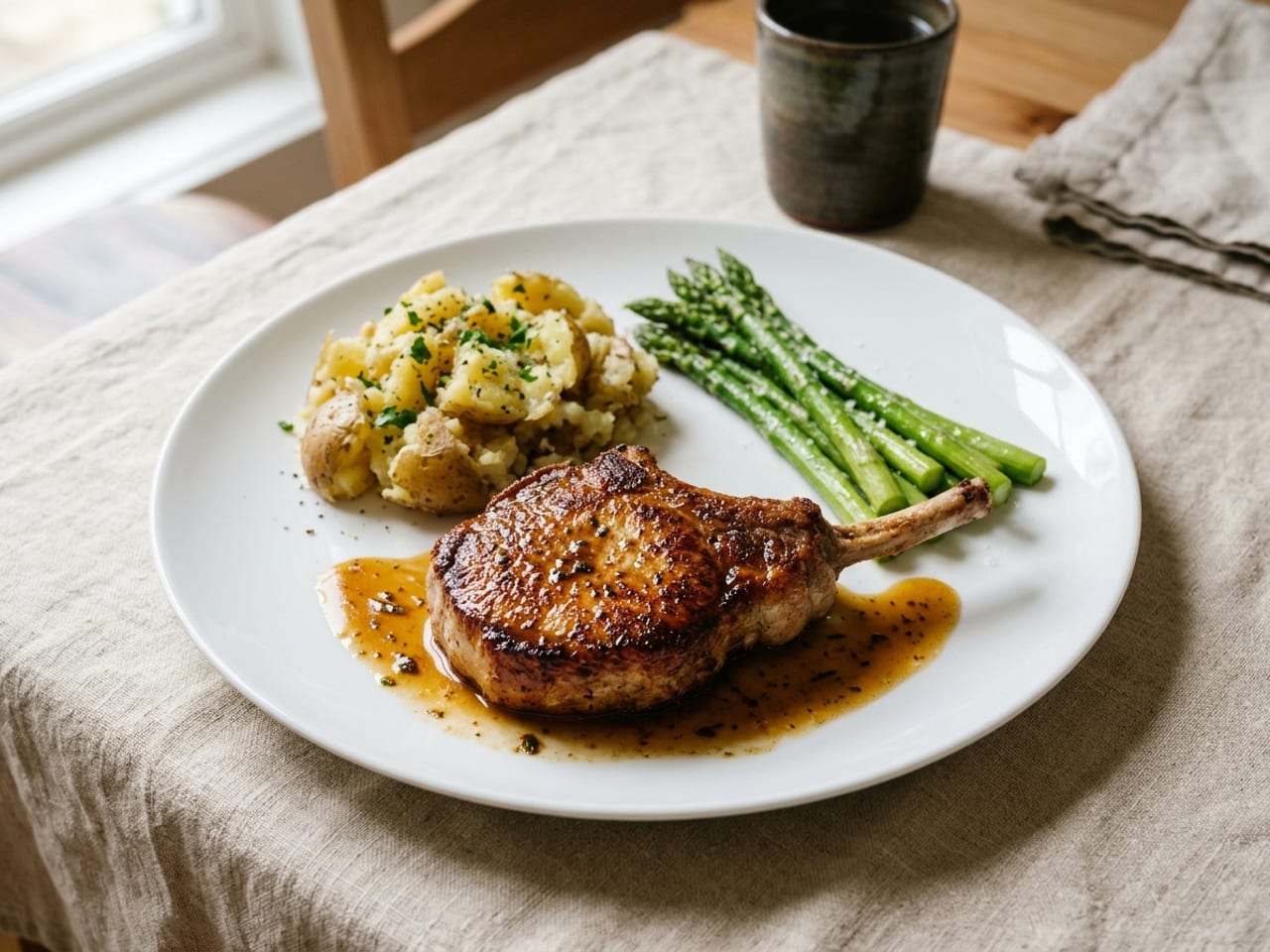
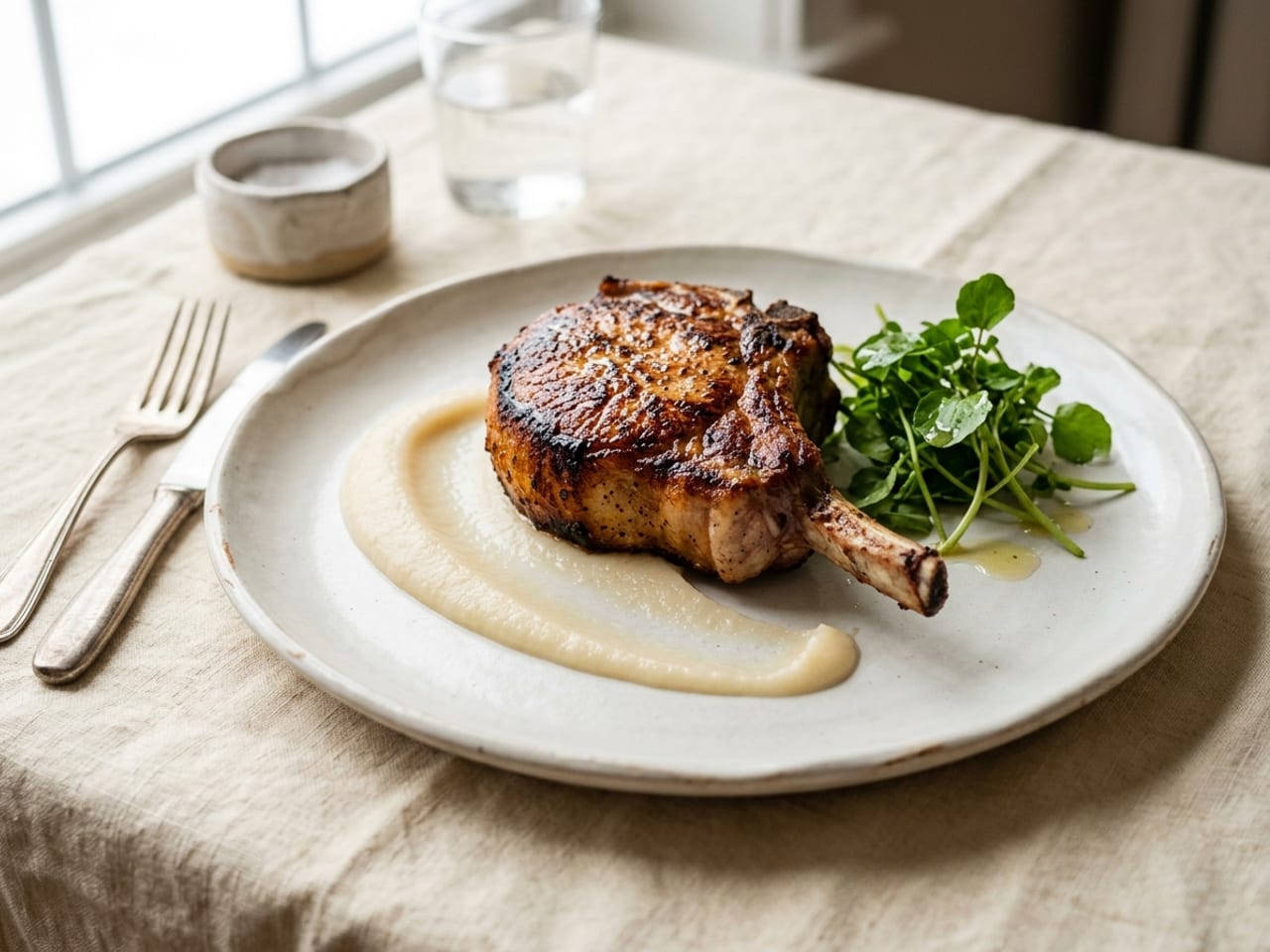
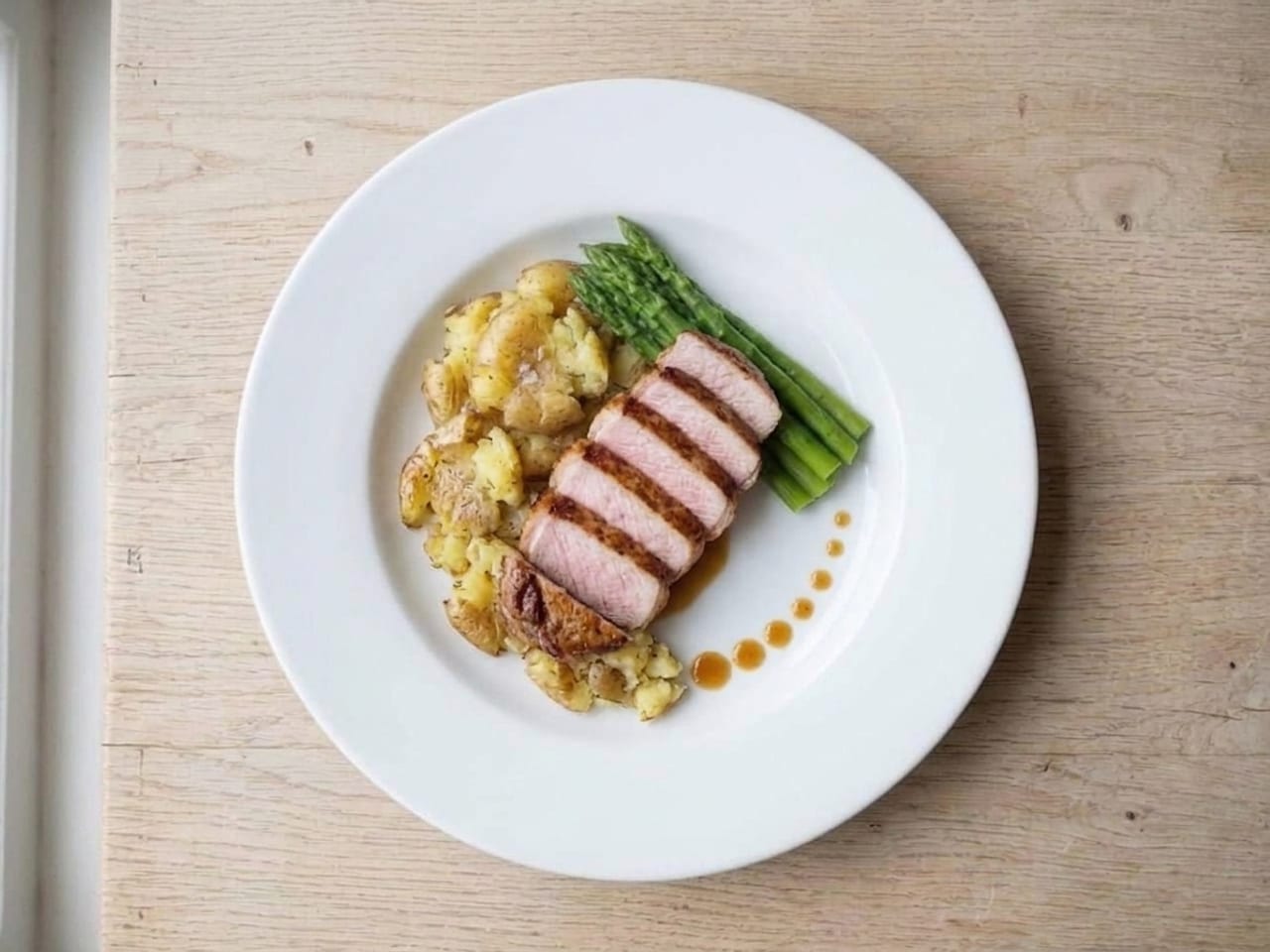
The photos on this page are AI-generated illustrations.
The short answer
The five plating quiz questions we see searched most, answered
The answers come from teaching sources: the CAERT food styling curriculum, Gisslen's Professional Cooking, the LibreTexts open textbook, a Texas terms key and school pages.1, 2, 3, 4 Where a study tested the rule, as for odd numbers, both layers are printed: the answer your quiz expects, then what the evidence says.
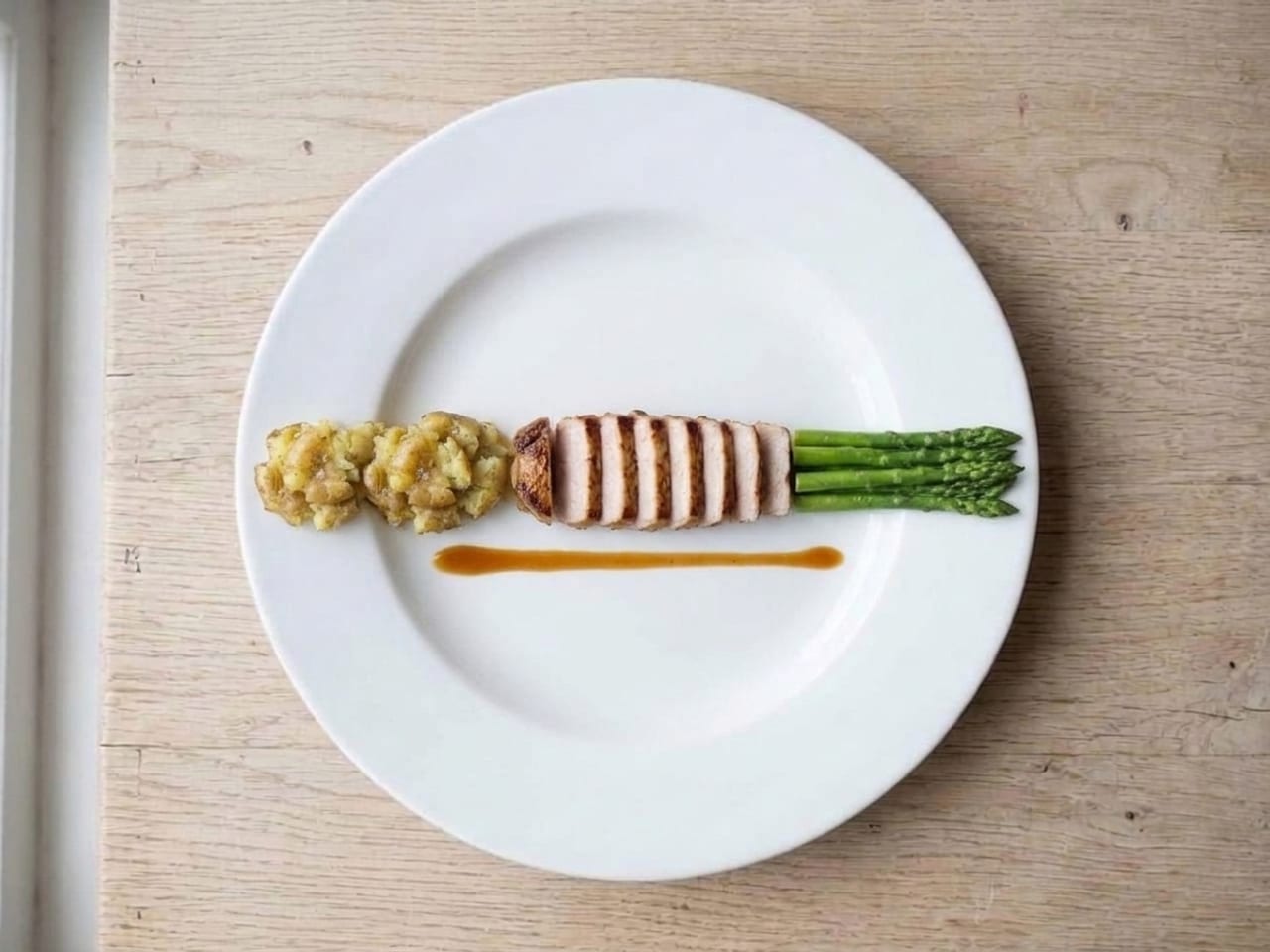
Classical plating, the clock layout: the protein nearest the diner (6 o'clock), the starch and the vegetables behind it. An AI render from our clock method guide, where every published set of hours is compared; the sources do not agree on one.
Each question is printed the way it turns up in class quizzes and worksheets, options and all. Under it, Show answer opens the answer (its first word is the one to write down), the reason with its source numbers, a note on the evidence where we found one, and a link to the guide that owns the topic. The answers are in the page itself, so they show with scripts off and in print.
Testing yourself: thirteen questions have options you can tap; the answer opens and a running score counts below. The rest are fill-in or short answers: say yours, then open it.
Two layers: where a study or a rule says something other than the answer a class expects, the card says both, without calling the textbook wrong. Ten cards carry a note; they are listed together below.
Wording: your course may use its own words (classic or classical, garnish or garnishing). If your teacher's material gives a different answer, go by it: we could not trace these questions to a named textbook.
Every answer is under its question: open "Show answer".
Four questions
Plating styles and the clock
Classic plating, the clock, and the style names quizzes ask about.
Question 1 · True or false
The classical style of plating uses the plate as the face of a clock to place food portions. True or false?
True
False
Show answer
True.The sources that teach the clock call it traditional or classical plating: CAERT says "Traditional plating is designed using the face of an analog clock"1 and Unilever Food Solutions calls it "The classical plating technique".14 They print different hours, and a few sources use the name classic for food side by side in the centre or the main item in front, so learn the idea rather than one set of numbers.26, 31
Which plating style uses traditional clock positions for protein, starch, and vegetables?
a. contemporary/free style
b. classical plating
c. deconstructed plating
d. landscape/organic style
Show answer
b. Classical plating.It is the only one of the four that the sources define by fixed positions; The Culinary Pro: "Traditional plating presents the food simply by using a clock face as a guide".1, 13, 14 Free-form is a no-rules or asymmetric placement, deconstructed by serving a dish's parts separately and landscape by a low band of food.18, 20, 21
The _____ food on a plate, typically a protein, should be placed between 3 and 9 o'clock on a plate. (4 letters)
Show answer
MAIN.Unilever Food Solutions' clock reads "Main : Between 3 to 9 o'clock".14 MEAT also has four letters, and one culinary school blog says "Between 3 and 9 is where your meat will sit",15 but "typically a protein" reads as a gloss on main (our reading).
Which of the following plating styles is considered the most traditional?
Show answer
Classical (classic) plating.CAERT and The Culinary Pro call the clock layout "Traditional plating",1, 13 and every other source we read that ranks the styles names classic plating as the traditional one, such as Catalonia Plates' "the foundation of traditional culinary presentation".21, 28, 30 None gives minimalist, landscape or free-form that place.
Where things go, how much plate to fill, and what the eye should land on.
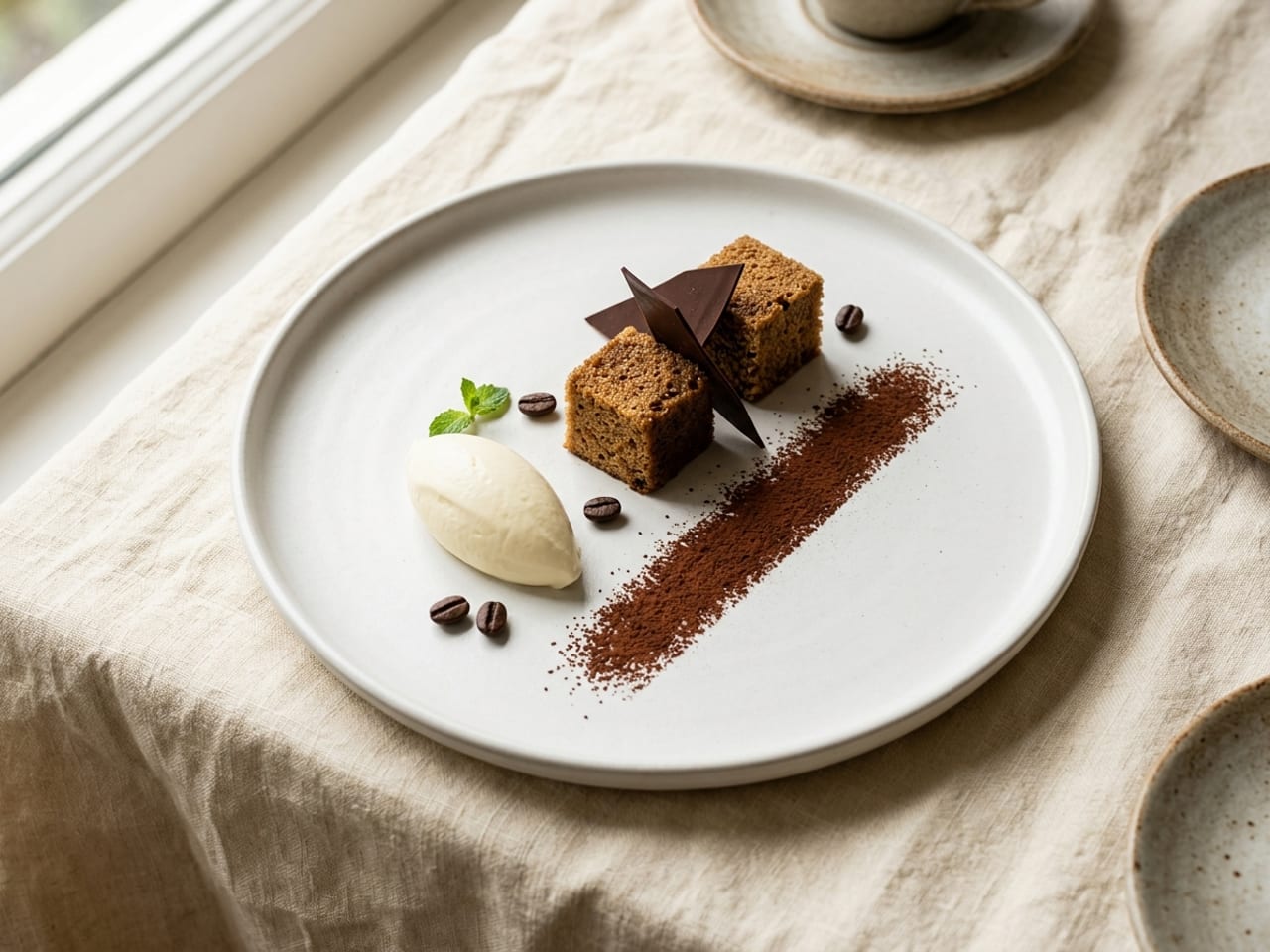
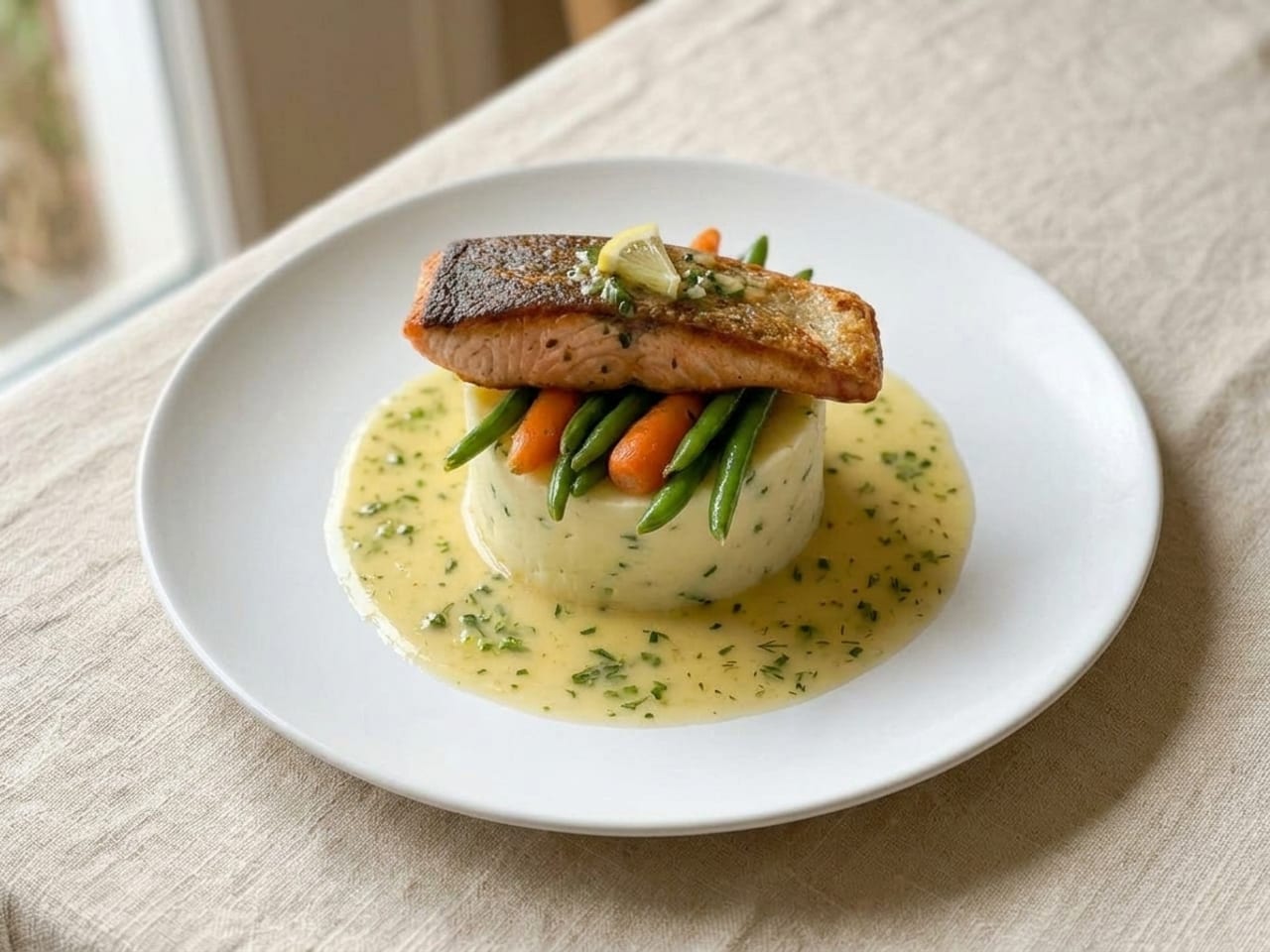
White space: the food kept to the middle, the rim left empty as a frame. An AI render from Plating 101.A focal point: one main item the eye lands on first, the purée and the leaves supporting it. An AI render from Plating 101.
Question 5 · Multiple choice
What is the purpose of leaving white space on a plate?
a. to reduce the amount of food served
b. to make the plate look uncluttered and elegant
c. to allow more sauce to be added later
d. to fit more garnishes
Show answer
b. To make the plate look uncluttered and elegant.The nearest wording is a culinary school's blog (Escoffier Online): empty parts make a meal look "cleaner, more elegant, and overall more professional".15 LibreTexts says to use white space "by thinking of the rim as your frame" and a Grade 10 activity sheet says the empty space "will provide contrast with the food"; none of the sources we read says it is there to serve less food.3, 9
What the evidence says (not tested):No study we found tested empty space itself. The nearest results point both ways: desserts on a bigger plate (more empty rim, our reading) were rated less appealing in an online survey of photographs, though the ratings of portion size fell too,42 while a salad on a large plate, stacked high, was liked best in a cafeteria.43 CAERT also warns that "too much space makes the food look disconnected or lost on the plate".1
Which of the following best describes a focal point on a plate?
a. the most colorful garnish
b. the main protein or key component that draws attention
c. the starch or side dish
d. the sauce drizzled on the rim
Show answer
b. The main protein or key component that draws attention.The Culinary Pro says "The main item is usually the focal point of the plate", and Chef Michael Beers asks "What does your eye see first?" and answers "Typically, it is not garnish!".13, 17 CAERT is the exception: the focal point can be "one of the main food items or the garnish", and the Texas terms key defines it as what "Emphasizes and strengthens the design by giving height and direction".1, 2
What the evidence says (not tested):No study we found measured a focal point. Where to put it splits teaching and research: LibreTexts teaches the rule of thirds, the focal point to the left or right "rather than the center",3 while in two dining experiments the same food, plated centred, was liked more than pushed to one side (in the second the abstract does not separate centred from horizontal), though neither tested a single focal point on a third.39, 40
b. the plate as a canvas, planning balance, depth, and harmony
c. how quickly the dish can be served
d. the number of plates needed
Show answer
b. The plate as a canvas, planning balance, depth, and harmony.LibreTexts: "think of yourself as an artist, the plate as your canvas, and the food as your medium"; CAERT says chefs "begin with an idea and a sketch".1, 3 None of the sources we read names taste alone, speed or the number of plates as the thing to picture first.
Statement 1: Odd-number groupings of items on a plate generally appear more natural. Statement 2: Using multiple textures and heights in plating can enhance visual appeal.
a. first is correct, second is incorrect
b. first is incorrect, second is correct
c. both correct
d. both incorrect
Show answer
c. Both correct.That is the class answer: CAERT teaches that "odd numbers of items are more interesting than even" and that "Different textures enhance the visual impact of a food presentation", and the Grade 10 Cookery module says "Be odd."1, 8 LibreTexts and the Escoffier School blog teach odd numbers too.3, 15
What the evidence says (the research disagrees):Statement 1 was tested and not supported: across seven experiments with scallops, "No consistent evidence for a preference for odd or even numbers of food items was found", and the plate with more items usually won (portion size, not oddness, drove the choices).38 For statement 2, the studies on height split (see the height question below), and the visual texture of food is "also important but little studied".49
About two thirds.The Culinary Pro: "no more than 2/3 of the plate should be filled with food"; a Grade 10 Cookery activity sheet: "Only fill about two thirds of each plate with food".9, 13 The Escoffier School blog gives no fraction, only "leave parts of the dish empty".15
How much of the plate should the vegetables, the starch and the protein each cover?
Show answer
Vegetables about half, starch a quarter, protein a quarter.The Grade 10 Cookery module: "vegetables should cover about half of the plate, starch one fourth, and protein one fourth"; the Grade 10 activity sheet gives the same split.8, 9
When selecting and preparing a plate's garnish, it's important to consider _____ colors and textures.
bland
contrasting
similar
none of the answer choices are correct
Show answer
Contrasting.CAERT: "If all items are the same color, same texture, and same consistency, there is no contrast or interest on the plate"; Gisslen: "Two or three colors on a plate are usually more interesting than just one"; the NAVTTC textbook says a garnish "always adds some contrasting colors and textures".1, 4, 7
What the evidence says (the research is mixed):The research is mixed, not opposed: contrast between food and plate raised expected liking online,46 adults in three countries preferred three colours on a plate,44 but in one study colour made people less willing to try the food and did not change how much they liked its flavour.45
Lower in the front, higher in the back.CAERT: "The food on a plate is often placed lower in the front and higher in the back", which "draws the eye in and upward"; it also warns that "if it is stacked too high, it will become unstable."1
What the evidence says (the research is mixed):Studies split on height: taller fried rice of the same volume and a tall salad on a large plate did better,43, 47 while stacked food read as a smaller portion than the same food spread flat.40, 48
Hot or cold garnish, sauce as garnish, edible garnish, and the garnish as focal point.
Question 13 · True or false
Cold garnishes should be served with warm dishes and warm garnishes should be served with cold dishes. True or false?
True
False
Show answer
False.The teaching rule is like with like: the American Culinary Federation's competition guide says "Cold-garnish cold food; hot-garnish hot food", and books from 1873 and 1949 say the same.12, 33, 34 The exceptions run one way only, a cold garnish on hot food such as a hot soup; no source we read puts a warm garnish on a cold dish.35
What the evidence says (not tested):No study we found tested garnish temperature. The only reason we found in print is about quality, not food safety: Good Housekeeping prefers "a quick and easy garnish rather than lukewarm food" for a hot soup, and the word garnish does not appear in the FDA Food Code (2026 text).35, 36 Why like-with-like is the rule is not stated in the books we read (our reading: the texture and temperature of the food).
Sauces can be used to add additional garnish to a plate. True or false?
True
False
Show answer
True.CAERT says "Sauces are used decoratively and/or to add artistic flair",1 and in the older, classical sense anything served with the main item is a garnish: an 1873 cookbook names "tomato sauce, in a dish of cutlets".33 Gisslen and CAERT do list sauce and garnish as separate parts of a plate.1, 4
True.Unilever ("Garnishes should always be edible"), LibreTexts ("should always be edible") and the NAVTTC textbook all say always; NAVTTC adds the reason: "It should always be edible because if you can't eat it, it doesn't belong on the plate."3, 7, 14 CAERT is softer: "Most chefs would insist on an edible garnish, although occasionally a nonedible one may be used."1
What the evidence says (the research is mixed):"Always" is not unanimous: Gisslen says it is "usually best to add nothing to the plate that is not intended to be eaten", the ACF guide defines "a nonfunctional garnish" as "any item, edible or inedible",4, 12 and the FDA, advising bakers, says non-edible decorations "should be removed before the food is served and eaten".37 No study tested it.
The garnish should always be the focal point of the plate. True or false?
True
False
Show answer
False.The main item usually is: "The main item is usually the focal point of the plate" (The Culinary Pro) and "Typically, it is not garnish!" (Chef Beers).13, 17 CAERT allows a garnish to be the focal point, but no source we read says it always should be.1
Statement 1: Clean plate rims, appropriate plate temperature, and mise en place are essential for professional plating. Statement 2: Taste of the dish is less important if the presentation is perfect.
a. first is correct, second is incorrect
b. first is incorrect, second is correct
c. both correct
d. both incorrect
Show answer
a. First is correct, second is incorrect.CAERT teaches "Check that the edge of the plate is clean" and to serve hot food "on a warm plate" (mise en place is not named in the plating lists we read; the ProStart judging rubric scores whether it is "maintained throughout all of competition").1 Gisslen says that when meat is badly trimmed "a fancy plating design won't correct it", and the ProStart judging rubric lists flavor first among the characteristics of a plated meal.4, 10
What the evidence says (not tested):Presentation does change how the same food is rated: diners liked the same meal more when it was plated more attractively.50 No study we found tested whether looks can make up for taste, and none tested plate temperature or clean rims.
Hot food should be served on warm plates and cold food on chilled plates. True or false?
True
False
Show answer
True.CAERT: "Keep hot food hot, and serve it on a warm plate" and "Keep cold food cold, and serve it on a chilled plate"; the Welsh exam board WJEC teaches the same.1, 11 It is a rule about the plate, not the garnish rule above.
Before a plate leaves the kitchen, what should be done to its rim?
Show answer
Check it and wipe it clean.CAERT: "Check that the edge of the plate is clean", and wipe the rim "using a dampened, rolled up cloth"; Chef Beers' slide reads "Wipe the rim!"1, 17
What the evidence says (the sources differ):On the cloth, the sources differ: CAERT says dampened, while the FDA Food Code says cloths in use for wiping food spills from tableware as food is served "shall be: (1) Maintained dry".1, 36 We found no source that reconciles the two, and no study of clean rims.
The vocabulary questions: garnishing, plating, classical garnish and gross piece.
Question 22 · Short answer
Decorating food is called
Show answer
Garnishing.The Texas terms key defines garnish as "To decorate or enhance the food with the addition of other items", and Gisslen gives the English meaning as "to decorate or embellish a food item by the addition of other items."2, 4 The same question also comes as "food decoration is called" and "decoration of food is called".
What is the term for the arrangement of food on a plate?
Show answer
Plating.The Texas terms key: Plating, "The way food is arranged on the plate"; CAERT: "Plating is positioning food on a serving piece, such as a plate."1, 2 CAERT keeps food presentation for the wider idea, arranging food "in an aesthetically appealing manner".1
In classical cuisine, the foods placed on a plate to accompany the main item.The Texas terms key: "In classical cuisine, combination of foods placed on a plate to accompany the main item".2 It is not classical plating (the clock layout above); Gisslen notes that "In classical cooking, the term garnish is used the way we use the term accompaniments."4
An uncut portion of the main food item.That is the Texas terms key's definition word for word; the same key defines a bouquetière as "A bouquet of vegetables" and accompaniments as "A vegetable or starch served with the main item."2
Every answer is under its question: open "Show answer".
Three questions
Questions we found no answer key for
These are printed the way students paste them, but no textbook, curriculum or school page we read gives an answer. Each card says what the sources do say, and they are not counted in the title.
Question 26 · Short answer
Which of the following plating styles leans towards the abstract and focuses on compositional balance?
Show answer
We found no answer key.No textbook, curriculum or school page we read uses these words, and the answer sites that carry the question refused us, so we did not see its options or its answer.32 The style the sources call abstract is free-form (6 of the 12 definitions we read), and only 1 (Think Kitchen) says balance still matters, so go by the definition your own course material gives.13, 19, 20, 22, 23
Statement 1: Contemporary plating often uses negative space and abstract arrangements. Statement 2: Classical plating ignores traditional positions for proteins, starches, and vegetables.
a. first is correct, second is incorrect
b. first is incorrect, second is correct
c. both correct
d. both incorrect
Show answer
Statement 2 is incorrect; we found no answer key for statement 1.Statement 2 is false: classical plating is the style defined by its fixed positions.1, 13 Statement 1 matches the sources only loosely (CAERT says modern plating uses "unconventional arrangements"; abstract describes free-form and negative space describes minimalist plating), and no teaching source we read ties both to contemporary plating, so the closest option is a, not a printed key.1, 19, 20
What the evidence says (not tested):No study we found tested contemporary plating as a style. The nearest result: in citizen-science tests, diners preferred balanced over unbalanced presentations of exactly the same ingredients, which the authors set against the modernist trend of crowding everything onto one side of the plate.41
We found no answer key.Textbooks call the round cut a rondelle, "When carrots and similar items are cut into round slices as shown, the cut is called rondelle",5 and the CIA lists rounds and "Diagonal/bias" as separate cuts.6 Of the four options only diagonal is cut from round slices, a rondelle cut at an angle, "creating long ovals" in one school programme's words, while dice are cubes and julienne is sticks (our reading).16
The style questions turn on six names. Each definition below is our one-sentence summary of the definitions we read, with one line quoted from a source; no textbook or state curriculum we read names these styles (CAERT splits plating into traditional and modern only), so most of the sources are school blogs, training sites and tableware or restaurant brands.1 The full definitions, with a photo of each, are in our plating techniques glossary; each line below says how it compares.
Classic plating · classical or traditional plating
The protein, starch and vegetables each sit in their own place, most often set by a clock face; the sources print different hours, and a few use the name for food side by side in the centre or the main item in front.1, 13, 14, 18, 26, 31
"Traditional plating is designed using the face of an analog clock." (CAERT)1
Agrees with our plating techniques glossary, which gives one published set of hours and links the rest.Read the full entry.
Free-form plating · freeform, sometimes called contemporary or abstract
Components placed asymmetrically, with no fixed positions; 6 of the 12 definitions we read call it abstract, only 1 says it still needs balance, and one says it seeks no "particular form or balance".13, 19, 20, 22, 23, 24, 25, 26, 27
"Free-form plating treats the plate as a canvas for a work of abstract art." (TouchBistro)19
Agrees with our glossary on asymmetry and no fixed positions.Read the full entry.
Landscape plating
Food laid low and long across the plate, named after landscape gardens; 6 sources describe a low band, 3 a garden-like or flat arrangement instead.18, 19, 20, 21, 22, 24, 25, 26, 27
"It comprises long and low placement of food across the plate." (Dufour Gourmet)21
Agrees with our glossary's low horizontal band; the garden-like reading is the other camp.Read the full entry.
Deconstructed plating
A familiar dish served as its separate components; one training site adds that a unified idea must still run through the plate.13, 18, 28, 29, 30
"Deconstructed plating breaks down a classic dish into its core ingredients, presenting them individually rather than combined." (Le Cordon Bleu Malaysia)18
Agrees with our glossary ("a familiar dish taken apart").Read the full entry.
Stacked plating · vertical plating
Components built upward in layers for height, sometimes inside a ring mould.13, 18, 28, 31
"Stacked plating brings height and drama to the presentation by layering the components in a vertical style." (The Culinary Pro)13
A quiz asks for the answer your course teaches, and the cards give it. Some of those answers are rules of thumb that nobody has tested, or that a study tested and did not support. Here are the ten cards with an evidence note, in the order of the quiz. We never call a textbook wrong: each line says what the sources say.
b. To make the plate look uncluttered and elegant.
Not tested.No study we found tested empty space itself. The nearest results point both ways: desserts on a bigger plate (more empty rim, our reading) were rated less appealing in an online survey of photographs, though the ratings of portion size fell too,42 while a salad on a large plate, stacked high, was liked best in a cafeteria.43 CAERT also warns that "too much space makes the food look disconnected or lost on the plate".1
b. The main protein or key component that draws attention.
Not tested.No study we found measured a focal point. Where to put it splits teaching and research: LibreTexts teaches the rule of thirds, the focal point to the left or right "rather than the center",3 while in two dining experiments the same food, plated centred, was liked more than pushed to one side (in the second the abstract does not separate centred from horizontal), though neither tested a single focal point on a third.39, 40
The research disagrees.Statement 1 was tested and not supported: across seven experiments with scallops, "No consistent evidence for a preference for odd or even numbers of food items was found", and the plate with more items usually won (portion size, not oddness, drove the choices).38 For statement 2, the studies on height split (see the height question below), and the visual texture of food is "also important but little studied".49
The research is mixed.The research is mixed, not opposed: contrast between food and plate raised expected liking online,46 adults in three countries preferred three colours on a plate,44 but in one study colour made people less willing to try the food and did not change how much they liked its flavour.45
The research is mixed.Studies split on height: taller fried rice of the same volume and a tall salad on a large plate did better,43, 47 while stacked food read as a smaller portion than the same food spread flat.40, 48
Not tested.No study we found tested garnish temperature. The only reason we found in print is about quality, not food safety: Good Housekeeping prefers "a quick and easy garnish rather than lukewarm food" for a hot soup, and the word garnish does not appear in the FDA Food Code (2026 text).35, 36 Why like-with-like is the rule is not stated in the books we read (our reading: the texture and temperature of the food).
The research is mixed."Always" is not unanimous: Gisslen says it is "usually best to add nothing to the plate that is not intended to be eaten", the ACF guide defines "a nonfunctional garnish" as "any item, edible or inedible",4, 12 and the FDA, advising bakers, says non-edible decorations "should be removed before the food is served and eaten".37 No study tested it.
Not tested.Presentation does change how the same food is rated: diners liked the same meal more when it was plated more attractively.50 No study we found tested whether looks can make up for taste, and none tested plate temperature or clean rims.
The sources differ.On the cloth, the sources differ: CAERT says dampened, while the FDA Food Code says cloths in use for wiping food spills from tableware as food is served "shall be: (1) Maintained dry".1, 36 We found no source that reconciles the two, and no study of clean rims.
Statement 2 is incorrect; we found no answer key for statement 1.
Not tested.No study we found tested contemporary plating as a style. The nearest result: in citizen-science tests, diners preferred balanced over unbalanced presentations of exactly the same ingredients, which the authors set against the modernist trend of crowding everything onto one side of the plate.41
The one rule a study tested head-on is odd numbers: seven experiments, scallops on white plates, and no consistent preference for odd or even; when the counts differed, the plate with more items tended to win.38 The authors themselves say three against four scallops may not stand for every food. Two more splits are not about a study. Where the focal point goes: LibreTexts teaches the rule of thirds, off-centre, while in two dining experiments the whole plating was liked more centred than pushed to one side (a different test: those studies moved every element, not one focal point).3, 39, 40 And whether the rim cloth is damp (CAERT) or dry (the FDA Food Code).1, 36
Method
How this quiz was made
We plated nothing and tested nothing for this quiz. The questions are ones people typed, word for word, into Google searches that showed our plating guides between August and November 2026, plus eleven more that the curricula we read cover. We read the 50 sources below between 10 October and 9 November 2026: 12 teaching sources (curricula, textbooks, a terms key, school material), 5 school sites, chefs and brands, 14 pages that define plating styles, 5 older books and food-safety texts, and 13 journal papers, most of them as abstracts. Each entry says how it was read: in full, through an archived copy or a headless browser, as search fragments of a lending-only scan, or as an upload of school material.
Every answer comes from a source that teaches the topic. Quiz and answer sites (Brainly, Chegg, Quizlet, Wayground) were used only for the wording of a question, never for an answer; most refused this machine anyway.32 Where no teaching source gives an answer, the card says we found no answer key and sits in its own block. We could not trace any of these questions to a named textbook or curriculum. Sentences marked "our reading" are ours. The photos are AI renders reused from our other plating guides.
FAQ
Plating quiz answers, the questions people ask
What are the answers to the food plating quiz?
The most-searched ones: classical plating uses the plate as the face of a clock, true; cold garnishes with warm dishes and warm with cold, false (like with like); the style with traditional clock positions is classical plating; white space makes the plate look uncluttered and elegant; odd numbers and multiple textures and heights, both correct as a class answer. All 25 answered questions are on this page with the reason for each, and three more where we found no answer key.
Is the classical style of plating the clock?
Yes, true: the sources that teach the clock call that layout classical or traditional plating (CAERT: "Traditional plating is designed using the face of an analog clock"; Unilever Food Solutions: "The classical plating technique"). They print different hours, and a few sources use the name classic for food side by side in the centre or the main item in front.
What is the purpose of white space on a plate?
To make the plate look uncluttered and elegant, the answer b in the usual quiz: empty parts make a meal look "cleaner, more elegant, and overall more professional" (Escoffier Online), and the rim works as a frame (LibreTexts). No study we found tested empty space itself, and CAERT warns that too much space makes food look lost.
Should garnish be edible?
Yes, in most sources: Unilever, LibreTexts and a NAVTTC textbook say always, and Gisslen says it is usually best to add nothing that is not meant to be eaten. CAERT allows an occasional nonedible garnish, and the FDA says non-edible decorations should be removed before the food is served and eaten.
What is classic plating?
The protein, starch and vegetables each sit in their own place, most often set by a clock face; the sources print different hours, and a few use the name for food side by side in the centre or the main item in front.
What is landscape plating?
Food laid low and long across the plate, named after landscape gardens; 6 sources describe a low band, 3 a garden-like or flat arrangement instead.
What is free-form plating?
Components placed asymmetrically, with no fixed positions; 6 of the 12 definitions we read call it abstract, only 1 says it still needs balance, and one says it seeks no "particular form or balance".
Do odd numbers look better on a plate?
Your quiz expects yes: CAERT, LibreTexts and a Grade 10 Cookery module teach odd numbers. The one study that tested it, seven experiments with scallops (Woods, Michel and Spence, PeerJ 2016), found no consistent preference for odd or even; the plate with more items usually won.
Should cold garnishes be served with warm dishes?
No: the statement is false. The rule in the American Culinary Federation's competition guide and in books from 1873 and 1949 is like with like, hot garnish with hot food and cold with cold. The exceptions run one way, a cold garnish on hot food such as a hot soup.
Which plating style is the most traditional?
Classical (classic) plating. CAERT and The Culinary Pro call the clock layout traditional plating, and every other source we read that ranks the styles names classic plating as the traditional one.
Which plating style leans towards the abstract and focuses on compositional balance?
We found no answer key: no textbook or curriculum we read uses those words, and the answer sites that carry the question refused us. The style the sources call abstract is free-form (6 of the 12 definitions we read), and only 1 (Think Kitchen) says balance still matters, so go by your course material's definition.
Can sauces be used as a garnish?
True, as a quiz answer: CAERT says sauces are used decoratively, and in the older, classical sense anything served with the main item, sauce included, is a garnish. Gisslen and CAERT list sauce and garnish as separate parts of a plate.
Your food, plated like a chef's
Snap it, upload it, and get the composed version back, with the steps to recreate it at home.
Free account · 1 free enhancement · No credit card
Sources
The curricula, textbooks, style guides and studies behind the answers
How each source was read (in full, in an archived copy, through a headless browser, as search fragments of a lending-only scan, as snippets, or only as a search-result title) is in its entry. Brands, blogs, uploads of school material and quiz sites are labelled; journal papers link their DOI.
CAERT, Inc. (n.d.). Food Styling and Presentation (E-unit 700101). Illinois State Board of Education, CTE documents, a school family and consumer sciences curriculum: "Traditional plating is designed using the face of an analog clock" (starch 10, vegetable 2, protein 6), odd numbers "more interesting than even", contrast, height, sauce and garnish as separate principles, "occasionally a nonedible" garnish, the rim wiped "using a dampened, rolled up cloth"; undated (resources accessed 2015); read in full on 2 November 2026, re-read 9 November 2026. isbe.net (PDF)
Texas Education Agency (2012). Plating and Garnishing Terms (Key). The Visual Appeal of Plating Food. Texas CTE (txcte.org), a terms worksheet key: Plating, "The way food is arranged on the plate"; Garnish, "To decorate or enhance the food with the addition of other items"; Gross piece, Bouquetière, Classical Garnish, Focal Point; read on 3 November 2026 in an Internet Archive copy (txcte.org did not answer), re-read 9 November 2026. txcte.org (PDF)
Cheramie, D. & Thibodeaux, S. (n.d.). 4.01 Food Presentation. Culinary Foundations. LibreTexts Workforce (open textbook), "the plate as your canvas", "Utilize white space by thinking of the rim as your frame", the rule of thirds (the focal point to the left or right, "rather than the center"), "Serve odd amounts of food", garnishes "should always be edible"; read in full on 3 November 2026, re-read 9 November 2026. libretexts.org
Gisslen, W. (n.d.). Professional Cooking, 9th edition, chapter 30: Food Presentation. John Wiley & Sons (a chapter PDF hosted by the Auguste Escoffier School of Culinary Arts), pp. 887 to 890: "Two or three colors on a plate are usually more interesting than just one", "it is usually best to add nothing to the plate that is not intended to be eaten", "a fancy plating design won't correct it", sauce and garnish listed as separate components, the classical sense of garnish; read in full on 17 October 2026, re-read 9 November 2026. escoffier.edu (PDF)
Gisslen, W. (2011). Professional Cooking, 7th edition. John Wiley & Sons, p. 144: "When carrots and similar items are cut into round slices as shown, the cut is called rondelle."; read in the Internet Archive's OCR text of the scan (first read 27 October 2026 for our knife-cut guides, re-checked 9 November 2026). archive.org
The Culinary Institute of America (2011). The Professional Chef, 9th edition. John Wiley & Sons, pp. 624 and 626: "Rounds/rondelles", and "The basic round shape can be varied by cutting the vegetable on the bias to produce an elongated or oval disk"; its table lists "Diagonal/bias" as its own row; read as Google Books search-inside snippets (24 October 2026, re-checked 9 November 2026). books.google.com
National Vocational and Technical Training Commission (NAVTTC), Pakistan (2022). Textbook of Professional Chef for 10th (test edition). NAVTTC, section 4.3.1: a garnish "always adds some contrasting colors and textures" and "should always be edible because if you can't eat it, it doesn't belong on the plate"; read in the Internet Archive's OCR text (collection "Matric Tech Textbooks by NAVTTC", file "Textbook of Professional Chef for 10th") on 3 November 2026, re-checked 9 November 2026. archive.org
K to 12 Technology and Livelihood Education (Philippines) (n.d.). Learning Module: Cookery Grade 10 (LM-Cookery Grade 10), Learning Outcome 3, Present Egg Dishes. a module PDF uploaded to Slideshare, pp. 85 to 88: "Read the clock!" (carbohydrate 11, vegetables 2, protein 6), "Be odd.", vegetables "about half of the plate, starch one fourth, and protein one fourth", "Any garnish on the plate should be edible"; a third-party upload of school material (weak), credited in it to startcooking.com; read in full through a headless browser. slideshare.net
Learning Activity Sheet, Cookery 10 (n.d.). Quarter 4, Module 4: Principles of Platter Presentation. a school activity sheet uploaded to Scribd, "Only fill about two thirds of each plate with food" and "The negative space will provide contrast with the food, making it look more appetizing" (quoted without the OCR's broken spacing); a third-party upload of school material (weak); read through a headless browser. scribd.com
National ProStart Invitational (National Restaurant Association Educational Foundation) (2025). 2025 Judging Rubric: Culinary Competition. competition rubric, hosted by a state affiliate, "The five characteristics considered for a plated meal will be:" flavor, texture and temperature (oral), then color and shape (visual); read in full on 3 November 2026, re-checked 9 November 2026. noviams.com (PDF)
WJEC (Welsh exam board) (2022). 2.3.2 Presentation techniques. WJEC Hospitality and Catering teaching resource, 2022 to 2023, "Hot food should be served on hot plates. Cold food should be served on chilled plates." (line-broken in the PDF); read in full on 17 October 2026, re-checked 9 November 2026. wjec.co.uk (PDF)
Leonard, E. G. (American Culinary Federation) (2006). American Culinary Federation's Guide to Culinary Competitions: Cooking to Win! John Wiley & Sons, "Cold-garnish cold food; hot-garnish hot food." and "A nonfunctional garnish is any item, edible or inedible, that does" (the fragment stops there); read as Internet Archive full-text search fragments of a lending-only scan (a short window of text, no page image); first read 17 October 2026 for our garnish guides, re-checked in the saved copy on 9 November 2026. archive.org
The Culinary Pro (2026). Plate Presentations. theculinarypro.com (a culinary training reference site; no author or date), "Traditional plating presents the food simply by using a clock face as a guide" (entrée 4 to 8, starch 9 to 10, vegetables 2 to 3), "The main item is usually the focal point of the plate", "no more than 2/3 of the plate should be filled with food", free form as "organized randomness"; read in full through a headless browser on 3 November 2026, re-read 9 November 2026. theculinarypro.com
Unilever Food Solutions (UK) (2026). The Basics of Food Plating Guide for Chefs. unileverfoodsolutions.co.uk (a food brand's page), undated; "The classical plating technique uses the three basic food items of starch, vegetables and main", "think of the plate as the face of a clock", "Main : Between 3 to 9 o'clock", and "Garnishes should always be edible"; read in full through a headless browser on 2 November 2026, re-checked 9 November 2026. unileverfoodsolutions.co.uk
Escoffier Online (Auguste Escoffier School of Culinary Arts) (2019). The Perfect Plate: Principles of Food Presentation. escoffieronline.com (the school's online-courses blog), posted 6 March 2019, updated since: empty parts of the dish make a meal look "cleaner, more elegant, and overall more professional"; "Always Use Odd Numbers"; meat between 3 and 9; read in full on 9 November 2026 through a headless browser (the site refuses plain requests from this machine). escoffieronline.com
Wekiva Culinary (2026). Classic Knife Cuts (and How to Make Them). wekivaculinary.org (a high-school culinary programme's site), undated; "Bias cuts are rondelles sliced at an angle to the vegetable, creating long ovals."; read in full on 9 November 2026 through a headless browser (the site refuses plain requests from this machine). wekivaculinary.org
Beers, M. (North Carolina Restaurant & Lodging Association) (2025). Plate Presentation Lecture. ncrla.org (lecture slides, PDF), "What does your eye see first?", "Typically, it is not garnish!", "Wipe the rim!"; a chef's slides (practice); read in full on 3 November 2026, re-checked 9 November 2026. ncrla.org (PDF)
Le Cordon Bleu Malaysia (2025). 8 Types of Popular Plating Techniques Aspiring Chefs Can Learn During Their Free Time. cordonbleu.edu (the school's blog), dated 11 August 2025 on the page as read: classic "all about balance and symmetry", freeform "an artistic, no-rules approach", deconstructed, stacking, minimalist, and "Nature-Inspired Plating" with "Landscape effects" (no landscape style); read in full on 9 November 2026. cordonbleu.edu
TouchBistro (2026). Food Plating Techniques for Restaurants. touchbistro.com (a restaurant software company's blog), undated: "three styles": classic ("side-by-side around the center of the plate using the clock method"), landscape ("a low-lying landscape of elements"), and free form, "the contemporary abstract style" and "a canvas for a work of abstract art"; read in full on 9 November 2026. touchbistro.com
Restaurantware (2026). Food Plating and Presentation Tips. restaurantware.com (a restaurant supplier's guide), published 23 July 2026, updated 27 August 2026: free-form "composed like an abstract painting rather than a clock face", landscape "a low, linear band across the plate", minimalist "works through negative space"; read in full on 9 November 2026. restaurantware.com
Dufour Gourmet (2024). The Art of Food Presentation: Tips and Techniques. dufourgourmet.com (a food retailer's blog), 17 January 2024, updated 4 August 2026: classical "a traditional and symmetrical plating technique", free form "more relaxed and asymmetrical", landscape "long and low placement of food across the plate"; read in full on 9 November 2026. dufourgourmet.com
Think Kitchen (2024). What Are the Different Food Plating Techniques? thinkitchen.in (a kitchenware retailer's blog), 28 October 2024: classic "balance and symmetry"; free form breaks the rules but "contrast and balance are still crucial"; read in full on 9 November 2026. thinkitchen.in
Araven (2024). 12 plating techniques for success. araven.com (a hospitality supplier's blog), 8 April 2024: free-form arranges the dish "without achieving any particular form or balance"; read in full on 9 November 2026. araven.com
Art of Plating (Akij Tableware) (2025). Plating styles. aop.com.bd (a tableware brand's cooking-show site), free-form "in an abstract yet meticulous manner"; landscape "embodies balance and tranquility"; read in full on 9 November 2026. aop.com.bd
Patra Porcelain (2024). The Art of Food Plating and Presentation. patraporcelain.com (a tableware brand's article), free-form: "This abstract style allows for creative freedom"; landscape: "long, low arrangements that mimic natural landscapes"; read in full on 9 November 2026. patraporcelain.com
At The Italian Table (2022). Food Plating Ideas From Professional Chefs! attheitaliantable.com.au (a food blog), 27 July 2022: classical "placing the ingredients side by side in the centre of the plate" (no clock); free-form "a painting surface for abstract art"; read in full on 9 November 2026. attheitaliantable.com.au
Metro Academy of Culinary (2016). Food Plating. mac948.wordpress.com (a culinary academy's blog; a copy of Unilever Food Solutions' text), 11 November 2016: free form "an abstract yet intriguing set-piece", landscape "laid out flat and “landscaped”"; the earliest dated copy of this wording we found; read in full on 9 November 2026. mac948.wordpress.com
Catalonia Plates (2025). Top 7 Plating Styles and the Tableware That Complements Them. cataloniaplates.com (a tableware retailer's blog), 12 June 2025: classic "the foundation of traditional culinary presentation"; deconstructed presents the ingredients "one at a time"; vertical plating emphasises "height over width"; read in full on 9 November 2026. cataloniaplates.com
Cordier, C. (International Culinary Studio) (2021). Eating With Your Eyes: The Art of Plating. internationalculinarystudio.com (an online culinary school's blog), 20 September 2021: deconstructed dishes "take the traditional elements of a dish or menu item and serve them in individual form"; read in full on 9 November 2026. internationalculinarystudio.com
Culinary Arts Academy Switzerland (Swiss Education Group) (2026). The Art of Plating Food: Techniques for Stunning Visuals. culinaryartsswitzerland.com (the school's news blog), undated: traditional style "Classic and elegant, with balanced proportions"; minimalist "plenty of white space"; contemporary "Bold and modern, often using geometric shapes"; deconstructed "Familiar dishes presented in separate components"; read in full on 9 November 2026. culinaryartsswitzerland.com
Wikipedia (2026). Food presentation. en.wikipedia.org, "a 'classic' arrangement of the main item in the front of the plate with vegetables or starches in the back, a 'stacked' arrangement"; an encyclopedia (weak); read in full on 9 November 2026. wikipedia.org
Brainly; Chegg (2026). Plating-style quiz items: "Which of the following plating styles leans towards the abstract and focuses on compositional balance?" and "Which of the following plating styles is considered the most traditional?" brainly.com (questions 59005662 and 57083070); chegg.com (q180017006), search-result titles only, read 9 November 2026: the pages refused this machine, so no answer, option list or origin was read; cited for the wording of the two questions, never for an answer. brainly.com
"The G.C." (1873). Round the Table: Notes on Cookery, and Plain Recipes (2nd edition). London, pp. 21 to 22: "The hot garnishes, which accompany every savoury dish, and the cold garnishes, which go with cold meats, salads, mayonnaises"; "tomato sauce, in a dish of cutlets" is a garnish; avoid "things which are not eatable" "as much as possible"; read in the Internet Archive's OCR text (17 October 2026, re-checked 9 November 2026). archive.org
McLean, B. B. (1949). Meal Planning and Table Service: For the American Home Without Servants. Manual Arts Press, around pp. 145 to 146: "Garnishes should be hot or cold, depending on meat service", "Garnishes should be edible", and items "pleasing in odd rather than even numbers"; read as Internet Archive full-text search fragments of a lending-only scan (a short window of text, no page image); first read 17 October 2026 for our garnish guides, re-checked in the saved copy on 9 November 2026. archive.org
Good Housekeeping (1985). Step-by-Step Cookery: Soups and Starters. Good Housekeeping, the garnish "may be hot or cold for a hot" soup, and "it is better to have a quick and easy garnish rather than lukewarm food"; read as Internet Archive full-text search fragments of a lending-only scan (a short window of text, no page image); first read 17 October 2026 for our garnish guides, re-checked in the saved copy on 9 November 2026. archive.org
U.S. Food and Drug Administration (2026). Food Code 2026. FDA (a model code that states adopt), 3-304.14(A): cloths in use for wiping food spills from tableware as food is served "shall be: (1) Maintained dry"; the word "garnish" does not appear in it; read in full (the PDF as text) on 10 October 2026 for an earlier guide, re-checked 9 November 2026. fda.gov
U.S. Food and Drug Administration (2026). FDA Advises Home and Commercial Bakers to Avoid Use of Non-Edible Food Decorative Products. FDA, "If a baker chooses to decorate a food item with decorations that are not edible, the decorations should be removed before the food is served and eaten."; read in an Internet Archive copy of 12 January 2026 (25 October 2026, re-checked 9 November 2026). fda.gov
Woods, A. T., Michel, C. & Spence, C. (2016). Odd versus even: a scientific study of the 'rules' of plating. PeerJ, 4, e1526; read in full: seven experiments with 1 to 6 scallops on white plates; "No consistent evidence for a preference for odd or even numbers of food items was found"; the plate with more items "was generally preferred"; the first author founded the testing platform's company (disclosed); no retraction or correction found (Crossref, OpenAlex, 9 November 2026). doi:10.7717/peerj.1526
Michel, C., Velasco, C., Fraemohs, P. & Spence, C. (2015). Studying the impact of plating on ratings of the food served in a naturalistic dining context. Appetite, 90, 45-50; abstract read; the main course liked more and judged more artistic "presented in the centre of the plate, rather than placed off to one side". doi:10.1016/j.appet.2015.02.030
Rowley, J. & Spence, C. (2018). Does the visual composition of a dish influence the perception of portion size and hedonic preference? Appetite, 128, 79-86; abstract read; liked more "when horizontally and/or centrally arranged" (the abstract does not separate the two), and rated a larger portion spread flat than stacked. doi:10.1016/j.appet.2018.06.005
Velasco, C., Michel, C., Woods, A. T. & Spence, C. (2016). On the importance of balance to aesthetic plating. International Journal of Gastronomy and Food Science, 5-6, 10-16; abstract read: "a clear preference for balanced over unbalanced presentations of exactly the same ingredients". doi:10.1016/j.ijgfs.2016.08.001
Głuchowski, A., Koteluk, K. & Czarniecka-Skubina, E. (2024). Effect of shape, size, and color of the food plate on consumer perception of energy value, portion size, attractiveness, and expected price of dessert. Foods, 13(13), 2063; abstract read; an online survey of 1,005 people rating photographs of desserts: as the plate grew from 24 to 27 cm (9.4 to 10.6 in) to 31 cm (12.2 in), ratings of appearance went down. doi:10.3390/foods13132063
Salazar Cobo, M. I., Jager, G., Ioannou, O., de Graaf, C. & Zandstra, E. H. (2025). Plate size or plating? Effects of visual food presentation on liking, appetite, and food-evoked emotions in online and real-life contexts. Food Quality and Preference, 122, 105306; abstract read; in a cafeteria, a salad on a large plate with high-stacked plating "received the highest ratings for liking". doi:10.1016/j.foodqual.2024.105306
Zampollo, F., Wansink, B., Kniffin, K. M., Shimizu, M. & Omori, A. (2012). Looks good enough to eat: How food plating preferences differ across cultures and continents. Cross-Cultural Research, 46(1), 31-49; abstract read: US, Italian and Japanese participants preferred three colours and three to four components on a plate; no retraction or correction notice found for this paper (9 November 2026). doi:10.1177/1069397111418428
Zellner, D. A., Lankford, M., Ambrose, L. & Locher, P. (2010). Art on the plate: Effect of balance and color on attractiveness of, willingness to try and liking for food. Food Quality and Preference, 21(5), 575-578; abstract read: colour made the balanced plate more attractive, people were "more willing to try the monochrome than colored presentations", and "There was no effect of color or balance on liking for the flavor of the food". doi:10.1016/j.foodqual.2010.02.007
Chen, Y.-C., Woods, A. T. & Spence, C. (2018). Sensation transference from plateware to food: The sounds and tastes of plates. International Journal of Food Design, 3(1), 41-62; abstract read; online, nobody tasted: higher expected liking of ice cream and sorbet "was attributed to the higher colour contrast between the food and plate". doi:10.1386/ijfd.3.1.41_1
Ichikawa, M., Seki, J., Wang, S. & Higgins, M. (2006). Visual volume and height of food affect our appetite. Kansei Engineering International, 6(1), 13-20; read in full for an earlier guide: photographs of fried rice; with the volume fixed, height changed preference and appetite. doi:10.5057/kei.6.13
Szocs, C. & Lefebvre, S. (2017). Spread or stacked? Vertical versus horizontal food presentation, portion size perceptions, and consumption. Journal of Business Research, 75, 249-257; abstract read: "consumers perceive portions as smaller and eat more when foods are presented vertically (i.e., stacked on the plate)". doi:10.1016/j.jbusres.2016.07.022
Spence, C., Piqueras-Fiszman, B., Michel, C. & Deroy, O. (2014). Plating manifesto (II): the art and science of plating. Flavour, 3, 4; read in an Internet Archive capture (the publisher's page refused this machine): the visual texture of the components is "also important but little studied". doi:10.1186/2044-7248-3-4
Zellner, D. A., Loss, C. R., Zearfoss, J. & Remolina, S. (2014). It tastes as good as it looks! The effect of food presentation on liking for the flavor of food. Appetite, 77, 31-35; abstract read; the same meal on two nights in two arrangements: the food was liked more "when it was presented in the more attractive than the less attractive manner". doi:10.1016/j.appet.2014.02.009