The clock method of plating: where each part goes, what each source says, and when to break it
Classical plating reads the plate as a clock face. The face is agreed; the hours are not. Every published clock we read, side by side, with the reasons, the research and the other clock: the one blind diners use.
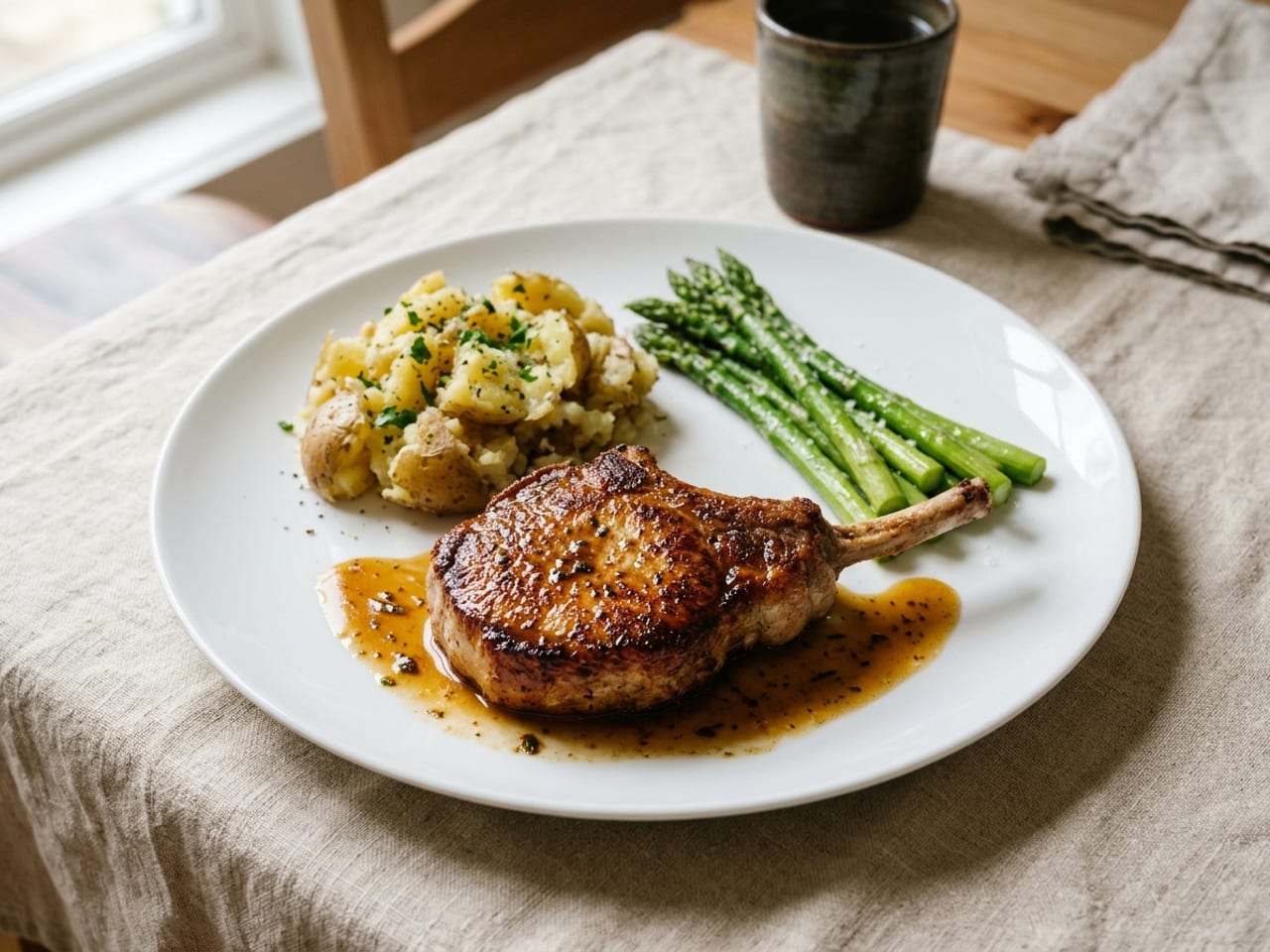
The photos on this page are AI-generated illustrations.
The classical style of plating uses the plate as the face of a clock: true or false?
True: the classical (classic) style of plating is the one taught with a clock face. The plate is read as a clock from the diner's seat: 12 at the far edge, 6 nearest the diner, and each part of the meal at an hour. The hours are where the sources part: we read 33 that print a clock and found 11 different layouts, none printed by more than five of them. In 29 of the 33 the protein is at 6 or in a band that holds 6 (the front half); in four it is at 2.2, 15, 20, 54 Some books define classic plating without a clock (Food for Fifty: the entrée at 6, nearest the guest; Mokbel: food in the centre; below).37, 45 We could not trace the quiz sentence itself to a named textbook (the quiz).
| The clock method at a glance | What the sources say |
|---|---|
| The face | 6 nearest the diner: all 12 sources in the edge table say so; five also name 12 as the far edge, and one, the Wisconsin Council, 3 on the right and 9 on the left (the face) |
| The hours | Eleven layouts in 33 sources; "protein 6, starch 10, vegetables 2", "protein 6, starch 11, vegetables 2" and Unilever's bands tie at five each, so no layout is the most common (every published clock) |
| Protein | At the front in 29 of 33: at 6, or in a band that holds 6; at 2 in four (why the front) |
| Starch and vegetables | Behind: starch at 10 in 9, at 11 in 5; vegetables at 2 in 12; bands in many others |
| Sauce and garnish | Mostly no hour: under or beside the protein (sauce and garnish) |
| Tested? | Not the clock itself, in what we found; centred and balanced plates were (the research) |
| For blind diners | The same face, used to say where each food is; ask first (the other clock) |
| Earliest we found | A plate clock for blinded soldiers, 1945; "6, 10 and 2", 1976; "classical plating" with the clock, 1999 (where it comes from) |
On this page: The clock face · Every clock we found · Why the front · Sauce and garnish · Step by step · When to break it · The research · For blind diners · Where it comes from · Terms · FAQ
Which edge is 12 o'clock on a plate?
The edge farthest from the diner. Read from the seat, 12 is the far edge and 6 the near edge: "Picture the plate as a clock, with 12 at the top and 6 at the bottom, from the diner's perspective" (Toast). Only the Wisconsin Council goes on to name the sides, 3 on the right and 9 on the left.20, 55 Service books name the same spot from the other side: the meat goes "on that part of the plate nearest the guest or at the bottom of the cover ie six o'clock" (Lillicrap).35 The twelve sources in the table below name an edge and all put 6 nearest the diner; none we read says otherwise, and the blindness organisations that use the clock for a different job agree (below).
| Source | Kind | Which edge, in its words |
|---|---|---|
| Toast (2025)20 | Restaurant-software blog | "12 at the top and 6 at the bottom, from the diner's perspective" |
| VisionAware, American Printing House for the Blind54 | Blindness organisation | "12:00 at the top (the edge farthest away) and 6:00 at the bottom (the closest edge)" |
| Wisconsin Council of the Blind & Visually Impaired55 | Blindness organisation | 12:00 farthest from you, 6:00 closest, 3:00 on the right, 9:00 on the left |
| VisAbility (Western Australia)57 | Blindness organisation | 12:00 "the edge that is farthest away from the person eating", 6:00 "the edge that is closest" |
| Hadley56 | Blindness organisation | "with 12 at the top and 6 at the bottom" |
| Wikipedia (2009 to 2022)6 | Encyclopedia | "six o'clock the position closest to the diner" |
| The Culinary Pro30 | Practice reference site | "the 6 o'clock plate position or the edge of the plate placed closest to the guest" |
| Lillicrap, Food and Beverage Service (1990 to 2002)35 | Service textbook (fragments) | "nearest the guest or at the bottom of the cover ie six o'clock" |
| Remarkable Service (2001)34 | Service book (fragments) | "the lower center portion of the plate (six o'clock position)" |
| Kotschevar (1999); Strianese (2003); Food for Fifty36, 37 | Service and banquet textbooks (fragments) | "the lower part of the plate closest to the guest, called the six o'clock position" (Kotschevar) |
| Instawork40 | Staffing company's guide | "the 6 o'clock position", "meaning closest to the guest" |
| Daniels, Losing your sight (2003)66 | Book on sight loss (fragment) | "with 6 o'clock nearest to the person" |
Turning the food, not just the plate
The clock fixes where things go; textbooks also say which way the main item faces. "Place the best side of the meat forward" and "Face the bone of a chop away from the customer" (ProStart, 2011; the American Culinary Federation's manual of 1992 says the same of the chop bone); "Place the main item near the center of the plate with the most favorable side toward the diner" (a 1995 Virginia chefs' book).38, 39 Who decides is the kitchen: in Remarkable Service "The chef will determine the actual placement of food on the plate", and a staffing company tells servers "do not rotate plates in front of the guests!".34, 40 One online study found that for a dish whose elements point one way, "an upward orientation of the dish was preferred" over elements pointing toward the viewer.69
What each source puts where: protein, starch and vegetables by the clock
33 sources that print a clock layout as advice, in date order within each table (undated pages last), hours exactly as printed. The first 13 are the oldest, the most printed and the schools; the other 20 open under "Show all". Sauce and garnish hours appear under the vegetables where a source gives one (two do). Books read only as search fragments are marked; Reluctant Gourmet (an AI-styled page) and an auto-generated study site are left out.
| Source | Protein | Starch | Vegetables | In its words |
|---|---|---|---|---|
| Montana blind-services guide (Wetsch)5 1976; guidance for helpers of blind people | meat 6 | mashed potatoes 10 | 2 | "The best position for cutting meat is six o'clock. Mashed potatoes should be at ten o'clock and vegetables at two o'clock for a right-handed person" (the guide adds that the positions are reversed for a left-handed person) |
| Axler, Food and Beverage Service28 1990; service textbook (fragment) | meat 4 to 7 | 12 to 2 | 8 to 10 garnish 3 | "of a clock as reference points: Meat 4 to 7 Garnish 3 Starch 12 to 2 Vegetable 8 to 10" |
| Rothschild, EATiQuette's The Main Course on Table Service1 2001; server training book (fragment) | 6:00 | 10:00 | 2:00 | "place the protein at 6:00, the starch at 10:00, the vegetable at 2:00, or however" (the fragment ends there) |
| Wikipedia, Food presentation6 2011 to 2022; encyclopedia (an unsourced edit) | 6 | 11 | 2 | "protein, traditionally at a 6 o'clock position, vegetable, at a 2 o'clock position, starch at an 11 o'clock position, sauce and garnish" |
| Cambro blog11 Feb 2014; equipment maker's blog | 2 | 10 | 6 | "When using round plates, conventionally, starches are placed at 10, protein at 2, and vegetables at 6." |
| CAERT curriculum (Illinois State Board of Education)2 2015 or later; school curriculum | 6 | 10 | 2 | "Traditional plating is designed using the face of an analog clock." Starch 10, vegetable 2, protein 6, in a figure and an answer key |
| Auguste Escoffier School of Culinary Arts blog8 Dec 2016; culinary school blog | main 6 | 11 | 2 | "Six is where you set the main dish, like steak or fish. Vegetables, meanwhile, should be placed at 2. Carbohydrates like pasta and rice always go at 11." Also: "there is some debate regarding this rule" |
| WebstaurantStore24 2017; restaurant-supply retailer | 3 to 9 | 9 to 12 | 12 to 3 | "From the diner's point of view, your protein should be between 3 and 9" |
| Richard Sandoval (Food Republic)18 Jan 2025; chef quoted in food media | 3 to 9 | 9 to 11 | 11 to 3 | "Place the protein between 3 and 9 o'clock, the starch between 9 and 11, and the vegetables between 11 and 3" |
| Toast (Aiden Tobor)20 May 2025; restaurant-software blog | 6 | 9 to 12 | 12 to 3 | "Picture the plate as a clock, with 12 at the top and 6 at the bottom, from the diner's perspective." |
| CaterCamp3 Mar 2026; catering-software blog | 6 | 10 | 2 sauce 11 | "Protein at 6 o'clock (center-bottom, closest to the guest)"; "Sauce at 11 o'clock or drizzled strategically" |
| Unilever Food Solutions15 undated; food brand | main 3 to 9 | 9 to 11 | 11 to 3 | "A simple food plating tip to a classical plating is to think of the plate as the face of a clock." |
| Le Cordon Bleu Malaysia blog27 undated; culinary school blog | centre or 3 to 9 | 10 | 2 | "Protein is placed at the centre or between 3 and 9 o'clock on the plate." |
Show all 33 rows (20 more)
| Source | Protein | Starch | Vegetables | In its words |
|---|---|---|---|---|
| Mokbel, Everyday to Gourmet45 2011; cookbook (fragment) | 6 | (hour cut off) | 2 | "position the protein (i.e., meat, fish, poultry, etc.) at 6 o'clock, vegetables at 2 o'clock, and starch" (the fragment ends there) |
| Start Cooking7 captured 2012; home-cooking site | 6 | 11 | 2 | "Read the clock! A foolproof way to arrange food on a plate": carbohydrate 11, vegetables 2, protein 6 "from the diner's point of view" |
| KitchenAid blog14 2013; appliance maker's blog | 2 | 10 | 3 to 9 | "Many chefs reference a clock layout"; it "will vary depending on your personal preferences" |
| GMA News (a Unilever Food Solutions senior sous chef's demo)16 Jan 2014; news report | main 3 to 9 ("safest bet is 6") | 9 to 11 | 11 to 3 | "the classical plating technique"; "serve the plate with the main ingredient facing the diner" |
| Chef Food Tools17 Nov 2014; retailer's blog (unilever's wording) | main 3 to 9 | 9 to 11 | 11 to 3 | "A simple guide to a classical plating is to think of the plate as the face of a clock." |
| Perdue12 captured 2015; food brand | 2 | 10 | 6 | "The clock method: starch at 10 o'clock, protein at 2 o'clock, veggies at 6 o'clock." |
| Hari Ghotra, Professional Plating Guide21 2016; chef's guide | main 6 | 9 to 12 | 12 to 3 | "The classic plating method was all about hosting 3 key elements"; "there aren't any strict rules" |
| Hospitality Net (Jumia Travel)23 Aug 2016; hospitality news article | 3 to 9 | 9 to 12 | 12 to 3 | "Classical plating arranges the main elements of the meal on a clock style." |
| ECR13 about 2017; radio station's lifestyle page | 2 | - | 6 | "proteins work best at two o'clock, while vegetables are plated at six o'clock on round plates. It's not a must" |
| John Reiss, Milwaukee Area Technical College (MKE Lifestyle)32 2017; instructor quoted in a magazine | 6 | - | 3 or 9 | "Traditionally, the protein is put at 6 o'clock, then the vegetables at 3 or 9 o'clock"; "there are many different ways to plate something" |
| La Tour Angelle9 2021; retailer's blog | 6 | 11 | 2 | "Classic plating, also known as the clock method": carbohydrates 11, vegetables 2, protein 6 |
| Tasting Table31 2023; food media | bottom, the 3 to 9 section | top | top | the protein "towards the bottom of the plate, somewhere in the three and nine o'clock section" |
| EHL Hospitality Business School, Insights26 2024; hospitality school blog | 3 to 9 | 9 to 12 | 12 to 3 | "The clock technique", "all from the diner's perspective" (close to WebstaurantStore's words) |
| Toast (Caroline Price, quoting Sandoval)19 Nov 2024; restaurant-software blog | 3 to 9 | 9 to 11 | 11 to 3 | "the classic clock method is a go-to" |
| Foodofile29 Nov 2025; industry blog | 6 | 2 | 10 | "In culinary school, we are taught to visualize the plate as a clock face" (no school named) |
| Just Jeannie Jacobs22 Mar 2026; lifestyle blog | 6 | 9 to 12 | 12 to 3 | "It's a framework, not a rulebook." |
| Restaurantware4 Jul 2026; foodservice supplier's blog | 6 | 10 | 2 | "Classic (clock) plating places protein at 6 o'clock, starch at 10, and vegetables at 2" |
| Wekiva Culinary25 undated; school programme site | meat 3 to 9 | 9 to 12 | 12 to 3 | "Between 3 and 9 is where your meat will sit." |
| MySupplyClub10 undated; supplier glossary | 6 | 11 | 2 | "The clock method is a traditional plating technique" |
| The Culinary Pro30 undated; practice reference site | 4 to 8 | 9 to 10 | 2 to 3 | "Traditional plating presents the food simply by using a clock face as a guide." |
What the tally says
- They agree on the face and on the front. The protein sits at the front, at 6 or in a band around it, in 29 of the 33. The four that put it at 2 are Cambro (2014), Perdue, ECR and a KitchenAid post (2013), and Cambro, Perdue and ECR move the vegetables to 6 instead.11, 12, 13, 14
- They split on the hours, and no layout wins. "Protein 6, starch 10, vegetables 2" is printed by five: a 1976 Montana guide for helpers of blind people, a 2001 server training book, a US school curriculum and two 2026 blogs.1, 2, 3, 4, 5 "Protein 6, starch 11, vegetables 2" is printed by five as well: Wikipedia from 2011 to 2022, Start Cooking, the Escoffier School's blog, La Tour Angelle and MySupplyClub.6, 7, 8, 9, 10 Unilever's "main 3 to 9, starch 9 to 11, vegetables 11 to 3" is on five pages too: they print the same bands, and only Chef Food Tools copies Unilever's wording (below). So there is no "most common" clock in what we read.
- Many rows are copies or echoes. The "main 3 to 9, starch 9 to 11, vegetables 11 to 3" rows share one set of hours (Unilever Food Solutions' page is undated; a GMA News report of a Unilever Food Solutions chef's demonstration, 31 January 2014, is the earliest dated): only Chef Food Tools reproduces Unilever's words (2014), and Toast and Food Republic quote Sandoval's identical hours in his own words (2024, 2025); EHL's bands read like WebstaurantStore's; Just Jeannie Jacobs follows Toast.15, 17, 18, 22, 24, 26 Count origins, not pages, and the picture is thinner still.
- The bands are web advice, not old manuals. Protein 3 to 9, starch 9 to 12, vegetables 12 to 3 is on Hospitality Net (2016), WebstaurantStore (2017), Wekiva Culinary and EHL (2024). The one service book with clock bands that we read, Axler's of 1990, prints different ones: meat 4 to 7, starch 12 to 2, vegetable 8 to 10.23, 24, 25, 26, 28
- Textbooks give the front, not the hours. Gisslen's Professional Cooking says that "Until recent years, plated main courses followed a standard pattern: meat or fish item at the front of the plate (closest to the diner), vegetable and starch items at the rear" and that "This arrangement is still the most commonly used", with no clock in the fragments we read; full-text searches of sixteen editions and copies of US and Canadian culinary textbooks found no clock layout for protein, starch and vegetables (one study-guide question mentions a 4 o'clock position), though those searches show only a few fragments of each.33
Where does the protein go on a plate, and why at 6 o'clock?
At the front, in most of the clocks above. Few sources say why; these are all the reasons we found, labelled by who gives them. Only the first two are about the front as such.
| Reason | Who says so | In their words |
|---|---|---|
| The diner cuts it without reaching over the rest34, 58 | Service book; Sight-loss guidance | In a fragment of Remarkable Service (2001) that interleaves two passages, the guest "does not have to reach over the accompaniments to cut it" (the sentence before it is cut off; the same fragments put the main item at the bottom, the six o'clock position); meat "is best positioned nearest to you, as this saves you having to reach across other foods to cut it up" (Guide Dogs UK). |
| Six o'clock is where meat is cut5 | Sight-loss guidance | "The best position for cutting meat is six o'clock", with mashed potatoes at ten and vegetables at two for a right-handed person "so that the potatoes may serve as a pusher for the vegetables"; the positions are reversed for a left-handed person (a 1976 Montana guide for helpers of blind people). |
| Plate it the way it is eaten32 | Chef's opinion | "The further you put something away on a plate from someone, they'll be forced to go through (other ingredients) to get to it" (chef Justin Carlisle). About any item, not the protein alone. |
| A focal point that grounds the dish20, 30 | Practice | "Place the protein at 6 o'clock: This grounds the dish and creates a natural focal point" (Toast, 2025); "The entrée or main focal point is served between 4 and 8 o'clock" (The Culinary Pro). |
| Balance, symmetry and a guided eye18, 25, 27 | Chef's opinion; Practice | "a sense of symmetry and flow ... guiding the diner's eye across the dish" (Sandoval); "Classic plating is all about balance and symmetry" (Le Cordon Bleu Malaysia); "According to science, people find things that are symmetrical more attractive" (Wekiva Culinary, no study named). |
| Structure for beginners18, 20 | Chef's opinion | "a great method for beginners because it provides structure" (Sandoval); "Once you've mastered the clock method, you can start breaking the rules" (Toast, 2025). |
| Low in front, higher at the back2 | Curriculum | "The food on a plate is often placed lower in the front and higher in the back. This placement draws the eye in and upward" (CAERT). Ours: a reason for height, which a flat item in front happens to give. |
| It is where service puts the main item33, 35, 36 | Service rule, no reason given | "meat or fish item at the front of the plate (closest to the diner)", a pattern plated main courses followed "Until recent years" and that is "still the most commonly used" (Gisslen); "Place the entree plate so that the main item is closest to the guest" (AHLEI); "Serve main food items at the six o'clock position" (Kotschevar). The rule, without a why. |
Our reading, not a source's: the protein is usually the one thing on the plate that needs a knife, and the front is the place to use one, which is close to the reason the service book fragment and the two sight-loss guides give in their own words. Nobody we read tested it.
Sauce and garnish on the clock
The clocks are written for three things, and most leave the sauce and the garnish without an hour. In what we read, one blog gives the sauce an hour and one service book gives the garnish one; no layout gives both.
| What | Where, in their words | Who |
|---|---|---|
| Sauce | "Sauce at 11 o'clock or drizzled strategically" | CaterCamp (2026): the only sauce hour in a three-zone layout we read3 |
| Sauce | Under the protein: "pour a small pool of sauce onto the plate then place the protein on top of it" (Cambro); "Consider placing sauces beneath meat" (Perdue); "plated under the protein or drawn across the plate" (Restaurantware) | Equipment maker, food brand, supplier4, 11, 12 |
| Sauce | A base layer: "Many chefs like to start with a sauce as the base of their plate" (Wekiva Culinary) | School programme site25 |
| Sauce | "under, on top, or around an item" (CAERT); "either under or over the main item" (The Culinary Pro) | Curriculum, practice site2, 30 |
| Garnish | "Garnish 3" | Axler (1990): the only garnish hour in a three-zone layout we read28 |
| Garnish | "with the garnish toward the rear of the plate" | Food for Fifty (banquet textbook)37 |
| Garnish | No hour: "Vary heights, textures, and colors within each section" | Richard Sandoval (Food Republic)18 |
| Both, free-form | Grilled lemons "at the twelve o'clock position as a garnish", the sauce brushed "to point at one o'clock", scallions at ten: one fish dish, an X shape, not the three-zone clock | Institute of Culinary Education (2015)41 |
The Institute of Culinary Education's fish dish is the clock used freely, as a drawing aid for one plate, not as the three-zone rule. Sauce moves themselves (pool, swoosh, dots, line) are in our sauce plating guide, and garnish in our food garnish guide.
How to plate by the clock method
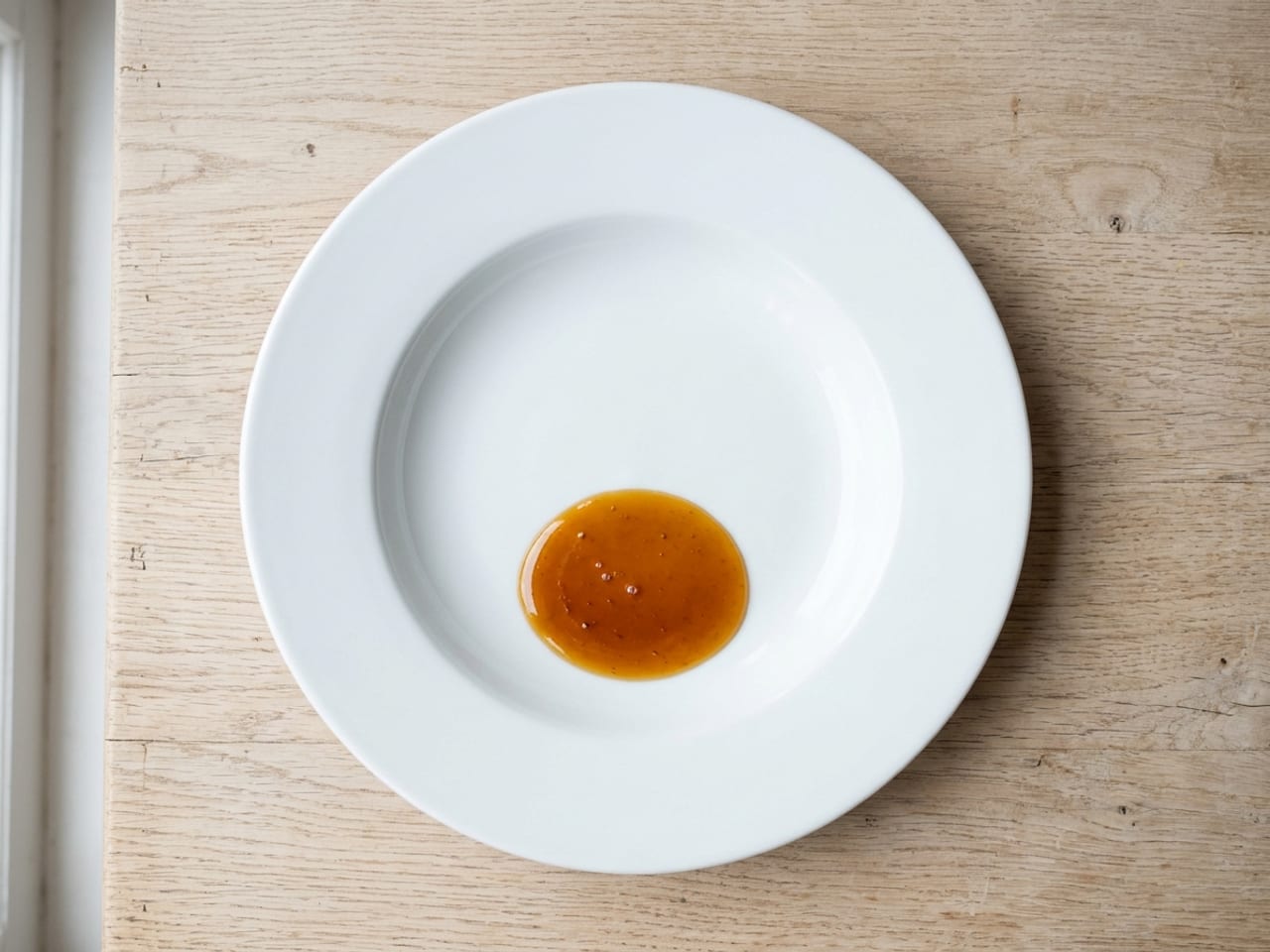
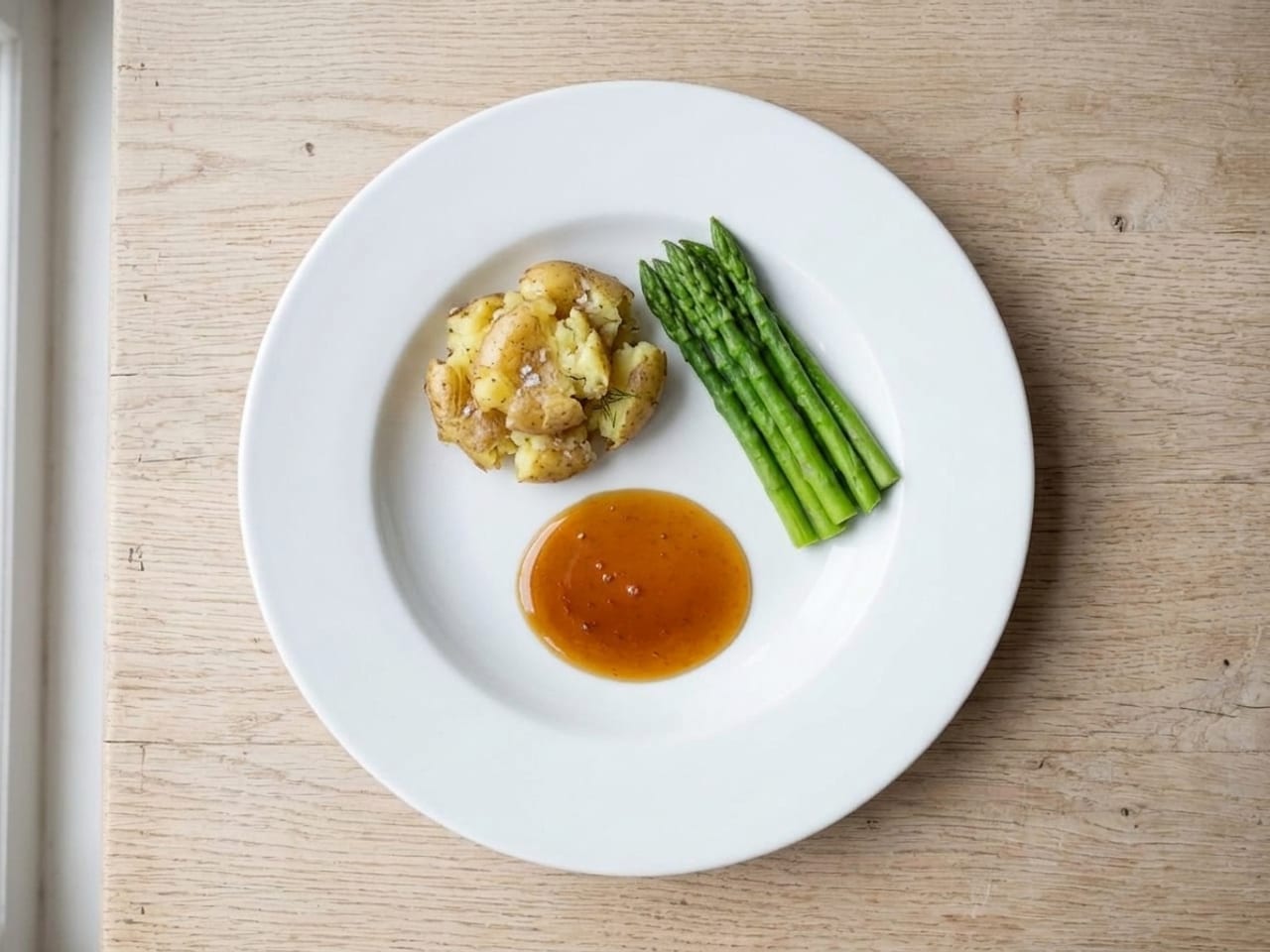
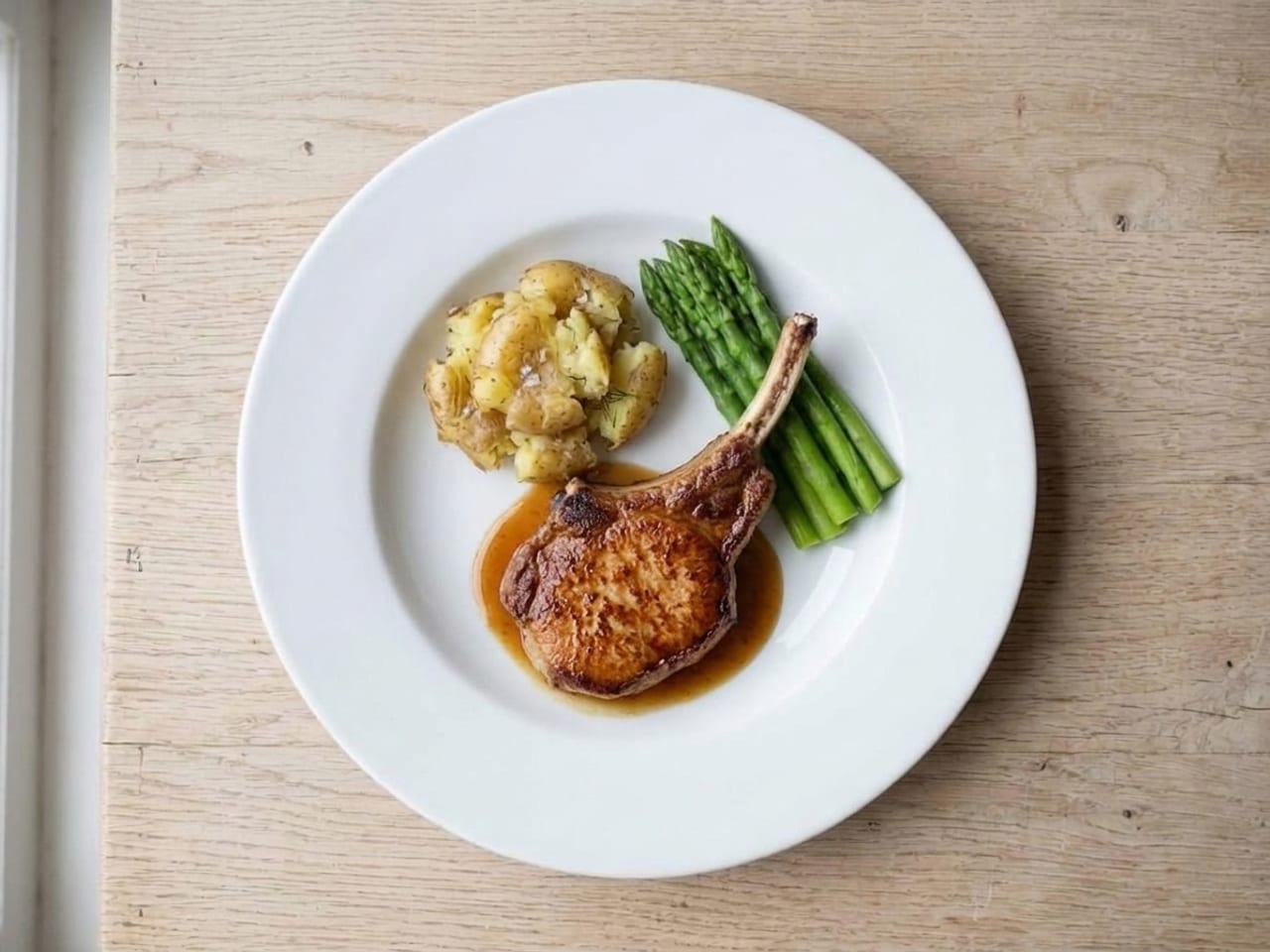
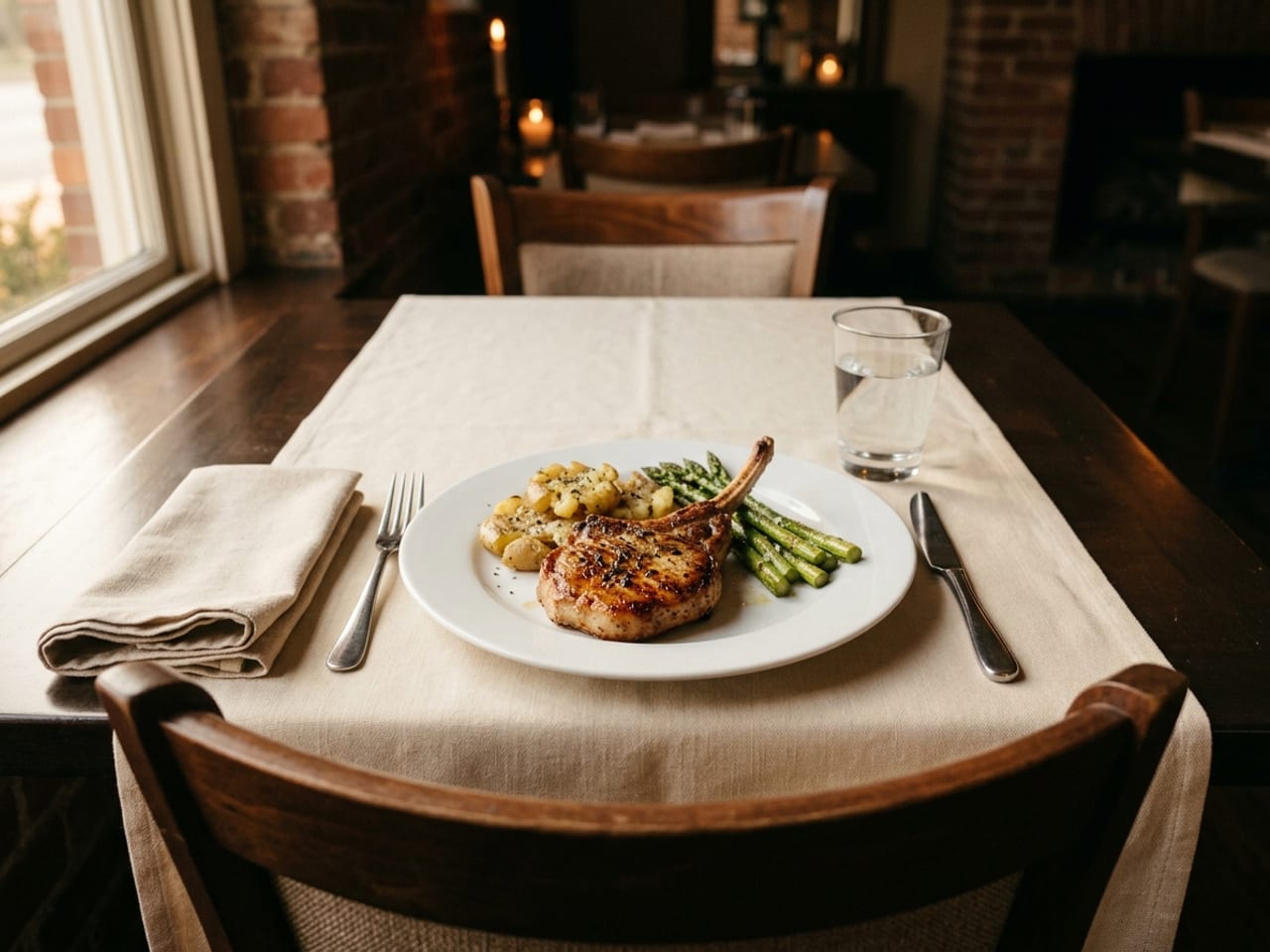
Five steps for a protein, a starch and a vegetable, shown on a pork chop with crushed potatoes and asparagus. Each step is quoted from a named source or marked ours; nothing was plated or tested by us.
- 1
Find 12 and 6 before anything goes on
Set the plate down the way it will face the diner: 12 is the far edge and 6 the near edge (VisionAware; Toast), with 3 on the right and 9 on the left (Wisconsin Council of the Blind & Visually Impaired).20, 54, 55 Pick one published set of hours and keep to it for every plate (ours: the tally has eleven to choose from, and the plates of one service should match). Rothschild's server book puts it plainly: protein at 6:00, starch at 10:00, vegetable at 2:00, "or however" (the fragment ends there); in Remarkable Service, "The chef will determine the actual placement of food on the plate".1, 34
 2
Sauce first, if it goes under
A sauce that sits under the protein goes down first, where the protein will sit: "pour a small pool of sauce onto the plate then place the protein on top of it" (Cambro), or, in Restaurantware's words, "plated under the protein or drawn across the plate before the components go down".4, 11 More sauce moves are in our sauce plating guide.
 3
Starch and vegetables at the back
Gisslen puts the "vegetable and starch items at the rear"; the clocks give them hours, starch at 10 and vegetables at 2 in the CAERT curriculum, starch at 11 in the Escoffier School's blog post, or bands from 9 to 12 and 12 to 3 on WebstaurantStore.2, 8, 24, 33 Shown here: crushed potatoes at about 10, asparagus at about 2. For height, The Culinary Pro says "Gain height by leaning the protein on the starch"; ours: leave the starch room to take it.30
 4
Protein at the front, best side to the diner
The main item goes "at the front of the plate (closest to the diner)" (Gisslen).33 Ours: turn it before you let go. "Place the best side of the meat forward" and "Face the bone of a chop away from the customer" (ProStart, 2011, and the American Culinary Federation's 1992 manual); "the most favorable side toward the diner" (a 1995 Virginia chefs' book).38, 39 A sliced protein fanned with its cut faces to the front is our steak guide's move.
 5
Serve it with the protein nearest the guest
Ours: garnish and wipe the rim, then carry the plate the same way round: "Place the entree plate so that the main item is closest to the guest" (AHLEI); "serve the plate with the main ingredient facing the diner" (a Unilever Food Solutions sous chef in GMA News).16, 36 A staffing company's guide adds: "If you have not received instructions on plate placement, ask. But, do not rotate plates in front of the guests!" 40
When not to use the clock: free-form, landscape, stacked and other plates
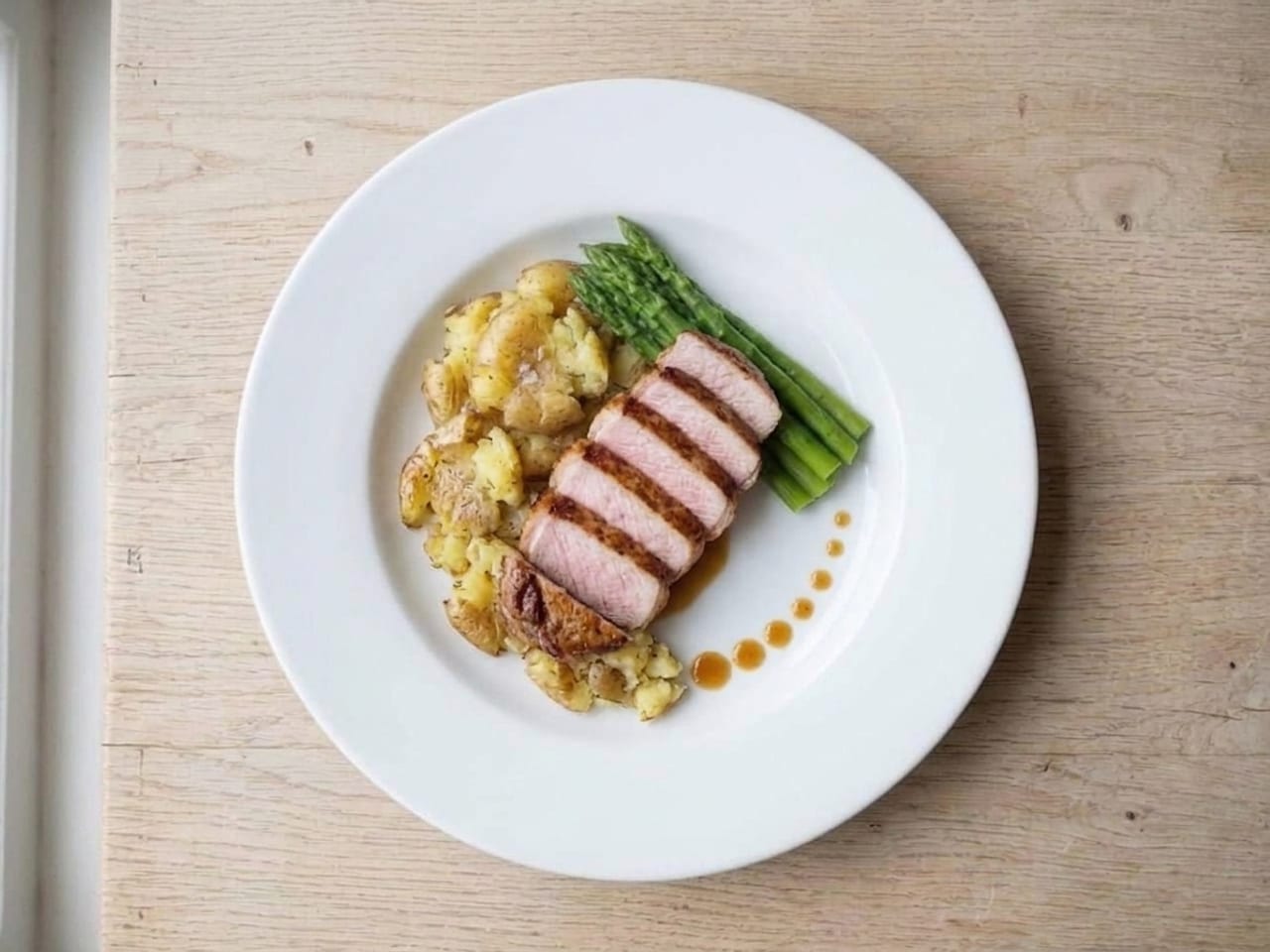
Several of the sources that print the clock treat it as a starting frame. "There aren't any strict rules" (Hari Ghotra); "there are many different ways to plate something" (John Reiss); "Once you've mastered the clock method, you can start breaking the rules" (Toast); Gisslen, after the front-of-plate pattern, adds that "cooks and chefs can create" others.20, 21, 32, 33 A 1995 restaurant cookbook speaks of "the same tired old formula approach to plates" (a fragment), and the CAERT curriculum says "Modern designs are generally more artistic, utilizing unique serving pieces and unconventional arrangements of food, sauce, and garnish."2, 44
 ClockFree-form
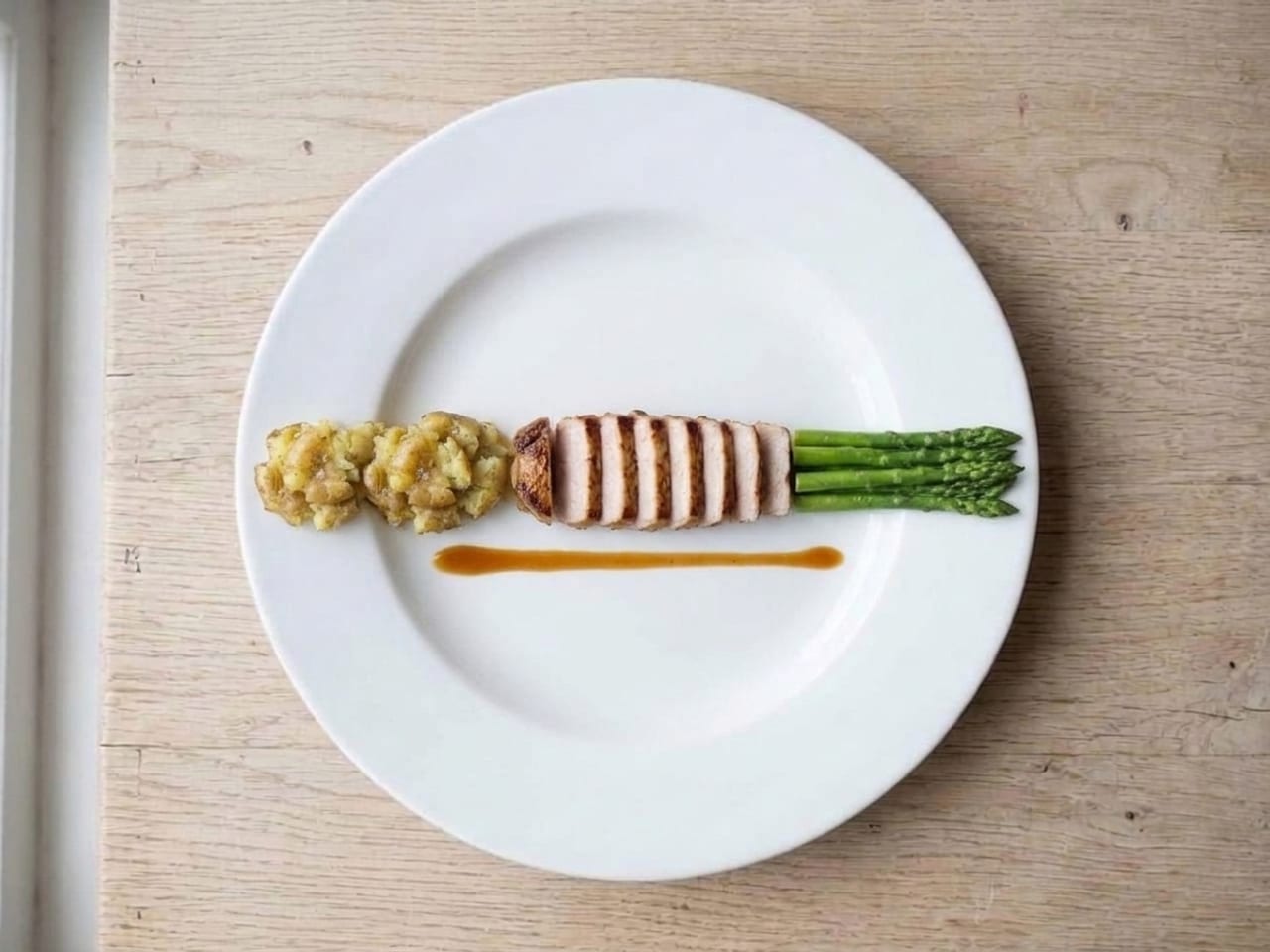
- Free-form and landscape. No fixed positions, or one low band across the plate: both are defined and shown in our plating techniques glossary. Keep the whole balanced: diners preferred balanced plates to unbalanced ones of the same food.70
- Stacked. Height instead of hours; in a 2025 cafeteria study a salad stacked high on a large plate was liked best.74 The method is in our stacking guide.
- Square and rectangular plates. "For square plates, divide into quadrants when figuring out the placement of foods" (Cambro); "Square or asymmetrical plates lend themselves to modern, stylized presentations" (Toast).11, 20 Plate shapes are in our plate types guide.
- One item. The clock can still place it: a caterer's book sets "the warm soufflé at 6 o'clock on the plate or in the middle of the salad".46
- Off centre on purpose. A pastry textbook: "The main component of the dessert does not always need to be centred, but can be placed slightly offset."42
What the research says about the clock layout
No study we found tested the clock layout itself, against another layout or at all (we searched PubMed and OpenAlex and read the abstract of Spence's 2021 review of the field). What has been tested is nearby:
- Centred beats off to one side. 163 diners liked a main course more, and judged it more artistic, when "presented in the centre of the plate, rather than placed off to one side", and would pay more for it (£15.35 against £11.65).67 Another study found food liked more and worth more "when horizontally and/or centrally arranged", flat and/or centred, without saying which mattered.68
- Balanced beats lopsided. "a clear preference for balanced over unbalanced presentations", unbalanced, which the abstract ties to the chefs' trend of crowding all the food onto one side of the dish.70
- Where the main sits is cultural. US, Italian and Japanese participants agreed on three colours and three to four components but showed "diverging preferences regarding the preferred position of the featured main course".71
- The arrangement changes liking. With Culinary Institute of America co-authors, the same chicken, rice pilaf and green beans were liked more in the more attractive of two arrangements; the abstract does not say what the arrangements were.73
- Odd numbers are not proven. "No consistent evidence for a preference for odd or even numbers of food items was found".72
So the clock's usual shape, centred and balanced with three components, sits close to what diners preferred in these studies; whether the hours themselves matter, nobody we read has measured. More in the plating techniques research notes and Plating 101.
The clock method for blind and low-vision diners
The same face, a different job: telling someone with sight loss where each food is on their plate. "Think of your plate as a clock face with 12:00 at the top (the edge farthest away) and 6:00 at the bottom (the closest edge)" (VisionAware, American Printing House for the Blind).54 Blindness organisations publish it for diners and for the people serving them; Vision Australia wrote its tip sheet for restaurant staff, and RNIB's benefits toolkit lists "the clock face method" as its example of someone telling you "whereabouts your food is on the plate".59, 60
How to describe a plate, from the blindness organisations, professionals and blind writers we read
- Ask first. "As always, the blind person themselves will be your best guide to what they need" (Canadian Organization of the Blind and DeafBlind). Not everyone wants it: "I firmly refuse this rigmarole from well-meaning wait staff", wrote Barbara Pierce in the National Federation of the Blind's Braille Monitor, though she thought it "appropriate and sporting" to tell a blind child where a lemon wedge is.61, 63
- Say what it is, then where. "When serving or eating with a blind person, tell him what he is being served. Explain the position of each portion by relating its position on the plate to the numbers on the face of a clock" (a 1976 Montana guide, in its own 1976 wording); "put meat at six o'clock, potatoes at noon and vegetables at nine and three", "and then tell them where it is" (Gwynneth Evans, a habilitation officer in Bradford's Visual Impairment Team, quoted by RNIB, on school lunches).5, 60
- Clock or compass. Guide Dogs UK suggests "the clock face or use north, south, east and west", and puts the meat nearest the diner so they need not reach across.58 The American Foundation for the Blind's June 2021 handout for healthcare food service staff gives plain directions and does not mention a clock: "The juice is at the top right of the tray, the bread is on a plate just under it."62
- The table too. A Wisconsin Council client uses the clock "to find the water glass and silverware, too".55
The hours in these sources are examples, not a standard: in the 14 sources in this table that name foods, the meat or chicken is at 6 in 11; one puts the meat at 12, one the steak at 3, and Hadley's example has no meat. A teacher's site we read but did not tabulate puts the potatoes at 6 and the chicken at 3.64
| Source | Edge | Hours named |
|---|---|---|
| Boucher and Tehan, They Can 'See' Without Eyes49 1945; book on blinded soldiers | not stated | meat 6, rolls 9, potatoes 12, vegetables 3 |
| Survey Midmonthly, "Meat at Six o'Clock"50 1946; magazine (a blinded g.i. quoted) | not stated | potatoes 2, meat 6, peas 9 |
| Unused Alibis (a veterans' training centre)51 1951; book | not stated | meat 12, potatoes 6 |
| Severance, He Helped Himself52 1954; profile of a blind man | not stated | meat 6, beans 3, potatoes 12; salad 9, water glass 1, coffee 4 |
| Robertson, How to Help Through Understanding53 1961; book | not stated | potatoes 12, meat 6, relish 9 |
| Wetsch, Montana Visual Services Division5 1976; state guidance for helpers | not stated | meat 6, mashed potatoes 10, vegetables 2 (for a right-handed person; reversed for a left-handed one) |
| Managing difficult patients (Springhouse), a case of a patient charted "Treat As Blind"66 1988; nursing book (a case) | not stated | meat 6, potatoes 10, vegetables 2 on his tray; the same book also has potatoes 2, meat 6, vegetables 10 |
| Wisconsin Council of the Blind & Visually Impaired55 2019, 2026; blindness organisation | 12 far, 6 near, 3 right, 9 left | chicken 6 (an example) |
| American Foundation for the Blind (for food service staff)62 2021; blindness organisation | no clock: "top right of the tray" | none |
| Alex Jurgensen, Canadian Organization of the Blind and DeafBlind blog63 2022; blindness organisation | not stated | peas 1, chicken 6, rice 10 |
| Hadley, What's on the Table56 2022; blindness organisation | 12 top, 6 bottom | pasta 3, asparagus 6, garlic bread 10 |
| Vision Australia (for restaurant staff)59 undated (file folder 2022-08); blindness organisation | not stated | steak 3, potatoes 9 |
| Nursing Assistant open textbook (WTCS)65 undated; care training | not stated | mashed potatoes 10, green beans 2, meat loaf 6 |
| RNIB Insight, quoting a Bradford Visual Impairment Team habilitation officer (school lunches)60 undated; blindness organisation hosting a local-service officer's advice | "top and bottom" | meat 6, potatoes 12, vegetables 9 and 3 |
| Guide Dogs UK58 undated; blindness organisation | clock face or compass points | meat 6, vegetables 9, potatoes 3 |
| VisionAware (American Printing House for the Blind)54 undated; blindness organisation | 12 top (farthest), 6 bottom (closest) | none on the page we read |
| VisAbility (Western Australia)57 undated; blindness organisation | 12 farthest, 6 closest | none |
Where the plate clock comes from: the earliest we found
From Internet Archive full-text searches and the web, so "earliest we found", not "first". The oldest plate clocks we found are for blind diners; the plating clock appears later. The dates go no further than that: we found nothing that says one led to the other.
| When | What we found |
|---|---|
| 1945 | A book on blinded soldiers: food "clockwise on his plate", "meat at six o'clock, rolls at nine, potatoes at twelve, and vegetables at three". The earliest plate clock we found.49 |
| 1946 | Survey Midmonthly runs "Meat at Six o'Clock": a blinded G.I. says "I think of my plate as if it was the face of a clock".50 |
| 1951 | A veterans' training centre puts "the meat at 12 o'clock, potatoes at 6 o'clock": the other way round from 1945 and 1946.51 |
| 1976 | A Montana guide for helpers of blind people: meat at six "for cutting", mashed potatoes at ten, vegetables at two, for a right-handed person. The earliest "6, 10 and 2" we found.5 |
| 1990 | Service books: Axler gives servers "the face of a clock as reference points" (meat 4 to 7, starch 12 to 2, vegetable 8 to 10, garnish 3); Lillicrap's silver-service rule gains "ie six o'clock", a phrase not in the 1971 and 1983 fragments we read.28, 35 |
| 1992 | Gisslen calls the main item in front, "closest to the diner", with vegetable and starch behind, "the traditional style"; his Professional Cooking keeps it as "still the most commonly used", with no hours.33 |
| 1995 | A restaurant cookbook speaks of "the same tired old formula approach to plates", meat at six, starch at ten, vegetable at two (the fragment begins mid-sentence; that it was a familiar pattern by then is our reading).44 |
| 1999 | "A nod to classical plating sees assembling the components in separate mounds, placed as if they were at different time on the face of a clock": the earliest "classical plating" tied to the clock that we found.43 |
| 2001 | A server training book: "place the protein at 6:00, the starch at 10:00, the vegetable at 2:00".1 |
| 2004 | A Dallas food writer credits post-2001 comfort food with reviving "the classic “clock face” presentation"; an observation, with no data.47 |
| 2009 to 2022 | Wikipedia's "Food presentation" carries the clock from its first revision (2009) and the hours 6, 11 and 2 from 2011, until an editor removes them in 2022 as "unsourced, poorly written content".6 |
| 2014 | "The classical plating technique" and "the face of the clock" appear together in a GMA News report of a Unilever Food Solutions chef's demonstration, the wording Unilever Food Solutions also prints.15, 16 |
| 2015 or later | An undated US school curriculum (its resources accessed in September 2015) teaches "Traditional plating" by "the face of an analog clock" and tests it.2 |
| 2016 | The Escoffier School's blog prints "the clock rule" with "some debate"; Hospitality Net prints "Classical plating" as bands.8, 23 |
| 2025 and 2026 | Restaurant-software and supplier blogs print two different clocks across 2025 and 2026: Toast's 6 with bands (May 2025), and 6, 10 and 2 at CaterCamp (March 2026) and Restaurantware (July 2026).3, 4, 20 |
What "classical plating" means
Three things, depending on the book. The clock: "A nod to classical plating" (1999), "Classical plating arranges the main elements of the meal on a clock style" (Hospitality Net, 2016), "a classical plating technique" (Unilever). The main item at 6 alone: "the entrée is placed nearest the guest, at the 6 o'clock position, with the garnish toward the rear of the plate. This classic plating style has widespread use" (Food for Fifty). Food in the middle: "One of the most common and classic plating techniques used in both everyday and gourmet presentations is arranging food in the center of the plate" (a 2011 cookbook, which prints a clock separately). The CAERT curriculum calls the clock "Traditional plating".2, 15, 23, 37, 43, 45
The quiz: "The classical style of plating uses the plate as the face of a clock to place food portions"
The sentence circulates as a true-or-false item on Brainly and Course Hero. Quizlet also lists plating sets, two of them titled for the Philippine TLE (Technology and Livelihood Education) course; we could not open any of these pages, so we read no answer key, do not know whether the item is in the Quizlet sets, and could not trace the item to a named textbook.48 Its wording ("classical", "face of a clock") matches Unilever Food Solutions' and the 2014 GMA News report.15, 16 The answer is true if "classical plating" means the clock layout, which is how Bergeron (1999), Hospitality Net (2016) and Unilever Food Solutions use it; it is not true of the two books above that use the name for something else.
Not sure your plate reads as a clock? Photograph it and Plate Artists re-plates that dish, with the food kept as it is and the changes named so you can repeat them. Start with a re-plate.
Your food, plated like a chef's
Snap it, upload it, and get the composed version back, with the steps to recreate it at home.
Start free · 1 enhancement →Free account · 1 free enhancement · No credit card
Clock method terms, defined
Five words this page uses; the plate's parts (well, rim) and the other plating styles are in our plating techniques glossary.
Clock method · clock face plating, the clock rule
A way to lay out a plate by reading it as a clock face from the diner's seat and giving each part of the meal an hour or a band of hours; the hours differ by source.
Where it comes from. The earliest service book we found with hours for several foods is Axler's (1990); "the clock rule" is the Escoffier School blog's name.8, 28
Classical plating · classic plating, traditional plating
In most of the sources we read, the clock-method layout of protein, starch and vegetables in fixed positions; some books use the name for the main item in front, or for food in the centre.
Where it comes from. "A nod to classical plating" (1999); "Traditional plating" (CAERT); "This classic plating style" for the entrée at 6 alone (Food for Fifty); "classic plating" for food in the centre (Mokbel, 2011, whose book prints a clock separately).2, 37, 43, 45
12 o'clock
The edge of the plate farthest from the diner as it is set down.
Where it comes from. "12 at the top and 6 at the bottom, from the diner's perspective" (Toast); "the edge farthest away" (VisionAware).20, 54
6 o'clock position
The edge of the plate nearest the diner, where most clock layouts put the main item.
Where it comes from. "the 6 o'clock plate position or the edge of the plate placed closest to the guest" (The Culinary Pro); "called the six o'clock position" (Kotschevar).30, 36
Clock face method (sight loss) · the clock method for blind and low-vision diners
Telling a blind or low-vision person where each food is on their plate by clock hours, 12 at the far edge and 6 nearest them.
Where it comes from. Printed by blindness organisations and care guides; the earliest we found is 1945.49, 54, 60
The clock method, answered
The classical style of plating uses the plate as the face of a clock to place food portions: true or false?
True, where "classical plating" means the clock layout, as Bergeron (1999), Hospitality Net (2016) and Unilever teach it: the plate is read as a clock face from the diner's seat, 12 at the far edge and 6 nearest the diner, and each part of the meal gets an hour. Two books we read use "classic plating" for the entree at 6 alone or for food in the centre. The sources agree on the face, not on the hours: in the 33 sources we read we found 11 different layouts. We could not trace the quiz item itself to a named textbook.
Which style of plating uses the plate as the face of a clock?
Classical or classic plating, also called traditional plating or the clock method. Unilever Food Solutions calls it "a classical plating technique", a US school curriculum (CAERT) "Traditional plating" and Le Cordon Bleu Malaysia's blog "Classic Plating". Free-form and landscape plating, the usual alternatives, have no fixed clock positions.
What is the clock method of plating?
You picture the plate as a clock face seen from the diner's seat and give the protein, the starch and the vegetables each an hour or a band of hours, so every plate of a dish comes out the same. One published version puts the protein at 6, the starch at 10 and the vegetables at 2; others put the starch at 11, or give bands such as protein 3 to 9.
Where does the protein go on a plate?
At the front, nearest the diner, in 29 of the 33 clock layouts we read: at 6 o'clock, or in a band around 6 such as 3 to 9. Four sources (Cambro, Perdue, ECR and a KitchenAid blog post) put it at 2 o'clock instead. Gisslen's Professional Cooking gives no hour but puts the meat or fish "at the front of the plate (closest to the diner)".
Where does the starch go on a plate?
Behind the protein, usually to the left, at an hour that changes with the source: 10 o'clock in 9 of the layouts we read, 11 o'clock in 5, a band from 9 to 11 or 9 to 12 in many others, and 2 o'clock in one blog. Gisslen just says "vegetable and starch items at the rear".
Where do the vegetables go on a plate?
Behind the protein, usually to the right: 2 o'clock in 12 of the layouts we read, a band from 11 or 12 to 3 in many others. Three sources (Cambro, Perdue and ECR) put the vegetables at 6, in front, with the protein at 2.
What is 12 o'clock on a plate?
The edge farthest from the diner as the plate is set down; 6 o'clock is the edge nearest them. All 12 sources in our edge table put 6 nearest the diner (none we read puts it elsewhere); five also name 12 as the far edge, and the Wisconsin Council puts 3 on the right and 9 on the left. From service textbooks to blindness organisations such as VisionAware: "12:00 at the top (the edge farthest away) and 6:00 at the bottom (the closest edge)".
Is "protein at 6, starch at 10, vegetables at 2" the rule?
It is one published version, not the rule. Five sources we read print exactly that (a 1976 Montana guide for helpers of blind people, a 2001 server training book, a US school curriculum and two 2026 blogs); five print the starch at 11 instead (Wikipedia from 2011 to 2022, the Escoffier School's blog and three others), and no single layout was printed by more than five of them.
Where does the sauce go in the clock method?
Usually under or beside the protein, with no hour: "pour a small pool of sauce onto the plate then place the protein on top of it" (Cambro), "under, on top, or around an item" (CAERT). Of the layouts we read only one blog gives the sauce an hour (CaterCamp, 11 o'clock) and only one service book gives the garnish one (Axler, 3 o'clock); none gives both.
What is the clock method for blind and low-vision people?
A way of telling someone with sight loss where each food is: the plate is a clock face, 12 at the far edge and 6 nearest them, and a server or companion says "your meat is at six o'clock". Blindness organisations publish it (VisionAware, Hadley, Guide Dogs UK, Vision Australia, RNIB); ask first, because not everyone wants it. The hours are examples: in the 14 table sources that name foods, the meat or chicken is at 6 in 11.
Do culinary schools teach the clock method?
Some schools publish it: the Escoffier School's blog (main dish at 6, vegetables at 2, carbohydrates at 11, 2016), Le Cordon Bleu Malaysia's blog (protein at the centre or between 3 and 9, starch at 10, vegetables at 2) and a US school curriculum (CAERT). The Institute of Culinary Education uses clock positions to place a sauce and garnishes on one fish dish. Gisslen's Professional Cooking describes the main item in front without hours.
Is the clock layout the one diners like best?
No study we found has tested it. The studies test parts of it: diners liked a main course more when it was in the centre of the plate rather than off to one side (Michel and others, 2015), and balanced plates over unbalanced ones of the same food (Velasco and others, 2016), while US, Italian and Japanese participants disagreed on where the main course should sit (Zampollo and others, 2012).
When should you not use the clock method?
Our reading: when the dish has no separate protein, starch and vegetable, when it is stacked or served as one item, or when you want a free-form or landscape plate. Cambro divides square plates into quadrants instead of hours, and Toast says that once you have mastered the clock "you can start breaking the rules".
How this page was made
We plated nothing and tested nothing for this page. We read the sources below on 2 November 2026: web pages in full (some through an archived copy or a headless browser, as each entry says), the older service books and textbooks as Internet Archive full-text search fragments of lending-only scans, and the studies as abstracts. Hours are copied as printed and every row is counted once; sentences marked ours are our reading. The photographs are AI renders that illustrate the steps.
The service books, schools, blogs, blindness organisations and studies behind this guide
How each source was read (in full, in an archived copy, through a headless browser, or as search fragments of a lending-only scan) is in its entry. Blogs, brands and shops are labelled.
- Rothschild, D. (2001). EATiQuette's The Main Course on Table Service: skills & tips for becoming a confident, efficient, professional server. EATiQuette, Phoenix AZ, "place the protein at 6:00, the starch at 10:00, the vegetable at 2:00, or however" (the fragment ends there; the main course is placed with the meat, fish or poultry nearest the guest), around p. 50 (the running head in the fragment); read 2 November 2026 as Internet Archive full-text search fragments of a lending-only scan, not the page images; page numbers not shown. archive.org
- CAERT, Inc. (n.d.). Food Styling and Presentation: E-unit 700101 and Lesson L700101. Illinois State Board of Education, CTE documents, "Traditional plating" by the face of an analog clock: starch 10, vegetable 2, protein 6, with a figure, a knowledge check and an answer key; undated, its resource list accessed 29 September 2015 (PDF created January 2016); a school-level family and consumer sciences curriculum, not a culinary-school textbook; both PDFs read in full on 2 November 2026. isbe.net (PDF)
- CaterCamp (2026). Food Presentation Tips. catercamp.com (a catering-software company's blog), 28 March 2026; protein 6 "closest to the guest", starch 10, vegetable 2, "Sauce at 11 o'clock or drizzled strategically"; read in full on 2 November 2026 through a headless browser (the site refuses plain requests from this machine). catercamp.com
- Restaurantware (2026). Food Plating & Presentation Guide. restaurantware.com (a foodservice supplier's blog), published 23 July 2026, updated 27 August 2026; "Classic (clock) plating places protein at 6 o'clock, starch at 10, and vegetables at 2"; sauce "plated under the protein or drawn across the plate"; read in full on 2 November 2026 through a headless browser (the site refuses plain requests from this machine). restaurantware.com
- Wetsch, R. (1976). A Guide for Working with the Older Blind Person. Visual Services Division, Helena, Montana, by an orientation and mobility specialist; "Eating Techniques", p. 19, and the rules for sighted helpers, p. 28; read in full in the Internet Archive scan (OCR text) on 2 November 2026. archive.org
- Wikipedia contributors (2011). Food presentation (revision history, 2009 to 2022). en.wikipedia.org, the clock sentence ("six o'clock the position closest to the diner") is in the first revision, 16 September 2009 (oldid 314394257), unsourced; the hours sentence (protein "traditionally" at 6, vegetable 2, starch 11, sauce and garnish without hours) was added 17 June 2011 (oldid 434805492) and removed 12 May 2022 as "unsourced, poorly written content"; revision texts read in full on 2 November 2026. en.wikipedia.org (2011 revision)
- Chapelle, E. (Start Cooking) (2012). Seven Ways to Present Food Like a Chef. startcooking.com (a home-cooking site), "Read the clock!": carbohydrate 11, vegetables 2, protein 6 "from the diner's point of view"; no date on the page, earliest Internet Archive capture 10 September 2012; read in full on the live page and in that capture on 2 November 2026. startcooking.com
- Auguste Escoffier School of Culinary Arts (2016). 5 Tips For Meaningful Food Presentation. escoffier.edu (the school's blog), 15 December 2016; "the clock rule": main dish at 6, vegetables at 2, carbohydrates "always" at 11, with "some debate regarding this rule"; read in full on 2 November 2026. escoffier.edu
- La Tour Angelle (2021). Food Plating: 7 Tips for Plating Your Food Like a Chef. latourangelle.com (a retailer's blog), 16 July 2021; "Classic plating, also known as the clock method": carbohydrates 11, vegetables 2, protein 6; read in full on 2 November 2026. latourangelle.com
- MySupplyClub (2026). What is Plating? Restaurant Food Presentation. mysupplyclub.com (a restaurant-supply glossary), undated; "a traditional plating technique": protein 6, vegetables 2, starch 11, "from the diner's perspective"; read in full on 2 November 2026. mysupplyclub.com
- Cambro Manufacturing (2014). Plating for Impact. Cambro blog (a foodservice equipment maker), 6 February 2014; "the Clock Method": on round plates "conventionally" starch 10, protein 2, vegetables 6; square plates divided into quadrants; sauce pooled under the protein; read in full on 2 November 2026. blog.cambro.com
- Perdue Foods (2015). Plating (How-To). perdue.com (a poultry brand), "The clock method: starch at 10 o'clock, protein at 2 o'clock, veggies at 6 o'clock"; "Consider placing sauces beneath meat"; read in full in the Internet Archive capture of 25 August 2015 (the same line in captures to 2023; the live page shows this machine a captcha). web.archive.org
- ECR (Kagiso Media) (2017). Three plating tips that will make your food look fancy. ecr.co.za (a radio station's lifestyle pages), undated page with embedded posts from 2015 to 2017; protein 2, vegetables 6 on round plates, "It's not a must"; read in full on 2 November 2026. ecr.co.za
- KitchenAid (2013). 10 Tips for Plating Food Like a Pro. KitchenAid blog, 23 August 2013; protein 2, starch 10, vegetables "between 3 and 9", a layout that "will vary depending on your personal preferences"; read in full in an Internet Archive capture (2015; first capture 24 August 2013). blog.kitchenaid.com (archived)
- Unilever Food Solutions (2026). Food Plating 101: Mastering the Basics. unileverfoodsolutions.com.sg (the same text on the UK and Egypt sites), undated; "a classical plating technique": "think of the plate as the face of a clock", main 3 to 9, starch 9 to 11, vegetables 11 to 3; read in full on 2 November 2026 through a headless browser (the site refuses plain requests from this machine). unileverfoodsolutions.com.sg
- Sarthou, N. (2014). A peek at food plating trends in 2014. GMA News Online, 31 January 2014; a Unilever Food Solutions senior sous chef's demonstration of "the classical plating technique": main 3 to 9 ("safest bet is 6 o'clock"), starch 9 to 11, vegetables 11 to 3, served "with the main ingredient facing the diner"; read in full on 2 November 2026. gmanetwork.com
- Chef Food Tools (2014). Plating Food Techniques For Beautiful Food Presentation. cheffoodtools.com (an equipment retailer's blog), 3 November 2014; "Classic Plating (Western style)" in Unilever's words and hours (main 3 to 9, starch 9 to 11, vegetables 11 to 3), so a copy or a shared source, not an independent reading; read in full in an Internet Archive capture (2015). cheffoodtools.com (archived)
- Parks, B. (2025). The Secret To Picture-Perfect Food Plating Is Mastering One Technique. Food Republic, 19 January 2025; chef Richard Sandoval quoted: protein 3 to 9, starch 9 to 11, vegetables 11 to 3, "a great method for beginners because it provides structure"; read in full on 2 November 2026. foodrepublic.com
- Price, C. (Toast) (2024). Food Plating Techniques: 10+ Dish Presentation Tips. Toast, On the Line (a restaurant-software company's blog), 14 November 2024; "the classic clock method", quoting Sandoval's hours; read in full on 2 November 2026 through a headless browser (the site refuses plain requests from this machine). pos.toasttab.com
- Tobor, A. (Toast) (2025). How To Plate Food Like a Chef: Learn the Secrets the Pros Use. Toast, On the Line (a restaurant-software company's blog), 19 May 2025; "12 at the top and 6 at the bottom, from the diner's perspective"; protein 6, starch 9 to 12, vegetables 12 to 3; square plates for "modern, stylized presentations"; read in full on 2 November 2026 through a headless browser (the site refuses plain requests from this machine). pos.toasttab.com
- Ghotra, H. (2016). Plating like the professionals (Professional Plating Guide 2016). harighotra.co.uk (a chef and food writer's guide, PDF), "The classic plating method was all about hosting 3 key elements": main 6, starch 9 to 12, vegetable 12 to 3; "there aren't any strict rules"; read in full on 2 November 2026 (the PDF's two columns re-read in order). harighotra.co.uk (PDF)
- Jacobs, J. (Just Jeannie Jacobs) (2026). Restaurant-Level Plating Guide. justjeanniejacobs.com (a lifestyle blog), 8 March 2026; protein 6, starch 9 to 12, vegetables 12 to 3, close to Toast's 2025 wording; "It's a framework, not a rulebook."; read in full on 2 November 2026. justjeanniejacobs.com
- Wawira, J. (Jumia Travel) (2016). More than just dining; a glance at the food plating art. hospitalitynet.org (26 August 2016), "Classical plating arranges the main elements of the meal on a clock style": protein 3 to 9, starch 9 to 12, vegetables 12 to 3; read on 2 November 2026 in an Internet Archive capture (the page refuses plain requests from this machine); the quotes also match a fetch tool's text extraction. hospitalitynet.org
- WebstaurantStore (2017). Food Presentation Tips (Easy Food Presentation & Plating Techniques). webstaurantstore.com (a restaurant-supply retailer), "From the diner's point of view": protein 3 to 9, starch 9 to 12, vegetable 12 to 3; page "Last updated on 3/23/2017", unchanged in the November 2023 update; read in full in Internet Archive captures of 2017 and 2024 (the live page refuses this machine). webstaurantstore.com
- Wekiva Culinary (2026). Plating: The Clock Guidelines. wekivaculinary.org (a school culinary programme's site), undated; vegetables 12 to 3, meat 3 to 9, starches 9 to 12; sauce as a base layer; read in full on 2 November 2026. wekivaculinary.org
- EHL Hospitality Business School (2024). A guide to food plating and presentation. EHL Insights, 26 June 2024; "The clock technique": protein 3 to 9, starch 9 to 12, vegetable 12 to 3, "all from the diner's perspective", in words close to WebstaurantStore's; read in full on 2 November 2026. insights.ehl.edu
- Le Cordon Bleu Malaysia (2026). 8 Types of Popular Plating Techniques Aspiring Chefs Can Learn During Their Free Time. cordonbleu.edu (the school's blog), undated; "Classic Plating": protein "at the centre or between 3 and 9 o'clock", starches at 10, vegetables at 2, "all about balance and symmetry"; read in full (a copy saved on 14 October 2026 by our stacking guide's run, re-read on 2 November 2026). cordonbleu.edu
- Axler, B. H. (1990). Food and Beverage Service. Wiley, New York, "using the face of a clock as reference points": meat 4 to 7, garnish 3, starch 12 to 2, vegetable 8 to 10; who plates (kitchen or server) is not in the fragment; read 2 November 2026 as Internet Archive full-text search fragments of a lending-only scan, not the page images; page numbers not shown. archive.org
- Foodofile Editorial (2025). How to Be Effortless During the Final Hour of Service. foodofile.com (an industry blog), 16 November 2025; "In culinary school, we are taught" (no school named): starch 2, vegetables 10, protein 6; read in full on 2 November 2026. foodofile.com
- The Culinary Pro (2026). Plate Presentations. theculinarypro.com (a practice reference site; no author or date), "Traditional plating": the main item between 4 and 8, starch between 9 and 10, vegetables between 2 and 3; sauce under or over the main item; "the 6 o'clock plate position or the edge of the plate placed closest to the guest"; read in full (a copy saved by our sauce plating guide's run, re-read on 2 November 2026). theculinarypro.com
- Tasting Table (2023). When Plating Food, Use The Clock Technique For An Enticing Look. tastingtable.com, 7 October 2023; the protein "towards the bottom of the plate, somewhere in the three and nine o'clock section", potatoes or vegetables in the top portion; read in full on 2 November 2026. tastingtable.com
- Hurt, J. (2017). The Art Of Plating. MKE Lifestyle, published 15 November 2017; Milwaukee Area Technical College instructor John Reiss ("Traditionally, the protein is put at 6 o'clock, then the vegetables at 3 or 9") and chef Justin Carlisle on plating the way a dish is eaten; read in full on 2 November 2026. mydigitalpublication.com
- Gisslen, W. (2011). Professional Cooking (4th ed. 1999, 5th ed. 2003, 7th ed. 2011); Advanced Professional Cooking (1992); The Chef's Art (1993). John Wiley & Sons, "THE PLATE": main courses "followed a standard pattern: meat or fish item at the front of the plate (closest to the diner), vegetable and starch items at the rear", "still the most commonly used"; the 1992 and 1993 books call it "the traditional style"; no clock hours in what we read; read 2 November 2026 as Internet Archive full-text search fragments of a lending-only scan, not the page images; page numbers not shown. archive.org
- Remarkable Service (no author line in the Internet Archive record) (2001). Remarkable Service: A Guide to Winning and Keeping Customers for Servers, Managers, and Restaurant Owners. John Wiley & Sons, the main item "usually" at the bottom, the six o'clock position, and, in a fragment that interleaves two passages, the guest "does not have to reach over the accompaniments to cut it" (the sentence before it is cut off); "The chef will determine the actual placement of food on the plate"; read 2 November 2026 as Internet Archive full-text search fragments of a lending-only scan, not the page images; page numbers not shown. archive.org
- Lillicrap, D. R. (1990). Food and Beverage Service (editions of 1971, 1983, 1990, 1994, 1998 and 2002). Edward Arnold; Hodder & Stoughton, in silver service the meat goes "on that part of the plate nearest the guest or at the bottom of the cover", with "ie six o'clock" added in the 1990 to 2002 editions we searched (not in the 1971 and 1983 fragments); read 2 November 2026 as Internet Archive full-text search fragments of a lending-only scan, not the page images; page numbers not shown. archive.org
- Cichy, R. F.; Brown, G.; Kotschevar, L. H.; Strianese, A. J. (2005). Managing Service in Food and Beverage Operations (AHLEI, 2005); The Waiter's Handbook (2004); Presenting Service (1999, 2007); Dining Room and Banquet Management (2003). Educational Institute of the American Hotel & Lodging Association; Pearson/Hospitality Press; Wiley; Delmar, "Place the entree plate so that the main item is closest to the guest" (AHLEI); "the main item will be on the side of the plate facing the guest" (Brown); "Serve main food items at the six o'clock position" (Kotschevar); "The meat on the plate should be placed at the 6 o'clock position in front of the guest" (Strianese); read 2 November 2026 as Internet Archive full-text search fragments of a lending-only scan, not the page images; page numbers not shown. archive.org
- Molt, M. (n.d.). Food for Fifty. a quantity-cooking textbook (edition and year not shown in the Internet Archive record), plated banquet service: "the entrée is placed nearest the guest, at the 6 o'clock position, with the garnish toward the rear of the plate. This classic plating style has widespread use." (joined from overlapping fragments); read 2 November 2026 as Internet Archive full-text search fragments of a lending-only scan, not the page images; page numbers not shown. archive.org
- National Restaurant Association Educational Foundation; Chesser, J. W. (2011). Foundations of Restaurant Management & Culinary Arts (ProStart, 2011); The Art and Science of Culinary Preparation (American Culinary Federation, 1992). Prentice Hall; Educational Institute of the American Culinary Federation, "Basics of Plate Presentation": "Place the best side of the meat forward", "Face the bone of a chop away from the customer" (ProStart); "THE BONE OF A CHOP SHOULD FACE AWAY FROM THE CUSTOMER" (ACF, 1992); read 2 November 2026 as Internet Archive full-text search fragments of a lending-only scan, not the page images; page numbers not shown. archive.org
- Culinary Secrets of Great Virginia Chefs (1995). Culinary Secrets of Great Virginia Chefs: elegant dining from colonial Williamsburg to historic Richmond. Rutledge Hill Press, Nashville, "Place the main item near the center of the plate with the most favorable side toward the diner."; read 2 November 2026 as Internet Archive full-text search fragments of a lending-only scan, not the page images; page numbers not shown. archive.org
- Instawork (2026). Instawork basics of serving & clearing plated service. instawork.com (a hospitality staffing company's guide), undated; "Usually the protein is placed at the 6 o'clock position", "meaning closest to the guest" and "do not rotate plates in front of the guests!"; read in full on 2 November 2026. instawork.com
- Institute of Culinary Education (2015). How to Plate a Fish Dish. ice.edu (Natural Gourmet Center post), 3 February 2015; "a hypothetical clock as your guide" for one dish: grilled lemons at twelve, a sauce stroke pointing at one o'clock, scallions at ten, couscous and fish "at a perpendicular three o'clock"; read in full on 2 November 2026. ice.edu
- BC Cook Articulation Committee (2015). Design Principles for Plating Food (Modern Pastry and Plated Dessert Techniques). BCcampus open textbook, "The main component of the dessert does not always need to be centred, but can be placed slightly offset"; read in full (a copy saved by our sauce plating guide's run, re-read on 2 November 2026). opentextbc.ca
- Bergeron, K. (1999). Professional Vegetarian Cooking. Wiley (per the Internet Archive record), "A nod to classical plating sees assembling the components in separate mounds, placed as if they were at different time on the face of a clock", joined from three overlapping fragments; no hours; read 2 November 2026 as Internet Archive full-text search fragments of a lending-only scan, not the page images; page numbers not shown. archive.org
- Helstrom, R. (1995). Contemporary Italian: Favorite Recipes from Kuleto's Italian Restaurant. a restaurant cookbook, speaks of "the same tired old formula approach to plates" with meat at six, starch at ten and vegetable at two (the fragment begins mid-sentence); read 2 November 2026 as Internet Archive full-text search fragments of a lending-only scan, not the page images; page numbers not shown. archive.org
- Mokbel, G. (2011). Everyday to Gourmet. a cookbook, "One of the most common and classic plating techniques used in both everyday and gourmet presentations is arranging food in the center of the plate", and, separately, "position the protein (i.e., meat, fish, poultry, etc.) at 6 o'clock, vegetables at 2 o'clock, and starch" (the fragment ends there); quotes joined from overlapping fragments; read 2 November 2026 as Internet Archive full-text search fragments of a lending-only scan, not the page images; page numbers not shown. archive.org
- Kirsch, A. (1998). Invitation to Dinner. Doubleday, New York, a plated first course: "plate as the face of a clock. Place the warm soufflé at 6 o'clock on the plate or in the middle of the salad"; read 2 November 2026 as Internet Archive full-text search fragments of a lending-only scan, not the page images; page numbers not shown. archive.org
- Faries, D. (2004). If It Looks Good, Eat It. Dallas Observer, 26 February 2004; a food writer's line on "the classic “clock face” presentation: veggies at 2 o'clock on the plate, a starch at 10 and an entrée plopped somewhere around 6", with no data behind its dating; read in full (a copy saved by our stacking guide's run, re-read on 2 November 2026). dallasobserver.com
- Brainly; Course Hero; Quizlet (2026). The classical style of plating uses the plate as the face of a clock to place food portions (true/false item). brainly.com (question 38215438); coursehero.com (tutors-problems 88201791); quizlet.com (Philippine TLE plating sets), search-result titles only, read 2 November 2026: the pages refused this machine, so no answer key, date or origin was read; we could not trace the item to a named textbook. brainly.com
- Boucher, A. B. & Tehan, J. L. (1945). They Can 'See' Without Eyes. a book on blinded soldiers, a blinded soldier's food "clockwise on his plate": "meat at six o'clock, rolls at nine, potatoes at twelve, and vegetables at three"; read 2 November 2026 as Internet Archive full-text search fragments of a lending-only scan, not the page images; page numbers not shown. archive.org
- Survey Midmonthly (1946). Meat at Six o'Clock (March 1946, vol. 82 no. 3). Survey Midmonthly, a blinded G.I. quoted: "I think of my plate as if it was the face of a clock", potatoes at two, meat at six, peas at nine; read in full in the Internet Archive scan (OCR text) on 2 November 2026. archive.org
- Association Press (National Board of YMCA) (1951). Unused Alibis (Creative Personalities, vol. VII). Association Press, New York, a blinded veterans' training centre: "the face of a clock with the meat at 12 o'clock, potatoes at 6 o'clock, and so on around"; read in full in the Internet Archive scan (OCR text) on 2 November 2026. archive.org
- Severance, P. (1954). He Helped Himself: A Handicap Or a Challenge? It All Depends on How You Look at Blindness. March 1954, a wife's description at table: meat at six, beans at three, potatoes at twelve, salad at nine, water glass at one, coffee at four; read in full in the Internet Archive scan (OCR text) on 2 November 2026. archive.org
- Robertson, J. (1961). How to Help Through Understanding. a book on helping others, "a clockface design is used. 'Potatoes at twelve, meat at six, relish at nine o'clock'"; read 2 November 2026 as Internet Archive full-text search fragments of a lending-only scan, not the page images; page numbers not shown. archive.org
- American Printing House for the Blind (VisionAware) (2026). Eating and Pouring with Confidence: Tips for Blind and Low Vision Individuals. aphconnectcenter.org, "Think of your plate as a clock face with 12:00 at the top (the edge farthest away) and 6:00 at the bottom (the closest edge)"; no example hours on the page as read; read in full on 2 November 2026. aphconnectcenter.org
- Wisconsin Council of the Blind & Visually Impaired (2019). Dine Confidently: Tips for Eating with a Visual Impairment (23 August 2019); Tips for Dining with Vision Loss (republished 27 May 2026). wcblind.org, 12:00 farthest, 6:00 closest, 3:00 right, 9:00 left; waitstaff can use it; a client finds "the water glass and silverware, too"; both pages read in full on 2 November 2026. wcblind.org
- Hadley (2022). What's on the Table (handout). hadleyhelps.org (PDF), "Imagine your plate as a clock, with 12 at the top and 6 at the bottom", "Ask others to use this method"; example pasta 3, asparagus 6, garlic bread 10; read in full on 2 November 2026. hadleyhelps.org (PDF)
- VisAbility (Western Australia) (2026). Practical advice with our Dining Skills course. visability.com.au, 12:00 "the edge that is farthest away from the person eating", 6:00 "the edge that is closest"; read in full on 2 November 2026. visability.com.au
- Guide Dogs for the Blind Association (UK) (2026). Eating in and dining out. guidedogs.org.uk, ask the server to describe the food by "the clock face or use north, south, east and west"; meat "best positioned nearest to you, as this saves you having to reach across other foods to cut it up"; example meat 6, vegetables 9, potatoes 3; read in full on 2 November 2026. guidedogs.org.uk
- Vision Australia (2022). Tips to improve the dining experience for customers who are blind or have low vision. Vision Australia employment services (PDF for hospitality staff), no printed date (file folder 2022-08); example "at 3 o'clock is the steak, your potatoes are at 9 o'clock" and the water glass by corner; read in full on 2 November 2026 (the PDF's two columns re-read in order). visionaustralia.org (PDF)
- RNIB (2026). Improve the experience of school lunch for children with vision impairment (Insight Online); Eating and drinking (PIP toolkit). rnib.org.uk, Gwynneth Evans, a senior habilitation officer in Bradford's Visual Impairment Team, quoted by RNIB: "put meat at six o'clock, potatoes at noon and vegetables at nine and three", "and then tell them where it is"; the benefits toolkit names "the clock face method" as help with "whereabouts your food is on the plate"; no dates in the text; both pages read in full on 2 November 2026. rnib.org.uk
- Pierce, B. (2003). Please Pass the Manners. Braille Monitor (National Federation of the Blind), May 2003, reprinted from Future Reflections, Fall 2001, a personal view: "I firmly refuse this rigmarole from well-meaning wait staff", but a lemon wedge "at eleven o'clock" is worth mentioning to a blind child; read in full on 2 November 2026. nfb.org
- American Foundation for the Blind (2021). Serving the Needs of Individuals with Visual Impairments in Healthcare Settings: Guidelines for Food Service Staff. afb.org (PDF), June 2021; describes position without a clock: "The juice is at the top right of the tray, the bread is on a plate just under it."; read in full on 2 November 2026. afb.org (PDF)
- Jurgensen, A. (2022). Tip #4 for Successful Interactions with Blind People: Describing What's On a Plate. The Canadian Organization of the Blind and DeafBlind (cobd.ca), 9 November 2022; posted on the organisation's site in its tips series: "you've got peas at 1, chicken at 6, and rice at 10", and "the blind person themselves will be your best guide"; read in full on 2 November 2026. cobd.ca
- Willings, C. (2026). Mealtime Independence. teachingvisuallyimpaired.com (an educator's site), updated 8 March 2026; "your potatoes are at 6 o'clock, and your chicken is at 3 o'clock" as an example of clock-face orientation; read in full on 2 November 2026. teachingvisuallyimpaired.com
- Wisconsin Technical College System (Chippewa Valley Technical College) (2026). Nursing Assistant, 5.7 Assisting With Nutrition and Fluid Needs. WTCS Pressbooks open textbook, "use the clock method to describe their plate": mashed potatoes 10, green beans 2, meat loaf 6; no chapter date in the text; read in full on 2 November 2026. wtcs.pressbooks.pub
- Webb, M.; Daniels, E.; Springhouse Corporation (1997). Caring for someone at home (1997); Losing your sight (2003); Managing difficult patients (1988). care and nursing books, "Setting out the plate like a clock face" (Webb); "a clock-face, with 6 o'clock nearest to the person" (Daniels); "meat at 6 o'clock, potatoes at 10 o'clock, vegetables at 2 o'clock" (Springhouse, a case vignette of a burn patient charted "Treat As Blind", where the same book also has "potatoes at 2 o'clock, meat at 6 o'clock, vegetables at 10 o'clock"); read 2 November 2026 as Internet Archive full-text search fragments of a lending-only scan, not the page images; page numbers not shown. archive.org
- Michel, C., Velasco, C., Fraemohs, P. & Spence, C. (2015). Studying the impact of plating on ratings of the food served in a naturalistic dining context. Appetite, 90, 45-50; abstract read; 163 diners; the main course liked more and judged more artistic "presented in the centre of the plate, rather than placed off to one side", and worth more (£15.35 against £11.65). doi.org
- Rowley, J. & Spence, C. (2018). Does the visual composition of a dish influence the perception of portion size and hedonic preference? Appetite, 128, 79-86; abstract read; liked more and worth more "when horizontally and/or centrally arranged", which the abstract does not separate. doi.org
- Michel, C., Woods, A. T., Neuhäuser, M., Landgraf, A. & Spence, C. (2015). Rotating plates: Online study demonstrates the importance of orientation in the plating of food. Food Quality and Preference, 44, 194-202; abstract read (via OpenAlex; the journal page refused this machine): "an upward orientation of the dish was preferred" over elements pointing toward the observer, and optimal orientation raised willingness to pay. doi.org
- Velasco, C., Michel, C., Woods, A. T. & Spence, C. (2016). On the importance of balance to aesthetic plating. International Journal of Gastronomy and Food Science, 5-6, 10-16; abstract read (via OpenAlex): "a clear preference for balanced over unbalanced presentations", the abstract ties unbalanced to the chefs' trend of crowding all the food onto one side of the dish. doi.org
- Zampollo, F., Wansink, B., Kniffin, K. M., Shimizu, M. & Omori, A. (2012). Looks good enough to eat: How food plating preferences differ across cultures and continents. Cross-Cultural Research, 46(1), 31-49; abstract read (via OpenAlex): US, Italian and Japanese participants agreed on three colours and three to four components but showed "diverging preferences regarding the preferred position of the featured main course"; the paper's own numbers not read. doi.org
- Woods, A. T., Michel, C. & Spence, C. (2016). Odd versus even: a scientific study of the 'rules' of plating. PeerJ, 4, e1526; abstract read: "No consistent evidence for a preference for odd or even numbers of food items was found". doi.org
- Zellner, D. A., Loss, C. R., Zearfoss, J. & Remolina, S. (2014). It tastes as good as it looks! The effect of food presentation on liking for the flavor of food. Appetite, 77, 31-35; abstract read; with Culinary Institute of America authors: the same chicken, rice pilaf and green beans in two arrangements, the more attractive one liked more; the abstract does not say what the two arrangements were. doi.org
- Salazar Cobo, M. I., Jager, G., Ioannou, O., de Graaf, C. & Zandstra, E. H. (2025). Plate size and food stacking: effects on liking and perceived amount in a real-life cafeteria setting. Food Quality and Preference, 122, 105306; abstract read (via OpenAlex): in a cafeteria, a salad on a large plate with high-stacked plating "received the highest ratings for liking". doi.org
Keep going
Plating 101
The clock, height, negative space, sauce and garnish, in six moves.
Plating techniques and styles
Classic, free-form, landscape, stacked and more, each defined and shown.
Sauce plating
Pools, swooshes, dots and lines, and where each sits.
How to plate steak
Two published clocks for a steak dinner, slicing and sauce.
How to stack food
When the plate goes up instead of round the clock.
Types of plates
Round, square, coupe and rimmed: what each one is for.