How to describe a plated dish: a 4-sentence template, the words to use, and worked examples
A plate description answers three questions: why these foods, which plating and garnishing elements, and why it is appealing to the eye. A sentence for each, six worked examples with every element labelled, the elements of plating as the curricula list them, and the words to use.
The photos on this page are AI-generated illustrations.
How do you describe food plating?
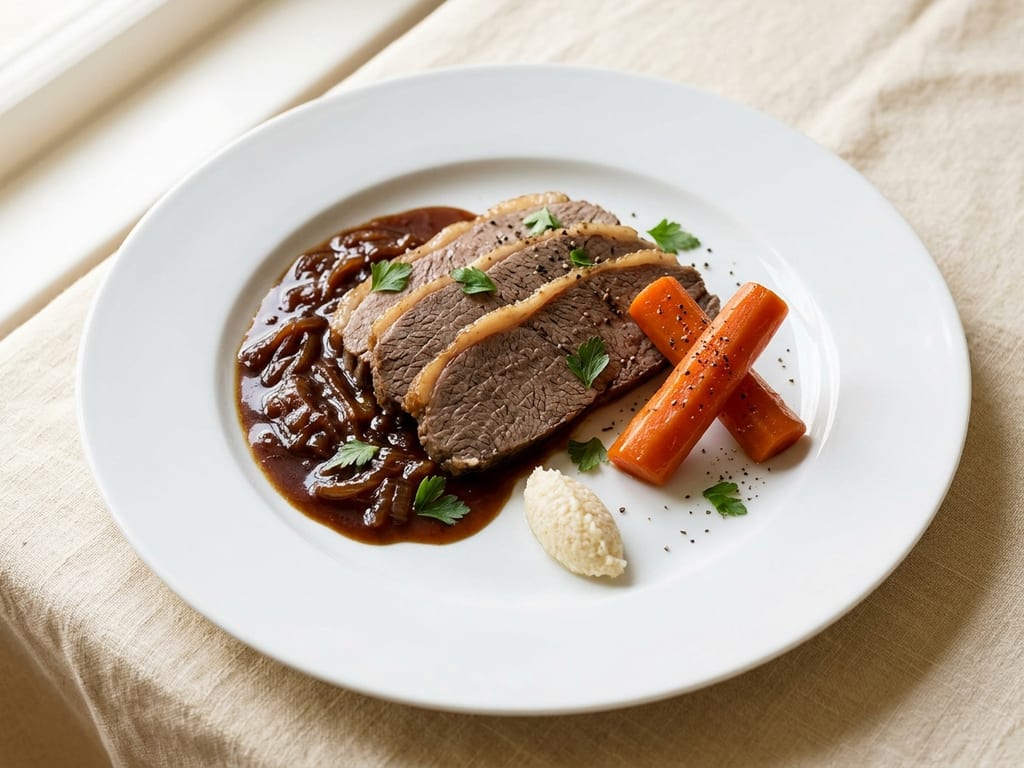
Write one sentence for each thing the prompt asks. 1: the food and why you chose it. 2: the plating style and where each part sits. 3: the garnish and the sauce, and what each adds. 4: why it looks appealing, naming the elements you can point to: colour, height, the focal point, the empty space and a clean rim. The template is ours; the rubrics we read score the plate itself, and their criteria are what sentences 2 to 4 name.5, 6 Here it is filled in for the picture below:
1 This plate is sliced brisket with glossy carrots, a small pale quenelle of horseradish and onion sauce, a good choice for a classic dinner plate because the sliced meat shows its grain and gives the plate one large, dark main shape. 2 It is plated in a classic style: three slices are shingled across the centre so each overlaps the last, the onion sauce pools under their left end, and two carrot batons and a small quenelle of horseradish sit to the right. 3 A few flat-leaf parsley leaves are scattered over the meat and the sauce for green, and the sauce stays under the brisket rather than over it, so the cut faces stay visible. 4 It looks appealing because the orange carrots and green parsley stand out against the brown meat and the white plate, the shingle is the clear focal point, and a wide band of empty plate leaves the clean rim as a frame.
On this page: The template · Six worked examples · The elements of plating · Words to use · Mistakes · Describe your own plate · FAQ
The four sentences, one by one
A class prompt that people type into search word for word reads: "In 3 to 4 sentences, provide a brief description of each plate. Describe why you chose the food items, what elements of plating and / or garnishing you used and why you believe your dish is appealing to the eye." It asks three things, and the template splits the middle one in two (plating, then garnishing), so each sentence has one job. Three sentences is fine when the plate is simple: merge 2 and 3, as two of the examples do. The sentences, starters and advice below are ours; the quoted lines under each are what the worksheets, rubrics and one textbook we read ask for or look for.
Sentence 1: The food, and why you chose it
Answers "why you chose the food items". Name the dish and its main parts in plain words, then give one real reason for the choice: the flavour pairing, the season, the colour it brings, or what the class brief asked for.
Starters: "This plate is ... with ..." · "I chose ... because ..." · "The main item is ..., served with ..."
Sentence 2: The plating style and the layout
Answers "what elements of plating you used". Name the style if the plate shows one (classic, free-form, stacked, in a bowl), then say where the main item and each side sit: centre, front, left, along a curve, on top of each other.
Starters: "I plated it in a ... style:" · "The ... sits ..., with ... behind / beside it." · "I stacked ... so that ..."
Sentence 3: The garnish and the sauce, and what they add
Answers "what elements of garnishing you used". Name each garnish and the sauce, say where they sit (under, beside, on top, as dots or a swoosh) and what each adds: a colour, a texture, or a flavour that echoes the dish.
Starters: "... on top adds ..." · "The sauce sits under / beside ... so ..." · "I garnished it with ..., which repeats ..."
Sentence 4: Why it looks appealing
Answers "why you believe your dish is appealing to the eye". Give the reasons as plating elements you can point to: the colours and how they contrast, the height, the one place the eye lands first, the empty space and the clean rim.
Starters: "It looks appealing because ..." · "The ... stands out against ..." · "The empty plate around ... keeps it from looking crowded."
What the rubrics score: the plate, not the paragraph
We read four rubric families, and all of them score the plate itself. The Texas Rubric for Plating Presentation (2012, copied almost word for word by West Virginia) gives up to 5 points each for balance, colour, shape, garnish and overall presentation; the 2025 ProStart Invitational judges colour, sauce colour, portions, a clean plate, balance, textures and shapes, and garnish; SkillsUSA (2024) gives each course 25 points for presentation and 20 for creativity without itemising them; a school team's practice sheet worded much like ProStart's scores colour, portions, a clean plate, textures and shapes, and garnish.5, 6, 7, 8 The three that itemise their criteria agree on garnish that fits the food, colour, and a clean or balanced plate, and all three mark a weak garnish down: Texas for an inappropriate, missing or excessive one, ProStart and Wekiva for an inedible one (Wekiva also a missing or random one). None of them scores a written description: the only thing written about the food that SkillsUSA scores is the menu, "Complete menu and matches dishes served.", apart from knowledge exams.7 So the rubric tells you what to mention; if your teacher marks the paragraph, their own rubric is the one to follow (ours).
Where the prompt comes from
We could not trace it to a named lesson. Nearby curricula ask for the same thing: a Texas plating-plan worksheet (2012) says "Describe your menu items and your reasons for the plate presentation.", and a CAERT lab sheet has students sketch a plate, then "write three to four sentences to describe the basic food presentation principles and styling techniques you used in the plating plan."1, 3 West Virginia's lesson has students plate one dessert, name it and photograph it for a portfolio.4 The Texas lesson "The Visual Appeal of Plating Food" bundles the worksheets and a rubric, but its lesson plan and slides could not be opened when we checked on 3 November 2026, so we do not know whether the prompt is in them.2
How long it should be
As long as the prompt says: three to four sentences a plate. The six examples below run from 103 to 155 words. Menu-writing advice such as "Keep descriptions under 25 words, ideally one to two sentences." is for a line on a restaurant menu, not for a class paragraph.34
Six plates described, with each element labelled
Each example describes a picture from one of our recipe pages. The pictures are AI renders, not dishes we plated, so the descriptions say only what is visible in them, and where a recipe's text says something the picture does not show, the note under it says so. Sentence one gives a reason the picture supports; for your own plate, give your real reason. "Sentence 1" and so on name the template sentence each one answers; the tags after it name the elements it uses and link to the word bank.
A classic dinner plate: brisket
- Sentence 1: This plate is sliced brisket with glossy carrots, a small pale quenelle of horseradish and onion sauce, a good choice for a classic dinner plate because the sliced meat shows its grain and gives the plate one large, dark main shape. ShapeFocal point
- Sentence 2: It is plated in a classic style: three slices are shingled across the centre so each overlaps the last, the onion sauce pools under their left end, and two carrot batons and a small quenelle of horseradish sit to the right. Plating styleBalanceSauce
- Sentence 3: A few flat-leaf parsley leaves are scattered over the meat and the sauce for green, and the sauce stays under the brisket rather than over it, so the cut faces stay visible. GarnishSauceColour
- Sentence 4: It looks appealing because the orange carrots and green parsley stand out against the brown meat and the white plate, the shingle is the clear focal point, and a wide band of empty plate leaves the clean rim as a frame. ColourFocal pointEmpty spaceClean rim
What we left out, and why: The recipe's text says the carrots are crossed; in the picture they lie side by side, one resting on the other, so the description says batons, not crossed. No starch is on the plate, so none is named.
A free-form plate with a swoosh: turkey gravy
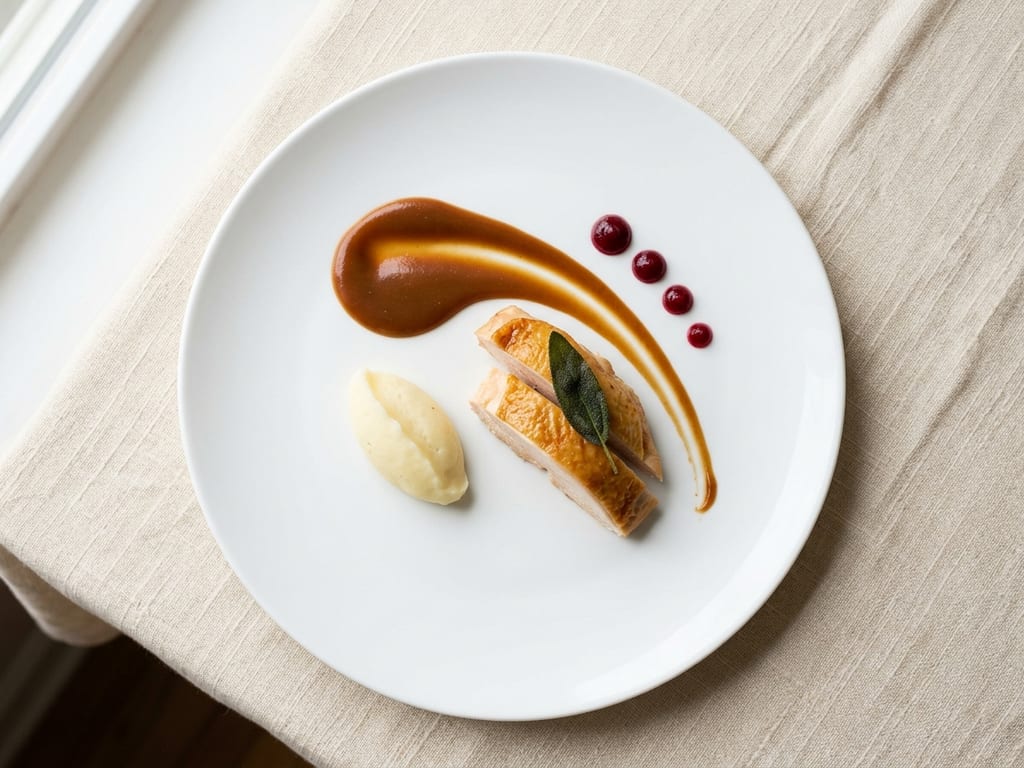
- Sentence 1: This is roast turkey with gravy, mashed potato and cranberry, plated to show off the gravy, so the sauce is the design rather than a pool under the meat. Sauce
- Sentence 2 + 3: It is plated free-form: one thick stroke of gravy curves from the upper left toward the lower right, two pieces of golden-skinned turkey lie beside the curve with a fried sage leaf on top, a quenelle of mashed potato sits to the left, and four cranberry dots follow the curve, each smaller than the last. Plating styleSauceFlowGarnish
- Sentence 4: The curve gives the plate movement, the dark red dots and the green sage are small colour accents on a mostly brown and cream plate, and more than half of the white plate is left empty, so the few pieces look placed on purpose. FlowColourEmpty space
What we left out, and why: Three sentences: the layout sentence carries the garnish and the sauce too. The recipe says "a few" cranberry dots; the picture shows four, and the potato sits below and to the left of the stroke's head, not under it.
A stacked plate, seen from the side: eggplant Parmesan
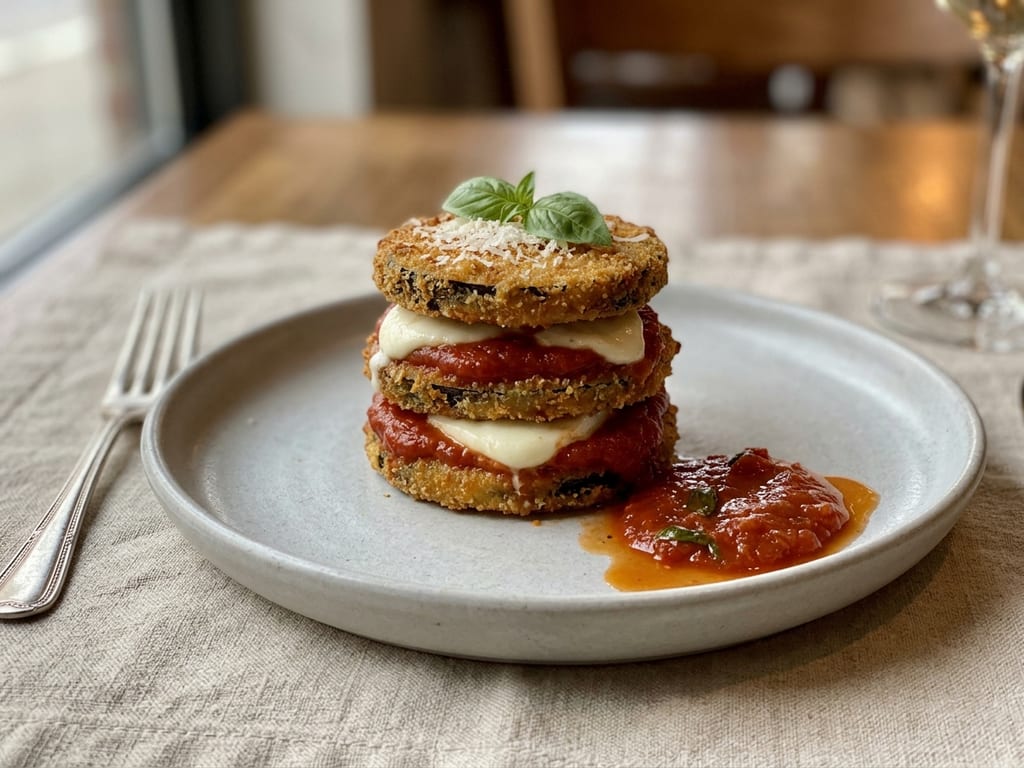
- Sentence 1: This is eggplant Parmesan built as a stack instead of a baked tray, so a single portion shows its layers. Height
- Sentence 2: Three golden breadcrumbed eggplant rounds are stacked in the centre of a pale grey plate, with red tomato sauce and melted white mozzarella between them, and a spoonful of sauce pools to the right of the stack. Plating styleHeightSauce
- Sentence 3: Grated Parmesan and a sprig of basil sit on top, so the garnish repeats the dish's own cheese and herb and adds fresh green. GarnishColour
- Sentence 4: Seen from the side, the height is the focal point: the gold, red and white layers read as stripes, the crisp edges stay visible, and the bare plate in front and to the left keeps the stack from looking crowded. Focal pointHeightColourTextureEmpty space
What we left out, and why: The recipe's text says torn mozzarella on a coupe plate; the picture shows melted slabs of cheese on a flat plate with a low rim, so the description says melted and does not name the plate type.
A soup in a wide bowl: butternut squash soup
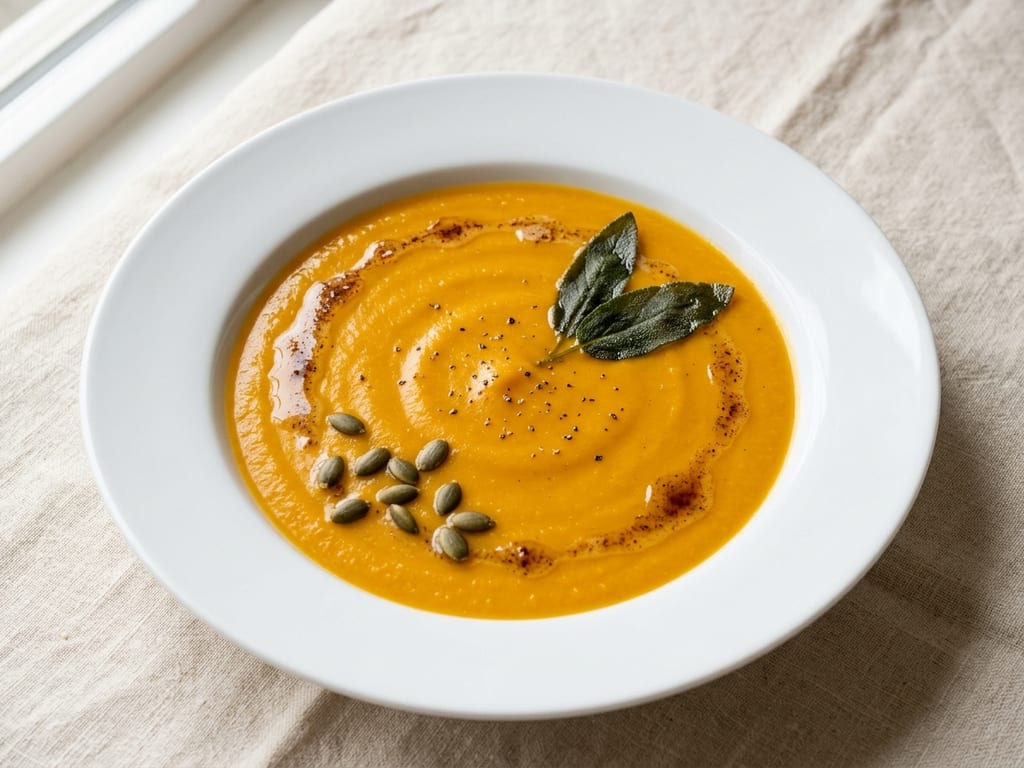
- Sentence 1: This is a smooth butternut squash soup in a wide white rimmed bowl, a dish whose bright orange is already most of the plate's colour. Colour
- Sentence 2 + 3: Because a soup is flat, the design is in the garnish: brown butter is streaked in a loose part ring near the edge, two fried sage leaves overlap at the upper right, and a small cluster of pepitas sits at the lower left, roughly opposite them. GarnishBalance
- Sentence 4: It looks appealing because the dark green sage and the olive-green pepitas contrast with the orange, the garnishes sit in separate places instead of a heap in the middle, and the clean white rim frames the soup. ColourBalanceClean rim
What we left out, and why: The butter is a part ring (streaks on three sides), so the description says part ring, not ring. With no single hero, the description names the garnishes' placement instead of a focal point.
A plain home-style salad bowl: Italian grinder salad
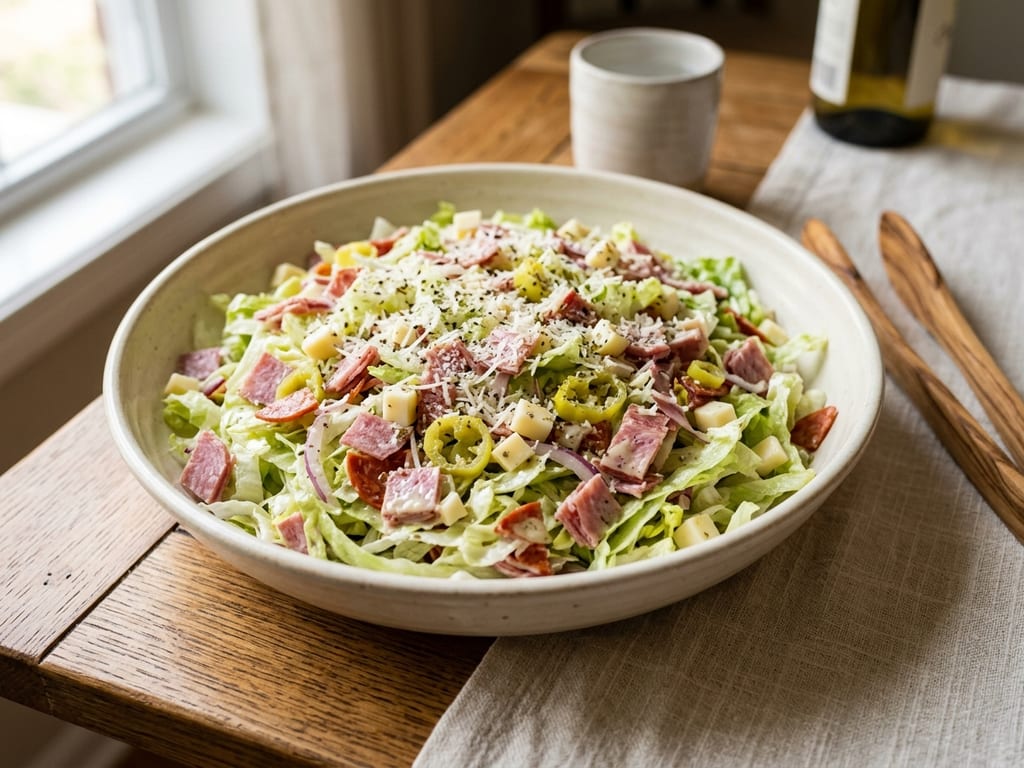
- Sentence 1: This is an Italian grinder salad, a home-style dish where the point is the mix: shredded lettuce tossed with salami, pepperoni, cheese cubes, pepperoncini rings and red onion.
- Sentence 2 + 3: It is served in one wide, shallow cream bowl and mounded gently, with everything mixed through rather than arranged, then finished with grated Parmesan and dark oregano flecks. Plating styleHeightGarnish
- Sentence 4: It looks appealing in a relaxed way: the pink salami, white cheese and yellow pepperoncini scatter colour over the pale green, the cubes, rings and shreds are all different shapes, and the bowl's rim is clean; there is no single focal point, which suits a shared salad. ColourShapeClean rimFocal point
What we left out, and why: The recipe's text says the salad is piled tall and served with tongs; the picture shows a modest mound and wooden servers lying beside the bowl, so the description says mounded gently and leaves the servers out.
A dessert with a lot of empty plate: pecan pie
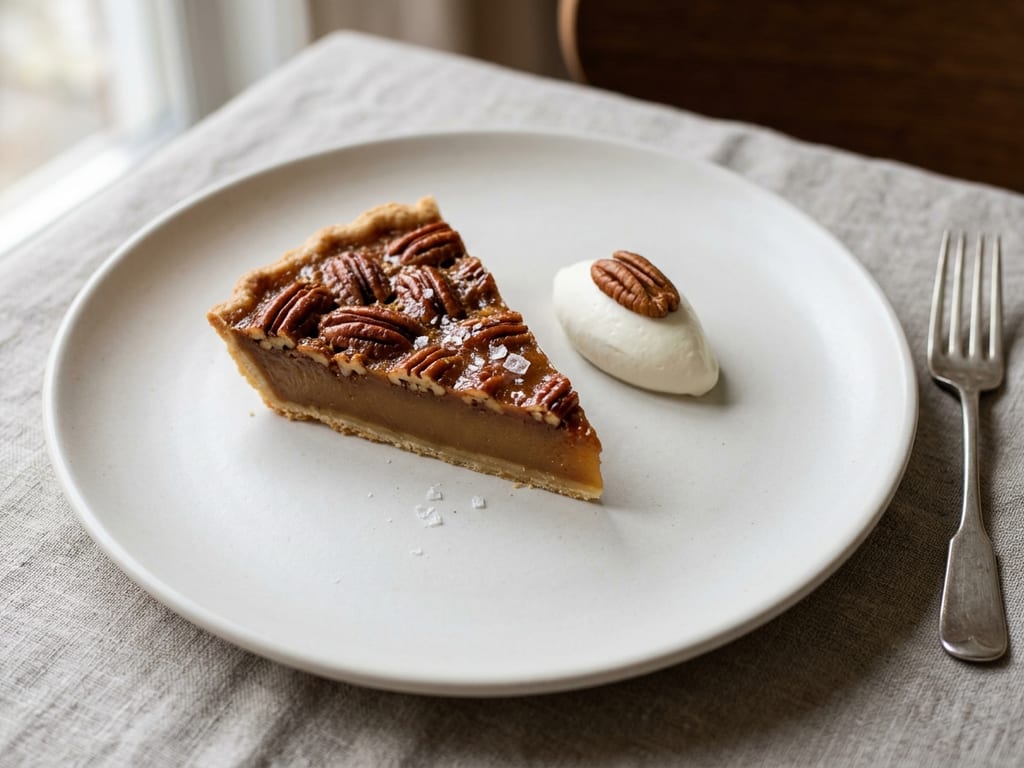
- Sentence 1: This is a slice of pecan pie with a quenelle of cream, a good dessert to plate because the glossy rows of pecans and the smooth filling on the cut side give it two clear textures. Texture
- Sentence 2: The wedge lies left of centre on a large off-white plate, its crimped crust to the left and its point toward the right, with the cream set beside the point rather than on top. BalanceEmpty space
- Sentence 3: A single pecan half on the cream repeats the pie's own nut, and a few white flakes of salt sit on the filling and on the plate. Garnish
- Sentence 4: It looks appealing because more than half the plate is left empty, which makes the slice the obvious focal point, and the white cream is the one light shape against the caramel browns; with so little colour contrast, the empty space and the shine do the work. Empty spaceFocal pointColourShape
What we left out, and why: The recipe's text says the slice stands upright on its crust; in the picture it lies flat, so the description says it lies.
What are the elements of plating? Every labelled list we found, counted
There is no single list. Curricula, textbooks and class decks print different lists under the name, and "element" means a different thing in each: design qualities you can see (colour, texture, shape, balance), the parts of the dish (main item, sauces, garnishes), or tips to follow (Unilever's five). The Texas and West Virginia worksheets are vocabulary lists, not element lists. Below: 24 lists from 22 sources, their exact words in their own order, oldest first (undated last). The first 13 show one of each kind of list; the other 11 (more copies of Unilever's tips, two principle lists, vocabulary lists and books with no count) open under "Show all". Books read only as search fragments are marked.
| Source | Printed as | Count | The list, in its order | What "element" means |
|---|---|---|---|---|
| Rogers, Creative Garnishing26 1995; garnishing book; read: search fragments | balance "achieved through" | 5 | color; shape; texture; flavor; portion | Design qualities |
| Reinhart FoodService staff training23 2007 (from the file name); food distributor's training; read: in full | Menu Planning and Serving Considerations (six numbered items) | 6 | Color; Texture / Consistency; Shape; Arrangement; Garnish; Dinnerware | Design qualities |
| Texas CTE, Plating and Garnishing Terms15 2012; state school worksheet; read: archived copy | Terms (no count) | none | Accompaniments; Balance; Bouquetiére; Classical Garnish; Focal Point; Garnish; Gross piece or centerpiece; Movement; Plating; Ravier | A vocabulary list |
| Chef Food Tools10 2014; retailer's blog; read: archived copy; a copy of Unilever's list | "The 5 Basic Elements of Plating Food" | 5 | Create a Framework; Keep It Simple; Balance the Dish; Get the Right Portion Size; Highlight the Key Ingredient | Tips (steps to follow) |
| CAERT curriculum (Illinois State Board of Education)17 2015 or later; school curriculum; read: in full | "Elements and principles of art" | 4 | balance; color; texture; space | Design qualities |
| Institute of Culinary Education video (Fine Dining Lovers)21 2017; culinary school, reported by food media; read: the report in full; video not watched | "The 4 Essential Elements of Plating" | 4 | composition; balance; shape; texture | Design qualities |
| Culinary Institute of America handout22 2024 (upload); culinary school handout; read: in full (text partly garbled) | "visual elements" | none | colors; textures; shapes; (two more it calls nonvisual: arrangements, and lines; the PDF's text is partly garbled there) | Design qualities |
| Chef Michael Beers lecture (NC Restaurant & Lodging Association)20 2025 (upload); chef's slide deck; read: in full | "BUFF" | 4 | Balance; Unity; Focal Point; Flow | Design qualities |
| Unilever Food Solutions9 undated; food brand; read: in full | "The 5 Basic Elements of Plating" | 5 | Create a Framework; Keep It Simple; Balance the Dish; Get the Right Portion Size; Highlight the Key Ingredient | Tips (steps to follow) |
| LibreTexts, Culinary Foundations18 undated; open textbook (college course); read: in full | "with the eyes of an artist" | 4 | Balance; Color; Shapes; Texture | Design qualities |
| BCcampus, Modern Pastry and Plated Dessert Techniques19 undated; open textbook (desserts); read: in full | "five characteristics" | 5 | Flavour; Texture; Temperature; Colour; Shape | Design qualities |
| Slideshare, "Basic concepts in food plating"24 undated; hospitality course deck; read: slide text | "Design Elements in Food Plating" | 5 | Line; Shape/Form; Texture; Color; Height | Design qualities |
| The Culinary Pro25 undated; culinary reference site; read: in full | "Elements of the Plate" | 5 | Main Item; Supporting Elements; Sauces; Garnishes; Plate Selection | Parts of the dish |
Show all 24 rows (11 more)
| Source | Printed as | Count | The list, in its order | What "element" means |
|---|---|---|---|---|
| On Cooking, ch. 36 (Pearson)27 2007; slides 2009 to 2019; culinary textbook and its lecture slides; read: book as fragments; slides in full | Choosing plates; Arranging foods; Composition | none | plate size, shape, color, pattern; shapes, colors, textures; white space; number of elements; focal point; height; layout | Design qualities |
| Gisslen, Professional Cooking29 2011; culinary textbook; read: search fragments | a dish's "Appearance" | none | color and color contrast; shape; shine; arrangement on the plate | Design qualities |
| CAERT curriculum, the same unit17 2015 or later; school curriculum; read: in full | "Basic principles of food presentation" | 8 | planning; plating; visual appeal; texture; proportion; sauce; garnish; balance | Principles |
| Prezi, "5 Basic Elements of Plating"11 2019; class presentation; read: in full; a copy of Unilever's list | "5 BASIC ELEMENTS OF PLATING" | 5 | Create a framework; Keep it simple; Balance the dish; Get the right portion size; Highlight the Key Ingredient | Tips (steps to follow) |
| Escoffier School blog28 2019; culinary school blog; read: in full | "the element of appearance" | none | color, size, and pattern or texture of the plate; a star item; height | Design qualities |
| NAVTTC, Textbook of Professional Chef (Pakistan)14 2022; vocational textbook; read: full OCR text; a copy of Unilever's list | "some basic elements of plating" | 6 | Create a visible artwork on the plate; Keep it simple and unique; Select one ingredient to focus on and use the maximum space to simplify the presentation; Balance the whole dish; Get the right portion size and weight of the dish; Make sure that the presentation will highlight the ingredient | Tips (steps to follow) |
| West Virginia DoE, Plating and Garnishing Terms (revised)16 2024; state school worksheet; read: archived copy; a revised copy of the Texas sheet | Terms (no count) | none | Balance; Classical Garnish; Focal Point; Garnish; Gross piece or centerpiece; Movement; Plating; Texture; Arrangement; Design | A vocabulary list |
| Slideshare, "The Five Basic Elements of Plating"12 undated; class document; read: the host's summary only; a copy of Unilever's list | "five basic elements of plating" | 5 | the same five (the host's summary) | Tips (steps to follow) |
| Slideshare, TLE 9 Lesson 4 (Philippines)13 undated; class deck; read: slide text; a copy of Unilever's list | "BASIC ELEMENTS OF PLATING" | 5 | sketch the plate; one ingredient and space; colors, shapes and textures; the right amount; the main ingredient stands out | Tips (steps to follow) |
| The same deck24 undated; hospitality course deck; read: slide text | "Principles of Art" | 7 | Emphasis; Balance; Unity-Harmony; Contrast; Movement/ Rhythm; Seqencing and Facing; Pattern/Repetition | Principles |
| Meriden Public Schools (Connecticut)30 undated; school-district curriculum; read: in full | vocabulary (no count) | none | Presentation; Plated Desserts; Composition; Shapes; Texture; Color; Complementary or Contrasting Flavors; Focal Point; Symmetrical; Asymmetrical; Garnish | A vocabulary list |
What the tally says
- Five is the most printed count, but mostly as one list. Nine rows print five; five of them are Unilever's tips and copies of them. The other four are different lists, one each: Rogers, Creative Garnishing (color, shape, texture, flavor, portion); BCcampus, Modern Pastry and Plated Dessert Techniques (Flavour, Texture, Temperature, Colour, Shape); Slideshare, "Basic concepts in food plating" (Line, Shape/Form, Texture, Color, Height); The Culinary Pro (Main Item, Supporting Elements, Sauces, Garnishes, Plate Selection). (Rogers' five are the qualities balance is achieved through, one sentence, not a labelled list.)
- Four: CAERT curriculum: balance, color, texture, space; Institute of Culinary Education video: composition, balance, shape, texture; Chef Michael Beers lecture: Balance, Unity, Focal Point, Flow; LibreTexts, Culinary Foundations: Balance, Color, Shapes, Texture. Six: Reinhart FoodService staff training (Color, Texture / Consistency, Shape, Arrangement, Garnish, Dinnerware); NAVTTC, Textbook of Professional Chef (Create a visible artwork on the plate, Keep it simple and unique, Select one ingredient to focus on and use the maximum space to simplify the presentation, Balance the whole dish, Get the right portion size and weight of the dish, Make sure that the presentation will highlight the ingredient). Lists of seven and eight are principles, not elements (CAERT's eight "Basic principles of food presentation" and a deck's seven "Principles of Art").
- Where they agree: of the 16 sources whose lists copy no other (counting a word wherever it appears in a source's list, tips, principles or term list), 11 print colour, 11 texture, 10 shape and 7 balance. Focal point (5), garnish (5), height (3), space (2) and sauce (2) are in far fewer.
- Two words have two meanings. The Texas terms key defines focal point as something that "Emphasizes and strengthens the design by giving height and direction" and balance as "Providing enough variety and contrast to hold interest"; elsewhere the focal point is where the eye lands ("What does your eye see first?", Beers) and balance is visual weight ("a feeling of equal weight", the art-principles deck). The Culinary Pro allows "one single focal point or several" on appetizers and desserts; CAERT and the CIA let a garnish be the focal point, while Beers says "Typically, it is not garnish!" Use the sense your class uses.15, 17, 20, 22, 24, 25
The "5 basic elements of plating"
In what we read, the phrase belongs to one list: Unilever Food Solutions' "The 5 Basic Elements of Plating". Its five are tips, steps to follow, not design qualities:9
- "Create a Framework - Start with drawings and sketches to visualise the plate."
- "Keep It Simple - Select one ingredient to focus on and use space to simplify the presentation."
- "Balance the Dish - Play with colours, shapes and textures to ensure diners are not overwhelmed."
- "Get the Right Portion Size - Ensure there is the right amount of ingredients and the plate complements the dish, not too big or too small."
- "Highlight the Key Ingredient - Ensure the main ingredient stands out and pay equal attention to the ‘support’."
Unilever's page is undated, so we could not date the original. The earliest dated copy we found is a Chef Food Tools post of 3 November 2014 with the same five items in near-identical words (US spelling); a 2019 Prezi, a Philippine TLE class deck and Pakistan's NAVTTC vocational textbook (2022, re-worded) repeat it.10, 11, 13, 14 Of the culinary textbooks we could open in full (LibreTexts, BCcampus) none prints it, and Gisslen and On Cooking were readable only as search fragments.27, 29 In a description, the five map onto the template (ours): framework is the plan before you plate; keep it simple and highlight the key ingredient are the focal point and the empty space (sentence 4); balance is colour, shape and texture (sentence 4); portion is the layout (sentence 2).
The 3 and 4 elements of plating
We found no list of three elements of plating. The nearest is the Culinary Institute of America's handout, "The food on a plate supplies important visual elements: colors, textures, and shapes", which goes on to name two more it calls nonvisual (arrangements, and lines; the PDF's text is partly garbled there).22 Lists of four exist, but four different ones: balance, color, texture, space (CAERT curriculum); composition, balance, shape, texture (Institute of Culinary Education video); Balance, Unity, Focal Point, Flow (Chef Michael Beers lecture); Balance, Color, Shapes, Texture (LibreTexts, Culinary Foundations).17, 18, 20, 21 If your class gives a list of three or four, describe your plate with your teacher's list (ours).
The elements this page's template uses
The template uses plain names drawn from what the lists share, plus the parts of the plate you can see. The set is ours, not any one source's; the table says how many of the 16 independent sources print each.
| Element | Printed by | In a description, say |
|---|---|---|
| Balance | 7 of 16 | Two senses: visual weight spread across the plate, and (in school lists) enough variety and contrast to hold interest. |
| Colour | 11 of 16 | The colours on the plate and how strongly they differ from each other and from the plate. |
| Texture | 11 of 16 | What the surface of the food looks like: crisp, smooth, glossy, rough. |
| Shape | 10 of 16 | The outlines of the pieces: rounds, wedges, slices, cubes, ribbons, dots. |
| Height | 3 of 16 | How far the food rises off the plate: flat, a low mound, a lean, a stack. |
| Focal point | 5 of 16 | The place the eye lands first; on a main course, usually the main item. |
| Empty (negative) space | 2 of 16 | The bare plate around the food, which frames it. |
| Garnish | 5 of 16 | An item added to enhance the dish, usually edible, that adds colour or echoes a flavour in it. |
| Sauce | 2 of 16 | Where the sauce sits and what shape it takes: under, on top, around, a pool, a swoosh, dots. |
Is a garnish always edible? Of the sources we read, four say so (Unilever, LibreTexts, Reinhart and the NAVTTC textbook), and most of the rest do not rule on it: "Garnishes should always be edible" (Unilever), "garnishes must be related to the dish and should always be edible" (LibreTexts), Reinhart's staff training says they "must be edible", and NAVTTC says "It should always be edible". CAERT allows an exception: "Most chefs would insist on an edible garnish, although occasionally a nonedible one may be used." 9, 14, 17, 18, 23 Two of the rubrics we read mark an inedible garnish down (ProStart: "Inedible garnish"; Wekiva: "Inedible, missing, or random garnish"), so on a class plate, keep it edible (ours).6, 8
The words to use, element by element
One line on what each element means, words to describe it, who the words come from, and a link to the full definition. Words you can see work best in a description of a picture; taste and smell words (tangy, smoky, aromatic) belong in a description of a dish you have eaten (ours).
Focal point
The place the eye lands first; on a main course, usually the main item.
Words: stands out, draws the eye first, the centre of the plate, the main item, a secondary accent. (ours; "What does your eye see first?" is Chef Beers' test)20
Height
How far the food rises off the plate: flat, a low mound, a lean, a stack.
Words: stacked, layered, leaning, a low mound, tall, flat. (ours)
Colour
The colours on the plate and how strongly they differ from each other and from the plate.
Words: vibrant, golden-brown, bright, deep, pale, a pop of green; one colour only is "monochromatic". (vibrant and golden-brown: British Council; monochromatic: LibreTexts; the rest ours)18, 32
Texture
What the surface of the food looks like: crisp, smooth, glossy, rough.
Words: crispy, creamy, rough, smooth, glazed (a shiny surface), crunchy, tender, chewy. (crispy, creamy, rough, smooth: the West Virginia terms key; glazed, crunchy, tender, chewy: British Council)16, 32
Shape
The outlines of the pieces: rounds, wedges, slices, cubes, ribbons, dots.
Words: round, wedge, shingled slices, cubes, rings, a quenelle (an egg shape), ribbons. (ours; LibreTexts adds that "knife skills can offer a variety of shapes")18
Balance
Two senses: visual weight spread across the plate, and (in school lists) enough variety and contrast to hold interest.
Words: balanced, symmetrical, asymmetric, evenly spread, lopsided. (asymmetric: the art-principles deck; symmetrical and asymmetrical: the CIA handout; the rest ours)15, 22, 24
Flow, or movement
The path the eye follows across the plate.
Words: horizontal, vertical, diagonal, curvy, zig-zag, sweeps, follows the curve. (the line words: the art-principles deck; sweeps and follows the curve: ours)15, 24
Empty (negative) space
The bare plate around the food, which frames it.
Words: room to breathe, uncrowded, crowded, sloppy, lost on the plate. (crowded, sloppy and lost on the plate: CAERT; the rest ours; "negative space is as important as what's on the plate" (Maggie Beer Foundation))17, 31
Rim
The border round the plate's well; in a description, say whether it is clean.
Words: a clean rim, wiped, framed, smears, drips. (ours; ProStart's top band reads "Clean plate")6
Garnish
An item added to enhance the dish, usually edible, that adds colour or echoes a flavour in it.
Words: a sprig of, a scatter of, a dusting of, a single leaf, echoes, repeats, accents. (ours; The Culinary Pro asks for garnishes that "echo some of the ingredients")17, 25
Sauce
Where the sauce sits and what shape it takes: under, on top, around, a pool, a swoosh, dots.
Words: a pool, a swoosh, dots, a drizzle, a smear, glossy, spooned under. (the shapes: the sauce moves on our plating techniques page; glossy: ours)17
Plating style
The name for the whole layout, when the plate shows one.
Words: classic, free-form, landscape, stacked, Nordic, deconstructed, served in a bowl, family style. (the style names: our plating techniques glossary; in a bowl and family style: ours)
Words to avoid, or to back up with a reason
- good, bad: "very general and don't really describe food" (British Council)32
- delicious, yummy: food writers avoid them (Ploughshares); a picture cannot show taste anyway (ours)33
- nice, fantastic: "No “nice” chicken stock, no “fantastic” beans here." (Ploughshares)33
- rich, over and over: "Overusing “rich”" is one of the British Council's common mistakes32
- light and rich together: "might be confusing unless you explain how those qualities work together" (British Council)32
- perfect, beautiful, amazing: praise without a reason; say what makes it so (ours)
The British Council's own example of the fix: instead of "The biscuits looked good," write "The golden-brown biscuits were rustic and looked delicious."32
Common mistakes in a plate description, and better versions
The first five are named by the sources credited beside them; the last two are our advice. The better versions describe the example pictures above.
| Mistake | Weak | Better |
|---|---|---|
| Vague praise32, 33, 34 British Council; Ploughshares; MyDigiMenu ("“Crispy” does more work than “delicious.”") | "The plate looks good and the turkey looks delicious." | "The golden turkey skin and four dark-red cranberry dots stand out on the white plate." |
| Piling up adjectives33 Ploughshares: "piling adjectives makes the writing overblown and cloying" | "A gorgeous, vibrant, rustic, elegant, mouth-watering soup." | "A bright orange soup with two dark green sage leaves." |
| One word, over and over32 British Council ("Overusing “rich”") | "Rich brisket in a rich sauce with rich carrots." | "Dark, glossy onion sauce under the brisket, with orange carrots beside it." |
| Words that fight each other32 British Council ("Make sure that all the words you use to describe a dish fit well together.") | "The pie looks light and rich." | "The filling looks dense and glossy; the cream beside it is the light part." |
| Saying what is not there29 Gisslen, on menus: "Accurate and truthful descriptions, however, are required." Using it for a plate description is ours. | "The carrots are crossed over each other at the end of the slices." | "Two carrot batons lie side by side at the end of the slices." |
| Listing ingredients instead of choices Ours | "Lettuce, salami, pepperoni, cheese, pepperoncini, onion, Parmesan, oregano." | "The salami, cheese and pepperoncini are mixed through the lettuce rather than arranged, so every serving gets some." |
| Naming a style the plate does not show Ours | "I used the clock method for my eggplant stack." | "I stacked it, so the height, not where things sit on the plate, is the main idea." |
Describe your own plate
Our checklist, before and while you write:
- Look before you write. Look at the plate (or your photo of it) from where the diner sits, and note what is where before you pick any words.
- Name only what is visible. If the recipe says crossed and the plate shows side by side, write side by side; Gisslen's rule for menus holds for plates too: "Accurate and truthful descriptions, however, are required."29
- One reason per choice. Each garnish, each placement, one reason: the colour it adds, the texture, the flavour it echoes.
- Name the elements by name. Colour, height, focal point, empty space, a clean rim: the plain set or the list your class uses.
- Read it against the prompt. Why these foods, which plating and garnishing elements, why it is appealing to the eye: one sentence for each, three to four in all.
Get the elements of your own plate named
Not sure what your plate shows? Our free rate my plating tool looks at one photo and scores five parts from 1 to 10, colour, height, empty space, focal point, clean rim, each with one sentence about your plate; the overall score is the mean of the five; it gives two tips for the weakest parts and, from 7.0, a small badge. One free rating a day, no account. It is an AI opinion, and it does not write a description or grade one: the sentences are still yours to write.
Describing food plating, answered
How do you describe food plating?
Write one sentence for each thing a plating description has to cover: the food and why you chose it; the plating style and where each part sits; the garnish and the sauce and what each adds; and why it looks appealing, naming the elements you can point to (colour, height, the focal point, the empty space, a clean rim). Describe only what is on the plate, in plain words.
In 3 to 4 sentences, how do I describe each plate, why I chose the food, the plating and garnishing elements, and why it is appealing to the eye?
Give each part of the prompt its own sentence. Sentence 1: the food and one real reason you chose it. Sentence 2: the plating style and the layout. Sentence 3: the garnish and sauce and what they add. Sentence 4: why it is appealing to the eye, by element: colour contrast, height, the focal point, the empty space and a clean rim. On a simple plate, sentences 2 and 3 can be one.
What are the 5 elements of plating?
There is no single list. In what we read, the "5 basic elements of plating" in class decks and on Prezi is Unilever Food Solutions' list of five tips: Create a Framework, Keep It Simple, Balance the Dish, Get the Right Portion Size, Highlight the Key Ingredient; its own date is unknown and the earliest dated copy we found is from 2014. Other lists of five are different: color, shape, texture, flavor, portion (Rogers, Creative Garnishing); Flavour, Texture, Temperature, Colour, Shape (BCcampus, Modern Pastry and Plated Dessert Techniques); Line, Shape/Form, Texture, Color, Height (Slideshare, "Basic concepts in food plating"); Main Item, Supporting Elements, Sauces, Garnishes, Plate Selection (The Culinary Pro).
What are the 4 elements of plating?
We found four lists of four, all different: balance, color, texture, space (CAERT curriculum); composition, balance, shape, texture (Institute of Culinary Education video); Balance, Unity, Focal Point, Flow (Chef Michael Beers lecture); Balance, Color, Shapes, Texture (LibreTexts, Culinary Foundations). Balance appears in all four.
What are the 3 elements of plating?
We found no list of three elements of plating in the curricula, textbooks and decks we read. The nearest is the Culinary Institute of America's handout, "The food on a plate supplies important visual elements: colors, textures, and shapes", which goes on to name two more. If your class uses a list of three, use your teacher's.
What are the elements of plating?
It depends on the source: in the 24 lists we read, "elements" are design qualities (colour, texture, shape, balance), the parts of the dish (main item, sauces, garnishes) or tips to follow, and the counts of element lists run from four to six (two lists of principles run to seven and eight). Of the 16 sources that copy no other, 11 print colour, 11 texture, 10 shape and 7 balance.
What words describe food presentation?
Words you can see, grouped by element: colour (vibrant, golden-brown, bright, pale), texture (crispy, creamy, smooth, glazed), shape (round, wedge, shingled slices, cubes), height (stacked, layered, a low mound), space (uncrowded, crowded), flow (curved, diagonal), and the plating style (classic, free-form, stacked). Avoid vague praise such as good, nice and delicious, and say why instead.
How do you describe a garnish?
Name it, say where it sits and what it adds: "A sprig of basil on top repeats the dish's own herb and adds fresh green." In the sources we read, a garnish should fit the dish; where they rule on it, four say it must always be edible and CAERT allows an occasional nonedible one, and two of the rubrics we read (ProStart and Wekiva) mark an inedible garnish down.
How long should a plate description be?
As long as the prompt asks: three to four sentences a plate. The six examples on this page run from 103 to 155 words. Advice to keep descriptions under 25 words is for menu lines, not class paragraphs.
How do you describe a plate of food?
Look first, then write what is there: the food in plain words, where each part sits, what the garnish and sauce add, and why the whole looks appealing (colour, height, the focal point, empty space, a clean rim). Name only what is visible, give one reason per choice, and skip words that only praise.
What is a good plating description example?
This plate is sliced brisket with glossy carrots, a small pale quenelle of horseradish and onion sauce, a good choice for a classic dinner plate because the sliced meat shows its grain and gives the plate one large, dark main shape. It is plated in a classic style: three slices are shingled across the centre so each overlaps the last, the onion sauce pools under their left end, and two carrot batons and a small quenelle of horseradish sit to the right. A few flat-leaf parsley leaves are scattered over the meat and the sauce for green, and the sauce stays under the brisket rather than over it, so the cut faces stay visible. It looks appealing because the orange carrots and green parsley stand out against the brown meat and the white plate, the shingle is the clear focal point, and a wide band of empty plate leaves the clean rim as a frame.
How do you describe classic plating?
Say where the main item and the sides sit and how the sauce relates to them: "three slices are shingled across the centre, the onion sauce pools under their left end, and two carrot batons sit to the right." Classic plating is often taught with a clock face, but the sources print different hours, so describe the positions you used rather than quoting one set of hours as the rule.
What do plating rubrics look for?
The rubrics we read score the plate itself: the Texas Rubric for Plating Presentation (2012) gives up to 5 points each for balance, colour, shape, garnish and overall presentation, and the 2025 ProStart Invitational judges colour, portions, a clean plate, balance, textures and shapes, and garnish. None of them scores a written description, so use their criteria as what to mention.
Can a tool write my plate description?
Not ours. Our rate my plating tool scores five parts of a plated dish from one photo (colour, height, empty space, focal point, clean rim), with one sentence on each and two tips, and from 7.0 a badge. It does not write or grade a description; it can help you see which elements your plate shows before you write.
Want to see your own plate plated differently? Photograph it and Plate Artists re-plates that dish, with the food kept as it is and the changes named. Start with a re-plate.
Your food, plated like a chef's
Snap it, upload it, and get the composed version back, with the steps to recreate it at home.
Start free · 1 enhancement →Free account · 1 free enhancement · No credit card
How this page was made
We plated nothing and tested nothing for this page. We read the sources below on 2 and 3 November 2026: web pages and PDFs in full (some through an archived copy or a headless browser, as each entry says), the lending-only textbooks as Internet Archive full-text search fragments, and two slide decks only as far as their host showed them. Lists are copied as printed and counted once per source; the template, the checklist and sentences marked ours are our advice. The six pictures are AI renders from our recipe pages, described by eye; none was run through the rating tool, so no score is printed for them.
The curricula, rubrics, textbooks and writing guides behind this page
How each source was read (in full, in an archived copy, through a headless browser, as search fragments of a lending-only scan, or only as a host's summary) is in its entry. Brands, shops and class decks are labelled.
- Texas Education Agency (2012). Plating Plan for Visual Appeal (Round Plate). Iron Chef Classroom Challenge. Texas CTE (txcte.org), a worksheet in the lesson "The Visual Appeal of Plating Food": "Describe your menu items and your reasons for the plate presentation."; the sketch above it "should include proper balance, color, proportion, serving size, and placement"; read on 3 November 2026 in an Internet Archive (Wayback) copy, because txcte.org returned a maintenance page. txcte.org (PDF)
- Texas CTE (Stephen F. Austin State University) (n.d.). Lesson Plan: Visual Appeal of Plating Food (grades 10 to 12). Texas CTE resource page, the resource page lists the lesson plan, a slide deck, the terms worksheet and key, two plating plans and a plating rubric; the page was read in an Internet Archive (Wayback) copy, because txcte.org returned a maintenance page; the lesson plan .docx and the deck could not be read (no archived copy), so we do not know their wording. txcte.org
- CAERT, Inc. (n.d.). Lab sheet LS-A, Food Presentation Design Sketch, in Lesson L700101 Food Styling and Presentation. Illinois State Board of Education, CTE documents, students sketch one of three scenarios, then: "Label each food component on the sketch. Then write three to four sentences to describe the basic food presentation principles and styling techniques you used in the plating plan." (p. 27); undated, resources accessed September 2015; read in full on 3 November 2026. isbe.net (PDF)
- West Virginia Department of Education (2024). Hospitality and Tourism Cluster, Lesson 3: plating and naming a dessert. wvde.us, students plate one dessert from a Plating Plan, name it, and the teacher photographs the plates for a portfolio; it lists the Texas plating plan and deck among its resources; file dated 2024/02 in its URL; read on 3 November 2026 in an Internet Archive copy. wvde.us (PDF)
- Texas Education Agency (2012). Rubric for Plating Presentation. Texas CTE (txcte.org); copied, with small wording changes, as West Virginia's Plating Presentation Rubric (2024), five criteria scored 5 to 0: Proper Balance, Use of Color, Shape (proportion), Use of Garnish, Overall Product Presentation; a rubric for the plate, not for a written description; read on 3 November 2026 in an Internet Archive (Wayback) copy, because txcte.org returned a maintenance page, the West Virginia copy also in an archived copy. txcte.org (PDF)
- National ProStart Invitational (National Restaurant Association Educational Foundation) (2025). 2025 Judging Rubric: Culinary Competition. competition rubric, hosted by a state affiliate, the Appearance Score, p. 9: colour and proper cooking, sauce colour, portion sizes, "Clean plate, with appetizing appearance and presentation", "Balanced presentation", "Multiple textures and shapes displayed", "No inedible garnish"; read in full on 3 November 2026. noviams.com (PDF)
- SkillsUSA (2024). Culinary Arts Competition, High School (and Post-Secondary) 2024. competition guideline, each course is scored for Presentation (25 points) and Creativity (20), with no itemised presentation criteria; the written parts are the menu (10 points; "Complete menu and matches dishes served."), a 100-point certification exam and a 25-point professional development test; none describes a plate; read in full on 3 November 2026. skillsusa.org (PDF)
- Wekiva High School culinary programme (n.d.). Competition team practice scoring sheets. wekivaculinary.org (a school team's sheet, worded much like ProStart's), "Garnish accentuates taste and attractiveness of plate" against "Inedible, missing, or random garnish"; undated (file path 2023/05); read in full on 3 November 2026. wekivaculinary.org (PDF)
- Unilever Food Solutions UK (n.d.). Food plating ("The 5 Basic Elements of Plating"). Unilever Food Solutions (food brand), five tips: Create a Framework, Keep It Simple, Balance the Dish, Get the Right Portion Size, Highlight the Key Ingredient; plus garnish rules ("Garnishes should always be edible"); undated (its first publication date not found); read in full on 2 November 2026 through a headless browser. unileverfoodsolutions.co.uk
- Chef Food Tools (2014). Plating Food Techniques For Beautiful Food Presentation (section: The 5 Basic Elements of Plating Food). retailer's blog, 3 November 2014; the same five items in near-identical words to Unilever Food Solutions' (US spelling), the earliest dated copy we found; read in an Internet Archive copy (2 November 2026). web.archive.org
- Dave, M. (2019). 5 Basic Elements of Plating. Prezi (a class presentation), updated 19 September 2019; the same five items in the same order; read in full on 3 November 2026 through a headless browser. prezi.com
- JadeAnnNapao (uploader) (n.d.). The Five Basic Elements of Plating.docx. Slideshare, undated; only the host's own summary of the document was readable on 3 November 2026 (the text sits behind the viewer), so it shows the title and that the same five items are listed, nothing more. slideshare.net
- JANETHDOLORITO (uploader) (n.d.). TLE 9 Lesson 4 (a Philippine Technology and Livelihood Education deck). Slideshare, undated; a slide headed "BASIC ELEMENTS OF PLATING" with the same five items in shortened form; slide text read on 2 November 2026 through a headless browser. slideshare.net
- National Vocational and Technical Training Commission (Pakistan) (2022). Textbook of Professional Chef for 10th (Test Edition). NAVTTC, p. 67, "There are some basic elements of plating": six bullets, a re-worded version of the same five (its third splits Unilever's second item); pp. 55 to 56 on garnish ("It should always be edible"); read 3 November 2026 as the Internet Archive's full OCR text of the book (inside the Internet Archive item "Matric Tech Textbooks by NAVTTC"). archive.org
- Texas Education Agency (2012). Plating and Garnishing Terms (and Key), in The Visual Appeal of Plating Food. Texas CTE (txcte.org), ten terms defined, not a list of elements: Accompaniments, Balance, Bouquetiére, Classical Garnish, Focal Point, Garnish, Gross piece or centerpiece, Movement, Plating, Ravier; read on 3 November 2026 in an Internet Archive (Wayback) copy, because txcte.org returned a maintenance page. txcte.org (PDF)
- West Virginia Department of Education (2024). Plating and Garnishing Terms (Key). wvde.us, a revised copy of the Texas sheet: drops Accompaniments, Bouquetiére and Ravier and adds Texture, Arrangement and Design; file dated 2024/02; read on 3 November 2026 in an Internet Archive copy. wvde.us (PDF)
- CAERT, Inc. (n.d.). Food Styling and Presentation: E-unit 700101. Illinois State Board of Education, CTE documents, pp. 1 to 4: "Elements and principles of art (e.g., balance, color, texture, and space)", eight "Basic principles of food presentation", and definitions of proportion, balance and garnish ("occasionally a nonedible one may be used"); undated (2015 or later), a school-level family and consumer sciences curriculum; read in full on 2 November 2026 and re-read in the saved copy on 3 November. isbe.net (PDF)
- Cheramie, R., & Thibodeaux, J. (n.d.). Culinary Foundations, 4.01 Food Presentation. LibreTexts Workforce (open textbook, CC BY-NC-SA 4.0), "Professional chefs look at their creations with the eyes of an artist": Balance, Color, Shapes, Texture; also the rim as a frame and garnish rules; read in full on 3 November 2026. libretexts.org
- BC Cook Articulation Committee (n.d.). Modern Pastry and Plated Dessert Techniques, 2.1 Plan Dessert Plating and 4.1 Design Principles for Plating Food. BCcampus (open textbook, CC BY 4.0), five "characteristics" for a plated dessert (flavour, texture, temperature; colour, shape) and a design checklist with flow, movement and negative space; read in full on 3 November 2026. libretexts.org
- Beers, M. (chef) (2025). Plate Presentations: Balance, Unity, Focal Point and Flow (lecture slides). North Carolina Restaurant & Lodging Association, "BUFF": Balance, Unity, Focal Point, Flow; uploaded October 2025, slides undated; read in full on 3 November 2026. ncrla.org (PDF)
- Fine Dining Lovers; Institute of Culinary Education (2017). The 4 Essential Elements of Plating (a report of an ICE video), and the ICE blog post Lessons 50-54: Food Art. Fine Dining Lovers; ice.edu, 28 April 2017: composition, balance, shape and texture, in the report's words (the video itself not watched); read in full on 2 November 2026 (report) and 3 November (blog). finedininglovers.com
- The Culinary Institute of America (2024). Technique of the Quarter: Enhancing Food Presentation. ciachef.edu (an admissions handout), "The food on a plate supplies important visual elements: colors, textures, and shapes", followed by two more it calls nonvisual (arrangements, and lines), partly garbled in the PDF's text; uploaded July 2024; read in full on 3 November 2026. ciachef.edu (PDF)
- Reinhart FoodService (2007). The Aesthetics of Plate Presentation (Dietary Employee Training Program). staff training handout, six factors: Color, Texture / Consistency, Shape, Arrangement, Garnish, Dinnerware; dated May 2007 by its file name only; read in full on 3 November 2026. familyconsumersciences.com (PDF)
- GwennMagangoCabagay (uploader) (n.d.). Basic concepts in food plating (platingusingartprincipleslecture.ppt). Slideshare (a hospitality course deck), undated; slide 16 "Design Elements in Food Plating": Line, Shape/Form, Texture, Color, Height; slide 29, seven principles of art; slide text read on 3 November 2026 through a headless browser. slideshare.net
- The Culinary Pro (ARD Culinary, Inc.) (2026). Plate Presentations: Elements of the Plate. theculinarypro.com, "elements" as the parts of the dish: Main Item, Supporting Elements, Sauces, Garnishes, Plate Selection; "there may be one single focal point or several" on appetizers and desserts; undated; read in full on 3 November 2026 through a headless browser. theculinarypro.com
- Rogers, M. R. (1995). Creative Garnishing: Beautiful Ways to Enhance Meals. book, "Balance is achieved through careful arrangement of color, shape, texture, flavor, and portion"; read 3 November 2026 as Internet Archive full-text search fragments of a lending-only scan. archive.org
- Labensky, S., et al. (Pearson) (2007). On Cooking: A Textbook of Culinary Fundamentals, ch. 36 Plate Presentation; and the publisher's ch. 36 lecture slides (slides 2009 to 2019). Pearson Prentice Hall, the 2007 scan read as Internet Archive full-text search fragments of a lending-only scan (a short window of text, no page image); no element list or count was readable; the lecture deck (uploaded to Slideshare by a third party) splits choosing plates, arranging foods and composition and prints no count. archive.org
- Auguste Escoffier School of Culinary Arts (2019). The Art of Food Presentation. escoffier.edu blog, first published 20 February 2019 per its footer, since updated; colour, size and texture under "the element of appearance", no count; read in full on 2 November 2026. escoffier.edu
- Gisslen, W. (2011). Professional Cooking. Wiley, the plating and garnish pages read as Internet Archive full-text search fragments ("Appearance (color and color contrast, shape, shine, arrangement on the"; no element list readable); the section "Menu Terminology and Accuracy" read in the Internet Archive's OCR text of the scan (page not captured). archive.org
- Meriden Public Schools (Connecticut) (n.d.). 706 Baking Techniques, Unit 3 Lesson 2: Food Presentation. school-district curriculum, a vocabulary list and the question "How can the color, texture, shape, temperature and size of each food component affect a plate design?"; read in full on 3 November 2026. meridenk12.org
- Maggie Beer Foundation (n.d.). Feast for the eyes. chef-trainer article (PDF), eight headings from "Balance and composition" to "Theme and storytelling", and "Don't overcrowd the plate; negative space is as important as what's on the plate."; undated; read in full on 3 November 2026. maggiebeerfoundation.org.au (PDF)
- British Council English Online (2024). 26 Deliciously Descriptive Words to Describe Food. English-learning blog, 10 October 2024; five appearance words (appetising, golden-brown, glazed, rustic, vibrant), texture words and "Common mistakes to avoid"; an English-teaching page, not a culinary one; read in full on 3 November 2026. britishcouncil.org
- Ploughshares (Emerson College) (n.d.). Adding Taste to Food Writing. Ploughshares blog, a writing-craft post citing Dianne Jacob's Will Write for Food (the book itself not read): "piling adjectives makes the writing overblown and cloying"; read in full on 3 November 2026. pshares.org
- MyDigiMenu (n.d.). Menu item description best practices for restaurants. menu-software vendor's blog, advice for MENU lines, not for class paragraphs: "Use one to two sensory words per dish" and "Keep descriptions under 25 words"; undated; read in full on 3 November 2026. mydigimenu.com
Keep going
Plating techniques and styles
Every style and composition term on this page, defined and shown.
Plating 101
The plating itself, step by step, before you write about it.
The clock method of plating
Classic plating by the clock, every published layout side by side.
Color on the plate
The colour words, and how to use colour on a plate.
Food garnish ideas
The garnish types, and how to make each one.
Rate my plating
A free AI score for five parts of your own plate, from one photo.