Sauce plating techniques: every move, its names and the thickness it needs
There are about a dozen ways to put sauce on a plate, and most have several names: the swoosh is also the smear, the swipe and, in the textbooks, a streak. Each needs its own consistency, thick and smooth for a swoosh, thin for a brush stroke, and no source we read gives that consistency as a number. This page names every move, says who calls it what, and quotes the steps from the sources that print them.
The photos on this page are AI-generated illustrations.
Sauce plating techniques and their names
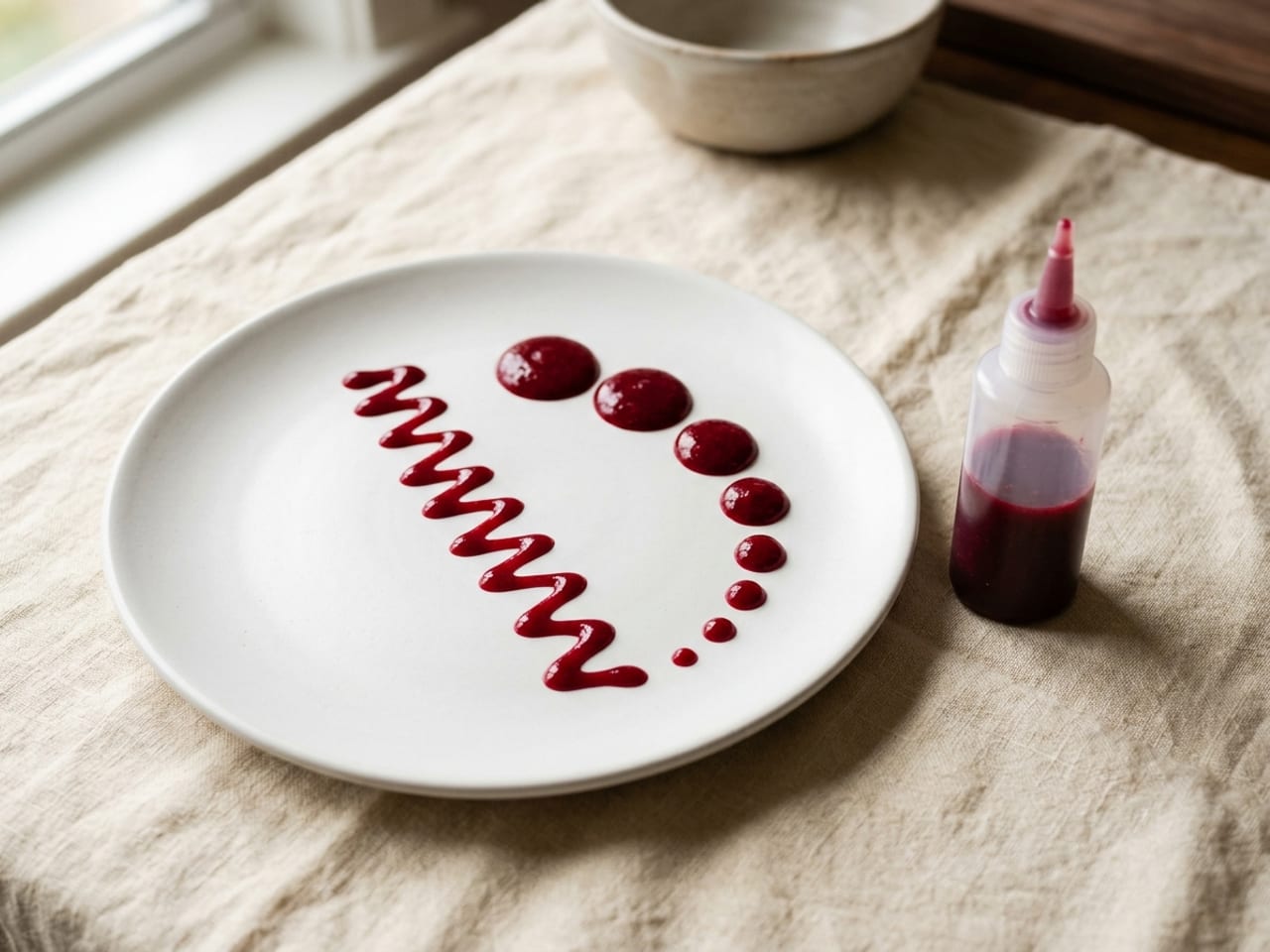
The moves are the swoosh or smear, dots, dragged dots, lines and zigzags, rings and spirals, the pool, sauce spooned over, the cordon, the brush stroke, the splatter, the two-sauce dessert patterns and flavoured oil. One row each below: what it is, every other name a named source uses for it, the tool, and the consistency those sources give. No source reconciles the names, so read "also called", never "properly called" (our reading of them). Each name links to its card.
| The move | What it is | Also called, and by whom | The tool | The consistency sources give |
|---|---|---|---|---|
| Swoosh or smear | A spoonful of thick sauce or purée, pulled across the plate with a spoon in one motion. | "Dollop and Swoop", "swoosh" and "Spoon It" (America's Test Kitchen);1, 2 "spoon swipe" (Tasting Table);3 "spoon swoosh", "spoon drag" and "sauce tail" (Tundra);11 "The smear" (CBC, Daniel Wilson, Rosanna ETC);5, 8, 13 "Smeared Sauce Plating Technique" (WebstaurantStore);7 "Sauce Swoosh" (Slurrp);10 "streaking" (the pastry textbooks);28, 31 "streaks or ribbons of sauce" (Gisslen, describing a style of plate, not a technique).34 | A spoon: its back for eight sources, its tip for three. The count is below. WebstaurantStore also allows "a spoon or plating wedge".7 | "thick, smooth sauces like a rouille or a puree" (America's Test Kitchen);1 "think yogurt or heavy cream" (Tasting Table);3 "thickish sauce or purée" (Daniel Wilson).13 |
| Dots | Small round drops of sauce, set down one at a time from a bottle or the tip of a spoon. | "dots" (America's Test Kitchen, Tasting Table, Gisslen);1, 3, 31 "Accent Dots" (WebstaurantStore);7 "The Sauce Dots Technique" (Unilever);6 "Dotting" (Le Cordon Bleu Malaysia, Cookist);9, 23 "The Spot" (Rosanna ETC);5 "Droplets" (Slurrp, the Institute of Culinary Education);10, 16 "Classic Dot work" (Greg Greenfield).15 | A squeeze bottle in most sources;1, 3, 6, 15 the end of a spoon for Rosanna Stevens and, by NPR's account, in Joël Robuchon's kitchen.5, 91 | Disputed. "a thick, smooth sauce that will stay put" (America's Test Kitchen)1 against "ideal for thinner sauces such as demi glazes" (Untappd).14 |
| Dragged dots | A dot, or a row of dots, pulled into a tail, a teardrop or a joined row with a thin tool. | "Smeared Accent Dots Plating Technique" (WebstaurantStore);7 a sauce "teardrop" or "swoosh" (the Institute of Culinary Education, for one drop pulled with a skewer);16 "The Streak" (Rosanna ETC, for a spot pulled into a line);5 "hearts" (The Nibble).19 | A plating wedge (WebstaurantStore), a skewer or, "If in a pinch", a spoon (the Institute of Culinary Education), the handle end of a spoon (Rosanna ETC) and, for lines and circles rather than dots, a toothpick (Julianne Glatz).5, 7, 16, 20 | "a drop of thickened sauce" (the Institute of Culinary Education);16 for toothpick work through lines or circles, "not too thick (such as plain mayonnaise) or too thin/watery" (Julianne Glatz).20 |
| Lines, drizzle and zigzag | Sauce laid down as a moving line: straight, waved, zigzagged, crossed, or let fall from a spoon. | "zigzags" and "waves" (America's Test Kitchen);1 "The Zig Zag Technique" (Unilever);6 "Drizzling" (Le Cordon Bleu Malaysia, Cookist);9, 23 "squiggles, loops, curls or zigzags" (The Nibble);19 "squiggles, free-form strafing lines" (Julianne Glatz);20 "a classic drizzle, a crosshatch" (Tasting Table);4 "thin rings or stripes" (Tasting Table);3 "lines, curves, and streaks" (Gisslen);31 "Spoon Swipe Cross" and "The Drip" (Greg Greenfield).15 | A squeeze bottle; or "Nothing more than a spoon is needed to drizzle random patterns of sauce" (Gisslen).31 For oil, the oil's own bottle and a thumb (Daniel Wilson).13 | Disputed. "Thin sauces like vinaigrettes or reductions work best for drizzling" (Tasting Table)3 against a drizzle "ideal for thicker sauces" (Cookist).23 For bottle lines America's Test Kitchen wants a sauce that is "thick, smooth".1 |
| Rings and spirals | A circle, an arc or a spiral of sauce, usually drawn while the plate turns. | "The swirl" (CBC);8 "Swirled Sauce Plating Technique" (WebstaurantStore);7 "The Swirl Technique" (Unilever);6 "The Spiral" and "The Half Spiral" (Greg Greenfield);15 "spirals" (America's Test Kitchen, Tasting Table);1, 3 "a ring" and "an arc" in Gisslen's recipe steps;31, 33 "concentric circles" (Julianne Glatz).20 | A squeeze bottle and a turntable ("Lazy Susan or cake spinner", the CBC), which Unilever makes optional;6, 8 for a ring, "a squeeze bottle or spoon" or a ladle (Gisslen).31, 33 | For bottle designs, "a thick, smooth sauce that will stay put" (America's Test Kitchen).1 Greg Greenfield draws his spiral with the same sauce as his dots, one that will "coat the back of a spoon but not completely drip off".15 |
| Pool | Sauce poured or spooned into a puddle, with the food set in it, on it or beside it. | "Pool Your Sauce" and "Pour It" (America's Test Kitchen);1, 2 "flooding" (the pastry textbooks);28, 31 "The Submerge" (Rosanna ETC);5 the "underneath" method (Cookist);23 "a mirror of sauce" (Nancy Silverton, René Verdon and other cookbooks of the 1980s);41, 42 "a pool beneath the main food" (an open textbook, of broths).52 | America's Test Kitchen names none; the pastry textbook says "Pouring", and Gisslen's recipes spoon or ladle.1, 28, 33 | No thickness is given. America's Test Kitchen asks for "a sauce that's worthy of a large serving, such as a red wine pan sauce or a crème anglaise", both pourable sauces (that reading is ours).1 |
| Sauce spooned over (nappé) | Sauce spooned or ladled over the food so that it coats it, wholly or in a band. | "napper": "to top" (Gisslen), "To coat" (Peterson), "to mask or cover" (Larousse Gastronomique);32, 38, 46, 104 "coat with" (Escoffier's English translation);47 "masquer" and "saucer" (French kitchen verbs);104, 105 "a band of sauce across the center" (Gisslen, for a partial coat);34 "spoon directly over the protein" (Made In).18 | A spoon or a ladle. Peterson: "The use of sauce spoons now allows the saucier to make thinner sauces" than this move once needed (read as a search fragment).38 | Nappé itself: "the texture of a sauce that has the right texture to coat foods" (Gisslen).32 It "must be thick enough to cling lightly to the food".32 |
| Cordon, or a thread of sauce | A thin line of sauce run around the food on the plate. | "un cordon de sauce" (Escoffier's French text, the 1938 Larousse Gastronomique);45, 48 "a thread of" sauce, and once "a border of" sauce (Escoffier's English translation);47 "Spoon the sauce around" (Gisslen);33 "Drizzle the demi-glace around the plate" (WebstaurantStore).7 | A spoon (Gisslen);33 "a spouted saucier" (WebstaurantStore).7 | Not stated by any source we read. One French recipe asks for a béarnaise "trés serrée", very tight, for a cordon laid on top of the meat (accent as the scan prints it; our translation).45 |
| Brush stroke | A thin sauce painted across the plate in one stroke with a brush. | "Pull Out the Paint Brush, Picasso" and "Brush It" (America's Test Kitchen);1, 2 "Brushstrokes" (Le Cordon Bleu Malaysia);9 "a decorative painterly smear of sauce" (Julianne Glatz);20 "Graining" (CBC, for two sauces pulled with a brush "until it looks like wood grain").8 | "a clean brush (such as a pastry brush)" (America's Test Kitchen);1 "Food-safe paintbrush" (CBC);8 "Pastry brushes, basting brushes, or even silicone brushes" (Tasting Table).3 | Thin: "This technique is meant for thin sauces that are easily spreadable" (America's Test Kitchen).1 A columnist puts it in between: "neither too thin or too thick".20 |
| Splatter | Sauce struck, flicked or thrown so that it bursts outward across the plate. | "The Splatter Technique" (Unilever);6 "The Splat" (Rosanna ETC);5 "a Jackson Pollock design" (Made In);18 "The Splatter Effect" (Greg Greenfield).15 | A spoon, used to hit the sauce (Unilever, Rosanna ETC, Made In) or thrown down full (Greg Greenfield).5, 6, 15, 18 | "This works well with fruit coulis or thicker sauces" (Rosanna ETC).5 No other named source gives one. |
| Flooding, feathering and outlining | The dessert two-sauce patterns: a flooded plate, a second sauce drawn through it, or sauce inside a piped outline. | "flooding", "blending or feathering" and "outlining" (Gisslen and the open pastry textbooks);28, 30, 31 "spider web design" (Christopher Styler);40 "a chevron design" (Julianne Glatz);20 "marble effects" and "swirls" (Tasting Table);3 "flame and heart patterns" (The Nibble);19 "heart-shaped, two-sauce garnishes" (Nation's Restaurant News).90 | "a pick or the end of a knife" (the open textbook; Gisslen says "the point of a knife");28, 31 "a skewer, toothpick, or the tip of a knife" (Tasting Table);3 a squeeze bottle or a parchment cone for the second sauce.19, 31 | The one rule in print: "the two sauces should be at about the same fluidity or consistency" (the open textbook), "of about the same weight and consistency" (Gisslen), "any two sauces of the same consistency" (Styler).28, 31, 40 |
| Flavoured oil | A herb or other flavoured oil drizzled around the food, dotted onto a sauce, or let break into it. | "flavored oil" used "as a sauce" (Gisslen);32 "dots of herb oil" (Great British Chefs);25 to "split sauces" (Great British Chefs).26 | A squeeze bottle, as Keller's cookbook lists its oils, or the oil's own bottle with a thumb over the top (Daniel Wilson).13, 44 | The oil is what it is. Gisslen gives an amount: "A tablespoon (15 mL) or so per portion is often enough." (Gisslen)32 |
Names with no named source behind them. Some names you will meet are not in the table, because we could not trace them to a named chef, school, textbook or magazine. "Comet", "tadpole", "chef smear" and "spoon push" for the swoosh come, in what we read, only from anonymous users of a question-and-answer site, one of whom adds "I'm not sure if either of those names are widely used".21 "Schmear" appears only in an NPR writer's list ("Schmears of chocolate"), not in any how-to.91 For "pearls" and "beads" (dots) and "chain" (dragged dots) we found no named source as a plating term. "Lattice", "moat" and "well" are everyday words that none of the how-to pages we read uses as the name of a technique (our reading); the nearest technique name to lattice is Tasting Table's "crosshatch".4 "Mirror" is different: it is a cookbook word for the pool, and is in the table. "Spider web" does have one: a plating book's "spider web design", read as a search fragment.40 These names are in use; we are saying only that we could not source them, not that they are wrong.
Three words that mean two things. "Swirl" is a spiral drawn on a turning plate (the CBC, WebstaurantStore, Unilever) and also two sauces marbled together with a skewer (Tasting Table).3, 6, 7, 8 "Streak" is a spot pulled into a thin line with a spoon handle (Rosanna ETC) and also sauce pulled "with a brush, an offset spatula, or the back of a spoon" (the pastry textbook).5, 28 "Swoosh" is a spoon dragged through a spoonful (nearly everyone) and also a skewer dragged through one squeezed drop (the Institute of Culinary Education).1, 16
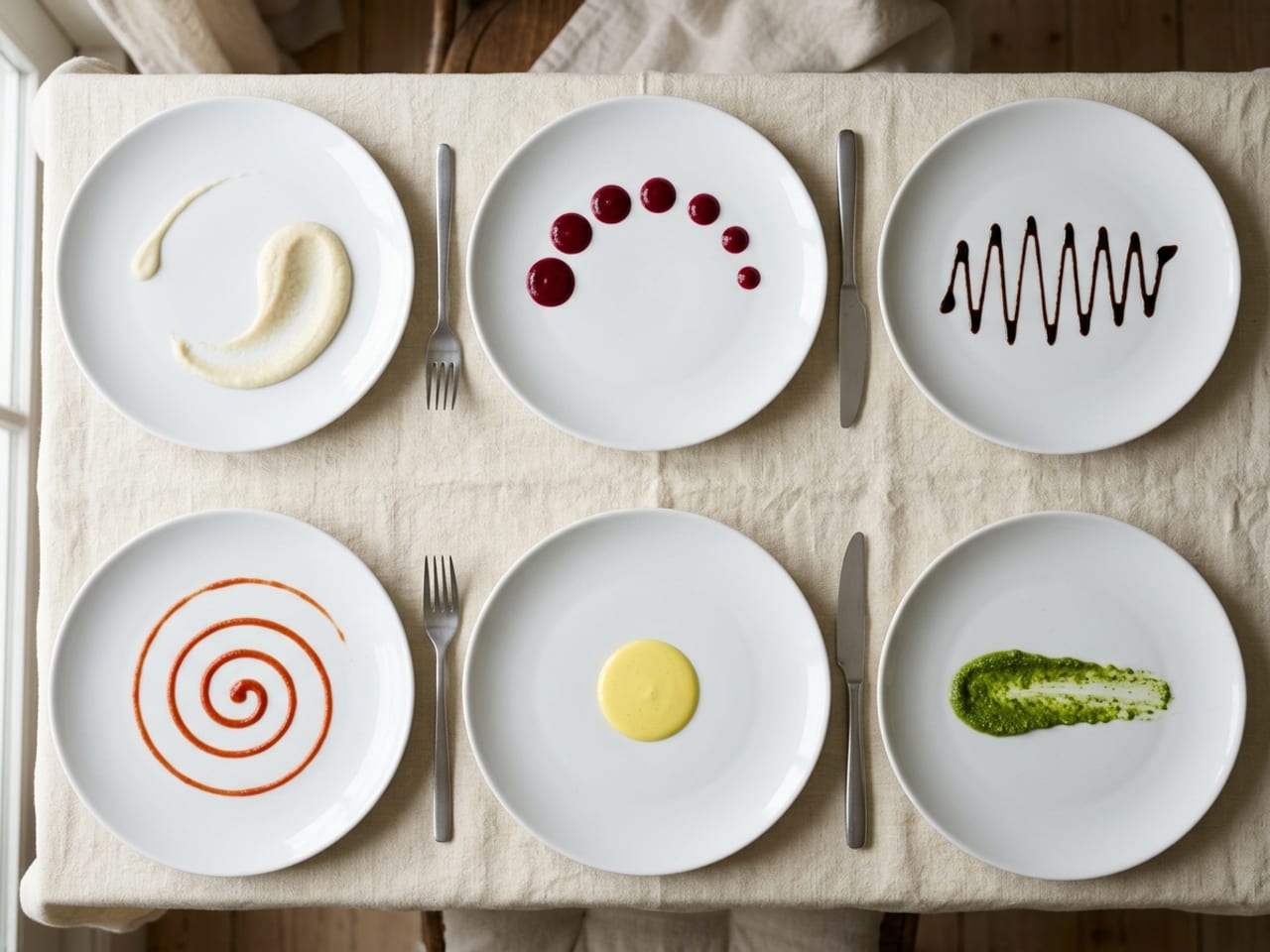
How this page was made. Every name, step, ratio, date and quotation here comes from the published source named beside it: cooking magazines and test kitchens, culinary schools' pages, chefs' own articles, textbooks, Escoffier, dictionaries, newspapers, peer-reviewed papers and food-safety agencies. Plate Artists cooked, plated, measured and tasted nothing for it, and watched none of the videos that some of these pages embed. The printed textbooks (Gisslen's two, the Culinary Institute of America's, Labensky and Hause, Peterson, McGee, Styler and others) were read only as short search fragments of Internet Archive scans, without page images, so their quotations are brief and some break off; an open textbook by Zeringue and Thibodeaux, readable in full, carries many of the same passages and is credited for what was read there. Escoffier's English text is the revised 1909 edition. Several websites that refuse automated readers were read in Internet Archive captures, and each reference says which. A chef's words are credited to the chef only where the chef wrote or said them; a writer's sentence is credited to the writer or the publication. Where sources disagree we set them side by side. Anything marked "ours" is our own reading, count, conversion or suggestion. Sources are at the bottom.
Every sauce plating move: what it is, the steps, the sauces, the failure
One card per move. The steps are quoted from the source named in front of them and none was kitchen-tested by us; where no named source prints steps, the card says so.
Back of the spoon or tip of the spoon? For the swoosh the sources split, and nobody says the other side is wrong. Eight use the back: America's Test Kitchen, Tasting Table, Daniel Wilson, Rosanna ETC, Made In, Untappd, Slurrp and the BCcampus pastry textbook.1, 3, 5, 10, 13, 14, 18, 28 Three dip the tip into the middle of the sauce: the CBC, WebstaurantStore and Tundra.7, 8, 11 The count is ours, of the pages we read.
Swoosh or smear
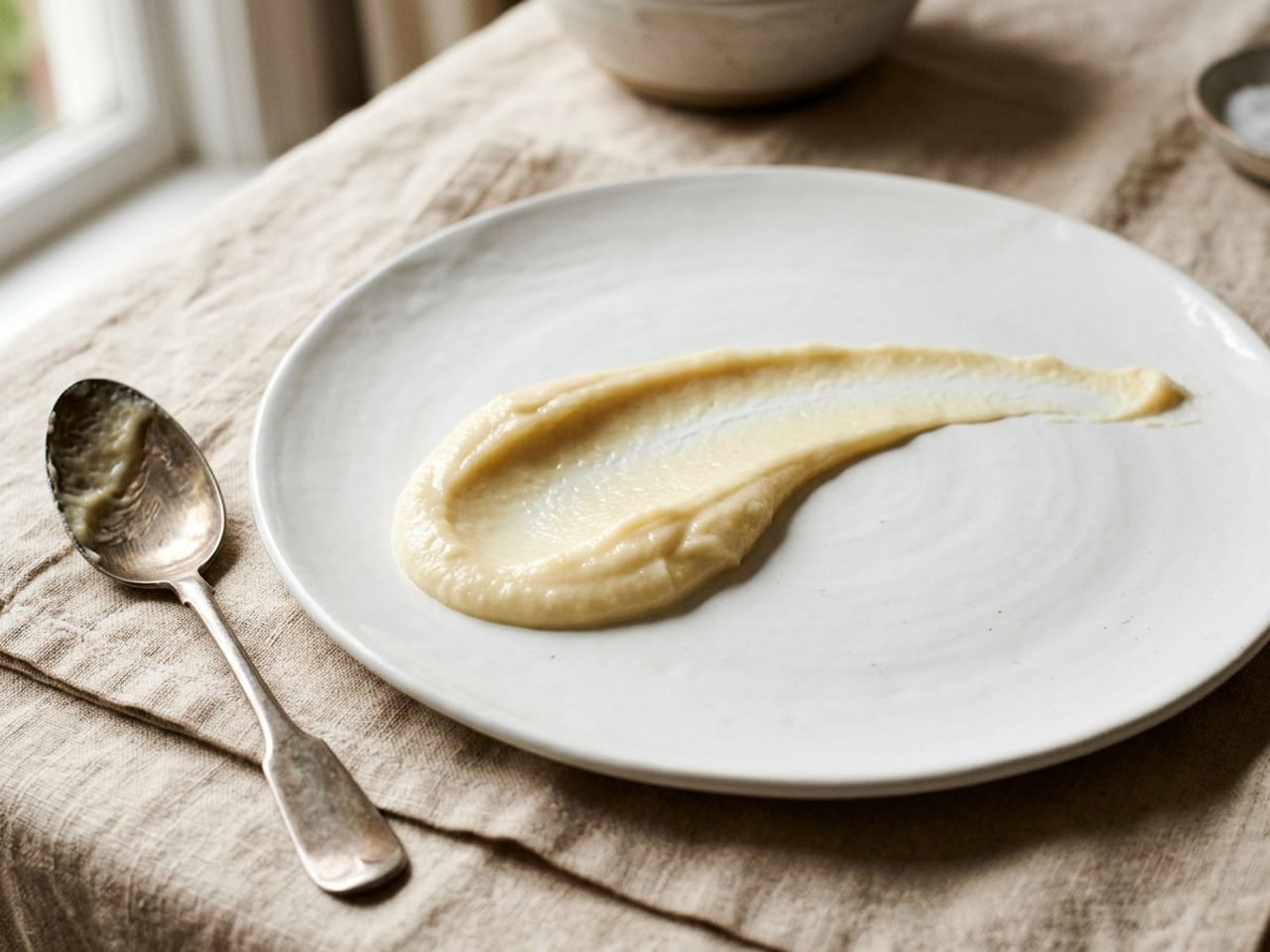
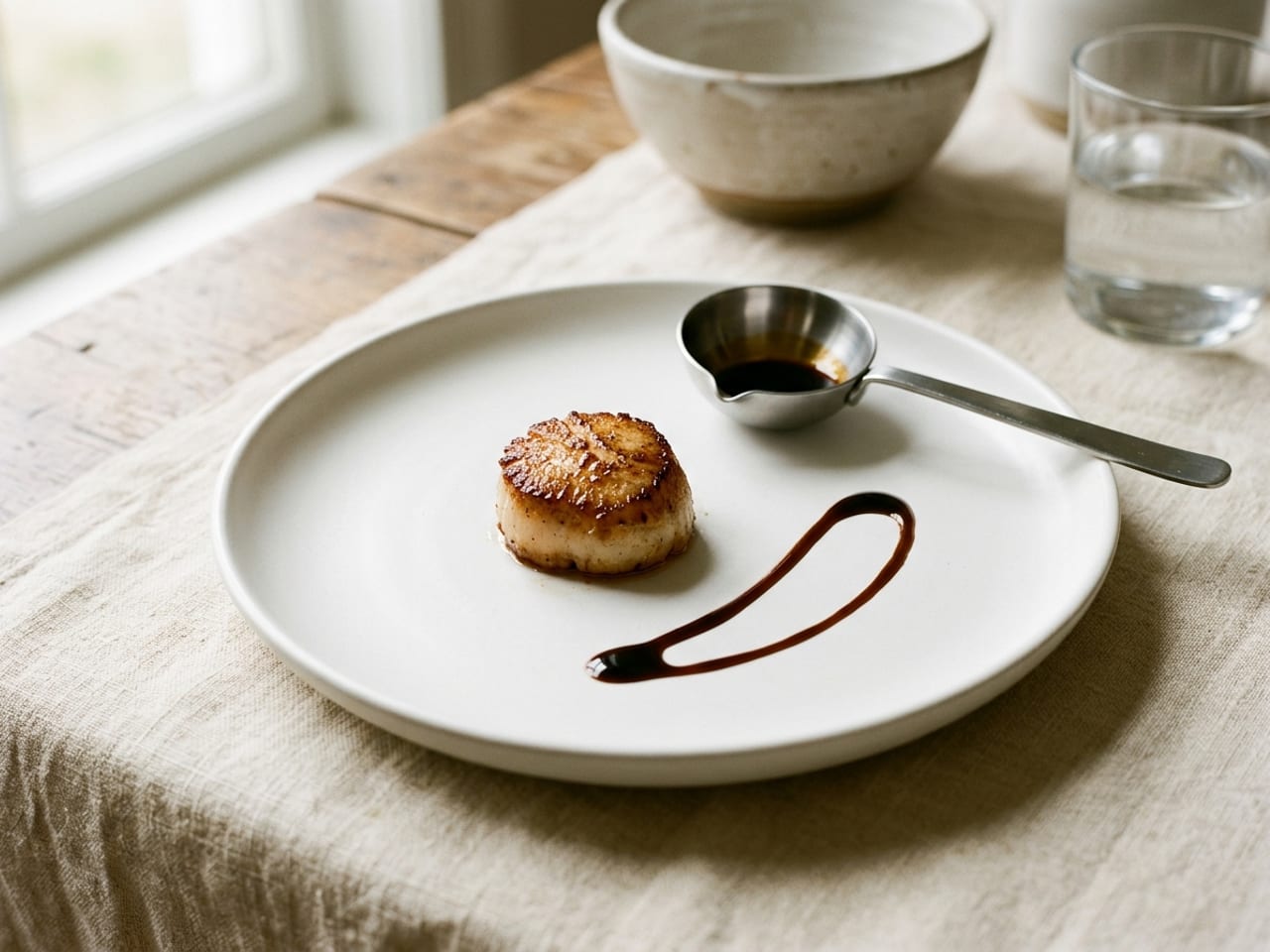
The mark most people mean by sauce plating: a spoonful set down and dragged, thick where it starts and thin where it ends, usually curved. America's Test Kitchen and chef Daniel Wilson both give the shape as a comma.1, 13 Swoosh and smear are one move in most of the sources we read, not two: the swoosh of America's Test Kitchen and the smear of Wilson, Rosanna Stevens and the CBC are all a spoon pulled through a spoonful of sauce.1, 5, 8, 13 No source we read sets the two words against each other (our reading of them), so if you see them listed as two techniques, ours included, the line between them is the writer's own.
The steps, in the sources' words. America's Test Kitchen: "Place a spoonful of your sauce on the plate." "Using the back of your spoon, drag the sauce to the other side of the plate to create a comma or apostrophe shape." "Place your food on top of or next to the sauce."1 Daniel Wilson, in his own words: "place a spoonful of thickish sauce or purée on one side of the plate. Then turn the spoon over and place the back of the spoon into the middle of the sauce, then drag to the other side of the plate, or curve it like a comma in a quick but controlled manner."13 Rosanna Stevens insists on two separate actions: "put the sauce on the plate first, and then smear it. Don't try and do it all in one move, it doesn't work."5 Tundra uses the tip: "dip the tip of the spoon in the middle of the sauce drip and tilt it at an angle", then "drag the spoon away from the sauce drip to leave an attractive sauce tail."11 The CBC and WebstaurantStore squeeze the sauce out of a bottle first and then pull it with the tip of a spoon; WebstaurantStore dips "into the middle of the sauce where it's thickest".7, 8 A private chef, Greg Greenfield, describes a different mechanic that he calls a spoon swipe, in which the sauce stays in the spoon: a teaspoon "about three quarters full", "round side down", and "The faster you swipe the longer the design will be." He is the only source for it.15
Which sauces. Vegetable and fruit purées, rouille, "thick whipped cream" and "even mashed potato".1, 5 Wilson's own plate is smoked kingfish on horseradish cream.13 A purée for it should be, in one culinary school blog's words, "a little bit thick so it holds its shape" and can be "smeared alongside your entree without running all over the plate". 54 On this site: pea purée, the parsnip purée under sesame-crusted tuna and mashed potatoes loosened to a purée (the pairing with this move is ours).
The tool. A spoon: its back for eight sources, its tip for three. The count is below. WebstaurantStore also allows "a spoon or plating wedge".7
What goes wrong. A ragged or broken mark. The causes the sources name are a sauce that is too thick, which "won't spread smoothly", and hesitation: "A shaky hand leads to messy edges, so commit to the movement."3 Tundra adds the rule for afterwards: "Never go back and try to fix the swoosh", and if it fails, "wipe it up and start over again."11 More under fixes.
Dots
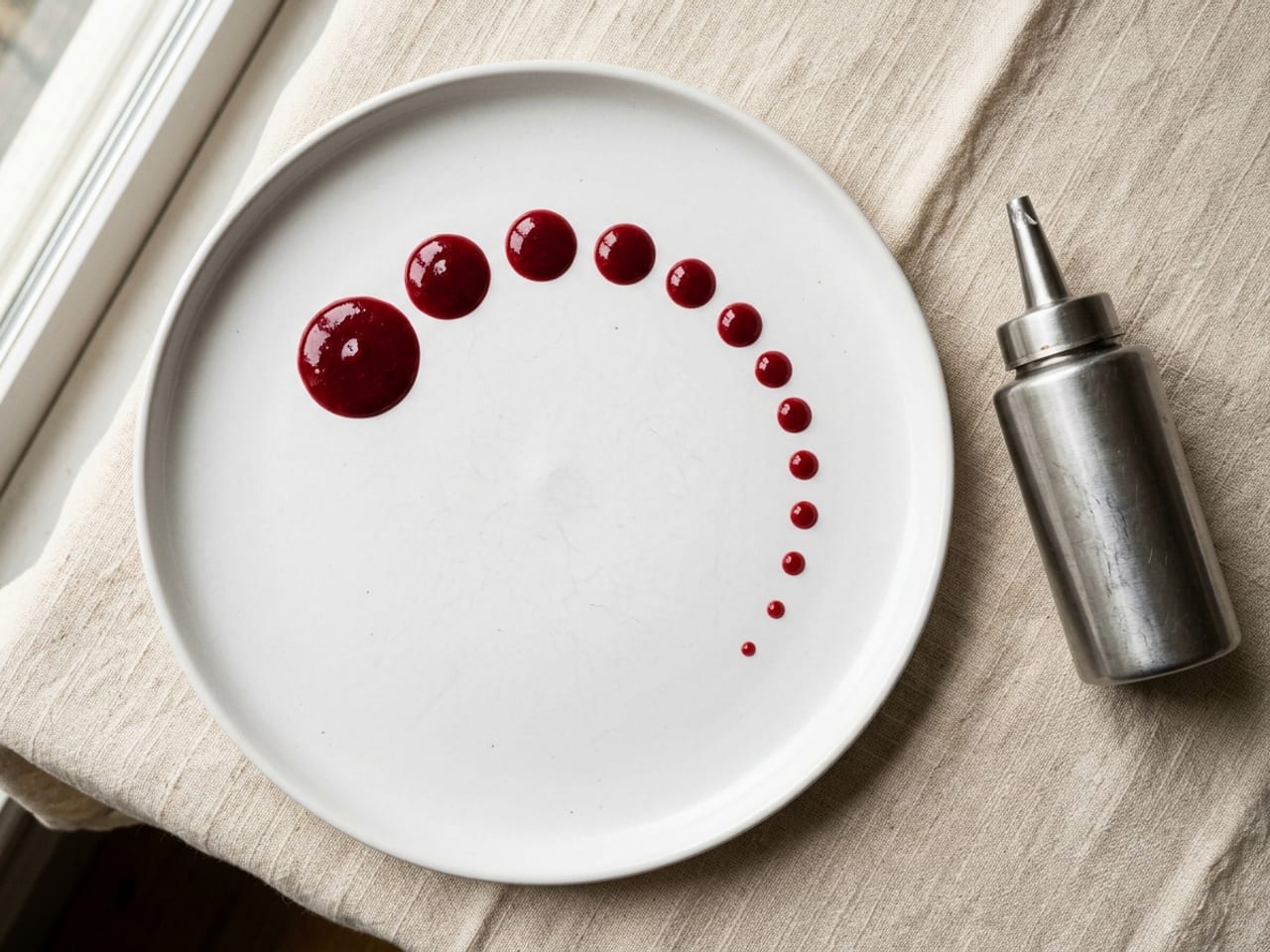
Round drops of sauce placed singly, in a row, a curve or a cluster. They are the move with the least agreement about the sauce. They are also not, by the record, a squeeze-bottle invention: Eric Ripert's memoir, as NPR reports it, has him dropping dots "not from a squeeze bottle but off the tip of a spoon" in Robuchon's kitchen.91 We read NPR, not the memoir.
The steps, in the sources' words. Greg Greenfield touches the plate: "Place the tip on the plate and squeeze gently until a dot is formed. Release your hand so the liquid contracts and move down the plate creating any size dots you desire."15 Unilever Food Solutions holds the bottle off it: "keep the squeeze bottle nozzle at an angle from the plate, apply pressure till you get your desired dot size."6 No source compares the two. Tasting Table: "test the flow on a spare plate before you dive in", start with dots "evenly spaced, uniform in size", and "Brace your wrist if you need extra control".3 Without a bottle, Rosanna Stevens: "use a very small amount on the end of the spoon and delicately dot it onto the plate".5 Size is a style choice: Slurrp "places larger dots near the food and smaller ones trailing away", Le Cordon Bleu Malaysia asks for "Small, uniform dots".9, 10
Which sauces. America's Test Kitchen: "Good candidates are a yogurt sauce or, for dessert applications, dulce de leche."1 Rosanna Stevens dots a plain vinaigrette on purpose, "as the oil and vinegar can separate and create a lovely visual effect".5 A fluid gel is the one sauce type that its makers describe by this job: sauces that "hold their shape, don't run and won't fall flat".80
The tool. A squeeze bottle in most sources;1, 3, 6, 15 the end of a spoon for Rosanna Stevens and, by NPR's account, in Joël Robuchon's kitchen.5, 91
What goes wrong. Dots that change as you work. The one cause in print is temperature, in Ripert's words as NPR quotes them: "The sauce is cold and thick when you start, but if you work too long, it warms up and thins."91 We found no named source on how to stop a dot leaving a peak or a tail; Greenfield's "Release your hand so the liquid contracts" is the nearest sentence.15 More under fixes.
Dragged dots
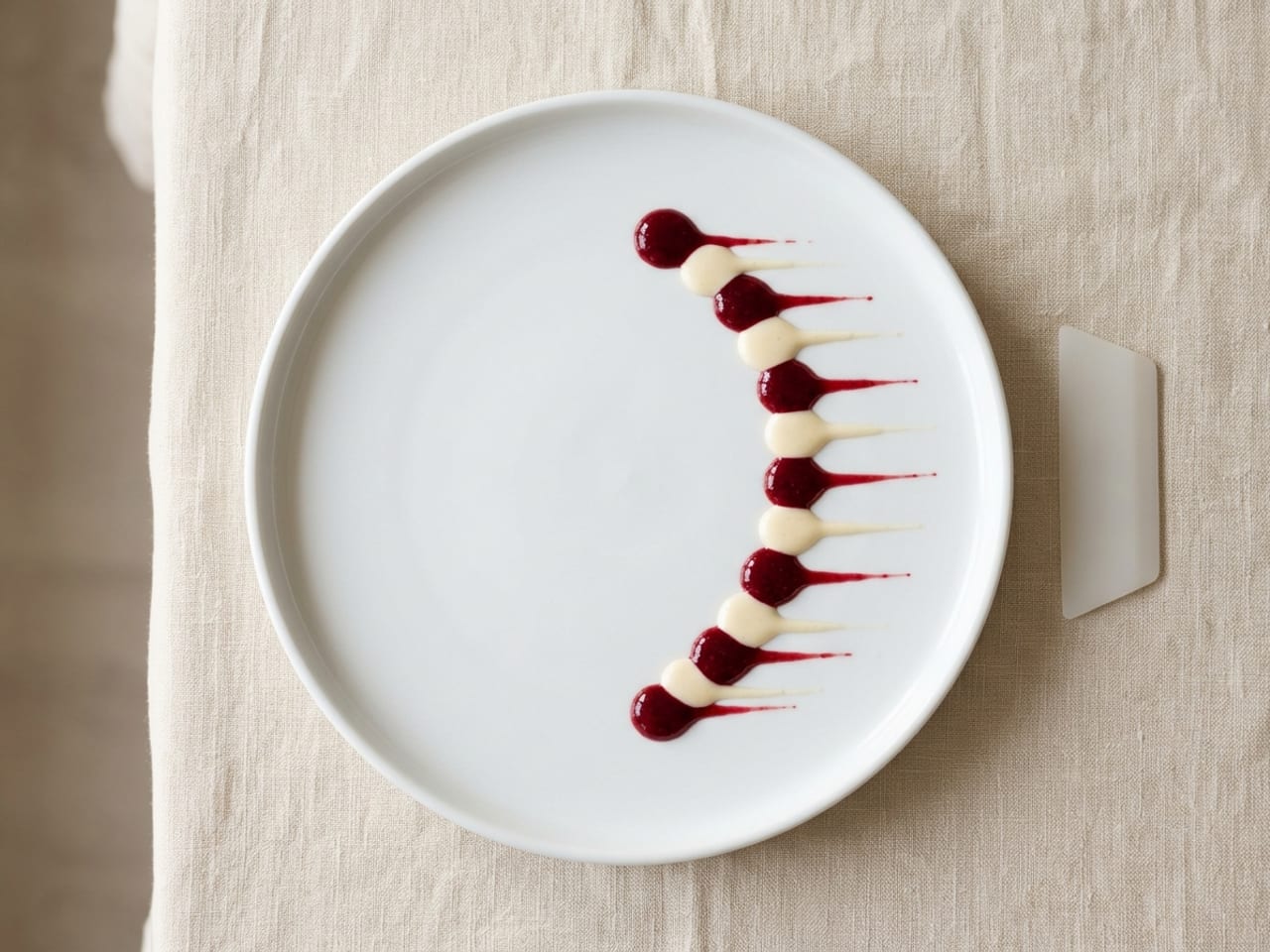
A drop of sauce that is put down round and then pulled. Three published versions exist, and they are different marks: one drop drawn out with a skewer, a row of dots joined by a single stroke, and a spot stretched into a thin line with the handle of a spoon.5, 7, 16 Note that the Institute of Culinary Education uses the word "swoosh" for the first of these, a skewer through one squeezed drop, which is not the spoon drag that most pages mean by it.16
The steps, in the sources' words. WebstaurantStore, a row: "Alternate between two sauce accent dots in a curved line along the side of your plate. Then, take a small plating wedge and place it at the center of the first accent dot in your row. Drag the plating wedge through the accent dots, creating a multicolored, single-sided edge."7 The Institute of Culinary Education, one drop: "squeeze a large circular drop onto the plate", then "drag a skewer through the droplet, bringing the sauce to one side to the desired length."16 Rosanna Stevens, a streak: "Spots can also be made into streaks, by using the end/handle of a spoon to spread a thin line of sauce outwards."5 Hearts: no named source prints the steps. The Nibble says only "You can turn dots into hearts with the nozzle tip" and points to a video that we did not watch.19 The usual description, which is ours and not a source's: draw a toothpick through the middle of each dot in a row, in one direction, without lifting.
Which sauces. The Institute of Culinary Education's drop "was simply pureed blanched spinach".16 Rosanna Stevens: "Chocolate sauce works well styled in this way, as does a rich jus."5 Glatz's list for toothpick patterns, which she draws through lines and circles, runs from "an herbed olive oil, a stock reduction, mayonnaise thinned with some lemon juice or other liquid" to "chocolate, caramel or fruit sauces". 20
The tool. A plating wedge (WebstaurantStore), a skewer or, "If in a pinch", a spoon (the Institute of Culinary Education), the handle end of a spoon (Rosanna ETC) and, for lines and circles rather than dots, a toothpick (Julianne Glatz).5, 7, 16, 20
What goes wrong. No named source describes what goes wrong. By our reading of the steps, the stroke has to start at the centre of the first dot, as WebstaurantStore says, and run through without a stop;7 and where two sauces meet, the rule a plating book gives for two-sauce designs applies: they should be "of the same consistency".40
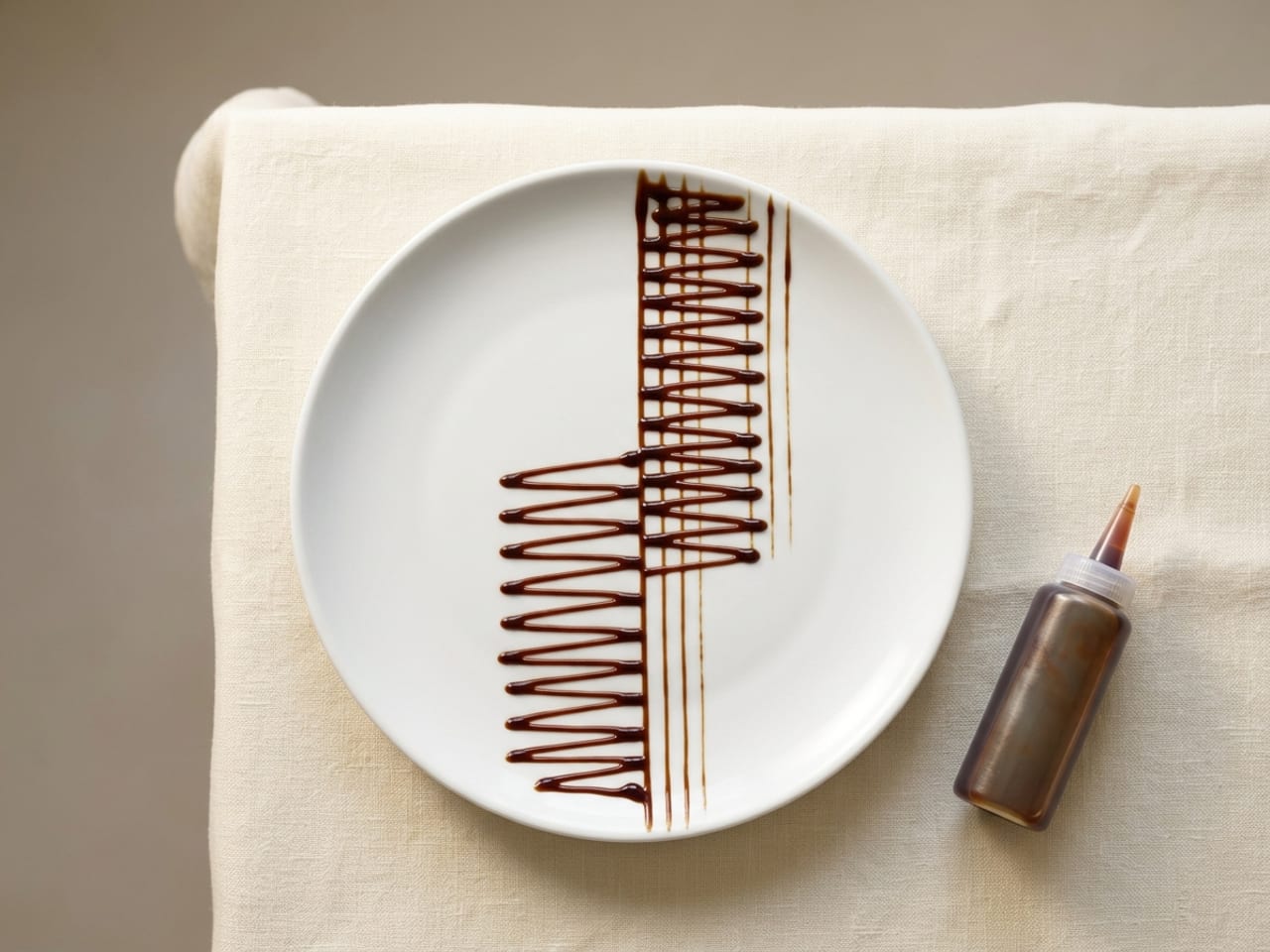
Lines, drizzle and zigzag
Everything drawn with a moving hand instead of a single placed drop or a single pull: a straight line, a wave, a zigzag, a crosshatch, or a looser fall of sauce from a spoon. Le Cordon Bleu Malaysia's one-line definition of drizzling is "Gently pouring sauce over the dish for a natural flow."9 The pastry textbook gives the two tools their jobs: "A squeeze bottle is useful for making dots, lines, curves, and streaks of sauce in many patterns. Or just a spoon is needed to drizzle random patterns of sauce onto a plate."28
The steps, in the sources' words. Tasting Table, with a bottle: "move the bottle slowly and deliberately to avoid splatters or uneven lines."3 A plating book, with a spoon or a bottle: "paint thin stripes of sauce in more or less parallel lines" (Christopher Styler, read as a search fragment).40 Daniel Wilson, for oil: "just put your thumb over the top of the bottle and release slightly to drizzle a thin stream."13 A zigzag (Unilever Food Solutions): "Fill a squeeze bottle with sauce, and squeeze along the plate till you get a zig zag design." Its tip for a first attempt is to draw the outline in oil first "so that the sauce doesn't go out of alignment".6 No source we read gives more than that.
Which sauces. Vinaigrettes and reductions (Tasting Table);3 balsamic glaze and flavoured oils, which Thomas Keller's cookbook lists in recipes as kept "in a squeeze bottle".44 A columnist's caution belongs here: squiggles of a sauce that has nothing to do with the dish are decoration, and the sauce should be "an integral part of the dish".20 On this site: teriyaki sauce reduced until it holds a line (the pairing is ours).
The tool. A squeeze bottle; or "Nothing more than a spoon is needed to drizzle random patterns of sauce" (Gisslen).31 For oil, the oil's own bottle and a thumb (Daniel Wilson).13
What goes wrong. Puddles and wobble. Thin sauces "need a steady hand and careful control to avoid puddles" (Tasting Table).3 For continuous lines Greenfield names the cause as pressure: he warns against "squeezing constantly but not too much to create inconsistent lines".15 More under fixes.
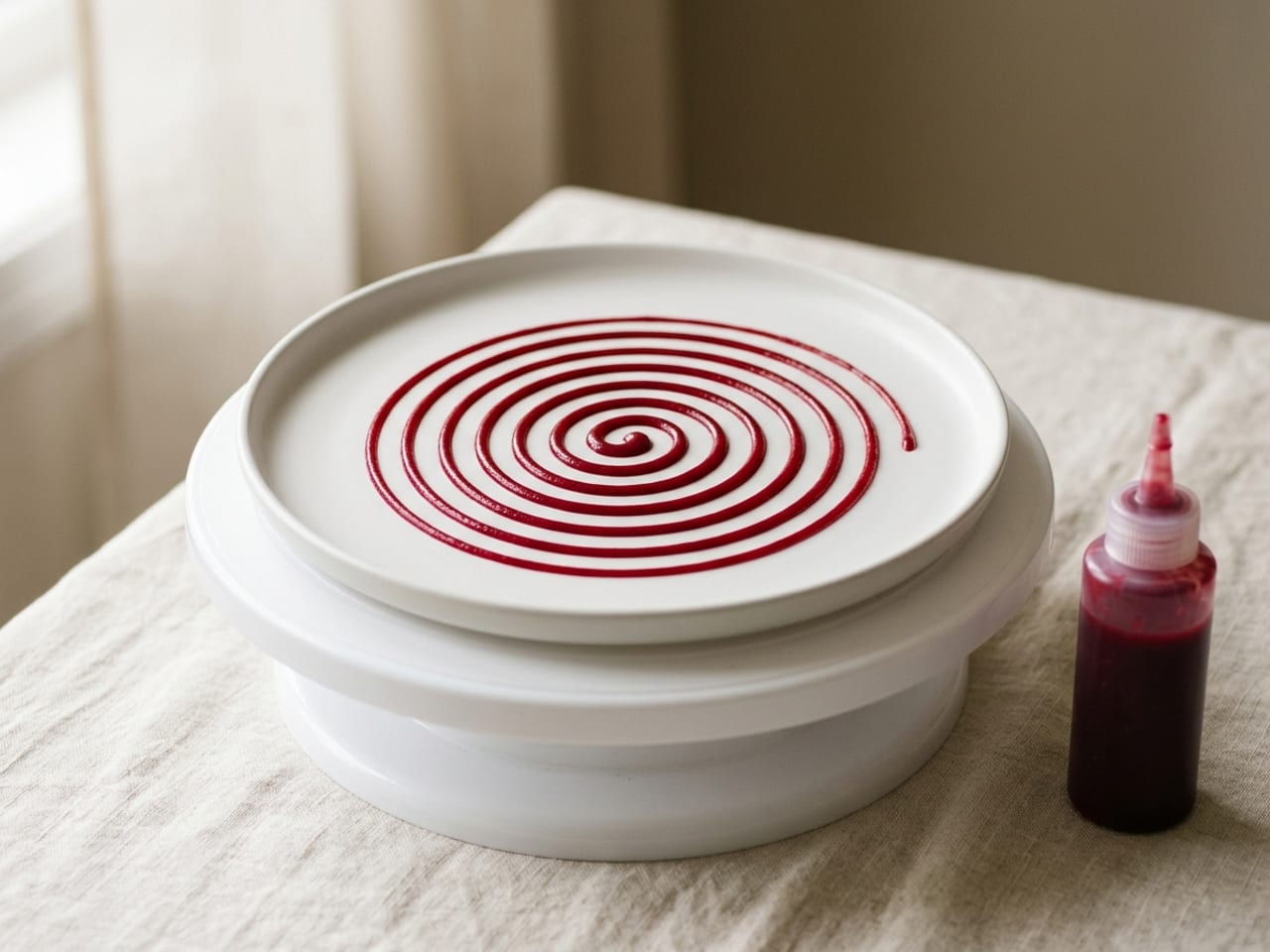
Rings and spirals
A closed or winding line: one ring around the food, an arc on one side of it, or a spiral from the centre of the plate outward. "Swirl" is the usual name for the spiral, but the word has a second meaning: Tasting Table uses "swirl them together" for two sauces marbled with a skewer.3, 6, 7, 8 So ask which one a recipe means.
The steps, in the sources' words. Unilever Food Solutions, with or without a turntable: "Start with the center of the plate and gradually move out until you get your desired design. If you have a cake turntable, you can also spin your plate on it while doing the swirl design to make the task easier."6 The CBC spins the plate and holds the bottle still: "point it downwards toward the centre of the plate".8 Gisslen, as recipe steps: "Using a squeeze bottle, squeeze an arc of Basil Sauce (p. 219) around one side of the mound", and "Ladle a ring of Sauce Suzette onto each plate."31, 33 Greenfield's half spiral masks the plate: "place plastic wrap on half the plate", draw the spiral, then "Simply peel the plastic away".15 The turntable itself, and how a plate is kept from sliding on it, is in our plating tools guide.
Which sauces. Vinaigrette around a tartare and basil sauce beside a mound are Gisslen's examples; a mango vinaigrette is Greenfield's.15, 33 Fluid gels are said by one magazine round-up to suit "dots, lines, circles and swirls".83
The tool. A squeeze bottle and a turntable ("Lazy Susan or cake spinner", the CBC), which Unilever makes optional;6, 8 for a ring, "a squeeze bottle or spoon" or a ladle (Gisslen).31, 33
What goes wrong. An uneven line, from uneven pressure: the fault Greenfield warns of is "inconsistent lines", and he rates the spiral "Difficulty Hard".15
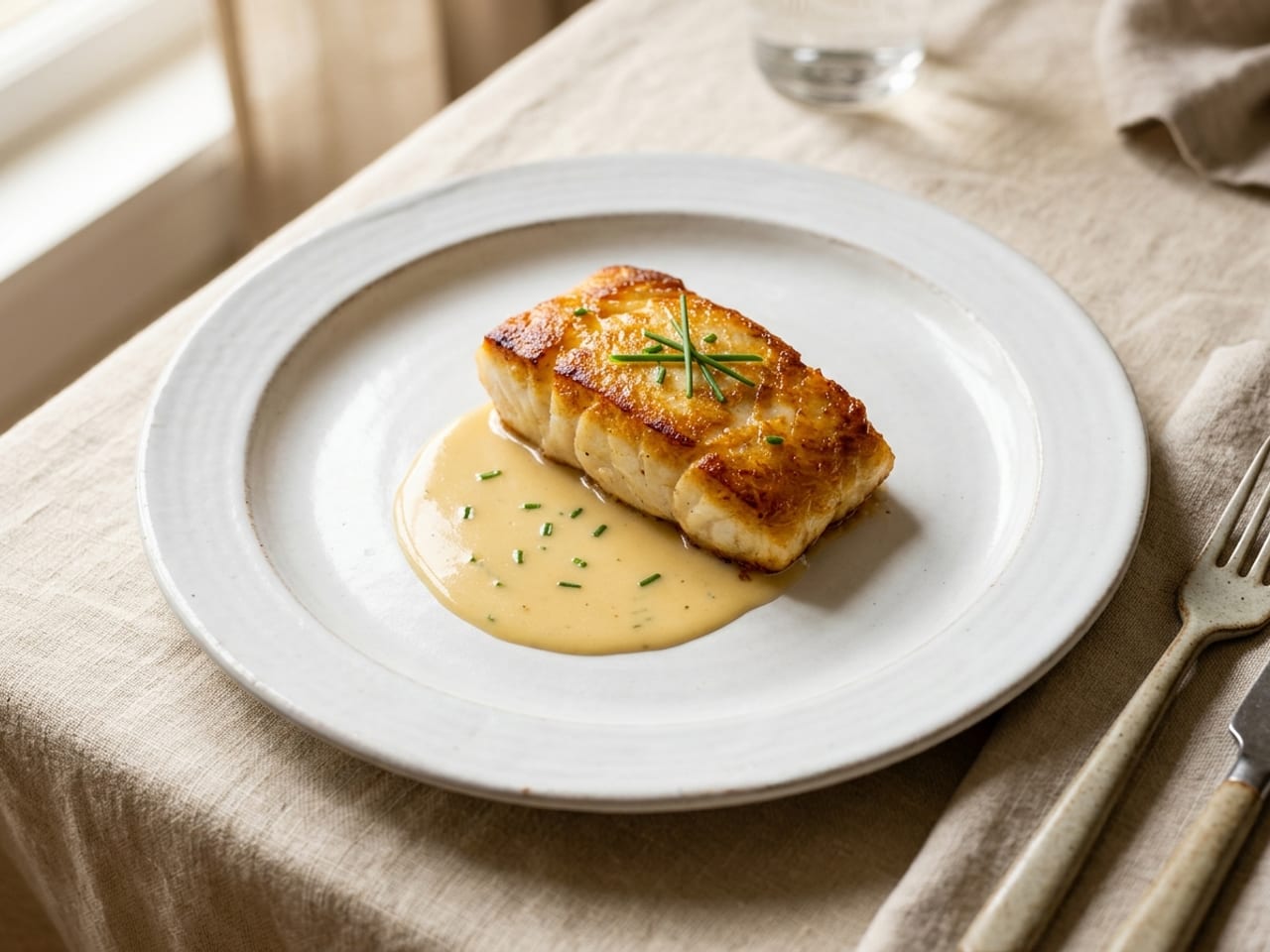
Pool
A measured puddle of sauce with the food in it. The pastry textbooks have a word for the dessert version: "Pouring a pool of sauce onto the plate is known as flooding."28 You will also see it called a mirror, a cookbook word of the 1980s: René Verdon's recipe says to make a "mirror" of sauce "on each heated dinner plate", and Nancy Silverton wants room for "a shining mirror of sauce" (both read as search fragments).41, 42 No dictionary we opened gives the word that sense.
The steps, in the sources' words. America's Test Kitchen: "By using a deep plate or a shallow bowl, you can create a perfect circular pool in the center of your dish. Place the rest of your food on top of the sauce in whatever manner you like."1 Rosanna Stevens: "pour enough over the top until you have flooded the base of plate and it's covered"; she also offers it as a rescue: "This also works as a back up option if you tried something more artistic and didn't get it quite right."5 The pastry textbook, for less: "Rather than flooding the entire plate, it may be more appropriate for some desserts to apply a smaller pool of sauce to the plate, as this avoids overwhelming the dessert with too much sauce."28 A French example: the Troisgros recipe for salmon with sorrel, as Le Monde printed it in 2014, divides the sauce over the bottom of four large hot plates and lays the fish on top (our translation of "répartir la sauce au fond de 4 grandes assiettes chaudes. Déposer dessus les escalopes").85
Which sauces. Pan sauces, crème anglaise, beurre blanc ("Serve the coley portions with the beurre blanc around the outside", Great British Chefs), raspberry coulis around a tart, a broth or jus.1, 5, 25, 52 A coulis is the natural pooling sauce by one textbook's description, "a texture similar to that of a thin tomato sauce" (the inference is ours).52 On this site: au jus under a roast, tomato sauce and mushroom sauce.
The tool. America's Test Kitchen names none; the pastry textbook says "Pouring", and Gisslen's recipes spoon or ladle.1, 28, 33
What goes wrong. Too much. A broth "should not be so abundant as to turn an entree into a soup".52 And the sources disagree about the plate: America's Test Kitchen wants a deep one for a pool, while Tasting Table's advice for sauce work in general is flat plates and no deep rims.1, 3
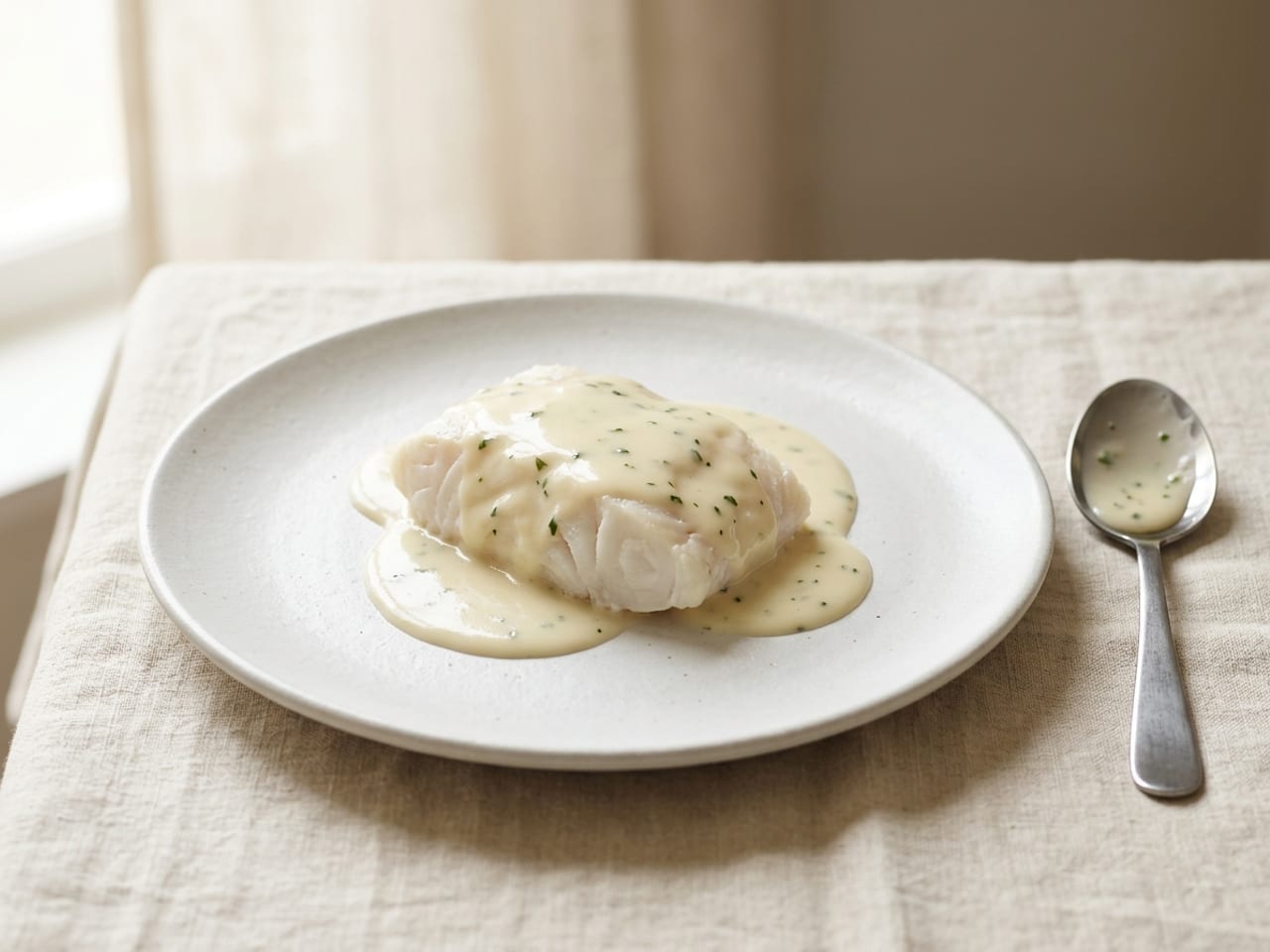
Sauce spooned over (nappé)
The oldest move on this page (our reading of the classical books) and the one those books mean by saucing a dish. In French the verb is napper, which the Trésor de la langue française defines as covering a solid dish with a jelly or a smooth sauce (our translation), and nappé is the consistency that lets a sauce do it.32, 104 Escoffier's English text says "coat": "coat with Mornay sauce, and set to glaze in a fierce oven". 47 Nappé is a thickness and a verb for coating food. No definition we read ties it to a swoosh or a dot, though two sources use the same spoon test for plating sauces; see the thickness section.
The steps, in the sources' words. Gisslen's guideline is to cover less than everything: "sometimes ladling sauce all over an item hides colors and shapes. If the item is attractive by itself, let the customer see it. Ladle the sauce around or under it, or possibly covering only part of it, as with a band of sauce across the center."34 Escoffier, on a dish for the table and not a single diner's plate: "Coat the bottom of the dish on which the sole is to be served with Mornay sauce; drain the fish, lay it on the prepared dish; cover it with the same sauce".47 Made In, for a pan sauce: "Reduce the sauce until it glazes the back of a spoon", then "Tilt the pan and spoon small amounts onto the plate or spoon directly over the protein. Clean the rim and add a final garnish."18 America's Test Kitchen does it to crisp-skinned salmon: "Transfer salmon to serving platter and spoon sauce over top. Serve."100
Which sauces. The textbook examples of sauces judged by nappe are "hollandaise, bearnaise and bechamel";49 the Culinary Institute of America's consumer site grades it, "a light nappe" for a delicate fish and "a heavy nappe" for a cheese sauce on broccoli.53 On this site: the five mother sauces, creamy dill sauce, horseradish sauce and Alfredo sauce on pasta.
The tool. A spoon or a ladle. Peterson: "The use of sauce spoons now allows the saucier to make thinner sauces" than this move once needed (read as a search fragment).38
What goes wrong. A sauce too thin to stay on: "Otherwise, it will just run off and lie in a puddle in the plate."32 Or too thick, which Gisslen rules out in the same breath: "This doesn't mean it should be heavy and pasty." 32 On crisp food the timing is the complaint; see the myth about crisp skin.
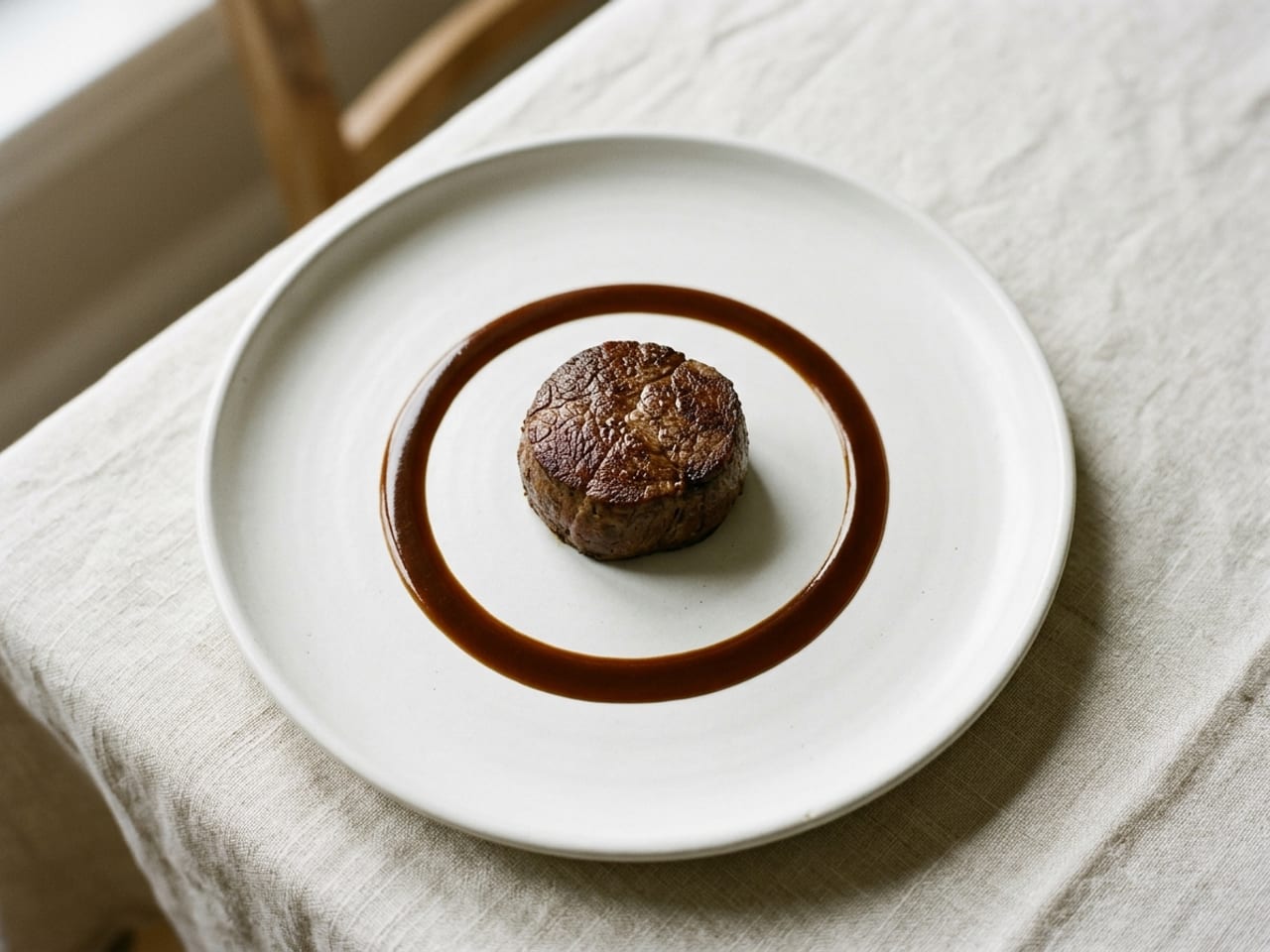
Cordon, or a thread of sauce
A narrow line of sauce around the food instead of over it or under it. The French word is real and old: "cordon de sauce" occurs about a hundred times in the scan of Escoffier's French guide that we read (101 by our count, with line breaks joined), as in "d'un cordon de sauce Chasseur", the end of an instruction to surround scrambled eggs with one.48 But no dictionary we opened gives "cordon" a sauce sense, and the English Escoffier never prints the word that way: its translator wrote "surround with a thread of chasseur sauce", and "thread of" occurs more than seventy times, most of them a sauce (74 by our count).47, 103, 104, 105 So do not write that Escoffier's English book calls it a cordon. Defining it as a thin line of sauce run around the food is our reading of those recipes.
The steps, in the sources' words. Escoffier, around: "Garnish with a small, grilled sausage, placed between the yolks, and surround with a thread of tomato sauce." And as a second sauce over the first: "Cover the sole with white-wine sauce, and lay a thread of shrimp sauce over the garnish."47 These are dishes sent to the table, not single plates. Gisslen, on a plate: "Serve 2 medallions per portion. Spoon the sauce around the meat", "Spoon the sauce around (not over) the sweetbreads", and for a fish "Place the fish on hot plates. Spoon a thin band of butter sauce onto the plate partway around the fish."33, 34 WebstaurantStore's classic plate: "Drizzle the demi-glace around the plate using a spouted saucier".7
Which sauces. Escoffier's threads are tomato, chasseur, Périgueux, half-glaze and shrimp sauce;47 Gisslen's are meat and fish sauces and butter sauce, and flavored oil, which "is usually drizzled around or, sometimes, over the item on the plate".32, 33 On this site: the steak sauces, beside or over, and au jus.
The tool. A spoon (Gisslen);33 "a spouted saucier" (WebstaurantStore).7
What goes wrong. No named source describes one. A reduced sauce that is too gelatinous is the textbook risk for any thin line of jus or demi-glace: Gisslen warns that reduced sauces "sometimes become so gelatinous that they solidify when they cool".32 Applying that to a cordon on a cool plate is ours.
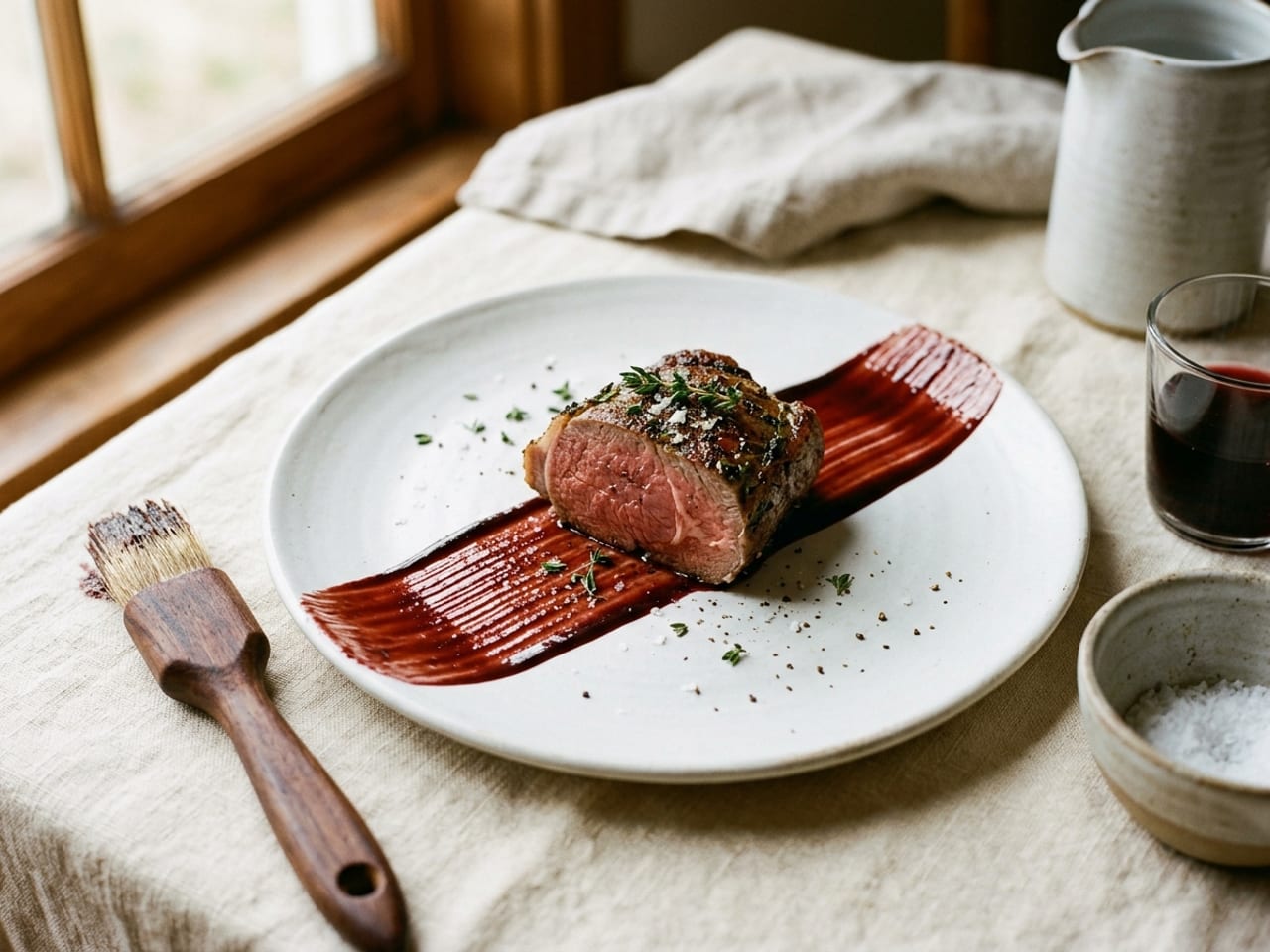
Brush stroke
A stroke of sauce with the brush marks left in it. It is the one move on which the sources agree that the sauce must not be stiff; they differ only on how thin.1, 20 Julianne Glatz called it "A recent innovation" in 2013.20
The steps, in the sources' words. America's Test Kitchen: load the brush, then "tap off any excess sauce, just like you would if you were painting a wall", and "brush a thin, spreadable sauce across the middle or the side of the plate. Place the food next to or across the sauce."1, 2 Tasting Table: "don't overload it".3 The Institute of Culinary Education: "Stroke the sauce in a single line using a paintbrush", and "Use a larger paintbrush to achieve a wider stroke".16 Debic starts from a spoonful: "Spoon plenty sauce or purée on the plate and use a brush to draw a nice line."24 Which brush is safe for food, and how to clean it, is in our plating tools guide.
Which sauces. "Pestos" and "Balsamic glazes also work well" (America's Test Kitchen);1 "wide strokes of bright pesto, streaks of a dark balsamic reduction, or subtle smears of a chocolate ganache" (Tasting Table);3 "a green infused oil or juice" (the Institute of Culinary Education);17 and pea purée, which WebstaurantStore paints on before the steak goes down.7
The tool. "a clean brush (such as a pastry brush)" (America's Test Kitchen);1 "Food-safe paintbrush" (CBC);8 "Pastry brushes, basting brushes, or even silicone brushes" (Tasting Table).3
What goes wrong. Too much sauce on the brush, which is what both loading tips above are for.1, 3 No named source we read describes a brush stroke drying or cracking on the plate, so we print no fix for it.
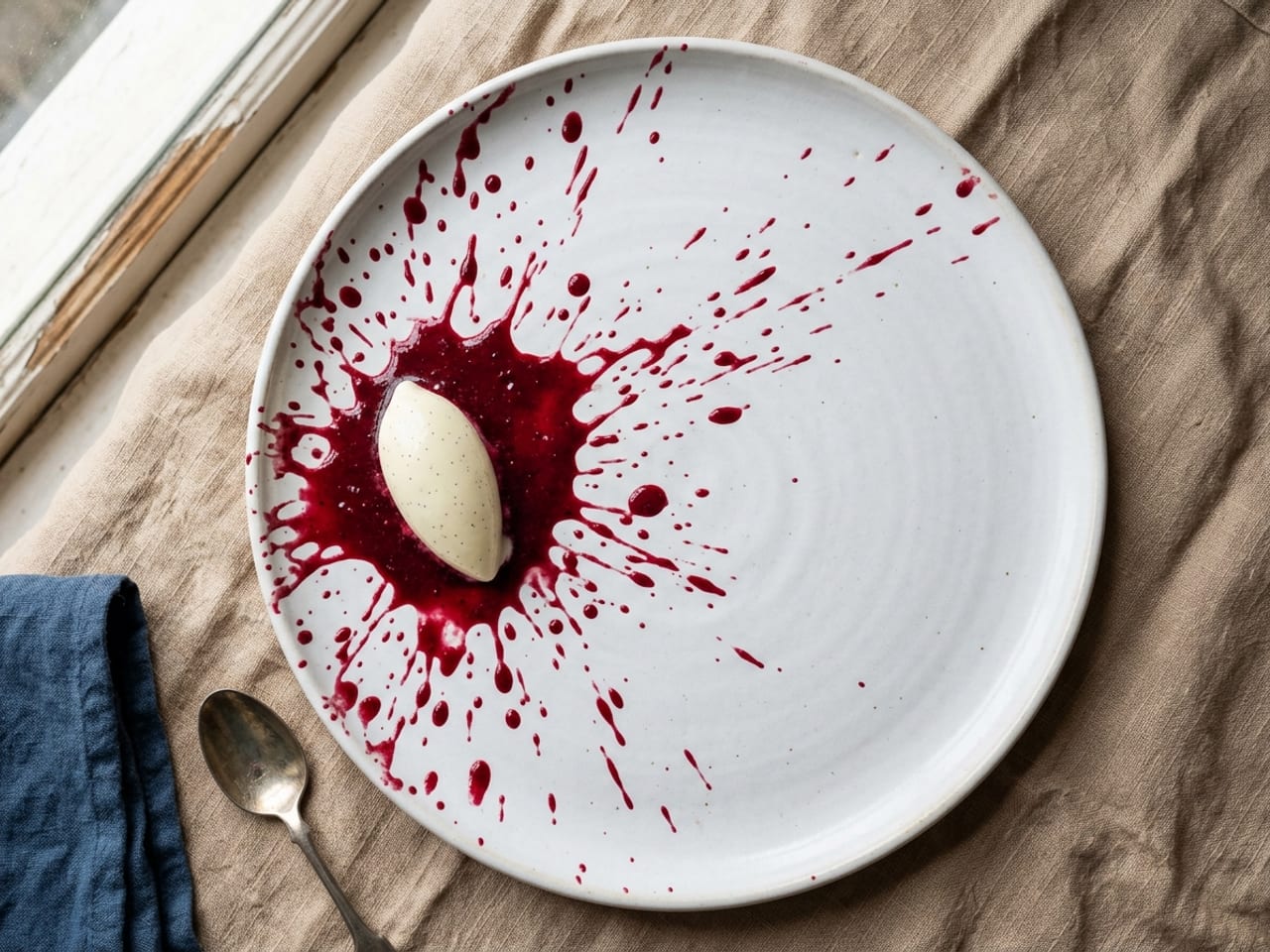
Splatter
The only move that is aimed and not drawn. In three of the four named sources the sauce is put on the plate and then hit with a spoon; in the fourth the loaded spoon is thrown.5, 6, 15, 18
The steps, in the sources' words. Unilever Food Solutions: "Place a generous amount of sauce at the centre of the plate. Using a spoon, hit the centre of the plate such that the sauce splatters to create a pattern. Make sure to moderate the amount of force used to avoid breaking your plate or creating a mess."6 Rosanna Stevens: "Take a small spoonful of sauce and place it on the plate. Now, using the back of the spoon quickly hit the sauce so it splatters outwards"; "wear an apron".5 The two disagree on the amount, "generous" against "a small spoonful". Made In, for a party: "Lay out all of your plates next to each other and simply put your different sauces down on random parts of the plates. Use the back of your spoon to hit these spots."18 Greenfield: "Working fast, you will throw the spoon down on the plate".15
Which sauces. Fruit coulis and thicker sauces, "and you could even do it with two different types of sauce to create a contrast" (Rosanna ETC).5 How a coulis is made is in our plating components guide.
The tool. A spoon, used to hit the sauce (Unilever, Rosanna ETC, Made In) or thrown down full (Greg Greenfield).5, 6, 15, 18
What goes wrong. A broken plate or a spattered cook; both warnings are in the steps above.5, 6 It also cannot be corrected, only wiped off and repeated (ours).
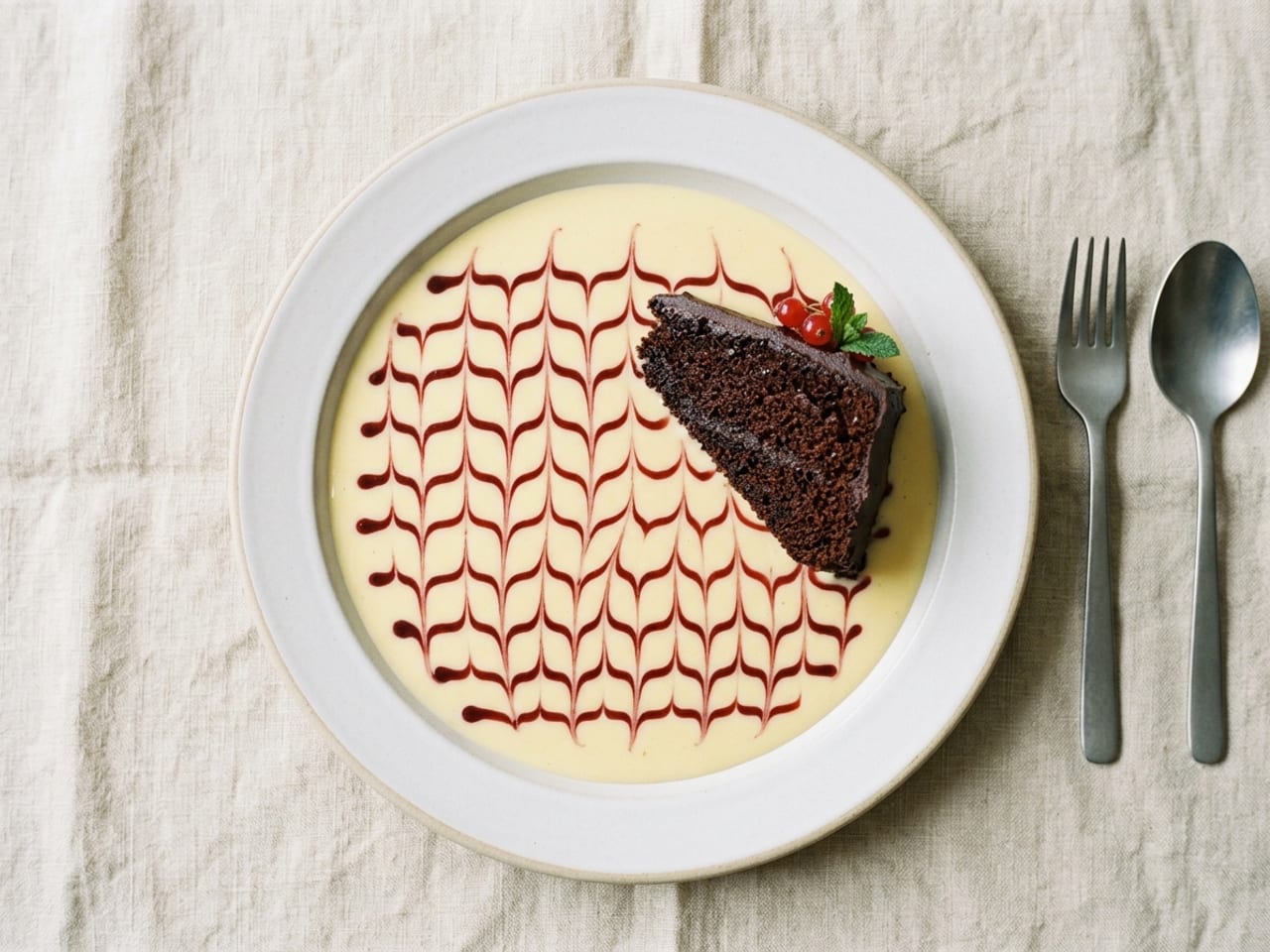
Flooding, feathering and outlining
The classic dessert vocabulary, and the only part of this page with a real textbook behind its names. In the words of the BCcampus pastry textbook, which match Gisslen's Professional Baking almost line for line: "Pouring a pool of sauce onto the plate is known as flooding. Although plate flooding often looks old-fashioned today, it can still be a useful technique for many desserts. Flooded plates can be made more attractive by applying a contrasting sauce and then blending or feathering the two sauces decoratively with a pick or the end of a knife."28, 31 A second open textbook, The Bakeshop, carries the same sentences, so these are one text in three places, not three sources.30
The steps, in the sources' words. Feathering (the textbooks): flood the plate, apply the contrasting sauce, then draw the pick or knife through both; "For this technique to work, the two sauces should be at about the same fluidity or consistency."28 Outlining (the textbooks): "a design is piped onto the plate with chocolate and allowed to set. The spaces can then be flooded with colourful sauces."28 No source gives the setting time. A chevron (Julianne Glatz): "make concentric circles, squares or rectangles or even lines, on the plate, then drag a toothpick through it, first one way, then the other, to create a chevron design."20 Marbling (Tasting Table): "Use a spoon or squeeze bottle to layer small amounts of each sauce on the plate, then gently swirl them together with a skewer, toothpick, or the tip of a knife", and lightly: "too much mixing can muddy the colors and lose the effect."3 Order (The Nibble, with crème anglaise): "the dessert is placed atop the sauce and then the sauce is decorated."19
Which sauces. The Nibble decorates a crème anglaise; Styler's example of a matched pair is "the mango and raspberry sauces".19, 40 The bottle "works better with more liquid sauces" than a pastry bag does (Gisslen).31 More dessert moves are in our dessert plating guide.
The tool. "a pick or the end of a knife" (the open textbook; Gisslen says "the point of a knife");28, 31 "a skewer, toothpick, or the tip of a knife" (Tasting Table);3 a squeeze bottle or a parchment cone for the second sauce.19, 31
What goes wrong. Two sauces of different thickness, by the rule above; and a coulis that will not wait: "One of the drawbacks of using a coulis is that it may separate quickly when used as a plating sauce. It's best to use à la minute."28
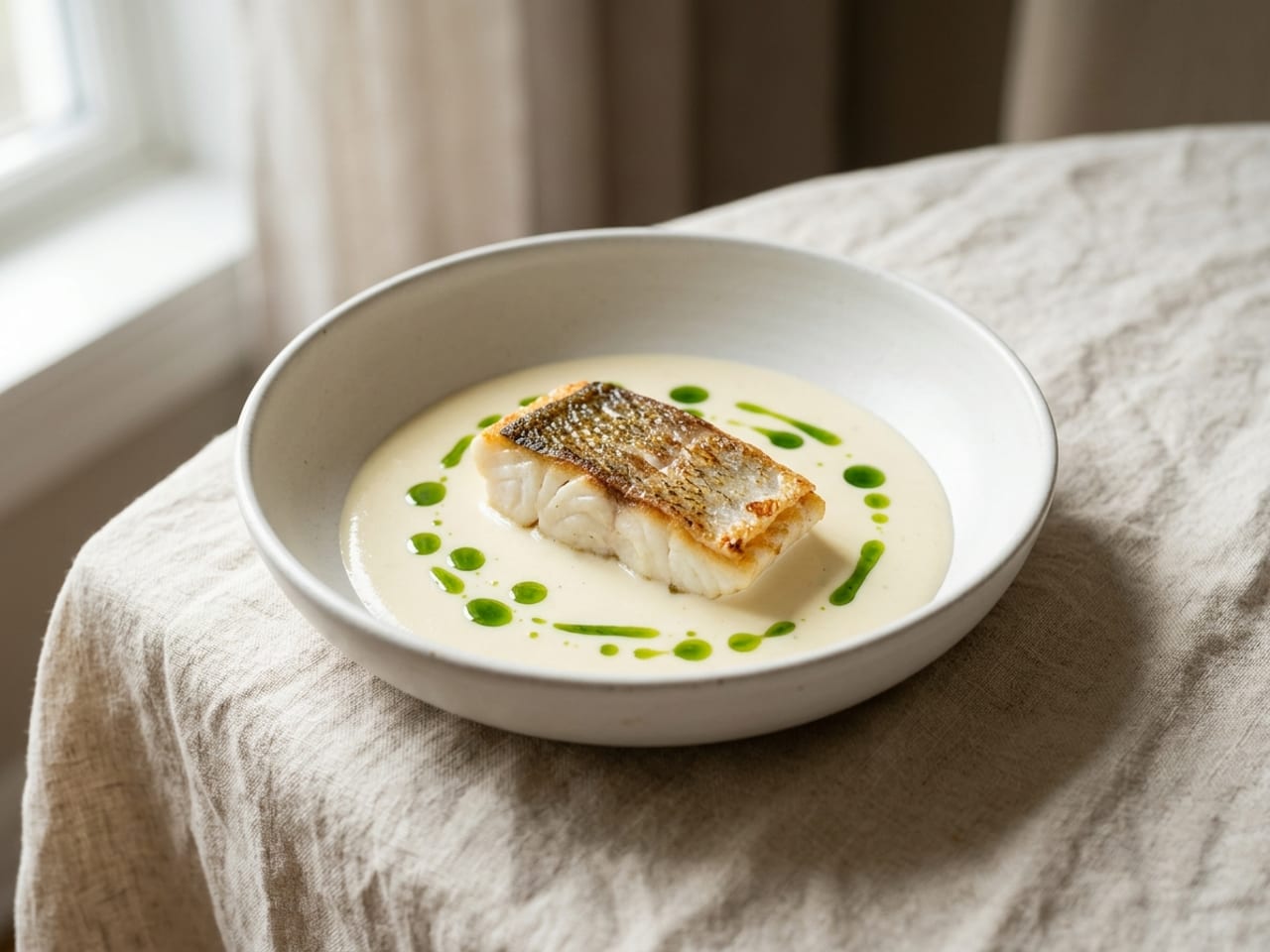
Flavoured oil
An oil used as the sauce or as a second one. Gisslen: "When used as a sauce, the oil is usually drizzled around or, sometimes, over the item on the plate."32 The split sauce, green oil broken into a pale sauce so that it beads, has exactly one named sentence behind it: Great British Chefs says of herb oils that "chefs use them to split sauces or add pops of bright green colour".26
The steps, in the sources' words. Around or over (Gisslen): drizzle about a tablespoon (15 ml) per portion.32 As dots on a sauce (Great British Chefs, a recipe step): "Serve the coley portions with the beurre blanc around the outside, then add dots of herb oil to finish".25 Splitting a sauce: no named source gives steps, a ratio, or says which sauces split cleanly, so we print none. How to make the oil is in our plating components guide.
Which sauces. Gisslen: flavored oils "are especially suitable for simple steamed, sautéed, or grilled items".32 Great British Chefs puts herb oil with a beurre blanc.25
The tool. A squeeze bottle, as Keller's cookbook lists its oils, or the oil's own bottle with a thumb over the top (Daniel Wilson).13, 44
What goes wrong. The risk with a homemade garlic or herb oil is not on the plate but in the bottle: see food safety. For the plate itself no named source describes a failure.
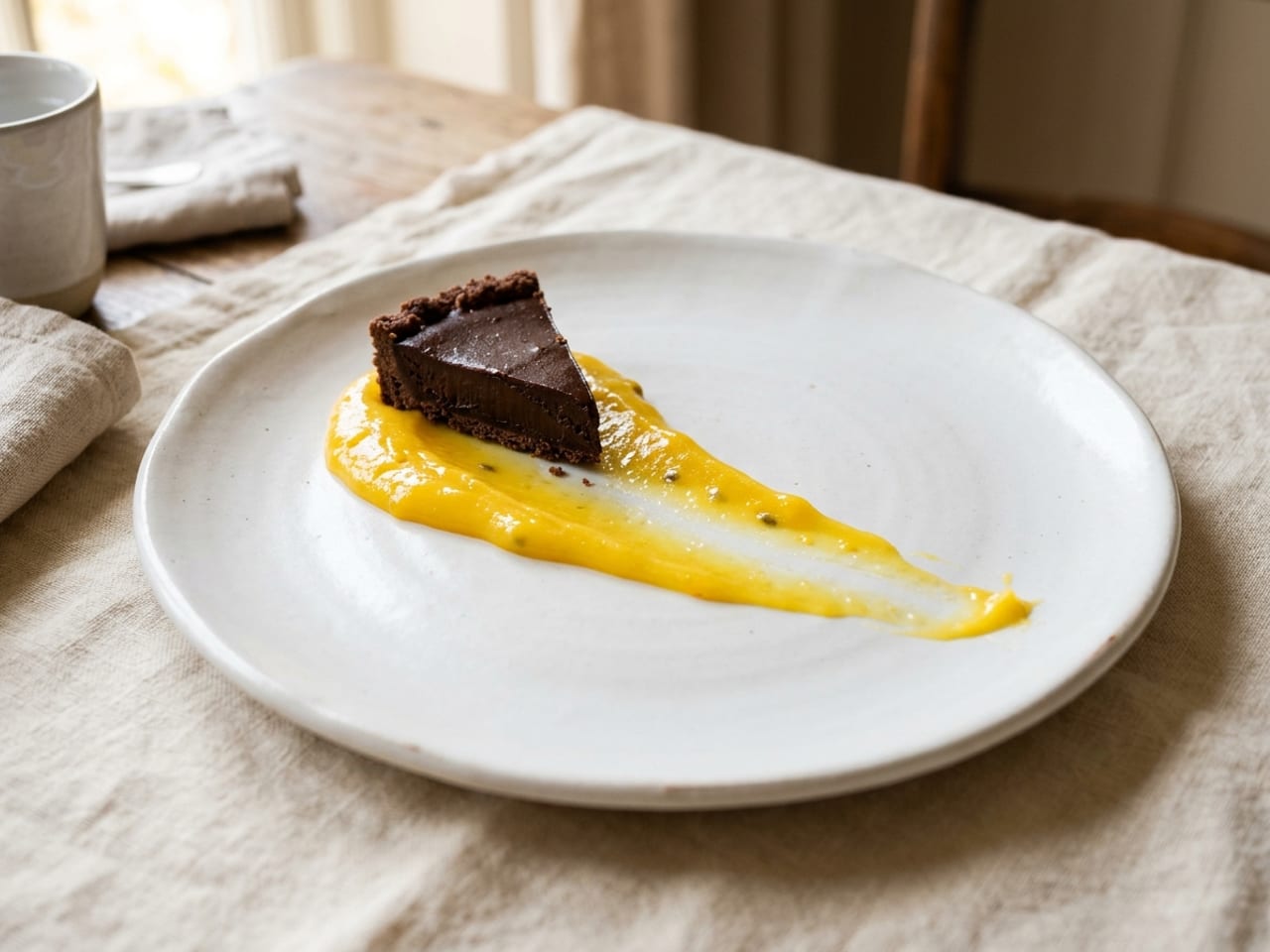
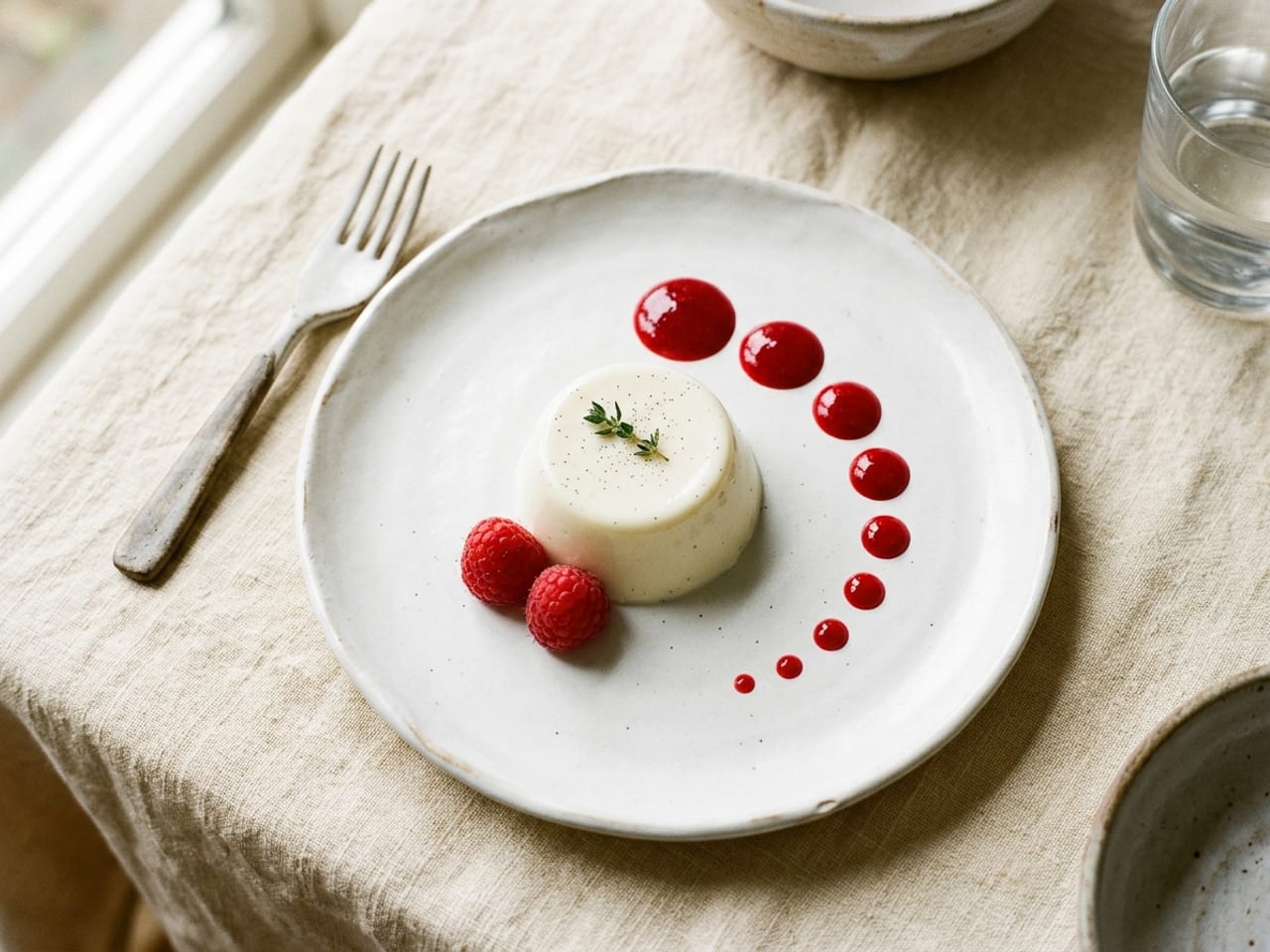
Moves with no sourced steps. For a few things people ask about, we found no how-to from a named source in text: hearts drawn through dots; a sauce split on purpose with oil; a sauce held inside a ring or well of purée; sauce poured at the table for a plated dish (how and when); where to put a foam; and how to stop a dot leaving a tail. This page gives one honest sentence on each where it comes up and prints no invented steps.
Sauce plating with a spoon, a squeeze bottle, a brush, a spatula or a skewer
What each tool does with sauce, in the sources' words. The tools themselves, their other names, substitutes and care are in our plating tools guide.
- Sauce plating with a spoonThe spoon makes the swoosh, the spooned dot, the drizzle, the pool, the coat and the splatter; Rosanna Stevens goes as far as "All you really need is a spoon!"5 Which spoon: "a flat, wide spoon (a soup spoon works well)" for a swipe (Tasting Table); a teaspoon for a fast tail and a dinner spoon for a splatter (Greg Greenfield).3, 15 How much: "a spoonful" (America's Test Kitchen), "a medium to large spoonful" for a smear and "a small spoonful" for a splat (Rosanna Stevens); nobody gives millilitres.1, 5 Angle, pressure, speed: "tilt it at an angle" (Tundra); "press the back of the spoon into the sauce" (Tasting Table); "push down, and spread the sauce out" (Made In); "in a quick but controlled manner" (Daniel Wilson); "Quickly pull" (WebstaurantStore).3, 7, 11, 13, 18 No source gives degrees or seconds. The sauce spoon and the spouted saucier spoon are two different tools; both are in our plating tools guide.
- With a squeeze bottleThe bottle makes dots, lines, zigzags, rings and spirals, and portions oil. A pastry textbook: "A squeeze bottle is useful for making dots, lines, curves, and streaks of sauce in many patterns."28 The Culinary Institute of America's textbook, as a search fragment: "Keep sauces in plastic squeeze bottles or a funnel dropper. These give you more control".36 Unilever recommends it as the place to start: "For beginners, you might want to start with a squeeze bottle to control how much sauce to use."6 How to hold it: tip on the plate (Greenfield), at an angle over it (Unilever, Slurrp), pointing straight down for a spiral (the CBC).6, 8, 10, 15 Which bottle: "those squeeze bottles with the pointed tips, by the way, not just any old ketchup bottle" (Tasting Table).4 No source gives a tip size in millimetres. Bottle or bag: a pastry bag "can be used in the same way, but the squeeze bottle works better with more liquid sauces" (Gisslen); WebstaurantStore's worked plates pipe a potato purée from a pastry bag and dot a pea purée from "a large squeeze bottle".7, 31 Reading that as stiff purée in a bag and looser purée in a bottle is ours. Nozzles, cleaning and the bottle's history are in our plating tools guide; how long a filled bottle may sit out is under food safety.
- With a brushOne job, the stroke, and one requirement, a thin sauce.1 Load, then "tap off any excess sauce" (America's Test Kitchen); "don't overload it" (Tasting Table); "Use a larger paintbrush to achieve a wider stroke" (the Institute of Culinary Education).1, 3, 16 A brush also finishes a sauce that another tool put down: the pastry textbook streaks a small amount of sauce "with a brush, an offset spatula, or the back of a spoon".28 One columnist prefers hardware-store paint brushes; we do not repeat that as advice, because a brush for food should be sold for food (our view; see the tools guide).20
- With a spatula, a wedge or a combOffset spatula. The only sourced "thick swipe" made with a spatula is Greg Greenfield's: "you just want to move the sauce along, do not push it down. Tilt the spatula gently so you are only using the edge". 15 The pastry textbook lists "an offset spatula" among its streaking tools.28 Plating wedge. WebstaurantStore uses one for its smear and for dragging a row of dots.7 Comb. The only comb in the sources is the CBC's "graining comb or graining rocker", decorators' tools pulled through two sauces "until it looks like wood grain".8 We found no named source for a pastry comb pulled through sauce on a plate, and a decorator's tool is not made for food (our caution). The tools are at offset spatula and plating wedge.
- With a skewer, a toothpick or a knife pointThe thin tools draw one sauce through another or pull a drop into a tail. The Institute of Culinary Education drags "a skewer through the droplet"; Julianne Glatz drags "a toothpick" through circles or lines; Tasting Table swirls with "a skewer, toothpick, or the tip of a knife"; the textbooks feather with "a pick or the end of a knife"; The Nibble uses "the nozzle tip" of the bottle itself.3, 16, 19, 20, 28 Anthony Bourdain's kit, as NPR quotes his Kitchen Confidential, was "a couple of squeeze bottles and a toothpick".91 The skewer as a tool is at plating tools.
How thick should a plating sauce be?
No source we read gives a physical number. No viscosity, no flow test, no sugar reading, for any move. Even the test kitchen that borrowed a viscometer to compare roux printed only relative results.58 The single viscosity range on this page, "from 1 to 5000 mPas", describes laboratory sugar solutions in a sensory paper, not any sauce.113 What the sources give instead are comparisons and a spoon test, and a textbook admits as much: "How thick is a thick sauce? Obviously, these are not precise, scientific terms that can be defined easily."33 This agrees with what our plating tools guide found.
| Who | For which move | In their words |
|---|---|---|
| America's Test Kitchen (2022) | Swoosh | "thick, smooth sauces like a rouille or a puree"; "The thicker consistency is key: It ensures that your swoosh holds its shape and doesn't run all over the plate."1 |
| America's Test Kitchen (2022) | Bottle designs: zigzags, dots, waves, spirals | "a thick, smooth sauce that will stay put. Good candidates are a yogurt sauce or, for dessert applications, dulce de leche."1 |
| America's Test Kitchen (2022) | Brush stroke | "thin sauces that are easily spreadable", such as pesto and balsamic glaze.1 |
| Tasting Table (2025) | Spoon swipe | "think yogurt or heavy cream".3 Those are two quite different thicknesses named in one breath (our remark). |
| Greg Greenfield, private chef (2021) | All his designs: dots, spiral, swipes, drip, splatter | "You want it to coat the back of a spoon but not completely drip off." His comparison is chocolate syrup, and "I prefer sauces to be a touch thicker" than that.15 He is the only source for the syrup comparison. |
| A Stack Exchange user (anonymous) | Spoon drag | "You want your sauce or puree to have the consistency of mayonnaise for this particular presentation."21 An anonymous answer, cited as such. |
| Christopher Styler, Working the Plate (2006) | Spooning, drizzling, painting | A plating book sorts sauces by job, as fragments: a dressing of thick spooning consistency; "For a dressing with a thinner consistency, suitable for drizzling, add hot water a few drops at a time"; "For a thinner, smoother sauce, suitable for drizzling or painting, add 1 to 2 tablespoons more", where the fragment ends.40 |
| Institute of Culinary Education (2012); Modernist Pantry | Dots of fluid gel | Fluid gels "hold their shape, don't run and won't fall flat"; the seller's comparison is ketchup, which "is not runny and will stay put when you place it on a burger".79, 80 |
| Zeringue and Thibodeaux (open textbook) | Beurre blanc; coulis | Beurre blanc "slightly thicker than heavy cream"; a coulis "a texture similar to that of a thin tomato sauce".51, 52 |
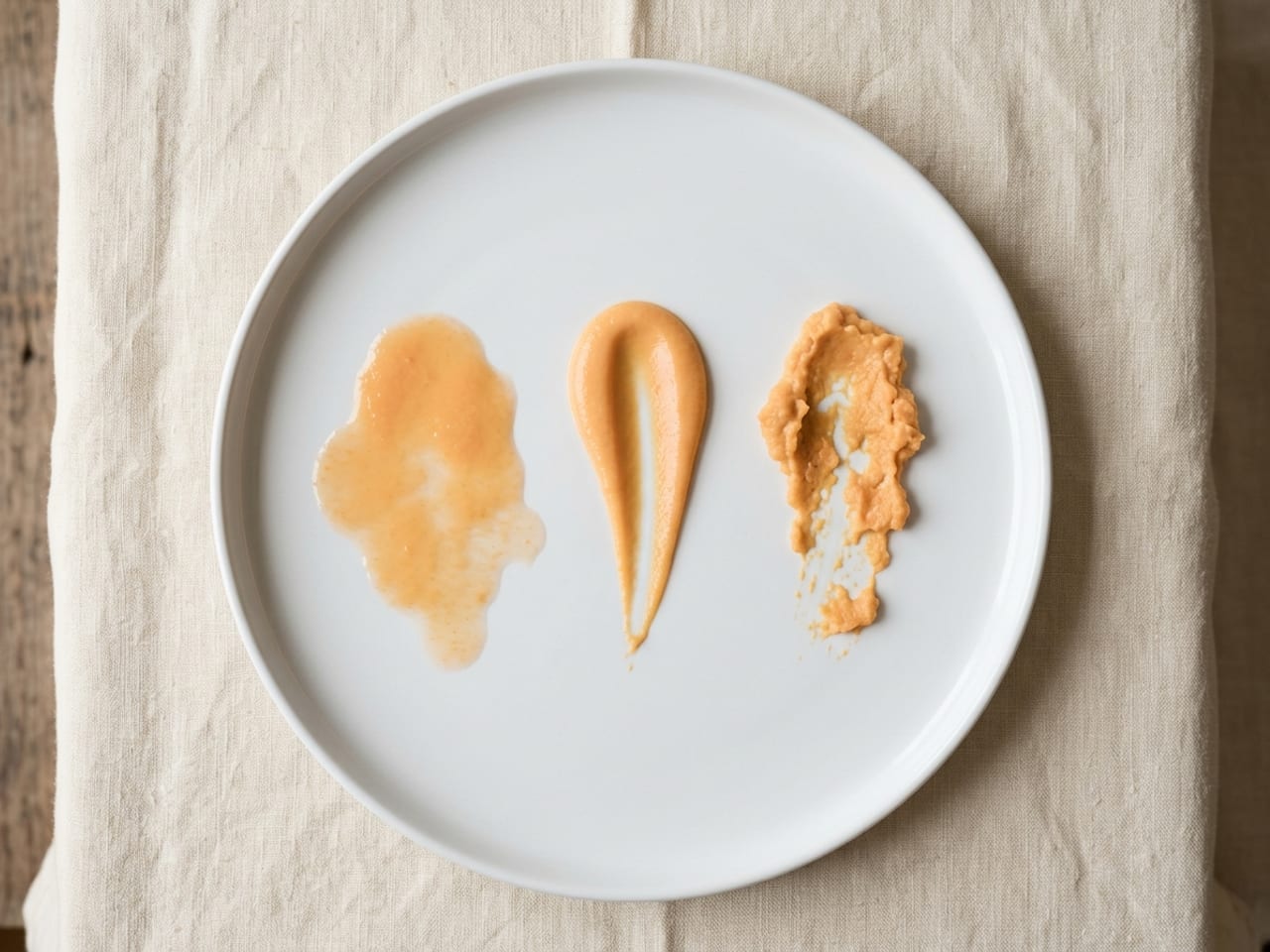
Where they disagree. On the swoosh, only about how thick: a purée or a rouille for America's Test Kitchen, "yogurt or heavy cream" for Tasting Table, mayonnaise for an anonymous answer, a touch thicker than chocolate syrup for one private chef, who uses that one consistency for everything.1, 3, 15, 21 On dots, flatly: thick (America's Test Kitchen) against thin (Untappd).1, 14 On the drizzle, flatly: thin (Tasting Table) against thick (Cookist).3, 23 On the brush they agree it is not a stiff sauce.1, 20 The one rule that three sources state in almost the same words is for two sauces drawn into each other: the same consistency.28, 31, 40
Nappé is a finishing test, not a plating specification. Cooks often answer the thickness question with one word, nappé: the sauce coats the back of a spoon. The sources test it in different ways, and none of the definitions below ties it to a swoosh, a dot, a line or a pool. One private chef and one writer use the same spoon test for plating sauces without the word (see the comparisons above).
| Who | How they define or test nappe |
|---|---|
| CIA Foodies (the Culinary Institute of America's consumer site) | "Dip a wooden spoon in the sauce and draw a line down the back of the spoon with your finger. If you leave a clean line down the center of the spoon, you have nappe." It grades the result as light, medium or heavy nappe.53 |
| Zeringue and Thibodeaux (open textbook) | "Run your index finger down the spoon"; "If you end up with a clean line down the middle, your sauce is ready."49 |
| James Peterson, Sauces (2008), as fragments | "Sauces are said to nap when they leave an opaque coating on the back of a spoon". No finger line.38 |
| Labensky and Hause, On Cooking (2007), as fragments | A good sauce "Has a consistency that will coat the back of a spoon (the French call this nappe)". The glossary gives the pronunciation as "nap".37 |
| Wayne Gisslen, Professional Cooking | Tested on the food, not the spoon: "Having the proper texture in a sauce to lightly coat foods." He spells it nappé and says it "nap pay".32, 34 |
| Escoffier, A Guide to Modern Cookery (revised 1909 edition) | The spoon test, without the word in English (the French has "nappe la cuiller"): a glaze is ready "when it evenly veneers a withdrawn spoon", and custard is cooked until it "properly coats the withdrawn spoon".47, 48 |
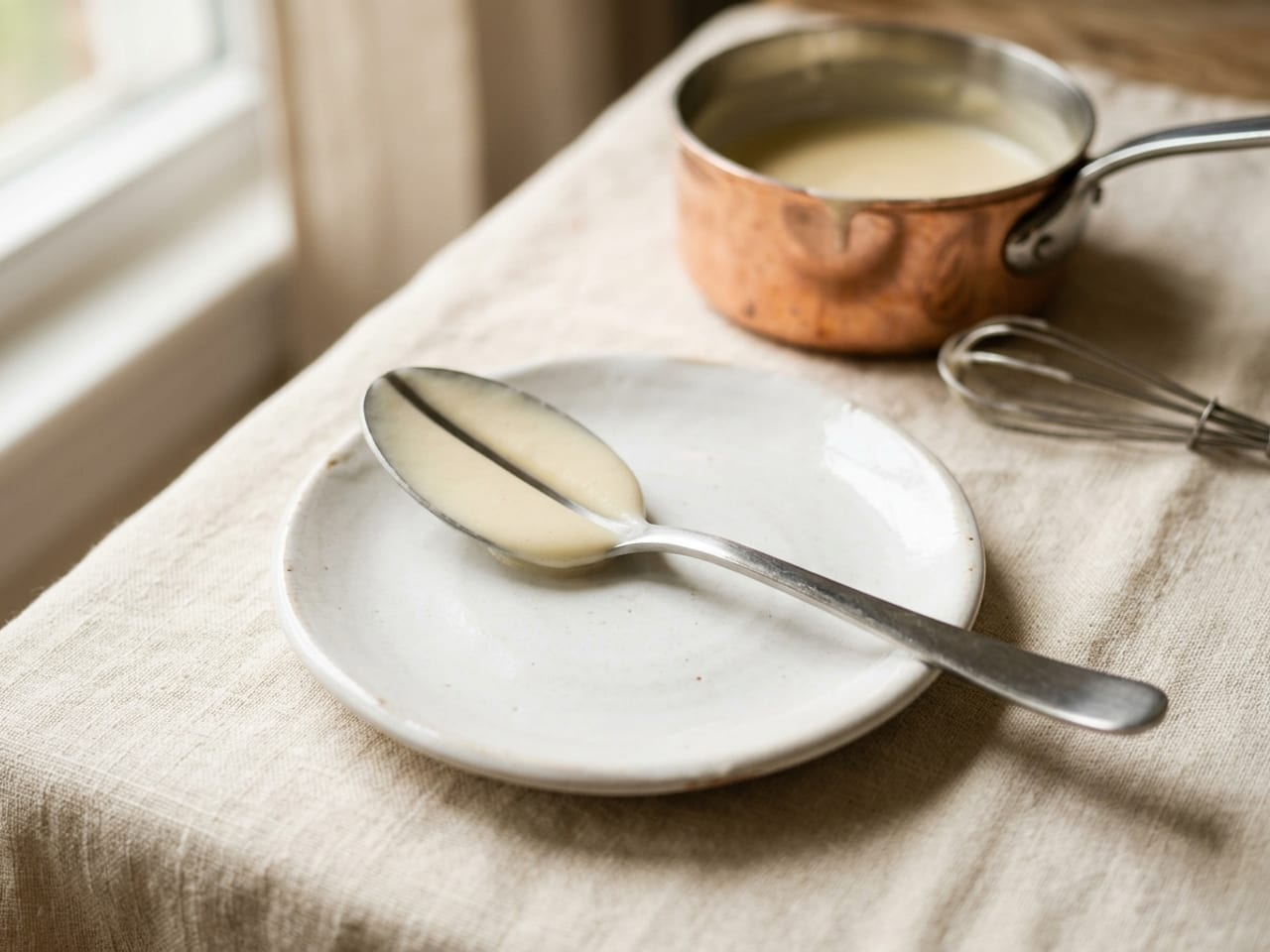
The Escoffier trap. It is often said that Escoffier defined nappe as a sauce that coats a spoon. In French he comes close: a glaze is ready when "elle nappe la cuiller".48 In the English edition we read, the translator kept the test and dropped the word: a glaze "veneers a withdrawn spoon", a custard "coats the withdrawn spoon". "Nappe" occurs 16 times in that text (our count), always as a jam and sugar stage, the one the book calls "equivalent to the large-thread stage in the cooking of sugar".47 His measures are British, too: a quart in that book is an imperial quart, 1.14 litres.
Make it thinner at the stove than you want it on the plate. The most useful sentence we found is Harold McGee's, read as search fragments: a sauce is "going to be thicker when the diner actually tastes it, and it may even congeal on the plate. So sauces should be thinner at the stove than they're meant to be at the table."39 A thickener also costs flavour, by McGee's heading "Thickeners Reduce Flavor Intensity".39
The plate's temperature. The textbooks say hot food on hot plates and cold food on cold plates and give no temperature: "Serve hot foods hot, on hot plates. Serve cold foods cold, on cold plates."33 One writer gives a number, "a low oven (about 150 degrees Fahrenheit)", about 65°C, for warming plates, and chills them "in the fridge or freezer for a few minutes" for cold sauces.3 For a butter sauce Serious Eats is firm: "This is a case where you absolutely should warm your plates before serving."66 How to warm a plate safely is in our steak guide.
How to thicken or loosen a sauce for plating
These are the numbers that exist, each with its owner. None of them is tied by its source to a plating move: they are how a sauce is thickened, and the comparisons above are how you judge the result. A metric figure inside a source's own parentheses is the source's; per-quart, per-litre and percentage arithmetic is ours and says so.
| Method | The numbers in print, and whose they are | The catch |
|---|---|---|
| Reduction | Demi-glace "reduced by half or to a nappé consistency" (the Culinary Institute of America).36 Glaze: "One gallon (4 liters) of stock produces only 1 to 2 cups (2.5 to 5 deciliters) of glaze", which is between a sixteenth and an eighth of the volume (our arithmetic). Cream: reduced by "one-third to two-thirds its original volume".49, 50 The home version: "reduce the sauce on low heat until it coats the back of a spoon" (Tasting Table).3 | It needs "no starches or other flavor-altering ingredients", but go too far and the sauce "will feel gluey in the mouth; it will also quickly congeal on hot plates".49 |
| Roux, per US gallon of liquid | Gisslen, per 1 gal (4 L): thin 12 oz (375 g), medium 1 lb (500 g), thick 1½ lb (750 g) of roux, each half butter and half flour by weight.32, 33 Per US quart that is 3, 4 and 6 oz; per litre about 94, 125 and 188 g (both ours, from the book's own figures). The Culinary Institute of America, per 1 gal (3.84 L): light, for soups, 10 to 12 oz (284 to 340 g); medium, for most sauces, 12 to 14 oz (340 to 397 g); heavy, as a binder, 1 lb 2 oz to 1 lb 4 oz (510 to 567 g).36 Per litre about 74 to 89 g, 89 to 103 g and 133 to 148 g (ours). Escoffier, for a soup velouté: "three and one-half oz. of white roux per quart", an imperial quart, so about 87 g per litre (ours).47 | The two textbooks disagree: for a medium sauce, 1 lb against 12 to 14 oz. Gisslen's table is printed cleanly in the publisher's PDF of his sauce chapter and garbled in two scans of the 7th edition; all three agree. The Culinary Institute of America's figures were read in one scan only, whose ounces are garbled and whose grams are not; the ounces given here are the ones those grams fix.32, 33, 36 Gisslen himself, beside the table: "How thick is a thick sauce? Obviously, these are not precise, scientific terms that can be defined easily."33 A darker roux thickens less: in America's Test Kitchen's measurement, blond "had 14 percent less thickening power" and peanut-butter-coloured "26 percent less".58 |
| Starch slurry: cornstarch, arrowroot, potato starch | Cornstarch "has roughly twice the thickening power of flour" (Gisslen).33 "For every tablespoon of cornstarch, use 2 teaspoons of potato starch" (America's Test Kitchen).61 Escoffier thickens a soup with "one-third of an oz. of arrowroot" to the imperial quart, about 8 g per litre (ours).47 Cook a cornstarch sauce "gently until the raw starch flavor disappears, usually about 5 minutes".49 | Mix it cold first: starch "must be mixed with a cool liquid before it is introduced into a hot one".49 It gives "a glossy sheen that is not always wanted".60 And it can thin again; see fixes. The Culinary Institute of America's textbook gives no ratio: "The amount of slurry needed depends on the batch". 36 No source we read gives a slurry ratio for a plating sauce. |
| Beurre manié (raw butter and flour) | Three proportions in print: "equal parts soft, raw butter and flour" (Gisslen), equal amounts "by weight" (the open textbook); "equal parts by volume" (America's Test Kitchen), which is far less flour by weight (our remark); and "four oz. of butter and three oz. of sifted flour" (Escoffier; 113 g and 85 g by our conversion).33, 47, 49, 60 America's Test Kitchen's dose: "whisk in 1 tablespoon beurre manié until completely dissolved."60 | Do not cook it long: it "should not be cooked any longer once the mixture thickens or the sauce will develop a strong floury taste."49 |
| Liaison (egg yolk and cream) | "Whisk together one part egg yolk and three parts whipping cream." "Temperatures over 185°F (85°C) will cause the yolks to curdle."49 | It thickens little: it "adds richness and smoothness with minimal thickening".49 The two textbooks give professional kitchens different floors for holding it, 135°F (57°C) in the open textbook and 140°F (60°C) in the Culinary Institute of America's.36, 49 |
| Butter whisked in (monter au beurre) | "As a general rule, a made-to-order butter sauce should contain about one third butter": "½ cup (125 grams) of butter should be used to finish 1 cup (250 milliliters) of liquid sauce base."38, 49 | Too little butter "tends to separate and float to the surface"; too much and the sauce "takes on a thick, waxy appearance, and it may break."49 The sources split on method: softened butter (Gisslen) or cold (the open textbook); a tablespoon at a time, the only way that worked in America's Test Kitchen's test, or, per Serious Eats, "you can add the butter all it once" (as printed).33, 49, 57, 66 |
| Beurre blanc: the temperature window | Ceiling: it "will begin to separate and leak butterfat if its temperature rises above about 135°F/58°C" (McGee, as a fragment; the pair is as he prints it, and 135°F is 57°C by our arithmetic); "At 136°F (58°C)" (Labensky and Hause; the open textbook).37, 39, 51 Floor: "below body temperature" is "Most damaging" (McGee), about 98.6°F (37°C), a figure that is ours; or "below 85°F (30°C)" (the open textbook).39, 51 Holding: a water bath "around 110°F (45°C) or so" (Serious Eats; 110°F is 43°C by our conversion).66 | It thickens as it waits: "Be sure to whisk in a tablespoon or two of water if you notice it thickening."66 The whole working window, from the floor to a degree short of the ceiling, lies below the 135°F (57°C) that the US Food Code asks of restaurants for hot holding; see food safety. |
| Gelatin | "We found that 2 teaspoons of gelatin per cup of broth thickens sauces and braises appropriately" (America's Test Kitchen), per cup being per 240 ml (ours).59 McGee: gelatin alone "requires a large" concentration, "10% or more, to have real weight" (fragments, joined).39 | McGee's next words: "at that concentration, the sauce is quick to congeal on a cooling plate".39 Bloom it first, "in a few tablespoons of cold water for 30 seconds".59 |
| Xanthan gum | Modernist Cuisine's website: "as little as 0.1% by weight can yield a thick liquid, and 0.5% by weight can make a thick paste".76 Modernist Cuisine at Home, as fragments: 0.1 to 0.15 g per 100 g for a thin sauce, 0.2 to 0.3 g "for a sauce closer in thickness to salad dressing or ketchup".43 Jason Logsdon: "0.1% to 0.3% for thin sauces and 0.3% to 1% for thick sauces", and "about 0.1% to 0.3%" to hold a purée together.77 In kitchen terms 0.1% is 1 g per litre of a water-thin sauce (ours). | The three ranges do not match: 0.5% is "a thick paste" to one and inside "thick sauces" to another.76, 77 Too much gives "a texture and mouthfeel resembling mucus" (Logsdon).77 It needs no heat; Serious Eats says it needs a blender, Logsdon that you can "blend or whisk".67, 77 No source we read says what percentage holds a dot. |
| Agar fluid gel | Jason Logsdon: "a ratio of 0.5% to 2.0% will result in a fluid gel ranging from runny to pudding-like."78 The Institute of Culinary Education's buttermilk fluid gel uses "7 grams agar" in 700 g of liquid, 1.0% (our arithmetic).80 A chef's lemon fluid gel uses 18 g for about 1,050 g of liquid and 150 g of sugar, roughly 1.5% of the whole or 1.7% of the liquid (ours, taking millilitres as grams).82 Modernist Cuisine at Home, as fragments: 0.25 g per 100 g for a thin broth, 0.4 to 0.5 g "for a moderately thick sauce", 0.9 to 1.1 g for "a thickness like that of a puree".43 | Method: set a gel, then blend it smooth; gelatin will not do, because "The friction of the blender will warm gelatin enough to melt it."78, 80 The sources differ on the heat: boiled and "simmered for 3 to 5 minutes" (Logsdon) against "bring the mixture to 185˚F. Cook two minutes at that temperature." (the Institute of Culinary Education; 185°F is 85°C).78, 80 Print a range with its owner, never one number as the ratio. |
| Crème anglaise | Cook "until it thickens enough to coat the back of a spoon (or until it reaches 185°F/85°C)." His procedure adds: "Never let the temperature go above 190°F (87°C)." (Gisslen, read in two scans)33, 34 It is the one sauce for which a textbook we read gives the coat-the-spoon point a thermometer reading. | Escoffier cooks it "until it approaches the boil and properly coats the withdrawn spoon. Take care not to let it boil, for this would turn the preparation."47 |
| A vegetable purée | No ratio. "Purées of starchy vegetables, such as squash or dried beans, may need to be thinned with stock, broth, or water." Watery ones "can be reduced to thicken them, but be careful not to lose the fresh vegetable taste and color." (Gisslen)32 | For wet vegetables, "rely on dry-heat cooking methods" before blending (The Daily Meal).74 |
| Coulis and dessert sauces | No ratio and no sugar figure. A fruit coulis "is usually as simple as pureed fruit thinned to the desired consistency with sugar syrup."52 | Escoffier's apricot sauce comes off the heat "when the sauce veneers the withdrawn spoon".47 |
| Loosening any sauce | "add a splash of stock, cream, or even water, depending on the sauce" (Tasting Table);3 "add hot water a few drops at a time" (Christopher Styler, of a dressing);40 "If it is too thick, thin it with stock." (James Peterson)38 | Thinning is the easy direction: "A butter sauce can easily be thinned, but thickening a sauce containing butter would require reduction", and boiling one "will cause it to break and become oily".49 And: "Always test your consistency on a spare plate before committing to your final design."3 |
Popular claims we could not source. Each of these is widely repeated and none was on a page or in a book fragment we could read, so none is printed above with a reference: that arrowroot turns slimy with dairy; that Joël Robuchon's purée is two pounds of potatoes to one of butter (America's Test Kitchen mentions "a full pound of cold butter" in his recipe without giving the potato weight);56 that pectin thickens a coulis; a pouring temperature for ganache; a xanthan or agar percentage "to hold a dot"; and a sugar reading for a coulis. We are saying we found no source, not that the claims are false.
Sauce plating failures and fixes
Each cause and each fix has its source beside it, or is labelled ours. None was kitchen-tested by us.
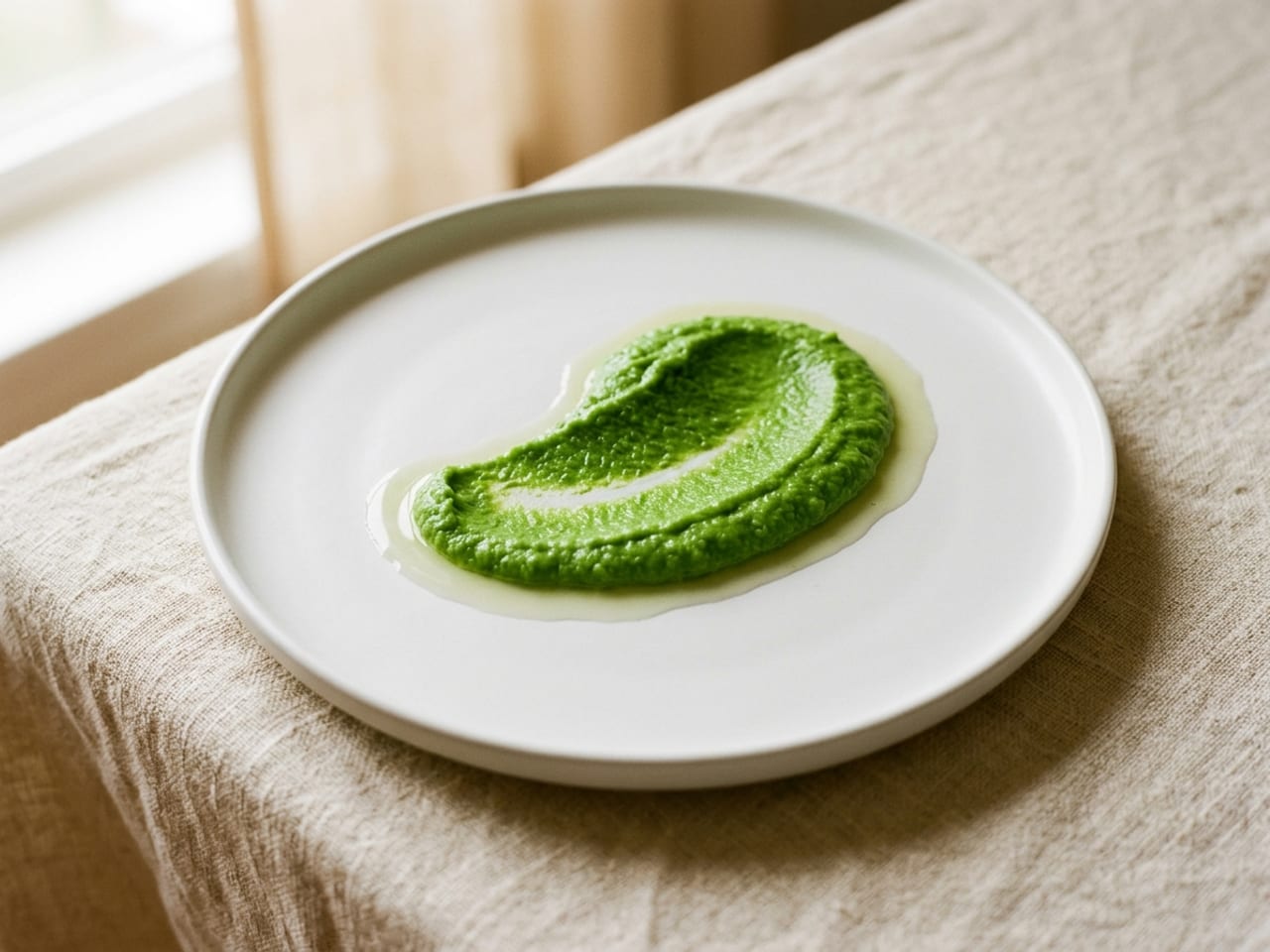
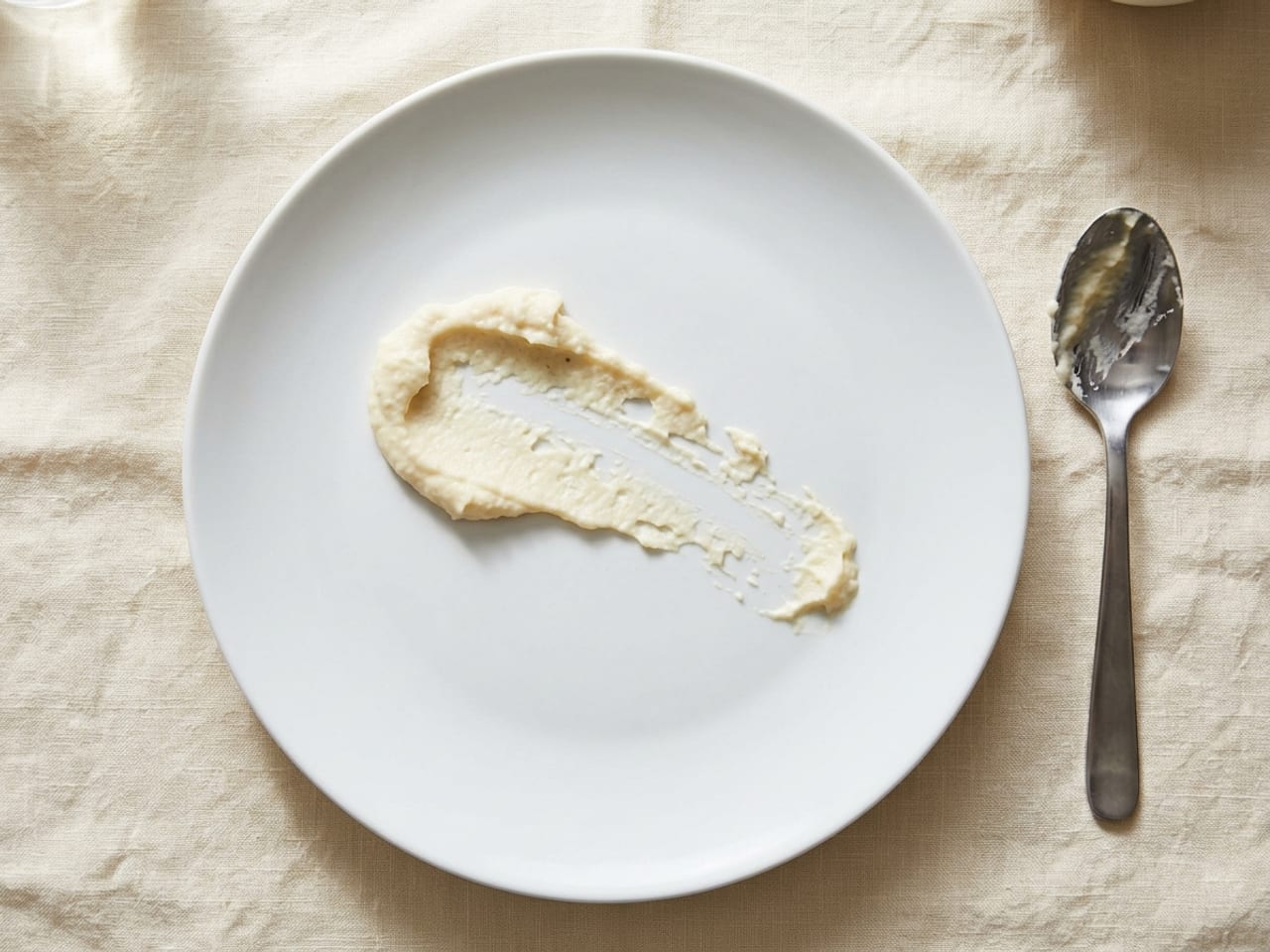
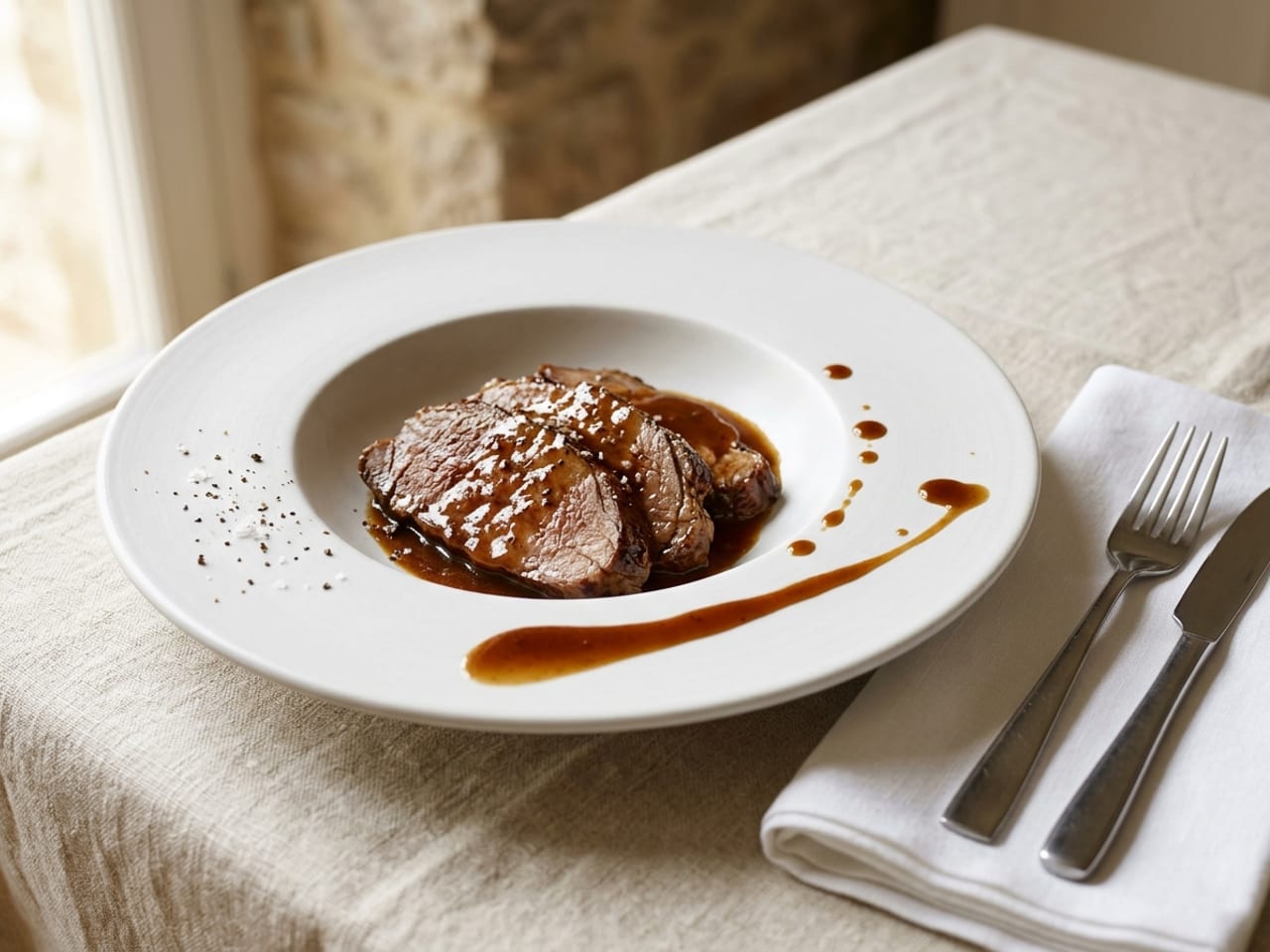
- A watery halo around a purée, a coulis or a gel (weeping)Why. There is one direct demonstration in print. At the Institute of Culinary Education an instructor, in the blog writer's words, "made an olive coulis with and without xantham gum and drew a line of both on a plate. The sauce without the gum quickly had syneresis, or weeping, while the one with the gum maintained its shape and body."81 A textbook gives the reason for purées: those of tomato or green vegetables "contain so little starch" that sauces thickened with them alone "will separate in to liquid and solid when left to sit unless another liaison is used along with the puree."49 And for coulis, a pastry textbook: "it may separate quickly when used as a plating sauce. It's best to use à la minute."28 Fixes, each with its owner. A little xanthan: "To hold purees together you only need a little xanthan gum, about 0.1% to 0.3%" (Jason Logsdon), which is 1 to 3 g per kilogram (ours).77 Less water going in: cook wet vegetables by dry heat (The Daily Meal).74 "Another liaison", the textbook's answer.49 For a fluid gel, a seller's advice: "adding a small amount of xanthan gum to a fluid gel will help prevent any liquids from weeping out".79 And plate late, as the pastry textbook says. For flour and cornstarch sauces the one statement we found is about freezing, not plating: America's Test Kitchen froze a gravy of each and "Once defrosted, both batches wept". 63 We found none that says a starch-thickened sauce weeps on the plate.
- A swoosh that tears, drags thin or has ragged edgesThe sources name two causes. Thickness: "Too thick, and it won't spread smoothly."3 And hesitation: "A shaky hand leads to messy edges, so commit to the movement" (Tasting Table); "just go for it and you'll get a better result" (the CBC).3, 8 Fixes. Loosen the sauce a few drops at a time and try it on a spare plate.3, 40 Put the sauce down first and pull second, as two moves.5 Do not repair it: "Never go back and try to fix the swoosh"; "wipe it up and start over again."11 With a spatula, "move the sauce along, do not push it down".15 That too little sauce on the plate causes gaps is a common explanation that no source we read states; it is ours if you see it here.
- Dots that flatten, spread or run into each otherNo named source we read explains flattening or merging, and none gives a spacing. What they give is the requirement: "a thick, smooth sauce that will stay put".1 The sauce can also change under your hand: "it warms up and thins" (Ripert, as NPR quotes him).91 Fixes. A thicker sauce, by any row of the table above. A fluid gel, the one sauce described by this property: "A fluid gel can be used to decorate plates without the worry of the strategically placed dots running all over the plate" (a seller's claim).79 A cold plate for a cold sauce: Tasting Table chills plates so that cold sauces do not end up "melting into a watery mess".3 Wider spacing and working in small batches are ours.
- A bottle that spits, splutters or draws a wobbly lineNo source we read explains a spitting bottle as trapped air, or tells the cook to tap or burp it; any air explanation is ours. What is sourced: a wide nozzle's stream "is harder to control and tends to burp and blurp", and a ragged tip can be trued by pushing "a skewer down through the top of the nozzle" (Serious Eats' tested review).27 Lumps block a tip: use "a smooth sauce", "no chunks allowed", and "test the flow on a spare plate" (Tasting Table).3 Blended sauces carry bubbles: a reply on Modernist Cuisine's xanthan page says that if a mixture "gets too foamy, you can pass the mixture through a fine-mesh sieve to extract some of the air". 76 For the line itself: "move the bottle slowly and deliberately", and "Brace your wrist".3 That straining keeps a bottle from clogging is our link; no source says it in those words.
- A skin on the sauceWhy. America's Test Kitchen, of puddings: as the mixture is heated "Water evaporates, and proteins and sugar become more concentrated. Together, this results in a dry barrier on the liquid's surface."62 McGee, of heated milk, as a fragment: "The skin forms because proteins unfolded by the heat concentrate" at the surface.39 What named sources do. Butter the surface: Escoffier holds cullises hot in a bain-marie "and butter their surfaces lest a skin should form."47 Keep it moving while it cools: his Espagnole "must be kept in motion until quite cool lest a skin should form on its surface".47 Cover it: "Cover to prevent a skin from forming" (Gisslen).33, 34 Press something onto it: parchment paper (America's Test Kitchen), or plastic wrap touching the surface, as Tasting Table reports of a Martha Stewart video.62, 69 Or strain it afterwards: America's Test Kitchen lets the skin form, "about 20 minutes, and then pour it through a fine-mesh strainer".62 No source we read deals with a skin forming on sauce that is already on the plate; that the same evaporation is at work there, and that the cure is to sauce the plate at the last moment, are ours.
- A butter sauce that is thin, oily or brokenThin from the start. America's Test Kitchen made a white butter sauce four ways: "The only sample that thickened into a proper butter sauce was the one made by whisking in cold butter one tablespoon at a time. The other sauces remained thin and broke."57 Serious Eats disagrees about the increments and agrees about the heat: make "sure the sauce doesn't get too hot, which is the surest way it will break."66 Tasting Table: it "can (and probably will) break if the butter isn't cold enough." 70 Broken by heat. "Extended periods at temperatures over 136°F (58°C) will cause the sauce to separate"; the textbook's rescue is to cool it to about 110 to 120°F (43 to 49°C) and whisk.51 Serious Eats: "if you see the butterfat starting to bead on the sauce, you have a window of opportunity", and a splash of cool water whisked in often saves it.66 A question-and-answer site adds the catch that a re-formed sauce "will slowly seep back out".71 Broken by cold. Below 85°F (30°C) "the butterfat will solidify. If the sauce is reheated, it will separate into butterfat and water; whisking will not re-emulsify it."51 On the plate. "A cold plate will chill the sauce immediately. This is a case where you absolutely should warm your plates before serving."66 And of hollandaise: "If the yolks or clarified butter gets too cold your sauce will break when you place it on your hot food product."51 We found no source on a pass lamp or heat lamp breaking a sauce; that follows from the ceilings above and is ours.
- A sauce that sets, stiffens or goes gluey on the plateThe cause in the sources is the sauce, not the plate. An over-reduced sauce "will feel gluey in the mouth; it will also quickly congeal on hot plates" (the open textbook; Peterson's scan returns the same words).38, 49 McGee, as fragments: a sauce is "going to be thicker when the diner actually tastes it, and it may even congeal on the plate. So sauces should be thinner at the stove than they're meant to be at the table."39 Gisslen: reduced sauces "sometimes become so gelatinous that they solidify when they cool".32 Fixes. "If it is too thick, thin it with stock."38 Stopping the reduction earlier next time is ours. Finish with butter, which "attenuates the gelatin's stickiness".49 Warm the plate: Tasting Table's method is "a low oven (about 150 degrees Fahrenheit)", about 65°C, so that sauces do not end up "stiffening up mid-swipe"; it is the only source we read that gives a plate temperature.3 Why a gelatin-rich jus does this is in our au jus guide.
- A starch sauce that was thick and went thin againOvercooking and holding. Gisslen: "Do not boil for a long period or the starch may break down and the liquid become thin. Sauces thickened with cornstarch may thin out if held on the steam table for long periods."32 Tasting Table: keep boiling and "the starch will start to disintegrate".68 And acid: "acids inhibit gelatinization. Whenever possible, do not add acid ingredients to sauces until the starch has fully gelatinized" (Gisslen); McGee adds that root starches suffer below pH 5 while grain starches stand more (see the myth entry).32, 39 Fixes. Add the acid after the sauce has thickened (Gisslen's rule); do not reheat a cornstarch sauce (the open textbook's rule); arrowroot is "less likely than cornstarch to break down when heated for a long time" (Gisslen; the scan prints "fora" for "for a"). 32, 33, 49 For sauces to be frozen, Gisslen names waxy maize, because other starches "lose their thickening power when frozen".33
- A vinaigrette or pesto that leaves a ring of oilA plain vinaigrette is meant to come apart: "A temporary emulsion will last very briefly and usually does not contain an emulsifying agent."49 America's Test Kitchen gives it "no more than an hour before the oil and the acid start to separate", and with Dijon mustard its dressing "held for 2 hours with no sign of separating".64, 65 A Serious Eats writer finds that a tiny pinch of xanthan in a taco sauce "keeps it from separating".67 Rosanna Stevens uses the separation as the effect.5 None of these sources is about a dressing on a plate, and none describes oil bleeding from a pesto stroke; applying them there is ours. Dressing a salad is its own subject: where the dressing goes.
- Sauce on the rimWhy it matters. Hands and sleeves. Unilever: "Avoid putting any sauces on the rims of the plates. Any sauce designs on the rims will be ruined since cooks, servers, and waiters hold the plate rims when delivering it to the diner."6 Gisslen, under "Keep food off the rim of the plate": "so many customers have soiled their sleeves on sauced rims, that decorating the rim is falling out of fashion."34 Fix. Wipe it before the plate leaves: a towel (WebstaurantStore), a damp paper towel (Daniel Wilson).7, 13 No source we read gives a width for the clean margin, and we found none that says what to dampen the cloth with; the vinegar habit is a myth entry below. The opposite also exists in print: Untappd's blog admires "upscale restaurant plates with sauce running out to the edge".14
- Too much sauce, or too littleToo much: "Make a better sauce and serve less of it" (Gisslen); "When in doubt, less is more" (Tasting Table); a smaller pool "avoids overwhelming the dessert with too much sauce" (the pastry textbook).3, 28, 33, 34 Too little is the critics' complaint: NPR's writer says dots "certainly don't allow you to satisfyingly dunk your crust of bread in them".91 Fixes. Start small: "remember you can always add more but not take away".5 And send the rest separately, "in one of those sweet little sauce jugs".5 The published amounts are under how much sauce.
Which move suits which sauce, and which dish
By sauce family first. A pairing is listed only where a named source makes it; the last column links to the recipe or guide on this site.
| Sauce family | The moves sources use it for | What to watch | On this site |
|---|---|---|---|
| Vegetable or fruit purée | Swoosh or smear (America's Test Kitchen, Wilson, Rosanna ETC, Untappd); a brushed base (WebstaurantStore); piped or bottled dots (WebstaurantStore); a quenelle (Tasting Table).1, 3, 5, 7, 13, 14 | Low-starch purées let go of their liquid as they sit; starchy ones go stiff and "may need to be thinned".32, 49 | Pea purée; citrus salmon with pea purée; tuna with parsnip purée; mashed potatoes; the quenelle. |
| Reduction, jus, demi-glace, pan sauce | A pool (America's Test Kitchen); spooned around, about 1½ fl oz (45 ml) a portion (Gisslen); a thread or cordon (Escoffier); drizzled around from a spouted spoon (WebstaurantStore); a streak from a spoon handle (Rosanna ETC); dots, says Untappd alone.1, 5, 7, 14, 33, 47 | Over-reduced, it congeals; make it "thinner at the stove".39, 49 | Au jus; steak sauces; mushroom sauce; teriyaki sauce. |
| Gravy and other roux-thickened sauces | Spooned or ladled over, or passed: "velvety sauces like béchamel or gravy" served warm from "a sauce boat or a ladle" (Cookist).23 No named source we read plates gravy as a swoosh or dots. | A skin as it waits; and gravy is a food the CDC links to one kind of food poisoning when it is held at unsafe temperatures.62, 120 | Turkey gravy; the mother sauces; jus against gravy. |
| Butter emulsion (beurre blanc) | Around the food ("the beurre blanc around the outside", Great British Chefs); a thin band on the plate "partway around the fish" (Gisslen); a pool under fish, as on our own plating-101 figure.25, 33, 34 | Warm plate, warm sauce, never hot: "A cold plate will chill the sauce immediately."66 | Plating 101; sauce fixes. |
| Egg emulsion (hollandaise, béarnaise, mayonnaise-based) | Spooned over, the textbook nappe case ("hollandaise, bearnaise and bechamel");49 béarnaise also as a cordon on the meat in the 1938 Larousse;45 a rouille as a swoosh (America's Test Kitchen);1 dots, in Ripert's account of a mayonnaise-based sauce.91 | It breaks hot and cold, and it has holding limits; see food safety.51 | Hollandaise among the mother sauces; béarnaise with steak. |
| Coulis | A pool or flood (Rosanna ETC, the pastry textbooks); splatter (Rosanna ETC); dots and lines from a bottle or cone (The Nibble); feathered into a second sauce (the textbooks).5, 19, 28 | It "may separate quickly when used as a plating sauce".28 | Coulis, defined; dessert plating. |
| Crème anglaise and other custard sauces | A pool (America's Test Kitchen); the flooded plate that a second sauce is feathered into (the textbooks, The Nibble).1, 19, 28 | A skin; and it is cooked to a temperature, 185°F (85°C), not thickened later.33, 62 | Dessert plating. |
| Fluid gel | Dots, lines, circles and swirls from a bottle (Fine Dining Lovers, the Institute of Culinary Education).80, 83 | Air from the blender; and it is kept cold: the Institute of Culinary Education holds its buttermilk gel in a squeeze bottle "cold, up to 3 days".80, 82 | Gels, defined. |
| Flavoured oil and vinaigrette | Oil drizzled around or over, a tablespoon (15 ml) or so a portion (Gisslen); dots of herb oil on a sauce (Great British Chefs); a ring of vinaigrette around a tartare (Gisslen); vinaigrette dots that separate on purpose (Rosanna ETC).5, 25, 32, 34 | A homemade garlic or herb oil belongs in the refrigerator, for four days at most; see food safety.122 | Herb oil; dressing a salad. |
| Caramel, chocolate sauce, ganache | A streak from a spoon handle (Rosanna ETC, of chocolate sauce); brushed smears of ganache (Tasting Table); bottle dots of dulce de leche (America's Test Kitchen); a piped chocolate outline to flood (the textbooks).1, 3, 5, 28 | They stiffen as they cool: caramel "will thicken as it cools".75 | Dessert plating. |
By dish
Only what a named source does. We found no named source for a sauce move specific to chicken, and none on plating sauced pasta as a sauce move; dressing a salad is its own subject.
| The dish | What named sources do with the sauce | |
|---|---|---|
| Steak | "savoury reductions elegantly painted on a steak plate" (Le Cordon Bleu Malaysia); demi-glace drizzled around a filet, and pea purée brushed under one (WebstaurantStore); a pan sauce spooned "directly over the protein" (Made In).7, 9, 18 | Steak: sauce beside or over, sauce by sauce |
| Fish | Sauce under and over a sole (Escoffier); beurre blanc around coley, with dots of oil (Great British Chefs); kingfish laid on a smear of horseradish cream "with decent gaps so that the cream can be seen" (Daniel Wilson); the sorrel sauce under the Troisgros salmon (Le Monde); a purée or pesto "underneath the fish" (Lucy Waverman).13, 25, 47, 85, 102 | Citrus salmon with pea purée; fish in the dish-by-dish guide |
| A roast with gravy | Gravy passed in "a sauce boat or a ladle" (Cookist); Escoffier sends the strained cooking stock of a pot-roast "to the table in a sauceboat at the same time as the meat or poultry".23, 47 | Turkey gravy; serving au jus |
| Dessert | Sauce on the plate, not over the dessert: sauces "are usually not ladled over the dessert because doing so would mar the appearance. Instead, the sauce is applied in a decorative fashion to the plate".28 Flooding, feathering, outlining, bottle dots and streaks.28, 31 | Dessert plating moves |
Sauce under, beside or over; first or last
The sources disagree, and the disagreement is the answer. One row each, classical first, then by position.
| Who | Position | In their words |
|---|---|---|
| Escoffier (English edition, revised 1909) | Classical service, on a dish for the table | Over ("coat with"), around ("a thread of"), under and over at once for a sole, or apart: "Send the sauce to the table separately."47 |
| The Christian Science Monitor, reporting from Troisgros (1982) | Nouvelle cuisine | Under: "In many cases a sauce is placed on the plate first so that it is beneath the food, rather than covering it as in the past." A reporter's sentence.84 |
| Gisslen, Professional Cooking | A culinary school textbook | Any of the three: "Sauces, if used, may be served around, under, or over other items on the plate."34 And: "Sauces, often in smaller quantities, are served under or around the item as often as over the top of it, perhaps even more often."32 |
| America's Test Kitchen (2022) | Sauce first | For a swoosh, "Place your food on top of or next to the sauce." For a brush stroke, "place your food on top." With a bottle, either order: "or place the food first and use the squeeze bottle to drizzle sauce on top".1 |
| WebstaurantStore (2025) | Sauce after the food | "With your principal ingredients plated, you're ready to top your dish with delicious sauces". Yet its own free-form example brushes the pea purée on before the steak.7 |
| Emil Nilsson, chef (KitchenTime, 2025) | Sauce last | "Always add your sauce last", his own sentence.22 |
| The pastry textbooks | Desserts: not over | Sauces "are usually not ladled over the dessert because doing so would mar the appearance."28, 30 |
| Nation's Restaurant News (2007) | Over, as a complaint about smears | "put the sauce over the food where it belongs in the first place. This way guests don't need to drag their food across the plate."90 |
The best single sentence is Gisslen's guideline, "When using a sauce or gravy, add it attractively": "Ladle the sauce around or under it, or possibly covering only part of it, as with a band of sauce across the center."34 Order follows from place (our reading): a sauce that goes under the food has to go down first, and a sauce that goes over it has to go on last. A fourth option is always open, the sauce apart: Rosanna Stevens suggests plating minimally and giving guests more "in one of those sweet little sauce jugs", and Cookist keeps "bold or spicy sauces that might not appeal to everyone's palate" on the side.5, 23 We found no named source on pouring a sauce at the table for a plated dish.
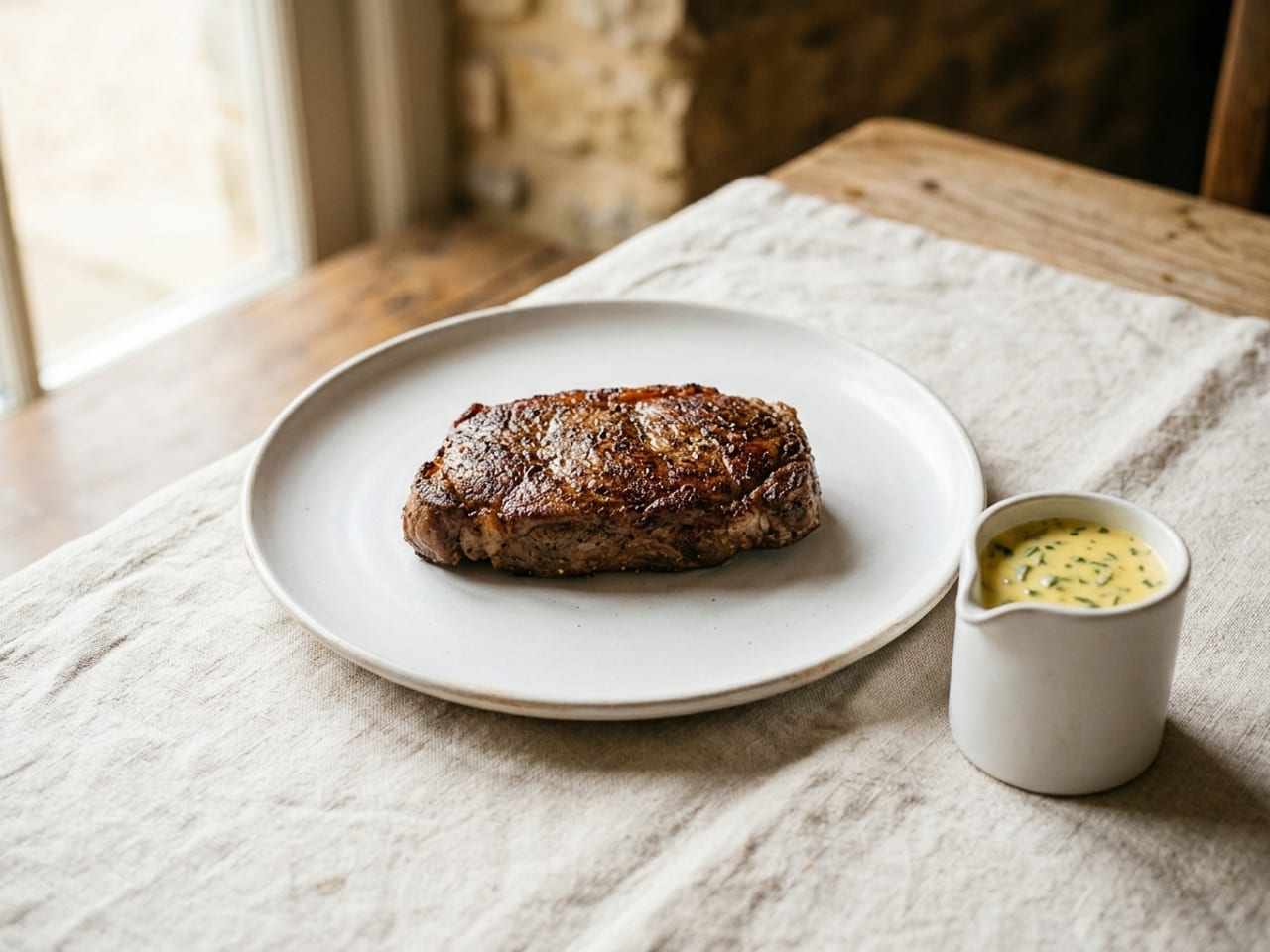
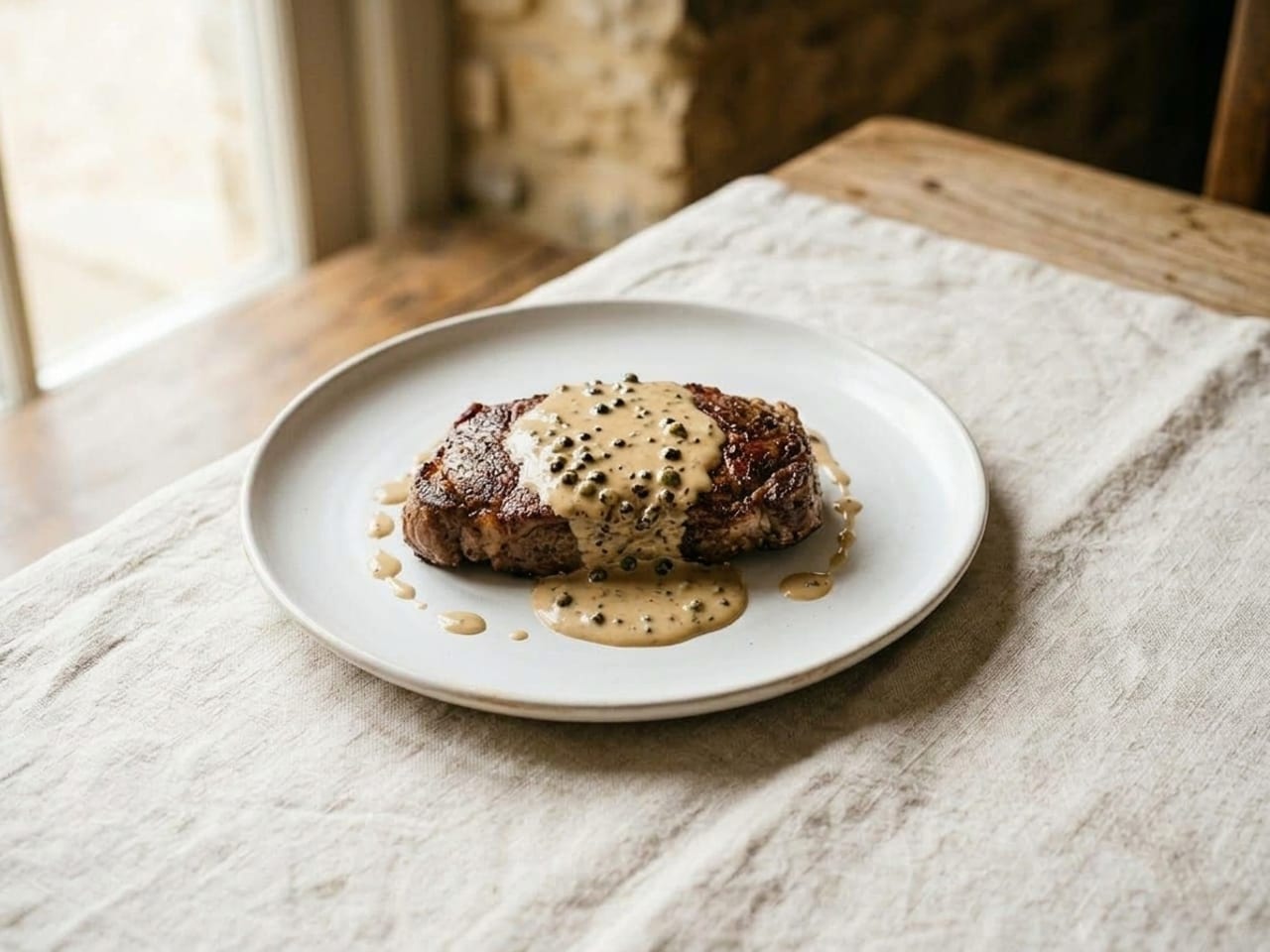
How much sauce
No source we read gives a general amount for a swoosh, a pool, a ring, a line or a set of dots, in tablespoons or in millilitres. None gives a dot size, a swoosh length or a nozzle width either. These are the quantities that are in print.
| Who | The amount | What it is, and is not |
|---|---|---|
| Gisslen, Professional Cooking (2011), recipe lines read in two scans | 2 fl oz (60 ml) of sauce with a portion of meatballs, broccoli or eggplant; about 1½ fl oz (45 ml) spooned "around" two medallions or an escalope of salmon.33, 34 | Five recipes, not a stated rule; the metric figures are the book's. 2 fl oz is 4 tablespoons and 1½ fl oz is 3 (ours). The scans garble the fraction as "1%"; the printed 45 mL fixes it as 1½. The medallion recipe prints "oz", the salmon recipe "fl oz". |
| Gisslen, Professional Cooking, sauce chapter | Flavored oil: "A tablespoon (15 mL) or so per portion is often enough."32 | A general guideline, not a recipe line. |
| Greg Greenfield, private chef (2021) | For a fast tail swipe, "the teaspoon is filled about three quarters full."15 | About 3.7 ml (ours). One source, for his own fast swipe. |
Gisslen's advice in words is better than any figure: "Make a better sauce and serve less of it."33 Jus per person is covered in our au jus guide.
Design advice that has a name behind it
- Flavour before decorationThe pastry textbook: "Many modern presentations may have a minimal amount of sauce. Sometimes this is done just for aesthetic reasons and not for how it will complement the dessert", and it calls this "the most important factor: flavour first, presentation second."28 Julianne Glatz: "It's important to make sure that whatever sauce you're using is an integral part of the dish".20 Gisslen: "Always think of the sauce as part of the overall design of the plate."34
- Empty space, and its limitFor: "A swipe, dot cluster, or carefully placed drizzle can anchor the design while still leaving plenty of room for the rest of the dish to breathe" (Tasting Table).3 A caution, from the pastry textbook: "Generally, sauce, ice cream or sorbet, and the main garnishes should radiate from the main component without a lot of separation. This allows the plate to have a balance of white space and not look too busy or confusing."29 In its two example figures, sauce all on one side "highlights the negative space on the plate", and sauce piped across the whole surface gives "more balance".29
A short history of sauce on the plate
We found no inventor and no year for the swoosh, the smear or the squeeze-bottle dot. What follows are dated sightings, and each says what kind of source it is.
| When | What the source says |
|---|---|
| Classical service, as Escoffier prints it | Sauce goes over the food, around it, or in a sauceboat. In the English edition of his guide that we read (the revised 1909 edition), "coat with" occurs 52 times and "thread of" 74 times, not every thread a sauce (some are glaze, butter or piped paste), and "sauceboat" or "sauce-boat" is on 60 lines (our counts).47 Even fried sole is dished "on a napkin with fried parsley", with "a tomato sauce separately".47 The French verbs are napper, masquer and saucer.48, 104 These are dishes sent to the table; we did not open Carême and say nothing about him. |
| 1950 | Merriam-Webster's first known use of the term "squeeze bottle". 103 A date for the word, not for its use on a plate: we found no first chef and no year for that. |
| 1962 or 1963 | The Troisgros salmon with sorrel sauce. One account dates it to "the summer of 1962"; Le Monde says "créé presque par hasard en 1963", created almost by chance in 1963 (our translation).85, 86 Neither is a document from the time. The recipe Le Monde prints puts the sauce on the plate first and the fish on it.85 The story that the large deep plate and the sauce spoon were invented for this dish is one Le Monde itself introduces with "La légende veut", legend has it; a later English account repeats it, also as legend, with a flat plate.85, 87 The New York Times obituary of Pierre Troisgros gives no year and no plate story.88 |
| 1973 | Henri Gault and Christian Millau's ten commandments of nouvelle cuisine, as Gault&Millau's own history page lists them. The one about sauce is "Tu élimineras les sauces riches", you shall eliminate rich sauces (our translation). It says nothing about where on the plate a sauce goes. We read the company's later summary, not the 1973 article.89 |
| The 1970s | Plating moves into the kitchen, by a textbook's account: "In traditional classical cuisine, many dishes were plated in the dining room by waiters. Nouvelle cuisine, however, placed a great deal of emphasis on artful plating presentations done by the chef in the kitchen."34 And the sauce itself gets lighter: "chefs looked for ways to eliminate starch thickeners in sauces in order to make them lighter."32 The textbook credits Fernand Point's apprentices; nothing we read has Point himself putting sauce under the food. |
| 1982 | The best dated sentence we found for sauce under the food. The Christian Science Monitor's food editor, reporting from Troisgros: "In many cases a sauce is placed on the plate first so that it is beneath the food, rather than covering it as in the past." The chefs, she writes, "introduced large serving plates on which to arrange food and sauces in the best way."84 It is a reporter's generalisation, "In many cases", written twenty years after the salmon. |
| The 1980s, remembered in 2007 | Dots and two-sauce hearts. A trade column of 2007 looks back: "What's wrong with dots of sauce from the '80s? And those lovely heart-shaped, two-sauce garnishes look far more appealing than today's smears."90 A columnist's memory, not a document from the decade. NPR's writer, ten years later, asks whether to "lay it at the persnickety door of the great Joel Robuchon" and does not answer; his cooks, by Eric Ripert's account as she reports it, made the dots with a spoon.91 |
| 1989 | "Smear of sauce" as plate decoration, the earliest dated use we found. Peter Mayle, in A Year in Provence, writes of slivers of duck breast "arranged in fan formation and lapped by an elegant smear of sauce on the refined tables of nouvelle cuisine" (joined from overlapping search fragments).93 A travel writer's aside, not a recipe; a floor on what we found, not a first use. |
| 2007 | The earliest dated complaint about smears that we found. Nation's Restaurant News, 1 October 2007: "During the last few months countless food photos arrived at the desks of NRN with more and more sauce skid marks. There's been raspberry coulis, herb purée and chocolate sauce smears." And: "Smears aren't new anymore anyway. At this point they're at least a few years old."90 So the smear, by this column's estimate, is some years older than 2007, and the phrase is older still (see 1989). The word it uses throughout is "smear", not "swoosh". |
| 2003 to 2013 | "Swoosh" for a sauce mark in print. The earliest use we found in the Internet Archive's scans is in an issue of The Baffler catalogued as 2003: lamb "accessorized with swooshes of bean puree".94 As an instruction it is in a chef's cookbook of 2011, "push the sauce toward the edge to create a swoosh", and "swoosh of sauce" is in two books of 2012, one of them "a Jackson Pollock swoosh of sauce across the plate and under the steak". 95, 96, 97 In 2013 Bon Appétit offers to show "how to get that four-star-restaurant swoosh of sauce", and a restaurant-supply blog teaches "the spoon swoosh".11, 12 The book and magazine uses are search fragments and floors on what we found, not first uses: we could not search the newspaper archives. Merriam-Webster dates the word "swoosh" itself to 1867 as a verb and 1885 as a noun, with no food sense.103 |
| 2015 | A chef calls for its end. Dale Talde's book lists it among trends that "deserve to die: foams and froths, the sauce swoosh" (a search fragment; the sentence runs on outside it).98 The same year a pastry textbook says of the flooded dessert plate that it "often looks old-fashioned today".28 |
| 2017 | The complaint in the general press. NPR quotes Delia Smith: "If I get one more plate put in front of me with six dots of sauce on it, I will go mad".91 The Washington Post runs "Dear chefs: Time to sauce the food, not smear the plate", in which the author of a sauce book, Susan Volland, says: "Absolutely, a smear of sauce can be beautiful", but "Sauce should be integral to the dish."92 |
| 2019 to today | Both at once. A culinary school's blog reports a "simple elegance" trend that "doesn't place as much focus on the extremely deliberate, delicate spooning of purees, sauces and similar ingredients into elaborate patterns". 55 America's Test Kitchen (2022) and Tasting Table (2025) still teach the swoosh, and Gisslen's textbook lists "streaks or ribbons of sauce" among current arrangements.1, 3, 34 On sauce poured at the table we found only general pieces: one magazine says tableside service "returned" "around 2021", with a fish "finished beside the table with a sauce".99 |
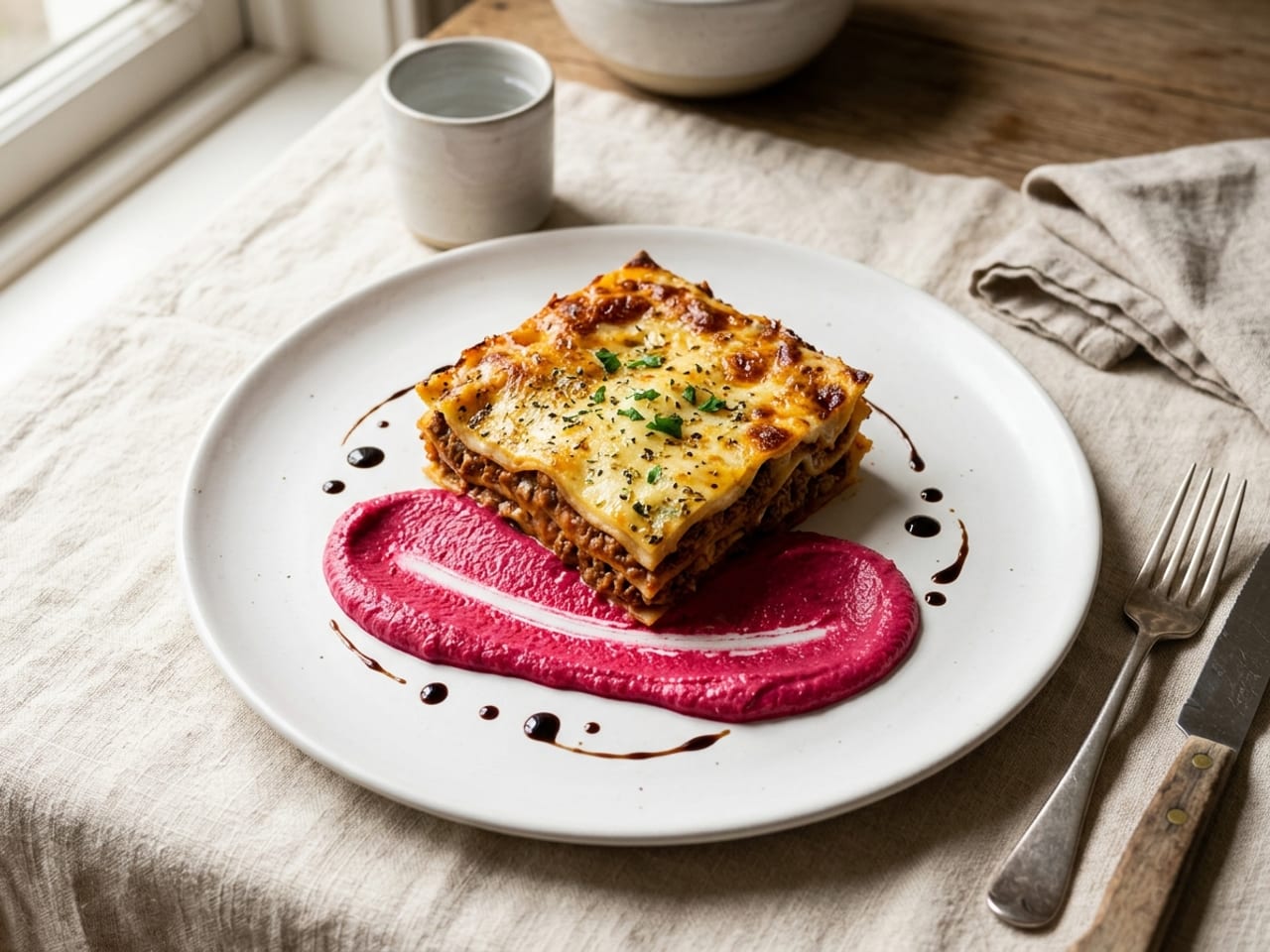
Eighteen popular claims about sauce plating, each with a verdict
"Supported" never means proven for your plate. "Supported, narrowly" means the source or study covers less than the claim says; "Mixed", that sources point both ways; "Not supported", that the claim was tested, or checked against the source it names or against agency rules, and did not hold; "No source found", that we found no source or study for it at all. Most of the papers were read as abstracts only, and each reference says which.
| The claim | Verdict | What we found |
|---|---|---|
| "An odd number of dots looks better" | Not supported | The one study of the odd-number rule that we found tested scallops, not dots. Its abstract, the only part we read: pairs of plates showing "odd versus even number of seared scallops (3 vs. 4; 1-6 in Experiment 7)", and "No consistent evidence for a preference for odd or even numbers of food items was found".108 That is pictures on a screen and "no consistent evidence", not a disproof. For sauce the rule has one source, a culinary school blog: "Dab an odd number of sauce droplets for composure", with no reason given.16 |
| "A sauce at nappé is the right thickness for a swoosh" | Mixed | No definition of nappé in the table above mentions a swoosh, a dot, a line or a pool: it is taught as a test for finishing a sauce that will coat food.32, 53 Two sources do apply the same spoon test to plating sauces without using the word: one private chef wants every design's sauce to "coat the back of a spoon but not completely drip off", and Tasting Table thickens "until it coats the back of a spoon".3, 15 America's Test Kitchen asks for something thicker for a swoosh, a purée or a rouille.1 |
| "Escoffier defined nappe as a sauce that coats the back of a spoon" | Supported, narrowly | He uses the verb for exactly that test and defines no noun. In his French text a meat glaze is ready when it covers a spoon dipped into it with a shiny, clinging layer, "qu'elle nappe la cuiller en un mot", in a word when it naps the spoon, and sauce allemande is reduced "jusqu'au moment où elle nappe bien la spatule" (our translation).48 His English translator wrote "veneers" and "coats the withdrawn spoon", so in the English edition we read the word "nappe" survives only as a jam stage, one the book calls "equivalent to the large-thread stage in the cooking of sugar" and puts at 222°F (106°C, our conversion).47 Neither text says the back of the spoon. |
| "Never put sauce over a crust or crisp skin" | Mixed | No named chef we found says never. America's Test Kitchen's crisp-skin salmon ends "spoon sauce over top. Serve."100 A recipe writer warns with a condition: "Do not pour sauce on the skin until just before serving else it will soften the fish skin."101 A newspaper columnist pours a butter sauce "around the fish".102 A trade column: "If a dish has crispy texture, serve the sauce on the side".90 Escoffier sends tomato sauce "separately" with fried sole.47 So the sources split, and the ones that warn give softening as the reason. For steak the same claim is examined in our steak guide. |
| "In fine dining the sauce always goes under the food" | Not supported | The 1982 report that credits the habit to nouvelle cuisine says "In many cases".84 A current textbook gives three options, "around, under, or over".34 And the classical books coat.47 |
| "Escoffier said the sauce must never hide the food" | No source found | We could not find the sentence in his English text, which coats food with sauce again and again. What he does say about restraint concerns seasoning: it "should be so calculated as to be merely a complementary factor".47 The writer who really says it is Gisslen: "sometimes ladling sauce all over an item hides colors and shapes. If the item is attractive by itself, let the customer see it."34 |
| "The swoosh is dead" | Mixed | As an opinion it has been in print since at least 2007 ("Smears aren't new anymore"), and a chef's book of 2015 wants "the sauce swoosh" to die. 90, 98 As a fact it does not hold: the move is still taught by America's Test Kitchen and Tasting Table and still listed in a textbook.1, 3, 34 We found no study of whether diners read a swoosh as dated. |
| "Chefs do all of this with a squeeze bottle" | Not supported | The dots NPR describes in Robuchon's kitchen were spooned.91 The pastry textbook gives the bottle, the spoon, the brush and the offset spatula a job each, and Gisslen writes "With a squeeze bottle or spoon".28, 34 |
| "A warm plate makes the sauce run" | No source found | Nothing we read says a hot plate makes a properly made hot sauce run. The printed worries point the other way: a sauce that stiffens or congeals as it loses heat, and a butter sauce chilled by a cold plate.39, 49, 66 Tasting Table says a warm plate keeps hot sauces fluid and a chilled one keeps cold sauces from turning watery.3 The textbooks say only hot food on hot plates and cold food on cold plates (Gisslen) and "Remember to chill or warm plates" (the Culinary Institute of America, as a fragment), with no temperature.33, 36 |
| "Acid breaks down cornstarch" | Supported, narrowly | Two textbooks say acid thins a starch sauce, for different reasons. Gisslen: "Acids inhibit gelatinization. A sauce thickened with flour or starch will be thinner if it contains acid", so "do not add acid ingredients to sauces until the starch has fully gelatinized."32, 34 McGee says acid shortens the starch chains, and then separates the starches: "Root starches are noticeably affected by moderate acidity (a pH lower than 5), while grain starches can withstand the acidities typical of yogurt and many fruits (pH 4)" (search fragments, joined).39 Corn is a grain; arrowroot, potato and tapioca are root or tuber starches (that gloss is ours). So acid is a real effect, cornstarch is the starch that stands it best, and neither book says acid "breaks down" a cornstarch sauce that has already thickened. |
| "A line on the plate should rise to the right" (said of the swoosh) | Supported, narrowly | The study behind this is about a line of food, not a line of sauce. In three online experiments people rated photographs of one dish arranged as a line or a circle; asked to turn the picture, they showed "a consistent preference toward the linear dish being rotated so that the line ascended to the right". The authors call it "intriguing first evidence".107 Nobody tasted anything, the dish was one dish, and no sauce line was tested. Applying it to the tilt of a swoosh is ours. |
| "Messy plating makes food taste worse" (said of the smear) | Supported, narrowly | The nearest paper found that "Food presented in a neatly arranged presentation is liked more than the same food presented in a messy manner."109 Its abstract names no food and no sauce, and we did not read the full text, so we cannot say a smear was involved. A second study by the same lead author served chicken with a sauce in two arrangements judged equally neat, and diners liked "the chicken and the sauce significantly more when presented in the more attractive manner"; its abstract does not describe the arrangements.110 |
| "Where the sauce goes changes how the dish is judged" | Supported, narrowly | One small restaurant study varied sauce placement itself: 57 people ate a dish with the sauces placed separately on the plate and with them drizzled across it. Before tasting, the separate version "was rated as healthier". After tasting it had higher liking, "but neither difference survived multiplicity correction."111 We found no study that sets a smear against a pool, dots against a swoosh, or sauce under against sauce over. |
| "A thicker sauce tastes weaker" | Supported, narrowly | In laboratory solutions, yes, past a threshold: with a cellulose gum, "perceived flavour intensity remained the same" at low concentrations and "a steady decrease was noted at higher concentrations"; with three thickeners, "Perception of both sweetness and aroma was suppressed" above a critical concentration.112, 113 Those were sweet test solutions, read as abstracts, not sauces. McGee's sauce chapter does carry the heading "Thickeners Reduce Flavor Intensity" (a search fragment).39 We found no study of a real sauce's thickness against its flavour. |
| "The proper name for a pool of sauce is a mirror" | Supported, narrowly | A name, yes; the proper name, no. Cookbooks of the 1980s print it: Nancy Silverton wants room for "a shining mirror of sauce", and René Verdon's recipe makes a "mirror" of sauce on each plate (both read as search fragments).41, 42 But no dictionary or textbook we opened uses "mirror" or "miroir" for a pool of sauce: in the French dictionaries the cooking sense of miroir is eggs, "Œufs au miroir", and the pastry textbook's word is flooding.28, 104, 105 |
| "Wipe the rim with vinegar" | No source found | Some cooks do. We found no named culinary source for it and no food-safety reason in the Food Code or on any agency page we opened. The sources that mention the wipe say a towel, or a damp paper towel.7, 13 |
| "A swoosh takes one to two tablespoons" and "the CIA recommends two ounces of sauce" | No source found | Neither figure is on any page or in any book fragment we could read. No source gives tablespoons or millilitres for a swoosh, a pool, a ring, a line or a set of dots; what does exist is in the table above. |
| "Keep squeeze bottles at room temperature so the sauce flows" | Not supported | Not for most plating sauces. We found the advice only on an unsigned page that names no source, and it runs against the food-safety rules below: a cream, butter, egg or stock sauce, a cooked purée and a garlic oil are all foods that agencies want kept cold or hot, not in between, and out for no more than two hours at home.114, 115 See food safety. |
Food safety for plating sauces, country by country
Plating sauces are the foods that sit at the pass: warm emulsions, cooked purées, stock reductions and oils in bottles. Restaurant rules, home advice and trade teaching are kept apart below, and so are the United States and the United Kingdom.
- Whose rules these areThree kinds of statement follow, and they are kept apart. United States, restaurants: the FDA Food Code, whose current edition is 2026. It is a model code, in its own words "a model for safeguarding public health" that represents "FDA's best advice for a uniform system of provisions that address the safety and protection of food offered at retail and in food service."114 It binds food businesses where a state or locality adopts it, and not home kitchens (our reading of its scope). United States, home cooks: the USDA's Food Safety and Inspection Service and the CDC. United Kingdom: the Food Standards Agency, for England, Wales and Northern Ireland. Trade teaching, such as a textbook's holding time, is none of these and is named as what it is. Follow your own country's advice.
- A filled squeeze bottle at room temperatureAt home (United States). The rule is the general one: "Never leave food out of refrigeration over 2 hours. If the temperature is above 90 °F, food should not be left out more than 1 hour." (90°F is 32°C.)115 Hot food "must be kept hot at 140° F or warmer", which is 60°C.116 No agency page we opened names a squeeze bottle, and we found no sourced temperature at which a home cook should hold one. In a restaurant (United States, where the Food Code is adopted). Food that needs temperature control is held "At 57°C (135°F) or above" or "At 5°C (41°F) or less".114 A bottle on the pass can instead run on the clock, for "a maximum of four hours", but only with written procedures, a starting temperature inside those limits, and a mark showing "the time that is four hours past the point in time when the food is removed from temperature control"; unmarked or over-time food "shall be discarded".114 Utensils and food-contact surfaces used with such food "shall be cleaned throughout the day at least every four hours".114 The Code does not use the words "squeeze bottle"; applying these sections to one is our reading. The bottle itself. One product review's advice is not to fill plastic with hot liquid: "Let any liquids cool down before you fill the squeeze bottle."27
- Which sauces need the controlThe Food Code's definition of a food that needs time or temperature control includes "An animal food that is raw or heat-treated; a plant food that is heat-treated" and "garlic-in-oil mixtures that are not modified in a way so that they are unable to support pathogenic microorganism growth or toxin formation".114 Its table for food that is not heat-treated, or is heat-treated and not then packaged (Table B), rates a food with a pH below 4.2 as not needing the control at any water activity.114 Our reading, and it is only that: cream and butter sauces, stock reductions, egg sauces, cooked vegetable purées and garlic oil fall inside the definition; a sharp vinaigrette or a gastrique may fall outside it, but that turns on a measured pH, which a home cook does not have. The Code names no plating sauce.
- Holding hollandaise and its relativesNobody agrees, and one textbook changed its own figure. Gisslen, 7th edition (2011): "it must be held below 140°F (60°C) so the eggs don't curdle."34 Gisslen, 10th edition: "It must be kept warm for service at a holding temperature of 145°F (63°C)", and "Hold sauce no longer than 2 hours. Make only enough to serve in this time, and discard any that is left over."35 (The 7th edition's holding time is a garbled fraction in the copy we read, so we do not print it.) Rouxbe: "held between 120F to 145F (49 to 63C)" and "not be held for more than 1.5 hours".73 An open textbook: "Never hold hollandaise-based sauces more than 1½ hours" and, on the same page, "should be only held for 2 hrs max."51 Food Republic: a double boiler "keeps it between 120 and 145 degrees Fahrenheit", 49 to 63°C.72 The Food Code (restaurants only): four hours under the time control described above, which a kitchen serving a highly susceptible population (a hospital, a nursing home, a day-care centre) may not use for raw eggs; and separately, "Pasteurized eggs or egg products shall be substituted for raw eggs in the preparation of foods such as Caesar salad, hollandaise or Béarnaise sauce, mayonnaise" unless the food is cooked or a consumer advisory applies, an exception those kitchens do not have.114 These are different kinds of statement, and none of the figures above is addressed to a home cook. At home (United States) the general rules apply: "Never leave food out of refrigeration over 2 hours", one hour above 90°F (32°C), and USDA advises everyone against "raw or undercooked egg yolks, whites or products containing them", with pasteurized eggs for dishes that will not be fully cooked.115, 118 So at home a hollandaise is made close to serving and what has stood warm for two hours is thrown away; that application is ours, and no US agency page we opened gives a holding time for hollandaise by name.
- Beurre blanc and the holding lineEvery warm-holding window the cooking sources give for a butter sauce, about 85 to 136°F (30 to 58°C) in the textbooks and about 110°F (43°C) at Serious Eats, lies under the Food Code's 135°F (57°C) hot-holding line except for one degree at the top.51, 66, 114 That observation is ours. The textbooks do treat such sauces as made to order or held for a limited time, and it is a restaurant's problem to solve under its own code; at home the two-hour rule above is the one that applies.115
- Gravy and stock-based saucesUnited States, home. "Discard any turkey, stuffing, and gravy left out at room temperature longer than 2 hours; 1 hour in temperatures above 90 °F." (90°F is 32°C.) "Use refrigerated turkey, stuffing, and gravy within 3 to 4 days."117 Reheating: "Reheat sauces, soups and gravies by bringing them to a rolling boil."116 Why gravy is singled out: the CDC lists it among foods "linked commonly to C. perfringens food poisoning", a bacterium it estimates "causes nearly 900,000 foodborne illnesses in the United States each year", most often from "foods cooked in large batches and held at unsafe temperatures (between 40°F and 140°F)", which is 4 to 60°C.120 Its prevention page: "Reheat leftovers to 165°F or hotter before serving" (74°C).121 United States, restaurants. The Food Code cools cooked food "Within two hours from 57ºC (135ºF) to 21ºC (70ºF)" and within six hours in all to 5°C (41°F), and reheats food for hot holding to "at least 74°C (165°F) for 15 seconds."114 We did not re-read the UK advice for this page.
- Raw-egg sauces: mayonnaise, aioli, Caesar dressingThe two countries differ; do not blend them. United States (USDA). "Everyone is advised against eating raw or undercooked egg yolks, whites or products containing them." And: "It is safe to use pasteurized eggs or egg substitutes in dishes that won't be cooked".118 United Kingdom (Food Standards Agency, advice written for caterers). "Young children, pregnant people, older adults and those with an underlying health condition (for example, cancer, diabetes, liver or kidney disease), can safely eat raw or lightly cooked hen eggs, or foods containing them, if they have a British Lion mark or are produced under the Laid in Britain egg assurance scheme." The agency calls the risk from those eggs "very low" and adds that this is "different to the risk being 'negligible'"; it asks for "Extra care" with "fresh mayonnaise"; it excludes other birds: "Eggs from species other than chickens carry a higher risk of Salmonella and should not be used in raw or lightly cooked dishes"; and its advice on vulnerable people begins with a limit, that it "does not apply to people who are severely immunocompromised and require medically supervised diets (for example, those undergoing transplant surgery)". A caterer who cannot verify the scheme is told to cook egg dishes thoroughly or use pasteurised egg.125 That page applies to England, Northern Ireland and Wales and is addressed to caterers; the agency's page for home cooks states the same position with the same exclusion.126
- Garlic and herb oils in a bottleUnited States. The CDC: "Refrigerate homemade oils made with garlic or herbs. Throw the oils away after 4 days."122 And of the toxin concerned: "You cannot see, smell, or taste the toxin that causes botulism."123 Oregon State University Extension gives the reason, "Low acid foods stored in oil create an oxygen-free environment", and does not exempt dried herbs: "If oil is seasoned with dried garlic and/or dried herbs, the mixture MUST be refrigerated and used within 4 days or frozen for long-term storage." The same goes for pesto. Shop-bought garlic in oil is different because it is acidified.124 In the restaurant code the same mixture is a food that needs temperature control.114 So the green oil for dots is made in small amounts, dated, kept cold and thrown out after four days. United Kingdom. We opened no UK page on flavoured oils and say nothing for it.
- Topping up, and labelsThe sourced form of "never top up" is about hollandaise: "Never mix an old batch of sauce with a new batch" (Gisslen); "never mix and old batch of sauce with a new one" (Rouxbe, as printed).35, 73 We found no named source that says it of a squeeze bottle in those words. For restaurants the Food Code has the cleaning rule above and a labelling one: working containers of food taken out of their original packages "shall be identified with the common name of the food."114 Gisslen adds a materials rule for acid sauces: "Never hold hollandaise or béarnaise" in aluminum; "Use stainless-steel containers."35
- Allergens that hide in sauces and finishing oilsA dot of sauce is easy to forget when a guest asks what is in the dish (our point). United States: "The nine leading causes of food allergies identified in the US are milk, eggs, fish, shellfish, tree nuts, peanuts, wheat, soybeans, and sesame."119 United Kingdom: fourteen are regulated, among them mustard, celery and sulphites, which the US sentence above does not name, and molluscs, which it names only if "shellfish" is read to include them; all four turn up in sauces (the selection of four is ours).127 Where they hide, from a US allergy charity's lists: fish may be in "Barbecue sauce", "Caesar salad and Caesar dressing" and "Worcestershire sauce"; tree nuts in "Nut oils (e.g., walnut oil, almond oil)" and pesto.128, 129 The plating cases are ours: butter and cream in a beurre blanc or an anglaise, egg in a hollandaise or an aioli, mustard in a vinaigrette, a finishing drizzle of walnut, hazelnut or sesame oil.
See the moves on your own plate
Reading about a swoosh is slower than seeing one on your own dinner. Photograph a dish you cooked and Plate Artists re-plates that dish the way a restaurant would, with the food kept as it is and the moves named so you can repeat them. Start with a re-plate.
Your dish, plated like a chef's
Snap it, upload it, and get the composed version back, with the steps to recreate it at home.
Start free · 1 enhancement →Free account · 1 free enhancement · No credit card
Sauce plating words, defined
Etymologies and first-use years are each dictionary's own. A word that no dictionary we read defines in a kitchen sense says so, and its definition is then a textbook's or our reading of the recipes.
Nappé · nappe; napper (the verb)
The consistency of a sauce that will coat food, or the back of a spoon, in a light even layer; as a verb (napper), to coat food with sauce.
Where it comes from. From French napper, which the Trésor de la langue française defines as covering a solid dish with a jelly or a smooth sauce and derives from nappe (our translation); Larousse says to cover a dish with a fluid or half-fluid element. Gisslen spells it nappé, says "nap pay" and glosses the verb as "to top"; Labensky and Hause spell it nappe and say "nap". Merriam-Webster's entry for nappe has no cooking sense. In Escoffier's English text of 1909 the word is only a jam and sugar stage; his French has "nappe la cuiller" for a finished glaze.32, 37, 47, 48, 103, 104, 105
Cordon · a thread of sauce
A thin line of sauce run around the food on the plate or dish.
Where it comes from. A kitchen usage, not a dictionary one: neither Merriam-Webster, the Trésor de la langue française nor Larousse gives cordon a sauce sense in the entries we read. It is in Escoffier's French recipes ("un cordon de sauce") and in the 1938 Larousse Gastronomique; Escoffier's English translator wrote "a thread of" sauce. The definition here is our reading of those recipes.45, 47, 48, 103, 104, 105
Masquer · to mask
To cover food with a sauce; in the stricter French definition, with a thick, cold one.
Where it comes from. French. The Trésor de la langue française restricts it to covering a dish with a thick, cold sauce, a cream or liquid sugar; Larousse defines it simply as coating a preparation with a sauce or a cream (our translations).104, 105
Flooding
Pouring a pool of sauce onto the plate, usually a dessert plate, so that it covers the base.
Where it comes from. The pastry textbooks' word: "Pouring a pool of sauce onto the plate is known as flooding." The same sentence is in Gisslen's Professional Baking, as a search fragment, and in two open textbooks.28, 30, 31
Feathering · blending
Drawing a pick or the point of a knife through two sauces of the same consistency so that one is pulled into the other in points.
Where it comes from. The pastry textbooks: a contrasting sauce is applied to a flooded plate, "then blending or feathering the two sauces decoratively with a pick or the end of a knife". We found no date and no inventor for it.28, 31
Outlining
Piping a design on the plate in chocolate, letting it set, and filling the spaces with sauce.
Where it comes from. The pastry textbooks: "a design is piped onto the plate with chocolate and allowed to set. The spaces can then be flooded with colourful sauces."28, 31
Streaking
Pulling a small amount of sauce across the plate with a brush, a spatula or the back of a spoon.
Where it comes from. The pastry textbooks' word for pulling sauce: "applying a small amount of sauce and streaking it with a brush, an offset spatula, or the back of a spoon" (the BCcampus pastry textbook). Reading it as the web's swoosh or smear is ours. Gisslen's cooking textbook speaks of plates "with streaks or ribbons of sauce to unite the various elements", a style of plate and not a technique. One blogger uses "streak" for a spot pulled into a thin line with a spoon handle.5, 28, 34
Swoosh
A spoonful of thick sauce or purée pulled across the plate in one motion, thick where it starts and thin where it ends; in most sources the same move as a smear.
Where it comes from. Imitative, per Merriam-Webster, which dates the verb to 1867 and the noun to 1885 and gives no food sense. As a name for a sauce mark the earliest uses we found are a magazine catalogued as 2003 ("swooshes of bean puree") and a cookbook of 2011 ("to create a swoosh"); earlier ones very likely exist.94, 95, 96, 97, 103
Smear · swipe; schmear
The same spoon-pulled mark as a swoosh, under the name that chef Daniel Wilson, the CBC and Rosanna Stevens use for it.
Where it comes from. Old English smeoru, in use before the 12th century (Merriam-Webster); swipe is "probably alteration of sweep", 1788; schmear is from Yiddish, first known use 1909. None has a plating sense in the dictionary. "Schmear" for a sauce mark appears, in what we read, only in one NPR writer's list.5, 8, 13, 91, 103
Drizzle
A small amount of sauce or oil let fall in a thin stream over or around food.
Where it comes from. Merriam-Webster: "perhaps alteration of Middle English drysnen to fall"; noun 1554, verb 1584. Cambridge defines the noun as "a small amount of liquid that is lightly poured over something".103, 106
Swirl
Either a spiral of sauce drawn on the plate or two sauces marbled together; ask which is meant.
Where it comes from. Merriam-Webster: "a twisting shape, mark, or pattern"; the verb is 14th century. In plating it has two meanings: a spiral drawn from the centre of the plate outward (the CBC, WebstaurantStore, Unilever) and two sauces stirred into each other with a skewer (Tasting Table).3, 6, 7, 8, 103
Mirror
A smooth, shallow pool of sauce covering the base of the plate, with the food set on it.
Where it comes from. A cookbook word, not a dictionary one. René Verdon's Convection Cuisine (1988) says to make a "mirror" of sauce "on each heated dinner plate" and Nancy Silverton's Desserts (1986) wants room for "a shining mirror of sauce" (both read as search fragments). In the Trésor de la langue française and Larousse the cooking sense of miroir is eggs ("Œufs au miroir"), and the textbooks we searched do not use the word for sauce.41, 42, 104, 105
Coulis
A sauce made from a strained purée of fruit or vegetables.
Where it comes from. Gisslen: "A vegetable or fruit purée, used as a sauce." The BCcampus pastry textbook: "most often an uncooked, strained purée". Cambridge: "a liquid made by cooking and crushing fruit". The textbook and the dictionary disagree on whether it is cooked.28, 34, 52, 106
Purée
Food mashed, blended or strained to a smooth pulp; thinned or enriched, it serves as a sauce.
Where it comes from. Gisslen's glossary: a food product mashed or strained to a smooth pulp, and the verb for doing it. His sauce chapter: "nearly any vegetable can be puréed and used as a sauce".32, 34
Jus
The unthickened juices of a roast, served as a thin sauce; jus lié is the same lightly thickened.
Where it comes from. Gisslen: "(1) Juice. (2) Unthickened juices from a roast." and "Jus Lié Thickened juices from a roast." Cambridge: "a thin sauce made from meat juices". Merriam-Webster returned no entry for jus lié.34, 103, 106
Reduction
A liquid concentrated by simmering off part of its water, and the act of doing so.
Where it comes from. Gisslen: "A liquid concentrated by cooking it to evaporate part of the water." The Trésor de la langue française has the cooking sense with an example of 1814; Merriam-Webster's entry has general senses only.34, 103, 104
Demi-glace
A brown sauce reduced with brown stock until concentrated and lightly syrupy; a meat glaze (glace de viande) is brown stock alone, reduced much further.
Where it comes from. Merriam-Webster: "a highly concentrated reduced brown sauce often used as a base for other sauces", from French, "literally, half-ice", first known use 1900. Gisslen: "half brown sauce plus half brown stock, reduced by half". Glace de viande is a different thing, in Gisslen's words "Meat glaze; a reduction of brown stock."34, 50, 103, 105
Gastrique
Caramelized sugar dissolved in vinegar, used to give a sauce a sweet and sour accent.
Where it comes from. A kitchen term with a textbook definition and no dictionary one: Merriam-Webster has no entry and Larousse's gastrique is only the adjective, "Qui a rapport à l'estomac" (of the stomach). Gisslen: "A mixture of caramelized sugar and vinegar, used to flavor sauces."34, 103, 105
Beurre blanc
A warm sauce of butter whisked into a reduction of wine, vinegar and shallots, held together as an emulsion.
Where it comes from. Merriam-Webster: "a seasoned butter sauce (as for fish) flavored with white wine, shallots, and vinegar or lemon juice"; "French, literally, white butter"; first known use 1958.51, 103
Emulsion
A uniform mixture of two liquids that do not dissolve in each other, such as fat and water; when it separates, the sauce has broken.
Where it comes from. Merriam-Webster traces it to Latin emulgēre, "to milk out", first known use 1612. Gisslen: "A uniform mixture of two unmixable substances". An open textbook calls a plain oil and vinegar dressing "A temporary emulsion".34, 49, 103
Fluid gel
A gel that has been set and then blended smooth, so that it flows when squeezed or stirred and holds its shape at rest.
Where it comes from. A set gel blended until it flows. The Institute of Culinary Education describes the result as bits of gel that "can flow, be poured or squeezed out from a bottle" and then "hold their shape"; Jason Logsdon gives the method for agar. The term's food-science history is in our plating components guide.78, 80
Weeping · syneresis
Liquid leaking out of a gel, a purée or a sauce as it stands, seen on the plate as a watery halo.
Where it comes from. The Institute of Culinary Education's blog uses the two words together ("syneresis, or weeping") for a coulis line that let go of its liquid; Jason Logsdon defines syneresis as "the leaking of liquid from a gel".78, 81
Crème anglaise · English custard; vanilla sauce
A pouring custard of milk, egg yolks and sugar, cooked until it coats a spoon.
Where it comes from. Merriam-Webster: "a vanilla-flavored custard sauce usually served with desserts"; "French, literally, English cream"; first known use 1877. Escoffier's English text calls it English custard; the Culinary Institute of America's textbook, vanilla sauce.36, 47, 103
Sauceboat · gravy boat; saucière
A small jug, usually with a lip and a handle, in which sauce or gravy is passed at the table.
Where it comes from. Merriam-Webster: "a low boat-shaped pitcher for serving sauces and gravies", first known use 1728. The French saucière is attested from 1328 (the Trésor de la langue française). Cambridge defines the gravy boat as "a long, low container with a handle, used for serving gravy at the table".103, 104, 106
Squeeze bottle
A flexible plastic bottle with a nozzle, used in kitchens to portion and draw with sauces, oils and purées.
Where it comes from. Merriam-Webster: "a bottle of flexible plastic that dispenses its contents when it is squeezed"; first known use 1950. That dates the word, not its use for plating.103
TCS food · time/temperature control for safety food
In the US Food Code, a food that must be kept hot or cold, or used within a time limit, to keep it safe.
Where it comes from. A term of the US Food Code, a model code for food businesses and not a rule for home kitchens. Its definition includes heat-treated animal and plant foods and garlic-in-oil mixtures.114
Sauce plating, answered
What are the sauce plating techniques called?
The main ones are the swoosh or smear (a spoonful pulled across the plate with a spoon), dots, dragged dots, lines and zigzags, rings and spirals, the pool (called flooding on dessert plates), sauce spooned over the food (nappé), the cordon or thread of sauce around it, the brush stroke, the splatter, the two-sauce dessert patterns (feathering and outlining) and flavoured oil. Most have several names: America's Test Kitchen says "Dollop and Swoop", Tasting Table "spoon swipe", chef Daniel Wilson and the CBC "the smear", and the pastry textbooks "streaking". No source reconciles them, so say "also called", not "properly called".
What is the difference between a swoosh and a smear?
In most of the sources we read there is none. America's Test Kitchen's swoosh and the smear described by chef Daniel Wilson, Rosanna Stevens and the CBC are all a spoon pulled through a spoonful of thick sauce. No source we read sets the two words against each other, so where a page lists them as two techniques, the distinction is that writer's own.
How do you plate sauce with a spoon?
For a swoosh, America's Test Kitchen's steps are: "Place a spoonful of your sauce on the plate", then "Using the back of your spoon, drag the sauce to the other side of the plate to create a comma or apostrophe shape." Eight of the sources we read use the back of the spoon and three use the tip dipped into the middle of the sauce; none says the other is wrong. A spoon also makes dots (a very small amount on the end of the spoon), a drizzle, a pool and sauce spooned around or over the food.
How do you make a sauce swoosh on a plate?
Use a thick, smooth sauce or purée. Put a spoonful on one side of the plate, press the back of the spoon into the middle of it and pull across in one motion, curving it like a comma. Chef Daniel Wilson says to do it "in a quick but controlled manner", and a restaurant-supply guide adds: "Never go back and try to fix the swoosh"; wipe the plate and start again.
How thick should a sauce be for plating?
No source we read gives a number: no viscosity, no flow test. They give comparisons. For a swoosh, America's Test Kitchen wants "thick, smooth sauces like a rouille or a puree" and Tasting Table says "think yogurt or heavy cream"; for squeeze-bottle designs, a sauce "that will stay put"; for a brush, a thin sauce. One private chef uses a sauce that will "coat the back of a spoon but not completely drip off" for every design. Harold McGee's advice is to make a sauce thinner at the stove than you want it on the plate, because it thickens as it cools.
How do you make a plating sauce thicker?
Reduce it: Tasting Table says to "reduce the sauce on low heat until it coats the back of a spoon". Or add a thickener, with its published range: roux at 12 ounces to 1.5 pounds per US gallon of liquid in Gisslen's textbook (the book's metric column works out to about 94 to 188 g per litre); xanthan gum at 0.1 to 0.3 percent for a thin sauce in one practitioner's range; agar at 0.5 to 2 percent for a fluid gel. To loosen a sauce, add stock, cream or water a little at a time and test on a spare plate.
How do you plate a purée, such as pea purée?
The published moves for a purée are the swoosh or smear, a brushed base, and dots piped from a bag or a bottle. A culinary school blog says a purée should be "a little bit thick so it holds its shape" and can be "smeared alongside your entree without running all over the plate". Low-starch purées of green vegetables can let go of water on the plate; one practitioner's fix is xanthan gum at about 0.1 to 0.3 percent, and a pastry textbook's is to plate at the last minute.
How do you make sauce dots on a plate?
With a squeeze bottle or the tip of a spoon. One private chef puts the tip on the plate, squeezes gently until a dot forms and releases; a food-service guide holds the nozzle at an angle over the plate. America's Test Kitchen asks for "a thick, smooth sauce that will stay put". The claim that an odd number of dots looks better has one source, a culinary school blog, and the one study we found of odd against even, which used scallops, found no consistent preference.
How do you drag dots of sauce into hearts or teardrops?
For a teardrop, the Institute of Culinary Education squeezes one large drop of thickened sauce and drags a skewer through it to one side. For a row, WebstaurantStore alternates dots of two sauces along a curve and pulls a plating wedge through them from the centre of the first dot. No named source prints the steps for hearts; the usual description, which is ours, is a toothpick drawn through the middle of each dot in a row in one direction.
How do you plate dessert sauces?
On the plate, not over the dessert: a pastry textbook says sauces "are usually not ladled over the dessert because doing so would mar the appearance." Its named techniques are flooding (a pool of sauce), feathering (a second sauce drawn through the first with a pick or a knife, for which the two sauces must be about the same consistency), outlining (a piped chocolate design filled with sauce), and dots, lines and streaks from a squeeze bottle.
How do you plate gravy?
The sources we read spoon or ladle it over, or pass it at the table in a sauceboat; none plates gravy as a swoosh or dots. Gisslen's general guideline applies: if the food is attractive, ladle the sauce "around or under it, or possibly covering only part of it". US food-safety advice is to discard gravy left out longer than 2 hours and to reheat it to a rolling boil.
Does the sauce go under, beside or over the food?
All three are in the textbooks. Gisslen: "Sauces, if used, may be served around, under, or over other items on the plate." Classical recipes coat the food or run a thread of sauce around it; a 1982 report from Troisgros says that "In many cases" the new cooking put the sauce beneath the food; pastry textbooks keep sauce off the dessert itself. There is no single rule.
Should the sauce go on the plate first or last?
Sources disagree. America's Test Kitchen puts a swoosh or a brush stroke down first and the food on or beside it, and allows either order with a squeeze bottle. WebstaurantStore sauces after the main ingredients are plated. Chef Emil Nilsson says "Always add your sauce last". A sauce that goes under the food has to go down first.
How much sauce should go on a plate?
No source we read gives a general amount for a swoosh, a pool, a ring or dots. What exists: Gisslen's textbook recipes use about 1.5 fluid ounces (45 ml) spooned around a portion of meat or fish and 2 fluid ounces (60 ml) with a vegetable or meatballs, and "A tablespoon (15 mL) or so per portion" of flavoured oil; one private chef fills a teaspoon about three quarters full for a fast swipe. Gisslen's advice in words: "Make a better sauce and serve less of it."
Why does my sauce leave a watery ring on the plate?
That is weeping. A culinary school demonstration drew a line of olive coulis with and without xanthan gum: the one without "quickly had syneresis, or weeping". A textbook explains that sauces thickened only with low-starch purées, such as tomato or green vegetables, separate into liquid and solid as they sit unless something else binds them. The published fixes are a little xanthan gum, cooking the water out of wet vegetables, and plating at the last minute.
Why does my swoosh tear or look ragged?
The causes the sources name are a sauce that is too thick, which "won't spread smoothly", and hesitation: "A shaky hand leads to messy edges, so commit to the movement." Loosen the sauce a few drops at a time, test on a spare plate, and make the pull in one motion. Do not try to repair it: wipe the plate and start again.
What does nappé mean?
It is the consistency of a sauce that will lightly coat food or the back of a spoon, from the French verb napper, to coat. The Culinary Institute of America's consumer site tests it by drawing a finger down the back of a coated wooden spoon: a clean line means nappe. It is a test for finishing a sauce. No definition we read ties it to a swoosh or a dot, though one private chef and Tasting Table use the same spoon test for plating sauces, and America's Test Kitchen asks for a thicker sauce for a swoosh.
How long can a squeeze bottle of sauce sit out?
At home in the United States the general rule applies: USDA says never to leave food out of refrigeration over 2 hours, or 1 hour above 90°F (32°C). Restaurants that follow the FDA Food Code, a model code, may hold such food without temperature control for up to four hours under written procedures. Homemade garlic or herb oil is a separate case: the CDC says to refrigerate it and throw it away after 4 days.
The books, pages, dictionaries, papers and agencies behind this guide
How the textbooks, the archived pages and the second-hand quotations were read is under how this page was made and in each entry. Peer-reviewed papers are cited by DOI and were read in full or as abstracts, as each entry says. Agency pages are named with their country. A page that could only be read in an Internet Archive capture links to the capture and gives its date. Readings, counts, conversions and arithmetic marked as ours are our own.
- Lapierre, D. (America's Test Kitchen) (2022). How to Plate Your Sauces Like a Fancy-Schmancy Chef. America's Test Kitchen, published 11 April 2022; its four headings ("Dollop and Swoop", "Grab the Squeeze Bottle", "Pull Out the Paint Brush, Picasso", "Pool Your Sauce"), the steps and the sauce each move needs; re-read 9 October 2026. americastestkitchen.com
- America's Test Kitchen (2026). Plating Techniques. America's Test Kitchen (online class page), no byline or date on the page (page data: 16 September 2026); its four headings ("Spoon It", "Pour It", "Squeeze It", "Brush It"); read 9 October 2026. americastestkitchen.com
- Carlucci, J. (2025). 16 Restaurant-Worthy Tips For Plating Sauces At Home. Tasting Table, 14 January 2025 (page data); the writer describes himself on the page as "a chef turned food writer"; the spoon swipe, bottle work, brushes, two-sauce swirls, the consistency comparisons and the plate temperatures; cites no source. tastingtable.com
- Beams, S. (2025). 11 Restaurant-Worthy Tips For Plating Desserts At Home. Tasting Table, 24 March 2025; the how-to sentences are the writer's; pastry chef Saura Kline is quoted directly only on colour and clutter. tastingtable.com
- Stevens, R. (2022). Five Quick Sauce Plating Techniques. Rosanna ETC (a blog), "Modified: May 7, 2022 · Published: Feb 14, 2022"; the writer describes herself on the page as "A trained chef"; her five names ("The Spot", "The Streak", "The Splat", "The Smear", "The Submerge"); cites no source. rosannaetc.com
- Unilever Food Solutions (Singapore) (2026). How to Use Creative Sauce Plating Techniques to Present Your Dish Professionally. unileverfoodsolutions.com.sg (a food manufacturer's trade page), the page heading; no author and no date; its four techniques (splatter, swirl, sauce dots, zig zag) and the rim advice; the live site refuses scripts, so it was read in the Internet Archive capture of 17 April 2026. unileverfoodsolutions.com.sg (archived)
- WebstaurantStore (2025). Easy Food Presentation & Plating Techniques. WebstaurantStore (a restaurant-supply retailer), the page's title tag (its on-page heading reads "Food Presentation" followed by "Techniques, Methods, & Tools"); "Last updated on Oct 15, 2025"; the four sauce techniques, the worked plates and the towel; the live site refuses scripts, so it was read in the Internet Archive capture of 6 October 2026. webstaurantstore.com (archived)
- CBC Life (2018). The art of plating: How to smear, swirl and stencil your way to Insta-worthy food creations. CBC Life, posted 11 April 2018; credits "Chef Shahir", with no surname on the page; "The smear", "The swirl" and "Graining". cbc.ca
- Le Cordon Bleu Malaysia (2026). 8 Types of Popular Plating Techniques Aspiring Chefs Can Learn During Their Free Time. cordonbleu.edu (the school's blog), no author and no date found on the page; item 8, "Sauce Painting & Drizzling"; a school marketing post with no steps and no citation; read 9 October 2026. cordonbleu.edu
- Basu, J. (2026). Sauce Swoosh, Quenelle: 5 Michelin-Level Plating Techniques You Can Try. Slurrp (a web story), 7 February 2026 (page data); "Sauce Swoosh" and "Droplets With Squeeze Bottles"; cites no source. slurrp.com
- Allen, K. (2013). Learn To Spoon Swoosh. Tundra Restaurant Supply blog, published 29 May 2013, modified 20 June 2017 (page data); the writer is a marketing consultant, per the page's own note; the three numbered steps and the warning not to retouch. blog.etundra.com
- Bon Appétit (2013). Watch How to Sauce a Plate in One Fell Swoosh. Bon Appétit, 15 August 2013; two paragraphs around a video that we did not watch; cited only as a dated use of the word "swoosh". bonappetit.com
- Wilson, D. (2014). Huxtable head chef Daniel Wilson reveals how to plate up like a pro. The Independent, 14 March 2014; first-person text by the chef; the sauce "smear" paragraph, the kingfish plate, the oil drizzle and the damp paper towel. the-independent.com
- Buckholtz, S. (2022). How to Plate Food Like a Chef: Food Presentation Techniques. Untappd for Business blog (a software vendor), published 14 October 2022, modified 6 December 2024; the smear and the squeeze-bottle dots; cites no source. lounge.untappd.com
- Greenfield, G. (2021). The Art of Plating. Household Staffing (an agency's blog), published 23 June 2021, modified 30 December 2024; a private chef's eight named designs and one unnamed one, with his consistency test; the spellings in quotations are the page's own. householdstaffing.com
- Natural Gourmet Center (Institute of Culinary Education) (2015). How to Plate a Fish Dish. Institute of Culinary Education blog, 3 February 2015; the sauce "teardrop" or "swoosh" made with a skewer, the paintbrush stroke and the odd number of droplets; our plating-tools guide lists the same page under its address, "Plating Fish". ice.edu
- Natural Gourmet Center (Institute of Culinary Education) (2015). Last Tomatoes of the Season Salad. Institute of Culinary Education blog, 6 September 2015; a paintbrush dragged through "a green infused oil or juice"; read 9 October 2026. ice.edu
- Steckel, G. (Made In Cookware) (2020). Extraordinary Plating with Ordinary Tools. Made In (a cookware maker's blog), 17 December 2020 (page data, which also names the writer); the swoosh, the struck splatter and the pan sauce spooned over. madeincookware.com
- The Nibble (2015). TIP OF THE DAY: Plate Painting For Your Dessert. The Nibble (a food webzine), 13 November 2015 by its address; byline "nibblerella"; the technique itself is in linked videos that we did not watch. blog.thenibble.com
- Glatz, J. (2013). Looking good. Illinois Times, 15 August 2013; a newspaper food column; squeeze-bottle squiggles, concentric shapes dragged with a toothpick into a chevron, and which sauces it works with. illinoistimes.com
- Seasoned Advice (Stack Exchange) users (2021). What is this technique where they add a thick sauce and spread it out with the back of a spoon. cooking.stackexchange.com, question 35747, anonymous users' answers and comments, cited only as evidence that the names circulate; the year given is that of the capture, because our notes record no date for the question; the live site refuses scripts, so it was read in the Internet Archive capture of 7 May 2021. cooking.stackexchange.com (archived)
- KitchenTime (2025). How to plate food like a professional: tips from Hattmakarn Brasserie & Bar. kitchentime.com (a retailer's guide), the page headline; published 9 May 2025; only "Always add your sauce last" is chef Emil Nilsson's own sentence, the rest is the retailer's. kitchentime.com
- Cookist (2024). How to Serve Sauces: 10+ Ideas to Serve Your Sauces Creatively and Perfectly! (With Video). Cookist, 2 April 2024; no author in the text read; the "underneath", "drizzling" and "dotting" methods and sauce on the side; cites no source. cookist.com
- Debic (2020). Food plating. debic.com (a dairy brand's chef site), published 27 October 2020, modified 25 July 2023; the brush line. debic.com
- GBC Kitchen (2023). Coley with Beurre Blanc, Fried Herbs and Mixed Herb oil Recipe. Great British Chefs, published 4 July 2023; the plating step: beurre blanc around the fish, dots of herb oil to finish. greatbritishchefs.com
- GBC Kitchen (2023). How To Make Herb Oil. Great British Chefs, published 4 July 2023; the sentence that chefs use herb oils "to split sauces". greatbritishchefs.com
- Andrews, B. (2023). We Tested 7 Squeeze Bottles to Find the Three Best for Cooking, Sauces, and More. Serious Eats, 7 February 2023, updated 6 November 2024; read in the Internet Archive capture of 2 September 2025 for our plating-tools guide and not re-read for this one: nozzles, truing a ragged tip with a skewer, no hot liquids in the bottle, and chef Shaun Hergatt on portioning. seriouseats.com (archived)
- BC Cook Articulation Committee (2015). Dessert Sauces. Modern Pastry and Plated Dessert Techniques (BCcampus open textbook, CC BY 4.0), the chapter read in full: flooding, feathering, outlining, streaking, the squeeze bottle and the spoon, the smaller pool, and coulis separating on the plate. opentextbc.ca
- BC Cook Articulation Committee (2015). Design Principles for Plating Food. Modern Pastry and Plated Dessert Techniques (BCcampus open textbook, CC BY 4.0), the chapter read in full: its two sauce figures (8a and 8b), the balance of white space, the flow of a coulis and "flavour first, presentation second". opentextbc.ca
- Souza, D., & Hagar, A. (2026). 5.4.5 - Applying Sauces. The Bakeshop (Columbus State Community College open e-book, OER Commons), the authors are named on the book's description page; no date recorded; its sentences on flooding and on not ladling sauce over a dessert are almost word for word those of the BCcampus chapter and of Gisslen's Professional Baking, so the three are not independent sources; read 9 October 2026. library.oercommons.org
- Gisslen, W. (2017). Professional Baking, 7th edition. John Wiley & Sons, Hoboken, flooding, feathering, outlining, the squeeze bottle against the pastry bag and the smaller pool; read only as full-text search fragments of the Internet Archive scan, no page number recorded; several fragments break off mid-sentence; one recipe line ("Ladle a ring of Sauce Suzette onto each plate") is from the scan of the 6th edition (2013), item professionalbaki0000giss_ed06. archive.org
- Gisslen, W. (n.d.). Professional Cooking, chapter 9, "Sauces" (publisher's PDF of the chapter). John Wiley & Sons; hosted by Auguste Escoffier School of Culinary Arts, read in full as a PDF whose printed pages start at 175; the file does not state the edition and is not the 7th, in which stocks and sauces share chapter 8; the file was created in June 2018; the roux table (Table 9.1), acids and starch, nappé, sauces under or around, flavored oils, purées as sauces, reduction and its cautions. resources.escoffier.edu
- Gisslen, W. (2011). Professional Cooking, 7th edition. John Wiley & Sons, Hoboken, the roux table (Table 8.5) and the sentence beside it, the glossary, the portion and plating lines of five recipes, crème anglaise, beurre manié, monter au beurre, hot and cold plates and the squeeze-bottle recipe steps; read only as full-text search fragments of the Internet Archive scan, no page number recorded; digits garbled by the scan are given in our reading, which agrees with the publisher's chapter PDF. archive.org
- Gisslen, W. (2011). Professional Cooking, 7th edition (scanned text of an uploaded copy). John Wiley & Sons, Hoboken, chapter 1 on nouvelle cuisine and plating in the kitchen, the presentation chapter's guidelines ("Keep food off the rim of the plate", "When using a sauce or gravy, add it attractively"), the plate arrangements, the glossary, acids and gelatinization, the crème anglaise procedure, recipe portion and plating lines and the hollandaise holding passage; read as the scanned text of an Internet Archive upload that is not a library scan; line breaks and hyphens are the scan's, and its hollandaise holding time is a garbled fraction that we do not print. archive.org
- Gisslen, W. (2026). Holding Hollandaise Sauce from Professional Cooking: 10th Edition by Wayne Gisslen. ckbk (the book's text online), the page title; the section "Holding Hollandaise Sauce"; the year given is the year we read it, because the page's notes record no publication year for the edition. app.ckbk.com
- The Culinary Institute of America (2011). The Professional Chef, 9th edition. John Wiley & Sons, Hoboken, roux per gallon for three consistencies, demi-glace reduced "to a nappé consistency", slurry, liaison, vanilla sauce and the squeeze-bottle line; read only as full-text search fragments of the Internet Archive scan, no page number recorded; the Internet Archive's catalogue description calls it the ninth edition; one scan only, whose ounce figures are garbled and whose gram figures are not, so the ounces given are the ones the grams fix. archive.org
- Labensky, S. R., & Hause, A. M. (2007). On Cooking: A Textbook of Culinary Fundamentals. Pearson Prentice Hall, Upper Saddle River, the Internet Archive's record calls it the 4th edition, which we did not confirm from a title page; nappe in its list of what a good sauce does and in the glossary, the beurre blanc temperature sentences, arrowroot, the liaison temperatures and covering a sauce against a skin; read only as full-text search fragments, no page number recorded. archive.org
- Peterson, J. (2008). Sauces: Classical and Contemporary Sauce Making, 3rd edition. John Wiley & Sons, Hoboken, the glossary entry "NAP (NAPPER)", thinning a sauce, the one-third butter rule, over-reduced sauces on hot plates and cream sauces; read only as full-text search fragments of the Internet Archive scan, quotations joined from overlapping fragments, no page number recorded. archive.org
- McGee, H. (2004). On Food and Cooking: The Science and Lore of the Kitchen. completely revised and updated edition; Scribner, New York, the sauce chapter: thinner at the stove, sauces congealing on the plate, gelatin at 10 percent, thickeners and flavour, starch and acid, starch thinning on long cooking, beurre blanc's temperatures and the skin on heated milk; read only as full-text search fragments of the Internet Archive scan, several joined from overlapping fragments and several breaking off mid-sentence, no page number recorded. archive.org
- Styler, C. (2006). Working the Plate: The Art of Food Presentation. John Wiley & Sons, Hoboken, the "spider web design" with two sauces of the same consistency, stripes of sauce, and sauces sorted into spooning, drizzling and painting thicknesses; read only as full-text search fragments of the Internet Archive scan, no page number recorded. archive.org
- Silverton, N. (1986). Desserts. Harper & Row, New York, "a shining mirror of sauce", and mirror as a verb ("mirror half the plate with wine sauce"); read only as full-text search fragments of the Internet Archive scan, no page number recorded. archive.org
- Verdon, R. (1988). Convection Cuisine. Hearst Books, New York, a serving step that makes a "mirror" of sauce "on each heated dinner plate"; read only as a full-text search fragment of the Internet Archive scan, no page number recorded. archive.org
- Myhrvold, N. (the catalogue's creator line) (2012). Modernist Cuisine at Home. The Cooking Lab, Bellevue, grams of xanthan gum and of agar per 100 g of liquid for three sauce thicknesses, and the fluid gel method; read only as full-text search fragments of the Internet Archive scan, joined from overlapping fragments, no page number recorded. archive.org
- Keller, T. (1999). The French Laundry Cookbook. Artisan, New York, recipe ingredient lines only, such as "Basil Oil (page 166), in a squeeze bottle" and "Balsamic Glaze (page 238), in a squeeze bottle"; read only as full-text search fragments of the Internet Archive scan; no saucing instruction and no sentence of Keller's on saucing was recovered. archive.org
- Montagné, P. (1938). Larousse Gastronomique (French first edition). Librairie Larousse, Paris, the year is the Internet Archive's catalogue date; the author, publisher and edition are not in the catalogue record, which names only "Gilbert", and are ours; "un cordon de sauce" and "Napper de sauce" in recipe text; read only as French full-text search fragments of the scan, accents as the scan returns them, no page number recorded. archive.org
- Larousse (2001). Larousse Gastronomique. Clarkson Potter, New York, "Based on the work of Prosper Montagné" per the catalogue; the entry NAPPER; read only as a full-text search fragment of the Internet Archive scan, no page number recorded. archive.org
- Escoffier, A. (1909). A Guide to Modern Cookery. William Heinemann, London; Project Gutenberg eBook #71395, the "New and Revised Edition, January 1909" in its impression of January 1920, never "the 1907 edition" (the Gutenberg header's 1907 is the first printing); read in full; formula numbers are the book's; its pints and quarts are British imperial; the counts of words given on this page are ours, made on the plain text. gutenberg.org
- Escoffier, A., with Gilbert, P., & Fétu, É. (1907). Le Guide culinaire: aide-mémoire de cuisine pratique, deuxième édition. Paris; Internet Archive scan b21525912, the second French edition: the title leaf reads "Deuxième édition" and its preface is dated 1 February 1907 (the Internet Archive's catalogue date, 1903, is that of the first edition); read as the scan's text without page images; the counts of words are ours. archive.org
- Zeringue, A., & Thibodeaux, W. R. (2022). 1.3: Sauces and Thickening Agents. Flavors of the Saucier: Stocks, Sauces, and Soups (Nicholls State University; Workforce LibreTexts, CC BY-NC-SA 4.0), page dated 15 May 2022, updated 7 September 2022; read in full; long passages match, word for word, the search fragments of Labensky and Hause and of Peterson, so it is credited for what was read here and the printed books only for their own fragments; the page was converted from a PDF and carries misprints, which quotations keep. workforce.libretexts.org
- Zeringue, A., & Thibodeaux, W. R. (2022). 1.2: Brown Stocks and Demi-Glace. Flavors of the Saucier: Stocks, Sauces, and Soups (Nicholls State University; Workforce LibreTexts, CC BY-NC-SA 4.0), read in full; demi-glace as "a very light syrup" and the yield of glaze from a gallon of stock. workforce.libretexts.org
- Zeringue, A., & Thibodeaux, W. R. (2022). 1.8: Hollandaise Based Sauces. Flavors of the Saucier: Stocks, Sauces, and Soups (Nicholls State University; Workforce LibreTexts, CC BY-NC-SA 4.0), read in full; hollandaise and beurre blanc temperatures, holding times (the page prints both 1½ hours and 2 hours) and the causes of a broken sauce; the misprint "J10°F" for 110°F is the page's. workforce.libretexts.org
- Zeringue, A., & Thibodeaux, W. R. (2022). 1.9: Miscellaneous Sauces. Flavors of the Saucier: Stocks, Sauces, and Soups (Nicholls State University; Workforce LibreTexts, CC BY-NC-SA 4.0), read in full; coulis and its texture, and broth served in a pool beneath the food. workforce.libretexts.org
- CIA Foodies (The Culinary Institute of America) (2022). Kitchen Vocab: Nappe. ciafoodies.com, 6 September 2022, page modified 30 June 2026; the definition, light, medium and heavy nappe, and the finger test on a wooden spoon; it gives no temperature and no number and says nothing about swooshes or dots. ciafoodies.com
- Larson, S. (byline) (2018). Perfect your purees with these simple steps. Auguste Escoffier School of Culinary Arts blog, published 27 August 2018, modified 17 November 2021; the school's blog, not a text by Auguste Escoffier; how thick a purée should be. escoffier.edu
- Larson, S. (byline) (2019). Contemporary plating techniques. Auguste Escoffier School of Culinary Arts blog, published 13 March 2019, modified 14 April 2023; the school's blog, not a text by Auguste Escoffier; the "simple elegance" trend, which it credits to the trade journal Restaurant Hospitality. escoffier.edu
- Dunn, S. (America's Test Kitchen) (2016). French-Style Mashed Potatoes (Pommes Purée). America's Test Kitchen, 27 September 2016; the recipe's quantities, "potatoes should almost be pourable" and why the potatoes cook in the milk and butter. americastestkitchen.com
- America's Test Kitchen (Cook's Illustrated) (2026). Why Cold Butter Keeps Sauces from Breaking. America's Test Kitchen, no date on the page; a white butter sauce made four ways; read 9 October 2026. americastestkitchen.com
- America's Test Kitchen (2026). Why Color Matters for Roux. America's Test Kitchen, no date on the page; three roux measured on a borrowed viscometer, with relative results only; read 9 October 2026. americastestkitchen.com
- America's Test Kitchen (Cook's Illustrated) (2026). Body Builder for Pan Sauces. America's Test Kitchen, no date on the page; gelatin per cup of broth and how to bloom it; read 9 October 2026. americastestkitchen.com
- America's Test Kitchen (2026). Three Ways to Thicken Sauce (Cornstarch, Roux, Beurre Manie). America's Test Kitchen, no date on the page; the slurry's glossy sheen and beurre manié by volume; read 9 October 2026. americastestkitchen.com
- America's Test Kitchen (2026). Can Potato Starch be Substituted for Cornstarch to Thicken Sauces? America's Test Kitchen, no date on the page; the substitution ratio and the tasters' words; read 9 October 2026. americastestkitchen.com
- America's Test Kitchen (Cook's Illustrated) (2026). A Tidy Way to Avoid Skin on Custards. America's Test Kitchen, no date on the page; why a skin forms and two ways to deal with it; read 9 October 2026. americastestkitchen.com
- America's Test Kitchen (2026). Rescuing Frozen Gravy. America's Test Kitchen, no date on the page; flour and cornstarch gravies both wept after freezing, and why; read 9 October 2026. americastestkitchen.com
- America's Test Kitchen (2024). Dressing That Won't Separate or Solidify in the Fridge. America's Test Kitchen, the page's title tag; 16 May 2024; how long a homemade vinaigrette holds together. americastestkitchen.com
- America's Test Kitchen (2026). What Kind of Mustard Should Be Used in a Vinaigrette? America's Test Kitchen, no date on the page; four mustards tested as emulsifiers; read 9 October 2026. americastestkitchen.com
- Gritzer, D. (2023). Beurre Blanc. Serious Eats, published 17 August 2023; the live page was not reachable, so it was read in the Internet Archive capture of 24 August 2023 and a later edition may differ; the butter all at once, the 110°F water bath, thinning with water, warm plates and the rescue. seriouseats.com (archived)
- Cook, L. (2025). I'm a Lazy Home Cook: This One Ingredient Makes Me Look Like a Pro. Serious Eats, 9 October 2025; the page's title prints a dash where this entry has a colon; read in the Internet Archive capture of 10 October 2025; the amounts, the blender, and a ratio the writer credits to Thomas Keller, whose book we did not open. seriouseats.com (archived)
- Friedman, S. (2023). The Mistake To Avoid After Thickening Sauce With Cornstarch. Tasting Table, 25 June 2023; boiling a cornstarch sauce after it thickens. tastingtable.com
- Aoki, P. (2023). The Simple Way Martha Stewart Prevents Lemon Curd From Forming An Outer Skin. Tasting Table, 6 November 2023; the writer's report of a Martha Stewart video, not Stewart's own words. tastingtable.com
- Swiers, A. (2023). The Possible Reason Your Beurre Blanc Broke And How To Save It. Tasting Table, 22 July 2023; butter that is not cold enough. tastingtable.com
- KitchenSavvy (2006). Beurre Blanc Breaks. kitchensavvy.com (a question-and-answer site), 1 August 2006; no author named; the page's title tag adds the site's name after a dash; names no source for its figures. kitchensavvy.com
- Parks, B. (2025). How To Fix Split Hollandaise Sauce. Food Republic, the page heading (its title tag reads "Here's How To Salvage Broken Hollandaise Sauce"); 12 January 2025; the double-boiler temperature range. foodrepublic.com
- Rouxbe Online Culinary School (2026). Food Safety of Hollandaise | Rouxbe Online Culinary School. rouxbe.com, the page title; no date recorded; the holding range and the 1.5 hour limit; read 9 October 2026. rouxbe.com
- Wilson, M. (2024). How To Prevent A Watery Puree Made From Moisture-Laden Veggies. The Daily Meal, 22 January 2024; dry-heat cooking for wet vegetables. thedailymeal.com
- Hamel, P. J. (2018). Caramel Sauce. King Arthur Baking, the page prints "June 4, 2018"; the sauce thickens as it cools and is reheated briefly before serving. kingarthurbaking.com
- Modernist Cuisine (2013). What Is Xanthan Gum? modernistcuisine.com, byline "MC", 1 March 2013, page modified 16 July 2025; the percentages; the advice on foam is a reply in the comments posted under the name Sam Fahey-Burke on 12 March 2013, not part of the article. modernistcuisine.com
- Logsdon, J. (2012). How to Use Xanthan Gum. Amazing Food Made Easy, page data: 27 November 2012, modified 23 December 2020; a practitioner's ranges for thin and thick sauces and for holding a purée together. amazingfoodmadeeasy.com
- Logsdon, J. (2012). How to Use Agar Agar in Cooking. Amazing Food Made Easy, page data: 29 November 2012, modified 23 December 2020; the agar fluid gel method and its percentage range, and the setting and melting temperatures he gives. amazingfoodmadeeasy.com
- Whitney, C. (2026). Fluid Gels. Modernist Pantry, Kitchen Alchemy blog (an ingredient seller), the page shows only a relative date ("6 years ago"), so the year given is the year we read it; a seller writing about what it sells; the method, dots that do not run and xanthan against weeping. blog.modernistpantry.com
- Institute of Culinary Education (2012). Taste Test: Fluid Gels. Institute of Culinary Education blog, 1 August 2012; the page's description credits "ICE's Director of Culinary Development Chef James Briscione"; what a fluid gel does on the plate and the buttermilk fluid gel recipe. ice.edu
- Institute of Culinary Education (2012). The ABCs of Hydrocolloids with ICE Chef Instructor Chris Gesualdi. Institute of Culinary Education blog, 23 February 2012; a report of a class with no byline in the text read; the weeping sentence is the blog writer's description of the instructor's demonstration, not a quotation of him; "xantham" is the page's spelling. ice.edu
- Wood, A. (2011). Lemon fluid gel. The Staff Canteen (a trade site; a chef's recipe), 13 January 2011; the quantities and the last two steps, printed there in capitals. thestaffcanteen.com
- Fine Dining Lovers (2017). Fluid Gels: How to Make Them and Master the Art of Fluid Gels. Fine Dining Lovers, the page heading; 15 November 2017; a round-up that says fluid gels suit dots, lines, circles and swirls. finedininglovers.com
- Hanes, P. (1982). Tennis and truffles mix with today's cuisine at Troisgros. The Christian Science Monitor, dateline Roanne, France, 1 April 1982; by the paper's food editor; a reporter's account of the Troisgros brothers and of the new cooking, not a quotation from them. csmonitor.com
- Labro, C. (interviewer) (2014). L'escalope de saumon à l'oseille de la maison Troisgros. Le Monde (M le magazine), address dated 23 October 2014; "Propos recueillis par Camille Labro"; the year 1963, the sentence that begins "La légende veut" and the recipe; the live page is restricted, so it was read in the Internet Archive capture of 11 November 2014; translations are ours. lemonde.fr (archived)
- Miseviciute, A. (2020). La Maison Troisgros: the birthplace of nouvelle cuisine. Club Oenologique, 2 June 2020; the summer of 1962; says nothing about a specially made plate or about sauce under the fish. cluboenologique.com
- Facchini, L. (2026). How the Troisgros family made "salmon with cream" legendary: the sorrel recipe. Reporter Gourmet, 22 February 2026; repeats the plate story as "legend has it" and says a flat plate where Le Monde says a deep one. reportergourmet.com
- Fabricant, F. (2020). Pierre Troisgros, Renowned French Restaurateur, Dies at 92. The New York Times, 25 September 2020; read in the Internet Archive capture of 25 January 2022; gives no year for the salmon and no plate story. nytimes.com (archived)
- Gault&Millau France (2015). Gault&Millau, découvreur de talents depuis 40 ans. gaultmillau.fr (the company's history page), the company's later summary of the ten commandments of 1973, read in the Internet Archive capture of 19 April 2015; the 1973 magazine article itself was not read; translations are ours. gaultmillau.fr (archived)
- Nation's Restaurant News (2007). On Food: Losing streaks: Fancy saucing and plating displays are all style and no substance. Nation's Restaurant News, 1 October 2007 (page data); a trade column with no byline on the page as served today, so it is credited to the publication. nrn.com
- Martyris, N. (2017). Haute Dots Of Sauce: Culinary Art Or A Horror Show On A Plate? NPR, The Salt, 6 December 2017; Delia Smith, Eric Ripert's memoir and Anthony Bourdain are quoted there second-hand, and none of those originals was opened for this page. npr.org
- Elder, K. (2017). Dear chefs: Time to sauce the food, not smear the plate. The Washington Post, address dated 14 April 2017; the page prints 15 April 2017; read in the Internet Archive capture of 17 December 2018; pastry chef Aggie Chin and author Susan Volland are quoted directly, and the sentence on texture is the writer's paraphrase of Chin. washingtonpost.com (archived)
- Mayle, P. (1989). A Year in Provence. Hamish Hamilton, London, publisher and year from the Internet Archive's catalogue record; read only as overlapping full-text search fragments of the scan, no page number recorded: "arranged in fan formation and lapped by an elegant smear of sauce on the refined tables of nouvelle cuisine". archive.org
- The Baffler (2003). The Baffler, vol. 15. catalogued so by the Internet Archive, the year is the catalogue date; the article and its writer were not identified; read only as overlapping search fragments, no page number recorded: "two small pieces of lamb propped up on mounds of cabbage and accessorized with swooshes of bean puree". archive.org
- Seaver, B. (2011). For Cod & Country. Sterling Epicure, New York, publisher and year from the Internet Archive's catalogue record; read only as search fragments, no page number recorded: "Using the back of the spoon, push the sauce toward the edge to create a swoosh", and the same word in three more recipes. archive.org
- Kaminsky, P. (2012). Culinary Intelligence: The Art of Eating Healthy (and Really Well). Alfred A. Knopf, New York, one search fragment that breaks off mid-sentence: "a Jackson Pollock swoosh of sauce across the plate and under the steak"; no page number recorded. archive.org
- Better Homes and Gardens (2012). Better Homes and Gardens Year-Round Slow Cooker Book. John Wiley & Sons, Hoboken (the Internet Archive's catalogue record), one search fragment: "Spoon and spread a 'swoosh' of sauce or drip the sauce onto the plate to make drops", with the scan's punctuation tidied; no page number recorded. archive.org
- Talde, D. (2015). Asian-American: Proudly Inauthentic Recipes from the Philippines to Brooklyn. catalogued so by the Internet Archive, written with a co-writer; one search fragment whose sentence begins and ends outside it, so the quotation is brief; no page number recorded. archive.org
- Tsapovsky, F. (2022). Tableside Presentations are Back on the Table. Fine Dining Lovers, 30 September 2022; the page's title tag (its on-page heading reads "The Restaurants Bringing Something Extra to the Table"); about tableside service in general, with one sauce example. finedininglovers.com
- America's Test Kitchen (2017). Cast Iron Crisp-Skin Salmon with Honey-Lime Sauce. America's Test Kitchen, 7 July 2017 (page data); the recipe step as served; the page is partly behind a paywall and does not say which side is up when the sauce goes on; read 9 October 2026. americastestkitchen.com
- Nagi (RecipeTin Eats) (2026). Crispy Skin Fish - RecipeTin Eats. RecipeTin Eats (print view), the page title, which prints a hyphen; no date recorded; the serving note; read 9 October 2026. recipetineats.com
- Waverman, L. (2019). How do I make crispy-skinned fish? The Globe and Mail, published 11 September 2019; a newspaper column; the butter sauce poured around the fish and the purée underneath. theglobeandmail.com
- Merriam-Webster (2026). Swoosh; smear; swipe; schmear; swirl; drizzle; sauce; nappe; cordon; beurre blanc; emulsion; crème anglaise; demi-glace; reduction; gravy; sauceboat; squeeze bottle. Merriam-Webster.com Dictionary, seventeen entries, each read on its own page on 9 October 2026 with a browser, or in an Internet Archive capture where the live page refused it (swoosh, sauce and demi-glace); the link goes to "swoosh"; the dictionary returned its not-found page for gastrique, jus lié and espuma. merriam-webster.com
- ATILF / CNRTL (2026). Napper; masquer; saucer; cordon; miroir; sauce; réduction; glace; saucier; saucière. Trésor de la langue française informatisé, with the dictionary of the Académie française (9th edition) for saucer, ten entries, each read through the CNRTL's data interface on 9 October 2026, which returns the dictionary text without page layout; the link goes to the first; translations are ours. cnrtl.fr
- Larousse (2026). Napper; masquer; saucer; cordon; miroir; demi-glace; glace; réduction; gastrique; saucier; saucière. Dictionnaire de français Larousse (online), eleven entries, each read on its own page on 9 October 2026 (pages are titled in the form "Définitions : demi-glace - Dictionnaire de français Larousse"); the link goes to the first; translations are ours. larousse.fr
- Cambridge University Press & Assessment (2026). Coulis; jus; drizzle; emulsion; gravy boat. Cambridge Dictionary, five entries, each read on its own page on 9 October 2026; the link goes to "coulis". dictionary.cambridge.org
- Youssef, J., Juravle, G., Youssef, L., Woods, A., & Spence, C. (2015). Aesthetic plating: a preference for oblique lines ascending to the right. Flavour, 4, 27, open access, full text read; three online experiments with photographs of one dish arranged as a line or a circle; nobody tasted anything, and the line was a line of food, not of sauce. doi:10.1186/s13411-015-0037-x
- Woods, A. T., Michel, C., & Spence, C. (2016). Odd versus even: a scientific study of the 'rules' of plating. PeerJ, 4, e1526, abstract only, read through the Europe PMC record; pictures of seared scallops, three against four and one to six; not sauce dots. doi:10.7717/peerj.1526 · PMID 26839741
- Zellner, D. A., Siemers, E., Teran, V., Conroy, R., Lankford, M., Agrafiotis, A., Ambrose, L., & Locher, P. (2011). Neatness counts. How plating affects liking for the taste of food. Appetite, 57(3), 642-648, abstract only; the abstract names no food and no sauce, and the full text, which describes how the plates were made messy, was not read. doi:10.1016/j.appet.2011.08.004 · PMID 21855585
- Zellner, D. A., Loss, C. R., Zearfoss, J., & Remolina, S. (2014). It tastes as good as it looks! The effect of food presentation on liking for the flavor of food. Appetite, 77, 31-35, abstract only; chicken with a fines herbes sauce, rice and green beans served in two arrangements; the abstract does not describe the arrangements or give the number of diners. doi:10.1016/j.appet.2014.02.009 · PMID 24589740
- Motoki, K., Yamaguchi, K., Koda, N., Oshiro, H., Horike, A., Moritoyo, R., et al. (2026). How Chef-Designed Plating Shapes Consumer Evaluations of a Dish in a Real Restaurant Setting. Foods, 15(17), 3081, abstract re-read for this page; the full text was read for our au jus guide on 28 September 2026; 57 participants, sauces placed separately on the plate against drizzled across it. doi:10.3390/foods15173081
- Hollowood, T. A., Linforth, R. S. T., & Taylor, A. J. (2002). The effect of viscosity on the perception of flavour. Chemical Senses, 27(7), 583-591, abstract only; sweet, flavoured solutions thickened with a cellulose gum, not a sauce; the abstract gives no panel size. doi:10.1093/chemse/27.7.583 · PMID 12200337
- Cook, D. J., Hollowood, T. A., Linforth, R. S. T., & Taylor, A. J. (2003). Oral shear stress predicts flavour perception in viscous solutions. Chemical Senses, 28(1), 11-23, abstract only; sugar solutions with three thickeners whose viscosity "ranged from 1 to 5000 mPas", the only physical viscosity figure on this page, and not a sauce. doi:10.1093/chemse/28.1.11 · PMID 12502520
- U.S. Food and Drug Administration (2026). Food Code 2026. U.S. Public Health Service, Food and Drug Administration (United States; a model code for retail and food service), read as FDA's PDF in the Internet Archive capture of 29 September 2026; the preface, the definition of time/temperature control for safety food (1-201.10(B)) and sections 3-302.12, 3-302.13, 3-403.11, 3-501.14, 3-501.16, 3-501.19, 3-801.11 and 4-602.11; asterisks and priority marks are left out of quotations, and defined terms, which the saved text prints in capitals, are given in lower case. fda.gov (archived PDF)
- USDA Food Safety and Inspection Service (2023). "Danger Zone" (40°F - 140°F). fsis.usda.gov (United States), last updated 28 June 2023; the two-hour rule and the one-hour rule above 90°F. fsis.usda.gov
- USDA Food Safety and Inspection Service (2020). Leftovers and Food Safety. fsis.usda.gov (United States), last updated 31 July 2020; hot food at 140°F or warmer, shallow containers, and reheating sauces, soups and gravies to a rolling boil. fsis.usda.gov
- USDA Food Safety and Inspection Service (2023). Let's Talk Turkey: A Consumer Guide to Safely Roasting a Turkey. fsis.usda.gov (United States), last updated 17 November 2023; the page's title prints a dash where this entry has a colon; gravy left out and gravy in the refrigerator. fsis.usda.gov
- USDA Food Safety and Inspection Service (2024). Is it safe to eat lightly cooked egg dishes, or use recipes that call for raw eggs? ask.fsis.usda.gov (United States), last updated 17 April 2024; the page title is the question. ask.fsis.usda.gov
- USDA Food Safety and Inspection Service (2024). Food Allergies: The "Big 9". fsis.usda.gov (United States), last updated 21 March 2024; the nine leading causes of food allergies identified in the US. fsis.usda.gov
- Centers for Disease Control and Prevention (2026). About C. perfringens food poisoning. cdc.gov (United States), page dated 28 September 2026; the estimate of illnesses, the foods commonly linked and the temperatures. cdc.gov
- Centers for Disease Control and Prevention (2024). Preventing C. perfringens Food Poisoning. cdc.gov (United States), page dated 3 April 2024; keeping, refrigerating and reheating cooked food. cdc.gov
- Centers for Disease Control and Prevention (2026). Botulism Prevention. cdc.gov (United States), page dated 26 February 2026; homemade oils made with garlic or herbs. cdc.gov
- Centers for Disease Control and Prevention (2024). Home-Canned Foods. cdc.gov (United States), page dated 25 April 2024; that the toxin cannot be seen, smelled or tasted. cdc.gov
- Oregon State University Extension Service (2025). Herbs and vegetables in oil. OSU Extension Service, SP 50-701 (United States), "Revised January 2025"; fresh and dried garlic or herbs in oil, pesto, and why shop-bought garlic in oil differs. extension.oregonstate.edu
- Food Standards Agency (2026). Advice on safe storage, handling and use of eggs for catering. GOV.UK (England, Northern Ireland and Wales), published 14 August 2026, last updated 20 August 2026; written for caterers; the British Lion and Laid in Britain position with its exclusions (other birds' eggs, and people who are severely immunocompromised) and its "very low" wording. gov.uk
- Food Standards Agency (2026). Home food fact checker. GOV.UK (England, Wales and Northern Ireland), updated 21 August 2026; the answer to "Are raw eggs safe to eat?", with its exclusion for people who are severely immunocompromised; re-read 9 October 2026. gov.uk
- Food Standards Agency (2026). Food allergy and intolerance advice for consumers. GOV.UK (England, Wales and Northern Ireland), updated 7 August 2026; the 14 regulated allergens; re-read 9 October 2026. gov.uk
- FARE (Food Allergy Research & Education) (2026). Fish - FoodAllergy.org. foodallergy.org (a United States non-profit, not an agency), the page title, which prints a hyphen; no date recorded; its list of foods that may contain fish; read 9 October 2026. foodallergy.org
- FARE (Food Allergy Research & Education) (2026). Tree Nut - FoodAllergy.org. foodallergy.org (a United States non-profit, not an agency), the page title, which prints a hyphen; no date recorded; nut oils and pesto in its lists; read 9 October 2026. foodallergy.org
Keep going
Food plating tools
The sauce spoon, the squeeze bottle, the brush, the wedge and the turntable: what each is called and the mark it makes.
Plating techniques and styles glossary
Every plating term defined and shown, from classic and free-form styles to shaping techniques.
The five French mother sauces
How each sauce is thickened, the small sauces derived from it and the fixes for lumps, splits and skins.
Coulis, purée, gel and foam, defined
The components of a fine-dining plate, each with a base ratio from a named source.
How to plate steak: the sauce
Beside or over, sauce by sauce, with the published recipes behind each answer.
Dessert plating
The dessert moves, from the smear and the dots to the quenelle.