Types of glasses for drinks: 35 glasses, what goes in each, and where they go
Every common drinking glass in one table: its names, what goes in it by the bartenders', brewers' and makers' own word, its capacity from makers' published specs, how to tell it from its look-alike, and where it sits.
The photos on this page are AI-generated illustrations.
What are the types of drinking glasses?
A home needs four or five: a water tumbler, an all-purpose wine glass, a rocks glass and a highball, plus flutes if you pour sparkling wine often (our advice, reasons below). The full table lists 35 types of glassware for drinks in seven groups, three water and everyday glasses, six wine glasses, three champagne glasses, eleven cocktail glasses, four spirits glasses, five beer glasses and three sherry, port and dessert wine glasses, with what goes in each, sizes in ml and US fl oz, and the look-alikes. This page is about glasses for drinks: not eyeglasses, and not lab glassware.
On this page: The table · Water · Wine · Champagne · Cocktail · Spirits · Beer · Sherry, port, dessert · Look-alikes · Does shape matter? · Names by region · What you need · Where they go · History · FAQ
Glass names for drinks: all 35 glasses in one table
One row a glass. "What goes in it" names its authority: the IBA for cocktails, Cicerone for beer, the dictionaries and etiquette sources, and the makers' own pairings, labelled as theirs. Capacities are the makers' nominal listed figures, a range across the makers we read with the number of makers; a glass with one or two makers shows each maker's figure instead. No maker we read says whether its figure is to the brim, we measured nothing, and no standard size exists for any of them. The first 12 rows are the glasses most people meet; the other 23 open under "Show all". Each name links to its section.
| Glass | What goes in it | Capacity (as makers list it) | How to tell it | Where it sits |
|---|---|---|---|---|
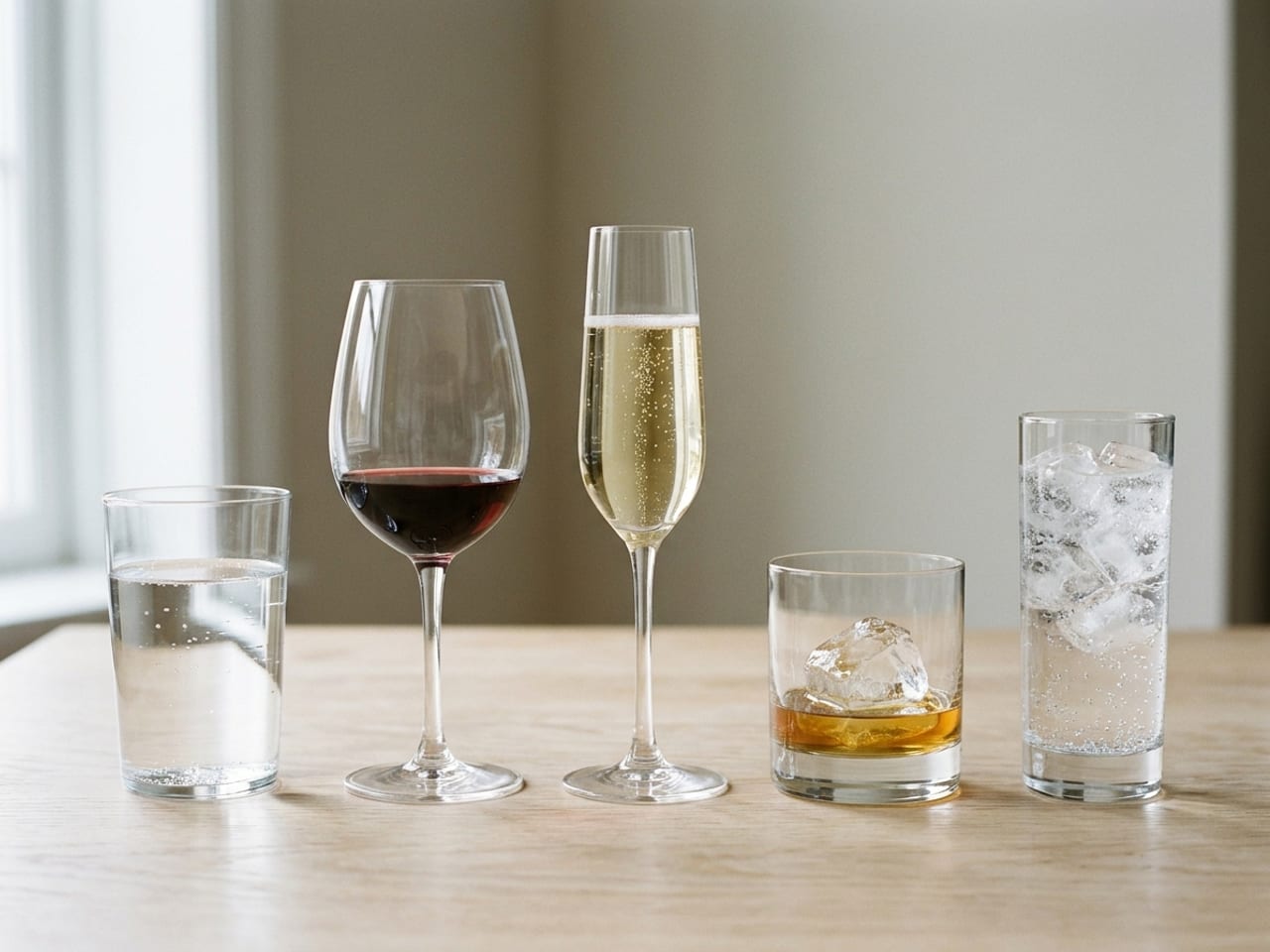
| Water tumbler Water and everyday | Water and soft drinks at the table. Debrett's: "A tumbler for water and two wine glasses, with the larger one for red wine, is usually enough". Zwiesel lists water as the drink for its water glasses and tumblers.3, 60 | 240 to 473 ml (8.1 to 16 US fl oz), 5 makers | vs the water goblet: No stem and no handle: Oxford's tumbler is "a glass for drinking out of, with a flat bottom and no handle or stem". "Tumbler" is also a family name: the IBA asks for a "thin tall Tumbler glass" (Gin Fizz) and a "small tumbler glass" (Ve.N.To).12, 45 | Above the tip of the dinner knife, about an inch (2.5 cm), or a little to its right at 45 degrees; it stays all meal.53, 56, 57, 58 |
| Water goblet Water and everyday | Water at a set table, where the etiquette sources call the water glass a goblet: "The water goblet is placed directly above the knives." (Emily Post Institute). Libbey also sells goblets for everyday drinks ("Goblet Beverage Glasses").5, 54, 56 | 303 to 488 ml (10.3 to 16.5 US fl oz), 3 makers | vs the red wine glass: A bowl on a stem, like a wine glass: Oxford's goblet is "a cup for wine, usually made of glass or metal, with a stem and base but no handle". Neither Oxford nor Cambridge says water goblet, and Spiegelau sells one item as "Red Wine/Water Goblet", so the line between the two is a maker's naming, not a shape rule.2, 44, 45 | Above the tip of the dinner knife, about an inch (2.5 cm), or a little to its right at 45 degrees; it stays all meal.53, 56, 57, 58 |
| Red wine glass (Bordeaux) Wine | Red wine. Debrett's lays two wine glasses, "with the larger one for red wine". Riedel names this bowl for Cabernet Sauvignon and Merlot, and Zwiesel's Classico Bordeaux lists Cabernet Sauvignon, Merlot, Barolo and Bordeaux first (the makers' pairings).1, 3, 60 | 645 to 1012 ml (21.8 to 34.2 US fl oz), 4 makers | vs the burgundy glass: Tall, and in each maker's line larger than the white: Riedel Vinum 650 ml against its white glasses' 370 to 404. Against the Burgundy glass it is taller in every line we read that prints both heights, and smaller in 7 of the 10 maker lines we compared: Riedel's Vinum Cabernet is 225 mm tall, its Pinot Noir 210 mm and 725 ml.1, 2, 3 | Right of the water glass, in the order the wines are poured; at a formal dinner up to five glasses, the smaller ones in front past three.54, 55 |
| White wine glass Wine | White wine: in Debrett's pair it is the smaller glass (our reading of "the larger one for red wine"). Urban Bar: "Our premium crystal 1910 wine glass is a perfect size for serving white wine" (the maker's claim).6, 60 | 300 to 600 ml (10.1 to 20.3 US fl oz), 6 makers | vs the red wine glass: A smaller bowl than the same maker's red: Riedel Vinum 370 to 404 ml against 650 to 725; Glencairn's Jura 340 against 480; Zwiesel Pure 300 to 408 against 540 to 692. Across makers the sizes overlap, and Libbey's stemless "White Wine" (17 oz) is larger than its "Red Wine" (16.75 oz).1, 3, 4, 7 | Right of the water glass, in the order the wines are poured; when it is poured first (as with a fish course), it stands furthest out, as our table setting guide says.54, 55 |
| Champagne flute Sparkling | Champagne and other sparkling wine: Cambridge's flute is "used for drinking sparkling wine". IBA: "flute glass" for the Bellini and the Mimosa, "Champagne flute" for the French 75.12, 44 | 133 to 348 ml (4.5 to 11.8 US fl oz), 5 makers | vs the coupe: Tall and narrow on a long stem. Capacity overlaps with the coupe; height and width do not: Riedel's Grape flute is 250 ml and 241 mm tall, its coupe 320 ml and 170 mm.1, 44 | For an opening toast, furthest right of the glasses.54, 59 |
| Coupe Sparkling | Two jobs. Champagne: Urban Bar sells it as "Perfect for cocktails or champagne and sparkling wines". Cocktails: the IBA names a "coupe glass" once, for Remember the Maine (its 39 "cocktail glass" specs name no shape), while Difford's serves the Daiquiri, Cosmopolitan and Manhattan in a coupe.6, 12, 13 | 133 to 320 ml (4.5 to 10.8 US fl oz), 6 makers | vs the champagne flute: A wide, shallow bowl on a stem (Cambridge: a glass "used especially for some alcoholic drinks", with a wide, shallow bowl). Lower than a flute or a martini glass from the same maker: Riedel's Grape coupe is 170 mm tall, its martini 185 mm, its flute 241 mm.1, 44 | Bar, not laid: the table settings we read do not place it. |
| Martini glass Cocktail | IBA: "martini cocktail glass" for four specs, the Dry Martini, Stinger, Tipperary and Tuxedo. The IBA's plain "cocktail glass" (39 specs) names no shape, so we do not count those as martini glasses.12 | 148 to 355 ml (5 to 12 US fl oz), 4 makers | vs the coupe: A cone on a stem: Urban Bar calls its martini "classic V-shaped". Capacity does not separate it from a coupe (Urban Bar sells both at 21 cl); the shape does, and Riedel's martini stands taller than its coupe (185 against 170 mm).1, 6 | Bar, not laid: the table settings we read do not place it. |
| Highball glass Cocktail | IBA: "highball" for 11 specs, among them the Cuba Libre, Paloma, Tequila Sunrise, Horse's Neck and the John Collins. Libbey's set copy: "best suited for your favorite beer, fizzy pops, lemonade and simple cocktails".5, 12 | 200 to 480 ml (6.8 to 16.2 US fl oz), 7 makers | vs the collins glass: Tall, narrow and stemless. Makers use highball and Collins for the same 300 to 370 ml glasses (in Difford's database the Urban Bar Koto highball is titled a "Highball Collins"; Urban Bar's own page says highball); only Difford's splits them by size, a "small (10oz max) highball" against "larger 12oz Collins glasses".6, 11, 13 | Bar, not laid: the table settings we read do not place it. |
| Rocks glass (old fashioned) Cocktail | IBA: "old fashioned glass" for 9 specs (the Old Fashioned, Negroni, Americano, Sazerac among them) and "rocks glass" for 7 (the Bloody Mary, Tommy's Margarita and Jungle Bird among them). Spirits too: Libbey sells "9 oz small rocks glasses for cocktails and spirits".5, 12 | 148 to 444 ml (5 to 15 US fl oz), 7 makers | vs the double old fashioned: Short, wide and stemless. One shape, several names: Riedel prints "Rocks Glass" in one line and "Single Old Fashioned" in another, Nude says "Lowball", Glencairn titles the same tumbler "Rock Tumbler" and "Whisky Tumbler", and Libbey files rocks and double old fashioned as one type.1, 4, 7, 8 | Bar, not laid: the table settings we read do not place it. |
| Shot glass Spirits | A measure of spirit. The NIAAA's US standard drink is "A 1.5-ounce shot glass of distilled spirits at 40% alcohol by volume"; UK bars sell gin, rum, vodka and whisky in 25 ml or 35 ml measures. Both set the pour, not the glass.20, 21 | 26 to 94 ml (0.9 to 3.2 US fl oz), 4 makers | vs the cordial (liqueur) glass: The smallest glass: Libbey's most common shot sizes are 2 oz (59 ml) and 1.5 oz (44 ml); Glencairn's is 50 ml, Urban Bar's 5 to 6 cl.4, 6, 7 | Bar, not laid: the table settings we read do not place it. |
| Snifter (brandy glass) Spirits | Brandy: Cambridge's US sense is a glass "used for drinking brandy". The Cognac interprofession prefers another shape: "Tulip glasses are widely regarded as the ideal choice to enjoy Cognac". Cicerone uses a snifter for strong beers.15, 16, 44 | Two makers: Glencairn 270 to 610 ml (9.1 to 20.6 US fl oz); Libbey 274 to 517 ml (9.3 to 17.5 US fl oz) | vs the glencairn glass: Cambridge: "a bowl-shaped glass that is narrower at the top and has a short stem". Wider than the Glencairn Glass: Glencairn's Skye snifter is 120 by 85 mm against the Glencairn's 115 by 66 mm.7, 44 | Bar, not laid: the table settings we read do not place it. |
| Pint glass Beer | Beer. Cicerone: the nonic pint is the "Every day pub glass suited to any British or Irish ale", and the shaker an "American cocktail shaker adopted for beer". Libbey sells its Pub glass as an "All-purpose beer glass perfect for stouts, ales, porters and more" (the maker's claim).5, 16 | Two makers: Glencairn 568 to 570 ml (19.2 to 19.3 US fl oz); Libbey 473 to 591 ml (16 to 20 US fl oz) | vs the pilsner glass: The pint is not one size. UK law: "Pint = 0.568 261 25 cubic decimetre" (568 ml, 19.2 US fl oz); Oxford: "0.473 of a litre in the US" (16 US fl oz). Libbey sells its "Pub" pattern at 16, 19 and 20 oz. Wondrich: the US pint glass is the bar's mixing glass, drafted for beer in the 1970s.4, 19, 45, 81 | Bar, not laid: the table settings we read do not place it. |
Show all 35 glasses (23 more)
| Glass | What goes in it | Capacity (as makers list it) | How to tell it | Where it sits |
|---|---|---|---|---|
| Juice glass Water and everyday | Juice, by its maker's name: Libbey's Boston set "ranges in size from juice to rocks to cooler".4, 5 | One maker we read: Libbey 118 to 290 ml (4 to 9.8 US fl oz) | vs the water tumbler: In Libbey's Boston set the juice glass (9.8 oz) is the smallest of three, beside 12.5 oz rocks and 16 oz cooler glasses, but the name does not fix the size: its Everest set has "14 oz tall juice glasses", the largest in the box.5 | Not placed in the dinner settings we read. |
| Burgundy glass Wine | Red wine, by its makers' names: Riedel sells it as Pinot Noir (Pinot/Nebbiolo in its O and Veloce lines), and Zwiesel's Classico Burgundy lists Pinot Noir and Beaujolais (the makers' pairings; the studies are under "Does the shape matter").1, 3 | 625 to 1022 ml (21.1 to 34.6 US fl oz), 3 makers | vs the red wine glass: Shorter than the Bordeaux glass in all six lines that print both heights, and larger in 7 of the 10 maker lines we compared: Riedel Vinum Pinot Noir 725 ml and 210 mm tall against its Cabernet's 650 ml and 225 mm; Spiegelau Authentis Burgundy 750 ml against its Bordeaux 650. Not in the other three: Riedel Veloce (763 against 829 ml), a Spiegelau short-bodied set (625 against 630) and Zwiesel The Moment (819 against 862).1, 2, 3 | Right of the water glass, in the order the wines are poured; at a formal dinner up to five glasses, the smaller ones in front past three.54, 55 |
| All-purpose wine glass Wine | Red, white and sparkling in one glass, the makers' idea: Zwiesel's Vervino allround glass lists Champagne, Barbera and Cabernet Sauvignon among its drinks. In Libbey's catalogue it is the second-largest type, 131 items.3, 4 | 473 to 685 ml (16 to 23.2 US fl oz), 3 makers | vs the iso tasting glass: A middle-sized bowl, between the maker's white and red glasses. The name is a maker's label, not a shape standard; the one standard tasting glass is the ISO glass.3, 8 | As a wine glass: right of the water glass, in pouring order (ours, from the rule the settings share). |
| Stemless wine glass Wine | Wine without a stem: Riedel's O line puts its varietal bowls (Cabernet/Merlot, Pinot/Nebbiolo, Riesling/Sauvignon Blanc, Viognier/Chardonnay) on a flat base.1 | 335 to 750 ml (11.3 to 25.4 US fl oz), 3 makers | vs the water tumbler: A wine-glass bowl with no stem: Riedel's O Cabernet/Merlot is 630 ml and 121 mm tall, against its stemmed Vinum Cabernet's 650 ml and 225 mm. The common claim that the hand warms the wine through it: we found no study that tested it.1 | Not named in the settings we read; as a wine glass it would follow the pouring order (ours). |
| ISO tasting glass Wine | Every wine, for tasting: the standard "specifies the characteristics of a wine-tasting glass to be used for the sensory analysis of wines", one glass for red, white and the rest.18 | No maker's spec for an ISO glass in what we read, so no figure here: the standard gives its dimensions in a figure we could not read. | vs the white wine glass: A cup shaped as an "elongated egg" on a stem and base, the opening narrower than the widest part "so as to concentrate the bouquet". Clear, colourless and plain, per the standard.18 | Tasting rooms and labs; not laid in the settings we read. |
| Tulip champagne glass Sparkling | Champagne in a wider glass. Riedel sells it as a "Champagne Wine Glass", and Maximilian Riedel says he wants the flute "obsolete within my lifetime" (a maker's view, no study cited); Pierre-Emmanuel Taittinger, of the Champagne house, says Champagne "must always be drunk in a flute".1, 40 | Two makers: Riedel 327 to 464 ml (11.1 to 15.7 US fl oz); Zwiesel 283 ml (9.6 US fl oz) | vs the champagne flute: Wider and larger than a flute: Riedel's are 327 to 464 ml and 235 to 260 mm tall, against its flutes' 212 to 250 ml. Zwiesel calls flutes and tulips alike "Champagne glass".1, 3 | Not named in the settings we read. |
| Nick & Nora glass Cocktail | Cocktails, as a smaller stand-in for the martini glass: Urban Bar sells it as "a narrower alternative to a wide martini glass". No IBA spec names it.6, 12 | 140 to 198 ml (4.7 to 6.7 US fl oz), 3 makers | vs the martini glass: The smallest of the stemmed cocktail glasses in the makers we read, with taller walls: Urban Bar, "Tall walls offer spill-proof alternative to the classic martini glass".6 | Bar, not laid: the table settings we read do not place it. |
| Collins glass Cocktail | The IBA names a "Collins glass" once, for the Suffering Bastard; its John Collins goes in a "highball". Difford's serves the Tom Collins, the Mojito and the Bloody Mary in a Collins glass.12, 13 | One maker we read: Cocktail Kingdom 300 to 360 ml (10.1 to 12.2 US fl oz) | vs the highball glass: A highball by another name in the makers' lists: Cocktail Kingdom sells Collins glasses at 10 oz and 12 oz, and Zwiesel lists "Collins" among the drinks for its highball and longdrink glasses. Difford's alone draws a size line (Collins 12 oz, highball 10 oz at most).3, 9, 13 | Bar, not laid: the table settings we read do not place it. |
| Double old fashioned (double rocks) Cocktail | IBA: "double old fashioned glass" for the Caipirinha and the Fernandito, "double rocks glass" (or a highball) for the Mai Tai. Wondrich: the bucket glass is used today for "straight spirits, spirits on ice and rocks, and drinks such as Old-Fashioneds, Caipirinhas, and Margaritas".12, 81 | 295 to 450 ml (10 to 15.2 US fl oz), 3 makers | vs the rocks glass: "Double" is a name, not a size: Cocktail Kingdom sells a 10 oz (295 ml) Double Rocks and a 12 oz (355 ml) plain Rocks; Riedel's Double Rocks is 370 ml against its Rocks at 283.1, 9 | Bar, not laid: the table settings we read do not place it. |
| Margarita glass Cocktail | The Margarita, by name. The IBA's own Margarita spec says "Shake and strain into a chilled cocktail glass." and Difford's picks an old-fashioned glass, so the margarita glass is a convention, not a rule.4, 12, 13 | One maker we read: Libbey 266 to 517 ml (9 to 17.5 US fl oz) | vs the coupe: Only Libbey sells one under that name in what we read, from 9 to 17.5 oz, plus a 27.25 oz and a 56 oz novelty, so we cannot describe its shape from a spec.4 | Bar, not laid: the table settings we read do not place it. |
| Hurricane glass Cocktail | IBA: "Strain into Hurricane glass." for the Singapore Sling.12 | One maker we read: Libbey 310 to 473 ml (10.5 to 16 US fl oz) | vs the zombie glass: Wondrich: "a huge glass modeled on the hurricane-lamp chimney glass". Only Libbey sells one in what we read, 10.5 to 16 oz.4, 81 | Bar, not laid: the table settings we read do not place it. |
| Sour glass Cocktail | Sours, by its maker's name. The IBA's Whiskey Sour names a "cobbler glass", or an old fashioned glass when served on the rocks.1, 12 | One maker we read: Riedel 215 to 217 ml (7.3 to 7.3 US fl oz) | vs the nick & nora glass: One maker in what we read: Riedel's is 217 ml and 158 mm tall, between its Nick & Nora (140 ml) and its coupes (310 to 320 ml).1 | Bar, not laid: the table settings we read do not place it. |
| Zombie glass Cocktail | The Zombie, by name. The IBA's Zombie says "Serve in a tall tumbler glass.", and Zwiesel lists Zombie among the drinks for its highball and longdrink glasses.3, 12 | One maker we read: Cocktail Kingdom 450 ml (15.2 US fl oz) | vs the highball glass: Larger than a typical highball: Cocktail Kingdom's is 16 oz (450 ml), above the 300 to 370 ml most highballs list.9 | Bar, not laid: the table settings we read do not place it. |
| Gin and tonic (balloon) glass Cocktail | Gin and tonic and spritzes, by the makers' lists: Zwiesel's Echo is for gin, cocktails, sangria, Aperol and gin and tonic. Gin and tonic is not an IBA cocktail; the IBA's Spritz goes in "a wine glass filled with ice".3, 12 | 550 to 650 ml (18.6 to 22 US fl oz), 4 makers | vs the burgundy glass: A big bowl on a stem, larger than most white wine glasses: 550 to 650 ml in the makers we read. Zwiesel files it as a "Cocktail glass".3, 6, 7, 8 | Bar, not laid: the table settings we read do not place it. |
| Glencairn glass Spirits | Whisky, for nosing. Glencairn says its founder "envisaged a glass similar to a traditional sherry nosing glass (or Copita)", and that drinkers use it for other spirits "such as vodka and sherry".41, 42 | One maker we read: Glencairn 200 ml (6.8 US fl oz) | vs the copita: Short and small; the maker's claim: "The tapering mouth of the glass captures and focuses the aroma on the nose." By the maker's figures it is 115 mm tall and 66 mm wide, against its copita at 150 by 60 mm and its Skye snifter at 120 by 85 mm.7, 41 | Bar, not laid: the table settings we read do not place it. |
| Cordial (liqueur) glass Spirits | Liqueurs, by its name (no authority we read gives it a drink). Browne's restaurant stocking list still carries a cordial glass.4, 10 | Two makers: Libbey 59 to 118 ml (2 to 4 US fl oz); Cocktail Kingdom 90 ml (3 US fl oz) | vs the shot glass: A very small glass that Libbey files with its stemware: 2 to 4 oz, against the shot glass's usual 1.5 to 2 oz without a stem.4, 9 | Bar, not laid: the table settings we read do not place it. |
| Pilsner glass Beer | Cicerone's footed pilsner: "Suitable for German and Czech/Bohemian Pilsners." Libbey lists its pilsner for "Kolsch, Lager, Bock, Hefeweizen, Witbier, or Pilsner" (the maker's list).5, 16 | 360 to 473 ml (12.2 to 16 US fl oz), 3 makers | vs the weizen (wheat beer) glass: Tall and slim: Zwiesel's 0.3 l Pilsglas is 360 ml and 187 mm tall; Libbey calls its Stockholm a "classic, slender European design" where "The slim mouth showcases the foam head".3, 5 | Bar, not laid: the table settings we read do not place it. |
| Weizen (wheat beer) glass Beer | Wheat beer by its name (Zwiesel sells it as a "Wheat beer glass"); Cicerone names no style, only that the weizen vase "Accommodates half liter of beer plus sizeable head."3, 16 | Two makers: Zwiesel 690 ml (23.3 US fl oz); Libbey 473 ml (16 US fl oz) | vs the pilsner glass: Taller and larger than a pilsner, sized for half a litre and its foam: Zwiesel's 0.5 l wheat beer glass prints 690 ml and 252 mm tall (our reading: 0.5 l is the pour and 690 ml the whole glass; the page does not say).3 | Bar, not laid: the table settings we read do not place it. |
| Tulip beer glass Beer | Cicerone: "Good utility glass suited to many Belgian styles from saison to blond ales."16 | One maker we read: Libbey 473 to 488 ml (16 to 16.5 US fl oz) | vs the pint glass: The shape, not the size: Libbey describes "an elegant tulip shape formed by the wide bowl and narrow top", at 16 to 16.5 oz, the size of a US pint.5 | Bar, not laid: the table settings we read do not place it. |
| Stange Beer | Kölsch. Cicerone: "Used to serve Kölsch, often in 0.2 liter size."16 | No maker's spec in what we read. Cicerone: "often in 0.2 liter size" (200 ml, 6.8 US fl oz). | vs the pilsner glass: Cicerone's only printed figure is the size; we read no maker's spec for a Stange. In German bars 0.2 litre is one of the serving volumes the measuring rules allow.16, 22 | Bar, not laid: the table settings we read do not place it. |
| Copita (sherry glass) Sherry, port and dessert wine | Sherry, and whisky for nosing: Wiktionary's copita is "A sherry glass with a tapering bowl" (a weaker, crowd-edited source); Glencairn calls its Copita "a whisky-nosing glass that has since become a popular laboratory tool in distilleries worldwide".42, 47 | Two makers: Glencairn 170 ml (5.7 US fl oz); Urban Bar 120 ml (4.1 US fl oz) | vs the glencairn glass: On a stem, taller and narrower than the Glencairn Glass: Glencairn's own Copita is 150 by 60 mm and 170 ml, its Glencairn Glass 115 by 66 mm and 200 ml. Urban Bar: "Stunning copita shape stemmed spirit glass".6, 7 | A sherry glass for the first course goes furthest right of the glasses.54 |
| Port glass Sherry, port and dessert wine | Port: Riedel names a glass for it, and Zwiesel's Alloro port glass lists vintage port, sherry (Jerez) and vermouth.1, 3 | Two makers: Riedel 265 ml (9 US fl oz); Zwiesel 310 ml (10.5 US fl oz) | vs the dessert wine glass: Smaller than a table-wine glass from the same makers: Riedel's 265 ml against its whites from 370 ml; Zwiesel's 310 ml.1, 3 | No fixed place in what we read. |
| Dessert wine glass Sherry, port and dessert wine | Sweet wine with dessert: Debrett's adds a smaller third glass, for pudding wine or champagne, to the water tumbler and two wine glasses.60 | One maker we read: Zwiesel 219 to 246 ml (7.4 to 8.3 US fl oz) | vs the port glass: Small: Zwiesel's sweet wine glasses print 219 to 246 ml, against its whites from 300 ml.3 | In a diamond of four or five glasses, the highest one.56 |
Glass size is not the pour
A wine glass of 645 to 1012 ml (21.8 to 34.2 US fl oz) is not meant to be filled: Riedel's own guidance is "Maximum 3 to 6 US fl. oz / 100 to 125 ml. Never over-pour the glass."1 UK law lets bars sell wine by the glass only in 125 ml, 175 ml or multiples (with exceptions), gin, rum, vodka and whisky in 25 ml or 35 ml, and beer or cider in a third, half or two-thirds of a pint or multiples of a half.20 A US standard drink is 12 fl oz of beer, 5 fl oz of wine or 1.5 fl oz of spirits, which the NIAAA says "may not reflect customary serving sizes".21 Serving glasses for water, soft drinks, beer and wine sold in German bars carry a fill line and one of a fixed set of volumes (0.1, 0.2, 0.25, 0.3, 0.33, 0.5 litre and more).22 How full to pour at the table is in fine dining etiquette.
Water glasses: the tumbler, the goblet and the juice glass
The glasses for water, soft drinks and juice. At a set table the water glass is the one that stays all meal, and Debrett's makes it a tumbler; American formal settings call it a goblet.54, 58, 60 Makers sell the same flat-bottomed glass at many sizes, and the name follows the size: Libbey's Boston set "ranges in size from juice to rocks to cooler".5
Water tumbler
Names: Tumbler or water glass; "H2O All Purpose Tumbler" (Riedel); "Allround drinking glass" and "Water glass" (Zwiesel).
What goes in it. Water and soft drinks at the table. Debrett's: "A tumbler for water and two wine glasses, with the larger one for red wine, is usually enough". Zwiesel lists water as the drink for its water glasses and tumblers.3, 60
How to tell it from the water goblet. No stem and no handle: Oxford's tumbler is "a glass for drinking out of, with a flat bottom and no handle or stem". "Tumbler" is also a family name: the IBA asks for a "thin tall Tumbler glass" (Gin Fizz) and a "small tumbler glass" (Ve.N.To).12, 45
Where it sits. Above the tip of the dinner knife, about an inch (2.5 cm), or a little to its right at 45 degrees; it stays all meal.53, 56, 57, 58 (see the order of glasses)
Capacity. 240 to 473 ml (8.1 to 16 US fl oz), 5 makers. As listed: Riedel H2O All Purpose Tumbler (Restaurant O): 330 ml (11.2 US fl oz)1; Zwiesel Pure tumbler: 357 ml (12.1 US fl oz)3; Zwiesel Echo allround tumbler: 411 ml (13.9 US fl oz)3; Zwiesel Simple allround tumbler: 255 ml (8.6 US fl oz)3; Zwiesel Forte water glass, 114 mm tall: 397 ml (13.4 US fl oz)3; Urban Bar 1910 Water Glass: 24 cl (240 ml, 8.1 US fl oz)6; Nude Sera tumbler (450 cc): 450 ml (15.2 US fl oz)8; Libbey Bar Essentials Tumbler: 16 oz (473 ml)5.
Water goblet
Names: Goblet; "Red Wine/Water Goblet" (Spiegelau); "Goblet" (a Libbey catalogue type); US formal-table usage.
What goes in it. Water at a set table, where the etiquette sources call the water glass a goblet: "The water goblet is placed directly above the knives." (Emily Post Institute). Libbey also sells goblets for everyday drinks ("Goblet Beverage Glasses").5, 54, 56
How to tell it from the red wine glass. A bowl on a stem, like a wine glass: Oxford's goblet is "a cup for wine, usually made of glass or metal, with a stem and base but no handle". Neither Oxford nor Cambridge says water goblet, and Spiegelau sells one item as "Red Wine/Water Goblet", so the line between the two is a maker's naming, not a shape rule.2, 44, 45
Where it sits. Above the tip of the dinner knife, about an inch (2.5 cm), or a little to its right at 45 degrees; it stays all meal.53, 56, 57, 58 (see the order of glasses)
Capacity. 303 to 488 ml (10.3 to 16.5 US fl oz), 3 makers. As listed: Spiegelau Authentis Red Wine/Water Goblet (16 1/4 oz, 480 ml as printed): 16.25 oz (481 ml)2; Libbey Foodservice catalogue, Goblet type: 10.25 to 16.5 oz across 27 items (303 to 488 ml; brands: Libbey, Reserve by Libbey, Spiegelau, Nachtmann)4; Zwiesel Alloro water glass, 186 mm tall: 400 ml (13.5 US fl oz)3; Zwiesel The Moment water glass, 193 mm tall: 345 ml (11.7 US fl oz)3.
Juice glass
Names: "Juice Tumbler" (a Libbey catalogue type).
What goes in it. Juice, by its maker's name: Libbey's Boston set "ranges in size from juice to rocks to cooler".4, 5
How to tell it from the water tumbler. In Libbey's Boston set the juice glass (9.8 oz) is the smallest of three, beside 12.5 oz rocks and 16 oz cooler glasses, but the name does not fix the size: its Everest set has "14 oz tall juice glasses", the largest in the box.5
Where it sits. Not placed in the dinner settings we read.
Capacity. One maker we read: Libbey 118 to 290 ml (4 to 9.8 US fl oz). As listed: Libbey Foodservice catalogue, Juice Tumbler type: 4 to 9 oz across 13 items (118 to 266 ml; brands: Libbey, Spiegelau)4; Libbey Boston set juice glass: 9.8 oz (290 ml)5.
Types of wine glasses and what goes in each
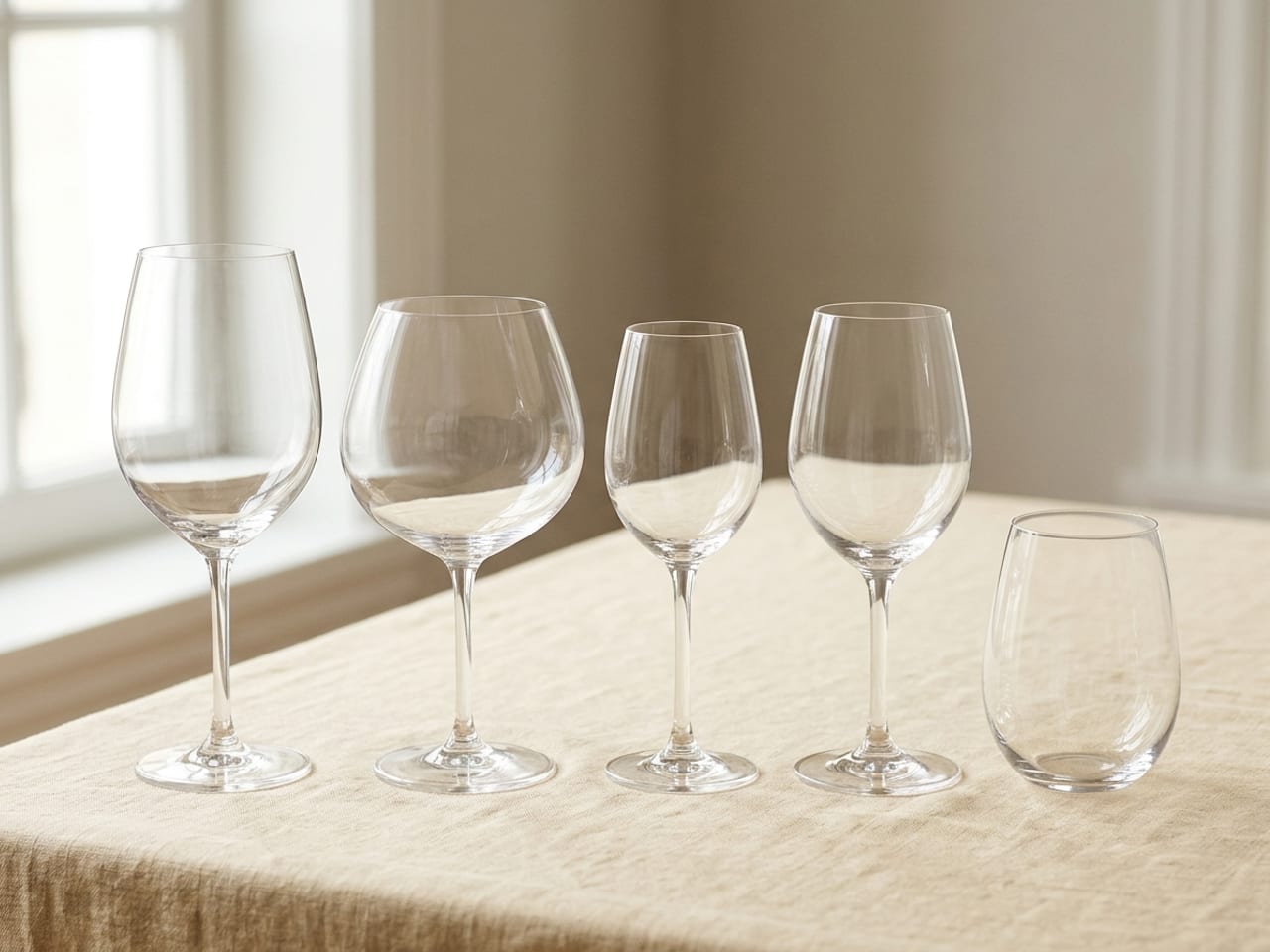
Wine glasses split by bowl, and the makers name the bowls for grapes. Riedel says it introduced "wine-friendly stemware" in the late 1950s, "recognizing that the taste and aroma of a beverage are influenced by the shape of the vessel"; that is the maker's account, and the studies are in does the shape matter.37 Within one maker's line the red bowls are larger than the white; across makers the sizes overlap, so read the capacity, not the name.1, 4 One standard exists, and it is a single glass for every wine: the ISO tasting glass.18
Red wine glass (Bordeaux)
Names: Bordeaux glass; "Cabernet Sauvignon/Merlot" (Riedel Vinum); "Bordeaux goblet" (Zwiesel Classico).
What goes in it. Red wine. Debrett's lays two wine glasses, "with the larger one for red wine". Riedel names this bowl for Cabernet Sauvignon and Merlot, and Zwiesel's Classico Bordeaux lists Cabernet Sauvignon, Merlot, Barolo and Bordeaux first (the makers' pairings).1, 3, 60
How to tell it from the burgundy glass. Tall, and in each maker's line larger than the white: Riedel Vinum 650 ml against its white glasses' 370 to 404. Against the Burgundy glass it is taller in every line we read that prints both heights, and smaller in 7 of the 10 maker lines we compared: Riedel's Vinum Cabernet is 225 mm tall, its Pinot Noir 210 mm and 725 ml.1, 2, 3
Where it sits. Right of the water glass, in the order the wines are poured; at a formal dinner up to five glasses, the smaller ones in front past three.54, 55 (see the order of glasses)
Capacity. 645 to 1012 ml (21.8 to 34.2 US fl oz), 4 makers. As listed: Riedel Vinum Cabernet Sauvignon/Merlot: 650 ml (22 US fl oz)1; Riedel Veloce Cabernet/Merlot: 829 ml (28 US fl oz)1; Riedel Superleggero Bordeaux Grand Cru: 953 ml (32.2 US fl oz)1; Riedel Veritas Bordeaux Grand Cru: 960 ml (32.5 US fl oz)1; Spiegelau Authentis Bordeaux (22 oz): 650 ml (22 US fl oz)2; Spiegelau Hybrid Bordeaux (23 oz): 680 ml (23 US fl oz)2; Zwiesel Classico Bordeaux goblet: 645 ml (21.8 US fl oz)3; Zwiesel Pure Bordeaux: 680 ml (23 US fl oz)3; Zwiesel Enoteca Bordeaux: 1012 ml (34.2 US fl oz)3; Nude Bordeaux (25 oz, as its distributor Browne prints it): 740 ml (25 US fl oz)10.
Burgundy glass
Names: "Pinot Noir" (Riedel Vinum); "Burgundy goblet" (Zwiesel Classico); Riedel's first Sommeliers shape was a burgundy goblet (V&A).
What goes in it. Red wine, by its makers' names: Riedel sells it as Pinot Noir (Pinot/Nebbiolo in its O and Veloce lines), and Zwiesel's Classico Burgundy lists Pinot Noir and Beaujolais (the makers' pairings; the studies are under "Does the shape matter").1, 3
How to tell it from the red wine glass. Shorter than the Bordeaux glass in all six lines that print both heights, and larger in 7 of the 10 maker lines we compared: Riedel Vinum Pinot Noir 725 ml and 210 mm tall against its Cabernet's 650 ml and 225 mm; Spiegelau Authentis Burgundy 750 ml against its Bordeaux 650. Not in the other three: Riedel Veloce (763 against 829 ml), a Spiegelau short-bodied set (625 against 630) and Zwiesel The Moment (819 against 862).1, 2, 3
Where it sits. Right of the water glass, in the order the wines are poured; at a formal dinner up to five glasses, the smaller ones in front past three.54, 55 (see the order of glasses)
Capacity. 625 to 1022 ml (21.1 to 34.6 US fl oz), 3 makers. As listed: Riedel Vinum Pinot Noir: 725 ml (24.5 US fl oz)1; Riedel Veloce Pinot Noir/Nebbiolo: 763 ml (25.8 US fl oz)1; Riedel Superleggero Burgundy Grand Cru: 1022 ml (34.6 US fl oz)1; Spiegelau short-bodied Burgundy (21 1/4 oz): 625 ml (21.1 US fl oz)2; Spiegelau Authentis Burgundy (25 1/4 oz): 750 ml (25.4 US fl oz)2; Spiegelau Hybrid Burgundy (28 1/2 oz): 840 ml (28.4 US fl oz)2; Zwiesel Pure Burgundy: 692 ml (23.4 US fl oz)3; Zwiesel Classico Burgundy goblet: 814 ml (27.5 US fl oz)3; Zwiesel Vervino Burgundy: 955 ml (32.3 US fl oz)3.
White wine glass
Names: "Riesling", "Viognier/Chardonnay" (Riedel Vinum); "White Wine" (Spiegelau, Libbey, Nude).
What goes in it. White wine: in Debrett's pair it is the smaller glass (our reading of "the larger one for red wine"). Urban Bar: "Our premium crystal 1910 wine glass is a perfect size for serving white wine" (the maker's claim).6, 60
How to tell it from the red wine glass. A smaller bowl than the same maker's red: Riedel Vinum 370 to 404 ml against 650 to 725; Glencairn's Jura 340 against 480; Zwiesel Pure 300 to 408 against 540 to 692. Across makers the sizes overlap, and Libbey's stemless "White Wine" (17 oz) is larger than its "Red Wine" (16.75 oz).1, 3, 4, 7
Where it sits. Right of the water glass, in the order the wines are poured; when it is poured first (as with a fish course), it stands furthest out, as our table setting guide says.54, 55 (see the order of glasses)
Capacity. 300 to 600 ml (10.1 to 20.3 US fl oz), 6 makers. As listed: Riedel Vinum Viognier/Chardonnay: 370 ml (12.5 US fl oz)1; Riedel Superleggero Riesling: 400 ml (13.5 US fl oz)1; Riedel Vinum Riesling/Zinfandel: 404 ml (13.7 US fl oz)1; Spiegelau Hybrid White Wine (12 3/4 oz): 380 ml (12.9 US fl oz)2; Spiegelau Authentis White Wine (14 1/4 oz): 420 ml (14.2 US fl oz)2; Zwiesel Pure Riesling: 300 ml (10.1 US fl oz)3; Zwiesel Pure Sauvignon: 408 ml (13.8 US fl oz)3; Zwiesel Vervino Chardonnay: 487 ml (16.5 US fl oz)3; Glencairn Jura White Wine Glass: 340 ml (11.5 US fl oz)7; Nude Vinifera White Wine (360 cc): 360 ml (12.2 US fl oz)8; Nude Vinifera White Wine (600 cc): 600 ml (20.3 US fl oz)8; Libbey Stemless White Wine (item 221): 17 oz (503 ml)4.
All-purpose wine glass
Names: Universal or allround wine glass; "All Purpose Wine" (Libbey); "Allround wine glass" (Zwiesel).
What goes in it. Red, white and sparkling in one glass, the makers' idea: Zwiesel's Vervino allround glass lists Champagne, Barbera and Cabernet Sauvignon among its drinks. In Libbey's catalogue it is the second-largest type, 131 items.3, 4
How to tell it from the iso tasting glass. A middle-sized bowl, between the maker's white and red glasses. The name is a maker's label, not a shape standard; the one standard tasting glass is the ISO glass.3, 8
Where it sits. As a wine glass: right of the water glass, in pouring order (ours, from the rule the settings share). (see the order of glasses)
Capacity. 473 to 685 ml (16 to 23.2 US fl oz), 3 makers. As listed: Zwiesel Vervino allround glass: 685 ml (23.2 US fl oz)3; Nude All Purpose Wine (540 cc): 540 ml (18.3 US fl oz)8; Libbey All Purpose Wine, the most common size (19 of 131 items): 16 oz (473 ml)4. Libbey's 131 All Purpose Wine items run from 4.6 to 28.5 oz (136 to 843 ml).
Stemless wine glass
Names: Restaurant O (Riedel); Authentis Casual (Spiegelau); "Stemless" (Libbey).
What goes in it. Wine without a stem: Riedel's O line puts its varietal bowls (Cabernet/Merlot, Pinot/Nebbiolo, Riesling/Sauvignon Blanc, Viognier/Chardonnay) on a flat base.1
How to tell it from the water tumbler. A wine-glass bowl with no stem: Riedel's O Cabernet/Merlot is 630 ml and 121 mm tall, against its stemmed Vinum Cabernet's 650 ml and 225 mm. The common claim that the hand warms the wine through it: we found no study that tested it.1
Where it sits. Not named in the settings we read; as a wine glass it would follow the pouring order (ours).
Capacity. 335 to 750 ml (11.3 to 25.4 US fl oz), 3 makers. As listed: Riedel O Viognier/Chardonnay: 335 ml (11.3 US fl oz)1; Riedel O Riesling/Sauvignon Blanc: 375 ml (12.7 US fl oz)1; Riedel O Cabernet/Merlot: 630 ml (21.3 US fl oz)1; Riedel O Pinot/Nebbiolo: 690 ml (23.3 US fl oz)1; Spiegelau Authentis Casual White Wine (14 1/4 oz): 420 ml (14.2 US fl oz)2; Spiegelau Authentis Casual Red Wine/Water Goblet (16 1/4 oz): 480 ml (16.2 US fl oz)2; Spiegelau Authentis Casual Burgundy (25 1/4 oz): 750 ml (25.4 US fl oz)2; Libbey Stemless Red Wine (item 222): 16.75 oz (495 ml)4; Libbey Stemless White Wine (item 221): 17 oz (503 ml)4.
ISO tasting glass
Names: ISO wine-tasting glass (ISO 3591); the INAO glass in the studies we read.
What goes in it. Every wine, for tasting: the standard "specifies the characteristics of a wine-tasting glass to be used for the sensory analysis of wines", one glass for red, white and the rest.18
How to tell it from the white wine glass. A cup shaped as an "elongated egg" on a stem and base, the opening narrower than the widest part "so as to concentrate the bouquet". Clear, colourless and plain, per the standard.18
Where it sits. Tasting rooms and labs; not laid in the settings we read.
Capacity. No maker's spec for an ISO glass in what we read, so no figure here: the standard gives its dimensions in a figure we could not read.
Types of champagne glasses: flute, coupe and tulip
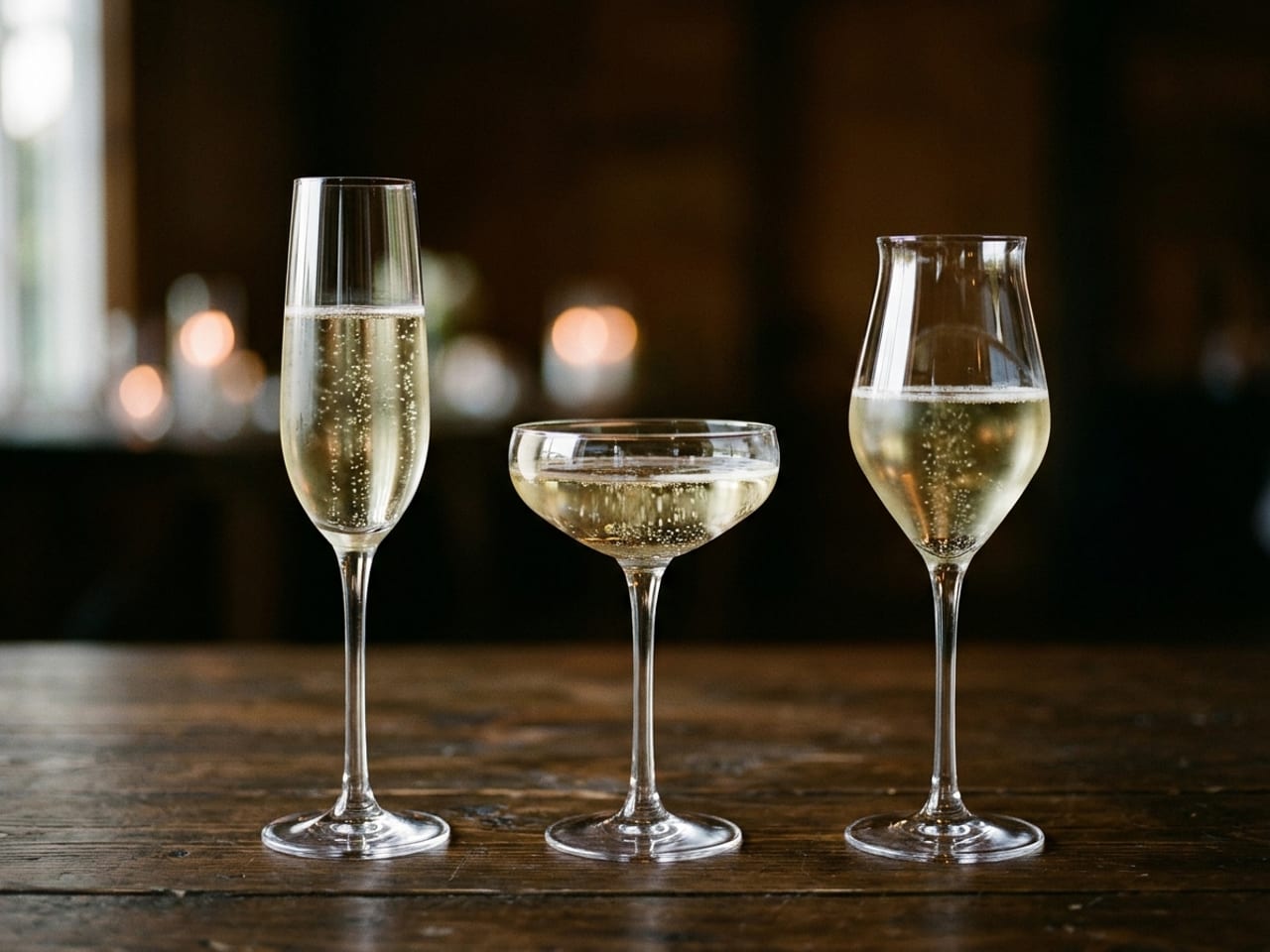
Three shapes for champagne and other sparkling wine, and the makers blur the names: Zwiesel calls every one a "Champagne glass", Riedel sells a flute and a wider glass it calls a "Champagne Wine Glass" (our grouping: we call it a tulip), and Urban Bar sells its coupe for cocktails or champagne.1, 3, 6 The New Year's Eve question is answered below the three glasses. Pouring it with caviar? The amounts, the ice and the spoon are in how to serve caviar.
Champagne flute
Names: Flute; "Champagne Flute" (Riedel, Spiegelau); "Flute Cocktail" (a Libbey catalogue type); German Sektflöte, Italian flûte.
What goes in it. Champagne and other sparkling wine: Cambridge's flute is "used for drinking sparkling wine". IBA: "flute glass" for the Bellini and the Mimosa, "Champagne flute" for the French 75.12, 44
How to tell it from the coupe. Tall and narrow on a long stem. Capacity overlaps with the coupe; height and width do not: Riedel's Grape flute is 250 ml and 241 mm tall, its coupe 320 ml and 170 mm.1, 44
Where it sits. For an opening toast, furthest right of the glasses.54, 59 (see the order of glasses)
Capacity. 133 to 348 ml (4.5 to 11.8 US fl oz), 5 makers. As listed: Riedel Wine Friendly Champagne Flute: 212 ml (7.2 US fl oz)1; Riedel Grape Champagne Flute: 250 ml (8.5 US fl oz)1; Spiegelau Authentis Champagne Flute (9 1/4 oz): 270 ml (9.1 US fl oz)2; Spiegelau Hybrid Champagne Flute (9 1/2 oz): 280 ml (9.5 US fl oz)2; Zwiesel Fortissimo: 240 ml (8.1 US fl oz)3; Zwiesel Bar Premium No.1: 253 ml (8.6 US fl oz)3; Zwiesel Pure: 297 ml (10 US fl oz)3; Zwiesel Vervino flute: 348 ml (11.8 US fl oz)3; Urban Bar Bacci Champagne Flute: 19 cl (190 ml, 6.4 US fl oz)6; Urban Bar 1910 Champagne Flute: 32 cl (320 ml, 10.8 US fl oz)6; Libbey Foodservice catalogue, Flute Cocktail type: 4.5 to 10 oz across 39 items (133 to 296 ml; brands: Libbey, Reserve by Libbey, Spiegelau)4. Libbey's catalogue also lists a 1.79 oz (53 ml) flute. Difford's measured Urban Bar's Castello flute at 220 ml to the brim and 205 mm tall.11
Coupe
Names: Champagne coupe, or champagne saucer (Snopes); "Champagne Glass Coupe" (Urban Bar); "Coupe/Cocktail" (Riedel); coupette, a small coupe (Urban Bar).
What goes in it. Two jobs. Champagne: Urban Bar sells it as "Perfect for cocktails or champagne and sparkling wines". Cocktails: the IBA names a "coupe glass" once, for Remember the Maine (its 39 "cocktail glass" specs name no shape), while Difford's serves the Daiquiri, Cosmopolitan and Manhattan in a coupe.6, 12, 13
How to tell it from the champagne flute. A wide, shallow bowl on a stem (Cambridge: a glass "used especially for some alcoholic drinks", with a wide, shallow bowl). Lower than a flute or a martini glass from the same maker: Riedel's Grape coupe is 170 mm tall, its martini 185 mm, its flute 241 mm.1, 44
Where it sits. Bar, not laid: the table settings we read do not place it.
Capacity. 133 to 320 ml (4.5 to 10.8 US fl oz), 6 makers. As listed: Riedel Veritas Coupe/Cocktail: 310 ml (10.5 US fl oz)1; Riedel Grape Coupe/Cocktail: 320 ml (10.8 US fl oz)1; Zwiesel Echo cocktail coupe: 277 ml (9.4 US fl oz)3; Urban Bar 1910 Coley coupe: 17 cl (170 ml, 5.7 US fl oz)6; Urban Bar 1920 Champagne Glass Coupe: 21 cl (210 ml, 7.1 US fl oz)6; Urban Bar 1920 Fizzio coupe: 26 cl (260 ml, 8.8 US fl oz)6; Cocktail Kingdom Leopold coupe, 6 oz: 180 ml (6.1 US fl oz)9; Cocktail Kingdom Leopold coupe, 7.5 oz: 225 ml (7.6 US fl oz)9; Nude Splash Champagne Coupe: 24.5 cl (245 ml, 8.3 US fl oz)8; Libbey Foodservice catalogue, Coupe Cocktail type: 4.5 to 10.5 oz across 19 items (133 to 310 ml; brands: Libbey, Reserve by Libbey, Spiegelau, Nachtmann)4. Libbey also lists a 14 oz coupe (Symbio, 414 ml).
Tulip champagne glass
Names: "Champagne Wine Glass" (Riedel); champagne glass of Zwiesel's "Tulip" range; tulip is our grouping.
What goes in it. Champagne in a wider glass. Riedel sells it as a "Champagne Wine Glass", and Maximilian Riedel says he wants the flute "obsolete within my lifetime" (a maker's view, no study cited); Pierre-Emmanuel Taittinger, of the Champagne house, says Champagne "must always be drunk in a flute".1, 40
How to tell it from the champagne flute. Wider and larger than a flute: Riedel's are 327 to 464 ml and 235 to 260 mm tall, against its flutes' 212 to 250 ml. Zwiesel calls flutes and tulips alike "Champagne glass".1, 3
Where it sits. Not named in the settings we read.
Capacity. Two makers: Riedel 327 to 464 ml (11.1 to 15.7 US fl oz); Zwiesel 283 ml (9.6 US fl oz). As listed: Riedel Veloce Champagne Wine Glass: 327 ml (11.1 US fl oz)1; Riedel Veritas Champagne Wine Glass: 459 ml (15.5 US fl oz)1; Riedel Superleggero Champagne Wine Glass: 464 ml (15.7 US fl oz)1; Zwiesel Tulip range champagne glass: 283 ml (9.6 US fl oz)3.
Flute, coupe or white wine glass for New Year's Eve?
For a toast, a flute keeps the fizz in the glass longest; for looks, a coupe; for tasting, Riedel and some sommeliers now say a white wine or tulip glass. What each rests on:
- The flute: with one Champagne, dissolved CO2 fell faster in a coupe than in a flute over the first 10 minutes, "the first analytical proof that the flute prolongs the drink's chill and helps it to retain its effervescence", and a later study measured two to three times more gas near the rim of a flute.23, 24 Not tested: whether anyone tastes the difference.
- The tulip or white wine glass: Maximilian Riedel, as the drinks business relays a Telegraph feature, wants the flute "obsolete within my lifetime" and says narrow flutes "inhibit aromas and mute flavour"; its report on a London restaurant that has served no flutes from the day it opened is headed "No flutes in the building". Pierre-Emmanuel Taittinger told The Times in 2024 that Champagne "must always be drunk in a flute". None of them cites a study.40
- The coupe: the 19th-century champagne glass in the V&A's dating (cup-shaped champagne glasses from about 1830, standard by the 1860s, while the flute goes back to the 1700s), and the one that doubles as a cocktail glass.6, 71, 72 The Marie Antoinette story is a myth: see the history.
How many: Select Hire plans one flute a guest for a toast and 1.5 as a welcome drink.66 Our advice: if you own one set, white wine glasses pour Champagne well enough for a party, and flutes are worth buying only if you open sparkling wine often.
Types of cocktail glasses, and what the IBA puts in each
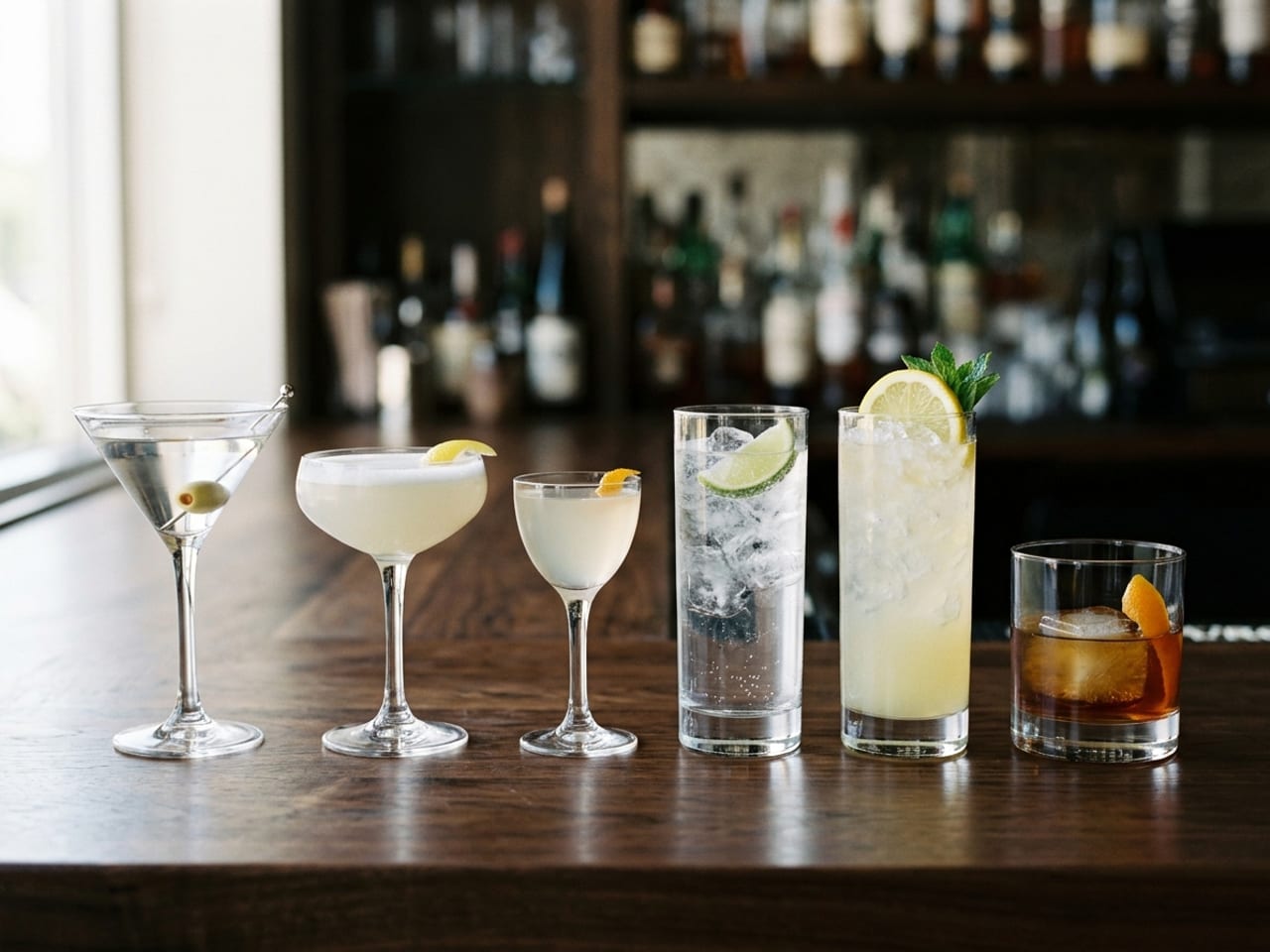
Every "what goes in it" line here starts from the International Bartenders Association's official recipes, which name the glass inside each method: we counted all 102.12 Its most common word is "cocktail glass" (39 recipes, plus 4 "martini cocktail glass"), and it never says what shape that is, so we do not equate it with the V-shaped martini glass. Other references pick differently for the same drink (see IBA vs Difford's): the right glass is a convention, not a rule. Garnishes for the same cocktails are in cocktail garnishes.
Martini glass
Names: V-shaped cocktail glass; "Martini/Cocktail" (Riedel); "Martini Cocktail" (a Libbey catalogue type).
What goes in it. IBA: "martini cocktail glass" for four specs, the Dry Martini, Stinger, Tipperary and Tuxedo. The IBA's plain "cocktail glass" (39 specs) names no shape, so we do not count those as martini glasses.12
How to tell it from the coupe. A cone on a stem: Urban Bar calls its martini "classic V-shaped". Capacity does not separate it from a coupe (Urban Bar sells both at 21 cl); the shape does, and Riedel's martini stands taller than its coupe (185 against 170 mm).1, 6
Where it sits. Bar, not laid: the table settings we read do not place it.
Capacity. 148 to 355 ml (5 to 12 US fl oz), 4 makers. As listed: Riedel Grape Martini/Cocktail: 200 ml (6.8 US fl oz)1; Zwiesel Bar Special martini: 272 ml (9.2 US fl oz)3; Zwiesel Enoteca martini: 293 ml (9.9 US fl oz)3; Urban Bar 1920 Martini: 21 cl (210 ml, 7.1 US fl oz)6; Libbey Foodservice catalogue, Martini Cocktail type: 5 to 12 oz across 28 items (148 to 355 ml; brands: Libbey, Reserve by Libbey, Spiegelau)4. Libbey also lists a 3 oz (89 ml) and a 13.5 oz (399 ml) martini. Difford's measured Urban Bar's Verdot martini at 255 ml to the brim and 183 mm tall.11
Nick & Nora glass
Names: Nick and Nora; a revived 1930s "Little Martini" (VinePair).
What goes in it. Cocktails, as a smaller stand-in for the martini glass: Urban Bar sells it as "a narrower alternative to a wide martini glass". No IBA spec names it.6, 12
How to tell it from the martini glass. The smallest of the stemmed cocktail glasses in the makers we read, with taller walls: Urban Bar, "Tall walls offer spill-proof alternative to the classic martini glass".6
Where it sits. Bar, not laid: the table settings we read do not place it.
Capacity. 140 to 198 ml (4.7 to 6.7 US fl oz), 3 makers. As listed: Riedel Drink Specific Nick & Nora: 140 ml (4.7 US fl oz)1; Riedel Drink Specific Nick & Nora Large: 198 ml (6.7 US fl oz)1; Cocktail Kingdom Nick and Nora, 5 oz: 150 ml (5.1 US fl oz)9; Urban Bar 1910 Nick & Nora: 17 cl (170 ml, 5.7 US fl oz)6.
Highball glass
Names: Highball; "Hi-Ball" (Libbey, Browne); "Longdrink" (Riedel, Zwiesel).
What goes in it. IBA: "highball" for 11 specs, among them the Cuba Libre, Paloma, Tequila Sunrise, Horse's Neck and the John Collins. Libbey's set copy: "best suited for your favorite beer, fizzy pops, lemonade and simple cocktails".5, 12
How to tell it from the collins glass. Tall, narrow and stemless. Makers use highball and Collins for the same 300 to 370 ml glasses (in Difford's database the Urban Bar Koto highball is titled a "Highball Collins"; Urban Bar's own page says highball); only Difford's splits them by size, a "small (10oz max) highball" against "larger 12oz Collins glasses".6, 11, 13
Where it sits. Bar, not laid: the table settings we read do not place it.
Capacity. 200 to 480 ml (6.8 to 16.2 US fl oz), 7 makers. As listed: Riedel Drink Specific Highball: 310 ml (10.5 US fl oz)1; Riedel Bar Rituals Highball: 321 ml (10.9 US fl oz)1; Riedel Restaurant O Highball: 350 ml (11.8 US fl oz)1; Zwiesel Simple longdrink glass: 370 ml (12.5 US fl oz)3; Zwiesel Echo highball: 480 ml (16.2 US fl oz)3; Glencairn Jura Highball: 320 ml (10.8 US fl oz)7; Glencairn Skye Highball: 350 ml (11.8 US fl oz)7; Urban Bar Castello Highball: 30 cl (300 ml, 10.1 US fl oz)6; Urban Bar 1910 Highball Tumbler: 35 cl (350 ml, 11.8 US fl oz)6; Urban Bar Rondo Highball: 37 cl (370 ml, 12.5 US fl oz)6; Cocktail Kingdom Koishi Highball, 10 oz: 300 ml (10.1 US fl oz)9; Cocktail Kingdom Hard Strong Tapered Highball, 12.5 oz: 370 ml (12.5 US fl oz)9; Nude Wayne highball (250 cc): 250 ml (8.5 US fl oz)8; Nude Caldera highball (450 cc): 450 ml (15.2 US fl oz)8; Libbey Foodservice catalogue, Hi-Ball Tumbler type: 6.75 to 15 oz across 97 items (200 to 444 ml; brands: Libbey, Reserve by Libbey, Spiegelau, Nachtmann)4. Most sit at 300 to 370 ml (10 to 12.5 US fl oz); Libbey's most common highball is 12 oz (28 of 97 items).
Collins glass
Names: Collins; named after the drink, the Tom (originally John) Collins.
What goes in it. The IBA names a "Collins glass" once, for the Suffering Bastard; its John Collins goes in a "highball". Difford's serves the Tom Collins, the Mojito and the Bloody Mary in a Collins glass.12, 13
How to tell it from the highball glass. A highball by another name in the makers' lists: Cocktail Kingdom sells Collins glasses at 10 oz and 12 oz, and Zwiesel lists "Collins" among the drinks for its highball and longdrink glasses. Difford's alone draws a size line (Collins 12 oz, highball 10 oz at most).3, 9, 13
Where it sits. Bar, not laid: the table settings we read do not place it.
Capacity. One maker we read: Cocktail Kingdom 300 to 360 ml (10.1 to 12.2 US fl oz). As listed: Cocktail Kingdom Hard Strong Collins, 10 oz: 300 ml (10.1 US fl oz)9; Cocktail Kingdom Hard Strong Collins, 12 oz: 360 ml (12.2 US fl oz)9; Cocktail Kingdom Buswell Collins, 12 oz: 360 ml (12.2 US fl oz)9. Cocktail Kingdom is the one maker we read that sells a glass under its own title Collins. Difford's database also titles a Libbey 12.5 oz (370 ml) and an Urban Bar 35 cl glass Collins, though both makers list theirs as a highball (Libbey: Hi-Ball Tumbler). Difford's measured the Libbey Heavy Base glass it titles a Collins at 385 ml to the brim and 143 mm tall.11
Rocks glass (old fashioned)
Names: Old fashioned glass, lowball, whisky tumbler; "Rocks Glass" and "Single Old Fashioned" (Riedel, in two lines); "Lowball" (Nude); "Rock Tumbler" and "Whisky Tumbler" (Glencairn); "Dof/Rocks Tumbler" (a Libbey catalogue type).
What goes in it. IBA: "old fashioned glass" for 9 specs (the Old Fashioned, Negroni, Americano, Sazerac among them) and "rocks glass" for 7 (the Bloody Mary, Tommy's Margarita and Jungle Bird among them). Spirits too: Libbey sells "9 oz small rocks glasses for cocktails and spirits".5, 12
How to tell it from the double old fashioned. Short, wide and stemless. One shape, several names: Riedel prints "Rocks Glass" in one line and "Single Old Fashioned" in another, Nude says "Lowball", Glencairn titles the same tumbler "Rock Tumbler" and "Whisky Tumbler", and Libbey files rocks and double old fashioned as one type.1, 4, 7, 8
Where it sits. Bar, not laid: the table settings we read do not place it.
Capacity. 148 to 444 ml (5 to 15 US fl oz), 7 makers. As listed: Riedel Tumbler Collection Single Old Fashioned: 245 ml (8.3 US fl oz)1; Riedel Drink Specific Rocks Glass: 283 ml (9.6 US fl oz)1; Riedel Restaurant O Single Old Fashioned: 290 ml (9.8 US fl oz)1; Glencairn Edinburgh whisky tumbler: 280 ml (9.5 US fl oz)7; Glencairn Jura whisky tumbler: 300 ml (10.1 US fl oz)7; Zwiesel Echo whisky glass small: 200 ml (6.8 US fl oz)3; Zwiesel Simple whisky glass: 300 ml (10.1 US fl oz)3; Urban Bar Qubo Fashioned Whisky Tumbler: 23 cl (230 ml, 7.8 US fl oz)6; Urban Bar 1890 Old Fashioned Tumbler: 30 cl (300 ml, 10.1 US fl oz)6; Nude Splash Lowball: 36 cl (360 ml, 12.2 US fl oz)8; Cocktail Kingdom Yarai Nesting Rocks, 6 oz: 180 ml (6.1 US fl oz)9; Cocktail Kingdom Yarai Rocks, 7.5 oz: 225 ml (7.6 US fl oz)9; Cocktail Kingdom Hard Strong Rocks, 12 oz: 355 ml (12 US fl oz)9; Libbey Foodservice catalogue, Dof/Rocks Tumbler type (single and double together): 5 to 15 oz across 143 items (148 to 444 ml; brands: Libbey, Reserve by Libbey, Spiegelau, Nachtmann)4. Libbey's most common rocks sizes are 12 oz (32 items) and 10 oz (22), of the type's 146. Libbey also lists Dof/Rocks items of 4, 4.5 and 4.75 oz (118 to 140 ml).
Double old fashioned (double rocks)
Names: DOF; double rocks; the "bucket" glass (Wondrich).
What goes in it. IBA: "double old fashioned glass" for the Caipirinha and the Fernandito, "double rocks glass" (or a highball) for the Mai Tai. Wondrich: the bucket glass is used today for "straight spirits, spirits on ice and rocks, and drinks such as Old-Fashioneds, Caipirinhas, and Margaritas".12, 81
How to tell it from the rocks glass. "Double" is a name, not a size: Cocktail Kingdom sells a 10 oz (295 ml) Double Rocks and a 12 oz (355 ml) plain Rocks; Riedel's Double Rocks is 370 ml against its Rocks at 283.1, 9
Where it sits. Bar, not laid: the table settings we read do not place it.
Capacity. 295 to 450 ml (10 to 15.2 US fl oz), 3 makers. As listed: Riedel Tumbler Collection Whisky/DOF: 295 ml (10 US fl oz)1; Riedel Bar Rituals Double Rocks: 350 ml (11.8 US fl oz)1; Riedel Drink Specific Double Rocks Glass: 370 ml (12.5 US fl oz)1; Riedel Restaurant O Double Old Fashioned: 370 ml (12.5 US fl oz)1; Riedel Resort (Tritan) Double Rocks: 411 ml (13.9 US fl oz)1; Cocktail Kingdom Yarai Nesting Double Rocks, 10 oz: 295 ml (10 US fl oz)9; Cocktail Kingdom Danuta Double Rocks, 15 oz: 450 ml (15.2 US fl oz)9; Libbey Bar Essentials Double Old Fashioned: 12 oz (355 ml)5.
Margarita glass
Names: "Margarita Cocktail" (a Libbey catalogue type).
What goes in it. The Margarita, by name. The IBA's own Margarita spec says "Shake and strain into a chilled cocktail glass." and Difford's picks an old-fashioned glass, so the margarita glass is a convention, not a rule.4, 12, 13
How to tell it from the coupe. Only Libbey sells one under that name in what we read, from 9 to 17.5 oz, plus a 27.25 oz and a 56 oz novelty, so we cannot describe its shape from a spec.4
Where it sits. Bar, not laid: the table settings we read do not place it.
Capacity. One maker we read: Libbey 266 to 517 ml (9 to 17.5 US fl oz). As listed: Libbey Foodservice catalogue, Margarita Cocktail type: 9 to 17.5 oz across 12 items (266 to 517 ml; all Libbey brand)4. Libbey also lists a 27.25 oz Grande and a 56 oz Super Stem (806 and 1,656 ml).
Hurricane glass
Names: "Hurricane Cocktail" (a Libbey catalogue type).
What goes in it. IBA: "Strain into Hurricane glass." for the Singapore Sling.12
How to tell it from the zombie glass. Wondrich: "a huge glass modeled on the hurricane-lamp chimney glass". Only Libbey sells one in what we read, 10.5 to 16 oz.4, 81
Where it sits. Bar, not laid: the table settings we read do not place it.
Capacity. One maker we read: Libbey 310 to 473 ml (10.5 to 16 US fl oz). As listed: Libbey Foodservice catalogue, Hurricane Cocktail type: 10.5 to 16 oz across 5 items (310 to 473 ml; all Libbey brand)4.
Sour glass
Names: "Sour Glass" and "Sour Optic" (Riedel).
What goes in it. Sours, by its maker's name. The IBA's Whiskey Sour names a "cobbler glass", or an old fashioned glass when served on the rocks.1, 12
How to tell it from the nick & nora glass. One maker in what we read: Riedel's is 217 ml and 158 mm tall, between its Nick & Nora (140 ml) and its coupes (310 to 320 ml).1
Where it sits. Bar, not laid: the table settings we read do not place it.
Capacity. One maker we read: Riedel 215 to 217 ml (7.3 to 7.3 US fl oz). As listed: Riedel Drink Specific Sour Optic: 215 ml (7.3 US fl oz)1; Riedel Drink Specific Sour Glass: 217 ml (7.3 US fl oz)1.
Zombie glass
Names: Zombie glass (Cocktail Kingdom's Mustipher).
What goes in it. The Zombie, by name. The IBA's Zombie says "Serve in a tall tumbler glass.", and Zwiesel lists Zombie among the drinks for its highball and longdrink glasses.3, 12
How to tell it from the highball glass. Larger than a typical highball: Cocktail Kingdom's is 16 oz (450 ml), above the 300 to 370 ml most highballs list.9
Where it sits. Bar, not laid: the table settings we read do not place it.
Capacity. One maker we read: Cocktail Kingdom 450 ml (15.2 US fl oz). As listed: Cocktail Kingdom Mustipher Zombie, 16 oz: 450 ml (15.2 US fl oz)9. Difford's measured a Beachbum Berry zombie glass at 430 ml to the brim and 175 mm tall.11
Gin and tonic (balloon) glass
Names: Gin balloon or gin goblet; "Gin Balloon Glass" (Urban Bar); "Gin Tonic Glass" (Nude); "Gin Goblet" (Glencairn); Zwiesel's Echo glass for gin and tonic, filed as "Cocktail glass".
What goes in it. Gin and tonic and spritzes, by the makers' lists: Zwiesel's Echo is for gin, cocktails, sangria, Aperol and gin and tonic. Gin and tonic is not an IBA cocktail; the IBA's Spritz goes in "a wine glass filled with ice".3, 12
How to tell it from the burgundy glass. A big bowl on a stem, larger than most white wine glasses: 550 to 650 ml in the makers we read. Zwiesel files it as a "Cocktail glass".3, 6, 7, 8
Where it sits. Bar, not laid: the table settings we read do not place it.
Capacity. 550 to 650 ml (18.6 to 22 US fl oz), 4 makers. As listed: Zwiesel Echo gin and tonic glass: 630 ml (21.3 US fl oz)3; Nude Vintage Gin Tonic Glass (585 cc): 585 ml (19.8 US fl oz)8; Glencairn Gin Goblet: 550 ml (18.6 US fl oz)7; Glencairn Jura Gin Goblet: 650 ml (22 US fl oz)7; Urban Bar Gin Balloon Glass: 60 cl (600 ml, 20.3 US fl oz)6.
Which glass the IBA names, across all 102 official cocktails
The glass each recipe names first, in the IBA's own words (a recipe that offers an alternative is counted under its first glass). The count is ours, from the method texts read on 6 November 2026.12
| Glass, as the IBA words it | Recipes | Among them |
|---|---|---|
| "cocktail glass" (chilled, large, elegant or slim) | 39 | Daiquiri, Manhattan, Margarita, Cosmopolitan, Espresso Martini, Sidecar, Aviation, Last Word |
| "martini cocktail glass" | 4 | Dry Martini, Stinger, Tipperary, Tuxedo |
| "highball" | 11 | Cuba Libre, Paloma, Tequila Sunrise, Horse's Neck, John Collins, Dark 'n' Stormy |
| "old fashioned glass" | 9 | Old Fashioned, Negroni, Americano, Sazerac, Black Russian, Penicillin |
| "rocks glass" or "rock glass" | 7 | Bloody Mary, Tommy's Margarita, Jungle Bird, New York Sour, Grand Margarita |
| "tumbler" (thin tall, tall or small) | 5 | Gin Fizz, Zombie, Russian Spring Punch, Planter's Punch, Ve.N.To |
| flute ("flute glass", "Champagne flute") | 3 | Bellini, Mimosa, French 75 |
| "double old fashioned glass" | 2 | Caipirinha, Fernandito |
| goblet ("goblet glass", "large goblet") | 2 | Pisco Sour, Pisco Punch |
| "footed copo glass" | 2 | Don's Special Daiquiri, Three Dots and a Dash |
| julep cup | 2 | Mint Julep, Sherry Cobbler |
| "double rocks glass" (or a highball) | 1 | Mai Tai |
| "Mule Cup or rocks glass" | 1 | Moscow Mule |
| "large Champagne glass" | 1 | Champagne Cocktail |
| "Hurricane glass" | 1 | Singapore Sling |
| "Collins glass" | 1 | Suffering Bastard |
| "wine glass" | 1 | Spritz |
| "cobbler glass" | 1 | Whiskey Sour (old fashioned glass on the rocks) |
| "coupe glass" | 1 | Remember the Maine |
| "Tiki glass" | 1 | IBA Tiki |
| "Irish coffee glass" | 1 | Irish Coffee |
| "Coppa grande" | 1 | Missionary's Downfall |
| no glass type named ("the glass", "a tall glass", "a large glass") | 5 | Mojito, Kir, Pina Colada, Canchanchara, Chartreuse Swizzle |
Not named in any of the 102: a snifter, a Nick & Nora, a Glencairn, a pint, a margarita glass or a champagne saucer, and the coupe only once.12 5 recipes name no glass type at all.
IBA vs Difford's: the same drink, a different glass
Difford's Guide, a widely used cocktail reference, and the Cognac interprofession pick differently from the IBA for these drinks. Neither is wrong: the glass is a convention.
| Drink | IBA | The other reference |
|---|---|---|
| Margarita | "chilled cocktail glass"12 | Difford's: old-fashioned glass13 |
| Daiquiri | "chilled cocktail glass"12 | Difford's: coupe13 |
| Cosmopolitan | "large cocktail glass"12 | Difford's: coupe13 |
| Manhattan | "chilled cocktail glass"12 | Difford's: coupe13 |
| Bloody Mary | "rocks glass" (highball "If requested served with ice")12 | Difford's: Collins glass13 |
| Mojito | names no glass type12 | Difford's: Collins glass13 |
| John / Tom Collins | "highball"12 | Difford's: Collins glass13 |
| Moscow Mule | "Mule Cup or rocks glass"12 | Difford's: copper mug or Collins glass13 |
| Stinger | "martini cocktail glass"12 | BNIC (Cognac): Old Fashioned glass15 |
Hot drinks in glass
The IBA's Irish Coffee is poured "into a preheated Irish coffee glass"; Difford's calls the same stemmed heatproof glass a toddy glass, and serves the Hot Toddy in "heat proof toddy glasses or mugs".12, 14 We found no maker's spec for either in what we read, so neither has a row. In Germany coffee drinks, Irish coffee included, are exempt from the fill-line rule for serving glasses.22
Types of whiskey and spirits glasses
Spirits glasses are small: a measure for a shot, a narrowing bowl for nosing. Before the Glencairn Glass, "tumblers, sherry copitas, and the Paris goblet were commonly used for serving whisky", as Whisky Magazine writes.43 The rocks glass, the everyday whisky glass, is with the cocktail glasses, and the copita with sherry. No study we read tested a whisky glass against a tumbler.
Shot glass
Names: Shot or shooter ("Shot/Shooter Cocktail", a Libbey catalogue type); schnapps glass (Zwiesel's bar set).
What goes in it. A measure of spirit. The NIAAA's US standard drink is "A 1.5-ounce shot glass of distilled spirits at 40% alcohol by volume"; UK bars sell gin, rum, vodka and whisky in 25 ml or 35 ml measures. Both set the pour, not the glass.20, 21
How to tell it from the cordial (liqueur) glass. The smallest glass: Libbey's most common shot sizes are 2 oz (59 ml) and 1.5 oz (44 ml); Glencairn's is 50 ml, Urban Bar's 5 to 6 cl.4, 6, 7
Where it sits. Bar, not laid: the table settings we read do not place it.
Capacity. 26 to 94 ml (0.9 to 3.2 US fl oz), 4 makers. As listed: Zwiesel Simple shot glass: 46 ml (1.6 US fl oz)3; Zwiesel Age shot glass: 60 ml (2 US fl oz)3; Zwiesel Pure shot glass: 94 ml (3.2 US fl oz)3; Glencairn Iona Shot Glass: 50 ml (1.7 US fl oz)7; Urban Bar Classic Shot Glass: 5 cl (50 ml, 1.7 US fl oz)6; Urban Bar 1910 Shot Glass: 6 cl (60 ml, 2 US fl oz)6; Libbey Foodservice catalogue, Shot/Shooter Cocktail type: 0.875 to 2.5 oz across 29 items (26 to 74 ml; all Libbey brand)4. Libbey also lists shot and shooter glasses of 0.75, 3, 3.7 and 5.375 oz (22 to 159 ml).
Glencairn glass
Names: The Glencairn Glass (a maker's product name; "The Official Whisky Glass" is the maker's own phrase).
What goes in it. Whisky, for nosing. Glencairn says its founder "envisaged a glass similar to a traditional sherry nosing glass (or Copita)", and that drinkers use it for other spirits "such as vodka and sherry".41, 42
How to tell it from the copita. Short and small; the maker's claim: "The tapering mouth of the glass captures and focuses the aroma on the nose." By the maker's figures it is 115 mm tall and 66 mm wide, against its copita at 150 by 60 mm and its Skye snifter at 120 by 85 mm.7, 41
Where it sits. Bar, not laid: the table settings we read do not place it.
Capacity. One maker we read: Glencairn 200 ml (6.8 US fl oz). As listed: Glencairn The Glencairn Glass, 115 x 66 mm: 200 ml (6.8 US fl oz)7.
Snifter (brandy glass)
Names: Brandy glass or balloon; "Snifter Glass" (Glencairn's Skye Brandy); "Brandy Cocktail" (a Libbey catalogue type). In British English a snifter is also a small drink (Cambridge, Oxford).
What goes in it. Brandy: Cambridge's US sense is a glass "used for drinking brandy". The Cognac interprofession prefers another shape: "Tulip glasses are widely regarded as the ideal choice to enjoy Cognac". Cicerone uses a snifter for strong beers.15, 16, 44
How to tell it from the glencairn glass. Cambridge: "a bowl-shaped glass that is narrower at the top and has a short stem". Wider than the Glencairn Glass: Glencairn's Skye snifter is 120 by 85 mm against the Glencairn's 115 by 66 mm.7, 44
Where it sits. Bar, not laid: the table settings we read do not place it.
Capacity. Two makers: Glencairn 270 to 610 ml (9.1 to 20.6 US fl oz); Libbey 274 to 517 ml (9.3 to 17.5 US fl oz). As listed: Glencairn Skye Brandy ("Snifter Glass"), 120 x 85 mm: 270 ml (9.1 US fl oz)7; Glencairn Montrose Brandy: 270 ml (9.1 US fl oz)7; Glencairn Jura Brandy Glass: 610 ml (20.6 US fl oz)7; Libbey Foodservice catalogue, Brandy Cocktail type: 9.25 to 17.5 oz across 4 items (274 to 517 ml; all Libbey brand)4. Libbey's catalogue also lists brandy glasses of 5.5 and 22 oz and a Spiegelau 18.75 oz (163, 651 and 554 ml).
Cordial (liqueur) glass
Names: Cordial glass; pony glass (Nude's product type); "Cordial Cocktail" (a Libbey catalogue type).
What goes in it. Liqueurs, by its name (no authority we read gives it a drink). Browne's restaurant stocking list still carries a cordial glass.4, 10
How to tell it from the shot glass. A very small glass that Libbey files with its stemware: 2 to 4 oz, against the shot glass's usual 1.5 to 2 oz without a stem.4, 9
Where it sits. Bar, not laid: the table settings we read do not place it.
Capacity. Two makers: Libbey 59 to 118 ml (2 to 4 US fl oz); Cocktail Kingdom 90 ml (3 US fl oz). As listed: Libbey Foodservice catalogue, Cordial Cocktail type: 2 to 4 oz across 4 items (59 to 118 ml; brands: Libbey, Reserve by Libbey)4; Cocktail Kingdom Cordial Cocktail Glass, 3 oz: 90 ml (3 US fl oz)9.
Types of beer glasses
For beer the authority is the Cicerone Certification Program's glassware chart: glasses in four national groups, each with what it suits (the full list is below).16 The table has the five our makers or Cicerone give a size for. Two names stay out: Cicerone has no teku, and a stein is a cup with a handle, "usually made of clay", in Cambridge's entry, not a glass.16, 44 Cicerone also makes a point of clean glasses: a glass that is not "beer clean" leaves beer looking flat.17
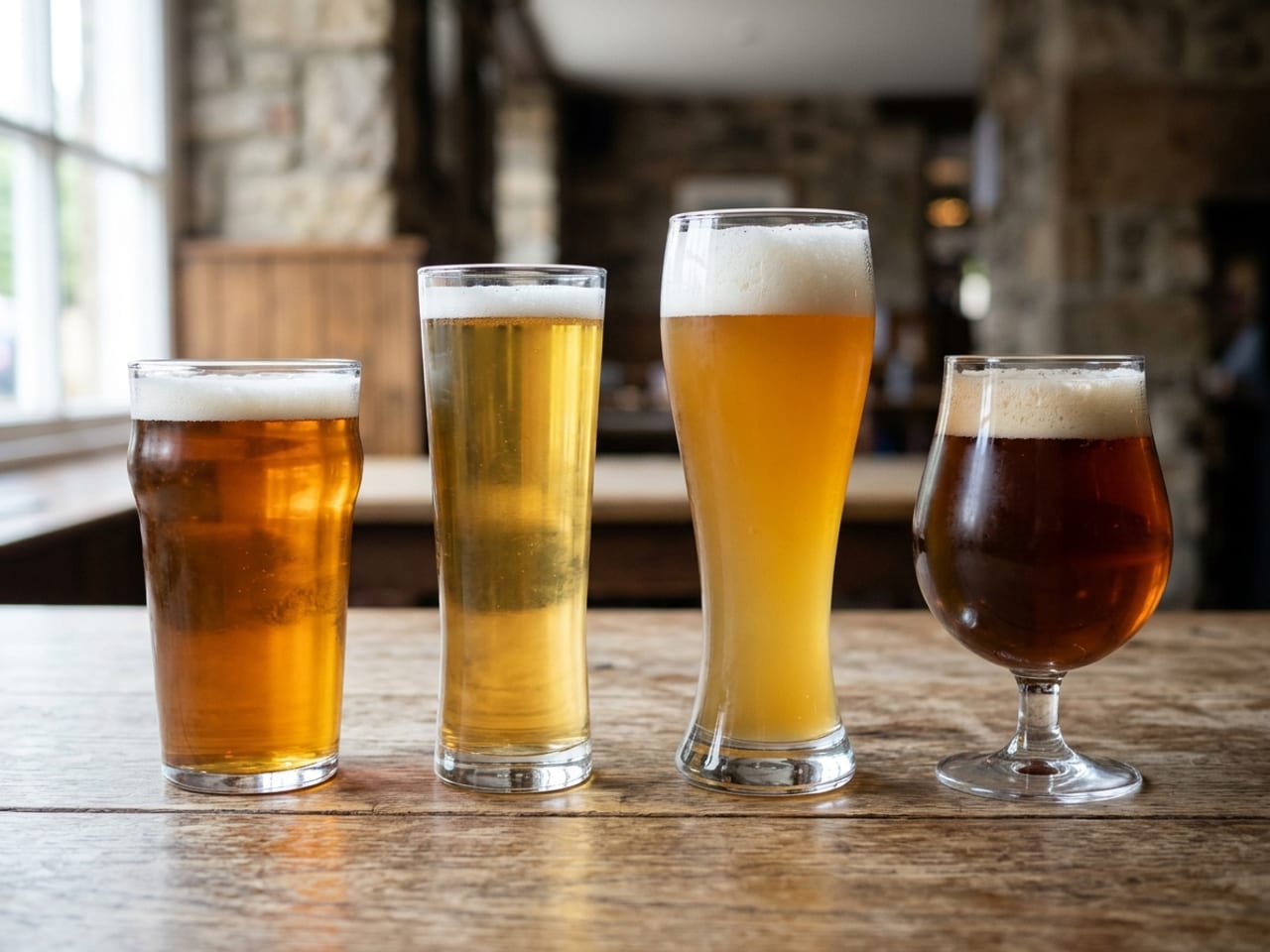
Pint glass
Names: UK: nonic pint, tulip pint, tankard; US: shaker pint; "Pub" (Libbey); "Pint Glass" (Glencairn).
What goes in it. Beer. Cicerone: the nonic pint is the "Every day pub glass suited to any British or Irish ale", and the shaker an "American cocktail shaker adopted for beer". Libbey sells its Pub glass as an "All-purpose beer glass perfect for stouts, ales, porters and more" (the maker's claim).5, 16
How to tell it from the pilsner glass. The pint is not one size. UK law: "Pint = 0.568 261 25 cubic decimetre" (568 ml, 19.2 US fl oz); Oxford: "0.473 of a litre in the US" (16 US fl oz). Libbey sells its "Pub" pattern at 16, 19 and 20 oz. Wondrich: the US pint glass is the bar's mixing glass, drafted for beer in the 1970s.4, 19, 45, 81
Where it sits. Bar, not laid: the table settings we read do not place it.
Capacity. Two makers: Glencairn 568 to 570 ml (19.2 to 19.3 US fl oz); Libbey 473 to 591 ml (16 to 20 US fl oz). As listed: Glencairn Iona Tankard, Large: 568 ml (19.2 US fl oz)7; Glencairn Skye Tankard ("Pint Glass"): 570 ml (19.3 US fl oz)7; Libbey Pub, 16 oz (the size of a US pint): 16 oz (473 ml)4; Libbey Craft Brews Nucleated Pint: 16.75 oz (495 ml)5; Libbey Pub: 19 oz (562 ml)4; Libbey Pub: 20 oz (591 ml)4.
Pilsner glass
Names: Footed pilsner (Cicerone); "Pilsglas" (Zwiesel); "Stockholm Pilsner" (Libbey).
What goes in it. Cicerone's footed pilsner: "Suitable for German and Czech/Bohemian Pilsners." Libbey lists its pilsner for "Kolsch, Lager, Bock, Hefeweizen, Witbier, or Pilsner" (the maker's list).5, 16
How to tell it from the weizen (wheat beer) glass. Tall and slim: Zwiesel's 0.3 l Pilsglas is 360 ml and 187 mm tall; Libbey calls its Stockholm a "classic, slender European design" where "The slim mouth showcases the foam head".3, 5
Where it sits. Bar, not laid: the table settings we read do not place it.
Capacity. 360 to 473 ml (12.2 to 16 US fl oz), 3 makers. As listed: Zwiesel Beer Basic 0.3 l Pilsglas: 360 ml (12.2 US fl oz)3; Libbey Stockholm Pilsner: 14.5 oz (429 ml)5; Libbey Craft Brews lager/pilsner: 16 oz (473 ml)5; Urban Bar Ginza Tall Cuts Pilsner: 46 cl (460 ml, 15.6 US fl oz)6.
Weizen (wheat beer) glass
Names: Weizen vase (Cicerone); "Wheat beer glass" (Zwiesel).
What goes in it. Wheat beer by its name (Zwiesel sells it as a "Wheat beer glass"); Cicerone names no style, only that the weizen vase "Accommodates half liter of beer plus sizeable head."3, 16
How to tell it from the pilsner glass. Taller and larger than a pilsner, sized for half a litre and its foam: Zwiesel's 0.5 l wheat beer glass prints 690 ml and 252 mm tall (our reading: 0.5 l is the pour and 690 ml the whole glass; the page does not say).3
Where it sits. Bar, not laid: the table settings we read do not place it.
Capacity. Two makers: Zwiesel 690 ml (23.3 US fl oz); Libbey 473 ml (16 US fl oz). As listed: Zwiesel Beer Basic 0.5 l wheat beer glass: 690 ml (23.3 US fl oz)3; Libbey Craft Brews wheat: 16 oz (473 ml)5.
Tulip beer glass
Names: Belgian tulip; "Belgian Ale" and "Classic Belgian" (Libbey).
What goes in it. Cicerone: "Good utility glass suited to many Belgian styles from saison to blond ales."16
How to tell it from the pint glass. The shape, not the size: Libbey describes "an elegant tulip shape formed by the wide bowl and narrow top", at 16 to 16.5 oz, the size of a US pint.5
Where it sits. Bar, not laid: the table settings we read do not place it.
Capacity. One maker we read: Libbey 473 to 488 ml (16 to 16.5 US fl oz). As listed: Libbey Craft Brews Classic Belgian: 16 oz (473 ml)5; Libbey Craft Brews Belgian Ale: 16.5 oz (488 ml)5.
Stange
Names: Stange (Cicerone's name).
What goes in it. Kölsch. Cicerone: "Used to serve Kölsch, often in 0.2 liter size."16
How to tell it from the pilsner glass. Cicerone's only printed figure is the size; we read no maker's spec for a Stange. In German bars 0.2 litre is one of the serving volumes the measuring rules allow.16, 22
Where it sits. Bar, not laid: the table settings we read do not place it.
Capacity. No maker's spec in what we read. Cicerone: "often in 0.2 liter size" (200 ml, 6.8 US fl oz).
Cicerone's beer glasses
What the Cicerone Certification Program's chart says each one suits, verbatim:16
| Glass | Group | Cicerone |
|---|---|---|
| Footed pilsner | German | "May have a longer stem. Suitable for German and Czech/Bohemian Pilsners." |
| Mass | German | "Liter-sized glass associated with beer gardens and Oktoberfest. Can be used for any lager less than 6% ABV." |
| Weizen vase | German | "Accommodates half liter of beer plus sizeable head. Curvier versions seen." |
| Stange | German | "Used to serve Kölsch, often in 0.2 liter size." |
| Willi Becher | German | "Classic shape suitable for all European lagers." |
| Shaker glass | American | "American cocktail shaker adopted for beer. Can be used for any American style of reasonable alcohol content." |
| Pub mug | British & Irish | "The dimpled mug has a slight retro feel. Used for any classic British or Irish ale." |
| Nonic pint | British & Irish | "Every day pub glass suited to any British or Irish ale." |
| Tulip pint | British & Irish | "Commonly associated with Irish Stout but may be used for any British or Irish ale." |
| Goblet | Belgian | "Heavier chalice shape used for some Trappist & Abbey ales and some Belgian pale ales." |
| Tulip | Belgian | "Good utility glass suited to many Belgian styles from saison to blond ales." |
| French jelly glass | Belgian | "Associated with Witbier but similar shapes used for lambics, Flanders Red, etc." |
| Snifter | Belgian | "Smaller glass for higher alcohol beers across all cultures: barleywines, eisbocks, imperial stouts, barrel-aged beers, etc." |
The chart is an image with no text layer, so we read it by eye. The Brewers Association's glass-by-style chart we could not read (it loads as images).
Sherry, port and dessert wine glasses
The small stemmed glasses for sherry, port and sweet wine. At a formal table a sherry glass for the first course goes furthest right and the dessert-wine glass is the highest in a diamond; the port glass has no fixed place in what we read.54, 56
Copita (sherry glass)
Names: Sherry copita; Glencairn titles its Copita "Sherry Glass, Premium whisky glass"; Urban Bar sells a "copita shape" whisky taster.
What goes in it. Sherry, and whisky for nosing: Wiktionary's copita is "A sherry glass with a tapering bowl" (a weaker, crowd-edited source); Glencairn calls its Copita "a whisky-nosing glass that has since become a popular laboratory tool in distilleries worldwide".42, 47
How to tell it from the glencairn glass. On a stem, taller and narrower than the Glencairn Glass: Glencairn's own Copita is 150 by 60 mm and 170 ml, its Glencairn Glass 115 by 66 mm and 200 ml. Urban Bar: "Stunning copita shape stemmed spirit glass".6, 7
Where it sits. A sherry glass for the first course goes furthest right of the glasses.54 (see the order of glasses)
Capacity. Two makers: Glencairn 170 ml (5.7 US fl oz); Urban Bar 120 ml (4.1 US fl oz). As listed: Glencairn Glencairn Copita, 150 x 60 mm: 170 ml (5.7 US fl oz)7; Urban Bar Spirit Crystal Whisky Taster: 12 cl (120 ml, 4.1 US fl oz)6.
Port glass
Names: "Port" (Riedel); "Sweet wine glass" (Zwiesel's article type for its port glass).
What goes in it. Port: Riedel names a glass for it, and Zwiesel's Alloro port glass lists vintage port, sherry (Jerez) and vermouth.1, 3
How to tell it from the dessert wine glass. Smaller than a table-wine glass from the same makers: Riedel's 265 ml against its whites from 370 ml; Zwiesel's 310 ml.1, 3
Where it sits. No fixed place in what we read.
Capacity. Two makers: Riedel 265 ml (9 US fl oz); Zwiesel 310 ml (10.5 US fl oz). As listed: Riedel Riedel Bar Port: 265 ml (9 US fl oz)1; Zwiesel Alloro port glass: 310 ml (10.5 US fl oz)3.
Dessert wine glass
Names: Sweet wine glass (Zwiesel); the glass for "pudding wine" (Debrett's).
What goes in it. Sweet wine with dessert: Debrett's adds a smaller third glass, for pudding wine or champagne, to the water tumbler and two wine glasses.60
How to tell it from the port glass. Small: Zwiesel's sweet wine glasses print 219 to 246 ml, against its whites from 300 ml.3
Where it sits. In a diamond of four or five glasses, the highest one.56 (see the order of glasses)
Capacity. One maker we read: Zwiesel 219 to 246 ml (7.4 to 8.3 US fl oz). As listed: Zwiesel Highness sweet wine glass: 219 ml (7.4 US fl oz)3; Zwiesel Marlene sweet wine glass: 221 ml (7.5 US fl oz)3; Zwiesel Glamorous sweet wine glass: 246 ml (8.3 US fl oz)3.
The look-alikes: which glass is which
Seven pairs and groups people mix up, each as a small table built from the same rows as the main table, then what the sources say. Capacity alone rarely separates them; the makers' heights and shapes do, and where makers use two names for one glass, we say so.
Flute vs coupe vs tulip: the three champagne glasses
| Glass | Capacity (as makers list it) | The tell |
|---|---|---|
| Champagne flute | 133 to 348 ml (4.5 to 11.8 US fl oz), 5 makers | Tall and narrow on a long stem. Capacity overlaps with the coupe; height and width do not: Riedel's Grape flute is 250 ml and 241 mm tall, its coupe 320 ml and 170 mm.1, 44 |
| Coupe | 133 to 320 ml (4.5 to 10.8 US fl oz), 6 makers | A wide, shallow bowl on a stem (Cambridge: a glass "used especially for some alcoholic drinks", with a wide, shallow bowl). Lower than a flute or a martini glass from the same maker: Riedel's Grape coupe is 170 mm tall, its martini 185 mm, its flute 241 mm.1, 44 |
| Tulip champagne glass | Two makers: Riedel 327 to 464 ml (11.1 to 15.7 US fl oz); Zwiesel 283 ml (9.6 US fl oz) | Wider and larger than a flute: Riedel's are 327 to 464 ml and 235 to 260 mm tall, against its flutes' 212 to 250 ml. Zwiesel calls flutes and tulips alike "Champagne glass".1, 3 |
Capacity will not tell them apart: flutes run 133 to 348 ml (4.5 to 11.8 US fl oz) and coupes 133 to 320 ml (4.5 to 10.8 US fl oz) in the makers we read. Height and width will: Riedel's Grape flute is 241 mm tall, its coupe 170 mm; the tulip is wider than the flute and larger, Riedel's 327 to 464 ml.1 Cambridge sums it up: the flute is a tall, narrow glass with a long stem, the coupe has a wide, shallow bowl.44 Which to pour into is in the New Year's Eve answer.
Red vs white wine glass, and Bordeaux vs Burgundy
| Glass | Capacity (as makers list it) | The tell |
|---|---|---|
| Red wine glass (Bordeaux) | 645 to 1012 ml (21.8 to 34.2 US fl oz), 4 makers | Tall, and in each maker's line larger than the white: Riedel Vinum 650 ml against its white glasses' 370 to 404. Against the Burgundy glass it is taller in every line we read that prints both heights, and smaller in 7 of the 10 maker lines we compared: Riedel's Vinum Cabernet is 225 mm tall, its Pinot Noir 210 mm and 725 ml.1, 2, 3 |
| Burgundy glass | 625 to 1022 ml (21.1 to 34.6 US fl oz), 3 makers | Shorter than the Bordeaux glass in all six lines that print both heights, and larger in 7 of the 10 maker lines we compared: Riedel Vinum Pinot Noir 725 ml and 210 mm tall against its Cabernet's 650 ml and 225 mm; Spiegelau Authentis Burgundy 750 ml against its Bordeaux 650. Not in the other three: Riedel Veloce (763 against 829 ml), a Spiegelau short-bodied set (625 against 630) and Zwiesel The Moment (819 against 862).1, 2, 3 |
| White wine glass | 300 to 600 ml (10.1 to 20.3 US fl oz), 6 makers | A smaller bowl than the same maker's red: Riedel Vinum 370 to 404 ml against 650 to 725; Glencairn's Jura 340 against 480; Zwiesel Pure 300 to 408 against 540 to 692. Across makers the sizes overlap, and Libbey's stemless "White Wine" (17 oz) is larger than its "Red Wine" (16.75 oz).1, 3, 4, 7 |
Inside one maker's line the red glass is bigger: Riedel Vinum's reds 650 to 725 ml, its whites 370 to 404; Glencairn's Jura 480 against 340.1, 7 Across makers the ranges overlap (white glasses 300 to 600 ml (10.1 to 20.3 US fl oz), Bordeaux 645 to 1012 ml (21.8 to 34.2 US fl oz)), and Libbey's stemless "White Wine" is larger than its "Red Wine".4 At the table, Debrett's puts it simply: two wine glasses, "the larger one for red wine".60
Bordeaux vs Burgundy: the Burgundy glass is shorter in all six lines that print both heights, and larger in 7 of the 10 maker lines we compared (Riedel Vinum 210 mm and 725 ml against 225 mm and 650 ml); not in Riedel Veloce, a Spiegelau short-bodied set (625 ml against 630) or Zwiesel The Moment.1, 2, 3 Whether the matching glass makes the wine taste better is in the studies: blindfolded tasters rated a Cabernet less intense in its own Bordeaux glass.29
Highball vs Collins (and zombie)
| Glass | Capacity (as makers list it) | The tell |
|---|---|---|
| Highball glass | 200 to 480 ml (6.8 to 16.2 US fl oz), 7 makers | Tall, narrow and stemless. Makers use highball and Collins for the same 300 to 370 ml glasses (in Difford's database the Urban Bar Koto highball is titled a "Highball Collins"; Urban Bar's own page says highball); only Difford's splits them by size, a "small (10oz max) highball" against "larger 12oz Collins glasses".6, 11, 13 |
| Collins glass | One maker we read: Cocktail Kingdom 300 to 360 ml (10.1 to 12.2 US fl oz) | A highball by another name in the makers' lists: Cocktail Kingdom sells Collins glasses at 10 oz and 12 oz, and Zwiesel lists "Collins" among the drinks for its highball and longdrink glasses. Difford's alone draws a size line (Collins 12 oz, highball 10 oz at most).3, 9, 13 |
| Zombie glass | One maker we read: Cocktail Kingdom 450 ml (15.2 US fl oz) | Larger than a typical highball: Cocktail Kingdom's is 16 oz (450 ml), above the 300 to 370 ml most highballs list.9 |
Makers use the two names for the same tall, narrow glasses (highballs 200 to 480 ml (6.8 to 16.2 US fl oz), Collins glasses 300 to 360 ml (10.1 to 12.2 US fl oz)), and Difford's database titles one Urban Bar highball a "Highball Collins" (Urban Bar's own page says highball).6, 9, 11 Difford's Guide is the one reference we read that splits them: "(Collins' are served in larger 12oz Collins glasses.)", against a "small (10oz max) highball".13 The history runs the same way: Wondrich dates the Collins glass to the 1870s and the highball drink to the 1890s, served first in the fizz glass, and the glass named after the drink.81, 83 The zombie glass is the tall outlier, 450 ml at Cocktail Kingdom.9
Rocks vs old fashioned vs double vs lowball vs tumbler
| Glass | Capacity (as makers list it) | The tell |
|---|---|---|
| Rocks glass (old fashioned) | 148 to 444 ml (5 to 15 US fl oz), 7 makers | Short, wide and stemless. One shape, several names: Riedel prints "Rocks Glass" in one line and "Single Old Fashioned" in another, Nude says "Lowball", Glencairn titles the same tumbler "Rock Tumbler" and "Whisky Tumbler", and Libbey files rocks and double old fashioned as one type.1, 4, 7, 8 |
| Double old fashioned (double rocks) | 295 to 450 ml (10 to 15.2 US fl oz), 3 makers | "Double" is a name, not a size: Cocktail Kingdom sells a 10 oz (295 ml) Double Rocks and a 12 oz (355 ml) plain Rocks; Riedel's Double Rocks is 370 ml against its Rocks at 283.1, 9 |
| Water tumbler | 240 to 473 ml (8.1 to 16 US fl oz), 5 makers | No stem and no handle: Oxford's tumbler is "a glass for drinking out of, with a flat bottom and no handle or stem". "Tumbler" is also a family name: the IBA asks for a "thin tall Tumbler glass" (Gin Fizz) and a "small tumbler glass" (Ve.N.To).12, 45 |
One shape, several names. Rocks, old fashioned and lowball are the same short, wide glass in the makers' own titles (Riedel, Nude, Glencairn, Urban Bar), and Libbey files rocks and double old fashioned as one type.1, 4, 6, 7, 8 "Double" is a name, not a size: Cocktail Kingdom's Double Rocks (10 oz) is smaller than its plain Rocks (12 oz).9 Tumbler is the family word: any glass "with a flat bottom and no handle or stem" (Oxford), from a juice glass to a highball.45 Wondrich traces the old fashioned glass to the 19th-century "small bar glass" and the double, the "bucket", to the 1940s.81
Martini vs coupe vs Nick & Nora
| Glass | Capacity (as makers list it) | The tell |
|---|---|---|
| Martini glass | 148 to 355 ml (5 to 12 US fl oz), 4 makers | A cone on a stem: Urban Bar calls its martini "classic V-shaped". Capacity does not separate it from a coupe (Urban Bar sells both at 21 cl); the shape does, and Riedel's martini stands taller than its coupe (185 against 170 mm).1, 6 |
| Coupe | 133 to 320 ml (4.5 to 10.8 US fl oz), 6 makers | A wide, shallow bowl on a stem (Cambridge: a glass "used especially for some alcoholic drinks", with a wide, shallow bowl). Lower than a flute or a martini glass from the same maker: Riedel's Grape coupe is 170 mm tall, its martini 185 mm, its flute 241 mm.1, 44 |
| Nick & Nora glass | 140 to 198 ml (4.7 to 6.7 US fl oz), 3 makers | The smallest of the stemmed cocktail glasses in the makers we read, with taller walls: Urban Bar, "Tall walls offer spill-proof alternative to the classic martini glass".6 |
Shape, not capacity: Urban Bar sells its V-shaped martini and its coupe both at 21 cl, and Zwiesel files both as "Cocktail glass" with the same drinks.3, 6 The martini is a cone; the coupe a wide, shallow bowl; the Nick & Nora the smallest, 140 to 198 ml (4.7 to 6.7 US fl oz), with tall walls, "a narrower alternative to a wide martini glass".6 The IBA's "cocktail glass" fits any of the three: only four of its recipes say "martini cocktail glass", and one says "coupe glass".12
Snifter vs Glencairn vs copita
| Glass | Capacity (as makers list it) | The tell |
|---|---|---|
| Snifter (brandy glass) | Two makers: Glencairn 270 to 610 ml (9.1 to 20.6 US fl oz); Libbey 274 to 517 ml (9.3 to 17.5 US fl oz) | Cambridge: "a bowl-shaped glass that is narrower at the top and has a short stem". Wider than the Glencairn Glass: Glencairn's Skye snifter is 120 by 85 mm against the Glencairn's 115 by 66 mm.7, 44 |
| Glencairn glass | One maker we read: Glencairn 200 ml (6.8 US fl oz) | Short and small; the maker's claim: "The tapering mouth of the glass captures and focuses the aroma on the nose." By the maker's figures it is 115 mm tall and 66 mm wide, against its copita at 150 by 60 mm and its Skye snifter at 120 by 85 mm.7, 41 |
| Copita (sherry glass) | Two makers: Glencairn 170 ml (5.7 US fl oz); Urban Bar 120 ml (4.1 US fl oz) | On a stem, taller and narrower than the Glencairn Glass: Glencairn's own Copita is 150 by 60 mm and 170 ml, its Glencairn Glass 115 by 66 mm and 200 ml. Urban Bar: "Stunning copita shape stemmed spirit glass".6, 7 |
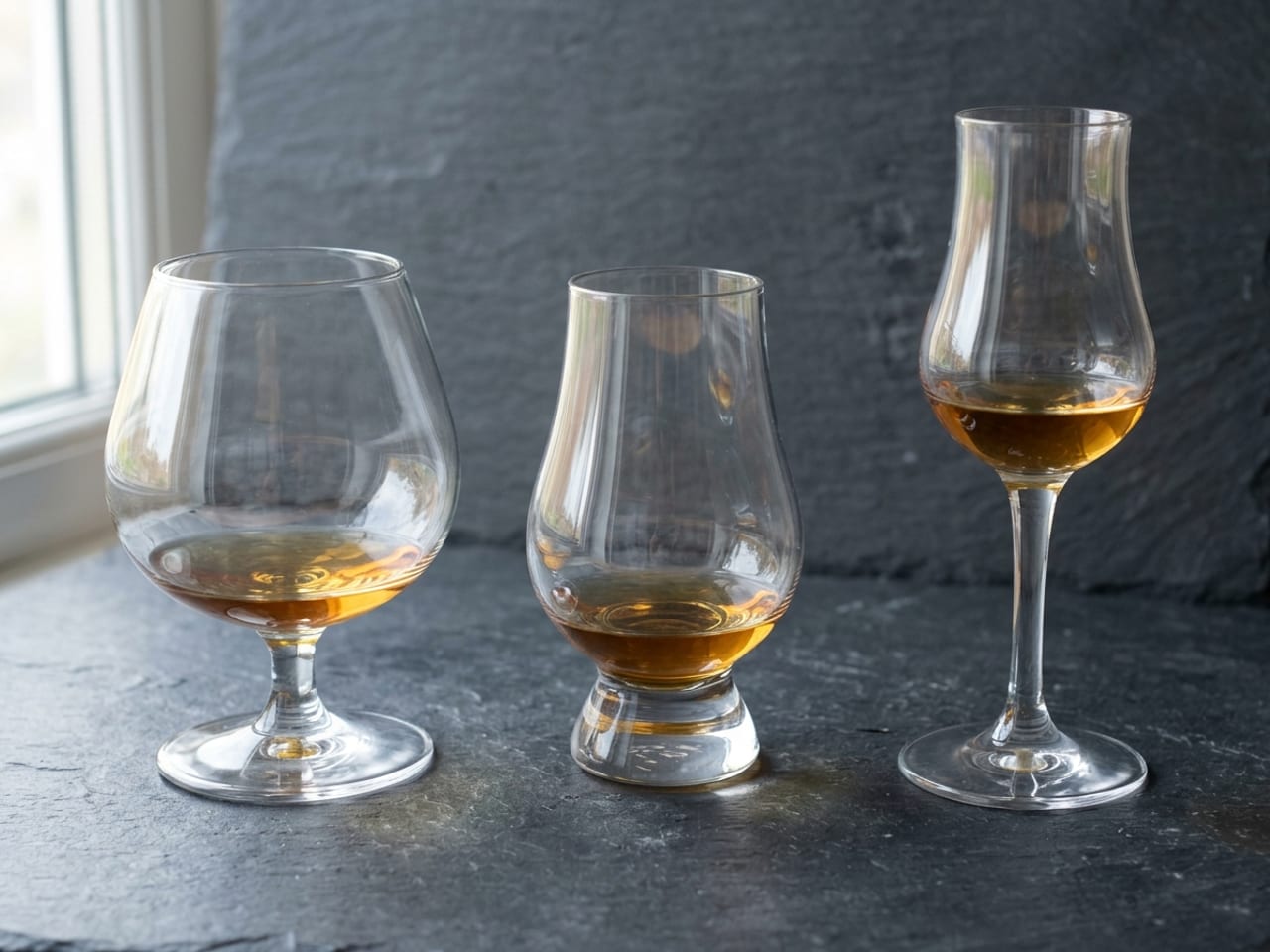
One maker, Glencairn, prints all three, so the figures compare like for like: the snifter (Skye) is 120 mm tall and 85 mm wide, 270 ml; the Glencairn Glass 115 by 66 mm, 200 ml; the copita 150 by 60 mm, 170 ml, on a stem.7 Glencairn says it designed its glass after the copita, "a traditional sherry nosing glass".42 For Cognac the interprofession prefers a tulip to either.15
Water goblet vs wine glass
| Glass | Capacity (as makers list it) | The tell |
|---|---|---|
| Water goblet | 303 to 488 ml (10.3 to 16.5 US fl oz), 3 makers | A bowl on a stem, like a wine glass: Oxford's goblet is "a cup for wine, usually made of glass or metal, with a stem and base but no handle". Neither Oxford nor Cambridge says water goblet, and Spiegelau sells one item as "Red Wine/Water Goblet", so the line between the two is a maker's naming, not a shape rule.2, 44, 45 |
| Red wine glass (Bordeaux) | 645 to 1012 ml (21.8 to 34.2 US fl oz), 4 makers | Tall, and in each maker's line larger than the white: Riedel Vinum 650 ml against its white glasses' 370 to 404. Against the Burgundy glass it is taller in every line we read that prints both heights, and smaller in 7 of the 10 maker lines we compared: Riedel's Vinum Cabernet is 225 mm tall, its Pinot Noir 210 mm and 725 ml.1, 2, 3 |
| Water tumbler | 240 to 473 ml (8.1 to 16 US fl oz), 5 makers | No stem and no handle: Oxford's tumbler is "a glass for drinking out of, with a flat bottom and no handle or stem". "Tumbler" is also a family name: the IBA asks for a "thin tall Tumbler glass" (Gin Fizz) and a "small tumbler glass" (Ve.N.To).12, 45 |
A water goblet is a stemmed glass in the wine glass's shape; the difference is the name and the place. Spiegelau sells one item as "Red Wine/Water Goblet", and Zwiesel's stemmed water glasses (345 to 400 ml) sit below its red wine glasses.2, 3 On the table the water glass stands above the knife tip and the wine glasses to its right, so position, not shape, says which is which.54, 56 A tumbler does the same job: Debrett's lays "A tumbler for water".60
Does the shape of the glass matter?
Six common claims, each with the studies that tested it and what they do not show. Where we found no study, we say so. The table setting guide covers the research on a set table, glass size and wine sales included.
| The claim | What the studies found | What they do not show |
|---|---|---|
| A flute keeps the bubbles longer than a coupe | Supported for the gas. With one Champagne, dissolved CO2 fell faster in a coupe than in a flute over the first 10 minutes (Liger-Belair 2009, "the first analytical proof that the flute prolongs the drink's chill and helps it to retain its effervescence"), and in 2012 the gas above a flute was two to three times higher near the rim than above a coupe.23, 24 | Whether anyone tastes the difference: neither paper ran a tasting. The 2012 authors' remark that a flute's first nose is more irritating is "generally accepted", in their words, not tested there. Nothing on tulip or wine glasses. |
| The right bowl concentrates a wine's aroma | Mixed. Hummel (2003, 181 volunteers) found odour ratings "influenced by glass shape"; a sniffer camera showed a ring of ethanol near the rim of a wine glass (Arakawa 2015); Hirson (2012, one white wine, a Gewürztraminer, in five glasses) found effects of shape and time but "no correlations between shape parameters" and aroma intensity. Blindfolded, Cliff (2001, a prior reading) rated aroma highest in a Burgundy glass and lowest in a Chardonnay glass, yet concluded the plain ISO glass is fine for a wide range of wines; Delwiche and Pelchat (2002) rated a Cabernet LESS intense in the Bordeaux glass made for it; Bai (2023, a 12-member panel) found a Cabernet more intense and more elegant in the glass with the smaller cup height and the bigger ratio of widest to opening diameter.26, 27, 28, 29, 30, 31, 32 | That a varietal glass beats a plain one for its own grape: no study we read shows it. Spence's review (2020) reads the evidence as "more psychological than physico-chemical": with tasters who cannot see the glass, it "seems to make little difference". |
| The glass aims the wine at parts of the tongue | Refuted for the tongue map: "distinct cell types expressing unique receptors are tuned to detect each of the five basic tastes" (Chandrashekar 2006), and the tongue map "has long been discredited" (Spence 2022), traced to a 1942 textbook's redrawing of 1901 data. Spence's 2020 review also "argues against the suggestion that the specific shape of the glass changes the flow properties of the liquid across the tongue (or rather, if it does, it argues against this having a noticeable difference to the tasting experience)".32, 33, 34 | Small differences in sensitivity across the mouth are real (Spence 2022). Riedel's own claims are below, dated and credited. |
| A stemless glass warms the wine | We found no study that tested it (searches of Europe PMC and Crossref, 6 November 2026). The claim is a maker's: Riedel says "the height of the stem ensures the wine is undisturbed by body heat".37 | Anything either way. |
| A nosing glass (Glencairn, copita) shows a whisky better than a tumbler | We found no study that tested it. The claim is the maker's: "The tapering mouth of the glass captures and focuses the aroma on the nose."41 | Anything either way. |
| The shape of the glass changes how fast you drink | In a lab, 159 social drinkers were 60% slower to finish lager from a straight glass than from a curved one, only when the glass was full and not for a soft drink (Attwood 2012). A 2022 review finds "a paucity of evidence", especially on how much people drink.35, 36 | An effect in a bar or at home. |
What the glassmaker claims, then and now
Riedel's case for varietal glasses has been told two ways. Today's About page speaks of aroma: bowl shape, size and rim "are carefully calibrated to suit specific grape varietals, because each wine type has its own aromatic fingerprint", and cites no study.37 In a 2023 article Maximilian Riedel still described the glass steering the wine: "for a wine with high acidity, flowing it onto the tip of the tongue emphasises the fruit and balances the acidity."39 In 2025 a London sommelier, Harry Cooper of Counter 71, repeated the tongue idea against flutes, "missing out on the sweet, salty and sour receptors located from the tip and around the edges".40 The tongue map those lines lean on "has long been discredited", and Spence's review finds the evidence argues against the glass changing how wine flows across the tongue, or at least against that making a noticeable difference.32, 33 Glencairn's nosing claim is the maker's too: we found no study of it.41
Our reading: buy glasses for the size, the feel and the look you like. The only shape effect with a clear measurement behind it is the flute holding champagne's gas longer, and even that has not been tasted.
Glass names by region and trade, and in four languages
Glassware is "drinking glasses or other objects made of glass" (Cambridge); Oxford's entry, just "objects made of glass", is why the word also brings up lab glassware.44, 45 The names that change by place or trade:
- Tumbler: Cambridge: "a drinking container that does not have a handle or a stem". The Collins entry on Dictionary.com adds that "Originally, a tumbler had a round or pointed base and so could not stand upright".44, 46
- Rocks, old fashioned, lowball: One glass. Wiktionary (a weaker, crowd-edited source) lists lowball glass, old fashioned glass and whiskey glass as synonyms of rocks glass and derives the name from "on the rocks"; Cambridge has no glass sense for lowball. The makers' titles agree (see the look-alikes).44, 47
- Goblet: Oxford: "a cup for wine, usually made of glass or metal, with a stem and base but no handle". "Water goblet" is the etiquette sources' phrase, not a dictionary's. False friend: French gobelet is a cup "généralement sans pied", without a stem (Larousse).45, 49, 56
- Snifter: A brandy glass in North American English; in British English "a small drink of something alcoholic" (Cambridge) or, old-fashioned and informal, "a small amount of a strong alcoholic drink" (Oxford).44, 45
- Pint: 568 ml in UK law ("Pint = 0.568 261 25 cubic decimetre"); Oxford gives "0.473 of a litre in the US". Beer or cider sold by retail in UK bars, unless pre-packed, is sold only in 1/3, 1/2 or 2/3 pint or multiples of half a pint.19, 20, 45
- Schooner, middy, pot (Australia): The same word changes size by state. Macquarie Dictionary: a schooner is about 425 ml in NSW, the ACT, the NT and Queensland but about 285 ml in South Australia; in Victoria you ask for a pot; and a pint is about 568 ml in NSW and the ACT but about 473 ml in WA, Tasmania and SA (for SA, Macquarie itself gives 450 ml in one sentence). A middy is asked for by that name in the NT, NSW, the ACT, WA and parts of Queensland, and in the NT it means the same 285 ml glass as a South Australian schooner. In Britain a schooner can be a sherry glass (Collins, on Dictionary.com).46, 48
- Copita: Spanish for a little glass ("diminutive of copa", Wiktionary); in English a sherry glass, and Glencairn's name for its whisky-nosing glass.42, 47
- Nonic: A British pub glass with a bulge below the rim; Wiktionary derives the name from a "trade name for no-nick" (a weaker source).47
- Nick & Nora: Named by the bartender Dale DeGroff in 1987 (see the history).79
- Stemware: Cambridge: "glasses and glass bowls that have a stem".44
Glass names in French, Spanish, German and Italian
Only words that Larousse, the Real Academia Española, Duden or Treccani print; a blank means we did not find it in those four, not that the word does not exist.49, 50, 51, 52
| English | French | Spanish | German | Italian |
|---|---|---|---|---|
| Wine glass RAE: copa = "Vaso con pie para beber"; its example "Se tomó una copa de vino" is a glass of wine, not the glass. | verre à vin | copa | Weinglas | bicchiere da vino |
| Water glass, tumbler Larousse translates verre à eau as tumbler; the RAE's vaso is a drinking vessel "por lo común de forma cilíndrica". | verre à eau | vaso | Wasserglas | bicchiere da acqua |
| Stemmed glass The RAE's copa is a "Vaso con pie para beber", so a wine glass, flute and cocktail glass are all copas ("Sirva el daiquiri en copa de cóctel"). | verre à pied | copa | bicchiere a stelo | |
| Round (balloon) wine glass | verre ballon | |||
| Champagne flute Duden: "enger Sektkelch"; Treccani: a tall, narrow glass "usato soprattutto per champagne e spumante". | Sektflöte | flûte | ||
| Sparkling wine glass Duden's Sektglas is "kelch- oder schalenförmig": flute or coupe. | Sektglas | |||
| Beer glass | Bierglas |
What glasses you actually need, and how many
A home kit (ours)
Our advice, not a rule from any source. The reasoning: a few shapes cover most drinks, and the studies give no specialist glass a proven edge.
- Water tumbler (240 to 473 ml (8.1 to 16 US fl oz)): Water, soft drinks, juice, and a highball or spritz at a pinch.
- All-purpose wine glass (473 to 685 ml (16 to 23.2 US fl oz)): Red, white and, at a pinch, sparkling: makers sell it for all three, and the studies give no glass a proven edge for its own grape.
- Rocks glass (old fashioned) (148 to 444 ml (5 to 15 US fl oz)): Spirits on ice and most short cocktails: the IBA's old fashioned and rocks glasses. Together they are the first-named glass in 16 of the IBA's 102 recipes.12
- Highball glass (200 to 480 ml (6.8 to 16.2 US fl oz)): Long drinks with a mixer, the Collins drinks included. The IBA names it in 11 recipes.12
- Champagne flute (133 to 348 ml (4.5 to 11.8 US fl oz)): Only if you pour sparkling wine often; a white wine or all-purpose glass does the job otherwise (see the New Year's Eve answer).
At a dinner table Debrett's asks for even less: "A tumbler for water and two wine glasses, with the larger one for red wine, is usually enough".60
What makers put in a box
We found no "starter bar" set at the makers we read. Their mixed boxes hold two or three shapes (in the sets we read), and a beer sampler six:
- Libbey 16-piece (Cabos and others): 8 tumblers (15.8 oz) and 8 rocks glasses (10.8 oz): two shapes5
- Libbey Boston 18-piece: 6 cooler (16 oz), 6 rocks (12.5 oz), 6 juice (9.8 oz): three shapes5
- Libbey Bar Essentials: one shape a box of 6: double old fashioned, highball or tumbler5
- Schott Zwiesel 18-piece Tulip: six white wine, six red wine and six champagne glasses: three shapes3
- Schott Zwiesel 17-piece Show bar set: 4 whisky, 4 schnapps and 4 long drink glasses (with straws and a brush): three shapes3
- Libbey Craft Brews: six beer glasses: sour, wheat, lager/pilsner, stout, high-ABV and IPA5
How many glasses for a party
No etiquette authority we read gives a number of glasses a guest. Hire firms do, and they split; each figure below is a firm's practice, not a rule:
- Party Rental Ltd (hire firm): 1.5 glasses a person in the first hour, then 1 an hour: 350 glasses for 100 guests over 3 hours.63
- Caterhire (Ireland): Two drinks a person in the first hour, one an hour after, plus 10% for breakages.64
- Glass Hire Melbourne: 1 glass a guest for one drink type, 2 to 3 for several, 4 to 5 for an all-inclusive sit-down meal, plus 10 to 20% more.65
- Event Supplies (UK retailer): About three glasses a guest over a whole wedding.62
- Plato Catering Hire (UK): For 100 day and 150 evening guests: 300 to 350 wine glasses, 100 to 150 beer or pint glasses, 100 to 150 short glasses, 150 to 200 highballs.61
- Select Hire (Ireland), flutes only: One a guest for a toast, 1.5 as a welcome drink, up to 3 over the event.66
- Ina Garten (via Tasting Table): About two glasses a person with one signature cocktail.67
Our reasoning: guests set a glass down and take a fresh one, so count drinks per hour rather than heads, and hire or borrow rather than buy for one big party.
Types of glasses in food and beverage service
For a restaurant, one supplier, Browne (a distributor of Pasabahce and Nude), lists 22 glass types and an ordering factor for each: "multiply the number of seats by the ordering factor listed". Its figures for the glasses in our table, glasses per seat:10
| Browne's type | Restaurant service | Bar service |
|---|---|---|
| Water/Goblet | 2 | 1.5 |
| Wine, Small | 1.5 | 1.5 |
| Wine, Large | 1.5 | 1 |
| Flute | 1 | 0.5 |
| Coupe | 1 | 0.5 |
| Martini | 1.5 | 1 |
| Rocks | 3 | 2 |
| Double Old Fashion | 1 | 1 |
| Hi-Ball | 2 | 1 |
| Beer, Large | 3 | 3 |
| Brandy/Cognac | 1 | 0.5 |
| Sherry | 1 | 0.5 |
| Cordial | 1 | 0.5 |
| Shooter | 0.5 | 1.5 |
Crystal, glass, the dishwasher and clean glass
- EU law on the word crystal: "Lead crystal" must hold at least 24% lead oxide and "full lead crystal" at least 30%; "crystal glass" needs at least 10% of zinc, barium, lead or potassium oxides, so it can be lead-free.68
- Health Canada: For lead crystal, "limit its use to serving food or drinks, never storing".70
- Riedel (maker): "Most RIEDEL glasses are dishwasher-safe", tested to EN 12875; glasses labelled hand wash only, and most decanters, by hand.69
- Cicerone: "Glasses that aren't beer clean result in beer that looks flat, lifeless, and unappetizing."17
Follow your own glasses' care card when they come with one (ours).
Where glasses go on the table, and how to hold one
Placement has its own guide and the diagram maker draws any setting; this is the recap in the same words.
- Water: above the tip of the dinner knife, about an inch (2.5 cm), or a little to its right at 45 degrees; it stays all meal.53, 56, 57, 58
- Wine: to the right of the water glass in the order the wines will be poured, up to five at a formal dinner; past three, the smaller glasses stand in front. Line, triangle or diamond is a choice of shape.54, 55
- Flute or sherry: a flute for an opening toast or a sherry for the first course goes furthest right.54, 59
- Dessert wine: the highest glass in a diamond.56
- Leaving: "Glasses used for a particular course are removed at the end of the course."54
The full layouts and why the guides disagree are in how to set a table, and the table setting diagram maker draws the place for the courses you choose. Holding a glass by the stem or the bowl, and how full to pour, is in fine dining etiquette.
A short history of drinking glasses
| When | What |
|---|---|
| Late 1600s | "Tall flute glasses became popular in the late 17th century." (V&A)72 |
| Mid-1700s | The flute is the champagne glass: "A typical flute glass of the mid-18th century, of a type made both for strong ale and for champagne." (V&A)72 |
| About 1830 | The coupe arrives: "glasses with cup-shaped bowls were probably introduced around 1830 and were standard by the 1860s", while flutes "were still made" (V&A). The earliest museum dating we found.71 |
| 1870s | The Collins and fizz glasses: "Both were introduced in the 1870s, both were cylindrical, and both were narrow" (Wondrich). The Collins glass takes its name from the drink.81, 83 |
| 1880s | The old fashioned glass is the old "small bar glass", used "mainly for the Old-Fashioned" and related drinks (Wondrich).81 |
| 1890s | The highball drink arrives and goes "first into the fizz glass"; a middle-sized glass then bridged the fizz and the Collins (Wondrich). Where the word highball comes from "has been much debated".81, 82 |
| Late 1800s to late 1930s | The flute takes back champagne from the coupe, but the dates spread: the late 19th century (Manners To Go), the 1920s (Glass of Bubbly), the late 1930s (Apollo). The V&A shows the two shapes in use side by side for a long overlap.71, 75, 77, 78 |
| 1940s | The double old fashioned, the "bucket": by the end of the 1940s eight- or nine-ounce glasses were common, "followed rapidly by the 12- to 16-ounce" double (Wondrich).81 |
| 1958 | Riedel's first wine-specific shape, a Burgundy glass, wins the grand prize at the Brussels World's Fair (V&A); Riedel says Claus J. Riedel created the Sommeliers design in 1958.38, 73 |
| 1971 or 1973 | The Sommeliers range: "A further twenty-one glass shapes were launched in 1971" (V&A); "Line introduced in 1973" (Riedel). Both dates as printed.38, 73 |
| 1970s | US bars draft the pint mixing glass as the beer glass with the craft beer movement (Wondrich).81 |
| 1987 | Dale DeGroff puts a 1930s "Little Martini" into use at the Rainbow Room and calls it the Nick & Nora glass; Steelite later catalogues it under that name (VinePair, with Food Republic agreeing).79, 80 |
| 2000 or 2001 | The Glencairn Glass: "Since its launch in 2001" on one Glencairn page, "created since 2000" on another; Whisky Magazine relays an official launch at Whisky Live London in 2001.42, 43 |
Was the coupe modelled on Marie Antoinette?
No source we read shows that Marie Antoinette, Helen of Troy, Madame de Pompadour, Madame du Barry or Empress Josephine had a glass moulded on her breast; Snopes: "None of the "famed beauty's breast" tales hold up." (Snopes argues from a 1663 date for the glass that we could not check.)74 If the V&A's "probably introduced around 1830" is right, the coupe is also later than Marie Antoinette's death in 1793.71, 74 Breast-shaped drinking vessels did exist, but they are not coupes: the porcelain milk bowls (jatte-tétons) of a 1787 service for Rambouillet, now in the Sèvres ceramics museum, and Greek mastos cups, which Apollo dates from the 4th century BC.75, 76 Popular accounts that date the coupe much earlier give no source we could check, so we leave their dates out; Apollo points to coupes in a 1735 painting, Jean-François de Troy's The Oyster Dinner, which we did not check.
The Nick & Nora's film link is a name story too: the glass was named in 1987, and "the glasses used in "The Thin Man" don't actually look like the Nick & Nora glass".79
Types of glasses for drinks, answered
What are the different types of drinking glasses?
Seven groups: water and everyday glasses, wine glasses, champagne glasses, cocktail glasses, spirits glasses, beer glasses, and glasses for sherry, port and dessert wine. This page's table lists 35: three water and everyday glasses, six wine glasses, three champagne glasses, eleven cocktail glasses, four spirits glasses, five beer glasses and three sherry, port and dessert wine glasses. A home needs far fewer: a tumbler, an all-purpose wine glass, a rocks glass and a highball cover most drinks (our advice), plus flutes if you pour sparkling wine often.
What are the types of wine glasses and their uses?
Red wine glass (Bordeaux): a tall red wine glass sold for Cabernet Sauvignon and Merlot, usually taller and smaller than the same maker's Burgundy glass. Burgundy glass: a red wine glass sold for Pinot Noir, usually shorter and larger than the same maker's Bordeaux glass. White wine glass: a wine glass with a smaller bowl than the same maker's red wine glass, for white wine. All-purpose wine glass: a middle-sized wine glass sold for red, white and sparkling wine alike. Stemless wine glass: a wine-glass bowl on a flat base with no stem. ISO tasting glass: the standard wine-tasting glass of ISO 3591: one egg-shaped cup on a stem for all wines. The pairings of glass to grape are the makers'; the studies we read do not show a varietal glass beating a plain one for its own grape.
What are the types of champagne glasses?
Three: the flute (tall and narrow, 133 to 348 ml (4.5 to 11.8 US fl oz) in the makers we read), the coupe (wide and shallow, 133 to 320 ml (4.5 to 10.8 US fl oz)) and a wider glass Riedel calls a "Champagne Wine Glass" (we group it as the tulip). Riedel wants the flute gone, and one London sommelier we read serves no flutes; Pierre-Emmanuel Taittinger says Champagne "must always be drunk in a flute".
Flute or coupe for New Year's Eve?
For a toast, the flute: in lab tests a flute lost dissolved CO2 more slowly than a coupe over the first 10 minutes, though nobody has tested whether drinkers taste it. The coupe, in use for champagne from about 1830 per the V&A (the flute is older), is the party look and doubles as a cocktail glass. A white wine or tulip glass is Riedel's and some sommeliers' choice for tasting; no study we read backs that either way.
What are the types of cocktail glasses?
Martini glass, Nick & Nora glass, Highball glass, Collins glass, Rocks glass (old fashioned), Double old fashioned (double rocks), Margarita glass, Hurricane glass, Sour glass, Zombie glass, Gin and tonic (balloon) glass, plus the coupe. The IBA's 102 official recipes name a "cocktail glass" more often than any other glass (39, plus 4 "martini cocktail glass"), then a highball (11), an old fashioned glass (9) or a rocks glass (7); its "cocktail glass" names no shape, so a coupe or a martini glass both fit it.
What is the difference between a highball and a Collins glass?
In the makers' catalogues, mostly the name: both are tall, narrow and stemless, highballs 200 to 480 ml (6.8 to 16.2 US fl oz) and Collins glasses 300 to 360 ml (10.1 to 12.2 US fl oz), and Difford's database titles one Urban Bar highball a "Highball Collins" (Urban Bar's own page says highball). Only Difford's Guide draws a line, a highball of "10oz max" against a 12 oz Collins. The IBA puts its John Collins in a "highball".
Is a rocks glass the same as an old fashioned glass?
Yes: one short, wide, stemless glass with several names. Riedel prints "Rocks Glass" in one line and "Single Old Fashioned" in another, Nude says lowball, and Libbey files rocks and double old fashioned as one type. The double is a name more than a size: Cocktail Kingdom's 10 oz Double Rocks is smaller than its 12 oz Rocks.
What are the types of beer glasses?
Our table has the pint glass, pilsner glass, weizen (wheat beer) glass, tulip beer glass and stange. Cicerone's beer glassware chart names, among others, the footed pilsner, Mass, weizen vase, Stange and Willi Becher (German); the shaker (American); pub mug, nonic pint and tulip pint (British and Irish); goblet, tulip, French jelly glass and snifter (Belgian). It has no teku. A UK pint is 568 ml by law, a US pint 473 ml.
What are the types of whiskey glasses?
The rocks glass (whisky tumbler) for whisky on ice or in a short drink, the Glencairn Glass (200 ml, Glencairn's own nosing glass), the copita (a stemmed sherry glass that distilleries use for nosing), the snifter (more for brandy) and the shot glass. We found no study showing that a nosing glass shows a whisky better than a tumbler; that is the makers' claim.
What glass for gin and tonic or an Aperol Spritz?
Gin and tonic is not an IBA cocktail; makers sell a big gin balloon glass for it (Urban Bar's "Gin Balloon Glass"), 550 to 650 ml (18.6 to 22 US fl oz), and Zwiesel lists Aperol among the drinks for its Echo glass. The IBA puts its Spritz in "a wine glass filled with ice". A highball works too (ours).
How big is a wine glass in ml and oz?
As makers list them: red wine (Bordeaux) glasses 645 to 1012 ml (21.8 to 34.2 US fl oz), Burgundy glasses 625 to 1022 ml (21.1 to 34.6 US fl oz), white wine glasses 300 to 600 ml (10.1 to 20.3 US fl oz). The glass is not the pour: Riedel advises 100 to 125 ml a serving, UK law lets bars sell wine by the glass only in 125 ml, 175 ml or multiples (with exceptions), and a US standard drink is 5 fl oz (148 ml) of 12% wine.
How many glasses do I need for a party?
No etiquette authority gives a per-guest number. Of the hire firms we read, two count by the hour: Party Rental plans 1.5 glasses a guest in the first hour and 1 an hour after, Caterhire two drinks in the first hour and one an hour after. Glass Hire Melbourne counts by drink types, 1 to 5 glasses a guest, and Event Supplies about three a guest over a wedding; spares are 10% (Caterhire) or 10 to 20% (Glass Hire Melbourne). For flutes, one a guest for a toast. Our reasoning: guests put glasses down and take a fresh one, so count by hours and drinks, not by heads.
What is the difference between a red and a white wine glass?
Size within a maker's line: the red bowl is larger (Riedel Vinum 650 to 725 ml against 370 to 404 ml for its whites). Across makers they overlap, and one Libbey stemless "White Wine" is larger than its "Red Wine". Whether the bowl changes the taste is in the studies we read, and they are mixed.
Where does the water glass go?
Above the tip of the dinner knife, about an inch (2.5 cm), or a little to its right at 45 degrees; the wine glasses go to its right in the order they will be poured. The water glass stays all meal. The full layouts are in our table setting guide.
Setting a table for a dish you plated? Photograph the plate and Plate Artists re-plates that dish, with the food kept as it is and the changes named. Start with a re-plate.
Your food, plated like a chef's
Snap it, upload it, and get the composed version back, with the steps to recreate it at home.
Start free · 1 enhancement →Free account · 1 free enhancement · No credit card
How this page was made
We measured nothing, tested nothing and poured nothing for this page. Every capacity is a maker's nominal listed figure, read on the maker's own page, catalogue or product feed or where a distributor prints the maker's catalogue page (each source entry says which); a range runs across the makers we read, never a standard. Libbey's catalogue counts, medians and ranges are ours, computed from its item list, and so is the cut-off that keeps a catalogue's odd sizes out of a range: an item under half or over one and a half times its type's median size is left out and named in that glass's capacity note. The conversions (1 US fl oz = 29.57 ml, 1 cl = 10 ml) are ours. Difford's Guide's own brim measurements are labelled and kept out of the ranges. The IBA tally is our count of its 102 recipes; the Cicerone chart was read by eye. The grouping, the advice and anything marked ours are ours. The figures are AI renders of plain glasses, not photographs. Read 6 November 2026.
The makers, authorities, studies and dictionaries behind this page
How each source was read (the maker's own page or a distributor's copy of it, in full, as an abstract, or as a prior reading) is in its entry.
- Riedel (2026). Product Portfolio On-Premise Collections, effective from 1 March 2026 (trade brochure). Riedel, hosted by a UK wholesaler (ascotwholesale.co.uk), the maker's own spec pages: "C:" capacity in ccm (ml) with US fl oz, "H:" height; Vinum, Superleggero, Veritas, Veloce, Restaurant O, Grape, Drink Specific Glassware, Bar Rituals, Riedel Bar and Tumbler lines; also its pour guidance, "Serving per glass: Maximum 3 to 6 US fl. oz / 100 to 125 ml. Never over-pour the glass."; read in full on 6 November 2026 as PDF text. ascotwholesale.co.uk
- Spiegelau (catalogue pages distributed by Libbey, as hosted by KaTom) (n.d.). Authentis, Authentis Casual and Hybrid stemware catalogue pages. res.katom.com (restaurant-supply distributor), the maker's catalogue page, "oz./ml." with item numbers and heights in inches; includes the item "Red Wine/Water Goblet"; read in full on 6 November 2026 as PDF text. katom.com
- Zwiesel Glas (Schott Zwiesel) (n.d.). Online shop product pages (165 pages: wine, champagne, water, bar, beer glasses and sets). zwiesel-glas.com/en/shop, the maker's fields "Article type", "Height", "Volume (ml)" and its own list "Perfect for the following drinks"; the pages do not say brimful or fill line; read in full on 6 November 2026. zwiesel-glas.com
- Libbey Foodservice (n.d.). Beverageware catalogue (814 items, Libbey, Reserve by Libbey, Spiegelau, Nachtmann). libbeyfoodservice.com, each item's type, nominal size in oz and pattern as the catalogue data prints them; counts, medians and ranges across a type are ours, computed from that list (items in a catalogue, not sales); read in full on 6 November 2026. libbeyfoodservice.com
- Libbey (n.d.). Consumer shop product pages (246 products: tumbler and rocks sets, Bar Essentials, Craft Brews beer glasses, goblets). shop.libbey.com, the maker's product feed (titles and descriptions as printed), read in full on 6 November 2026. shop.libbey.com
- Urban Bar (n.d.). Glassware collection product pages (240 products). urbanbar.com (UK bar-glass maker), nominal capacity in cl in each product title; the maker's product feed (titles and descriptions as printed), read in full on 6 November 2026. urbanbar.com
- Glencairn Crystal (n.d.). Product pages (Glencairn Glass, Copita, Mixer, Gin Goblet, tumblers, highballs, wine goblets, brandy glasses, tankards, shot and dram glasses). glencairn.com, the maker's "Glass Dimensions" and "Glass Volume" fields (128 pages with a volume); the pages do not say brimful; read in full on 6 November 2026. glencairn.com
- Nude Glass (n.d.). Product pages (508 products: wine, champagne, lowball, highball, whisky, cognac, gin and tonic glasses). nudeglass.com, capacities in cc or cl where the title prints one; the maker's product feed (titles and descriptions as printed), read in full on 6 November 2026. nudeglass.com
- Cocktail Kingdom (n.d.). Product pages (478 products: Nick and Nora, coupe, Collins, highball, rocks, zombie and cordial glasses). cocktailkingdom.com (US bar-supply maker and seller), capacity in oz and ml in each product title; the maker's product feed (titles and descriptions as printed), read in full on 6 November 2026. cocktailkingdom.com
- Browne Foodservice (2019). Glassware 101 (file BFS_Glass101_0119). brownefoodservice.com (distributor of Pasabahce and Nude), a supplier's guide: its "Glassware Volume Guide" ordering factors per seat for 22 glass types ("multiply the number of seats by the ordering factor listed"), a restaurant-stocking rule, not a standard; read in full on 6 November 2026 as PDF text. brownefoodservice.com
- Difford's Guide (n.d.). Glassware and barware database (product pages, ids 1 to 520). diffordsguide.com, "Capacity to brim", "Capacity to washline", height and width: Difford's OWN measurements of makers' glasses, not the makers' printed specs, so the page prints them apart from the makers' ranges; read in full on 6 November 2026. diffordsguide.com
- International Bartenders Association (IBA) (n.d.). IBA official cocktails: all 102 cocktail pages (The Unforgettables, Contemporary Classics, New Era). iba-world.com, the glass is named inside each recipe's "Method" text (there is no separate glass field); the tally of first-named glasses is ours, counted from all 102 Method texts; read in full on 6 November 2026. iba-world.com
- Difford's Guide (n.d.). Cocktail recipe pages: Margarita, Daiquiri, Cosmopolitan, Manhattan, Dry Martini, Negroni, Old Fashioned, Whiskey Sour, Tom Collins, Bloody Mary, Mojito, Moscow Mule, Gin Fizz. diffordsguide.com, each page's "Select and pre-chill a ..." or "Serve in a ..." line; the Gin Fizz page: "The Gin Fizz is differentiated from a Gin Collins (properly called a John Collins) by the small (10oz max) highball glass it's served in. (Collins' are served in larger 12oz Collins glasses.)"; a hospitality reference, not a maker; read in full on 6 November 2026. diffordsguide.com
- Difford's Guide (n.d.). Hot Toddy and Irish Coffee recipe pages. diffordsguide.com, "Cocktail served hot, usually in heat proof toddy glasses or mugs"; the Irish Coffee "is traditionally served in a stemmed heatproof glass known as a toddy glass"; read in full on 6 November 2026. diffordsguide.com
- BNIC (Bureau National Interprofessionnel du Cognac) (n.d.). The Best Glasses to drink Cognac (Discoveries). china.cognac.fr (English page), "Tulip glasses are widely regarded as the ideal choice to enjoy Cognac"; it also puts the Stinger in an Old Fashioned glass, where the IBA says martini cocktail glass; the interprofession's advice, not a test; read in full on 6 November 2026. cognac.fr
- Cicerone Certification Program (n.d.). Guide to Beer Glassware (one-page chart, 14 glasses in four groups). cicerone.org, what each glass is "suited to", read by eye from an image-only PDF (no text layer) on 6 November 2026; it gives no capacities except the weizen vase's half liter, the Mass's liter and the Stange's 0.2 liter. cicerone.org
- Cicerone Certification Program (2019). Inaugural Beer Clean Glass Day (press release, 4 April 2019). cicerone.org, "Glasses that aren't beer clean result in beer that looks flat, lifeless, and unappetizing."; read in full on 6 November 2026. cicerone.org
- International Organization for Standardization (1977). ISO 3591:1977 Sensory analysis: Apparatus: Wine-tasting glass. preview of the first pages hosted by iTeh Standards, one tasting glass for all wines, a cup like "an "elongated egg"" on a stem, the opening narrower "so as to concentrate the bouquet"; the dimensions are in a figure we could not read, so the page gives no capacity; read 6 November 2026 as OCR of a scanned preview. iteh.ai
- UK Parliament (1985). Weights and Measures Act 1985, Schedules 1 and 3 (as revised). legislation.gov.uk, "Pint = 0.568 261 25 cubic decimetre" (Schedule 1) and the imperial capacity measures lawful for trade (Schedule 3); the site notes revised texts "may not be fully up to date" and flags a repeal of Schedule 1 (2025 c. 20, s. 11(3)) not yet applied (the text is "up to date with all changes known to be in force on or before 05 November 2026"); the quote drops the site's amendment markers; read in full on 6 November 2026. legislation.gov.uk
- UK Government (1988). The Weights and Measures (Intoxicating Liquor) Order 1988, SI 1988/2039, articles 2, 3 and 5A (as revised; 2/3 pint added by SI 2011/2331). legislation.gov.uk, beer or cider sold by retail, unless pre-packed, only in 1/3, 1/2 or 2/3 pint or a multiple of 1/2 pint (article 2); wine sold by the glass for drinking on the premises only in "125 ml and 175 ml" or multiples, with exceptions (article 5A); gin, rum, vodka and whisky 25 ml or 35 ml; it regulates the quantity sold, not the glass; read in full on 6 November 2026. legislation.gov.uk (article 2; article 5A for wine)
- National Institute on Alcohol Abuse and Alcoholism (NIH) (n.d.). What Is A Standard Drink? niaaa.nih.gov, 12 fl oz of 5% beer, 5 fl oz of 12% wine, 1.5 fl oz of 40% spirits; "they may not reflect customary serving sizes"; a health definition, not a glass size; read in full on 6 November 2026. niaaa.nih.gov
- Landesamt für Mess- und Eichwesen Rheinland-Pfalz (2024). Information über die Verwendung von Ausschankmaßen und Schankgefäßen (Stand 11-2024). lme.rlp.de (a German state weights-and-measures office), serving glasses in German trade carry a fill line ("Eichstrich") and one of the nominal volumes allowed under section 27 MessEV (for example 0.1, 0.2, 0.25, 0.3, 0.33, 0.5, 1 litre); coffee drinks, Irish coffee included, are exempt; read in full on 6 November 2026 as PDF text. lme.rlp.de
- Liger-Belair, G., Villaume, S., Cilindre, C., Polidori, G. and Jeandet, P. (2009). CO2 volume fluxes outgassing from champagne glasses in tasting conditions: flute versus coupe. Journal of Agricultural and Food Chemistry 57, one Champagne, one flute and one coupe, the first 10 minutes; abstract read on 6 November 2026 (Europe PMC record); the publisher's page refused us. doi:10.1021/jf900804j
- Liger-Belair, G., Bourget, M., Pron, H., Polidori, G. and Cilindre, C. (2012). Monitoring gaseous CO2 and ethanol above champagne glasses: flute versus coupe, and the role of temperature. PLoS ONE 7(2): e30628, 100 mL poured into each glass, gas measured above it for 15 minutes; open-access full text read on 6 November 2026. doi:10.1371/journal.pone.0030628
- Moriaux, A.-L., Vallon, R., Lecasse, F., Chauvin, N., Parvitte, B., Zéninari, V., Liger-Belair, G. and Cilindre, C. (2021). How does gas-phase CO2 evolve in the headspace of champagne glasses? Journal of Agricultural and Food Chemistry, two prototype glasses and the INAO tasting glass; abstract read on 6 November 2026 (Europe PMC record). doi:10.1021/acs.jafc.0c02958
- Arakawa, T., Iitani, K., Wang, X., Kajiro, T., Toma, K., Yano, K. and Mitsubayashi, K. (2015). A sniffer-camera for imaging of ethanol vaporization from wine: the effect of wine glass shape. Analyst, ethanol vapour imaged above 13 °C wine in a wine glass, a cocktail glass and a straight glass; abstract read on 6 November 2026 (Europe PMC record). doi:10.1039/c4an02390k
- Hummel, T., Delwiche, J. F., Schmidt, C. and Hüttenbrink, K.-B. (2003). Effects of the form of glasses on the perception of wine flavors: a study in untrained subjects. Appetite 41(2): 197-202, 181 volunteers, red and white wine, glasses of the same height and similar opening; abstract read on 6 November 2026 (Europe PMC record); also cited on our table setting guide. doi:10.1016/S0195-6663(03)00082-5
- Cliff, M. A. (2001). Influence of Wine Glass Shape on Perceived Aroma and Colour Intensity in Wines. Journal of Wine Research 12(1): 39-46, 18 blindfolded tasters, the ISO glass against two Riedel varietal glasses; a prior reading for our table setting guide, copied into this run's notes, not re-fetched. doi:10.1080/09571260120069741
- Delwiche, J. F. and Pelchat, M. L. (2002). Influence of glass shape on wine aroma. Journal of Sensory Studies 17(1): 19-28, one Cabernet in four glasses; a prior reading for our table setting guide, copied into this run's notes, not re-fetched. doi:10.1111/j.1745-459X.2002.tb00329.x
- Hirson, G. D., Heymann, H. and Ebeler, S. E. (2012). Equilibration time and glass shape effects on chemical and sensory properties of wine. American Journal of Enology and Viticulture 63(4): 515-521, one Gewürztraminer in five glass shapes at 0, 5 and 10 minutes; abstract read on the journal's page on 6 November 2026. doi:10.5344/ajev.2012.11113
- Bai, Y., Zhang, W., Li, Y. and others (2023). Glass volume or shape influence the aroma attributes of Cabernet Sauvignon dry red wine. Journal of Sensory Studies, a 12-member panel, Bordeaux and Burgundy glasses and 350, 500 and 650 mL glasses; abstract read via Crossref on 6 November 2026. doi:10.1111/joss.12828
- Spence, C. (2020). Wine psychology: basic & applied. Cognitive Research: Principles and Implications 5: 19, a narrative review (the reading of each study is the author's); full text read via Europe PMC on 6 November 2026. doi:10.1186/s41235-020-00225-6
- Spence, C. (2022). The tongue map and the spatial modulation of taste perception. Current Research in Food Science, a narrative review; full text read via Europe PMC on 6 November 2026; it does not test glasses. doi:10.1016/j.crfs.2022.02.004
- Chandrashekar, J., Hoon, M. A., Ryba, N. J. P. and Zuker, C. S. (2006). The receptors and cells for mammalian taste. Nature, a review; abstract read on 6 November 2026 (Europe PMC record); it does not address glasses. doi:10.1038/nature05401
- Attwood, A. S., Scott-Samuel, N. E., Stothart, G. and Munafò, M. R. (2012). Glass shape influences consumption rate for alcoholic beverages. PLoS ONE 7(8): e43007, 159 social drinkers in a lab, lager or a soft drink in a straight or a curved glass; abstract read on 6 November 2026 (Europe PMC record). doi:10.1371/journal.pone.0043007
- Langfield, T., Pechey, R., Pilling, M. A. and Marteau, T. M. (2022). Glassware design and drinking behaviours: a review of impact and mechanisms using a new typology of drinking behaviours. Health Psychology Review, a review; abstract read on 6 November 2026 (Europe PMC record). doi:10.1080/17437199.2020.1842230
- Riedel (n.d.). About RIEDEL. riedel.com, the maker's account: in the late 1950s Claus J. Riedel introduced "wine-friendly stemware", and bowl shape, size and rim "are carefully calibrated to suit specific grape varietals"; no study cited; read in full on 6 November 2026. riedel.com
- Riedel (n.d.). Sommeliers collection page. riedel.com, "Line introduced in 1973" and "created by 9th generation Claus J. Riedel in 1958"; the "first" claim is the maker's; read in full on 6 November 2026. riedel.com
- Pictet Group (2023). Riedel: Tasting the difference with the right wine glass (Insights, 22 February 2023). pictet.com, quotes Maximilian Riedel on how the glass makes the wine flow "onto the tip of the tongue"; the maker's claim relayed by a bank's magazine, no study; read in full on 6 November 2026. pictet.com
- the drinks business (2025). 'No flutes in the building': why sommeliers are snubbing Champagne's most iconic glass (August 2025). thedrinksbusiness.com, quotes Pierre-Emmanuel Taittinger (always a flute), Maximilian Riedel (wants the flute "obsolete within my lifetime") and a London head sommelier; trade press, no study; read in full on 6 November 2026. thedrinksbusiness.com
- Glencairn Crystal (n.d.). FAQs. glencairn.com, the maker's claim: "The tapering mouth of the glass captures and focuses the aroma on the nose."; read in full on 6 November 2026. glencairn.com
- Glencairn Crystal (n.d.). The Glass; Did you know?; About; The Glencairn Copita. whiskyglass.com (Glencairn's whisky-glass site), "Since its launch in 2001 the glass has won numerous awards"; "Over 50 million Glencairn Glasses have been created since 2000!"; "Glencairn Crystal was founded by Raymond Davidson in 1981"; the Copita as "a whisky-nosing glass"; read in full on 6 November 2026. whiskyglass.com
- Whisky Magazine (2025). Whisky legends reunite to celebrate 25 years of the Glencairn Glass (30 October 2025). whiskymag.com, the maker's account relayed by trade press: launched "in 2001 at Whisky Live in London"; before it, "tumblers, sherry copitas, and the Paris goblet were commonly used for serving whisky"; read in full on 6 November 2026. whiskymag.com
- Cambridge Dictionary (n.d.). Entries: glassware, stemware, tumbler, highball, goblet, flute, coupe, snifter, schooner, stein, pint. dictionary.cambridge.org, read in full on 6 November 2026. cambridge.org
- Oxford Learner's Dictionaries (n.d.). Entries: glassware, tumbler, highball, goblet, flute, snifter, schooner, stein, pint. oxfordlearnersdictionaries.com, read in full on 6 November 2026. oxfordlearnersdictionaries.com
- Dictionary.com (with Collins English Dictionary entries) (n.d.). Entries: tumbler, schooner, highball, snifter, coupe. dictionary.com, read in full on 6 November 2026. dictionary.com
- Wiktionary contributors (n.d.). Entries: rocks glass, copita, nonic, pot, Nick and Nora glass. en.wiktionary.org, crowd-edited, so a weaker source, used only where the dictionaries above have no entry for the glass; read in full on 6 November 2026. wiktionary.org
- Macquarie Dictionary (n.d.). A deep dive into Aussie beer sizes (blog). macquariedictionary.com.au, the schooner, pot, middy and pint by state; the page itself wobbles on one figure, so the guide prints the names and leaves the sizes to the states it names; read in full on 6 November 2026. macquariedictionary.com.au
- Larousse (n.d.). Dictionnaire français-anglais: verre; Dictionnaire de français: gobelet. larousse.fr, read in full on 6 November 2026. larousse.fr
- Real Academia Española (n.d.). Diccionario de la lengua española: copa, vaso. dle.rae.es, read in full on 6 November 2026. rae.es
- Duden (n.d.). Weinglas, Sektflöte, Sektglas, Wasserglas, Bierglas. duden.de, read in full on 6 November 2026. duden.de
- Treccani (n.d.). Vocabolario: bicchiere, flûte. treccani.it, read in full on 6 November 2026. treccani.it
- The Emily Post Institute (n.d.). Basic table setting. emilypost.com, water glass above the knife or at 45 degrees to its right; a prior reading for our table setting guide, copied into this run's notes, not re-fetched. emilypost.com
- The Emily Post Institute (n.d.). Formal place setting. emilypost.com, up to five glasses in the order of use; "When there are more than three glasses, they can be arranged with smaller glasses in front."; a sherry glass or flute for a first course or toast to the right of the wine glasses; "Glasses used for a particular course are removed at the end of the course."; a prior reading for our table setting guide, copied into this run's notes, not re-fetched. emilypost.com
- Post, E. (1922). Etiquette in Society, in Business, in Politics and at Home. Funk & Wagnalls (Project Gutenberg #14314), "Setting the Places": the wine glasses grouped to the right of the goblet or slanting down from it; a prior reading for our table setting guide, copied into this run's notes, not re-fetched. gutenberg.org
- Etiquette Scholar (n.d.). Placing stemware. etiquettescholar.com, "The water goblet is placed in a position closest to the hand, approximately 1 inch above the tip of the dinner knife"; triangle and diamond arrangements; read again on 6 November 2026. etiquettescholar.com
- Nebraska Extension (n.d.). Favorite Foods Contest: basic guide. extension.unl.edu, water glass about 1 inch above the knife tip; a prior reading for our table setting guide, copied into this run's notes, not re-fetched. unl.edu
- Martha Stewart editors (n.d.). Setting the table 101. marthastewart.com, the stemware triangle; "Water glasses remain on the table for the duration of the meal."; a prior reading for our table setting guide, copied into this run's notes, not re-fetched. marthastewart.com
- Martha Stewart editors (n.d.). How to set a formal dinner table. marthastewart.com, champagne for toasts "placed furthest to the right so guests can easily raise their glasses"; a prior reading for our table setting guide, copied into this run's notes, not re-fetched. marthastewart.com
- Debrett's (n.d.). The Christmas table. debretts.com, "A tumbler for water and two wine glasses, with the larger one for red wine, is usually enough", and a smaller third glass for pudding wine or champagne; a prior reading for our table setting guide, copied into this run's notes, not re-fetched. debretts.com
- Plato Catering Hire (n.d.). Let's talk glass hire: How many glasses do I need? platohire.co.uk (UK hire firm), a hire firm's guide for 100 day and 150 evening guests; no source given for its figures; read in full on 6 November 2026. platohire.co.uk
- Event Supplies (n.d.). How Many Glasses Do You Need for a Wedding? UK Guide. eventsupplies.co.uk (retailer), "plan for around three glasses per guest across the whole event, not one"; read in full on 6 November 2026. eventsupplies.co.uk
- Party Rental Ltd (n.d.). How many glasses do I need for a cocktail party? help.partyrentalltd.com (hire firm), "1.5 glasses per person for the first hour and 1 glass per hour for every hour after", with a worked example of 350 glasses for 100 guests over 3 hours; read in full on 6 November 2026. partyrentalltd.com
- Caterhire (n.d.). Essential Guide to Glassware Hire for Events. caterhire.ie (Irish hire firm), "two drinks per person for the first hour of the event, and one drink for every hour thereafter", plus 10% for breakages; read in full on 6 November 2026. caterhire.ie
- Glass Hire Melbourne (n.d.). How many glasses should I hire? Your guide by event type. glasshiremelbourne.com.au (Australian hire firm), 1 glass a guest for one drink type, 2 to 3 for several, 4 to 5 for an all-inclusive sit-down meal, plus 10 to 20% more; read in full on 6 November 2026. glasshiremelbourne.com.au
- Select Hire (n.d.). Party guide. selecthire.ie (Irish hire firm), champagne flutes: "For a toast: one glass per guest. As a welcome drink: 1.5 glasses per guest. Throughout the event: up to 3 glasses per guest."; read in full on 6 November 2026. selecthire.ie
- Tasting Table (n.d.). Why Ina Garten Thinks You Should Rent Your Glassware For Parties. tastingtable.com, the magazine's paraphrase of Ina Garten's Cook Like a Pro (the book not read): "about two glasses per person" with one signature cocktail; read in full on 6 November 2026. tastingtable.com
- Council of the European Communities (1969). Council Directive 69/493/EEC of 15 December 1969 on crystal glass (consolidated text, 2007). EUR-Lex, "lead crystal" at least 24% PbO, "full lead crystal" at least 30%, "crystal glass" at least 10% of ZnO, BaO, PbO or K2O; later amendments not checked; read in full on 6 November 2026. eur-lex.europa.eu
- Riedel (n.d.). Glass care. riedel.com, "Most RIEDEL glasses are dishwasher-safe. The dishwasher resistance has been tested in accordance with EN 12875-1:2005 and EN 12875-2:2001."; read in full on 6 November 2026. riedel.com
- Health Canada (n.d.). Lead crystalware and your health. canada.ca, "limit its use to serving food or drinks, never storing"; read in full on 6 November 2026 (page dated 21 August 2024), after a prior reading. canada.ca
- Victoria and Albert Museum (n.d.). Champagne Glass, Stourbridge Glass Co., 1880s (object O56358). V&A collections, "glasses with cup-shaped bowls were probably introduced around 1830 and were standard by the 1860s"; read in full on 6 November 2026. vam.ac.uk
- Victoria and Albert Museum (n.d.). Champagne Glass, England, mid-18th century (object O1290). V&A collections, "A typical flute glass of the mid-18th century, of a type made both for strong ale and for champagne"; read in full on 6 November 2026. vam.ac.uk
- Victoria and Albert Museum (n.d.). Riedel Sommeliers Burgundy Grand Cru glass (object O1314055). V&A collections, the burgundy goblet "was the first glass designed for what became the Sommeliers range" (1958 World's Fair, Brussels) and "A further twenty-one glass shapes were launched in 1971."; read in full on 6 November 2026. vam.ac.uk
- Snopes (2002). Palace Coupe (fact check). snopes.com, "None of the "famed beauty's breast" tales hold up."; its own date for the glass has no citation, so the guide does not print it; read in full on 6 November 2026. snopes.com
- Apollo Magazine (n.d.). History of the champagne coupe. apollo-magazine.com, repeats the breast legends with "is said to"; names the Sèvres jatte-tétons and Greek mastos cups; "By the late 1930s the shallow glass was no longer desirable"; read in full on 6 November 2026. apollo-magazine.com
- A Thirst for Firsts (2024). The first coupe glass (blog post, February 2024). athirstforfirsts.co.uk, on the 1787 Rambouillet porcelain service with four jatte-tétons, "bowls shaped like breasts specifically for drinking milk"; a drinks-history blog; read in full on 6 November 2026. athirstforfirsts.co.uk
- Glass of Bubbly (n.d.). The history of the champagne coupe. glassofbubbly.com (wine blog), the coupe "popular until the 1920's when it was challenged by new and fresh designs such as the flute"; read in full on 6 November 2026. glassofbubbly.com
- Manners To Go (n.d.). History of the coupe glass (blog). mannerstogo.com (an etiquette company), "By the late 19th century, a shift in taste occurred, and the flute glass started to gain favor over the coupe"; read in full on 6 November 2026. mannerstogo.com
- VinePair (n.d.). The Nick & Nora glass cocktail revival. vinepair.com, quotes Dale DeGroff: a 1930s "Little Martini" from a catalogue, in use at the Rainbow Room in 1987 and later catalogued by Steelite as the Nick & Nora; "the glasses used in "The Thin Man" don't actually look like the Nick & Nora glass"; drinks journalism; read in full on 6 November 2026. vinepair.com
- Food Republic (n.d.). The cinematic origins of the Nick & Nora cocktail glass. foodrepublic.com, agrees with VinePair on the chain (not an independent check); read in full on 6 November 2026. foodrepublic.com
- Wondrich, D. (n.d.). Glassware. In D. Wondrich and N. Rothbaum (eds), The Oxford Companion to Spirits & Cocktails. Oxford University Press, read on spiritsanddistilling.com, the fizz and Collins glasses "Both were introduced in the 1870s"; the old fashioned glass from the "small bar glass"; the double old fashioned "bucket"; the hurricane "modeled on the hurricane-lamp chimney glass"; the US pint mixing glass drafted for beer in the 1970s; read in full on 6 November 2026. spiritsanddistilling.com
- Wondrich, D. (n.d.). The Highball. In The Oxford Companion to Spirits & Cocktails. Oxford University Press, read on spiritsanddistilling.com, "The etymology of "Highball" has been much debated"; read in full on 6 November 2026. spiritsanddistilling.com
- Simonson, R. (n.d.). Tom Collins. In The Oxford Companion to Spirits & Cocktails. Oxford University Press, read on spiritsanddistilling.com, the drink "lent its name to the long, thin glass (the Collins glass)"; John Collin (about 1771 to 1843), headwaiter of Limmer's Old House in London; read in full on 6 November 2026. spiritsanddistilling.com
Keep going
How to set a table
Where each glass goes: the order, and the line, triangle and diamond.
Fine dining etiquette
How to hold a glass, how full it should be, and the wine ritual.
Cocktail garnishes
The garnish for each classic cocktail, with the IBA's glass.
Types of cutlery
Every knife, fork and spoon by name, length and place.
Types of plates
Every plate, its size and what it is for.
Table setting diagram maker
Pick the courses; it draws the place setting, glasses included.