Types of cutlery: 31 pieces, what each is for, and where it goes
Every knife, fork, spoon and serving piece in one table: its US and UK names, what it is for, its length from makers' published specs, how to tell it from its look-alike, and where it sits.
The photos on this page are AI-generated illustrations.
What are the types of cutlery?
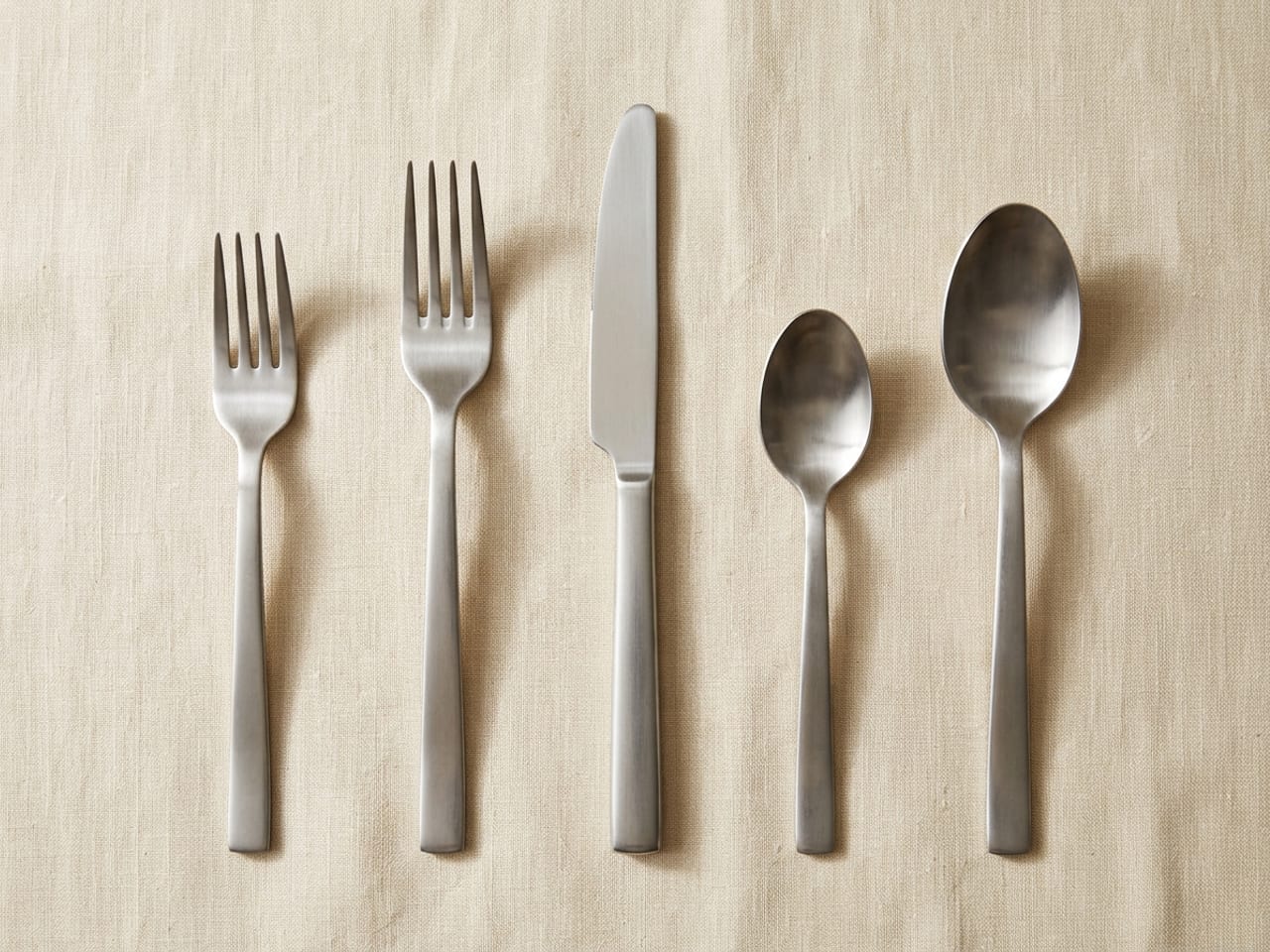
Cutlery comes in four groups: knives, forks, spoons and serving pieces. The everyday core is small: a US 5-piece place setting is a dinner knife, a dinner fork, a salad fork, an oval soup (place) spoon and a teaspoon, and a UK 24-piece set is six settings of four: table knife, table fork, a large spoon and a teaspoon. Most other pieces are for one course or one food. The table below lists all 31 we found in makers' ranges and etiquette sources, seven knives, eight forks, nine spoons and seven serving pieces.1, 4, 5, 8, 10
On this page: The table · Knives · Forks · Spoons · Serving pieces · Look-alikes · Names by region · What you need · Where it goes · FAQ
Cutlery names and uses: all 31 pieces in one table
One row a piece. Lengths are the range across the makers' printed specs we read, in both units, with the number of makers; a piece with one or two makers shows each maker's figure instead, because two figures are not a range. We measured nothing, and no source we read sets a standard length for any piece. The first 11 rows are the pieces most people meet; the other 20 open under "Show all". Each name links to its section.
| Piece | What it is for | Length (makers' specs) | How to tell it | Where it sits |
|---|---|---|---|---|
| Dinner knife Knife; US dinner knife or place knife; UK table knife; "joint knife" in a UK catering textbook; an old US name is case knife | Cuts the main course. At an informal meal the Emily Post Institute lets it serve every course, and in a 5-piece set it spreads the butter too ("Used to cut food and for spreading butter.", an Oneida retailer).15, 25 | 21.6 to 26.4 cm (8.5 to 10.4 in), 9 makers | vs the steak knife: The set's own knife. A steak knife is serrated with a sharp tip, and Etiquette Scholar says it is "not made as part of a set of flatware" (though Christofle and Robert Welch both sell one in-pattern).3, 6, 28 | Right of the plate, blade toward the plate.27, 37 |
| Fish knife Knife; "Fish Blade" in an English maker's catalogue (Arthur Price); with its fork, a pair of "fish eaters" in Victorian trade (V&A) | The fish course, with the fish fork. Sources split on the job: Christofle says it "is reserved for cutting up fish, producing fine, clean slices"; Etiquette Scholar says its notched point is "used to separate the skeleton from the body and lift the bones onto a plate", and Wikipedia says "The fish knife is not designed for cutting."21, 28, 47 | 19.4 to 22.4 cm (7.6 to 8.8 in), 5 makers | vs the butter spreader: A wide, flat, dull blade, often with a notch near a pointed tip (Etiquette Scholar); Cambridge: "a knife for eating fish, with a wide blade and a round edge". The butter spreader is much shorter, the smallest knife on the table, with a rounded blade.28, 51 | Right of the dinner knife: "The specially shaped fish knife goes to the right of the dinner knife."26 |
| Butter spreader Knife; US butter spreader or butter knife (the Emily Post Institute says butter knife); UK butter knife (Robert Welch) | Your own butter knife at the bread plate: Merriam-Webster's butter spreader is "a small knife with rounded blade used for buttering bread at table".25, 55 | 14.9 to 17.1 cm (5.9 to 6.8 in), 4 makers | vs the master butter knife: A rounded tip and one at each place. The master butter knife is a serving piece that "sits with the butter dish" and "usually has a pointy end" (Silver Superstore).40, 41 | On the bread plate: "diagonally across the edge of the plate, handle on the right side and blade facing down".25 |
| Dinner fork Fork; US dinner fork or place fork; UK table fork; "joint fork" in a UK catering textbook | "The dinner fork, the larger of the two forks, is used for the main course" (Emily Post Institute).25 | 18.4 to 21.3 cm (7.2 to 8.4 in), 9 makers | vs the salad fork: The longer of the two forks in a 5-piece set. The salad fork is shorter and, in Christofle's words, "wider than a table fork, with one side used to cut salad leaves."20, 25 | Left of the plate. Every fork goes on the left except the oyster fork.26, 27 |
| Salad fork Fork; sold as a "salad/dessert fork" by Yamazaki and as "Dessert/Salad Fork" in one Oneida pattern | "the smaller fork is used for a salad or an appetizer" (Emily Post Institute).25 | 15.2 to 18.4 cm (6.0 to 7.2 in), 7 makers | vs the dinner fork: Shorter than the dinner fork, and wider: Christofle says one side cuts the leaves; Etiquette Scholar gives salad, fish, dessert and pastry forks "a wide left tine and an optional notch".20, 29 | Outside the dinner fork when the salad comes first; inside it, next to the plate, when the salad follows the main.26, 27 |
| Fish fork Fork | "A fish fork is wide enough to pick up fish flesh that cannot be pricked." (Christofle)20 | 17.8 to 22.9 cm (7.0 to 9.0 in), 4 makers | vs the dinner fork: Etiquette Scholar: "the fish fork features an extra wide left tine, and an optional notch, grooved to fit over the bones."29 | Left of the dinner fork: "If there is a fish course, this small fork is placed to the left of the dinner fork because it is the first fork used."26 |
| Dessert fork Fork; UK also pudding fork (Debrett's "dessert (pudding) spoons and forks"), "sweet fork" in a UK catering textbook, side fork (Robert Welch) | "The dessert fork is used with the dessert spoon for entremets, but it also works for starters." (Christofle). Debrett's: "Always eat puddings with a spoon and fork (both should always be laid)".20, 32 | Two makers: Christofle 17.1 cm (6.8 in); Robert Welch 19.0 cm (7.5 in) | vs the salad fork: Often the same fork as the salad fork: Yamazaki sells a "salad/dessert fork", one retailer's 5-piece setting has a dessert fork where the others have a salad fork, and the Emily Post Institute says salad forks "can often double as dessert forks".17, 18, 27 | Above the plate, handle to the left, under the dessert spoon; at a formal dinner it comes in on the dessert plate. Viners' product page lays it "to the left of the table fork"; its table page, above the plate.25, 26 |
| Oyster fork Fork; also cocktail fork or seafood fork (Wikipedia; Christofle sells an "Oyster/Cocktail Fork"; Tasting Table treats the seafood fork as a different fork) | Shellfish: Christofle's oyster fork "has flat edges that allow it to loosen and prick the oyster."20, 48 | Two makers: Gorham 14.0 cm (5.5 in); Christofle 14.6 cm (5.8 in) | The smallest fork in a set, with "three short, broad tines" (Wikipedia). Whether a cocktail or seafood fork is the same fork, sources split: Wikipedia and Christofle say yes, Tasting Table describes a seafood fork as a different, larger fork.3, 46, 48 | Far right, outside the spoons: "It is the only fork ever placed on the right of the plate."26 |
| Soup spoon (oval) or place spoon Spoon; US oval soup spoon, place spoon, dinner spoon or soup/cereal spoon (one Oneida pattern: "Dessert/Oval Soup Spoon"); the big spoon in a US 5-piece set | "The oval soup spoon is made to eat soup, namely, soup made with particles of solid food, such as meat, vegetables, grains, and pasta." (Etiquette Scholar). As the place spoon, "an all-purpose utensil used to eat soup, cereal, and dessert".15, 30, 31 | 17.1 to 20.7 cm (6.8 to 8.1 in), 6 makers | vs the dessert spoon: An oval bowl in Etiquette Scholar; Viners, a British maker, describes its soup spoon as having "a deep, circular bowl". Each is one source's pattern, not a national rule. The round cream soup spoon is the one made with a circular bowl (Etiquette Scholar).10, 30 | Far right, outside the knives: "the soup spoon goes to the far (outside) right of the dinner knife".25 |
| Dessert spoon Spoon; UK dessert spoon, also pudding spoon (Debrett's) and "sweet spoon" in a UK catering textbook; in US sets the oval soup or place spoon is sold for dessert too (ours: roughly the same job) | Cambridge (UK): "a medium-sized spoon, used especially for eating sweet food at the end of a meal". Debrett's: for puddings, "the spoon should be a dessert spoon."32, 51 | 17.1 to 18.9 cm (6.8 to 7.4 in), 6 makers | vs the soup spoon (oval) or place spoon: "The dessert spoon is a similar size to a soup spoon; however, it features an oval bowl rather than a round one." (Viners). Post 1922: "the spoon which is double the size of a teaspoon is known as nothing but a dessert spoon".10, 37 | Above the plate, spoon on top with its handle to the right; at a formal dinner it comes in on the dessert plate.24, 25, 26 |
| Teaspoon Spoon; Robert Welch sells an "English Teaspoon" and a longer "American / US Teaspoon" | Cambridge: "a small spoon used to stir (= mix) tea or coffee in a cup". Debrett's adds grapefruit, boiled eggs and ice cream.32, 51 | 13.1 to 16.5 cm (5.2 to 6.5 in), 6 makers | vs the demitasse or espresso spoon: Bigger than the coffee or demitasse spoon. At Robert Welch the US teaspoon is 160 mm long, the English one 134 mm.6 | Right of the knife, inside the soup spoon: "the teaspoon or dessert spoon, which will be used last, goes to the left (inside) of the soup spoon".25 |
Show all 31 pieces (20 more)
| Piece | What it is for | Length (makers' specs) | How to tell it | Where it sits |
|---|---|---|---|---|
| Steak knife Knife | Takes the dinner knife's job when the main course is meat: "If the main course is meat, a steak knife can take the place of the dinner knife." (Emily Post Institute). Debrett's: "It is permissible in a restaurant to ask for a steak knife if the meat is tough".25, 32 | Two makers: Christofle 24.8 cm (9.8 in); Robert Welch 24.3 cm (9.6 in) | vs the dinner knife: Serrated, with a sharp tip (Etiquette Scholar); at a formal meal it "is not provided if meat is served roasted".28 | In the dinner knife's place, blade toward the plate.25 |
| Dessert knife Knife; side knife (Robert Welch) | Dessert, with the dessert fork: "It is used in formal and informal dining with a dessert fork." (Etiquette Scholar). Viners puts it in its formal (44-piece) set.10, 28 | Two makers: Christofle 19.7 cm (7.8 in); Robert Welch 22.2 cm (8.7 in) | vs the dinner knife: Smaller than the dinner knife: "usually smaller than the table knife" (Viners); Robert Welch's side knife is 222 mm against its 241 mm table knife.6, 10 | No fixed place in the US sources we read; Christofle: "placed either to the right of the plate or on top of it"; Viners' product page says "laid next to the table knife", though its table-setting page puts dessert cutlery above the plate.21 |
| Fruit knife Knife; Sambonet sells a "fruit/dessert knife" | "The fruit knife is used to cut and peel fresh fruit at the table in formal and informal dining." (Etiquette Scholar). Post 1922 pairs it with a fruit fork.28, 37 | No maker's printed length in what we read; Sambonet's guide gives about 17 to 18 cm (6.7 to 7.1 in) for its fruit/dessert knife. | vs the dessert knife: Smaller again than the dessert knife in Etiquette Scholar's order of sizes; Sambonet sells one knife for both jobs.19, 28 | Brought with the fruit: "A doily goes under the finger bowl, and a fruit knife and fork on either side." (Post 1922)37 |
| Cheese knife Knife; Debrett's names cheddar, soft, flat, spreader and pronged kinds | Cuts cheese: Sambonet's has "very sharp blades and a double tip"; Christofle's is "often with a serrated or pointed blade to easily cut different textures of cheese."19, 21, 33 | One maker we read: Christofle 20.3 cm (8.0 in) | A forked or double tip. Debrett's cheese spreader is the blunt one: "With a curved, rounded dull-edged blade".19, 33 | On the cheese board, shared: "Always use the cheese knife provided to cut cheese from a communal board, not your own knife." (Debrett's)33 |
| Cake or pastry fork Fork; Cake fork (Christofle, Sambonet); pastry fork (Robert Welch, Arthur Price, Steelite) | "With one of its edges being sharp, the cake fork is specially designed to cut cakes or pies on your plate without crushing or deforming your cakes." (Christofle)20 | 15.2 to 16.3 cm (6.0 to 6.4 in), 3 makers | vs the dessert fork: One wider, bevelled outer tine that cuts: Sambonet's has "only three prongs, the outer one of which is wider than the others so that it can serve as a knife". Tine counts vary: Wikipedia gives three or four.19, 50 | No fixed place in what we read. |
| Snail fork Fork; Snail or escargot fork, used with snail tongs | Takes the snail out of its shell; a UK catering textbook pairs it with snail tongs, which hold the shell.29, 36 | No maker's printed length in what we read; Etiquette Scholar gives about 4½ in (11.4 cm). | vs the oyster fork: Two tines: "The snail fork is approximately 4½ inches in length with two long, pointed tines." (Etiquette Scholar)29 | "Snail tongs: left of cover Snail fork: right of cover" (Lillicrap)36 |
| Lobster fork or pick Fork; Lobster fork (Christofle); lobster pick (a UK catering textbook) | "The lobster fork is ideal for removing flesh from lobster claws." (Christofle); the textbook's lobster pick is "to extract the flesh from the claw".20, 36 | No maker's printed length in what we read; Etiquette Scholar gives 6¾ to 8 in (17.1 to 20.3 cm). | vs the oyster fork: "The lobster fork is larger than the oyster fork and has a different use." (Christofle)20 | No fixed place in what we read. |
| Cream soup spoon (round) Spoon; Cream soup spoon | Gorham's: "The rounded bowl is specially designed for cream soups and hearty stews"; Miss Manners' old family had "a round spoon used for cream soup served in soup cups".2, 34 | Two makers: Gorham 15.9 cm (6.3 in); Christofle 16.5 cm (6.5 in) | vs the soup spoon (oval) or place spoon: A round bowl, "made with a round bowl to fit the shape of the cream soup bowl" (Etiquette Scholar), and shorter than the oval soup spoon in the makers' figures.30 | The soup spoon's place: "If soup or fruit is served as a first course, then the accompanying spoon goes to the right of the knives."26 |
| Bouillon or round-bowl soup spoon Spoon; Bouillon spoon; round bowl soup spoon (Robert Welch) | "The bouillon spoon is used at light meals, such as formal and informal luncheons, when clear or jellied soup is served as a first course." (Etiquette Scholar). Post 1922 has cup soups "eaten with a teaspoon or a bouillon spoon."30, 37 | Two makers: Robert Welch 18.0 cm (7.1 in); Oneida 15.9 cm (6.3 in) | vs the cream soup spoon (round): Round, and the smallest of the soup spoons in Miss Manners' account: "a smaller round spoon for bouillon".34 | The soup spoon's place, right of the knives, when it is the first course.26 |
| Table spoon Spoon; Table spoon or tablespoon; in the UK a serving spoon (Cambridge); in the US also the 15 mL measure | Viners: "The table spoon is the largest spoon in the cutlery range. It is not part of a place setting and is used for preparing and serving food." Sambonet's is "used for eating soups but also for serving dishes".10, 19 | Two makers: Christofle 20.6 to 21.0 cm (8.1 to 8.3 in); Amefa 20.5 cm (8.1 in) | vs the serving spoon: The largest spoon of a set. As a measure it is a different thing: 15 mL on US food labels and 20 mL in Australia (see the measures below).51, 57, 58 | Not part of a place setting, in Viners' words; on the table it serves.10 |
| Demitasse or espresso spoon Spoon; Demitasse, espresso, coffee or after-dinner coffee spoon | "At a formal dinner or formal luncheon, coffee is served in a demitasse cup, and a demitasse spoon is used if sugar is added." (Etiquette Scholar)30 | 10.2 to 13.3 cm (4.0 to 5.3 in), 7 makers | vs the teaspoon: Shorter than a teaspoon with a smaller bowl: Robert Welch's coffee spoon bowl is 21 mm wide, its English teaspoon's 27 mm.6 | No fixed place in what we read. |
| Iced-tea spoon Spoon; Iced-tea or iced-beverage spoon; long handled spoon (Robert Welch) | "The iced-beverage spoon, also known as an iced-tea spoon, is used to stir sugar in cold beverages served in a tall glass, such as iced tea or iced coffee." (Etiquette Scholar). Debrett's: ice cream in a tall glass takes "a long teaspoon".30, 32 | Two makers: Robert Welch 20.6 cm (8.1 in); Libbey 19.1 to 21.3 cm (7.5 to 8.4 in) | vs the teaspoon: A teaspoon-sized bowl on a long handle, long enough to reach the bottom of a tall glass (ours; Etiquette Scholar says the spoon is for a tall glass).6 | No fixed place in what we read. |
| Grapefruit spoon Spoon; Grapefruit, citrus, orange or fruit spoon | "A grapefruit spoon is a utensil usually similar in design to a teaspoon that tapers to a sharp edge or teeth, the intent of the front serration being to separate the flesh of a grapefruit from its rind." (Wikipedia)36, 50 | No maker's printed length in what we read; Etiquette Scholar gives 5½ to 6½ in (14.0 to 16.5 cm). | vs the teaspoon: A teaspoon with a point or teeth: "an elongated bowl and a pointed tip" (Etiquette Scholar).30 | Far right as a first-course spoon; Post 1922 puts "the oyster fork or grape fruit spoon" outermost.26, 37 |
| Serving spoon Serving piece; Serving spoon (a pierced, slotted version is sold too: Oneida, Gorham) | Serves from the dish: Post 1922 has "a serving spoon (somewhat larger than an ordinary tablespoon) is put on all dishes".37 | 22.9 to 33.0 cm (9.0 to 13.0 in), 3 makers | vs the table spoon: Larger than the table spoon where one maker prints both: Christofle Malmaison's serving spoon is 13.00 in (33.0 cm) against its 8.12 in table spoon. | On the dish it serves (Post 1922).37 |
| Serving fork Serving piece; Gorham also sells a cold meat fork | Serves meat and vegetables from a platter (ours); sold beside the serving spoon by Oneida, Robert Welch and Christofle.1, 3, 6 | 22.6 to 25.1 cm (8.9 to 9.9 in), 3 makers | A large fork, about the serving spoon's length at Robert Welch (249 and 251 mm) and Oneida (8.9 and 9 in); Christofle's is 9.87 in against its 13.00 in spoon. | With the platter it serves (ours). |
| Gravy or sauce ladle Serving piece; Gravy ladle (Gorham, Christofle, Oneida); sauce ladle (Robert Welch) | Serves gravy or sauce (ours). It is in Oneida's 3-piece hostess set, Etiquette Scholar's four-piece hostess set and its 43-piece service for eight.1, 31 | 16.5 to 17.8 cm (6.5 to 7.0 in), 3 makers | A small deep bowl on a handle (ours), smaller than a soup ladle (Christofle's soup ladle is 11.50 in, 29.2 cm).3 | With the gravy boat (ours). |
| Master butter knife Serving piece; Master butter knife or butter serving knife; "butter knife" in Victorian use (Wikipedia) | "Master butter knife designed for serving from the butter dish" (Gorham, as its retailer prints it). Eliza Leslie, 1853: "Always take butter with the butter-knife, and then do not forget to return that knife to the butter-plate."2, 39 | Two makers: Gorham 16.8 cm (6.6 in); Oneida 17.8 cm (7.0 in) | vs the butter spreader: Pointed, and only one on the table: "It usually has a pointy end" (Silver Superstore); the spreader at each place is rounded.40, 41, 49 | "The butter serving knife sits with the butter dish." (Silver Superstore)40 |
| Sugar spoon Serving piece | Serves sugar from the bowl (ours); in hostess sets from Oneida and Gorham, and Sambonet sizes it between the dessert spoon and the teaspoon.1, 2, 19 | Two makers: Gorham 15.2 cm (6.0 in); Oneida 15.9 cm (6.3 in) | A teaspoon-sized serving spoon, often with a shaped bowl (ours). | With the sugar bowl (ours). |
| Cake or pie server Serving piece; "Cake/Multi Server" (Christofle) | Cuts and lifts a slice of cake or pie (ours); Gorham and Etiquette Scholar put a pie server in the six-piece hostess set.2, 31 | Two makers: Robert Welch 25.1 cm (9.9 in); Christofle 27.3 cm (10.8 in) | A flat, wedge-shaped blade (ours). | With the cake or pie (ours). |
| Carving knife and fork Serving piece; Carving set (carving knife and carving fork) | Carves a roast at the table or sideboard (ours).3, 19 | One maker we read: Christofle 27.6 to 33.0 cm (10.9 to 13.0 in) | Among the longest pieces of a silver service in what we read.3 | Beside the roast (ours). |
Types of table knives and their uses
Table knives cut, spread or separate; none of them is a kitchen knife. Etiquette Scholar says table knives are "made in seven sizes", from the dinner knife down to the butter spreader, the smallest.28 In use, the edge faces the plate, and the knife you need first sits furthest out.27, 37 In the trade, and in Oxford's North American sense, "cutlery" also means sharp knives ("knives, etc. that are sharp");52 chef's knives and cuts are in our knife skills guide and the chef's spoons and tweezers in plating tools.
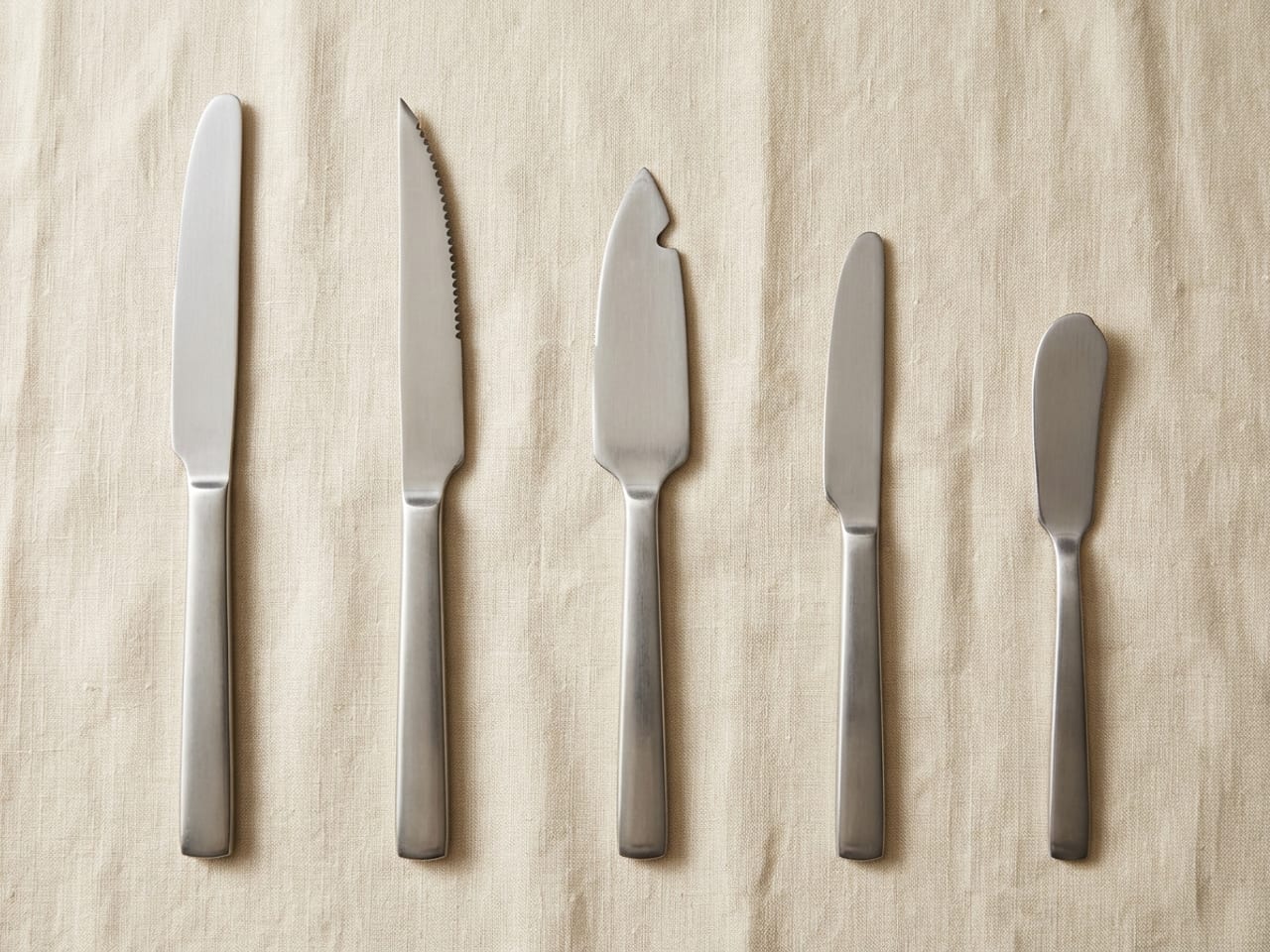
Dinner knife
Names: US dinner knife or place knife; UK table knife; "joint knife" in a UK catering textbook; an old US name is case knife.
What it is for. Cuts the main course. At an informal meal the Emily Post Institute lets it serve every course, and in a 5-piece set it spreads the butter too ("Used to cut food and for spreading butter.", an Oneida retailer).15, 25
How to tell it from the steak knife. The set's own knife. A steak knife is serrated with a sharp tip, and Etiquette Scholar says it is "not made as part of a set of flatware" (though Christofle and Robert Welch both sell one in-pattern).3, 6, 28
Where it sits. Right of the plate, blade toward the plate.27, 37 (see it in a setting)
Length. 21.6 to 26.4 cm (8.5 to 10.4 in), 9 makers. As printed: Oneida Diameter: 8 15/16 in (22.7 cm)1; Oneida Chef's Table: 9 1/2 in (24.1 cm)1; Gorham Chantilly place knife: 9 1/8 in (23.2 cm)2; Gorham Chantilly dinner knife: 9 5/8 in (24.4 cm)2; Gorham Chantilly Continental knife: 10 3/8 in (26.4 cm)2; Robert Welch Malvern Bright table knife: 241 mm (9.5 in)6; Robert Welch Stanton Bright table knife: 233 mm (9.2 in)7; Christofle Malmaison: 9 3/4 in (24.8 cm)3; Reed & Barton 1800: 9.12 in (23.2 cm)4; Lenox Eternal Frosted: 9.25 in (23.5 cm)5; Libbey 213-5502: 9 3/4 in (24.8 cm), via Chef's Deal13; International Tableware MA-331: 8 7/8 in (22.5 cm), via Chef's Deal13; Amefa 193300B000305: 8 1/2 in (21.6 cm), via Chef's Deal13.
Steak knife
What it is for. Takes the dinner knife's job when the main course is meat: "If the main course is meat, a steak knife can take the place of the dinner knife." (Emily Post Institute). Debrett's: "It is permissible in a restaurant to ask for a steak knife if the meat is tough".25, 32
How to tell it from the dinner knife. Serrated, with a sharp tip (Etiquette Scholar); at a formal meal it "is not provided if meat is served roasted".28
Where it sits. In the dinner knife's place, blade toward the plate.25 (see it in a setting)
Length. Two makers: Christofle 24.8 cm (9.8 in); Robert Welch 24.3 cm (9.6 in). As printed: Christofle Malmaison: 9.75 in (24.8 cm)3; Robert Welch Malvern Bright: 243 mm (9.6 in)6.
Fish knife
Names: "Fish Blade" in an English maker's catalogue (Arthur Price); with its fork, a pair of "fish eaters" in Victorian trade (V&A).
What it is for. The fish course, with the fish fork. Sources split on the job: Christofle says it "is reserved for cutting up fish, producing fine, clean slices"; Etiquette Scholar says its notched point is "used to separate the skeleton from the body and lift the bones onto a plate", and Wikipedia says "The fish knife is not designed for cutting."21, 28, 47
How to tell it from the butter spreader. A wide, flat, dull blade, often with a notch near a pointed tip (Etiquette Scholar); Cambridge: "a knife for eating fish, with a wide blade and a round edge". The butter spreader is much shorter, the smallest knife on the table, with a rounded blade.28, 51
Where it sits. Right of the dinner knife: "The specially shaped fish knife goes to the right of the dinner knife."26 (see it in a setting)
Length. 19.4 to 22.4 cm (7.6 to 8.8 in), 5 makers. As printed: Libbey 774452 Geneva (maker line: 7-5/8 in overall; the title prints 7 in): 7 5/8 in (19.4 cm), via Chef's Deal13; Christofle Malmaison: 7.75 in (19.7 cm)3; Amefa 906500B000410: 8 in (20.3 cm), via Chef's Deal13; Gorham Chantilly, hollow handle: 8.50 in (21.6 cm)2; Robert Welch Malvern Bright: 224 mm (8.8 in)6.
Butter spreader
Names: US butter spreader or butter knife (the Emily Post Institute says butter knife); UK butter knife (Robert Welch).
What it is for. Your own butter knife at the bread plate: Merriam-Webster's butter spreader is "a small knife with rounded blade used for buttering bread at table".25, 55
How to tell it from the master butter knife. A rounded tip and one at each place. The master butter knife is a serving piece that "sits with the butter dish" and "usually has a pointy end" (Silver Superstore).40, 41
Where it sits. On the bread plate: "diagonally across the edge of the plate, handle on the right side and blade facing down".25 (see it in a setting)
Length. 14.9 to 17.1 cm (5.9 to 6.8 in), 4 makers. As printed: Robert Welch Malvern Bright butter knife: 149 mm (5.9 in)6; Gorham Chantilly, hollow handle: 6.25 in (15.9 cm)2; Christofle Malmaison: 6.62 in (16.8 cm)3; Gorham Chantilly, flat handle: 6.75 in (17.1 cm)2; CAC China 8008-12 Golden Pearl: 6 3/4 in (17.1 cm), via Chef's Deal13.
Dessert knife
Names: side knife (Robert Welch).
What it is for. Dessert, with the dessert fork: "It is used in formal and informal dining with a dessert fork." (Etiquette Scholar). Viners puts it in its formal (44-piece) set.10, 28
How to tell it from the dinner knife. Smaller than the dinner knife: "usually smaller than the table knife" (Viners); Robert Welch's side knife is 222 mm against its 241 mm table knife.6, 10
Where it sits. No fixed place in the US sources we read; Christofle: "placed either to the right of the plate or on top of it"; Viners' product page says "laid next to the table knife", though its table-setting page puts dessert cutlery above the plate.21
Length. Two makers: Christofle 19.7 cm (7.8 in); Robert Welch 22.2 cm (8.7 in). As printed: Christofle Marly dessert knife: 7 3/4 in (19.7 cm)3; Robert Welch Malvern Bright side knife: 222 mm (8.7 in)6.
Fruit knife
Names: Sambonet sells a "fruit/dessert knife".
What it is for. "The fruit knife is used to cut and peel fresh fruit at the table in formal and informal dining." (Etiquette Scholar). Post 1922 pairs it with a fruit fork.28, 37
How to tell it from the dessert knife. Smaller again than the dessert knife in Etiquette Scholar's order of sizes; Sambonet sells one knife for both jobs.19, 28
Where it sits. Brought with the fruit: "A doily goes under the finger bowl, and a fruit knife and fork on either side." (Post 1922)37
Length. No maker's printed length in what we read; Sambonet's guide gives about 17 to 18 cm (6.7 to 7.1 in) for its fruit/dessert knife.
Cheese knife
Names: Debrett's names cheddar, soft, flat, spreader and pronged kinds.
What it is for. Cuts cheese: Sambonet's has "very sharp blades and a double tip"; Christofle's is "often with a serrated or pointed blade to easily cut different textures of cheese."19, 21, 33
How to tell it. A forked or double tip. Debrett's cheese spreader is the blunt one: "With a curved, rounded dull-edged blade".19, 33
Where it sits. On the cheese board, shared: "Always use the cheese knife provided to cut cheese from a communal board, not your own knife." (Debrett's)33
Length. One maker we read: Christofle 20.3 cm (8.0 in). As printed: Christofle Malmaison: 8.00 in (20.3 cm)3.
Types of forks and their uses
Forks differ by length and by their tines: Etiquette Scholar says forks with "a wide left tine and an optional notch, such as a salad fork, fish fork, dessert fork, and pastry fork, provide extra leverage when cutting food that normally does not require a knife", and "Forks with curved tines, such as the oyster fork, are made to follow the shape of the shell."29 Tine counts are not fixed between makers, so the tells below say "usually" where sources disagree. Every fork goes on the left except the oyster fork.26
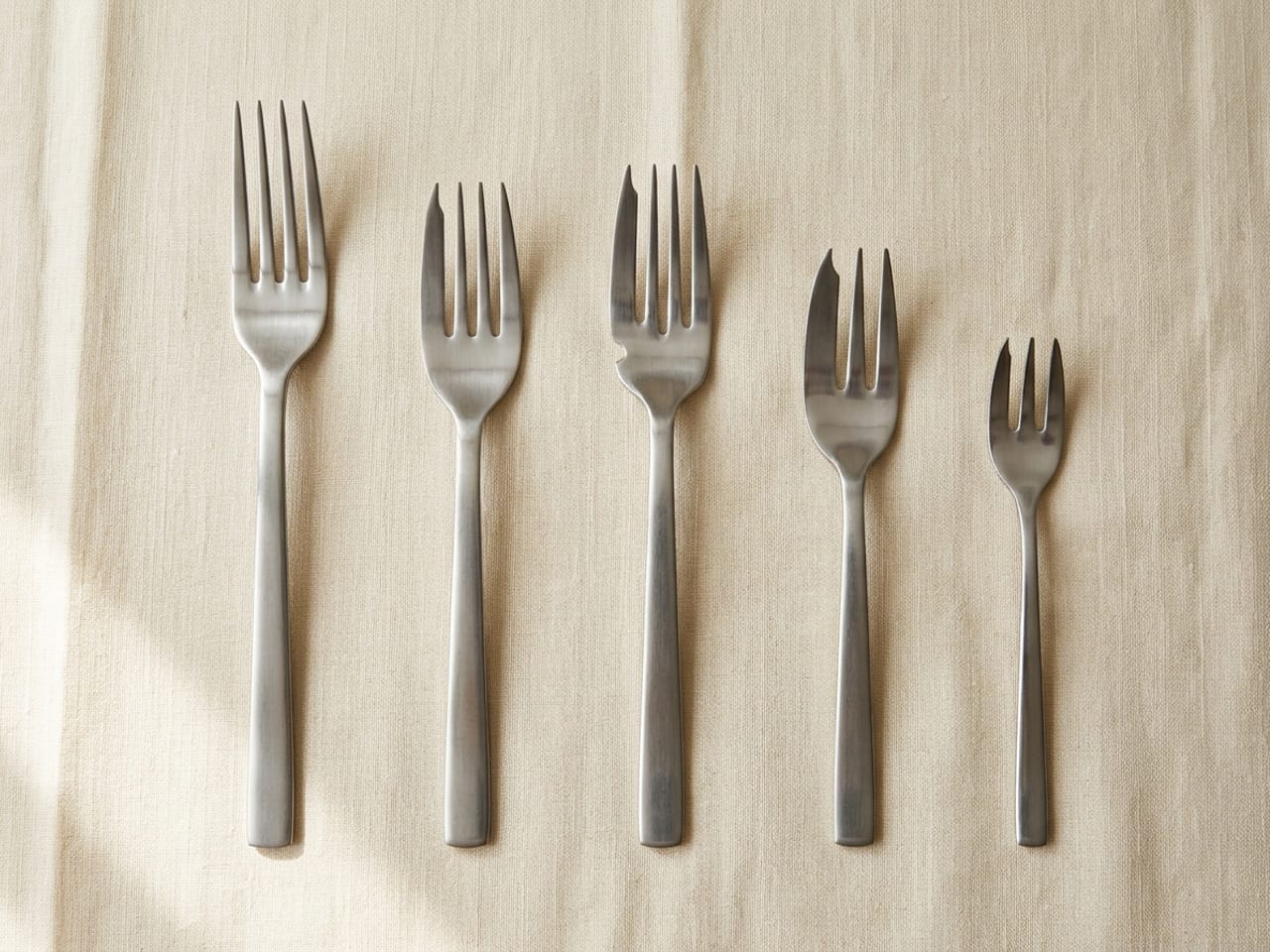
Dinner fork
Names: US dinner fork or place fork; UK table fork; "joint fork" in a UK catering textbook.
What it is for. "The dinner fork, the larger of the two forks, is used for the main course" (Emily Post Institute).25
How to tell it from the salad fork. The longer of the two forks in a 5-piece set. The salad fork is shorter and, in Christofle's words, "wider than a table fork, with one side used to cut salad leaves."20, 25
Where it sits. Left of the plate. Every fork goes on the left except the oyster fork.26, 27 (see it in a setting)
Length. 18.4 to 21.3 cm (7.2 to 8.4 in), 9 makers. As printed: Oneida Chef's Table: 8 in (20.3 cm)1; Oneida Diameter: 7 1/2 in (19.1 cm)1; Oneida Louisiana: 7.25 in (18.4 cm)1; Gorham Chantilly place fork: 7 3/8 in (18.7 cm)2; Gorham Chantilly Continental fork: 8 3/8 in (21.3 cm)2; Robert Welch Malvern Bright table fork: 207 mm (8.1 in)6; Robert Welch Stanton Bright table fork: 198 mm (7.8 in)7; Christofle Malmaison: 8 1/8 in (20.6 cm)3; Christofle Cluny: 8.25 in (21.0 cm)3; Reed & Barton 1800: 7.62 in (19.4 cm)4; Lenox Alcott: 8.25 in (21.0 cm)5; International Tableware MA-221: 7 1/2 in (19.1 cm), via Chef's Deal13; Frieling 192400B000320: 7 7/8 in (20.0 cm), via Chef's Deal13; CAC China 2003-05: 7 1/4 in (18.4 cm), via Chef's Deal13.
Salad fork
Names: sold as a "salad/dessert fork" by Yamazaki and as "Dessert/Salad Fork" in one Oneida pattern.
What it is for. "the smaller fork is used for a salad or an appetizer" (Emily Post Institute).25
How to tell it from the dinner fork. Shorter than the dinner fork, and wider: Christofle says one side cuts the leaves; Etiquette Scholar gives salad, fish, dessert and pastry forks "a wide left tine and an optional notch".20, 29
Where it sits. Outside the dinner fork when the salad comes first; inside it, next to the plate, when the salad follows the main.26, 27 (see it in a setting)
Length. 15.2 to 18.4 cm (6.0 to 7.2 in), 7 makers. As printed: Oneida Diameter: 7 in (17.8 cm)1; Oneida Easton: 7 in (17.8 cm)1; Oneida Louisiana: 6.75 in (17.1 cm)1; Gorham Chantilly: 6 3/8 in (16.2 cm)2; Christofle Malmaison: 6 1/2 in (16.5 cm)3; Reed & Barton 1800: 6.62 in (16.8 cm)4; Lenox Alcott: 7.25 in (18.4 cm)5; International Tableware MA-222: 6 in (15.2 cm), via Chef's Deal13; CAC China 2003-06 Elizabeth: 6 1/2 in (16.5 cm), via Chef's Deal13.
Fish fork
What it is for. "A fish fork is wide enough to pick up fish flesh that cannot be pricked." (Christofle)20
How to tell it from the dinner fork. Etiquette Scholar: "the fish fork features an extra wide left tine, and an optional notch, grooved to fit over the bones."29
Where it sits. Left of the dinner fork: "If there is a fish course, this small fork is placed to the left of the dinner fork because it is the first fork used."26 (see it in a setting)
Length. 17.8 to 22.9 cm (7.0 to 9.0 in), 4 makers. As printed: Christofle Malmaison: 7.00 in (17.8 cm)3; Libbey 774036: 7 in (17.8 cm), via Chef's Deal13; Gorham Chantilly, hollow handle: 8.00 in (20.3 cm)2; Robert Welch Malvern Bright: 194 mm (7.6 in)6; Libbey 492-019 Louvre: 9 in (22.9 cm), via Chef's Deal13.
Dessert fork
Names: UK also pudding fork (Debrett's "dessert (pudding) spoons and forks"), "sweet fork" in a UK catering textbook, side fork (Robert Welch).
What it is for. "The dessert fork is used with the dessert spoon for entremets, but it also works for starters." (Christofle). Debrett's: "Always eat puddings with a spoon and fork (both should always be laid)".20, 32
How to tell it from the salad fork. Often the same fork as the salad fork: Yamazaki sells a "salad/dessert fork", one retailer's 5-piece setting has a dessert fork where the others have a salad fork, and the Emily Post Institute says salad forks "can often double as dessert forks".17, 18, 27
Where it sits. Above the plate, handle to the left, under the dessert spoon; at a formal dinner it comes in on the dessert plate. Viners' product page lays it "to the left of the table fork"; its table page, above the plate.25, 26 (see it in a setting)
Length. Two makers: Christofle 17.1 cm (6.8 in); Robert Welch 19.0 cm (7.5 in). As printed: Christofle Marly dessert fork: 6 3/4 in (17.1 cm)3; Robert Welch Malvern Bright side fork: 190 mm (7.5 in)6.
Cake or pastry fork
Names: Cake fork (Christofle, Sambonet); pastry fork (Robert Welch, Arthur Price, Steelite).
What it is for. "With one of its edges being sharp, the cake fork is specially designed to cut cakes or pies on your plate without crushing or deforming your cakes." (Christofle)20
How to tell it from the dessert fork. One wider, bevelled outer tine that cuts: Sambonet's has "only three prongs, the outer one of which is wider than the others so that it can serve as a knife". Tine counts vary: Wikipedia gives three or four.19, 50
Where it sits. No fixed place in what we read.
Length. 15.2 to 16.3 cm (6.0 to 6.4 in), 3 makers. As printed: Steelite 5970SX025: 6 in (15.2 cm), via Chef's Deal13; Christofle Malmaison cake/pastry fork: 6.25 in (15.9 cm)3; Steelite 5992SX068: 6.375 in (16.2 cm), via Chef's Deal13; Robert Welch Malvern Bright pastry fork: 163 mm (6.4 in)6.
Oyster fork
Names: also cocktail fork or seafood fork (Wikipedia; Christofle sells an "Oyster/Cocktail Fork"; Tasting Table treats the seafood fork as a different fork).
What it is for. Shellfish: Christofle's oyster fork "has flat edges that allow it to loosen and prick the oyster."20, 48
How to tell it. The smallest fork in a set, with "three short, broad tines" (Wikipedia). Whether a cocktail or seafood fork is the same fork, sources split: Wikipedia and Christofle say yes, Tasting Table describes a seafood fork as a different, larger fork.3, 46, 48
Where it sits. Far right, outside the spoons: "It is the only fork ever placed on the right of the plate."26 (see it in a setting)
Length. Two makers: Gorham 14.0 cm (5.5 in); Christofle 14.6 cm (5.8 in). As printed: Gorham Chantilly cocktail fork: 5.50 in (14.0 cm)2; Christofle Malmaison oyster/cocktail fork: 5.75 in (14.6 cm)3.
Snail fork
Names: Snail or escargot fork, used with snail tongs.
What it is for. Takes the snail out of its shell; a UK catering textbook pairs it with snail tongs, which hold the shell.29, 36
How to tell it from the oyster fork. Two tines: "The snail fork is approximately 4½ inches in length with two long, pointed tines." (Etiquette Scholar)29
Where it sits. "Snail tongs: left of cover Snail fork: right of cover" (Lillicrap)36
Length. No maker's printed length in what we read; Etiquette Scholar gives about 4½ in (11.4 cm).
Lobster fork or pick
Names: Lobster fork (Christofle); lobster pick (a UK catering textbook).
What it is for. "The lobster fork is ideal for removing flesh from lobster claws." (Christofle); the textbook's lobster pick is "to extract the flesh from the claw".20, 36
How to tell it from the oyster fork. "The lobster fork is larger than the oyster fork and has a different use." (Christofle)20
Where it sits. No fixed place in what we read.
Length. No maker's printed length in what we read; Etiquette Scholar gives 6¾ to 8 in (17.1 to 20.3 cm).
Types of spoons and their uses
"Spoons are used to sip, stir, and sup": Etiquette Scholar counts fourteen types.30 The names are where the US and UK split most: the big spoon of a US 5-piece setting (oval soup, place or dinner spoon) is also used for dessert, as a British dessert spoon is (our reading), and a British table spoon serves rather than sits at the place (see names by region). The bowl shape is the quickest tell: round for cream soup and bouillon, oval for dessert and for soup with pieces in it.10, 30, 34
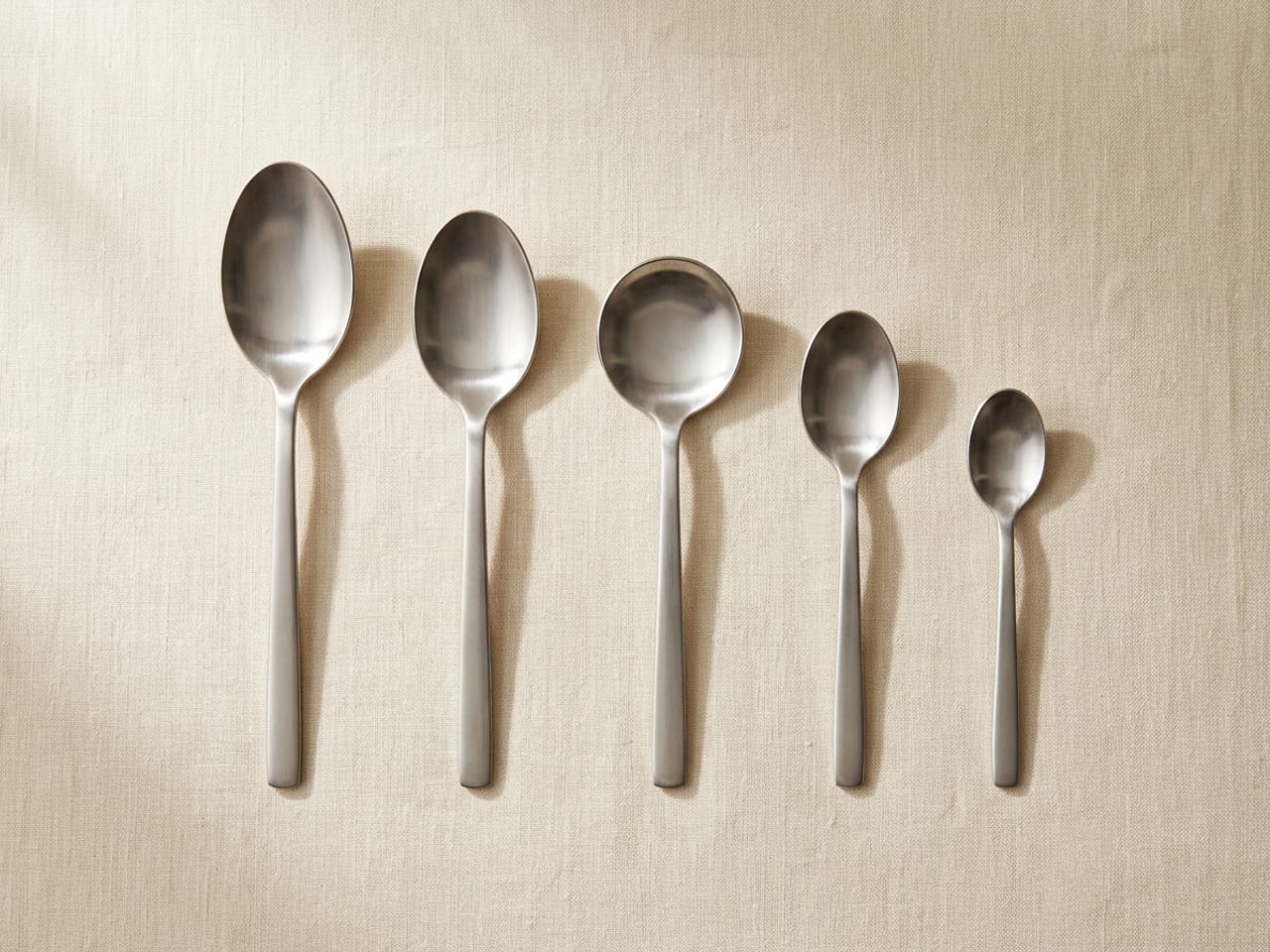
Soup spoon (oval) or place spoon
Names: US oval soup spoon, place spoon, dinner spoon or soup/cereal spoon (one Oneida pattern: "Dessert/Oval Soup Spoon"); the big spoon in a US 5-piece set.
What it is for. "The oval soup spoon is made to eat soup, namely, soup made with particles of solid food, such as meat, vegetables, grains, and pasta." (Etiquette Scholar). As the place spoon, "an all-purpose utensil used to eat soup, cereal, and dessert".15, 30, 31
How to tell it from the dessert spoon. An oval bowl in Etiquette Scholar; Viners, a British maker, describes its soup spoon as having "a deep, circular bowl". Each is one source's pattern, not a national rule. The round cream soup spoon is the one made with a circular bowl (Etiquette Scholar).10, 30
Where it sits. Far right, outside the knives: "the soup spoon goes to the far (outside) right of the dinner knife".25 (see it in a setting)
Length. 17.1 to 20.7 cm (6.8 to 8.1 in), 6 makers. As printed: Oneida Chef's Table: 7 1/4 in (18.4 cm)1; Oneida Diameter: 7 1/2 in (19.1 cm)1; Gorham Chantilly: 6 3/4 in (17.1 cm)2; Robert Welch Malvern Bright soup spoon: 207 mm (8.1 in)6; Robert Welch RW2 Satin soup spoon: 198 mm (7.8 in)7; Christofle Malmaison: 7 1/2 in (19.1 cm)3; Reed & Barton 1800: 7 in (17.8 cm)4; Lenox Alcott: 7.5 in (19.1 cm)5.
Dessert spoon
Names: UK dessert spoon, also pudding spoon (Debrett's) and "sweet spoon" in a UK catering textbook; in US sets the oval soup or place spoon is sold for dessert too (ours: roughly the same job).
What it is for. Cambridge (UK): "a medium-sized spoon, used especially for eating sweet food at the end of a meal". Debrett's: for puddings, "the spoon should be a dessert spoon."32, 51
How to tell it from the soup spoon (oval) or place spoon. "The dessert spoon is a similar size to a soup spoon; however, it features an oval bowl rather than a round one." (Viners). Post 1922: "the spoon which is double the size of a teaspoon is known as nothing but a dessert spoon".10, 37
Where it sits. Above the plate, spoon on top with its handle to the right; at a formal dinner it comes in on the dessert plate.24, 25, 26 (see it in a setting)
Length. 17.1 to 18.9 cm (6.8 to 7.4 in), 6 makers. As printed: Robert Welch Malvern Bright: 189 mm (7.4 in)6; Christofle Malmaison: 6.75 in (17.1 cm)3; Amefa 141024B000345: 7 3/16 in (18.3 cm), via Chef's Deal13; Frieling 192400B000345: 7 7/16 in (18.9 cm), via Chef's Deal13; International Tableware MA-114: 7 in (17.8 cm), via Chef's Deal13; Oneida Chef's Table (1880 Hospitality) tablespoon/dessert spoon: 7 in (17.8 cm), via Hubert14.
Cream soup spoon (round)
Names: Cream soup spoon.
What it is for. Gorham's: "The rounded bowl is specially designed for cream soups and hearty stews"; Miss Manners' old family had "a round spoon used for cream soup served in soup cups".2, 34
How to tell it from the soup spoon (oval) or place spoon. A round bowl, "made with a round bowl to fit the shape of the cream soup bowl" (Etiquette Scholar), and shorter than the oval soup spoon in the makers' figures.30
Where it sits. The soup spoon's place: "If soup or fruit is served as a first course, then the accompanying spoon goes to the right of the knives."26 (see it in a setting)
Length. Two makers: Gorham 15.9 cm (6.3 in); Christofle 16.5 cm (6.5 in). As printed: Gorham Chantilly: 6.25 in (15.9 cm)2; Christofle Malmaison: 6.50 in (16.5 cm)3.
Bouillon or round-bowl soup spoon
Names: Bouillon spoon; round bowl soup spoon (Robert Welch).
What it is for. "The bouillon spoon is used at light meals, such as formal and informal luncheons, when clear or jellied soup is served as a first course." (Etiquette Scholar). Post 1922 has cup soups "eaten with a teaspoon or a bouillon spoon."30, 37
How to tell it from the cream soup spoon (round). Round, and the smallest of the soup spoons in Miss Manners' account: "a smaller round spoon for bouillon".34
Where it sits. The soup spoon's place, right of the knives, when it is the first course.26 (see it in a setting)
Length. Two makers: Robert Welch 18.0 cm (7.1 in); Oneida 15.9 cm (6.3 in). As printed: Robert Welch Malvern Bright round bowl soup spoon: 180 mm (7.1 in)6; Oneida Chef's Table (1880 Hospitality) bouillon spoon: 6.25 in (15.9 cm), via Hubert14.
Table spoon
Names: Table spoon or tablespoon; in the UK a serving spoon (Cambridge); in the US also the 15 mL measure.
What it is for. Viners: "The table spoon is the largest spoon in the cutlery range. It is not part of a place setting and is used for preparing and serving food." Sambonet's is "used for eating soups but also for serving dishes".10, 19
How to tell it from the serving spoon. The largest spoon of a set. As a measure it is a different thing: 15 mL on US food labels and 20 mL in Australia (see the measures below).51, 57, 58
Where it sits. Not part of a place setting, in Viners' words; on the table it serves.10
Length. Two makers: Christofle 20.6 to 21.0 cm (8.1 to 8.3 in); Amefa 20.5 cm (8.1 in). As printed: Christofle Malmaison: 8.12 in (20.6 cm)3; Amefa 141000B000325: 8 1/16 in (20.5 cm), via Chef's Deal13; Christofle Marly: 8 1/4 in (21.0 cm)3.
Teaspoon
Names: Robert Welch sells an "English Teaspoon" and a longer "American / US Teaspoon".
What it is for. Cambridge: "a small spoon used to stir (= mix) tea or coffee in a cup". Debrett's adds grapefruit, boiled eggs and ice cream.32, 51
How to tell it from the demitasse or espresso spoon. Bigger than the coffee or demitasse spoon. At Robert Welch the US teaspoon is 160 mm long, the English one 134 mm.6
Where it sits. Right of the knife, inside the soup spoon: "the teaspoon or dessert spoon, which will be used last, goes to the left (inside) of the soup spoon".25 (see it in a setting)
Length. 13.1 to 16.5 cm (5.2 to 6.5 in), 6 makers. As printed: Oneida Louisiana: 6 in (15.2 cm)1; Oneida Chef's Table: 6 3/8 in (16.2 cm)1; Gorham Chantilly: 5 3/4 in (14.6 cm)2; Robert Welch Malvern Bright English teaspoon: 134 mm (5.3 in)6; Robert Welch Malvern Bright American / US teaspoon: 160 mm (6.3 in)6; Robert Welch RW2 Satin English teaspoon: 131 mm (5.2 in)7; Christofle Malmaison: 6 in (15.2 cm)3; Christofle Marly: 5 7/8 in (14.9 cm)3; Reed & Barton 1800: 6.12 in (15.5 cm)4; Lenox Alcott: 6.5 in (16.5 cm)5.
Demitasse or espresso spoon
Names: Demitasse, espresso, coffee or after-dinner coffee spoon.
What it is for. "At a formal dinner or formal luncheon, coffee is served in a demitasse cup, and a demitasse spoon is used if sugar is added." (Etiquette Scholar)30
How to tell it from the teaspoon. Shorter than a teaspoon with a smaller bowl: Robert Welch's coffee spoon bowl is 21 mm wide, its English teaspoon's 27 mm.6
Where it sits. No fixed place in what we read.
Length. 10.2 to 13.3 cm (4.0 to 5.3 in), 7 makers. As printed: Robert Welch Malvern Bright coffee / espresso spoon: 102 mm (4.0 in)6; Christofle Malmaison espresso spoon: 4.00 in (10.2 cm)3; Gorham Chantilly: 4.13 in (10.5 cm)2; Libbey 239-007: 4 1/4 in (10.8 cm), via Chef's Deal13; Amefa 331923B000380: 4 1/4 in (10.8 cm), via Chef's Deal13; CAC China 2003-09: 4 1/2 in (11.4 cm), via Chef's Deal13; International Tableware MA-116: 5 1/4 in (13.3 cm), via Chef's Deal13.
Iced-tea spoon
Names: Iced-tea or iced-beverage spoon; long handled spoon (Robert Welch).
What it is for. "The iced-beverage spoon, also known as an iced-tea spoon, is used to stir sugar in cold beverages served in a tall glass, such as iced tea or iced coffee." (Etiquette Scholar). Debrett's: ice cream in a tall glass takes "a long teaspoon".30, 32
How to tell it from the teaspoon. A teaspoon-sized bowl on a long handle, long enough to reach the bottom of a tall glass (ours; Etiquette Scholar says the spoon is for a tall glass).6
Where it sits. No fixed place in what we read.
Length. Two makers: Robert Welch 20.6 cm (8.1 in); Libbey 19.1 to 21.3 cm (7.5 to 8.4 in). As printed: Robert Welch Malvern Bright long handled spoon: 206 mm (8.1 in)6; Libbey 649-021: 7 1/2 in (19.1 cm), via Chef's Deal13; Libbey 657-021: 8 in (20.3 cm), via Chef's Deal13; Libbey 130-021 Harbour: 8 3/8 in (21.3 cm), via Chef's Deal13.
Grapefruit spoon
Names: Grapefruit, citrus, orange or fruit spoon.
What it is for. "A grapefruit spoon is a utensil usually similar in design to a teaspoon that tapers to a sharp edge or teeth, the intent of the front serration being to separate the flesh of a grapefruit from its rind." (Wikipedia)36, 50
How to tell it from the teaspoon. A teaspoon with a point or teeth: "an elongated bowl and a pointed tip" (Etiquette Scholar).30
Where it sits. Far right as a first-course spoon; Post 1922 puts "the oyster fork or grape fruit spoon" outermost.26, 37
Length. No maker's printed length in what we read; Etiquette Scholar gives 5½ to 6½ in (14.0 to 16.5 cm).
Serving pieces
Serving pieces stay with the dish, not at the place. US makers sell them as "hostess" sets: Oneida's 3-piece holds a serving spoon, gravy ladle and sugar spoon; Gorham's 6-piece a butter knife, cold meat fork, pie server, pierced and solid serving spoons and a sugar spoon.1, 2 Where no source states a piece's use or place, the line says "ours". Carving at the table is in how to carve a turkey, cutlery at a buffet in how to set up a buffet table.
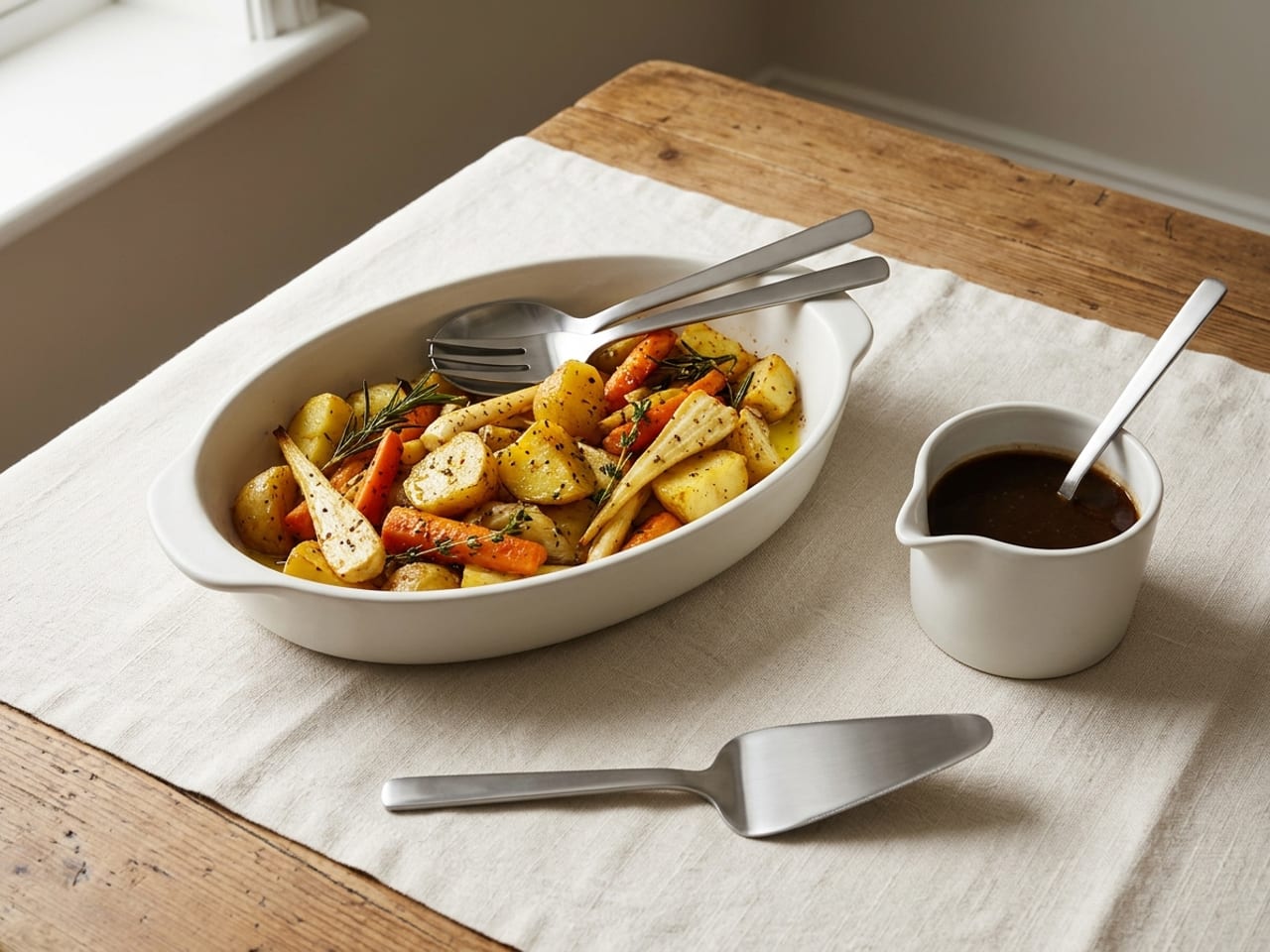
Serving spoon
Names: Serving spoon (a pierced, slotted version is sold too: Oneida, Gorham).
What it is for. Serves from the dish: Post 1922 has "a serving spoon (somewhat larger than an ordinary tablespoon) is put on all dishes".37
How to tell it from the table spoon. Larger than the table spoon where one maker prints both: Christofle Malmaison's serving spoon is 13.00 in (33.0 cm) against its 8.12 in table spoon.
Where it sits. On the dish it serves (Post 1922).37
Length. 22.9 to 33.0 cm (9.0 to 13.0 in), 3 makers. As printed: Robert Welch Malvern Bright: 251 mm (9.9 in)6; Oneida Butler: 9 in (22.9 cm)1; Christofle Malmaison, large: 13.00 in (33.0 cm)3.
Serving fork
Names: Gorham also sells a cold meat fork.
What it is for. Serves meat and vegetables from a platter (ours); sold beside the serving spoon by Oneida, Robert Welch and Christofle.1, 3, 6
How to tell it. A large fork, about the serving spoon's length at Robert Welch (249 and 251 mm) and Oneida (8.9 and 9 in); Christofle's is 9.87 in against its 13.00 in spoon.
Where it sits. With the platter it serves (ours).
Length. 22.6 to 25.1 cm (8.9 to 9.9 in), 3 makers. As printed: Robert Welch Malvern Bright: 249 mm (9.8 in)6; Oneida Butler: 8.9 in (22.6 cm)1; Christofle Malmaison, large: 9.87 in (25.1 cm)3.
Gravy or sauce ladle
Names: Gravy ladle (Gorham, Christofle, Oneida); sauce ladle (Robert Welch).
What it is for. Serves gravy or sauce (ours). It is in Oneida's 3-piece hostess set, Etiquette Scholar's four-piece hostess set and its 43-piece service for eight.1, 31
How to tell it. A small deep bowl on a handle (ours), smaller than a soup ladle (Christofle's soup ladle is 11.50 in, 29.2 cm).3
Where it sits. With the gravy boat (ours).
Length. 16.5 to 17.8 cm (6.5 to 7.0 in), 3 makers. As printed: Gorham Chantilly: 6.75 in (17.1 cm)2; Robert Welch Malvern Bright sauce ladle: 165 mm (6.5 in)6; Christofle Malmaison: 7.00 in (17.8 cm)3.
Master butter knife
Names: Master butter knife or butter serving knife; "butter knife" in Victorian use (Wikipedia).
What it is for. "Master butter knife designed for serving from the butter dish" (Gorham, as its retailer prints it). Eliza Leslie, 1853: "Always take butter with the butter-knife, and then do not forget to return that knife to the butter-plate."2, 39
How to tell it from the butter spreader. Pointed, and only one on the table: "It usually has a pointy end" (Silver Superstore); the spreader at each place is rounded.40, 41, 49
Where it sits. "The butter serving knife sits with the butter dish." (Silver Superstore)40
Length. Two makers: Gorham 16.8 cm (6.6 in); Oneida 17.8 cm (7.0 in). As printed: Gorham Chantilly butter serving knife: 6.63 in (16.8 cm)2; Oneida Butler butter serving knife: 7 in (17.8 cm)1.
Sugar spoon
What it is for. Serves sugar from the bowl (ours); in hostess sets from Oneida and Gorham, and Sambonet sizes it between the dessert spoon and the teaspoon.1, 2, 19
How to tell it. A teaspoon-sized serving spoon, often with a shaped bowl (ours).
Where it sits. With the sugar bowl (ours).
Length. Two makers: Gorham 15.2 cm (6.0 in); Oneida 15.9 cm (6.3 in). As printed: Gorham Chantilly: 6.00 in (15.2 cm)2; Oneida Butler: 6.25 in (15.9 cm)1.
Cake or pie server
Names: "Cake/Multi Server" (Christofle).
What it is for. Cuts and lifts a slice of cake or pie (ours); Gorham and Etiquette Scholar put a pie server in the six-piece hostess set.2, 31
How to tell it. A flat, wedge-shaped blade (ours).
Where it sits. With the cake or pie (ours).
Length. Two makers: Robert Welch 25.1 cm (9.9 in); Christofle 27.3 cm (10.8 in). As printed: Robert Welch Malvern Bright cake / pie server: 251 mm (9.9 in)6; Christofle Malmaison cake multi-server: 10.75 in (27.3 cm)3.
Carving knife and fork
Names: Carving set (carving knife and carving fork).
What it is for. Carves a roast at the table or sideboard (ours).3, 19
How to tell it. Among the longest pieces of a silver service in what we read.3
Where it sits. Beside the roast (ours).
Length. One maker we read: Christofle 27.6 to 33.0 cm (10.9 to 13.0 in). As printed: Christofle Malmaison carving fork: 10.87 in (27.6 cm)3; Christofle Malmaison carving knife: 13.00 in (33.0 cm)3.
The look-alikes: which piece is which
Five pairs and groups people mix up, each as a small table built from the same rows as the main table, then what the sources say about the difference.
Fish knife vs butter knife (and dinner knife)
| Piece | Length (makers' specs) | The tell |
|---|---|---|
| Fish knife | 19.4 to 22.4 cm (7.6 to 8.8 in), 5 makers | A wide, flat, dull blade, often with a notch near a pointed tip (Etiquette Scholar); Cambridge: "a knife for eating fish, with a wide blade and a round edge". The butter spreader is much shorter, the smallest knife on the table, with a rounded blade.28, 51 |
| Butter spreader | 14.9 to 17.1 cm (5.9 to 6.8 in), 4 makers | A rounded tip and one at each place. The master butter knife is a serving piece that "sits with the butter dish" and "usually has a pointy end" (Silver Superstore).40, 41 |
| Dinner knife | 21.6 to 26.4 cm (8.5 to 10.4 in), 9 makers | The set's own knife. A steak knife is serrated with a sharp tip, and Etiquette Scholar says it is "not made as part of a set of flatware" (though Christofle and Robert Welch both sell one in-pattern).3, 6, 28 |
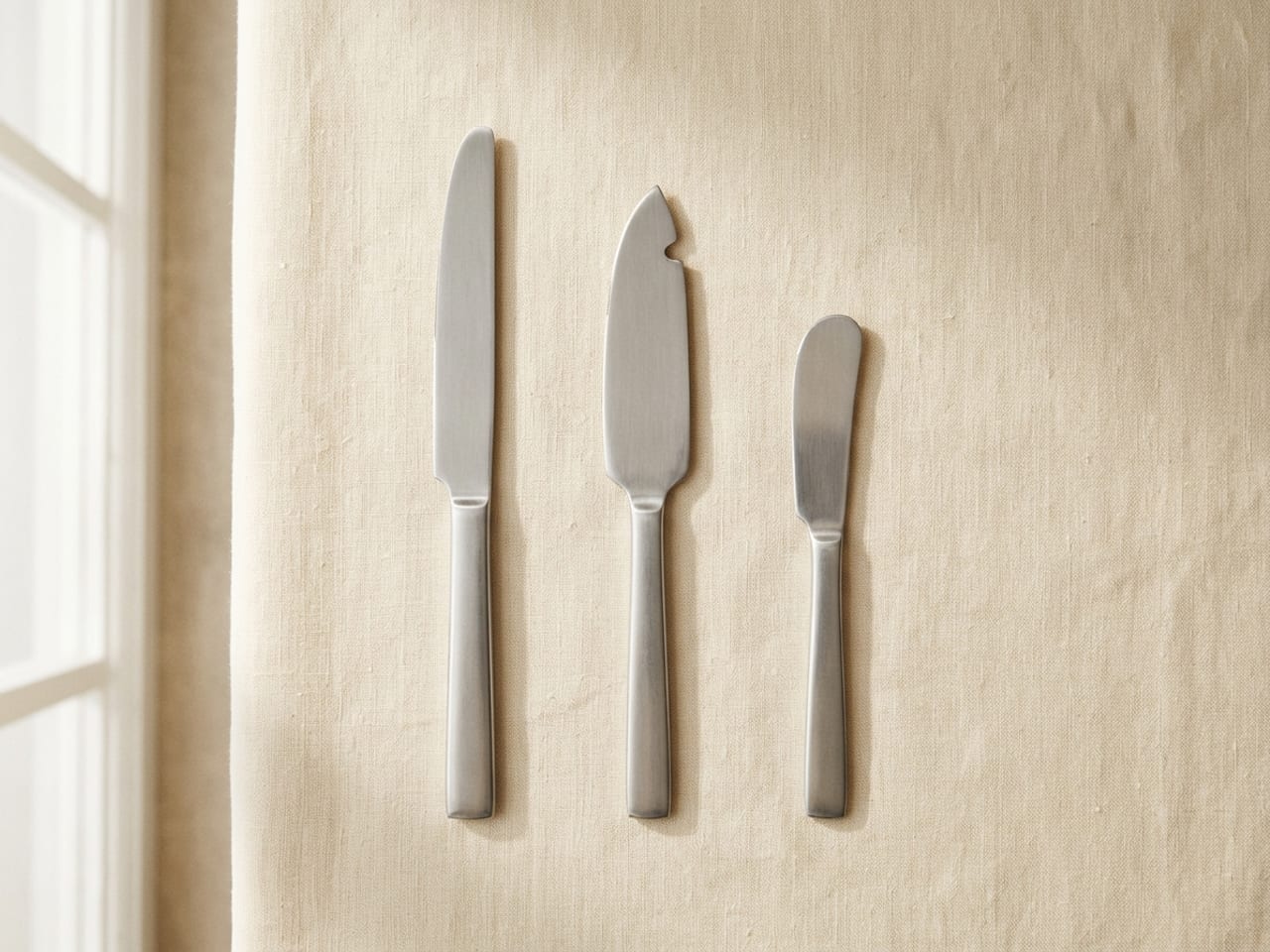
Length settles most cases. Fish knives run 19.4 to 22.4 cm (7.6 to 8.8 in) in the makers' figures we read, not far short of dinner knives at 21.6 to 26.4 cm (8.5 to 10.4 in); butter spreaders run 14.9 to 17.1 cm (5.9 to 6.8 in), the shortest knife on the table. Then the blade: the fish knife's is wide, flat and dull, often notched or pointed near the tip; the spreader's is small and rounded.28, 51 And the place: a fish knife lies with the knives, right of the dinner knife; a spreader lies across the bread plate.25, 26
What the fish knife does is where sources split: Christofle says it cuts ("producing fine, clean slices"), Etiquette Scholar that its point separates the skeleton and lifts the bones, and Wikipedia that it "is not designed for cutting."21, 28, 47 How to hold it is in fine dining etiquette.
The pair became a television moment on Below Deck Mediterranean (season 9, episode 11, aired August 2024): a guest asked why she had a butter knife, and the chief stew, Aesha Scott, told her it was a fish knife.65, 66 No source we read describes the knife on screen, so we cannot say more than the tells above.
Butter knife vs butter spreader vs master butter knife
| Piece | Length (makers' specs) | The tell |
|---|---|---|
| Butter spreader | 14.9 to 17.1 cm (5.9 to 6.8 in), 4 makers | A rounded tip and one at each place. The master butter knife is a serving piece that "sits with the butter dish" and "usually has a pointy end" (Silver Superstore).40, 41 |
| Master butter knife | Two makers: Gorham 16.8 cm (6.6 in); Oneida 17.8 cm (7.0 in) | Pointed, and only one on the table: "It usually has a pointy end" (Silver Superstore); the spreader at each place is rounded.40, 41, 49 |
"Butter knife" names two different pieces. The butter spreader is your own, one at each place, with a rounded tip; the master butter knife is shared, usually pointed, and "sits with the butter dish".40, 55 In 1853 Eliza Leslie meant the shared one: take butter with it, then "return that knife to the butter-plate."39 Debrett's still has butter "taken from the butter dish, using the butter knife and placed on the edge of your side plate."33
The names do not line up between sources: the Emily Post Institute, Post in 1922 and Robert Welch all call the individual one a butter knife, and Etiquette Scholar's six-piece hostess set calls its serving piece a "butter spreader".6, 25, 31, 37 A seller's blog adds that "a single pattern may offer eight or more different styles of butter handling utensils."41 Go by the tip and by where it lies (ours). A dinner knife is neither: it is longer and is laid on the right, though in a 5-piece set it does the spreading too.15 The table setting guide's butter spreader entry has the dictionary wording.
Salad fork vs dinner fork vs dessert fork
| Piece | Length (makers' specs) | The tell |
|---|---|---|
| Dinner fork | 18.4 to 21.3 cm (7.2 to 8.4 in), 9 makers | The longer of the two forks in a 5-piece set. The salad fork is shorter and, in Christofle's words, "wider than a table fork, with one side used to cut salad leaves."20, 25 |
| Salad fork | 15.2 to 18.4 cm (6.0 to 7.2 in), 7 makers | Shorter than the dinner fork, and wider: Christofle says one side cuts the leaves; Etiquette Scholar gives salad, fish, dessert and pastry forks "a wide left tine and an optional notch".20, 29 |
| Dessert fork | Two makers: Christofle 17.1 cm (6.8 in); Robert Welch 19.0 cm (7.5 in) | Often the same fork as the salad fork: Yamazaki sells a "salad/dessert fork", one retailer's 5-piece setting has a dessert fork where the others have a salad fork, and the Emily Post Institute says salad forks "can often double as dessert forks".17, 18, 27 |
| Cake or pastry fork | 15.2 to 16.3 cm (6.0 to 6.4 in), 3 makers | One wider, bevelled outer tine that cuts: Sambonet's has "only three prongs, the outer one of which is wider than the others so that it can serve as a knife". Tine counts vary: Wikipedia gives three or four.19, 50 |
In the makers' figures we read the salad fork is the shorter, 15.2 to 18.4 cm (6.0 to 7.2 in) against 18.4 to 21.3 cm (7.2 to 8.4 in) for dinner forks, though the ranges touch: Lenox's Alcott salad fork is as long as Oneida's Louisiana dinner fork.1, 5 It is usually wider too: Christofle says "wider than a table fork, with one side used to cut salad leaves"; Etiquette Scholar gives salad, fish, dessert and pastry forks a wide left tine.20, 29
Salad fork vs dessert fork: often the same fork. Yamazaki sells a "salad/dessert fork", one Oneida pattern a "Dessert/Salad Fork", and the Emily Post Institute says salad forks "can often double as dessert forks".1, 17, 27 Dessert fork vs cake fork: the cake (pastry) fork has one wider, sharpened outer tine for cutting; sources disagree on tine counts, so count the wide tine, not the tines.19, 20, 50 A "place" fork and a "dinner" fork can be two sizes of the same piece in one pattern: see sizes.
Oyster fork vs cocktail fork
| Piece | Length (makers' specs) | The tell |
|---|---|---|
| Oyster fork | Two makers: Gorham 14.0 cm (5.5 in); Christofle 14.6 cm (5.8 in) | The smallest fork in a set, with "three short, broad tines" (Wikipedia). Whether a cocktail or seafood fork is the same fork, sources split: Wikipedia and Christofle say yes, Tasting Table describes a seafood fork as a different, larger fork.3, 46, 48 |
| Snail fork | No maker's printed length in what we read; Etiquette Scholar gives about 4½ in (11.4 cm). | Two tines: "The snail fork is approximately 4½ inches in length with two long, pointed tines." (Etiquette Scholar)29 |
| Lobster fork or pick | No maker's printed length in what we read; Etiquette Scholar gives 6¾ to 8 in (17.1 to 20.3 cm). | "The lobster fork is larger than the oyster fork and has a different use." (Christofle)20 |
Wikipedia treats them as one fork: "An oyster fork, also known as a cocktail fork or seafood fork", the later names having come in "as other seafood became popular"; Christofle sells one "Oyster/Cocktail Fork" and Gorham's same-size piece is called a cocktail fork.2, 3, 48 Tasting Table disagrees, describing a seafood fork that is "more petite than a regular table fork yet larger than a salad fork" and usually four-tined, beside an oyster fork that "is short with three short, slightly curved tines."46 Either way it is the smallest fork with short, broad tines, and it is the one fork laid on the right.26
Formal or informal? Sources split too: the Emily Post Institute lays it at a formal setting, Etiquette Scholar says "The oyster fork is used only in informal dining."26, 29 The other shellfish forks are easy to tell: the snail fork has two long, pointed tines, and the lobster fork is "larger than the oyster fork".20, 29 Eating oysters is in fine dining etiquette.
Dessert spoon vs soup spoon vs table spoon vs teaspoon
| Piece | Length (makers' specs) | The tell |
|---|---|---|
| Table spoon | Two makers: Christofle 20.6 to 21.0 cm (8.1 to 8.3 in); Amefa 20.5 cm (8.1 in) | The largest spoon of a set. As a measure it is a different thing: 15 mL on US food labels and 20 mL in Australia (see the measures below).51, 57, 58 |
| Soup spoon (oval) or place spoon | 17.1 to 20.7 cm (6.8 to 8.1 in), 6 makers | An oval bowl in Etiquette Scholar; Viners, a British maker, describes its soup spoon as having "a deep, circular bowl". Each is one source's pattern, not a national rule. The round cream soup spoon is the one made with a circular bowl (Etiquette Scholar).10, 30 |
| Dessert spoon | 17.1 to 18.9 cm (6.8 to 7.4 in), 6 makers | "The dessert spoon is a similar size to a soup spoon; however, it features an oval bowl rather than a round one." (Viners). Post 1922: "the spoon which is double the size of a teaspoon is known as nothing but a dessert spoon".10, 37 |
| Cream soup spoon (round) | Two makers: Gorham 15.9 cm (6.3 in); Christofle 16.5 cm (6.5 in) | A round bowl, "made with a round bowl to fit the shape of the cream soup bowl" (Etiquette Scholar), and shorter than the oval soup spoon in the makers' figures.30 |
| Teaspoon | 13.1 to 16.5 cm (5.2 to 6.5 in), 6 makers | Bigger than the coffee or demitasse spoon. At Robert Welch the US teaspoon is 160 mm long, the English one 134 mm.6 |
| Demitasse or espresso spoon | 10.2 to 13.3 cm (4.0 to 5.3 in), 7 makers | Shorter than a teaspoon with a smaller bowl: Robert Welch's coffee spoon bowl is 21 mm wide, its English teaspoon's 27 mm.6 |
Bowl first: a dessert spoon has an oval bowl, a cream soup or bouillon spoon a round one, and the oval soup spoon is oval but is sold in US sets as the all-purpose place spoon.10, 30, 34 Miss Manners describes the old family: "a large oval tablespoon that was used for clear soup served in soup plates, a round spoon used for cream soup served in soup cups, a smaller round spoon for bouillon and a medium-sized oval spoon used for dessert."34 Wikipedia's claim that British soup spoons are round and continental ones oval carries no citation there, so we leave it out. Viners, a British maker, does describe its soup spoon as having "a deep, circular bowl", while Etiquette Scholar's oval soup spoon is oval: each is one source's pattern, not a national rule.10, 30
Size next: the table spoon is the largest, 20.5 to 21.0 cm (8.1 to 8.3 in) in two makers' patterns; the dessert spoon sits between it and the teaspoon, and Post in 1922 put the dessert spoon at "double the size of a teaspoon".3, 13, 37 One maker even sells one piece as "Tablespoon/Dessert Spoon".14 And the words "tablespoon" and "teaspoon" are also measures, which are not the same size as the spoons on the table: see spoon names as measures.
Silverware vs flatware vs cutlery, and the names that change
Silverware vs flatware vs cutlery
The same knives, forks and spoons, three words by region. Cambridge marks cutlery as the UK word, "( US usually silverware )", and flatware as the US one, "( UK cutlery )"; Oxford and Longman both mark cutlery as especially British; Oxford gives flatware or silverware for North America and Longman gives silverware.51, 52, 53 Silverware need not be silver: Oxford's American dictionary has it "made of metal but not necessarily silver".52 Two catches. In North America "cutlery" also means sharp knives (Oxford: "knives, etc. that are sharp"; the American Dictionary.com entry lists "cutting instruments collectively" first).52, 54 And flatware first meant plates and dishes; its US sense of domestic cutlery is recorded by 1895.56 The word cutlery itself comes through Middle English from Old French coutellerie, from coutel, "knife".52 The table setting guide keeps the short entry.
US and UK names for the same pieces
- The big knife and fork: dinner (or place) knife and fork in the US; table knife and table fork in British makers' ranges (Arthur Price, Robert Welch, Viners); "joint knife" and "joint fork" in the UK catering textbook Food and Beverage Service; "large knives and forks" in Debrett's.6, 9, 10, 32, 36 Dictionary.com's American entry gives case knife as another name for a table knife; the British (Collins) entry knows only the sheath knife.54
- The middle spoon: the British dessert spoon (also "dessert (pudding)" spoon in Debrett's, "sweet spoon" in the 1990 catering textbook, where the 1971 edition said "Dessert spoon") is close to the spoon a US 5-piece set sells as the oval soup, place or dinner spoon (our reading: the sources give a similar size and an oval bowl, and Etiquette Scholar says the place spoon eats "soup, cereal, and dessert").1, 15, 32, 36 Gorham's Strasbourg "Place Spoon" is "an elegant sterling silver oval soup spoon".2
- The big spoon: a British tablespoon is "a large spoon used for serving food", the American one "a spoon that contains 15 mililitres, used for measuring food" (Cambridge's spelling).51 British sources disagree on whether it is everyday cutlery: Debrett's lists tablespoons among the pieces you meet "on a day-to-day basis", while Viners says it "is not part of a place setting".10, 32
- The small pieces: butter spreader in the US retailers' lists and butter knife in Robert Welch's and Arthur Price's (our reading from the catalogues); fish knife and "Fish Blade" (Arthur Price's catalogue); dessert fork, "sweet fork" (the textbook) and side fork (Robert Welch); English teaspoon and the longer American / US teaspoon, which Robert Welch sells side by side (134 mm and 160 mm, 5.3 and 6.3 in).6, 9, 36
Place, dinner, luncheon and Continental sizes
US silver patterns can come in more than one size of the same knife and fork. Gorham's Chantilly is the one pattern we read that prints three; it is one pattern's example, not a standard:2
| Gorham Chantilly | Fork | Knife |
|---|---|---|
| Place size | 7 3/8 in (18.7 cm) | 9 1/8 in (23.2 cm) |
| Dinner size | 7 1/2 in (19.1 cm) | 9 5/8 in (24.4 cm) |
| Continental size | 8 3/8 in (21.3 cm) | 10 3/8 in (26.4 cm) |
The labels are per maker, so one maker's dinner fork can be shorter than another's place fork (Oneida Louisiana's dinner fork is 7.25 in, 18.4 cm, against Chantilly's 7 3/8 in place fork).1, 2 A smaller luncheon size sits below them: Gorham's luncheon knife is 8.88 in (22.6 cm), "Smaller than a traditional dinner or place knife", and Christofle sells a "standard" (luncheon) fork of 7.37 in (18.7 cm) beside its 8.12 in dinner fork.2, 3 One US replacements dealer says that "Since about 1975 most manufacturers have deemed "place size" the industry standard for 4 piece and 5 piece settings"; that is one dealer's account.43 Miss Manners on place pieces: "Between luncheon and dinner size, they are supposed to fit not only any time of day, but any course."34
Spoon names as measures: teaspoon, dessertspoon, tablespoon
A recipe's teaspoon and tablespoon are volumes, not the spoons on the table. For US nutrition labels "a teaspoon means 5 milliliters (mL), a tablespoon means 15 mL"; that is a labelling rule, not the size of a table spoon.57 Australia's tablespoon is 20 mL: an NSW Health cookbook gives "4 teaspoons or 20ml" and the national food regulator writes "20 ml (1 Australian metric tablespoon)".58, 59 For the dessertspoon, Cambridge's UK entry gives both the spoon and "the amount that a dessertspoon holds"; Wikipedia puts the measure at usually 10 mL, but we found no official UK source for it.50, 51 Mrs Beeton in 1861 made a "DESSERT-SPOONFUL" half a table-spoonful.72 The spoons in a drawer vary: Wikipedia reports a survey of household teaspoons holding from 2.5 to 7.3 mL (the study itself we did not read), and says a spoon's capacity "is defined by neither law nor custom".50 For cooking, use measuring spoons (ours).
Cutlery names in French, Spanish, German and Italian
The headwords and genders below are as Larousse, the Real Academia Española, Duden and Treccani print them (m masculine, f feminine, n neuter); a blank means those four did not give it in what we read.60, 61, 62, 63
| English | French | Spanish | German | Italian |
|---|---|---|---|---|
| Cutlery (the set) Larousse's couvert is one diner's place at table with its plates and glasses, so it is not entered as the cutlery set (the plural couverts is in the weaker list below); in France coutellerie names the cutler's trade (in Canada a boxed set). The RAE's cubierto (m) is one piece of a cubertería. | cubertería (f) | Besteck (n) | ||
| Knife Duden uses Messer in its Besteck entry ("Satz Messer, Gabel, Löffel"), but its own Messer page would not open, so no gender is given here. | couteau (m) | cuchillo (m) | Messer | coltello (m) |
| Fork | fourchette (f) | tenedor (m) | Gabel (f) | forchetta (f) |
| Spoon | cuillère (or cuiller) (f) | cuchara (f) | Löffel (m) | cucchiaio (m) |
| Teaspoon, small spoon | petite cuillère (f) | cucharilla (f) | Teelöffel (m) | cucchiaino (m) |
| Table or soup spoon (our label) Duden: the Esslöffel is the larger spoon "besonders zum Essen von Suppe", and a Suppenlöffel is an "Esslöffel für die Suppe". | Esslöffel; Suppenlöffel (m) | |||
| Dessert spoon | Dessertlöffel (m) | |||
| Table knife Treccani lists coltello "da cucina, da tavola, da frutta"; Larousse sorts couteaux into non-folding table knives and folding pocket knives. | coltello da tavola (m) | |||
| Fruit knife | coltello da frutta (m) | |||
| Fish knife; fish cutlery | Fischmesser; Fischbesteck (n) |
From weaker sources (Wiktionary, the PONS bilingual dictionary and the Italian, Spanish and German Wikipedias, which we did not check against a national dictionary):64
- French: couverts (m pl) for cutlery; cuillère à café (teaspoon); cuillère à soupe (tablespoon); cuillère à dessert; couteau à beurre; couteau à poisson and couvert à poisson, a fish knife and fork (PONS)
- Spanish: cubiertos (m pl); cuchara de sopa; cuchara de postre; cuchillo de untar (butter knife); cuchillo de pescado; tenedor de pescado; tenedor de postre
- German: Messer (n); Buttermesser (n); Dessertmesser; Butterstreicher
- Italian: posate (f pl) for cutlery; cucchiaio da tavola; cucchiaio da dolce; coltello da burro; coltello da pesce
What cutlery you actually need
Everyday cutlery is a handful of pieces; formal sets add the course pieces. Debrett's splits it the same way: everyday is "large knives and forks, small knives and forks, teaspoons, dessert (pudding) spoons and forks, and tablespoons", and "Extras include blunt knives for butter, fish knives, soup spoons, and extra small spoons for coffee, or for salt and mustard."32 Our advice: start with the five pieces below for each person, and add a course piece only when you serve that course often (steak knives if you serve steak, a fish set if you serve fish).
What a US 5-piece place setting holds
Two forks, one knife, two spoons, in all 10 listings we read, with small differences in the names:
| Maker or listing | The five pieces, as printed |
|---|---|
| Oneida (Chef's Table, Diameter, Easton, Louisiana, Butler)1 | salad fork, dinner fork, dinner knife, oval soup spoon, teaspoon |
| Reed & Barton 18004 | salad fork, dinner fork, dinner knife (hollow handle), oval soup spoon, teaspoon |
| Lenox Alcott and Eternal Frosted5 | salad fork, dinner fork, dinner knife, oval soup spoon, teaspoon |
| Christofle Malmaison, Marly, Cluny3 | salad fork, dinner fork, dinner knife, soup spoon, teaspoon |
| Nambe Dune (a retailer)16 | one salad fork, one dinner fork, one dinner knife, one soup spoon, one teaspoon |
| Yamazaki Merge (a retailer)17 | dinner knife, dinner fork, salad/dessert fork, soup/cereal spoon, teaspoon |
| Oneida Myles (a retailer's service for 4)15 | dinner fork, salad fork, dinner spoon ("Used for soup and cereal"), teaspoon, dinner knife |
| Etiquette Scholar (buying guide)31 | dinner knife, dinner fork, teaspoon, salad fork, soup spoon |
| The Lark, Denver (a retailer)18 | dinner fork, dinner knife, teaspoon, soup spoon, dessert fork |
| Gorham Chantilly2 | 4-piece: salad fork, place fork, place knife, teaspoon; the 5-piece adds an oval soup or cream soup spoon |
Etiquette Scholar's buying guide counts up from three pieces: "The minimum number is three: dinner knife, dinner fork, and teaspoon." A fourth is the salad fork, a fifth the soup spoon, a sixth the butter spreader, and a seventh "an iced beverage spoon ... or a seafood cocktail fork".31 So you may never need a separate butter spreader: in a 5-piece set the dinner knife spreads (our reading).15
What a 24-piece cutlery set holds
Six place settings of four pieces: a table knife, a table fork, a large spoon and a teaspoon each. The large spoon is where makers split, so read the box:
| Maker | The 24 pieces, as printed | Large spoon |
|---|---|---|
| Arthur Price (Grecian)8 | 6 table knives, 6 table forks, 6 dessert spoons, 6 teaspoons | Dessert spoon |
| Viners10 | 6 table knives, 6 table forks, 6 dessert spoons, 6 teaspoons | Dessert spoon |
| Sabre Paris (UK shop)12 | 6 table forks, 6 table knives, 6 dessert spoons, 6 teaspoons | Dessert spoon |
| Robert Welch (Malvern Bright and three other patterns)7 | 6 table knives, 6 table forks, 6 soup spoons, 6 English teaspoons | Soup spoon |
| Amefa (Venus)11 | 6 table knives, 6 table forks, 6 table spoons, 6 medium teaspoons | Table spoon |
| Christofle (Cluny, a US retailer's listing)3 | 6 each standard forks, standard knives, standard/place spoons, coffee spoons | Place spoon, with coffee spoons instead of teaspoons |
Bigger sets add the course pieces. Viners' 44-piece "formal setting" for six adds dessert knives, dessert forks and soup spoons to the 24, plus two table spoons; Robert Welch's 7-piece place setting adds a side knife, side fork and dessert spoon; Christofle's Marly 36-piece service has dessert forks and knives.3, 6, 10 Robert Welch's 16-piece set for four swaps its soup spoons for dessert spoons.7
How many place settings to buy
One etiquette site gives numbers: "Four to eight place settings offer a couple several days' use, but the average family may need eight place settings per day. Those who entertain often may want twelve to sixteen place settings." It adds that catalogues sell them "in sets of four, eight, twelve, and sixteen".31 Our reasoning: count the most people you seat at once, then add the pieces that get used twice in one meal (teaspoons and forks run out first when dessert follows a main), and the dishwasher cycle you wait on. We found no other source that gives a number.
Stainless grades: 18/10 and 18/0
The numbers on the box are the steel's chromium and nickel: "18/10 flatware - 18% Chromium, 10% Nickel" and "18/0 flatware - 18% Chromium, no Nickel", in one seller's FAQ, which also says "the difference between 18/8 and 18/10 is non-existent."42 Arthur Price makes most of its range in what it calls "the highest grade 18/10 stainless steel."23 We read no standard that defines the grades. For one set that does everything, Etiquette Scholar's advice is "stainless steel in a simple pattern."31
Care: the dishwasher question
Makers and appliance brands disagree on silver in the dishwasher, and even Christofle's two care pages differ on stainless. What each says:
- Christofle (maker): "All Christofle cutlery is dishwasher-safe, with the exception of pieces from the Talisman collection." Knives blade down, at most 65°C / 149°F, and "Knives made before 1968 must be washed by hand". Its everyday-care page: wash stainless and sterling separately.22
- GE Appliances (dishwasher maker): Under normal conditions sterling, plate and stainless can go in, but "Do not mix sterling silver with stainless steel in your silverware rack. The stainless steel can cause pitting of the sterling silver."44
- Arthur Price (maker): "Absolutely, all of our cutlery is suitable for dishwashers."23
- Cascade (detergent brand): "It is NOT recommended to wash sterling silver dishes or silverware or silver plated flatware in the dishwasher".45
Christofle also warns that "Highly acidic foods, such as lemon or tomato juice, may cause silver to tarnish more quickly when left in contact with cutlery for extended periods", and that regular use reduces tarnishing.22 Follow your own set's care card when it has one (ours).
Where each piece goes, in short
Placement has its own guide, and the diagram maker draws any setting from a menu; this is the recap, in the same words. The glasses above the knives are in types of glasses.
- Outside in, by course: "Utensils are placed in the order of use; from the outside in."27 Forks on the left, knives and spoons on the right (which side the fork goes).
- Knife blades face the plate (why); the steak knife replaces the dinner knife; the butter spreader lies on the bread plate (steak and butter knives).
- Spoons: soup or first-course spoon outermost, teaspoon inside it (where the spoons go); the oyster fork, the one fork on the right, outside them all (oyster fork).
- Dessert: spoon and fork above the plate, or brought with the dessert (dessert spoon and fork); British sources differ on above or beside the plate, and the table setting guide has both (US, UK and French settings).
- Pieces with no fixed place in what we read (cake fork, lobster fork, demitasse and iced-tea spoons) have no sourced position; the table says "no fixed place" rather than guess. Our reading is that they arrive with their course or drink (ours).
The full layouts are in how to set a table (basic, informal and formal photos with keys, and where everything goes), and the table setting diagram maker draws the setting for the courses you choose. How to hold each piece is in fine dining etiquette: holding the knife and fork, American and Continental styles, soup and resting and finished positions.
Spoon or fork first?
No source we read gives a spoon-or-fork rule. The rule is the order of the courses: the piece for the first course sits outermost, so you start from the outside and work in. The Emily Post Institute puts it as order of use, outside in; Robert Welch as "The general rule with cutlery is to start from the outside and work inwards, from starters to the main course."24, 27 Soup first: the spoon on the far right. Salad first: the fork on the far left.
A short history of the pieces
Specialised pieces multiplied in Georgian and Victorian England: as a Harper's review of Bee Wilson's history of cutlery puts it, "special-purpose silverware proliferated": fish knives and forks, oyster, pickle and cake forks, grapefruit and ice-cream spoons, tongs and servers.71 One estimate has makers designing "nearly two hundred different types of eating or serving implement".70
| When | What |
|---|---|
| 1430 | The table fork in an English inventory, the earliest record of the word in that sense in Etymonline's entry.56 |
| 1611 | An early English account of the fork at table: Thomas Coryat writes that Italians "doe alwaies at their meales use a little" fork, "for the most part made of yron or steele, and some of silver, but those are used only by Gentlemen."67 |
| 1700 to 1800 | "Specialist cutlery for different dishes, such as this fish knife and fork, had evolved in the period 1700-1800." (V&A)68 |
| From about 1830 | Fish knives and forks "were among the most ornate cutlery on the table, with handles of silver plate, mother-of-pearl (as here) or ivory." (V&A)68 |
| 1853 | The butter knife is still shared: Eliza Leslie tells diners to return it to the butter plate.39 |
| 1860 to 61 | An Elkington electroplated fish knife engraved for the London and North Western Railway; the V&A suggests fish eaters "were used first in station restaurants".69 |
| 1861 | Mrs Beeton: "Steel knives and forks should on no account be used in helping fish"; electroplated fish-carvers "answer very well, and are inexpensive". These are serving pieces, not a fish knife at each place.72 |
| 1875 | Routledge's Manual of Etiquette, as Debrett's quotes it: "Silver fish-knives will now always be met with at the best tables".32 |
| 1879 | An etiquette guide gives each diner "two large knives and a silver knife and fork for fish, a tablespoon for soup and three large forks", plus dessert spoons and small forks (as COVE reads it).70 |
| 1898 and 1910 | Two Gorham catalogues (Strasbourg and Buttercup) "together list more than 100 different items of cutlery" (Gastropod).73 |
| 1922 | Emily Post looks back on a table where "enough forks and knives and spoons were arrayed at each "place" for a dozen courses."37 |
| 1927 | Post's enlarged edition sets the limit: "On the properly set table there may never be more than three forks, or two knives."38 |
Why silver for fish? Three wordings of one idea: Beeton's steel imparts "a very disagreeable flavour"; the COVE essay says "it was thought ordinary metal blades blackened when coming into contact with fish"; Bee Wilson, as Harper's reviewer relays her, that silver "did not react chemically with the lemon juice".70, 71, 72 The same review relays Wilson's twist: "The authentically posh didn't use fish knives but instead maneuvered the flesh off the bone and onto the plate by the deft use of two forks", because owning new fish knives "betrayed the fact that you hadn't inherited your silver but bought it."71 We could not establish the earliest oyster fork: the dates we found disagree and their sources were not readable.
Types of cutlery, answered
What are the different types of cutlery?
Four groups: knives, forks, spoons and serving pieces. This page's table lists 31: seven knives, eight forks, nine spoons and seven serving pieces. Most of the rest are for one course or one food. The everyday core is small: a US 5-piece place setting is a dinner knife, a dinner fork, a salad fork, an oval soup (place) spoon and a teaspoon, and a UK 24-piece set is six each of table knives, table forks, a large spoon and teaspoons.
What are the names of cutlery pieces and their uses?
Dinner knife: the main knife of a place setting, used for the main course. Fish knife: a knife with a wide, flat, dull blade, often notched near the tip, used with a fish fork for the fish course. Butter spreader: a small knife with a rounded blade, one at each place, for buttering bread at the table. Dinner fork: the main fork of a place setting, used for the main course. Salad fork: the smaller fork of a place setting, for a salad or an appetizer. Fish fork: a fork with a wide left tine, sometimes notched, used with the fish knife for the fish course. Dessert fork: a smaller fork used with the dessert spoon for dessert. Oyster fork: the smallest fork, with three short, broad tines, for shellfish. Soup spoon (oval) or place spoon: a spoon with an oval bowl for soup with solid pieces. Dessert spoon: a medium spoon with an oval bowl for dessert. Teaspoon: the small spoon of a place setting, for stirring tea or coffee and for small sweet dishes.
What are the types of forks and their uses?
Dinner fork: the main fork of a place setting, used for the main course; called the table fork in Britain. Salad fork: the smaller fork of a place setting, for a salad or an appetizer. Fish fork: a fork with a wide left tine, sometimes notched, used with the fish knife for the fish course. Dessert fork: a smaller fork used with the dessert spoon for dessert; in Britain also the pudding fork. Cake or pastry fork: a small fork with one wider, sharpened outer tine for cutting cake or pastry on the plate. Oyster fork: the smallest fork, with three short, broad tines, for shellfish; the only fork set on the right of the plate. Snail fork: a narrow fork with two long, pointed tines for taking snails from their shells. Lobster fork or pick: a long, narrow fork or pick for taking the meat out of lobster claws. Every fork goes on the left of the plate except the oyster fork, which sits on the far right.
What are the types of spoons?
Soup spoon (oval) or place spoon: a spoon with an oval bowl for soup with solid pieces; sold in US sets as the place or dinner spoon for soup, cereal and dessert. Dessert spoon: a medium spoon with an oval bowl for dessert; about the size of the oval soup spoon that US sets sell as the place spoon (our reading). Cream soup spoon (round): a soup spoon with a round bowl, made for cream soup served in a cup or small bowl. Bouillon or round-bowl soup spoon: a small round-bowled spoon for clear soup or bouillon served in a cup. Table spoon: the largest spoon of a cutlery set, used in Britain for serving and in some sets for soup; not the same thing as the tablespoon measure. Teaspoon: the small spoon of a place setting, for stirring tea or coffee and for small sweet dishes. Demitasse or espresso spoon: the smallest spoon of most sets, for the small cup of coffee after a meal. Iced-tea spoon: a long-handled spoon for stirring iced tea or coffee in a tall glass. Grapefruit spoon: a teaspoon-like spoon with a pointed or serrated tip for eating grapefruit halves.
What are the types of table knives and their uses?
Etiquette Scholar says table knives are "made in seven sizes": dinner, steak, luncheon, fish, dessert and fruit knives and the butter spreader. Our table has dinner knife, steak knife, fish knife, butter spreader, dessert knife, fruit knife and cheese knife, plus the master butter knife and the carving knife among the serving pieces. Kitchen knives are a different family.
What is the difference between silverware, flatware and cutlery?
Mostly where you are. Cambridge, Oxford and Longman mark cutlery as the British word (Longman: "especially British English") for the knives, forks and spoons you eat with; Cambridge and Oxford give flatware or silverware as the American ones, Longman silverware; silverware need not be silver (Oxford: "made of metal but not necessarily silver"). In North America cutlery can also mean sharp knives, the trade sense.
What is the difference between a fish knife and a butter knife?
A fish knife is the longer one, 19.4 to 22.4 cm (7.6 to 8.8 in) in the makers' figures we read, with a wide, flat, dull blade, often notched near a pointed tip, laid with a fish fork for the fish course. A butter spreader is the smallest knife on the table, 14.9 to 17.1 cm (5.9 to 6.8 in), with a rounded blade, and it lies on the bread plate. On Below Deck Mediterranean (season 9, episode 11, August 2024) a guest asked why she had a butter knife and the chief stew, Aesha Scott, told her it was a fish knife, as Bravo reported.
Is a dessert spoon the same as a tablespoon?
British sources differ. Viners lists a place setting's spoons as the dessert spoon (medium, oval bowl), the soup spoon and the teaspoon, and says the table spoon, the largest, "is not part of a place setting"; Debrett's, though, lists tablespoons among everyday pieces, and Amefa's 24-piece set holds table spoons. In the US the oval soup or place spoon is sold as the all-purpose spoon, dessert included (ours: the dessert spoon's job), and "tablespoon" is mostly the measure: 15 mL on US nutrition labels. As measures, Mrs Beeton (1861) made a dessert-spoonful half a table-spoonful; Wikipedia gives the dessertspoon measure as usually 10 mL, but we found no official UK source for it.
What is the difference between a salad fork and a dinner fork?
The salad fork is shorter, 15.2 to 18.4 cm (6.0 to 7.2 in) against 18.4 to 21.3 cm (7.2 to 8.4 in) for dinner forks across the makers we read, and often wider, with one side or a wider left tine for cutting leaves. The Emily Post Institute: "The dinner fork, the larger of the two forks, is used for the main course; the smaller fork is used for a salad or an appetizer."
What is in a 24-piece cutlery set?
Six place settings of four pieces: six table knives, six table forks, six large spoons and six teaspoons. The large spoon differs by maker: dessert spoons at Arthur Price, Viners and Sabre Paris, soup spoons at Robert Welch, table spoons at Amefa.
What is in a 5-piece place setting?
A salad fork, a dinner fork, a dinner knife, an oval soup spoon (also sold as a place or dinner spoon) and a teaspoon, in the 10 listings we read, with two exceptions: one retailer puts a dessert fork in the salad fork's place, and Gorham's 4-piece leaves out the soup spoon.
Do you use the spoon or the fork first?
No source we read gives a spoon-or-fork rule. The rule is order of use, "from the outside in" (Emily Post Institute): whichever course comes first, its piece sits outermost. Soup first means the soup spoon, far right, comes first; a first-course salad means the salad fork, far left.
Where does the oyster fork go, and is it a cocktail fork?
On the far right, outside the spoons: the Emily Post Institute calls it "the only fork ever placed on the right of the plate." Wikipedia and Christofle treat oyster fork and cocktail fork as one piece; Tasting Table describes a seafood fork as a different, larger fork. Sources also split on formal use: Etiquette Scholar says the oyster fork "is used only in informal dining", while the Emily Post Institute lays it at a formal setting.
What are the names of cutlery in French, Spanish, German and Italian?
Knife, fork, spoon: French couteau (m), fourchette (f), cuillère (f); Spanish cuchillo (m), tenedor (m), cuchara (f); German Messer, Gabel (f), Löffel (m); Italian coltello (m), forchetta (f), cucchiaio (m). For the set, Spanish cubertería (f) and German Besteck (n) come from the national dictionaries; French couvert in Larousse is one diner's place, and the plural couverts for cutlery comes from weaker sources, as does Italian posate.
Laying a table for a dish you plated? Photograph the plate and Plate Artists re-plates that dish, with the food kept as it is and the changes named. Start with a re-plate.
Your food, plated like a chef's
Snap it, upload it, and get the composed version back, with the steps to recreate it at home.
Start free · 1 enhancement →Free account · 1 free enhancement · No credit card
How this page was made
We measured nothing and tested nothing for this page. Every length is a maker's printed figure, read on the maker's own page or where a retailer or restaurant-supply distributor prints the maker's number (each source entry says which); a range runs across the patterns we read, never a standard, and the conversions (1 in = 2.54 cm, rounded to 0.1) are ours. Uses and placements are quoted from the etiquette and service sources, the names from the dictionaries, makers' catalogues and the etiquette sources (the Etymonline dates are a prior reading); the UK catering textbook and Miss Manners' book were read only as search fragments. The grouping, the advice and anything marked ours are ours. The figures are AI renders of one plain pattern, not photographs of a real set. Read 4 November 2026.
The makers, dictionaries and etiquette sources behind this page
How each source was read (the maker's own page, a retailer or distributor printing the maker's figure, in full, as search fragments of a lending-only scan, or as a prior reading) is in its entry.
- Oneida (lengths as printed by Silver Superstore) (n.d.). Chef's Table, Chef's Table Hammered, Diameter, Easton, Louisiana and Butler stainless flatware pattern pages. silversuperstore.com, each page prints "Flatware lengths" in inches and what the "5pc Place Setting Includes" (salad fork, dinner fork, dinner knife, oval soup spoon, teaspoon); Butler prints the serving pieces; a US retailer's page that prints the maker's own lengths (practice-level: we did not see the maker's sheet); read in full on 4 November 2026. silversuperstore.com
- Gorham (lengths as printed by Silver Superstore) (n.d.). Chantilly sterling flatware: pattern page and single-piece pages (cocktail fork, fish knife and fork, butter spreaders, butter serving knife, demitasse and cream soup spoons, luncheon knife, gravy ladle, cold meat fork, sugar spoon); Strasbourg and Buttercup place spoon pages. silversuperstore.com, the pattern page prints place, dinner and Continental lengths for one pattern and the 4- and 5-piece place settings; the butter serving knife page: "Master butter knife designed for serving from the butter dish"; the Strasbourg "Place Spoon" is "an elegant sterling silver oval soup spoon"; a US retailer's page that prints the maker's own lengths (practice-level: we did not see the maker's sheet); read in full on 4 November 2026. silversuperstore.com
- Christofle (lengths as printed by Silver Superstore) (n.d.). Malmaison, Marly and Cluny silverplate flatware: pattern pages and single-piece pages. silversuperstore.com, Malmaison lists the widest single-pattern inventory we read ("Additional Place Setting Pieces": fish knife and fork, steak knife, butter spreader, ice cream spoon, espresso spoon, cake/pastry fork, oyster/cocktail fork, cream soup spoon, dessert spoon and more) and serving and carving pieces; Marly prints a 36-piece service for 6, Cluny a 24-piece standard service for 6; a US retailer's page that prints the maker's own lengths (practice-level: we did not see the maker's sheet); read in full on 4 November 2026. silversuperstore.com
- Reed & Barton (lengths as printed by Silver Superstore) (n.d.). 1800 stainless flatware pattern page. silversuperstore.com, "5pc Place Setting Includes: Salad Fork Dinner Fork Dinner Knife, HH Oval Soup Spoon Teaspoon" and their lengths; a US retailer's page that prints the maker's own lengths (practice-level: we did not see the maker's sheet); read in full on 4 November 2026. silversuperstore.com
- Lenox (lengths as printed by Silver Superstore) (n.d.). Alcott and Eternal Frosted stainless flatware pattern pages. silversuperstore.com, the same five pieces in the 5-piece place setting, with lengths; a US retailer's page that prints the maker's own lengths (practice-level: we did not see the maker's sheet); read in full on 4 November 2026. silversuperstore.com
- Robert Welch (n.d.). Malvern Bright cutlery: single-piece product pages (table knife and fork, soup spoon, round bowl soup spoon, side knife and fork, dessert spoon, English and American / US teaspoons, coffee / espresso spoon, long handled spoon, fish knife and fork, pastry fork, butter knife, steak knife, serving pieces) and the 7-piece place setting. robertwelch.com (UK maker), the maker's own pages, lengths in millimetres; read in full on 4 November 2026. robertwelch.com
- Robert Welch (n.d.). Cutlery Set 24 Piece pages: Malvern Bright, Stanton Bright, RW2 Satin, Radford Satin. robertwelch.com (UK maker), "24 Piece / 6 People ... Table Knife (6), Table Fork (6), Soup Spoon (6), English Teaspoon (6)"; the 16-piece set for 4 has dessert spoons instead of soup spoons; read in full on 4 November 2026. robertwelch.com
- Arthur Price (n.d.). Everyday Classic Grecian 24 Piece Boxed Set. arthurprice.com (UK maker), "Includes: 6 x Table Knives, 6 x Table Forks, 6 Dessert Spoons and 6 x Teaspoons."; read in full on 4 November 2026. arthurprice.com
- Arthur Price of England (2021). Generations of Style (brochure J19047). Arthur Price (maker catalogue, PDF), the "Standard 7-Piece Place Settings" name the UK pieces (Table Knife, Dessert Spoon, Table Fork, Soup Spoon, Dessert Knife, Tea Spoon, Dessert Fork) and the extras include "Fish Blade", fish fork, coffee spoon, pastry fork; read 4 November 2026 as the PDF's text layer. Arthur Price (PDF)
- Viners (n.d.). Cutlery Set Contents. viners.co.uk (UK maker), what a 16-, 24- and 44-piece set holds and what each piece is for: "The table spoon is the largest spoon in the cutlery range. It is not part of a place setting and is used for preparing and serving food."; table cells read from the page's text, so the column alignment is our reading; read in full on 4 November 2026. viners.co.uk
- Amefa (n.d.). Venus cutlery set 24 pieces. amefa.com (Dutch maker), "Content: 6 medium teaspoons, 6 table forks, 6 table knives, 6 table spoons"; read in full on 4 November 2026. amefa.com
- Sabre Paris (n.d.). 24-piece cutlery sets. sabre-paris.co.uk (French maker's UK shop), "They include 6 table forks, 6 table knives, 6 dessert spoons and 6 teaspoons."; read in full on 4 November 2026. sabre-paris.co.uk
- Libbey, International Tableware, Amefa, Frieling, CAC China and Steelite (as printed by Chef's Deal) (n.d.). Foodservice flatware listings: dinner forks and knives, salad forks, dessert spoons, tablespoon, demitasse, iced tea and fish pieces, pastry forks, a butter spreader. chefsdeal.com, a restaurant-supply distributor's listing that prints the maker's model number and length (for example "Libbey 774452 Fish Knife, 7" 18/8 Steel Blade, Geneva" and "Amefa 906500B000410 Fish Knife 8""); each length counts for its maker, via Chef's Deal; read in full on 4 November 2026. chefsdeal.com
- Oneida, 1880 Hospitality line (as printed by Hubert) (n.d.). Chef's Table Heavyweight 18/0 Dinner Knife (with the pattern's other pieces). hubert.com, prints "6.25"L Bouillon Spoon 6.25"L Teaspoon 7"L Tablespoon/Dessert Spoon 7.25"L Salad Fork"; a restaurant-supply distributor's listing that prints the maker's model number and length; read in full on 4 November 2026. hubert.com
- Oneida (as sold by Finest Flatware) (n.d.). Oneida Myles 20 Piece Fine Flatware Set, Service for 4. finestflatware.com (retailer), the dinner spoon is "The large spoon from the 5 piece place set. Used for soup and cereal."; the dinner knife "Used to cut food and for spreading butter."; read in full on 4 November 2026. finestflatware.com
- Nambe (as sold by Fine Decor Direct) (n.d.). Nambe Dune 5-Piece Place Setting. finedecordirect.com (retailer), "one salad fork, one dinner fork, one dinner knife, one soup spoon and one teaspoon"; read in full on 4 November 2026. finedecordirect.com
- Yamazaki (as sold by My Quick Buy) (n.d.). Yamazaki Merge 5-Piece Place Setting. myquickbuy.com (retailer), "dinner knife, dinner fork, salad/dessert fork, soup/cereal spoon" and a teaspoon; read in full on 4 November 2026. myquickbuy.com
- The Lark (Denver) (n.d.). 5 Piece Place Setting. thelarkdenver.com (retailer), "Dinner Fork; Dinner Knife; Teaspoon; Soup Spoon; Dessert Fork": a dessert fork in the salad fork's slot; read in full on 4 November 2026. thelarkdenver.com
- Sambonet (n.d.). Recognising cutlery and choosing the right one for every meal. sambonet.com (Italian maker), the maker's guide to its pieces, with approximate lengths ("about 20 cm") rather than one pattern's spec: we print them as approximate; read in full on 4 November 2026. sambonet.com
- Christofle (n.d.). The different types of forks. christofle.com (French maker), salad, dessert, cake, fish, oyster and lobster forks, each with what it is for; read in full on 4 November 2026 (US and UK sites). christofle.com
- Christofle (n.d.). The different types of knives. christofle.com (French maker), table, fish, cheese, butter and dessert knives; "The fish knife is reserved for cutting up fish, producing fine, clean slices."; read in full on 4 November 2026. christofle.com
- Christofle (n.d.). Care advice; and Everyday silver care. christofle.com (French maker), the care-advice page says all its cutlery is dishwasher-safe except the Talisman collection, knives blade down, at most 65°C / 149°F, knives made before 1968 by hand; the everyday-care page says to wash stainless and sterling separately (the two pages differ on stainless in the dishwasher); read in full on 4 November 2026. christofle.com
- Arthur Price of England (n.d.). Frequently asked questions. arthurprice.com (UK maker), "Absolutely, all of our cutlery is suitable for dishwashers."; "The majority of our cutlery is made from the highest grade 18/10 stainless steel."; read in full on 4 November 2026. arthurprice.com
- Viners; Robert Welch (n.d.). How to Set a Table; How to set the table. viners.co.uk and robertwelch.com (UK makers), dessert cutlery above the plate, the spoon above the fork; side plates, with the butter knives on top, to the left of the forks (Robert Welch); read in full on 4 November 2026. robertwelch.com
- The Emily Post Institute (n.d.). Informal place setting. emilypost.com, "The dinner fork, the larger of the two forks, is used for the main course; the smaller fork is used for a salad or an appetizer."; read in full on 4 November 2026. emilypost.com
- The Emily Post Institute (n.d.). Formal place setting. emilypost.com, "The specially shaped fish knife goes to the right of the dinner knife."; "It is the only fork ever placed on the right of the plate."; read in full on 4 November 2026. emilypost.com
- The Emily Post Institute (n.d.). Table setting guides. emilypost.com, "Utensils are placed in the order of use; from the outside in."; read in full on 4 November 2026. emilypost.com
- Etiquette Scholar (n.d.). Knives. etiquettescholar.com (etiquette site, no named author), "Table knives are made in seven sizes"; the fish, dessert, fruit and steak knives and the butter spreader; its own approximate lengths are not makers' specs; read in full on 4 November 2026. etiquettescholar.com
- Etiquette Scholar (n.d.). Forks. etiquettescholar.com (etiquette site, no named author), fork types, tines and uses, the seafood (cocktail), oyster, snail and lobster forks; approximate lengths; read in full on 4 November 2026. etiquettescholar.com
- Etiquette Scholar (n.d.). Spoons. etiquettescholar.com (etiquette site, no named author), "The following fourteen types are discussed below in order of descending size"; oval, cream and bouillon soup spoons, place, dessert, iced-beverage, citrus and demitasse spoons; read in full on 4 November 2026. etiquettescholar.com
- Etiquette Scholar (n.d.). Flatware buying guide. etiquettescholar.com (etiquette site, no named author), what a 3- to 7-piece place setting holds, how many settings to buy, hostess sets and the place spoon; one site's advice; read in full on 4 November 2026. etiquettescholar.com
- Debrett's (n.d.). The Curse of Cutlery. debretts.com (UK etiquette publisher), everyday cutlery and "Extras"; puddings with a dessert spoon and fork; jam spoons; a steak knife in a restaurant; quotes Routledge's Manual of Etiquette (1875) on silver fish-knives; read in full on 4 November 2026. debretts.com
- Debrett's (n.d.). Breaking Bread. debretts.com (UK etiquette publisher), butter from the butter dish with the butter knife; cheese knives; when the round soup spoon appeared; read in full on 4 November 2026. debretts.com
- Martin, J. (Miss Manners) (2008). Too many silverware choices. Deseret News (syndicated column), 29 December 2008, the old spoon family: "a large oval tablespoon that was used for clear soup served in soup plates, a round spoon used for cream soup served in soup cups, a smaller round spoon for bouillon and a medium-sized oval spoon used for dessert"; read in full on 4 November 2026. deseret.com
- Martin, J. (1983). Miss Manners' Guide to Excruciatingly Correct Behavior. Warner Books (and later printings), on the fish knife and fork ("In Victorian times, the fish fork and fish knife were invented."); read on 4 November 2026 as Internet Archive full-text search fragments of a lending-only scan (a short window of OCR text, no page image). archive.org
- Lillicrap, D. R. (later with Cousins, J. A.) (1971). Food and Beverage Service (editions of 1971, 1983, 1990, 2006 and 2010; and Cousins, Food and beverage service for levels 1 and 2, 2014). Edward Arnold; Hodder & Stoughton; Hodder Education, the UK catering textbook's covers and cutlery lists ("joint knife", "sweet fork", "small (side) knife") and its specialist-cutlery figure (lobster pick, snail tongs and fork, grapefruit and sundae spoons, caviar knife); read on 4 November 2026 as Internet Archive full-text search fragments of a lending-only scan (a short window of OCR text, no page image), so we quote only what the fragment shows. archive.org
- Post, E. (1922). Etiquette in Society, in Business, in Politics and at Home. Funk & Wagnalls (Project Gutenberg #14314), the dinner table, the dessert spoon ("double the size of a teaspoon"), fruit knife and fork, bouillon spoons; a dated etiquette book; read in full on 4 November 2026. gutenberg.org
- Post, E. (1927). Etiquette: The Blue Book of Social Usage (new and enlarged edition). Funk & Wagnalls (Internet Archive scan), "On the properly set table there may never be more than three forks, or two knives."; read 4 November 2026 in the scan's full text. archive.org
- Leslie, E. (1853). Miss Leslie's Behaviour Book. T. B. Peterson (Internet Archive scan), "Always take butter with the butter-knife, and then do not forget to return that knife to the butter-plate."; read 4 November 2026 in the scan's full text. archive.org
- Silver Superstore (n.d.). Butter Knife vs Butter Spreader (FAQ). silversuperstore.com (retailer), "The butter serving knife sits with the butter dish. It usually has a pointy end"; spreaders are usually sold as "additional place setting pieces"; read in full on 4 November 2026. silversuperstore.com
- Silver Chatter (sponsored by Georgia Silver) (2008). Butter Handling Utensils. silverchatter.com (a silver seller's blog), 14 November 2008, master butter knife vs individual spreader, and "a single pattern may offer eight or more different styles of butter handling utensils"; read in full on 4 November 2026. silverchatter.com
- Silver Superstore (n.d.). 18/10, 18/8, 18/0 (FAQ). silversuperstore.com (retailer), "18/10 flatware - 18% Chromium, 10% Nickel"; "18/0 flatware - 18% Chromium, no Nickel"; a seller's FAQ, not a standard; read in full on 4 November 2026. silversuperstore.com
- Silver Queen (n.d.). Sterling Silver Flatware Frequently asked questions. silverqueen.com (US replacements dealer), "Since about 1975 most manufacturers have deemed "place size" the industry standard for 4 piece and 5 piece settings."; one dealer's account of the size names; read in full on 4 November 2026. silverqueen.com
- GE Appliances (n.d.). Dishwasher Washing Flatware. GE Appliances support, "Do not mix sterling silver with stainless steel in your silverware rack. The stainless steel can cause pitting of the sterling silver."; read in full on 4 November 2026. geappliances.com
- Cascade (Procter & Gamble) (n.d.). How To Clean Silverware in a Dishwasher. cascadeclean.com (detergent brand), "It is NOT recommended to wash sterling silver dishes or silverware or silver plated flatware in the dishwasher"; read in full on 4 November 2026. cascadeclean.com
- Tasting Table (n.d.). What Is A Seafood Fork And How Is It Used? tastingtable.com (food website), calls the seafood fork and the oyster fork two different forks; a listicle-grade page, quoted only for that split; read in full on 4 November 2026. tastingtable.com
- Wikipedia contributors (n.d.). Fish knife. Wikipedia, "The fish knife is not designed for cutting."; a crowd-edited encyclopedia (its own citations not checked by us); read in full on 4 November 2026. wikipedia.org
- Wikipedia contributors (n.d.). Oyster fork. Wikipedia, "An oyster fork, also known as a cocktail fork or seafood fork"; "three short, broad tines"; crowd-edited; read in full on 4 November 2026. wikipedia.org
- Wikipedia contributors (n.d.). Butter knife. Wikipedia, the Victorian split into a butter spreader and a serving or "master" butter knife; crowd-edited; read in full on 4 November 2026. wikipedia.org
- Wikipedia contributors (n.d.). Soup spoon; Dessert spoon; Tablespoon; Teaspoon; Grapefruit spoon; Pastry fork. Wikipedia, six articles, used for bowl shapes, the measure-versus-piece split and the cake fork's tines; crowd-edited, their citations not checked by us; read in full on 4 November 2026. wikipedia.org
- Cambridge University Press (n.d.). Cambridge Dictionary: cutlery, flatware, silverware, tablespoon, dessertspoon, teaspoon, fish knife, soup spoon, butter knife. dictionary.cambridge.org, cutlery "( US usually silverware )"; tablespoon, UK: "a large spoon used for serving food", US: "a spoon that contains 15 mililitres, used for measuring food" (Cambridge's spelling); read in full on 4 November 2026. cambridge.org
- Oxford University Press (n.d.). Oxford Learner's Dictionaries: cutlery; silverware and flatware (American English). oxfordlearnersdictionaries.com, cutlery "( North American English usually flatware , silverware )" and a North American sense "knives, etc. that are sharp"; the word's Old French origin; read in full on 4 November 2026. oxfordlearnersdictionaries.com
- Pearson Longman (n.d.). Longman Dictionary of Contemporary English: cutlery. ldoceonline.com, "SYN silverware American English"; read in full on 4 November 2026. ldoceonline.com
- Dictionary.com (with Collins English Dictionary) (n.d.). cutlery; case knife. dictionary.com, the American entry for cutlery lists "cutting instruments collectively" first; the American entry for case knife gives "a table knife.", the British (Collins) entry only the sheath knife; read in full on 4 November 2026. dictionary.com
- Merriam-Webster (n.d.). butter spreader; flatware. merriam-webster.com, butter spreader: "a small knife with rounded blade used for buttering bread at table"; a prior reading for our table setting guide, copied into this run's notes, not re-fetched (the site refused our fetcher on 4 November 2026). merriam-webster.com
- Harper, D. (n.d.). Flatware; cutlery; fork (entries). Online Etymology Dictionary, flatware first meant plates and dishes (1851), its US sense of domestic cutlery recorded by 1895; the table fork in an English inventory of 1430; a prior reading for our table setting guide, copied into this run's notes, not re-fetched, as cited on that guide. etymonline.com
- US Food and Drug Administration (n.d.). 21 CFR 101.9(b)(5)(viii), nutrition labeling of food. Electronic Code of Federal Regulations, "For nutrition labeling purposes, a teaspoon means 5 milliliters (mL), a tablespoon means 15 mL"; a labelling rule, not a size for a table spoon; read in full on 4 November 2026. ecfr.gov
- Sydney Local Health District (NSW Health) (n.d.). Cooking terms and knife safety. NSW Health cookbook (PDF), "tsp = teaspoon = 5ml" and a tablespoon of "4 teaspoons or 20ml"; read 4 November 2026 as the PDF's text. nsw.gov.au (PDF)
- Food Standards Australia New Zealand (n.d.). Survey of chemical contaminants and residues in coffee. FSANZ (PDF), uses "20 ml (1 Australian metric tablespoon)" in its method; read 4 November 2026 as the PDF's text. foodstandards.gov.au (PDF)
- Larousse (n.d.). Dictionnaire de français: couteau, fourchette, cuillère, couvert, coutellerie. larousse.fr, the headwords with their gender as printed ("couteau nom masculin", "fourchette nom féminin"); read in full on 4 November 2026. larousse.fr
- Duden (n.d.). Duden online: Besteck, Gabel, Löffel, Esslöffel, Suppenlöffel, Teelöffel, Dessertlöffel, Fischmesser, Fischbesteck. duden.de, the headwords with their article as printed ("das Besteck", "die Gabel", "der Löffel"); Duden's own page for Messer could not be opened (it returned an error), so the page prints no gender for it from Duden; read in full on 4 November 2026. duden.de
- Real Academia Española (n.d.). Diccionario de la lengua española: cuchillo, tenedor, cuchara, cucharilla, cubierto, cubertería. dle.rae.es, the headwords with their gender as printed ("tenedor m.", "cuchara ... f."); read in full on 4 November 2026. dle.rae.es
- Istituto della Enciclopedia Italiana (Treccani) (n.d.). Vocabolario: coltello, forchetta, cucchiaio, cucchiaino. treccani.it, the headwords with their gender as printed ("coltèllo s. m.", "forchétta s. f."); coltello "da tavola, da frutta"; the page for posata did not load; read in full on 4 November 2026. treccani.it
- Wiktionary; PONS; Italian, Spanish and German Wikipedia (n.d.). Translation boxes for cutlery, knife, fork, spoon, teaspoon, tablespoon, dessertspoon, butter knife; PONS English-French fish knife; Posata, Cubiertos, Besteck articles. wiktionary.org, pons.com, wikipedia.org, crowd-edited or bilingual sources, weaker than the four national dictionaries: the page lists their words separately and labels them so; read in full on 4 November 2026. wiktionary.org
- Feiner, A. (Bravo) (2024). Kate Chastain Reacts to Those "Difficult" Below Deck Med Guests. bravotv.com (The Daily Dish), 12 August 2024, "Aesha Scott corrected a guest who asked why she had a butter knife (it was a fish knife)"; the network's own site; read in full on 4 November 2026. bravotv.com
- Reality Tea (2024). Below Deck Mediterranean Season 9, Episode 11 Recap: Mean Girls. realitytea.com, 12 August 2024, an episode recap, reliable for what was said on screen, not for etiquette; read in full on 4 November 2026. realitytea.com
- Coryat, T. (1611). Coryat's Crudities (1905 MacLehose reprint, vol. 1). Internet Archive scan, Italians "doe alwaies at their meales use a little" fork; read 4 November 2026 in the scan's full text (also a prior reading for our table setting guide). archive.org
- Victoria and Albert Museum (n.d.). Fish fork and knife, designed by George Walton, William Comyns & Sons, about 1902 to 1903 (object O96734). V&A collections, "Specialist cutlery for different dishes, such as this fish knife and fork, had evolved in the period 1700-1800."; read 4 November 2026 through the V&A's collections API. vam.ac.uk
- Victoria and Albert Museum (n.d.). Fish knife, electroplated nickel silver, Elkington and Co., Birmingham, 1860 to 61 (object O96916). V&A collections (National Railway Museum loan), engraved with the London and North Western Railway's logo; "The early date of these fish eaters suggests that they were used first in station restaurants"; read 4 November 2026 through the V&A's collections API. vam.ac.uk
- COVE Editions (n.d.). Cutlery and Victorian Dining Culture. editions.covecollective.org (a peer-edited Victorian studies site; author not named in the text we saved), the fish knife "first appeared at the start of the nineteenth century but gained in popularity from the 1850s onwards"; "nearly two hundred different types" as an estimate; read in full on 4 November 2026. covecollective.org
- Shapin, S. (2013). The Tines They Are A-changin' (review of Bee Wilson, Consider the Fork). Harper's Magazine, January 2013, the reviewer's account of Wilson on special-purpose silverware and fish knives; Wilson's own book not read; read in full on 4 November 2026. harpers.org
- Beeton, I. (1861). The Book of Household Management. S. O. Beeton (Project Gutenberg #10136), on steel and fish ("Steel knives and forks should on no account be used in helping fish") and the spoon measures; read in full on 4 November 2026. gutenberg.org
- Gastropod (podcast) (2014). The Golden Spoon (episode text reposted on a co-host's blog, 29 September 2014). goodreads.com author blog, two Gorham catalogues, 1898 Strasbourg and 1910 Buttercup, "together list more than 100 different items of cutlery"; read in full on 4 November 2026. goodreads.com
Keep going
How to set a table
Basic, informal and formal settings, with every piece's place and the reason for it.
Table setting diagram maker
Pick the menu; it draws the place setting with every fork, knife and spoon.
Fine dining etiquette
How to hold and use each piece at the table, and the resting and finished positions.
Types of plates
Every plate, its size and what it is for, to go with the cutlery.
Types of glasses
Every drinking glass, what goes in it and where it sits, to go with the cutlery.
Plating tools
The chef's spoons, tweezers and spatulas, the kitchen side of cutlery.