Fine dining etiquette: how to eat at a fine-dining restaurant, from the napkin to the bill
The rules for eating out at a formal restaurant, each one credited to the authority that states it and dated, and where the authorities disagree, every side shown.
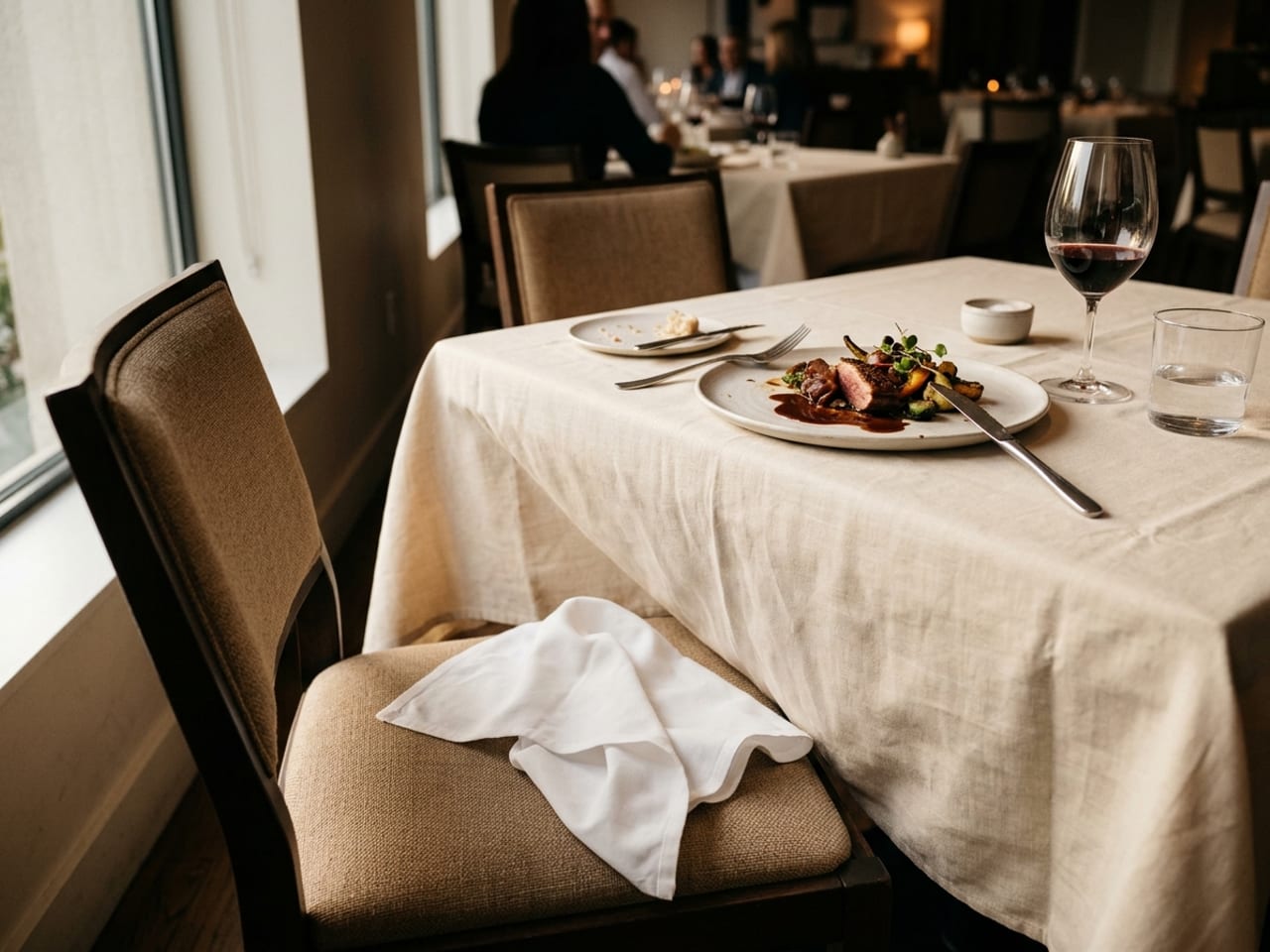
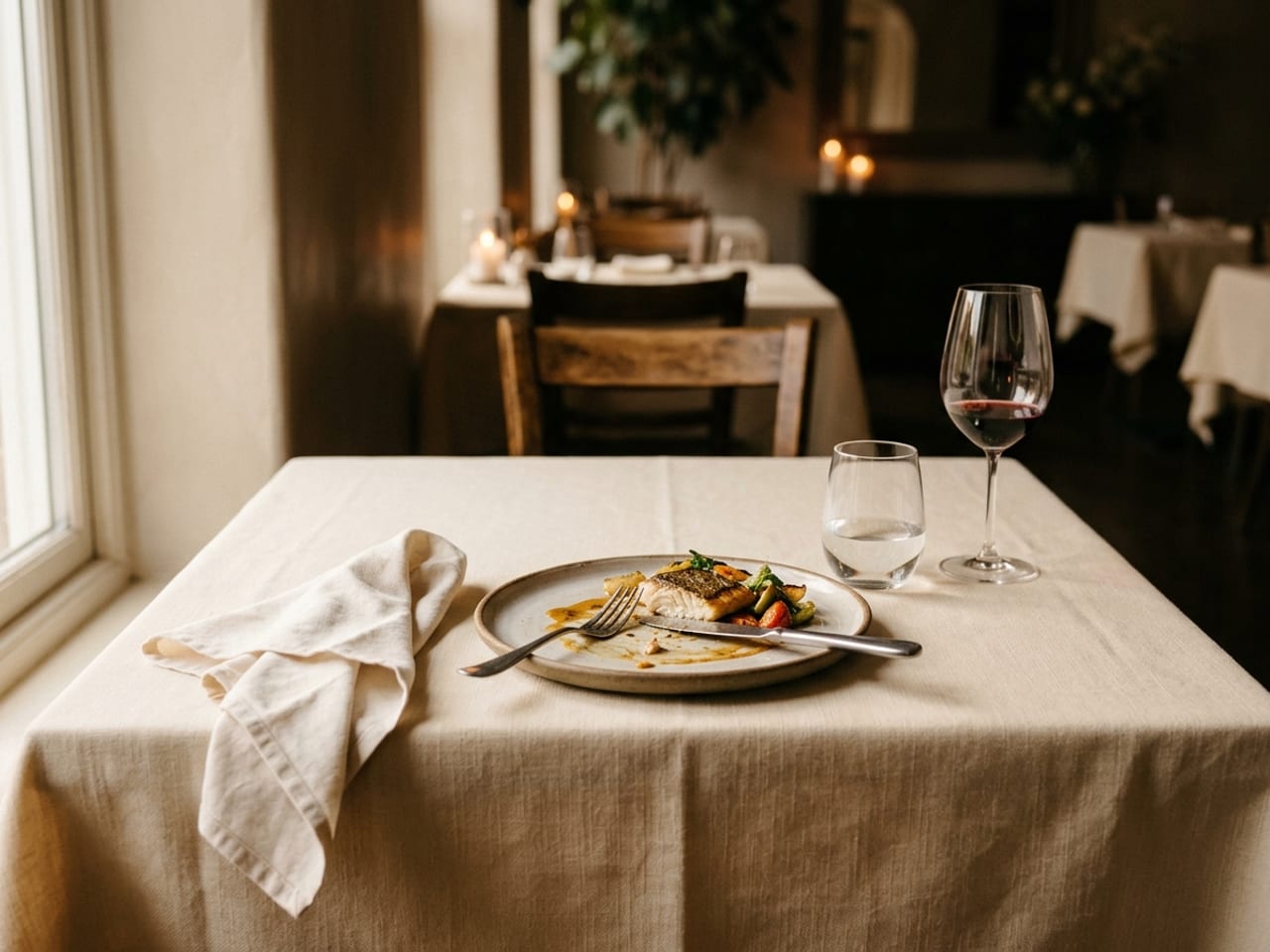
The photos on this page are AI-generated illustrations.
Fine dining etiquette: the rules every authority we read agrees on
Fine dining etiquette, in short: napkin on your lap, wait until everyone is served, use the cutlery from the outside in, break bread by hand, spoon soup away from you, hold a wine glass by the stem, keep elbows off the table while eating, and never put anything from your mouth into the napkin. Those are the rules on which every authority we read that answers agrees; the outside-in rule is drawn on our table setting guide. Where they disagree (the napkin when you get up, how you hold the knife, a spoon with spaghetti, wiping the plate with bread), this page shows each side and who says it.
| The rule | Who says so (every source we read that answers) |
|---|---|
| Wait until everyone is served, unless the host starts or asks you to | Seven: Debrett's, Etiquette Scholar, the Accademia Italiana Galateo, Tasting Table, JNTO (Japan), t-online (Germany), Sabrina Verlezza Cipriani (Italy).38, 43, 52, 69, 76, 79, 81, 130 In a restaurant Debrett's adds: if your dish is late, "insist the others start"; if service is staggered, ask "do you mind if I start?". They split on whether the host says "buon appetito" (below). |
| Break bread by hand, one bite-size piece at a time | Four: Debrett's, the Emily Post Institute, Etiquette Scholar, the Accademia Italiana Galateo.33, 39, 40, 55, 69 Butter each piece as you eat it, where they say (Debrett's, the Emily Post Institute, Etiquette Scholar). |
| Move the soup spoon away from you | Four: Debrett's, the Emily Post Institute, Etiquette Scholar, the Accademia Italiana Galateo.32, 40, 52, 70 The Accademia describes the same stroke as rim to centre. |
| Hold a stemmed wine glass by the stem (or the base) | Four: Debrett's, Maximilian Riedel (glassmaker), Wine Spectator's Dr. Vinny, Südostschweiz (Swiss newspaper).47, 82, 83, 84, 85 Debrett's says it of white-wine glasses, and also that holding the bowl is "no longer a guarantee of social death".46 |
| No elbows on the table while you are eating | Five: Debrett's, the Emily Post Institute, Etiquette Scholar, Sabrina Verlezza Cipriani (Italy), t-online (Germany).30, 38, 64, 79, 81 Between courses they split (below). |
| Nothing from your mouth goes into the napkin | Two: the Emily Post Institute, Etiquette Scholar.31, 62 Emily Post said the same in 1922.148 How it comes out, fork or fingers, is split (below). |
On this page: First time · The napkin · Starting, phones, elbows · Knife and fork · Bread, soup, salt · Hard dishes · Wine · Staff · The bill · By country · History · Popular rules · Terms · FAQ
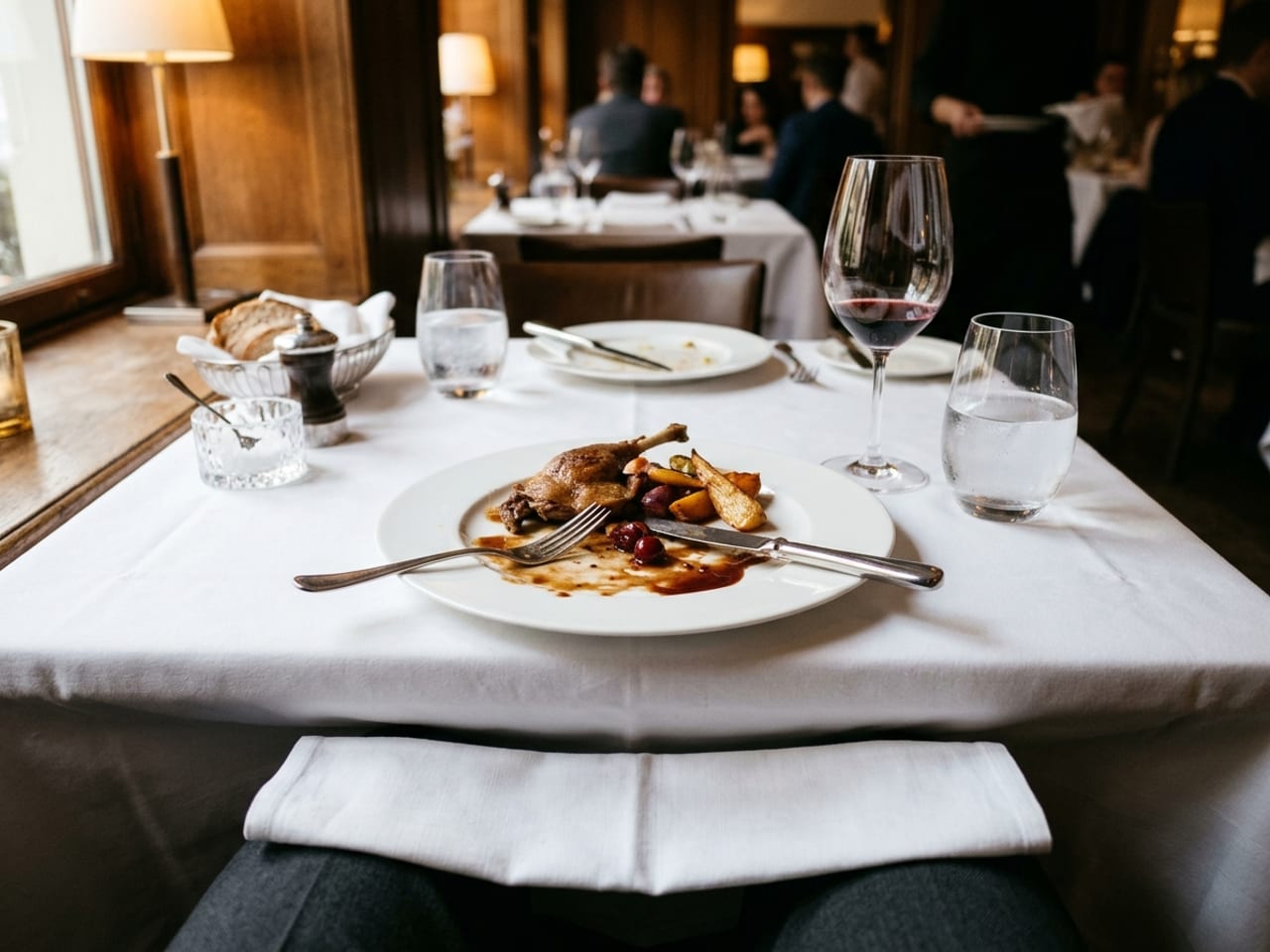
How this page was made. Etiquette is opinion, so every rule here is credited to the authority that states it, with its date or edition: the Emily Post Institute (US), Debrett's (UK), Etiquette Scholar (a US reference website), the Accademia Italiana Galateo (Italy), Japan's national tourism agency, sommelier bodies, service textbooks and training standards, and dated books from Erasmus (1530) to Emily Post (1922 and 1927). Newspapers and magazines quoting trainers, chefs or sommeliers are labelled as such. Where the authorities disagree, each is shown; a line marked "ours" is our own suggestion. We read every page in October 2026; Amy Vanderbilt, Letitia Baldrige and Miss Manners are missing because we could not read their books. Plate Artists ate at, booked and observed nothing for this page. Sources are at the bottom.
What counts as fine dining, and what to expect the first time
Which restaurants are fine dining? There is no single definition. The dictionary and Hong Kong's curriculum make formality part of it; an industry research firm drew the line by price; a Canadian textbook says today's best rooms often skip the tablecloth; and MICHELIN says formality has nothing to do with a star (how stars work is on our Michelin stars guide).
| Who | What fine dining is | Formality? |
|---|---|---|
| Cambridge Dictionary1 Dictionary; Undated, read Oct 2026 | "a style of eating that usually takes place in expensive restaurants, where especially good food is served to people, often in a formal way" | Often |
| Technomic, as FSR Magazine reports it4 Industry research, via a trade magazine; Aug 2014 | A segment by money and drink: dinner, "an extensive alcohol program, and check averages above $50" (2014 dollars) | Not part of it |
| FSR Magazine's writer4 Trade magazine (opinion); Aug 2014 | Checks "likely starting closer to $75"; better defined by "service, dining experience, menu" and "a strong chef presence"; little of the old "stuffiness" | Less than it was |
| BC open textbook, 2nd edition5 Textbook; 2015 to 2021 | "highly trained chefs preparing complex food items, exquisitely presented", "experienced servers with sound food and beverage knowledge"; linens, china and crystal "once mandatory" | No: today "generally no linen tablecloths" |
| Hong Kong Education Bureau6 Government curriculum text; July 2024 | "very high standards in all aspects": an extensive à la carte menu, silver service, a high staff-to-guest ratio, low seat turnover; "Dining etiquette is required" | Yes: "Some require membership and dress code" |
| The MICHELIN Guide2 Restaurant guide; Nov 2025 | No definition. Stars are for "the food on the plate", and "The style of a restaurant and its level of comfort or formality have no bearing on the award" | Irrelevant to a Star |
The same Canadian textbook puts fine dining at under 1% of restaurant visits but 4.2% of the money (the chapter's Restaurants Canada figures), and a casual sit-down meal at 60 to 75 minutes against two to three hours for a multi-course fine-dining one, in a US service textbook.5, 7
Fine dining for beginners: what happens, from the door to the bill
No restaurant publishes its running order, so here is the one a US service textbook teaches its students, in seven phases; the Philippines' national training standard for table service lists much the same steps in much the same order, from the welcome to the bill, and Australia's covers the same ground from the welcome to clearing.7, 12, 13 It is what servers are taught, not a rule every room keeps.
- Arrival and greeting. The host greets you "within 30 seconds", confirms the booking and takes coats "if coat check available".7
- Seating. You are walked to the table, "chairs pulled out in upscale venues", given menus and the specials, and water is poured. Australia's training standard adds "napkin service", and the Philippines' has cloth napkins "opened for the guests when applicable".7, 12, 13
- Drinks and wine. Drinks and wine come before the food order (the wine ritual).7
- Ordering. The order is taken when you look ready, allergies are noted, and bread or the first bites start. The orders are "repeated back to the guests to confirm items" (TESDA), and the cutlery and glasses are changed to suit what each person chose.7, 12, 13
- The courses. Everyone at the table gets the course at once; the server checks back soon after (Nicolet says within 2 minutes; TESDA calls it the "3-minute check"); crumbs are cleared between courses.7, 8, 13
- Clearing and dessert. Main plates are cleared "when all guests finished", then the dessert menu, coffee, tea and after-dinner drinks.7
- The bill. The check comes "when requested (but not before)", and in upscale rooms guests are walked to the door.7
A few things a first-timer may not expect, each from the source named. A restaurateur's rules for his own staff (2009): never refuse to seat three because the fourth is late, and bottled or tap water: "Both are fine"; but Bern's Steak House will "only seat complete parties".14, 26 At a Michelin-starred or "high level" restaurant, Fine Dining Lovers (2016) lists the welcome glass of sparkling wine, bread, the amuse-bouche, the pre-dessert and petits fours among the "unpaid" extras; an aperitif you choose is charged.21 The chef "is not always at the restaurant", and asking about a dish is fine.21 Ours: if a step is unclear, ask the server; that is their job, and the textbooks above train them for it.
Booking, dress and diets
Booking windows, deposits and cancellation charges, how much notice kitchens want for allergies and diets, minimum ages, late arrival and photo rules are on our tasting menu guide, read from restaurants' own pages: booking, dietary needs and allergies, dress and children, pacing and arriving. The tasting-menu restaurants read there required no jacket; the rooms below, mostly à la carte (The Ritz serves tasting menus too), go further: two of the seven we read require one.
| Restaurant | What its own page asks (October 2026) | Jacket |
|---|---|---|
| The Ritz Restaurant22 London, UK | "Gentlemen are required to wear a jacket and tie"; no jeans or sportswear for anyone | Required |
| Galatoire's23 New Orleans, US | Jackets required after 5pm and all day Sunday in the main and second-floor rooms, with "complimentary loaner jackets" | Required |
| Commander's Palace24 New Orleans, US | "Jackets are preferred for gentlemen"; collared shirts and closed-toed shoes required; ripped jeans not allowed | Preferred or recommended |
| Antoine's25 New Orleans, US | Jackets and collared shirts "strongly suggested"; enforced "at the discretion of the manager" | Preferred or recommended |
| Lasserre27 Paris, France | "Elegant dress is required"; "Jackets are recommended for gentlemen" | Preferred or recommended |
| Bern's Steak House26 Tampa, US | Jackets and ties "encouraged, but not officially required"; in T-shirts, shorts or athletic shoes you may be seated in the lounge | Not required |
| Rules28 London, UK | "smart/casual"; no shorts, joggers, tracksuits or sportswear | Not required |
Every one of them rules out sportswear or athletic wear in some form. Other things these pages print: Rules admits only children aged 10 and over after 7pm; The Ritz adds a £58 a person entertainment charge to its à la carte and Epicurean menus on Friday and Saturday evenings.22, 28 Ours: read the restaurant's own page the week you go; these are October 2026 readings.
The napkin: when to unfold it, where it goes when you leave the table, and when you finish
Every source we read that says puts the napkin on your lap; they differ on when, and above all on where it goes when you get up mid-meal. Four of the seven modern sources that answer say the chair; three say on the table, beside or to the left of the plate: the Emily Post Institute because a used napkin on the seat transfers food mess to the chair or your clothes, the Italian and German trainers because the chair is not clean. When you finish, all seven that answer (Staffe in 1899 among them) say beside or to the left of the plate, and none says on it. The two books from 1899 and 1922 are shown as history.
| Source | On your lap | When you get up mid-meal | When you finish |
|---|---|---|---|
| The Emily Post Institute29, 30 Undated, read Oct 2026 | "as soon as you sit down" | Loosely folded, to the left of the plate, "not on the plate or chair you sit in", every time you leave | The same: "'LL' for 'Loosely' to the 'Left'" |
| Debrett's41, 49 Undated, read Oct 2026 | "before you start eating"; "don't tuck it in your shirt" | Not stated | "unfolded, beside your plate" |
| Etiquette Scholar52, 53 2019 | At once at an informal meal; at a formal one, wait for the hostess to unfold hers | "put the napkin on your chair", soiled side up if the seat is upholstered | Left of the plate in loose folds (in the middle if the plate is gone); on the lap if coffee is served at the table |
| Tasting Table (Elettra Pauletto)76 Oct 2023 | With a host, once the host has; a large napkin folded once, "crease facing inwards" | "excuse yourself and place your napkin on your chair", without saying why | On the table, left of the plate |
| William Hanson (British etiquette coach)78 July 2011 | "Unfold your napkin only by half. The crease should be nearest to you" | "can be left on the chair" | Left of the plate |
| Arden Clise (etiquette consultant)77 May 2011 | "as soon as you sit down" | The chair, says "Most etiquette consultants" she asked; others the chair back, its arm or the table | Left of the plate |
| Sabrina Verlezza Cipriani (Italy)79 Jan 2020 | Not stated | "on the left side of the plate, but never on your chair" | Not stated |
| Lis Droste, trainer, via t-online (Germany)80 2016 | Half open, the opening upward | Beside the plate, "nicht auf den Stuhl" (not on the chair) | Not stated |
| Baronne Staffe, Usages du monde (France)145 1899, history | Never fully unfolded: lengthwise on the knees, "pliée en trois" (folded in three) | Not stated | Beside the plate, "sans la replier" (without refolding it) |
| Emily Post, Etiquette (US)148 1922, history | "folded once in half across the lap" | Not stated | Not stated |
Using it
- Unfold it "in one smooth motion", no snapping, and never tuck it into your collar, shirt or belt (Etiquette Scholar; Debrett's: "don't tuck it in your shirt"). A large napkin is folded once, the crease toward you (William Hanson, Tasting Table).41, 53, 76, 78
- Blot, don't wipe, and blot your lips before you drink (Etiquette Scholar; Italy's etiquette association says the napkin is for use above all before a sip of water or wine); the Emily Post Institute dabs "your chin and upper lip" now and then.31, 53, 71
- Never rub a smudged fork or glass with it: ask for another (the Emily Post Institute). Never dip a corner in the finger bowl to clean a stain (the Accademia Italiana Galateo).31, 67
- Dropped it? "Picking up a napkin that has fallen on the floor is just bad restaurant etiquette": the server replaces it, and at a fine-dining restaurant will likely refold or replace yours while you are away (Tasting Table, 2023).76
Ours: in a restaurant, where staff tidy it while you are gone, either spot will do; the chair is the one that three sources object to (a soiled seat, or a seat that is not clean), so if unsure, follow the host, or put it loosely to the left. How to fold a napkin, and where it sits in a setting, are on our napkin folding guide.
When to start eating, pace, phones, elbows and leaving the table
When to start eating
Every source we read that answers says wait for the whole table, or for the host; they split on what the host says.
| Source | When to start |
|---|---|
| Debrett's38 Undated | "do not start before everyone has been served"; at a large party, start if the host asks; if you can't take very hot food, pick up your cutlery anyway so no one waits |
| Debrett's, on restaurants43, 46 About 2022 | "Wait until all dishes have arrived"; if yours is late, "insist the others start"; where service is staggered, ask "do you mind if I start?" |
| Etiquette Scholar52 2019 | At a table of two to four, wait until everyone is served; at a formal or business meal, wait or start when the host asks |
| Etiquette Scholar, on Italy and France64, 65 2019 | Start when the host says "Buon appetito" or "Bon appetit" |
| Accademia Italiana Galateo (Italy)69 Apr 2021 | Saying "buon appetito" is wrong: the meal starts "in silenzio" (in silence), following the host |
| Tasting Table76 Oct 2023 | With a host, follow the host's lead |
| JNTO (Japan)130 Undated | In groups people "don't start eating until everyone has food in front of them"; say "Itadakimasu" first |
| t-online (Germany)81 2016 | Start only when everyone is served; no wine before everyone has a glass, and as a rule the host raises his glass first |
Pace and talking
Eat while others talk and pause to answer; if you eat fast, slow down so you don't finish long before everyone else; asked a question mid-bite, raise a finger, chew, swallow, then answer (the Emily Post Institute).30 Debrett's: carry on eating during conversation but never talk with your mouth full, stop during speeches or a performance, leave a gap between eating and drinking, and remember that "The best table manners are always those that no one notices."38 Don't reach across anyone: ask for things to be passed (Debrett's, the Emily Post Institute), and pass salt and pepper together (Etiquette Scholar).30, 38, 54 Which way dishes travel is on our table setting guide.
Elbows and hands
| Source | Elbows while eating | Between courses |
|---|---|---|
| Debrett's38, 46 Undated | No: "Do not put elbows on the table." | No exception given (Essential); its piece on manners today says off the table "when you're eating" |
| The Emily Post Institute30 Undated | No | Yes, "between courses or once the meal is finished, and always has been, even in Emily's day" |
| Etiquette Scholar, on Italy64 2019 | No | No: when not holding cutlery, wrists on the table, "never your elbows" |
| Sabrina Verlezza Cipriani (Italy)79 2020 | "never" | "never" |
| t-online (Germany)81 2016 | No: "unbedingt" (absolutely) avoid it; hands always visible | No exception given |
| Emily Post, Etiquette148 1922 | "never" | "universally seen" at small restaurant tables |
Where your hands rest splits by country: in your lap for Debrett's, visible on the table for a German guide and for Etiquette Scholar on Italy (the claim).38, 64, 81
Phones and photos
The Emily Post Institute: your phone "should be silenced and put away during the meal", not on the table; a photo of the table or your plate is fine if your host invites it, before you start; for an emergency, step away from the table; to send a message, "excuse yourself, send your message, and then return as soon as you can".30, 35 Debrett's: "Put your phone away before you enter the restaurant", and if you are expecting an important call, say so at the start.44 No restaurant's own page we read prints a phone policy: in what we read, only news reports describe phone rules, such as a Manhattan bistro's no-phone policy and locked pouches at a Charlotte bar (Fox News, September 2026).120 Bern's Steak House prints a photo rule: still photos only, no video.26 What tasting-menu restaurants and chefs say about photos is on our tasting menu guide.
Leaving the table mid-meal
Excuse yourself without announcing why, and leave the napkin where your source says (the napkin table); at a fine-dining restaurant a server will likely refold or replace it while you are gone (Tasting Table), and staff may walk you to the bathroom (Fine Dining Lovers).21, 76 Grooming (hair, make-up, picking your teeth) belongs in the restroom, not at the table (the Emily Post Institute); so does food stuck in your teeth, and a neighbour with something on their face can be told by a light tap of your own chin (Etiquette Scholar).30, 62 Ours: go between courses, once a plate is cleared.
How to use cutlery in fine dining: holding, cutting, American and Continental
Which fork and knife to pick up is the setting's job: from the outside in, course by course, as our table setting guide shows. After you order, the server adds or changes cutlery to suit your dishes; two national training standards for table service list that step.12, 13 This section is about using them.
How to hold the knife
Not like a pen, with the handle in the palm (Debrett's, the Emily Post Institute; the other two don't say). Where the index finger goes is split.
| Source | The grip |
|---|---|
| Debrett's39 Undated | "Do not hold your knife like a pen": the handle in the palm, "the thumb on the side and the index finger on top of the handle" |
| Accademia Italiana Galateo73 Mar 2021 | In the right hand, the index finger not reaching past the handle to touch the blade |
| Etiquette Scholar52 2019 | "Extend your index finger along the top of the blade", the knife held "an inch or two above the plate" (2.5 to 5 cm, our conversion) |
| The Emily Post Institute30 Undated | When cutting, the handle in the palm, thumb, index and middle fingers gripping "just at the neck where the handle joins the head"; a fork or spoon used alone rests in the web of thumb and index finger |
American and Continental, in use
The two styles as each source describes them using the knife and fork; how the settings differ by country is on our table setting guide.
| Source | What it says |
|---|---|
| The Emily Post Institute34 Undated | Continental: the fork stays in the left hand, tines down, the knife "available as a pusher". American: cut, then move the fork to the right hand, tines up. "It is perfectly okay in America to switch between styles, even during the same course." |
| Debrett's39, 42 Undated | With knife and fork, "always keep the tines of the fork pointing downwards" and push the food on; never turn the fork over to scoop. A fork used alone goes to the right hand, tines up, "like a spoon". |
| Etiquette Scholar52 2019 | "The continental style prevails at all meals, formal and informal"; the American tines-up fork is for informal meals. |
| Accademia Italiana Galateo72 Mar 2021 | Either hand will do, but "non cambiarla" (don't switch it) while eating the same dish. |
| t-online (Germany)81 2016 | Fork in the left, knife in the right, "Auch, wenn Sie Linkshänder sind" (even if you are left-handed). |
| Emily Post, Blue Book149 1927 | Cutting a few pieces and then moving the fork is allowed; switching "at nearly every mouthful is a ridiculous practise of the would-be elegant". |
Cutting and eating
- Cut one bite at a time: "One bite at a time. Always." (the Emily Post Institute; its tips page allows "a piece or two").30, 31
- Only the fork and spoon go into your mouth, never the knife; bring the food to your mouth, not your head to the plate; don't wave your cutlery as you talk (Debrett's; the Accademia Italiana Galateo calls gesturing with a utensil in hand rude).39, 73
- Once used, cutlery never goes back on the tablecloth: it rests on the plate (Etiquette Scholar; the Accademia Italiana Galateo).63, 72
- Asking for a steak knife is fine in a restaurant, rude in a private house (Debrett's).39
- Dropped a knife or fork? Leave it, tell the server, who brings another; pick it up only if someone could trip on it (the Emily Post Institute). Staffe said the same in 1899: ask the servant for another.31, 145
Resting and finished: the signal to the server
In one line, because our table setting guide draws them: apart on the plate means you are still eating; together and parallel means you have finished, handles "on the numeral 4" for the Emily Post Institute, "six-thirty" with tines up for Debrett's, and 6:30 tines up for Italy's etiquette association, which rests them at 8:20 meanwhile. Then leave the plate where it is: "Pushing it away is not considered polite" (the Emily Post Institute).31, 39, 71 The terms are resting and finished.
Bread and butter, soup, salt and pepper
Bread and butter
Your bread plate is on the left: Debrett's puts the side plate to the left of the forks, and US settings, as our table setting guide shows, put it above them; in France, Etiquette Scholar says a bread plate is rare, and The Local France says the bread goes on the table.40, 65, 91 (The full layout is on our table setting guide.) How to eat it, source by source:
| Source | Tear or cut | Butter |
|---|---|---|
| Debrett's39, 40 Undated | "Break the roll, by hand, into bite-sized pieces", a new piece for each mouthful | From the dish to the edge of your side plate with the butter knife, then "Each piece, or mouthful, of bread is individually buttered"; the same for restaurant sliced bread; hot toast all at once |
| The Emily Post Institute33 Undated | "Use your fingers to break off a smaller piece" | "Butter and eat that piece before breaking off and buttering another one"; toast and hot biscuits all over at once |
| Etiquette Scholar55 2019 | A bite-sized piece | "Don't butter the whole piece of bread and then take bites from it"; with olive oil, dip bite-sized pieces |
| Accademia Italiana Galateo69 Apr 2021 | "non va mai tagliato con il coltello" (never cut with a knife): broken into small pieces over its plate | Not stated |
| Emily Post, Etiquette148 1922, history | "Bread should always be broken into small pieces with the fingers" | A mouthful or two at a time on the plate edge, never "buttered in the air"; no butter at all at a formal dinner |
| Baronne Staffe (France)145 1899, history | Broken, never cut | Not stated |
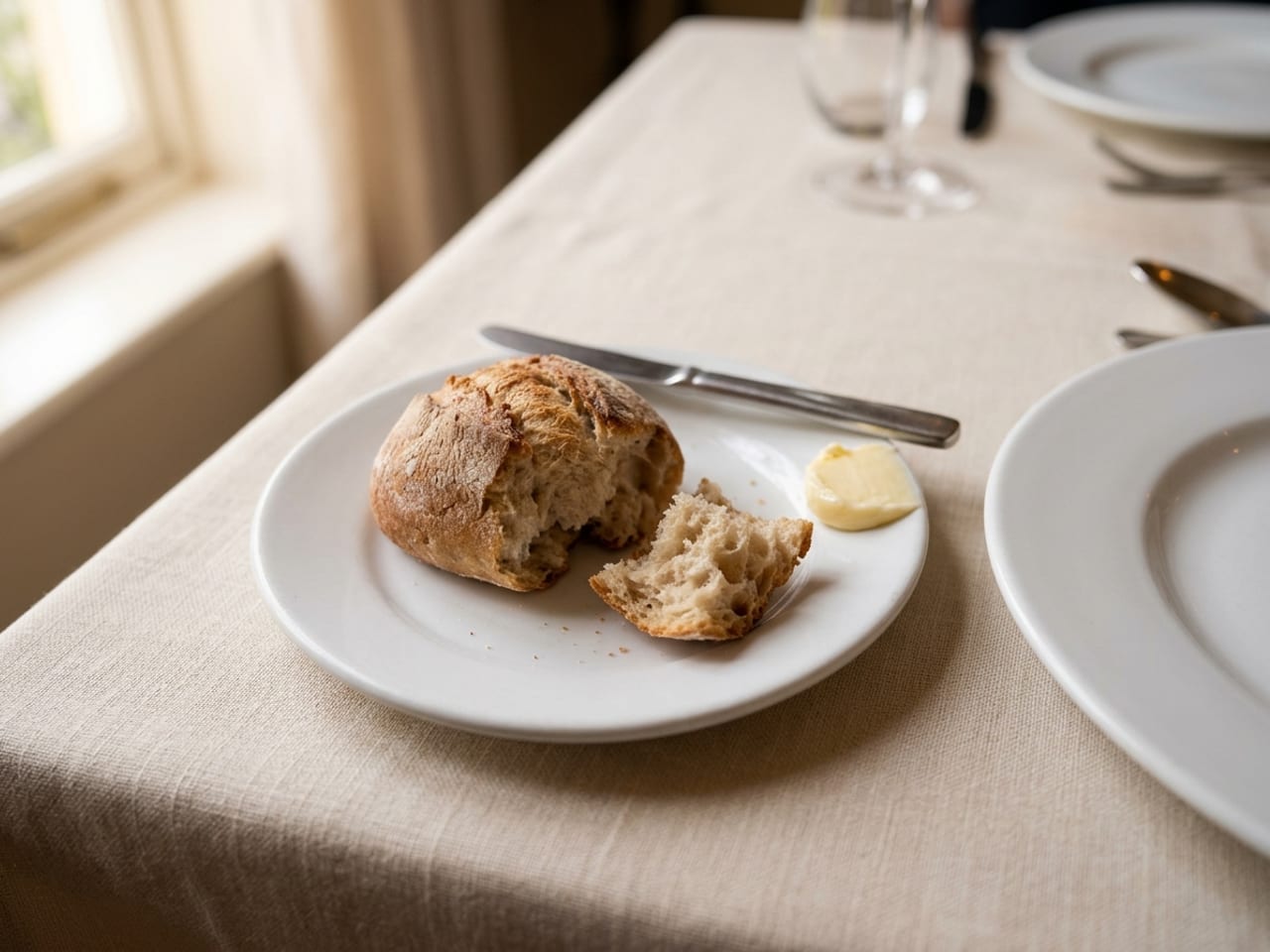
Don't hold bread in one hand and the soup spoon in the other: put the spoon down, then take a bite (the Emily Post Institute).33
Wiping the plate with bread
Split by country, and by how formal the table is. Two of the eight positions we read say no outright; the rest allow it somewhere.
| Source | Where | What it says | Wipe? |
|---|---|---|---|
| Debrett's38, 42 Undated | UK | "It is very tempting to mop up sauce, or the last few mouthfuls of soup, with bread, but it should be resisted." | No |
| French etiquette books, as Le Temps quotes them90 2018 | France | The Petit Larousse du savoir-vivre: "ne saucez pas votre assiette avec du pain" (don't wipe your plate with bread) | No |
| The Local France91 Aug 2024 | France | "Saucer" is common, and some French etiquette manuals suggest that "in 'polite' company" it is better avoided | Qualified |
| Le Bayview's restaurant manager, via Le Temps90 2018 | Geneva | With its sauced dishes, wiping is tempting, "voire acceptable" (even acceptable): the guest should feel at ease | Yes |
| Accademia della Crusca88 Oct 2022 | Italy | The galateo forbids "scarpetta" "nei contesti formali" (in formal settings); many leading chefs, starting with Gualtiero Marchesi, take it as appreciation | Qualified |
| Etiquette Scholar, on Italy64 2019 | Italy | "you can generally use your bread to soak some of it up, but do so carefully, and don't mop the bread around the plate" | Qualified |
| TheFork's survey, via Sky TG2492 Nov 2023 | Italy | 58% of respondents do it whatever the restaurant, 28% only in informal ones (method not given) | Yes |
| Lis Droste, trainer, via t-online80 2016 | Germany | Now accepted "In vielen Sternerestaurants" (in many starred restaurants), but she would use the sauce spoon | Qualified |
Ours: at a formal table in Britain or France, leave it; in Italy, watch the table. A German trainer's alternative is the sauce spoon, where one is laid.80
How to eat soup
| Source | The spoon | Tilt the bowl? | Spoon when done |
|---|---|---|---|
| Debrett's40 Undated | "fill the spoon by pushing away from you", sip from the side, "Don't suck or slurp" | Yes, "away from you" | "Leave your spoon in the bowl" |
| The Emily Post Institute32, 33 Undated | "scoop the soup away from you"; touch the underside to the far edge; blow gently, except "At a very formal meal": hold the spoon low over the bowl about 30 seconds | Yes, "Just tilt the bowl away from you" | In a shallow bowl, in it; a deep bowl or cup, on the underplate |
| Etiquette Scholar52, 63 2019 | Dip at the near edge, "skim away from you", sip from the side; fill it "no more than two-thirds full" | "slightly tip the bowl away from you" | Not stated |
| Accademia Italiana Galateo70 Apr 2021 | From the rim toward the centre; too hot, wait rather than blow | "verso l'esterno, mai all'interno" (outward, never inward) | Left in the plate |
| Lis Droste, trainer, via t-online (Germany)80 2016 | Not stated | "immer zur Tischmitte" (always toward the middle of the table) | Not stated |
| Emily Post, Etiquette148 1922, history | "dip his spoon away from him", no more than three-quarters full, from the side, "without noise" | Not stated | Not stated |
| Baronne Staffe (France)145 1899, history | Not stated | No: a little always stays in the plate because one "ne peut incliner" it (may not tilt it) | Left in the plate |
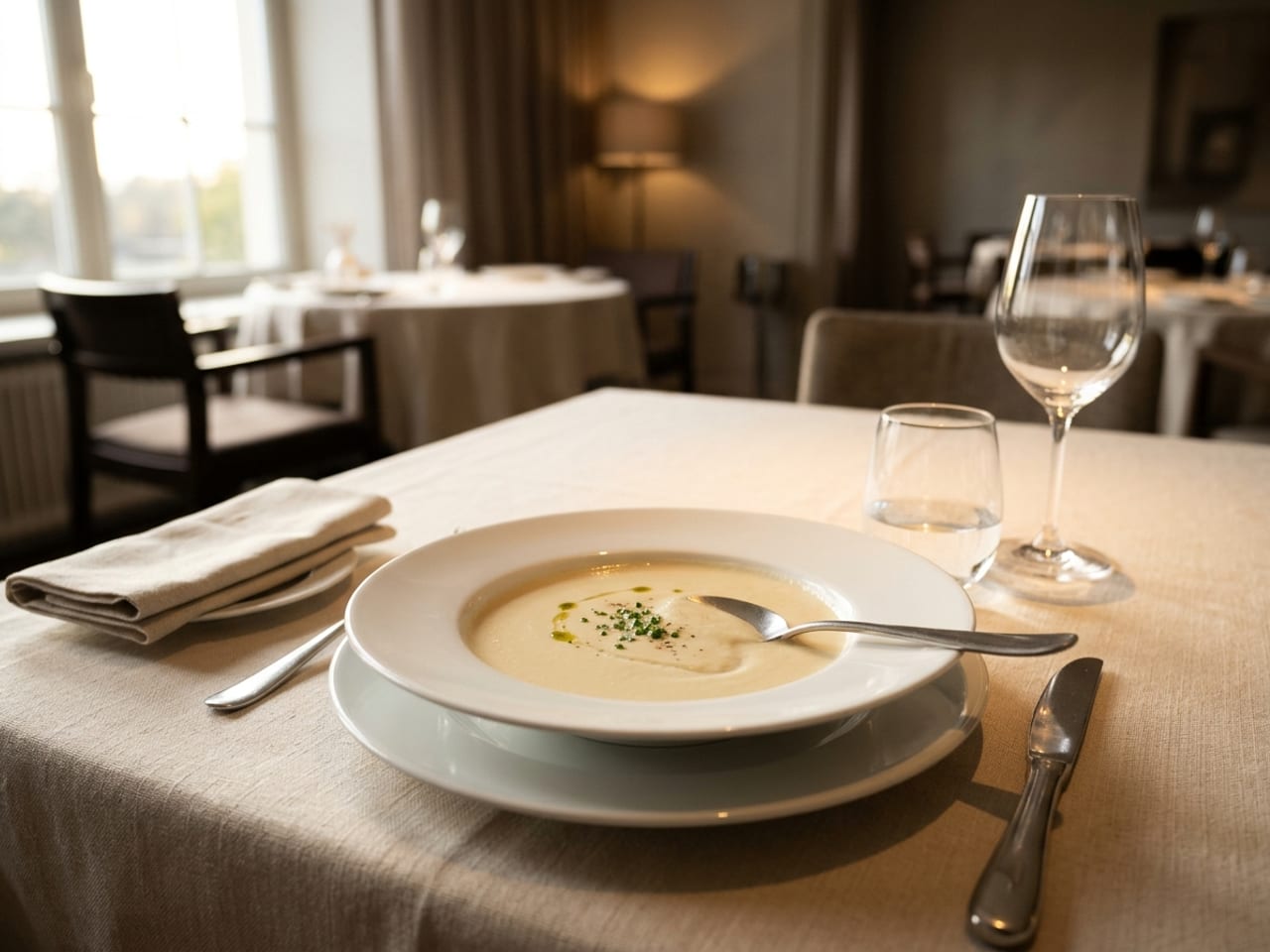
Blowing on hot soup splits too: the Emily Post Institute allows a gentle breath except at a very formal meal, while Italy's etiquette association, and Courtin in 1677, say wait.32, 70, 144 At a Japanese kaiseki meal you lift the bowl and sip the broth, and put the lid back top up (JNTO).133
Salt and pepper
Taste first (Etiquette Scholar), and put salt on the side of the plate rather than over the food, "even if served from a grinder" (Debrett's).38, 54 Pass salt and pepper together, even if only one is asked for; from an open salt cellar, use its spoon or a clean knife tip, and fingers only if the cellar is yours alone (Etiquette Scholar).54 Italy's etiquette association calls asking a hostess for salt and pepper "estremamente maleducato" (extremely rude), because it says the food is bland, and keeps the pinch with the fingers for chefs.68 In a restaurant with no salt on the table, Tasting Table (2017) advises against asking to season at a white-tablecloth place.93 No authority we read says salting before tasting insults the chef (the claim).
How to eat the hard dishes: pasta, oysters, lobster, caviar, cheese and more
One card per dish, with what each authority says and, where they split, every side. Debrett's tells a guest choosing from the menu to be wary of them, and its rule for a slip is to "just carry on"; when in doubt, delay and "take a cue from your host or other diners" (the Emily Post Institute), or ask your neighbour (Debrett's).33, 41, 44
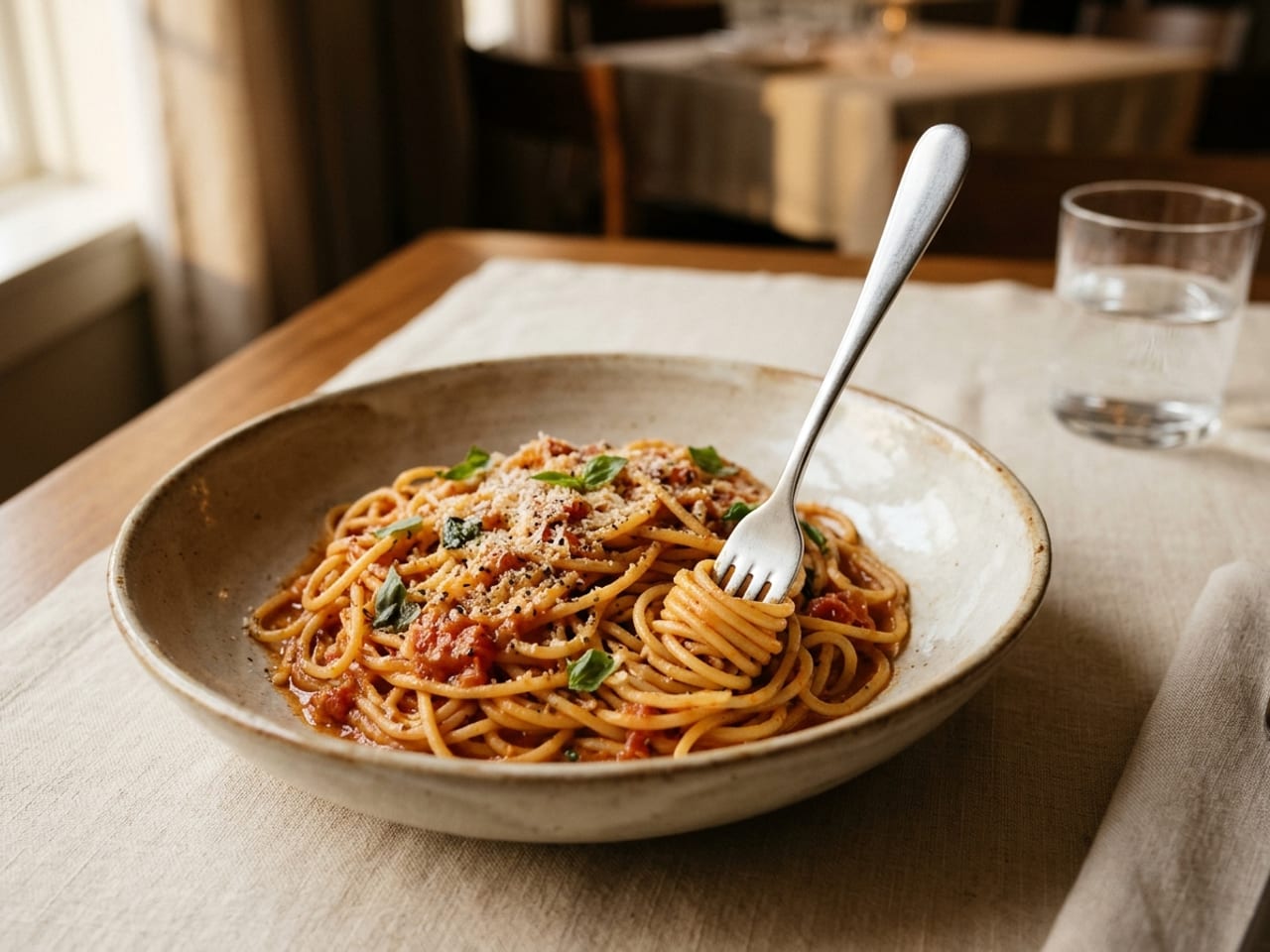
Spaghetti and long pasta
Split: the fork alone, or a spoon to help
Italy's etiquette association: "Vietato utilizzare il cucchiaio" (using the spoon is forbidden); the fork, tilted, catches two or three strands and rolls them into a neat skein, and spaghetti is cut only for a small child still learning to chew.66 An Italian food magazine quotes a galateo the same way: the fork only, no knife, no spoon.138 Etiquette Scholar winds the strands with the tines against the plate and adds "In the US, a spoon is at times used to steady the fork"; a stray strand may be "quietly" sucked in, "not improper"; wide noodles are cut.60, 64 Debrett's moves a fork used alone to the right hand, tines up.39
Ours. The fork alone, turned against the plate, is the way every source allows.
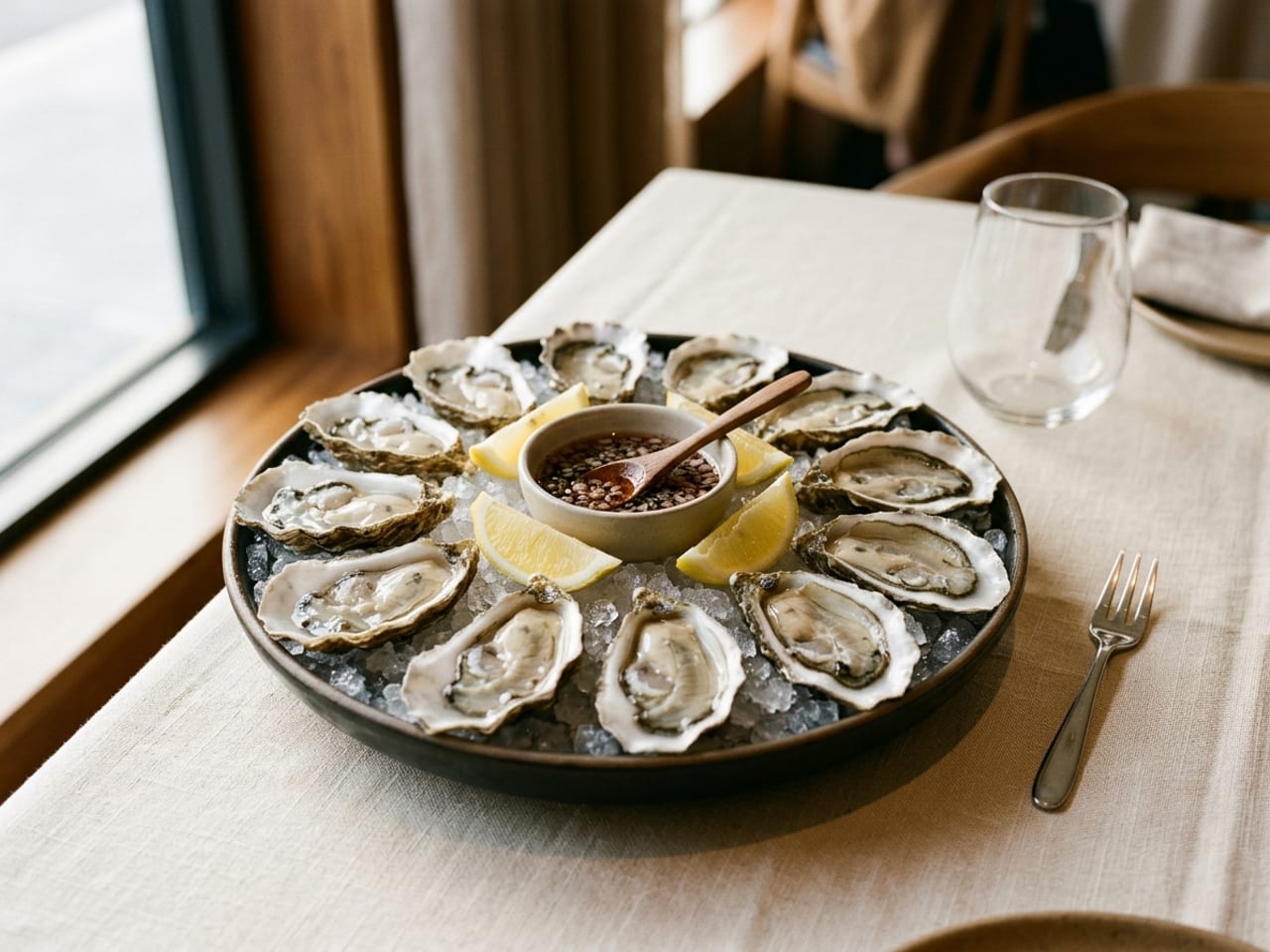
Oysters
Split: a fork, or tipped from the shell
Etiquette Scholar: hold the shell in one hand and the small oyster fork in the other, dip, and "eat it in one bite"; sucking it straight from the shell is for an oyster bar or a picnic.56 An Italian magazine (2014) and a German trainer (2016) tip it from the shell instead, the trainer adding "geräuschlos" (noiselessly).80, 138 Debrett's tells a guest choosing from the menu to be wary of dishes that need "seafood picks" or finger bowls.44 The oyster fork is the only fork laid on the right (our table setting guide).
Ours. Use the fork if one is laid; watch the host if not.
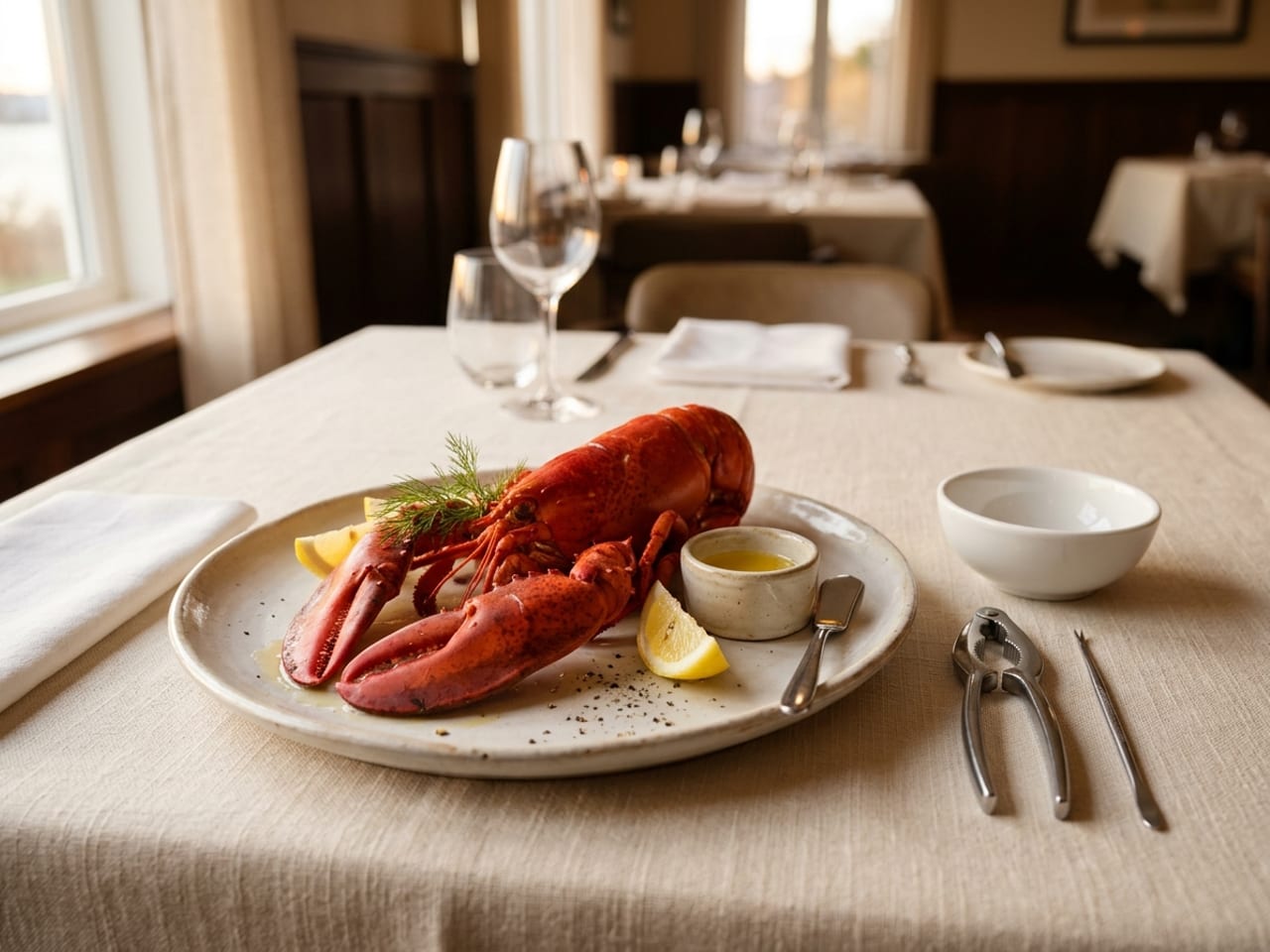
Lobster and shellfish
Tools are provided; a bib only at a lobster house
Etiquette Scholar: steady the lobster, twist off the claws, crack them with the tool provided, use "a fork or lobster pick", put the shells in the bowl provided; finger bowls come afterwards.57 Peter Post of the Emily Post Institute would not order lobster at a business meal unless at a lobster house, "And, yes, in that case use a bib".37 None of the etiquette pages we read treats crab separately.
Ours. The bib and the tools tell you the restaurant expects you to use your hands.
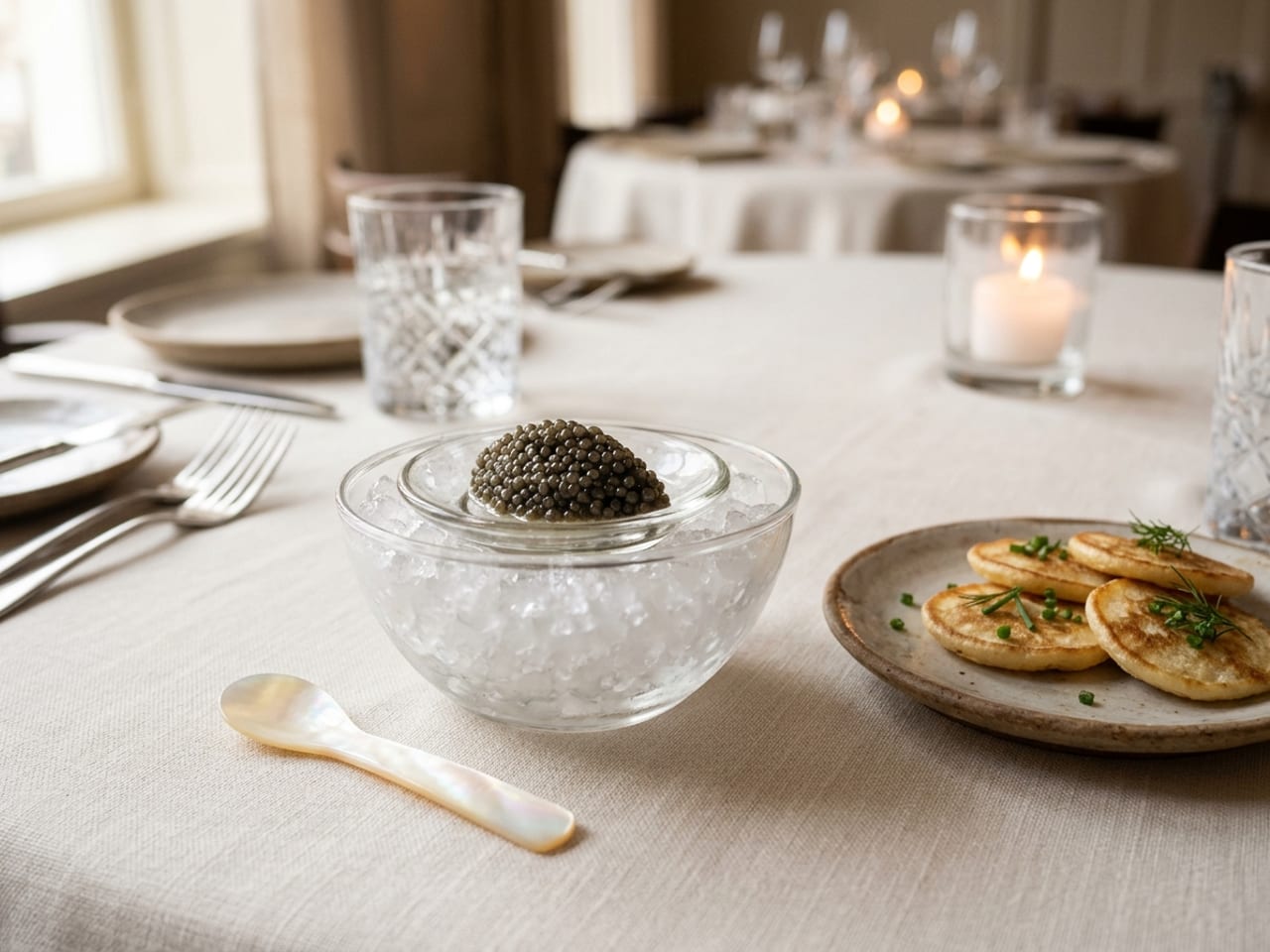
Caviar
A small spoon, often mother-of-pearl
Etiquette Scholar: "Caviar is scooped with a small spoon onto a toast round", then eaten with the fingers.58 The caviar house Petrossian, which sells the spoons, calls mother-of-pearl "customary" because it "prevents oxidation of the grains", finds stainless steel "an acceptable alternative", and on toast or not says "At Petrossian, there are no rules."87
Ours. Take a small amount; no one we read says how much.
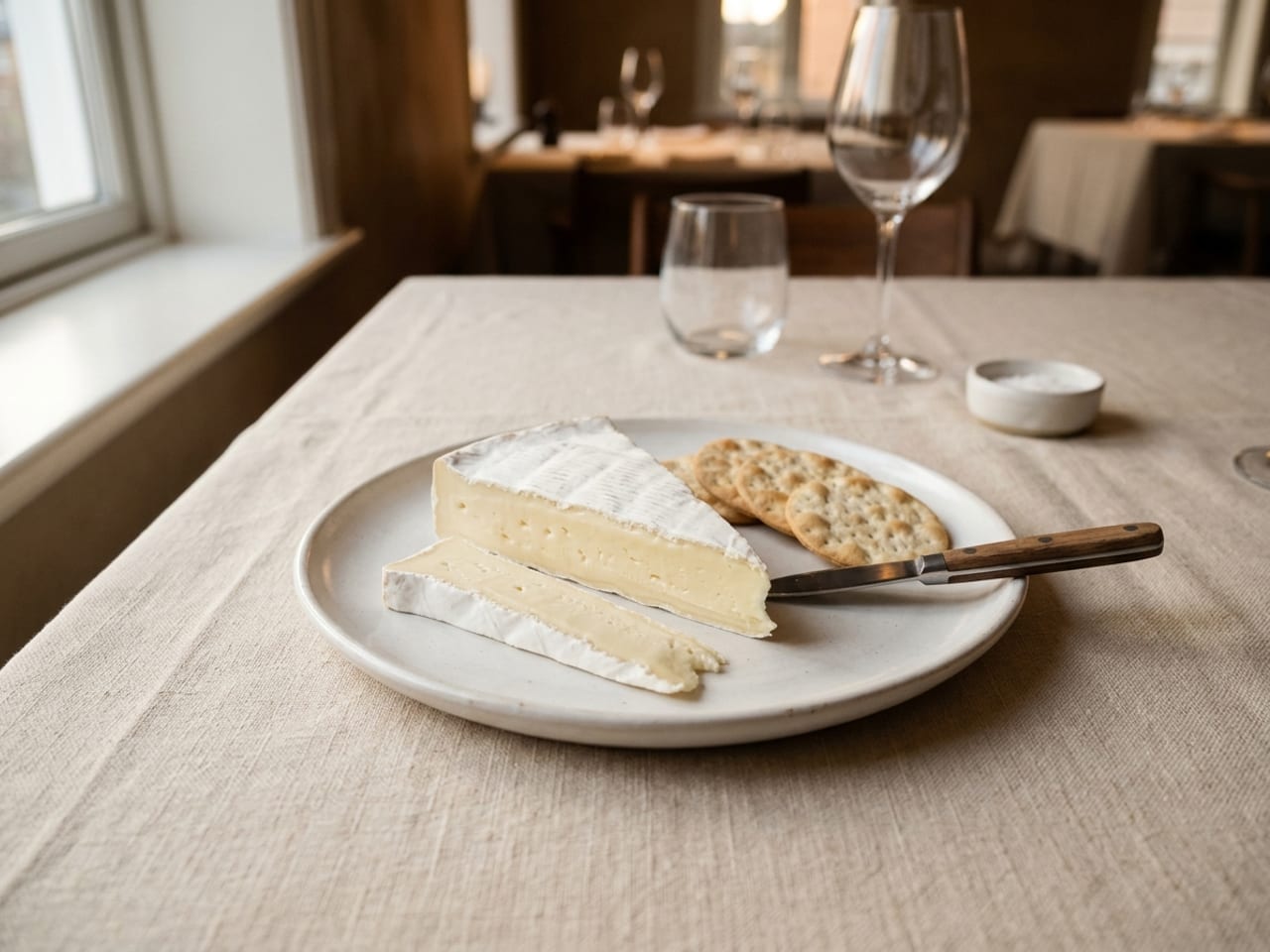
The cheese course
Cut along a wedge, never the nose
Debrett's: use the cheese knife on a shared board, never your own; cut a round cheese "like a cake"; "With a wedge such as Brie, cut slivers lengthways. Never cut the nose off a triangular slice"; the rind "may be eaten or left".40 Etiquette Scholar: soft rinds can be eaten, hard rinds come off, and soft cheese is spread on a cracker and eaten by hand; on France, round cheeses are cut from the centre, "never" from the side.59, 65 Italy's etiquette association cuts soft cheese with the fork, not the knife.69 Where the cheese course falls is on the courses of a meal.
Ours. Leave the cheese shaped so the next person gets rind and centre too: that is what both cutting rules protect.
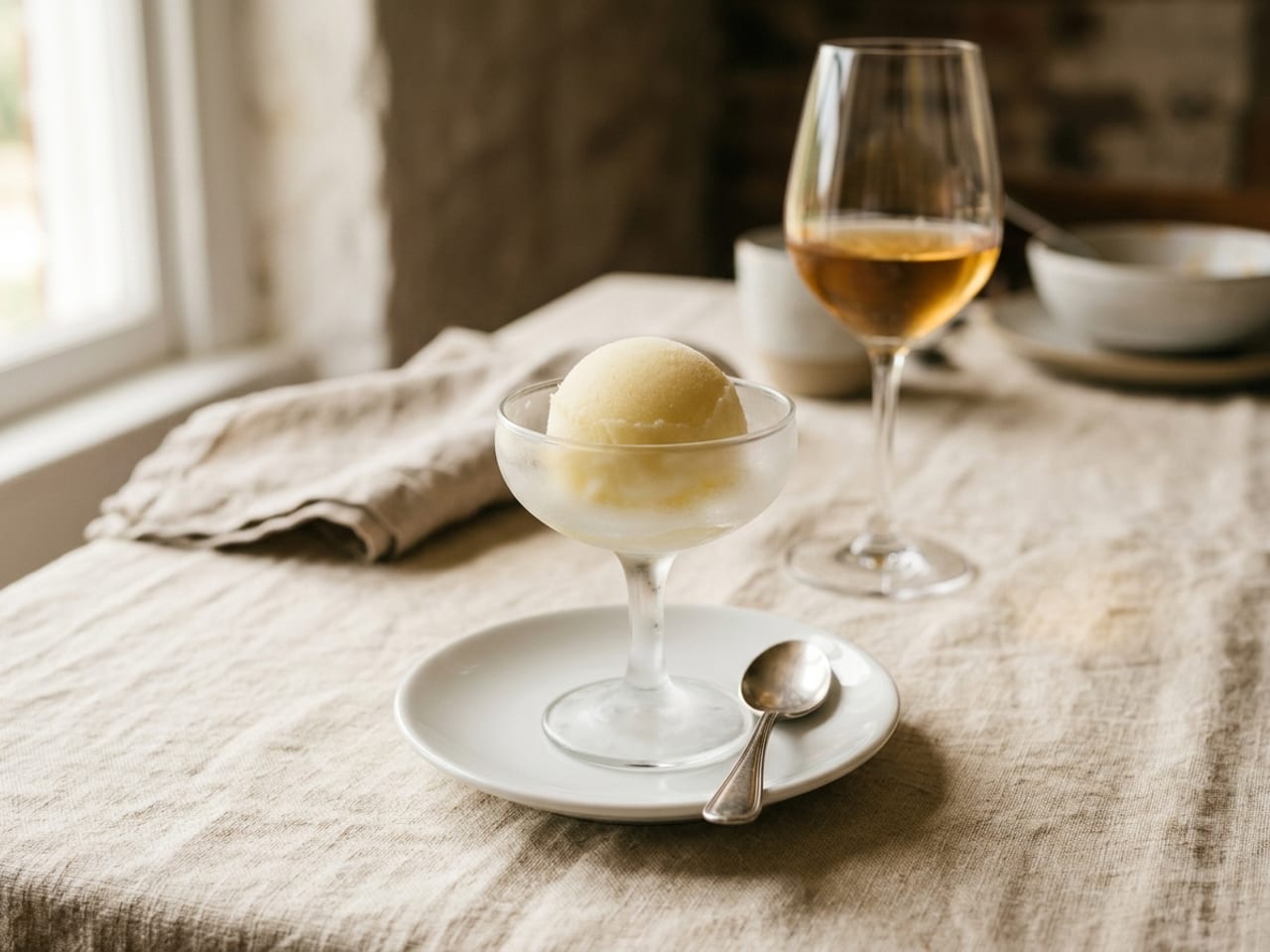
Sorbet between courses
Split: a teaspoon, or a fork
Debrett's: "Sorbet, served between courses, is eaten with a teaspoon."39 Etiquette Scholar: with a meat course, a fork; as dessert, a spoon.61 Why it is served and what the studies say is on our palate cleanser guide.
Ours. Use the spoon that comes with it.
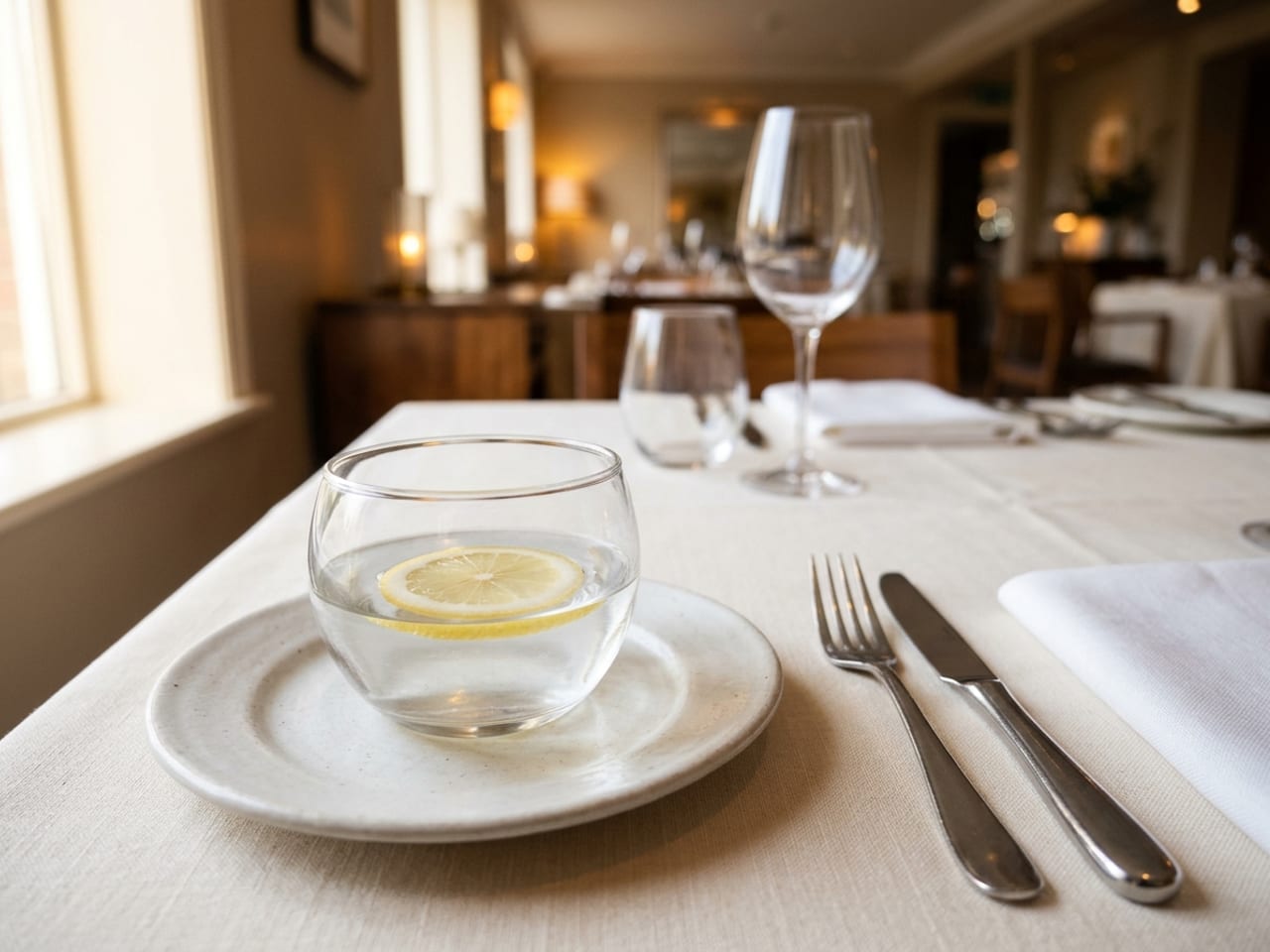
Finger bowls and hot towels
Fingertips only; a lemon slice is usual (Italy's etiquette association)
Italy's etiquette association: wet only the fingertips, never the corner of your napkin; the bowl sits to the left of the plate and "solitamente" (usually) holds a slice of lemon.67 The older view, Emily Post in 1922: cold water, the bowl "less than half filled", and a lemon slice "is never seen outside of a chop-house".148 If you sip from it by mistake, Debrett's says "just carry on".41 In Japan the oshibori towel is "to wipe your hands before eating"; wiping your face "is considered bad manners"; fold it and set it aside (JNTO).131 A Japanese food company's page for visitors adds that face-wiping is frowned on "even among Japanese people".94
Ours. Dip, dry on the napkin in your lap, and leave the bowl where it was set.
Bones, pits and anything you can't swallow
Never the napkin; fork or fingers is split
The Emily Post Institute today: "If it went in with a utensil, it comes out on a utensil; if it went in with your fingers, it comes out with your fingers", to the side of the plate, never into the napkin.31 Etiquette Scholar puts a scalding bite back "onto your fork", "definitely not into your napkin".62 Debrett's: try to swallow gristle; if it is unsafe, cover your mouth with your hand and put it on the side of the plate; pips go to the side plate "with the fingers" on one page and "into a cupped left hand" on another.38, 39, 41 Emily Post in 1922 allowed only "between first-finger and thumb" and called spitting onto a fork "horrid".148 A lamb-chop bone: not in your fingers as a guest unless the host gives "the go ahead" (Peter Post).37
Ours. Out quietly, onto the plate edge, by whichever route it went in.
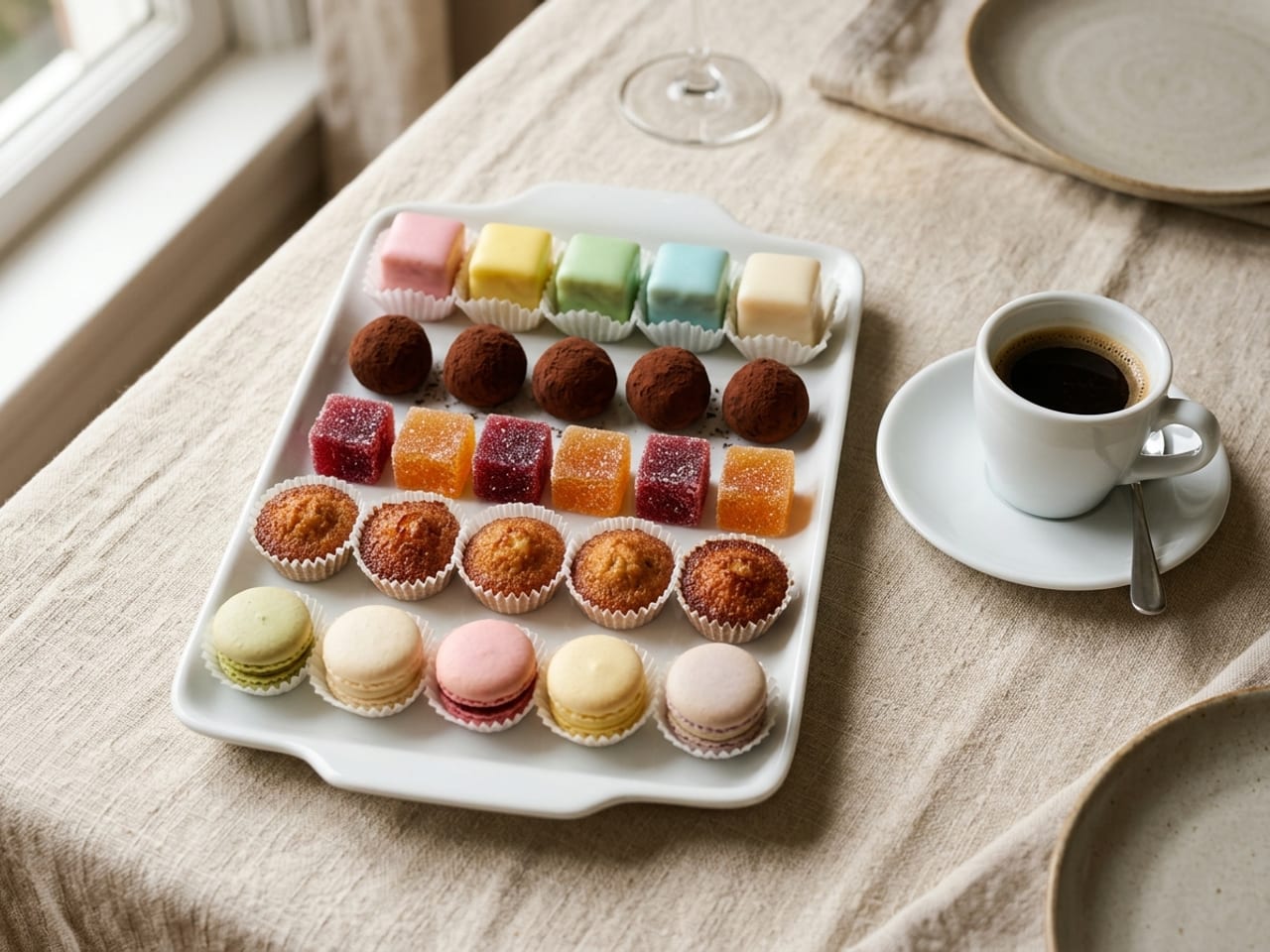
Finger foods: asparagus, artichokes, fruit, petits fours
What the authorities let you pick up
Debrett's: fingers are fine for asparagus without sauce, artichoke leaves ("the only way"), grapes and oranges, bread and soft fruit; "the only fruit that requires a knife and fork is pineapple"; cut grapes off in a small bunch.39, 41, 42 The Emily Post Institute: "Artichoke leaves are always eaten with the fingers."33 Italy's etiquette association adds bread, grissini, small unpeeled fruit and petits fours by their paper case, and old texts' asparagus by hand, but never food straight from a shared tray to your mouth.74, 75 For sushi, hands are "perfectly acceptable", "especially at higher-end restaurants" (JNTO).132 The first bite is on our amuse-bouche guide, the last sweets on mignardises.
Ours. If the kitchen sends something without cutlery, it means fingers.
Glasses and wine: holding a glass, the taste pour, sending wine back
Holding a glass, and which is which
The bigger, rounder wine glasses are for red, the taller, thinner ones for white (Debrett's).41 The order they are laid in, water first, is on our table setting guide. How to hold one:
| Source | Stem or bowl |
|---|---|
| Debrett's, World of Wine47 Undated | White wine glasses "should always be held by the stem to avoid warming the wine" |
| Debrett's, on manners today46 Undated | Holding a wine glass by the bowl is "no longer a guarantee of social death" |
| Maximilian Riedel (glassmaker), via Food Republic82 July 2024 | "clasp the stem between your thumb, pointer, and middle finger", ring finger under the base; the bowl "can, over time, warm the wine" |
| Wine Spectator, Dr. Vinny84 Dec 2012 | "etiquette dictates one should hold a glass by the stem or base, not by the bowl" |
| Wine Spectator, Dr. Vinny83 Jan 2015 | "pinch the stem, or hold it by the base"; stemless glasses are fine |
| Südostschweiz (Swiss newspaper)85 Undated | The stem or the lower third; the bowl is "ein absolutes No-Go" (an absolute no-go) |
| TESDA training standard (staff)13 2013 | "Glasses are handled by the base or the stem." |
| Baronne Staffe (France)145 1899, history | The fingers hold the stem; "on ne prend jamais le verre à pleine main" (never the glass in your whole hand) |
A glass is filled only a third (Debrett's) or "one third, to half full, dependant on the size of the glass" (the Court of Master Sommeliers Europe), so a part-full glass is normal.47, 96 In England and Wales, licensed premises must offer still wine by the glass in a 125 ml measure (shown on the menu or price list, and you must be told it exists if you don't name a size), and must ensure that "free potable water is provided on request to customers where it is reasonably available" (law since 2014; Debrett's calls tap water "quite acceptable"). 48, 110 To decline wine, ask the server to take the glass away, or say "No thank you" (at a private dinner, the columnist adds, a shake of the head will do); turning the glass over "is not a universally recognized symbol" (Etiquetteer, an etiquette columnist, 2021).86 When a bottle is finished, signal for another rather than putting it "upside-down in the wine-cooler" (Debrett's).45
The wine ritual, step by step
The Court of Master Sommeliers sets the exam standard sommeliers are tested on; its Americas branch says its standards are "more formal and exacting than those found in many restaurants". The Americas and European branches differ in places:95, 96
| Step | CMS Americas (2025) | CMS Europe (version 24.1, 2024) |
|---|---|---|
| The bottle | The order repeated back (vintage, producer, cuvée); the bottle shown from the ordering guest's right | Shown to the host "label side up, on a clean service cloth", with vintage, producer and vineyard repeated |
| The cork | "Present the cork on an underliner to the right of the ordering guest" | Presented to the host; a screw cap "is not presented" |
| The taste | 1 to 1.5 oz (30 to 45 mL), poured "With the label facing the ordering guest", then "Wait for approval" | "approx. 50ml" for the host to taste |
| Who is poured first | The guest to the orderer's left, then clockwise "regardless of gender"; "The ordering guest is always served last" | "ladies first, gentlemen second and the host last"; clockwise regardless of gender at eight or more |
| A second bottle | A clean glass for the host to taste | A clean glass for the host, who is asked whether everyone gets fresh glasses |
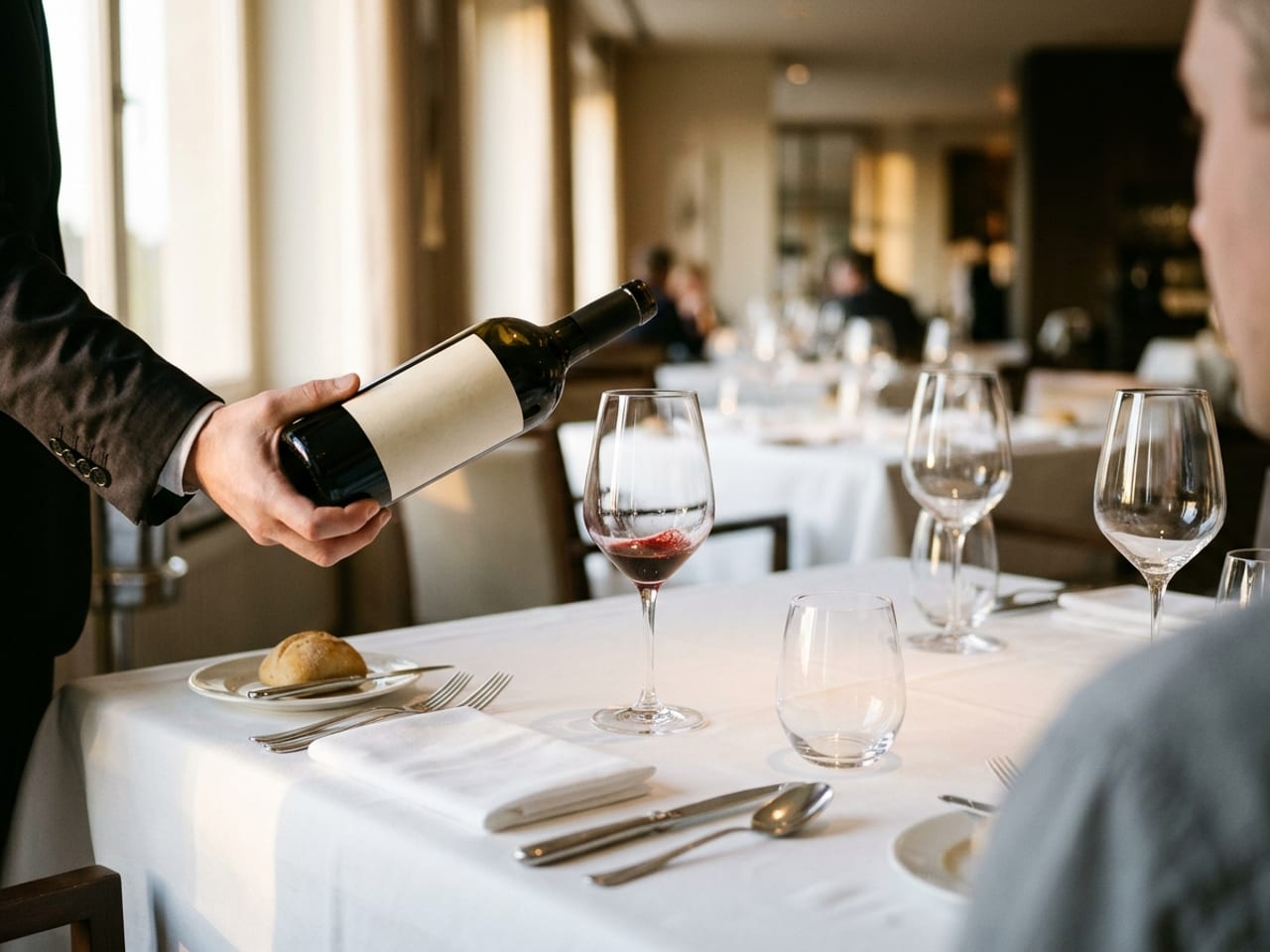
Your part: check the bottle is the one you ordered (producer, style, vintage: a former head sommelier quoted by Decanter says the blame for a wrong bottle is shared if you confirm it); look at the cork if offered (sniffing it is "an option, but it's generally thought not much can be detected", Decanter says); then "just swirl it around the glass, give it a sniff and take a small sip" (Debrett's), and raise any problem now, not after half a glass.47, 99, 104 A screw cap is not presented, and with one, Debrett's says there is "little harm in skipping the tasting altogether". 48, 96 The host can hand the tasting to a guest as a compliment (Debrett's).48
What the taste is for
The key split. Five sources we read describe it as a check for faults such as cork taint, a musty, damp-cardboard smell, and three of them (Goode, Debrett's, Wine Folly) say that is all it is for; three say it is also to check you like it; the sommelier exam standards say only "approval".
| Source | The taste is for | What it says |
|---|---|---|
| Court of Master Sommeliers, Americas95 2025 | Not stated | A taste "for approval"; it does not say approval of what |
| Court of Master Sommeliers Europe96 2024 | Not stated | "a small amount for the host to taste" |
| Jamie Goode (wine writer)97 Aug 2019 | For faults | "You are looking for an obvious wine fault, and usually this means cork taint"; "The only acceptable reason to reject a wine is faultiness" |
| Debrett's48 Undated | For faults | "simply a question of checking that the wine is not corked or gone over rather than an assessment of its quality or suitability" |
| Wine Folly (Madeline Puckette)98 Undated | For faults | "simply to determine if the wine is flawed in any way" |
| Fiona Beckett, via Decanter99 Apr 2022 | For faults | "so you can check it's not corked" |
| WSET100 Aug 2023 | For faults | Taste so that "If a fault isn't immediately apparent, you may also want to take a sip of the wine as another check"; a wine that "doesn't taste right" should go back |
| Wine Spectator, Dr. Vinny102 Mar 2014 | Fault; a dislike is negotiable | Confirm it is "fine (not flawed)"; but "it's OK to ask if they can recommend something else" |
| VinePair (Zach Geballe)105 Sept 2019 | Fault; a dislike is negotiable | Faults, clearly; a recommended wine you dislike should be swapped "graciously"; one you chose meets "a bit more resistance" |
| Nicolet College textbook (staff)10 Undated | Fault; a dislike is negotiable | A faulty bottle is replaced; a sound one the guest dislikes: "Some will replace, others won't" |
| Wine Spectator, Dr. Vinny103 Oct 2022 | Also whether you like it | Raise a flaw, or a wine that "just doesn't meet your expectations", at the taste |
| Brahm Callahan, Master Sommelier, via VinePair104 Nov 2015 | Also whether you like it | "to confirm that they like the wine" |
| Ella Lawrence, a working server, via 7x7106 May 2009 | Also whether you like it | "If you're not enjoying the wine you ordered, you should ask to return it." |
Sending wine back
A faulty bottle goes back, by every source above that says what happens to one; a US service textbook tells staff "Never argue with a guest about whether a wine is flawed, even if you think they're mistaken", and a sommelier told VinePair "We do not argue with the guest, ever".11, 105 A sound bottle you simply don't like is the restaurant's call: "Some will replace, others won't", and "Most restaurants will replace a wine once as a service gesture, though policies vary" (the same textbook); a recommended bottle is easier to swap than one you chose (VinePair). No source we read says a restaurant must take back a sound bottle you chose yourself.10, 11, 105
Ordering to a budget
Every source we read says naming a budget is fine; they differ on how. Say it outright (WSET: "Be upfront and clear about your budget"; VinePair: "zero shame"), or discreetly: point to a price on the list (Wine Spectator's Dr. Vinny) or give the sommelier "expenditure guidelines" (Debrett's, which finds it "entirely reasonable to start by looking at price"). The sommelier standard asks for recommendations that align "with the guest's budget".48, 95, 101, 102, 105
Bringing your own bottle
Check first: Bern's Steak House charges $75 a 750ml bottle and only for wines not on its own list; the tasting-menu restaurants' corkage fees are on our tasting menu guide.26 Sommeliers quoted by Decanter (2024): call ahead if you bring several bottles, corkage may be waived if you also buy from the list, offer the sommelier a glass, and "leave an extra gratuity".109
Toasts and clinking
In Germany, eye contact when clinking is "an absolute must" (The Local, 2018); a Swiss paper adds: clink only with the host and your neighbours, and never cross glasses; at a British table, port goes clockwise and is passed on "without putting it down, even if not drinking any" (Debrett's); Staffe (1899) left the toasts to the host.51, 85, 123, 145
Getting attention, asking, sending a dish back, complimenting the kitchen
Getting a server's attention
No etiquette institute page we read gives a full method; these are magazine writers. Close your menu and put it down to show you are ready to order; catch the server's eye, or raise a hand as they pass; for the bill, the "pen-signing gesture" (Food Republic, 2023). Ask any passing staffer (St. Louis Magazine, 2022). Never snap your fingers or whistle (both), wave "like an NFL referee" or raise an empty glass (St. Louis Magazine); in France, don't call "garçon !" (The Local, 2024).111, 112, 121 Who is who: the maître d' runs the room, assigns the tables and handles complaints; in larger hotels the station waiter is sometimes called a chef de rang; a sommelier, in upscale rooms, the wine (the terms).6, 7
Asking, ordering and small problems
- Ask about anything vaguely named on the menu: "There is no reason to feel stupid asking questions" (Fine Dining Lovers).21 Who orders first: whoever is ready, then clockwise, says the Boston Globe's etiquette columnist (2024). Who is served first is a separate split: a US service textbook says fine dining "may maintain traditional protocols" (women first, the host last), while, it adds, many modern restaurants serve whoever is most accessible first.8, 119
- A dirty fork or glass: ask quietly for another the next time the server stops by, and don't announce it to the table. Something in your food: "avoid any fuss", quietly tell the waiter. A spill: set the glass upright, apologise, dam it with your napkin, call the server. A plate taken too early: "Oh, I'm not finished yet" (all the Emily Post Institute).31
- Your dish is late: insist the others start, then "wait a few minutes before quietly enquiring" (Debrett's).43
Sending a dish back
Opinions run from send it back at once to hardly ever worth it:
| Who | Position | What they say |
|---|---|---|
| Three chefs, via Phoenix New Times113 Sept 2012 | Early, with a reason | Azucena Tovar: as soon as there is a problem, "even after a brief look or smell"; Bernie Kantak: "Send it back with the server along with an explanation"; Romeo Taus: "Gently, very gently!" |
| The Emily Post Institute31 Undated | Early, with a reason | A fly in the soup: "quietly alert" the waiter, "avoid any fuss" |
| Jamila Musayeva (etiquette author), via Food Republic114 Feb 2025 | Faults only | Undercooked, overcooked, a hair, an ingredient you asked to leave out: fair. Not expecting it, the portion, the flavours: "a matter of personal taste". Never after eating most of it |
| Sharon Schweitzer (etiquette consultant), via Quartz115 July 2022 | Depends on the company | Alone, "of course send it back"; at a business dinner a new dish "holds everyone up", so only for spoiled food or an unwanted addition |
| Robert Sietsema (critic), The Village Voice116 June 2010 | Rarely | "usually a futile gesture" costing "20 minutes or more", except a threat to health; though in a five-star restaurant "you can do anything you want and be treated with the utmost courtesy" |
On the staff side, the sommelier standard teaches "Acknowledge the issue", "Apologize sincerely", "Act quickly and kindly"; a US service textbook takes a dish with a quality problem off the bill ("Item removed from check"), what it teaches staff, not something you can demand; a restaurateur's staff rule: "Never remove a plate full of food without asking what went wrong". 9, 14, 95 In Japan "substitutions are rare", an etiquette consultant told Quartz.115 Ours: say it early, quietly, with the reason.
When plates are cleared, and stacking
Every source we read that takes a side says a formal table is cleared once everyone has finished the course: a restaurateur's staff rule ("Wait, wait, wait."), a 2002 consultant (clearing early is "impolite", a "mostly American practice"), a service textbook, a food-safety training article ("best practice") and an etiquette expert quoted by Fox News in 2026, which also reports that "many contemporary restaurants clear plates individually". The Washington Post (2015) said it "has long been the custom".8, 14, 16, 17, 18, 19 At a Japanese kaiseki meal the opposite is normal: dishes go "as diners finish" (JNTO).133 Don't stack your own plates: at a MICHELIN-starred restaurant it's "a huge no-no" (Food Republic, 2023).20 Crumbing between courses is the server's job; you need do nothing (ours).8
Compliments, the chef and the kitchen
Tell your server; chefs check on diners once service settles, and "a compliment goes a long way", a chef told Cheapflights; the chef "is not always at the restaurant", so to shake hands, "inquire in advance" (Fine Dining Lovers). Kitchen tours: book a late table and ask directly; they happen only when the kitchen is not busy ("during peak dining hours it just isn't safe").21, 117 A restaurateur's staff rule: "If someone wants to meet the chef, make an effort."15 A critic's view the other way (2009): a chef at your table makes honest criticism impossible.118
Paying: asking for the bill, splitting it, tipping
The bill comes when you ask for it. No source we read says a fine-dining table should be brought the bill unasked: a service textbook ("when requested (but not before)"), a restaurateur's staff rule ("Never bring a check until someone asks for it"), and in France, outside very busy or touristy places, it usually waits until you ask, which is "deliberate", so lingering is fine, though a restaurant with two sittings should tell you the end time when you book or arrive.7, 15, 121 Ask with "l'addition, s'il vous plaît" in France, "Die Rechnung, bitte" in Germany, "o-kanjo kudasai" in Japan, where you usually pay at the till by the exit.121, 122, 134
Who pays and splitting. If several people ask, the bill goes to "a neutral place on the table", and a service charge should be pointed out when it is presented (a restaurateur's staff rules).15 In Germany expect "zusammen oder getrennt" (together or separately), and a German trainer says the host pays discreetly by card at the counter.80, 122
Tipping and service charges depend on the country and the restaurant, and some of it is law: in the US the Emily Post Institute's custom is "15-20%, pre-tax" for table service, Bern's adds a 12% service charge, Hong Kong restaurants mostly add 10%, and in Japan "Tipping is not customary"; the rest, law first and by country, is on our tasting menu guide.26, 36, 131, 141 Taking food home is split by country.
Dining etiquette in France, Italy, Japan, the UK, the US and Germany
Each cell says who said it and when; a custom one source reports for one country is never a rule for another. Japan, the UK and the US rest on a tourism agency or an etiquette authority; France, Italy and Germany on newspapers quoting trainers, a US etiquette website writing about each country, an Italian etiquette association and a dated French book, because Atout France, Italy's tourism board and Germany's publish no table-manners page we could find.
| Country | Starting | Hands, elbows, chopsticks | Bread and sauce | Taking food home | The bill | Also |
|---|---|---|---|---|---|---|
| France | Etiquette Scholar (2019): not until the host says "Bon appetit!"65 | Elbows on the table are among the faux pas French guides rank above wiping your plate, as The Local France reports them (2024)91 | On the cloth, not a plate (The Local, 2024; Etiquette Scholar: "a bread plate is rare"); wiping the plate, "saucer", is common, but some manuals say avoid it in "polite" company65, 91 | Atout France: "don't hesitate to ask for a doggy bag"; since 1 July 2021 restaurants must give a container to anyone who asks, as the trade body GHR reports the law124, 135 | Usually not brought until you ask (except in very busy or touristy places), and that is "deliberate"; ask for "l'addition, s'il vous plaît", never call "garçon !" (The Local, 2024)121 | Salad is not cut with a knife: the French guides The Local reports (2024) say fold a large leaf; Staffe in 1899 said the hostess should have it prepared so the leaves are small enough91, 145 |
| Italy | Split: the Accademia Italiana Galateo (2021) says never say "buon appetito", start in silence after the host; Etiquette Scholar (2019) says wait for the host to say it64, 69 | Wrists on the table, "never your elbows" (Etiquette Scholar); "never put your elbows on the table" (the consultant Sabrina Verlezza Cipriani, 2020)64, 79 | Never cut with a knife (Accademia Italiana Galateo); scarpetta is forbidden by the galateo in formal settings but welcomed by many chefs (Accademia della Crusca, 2022)69, 88 | No source read | No source read | A cappuccino after a meal surprises restaurateurs, a custom, "not because it's forbidden"; many Italians avoid Parmesan on seafood (a BBC writer, as Il Fatto Quotidiano, 2026, and Politis report her); no spoon for spaghetti (the Accademia Italiana Galateo)66, 136, 137 |
| Japan | Say "Itadakimasu"; in groups, wait until everyone has food (JNTO)130 | Lift the bowl to your mouth, not your mouth to the bowl; never stand chopsticks in rice or pass food chopstick to chopstick: both recall rites for the dead (JNTO)126, 127 | Sushi: dip the topping, not the rice; hands are "perfectly acceptable", especially at higher-end restaurants (JNTO)130, 132 | Leftovers are "frowned upon" and taking them home is "generally not accepted" (JNTO)130 | Ask with "o-kanjo kudasai" and usually pay at the till by the exit (JNTO's German office); "Tipping is not customary"131, 134 | Slurping noodles is the local norm, optional for visitors; the oshibori towel is for hands only (JNTO)130, 131 |
| United Kingdom | Not before everyone is served; with staggered service, ask "do you mind if I start?" (Debrett's)38, 46 | "sit square with hands in the lap"; "Do not put elbows on the table" (Debrett's)38 | From the side plate on the left, broken by hand; mopping "should be resisted" (Debrett's)38, 40 | The Debrett's pages we read don't say | No source read | Salt on the side of the plate; port passed clockwise (Debrett's). In England and Wales, licensed premises must offer still wine by the glass in a 125 ml measure and ensure "free potable water is provided on request to customers where it is reasonably available" (law, 2014)38, 51, 110 |
| United States | At a table of two to four, wait until everyone is served (Etiquette Scholar); with an unfamiliar dish, take a cue from the host (the Emily Post Institute)33, 52 | No elbows while eating, fine between courses (the Emily Post Institute); Post 1922 taught children to keep hands in their laps30, 148 | Break off a piece, butter it, eat it, then the next (the Emily Post Institute)33 | A dining columnist (2016): "appropriate in almost all dining situations"; no etiquette institute page we read says125 | One restaurateur's staff rule (2009): "Never bring a check until someone asks for it"15 | Cutting, then moving the fork to the right hand, and switching styles is fine (the Emily Post Institute)34 |
| Germany | Only when everyone is served; no wine until everyone has a glass (t-online, 2016, citing knigge.de)81 | No elbows, but hands always visible: both arms under the table look wrong (t-online, 2016)81 | On the small plate on the left; bread in the sauce is now accepted in many starred restaurants, a trainer told t-online (2016)80 | No source read | Not brought until you ask; expect "zusammen oder getrennt" (together or separately); the tip is handed over, "not left on the table" (The Local Germany, 2018)122 | Napkin beside the plate, not on the chair, when you get up (a trainer, 2016); eye contact when clinking glasses (The Local Germany, 2018)80, 123 |
| Spain | No source read | No source read | No source read | No source read | No source read | Restaurants tend to serve lunch between 13:00 and 16:00 and dinner between 20:00 and 23:30, and after a meal it is normal to stay for coffee and a chat (Turespaña)139, 140 |
| Hong Kong | No source read | No source read | No source read | No source read | "Most restaurants add a 10% service charge"; unrequested tea or snacks may be billed (Hong Kong Tourism Board)141 | Mainland China: we found no national tourism or etiquette authority page on table manners, so it has no row |
Japan, a little more. Chopsticks rest across the dish or on a rest, never on the table; a shared dish is split: JNTO's UK office lets you turn your own chopsticks round, while a Japanese etiquette master writing for nippon.com calls that kaeshi-bashi, a breach, and asks for serving chopsticks. Pour for others, never yourself, and leave your glass full if you want no more.126, 128, 129 Slurping noodles is the local norm, but "don't feel obligated to slurp yourself"; Della Casa's Galateo in 1558 told the story of a count faulted for eating with "a certaine straunge noyes". 130, 143
Where today's table rules came from, dated
Only what dated books print; old rules are shown as history, never as today's rules. Some have turned right round: Erasmus and Courtin told you to cut your bread, Staffe and Post to break it.
| Year | The book | What it says |
|---|---|---|
| 1530 | Erasmus, De civilitate morum puerilium (French translation, 1877)142 | Both hands on the table, not clasped on the plate; elbows excusable only for "un vieillard ou un malade" (an old or sick man); bread cut "proprement avec ton couteau" (cleanly with your knife), breaking it a courtier's affectation; the napkin, if you are given one, over the shoulder or the left arm. |
| 1558 | Giovanni Della Casa, Galateo (English, 1576)143 | Don't rub greasy fingers on your bread or your teeth with the napkin, and "It is a rude fashion besides, to leane over the table"; the count whose one fault was eating with "a certaine straunge noyes". |
| 1677 | Antoine de Courtin, Nouveau traité de la civilité144 | Never elbows on the table; cut the bread you will eat rather than bite it; wait rather than blow on hot soup; salt with the point of the knife; fears about passing salt are "fuperftitions ridicules" (ridiculous superstitions, in the scan's spelling). |
| 1875 | Routledge's Manual of Etiquette, as Debrett's quotes it39 | Soup from the side of the spoon, making "no sound in doing so"; asparagus by fingers or fork, "It would be difficult to say which is the more correct." |
| 1899 | Baronne Staffe, Usages du monde145 | The napkin never fully unfolded, and left beside the plate at the end without being refolded; bread broken, never cut; the soup plate never tilted; the glass by the stem; only bread touched with the fingers. |
| 1915 | Lucy G. Allen, Table Service146 | A household manual: food from the left, drinks from the right; before dessert the crumbs are swept, "the only time during the meal that a person is left without a plate before him". |
| 1918 | American Cookery magazine147 | Asked whether salting your food insults your hostess, the editors said the question was put "rather too strongly": taste in seasoning "varies greatly". |
| 1922 | Emily Post, Etiquette148 | Bread "always" broken; no butter at a formal dinner and rolls laid on the tablecloth; elbows "never" while eating but "universally seen" at small restaurant tables; anything out of the mouth between finger and thumb; the finger bowl with no lemon outside a "chop-house". |
| 1927 | Emily Post, the Blue Book149 | Cutting a few pieces, then moving the fork to the right hand, is allowed; switching "at nearly every mouthful is a ridiculous practise of the would-be elegant" (more on our table setting guide). |
Popular fine dining rules, each with a verdict
Twenty rules people repeat, each against what we read. "Supported, narrowly" means the sources cover less than the rule says; "Mixed", that they split, often by country; "Not supported", that the sources we read say otherwise or no authority we read states it; "No source found", that we found nothing for it.
| The rule | Verdict | What we found |
|---|---|---|
| Elbows on the table are rude. | Supported, narrowly | While you eat, yes: all five modern authorities we read that answer say so. Between courses they split: the Emily Post Institute allows it "and always has been, even in Emily's day", and Debrett's gives no exception. Older books: Erasmus in 1530 excused elbows only for the old and the sick; Post in 1922 found them "universally seen" at small restaurant tables.30, 38, 142, 148 |
| Keep your hands in your lap. | Mixed | By country. Lap: Debrett's ("sit square with hands in the lap") and Post 1922 for children. On the table: Erasmus (1530), a German guide (2016: both arms under the table look wrong) and Etiquette Scholar on Italy (wrists on the table).38, 64, 81, 142, 148 |
| Salting before you taste insults the chef. | Not supported | No authority we read supports this, in what we read. Etiquette Scholar says only "Taste Before Salting"; Debrett's says where the salt goes (the side of the plate); Italy's etiquette association calls asking a hostess for salt rude, which is about a host's table. In 1918 American Cookery said the insult idea was put "rather too strongly", and Courtin in 1677 called the fear of serving someone salt a ridiculous superstition (a different salt worry). Tasting Table (2017): the job-interview story's "true origins are unknown", though at a white-tablecloth restaurant with no shakers on the table it is "best not to DIY season at all".38, 54, 68, 93, 144, 147 |
| Never cut lettuce with a knife. | Mixed | A rule in French sources (Staffe 1899; the French guides The Local reported in 2024; Etiquette Scholar on France: fold it). Emily Post in 1922 called it "silly" and gave the old reason: "A steel knife must not be used for salad or fruit, because it turns black." The Debrett's pages we read are silent.65, 91, 145, 148 |
| Never use a spoon with spaghetti. | Mixed | In Italy, yes: "Vietato utilizzare il cucchiaio" (the Accademia Italiana Galateo), and Etiquette Scholar on Italy agrees. Etiquette Scholar's pasta page reports that "In the US, a spoon is at times used to steady the fork".60, 64, 66 |
| Hold a wine glass by the stem. | Supported | Every source we read that answers prefers the stem or the base (the table), for the wine's temperature and the fingerprints. Debrett's softens it: the bowl is "no longer a guarantee of social death".46, 84 |
| Smell the cork. | Not supported | No authority we read supports this, in what we read: no wine authority tells you to sniff it. Matt Kramer (Wine Spectator, 2000): "We're given the cork not to smell, but to read"; a Master Sommelier (Chowhound, 2025): "The cork is a closure and has nothing to do with wine quality"; Decanter (2022): "not much can be detected" by sniffing it.99, 107, 108 |
| Turn your glass upside down to refuse wine. | Not supported | No authority we read supports this, in what we read. The one etiquette columnist we found on it says stop: it "is not a universally recognized symbol"; ask the server to take the glass away, or say "No thank you" (Etiquetteer, 2021). We found no institute page on it.86 |
| Leave your napkin on the chair when you get up. | Mixed | Four sources we read say the chair; three say beside or left of the plate: the Emily Post Institute because a used napkin on the seat can soil the chair or your clothes, an Italian consultant and a German trainer because the chair is not clean (the napkin table). At the end of the meal all seven that answer say beside or left of the plate.29, 53, 76, 79, 80 |
| It is polite to leave a little food on your plate. | Not supported | No authority we read supports this, in what we read. Japan's tourism agency says the opposite: "Do try your best to finish all your meal". Emily Post in 1922 left meat on a bird's bones only because birds "are not eaten with the fingers in company".126, 148 |
| Asking for a doggy bag at a fine restaurant is rude. | Mixed | By country. France: the tourism agency says "don't hesitate", and restaurants must give a container to anyone who asks (since 2021, as GHR reports it). Japan: "generally not accepted" (JNTO). The US and UK etiquette pages we read are silent; a US columnist (2016) calls it fine "in almost all dining situations".124, 125, 130, 135 |
| Women are served first. | Mixed | In one sommelier standard. The Court of Master Sommeliers Europe pours "ladies first, gentlemen second and the host last"; its Americas twin goes clockwise "regardless of gender". A US service textbook says fine dining "may maintain traditional protocols"; the Boston Globe's etiquette columnist (2024) calls women-first ordering "inefficient and needlessly rigid".8, 95, 96, 119 |
| Wiping your plate with bread is rude. | Mixed | Debrett's and the French etiquette books Le Temps quotes say don't; Italy's language academy says the galateo forbids it only in formal settings while many chefs welcome it; a German trainer says many starred restaurants now accept it (every position).38, 80, 88, 90 |
| Break a bread roll, never cut it. | Supported | Today, by every source we read that answers. It was the other way round: Erasmus (1530) said cut it "proprement avec ton couteau" and called breaking it a courtier's affectation; Courtin (1677) said cut off what you will eat. By Staffe (1899) and Post (1922) you broke it.40, 142, 144, 145, 148 |
| Never tilt the soup bowl. | Not supported | Every modern source we read allows a tilt, away from you (Debrett's, the Emily Post Institute, Etiquette Scholar, the Accademia Italiana Galateo) or toward the table's centre (a German trainer). Staffe forbade it in 1899.32, 40, 52, 70, 80, 145 |
| No cappuccino after a meal in Italy. | Supported, narrowly | A custom, not a rule: a breakfast drink that surprises restaurateurs after lunch or dinner (the BBC writer Eva Sandoval, as Il Fatto Quotidiano reported her in 2026, our translation), drawing looks "not because it's forbidden" (the same BBC text, via Politis).136, 137 |
| No cheese on seafood pasta in Italy. | Supported, narrowly | A strong custom, as a BBC writer reports it: many Italians avoid it, thinking it covers the fish, and the BBC text notes exceptions "built into specific regional recipes". No Italian etiquette authority page on it was found.136, 137 |
| You can only send wine back if it is faulty. | Mixed | Five sources we read say the taste is for faults; three say it is also whether you like it; the sommelier exam standards don't say. A US service textbook: for a sound bottle you dislike, "Some will replace, others won't" (the tally).10 |
| Plates are cleared only when everyone has finished. | Supported, narrowly | At a formal table, by every source we read that takes a side, from a 2002 consultant (clearing early is "impolite", a "mostly American practice") to a 2026 etiquette expert. But Fox News (2026) reports "many contemporary restaurants clear plates individually", a training article allows it in casual dining, and at a Japanese kaiseki meal dishes go "as diners finish" (JNTO).17, 18, 19, 133 |
| A Michelin star means a formal restaurant. | Not supported | MICHELIN: "The style of a restaurant and its level of comfort or formality have no bearing on the award"; Stars are for "the food on the plate". How the stars work is on our Michelin stars guide.2 |
Photograph your plate, see it re-plated
Cooking a dinner of your own courses at home? Photograph one and Plate Artists re-plates that dish, with the food kept as it is and the changes named so you can repeat them on the next plate. Start with a re-plate, and set the table with the table setting diagram.
Your food, plated like a chef's
Snap it, upload it, and get the composed version back, with the steps to recreate it at home.
Start free · 1 enhancement →Free account · 1 free enhancement · No credit card
Fine dining terms, defined
Only the words our table setting, prix fixe and tasting menu guides don't already define (place setting, charger, resting and finished positions, prix fixe, omakase, corkage and more are there).
Continental style · European style
Eating with the fork kept in the left hand, tines down, and the knife in the right throughout, without switching hands.
Where it comes from. The Emily Post Institute: "the fork stays in the left hand", tines down, the knife "available as a pusher".34
American style · zig-zag
Cutting with the fork in the left hand, then laying the knife down and moving the fork to the right hand, tines up, to eat.
Where it comes from. The Emily Post Institute: the fork "is transferred to the right hand", tines up; Post in 1927 used "zig-zag" to mock switching at every mouthful.34, 149
Maître d' · maître d'hôtel; restaurant manager
The person in charge of the dining room, who assigns the tables, takes bookings and deals with complaints.
Where it comes from. Hong Kong's Education Bureau: "short for maitre d'hotel which literally means "master of the hall"".6, 7
Chef de rang · station waiter
The waiter in charge of one station, a group of tables; the name is used in some larger hotels.
Where it comes from. Hong Kong's Education Bureau: in larger hotels the station waiter "is sometimes called a chef de rang".6
Sommelier · wine waiter
The member of staff who helps you choose the wine and serves it.
Where it comes from. Nicolet College's textbook: sommeliers help guests choose wine, "typically in upscale establishments".7, 48
Taste pour · host's taste
The small pour offered to whoever ordered the bottle before the rest of the table is served.
Where it comes from. 1 to 1.5 oz (30 to 45 mL) in the Court of Master Sommeliers Americas' standard, "approx. 50ml" in its European twin.95, 96
Corked · cork taint; TCA
A wine fault that makes a wine smell musty, like damp cardboard; it has nothing to do with bits of cork in the glass.
Where it comes from. WSET: musty, "damp cardboard" aromas; "Corked does not mean pieces of cork floating in your wine".98, 100
Crumbing · crumbing down
Sweeping crumbs off the tablecloth between courses with a crumber or a folded napkin.
Where it comes from. Nicolet College: after the starters and the mains, "essential" in upscale dining; Lucy Allen in 1915 did it before dessert with a small napkin and a plate.8, 146
Finger bowl · lavadita (Italian)
A small bowl of water set at your place for rinsing your fingertips after food eaten by hand.
Where it comes from. Italy's etiquette association calls it the coppetta lavadita; Emily Post described it in 1922.67, 148
Oshibori
The small wet towel given at Japanese restaurants for wiping your hands before eating.
Where it comes from. JNTO: "A small towel called an "oshibori" is often provided at restaurants."131
Itadakimasu · gochisosama-deshita (after the meal)
The phrase said in Japan before eating; gochisosama-deshita, roughly thanks for the food, is said after.
Where it comes from. JNTO: said before eating, "meaning something like "I am glad to receive this meal"".130
Scarpetta · fare la scarpetta
Italian for wiping up the sauce left on your plate with a piece of bread.
Where it comes from. Treccani: gathering the sauce left on the plate with a piece of bread, on the fork or "più comunem." (more commonly) in the fingers; in a word list by 1952 (Accademia della Crusca).88, 89
Saucer
The French verb for mopping up sauce with bread.
Where it comes from. The Local France: "there is even a verb to describe 'mopping up sauce with bread'".91
Guéridon service · tableside service
Service in which a dish is finished and plated at the table from a side trolley.
Where it comes from. The Ritz London: "dishes are completed and plated at your table".22
Fine dining etiquette, answered
What are the basic rules of fine dining etiquette?
The ones every authority we read that answers agrees on:wait until everyone is served, unless the host starts or asks you to; break bread by hand, one bite-size piece at a time; move the soup spoon away from you; hold a stemmed wine glass by the stem (or the base); no elbows on the table while you are eating; nothing from your mouth goes into the napkin. Work through the cutlery from the outside in, keep your phone away, and when you are unsure, follow the host. Where the authorities disagree (the napkin when you get up, the spoon with spaghetti, wiping the plate with bread), this page shows each side.
What should you not do at a fine dining restaurant?
In what we read: don't put your elbows on the table while eating, put anything from your mouth into the napkin, polish a dirty fork or glass with your napkin (ask for another), pick up dropped cutlery (tell the server), push your plate away when finished, stack your own plates, snap your fingers or whistle at the staff, or keep your phone on the table. Each of these is credited to its source on the page.
Where do you put your napkin when you leave the table?
The authorities split. The Emily Post Institute says loosely folded, to the left of the plate, every time, and not on the chair, where it would transfer food mess to the seat or your clothes; an Italian consultant and a German trainer agree, because the chair is not clean. Etiquette Scholar, Tasting Table, William Hanson and most consultants Arden Clise asked say on the chair. In all, four of the sources we read say the chair and three say the table.
Where does the napkin go when you finish eating?
Beside the plate, usually to its left, loosely folded or simply unfolded, and never on the plate: all seven sources we read that answer agree, from Staffe in 1899 ('sans la replier', without refolding it) to Debrett's ('unfolded, beside your plate') and the Emily Post Institute ('Loosely' to the 'Left'). Etiquette Scholar keeps it on the lap if coffee is served at the table.
Which fork do you use first?
The outermost, then work in, course by course; the setting tells you the menu. A course may also come with its own cutlery: once you have ordered, the waiter adds or changes cutlery and glasses to suit your choices, as two national training standards for servers describe.
How do you hold a knife and fork in fine dining?
Knife in the right hand, handle in the palm, not like a pen; the index finger on top of the handle (Debrett's, the Italian Accademia) or along the top of the blade (Etiquette Scholar). Fork in the left, tines down, pushing the food on with the knife (Continental, the British way), or cut, then move the fork to the right hand, tines up (American). The Emily Post Institute says switching is fine in America; Italy's etiquette association says don't switch during the same dish. Cut one bite at a time.
Is the bread plate on the left or right?
On the left: Debrett's puts the side plate to the left of the forks, and US settings put the bread plate above the forks (one Italian etiquette article puts it on the right; the same academy's main guide says left). In France, Etiquette Scholar says a bread plate is rare, and The Local France (2024) says the bread goes on the table rather than on a plate. Your drinks are on the right.
How do you eat bread at a fine dining restaurant?
Break off one bite-size piece by hand over your side plate, butter that piece with butter you have first moved to your plate, eat it, then break the next. Every authority we read that answers says break, never cut, a roll; Debrett's and the Emily Post Institute let you butter hot toast all at once. Wiping your plate with bread is split by country.
How do you eat soup properly?
Move the spoon away from you, fill it no more than two-thirds (Etiquette Scholar; Post in 1922 said three-quarters), and sip from its side without slurping. To get the last of it, tilt the bowl away from you (every modern source we read allows this; Staffe in 1899 did not). Leave the spoon in a shallow bowl, or on the plate under a deep bowl or cup.
How do you eat pasta in fine dining?
Catch a few strands with the fork and turn it against the plate or bowl into a neat bite. Italian sources forbid a spoon to help ('Vietato utilizzare il cucchiaio') and cutting spaghetti except for small children; Etiquette Scholar notes a spoon is at times used in the US and cuts wide noodles.
Is it rude to salt your food before tasting it?
No authority we read says it insults the chef. Etiquette Scholar says taste first, Debrett's puts salt on the side of the plate, not over the food, and in 1918 American Cookery called the insult idea overstated. At a white-tablecloth restaurant with no salt on the table, Tasting Table (2017) suggests not asking to season at all.
What is the wine tasting at a restaurant for?
To check the wine is sound: Jamie Goode, Debrett's, Wine Folly, Fiona Beckett and WSET say it is for faults such as cork taint (a musty, damp cardboard smell). Three sources we read, among them a Master Sommelier, say it is also to see whether you like it. The sommelier exam standards just call it a taste 'for approval'. Swirl, sniff, take a small sip, and say yes or raise a problem then.
Can you send wine back at a restaurant?
If it is faulty, yes, in every source we read that says what happens to a faulty bottle. If it is sound and you just don't like it, it depends: a recommended bottle is more readily swapped (VinePair), and a US service textbook says 'Some will replace, others won't'. No source we read says a restaurant must take back a sound bottle you chose yourself.
Is it rude to put your elbows on the table?
While you are eating, yes, by every authority we read that answers. Between courses or after the meal the Emily Post Institute says it is fine, 'and always has been'; Debrett's and a German guide give no exception, and the Italian consultant Sabrina Verlezza Cipriani and Etiquette Scholar, writing on Italy, say never.
Can you use your phone or take photos at a fine dining restaurant?
Etiquette authorities say put it away and silence it: the Emily Post Institute allows a photo of your plate if your host invites one, before you start; Debrett's says put it away before you go in. No restaurant's own page we read prints a phone policy, though news reports describe some that lock phones away; Bern's Steak House allows still photos only. Step away from the table to take a call.
How much do you tip at a fine dining restaurant?
It depends on the country and the restaurant. In the US the Emily Post Institute's custom is 15 to 20% before tax, but some restaurants add a fixed service charge (Bern's adds 12%); in France, where service is charged, the posted price is 'taxes et service compris' and a tip on top is your choice; in Japan tipping is not customary; in Hong Kong most restaurants add 10%. Our tasting menu guide has the law and practice by country.
What should I expect the first time at a fine dining restaurant?
Greeting and coats at the door, your chair held, menus and water, drinks and the wine ritual before you order, courses served to everyone at once with crumbs cleared between them, plates taken when the whole table has finished, then dessert and coffee, and the bill only when you ask. A US service textbook allows two to three hours for a multi-course fine-dining meal. Check the dress code first: a few rooms still require a jacket.
Which restaurants count as fine dining?
There is no single definition. Cambridge: 'expensive restaurants, where especially good food is served to people, often in a formal way'; industry research (2014), as FSR Magazine reported it, drew the line at average checks above $50; a Canadian textbook points to trained chefs and knowledgeable service rather than tablecloths. MICHELIN does not define it: a Star is for the food, not the formality.
The etiquette authorities, books, sommeliers, restaurants and agencies behind this guide
How each source was read (in full, as a PDF, through a page-reading tool, in a reprint, or as the OCR text of a scanned book) and when are in its entry and under how this page was made. Undated pages carry the year we read them. Blogs, magazines, newspapers, trade pages, training standards and companies selling the thing they write about are labelled. Translations, conversions, counts and suggestions marked ours are our own.
- Cambridge Dictionary (2026). Fine dining (entry). Cambridge English Dictionary (Cambridge University Press), undated page, read October 2026: "a style of eating that usually takes place in expensive restaurants, where especially good food is served to people, often in a formal way". dictionary.cambridge.org
- MICHELIN Guide (2025). What is a MICHELIN Star. guide.michelin.com (the guide's own page), 12 November 2025, read October 2026 through a page-reading tool (the page is a JavaScript shell to plain downloads): Stars are for "the food on the plate"; "The style of a restaurant and its level of comfort or formality have no bearing on the award". guide.michelin.com
- MICHELIN Guide (2021). MICHELIN Guide Taipei & Taichung 2021 selection to be revealed on 25 August 2021 online. guide.michelin.com (the guide's own page, Taiwan edition), 25 August 2021, read October 2026 through a page-reading tool: the Service Award "does not recognize a venue, but rather an individual". guide.michelin.com
- FSR Magazine (2014). Fine lines. FSR Magazine (US restaurant trade magazine; no byline in our copy), 29 August 2014, read October 2026, in full: Technomic's segments as the magazine reports them (Technomic's own document not read), fine dining "check averages above $50" in 2014 dollars; the writer's view that it starts "closer to $75" and is better defined by service, experience, menu and chef. fsrmagazine.com
- Westcott, M., & Anderson, W. (eds.) (2021). Introduction to Tourism and Hospitality in BC, 2nd edition, 4.2 Types of food and beverage providers. BCcampus Open Education (open textbook, CC BY 4.0), © 2015, 2020, 2021, read October 2026, in full: fine dining defined by trained chefs, "exquisitely presented" food and knowledgeable servers; linens, china and crystal "once mandatory"; today's finest rooms often have "generally no linen tablecloths"; Restaurants Canada's 2019 shares. opentextbc.ca
- Education Bureau, Hong Kong SAR Government (2024). Introduction to Hospitality (Tourism and Hospitality Studies reference material). edb.gov.hk (government curriculum text), file dated 12 July 2024, read October 2026 as a PDF: fine dining "very high standards in all aspects", "Dining etiquette is required", "Some require membership and dress code", a 10% service charge (Hong Kong practice); the maître d' and chef de rang. edb.gov.hk
- Below, M. (Nicolet College) (2026). Chapter 3: Fundamentals of dining room operations. Dining Room & Beverage Management for Culinary Students (open textbook, Pressbooks, CC BY-NC-SA 4.0), undated online edition, read October 2026, in full: the seven service phases from arrival to the door, the check "when requested (but not before)", meal lengths (fine-dining multi-course "2-3 hours") and who is who in the room. nicoletcollege.pressbooks.pub
- Below, M. (Nicolet College) (2026). Chapter 4: American service. Dining Room & Beverage Management for Culinary Students (open textbook), undated online edition, read October 2026, in full (table-setting's ref 61): clear plates "only when all guests at the table have finished the course"; crumbing; traditional and contemporary serving order; "Fine dining restaurants may maintain traditional protocols". nicoletcollege.pressbooks.pub
- Below, M. (Nicolet College) (2026). Chapter 8: The professional server. Dining Room & Beverage Management for Culinary Students (open textbook), undated online edition, read October 2026, in full: service recovery taught to staff, from an apology to an item "removed from check" or a meal comped. nicoletcollege.pressbooks.pub
- Below, M. (Nicolet College) (2026). Chapter 10: Wine service. Dining Room & Beverage Management for Culinary Students (open textbook), undated online edition, read October 2026, in full: the host's taste of "1-2 oz" (about 30 to 60 ml, our conversion), the cork a "Tradition from checking authenticity", and for a sound wine the guest dislikes, "Some will replace, others won't". nicoletcollege.pressbooks.pub
- Below, M. (Nicolet College) (2026). Chapter 15: Sales and service for the wine professional. Dining Room & Beverage Management for Culinary Students (open textbook), undated online edition, read October 2026, in full: "Most restaurants will replace a wine once as a service gesture, though policies vary"; "Never make assumptions about what someone can or will spend on wine". nicoletcollege.pressbooks.pub
- Commonwealth of Australia (SkillsIQ) (2023). SITHFAB034 Provide table service of food and beverage, Release 1. training.gov.au (national training standard), document generated 2 March 2023, read October 2026 as a PDF: the steps for "à la carte or fine-dining settings" in order, from welcome and "napkin service" to clearing "at the appropriate time". training.gov.au
- Technical Education and Skills Development Authority (TESDA), Philippines (2013). Training Regulations: Food and Beverage Services NC II (amended). tesda.gov.ph (national training standard), promulgated December 2013, read October 2026 as a PDF: the "sequence of service" from greeting to the bill, napkins opened for guests "when applicable", orders repeated back, a "3-minute check", glasses "handled by the base or the stem". tesda.gov.ph
- Buschel, B. (2009). 100 things restaurant staffers should never do (part 1). The New York Times, You're the Boss blog (a restaurateur's rules for his staff; opinion), 29 October 2009, read October 2026 in the NYT archive: "Do not take an empty plate from one guest while others are still eating the same course"; "Never refuse to seat three guests because a fourth has not yet arrived"; bottled or tap, "Both are fine". archive.nytimes.com
- Buschel, B. (2009). 100 things restaurant staffers should never do (part 2). The New York Times, You're the Boss blog (opinion), 5 November 2009, read October 2026 in the NYT archive: "Never bring a check until someone asks for it"; a service charge flagged with the bill; "If someone wants to meet the chef, make an effort". archive.nytimes.com
- Ferdman, R. A. (The Washington Post) (2015). Waiter, leave my plate alone. The Washington Post, reprinted by IOL (South Africa), reprint dated 30 June 2015, read October 2026 (the reprint carries no byline; the author is from other listings): clearing once everyone has finished "has long been the custom"; Tyler Cowen: "It's definitely been getting worse". iol.co.za
- Burke, P. (Fox News) (2026). Why restaurant servers clear your plate before everyone finishes eating. Fox News (news site; an etiquette expert and a consultant quoted), 3 September 2026, read October 2026: "many contemporary restaurants clear plates individually"; Jacqueline Whitmore: "Everyone at the table should be finished". foxnews.com
- StateFoodSafety (2014). Server tip: clearing the table. statefoodsafety.com (food-safety training provider's article), first published October 2014 (update date not shown), read October 2026: waiting for the whole table is "best practice", clearing as each finishes "may be appropriate" in casual dining; which side to clear from is disputed. statefoodsafety.com
- Main, B. (Restaurant Business) (2002). Are you finished yet? Restaurant Business (trade magazine; a consultant's opinion), 6 June 2002, read October 2026: removing dishes early "is impolite", a "mostly American practice". restaurantbusinessonline.com
- Forster, T. (Food Republic) (2023). Stacking empty plates is a restaurant etiquette mistake. Food Republic (food website; opinion), 26 August 2023 (author and date from the page header), read October 2026: stacking at a MICHELIN-starred restaurant is "a huge no-no". foodrepublic.com
- Fine Dining Lovers (2016). Master Michelin-starred dining etiquette: 10 dos and don'ts. Fine Dining Lovers (S.Pellegrino-owned magazine; etiquette opinion), 2 September 2016, read October 2026: the chef "is not always at the restaurant"; to shake hands, "inquire in advance"; asking questions is fine; bread, amuse-bouche, pre-dessert and petits fours among the "unpaid" extras, but a chosen aperitif is charged; staff who "accompany you to the bathroom and replace your napkin" (also cited on our tasting menu guide). finedininglovers.com
- The Ritz London (2026). The Ritz Restaurant. theritzlondon.com (restaurant's own page), undated page, read October 2026: "Gentlemen are required to wear a jacket and tie"; jeans and sportswear not permitted; guéridon service on the Arts de la Table menu; a £58 entertainment charge with the à la carte or Epicurean menus on Friday and Saturday evenings. theritzlondon.com
- Galatoire's (2026). FAQ. galatoires.com (restaurant's own page), undated page, read October 2026: jackets required after 5pm and all day on Sunday in the main and second-floor rooms, "complimentary loaner jackets". galatoires.com
- Commander's Palace (2026). FAQ. commanderspalace.com (restaurant's own page), undated page, read October 2026: "Jackets are preferred for gentlemen"; collared shirts and closed-toed shoes required; ripped jeans not allowed. commanderspalace.com
- Antoine's (2026). About (policies). antoines.com (restaurant's own page), undated page, read October 2026: jackets and collared shirts "strongly suggested"; the dress code "enforced at the discretion of the manager". antoines.com
- Bern's Steak House (2026). What to expect. bernssteakhouse.com (restaurant's own page), undated page, read October 2026: jackets and ties "encouraged, but not officially required"; a 12% service charge added; still photos only; corkage $75 per 750ml for wines not on its list; only complete parties seated. bernssteakhouse.com
- Restaurant Lasserre (2026). Home page (English). restaurant-lasserre.com (restaurant's own page), undated page, read October 2026: "Elegant dress is required in our restaurant. Jackets are recommended for gentlemen.". restaurant-lasserre.com
- Rules (2026). Reservation info. rules.co.uk (restaurant's own page), undated page, read October 2026: a "smart/casual dress code"; no shorts, joggers, tracksuits or sportswear; after 7pm only children aged 10 and over. rules.co.uk
- The Emily Post Institute (2026). Table manners video: the napkin. emilypost.com (the Emily Post Institute, US etiquette authority), undated page, read October 2026, in full: "'LL' for 'Loosely' to the 'Left'", "not on the plate or chair you sit in", every time you leave the table; the chair advice of "some experts" named and rejected. emilypost.com
- The Emily Post Institute (2026). Top table manners tips. emilypost.com (the Emily Post Institute, US etiquette authority), undated page, read October 2026, in full: napkin in the lap "as soon as you sit down"; how to hold knife, fork and spoon; elbows off while eating but fine between courses "even in Emily's day"; phones "silenced and put away"; pace with the table; grooming in the restroom. emilypost.com
- The Emily Post Institute (2026). Top questions for dining out. emilypost.com (the Emily Post Institute, US etiquette authority), undated page, read October 2026, in full: cut "One bite at a time. Always."; a dropped utensil, a dirty fork or glass, a spill, a plate taken too early, something in your soup; "If it went in with a utensil, it comes out on a utensil"; finished with handles "on the numeral 4". emilypost.com
- The Emily Post Institute (2026). How to eat soup the proper way. emilypost.com (the Emily Post Institute, US etiquette authority), undated page, read October 2026, in full: spoon "away from you", tilt the bowl "away from you", blowing gently except "At a very formal meal". emilypost.com
- The Emily Post Institute (2026). Guide to food and drink. emilypost.com (the Emily Post Institute, US etiquette authority), undated page, read October 2026, in full: bread broken and buttered a piece at a time; soup spoon left in a shallow bowl or on the underplate; artichokes, olive pits, lemon wedges, sushi; with an unfamiliar food, "take a cue from your host or other diners". emilypost.com
- The Emily Post Institute (2026). Table manners: Continental style dining. emilypost.com (the Emily Post Institute, US etiquette authority), undated page, read October 2026, in full (table-setting's ref 5): in the Continental style the fork stays in the left hand, tines down, the knife "available as a pusher"; switching between styles is fine in America. emilypost.com
- The Emily Post Institute (2026). Texting at the dinner table. emilypost.com (the Emily Post Institute, US etiquette authority), undated page, read October 2026, in full: "excuse yourself, send your message, and then return as soon as you can". emilypost.com
- The Emily Post Institute (2026). General tipping guide. emilypost.com (the Emily Post Institute, US etiquette authority), undated page, read October 2026, in full: sit-down wait service "15-20%, pre-tax"; the host or maître d' "No obligation" for seating you (US custom). emilypost.com
- Post, P. (Emily Post Institute) (2015). It's finger lickin' good. Not. Boston.com (The Boston Globe's Etiquette at Work column), 21 May 2015, read October 2026: lobster at a business meal only at a lobster house, and there "use a bib"; no lamb-chop bone in the fingers as a guest unless the host gives "the go ahead"; never lick your fingers. boston.com
- Debrett's (2026). Essential table manners. debretts.com (Debrett's, British etiquette authority), undated page (site footer 2025), read October 2026, in full: "Do not put elbows on the table"; wait until everyone is served; salt on the side of the plate; mopping with bread "should be resisted"; gristle; eating while talking. debretts.com
- Debrett's (2026). The curse of cutlery. debretts.com (Debrett's, British etiquette authority), undated page (site footer 2025), read October 2026, in full (table-setting's ref 9; it quotes Routledge's Manual of Etiquette, 1875): only fork and spoon go to the mouth; fork tines down, food pushed on; the knife held with "the index finger on top of the handle"; a steak knife in a restaurant; sorbet "with a teaspoon"; pips to the side plate. debretts.com
- Debrett's (2026). Breaking bread. debretts.com (Debrett's, British etiquette authority), undated page (site footer 2025), read October 2026, in full (table-setting's ref 103): break a roll "by hand, into bite-sized pieces"; butter to the side plate first; soup spoon pushed away, bowl tilted away; cheese cut along a wedge, "Never cut the nose off". debretts.com
- Debrett's (2026). A practical guide to table manners. debretts.com (Debrett's, British etiquette authority), undated page (site footer 2025), read October 2026, in full: napkin "on your lap, don't tuck it in your shirt"; which wine glass is which; fingers for asparagus without sauce, artichoke leaves, grapes; pips "into a cupped left hand"; if you slip, "just carry on". debretts.com
- Debrett's (2021). The golden rules of dining. debretts.com (Debrett's, British etiquette authority), undated page (its text mentions lockdown, so about 2021), read October 2026, in full: salt on the side of the plate; no mopping; fork tines down, never turned over to scoop; grapes cut in a small bunch. debretts.com
- Debrett's (2022). The rules of restaurants. debretts.com (Debrett's, British etiquette authority), undated page (its text says "After the difficulties of the last two years", so about 2022), read October 2026: "Wait until all dishes have arrived"; if yours lags, "insist the others start". debretts.com
- Debrett's (2026). Restaurant etiquette for guests. debretts.com (Debrett's, British etiquette authority), undated page (site footer 2025), read October 2026, in full: "Put your phone away before you enter the restaurant"; be wary of messy dishes "(seafood picks for example)" or finger bowls. debretts.com
- Debrett's (2026). Brush up your restaurant behaviour. debretts.com (Debrett's, British etiquette authority), undated page (site footer 2025), read October 2026, in full: signal the waiter for another bottle rather than putting the empty one "upside-down in the wine-cooler". debretts.com
- Debrett's (2026). Are table manners old-fashioned? debretts.com (Debrett's, British etiquette authority), undated page (site footer 2025), read October 2026, in full (it reports an unnamed survey of Gen Z, aged 12 to 27): holding a wine glass by the bowl is "no longer a guarantee of social death"; respondents call waiting to start "increasingly pointless"; staggered service, "do you mind if I start?". debretts.com
- Debrett's (2026). World of wine. debretts.com (Debrett's, British etiquette authority), undated page (site footer 2025), read October 2026, in full: "A wine glass should be only filled one third full"; white wine glasses "should always be held by the stem"; "just swirl it around the glass, give it a sniff and take a small sip". debretts.com
- Debrett's (2026). Everyday etiquette articles (listing page 15: ordering and tasting wine; water). debretts.com (Debrett's, British etiquette authority), undated articles on one listing page (untitled in our copy), read October 2026, in full: the tasting is "simply a question of checking that the wine is not corked or gone over rather than an assessment of its quality or suitability"; "entirely reasonable to start by looking at price"; tap water "quite acceptable". debretts.com
- Debrett's (2026). The A-Z of the modern gentleman. debretts.com (Debrett's, British etiquette authority), undated page (site footer 2025), read October 2026, in full: napkin in the lap "before you start eating"; at the end "unfolded, beside your plate". debretts.com
- Debrett's (2026). Victorian dining etiquette. debretts.com (Debrett's, British etiquette authority), undated page (site footer 2025), read October 2026, in full, on past practice: guests placed the napkin "on their knees" as soon as they were seated. debretts.com
- Debrett's (2026). The Christmas table. debretts.com (Debrett's, British etiquette authority), undated page (site footer 2025), read October 2026, in full (table-setting's ref 8): port goes clockwise from the host and is passed on "without putting it down, even if not drinking any". debretts.com
- Etiquette Scholar (2019). Table manners (page 1). etiquettescholar.com (etiquette reference website, Yellowstone Publishing; no named author), page footer 2019, read October 2026, in full: napkin at once (informal) or after the hostess (formal); "put the napkin on your chair" when leaving; a table of two to four waits for all; "Extend your index finger along the top of the blade"; the Continental style "prevails"; the soup stroke. etiquettescholar.com
- Etiquette Scholar (2019). Table manners (page 2: the napkin). etiquettescholar.com (etiquette reference website, Yellowstone Publishing; no named author), page footer 2019, read October 2026, in full: unfold "in one smooth motion"; chair, "soiled side up" if upholstered; left of the plate at the end, in loose folds; blot, not wipe. etiquettescholar.com
- Etiquette Scholar (2019). Table manners (page 3: passing, salt and pepper). etiquettescholar.com (etiquette reference website, Yellowstone Publishing; no named author), page footer 2019, read October 2026, in full: "Taste Before Salting"; "Pass Salt and Pepper Together"; salt from a cellar onto the bread plate or plate rim. etiquettescholar.com
- Etiquette Scholar (2019). Table manners (page 4: bread). etiquettescholar.com (etiquette reference website, Yellowstone Publishing; no named author), page footer 2019, read October 2026, in full: "Don't butter the whole piece of bread"; with olive oil, dip bite-sized pieces. etiquettescholar.com
- Etiquette Scholar (2019). Oysters. etiquettescholar.com (etiquette reference website, Yellowstone Publishing; no named author), page footer 2019, read October 2026, in full: shell in one hand, the oyster fork in the other, "eat it in one bite"; sucking from the shell at an oyster bar or picnic. etiquettescholar.com
- Etiquette Scholar (2019). Lobster. etiquettescholar.com (etiquette reference website, Yellowstone Publishing; no named author), page footer 2019, read October 2026, in full: twist off the claws, crack them with the tool provided, "use a fork or lobster pick", a bowl for the shells. etiquettescholar.com
- Etiquette Scholar (2019). Caviar. etiquettescholar.com (etiquette reference website, Yellowstone Publishing; no named author), page footer 2019, read October 2026, in full: "Caviar is scooped with a small spoon onto a toast round"; "Eat with the fingers". etiquettescholar.com
- Etiquette Scholar (2019). Cheese. etiquettescholar.com (etiquette reference website, Yellowstone Publishing; no named author), page footer 2019, read October 2026, in full: soft rinds edible, hard rinds removed; soft cheese spread on a cracker and "brought to the mouth with fingers". etiquettescholar.com
- Etiquette Scholar (2019). Pasta. etiquettescholar.com (etiquette reference website, Yellowstone Publishing; no named author), page footer 2019, read October 2026, in full: wind spaghetti on the fork with the tines against the plate; "In the US, a spoon is at times used to steady the fork"; stray strands quietly sucked in, "not improper". etiquettescholar.com
- Etiquette Scholar (2019). Sorbet. etiquettescholar.com (etiquette reference website, Yellowstone Publishing; no named author), page footer 2019, read October 2026, in full: "If served with a meat course or fruit cup, eat it with fork"; as dessert, a spoon. etiquettescholar.com
- Etiquette Scholar (2019). Table manners mishaps. etiquettescholar.com (etiquette reference website, Yellowstone Publishing; no named author), page footer 2019, read October 2026, in full: a scalding bite "onto your fork", "definitely not into your napkin"; food in the teeth: the restroom; a spill: signal the server. etiquettescholar.com
- Etiquette Scholar (2019). Utensil etiquette. etiquettescholar.com (etiquette reference website, Yellowstone Publishing; no named author), page footer 2019, read October 2026, in full: a soiled utensil is never laid back on the table; the soup spoon filled "no more than two-thirds full"; how the fish knife is held. etiquettescholar.com
- Etiquette Scholar (2019). Italian dining etiquette. etiquettescholar.com (etiquette reference website, Yellowstone Publishing; no named author), page footer 2019, read October 2026, in full (a country summary): no spoon for pasta; bread may soak up sauce "carefully"; wrists on the table, "never your elbows"; start when the host says "Buon appetito". etiquettescholar.com
- Etiquette Scholar (2019). French dining etiquette. etiquettescholar.com (etiquette reference website, Yellowstone Publishing; no named author), page footer 2019, read October 2026, in full (a country summary): "a bread plate is rare"; "Do not begin eating until the host says, "Bon appetit!""; fold lettuce, never cut it; round cheeses cut from the centre. etiquettescholar.com
- Accademia Italiana Galateo (2021). Come si mangiano gli spaghetti. accademiaitalianagalateo.it (Italian etiquette association), 23 March 2021, read October 2026, in full (Italian; translations ours): "Vietato utilizzare il cucchiaio" (using the spoon is forbidden); the fork, tilted, catches 2 or 3 strands; spaghetti cut only for a small child. accademiaitalianagalateo.it
- Accademia Italiana Galateo (2021). Pillole di galateo: il lavadita. accademiaitalianagalateo.it (Italian etiquette association), 18 March 2021, read October 2026, in full (Italian; translations ours): wet only the fingertips; never dip the napkin corner in it; the bowl left of the plate, "solitamente" (usually) with a slice of lemon. accademiaitalianagalateo.it
- Accademia Italiana Galateo (2021). Pillole di galateo: sale e pepe. accademiaitalianagalateo.it (Italian etiquette association), 13 May 2021, read October 2026, in full (Italian; translations ours): asking the hostess for salt and pepper would be "estremamente maleducato" (extremely rude); the pinch of salt is for chefs. accademiaitalianagalateo.it
- Accademia Italiana Galateo (2021). 5 errori da non commettere a tavola. accademiaitalianagalateo.it (Italian etiquette association), 18 April 2021, read October 2026, in full (Italian; translations ours): saying "buon appetito" is wrong, the meal starts "in silenzio" following the host; bread "non va mai tagliato con il coltello" (never cut with a knife). accademiaitalianagalateo.it
- Accademia Italiana Galateo (2021). Pillole di galateo: il cucchiaio. accademiaitalianagalateo.it (Italian etiquette association), 14 April 2021, read October 2026, in full (Italian; translations ours): soup taken from the rim toward the centre; tilt the plate "verso l'esterno" (outward); wait rather than blow; the spoon left in the plate. accademiaitalianagalateo.it
- Accademia Italiana Galateo (2021). Il galateo della tavola. accademiaitalianagalateo.it (Italian etiquette association), 14 May 2021, read October 2026, in full (Italian; translations ours): pausing, cutlery in the plate at 8:20 ("20.20"); finished, tines up and parallel at 6:30; the napkin used above all before drinking. accademiaitalianagalateo.it
- Accademia Italiana Galateo (2021). Pillole di galateo: la forchetta. accademiaitalianagalateo.it (Italian etiquette association), 8 March 2021, read October 2026, in full (Italian; translations ours): either hand, but "non cambiarla" (don't switch) during the same dish; handles never on the table. accademiaitalianagalateo.it
- Accademia Italiana Galateo (2021). Pillole di galateo: il coltello. accademiaitalianagalateo.it (Italian etiquette association), 13 March 2021, read October 2026, in full (Italian; translations ours): the index finger must not pass the handle and touch the blade; no gesturing with cutlery. accademiaitalianagalateo.it
- Accademia Italiana Galateo (2021). Mangiare con le mani può essere elegante. accademiaitalianagalateo.it (Italian etiquette association), 28 February 2021, read October 2026, in full (Italian; translations ours): bread, grissini, small unpeeled fruit and petits fours by hand; never from the shared tray straight to the mouth. accademiaitalianagalateo.it
- Accademia Italiana Galateo (2021). Come mangiare gli asparagi. accademiaitalianagalateo.it (Italian etiquette association), 15 March 2021, read October 2026, in full (Italian; translations ours): old etiquette texts say by hand; without tongs or finger bowls, break them with the fork down to the white. accademiaitalianagalateo.it
- Pauletto, E. (Tasting Table) (2023). 8 restaurant napkin etiquette tips you should know. Tasting Table (magazine; opinion), 16 October 2023, read October 2026: a large napkin folded once, "crease facing inwards"; leaving mid-meal, "place your napkin on your chair"; finished, left of the plate; with a host, follow the host. tastingtable.com
- Clise, A. (2011). Napkin wars. cliseetiquette.com (an etiquette consultant's blog), 16 May 2011, read October 2026: "Most etiquette consultants agree the napkin should be placed on your chair" mid-meal; others say the chair back, its arm or the table. cliseetiquette.com
- Hanson, W. (2011). In defence of the napkin. HuffPost UK (contributor blog of a British etiquette coach), 23 July 2011, read October 2026: "Unfold your napkin only by half. The crease should be nearest to you"; mid-meal it "can be left on the chair"; finished, left of the plate. huffingtonpost.co.uk
- La Voce di New York (interview with Sabrina Verlezza Cipriani) (2020). Sabrina Verlezza Cipriani, the "Queen of Manners", explains the 'Galateo rules'. La Voce di New York (newspaper; an etiquette consultant quoted), 14 January 2020, read October 2026: leaving the table, napkin "on the left side of the plate, but never on your chair"; "never put your elbows on the table"; the host starts and toasts first. lavocedinewyork.com
- t-online (Lis Droste, etiquette trainer, quoted) (2016). Tischmanieren erklärt: der Restaurant-Knigge. t-online (German news portal; a trainer quoted), 22 October 2015, updated 19 September 2016, read October 2026 (German; translations ours): napkin half open on the lap; getting up mid-meal, "neben den Teller, aber nicht auf den Stuhl" (beside the plate, not on the chair); tilt the soup plate toward the table centre; oysters slurped "geräuschlos" (noiselessly); bread in the sauce now accepted in many starred restaurants. t-online.de
- t-online (2016). Tischmanieren: Tipps für gutes Benehmen. t-online (German news portal; unnamed author, citing knigge.de), 19 September 2011, modified 25 August 2016, read October 2026 (German; translations ours): no elbows, but hands always visible; no wine before everyone has a glass; fork left and knife right "even if you are left-handed". t-online.de
- Rickman, C. (Food Republic, quoting Maximilian Riedel) (2024). Should you be holding a wine glass by the stem or the bowl? Food Republic (food website; a glassmaker's CEO quoted), 27 July 2024, read October 2026: "clasp the stem between your thumb, pointer, and middle finger", ring finger under the base; holding the bowl "can, over time, warm the wine". foodrepublic.com
- "Dr. Vinny" (Wine Spectator) (2015). Why do so many people hold their wineglass the wrong way? Wine Spectator (wine magazine; columnist), 23 January 2015, read October 2026: "the proper way to hold a wineglass is to pinch the stem, or hold it by the base"; relaxed about stemless glasses. winespectator.com
- "Dr. Vinny" (Wine Spectator) (2012). Is there a correct way to hold a wineglass? Wine Spectator (wine magazine; columnist), 17 December 2012, read October 2026: "etiquette dictates one should hold a glass by the stem or base, not by the bowl" (fingerprints, warming). winespectator.com
- Südostschweiz (2026). Prost, Salute, zum Wohl oder Viva. Südostschweiz (Swiss regional newspaper), undated page, read October 2026 (German; translations ours): wine glasses held by the stem, holding the bowl "ein absolutes No-Go"; clink only with the host and neighbours, eyes met, never crossing glasses. suedostschweiz.ch
- Etiquetteer (pseudonymous etiquette columnist) (2021). Unwanted glassware (Vol. 20, Issue 90). etiquetteer.com (an etiquette columnist's web column), 28 November 2021, read October 2026: an upside-down glass "is not a universally recognized symbol"; ask the server to remove it; decline with "No thank you" or a shake of the head. etiquetteer.com
- Petrossian (2026). The caviar spoon (L'indispensable cuillère ?). petrossian.fr (a caviar house's own blog; it sells the spoons), undated page, read October 2026: "It is customary to enjoy caviar with a mother-of-pearl spoon", which "prevents oxidation of the grains"; stainless steel "an acceptable alternative"; on toast or not, "At Petrossian, there are no rules". petrossian.fr
- di Valvasone, L. (Accademia della Crusca) (2022). In Italia facciamo (la) scarpetta (anche senza conoscerne l'origine). Accademia della Crusca, language advice (Italian language academy), 24 October 2022, read October 2026, in full (Italian; translations ours): the galateo forbids scarpetta "nei contesti formali" (in formal settings), while many leading chefs, starting with Gualtiero Marchesi, see it as appreciation; the phrase in a 1952 word list. accademiadellacrusca.it
- Istituto della Enciclopedia Italiana (2026). Scarpetta (entry). Vocabolario Treccani online (Italian dictionary), undated page, read October 2026 (Italian; translation ours): "fare la scarpetta", to gather the sauce left on the plate with a piece of bread on the fork or, "più comunem." (more commonly), in the fingers. treccani.it
- Amoiel, E. (Le Temps) (2018). A toutes les sauces. Le Temps (Geneva newspaper; it quotes French etiquette books and a restaurant manager), 2 November 2018, modified 10 June 2023, read October 2026 (French; translations ours): the Petit Larousse du savoir-vivre, "ne saucez pas votre assiette avec du pain" (don't wipe your plate with bread), read only as the paper quotes it; Le Bayview's manager: wiping is tempting, "voire acceptable" (even acceptable). letemps.ch
- The Local France (2024). Is it rude to mop your plate with bread in France? The Local France (English-language news site), 5 August 2024 (date in the address), read October 2026: "saucer" is common; some etiquette manuals advise against it in "polite" company; bread left on the table, not the plate; French guides rank elbows, spreading foie gras and cutting salad as worse faux pas; the etiquette expert Vivianne Neri quoted. thelocal.fr
- Sky TG24 (2023). Fare la scarpetta, il decalogo di TheFork per eseguirla a regola d'arte. Sky TG24 (Italian TV news site, reporting a booking platform's survey; method not given), 30 November 2023, read October 2026 (Italian; translations ours): 28% of respondents make scarpetta only in informal restaurants, 58% "indipendentemente dal livello di raffinatezza del locale" (whatever the restaurant). tg24.sky.it
- Tasting Table staff (Miss Conduct column) (2017). Asking for a friend: is it offensive to season your food before tasting it? Tasting Table (magazine; columnist's opinion), 19 January 2017, read October 2026: the salt-before-tasting job-interview story's "true origins are unknown"; at a white-tablecloth restaurant with no shakers on the table, "it's best not to DIY season at all". tastingtable.com
- Yakult Honsha (2026). How to use an oshibori at a restaurant (Japanese Customs). yakult.co.jp (a Japanese food company's page for visitors), undated page, read October 2026: wiping the face or neck with an oshibori "is frowned upon and seen as bad manners" even among Japanese people; fold it dirty side in. yakult.co.jp
- Court of Master Sommeliers, Americas (2025). Advanced and Master Sommelier Hospitality & Service Exam Standards and Guidelines. mastersommeliers.org (sommelier body's exam standard), © 2025, read October 2026 as a PDF: "more formal and exacting than those found in many restaurants"; the cork on an underliner; a taste of 1 to 1.5 oz (30 to 45 mL) poured "With the label facing the ordering guest", "for approval"; then clockwise "regardless of gender", the ordering guest last; recommendations aligned with "the guest's budget". mastersommeliers.org
- Court of Master Sommeliers Europe (2024). Service Standards, version 24.1. courtofmastersommeliers.org (sommelier body's exam standard), uploaded May 2024, read October 2026 as a PDF: the bottle presented "label side up"; a taste "(approx. 50ml)"; then "ladies first, gentlemen second and the host last", clockwise regardless of gender at eight or more; glasses filled "one third, to half full"; a screw cap "is not presented". courtofmastersommeliers.org
- Goode, J. (2019). When is it acceptable to reject a wine in a restaurant? How to manage the 'taste'. wineanorak.com (a wine writer's blog; opinion), 10 August 2019, read October 2026: "You are looking for an obvious wine fault, and usually this means cork taint"; "The only acceptable reason to reject a wine is faultiness". wineanorak.com
- Puckette, M. (Wine Folly) (2026). How to order wine at a restaurant. winefolly.com (wine educator's website), undated page, read October 2026: "verify the bottle, inspect the cork, and approve the wine sample"; the sample is "simply to determine if the wine is flawed". winefolly.com
- Seal, L. (Decanter) (2022). In the restaurant: the wine tasting ritual, how to handle it like an expert. Decanter (wine magazine; sommeliers and critics quoted), last updated 12 April 2022, read October 2026: check producer, style and vintage; "Sniffing the cork is an option, but it's generally thought not much can be detected"; Fiona Beckett: the taste is "so you can check it's not corked"; raise concerns then, not after half a glass. decanter.com
- WSET (Wine & Spirit Education Trust) (2023). Common wine faults and how to spot them. wsetglobal.com (wine education body's blog), 24 August 2023, read October 2026: corked means musty, "damp cardboard" aromas, not bits of cork; "you are encouraged to try the wine before it's poured"; a wine that "doesn't taste right" can be returned. wsetglobal.com
- WSET (Wine & Spirit Education Trust) (2022). How to read a wine list in a restaurant or bar. wsetglobal.com (wine education body's blog), 22 March 2022, read October 2026: "Be upfront and clear about your budget"; check the bottle when it is presented. wsetglobal.com
- "Dr. Vinny" (Wine Spectator) (2014). How do I order wine in a restaurant? Wine Spectator (wine magazine; columnist), 14 March 2014, read October 2026: point to a price on the list; the splash is to confirm the wine is "fine (not flawed)"; if you don't like it, "it's OK to ask if they can recommend something else". winespectator.com
- "Dr. Vinny" (Wine Spectator) (2022). Is it appropriate for a sommelier to sample the wine that I ordered? Wine Spectator (wine magazine; columnist), 17 October 2022, read October 2026: raise a flaw or a wine that "just doesn't meet your expectations" at the taste; a server tasting your wine first is "not a typical practice". winespectator.com
- VinePair (interview with Brahm Callahan, Master Sommelier) (2015). A Master Sommelier explains the rationale behind each component of wine presentation. VinePair (drinks magazine; a Master Sommelier's opinion), 4 November 2015, read October 2026: the presentation lets you confirm the order; cork presentation began as fraud prevention and its reasons are mostly "no longer relevant"; the guest tastes "to confirm that they like the wine". vinepair.com
- Geballe, Z. (VinePair) (2019). How, when, and why it's okay to send back a bottle of wine. VinePair (drinks magazine; a sommelier quoted), 4 September 2019, read October 2026: cork taint is clearly a reason; a recommended wine that doesn't suit you should be swapped "graciously"; one you chose may meet "a bit more resistance"; "zero shame" in a budget; Cassandra Felix: "We do not argue with the guest, ever". vinepair.com
- Lawrence, E. (a working server) (2009). How to be a better diner, part 6: know when and how to send back wine. 7x7 (San Francisco magazine site; guest blogger's opinion), 19 May 2009, read October 2026: "If you're not enjoying the wine you ordered, you should ask to return it". 7x7.com
- Kramer, M. (Wine Spectator) (2000). This is only a test. Wine Spectator (wine magazine; critic's column), 30 June 2000, read October 2026: "We're given the cork not to smell, but to read"; a custom he dates to the late 1800s (no source given for that history). winespectator.com
- Chowhound (quoting Elizabeth Schweitzer, Master Sommelier) (2025). The wine etiquette mistake you need to stop making at restaurants. Chowhound (food website; a Master Sommelier quoted), 1 October 2025, read October 2026: "The cork is a closure and has nothing to do with wine quality". chowhound.com
- Dara, J. (Decanter) (2024). Sommeliers share BYOB tips and etiquette. Decanter (wine magazine; sommeliers quoted, opinion), 1 February 2024, read October 2026: call ahead if bringing several bottles; corkage may be "waived with a purchase"; offer the sommelier a glass; "leave an extra gratuity". decanter.com
- UK Government (2014). The Licensing Act 2003 (Mandatory Licensing Conditions) (Amendment) Order 2014, SI 2014/2440, Schedule. legislation.gov.uk (law, England and Wales), as made, read October 2026; still in force in the consolidated 2010 Order Schedule (E+W) as read October 2026; extent England and Wales per Licensing Act 2003 s.201(3): "free potable water is provided on request to customers where it is reasonably available"; still wine by the glass available in "125 ml", and customers told the small measures exist. legislation.gov.uk
- Rickman, C. (Food Republic) (2023). The menu etiquette rule that will get your waiter's attention. Food Republic (food website; opinion), 25 December 2023 (author and date from the page header), read October 2026: close the menu to show you are ready; eye contact or a raised hand; the "pen-signing gesture" for the bill; never snap or whistle. foodrepublic.com
- Mahe, G. (St. Louis Magazine) (2022). Ask George: how do I get a server's attention without looking obnoxious? St. Louis Magazine (city magazine; dining editor's opinion), 24 June 2022 (updated 8 February 2025), read October 2026: not by snapping, yelling, waving "like an NFL referee", whistling or raising an empty glass; eye contact and a smile, or any passing staffer. stlmag.com
- Hahnefeld, L. (ed.) (Phoenix New Times) (2012). What's the best way to send food back at a restaurant? Phoenix New Times (newspaper; three chefs quoted), 26 September 2012, read October 2026: Romeo Taus, "Gently, very gently!"; Azucena Tovar, as soon as there's a problem; Bernie Kantak, "Send it back with the server along with an explanation". phoenixnewtimes.com
- Suppa, C. J. (Food Republic, quoting Jamila Musayeva) (2025). How to send food back without offending your server. Food Republic (food website; an etiquette author quoted), 17 February 2025, read October 2026: undercooked, overcooked, a hair or an ingredient you asked to leave out are fair; disliking it is "a matter of personal taste"; not "after you've eaten almost your entire plate". foodrepublic.com
- Josephs, L. (Quartz, quoting Sharon Schweitzer) (2022). How to send back restaurant food without being a jerk. Quartz (business news site; an etiquette consultant quoted), updated 20 July 2022, read October 2026: alone, "of course send it back"; at a business dinner it "holds everyone up"; in Japan "substitutions are rare". qz.com
- Sietsema, R. (The Village Voice) (2010). Brian P. asks: do you ever send food back in a restaurant? The Village Voice (newspaper; a critic's opinion), 18 June 2010, read October 2026: "usually a futile gesture", "a delay of 20 minutes or more", except a threat to health; in a five-star restaurant "you can do anything you want and be treated with the utmost courtesy". villagevoice.com
- Mack, L. (Cheapflights) (2016). Fine dining secrets: how to have a VIP night out anywhere in the world. Cheapflights, The Taste of Travel (travel website; chefs and managers quoted), published 11 January 2016, modified 21 January 2026, read October 2026: chefs check on diners once service settles and "a compliment goes a long way"; ask for a kitchen tour "directly", granted only when the kitchen is not busy. cheapflights.com
- Philadelphia Magazine (2009). Food for thought: stay in the kitchen. Philadelphia Magazine (city magazine; a critic's opinion), 22 September 2009, read October 2026: chef visits to tables make honest criticism impossible ("Who in their right minds will be honest with criticism in this situation?"). phillymag.com
- Abrahams, R. (Miss Conduct, The Boston Globe) (2024). Whose order should a waiter take first? The Boston Globe Magazine (etiquette column; opinion), 14 May 2024, read October 2026: women-first ordering is "inefficient and needlessly rigid"; whoever is ready goes first, then clockwise. bostonglobe.com
- Bardolf, D. (Fox News) (2026). Restaurants lock up customers' phones as devices become the 'new cigarettes'. Fox News (news site; operators quoted, partly citing The Wall Street Journal and The Guardian), 28 September 2026, read October 2026: Eulalie in Manhattan prints a no-phone policy; locked pouches in a Charlotte bar; the practice "appears most common" at tasting-menu restaurants, cocktail lounges and listening bars. foxnews.com
- Mansfield, G. (The Local France) (2024). Explained: restaurant bill etiquette in France. The Local France (English-language news site), 28 May 2024, read October 2026: "the bill is not usually presented until you ask for it", and that is "deliberate"; "l'addition, s'il vous plaît"; calling out "garçon !" is rude; two-sitting restaurants should say the end time. thelocal.fr
- The Local Germany (2018). Everything you need to know about eating out in Germany. The Local Germany (English-language news site), 15 November 2018, read October 2026: "the waiter or waitress won't bring it unless you ask"; "zusammen oder getrennt" (together or separately); the tip handed over when paying, "not left on the table". thelocal.de
- The Local Germany (2018). Prost! Why do Germans make eye contact when they clink glasses? The Local Germany (English-language news site), 4 April 2018, read October 2026: eye contact while clinking is "an absolute must"; the bad-luck line is "a superstition, not a reason". thelocal.de
- GHR (Groupement des Hôtelleries et Restaurations de France) (2021). Obligation de mise à disposition de doggy bags depuis le 1er juillet 2021. ghr.fr (trade body reporting the law), published 2 July 2021, read October 2026 (French; translation ours; Légifrance blocked us, so the statute was not read; our tasting menu guide cites the same page): containers for uneaten food "doivent être mis à disposition des clients qui en font la demande"; free or paid is left to the restaurant ("à titre gratuit ou payant est laissé au choix du professionnel"). ghr.fr
- Mahe, G. (St. Louis Magazine) (2016). Ask George: when is it not acceptable to ask for a doggie bag at a restaurant? St. Louis Magazine (city magazine; columnist's opinion), 2 December 2016, read October 2026: "appropriate in almost all dining situations", with care at a business meal when someone else pays. stlmag.com
- Japan National Tourism Organization (JNTO) (2026). Japanese food etiquette guide. japan.travel (Japan's national tourism agency), undated page, read October 2026 (English read with a language cookie): the two biggest chopstick "no-no's"; "Do try your best to finish all your meal"; leave a drink full to stop refills; pour for others; "Do bring the serving dishes to your mouth". japan.travel
- Japan National Tourism Organization (JNTO), US office (2026). Table manners in Japan. japan.travel (Japan's national tourism agency), blog, undated page, read October 2026: why passing food between chopsticks and chopsticks stood in rice recall funeral rites; noise is rude except with noodles and miso soup. japan.travel
- Japan National Tourism Organization (JNTO), UK office (2026). Stepping up your chopstick game. japan.travel (Japan's national tourism agency), blog, undated page, read October 2026: rest chopsticks across the dish or on a rest; for a shared dish use serving chopsticks "or swap round the ends of your chopsticks". japan.travel
- nippon.com (2026). 箸の作法 (Chopstick manners). nippon.com (Japanese magazine; author bio: an Ogasawara-ryū etiquette master), undated page, read October 2026 (Japanese; translations ours): dozens of forbidden chopstick moves; reversing your own chopsticks for a shared dish is "返し箸" (kaeshi-bashi), a breach: use serving chopsticks. nippon.com
- Japan National Tourism Organization (JNTO) (2026). Understanding and mastering Japanese manners and etiquette. japan.travel (Japan's national tourism agency), undated page, read October 2026: "Itadakimasu" and "Gochisosama-deshita"; wait until everyone has food; leftovers "frowned upon" and taking them home "generally not accepted"; slurping optional for visitors; sushi rules "stringent at nicer sushi establishments". japan.travel
- Japan National Tourism Organization (JNTO) (2026). Japanese customs and etiquette (Responsible Travel Guide). japan.travel (Japan's national tourism agency), undated page, read October 2026: the oshibori is "to wipe your hands before eating"; wiping your face "is considered bad manners"; "Tipping is not customary in Japan". japan.travel
- Japan National Tourism Organization (JNTO) (2026). Sushi in Japan guide. japan.travel (Japan's national tourism agency), undated page, read October 2026: hands "perfectly acceptable", "especially at higher-end restaurants"; dip the topping, not the rice; ginger between pieces. japan.travel
- Japan National Tourism Organization (JNTO) (2026). A master class in kaiseki ryori. japan.travel (Japan's national tourism agency), undated page, read October 2026: slide chopsticks out of the paper sleeve; lift the soup lid at once and replace it top up; empty dishes removed "as diners finish". japan.travel
- Japan National Tourism Organization (JNTO), German office (2026). Essen in Japan. japan.travel (Japan's national tourism agency) (German), undated page, read October 2026 (German; translation ours): ask for the bill with "o-kanjo kudasai" and usually pay "an der Kasse am Ausgang" (at the till by the exit). japan.travel
- France.fr (Atout France) (2026). Eating in France: recommendations for an authentic culinary experience. france.fr (France's national tourism agency), undated page, read October 2026: if you can't finish, "don't hesitate to ask for a doggy bag". france.fr
- Il Fatto Quotidiano (2026). Dal cappuccino dopo la pasta ai piatti "fuori Regione": le richieste dei turisti al ristorante che sorprendono gli italiani. Il Fatto Quotidiano (Italian newspaper, reporting a BBC writer), 13 July 2026, read October 2026 (Italian; translations ours): a cappuccino after a meal surprises restaurateurs, it is a breakfast drink; many Italians avoid Parmesan on fish. ilfattoquotidiano.it
- Politis English (republishing the BBC) (2026). Seven Italian dining mistakes to avoid. Politis (Cypriot news site; page credits "Source: BBC"; the BBC original not found), undated 2026 page, read October 2026: a cappuccino with a meal draws looks "not because it's forbidden"; Parmesan on seafood pasta "often viewed as masking delicate flavours", with regional exceptions. politis.com.cy
- Zanzi, C. (Scatti di Gusto) (2014). Evitare nuovi forkgate: come si mangia al ristorante dalla pizza al sushi. Scatti di Gusto (Italian food magazine, quoting an unnamed galateo), 13 January 2014, updated 2 July 2014, read October 2026 (Italian; translations ours): spaghetti "esclusivamente con la forchetta" (with the fork only), no knife, no spoon; oysters held by the shell and tipped into the mouth. scattidigusto.it
- Turespaña (spain.info) (2026). Typical opening times and public holidays in Spain for 2026. spain.info (Spain's national tourism agency), undated page, read October 2026: lunch "between 13:00 and 16:00", dinner "between 20:00 and 23:30". spain.info
- Turespaña (spain.info) (2026). Culture of Spain: customs for happiness. spain.info (Spain's national tourism agency), undated page, read October 2026: after a meal "it is normal to relax after a meal and enjoy a chat and a good cup of coffee"; allow at least 20 minutes. spain.info
- Hong Kong Tourism Board (2026). Dining tips. discoverhongkong.com (Hong Kong's tourism board), undated page, read October 2026: "Most restaurants add a 10% service charge"; unrequested tea or snacks may be billed. discoverhongkong.com
- Erasmus, D. (1530). De civilitate morum puerilium, ch. IV, in the French translation by A. Bonneau, La Civilité puérile (Isidore Liseux, Paris, 1877). Wikisource transcription of the 1877 edition, read October 2026, the whole chapter (French; translations ours): both hands on the table; elbows excusable "que pour un vieillard ou un malade" (only for an old or sick man); cut your bread "proprement avec ton couteau" (cleanly with your knife); the napkin on the shoulder or left arm. fr.wikisource.org
- Della Casa, G. (1558). Galateo, translated by Robert Peterson (1576), edited by J. E. Spingarn as A Renaissance Courtesy-book (1914). Project Gutenberg #47993, written about 1551 to 1555, printed 1558; read October 2026 in full: don't rub greasy fingers on your bread or your teeth with the napkin; "a rude fashion besides, to leane over the table"; the count who ate with "a certaine straunge noyes". gutenberg.org
- Courtin, A. de (1677). Nouveau traité de la civilité qui se pratique en France parmi les honnestes gens (first edition 1671), ch. XI. Internet Archive OCR text of the 1677 edition, read October 2026 (French, OCR spelling kept; translations ours): never elbows on the table; don't bite your bread, cut off what you will eat; wait rather than blow on hot soup; salt with the point of the knife; superstitions about serving salt are "ridicules". archive.org
- Staffe, Baronne (1899). Usages du monde: règles du savoir-vivre dans la société moderne (G. Havard fils, Paris). Internet Archive OCR text of the 1899 printing (preface to the new edition dated 1897), read October 2026 (French, OCR spelling kept; translations ours; table-setting's ref 35): the napkin never fully unfolded, left beside the plate "sans la replier" (without refolding it); bread broken, never cut; a little soup always left because the plate "ne peut incliner" (may not be tilted); the glass held by the stem; a dropped knife replaced by the servant. archive.org
- Allen, L. G. (1915). Table Service (Little, Brown, Boston). Internet Archive scan (a household-service manual), read October 2026 as OCR text: food from the left, beverages from the right; before dessert the crumbs are removed, "the only time during the meal that a person is left without a plate before him". archive.org
- American Cookery (Boston Cooking-School magazine) (1918). Query No. 3938: salting food at table, vol. 22. Internet Archive OCR text of volume 22 (1917 to 1918), read October 2026 (the April 1918 issue date comes from a blog, the OCR shows only the query number): "Our querist puts the question rather too strongly"; taste in seasoning "varies greatly". archive.org
- Post, E. (1922). Etiquette in Society, in Business, in Politics and at Home (Funk & Wagnalls, first edition). Project Gutenberg #14314, read October 2026, passages found by search (table-setting's ref 27): bread "always" broken; no butter at dinner; rolls on the tablecloth at a formal dinner; elbows "never" while eating; anything out of the mouth "between first-finger and thumb"; the finger bowl; children's soup lesson. gutenberg.org
- Post, E. (1927). Etiquette: The Blue Book of Social Usage, new and enlarged edition. Internet Archive OCR text of the April 1929 printing, read October 2026 (table-setting's ref 28): switching the fork "at nearly every mouthful is a ridiculous practise of the would-be elegant"; elbows "never" while eating. archive.org
Keep going
How to set a table
Where every piece goes, outside in, and the resting and finished positions drawn.
Tasting menus
Booking, dress, tipping by country and what to expect, course by course.
How to fold napkins
Eighteen folds with step diagrams, and where the napkin sits.
How Michelin stars work
What the stars mean and what the inspectors judge.
Palate cleanser
Sorbet between courses: when it is served and why.
Courses of a meal
The order of courses in a 3, 5, 7 or 12-course meal.