Mango Sticky Rice Recipe (Khao Niao Mamuang — the Real Steamed Method)
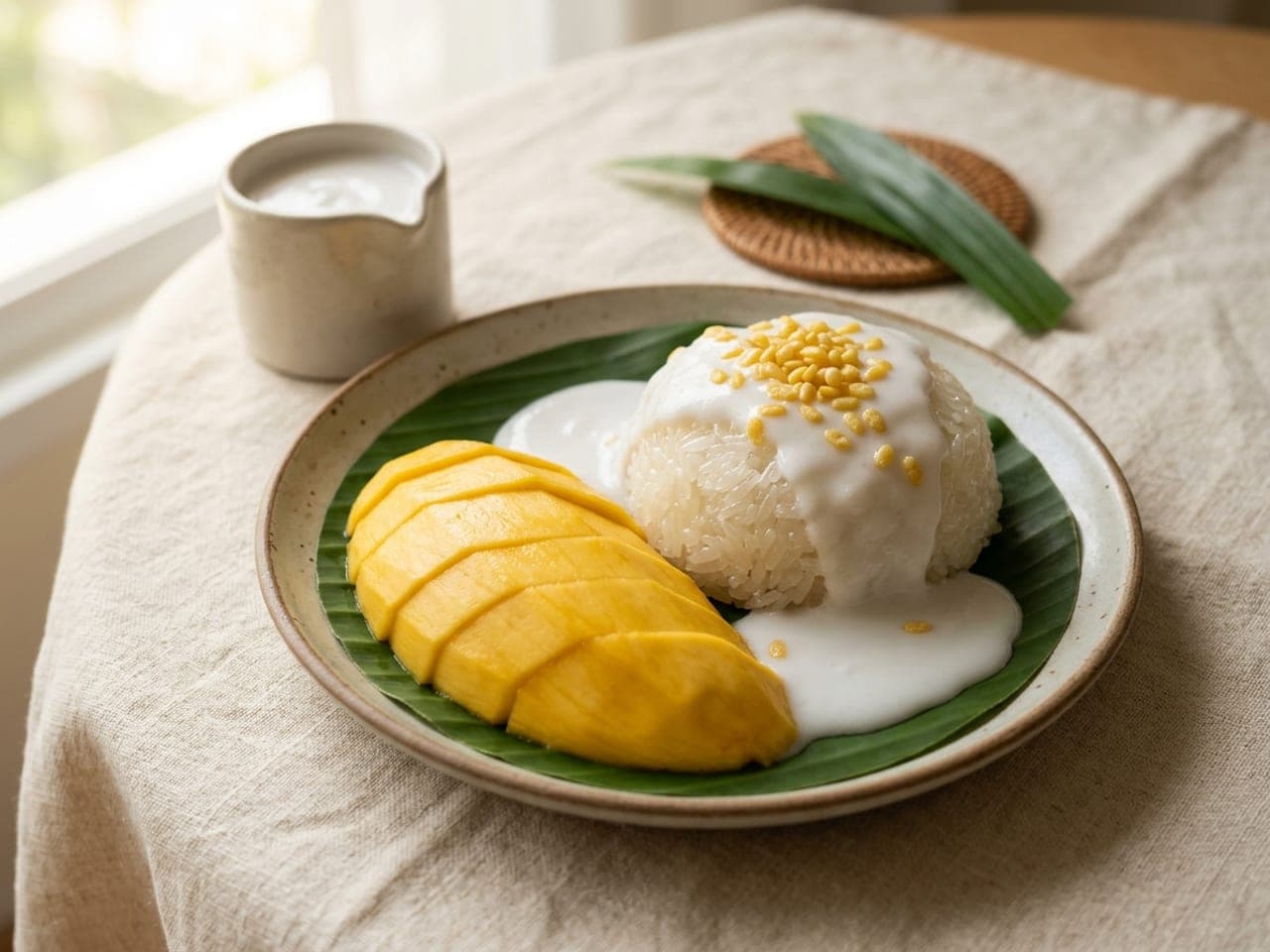
Thailand's summer dessert, three ingredients pretending to be simple: glutinous rice steamed — never boiled — until each grain is a chewy pearl, folded with sweetened coconut milk, and served warm beside cold ripe mango under a drizzle of salted coconut cream. The whole dish is balance arithmetic: sweet rice, salty sauce, perfumed fruit. Get the rice species right and the rest is patience; this page handles both.
Ingredients
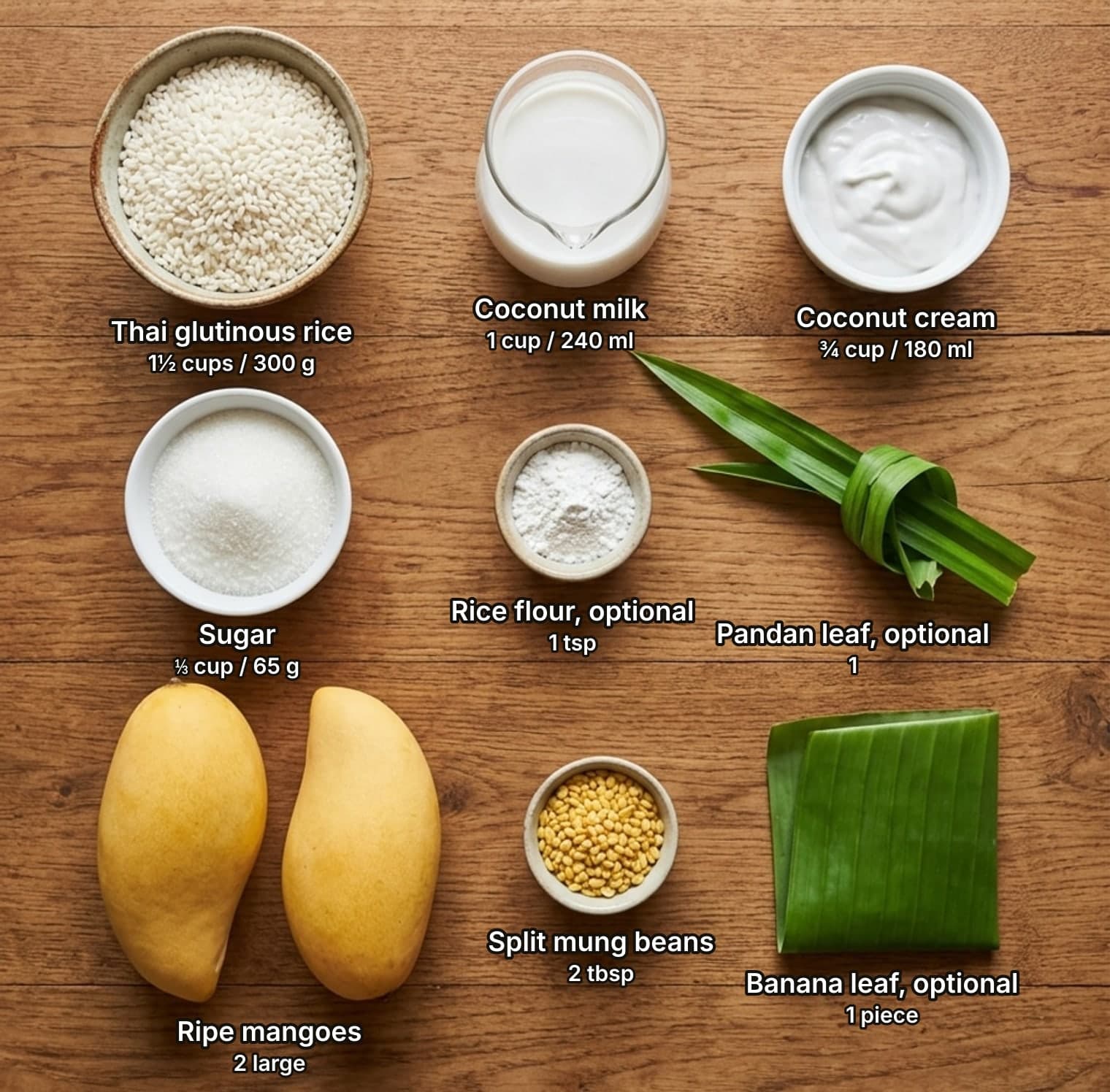
- Thai glutinous rice (labelled glutinous or sweet rice — opaque grains)1½ cups / 300 g
- full-fat canned coconut milk (seasoning)1 cup / 240 ml
- coconut cream (sauce — pure cream can, or the thick cap of an unshaken can)¾ cup / 180 ml
- sugar⅓ cup / 65 g
- fine salt (¾ tsp rice seasoning + ½ tsp sauce)1¼ tsp total
- rice flour (optional, to thicken the sauce)1 tsp
- pandan leaf (optional, knotted into the steam or the milk)1
- large ripe mangoes (honey/Ataulfo type first choice), chilled2
- dried yellow split mung beans (or toasted sesame seeds)2 tbsp
- banana leaf, for plating (optional)1 piece
Thailand’s summer, served on a plate
Khao niao mamuang — sticky rice with mango — is not an everyday Thai dessert; it is a seasonal event. Thai mango season peaks from about March through June, exactly the months the country turns furnace-hot, and the dish is the collision of that calendar: the year’s most perfumed fruit, cold from the market ice, against warm coconut rice, sold from street carts and market stalls in flat boxes with the salted cream in a tiny bag on top. Around Songkran, the April new-year water festival, it is practically the national dish; by July the best mangoes are gone and the carts move on. The dish’s whole design — warm against cold, sweet against salt — is tropical-heat engineering.
The rice half of the name carries its own geography. Glutinous rice is the staple — not the side dish, the staple — of Isaan and northern Thailand and of Laos, eaten with the hands at every meal, steamed in woven baskets that hang from kitchen rafters. Khao niao mamuang is that everyday rice in its festival clothes: same grain, same steaming, plus coconut, sugar and the season’s fruit. Which is why the technique on this page is non-negotiable in Thailand — everyone’s grandmother steams sticky rice weekly, and boiling it would be like a French kitchen boiling a baguette.
The dish had a global moment in 2022, when the Thai rapper Milli finished her Coachella set by eating a bowl of it on stage — mango sticky rice trended worldwide, sold out across Bangkok for weeks, and Thai officials talked seriously about UNESCO paperwork. The carts, which had been serving it for generations, were reported to be unimpressed and very busy.
How to make Mango sticky rice
- Buy the right rice — this is the whole recipe deciding itself. You need 1½ cups (300 g) of Thai glutinous rice — the bag says “glutinous rice” or “sweet rice”, the grains are long and chalk-opaque white, and Thai brands fill a shelf of every Asian grocer. Jasmine, basmati, sushi or risotto rice cannot make this dish at any water ratio — the sections below explain the starch chemistry, but the shopping rule is simple: if the raw grains are translucent, it is the wrong bag.
- Soak — four hours minimum, overnight is better. Rinse the rice in a few changes of water until it runs mostly clear, then cover it generously with cool water and walk away for at least 4 hours, or overnight — on the counter in a cool kitchen, in the fridge in a warm one. Steaming cooks by vapour, not immersion, and only water already inside the grain can gelatinise the starch — under-soaked rice steams into a chalky centre no amount of extra time fixes. (Truly out of time? Two hours in warm water is the floor, and the texture will tell on you a little.)
- Steam 25 minutes, flipping once. Drain the rice and spread it in a cheesecloth- or muslin-lined steamer basket (a metal sieve that sits over a saucepan works; so does a bamboo steamer; a knotted pandan leaf in the steaming water is the classic perfume). Steam over rolling-boil water, covered, about 25 minutes, flipping the whole rice bundle over at the 15-minute mark so both faces cook evenly. Done rice is translucent, glossy, chewy-tender with no white core — and it never touched the water. Rice-cooker and microwave fallbacks live in the FAQ, honestly graded.
- Make the seasoning coconut while the rice steams. Warm 1 cup (240 ml) of full-fat coconut milk with ⅓ cup (65 g) sugar and ¾ tsp fine salt, stirring just until dissolved — do not boil. Taste it: sweet first, then a saline edge that seems slightly too assertive on its own. That edge is the dish; the mango is unsalted and the arithmetic needs it.
- Marry them hot, then let them sit. Turn the just-steamed rice into a bowl, pour the warm seasoned coconut milk over, fold gently once or twice — the grains will swim; trust it — cover, and rest 20–30 minutes. The hot rice drinks the coconut as it cools, finishing plump, glossy and just-set. This resting step is where sticky rice becomes the dessert; skip it and you serve wet rice in a puddle. Do not refrigerate while it rests for serving — the dish is served warm or room temperature, and the fridge is where sticky rice goes to turn to grout. (Leftovers are the exception: chill them promptly and accept the texture hit — grout beats Bacillus cereus.)
- Make the salted coconut sauce. Warm ¾ cup (180 ml) of coconut cream (the thick top of a can, or a small can of pure cream) with ½ tsp salt — and, if you like the sauce Bangkok-thick, 1 tsp of rice flour slurried in 1 tbsp of cold water, stirred in as it warms until it barely coats a spoon. This sauce is SALTY-creamy, not sweet — it is the counterweight, poured over the sweet rice at the end. Keep it warm.
- Toast the mung beans. Rinse 2 tbsp of dried yellow split mung beans, pat dry, and toast them in a dry pan over medium heat, tossing, 4–5 minutes until golden and audibly crackling. They land on the finished plate like tiny croutons — the traditional crunch against all that soft. (Toasted sesame seeds are the accepted stand-in; fried shallots are for people ready to argue in Thai.)
- Cut the mango cold and generous. Take 2 large ripe mangoes — chilled, which is the temperature counterpoint to the warm rice — slice the cheeks off either side of the flat pit, run a spoon between flesh and skin to free each cheek whole, and slice into thick petals or crosswise coins. A ripe mango is slippery; cut cheek-down on the board, not in your palm. Any juice on the board gets poured over the plate — that is chef’s tax.
- Plate warm rice, cold mango, salty drizzle. Mound a serving of the warm coconut rice on one side of each plate (a small bowl as a mould gives the street-box dome), fan half a mango alongside, spoon the warm salted sauce generously over the rice — letting it pool — and scatter the toasted mung beans on last so they stay loud. Eat immediately, ideally outdoors, ideally in weather too hot for any other dessert; that is the climate this dish was engineered for.
Safety & hygiene Important
- Cooked rice keeps street hours, not fridge hours. Sticky rice is served warm or at room temperature, and that tradition comes with a clock: cooked rice held warm too long is the textbook Bacillus cereus vehicle, and its toxins shrug off reheating. The safe shape of the day: serve within 2 hours of steaming — 1 hour if it is sitting outdoors above 90°F (32°C) — keep the resting bowl covered at room temperature, never in a warm oven or a sunny window, and anything still out at the 4-hour mark is bin food, not dessert. Leftovers go promptly to the fridge (the FAQ covers reviving them) rather than ferrying in and out of the danger zone. The FAQ’s make-ahead answer works inside these rules, not around them.
- Steam burns worse than boiling water. Steam carries more energy than the water it came from, and it exits a lifted lid invisibly, wrist-high. Open the steamer AWAY from yourself, lid tilted like a shield; use dry cloths or mitts for the basket (a wet cloth conducts steam straight through); and when flipping the rice bundle at the 15-minute mark, lift the whole cloth out onto a plate rather than performing surgery over the live pot. The dessert is gentle; the equipment is not.
- Coconut milk is fresh dairy’s cousin once opened. Canned coconut milk and cream are sterile until the opener touches them — after that they are perishable: refrigerate leftovers in a covered non-metal container and use within 3–4 days, or freeze in cubes for future batches. A sour smell, fizz, or grey cast means the can’s second life is over. And buy full-fat cans meant for cooking, not “coconut drink” from the beverage aisle — the difference is the whole sauce.
- Ripe is a smell; fermented is a warning. A mango at its peak smells honeyed at the stem and yields slightly, like a ripe avocado. Past that peak the flesh ferments — an alcoholic, solvent-ish whiff, fizzy taste, translucent mushy patches — and a fermenting mango is compost, not dessert. Softness alone is not the test (some varieties stay firm-ish when ready); trust nose over squeeze, and cut away bruises generously — they are where the fermentation starts.
3 ways to plate it
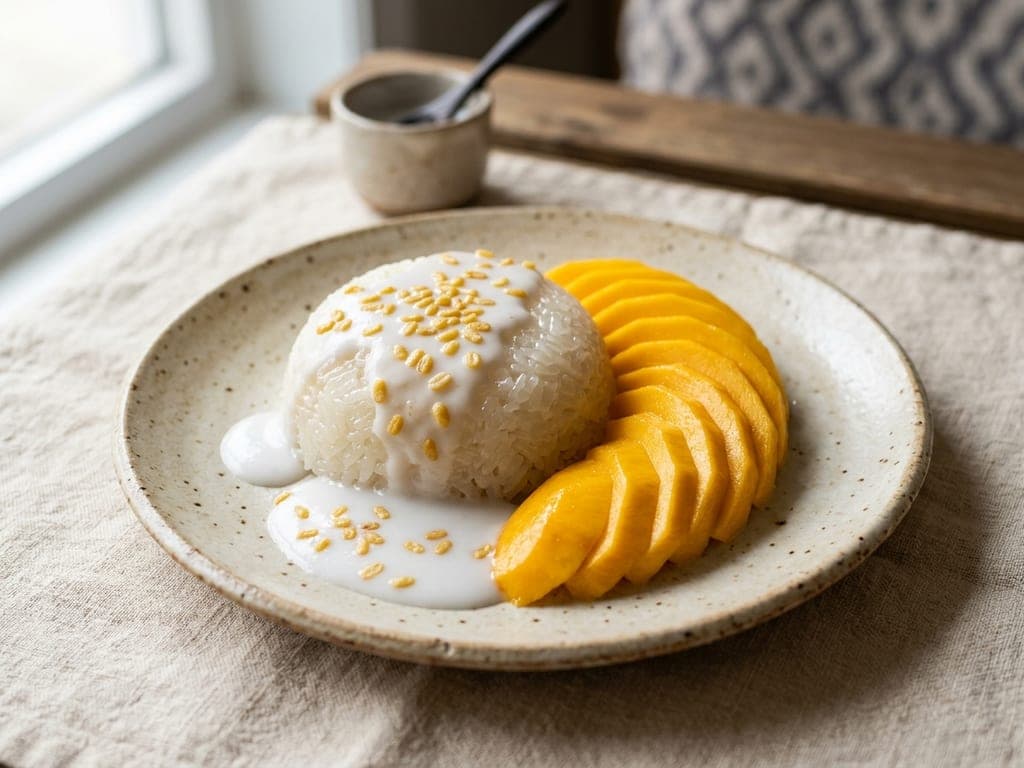
- Pack the warm rice into a small bowl, press once, and unmould with a tap — the clean dome is what separates a plated dessert from a scoop of rice, and it takes ten seconds.
- Fan the mango petals in an overlapping arc hugging the dome’s curve, cut edges facing out — fruit and rice should read as one composition, not two neighbours.
- Spoon the warm salted sauce over the dome’s peak and let gravity build the pool at the base; a poured pool reads generous where a painted stripe reads cautious.
- Scatter the toasted mung beans onto the wet sauce at the last second — they anchor where they land and stay crackling for exactly the length of dessert.
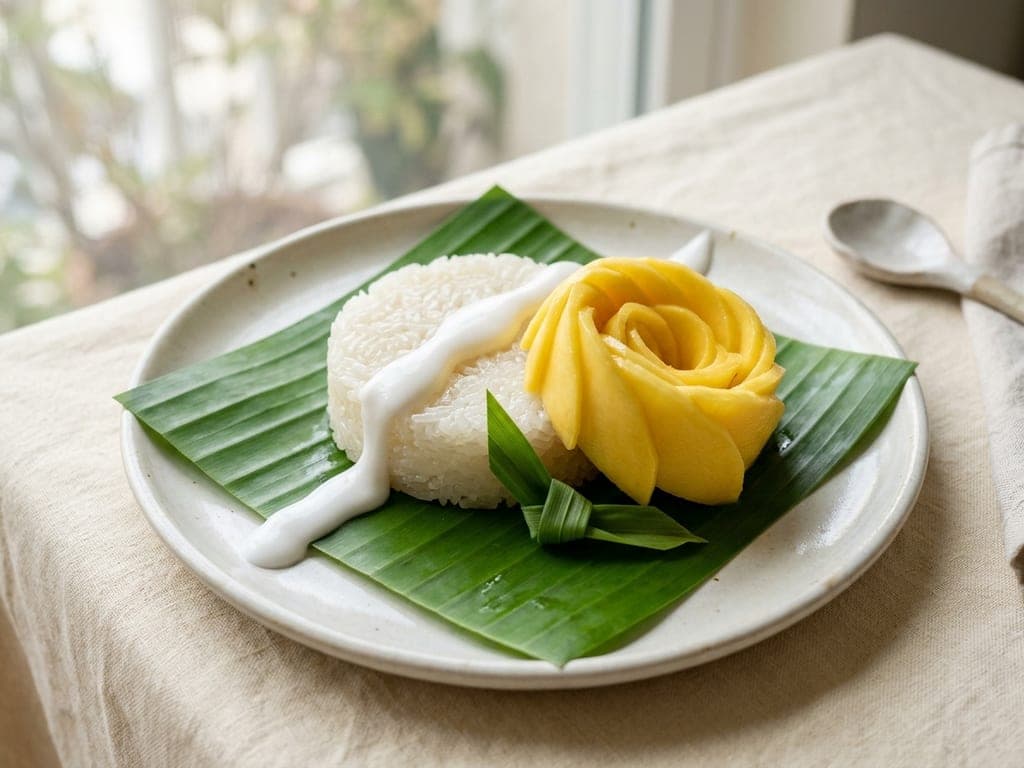
- Cut a banana-leaf square (Asian grocer freezer; wiped and briefly waved over a flame to gloss) — it is the plate’s plate, and the green under gold is the whole colour scheme.
- Press the rice into a low, wide cylinder rather than a dome — a ring mould or tuna-can form gives the level top the fanned fruit wants to sit against.
- Slice the mango cheek into thin, even petals and fan them with each slice overlapping half the last, curling the line into a partial rosette — a wet knife and unhurried hands are the entire technique.
- Ribbon the sauce across rice and plate in ONE continuous pass and stop — the temple version earns its stillness by refusing the second drizzle everything in you will suggest.
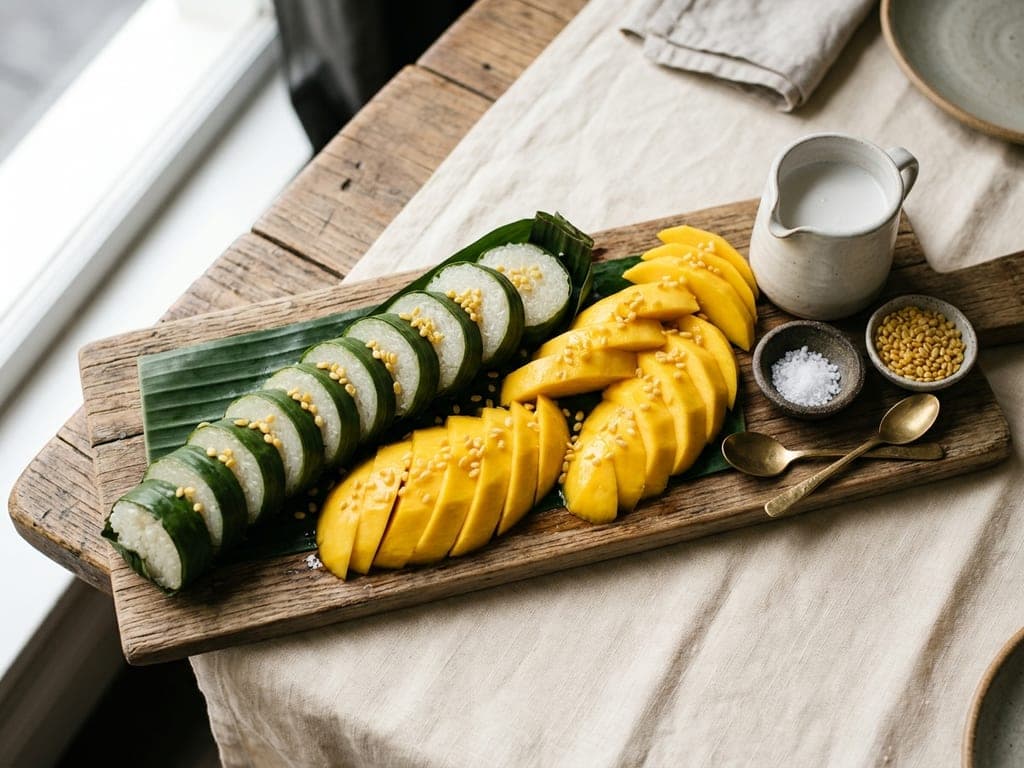
- Roll the warm rice in a banana leaf into a snug log, rest it seam-down ten minutes, then slice into thick rounds through the leaf — the green-ringed coins plate a crowd in one move.
- Lay the rounds slightly overlapping down one side of the platter and the mango fans down the other, meeting in the middle — two rivers, one platter.
- Serve the salted sauce warm in a small jug rather than pre-pouring — self-sauced portions stay glossy, and the jug’s second lap around the table is the dessert’s applause.
- Keep the mung beans and a pinch of flaky salt in twin dishes at the platter’s end — the finishing station lets every plate end crunchy, and the salt dish quietly converts the doubters.
Sticky rice is a different species of ingredient
The name “glutinous” confuses two ways at once: there is no gluten in it (the word means glue-like; the dish is naturally gluten-free), and it is not regular rice cooked stickier. Rice starch is two molecules in a ratio — amylose, which cooks into distinct firm grains, and amylopectin, which cooks into cling. Jasmine rice runs meaningfully amylose; glutinous rice is essentially all amylopectin. That is why the raw grains are chalk-opaque instead of translucent (the starch is packed differently, scattering light), why it cooks into chewy pearls that hold together in a sheet, and why no water ratio ever turns jasmine into khao niao. It is a different ingredient that happens to share a plant family — treat the two as interchangeable and both will punish you.
The starch also dictates the method. Boiled in water, near-pure amylopectin doesn’t simmer into grains — it dissolves at the surface into paste, and the pot produces something between porridge and wallpaper adhesive. So Thailand steams it: the long soak loads water INTO each grain, and steam then gelatinises the starch from within, so the grains cook through while never sitting in the liquid that would dissolve them. Soak, steam, flip once, done — the equipment is a sieve and a saucepan, the skill is only patience, and the result is the springy, distinct-yet-clinging texture the whole dessert is built on.
Shopping notes: Thai brands (the bags labelled glutinous or sweet rice, often marked from Thailand) are the target, and the long-grain Thai type is the classic for this dish; short-grain Japanese sweet rice — the mochi one — steams up rounder and softer and will pass in a pinch. “Sticky rice” on a restaurant menu near the sushi is plain japonica and not this. When in doubt, look through the bag: opaque white, or walk on.
The coconut arithmetic
The dish uses coconut twice, in opposite directions — and most Western recipes flatten this into one sweet sauce, which is how you get the cloying version. Pass one is the seasoning: warm coconut milk, sugar and a decisive ¾ teaspoon of salt folded into the just-steamed rice, which drinks it up during a twenty-minute covered rest. The rice ends sweet-leaning, rich, barely saline underneath. Pass two is the sauce: coconut CREAM warmed with salt and no sugar at all, drizzled over at serving. It tastes almost startling alone — creamy brine — and lands exactly right over sweet rice and honeyed mango. Sweet base, salty finish, perfumed fruit: three vectors, deliberately not aligned.
Both passes want the real ingredient: full-fat canned coconut milk (the can that thumps rather than sloshes; shake-test in the aisle) and, for the sauce, either the thick cap that rises in an unshaken can or a small can of pure coconut cream. The refrigerated “coconut drink” cartons are water with marketing and cannot build either layer. “Cream of coconut” — sweetened, for cocktails — is a different product again and would double the sugar; the label to trust reads coconut and maybe a stabiliser, nothing else. The optional teaspoon of rice-flour slurry in the sauce is the street vendors’ trick for a drizzle that ribbons instead of running.
If you have a pandan leaf — the vanilla of Southeast Asia, sold frozen in Asian grocers — knot it into the steaming water or the seasoning milk and fish it out at the end; the grassy-vanilla perfume is the smell of a Bangkok dessert cart. Worth buying once; the freezer keeps the rest of the bunch for a year of batches.
The mango is half the dish — buy it like it matters
In Thailand the dish rides on nam dok mai mangoes — slim, golden, almost fibreless, honey-and-flowers — and their cousins, picked ripe and sold the same day. Nothing in a Western supermarket is quite that, but the gap is smaller than it looks if you buy by variety and patience rather than by whatever is nearest the door. First choice: the small flat yellow ones sold as honey, Ataulfo or Champagne mangoes (and, in European season, Pakistani or Indian varieties like Alphonso or Chaunsa, which are arguably better than anything in the original) — buttery, thin-pitted, minimal fibre. Second: Kent or Keitt, the larger green-red ones, genuinely good when properly ripe. Last resort: Tommy Atkins, the fibrous red-blushed default — it will do, with a sigh, sliced thin across the fibre.
Ripeness outlives variety. Colour is nearly useless across mango types; the tests are a honeyed smell at the stem end and flesh that gives slightly under a thumb, like a ripe avocado. Supermarket mangoes ship hard and finish on your counter: two to four days at room temperature (paper bag to hurry it), THEN into the fridge, where a ripe mango holds several days and picks up the chill the plate wants. Buy the mangoes when you buy the rice, and let the fruit’s schedule set dessert night — the rice takes an afternoon; the mango takes the week it takes.
And if the week fails you: good frozen mango, thawed cold, beats an unripe fresh one — the texture loses a little spring but the perfume is real, and the dish is forgiving of everything except crunchy sour fruit and boiled rice.
Questions, answered
Can I make mango sticky rice with jasmine rice?
No — and it is chemistry, not gatekeeping. Jasmine carries enough amylose to cook into separate fluffy grains; glutinous rice is nearly all amylopectin, which is what makes the pearls cling into a sheet you can eat with your fingers. Jasmine folded with coconut milk makes a decent rice pudding — a different, wetter dessert. The right bag costs a few euros at any Asian grocer and says “glutinous” or “sweet rice” on it.
Can I use a rice cooker or microwave instead of steaming?
Honestly graded: a rice cooker works at a B+ — soaked rice, water just level with the grains (about ¾ cup / 180 ml for this quantity), normal cycle; the bottom layer runs a little wet. The microwave is the sleeper: soaked rice in a covered bowl with ½ cup (120 ml) water, 3 minutes high, stir, 3 more, rest 5 — closer to steamed than it has any right to be. Both beat boiling, which is the one true failure. The cloth-in-steamer method remains the A.
Why did my sticky rice turn to mush?
One of three roads: it was boiled in water like pasta (amylopectin dissolves — paste, every time), it was the wrong rice “compensated” with extra water, or it steamed fine and then drowned — the seasoning coconut milk went in as a flood instead of the measured cup, or the rice never got its covered rest to absorb. Steam the right grain, add the milk warm and measured, rest 20 minutes: the mush disappears from your life.
Can I make it ahead?
Same-day, yes, within the safety window: steam and season the rice so it comes off the steamer within 2 hours of dessert, hold it covered at room temperature (not the fridge while serving — coconut sticky rice sets to grout in the cold), sauce and beans done alongside, mango cut at serving. Next-day is a compromise: refrigerate the rice for safety, then revive portions with a splash of coconut milk under a damp paper towel in the microwave, 40–60 seconds. Real texture loss, workable Tuesday. The assembled plate holds for the length of dessert, which is as designed.
What coconut milk should I buy?
Full-fat canned coconut milk — the can that thumps when shaken — for seasoning the rice, and coconut cream (a pure-cream can, or the thick cap of an unshaken can) for the salted sauce. Skip light coconut milk (the dish IS the richness), skip carton “coconut drinks” (flavoured water), and skip sweetened “cream of coconut” cocktail syrup, which would break the sweet-salty arithmetic the dish runs on.
What mango is best outside Thailand?
In order: the small yellow honey/Ataulfo/Champagne type; Indian or Pakistani season fruit (Alphonso, Chaunsa) when Europe has it; Kent or Keitt properly ripened; Tommy Atkins as the fibrous last resort. Judge ripeness by a honeyed smell at the stem and a slight give — colour lies across varieties. Hard supermarket fruit ripens on the counter in 2–4 days, then chills in the fridge; the cold mango against warm rice is part of the dish.
What is the yellow crunchy topping?
Split yellow mung beans, rinsed, dried and pan-toasted until golden and crackling — the traditional textural counterpoint, little savoury croutons against all that soft and sweet. Toasted sesame is the common substitute; crispy fried shallots appear on savoury-leaning street versions. Whatever the crunch, it goes on at the last second — humidity is its enemy and the sauce is humid.
Is mango sticky rice vegan and gluten-free?
Both, natively — rice, coconut, sugar, salt, fruit; nothing hides. “Glutinous” is the trap word: it describes the glue-like starch (pure amylopectin), not gluten, of which rice has none. The only label to read is the coconut cream’s, where a rare brand slips in dairy-derived stabilisers — the shortest ingredient list wins, as usual.
Warm or cold — how is it supposed to be served?
Rice warm or at room temperature, mango cold, sauce warm — the temperature contrast is designed, not accidental. Fridge-cold assembled leftovers are the saddest version of the dish: the rice hardens (amylopectin retrogrades fast in the cold) and the sauce sets to wax. If dessert must wait, hold the rice at room temperature within its 4-hour window and chill only the fruit.
How many calories in a serving?
About 450 as plated here — the rice and the two coconut passes carry nearly all of it; the mango is the light half of the plate. It is a festival dessert and portions accordingly: the street box is modest, the mango is generous, and the correct lightening lever is more fruit against a smaller rice mound, never a “light” coconut milk that thins the entire point.
Snap your finished plate and let the AI plate it again — more beautifully.