Classic Deviled Eggs Recipe (Creamy, Easy to Peel)
Classic deviled eggs the way a good kitchen makes them: seven eggs for twelve halves so every white is filled high with yolk, eggs started hot in steam for 12 minutes so the shells slip off, a two-acid filling with real heat in it, and a make-ahead plan that gets a platter to the party cold and safe. Plus the history nobody tells right, from a 13th-century Andalusian cookbook to the earliest known “deviled eggs” in print: a hungry sailor’s second supper, in 1854.
Ingredients
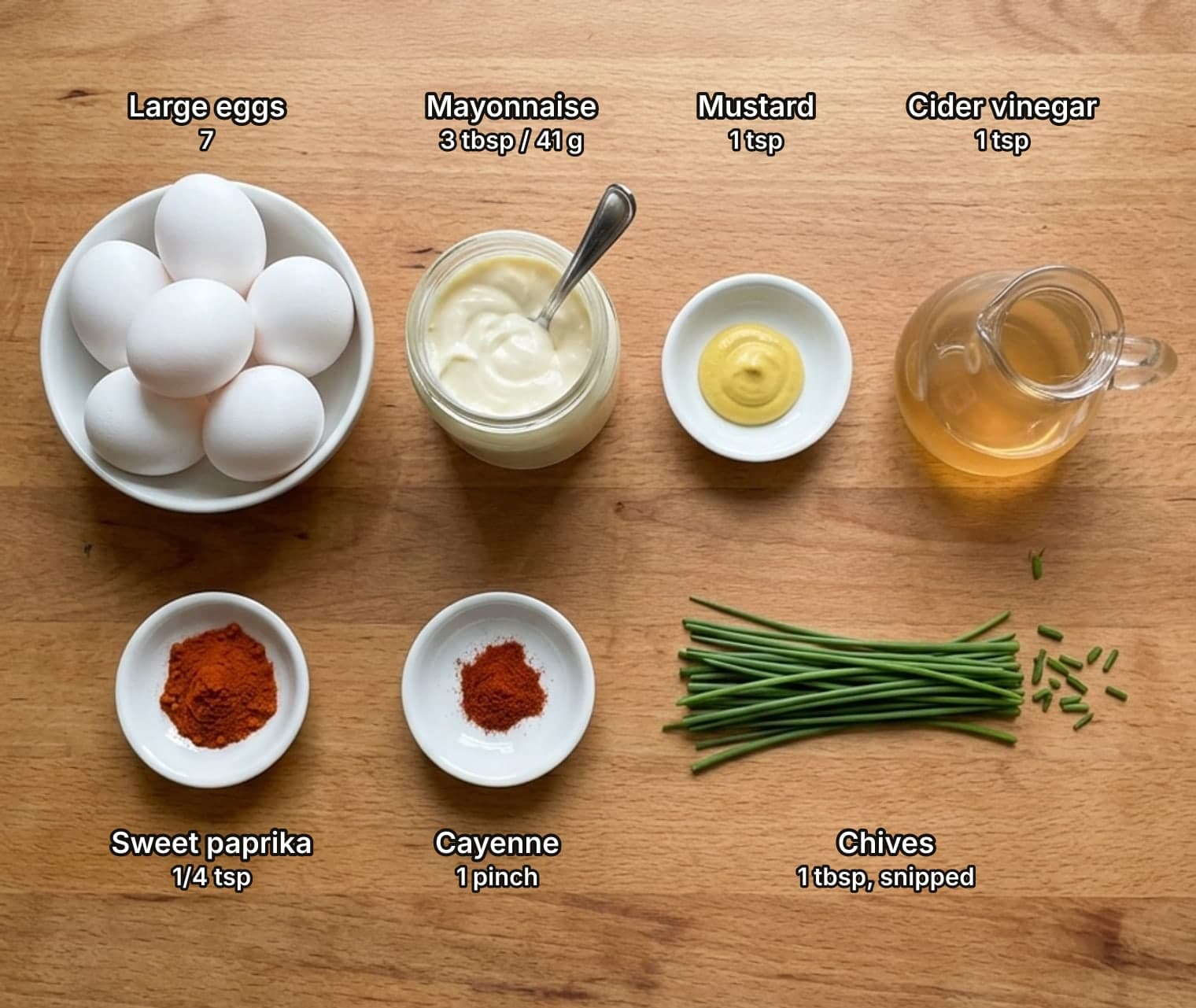
- large eggs, fridge-cold and uncracked (US large, about 2 oz / 57 g in the shell; in the UK and EU that is a medium egg; contains egg)7 (makes 12 filled halves plus 2 spare whites)
- mayonnaise, store-bought (Duke’s for Southern tang, Hellmann’s for a milder jar; not homemade if serving pregnant or high-risk guests; contains egg)3 tbsp (41 g)
- yellow mustard or Dijon mustard (mustard is a declared allergen in the UK and EU)1 tsp
- apple cider vinegar or dill pickle brine1 tsp
- fine salt, plus a pinch for seasoning the whites1/8 tsp
- cayenne pepper, or 2 to 3 dashes of hot sauce (the “devil”)1 pinch
- freshly ground black pepper1 pinch
- sweet paprika (the classic finish) or smoked paprika (pimentón), to dust1/4 tsp
- fresh chives, finely snipped (optional garnish)1 tbsp
- flaky sea salt, to finish (optional)a few flakes
What are deviled eggs, and what goes in them?
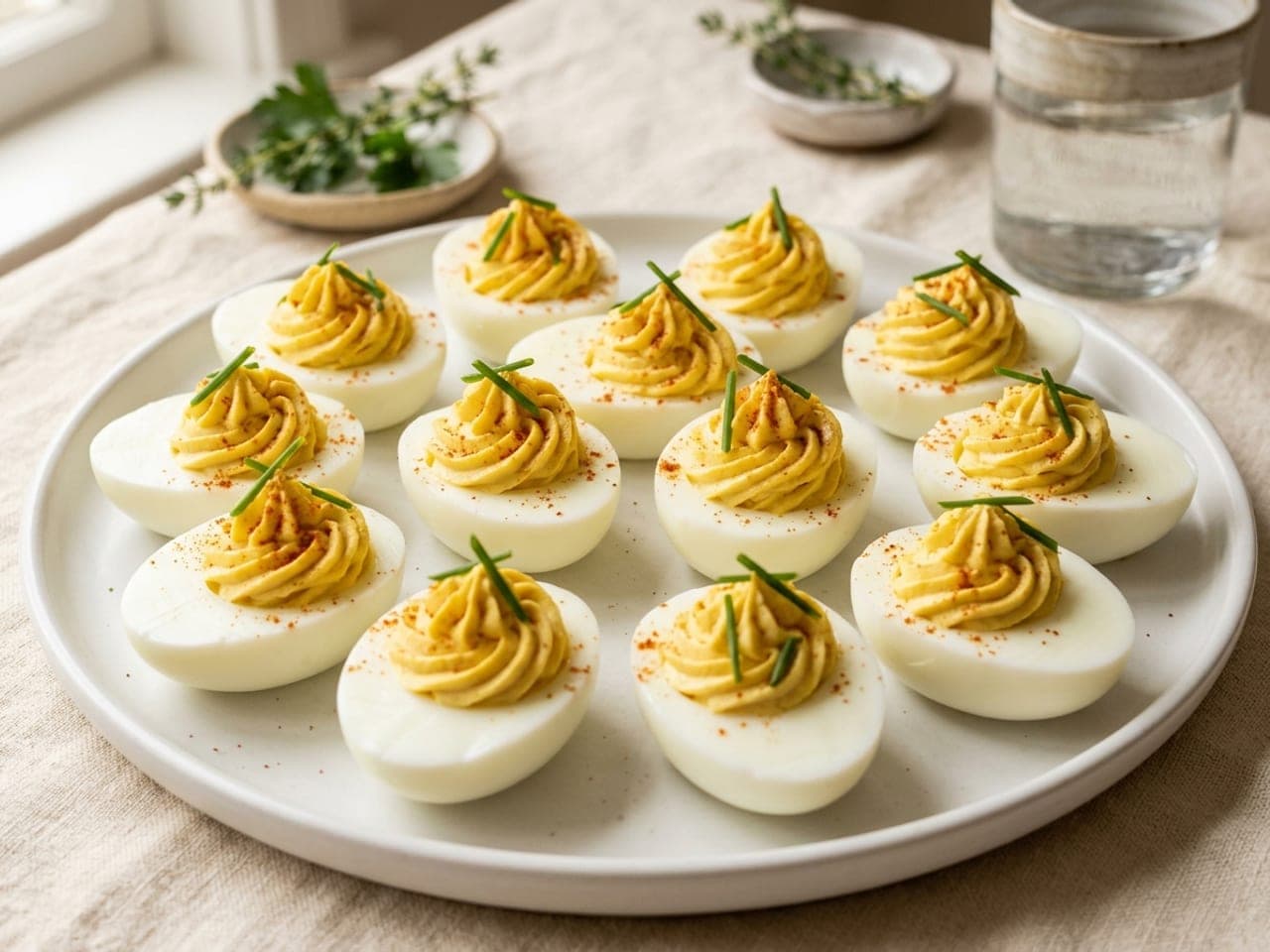
Deviled eggs are hard-cooked eggs halved lengthwise, their yolks mashed with mayonnaise, mustard, an acid and something hot, then piped or spooned back into the whites and finished with a dusting of paprika. They are the most American of party foods, on the Easter table, the Thanksgiving sideboard, the church potluck and the Christmas buffet, and they are made by the dozen because nobody eats one.
Every good version is built from five parts: yolk, fat, acid, pungency and a garnish. The yolk is the body. The fat, almost always mayonnaise today (butter in the 19th century), makes it creamy. The acid, vinegar or pickle brine, brightens it. The pungency, mustard plus a little cayenne or hot sauce, is the “devil” in deviled. The garnish, paprika and chives, is what the eye eats first. This recipe keeps that classic shape and changes only what makes it better: one extra egg per dozen halves so the yolk filling mounds high, a hot start so the eggs peel cleanly, and a filling built on yolk rather than on extra mayonnaise.
For 12 halves, which serves 6 as one appetizer among several, you need 7 large eggs, 3 tbsp of mayonnaise, 1 tsp each of mustard and cider vinegar or pickle brine, 1/8 tsp of salt, a pinch each of black pepper and cayenne, and paprika and chives to finish. Allow about 50 minutes from cold eggs to a finished plate, most of it hands-off: 20 minutes to boil the water and steam the eggs, 15 in the ice bath, and 15 to peel, fill and garnish.
How to make Deviled Eggs
- Set up the steamer and the ice bath. Pour 1 inch (2.5 cm) of water into a saucepan wide enough to hold a steamer basket, cover, and bring it to a hard boil over high heat. While it heats, fill a large bowl with about 4 cups (1 L) of ice and 4 cups (1 L) of cold water. Take 7 large eggs straight from the fridge: seven, not six, because one or two whites always tear, and the spare yolk is what lets every one of the 12 finished halves be filled high instead of scraped level. If you plan ahead, turn the carton on its side in the fridge the day before; America’s Test Kitchen and Harold McGee both report better-centered yolks, and a centered yolk means walls of even thickness that do not split when you fill them. It costs nothing, though the evidence is thin. Optional: prick the wide end of each egg with a thumbtack (a drawing pin) to vent the air cell, a trick Kenji López-Alt uses to cut cracks and the flat dimple at the base.
- Steam the eggs hot, 12 minutes. Lower the cold eggs into the steamer basket in a single layer, set it over the boiling water, cover, and keep the heat on high. Use tongs or a spoon and lower the basket carefully; when you lift the lid, tilt it away from you so the steam escapes on the far side. Set a timer for 12 minutes. The hot start is the whole secret of a clean peel: when heat hits the egg fast, the outer white sets before its proteins can glue themselves to the shell membrane. In Serious Eats’ tests, eggs started in boiling water or steam peeled cleanly well above 90% of the time, against just over 50% for eggs started in cold water. Steam beats a pot of boiling water for consistency, because seven fridge-cold eggs cannot knock the temperature of steam down the way they cool a pot of water. Twelve minutes gives a yolk that is fully set, pale gold to the center and still moist, roughly 170°F (77°C) at the center, which is exactly what a filling wants: a dry, chalky yolk needs more mayonnaise to become smooth, and more mayonnaise means a softer, weepier filling. For US extra-large eggs (roughly a UK/EU large) add about a minute, for smaller ones take a minute or two off, and at high altitude add a minute or two, since water boils cooler. While they steam, wash your hands with soap and warm water for 20 seconds, and the tack if you used one: raw shells can carry salmonella, and in a few minutes you will be handling the peeled eggs.
- Shock in ice water for 15 minutes. The moment the timer sounds, lift the eggs into the ice bath with a slotted spoon and leave them there for a full 15 minutes. Two things are happening. First, carryover cooking stops, so the yolk stays at the texture you timed for. Second, you are preventing the green-gray ring: prolonged heat makes the white release hydrogen sulfide, which reacts with iron at the surface of the yolk to form ferrous sulfide. Tinkler and Soar worked this out in the Biochemical Journal in 1920, and they found that quick cooling draws the gas outward, away from the yolk. What cold water cannot do is undo a ring that has already formed, so the bath has to be immediate. (A green ring is harmless, by the way, just unpretty.) If you are cooking a day or more ahead, move the cooled eggs, still in their shells, to the fridge. In Serious Eats’ tests, chilling overnight cut the number of badly peeled eggs by a further half.
- Peel, halve, and choose the best twelve. Tap each egg all over on the counter, then roll it gently under your palm to craze the shell. Peel under a thin trickle of cold running water, starting at the wide end where the air pocket gives you a way in; the water slips between membrane and white and floats the shell away. Pat the eggs dry. Wipe a sharp knife clean and wet it between cuts, then halve each egg lengthwise from tip to tip. A clean blade gives a clean, glossy cut edge, which is half of what makes a deviled egg look professional. Pop the yolks into a fine-mesh sieve set over a bowl. You now have 14 white halves: choose the 12 best, with even walls and no tears, and set them cut side up on a plate. The two rejects are the cook’s perk, or chop them into tomorrow’s egg salad. Sprinkle the 12 whites very lightly with salt, then slide the plate into the fridge while you make the filling. Almost nobody seasons the whites, and an unseasoned white is the reason so many deviled eggs taste flat under a well-seasoned filling.
- Make the filling: sieve first, then season. Press all 7 yolks through the sieve with the back of a spoon. Sieving gives a lump-free, fine powder without beating in air; a fork leaves grainy spots, and a food processor gives the silkiest result of all but is a lot of washing up for 7 yolks. Add 3 tbsp (41 g) of store-bought mayonnaise, 1 tsp of yellow or Dijon mustard, 1 tsp of apple cider vinegar or dill pickle brine, 1/8 tsp of fine salt, a pinch of black pepper and a pinch of cayenne, then fold and smear everything against the side of the bowl with a flexible spatula until completely smooth. That is roughly 3 parts yolk to 1 part mayonnaise by weight: 7 yolks, about 119 g, to 41 g. Many popular recipes run closer to 2 to 1, which is why their fillings slump. Two acids matter: mustard brings pungency, vinegar brings brightness, and together they cut the richness of the yolk. The cayenne is the devil. Taste and adjust: the texture you want holds a soft peak on the spatula, thick enough to pipe a ridge, soft enough to melt on the tongue. If it is too soft to hold a ridge, chill it for 10 minutes, or mash in more yolk; never add more mayonnaise to fix it.
- Pipe high, as close to serving as you can. Scrape the filling into a piping bag fitted with a large open-star tip, or into a zip-top bag with a 3/8 inch (1 cm) corner snipped off. Hold the bag upright just above each white and pipe a generous swirl that rises about 1/2 inch (1.3 cm) above the white, releasing pressure before you lift away so the top finishes in a clean point rather than a tail. This is what the seventh yolk is for: an overfilled half looks deliberate and generous, while a level fill looks like it ran out. No bag? Use two teaspoons, one to scoop and one to push, and mound it. If a white rocks on the plate, shave the thinnest possible sliver off its rounded base so it sits flat (too deep and you cut a hole into the cavity), or anchor it with a dab of filling underneath. If filled eggs must wait in the fridge, cover them with plastic wrap tented over a few toothpicks so it never touches the piped tops. Fill as close to serving time as your day allows. Filled eggs held for hours weep a watery layer at the base of the filling and develop a dry skin on top, and America’s Test Kitchen found last-minute filling gave the brightest flavor. For parties, bring the filled bag and the whites separately and pipe on arrival.
- Finish, chill, and watch the clock. Dust each egg with paprika from a sealed, in-date jar (it goes on raw, with no cooking to follow) through a small sieve or from pinched fingertips, holding your hand high so it falls as an even haze rather than a red blot. Sweet paprika is the classic American finish and is mostly color; smoked paprika (pimentón) actually tastes of something on a cold filling. Add a few snipped chives and, if you like, two or three flakes of sea salt for crunch. Serve cold, straight from the fridge, on a chilled plate. From the moment they leave the fridge, deviled eggs are on a food-safety clock that most recipes leave out: under US guidance, 2 hours at room temperature, or 1 hour when it is above 90°F (32°C), after which they go in the bin, not back in the fridge. UK guidance allows chilled food out for up to 4 hours, but the shorter US limit is the safer habit. For a long party, set the platter over a tray of crushed ice and put out small batches, refilling from the fridge. Leftovers that stayed inside the clock keep, covered and chilled, for 3 to 4 days under US guidance, never past 1 week from cooking; UK guidance allows 2 days in total, counted from when the eggs were boiled.
Safety & hygiene Important
- The party clock: 2 hours, 1 hour in heat. The FDA’s rule for cooked eggs and egg dishes: never leave them out of the refrigerator for more than 2 hours, or more than 1 hour when the temperature is above 90°F (32°C), because bacteria grow quickly between 40°F and 140°F (4°C and 60°C). The same guidance says to keep egg dishes refrigerated until serving and to keep cold egg dishes on ice if they will be out longer than 2 hours. Count from when the platter leaves the fridge, not from when guests arrive, and throw out anything that has gone over; returning it to the fridge does not reset the clock. This 2-hour limit is the US rule; UK guidance allows chilled food out of the fridge for up to 4 hours, but the shorter US limit is the safer habit, and it is the one this recipe uses.
- Make-ahead and leftover windows, US and UK. Hard-cooked eggs, in the shell or peeled, keep for 1 week in a fridge at 40°F (4°C) or below under US guidance (FDA, USDA FSIS). UK guidance is much shorter: Food Standards Scotland says a hard-boiled egg keeps up to 2 days in the fridge, with or without the shell. Peeled whites and filling stored separately and tightly covered keep well for up to 2 days. Once assembled, US guidance gives leftover egg dishes 3 to 4 days refrigerated; the UK Food Standards Agency advises eating leftovers within 48 hours, with the fridge at 41°F (5°C) or below. Under US guidance, treat the 1 week from cooking as the outer limit (our own rule for combining the two FDA numbers): 2 days of make-ahead plus 4 days of leftovers must still fit inside it. Under UK guidance, the whole chain, from boiling to the last leftover, is 2 days. USDA FSIS explains why cooked eggs spoil faster than raw ones: cooking leaves a thin film of water under the shell that bacteria like. Do not freeze deviled eggs: the whites turn rubbery and the filling separates.
- Pregnancy and high-risk guests: the mayonnaise matters. A fully cooked egg, firm white and firm yolk, is safe for pregnant, elderly and immunocompromised guests, and every egg in this recipe meets the FDA’s test for a whole egg, “cook eggs until both the yolk and the white are firm”; a yolk steamed for 12 minutes is firm to the center, well past the 160°F (71°C) the FDA sets for egg dishes. The risk is in the binder. Use store-bought mayonnaise: the FDA notes that commercial mayonnaise is made with pasteurized eggs, and US agencies advise against homemade mayonnaise and aioli from raw eggs, especially in pregnancy. (In the UK the NHS says homemade mayonnaise made with British Lion eggs is fine in pregnancy; with any other eggs, stick to a jar.) The NHS also lists pre-packed sandwiches and salads containing egg among foods to be careful with in pregnancy because of listeria, which argues for freshly made eggs over ready-made supermarket ones. Allergens here: egg (in the eggs and the mayonnaise) and mustard (a declared allergen in the UK and EU; Dijon also usually contains sulphites). Optional additions bring more: Worcestershire sauce adds fish (anchovies) and, in the UK and EU formulation, barley malt vinegar (gluten); butter adds milk; store-bought fried shallots usually add wheat; pickled-pepper brine and instant potato flakes often contain sulphites.
- Transport and the Easter-basket rule. Raw shells can carry salmonella, so wash your hands with soap for 20 seconds, and anything that touched the raw eggs, before you handle the peeled ones. USDA advice for taking deviled eggs to a party: keep them chilled until serving and carry them in a cooler with ice. Keep the peeled whites in the fridge while you make the filling rather than on the counter. The cleanest system is to carry the whites in a covered container and the filling in its piping bag, both in the cooler, and assemble on arrival. Eggs that crack while cooking are still safe to use. Eggs that were dyed and hidden for an egg hunt are a different matter: USDA FSIS does not recommend eating hard-cooked eggs that have been hidden or played with, because bacteria on the shell can reach the egg inside. Cook a separate batch for the platter.
- EU and UK eggs: unwashed, unrefrigerated, shorter clocks. European and British shops sell Class A eggs unwashed and usually unrefrigerated: EU rules forbid washing them (with a few authorised exceptions), to protect the natural cuticle on the shell (many producers, including those in the UK’s British Lion scheme, vaccinate their hens against salmonella instead), and advise against chilling before sale because cold eggs brought back to room temperature sweat condensation, which helps bacteria onto and into the shell. Best-before dates are set no more than 28 days after laying. The practical rules for a European kitchen: once you have refrigerated eggs, keep them refrigerated. After boiling, US and UK advice part ways: the FDA allows hard-cooked eggs 1 week in the fridge, while UK guidance (Food Standards Scotland) says hard-boiled eggs keep up to 2 days, and the FSA says to eat leftovers within 48 hours. In the UK, cook the eggs no more than 2 days before the party and count every day from cooking. The 2-hour out-of-fridge rule we use is the US one; UK guidance allows chilled food out for up to 4 hours, and the shorter US limit is the safer habit. One bonus: eggs stored at room temperature age faster, so European supermarket eggs are almost always past the stage where very fresh eggs refuse to peel.
3 ways to plate it
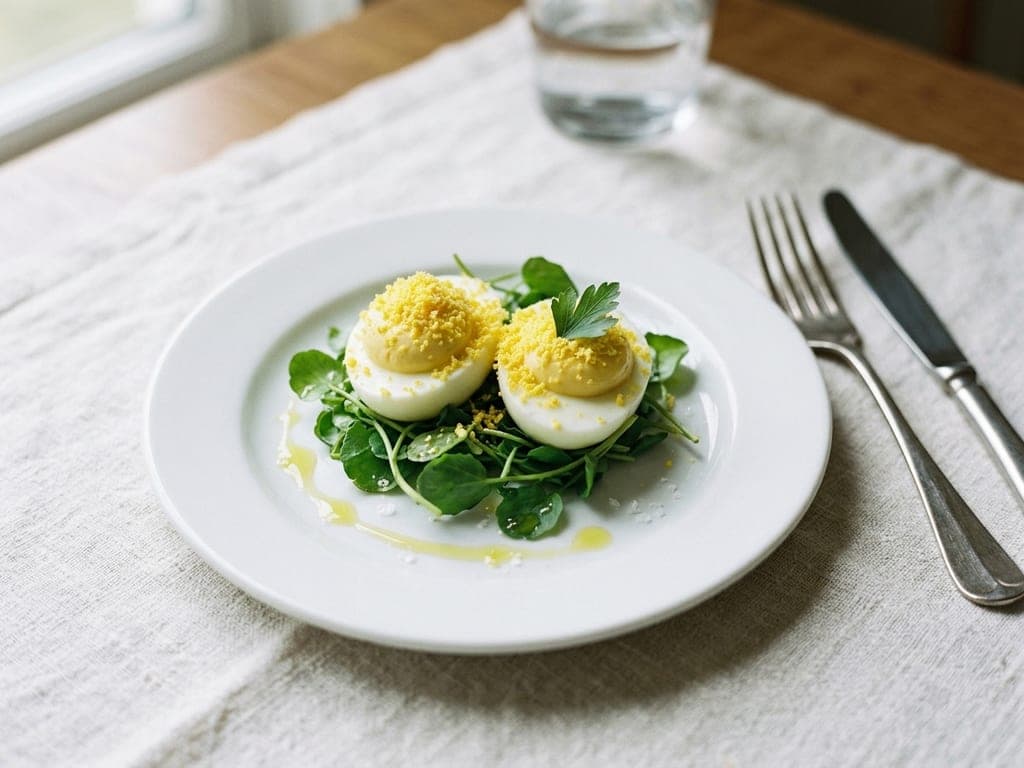
How long to boil eggs for deviled eggs, by method
Ask how long to boil eggs for deviled eggs and you will find answers from 9 to 17 minutes. They are not contradicting each other; they are timing different methods without saying so. What matters is how the eggs start. Here are the times that give a fully set, still-moist yolk for fridge-cold US large eggs, and what each costs you at the peeling stage.
Steamed, hot start (this recipe): 1 inch (2.5 cm) of water at a full boil, eggs in a covered steamer basket, 12 minutes over high heat, then 15 minutes in ice water. Kenji López-Alt steams his deviled eggs for 12 minutes; at 11 the yolk is just barely firm, and America’s Test Kitchen, steaming over medium heat, takes 13. Peeling: excellent. Lowered into boiling water, hot start: bring a large pot of water to the boil, lower the eggs in, boil 30 seconds, then cover and hold at a bare simmer for 11 minutes. Serious Eats caps this at 6 eggs per 3 quarts (2.8 L) of water, so use a bigger pot for 7. Peeling: excellent. Cold start, then off the heat: eggs covered by an inch (2.5 cm) of cold water, brought to the boil, covered and taken off the heat to stand for 10 to 17 minutes depending on whose recipe you follow. The yolks are tender, but these eggs peel worst; ATK graded the method C, and Kenji showed the right standing time shifts with the volume of water in the pot. Pressure cooker: in Kenji’s tests 5 minutes left the yolk translucent, 6 set it, and 7 already tinged it green, with no peeling advantage at all. At altitude, water boils cooler, about 208°F (98°C) at 2,000 feet (610 m), so add time as you go higher.
Why hot starts peel better: when heat hits the egg fast, the outer layer of white sets before it can bond to the membrane under the shell, and shrinks away from it instead. In Serious Eats’ 2014 tests, even two-week-old eggs started cold peeled cleanly only just over half the time, while eggs started in boiling water or steam came out well above 90%. ATK’s 2016 trial put both steaming and boiling-water starts at 9 of 10 flawless, even with notoriously difficult fresh eggs.
What about “old eggs peel easier”? It is true, within limits. The variable is the pH of the white: as an egg ages, carbon dioxide escapes through the shell and the white turns more alkaline, and above about pH 8.9 eggs peel easily (Goodrum, Britton and Davis, Poultry Science, 1989). In a fridge at 39°F (4°C) an egg gets there in about 5 days; at 75°F (24°C), in about 3. Supermarket eggs are almost always past that point by the time you buy them, so age only matters for eggs straight from the hen or the farmers’ market. Two myths to drop: vinegar or salt in the water, which made little difference in Kenji’s blind peeling tests, where start temperature was the factor that counted, and aging eggs after cooking, which barely helps: in one 1973 study, eggs stored for up to three weeks after cooking peeled only slightly better, never easily, and lost flavor within a week (Spencer and Tryhnew). Age them raw, or just start them hot.
The secret to good deviled eggs: more yolk, less mayonnaise
If there is one secret, it is arithmetic. Cook 7 eggs for 12 halves, as America’s Test Kitchen does, and you get 7 yolks of filling for 12 whites. The extra yolk is what lets you fill each half to a generous mound without thinning the filling with more mayonnaise, and the two spare whites absorb the tears that happen to everyone. That is a loss allowance of about 14%, a little more than the 10% party-planning guides usually suggest. Kenji López-Alt goes further, cooking 12 eggs to fill 16 halves. The result is a filling at about 3 parts yolk to 1 part mayonnaise by weight, where many popular recipes sit near 2 to 1, and it is the difference between a filling that holds a piped ridge and one that slumps into the hollow.
The binder is the second decision, and it is not just brand loyalty. In the US, mayonnaise is legally defined: at least 65% vegetable oil by weight, with egg and an acid. Miracle Whip is not mayonnaise under that rule but “salad dressing”, which needs only 30% oil and is thickened with a cooked starch paste; its first ingredient is water and it is sweetened with high-fructose corn syrup, which is why it tastes sweet-tangy and sets like a gel. Duke’s, the Southern US favorite, is yolk-rich, made with cider vinegar, and contains no sugar, which gives the tang Southern cooks call its twang. Hellmann’s adds a little sugar and lemon juice for a rounder, milder jar. Any of them works here. With Duke’s, expect a sharper filling; with Miracle Whip, halve the vinegar, since it brings its own acid and sweetness.
Then the texture. A fork leaves small grains of yolk; pressing the yolks through a fine sieve gives a smooth powder without whipping in air, and a food processor gives the silkiest result of all, which is the route Kenji takes when he drizzles olive oil into the running machine like a mayonnaise (go slowly, or the filling breaks and turns greasy). Finally, the acid. Kenji’s own line is that “the real secret here is to absolutely pack them with mustard and vinegar”, and he has a point: yolk and mayonnaise are both rich and mild, and two different acids, the pungent one in mustard and the bright one in vinegar or pickle brine, make the filling taste of more than egg.
What can you add to deviled eggs to make them taste better? Think in terms of what each addition does rather than in lists of 31 ingredients. For more brightness: cider or white wine vinegar, dill pickle brine, or the brine from a jar of pickled cherry peppers. For depth: a dash of Worcestershire sauce, as America’s Test Kitchen uses (it contains anchovies, so the eggs are no longer vegetarian), or a mashed anchovy. For richness: a tablespoon of soft butter per 6 yolks, or a thread of good olive oil. For heat: cayenne, hot sauce, hot or smoked paprika. For contrast on top: chives, flaky salt, crushed red pepper, fried shallots or crumbled bacon. The Southern church-supper version folds in sweet pickle relish (a sweet chopped-pickle condiment); drain it well in a sieve, because relish juice is the most common cause of a runny filling.
One more small trick for looks: centered yolks give whites with even walls that do not tear when filled. Storing the carton on its side for a day before cooking is the classic advice. The evidence is thin but encouraging: a 1975 Poultry Science study of 24 strains found yolk position depended on heredity, the age of the egg and its position during heating, and older eggs center worse. That is the one real tradeoff in deviled eggs: older eggs peel more easily but center less reliably. Hot-starting takes most of the peeling problem off the table, which leaves you free to use fresher eggs.
How far ahead can you make deviled eggs? A party host’s timeline
Deviled eggs are the ideal make-ahead party food, as long as you respect two different clocks: the quality clock, which is about weeping fillings and dry skins, and the safety clock, which is about bacteria. The plan that satisfies both: up to a week ahead, cook the eggs and refrigerate them in their shells; up to 2 days ahead, peel and halve them, store the whites in a covered container, and put the filling in its piping bag with the air pressed out; within a few hours of serving, pipe and garnish. America’s Test Kitchen gives the separate whites and filling 2 days; Kenji López-Alt says overnight. Nothing goes past the week that started when the eggs were cooked. (In the UK, where guidance gives hard-boiled eggs 2 days, compress the whole plan into the 2 days before the party.)
Platter math for holiday hosts: plan 2 to 4 halves per guest, the range Whole Foods Market gives. Two is enough when deviled eggs are one appetizer among many, three is the safe default, and four is right for Easter or anywhere they are the star; count about one per child. Because this recipe already cooks 7 eggs per 12 halves, the loss buffer is built in. For 24 adults at 3 halves each, that is 72 halves: 6 batches of this recipe, 42 eggs, filled with about 1 cup plus 2 tbsp (270 ml) of mayonnaise, 2 tbsp each of mustard and vinegar, and 3/4 tsp of salt. If the same 24 guests are grazing a full holiday spread, 2 halves each is enough: 48 halves, 4 batches, 28 eggs. Steam the eggs in single-layer batches, bringing the water back to a full boil between them, so every batch gets the same hot start.
Getting them there: carry the whites and the filled piping bag separately in a cooler with ice packs, then pipe and dust with paprika on arrival, which also saves every garnish from sliding in the car. If they must travel filled, use a lidded deviled-egg carrier, or line a flat container with paper towel and nestle the eggs tightly so they cannot slide. At the party, the US 2-hour clock runs from the moment they leave the cooler, 1 hour if it is above 90°F (32°C). If they are going on a charcuterie board, give them their own chilled plate beside it rather than tucking them among cheeses on a board that will sit out all evening; better still, nest the plate in a tray of crushed ice and refill in small batches from the fridge, as USDA advises for cold buffet food.
Leftovers that stayed within the clock keep for 3 to 4 days refrigerated under US guidance, never past 1 week from cooking; UK guidance allows 2 days in total, counted from when the eggs were boiled. Deviled eggs do not freeze: the whites turn tough and rubbery and the mayonnaise emulsion breaks. If you have spare filling, it is excellent spread on toast or folded into egg salad.
Why are they called deviled eggs? The real history
“Deviled” is cook’s slang from the 18th century for food made fiery with mustard, cayenne and pepper, usually late-night drinking food such as grilled kidneys and bones, and the name is presumably a nod to the heat of hell. The date you will see everywhere, 1786, is real but misread. It comes from The Lounger, an Edinburgh periodical, whose issue of 23 September 1786 describes a drinking companion who “can make punch, brew negus, and season a devil”. There is not an egg in it: it is the first print record of “devil” as a dish, not of deviled eggs. By 1820 Washington Irving could write that one diner “holds a curry or a devil in utter abomination”, the devil being a named hot dish. The paprika-colored-like-the-devil explanation is a myth: the word was describing cayenne and mustard heat for more than a century before paprika appears in these recipes.
The earliest known “deviled eggs” in print, according to the Oxford English Dictionary, are not a recipe at all. They are a line of sailor’s banter in Jacob A. Hazen’s memoir Five Years Before the Mast (Philadelphia, 1854). The author has ordered a hot supper at a hotel ashore, and his shipmate Stephens, who has jumped ship to join him, sits down to it: “I’ve had one supper to-night already,” he says, “but I don’t care to go a second cargo on deviled eggs and Bologna sausages.” That is, he doesn’t mind a second helping. Neither Hazen nor his shipmate says what the eggs were, and later in the century the name covered both cold stuffed eggs and hot eggs in a devil sauce. A newspaper search may one day find an earlier use; for now, 1854 is the date.
Stuffed eggs are much older than the name. The claim that the Romans made them does not survive a reading of the sources: Apicius’ cookbook dresses boiled eggs with fish sauce, oil, wine and pepper but never halves or fills one, and the “stuffed eggs” in Petronius’ Satyricon are a banquet joke made of pastry, with a plump little songbird (a fig-pecker) hidden in a peppered yolk. The real ancestor is a 13th-century Andalusian cookbook, translated by Charles Perry, which gives this recipe: “Take as many eggs as you like, and boil them whole in hot water; put them in cold water and split them in half with a thread. Take the yolks aside and pound cilantro and put in onion juice, pepper and coriander, and beat all this together with murri, oil and salt and knead the yolks with this until it forms a dough. Then stuff the whites with this and fasten it together, insert a small stick into each egg, and sprinkle them with pepper, God willing.” Split with a thread, rejoined into a whole egg and pinned with a stick, and seasoned with murri, a fermented barley condiment Perry calls a medieval Mediterranean soy sauce (not the fish sauce it is often called). A second recipe in the same book coats the rejoined eggs in flour and fries them. Renaissance Italy fried its stuffed eggs too; Platina, in a book printed in the 1470s, filled them with raisins, cheese and herbs and judged the dish plainly: “This has more harm than good in it.”
The cold American party egg arrives after the Civil War. Marion Harland’s Common Sense in the Household (New York, 1871) prints “Devilled Eggs” that would be recognizable today, trimmed to stand upright and filled with yolks rubbed with “a very little melted butter, some cayenne pepper, a touch of mustard, and just a dash of vinegar”, then sent “to table upon a bed of chopped cresses, seasoned with pepper, salt, vinegar, and a little sugar”. Butter, not mayonnaise; cayenne, not paprika. Fannie Farmer’s famous Boston Cooking-School Cook Book of 1896, often credited with putting mayonnaise in deviled eggs, has no recipe called deviled eggs at all: her “Egg Farci” mixes the yolks with chopped chicken or veal and moistens them “with melted butter or Mayonnaise”. Paprika turns up by 1908 in Emma Paddock Telford’s New York Evening Telegram Cook Book, whose picnic eggs are pinned back together “with a couple of little Japanese wooden tooth picks”. Mayonnaise became the default only as jars filled the shelves: Mrs. Schlorer’s in Philadelphia from 1907, Richard Hellmann’s bottled mayonnaise from 1912 (per food historian Andrew F. Smith), Duke’s mayonnaise company from 1923. Even the 1946 Joy of Cooking still offered “Mayonnaise, French dressing, cream or butter” as the binder.
Some Southern and Midwestern cooks call them dressed eggs, stuffed eggs or salad eggs, and the usual explanation is that church suppers avoided the word “devil”. It may be so, but the evidence is thin: the version usually quoted rests on a single 2013 newspaper column, and “dress” has always been plain kitchen English for seasoning a dish. The lexicographer Grant Barrett calls “dressed eggs” a regional term, “definitely in Kentucky”, and finds it in newspapers and cookbooks back to the mid-1800s. “Angel eggs” appears to be a modern, playful coinage.
Stuffed eggs around the world, and Rettigová’s Czech baked eggs
Deviled eggs have cousins across Europe, each with its own story. In France they are œufs mimosa, named because the sieved yolk scattered on top looks like mimosa blossom. The earliest printed version found so far, in a French local paper in July 1911, was not the humble bistro starter it became: its whites were filled with foie gras purée, masked with a sauce of mayonnaise and béchamel and showered with sieved yolk and parsley, and its author admired the name because the green and yellow were exactly the colors of the flower. By the mid-1920s the mayonnaise version had settled into the form French cafés still serve.
In Hungary they are kaszinótojás, “casino eggs”, named for the 19th-century gentlemen’s clubs rather than for gambling, and usually served on a bed of French-style potato salad under a coat of mayonnaise; the state cold-food shops of the 1950s made them an everyday snack. The story that the food writer known as Ínyesmester coined the name because cafés botched the dish is not supported by his own cookbook. In Germany, Russische Eier are stuffed or mayonnaise-coated halves, classically topped with caviar, a dish unknown in Russia itself. And in Berlin’s old pubs, Soleier, eggs pickled in salt brine, are eaten as a do-it-yourself deviled egg at the bar: you halve the egg, lift out the yolk, fill the hollow with oil, vinegar, mustard, pepper and salt, and set the yolk back in upside down. It is the same bar-snack instinct that gave Prague its utopenci.
The Czech lands have their own branch, and a surprisingly early one. Magdalena Dobromila Rettigová’s Domácí kuchařka (The Home Cook), first published in 1826 and reprinted for decades, prints nadívaná vejce, stuffed eggs; we could not confirm which edition first carried the recipe. In her 1849 German edition it opens “Koche 9 Eier hart”: boil 9 eggs hard. The yolks are creamed with butter and a bread roll soaked in cream and squeezed dry, seasoned with parsley, lemon zest, mace and salt, piled back into the whites, laid in a buttered dish, doused with cream, dotted with butter and baked. It is a warm, gentle dish with nothing devilish about it, and a lovely way to use up Easter eggs. The cold, mayonnaise-bound plněná vejce that Czech families set out today belong to the Christmas and New Year’s Eve cold platter, the obložená mísa, beside chlebíčky, the open sandwiches that are the country’s great party food. One trap for anyone translating: Czech ruské vejce are not stuffed eggs at all, but a halved egg on vlašský salát (a ham and potato mayonnaise salad) with pickle and peas, often set in aspic.
The deviled egg plate
In much of the American South a deviled egg plate, with its oval wells that stop a dozen halves from sliding into each other, is a household institution. Liz Williams of the Southern Food and Beverage Museum was given one by her mother at 21, with the words “You can’t entertain without one of these.” The history of the plate is harder to pin down than its devotees might like. Collectors trace American egg plates to the pressed and Depression glass of the 1930s, and Duncan and Miller’s Sandwich pattern, introduced in 1925, may have produced one of the earliest, though that is a collector’s hedge rather than a documented fact. The earliest firmly dated example we could verify is Anchor Hocking’s Deviled Egg and Relish Tray, with 8 egg wells, which appears in the company’s catalogues from 1961 to 1964, the height of the cocktail-party era. The Victorian “egg plate” you may see in antique shops is usually an oyster plate, with kidney-shaped wells and jagged edges; true egg wells are smooth ovals.
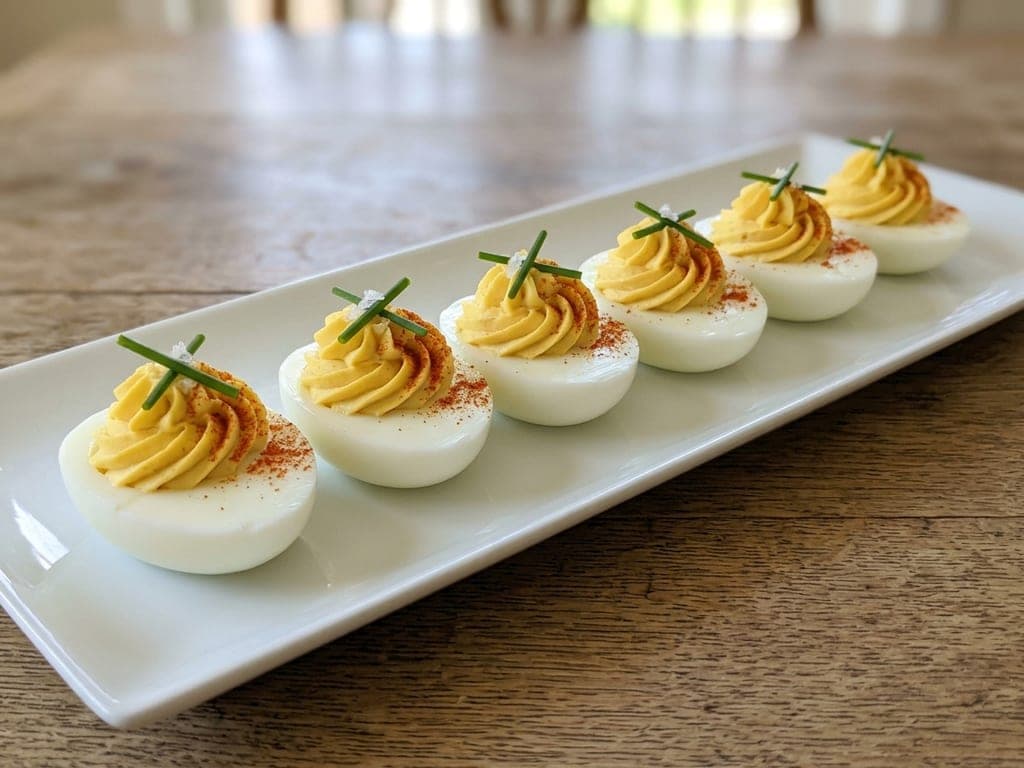
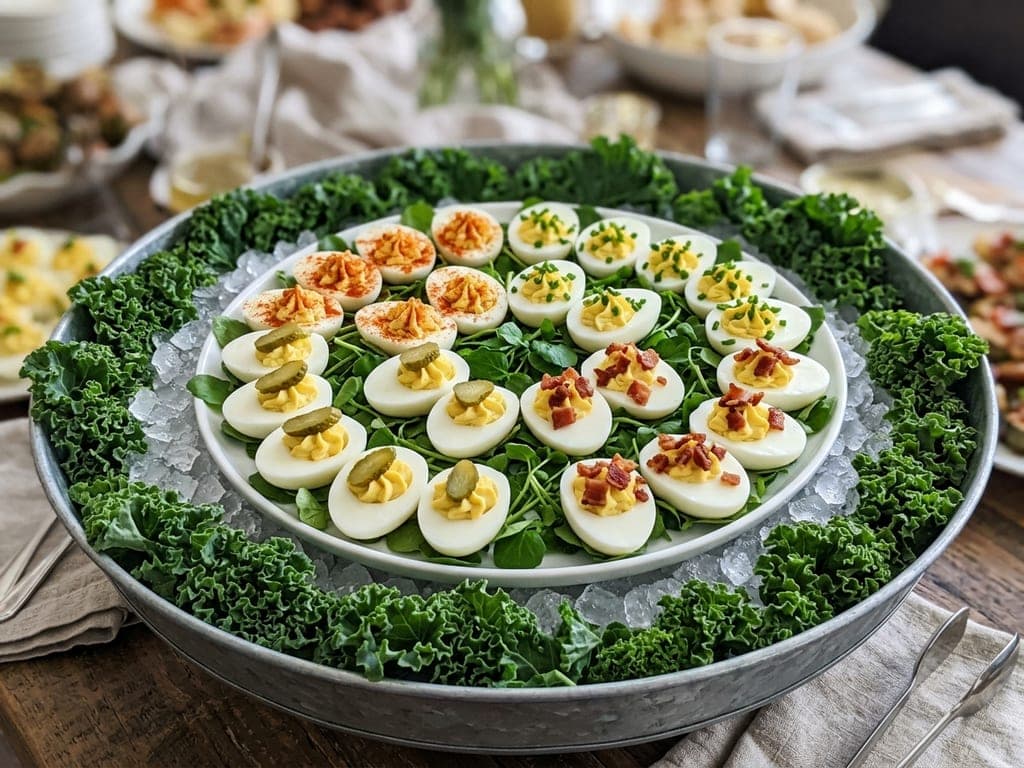
You do not need one. A plain white or neutral platter works, and a bed of something stops the eggs from sliding: a scattering of coarse salt, a line of dressed watercress (Harland’s serving suggestion in 1871), or finely shredded lettuce. Tilt each egg slightly toward the guest, arrange them in rows or rings rather than a heap, and garnish at the last moment. The three plating ideas below take the same eggs from a church-supper tray to a restaurant plate.
Questions, answered
What is the secret to good deviled eggs?
Three things. Start the eggs hot, in steam or boiling water, so they peel cleanly: Serious Eats measured well above 90% clean peels from hot starts against just over 50% from cold. Stop at a just-set yolk (12 minutes steamed) and chill in ice water for 15 minutes, so there is no green ring and no chalky yolk. And use more yolk than whites: cook 7 eggs for 12 halves, as America’s Test Kitchen does, so the filling mounds high at about 3 parts yolk to 1 part mayonnaise instead of being stretched with extra mayonnaise.
How long do you boil eggs for deviled eggs?
It depends on how the eggs start. For fridge-cold large eggs lowered into already boiling water and held at a bare simmer, 11 minutes; steamed over boiling water with the lid on, 12 minutes (13 over medium heat); then 15 minutes in ice water either way. That gives a fully set but still moist yolk. The cold-water start (bring to a boil, then take off the heat and stand 10 to 17 minutes) also cooks the yolk well, but those eggs peel badly. At high altitude, add a minute or two.
What are the ingredients in deviled eggs?
Hard-cooked eggs, mayonnaise, mustard, an acid (vinegar or pickle brine), salt and something hot (cayenne or hot sauce), finished with paprika. This recipe uses 7 large eggs, 3 tbsp mayonnaise, 1 tsp mustard, 1 tsp cider vinegar or dill pickle brine, 1/8 tsp salt, a pinch each of black pepper and cayenne, paprika and chives for 12 halves. Common additions include sweet pickle relish, Worcestershire sauce, bacon and fresh herbs.
What can I add to deviled eggs to make them taste better?
Add by purpose. For brightness, a little more vinegar, dill pickle brine or pickled-pepper brine. For depth, a dash of Worcestershire sauce or a mashed anchovy (both make the eggs non-vegetarian). For richness, a tablespoon of soft butter per 6 yolks or a thread of olive oil. For heat, cayenne, hot sauce or hot smoked paprika. For crunch on top, chives, flaky salt, crushed red pepper, fried shallots or bacon. And salt the whites lightly before filling; unseasoned whites make even a good filling taste flat.
Why are they called deviled eggs?
Because “deviled” was 18th- and 19th-century cook’s slang for food seasoned hot with mustard, cayenne and pepper, presumably after the heat of hell. The word “devil” for such a dish is first recorded in 1786 (with no eggs involved), and the earliest known “deviled eggs” in print date from 1854, in a sailor’s memoir. The name is about spice, not the red color of paprika, which only entered the recipe around the early 1900s.
How far ahead can you make deviled eggs?
Under US guidance, cook the eggs up to 1 week ahead and keep them in their shells in the fridge. Up to 2 days ahead, peel and halve them, and store the whites and the filling separately, the filling in a sealed piping bag. Pipe and garnish within a few hours of serving, because filled eggs weep and dry out as they sit. Once assembled, leftovers keep 3 to 4 days under US guidance, never beyond 1 week from cooking. UK guidance is stricter: hard-boiled eggs and egg dishes 2 days in total, so cook the eggs no more than 2 days ahead.
How long can deviled eggs sit out?
Under US (FDA) guidance, no more than 2 hours at room temperature, or 1 hour when it is above 90°F (32°C), counted from when they leave the fridge. After that, throw them away; putting them back in the fridge does not make them safe again. UK guidance allows chilled food out for up to 4 hours, but the shorter US limit is the safer habit. For longer parties, set the platter over crushed ice and bring them out in small batches.
How many deviled eggs per person?
Plan 2 to 4 halves per guest: 2 when they are one of many appetizers, 3 as a safe default, 4 when they are the star, as at Easter, and about 1 per child. For 24 adults at 3 halves each, make 72 halves, which is 6 batches of this recipe, or 42 eggs. Cooking 7 eggs per 12 halves builds in the spare whites you will lose to tearing.
Why are my deviled eggs runny?
Usually too much mayonnaise for the amount of yolk, undrained relish, or eggs filled too long before serving. To fix a loose filling, mash in an extra yolk (the reason this recipe cooks a seventh egg) or push it through a sieve with another yolk; a pinch of instant potato flakes also works in an emergency. To prevent it, build the filling at about 3 parts yolk to 1 part mayonnaise by weight and drain relish well.
Can you freeze deviled eggs?
No. Freezing does not make them unsafe, but it ruins them: cooked egg whites turn tough and rubbery, the mayonnaise emulsion separates when it thaws, and the yolk turns grainy. Make them ahead in the fridge instead: whole eggs in their shells for up to a week under US guidance (2 days under UK guidance), whites and filling separately for up to 2 days.
How many calories are in a deviled egg?
About 67 calories per half, or 135 for a 2-half serving, in this recipe. The arithmetic, from USDA FoodData Central values: 7 large hard-cooked eggs (350 g at 155 kcal per 100 g) give about 542 kcal; subtract the two unused white halves, about 33 g of white at 52 kcal per 100 g, or 17 kcal, for 525 kcal of egg. Add 3 tbsp mayonnaise (about 41 g at 680 kcal per 100 g, 280 kcal) and 1 tsp yellow mustard (3 kcal): about 808 kcal for 12 halves. Each half carries about 5.7 g fat, 3.4 g protein, 110 mg cholesterol and about 90 mg sodium with the pinch of salt on the whites (58 mg with no added salt).
Snap your finished plate and let the AI plate it again — more beautifully.