Sweet Potato Casserole Recipe: Roasted, Pecan or Marshmallow
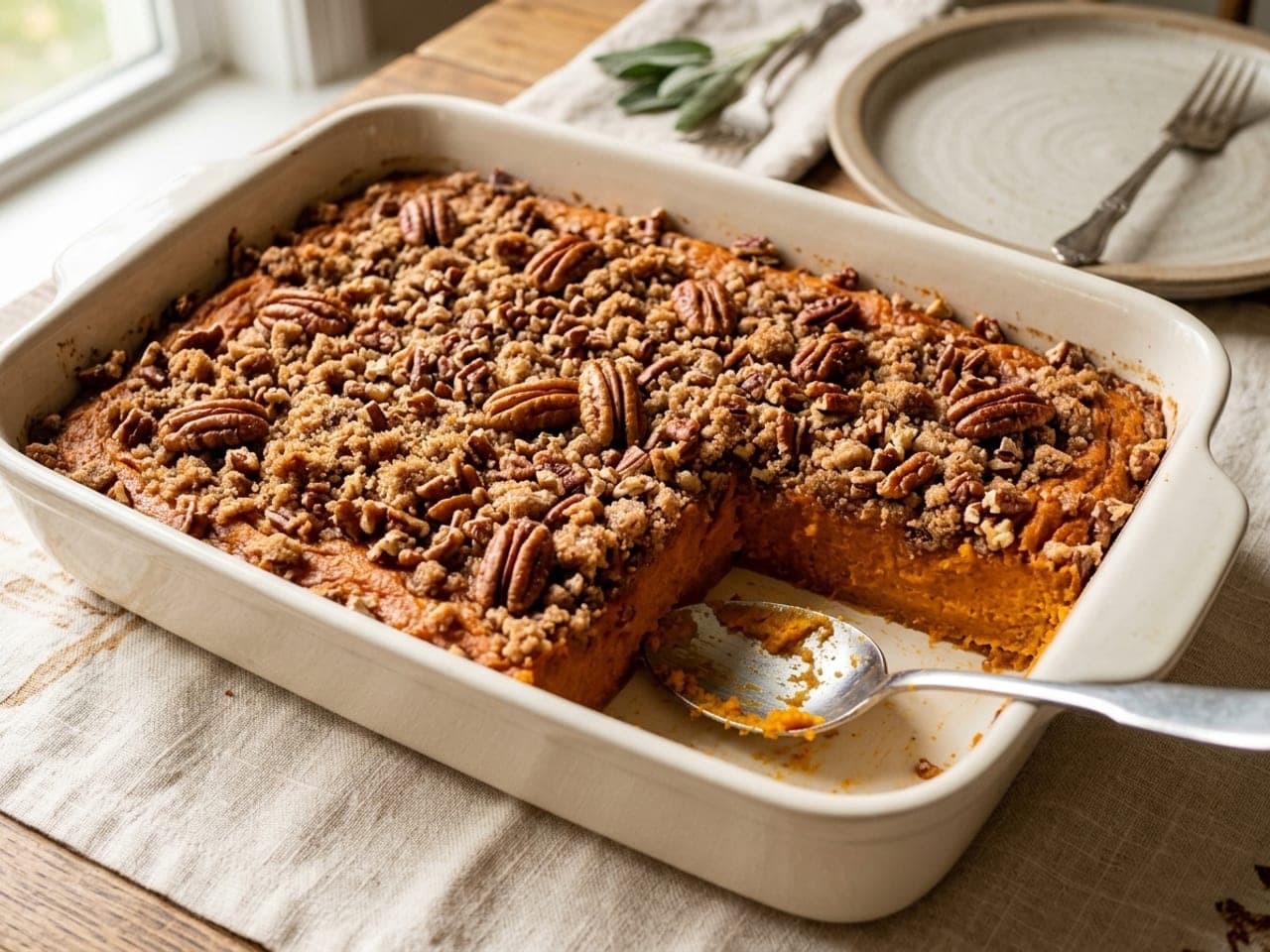
A sweet potato casserole built the way a good kitchen would build it: potatoes roasted whole so their own enzyme turns starch into sugar before you add any, a silky egg-set filling baked to a real center temperature of 165°F (74°C), and your choice of a crisp pecan streusel, a toasted marshmallow lid, or both. Plus a make-ahead plan with US and UK safety windows, and the marshmallow history told right: the topping was on Southern tables by 1915, two years before the booklet everyone credits.
Ingredients
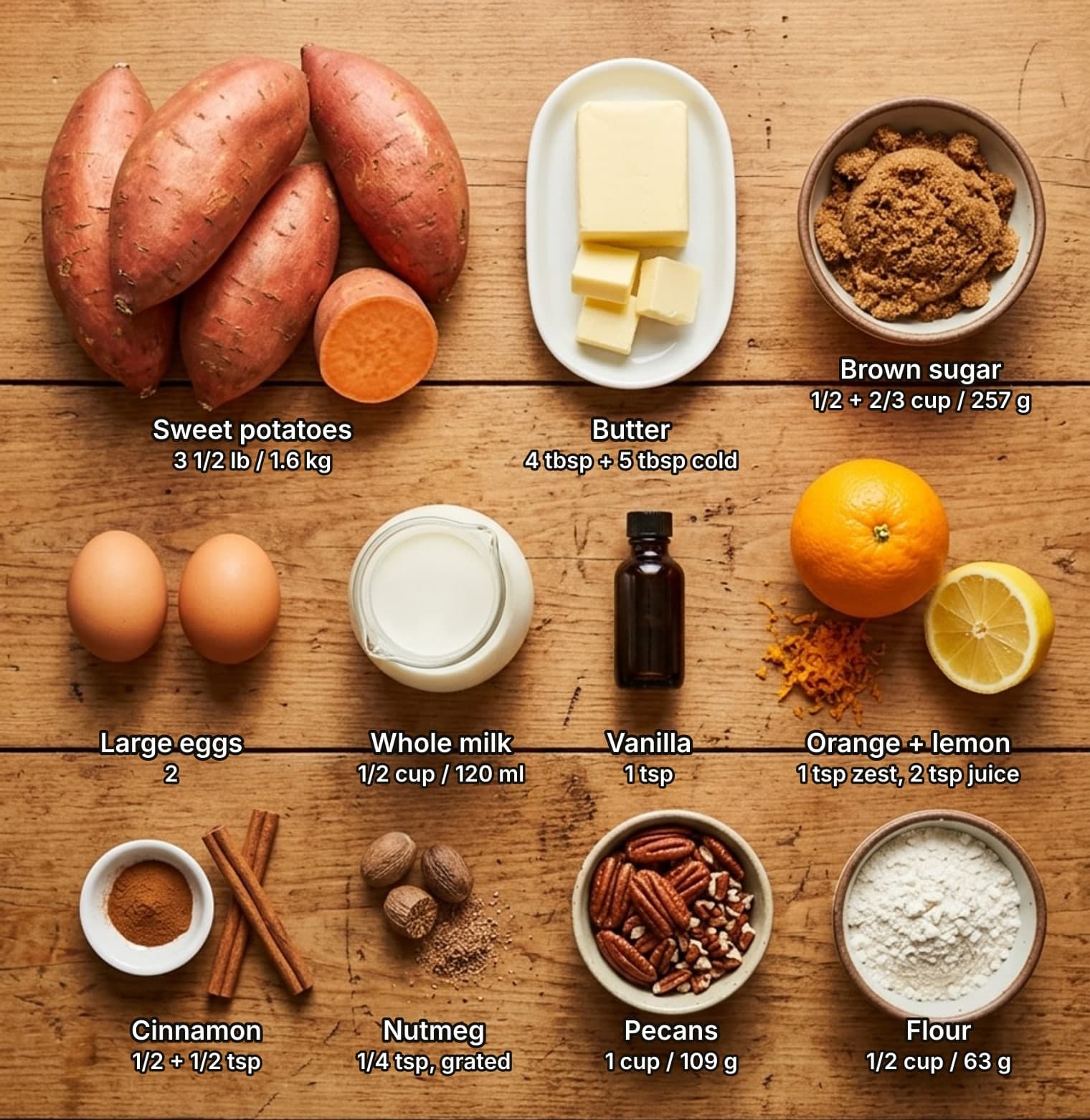
- orange-fleshed sweet potatoes of similar size, scrubbed (Covington, Beauregard, Jewel or Garnet; often sold as “yams” in US stores)about 3 1/2 lb (1.6 kg), 5 to 6 medium, for 5 cups (1 kg) roasted flesh
- unsalted butter, softened, plus a little for the dish (contains milk)4 tbsp (2 oz / 56 g)
- light or dark brown sugar, packed1/2 cup (110 g)
- fine sea salt or table salt (or 1 1/2 tsp Diamond Crystal kosher salt)3/4 tsp
- vanilla extract1 tsp
- ground cinnamon1/2 tsp
- freshly grated nutmeg1/4 tsp
- finely grated orange zest1 tsp (from 1 orange)
- fresh lemon juice (or 1 tbsp bourbon)2 tsp
- large eggs, beaten (contains egg)2
- whole milk, cold (contains milk)1/2 cup (120 ml)
- PECAN STREUSEL: pecans, toasted and roughly chopped (tree nut; walnuts work the same way, and toasted pepitas (pumpkin seeds) give a nut-free crunch; check the pack for a “may contain tree nuts” warning)about 1 cup once chopped (109 g); weigh the whole pecans before toasting
- PECAN STREUSEL: all-purpose flour (contains gluten; a 1:1 gluten-free blend works)1/2 cup (63 g)
- PECAN STREUSEL: brown sugar, packed2/3 cup (147 g)
- PECAN STREUSEL: ground cinnamon1/2 tsp
- PECAN STREUSEL: fine sea salt1/4 tsp
- PECAN STREUSEL: cold unsalted butter, cut into 1/2-inch (1.3 cm) cubes (contains milk)5 tbsp (70 g)
- MARSHMALLOW TOP: mini marshmallows (standard brands such as Jet-Puffed contain pork or beef gelatin, so this topping is not vegetarian; for a vegetarian dish use a gelatin-free brand such as Dandies, which contains soy)4 cups (about 6 oz / 180 g) for a marshmallow-only top, or 2 cups (about 3 oz / 90 g) over the streusel for both
What makes this sweet potato casserole different
Sweet potato casserole is the Thanksgiving side that sits halfway to dessert: mashed sweet potatoes sweetened with brown sugar and butter, bound with eggs, spread in a baking dish and finished with a pecan streusel, toasted marshmallows, or both. Most recipes boil the potatoes, bake until the topping looks right, and leave it there.
This one changes three things. The potatoes are roasted whole, so the filling is sweeter and less watery before any sugar goes in. The filling is baked to a number, 165°F (74°C) in the center, because it is an egg custard at heart and a thermometer is the only honest test of an egg dish. And the topping is treated as a choice with consequences, with exact amounts for a pecan streusel, a marshmallow lid, or both, and the calorie math for each.
For one 9x13-inch (23x33 cm) dish serving 10, you need about 3 1/2 lb (1.6 kg) of sweet potatoes (5 cups or 1 kg of roasted flesh), butter, brown sugar, 2 eggs, 1/2 cup (120 ml) of milk, salt, vanilla, warm spice, orange zest and a little lemon juice, plus the topping. Allow about 2 1/2 hours, most of it hands-off roasting and baking, or split it across two days with the make-ahead plan below.
How to make Sweet Potato Casserole
- Roast the sweet potatoes whole, starting in a cold oven. Line a rimmed baking sheet with foil or parchment, because the potatoes weep a dark syrup that burns onto bare metal. Prick each scrubbed sweet potato 3 or 4 times with a fork, lay them on the sheet, put the sheet in a COLD oven and set it to 350°F (175°C). Roast 75 to 90 minutes, until a skewer slides through the thickest part with no resistance and the skins are puffed and beading syrup. Why whole, and why cold: a sweet potato sweetens itself. Its own enzyme, beta-amylase, cuts swollen starch into maltose while the flesh sits between about 135°F and 170°F (57°C and 77°C), with one lab study finding it still at work up to 176°F (80°C), and stops once heat destroys it. USDA figures show raw sweet potato has no maltose, while baked flesh has 3.1 g per 100 g and has lost more than 40% of its starch. Starting cold stretches the time the flesh spends in that window. Boiling rushes through it and adds water; a microwave blocks most of the conversion (about 80% in lab tests), which is why microwaved casseroles taste flat.
- Toast the pecans and make the streusel while the potatoes roast. Once the oven has reached 350°F (175°C), spread the pecans on a small tray and toast them on a lower rack for 8 to 10 minutes, until they smell like browned butter, then cool and chop them roughly. Toast them now because 30 to 40 minutes under a streusel will not finish a raw nut: the topping browns long before the pecans inside it do. In a bowl, mix the flour, 2/3 cup (147 g) brown sugar, cinnamon and 1/4 tsp salt. Add the 5 tbsp (70 g) cold butter cubes and pinch them into the dry mix with your fingertips until you have clumps from pea size to marble size, then stir in the pecans. Cold butter is the point: it keeps its shape and bakes into crisp, craggy clumps, where melted butter dissolves the sugar into a paste that bakes into a flat, greasy sheet. This streusel also has more flour and less sugar than most casserole toppings, so it crisps rather than turning to candy. Refrigerate it until the casserole goes into the oven.
- Scoop, weigh and mash while the potatoes are hot. Let the roasted potatoes cool on the tray for about 10 minutes, until you can handle them. Split each one lengthwise, scoop the flesh into a large bowl and discard the skins. Weigh it: you want 5 cups (1 kg) of flesh. Sweet potatoes vary, so weighing the flesh rather than counting potatoes is what makes the filling set the same way every time; eat or freeze any extra. Add the 4 tbsp (56 g) softened butter first and mash it in while the flesh is hot so it melts and coats everything. A hand masher leaves a rustic texture. For the silky, restaurant finish, use a food processor or push the flesh through a ricer: sweet potatoes carry far less starch than russets, and roasting has already converted a good share of it, so they do not turn gluey the way a processed russet does. If your potatoes are stringy, the ricer or a food mill is the better tool because it holds the fibers back.
- Season it, taste it, then add the eggs. Beat in the 1/2 cup (110 g) brown sugar, 3/4 tsp salt, vanilla, cinnamon, nutmeg, orange zest and lemon juice, then taste the filling now, before any raw egg goes in. The salt is not optional: a 1997 study in Nature found that salt suppresses bitterness more than it suppresses sweetness, so a properly salted filling tastes cleaner and sweeter at the same sugar. The lemon juice does the opposite job, taking the edge off the sugar so the dish reads as sweet potato rather than candy, and the zest adds orange perfume without adding liquid. Adjust salt or sugar to your potatoes, since late-season, long-stored roots are sweeter raw. When the mash has cooled to warm rather than hot, below about 140°F (60°C) and no longer steaming (whole egg starts to set at 144°F (62°C)), whisk the 2 eggs into the 1/2 cup (120 ml) cold milk and beat that into the mash until smooth. Mixing the eggs into cold milk first protects them from scrambling on contact with warm potato.
- Fill the dish and level it. Butter a 9x13-inch (23x33 cm) baking dish, a 3-quart (2.8 L) dish. Spread the filling in an even layer and smooth it with an offset spatula or the back of a spoon, taking it right into the corners. An even depth matters more than it looks: a thin edge and a thick center will set at different times, and the thermometer reading you take in the middle is only true for the whole dish when the whole dish is the same depth. Wipe the rim of the dish clean now with a damp paper towel, since filling on the rim scorches and is the first thing anyone sees on the table. If you are making the casserole ahead, stop here: cover it tightly and refrigerate for up to 1 day, keeping the streusel in its own container, and do not add any topping until the dish goes into the oven.
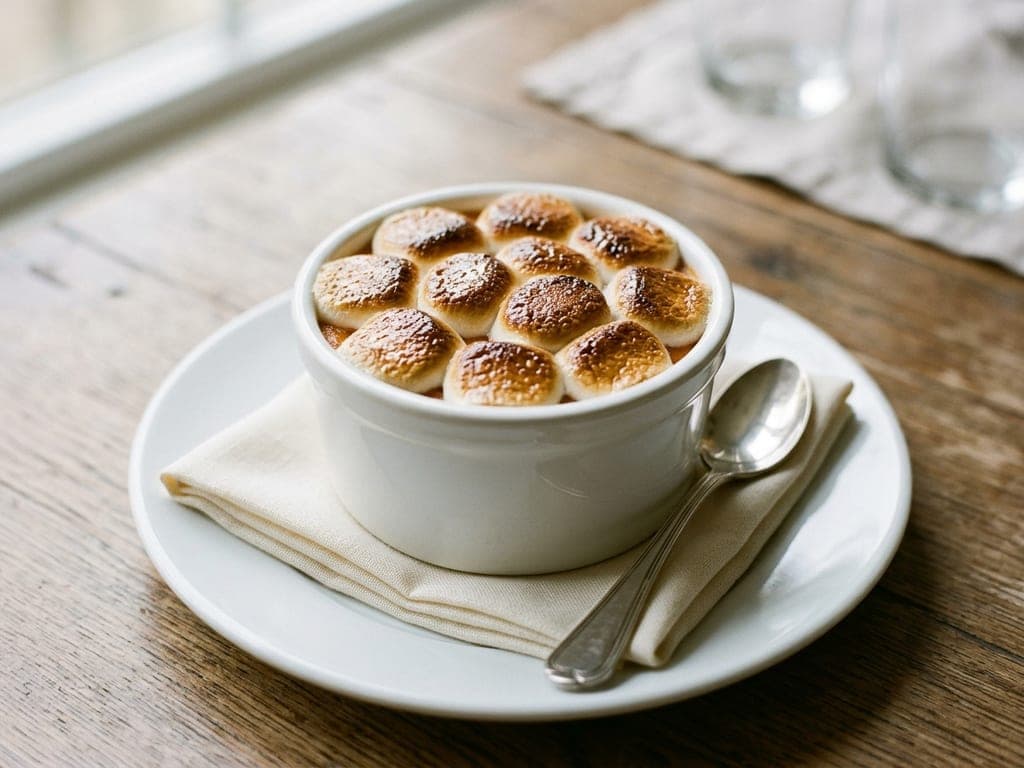
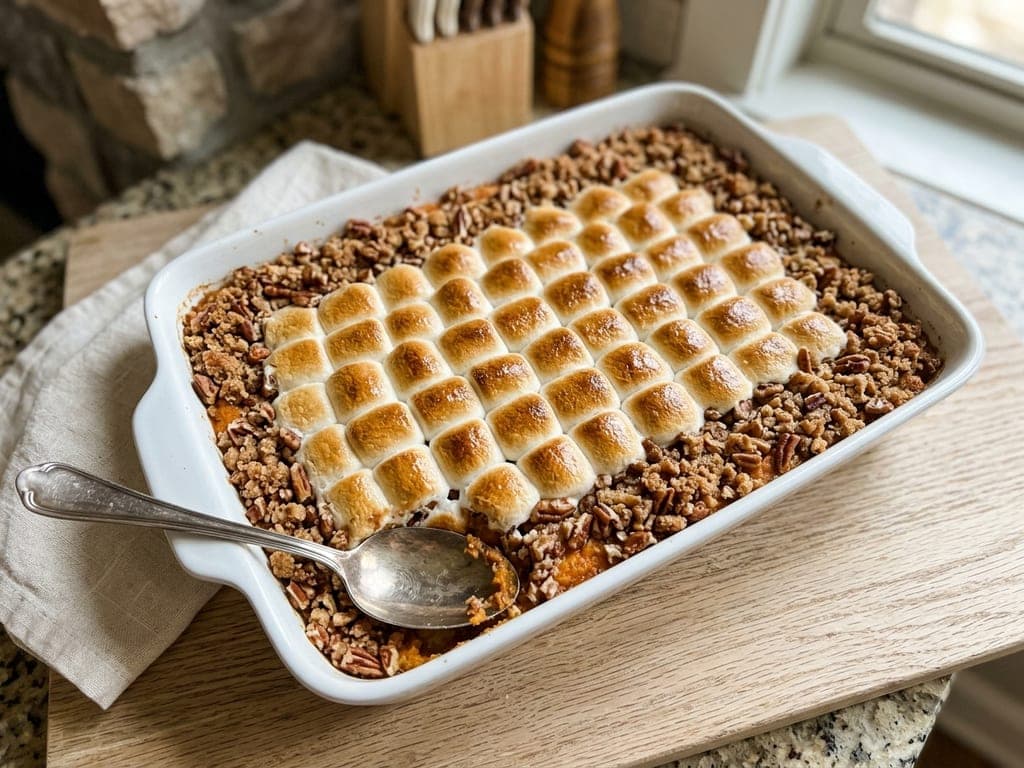
- Top it and bake to 165°F (74°C) in the center. Oven at 350°F (175°C), rack in the middle. PECAN STREUSEL: scatter the cold streusel evenly over the filling and bake 30 to 40 minutes, until the streusel is deep golden and an instant-read thermometer in the center reads at least 165°F (74°C); 165°F to 175°F (74°C to 79°C) is the sweet spot, where the custard is fully set but not yet weeping. MARSHMALLOW: bake the bare filling about 25 minutes, until the center reads about 150°F (66°C), then cover it with the 4 cups (180 g) mini marshmallows and bake 8 to 10 minutes more, until they are puffed and golden and the center has reached 165°F (74°C). If the marshmallows are golden before the center gets there, lay foil loosely over the dish and keep baking; never take it out on color alone. Gelatin-free marshmallows puff less and brown faster, so check them from 5 minutes. Mini marshmallows brown evenly; large ones puff taller but burn at the peaks. A kitchen blowtorch can touch up any pale spots. BOTH: bake with the streusel as above, then scatter 2 cups (90 g) marshmallows into the gaps for the last 8 to 10 minutes. Marshmallows go on late because they are a gelatin foam: the gelatin melts at about 95°F (35°C), trapped air expands and they puff, but left too long the bubbles burst and the sugar scorches. For darker tops, and only once the center is at temperature, use the broiler (the overhead grill) for 60 to 90 seconds with the dish 6 inches (15 cm) below the element, and do not walk away; if a marshmallow catches, turn the broiler off and keep the oven door shut until it goes out. From fridge-cold, add 15 to 20 minutes and tent with foil if the top browns first. The number matters: USDA lists egg dishes at 160°F (71°C) and casseroles at 165°F (74°C), and this is both. At the other end, do not push past about 185°F (85°C): a few degrees beyond that the egg curdles and squeezes out liquid.
- Rest it for 10 to 15 minutes, then serve. Set the dish on a rack and leave it alone for 10 to 15 minutes before serving. The filling puffs slightly in the oven, like a loose soufflé, as steam lifts it; resting lets that settle and lets the egg finish setting, so the first spoonful holds its shape instead of slumping and weeping onto the plate. The marshmallows also firm from molten to a soft, chewy lid you can cut through cleanly. Serve with a large spoon, or for neat portions, cut squares with a thin knife dipped in hot water. If dinner runs late, hold the casserole hot, at 140°F (60°C) or above (63°C (145°F) or above in the UK), loosely covered with foil in a low oven, and aim to serve within an hour. At room temperature on a buffet, the clock is 2 hours (1 hour above 90°F (32°C)); after that, refrigerate it or throw it out.
Safety & hygiene Important
- Bake to 165°F (74°C) in the center. This filling is bound with raw eggs, so judge it with a thermometer, not by the color of the topping. USDA’s chart lists egg dishes at 160°F (71°C) and casseroles at 165°F (74°C); this is both, so we bake to at least 165°F (74°C) in the center, and 165°F to 175°F (74°C to 79°C) is also where the custard is set but not weeping. Leftovers and made-ahead dishes are reheated to 165°F (74°C) too. In the UK, the Food Standards Agency asks that reheated food be steaming hot all the way through, not just warm.
- Make-ahead: keep the raw-egg stage short. The safest make-ahead is to roast and mash the potatoes without eggs, then add the eggs and milk on the day. If you do assemble the whole filling ahead, keep it covered in the fridge at 40°F (4°C) or colder (UK: 5°C (41°F) or below) and bake it within 1 day. FoodSafety.gov’s storage windows for egg casseroles apply to baked dishes, not to raw egg mixtures, so we keep the raw stage conservative. Wash your hands with soap for 20 seconds after cracking the eggs, and in a kitchen that is also handling raw turkey, keep this dish, its spoon and its bowls away from the poultry board, knives and sink.
- Leftovers: the US and UK windows differ. Refrigerate leftovers within 2 hours of baking (1 hour if the room is above 90°F (32°C)), in shallow containers so they cool quickly. US: FoodSafety.gov lists casseroles with eggs, once baked, at 3 to 4 days in the fridge and 2 to 3 months in the freezer (freezer times are for quality; food held at 0°F (-18°C) stays safe). UK: the Food Standards Agency says to eat leftovers within 48 hours or freeze them, and to reheat them only once. If you made the mash ahead, count those days from the day you roasted the potatoes, not the day you baked. UK readers following the reheat-once rule should reheat leftovers only if the casserole was made fresh, and reheat just the portion they will eat.
- Buffet holding. Bacteria grow fastest between 40°F and 140°F (4°C and 60°C) in USDA terms; the UK Food Standards Agency puts its danger zone at 8°C to 63°C. On a holiday buffet, keep the casserole hot, at 140°F (60°C) or above in USDA terms (UK: 63°C (145°F) or above), or discard it after 2 hours at room temperature. Putting it back in the oven does not reset that clock: reheating kills bacteria but not the heat-stable toxins some of them leave behind.
- Allergens. The filling contains egg and milk; the streusel contains tree nuts (pecans), gluten (wheat flour) and milk; standard marshmallows contain gelatin from pork or beef, so the marshmallow versions are not vegetarian as written. Gelatin-free marshmallows are usually set with carrageenan and soy protein (Dandies contain soy), so check the label for a soy-free table. For a nut-free table, bake the marshmallow version, keep pecans off the plate, and toast nothing nutty on the same tray. For gluten-free, use a 1:1 gluten-free flour blend in the streusel or skip it, and check the marshmallow and vanilla labels. For vegetarian guests, bake the streusel-only version or use gelatin-free marshmallows. Vanilla extract and the optional bourbon leave a trace of alcohol after baking; stick with the lemon juice and use alcohol-free vanilla if that matters to you.
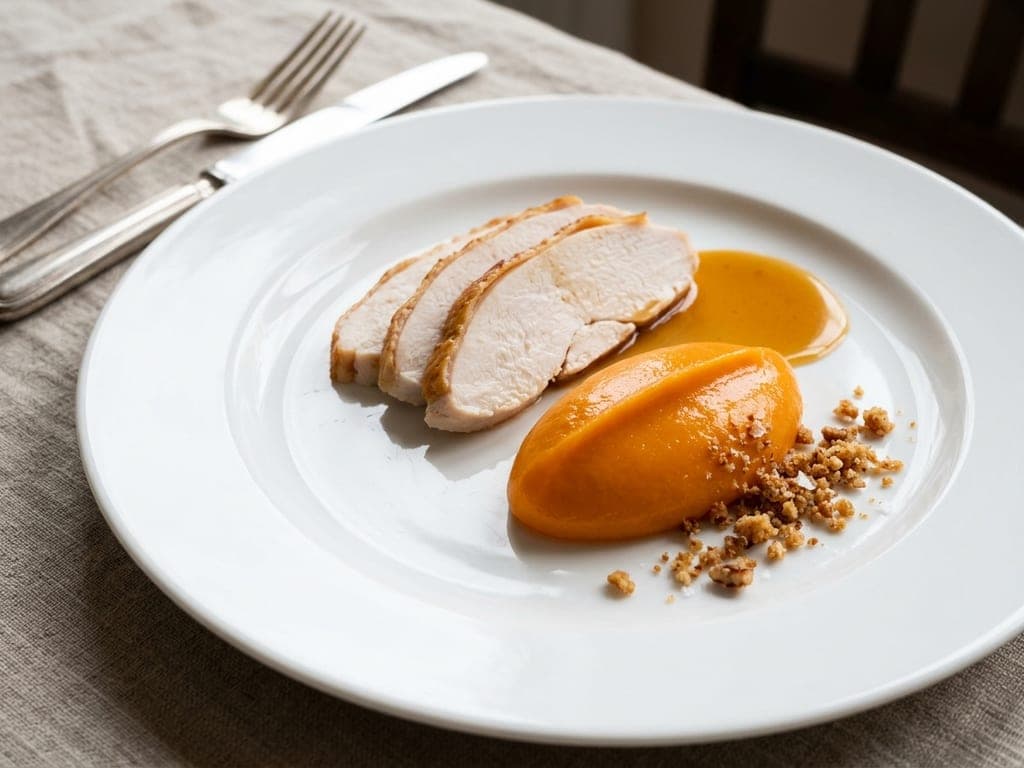
3 ways to plate it
Roast, don’t boil: why the oven makes a sweeter casserole
A sweet potato gets much of its sweetness in the oven. Raw sweet potato contains starch and some sucrose, but no maltose at all: USDA nutrient data lists 0 g of maltose and 12.65 g of starch per 100 g raw, against 3.12 g of maltose and 7.05 g of starch per 100 g of flesh baked in the skin. More than 40% of the starch has been broken down, and maltose, zero in the raw root, is now almost half the sugar. The worker is the potato’s own enzyme, beta-amylase, which can only attack starch once the granules have swollen with heat, and which is destroyed as the flesh gets hotter still.
The window usually quoted, after Harold McGee, runs from about 135°F to 170°F (57°C to 77°C). Lab work suggests that is conservative at the top: in a 1994 study of the classic US variety ‘Jewel’, maltose kept rising to a peak at 176°F (80°C). Either way, the rule is the same. The longer the flesh spends in that range, the sweeter it gets, and maltose is also the raw material for the toasty, caramel aroma of a baked sweet potato. Serious Eats’ Food Lab found that holding potatoes in a 150°F (66°C) water bath for an hour before roasting made them markedly sweeter and more flavorful; starting our potatoes in a cold oven is a gentler version of the same idea.
Other methods lose on both counts. Boiled flesh takes on water: America’s Test Kitchen found boiled sweet potatoes “waterlogged” and fixed it by stirring them in a dry pot for 7 minutes, which drove off 12% of their weight. Boiling also heats the flesh so fast that the enzyme has little time to work. A microwave is worse: brief microwave heating blocked about 80% of maltose formation in the 1994 study, and ATK found microwaved pieces gave a “leathery, tough mash”. Canned sweet potatoes, heated fast in the can, stay higher in starch, which a 1980 Journal of Food Science study put down to the rapid inactivation of the enzyme. That is why a roasted casserole needs less sugar than a boiled one to taste as sweet.
Marshmallow or pecan streusel? An honest comparison
The marshmallow lid is the lighter topping. On this recipe’s filling (about 195 kcal a serving), 4 cups (180 g) of mini marshmallows add about 60 kcal a serving, while the pecan streusel adds about 204 kcal. The streusel’s calories are butter and nuts, not sugar: its 1 cup (109 g) of pecans alone is 753 kcal. The marshmallows bring almost pure sugar, about 10 g a serving, where the streusel brings crunch, fat and a toasted, savory edge that balances the sweet filling.
They also behave differently in the oven. A marshmallow is a foam of sugar syrup and air held up by gelatin; in the heat the gelatin melts, the air expands and it puffs, then the sugar browns. Left too long, the bubbles burst, the lid collapses and the peaks burn, which is why the marshmallows go on only for the last 8 to 10 minutes. A streusel needs the whole bake to crisp, which is why it goes on at the start, cold. For both, bake with the streusel and add marshmallows to the gaps at the end.
The best-known restaurant version, the sweet potato casserole at Ruth’s Chris Steak House (founded in New Orleans in 1965), takes the pecan side: a brown-sugar, flour and pecan crust over a sweetened, egg-bound filling, and no marshmallows. Its official menu lists the side at 880 calories, more than twice the calories of a serving of this recipe with streusel. Accounts disagree about who created it, so we leave that open.
Who prefers which is less settled than the internet suggests. An AP-NORC poll in November 2023 found that 42% of Northeasterners chose sweet potatoes with no marshmallows, against 29% in both the Midwest and the South; nationally, among adults who celebrate Thanksgiving, about a third preferred no marshmallows and about a quarter wanted them. We could find no poll that pits marshmallow against pecan, so the familiar claim that the South is pecan country and the North is marshmallow country is anecdote, not data.
Why is sweet potato casserole watery? The causes, ranked
1. Boiled potatoes. They absorb water in the pot, and that water comes out in the oven. Roast instead, or, if you must boil, stir the drained potatoes in the dry pot over medium heat until the steam stops, America’s Test Kitchen’s fix.
2. Too much milk. Sweet potatoes already carry more moisture and less starch than white potatoes, so recipes that pour in cream as if for mashed russets end up loose. This recipe uses 1/2 cup (120 ml) of milk for 5 cups (1 kg) of flesh.
3. An underbaked center. The eggs are what set the filling, and they need heat to do it: a whole egg begins to set at 144°F to 158°F (62°C to 70°C), and sugar pushes that higher. Bake until the center reads at least 165°F (74°C).
4. An overbaked center. Past about 185°F (85°C) the egg proteins tighten, and a few degrees higher they curdle and squeeze liquid out, so a casserole baked far too long can weep just like one baked too little.
5. Undrained canned yams. The syrup in the can is liquid you did not plan for. Drain them well and cut back the sugar.
6. Serving it straight from the oven, or covering it while hot. Give it 10 to 15 minutes to set, uncovered, so steam escapes instead of condensing back onto the top. Do not try to rescue a baked casserole by stirring in flour or cornstarch; it will taste raw and pasty.
The make-ahead plan for Thanksgiving
Up to 1 week ahead: make the streusel and keep it in a covered container in the fridge. Held cold and apart from the filling, it stays crisp-ready; mixed onto the filling in advance, it drinks up moisture and bakes soft.
Up to 2 days ahead: roast, scoop and mash the potatoes with the butter only, spread the mash in a shallow container (or straight into the buttered baking dish) and refrigerate it within 2 hours, uncovered until cool, then covered. Plain cooked sweet potato is the safest thing to hold, and two days fits inside both the US and the UK guidance for cooked food. This is our preferred plan, because it keeps raw egg out of the fridge altogether.
Up to 1 day ahead, if you prefer: finish the whole filling, eggs and all, spread it in the dish, cover and refrigerate. Keep the topping separate.
On the day: beat the seasoning, eggs and milk straight into the cold mash; there is no need to warm it. Fill the dish, top it and bake, allowing 15 to 20 minutes more than for a freshly made filling; the thermometer, not the clock, tells you when it is done.
To freeze: freeze the plain mash, or the baked casserole without its topping, wrapped airtight, for 2 to 3 months. Thaw in the fridge overnight and pour off any liquid that has separated (freezing ruptures the potato’s cells). For plain mash, beat in the seasoning, eggs and milk as in the recipe. Add a fresh topping and bake until the center reaches 165°F (74°C) either way. Streusel freezes well on its own; marshmallows do not, so add them fresh. To reheat leftovers, cover with foil and warm at 350°F (175°C) for 20 to 25 minutes (longer for a full fridge-cold dish), until the center is back to 165°F (74°C); a fresh handful of marshmallows for the last 5 minutes, uncovered, restores the top.
The history: marshmallows arrived before the booklet everyone credits
Read almost any account of this dish and you will be told that it began in 1917, when the makers of Angelus Marshmallows hired the Boston cookery writer Janet McKenzie Hill to write a recipe booklet containing “the first documented appearance” of sweet potatoes baked under marshmallows. That phrase comes from a 2011 Saveur article, which gives no title and quotes no recipe text from the booklet; later articles attribute it to the Library of Congress, but the Library’s blog added the claim in 2012 by quoting Saveur. The booklet is real, a 16-page pamphlet copyrighted in 1917 by Rueckheim Bros. & Eckstein of Chicago (the firm did not become the Cracker Jack Company until 1922), yet we could not find its sweet potato recipe quoted anywhere.
The dish is in print earlier. On March 5, 1915, the Ward-Belmont Hyphen, the student weekly of Ward-Belmont School in Nashville, described a luncheon with “baked sweet potatoes with marshmallows” on the menu. In the summer of 1916, the Woman’s Club of Reading, Pennsylvania, compiled its Club House Cook Book, and Nellie Gery’s entry, “Sweet Potato and Marshmallow”, is the modern casserole in full: “Boil potatoes in unsalted water, until tender; remove the skins and mash as Irish potatoes, stir into them sugar, butter and salt to taste. Place in a buttered baking dish, cover the top with marshmallows. Put in the oven until the mashmallows [sic] brown and swell.” And it kept turning up in 1917, the booklet’s year: on January 5, Florida’s county home demonstration agents, meeting at the Florida State College for Women in Tallahassee, sat down to a banquet in the college dining room with “Marshmallow Sweet Potatoes” on the menu, and in its June and July issue Hill’s own magazine, American Cookery, printed a reader’s tip: “Place a marshmallow in center of each square and brown in oven to a nice rich brown.”
The earliest sighting we found is Southern, and so is the Tallahassee banquet, which undercuts another favorite line, that Southerners respected sweet potatoes too much to put candy on them. Some Southern writers did look down on it; Harriet Ross Colquitt’s Savannah Cook Book of 1933 found the plain version “far, far nicer”, as quoted by Saveur. But the dish was on Southern tables from the start. By November 1920 the Ladies’ Home Journal was printing “Mashed Sweet Potatoes With Marshmallows” on a Thanksgiving menu.
The base is much older. Mary Randolph’s The Virginia House-Wife (quoted here from the 1830 edition) has a sweet-potato pudding of boiled, sieved potatoes, eggs, sugar, butter, nutmeg, lemon and brandy, and adds: “Irish potato pudding is made in the same manner, but is not so good.” Lettice Bryan’s Kentucky Housewife (1839) bakes a crustless one, and prefers baked potatoes to parboiled ones for it, and Abby Fisher, in What Mrs. Fisher Knows About Old Southern Cooking (San Francisco, 1881), sharpened her sweet potato pie with the juice of an orange and half its grated peel, an idea this recipe borrows with its orange zest. Fannie Farmer’s 1896 Boston Cooking-School Cook Book already had glazed sweet potatoes, an early printed form of candied yams.
The name came later than the dish. The earliest English “Sweet Potato Casserole” we found, in the Washington Post of November 13, 1927, is layered sweet potatoes, tart apples and sausage. In December 1942 a syndicated food column, Lynn Chambers’s “Lynn Says” (Western Newspaper Union; we read it in the Toledo Union Journal of December 24), printed a mashed, egg-lightened, marshmallow-topped sweet potato casserole and claimed it had taken “a mighty fine lead” in a poll of servicemen’s favorite foods. The pecan streusel we could not date reliably; it is everywhere in late-20th-century community cookbooks, and pecans were already going into Southern sweet potato dishes by the 1920s.
Yams, sweet potatoes and the world’s other sweet potato dishes
The orange “yams” in American stores are sweet potatoes (Ipomoea batatas, the morning-glory family). True yams (Dioscorea) are a different, starchier and drier tuber grown mostly in Africa; do not swap one for the other in this recipe. The Library of Congress notes that the USDA requires any “yam” label to say “sweet potato” as well, which is why a can of Bruce’s carries both words: “Yams” and “Cut Sweet Potatoes”. Louisiana is often said to have coined the word in 1937, when LSU horticulturists and the state’s growers began marketing its moist orange sweet potatoes nationally as “Louisiana yams”; they made it a national brand, but Americans had long used the word: Amelia Simmons listed “Pompkins, Potatoes or Yams” in 1796, and a 1918 Barrett Company booklet noted that some varieties “are also called ‘yams’ in the South and the name is now in general use”.
For this dish, buy the moist, orange-fleshed types: Covington, the most widely grown variety in North Carolina (the top US producer since 1971), LSU-bred Beauregard, Jewel or Garnet. White and Japanese sweet potatoes such as Hannah or Murasaki are drier and paler; they mash stiffer and need more milk.
The same root is a festival food around the world. Japan fries it and tosses it in syrup and sesame as daigaku imo, “university potato”, a name with several competing origin stories, most of them set among Tokyo university students between the 1910s and the early 1930s. Okinawa, where the sweet potato arrived from Fujian in 1605, grows the purple beni imo. Korea owes its goguma to the envoy Jo Eom, who saw the plant on Tsushima in 1763 and sent seed tubers home to Busan. New Zealand’s kūmara has been grown there since first settlement, around the 13th century; most researchers hold that people carried the plant from South America into Polynesia around AD 1000 to 1200, though whether Polynesians sailed east or South Americans sailed west is still debated; a 2018 genetic study argued for natural spread and has been sharply disputed. In Lima, camote sits beside ceviche and goes into picarones, the syrup-soaked sweet potato and squash doughnuts already named in print in 1798.
Questions, answered
Should sweet potatoes be boiled or baked for sweet potato casserole?
Baked. Slow oven heat keeps the flesh between about 135°F and 170°F (57°C and 77°C) for longer, and in that range the potato’s own enzyme turns starch into maltose, so the casserole tastes sweeter before you add sugar. USDA data shows raw flesh has no maltose and baked flesh 3.1 g per 100 g. Boiling adds water and rushes through that window.
Can I make sweet potato casserole the day before?
Yes. The best plan is to roast and mash the potatoes up to 2 days ahead without the eggs, cool the mash quickly in a shallow container, then add eggs, milk and seasoning on the day. You can also assemble the complete filling up to 1 day ahead, covered in the fridge. Either way, keep the streusel or marshmallows separate and add them only when the dish goes into the oven, and allow 15 to 20 extra minutes from cold, baking until the center reads 165°F (74°C).
What is the difference between sweet potato casserole and candied yams?
Both are made with sweet potatoes, since the “yams” in US stores are sweet potatoes. Candied yams are slices or chunks baked in a butter and brown-sugar glaze, with no eggs and no topping; Fannie Farmer printed glazed sweet potatoes in 1896. Sweet potato casserole is a mash set with eggs, like a loose soufflé, and finished with pecan streusel or marshmallows.
Why is my sweet potato casserole watery?
Usually because the potatoes were boiled and took on water. Other causes: too much milk or cream, a center that never reached 165°F (74°C) so the eggs did not set, a center baked far past 185°F (85°C) so the eggs curdled and wept, undrained canned yams, or serving it without a 10 to 15 minute rest. Roast the potatoes and bake to temperature.
Are yams and sweet potatoes the same?
No. Sweet potatoes (Ipomoea batatas) belong to the morning-glory family; true yams (Dioscorea) are a separate, starchier, drier tuber grown mostly in Africa. The orange “yams” sold in the US are soft sweet potatoes, and the USDA requires a “yam” label to say “sweet potato” too.
Can you freeze sweet potato casserole?
Yes, without its topping. Freeze the plain roasted mash, or the baked casserole, wrapped airtight, for 2 to 3 months. Thaw it in the fridge overnight and pour off any liquid. For plain mash, beat in the seasoning, eggs and milk as in the recipe. Add fresh streusel or marshmallows and bake until the center reaches 165°F (74°C). Marshmallows do not freeze well; streusel does.
Is sweet potato casserole better with marshmallows or pecans?
It depends what you want from the top. Marshmallows give a soft, toasted, sweet lid and are the lighter choice, about 60 kcal a serving here. Pecan streusel gives crunch and a savory, buttery balance for about 204 kcal a serving, mostly from butter and nuts. You can have both: bake with the streusel and add 2 cups (90 g) of marshmallows for the last 8 to 10 minutes.
Why do you put eggs in sweet potato casserole?
Eggs turn a mash into a casserole. As the dish bakes they set the filling so it holds a spoon-cut edge, and the steam gives it a light, soufflé-like lift that settles as it rests. Without eggs you have sweetened mashed sweet potatoes. Because the eggs start raw, bake until the center reads 165°F (74°C).
How long do you bake sweet potato casserole at 350°F (175°C)?
At 350°F (175°C), a freshly made filling with pecan streusel takes 30 to 40 minutes; with marshmallows, bake about 25 minutes bare, then 8 to 10 minutes with the marshmallows on. From the fridge, add 15 to 20 minutes. Time is only a guide: it is done when the center reads at least 165°F (74°C), best no higher than 175°F (79°C).
Can I use canned sweet potatoes (canned yams)?
Yes. A 29 oz (822 g) can gives about 2 cups (roughly 400 g) of drained, mashed sweet potato, so you need about 2 1/2 cans for this recipe’s 5 cups (1 kg). Drain them very well and pat them dry, cut the brown sugar in the filling by 2 to 3 tbsp because they are packed in syrup, and add the milk a little at a time. Canned potatoes taste starchier and blander than roasted ones, so be generous with salt, zest and lemon.
How many calories are in sweet potato casserole?
About 400 kcal a serving with pecan streusel, 255 kcal with marshmallows and 430 kcal with both (10 servings). The filling is 1,950 kcal: 1 kg roasted sweet potato 900, 1/2 cup (110 g) brown sugar 418, 4 tbsp (56 g) butter 402, 2 eggs 144, 1/2 cup (120 ml) milk 74, vanilla 12. The streusel is 2,043 kcal: 1 cup (109 g) pecans 753, 2/3 cup (147 g) brown sugar 559, 5 tbsp (70 g) butter 502, 1/2 cup (63 g) flour 229. 4 cups (180 g) mini marshmallows are 600 kcal. So (1,950 + 2,043) ÷ 10 = 399 and (1,950 + 600) ÷ 10 = 255. A serving also gives about 960 µg of vitamin A, 107% of the Daily Value, from the potatoes alone, and about 300 mg sodium with streusel.
Snap your finished plate and let the AI plate it again — more beautifully.