Taco Soup Recipe: Easy One-Pot, Slow Cooker or Instant Pot
Taco soup is the easy one-pot American supper of browned ground beef, beans, corn and tomatoes with green chiles, simmered in a taco-spiced broth and topped like a taco. This recipe seasons it from scratch, so you keep the packets’ flavor jobs (salt, tang, savory depth) at a fraction of their sodium, and it gives the stovetop method plus slow cooker and Instant Pot versions, chicken and vegetarian swaps, the ranch-packet Texas version, and safe freezing for a big batch. It also has the history the other recipes skip: taco soup is not a 1950s Southwest dish. The earliest printed taco soup we found is from 1977.
Ingredients
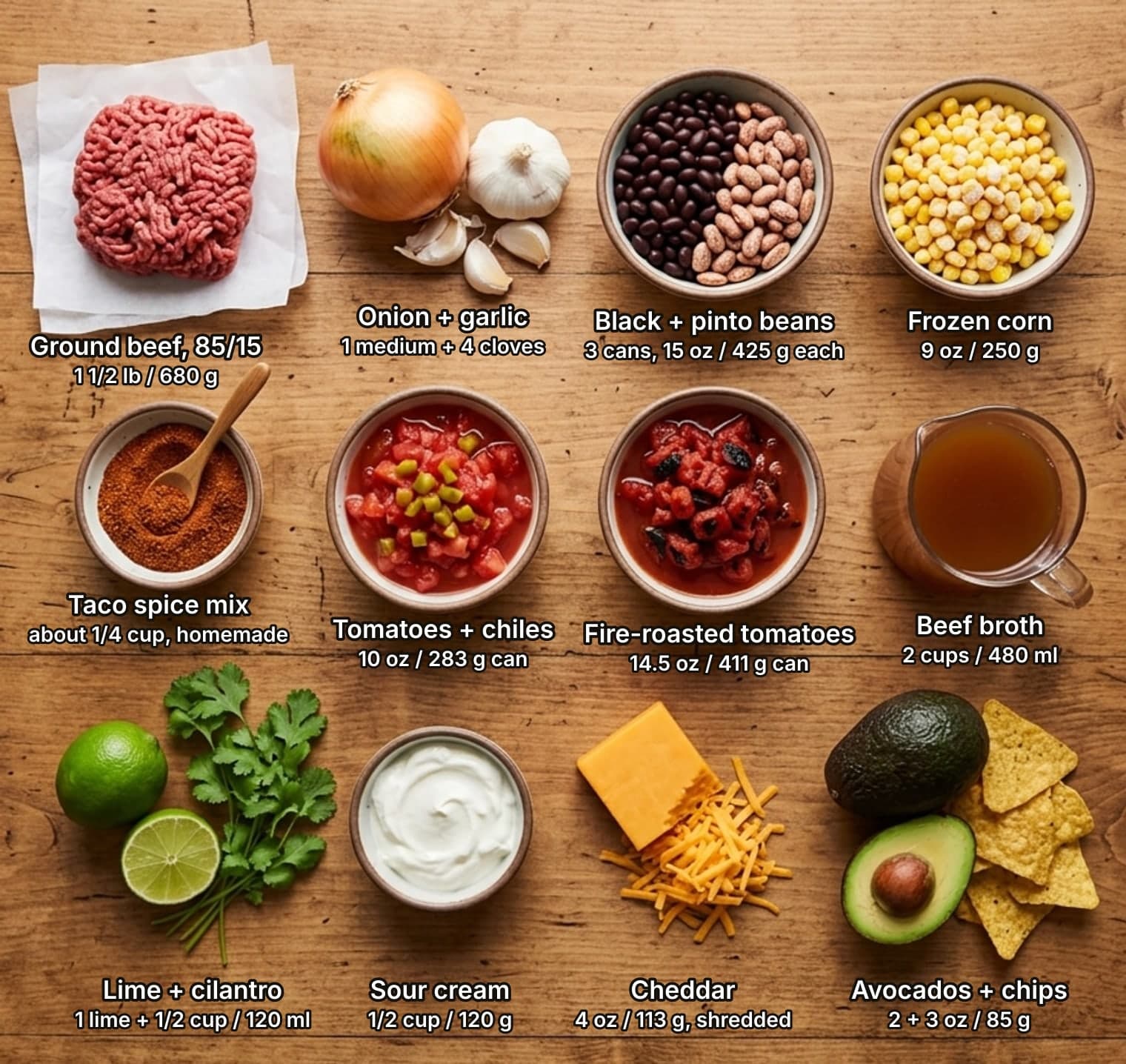
- ground beef, 85% lean / 15% fat (with 90/10 or leaner, add 1 tbsp olive oil in step 3; with 80/20, spoon off more fat)1 1/2 lb (680 g)
- yellow onion, finely diced1 medium, about 6 oz (170 g)
- jalapeño, seeded and minced (optional; leave the seeds in for more heat)1
- garlic cloves, minced4
- chili powder, US-style blend (in the US this is ground chile mixed with cumin, oregano, garlic and usually salt; it is milder than the pure chilli powder sold in UK and EU shops, so there use 1 tbsp sweet paprika + 1 tbsp ancho or mild chilli powder)2 tbsp
- ground cumin2 tsp
- smoked paprika1 tsp
- dried oregano, Mexican if you have it1 tsp
- garlic powder1/2 tsp
- onion powder1/2 tsp
- cayenne pepper (optional)1/4 tsp
- Diamond Crystal kosher salt (with Morton kosher or table salt, use about half), plus more to taste at the end1 1/2 tsp
- black pepper, freshly ground1/2 tsp
- tomato paste1 tbsp
- dried dill (the herb note of ranch seasoning, without the packet)1 tsp
- black beans, low-sodium, with their liquid (do not drain; see the FAQ). In Europe they may be sold as black turtle beans2 cans, 15 oz (425 g) each
- pinto beans, with their liquid (low-sodium if you can find them; the nutrition math assumes regular). In Europe, borlotti beans are the closest match1 can, 15 oz (425 g)
- Ro-Tel Original diced tomatoes and green chiles (outside North America: a 14 oz (400 g) can of diced tomatoes with about 1/2 cup (120 ml) of its juice poured off, plus 1 extra minced green chile or 2 tbsp chopped pickled jalapeños)1 can, 10 oz (283 g)
- fire-roasted diced tomatoes, with their juice (plain diced tomatoes work; no-salt-added ones cut about 110 mg of sodium per bowl)1 can, 14.5 oz (411 g)
- low-sodium beef broth (or low-sodium chicken broth, or water)2 cups (480 ml), plus more to thin
- frozen corn kernels (no need to thaw)about 9 oz (250 g), 1 3/4 cups (420 ml)
- masa harina (optional, for a thicker soup), whisked with 1/4 cup (60 ml) water2 tbsp
- fresh lime juice2 tbsp (about 1 lime), plus wedges to serve
- fresh cilantro (fresh coriander), leaves and tender stems, chopped1/2 cup (120 ml) loosely packed, plus leaves to serve
- for the lime crema (topping): sour cream (contains milk; Greek yogurt or Mexican crema also work) stirred with 1 tbsp lime juice, 1/2 tsp dried dill and a pinch of salt1/2 cup (120 g)
- for topping: sharp cheddar or Monterey Jack, shredded from a block (pre-shredded bags are coated with anti-caking starch and melt dull), or crumbled cotija (contains milk)4 oz (113 g), about 1 cup (240 ml)
- for topping: ripe avocados, scrubbed under running water, then sliced just before serving and squeezed with lime2
- for topping: tortilla chips or fried tortilla strips (corn; check the label if you need them gluten-free)3 oz (85 g)
- for topping: red onion, sliced into thin rings (quick-pickled in lime juice for 15 minutes if you like), and sliced jalapeño1/2 small onion
Easy taco soup, seasoned from scratch in one pot
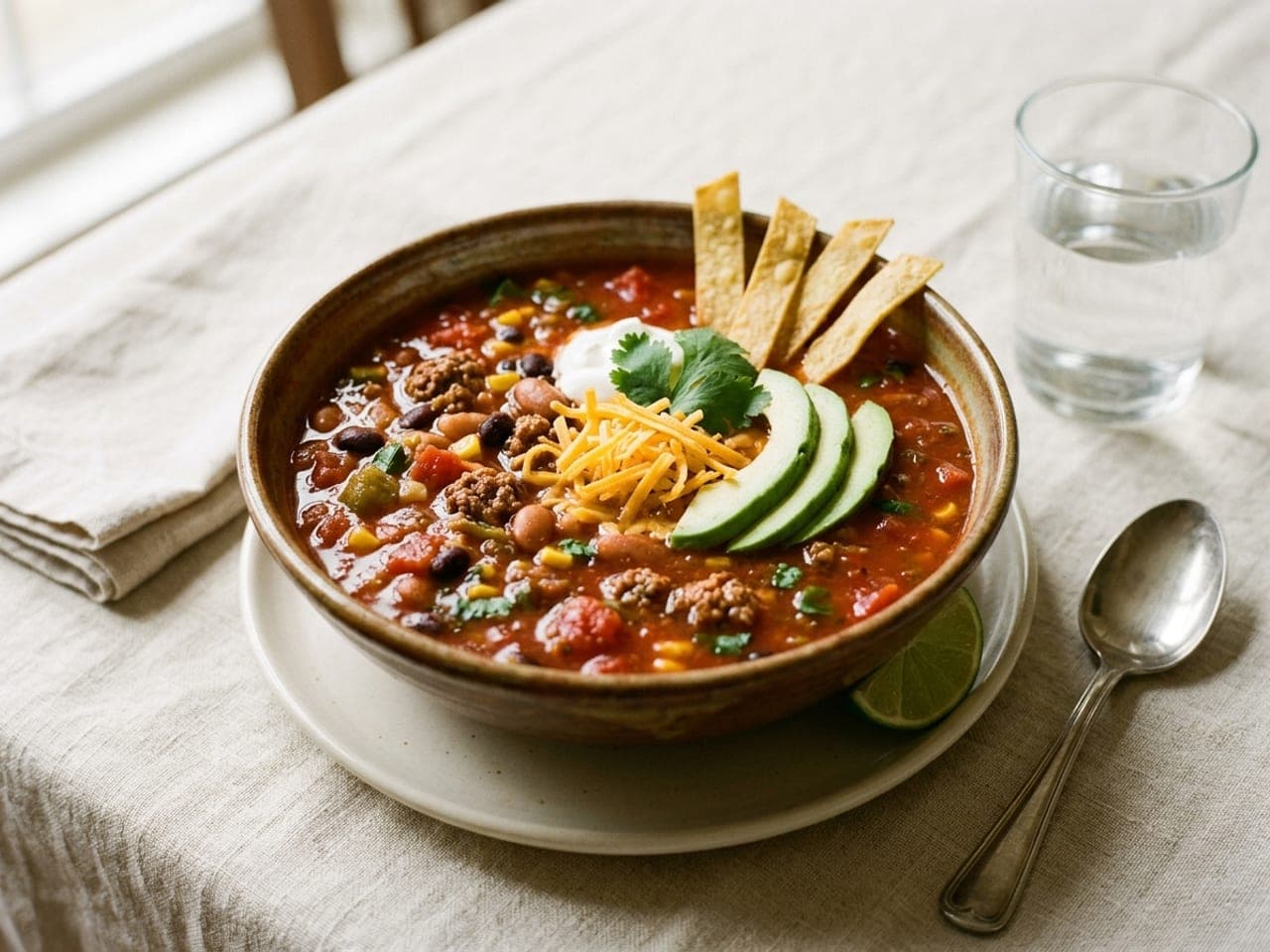
Taco soup is an American one-pot soup built from taco-night ingredients: ground beef browned with taco seasoning, canned beans, corn, tomatoes with green chiles and broth, simmered briefly and topped the way you top a taco, with cheese, sour cream, avocado and crushed tortilla chips. It is not a Mexican dish and does not claim to be; it is a Tex-Mex home-cooking staple of church suppers, school lunches, potlucks and game days, loved because it is fast, cheap, feeds a crowd and freezes well.
This is the easy stovetop version, done in a little over an hour with one pot and no draining of cans. It makes about 12 1/2 cups (3 liters), 8 bowls of about 1 1/2 cups (360 ml). Three things set it apart from the usual dump-and-stir recipe. The beef is browned properly, with a quarter of it seared hard for flavor. The seasoning is made from scratch, so you get the flavor a taco packet and a ranch packet give without most of their salt. And the soup is finished with lime and dill, which play the part the ranch packet plays in the classic Texas version.
The same pot of ingredients works in a slow cooker or an Instant Pot, it converts easily to chicken or to a vegetarian soup, and it is one of the best soups there is for freezing. All of that is below, along with the history that no other taco soup recipe gets right.
How to make Taco Soup
- Mix the seasoning and prep everything first. In a small bowl, stir together the chili powder, cumin, smoked paprika, oregano, garlic powder, onion powder, cayenne if using, the 1 1/2 tsp salt and the black pepper. Rinse the cilantro and jalapeños, then dice the onion, mince the jalapeño and garlic, open the cans, and set the tomato paste and dill beside the stove. Wear gloves for the jalapeño, or wash your hands well after mincing it and keep them away from your eyes. Why: this is your taco seasoning, made from scratch. A 1 oz (28 g) store packet does the same job, but it is mostly salt, spice and cornstarch, and one McCormick packet carries about 2,300 mg of sodium (380 mg per 2 tsp, about 6 servings). Mixing your own lets you choose the salt (this blend plus the salt adds about 270 mg sodium per bowl) and keeps the spices fresh-tasting. Everything moves fast once the beef is in the pot, and ground spices scorch in seconds, so have it all within reach before you turn on the heat.
- Brown a quarter of the beef hard, then the rest. Set a heavy 6 to 7 quart (5.7 to 6.6 liter) Dutch oven over medium heat for 3 to 4 minutes (if it is enameled, add 1 tsp oil first; bare cast iron or stainless steel can go over medium-high for 2 minutes). Pinch off about a quarter of the beef, 6 oz (170 g), press it into a thin patty, lay it in the hot pot and leave it alone for 4 to 5 minutes, until the underside is a deep brown crust. Flip it for 1 minute, then break it up and add the rest of the beef. Wash your hands with soap and warm water for 20 seconds after handling the raw beef. Cook, breaking it into small crumbles, just until no pink remains, about 5 minutes. Why: a pot full of ground beef releases more juice than it can boil off, so it steams grey instead of browning; the surface cannot pass about 212°F (100°C) while liquid pools. Browning one flat slab in a hot pot gets real Maillard crust, and those browned flavors dissolve into the whole soup later. Cooking the other three quarters only to the no-pink stage keeps the crumbles tender instead of pebbly. The soup simmers well past the safe 160°F (71°C) for ground beef, but never brown the meat partly and finish it later.
- Spoon off the fat, keep a tablespoon, and soften the onion. Tilt the pot and spoon off all but about 1 tbsp of the rendered fat (with 85/15 beef there is usually 2 to 3 tbsp). Lower the heat to medium, add the onion and jalapeño and cook, stirring and scraping, for 5 to 6 minutes, until the onion is soft and translucent. Add the garlic for the last minute. Why: 1 1/2 lb (680 g) of 85/15 beef sheds roughly 30% of its fat as it cooks. Leaving all of it makes a greasy slick on the finished soup, but keeping one spoonful gives the spices a fat to bloom in, and fat carries their flavor. The onion’s moisture lifts the browned bits (the fond) off the bottom of the pot, so nothing burns, and a properly softened onion has no raw bite; undercooked onion is the most common flaw in quick taco soups. Garlic goes in last because it browns and turns bitter faster than onion.
- Bloom the spices and the tomato paste. Add the spice mix and the tomato paste to the pot and stir constantly for 45 to 60 seconds, until the spices smell toasty and the paste turns a shade darker and brick red. Do not let it go past that point. Why: many of the flavor compounds in chile, cumin and paprika dissolve in fat, not water. Frying ground spices briefly in the fat releases them and spreads them through the whole pot; stirred straight into broth, the same spices taste dusty and flat. Tomato paste caramelizes in the same minute, which deepens its sweetness and savory edge. Ground spices burn fast, which is why the liquid goes in right after. If you use a store taco packet instead, skip this frying step and stir the packet in with the tomatoes: packets contain cornstarch, which can catch and scorch on a hot, dry pot floor.
- Add the tomatoes, beans and broth, and simmer. Pour in the Ro-Tel and the diced tomatoes with all their juice and scrape the bottom of the pot clean. Add both cans of black beans and the pinto beans with their liquid, then the broth. Bring to a boil, lower the heat to a gentle simmer, set the lid ajar and cook for 20 minutes, stirring now and then. Why: the tomatoes’ acid and water finish lifting the fond, so every browned bit ends up in the broth. The bean liquid is a free thickener: it is mostly soluble fiber and sugars with a little protein, which give the broth body without flour. That is why this recipe uses low-sodium black beans and keeps their liquid rather than draining it and adding more broth. Twenty minutes at a lazy simmer, around 200°F (93°C), is enough for the seasoning to soak into the beans and meat; taco soup is meant to be quick, and everything in the pot is already cooked.
- Add the corn and dill, and thicken if you like. Stir in the frozen corn and the dill and simmer, uncovered, for 8 to 10 minutes, until the corn is hot and sweet but still has a little snap. For a thicker, more chili-like soup, stir in the masa harina slurry and simmer 5 minutes more before you judge the texture; add broth or water, 1/4 cup (60 ml) at a time, if it is thicker than you want. Why: frozen corn is only blanched before freezing, so it keeps more bite than canned corn, which is fully cooked in the can; added late, it stays crisp against the soft beans. Dill is the herb that makes a ranch packet taste like ranch, and here it gives the same background note. Masa harina, the corn flour used for tortillas, thickens without turning gluey and adds a toasted-corn flavor that suits the soup; cornstarch works too, but tastes of nothing and turns the broth glossy.
- Finish with lime and cilantro, then taste. Take the pot off the heat and stir in the lime juice and the chopped cilantro. Taste and adjust: a pinch more salt if it tastes flat, a little more chili powder or cayenne if you want heat. Why: acid is what the ranch packet’s lactic and citric acids and buttermilk bring to the classic version, a tang that keeps a rich, beany soup from tasting heavy. Added at the end, fresh lime tastes bright; boiled for twenty minutes, it goes dull. Cilantro loses its fresh, green flavor with long cooking too, so it goes in last. Taste only after the lime is in, because acid makes food taste saltier, and it is easy to over-salt a soup you season before the acid goes in.
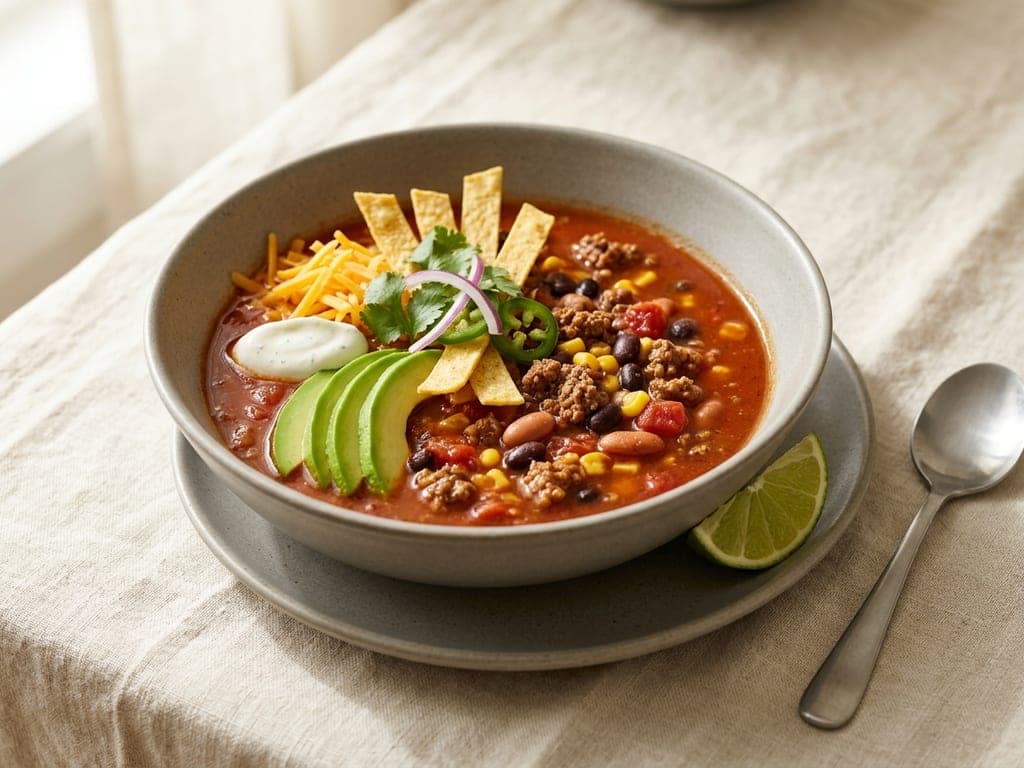
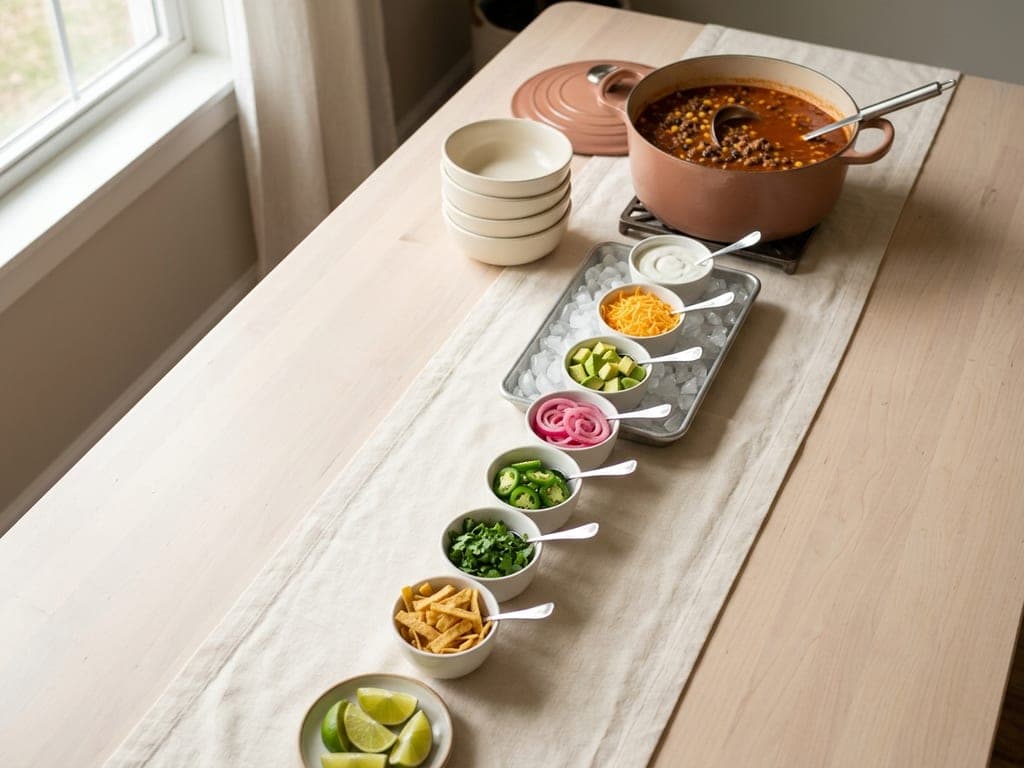
- Serve in warm bowls, toppings last. Warm wide, shallow bowls in a low oven or with hot water. Ladle in about 1 1/2 cups (360 ml) of soup per bowl, then top at the table: a spoon of lime crema, shredded cheese, avocado, cilantro, red onion and jalapeño, and the tortilla chips or strips last, so they are still crunchy when they reach the spoon. Why: the soup is soft and hot, so it needs contrast: crunch, cool dairy, fresh acid and raw onion. The dairy toppings do real work against chile heat. In a Penn State study, milk cut the burn of capsaicin better than other drinks, which points to the milk protein casein rather than fat; casein binds capsaicin, and sour cream and cheese carry it. Chips go soggy within minutes in hot broth, and sour cream stirred in turns the broth pink and cloudy, so leave the toppings on the surface. See the three ways to plate it below.
Safety & hygiene Important
- Ground beef: cook to 160°F (71°C), not by color. USDA FSIS says ground beef is safe at 160°F (71°C) and warns that color is not a reliable sign: beef can turn brown before it gets there. In this soup the crumbles simmer for 30 minutes after browning, so they pass that point with room to spare; the risk is in shortcuts. Never brown the beef partly and finish it later (partial cooking lets bacteria survive and multiply), and wash your hands with soap and warm water for at least 20 seconds, and wash the board, knife and any plate that held raw meat in hot soapy water, before you touch the toppings. For chicken or turkey, the target is 165°F (74°C).
- Cool a big pot fast: shallow containers, 2 hours. A full pot of soup cools slowly enough for bacteria to multiply in the middle. Refrigerate leftovers within 2 hours of cooking (1 hour if the room is above 90°F (32°C)). To get there, set the pot in a sink of ice water and stir for about 10 minutes, then ladle the soup into shallow containers no more than 2 inches (5 cm) deep. Taco soup is thick, like chili, and thick foods cool slowest, so extension food-safety guides say to keep it 2 inches (5 cm) deep or less. Hot food can go straight into the fridge. The FDA Food Code standard for kitchens, a good home benchmark, is from 135°F (57°C) to 70°F (21°C) within 2 hours and to 41°F (5°C) within 6 hours in total. Do not put a full slow-cooker crock in the fridge: its thick walls hold heat.
- Leftovers: the US and UK windows differ. US: FoodSafety.gov and USDA FSIS advise eating soups and stews with meat within 3 to 4 days in the fridge, at 40°F (4°C) or below, and reheating soup by bringing it to a rolling boil (FSIS), which takes it well past the 165°F (74°C) leftovers target. Some recipe sites say 5 to 7 days because the ingredients came from cans; canned ingredients do not make cooked leftovers last longer. Frozen at 0°F (-18°C), the soup stays safe indefinitely, and it is best within 2 to 3 months (FoodSafety.gov; FSIS says 3 to 4). UK: the Food Standards Agency says to eat leftovers within 2 days or freeze them, to reheat only once, and to reheat until steaming hot all the way through; eat defrosted soup within 24 hours and do not refreeze it.
- Slow cooker and buffet rules. USDA FSIS: always thaw meat before it goes into a slow cooker, fill the cooker half to two thirds full, and, if you can, run it on HIGH for the first hour. If the power goes out while you are away, throw the food out, even if it looks done. Do not reheat leftovers in a slow cooker; bring them to a boil on the stove, or to 165°F (74°C) in the microwave, first, then hold them in the cooker on WARM. For a buffet or game day, keep the soup at 140°F (60°C) or above (US) or 63°C (145°F) or above (UK). Keep cold toppings on ice, and throw out any dairy, avocado or other perishable topping that has sat out more than 2 hours (1 hour above 90°F (32°C), as at an outdoor tailgate). Put the soup itself in the fridge within 2 hours of turning off the heat.
- Sodium and allergens. As written, a bowl has about 880 mg of sodium, 38% of the US Daily Value of 2,300 mg, or about 2.2 g of salt, more than a third of the UK adult maximum of 6 g (arithmetic in the FAQ). The packet version runs higher: one taco packet and one ranch packet carry about 4,500 mg between them, and even with the beans drained and rinsed a bowl comes to about 1,220 mg. Allergens: the toppings contain milk (sour cream, cheese); ranch seasoning packets contain buttermilk (milk); some taco packets and chili powders contain wheat or are made where wheat is handled, so check labels if you cook gluten-free. Tortilla chips are corn but can share fryers with wheat. Check the broth too: many beef broths contain celery (a major allergen in the UK and EU), UK stock cubes and pots often contain wheat or barley (gluten), and some bouillon pastes contain soy. Water works fine instead.
3 ways to plate it
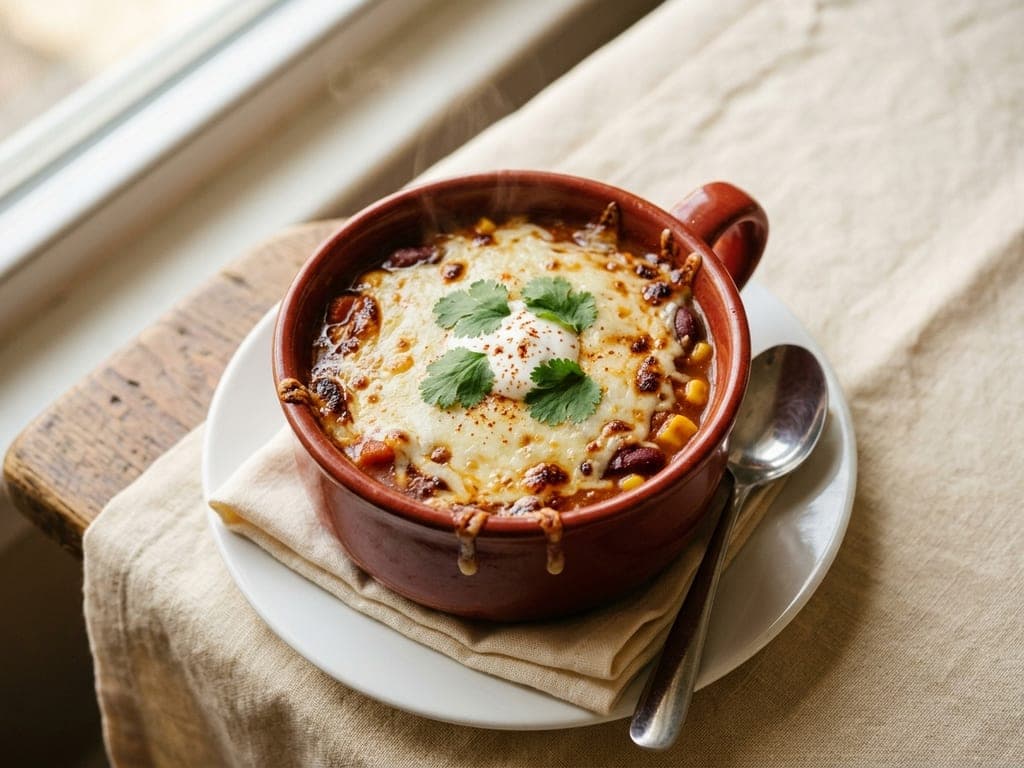
Where taco soup came from: 1977, not the 1950s
Search for where taco soup originated and you will read that it was born in the Southwestern United States in the 1950s, as a mild alternative to chili. We found no source for that anywhere: not in the Internet Archive’s cookbook full text, not in the Google Books record, and not in Texas and Oklahoma newspaper archives. The most respected reference answer, the Food Timeline, says taco soup recipes began appearing in American publications in the early 1990s and that the oldest it found was Campbell’s, dated 1993. Printed cookbooks put it at least 15 years earlier.
The earliest printed taco soup we found is in Uncle Ben’s Rice Cookery, a brand cookbook published by H.P. Books in Tucson in 1977. It sits on a “Monday Night Football” menu beside guacamole, corn chips and cole slaw, with the promise: “After the game or theater, you and your guests can enjoy spicy Taco Soup. And it’s easy to prepare, too.” In 1980 the syndicated diet columnist Barbara Gibbons printed a “Mex-Tex Taco Soup” in The Light and Easy Cookbook. In 1982 it appears in Time to Enjoy, a recipe booklet from Rival, the company that made the Crock-Pot, as “The taste of tacos in a soup... a great way to warm up on a chilly evening.”
Then it went into community cookbooks. The Pella Collector’s Cookbook (Central College Auxiliary, Pella, Iowa, 1982) has Maxine Huffman’s taco soup made with a ham bone, hominy and corn, garnished with cheese, lettuce, green onions and Doritos: proof that early taco soup meant taco toppings on a soup, not a fixed formula. The Faith Lutheran Church Women Cook Book, printed in 1982, has the version we still make: Sally Nash’s pound of hamburger (450 g), a packet of taco seasoning, kidney beans, stewed tomatoes and tomato sauce, with avocado, chips, cheese and sour cream set out in separate bowls. The toppings bar was there from the start. On 27 July 1983, the Lawton Constitution in Oklahoma reported that Routh Becker’s Taco Soup had taken third place for main dishes in its readers’ recipe contest, which drew more than 330 entries: the earliest newspaper sighting we found.
The earliest ranch-packet version we found is Texan. The Eyes of Texas Cookbook (KPRC-TV Houston, published in Fredericksburg, 1987) has a taco soup of ground beef, a taco seasoning envelope, hominy, pinto beans, canned tomatoes and an envelope of ranch-style salad dressing mix. By 1990 A Taste of the Country, from Reiman Associates, the Wisconsin publisher of Country Woman magazine, summed the dish up as “like chili, but without the wait”, and by 1995 a Rotary club cookbook in Flushing, New York, was calling taco soup “this Texan recipe”. Campbell’s printed its own Taco Soup, made with condensed tomato soup, in 1992.
No single inventor is on record. Every early community-cookbook version carries the name of a home cook, and the dish could only exist once its shortcuts did: Ro-Tel tomatoes and green chiles, canned in Elsa, Texas, since 1943 by the company’s own account; taco seasoning packets, which Lawry’s sold from 1967 and a Texas grocery ad was selling by March 1969; and Hidden Valley’s ranch mix, sold by mail and in local stores in packets from the late 1950s, to be stirred into buttermilk and mayonnaise, and taken national by Clorox, which bought the brand in 1972. Tipping that packet dry into a soup pot was a home cook’s idea. Taco soup’s real parent is chili con carne, and its cousin is Mexico’s sopa de tortilla, which shares the crisp tortilla, cheese and avocado garnish but not the beef.
Taco soup with ranch: what the packets actually do
The famous version of taco soup, the one often called seven-can soup, is a dump recipe: brown a pound or two (450 to 900 g) of beef, then add a packet of taco seasoning, a packet of dry ranch dressing mix and cans of beans, corn and tomatoes with green chiles, undrained. It works, and it is worth understanding why, because each packet does a specific job.
The taco packet brings salt, chile, cumin and cornstarch. Old El Paso’s original mix lists cornstarch as its first ingredient, and the starch is what makes packet taco meat saucy; in soup it adds slight body. The ranch packet is the clever part. Hidden Valley’s original mix is maltodextrin, buttermilk, salt, monosodium glutamate (MSG), garlic, onion, lactic acid, spices and citric acid. That is three flavor tools in one envelope: acid (tang), MSG (savory depth, the taste called umami) and a little body from maltodextrin and gums. That combination is why ranch-packet taco soup tastes rounder than taco seasoning alone.
The cost is sodium. One 1 oz (28 g) McCormick taco packet has about 2,300 mg and one 1 oz (28 g) Hidden Valley ranch packet about 2,160 mg, from their labels: about 4,500 mg together, or about 560 mg in each of 8 bowls before the beans and tomatoes add theirs. This recipe keeps the flavor jobs and drops most of that salt. The homemade blend and measured salt replace the taco packet; dill replaces the ranch herbs; lime juice in the pot and a lime crema on top replace the acids and buttermilk. If you want the packet’s savory pop, 1/4 tsp MSG in the pot does it with about a third of the sodium of the same weight of salt.
To make the classic ranch version instead: skip the salt, spices and dill, stir in 1 packet of taco seasoning and 1 packet of dry ranch mix with the tomatoes, use regular beans drained and rinsed, and add about 2 cups (480 ml) more broth or water to replace their liquid. Draining and rinsing canned beans cuts their sodium by about 41% (Duyff and colleagues, 2011), which offsets some of the packets’ salt.
Crock pot taco soup and Instant Pot taco soup
Slow cooker (crock pot) taco soup: brown the beef, soften the onion and bloom the spices and tomato paste exactly as in steps 2 to 4, in the Dutch oven or a large skillet. Pour in 1/2 cup (120 ml) of the broth and scrape up the browned bits, then tip everything into a 5 to 6 quart (4.7 to 5.7 liter) slow cooker with the tomatoes, beans, remaining broth and corn. The full batch fills a 6 quart (5.7 liter) cooker about halfway, inside the half-to-two-thirds range USDA FSIS recommends. Cook on LOW for 4 to 6 hours or HIGH for 2 to 3 hours, with the first hour on HIGH if you can. Stir in the lime and cilantro just before serving.
Should you brown the beef first? USDA FSIS does not strictly require it, as long as the meat is thawed. But slow cookers never brown anything, raw ground beef packs into a dense mass that heats slowly, and its fat does not cook off; it floats on top. Browning first gives you flavor, lets you pour off the fat and gets the meat safely out of the danger zone at the start. Because everything in the pot is already cooked once the beef is browned, the slow cooker’s job is only to meld the flavors, which is why taco soup does not need 8 hours.
Instant Pot taco soup: an 8 quart (7.6 liter) pot takes the full batch; in a 6 quart (5.7 liter) pot, hold back 1 cup (240 ml) of the broth and all of the corn until after cooking (see the fill note below). On Sauté, brown the beef as in step 2 and spoon off all but 1 tbsp of fat. Cook the onion and jalapeño 3 minutes and the garlic 1 minute, then add the spices and tomato paste for 45 seconds. Press Cancel, pour in 1/2 cup (120 ml) of the broth and scrape the bottom completely clean. Add the rest of the broth (less the held-back cup in a 6 quart pot), the beans with their liquid and, in an 8 quart pot, the corn, then pour both cans of tomatoes on top and do not stir. Seal, cook at high pressure for 5 minutes, let the pressure release naturally for 10 minutes, then turn the valve to Venting with a long spoon, keeping your face and hands away from it. If soup sputters out, close it and let the pressure finish dropping on its own. Stir in any held-back broth and corn on Sauté for 3 to 4 minutes, add the lime and cilantro, and taste. Add a masa slurry only after cooking, never before pressure.
The deglazing and the tomatoes on top are what stop the BURN notice. Thick, sugary tomato sitting on the hot pot floor scorches before the cooker builds pressure; with thin broth on the bottom and tomatoes on top, it cannot. If BURN appears anyway, cancel, release the pressure as the manual directs, scrape the base clean, add 1/2 cup (120 ml) broth and start again. The full batch reaches just past the 1/2 line of a 6 quart (5.7 liter) Instant Pot, and Instant Pot says bean soups must stay at or below that line, which is why the 6 quart version holds back broth and corn until after pressure.
Chicken taco soup and vegetarian taco soup
Chicken taco soup: replace the beef with 1 1/2 lb (680 g) boneless, skinless chicken thighs (juicier) or breasts, left whole. Soften the onion in 1 tbsp olive oil, since chicken gives you no rendered fat, bloom the spices and tomato paste, then add the tomatoes, beans and broth and lay the chicken in the liquid. Simmer, covered, for 15 to 20 minutes, until the thickest piece reaches 165°F (74°C). Lift the chicken out, shred it with two forks, and return it with the corn. In a slow cooker, the whole raw thighs (thawed, never frozen) can go straight in: 4 to 6 hours on LOW, until the thickest piece reads 165°F (74°C), then shred. Ground chicken or turkey works like beef: brown it in 1 tbsp oil and cook it to 165°F (74°C).
Vegetarian taco soup: leave out the beef and add a fourth can of beans, or 12 oz (340 g) of plant-based ground meat browned in 1 tbsp oil (in an Instant Pot, cut the pressure time to 3 to 4 minutes). Use vegetable broth, and add 1 tbsp soy sauce (it contains soy and wheat; tamari is usually wheat-free) or 1/4 tsp MSG for the savory depth the beef supplied. Check your labels: plant-based grounds often contain wheat gluten and soy; Worcestershire sauce, which some recipes add, usually contains anchovies, and a ranch packet contains buttermilk, so a ranch-packet soup is vegetarian but not vegan. Our main recipe is a beef soup, so it is not marked vegetarian.
Taco soup vs chili
Taco soup is chili’s quick, brothy younger relative, and a 1990 cookbook put it perfectly: “like chili, but without the wait”. The difference comes down to four things. First, the seasoning. Chili is built on chiles: a Texas bowl of red starts from whole dried chiles, toasted and puréed, and braised for hours. Taco soup is seasoned with a ready-ground blend of chili powder, cumin and oregano, the same mix as taco meat. Second, the liquid and the time: taco soup is a soup, with more broth, and it is ready in about 30 minutes of simmering because every ingredient is already cooked. Chili is a thick braise.
Third, the markers. Corn, hominy, a ranch packet and a pile of crushed tortilla chips all say taco soup; you rarely find them in a pot of chili. Fourth, the beans: they are essential to taco soup, while many Texas cooks make chili without them. If your taco soup comes out thicker than you like, it is drifting toward chili; add broth. If you want it closer to chili, simmer it uncovered for 15 more minutes and add the masa harina.
Freezing taco soup, and making it ahead
Taco soup freezes better than almost any soup, because beans, corn and ground beef come through freezing with their texture intact. Cool it quickly (see the safety notes), then ladle it into freezer containers or flat freezer bags in 3 cup (720 ml) portions, two bowls each, rather than one solid block, leaving about 1 inch (2.5 cm) of headspace, since water expands by about 9% as it freezes. Freeze it without toppings: chips go soggy, and sour cream and avocado do not freeze well. Label and date it, and use it within about 3 months for the best quality.
To serve, thaw it overnight in the fridge, or use the microwave’s defrost setting, then reheat on the stove until it comes to a boil, well past 165°F (74°C), adding a splash of broth or water, because the beans keep absorbing liquid and the soup thickens as it sits. Soup thawed in the fridge can go back into the freezer, USDA FSIS says; UK Food Standards Agency advice is stricter: eat defrosted soup within 24 hours, don’t refreeze it, and reheat it only once. So freeze it in two-bowl portions and thaw only what you need.
Taco soup also tastes better on the second day, when the spices have soaked into the beans. For a party, make it a day ahead, cool and refrigerate it, and bring it back to a boil on the stove before moving it to a slow cooker on WARM for serving. (In the UK, that reheat is its one reheat: discard what is left after the party.)
Questions, answered
What is taco soup made of?
Taco soup is browned ground beef simmered with canned beans (usually black and pinto), corn, tomatoes with green chiles such as Ro-Tel, onion and broth, seasoned with taco seasoning and often a packet of dry ranch mix. It is topped like a taco, with cheese, sour cream, avocado and crushed tortilla chips. This recipe uses a homemade seasoning blend, dill and lime in place of the packets.
Do you drain the beans for taco soup?
It depends on the beans and the seasoning. The bean liquid is a free thickener, mostly soluble fiber and sugars, so if you use low-sodium beans and a homemade seasoning, as this recipe does, keep it. If you use regular beans with a taco packet and a ranch packet, drain and rinse them: in a 2011 study by Duyff and colleagues, draining cut canned beans’ sodium by about 36% and draining plus rinsing by about 41%. Replace the lost liquid with about 2 cups (480 ml) of low-sodium broth or water for 3 cans.
Can you freeze taco soup?
Yes, and it is one of the best soups for freezing. Cool it quickly in shallow containers, freeze it without toppings, leave about 1 inch (2.5 cm) of headspace, and use it within about 3 months for the best quality (FoodSafety.gov says 2 to 3 months, USDA FSIS 3 to 4). Thaw it in the fridge and bring it to a boil on the stove (well past the 165°F (74°C) leftovers target), thinning with a little broth. In the UK, eat it within 24 hours of thawing and do not refreeze it.
Can you make taco soup in a crock pot?
Yes. Brown the beef and soften the onion first for flavor and so you can pour off the fat, then put everything in a 5 to 6 quart (4.7 to 5.7 liter) slow cooker and cook on LOW for 4 to 6 hours or HIGH for 2 to 3 hours. USDA FSIS advises using only thawed meat, filling the cooker half to two thirds full, and running it on HIGH for the first hour if you can. Add the lime and cilantro at the end.
What is the difference between taco soup and chili?
Taco soup is thinner and quicker: it is seasoned with a ground spice blend (taco seasoning), simmers about 30 minutes because every ingredient is already cooked, and usually includes corn, beans and often a ranch packet. Chili is a thick braise built on chiles, often whole dried ones, and cooked for hours; many Texas cooks leave out the beans. A 1990 cookbook described taco soup as “like chili, but without the wait”.
What goes well with taco soup?
Pair it for contrast. The soup is soft, hot and savory, so serve crunch (tortilla chips, tostadas or a crisp cabbage slaw), acid (lime wedges, pickled red onion) and one starch: cornbread or Mexican-style rice, not both. Quesadillas or warm tortillas work too. Sour cream and cheese on top do more than add richness: milk protein binds the capsaicin that makes chiles burn.
How long does taco soup last in the fridge?
In the US, 3 to 4 days at 40°F (4°C) or below, per FoodSafety.gov and USDA FSIS; in the UK the Food Standards Agency says 2 days. Refrigerate it within 2 hours of cooking, in shallow containers so it cools fast, and reheat it to a boil, past 165°F (74°C), or steaming hot all the way through. Canned ingredients do not extend the life of cooked soup, whatever some recipe sites say.
Where did taco soup originate?
In American cookbooks of the late 1970s and early 1980s, not the 1950s Southwest. The earliest printed taco soup we found is in Uncle Ben’s Rice Cookery (1977); by 1982 it was in a Crock-Pot maker’s recipe booklet, an Iowa college-auxiliary cookbook and a Lutheran church cookbook, and by 1983 in an Oklahoma newspaper’s recipe contest. The ranch-packet version appears in Texas by 1987. No single inventor is on record.
Why do you put ranch seasoning in taco soup?
Because a dry ranch packet adds three things taco seasoning lacks: tang from buttermilk, lactic acid and citric acid; savory depth from MSG; and a little body from maltodextrin and gums. It also adds about 2,160 mg of sodium per 1 oz (28 g) packet, and milk. To get the same effect with less salt, use dried dill in the pot and finish with lime juice and a lime-and-sour-cream crema, as this recipe does.
How do you thicken taco soup?
Whisk 2 tbsp masa harina with 1/4 cup (60 ml) water, stir it in and simmer 5 minutes; it thickens without turning gluey and adds a toasted-corn flavor. You can also mash about 1/2 cup (120 ml) of the beans against the side of the pot, keep the bean liquid instead of draining it, or simmer the soup uncovered for 10 to 15 minutes. Crushed tortilla chips simmered in the soup for 10 minutes thicken it too.
How many calories are in a bowl of taco soup?
About 375 calories per bowl of about 1 1/2 cups (360 ml), toppings not included, with about 27 g protein, 12 g fat, 14 g fiber and 880 mg sodium. The math, for the whole pot, divided by 8: 1 1/2 lb (680 g) raw 85/15 beef browns to about 457 g of crumbles (1,170 kcal, 127 g protein, 70 g fat, 407 mg sodium; USDA FDC 174034) plus 1 tbsp of kept fat (117 kcal). Two cans of low-sodium black beans with liquid, 850 g: 774 kcal, 51 g protein, 59 g fiber, 1,173 mg sodium (FDC 175238). A can of pinto beans, 425 g: 349 kcal, 20 g protein, 20 g fiber, 1,139 mg (FDC 175201). Ro-Tel, 283 g: 57 kcal, 860 mg (label). Fire-roasted diced tomatoes, 411 g: 99 kcal, 7 g fiber, 1,000 mg (Hunt’s label; plain canned tomatoes run about half that). Frozen corn, 250 g: 203 kcal. Onion, garlic, tomato paste, spices, broth and lime: about 230 kcal together; the chili powder adds 456 mg sodium (FDC 171319), the salt 1,680 mg (Diamond Crystal label, 280 mg per 1/4 tsp), the low-sodium broth up to 280 mg. Total about 3,000 kcal and 7,050 mg sodium, so about 375 kcal and 880 mg per bowl. Toppings add more: roughly 115 kcal for 1 oz (28 g) cheddar and 60 kcal for 2 tbsp sour cream.
Snap your finished plate and let the AI plate it again — more beautifully.