Cranberry Sauce Recipe: Make-Ahead, Plus a Jellied Version
Homemade cranberry sauce from one 12 oz (340 g) bag: 150 g of sugar (44% of the berry weight, 3/4 cup), water, a little orange and a pinch of salt, simmered only until most of the berries pop, then made 1 to 3 days ahead, because cranberry pectin keeps firming in the fridge for days and the sauce is better for the wait. Eight servings of a generous 1/4 cup (65 ml) at about 96 kcal each, with the arithmetic shown. The page settles the storage question with sources (USDA says 7 to 10 days in the fridge; freeze the whole-berry sauce, not a molded log), gives a jellied “like the can” version that slices clean, explains why the can is labelled upside down, fixes bitter, runny and rubbery sauce, and tells the history no ranking recipe does: a strained, molded cranberry sauce was in an American cookbook in 1837, 75 years before Marcus Urann’s first canned sauce.
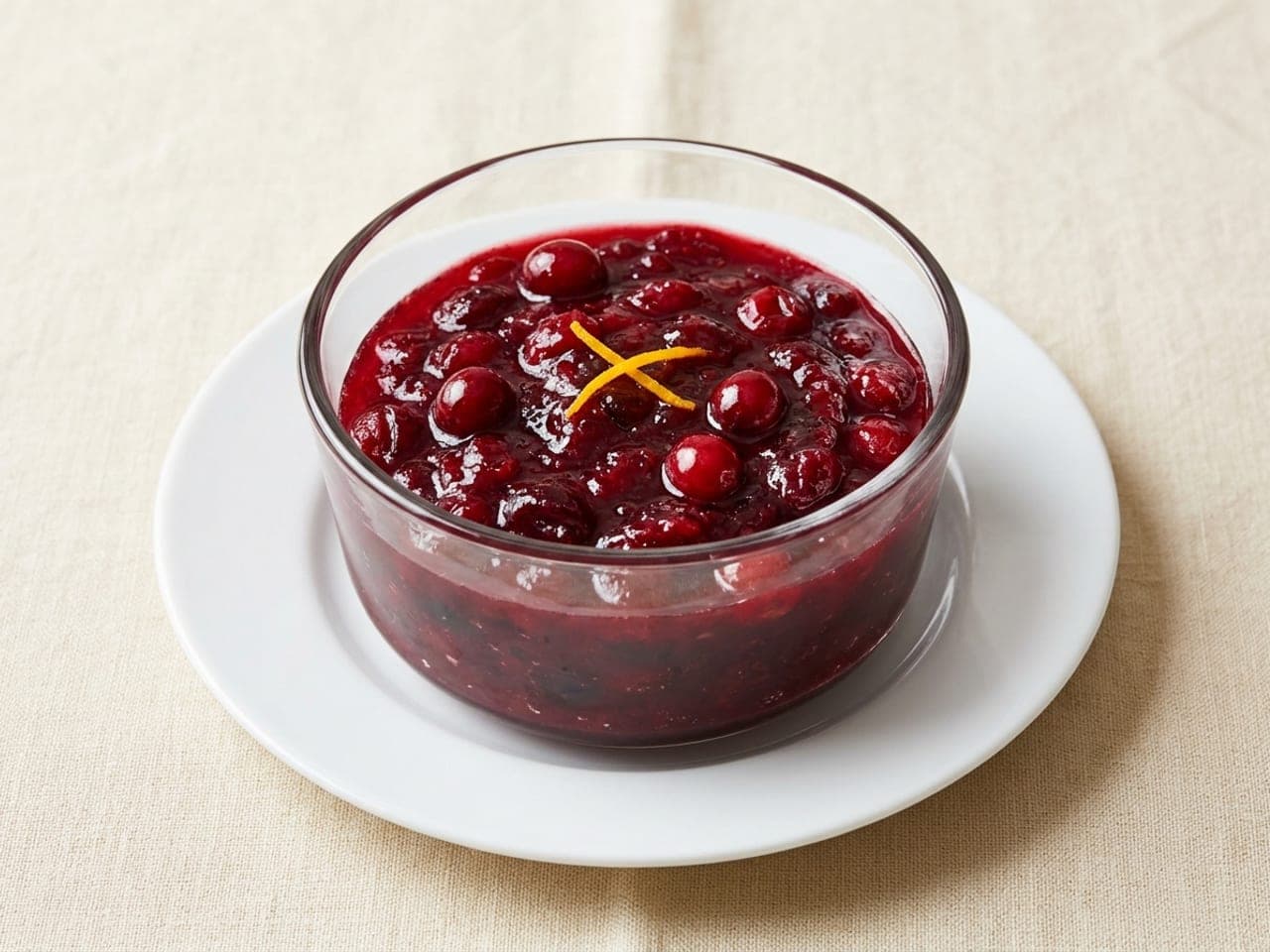
Ingredients
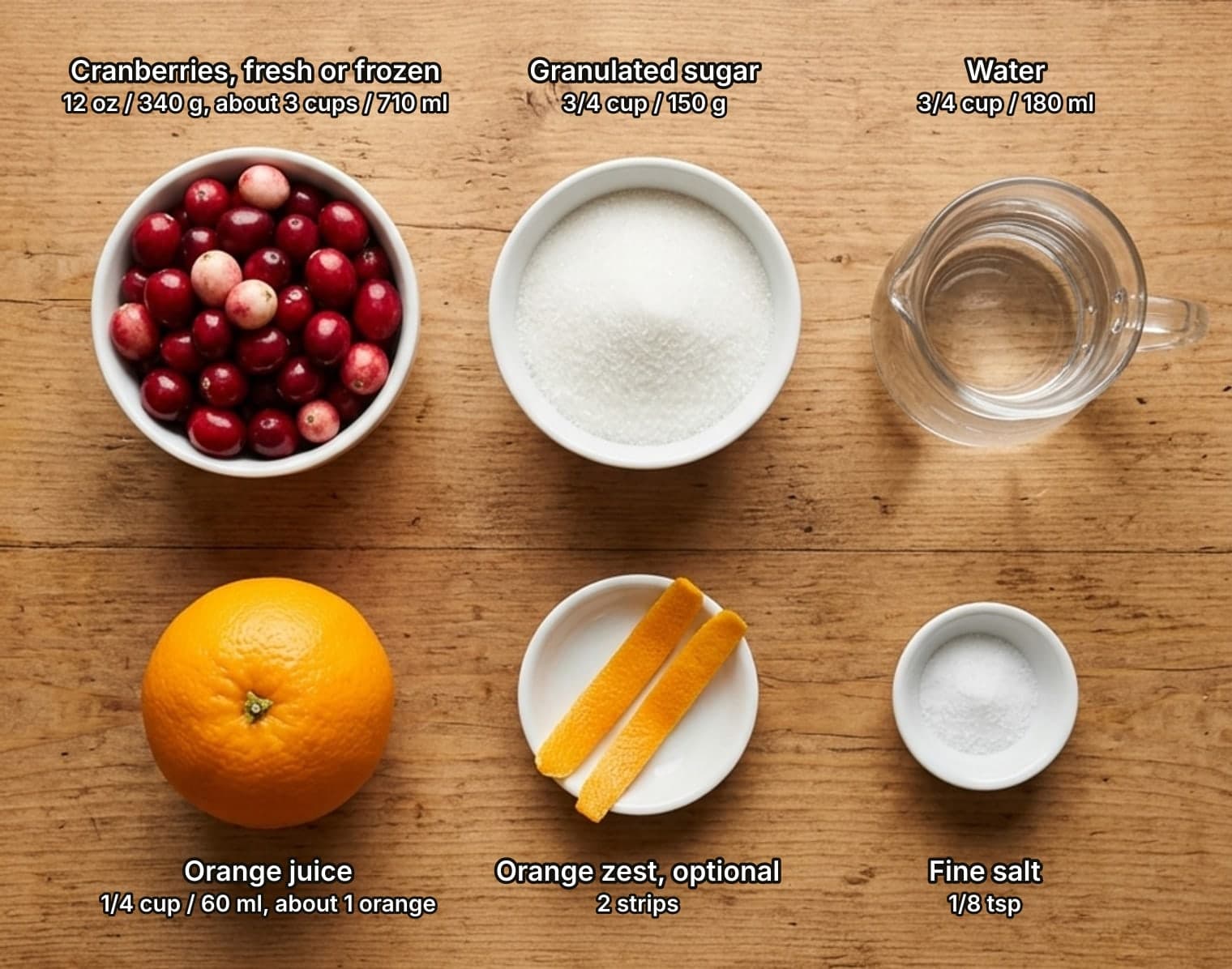
- fresh or frozen cranberries, one standard US bag (UK packs are 250, 300 or 340 g; see the scaling note in the Europe section). Frozen berries go in straight from the freezer, no thawing12 oz (340 g), about 3 cups (710 ml)
- granulated sugar (UK caster sugar works the same by weight). This is 44% of the berry weight: use 100 g (1/2 cup) for a tart sauce or 200 g (1 cup) for the sweetness of the can3/4 cup (150 g)
- water3/4 cup (180 ml)
- orange juice, squeezed just before you start (or use more water)1/4 cup (60 ml), from about 1 orange
- orange zest, taken from the same orange with a vegetable peeler, no white pith (optional; removed before serving)2 strips
- fine salt1/8 tsp
- For the jellied “like the can” version instead (step 8): the same bag of cranberries, cooked with water, sugar and a pinch of salt, no orange12 oz (340 g) cranberries, 1 1/4 cups (300 ml) water, 1 1/4 cups (250 g) sugar
How long does cranberry sauce last? The numbers, with their sources
Ranking recipes disagree wildly on this. One very popular page says homemade sauce freezes for a year in its main text and two months in its own cook’s note; another says it keeps “several months” in the fridge in one paragraph and “at least one week” in the next. The answer with an authority behind it is USDA’s FoodKeeper: homemade cranberry sauce lasts 7 to 10 days in the refrigerator. Canned sauce lasts about 2 years unopened in the pantry and 1 to 2 weeks in the fridge once opened; Ocean Spray says to move it out of the can into a covered container.
Freezing is where the advice genuinely splits, and the reason is that two different questions are being answered. Frozen at 0°F (-18°C), food stays safe indefinitely, so the limit is texture. USDA’s FoodKeeper and Ocean Spray both say they do not recommend freezing cranberry sauce because it “may become too watery” once thawed. UMass Extension says homemade sauce can be frozen but should be used within 2 months, and BBC Food, Love and Lemons, Martha Stewart and NYT Cooking all give 3 months. USDA’s note is about texture, not safety, and it covers homemade sauce as well as canned. In practice a whole-berry sauce weeps a little and comes back together with a stir, while a firm molded log loses its clean shape. So our call, against USDA’s quality note but in line with UMass Extension, is to freeze whole-berry sauce for up to 2 to 3 months for the best texture, and make jellied sauce fresh.
Cranberry sauce does keep unusually well for a cooked dish, for a reason worth knowing. Cranberries are very acidic and carry their own benzoic acid, the acid behind the common food preservative sodium benzoate, which is partly why fresh berries keep for weeks in the fridge. That is not a licence to stretch the 7 to 10 days. Mold can grow in refrigerated jams and jellies, and when it does, USDA’s advice is to discard the whole container, not scrape the top.
How to make Cranberry Sauce
- Sort the berries, and do not thaw frozen ones. Tip the cranberries onto a tray and pick out stems and any berries that are soft, shrivelled or brown, then rinse them in a colander and let them drain well, since water clinging to the berries only dilutes the syrup. A sound cranberry is firm enough to bounce, because it has small pockets of air inside; the soft ones are past it and will taste flat. Pale or partly white berries are fine, just a little more sour. If your berries are frozen, sort and rinse them frozen and keep them frozen: the cranberry growers’ own advice is not to thaw them before cooking, because thawed berries go soft and leak their juice onto the board instead of into the pan. Frozen berries add 2 to 3 minutes to the cook, nothing else changes, which is why a bag in the freezer from October is the easiest Thanksgiving insurance there is.
- Build the syrup in a stainless or enamel pan. Put the water, orange juice, sugar, salt and zest strips in a 3 quart (2.8 L) stainless steel or enamelled saucepan and bring it to a boil over medium-high heat, stirring until the sugar has dissolved. The pan matters more here than in most recipes: cranberries are about as acidic as lemon juice, and acid pulls metal out of bare aluminum and unseasoned cast iron (and unlined copper, which should not touch acidic food at all), which gives the sauce a metallic edge, may dull its colour and is something Health Canada advises against. A wide pan is better than a tall one, because it lets steam escape and the berries cook in a single layer. Squeeze the orange just before you start and take the zest in strips with no white pith; both the pith and juice left standing can bring bitterness, and strips are easy to fish out later. The pinch of salt is not there to make the sauce salty. It suppresses bitterness more than it suppresses sweetness, so the fruit tastes rounder.
- Add the berries and simmer until they pop. Tip in the cranberries, return to a boil, then lower the heat to a lively simmer and cook, stirring every minute or so, for 8 to 12 minutes (2 to 3 minutes more from frozen). Within a few minutes you will hear the berries start to crack and pop as the air and water inside them expand and split the skins. That popping is the point of the whole recipe: each split berry releases its pectin, the natural gelling fibre in the fruit, into the hot, sugary, acidic syrup, and that pectin is what turns a pan of loose berries into a sauce that sets with no gelatin or packet pectin at all. Simmer uncovered so a little water evaporates, and keep the heat at a simmer rather than a hard boil, which would spit and catch on the bottom of the pan. Bursting berries can spit hot syrup, so stir with a long-handled spoon and keep your face back from the pan.
- Stop while it still looks too thin. Take the pan off the heat when most of the berries have burst, a few are still whole and the liquid coats a spoon but still runs off it. It will look too loose. Stop anyway. Cranberry sauce thickens dramatically as it cools, and the gel keeps getting firmer in the fridge for days afterwards, so a sauce that looks right in the pan will be a stiff, rubbery block by Thanksgiving. If you like a jammier, less chunky texture, press some of the berries against the side of the pan with the back of a wooden spoon in the last minute; for a whole-berry look, leave them. Cooking long past the pop does not improve anything: the colour drifts from ruby towards brick, the fresh fruit taste goes, and cooks commonly find the sauce turns harsher, because the skins and seeds carry most of the fruit’s tannins.
- Take out the zest and taste it cold. Fish out the orange zest strips, scrape the sauce into a bowl and let it cool. Taste for sugar only once it is cold. Eliza Leslie gave the same instruction in 1837, “Taste it when it is cold, and if not sweet enough, add more sugar”, and it still holds: the sauce is served cool, so that is the temperature at which it has to taste right. If it needs more sweetness once cold, stir in a spoonful of maple syrup, honey (skip the honey if the sauce will be served to a baby under 12 months) or superfine (caster) sugar; ordinary granulated sugar will not dissolve in a cold gel and stays gritty. If it tastes bitter rather than simply sour, stir in a second pinch of salt before reaching for more sugar.
- Make it 1 to 3 days ahead. Cover the bowl and refrigerate it within 2 hours of cooking; spreading it in a shallow container cools it faster. Then leave it. Making cranberry sauce ahead is not just a way to free the stove on the day: cranberry pectin sets slowly, and laboratory work on cranberry gels found the network forms over the first 24 hours and keeps gaining strength for up to a week. So a sauce made 1 to 3 days ahead has a better, more even set than one made that morning, and the orange and fruit flavours settle together. It keeps for 7 to 10 days in the fridge, by USDA’s count, so making it on the weekend before Thanksgiving is fine. Store it in glass or plastic with a lid, never in the saucepan. The batch makes about 2 1/4 cups (530 ml), 8 servings of a generous 1/4 cup (65 ml).
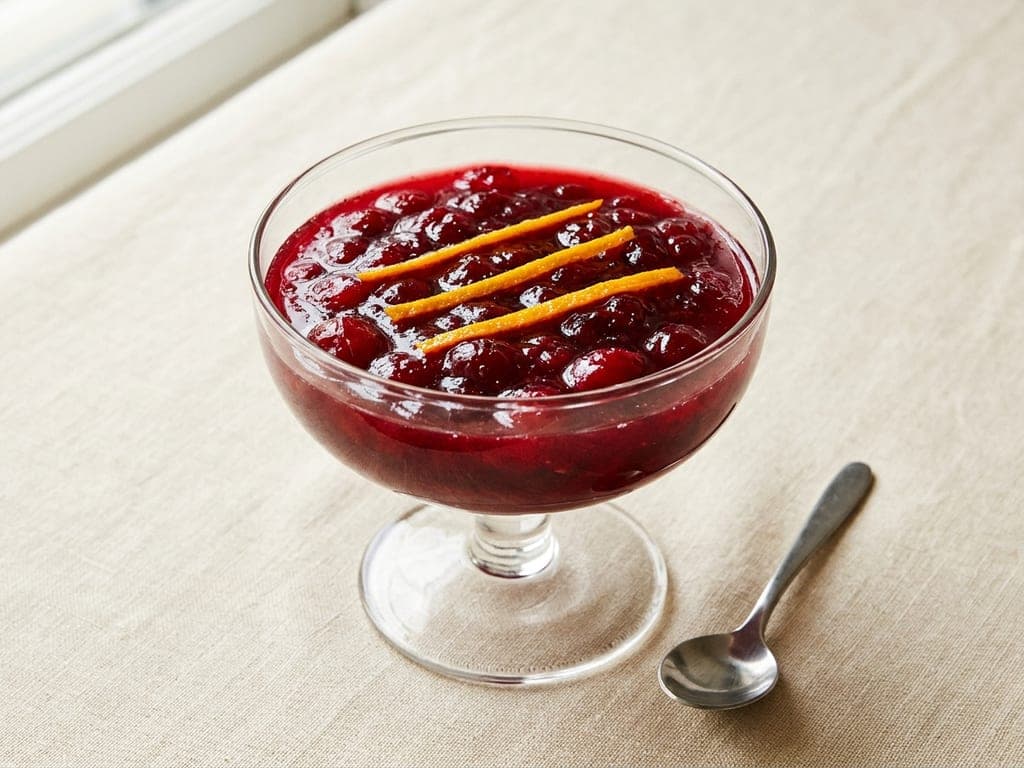
- Bring it back to serving texture. Take the sauce out of the fridge 30 to 60 minutes before dinner. Fridge-cold cranberry sauce is stiff and its flavour muted; at cool room temperature it is spoonable and tastes brighter. Stir it well. If it has set firmer than you want, stir in water or orange juice 1 tablespoon at a time until it loosens; warming alone will not always do it, because a firm cranberry gel can refuse to soften with heat. If it is looser than you want, it can go back on the stove for 3 to 5 minutes to evaporate more water, then cool again. Serve it in a glass or white dish so the colour does the work (see the plating ideas below), and put it back in the fridge within 2 hours of taking it out, counting the time it spent warming up.
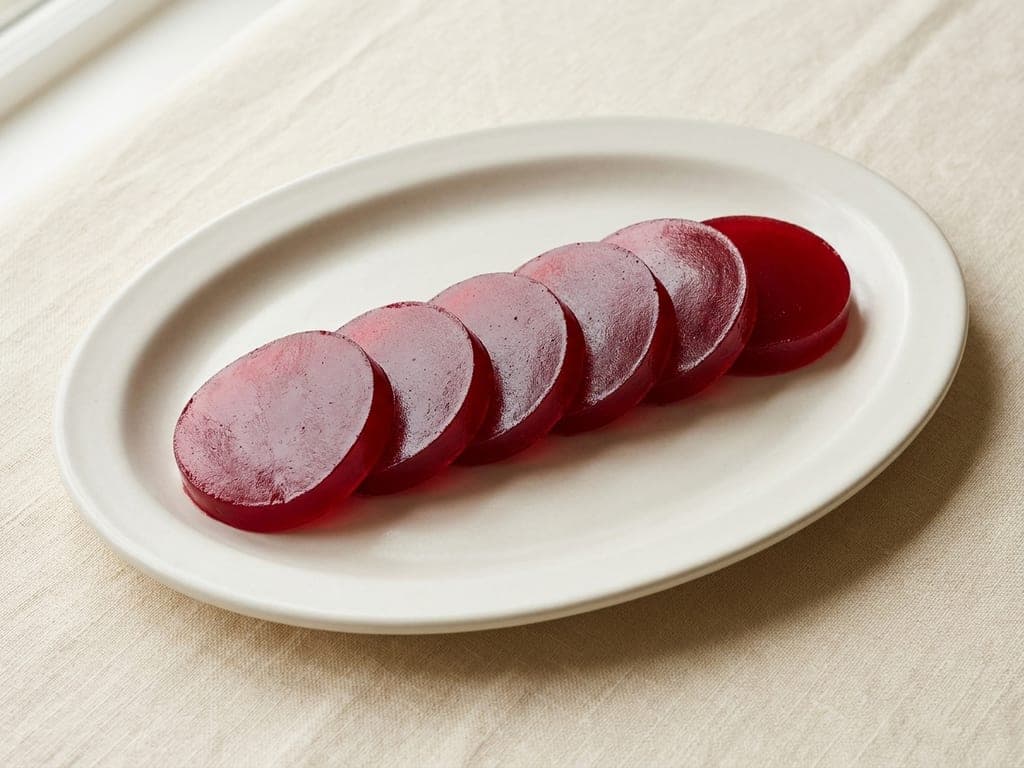
- Or: set it jellied, like the can. For a sliceable jellied log, simmer the 12 oz (340 g) of cranberries with 1 1/4 cups (300 ml) water in the 3 quart (2.8 L) pan for about 10 minutes, until every berry has burst and softened. Pass everything through a food mill, or let it cool for 10 minutes, blend it briefly with the lid vented and covered with a folded towel and press it through a fine sieve, scraping the purée off the underside; discard the skins and seeds. Return the purée to the clean pan with 1 1/4 cups (250 g) sugar and a pinch of salt and boil it steadily over medium heat, stirring with a long-handled spoon and skimming the foam, until it reaches 217 to 221°F (103 to 105°C), usually 10 to 15 minutes, or until a spoonful on a frozen plate wrinkles when pushed and the trail of your finger stays clear. It foams up and spits as it nears the jelly point: turn the heat down if it does, keep your face and hands back from the pan and keep children away from the stove, because syrup this hot sticks to skin and burns worse than boiling water. Unlike the whole-berry sauce, this one is boiled to the jelly point so it sets firm enough to slice. Pour it into a lightly oiled 1 1/2 to 2 cup (350 to 475 ml) mold (not unlined copper) or a clean, emptied can, minding the can’s sharp cut rim, chill at least 8 hours, then dip the mold in hot water for 5 to 10 seconds, run a thin knife round and turn it out. The full method, the altitude adjustment and why it is sweeter than the can are in the section below.
Safety & hygiene Important
- Fridge life: 7 to 10 days homemade. USDA’s FoodKeeper gives homemade cranberry sauce 7 to 10 days in the refrigerator, an opened can 1 to 2 weeks and an unopened can about 2 years in the pantry. Once a can is open, move the sauce into a covered glass or plastic container, as Ocean Spray and the UK’s Food Standards Agency both advise. Keep the fridge at 40°F (4°C) or below; the FSA says 5°C or below. Longer claims you will see on recipe pages, up to “several months”, are not backed by USDA. In the UK, the FSA’s general rule for cooked leftovers is stricter: eat or freeze them within 2 days. USDA’s 7 to 10 days is specific to cranberry sauce, a sugared, very acidic fruit sauce. If you follow the FSA rule, freeze what you will not eat within 2 days. Use a clean spoon each time.
- On the table: the 2-hour rule. Cranberry sauce is a perishable cooked food once made. Treat it like any cooked dish and follow USDA’s general rule: no more than 2 hours at room temperature, counting any time it spends warming up before dinner, or 1 hour when it is above 90°F (32°C). On a long Thanksgiving buffet, put out a small dish and refill it from the fridge rather than leaving the whole batch out, never tip what was on the table back into the fresh container, and give the sauce its own spoon so the carving fork and gravy ladle stay out of it. Refrigerate the cooked sauce within 2 hours of making it.
- Mold means discard the whole container. If you see mold on cranberry sauce, throw the whole container away; do not scrape it off and eat the rest. USDA’s Food Safety and Inspection Service lists jams and jellies among the foods to discard when moldy, because in soft, high-moisture foods mold can grow below the surface and bacteria may grow along with it, and the National Center for Home Food Preservation says the same for sweet spreads, noting that mold may produce mycotoxins. Also discard sauce that fizzes, smells of alcohol or yeast, or comes from a bulging or leaking can. A little clear liquid weeping out of an older gel on its own is not spoilage; stir it back in.
- Shelf-stable jars need a tested canning recipe. This is a fridge sauce. If you want jars for the pantry, follow a tested recipe exactly rather than putting this one in jars. The National Center for Home Food Preservation’s cranberry sauce uses 4 cups (about 450 g) of cranberries, 1 cup (240 ml) water and 2 cups (400 g) sugar, filled boiling hot with 1/2 inch (1.3 cm) headspace and processed in half-pint or pint jars in a boiling-water canner for 15 minutes up to 1,000 ft (305 m), 20 minutes from 1,001 to 6,000 ft (305 to 1,830 m) and 25 minutes above that; Ball publishes another tested version. Do not invent a processing time for a different ratio, do not rely on open-kettle canning (hot sauce sealed in jars with no processing) or on turning hot jars upside down to seal them, and do not can this recipe or a sugar-free version, neither of which is a tested canning recipe.
- Freezing: safe, but it is a texture call. Food kept at 0°F (-18°C) stays safe indefinitely, so the freezer limit on cranberry sauce is about quality. USDA’s FoodKeeper and Ocean Spray both advise against freezing it because it “may become too watery” after thawing; UMass Extension says homemade sauce can be frozen but used within 2 months. Our approach: freeze the whole-berry sauce, which comes back with a stir, and do not freeze a molded jellied log, which weeps and splits. Cool it first, pack it in freezer containers or wide-mouth freezer jars with 1/2 inch (1.3 cm) headspace for a pint (1 inch / 2.5 cm for a quart), and thaw it overnight in the fridge, not on the counter.
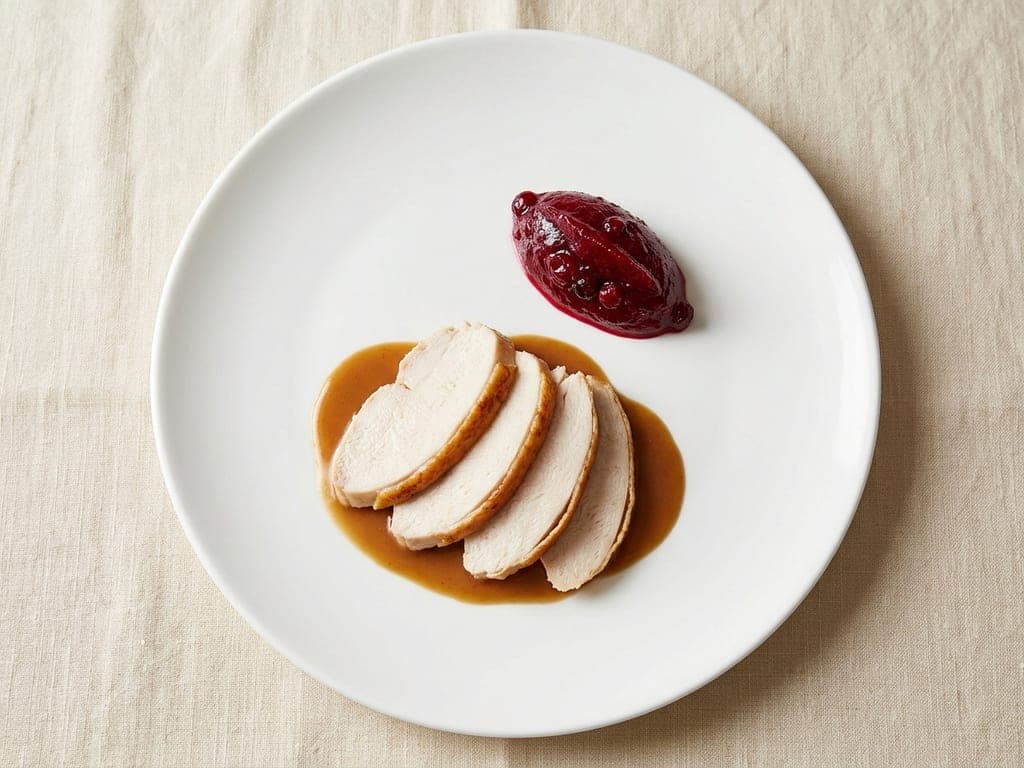
3 ways to plate it
Why cranberry sauce sets on its own, and why to make it ahead
Cranberry sauce is closer to a quick jam than a sauce. Cranberries hold about 0.4 to 1.2% pectin, the plant fibre that gels jams, and they are about as acidic as lemon juice. When the berries burst in hot syrup, the pectin dissolves, and acid plus sugar let its long chains bond into a gel as the sauce cools. That is the whole reason a pan of cranberries, sugar and water sets with no gelatin and no packet pectin, and why the canned jelly holds the shape of the can.
Cranberry pectin is also unusual. Work on cranberry jelly published in 1936 found it gels at only about 38 to 41% sugar and other dissolved solids, where ordinary jellies need around 65%. Later work, summarised in a University of Massachusetts thesis on cranberry gels, found it is also slow: the gel network forms over the first 24 hours and goes on strengthening for up to a week. Those two facts explain most of what recipes get wrong. They explain why a sauce that looks thin in the pan is firm the next day, why cooking until it looks thick gives a rubbery block, and why making it 1 to 3 days ahead gives a better texture, not just an easier Thanksgiving morning.
Popular recipes range from 1/2 cup (100 g) to 1 cup (200 g) of sugar per 12 oz (340 g) bag. Measured by weight, that is roughly 30 to 60% of the berry weight. We use 150 g (3/4 cup), 44%: enough for a dependable soft set and a sauce that is still clearly tart. For a sharper sauce use 100 g (1/2 cup), about the least that still sets well; for the sweetness people know from the can use 200 g (1 cup). The UK rule is the same percentage: weigh the berries and use 44% of that weight in sugar.
One honest correction to a common claim: homemade cranberry sauce is not automatically lower in sugar than canned. Ocean Spray’s jellied sauce carries 22 g of sugar in a level 1/4 cup (70 g) serving. Measured the same way, our default has about 19 g, and a recipe using 1 cup (200 g) of sugar per bag has about 22 g, as much as the can. Homemade tastes tarter mainly because whole berries burst on the tongue with fresh acid. If lower sugar is the goal, the 100 g version has about 14 g per level 1/4 cup.
Jellied cranberry sauce like the can, at home
The canned log is made the same way a home cook would make a molded jelly, only at scale: according to America’s Test Kitchen’s account of the process, the berries are ground to a purée, screened to remove skins and seeds, sweetened, poured into cans and heated, and the pectin sets in the shape of the can. The rings on the log are a cast of the can’s strengthening ridges, nothing added to the sauce. Ocean Spray’s jellied sauce lists just cranberries, high-fructose corn syrup, corn syrup and water, with no added pectin or gelatin.
At home, step 8 gives the method. Simmer one 12 oz (340 g) bag with 1 1/4 cups (300 ml) water until every berry has burst, about 10 minutes, then push it through a food mill, or let it cool for 10 minutes, blend it briefly with the lid vented and covered with a folded towel and press it through a fine sieve, scraping the underside so you keep the pulp, which carries the pectin. Return the purée to a clean pan with 1 1/4 cups (250 g) sugar and a pinch of salt and boil it steadily over medium heat, stirring with a long-handled spoon and skimming, until it reaches 217 to 221°F (103 to 105°C), usually 10 to 15 minutes. It foams and spits as it nears the jelly point, so use the 3 quart (2.8 L) pan, turn the heat down if it spits and keep your face back. The hot liquid tells you nothing about the set, because pectin only gels as it cools, so use the thermometer or the frozen-plate test: a spoonful on a plate from the freezer, back in the freezer for a minute, should wrinkle when pushed and leave a clear trail under your finger. At altitude, check your thermometer in boiling water first and aim for 5 to 9°F (3 to 5°C) above that reading, ideally 8°F (4.5°C); water boils about 1°F (0.5°C) lower for every 500 ft (150 m) of height, so at 5,000 ft (1,520 m) the target is near 210°F (99°C).
Pour it into a 1 1/2 to 2 cup (350 to 475 ml) mold (not unlined copper, which should not hold acidic food), a straight-sided ramekin or a clean, emptied 14 to 15 oz (400 to 425 g) can with a smooth rim, wiped with a drop of neutral oil and then wiped almost dry, so the log releases without looking greasy. By our estimate it makes about 1 1/3 to 1 1/2 cups (320 to 350 ml), close to one can’s worth. Chill it for at least 8 hours, ideally overnight, since the gel keeps firming. To turn it out, dip the mold in hot water for 5 to 10 seconds, run a thin knife round the edge and invert it onto a plate. From a reused can, open the other end as well and push the log through with the loose lid; the cut rims are sharp, so hold the can in a folded cloth.
Expect it to be firmer and sweeter than the can. Cooked to the jelly point, it ends up, by our arithmetic, around 60 to 65% sugar and other dissolved solids, where Ocean Spray’s sauce has about 32 g of sugar and about 40 g of carbohydrate per 100 g, which is right where cranberry pectin sets on its own (see above); the home version is boiled well past that, so it is firmer. That firmness is what makes the home version slice cleanly for plating, so cut thinner slices. Cutting the sugar does not make it less sweet, because boiling to the same temperature brings it to the same concentration: less sugar just gives you less jelly, and a little tarter.
Why is the can upside down? Ocean Spray told CNN that since the early 2000s the cans have been filled and labelled upside down, with the rounded end on top during filling, which leaves an air bubble at that end. Open the end the label treats as the bottom, then, as the company puts it, “swipe the edge of the can with a knife to break the vacuum and the log will easily slide out.”
The history: the molded sauce is older than the can
One of the earliest appearances of the word cranberry in English print has cranberries and turkeys in the same paragraph, and not on a feast table. In a letter dated 24 September 1647 and printed in London in 1648, the missionary John Eliot described Christian Native people near Boston earning a living at the colonists’ market: in winter they sold “Brooms, Staves, Elepots, Baskets, Turkies”, and “in the Autumn they sell Craneberries, Fish, Venison, &c.” The spelling points to the name’s origin, the Low German kraanbere, “crane berry”.
The earliest description we found of cranberries cooked as a sauce for meat is John Josselyn’s, in New-Englands Rarities Discovered (London, 1672): “The Indians and English use them much, boyling them with Sugar for Sauce to eat with their Meat; and it is a delicate Sauce, especially for roasted Mutton”. The meat he singles out is mutton, not turkey, and he mentions no Pilgrims; the attribution to Native cooks is his. Amelia Simmons’s American Cookery (Hartford, 1796), often called the first cranberry sauce recipe, gives no recipe at all, only a serving note at the end of roast turkey: “serve up with boiled onions and cramberry-sauce, mangoes, pickles or celery.” Her only cranberry recipe is a tart. Nothing documents cranberries at the 1621 harvest feast at Plymouth, and two popular claims, a “first recipe” in 1683 and a Wampanoag word “ibimi” meaning bitter berry, have no primary source we could find; the second appears in Ocean Spray’s own heritage copy, which places Pequots on Cape Cod.
The scoop is in Eliza Leslie’s Directions for Cookery (Philadelphia, 1837), one of the earliest full American recipes for the sauce. She stews a quart (about 1 litre) of berries with a teacup of water until they are “like a marmalade”, stirs in a pound (450 g) of brown sugar, and then offers the jellied version: “You may strain the pulp through a cullender or sieve into a mould, and when it is in a firm shape send it to table on a glass dish.” She adds, “Cranberry sauce is eaten with roast turkey, roast fowls and roast ducks.” The strained, molded, unmolded cranberry jelly people think of as a 20th-century factory product was a home technique 75 years before Urann’s 1912 can. A decade earlier, Sarah Josepha Hale, who later campaigned for a national Thanksgiving, put “custards and cheese, and cranberry sauce” on the supper table in her 1827 novel Northwood, on the eve of the Thanksgiving dinner rather than at it.
By the Civil War the pairing travelled. A Pennsylvania soldier at Fort Burnham, Virginia, wrote of Thanksgiving 1864: “We had a very nice dinner of turkey, chicken and cranberries, furnished, I believe, by the States of New York and Pennsylvania.” The often-repeated story that General Grant ordered cranberry sauce for the troops has no source we could find; the soldier credits the civilian dinner drives.
The can, the war and the 1959 scare
Marcus L. Urann, a lawyer turned grower in Hanson, Massachusetts, is generally credited with the first commercially canned cranberry sauce, in 1912. In 1930 he joined John C. Makepeace of Wareham, Massachusetts, and Elizabeth F. Lee of New Egypt, New Jersey, in a cooperative whose name was Cranberry Canners, Inc.; it became the National Cranberry Association in 1946 and Ocean Spray Cranberries, Inc. only in 1959. Its first product was jellied cranberry sauce, and by 1941 the canned log was sold nationally. Ocean Spray says it sold 85 million cans in 2024.
The Second World War made turkey with cranberry sauce an export. The growers’ trade magazine reported a 1,300,000 lb (590,000 kg) government order for dehydrated cranberries from the 1942 crop, and in 1943 growers were asked to pledge half their crop to the Army. In October 1944 Urann told growers by radio that 1,000,000 lb (454,000 kg) of dehydrated cranberries were wanted for the holiday dinners of troops on 56 fronts, and that “Uncle Sam is not forgetting to say thanks to his Yanks”.
Then came Monday, 9 November 1959, 17 days before Thanksgiving. The Secretary of Health, Education and Welfare, Arthur Flemming, announced that cranberries from the 1958 and 1959 crops of Washington and Oregon might be contaminated with the weed killer aminotriazole, which had caused thyroid cancer in rats. The statement covered only those two states, but asked at the press conference what a shopper should do if she could not tell where the berries were grown, he said, as the National Guardian reported that month, that “to be on the safe side, she doesn’t buy.” The punchier line usually quoted, “To be on the safe side, I’d pass them up,” comes from Yankee magazine’s retelling 21 years later. Sales collapsed. At a dinner in Wisconsin Rapids, Vice-President Richard Nixon ate four helpings of cranberry sauce, while elsewhere in the state John F. Kennedy drank cranberry juice. The government later paid growers about $8 million in compensation.
Troubleshooting: bitter, runny, rubbery, purple or metallic
Bitter. The usual causes are orange pith or zest cooked too long, orange juice squeezed long before it was used, and cooking far past the pop, which cooks commonly find makes the skins taste harsher. The quick fix is a pinch of salt: in a 1997 study in Nature, Paul Breslin and Gary Beauchamp showed that sodium salt suppresses bitterness far more than it suppresses sweetness, so the sauce tastes both less bitter and sweeter. Then add sweetness if it needs it, as syrup or superfine sugar once cold. Next time, take the zest in pith-free strips and stop when most berries have burst.
Runny. Almost always it has not had time. Cranberry sauce thickens sharply as it cools and keeps setting in the fridge for a day or more, so judge it the next morning. If it is still loose after a night, too much liquid or a very short cook is the cause: simmer it for 3 to 5 minutes more and chill it again. A sauce made with very little sugar will also set softer, because sugar is part of what lets the pectin gel.
Rubbery or too stiff. It was cooked too long, often because it was cooked until it looked thick in the pan. Stir in water or orange juice 1 tablespoon at a time; heat alone may not loosen it, because a firm cranberry gel can refuse to soften.
Purple, blue-ish or refusing to set. This is what happens if anyone adds baking soda to tame the tartness. Raising the pH above about 3.6 stops the pectin from gelling and shifts the red pigments towards purple. Never neutralise cranberry sauce with soda; balance it with sugar and salt.
Metallic, grey or dull. Bare aluminum and unseasoned cast iron react with acid. In America’s Test Kitchen’s test with tomato sauce, food simmered in aluminum picked up 14.3 mg of aluminum per kg against under 1 mg in stainless steel, and unseasoned cast iron picked up enough iron for tasters to notice. Cranberries are more acidic than tomatoes. ATK called the result a flavour problem rather than a harmful one, but Health Canada advises against cooking or storing acidic foods in aluminum or unlined cast iron, and against using uncoated copper for food at all. Cook in stainless steel or enamel, never store the sauce in the pan, and do not set the jellied version in an unlined copper mold.
Sauce, relish or jelly, and the European cousin
Three things share the table under similar names. Cranberry relish is raw: berries chopped, often with a whole orange, crunchy and sharp, with no gel. Whole-berry cranberry sauce is cooked until the berries burst, skins kept, and it sets soft and spoonable. Jellied cranberry sauce, which is the same thing as cranberry jelly, is cooked, strained of skins and seeds and set firm enough to slice. This page gives the second and the third.
For UK and European readers: cranberries are not grown commercially in Britain and arrive as imports, mainly from the US and Canada, from October to about January, in 250 g, 300 g and 340 g packs. Keep the sugar at 44% of the berry weight. For a 250 g pack that is 110 g sugar, 130 ml water and 3 tbsp orange juice; for 300 g, 130 g sugar, 160 ml water and 3 1/2 tbsp juice. Caster sugar works as well as granulated, and light brown sugar, as BBC Food uses, adds a soft caramel note. Britain does have a wild cranberry of its own, the small Vaccinium oxycoccos of peat bogs, but cranberry sauce with the British Christmas turkey is an American habit that took hold later: Mrs Beeton’s roast turkey in 1861 came with brown gravy and bread sauce.
Across central and northern Europe the role belongs to the lingonberry, the cranberry’s smaller, milder cousin in the same genus: lingon in Sweden, Preiselbeeren in Germany and Austria, brusinky in Czech. Lingonberry preserve goes with Swedish meatballs, venison and schnitzel, and in Czech kitchens a spoonful of brusinky sits beside svíčková with whipped cream and a slice of lemon. Czech shops often sell American cranberries as brusinky too, although the proper Czech word for cranberry is klikva.
Questions, answered
How long does cranberry sauce last in the fridge?
Homemade cranberry sauce lasts 7 to 10 days in the fridge, according to USDA’s FoodKeeper. Canned sauce lasts 1 to 2 weeks once opened (Ocean Spray says to move it into a covered glass or plastic container), and an unopened can keeps about 2 years in the pantry. Keep it at 40°F (4°C) or below (5°C or below, says the UK’s FSA), use a clean spoon, and discard the whole container if you see mold. In the UK, the FSA’s general advice is to eat or freeze cooked leftovers within 2 days.
Can you freeze cranberry sauce?
Yes, homemade whole-berry sauce freezes well. Cool it, pack it in freezer containers or wide-mouth freezer jars with 1/2 inch (1.3 cm) headspace for a pint, and use it within 2 to 3 months for the best texture (UMass Extension says 2). It stays safe for longer at 0°F (-18°C); the limit is texture. Thaw it overnight in the fridge and stir. USDA’s FoodKeeper and Ocean Spray do not recommend freezing cranberry sauce at all, because it can turn watery after thawing. That is a texture warning, not a safety one. It matters most for a molded jellied log, which weeps and splits, so make that fresh.
How do you make cranberry sauce with frozen cranberries?
Exactly the same way, with the same weight of berries. Do not thaw them: sort and rinse them frozen, add them straight to the boiling syrup and allow 2 to 3 extra minutes for them to pop. Thawed berries go soft and lose juice before they reach the pan. Fresh cranberries are in US stores from about September to January, so freezing a bag or two in autumn means you can make this any time of year.
How far ahead can I make cranberry sauce for Thanksgiving?
Up to about a week, and 1 to 3 days ahead is ideal. Cranberry pectin keeps setting for days, so a sauce made ahead has a firmer, more even texture than one made that morning. USDA gives homemade sauce 7 to 10 days in the fridge, so a sauce made the weekend before is fine. For longer, freeze it. Leftovers keep within the same 7 to 10 day window: stir them into yogurt or oatmeal, spread them in a turkey sandwich on a split dinner roll, or whisk 2 tablespoons into a vinaigrette.
Why is my cranberry sauce bitter?
Usually orange pith or zest cooked too long, orange juice that stood for a while before it went in, or berries cooked far past the point where they popped. Stir in a pinch of salt first: it suppresses bitterness more than sweetness. Then add sweetness if it still needs it, as maple syrup or superfine sugar once the sauce is cold. Never add baking soda; it turns the sauce purple and stops it setting.
Why is cranberry sauce a jelly, and does it contain gelatin?
It sets from the cranberries’ own pectin, not gelatin. Cranberries carry 0.4 to 1.2% pectin and are as acidic as lemon juice; when they burst in hot syrup the pectin dissolves, and sugar and acid let it gel as it cools, at only about 40% sugar where most jellies need 65%. Homemade sauce and Ocean Spray’s canned sauce contain no gelatin, so both are vegetarian and vegan (unless you sweeten yours with honey). Some sugar-free recipes do add gelatin to make up for the weaker set, so check the recipe.
How do you make cranberry sauce like the can?
Simmer a 12 oz (340 g) bag of cranberries with 1 1/4 cups (300 ml) water until every berry bursts, push it through a food mill or a fine sieve to remove the skins and seeds, then boil the purée with 1 1/4 cups (250 g) sugar and a pinch of salt to 217 to 221°F (103 to 105°C), or until a spoonful wrinkles on a frozen plate. Pour it into an oiled mold or a clean emptied can (mind the sharp cut rim), chill at least 8 hours, dip in hot water and turn it out. It makes about one can’s worth, and it is firmer and sweeter than the can. On a real can, open the end the label treats as the bottom: that is where the air bubble is, so the log slides out.
Can you make cranberry sauce from dried cranberries?
You can make a compote, but not the same set sauce. Dried cranberries are usually already sweetened and they do not release enough pectin to gel. Simmer about 1 1/2 cups (240 g) of dried cranberries in 1 1/2 to 2 cups (360 to 480 ml) water or unsweetened cranberry juice for 15 to 20 minutes, blend a quarter of it, thicken with 1 tablespoon cornstarch (cornflour) mixed into 2 tablespoons water, and add lemon juice to bring back the tartness drying removed. Add little or no sugar.
How do you make cranberry sauce without sugar?
Cook the berries in water or apple or orange juice as in the recipe. They still thicken from their own pectin, but the set is softer and the taste very sharp, because sugar is part of what lets cranberry pectin gel. Sweeten after cooking, to taste: allulose behaves most like sugar, while erythritol can recrystallise in the fridge. Keep it refrigerated, use it within a week, and do not can it. If your sweetener is xylitol (also sold as birch sugar), keep the sauce away from dogs: the FDA warns it can kill them. Grapes, raisins, currants and alcohol, which some cranberry recipes add, are also toxic to dogs. Plain sauce is simply too sugary to share. If a dog eats any of these, call a vet straight away.
What is the difference between cranberry sauce, cranberry relish and cranberry jelly?
Relish is raw: chopped berries, often with orange, crunchy and tart. Whole-berry sauce is cooked until the berries burst and keeps the skins, so it is soft and spoonable. Jellied sauce, also called cranberry jelly, is cooked, strained of skins and seeds and set firm enough to slice. All three are naturally gluten-free and vegan when made from cranberries, sugar, water and fruit; check any added extras.
How many calories are in cranberry sauce?
About 96 kcal per serving of this recipe, a generous 1/4 cup (65 ml). The batch: 340 g cranberries at 46 kcal per 100 g is 156 kcal; 150 g sugar at 387 kcal per 100 g is 581 kcal; 60 ml (62 g) orange juice at 45 kcal per 100 g is 28 kcal; total 765 kcal, divided by 8 is 96. Sugars: 14.5 g from the berries, 149.7 g from the sugar and 5.2 g from the juice, 169 g in all, about 21 g a serving. Ocean Spray’s jellied sauce has 120 kcal and 22 g sugar per level 1/4 cup (70 g); measured the same way, ours has about 19 g sugar and 85 kcal, so the sugar is close. With 100 g sugar, an eighth of the batch drops to about 71 kcal and 15 g sugar; with 200 g, it rises to about 120 kcal and 27 g, which is about 22 g per level 1/4 cup, the same as the can. Each serving has about 25 g of carbohydrate, so people with diabetes should count it as a carbohydrate portion. The jellied version is denser: 340 g berries (156 kcal) plus 250 g sugar (968 kcal) is about 1,124 kcal for the log, roughly 140 kcal per eighth.
Snap your finished plate and let the AI plate it again — more beautifully.