The quenelle: how to shape one with one spoon or two, food by food
The smooth oval of ice cream, cream or purée on a restaurant plate, explained: what it is and how to say it, the one-spoon and two-spoon methods step by step, how warm the spoon should be, what the sources say 9 foods need, how to stop it sliding, and the Lyon dish it is named for.
The photos on this page are AI-generated illustrations.
What is a quenelle?
A quenelle (say kuh-NEL) is a small, smooth oval of a soft food, such as ice cream, whipped cream, mousse or purée, shaped with one or two spoons. The word first meant, and still means, a poached oval dumpling of pounded fish or meat, the best known being the pike quenelles (quenelles de brochet) of Lyon.
- How to say it. Kuh-NEL, /kəˈnɛl/: two syllables, stress on the second, no "kw". Four dictionaries agree, and the three that separate British from American English give the same for both.1, 2, 3, 4
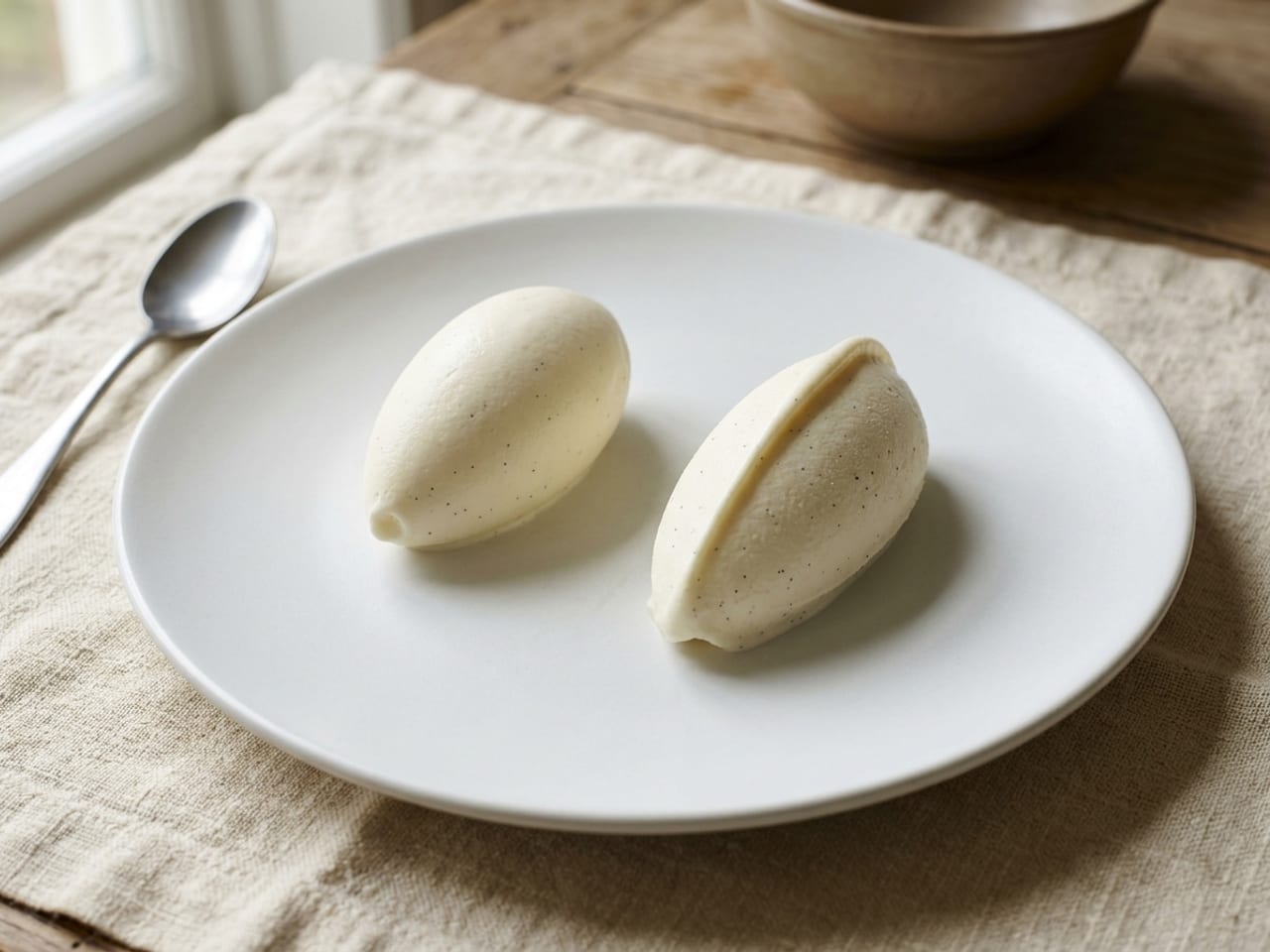
- Quenelle or rocher. Two spoons leave an oval with three faces. One spoon leaves a smooth egg with no edges, which many kitchens call a rocher. Plenty of chefs call both a quenelle. The shapes, side by side.
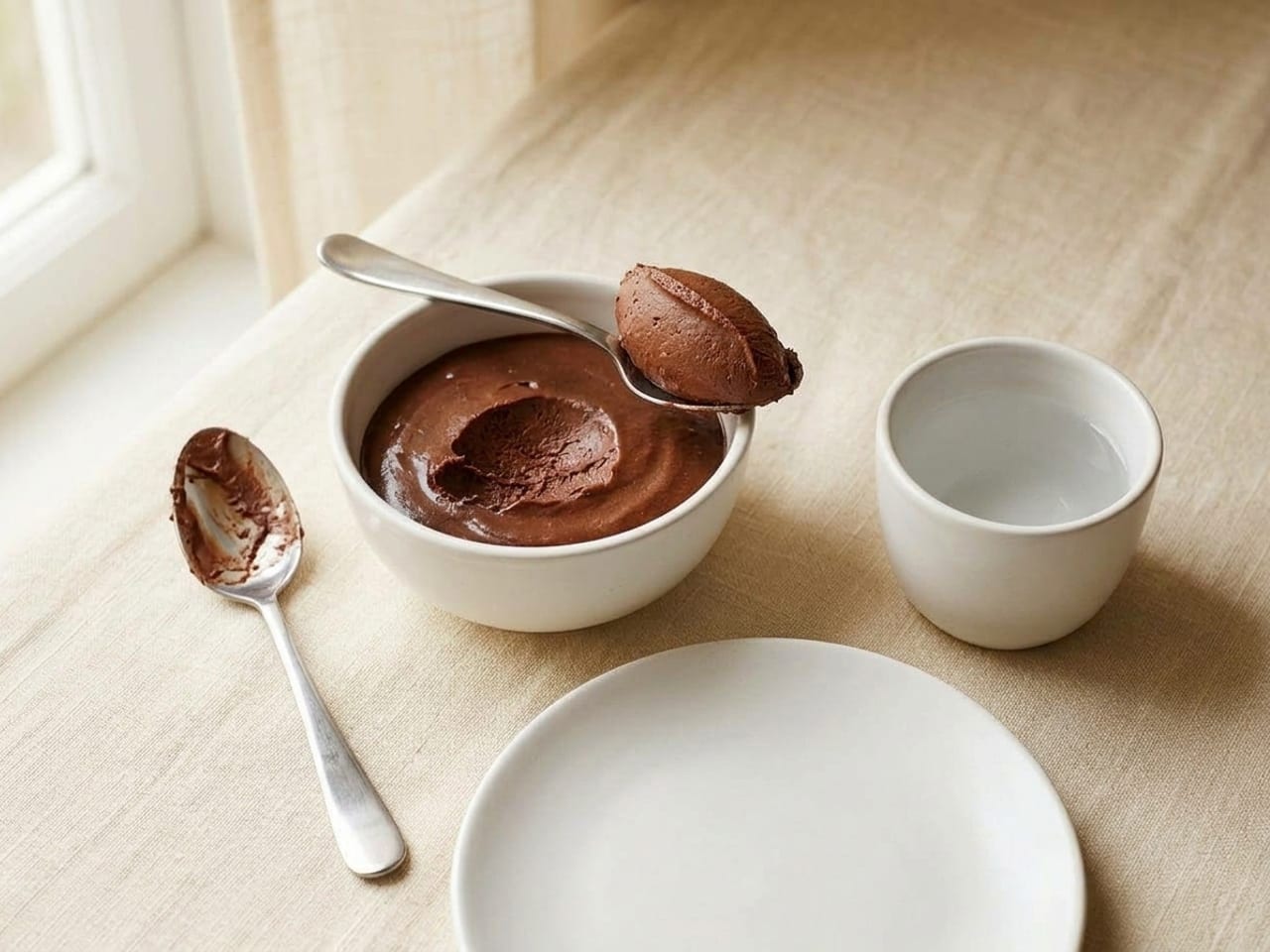
- How. One spoon: draw a warm, deep spoon through the food in one motion so it curls over itself. Two spoons: pass the food from one to the other until every side is smooth.
- The food has to be right. The food must be "the consistency of butter at room temperature, or a little firmer".38 What that means for each food.
- The dish. Quenelles de brochet are poached pike dumplings, shaped with the same two spoons. The dish and its published recipes.
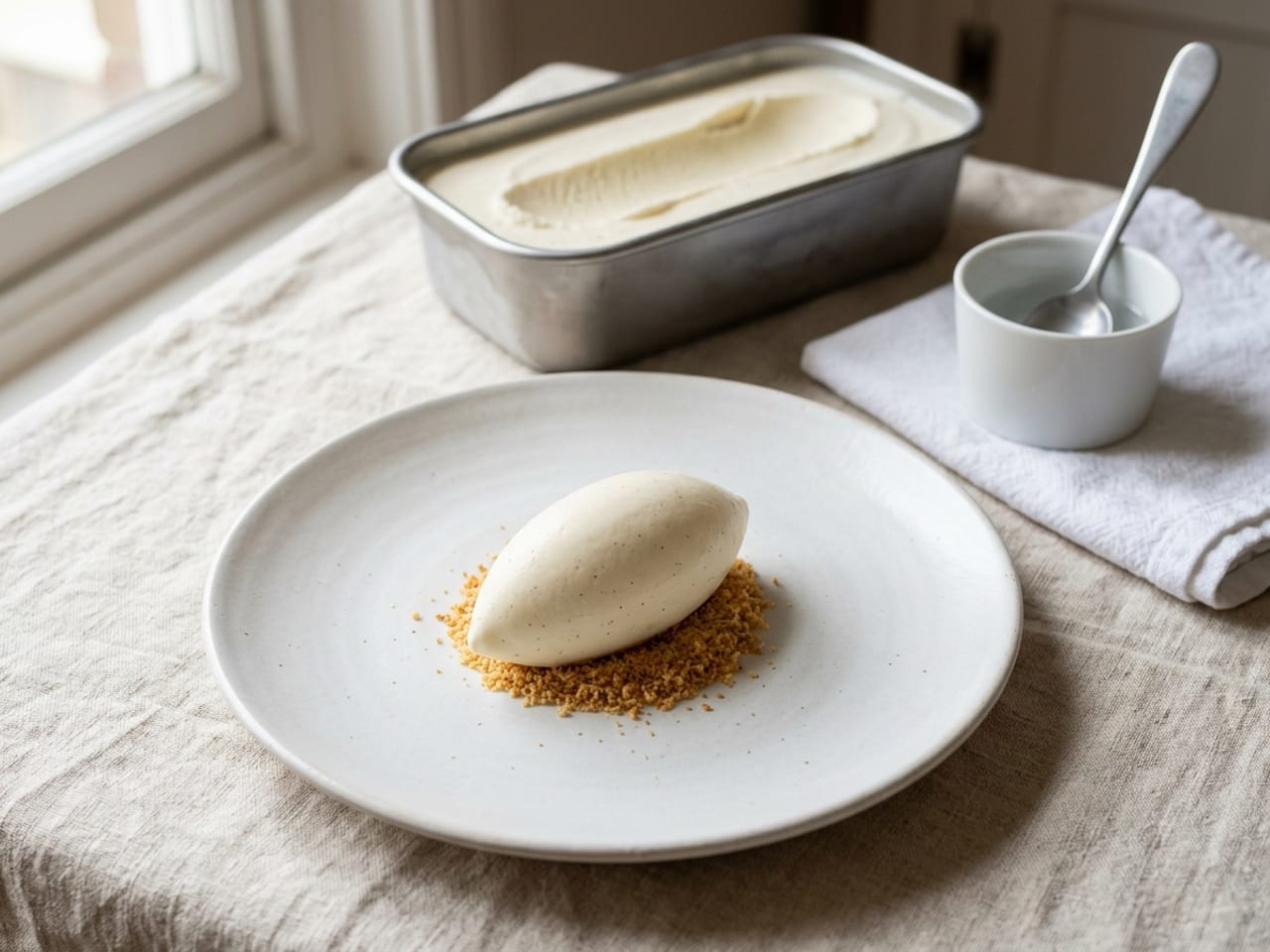
How this page was made. Every method here is quoted from the published source named beside it: chefs, cookbooks, test kitchens and food-safety agencies. We have not kitchen-tested them. Where the sources disagree, and on the spoon's temperature they disagree a lot, we set them side by side instead of picking a winner. Our own suggestions and arithmetic are labelled "ours". Sources are at the bottom.
Rocher vs quenelle: one spoon or two
The sources that compare the two methods agree on the geometry: two spoons give three faces, one spoon gives a seamless oval. What they do not agree on is the name.
| Name | Spoons | Shape | Who calls it what |
|---|---|---|---|
| Two-spoon quenelle | Two spoons of the same size; the food is passed from one to the other.37, 44 | An oval with three faces: "a three-sided oval shape".37 | A quenelle, in every source we read. |
| One-spoon quenelle, or rocher | One deep spoon, drawn through the food in a scooping motion.36, 40 | A smooth egg: "a shape with no apparent edges",38 "a smooth, seamless egg-like shape".39 | A rocher by ChefSteps and Great British Chefs;36, 38 a quenelle by the MICHELIN Guide and Francisco Migoya.35, 39 |
| Poached quenelle (the dish) | Classically two spoons, one of them wet or hot; also rolled, piped or shaped by hand.12, 23, 59 | "Of an egg shape" in 1827;15 "the shape of a large olive" in Escoffier's English edition of 1907.23 | A quenelle: "a poached oval dumpling of pureed forcemeat (as of pike)".2 |
What chefs actually call it. ChefSteps defines the rocher as a "one-handed quenelle" and says the two-spoon version "by design" creates "a shape with three curving sides".38 Great British Chefs follows it: a rocher is "essentially a one-handed quenelle, using only one spoon in a single, scooping method", and it "can take a trained eye to spot the difference".36 But the MICHELIN Guide never uses the word rocher: the technique "can be executed with one spoon or two, but the former yields a smoother quenelle with no apparent edges and is the one favoured by chefs."35 And a former pastry chef admits that "Most professional chefs will refer to a rocher as a quenelle."45
So "rocher" is a convention, not a dictionary term: none of the dictionaries we checked records it for a spoon-shaped scoop (more on the word). On this page a rocher is the one-spoon oval, and a quenelle is either.
Which to choose. For smooth foods, ChefSteps says, "a one-handed quenelle is ideal because it's faster and yields a shape with no apparent edges".38 Migoya calls the two-spoon method "certainly easier", though "it never looks as clean as a single-spoon quenelle".39 Savory cooks still use two for caviar and purées,42 and the dumpling has been spooned that way since at least 1813.12
The quenelle spoon
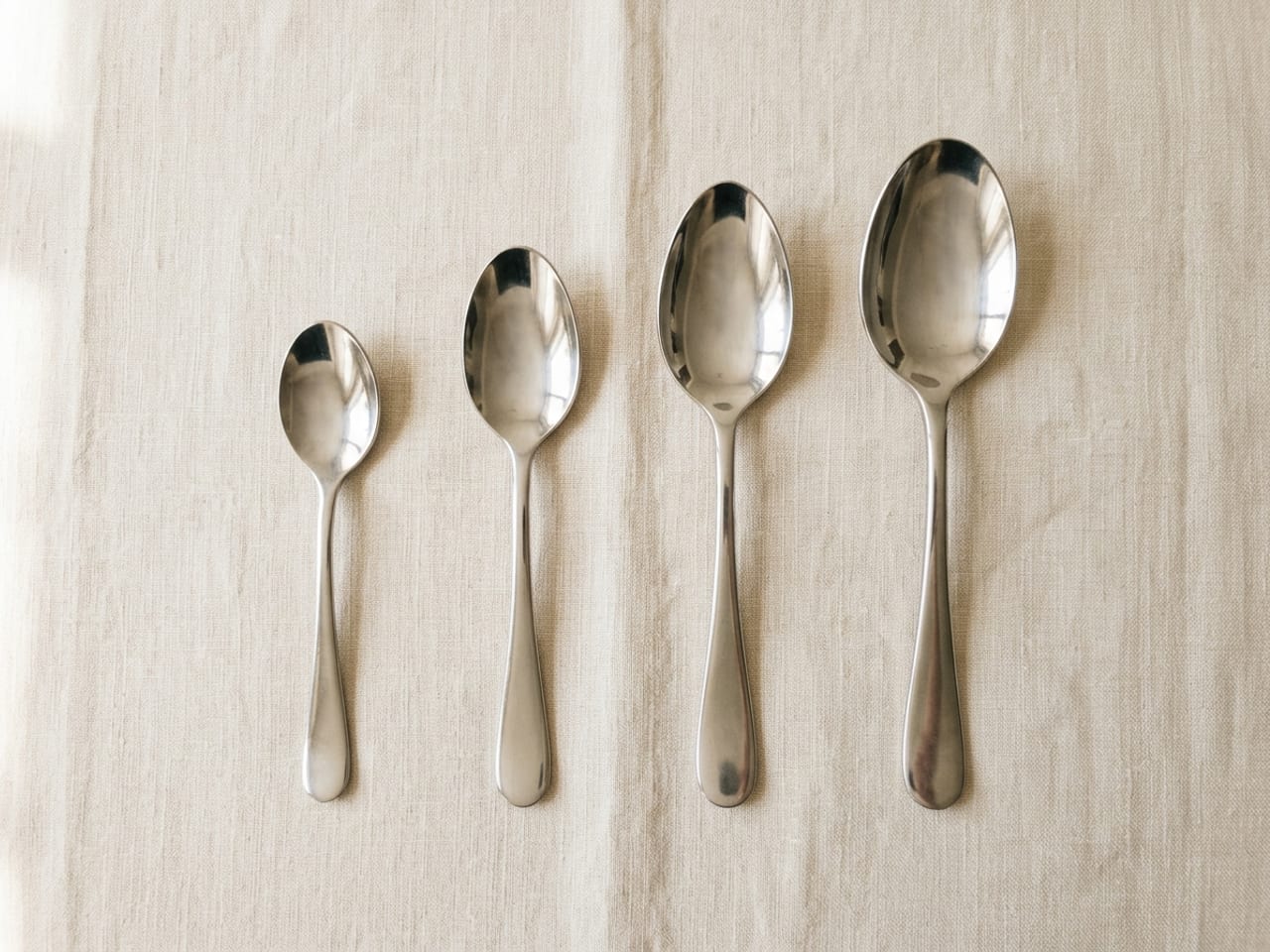
- Deep and oval beats flatFrancisco Migoya, in the Culinary Institute of America's Frozen Desserts: the spoon "should be deep enough to scoop a nicely oval-shaped quenelle. Flat spoons will not produce a pronounced oval shape."39 ChefSteps agrees, "deep bowled rather than flat", and adds where to find one: "Look for good ones at a thrift store or antique shop."38 Bon Appétit asks for "a sturdy tapered spoon with a deep bowl";40 the pastry chef it follows, Kristen Murray, wants "a nice tip" and a round back, "Not too wide, but a little longer."41
- The spoon sets the portion"The size of spoon will determine how big the quenelle is".44 The only published scale we found is for the poached dumpling: Charles Ranhofer, in 1894, counted "eight large soup-spoonfuls, or sixteen dessert-spoons, or thirty-two tea-spoons, or sixty-four coffee-spoons" to a pound of forcemeat (454 g).18 By our arithmetic that is 2 oz (57 g) for a soup spoon down to ¼ oz (7 g) for a coffee spoon. Jacques Pépin's "about 2 ounces" (57 g) from a large serving spoon matches Ranhofer's soup spoon.61 For ice cream or cream we found no published weight at all, from any chef, book or test kitchen: choose the spoon by eye against the plate (ours). The one measured frozen portion we have is a sorbet course, 0.6 oz (17 g), in the palate cleanser guide.
- Do you need a quenelle spoon?None of the sources above requires one. Murray uses vintage spoons, and Bon Appétit suggests searching for an "oval dessert spoon".40 Orlando Soto, pastry chef of Le Bernardin, prefers what Food & Wine calls "a Rocher Spoon, which has a curved handle optimal for executing a sweeping wrist motion", and notes that "you can get different shapes of quenelles depending on how long, how short, and how deep the shape of the spoon is".42 Two spoons sold to cooks: the Gestura 01, which its maker describes as "a single tablespoon volume (half ounce)" (15 ml) with a deep well and a tapered tip, though the maker's page never mentions quenelles;80 and the Gray Kunz sauce spoon, which Wirecutter says holds 2.5 tablespoons (37 ml) against roughly one tablespoon (15 ml) for a dinner spoon. Its seller's own page now reads "Approximately 2 Tablespoons";84 the plating tools guide sets the printed figures side by side. Wirecutter's reviewer, a former line cook, calls the spoon "ideal for making large quenelles out of softened butter, whipped cream, or ice cream", though she also describes its "shallower belly", the opposite of what Migoya asks for.81
- Left-handed cooksThe two-spoon instructions assume a right hand and say so: Escoffier fills the spoon "held in the left hand",23 and Claiborne and Franey begin "If you are right-handed".60 Mirror them (ours). We found no credible source on left-handed quenelle spoons; a symmetrical oval spoon works in either hand (ours).
| Source | Spoon named | Used for |
|---|---|---|
| Kristen Murray, in Bon Appétit | "oval dessert spoon", one40 | ice cream |
| Escoffier, 1907 English edition | "two coffee-spoons"23 | "ordinary quenelles" of forcemeat; small ones, by the spoon (our reading) |
| Julia Child, Bertholle and Beck | "2 dessert spoons"59 | fish quenelles, about 16 to a recipe |
| Claiborne and Franey, 1974 | "two large soup spoons"60 | fish mousse quenelles |
| Anne Willan, 2007 | "a large tablespoon in each hand"; "A tablespoon is the most common size"62 | quenelles Nantua |
| Jacques Pépin, 2011 | "a large serving spoon", two of them61 | fish quenelles of "about 2 ounces" (57 g) |
| Charles Ranhofer, 1894 | "two common, large and very thin iron soup spoons"18 | forcemeat |
How to make a one-spoon quenelle
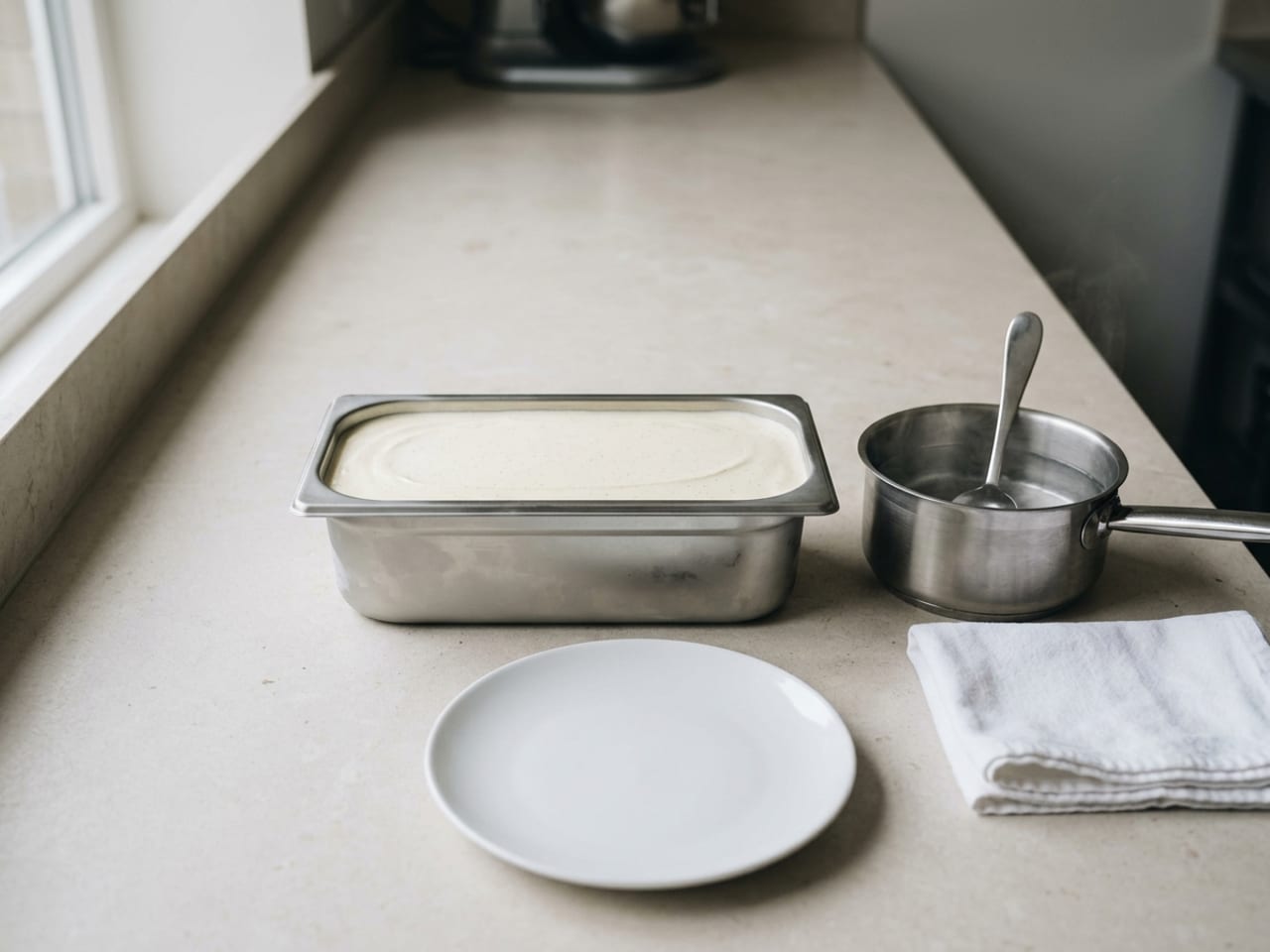
The steps below are Bon Appétit's, written with pastry chef Kristen Murray for ice cream, with Great British Chefs' opposite motion beside them. They are quoted, not kitchen-tested by us. The food should be the consistency of soft butter before you start.
 1
1Set up the station
Bon Appétit's set-up: "Chill your serving plates in the freezer for at least 10 minutes, otherwise the quenelles will start to melt on contact." Put a small pan of hot water and a kitchen towel beside you, stand the spoon in the water, and take the ice cream out of the freezer last.40 Bon Appétit gives no softening time; the sources that measure it temper the tub first (see ice cream). Kristen Murray starts from "a nice clean flat surface" and a base that is "pretty nice and firm".41 Bring the chilled plate out once the station is set (ours).
 2
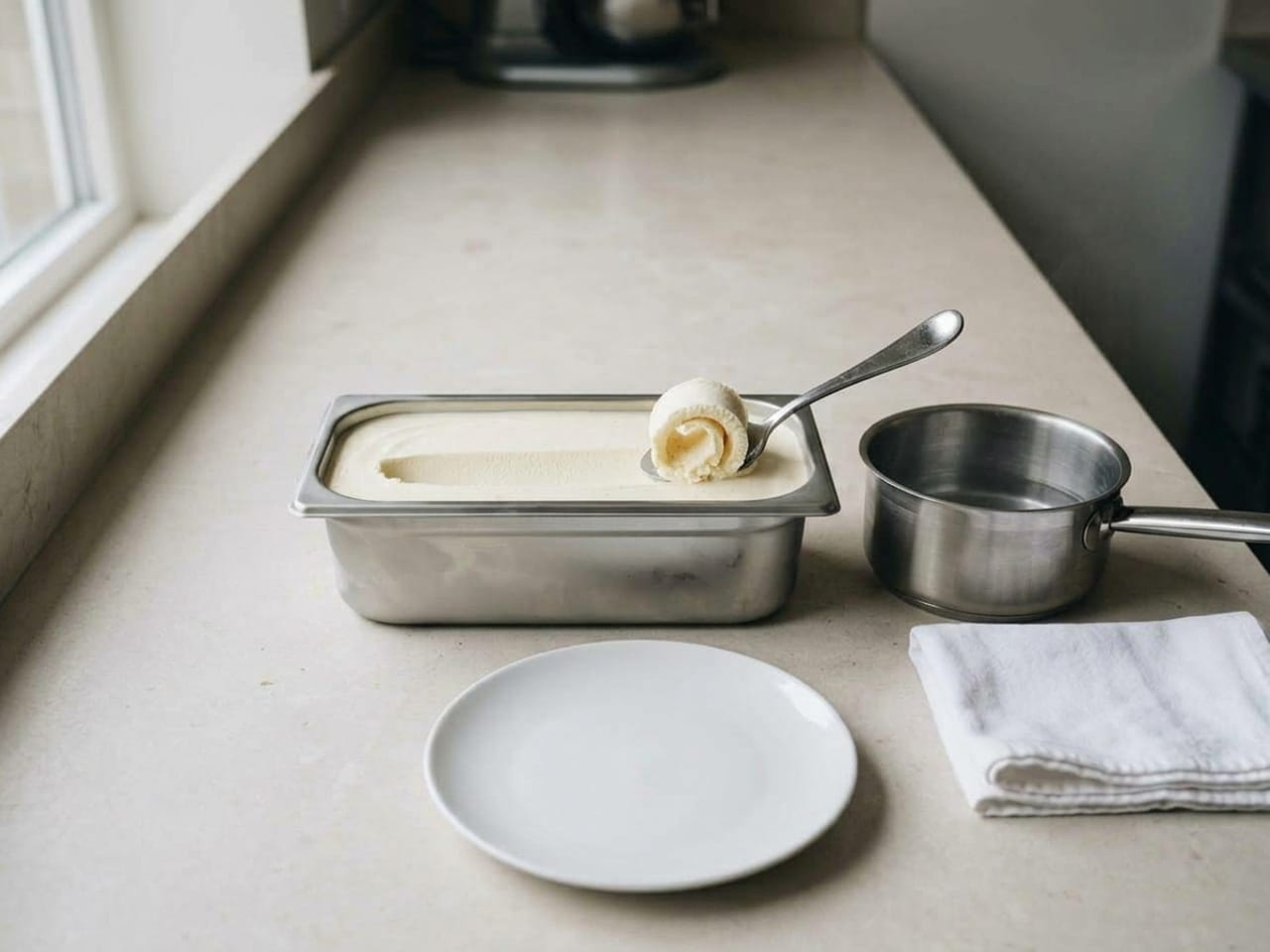
2Draw the spoon through in one motion
Tap the spoon on the towel, hold it near the bowl "with the rounded side angled down", and "In a single motion, drag the spoon through the ice cream toward the near edge of the container so it curls over itself to form the quenelle."40 That is Bon Appétit's write-up of Murray's motion; her own words in the video are in the table below. Great British Chefs goes the other way: "push the spoon through the butter or ice cream away from you, turn the spoon 180 degrees towards you and pull it back through and up out of the bowl or container."36 Our advice: pick one and stay with it.
 3
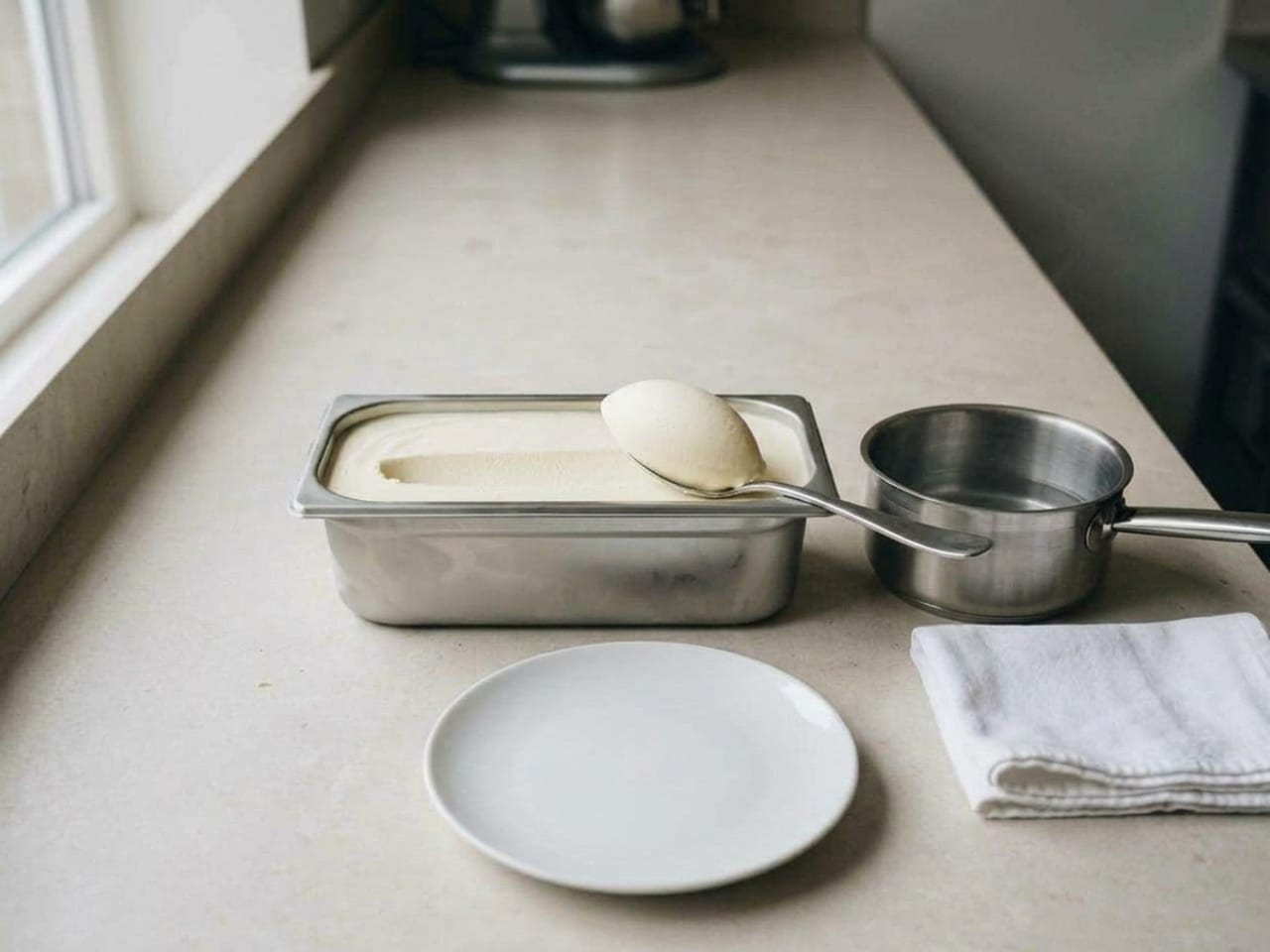
3Clean it up on the rim
Slide the spoon out, dip it, tap it dry, cup it back over the top and "tap it against the side of the container several times so the quenelle rotates inside the spoon. Gently scrape the ends of the quenelle against the container to create sharp tapered points."40 A restaurant pastry cook's version: "drag the edge of the quenelle across the lip of the container to make a smooth finish on the side."43
 4
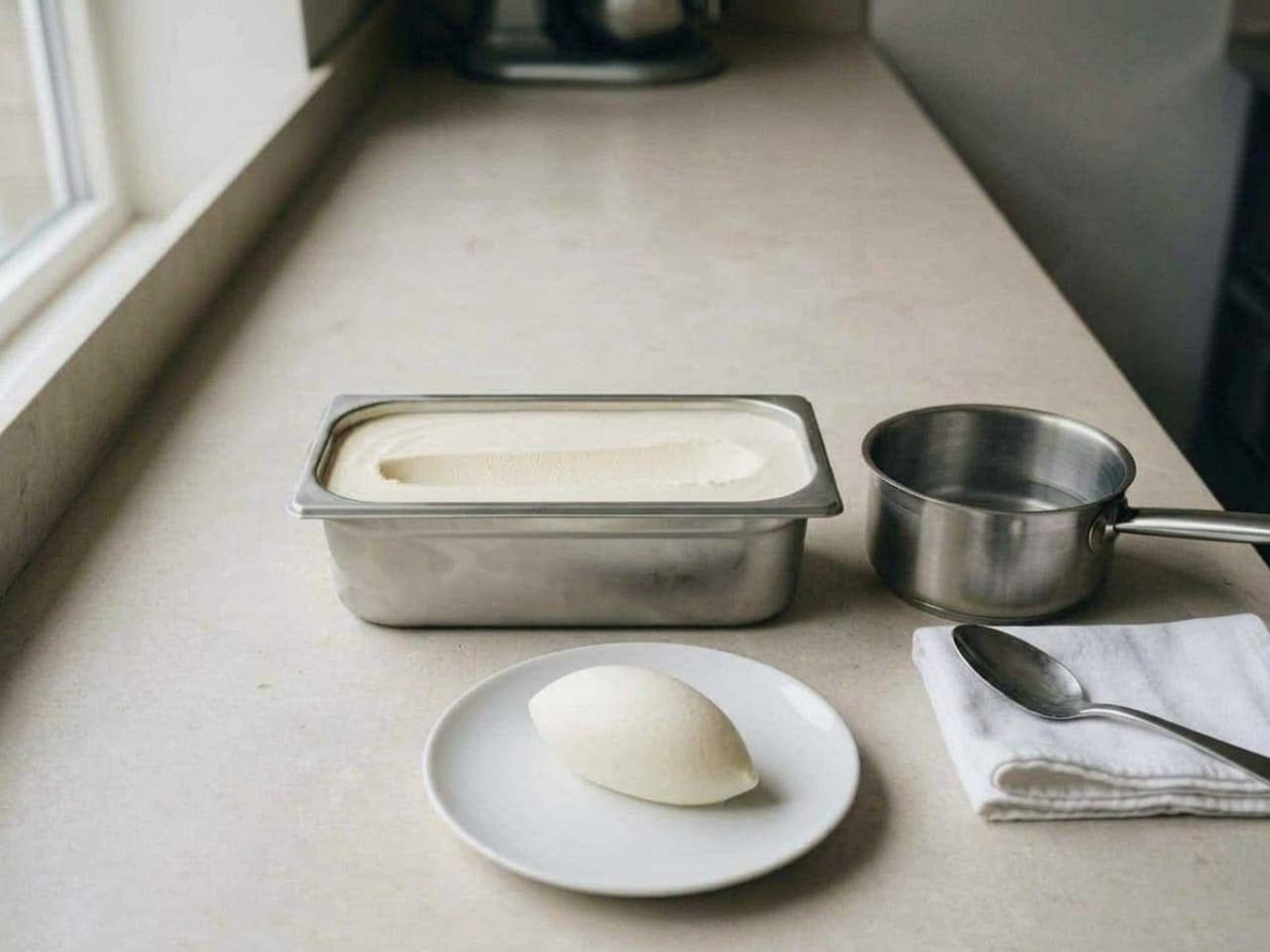
4Release it onto the plate
"Gently transfer the quenelle to the chilled plate, curving the spoon as you release it. Make sure not to lift the spoon straight up, or you'll create a ridge." 40 If it clings, use warmth: Murray says "use your hand and the warmth to release it",41 and Cindy Khoo, for "stickier, more icy food like sorbets", rubs "the back of the spoon in the palm of your hand".35
| Motion | Published by | In their words |
|---|---|---|
| Drag toward you | Bon Appétit, describing Kristen Murray | One stroke "toward the near edge of the container so it curls over itself".40 The article does not say where the stroke starts; in the video Murray says "I use the corner".41 |
| Push away, turn, pull back | Great British Chefs | You "push the spoon through the butter or ice cream away from you, turn the spoon 180 degrees towards you and pull it back through and up".36 Food & Wine describes the same roll: "Push the soft scoop away from you, wrap around with the spoon, and pull it back".42 |
| Carve up the wall, more than once | The Baker's Almanac | With the spoon angled, "carve the spoon directly up towards the edge of the bowl or container", and "Repeat this carving motion as many times as necessary until you form the quenelle".43 Murray's own words are close: "you go up instead of down. And then you roll it. Usually it's a two to three turn roll."41 |
None of these sources calls another's motion wrong. Murray, The Baker's Almanac and Orlando Soto all finish by cleaning the oval against the edge of the container; Great British Chefs' description stops when the spoon comes up out of the bowl. Soto, of Le Bernardin, puts the whole thing in a sentence: "I tell my cooks to carve out the amount that they need and then clean it off the side of the bowl or the container that they're using."42
How to make a quenelle with two spoons
The older method, and the easier one to learn. These steps are Great British Chefs' and Good Housekeeping's, quoted, not kitchen-tested by us.
 1
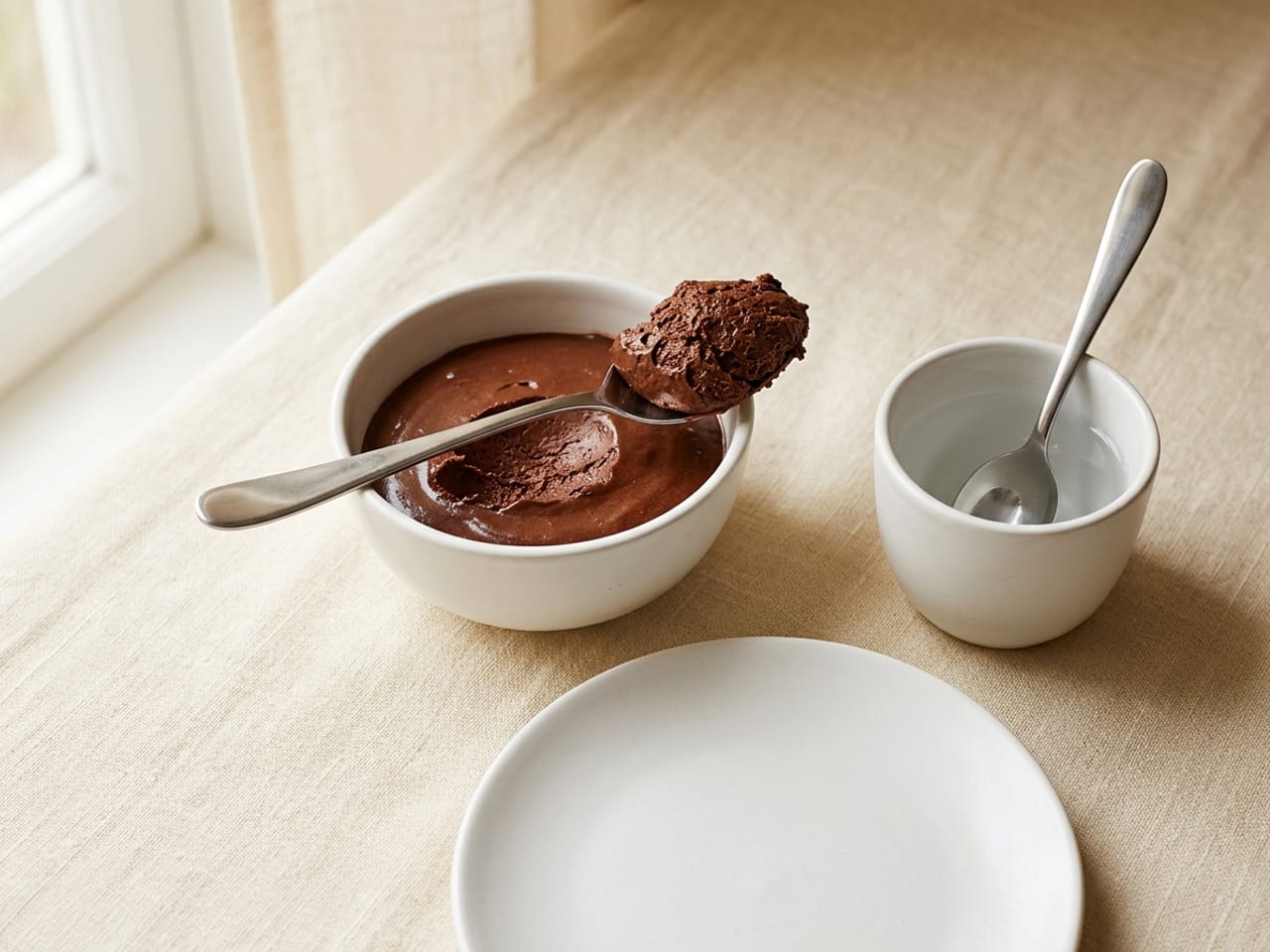
1Dip two matching spoons and fill one
Great British Chefs: "Dip two identical spoons into hot water", which "helps to 'release' the quenelle at the end", then "Shake off the excess water and take a generous scoop of the chosen ingredient in one spoon."37 Good Housekeeping: "Hold a spoon in each hand. Scoop a generous amount of mixture into one spoon."44
 2
2Scoop it across into the second spoon
"Gently curve second spoon towards you, pressing bowl of spoon against mixture and scooping it into second spoon as you go". Then "Transfer mixture back to first spoon in same manner. You will start to see that it develops a smooth surface from where the spoon has scooped it."44
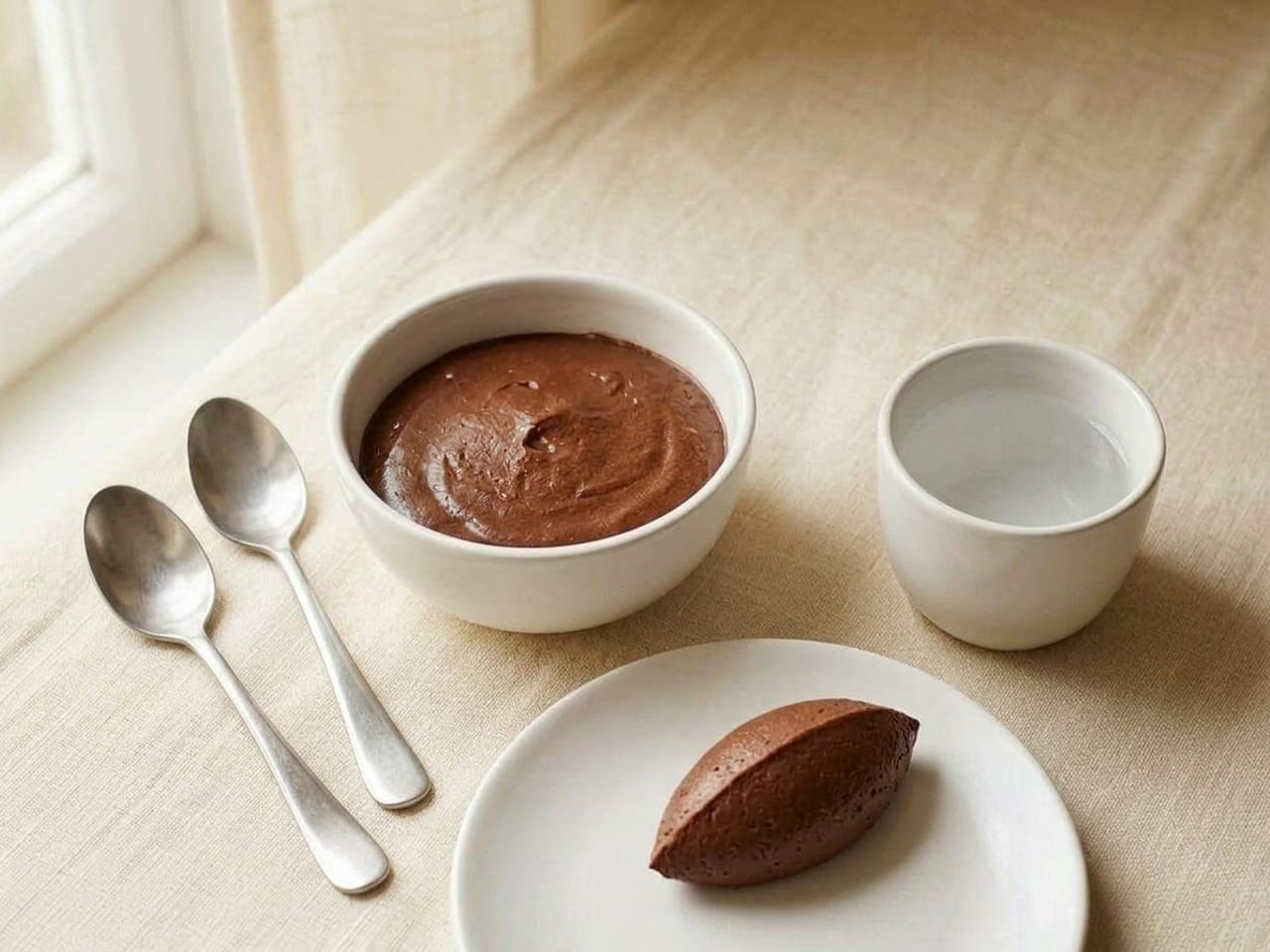 3
3Keep passing until it has three faces
"Pass the mixture repeatedly between the spoons; turning and smoothing each side until a neat quenelle is formed."37 Good Housekeeping: "Keep scooping back and forth until a smooth oval shape is achieved."44 No authoritative source fixes the number of passes. Our reading of the geometry: each pass shapes one face, so three faces need at least three. Then set it on the plate (ours).
Who still uses two spoons. Orlando Soto: "There's a two spoon quenelle which most savory chefs like to use a lot, where you press your caviar, your puree, whatever it is, between two spoons". The result, he says, is "this very symmetrical, almost rhombus shape that you see in a lot of plating in late '90s and early 2000s Michelin kitchens across the world."42
The same two spoons make the dumpling. A cook in 1813 was already lifting forcemeat out of one spoon with another kept in boiling water.12 The poached version, with Escoffier's and Julia Child's instructions, is in the dish.
Hot, warm or cold: how warm should the spoon be?
There is no agreed answer. Published advice runs from boiled water to a cup of cold water, and some of it contradicts itself within one website. Here is each source in its own words, then what they have in common, food by food.
| Source | The water | Dry the spoon? |
|---|---|---|
| Kristen Murray (Bon Appétit video) | "really hot water. I like to use tea water, or I boil a pot"41 | Not stated in the transcript |
| Bon Appétit (article) | "hot tap water"40 | "a couple of taps on the towel to shake off excess water" |
| Great British Chefs (how-to) | "hot water"37 | "Shake off the excess water" |
| Great British Chefs (feature) | "warm water (not hot, to avoid anything melting)"36 | Not stated |
| Cindy Khoo, as reported by the MICHELIN Guide | "a container of warm water": "hot enough to release the quenelle, but not so hot that it immediately melts it"35 | Not stated |
| ChefSteps | "hot enough to release the rocher but not so hot that it melts the food"38 | Not stated |
| The Baker's Almanac | "It's crucial that the water is hot"; change it when it is "lukewarm or dirty"43 | "tap off all the excess water so it doesn't change the consistency" |
| Flour & Fiction | "The water shouldn't be boiling hot": "aim for around 140°F (60°C)", the only number we found45 | "shake or blot off any excess water" |
| Food & Wine, with Orlando Soto | "a cold, slightly wet spoon" in the article's opening line, though it later reports a spoon dipped in warm water; Soto wants it "somewhat wet, so it doesn't cling"42 | No: left wet |
| Maki Yazawa (Wirecutter) | "hot water for a few seconds until it's warmed up", for butter, whipped cream or ice cream81 | "then I wipe it clean" |
| Escoffier, 1907 (forcemeat) | "hot water", for one of the two spoons, so it is "at once moist and hot"23 | No |
| Claiborne and Franey, 1974 (fish mousse) | "boiling or very hot water"60 | No |
| Julia Child (forcemeat) | "a cup of cold water"; "a wet spoon"59 | No |
- Ice cream and sorbet: two camps, one testMurray boils the water, Bon Appétit uses hot tap water and The Baker's Almanac calls hot water "crucial".40, 41, 43 Flour & Fiction sits between the camps: "a mug of warm water", not boiling, at about 140°F (60°C).45 Great British Chefs' feature and Cindy Khoo say warm.35, 36 One article stands outside both: Food & Wine opens with "a cold, slightly wet spoon".42 Both camps would pass the same test, in ChefSteps' words: "hot enough to release the rocher but not so hot that it melts the food." 38
- Whipped cream: both sources that address it add heatThe Baker's Almanac: "we sometimes dip the spoon in the water, use a blowtorch on the spoon, and then shape the quenelle. This works really well for whipped creams, which are a bit more difficult to quenelle. For this, you just have to be careful because the heat can start to melt the item that you are quenelling."43 Wirecutter's reviewer does the same for butter, whipped cream and ice cream alike: the spoon goes "into hot water for a few seconds until it's warmed up", then is wiped clean.81 We found no named source that calls for a cold spoon with cream.
- Meringue and other sticky foods: clean and re-dipThomas Keller's MasterClass recipe for meringue quenelles: "cleaning your spoon in the hot water bath after each scoop will help the very sticky meringue to slide off of the spoon."48 For ice cream, Flour & Fiction re-warms the spoon only when the ice cream starts to stick.45
- Forcemeat for poaching: hot in Escoffier, cold in Julia ChildEscoffier keeps one of his two spoons in hot water;23 Claiborne and Franey use "boiling or very hot water";60 Julia Child sets her two dessert spoons "in a cup of cold water".59 Each of these is its author's published method for a poached quenelle.
- Where to start (ours)Our suggestion, not a sourced rule: begin with hot tap water and a spoon tapped dry. If the quenelle comes out with a wet, melted skin, let the water cool; if it sticks or tears, go hotter.
How to quenelle ice cream, whipped cream, butter and 6 more foods
The general rule comes from ChefSteps: "The food must be the consistency of butter at room temperature, or a little firmer, so the rocher will form and hold its shape. The food should be uniform, without large voids of trapped air, which would show up as craters in the rocher."38 Great British Chefs says the same: "firm enough to hold its shape, but soft enough that a spoon can glide through it easily (room temperature butter, for example)."36
Beyond that rule, published settings are thin. The table gives every number we could source and says so plainly where there is none. It has no column for how long a quenelle holds, because nobody has published one.
| Food | What the sources say it needs | Published number | One spoon or two |
|---|---|---|---|
| Ice cream | Tempered: "It can't be rock hard or too soft" (Orlando Soto); "pretty nice and firm" (Kristen Murray).41, 42 | 6 to 10°F (-14 to -12°C) to dip;50 about 8°F (-13°C) after about 30 minutes in the refrigerator, for a pint;51 about -5°C (23°F) at The Fat Duck.53 | One: "a smooth, seamless egg-like shape".39 |
| Sorbet | As ice cream: "Temper in the fridge or at room temperature until scoopable".45 | No published setting found. | One; it sticks more, so warm the back of the spoon in your palm.35, 36 |
| Whipped cream and Chantilly | "Whipped to a certain stiffness for it to hold" (Orlando Soto); "a bit more difficult to quenelle" than ice cream (The Baker's Almanac).42, 43 | No published peak stage found. Medium to stiff peaks is our reading. | Either: Great British Chefs shapes Chantilly between two;37 The Baker's Almanac shapes whipped cream with one.43 |
| Crème fraîche and mascarpone | "Use thick, well-set crème fraîche or whip it if it's runny". 45 | No published setting found. | Not stated by any source we read. |
| Mousse and ganache | Mousse is named as a quenelle food with no setting given.35, 37, 40 Whipped ganache: chilled, then whipped firm.56, 57 | Whipped ganache: 12 hours at 40°F (4°C);56 or 6 hours to overnight, then "a medium/stiff peak".57 Mousse: no published setting found. | One, for ganache: ChefSteps lists it among the smooth foods that suit a rocher.38 |
| Butter | "At room temperature, or a little firmer".46 | No temperature in degrees published. | One: ChefSteps lists whipped butter among rocher foods.38 |
| Purée and mashed potato | Named as quenelle foods, with no setting given.1, 35, 42 | No published setting found. Our cue: it holds a peak on the spoon without slumping. | Two: savory chefs press "your caviar, your puree, whatever it is, between two spoons" (Orlando Soto).42 |
| Tartare | Named as a quenelle food, with no chop size, binder or temperature given.35, 36, 38 | No published setting found. | One: ChefSteps names beef tartare as a rocher food.38 |
| Pâté and rillettes | "Soft pâté";38 rillettes are named too, with no setting given.37 | No published setting found. | Either: one for soft pâté (ChefSteps);38 two in Great British Chefs' how-to.37 |
Ice cream
How cold. The International Dairy Foods Association says a freezer should be set "between -5°F and 0°F" (-21 to -18°C) and that ice cream "is easy to dip between 6°F and 10°F" (-14 to -12°C).50 Serious Eats reports that scoop shops and restaurants keep separate service freezers at "between 0 and 10 degrees" Fahrenheit (-18 to -12°C).52
How to get there. America's Test Kitchen measured it, on a pint of Ben & Jerry's. A pint left "in the refrigerator for about 30 minutes" came to "around 8 degrees throughout" (8°F, -13°C). On the counter, after 15 minutes only "the top ½ inch" (1.3 cm) was scoopable and the pint was "still rock-hard 2 inches below the surface" (5 cm). Their test for ready: press the middle gently, and a "¼-inch indentation" (6 mm) means go.51 They were scooping balls, not quenelles. A one-spoon quenelle only skims the surface, so the counter result may be all it needs (our reading; America's Test Kitchen itself says to soften it "in the refrigerator, not on the counter"). A former pastry chef's blog moves the tub to the fridge 15 minutes before starting.45
A much warmer number. Chris Young, formerly of The Fat Duck: "The ice cream itself isn't that cold, or you wouldn't be able to easily scoop a roche with one hand. In general, the ice cream is probably around -5 °C, which was the temperature we always churned our ice creams to" (23°F).53 As we read the difference, the first set of figures is for hardened ice cream brought back up for scooping, and his is for ice cream served at the temperature it left the churn.
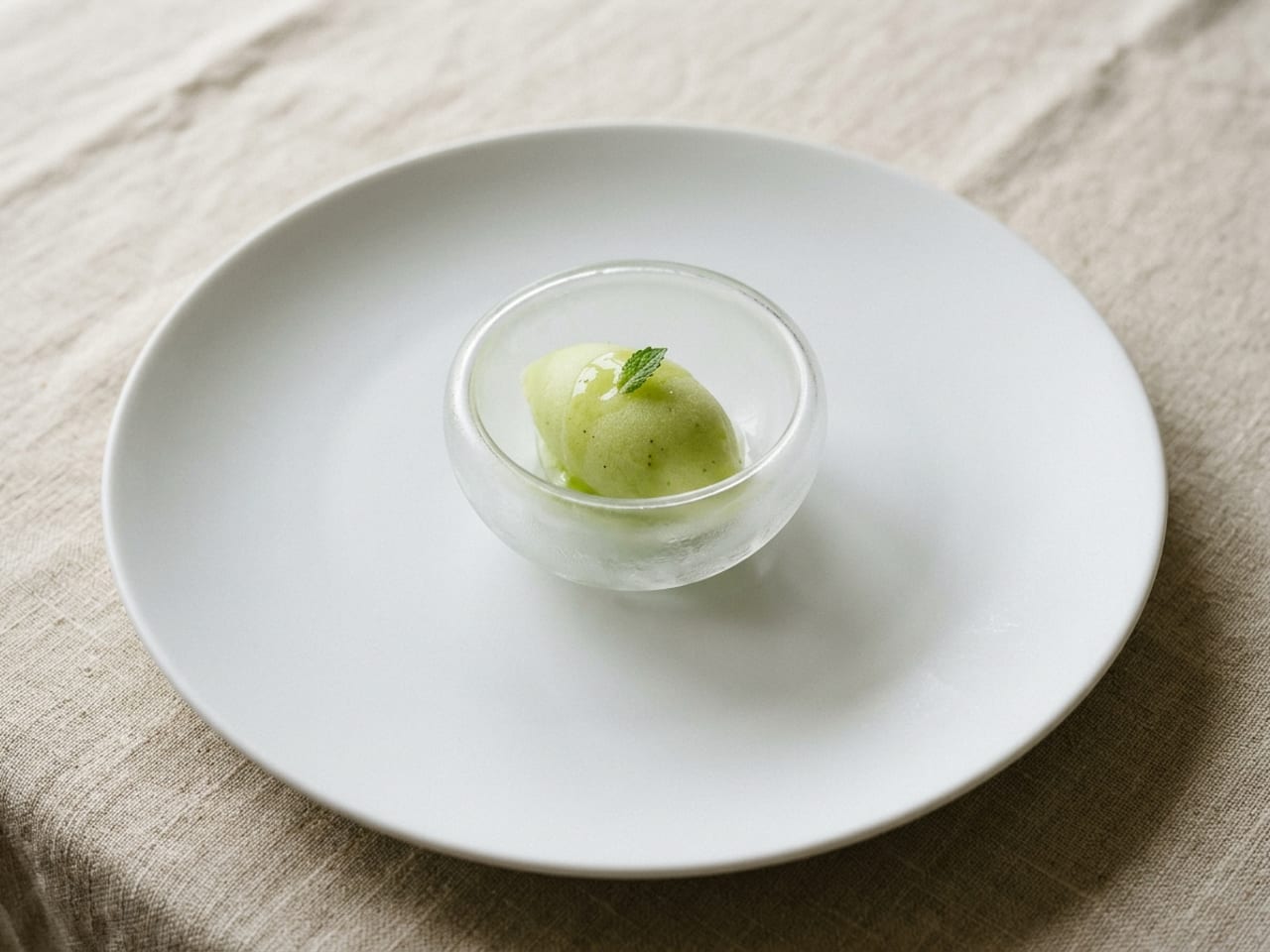
Sorbet
Sorbet behaves like ice cream with one difference the MICHELIN Guide's pastry chef points out: "For stickier, more icy food like sorbets, you may need to rub the back of the spoon in the palm of your hand to release it from the spoon." 35 No source we read gives sorbet its own temperature.
A small sorbet quenelle is also the classic palate cleanser; that guide has the portion and the glass, and the photo here is the sorbet course of our tasting menu at home.
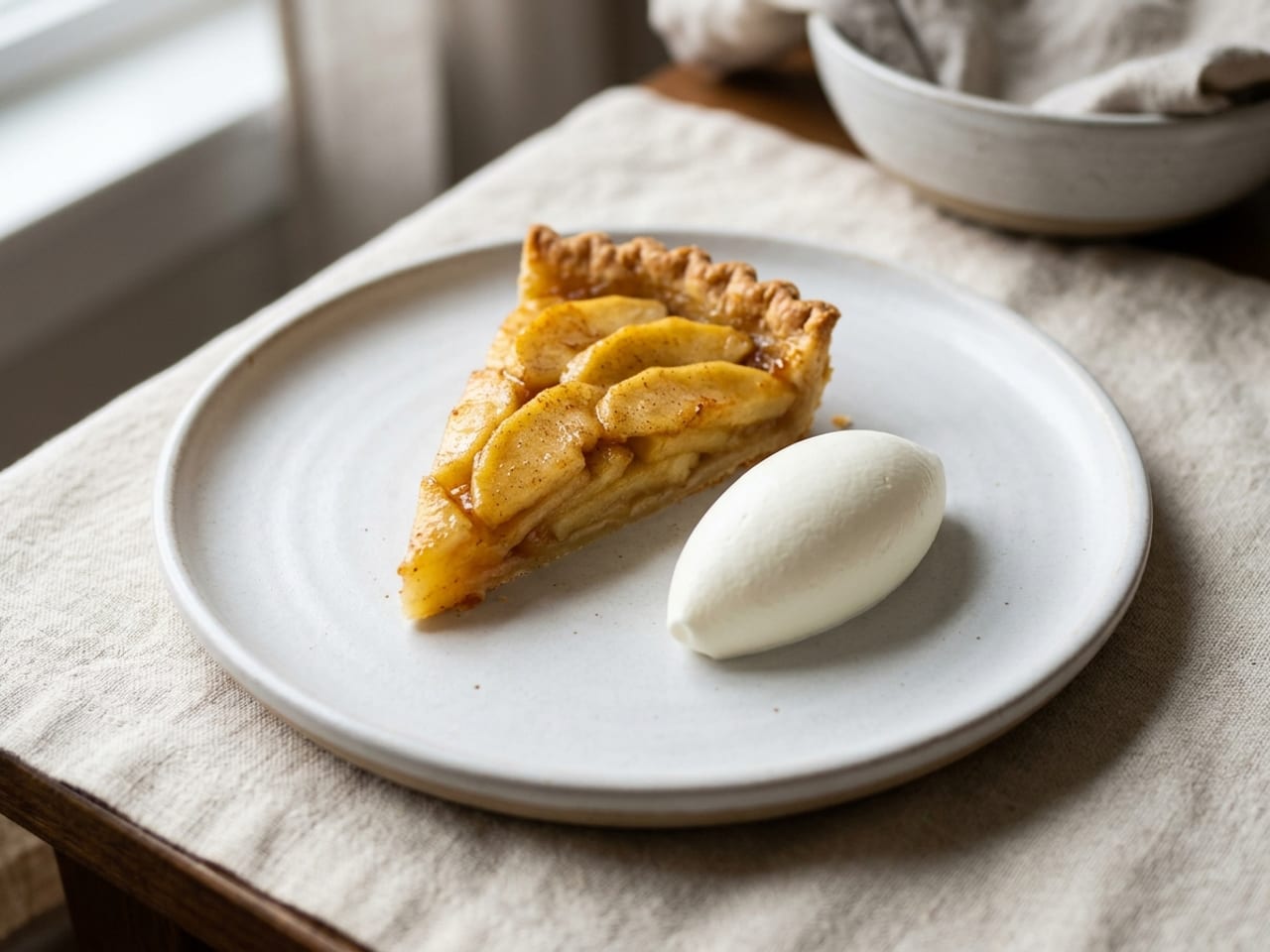
Whipped cream and Chantilly
How stiff. Le Bernardin quenelles whipped cream "all the time", says Orlando Soto, "but it has to be whipped to a certain stiffness for it to hold right when you're trying to give it that shape."42 He names no peak stage, and neither does any chef or test kitchen we read. King Arthur Baking describes the stages: at soft peak a spoonful "will be slightly less stiff than sour cream"; at stiff peaks the cream is "thick and spreadable, almost like the icing for a cake."54 Read against the general rule above (butter at room temperature, or a little firmer), that points to medium to stiff peaks. That inference is ours.
Chantilly. As Food & Wine makes it, Chantilly is "whipped to soft peaks for a lush texture; this is not a stiff cream that can be piped", it "is best used right after it is made, and is not stable at room temperature", and "one to two tablespoons of crème fraîche or sour cream per cup of heavy cream" (15 to 30 ml per 237 ml) gives one that "will hold well for a few hours", in the refrigerator by our reading, since the same article calls it unstable at room temperature.55 So a classic Chantilly needs whipping a little further before it will hold an oval (ours), though the same article opens with "a quenelle of whipped cream atop your slice".
Too far. Over-whipped cream turns grainy: "The fat has been so coagulated that the air is forced out and your lofty cream will begin to deflate." Caught early, King Arthur rescues it by "adding a few more tablespoons of cream and gently, by hand preferably, combining it".54
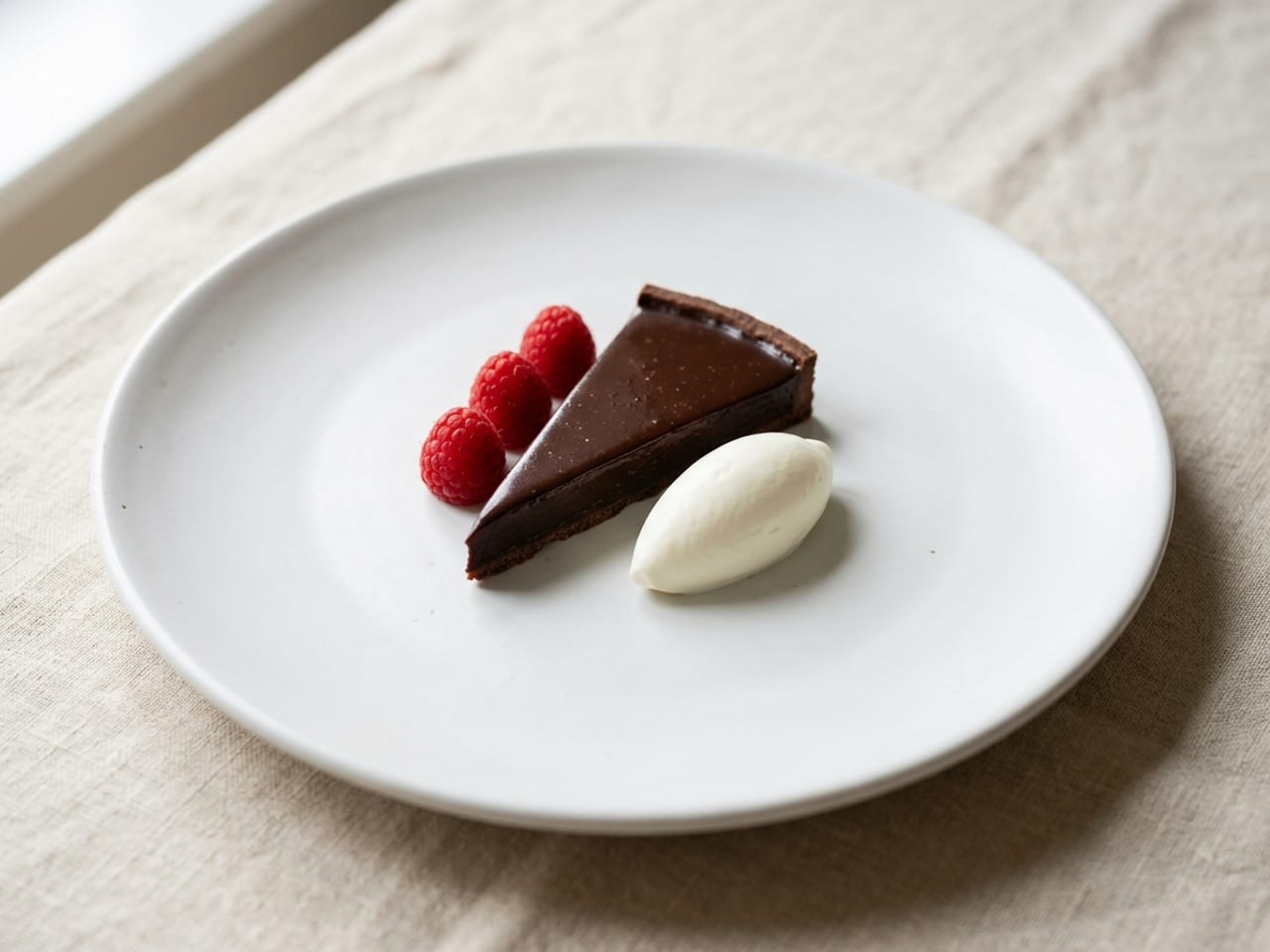
Crème fraîche and mascarpone
Great British Chefs lists a quenelle of crème fraîche among the classic uses, "like Tom Aikens makes here for his raspberry summer puddings".36 The only instruction we found is a blog's: thick and well set, or whipped first if runny.45
Mascarpone turns up twice: the pastry cook behind The Baker's Almanac quenelles "ice cream and mascarpone whipped cream daily",43 and an ice-cream teacher's tutorial suggests practising on "something more forgiving such as heavy cream or mascarpone".47 Neither gives a temperature.
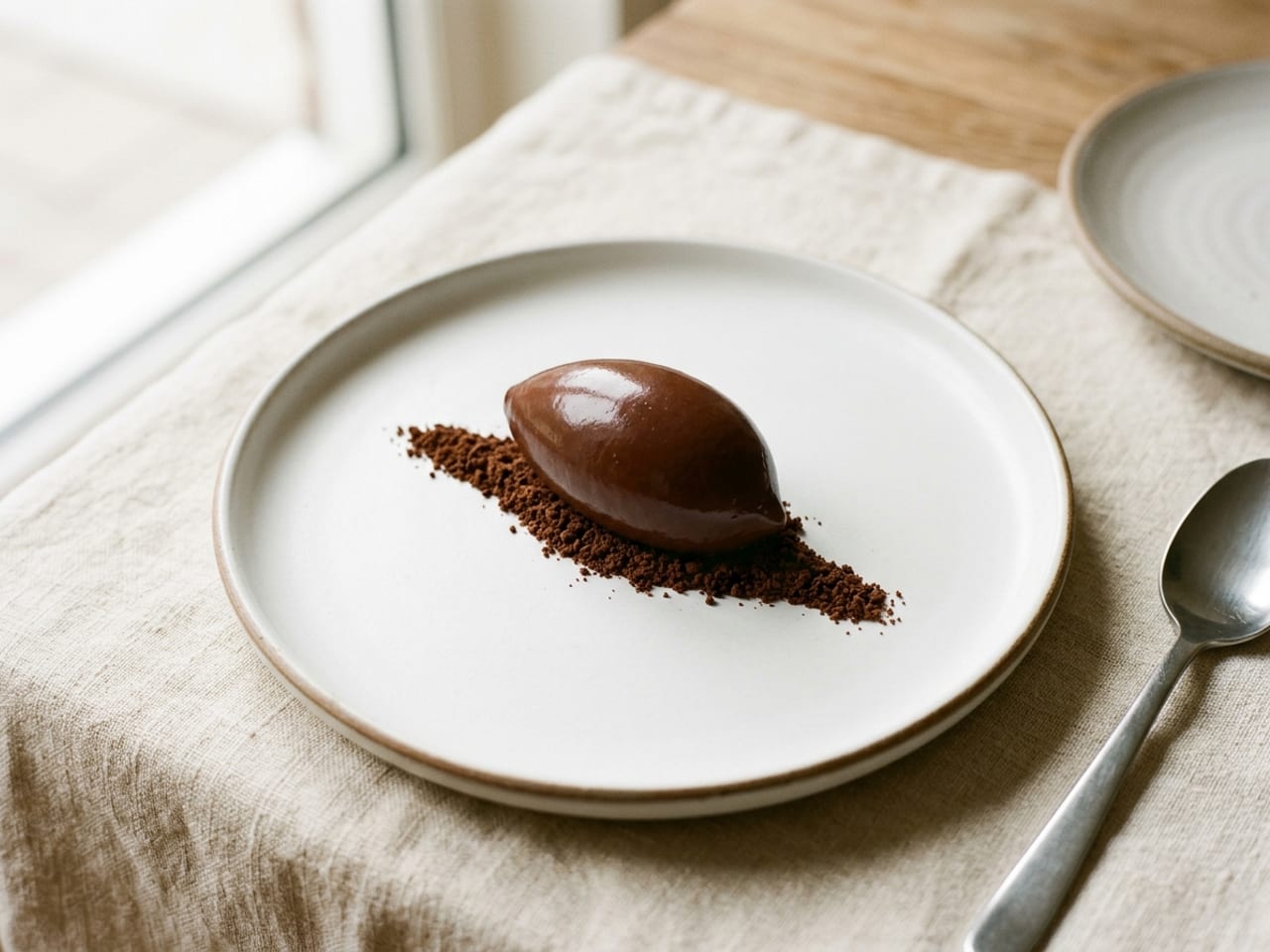
Mousse and ganache
Mousse. Bon Appétit, the MICHELIN Guide and Great British Chefs all name mousse as a quenelle food;35, 37, 40 none gives a setting time or a temperature for shaping it. Use the general rule above.
Whipped ganache. Valrhona: "Leave to set in the refrigerator, ideally for 12 hours at 40°F (4°C). Whisk until the texture is firm enough to use in a piping bag or with a spatula."56 Matt Adlard: "Put in the fridge for 6 hours or ideally overnight. Once chilled, whisk to a medium/stiff peak then use immediately"; if it is too stiff the next day, he leaves it at room temperature for 1 to 2 hours until it is pipeable.57 That hour or two counts against the two-hour limit in the safety notes (our note). Guittard describes the same sequence: chocolate and cream, "chilled overnight, then whipped just as whipped cream is whipped".58 All three are writing about piping, not quenelles, and we found no temperature window in degrees for a ganache quenelle.
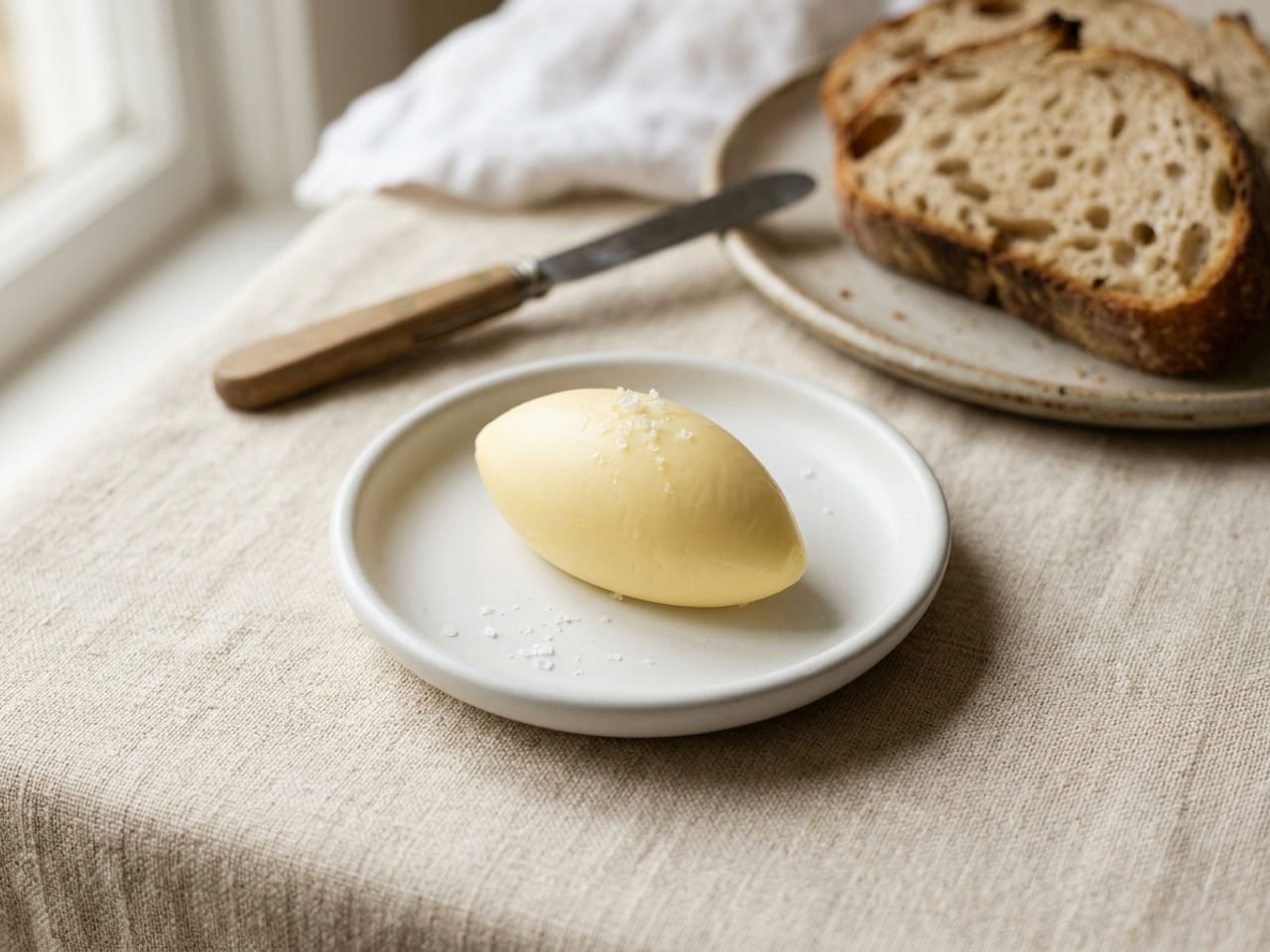
Butter
Butter is the texture every other food is measured against: Great British Chefs wants a mixture "firm enough to hold its shape, but soft enough that a spoon can glide through it easily (room temperature butter, for example)."36 Butter Journal, adapting ChefSteps: "The butter must be at room temperature, or a little firmer, so the rocher will form and hold its shape", and "If necessary, warm the bottom of the spoon with your hand to help release the rocher."46
No source we read gives a temperature in degrees.
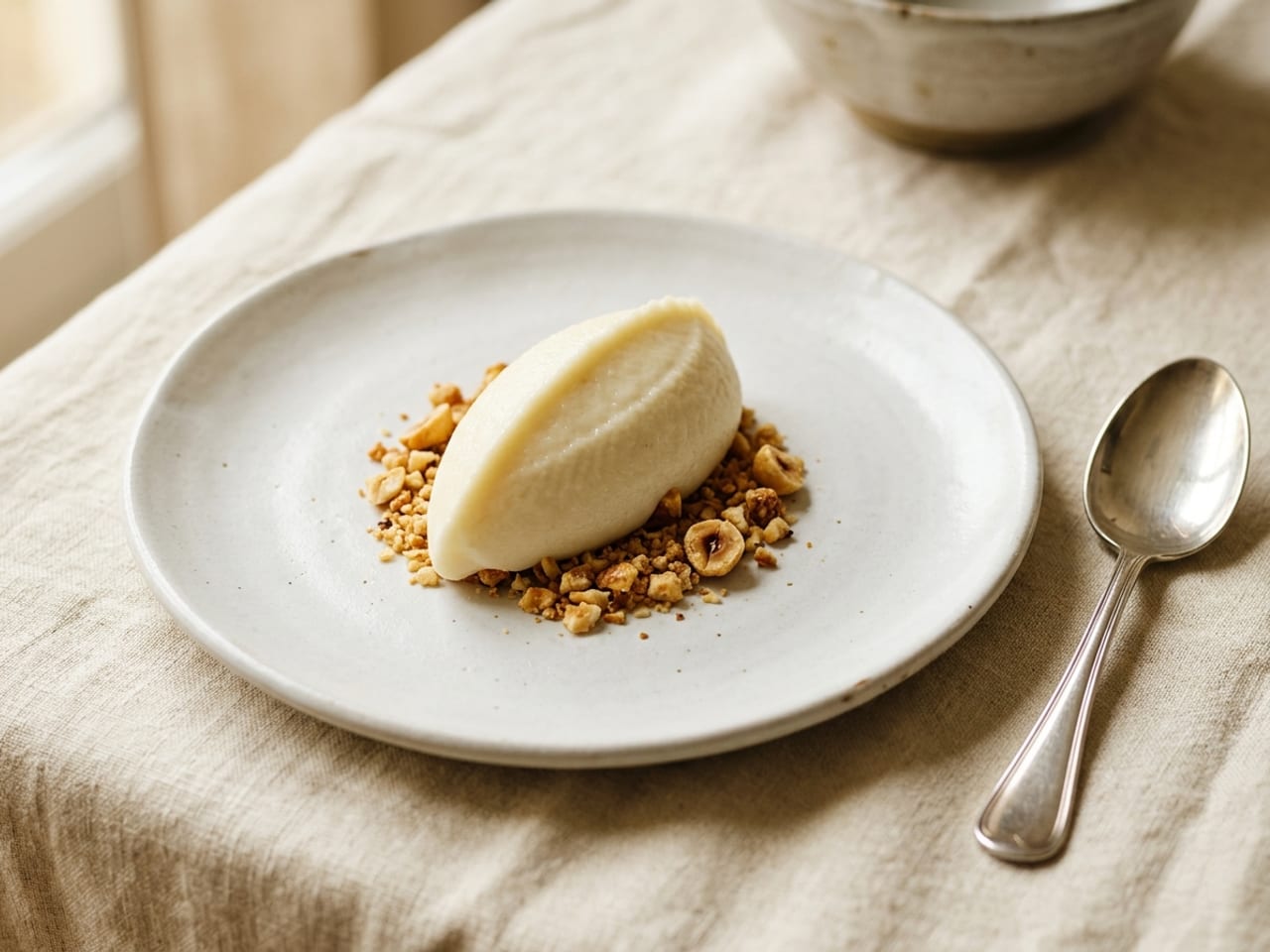
Purée and mashed potato
The MICHELIN Guide lists "ice cream, beef tartare or mashed potato";35 the Cambridge Dictionary defines the shape with "ice cream or mashed potato".1 But we found no chef or textbook that says how stiff a purée must be, so the cue in the table is ours: stiffer than you would spread as a swoosh, and able to hold a peak on the spoon.
For making the purée itself see the purée entry in plating components; for mashed potatoes on a dinner plate, how to plate food.
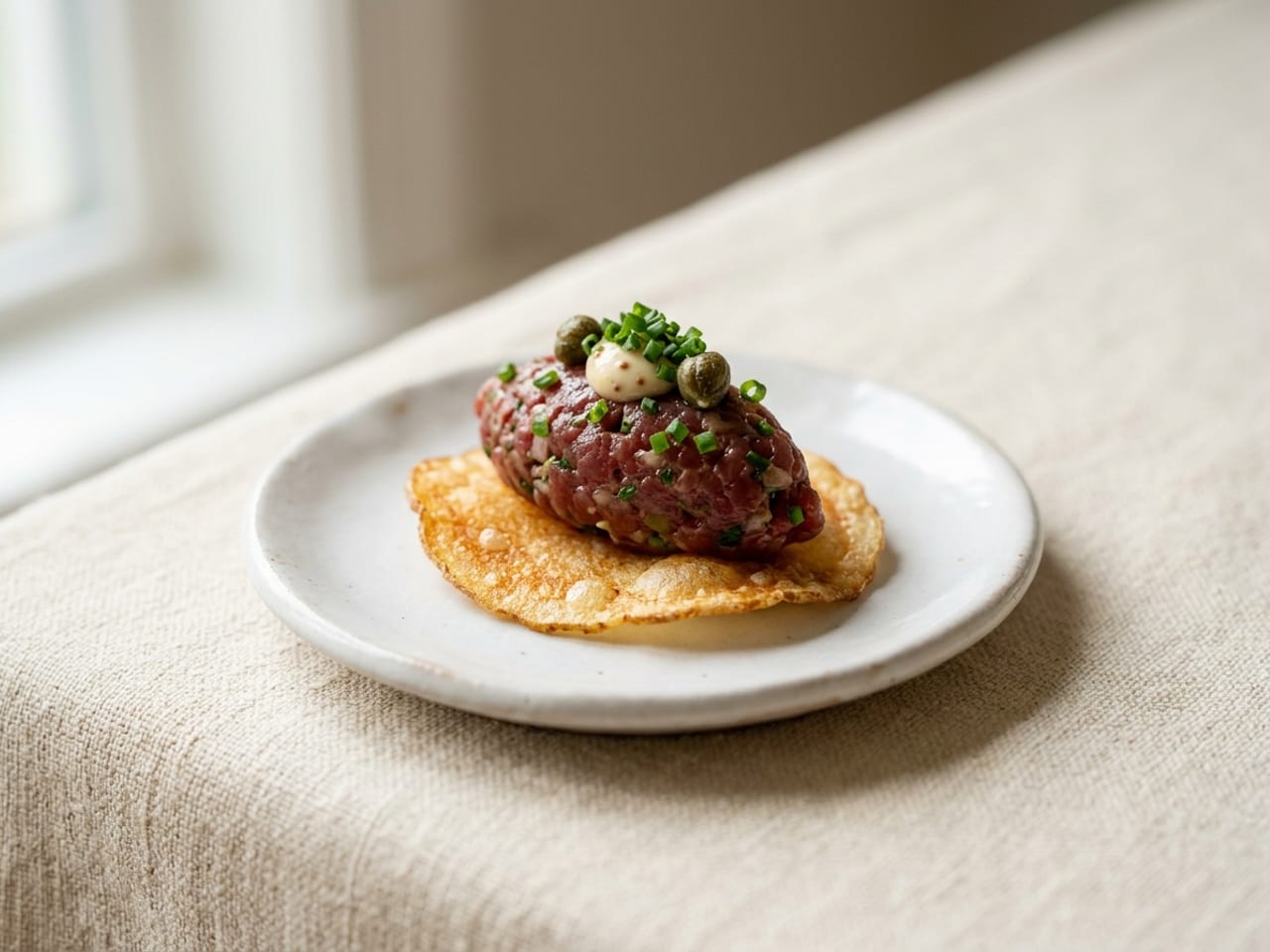
Tartare
ChefSteps, Great British Chefs and the MICHELIN Guide all name tartare,35, 36, 38 and none says anything about how to prepare it for shaping.
It is raw meat or raw fish, so the limits are about safety, not texture. USDA calls raw beef unsafe for anyone, and the FDA tells pregnant women, children, older adults and people with weakened immune systems to avoid raw fish (see safety). For everyone else: keep it cold until the moment it is shaped and serve it at once (ours). The amuse-bouche guide plates one on a potato crisp.
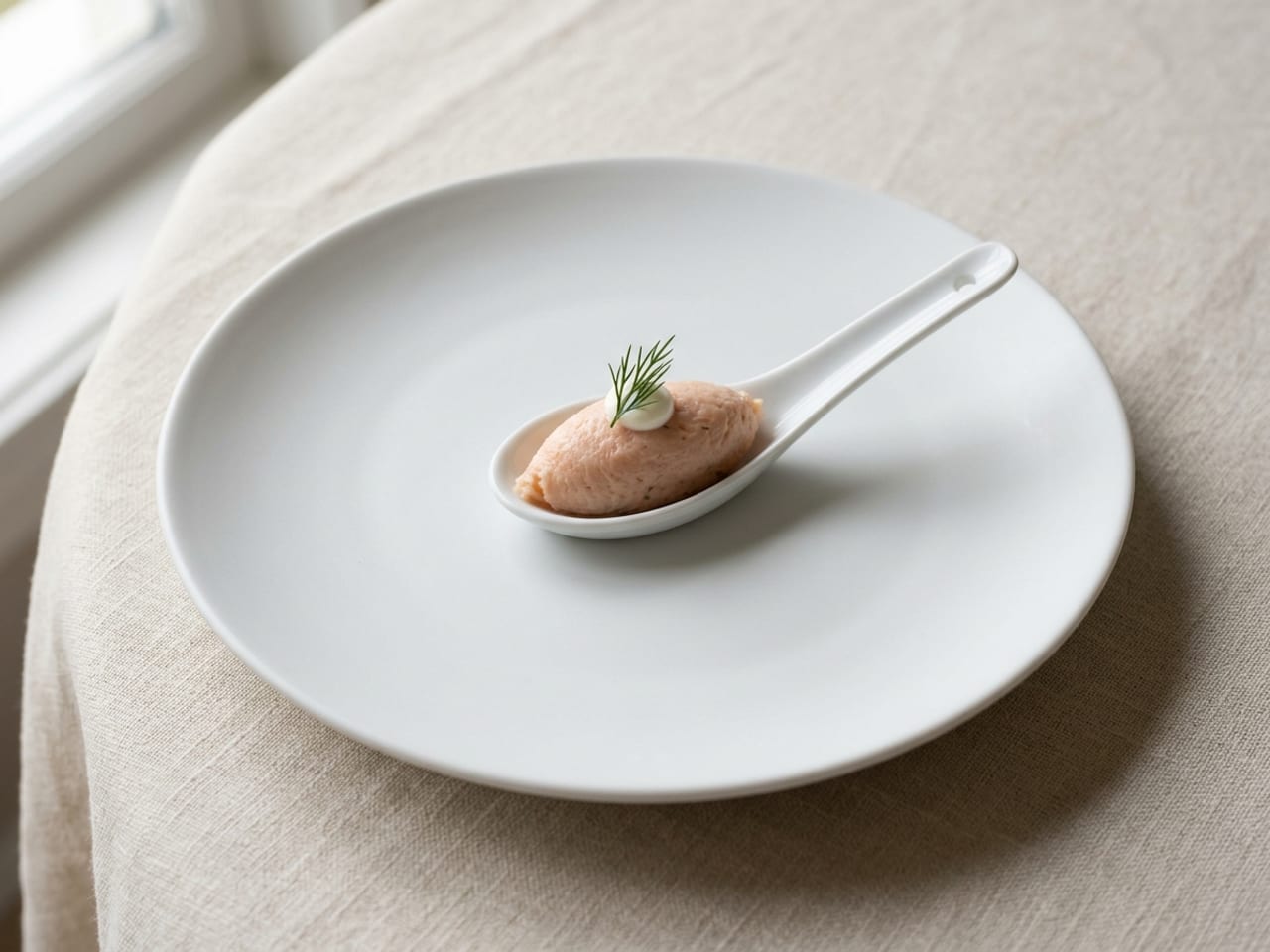
Pâté and rillettes
Anne Willan explains how the dumpling's shape reached the pâté: "The characteristic oval that results when shaping with two spoons has become so popular that pates (and ice cream and mousses) are shaped the same way."62 The MICHELIN Guide sets a quenelle of pâté on a crisp slice of baguette;35 Great British Chefs adds "savoury dishes such as rillettes".37
No source gives a temperature. Both are perishable, so the two-hour rule applies from the moment they leave the fridge.
Also named by the sources: caviar (Thomas Keller's Oysters and Pearls is finished with "a quenelle, or small oval scoop, of caviar"), 49 tapenade,35 and meringue, which Keller's MasterClass recipe shapes with "an ovular, deep-bowled spoon" once it will "hold stiff peaks".48 We found no named source for cream cheese, other soft cheeses or hummus.
Plating a quenelle: the crumb anchor and the cold plate
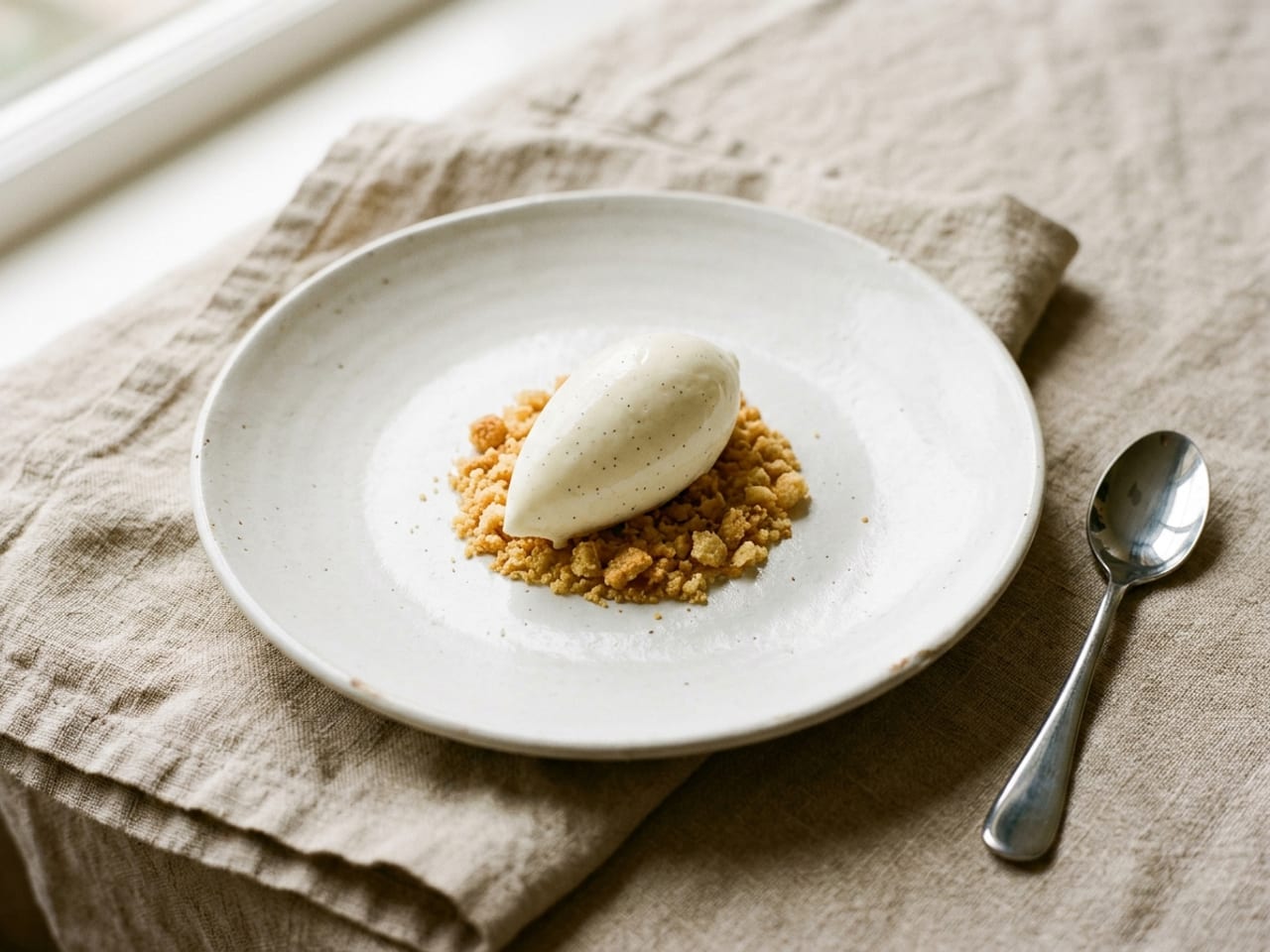
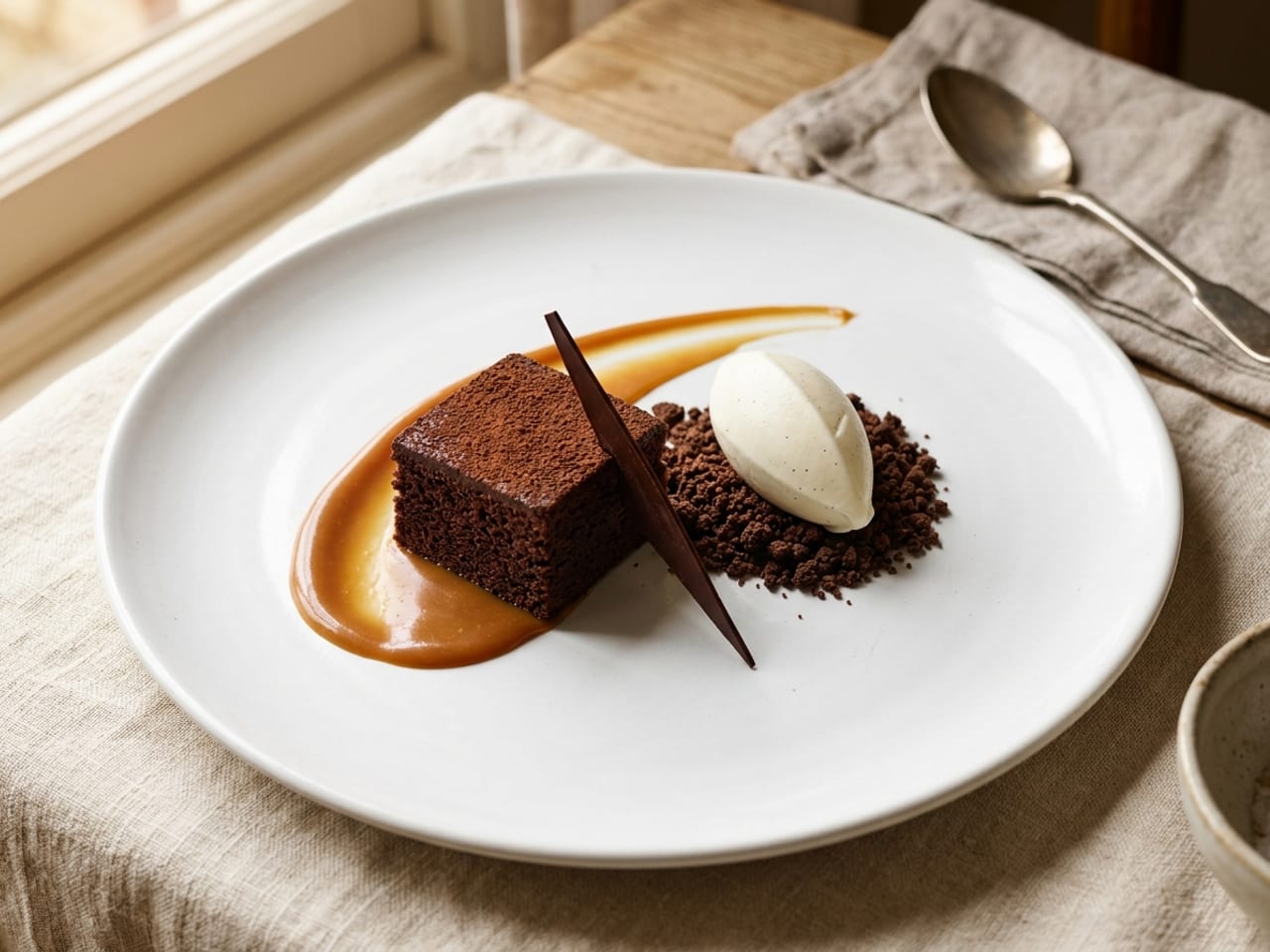
- Set a frozen quenelle on crumbs, not on the plateChris Young, co-founder of ChefSteps and formerly of The Fat Duck, on why his ice cream held: "The most important thing is that the roche (it's a one-handed quenelle) isn't actually sitting on the plate, it's sitting on some granola. That insulates it from the ceramic, and helps keep it from melting quickly". And: "we always plated the ice cream on something that insulated it from the plate and kept it from sliding around while it was carried to the guest's table."53 One layer, two jobs: insulation and grip. Our dessert guide calls that bed the soil: see how to keep ice cream from sliding on the plate.
- Chilled plates: the sources disagreeBon Appétit: "Chill your serving plates in the freezer for at least 10 minutes, otherwise the quenelles will start to melt on contact."40 Chris Young: "The kitchen wasn't cold where I worked, and the plates were room temperature."53 Our reading of why both can be right: his quenelle never touches the plate, and hers sits on it.
- Set it down in a curveRelease by "curving the spoon as you release it. Make sure not to lift the spoon straight up, or you'll create a ridge."40 A former pastry chef's blog puts it as: "gently place the quenelle on its side onto a plate or dessert. Let the softened ice cream gently roll off the spoon."45
- What slows the meltYoung again: "having a high-fat, churned ice cream makes for ice cream that melts much slower. The leaner the ice cream, and the less air whipped into it, the faster it will melt."53 Published measurements back the air half of that; see the research.
- How long it holds: no published numberWe found no sourced figure, in minutes, for how long a quenelle of any food holds on a plate, so this page gives none. The nearest thing is Young's description of service: "On a typical night, I used to have maybe 8 to 12 plates on my bench, with roches of ice cream sitting on them while I plated the rest of the dish."53 The cue we use (ours): shape the frozen element last and send the plate.
- Scooping aheadOne former pastry chef's blog does it at home: "You can pre-prepare your quenelles and freeze them again for later! Just place the quenelles on a cold baking sheet, cover, and put in the freezer".45 We found no book or named restaurant chef recommending it, and no source says how long they keep. Young scooped to order.53
- Where it sitsNo craft source we read gives a placement rule for the quenelle. For the composition around it, see dessert plating (the five roles and the order to plate them in), coulis, tuile and the other plating components (what to set it on and lean against it) and Michelin-star plating (the structure of a fine-dining plate).
- When a plain scoop is betterMigoya gives the case for the quenelle: "Quenelles just look better because they are more refined than a scooped ball and are a display of the pastry cook's and pastry chef's finesse and skill."39 Orlando Soto gives the case against: for "a dish that is meant to hit nostalgia", he prefers an ordinary scoop.42
Quenelle troubleshooting
Each fix comes from the source cited beside it; where a source states only the rule, the diagnosis is our reading. We found no source that names cracks in too-cold ice cream or a melted trail on the plate as faults, so they are not in the table.
| What you see | What the sources say |
|---|---|
| Craters or air pockets | "The food should be uniform, without large voids of trapped air, which would show up as craters in the rocher."38 If bubbles show on the surface, "you can drop it at any time. Just wash your spoon in your water, pat it dry, and pick up where you left off."43 |
| It sticks to the spoon | Warm the spoon. Cindy Khoo: "At the beginning, it usually came out of shape or stuck to the spoon"; for sorbet she rubs the back of the spoon in her palm.35 Orlando Soto keeps the spoon "somewhat wet, so it doesn't cling".42 |
| Ragged sides | Do as one pastry cook does and "drag the edge of the quenelle across the lip of the container to make a smooth finish on the side", and change the water when it is "lukewarm or dirty".43 |
| Blunt ends | "Gently scrape the ends of the quenelle against the container to create sharp tapered points."40 |
| A ridge on top | The spoon was lifted straight up. Curve it away as you release.40 |
| Ice cream too hard to cut cleanly | It needs tempering: about 30 minutes in the refrigerator for a pint, in America's Test Kitchen's measurement.51 "It can't be rock hard or too soft."42 |
| The spoon melts the surface | The water is too hot for that food: "hot enough to release the quenelle, but not so hot that it immediately melts it".35 |
| It melts where it touches the plate | Chill the plate for at least 10 minutes in the freezer,40 or keep the quenelle off the ceramic on a bed of crumbs.53 |
| It slides across the plate | Give it an anchor: crumbs, granola or crumble under it.53 |
| A flat, shallow shape | "Flat spoons will not produce a pronounced oval shape."39 Use a deeper spoon. |
| Uneven faces (two spoons) | The spoons do not match: "always use two spoons of the same size".44 |
| Grainy whipped cream | Over-whipped. Caught early, fold in "a few more tablespoons of cream" by hand.54 |
| A poached quenelle breaks up | Poach a test one first. Anne Willan: if it "starts to break up, add another lightly beaten egg white to the remaining mixture and beat for 2 to 3 minutes over ice."62 Escoffier: too light, add "a little white of egg"; too stiff, "a little softened butter".23 |
| The paste is too soft to poach at all | Julia Child's way out: "declare it to be a mousse", pack it into a buttered soufflé mould, "Set in a pan of boiling water and bake in a preheated 350-degree oven until the mousse has risen and shows a faint line of shrinkage from the sides of the mold" (350°F, 177°C).59 It is the same raw fish and egg, so the 160°F (71°C) check in the safety notes applies (ours). |
What to practise on
- Vegetable shorteningA restaurant pastry cook's tip, naming a brand of shortening: "Use Crisco to practice your quenelles. Surprisingly enough, Crisco has the perfect consistency to practice with!" She lines a baking sheet with foil for the practice quenelles, which "lets you scrape them into the container and start over again once you fill the sheet up."43
Why tempered ice cream scoops and dense ice cream melts faster
None of these papers is about quenelles. They explain the materials: why a few degrees change how ice cream cuts, and what makes it melt faster or slower on the plate. PubMed-indexed papers carry a PMID next to the DOI in the sources.
- Nobody has studied the quenelle itselfWe found no paper on the shape. The principle can be stated in general terms, and the statement is ours: a food holds a quenelle's edges when its yield stress, the push needed to make it flow, is higher than the stress its own weight puts on it. No paper we read gives a threshold value, so we print none.
- At serving temperature, about a quarter of the water in ice cream is still liquidH. Douglas Goff of the University of Guelph: "Even at the typical ice cream serving temperature of -16°C, only about 72% of the water is frozen" (3°F), which "helps to give ice cream its ability to be scooped and chewed at freezer temperatures."65 His worked freezing curve for one example mix puts 50% of the water frozen at -5.87°C (21°F), 75% at -13.16°C (8°F) and 80% at -16.61°C (2°F).66 Our reading of that curve: the 8°F (-13°C) that America's Test Kitchen calls scoopable is about three-quarters frozen, and Chris Young's -5°C (23°F) is about two-fifths. The curve is calculated for one mix, not measured on yours, which is also why it does not match Goff's own 72% exactly: in another paper's calculated table, changing the sugars moves the figure at one temperature by ten points or more.67
- Hardness and melting come from structureMuse and Hartel, in the Journal of Dairy Science: "Fat destabilization, ice crystal size, and the consistency coefficient of the mix were found to affect the melting rate of ice cream, whereas hardness was influenced by ice phase volume, ice crystal size, overrun, fat destabilization, and the rheological properties of the mix."67 What it doesn't show: hardness at different serving temperatures. We found no paper that tabulates that.
- More air: softer, and slower to melt"Ice creams with lower overruns (80%) were harder than those made with 120% overrun but melted more rapidly."68 The range tested, 80 to 120% overrun, is a commercial one (our note); Muse and Hartel saw no effect of overrun on melting "because of the narrow range of overruns obtainable in this batch freezer".67 A later study with the same senior author: "Ice creams with a combination of low overrun and low fat destabilization had the highest drip-through rates."69 That agrees with half of what Chris Young saw at the pass: ice cream with less air in it melts faster.53 The other half, that leaner ice cream melts faster, is his observation; these papers held the fat content fixed and measured how much of the fat had clumped into a network, which is a different thing.
- One lab study: the temperature of the cream changes how it whipsA dairy company's lab whipped cream at 5 to 15°C (41 to 59°F). Warmer cream whipped faster and took in less air: "Whipping time, overrun, and bubble diameters decreased with increasing temperature, with the exception of bubble size at 15 degrees C". Because the air content changed least in storage in the middle of the range, the authors recommend "7.5 to 12.5 degrees C" (45.5 to 54.5°F) "for making whipped creams with a good texture", the exact temperature to be chosen for the amount of air wanted.70 What it doesn't show: anything about quenelles, or that a home cook should stop chilling the cream and the bowl. It is one study. Goff's plain account of the far end: "If it is whipped too far, the fat will begin to churn and butter particles will form."65
- Ganache: cocoa solids firm it, sugar and milk powder soften itMcGill and Hartel found that "greater levels of cocoa powder, which is mostly insoluble, strengthens ganache structure, producing a firmer product, whereas greater levels of milk powder and sugar, which dissolve in the aqueous cream component, produce a softer ganache."71 Our practical reading: at the same ratio a dark ganache sets firmer than a milk or white one, so expect the paler ones to come out softer. The study was on plain ganache, not whipped, and the abstract gives no temperatures or chilling times.
Quenelles de brochet: pike quenelles and sauce Nantua
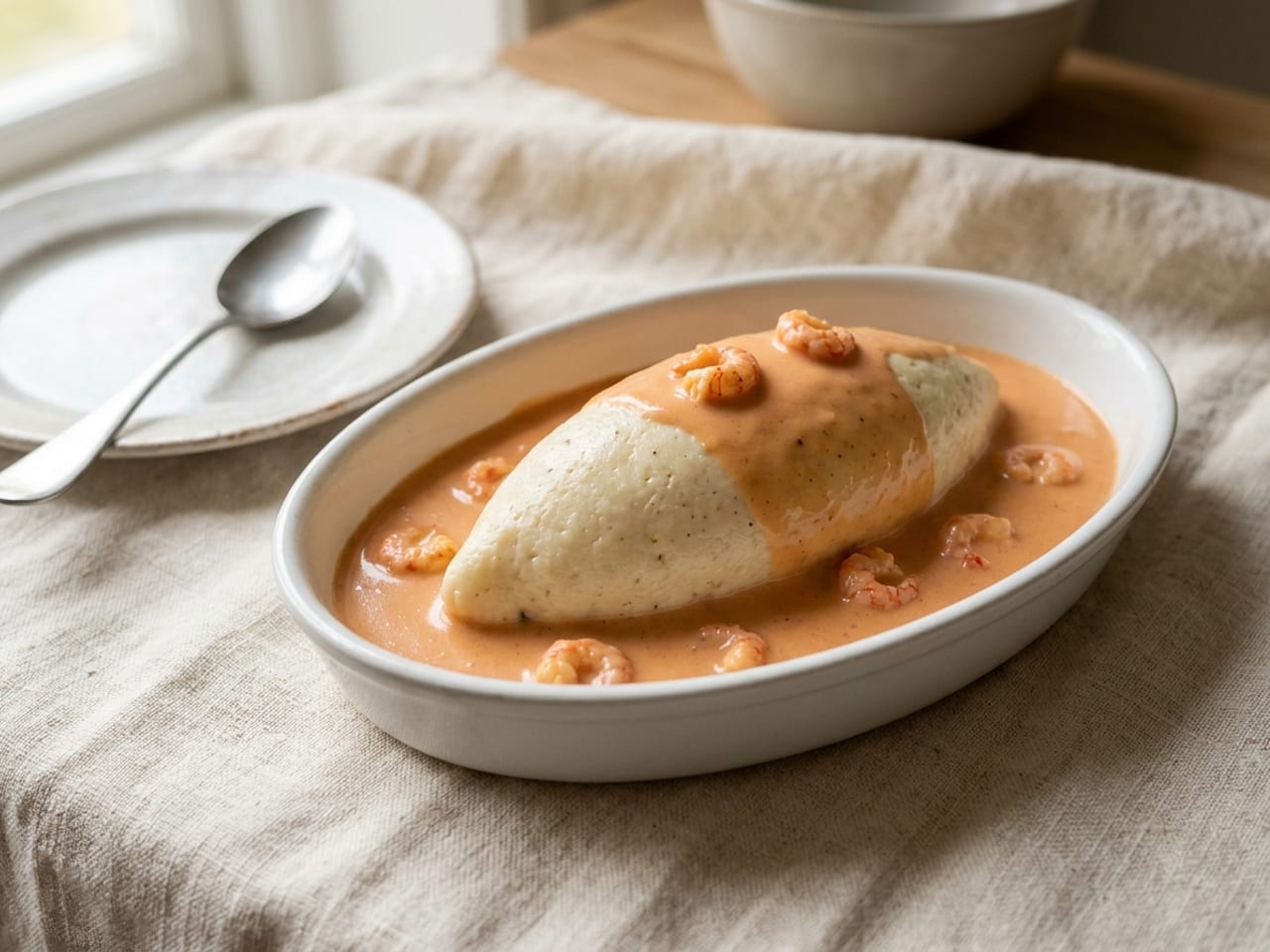
What it is. Merriam-Webster: "a poached oval dumpling of pureed forcemeat (as of pike) often served in a cream sauce".2 Julia Child says a good mixture "has just enough body to hold its shape when it goes into the poaching liquid", and explains the fish: pike has "excellent flavor" but is "so webbed with little bones that a quenelle is the most convenient way of eating it". Her American substitute is halibut.59
Three families of recipe. The published recipes differ most in what binds the fish:
- Panada and beef fat (Escoffier). His dish recipe, No. 1040 in the English edition of 1907, pounds "one lb. of the meat of pike" (454 g) and "one lb. of the fat of kidney of beef" (454 g), then one pound (454 g) of frangipan panada with "the white of four little eggs", and sieves the paste.23 The French editions give the same equal weights, 500 g of each.20, 22
- Choux paste (Julia Child, Anne Willan). Child beats fish purée into pâte à choux, chills it, then beats in "2 to 6 Tb chilled whipping cream" (30 to 89 ml), for about 16 quenelles.59 Willan: "Some cooks omit the choux pastry and rely on whites alone to bind the quenelles. Not me."62
- Egg and cream, no panada (Pépin's mousseline, Boulud's mousse). Jacques Pépin's "Escoffier Quenelles" use 8 ounces (227 g) each of sole and whiting, not pike, with 1 large egg white and 1¼ cups (296 ml) of very cold heavy cream; the printed method leaves the egg white out.61 Daniel Boulud stirs 4 eggs and 2 cups (473 ml) of cream into 1½ lb (680 g) of pike or sole.63 Escoffier allowed for this too: panadas "are not necessary to every forcemeat; for the mousseline kind, which are the finest and lightest, do not require them."23
Escoffier printed two different ratios. His forcemeat No. 203 is one pound (454 g) of pike to "one-half lb. of stiff frangipan" (227 g) and "one-half lb. of melted beef-fat" (227 g), with no egg white; No. 1040 is equal weights with four whites.23 If you cook from him, say which number. The frangipan panada itself, No. 192: "four oz. of sifted flour, the yolks of four eggs, a little salt, pepper, and nutmeg. Now add by degrees three oz. of melted butter and dilute with one-half pint of boiled milk." That is 113 g of flour and 85 g of butter; the half pint in a London book of 1907 is an imperial one, 284 ml, where a US half pint would be 237 ml.23
Shaping the dumpling, in Escoffier's words (No. 205, method 2, "To Mould Quenelles with a Spoon", 1907 English edition):23
- Butter the pan or tray with a brush "and let the butter cool". Beside it, "a receptacle containing hot water, into which the spoon used for moulding is inserted."
- "For ordinary quenelles two coffee-spoons are used, one of which is kept in the hot water". With the other, "held in the left hand, take up a little of the forcemeat (just enough to fill the spoon)".
- Then "withdraw the second spoon from the hot water and place it, with its convex side uppermost, on the other spoon. This smoothens the upper surface of the forcemeat."
- Now, "with the help of the second spoon, remove the whole of the contents of the first spoon, and overturn the second spoon on the spot in the tray or sautépan which the ball is intended to occupy." The spoon, "being at once moist and hot, allows the forcemeat to leave it quite easily in the shape of a large olive."
- To poach, "pour enough boiling, salted water over them to moisten them abundantly", move the tray from time to time, and drain them "when they have swollen sufficiently and seem soft and firm to the touch".
Only one of his two spoons is hot, and the coffee-spoons make small quenelles, about ¼ oz (7 g) each on Ranhofer's count (our arithmetic); for the Lyonnaise dish he says only "mould some quenelles with a spoon".23 Julia Child does the same thing cold: "With a wet spoon, dip out a rounded mass of the cold quenelle paste. Transfer the spoon to your left hand. Smooth the top of the paste with the inverted bowl of the second wet spoon. Then slip the bowl of the second spoon under the quenelle to loosen it and drop it into the barely simmering liquid."59 Pépin uses two serving spoons and makes each quenelle "about 2 ounces" (57 g).61
| Recipe | Binder | Poaching liquid | Time |
|---|---|---|---|
| Escoffier, 1907 (English edition) | Frangipan panada and beef kidney fat, with egg whites in No. 104023 | Boiling salted water poured over the tray, kept "on the side of the stove"; the liquor "must not boil" | No time given: until "swollen sufficiently" and "soft and firm to the touch", then 10 minutes simmering in the sauce |
| Julia Child, Bertholle and Beck, 1961 | Pâte à choux, fish purée and chilled cream59 | Fish stock or salted water, 3 to 4 inches (7.6 to 10 cm) deep, never "beyond the barest suggestion of a simmer" | 15 to 20 minutes, until they "have about doubled in size and roll over easily" |
| Anne Willan, 2007 | Choux paste, egg whites and cream62 | Salted simmering water, 3 inches (7.6 cm) deep | "about 10 minutes depending on size, or until they are firm when you press them with a fingertip" |
| Jacques Pépin, 2011 | Egg white and cream: a mousseline, no panada61 | Water at least 2 inches (5 cm) deep, held "at about 180 degrees" (180°F, 82°C) | About 12 minutes, turned after 5 to 6; then chilled in ice water and baked in sauce at 350°F (177°C) for 25 to 30 minutes |
| Daniel Boulud, 2016 | Whole eggs and cream63 | Water at "a low simmer", the mousse rolled in plastic wrap as logs | Until set, "about 45 minutes"; then baked in the sauce at 375°F (191°C) and finished at 425°F (218°C) |
| Charles Ranhofer, 1894 | Forcemeat18 | Water brought to a first boil, then moved aside so it "only simmers" | For "six to fourteen minutes, according to their size" |
Where the recipes disagree. On the binder, as above. On the spoons: hot for Escoffier, Claiborne and Franey and Willan, cold and wet for Child.23, 59, 60, 62 And on whether the quenelles should swell in the first poach: Child's are done when they "have about doubled in size", while Pépin warns that "If the water boils, the quenelles will cook too fast and expand, which they should not do during this first cooking"; his puff later, in the oven.59, 61 Of these recipes only Pépin's gives a water temperature, and none gives an internal one; see safety for the figure to check.
Test one first. Escoffier: "Test the forcemeat by poaching a small portion of it in salted, boiling water. This test, which is indispensable, allows of rectifying the seasoning and the consistence if necessary."23
Other ways to shape them. Escoffier lists four: "(1) By rolling them; (2) by moulding them with a spoon; (3) by forming them with a piping-bag; (4) by moulding them by hand into the shape of a kidney."23 Child rates the rolled cylinder "A neater-looking but less light-textured alternative" to the spoon,59 and Boulud skips shaping altogether by rolling the mousse in plastic wrap.63
Sauce Nantua. Escoffier's formula, No. 95: "Boil one pint of Béchamel Sauce, add one-half pint of cream, and reduce by a third. Rub it through a tammy, and finish it with a further addition of two tablespoonfuls of cream, three oz. of very fine crayfish butter, and one tablespoonful of small, shelled crayfishes' tails."23 In imperial measure that is 568 ml of béchamel, 284 ml of cream and 85 g of crayfish butter. He does not pair it with the Lyonnaise quenelle, which in 1903 takes "une sauce quelconque de poisson", any fish sauce;20 Favre finishes his in a crayfish coulis with cream,21 and a Lyon magazine reports that la Mère Brazier liked to serve hers with sauce Nantua.25 The earliest "sauce Nantua" we found, in an 1865 book, is in a chapter on Lyon.28 Boulud's verdict: "Fifty percent of the pleasure of the quenelle is in the sauce".63 The sauce is a daughter of béchamel: see the mother sauces.
We print no pike quenelle recipe of our own. These are quotations from published recipes, not a tested method, and where a scan garbled a quantity we left it out.
Where the quenelle came from
The quenelle was a dumpling, shaped like an egg, long before it was a shape. It was made with spoons from early on, and what changed over two and a half centuries is the material: forcemeat, then meringue, then sorbet and ice cream. Pike quenelles were Paris cooking before they were Lyon's. Every date below is the earliest we found in digitised books, not a claim of first ever.
| When | What the record shows |
|---|---|
| 1749 | Menon's La Science du maître d'hôtel cuisinier prints a recipe headed "Quenèlle de Poularde": scraped raw chicken pounded with fat, bread crumb and egg yolks, rolled "en forme de petites saucisses courtes" (short little sausages) and poached in stock.11 It is the earliest quenelle we found, a year before the date the French dictionary gives.5 Rolled, not spooned. |
| 1813 | Louis Eustache Ude, whose writing of 1813 is the Oxford English Dictionary's earliest evidence for the word in English,3 already shapes them with two spoons in The French Cook: one filled and "levelled all round, with a knife dipped into boiling water", the other "lying also in boiling hot water".12 |
| 1814 | Antoine Beauvilliers, a Paris restaurateur, prints a recipe headed "Quenelles de Brochet": made like his whiting quenelles, with the flesh of two or three anchovies worked in. It is the earliest pike quenelle we found.83 |
| 1815 | Carême lists "Les quenelles de brochet au suprême" among the entrées of a model meatless menu.13 His recipe of 1833 starts from "deux moyens brochets de Seine", two medium pike from the Seine: a Paris dish.14 |
| 1827 | An English household book: "form this farce into quenelles of an egg shape, in different-sized spoons which must be dipped in water". It adds that "Quenelles may be made of any meat, as veal, fowl, game, fish, fruit, or vegetables."15 |
| 1844 | A Lyon restaurant's printed list of dishes includes "Quenelles de brochet" under the freshwater fish, the earliest Lyon evidence we found.16 |
| 1891 | Mrs Marshall poaches meringues: "with two spoons form the meringue into quenelle shapes".17 It is the earliest use we found of the shape for something sweet that is not a forcemeat. |
| 1903 to 1907 | Three Escoffier books say three different amounts. The French first edition of 1903 gives sizes and weights and names the "Godiveau lyonnais".20 The second French edition of 1907 lists four ways of shaping and calls them "trop connues pour qu'il soit nécessaire de nous y arrêter", too well known to dwell on.22 The French of 1907 says only that garnish quenelles "se moulent à la cuiller à café"; the English edition of the same year, A Guide to Modern Cookery, is the one that spells out the method: two coffee-spoons, one of them kept in hot water.22, 23 |
| 1905 | Favre's dictionary, in the four-volume printing of 1905, has "Quenelles de poisson à la lyonnaise": pike, beef fat and marrow, pâte à choux and crayfish coulis.21 We did not open the first edition, so we cannot date the recipe earlier. |
| 1918 | A Hachette guide to Lyon lists Restaurant Morateur, with its "quenelles Morateur", among the first-order tables.24 |
| 1920s | According to a Lyon magazine quoting a local historian, the charcutier Joseph Moyne replaced the beef fat with butter in the 1920s. We have this second-hand only, and the dates differ from page to page.25 |
| 1929 | A London pastry book calls a spoonful of ice a rocher: "Place one rocher (spoon) of vanilla ice between two shells of meringue". Its rochers de glace are "The ice dressed with a spoon in round or oval shape", piled in a pyramid.82 It is the earliest "rocher" for a spoon-shaped portion that we found. |
| 1984 to 1994 | The word quenelle follows the shape to the freezer. In full-text search fragments, which is as far as we could read these books: a British cookbook of 1984 has "quenelles of sorbet (parts of a scoop)", with a gloss that shows the word still needed explaining;30 Michel Guérard moulds sorbet quenelles with a spoon dipped in hot water in 1989;31 and by 1994 a baking textbook asks students "What is a quenelle of ice cream? Describe how to make it."32 |
| 1999 | Thomas Keller's The French Laundry Cookbook has a sidebar on the "one-spoon quenelle" on p. 274; we read it only in the Internet Archive's snippet view.33 |
| 2014 | The French trade code for quenelles reserves "Quenelles de" a named species for products with at least 13% of it.26 |
| 2015 | The earliest dated text we found that equates the rocher with a one-spoon quenelle, again as a search fragment: "Place a rocher (or one-handed quenelle) of caramel mousse on top".34 |
The word. The Trésor de la langue française derives quenelle from the German Knödel, a dumpling, and Merriam-Webster and Collins agree.2, 4, 5 Knödel is itself a diminutive of a Middle High German word for knot.8 That is the modern consensus, not the nineteenth century's: Littré called the origin uncertain,7 and Favre derived it from an Anglo-Saxon word for pounding, "parce que les chairs dont on fait les quenelles sont pilées au mortier".21 The Académie française is the dictionary that ties it to Lyon: "Les quenelles sont une spécialité lyonnaise."6
Which dictionaries know the shape. Merriam-Webster and Collins define only the dumpling.2, 4 The Cambridge Dictionary has both senses, the second being "a carefully shaped small amount of a soft food such as ice cream or mashed potato", with the example "You can shape smooth quenelles of meringue between two spoons dipped in hot water."1
Rocher is French for rock. In pastry it means a small cake or chocolate whose rough look recalls one.9 No dictionary we checked records it for a spoon-shaped scoop, but the kitchen sense is not new. A London pastry book of 1929 already writes "Place one rocher (spoon) of vanilla ice between two shells of meringue", and describes rochers de glace as "The ice dressed with a spoon in round or oval shape and placed on the dish or timbale on top of each other in form of pyramid."82 That is the earliest use we found. No source we read says in terms why the spoonful took the name, so we offer no origin story. What is recent, in our sources, is the rule that a rocher is the one-spoon shape: the earliest dated text we found that calls it a "one-handed quenelle" is from 2015.34
Spelling. Menon's heading spells it "Quenèlle", though his recipe has plain "quenelles".11 It is not cannelle, which is French for cinnamon, nor cannelé, fluted, the word for the Bordeaux cake and the fluted piping tip; Escoffier uses the second right beside our word in 1903, for quenelles laid with the spoon or the bag "de forme ovale ou cannelée", oval or fluted.20
Quenelle myths and shaky claims
- "A pastry chef named Charles Morateur invented the Lyon quenelle in the 1830s"Shaky. The story is told in a 1983 book, as a Lyon magazine reports it;25 we did not open that book, and Food & Wine repeats the claim without a source.42 A pâtissier of that name did exist: Lyon's directory of 1853 lists "Morateur (Claude) pâtissier, cours Morand, 10", a Claude, not a Charles. The directory of 1834, the one nearest the story's date, has only a baker's widow of the name, which is an absence of evidence, not proof.29 Nothing we read from the period credits him with the quenelle. A Lyon gourmet who died in 1895 praises Morateur for crayfish à la Nantua and gives the quenelles to another house: "Et les quenelles de chez Deau?"19 What the record does show is a Lyon restaurant called Morateur known for its quenelles by 1918.24
- "Quenelles go back to the Romans and De Re Coquinaria"Food & Wine says the quenelle is name-dropped in that Roman cookbook,42 and a Lyon historian quoted in Lyon Capitale goes further: the Roman ball "a transité par l'Allemagne et l'Alsace, a pris une forme ovale et est devenue quenelle" (passed through Germany and Alsace, took an oval shape and became the quenelle; our translation).25 Neither offers evidence for the descent. Poached balls of pounded meat are certainly old, but the word is eighteenth-century French.5 We did not examine the Roman text ourselves.
- "A real quenelle has three sides; one spoon makes a rocher, not a quenelle"A convention, not a definition. The MICHELIN Guide says the technique "can be executed with one spoon or two",35 Migoya writes of a "single-spoon quenelle",39 none of the dictionaries we checked has "rocher" in this sense,9 and the old books ask for an egg, an oval or an olive, never three sides.15, 20, 23
- "Pike quenelles are a Lyon invention"Overstated. A Paris restaurateur printed the recipe in 1814,83 Carême's pike came from the Seine,14 and the earliest Lyon evidence we found is a menu of 1844.16 What Lyon gave the dish is a style, named by Escoffier in 1903 and by Favre in his 1905 edition: pike with beef kidney fat and a cooked flour paste.20, 21
- "It came from German by way of Alsatian, and it is the same word as gnocchi"The dictionaries say German Knödel, with no mention of Alsatian;2, 4, 5 the Alsace route is a Lyon historian's, quoted without evidence.25 Knödel is a diminutive of a word for knot;8 gnocchi is probably Germanic too, but Merriam-Webster ties it to a word for knuckle, not knot.10 And the etymology was not always settled: Littré called the origin uncertain.7
- "A quenelle de brochet must be 22% pike, and the name is protected"The French trade code sets 13% of the named species.26 A Label Rouge specification with 18% pike was put out for consultation in 2002; as far as we could read, in a cached copy of the notice, that was an application, and we could not confirm it was ever approved.27 The 22% printed on some tourism pages is not in the code.
- "Use warm water, never hot"Two sources' view, Great British Chefs' feature and Cindy Khoo as the MICHELIN Guide reports her, both of them worried about melting;35, 36 Great British Chefs gives it as a general tip that "does depend slightly on the ingredient". Others boil the water, and for poached quenelles Julia Child used cold. See how warm the spoon should be.
Quenelle safety
The plated quenelle is usually chilled dairy served without cooking, and the classic one is minced fish with egg. The figures are US agencies' unless marked; where we apply them to a quenelle, that application is ours.
- A pike quenelle is minced fish with egg, so 145°F (63°C) is not the figureFoodSafety.gov gives 145°F (63°C) for whole fish and fillets, but 160°F (71°C) for "Egg dishes".72, 74 The FDA Food Code, the model code for restaurants, sets comminuted (chopped, ground or minced) fish at 155°F (68°C) for 17 seconds, and its definition of comminuted includes "gefilte FISH".73A pike quenelle is the same kind of food (our reading). None of the recipes above gives an internal temperature; Pépin's 180°F (82°C) is the water, not the centre. Our application of the agencies' numbers: check one quenelle with a thermometer and look for 160°F (71°C) in the middle.
- Two hours out of the fridge, one hour in the heatUSDA: "Never leave food out of refrigeration over 2 hours. If the temperature is above 90 °F, food should not be left out more than 1 hour" (32°C); the danger zone runs from 40°F to 140°F (4 to 60°C).75 A quenelle of cream, crème fraîche, mascarpone, mousse, pâté or tartare is perishable food at room temperature from the moment it is shaped. Our application: the two hours are cumulative, so practice time counts, and a bowl of cream or mousse that sat out through practice and dinner should not go back in the fridge for tomorrow.
- Mousse or meringue made with raw eggIn the US, the FDA says that for dishes served with raw or undercooked egg you should "use either shell eggs that have been treated to destroy Salmonella, by pasteurization or another approved method, or pasteurized egg products."74 The UK differs, for British eggs only: the Food Standards Agency says young children, pregnant people, older adults and people with an underlying health condition "can safely eat raw or lightly cooked hen eggs, or foods containing them, if they have a British Lion mark or are produced under the Laid in Britain egg assurance scheme". It adds that this "does not apply to people who are severely immunocompromised and require medically supervised diets", and that with any other egg you should "ensure that egg dishes are thoroughly cooked or prepared using pasteurised egg products."76 The NHS lists mousse made with British Lion or Laid in Britain hen eggs as safe in pregnancy, and says other eggs should be eaten well cooked.77 Our application: anywhere else, or with eggs that carry neither mark, make an uncooked mousse with pasteurised egg. The same goes for a meringue that is shaped and served without baking (ours); Keller's is heated to 150°F (66°C) and then baked.48
- Tartare is rawUSDA on steak tartare: it "is dangerous because it is uncooked", and "Raw meat is never safe to consume." Ground beef is safe at 160°F (71°C).78 For raw fish the FDA says "It's always best to cook seafood thoroughly", and that if you eat it raw anyway, "one rule of thumb is to eat fish that has been previously frozen", with a warning attached: "freezing doesn't kill all harmful germs. That's why the safest route is to cook your seafood." It tells four groups to avoid raw or undercooked fish and shellfish altogether: pregnant women, children, older adults and people with weakened immune systems.79 For restaurants, the Food Code requires fish served raw to have been frozen at -4°F (-20°C) or below for 7 days, with faster options and exceptions.73 A home freezer set between -5°F and 0°F (-21 to -18°C), the range the ice cream industry advises,50 is at best on that line and usually above it, so it is no substitute (ours).
- Keeping poached quenellesJulia Child: "arrange them in a lightly buttered dish, brush them with melted butter, cover with waxed paper, and refrigerate. They will keep perfectly for one to two days."59 That is her instruction, not an agency figure. The agencies do give one for the reheat: 165°F (74°C) for leftovers, and the FDA says cooked egg dishes kept for later "should be thoroughly reheated to 165° F before serving".72, 74
- AllergensOur note, from the ingredient lists: a classic pike quenelle contains fish, egg, milk and wheat (the flour in the panada), and sauce Nantua adds crustacean shellfish. The crumb under a plated quenelle is usually wheat, and often nuts.
See the quenelle on your own plate first
Before you practise the spoon, see where the oval should go. Photograph a dish you cooked and Plate Artists re-plates your own dish the way a restaurant would, with the moves named so you can repeat them. The plating techniques glossary explains each one, and the fancy desserts hub has things worth setting a quenelle beside.
Your dish, plated like a chef's
Snap it, upload it, and get the composed version back, with the steps to recreate it at home.
Start free · 1 enhancement →Free account · 1 free enhancement · No credit card
Quenelle terms, defined
| Term | Where the word comes from | Defined by |
|---|---|---|
| Quenelle | French, from German Knödel, dumpling; in French by 1749, in English by 1813 | Cambridge Dictionary; Merriam-Webster |
| Rocher | French: rock; in pastry, a small rough-looking cake or chocolate; in English for a spoonful of ice by 1929 | Kitchen usage (Kollist 1929; ChefSteps; Great British Chefs); in no dictionary we checked |
| Quenelles de brochet | French: brochet, pike | Beauvilliers 1814; Carême 1815; Escoffier 1903 and 1907 |
| Forcemeat | English: force, an alteration of farce, plus meat; circa 1688 | Merriam-Webster |
| Panada | In English circa 1598 | Merriam-Webster; Escoffier 1907 |
| Frangipane panada | Escoffier's No. 192, spelled "frangipan" in the 1907 English edition | Escoffier 1907 |
| Mousseline | French, for light preparations usually finished with cream | Trésor de la langue française; Escoffier 1903 and 1907 |
| Godiveau | French; first attested in 1546, in Rabelais, for a kind of small sausage | Trésor de la langue française |
| Godiveau lyonnais | French: the godiveau of Lyon | Escoffier 1903 |
| Sauce Nantua | After Nantua, a town in the Ain, by the usual account; Escoffier does not explain the name | Escoffier 1907, No. 95 |
| Knödel | German: a diminutive of a Middle High German word for knot | Duden |
| Cocon | French trade term | Code d'usages Quenelles, 2014 |
| Quenelle spoon | English retail and kitchen usage | Food & Wine; ChefSteps |
| Poaching | As Escoffier defines it | Escoffier 1907, No. 249 |
| Tempering | English kitchen usage | Kitchen usage (Orlando Soto, in Food & Wine; America's Test Kitchen for the refrigerator); the definition is ours |
Quenelle · kuh-NEL
A small, smooth oval of a soft food such as ice cream, whipped cream, mousse or purée, shaped with one or two spoons; originally, and still, a poached oval dumpling of pounded fish or meat.
Rocher · one-spoon quenelle, one-handed quenelle
Kitchen English for a quenelle made with one spoon in a single scooping motion, which leaves a smooth egg with no edges; the dictionaries we checked do not record the sense, and many chefs call the same shape a quenelle.
Quenelles de brochet · pike quenelles
Poached oval dumplings of pounded pike, bound with a flour panada or with egg and cream and shaped with spoons; in a Paris cookbook by 1814 and a named Lyon style, with beef fat and panada, by 1903.
Forcemeat · farce
Finely chopped and highly seasoned meat or fish, served alone or used as a stuffing; the mixture a poached quenelle is made from.
Panada · panade
A paste of flour or bread crumbs and water or stock, used to bind a forcemeat so that it keeps its consistency when cooked.
Frangipane panada
The binder of Escoffier's Lyonnaise pike quenelle: flour, egg yolks, melted butter and boiled milk, cooked to a stiff paste and cooled.
Mousseline · mousseline forcemeat
A light forcemeat of raw fish or meat with egg white and cream and no panada; Escoffier calls the mousseline kind the finest and lightest.
Godiveau
A forcemeat of meat or fish with beef kidney fat and eggs, used for quenelles or to fill a hot pâté.
Godiveau lyonnais
Escoffier's name for the pike forcemeat of Lyon: equal weights of pike, beef kidney fat and frangipane panada, with egg whites.
Sauce Nantua
Béchamel reduced with cream and finished with crayfish butter and crayfish tails; the classic sauce for pike quenelles.
Knödel
The southern German and Austrian word for a dumpling, and the word the French quenelle was borrowed from.
Cocon
A French trade name for a quenelle that contains at least 13% pike, 3% crustacean flesh and 3% mushroom.
Quenelle spoon · rocher spoon
A shop and kitchen name for a deep-bowled oval spoon used to shape quenelles; there is no standard definition, and a deep oval dessert spoon does the same job.
Poaching
Cooking in liquid kept just below the boil; Escoffier calls it a boiling that does not boil.
Tempering · of ice cream
Letting hard-frozen ice cream or sorbet warm slightly, usually in the refrigerator, until a spoon can glide through it.
Quenelles, answered
What is a quenelle?
A quenelle (kuh-NEL) is a small, smooth oval of a soft food, such as ice cream, whipped cream, mousse or purée, shaped with one or two spoons. The word first meant, and still means, a poached oval dumpling of pounded fish or meat, the best known being the pike quenelles of Lyon.
How do you pronounce quenelle?
Kuh-NEL: two syllables, stress on the second, with no kw sound. The Oxford English Dictionary, Merriam-Webster, Cambridge and Collins all give it that way, and the three that list British and American English separately give the same for both; the French, [kənɛl], is close to it.
How do you make a quenelle?
With two spoons: dip two identical spoons in hot water, take a generous scoop in one, and pass it back and forth, each spoon smoothing a side, until it is a neat three-sided oval. With one spoon: draw a warm, deep spoon through the food in one motion so it curls over itself, then tidy it on the rim of the tub.
What is the difference between a quenelle and a rocher?
Two spoons leave an oval with three faces; one spoon leaves a smooth egg with no edges. Many kitchens call the one-spoon version a rocher, and ChefSteps and Great British Chefs use the word that way. It is a convention, not a dictionary definition: the MICHELIN Guide and many chefs call both a quenelle.
Can you make a quenelle with one spoon?
Yes, and for smooth foods many chefs prefer it. Bon Appétit, writing up pastry chef Kristen Murray's method, drags a warm spoon through the ice cream toward the near edge of the tub so it curls over itself. Great British Chefs describes the opposite motion: push the spoon away, turn it 180 degrees and pull it back through.
How do you quenelle ice cream?
Temper it first: the ice cream industry's dipping range is 6 to 10°F (-14 to -12°C), and America's Test Kitchen got a pint to about 8°F (-13°C) in about 30 minutes in the refrigerator. Stand a deep oval spoon in hot water, tap it dry, draw it through the surface in one motion, and set the oval on a bed of crumbs.
Should the spoon be hot or cold for a quenelle?
For frozen foods most published sources say warm to hot, and they disagree on how hot: boiled water (Kristen Murray), about 140°F (60°C) (one pastry blog) or warm, not hot (Great British Chefs); Food & Wine's article says cold and slightly wet. The test they share is hot enough to release the food but not so hot that it melts it. For poached fish quenelles, Julia Child used cold water.
What is the best spoon for a quenelle, and do you need a quenelle spoon?
A deep, oval spoon with a tapered tip. Flat spoons will not give a pronounced oval, says Francisco Migoya in the Culinary Institute of America's Frozen Desserts. You do not need a special one: Bon Appétit suggests an oval dessert spoon and ChefSteps suggests a thrift store. For the two-spoon method, use two of the same size.
Can you quenelle whipped cream?
Yes. Le Bernardin's pastry chef says they do it all the time, but the cream has to be whipped to a certain stiffness to hold. No chef we read names a peak stage; medium to stiff peaks is our reading. Chantilly whipped only to soft peaks needs more whipping first, and over-whipped cream turns grainy.
How do you quenelle mashed potatoes?
No source we read gives a method for mashed potato in particular. Le Bernardin's pastry chef says savory chefs shape purées between two spoons, and Great British Chefs' two-spoon method is to dip both spoons in hot water, scoop with one and pass the mixture between them until every side is smooth. How stiff the mash should be is not published either; our cue is that it holds a peak on the spoon without slumping.
How do you quenelle butter?
Use butter at room temperature, or a little firmer, and one deep spoon: push it through the butter, turn it and pull it back (Great British Chefs). If the oval clings, warm the bottom of the spoon with your hand. No source we read gives a temperature in degrees.
Why won't my quenelle hold its shape?
By our reading of the sources, the food is usually too soft or too warm. The benchmark is the consistency of butter at room temperature, or a little firmer. Ice cream should be tempered, neither rock hard nor soft; cream may need more whipping; and a flat spoon gives a flat shape. Air pockets show up as craters, so start from a smooth, even mass.
How do you stop a quenelle sliding or melting on the plate?
Set it on something: a small bed of crumbs, granola or crumble. Chris Young, formerly of The Fat Duck, says the layer insulates the ice cream from the plate and stops it sliding. Bon Appétit also chills the plates in the freezer for at least 10 minutes. Shape the frozen quenelle last, just before the plate goes out (our cue).
Can you make quenelles ahead of time?
Poached fish quenelles, yes: Julia Child refrigerates them, brushed with butter and covered, for one to two days; reheat them to 165°F (74°C), the US figure for leftovers. For ice cream, one former pastry chef's blog freezes shaped quenelles on a cold, covered baking sheet, but we found no chef or book that recommends it and no published holding time, so shape to order when you can.
What are quenelles de brochet?
Pike quenelles: poached oval dumplings of pounded pike bound with a flour panada or with egg and cream, shaped with two spoons and often served in sauce Nantua, a crayfish cream sauce. They are in a Paris cookbook of 1814 and on a Lyon restaurant menu in 1844, and the Académie française calls quenelles a speciality of Lyon.
What is a quenelle made of, and what does it taste like?
The plated shape is made of whatever is being shaped: ice cream, cream, mousse, purée. The dish is pounded fish or meat with a binder, classically pike with a flour panada, fat and egg. Julia Child says a good one is almost as light as a soufflé, and Daniel Boulud says half the pleasure is in the sauce.
The books, chefs, test kitchens and research behind this guide
Dictionaries and primary texts read in scans (Menon 1749, Ude 1813, Beauvilliers 1814, Carême 1815 and 1833, Ranhofer 1894, Escoffier 1903 and both 1907 editions, Favre 1905, Kollist 1929) for the word and the history, with books read only as search fragments marked as such; published how-tos and recipes for every method, quoted in their own words and not kitchen-tested by us; peer-reviewed papers verified through Crossref, with a PMID where PubMed indexes them; and government pages for food safety. Videos were not watched: Kristen Murray is quoted from a printed transcript. The 1974 New York Times recipe is quoted from a text extract of its archive page; the article itself is behind a paywall. "Earliest we found" means exactly that, not first ever. Figures marked as ours are our own arithmetic or inference.
- Cambridge Dictionary (n.d.). Quenelle. dictionary.cambridge.org, two senses, the poached dish and "a carefully shaped small amount of a soft food such as ice cream or mashed potato"; UK and US /kəˈnel/. dictionary.cambridge.org
- Merriam-Webster (2026). Quenelle. Merriam-Webster.com Dictionary, read in an Internet Archive capture of 5 February 2026; the dumpling sense only; from German Knödel; first known use 1845. merriam-webster.com (archived)
- Oxford English Dictionary (n.d.). Quenelle, n. oed.com, free summary page only (the full entry is paywalled); earliest evidence 1813, in the writing of L. E. Ude; British and US /kəˈnɛl/, kuh-NEL. oed.com
- Collins (2021). Quenelle. Collins English Dictionary, read in an Internet Archive capture of 28 April 2021; from French, from German Knödel, dumpling, from Old High German knodo, knot. collinsdictionary.com (archived)
- ATILF / CNRS (1994). Quenelle (entry), Trésor de la langue française informatisé. CNRTL, borrowed from German Knödel; first French attestation 1750, "quenelles de poulardes"; pronounced [kənεl]; in the Académie's dictionary since 1878. cnrtl.fr
- Académie française (n.d.). Quenelle (entry), Dictionnaire de l'Académie française, 9th edition. CNRTL, read through the CNRTL portal; "Les quenelles sont une spécialité lyonnaise"; the 8th edition (1932 to 1935) has only "Sorte de boulette de viande ou de poisson". cnrtl.fr
- Littré (n.d.). Quenelle (entry), Littré. CNRTL, read through the CNRTL portal; "Origine incertaine"; a quenelle's filling is always passed through a sieve, a boulette's is chopped. cnrtl.fr
- Duden (n.d.). Knödel. Duden online, a diminutive of Middle High German knode, knote, knot; used especially in southern Germany and Austria. duden.de
- ATILF / CNRS (1994). Rocher (entry), Trésor de la langue française informatisé. CNRTL, the pastry sense: a small light cake or chocolate whose irregular look recalls a rock; no sense for a spoon-shaped scoop. cnrtl.fr
- Merriam-Webster (2026). Forcemeat; panada; gnocchi (entries). Merriam-Webster.com Dictionary, read in Internet Archive captures of 2025 and 2026 (the link opens the forcemeat entry as captured on 1 October 2025); forcemeat circa 1688, panada circa 1598; gnocchi probably of Germanic origin, akin to a word for knuckle. merriam-webster.com (archived)
- Menon (1749). La Science du maître d'hôtel cuisinier. Paris, "Quenèlle de Poularde", pp. 148 to 149 (heading read on the page image, recipe from the scan's text layer); digitised by the Bibliothèque nationale de France. gallica.bnf.fr
- Ude, L. E. (1813). The French Cook. London: printed by Cox and Baylis for the author, sauce No. 72 "La Chambord", p. 41, quenelles poached à la cuillère, with two spoons; "Farces, or Forced Meat", pp. 115 to 117; digitised by the Internet Archive. archive.org
- Carême, M.-A. (1815). Le Pâtissier royal parisien, vol. 2. Paris, "Les quenelles de brochet au suprême" among the entrées of a model meatless menu in the "Traité des menus en maigre", p. 335; digitised by the Bibliothèque nationale de France. gallica.bnf.fr
- Carême, M.-A. (1833). L'Art de la cuisine française au XIXe siècle, vol. 1. Paris, "Farce à quenelles de brochet", made with two medium pike from the Seine, p. 68; digitised by the Bibliothèque nationale de France. gallica.bnf.fr
- Anonymous ("A Lady") (1827). Domestic Economy, and Cookery, for Rich and Poor. London: Longman, Rees, Orme, Brown, and Green, "Quenelle, or Farce of Fowls", p. 186: "quenelles of an egg shape, in different-sized spoons"; digitised by the Internet Archive. archive.org
- Restaurant Mathieu fils (1844). Restaurant Mathieu fils, à Lyon: liste des consommations. Lyon: impr. de Lambert-Gentot, "Quenelles de brochet" under the freshwater fish, unpaginated; the earliest Lyon evidence we found; digitised by the Bibliothèque nationale de France. gallica.bnf.fr
- Marshall, A. B. (1891). Mrs A. B. Marshall's Larger Cookery Book of Extra Recipes. London, "Poached Meringues", p. 614: "with two spoons form the meringue into quenelle shapes"; digitised by the Internet Archive. archive.org
- Ranhofer, C. (1894). The Epicurean. New York, No. 155, p. 209: two thin iron soup spoons, one in hot water; quenelles per pound by spoon size; read in the text layer of the Internet Archive's scan of the 1894 edition. archive.org
- Tisseur, C. (Nizier du Puitspelu) (1896). Les oisivetés du sieur du Puitspelu, Lyonnais, 2nd edition. Lyon: Bernoux et Cumin, "Propos de gueule lyonnais", pp. 214 to 215; the author died in 1895; digitised by the Bibliothèque nationale de France. gallica.bnf.fr
- Escoffier, A. (1903). Le Guide culinaire, first edition. Paris: au bureau de l'Art culinaire, "Quenelles diverses", p. 184; "Farce à la graisse ou Godiveau lyonnais", p. 254; "Quenelles à la Lyonnaise", p. 268; mousseline forcemeat, p. 181; digitised by the Bibliothèque nationale de France. gallica.bnf.fr
- Favre, J. (1905). Dictionnaire universel de cuisine pratique, vol. 4. Paris, "Quenelle", p. 1686; "Quenelles de poisson à la lyonnaise", formula 4,643, p. 1688; the four-volume printing of 1905, usually described as the second edition, though the library record does not say so; the first edition was not opened; digitised by the Bibliothèque nationale de France. gallica.bnf.fr
- Escoffier, A. (1907). Le Guide culinaire, second French edition. Paris, introduction dated 1 February 1907; "Quenelles diverses", p. 96 (page number inferred from the running heads); "Godiveau Lyonnais", pp. 91 to 92; "Quenelles de Brochet à la Lyonnaise", p. 410; digitised by the Internet Archive (scan b21525912, which its catalogue record misdates to 1903). archive.org
- Escoffier, A. (1907). A Guide to Modern Cookery. London: William Heinemann, sauce Nantua, No. 95, p. 40; panadas, No. 189, p. 77; frangipan panada, No. 192, p. 78; testing a forcemeat, No. 193; pike forcemeat, No. 203, p. 83; moulding and poaching quenelles, No. 205, pp. 84 to 86; poaching, No. 249; Quenelles de brochet à la Lyonnaise, No. 1040, pp. 350 to 351; digitised by the Internet Archive, text also read in Project Gutenberg ebook 71395. archive.org
- Hachette (Guides Joanne) (1918). Lyon. Hachette, restaurants of the first order: Morateur, "spécialité de poulardes à la gelée et de quenelles Morateur"; digitised by the Bibliothèque nationale de France. gallica.bnf.fr
- Deligia, F. (2019). Histoire de la quenelle de Lyon, la vraie, celle qui se mange. Lyon Capitale, 4 January 2019; a secondary source: reports Félix Benoit's 1983 Morateur story and, from Yves Rouèche, Joseph Moyne's butter quenelle; neither book was opened. lyoncapitale.fr
- CTCPA / ADEPALE (2014). Code d'usages Quenelles, indice b. ctcpa.org, December 2014; "Quenelles de" a named species needs at least 13% of it; "au beurre" only when butter is the sole fat. ctcpa.org
- BOCCRF (2002). Avis de mise en consultation d'un cahier des charges de label rouge pour de la quenelle de brochet. economie.gouv.fr, 21 October 2002; read in a cached copy only, the live page being blocked; an application with 18% pike minimum, approval not verified. economie.gouv.fr
- Monselet, C. (1865). De Montmartre à Séville. Paris: A. Faure, chapter "Lyon", p. 86, crayfish tails "à la sauce Nantua"; the earliest "sauce Nantua" we found; digitised by the Bibliothèque nationale de France. gallica.bnf.fr
- Lyon directories (1834 to 1853). Nouvel Indicateur des habitants de la ville de Lyon (1834); Lyon: la magistrature, le barreau et le commerce classés par ordre de rues (1843); Nouvel Indicateur de l'agglomération lyonnaise (1853). Lyon, full-text search, with the 1853 page read on the scan (view 407): in 1834 only "Morateur (Vve.), boulangère"; in 1843 grocers; in 1853 a baker's widow, "Morateur (Claude) pâtissier, cours Morand, 10", a grocer, a lodging-house keeper and a butcher; the 1843 and 1853 volumes are Gallica bpt6k1179089w and bd6t54169373d. gallica.bnf.fr
- Marshall, J. (1984). The Wholefood Party Book. Thorsons, read as a full-text search fragment only: "quenelles of sorbet (parts of a scoop)"; the earliest sorbet quenelle we found, with a gloss explaining the word. archive.org
- Guérard, M. (1989). Minceur exquise. Paris: Robert Laffont, read as a full-text search fragment only; quenelles of sorbet moulded with a spoon dipped in hot water. archive.org
- Gisslen, W. (1994). Professional Baking. New York: Wiley, read as a full-text search fragment only; review question "What is a quenelle of ice cream? Describe how to make it.". archive.org
- Keller, T. (1999). The French Laundry Cookbook. New York: Artisan, sidebar "Quenelles", p. 274; read in the Internet Archive's snippet view only, so the page was not seen whole. archive.org
- Food & Home Entertaining (2015). "A rocher (or one-handed quenelle) of caramel mousse". Food & Home Entertaining, November 2015, read as a full-text search fragment only; the earliest dated text we found that calls the rocher a one-handed quenelle. archive.org
- Tan, R. (2018). Kitchen language: what is a quenelle? MICHELIN Guide, 3 October 2018; quotes Cindy Khoo, executive pastry chef, Hilton Singapore; the embedded video was not watched. guide.michelin.com
- Great British Chefs (2024). Quenelle versus rocher: what's the difference? Great British Chefs, 2 August 2024; the push away, turn and pull back motion; "warm water (not hot, to avoid anything melting)". greatbritishchefs.com
- Great British Chefs (2025). How to quenelle. Great British Chefs, page dated 14 February 2025, first published December 2014; three steps with two identical spoons dipped in hot water. greatbritishchefs.com
- ChefSteps (n.d.). How to make a rocher. ChefSteps, the introduction only; the step-by-step is in the page's video, which was not opened. chefsteps.com
- Migoya, F. (2008). Frozen Desserts. Wiley / The Culinary Institute of America, section "Spoons", read on ckbk, which gives no print page number. app.ckbk.com
- Saffitz, C. and Wartzman, E. (2016). Got a spoon? You can make a fancy restaurant dessert. Bon Appétit, 22 March 2016; Kristen Murray of Måurice, Portland; the one-spoon steps quoted in this guide. bonappetit.com
- Bon Appétit (2016). How to make a quenelle (video, with transcript). Bon Appétit, released 22 March 2016; Kristen Murray's own words, read from the transcript printed on the watch page; the video itself was not watched. bonappetit.com
- Datskovska, S. (2024). How to make a quenelle at home. Food & Wine, 7 August 2024; quotes Orlando Soto, pastry chef of Le Bernardin; also the source of the De Re Coquinaria and Morateur claims discussed under the myths. foodandwine.com
- Jeon, L. (2019). The ultimate guide to making a quenelle. The Baker's Almanac, 6 July 2019; a restaurant pastry cook's blog. thebakersalmanac.com
- Good Housekeeping UK (2014). How to make quenelles. Good Housekeeping, 20 October 2014; four steps with two spoons of the same size. goodhousekeeping.com
- Flour & Fiction (2024). How to quenelle like a pastry chef: step-by-step guide. Flour & Fiction, 29 November 2024; a former pastry chef's blog; the only spoon-water temperature in degrees we found. flourandfiction.com
- Maret, A. (2016). Quenelles and rocher. Butter Journal, dated 18 March 2016 on the page (the URL carries 2016/2/12); reprints a 2009 Fine Cooking text for two spoons and adapts the ChefSteps text for butter. butterjournal.com
- cucina.li (2024). Tutorial: how to make the perfect quenelle. cucina.li, 15 March 2024; an ice-cream teacher's blog; practice on cream or mascarpone; also the source of the unsourced "1824" story discussed under the myths. cucina.li
- MasterClass (2023). How to make Chef Thomas Keller's Swiss meringue recipe. MasterClass, last updated 6 March 2023; the whites are heated to 150°F (66°C) and the meringues baked; meringue quenelles shaped with a deep-bowled spoon cleaned in hot water after each scoop. masterclass.com
- Keller, T. (2016). The Thomas Keller Library: Oysters and Pearls. Workman Publishing blog, 15 November 2016, read in an Internet Archive capture; an excerpt from The French Laundry Cookbook: "a quenelle, or small oval scoop, of caviar". blog.workman.com (archived)
- International Dairy Foods Association (n.d.). Tips on storing and handling ice cream. idfa.org, freezer between -5°F and 0°F (-21 to -18°C); easy to dip between 6°F and 10°F (-14 to -12°C). idfa.org
- America's Test Kitchen (n.d.). The best way to soften ice cream. americastestkitchen.com, a pint (Ben & Jerry's, in their test) reaches about 8°F (-13°C) throughout after about 30 minutes in the refrigerator; tested with round scoops, not quenelles. americastestkitchen.com
- Falkowitz, M. (2014). Secret tools and tricks of the ice cream pros: how to make creamy ice cream. Serious Eats, 21 March 2014; service freezers held between 0 and 10°F (-18 to -12°C). seriouseats.com
- Young, C. (2016). Technique question regarding ice cream (forum reply). ChefSteps community forum, 10 December 2016; a post under the account of ChefSteps' co-founder, formerly of The Fat Duck: the granola anchor, room-temperature plates, ice cream at about -5°C (23°F). community.chefsteps.com
- Robbins, M. (2015). How to make whipped cream. King Arthur Baking, 19 July 2015; soft, medium and stiff peaks described; rescuing over-whipped cream. kingarthurbaking.com
- Food & Wine (2025). How to make Chantilly cream. Food & Wine, 31 December 2025; whipped to soft peaks; crème fraîche or sour cream to stabilise it. foodandwine.com
- Valrhona (n.d.). Confection whipped ganache. valrhona.us, a whipped ganache made with starch and gelatin (milk, potato starch, glucose, gelatin, chocolate, cream), not a plain cream ganache; set in the refrigerator, ideally 12 hours at 40°F (4°C), then whisked. valrhona.us
- Adlard, M. (2023). Whipped ganache 101. mattadlard.com, 11 December 2023; 6 hours or overnight in the fridge, whisked to a medium to stiff peak; written for piping, not quenelles. mattadlard.com
- Guittard Chocolate Company (n.d.). Whipped ganache. guittard.com, an emulsion of chocolate and cream, chilled overnight, then whipped like cream. guittard.com
- Beck, S., Bertholle, L. and Child, J. (1961). Mastering the Art of French Cooking, vol. 1. New York: Alfred A. Knopf, quenelles, pp. 184 to 187, read in the Internet Archive's text layer of a sixth printing; quantities the scan garbled are left out of this guide. archive.org
- Claiborne, C. with Franey, P. (1974). Food: an elegant opening. The New York Times, 27 October 1974, p. 341; the archive page is headed "Food"; fish mousse quenelles shaped with two large soup spoons and very hot water; quoted from a text extract of the archive page, the article itself being behind a paywall that we could not open when this guide was checked. nytimes.com
- Pépin, J. (2011). Escoffier quenelles. Essential Pépin, KQED, 17 September 2011; a mousseline of sole and whiting, poached at about 180°F (82°C); the printed method leaves out the egg white the ingredient list calls for. kqed.org
- Willan, A. (2007). Quenelles Nantua. Los Angeles Times, 30 May 2007; choux-bound pike quenelles shaped with two tablespoons dipped in the hot poaching water, poached about 10 minutes. latimes.com
- Boulud, D. (2016). Pike cakes with crayfish sauce (quenelles de brochet). Saveur, 26 April 2016; a mousse of fish, eggs and cream poached as logs in plastic wrap, then baked in the sauce. saveur.com
- Wikipedia (2026). Quenelle. en.wikipedia.org, crowd-sourced; cited here only as the place the "chef named Bontemps" claim is printed; its two citations for that claim were not checked. en.wikipedia.org
- Goff, H. D. (n.d.). Finding science in ice cream. University of Guelph, about 72% of the water frozen at -16°C (3°F); serving temperatures of -15 to -18°C (5 to 0°F); over-whipped cream churns to butter. uoguelph.ca
- Goff, H. D. (n.d.). Freezing point depression of a mix. University of Guelph, a course handout: a calculated freezing curve for one example mix. uoguelph.ca
- Muse, M. R. and Hartel, R. W. (2004). Ice cream structural elements that affect melting rate and hardness. Journal of Dairy Science, 87(1), 1 to 10. doi:10.3168/jds.S0022-0302(04)73135-5 · PMID 14765804
- Sofjan, R. P. and Hartel, R. W. (2004). Effects of overrun on structural and physical characteristics of ice cream. International Dairy Journal, 14(3), 255 to 262; abstract read on an indexing service, not on the publisher's page. doi:10.1016/j.idairyj.2003.08.005
- Warren, M. M. and Hartel, R. W. (2018). Effects of emulsifier, overrun and dasher speed on ice cream microstructure and melting properties. Journal of Food Science, 83(3), 639 to 647. doi:10.1111/1750-3841.13983 · PMID 29388677
- Ihara, K., Habara, K., Ozaki, Y., et al. (2010). Influence of whipping temperature on the whipping properties and rheological characteristics of whipped cream. Journal of Dairy Science, 93(7), 2887 to 2895. doi:10.3168/jds.2009-3012 · PMID 20630206
- McGill, J. and Hartel, R. W. (2018). Investigation into the microstructure, texture and rheological properties of chocolate ganache. Journal of Food Science, 83(3), 689 to 699. doi:10.1111/1750-3841.14053 · PMID 29355953
- FoodSafety.gov (n.d.). Cook to a safe minimum internal temperature. foodsafety.gov, read in an Internet Archive capture; fish 145°F (63°C); egg dishes 160°F (71°C); leftovers of any type 165°F (74°C). foodsafety.gov
- US Food and Drug Administration (2022). Food Code 2022. fda.gov, comminuted fish, § 3-401.11(A)(2): 68°C (155°F) for 17 seconds; raw fish for ready-to-eat service, § 3-402.11; highly susceptible populations, § 3-801.11; a model code for restaurants and shops, not consumer advice. fda.gov
- US Food and Drug Administration (n.d.). What you need to know about egg safety. fda.gov, read in an Internet Archive capture; dishes containing eggs cooked to 160°F (71°C); cooked egg dishes kept for later reheated to 165°F (74°C); pasteurised eggs for dishes served raw. fda.gov
- USDA Food Safety and Inspection Service (n.d.). "Danger Zone" (40°F to 140°F). fsis.usda.gov, read in an Internet Archive capture; the zone is 4 to 60°C; never leave food out of refrigeration over 2 hours, 1 hour above 90°F (32°C). fsis.usda.gov
- Food Standards Agency (2026). Advice on safe storage, handling and use of eggs for catering. GOV.UK, published 14 August 2026; British Lion and Laid in Britain hen eggs can be eaten raw or lightly cooked by vulnerable groups; does not apply to the severely immunocompromised; other eggs to be cooked through or replaced with pasteurised egg. gov.uk
- NHS (n.d.). Foods to avoid in pregnancy. nhs.uk, mousse made with raw British Lion or Laid in Britain hen eggs is listed as safe to eat; other eggs should be eaten well cooked. nhs.uk
- Lichtman, S. (2018). Tips for eating cannibal sandwiches this holiday season. US Department of Agriculture blog, 17 December 2018, by a Food Safety and Inspection Service writer; steak tartare is uncooked; ground beef is safe at 160°F (71°C). usda.gov
- US Food and Drug Administration (n.d.). Selecting and serving fresh and frozen seafood safely. fda.gov, read in an Internet Archive capture; raw fish: eat fish that has been previously frozen, though freezing does not kill all harmful germs; pregnant women, children, older adults and people with weakened immune systems should avoid it. fda.gov
- Gestura (n.d.). 01 Silver spoon (product page). gesturautensils.com, the maker's page: a single tablespoon volume (15 ml), a deep well and a tapered tip; it does not mention quenelles. gesturautensils.com
- Yazawa, M. (2025). It's not just a spoon. It's a Kunz spoon. Wirecutter, The New York Times, 7 March 2025; a regular Kunz spoon holds 2.5 tablespoons (37 ml), a dinner spoon roughly one; the author, a former line cook, uses it for quenelles of butter, whipped cream and ice cream. nytimes.com
- Kollist, E. J. (1929). French Pastry, Confectionery and Sweets. London: Cassell, recipe 480, "Place one rocher (spoon) of vanilla ice", and recipe 489, "Rochers de glace", pp. 214 to 217 (page numbers from the scan's running heads); digitised by the Internet Archive. archive.org
- Beauvilliers, A. (1814). L'Art du cuisinier, vol. 2. Paris: Pilet, "Quenelles de Brochet", p. 84; digitised by the Internet Archive. archive.org
- JB Prince (2026). Gray Kunz Sauce Spoon (product page). jbprince.com, read 4 October 2026: "Regular Size. 9" Overall Length. Approximately 2 Tablespoons 18/10 Stainless steel"; the same seller's 2014 press release gives 2.5 tablespoons. jbprince.com
Keep going
Dessert plating
Where the quenelle goes: the five roles of a plated dessert, the crumb anchor and the order to plate them in.
Plating components: coulis, tuile and 14 more
What to set a quenelle on and lean against it: coulis, crumb, tuiles, crémeux, gels and foams, each with a base ratio.
Plating techniques and styles
The other hand moves, defined and shown: the swoosh, dots, the ring mould, fanning, and eight plating styles.
Michelin-star plating
The structure of a fine-dining plate, and the few moves that build it at home.
Palate cleansers
The sorbet course between courses: what to serve, how much, and where a small quenelle of sorbet fits.
The five French mother sauces
Béchamel and its daughters, sauce Nantua among them, defined and plated.