Roast Turkey Recipe: Timing Chart That Adds Up, Temps, Carving
A roast turkey recipe for the Thanksgiving centerpiece that lets the thermometer, not the clock, decide: one 12 to 14 lb (5.4 to 6.4 kg) bird, dry-brined a day or two ahead, herb butter under the skin, roasted breast up at 325°F (163°C) on a rack over a little water, and taken out when the thigh reads 170 to 175°F (77 to 79°C) and the breast 157 to 160°F (69 to 71°C). The breast should rise to 165°F (74°C) as it rests; check that it does, or it goes back in. It serves 12. The page settles the arguments the top recipes leave open: why no single minutes-per-pound rule can be right (and a weight chart that adds up), 325 or 350, foil, water in the pan, basting, and whether your supermarket bird is already brined. Then it carves the bird the restaurant way, breast off whole and sliced across the grain, and plates it three ways.
Ingredients
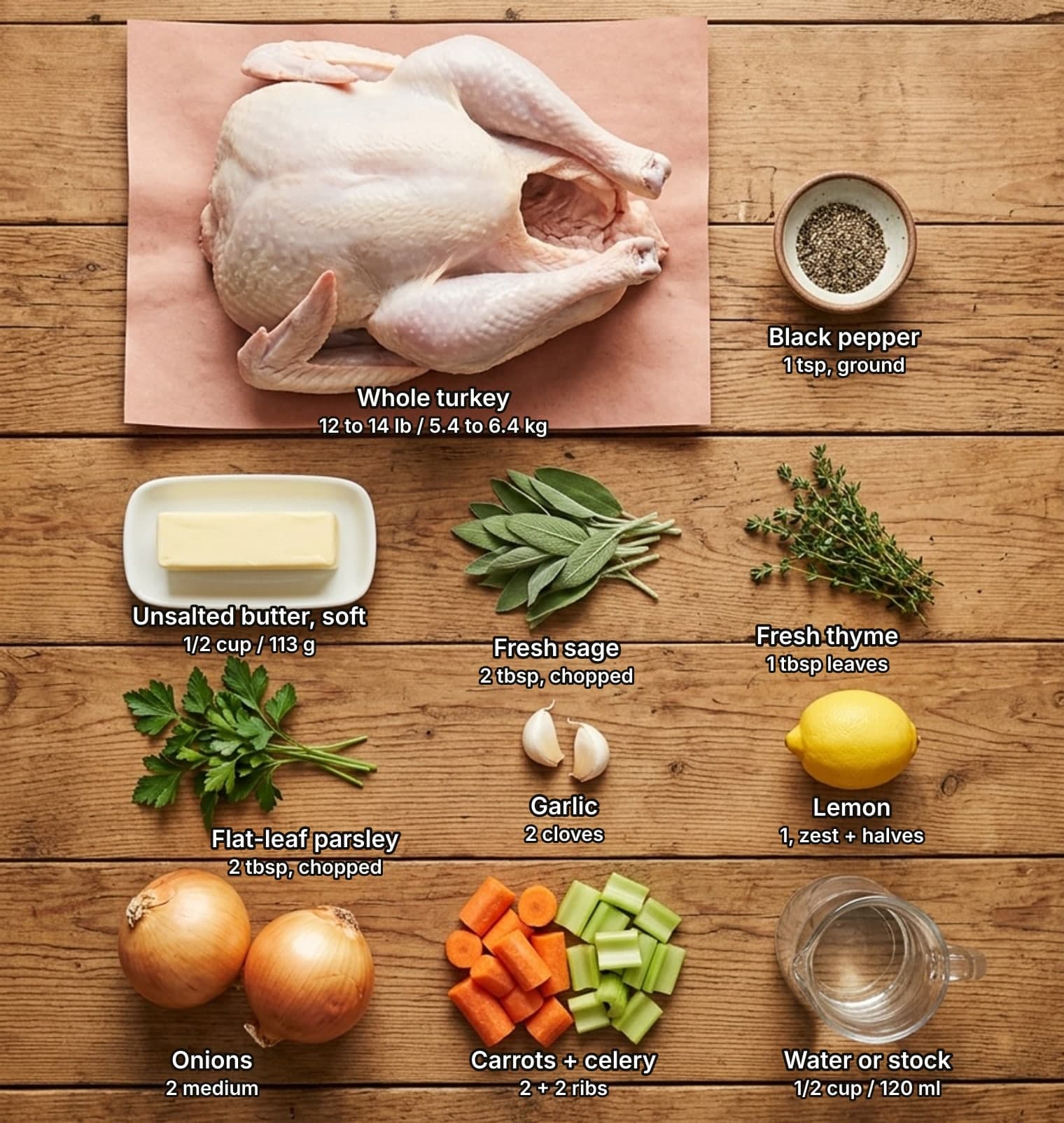
- whole turkey, fully thawed, neck and giblets removed from BOTH cavities (keep them for gravy stock). Read the label first: if it says kosher, self-basting, or “contains up to X% of a solution”, it is already brined, so skip the dry brine. The label lists what is in the solution: usually salt, sometimes butter (milk), broth or flavorings, so check it for allergens too1 bird, 12 to 14 lb (5.4 to 6.4 kg)
- kosher salt for the dry brine, weighed if you can (brands differ by weight: Diamond Crystal is about 2.8 g per tsp, Morton about 4.8 g). In Europe use any coarse salt by weight. That is about 5 g per kg (about 2.3 g per lb) of bird, 27 to 32 g for a 12 to 14 lb (5.4 to 6.4 kg) bird. Skipping the dry brine on a plain bird? Put 1 tsp Diamond Crystal or 1/2 tsp Morton in the herb butter instead30 g for a 13 lb (5.9 kg) bird: 3 1/2 tbsp Diamond Crystal or 2 tbsp Morton kosher salt
- black pepper, freshly ground (mixed with the salt, or into the herb butter if you skip the dry brine)1 tsp
- unsalted butter, soft enough to spread (contains milk; for dairy-free, brush the skin with olive oil instead, which can’t go under the skin)1/2 cup / 1 stick (113 g)
- fresh sage, finely chopped (or 2 tsp dried: dried herbs are about three times as strong)2 tbsp
- fresh thyme leaves (or 1 tsp dried)1 tbsp
- fresh flat-leaf parsley, finely chopped (leave it out rather than use dried)2 tbsp
- garlic, finely grated2 cloves
- lemon, zest finely grated for the butter; the zested lemon halved for the cavity1
- onion, 1 quartered for the cavity and 1 thickly sliced for under the rack2 medium
- carrots, cut in chunks, and celery ribs, cut in chunks (celery is a major allergen in the UK and EU), for under the rack2 carrots, 2 celery ribs
- water, or unsalted turkey or chicken stock, for the pan (most stocks contain celery; check the label for wheat or barley if you cook gluten-free)1/2 cup (120 ml), plus a splash if the pan runs dry
- optional, for the platter: 1 more lemon, a few sage and thyme sprigs, and a handful of roasted shallots or halved roasted applesto garnish
Roast turkey for 12: the method, and how big a bird to buy
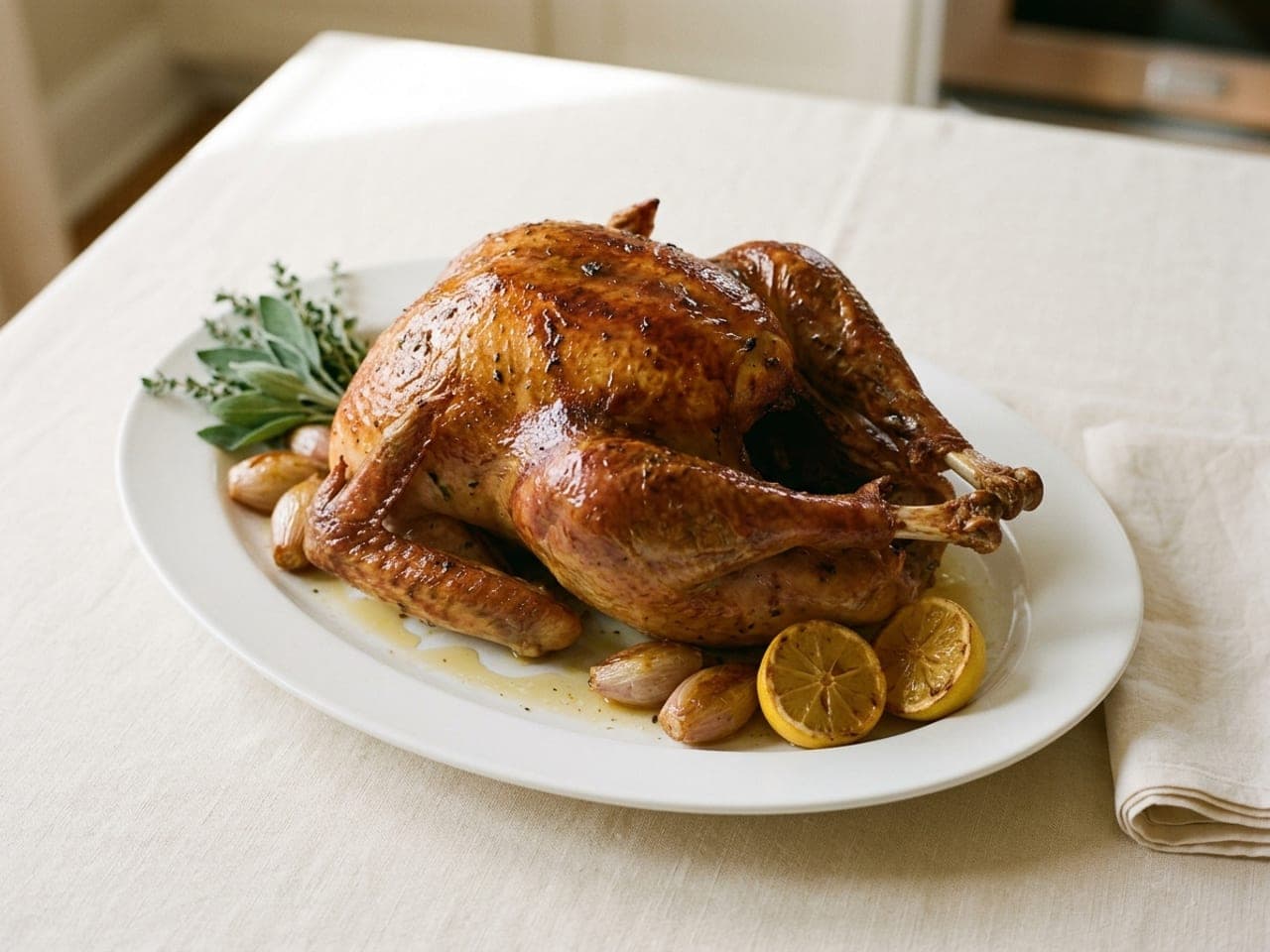
This is a classic roast turkey, the whole bird carried to the Thanksgiving table, done the way a good kitchen does it: salted ahead, buttered under the skin, roasted breast up on a rack at a steady 325°F (163°C), and taken out by thermometer rather than by the clock. Nothing here needs special equipment beyond a roasting pan with a rack and a probe thermometer, and the thermometer matters more than the pan.
How big a bird: USDA FSIS says to allow 1 lb (450 g) of raw turkey per person, so a 12 to 14 lb (5.4 to 6.4 kg) bird serves 12. If you want leftovers for sandwiches, the Butterball Turkey Talk-Line’s rule is about 1 1/2 lb (680 g) per person, which makes the same bird dinner for 8 or 9. Allow 1 1/4 lb (570 g) per person for a frozen pre-stuffed bird (FSIS). The FSIS roasting table starts whole birds at 8 lb (3.6 kg), so for fewer than about 8 people, a bone-in turkey breast is the better buy; see our turkey breast recipe. The table stops at 24 lb (10.9 kg), so for a very big crowd, roast two medium birds rather than one giant. Our turkey calculator does this sizing, and the thawing and roasting times, for your own guest count and dinner time. As written, the roast is gluten-free (check the labels of any stock you add and, for a self-basting or enhanced bird, the ingredients of its solution, which can include butter, broth or flavorings) and contains milk, in the butter; for a dairy-free bird, choose one with no butter in its solution and brush the skin with olive oil instead.
What 1 lb (450 g) a head gives you on the plate: Rutgers Cooperative Extension says 1 to 1 1/2 lb (450 to 680 g) of raw turkey per person yields about 10 oz (283 g) of cooked meat, which is 40 to 60% of the raw weight once bones, fat and cooking losses are gone. A 13 lb (5.9 kg) bird therefore carves to roughly 5 to 8 lb (2.4 to 3.5 kg) of meat and skin: 12 generous 6 oz (170 g) servings, 4 1/2 lb (2 kg) in all, with some left for the next day.
How to make Roast Turkey
- Five days ahead (Saturday): thaw it in the fridge, then read the label. Thaw a frozen bird in its wrapper on a tray on the bottom shelf of the fridge at 40°F (4°C) or colder, allowing about 24 hours for every 4 to 5 lb (1.8 to 2.3 kg): a 12 to 14 lb (5.4 to 6.4 kg) bird needs 3 to 4 days (USDA FSIS). For Thanksgiving on Thursday, November 26, 2026, put it in on Saturday, November 21. It thaws by Tuesday or Wednesday, which leaves 1 to 2 days for the dry brine, and FSIS says a thawed bird keeps 1 to 2 days in the fridge, so it never waits longer than that. (Our turkey calculator gives Sunday, November 22 for a 13 or 14 lb (5.9 or 6.4 kg) bird: that is the latest safe start for a bird you roast without dry-brining. The salt needs the extra day.) Short on time? Submerge the bird, in its wrapper if that is intact or sealed in a leak-proof bag if it isn’t, in cold tap water, allowing about 30 minutes per lb (0.45 kg) and changing the water every 30 minutes, then cook it right away and don’t refreeze it. Never thaw it on the counter. Once thawed, reach into both cavities, the big one and the flap at the neck end, and pull out the neck and the giblet packet. Now read the label. Most whole turkeys in US supermarkets are sold “enhanced”: injected with salt water (“contains up to 8% of a solution”, “self-basting”), and kosher birds are salted during processing. Those are already brined; skip step 2 and go straight to step 3 on roasting day. Don’t rinse the bird: USDA advises against washing raw poultry, because splashing spreads bacteria around the sink and counter, and only cooking kills them (the UK’s Food Standards Agency says the same). Why this matters: the label decides the salt, and the salt decides the gravy (step 7).
- One to two days ahead: dry-brine a plain bird, then let the skin dry. Pat the bird dry with paper towels. Mix the salt with the pepper and sprinkle it evenly over the whole bird, about two-thirds on the breast and thighs where the meat is thickest, and a little inside the cavity. Slide your fingers under the breast skin from the neck end to loosen it (you’ll need the pocket for the butter anyway) and put some of the salt directly on the meat. Set the bird on a rack over a tray or in the roasting pan, cover it loosely, and refrigerate it on the bottom shelf, with no ready-to-eat food below or beside it, for 1 to 2 days (24 to 48 hours), which keeps a thawed or fresh raw bird inside FSIS’s 1-to-2-day fridge window; for the last 8 to 24 hours, uncover it so the skin dries. Why: salt dissolves some of the muscle proteins near the surface, so the meat squeezes out less juice as it cooks, and it seasons deeper than salt added at the table. We use about 0.5% of the bird’s weight, between Russ Parsons’ 1 tbsp Diamond Crystal per 5 lb (2.3 kg) and America’s Test Kitchen’s 1 tsp kosher salt per lb (0.45 kg), measured as Diamond Crystal, which reads as seasoned but not cured. Weigh it if you can, because a tablespoon of Morton weighs about 70% more than a tablespoon of Diamond Crystal. The uncovered night in the fridge is what gives you crisp, bronzed skin: dry skin browns, wet skin steams.
- Roasting day: herb butter under the skin, not just on it. Take the bird out of the fridge only when you are ready to work on it; there is no need to let it sit for an hour, which warms the surface into the danger zone while the center moves by a degree or two. Heat the oven to 325°F (163°C) with a rack in the lowest position, so the bird sits in the middle of the oven. Mash the soft butter with the sage, thyme, parsley, garlic and lemon zest, or use the herb butter you made ahead. If you skipped step 2, mix the pepper into the butter too, and, for a plain bird that is not pre-brined, 1 tsp Diamond Crystal or 1/2 tsp Morton kosher salt. Work two-thirds of it under the loosened breast skin with your fingers and press from the outside to spread it into an even layer, then rub the rest over the thighs and drumsticks. Put the quartered onion, the lemon halves and any herb stems loosely into the cavity; loosely, so hot air can move through it. Tuck the wing tips behind the shoulders (FSIS calls it “akimbo”), which keeps them from scorching. Leave the legs untied, or tie the drumstick ends together loosely: a tight truss presses the thighs against the body, and the thighs are already the part that finishes last. Why the butter goes under the skin: the skin is a waterproof sheet, so butter on top mostly runs into the pan. Under the skin it flavors the meat and helps the skin brown from beneath.
- Set up the pan: a rack, vegetables and just 1/2 cup (120 ml) of water. Scatter the sliced onion, carrots and celery in a sturdy, shallow roasting pan (roasting tin), set a V-rack or flat rack over them, and put the bird on it breast side up. Pour in 1/2 cup (120 ml) of water or unsalted stock, the amount USDA’s own “Let’s Talk Turkey” guide suggests. Insert a leave-in probe thermometer into the thickest part of the inner thigh, angled toward the body and not touching bone (bone reads high); FSIS puts the probe there because the thigh finishes last. Why the rack and the little water: the rack lifts the bird so hot air reaches the underside and the back doesn’t stew in its own juices. The vegetables and the half cup of liquid keep the first drippings from scorching before the bird has released its own, and they build the base for the gravy. That much water does not steam the bird. A deep bath of stock, or a lid, does: the skin stays pale and the drippings get diluted, which is the Butterball Turkey Talk-Line’s reason for adding none. Half a cup (120 ml) is the middle way both camps’ reasons support.
- Roast at 325°F (163°C) and shield only the breast. Roast the bird breast side up the whole time, without flipping or basting; turning a hot 13 lb (5.9 kg) bird is a burn risk, and the foil shield below does the same job. America’s Test Kitchen tested it: “Basting does little to make the bird more moist,” and every time the door opens the oven loses heat, which lengthens the cook. Plan on 3 to 3 3/4 hours for a 12 to 14 lb (5.4 to 6.4 kg) unstuffed bird, the USDA FSIS figure at this temperature, but start reading the thermometer at 2 1/2 hours, because a dry-brined, unstuffed bird with a probe often gets there before the clock says so. When the breast skin is the color you want lay a loose sheet of foil over the breast only, shaped like a shield with its point toward the legs. This is an old trick: Hannah Glasse told cooks in 1748 to “pin some white Paper on the Breast till it is near enough.” Why only the breast: the white meat is thinner, sits on top, and is done at a lower temperature than the dark meat, so it runs ahead. The shield slows it down while the legs catch up. Don’t seal the whole bird in foil; trapped steam softens the skin. If the pan runs dry and the drippings start to smoke, carefully add a splash of hot water down the side of the pan, away from you; cold water hitting smoking fat will spit.
- Check three places, then take it out at the right moment. The bird is ready to come out when the innermost thigh reads 170 to 175°F (77 to 79°C) and the thickest part of the breast reads 157 to 160°F (69 to 71°C). Check both sides of the bird, since the side facing the oven wall runs ahead, and check the innermost part of the wing joint too. These are FSIS’s three spots. For the breast, slide the thermometer in from the neck end, parallel to the pan, until the tip sits in the center of the thickest part. Why two numbers: the safe temperature for all turkey meat is 165°F (74°C) (USDA FSIS). The thigh goes past it on purpose, because its connective tissue needs the extra heat to turn tender. The breast is the part that dries out, and it keeps climbing once it leaves the oven, by anywhere from about 5 to 15°F (3 to 8°C). Taken out at 157 to 160°F (69 to 71°C), the breast should climb to 165°F (74°C) or a little above as it rests. Check that it does (step 7); if it doesn’t, it goes back in. An uncovered bird, the way this recipe rests it, carries over less than a tented one, so take it out nearer 160°F (71°C) unless you plan to tent it. Stuffed the bird? The early pull doesn’t apply: keep roasting until the center of the stuffing reads 165°F (74°C) in the bird, whatever the breast says (see the stuffing note). Pop-up timers are not a substitute; FSIS asks you to check with a thermometer even when the button has popped.
- Rest it 30 to 45 minutes and make the gravy. The pan is heavy and full of hot fat: slide the oven rack out and lift the pan with both hands, keeping it level. Wearing oven mitts, tilt the bird with tongs or a wad of paper towels so the juices in the cavity, which are near boiling, run into the pan away from you, then lift it onto a carving board with a juice groove. Rest it for 30 to 45 minutes. FSIS suggests 20 minutes, for quality, so the juices set and it carves more easily; a big bird rewards longer. During the rest, check that the breast has reached 165°F (74°C); in one thermometer seller’s test, two small birds peaked 13 and 24 minutes into the rest. If it stalls below 165°F (74°C), return the bird to the oven for 10 minutes and check again. Tent it loosely with foil only if the rest will run past 45 minutes or the kitchen is cold: America’s Test Kitchen skips the tent because it “will make the skin soggy”, and in the same seller’s test, three small tented birds were still at 147 to 151°F (64 to 66°C) after 90 minutes. Use the rest for the gravy: carefully pour the hot drippings through a sieve into a heatproof jug, let the fat rise, and follow our turkey gravy recipe. If the bird was dry-brined, kosher or enhanced, taste the defatted drippings before you add them, because they can be too salty to use at full strength; the gravy page shows how to build it on unsalted stock and season with the drippings to taste.
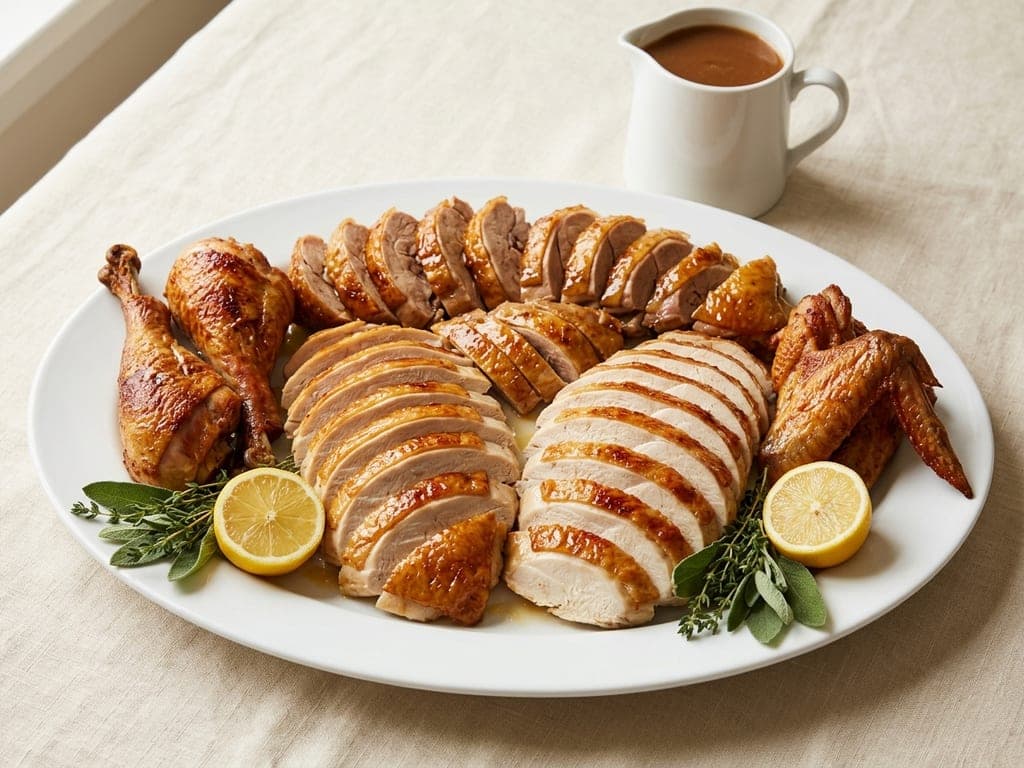
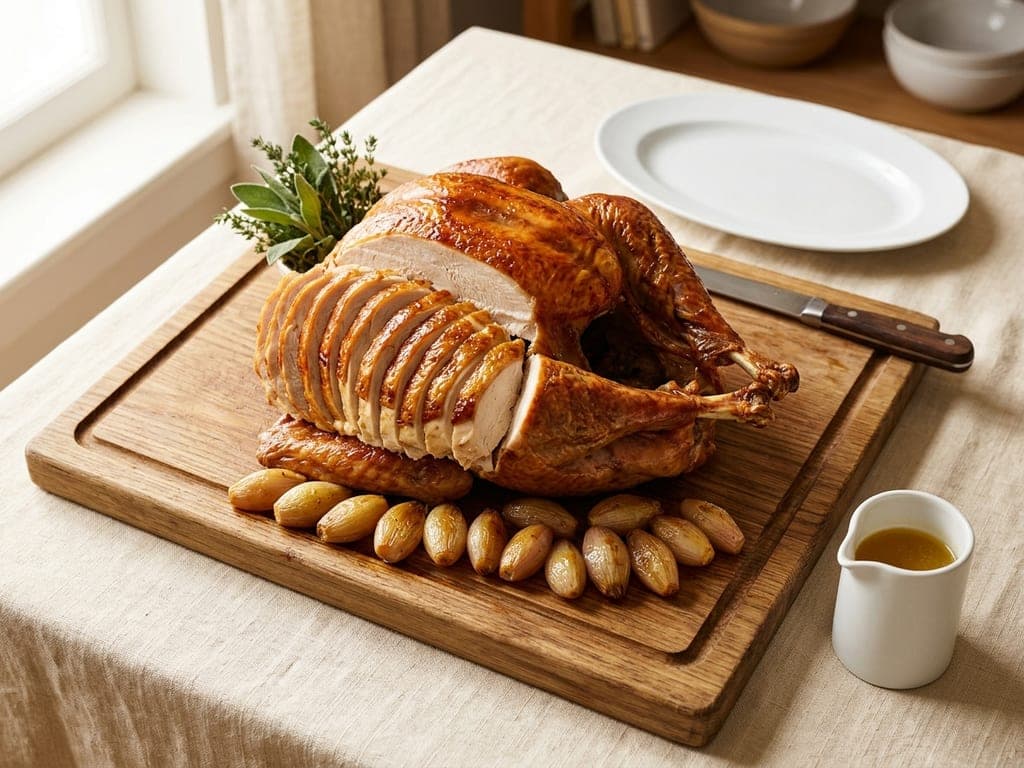
- Carve it the restaurant way: breast off whole, sliced across the grain. Use a long, sharp carving or chef’s knife, 8 to 10 inches (20 to 25 cm), tongs or a clean kitchen towel to steady the bird (a carving fork works too), and a board with a juice groove, or any board set inside a rimmed sheet pan. Legs first: cut through the skin between thigh and breast, pull the leg outward until the hip joint pops, then cut through the joint, scooping the knife close to the backbone to keep the oyster (the small, tender nugget of dark meat on the back) attached. Cut through the knee joint to separate drumstick and thigh, following the thin line of fat. Turn the thigh skin side down, cut along both sides of the bone, lift the bone out, and slice the boneless thigh crosswise. Breast next: cut straight down along one side of the breastbone, then follow the rib cage with the tip of the knife, peeling the meat away as you go, until the whole breast half comes off in one piece. Lay it skin side up and slice it across the grain about 1/4 to 1/2 inch (6 mm to 1.3 cm) thick. Repeat on the other side, then take the wings off at the shoulder joint. Why take the breast off whole: slicing thin from the standing carcass cuts along the grain, which a Philadelphia turkey seller told The New York Times leaves the pieces “all stringy”; slicing a whole breast half crosswise gives short fibers, even slices, and a strip of crisp skin on every one. Arrange it on a warm platter and spoon a little hot stock or jus over the meat (see our au jus guide) to keep it glossy while the table gathers.
Safety & hygiene Important
- 165°F (74°C) in three places, and what an early breast pull does and doesn’t mean. USDA FSIS: a whole turkey is safe at a minimum internal temperature of 165°F (74°C), “as measured with a food thermometer”, checked “in the innermost part of the thigh and wing and the thickest part of the breast.” Always confirm the breast reaches 165°F (74°C) during the rest; if it stalls below, put the bird back in the oven. This recipe takes the breast out at 157 to 160°F (69 to 71°C) so that it can rise there as it rests. The science behind it comes from FSIS’s time-and-temperature tables for turkey, which FSIS publishes for food processors, not as home-cooking advice. They give the time needed for a 10-million-fold (7-log) kill of Salmonella: under 10 seconds at 165°F (74°C), about 48 seconds at 157°F (69°C) and about 3.7 minutes at 150°F (66°C). A breast taken out at 157 to 160°F (69 to 71°C) spends many minutes above those temperatures as it rests and climbs. That is why the early pull is safe, provided the breast then reaches 165°F (74°C). It does not mean you can serve a breast that tops out at 150°F (66°C): the tables assume every part of the meat holds that temperature, and home thermometers and probe placement are not that precise. Nor does it apply to a stuffed bird (see the stuffing note). Turkey can stay pink even when it has reached 165°F (74°C) (FSIS), so in the US the thermometer is the test, not the color or a pop-up timer. In the UK, the Food Standards Agency’s test is that the bird is steaming hot all the way through, with no pink meat in the thickest part and juices that run clear; with a probe, it accepts 70°C (158°F) held for 2 minutes or 75°C (167°F) for 30 seconds, among other time and temperature pairs. Those pairs are the same time-at-temperature idea: a breast that climbs to 74°C (165°F) during the rest passes 70°C (158°F) on the way up and should stay above it for well over 2 minutes. The FSA’s no-pink check is stricter than the US view that safely cooked turkey can stay pink, so if you are cooking to UK guidance, use the thermometer and the no-pink check together, and if the thickest part is still pink, keep cooking.
- Thawing, cooking from frozen, and the hour on the counter. Thaw only in the fridge, in cold water changed every 30 minutes (in its wrapper if that is intact, or sealed in a leak-proof bag), or in the microwave, and cook water- or microwave-thawed birds right away, without refreezing (USDA FSIS). Never on the counter: the outside sits in the danger zone, 40 to 140°F (4 to 60°C), long before the center thaws. A fridge-thawed bird keeps 1 to 2 more days in the fridge, which is why the dry brine here runs 1 to 2 days, not 3. If you run out of time, you can roast it from frozen: FSIS says it takes “at least 50 percent longer” than a thawed bird, and you pull the giblet packets out with tongs partway through. You can’t salt a frozen bird or butter it under the skin, so brush the skin with butter or oil once it has thawed enough. If a plastic giblet bag melts in the oven, FSIS says not to eat the giblets or the turkey. The common advice to leave the bird out for an hour before roasting buys almost nothing: by our estimate a 4-inch (10 cm) breast warms by only about 1 to 2°F (1°C) at the center in an hour, while the surface spends that hour warming, and it uses up part of the 2-hour limit FSIS sets for perishable food at room temperature. Take it out when you are ready to butter it.
- Stuffing inside the bird. FSIS does not recommend stuffing a turkey, because the stuffing in the middle of the bird heats last and must itself reach a safe minimum of 165°F (74°C). By the time it does, the breast is usually overcooked. Bake it in a dish instead. If you do stuff it, mix the wet and dry ingredients just before filling, fill the cavities loosely, roast immediately, check the very center of the stuffing for 165°F (74°C) as well as the meat. The stuffing has to reach 165°F (74°C) in the oven, so a stuffed bird is not a candidate for the early breast pull: keep roasting until the center reads 165°F (74°C), and don’t count on the rest to finish it. Don’t scoop out underdone stuffing to finish in a dish either, because it can contaminate the cooked meat (FSIS). Then allow for the longer stuffed times in the chart above, and take all the stuffing out after roasting. Never stuff a bird the night before, and don’t buy a fresh pre-stuffed bird. Frozen pre-stuffed birds that carry the USDA or State inspection mark are the exception: cook them from frozen, following the package. The UK’s Food Standards Agency goes further: cook the stuffing in a separate roasting tin, not inside the turkey.
- Raw poultry in the kitchen. Don’t rinse the turkey: USDA advises against washing raw poultry, because splashing spreads bacteria across the sink and counter, and roasting to 165°F (74°C) is what kills them. Keep the bird on a tray on the bottom shelf of the fridge so its juices can’t drip onto ready-to-eat food. Use a separate board for raw turkey, and after handling it or the giblets, wash your hands for 20 seconds and wash the board, knives, sink and anything else it touched with hot, soapy water (FSIS: “Always wash hands, utensils, the sink, and anything else that comes in contact with raw turkey and its juices with soap and water”). Clean the thermometer probe after each reading of a raw bird.
- Holding, leftovers and reheating: the US and UK windows differ. Count the 2 hours from when the bird comes out of the oven, not from when dinner starts, so a 45-minute rest uses up part of it. That is FSIS’s own count: “Refrigerate the cooked turkey and stuffing within 2 hours after cooking.” FSIS: “Discard any turkey, stuffing, and gravy left out at room temperature longer than 2 hours; 1 hour in temperatures above 90 °F” (32°C). Keep what is on the table hot at 140°F (60°C) or above (US); the UK’s legal hot-holding temperature for food businesses is 63°C (145°F). Strip the meat off the bones, divide it into shallow covered containers so it cools quickly, and refrigerate it. US (FSIS): use refrigerated turkey within 3 to 4 days, or freeze it and use it within 2 to 6 months for best quality; reheat it to 165°F (74°C), in an oven no lower than 325°F (163°C), with a little broth and a lid to keep it moist. UK: the Food Standards Agency says to cool leftovers and get them into the fridge or freezer within 1 to 2 hours, eat them within 48 hours or freeze them, reheat them only once, until steaming hot all the way through, and eat defrosted leftovers within 24 hours.
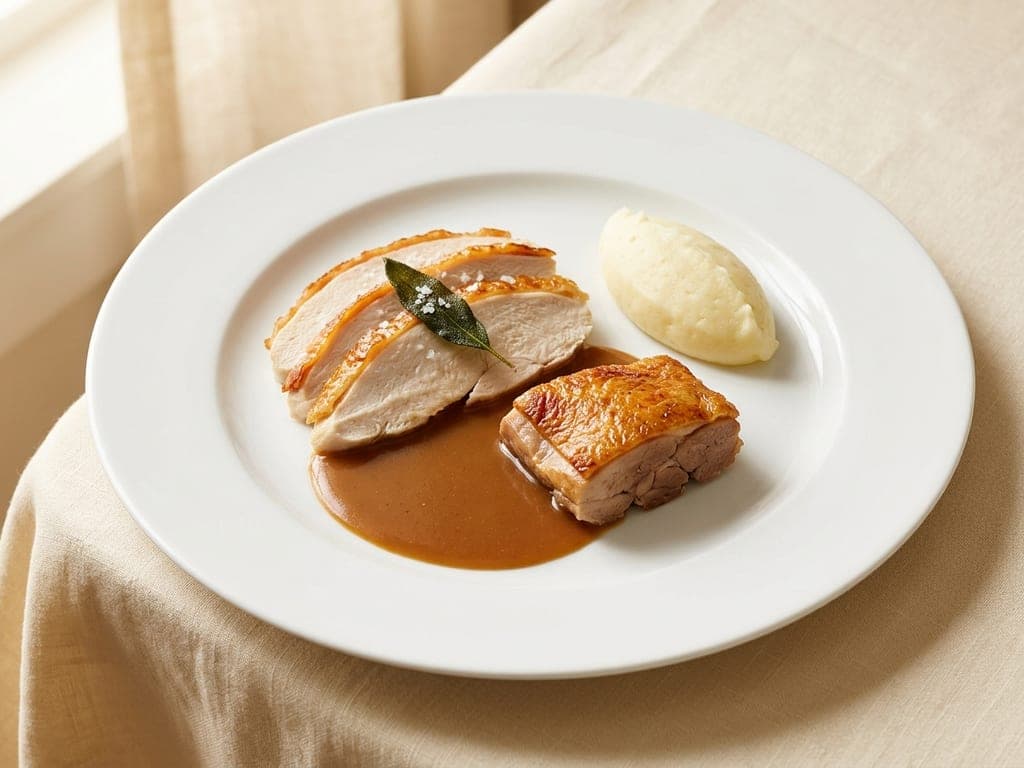
3 ways to plate it
How long to cook a turkey per pound (and why no single number is right)
Search for turkey roasting times and you will find 10 to 12, 14 and 15 to 20 minutes per pound at 325°F (163°C), and 13 at 350°F (177°C). They can’t all be right, and in a sense none of them is, because the time a turkey takes does not grow in step with its weight. Heat travels into a roast by conduction, and the time it takes to reach the center grows with the square of the thickness, while the weight grows with the cube. As the climate scientist Andrew Dessler put it in his essay “Cook like a physicist”, the time “scales with mass to the 2/3rds power.” Double the weight of the bird and you don’t double the time; you multiply it by about 1.6.
USDA FSIS’s own timetable, the one the agency publishes for a 325°F (163°C) oven, follows that physics closely: fit a curve through its band midpoints and the time grows with weight to the power 0.65, almost exactly the textbook two-thirds. Unstuffed: 8 to 12 lb (3.6 to 5.4 kg), 2 3/4 to 3 hours; 12 to 14 lb (5.4 to 6.4 kg), 3 to 3 3/4 hours; 14 to 18 lb (6.4 to 8.2 kg), 3 3/4 to 4 1/4 hours; 18 to 20 lb (8.2 to 9.1 kg), 4 1/4 to 4 1/2 hours; 20 to 24 lb (9.1 to 10.9 kg), 4 1/2 to 5 hours. Stuffed: 3 to 3 1/2, 3 1/2 to 4, 4 to 4 1/4, 4 1/4 to 4 3/4 and 4 3/4 to 5 1/4 hours for the same bands.
Work out the minutes per pound at the middle of each band and the drift is plain: about 17 minutes per lb (38 per kg) for a 10 lb (4.5 kg) bird, 15 1/2 at 13 lb (5.9 kg), 15 at 16 lb (7.3 kg), 14 at 19 lb (8.6 kg) and 13 minutes per lb (29 per kg) at 22 lb (10 kg). So “15 to 20 minutes per pound” fits small birds, “13 to 15” fits the 14 to 24 lb (6.4 to 10.9 kg) birds most people buy, and “10 to 12” falls short of FSIS for every bird up to about 22 lb (10 kg): for a 16 lb (7.3 kg) bird it gives 2 hours 40 minutes to 3 hours 12 minutes, against FSIS’s 3 3/4 to 4 1/4 hours, as much as an hour and a half short. And the “13 minutes per pound at 350°F, according to USDA” line you may see online can’t come from the FSIS timetable, which has no 350°F (177°C) column.
Use the chart to plan the day, not to decide when the bird is done. Ovens run hot or cool, birds come in different shapes, and a dry-brined bird that went in cold from the fridge is not the same as one that sat out. Start reading the thermometer 30 minutes before the bottom of your band, and take the bird out when the numbers in step 6 say so. If it is ready early, tent it loosely and let it wait: in one thermometer seller’s test, three small tented birds were still at 147 to 151°F (64 to 66°C) after 90 minutes, and that is exactly when you need the oven for the sides.
325 or 350? Foil, water in the pan and basting, settled
325 or 350: both are safe, and the done temperature doesn’t change with the oven. FSIS says to set the oven “no lower than” 325°F (163°C), its timetable is written for 325°F (163°C), and USDA’s own nutrient studies roasted whole birds at that temperature too. At 350°F (177°C) the bird cooks a little faster, but the gap between the outside and the center gets steeper: more of the outer breast overshoots while you wait for the thighs, and the bird carries over more after it comes out. On a whole bird, where the breast is always racing the legs, 325°F (163°C) is the more forgiving choice, and a dry, salted skin browns well at it over 3 hours. A hot oven makes sense for a spatchcocked (butterflied) bird roasted flat, commonly at around 450°F (232°C): lying open, legs out toward the heat, its breast and thighs finish together in less than half the time, but you give up the whole bird at the table.
Foil: a steering tool, not a moisture tool. FSIS’s roasting guide offers both timings, a tent “for the first 1 to 1 ½ hours” if your pan has no lid, or foil placed over the bird “after it reaches the desired color.” We use a loose shield over the breast only, once it is the color you want, because the breast is the part that runs ahead. A fully sealed bird steams, and the skin goes soft. The only thing that keeps the breast juicy is taking it out at the right temperature.
Water in the pan: a little, not a lot. FSIS suggests adding 1/2 cup (120 ml) of water to the bottom of the pan. Butterball’s Turkey Talk-Line recommends none, calling cooking with steam acceptable but not its preferred method. Both are right about their own amounts. Half a cup (120 ml) in a wide pan stops the first drippings from burning and evaporates long before it can steam the bird; two quarts (1.9 liters) of stock turns roasting into braising, with pale skin and watery drippings.
Basting: skip it. America’s Test Kitchen roasted turkey breasts basted and unbasted and found basting “does little to make the bird more moist” and made the turkey take longer, because the door kept opening. The juice you spoon over the skin runs straight back into the pan; the salt already in the meat is what holds the juice in.
Two meats, one bird: the temperatures that matter
A turkey is two different meats sharing one oven. The breast is lean, with about 2 g of fat per 100 g roasted (USDA FoodData Central), and dries out as it goes past done. The dark meat has about 6 g of fat per 100 g and plenty of connective tissue, and it gets more tender with a few extra degrees. So one number can’t serve both, and the safe number isn’t the best number for either.
Safe: 165°F (74°C), in the thickest part of the breast, the innermost thigh and the innermost wing (USDA FSIS). That is the instant-kill temperature for Salmonella. FSIS’s time-at-temperature tables for turkey, which it publishes for food processors rather than home cooks, give the time for the same 10-million-fold (7-log) kill of Salmonella at lower temperatures: under 10 seconds at 165°F (74°C), about 26 seconds at 160°F (71°C), about 48 seconds at 157°F (69°C), about 1.2 minutes at 155°F (68°C) and about 3.7 minutes at 150°F (66°C).
Best: take the bird out when the thigh reads 170 to 175°F (77 to 79°C), the range America’s Test Kitchen uses for tender dark meat, and the breast reads 157 to 160°F (69 to 71°C). The thermometer maker ThermoWorks pulls the breast at 157°F (69°C); we don’t go lower, because at a gentle 325°F (163°C) the carryover is at the small end of its range and a breast pulled much earlier may not make it to 165°F (74°C). The breast should then rise to 165°F (74°C) or a little above as it rests, spending minutes, not seconds, above the temperatures in that table on the way. That is carryover cooking: heat stored in the hot outer layers keeps moving inward after the bird leaves the oven. Expect anywhere from about 5 to 15°F (3 to 8°C) in the breast, more with a bigger bird, a hotter oven or a foil tent. In one UK test by a thermometer maker, two 4 to 4.5 kg (8.8 to 9.9 lb) birds roasted at 180°C (356°F) and rested under foil rose 6 and 8°C (11 and 14°F), peaking 13 and 24 minutes into the rest. Confirm the breast has reached 165°F (74°C) before you carve; if it hasn’t, it goes back in.
Where to probe: the thigh at its thickest, inside, next to the body, without touching bone; the breast from the neck end, parallel to the pan, into the center of its thickest part; and the wing at the joint. Check both sides of the bird. If your turkey is still a little pink at 165°F (74°C), it can be: FSIS notes that turkey can stay pink after reaching a safe temperature, and dry-brined meat can look slightly pink near the surface. The thermometer is the test.
Brine or not? Read the label before you salt
Most of the whole turkeys sold in US supermarkets are already brined. USDA’s own researchers, buying birds for their nutrient study, noted that, by industry estimates, about 98% of retail whole turkeys are enhanced with sodium-containing solutions, and non-enhanced birds were hard to find. A frozen Butterball, for example, “Contains up to 8% of a solution of Water, Salt, Spices, and Natural Flavor.” Kosher birds are salted during processing. The result shows in the numbers: roasted, meat and skin, an enhanced turkey has 224 mg of sodium per 100 g against 103 mg for a plain bird (USDA FoodData Central), more than twice as much before you add a grain of salt. So check the label for “kosher”, “self-basting”, “enhanced” or “contains up to X% solution”, and if you find any of them, don’t brine. Butter it and roast it. The same label lists what is in the solution, which can include butter or broth as well as salt, so it is also where you check for allergens.
For a plain bird, we dry-brine rather than wet-brine. A wet brine works, and America’s Test Kitchen’s is 1 cup (292 g) of table salt in 2 gallons (7.6 liters) of cold water for 6 to 12 hours, but it needs a container and fridge space most kitchens don’t have in November, and the extra juice it adds is plain water. Salting the bird dry does the same job for the meat, needs only fridge space, and gives crisper skin because the surface dries out. Use about 0.5% of the bird’s weight in salt, 5 g per kg (about 2.3 g per lb): between Russ Parsons’ original dry-brined “Judy Bird” rate (1 tbsp Diamond Crystal per 5 lb (2.3 kg)) and America’s Test Kitchen’s (1 tsp kosher salt per lb, 0.45 kg, measured as Diamond Crystal, for 24 to 48 hours). Give it 1 to 2 days, uncovered for the last night, which keeps the raw bird inside FSIS’s 1-to-2-day fridge window.
Brining changes the drippings. Every salted bird, whether you salted it or the processor did, gives saltier pan juices. Build the gravy on unsalted stock, taste the defatted drippings, and add them to taste; our turkey gravy recipe walks through it.
The Thanksgiving countdown
For dinner on Thursday, November 26, 2026, with a 12 to 14 lb (5.4 to 6.4 kg) frozen bird. Saturday, November 21: move it to the fridge on a tray to thaw (3 to 4 days at 40°F (4°C) or colder; FSIS allows a thawed bird 1 to 2 more days in the fridge, so this lands on Thursday either way). Our turkey calculator says Sunday, November 22 for a 13 or 14 lb (5.9 or 6.4 kg) bird, which is the latest start without a dry brine; the salt needs the extra day. Buying fresh instead? FSIS says to buy it only 1 to 2 days before you cook it, so buy it on Tuesday or Wednesday and salt it the day you bring it home. Tuesday, November 24, or Wednesday morning at the latest, as soon as it has thawed (no ice crystals in the cavity): take out the giblets, read the label, and dry-brine a plain bird. Make and refrigerate the herb butter; make the gravy stock from the neck and giblets if you like. Wednesday night: uncover the bird so the skin dries.
Thursday, with dinner at 5 pm: take the herb butter out to soften at about 11:30 am. At 12:10 pm, heat the oven, then butter the bird and set up the pan. It goes in at 12:30 pm, and you start checking at 3:00 pm. With FSIS’s 3 to 3 3/4 hours it comes out between 3:30 and 4:15 pm; if it is ready early, it waits under a loose tent. Rest it at least 30 minutes while the gravy and the oven-bound sides go on. Carve at about 4:45 pm, serve at 5, and have the leftovers in the fridge within 2 hours of the bird coming out of the oven. Our Thanksgiving timeline tool builds this schedule around your own dinner time.
The turkey at the first Thanksgiving is an 1841 footnote
Everyone says the Pilgrims ate turkey in 1621. The only eyewitness account of that harvest celebration, Edward Winslow’s letter of December 1621, printed in London in 1622 in the book known as Mourt’s Relation, never uses the word. It says the governor “sent foure men on fowling, that so we might after a more speciall manner reioyce together”, that the four men killed in one day as much fowl as, “with a little helpe beside”, served the company almost a week, and that Massasoit’s men “went out and killed five Deere.” The only game it names is fowl and five deer. (Most modern quotations drop the “more” from “a more special manner”; it is in the 1622 text.) William Bradford, writing years later, does record “great store of wild Turkies, of which they tooke many” that autumn, but he is describing the season, not the feast.
The turkey arrives, as far as anyone has found, in 1841. In Chronicles of the Pilgrim Fathers (Boston, 1841), Alexander Young reprinted Winslow’s letter and added a footnote: “This was the first Thanksgiving, the harvest festival of New England. On this occasion they no doubt feasted on the wild turkey as well as venison.” In one note he named the event “the first Thanksgiving” and supplied the turkey, on the strength of Bradford’s remark about the season and his own “no doubt”. Plausible, since wild turkeys were plentiful, but a guess.
Fiction had already set the table. Sarah Josepha Hale’s novel Northwood (1827) describes a New England Thanksgiving where “The roasted turkey took precedence on this occasion, being placed at the head of the table.” Hale spent decades campaigning for a national Thanksgiving and wrote to Lincoln in September 1863; his proclamation of October 3, 1863 set the last Thursday of November and mentions no food at all. By 1896, Fannie Farmer’s Boston Cooking-School Cook Book printed a Thanksgiving menu with roast turkey and cranberry jelly at its heart.
The technique has a longer history than the holiday. Hannah Glasse, in The Art of Cookery (1748 edition), told cooks to pin “white Paper on the Breast till it is near enough”: an early breast shield, and the ancestor of today’s foil. Amelia Simmons’s American Cookery (1796), the first cookbook by an American author, roasted the bird “until a steam emits from the breast” and served it with “cramberry-sauce”. Farmer’s ten-pound (4.5 kg) turkey needed “about three hours”, and if it browned too fast she covered it “with buttered paper”. The pop-up timer came out of California’s turkey industry in the 1960s; Fresno turkey grower George Kliewer patented it in 1964 and an improved version, the Dun-Rite timer, in 1966. Pam Anderson popularized brining the Thanksgiving turkey in Cook’s Illustrated in November/December 1993, and dry brining took off with Russ Parsons’ “Judy Bird” in the Los Angeles Times in 2006. Two stories to retire: Benjamin Franklin never proposed the turkey as the national bird (in a 1784 letter to his daughter he called it “a much more respectable Bird” than the eagle on a medal), and the Cratchits in A Christmas Carol eat a goose; the prize turkey is Scrooge’s gift. The first president to formally “pardon” a turkey was George H. W. Bush, on November 17, 1989.
Questions, answered
How long do you cook a turkey per pound?
At 325°F (163°C), about 13 to 17 minutes per pound (about 29 to 38 minutes per kg) unstuffed, and less per pound the bigger the bird, because cooking time grows more slowly than weight. From the USDA FSIS timetable: 12 to 14 lb (5.4 to 6.4 kg) takes 3 to 3 3/4 hours, 14 to 18 lb (6.4 to 8.2 kg) 3 3/4 to 4 1/4 hours, and 20 to 24 lb (9.1 to 10.9 kg) 4 1/2 to 5 hours. Stuffed birds take a little longer. Use the chart to plan, start checking 30 minutes before the band begins, and let the thermometer decide.
Is it better to cook a turkey at 325 or 350?
325°F (163°C) for a whole bird. It is the temperature USDA’s timetable is written for, and the gentler heat leaves less gap between the breast, which dries out, and the thighs, which finish last. 350°F (177°C) is safe and a little faster, but more of the breast overshoots and the bird carries over more as it rests. The done temperature is the same either way.
Should I cover my turkey with foil?
Not the whole bird. Roast it uncovered so the skin browns, and when the breast is the color you want, lay a loose foil shield over the breast only to slow it down while the thighs catch up. FSIS allows either a tent for the first 1 to 1 1/2 hours or foil once the bird has browned. Don’t wrap it tightly, which steams the skin, and tent it during the rest only if the rest runs long.
Do you put water in the bottom of the roasting pan?
A little. USDA FSIS suggests 1/2 cup (120 ml) of water in the pan, which keeps the first drippings from burning without steaming the bird. Skip the big bath of stock some recipes use: it steams the skin pale and dilutes the drippings, which is why the Butterball Turkey Talk-Line advises against adding water at all. A bed of onion, carrot and celery under the rack plus the half cup of water gives the best base for gravy.
What temperature is turkey done?
165°F (74°C), measured with a thermometer in the thickest part of the breast, the innermost thigh and the innermost wing (USDA FSIS). For the best texture, take the bird out when the thigh reads 170 to 175°F (77 to 79°C) and the breast 157 to 160°F (69 to 71°C); the breast should rise to 165°F (74°C) as it rests. Check that it does before you carve, or it goes back in. A stuffed bird is different: the center of the stuffing must reach 165°F (74°C) in the oven, so there is no early pull.
How long should a turkey rest?
20 minutes is FSIS’s suggestion, for quality; 30 to 45 minutes is better for a 12 to 14 lb (5.4 to 6.4 kg) bird. The temperature keeps climbing for a while (in one thermometer seller’s test, two small birds peaked 13 and 24 minutes into the rest). FSIS’s reason for the stand is “to allow juices to set”, and it says the turkey “will carve more easily.” In the same test, three small tented birds were still at 147 to 151°F (64 to 66°C) after 90 minutes, which frees the oven for the sides. Have it carved, served and the leftovers in the fridge within 2 hours of taking it out of the oven.
Should you baste a turkey?
No. America’s Test Kitchen found basting “does little to make the bird more moist” and makes it take longer, because every time the oven door opens the oven loses heat. Butter under the skin, salt in the meat, and taking it out at the right temperature do far more.
Can I dry-brine a Butterball or a kosher turkey?
No. Both are already salted: a frozen Butterball “Contains up to 8% of a solution of Water, Salt, Spices, and Natural Flavor,” and kosher birds are salted during processing. Salting them again makes the meat and the drippings too salty. Look for “kosher”, “self-basting”, “enhanced” or “contains up to X% solution” on the label; if you see any of them, skip the salt and go straight to the herb butter (made without salt).
How much turkey per person?
1 lb (450 g) of raw bird per person (USDA FSIS), or about 1 1/2 lb (680 g) if you want leftovers (the Butterball Turkey Talk-Line’s rule). A 12 to 14 lb (5.4 to 6.4 kg) bird feeds 12, or 8 to 9 with leftovers. For fewer than about 8 people, roast a bone-in breast; for more than about 24 people, roast two birds.
How long does it take to thaw a turkey, and can you cook it from frozen?
In the fridge, about 24 hours per 4 to 5 lb (1.8 to 2.3 kg): 3 to 4 days for a 12 to 16 lb (5.4 to 7.3 kg) bird. In cold water, sealed in its wrapper or a leak-proof bag, about 30 minutes per lb (0.45 kg), changing the water every 30 minutes: 6 to 8 hours for the same bird, then cook it right away and don’t refreeze it (USDA FSIS). Never on the counter. You can roast a turkey from frozen; FSIS says it takes at least 50% longer, and you pull the giblets out with tongs once they loosen.
How many calories are in roast turkey?
About 368 calories per 6 oz (170 g) serving of meat with skin, as this recipe is written, before gravy. The arithmetic, with the butter and the salt spread the same way, per gram of carved meat: roasted turkey meat and skin is 189 kcal per 100 g (USDA FoodData Central 171479), so 170 g is 321 kcal, 48.5 g protein and 12.6 g fat. A 13 lb (5.9 kg) bird carves to about 6 1/2 lb (2.9 kg) of meat and skin. The 1/2 cup (113 g) of butter adds 810 kcal to the bird (717 per 100 g); spread over that 2.9 kg, it comes to about 47 kcal per 170 g serving, if all of it stayed on the meat, which it doesn’t (much ends up in the drippings). 321 + 47 = 368, so treat 368 as an upper bound. Sodium: 175 mg a serving from the turkey itself (103 mg per 100 g), plus up to about 670 mg from the dry brine (30 g of salt is about 11.6 g of sodium; spread over the same 2.9 kg of meat, that is about 670 mg per 170 g if none were lost to the drippings), so up to about 845 mg. An enhanced supermarket bird with no added salt comes to about 381 mg (224 mg per 100 g). Breast meat alone is leaner: 147 kcal per 100 g without skin.
Snap your finished plate and let the AI plate it again — more beautifully.