Smažený Sýr (Czech Fried Cheese): No-Leak Method, Since 1916
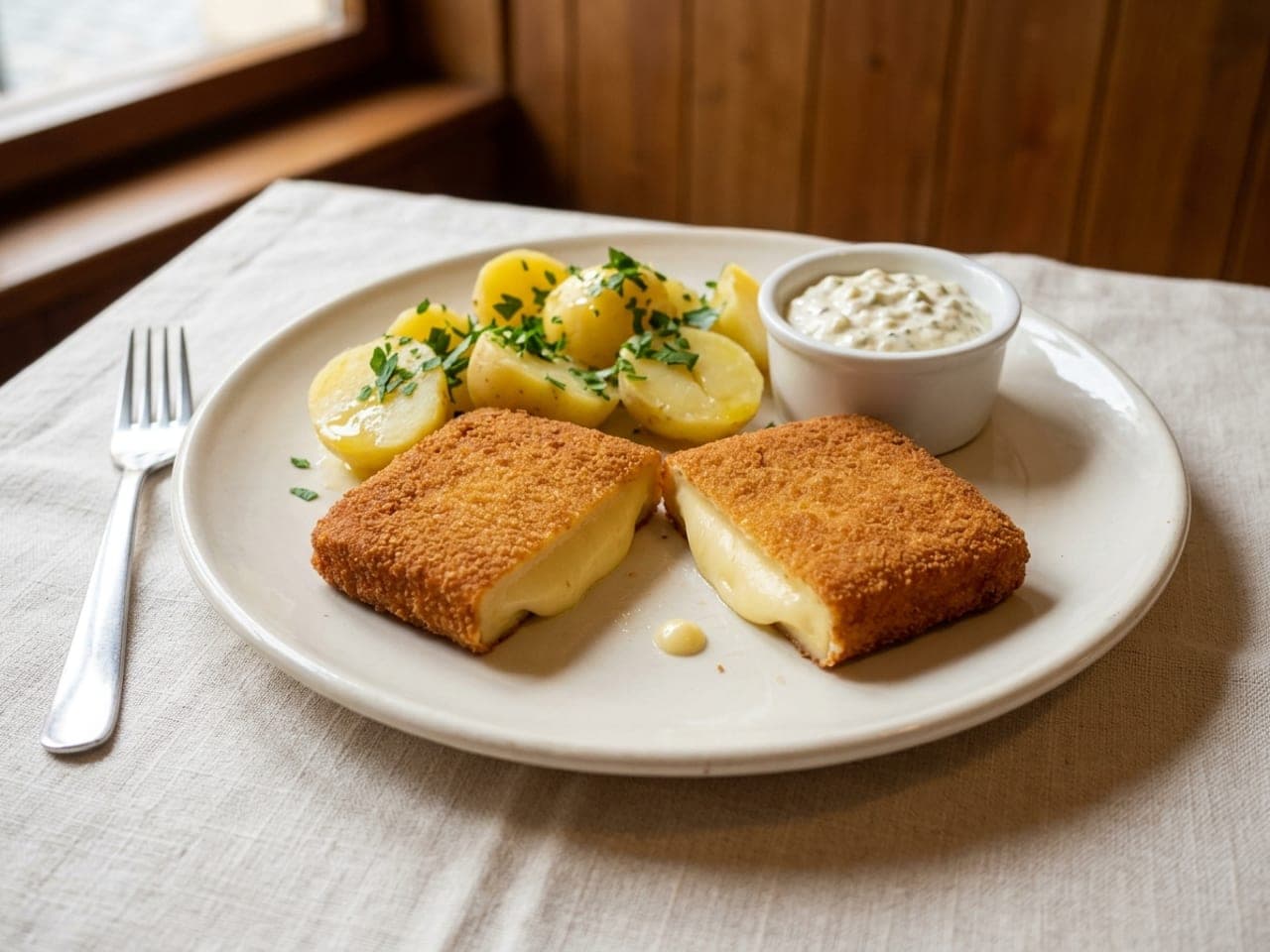
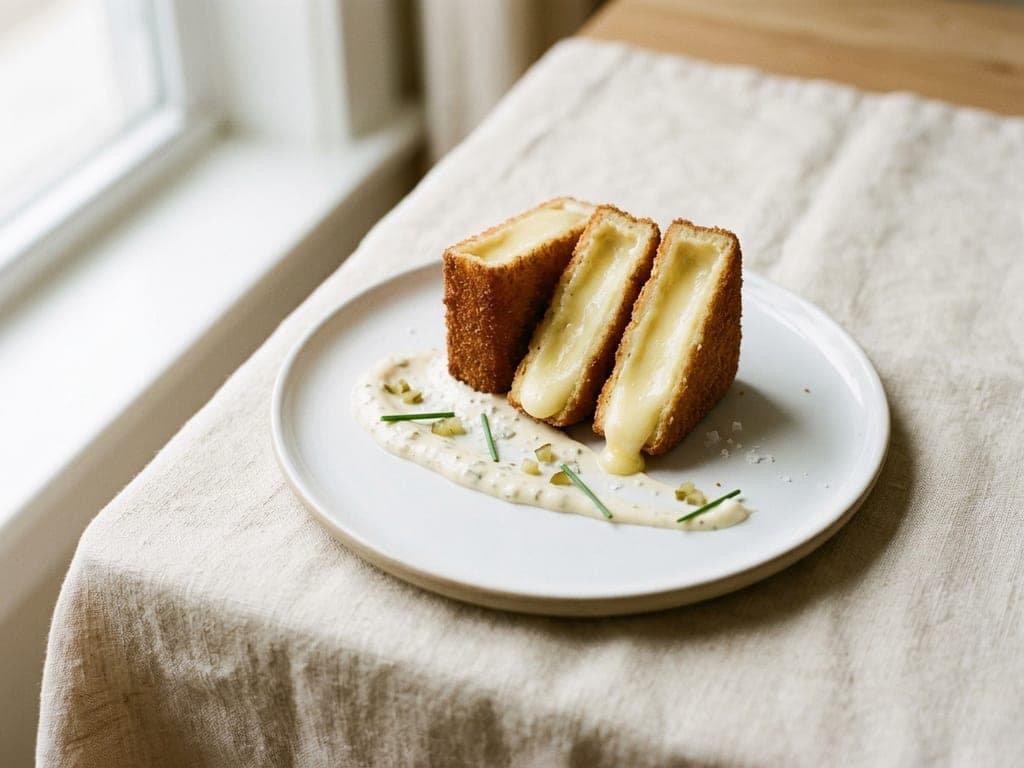
Smažený sýr, the Czech pub classic everyone calls smažák: a thick slab of semi-hard cheese in a double coat of flour, egg and breadcrumbs, fried for about three minutes until the crust is deep gold and the inside runs, then served with tatarka, the rich Czech tartar sauce. This version is built around the two things that go wrong at home. The cheese: Czech eidam 30 % is a low-fat cheese most readers can’t buy, so we match it by the numbers with supermarket cheese. The leak: a 10 to 15 minute rest after breading, the method of a Prague pub chain that fries hundreds a day, sets the crust better than a hard freeze. There’s a from-scratch tatarka, and a history the web gets wrong: fried breaded cheese is in Czech print from 1916, decades before the “post-war canteen invention” story. Contains milk, egg and wheat; the tatarka adds mustard.
Ingredients
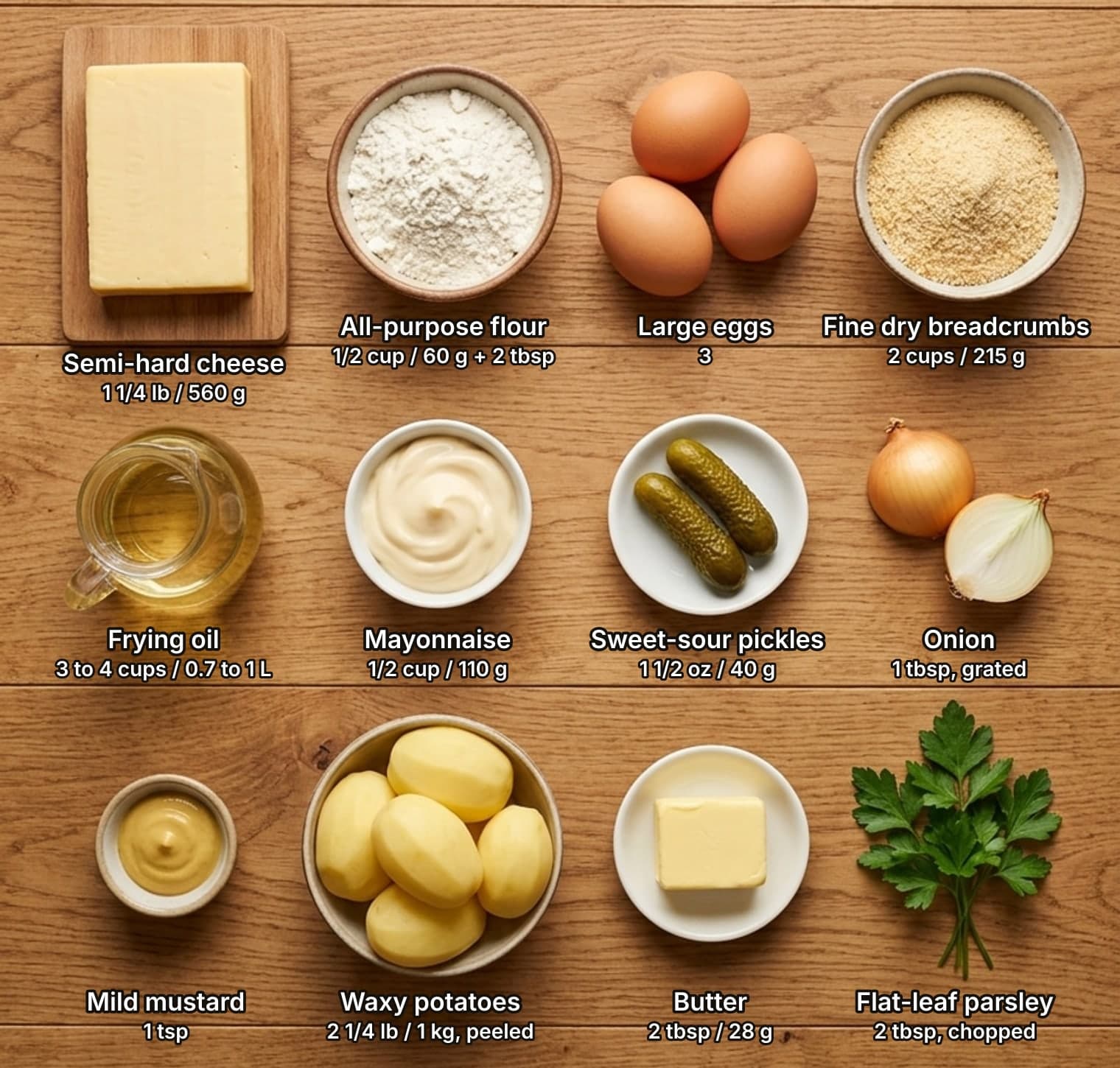
- semi-hard cheese in one block: Czech eidam 30 % (30 % fat in dry matter) if you can get it; in the US, low-moisture part-skim mozzarella (the closest match by fat and water) or Edam or Gouda (richer, runnier); rind or wax removed. Choose microbial (vegetarian) rennet if that matters to you. Contains milk1 1/4 lb (560 g), cut into 4 slabs of about 5 oz (140 g) each
- all-purpose (plain) flour; Czech cooks use polohrubá (semi-coarse) flour, and 1 tbsp fine semolina stirred in gets you close. Contains wheat (gluten)1/2 cup (60 g), plus 2 tbsp for the final crumb mix
- large eggs, beaten very smooth, NOT salted. Contains egg3
- fine dry breadcrumbs (Czech strouhanka; plain, not panko, not seasoned). Contains wheat (gluten); some brands also contain milk or sesame, so check the label2 cups (about 215 g)
- frying fat: refined rapeseed (canola) or refined sunflower oil, or clarified butter (ghee) for the richer Czech pub flavor; lard works but is not vegetarianabout 3 to 4 cups (700 ml to 1 L), enough for a depth of 3/4 inch (2 cm) in a 10- to 11-inch (25 to 28 cm) pan; go by the depth, not the volume
- tatarka: full-fat mayonnaise (jarred, or homemade with pasteurized egg yolk). Contains egg1/2 cup (110 g)
- tatarka: sweet-sour pickles, very finely chopped (Czech sterilované okurky; in the US bread-and-butter pickles or sweet gherkins; in the UK sweet-and-sour gherkins, not sharp cornichons). Jarred pickles may contain sulphites1 1/2 oz (40 g), about 2 small
- tatarka: brine from the pickle jar2 tbsp
- tatarka: onion, grated or chopped as fine as you can1 tbsp (about 10 g)
- tatarka: mild mustard (Czech plnotučná hořčice or Dijon). Contains mustard1 tsp
- tatarka: sugar, fine salt and black peppera pinch of each, to taste
- tatarka, optional: Worcestershire sauce (most brands contain anchovy, so use a vegetarian brand or skip it for a vegetarian plate. Contains fish)a few drops
- jar option instead of the five tatarka lines above: Czech or Polish tatarská omáčka from a deliabout 7 oz (200 g)
- to serve: waxy or all-purpose potatoes for boiled potatoes, peeled2 1/4 lb (1 kg)
- to serve: unsalted butter and chopped flat-leaf parsley for the potatoes. Contains milk2 tbsp (28 g) butter, 2 tbsp parsley
- to serve, optional: soft round rolls for smažák v housce (the fried cheese roll), with lettuce and sliced tomato. Contains wheat4 rolls
What smažený sýr is (and what it isn’t)
Smažený sýr (roughly SMAH-zheh-nee SEER) means simply “fried cheese”, and Czechs shorten it to smažák. It is one slab of semi-hard cheese, most often eidam, breaded in flour, egg and crumbs and fried until the crust is crisp and the inside runs when you cut it. In a Czech pub it comes with tatarka and either boiled potatoes or hranolky (fries); on the street it goes into a soft roll as smažák v housce. Slovakia has the same dish as vyprážaný syr, from the same Czechoslovak kitchen.
It is not mozzarella sticks. A stick is mostly crust with a thin core of stretchy cheese; a smažák is a knife-and-fork main course of about 5 oz (140 g) of cheese, closer to a schnitzel than a snack. Its cousins are the Hungarian rántott sajt, usually made with trappista cheese; the Romanian and Bulgarian cașcaval pane; Slovenian ocvrti sir, served with tartar sauce and fries; and the Austrian and German gebackener Camembert, whose Czech equivalent is smažený hermelín.
Czechs keep the names apart. When the cheese is Hermelín (the Czech Camembert-style cheese), Niva (a Czech blue) or pungent Olomoucké tvarůžky, it stops being smažený sýr and becomes smažený hermelín, smažená Niva or smažené tvarůžky. And despite what travel pieces say, it isn’t the Czech national dish: there isn’t an official one, and svíčková or roast pork with dumplings and sauerkraut is the usual answer. Smažák is the pub staple and the old canteen favorite, and often the only meatless main on the menu.
How to make Smažený sýr (Czech fried cheese with tartar sauce)
- Start the potatoes, then make the tatarka. Put the peeled potatoes, cut into even chunks, in a pot of cold salted water and bring them to a simmer; they take 25 to 30 minutes from cold water. When they’re tender, drain them, put the lid back on and keep them warm on the turned-off burner until the cheese is fried (our boiled potatoes recipe has the details). Then make the tatarka so it has time to settle: stir the chopped pickles, 2 tbsp of their brine, the onion, mustard and a pinch of sugar into the mayonnaise, season with salt, pepper and a few drops of Worcestershire if you use it, and chill it covered. The brine is the Czech move. It thins the sauce to a soft, spoonable texture and brings the sweet-sour note that American tartar sauce, built on dill pickles or relish and lemon, doesn’t have. Taste it after 15 minutes in the fridge, when the onion has calmed down, and add a little more brine if it is stiff.
- Cut four even slabs. Cut the block straight from the fridge, when it is firm and slices cleanly, into 4 slabs 5/8 inch (1.5 cm) thick, about 4 1/4 by 3 inches (11 by 7.5 cm) and 5 oz (140 g) each. Weigh one if you can. Trim off any wax, rind or dry edge: Anuše Kejřová’s 1922 recipe already cut away “the hard edges”, because a dry rim won’t melt and the crust won’t grip it. Thickness is the one number that matters most. At 3/8 inch (1 cm) the cheese liquefies before a crust can set and tends to burst; at 3/4 inch (2 cm) the crust is done long before the middle melts. Five-eighths of an inch (1.5 cm) is the Czech pub slab (Wikipedia gives the same figure), and it’s what the frying times below are built on. Keep the corners square rather than rounded: a clean edge is easier to coat.
- Set up a four-dish breading station. Line up four shallow dishes. First, the 1/2 cup (60 g) flour (with the semolina, if using). Second, the eggs, beaten until completely smooth and no strings of white remain; don’t salt them. The cheese brings plenty of salt, about 1.5 g per 100 g on a Czech eidam label, and Lokál, the Prague pub chain whose kitchens fry around 400 of these a day, marks “no salt in the egg” with an exclamation mark. Third, about half the breadcrumbs. Fourth, the rest of the breadcrumbs mixed with the extra 2 tbsp flour. That last dish is Lokál’s trick: a crumb and flour mix makes a finer, tighter final layer that bonds to the egg better than crumbs alone. Set a wire rack over a tray at the end of the line.
- First coat: flour, egg, crumbs, and seal the edges. Pat each slab dry, then turn it in the flour on both faces and all four edges and tap off the excess: a thin, even film is what the egg sticks to. (If the flour won’t cling to a very dry cut, a quick dip in cold water first fixes it. It’s a common Czech home trick, and the 1934 Janků-Sandtnerová recipe dipped the cheese in milk first.) Dip it in the egg, lift it and let the excess drip back, then lay it in the plain crumbs and scoop crumbs over the top. Don’t press hard. Lokál’s instruction is to bread “without pressure”, because pressing squeezes the soft cheese and thins the coating exactly where you need it. Instead, stand the slab on each edge in turn and roll it through the crumbs, since the edges and corners are where fried cheese cracks and leaks. Set it on the rack and coat the other three.
- Second coat: egg, then the crumb and flour mix. Take each slab through the egg again and then through the crumb and flour mix, edges first, then both faces. This double coat is standard Czech practice (Czech Wikipedia says to repeat it twice or even three times) and it is the single biggest protection against a leak: the second layer covers the pinholes and thin spots the first one left. Check every slab in the light. Any pale patch where you can see the cheese through the crumbs is a future blowout, so dab it with a little egg and press on a pinch of crumbs. Return the slabs to the rack in one layer, not touching.
- Rest the breaded slabs 10 to 15 minutes. Leave the slabs on the rack at room temperature for 10 to 15 minutes while the fat heats. This is Lokál’s method and the step most home recipes skip. During the rest, the crumbs soak up moisture from the egg, and the coating firms into a single shell that clings to the cheese instead of sliding on it; set coatings are what keep cheese in. Chefs there also like the cheese to lose its fridge chill, so the inside melts in about the time the crust needs, with the minute’s rest after frying finishing the job. Freezing the slabs solid, which many recipes suggest, backfires in a pan: our rough heat-transfer estimate (assumed textbook values for a semi-hard cheese, not a lab test) puts the center of a frozen 5/8-inch (1.5 cm) slab at nearly 6 minutes to melt, while the crust is brown in 2 to 3. If your kitchen is very warm, or you’re using a rich, soft-melting cheese such as Monterey Jack or full-fat Edam, rest them uncovered in the fridge instead: a cover traps steam and the coating peels.
- Heat the fat to 350°F (175°C). Pour the fat into a heavy 10- to 11-inch (25 to 28 cm) frying pan or a wide, deep pot to a depth of about 3/4 inch (2 cm), never more than half the pan’s depth, and heat it over medium-high heat to 350°F (175°C). A clip-on or instant-read thermometer takes the guesswork out; without one, a pinch of crumbs should sizzle at once and turn golden in about 30 seconds. The depth matters. Lokál fries smažák in enough fat that the slab is partly submerged and rises as it cooks, unlike a schnitzel in a thin layer, so the edges fry and seal too instead of stewing. Temperature matters more: below about 340°F (170°C) the cheese melts before the crust closes and the coating drinks oil; above about 355°F (180°C) the crust browns while the middle is still firm. Stay with the pan the whole time the fat is on the heat, and keep a lid that fits (or a baking sheet) within reach before you start. If the fat starts to smoke, turn off the heat and let it cool a little: smoke means it’s too hot.
- Fry two at a time, about 3 minutes in all. Lower two slabs into the fat, laying them away from you. Fry for 1 to 1 1/2 minutes, until the underside is a deep, even gold, then turn them once, using two spatulas or a spatula and a fork on the crust (never pierce it), and fry the second side for another 1 to 1 1/2 minutes. When a slab is ready it feels soft and swollen when you press the side gently with a spatula. If you see a bead of cheese at an edge, take it out at once: the crust has done its job and the next 20 seconds are the leak. That is why we don’t give 3 to 4 minutes per side, as some recipes do (fine for a cooler pan, too long at 350°F / 175°C), or “about 20 seconds” (far too short to melt the middle). Let the fat come back to 350°F (175°C) and skim out stray crumbs before the second batch.
- Drain on a rack, rest 1 minute and serve at once. Lift the slabs onto the wire rack, not paper, which traps steam under the crust and softens it. Give them about a minute before plating: the center keeps climbing after the slab leaves the fat, and by our estimate a 5/8-inch (1.5 cm) slab needs that minute to melt right through. Then serve straight away with the buttered, parsleyed potatoes and a generous spoon of tatarka. Don’t fry ahead. A 1964 Czechoslovak milk-bar standard put it bluntly: “Sýr se nikdy nesmaží do zásoby, protože studený smažený sýr je příliš gumovitý” (cheese is never fried in advance, because cold fried cheese is too rubbery). If the four can’t sit down together, serve each pair as it comes out. The center is molten, so cut children’s portions for them and let them stand a minute before serving.
Safety & hygiene Important
- Hot fat, and what to do if a slab bursts. Use a heavy pan filled no more than halfway, keep the handle turned in, and lower the slabs in away from you. Watch the temperature: every fat here stays below its smoke point at 350°F (175°C), lard only just, except two. Whole butter burns at about 300°F (150°C), so use clarified butter (about 480°F / 250°C), and unrefined, cold-pressed sunflower oil smokes at about 225°F (107°C). Refined sunflower (about 440°F / 227°C) and refined canola (about 400°F / 204°C) are fine, and so is lard (about 375°F / 190°C), as long as you keep it at 350°F (175°C) and don’t reuse it many times. If a slab ruptures, lift it out at once with a slotted spatula: molten cheese carries water into the fat and makes it spit, and it scorches onto the pan. If the fat catches fire, turn off the heat if you can reach it safely and slide a metal lid or a baking sheet over the pan (or use a fire blanket). Leave it covered and on the stove until it is completely cool. Never use water, a wet or damp towel, or flour, and don’t try to carry the pan. If the fire doesn’t go out at once, get everyone out and call 911 (999 in the UK). If a burst slab has left the fat foamy and full of burnt cheese, strain it or throw it out rather than frying the next batch in it, but let it cool completely first, and never pour it down the sink.
- Raw egg in homemade mayonnaise. If you make the mayonnaise for the tatarka yourself, the yolk stays raw. In the US, the USDA and FDA advise pasteurized eggs for any dish where eggs stay raw, and especially for pregnant women, young children, older adults and anyone with a weakened immune system. In the UK, the Food Standards Agency says hen eggs with the British Lion mark (or from the Laid in Britain scheme) are safe raw or lightly cooked for pregnant women, babies, children and older people. People who are severely immunocompromised should still avoid raw egg, and the FSA says vulnerable groups should eat other eggs only when thoroughly cooked. So for pregnant women, children and older people, make the mayonnaise with a Lion-marked or pasteurized egg, or buy jarred. Jarred mayonnaise is made with pasteurized egg. The egg in the breading is not a concern once fried, but the breading station is raw egg: throw away flour and crumbs that have touched it, and wash your hands (with soap, for 20 seconds) and tools before you touch the tatarka or the cooked cheese. Keep the finished tatarka covered in the fridge and use it up quickly; we make only what we’ll eat in a day or two. Don’t leave tatarka out of the fridge for more than 2 hours (1 hour above 90°F / 32°C).
- Pregnancy: choose a pasteurized cheese. The middle of a fried slab gets molten but not steaming hot (about 140°F / 60°C by our rough estimate, well short of the USDA’s 165°F / 74°C), so frying doesn’t sterilize the cheese. The NHS lists pasteurized semi-hard cheeses such as Edam as safe in pregnancy, so choose a block made from pasteurized milk (standard for supermarket eidam, Edam, Gouda and mozzarella, but check the label). Skip the smažený hermelín and smažená Niva variants: they are mold-ripened and would need to be steaming hot all the way through.
- Leftovers: cool fast, reheat well. Fried cheese is at its best in the first few minutes, but if some is left, get it into the fridge within 2 hours of cooking (1 hour if the room is above 90°F / 32°C), as USDA advises. The USDA’s window for cooked leftovers is 3 to 4 days in the fridge; the UK Food Standards Agency says to eat leftovers within 2 days. Reheat on a rack in a 400°F (200°C) oven for about 8 to 10 minutes, or in an air fryer at about 355°F (180°C) for 4 to 6 minutes, until steaming hot all the way through (165°F / 74°C in the center is the USDA mark). Reheat only once (FSA). Skip the microwave: it turns the crust soggy and the cheese rubbery.
- Allergens, and how vegetarian it really is. The dish contains milk, egg and wheat (gluten). The tatarka adds egg, mustard and sulphites (from the pickles and brine), and Worcestershire sauce adds fish (most brands contain anchovy), sulphites and, in the UK formula, barley. Breadcrumbs and rolls can also contain milk, soy or sesame, so check labels. For a vegetarian plate, check three things. The rennet: many Czech eidams are made with microbial rennet (Madeta’s eidam 30 % states it is made without animal rennet), but traditional Gouda, Emmental and Gruyère are usually made with animal rennet, and EU rules let some cheeses skip an ingredient list, so look for “microbial” or “vegetarian rennet” or a vegetarian symbol. (Some cheeses are set with fermentation-produced chymosin, made by microbes rather than taken from calves; most vegetarians accept it, some don’t.) The frying fat: lard is pork. And the Worcestershire: use a vegetarian brand or leave it out.
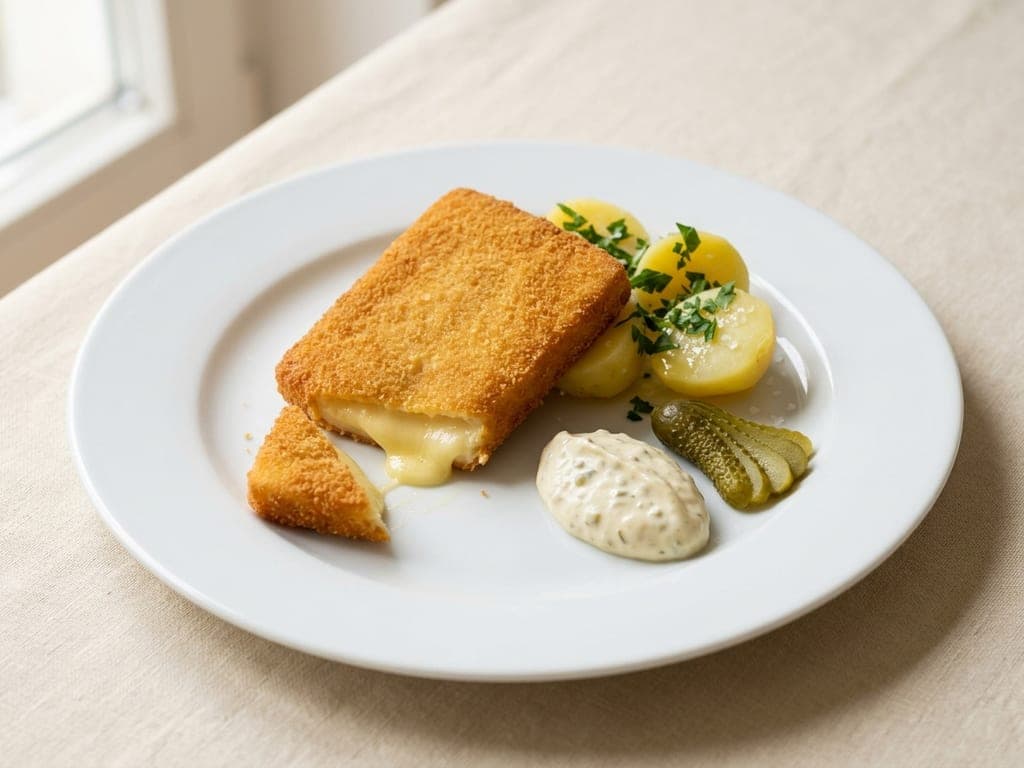
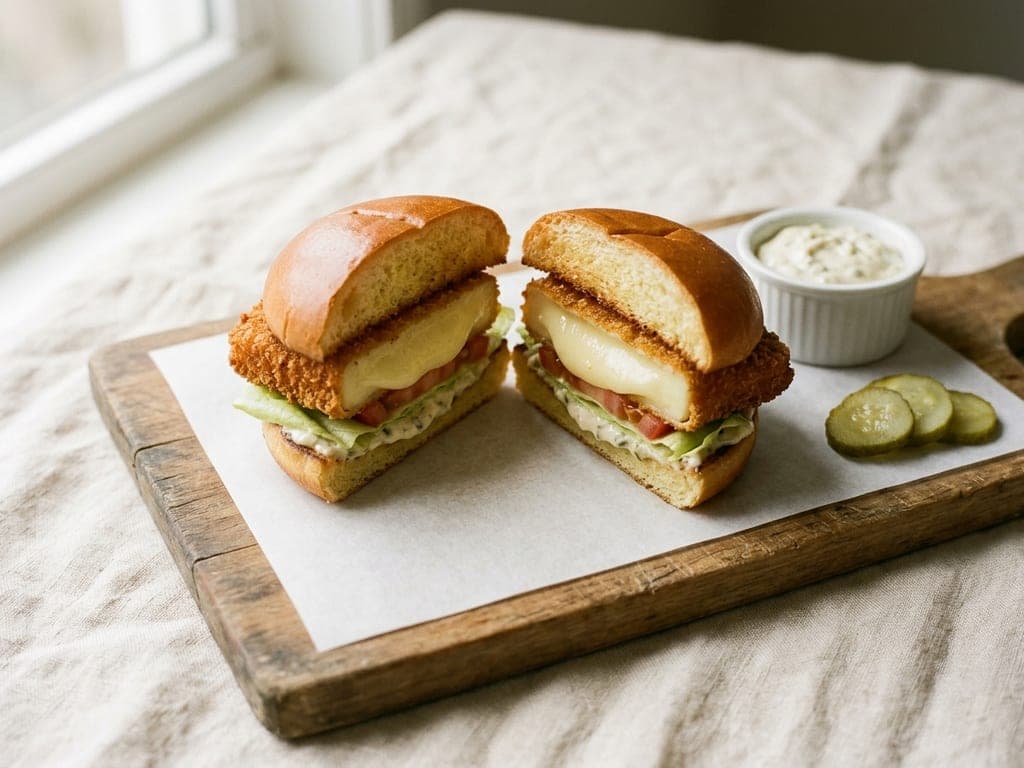
3 ways to plate it
In print since 1916: the real history of smažený sýr
Most pages, in English and in Czech, will tell you smažený sýr is a post-war dish, first written down in 1953 or invented in a 1950s canteen. Czech libraries say otherwise. Searching the digitized collections of the Moravian Library in Brno, we found a recipe titled “Smažený ementálský sýr” (fried Emmental) in the women’s magazine Ženské listy on 15 July 1916, in the middle of the First World War: Emmental cut into neat “schnitzels”, dipped in egg and grated roll, and fried in butter. That is 37 years before the “1953 first mention”.
The first cookbook recipe we found is Anuše Kejřová’s Minutové večeře (Quick suppers, Prague, 1922), a book for working women: “Tenké řízky ementálského sýru, zbavené tvrdých okrajů, obalíme v mouce, smočíme v rozšlehaném vejci a pak ještě v rozstrouhané žemli obalíme.” In English: thin schnitzels of Emmental, with the hard edges cut off, are coated in flour, dipped in beaten egg and then coated again in grated roll. They are fried in a spoonful of butter until golden and set on a platter ringed with mashed potato dressed with fried onion. The three-step breading on your counter is more than a century old. By 1933, posthumous editions of Kejřová’s books (she died in 1926) offered “Emmental or Dutch cheese”, meaning Edam or Gouda, and in 1934 Marie Janků-Sandtnerová’s household manual cut much thicker slabs, 1 inch (2.5 cm), fried them a minute a side and served the cold slices on a piece of bread roll with tea: the first fried cheese on a roll we found, decades before smažák v housce became street food.
It was a restaurant dish too. In his column “Zápisník labužníka” (Týden, 2011), the food writer Vladimír Poštulka described a 1936 menu from the Šroubek, one of the grandest restaurants on Wenceslas Square (the Šroubek family’s hotel on the square, long the Hotel Evropa, reopened in October 2024 as W Prague), listing fried Emmental with tartar sauce, and concluded the dish did not appear only in the 1950s “as is so often stated”. A Prague nutrition book printed the same year planned a supper of fried cheese with tartar sauce and fries, so his menu was no one-off. He also recorded a rival claim: “Já sám jsem smažák poprvé jedl v hospůdce U tří pštrosů u Karlova mostu, bylo to v roce 1960. A tamější kuchař mi tvrdil, že je to jeho vynález.” (I first ate smažák myself at the little pub U tří pštrosů by Charles Bridge in 1960. And the cook there assured me it was his invention.) The printed record from 1916 on shows the cook’s claim can’t be true.
Fried cheese itself is far older than any of this. The Parisian household book Le Ménagier de Paris, written around 1393, has “pipefarces”: strips of cheese dipped in a batter of egg yolk, flour and wine and fried in fat. That is battered, not breaded, though. For the breaded slab, the 1916 Czech recipe is the earliest printed example we found; we didn’t search Austrian and German archives, so we’d call it one of the earliest, not the first.
How Emmental became eidam, and tatarka joined it
The cheese changed with the economy. Emmental is the cheese of every breaded recipe from 1916 into the 1930s; Dutch-type cheese joins it in Kejřová’s posthumous editions of 1933 and 1934. The post-war canteen and milk-bar books of the 1950s and 60s specify Emmental or moravský bochník, a Czech semi-hard loaf cheese. Eidam creeps in around 1960 and takes over: in 1962 the nutrition magazine Výživa lidu described eidam-type cheeses as very widespread, with the 2.5 kg (5 1/2 lb) eidam brick the most-made format among them, and recommended eidam for main dishes such as “smažený sýr”. In 1969 a pensioner’s recipe in Svět práce costed a whole fried-cheese supper for four, with mash and cucumber salad, at 20.50 Kčs, the cheese Kčs 8 of it. Cheap, plentiful eidam made smažák an everyday dish.
Tatarka came early, though not in the first recipes: the 1916 and 1922 versions have none. A 1936 Prague nutrition book, Pavel Viskup’s Výživa a jídelní lístek rozumného člověka, plans a supper (p. 116) of “osmažený sýr s tatarskou omáčkou a franc. brambory”: fried cheese with tartar sauce and “French potatoes”, most likely fried potatoes here, though the same Czech words now name a baked potato-and-egg dish. That is the same year as Poštulka’s Šroubek menu (which isn’t reproduced anywhere we could find), and the earliest printed pairing of fried cheese with tatarka we found. After the war the pairing was written into the canteen manuals: Václav Kněz and Hana Pačová’s Sýry a příprava sýrových jídel, in print by 1958, was already being quoted by a magazine in October 1957 for its “smažený sýr obložený, s tatarskou omáčkou”. Tatarka was sold ready-made by 1959, and in 1964 the state standard for milk bars set the canteen version in stone: “Smažený sýr se klade na krajíček chleba, přelije tatarskou omáčkou a podává se ještě teplý” (the fried cheese is laid on a slice of bread, covered with tartar sauce and served while still warm). Poštulka argues that tatarka, not the cheese, is the truly Czech part of the dish.
Two dates to correct while we’re here. Smažený hermelín appears in print from 1971 and was common in magazines by 1975. The Hermelín name itself dates from 1946, not 1915, as it is sometimes said. And there is no EU protected name or UNESCO listing for smažený sýr.
Which cheese to buy, by the numbers
Czech smažák is made with eidam 30 %, and the percentage trips up everyone outside the Czech Republic. It means 30 % fat in the dry matter (tuk v sušině), not 30 % fat. A Czech eidam 30 % is about half water and has around 16 g fat per 100 g (Madeta’s label: 265 kcal, 16 g fat, 29 g protein, 1.5 g salt). The Czech consumer tester dTest recommends the 20 % and 30 % eidams for frying and the 45 % one for gratins, and Lokál chose eidam 30 % for its pubs after testing several. Lower fat means a firmer melt that runs a little when cut, where a rich cheese floods the plate.
Dutch and American Edam is the full-fat kind: USDA data puts it at 28.6 g fat and 41 g water per 100 g, and Gouda is almost the same (27.4 g fat, 41.5 g water). Both work and taste great, but they melt faster and runnier, so they’re less forgiving of a thin spot in the crust. Czech cooks disagree here, and some prefer 40 or 45 % cheese for exactly that richness. The closest US supermarket match to Czech eidam by composition is a block of low-moisture, part-skim mozzarella (19.8 g fat, 47.1 g water per 100 g); it is milder and stretchier, but it fries the most like the real thing. If you use Gouda, buy a young, mild one; aged Gouda is too hard and crystalline to melt smoothly. Monterey Jack works too, and so does Emmental if you cut the slabs from a solid part of the block, because the holes become channels for the melting cheese. Always start from a block: pre-sliced sandwich cheese is too thin, and shreds won’t hold a shape.
Two kinds fail. Fresh mozzarella in water has so much free moisture that it turns to steam and liquid cheese and bursts through the crust; save it for mozzarella in carrozza. Reduced-fat “light” cheeses go rubbery and don’t flow at all. And read the label on cheap bricks: Czech rules keep vegetable-fat imitations from being called sýr, and the same caution applies to “cheese product” anywhere.
Why fried cheese leaks, and why resting beats freezing
A smažák leaks when the cheese under the crust turns liquid before the crust has set, or when the crust has a weak spot. Our rough heat-transfer estimate (a simple model using assumed textbook values for a semi-hard cheese, so read the numbers as rules of thumb, not measurements) shows how fast that happens: in 350°F (175°C) fat, the cheese just under the crust passes 140°F (60°C) and starts to flow in under a minute, whether it started at room temperature or straight from the fridge. The crust needs 1 to 1 1/2 minutes a side to turn gold. So the cheese next to the crust is always liquid before the crust is fully set, and it’s the coating, not the cheese temperature, that holds it in.
That’s why the fixes are all about the crust: a double coat, sealed edges, no pressing, fat hot enough that the crust sets fast, and the rest after breading, which lets the crumbs hydrate and harden into a shell. The same model shows why a hard freeze is the wrong fix for a pan: a frozen 5/8-inch (1.5 cm) slab needs nearly 6 minutes before its center melts, twice the frying time, so you get a dark crust around a cold core. A short chill does no harm. By the same rough numbers, 10 to 20 minutes in a home freezer only takes a fridge-cold slab to around freezing point, firm, not frozen. If that’s your habit, keep it; just don’t go longer.
Thickness follows the same logic. The estimate puts the center of a fridge-cold 5/8-inch (1.5 cm) slab at about 4 minutes to reach 140°F (60°C) in hot fat, which a 3-minute fry plus a minute’s rest covers. At 3/4 inch (2 cm) the center needs nearly 7 minutes; at 3/8 inch (1 cm), the whole slab is liquid in under 2, before the crust can protect it. The remaining leaks are mechanical: a fork through the crust when turning, edges that were never coated, and fat below about 340°F (170°C), where the crust sets too slowly.
Tatarka is not American tartar sauce
Czech tatarka and American tartar sauce share a name and a jar shape and not much else. A Czech jar, Hellmann’s tatarská omáčka, is mostly rapeseed oil and has 41 g fat and 393 kcal per 100 g, which is close to real mayonnaise. USDA’s ready-to-serve tartar sauce has 16.7 g fat and 211 kcal, and Kraft’s US version lists water before the oil. The sugar is about the same (4.8 g against 4.25 g per 100 g). The Czech sweet-sour note comes from the pickles: Czech sterilované okurky are cucumbers in a sweetened, spiced vinegar brine, and cooks loosen the mayonnaise with that brine, which is why pub tatarka is softer than mayonnaise and tastes more of pickle.
Our tatarka for four is 1/2 cup (110 g) mayonnaise, 1 1/2 oz (40 g) finely chopped sweet-sour pickles, 2 tbsp of their brine, 1 tbsp very finely chopped onion, 1 tsp mild mustard, a pinch each of sugar, salt and pepper, and a few drops of Worcestershire sauce if you like. It makes about 7 oz (200 g), roughly 1/4 cup (50 g) per plate. It is close to the pub versions: Lokál makes its own mayonnaise and adds sour pickles with a little of their brine, onion, a pinch of sugar and salt, vinegar or lemon, pepper, Worcestershire and mustard.
The jar option: Central European and Polish delis in the US and UK sell Czech and Polish tatarská. Otherwise, jarred American tartar sauce will do in a pinch, but it is leaner and sharper, so we’d rather stir sweet pickle relish and a spoonful of its liquid into good mayonnaise.
Make ahead, air fryer, oven and freezing
You can bread the slabs up to a few hours ahead and keep them uncovered on a rack in the fridge; give them the 10 to 15 minute rest out of the fridge before frying. To freeze raw breaded slabs, freeze them on a tray, then bag them, and use them within about 3 months (the Slovenian food blog Jernej Kitchen gives the same window for ocvrti sir). Czech frozen breaded cheese is sold to fry straight from frozen at 355°F (180°C), but from our heat estimate a home-frozen 5/8-inch (1.5 cm) slab will brown before its center melts, so we’d thaw it for 20 to 30 minutes in the fridge first, or fry it from frozen at 320 to 330°F (160 to 165°C), brushing off any ice crystals and lowering it in very gently, and finish it for 3 to 5 minutes in a 355°F (180°C) oven. That last one is our workaround, not a tested standard.
Air fryer: preheat the basket empty, then put in the baking paper and the slabs together (never leave loose paper in the basket without food on it, and keep it clear of the element); space the slabs so they don’t touch, spray them with oil and cook at 400°F (200°C) for 8 to 12 minutes, turning halfway. Oven: 400°F (200°C) on a lined tray, drizzled with oil, for 15 to 20 minutes, until golden. Both are gentler on the crust and use less fat, and both give a paler, drier crust than frying; the double coat and the rest matter even more here, since the crust sets slowly.
Questions, answered
What cheese is used for smažený sýr?
In the Czech Republic, eidam 30 %, a firm, mild, low-fat Edam-type cheese; the 30 % is fat in dry matter, so the cheese itself has about 16 g fat per 100 g. Pub chains such as Lokál chose it after testing, and Czech consumer tester dTest recommends the 20 % and 30 % eidams for frying. Gouda and full-fat eidam also work but run more. Outside the Czech Republic, the closest supermarket match is a block of low-moisture, part-skim mozzarella, followed by Edam, Gouda, Monterey Jack or Emmental. With Hermelín, Niva or Olomoucké tvarůžky the dish gets a different name: smažený hermelín, smažená Niva, smažené tvarůžky.
Can I use mozzarella or Gouda for Czech fried cheese?
Yes, with one exception. Low-moisture, part-skim mozzarella sold in a block is actually the best US match for Czech eidam by fat and water (19.8 g fat and 47.1 g water per 100 g, against about 16 g fat and 50 % water), though it is milder and stretchier. Gouda and Edam are richer (27 to 29 g fat per 100 g) and melt runnier, so make the double coat especially careful. Don’t use fresh mozzarella in water: the extra moisture turns to steam and bursts the crust.
Why does my fried cheese leak?
Almost always because of the crust, not the cheese. The common causes: a single coat with thin spots, edges and corners that were never coated, pressing the slab into the crumbs, frying the moment it’s breaded instead of letting the coating set for 10 to 15 minutes, fat that is too cool (below about 340°F / 170°C), a slab thinner than about 5/8 inch (1.5 cm), piercing the crust with a fork, and leaving it in the fat too long. Double-coat, seal the edges, rest, fry at 350°F (175°C) for 1 to 1 1/2 minutes a side, and take it out the moment you see a bead of cheese.
Should I freeze the cheese before frying?
A short chill is fine, but freezing solid isn’t worth it for a pan-fried slab. By our rough heat estimate, a frozen 5/8-inch (1.5 cm) slab needs nearly 6 minutes in 350°F (175°C) fat before its center melts, while the crust is brown in 2 to 3, so you get a dark crust and a cold middle. 10 to 20 minutes in the freezer only firms the slab to around freezing point, which does no harm. Lokál’s pub method skips the freezer altogether and rests the breaded cheese for 10 to 15 minutes so the coating sets, and that is what we recommend.
What oil temperature should I fry smažený sýr at?
Between 340 and 355°F (170 and 180°C), ideally 350°F (175°C), in fat about 3/4 inch (2 cm) deep. Fry 1 to 1 1/2 minutes per side, about 3 minutes in all, until deep gold, and let the fat come back to temperature between batches. Use refined rapeseed (canola) or sunflower oil, or clarified butter; not whole butter, which burns at about 300°F (150°C), and not cold-pressed sunflower oil.
Can I make smažený sýr in an air fryer or oven?
Yes, with a paler, drier crust than frying. Air fryer: preheat the basket empty, then add parchment and slabs together (never loose paper on its own), slabs not touching, a spray of oil, 400°F (200°C) for 8 to 12 minutes, turned halfway. Oven: 400°F (200°C) on a lined tray with a drizzle of oil for 15 to 20 minutes. Double-coat and rest the slabs first; the crust sets more slowly than in hot fat, so it needs all the help it can get.
What is tatarka, and how is it different from American tartar sauce?
Tatarka (tatarská omáčka) is the Czech tartar sauce: mayonnaise with very finely chopped sweet-sour pickles loosened with their brine, onion, mustard and a little sugar. It is much richer than the US kind. A Czech jar (Hellmann’s) has 41 g fat per 100 g against 16.7 g for USDA’s ready-to-serve tartar sauce, with about the same sugar. The sweet-sour taste comes from Czech sterilované okurky rather than dill pickles, relish, lemon or capers. Our from-scratch version is in the ingredients and the tatarka section.
What is smažený sýr served with?
In a Czech pub, with tatarka and either boiled potatoes, usually with butter and parsley or chives, or hranolky (fries). Czech menus print the cheese weight, and 120 g or 150 g (about 4 to 5 oz) is the usual portion, so our 5 oz (140 g) slab is a pub serving. Some cooks find fries plus fried cheese too much fried food and go for potatoes or potato salad. On the street, it comes in a soft roll as smažák v housce, with tatarka and some lettuce or tomato.
Is smažený sýr vegetarian?
Usually, and it’s the classic meatless dish on Czech pub menus, but check three things. Rennet: many Czech eidams use microbial rennet, but Gouda, Emmental and Gruyère are traditionally made with animal rennet, and some EU cheeses don’t list ingredients, so look for “microbial” or “vegetarian rennet” or a vegetarian symbol. Frying fat: some pubs use lard. Tatarka: most Worcestershire sauce contains anchovy.
Is smažený sýr the national dish of the Czech Republic?
No. There isn’t an official Czech national dish; the usual answers are svíčková or roast pork with dumplings and sauerkraut. Smažený sýr is the pub classic and canteen staple, it has no EU or UNESCO status, and it’s not the post-war invention it’s often said to be: Czech print has fried breaded Emmental from 1916 and a cookbook recipe from 1922.
How many calories are in smažený sýr?
About 1,165 kcal per serving as written: one slab, its tatarka, the boiled potatoes and their butter. The math per serving: 5 oz (140 g) Czech eidam 30 % at 265 kcal per 100 g = 371 kcal; 12 g flour = 44; 30 g egg = 43; 35 g breadcrumbs = 138; about 12 g of absorbed frying oil = 106 (an estimate; breaded fried foods of this size usually take up roughly 8 to 20 g). That’s a 702 kcal slab. The tatarka adds about 199: 27.5 g mayonnaise at 680 kcal per 100 g (USDA) = 187, plus about 12 kcal from the pickles, brine, onion and mustard, so the slab and tatarka alone come to about 900 kcal. The potatoes add the rest: 250 g boiled (215 kcal) plus a quarter of the butter (7 g, 50 kcal), for a plate of about 1,165 kcal. With low-moisture, part-skim mozzarella the plate is about 1,210 kcal (945 without the potatoes); with full-fat US Edam, about 1,295 (1,030 without). Sodium is about 1,450 mg per serving for the slab and tatarka (about 1,550 mg with low-moisture mozzarella, about 1,970 mg with US Edam): about 840 mg from the cheese (1.5 g salt per 100 g on the label), about 300 mg from the breadcrumbs and egg and around 300 mg from the tatarka (about 175 mg of it from the mayonnaise, the rest from the pickles, brine and mustard). The unsalted butter adds almost none; the potatoes add whatever salt their cooking water gives them.
Snap your finished plate and let the AI plate it again — more beautifully.