Čočka na Kyselo (Czech Sour Lentils) with Fried Egg
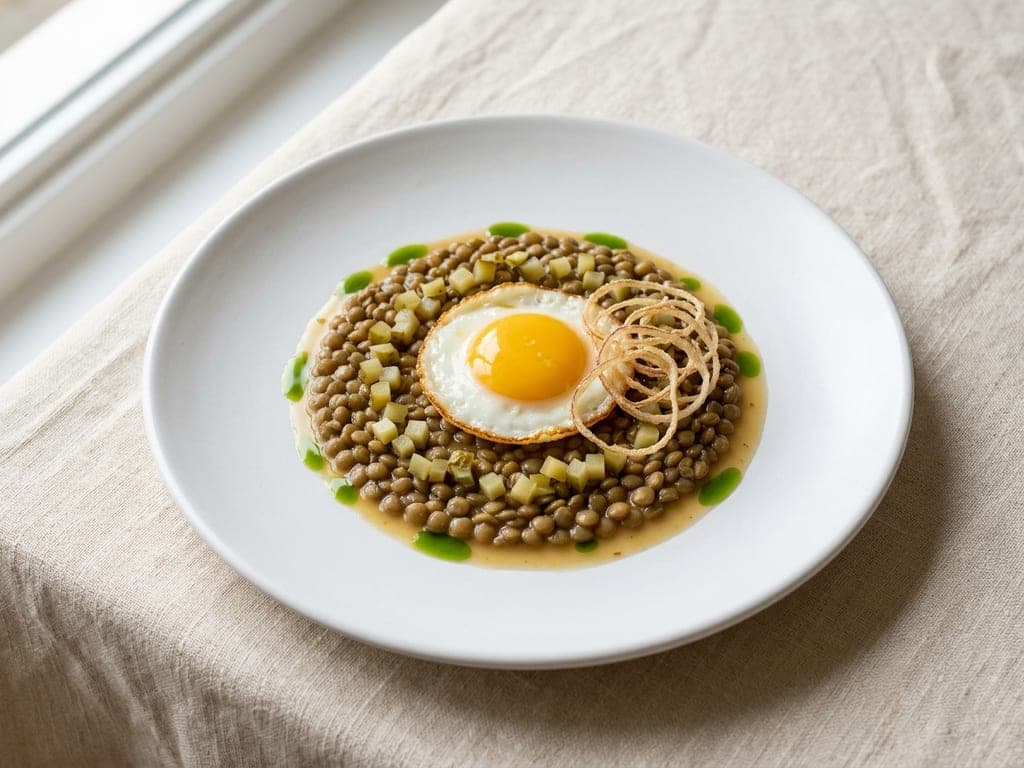
Čočka na kyselo is the Czech lentils recipe every Czech knows: brown lentils simmered until creamy, bound with a light golden onion roux and finished off the heat with vinegar and a pinch of sugar, then crowned with a crisp-edged fried egg and a sweet-sour pickle. This version gives the numbers other sour lentils recipes leave out: how long each kind of lentil takes, a doneness test, and how much vinegar to use when your bottle is 5% (US) or 6% (many UK wine vinegars) rather than the 8% Czech recipes assume. It also explains čočka na husto, and what the old Czech papers really say about eating lentils on New Year’s Day for money. Vegetarian when made with butter. Contains wheat, egg and milk; the pickles, mustard and wine vinegar may add mustard and sulphites.
Ingredients
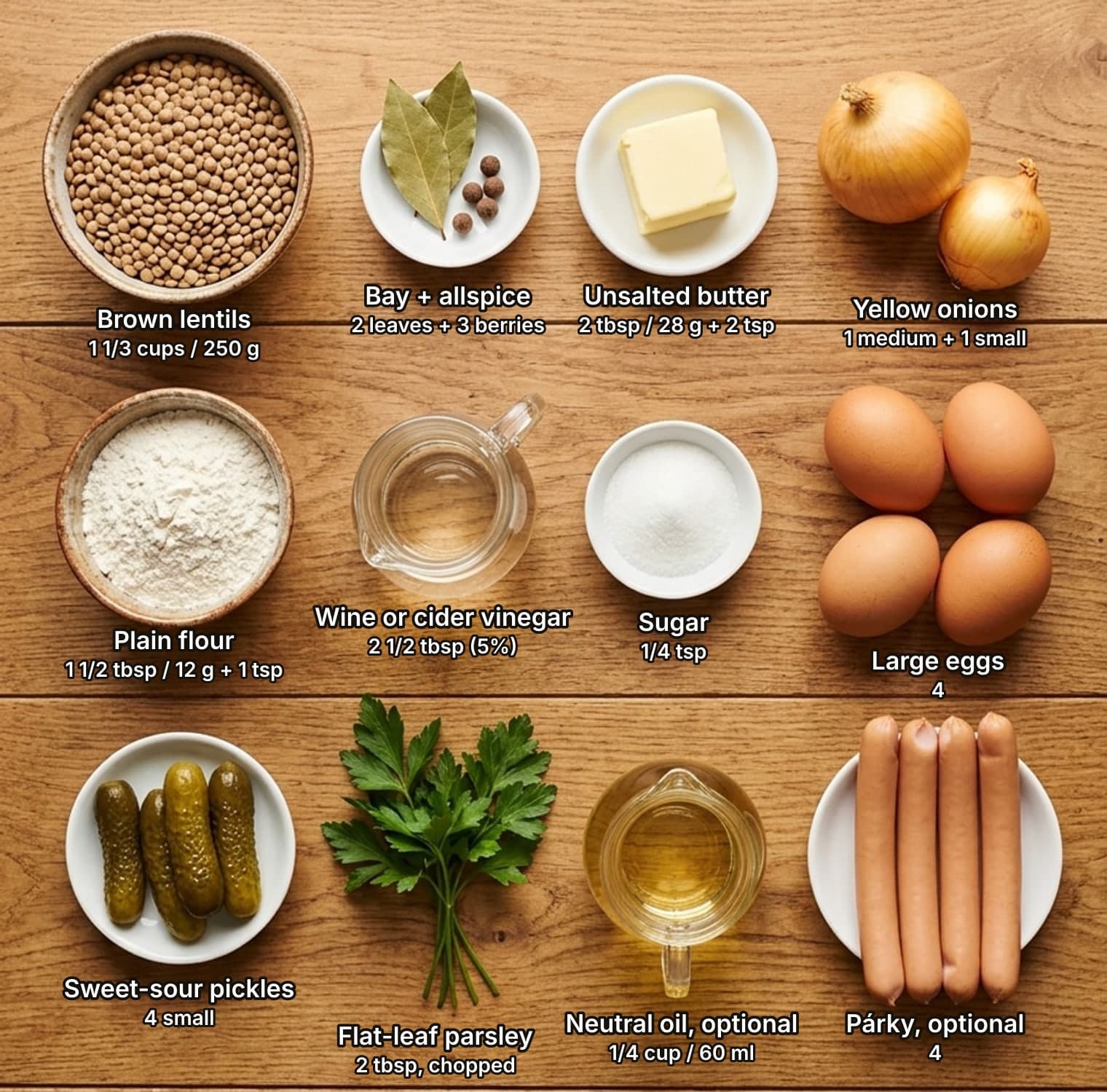
- brown or large green lentils (Czech “velkozrnná”; small green lentils hold their shape best; not red or yellow, which turn to purée), picked over and rinsed1 1/3 cups (250 g)
- cold water, for simmering the lentils5 cups (1.2 l)
- bay leaves2
- allspice berries (optional)3
- fine salt, plus more to taste3/4 tsp
- unsalted butter (or lard, the traditional fat; lard makes the dish non-vegetarian)2 tbsp (28 g)
- yellow onion, finely chopped1 medium (about 5 oz / 150 g)
- all-purpose (plain) flour (contains wheat; for gluten-free, see the FAQ)1 1/2 tbsp (12 g)
- reserved lentil cooking liquid, plus more to loosen1 1/4 cups (300 ml)
- white wine or cider vinegar, 5% acidity (if your bottle is 6%, as many UK white wine vinegars are, use about 2 tbsp; with Czech 8% kvasný lihový ocet use about 1 1/2 tbsp)2 1/2 tbsp, to taste
- granulated sugar1/4 tsp
- dried marjoram or thyme (optional)a pinch
- freshly ground black pepperto taste
- large eggs (if you serve runny yolks to pregnant, very young or older diners, use pasteurized in-shell eggs in the US, or British Lion or Laid in Britain eggs in the UK; see the safety notes)4
- butter or neutral oil, for frying the eggs2 tsp
- sweet-sour pickles (Czech sterilované okurky; in the US German-style or sweet dill pickles), to serve4 small
- flat-leaf parsley or chives, chopped2 tbsp
- crisp onion (optional): small onion, sliced into thin rings1 small (about 3 1/2 oz / 100 g)
- crisp onion (optional): flour, for dusting the rings (cornstarch, or cornflour in the UK, for gluten-free)1 tsp
- crisp onion (optional): neutral oil, such as sunflower or canola (rapeseed)1/4 cup (60 ml)
- párky (Czech frankfurters) or smoked sausage, to serve (optional; leave out for the vegetarian version)4
- rye bread, to serve (gluten-free bread for a gluten-free plate)4 slices
What čočka na kyselo is
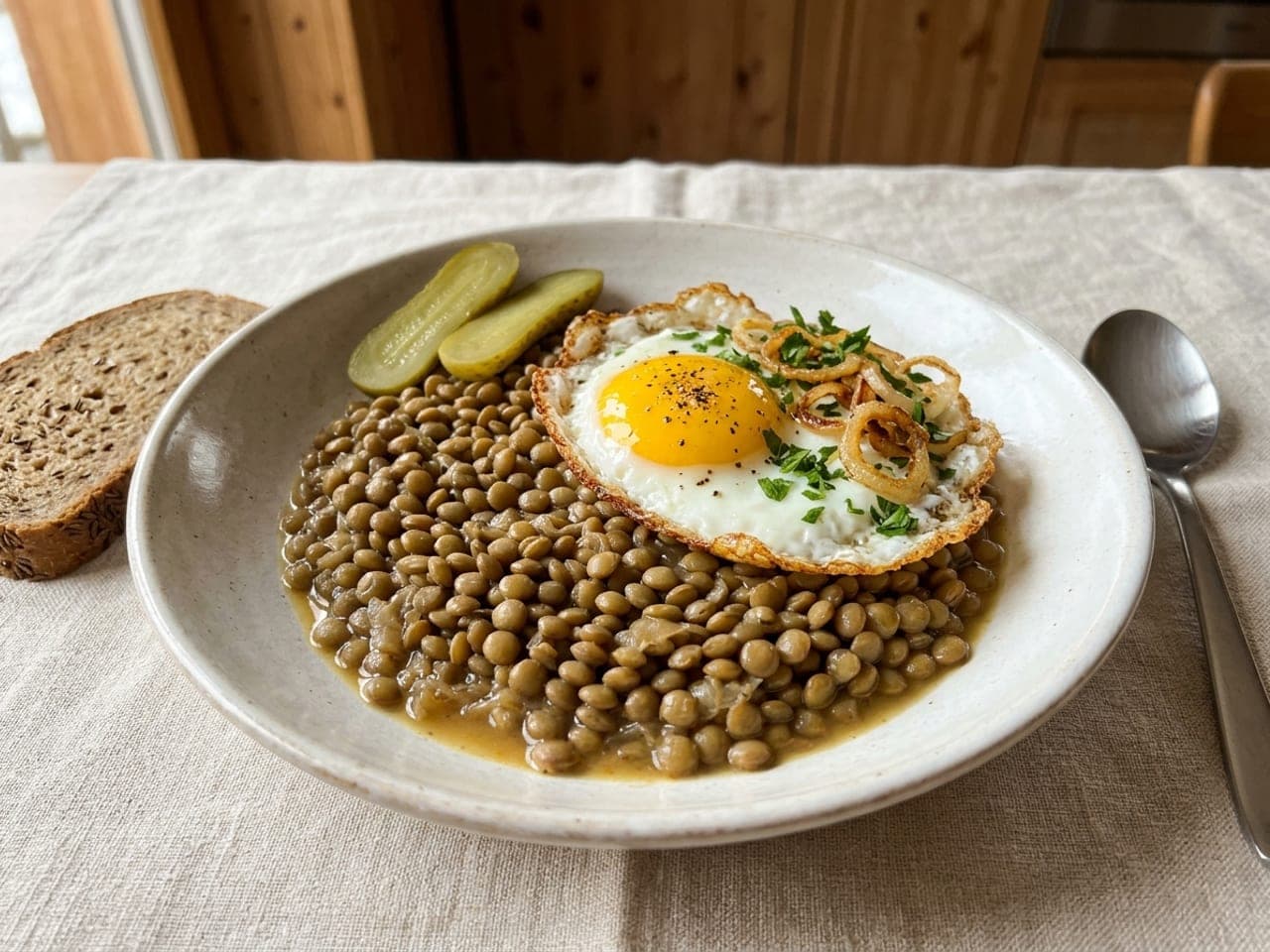
Čočka na kyselo (say CHOTCH-kah nah KIH-seh-loh; “č” is the “ch” in “church”, and Czech stresses the first syllable) means “lentils made sour”: brown lentils simmered soft, bound with a light onion roux and finished with vinegar and a pinch of sugar, so the bowl tastes earthy, gently sharp and faintly sweet. It is a main course, not a soup. It should sit in a soft, spoonable mound. Czechs crown it with a fried egg (sázené vejce, also called volské oko, “ox eye”), put a sweet-sour pickle alongside, often add a fried párek or smoked sausage, and mop up with rye bread. You will meet it on school lunch menus, in pubs and, on 1 January, on family tables.
“Na kyselo” is a method rather than a single dish. Czech cookbooks also make potatoes, turnips, eggs, mushrooms and kidneys na kyselo, all built the same way: a cooked base, a roux and vinegar, often with a little sugar. It has nothing to do with kyselo, the soup from the Krkonoše mountains, which is soured with rye-bread sourdough rather than vinegar; the two just share the word kyselý, “sour”.
How to make Sour lentils (Čočka na kyselo)
- Rinse, and soak only if you are short of time later. Tip the lentils onto a tray and pick out any small stones, stray grains of wheat or barley, and shrivelled lentils, then rinse them in a sieve under cold water until it runs clear. Soaking is not required for brown or green lentils. If you like, soak them in cold water for 30 to 60 minutes (the common Czech habit), which takes roughly 10 to 20 minutes off the simmer; drain and discard the soaking water. Rinsing washes off dust and loose skins that would otherwise foam and cloud the cooking liquid, and that liquid is going into your sauce.
- Simmer gently until creamy but whole. Put the lentils in a wide pot with the 5 cups (1.2 l) cold water, the bay leaves and allspice. Bring to a boil, skim off any grey foam, then turn the heat down until only a few bubbles break the surface, and set the lid ajar. Do not let it boil hard and do not stir; just give the pot a shake now and then. A rolling boil and a spoon both tumble the lentils and split their skins, and split lentils go to mush before the rest are done. Brown and large green lentils usually take 25 to 45 minutes unsoaked, and big Czech velkozrnná lentils can take close to an hour; allow longer still above about 3,000 feet (900 m), where water boils cooler. Add the 3/4 tsp salt once the lentils start to soften, about 15 to 20 minutes in; Czech packs say to salt them “just before they soften”. Start testing at 20 minutes: taste three lentils. They are ready when all three are creamy right to the centre with no chalky core, and most skins are still whole. Keep the vinegar well away from the pot for now: acid firms the lentils’ cell walls and stalls the softening.
- Fry the crisp onion while the lentils cook (optional). Heat the 1/4 cup (60 ml) oil in an 8 inch (20 cm) frying pan over medium heat; across its flat base, about 6 1/4 inches (16 cm), that is roughly 1/8 inch (3 mm) deep, enough to shallow-fry. Toss the onion rings with the 1 tsp flour (or cornstarch for gluten-free), shake off the excess, and fry them in two batches, stirring, for 4 to 6 minutes until evenly golden. Lift them onto paper towels and salt them lightly. The flour dries the surface so the rings crisp instead of steaming, and frying in batches keeps the oil hot. Pull them at gold, not dark brown: they keep colouring for a minute off the heat and turn bitter if pushed. Keep a lid or baking sheet next to the pan while the oil is hot.
- Drain and save the liquid. Set a sieve over a bowl or jug and drain the lentils. Measure out 1 1/4 cups (300 ml) of the cooking liquid for the sauce and keep the rest. Fish out the bay leaves and allspice. The liquid is not waste: it carries starch from the lentils, which helps the roux thicken, and it tastes of lentil rather than plain water. If you have less than 1 1/4 cups (300 ml), make up the difference with hot water.
- Make a light golden onion roux. You can start the onion while the lentils finish simmering, so it is ready when they are drained. Melt the butter in a wide saucepan or deep frying pan over medium heat. Add the chopped onion with a pinch of salt and cook, stirring often, for 8 to 10 minutes, until soft and evenly golden. If you like, add a pinch of dried marjoram or thyme to the onion now (the 1869 Pražská kuchařka uses thyme; most old recipes keep it plain). Sprinkle over the flour and stir for 2 to 3 minutes, until it smells nutty and turns the colour of pale straw. Stop there. Most modern Czech recipes, and Anuše Kejřová’s in 1905, use a light golden roux, and a light roux keeps most of its thickening power: in a test by Cook’s Illustrated, a blond roux cooked for 3 minutes had 14% less thickening power than a white one and a darker, peanut-butter roux 26% less, because dry heat breaks the starch down. A dark roux would also add a bitter edge that clashes with the vinegar.
- Whisk in the liquid and simmer. Pour in the reserved lentil liquid a ladle at a time, whisking after each addition so the roux absorbs it without lumps. Bring it to a simmer and cook gently for 10 minutes, stirring now and then, until it has the body of a light gravy and no longer tastes of raw flour. The ratio here, about 1 1/2 tbsp flour to 1 1/4 cups (300 ml) liquid, makes a fairly thin sauce on purpose. The lentils add their own starch as they sit in it, and the whole dish keeps thickening as it cools, so a sauce that looks a little loose now will be right on the plate.
- Fold in the lentils, then sour it off the heat. Tip the lentils into the sauce and fold them in gently with a spatula. Simmer for 5 minutes so the flavours meet and the sauce clings. It should slump into a soft mound on a spoon; if it is stiff, loosen it with a splash of the spare cooking liquid. Now take the pan off the heat and stir in 2 tbsp of the vinegar (1 1/2 tbsp if your bottle is 6%, 1 1/4 tbsp if it is Czech 8%), the sugar and a good grind of pepper. Taste, then add the rest (about 1/2 tbsp of 5% or 6% vinegar, 1/4 tbsp of 8%) and more salt until it is clearly tangy but not harsh. Adding the vinegar last keeps it bright, and the pinch of sugar rounds off the sharp edge without tasting sweet. Leave the lid off: the sourness fades a little as the lentils soak it up, so taste again just before serving and add a few more drops if needed.
- Fry the eggs with crisp, lacy edges. Heat the 2 tsp butter or oil in a nonstick frying pan over medium-high heat until it shimmers. A 10 inch (25 cm) pan has a flat base about 8 inches (20 cm) across, which fits two eggs at a time; a 12 inch (30 cm) pan takes all four. Crack each egg into a cup first and slide it in, so a broken yolk or a bad egg never reaches the pan, then cook for 2 to 3 minutes, tilting the pan and spooning the hot fat over the whites (not the yolks) so they set quickly and the edges turn lacy and brown while the yolks stay runny. For a firm yolk, turn the heat to low, add 1 tbsp water, cover the pan and cook 2 to 3 minutes more, until the yolk is firm when pressed, not just filmed over. Season with salt and pepper. Spoon the lentils into warm shallow bowls, slide an egg on top, and finish with the crisp onion, parsley, a pickle and rye bread on the side. Add a párek or smoked sausage if you like, heated in a pan or simmering water until steaming hot through, 165°F (74°C).
Safety & hygiene Important
- Leftovers: US and UK windows. Cool leftovers quickly in a shallow container. USDA advice is to refrigerate within 2 hours of cooking (1 hour if the room is above 90°F / 32°C), keep the fridge at 40°F (4°C) or below, eat within 3 to 4 days, and reheat to 165°F (74°C) on a thermometer. The UK Food Standards Agency says to get cooked food into the fridge (0 to 5°C) within one to two hours, eat leftovers within 48 hours or freeze them, reheat until steaming hot throughout, and reheat only once. Cooked lentils thicken a lot overnight, so loosen them with water before reheating and stir so the middle heats through. Don’t leave the pot lukewarm on a barely-on burner for hours: keep it hot, at 140°F (60°C) or above, for serving, or chill it.
- Runny yolks. In the US, the USDA and FDA advise cooking eggs until both the white and yolk are firm, and egg dishes to 160°F (71°C); pasteurized in-shell eggs are the safe choice if you want a runny yolk, especially for pregnant women, young children, older adults and anyone with a weakened immune system. In the UK, the Food Standards Agency says hen eggs with the British Lion mark, or produced under the Laid in Britain scheme, are safe runny for pregnant women, babies, young children and older people. Anyone in those groups should cook other eggs, including imported eggs or eggs of unknown origin, until the white and yolk are solid. People who are severely immunocompromised and on a medically supervised diet should follow their own medical advice. In October 2026 the FSA also told consumers in England, Wales and Northern Ireland not to eat shell eggs stamped 3UA1012066 (from Yasensvit Ltd, Ukraine) because Salmonella had been found in some; most went to caterers and small shops, not supermarkets. If in doubt, cook the yolks until firm: add a splash of water, cover the pan and cook 2 to 3 minutes more, until the yolk no longer gives when pressed. Either way, wash your hands, and keep egg shells and drips away from the pickles, bread and cooked lentils.
- Freezing and reheating. Freeze the lentils (not the eggs, pickles or onion topping) in flat, airtight bags or tubs. Food kept frozen at 0°F (-18°C) stays safe indefinitely; for best quality, eat it within 2 to 3 months. The UK FSA advises defrosting in the fridge, eating within 24 hours of fully defrosting, and reheating only once. A flour-thickened sauce can turn a little spongy after freezing; whisk in a splash of hot water as it reheats, then add fresh vinegar.
- Hot oil for the crisp onion. Stay with the pan while the oil is hot, keep the handle turned inward, and have a metal lid or baking sheet within reach before you start. If the oil starts to smoke it is too hot: turn off the heat and let it cool before carrying on. If it catches fire, turn off the heat if you can do so safely and do not move the pan. Never use water, flour or a wet or damp towel. US fire safety advice (NFPA) is that you can smother a small pan fire by sliding the lid, a baking sheet or a fire blanket over the pan and leaving it covered until completely cool; UK fire services advise not tackling it at all. If you have any doubt, or the fire does not go out at once, get out, close the door behind you, and call 911 (999 in the UK) from outside.
- Allergens and dietary notes. The classic recipe contains wheat (gluten) in the roux, egg, and milk (butter). Served the classic way it can also bring mustard (many Czech pickles are packed with mustard seed, and pub plates add a spoon of mustard) and sulphites (wine vinegar is often sulphited; spirit vinegar usually is not). Sausages can contain milk, soy, mustard or celery, so check the labels. Made with butter it is lacto-ovo vegetarian. Lard is pork fat, and párky and smoked sausage are meat (usually pork; check the label if you avoid pork). For gluten-free, skip the flour in the roux and thicken by mashing a ladle of the cooked lentils into the onion, or with grated raw potato, as some Czech cooks do. Dust the crisp onion with cornstarch (cornflour) instead of flour, serve gluten-free bread instead of rye, and check that your sausage and pickles are gluten-free. Lentils can carry the odd stray wheat or barley grain, so if you cook for someone with coeliac disease, buy lentils labelled gluten-free if you can and pick them over carefully. For a vegan bowl, use oil in the roux, leave out the egg and sausage, and check that your bread is vegan.
3 ways to plate it
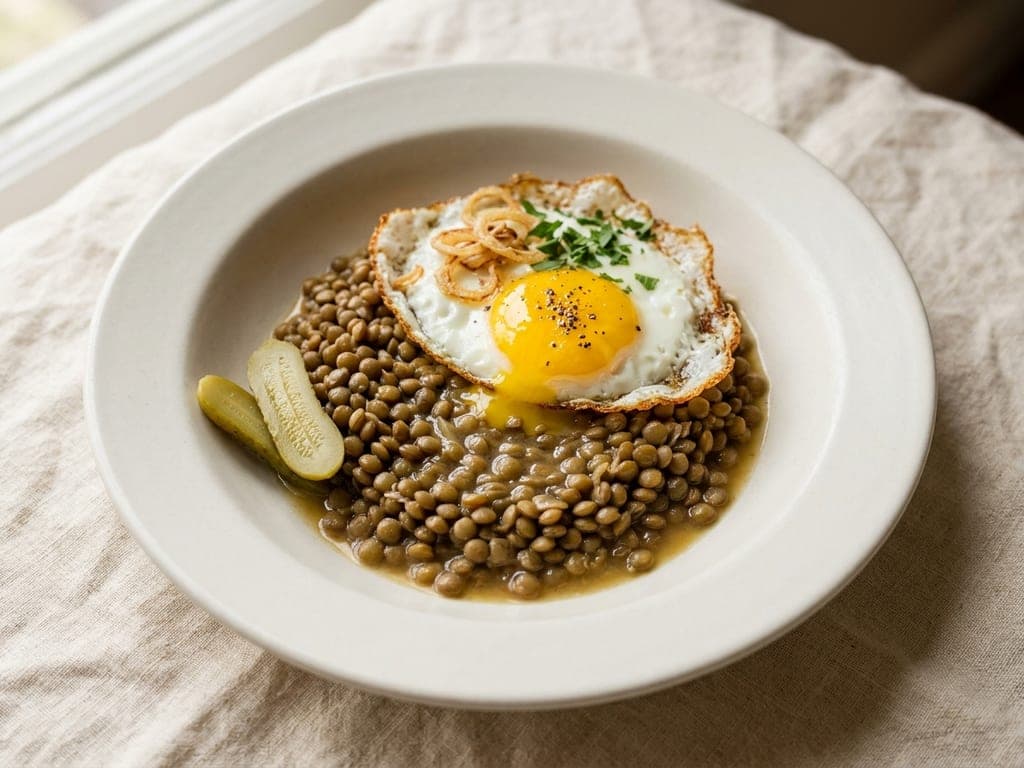
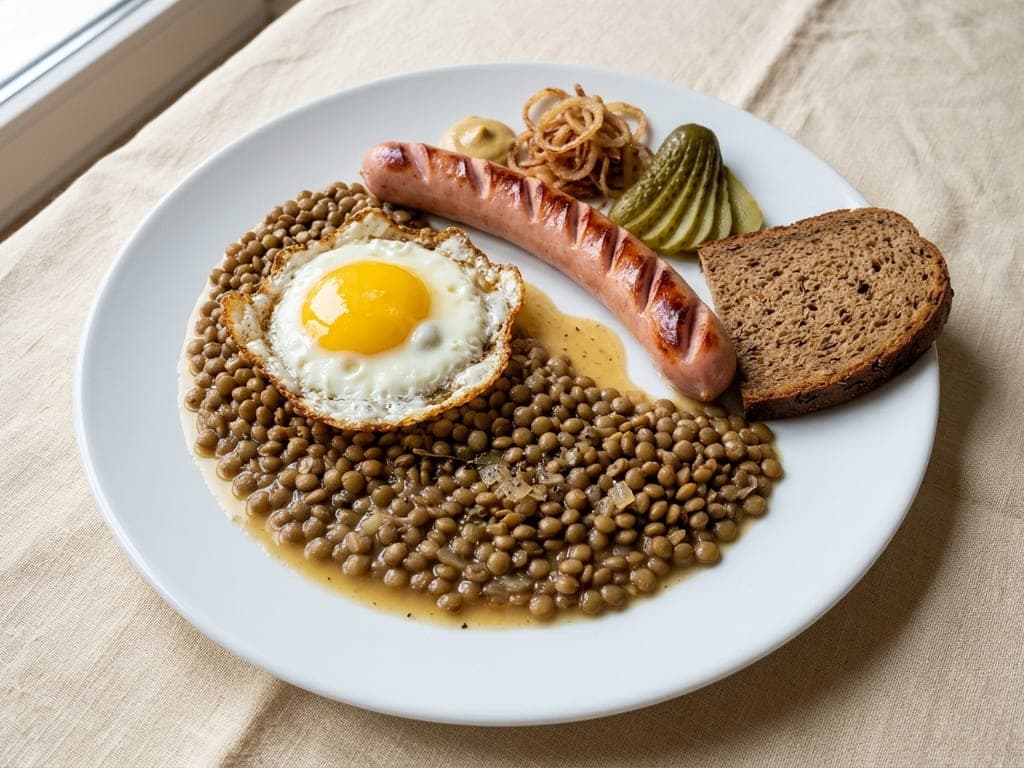
Čočka na kyselo, čočka na husto, or lentil soup?
We could not find a cookbook or dictionary that defines “čočka na husto”, so this section is our reading. The name does turn up in print as a dish of its own: an ethnographic encyclopedia lists it among the cheap, oft-repeated dishes of public kitchens, a 1961 study of Brno food has workers walking to a canteen for “čočka na husto”, and a 1957 scouting handbook makes it with a roux. None of them says how it differs from čočka na kyselo. “Na husto” (HOOS-toh) simply means “thick”; “na kyselo” means “soured”. The names describe texture and flavour, so one pot can be both.
In practice, a good čočka na kyselo is also na husto: thick enough to hold a soft mound on the plate. Someone searching for “čočka na husto” most likely wants exactly that, the thick main-course lentils rather than čočková polévka, the thinner lentil soup, or a milder version with little or no vinegar. To get it, keep the sauce to about 1 1/4 cups (300 ml) as in this recipe, simmer until it clings, and add the vinegar to taste, starting with less. If you thin the same pot with broth, you are on the way to lentil soup.
Which lentils, and how to keep them whole but creamy
Czech shops sell “čočka velkozrnná” (large-grain lentils), which are large green lentils of the Canadian Laird type, khaki in the bag and brown once cooked. The closest US match is ordinary brown lentils; in the UK, look for green or brown lentils. Small green lentils (drobnozrnná) hold their shape better, and Forbes Česko recommends them for exactly that reason. French green (Puy) and black beluga lentils stay firm and separate, which suits a salad more than this dish. Red and yellow lentils are sold hulled, so with no skin to hold them they collapse into purée in 10 to 15 minutes: that is dal, not čočka na kyselo.
Timing varies with size, age and soaking. As a guide: large brown or green lentils take 25 to 45 minutes unsoaked (Czech velkozrnná can take nearly an hour, and around 20 to 30 minutes after an overnight soak), small green lentils 20 to 30 minutes, red lentils 10 to 15 minutes. Because the range is so wide, trust the three-lentil test in the method rather than the clock.
Three things slow softening. Acid, which is why the vinegar goes in last. Hard water: calcium firms up the cell walls of pulses, and in a Japanese study on kidney beans higher calcium levels suppressed softening, while magnesium did not. If your water is very hard and the lentils stay stubborn, use filtered water. And old lentils, which can take much longer, so buy from a shop with a good turnover. A gentle simmer with no stirring keeps the skins on; a few burst lentils are welcome, because they make the sauce creamy.
Vinegar: strength, timing and that pinch of sugar
When a Czech recipe says “ocet”, it means ordinary spirit vinegar (kvasný lihový ocet) at 8% acidity. Standard US white and cider vinegar is 5% (check your label), and many UK white wine vinegars are 6%; Czech 8% is 1.6 times as sharp as 5%. Our dose is about 1 tbsp of 5% vinegar per 100 g (1/2 cup) dry lentils, so 2 1/2 tbsp for this pot; with 6% vinegar use about 2 tbsp, and with 8% about 1 1/2 tbsp. White wine or cider vinegar gives a softer, rounder sourness than plain distilled vinegar, which is why many cooks prefer it here.
Add it at the end, off the heat. Acid stabilises the pectin in the lentils’ cell walls, so vinegar added early can leave them stubbornly firm; Anuše Kejřová warned in 1905 that if the lentils went into the sour sauce too early, “they would harden”. The other reason is flavour. Sourness fades as the dish stands, because the lentils soak up the vinegar, so Czech cooks season and serve straight away and add another splash when reheating. Simmering does not “cook off” the acid; the lentils absorb it.
The sugar is there to round the vinegar, not to make the lentils sweet. Taste research shows that sweet and sour suppress each other in a mixture, and sugar is an especially strong suppressor (Keast and Breslin, 2003; Green and colleagues, 2010), so 1/4 tsp takes the harsh edge off without tasting sugary. How sweet to go is an old argument. Kejřová’s 1905 recipe insists “Omáčka musí býti sladkokyselá” (“the sauce must be sweet and sour”) and uses two sugar cubes, while Marie Janků-Sandtnerová’s 1930 version uses lemon juice and vinegar with no sugar at all. This recipe sits between them.
Light roux, or no roux at all
The roux (jíška) is what makes čočka na kyselo a sauced dish rather than plain boiled lentils. Food writer Jana Florentýna Zatloukalová, quoted by Deník in 2023, put it this way: “čočka na kyselo je svou povahou zadělávané jídlo a to se bez jíšky neobejde” (“sour lentils are by nature a roux-thickened dish, and that can’t do without a roux”). The same article notes that chef Jaroslav Sapík fries an onion roux in lard, while chef Zdeněk Pohlreich leaves the roux out altogether.
If you do use one, keep it light. A roux cooked to pale gold keeps most of its thickening power and lets the onion and vinegar lead; a dark roux thickens noticeably less and tastes bitter next to the vinegar. For a lighter or gluten-free bowl, leave the roux out as Pohlreich does, and thicken another way: cook the onion in the fat, add the lentils with a little of their liquid, and mash a ladleful against the side of the pan. Grated raw potato simmered in the sauce works too.
Two hundred years of sour lentils in Czech cookbooks
The dish is far older in print than most pages suggest. Václav Pacovský’s cookbook “Auplné umění kuchařské”, dated by the Moravian Library to 1827 and already a third edition, has two recipes for “kyselá čočka” (sour lentils, the older word order). One serves it with partridges; the method is a brown roux with onion, a drop of wine vinegar, and the lentils added only half an hour before serving, and he insists the dish “musí ale dosti mastná a kyselá býti” (“must be rich enough and sour enough”). The other sits in his fast-day chapter and comes with “sausages” made of carp, so it could be eaten on meatless fast days.
The fried egg is not a modern touch either. Františka Hansgirgová’s “Nová česká kuchařka” (second edition, 1866) names the dish “Kyselá čočka se sázenými vejci”, sour lentils with fried eggs, and tells the cook to garnish it with fried eggs, smoked meat or frankfurters. The Pražská kuchařka of 1869 offers the same choice. Every modern page that offers “an egg or a sausage” is repeating a choice that was settled in Czech print by 1866. Pickles joined early too: an 1876 newspaper joke about a poor priest’s menu lists “čočka s okurkami”, lentils with pickles, and Prague’s public kitchens sold “čočka s okurkou” for 6 kreuzer in 1882. The first cookbook we found that puts fried egg and pickle on the same plate is the 1930 edition of Marie Janků-Sandtnerová’s: serve it with fried eggs and garnish it with pickles, the plate most Czechs know today.
It was everyday and fast-day food as much as festive food. The earliest dated use of the modern name we found, “čočka na kyselo”, is on the Olomouc public kitchen’s weekly menu for April 1876, printed in the local papers Našinec and Pozor: Good Friday’s lunch (14 April) was fasting potato soup, sour lentils and buchtičky. In a Brno humour column of 1877 the writer’s Friday lunch is potato soup, sour lentils and buchty. By the socialist era it was in “Receptury teplých pokrmů”, the recipe book for Czechoslovak public catering (its 1979 edition ran to 70,000 copies), and today it still turns up on school lunch menus, often with a boiled egg and a pickle.
New Year’s lentils for money: what the old papers say
Czechs eat lentils on New Year’s Day for money in the coming year, and most pages explain that lentils look like coins. The oldest Czech folklore records we found say something a little different. In 1893 the ethnographic journal Český lid noted from Kladno that whoever eats lentils on Good Friday will keep money all year. A 1903 survey of Christmas customs in the journal of the Society of Friends of Czech Antiquities (reprinted in the newspaper Venkov at Christmas 1908) gives the New Year version: “V tento den a na Nový rok má jísti hospodář čočku a to nejméně 3 lžíce, ale nesmí ani zrnka upustiti; pak se ho budou držeti peníze” (“On this day [Christmas Eve] and on New Year the farmer must eat lentils, at least 3 spoonfuls, but must not drop a single lentil; then money will stick to him”). Scatter them, it adds, and you scatter money all year.
In those early sources lentils were one lucky food among several. The 1903 survey has millet and semolina porridge doing the same job, and a 1913 New Year piece in České slovo has the housewife cooking millet, lentils or rice “so there is no shortage of money in the year”. So the custom is documented by the 1890s, first for Good Friday; “centuries old” is not something we could find in print.
Czechs share the habit with Slovaks, Hungarians, Austrians, Germans and Italians, who eat lenticchie with cotechino on New Year’s Eve. Nobody has documented where it started, and the popular story that ancient Romans gave purses of lentils at New Year comes with no classical source. Some Czech families add a second rule, repeated by Forbes Česko: no poultry on New Year’s Day, or your luck flies away.
Questions, answered
What is čočka na kyselo?
Čočka na kyselo is Czech sour lentils: brown lentils simmered until creamy, thickened with a light onion roux and seasoned with vinegar and a pinch of sugar. It is served as a main course, usually topped with a fried egg, with a sweet-sour pickle, often a fried sausage, and rye bread. Recipes for it appear in Czech cookbooks from at least 1827.
What is the difference between čočka na kyselo and čočka na husto?
“Na kyselo” means soured, finished with vinegar; “na husto” means thick. Both turn up as dish names on old Czech public-kitchen menus, but no source we found defines the difference, and a good čočka na kyselo is also na husto: thick enough to hold a mound on the plate rather than run like soup. If you want “čočka na husto”, make this recipe, simmer until the sauce clings, and add the vinegar gradually to taste. Thin it with broth and you are heading towards lentil soup. (This is our reading of the Czech; we found no printed definition.)
Do you need to soak lentils for čočka na kyselo?
No. Brown and green lentils cook without soaking in about 25 to 45 minutes. A 30 to 60 minute soak, a common Czech habit, takes roughly 10 to 20 minutes off the simmer; an overnight soak brings large Czech lentils down to about 20 to 30 minutes. Soaking and discarding the water also removes some of the sugars that cause wind, so it is worth doing if that bothers you. Whatever you do, test for doneness by tasting three lentils.
Which lentils are best for Czech sour lentils?
Brown or large green lentils, the US and UK equivalent of Czech “velkozrnná”. Small green lentils hold their shape even better. Avoid red and yellow lentils: they are hulled and collapse into purée. Puy and beluga lentils work but stay firm and salad-like. Canned brown lentils will do in a hurry (drain them and use water or stock for the sauce), though dried lentils give a creamier result and a better cooking liquid.
How much vinegar goes in čočka na kyselo, and which kind?
Start with about 1 tbsp of 5% vinegar per 100 g (1/2 cup) of dry lentils, so 2 to 2 1/2 tbsp for 250 g, then taste. Many UK white wine vinegars are 6%: use about 2 tbsp. White wine or cider vinegar is the mildest choice. Czech recipes assume 8% spirit vinegar, which is 1.6 times stronger, so use about 1 1/2 tbsp of that. Stir it in off the heat at the very end with a pinch of sugar, which softens the sharpness, and add a few more drops at the table if the sourness has faded. A spoon of the sweet-sour pickle brine can stand in for some of the vinegar; it brings its own sugar and salt, so taste before adding more.
Why are my lentils still hard?
The usual culprits are acid added too early (vinegar firms the lentils’ cell walls and stops them softening), very hard water (calcium slows softening; try filtered water), old lentils, or simply not enough time: big lentils can take close to an hour. Keep the vinegar out until the lentils are completely tender, simmer gently with the lid ajar, and taste three lentils before you drain. With very hard water, a Czech tip is a pinch of baking soda in the cooking water (no more than 1/8 tsp for the pot; more tastes soapy).
What do you serve with čočka na kyselo?
The classic Czech plate is a fried egg on top (sázené vejce or volské oko), a sweet-sour pickle on the side, crisp fried onion, and rye bread. Many people add a fried párek (frankfurter) or slices of smoked sausage, and canteens often swap the fried egg for a boiled one. Czech pickles are sweet-sour, so in the US look for German-style or sweet dill pickles rather than salty kosher dills.
Why do Czechs eat lentils on New Year’s Day?
For money: the belief is that lentils, like other small grains, bring plenty of money in the coming year. The oldest Czech records we found are folklore notes: in 1893 from Kladno, for eating lentils on Good Friday, and in 1903 for Christmas Eve and New Year, where the farmer must eat at least three spoonfuls without dropping a single lentil so the money sticks to him. Millet, semolina and rice did the same job. Slovaks, Hungarians, Austrians, Germans and Italians share the custom; where it began is not documented.
Can you make čočka na kyselo ahead and reheat it?
Yes, with two adjustments. Cook it without the vinegar, cool it quickly and refrigerate it for up to 3 to 4 days (USDA) or 48 hours (UK FSA). It thickens a lot in the fridge, so loosen it with water or saved cooking liquid, reheat it to 165°F (74°C) on a thermometer (USDA) or until steaming hot throughout (UK FSA), and reheat it only once, then add the vinegar, sugar and salt. Fry the eggs fresh. It freezes well without the eggs and toppings; for best quality eat it within 2 to 3 months.
Is čočka na kyselo vegetarian or gluten-free?
It is vegetarian when the roux is made with butter or oil, as in this recipe, and served without sausage; lard is pork fat, and párky are meat, usually pork. It is not gluten-free as written, because the roux uses wheat flour, the crisp onion is dusted with flour and it is served with rye bread. To make it gluten-free, leave out the flour and thicken by mashing some of the cooked lentils, or simmer in a little grated raw potato; dust the onion with cornstarch, serve gluten-free bread, buy lentils labelled gluten-free if you can and pick them over for stray grains, and check your pickles and any sausage.
How many calories are in a bowl of čočka na kyselo with a fried egg?
About 390 kcal and 22 g protein per serving, by our arithmetic from USDA values. The pot: 250 g dry lentils (352 kcal per 100 g raw) = 880 kcal, 2 tbsp butter (102 kcal each) = 204, a 150 g onion (40 kcal per 100 g) = 60, 12 g flour (364 per 100 g) = 44, 1/4 tsp sugar = 4 and 2 1/2 tbsp vinegar = 7, so 1,199 kcal, or 300 kcal per serving. Add one large fried egg (USDA: 92 kcal, 6.3 g protein) for about 390. Protein: 61.6 g from the lentils plus about 3 g from the onion and flour, divided by 4, plus the egg, is about 22 g. Sodium is at most about 530 mg (3/4 tsp salt, about 1,740 mg, split four ways, plus 94 mg in the egg), and less in practice, because part of the salted cooking water is left over. The pickle, bread, crisp onion and sausage are extra.
Snap your finished plate and let the AI plate it again — more beautifully.