Cartouche: the parchment lid, how to make one, and when to use it
This page is about the cartouche in cooking, the round of paper a cook lays on food in the pan, from the textbooks, test kitchens, chefs and makers who describe it, side by side where they disagree: how to fold one, what it does and how sure anyone is, when to use it and when not, and what to make it from.
The photos on this page are AI-generated illustrations.
What is a cartouche in cooking?
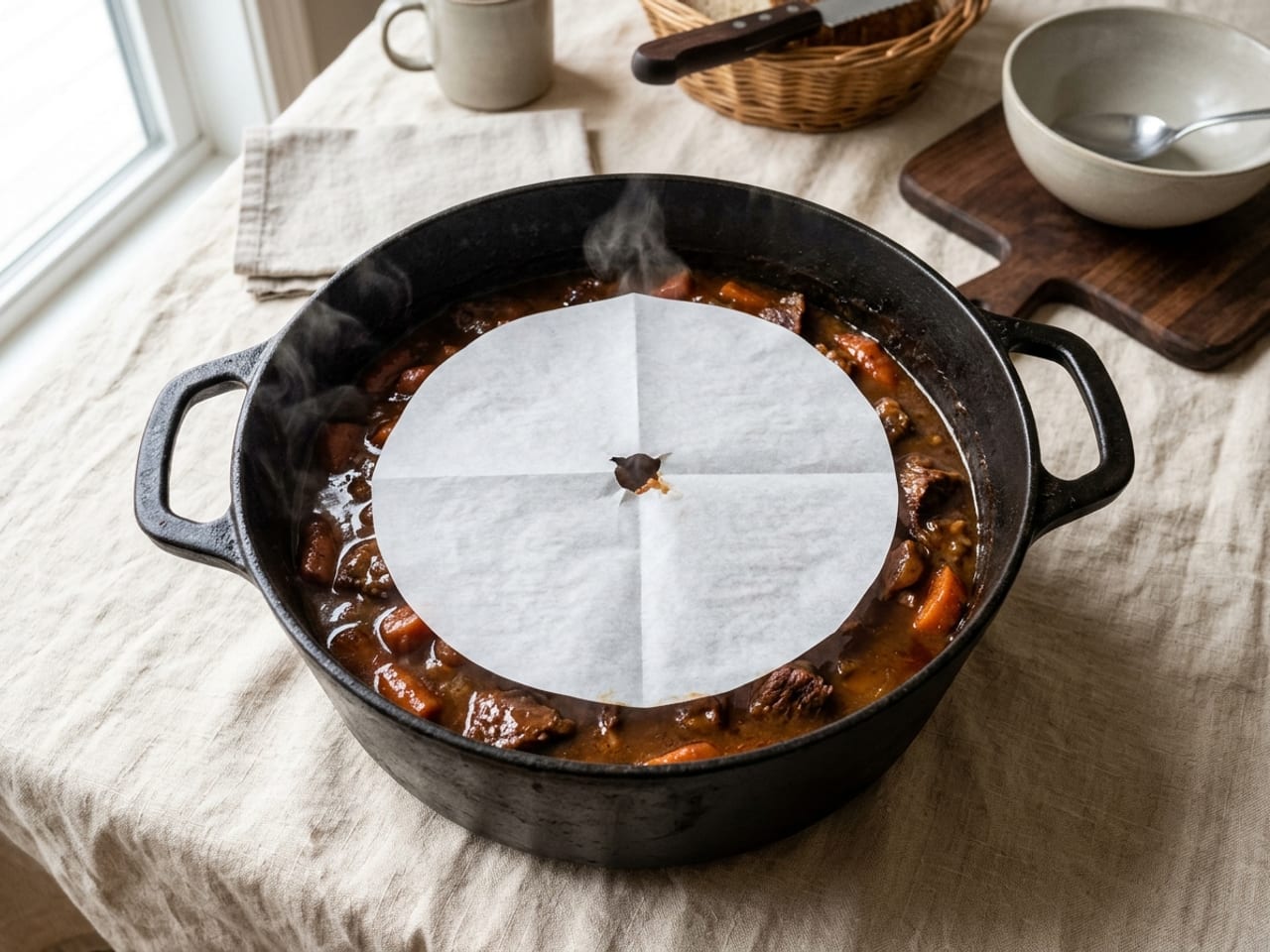
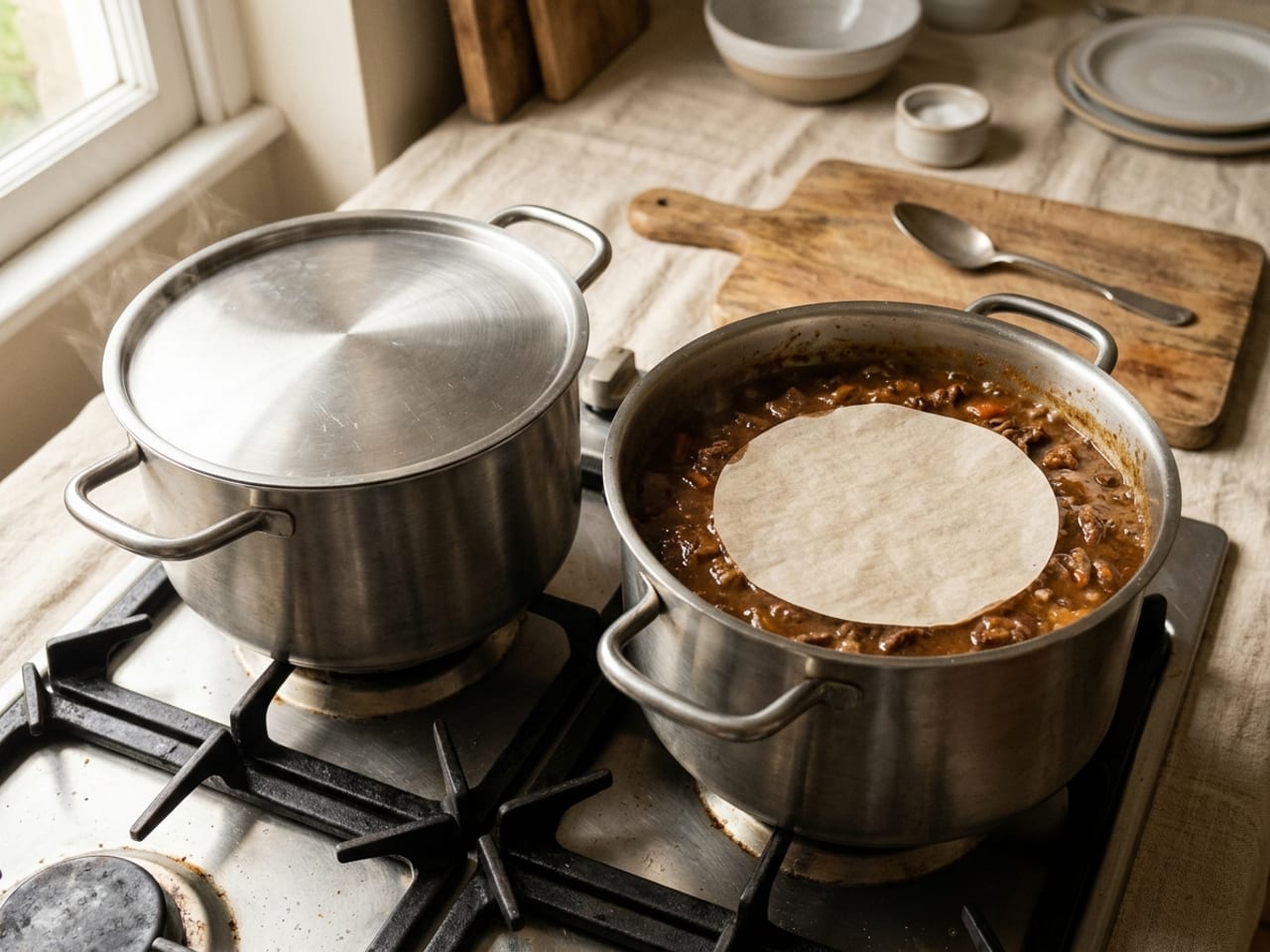
In cooking, a cartouche is a round of paper, usually parchment (greaseproof paper in the UK), laid directly on the surface of food as it cooks. It lets some steam out round its edge, so a braise or glaze loses water more slowly than in an open pan but faster than under a lid (our reading of sources that each compare it with one of them; none measured it), and it stops a skin forming. Sources split on a centre hole, on butter, and on putting a lid on top.1, 5, 17, 24
Not this cartouche: in dictionaries a cartouche is a scroll-shaped ornament or frame, the oval round a pharaoh's name in Egyptian hieroglyphs, or, in French, a cartridge; Cartouche was also an 18th-century Paris bandit (the other senses).64, 70
| The cartouche at a glance | What the sources say |
|---|---|
| Made from | Parchment or baking paper; greaseproof in UK textbooks; foil or a cooking sheet for a Japanese drop lid (which paper) |
| Size | The inside radius of the pot, folded and cut; one printed size, America's Test Kitchen's for a 12 in (30.5 cm, ours) skillet (sizes) |
| Centre hole | Optional: 9 of 24 methods cut one, Gisslen calls it not necessary, Saveur and four other step-by-step sources cut none (who says what) |
| Lid on top | Split three ways across 24 instructions: with a lid, paper or a lid, paper instead (the table) |
| Used for | Braises, poached fish and fruit, glazed vegetables, sweating, skins on sauces; never stock in what we read (by dish) |
| Measured? | No: no source reports grams, degrees or minutes for paper against a lid (claims and verdicts) |
| The word | French for a cartridge or ornament; English kitchen use, earliest correct spelling we found 1908 (history) |
On this page: What it is · How to make one · Hole, butter, size · What it does · When to use it · Stock · Lid on top? · Cartouche vs lid · Which paper · The word · Plating · Terms · FAQ
How this page was made. Every method, use and verdict comes from the source named beside it, with its edition or date. Most textbooks are lending-only scans we could read only as short search fragments; old cookbooks were read in dated scans; each source's entry says how it was read. Plate Artists folded, cooked and measured nothing for this page: the methods are quoted, not kitchen-tested. Sums, conversions and anything marked "ours" are our own. Sources are at the bottom.
How to make a cartouche with parchment or baking paper
The fold almost every source shares: Le Cordon Bleu, Gritzer at Serious Eats, Saveur, America's Test Kitchen, Great British Chefs and Pépin (who used it for cake tins). Quoted, not kitchen-tested by us.
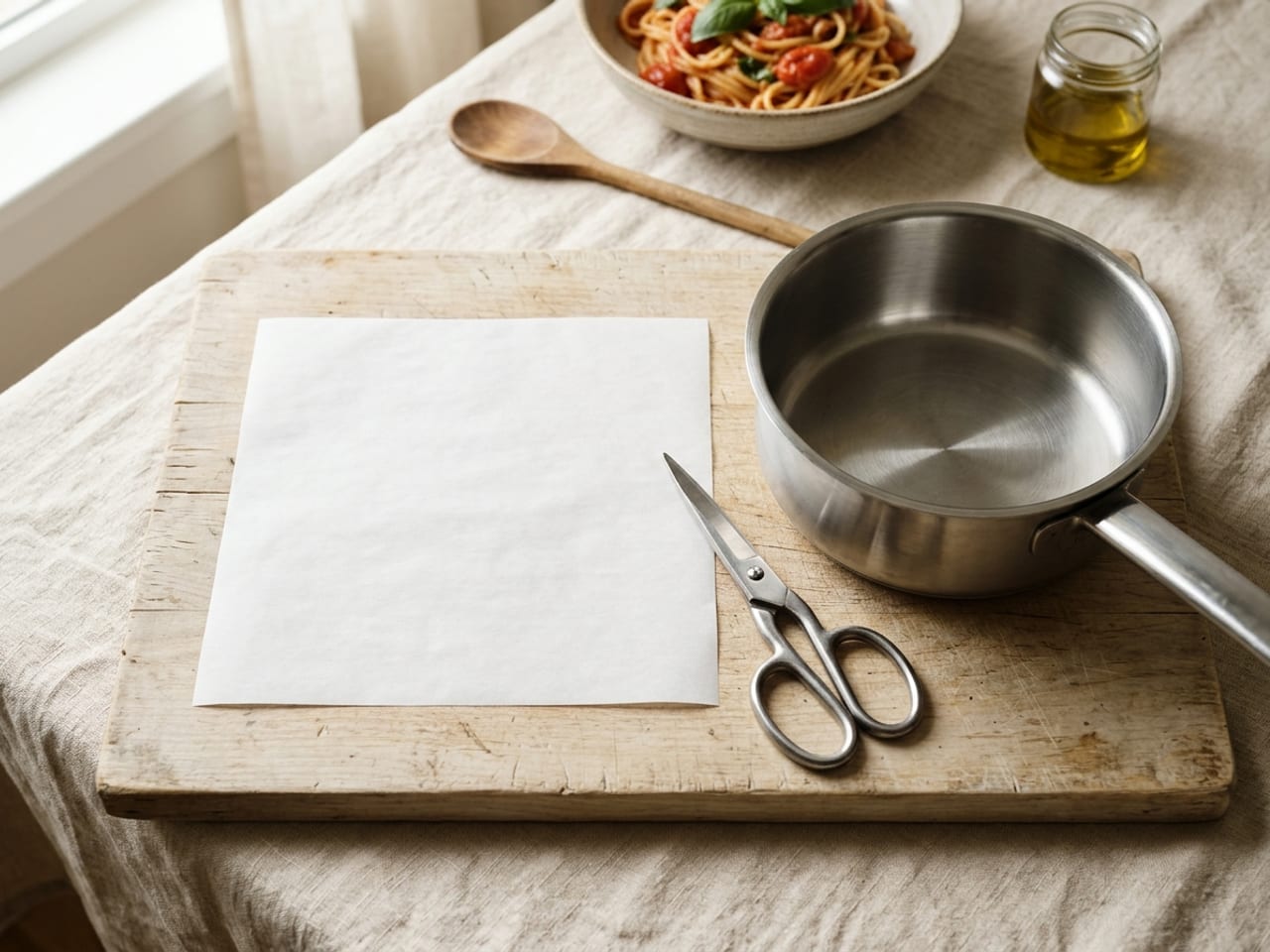 1
Cut a square of parchment a little larger than the pot
Gritzer starts with "a square piece of parchment paper that's just slightly larger than the pot itself."5 America's Test Kitchen uses a 12 in (30.5 cm, ours) square for a skillet of the same size.2 Saveur folds a rectangular sheet; UK books say greaseproof paper (see which paper).6, 24
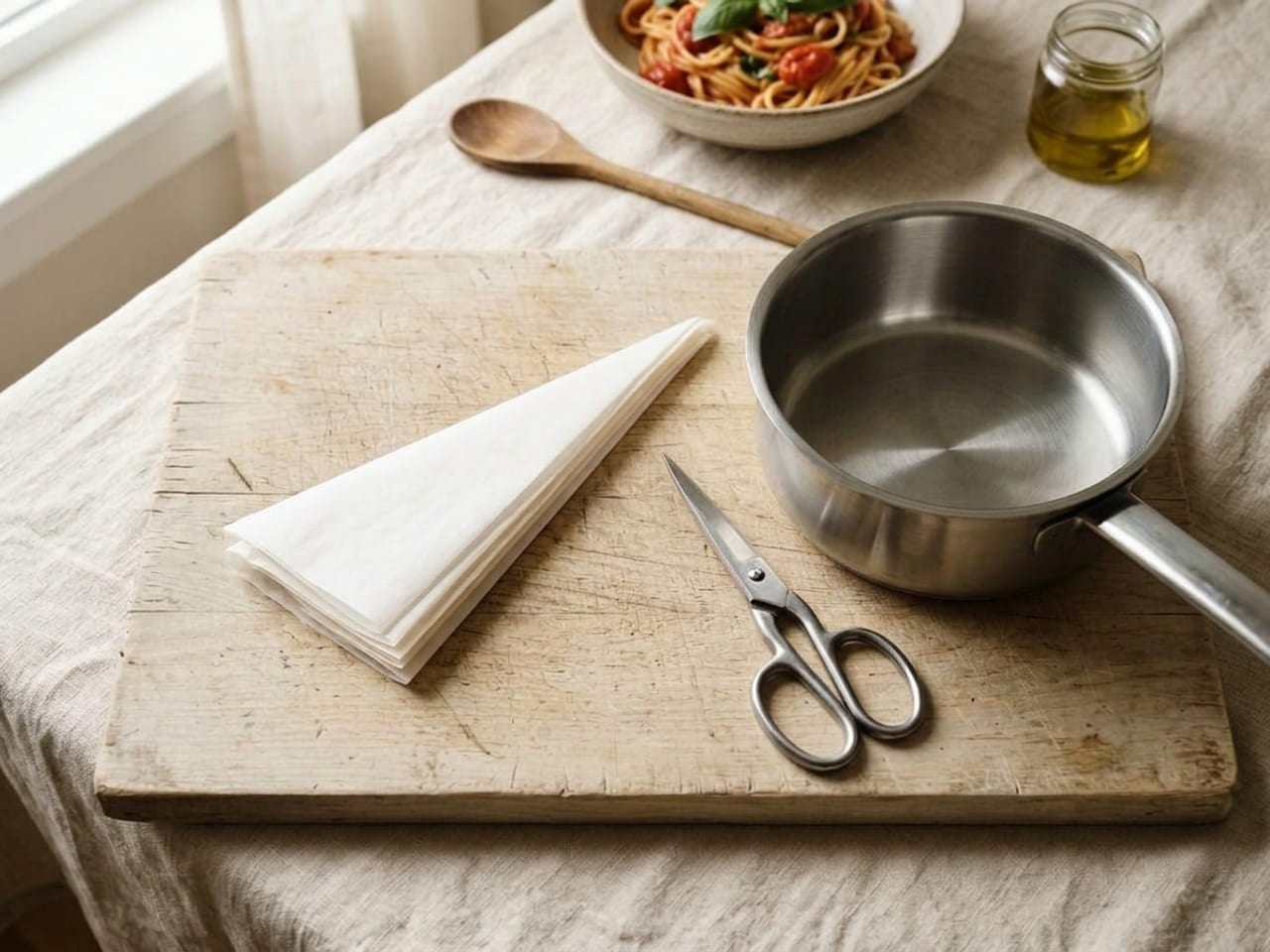 3
Fold it into a triangle, then into a narrow wedge
Fold the small square on the diagonal "to form a triangle, keeping the closed sides together, and then fold that triangle in half lengthwise a couple more times to form a narrow wedge" (Gritzer).5 Saveur folds the triangle two more times; Pépin, lining cake tins, folds it "onto itself in the same manner several times to obtain a thin, long" one (the fragment ends there).6, 27 The narrower the wedge, the rounder the edge after the cut (ours).
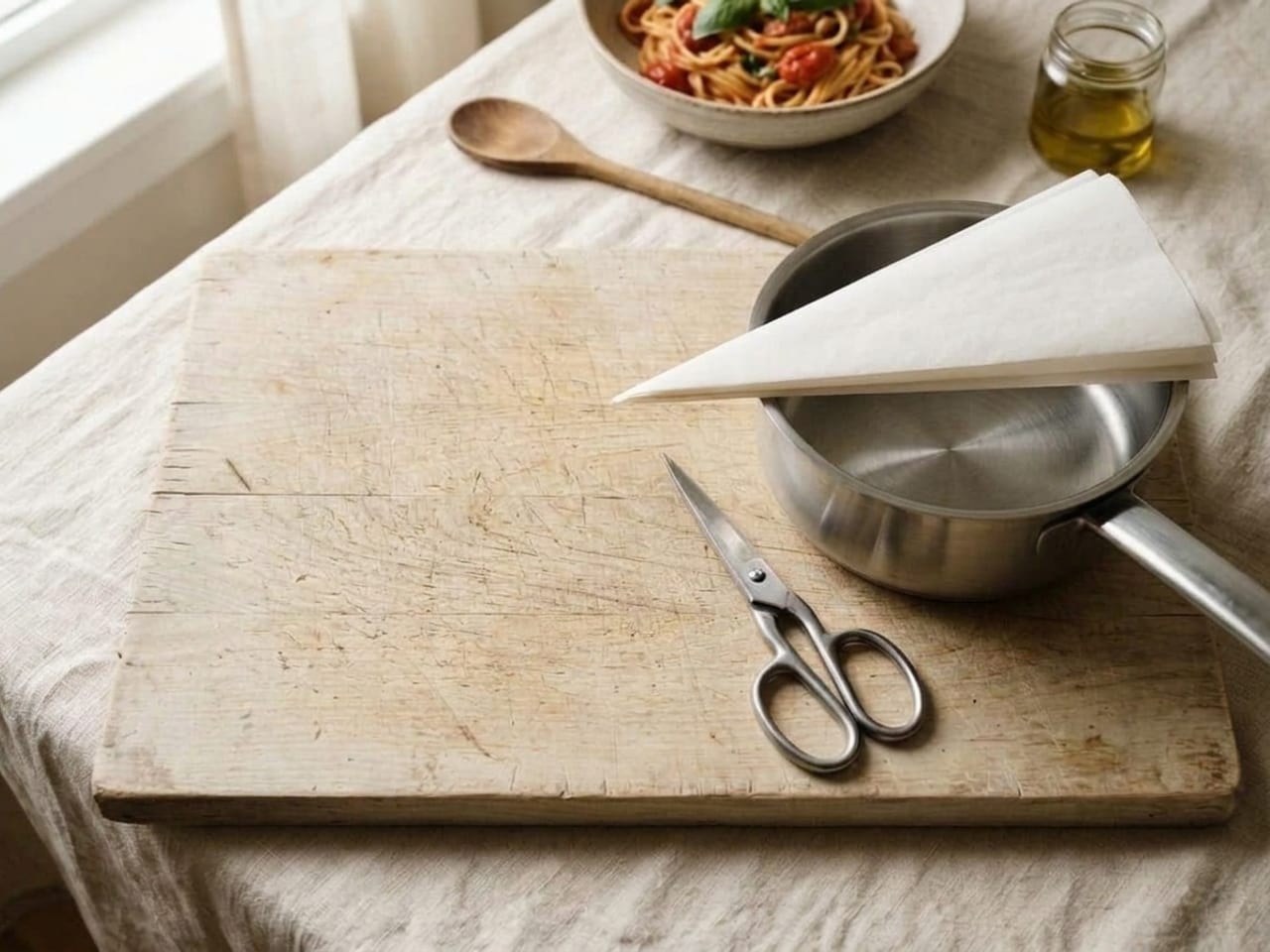 4
Hold the point at the centre of the pot and cut at the inside wall
Le Cordon Bleu says to "Hold one narrow point in" the centre of the pan.24 Gritzer trims the wedge "so that it just fits inside the pot's edge": its length should "match the radius of the inside of the pot", and a little shorter is fine, longer is not.5 Saveur cuts "where it meets the rim".6 Fine Dining Lovers goes the other way: "slightly larger than the radius" (see the size split).7
- 5
If you want a centre hole, snip off the tip (optional)
America's Test Kitchen cuts "1/4 inch of tip of triangle to create small hole" (0.6 cm, ours); Gritzer snips the tip for "a center vent"; chef Lance Knowling in Chowhound says "Don't forget to put a small hole in the center!"2, 5, 11 Gisslen (2011) calls a vent hole "not necessary, because the steam can easily vent from around the edges", and Saveur and four other sources that print every step cut none.6, 8, 9, 14, 16, 17 No source we read gives a measured reason for the hole (see who cuts one).
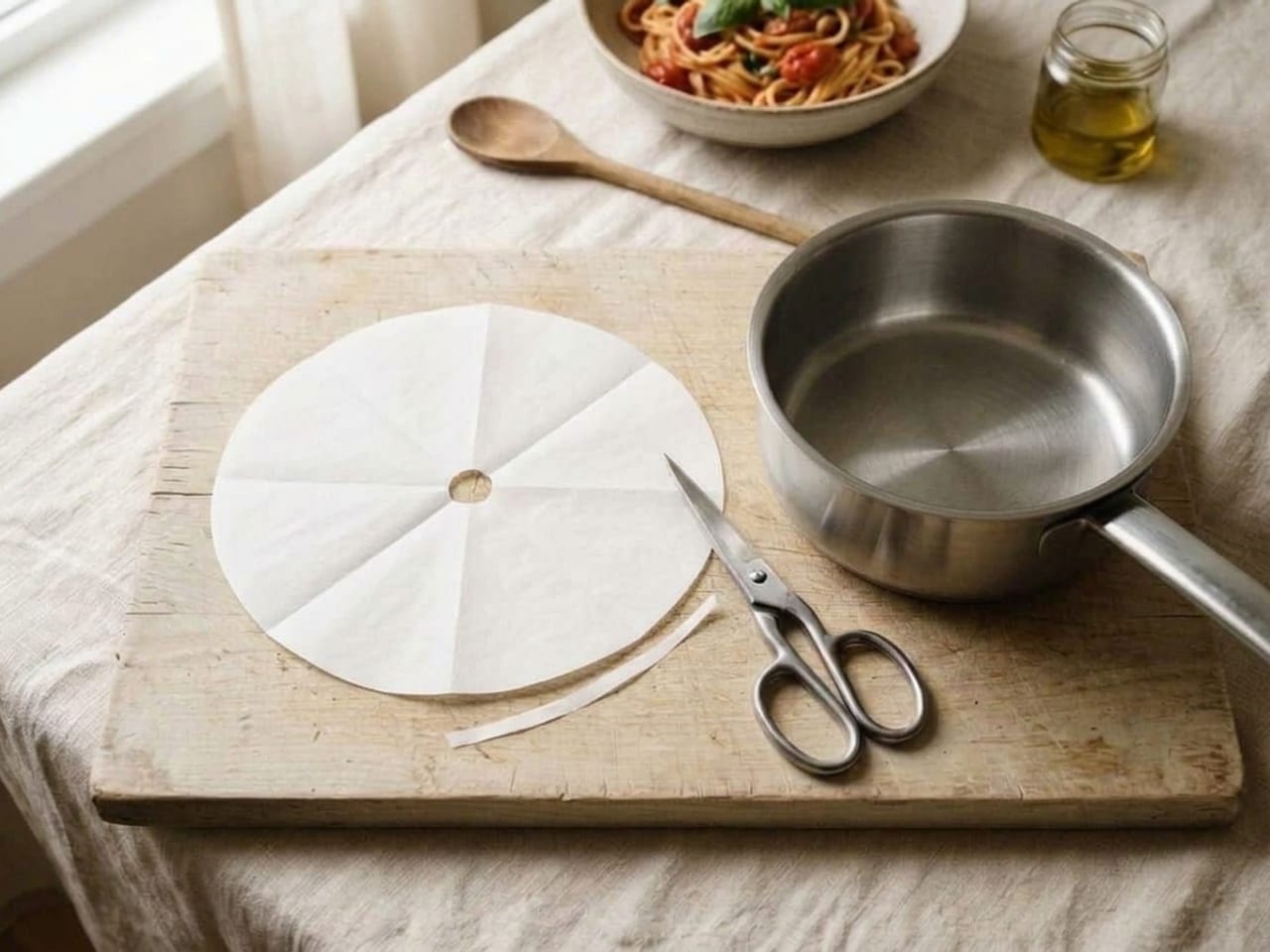 6
Unfold it and lay it directly on the food
"Unfold the circle and tuck it into the pot, gently pressing it against the ingredients" (Saveur).6 Gritzer presses it "directly onto the surface" with the roll's curl facing down, so it does not lift; if the paper is buttered, Gisslen puts it "buttered side down". 5, 17 Lift it with tongs to check the food; throw it away afterwards (America's Test Kitchen, Gritzer, Chowhound).2, 5, 11
One quicker way: Chowhound's chef measures "the inside diameter of the pan or pot and cut[s] it out with scissors". Great British Chefs, at the end of the same fold, cuts the wide end "at an angle". 9, 11 A UK baking teacher folds rather than traces because tracing the tin "gives you the size of the outside"; the same is true of a pot's lid or base (ours).63
What size should a cartouche be?
The only stovetop cartouche with printed sizes in anything we read is America's Test Kitchen's, for a 12 in (30.5 cm, ours) skillet: a 12 in (30.5 cm, ours) square folded to 6 in (15.2 cm, ours), the tip cut 1/4 in (0.6 cm, ours) and the base cut 5 in (12.7 cm, ours) from the hole.2 That makes a round about 10.5 in (26.7 cm) across: our arithmetic, 5 in plus the 1/4 in tip, doubled.
For any other pot, the sources give a rule, not a number, and they disagree: Gritzer wants the wedge to "match the radius of the inside of the pot", a little short being fine and longer not, because it will not fit; Saveur cuts where the wedge "meets the rim"; Fine Dining Lovers cuts it "slightly larger than the radius"; Gisslen cuts paper "the same size as the pan" and L'école Culinaire "the size of the sauté pan". 5, 6, 7, 17, 23 The Japanese paper drop lid is made one size larger than the inside of the pot (Kodansha, our gloss), the wooden one smaller.35
| Inside of the pot, across (measure it) | Square of paper (ours) | Cut the wedge at, from the point (ours) |
|---|---|---|
| 8 in (20.3 cm) | 9 in (22.9 cm) | 4 in (10.2 cm) |
| 9.5 in (24.1 cm) | 10.5 in (26.7 cm) | 4.75 in (12.1 cm) |
| 10 in (25.4 cm) | 11 in (27.9 cm) | 5 in (12.7 cm) |
| 11 in (27.9 cm) | 12 in (30.5 cm) | 5.5 in (14 cm) |
| 12 in (30.5 cm) | 13 in (33 cm) | 6 in (15.2 cm) |
Our arithmetic from Gritzer's rule: the wedge is half the inside width, and the square is 1 in (2.5 cm) wider than the pot, our reading of his "slightly larger". The table measures from the point, which sits at the pot's centre. If you snip the tip first and then measure from the hole, as America's Test Kitchen does, subtract the tip from that figure (ours). For an oval pot or a square pan, none of the sources we read gives a method; ours is to cut a sheet a little larger than the pan, press it down inside, crease it along the inside wall and trim on the crease.
Hole or no hole, butter or water, which paper: every method we read
All 24 sources we read that say how to make or lay the paper, with what each says ("-" where it says nothing). The first 8 are the ones most readers meet; the other 16 open under "Show all". Whether a lid goes on as well is its own table.
| Source | Centre hole | Butter or water | Paper | Size rule |
|---|---|---|---|---|
| America's Test Kitchen2 carrots recipe, 2014 | Yes: "Cut off 1/4 inch of tip" | butter goes in the liquid, not on the paper | parchment | 12 in (30.5 cm) square, cut 5 in (12.7 cm) from the hole, for a 12 in (30.5 cm) skillet (cm ours) |
| Gritzer, Serious Eats5 2025 | Yes: "a center vent" | - | parchment | wedge = inside radius; shorter fine, longer not |
| Chowhound (chef Lance Knowling)11 2025 | Yes: "Don't forget to put a small hole in the center!" | - | parchment | fold, or measure the inside diameter and cut |
| Tsuji, Japanese Cooking: A Simple Art31 1980 | Yes: "a baking paper circle with a center vent" | - | baking paper | - |
| Gisslen, Professional Cooking17 7th ed., 2011 | Not needed: "not necessary": steam vents round the edges | buttered, "buttered side down" | parchment, waxed or "other paper" | "cut the same size as the pan" |
| Saveur (Coleman)6 2007 | No: no hole in its steps | - | parchment | tip at the centre, cut "where it meets the rim" |
| CIA, The Professional Chef19, 20 8th ed. 2006, 9th ed. 2011 | - | "Buttered or oiled parchment" | parchment | for a sauce, "cut to fit directly on the surface" |
| Leiths; Fine Dining Lovers (its steps near-verbatim)7, 8 undated; 2018 | No: no hole in either's steps | "Crumple the cartouche and dampen under cold water" | greaseproof; FDL also parchment | Leiths: "a fraction larger than the radius"; FDL: "slightly larger than the radius" |
Show all 24 sources (16 more)
| Source | Centre hole | Butter or water | Paper | Size rule |
|---|---|---|---|---|
| CIA, The New Professional Chef21 1996 | Yes: tip "trimmed to allow steam to escape" | - | parchment ("Parchment Lids") | folded into triangles |
| Practical Cookery26 1974 to 2015 | Yes: 2015 only: "with a small hole ... at the centre" | buttered for poaching and braising; not stated for sweating | greaseproof | - |
| The Takeout12 2024 | Yes: snips the tip | - | parchment | "the folded paper is its radius", trimmed to fit |
| Le Creuset (maker's recipe)15 undated | Yes: "Tear a small hole in the centre" | - | parchment or greaseproof | "a rough circle the size of the pan" |
| Hayashi, Simple & Delicious Japanese Cooking33 1999 | Yes: foil "with a hole torn out of the center" | - | aluminium foil | - |
| On Cooking22 2003 to 2011 | - | buttered | parchment; foil for an oven pan | - |
| L'école Culinaire23 2012 | - | buttered, "buttered side down" | parchment or waxed paper | "the size of the sauté pan" |
| Le Cordon Bleu, Complete Cooking Techniques24 1996 | - | - | greaseproof | fold a square, narrow point at the centre |
| Le Cordon Bleu, Cuisine Foundations25 2010 | - | sometimes: "Butter the cartouche"; plain for turnips | parchment | - |
| Professional Chef Level 1 (UK)60 2011 | - | "brush one side with melted butter" | greaseproof | - |
| Great British Chefs9 2015 | No: no hole in its steps | - | parchment | large end cut off at an angle |
| The Culinary Pro16 undated | No: no hole in its steps | - | parchment | triangle cut to fit the pot |
| RecipeTin Eats14 2025 | No: no hole in its steps | - | parchment | the wedge's "long side should reach the edge (that’s your radius)" |
| Andoh, Washoku32 2005 | - | - | a double thickness of parchment | - |
| Kikkoman (glossary)34 undated | - | - | parchment or foil "cut to size" | a drop lid is "one size smaller than the pot" |
| Kodansha dictionary (kamibuta)35 online | - | - | kitchen paper | one size LARGER than the pot's inside (our gloss) |
The centre hole: optional
Nine of the 24 cut or tear one: America's Test Kitchen, Gritzer, a Chowhound chef, Tsuji's paper drop lid, the CIA in 1996, Practical Cookery in 2015, The Takeout, Le Creuset and Hayashi's foil. One, Gisslen 2011, calls it "not necessary, because the steam can easily vent from around the edges", and his 1983 and 1999 editions, in the search fragments we read, go straight from the paper to the next step with no hole remark; five, Saveur, RecipeTin Eats, Leiths (with Fine Dining Lovers), Great British Chefs and The Culinary Pro, print full steps with no hole; nine say nothing.2, 5, 6, 7, 8, 9, 11, 12, 14, 15, 16, 17, 18, 21, 26, 31, 33 The reasons given are "to allow steam to escape" (CIA 1996) or simply "a center vent"; no source gives a measured reason. Our take: the hole is optional, and a hole lets a little more steam out.
Butter, oil or water
Most textbooks we read butter it: 7 of the 24 rows, with Gisslen and L'école Culinaire putting it "buttered side down" and the CIA allowing "Buttered or oiled parchment". 17, 19, 23 None of the magazines or web pages we read butters it, and America's Test Kitchen puts its butter in the liquid. Leiths wets it instead, and Fine Dining Lovers prints near-identical steps: "Crumple the cartouche and dampen under cold water before use."2, 7, 8 Bacofoil tells cooks to oil greaseproof paper because, unlike baking paper, it has no silicone, which may be why the UK books butter it (ours).40 Both work in the sources' hands; nobody says "always".
Which side down
Buttered side down (Gisslen, L'école Culinaire); with parchment from a roll, the curl facing the food so it stays down (Gritzer). Asahi Kasei's scum-absorbing sheet can go either side down (our gloss). No other source we read addresses it.5, 17, 23, 36
Once only
America's Test Kitchen says "Discard parchment round", Gritzer "you can't reuse it", Chowhound "a single-use item". Le Cordon Bleu lifts one off its pilaf and puts it back within the same dish.2, 5, 11, 25 No source we read reuses one across dishes.
What a cartouche does, and how sure anyone is
12 things said about the cartouche, who says each, and what kind of evidence stands behind it. None of them was measured in anything we read: no source reports grams of water, temperatures or times for paper against a lid or an open pan. America's Test Kitchen compared covers on its carrots but published no figures.1
| Claim | Who says it | Evidence | Verdict |
|---|---|---|---|
| It stops a skin forming | America's Test Kitchen, McGee, CIA, Le Cordon Bleu, Gisslen ("Cover", cover not named), Larousse gastronomique, Great British Chefs4, 9, 17, 19, 20, 24, 28, 52 | Textbooks and food-science explanation; why a skin forms is explained (water evaporates, proteins concentrate) | Agreed, never measured |
| It slows evaporation (compared with an open pan) | Le Cordon Bleu ("to prevent evaporation"), Hotel and Catering Studies, Fine Dining Lovers, Le Creuset; McGee on covers and evaporative cooling in general7, 15, 24, 28, 57 | Textbook practice and general physics; no source weighed the water | Agreed, never measured |
| It lets more water go than a lid does | America's Test Kitchen, Gritzer, Chowhound ("for removing the water"), RecipeTin Eats; the carrots recipe simmers under paper until "almost all water has evaporated"1, 2, 5, 11, 14 | Test-kitchen and writers' explanation | Explained, never measured |
| It cooks the exposed top evenly | America's Test Kitchen (carrots "evenly cooked from end to end"), Gisslen ("it does help the fish cook more evenly"), CIA, On Cooking ("to trap the steam")1, 2, 17, 19, 22 | One test-kitchen comparison with no numbers published; textbook practice | Agreed, never measured |
| A metal lid condenses steam unevenly, leaving cooler spots | America's Test Kitchen only (echoed by magazines that cite it)1 | A stated mechanism; no temperatures printed | One source |
| It keeps food submerged | The Culinary Pro says yes; Tsuji: "A paper circle does not halt the movement of simmering foods"; the CIA weighs its pears down on top of the paper16, 20, 31 | One school-style site against a Japanese cookery text and a textbook's practice | Disputed |
| It keeps an oven braise below the boil | McGee: a covered pot in the oven eventually boils unless it is "left uncovered, which allows cooling evaporation"; he leaves the lid ajar28 | Physics for a partial cover; no source says it of paper | Ours |
| It works better than a cracked lid | Gritzer and The Takeout (opinion); America's Test Kitchen found a partly covered pan less "even, fast, or consistent" (no figures)1, 5, 12 | Opinion and one unpublished comparison | Opinion |
| A lid "prevents browning" (America's Test Kitchen, says Tasting Table) | Tasting Table puts it to America's Test Kitchen, whose page does not say it; Gritzer explains that a full lid "hinders browning"1, 5, 13 | America's Test Kitchen's page does not say it; Gritzer's is one writer's explanation | Misattributed |
| It keeps air off food that is waiting | Escoffier ("The object of the paper is to keep off the air"), Gouffé ("to prevent drying"), Larousse gastronomique48, 50, 52 | Old and modern textbook practice | Agreed, never measured |
| Metal lids cause a thick skin on purées | Chowhound's writer, with no source11 | None given | Unsourced |
| Flavours soak in better under a drop lid | Tsuji (it "makes flavors penetrate foods"); Kikkoman hedges: drop lids "are even said to"31, 34 | Asserted for the wooden drop lid; no test | Opinion |
How the sources explain it
Gritzer: with a lid fully on, "most of the steam released by the food is trapped", condenses and drips back, which slows browning and stops the liquid reducing; uncovered, exposed food browns faster and the liquid cooks down. A stew or braise wants "some browning and evaporation for flavor development", but "just not too much too soon", and the paper gives a partial cover.5 America's Test Kitchen adds that a metal lid "absorbs heat energy more readily than parchment does", so steam condenses on it, and unevenly.1 So a cartouche loses water faster than a lid and slower than an open pan: our reading of sources that each compare it with only one of them.1, 24
What it does not do
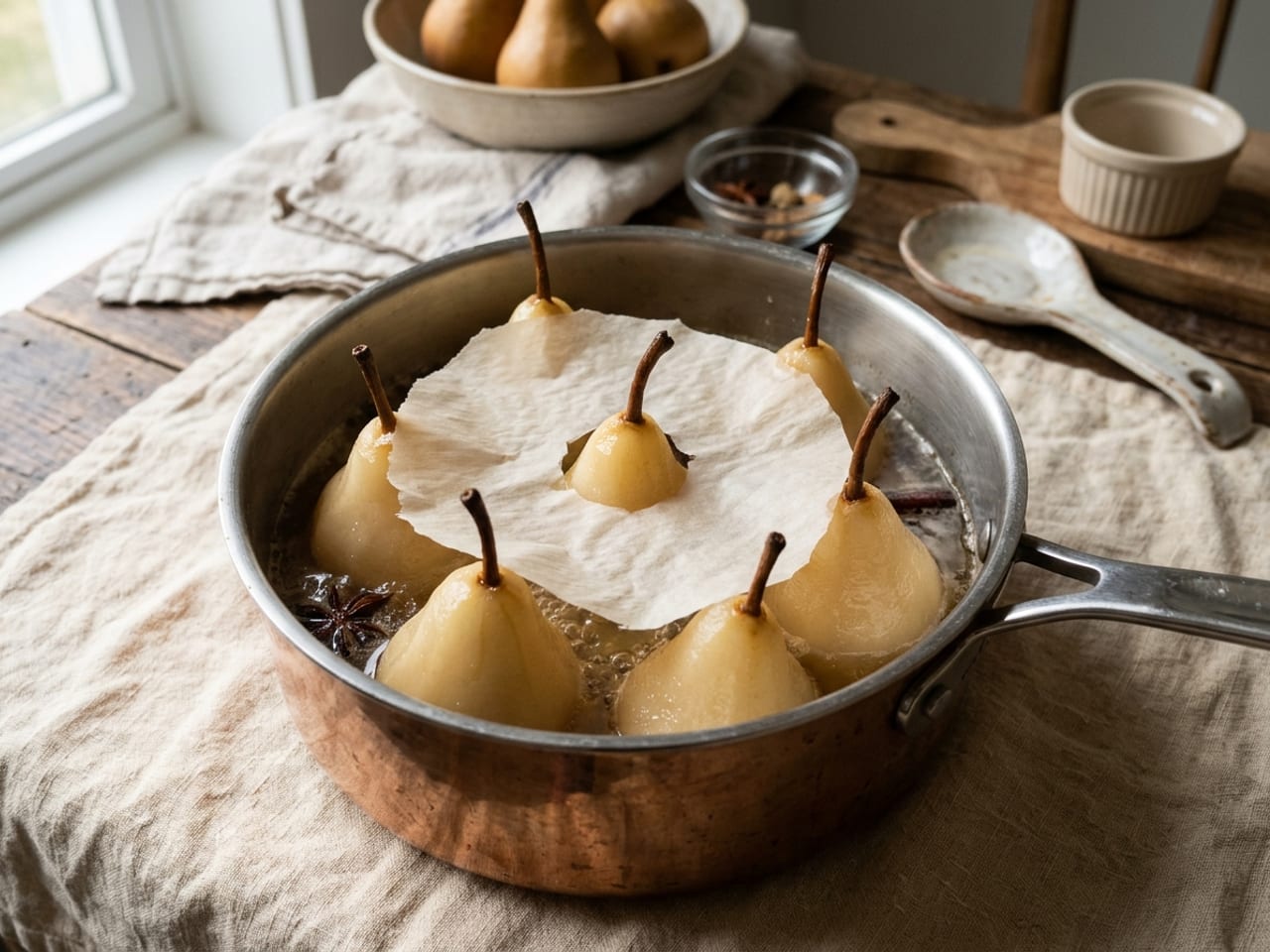
- Hold food under. Tsuji: "A paper circle does not halt the movement of simmering foods"; the CIA puts a weight on its poached pears as well as paper. Do not count on the paper alone to keep floating food submerged.20, 31
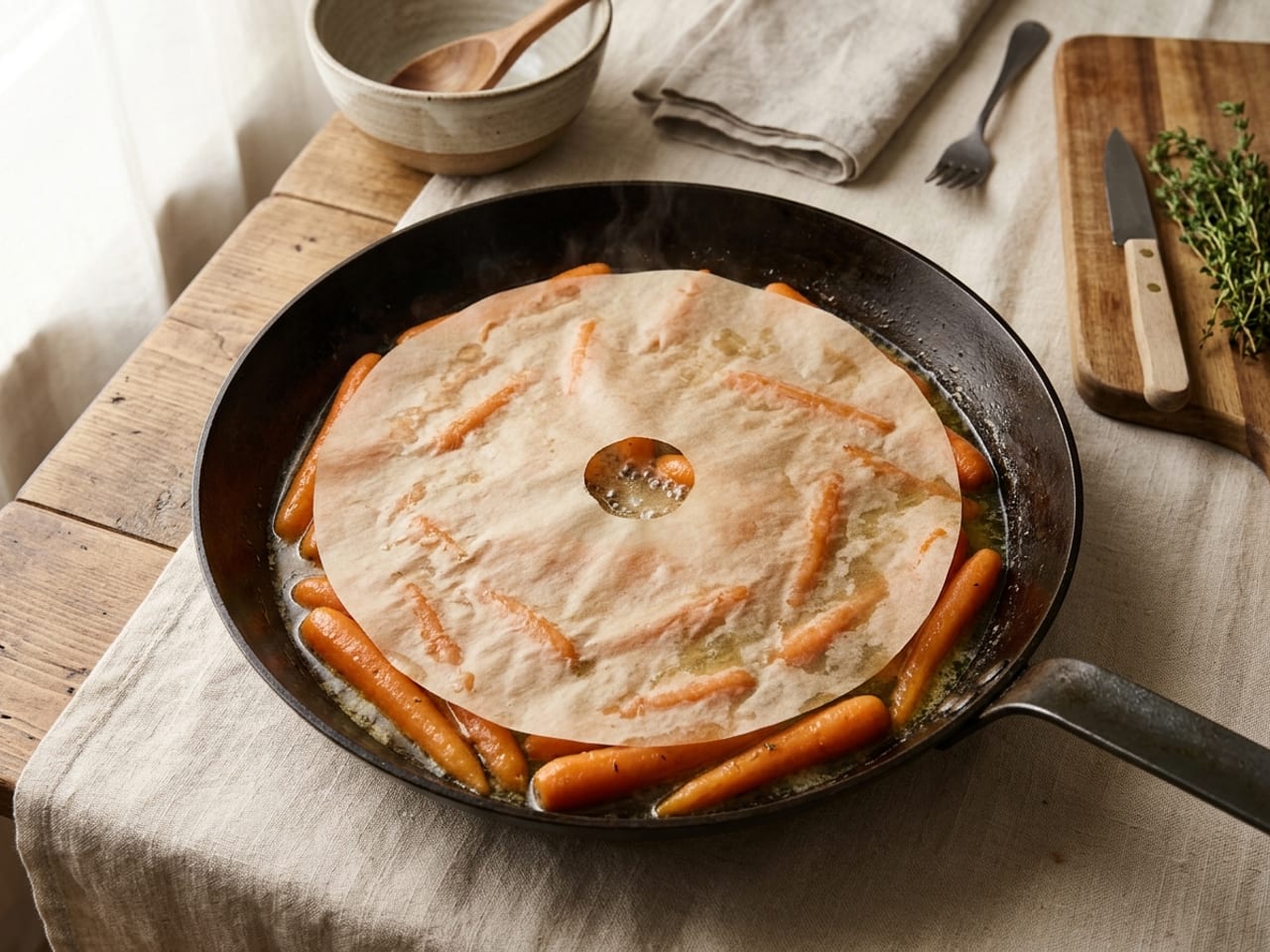
- Brown or reduce food quickly. America's Test Kitchen and Le Cordon Bleu take the paper off to glaze; Gritzer removes it near the end if "you want a little more browning and evaporation". 2, 5, 25
- Help in a closed cooker. In a slow cooker or Instant Pot, "a cartouche doesn't really add any benefit" (RecipeTin Eats).14
- Come with a number. No source tells you how much water it saves; a recipe's time still has to be checked by eye (ours).
When to use a cartouche, dish by dish
The dishes the sources put under paper: 14 kinds of dish from 37 sources, and four that people ask about where we found no source using one. The key rows show first; the rest open under "Show all".
| Dish | Who puts paper on it |
|---|---|
| Braises and stews | Gritzer (stews and braises), RecipeTin Eats (Persian lamb shanks), The Culinary Pro ("a stew, sauce, or soup"), Practical Cookery (with a lid); in the old books Carême, Acton and Francatelli5, 14, 16, 26, 45, 46, 47 |
| Shallow-poached fish | CIA ("buttered parchment (cartouche)"), Gisslen, On Cooking, L'école Culinaire, Practical Cookery, Pépin's trout, The Takeout, Francatelli, Pellaprat 1954. Escoffier advised against it in 1907 (why)12, 17, 19, 20, 22, 23, 26, 27, 47, 51 |
| Poached and stewed fruit | CIA (pears, weighed down as well), Saveur (pears and apples), Practical Cookery 2015 (plums, greengages, cherries)6, 20, 26 |
| Glazed vegetables | America's Test Kitchen (whole carrots), Le Cordon Bleu 2010 (turnips, onions), Larousse gastronomique (carottes glacées), the UK Level 2 textbook, Tasting Table ("glazing")2, 13, 25, 52, 60 |
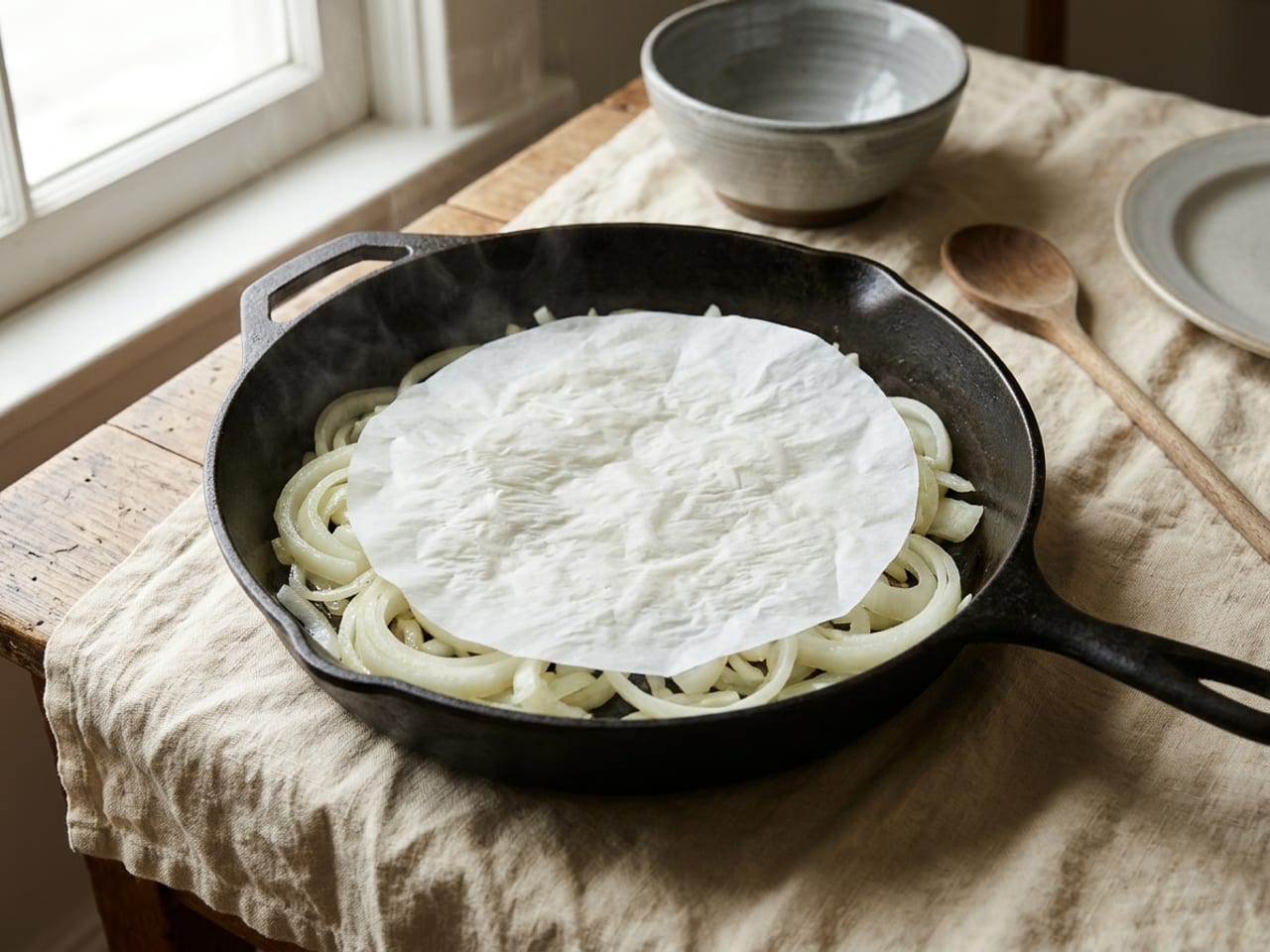
| Sweating onions and vegetables | Le Cordon Bleu 1996 ("without browning"), Leiths and Fine Dining Lovers (a damp paper on onions), Practical Cookery (paper and lid, removed before the liquid), Pellaprat (à l'étuvée)8, 24, 26, 51 |
| Sauces, soups and gravy (against a skin) | Great British Chefs ("primarily"), The Culinary Pro, Le Cordon Bleu ("buttered greaseproof paper"), CIA (parchment or plastic wrap), Fine Dining Lovers7, 9, 16, 19, 20, 24 |
| Simmering stock no source found | No source we read. McGee and Pépin simmer it uncovered (below) |
| Bolognese and ragù no source found | No source we read. Hazan cooks it "uncovered, at the merest simmer" |
| Caramelised onions no source found | No source we read; the paper's stated job on onions is to stop them browning |
Show all 18 dishes (9 more)
| Dish | Who puts paper on it |
|---|---|
| Poached chicken | On Cooking, Practical Cookery 2015 (170°C (338°F, ours) for 12 minutes), Gisslen, The Takeout12, 17, 22, 26 |
| Fish fumet (sweating the bones only) | Gisslen: bones covered "loosely with a round of brown paper or parchment" while they sweat, before any liquid goes in17 |
| Fondant and other potatoes | Great British Chefs (fondant, "a cartouche or a lid"), RecipeTin Eats (Pommes Anna)10, 14 |
| Purées and coulis | Chowhound (a chef's purées), Saveur (Bruce Sherman's parsley coulis)6, 11 |
| Pastry cream and custard | McGee (buttered parchment), America's Test Kitchen, Gisslen (waxed paper), Larousse gastronomique, Acton 1845 ("Never omit a buttered paper over any sort of custard-mixture")4, 17, 28, 46, 52 |
| Rice | Le Creuset (jambalaya), Le Cordon Bleu 2010 (pilaf, in the oven), MasterClass's pilaf as reported by Tasting Table13, 15, 25 |
| Japanese simmered dishes (nimono) | Tsuji (a vented paper circle as the drop lid), Andoh (parchment), Nipponica (a paper drop lid for beans)31, 32, 35 |
| Prepared food kept for later | Escoffier (duxelles, mirepoix, braised vegetables, cooling tongue), Gouffé (mushrooms, fines herbes), The Larder Chef (panadas)48, 49, 50, 57 |
| Jam on the stove, confit no source found | No source we read uses one while cooking; Escoffier's jam paper goes on the day after potting |
Should you use a cartouche for stock? No
Every source we read that answers keeps simmering stock uncovered. McGee: "The pot is left uncovered to prevent accidental boiling and clouding, and to allow slow evaporation and concentration"; Pépin simmers his brown stock "uncovered, for about 3 hours".28, 30 No source we read puts a cartouche on a simmering stock. The one paper use near stock is Gisslen's fish fumet: the bones are covered "loosely with a round of brown paper or parchment" while they sweat over low heat, before any liquid goes in.17 Our au jus guide simmers uncovered too.
Bolognese, ragù, caramelised onions, jam
None of the 37 sources in the dish tally uses a cartouche for these. Marcella Hazan cooks bolognese "uncovered, at the merest simmer for a long, long time".29 On onions, the paper's stated job is to sweat them "without browning", the opposite of caramelising.24 Escoffier's jam paper goes on the day after potting, not in the pan.49 Ours: a cartouche on a ragù is a reasonable partial cover if it reduces faster than you want, made of parchment rather than foil (why).
Why use a cartouche and a lid? Paper with a lid, paper or a lid, paper alone
24 instructions from the sources we read that say whether a lid goes on as well (America's Test Kitchen, Pellaprat and Practical Cookery give two each). Ten put the paper under a lid (five of them before 1950), six offer paper or a lid, and eight use paper instead of a lid. In the older books we read, the paper usually went under a lid; modern test kitchens and food writers use it in place of one.
| Source | Way | In its words |
|---|---|---|
| Carême45 1815 | Paper and a lid | paper round, then the braising pan on the range "avec du feu dessus et dessous" (fire above and below, so a lid holding embers: our reading) |
| Acton46 1845 | Paper and a lid | paper under the lid that, in France, carried the fire |
| Francatelli47 1846 | Paper and a lid | "cover with a round of buttered paper, put the lid on" |
| Gouffé48 1868 | Paper and a lid | "Put a round of paper over the whole, and close the stewpan"; once "only three parts covered" |
| Pellaprat51 1937 | Paper and a lid | "a round of buttered paper placed on vegetables and with the cover" |
| Cordon Bleu books (London school; Le Cordon Bleu)61 1963 to 1992 | Paper and a lid | "greaseproof paper under the lid" (1963); "round of buttered baking parchment and then the lid" (1992) |
| Practical Cookery26 1974 to 2008 | Paper and a lid | "Cover with greaseproof paper and a lid and sweat"; braises, "buttered greaseproof paper and a lid" |
| Gisslen17, 18 1983 to 2011 | Paper and a lid | shallow poaching: paper "and cover the pan with a lid"; the paper "is sometimes omitted if the pan has a tight lid" |
| Game Cookery (UK)57 1989 | Paper and a lid | "cover with a cartouche of greaseproof paper and then the lid" |
| America's Test Kitchen (steep)2 2014 | Paper and a lid | off the heat, "Cover skillet and let stand for 20 minutes", the paper underneath |
| Larousse gastronomique52 1997 | Paper or a lid | "le couvercle peut être remplacé par du papier sulfurisé" (the lid can be replaced by parchment) |
| CIA, The Professional Chef19, 20 2006, 2011 | Paper or a lid | "Buttered or oiled parchment or a loose-fitting lid" |
| On Cooking22 2003 to 2011 | Paper or a lid | "buttered parchment paper (cartouche) or a lid" |
| City & Guilds 710059 2010 | Paper or a lid | "a cartouche and/ or a lid" (either or both) |
| Practical Cookery (fruit)26 2015 | Paper or a lid | "cover with greaseproof paper or" a lid (two search fragments) |
| Great British Chefs (fondant)10 undated | Paper or a lid | "cover with a cartouche or a lid" |
| Pellaprat51 1974 printing | Paper instead of a lid | "un rond de papier huilé sur les choux, mais sans couvercle" (but without a lid) |
| Tsuji31 1980 | Paper instead of a lid | a drop lid, or a vented paper circle, sits on the food; no pot lid |
| Saveur6 2007 | Paper instead of a lid | "instead of a lid" |
| America's Test Kitchen (simmer)2 2014 | Paper instead of a lid | "Remove lid from skillet, leaving parchment round in place" |
| Gritzer, Serious Eats5 2025 | Paper instead of a lid | the paper is the partial cover, in place of a cracked lid |
| Chowhound11 2025 | Paper instead of a lid | a cartouche instead of a metal lid on a purée |
| RecipeTin Eats14 2025 | Paper instead of a lid | "the cartouche is used instead of a lid" |
| The Takeout12 2024 | Paper instead of a lid | for when a recipe says "partially cover" |
Why both? Gisslen's reason is the only one given: the paper "holds in the steam to cook the top of the fish" and "does help the fish cook more evenly", even under a lid.17 Acton's 1845 reason, a shield against the fire on the lid of a French braising pan, no longer applies to a modern oven (ours).46 No source measures paper and lid against paper alone.
When a lid, or no cover, is better
- No cover: stock (McGee, Pépin), bolognese (Hazan), and the last minutes of a glaze or braise (America's Test Kitchen, Gritzer).2, 5, 28, 29, 30
- No regular lid on a Japanese simmered dish: Andoh, with no drop lid, says "it is best to leave the pot uncovered" rather than use an ordinary lid.32
- Not covered all the way on some vegetables: the CIA warns that some "will discolor if left covered during the whole cooking process" (the search fragment does not say which).20
- A lid, when you want no reduction at all: a full lid traps most of the steam (Gritzer); RecipeTin Eats chose paper over a lid precisely because a lid "traps more steam".5, 14
- Cooling in a food business: the model Food Code wants cooling food "loosely covered or uncovered" so heat can leave the surface; pressing paper onto a large batch works against that. Cool it first, then cover (ours).44
Cartouche vs lid vs cracked lid vs drop lid (otoshibuta)
| Cover | Where it sits | Size | Steam and liquid, in the sources' words | Who uses it, for what |
|---|---|---|---|---|
| Pot lid5, 19, 28, 50 | On the rim | The pot's own | Most stays in and drips back, which "prevents liquids from evaporating and reducing" (Gritzer); in the oven a covered pot eventually boils (McGee) | Escoffier's braises ("cover the braising-pan"); the CIA allows a loose-fitting one for shallow poaching |
| Cracked lid, lid ajar5, 28 | On the rim, pushed aside | The pot's own | Some escapes at the gap; Gritzer finds the gap hard to judge | McGee's own stew method ("the pot lid ajar") |
| Cartouche (paper round)1, 5, 7 | On the food | The inside radius (Gritzer); slightly larger (Fine Dining Lovers) | Some escapes round the edge (America's Test Kitchen), and at a centre hole if cut; the surface stays covered, so no skin | Modern sources for braises and glazes; textbooks for poaching, often with a lid as well |
| Drop lid (otoshibuta), wood31 | On the food, floating | "slightly smaller in diameter than the straight-sided pot" (Tsuji) | Floats on the liquid and acts "to submerge" the food, "thereby ensuring even cooking"; "the right weight" to keep it from moving about (Tsuji); soaked in water first | Tsuji: "a necessity" for Japanese simmered dishes |
| Paper drop lid (kamibuta)31, 32, 34, 35 | On the food | One size LARGER than the pot's inside (Kodansha, our gloss); Tsuji's has a centre vent | "does almost the same job" as wood, but "does not halt the movement of simmering foods" (Tsuji) | Tsuji, Andoh, Kikkoman, Nipponica (beans) |
| No cover2, 28, 29, 30 | - | - | Steam leaves; liquid reduces; exposed food browns faster (Gritzer) | Stock (McGee, Pépin), bolognese (Hazan), the last minutes of a glaze (America's Test Kitchen) |
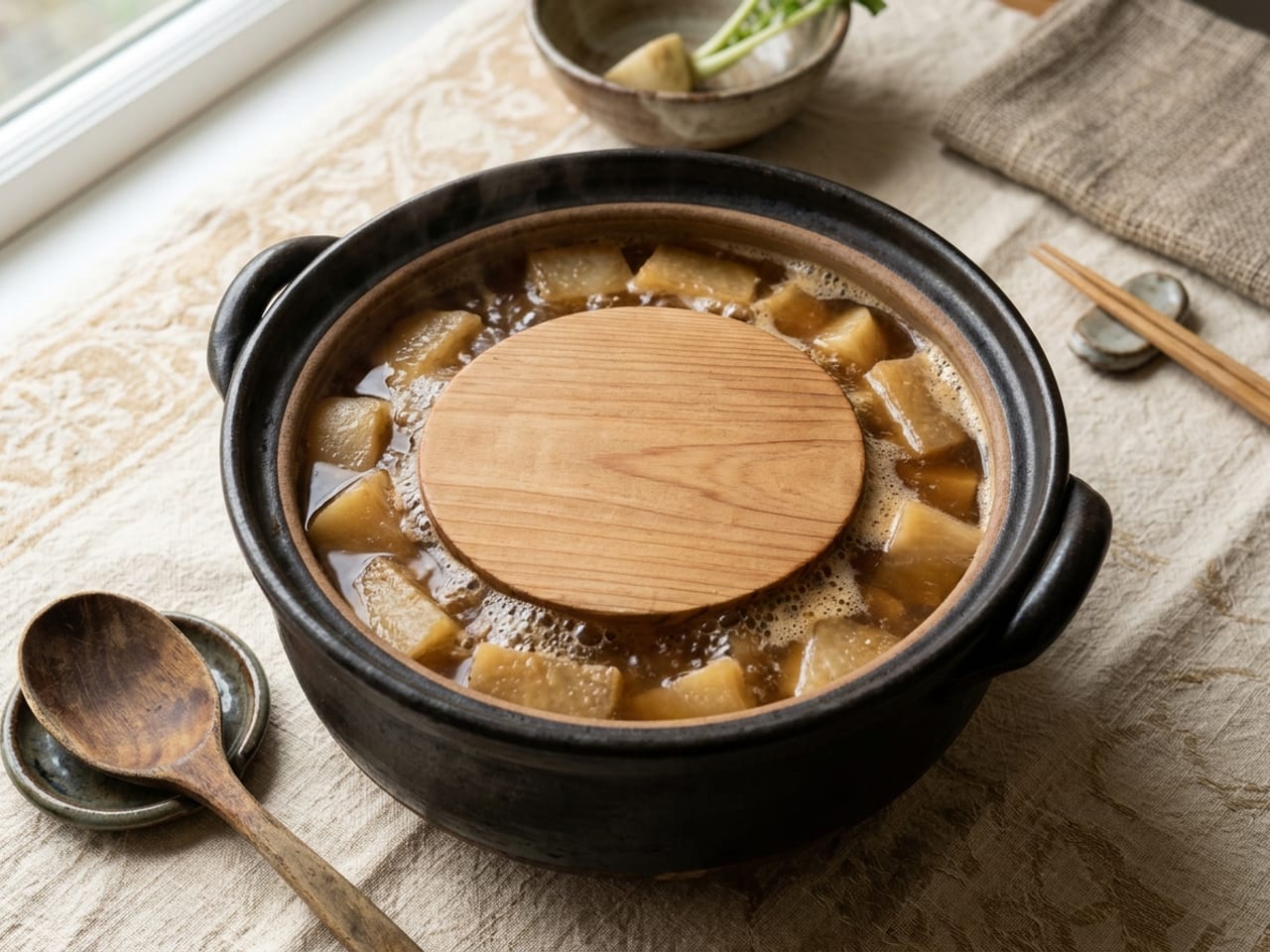
The Japanese drop lid is the closest relative. Tsuji says it keeps food still, spreads the liquid and heat, makes flavours penetrate and "prevents the simmering liquid from breaking into a rolling" boil; it is soaked in water for a few minutes first, or it "will carry that particular odor forever".31 The paper version does everything but hold the food still. Kodansha's dictionary makes the paper lid one size larger than the pot's inside and the wooden one one size smaller (our gloss).35 Kikkoman says silicone drop lids have now overtaken wooden ones.34
Which paper for a cartouche: parchment, greaseproof, wax paper or foil
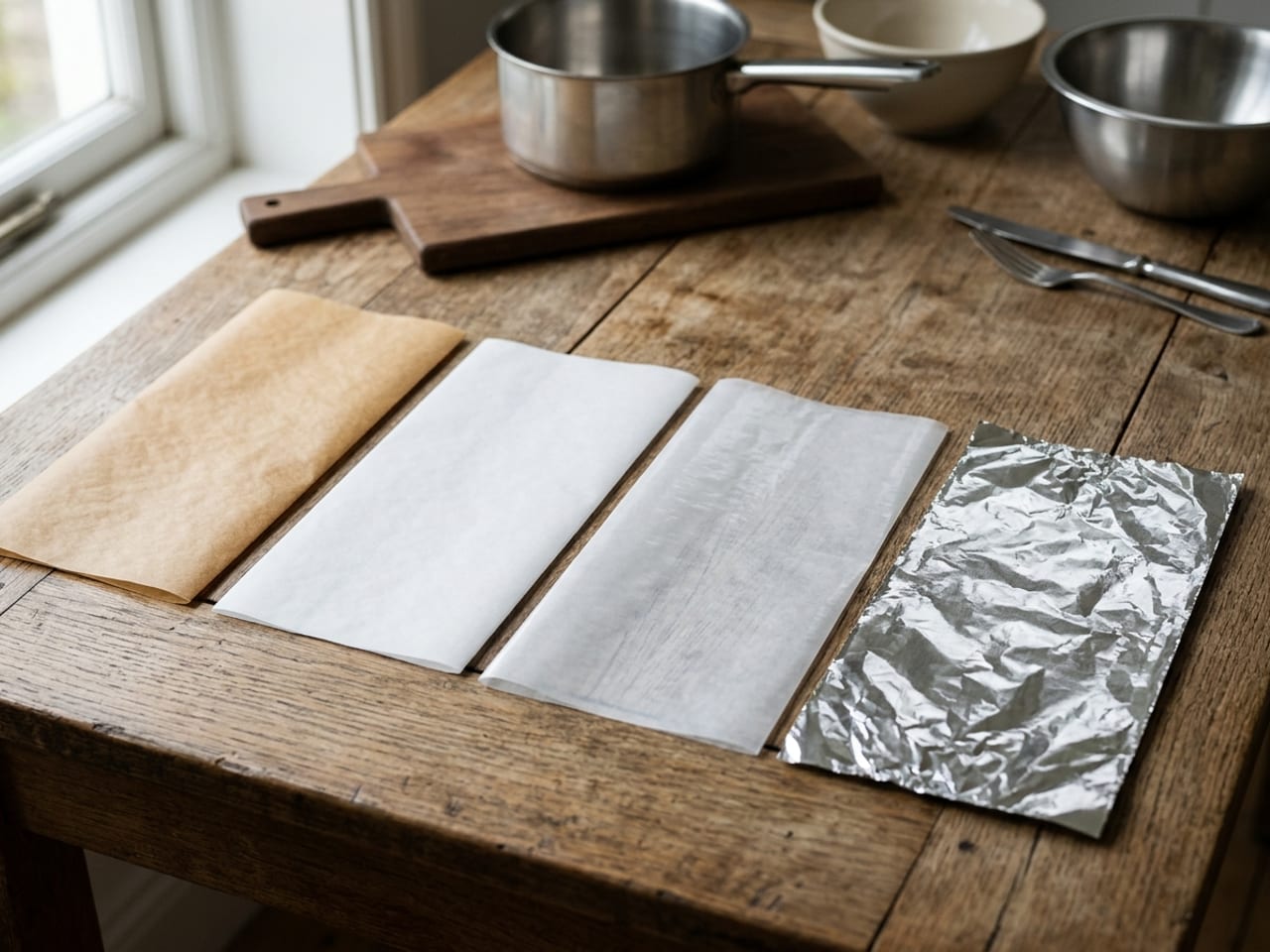
What each sheet is in its maker's words, the heat limit the maker prints (conversions ours), and who uses it as a cartouche. In the US, say parchment; in the UK, baking paper is the siliconised one and greaseproof is not; in Japan, a cooking sheet. Practical Cookery says "greaseproof paper" throughout and never "cartouche". 26
| Sheet | What it is | Maker's heat limit | Used as a cartouche by |
|---|---|---|---|
| Parchment (US); baking paper (UK)3, 31, 37, 39, 40, 41 | Paper coated with silicone: Bacofoil's baking paper is "siliconized on both sides"; If You Care's is greaseproof paper with "a fine misting" of silicone | Reynolds 425°F (218°C, ours; 420°F on another of its pages); If You Care 428°F (220°C, ours); "most" brands 420 to 450°F (216 to 232°C, ours) per America's Test Kitchen; Lakeland's silicone paper circles 230°C (446°F, ours) | Every US textbook and web source we read; Tsuji's "baking paper" |
| Greaseproof paper (UK)8, 24, 26, 40, 60 | "not siliconized, so if you intend on cooking with it, coat it well with oil" (Bacofoil) | No figure printed on the maker's page we read | The UK textbooks (Practical Cookery, Le Cordon Bleu 1996, the Level 1 to 3 books), Leiths; usually buttered, which Bacofoil's advice explains (ours) |
| Wax paper (waxed paper)17, 23, 27, 38 | Paper with a wax coating, sold for wrapping and lining | Reynolds: it "should not be directly exposed to the heat of an oven"; only as a liner the batter completely covers | Gisslen (poaching fish and chicken) and L'école (fish, then into a 350°F (177°C) oven, which Reynolds rules out); Pépin lined cake tins with it. The maker does not address the stovetop. Ours: use parchment |
| Brown paper17, 27 | Plain brown wrapping paper | No figure | Gisslen's fish fumet ("brown paper or parchment"); Pépin says cooks lined cake pans with it before rolls of parchment and wax paper |
| Aluminium foil22, 33, 34 | Metal foil; a torn centre hole in Hayashi | No heat limit relevant here; the caution is acid and salt (below) | Hayashi for a Japanese drop lid; Kikkoman; On Cooking for an oven pan |
| Silicone-coated cooking sheet (Japan)36 | Asahi Kasei's sheet, "両面シリコーン加工" (silicone-coated both sides), sold cut to size for a drop lid | 250°C for 20 minutes to 300°C for 5 minutes (482 to 572°F, ours); a scum-absorbing sheet that also works as a drop lid (our gloss), 110°C (230°F, ours) | The maker's own drop-lid use |
| Kitchen paper35 | Absorbent paper towel | No figure | Kodansha's kamibuta (paper drop lid) for long simmering |
| Silicone baking mat34 | A reusable sheet of silicone | - | None of the sources we read uses one as a cartouche. Kikkoman mentions silicone drop LIDS, a different product |
Safety
- Heat. A braise in a 300 to 350°F (149 to 177°C, ours) oven sits under every parchment rating above (ours). In the oven above its rating, parchment "does not release noxious chemicals, and the paper will not burn", manufacturers told America's Test Kitchen; ATK adds that it can "darken and turn brittle". That is oven air, not a flame (next point).3
- Gas flame. Reynolds: "Never touch the parchment paper to an open flame". On a gas hob, keep the round inside the pot, below the rim, with no paper hanging over the edge (ours).37 Asahi Kasei recommends its cooking sheet for a drop lid but points gas-hob frying-pan users to its foil.36
- Wax paper. "Wax paper should not be directly exposed to the heat of an oven" (Reynolds). Yet L'école Culinaire covers fish with "buttered parchment, or waxed paper" and puts it in a 350°F (177°C) oven, and Gisslen allows waxed paper on poaching fish and chicken; the maker does not address the stovetop. Ours: use parchment.17, 23, 38
- Foil with acidic or salty food. Reynolds, citing USDA, says pinholes from acidic, spicy or salty food produce "a harmless aluminum salt"; Germany's BfR said in 2014 that it had for some time recommended that aluminium foil not touch acidic or salty foods, and Northern Ireland's official business guidance says to avoid it with "tomatoes, rhubarb or citrus".37, 42, 43 For a tomato, wine or citrus dish, ours is parchment, not foil.
- Plastic wrap on hot cream. McGee lays "buttered parchment directly onto the cream" and says to avoid plastic wrap, whose plasticisers "tend to migrate into fat-rich foods"; Bacofoil does not recommend its cling film in the oven.28, 40
- Escoffier's objection. In 1907 Escoffier advised against covering poaching fish with buttered paper, "for nowadays a suitable paper is very rarely found": the papers on the market, "owing to the chemical products used in their manufacture", gave off a smell, and he extended this to everything once cooked under paper.49, 50 Francatelli before him and Pellaprat after him kept paper on fish.47, 51 Today's food parchment is a different, silicone-coated product; whether Escoffier's complaint applies to it, no source we read says (ours).
Cartouche meaning, in English and in French, and where the cooking sense comes from
From Italian, via French. French cartouche comes from Italian cartoccio, a paper cone or roll, from carta, paper (Larousse, the TLFi, Merriam-Webster, Etymonline); Wiktionary gives Italian cartuccia instead, whose military sense, the TLFi says, came back into Italian from French.64, 68, 69, 70, 71 In French it is two words: masculine, an ornament or frame; feminine, a cartridge, originally rolled paper holding a gun's charge.69, 70
Pronunciation. UK /kɑːˈtuːʃ/, US /kɑːrˈtuːʃ/ (Cambridge); "kär-ˈtüsh" (Merriam-Webster); French [kaʀtuʃ]. Say kar-TOOSH.64, 65, 70
The major dictionaries do not record the cooking sense. In what we read, 8 of 9 dictionaries have no cooking sense; Wiktionary, a wiki, is the one that does. We did not read the OED.
| Dictionary | Cooking sense? | Senses it gives |
|---|---|---|
| Merriam-Webster (archived copy, January 2026)64 | No | paper gun cartridge, ornamental frame, the Egyptian oval |
| Cambridge Advanced Learner's65 | No | scroll-shaped ornament; decorative frame round writing, especially an Egyptian royal name |
| Oxford Advanced Learner's (archived copy, 2017)66 | No | the Egyptian oval |
| Random House Unabridged and Collins 2012 (Dictionary.com, archived copy)67 | No | ornament, Egyptian oval, firework case, cartridge, cartridge box |
| Online Etymology Dictionary (archived copy)68 | No | ornament, paper cartridge, Egyptian oval |
| Larousse (French, and French-English)70 | No | masculine: ornament, Egyptian loop, map frame; feminine: cartridge, refill |
| TLFi, Littré and the Académie (CNRTL)69 | No | ornament (1546), cartridge (1571) |
| Larousse gastronomique, 199752 | No entry | no 'cartouche' entry; the job is described under COUVRIR as papier sulfurisé |
| Wiktionary (English; a wiki)71 | Yes | "(cooking) A parchment disc placed on top of food"; the French Wiktionnaire has no cooking sense |
What French cooks call it
Not cartouche, in what we read. Carême wrote "un rond de papier beurré" (a round of buttered paper), Escoffier "un rond de papier blanc beurré"; Larousse gastronomique (1997) has no entry for the word and, under COUVRIR, says the lid "peut être remplacé par du papier sulfurisé, beurré ou non" (can be replaced by parchment, buttered or not).45, 49, 52 Modern French books say "rond de papier sulfurisé" or "couvercle en papier", and a hotel-school worksheet times the step "Réaliser un rond de papier sulfurisé"; the one French "cartouche en papier sulfurisé" we found reads as a translation of an English book (our inference).53 The exception is a 1962 London dictionary of kitchen French: "cartouche nf. round piece of grease-proof paper."58 So the cooking cartouche is, in what we read, an English and Commonwealth kitchen word built on a French one. Not to be confused with en papillote, where the paper is sealed round the food.52
History: the practice first, then the word (earliest we found)
The buttered paper round is older than the word: Carême used it in 1815, and the 19th-century cooks we read often put it under the lid. The earliest culinary entry we found (Senn, 1898) is headed "Cartridge", the English twin of the French word; Senn's own 1908 dictionary has "Cartouche, f.". Victorian kitchens also used stout "cartridge paper", which may be the bridge to Senn's headword; no source says so (ours).45, 47, 54, 56
- 1546 and 1571. French: the ornament "cartoche" (1546) and the cartridge "cartuche" (1571), "papier enroulé contenant la charge" (rolled paper holding the charge), per the TLFi.69
- c. 1611. English cartouche, as the paper cartridge and the scroll ornament (Merriam-Webster dates the cartridge sense "circa 1611"; Etymonline gives both from the "1610s").64, 68
- 1815. Carême covers a chartreuse and a braise with "un rond de papier beurré" (a round of buttered paper): the practice, under another name.45
- 1845. Acton gives the oldest reason we found: the paper keeps delicate braised meat from being "browned by the fire, which, in France, is put round the lid".46
- 1846. Francatelli uses "a round of buttered paper" 26 times in The Modern Cook, often with the lid on as well (10 of the 26 name a lid, our count).47
- 1868. Gouffé's reasons: "to keep the moisture in, and preserve them white", "to prevent drying", and to keep floating pieces of a braise from "getting black".48
- 1898. The earliest culinary definition we found is under "Cartridge": "a circular piece of greased paper, used for covering meat, etc., during the process of cooking" (Senn).54
- 1903. Martyn's Menu Dictionary (New York) copies Senn under the French word, misspelt "Cartrouche, m."55
- 1907. Escoffier advises against paper on poaching fish, because the papers of his day smelled (below), while still covering mirepoix with "un rond de papier blanc beurré".49, 50
- 1908. Senn moves his entry to "Cartouche, f.": the earliest correctly spelt culinary cartouche we found.56
- 1962. A London dictionary of kitchen French lists "cartouche nf. round piece of grease-proof paper."58
- 1969. The CIA's Professional Chef says "buttered paper"; its 1996 edition teaches "Cutting Parchment Lids".21
- 1976. The earliest printed fold-to-a-triangle we found, in Pépin's La Technique, is for lining cake tins, not for a lid.27
- 1980. Tsuji, in English: "a baking paper circle with a center vent does almost the same job that a wooden drop-lid does." He starts a fold for it, "Fold a square of baking paper or kitchen" (the fragment ends there): the earliest fold for a lid we found.31
- 1989. UK trade books use the word routinely: "cover with a buttered cartouche" (The Larder Chef).57
- 2006. The CIA's 8th edition: "buttered parchment (cartouche)". Within the CIA line the word arrives between 1996 and 2006, in what the Internet Archive's search covers.19
- 2010. The City & Guilds 7100 textbook asks students: "What is a cartouche? And what is it used for?"59
- 2014. America's Test Kitchen prints a sized fold for a 12 in (30.5 cm, ours) skillet in Slow-Cooked Whole Carrots.2
In culinary schools
The CIA's wording moved from "buttered paper" (1969) to "Parchment Lids" (1996) to "buttered parchment (cartouche)" (2006 and 2011); On Cooking prints "cartouche" in its Canadian editions; the UK Level 1 textbook defines it as "a circle of greaseproof paper used to prevent dishes from forming a skin or losing moisture", and the City & Guilds 7100 textbook asks "What is a cartouche? And what is it used for?".19, 20, 21, 22, 59, 60 Practical Cookery, the standard UK college text, says "buttered paper" or "greaseproof paper" in every edition we searched, never cartouche.26
The UK baking sense: a tin liner
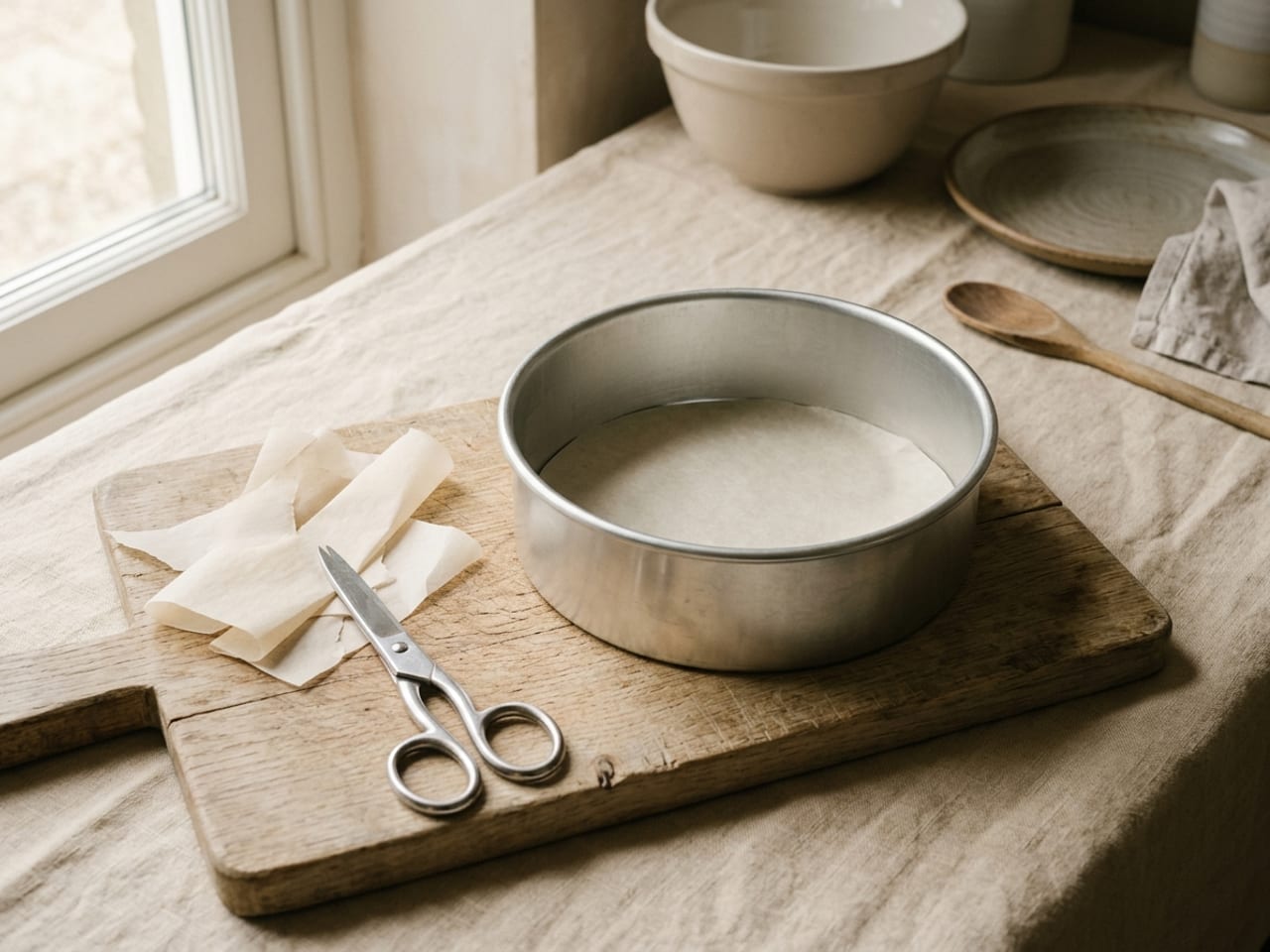
In UK use the same folded circle also lines a cake tin or blind-bakes pastry: Great British Chefs says it can "line the base of a round cake tin or when blind baking", City & Guilds lines a flan "with greaseproof paper (cartouche)", Leiths uses "Dry cartouches" to bake pastry blind, and an ASEAN trainee manual says "Make a paper cartouche and cover the pastry with it".8, 9, 59, 62 No dictionary we read records this sense. Lakeland sells pre-cut "silicone paper circles" for 17, 18 and 23 cm (about 7, 7 and 9 in, ours) tins without calling them cartouches.41
The other cartouches
Outside the kitchen a cartouche is an ornamental frame or scroll (the oldest French sense, 1546) or the frame for a map's title; the oval round a pharaoh's name in hieroglyphs (English since 1830, named for its likeness to a rolled paper cartridge); and, in French, a cartridge or ink refill.65, 68, 69, 70 Louis Dominique Cartouche (1693 to 1721) was a Paris bandit.70
Where a cartouche shows up on the plate
- Glazed vegetables: paper on, then off for the glaze (America's Test Kitchen, Le Cordon Bleu); turned carrots and turnips are in our tourné guide.2, 25
- Fondant potatoes: Great British Chefs covers them "with a cartouche or a lid"; every fondant version is in the tourné guide.10
- Poached fruit and purées: pears under paper (Saveur, the CIA), purées (Chowhound), and Bruce Sherman's coulis; see our coulis guide and purées for plating.6, 11, 20
- A sauce with no skin: paper pressed on while it waits; the causes and every fix are in our sauce plating guide, the five mother sauces in the mother sauces guide.
Photograph your plate, see it re-plated
A cartouche gets the glaze and the sauce right in the pan; the plate is where it shows. Photograph a dish you have cooked and Plate Artists re-plates that dish, with the food kept as it is and the changes named so you can repeat them. Start with a re-plate.
Your food, plated like a chef's
Snap it, upload it, and get the composed version back, with the steps to recreate it at home.
Start free · 1 enhancement →Free account · 1 free enhancement · No credit card
Cartouche terms, defined
Only the words the site does not already define: poaching, reduction and fond are in our other guides' glossaries.
Cartouche (cooking) · parchment lid, paper lid
A round of paper, usually parchment or greaseproof, laid directly on the surface of food as it cooks or waits.
Where it comes from. An English and Commonwealth kitchen word on a French base: Senn 1908, the CIA since 2006, UK college texts; Wiktionary is the one general dictionary we read that records it.19, 56, 59, 71
False lid
Another name for a cartouche, used by one culinary-instruction site we read.
Where it comes from. The Culinary Pro: "a parchment paper lid, also known as a false lid".16
Cartridge (culinary)
Senn's 1898 English name for a circular piece of greased paper laid over food while it cooks.
Where it comes from. Senn's 1898 headword, glossed "Cartouche, f. Cartridge" by 1908; the gun cartridge was first a roll of paper.54, 56, 69
Rond de papier (beurré) · rond de papier blanc
The older French name for the paper round: a round of (buttered) paper.
Where it comes from. Carême 1815; Escoffier 1907, "un rond de papier blanc beurré".45, 49
Papier sulfurisé · rond de papier sulfurisé, couvercle en papier
French for parchment paper; a round of it is what French cooks lay on food where English cooks say cartouche.
Where it comes from. Larousse gastronomique 1997 under COUVRIR; 81 French books in one search use "rond de papier sulfurisé".52, 53
Greaseproof paper
A dense paper that resists grease but, unlike baking paper, has no silicone coating, so cooks butter or oil it.
Where it comes from. Bacofoil: "not siliconized"; the UK textbooks butter it.26, 40
Baking paper · baking parchment, silicone paper
The UK and Commonwealth name for silicone-coated parchment, the usual cartouche paper today.
Where it comes from. Bacofoil: "siliconized on both sides"; Lakeland sells "silicone paper circles".40, 41
Otoshibuta · otoshi-buta, drop lid, dropped lid
A wooden lid a little smaller than the pot, laid directly on the food in a Japanese simmered dish; Tsuji calls it "the right weight".
Where it comes from. Japanese 落とし蓋; Tsuji 1980: otoshi-buta, literally "drop-lid."31, 35
Kamibuta · paper drop lid
A paper drop lid, made a little larger than the inside of the pot and pressed onto the simmering liquid.
Where it comes from. Japanese 紙蓋; Kodansha's kitchen dictionary (our gloss).35
Shallow poaching
Cooking food part-covered in a little liquid, the exposed top cooked by steam held in by paper or a lid.
Where it comes from. CIA: parchment or a loose-fitting lid; Gisslen: paper and a lid.17, 19
Sweating
Cooking vegetables gently in fat, often under paper, so they soften in their own juices without browning.
Where it comes from. Practical Cookery: "sweat (cook gently without colouring)"; Le Cordon Bleu's greaseproof cartouche box.24, 26
En papillote
Food sealed inside a folded paper case and cooked; unlike a cartouche, the paper is closed round it.
Where it comes from. Larousse gastronomique 1997: the edges folded and pressed "pour empêcher les sucs de s'échapper".52
Cartouche cooking, answered
What is a cartouche in cooking?
A round of paper, usually parchment (greaseproof in the UK), laid directly on the surface of food as it cooks or waits. America's Test Kitchen calls it "a round of parchment paper placed directly on top of food during cooking". It covers the food without sealing the pot, and keeps a skin from forming.
What is a cartouche used for?
To part-cover food in a pan: braises and stews, shallow-poached fish, poached fruit, glazed vegetables and sweating onions, and to stop a skin on sauces and pastry cream. Of the 37 sources in our dish tally, none uses one on simmering stock, bolognese or caramelised onions.
How do you make a cartouche with parchment or baking paper?
Cut a square a little larger than the pot, fold it in half and in half again, fold it into a triangle and then into a narrow wedge, hold the point at the centre of the pot and cut where it meets the inside wall, then unfold it. Snipping off the tip for a centre hole is optional.
Why use a cartouche instead of a lid?
Because it lets some steam out round its edge while keeping the surface covered. Gritzer explains that a full lid traps most of the steam, which condenses and drips back, so the liquid does not reduce and browning slows; America's Test Kitchen adds that a metal lid absorbs heat more readily than parchment, so the steam condenses on it, unevenly, and cooking and evaporation slow down. Nobody we read has measured the difference.
Should you use a cartouche and a lid together?
The sources split three ways: 10 of the 24 instructions in our table put paper under a lid (Gisslen, Practical Cookery and the four 19th-century cooks we read), 6 offer paper or a lid (the CIA, On Cooking), and 8 use paper instead of a lid (Gritzer, Saveur, RecipeTin Eats, Japanese drop lids).
Should I use a cartouche for stock?
No: every source we read that answers keeps stock uncovered. McGee leaves the pot uncovered "to prevent accidental boiling and clouding, and to allow slow evaporation", and Pépin simmers his brown stock uncovered. The one paper use near stock is Gisslen's round over fish bones while they sweat, before the liquid goes in.
Should I use a cartouche for bolognese or ragù?
None of the 37 sources in our dish tally uses one for bolognese, and Marcella Hazan cooks hers "uncovered, at the merest simmer". If you want it to reduce more slowly, a cartouche is a reasonable partial cover (ours); use parchment rather than foil with tomato.
Can you use a cartouche for caramelised onions?
None of the 37 sources in our dish tally does. Where sources put paper on onions (Le Cordon Bleu, Leiths) it is to sweat them: in their own juices "without browning" (Le Cordon Bleu), in "a moist environment" (Leiths), the opposite of caramelising. Lifting it off once they are soft, so they can colour, is our suggestion.
Should I use a cartouche for a stew or braise?
Gritzer uses one on stews and braises instead of a lid, for "some browning and evaporation for flavor development", but "just not too much too soon"; RecipeTin Eats uses one on its Persian lamb shanks and says it "stops the top from drying out". Practical Cookery puts buttered greaseproof paper and a lid on its braises. In a slow cooker RecipeTin Eats says it "doesn't really add any benefit".
Does a cartouche need a hole in the middle?
The sources split: 9 of the 24 methods in our table cut or tear one (America's Test Kitchen, Gritzer, a Chowhound chef, Tsuji), Gisslen says it is "not necessary, because the steam can easily vent from around the edges", and five that print every step (Saveur, RecipeTin Eats, Leiths, Great British Chefs, The Culinary Pro) cut none. No source gives a measured reason for it.
Should you butter a cartouche?
Most of the textbooks we read do (Gisslen and L'école Culinaire put it buttered side down; the CIA allows oil); none of the web sources we read does. Leiths wets it instead, "Crumple the cartouche and dampen under cold water", and Fine Dining Lovers prints near-identical steps. Bacofoil tells cooks to coat greaseproof paper "well with oil" because it has no silicone, which may be why the UK books butter it (ours).
What can I use instead of parchment for a cartouche?
Greaseproof paper, buttered (the UK textbooks); aluminium foil with a hole torn in it (Hayashi), though not with tomato, wine or other acidic food; a Japanese silicone-coated cooking sheet; or any flat, lightweight cover (Tsuji). No source we read uses a silicone baking mat, and wax paper is not for direct oven heat (Reynolds).
What is a cartouche in French cooking?
In what we read, French cooks do not call it a cartouche: Carême wrote "rond de papier beurré" and Escoffier "rond de papier blanc beurré", Larousse gastronomique says "papier sulfurisé", and modern French books say "rond de papier sulfurisé" or "couvercle en papier". The one source we read that lists cartouche as a French kitchen noun is a 1962 London dictionary.
How do you pronounce cartouche?
kar-TOOSH, stress on the second syllable: Cambridge prints UK /kɑːˈtuːʃ/ and US /kɑːrˈtuːʃ/, Merriam-Webster kär-ˈtüsh. In French, [kaʀtuʃ].
What is the difference between a cartouche and a drop lid (otoshibuta)?
A traditional Japanese drop lid is wooden, a little smaller than the pot, and floats on the liquid; Tsuji calls it "the right weight" to keep the food from moving about. A paper cartouche weighs almost nothing: Tsuji says a vented paper circle "does almost the same job" but "does not halt the movement of simmering foods".
What is a cartouche in baking?
In UK use, the same folded paper circle lining the base of a round cake tin, or the paper used to blind-bake pastry (Great British Chefs, the City & Guilds 7100 textbook). No dictionary we read records this sense.
The textbooks, test kitchens, cooks, makers and dictionaries behind this guide
How each source was read (in full, in an archived copy, as a scan's OCR text, or as a search fragment of a lending-only item) is in its entry and under how this page was made. Makers' pages are what they sell and recommend; chefs and magazines are practice and opinion, not measurement. Sums, conversions and suggestions marked ours are our own.
- America's Test Kitchen (2026). Using a Parchment Cartouche Instead of a Lid. americastestkitchen.com (undated how-to), read in full on 26 October 2026 (the public part of a members' page): a cartouche is "a round of parchment paper placed directly on top of food during cooking"; on Slow-Cooked Whole Carrots it "was able to trap steam directly on top of the carrots while still allowing it to escape around the edges of the paper"; "although a partially covered pan traps some steam, the cooking isn't as even, fast, or consistent"; and the mechanism, "A metal lid absorbs heat energy more readily than parchment does". No figures are printed. americastestkitchen.com
- Keith Dresser, America's Test Kitchen (2014). Slow-Cooked Whole Carrots. americastestkitchen.com (Cook's Illustrated recipe, published 4 November 2014), read in full on 26 October 2026: "Fold 12-inch square of parchment paper into quarters to create 6-inch square ... Cut off 1/4 inch of tip of triangle to create small hole. Cut base of triangle straight across where it measures 5 inches from hole. Open paper round." The round goes on with the skillet covered for a 20-minute steep, then "Remove lid from skillet, leaving parchment round in place", simmer about 45 minutes, "Discard parchment round" and glaze 2 to 4 minutes. americastestkitchen.com
- America's Test Kitchen (Cook's Illustrated) (2026). It's Fine To Heat Parchment Paper to High Temperatures In the Oven. americastestkitchen.com (undated how-to), read in full on 26 October 2026: "Most parchment paper is rated for use at temperatures no higher than 420 to 450 degrees"; after "Phone calls to several manufacturers": "Using parchment at higher-than-recommended temperatures does not release noxious chemicals, and the paper will not burn", though it can "darken and turn brittle" (a second-hand maker statement; oven use only). americastestkitchen.com
- America's Test Kitchen (2026). A Tidy Way to Avoid Skin on Custards. americastestkitchen.com (undated how-to), our reading for /guides/sauce-plating, re-checked 26 October 2026: "The most common method is to press parchment paper onto the surface, which prevents evaporation". americastestkitchen.com
- Daniel Gritzer (2025). How to Make a Parchment Paper Lid That'll Transform All Your Winter Stews. Serious Eats (8 January 2025, the date Wikipedia cites); read as the author-credited syndicated copy on AOL, 15 December 2025, read in full on 26 October 2026 in the AOL copy ("Read the original article on Serious Eats"), seriouseats.com refusing this machine: a square "just slightly larger than the pot"; "you want the wedge's length to match the radius of the inside of the pot"; "snip off the tip of the wedge. This will create a center vent"; "press the paper lid directly onto the surface of that food", curling "downward toward the food"; a cracked lid "bounces between being too effective of a cover ... and not effective enough"; single use ("you can't reuse it"). No measurements. aol.com (Serious Eats syndication)
- Todd Coleman (2007). A Different Use For Parchment Paper (Kitchen Origami). Saveur (28 August 2007), read in full on 26 October 2026: six steps from a rectangular sheet; "Align the tip of the triangle with the center of the pot. Cut off the back of the paper triangle where it meets the rim of the pot"; no hole is cut; chef Bruce Sherman (North Pond) uses the circle "instead of a lid" for a coulis, and Saveur adds poaching "delicate fruit like pears or apples". saveur.com
- Holly Garrad-Cole (2018). How to Make a Cartouche. Fine Dining Lovers (2 August 2018), read in full on 26 October 2026: "Cut the triangle to slightly larger than the radius of your pan"; "Scrunch up the cartouche and dampen under cold water before use"; it "slows down the rate of eveporation" (sic) and "prevents the unwanted surface "skin"". Its steps are near-verbatim Leiths', so we count it with Leiths, not as an independent source. finedininglovers.com
- Leiths School of Food and Wine (2026). How To Make a Cartouche. leiths.com (undated), read in full on 26 October 2026: "Dampening the cartouche helps to maintain a moist environment, e.g. sweating onions. Dry cartouches are used too, when baking pastry blind"; "Crumple the cartouche and dampen under cold water before use". leiths.com
- Great British Chefs (2015). How to make a cartouche (How to make a parchment lid). greatbritishchefs.com (video how-to; schema date 1 June 2015, page dated 14 February 2025), read in full on 26 October 2026: "used primarily to stop a skin forming on your sauce or gravy while cooking. Alternatively you can use it to line the base of a round cake tin or when blind baking"; fold a square in half, in half again, into a triangle, "Repeat once more before cutting off the large end at an angle". greatbritishchefs.com
- Great British Chefs (2026). Paprika-Spiked Fondant Potatoes. greatbritishchefs.com (recipe publisher, undated page), our reading for /guides/tourne, 24 October 2026: stock "halfway up the potatoes", then "cover with a cartouche or a lid, then cook over low heat for 20-25 minutes, or until tender". greatbritishchefs.com
- Ashlen Wilder, quoting chef Lance Knowling (Northridge Restaurant) (2025). The Parchment Paper Trick For Better Purees. Chowhound (13 March 2025), read in full on 26 October 2026: fold one, or "measure the inside diameter of the pan or pot and cut it out"; "Don't forget to put a small hole in the center!"; "A cartouche is intended to be a single-use item"; a cartouche on a purée is "for removing the water"; and the writer's own claim, unsourced, that "metal lids often cause a thick skin". chowhound.com
- Sam Worley (2024). Parchment Paper Is The Unexpected Secret To A Better Poach. The Takeout (25 November 2024), read in full on 26 October 2026: "When a recipe instructs you to partially cover a dish as it cooks, that's a perfect opportunity for a cartouche"; it then keeps the poached fish warm (opinion; nothing measured). thetakeout.com
- Wendy Leigh (2023). How A Parchment Paper Cartouche Can Help Food Cook More Evenly. Tasting Table (14 January 2023), read in full on 26 October 2026: restates America's Test Kitchen and adds that the lid "prevents browning", wording not on the ATK page we read; lists "poaching, glazing, steaming, and braising"; reports MasterClass (rice pilaf, ratatouille, velouté, short ribs) and Food52 (poached fish) second-hand. tastingtable.com
- JB Alexandre, RecipeTin Eats (2025). How To Make A Cartouche. recipetineats.com (21 November 2025, updated 24 October 2026), read in full on 26 October 2026, with the author's replies in the comments: it "stops the top from drying out"; "the cartouche is used instead of a lid ... A regular lid traps more steam, which can make the potatoes a little too wet"; in a slow cooker or Instant Pot "a cartouche doesn't really add any benefit". recipetineats.com
- Le Creuset (Ireland) (2026). Chicken Jambalaya. lecreuset.ie (maker's recipe, undated), read in full on 26 October 2026: "Tear a small hole in the centre of the circle to allow the steam out and then lay the paper over the pan"; "A cartouche ensures the cooking liquid doesn't evaporate before the rice is cooked". lecreuset.ie
- John Reiss, The Culinary Pro (2026). Cartouche. theculinarypro.com (culinary-instruction site, undated), read in full on 26 October 2026: "A cartouche is a parchment paper lid, also known as a false lid, used for covering the surface of a stew, sauce, or soup. It traps steam keeping stewed components submerged in liquid, reduces evaporation, and prevents a skin from forming on the surface of sauces." No vent, butter or lid is mentioned. theculinarypro.com
- Wayne Gisslen (2011). Professional Cooking, 7th edition. John Wiley & Sons, read on 26 October 2026 in two Internet Archive copies (an uploaded PDF's OCR text, in full, and a lending scan as search fragments); chapters given, page numbers not reliable: shallow-poached fish, "Cover the fish with a piece of buttered parchment or other paper and cover the pan with a lid ... (Some chefs like to cut a vent hole in the center of the parchment, but this is not necessary, because the steam can easily vent from around the edges.)"; a recipe's paper "cut the same size as the pan ... buttered side down"; fish fumet bones covered "loosely with a round of brown paper or parchment" while they sweat; pastry cream covered "with waxed paper to keep a crust from forming"; sauces: "Cover to prevent a skin from forming". The word "cartouche" does not appear. archive.org
- Wayne Gisslen (1983). Professional Cooking (1983 and 1999 editions). John Wiley & Sons, read on 26 October 2026 as Internet Archive full-text search fragments of a lending-only item, not the page images: the same paper-and-lid shallow-poach step, "it does help to cook more evenly. 6. Bring the liquid just to a simmer", with no vent-hole remark between steps 5 and 6 (an absence read from consecutive fragments). archive.org
- The Culinary Institute of America (2006). The Professional Chef, 8th edition. John Wiley & Sons, read on 26 October 2026 as Internet Archive full-text search fragments of a lending-only item, not the page images: "Place a piece of buttered parchment (cartouche) over the fillets to cover"; shallow poaching, "Buttered or oiled parchment or a loose-fitting lid is used to loosely cover the pan", which "traps enough of the steam to cook the unexposed part of the food, but not so much that the cooking speed rises"; the glossary's parchment is used for "covering items during the process of shallow poaching"; sauces held under "a piece of parchment paper or plastic wrap cut to fit directly on the surface of the sauce" (chapter 16). archive.org
- The Culinary Institute of America (2011). The Professional Chef, 9th edition. John Wiley & Sons, read on 26 October 2026 as Internet Archive full-text search fragments of a lending-only item, not the page images: "Place a piece of buttered parchment paper (cartouche) over the paupiettes to cover"; poached pears, "Cover with parchment paper, weigh the pears down if they float"; vegetables that "will discolor if left covered during the whole cooking process" (the fragment does not say which); sauces held under "a piece of parchment paper or plastic wrap cut to fit directly on the" (the fragment ends there; the 2006 edition has the full sentence). archive.org
- The Culinary Institute of America (1969). The Professional Chef (1969); The New Professional Chef (1991, 1996). The Culinary Institute of America (publishers as printed in each scan), read on 26 October 2026 as Internet Archive full-text search fragments of a lending-only item, not the page images: 1969, "Cover with a well buttered paper"; 1996, "FIGURE 6-64 Cutting Parchment Lids", the tip "trimmed to allow steam to escape as foods cook"; no "cartouche" in either (0 search hits). archive.org
- Sarah R. Labensky, Alan M. Hause et al. (2011). On Cooking: A Textbook of Culinary Fundamentals (Canadian editions 2003 to 2011; US edition 2007). Pearson, read on 26 October 2026 as Internet Archive full-text search fragments of a lending-only item, not the page images: "For partially submerged foods, a cartouche is used to trap the steam"; "Cover the pan with buttered parchment paper (cartouche) or a lid" (same wording 2003, 2006, 2009, 2011); a hotel-pan dish covered "with aluminum foil or buttered parchment paper" at 175°C (350°F); the 2007 US edition says "a piece of buttered parchment paper or a lid", without the word cartouche. archive.org
- L'école Culinaire (custom edition) (2012). Meat, Seafood and Poultry Fabrication. Cengage Learning, read on 26 October 2026 as Internet Archive full-text search fragments of a lending-only item, not the page images: "Cover the fish with buttered parchment, or waxed paper (a cartouche), and transfer to a 350°F/177°C oven"; "a buttered parchment paper round the size of the sauté pan, buttered side down". archive.org
- Jeni Wright and Eric Treuillé, Le Cordon Bleu (1996). Le Cordon Bleu Complete Cooking Techniques. Cassell, read on 26 October 2026 as Internet Archive full-text search fragments of a lending-only item, not the page images (two columns interleaved in the OCR; index "Cartouche 190"): a box headed "GREASEPROOF PAPER CARTOUCHE" for vegetables sweated "so they cook in their own juices and retain flavour without browning"; "Greaseproof paper is used as a covering to prevent evaporation"; "Fold a square of paper in half, then in half again, then into" a triangle and hold "one narrow point" in the centre of the pan (the rest of the step is not in the fragments). archive.org
- Le Cordon Bleu (2010). Le Cordon Bleu Cuisine Foundations: Classic Recipes. Delmar Cengage Learning, read on 26 October 2026 as Internet Archive full-text search fragments of a lending-only item, not the page images: glazed turnips, "Cover with a parchment-paper lid (cartouche) and cook the turnips over low heat until all the water has evaporated. Remove the cartouche and roll the turnips" (OCR "tumips") in the syrup; pilaf, the cartouche lifted to dot the rice with butter, then "Replace the cartouche"; "Butter the cartouche and place over the garniture. Keep warm.". archive.org
- Victor Ceserani and Ronald Kinton (later David Foskett et al.) (1974). Practical Cookery (editions of 1974, 1981, 1990, 2000, 2004, 2008 and 2015). Edward Arnold; Hodder & Stoughton; Hodder Education, read on 26 October 2026 as Internet Archive full-text search fragments of a lending-only item, not the page images: "Cover with greaseproof paper and a lid and sweat ... Remove greaseproof paper" (1974, 1981); braises "Cover with buttered greaseproof paper and a lid" (1974 to 2008); poached fish "Cover with a buttered greaseproof paper. Poach ... in a moderate oven at 150-200°C" (1990); fruit "cover with greaseproof paper or a lid" (2015); "Cover with buttered paper, with a small hole ... at the centre" (2015; a stray OCR colon removed). The word "cartouche" returns no hits in any edition searched. archive.org
- Jacques Pépin (1976). La Technique. Optimum Publishing, read on 26 October 2026 as Internet Archive full-text search fragments of a lending-only item, not the page images: Technique 30, lining cake pans (pp. 66-67): a square of wax paper folded in half, in half again, diagonally, then "onto itself in the same manner several times to obtain a thin, long" one (the fragment ends there), laid with "the point of the triangle at the center of the pan"; "the modern papers which come on rolls are easier to work with" than brown wrapping paper; trout: "Cover with the buttered paper and bring to a boil on top of the stove". No "cartouche" in the book. archive.org
- Harold McGee (2004). On Food and Cooking: The Science and Lore of the Kitchen, revised edition. Scribner, read on 26 October 2026 as Internet Archive full-text search fragments of a lending-only item, not the page images: stock, "The pot is left uncovered to prevent accidental boil- ing and clouding, and to allow slow evap- oration and concentration"; oven braises reach the boil in a covered pot "Unless the pot is left uncovered, which allows cooling evaporation"; his own stew goes in "the pot lid ajar"; pastry cream, "buttered parchment directly onto the cream. Avoid plastic wrap; its plasticizing chemi- cals tend to migrate into fat-rich foods" (p. 99). McGee does not mention a paper cover for stock or braises in what we read. archive.org
- Marcella Hazan (1992). Essentials of Classic Italian Cooking. Knopf, read on 26 October 2026 as Internet Archive full-text search fragments of a lending-only item, not the page images: Bolognese meat sauce, "Cook, uncovered, at the merest simmer for a long, long time". archive.org
- Jacques Pépin (2011). Spicy Rib Roast (with Basic Brown Sauce). Essential Pépin, KQED (17 September 2011), read in full on 26 October 2026 (first read for /guides/au-jus): the brown stock is to "simmer slowly, uncovered, for about 3 hours". kqed.org
- Shizuo Tsuji with Mary Sutherland (1980). Japanese Cooking: A Simple Art. Kodansha International, read on 26 October 2026 as Internet Archive full-text search fragments of a lending-only item, not the page images: the drop-lid "is a necessity in preparing simmered dishes"; of "well-dried cypress or cedar", "slightly smaller in diameter than the straight-sided pot"; it acts "to submerge solids" (OCR "soHds"); "A paper circle does not halt the movement of simmering foods, but serves every other function of a drop-lid"; "a baking paper circle with a center vent does almost the same job"; "always soak the drop-lid in water for a few minutes". archive.org
- Elizabeth Andoh (2005). Washoku: Recipes from the Japanese Home Kitchen (and Kansha, 2010). Ten Speed Press, read on 26 October 2026 as Internet Archive full-text search fragments of a lending-only item, not the page images: "If you do not have an otoshi-buta, you can improvise with a double thickness of parchment paper"; "If you do not have a dropped lid, it is best to leave the pot uncovered" (OCR "itis"); Kansha: "Cover with a circle of parchment paper (a wooden otoshi-buta would stain yellow)". archive.org
- Keiko Hayashi (1999). Simple & Delicious Japanese Cooking. Shufunotomo, read on 26 October 2026 as Internet Archive full-text search fragments of a lending-only item, not the page images: "a drop lid ... or a piece of aluminum foil with a hole torn out of the center directly on top of the fish"; the drop lid is "a wooden lid whose diameter is smaller than that of the pan". archive.org
- Kikkoman Corporation (2026). Otoshibuta / Drop Lid (glossary). kikkoman.com (soy sauce maker, undated), read in full on 26 October 2026: "a pot lid one size smaller than the pot itself, and meant to sit directly on top of the ingredients"; wooden lids "have been overtaken by silicon ones, and some people even use aluminum foil or parchment paper cut to size"; drop lids "are even said to help the flavors better soak into the dish". kikkoman.com
- Kodansha, 食器・調理器具がわかる辞典; Shogakukan, Nipponica (Tada Tetsunosuke) (2026). 落とし蓋 (otoshibuta) and 紙蓋 (kamibuta). kotobank.jp (Japanese dictionaries online), read in full on 26 October 2026 (our glosses): the wooden drop lid is "one size smaller than the pot's inner diameter" and rests on the food; Nipponica: a drop lid "is not limited to wood", a paper one can stand in for beans; the kamibuta, a paper drop lid for long simmering of things that break up, is made "one size larger than the pot's inner diameter" and pressed onto the liquid. kotobank.jp
- Asahi Kasei Home Products (2026). クックパー® クッキングシート and アク・あぶら取りシート (product pages). asahi-kasei.co.jp (maker, undated), read in full on 26 October 2026 (our glosses): the silicone-coated cooking sheet, cut "to the size you like" for a drop lid, lets steam through moderately, heat rating "250℃ 20分 〜 300℃ 5分" (250°C for 20 minutes to 300°C for 5 minutes); on a gas hob the maker points frying-pan users to its foil instead; a scum-absorbing sheet for simmered dishes also works as a drop lid (落としぶた効果も), heat resistance 110°C, and can go either side down (オモテ・ウラなく、使えます). asahi-kasei.co.jp
- Reynolds Consumer Products (2026). Reynolds Kitchens Parchment Paper (rolls) and Reynolds Wrap Standard Aluminum Foil, product FAQs. reynoldsbrands.com (maker, undated), read in full on 26 October 2026: parchment "is oven safe up to 425°F ... Never touch the parchment paper to an open flame or to the sides of the oven, and do not use with a broiling unit or toaster oven"; the Reynolds standard-foil product page gives "oven safe up to 420°F" for the same parchment, "not suitable for cooking that involves direct heat", and for broiling or grilling "we recommend that you use foil"; on foil, "Small pinholes or discoloration may occur when aluminum foil comes into contact with highly acidic, spicy, or salty foods. Per USDA, this reaction produces a harmless aluminum salt". reynoldsbrands.com
- Reynolds Consumer Products (2026). Reynolds Kitchens Cut-Rite Wax Paper, product FAQ. reynoldsbrands.com (maker, undated), read in full on 26 October 2026: "Wax paper should not be directly exposed to the heat of an oven", except as a liner the batter "completely covers"; "only parchment paper is oven safe (up to 425F)". Stovetop use is not addressed. reynoldsbrands.com
- If You Care (2026). FAQs and Parchment Baking Paper product page. ifyoucare.com (maker, undated), read in full on 26 October 2026: "Made from unbleached totally chlorine-free (TCF) greaseproof paper" with "a fine misting of food safe and non-toxic silicone"; "You can bake up to 428 degrees F". ifyoucare.com
- Bacofoil (UK) (2026). FAQs. bacofoil.co.uk (maker, undated), read in full on 26 October 2026: "Baking paper is siliconized on both sides"; "Greaseproof Paper is not siliconized, so if you intend on cooking with it, coat it well with oil"; cling film in the oven: "No, we would not recommend it, as it has never been tested for this use". bacofoil.co.uk
- Lakeland (2026). Baking Parchment Paper Circles 18cm (7 in) x 100 (product 5521). lakeland.co.uk (kitchenware maker and shop, undated), read in full on 26 October 2026: "100 18cm non-stick silicone paper circles"; "Perfect for lining 18cm cake tins"; "Oven safe up to 230°C"; "17cm and 23cm circles also available". Lakeland does not call them cartouches. lakeland.co.uk
- German Federal Institute for Risk Assessment (BfR) (2014). Annual Report 2014 (English e-paper), p. 37. bfr.bund.de, read in full on 26 October 2026: because of the "solubility of aluminium under the influence of acids and salts", the BfR "has been recommending for some time now that aluminium foils, trays and uncoated aluminium dishes and utensils should not be brought into contact with acidic or salty foods". We found no newer BfR page saying the same. bfr.bund.de
- nibusinessinfo.co.uk (Invest Northern Ireland) (2026). Aluminium in food packaging. nibusinessinfo.co.uk (official business guidance, undated), read in full on 26 October 2026: "Avoid using aluminium with acidic foods like tomatoes, rhubarb or citrus, as they may cause it to migrate into food more quickly". nibusinessinfo.co.uk
- Minnesota Rules 4626.0390 (the FDA model Food Code, 3-501.15) (2026). Cooling Methods. Office of the Revisor of Statutes, revisor.mn.gov, read in full on 26 October 2026 (fda.gov refused this machine, so the Code was read in a state's adoption): containers of cooling food must be "loosely covered or uncovered ... during the cooling period to facilitate heat transfer from the surface of the food". For food businesses; it does not mention paper or skins. revisor.mn.gov
- Antonin Carême (1815). Le Pâtissier royal parisien, tome 1. Paris, read on 26 October 2026 in the Internet Archive scan's OCR text, in full (first read for /guides/mignardises): "vous couvrez le dessus d'un rond de papier beurré" (a chartreuse, before the bain-marie); a braise, "Couvrez le tout d'un rond de papier beurré", then on the paillasse "avec du feu dessus et dessous". archive.org
- Eliza Acton (1845). Modern Cookery, in all its branches. Longman, Brown, Green & Longmans, read on 26 October 2026 in the Internet Archive scan's OCR text, in full: "A round of buttered paper is generally put over the more delicate kinds of braised meat, to prevent their being browned by the fire, which, in France, is put round the lid of the braising-pan"; "Never omit a buttered paper over any sort of custard-mixture". archive.org
- Charles Elmé Francatelli (1846). The Modern Cook. Richard Bentley, read on 26 October 2026 in the Internet Archive scan's OCR text, in full: "a round of buttered paper" 26 times, often with the lid as well (10 of the 26 name a lid, our count): "cover with a round of buttered paper, put the lid on, and set them to braize very gently"; on soles in the oven, "cover them with a round of buttered paper, and set them in the oven for about ten minutes". archive.org
- Jules Gouffé, translated by Alphonse Gouffé (1868). The Royal Cookery Book. Sampson Low, Son, and Marston, read on 26 October 2026 in the Internet Archive scan's OCR text, in full (first read for /guides/canapes): mushrooms covered with a round of paper "to keep the moisture in, and preserve them white"; fines herbes "to prevent drying"; a braised calf's head, paper "to prevent the pieces floating on the top of the braize from getting black", the stewpan "only three parts covered". archive.org
- Auguste Escoffier (1907). Le Guide culinaire, 2e édition. Paris, read on 26 October 2026 in the Internet Archive scan's OCR text, in full (first read for /guides/tourne): fish, "Nous conseillons de renoncer à couvrir le poisson d'un papier beurré pendant le pochage, car il est extrêmement rare de trouver maintenant du papier convenable pour cet usage", because of the "produits chimiques" in commercial papers; mirepoix, "couvrir d'un rond de papier blanc beurré". The word "cartouche" appears once, for gun cartridges. archive.org
- Auguste Escoffier (1907). A Guide to Modern Cookery. William Heinemann, read on 26 October 2026 in full, in the Internet Archive scan's OCR of the 1907 edition (the Project Gutenberg text, eBook 71395, is the revised 1909 edition and was used to search; every quote here is in the 1907 scan): poaching fish, "that the fish be not covered with buttered paper as is often done, for nowadays a suitable paper is very rarely found"; tongue, "The object of the paper is to keep off the air"; sauces, "butter their surfaces lest a skin should form" or keep it "in motion until quite cool lest a skin should form"; braises, "cover the braising-pan". No "cartouche", "parchment" or "greaseproof" in the book. archive.org
- Henri-Paul Pellaprat (1937). Modern Culinary Art (1937); Le Poisson dans la cuisine française (1954); La Cuisine familiale et pratique (1974 printing). Comptoir français du livre (1937); later French printings, read on 26 October 2026, the 1937 book in the Internet Archive scan's OCR text in full, the others as full-text search fragments: "Cover with a round of buttered paper placed on vegetables and with the cover" (1937); fish, "on couvre d'un papier beurré et l'on met au four chaud" (1954); cabbage in the oven "avec un rond de papier huilé sur les choux, mais sans couvercle" (1974). archive.org
- Larousse gastronomique (Comité gastronomique présidé par Joël Robuchon) (1997). Larousse gastronomique. Larousse-Bordas, read on 26 October 2026 in the Internet Archive scan's OCR text, in full (first read for /guides/tourne): no entry "cartouche" (its one "cartouches" is a soda siphon's gas); under COUVRIR, "le couvercle peut être remplacé par du papier sulfurisé, beurré ou non", which also stops "qu'il se forme une peau pendant le refroidissement"; carottes glacées, "couvrir de papier sulfurisé". archive.org
- French cookbooks and a hotel-school worksheet (various) (2026). Search of French-language books for the paper lid's name. Internet Archive full-text search, 26 October 2026, search fragments, not full books: "rond de papier sulfurisé" in 81 books, e.g. "posez a la surface un rond de papier sulfurisé pour empécher la formation d'une peau" (1989); "Couvercle en papier sulfurisé pour une cuisson à l'étouffée" (2014); a school worksheet step "Réaliser un rond de papier sulfurisé"; "cartouche de papier sulfurisé" 0 hits; the one French "cartouche en papier sulfurisé" is in Le Livre des Chefs (2005), whose wording matches the English Cook's Book of the same year (our inference: a translation). archive.org
- Charles Herman Senn (1898). Senn's Culinary Encyclopaedia. Spottiswoode & Co., London, read on 26 October 2026 in the Internet Archive scan's OCR text, in full: "Cartridg'e. A culinary term meaning a circular piece of greased paper, used for covering meat, etc., during the process of cooking." (Senn's earlier Culinary Dictionary was not read). archive.org
- Charles Martyn (1903). Martyn's Menu Dictionary. The Caterer Publishing Co., New York, read on 26 October 2026 in the Internet Archive scan's OCR text, in full: "Cartrouche, m. Cartridge. A circular piece of greased paper, used for covering meat, etc., during the pro- cess of cooking.". archive.org
- Charles Herman Senn (1908). A Pocket Dictionary of Foods & Culinary Encyclopaedia. Food & Cookery Publishing Agency, London, read on 26 October 2026 in the Internet Archive scan's OCR text, in full (preface dated 1908): "Cartouche, f. Cartridge. A culinary term meaning a circular piece of greased paper, used for covering meat, etc., during the process of cooking.". archive.org
- UK trade and college texts (various) (1989). The Larder Chef (1989); Game Cookery (1989); Hotel and Catering Studies (1992); Food Preparation and Cooking (1993, 1996); Cooking for Expats (2003). various publishers, read on 26 October 2026 as Internet Archive full-text search fragments of a lending-only item, not the page images: "cover with a buttered cartouche" (Larder Chef); "cover with a cartouche of greaseproof paper and then the lid" (Game Cookery); "covered with a cartouche of greaseproof paper to prevent evaporation" (Hotel and Catering Studies); "a buttered paper lid or cartouche, to prevent the fish from drying out" (1993); "Cartouche A buttered greaseproof paper used to cover the liquid contents of a dish" (2003). archive.org
- Steve Combes (1962). Dictionary of Cuisine French. Barrie & Rockliff, London, read on 26 October 2026 as Internet Archive full-text search fragments of a lending-only item, not the page images: "cartouche nf. round piece of grease-proof paper." The one source we read that gives cartouche as a French kitchen noun. archive.org
- City & Guilds (2010). 7100 Diploma in Professional Cookery, Level 2 (textbook). City & Guilds, read on 26 October 2026 as Internet Archive full-text search fragments of a lending-only item, not the page images: braised food "is usually covered with a cartouche and/ or a lid" (OCR "ora"); "cover with a buttered cartouche (buttered paper)"; the end-of-chapter question "What is a cartouche? And what is it used for?"; "The flan is lined with greaseproof paper (cartouche) and filled with baking beans.". archive.org
- Neil Rippington (Level 1) and other authors (2007). Professional Chef, Level 1 (2011), Level 2 (2007) and Level 3 (2010) Diploma textbooks. Cengage Learning EMEA, read on 26 October 2026 as Internet Archive full-text search fragments of a lending-only item, not the page images: "cartouche is a circle of greaseproof paper used to prevent dishes from forming a skin or losing moisture", brushing "one side with melted butter" (Level 1); glazing, "Cover with a cartouche and bring to the boil on the stove" (Level 2); "a buttered cartouche to prevent a skin from forming" (Level 3). archive.org
- Cordon Bleu Cookery School (London) books, and Le Cordon Bleu (Paris) (1963). Penguin Cordon Bleu Cookery (1963); The Cordon Bleu Cookery Book (1976); Le Cordon Bleu at Home (1992). various publishers, read on 26 October 2026 as Internet Archive full-text search fragments of a lending-only item, not the page images: "Place a piece of waxed or greaseproof paper under the lid and replace carefully" (1963); "Cover the pan with greaseproof paper and the lid" (1976); "round of buttered baking parchment and then the lid" (1992); no "cartouche". archive.org
- William Angliss Institute of TAFE for ASEAN (2013). Trainee Manual: Prepare hot, cold and frozen dessert. ASEAN, read on 26 October 2026 in the Internet Archive scan's OCR text, in full (first read for /guides/how-to-stack-food): "Make a paper cartouche and cover the pastry with it, then fill with baking pulses or rice"; "cover with a greased cartouche to prevent a skin forming". archive.org
- Caro, Caroline's Easy Baking Lessons (2019). Lining Baking Tins/Pans: Theory Lesson 4. easyonlinebakinglessons.com (4 November 2019, updated 27 August 2024), read in full on 26 October 2026: the same fold for a tin base, "place the point of the 'paper dart' to the centre of the cake pan" and trim "in a straight cut"; tracing the tin "gives you the size of the outside of the cake tin so it will always be a bit too big". easyonlinebakinglessons.com
- Merriam-Webster (2026). cartouche. Merriam-Webster.com Dictionary, read on 26 October 2026 in an archived (Wayback) copy, the live page refusing this machine of 13 January 2026: "kär-ˈtüsh"; senses "a gun cartridge with a paper case", "an ornate or ornamental frame", and an oval "enclosing a sovereign's name"; from Middle French, from Italian cartoccio, from carta; first known use "circa 1611". merriam-webster.com
- Cambridge Advanced Learner's Dictionary (2026). cartouche. dictionary.cambridge.org, read in full on 26 October 2026: UK "/kɑːˈtuːʃ/", US "/kɑːrˈtuːʃ/"; "a decorative frame around a piece of writing, especially a royal name in Egyptian hieroglyphs". dictionary.cambridge.org
- Oxford Advanced Learner's Dictionary (2017). cartouche. oxfordlearnersdictionaries.com, read on 26 October 2026 in an archived (Wayback) copy of 13 November 2017: the Egyptian sense only; "from French cartouche (masculine noun), earlier cartoche, from Italian cartoccio, from carta". This is the learner's dictionary, not the OED, which we did not read. oxfordlearnersdictionaries.com
- Dictionary.com (Random House Unabridged; Collins English Dictionary 2012) (2024). cartouche. dictionary.com, read on 26 October 2026 in an archived (Wayback) copy of 12 August 2024: ornament, Egyptian oval, firework case, cartridge and cartridge box; dated 1605 to 1615, from Middle French, from Italian cartoccio, with an "-occio augmentative suffix". dictionary.com
- Douglas Harper, Online Etymology Dictionary (2017). cartouche (n.). etymonline.com (updated 9 October 2017), read on 26 October 2026 in an archived (Wayback) copy of 29 November 2022: "1610s, "scroll-like ornament," also "paper cartridge," from French cartouche"; the Egyptian sense "From 1830"; from Italian cartoccio "roll of paper". etymonline.com
- Trésor de la langue française informatisé (CNRTL), with Littré and the Académie (2026). cartouche. cnrtl.fr, read in full on 26 October 2026 (the portal's data): the ornament first as "cartoche" in 1546, "Empr. à l'ital. cartoccio ... proprement « cornet de papier »"; the cartridge from 1571, "papier enroulé contenant la charge"; Italian "cartuccia" in the military sense is a borrowing back from French; no cooking sense. cnrtl.fr
- Larousse (2026). cartouche (nom masculin; nom féminin); Dictionnaire français-anglais; Encyclopédie: Louis Dominique Cartouche. larousse.fr, read in full on 26 October 2026: masculine (ornament, the Egyptian royal-name loop, a map's title frame), "(italien cartoccio, cornet de papier, de carta, papier)"; feminine (cartridge); pronunciation "[ kartuʃ ]"; no cooking sense in either entry; the bandit "Brigand français (Paris 1693-Paris 1721)". larousse.fr
- Wiktionary contributors (2026). cartouche. en.wiktionary.org (a wiki, not an edited dictionary), read in full on 26 October 2026: the one general dictionary we read with a cooking sense, "A parchment disc placed on top of food to limit evaporation, or to prevent a skin forming on soups and stews"; it derives the word from Italian cartuccia, which the TLFi contradicts. The French Wiktionnaire (fr.wiktionary.org, read the same day) lists no cooking sense. en.wiktionary.org
Keep going
Sauce plating
Every sauce move by name, and the fix when a skin forms.
The mother sauces
The five sauces, their ratios, and how to hold them without a skin.
Tourné and fondant potatoes
Turned vegetables and the fondant potato, every version side by side.
Au jus
Stock and jus, simmered uncovered, and how to serve them.